 91- 6303239042


Think It Over
1 What will be the magnitude of velocity of the child at the bottom of the blue slide?
Solution
Concept involved : When the child starts from rest at the top of the slide, gravity converts the whole loss of gravitational potential energy into kinetic energy (we neglect friction and air-resistance, as is usually assumed in Class 9 problems).
Symbols used
- $$m$$ – mass of the child
- $$h$$ – vertical height of the slide (top to bottom)
- $$g$$ – acceleration due to gravity ( $$9.8\,\mathrm{m\,s^{-2}}$$ )
- $$u$$ – speed of the child at the top (starts from rest, so $$u = 0$$)
- $$v$$ – speed of the child at the bottom (what we have to find)
Step 1 : Write the two forms of mechanical energy
Potential energy at the top $$U_{\text{top}} = mgh$$
Kinetic energy at the bottom $$K_{\text{bottom}} = \dfrac12 m v^2$$
Step 2 : Apply conservation of mechanical energy
Because no external work is done on the child–slide system,
$$mgh = \dfrac12 m v^2$$
Step 3 : Solve algebraically for $$v$$
First cancel the common factor $$m$$ on both sides :
$$gh = \dfrac12 v^2$$
Multiply both sides by $$2$$
$$2gh = v^2$$
Take the square root
\[v = \sqrt{2gh}\]
Step 4 : Substitute the numerical values
For the blue slide the textbook gives a height of $$h = 3.0\,\mathrm{m}$$ (all slides in the figure have the same height).
$$v = \sqrt{2 \times 9.8\,\mathrm{m\,s^{-2}} \times 3.0\,\mathrm{m}}$$
$$v = \sqrt{58.8}\,\mathrm{m\,s^{-1}}$$
\[v \approx 7.7\,\mathrm{m\,s^{-1}}\]
Final result : The magnitude of the child’s velocity at the bottom of the blue slide is about $$7.7\,\mathrm{m\,s^{-1}}$$ (≈ 28 km h-1). Notice that the shape of the slide has no effect on this value; only the vertical height matters.
Answer
Magnitude of velocity at the bottom : $$v \approx 7.7\,\mathrm{m\,s^{-1}}$$
2 Will two children of different masses reach the bottom of the same slide with the same velocity?
Solution
Given : Two children, A and B, of different masses m1 and m2, start from rest at the same position on the top of a smooth slide whose bottom is at a vertical depth h below the starting point.
The question is whether their speeds at the bottom will be the same.
1. Write the forms of mechanical energy.
- Gravitational potential energy (P.E.) of a child of mass m at height h: $$U = mgh$$.
- Kinetic energy (K.E.) when the child reaches the bottom with speed v: $$K = \tfrac12 m v^2$$.
2. Apply conservation of mechanical energy.
The slide is taken as smooth (no friction), and air resistance is neglected. Therefore, mechanical energy is conserved:
Potential energy at the top = Kinetic energy at the bottom.
For any child on the slide,
$$mgh = \tfrac12 m v^2$$.
3. Solve for the speed v.
Cancel the common factor m from both sides:
$$gh = \tfrac12 v^2 \;\;\;\Longrightarrow\;\;\; v^2 = 2gh$$.
Taking the positive square-root (speed is positive), we get the key result
\[ v = \sqrt{2gh} \quad(1) \]4. Interpret the result.
- The expression (1) contains only g (acceleration due to gravity) and h (vertical height).
- It is independent of mass; the symbols m1 and m2 never appear in the final formula.
5. Conclusion.
Since both children start from the same height and the mass does not affect the final speed given by equation (1), both children will reach the bottom of the slide with the same velocity, provided friction and air resistance are negligible.
Extra note (beyond ideal conditions) : In the real world, a heavier child may experience slightly less fractional loss of energy due to friction, so the speeds could differ a little. However, according to the ideal laws of mechanics taught at this level, the two velocities are identical.
Answer
Yes. Using conservation of energy, $$v = \sqrt{2gh}$$; since mass does not appear in this expression, both children reach the bottom with the same velocity (assuming negligible friction and air resistance).
3 Which of the slides will result in the largest magnitude of velocity for the child at its bottom?
Solution
Given: Every slide begins at the same vertical height h. The child starts from rest and, as stated in the chapter discussion, we neglect friction and air resistance, so only gravity does work.
Step 1 – Apply conservation of mechanical energy
The total mechanical energy at the top (T) must equal that at the bottom (B):
- At T: potential energy $$U_T = m g h$$, kinetic energy $$K_T = 0$$ (child is at rest).
- At B: potential energy $$U_B = 0$$ (ground is the reference level), kinetic energy $$K_B = \tfrac12 m v^2$$.
Hence
\[U_T + K_T = U_B + K_B\]gives
$$m g h = \tfrac12 m v^2$$Step 2 – Solve for the speed
$$g h = \tfrac12 v^2$$2 g h = v^2$$ \[v = \sqrt{2 g h}\]Step 3 – Compare the slides
The final speed $$v$$ depends only on the vertical drop $$h$$ and the acceleration due to gravity $$g$$ — not on the slide’s shape or length. Because every slide starts from the same height, each gives exactly the same magnitude of velocity at the bottom.
Conclusion: None of the slides produces a larger speed; the child reaches the bottom of every slide with the same velocity.
(If substantial friction were present, the shorter, steeper slide would give a slightly higher speed, but the textbook question assumes the ideal friction-free case.)
Answer
All the slides give the same speed; none produces a larger velocity than the others.
Example 7.1
Example 7.1 While exercising, a girl lifts a dumbbell and slowly lowers it down. Identify when the girl does positive work on the dumbbell and when she does negative work on it.
Solution
Concept recalled
For a constant force the mechanical work is defined as
$$W = \vec F \cdot \vec s = F s \cos \theta,$$
where $$\theta$$ is the angle between the (average) force $$\vec F$$ applied by the agent and the displacement $$\vec s$$ of the body on which the force acts.
• If $$0^\circ \le \theta < 90^\circ$$, $$\cos \theta > 0$$ → $$W > 0$$ (positive work).
• If $$\theta = 90^\circ$$, $$\cos 90^\circ = 0$$ → $$W = 0$$ (zero work).
• If $$90^\circ < \theta \le 180^\circ$$, $$\cos \theta < 0$$ → $$W < 0$$ (negative work).
Situation 1: Lifting the dumb-bell upward
- The girl exerts an upward muscular force $$\vec F_{\text{girl}}$$ to overcome the weight $$\vec W = m\vec g$$.
- The displacement of the dumb-bell during lifting is also upward. Hence $$\theta = 0^\circ$$ between $$\vec F_{\text{girl}}$$ and $$\vec s$$.
Therefore
$$W_{\text{girl, up}} = F_{\text{girl}}\, s \cos 0^\circ = F_{\text{girl}}\, s ( +1 ) > 0.$$
So the girl does positive work on the dumb-bell while lifting it.
Situation 2: Lowering the dumb-bell slowly (i.e. almost at constant speed)
- Once again she exerts an upward force $$\vec F_{\text{girl}}$$, but of the same magnitude as the weight so that the net force is practically zero and the dumb-bell comes down slowly without acceleration.
- Now the displacement $$\vec s$$ of the dumb-bell is downward.
- The angle between her force (upward) and the displacement (downward) is $$\theta = 180^\circ$$.
Hence
$$W_{\text{girl, down}} = F_{\text{girl}}\, s \cos 180^\circ = F_{\text{girl}}\, s ( -1 ) < 0.$$
Thus the girl does negative work on the dumb-bell while lowering it. (At the same time gravity does an equal amount of positive work.)
Result summarised
- Positive work: during the upward lift.
- Negative work: during the controlled downward motion.
Answer
The girl does positive work on the dumb-bell while lifting it upward and negative work on the dumb-bell while lowering it down slowly.
Example 7.2
Example 7.2
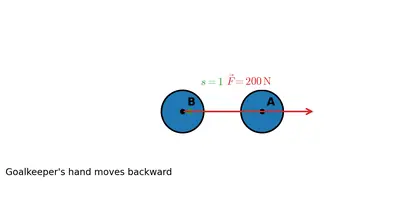
Solution
Given data
- Magnitude of force applied by the goalkeeper:
$$F = 200 \text{ N}$$ - Backward displacement of the hand (same as the displacement of the ball while being stopped):
$$s = 15 \text{ cm} = 0.15 \text{ m}$$
Step 1 — Identify the angle between force and displacement
The goalkeeper's force is exerted opposite to the direction in which the ball is moving. Hence the angle between the applied force (towards the player) and the ball’s displacement (still forward, though slowing down) is $$\theta = 180^{\circ}$$.
Step 2 — Write the work-done formula
For a constant force at an angle $$\theta$$ to the displacement,
$$W = F\,s\,\cos\theta$$
Step 3 — Substitute the known values
$$W = (200\,\text{N})(0.15\,\text{m})\cos 180^{\circ}$$
Since $$\cos 180^{\circ} = -1$$,
$$W = (200)(0.15)(-1)\,\text{J}$$
Step 4 — Evaluate
$$W = -30\,\text{J}$$
\[W = -30 \ \text{J}\]The negative sign shows that the goalkeeper’s hand removed energy from the ball (work done against its motion), thereby stopping it.
Answer
Work done = $$-30\,\text{J}$$
Pause and Ponder (after Section 7.1)
1
Solution
Step 1 — Recall the definition of mechanical work
When a constant force $$\vec F$$ acts on a body and the centre of mass of the body undergoes a displacement $$\vec s$$, the work done by the force is defined as
\[ W = \vec F \cdot \vec s = F s \cos \theta \]
where $$\theta$$ is the angle between $$\vec F$$ and $$\vec s$$.
Step 2 — Identify the force and displacement for the barbell
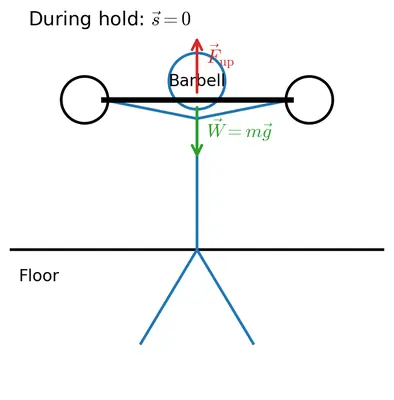
The weightlifter exerts an upward force $$F = mg$$ on the barbell to balance its weight. While she is holding it steady, the barbell does not move upward or downward. Hence its displacement is
$$ s = 0 $$.
Step 3 — Compute the work done
Using the work formula with $$s = 0$$:
$$ W = F s \cos \theta = F (0) \cos \theta = 0 \text{ J}. $$
Step 4 — Interpretation
Because the barbell’s displacement is zero, the mechanical work done on it is zero, even though the weightlifter’s muscles consume energy internally to keep the force applied.
Therefore, while holding the barbell steady, the weightlifter does no mechanical work on the barbell.
Answer
No. The barbell’s displacement is zero, so the work done on it is $$W = 0\,\text{J}$$.
2
Solution
Problem restated
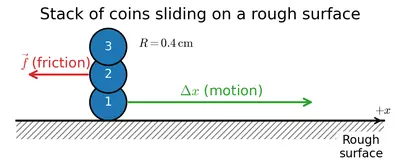
The stack of coins slides forward on a horizontal rough surface (Fig. 6.13c). We have to decide whether the work done by the frictional force exerted by the surface on the coins is positive, negative or zero.
Identify the directions
• Displacement of the coins, $$\vec{s}$$: forward.
• Kinetic friction on the coins, $$\vec{F}_f$$: exactly opposite to the motion (backward), because friction always opposes relative motion.Use the definition of work
By definition, the work done by a constant force is
$$W = \vec{F}_f \cdot \vec{s} = F_f\,s\cos\theta,$$ where $$\theta$$ is the angle between $$\vec{F}_f$$ and $$\vec{s}$$.Substitute the angle
Since the two vectors point in opposite directions, $$\theta = 180^{\circ}$$. For this angle $$\cos 180^{\circ} = -1$$.Sign of the work
\[ W = F_f\,s\cos 180^{\circ} = -F_f\,s < 0 \]
Hence the numerical value of the work is negative.Conclusion
The work done by friction on the moving stack of coins is negative. (This negative work removes kinetic energy and eventually brings the coins to rest.)
Answer
Negative work.
Example 7.3
Example 7.3
Solution
Given information
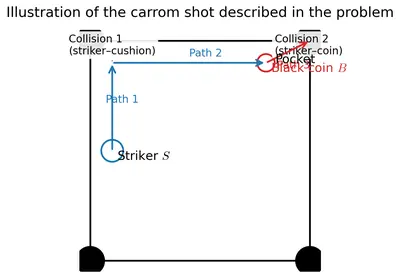
The striker is flicked by the player, hits an intermediate (white) coin, which in turn strikes the required black coin and pockets it. We neglect air resistance and sliding friction on the board for the very short time‐intervals of interest, but we do keep track of the small losses to sound and heat that inevitably accompany every collision.
Step 1 Who actually does external work?
- The only agent that supplies energy from outside the system of coins is the player’s finger/hand. While flicking, the muscles exert a force $$\vec F$$ on the striker through a displacement $$\vec s$$, so the work done is
\[W = \vec F\, \cdot \vec s > 0\]
- This positive work converts the player’s chemical energy of muscles into the kinetic energy of the striker. No one else (the intermediate coin, the black coin, or the pockets) performs external work; afterwards the coins merely exchange the energy already present in the system.
Step 2 Energy changes at every collision
- Finger → Striker
Chemical energy (muscles) $$\longrightarrow$$ Kinetic energy of striker $$K_s = \tfrac12 m_s v_s^2$$. - Striker → Intermediate (white) coin
During the (slightly inelastic) impact the striker exerts an impulsive force on the coin.
• Work done by striker on the coin is the loss of its own kinetic energy:
$$\Delta K_s = -W_{s\,\text{on}\,w}$$,
$$\Delta K_w = +W_{s\,\text{on}\,w}$$.
• Result: a large part of $$K_s$$ becomes kinetic energy of the white coin; a small part is dissipated as sound + heat. - White coin → Black coin
In the next collision the now-moving white coin does work on the stationary black coin.
$$K_w \longrightarrow K_b$$ (kinetic of black coin) + sound + heat.
The white coin slows down almost to rest; the black coin shoots towards the pocket. - Black coin → Pocket / board felt
As the black coin slides and finally drops into the pocket its kinetic energy is completely converted into:
• Heat produced by sliding friction with the board felt.
• Sound made when it touches the base of the pocket.
There is no useful mechanical energy left once the coin comes to rest.
Summary of energy flow
| Stage | Energy before | Energy after |
|---|---|---|
| Finger flick | Chemical (muscles) | Kinetic of striker |
| 1st collision | Kinetic of striker | Kinetic of white coin + sound/heat |
| 2nd collision | Kinetic of white coin | Kinetic of black coin + sound/heat |
| Coin pockets | Kinetic of black coin | Heat + sound (coin at rest) |
Conclusion
The player is the only one who does external mechanical work. Every subsequent contact merely redistributes the kinetic energy already present, each time bleeding off a small fraction as sound and heat until the black coin finally stops in the pocket.
Answer
The player alone does external work. His muscles convert chemical energy into the striker’s kinetic energy. At the striker–white coin collision that kinetic energy is transferred to the white coin with a small loss to sound/heat; at the white-coin–black-coin collision the same transfer occurs to the black coin, again with minor losses; finally the black coin’s kinetic energy is dissipated as heat and sound when it slides and comes to rest in the pocket.
Pause and Ponder (after Section 7.2)
3 When you pedal a bicycle on a flat road, your muscles supply energy. In what forms does this muscular energy appear as you ride?
Solution
Given concept
Muscular energy originates from the chemical energy of the food stored in our body. Whenever we do mechanical work (for example, pedalling a bicycle), this muscular energy is transformed into other forms of energy.
Application to the present situation
- To set the bicycle and rider in motion
• The chief useful output is the kinetic energy of translation of the bicycle–rider system.
• The rotating parts (wheels, crank, chain sprockets) also gain rotational kinetic energy.
Therefore a major part of the muscular energy becomes mechanical (kinetic) energy: $$E_{\text{muscle}} \longrightarrow E_{\text{kinetic}}\;.$$ - To overcome resistive forces
Even on a level road the rider must work continuously because of- rolling friction between tyre and road,
- internal friction in the chain, bearings, gears, and
- air resistance (drag).
- Minor energy channels
A very small fraction is converted into sound produced by the chain, gears or the tyres rubbing the road: $$E_{\text{muscle}} \longrightarrow E_{\text{sound}}.$$
Summary of energy transformations
Thus, while pedalling on a flat road, the chemical energy stored in our muscles is mainly converted into:
- mechanical (kinetic) energy of the bicycle and its moving parts,
- heat energy (due to friction and air resistance), and
- sound energy (a negligible share).
Answer
Muscular (chemical) energy is transformed chiefly into (i) mechanical kinetic energy of the bicycle and rider, (ii) heat energy produced by friction and air resistance, and (iii) a small amount of sound energy.
Example 7.4
Example 7.4 If the velocity of a vehicle doubles in magnitude, what will its kinetic energy be compared to its original value?
Solution
Kinetic energy of a body is given by the formula $$K = \tfrac{1}{2} m v^{2}$$, where $$m$$ is the mass of the body and $$v$$ is its speed.
Step 1 – Original kinetic energy
If the initial speed of the vehicle is $$v$$, its initial kinetic energy is
Step 2 – Kinetic energy after doubling the speed
When the speed is doubled, the new speed becomes $$2v$$. Substituting $$2v$$ for $$v$$ in the formula,
$$K_2 = \tfrac{1}{2} m (2v)^{2}$$
Simplify the square:
$$K_2 = \tfrac{1}{2} m (4v^{2})$$
Factor the numerical coefficient:
$$K_2 = 4 \left( \tfrac{1}{2} m v^{2} \right)$$
But $$\tfrac{1}{2} m v^{2} = K_1$$, therefore
\[K_2 = 4K_1\]Conclusion
Doubling the speed makes the kinetic energy four times its original value.
Answer
It becomes four times the original kinetic energy.
Example 7.5
Example 7.5 In one of their fastest deliveries, an Indian cricketer bowled a cricket ball with an approximate mass of $$0.2 \, \mathrm{kg}$$ at a velocity of about $$154.8 \, \mathrm{km \, h^{-1}}$$. Calculate the kinetic energy of the ball at the time of its delivery.
Solution
Given data
- Mass of the cricket ball: $$m = 0.2\,\text{kg}$$
- Speed of the delivery: $$v = 154.8\,\text{km\,h}^{-1}$$
Step 1: Convert the speed to metres per second (SI unit)
We know $$1\,\text{km\,h}^{-1} = \tfrac{1000\,\text{m}}{3600\,\text{s}} = \tfrac{5}{18}\,\text{m\,s}^{-1}$$.
So
$$v = 154.8 \times \frac{5}{18}\,\text{m\,s}^{-1}$$
First divide by 18:
$$\frac{154.8}{18} = 8.6$$
Then multiply by 5:
$$v = 8.6 \times 5 = 43.0\,\text{m\,s}^{-1}$$
Step 2: Write the formula for kinetic energy
For an object of mass $$m$$ moving with speed $$v$$, the kinetic energy $$E_{\text{k}}$$ is
$$E_{\text{k}} = \tfrac{1}{2} m v^{2}$$
Step 3: Substitute the numerical values
$$E_{\text{k}} = \tfrac{1}{2} \times 0.2\,\text{kg} \times (43.0\,\text{m\,s}^{-1})^{2}$$
First square the velocity:
$$v^{2} = 43.0^{2} = 1849$$
Multiply by the mass:
$$m v^{2} = 0.2 \times 1849 = 369.8$$
Now take half of this product:
$$E_{\text{k}} = \tfrac{1}{2} \times 369.8 = 184.9$$
Step 4: State the final answer with appropriate significant figures
\[E_{\text{k}} \;\approx\; 1.85 \times 10^{2}\, \text{J}\]
Thus, the kinetic energy of the ball at the moment of delivery is approximately $$185\,\text{joules}$$.
Answer
$$E_{\text{k}} \approx 1.85 \times 10^{2}\, \text{J}$$
Example 7.6
Example 7.6
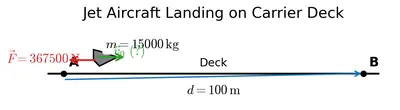
Solution
Given data
- Mass of the jet, $$m = 15000 \; \mathrm{kg}$$
- Retarding (backward) force, $$F = 367500 \; \mathrm{N}$$
- Stopping distance, $$s = 100 \; \mathrm{m}$$
- Final velocity after being stopped, $$v_f = 0 \; \mathrm{m\,s^{-1}}$$
We have to find the initial velocity $$v_i$$ of the aircraft just before the hook engaged the wire.
Method : Work–energy theorem
The work done by the constant backward (retarding) force equals the change in kinetic energy of the aircraft.
Work done by the force:
Because the force is opposite to the direction of motion, the angle between the force and the displacement is $$180^{\circ}$$, so $$\cos 180^{\circ} = -1$$.
$$W = F \; s \; \cos 180^{\circ} = -F s$$
Change in kinetic energy:
$$\Delta K = K_f - K_i = \frac12 m v_f^{2} - \frac12 m v_i^{2} = 0 - \frac12 m v_i^{2} = -\frac12 m v_i^{2}$$
According to the work–energy theorem,
$$W = \Delta K$$
Substituting the expressions for $$W$$ and $$\Delta K$$:
$$-F s = -\frac12 m v_i^{2}$$
Cancel the negative signs on both sides:
$$F s = \frac12 m v_i^{2}$$
Solve for $$v_i$$:
$$v_i^{2} = \frac{2 F s}{m}$$
Now plug in the given values:
$$v_i^{2} = \frac{2 \times 367500 \; \mathrm{N} \times 100 \; \mathrm{m}}{15000 \; \mathrm{kg}}$$
First, multiply the numerator:
$$2 \times 367500 = 735000$$
$$735000 \times 100 = 73500000$$
So,
$$v_i^{2} = \frac{73500000}{15000}$$
Divide:
$$v_i^{2} = 4900$$
Take square root:
$$v_i = \sqrt{4900} = 70 \; \mathrm{m\,s^{-1}}$$
Therefore, the aircraft was moving at $$70 \; \mathrm{m\,s^{-1}}$$ just before the wire caught the hook.
Answer
$$v = 70 \; \mathrm{m\,s^{-1}}$$
Pause and Ponder (after Example 7.6)
4 Two objects A and B of mass $$m$$ and $$4m$$ have the same kinetic energy. What is the ratio of the magnitude of velocities of A and B?
Solution
Step 1 | Write the expression for kinetic energy
For any object of mass $$m$$ moving with speed $$v$$, the kinetic energy is
\[K = \tfrac12 m v^2\]Step 2 | Write kinetic energy for each object
- Object A: mass $$m$$, speed $$v_A$$
$$K_A = \tfrac12 m v_A^2$$ - Object B: mass $$4m$$, speed $$v_B$$
$$K_B = \tfrac12 (4m) v_B^2$$
Step 3 | Set the kinetic energies equal
It is given that the two kinetic energies are the same:
$$K_A = K_B$$
Substitute the expressions just written:
$$\tfrac12 m v_A^2 = \tfrac12 (4m) v_B^2$$
Step 4 | Simplify the equality
Cancel the common factor $$\tfrac12 m$$ from both sides:
$$v_A^2 = 4 v_B^2$$
Step 5 | Take the square root
$$v_A = 2 v_B$$ (Only the positive root is taken because speed is a magnitude.)
Step 6 | Write the required ratio
\[\frac{v_A}{v_B} = 2 : 1\]Thus, the magnitude of the velocity of object A is twice that of object B.
Answer
Ratio of speeds: $$v_A : v_B = 2 : 1$$
5 Does the kinetic energy of an object which moves with constant velocity change with its position?
Solution
Given : An object of mass m is moving with constant (uniform) velocity $$\vec v$$.
Concept used : The kinetic energy (K.E.) of a body is defined as
\[K = \frac{1}{2} m v^{2}\]
where v is the magnitude of the velocity.
Explanation :
- When the motion is with constant velocity, its magnitude $$v$$ remains the same at every instant of time.
- The mass m of the object is, of course, fixed.
- Since both factors that appear in the formula for kinetic energy – mass m and speed v – stay unchanged, the numerical value of $$K$$ does not vary as the object changes its position along the path.
Hence, the kinetic energy is constant; it does not depend on the position of the object so long as the velocity remains constant.
Answer
No. With constant velocity, $$K = \tfrac{1}{2} m v^{2}$$ stays the same everywhere, so kinetic energy is independent of position.
Example 7.7
Example 7.7 After taking a catch, a fielder threw the cricket ball of mass 200 g high up in the air about 10 m above the ground in celebration. How much potential energy will the ball have when the ball reaches its maximum height? Assume $$g = 10 \, \mathrm{m \, s^{-2}}$$.
Solution
Given data
- Mass of the cricket ball: $$m = 200 \text{ g}$$
- Maximum height above the ground: $$h = 10 \text{ m}$$
- Acceleration due to gravity: $$g = 10 \mathrm{ m\,s^{-2}}$$
Step 1: Convert mass to SI units
$$200 \text{ g} = \frac{200}{1000} \text{ kg} = 0.2 \text{ kg}$$
Step 2: Recall the formula for gravitational potential energy
The gravitational potential energy $$U$$ at height $$h$$ is
$$U = mgh.$$
Step 3: Substitute the known values
$$U = (0.2 \text{ kg})(10 \mathrm{ m\,s^{-2}})(10 \text{ m}).$$
Step 4: Calculate
$$U = 0.2 \times 10 \times 10 = 20 \text{ J}.$$
Result
The ball’s gravitational potential energy at the highest point is
\[U = 20\;\text{J}\]
Answer
$$U = 20 \text{ J}$$
Pause and Ponder (after Example 7.7)
6 Does the potential energy of an object near the surface of the Earth change if it moves with constant velocity in the horizontal direction? What if the object is gradually raised in the vertical direction?
Solution
Known relation for gravitational potential energy near Earth’s surface
For an object of mass $$m$$ kept at height $$h$$ (measured from an arbitrary reference level), the gravitational potential energy is
\[U = m g h\] where $$g$$ is the acceleration due to gravity (≈ 9.8 m s−2).
(i) Motion with constant velocity in the horizontal direction
- The object moves parallel to the Earth’s surface, so its vertical coordinate (its height $$h$$ above the chosen reference level) remains the same:
$$h_2 = h_1$$. - Initial potential energy: $$U_1 = m g h_1$$.
- Final potential energy: $$U_2 = m g h_2 = m g h_1$$.
- Change in potential energy:
$$\Delta U = U_2 - U_1 = m g h_1 - m g h_1 = 0$$.
Therefore, while the object moves horizontally (with any speed), its gravitational potential energy does not change.
(ii) Motion in the vertical direction (object gradually raised)
- Let the object be lifted from height $$h_1$$ to a greater height $$h_2$$, so $$h_2 > h_1$$.
- Initial potential energy: $$U_1 = m g h_1$$.
- Final potential energy: $$U_2 = m g h_2$$.
- Change in potential energy:
$$\Delta U = U_2 - U_1 = m g (h_2 - h_1)$$. - Since $$h_2 - h_1 > 0$$, we get $$\Delta U > 0$$; i.e. the potential energy increases in direct proportion to the rise in height.
Conclusion
- Horizontal motion at constant level ⟹ no change in gravitational potential energy.
- Vertical upward motion ⟹ gravitational potential energy increases by $$m g \Delta h$$.
Answer
No. When the object moves horizontally at the same height, $$U = mgh$$ stays constant, so its gravitational potential energy does not change.
Yes. When the object is raised through a height $$\Delta h$$, its potential energy increases by $$\Delta U = mg\,\Delta h$$.
Example 7.8
Example 7.8 What will be the magnitude of velocity of the child on reaching the bottom of the slide of height $$h$$?
Solution
Given data
- Height of the top of the slide above the bottom: $$h$$
- Mass of the child: $$m$$ (it will cancel out, but we keep it during the derivation)
- Initial speed at the top: the child starts from rest, so $$u = 0$$
- The slide is considered smooth (negligible friction and air resistance), therefore mechanical energy is conserved.
Step 1 – Write the mechanical energy at the top
At the top the child is at height $$h$$. Hence
• Potential energy (PE)
$$\text{PE}_{\text{top}} = m g h$$
• Kinetic energy (KE)
Because $$u = 0$$,
$$\text{KE}_{\text{top}} = \tfrac12 m u^2 = \tfrac12 m (0)^2 = 0$$
• Total mechanical energy at the top
$$E_{\text{top}} = \text{PE}_{\text{top}} + \text{KE}_{\text{top}} = m g h + 0 = m g h$$
Step 2 – Write the mechanical energy at the bottom
At the bottom the child’s height is zero, so
• Potential energy
$$\text{PE}_{\text{bottom}} = m g (0) = 0$$
• Let the unknown speed at the bottom be $$v$$. Then the kinetic energy is
$$\text{KE}_{\text{bottom}} = \tfrac12 m v^2$$
• Total mechanical energy at the bottom
$$E_{\text{bottom}} = \text{PE}_{\text{bottom}} + \text{KE}_{\text{bottom}} = 0 + \tfrac12 m v^2 = \tfrac12 m v^2$$
Step 3 – Apply conservation of mechanical energy
Because the slide is smooth, no energy is lost to friction, so
$$E_{\text{top}} = E_{\text{bottom}}$$
Substitute the two energies:
$$m g h = \tfrac12 m v^2$$
Step 4 – Solve for $$v$$
First cancel the common factor $$m$$ (mass does not affect the result):
$$g h = \tfrac12 v^2$$
Multiply both sides by $$2$$:
$$2 g h = v^2$$
Now take the square root of both sides (speed is positive):
\[v = \sqrt{2 g h}\]
The magnitude of the child’s velocity on reaching the bottom depends only on $$g$$ and the vertical height $$h$$ of the slide.
Answer
$$v = \sqrt{2 g h}$$
Example 7.9
Example 7.9
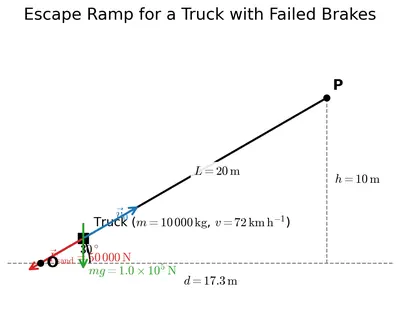
Solution
1. Convert the truck’s speed to SI units
$$v = 72\;\mathrm{km\,h^{-1}} = 72 \times \frac{1000\,\mathrm{m}}{3600\,\mathrm{s}} = 20\;\mathrm{m\,s^{-1}}$$
2. Initial kinetic energy of the truck
$$K_i = \tfrac12 m v^2 = \tfrac12 (10000\;\mathrm{kg})(20\;\mathrm{m\,s^{-1}})^{2} = 2.0\times10^{6}\;\mathrm{J}$$
3. Forces opposing the motion on the slope
- Component of truck’s weight along the incline:
$$W_{\parallel} = mg \sin\theta = (10000)(10)\sin30^{\circ} = 50000\;\mathrm{N}$$ - Retarding force exerted by sand:
$$F_s = 50000\;\mathrm{N}$$
Thus the total retarding force is
$$F_{\text{total}} = W_{\parallel} + F_s = 50000\;\mathrm{N} + 50000\;\mathrm{N} = 100000\;\mathrm{N}$$
4. Energy required to bring the truck to rest
The work done by the total retarding force over a distance $$s$$ along the ramp equals the initial kinetic energy:
$$F_{\text{total}} \; s = K_i$$
Substituting the numbers,
$$100000\;\mathrm{N}\;\times s = 2.0\times10^{6}\;\mathrm{J}$$
Hence
\[ s = \frac{2.0\times10^{6}}{1.0\times10^{5}} = 20\;\mathrm{m} \]5. Check: vertical rise
With $$\sin30^{\circ}=\tfrac12$$ the truck climbs
$$h = s\sin\theta = 20\times\tfrac12 = 10\;\mathrm{m}$$
which is consistent with the energy used against gravity plus sand.
Minimum length of the escape ramp
\[ \boxed{\;s_{\min} \approx 20\;\mathrm{m}\;} \]Answer
Minimum length of escape ramp $$s_{\min} \approx 20\;\text{m}$$
Pause and Ponder (after Example 7.9)
7
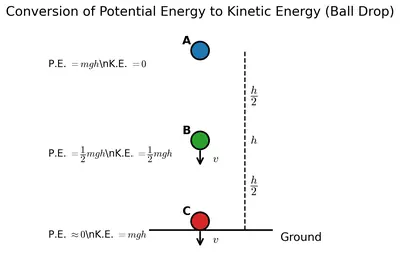
Solution
Given: A ball of mass $$m$$ is allowed to fall freely from a height $$h$$ above the ground (Fig. 7.19). The ground level is chosen as the zero level for gravitational potential energy.
Step 1 – Initial mechanical energy (at height h)
- Initial kinetic energy: the ball is released from rest, so $$K_i = \tfrac12 m u^2 = 0$$ because $$u = 0$$.
- Initial potential energy: $$U_i = m g h$$ (distance of centre of the ball above the ground is $$h$$).
Hence the total (mechanical) energy when the ball is released is
$$E_i = K_i + U_i = 0 + m g h = m g h.$$
Step 2 – Speed just before hitting the ground
The ball falls freely under gravity, so we use the kinematic relation
$$v^2 - u^2 = 2 a s,$$
where $$u = 0$$, $$a = g$$ (downwards) and $$s = h$$ (distance fallen). Therefore
$$v^2 = 2 g h \;\;\;\Rightarrow\;\; v = \sqrt{2 g h}.$$
Step 3 – Mechanical energy just before impact
- Kinetic energy just before impact:
$$K_f = \tfrac12 m v^2 = \tfrac12 m (2 g h) = m g h.$$
- Potential energy at the ground (zero level): $$U_f = 0.$$
The total mechanical energy at this instant is
$$E_f = K_f + U_f = m g h + 0.$$
Step 4 – Comparison with the initial energy
The initial and final totals are identical:
\[E_f = m g h = E_i.\]
Thus, even just before the ball strikes the ground, its mechanical energy is still $$m g h$$, confirming the conservation of mechanical energy for free fall.
Answer
The mechanical energy just before impact is $$mgh$$ — exactly the same as at the start, so energy is conserved.
8
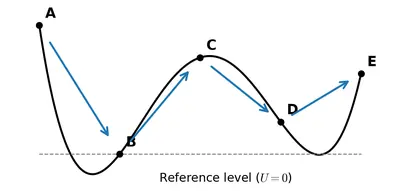
Solution
Given situation – A smooth-looking but real track in a science park has the shape shown in Fig. 7.22 (a succession of hills and valleys). A steel ball is released from the highest point A. The marked positions are
- A – the starting (highest) point
- B – the first lowest point, just after A
- C – the next crest after B
- D, E – still later crests
We have to discuss how gravitational potential energy (PE) and kinetic energy (KE) vary at A, B, C and why the later crests (C, D, E…) are lower than the previous ones.
Choose the horizontal floor of the park as the zero-level of potential energy. Let
- mass of the ball = $$m$$
- $$g$$ = acceleration due to gravity
- heights of the points above the reference level = $$h_A,\,h_B,\,h_C\,(\dots)$$
1. Energy at the top A
The ball is simply released, so initial speed $$u=0$$.
Potential energy at A: $$PE_A = m g h_A$$
Kinetic energy at A: $$KE_A = \dfrac12 m u^2 = 0$$
Total mechanical energy at A is therefore
\[E_A = PE_A + KE_A = m g h_A\]
2. Energy at the bottom B
While rolling down from A to B the ball loses height, so some PE converts into KE.
Height at B (above the chosen reference) is $$h_B$$, so
Potential energy at B: $$PE_B = m g h_B$$
If friction and air resistance are ignored for the moment, the loss in PE equals the gain in KE:
$$KE_B = m g (h_A - h_B)$$
Hence at B, KE is maximum because the height is minimum, whereas PE is minimum.
3. Energy at the next crest C
The ball now climbs up from B to C. Height increases from $$h_B$$ to $$h_C$$, so some of the kinetic energy is reconverted into potential energy.
Potential energy at C: $$PE_C = m g h_C$$
Available mechanical energy just before reaching C (again neglecting friction) would still be
$$E = m g h_A$$ (the same as at A).
Therefore, ideal kinetic energy at C would be
$$KE_C = m g (h_A - h_C)$$
This tells us:
- If there were no dissipative forces, the ball would rise to exactly the original height, i.e. $$h_C = h_A$$ and $$KE_C = 0$$. It would momentarily come to rest before rolling down again, just like an ideal pendulum.
- In the real track, however, some energy is lost as heat and sound because of rolling friction at the axle, deformation of the rails, air resistance, etc. Let the energy lost in going from A to C be $$E_{\text{loss}}$$.
Then the actual mechanical energy available at C is
$$E_C = m g h_A - E_{\text{loss}}$$
Equating this to $$PE_C + KE_C$$ we get
$$m g h_C + KE_C = m g h_A - E_{\text{loss}}$$
Since $$E_{\text{loss}} > 0$$, the same total energy cannot be maintained, which implies $$h_C < h_A$$. In words, the ball cannot climb back to its original height.
4. Why the successive crests keep getting lower (C, D, E…)
Each time the ball rolls along the track it experiences:
- Rolling friction between the ball and the rails
- Internal friction within the ball and the track due to small deformations
- Air resistance, especially when the speed is high near the bottom
All these forces are non-conservative. They convert a part of the mechanical energy into heat and sound, which the ball-track system cannot recover. Consequently the mechanical energy keeps decreasing:
\[E_A > E_C > E_D > E_E > \dots\]
Because potential energy at any crest is $$m g h$$, a fall in total mechanical energy inevitably shows up as a lower attainable height. Therefore every new high point (C, D, E, …) is lower than the immediately preceding one, until finally the ball stops somewhere in the first valley when all its initial mechanical energy has been dissipated.
Summary of energy changes
| Point | Height | Potential Energy | Kinetic Energy |
|---|---|---|---|
| A | Maximum ($$h_A$$) | Maximum ($$mgh_A$$) | Zero (released from rest) |
| B | Minimum ($$h_B$$) | Minimum ($$mgh_B$$) | Maximum (converted from PE) |
| C | Less than A ($$h_C<h_A$$) | Increased again ($$mgh_C$$) | Reduced compared with B; may even be zero if it just reaches C) |
The reduction in the height of successive crests is indeed due to the energy irreversibly lost to friction and air resistance.
Answer
At A: maximum gravitational potential energy $$mgh_A$$ and zero kinetic energy.
At B: the loss of potential energy $$mg(h_A-h_B)$$ has become kinetic; thus PE is minimum while KE is maximum.
At C: part of that kinetic energy is again converted to potential, so PE increases and KE falls. Because some mechanical energy is lost to friction and air resistance, the total energy at C is less than at A, giving $$h_C<h_A$$.
For the same reason every later crest (D, E …) is lower than the previous one: a little mechanical energy is dissipated on each trip, so the ball can no longer rise to its former height.
Example 7.10
Example 7.10 A weightlifter lifts a 75 kg mass by 2 m in 5 seconds. How much power would she require for this task?
Solution
Given data
- Mass lifted: $$m = 75\,\text{kg}$$
- Height raised: $$h = 2\,\text{m}$$
- Time taken: $$t = 5\,\text{s}$$
- Acceleration due to gravity: $$g = 9.8\,\mathrm{m\,s^{-2}}$$
Step 1: Work done against gravity
$$W = mgh$$
$$W = 75\,\text{kg} \times 9.8\,\mathrm{m\,s^{-2}} \times 2\,\text{m}$$
$$W = 75 \times 19.6\,\text{J}$$
$$W = 1470\,\text{J}$$
Step 2: Power required
Power is the rate of doing work:
$$P = \dfrac{W}{t}$$
$$P = \dfrac{1470\,\text{J}}{5\,\text{s}}$$
$$P = 294\,\text{W}$$
\[ P \approx 2.94 \times 10^{2}\,\text{W} \]Conclusion
The weightlifter needs a power of about $$3.0 \times 10^{2}\,\text{W}$$ (approximately 300 W) to lift the mass in the given time.
Answer
Required power $$P \approx 2.94 \times 10^{2}\,\text{W} \approx 3.0 \times 10^{2}\,\text{W}$$ (about 300 W).
Example 7.11
Example 7.11 A car of mass $$1000 \, \mathrm{kg}$$ starts from rest and reaches a speed of $$72 \, \mathrm{km \, h^{-1}}$$ in 10 seconds. Calculate the power of the engine required to achieve this start.
Solution
Given data
- Mass of the car, $$m = 1000 \;\mathrm{kg}$$
- Initial speed, $$u = 0$$ (starts from rest)
- Final speed, $$v = 72\;\mathrm{km\,h^{-1}}$$
- Time taken, $$t = 10\;\mathrm{s}$$
Step 1 – Convert the final speed to SI units
$$v = 72\;\mathrm{km\,h^{-1}} = 72 \times \frac{1000}{3600}\;\mathrm{m\,s^{-1}} = 20\;\mathrm{m\,s^{-1}}$$
Step 2 – Find the change in kinetic energy
The car starts from rest, so its initial kinetic energy is zero. The final kinetic energy is
$$K = \tfrac12 m v^{2}$$
Substituting the values:
$$K = \tfrac12 \times 1000\;\mathrm{kg} \times (20\;\mathrm{m\,s^{-1}})^{2}$$
$$K = \tfrac12 \times 1000 \times 400$$
$$K = 200\,000\;\mathrm{J}$$
This is the work $$W$$ done by the engine during the 10 s start, because on a level road work done $$=\,$$ gain in kinetic energy.
Step 3 – Calculate the power of the engine
Power is the rate of doing work:
$$P = \frac{W}{t}$$
$$P = \frac{200\,000\;\mathrm{J}}{10\;\mathrm{s}}$$
$$P = 20\,000\;\mathrm{W}$$
$$P = 20\;\mathrm{kW}$$
Result
The engine must supply a power of
\[P = 20\;\text{kW}\]
Answer
Required power of the engine: $$P = 20\;\mathrm{kW}$$
Example 7.12
Example 7.12 A person uses an inclined ramp to raise an object over a step 30 cm high. The ramp has a width of 40 cm. What is the mechanical advantage of the ramp that helps the person achieve the task?
Solution
Given data
- Vertical height to be climbed (step height), $$h = 30\;\text{cm}$$.
- Horizontal reach (width of the ramp on the floor), $$b = 40\;\text{cm}$$.
For an inclined plane we need its actual length (the sloping surface) to calculate the ideal mechanical advantage (IMA).
1. Find the length of the ramp
The ramp, the height and the horizontal reach form a right‑angled triangle, so by Pythagoras’ theorem:
$$l = \sqrt{h^{2}+b^{2}}$$
$$l = \sqrt{(30\;\text{cm})^{2} + (40\;\text{cm})^{2}}$$
$$l = \sqrt{900 + 1600}\;\text{cm}$$
$$l = \sqrt{2500}\;\text{cm}$$
$$l = 50\;\text{cm}$$
2. Calculate the mechanical advantage
For an ideal (frictionless) inclined plane:
$$\text{Mechanical Advantage (IMA)} = \dfrac{\text{Length of slope}}{\text{Vertical height}}$$
$$\text{IMA} = \dfrac{l}{h} = \dfrac{50\;\text{cm}}{30\;\text{cm}}$$
$$\text{IMA} = \dfrac{5}{3} \approx 1.67$$
Therefore, the ramp multiplies the applied effort by a factor of about 1.67.
Answer
Mechanical advantage of the ramp: $$\displaystyle \text{MA}=\frac{5}{3}\;\approx\;1.67$$
Pause and Ponder (after Example 7.12)
9
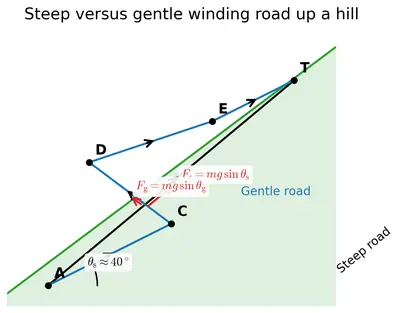
Solution
The hillside road is nothing but a big inclined plane. To see why a long, gently-sloping incline is preferred to a short, steep one, compare the force a vehicle must exert in the two cases.
Let the vehicle of mass $$m$$ finally reach a height $$h$$ above the starting point.
1. Work needed is fixed by the height, not by the path
The gravitational potential-energy gained is
\[ W = m g h \quad(1) \]Equation (1) shows that the total work that has to be done against gravity is the same whether we go straight up or wind around.
2. Force needed on an inclined plane
Suppose the road rises the same height $$h$$ but is made as an incline of length $$l$$, making an angle $$\theta$$ with the horizontal (Fig. 4.26). The component of the vehicle’s weight parallel to the road is
$$F = m g \sin\theta.$$
Because $$\sin\theta = h / l$$, the required uphill pulling force becomes
$$F = m g \dfrac{h}{l}. $$
Longer road ⇒ larger $$l$$ ⇒ smaller $$F$$.
3. Mechanical advantage
For an inclined plane the mechanical advantage is
$$\text{M.A.} = \dfrac{\text{load}}{\text{effort}} = \dfrac{m g}{F} = \dfrac{l}{h}. $$
The larger the ratio $$l/h$$ (that is, the gentler and longer the slope), the less effort the engine has to supply at each instant. While the engine works for a longer distance, it never has to exceed its comfortable force (or power) limit, preventing stalling, overheating, and skidding; passengers also enjoy a safer, smoother ride.
Therefore, roads on hills are made to wind gently instead of rising abruptly, so that the force (and power) required from vehicles at any moment becomes small enough for ordinary engines to manage, even though the total work $$mgh$$ remains unchanged.
Answer
Because a winding road acts as a long, gentle inclined plane. For an incline of length $$l$$ rising a height $$h$$, the force a vehicle must provide is $$F = m g \dfrac{h}{l}$$. Making $$l$$ large (a gentle, zig-zag road) reduces this force far below the almost-vertical value $$mg$$, allowing vehicles to climb the hill safely with the limited power of their engines, even though the total work done $$mgh$$ is the same.
10
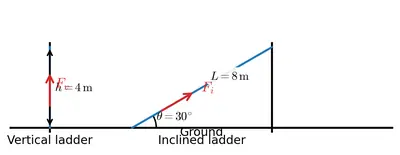
Solution
Given situation
• Height to be reached = $$h$$.
• Weight of the climber = $$mg$$.
• Two possible paths:
- Vertical ladder → distance climbed $$=h$$.
- Inclined ladder: length of ladder $$=L$$, makes angle $$\theta$$ with the horizontal; the same vertical height $$h$$ is reached.
1. Forces acting while climbing very slowly (no acceleration)
The only external force the climber has to balance is the component of the weight acting along the ladder.
Resolve the weight $$mg$$ along (∥) and perpendicular (⟂) to the ladder:
Along the ladder: $$mg\sin\theta$$ [because the angle between $$mg$$ and the normal to the plane is $$\theta$$].
2. Force a climber must apply
To move up very slowly (quasi-static) the net force along the ladder is zero, so the climber’s upward pull must be
\[ F = mg\sin\theta \quad(1) \]For a vertical ladder $$\theta = 90^{\circ}$$, therefore $$F_{\text{vertical}} = mg\sin 90^{\circ} = mg$$.
For any inclined ladder $$0^{\circ} < \theta < 90^{\circ}$$, so $$\sin\theta < 1$$ and
$$F_{\text{inclined}} = mg\sin\theta < mg = F_{\text{vertical}}.$$
3. Work done in each case
Work is the product of the force actually applied and the distance through which that force acts.
(i) Vertical climb:
$$W_v = mg \times h = mgh$$.
(ii) Inclined climb:
\[ W_i = F \times L = \bigl(mg\sin\theta\bigr) L. \]
But for the right-triangle formed by the ladder, $$\sin\theta = \dfrac{h}{L}$$ ⇒ $$L = \dfrac{h}{\sin\theta}$$.
Substituting,
\[ W_i = mg\sin\theta \; \frac{h}{\sin\theta} = mgh = W_v. \quad(2) \]The work needed is the same in both cases; energy is conserved.
4. Why the inclined ladder feels easier
- The required force is smaller, eqn. (1).
- Human effort is usually limited by the maximum force our muscles can exert rather than by the total energy we can expend over a few seconds. A smaller force therefore feels “easier”, even though it has to be exerted over a longer distance.
- This is exactly how an inclined plane (a simple machine) provides mechanical advantage $$\text{M.A.}=\dfrac{\text{load}}{\text{effort}} = \dfrac{mg}{mg\sin\theta} = \dfrac{1}{\sin\theta}=\dfrac{L}{h}>1.$$(Bigger M.A. ⇒ smaller effort).
Conclusion
Climbing an inclined ladder requires the same total work but a smaller force; hence it is felt to be easier than climbing a vertical ladder.
Answer
The inclined ladder is an “inclined plane”. To move up slowly the climber need only balance the component of weight along the ladder,
$$F = mg\sin\theta,$$
where $$\sin\theta < 1$$. Thus the effort needed on the inclined ladder is less than the full weight $$mg$$ that must be overcome on a vertical ladder. Although the climber moves through a greater distance $$L$$, the work done $$F L = mg h$$ is the same; the advantage is the smaller force. Hence climbing the inclined ladder feels easier.
Example 7.13
Example 7.13
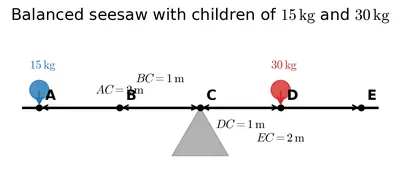
Solution
Given data
Distances of the four seats from the fulcrum C:
- Left-hand side: seat A at $$AC = 2\,\text{m}$$, seat B at $$BC = 1\,\text{m}$$
- Right-hand side: seat D at $$DC = 1\,\text{m}$$, seat E at $$EC = 2\,\text{m}$$
Masses of the two children:
$$m_1 = 15\,\text{kg}, \qquad m_2 = 30\,\text{kg}$$
Principle of moments (law of the lever)
The seesaw is in equilibrium when the algebraic sum of the turning moments about the fulcrum is zero. Taking clockwise moments as positive and anticlockwise moments as negative, we need
$$m_1 g \times r_1 = m_2 g \times r_2$$
where $$r_1$$ and $$r_2$$ are the respective perpendicular distances of the two children from C, on opposite sides.
Choosing suitable seats
Because $$m_2 = 2 m_1$$ (the second child is twice as heavy), the heavier child should sit at half the distance from C compared with the lighter child:
$$r_2 = \dfrac{m_1}{m_2}\,r_1 = \dfrac{1}{2}\,r_1$$
Checking the available seat positions:
| Seat | Side | Distance from C |
|---|---|---|
| A | Left | $$2\,\text{m}$$ |
| B | Left | $$1\,\text{m}$$ |
| D | Right | $$1\,\text{m}$$ |
| E | Right | $$2\,\text{m}$$ |
We therefore place
- the lighter child (15 kg) on a seat 2 m from C (either A or E);
- the heavier child (30 kg) on the diametrically opposite seat 1 m from C (either D or B).
Verification
Example choice: 15 kg at A, 30 kg at D.
Anticlockwise moment: $$m_1 g r_1 = 15g \times 2 = 30g$$
Clockwise moment: $$m_2 g r_2 = 30g \times 1 = 30g$$
Since the two moments are equal and opposite, the seesaw is balanced.
Hence, any of the following symmetric arrangements gives equilibrium:
- 15 kg on A and 30 kg on D, or
- 15 kg on E and 30 kg on B.
Answer
The lighter child of 15 kg must sit on a seat 2 m from the fulcrum (A or E), and the heavier child of 30 kg must sit on the opposite seat 1 m from the fulcrum (D or B). Either 15 kg at A with 30 kg at D, or 15 kg at E with 30 kg at B, balances the seesaw.
Pause and Ponder (end of chapter body)
11
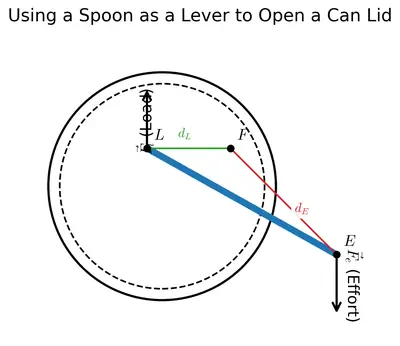
Solution
Concept involved : A spoon used in the manner shown in Fig. 7.35 behaves like a first-class lever.
The rim of the can works as the fulcrum (O). The blade of the spoon just under the lid exerts an upward force on the lid (this is the load, L). The force you apply at the handle is the effort, E.
Moments (turning effects) about the fulcrum
For rotational equilibrium of the lever, the clockwise moment of the load must equal the anticlockwise moment of the effort:
$$ F_L\,l_L = F_E\,l_E $$
where
- $$F_L$$ = force needed to lift the lid (load)
- $$F_E$$ = force applied by your hand (effort)
- $$l_L$$ = load arm = perpendicular distance of the load from fulcrum (very small, only the thickness of the spoon blade)
- $$l_E$$ = effort arm = distance of your hand from fulcrum (length of the handle, several centimetres)
Re-arranging,
$$ F_E = \dfrac{l_L}{l_E}\,F_L $$
Because $$l_E \gg l_L$$, the ratio $$\dfrac{l_L}{l_E}$$ is a small fraction, so the required effort $$F_E$$ is much smaller than the actual force needed to raise the lid directly.
Mechanical advantage
The mechanical advantage (M.A.) of a lever is
$$ \text{M.A.}=\dfrac{F_L}{F_E}=\dfrac{l_E}{l_L}\;\;$$
Since $$l_E \gg l_L$$, we get a large M.A. Hence the spoon multiplies the force of your hand, making it easier to open the can.
Energy viewpoint
The work you do is $$W=F_E\,l_E$$ and the work done on the lid is $$F_L\,l_L$$. From the equality of moments, these two works are equal, so energy is conserved. The spoon does not reduce the work; it only allows the same work to be done with a smaller force acting through a larger distance.
Conclusion : A spoon provides a long effort arm and a short load arm, giving a large mechanical advantage. Therefore a small force exerted at the handle produces a much larger force at the lid, making it easier to open the can.
Answer
The spoon acts as a first-class lever with a long effort arm and a very short load arm, so $$\dfrac{F_L}{F_E}=\dfrac{l_E}{l_L}\gg1$$. Hence a small effort at the handle produces a large force on the lid, making it easier to open.
12 Why do you push an object closer to scissors fulcrum when you want to cut an object which is hard?
Solution
Scissors are examples of class-I levers (fulcrum between effort and load). To understand why we cut hard objects close to the fulcrum, analyse the moment (torque) condition for a lever.
- Label the three key points.
- Fulcrum F: the rivet/pin about which the blades turn.
- Effort E: the force your fingers apply on the handles.
- Load L: the resistance offered by the material being cut, acting at the point on the blades where the material is placed.
- Torque (moment) balance.
For rotational equilibrium, clockwise moment = anticlockwise moment:
$$E \times L_e = L \times L_l$$
where
$$L_e$$ = effort arm (distance F‒E) and $$L_l$$ = load arm (distance F‒L). - Mechanical advantage.
Dividing by $$E$$ gives
$$\text{M.A.}=\dfrac{L}{E}=\dfrac{L_e}{L_l}$$
The smaller the load arm $$L_l$$, the larger the mechanical advantage.
- Shifting the load closer to the fulcrum.
When you slide the material toward F, $$L_l$$ decreases while $$L_e$$ (length of the handle) stays the same. Hence
$$\text{M.A.}\;{\Large\uparrow}\qquad(\because L_l \downarrow)$$
For the same muscular effort $$E$$ the load that can now be overcome is
$$L = \dfrac{E\,L_e}{L_l}$$
Because $$L_l$$ is smaller, $$L$$ becomes much larger; the blades therefore press on the material with a greater force.
- Result.
To cut a hard object you push it right next to the rivet so that the shortened load arm gives the scissors a higher mechanical advantage and a larger cutting force, allowing the hard object to be sheared with the same hand effort.
Answer
Cutting close to the scissors’ fulcrum shortens the load arm, so $$\text{M.A.}=L_e/L_l$$ becomes large; with the same hand force the blades now exert a much bigger force on the material, making it possible to cut the hard object.
13 Throughout history, many designs of perpetual machines (using wheels, weights or magnets) have been proposed but none actually work. Why do all real machines eventually slow down and stop? Explain in terms of work and energy.
Solution
Step 1 — Condition for endless motion
For a wheel or any machine to keep rotating without ever slowing down, its total mechanical energy (kinetic + potential) must remain constant:
\[ E_{\text{mech}} = K + U = \text{constant} \quad(1) \]This requires the net work done by all non-conservative (resistive) forces to be zero.
Step 2 — Resistive forces in every real machine
- Friction at the axle, joints and bearings
- Air resistance on the moving surfaces
- Internal deformation of the parts, producing heat and sound
All these forces oppose the motion at every point, so the angle between the resistive force $$\vec F_{\text{res}}$$ and the displacement $$\vec s$$ is $$180^{\circ}$$. Their work is therefore negative:
\[ W_{\text{res}} = F_{\text{res}}\, s\, \cos 180^{\circ} = -F_{\text{res}}\, s \quad(2) \]Step 3 — Apply the work–energy theorem to one revolution
Let the wheel of mass $$m$$ begin a revolution with speed $$v_0$$. Its initial kinetic energy is
\[ K_0 = \tfrac{1}{2} m v_0^{2} \quad(3) \]During that revolution the resistive forces perform the negative work $$W_{\text{res}}$$ given by Eq. (2). The work–energy theorem states
\[ W_{\text{net}} = \Delta K = K_1 - K_0 \quad(4) \]If no external agent supplies positive work, then $$W_{\text{net}} = W_{\text{res}}$$, and substituting from Eq. (2) gives
\[ K_1 = K_0 + W_{\text{res}} = K_0 - F_{\text{res}}\, s \quad(5) \]Since $$F_{\text{res}}\, s$$ is positive, Eq. (5) shows that $$K_1$$ is smaller than $$K_0$$. The kinetic energy after the revolution is less than it was before, so the speed drops.
Step 4 — Repeat over many revolutions
The same loss occurs in every subsequent revolution. After $$n$$ revolutions,
\[ K_n = K_0 + \sum_{i=1}^{n} W_i \quad(6) \]Every $$W_i$$ is negative, so the kinetic energy steadily decreases. Eventually $$K_n \to 0$$, the speed reaches zero, and the machine comes to rest.
Step 5 — Energy is conserved overall
The mechanical energy that the machine appears to lose is not destroyed; it is converted into internal energy (heat) of the bearings, the air and the machine's parts, with a small fraction radiated as sound. The law of conservation of energy is therefore obeyed — only the mechanical share of the energy decreases.
Conclusion
No real machine can be free of friction and air resistance. These resistive forces always do negative work on the moving parts, continuously draining their mechanical energy into heat and sound. The kinetic energy keeps falling until the motion stops. Hence a perpetual-motion machine is impossible.
Answer
Real machines always experience friction, air resistance and other resistive forces. These forces act opposite to the motion and therefore do negative work on the moving parts, converting mechanical energy into heat and sound. By the work–energy theorem the kinetic energy steadily decreases until the moving parts come to rest. Hence every real machine eventually slows down and stops, and a perpetual-motion machine is impossible.
Revise, Reflect, Refine
1 State whether True or False.
(i) Work is said to be done when a force is applied, even if the object does not move.
Solution
Concept recalled : In physics, work (W) is defined as the dot-product of the force $$\vec F$$ and the displacement $$\vec s$$ produced by it:
\[ W = \vec F \cdot \vec s = F s \cos \theta \quad(1) \]
where $$\theta$$ is the angle between the directions of $$\vec F$$ and $$\vec s$$.
Key point : If there is no displacement (i.e. $$s = 0$$), then irrespective of the magnitude of the applied force, Eq. (1) gives
$$ W = F \times 0 = 0 \,\text{J}. $$
So, merely applying a force without causing any displacement means no work is done.
Answer
False
(ii) Lifting a bucket vertically upward results in positive work done on the bucket.
Solution
Given situation : A bucket is lifted vertically upward.
• Applied force $$\vec F$$ (by the person) acts upward.
• The displacement $$\vec s$$ of the bucket is also upward.
• Hence the angle between $$\vec F$$ and $$\vec s$$ is $$\theta = 0^{\circ}$$.
Using Eq. (1) from part (i),
$$ W = F s \cos 0^{\circ} = F s \times 1 = +F s. $$
The positive sign shows that the work done on the bucket is positive.
Answer
True
(iii) The SI unit for both work and energy is joule (J).
Solution
Fact : One joule (1 J) is defined as the work done when a force of one newton displaces a body by one metre in the direction of the force.
Since energy is the ability to do work, it is measured in the same unit as work. In the SI system that unit is the joule (J).
Answer
True
(iv) A motionless stretched rubber band has kinetic energy.
Solution
Observation : The rubber band is stretched but at rest (motionless).
Because it is not moving, its speed $$v = 0$$, and therefore its kinetic energy $$K = \tfrac12 m v^{2} = 0$$.
However, due to stretching, it stores elastic potential energy, not kinetic energy.
Answer
False
(v) Energy can change from one form to another.
Solution
Principle of energy conversion : Numerous daily examples—like an electric bulb changing electrical energy into light and heat, or a hydroelectric plant converting potential energy of water into electrical energy—show that energy readily transforms from one form to another while the total amount remains conserved.
Answer
True
2 Fill in the blanks.
(i) Work done = _____ × _____ (in the direction of force).
Solution
By definition, mechanical work is the product of the applied force and the displacement produced in the same direction as that force.
Hence,
$$\text{Work done} = \text{Force} \times \text{Displacement}$$
Answer
Force × Displacement
(ii) 1 joule of work is done when a force of _____ newton displaces an object by 1 metre in the direction of the force.
Solution
The SI unit of work is the joule (J). One joule is defined as the work done when a force of 1 newton moves an object through a displacement of 1 metre in the direction of the force.
Therefore, the required value of force is
$$1\;\text{N}.$$
Answer
1 newton
(iii) The expression for kinetic energy of a body of mass $$m$$ and velocity $$v$$ is _____.
Solution
Starting from the work–energy theorem, the work done in accelerating a body of mass $$m$$ from rest to velocity $$v$$ equals the change in its kinetic energy:
$$W = \frac12 m v^2 - 0$$
Thus, the kinetic energy (K.E.) of the body is
$$\text{K.E.} = \frac12 m v^2.$$
Answer
$$\dfrac12 m v^2$$
(iv) The potential energy of an object of mass $$m$$ at a small height $$h$$ from the Earth's surface is _____.
Solution
Near the Earth's surface, the gravitational potential energy (P.E.) gained by lifting a body of mass $$m$$ through a vertical height $$h$$ is equal to the work done against gravity:
$$\text{P.E.} = m g h$$
where $$g$$ is the acceleration due to gravity.
Answer
$$m g h$$
(v) Power is defined as the _____ at which work is done.
Solution
Power measures how fast work is done or energy is transferred.
Formally,
$$\text{Power} = \frac{\text{Work done}}{\text{Time taken}}$$
so power is the rate at which work is done.
Answer
rate
3
When a ball thrown upwards reaches its highest point, tick which of the following statement(s) are correct?
- The force acting on the ball is zero.
- The acceleration of the ball is zero.
- Its kinetic energy is zero.
- Its potential energy is maximum.
Solution
Given: A ball is thrown vertically upward. We examine its physical quantities at the highest point of its flight (air resistance neglected).
- Force on the ball.
Throughout the motion, the only significant force on the ball is its weight $$W = mg$$, directed vertically downward. Even at the highest point — where the ball is momentarily at rest — gravity continues to act, so the force does not become zero.
Conclusion: Statement (i) is false. - Acceleration of the ball.
By Newton's second law, \[ a = \dfrac{F_{\text{net}}}{m} = \dfrac{mg}{m} = g \] directed downward. The acceleration due to gravity $$g \approx 9.8\,\mathrm{m\,s^{-2}}$$ is the same at every point of the trajectory, including the highest one.
Conclusion: Statement (ii) is false. - Kinetic energy at the highest point.
The velocity becomes zero at the top: $$v = 0$$. Therefore \[ K = \tfrac{1}{2} m v^{2} = 0 \] Conclusion: Statement (iii) is true. - Potential energy at the highest point.
Gravitational potential energy is $$U = mgh$$, where $$h$$ is the height measured from the point of projection. The ball is at its greatest height, so $$U$$ is maximum.
Conclusion: Statement (iv) is true.
Final result: The correct statements are (iii) and (iv).
Answer
(iii) and (iv)
4 For each of the following situations, identify the energy transformation that takes place:
(i) a truck moving uphill
Solution
A truck climbs a hill by burning diesel (or petrol).
- The fuel contains chemical energy.
- The engine converts this into mechanical (kinetic) energy of the moving truck.
- As the truck rises through a height $$h$$, it gains gravitational potential energy $$U = mgh$$.
Thus the dominant chain of transformation is:
chemical energy → kinetic energy → gravitational potential energy (with some loss as heat and sound).
Answer
Chemical energy of fuel → kinetic energy of wheels → gravitational potential energy of the truck.
(ii) unwinding of a watch spring
Solution
When you wind a watch, you store elastic potential energy in its spring. As the spring unwinds,
- elastic potential energy → kinetic (mechanical) energy of the gear train and hands.
Answer
Elastic potential energy of the spring → mechanical (kinetic) energy of the watch gears.
(iii) photosynthesis in green leaves
Solution
During photosynthesis, chlorophyll in green leaves absorbs sunlight.
The absorbed radiant (light) energy is used to combine $$\mathrm{CO_2}$$ and $$\mathrm{H_2O}$$ into glucose, $$\mathrm{C_6H_{12}O_6}$$, storing chemical energy in its bonds.
Therefore: light (solar radiant) energy → chemical energy of glucose.
Answer
Light (solar radiant) energy → chemical energy of glucose.
(iv) water flowing from a dam
Solution
Water stored at a height in a dam possesses gravitational potential energy $$U = mgh$$.
As it is released and begins to flow downward, this converts to kinetic energy of the moving water (which can later run a turbine).
Answer
Gravitational potential energy of stored water → kinetic energy of flowing water.
(v) burning of a matchstick
Solution
The chemicals on a match head react with oxygen when struck.
Chemical energy stored in the match → heat energy (flame) + light energy.
Answer
Chemical energy → heat and light energy.
(vi) explosion of a fire cracker
Solution
In a fire-cracker, tightly packed chemicals possess stored chemical energy.
On ignition: chemical energy → light + sound + heat + kinetic energy of fragments.
Answer
Chemical energy → light + sound + heat + kinetic energy.
(vii) speaking into a microphone
Solution
When we speak, our vocal cords create sound waves.
The microphone diaphragm vibrates with these waves, producing an electric current.
Thus: sound energy → electrical energy.
Answer
Sound energy → electrical energy.
(viii) a glowing electric bulb
Solution
An electric bulb takes in electrical energy.
The filament becomes hot, emitting visible light (and some infrared heat).
Therefore: electrical energy → light energy (plus heat).
Answer
Electrical energy → light energy (and heat).
(ix) a solar panel
Solution
In a solar (photovoltaic) panel, incident sunlight excites electrons in semiconductor layers.
Radiant solar energy → electrical energy delivered as a current.
Answer
Light (solar) energy → electrical energy.
5 A student is slowly lifted straight up in an elevator from the ground level to the top floor of a building. Later, the same student climbs the staircase, all the way to the top. Given that the height of the building is $$h = 72.5 \, \mathrm{m}$$, acceleration due to gravity is $$g = 10 \, \mathrm{m \, s^{-2}}$$, and student's mass is $$m = 50 \, \mathrm{kg}$$.
(i) Find the gain in the potential energy if the student is lifted straight up to the top.
Solution
The gravitational potential energy ("gain in P.E.") acquired by a body of mass $$m$$ when it is raised through a vertical height $$h$$ is
$$U = mgh$$
Substitute the given data:
$$m = 50\,\text{kg}, \; g = 10\,\text{m\,s}^{-2}, \; h = 72.5\,\text{m}$$
$$U = (50\,\text{kg})(10\,\text{m\,s}^{-2})(72.5\,\text{m})$$
$$U = 500\times 72.5 \;\text{J}$$
$$U = 36\,250\,\text{J}$$
Answer
Gain in potential energy = $$3.625\times10^{4}\,\text{J}$$ (or $$36\,250\,\text{J}$$).
(ii) Find the gain in the potential energy when the student climbs the stairs to the same top.
Solution
While climbing the stairs the student again reaches the same vertical height $$h = 72.5\,\text{m}$$. Gravitational potential energy depends only on the change in vertical position, not on the path.
Hence
$$U = mgh = (50)(10)(72.5) \;\text{J} = 36\,250\,\text{J}.$$
Answer
The gain in potential energy is the same, $$36\,250\,\text{J}$$.
(iii) What do you conclude about the dependence of the potential energy on the path taken?
Solution
From (i) and (ii) the energy increase is
$$U_{\text{elevator}} = U_{\text{stairs}} = 36\,250\,\text{J}.$$
This equality shows that gravitational potential energy depends only on the vertical displacement (initial and final heights) and is independent of the actual path—whether the student moves straight up or along a staircase.
Answer
Potential energy change depends solely on the vertical height gained, not on the path taken.
6 A crane lifts a mass $$m$$ to the 10th floor of a building in a certain time. It then raises the same mass to the 20th floor of the same building in double the time. How much more energy and power are required? Assume that the height of all floors is equal.
Solution
Given data and symbols
- Mass lifted: $$m$$
- Height of one floor: $$h$$
- First lift: to the 10th floor, so vertical rise $$10h$$ in time $$t$$ (the statement says “a certain time”; call it $$t$$).
- Second lift: to the 20th floor, so vertical rise $$20h$$ in time $$2t$$ (“double the time”).
- Acceleration due to gravity: $$g$$.
1. Work / energy for each lift
Change in gravitational potential energy = work done by the crane.
First lift:
$$W_1 = m g (10h)$$
Second lift:
$$W_2 = m g (20h)$$
$$\Rightarrow \; W_2 = 2\,m g (10h) = 2W_1$$
Extra energy required
$$W_2 - W_1 = 2W_1 - W_1 = W_1 = m g (10h)$$
Thus the second operation needs twice as much energy as the first; the additional energy equals the whole of the first lift’s energy (100 % more).
2. Power for each lift
Average power = work ÷ time.
First lift:
$$P_1 = \dfrac{W_1}{t} = \dfrac{m g (10h)}{t}$$
Second lift:
$$P_2 = \dfrac{W_2}{2t} = \dfrac{m g (20h)}{2t}$$
Simplify:
$$P_2 = \dfrac{20}{2}\,\dfrac{m g h}{t} = 10\,\dfrac{m g h}{t}= \dfrac{m g (10h)}{t}=P_1$$
Extra power required
$$P_2 - P_1 = 0$$
The crane must supply the same power in both cases; there is no increase in power requirement.
Result
- Energy for the 20th-floor lift is double that for the 10th-floor lift; the “extra” energy equals $$m g (10h)$$ (a 100 % increase).
- Power remains unchanged; no additional power is needed.
Answer
Energy: twice as much as before; extra energy $$= m g (10h)$$ (100 % more).
Power: unchanged, $$P_2 = P_1$$; no additional power is required.
7 Which factors determine the energy required to raise a flag from the ground to the top of a tall flagpole using a pulley? Does raising the flag slowly or quickly change the amount of work done? If the speed at which the flag is raised is doubled, how does the power requirement change? Explain your answers.
Solution
Step 1 – Identify what is being lifted and through what height
Let the mass of the flag (together with the short length of rope that actually rises) be $$m$$. The flag is pulled from the ground to the top of a pole of height $$h$$. The vertical distance through which the centre of gravity of the flag is raised is therefore $$h$$.
Step 2 – Write the expression for the gravitational potential energy gained
When an object of mass $$m$$ is lifted vertically through a height $$h$$ against gravity, the increase in its gravitational potential energy is
where $$g$$ is the acceleration due to gravity (approximately $$9.8\,\text{m\,s}^{-2}$$). This increase in potential energy is exactly the mechanical work that must be done by the person (through the pulley) on the flag, provided we neglect friction in the pulley and the weight of the rope.
Therefore, the energy required depends only on
- the mass $$m$$ of the flag (and any part of the rope that is lifted),
- the vertical height $$h$$ through which it is raised, and
- the constant $$g$$ (same at a given place on the Earth).
Whether the flag is raised slowly or quickly does not change $$m$$, $$g$$ or $$h$$, so the work done (and hence the energy required) remains exactly the same.
Step 3 – Effect of speed on power
Suppose the flag is raised at a uniform speed $$v$$. The time taken is
The rate at which work is done, i.e. the power, is
$$P = \frac{W}{t} = \frac{mgh}{h/v} = mgv.$$Thus power is directly proportional to the lifting speed $$v$$.
If the speed is doubled (from $$v$$ to $$2v$$), the time taken halves (from $$t$$ to $$t/2$$) and
\[P_{\text{new}} = mg(2v) = 2\,mgv = 2P_{\text{old}}.\]So the power required becomes twice the original value, even though the total work done is unchanged.
Summary
- Energy (work) needed to hoist the flag: $$W = mgh$$ → depends only on $$m$$, $$g$$ and $$h$$.
- Raising it slowly or quickly: same work, because $$W$$ does not involve time or speed.
- Doubling the speed halves the time and therefore doubles the power requirement: $$P \propto v$$.
Answer
The work/energy required is $$W = mgh$$, so it is determined only by
(i) the mass lifted $$m$$, (ii) the vertical height $$h$$ and (iii) $$g$$. Raising the flag fast or slow does not change this work. Power is $$P = W/t = mgv$$, so if the raising speed is doubled the power needed is also doubled, even though the work done remains the same.
8 A man of mass 60 kg rides a scooter of mass 100 kg. He accelerates the scooter to a velocity $$v$$. The next day, his son with a mass of 40 kg joins him as a passenger. If the scooter reaches the same speed on both days in the same time interval, what is the ratio of the fuel of the tank used on the two days? Assume that the energy transfer to the scooter happens entirely due to fuel, and no other losses occur due to air resistance and friction.
Solution
Step 1 – List the masses on each day
- Mass of the man: $$60 \text{ kg}$$
- Mass of the scooter: $$100 \text{ kg}$$
- Mass of the son: $$40 \text{ kg}$$ (only on the second day)
First day (man + scooter):
$$m_1 = 60 + 100 = 160 \;\text{kg}$$
Second day (man + son + scooter):
$$m_2 = 60 + 40 + 100 = 200 \;\text{kg}$$
Step 2 – Write the work (energy) required each day
The scooter starts from rest and reaches the same speed $$v$$ in both cases. The gain in kinetic energy on each day equals the work done by the engine, and this work comes entirely from burning fuel (no other losses are assumed).
First day:
$$W_1 = \tfrac12 m_1 v^2$$
Second day:
$$W_2 = \tfrac12 m_2 v^2$$
Step 3 – Relate fuel consumption to the work done
The chemical energy released from the fuel is directly proportional to the work done, so
$$F_1 : F_2 = W_1 : W_2$$
Substituting $$W_1$$ and $$W_2$$ gives
$$\displaystyle F_1 : F_2 = \tfrac12 m_1 v^2 : \tfrac12 m_2 v^2 = m_1 : m_2$$
Step 4 – Insert the numerical masses
$$F_1 : F_2 = 160 : 200 = 4 : 5$$
Conclusion
The scooter burns fuel in the ratio 4 : 5; that is, if it uses 4 units of fuel on the first day, it will use 5 units on the second day.
Answer
Fuel consumed (first day) : (second day) = 4 : 5
9
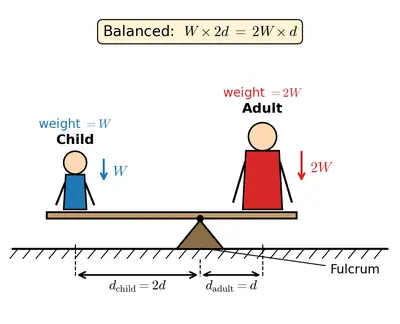
Solution
Principle involved — Law of the Lever
For a seesaw (a type I lever) to be in equilibrium, the algebraic sum of the turning moments (torques) about the fulcrum must vanish:
$$\sum \tau = 0 \implies W_C\,x_C = W_A\,x_A$$
where
- $$W_C$$ = weight of the child,
- $$W_A$$ = weight of the adult,
- $$x_C$$ = perpendicular distance of the child from the fulcrum,
- $$x_A$$ = perpendicular distance of the adult from the fulcrum.
Given data
The adult is twice as heavy as the child:
$$W_A = 2W_C$$
Substitute into the moment balance
$$W_C\,x_C = (2W_C)\,x_A$$
Cancel the common factor $$W_C$$ (it is non-zero):
$$x_C = 2x_A$$
Result
The child must sit at a distance twice that of the adult from the fulcrum.
For example, if the adult adjusts his sliding seat so that he is $$x=1\,\text{m}$$ from the fulcrum, the child must sit $$x_C = 2\,\text{m}$$ away on the opposite side to balance the seesaw.
What to draw
- Draw a horizontal plank pivoted at its centre on a triangular support (the fulcrum).
- Mark the left-hand seat (child) at a distance labelled $$x_C = 2x$$ from the fulcrum and draw a downward arrow labelled $$W_C$$.
- Mark the right-hand seat (adult) at a distance labelled $$x_A = x$$ from the fulcrum and draw a double-length downward arrow labelled $$W_A = 2W_C$$.
- Show the fulcrum exactly midway between the two riders.
This sketch makes it clear that the larger weight sits closer and the smaller weight sits farther so that the clockwise and anticlockwise moments are equal.
Answer
To balance: if the adult is at a distance $$x$$ from the fulcrum, the child must sit at $$2x$$ on the opposite side (twice as far).
10 A ball of mass 2 kg is thrown up with a velocity of $$20 \, \mathrm{m \, s^{-1}}$$.
(i) Identify the sign of the work done by gravity on the ball during its upward motion and its downward motion.
Solution
Given data
Force of gravity (weight) on the ball acts vertically downward throughout the motion.
(a) Upward motion
- Displacement: upward.
- Force of gravity: downward.
- Angle between F and s: $$180^{\circ}$$.
Work done by a constant force is $$W = F s \cos\theta$$. Here, $$\cos180^{\circ} = -1$$, so
\[W_{\text{up}} = F s ( -1 ) < 0 \]The work done by gravity while the ball moves upward is negative.
(b) Downward motion
- Displacement: downward.
- Force of gravity: downward.
- Angle between F and s: $$0^{\circ}$$.
Now $$\cos0^{\circ} = +1$$, hence
\[W_{\text{down}} = F s ( +1 ) > 0 \]The work done by gravity while the ball moves downward is positive.
Answer
Upward motion: work by gravity is negative.
Downward motion: work by gravity is positive.
(ii) If the ball reaches a height of 19.4 m, how much work was done by air resistance (assume $$g = 10 \, \mathrm{m \, s^{-2}}$$).
Solution
Step 1 — Initial kinetic energy of the ball
\[K_i = \tfrac12 m u^2 = \tfrac12 (2\,\text{kg})(20\,\text{m s}^{-1})^2 = \tfrac12 (2)(400) = 400\,\text{J}\]Step 2 — Ideal maximum height (no air resistance)
With only gravity acting, the whole KE would convert into gravitational potential energy (GPE):
\[K_i = m g h_{\text{ideal}} \Rightarrow h_{\text{ideal}} = \frac{K_i}{m g} = \frac{400}{2\times10}=20\,\text{m}\]Step 3 — Actual gravitational potential energy reached
The ball is observed to rise only
\[h_{\text{actual}} = 19.4\,\text{m}\] \[U_{\text{actual}} = m g h_{\text{actual}} = 2\,\text{kg}\times10\,\text{m s}^{-2}\times19.4\,\text{m} = 388\,\text{J}\]Step 4 — Work done by air resistance
Energy lost = Initial KE − Actual gain in GPE
\[W_{\text{air}} = 400\,\text{J} - 388\,\text{J} = 12\,\text{J}\]The force of air resistance acts opposite to the motion, so it removes energy from the ball; therefore the work it does is negative:
\[\boxed{W_{\text{air}} = -12\,\text{J}}\]Answer
The work done by air resistance is $$-12\,\text{J}$$ (negative because it opposes the motion).
11
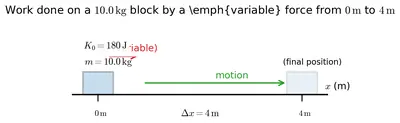
Solution
Given data
Mass of block $$m = 10.0\;\text{kg}$$
Initial kinetic energy at the origin $$K_{0}=180\;\text{J}$$
The force–displacement graph shown in Fig. 7.37 is a triangle that rises uniformly from 0 N at $$s = 0\;\text{m}$$ to 160 N at $$s = 2\;\text{m}$$ and then falls uniformly back to 0 N at $$s = 4\;\text{m}$$. (For the answer it is the area under the graph that matters, not its exact shape.)
1. Initial speed at 0 m
The kinetic-energy formula gives
$$K_{0}=\tfrac12 m v_{0}^{2}\;\;\Longrightarrow\;\;v_{0}=\sqrt{\dfrac{2K_{0}}{m}}$$
$$v_{0}=\sqrt{\dfrac{2\times 180\;\text{J}}{10\;\text{kg}}}=\sqrt{36}=6\;\text{m s}^{-1}$$
2. Work done by the variable force between 0 m and 4 m
The work is the shaded area under the graph.
- First triangle (0 m → 2 m): $$W_{1}=\tfrac12\times 2\;\text{m}\times 160\;\text{N}=160\;\text{J}$$
- Second triangle (2 m → 4 m): $$W_{2}=\tfrac12\times 2\;\text{m}\times 160\;\text{N}=160\;\text{J}$$
Total work
$$W=W_{1}+W_{2}=160\;\text{J}+160\;\text{J}=320\;\text{J}$$
3. Final speed at 4 m
Work–energy theorem: $$K_{4}=K_{0}+W$$
$$K_{4}=180\;\text{J}+320\;\text{J}=500\;\text{J}$$
The speed $$v_{4}$$ corresponding to this kinetic energy is
$$K_{4}=\tfrac12 m v_{4}^{2}\;\;\Longrightarrow\;\;v_{4}=\sqrt{\dfrac{2K_{4}}{m}}$$
$$v_{4}=\sqrt{\dfrac{2\times 500}{10}}=\sqrt{100}=10\;\text{m s}^{-1}$$
4. Does the block ever have negative acceleration?
Throughout the 4 m span the applied force is in the same direction as motion, so $$F\gt 0\;\Rightarrow\;a=F/m\gt0$$ at every point. Although the magnitude of the force (hence the acceleration) decreases after 2 m, it never becomes negative. Therefore, the block never experiences negative acceleration (retardation) during the given interval.
Answer
(i) Speed at 0 m: $$6\;\text{m s}^{-1}$$
(ii) Speed at 4 m: $$10\;\text{m s}^{-1}$$
No part of the motion involves negative acceleration.
12 The gravitational attraction on the surface of the Moon (lunar surface) is about $$\frac{1}{6}$$th of that on the surface of the Earth. An astronaut can throw a ball up to a height of 8 m from the surface of the Earth. How far up will the ball thrown with the same upward velocity travel from the surface of the Moon?
Solution
Given data
- Maximum height reached on Earth: $$h_E = 8 \;\text{m}$$
- Acceleration due to gravity on Earth: $$g_E$$ (symbolic)
- Acceleration due to gravity on Moon: $$g_M = \dfrac{g_E}{6}$$
Step 1: Initial speed on Earth
The kinematic relation for vertical motion is
$$v^2 = u^2 + 2 a s$$
At the highest point $$v = 0$$ and $$a = -g_E$$, so
$$0 = u^2 - 2 g_E h_E \;\Rightarrow\; u^2 = 2 g_E h_E \quad(1)$$
Step 2: Height on the Moon with the same speed
On the Moon the upward motion obeys
$$0 = u^2 - 2 g_M h_M \;\Rightarrow\; h_M = \dfrac{u^2}{2 g_M}$$
Because $$g_M = \dfrac{g_E}{6}$$,
$$h_M = \dfrac{u^2}{2 \bigl(\dfrac{g_E}{6}\bigr)} = \dfrac{6 u^2}{2 g_E} = 3\,\dfrac{u^2}{g_E} \quad(2)$$
Step 3: Substitute $$u^2$$ from (1)
Insert $$u^2 = 2 g_E h_E$$ into (2):
$$h_M = 3\,\dfrac{2 g_E h_E}{g_E} = 6 h_E$$
Step 4: Numerical value
$$h_M = 6 \times 8 \;\text{m} = 48 \;\text{m}$$
Result
The ball will rise to a height of about $$48\,\text{m}$$ from the surface of the Moon.
Answer
$$h_M = 48\,\text{m}$$
13
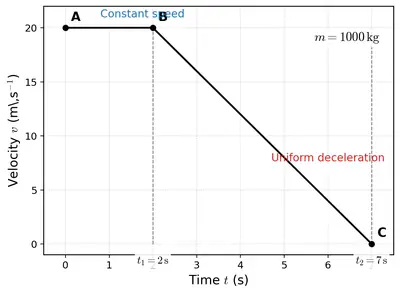
(i) Describe how the car moves between positions A and B.
Solution
The horizontal portion of the speed–time graph from A to B is a straight line parallel to the time-axis, which means the speed does not change during this interval.
Hence, between A and B the car keeps moving with the same (uniform) speed. No braking force acts during this part; the segment AB simply represents the driver’s reaction time after seeing the obstruction.
Answer
Between A and B the car travels with uniform speed – it neither accelerates nor decelerates.
(ii) Calculate the kinetic energy of the car at A.
Solution
At point A (and throughout AB) the speed read from the graph is $$v = 20\,\text{m s}^{-1}$$.
Mass of the car: $$m = 1000\,\text{kg}$$.
Kinetic energy at A:
\[E_K = \frac12 m v^2 \]Substituting the numbers,
$$E_K = \frac12 \times 1000\,\text{kg} \times (20\,\text{m s}^{-1})^2$$
$$E_K = 500 \times 400$$
$$E_K = 2.0 \times 10^5\,\text{J}$$
Answer
Kinetic energy at A: $$2.0 \times 10^5\,\text{J}$$.
(iii) State the work done by the brakes in bringing the car to a halt between B and C.
Solution
The car finally comes to rest at C, so its kinetic energy there is zero.
Work done by the brakes = change in kinetic energy
$$W = E_{K,\,C} - E_{K,\,A} = 0 - 2.0\times10^5\,\text{J}$$
$$W = -2.0\times10^5\,\text{J}$$
The negative sign shows that the work is done against the motion (it is the brakes that do the work on the car).
Answer
Work done by the brakes = $$-2.0\times10^5\,\text{J}$$ (magnitude $$2.0\times10^5\,\text{J}$$).
(iv) What does the kinetic energy of the car transform into?
Solution
The kinetic energy lost by the car is mainly converted into heat produced in the brake shoes, the tyres and the road surface, and a small part appears as sound.
Answer
It is converted chiefly into heat (and a little sound) in the brakes, tyres and road.
14
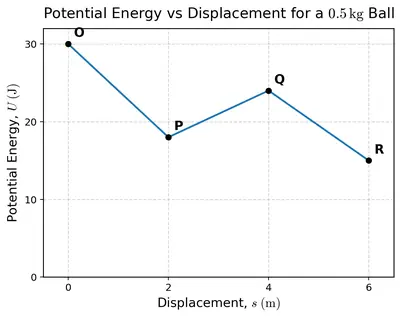
Solution
Step 1 – Read the potential–energy values from the graph
- At point O (starting point) the graph shows a potential energy of $$30\,\text{J}$$.
- From the graph, the heights corresponding to the other three marked positions are:
P : $$U_P = 20\,\text{J}$$,
Q : $$U_Q = 0\,\text{J}$$,
R : $$U_R = 30\,\text{J}$$.
Step 2 – Find the total mechanical energy of the ball
The ball is released from rest at O, so its kinetic energy there is zero.
$$E_{\text{total}} = U_O + K_O = 30\,\text{J} + 0 = 30\,\text{J}$$
Because the track is friction-less, this total mechanical energy remains the same everywhere on the track.
Step 3 – Relate kinetic energy and speed
At any point, $$K = \tfrac12\,m v^2$$, hence
$$v = \sqrt{\dfrac{2K}{m}}$$
The mass of the ball is $$m = 0.5\,\text{kg}$$.
Step 4 – Calculate speed at each point
| Point | Potential energy $$U$$ (J) | Kinetic energy $$K=E_{\text{total}}-U$$ (J) | Speed $$v=\sqrt{2K/m}$$ (m s−1) |
|---|---|---|---|
| P | $$20$$ | $$30-20 = 10$$ | $$v_P = \sqrt{\dfrac{2\times10}{0.5}} = \sqrt{40} \approx 6.32$$ |
| Q | $$0$$ | $$30-0 = 30$$ | $$v_Q = \sqrt{\dfrac{2\times30}{0.5}} = \sqrt{120} \approx 10.95$$ |
| R | $$30$$ | $$30-30 = 0$$ | $$v_R = 0$$ |
Step 5 – State the results
The velocities of the 0.5 kg ball are therefore:
- at P : $$v_P \approx 6.3\,\text{m s}^{-1}$$
- at Q : $$v_Q \approx 11\,\text{m s}^{-1}$$
- at R : $$v_R = 0\,\text{m s}^{-1}$$
Answer
$$v_P \approx 6.3\,\mathrm{m\,s^{-1}},\; v_Q \approx 11\,\mathrm{m\,s^{-1}},\; v_R = 0$$
15 A coconut of mass 1.5 kg falls from the top of a coconut tree onto the wet sand on a beach. The height of the tree is 10 m. On impact, the coconut comes to rest by making a depression in the sand.
(i) Calculate the velocity of the coconut just before it hits the sand.
Solution
Given mass is not required for finding the velocity; only the height matters.
Initial velocity of the coconut just as it starts to fall: $$u = 0 \text{ m s}^{-1}$$
Height of fall: $$h = 10 \text{ m}$$
Acceleration due to gravity: $$g = 10 \text{ m s}^{-2}$$
Use the kinematic relation $$v^{2} = u^{2} + 2 g h$$.
Substituting the values:
$$v^{2} = 0 + 2 \times 10 \times 10 = 200$$
Taking the square root:
$$v = \sqrt{200} = 14.14 \text{ m s}^{-1}$$
Rounded to two significant figures, $$v \approx 14 \text{ m s}^{-1}$$.
Answer
$$v \approx 14 \text{ m s}^{-1}$$
(ii) Assume that the average resistive force of sand is 3000 N and all of the coconut's energy is used to create the depression in the sand. Calculate the depth of the depression the coconut makes in the sand. Assume $$g = 10 \, \mathrm{m \, s^{-2}}$$.
Solution
Average resistive force offered by sand: $$F = 3000 \text{ N}$$
The kinetic energy of the coconut just before impact is completely used up in doing work against this resistive force while coming to rest inside the sand.
Kinetic energy at impact:
$$\tfrac12 m v^{2} = \tfrac12 \times 1.5 \times 14.14^{2} \text{ J}$$
Since $$v^{2} = 200$$ (from part (i)), it is quicker to write:
$$\tfrac12 m v^{2} = \tfrac12 \times 1.5 \times 200 = 150 \text{ J}$$
Let $$d$$ be the depth of the depression. Work done against the resistive force is
$$F d = 3000 \times d$$
Equating work done to the initial kinetic energy:
$$F d = \tfrac12 m v^{2}$$
$$\Rightarrow d = \frac{\tfrac12 m v^{2}}{F} = \frac{150}{3000} = 0.05 \text{ m}$$
Convert to centimetres:
$$0.05 \text{ m} = 5 \text{ cm}$$
Answer
Depth of depression $$d = 0.05 \text{ m} = 5 \text{ cm}$$


