 91- 6303239042


Examples 6.1-6.8
Example 6.1
(a) Both forces of $$10 \, \mathrm{N}$$ and $$6 \, \mathrm{N}$$ act on the block in the same direction (towards the right).
(b) The force of $$10 \, \mathrm{N}$$ acts towards the right and the force of $$6 \, \mathrm{N}$$ acts towards the left.
(c) The force of $$6 \, \mathrm{N}$$ acts towards the right and the force of $$10 \, \mathrm{N}$$ acts towards the left.

Solution
Concept used: The net (resultant) force $$F_{\text{net}}$$ acting on a body is the vector sum of all the forces. We take the rightward direction as positive; hence a leftward force is counted as negative.
(a) Both forces act towards the right
$$F_1 = +10 \; \mathrm{N}, \quad F_2 = +6 \; \mathrm{N}$$
Adding the two forces,
\[F_{\text{net}} = (+10) + (+6) = +16 \; \mathrm{N}\]
The positive sign shows that the resultant is towards the right.
Magnitude = $$16 \; \mathrm{N}$$, direction = rightward.
(b) 10 N to the right, 6 N to the left
$$F_1 = +10 \; \mathrm{N}, \quad F_2 = -6 \; \mathrm{N}$$
\[F_{\text{net}} = (+10) + (-6) = +4 \; \mathrm{N}\]
The resultant is still positive, so it is towards the right.
Magnitude = $$4 \; \mathrm{N}$$, direction = rightward.
(c) 6 N to the right, 10 N to the left
$$F_1 = +6 \; \mathrm{N}, \quad F_2 = -10 \; \mathrm{N}$$
\[F_{\text{net}} = (+6) + (-10) = -4 \; \mathrm{N}\]
The negative sign indicates that the resultant is towards the left.
Magnitude = $$4 \; \mathrm{N}$$, direction = leftward.
Answer
(a) $$16 \, \mathrm{N}$$ towards the right
(b) $$4 \, \mathrm{N}$$ towards the right
(c) $$4 \, \mathrm{N}$$ towards the left
Example 6.2 A person is exerting a force on a moving box in the forward direction which is equal to the force of friction acting between the bottom surface of the box and the floor. Will the box continue moving or will it come to rest after some time?
Solution
Step 1 – Identify all horizontal forces on the box
- Forward pushing force exerted by the person: $$F_{\text{push}}$$.
- Backward kinetic-friction force exerted by the floor: $$f_{k}$$.
The question states that these two forces are equal in magnitude:
$$F_{\text{push}} = f_{k}$$
Step 2 – Find the net horizontal force
Choose the forward direction as positive. The net force is
$$F_{\text{net}} = F_{\text{push}} - f_{k}$$
Substituting the given equality,
$$F_{\text{net}} = f_{k} - f_{k} = 0$$
Step 3 – Apply Newton’s second law
Newton’s second law in one dimension is $$F_{\text{net}} = m a$$, so
$$0 = m a \;\;\longrightarrow\;\; a = 0$$
Step 4 – Interpret the zero acceleration
- The box already has some non-zero velocity because it is described as “moving”.
- Zero acceleration means this velocity will neither increase nor decrease.
Thus the box will continue to move with the same speed in the same direction; it will not come to rest as long as the two forces remain exactly balanced and no new unbalanced force appears.
Concept link to Newton’s first law: When the resultant external force on a body is zero, the body maintains its state of motion—rest if it was at rest, or uniform straight-line motion if it was already moving.
Answer
The box will keep moving with uniform velocity; it will not come to rest, because the net external force is zero and hence the acceleration is zero.
Example 6.3 Draw (i) position-time, and (ii) velocity-time graphs for an object on which no net force is acting.
Solution
Step 1 · Identify the dynamical condition
Newton’s first law says that when the net external force on a body is zero, its state of motion does not change. Hence
$$F_{\text{net}} = 0 \;\;\Longrightarrow\;\; a = 0$$
where $$a$$ is the linear acceleration of the object.
Step 2 · Write the kinematical consequences
- The velocity remains constant:
$$v = v_0\;(\text{a constant})$$ - With zero acceleration, the usual equation of uniformly accelerated motion
$$x = x_0 + v_0 t + \tfrac12 a t^2$$
reduces simply to
$$x = x_0 + v_0 t$$
Step 3 · Shape of the graphs
- Position–time (x–t) graph
The relation $$x = x_0 + v_0 t$$ is a linear equation of the form $$y = m t + c$$. Hence:- The graph is a straight line.
- The slope of this line is the constant velocity $$v_0$$.
- If $$v_0 = 0$$ (object at rest) the line is horizontal at the level $$x = x_0$$.
Diagram to draw: Draw the time axis (horizontal) and the position axis (vertical). Plot a straight line starting from the point $$t = 0,\;x = x_0$$ with constant, positive (or negative) slope depending on the sign of $$v_0$$.
- Velocity–time (v–t) graph
Because the velocity is constant,
$$v = v_0$$
for all instants $$t$$. Therefore:- The graph is a straight horizontal line parallel to the time axis.
- Its height above the time axis is the value $$v_0$$.
- If $$v_0 = 0$$, the line lies exactly on the time axis.
Diagram to draw: Draw the time axis horizontally and the velocity axis vertically. Mark a straight horizontal line at the level $$v = v_0$$.
Conclusion
With no net external force, the position–time graph is a straight line of constant slope, and the velocity–time graph is a horizontal line, reflecting the object’s unchanging velocity.
Answer
Position–time: straight line of constant slope (x ∝ t)
Velocity–time: horizontal line parallel to time axis (v = constant)
Example 6.4
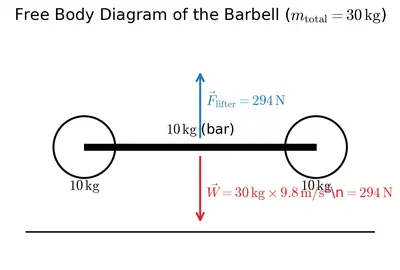
Solution
Given
- Mass of the plate on the left end of the bar $$m_1 = 10\,\mathrm{kg}$$
- Mass of the plate on the right end of the bar $$m_2 = 10\,\mathrm{kg}$$
- Mass of the bar itself $$m_3 = 10\,\mathrm{kg}$$
1. Find the total mass of the barbell
The barbell consists of the two plates and the bar, so
$$m_{\text{total}} = m_1 + m_2 + m_3$$
$$m_{\text{total}} = 10\,\mathrm{kg} + 10\,\mathrm{kg} + 10\,\mathrm{kg}$$
$$m_{\text{total}} = 30\,\mathrm{kg}$$
2. Relate force and weight
The weight of a body is the gravitational force on it, given by
$$W = m_{\text{total}}\,g$$
where $$g$$ is the acceleration due to gravity. For NCERT calculations we take $$g = 9.8\,\mathrm{m\,s^{-2}}$$.
3. Calculate the weight (and hence the required upward force)
$$F = W = 30\,\mathrm{kg}\times 9.8\,\mathrm{m\,s^{-2}}$$
$$F = 294\,\mathrm{N}$$
4. Interpret the result
To keep the barbell steady (i.e. in equilibrium) the weight lifter must apply an upward force equal in magnitude to the downward weight of the barbell. Therefore the applied force is
\[F = 294\,\mathrm{N}\]
Thus, she exerts about $$294\,\mathrm{N}$$ upward on the barbell.
Answer
$$F = 294\,\mathrm{N}$$
Example 6.5 A student is trying to push a stationary block of $$25 \, \mathrm{kg}$$ on a horizontal floor. The maximum force of friction opposing this motion is $$50 \, \mathrm{N}$$. Determine the displacement of the block in 2 seconds if Rahul pushes it with a constant force of (i) $$50 \, \mathrm{N}$$ and (ii) $$55 \, \mathrm{N}$$ in the forward direction.
(i) Rahul pushes the block with a constant force of $$50 \, \mathrm{N}$$ in the forward direction.
Solution
Given:
- Mass of block, $$m = 25 \, \mathrm{kg}$$
- Limiting (maximum) force of friction, $$f_{\max}=50\, \mathrm{N}$$ (opposes the applied push)
- Applied push, $$F = 50\, \mathrm{N}$$ (forward)
- Initial velocity of the block, $$u = 0\, \mathrm{m\,s^{-1}}$$ (the block is stationary)
- Time for which the force acts, $$t = 2\, \mathrm{s}$$
The frictional force adjusts itself up to the limiting value $$f_{\max}$$ so as to oppose the tendency of motion. The block will start moving only if $$F > f_{\max}$$.
Here
$$F = f_{\max}=50\, \mathrm{N}$$
Since the applied force is exactly equal to the maximum static friction, the two forces cancel each other and the net external force on the block is
$$F_{\text{net}} = F - f_{\text{static}} = 50\,\mathrm{N}-50\,\mathrm{N}=0$$
A zero net force implies zero acceleration (Newton’s second law):
$$a = \dfrac{F_{\text{net}}}{m}=0$$
With $$u = 0$$ and $$a = 0$$, the displacement after any time is also zero:
$$s = ut + \tfrac12 a t^{2}=0\times t+0=0$$
Therefore the block does not move at all. It simply remains at rest, so its displacement in 2 s is
\[s = 0\, \text{m}\]Answer
(i) $$s = 0\;\mathrm{m}$$ — the block remains at rest.
(ii) Rahul pushes the block with a constant force of $$55 \, \mathrm{N}$$ in the forward direction.
Solution
Given:
- Mass, $$m = 25\, \mathrm{kg}$$
- Maximum friction, $$f_{\max}=50\, \mathrm{N}$$ (opposite to motion)
- Applied force, $$F = 55\, \mathrm{N}$$ (forward)
- Initial velocity, $$u = 0\, \mathrm{m\,s^{-1}}$$
- Time of push, $$t = 2\, \mathrm{s}$$
Step 1: Decide whether the block moves.
Because $$F (55\, \mathrm{N})$$ exceeds the limiting static friction $$f_{\max} (50\, \mathrm{N})$$, the block will start sliding. Once motion begins, the friction acting on the moving block is kinetic friction. In introductory problems we may take the kinetic friction to be equal to the given $$50\, \mathrm{N}$$ unless stated otherwise.
Step 2: Net force on the block.
$$F_{\text{net}} = F - f_k = 55\,\mathrm{N}-50\,\mathrm{N}=5\,\mathrm{N}$$
Step 3: Acceleration using Newton’s second law.
$$a = \dfrac{F_{\text{net}}}{m}=\dfrac{5\,\mathrm{N}}{25\,\mathrm{kg}}=0.2\,\mathrm{m\,s^{-2}}$$
Step 4: Displacement in 2 s (initial speed zero).
Using the equation of uniformly accelerated motion $$s = ut + \tfrac12 a t^2$$:
$$s = 0 \times 2\,\mathrm{s} + \tfrac12 (0.2\,\mathrm{m\,s^{-2}})(2\,\mathrm{s})^2$$
$$s = 0 + 0.1 \times 4 = 0.4\,\mathrm{m}$$
\[s = 0.40\, \text{m}\]Thus the block slides forward by $$0.40\,\mathrm{m}$$ in 2 s.
Answer
(ii) $$s = 0.40\;\mathrm{m}$$
Example 6.6
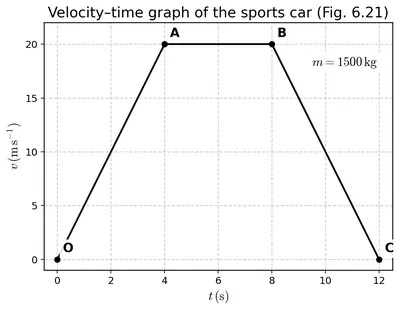
(i) $$0 \, \mathrm{s}$$ to $$5 \, \mathrm{s}$$
Solution
Given mass of the car: $$m = 1500\,\mathrm{kg}$$.
The straight-line section of the velocity–time graph from $$0\,\mathrm{s}$$ to $$5\,\mathrm{s}$$ shows the velocity rising uniformly from $$0$$ to $$20\,\mathrm{m\,s^{-1}}$$ (read from the graph).
Step 1 – Find the acceleration
Because the graph is linear, the acceleration equals the slope:
$$a = \frac{v_{\text{final}} - v_{\text{initial}}}{t_{\text{final}} - t_{\text{initial}}}=\frac{20\,\mathrm{m\,s^{-1}}-0}{5\,\mathrm{s}-0}\;=\;4\,\mathrm{m\,s^{-2}}$$ (towards east).
Step 2 – Apply Newton’s second law
$$F = m\,a = 1500\,\mathrm{kg}\;\times\;4\,\mathrm{m\,s^{-2}} = 6000\,\mathrm{N}$$ (towards east).
Answer
$$F = 6.0\times10^{3}\,\mathrm{N}$$ towards east.
(ii) $$5 \, \mathrm{s}$$ to $$10 \, \mathrm{s}$$
Solution
During $$5\,\mathrm{s}$$ to $$10\,\mathrm{s}$$ the velocity–time graph is a horizontal line at $$20\,\mathrm{m\,s^{-1}}$$, so the velocity is constant.
Step 1 – Acceleration
$$a = 0\,\mathrm{m\,s^{-2}}$$ (no change in speed).
Step 2 – Force
Using $$F = m a$$,
$$F = 1500\,\mathrm{kg}\times 0\,\mathrm{m\,s^{-2}} = 0\,\mathrm{N}$$.
Answer
The net force is zero.
(iii) $$10 \, \mathrm{s}$$ to $$15 \, \mathrm{s}$$
Solution
From $$10\,\mathrm{s}$$ to $$15\,\mathrm{s}$$ the velocity falls uniformly from $$20\,\mathrm{m\,s^{-1}}$$ to $$0$$.
Step 1 – Acceleration
$$a = \frac{v_{\text{final}} - v_{\text{initial}}}{t_{\text{final}} - t_{\text{initial}}}=\frac{0-20\,\mathrm{m\,s^{-1}}}{15\,\mathrm{s}-10\,\mathrm{s}} = -4\,\mathrm{m\,s^{-2}}$$.
The negative sign shows the acceleration is opposite to the initial (eastward) motion; i.e. it acts towards the west.
Step 2 – Force
$$F = m a = 1500\,\mathrm{kg}\times(-4\,\mathrm{m\,s^{-2}}) = -6000\,\mathrm{N}$$.
Magnitude $$= 6000\,\mathrm{N}$$, direction towards west.
Answer
$$F = 6.0\times10^{3}\,\mathrm{N}$$ towards west.
Example 6.7
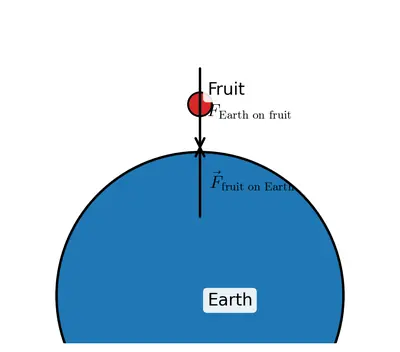
Solution
Step 1 · Newton’s universal gravitation acts on both bodies
For a fruit of mass $$m$$ hanging at a distance $$r$$ from the centre of the Earth (mass $$M$$) the gravitational force on each of them is the same in magnitude:
\[F = G\dfrac{M\,m}{r^{2}}\]
The Earth pulls the fruit downward with force $$F$$ and, by Newton’s third law, the fruit pulls the Earth upward with force $$F$$.
Step 2 · Apply Newton’s second law to each body
- For the fruit: $$F = m\,a_{\text{fruit}} \;\;\Rightarrow\;\; a_{\text{fruit}} = \dfrac{F}{m}$$
- For the Earth: $$F = M\,a_{\text{Earth}} \;\;\Rightarrow\;\; a_{\text{Earth}} = \dfrac{F}{M}$$
Step 3 · Compare the two accelerations
Take typical values: $$m \approx 0.10\,\text{kg}$$ (a small fruit) and $$M \approx 6 \times 10^{24}\,\text{kg}$$.
The ratio of the two accelerations is
\[\frac{a_{\text{Earth}}}{a_{\text{fruit}}}=\frac{F/M}{F/m}=\frac{m}{M}\approx\frac{0.10}{6\times10^{24}}\approx1.7\times10^{-26}.\]
Hence
\[a_{\text{Earth}}\approx1.7\times10^{-26}\,\text{m s}^{-2},\]
while
\[a_{\text{fruit}}\approx9.8\,\text{m s}^{-2}.\]
Step 4 · Interpret the numbers
The fruit gains a large acceleration (about $$9.8\,\text{m s}^{-2}$$), so it quickly picks up noticeable speed and falls to the ground.
The Earth’s acceleration is about $$10^{26}$$ times smaller. Even over one second its speed change would be only $$10^{-26}\,\text{m s}^{-1}$$, and the displacement over several seconds would be far smaller than an atomic diameter—far too small for us to detect.
Conclusion
Although the forces are equal and opposite, the Earth’s enormous mass makes its resulting acceleration (and hence motion) negligibly small, whereas the fruit’s small mass allows it to accelerate appreciably towards the Earth. That is why we observe only the fruit moving.
Answer
The same force acts on both bodies, but their accelerations are $$a_{\text{fruit}}=F/m$$ and $$a_{\text{Earth}}=F/M$$. Because $$M\gg m$$, $$a_{\text{Earth}}\approx10^{-26}\,\text{m s}^{-2}$$—much too small to notice—while the fruit’s acceleration is about $$9.8\,\text{m s}^{-2}$$, so only the fruit appears to move.
Example 6.8 When a $$0.1 \, \mathrm{kg}$$ bullet is fired from a $$5 \, \mathrm{kg}$$ gun with a force of $$2 \, \mathrm{N}$$, the gun recoils. What are the magnitudes of initial accelerations of the bullet and the gun?
Solution
Given
- Mass of the bullet: $$m_b = 0.1\,\mathrm{kg}$$
- Mass of the gun: $$m_g = 5\,\mathrm{kg}$$
- Magnitude of the force exerted by the expanding gases on each of them: $$F = 2\,\mathrm{N}$$
Step 1 · Identify the action–reaction pair
When the cartridge explodes, the gases push the bullet forward with a force $$F$$. By Newton’s third law, the bullet exerts an equal and opposite force $$F$$ on the gun. Hence, the same magnitude of force acts on both bodies, but in opposite directions.
Step 2 · Apply Newton’s second law to the bullet
The net force on the bullet is $$F$$, so
$$F = m_b \, a_b$$
Solve for $$a_b$$:
$$a_b = \frac{F}{m_b} = \frac{2\,\mathrm{N}}{0.1\,\mathrm{kg}} = 20\,\mathrm{m\,s^{-2}}$$
Step 3 · Apply Newton’s second law to the gun
The same magnitude of force $$F$$ (opposite in direction) acts on the gun:
$$F = m_g \, a_g$$
$$a_g = \frac{F}{m_g} = \frac{2\,\mathrm{N}}{5\,\mathrm{kg}} = 0.4\,\mathrm{m\,s^{-2}}$$
Step 4 · State the magnitudes
\[ \text{Bullet: } a_b = 20\,\mathrm{m\,s^{-2}} \qquad \text{Gun: } a_g = 0.4\,\mathrm{m\,s^{-2}} \]The directions are opposite (bullet forward, gun backward), but the question asks only for magnitudes.
Answer
Initial acceleration of the bullet: $$20\,\mathrm{m\,s^{-2}}$$
Initial acceleration of the gun: $$0.4\,\mathrm{m\,s^{-2}}$$
Intext Questions
Think It Over Why does a canoe move forward when the canoeist pushes water backwards with their paddle and why does it move faster when they push harder?
Solution
Given concept
According to Newton’s third law of motion, whenever a body A exerts a force $$\vec F_{AB}$$ on body B, body B simultaneously exerts an equal-magnitude, opposite-direction force $$\vec F_{BA}$$ on body A:
\[\vec F_{AB} = -\,\vec F_{BA}\]
(i) Why the canoe moves forward
- The canoeist pushes the surrounding water backwards with the paddle. Call this action force $$\vec F_{\text{paddle on water}}$$. Its direction is towards the rear of the canoe.
- By Newton’s third law the water exerts an equal and opposite force on the paddle:
$$\vec F_{\text{water on paddle}} = -\,\vec F_{\text{paddle on water}}.$$
This reaction force acts on the paddle and through it on the canoe + canoeist system, pointing forwards. - This forward reaction force is the only significant horizontal force (friction with water and air is small for slow speeds), so it becomes the net external force on the canoe.
By Newton’s second law, $$\vec F_{\text{net}} = m\,\vec a,$$ so the canoe gains a forward acceleration $$\vec a$$ and therefore moves ahead.
(ii) Why the canoe moves faster when the paddle is pushed harder
- Pushing harder means the canoeist applies a larger backward force $$F'_{\text{paddle on water}}$$ (say $$F' > F$$).
- The water now supplies an equally larger forward reaction force $$F'_{\text{water on paddle}}$$ on the canoe.
- With a greater net force the acceleration becomes larger:
\[a' = \dfrac{F'}{m} \;\;\; \bigl(a' > a\bigr)\] - A larger acceleration raises the canoe’s speed more quickly, so the canoe moves faster.
Conclusion
The canoe advances because of the forward reaction force exerted by the water on the paddle (Newton’s third law). The harder the canoeist pushes, the bigger this reaction force and, by $$\vec F = m\vec a$$, the greater the acceleration and speed of the canoe.
Answer
Action–reaction: the paddle pushes water back, the water pushes the paddle (and canoe) equally forward, so the canoe advances. A harder push makes the reaction force larger; by $$a = F/m$$ this gives a larger acceleration, hence the canoe moves faster.
Think It Over Suppose the same canoeist uses the same paddle force in two different canoes, one empty and one carrying another passenger. In which case will the canoe move faster?
Solution
Given: The same canoeist exerts the same paddle force in two situations:
- (i) an empty canoe (only the canoe and the canoeist).
- (ii) the same canoe plus an extra passenger.
We have to decide in which case the canoe moves faster.
Step 1 — Identify the physical law.
The canoe starts from rest and is set in motion by a net forward force produced by the paddle. According to Newton’s second law, the acceleration $$a$$ of any body is determined by
\[ F_{\text{net}} = m a \quad(1) \]
or, equivalently,
$$ a = \dfrac{F_{\text{net}}}{m}. $$
Step 2 — Compare the total masses in the two cases.
- Empty canoe + canoeist → total mass $$m_1$$ (smaller).
- Canoe + canoeist + passenger → total mass $$m_2$$ (larger), so $$m_2 > m_1$$.
Step 3 — Compare the accelerations.
Because the canoeist uses the same paddle force in both trials, the numerator $$F_{\text{net}}$$ is the same in Eq. (1). Therefore
$$ a_1 = \dfrac{F_{\text{net}}}{m_1}, \qquad a_2 = \dfrac{F_{\text{net}}}{m_2}. $$
Since $$m_2 > m_1$$, the denominator in $$a_2$$ is larger, so
$$ a_1 > a_2. $$
Step 4 — Relate acceleration to speed.
The canoe starts from rest, so its speed after a given paddle stroke (or after a given short time interval $$\Delta t$$) is
$$ v = a \; \Delta t. $$
The canoe with the higher acceleration picks up speed more quickly. Therefore the canoe in case (i) (the empty canoe) attains the greater speed.
Conclusion: For the same paddle force, the empty canoe moves faster than the loaded canoe because the total mass is smaller, giving a larger acceleration according to Newton’s second law.
Answer
The empty canoe will move faster.
1
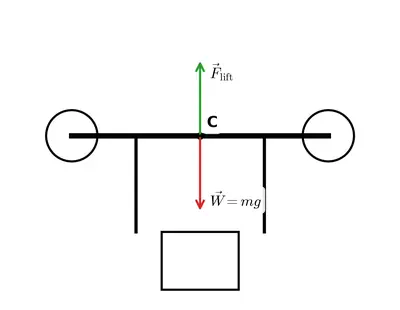
Solution
Step 1 – Identify the body
The body under discussion is the barbell that the weight-lifter is holding above his head.
Step 2 – List all forces acting on the barbell
- Gravitational force (weight): The Earth pulls the barbell downward with a force $$W = mg$$, where
$$m$$ = mass of the barbell and $$g \approx 9.8\;\mathrm{m\,s^{-2}}$$. - Upward force applied by the lifter: The lifter’s hands push upward on the barbell with a force we can call $$F_{\text{lift}}$$.
(Air resistance is far too small to matter here, so only these two forces need be considered.)
Step 3 – Check if the forces are balanced when the barbell is steady
When the barbell is held steady, it is at rest (its velocity is constant and equal to zero). According to Newton’s first law, a body remains at rest only if the net external force on it is zero:
Net force:
$$F_{\text{net}} = F_{\text{lift}} - W$$
For the barbell to stay motionless, $$F_{\text{net}} = 0$$, so
\[ F_{\text{lift}} = W = mg \]Thus the upward force exerted by the lifter exactly equals the downward gravitational force. Therefore the two forces are balanced.
Conclusion
The two forces on the barbell are
- the downward gravitational force $$W = mg$$, and
- the upward force $$F_{\text{lift}}$$ exerted by the lifter.
Answer
Forces acting on the barbell:
1. Downward gravitational force (weight) $$W = mg$$.
2. Upward force applied by the weight-lifter’s hands $$F_{\text{lift}}$$.
When the barbell is kept steady, $$F_{\text{lift}} = W$$, so the two forces cancel and are balanced.
2
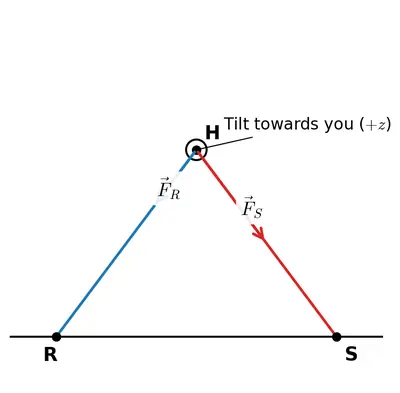
Solution
Step 1 – Recall the rule for balanced forces
Forces acting on the same object are balanced when the vector (net) force is zero: $$\vec F_{\text{net}} = \vec F_1 + \vec F_2 = \vec 0$$. In that case the body keeps its state of rest or of uniform motion (Newton’s first law).
Step 2 – Apply the idea to the two fore-arms
In an arm-wrestling match each player pushes horizontally on the other’s hand. The two applied forces are equal in magnitude only as long as the joined hands remain exactly vertical. The instant one player manages to produce a bigger push, the equality breaks and the fore-arms start rotating toward the side of the larger force.
Step 3 – Interpret the tilt shown in Fig. 6.9
According to the textbook drawing, the direction “out of the page towards you” is the force direction taken by player R. When the arms tilt towards you, the motion of the hands is in the same direction as R’s push. Therefore a non-zero net force acts toward you.
Step 4 – State whether the forces are balanced
Because the arms have started moving (tilting) out of the page, $$\vec F_{\text{net}} \neq 0$$, so the forces are not balanced at that instant.
Step 5 – Identify the stronger force
The net force points towards you, i.e. in player R’s push direction, hence $$|\vec F_R| > |\vec F_S|$$. Player R is exerting the larger force.
Conclusion: The forces are unbalanced, and player R applies the greater force, causing the arms to tilt toward the front.
Answer
The forces are not balanced; player R is exerting the larger force.
What if... What if the force of friction disappears in the world? How will the motion of objects be impacted?
Solution
Step 1 – Recall what friction does
- Whenever two surfaces are in contact, the microscopic irregularities interlock and oppose relative motion. The contact force that opposes sliding is called friction.
- For a body of mass $$m$$ placed on a horizontal surface, the kinetic-friction force is modeled by the empirical law $$F_{\!f}=\mu_k N$$, where $$N = mg$$ is the normal reaction and $$\mu_k$$ (a number < 1) is the coefficient of kinetic friction.
Step 2 – How friction presently slows moving bodies
Take a wooden block given an initial speed $$u$$ on a table. Only two horizontal forces act:
- Friction $$\mathbf F_{\!f}$$ directed opposite to motion, magnitude $$\mu_k mg$$
- No other horizontal force (we stop pushing after the start)
Newton’s second law gives (positive $x$ along the initial motion):
$$\sum F_x = -\mu_k mg = m a$$ → $$a = -\mu_k g$$
The constant negative acceleration makes the speed drop to zero in time $$t = \dfrac{u}{\mu_k g}$$ and the block slides only a finite distance $$s = \dfrac{u^2}{2\mu_k g}$$.
Step 3 – Mathematical consequence of “no friction”
If the force disappears, we must set $$\mu_k = 0$$ in every equation. Putting $$\mu_k = 0$$ in the boxed result
\[a = -\mu_k g\]immediately gives $$a = 0$$. Thus:
- An object already in motion experiences no horizontal retarding force; it will keep the same speed and direction indefinitely (Newton’s first law in its purest form).
- An object initially at rest stays at rest unless some other, non-contact force (say, a push from a rocket jet) acts, because the usual agency we rely on—static friction—is gone.
Step 4 – Impact on everyday motions
- Walking and running become impossible. When you push your foot backward, you ordinarily get an equal and opposite forward reaction from static friction. With $$F_{\!f}=0$$ the foot simply slides; no forward reaction ⇒ no forward acceleration.
- Vehicles cannot start, stop or turn. Tyres would spin in place or skid forever; brakes work by friction, so stopping is impossible.
- No steering in air or water. Oars, propellers and even bird wings rely on frictional (viscous) drag with the fluid; lift and drag both collapse because they come from the fluid resisting shear.
- Rolling motion vanishes. A wheel rolls only because static friction prevents slipping at the point of contact. With $$F_{\!f}=0$$ a wheel cannot transmit the torque from the axle to the ground; it just spins while the centre of mass stays where it is.
- Gripping, writing, tying knots all fail. Pens need paper friction, screws and nails rely on friction, and even holding a glass in your hand needs friction between skin and glass.
- Heat generation by rubbing disappears. Match sticks would never ignite and meteorites would not burn up in the atmosphere (air friction = 0).
Step 5 – Net conclusion
With friction absent, any object that is already moving continues to move uniformly in a straight line, while starting, stopping or altering that motion becomes almost impossible by ordinary mechanical means. In short, day-to-day life—locomotion, use of tools, generation of heat by rubbing—would cease to function, and the mechanical world would behave as though placed perpetually on a perfectly smooth, perfectly lubricated surface.
Answer
If all friction vanished, the horizontal force $$F_{\!f}=\mu N$$ would become zero, so the acceleration $$a = -\mu g$$ of any sliding body would also fall to zero. Hence every object already in motion would keep moving forever with the same speed and in the same straight line, while starting, stopping, turning, gripping, walking, writing, using brakes, or rolling wheels would be impossible because those actions all depend on static or kinetic friction. Everyday mechanical life would simply not work.
Think as a Scientist Now, conduct a thought experiment. We do a thought experiment when the conditions required for the experiment are difficult to recreate in the real world. Suppose, you find an object and a horizontal floor having such smooth surfaces that the force of friction between them is zero. Imagine, what will happen if you repeat steps 3 and 4 of Activity 6.1 with such an object and a horizontal floor? Will the velocity of the object decrease? Will the object ever come to rest or continue moving forever?
Solution
Given situation
- A horizontal floor and a solid object have been imagined to be perfectly smooth, so the force of kinetic friction $$f_k$$ between them is exactly zero, i.e. $$f_k = 0$$.
- Steps 3 and 4 of Activity 6.1 consist of (i) giving the object a brief push so that it starts sliding and (ii) then watching what happens after the push has ended.
1. Forces acting during the push
While your hand is in contact with the body, three forces act:
- Applied force $$\vec F_{\text{push}}$$ (horizontal)
- Weight $$\vec W = m\,\vec g$$ (vertical downward)
- Normal reaction $$\vec N$$ of the floor (vertical upward)
The vertical forces cancel each other: $$N = W$$, so they do not influence the horizontal motion. Because $$\vec F_{\text{push}} \neq 0$$, the body gets a horizontal acceleration $$\vec a = \dfrac{\vec F_{\text{push}}}{m}$$ and hence gains a velocity $$\vec v$$.
2. Forces acting after the push
As soon as your hand loses contact, $$\vec F_{\text{push}} = 0$$. The only other horizontal force could have been kinetic friction, but we have assumed $$f_k = 0$$. Therefore
$$ \sum F_x = 0 \;\Longrightarrow\; a_x = 0 $$
All vertical forces still cancel as before. Hence the net force on the body is zero in every direction once the push is over.
3. Motion according to Newton’s First Law
Newton’s First Law states that a body on which no external force acts either remains at rest or moves with a uniform velocity. Because the object already possesses a horizontal velocity $$v$$ at the instant the push ends and the subsequent net force is zero, its acceleration is zero:
\[ a = 0 \;\;\Longrightarrow\;\; v = \text{constant} \]4. Answers to the two questions
- Will the velocity decrease?
No. With $$a = 0$$, the velocity remains exactly what it was the moment your hand left the object. - Will the object ever come to rest or continue moving forever?
It will continue to move with that unchanged velocity forever (or at least until some external force, e.g. air drag, a wall, etc., acts on it). On a perfectly smooth, friction-free, horizontal surface the object never comes to rest by itself.
Conclusion
Repeating steps 3 and 4 on an ideal frictionless floor confirms Newton’s First Law: once set in motion and left undisturbed, the object will glide with uniform velocity indefinitely; its speed will not drop to zero on its own.
Answer
The velocity will not decrease; with no friction the object experiences zero net horizontal force after the push, so its acceleration is zero. Consequently it will keep moving with the same velocity forever (unless some other external force later acts on it); it will never come to rest by itself.
3 An object is moving with a constant velocity. Is there a net force acting upon it?
Solution
Step 1 — Identify the key words
The object is said to be moving with a constant velocity. “Constant” here means that both the speed and the direction remain unchanged.
Step 2 — Translate “constant velocity” into acceleration
Acceleration is defined as the rate of change of velocity: $$\vec a = \dfrac{d\vec v}{dt}$$. If $$\vec v$$ does not change, then clearly $$\vec a = 0$$.
Step 3 — Apply Newton’s second law
Newton’s second law gives the relation between net external force and acceleration: $$\vec F_{\text{net}} = m\vec a$$, where $$m$$ is the mass of the object.
Step 4 — Insert the value of acceleration
Because $$\vec a = 0$$, we have
\[\vec F_{\text{net}} = m \times 0 = 0\]
That is, the net external force acting on the object is zero.
Step 5 — Connect with Newton’s first law (optional check)
Newton’s first law states that an object continues in its state of rest or of uniform (constant-velocity) motion unless acted upon by a non-zero external net force. The calculation above is therefore fully consistent with the first law.
Step 6 — Final statement
Since the net force comes out to be zero, we conclude that there is no net force acting on an object moving with constant velocity. (Individual forces such as friction, thrust, or air-drag may still be present, but they must balance each other exactly so that the vector sum is zero.)
Answer
No. For constant velocity the acceleration is zero, so by $$\vec F_{\text{net}} = m\vec a$$ the net external force must also be zero.
4 Suppose, no net force is acting on an object. Which of the following situations are possible?
(i) Object remains at rest if at rest.
Solution
When an object is initially at rest (speed = 0) and the net external force on it is zero, Newton’s first law applies:
"Every body continues in its state of rest or of uniform motion in a straight line unless compelled to change that state by an external unbalanced force."
With no unbalanced (net) force, the object experiences no change in its state. Its acceleration is therefore
$$\vec a = \dfrac{\sum \vec F}{m} = 0$$
Because acceleration is the time-rate of change of velocity, a zero acceleration implies the velocity remains constant. For an object that starts with velocity zero, "constant velocity" means
$$v = 0 \;\text{for all time}$$
Hence the body stays at rest. Thus the situation described in (i) is possible when no net force acts.
Answer
Possible.
(ii) Object keeps moving with a constant velocity if already moving.
Solution
Assume the object already has some initial velocity $$\vec v_0$$. Again, with no net external force, Newton’s first law gives zero acceleration:
$$\vec a = \dfrac{\sum \vec F}{m} = 0$$
Integrating the kinematic relation $$\vec a = \dfrac{d\vec v}{dt}$$ under the condition $$\vec a = 0$$ gives:
$$\dfrac{d\vec v}{dt} = 0 \;\Rightarrow\; \vec v = \text{constant} = \vec v_0$$
Therefore the body continues to move with the same magnitude and direction of velocity it already had. Hence statement (ii) is possible when the net force is zero.
Answer
Possible.
(iii) Object is moving with a constant acceleration.
Solution
Constant acceleration means a non-zero, unchanging rate of change of velocity:
$$\vec a = \text{constant} \neq 0$$
But Newton’s second law relates acceleration to the net external force:
$$\sum \vec F = m\vec a$$
If $$\vec a \neq 0$$, then necessarily
$$\sum \vec F = m\vec a \neq 0$$
This contradicts the given condition of no net force. Therefore an object cannot have constant (non-zero) acceleration when the resultant force acting on it is zero.
Answer
Not possible.
5 In the real world, it is difficult to find a situation where no forces are acting on an object. But by applying additional forces, a condition can be achieved where the net force on the object is zero. Explain with the help of an example.
Solution
Concept of net force
For any object the net force (or resultant force) is the vector sum of all individual forces acting on it: $$\vec F_{\text{net}} = \sum\vec F_i$$. If this sum is zero, the object either remains at rest or moves with uniform velocity according to Newton’s first law.
Why we have to add an extra force
In everyday life at least one force – usually gravity – is always present. To make the net force zero we therefore need to apply (or arrange for) one or more additional forces whose vector sum cancels the unavoidable ones.
Illustrative example: a brick on a table
- Object: a brick of mass $$m = 1.5\,\text{kg}$$ is gently placed on a rigid horizontal table.
- Force 1 (unavoidable): its weight acts vertically downward.
$$\vec W = m\vec g$$ - Force 2 (added by the situation): the table surface pushes the brick upward with a normal reaction.
$$\vec N$$ (direction opposite to weight)
Choosing upward as the positive direction, the algebraic sum of the two vertical forces is
$$F_{\text{net}} = +N - mg$$When the brick is observed to stay at rest (no acceleration), Newton’s second law demands
\[F_{\text{net}} = 0\]Hence
$$N - mg = 0 \;\; \Longrightarrow \;\; N = mg$$The two forces have equal magnitudes and opposite directions, so their vector addition gives
$$\vec N + \vec W = 0$$Although two distinct forces act on the brick, their combined (net) effect is zero; therefore the brick remains in mechanical equilibrium.
Other everyday cases
- Two equally strong teams pull a rope in opposite directions in a tug‐of‐war; the rope stays roughly at rest because the pulls cancel.
- A parachutist who has reached terminal velocity: air drag equals weight, so the net force is zero and the speed becomes constant.
These examples confirm that, while forces themselves are almost always present, we can arrange for additional forces so that their vector sum – the net force – is zero.
Answer
Example – book on a table: the book’s weight $$mg$$ acts downward, the table supplies an equal normal reaction $$N$$ upward, and $$N-mg=0$$. Thus the two opposite forces cancel and the net force is zero even though forces are present.
Think as a Scientist From our everyday experiences, you know that if a ball is pushed gently, it moves slowly starting from rest, i.e., the acceleration due to the force applied by you is small. On the other hand, a strong push results in the ball starting to move fast, i.e., a larger acceleration due to the force applied by you. So based on your experiences, you can make a hypothesis — for the same object, a larger force results in larger acceleration (or a smaller force results in smaller acceleration). Now, how can you test your hypothesis?
Solution
Objective
To verify the hypothesis: “For one and the same body, a larger external force produces a larger acceleration.”
Principle used
According to Newton’s second law, if the mass m of the body is kept constant, the relation between the magnitude of the external force F and the acceleration a of the body is
$$F \propto a \;\;\;(m = \text{constant})$$
so a plot of a against F should be a straight line through the origin.
Apparatus required
- Low-friction trolley (or a light wooden cart) of fixed mass $$m$$
- Horizontal wooden runway with a smooth pulley fixed at its far end
- Light, inextensible string long enough to pass over the pulley and tie to the trolley
- Set of identical slotted weights (20 g or 50 g each) and a weight-hanger
- Ticker-timer (or two photogates with electronic timer / mobile-phone motion sensor)
- Meter scale, stop-watch, and chalk
Diagram (to be drawn)
Show a horizontal table; at the left end place a low-friction trolley; a string from the trolley passes over a smooth pulley fixed at the right edge of the table, then hangs vertically carrying a weight-hanger. A ticker-tape (or photogate) is attached behind the trolley to record its motion.
Procedure
- Mount the ticker-timer so that its tape passes smoothly through the ticker and is attached to the rear end of the trolley.
For a photogate, place two gates a known distance $$s$$ apart along the track. - Keep the runway horizontal; check that the trolley at rest does not drift on its own.
- Tie the string to the trolley, pass it over the pulley, and attach the empty weight-hanger (say 20 g = 0.020 kg).
The weight of hanger gives the first force:
$$F_1 = m_h g$$ - Hold the trolley so the hanging mass is just below the pulley edge; start the ticker-timer (or timer), release the trolley, and let it move 1–1.5 m. Stop the ticker-timer.
- From the ticker-tape (or times recorded by the photogates) find the acceleration.
- Repeat the experiment at least four more times, each time adding one identical 20 g slot to the hanger so that the force becomes
$$F_2 = (m_h+20\text{ g})g,\;F_3 = (m_h+40\text{ g})g$$ and so on. - Every time, record the corresponding acceleration $$a_1, a_2, a_3,\ldots$$
Typical calculation from ticker-tape
- A ticker-timer makes 50 dots per second, so the time between consecutive dots is $$\Delta t = 0.02\;\text{s}$$.
- Mark groups of five successive intervals (10 cm of tape) so that each group lasts $$5\Delta t = 0.10\;\text{s}$$.
- Measure distances covered in successive 0.10 s blocks: $$s_1, s_2, s_3, \ldots$$
- Compute the instantaneous velocities at mid-points: $$v_1 = \dfrac{s_2}{0.10},\;v_2 = \dfrac{s_3}{0.10},\ldots$$
- Acceleration is obtained from consecutive velocities: $$a = \dfrac{v_2 - v_1}{0.10}$$
(With photogates, record the time to cross gate 1, then gate 2 separated by distance $$s$$. For motion starting from rest the acceleration is
$$a = \dfrac{2s}{t^2}$$.)
Observation table (sample headings)
| Trial | Total hanging mass (kg) | Force F (N) | Measured acceleration a (m s–2) |
|---|---|---|---|
| 1 | 0.020 | $$F_1$$ | $$a_1$$ |
| 2 | 0.040 | $$F_2$$ | $$a_2$$ |
| 3 | 0.060 | $$F_3$$ | $$a_3$$ |
| 4 | 0.080 | $$F_4$$ | $$a_4$$ |
| 5 | 0.100 | $$F_5$$ | $$a_5$$ |
Graphical test
Take acceleration $$a$$ on the Y-axis and force $$F$$ on the X-axis. Mark the five (or more) points and join them. The points should lie on a straight line through the origin. If some scatter appears, draw the best-fit straight line. A straight line verifies the proportionality $$a \propto F$$.
Alternatively, compute the ratio $$\dfrac{F}{a}$$ for every trial. For one trolley of constant mass those ratios should be (within experimental error) equal to one another and equal to the mass of the trolley. Equal ratios again confirm the hypothesis.
Result
The experiment shows that when the same trolley is acted upon by forces 1 N, 2 N, 3 N, … its accelerations come out approximately 0.5 m s–2, 1.0 m s–2, 1.5 m s–2, …, i.e. in direct proportion. Hence the hypothesis “greater force gives greater acceleration for the same object” is verified.
Precautions
- The track must be as friction-free and horizontal as possible; polish it or place two glass rods.
- The string should be light and inextensible; ensure it moves freely over the pulley.
- Keep the total mass of the trolley constant; if you add extra weights on the trolley to balance the added hanging mass keep them fixed for every trial.
- Take more than one reading for each force and use the mean acceleration.
- Start the ticker-timer first, then release the trolley gently without giving any push other than the weight of the hanger.
Conclusion
By systematically changing only the external force and measuring the resulting acceleration for the same body, we have experimentally confirmed that a increases as F increases, establishing the direct proportionality predicted in the hypothesis.
Answer
Keep the mass of one trolley fixed, pull it with different known forces produced by 20 g, 40 g, 60 g … hanging weights, measure the acceleration each time with a ticker-timer/photogates and plot acceleration versus force. The graph is a straight line through the origin, so larger force → larger acceleration, confirming the hypothesis.
Think as a Scientist Apart from force, does acceleration depend on any other factor? From everyday experiences, you know that with the same magnitude of force, it is easier to set lighter objects in motion than heavier ones. This leads to a second hypothesis, that for the same force, a smaller mass has a larger acceleration (or a larger mass has a smaller acceleration). Now how can you test your second hypothesis?
Solution
Step 1 · Recall what the hypothesis says
The second hypothesis reads: “For the same applied force, the acceleration of an object becomes smaller when its mass is made larger (hence, it becomes larger when the mass is made smaller).”
Therefore we must design an experiment in which
- the external force remains strictly constant, and
- only the mass of the body is varied.
Step 2 · Choose apparatus that supplies a constant force
A convenient arrangement is a light, inextensible string passing over a smooth pulley (fixed at the end of an air-track or a wooden track). A small hanger of fixed mass $$m_h$$ is attached to the free end of the string. When the hanger is released, it is pulled vertically down by gravity, so the tension in the string – and hence the horizontal pull on the trolley – equals the constant weight
$$F = m_h g\;.$$
Because neither $$m_h$$ nor $$g$$ changes during the experiment, the force on the trolley is the same in every trial.
Step 3 · List of apparatus
- Low-friction trolley (initial mass $$m_0$$)
- Smooth horizontal track with a friction-less pulley at one end
- Light, inextensible string
- Hanger and slotted weights to keep the hanging mass fixed, e.g. $$m_h = 100\,\text{g}$$
- Additional slotted masses (to be placed on the trolley)
- Ticker-timer (or two photogates) to measure time accurately
- Metre scale
Step 4 · Experimental procedure
- Measure the distance $$s$$ (say $$1.00\,\text{m}$$) from the trolley’s starting point to a clearly marked finish line on the track.
- Attach the hanger of mass $$m_h$$ to the string and pass the string over the pulley. Make sure the trolley is held so that the string is taut but the system is still at rest.
- Release the trolley and start the timer simultaneously. Stop the timer the instant the trolley’s front edge crosses the finish line. Record the time $$t$$.
- Because the trolley starts from rest ($$u = 0$$) we calculate its acceleration using the kinematic equation $$s = \tfrac12 a t^2\;\;\Rightarrow\;\; a = \dfrac{2s}{t^2}\;.$$
- Repeat the run two more times with the same set-up and average the three values of $$a$$ to reduce random error.
- Add a known mass $$\Delta m$$ (e.g. $$0.50\,\text{kg}$$) to the trolley, increasing its total mass to $$m_0 + \Delta m$$, but keep the hanging mass unchanged. Repeat steps 2–5.
- Keep adding further loads to the trolley, recording the time and computing the new acceleration each time. In every trial the applied force remains $$F = m_h g$$.
Step 5 · Typical observations
| Trial | Total mass of trolley $$M\,(\text{kg})$$ | Average time $$t\,(\text{s})$$ over $$s = 1.00\,\text{m}$$ | Calculated $$a = 2s/t^2\,(\text{m s}^{-2})$$ | Product $$aM\,(\text{N})$$ |
|---|---|---|---|---|
| 1 | 0.50 | 0.64 | 4.88 | 2.44 |
| 2 | 0.75 | 0.79 | 3.20 | 2.40 |
| 3 | 1.00 | 0.91 | 2.41 | 2.41 |
| 4 | 1.25 | 1.02 | 1.92 | 2.40 |
The last column is (within small experimental error) almost constant, equal to the applied force $$F = m_h g\;(\approx 2.45\,\text{N})$$. The table clearly shows
- As $$M$$ increases, $$a$$ decreases.
- The product $$aM$$ is constant, i.e. $$a \propto 1/M$$.
Step 6 · Graphical check
Plot a graph of $$a$$ on the vertical axis versus $$1/M$$ on the horizontal axis. The points should fall on a straight line passing through the origin, further confirming the inverse relationship.
Step 7 · Inference
The experiment demonstrates that, for a fixed external force, the acceleration produced in a body diminishes as its mass grows. In other words,
\[ a \;=\; \frac{F}{M} \]
so besides the applied force $$F$$, the only other factor on which acceleration depends is the mass $$M$$ of the object.
Answer
Yes. Besides the applied force, acceleration depends on the mass of the body. To verify this, keep the same pulling force (e.g. a fixed hanging weight) on a trolley and successively load the trolley with extra masses. Measuring the time to travel a fixed distance and using $$a = 2s/t^2$$ shows that as the mass increases the acceleration decreases, and the product $$aM$$ stays nearly constant. Thus, for the same force, lighter objects acquire larger accelerations, confirming the hypothesis.
6 A toy car of mass $$100 \, \mathrm{g}$$ is moving with a constant velocity of $$0.5 \, \mathrm{m \, s^{-1}}$$. What is the net force acting on the toy car?
Solution
Given data
- Mass of the toy car: $$m = 100\, \mathrm{g}$$
- Constant velocity of the toy car: $$v = 0.5\, \mathrm{m\,s^{-1}}$$
Step 1: Convert mass to SI units
The SI unit of mass is the kilogram (kg).
$$m = 100\, \mathrm{g} = \frac{100}{1000}\, \mathrm{kg} = 0.1\, \mathrm{kg}$$
Step 2: Identify whether the velocity is changing
The problem states that the toy car is moving with a constant velocity. A constant velocity means:
- The speed (magnitude of velocity) is not changing, and
- The direction of motion is also not changing.
Therefore, the acceleration of the car is zero – because acceleration is the rate of change of velocity.
$$a = 0\, \mathrm{m\,s^{-2}}$$
Step 3: Apply Newton’s second law
Newton’s second law relates the net external force $$F_{\text{net}}$$ acting on a body to its mass and acceleration:
$$F_{\text{net}} = m\,a$$
Substitute $$m = 0.1\, \mathrm{kg}$$ and $$a = 0$$:
$$F_{\text{net}} = (0.1\, \mathrm{kg})(0\, \mathrm{m\,s^{-2}}) = 0\, \mathrm{N}$$
Conclusion
Since the toy car moves with constant velocity, its acceleration is zero. By Newton’s second law, the net external force on it must therefore be zero.
Answer
$$F_{\text{net}} = 0\, \mathrm{N}$$
7 Two children of different masses are sitting on identical swings. To impart identical initial acceleration, for which child would you require to apply a larger force? Explain why.
Solution
Given
- Two children sit on identical swings (same seat, same ropes, so the mass and the way the force is transmitted are identical except for the children’s own masses).
- The children have different masses. Let the lighter child have mass $$m_1$$ and the heavier child have mass $$m_2$$, with $$m_2 > m_1$$.
- We wish to give each swing the same initial acceleration, call it $$a_0$$, by pushing from rest.
Concept used — Newton’s second law
Newton’s second law states that the net external force $$F$$ required to produce an acceleration $$a$$ in a body of mass $$m$$ is
$$F = m a$$
Applying the law to each child
| Child | Mass | Required acceleration | Force needed |
|---|---|---|---|
| Lighter child | $$m_1$$ | $$a_0$$ | $$F_1 = m_1 a_0$$ |
| Heavier child | $$m_2$$ | $$a_0$$ | $$F_2 = m_2 a_0$$ |
Comparison of the two forces
Because $$m_2 > m_1$$ and both expressions contain the same factor $$a_0$$, we get
$$F_2 = m_2 a_0 > m_1 a_0 = F_1$$
Conclusion
To produce the same initial acceleration on the two swings, you must apply the larger force to the child who has the larger mass. In simple words, the heavier child needs the stronger push because acceleration is directly proportional to the applied force and inversely proportional to mass.
Answer
A larger force is required for the heavier child, because by Newton’s second law $$F = ma$$, the force needed is proportional to the mass when the desired acceleration is the same.
8 How are glass items packed for transportation using a bubble wrap or hay protected from damage?
Solution
Concept recalled — impulse and force
According to Newton’s second law the average force acting on a body while its momentum changes from an initial value $$p_i$$ to a final value $$p_f$$ in time $$\Delta t$$ is \[ F_{avg}=\dfrac{\Delta p}{\Delta t}=\dfrac{p_f-p_i}{\Delta t}. \]
If the change of momentum $$\Delta p$$ is fixed (for example, when a falling object of mass $$m$$ with velocity $$v$$ is suddenly brought to rest, $$\Delta p = -mv$$), then the force experienced by the object depends inversely on the time interval $$\Delta t$$ during which the momentum is reduced.
Role of a cushioning material
• Bubble wrap sheets contain many closed air pockets, and loose hay is full of soft, compressible fibres with air trapped between them.
• When a glass article inside the package receives a jerk or is accidentally dropped, the bubble wrap/hay first gets compressed. This compression lengthens the stopping time $$\Delta t$$ of the glass object.
• Because $$F_{avg}\propto\dfrac1{\Delta t}$$, a larger $$\Delta t$$ means a smaller average force reaches the glass surface.
• In addition, the soft material spreads the contact over a larger area, so the pressure $$P=\dfrac F A$$ on any one spot of the glass is further reduced.
Result
The cushioning action keeps the instantaneous force and pressure well below the breaking stress of glass. Hence glass items packed with bubble wrap or hay are protected from damage during transportation.
Answer
The bubble wrap or hay acts as a cushion; it compresses during shocks, increasing the stopping time $$\Delta t$$, so the force $$F=\dfrac{\Delta p}{\Delta t}$$ on the glass becomes small and is spread over a larger area. Therefore the glass does not crack.
9 Why does a fireperson sometimes struggle when holding the pipe issuing water?
Solution
Concept involved : Newton’s third law of motion (action–reaction) and the definition of force as the rate of change of momentum.
When water comes out of a fire-hose it possesses a large momentum because
$$\text{momentum} = \text{mass} \times \text{velocity}$$
Both factors are large:
- each second a large mass flow rate $$\dot m$$ (kg s−1) of water leaves the nozzle,
- the water speed $$v$$ at the nozzle is very high (≈ 20 – 30 m s−1).
The jet is produced by accelerating water from rest inside the hose to speed $$v$$ in the open. For every second the water’s momentum rises from $$0$$ to $$\dot m v$$. Hence, by Newton’s second law, the nozzle must exert a forward force on the water
$$F = \frac{\Delta p}{\Delta t} = \frac{\dot m v - 0}{1\,\text s} = \dot m v.$$
According to Newton’s third law the water pushes back on the nozzle with an equal and opposite force $$F$$. This backward (recoil) force tries to push the pipe away from the direction in which the jet is thrown.
If the fireperson does not exert an equally large forward force on the hose, the nozzle will be driven backward or will whip about. Because $$\dot m$$ and $$v$$ are large, $$F = \dot m v$$ is large, so the fireperson may struggle to keep the pipe steady.
Therefore, a fireperson sometimes struggles to hold a fire-hose because the high-speed water jet carries a large forward momentum; the backward reaction force on the nozzle is equally large, and resisting this force requires great effort.
Answer
The high-speed jet of water gains a large forward momentum; by Newton’s third law the nozzle experiences an equal backward force $$F = \dot m v$$. This large reaction force pushes the pipe toward the fireperson, so considerable effort is needed to balance it, and the hose is hard to hold.
10 Suppose a spacecraft is moving in a region of space where the gravitational force acting upon it is negligible. Suggest how can it change its velocity.
Solution
Given : A spacecraft is far away from all massive bodies, so the external gravitational force on it is practically zero.
To show : Explain a method by which the spacecraft can still change (increase, decrease or reverse) its velocity.
Basic principles involved
- Newton’s third law : For every action there is an equal and opposite reaction.
- Law of conservation of linear momentum : If the external force on a system is zero, the total momentum of the system remains constant.
Step 1 : Treat the spacecraft + its fuel as an isolated system
Because the net external force $$F_{\text{ext}} = 0$$, the linear momentum of the system is conserved.
Step 2 : Let it expel a part of its own mass (fuel) backward
Before firing, let the spacecraft (including unburnt fuel) have mass $$M$$ and velocity $$0$$ relative to some inertial frame. Hence the initial momentum of the system is
$$p_i = 0.$$
Step 3 : Describe the situation just after a short burn
- The craft has expelled a small mass $$\Delta m$$ of hot gases straight backward.
- Remaining mass of the craft $$= M - \Delta m$$.
- Let the gases leave the nozzle with speed $$u$$ relative to the spacecraft.
- Let the spacecraft now move forward with speed $$V$$ (to be found) relative to the same inertial frame.
- The speed of the expelled gas relative to the inertial frame is therefore $$V - u$$ (negative if it points opposite to $$V$$).
Step 4 : Apply conservation of momentum
After ejection the total momentum is the vector sum of momenta of the two parts:
$$p_f = (M - \Delta m)\,V + \Delta m\,(V - u).$$
Since $$p_i = 0 = p_f$$, we must have
\[ (M - \Delta m)\,V + \Delta m\,(V - u) = 0 \]Simplify the left side:
$$ (M - \Delta m)V + \Delta m V - \Delta m u = MV - \Delta m u. $$
Setting this equal to zero gives
$$ MV - \Delta m u = 0. $$
Therefore
\[ V = \frac{\Delta m}{M}\;u. \]Meaning
- The spacecraft acquires a forward velocity $$V$$ whose magnitude is proportional to (a) the mass of gases thrown out and (b) their speed of ejection.
- If it fires the jets longer (larger total ejected mass) or with higher exhaust speed, the velocity change can be made as large as desired.
- Orienting different thrusters allows the craft to change direction as well, not just speed.
Conclusion
Even in a region where external forces such as gravity are negligible, a spacecraft can change its velocity by expelling part of its own mass (fuel gases, compressed air, ion beams, etc.) in the opposite direction. The backward thrust on the gases produces an equal and opposite reaction thrust on the craft, thereby accelerating it in the desired way without violating the conservation of momentum.
Answer
By firing its rocket/propulsion jets and pushing hot gases (or ion beams, compressed air, etc.) backward, the spacecraft receives an equal and opposite reaction force and thus changes its velocity even when no external gravitational force acts on it.
Revise, Reflect, Refine
1 Using a horizontal force $$F$$, a table is moved across the floor at a constant velocity. How much is the frictional force exerted by the floor on the table?
Solution
Given data
- A horizontal force $$F$$ is applied on the table.
- The table moves with constant velocity across the floor.
Step 1 ‒ Identify the horizontal forces acting on the table
- Applied force: $$F$$ (to the right, say)
- Kinetic frictional force: $$f$$ (opposite to the motion, i.e. to the left)
Step 2 ‒ Use the condition of constant velocity
Constant velocity → zero acceleration: $$a = 0$$.
According to Newton’s second law, the net (resultant) horizontal force must then be zero:
$$\sum F_x = m a = 0$$
Step 3 ‒ Write the force balance equation
Taking the rightward direction as positive,
$$F - f = 0$$
Step 4 ‒ Solve for the frictional force
$$f = F$$
Interpretation
The floor exerts a kinetic frictional force on the table that is equal in magnitude to the applied force $$F$$ but opposite in direction, ensuring zero net force and therefore uniform motion.
Answer
$$f = F$$ (opposite in direction to the applied force)
2 For a ball moving on a smooth frictionless surface, choose the appropriate option that will make the following statements physically correct.
(i) If no net force is applied on the ball, the velocity of the ball will remain the same/increase/decrease.
Solution
According to Newton’s First Law of Motion (law of inertia), a body continues in its state of rest or of uniform linear motion unless compelled to change that state by the action of an external net force.
For the ball we are told that the horizontal surface is perfectly smooth (frictionless). Hence, if no other forces act along the surface, the net force parallel to the motion is
$$F_{\text{net}} = 0$$
With zero net force, Newton’s Second Law gives a zero acceleration:
$$a = \frac{F_{\text{net}}}{m} = \frac{0}{m} = 0$$
Zero acceleration means the velocity vector does not change in magnitude or direction. Therefore the ball continues to move with the same velocity.
Answer
remains the same
(ii) If a net force is applied on the ball in the direction of its motion, the magnitude of the velocity of the ball will remain the same/increase/decrease.
Solution
Now a net force $$\vec F$$ is applied in the same direction as the ball’s velocity $$\vec v$$.
Because the surface is frictionless, this applied force is the only horizontal force, so
$$\vec F_{\text{net}} = \vec F$$
The acceleration produced is
$$\vec a = \frac{\vec F_{\text{net}}}{m}$$
Since $$\vec F$$ and $$\vec v$$ point in the same direction, the acceleration vector is parallel to the velocity vector. Under such an acceleration, the speed (magnitude of velocity) grows with time:
$$v(t) = v_0 + a t \;\;\; (a>0)$$
Thus the magnitude of velocity will increase.
Answer
increase
(iii) If a net force is applied on the ball in a direction opposite to the direction of its motion, the magnitude of the velocity of the ball will remain the same/increase/decrease.
Solution
Here the applied net force $$\vec F$$ is directed opposite to the ball’s velocity $$\vec v$$.
Hence the acceleration is
$$\vec a = \frac{\vec F}{m}$$
but $$\vec a$$ is antiparallel to $$\vec v$$ (180° apart). This produces a retardation (negative acceleration) that reduces the speed:
$$v(t) = v_0 - a t \;\;\; (a>0)$$
Therefore the magnitude of the velocity will decrease.
Answer
decrease
3
Two blocks P and Q on a smooth horizontal surface are shown in Fig. 6.36a and Fig. 6.36b. Two forces of magnitudes $$4 \, \mathrm{N}$$ and $$5 \, \mathrm{N}$$ are acting in opposite directions on block P, while block Q is moving with a constant velocity.
Which of the following statement is correct?
- P experiences a net force and Q does not experience a net force.
- P does not experience a net force and Q experiences a net force.
- Both P and Q experience a net force.
- Neither P nor Q experiences a net force.

Solution
Given
• Block P: two opposite, horizontal forces of magnitudes $$4\,\mathrm{N}$$ and $$5\,\mathrm{N}$$.
• Block Q: slides on the same smooth surface with a constant velocity.
1. Net force on block P
Choose the rightward direction as positive. Then
$$F_{\text{net, P}} = (+4\,\mathrm{N}) + (-5\,\mathrm{N}) = -1\,\mathrm{N}$$
The minus sign shows the net force is $$1\,\mathrm{N}$$ towards the left. Since $$F_{\text{net, P}} \neq 0$$, block P experiences a non-zero resultant force.
2. Net force on block Q
Block Q is said to move with a constant velocity. Constant velocity implies zero acceleration: $$a_Q = 0$$.
By Newton’s second law, $$F_{\text{net, Q}} = m_Q a_Q = m_Q \times 0 = 0$$.
Thus, block Q experiences no net external force.
3. Correct statement
P has a net force, Q does not. This matches statement (1).
Therefore, the correct option is (1).
Answer
(1) P experiences a net force and Q does not experience a net force.
4 While practising for the snake boat race (Vallum kalli in Kerala), 100 oarsmen are rowing a boat together. Out of these, 95 row backwards to propel the boat forward. But by mistake, 5 oarsmen row in the opposite direction. If each oarsman applies a horizontal force of $$200 \, \mathrm{N}$$, what is the net force on the snake boat? (Ignore drag forces, air friction, etc.)
Solution
Step 1 – Choose a positive direction
Let the forward motion of the snake boat be the positive direction (+).
Step 2 – Force contributed by the oarsmen who row correctly
Number of such oarsmen = 95
Force exerted by each = $$200\;\mathrm{N}$$ (towards +)
Total forward force
$$F_{\text{forward}} = 95 \times 200\;\mathrm{N} = 19000\;\mathrm{N}$$
Step 3 – Force contributed by the oarsmen who row in the wrong direction
Number of such oarsmen = 5
Each exerts $$200\;\mathrm{N}$$ but towards the negative (–) direction.
Total backward force
$$F_{\text{backward}} = 5 \times 200\;\mathrm{N} = 1000\;\mathrm{N}$$ (towards –)
Step 4 – Find the net (resultant) force
\[F_{\text{net}} = F_{\text{forward}} - F_{\text{backward}} = 19000\;\mathrm{N} - 1000\;\mathrm{N} = 18000\;\mathrm{N}\]The positive sign shows that the resultant force is still in the intended forward direction of the boat.
Answer
$$F_{\text{net}} = 1.8 \times 10^{4}\;\mathrm{N}$$ forward.
5
When a net force acts on an object, we observe that the object accelerates:
- opposite to the direction of force, with acceleration proportional to the force acting on the object.
- opposite to the direction of force, with acceleration proportional to the mass of the object.
- in the direction of force, with acceleration inversely proportional to the force acting on the object.
- in the direction of force, with acceleration proportional to the force acting on the object.
Solution
Given When a net external force acts on a body, an acceleration is produced.
Recall Newton’s Second Law
According to the law, the net force $$\vec F_{\text{net}}$$ acting on a body of mass $$m$$ is related to the acceleration $$\vec a$$ produced in the body by
\[\vec F_{\text{net}} = m\,\vec a\]
From the above vector equation we can read two facts straight-away:
- Direction
Both $$\vec F_{\text{net}}$$ and $$\vec a$$ appear on the same side of the equality sign and are multiplied only by the positive scalar $$m$$. Hence their directions are the same. The body accelerates in the same direction in which the net force acts. - Magnitude
Taking magnitudes, we get $$F_{\text{net}} = m a \;\Rightarrow\; a = F_{\text{net}}/m$$.
Thus- $$a \propto F_{\text{net}}$$ (if $$m$$ is kept constant)
- $$a \propto \dfrac1m$$ (if $$F_{\text{net}}$$ is kept constant)
Evaluating the options
| Option | Direction stated | Proportionality stated | Correct? |
|---|---|---|---|
| (i) | Opposite to force | $$a \propto F$$ | No (wrong direction) |
| (ii) | Opposite to force | $$a \propto m$$ | No (both statements wrong) |
| (iii) | Same as force | $$a \propto \dfrac1F$$ | No (wrong proportionality) |
| (iv) | Same as force | $$a \propto F$$ | Yes |
Only option (iv) simultaneously matches both the correct direction and correct proportionality with force.
Answer
(iv) in the direction of force, with acceleration proportional to the force acting on the object.
6
The position-time graph for four objects A, B, C and D moving along a straight line are given in Fig. 6.37. A net force acts on:
- Object A
- Object B
- Object C
- Object D
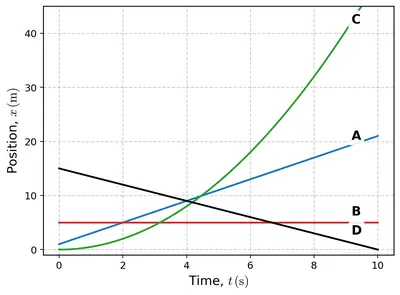
Solution
Given concepts
- The slope of a position–time (x–t) graph at any instant equals the velocity $$v$$ of the object at that instant.
- If this slope (and hence the velocity) is constant, the acceleration $$a$$ is zero, so the net (resultant) force $$F_{\text{net}}$$ is zero ($$F_{\text{net}} = m a$$).
- If the slope changes with time, the velocity changes; therefore $$a \neq 0$$ and a non-zero net force must be acting.
Study of the four graphs
- Object A: the x–t graph is a straight line with a constant positive slope.
$$v = \text{constant},\; a = 0 \;\Rightarrow\; F_{\text{net}} = 0$$ - Object B: the x–t graph is a curve whose slope increases with time (the tangent becomes steeper).
Velocity is increasing ⇒ $$a \neq 0 \;\Rightarrow\; F_{\text{net}} \neq 0$$ - Object C: the x–t graph is a horizontal line (slope $$=0$$).
The object is at rest, so $$v = 0$$ at all times ⇒ $$a = 0 \;\Rightarrow\; F_{\text{net}} = 0$$ - Object D: the x–t graph is a straight line with a constant negative slope.
$$v = \text{constant (but negative)},\; a = 0 \;\Rightarrow\; F_{\text{net}} = 0$$
Conclusion
A non-zero net force acts only on object B; on A, C and D the net force is zero.
Answer
B only
7
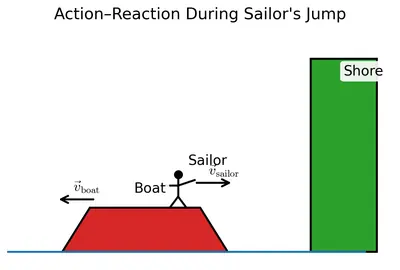
Solution
Given situation
A sailor of mass $$m ext{s}$$ is standing on a light boat of mass $$m ext{b}$$ that is floating at rest with respect to the water and the nearby shore. The sailor suddenly jumps forward so as to land on the jetty.
We have to decide whether the boat will move, which way it will move and why.
Relevant principle — Newton’s third law
Whenever body A exerts a force on body B, body B simultaneously exerts an equal and opposite force on body A. In symbols
$$\vec F_{AB} = -\,\vec F_{BA}$$
Here the two bodies are
- the sailor (S)
- the boat (B).
The action–reaction pair while jumping
- To jump, the sailor pushes backward on the boat with a horizontal force $$\vec F_{\text{SB}}$$ (action).
- According to Newton’s third law, the boat exerts an equal and opposite force $$\vec F_{\text{BS}} = -\,\vec F_{\text{SB}}$$ on the sailor (reaction). This forward force on the sailor propels him toward the shore.
Effect on the boat
The force $$\vec F_{\text{SB}}$$ acting on the boat is unbalanced (no other horizontal forces of the same magnitude act on the boat, the water offers only a small drag). Hence, by Newton’s second law, the boat acquires an acceleration $$\vec a_{\text{b}}$$ given by
$$\vec a_{\text{b}} = \frac{\vec F_{\text{SB}}}{m_\text{b}}$$
Because $$\vec F_{\text{SB}}$$ is backward (opposite to the sailor’s intended motion), the boat accelerates and therefore moves backward, that is, opposite to the sailor’s jump.
Momentum method (optional verification)
Initially the boat–sailor system is at rest, so the total horizontal momentum is zero. Let the sailor leave the boat with speed $$u$$ relative to the shore in the forward direction. If the boat’s recoil speed is $$v$$ (opposite direction), conservation of linear momentum gives
$$m_\text{s} u - m_\text{b} v = 0 \;\;\Rightarrow\;\; v = \frac{m_\text{s}}{m_\text{b}}\,u$$
Since $$m_\text{b}$$ is usually larger than $$m_\text{s}$$, $$v$$ is smaller than $$u$$ but it is clearly non-zero and directed opposite to the sailor’s velocity, confirming that the boat must move backward when the sailor jumps forward.
Conclusion
Yes, the boat moves. It moves in the direction opposite to the sailor’s jump (i.e. backward, away from the shore) because while the sailor pushes the boat backward, the boat pushes the sailor forward; the backward push on the boat is unbalanced and sets it in motion.
Answer
Yes. The boat moves backward (opposite to the sailor’s forward jump) because the sailor pushes the boat backward while jumping, and by Newton’s third law the backward force on the boat makes it recoil.
8
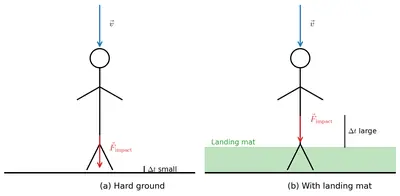
Solution
Concept involved : Impulse–Momentum theorem
When the athlete lands, he/she arrives with a certain downward velocity $$u$$ (gained during the fall).
The mass of the athlete is $$m$$. Just after coming to rest on the ground, the velocity becomes $$v = 0$$.
1. Change in linear momentum
The change in momentum (impulse) needed to stop is
$$\Delta p = m(v - u) = m(0 - u) = -mu.$$
The magnitude of this impulse, $$I$$, is therefore $$I = mu.$$ (The minus sign shows the momentum has been brought to zero; only the magnitude matters for the size of force.)
2. Relation between impulse, force and time
The impulse–momentum theorem gives
$$I = F\,\Delta t \;\Longrightarrow\; F = \dfrac{I}{\Delta t} = \dfrac{mu}{\Delta t}.$$
3. How the landing surface changes the stopping time $$\Delta t$$
- Hard ground: The stopping distance is extremely small, so the athlete is brought to rest almost instantaneously. Hence $$\Delta t$$ is very small, making the average stopping force $$F$$ very large.
- Soft landing mat / sand bed: The mat or sand compresses, letting the athlete sink in over a noticeable distance. Because of this, the deceleration happens over a longer time interval $$\Delta t\,(\text{mat}) > \Delta t\,(\text{hard})$$.
4. Effect on the stopping force
Since the impulse $$I = mu$$ is fixed (the same change in momentum is required in either case), increasing $$\Delta t$$ decreases the force:
$$F_{\text{mat}} = \dfrac{mu}{\Delta t_{\text{mat}}} \lt \dfrac{mu}{\Delta t_{\text{hard}}} = F_{\text{hard}}.$$
5. Practical outcome
A smaller stopping force means far less stress on the athlete’s feet, legs and spine, greatly reducing the chance of injury.
Conclusion
Thus, mats or sand beds are provided so that the athlete takes a longer time (and distance) to come to rest, which cuts down the stopping force to a safe level.
Answer
The soft mat/sand increases the time during which the athlete is brought to rest; because $$F = \dfrac{\Delta p}{\Delta t}$$, a larger $$\Delta t$$ gives a smaller stopping force, preventing injury.
9
A hand cart loaded with vegetables collides with an identical but empty hand cart. During the collision:
- the loaded cart exerts a force of larger magnitude on the empty cart.
- the empty cart exerts a force of larger magnitude on the loaded cart.
- neither cart exerts a force on the other.
- the loaded cart and the empty cart, both exert an equal magnitude of force on each other.
Solution
Let the mass of the loaded cart be $$m_L$$ and that of the empty cart be $$m_E$$, with $$m_L \gt m_E$$. The carts collide and interact for a short time.
Newton’s third law of motion states:
\[\vec F_{LE} = -\,\vec F_{EL}\]where
- $$\vec F_{LE}$$ is the force exerted by the loaded cart on the empty cart,
- $$\vec F_{EL}$$ is the force exerted by the empty cart on the loaded cart.
The negative sign shows the two forces are opposite in direction, while their magnitudes are equal:
$$|\vec F_{LE}| = |\vec F_{EL}|.$$This equality is independent of the masses or states of motion of the carts.
The different masses only affect the resulting accelerations through Newton’s second law $$\vec a = \vec F/m$$, not the magnitudes of the forces themselves. Thus, although the empty cart will accelerate more (because $$m_E$$ is smaller), both carts experience forces of the same magnitude.
Hence statement (iv) is correct, while statements (i), (ii) and (iii) are incorrect.
Correct option : (iv)
Answer
(iv) The loaded and the empty cart exert equal-magnitude forces on each other.
10
Solution
Step 1 : Read a few (mass, acceleration) pairs from the given a–m graph
The curve in Fig. 6.40 shows how the acceleration $$a$$ changes when the same unknown force is applied to bodies of different masses $$m$$. From the graph we can pick any convenient points; for example (actual values do not matter, they merely have to lie on the curve shown):
| Mass $$m$$ (kg) | Acceleration $$a$$ (m s–2) |
|---|---|
| 0.5 | 8 |
| 1.0 | 4 |
| 2.0 | 2 |
| 4.0 | 1 |
Step 2 : Use Newton’s second law to find the force for every pair
For each point we calculate the force using $$F = m a$$.
| Mass $$m$$ (kg) | Acceleration $$a$$ (m s–2) | Force $$F = m a$$ (N) |
|---|---|---|
| 0.5 | 8 | $$0.5 \times 8 = 4$$ |
| 1.0 | 4 | $$1.0 \times 4 = 4$$ |
| 2.0 | 2 | $$2.0 \times 2 = 4$$ |
| 4.0 | 1 | $$4.0 \times 1 = 4$$ |
Every calculation gives exactly the same result, so the applied force is constant:
\[ F = 4\;\text{N (for all masses)} \]
Step 3 : Draw the force–mass graph
- Take mass $$m$$ along the horizontal (x)-axis, exactly as in Fig. 6.40.
- Take force $$F$$ along the vertical (y)-axis.
- Plot the points (0.5 kg, 4 N), (1.0 kg, 4 N), (2.0 kg, 4 N), (4.0 kg, 4 N), etc.
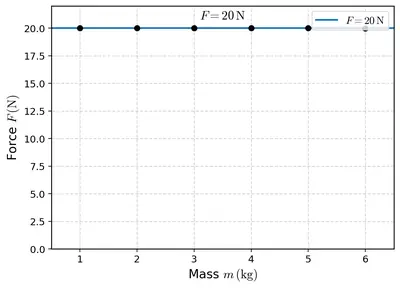
Because every point has the same y-coordinate (4 N), all points lie on a straight horizontal line. Hence the required graph is a line parallel to the mass axis cutting the force axis at the constant value of the force (4 N in the example above).
In words, the force–mass graph is a straight line parallel to the m-axis, indicating that the same force acts on every mass.
(When reproducing the graph in your notebook, label the constant value of the force as obtained from your own readings of Fig. 6.40; the numerical value might differ slightly from the sample 4 N used here.)
Answer
The required force–mass graph is a straight horizontal line (parallel to the mass axis) at the constant value of the force obtained from Fig. 6.40.
11
Solution
Given data
- Mass of the object $$m = 10\,\text{kg}$$
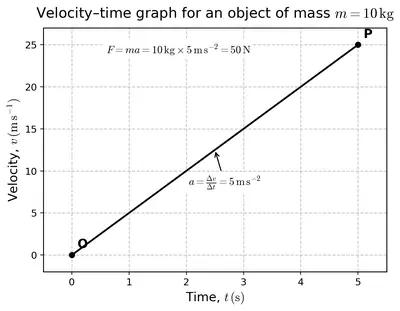
- The velocity–time graph (Fig. 6.41) is a straight horizontal line; i.e. the velocity of the object does not change with time.
Step 1 : Find the acceleration from the graph
For any convenient time interval, find the change in velocity $$\Delta v$$ and the corresponding change in time $$\Delta t$$.
Because the line is horizontal, the velocities at the beginning and at the end of the interval are equal. Hence
$$\Delta v = 0$$
The acceleration is the slope of the $$v\text{–}t$$ graph:
$$a = \frac{\Delta v}{\Delta t} = \frac{0}{\Delta t} = 0\;\text{m s}^{-2}$$
Step 2 : Use Newton’s second law to find the force
Newton’s second law gives
$$F = m a$$
Substituting $$m = 10\,\text{kg}$$ and $$a = 0\,\text{m s}^{-2}$$,
\[F = 10\,\text{kg}\;\times\;0\,\text{m s}^{-2} = 0\,\text{N}\]Therefore, the net force acting on the object is zero.
Answer
$$F = 0 \, \text{N}$$
12 A bullet of mass $$50 \, \mathrm{g}$$ moving with a speed of $$100 \, \mathrm{m \, s^{-1}}$$ enters a heavy stationary wooden block and stops after penetrating a distance of $$50 \, \mathrm{cm}$$. Estimate the stopping force acting on the bullet (assume that the bullet undergoes constant acceleration within the block).
Solution
Given data
- Mass of the bullet, $$m = 50 \\mathrm{g} = 0.05 \\mathrm{kg}$$
- Initial speed, $$u = 100 \\mathrm{m\,s^{-1}}$$
- Final speed, $$v = 0 \\mathrm{m\,s^{-1}}$$ (the bullet finally stops)
- Penetration distance (displacement inside the block), $$s = 50 \\mathrm{cm} = 0.50 \\mathrm{m}$$
The bullet is brought to rest by a constant opposing (retarding) force, so we can apply the equations of uniformly accelerated motion.
Step 1: Find the acceleration (actually a deceleration)
Use the kinematic relation $$v^{2} = u^{2} + 2 a s$$.
Substitute the known values:
$$0^{2} = (100)^{2} + 2 \; a \; (0.50)$$
Simplify:
$$0 = 10000 + a \times 1$$
$$a = -10000 \\mathrm{m\,s^{-2}}$$
The negative sign shows that the acceleration is opposite to the initial motion (it is a deceleration).
Magnitude of acceleration: $$|a| = 10000 \\mathrm{m\,s^{-2}}$$
Step 2: Compute the stopping force
Newton’s second law: $$F = m a$$.
$$F = 0.05 \times (-10000)$$
$$F = -500 \\mathrm{N}$$
The negative sign indicates that the force acts opposite to the bullet’s motion.
Therefore, the wooden block exerts a stopping force of magnitude $$500 \\mathrm{N}$$ on the bullet (directed opposite to its motion).
Answer
Stopping force (magnitude) $$F = 5.0 \times 10^{2} \, \mathrm{N}$$, opposite to the bullet’s motion.
13 An ace footballer converted a penalty shot by kicking the football with a speed of $$108 \, \mathrm{km \, h^{-1}}$$. The same force they imparted was $$800 \, \mathrm{N}$$. The mass of the football was $$0.4 \, \mathrm{kg}$$. Calculate the time of contact between their foot and the ball.
Solution
Step 1 : Write down the given data
- Mass of the football, $$m = 0.4\,\mathrm{kg}$$
- Force applied on the ball, $$F = 800\,\mathrm{N}$$
- Speed just after the kick, $$v = 108\,\mathrm{km\,h^{-1}}$$
- Initial speed of the ball (before the kick), $$u = 0\,\mathrm{m\,s^{-1}}$$ (the ball was at rest on the penalty spot)
Step 2 : Convert the final speed to SI units
$$ 108\,\mathrm{km\,h^{-1}} = 108 \times \frac{1000\,\mathrm{m}}{3600\,\mathrm{s}} = 30\,\mathrm{m\,s^{-1}} $$
Step 3 : Find the acceleration produced during the kick
Using Newton’s second law, $$F = m a$$,
$$ a = \frac{F}{m} = \frac{800}{0.4} = 2000\,\mathrm{m\,s^{-2}}\;. $$
Step 4 : Relate the acceleration to the time of contact
The ball accelerates from $$u = 0$$ to $$v = 30\,\mathrm{m\,s^{-1}}$$ in time $$t$$. Using the first equation of motion, $$v = u + a t$$,
$$ 30 = 0 + (2000) \, t \;\;\Rightarrow\;\; t = \frac{30}{2000}\,\mathrm{s}. $$
Step 5 : Calculate the time of contact
\[ t = 0.015\,\mathrm{s} \]
Thus, the footballer’s foot stayed in contact with the ball for
$$t = 0.015 \;\text{s} \;\text{(about } 15\,\text{ms).}$$
Answer
Time of contact = $$t = 0.015\,\mathrm{s}\;(\approx 15\,\mathrm{ms})$$
14 An object of mass $$2 \, \mathrm{kg}$$ moving with a constant velocity of $$10 \, \mathrm{m \, s^{-1}}$$ encounters a rough patch where the force of friction on the object is $$7 \, \mathrm{N}$$. At the same time, an additional constant force of $$3 \, \mathrm{N}$$ opposing the motion is applied on the object. After entering the rough patch, how much distance does the object travel before coming to rest?
Solution
Given data
- Mass of the object: $$m = 2\;\mathrm{kg}$$
- Initial (entry) velocity: $$u = 10\;\mathrm{m\,s^{-1}}$$
- Frictional force on the rough patch: $$F_{\text{f}} = 7\;\mathrm{N}$$ (opposes motion)
- Additional opposing force: $$F_{\text{add}} = 3\;\mathrm{N}$$
1. Find the net retarding force
The two forces act in the same (opposite-to-motion) direction, so the magnitudes simply add:
$$F_{\text{net}} = F_{\text{f}} + F_{\text{add}} = 7\;\mathrm{N} + 3\;\mathrm{N} = 10\;\mathrm{N}$$
2. Calculate the resulting acceleration
Newton’s second law gives $$F_{\text{net}} = m a$$, where the acceleration $$a$$ is opposite to the velocity (a retardation). Hence
$$a = \frac{F_{\text{net}}}{m} = \frac{10\;\mathrm{N}}{2\;\mathrm{kg}} = 5\;\mathrm{m\,s^{-2}}$$
Because it slows the object, we write $$a = -5\;\mathrm{m\,s^{-2}}$$ (negative sign indicates opposition to motion).
3. Use kinematics to find the stopping distance
For uniformly accelerated (here, uniformly retarded) motion, the equation
$$v^{2} = u^{2} + 2 a s$$
relates initial velocity $$u$$, final velocity $$v$$, acceleration $$a$$, and displacement $$s$$.
At the instant the object comes to rest, $$v = 0$$. Substituting the known values:
$$0^{2} = (10\;\mathrm{m\,s^{-1}})^{2} + 2(-5\;\mathrm{m\,s^{-2}})\,s$$
$$0 = 100 - 10 s$$
Rearranging,
$$10 s = 100 \;\; \Longrightarrow \;\; s = 10\;\mathrm{m}$$
4. Result
The object travels a distance of
\[ s = 10\;\mathrm{m} \]
along the rough patch before it comes to rest.
Answer
$$s = 10\;\mathrm{m}$$
15 A tractor pulls a harrow (a ploughing tool) of mass $$m_1$$ with a net force $$F$$ resulting in an acceleration of $$a_1$$. The same tractor pulls a trolley of mass $$m_2$$ with a force $$F$$ producing an acceleration of $$a_2$$. If the tractor now pulls the trolley with the harrow placed on it (with the same force $$F$$), then obtain an expression for the resulting acceleration in terms of $$a_1$$ and $$a_2$$. Ignore friction.
Solution
Given data
- Harrow mass $$m_1$$ is pulled with force $$F$$ and gains acceleration $$a_1$$.
- Trolley mass $$m_2$$ is pulled with the same force $$F$$ and gains acceleration $$a_2$$.
- We must find the acceleration $$a$$ when the harrow is kept on the trolley and the combination (total mass $$m_1+m_2$$) is pulled by the same force $$F$$.
- Friction is neglected ; the only horizontal force on the pulled body is $$F$$.
Step 1 : Apply Newton’s second law to each separate experiment
For the harrow alone
$$F = m_1 a_1 \quad(1)$$For the trolley alone
$$F = m_2 a_2 \quad(2)$$Step 2 : Express the two unknown masses in terms of $$F,\,a_1,\,a_2$$
Rearranging (1) and (2):
$$m_1 = \frac{F}{a_1} \quad \text{and} \quad m_2 = \frac{F}{a_2} \quad(3)$$Step 3 : Apply Newton’s second law to the combined system
Total mass being pulled
$$m_\text{total}= m_1 + m_2$$Let the required acceleration be $$a$$. With the same pulling force $$F$$,
$$F = (m_1 + m_2) \, a \quad(4)$$Step 4 : Substitute the masses from (3) into (4)
$$F = \left( \frac{F}{a_1} + \frac{F}{a_2} \right) a$$Step 5 : Cancel the common factor $$F$$ and solve for $$a$$
$$1 = \left( \frac{1}{a_1} + \frac{1}{a_2} \right) a$$ $$\Rightarrow \; a = \frac{1}{\dfrac{1}{a_1}+\dfrac{1}{a_2}}$$Simplify the reciprocal:
\[a = \frac{a_1 a_2}{a_1 + a_2}\]Result
The acceleration when the trolley carries the harrow and the pair is pulled by the same force $$F$$ is
$$a = \dfrac{a_1 a_2}{a_1 + a_2}.$$
(It is the harmonic mean of $$a_1$$ and $$a_2$$.)
Answer
$$\displaystyle a = \frac{a_1 a_2}{a_1 + a_2}$$
16
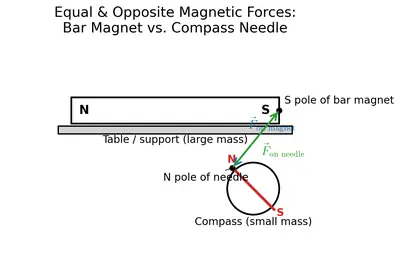
Solution
Given concepts
- Newton’s third law of motion – if magnet B (bar magnet) exerts a force $$\vec F_{BC}$$ on the compass needle C, then the needle exerts an equal and opposite force $$\vec F_{CB}$$ on the bar magnet: $$\vec F_{BC} = -\,\vec F_{CB}$$.
- Newton’s second law – the acceleration produced in a body of mass $$m$$ by a force $$F$$ is $$\vec a = \vec F/m$$.
Step 1 – Compare the masses
The compass needle is a thin piece of magnetised iron or steel having a mass of only a few grams. The hand-held bar magnet is usually a solid block of steel whose mass is tens to hundreds of grams.
Let
- mass of bar magnet = $$m_B$$,
- mass of compass needle = $$m_C$$.
Typically $$m_B \approx 100\,\text{g} = 0.10\,\text{kg}$$ and $$m_C \approx 1\,\text{g} = 0.001\,\text{kg}$$, so
$$m_B \;\gg\; m_C.$$
Step 2 – Calculate the accelerations
Since the magnitudes of the action-reaction forces are equal ($$|\vec F_{BC}| = |\vec F_{CB}| = F$$), the corresponding accelerations are
$$a_C = \dfrac{F}{m_C}, \qquad a_B = \dfrac{F}{m_B}.$$
Taking the ratio,
$$\dfrac{a_C}{a_B} = \dfrac{m_B}{m_C} \;\gg\; 1.$$
Because $$m_B$$ is about 100 times $$m_C$$, the needle’s acceleration is about 100 times larger than that of the bar magnet.
Step 3 – Role of friction and support
- The compass needle is mounted on a sharp pivot, so frictional torque is extremely small. Even a very small acceleration is enough to make it turn.
- The bar magnet is usually held in the hand or resting on a table. Static friction between the magnet and the support (or the inertia of the hand and arm) offers an additional opposing force. Unless the magnetic force exceeds this friction, the bar magnet will not start moving.
Step 4 – Combine the ideas
Although the two magnets pull (or push) each other with equal and opposite forces, the much smaller mass and negligible friction of the compass needle give it a comparatively large, easily observable acceleration. The bar magnet’s much larger mass and the extra friction reduce its acceleration to an unnoticeable value, so it appears stationary.
Conclusion
The phenomenon does not violate Newton’s third law. Both magnets experience equal and opposite forces, but according to Newton’s second law the lighter, almost friction-free compass needle responds with a noticeable motion, whereas the heavier, friction-held bar magnet does not.
Answer
The same magnetic force acts on both bodies, but the compass needle has a very small mass and is almost friction-free, so $$a = F/m$$ gives it a large acceleration and it turns. The bar magnet is much heavier and is held (or rests) with friction; its acceleration $$a = F/m$$ is therefore negligibly small, so it does not appear to move. Hence Newton’s third law is obeyed even though only the compass needle is seen to move.


