 91- 6303239042


Examples
Example 5.1 If 10 g of salt is dissolved in 90 g of water, calculate the mass by mass percentage of the solution formed.
Solution
Given data
- Mass of solute (salt), $$m_\text{solute} = 10\,\text{g}$$
- Mass of solvent (water), $$m_\text{solvent} = 90\,\text{g}$$
Step 1: Find the total mass of the solution.
By definition,
$$m_\text{solution} = m_\text{solute} + m_\text{solvent}$$
Substituting the given masses:
$$m_\text{solution} = 10\,\text{g} + 90\,\text{g} = 100\,\text{g}$$
Step 2: Write the formula for mass by mass percentage.
For a solution, the mass by mass percentage of solute is
$$\%\,m{\small /}m = \frac{m_\text{solute}}{m_\text{solution}} \times 100\%$$
Step 3: Substitute the values and simplify.
$$\%\,m{\small /}m = \frac{10\,\text{g}}{100\,\text{g}} \times 100\%$$
$$\%\,m{\small /}m = \frac{10}{100} \times 100\%$$
$$\%\,m{\small /}m = 10\%$$
Result
\[\boxed{\%\,m{\small /}m = 10\%}\]The solution therefore contains 10 percent salt by mass.
Answer
Mass by mass percentage of the solution = 10 %.
Example 5.2 If 5 g of glucose is dissolved in water to make 100 mL of solution, calculate its concentration in mass by volume percentage.
Solution
Step 1. Write the given data.
- Mass of solute (glucose), $$m_s = 5\,\text{g}$$
- Volume of the final solution, $$V = 100\,\text{mL}$$
Step 2. Recall the definition of mass by volume percentage.
The mass by volume percentage (also written as % (w/v)) tells us how many grams of solute are present in every $$100\,\text{mL}$$ of the solution. Its general formula is
$$\text{Mass by volume \%} = \left(\dfrac{\text{mass of solute (in g)}}{\text{volume of solution (in mL)}}\right) \times 100\%$$
Step 3. Substitute the given values.
$$\text{Mass by volume \%} = \left(\dfrac{5\,\text{g}}{100\,\text{mL}}\right) \times 100\%$$
Step 4. Do the arithmetic.
First divide:
$$\dfrac{5\,\text{g}}{100\,\text{mL}} = 0.05\,\text{g mL}^{-1}$$
Then multiply by $$100\%$$:
$$0.05 \times 100\% = 5\%$$
Step 5. Report the concentration.
The concentration of the glucose solution is therefore
\[5\,\% \text{ (mass by volume)}\]Answer
$$5\,\%$$ (mass by volume)
Example 5.3 If 1 mL of a liquid pesticide is mixed with a sufficient amount of water to form 100 mL of a pesticide spray for rice crop, calculate its volume by volume percentage.
Solution
Step 1 – Identify the known data
- Volume of the pesticide (solute): $$V_{\text{pest}} = 1\,\mathrm{mL}$$
- Total (final) volume of the spray (solution): $$V_{\text{soln}} = 100\,\mathrm{mL}$$
Step 2 – Recall the definition
The volume by volume percentage ( v/v %) of a component in a liquid mixture is defined as
$$\text{(v/v)\,\%} = \frac{\text{Volume of solute}}{\text{Total volume of solution}} \times 100$$
Step 3 – Substitute the numbers
$$\text{(v/v)\,\%} = \frac{1\,\mathrm{mL}}{100\,\mathrm{mL}} \times 100$$
Step 4 – Do the arithmetic
$$\text{(v/v)\,\%} = \frac{1}{100} \times 100 = 1$$
Step 5 – State the result
\[\boxed{\text{Volume by volume percentage of pesticide} = 1\,\%}\]
Answer
1 % (v/v)
Pause and Ponder
1 A common talcum powder contains 4 % $$m/m$$ zinc oxide, which acts as an antiseptic. How much zinc oxide is present in 300 g of the talcum powder?
Solution
Given data
- Total mass of the talcum powder, $$m_{\text{powder}} = 300\,\text{g}$$.
- Mass percentage of zinc oxide (\( \mathrm{ZnO} \)) in the powder, $$w\% = 4\,\%\, (m/m)$$.
Step 1 — Translate the percentage into a fraction
By definition, a mass percentage relates the mass of a component to the total mass of the mixture:
$$\frac{\text{mass of } \mathrm{ZnO}}{\text{total mass of powder}} \times 100 = 4$$
This can be written in fractional form as
$$\frac{\text{mass of } \mathrm{ZnO}}{\text{total mass of powder}} = \frac{4}{100} = 0.04$$
Step 2 — Set up the proportion for 300 g of powder
Let $$m_{\mathrm{ZnO}}$$ be the mass of zinc oxide in 300 g of powder. Substitute the known mass of the powder:
$$\frac{m_{\mathrm{ZnO}}}{300}\times 100 = 4$$
Step 3 — Solve for $$m_{\mathrm{ZnO}}$$
First isolate $$m_{\mathrm{ZnO}}$$ by multiplying both sides by $$\frac{300}{100}$$:
$$m_{\mathrm{ZnO}} = \frac{4}{100}\times 300$$
Calculate the product:
$$m_{\mathrm{ZnO}} = 0.04\times 300 = 12$$
Step 4 — State the result
The mass of zinc oxide present in 300 g of the talcum powder is
\[ m_{\mathrm{ZnO}} = 12\,\text{g} \]
Answer
$$12\,\text{g}$$
2 Your mother gives you a bottle of orange juice concentrate to mix with water and serve it to your visiting friends. She asks you to mix two tablespoons of the concentrate with water in a glass tumbler. If each tablespoon measures 15 mL and you make 150 mL of juice per person, what is the % $$v/v$$ of orange juice concentrate in the mixture you prepared?
Solution
Step 1: Identify the data given.
- Each tablespoon of concentrate → $$15\,\text{mL}$$
- Number of tablespoons used → $$2$$
- Total volume of finished drink (juice) → $$150\,\text{mL}$$
Step 2: Calculate the volume of orange-juice concentrate added.
$$\text{Volume of concentrate}=2\times15\,\text{mL}=30\,\text{mL}$$
Step 3: Recall the formula for percentage by volume (%% $$v/v$$).
$$\%\,v/v=\left(\dfrac{\text{volume of solute (concentrate)}}{\text{total volume of solution}}\right)\times100$$
Step 4: Substitute the known values.
$$\%\,v/v=\left(\dfrac{30\,\text{mL}}{150\,\text{mL}}\right)\times100$$
Step 5: Do the arithmetic.
$$\dfrac{30}{150}=0.20$$
$$0.20\times100=20$$
Step 6: State the final result.
\[\boxed{\%\,v/v = 20\%}\]
Therefore, the orange-juice concentrate makes up 20 percent of the total volume of the prepared juice.
Answer
$$\%\,v/v = 20\%$$
3 Vinegar, used as a food preservative and additive, contains 5 % $$v/v$$ acetic acid. Glacial acetic acid is a liquid, i.e., 100% acetic acid. If you want to make vinegar from glacial acetic acid, how would you proceed?
Solution
Given data
- Commercial vinegar must contain 5 % v/v acetic acid.
- Glacial acetic acid is 100 % (pure) acetic acid.
Step 1 – Recall the definition of volume %
For a solution expressed as "x % v/v"
$$\%\,v/v = \frac{\text{volume of solute (mL)}}{\text{total volume of solution (mL)}} \times 100$$
Step 2 – Set up the calculation
Let us prepare 100 mL of vinegar (any convenient volume can be chosen and then scaled).
Insert the known quantities:
$$5 = \frac{V_{\text{acetic acid}}}{100\,\text{mL}} \times 100$$
Step 3 – Solve for the required volume of glacial acetic acid
$$V_{\text{acetic acid}} = \frac{5 \times 100\,\text{mL}}{100} = 5\,\text{mL}$$
Step 4 – Determine the volume of water to add
Total desired volume = 100 mL
Volume already occupied by acetic acid = 5 mL
Therefore, volume of water required:
$$V_{\text{water}} = 100\,\text{mL} - 5\,\text{mL} = 95\,\text{mL}$$
Step 5 – Laboratory procedure
- Put on gloves and goggles.
- Measure 95 mL of distilled water in a 100 mL measuring cylinder or volumetric flask.
- Slowly add 5 mL of glacial acetic acid into the water (never the reverse: "add acid to water" for safety).
- Mix thoroughly. The final volume is 100 mL, giving 5 % v/v vinegar.
Optional scaling
| Desired volume of vinegar | Glacial acetic acid needed (5 % of total) | Water to add |
|---|---|---|
| 250 mL | 12.5 mL | 237.5 mL |
| 500 mL | 25 mL | 475 mL |
| 1 L (1000 mL) | 50 mL | 950 mL |
Conclusion
To convert glacial acetic acid into table vinegar, dilute it so that 1 part acid is present in 19 parts water, giving a final concentration of 5 % v/v.
Answer
Measure 5 mL of glacial acetic acid, add it carefully to 95 mL of distilled water, and mix; the resulting 100 mL solution is vinegar containing 5 % v/v acetic acid.
4 Refer to the solubility curves given in Activity 5.2. If equal masses of hot, saturated solutions of compounds 'A' and 'B' are cooled from 80 °C to 60 °C, which solution is likely to deposit more solid?
Solution
Step 1 : Read the solubility data from Activity 5.2
From the graph the approximate solubilities (g of solute per 100 g of water) are
- Compound A : $$S_{A,80}=140$$ at 80 °C and $$S_{A,60}=104$$ at 60 °C
- Compound B : $$S_{B,80}=38$$ at 80 °C and $$S_{B,60}=37$$ at 60 °C
Step 2 : Choose an equal mass of each hot, saturated solution
Take 100 g of each saturated solution at 80 °C (the problem says “equal masses”).
For any solute with solubility $$S$$, the composition of 100 g of saturated solution is :
- Mass of water : $$m_w = \frac{100}{100+S}\times100\;\text{g}$$
- Mass of solute : $$m_{s,80}= \frac{S}{100+S}\times100\;\text{g}$$
Step 3 : Calculate for compound A
- At 80 °C : $$m_{s,80}(A)= \frac{140}{100+140}\times100 = 58.3\,\text{g}$$ and $$m_w(A)=41.7\,\text{g}$$
- At 60 °C the same 41.7 g of water can now hold at most
$$m_{s,60\,\max}(A)= \frac{104}{100}\times41.7 = 43.3\,\text{g}$$ - Solid deposited : $$m_p(A)=58.3-43.3 = 15\,\text{g}$$
Step 4 : Calculate for compound B
- At 80 °C : $$m_{s,80}(B)= \frac{38}{100+38}\times100 = 27.5\,\text{g}$$ and $$m_w(B)=72.5\,\text{g}$$
- At 60 °C : $$m_{s,60\,\max}(B)= \frac{37}{100}\times72.5 = 26.8\,\text{g}$$
- Solid deposited : $$m_p(B)=27.5-26.8 = 0.7\,\text{g}$$
Step 5 : Compare
$$m_p(A)=15\,\text{g} \gg m_p(B)=0.7\,\text{g}$$
Hence the saturated solution of compound A deposits far more solid on cooling.
Answer
The hot, saturated solution of compound A will deposit more solid when cooled from 80 °C to 60 °C.
5 Will there be any change in the size of common salt crystals if the rate of evaporation is increased or decreased? Explain.
Solution
Concept recalled – Crystallisation
When a hot, saturated solution of common salt (sodium chloride, $$\mathrm{NaCl}$$) is allowed to cool and the solvent (water) subsequently evaporates, the excess $$\mathrm{NaCl}$$ separates out as solid crystals. Two simultaneous processes decide the size of the final crystals:
- Nucleation: first tiny particles (nuclei) of the solid appear.
- Crystal growth: extra ions from the solution arrange themselves on the faces of these nuclei, enlarging each crystal.
The relative time available for the second step (growth) depends upon how quickly the water molecules leave the solution.
Case 1 – Fast evaporation (high temperature, blowing air, sun-drying, etc.)
- Water molecules escape quickly; therefore the solution becomes supersaturated in a very short time.
- Large number of nuclei form almost simultaneously because supersaturation is high.
- Each nucleus gets only a small share of the dissolved salt before all liquid disappears.
Hence the individual crystals remain small.
Case 2 – Slow evaporation (room temperature, covered beaker, shaded place, etc.)
- Supersaturation builds up gradually, so fewer nuclei are produced.
- Because water leaves slowly, ions have sufficient time to migrate and add themselves regularly to the existing faces of those few nuclei.
Consequently, each crystal grows larger and well-defined.
Reason summarised mathematically
If $$N$$ is the number of nuclei produced and $$M$$ is the total moles of excess $$\mathrm{NaCl}$$ that must separate, the average moles available per crystal are
$$n_{\text{avg}} = \frac{M}{N}$$
Fast evaporation ⇒ large $$N$$ ⇒ smaller $$n_{\text{avg}}$$ ⇒ small crystals.
Slow evaporation ⇒ small $$N$$ ⇒ larger $$n_{\text{avg}}$$ ⇒ big crystals.
Conclusion
The size of common-salt crystals does change with the rate of evaporation:
- Increasing the rate of evaporation → numerous tiny crystals.
- Decreasing the rate of evaporation → fewer but bigger, well-formed crystals.
Answer
Yes. Fast evaporation gives many small crystals, whereas slow evaporation allows fewer nuclei to grow into large, well-formed common-salt crystals.
6 State whether the following statements are True or False. Also, correct the False statements.
(i) Salt can be separated from a salt solution by evaporation or distillation.
Solution
Common salt (mainly $$\mathrm{NaCl}$$) is present in the solution as a non-volatile solute, while water is volatile.
- Evaporation: On heating, only water molecules escape into the vapour phase. When the whole of the water has evaporated, a residue of dry salt is left behind. Hence evaporation works.
- Distillation: In simple distillation the solution is boiled. Water vapour rises into the condenser and is collected as liquid water in a separate receiver. The non-volatile salt does not distil and remains in the distillation flask. Thus distillation also separates salt from its solution.
Therefore the given statement is correct.
Answer
True.
(ii) Distillation can be used for separation of two liquids even when these have the same boiling point.
Solution
For simple distillation to separate two miscible liquids, their boiling points must differ appreciably (about $$25\,{}^{\circ}\mathrm{C}$$ or more). If the two liquids have the same boiling point, both vaporise together and cannot be separated by ordinary distillation; even fractional distillation will fail when the boiling points are identical.
Hence the statement is false.
Answer
False. Distillation separates two liquids only when their boiling points are different (usually by at least about $$25\,{}^{\circ}\mathrm{C}$$); if the boiling points are the same, distillation cannot separate them.
(iii) In paper chromatography, the solvent level should be above the sample spot at the beginning of the experiment.
Solution
At the start of a paper-chromatography run, the paper strip is suspended so that:
- the solvent level is below the pencil line carrying the sample spot, and
- the spot is not submerged.
This arrangement prevents the sample from dissolving directly into the bulk solvent; instead, it moves upward only with the advancing solvent front, allowing separation of its components.
Therefore the statement is false.
Answer
False. At the beginning of paper chromatography the solvent level must be below the sample spot, not above it.
(iv) Evaporation and crystallization are the same processes.
Solution
Evaporation is merely the removal of solvent (usually by heating) until the liquid phase is gone. Crystallization, on the other hand, involves slow cooling (or controlled evaporation) of a saturated solution so that well-formed, pure crystals of the solute separate, often leaving soluble impurities in the mother liquor.
Because the objectives, conditions and results differ, the two processes are not the same. Thus the statement is false.
Answer
False. Evaporation only removes the solvent, whereas crystallization deliberately forms pure solid crystals from a saturated solution; the two processes are different.
7 Why do immiscible liquids form two separate layers in a separating funnel?
Solution
Step 1 – Recall the meaning of “immiscible”
Two liquids are said to be immiscible when their molecules do not mix to give a single uniform phase. Each liquid stays as a separate phase because the force of attraction between like molecules (liquid A–A or liquid B–B) is stronger than the attraction between unlike molecules (A–B).
Step 2 – Forces acting inside a separating funnel
When a mixture of two immiscible liquids is poured into a separating funnel and allowed to stand, two phenomena act simultaneously:
- Inter-molecular preference – molecules of the same kind stay together, so the two liquids refuse to mix.
- Gravity – because every point in the liquid experiences its weight, the liquid with the greater density sinks.
Step 3 – Density decides which layer is on top
Assign the densities $$\rho_1$$ and $$\rho_2$$ to the two liquids. If $$\rho_1 > \rho_2$$, liquid 1 is heavier for the same volume, so gravity pulls it to the bottom of the funnel, while the lighter liquid 2 floats above it. The two layers remain distinct because there is practically no mutual solubility.
Result
Thus, in a separating funnel two immiscible liquids arrange themselves in two separate layers: the denser liquid forms the lower layer and the less dense liquid forms the upper layer. Their immiscibility (lack of mutual attraction) prevents them from mixing, and their different densities let gravity stack them one over the other.
Answer
Because the two liquids do not dissolve in each other, the molecules of each liquid stay together; gravity then arranges them according to density, with the denser liquid settling at the bottom and the lighter one floating on top, so two distinct layers appear in the separating funnel.
8 Is sublimation different from evaporation? Justify.
Solution
Step 1 – Recall the definitions
- Sublimation is the direct change of a substance from the solid state to the vapour (gaseous) state on heating, without passing through the liquid state.
Example: Dry ice: $$\mathrm{CO_2(s)} \;\longrightarrow\; \mathrm{CO_2(g)}$$ - Evaporation is the slow conversion of the surface molecules of a liquid into vapour at any temperature below its boiling point.
Example: Water left in an open dish gradually turns into $$\mathrm{H_2O(g)}$$.
Step 2 – State the phase changes involved
| Process | Initial phase | Final phase |
|---|---|---|
| Sublimation | Solid | Gas |
| Evaporation | Liquid | Gas |
Step 3 – Energy considerations
- Both processes require heat energy (endothermic).
- In sublimation the latent heat of fusion is skipped; particles gain enough energy to break all intermolecular bonds at once.
- In evaporation the particles first exist as a liquid and only the more energetic surface molecules escape into the gas phase.
Step 4 – Conditions under which they occur
- Sublimation occurs in solids whose vapour pressure becomes appreciable before melting (e.g. napthalene, iodine, camphor).
- Evaporation can occur for any liquid provided the surrounding air can take up the vapour and the temperature is below the boiling point.
Step 5 – Conclusion
Because the initial states, mechanisms and typical conditions differ, sublimation and evaporation are not the same phenomenon.
Answer
Yes. Sublimation is the direct change of a solid into vapour, whereas evaporation is the change of a liquid into vapour; hence they are different processes.
9 Clouds are made up of tiny water droplets or ice crystals floating in the air. Based on what you know about solutions, suspensions and colloids, what type of mixture do you think clouds are and why?
Solution
Step 1 : Recall the size-ranges and properties of the three kinds of mixtures
| Type of mixture | Typical particle diameter (nm) | Main observable properties |
|---|---|---|
| Solution (true solution) | < $$1\,\text{nm}$$ |
|
| Colloid | About $$1\,\text{nm}$$ to $$1000\,\text{nm}$$ (≈ $$1\,\mu\text{m}$$) |
|
| Suspension | > $$1000\,\text{nm}$$ |
|
Step 2 : Examine the facts about clouds
- A cloud consists of innumerable tiny droplets of liquid water or minute ice crystals dispersed throughout the surrounding air.
- The droplets have an average diameter of roughly $$10\,\mu\text{m}=10\times10^{3}\,\text{nm}$$. (Even though this is slightly above the textbook upper limit of $$1000\,\text{nm}$$, in everyday chemistry such airborne dispersions are still treated as colloids called aerosols.)
- The droplets stay suspended for long periods – they do not settle quickly like the sand particles of a suspension, because they are light and are held up by slow upward air currents.
- Clouds scatter sunlight; the familiar glowing white appearance is nothing but the Tyndall effect on a grand scale.
Step 3 : Match the observations with the definitions
- Not a solution: particles are far larger than $$1\,\text{nm}$$ and do scatter light.
- Not an ordinary suspension: although droplets are large, they remain uniformly spread and do not settle rapidly.
- Most consistent with a colloid: a stable dispersion of a liquid (water) in a gas (air) that exhibits the Tyndall effect. In colloid science such a system is termed a liquid-in-gas aerosol.
Conclusion
Therefore, on the basis of stability and light-scattering behaviour, clouds are best classified as colloidal dispersions (aerosols) of water droplets or ice crystals in air.
Answer
Clouds are colloids—specifically, a liquid/solid in gas aerosol—because their tiny water droplets remain dispersed without settling and scatter light (Tyndall effect).
10 Why do cities with a lot of smoke and dust in the air often look hazy?
Solution
Concept recalled — Colloidal dispersion of dust and smoke in air
Air that contains an unusually large number of very fine solid particles (soot, dust) or tiny liquid droplets behaves like a colloid: the gas (air) is the dispersion medium and the solid or liquid particles form the dispersed phase.
The optical property involved — Tyndall effect
When a beam of light passes through a colloidal dispersion, the minute dispersed particles are large enough (roughly 1 nm – 1000 nm) to scatter the incident light in all directions. This phenomenon is called the Tyndall effect.
Step-wise reasoning
- In a crowded city, exhaust gases from vehicles, factory chimneys and construction activities continuously add smoke and dust to the atmosphere.
- The suspended particles remain mixed with air for long periods, producing a stable colloidal system.
- Sunlight (or any bright light) that enters this colloidal atmosphere encounters these particles, and each particle scatters a part of the light.
- The scattered light reaches our eyes from many random directions instead of only along the straight-line path from the object we are viewing.
- This additional, randomly scattered light reduces the contrast of distant objects with the background, so they look blurred or faint; the whole scene appears hazy or smoke-filled.
Conclusion
Cities with plenty of smoke and dust look hazy because the suspended particles in air scatter the sunlight (Tyndall effect), making the entire path of light visible and lowering the clarity of distant objects.
Answer
Cities rich in smoke and dust appear hazy because the suspended particles act as a colloidal dispersion and scatter sunlight (Tyndall effect); the scattered light reaching our eyes from all directions reduces visibility and gives a misty appearance.
Revise, Reflect, Refine
1
Which of the following mixtures are correctly classified as homogeneous (Hm) and heterogeneous (Ht)? Choose the correct option.
(i) Air — Hm, Milk — Ht, Sugar solution — Hm, Smoke — Hm
(ii) Brass — Ht, Fog — Ht, Vinegar — Hm, Muddy water — Hm
(iii) Copper sulfate solution — Hm, Salt solution — Hm, Milk — Hm, Bronze — Hm
(iv) Muddy water — Ht, Milk — Ht, Blood — Ht, Brass — Hm
Solution
Key idea | How do we decide?
- Homogeneous mixture (Hm) – only one visible phase; composition and properties are the same throughout. Typical examples are true solutions and solid alloys.
- Heterogeneous mixture (Ht) – shows two or more phases; composition is not uniform. Suspensions, colloids, smokes, fogs, emulsions, etc. fall in this class.
Test every component named in the options.
| Mixture | Nature | Reason |
|---|---|---|
| Air | Hm | Gases mix completely giving a single gas-phase solution. |
| Milk | Ht | Fat globules are dispersed in water (emulsion/colloid) → non-uniform under a microscope and separable by centrifugation. |
| Sugar solution | Hm | Sugar $$\big(\mathrm{C_{12}H_{22}O_{11}}\big)$$ dissolves molecularly in water. |
| Smoke | Ht | Solid soot particles suspended in air (aerosol). |
| Brass | Hm | Solid alloy of Cu and Zn → single solid phase. |
| Fog | Ht | Liquid $$\mathrm{H_2O}$$ droplets dispersed in air. |
| Vinegar | Hm | Aqueous solution of ethanoic acid. |
| Muddy water | Ht | Sand/clay particles suspended; they settle on standing. |
| Copper sulphate solution | Hm | $$\mathrm{CuSO_4}$$ fully dissolves giving one phase. |
| Salt solution | Hm | $$\mathrm{NaCl}$$ completely miscible at the ionic level. |
| Bronze | Hm | Solid solution of Cu and Sn (single phase). |
| Blood | Ht | Cells + plasma; separates on centrifugation. |
Check every option against the table.
- (i) Smoke is marked Hm (should be Ht) → incorrect.
- (ii) Brass is marked Ht (should be Hm) and muddy water is marked Hm (should be Ht) → incorrect.
- (iii) Milk is marked Hm (should be Ht) → incorrect.
- (iv) Every assignment – muddy water (Ht), milk (Ht), blood (Ht), brass (Hm) – matches the table → correct.
Hence, the list in option (iv) is the only one in which all mixtures are classified correctly.
Answer
(iv)
2
Choose the correct options, and explain the reason for the correct and incorrect options.
Which among the following mixtures show the Tyndall Effect? A mixture of:
(a) air and dust particles
(b) copper sulfate and water
(c) starch and water
(d) acetone and water
(i) a and b (ii) b and d (iii) a and c (iv) c and d
Solution
Key concept — Tyndall effect
When a strong beam of light is passed through a mixture, the path of the light becomes visible only if the dispersed particles are large enough (about 1 nm – 1000 nm) to scatter the light. Such scattering is called the Tyndall effect and it is shown only by colloidal dispersions. It is not observed in:
- true solutions (particle size < 1 nm)
- coarse suspensions whose particles settle quickly and block light instead of scattering it uniformly
We now test each given mixture.
- Air and dust particles
Dust particles (diameter ≈ 100 nm to a few µm) are dispersed in air, forming an aerosol, i.e. a colloid. Hence the beam of light becomes visible in a dark room when sunlight enters through a window: the Tyndall effect is observed. - Copper sulphate and water
Copper sulphate dissolves completely, forming a true solution. The ions $$\mathrm{Cu^{2+}}$$ and $$\mathrm{SO_4^{2-}}$$ are about 0.1 nm in size, far below the colloidal range, so no scattering occurs ⇒ no Tyndall effect. - Starch and water
Starch granules do not dissolve molecularly; they swell and remain dispersed with size roughly 10 nm–1000 nm, producing a starch sol (a colloidal solution). Consequently the mixture strongly scatters light ⇒ Tyndall effect is seen. - Acetone and water
Acetone is completely miscible with water and forms a homogeneous true solution (individual molecules, size < 1 nm). Therefore there is no visible scattering ⇒ no Tyndall effect.
Summary of observations
| Mixture | Type of dispersion | Tyndall effect? |
|---|---|---|
| (a) Air + dust | Colloid (aerosol) | Yes |
| (b) $$\mathrm{CuSO_4}$$ solution | True solution | No |
| (c) Starch + water | Colloid (sol) | Yes |
| (d) Acetone + water | True solution | No |
Only mixtures (a) and (c) scatter light, so the correct set of options is (iii) a and c.
Answer
(iii) a and c
Only the colloidal mixtures air + dust and starch + water scatter light and therefore exhibit the Tyndall effect; the true solutions of $$\mathrm{CuSO_4}$$ in water and acetone in water do not.
3
A mixture can be categorised as a solution, a suspension, or a colloid, each possessing distinct properties. Utilise the words or phrases provided in the box to fill in the Table 5.2. Words and phrases may be used more than once.
Words and Phrases: Large-sized particles; Particles remain evenly distributed; Small-sized particles (less than 1 nm diameter); Moderate-sized particles (1–1000 nm); Settles down when left undisturbed (more than 1000 nm in diameter); Does not settle down; Scatters light; Separates by filtration; Transparent; Salt solution; Milk; Sand in water; Smoke; Heterogeneous mixture; Cannot be separated by filtration; Mud; Butter; Brass.
Complete the Table 5.2.
| Solution | Suspension | Colloid |
|---|---|---|
| Properties | Properties | Properties |
| Examples | Examples | Examples |
Solution
Step 1 – Recall the size–based classification of mixtures
A dispersed-phase particle is called
- a solute in a solution if its diameter is smaller than 1 nm
- a suspended particle in a suspension if its diameter is larger than 1000 nm
- a colloidal particle in a colloid if its diameter lies between 1 nm and 1000 nm
Step 2 – Sort every clue from the word-box
- Small-sized particles (< 1 nm), particles remain evenly distributed, transparent, does not settle down, cannot be separated by filtration ⇒ Solution
- Large-sized particles (> 1000 nm), settles down, separates by filtration, heterogeneous mixture, scatters light ⇒ Suspension
- Moderate-sized particles (1–1000 nm), does not settle down, particles remain evenly distributed, scatters light, cannot be separated by filtration ⇒ Colloid
Step 3 – Pick suitable examples from the same word-box
- Solution ⇒ Salt solution, Brass
- Suspension ⇒ Sand in water, Mud
- Colloid ⇒ Milk, Smoke, Butter
Step 4 – Fill Table 5.2 completely
| Solution | Suspension | Colloid |
|---|---|---|
|
|
|
|
|
|
Answer
Completed Table 5.2 is:
| Solution | Suspension | Colloid |
|---|---|---|
| Small-sized particles (<1 nm); particles remain evenly distributed; does not settle; transparent; cannot be separated by filtration | Large-sized particles (>1000 nm); heterogeneous; settles on standing; scatters light; separates by filtration | Moderate-sized particles (1–1000 nm); particles remain evenly distributed; does not settle; scatters light; cannot be separated by filtration |
| Salt solution; Brass | Sand in water; Mud | Milk; Smoke; Butter |
4 Solve the following problems:
(i) A cake recipe uses dry ingredients, namely 75 g of sugar for 420 g of all-purpose flour and 5 g of sodium hydrogencarbonate. Express the concentration of each component in the mixture using an appropriate method.
Solution
Step 1 — Find the total mass of the dry mix.
Total mass
$$m_{\text{total}} = 75\,\text{g} + 420\,\text{g} + 5\,\text{g} = 500\,\text{g}$$
Step 2 — Recall the definition of mass percentage.
For any component A,
$$\%\,\text{(A by mass)} = \frac{m_A}{m_{\text{total}}}\times100$$
Step 3 — Calculate each percentage.
- Sugar: $$\%\,\text{sugar} = \frac{75}{500}\times100 = 15\%$$
- All-purpose flour: $$\%\,\text{flour} = \frac{420}{500}\times100 = 84\%$$
- Sodium hydrogencarbonate: $$\%\,\mathrm{NaHCO_3} = \frac{5}{500}\times100 = 1\%$$
Step 4 — State the concentrations.
Thus the dry mixture contains
- 15 mass % sugar,
- 84 mass % all-purpose flour, and
- 1 mass % sodium hydrogencarbonate.
Answer
Sugar = 15 %
Flour = 84 %
$$\mathrm{NaHCO_3}$$ = 1 %
(ii) A brass alloy contains 70% copper by mass. Calculate the quantities of copper and zinc present in 120 g of brass.
Solution
Given. Brass has 70 % Cu by mass. Sample mass: 120 g.
Step 1 — Compute mass of copper.
$$m_{\text{Cu}} = \frac{70}{100}\times120\,\text{g} = 84\,\text{g}$$
Step 2 — Compute mass of zinc.
Because brass is mainly Cu + Zn, zinc accounts for the remaining 30 % mass.
$$m_{\text{Zn}} = \frac{30}{100}\times120\,\text{g} = 36\,\text{g}$$
Step 3 — State the result.
Hence, 120 g of brass contains 84 g copper and 36 g zinc.
Answer
Cu = 84 g,
Zn = 36 g
5
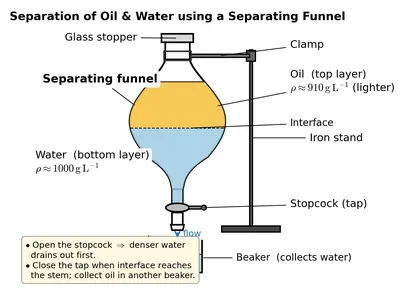
Solution
Given data
Volume of the oil pack = 1 L (= 1000 cm3)
Mass of the oil pack = 910 g
Step 1 : Calculate the density of the cooking oil
The formula for density is $$\rho = \frac{m}{V}$$
Substituting the given values,
$$\rho_{\text{oil}} = \frac{910\;\text{g}}{1000\;\text{cm}^3}$$
$$\rho_{\text{oil}} = 0.91\;\text{g cm}^{-3}$$
Step 2 : Compare the density with that of water
The density of water at room temperature is $$1.0\;\text{g cm}^{-3}$$.
- $$\rho_{\text{oil}} = 0.91\;\text{g cm}^{-3} < \rho_{\text{water}} = 1.0\;\text{g cm}^{-3}$$
- Because the oil is less dense than water and the two liquids are immiscible, they will form two separate layers.
Step 3 : Decide which layer will be on top
Since the oil has lower density, it will float. Therefore,
- Top layer : Cooking oil
- Bottom layer : Water
Step 4 : Separation method
Use a separating funnel (liquid–liquid separation):
- Transfer the oil–water mixture into the separating funnel and fit the stopper.
- Allow the mixture to stand until two clear layers appear.
- Place a beaker under the funnel. Open the stop-cock to drain the lower (water) layer completely.
- Close the stop-cock when the oil layer is about to reach the outlet. Collect the oil separately in another beaker.
Step 5 : Diagram to be drawn
- Draw a vertical glass separating funnel with a stop-cock near its tapered end.
- Show two horizontal layers inside: the upper shaded layer labelled “Cooking oil (0.91 g cm−3)” and the lower clear layer labelled “Water (1 g cm−3)”.
- Draw a stand holding the funnel, a beaker under the stem to collect water, and another beaker kept ready for oil.
- Indicate the direction of flow (arrow) from the stop-cock to the lower beaker.
Thus the immiscible liquids get completely separated.
Answer
(i) Yes. Oil and water are immiscible and will form two layers.
(ii) Oil (density 0.91 g cm−3) floats on top of water (density 1.0 g cm−3).
(iii) Pour the mixture into a separating funnel, allow the layers to settle, then open the stop-cock to drain the lower water layer first and collect the upper oil layer separately.
6
Assertion (A): Solutions do not exhibit the Tyndall effect.
Reason (R): The particles in solutions are larger than 100 nm, so they cannot scatter light.
Choose the correct option:
(i) Both A and R are true, and R is the correct explanation of A.
(ii) Both A and R are true, but R is not the correct explanation of A.
(iii) A is true, but R is false.
(iv) A is false, but R is true.
Solution
Step 1 — Recall the Tyndall effect
The Tyndall effect is the visible scattering of a light beam by particles whose sizes are comparable to or larger than the wavelength of visible light (roughly $$400\,\text{nm}$$ to $$700\,\text{nm}$$). Particles must therefore be of at least a few tens of nanometres in diameter to scatter light effectively.
Step 2 — Typical particle sizes in different types of mixtures
| Type of mixture | Typical particle size range | Tyndall effect? |
|---|---|---|
| True solution | $$\lt 1\,\text{nm}$$ | No |
| Colloid | $$1\,\text{nm}$$ to $$100\,\text{nm}$$ | Yes |
| Suspension | $$\gt 100\,\text{nm}$$ | Yes (particles often visible to the naked eye) |
Step 3 — Test the Assertion (A)
Because the particles in a true solution are extremely small ($$\lt 1\,\text{nm}$$), they do not scatter light. Hence a beam of light, on passing through a true solution, is not visible. Therefore, Assertion (A) is true.
Step 4 — Test the Reason (R)
Reason (R) claims that “The particles in solutions are larger than $$100\,\text{nm}$$, so they cannot scatter light.” This statement is doubly wrong:
- In reality, the particles in a true solution are smaller than $$1\,\text{nm}$$, not larger than $$100\,\text{nm}$$.
- If particles were indeed larger than $$100\,\text{nm}$$, they would actually scatter light very strongly (as in a colloid or coarse suspension), not fail to do so.
Hence, Reason (R) is false.
Step 5 — Match with the options
Since Assertion (A) is true but Reason (R) is false, the correct choice is
(iii) A is true, but R is false.
Answer
(iii) A is true, but R is false.
7
How would you separate the mixtures given in Table 5.3? Mention the reason for choosing your method. If a mixture cannot be separated, explain why.
| Mixture | Method of separation | Reason for selection |
|---|---|---|
| Mud from muddy water | ||
| Plasma from other components in the blood sample | ||
| Naphthalene and sand | ||
| Chalk powder and common salt | ||
| Common salt and water | ||
| Oil from water | ||
| Pigments of the flower |
Solution
Background Concepts
- A suitable separation technique always exploits a difference in some physical property of the components – particle size, solubility, density, volatility, affinity for a stationary phase, etc.
- Whenever we name a method, we must also state which property it makes use of and how that property differs for the two constituents.
Worked explanation for each mixture in Table 5.3
| Mixture | Step-by-step method | Property exploited / Reason |
|---|---|---|
| Mud from muddy water |
|
Mud is insoluble and has far larger, denser particles than water. Gravity pulls it down; filter pores (≈ $$10^{-5}\,\text{m}$$) stop the remaining solids. |
| Plasma from other components of blood |
|
Centrifugation separates components that have small but significant density differences; the denser cells experience a larger centrifugal force $$F=m\omega^2r$$ and move outward faster than plasma proteins and water. |
| Naphthalene and sand |
|
Naphthalene is volatile and sublimes directly at $$80\,{}^{\circ}\text{C}$$, whereas sand (silica) is non-volatile and does not sublime. |
| Chalk powder (CaCO3) and common salt (NaCl) |
|
Difference in solubility. NaCl is highly soluble (≈ $$36\,\text{g}/100\,\text{mL at }25^{\circ}\text{C}$$); CaCO3 is practically insoluble (≈ $$0.0013\,\text{g}/100\,\text{mL}$$). |
| Common salt and water (brine) |
|
NaCl is non-volatile; water boils at $$100^{\circ}\text{C}$$ and escapes as vapour, so evaporation/distillation works. |
| Oil from water (immiscible liquid mixture) |
|
Oil and water are immiscible and have different densities (e.g. kerosene ≈ $$0.80\,\text{g\,cm}^{-3}$$, water $$1.0\,\text{g\,cm}^{-3}$$), giving two distinct layers that can be tapped off. |
| Pigments present in a flower |
|
Chromatography separates substances based on differential adsorption (affinity) to the stationary phase (paper fibres) versus solubility in the moving solvent. Each pigment has its own balance, so they move at different speeds. |
Note on mixtures that cannot be separated by physical means
All seven listed mixtures are physical mixtures, so at least one physical technique exists in each case; hence none is inseparable.
Answer
| Mixture | Best method | Key reason |
|---|---|---|
| Muddy water | Sedimentation → Decantation → Filtration | Mud is insoluble & denser; particle size large enough to settle/filter. |
| Blood (plasma from cells) | Centrifugation | Components differ slightly in density; spinning packs heavy cells. |
| Naphthalene + sand | Sublimation | Naphthalene sublimes; sand does not. |
| Chalk powder + NaCl | Dissolve in water → Filtration → Evaporation/crystallisation | Salt soluble; chalk insoluble. |
| NaCl solution (salt + water) | Evaporation (or simple distillation) | Water volatile; salt non-volatile. |
| Oil + water | Separating funnel | Liquids are immiscible & have different densities. |
| Flower pigments | Paper chromatography | Pigments have different solubility/adsorption, so travel unequal distances. |
8
Solution
Step 1 · Analyse the information given
- Liquid A boils at $$60\,{}^{\circ}\mathrm{C}$$.
- Liquid B boils at $$90\,{}^{\circ}\mathrm{C}$$.
- Both liquids are miscible.
- The difference in their boiling points is $$90\,{}^{\circ}\mathrm{C}-60\,{}^{\circ}\mathrm{C}=30\,{}^{\circ}\mathrm{C}$$.
NCERT states that if the difference in boiling points of two miscible liquids is more than about $$25\,\text{K}$$, they can be separated by simple distillation (fractional distillation is needed only when the difference is smaller).
Step 2 · Principle of simple distillation
- The liquid with the lower boiling point converts to vapour first.
- The vapour is led through a condenser, where it cools and changes back to liquid.
- The higher-boiling liquid remains in the distillation flask until most of the lower-boiling liquid has been distilled off.
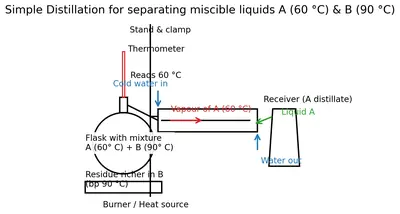
Step 3 · Procedure
- Pour the mixture of liquids A and B into a round-bottom (distillation) flask and add a few porcelain chips to avoid bumping.
- Fit the flask with a cork carrying a thermometer so that the bulb is just below the side arm.
- Connect the side arm to a Liebig condenser inclined slightly downwards toward a clean, dry receiving flask.
- Gently heat the distillation flask. When the temperature reaches close to $$60\,{}^{\circ}\mathrm{C}$$, liquid A starts boiling and its vapour passes into the condenser.
- The vapour of A condenses and is collected in the receiver; the temperature remains almost steady near $$60\,{}^{\circ}\mathrm{C}$$ during this period.
- When no more liquid distils at this temperature, stop heating. Liquid B (with the higher boiling point) is left behind in the distillation flask.
Step 4 · Result
- Liquid A (bp $$60\,{}^{\circ}\mathrm{C}$$) is obtained as the distillate.
- Liquid B (bp $$90\,{}^{\circ}\mathrm{C}$$) remains in the original flask.
Step 5 · Labelled diagram to draw
Draw and label these parts clearly:
- A round-bottom distillation flask containing the mixture and porcelain chips.
- A thermometer inserted through a cork; its bulb just below the side arm.
- A side arm leading to a water-cooled Liebig condenser. Show arrows for water in (nearest the receiver end) and water out (nearest the distillation flask end).
- A receiving flask (conical flask) at the condenser outlet to collect liquid A.
- A stand and clamp holding the apparatus, and a gentle Bunsen burner flame heating the distillation flask.
- Label the temperature range $$\approx60\,{}^{\circ}\mathrm{C}$$ on the thermometer, and indicate vapour of A going into the condenser and residue: liquid B left behind.
With these annotations, the diagram will show how simple distillation separates two miscible liquids whose boiling-point difference is about $$30\,\text{K}$$.
Answer
Separate the mixture by simple distillation because the boiling points differ by about $$30\,{}^{\circ}\mathrm{C}$$ (greater than $$25\,\text{K}$$).
On heating, liquid A (bp $$60\,{}^{\circ}\mathrm{C}$$) distils first, condenses in the condenser and is collected in the receiver, while liquid B (bp $$90\,{}^{\circ}\mathrm{C}$$) remains in the distillation flask.
Draw a labelled simple-distillation setup: round-bottom flask with mixture, thermometer, side arm to Liebig condenser (water in/out), receiving flask, and heat source.
9 Compare evaporation, crystallization and distillation. In which situation, would you prefer each of these over the others?
Solution
Key idea — all three techniques separate the components of a solution by using the different volatilities of the constituents, but each is carried out in a different way and therefore suits a different purpose.
1. Evaporation
- Apparatus: china dish, Bunsen burner or hot plate, tripod and wire-gauze; no lid or condenser.
- Principle: the solvent (often water) is allowed to evaporate into the surroundings. Only the residue that does not evaporate is obtained.
- Working temperature: close to the solvent’s boiling point; water is steadily lost as vapour.
- Product obtained: generally an amorphous or powdery solid that may still contain soluble impurities because everything that is non-volatile remains behind.
- Uses: obtaining common salt from sea water; concentrating sugar solution before crystallisation.
- Limitations: (i) not suitable if the solid decomposes on strong heating, (ii) solvent is wasted, (iii) purity is limited.
2. Crystallisation
- Apparatus: beaker, glass rod, water-bath, filter paper, watch glass, crystallising dish.
- Principle: prepare a hot, saturated solution. On slow cooling the solute’s solubility falls, so it separates as well-shaped crystals while most impurities stay dissolved in the mother liquor.
- Working temperature: first just below the solvent’s boiling point to make the solution saturated; then allowed to cool undisturbed.
- Product obtained: pure crystalline solid (e.g. blue crystals of $$\mathrm{CuSO_4\,·\,5H_2O}$$).
- Uses: purifying a solid that is heat-stable and more soluble in hot solvent than in cold; preparing sample crystals for X-ray studies, silica gel, alum, etc.
- Limitations: time-consuming; cannot recover the solvent; needs that solubility change with temperature.
3. Distillation
- Apparatus: round-bottom flask, thermometer, condenser, receiver; the setup is closed except for an exit to the receiver.
- Principle: the solution is boiled; the vapour of the more volatile component is led through a condenser, cooled and condensed back to liquid, which is collected separately. Thus both solvent and residue can be obtained.
- Working temperature: exactly at the solvent’s (or lower-boiling liquid’s) boiling point; temperature is monitored by the thermometer.
- Product obtained: pure liquid (distillate) and the less volatile component left behind.
- Uses: (i) obtaining distilled water from tap water, (ii) separating miscible liquids whose boiling points differ by at least $$25\,{}^\circ\mathrm{C}$$ (simple distillation) or less (fractional distillation), (iii) recovering organic solvents such as ethanol.
- Limitations: needs more glassware and heat source; slower than plain evaporation.
4. Side-by-side comparison
| Feature | Evaporation | Crystallisation | Distillation |
|---|---|---|---|
| Components recovered | Only non-volatile solid | Pure solid crystals | Volatile liquid (distillate) and/or solid residue |
| Purity obtained | Low | High for solid | High for liquid (and fair for residue) |
| Equipment | Very simple | Moderate | Elaborate (condenser etc.) |
| Solvent recovery | No | No | Yes |
| Risk of thermal decomposition | High | Lower (mild heating only) | Controlled (thermometer) |
5. Which one to prefer?
- Choose evaporation when the only goal is to obtain a solid quickly and the solid does not char; the solvent is cheap or not required (e.g. getting common salt from brine on a large scale).
- Choose crystallisation when high-purity solid crystals are needed and the solute’s solubility changes appreciably with temperature, e.g. purifying impure $$\mathrm{CuSO_4}$$ or sugar.
- Choose distillation when it is necessary to (a) collect the liquid component, (b) keep the solid from decomposing, or (c) separate two miscible liquids with different boiling points, e.g. obtaining distilled water, separating acetone $$\bigl(b.p.=56\,{}^\circ\mathrm{C}\bigr)$$ from ethanol $$\bigl(b.p.=78\,{}^\circ\mathrm{C}\bigr)$$.
Answer
Use evaporation for a quick, low-purity solid when the solvent is unimportant; use crystallisation for obtaining pure, well-shaped crystals of a heat-stable solid; use distillation when the liquid must be recovered or when separating liquids having different boiling points.
10 Blood is an example of a colloidal mixture.
(i) What would happen if blood behaved like a true suspension inside the body?
Solution
Step 1 — Recall the difference between a colloid and a true suspension
- In a colloid the particle size lies in the range $$10^{-9}\,\text{m}$$ to $$10^{-7}\,\text{m}$$ (1 nm to 100 nm); the particles remain continuously dispersed and do not settle on standing.
- In a true suspension the particles are much larger (typically greater than $$10^{-6}\,\text{m}$$). Under gravity they slowly settle to the bottom and form a separate layer.
Step 2 — Apply this idea to blood
Blood contains red blood cells, white blood cells, platelets and plasma proteins dispersed in liquid plasma. Because the effective sizes of these particles fall in the colloidal range, blood normally behaves as a stable colloid and flows uniformly through arteries, veins and capillaries.
Step 3 — Predict what would happen if blood behaved like a true suspension
If the same particles behaved like a true suspension, their larger effective size would cause them to settle under gravity:
- Red blood cells, white blood cells and platelets would gradually accumulate at the lower portions of blood vessels.
- The upper layer of every vessel would then consist almost entirely of clear plasma.
- Such settling would block fine capillaries and interrupt the continuous supply of oxygen and nutrients to the tissues.
- The separation would prevent uniform circulation, and the life processes that depend on blood flow would stop.
Step 4 — Conclusion
If blood behaved like a true suspension, its cells and proteins would stratify inside the body, block blood vessels and bring circulation to a halt — a situation incompatible with life.
Answer
The cells and proteins would settle under gravity, blocking blood vessels and stopping the uniform circulation of oxygen and nutrients; life processes would soon stop.
(ii) In a blood sample, identify the dispersed phase and the dispersion medium.
Solution
Blood is a liquid sol colloid.
Dispersed (discontinuous) phase
• Solid components – red blood cells, white blood cells, platelets and plasma proteins.
Dispersion (continuous) medium
• The liquid plasma, which is mostly water containing dissolved salts, glucose, hormones, etc.
Answer
Dispersed phase – blood cells and proteins; Dispersion medium – liquid plasma.
11
Solution
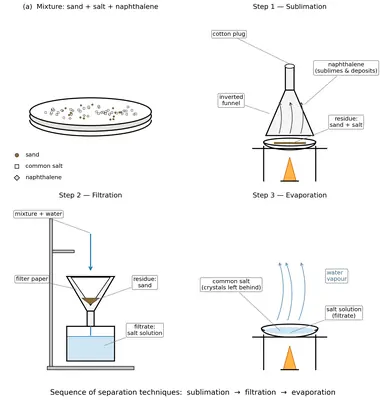
Given mixture: sand (insoluble solid), common salt (soluble solid, $$\mathrm{NaCl}$$), and naphthalene (volatile solid that sublimes).
We want each component in the pure, dry form. At every stage only one component must be removed while the others remain unaffected. This fixes an unambiguous order of techniques, explained step-by-step below.
Sublimation — separates naphthalene.
• Put the dry mixture in a china dish.
• Invert a funnel over it, plug the stem with cotton, and heat gently.
• Naphthalene sublimes: $$\text{solid} \; \xrightarrow{\text{heat}} \; \text{vapour}$$ and then re-solidifies as a white crystalline layer on the cooler funnel walls.
• Scrape off and collect the pure naphthalene.Dissolve & filtrate — removes sand from the salt solution.
• The residue (sand + salt) is transferred to a beaker and stirred with a small quantity of water.
• Common salt dissolves to give $$\mathrm{NaCl(aq)}$$ but sand remains insoluble.
• Filter the suspension. Filtration gives:
Residue on filter paper → dry to obtain pure sand.
Filtrate (salt solution) → taken to the next step.Evaporation/Crystallisation — obtains common salt.
• Heat the filtrate gently in an evaporating dish until the volume is reduced and salt crystals start appearing at the edge.
• Stop heating, cool, and allow crystallisation. Filter, wash and dry the crystals to get pure common salt.
Why no other order works:
If we had added water first, naphthalene (insoluble) would still have to be separated, but sublimation would become cumbersome from a wet mixture. Therefore sublimation must be the very first step, followed by filtration (to remove sand) and finally evaporation/crystallisation (to obtain the dissolved salt).
Hence the correct, complete sequence of separation techniques is:
Sublimation → Filtration → Evaporation / Crystallisation.
Answer
Sublimation → Filtration → Evaporation (or crystallisation).
12 Why is distillation an effective method for separating a mixture of water and acetone?
Solution
Step 1 – Nature of the mixture
• The solution contains two liquids — water and acetone — that are completely miscible (they mix in every proportion without forming layers).
Step 2 – Compare their boiling points
- Normal boiling point of acetone: $$56^{\circ}\mathrm{C}$$
- Normal boiling point of water : $$100^{\circ}\mathrm{C}$$
The difference is $$100^{\circ}\mathrm{C}-56^{\circ}\mathrm{C}=44^{\circ}\mathrm{C}$$. A gap of more than about $$25^{\circ}\mathrm{C}$$ is considered sufficient for simple distillation.
Step 3 – Principle of distillation
At any given pressure a liquid boils when its vapour pressure equals the external pressure. The liquid with the lower boiling point (higher volatility) reaches this condition first, so it vapourises preferentially.
Step 4 – How separation occurs
- On gentle heating the thermometer quickly rises to about $$56^{\circ}\mathrm{C}$$. Only acetone boils, producing vapour rich in acetone.
- The vapour passes into the condenser, cools, and liquefies; pure (or almost pure) acetone drips into the receiver.
- After most acetone has distilled, the temperature of the residue climbs towards $$100^{\circ}\mathrm{C}$$. Now water begins to boil and can be collected in a separate vessel if required.
Step 5 – Conclusion
The large boiling-point difference allows each component to vaporise at a distinctly different temperature, so distillation cleanly separates the more volatile acetone from water. Therefore distillation is an effective method for this mixture.
Answer
Because acetone boils at only $$56^{\circ}\mathrm{C}$$ whereas water boils at $$100^{\circ}\mathrm{C}$$, the far more volatile acetone vapourises first, is condensed and collected, leaving water behind; the large 44 °C boiling-point gap makes simple distillation an efficient way to separate the two liquids.
13
Answer the following questions with the help of the data given in Table 5.4.
Table 5.4: Solubility of various salts (in g per 100 g of water) at different temperatures
| Salts | 10 °C | 20 °C | 30 °C | 40 °C | 60 °C | 80 °C |
|---|---|---|---|---|---|---|
| Potassium nitrate | 21 | 32 | 45 | 62 | 106 | 167 |
| Sodium chloride | 36 | 36 | 36.3 | 36.5 | 37 | 37 |
| Potassium chloride | 35 | 35 | 37.4 | 40 | 46 | 54 |
| Ammonium chloride | 24 | 37 | 41 | 41 | 55 | 66 |
(i) What mass of potassium nitrate would be needed to prepare its saturated solution in 50 g of water at 40 °C?
Solution
From Table 5.4 the solubility of potassium nitrate (KNO3) at 40 °C is
$$62\;\text{g per }100\;\text{g water}$$
That is, 100 g of water dissolves 62 g of the salt to give a saturated solution.
For only 50 g of water, keep the same proportion:
$$\text{Mass of }\mathrm{KNO_3}=62\;\text{g}\times\frac{50\;\text{g water}}{100\;\text{g water}}$$
$$=62\times0.50=31\;\text{g}$$
Therefore, the student must dissolve 31 g of potassium nitrate in 50 g of water at 40 °C to obtain a saturated solution.
Answer
31 g of $$\mathrm{KNO_3}$$
(ii) A student makes a saturated solution of potassium chloride in water at 80 °C and leaves the solution to cool at room temperature (25 °C). What would she observe as the solution cools? Explain.
Solution
At 80 °C a saturated solution of potassium chloride contains
$$54\;\text{g KCl per }100\;\text{g water}$$
When the hot solution is allowed to cool to room temperature (≈25 °C) its solubility falls to a value close to that at 30 °C, i.e.
$$\approx37\;\text{g KCl per }100\;\text{g water}$$
Thus each 100 g of water can now keep only about 37 g in solution. The extra
$$54-37=17\;\text{g (per 100 g water)}$$
has no choice but to leave the solution. The moment the temperature drops below 80 °C, the solution becomes supersaturated and the excess potassium chloride separates out as solid.
Observation: Colourless, cubic crystals of potassium chloride will slowly form and settle at the bottom of the container (or deposit on the walls) as the solution cools.
Answer
On cooling, colourless crystals of $$\mathrm{KCl}$$ separate out because its solubility decreases from 54 g/100 g H2O at 80 °C to about 37 g/100 g H2O near 25 °C; the excess salt precipitates.
(iii) What is the effect of a change in temperature on the solubility of salts? Also, compare the changes in the solubility of the four given salts with increasing temperature from 10 °C to 80 °C.
Solution
In general, the solubility of most solid salts in water increases with temperature because heating supplies more energy to break the ionic lattice and hydrate the ions.
Using Table 5.4 (10 °C → 80 °C):
| Salt | Solubility at 10 °C (g/100 g H2O) | Solubility at 80 °C | Increase (g) |
|---|---|---|---|
| Potassium nitrate | 21 | 167 | +146 |
| Sodium chloride | 36 | 37 | +1 |
| Potassium chloride | 35 | 54 | +19 |
| Ammonium chloride | 24 | 66 | +42 |
- The most dramatic rise is for $$\mathrm{KNO_3}$$: its solubility becomes almost eight times the original value.
- $$\mathrm{NH_4Cl}$$ also shows a large, though smaller, increase.
- $$\mathrm{KCl}$$ exhibits a moderate increase.
- $$\mathrm{NaCl}$$ is almost insensitive to temperature—the change is negligible.
Hence, while temperature generally enhances solubility, the magnitude of the effect is salt-specific: $$\mathrm{KNO_3} > \mathrm{NH_4Cl} > \mathrm{KCl} \gg \mathrm{NaCl}$$ for the salts listed.
Answer
Rising temperature usually raises solubility. Between 10 °C and 80 °C the increases are: $$\mathrm{KNO_3}$$ 146 g > $$\mathrm{NH_4Cl}$$ 42 g > $$\mathrm{KCl}$$ 19 g >> $$\mathrm{NaCl}$$ 1 g.
14
Three students, A, B and C, are preparing sugar solutions for an experiment:
- Student A dissolves 20 g of sugar in 80 g of water.
- Student B dissolves 20 g of sugar in 100 g of water.
- Student C dissolves 30 g of sugar in 80 g of water.
(i) Calculate the mass percentage (% $$m/m$$) concentration of sugar in each student's solution.
Solution
Step 1 – Recall the formula
Mass percentage ("% m/m") is defined as
$$\%\;m/m = \frac{\text{mass of solute}}{\text{mass of solution}} \times 100$$
where
$$\text{mass of solution}=\text{mass of solute}+\text{mass of solvent}$$
Step 2 – Student A
Mass of solution = $$20\,\text{g}+80\,\text{g}=100\,\text{g}$$
$$\%\;m/m = \frac{20}{100}\times100 = 20\%$$
Step 3 – Student B
Mass of solution = $$20\,\text{g}+100\,\text{g}=120\,\text{g}$$
$$\%\;m/m = \frac{20}{120}\times100 = 16.67\% \;(\approx16.7\%)$$
Step 4 – Student C
Mass of solution = $$30\,\text{g}+80\,\text{g}=110\,\text{g}$$
$$\%\;m/m = \frac{30}{110}\times100 = 27.27\% \;(\approx27.3\%)$$
Answer
Student A: 20 %
Student B: 16.7 %
Student C: 27.3 %
(ii) Whose solution is the most concentrated? Explain why.
Solution
The greater the mass percentage of solute, the more concentrated the solution is. From part (i):
- Student A: 20 %
- Student B: 16.7 %
- Student C: 27.3 %
Answer
Student C’s solution is the most concentrated because its sugar content (27.3 %) is higher than that of Students A (20 %) and B (16.7 %).
15
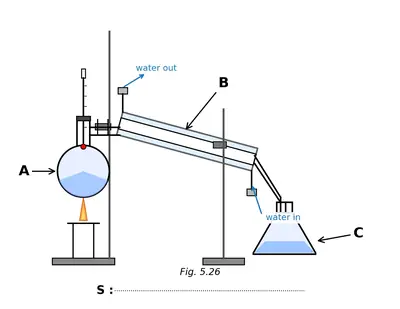
(i) Identify the separation technique marked as 'S'.
Solution
The arrangement shown in Fig. 5.26 has the following unmistakable features.
- A round-bottom (distillation) flask in which the liquid mixture is boiled.
- An upright tube packed with glass beads fitted just above the flask, i.e. a fractionating column.
- A thermometer whose bulb is exactly at the mouth of the column so that the temperature of the vapour leaving the column is recorded.
- A Liebig condenser attached sideways to liquefy the rising hot vapours and a receiver to collect the condensate.
The presence of the fractionating column tells us that the process is not simple distillation (used when the difference in boiling points is > 25 °C) but fractional distillation, employed for separating two or more miscible liquids whose boiling points differ by not more than about 25 °C.
Hence, the separation technique marked ‘S’ is fractional distillation.
Answer
(ii) Label the apparatus A, B and C.
Solution
The three parts marked in the diagram correspond to the usual fractional-distillation setup.
- A : Fractionating column (packed with glass beads).
- B : Liebig condenser (water-cooled).
- C : Receiver/collecting flask for the distillate.
Answer
(iii)
Which of the following mixtures can be separated by the technique identified above? Use the data given in Table 5.5. Mixtures:
(a) water — acetone (b) water — salt
(c) acetone — alcohol (d) sand — salt
(e) alcohol — chloroform (f) alcohol — benzene
Table 5.5: Boiling points of some compounds
| Solvent | Water | Acetone | Alcohol | Chloroform | Benzene |
|---|---|---|---|---|---|
| Temperature (°C) | 100 °C | 56 °C | 78 °C | 61 °C | 80 °C |
Solution
Criteria for fractional distillation
For a mixture to be separated by fractional distillation, the two components must be (i) both volatile liquids that are miscible with each other and (ii) have boiling points that differ by less than about 25 °C. If the boiling-point gap is larger than 25 °C, ordinary (simple) distillation is enough; if one component is non-volatile (a dissolved solid) or both are solids, distillation is not the appropriate technique.
Applying the criteria to each mixture (using Table 5.5)
| Mixture | Boiling points (°C) | $$\Delta T$$ (°C) | Suitable for fractional distillation? |
|---|---|---|---|
| (a) water – acetone | 100, 56 | 44 | No — $$\Delta T \gt 25\,{}^{\circ}\mathrm{C}$$; simple distillation is sufficient. |
| (b) water – salt | — (salt is a non-volatile solid) | — | No — not two miscible liquids; evaporation or simple distillation is used. |
| (c) acetone – alcohol | 56, 78 | 22 | Yes — miscible, $$\Delta T \lt 25\,{}^{\circ}\mathrm{C}$$. |
| (d) sand – salt | — (both solids) | — | No — solid mixture; cannot be distilled. |
| (e) alcohol – chloroform | 78, 61 | 17 | Yes — miscible, $$\Delta T \lt 25\,{}^{\circ}\mathrm{C}$$. |
| (f) alcohol – benzene | 78, 80 | 2 | Yes — miscible, $$\Delta T \lt 25\,{}^{\circ}\mathrm{C}$$. |
Conclusion
The mixtures that satisfy both conditions for fractional distillation are (c) acetone – alcohol, (e) alcohol – chloroform and (f) alcohol – benzene.
Answer


