Join WhatsApp Icon JEE WhatsApp Group
NCERT Solutions for Class 9 Maths

Chapter 8: Predicting What Comes Next: Exploring Sequences and Progressions

Download Solutions PDF
Daily JEE Updates, Tips & Important Alerts
Join 30,000+ students and stay updated with JEE notifications and preparation insights.
Join Now!
Free PDF
Complete NCERT Solution PDF for Chapter 8: Predicting What Comes Next: Exploring Sequences and Progressions
Download Solutions PDF

Examples

Example 1 Consider the expression $$u_n = 2n - 1$$. This states that the $$n^{th}$$ term of the sequence is given by the rule $$2n - 1$$. When we substitute 1, 2, 3, ... for $$n$$ in the expression $$2n - 1$$, we get $$u_1 = 2 \times 1 - 1 = 1$$, $$u_2 = 2 \times 2 - 1 = 3$$, $$u_3 = 2 \times 3 - 1 = 5$$, etc.

Solution

We are given the rule for the sequence

$$u_n = 2n - 1$$

where $$n$$ is a positive integer (that is, $$n = 1, 2, 3, \ldots$$). Let us substitute successive natural-number values of $$n$$ and calculate the corresponding terms.

  1. For $$n = 1$$

    $$u_1 = 2 \times 1 - 1 = 2 - 1 = 1$$

  2. For $$n = 2$$

    $$u_2 = 2 \times 2 - 1 = 4 - 1 = 3$$

  3. For $$n = 3$$

    $$u_3 = 2 \times 3 - 1 = 6 - 1 = 5$$

  4. For $$n = 4$$

    $$u_4 = 2 \times 4 - 1 = 8 - 1 = 7$$

  5. For $$n = 5$$

    $$u_5 = 2 \times 5 - 1 = 10 - 1 = 9$$

  6. For $$n = 6$$

    $$u_6 = 2 \times 6 - 1 = 12 - 1 = 11$$

The first six terms are therefore

$$1,\;3,\;5,\;7,\;9,\;11\ldots$$

Notice that each term is an odd number and that the difference between any two consecutive terms is

$$3 - 1 = 2, \; 5 - 3 = 2, \; 7 - 5 = 2, \; \text{and so on.}$$

Hence the sequence lists all positive odd integers in increasing order, and the nth term is always given by $$u_n = 2n - 1$$, as claimed.

Answer

The sequence generated by $$u_n = 2n - 1$$ is
$$1, 3, 5, 7, 9, 11, \ldots$$ — the positive odd integers.

Example 2 As another example, consider the sequence that is generated by the explicit formula $$s_n = 5n - 2$$. Can you write the first 6 terms of this sequence? What is the 100$$^{\text{th}}$$ term? The 1000$$^{\text{th}}$$ term?

Solution

Given explicit formula: $$s_n = 5n - 2$$, where $$n = 1, 2, 3, \ldots$$

We have to write the first six terms of the sequence and then find the 100th and 1000th terms.

Step 1: First six terms

  1. For $$n = 1$$:
    $$s_1 = 5(1) - 2 = 5 - 2 = 3$$

  2. For $$n = 2$$:
    $$s_2 = 5(2) - 2 = 10 - 2 = 8$$

  3. For $$n = 3$$:
    $$s_3 = 5(3) - 2 = 15 - 2 = 13$$

  4. For $$n = 4$$:
    $$s_4 = 5(4) - 2 = 20 - 2 = 18$$

  5. For $$n = 5$$:
    $$s_5 = 5(5) - 2 = 25 - 2 = 23$$

  6. For $$n = 6$$:
    $$s_6 = 5(6) - 2 = 30 - 2 = 28$$

Thus, the first six terms are

\[3,\, 8,\, 13,\, 18,\, 23,\, 28\]

Step 2: 100th term

Substitute $$n = 100$$ in the formula:

$$s_{100} = 5(100) - 2 = 500 - 2 = 498$$

Step 3: 1000th term

Substitute $$n = 1000$$ in the formula:

$$s_{1000} = 5(1000) - 2 = 5000 - 2 = 4998$$

Conclusion

  • First six terms: $$3, 8, 13, 18, 23, 28$$
  • 100th term: $$498$$
  • 1000th term: $$4998$$

Answer

First six terms: $$3, 8, 13, 18, 23, 28$$; 100th term: $$498$$; 1000th term: $$4998$$

Example 3 Find the first four terms of the sequence given by the recursive rule $$u_1 = 1$$, $$u_n = 2u_{n-1} + 3$$ for $$n \geq 2$$. Is 133 a term of this sequence?

Solution

We are given a sequence defined recursively as follows:

Initial (first) term:
$$u_1 = 1$$

Recursive rule (for every integer $$n \ge 2$$):
$$u_n = 2u_{n-1} + 3$$

Step 1: Find the first four terms.

  1. First term (already given): $$u_1 = 1$$
  2. Second term:
    $$u_2 = 2u_{1} + 3 = 2\times1 + 3 = 2 + 3 = 5$$
  3. Third term:
    $$u_3 = 2u_{2} + 3 = 2\times5 + 3 = 10 + 3 = 13$$
  4. Fourth term:
    $$u_4 = 2u_{3} + 3 = 2\times13 + 3 = 26 + 3 = 29$$

Thus the first four terms are
$$1,\;5,\;13,\;29.$$

Step 2: Decide whether 133 is a term of the sequence.

Method 1: Obtain a general (explicit) formula and test 133.

The given recurrence is first-order linear:

$$u_n - 2u_{n-1}=3.$$

(i) Solve the homogeneous part $$u_n^{(h)}-2u_{n-1}^{(h)}=0$$.
Putting $$u_n^{(h)}=k^n$$ gives $$k^n-2k^{n-1}=0\Rightarrow k=2$$, so

$$u_n^{(h)} = A\,2^{n-1},$$ where $$A$$ is a constant.

(ii) Find one particular solution. Try a constant value $$u_n^{(p)} = C$$:

$$C - 2C = 3 \;\Longrightarrow\; -C = 3 \;\Longrightarrow\; C = -3.$$

(iii) Combine homogeneous and particular solutions:

$$u_n = A\,2^{n-1} - 3.$$

(iv) Use the initial condition $$u_1 = 1$$ to find $$A$$:

For $$n = 1$$, $$u_1 = A\,2^{1-1} - 3 = A - 3 = 1\;\Longrightarrow\; A = 4.$$

Hence the explicit (closed-form) formula is

\[u_n = 4\,2^{n-1} - 3.\]

Now test 133:

Set $$u_n = 133$$:

$$4\,2^{n-1} - 3 = 133$$
$$4\,2^{n-1} = 136$$
$$2^{n-1} = 34.$$

The number 34 is not a power of 2 (powers of 2 near it are 32 and 64). Therefore there is no integer $$n$$ for which $$2^{n-1}=34$$, so 133 is not a term of the sequence.

Method 2 (quick check by continuation):

nun
11
25
313
429
52\times29+3 = 61
62\times61+3 = 125
72\times125+3 = 253

The value 133 never appears; the terms jump from 125 to 253, so 133 is skipped. This agrees with the algebraic conclusion.

Conclusion

  • The first four terms are $$1,\;5,\;13,\;29.$$
  • Since $$2^{n-1} = 34$$ has no integer solution, 133 is not a term of the sequence.

Answer

The first four terms are $$1,\;5,\;13,\;29$$ and 133 is not a term of the sequence.

Example 4 Find the first four terms of the sequence given by the recursive rule $$s_1 = 3$$, $$s_n = s_{n-1}(s_{n-1} - 1)$$ for $$n \geq 2$$.

Solution

The rule is recursive: each new term is calculated from the term that comes just before it.

Given

$$s_1 = 3,$$

and for every integer $$n \geq 2$$,

$$s_n = s_{n-1}\,(s_{n-1} - 1).$$

We need the first four terms: $$s_1, s_2, s_3, s_4$$.

  1. First term (already given):
    $$s_1 = 3.$$

  2. Second term (put $$n = 2$$ in the rule):

    $$s_2 = s_{1}\,(s_{1} - 1).$$

    Substitute $$s_1 = 3$$:

    $$s_2 = 3\,(3 - 1) = 3 \times 2 = 6.$$

  3. Third term (put $$n = 3$$):

    $$s_3 = s_{2}\,(s_{2} - 1).$$

    Substitute $$s_2 = 6$$:

    $$s_3 = 6\,(6 - 1) = 6 \times 5 = 30.$$

  4. Fourth term (put $$n = 4$$):

    $$s_4 = s_{3}\,(s_{3} - 1).$$

    Substitute $$s_3 = 30$$:

    $$s_4 = 30\,(30 - 1) = 30 \times 29 = 870.$$

Therefore, the first four terms of the sequence are $$3,\;6,\;30,\;870.$$

Answer

$$3,\; 6,\; 30,\; 870$$

Example 5 A person books a taxi to travel in the city. The taxi company charges a fixed booking fee of ₹200 plus ₹40 per kilometre travelled. Let us write the sequence representing the total fare after travelling 1 km, 2 km, 3 km, and so on. If the person travels 10 km, what will be the total fare?

Solution

The taxi fare has two parts:

  • a fixed booking fee of ₹200, which is paid once irrespective of the distance, and
  • a running charge of ₹40 for each kilometre travelled.

Let the distance travelled be denoted by the positive integer $$n$$ (measured in km).

For a given $$n$$ kilometres, the total fare $$T_n$$ is therefore

\[ T_n = 200 + 40n \]

We now list the fares for the first few natural numbers $$n = 1,2,3,\ldots$$:

Distance $$n$$ (km)Total fare $$T_n$$ (₹)
1$$T_1 = 200 + 40\times 1 = 240$$
2$$T_2 = 200 + 40\times 2 = 280$$
3$$T_3 = 200 + 40\times 3 = 320$$
4$$T_4 = 200 + 40\times 4 = 360$$

The sequence of fares is therefore

\[ 240,\;280,\;320,\;360,\;\ldots \]

Each term exceeds the previous one by a constant amount $$d = 40$$, so the sequence is an arithmetic progression (A.P.) with

  • first term $$a = 240$$,
  • common difference $$d = 40$$.

For an A.P., the nth term is given by $$T_n = a + (n-1)d$$. Substituting $$a = 240$$ and $$d = 40$$, we get back the earlier linear expression

\[ T_n = 240 + (n-1)\times 40 = 200 + 40n. \]

Fare for 10 km

Put $$n = 10$$ in $$T_n = 200 + 40n$$:

\[ T_{10} = 200 + 40\times 10 = 200 + 400 = 600. \]

The passenger must therefore pay ₹600 for a 10 km ride.

Answer

₹600

Example 6 Is 1, 2, 4, 8, 16, ... a geometric progression? If so, what is the common ratio?

Solution

We recall the definition first.

Definition of a geometric progression (G.P.)
A sequence $$a_1, a_2, a_3,\dots$$ is called a geometric progression if the ratio of any term to its preceding term is the same constant, called the common ratio $$r$$; that is, $$\dfrac{a_{n+1}}{a_n}=r$$ for every admissible $$n$$.

Let us examine the given sequence:

$$a_1=1,\;a_2=2,\;a_3=4,\;a_4=8,\;a_5=16,\;\dots$$

  1. Check the ratio of the 2nd term to the 1st term:
    $$\dfrac{a_2}{a_1}=\dfrac{2}{1}=2$$
  2. Check the ratio of the 3rd term to the 2nd term:
    $$\dfrac{a_3}{a_2}=\dfrac{4}{2}=2$$
  3. Check the ratio of the 4th term to the 3rd term:
    $$\dfrac{a_4}{a_3}=\dfrac{8}{4}=2$$
  4. Check the ratio of the 5th term to the 4th term:
    $$\dfrac{a_5}{a_4}=\dfrac{16}{8}=2$$

Every time we divide a term by the preceding term, the result is the same number $$2$$. Since this ratio is constant, the sequence satisfies the definition of a geometric progression.

Therefore, the given sequence is a G.P., and its common ratio is

\[ r = 2 \]

Answer

Yes. It is a geometric progression with common ratio $$2$$.

Example 7 Is 1, 3, 9, 27, 81, ... a geometric progression? If so, what is the common ratio?

Solution

To decide whether the sequence 1, 3, 9, 27, 81, … is a geometric progression (G.P.), compare the ratio of each term to its preceding term.

For any sequence $$a_1, a_2, a_3, \ldots$$ to be a G.P., the following must be true:

$$\text{Common ratio } r \\ = \frac{a_{n+1}}{a_n}\; \text{is the same for all } n \ge 1.$$

Compute successive ratios for the given sequence:

First ratio:
$$r_1 = \frac{a_2}{a_1} = \frac{3}{1} = 3$$

Second ratio:
$$r_2 = \frac{a_3}{a_2} = \frac{9}{3} = 3$$

Third ratio:
$$r_3 = \frac{a_4}{a_3} = \frac{27}{9} = 3$$

Fourth ratio:
$$r_4 = \frac{a_5}{a_4} = \frac{81}{27} = 3$$

All calculated ratios are equal: $$r_1 = r_2 = r_3 = r_4 = 3$$.

Since the ratio $$\frac{a_{n+1}}{a_n}$$ remains constant and equals 3 for every pair of consecutive terms, the sequence is a geometric progression with common ratio 3.

Answer

Yes, it is a geometric progression; the common ratio is $$3$$.

Example 8 Is 1, –1, 1, –1, 1, ... a geometric progression? If so, what is the common ratio?

Solution

Step 1 – Recall the definition of a geometric progression (G.P.)

A sequence $$a_1, a_2, a_3,\dots$$ is called a geometric progression if the ratio of any term (except the first) to the term just before it is a constant. That is, if there exists a non-zero number $$r$$ such that

$$\dfrac{a_2}{a_1}=\dfrac{a_3}{a_2}=\dfrac{a_4}{a_3}=\dots=r$$,

then the sequence is a G.P. with common ratio $$r$$.

Step 2 – Write the first few terms of the given sequence

The sequence given is:

$$1,\; -1,\; 1,\; -1,\; 1,\; \dots$$

Thus

  • $$a_1 = 1$$
  • $$a_2 = -1$$
  • $$a_3 = 1$$
  • $$a_4 = -1$$

Step 3 – Find the ratio of consecutive terms

First pair:

$$\dfrac{a_2}{a_1}= \dfrac{-1}{1} = -1$$

Second pair:

$$\dfrac{a_3}{a_2}= \dfrac{1}{-1} = -1$$

Third pair:

$$\dfrac{a_4}{a_3}= \dfrac{-1}{1} = -1$$

We see that every time the ratio equals the same constant $$-1$$.

Step 4 – Conclusion

Because the ratio between any term and the term preceding it is the same constant $$-1$$, the sequence satisfies the definition of a geometric progression.

Hence,

\[ \text{Common ratio } r = -1 \]

Therefore, 1, –1, 1, –1, 1, … is indeed a geometric progression with common ratio $$-1$$.

Answer

Yes. It is a geometric progression with common ratio $$r = -1$$.

Example 9 Check whether the sequence $$5, \frac{15}{4}, \frac{45}{16}, \frac{135}{64}, \ldots$$ is a geometric progression and find its $$n^{th}$$ term.

Solution

Given sequence: $$5, \frac{15}{4}, \frac{45}{16}, \frac{135}{64}, \ldots$$

For a sequence to be a geometric progression (G.P.), the common ratio $$r$$ between any term and its preceding term must be constant:

$$r = \frac{a_{k+1}}{a_k}\; \text{for all} \; k \ge 1$$

We calculate $$r$$ for successive pairs:

  1. Between the first and second terms:
    $$r = \frac{\frac{15}{4}}{5} = \frac{15}{4} \times \frac{1}{5} = \frac{15}{20} = \frac{3}{4}$$
  2. Between the second and third terms:
    $$r = \frac{\frac{45}{16}}{\frac{15}{4}} = \frac{45}{16} \times \frac{4}{15} = \frac{180}{240} = \frac{3}{4}$$
  3. Between the third and fourth terms:
    $$r = \frac{\frac{135}{64}}{\frac{45}{16}} = \frac{135}{64} \times \frac{16}{45} = \frac{2160}{2880} = \frac{3}{4}$$

Since the ratio is the same ($$r = \frac{3}{4}$$) for every pair of consecutive terms, the sequence is a geometric progression.

For a G.P. whose first term is $$a_1$$ and common ratio is $$r$$, the general (or $$n^{\text{th}}$$) term is

\[ a_n = a_1\, r^{\,n-1} \]

Here, $$a_1 = 5$$ and $$r = \frac{3}{4}$$, hence

\[ a_n = 5\left(\frac{3}{4}\right)^{n-1} \]

This gives every term of the progression. For example, putting $$n = 1,2,3,\ldots$$ reproduces the given numbers.

Answer

Yes, it is a geometric progression; its $$n^{\text{th}}$$ term is $$a_n = 5\left(\frac{3}{4}\right)^{n-1}$$.

Example 10 A ball is dropped from a height of 24 feet above the ground. Each time the ball bounces up to $$\left(\frac{3}{4}\right)^{\text{th}}$$ of its previous height.

(a) Can you write the sequence of numbers obtained from the heights attained by the ball in five successive bounces?

Solution

Let the height just before the first bounce be taken as the initial height.
Given initial height = $$24\text{ ft}$$.

Each bounce makes the ball rise to $$\frac34$$ of the height it had just before that bounce.

Therefore, after the

  • 1st bounce: Height = $$24\times\frac34=18\text{ ft}$$
  • 2nd bounce: Height = $$18\times\frac34=13.5\text{ ft}$$
  • 3rd bounce: Height = $$13.5\times\frac34=10.125\text{ ft}$$
  • 4th bounce: Height = $$10.125\times\frac34=7.59375\text{ ft}$$
  • 5th bounce: Height = $$7.59375\times\frac34=5.6953125\text{ ft}$$

Thus the sequence of heights attained in the first five bounces is

$$18,\;13.5,\;10.125,\;7.59375,\;5.6953125$$ feet.

Answer

$$18,\;13.5,\;10.125,\;7.59375,\;5.6953125$$

(b) How many bounces are required for the ball to remain below a height of $$\frac{1}{6}$$ of the original height from which it was dropped?

Solution

Let $$h_0 = 24\text{ ft}$$ be the original height from which the ball is dropped.

After $$n$$ bounces, the height reached is

\[h_n = h_0\left(\frac{3}{4}\right)^{n} = 24\left(\frac{3}{4}\right)^{n}\text{ ft}.\]

We want the least positive integer $$n$$ for which this height falls below one-sixth of the original height.

Required condition:

\[24\left(\frac{3}{4}\right)^{n} \lt \frac{1}{6}\times 24 = 4\text{ ft}.\]

Divide both sides by $$24$$:

\[\left(\frac{3}{4}\right)^{n} \lt \frac{1}{6}.\]

Because $$\dfrac{3}{4} \lt 1$$, the quantity $$\left(\dfrac{3}{4}\right)^{n}$$ decreases as $$n$$ grows. We compute successive powers and compare them with $$\dfrac{1}{6} \approx 0.1667$$.

Bounce number $$n$$Value of $$\left(\dfrac{3}{4}\right)^{n}$$Decimal valueIs it less than $$\dfrac{1}{6}$$?
1$$\dfrac{3}{4}$$$$0.7500$$No
2$$\dfrac{9}{16}$$$$0.5625$$No
3$$\dfrac{27}{64}$$$$0.4219$$No
4$$\dfrac{81}{256}$$$$0.3164$$No
5$$\dfrac{243}{1024}$$$$0.2373$$No
6$$\dfrac{729}{4096}$$$$0.1780$$No
7$$\dfrac{2187}{16384}$$$$0.1335$$Yes

The first value that falls below $$\dfrac{1}{6}$$ occurs at $$n = 7$$.

Hence, the ball must bounce 7 times before its rebound height drops below one-sixth of the original height.

Answer

7 bounces

Intext Questions

Think and Reflect Can you describe the pattern in each of the above sequences? Can you predict the next few numbers in these sequences?

Solution

Objective : For every sequence listed below we must

  • observe a recurrent rule (pattern),
  • justify that rule by showing intermediate calculations a Class 9 student is expected to carry out,
  • write a usable algebraic description (the nth or general term), and
  • use the rule to generate the next three terms.

The sequences that were given just above the question are taken to be

  1. $$1, 3, 5, 7, \dots$$

  2. $$1, 4, 9, 16, \dots$$

  3. $$2, 4, 8, 16, \dots$$

  4. $$1, 2, 4, 7, 11, \dots$$

  5. $$1, 1, 2, 3, 5, 8, \dots$$

Sequence (i) : $$1,3,5,7,\dots$$

• First–order differences: $$3-1 = 2,\;5-3 = 2,\;7-5 = 2$$. The difference is constantly $$2$$, so the sequence is an arithmetic progression (AP) with common difference $$d=2$$.

• General term of an AP: $$a_n = a_1 + (n-1)d$$. Here $$a_1 = 1,\;d = 2$$.

$$a_n = 1 + (n-1)\times 2 = 2n-1.$$

• Next three terms: put $$n = 5,6,7$$  ⇒  $$a_5=9,\;a_6=11,\;a_7=13$$.

Sequence (ii) : $$1,4,9,16,\dots$$

• These numbers are all perfect squares:

$$1 = 1^2,\;4 = 2^2,\;9 = 3^2,\;16 = 4^2.$$

• Therefore $$a_n = n^2$$ for $$n\ge 1$$.

• Next three terms correspond to $$n = 5,6,7$$:

$$a_5 = 5^2 = 25,\;a_6 = 6^2 = 36,\;a_7 = 7^2 = 49.$$

Sequence (iii) : $$2,4,8,16,\dots$$

• Each term is obtained by multiplying the preceding term by $$2$$ (common ratio $$r=2$$). The sequence is a geometric progression (GP).

• General term of a GP: $$a_n = a_1 r^{\,(n-1)}$$. Here $$a_1=2,\;r=2$$.

$$a_n = 2\times 2^{\,(n-1)} = 2^n.$$

• Next three terms ( $$n = 5,6,7$$ ):

$$a_5 = 2^5 = 32,\;a_6 = 2^6 = 64,\;a_7 = 2^7 = 128.$$

Sequence (iv) : $$1,2,4,7,11,\dots$$

• First–order differences: $$2-1 = 1,\;4-2 = 2,\;7-4 = 3,\;11-7 = 4$$ – the increments themselves form the sequence $$1,2,3,4,\dots$$ of successive natural numbers.

• Hence each term is obtained by adding, in order, $$1,2,3,4,\dots$$ to the previous term. Equivalently,

$$a_n = 1 + \underbrace{(1+2+3+\dots+(n-1))}_{\text{sum of first }(n-1)\text{ natural numbers}}.$$

The well-known formula $$1+2+\dots+(n-1)=\dfrac{(n-1)n}{2}$$ gives

$$a_n = 1 + \dfrac{(n-1)n}{2}.$$

• Next three terms: use $$n = 6,7,8$$.

$$\begin{aligned} a_6 &= 1 + \dfrac{5\times 6}{2} = 1+15 = 16,\\ a_7 &= 1 + \dfrac{6\times 7}{2} = 1+21 = 22,\\ a_8 &= 1 + \dfrac{7\times 8}{2} = 1+28 = 29. \end{aligned}$$

Sequence (v) : $$1,1,2,3,5,8,\dots$$

• Each term (starting from the third) is the sum of the two immediately preceding terms:

$$1+1=2,\;1+2=3,\;2+3=5,\;3+5=8,$$

and so on. This is the famous Fibonacci sequence.

• Using the recurrence $$a_{n}=a_{n-1}+a_{n-2}$$ with initial values $$a_1=a_2=1$$, find the next three terms:

$$\begin{aligned} a_7 &= a_5 + a_6 = 5 + 8 = 13,\\ a_8 &= a_6 + a_7 = 8 + 13 = 21,\\ a_9 &= a_7 + a_8 = 13 + 21 = 34. \end{aligned}$$

Summary of predictions

Sequence No.Next three terms
(i)$$9,\;11,\;13$$
(ii)$$25,\;36,\;49$$
(iii)$$32,\;64,\;128$$
(iv)$$16,\;22,\;29$$
(v)$$13,\;21,\;34$$

Thus, by recognising the underlying rule in each list, we can confidently extend every sequence.

Answer

(i) 9, 11, 13
(ii) 25, 36, 49
(iii) 32, 64, 128
(iv) 16, 22, 29
(v) 13, 21, 34

Exercise Consider the sequence 1, 4, 7, 10, 13, ... Can you predict the next four terms? Can you derive the first 10 terms of the sequence obtained by adding all the terms up to a given term of this sequence? (Hint: The first term is 1. The second term is 1 + 4 = 5, the third term is 1 + 4 + 7 = 12, and so on.)

Solution

Step 1 · Identify the pattern of the given sequence

The terms 1, 4, 7, 10, 13, … increase by the same amount each time.

Common difference:
$$d = 4 - 1 = 3 = 7 - 4 = 10 - 7 = \dots$$

So the sequence is an arithmetic progression (A.P.) with first term $$a = 1$$ and common difference $$d = 3$$.

Step 2 · Write the formula for the n-th term

For an A.P. the n-th term $$a_n$$ is

$$a_n = a + (n-1)d$$

Hence

$$a_n = 1 + (n-1)\,3 = 3n - 2$$

Step 3 · Predict the next four terms

Last known term is the 5th term, $$a_5 = 13$$.

  • 6th term: $$a_6 = 3(6)-2 = 16$$
  • 7th term: $$a_7 = 3(7)-2 = 19$$
  • 8th term: $$a_8 = 3(8)-2 = 22$$
  • 9th term: $$a_9 = 3(9)-2 = 25$$

Thus the next four terms are 16, 19, 22 and 25.

Step 4 · Define the required ‘running–sum’ sequence

Let $$S_n$$ be the sum of the first n terms of the original A.P. The question asks for the first ten values of $$S_n$$.

Step 5 · Derive a general formula for $$S_n$$

For an A.P. the sum of the first n terms is

$$S_n = \dfrac{n}{2}\,[2a + (n-1)d]$$

Substitute $$a = 1$$ and $$d = 3$$:

$$S_n = \dfrac{n}{2}\,[2(1) + (n-1)3]$$
$$\;\;\;\; = \dfrac{n}{2}\,[2 + 3n - 3]$$
$$\;\;\;\; = \dfrac{n}{2}\,[3n - 1]$$

Therefore

\[S_n = \dfrac{n\,(3n - 1)}{2}\]

Step 6 · Compute $$S_1, S_2, \dots , S_{10}$$

nFormulaValue of $$S_n$$
1$$\dfrac{1(3·1-1)}{2}$$1
2$$\dfrac{2(3·2-1)}{2}$$5
3$$\dfrac{3(3·3-1)}{2}$$12
4$$\dfrac{4(3·4-1)}{2}$$22
5$$\dfrac{5(3·5-1)}{2}$$35
6$$\dfrac{6(3·6-1)}{2}$$51
7$$\dfrac{7(3·7-1)}{2}$$70
8$$\dfrac{8(3·8-1)}{2}$$92
9$$\dfrac{9(3·9-1)}{2}$$117
10$$\dfrac{10(3·10-1)}{2}$$145

Step 7 · Write the running–sum sequence explicitly

The required sequence is:
1, 5, 12, 22, 35, 51, 70, 92, 117, 145.

All steps shown.

Answer

Next four terms: 16, 19, 22, 25.
First ten terms of the running–sum sequence: 1, 5, 12, 22, 35, 51, 70, 92, 117, 145.

Exercise Can you write $$t_5$$, $$t_6$$, $$t_7$$ and $$t_8$$ for the sequence of triangular numbers?

Solution

The triangular numbers arise from adding the first few natural numbers one after another.

In symbols, if $$t_n$$ denotes the $$n^{\text{th}}$$ triangular number, then

\[t_n = 1 + 2 + 3 + \cdots + n\]

Using the well-known formula for the sum of the first $$n$$ natural numbers, we have

$$t_n = \dfrac{n(n+1)}{2}$$

Now substitute $$n = 5,6,7,8$$ one by one.

  • For $$n = 5$$:
    $$t_5 = \dfrac{5(5+1)}{2} = \dfrac{5 \times 6}{2} = 15$$
  • For $$n = 6$$:
    $$t_6 = \dfrac{6(6+1)}{2} = \dfrac{6 \times 7}{2} = 21$$
  • For $$n = 7$$:
    $$t_7 = \dfrac{7(7+1)}{2} = \dfrac{7 \times 8}{2} = 28$$
  • For $$n = 8$$:
    $$t_8 = \dfrac{8(8+1)}{2} = \dfrac{8 \times 9}{2} = 36$$

Thus the required terms are 15, 21, 28 and 36.

Answer

$$t_5 = 15$$, $$t_6 = 21$$, $$t_7 = 28$$, $$t_8 = 36$$

Think and Reflect Can you think of any other kinds of sequences? List out five different types of sequences and discuss their properties with your friends.

Solution

What is meant by a sequence?
In Class 9 we call an ordered list of numbers a sequence. If the numbers are written as $$a_1, a_2, a_3, \ldots , a_n, \ldots$$ then the sub-script tells us the position (1st, 2nd, 3rd, …).

The textbook introduces arithmetic and geometric progressions. Here are five other kinds of sequences that you and your friends can explore.

  1. Arithmetic Progression (AP)
    • Definition : the difference $$d$$ between consecutive terms is constant, i.e. $$a_{n+1}-a_n=d$$.
    • The n-th term is \[a_n=a_1+(n-1)d\]
    • Example : 2, 5, 8, 11, … has $$a_1=2$$, $$d=3$$.
      10th term : $$a_{10}=2+(10-1)\times3=29$$.
    • Sum of first $$n$$ terms (proved in the text) \[S_n=\frac{n}{2}\,[2a_1+(n-1)d] \]
  2. Geometric Progression (GP)
    • Definition : the ratio $$r$$ of consecutive terms is constant, i.e. $$\dfrac{a_{n+1}}{a_n}=r$$.
    • The n-th term is \[a_n=a_1 r^{\;n-1}\]
    • Example : 3, 6, 12, 24, … has $$a_1=3$$, $$r=2$$.
      6th term : $$a_6=3\times2^{5}=96$$.
    • Sum of first $$n$$ terms (for $$r\neq1$$) \[S_n=a_1\,\frac{r^{\;n}-1}{r-1}\]
  3. Fibonacci Sequence
    • Starts with $$F_1=1,\;F_2=1$$ and follows the recurrence relation \[F_n=F_{n-1}+F_{n-2}\quad(n\ge3)\]
    • Beginning terms : 1, 1, 2, 3, 5, 8, 13, …
    • Illustration : to find $$F_8$$ —
      $$F_3=1+1=2$$, $$F_4=2+1=3$$, $$F_5=3+2=5$$, $$F_6=5+3=8$$, $$F_7=8+5=13$$, $$F_8=13+8=21$$.
    • Property : the ratio $$\dfrac{F_{n+1}}{F_n}$$ approaches the golden ratio $$\varphi\,(\approx1.618)$$ as $$n$$ grows.
  4. Square-number Sequence
    • Each term is the square of its position : $$a_n=n^2$$.
    • Terms : 1, 4, 9, 16, 25, …
    • 12th term : $$a_{12}=12^2=144$$.
    • Property : successive differences form the odd numbers 3, 5, 7, 9, …
  5. Triangular-number Sequence
    • Represents dots that can be arranged as an equilateral triangle.
    • Formula : $$T_n=\dfrac{n(n+1)}{2}$$.
    • Terms : 1, 3, 6, 10, 15, …
    • 10th term : $$T_{10}=\dfrac{10\times11}{2}=55$$.
    • Property : differences between successive terms are the natural numbers 2, 3, 4, 5, …

Summary
These five sequences illustrate different rules: constant addition (AP), constant multiplication (GP), addition of two previous terms (Fibonacci), squaring the position (square numbers) and a quadratic formula giving triangular arrangements. Try plotting their terms or finding patterns in their differences and ratios for further exploration!

Answer

Five examples of sequences you can study:

  • Arithmetic : 2, 5, 8, 11, …
  • Geometric : 3, 6, 12, 24, …
  • Fibonacci : 1, 1, 2, 3, 5, 8, …
  • Square numbers : 1, 4, 9, 16, …
  • Triangular numbers : 1, 3, 6, 10, …

Think and Reflect Why is it useful to have an explicit formula for the $$n^{th}$$ term of a sequence?

Solution

Understanding the idea of an explicit $n^{\text{th}}$-term formula

Suppose you are given a sequence $$a_1,\;a_2,\;a_3,\;\ldots$$. An explicit (or general) formula is a rule that produces the term $$a_n$$ directly from the position $$n$$:

\[a_n = f(n)\]

where $$f(n)$$ is some expression in $$n$$ (it could be linear, quadratic, a fraction, a power, … — whatever the sequence demands).

Why is such a formula useful?

  1. Immediate calculation of any term
    Without the explicit rule you might have to write out all the preceding terms to reach, say, the $$50^{\text{th}}$$ term. With the rule you substitute once.
    Example. In the arithmetic progression $$2,5,8,11,\ldots$$ we have the explicit rule
    $$a_n = 2 + (n-1)\times3$$.
    To find the $$50^{\text{th}}$$ term:
    $$a_{50} = 2 + (50-1)\times3 = 2 + 49\times3 = 2 + 147 = 149.$$
    No listing of the first 49 terms is required.
  2. Testing whether a given number is in the sequence
    Because $$a_n$$ is expressed in $$n$$ you can turn the question “Is $$k$$ a term?” into an algebraic equation and see whether it gives an integer $$n$$.
    Example. Using the same rule $$a_n = 2 + 3(n-1)$$, check if $$203$$ is a term:
    • Set $$2 + 3(n-1) = 203.$$
    • Solve: $$3(n-1) = 201 \;\Rightarrow\; n-1 = 67 \;\Rightarrow\; n = 68.$$
    • Because $$n = 68$$ is a positive integer, $$203$$ is the $$68^{\text{th}}$$ term.
  3. Proving properties of the sequence
    Many theoretical results (for example, verifying that the difference between consecutive terms is constant, or establishing divisibility patterns) are far easier when you can manipulate the general term algebraically.
  4. Finding other formulas such as the sum of the first $n$ terms
    In an arithmetic progression the derivation of the sum formula
    \[S_n = \dfrac{n}{2}\,(a_1 + a_n)\] hinges on first having $$a_n$$ expressed explicitly.
  5. Efficient use of technology
    A calculator or a computer spreadsheet can generate large parts of the sequence instantly once you supply the explicit rule. This is impractical if each term depends on all the previous ones.

Conclusion

A single compact formula $$a_n = f(n)$$ turns the sequence into something you can examine, compute, and prove facts about directly, without repeatedly building it term-by-term. That is why having an explicit $$n^{\text{th}}$$-term formula is so useful.

Answer

Because a formula $$a_n = f(n)$$ lets you obtain any required term instantly, test whether a number belongs to the sequence, prove properties algebraically and derive related results such as sums, all without first generating every earlier term.

Exercise Using the explicit rule $$u_n = 2n - 1$$, find the 53$$^{rd}$$ term, the 108$$^{th}$$ term, and the 1170$$^{th}$$ term of the odd number sequence.

Solution

The sequence of odd natural numbers can be generated by the explicit ("nth-term") rule

$$u_n = 2n - 1,$$

where $$n$$ is the position (rank) of the term in the sequence and $$u_n$$ is the value of that term.

We must evaluate $$u_n$$ for three different values of $$n$$.

  1. 53rd term
    Substitute $$n = 53$$:
    $$u_{53} = 2 \times 53 - 1 = 106 - 1 = 105.$$
  2. 108th term
    Substitute $$n = 108$$:
    $$u_{108} = 2 \times 108 - 1 = 216 - 1 = 215.$$
  3. 1170th term
    Substitute $$n = 1170$$:
    $$u_{1170} = 2 \times 1170 - 1 = 2340 - 1 = 2339.$$

Hence the required terms are:

  • 53rd term = 105,
  • 108th term = 215,
  • 1170th term = 2339.

Answer

53rd term = 105, 108th term = 215, 1170th term = 2339

Think and Reflect Can you find the rule describing the $$n^{th}$$ term of the sequence of square numbers?

Solution

The sequence of square numbers begins

$$1,\;4,\;9,\;16,\;25,\;\ldots$$

Label the terms as $$t_1,\,t_2,\,t_3,\ldots$$ so that $$t_n$$ denotes the $$n^{\text{th}}$$ term we wish to describe.

Step 1 – Look at the first few terms

Position $$n$$Term $$t_n$$
11
24
39
416
525

Notice that every term equals the number of its position squared:

  • First term: $$1 = 1 \times 1 = 1^2$$
  • Second term: $$4 = 2 \times 2 = 2^2$$
  • Third term: $$9 = 3 \times 3 = 3^2$$
  • Fourth term: $$16 = 4 \times 4 = 4^2$$
  • Fifth term: $$25 = 5 \times 5 = 5^2$$

The pattern strongly suggests $$t_n = n^2$$, but we verify it algebraically.

Step 2 – Confirm by differences

Find successive differences of the sequence:

TermValueDifference from previous term
$$t_1$$1
$$t_2$$4$$4-1 = 3$$
$$t_3$$9$$9-4 = 5$$
$$t_4$$16$$16-9 = 7$$
$$t_5$$25$$25-16 = 9$$

The differences are the consecutive odd numbers $$3,5,7,9,\ldots$$. The sum of the first $$n$$ odd numbers is known to be $$n^2$$. Hence if $$t_n = n^2$$, each increase must indeed be an odd number, which matches the table, confirming the rule.

Step 3 – State the general term

Because every check is consistent, the $$n^{\text{th}}$$ term is

\[t_n = n^2\]

Therefore the required rule is $$t_n = n^2$$.

Answer

$$t_n = n^2$$

Exercise Consider the expression $$t_n = 3n - 7$$.

(i) Find its first, second, third, 12$$^{th}$$, 18$$^{th}$$ and 50$$^{th}$$ terms.

Solution

The general term of the sequence is given by

$$t_n = 3n - 7$$

Substitute the required values of $$n$$ one by one.

  • First term: $$n = 1$$
    $$t_1 = 3(1) - 7 = 3 - 7 = -4$$
  • Second term: $$n = 2$$
    $$t_2 = 3(2) - 7 = 6 - 7 = -1$$
  • Third term: $$n = 3$$
    $$t_3 = 3(3) - 7 = 9 - 7 = 2$$
  • 12th term: $$n = 12$$
    $$t_{12} = 3(12) - 7 = 36 - 7 = 29$$
  • 18th term: $$n = 18$$
    $$t_{18} = 3(18) - 7 = 54 - 7 = 47$$
  • 50th term: $$n = 50$$
    $$t_{50} = 3(50) - 7 = 150 - 7 = 143$$

Answer

$$t_1 = -4,\; t_2 = -1,\; t_3 = 2,\; t_{12} = 29,\; t_{18} = 47,\; t_{50} = 143$$

(ii) Which term of the sequence is 332?

Solution

Let the $$k$$-th term be $$332$$, that is

$$t_k = 3k - 7 = 332$$

Solve for $$k$$:

$$3k = 332 + 7 = 339$$
$$k = \dfrac{339}{3} = 113$$

Because $$k = 113$$ is a positive integer, the 113th term of the sequence is $$332$$.

Answer

332 is the 113th term.

(iii) Is 557 a term of this sequence? Why or why not?

Solution

Assume that $$t_m = 557$$ for some positive integer $$m$$:

$$3m - 7 = 557$$

Solve for $$m$$:

$$3m = 557 + 7 = 564$$
$$m = \dfrac{564}{3} = 188$$

Since $$m = 188$$ is a whole positive number, such a term exists in the sequence. Thus $$557$$ is indeed a term (specifically, the 188th term).

Answer

Yes. 557 is the 188th term of the sequence.

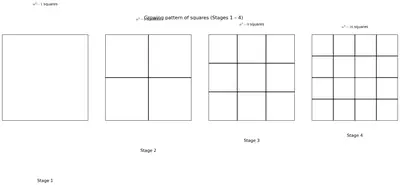
Think and Reflect Can you predict the number of squares in Stages 5 and 6 of the sequence? In Stages 10, 11 and 12? In Stage 20? At any stage?

Solution

Step 1 : Observe and record the first few stages

Stage  $$(n)$$No. of new squares added
over the previous stage
Total no. of squares
till this stage
1Starting square$$1$$
2$$3$$$$1+3 = 4$$
3$$5$$$$4+5 = 9$$
4$$7$$$$9+7 = 16$$

The number of new squares that appear each time forms the sequence $$3,5,7,9,\dots$$ – the consecutive odd numbers.

Step 2 : Express the nth difference

The odd numbers can be written as

$$3 = 2 \times 2 - 1,\; 5 = 2 \times 3 - 1,\; 7 = 2 \times 4 - 1,\;\dots$$

In general, at Stage $$n \,(n \ge 2)$$ the extra squares added are

$$2n - 1.$$

Step 3 : Form a cumulative (recursive) relation

Let $$S_n$$ be the total number of squares in Stage $$n$$. Then

$$S_1 = 1,\qquad S_{n} = S_{n-1} + (2n-1) \;\;\text{for } n \ge 2.$$

Step 4 : Solve the recurrence to get a direct formula

Add the first $$n$$ odd numbers:

$$S_n = 1 + 3 + 5 + \dots + (2n-1).$$

A known result (which can be proved by induction) is

\[S_n = n^2.\]

Thus Stage $$n$$ contains exactly $$n^2$$ small squares.

Step 5 : Predict the requested stages

  • Stage 5: $$S_5 = 5^2 = 25$$ squares.
  • Stage 6: $$S_6 = 6^2 = 36$$ squares.
  • Stage 10: $$S_{10} = 10^2 = 100$$ squares.
  • Stage 11: $$S_{11} = 11^2 = 121$$ squares.
  • Stage 12: $$S_{12} = 12^2 = 144$$ squares.
  • Stage 20: $$S_{20} = 20^2 = 400$$ squares.

Step 6 : General prediction

At any stage $$n$$ the number of squares is $$n^2.$$

Answer

Stage 5: 25 squares
Stage 6: 36 squares
Stage 10: 100 squares
Stage 11: 121 squares
Stage 12: 144 squares
Stage 20: 400 squares
Any stage n: $$n^2$$ squares

Think and Reflect Consider all the sequences we have discussed so far in this chapter. Which ones are arithmetic progressions and which ones are not? Can you justify your claim?

Solution

Recall – definition of an arithmetic progression (A.P.)
A sequence $$a_1 , a_2 , a_3 ,\ldots$$ is an A.P. iff the difference between every two consecutive terms is the same; that is,

\[ a_{n+1}-a_n=d \;\text{(constant for every } n\ge 1\text{).} \]

The constant number $$d$$ is called the common difference.

The sequences that have appeared in the chapter are the following:

  1. $$1,2,3,4,5,\ldots$$
  2. $$2,4,6,8,10,\ldots$$
  3. $$5,10,15,20,25,\ldots$$
  4. $$1,4,9,16,25,\ldots$$ (perfect squares)
  5. $$1,3,5,7,9,\ldots$$
  6. $$1,2,4,8,16,\ldots$$ (powers of 2)

We check the common difference for each sequence.

SequenceFirst few differences $$a_{n+1}-a_n$$Constant?Conclusion
(i)$$2-1=1,\;3-2=1,\;4-3=1$$Yes (always 1)A.P. with $$d=1$$
(ii)$$4-2=2,\;6-4=2,\;8-6=2$$Yes (always 2)A.P. with $$d=2$$
(iii)$$10-5=5,\;15-10=5,\;20-15=5$$Yes (always 5)A.P. with $$d=5$$
(iv)$$4-1=3,\;9-4=5,\;16-9=7$$No (3,5,7,\ldots)Not an A.P.
(v)$$3-1=2,\;5-3=2,\;7-5=2$$Yes (always 2)A.P. with $$d=2$$
(vi)$$2-1=1,\;4-2=2,\;8-4=4$$No (1,2,4,\ldots)Not an A.P.

Final classification

  • Arithmetic progressions: Sequences (i), (ii), (iii) and (v).
  • Not arithmetic progressions: Sequences (iv) and (vi).

This follows directly from the fact that only in the first, second, third and fifth sequences is the difference between successive terms the same throughout; in the fourth and sixth sequences the difference keeps changing, so the defining condition of an A.P. fails.

Answer

Sequences (i) $$1,2,3,4,5,\ldots$$, (ii) $$2,4,6,8,10,\ldots$$, (iii) $$5,10,15,20,25,\ldots$$ and (v) $$1,3,5,7,9,\ldots$$ are arithmetic progressions, because their consecutive–term difference is constant (1, 2, 5 and 2 respectively).

Sequences (iv) $$1,4,9,16,25,\ldots$$ and (vi) $$1,2,4,8,16,\ldots$$ are not arithmetic progressions, because their consecutive–term differences (3, 5, 7, … and 1, 2, 4, … respectively) are not constant.

Exercise Verify that the following sequences are arithmetic progressions and write their $$n^{th}$$ terms. What do you observe when you plot the ordered pairs emerging from them?

(i) 2, 5, 8, 11, ...

Solution

Step 1 – Check the common difference

First term: $$a_1 = 2$$
Second term: $$a_2 = 5$$
Common difference from the first two terms: $$d = a_2 - a_1 = 5 - 2 = 3$$

Next, confirm that the same difference occurs between all consecutive terms.

$$a_3 - a_2 = 8 - 5 = 3$$
$$a_4 - a_3 = 11 - 8 = 3$$

Because the common difference $$d = 3$$ is constant, the sequence is an arithmetic progression (A.P.).

Step 2 – Find the $$n^{\text{th}}$$ term

For an A.P., the general (or $$n^{\text{th}}$$) term is

$$a_n = a_1 + (n-1)d$$

Substituting $$a_1 = 2$$ and $$d = 3$$:

$$a_n = 2 + (n - 1)\times 3 = 2 + 3n - 3 = 3n - 1$$

Step 3 – Plotting ordered pairs

Form ordered pairs $$(1,2),(2,5),(3,8),(4,11),\ldots$$, where the first coordinate is the term number $$n$$ and the second is $$a_n$$.

If these pairs are plotted on a Cartesian plane with $$n$$ on the x-axis and $$a_n$$ on the y-axis, every point satisfies the linear equation $$y = 3x - 1$$. Hence all points lie on a straight line with slope $$3$$, which equals the common difference.

Answer

AP verified; $$a_n = 3n - 1$$. The points $$(n,a_n)$$ lie on the straight line $$y = 3x - 1$$.

(ii) –5, –1, 3, 7, ...

Solution

Step 1 – Check the common difference

First term: $$a_1 = -5$$
Second term: $$a_2 = -1$$
Common difference from the first two terms: $$d = a_2 - a_1 = (-1) - (-5) = 4$$

Verify with the next pair of terms:

$$a_3 - a_2 = 3 - (-1) = 4$$
$$a_4 - a_3 = 7 - 3 = 4$$

Since the common difference $$d = 4$$ is constant, the sequence is an arithmetic progression.

Step 2 – Find the $$n^{\text{th}}$$ term

Using $$a_n = a_1 + (n-1)d$$ with $$a_1 = -5$$ and $$d = 4$$:

$$a_n = -5 + (n - 1)\times 4 = -5 + 4n - 4 = 4n - 9$$

Step 3 – Plotting ordered pairs

The ordered pairs are $$(1,-5),(2,-1),(3,3),(4,7),\ldots$$.

Each point satisfies the linear equation $$y = 4x - 9$$, so all lie on a straight line whose slope $$4$$ matches the common difference of the A.P.

Answer

AP verified; $$a_n = 4n - 9$$. The points $$(n,a_n)$$ lie on the straight line $$y = 4x - 9$$.

Exercise Using the formula $$t_n = a + (n - 1) \times d$$, find the $$n^{th}$$ term of the following arithmetic progressions.

(i) $$\frac{1}{2}, \frac{5}{2}, \frac{9}{2}, \frac{13}{2}, \ldots$$

Solution

The given arithmetic progression (A.P.) is
$$\frac{1}{2},\;\frac{5}{2},\;\frac{9}{2},\;\frac{13}{2},\;\ldots$$

Step 1 — Identify the first term a.
The first term is the very first number in the list:
$$a = \frac{1}{2}$$

Step 2 — Find the common difference d.
Subtract any term from the term that follows it:
$$d = \frac{5}{2} - \frac{1}{2} = \frac{4}{2} = 2$$

Step 3 — Write the formula for the $n^{\text{th}}$ term.
For an A.P.,
$$t_n = a + (n - 1)\,d$$

Step 4 — Substitute $a$ and $d$.
$$t_n = \frac{1}{2} + (n - 1)\,(2)$$

Step 5 — Simplify.
First expand the bracket:
$$(n - 1)\,(2) = 2n - 2$$
Now add to $\frac12$:
$$t_n = \frac{1}{2} + 2n - 2$$
Combine the constant terms: $-2 + \frac12 = -\frac32$
$$t_n = 2n - \frac{3}{2}$$

We often write everything over a common denominator 2:

\[ t_n = \frac{4n - 3}{2} \]

Answer

$$(\text{i})\; t_n = \dfrac{4n - 3}{2}$$

(ii) 1.5, 3.5, 5.5, 7.5, ...

Solution

The given arithmetic progression is
$$1.5,\; 3.5,\; 5.5,\; 7.5,\; \ldots$$

Step 1 — Identify the first term a.
$$a = 1.5$$

Step 2 — Find the common difference d.
$$d = 3.5 - 1.5 = 2.0$$

Step 3 — Write the general term.
For an A.P., $$t_n = a + (n - 1)\,d$$

Step 4 — Substitute $a$ and $d$.
$$t_n = 1.5 + (n - 1)\,(2)$$

Step 5 — Simplify.
$$(n - 1)\,(2) = 2n - 2$$
Adding 1.5:
$$t_n = 1.5 + 2n - 2 = 2n - 0.5$$

Writing the answer as a single fraction:

\[ t_n = 2n - 0.5 = \frac{4n - 1}{2} \]

Answer

$$(\text{ii})\; t_n = 2n - 0.5 = \dfrac{4n - 1}{2}$$

Exercise Find recursive rules for the APs in the previous exercises.

Solution

Pre-requisite A sequence $$a_1,a_2,a_3,\dots$$ is said to be defined recursively when we state

  1. the value of the first (or some fixed) term, and
  2. a rule that produces $$a_n$$ from the immediately preceding term $$a_{n-1}$$ for every $$n\ge 2$$.

For an arithmetic progression (AP) the successive terms differ by the same common difference $$d$$, so every AP can always be written in the recursive form

$$a_1 = \text{first term},\qquad a_n = a_{n-1}+d\;\;(n\ge 2).$$

The three sequences that were declared APs in the earlier exercise were

  1. $$2,\;5,\;8,\;11,\;14,\ldots$$
  2. $$-1,\;-4,\;-7,\;-10,\ldots$$
  3. $$10,\;7,\;4,\;1,\;-2,\ldots$$

We now write a separate recursive rule for each of them.


(i) Sequence $$2,5,8,11,\ldots$$

Common difference : $$d = 5-2 = 3.$$ Therefore

\[a_1 = 2,\quad a_n = a_{n-1}+3\;(n\ge 2).\]


(ii) Sequence $$-1,-4,-7,-10,\ldots$$

Common difference : $$d = -4-(-1) = -3.$$ Hence

\[a_1 = -1,\quad a_n = a_{n-1}-3\;(n\ge 2).\]


(iii) Sequence $$10,7,4,1,-2,\ldots$$

Common difference : $$d = 7-10 = -3.$$ So

\[a_1 = 10,\quad a_n = a_{n-1}-3\;(n\ge 2).\]

Each rule gives exactly the same list of numbers we started with, and every term can be generated successively from the one just before it.

Answer

(i) $$a_1 = 2,\; a_n = a_{n-1}+3\;(n\ge 2)$$
(ii) $$a_1 = -1,\; a_n = a_{n-1}-3\;(n\ge 2)$$
(iii) $$a_1 = 10,\; a_n = a_{n-1}-3\;(n\ge 2)$$

Think and Reflect Can the same approach be used to find the sum of $$1 + 2 + 3 + \cdots + 100$$?

Solution

Given: the series $$1 + 2 + 3 + \cdots + 100$$.

The textbook has just paired the first and the last terms of a series, the second and the second-last terms, and so on, to get equal partial sums. We examine whether exactly the same pairing works here.

Let the required sum be denoted by $$S$$:

$$S = 1 + 2 + 3 + \cdots + 98 + 99 + 100.$$

Step 1 : Write the series twice, once in the usual order and once in reverse, and then add the two rows term-by-term.

$$S\;=\;$$$$1$$$$+\,2$$$$+\,3$$$$+\,\cdots$$$$+\,98$$$$+\,99$$$$+\,100$$
$$S\;=\;$$$$100$$$$+\,99$$$$+\,98$$$$+\,\cdots$$$$+\,3$$$$+\,2$$$$+\,1$$
$$2S\;=\;$$$$101$$$$+\,101$$$$+\,101$$$$+\,\cdots$$$$+\,101$$$$+\,101$$$$+\,101$$

Each column adds to the same value $$101$$:

$$1 + 100 = 101,\; 2 + 99 = 101,\; 3 + 98 = 101,\; \ldots,\; 99 + 2 = 101,\; 100 + 1 = 101.$$

Step 2 : Count the number of column sums.

Since each of the two rows has $$100$$ terms, the addition produces $$100$$ column sums, each equal to $$101$$. Therefore

\[2S = 100 \times 101 = 10\,100.\]

Step 3 : Solve for $$S$$.

$$S = \dfrac{10\,100}{2} = 5050.$$

Conclusion: Yes, the same pairing approach works perfectly, and it gives the well-known result

\[1 + 2 + 3 + \cdots + 100 = 5050.\]

Answer

Yes. Writing the series twice (forward and reversed) and adding gives $$2S = 100 \times 101 = 10\,100$$, so $$S = \dfrac{10\,100}{2} = \mathbf{5050}$$.

Think and Reflect Can you use this formula to find $$S_{20}$$, $$S_{50}$$ or $$S_{1000}$$?

Solution

Known relation for any polygon

If a polygon has n sides, the sum of its interior angles is

$$S_n = 180(n-2)$$

We simply substitute the required value of n.

1. Sum for 20 sides

$$S_{20}=180(20-2)$$

$$S_{20}=180\times18$$

$$180\times18=3240$$

Thus $$S_{20}=3240^{\circ}$$.

2. Sum for 50 sides

$$S_{50}=180(50-2)$$

$$S_{50}=180\times48$$

$$180\times48=8640$$

Thus $$S_{50}=8640^{\circ}$$.

3. Sum for 1000 sides

$$S_{1000}=180(1000-2)$$

$$S_{1000}=180\times998$$

$$180\times998=179640$$

Thus $$S_{1000}=179640^{\circ}$$.

Therefore the given formula can indeed be used to find $$S_{20}$$, $$S_{50}$$, $$S_{1000}$$ (or any $$S_n$$) directly.

Answer

$$S_{20}=3240^{\circ},\; S_{50}=8640^{\circ},\; S_{1000}=179640^{\circ}.$$

Think and Reflect

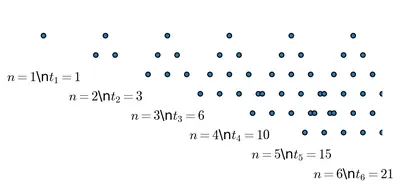
Let us revisit the sequence $$t_n$$ of triangular numbers 1, 3, 6, 10, 15, ... shown in Fig. 8.1. Note that the $$n^{th}$$ term of this sequence is the sum of the first $$n$$ natural numbers. Thus $$t_n = \frac{n(n+1)}{2}$$. Can you use this to find the 10$$^{th}$$, 17$$^{th}$$ and 80$$^{th}$$ triangular numbers?
Fig. 8.1
Fig. 8.1

Solution

We know that the triangular numbers form the sequence of sums of the first $$n$$ natural numbers.

Algebraically the $$n^{\text{th}}$$ triangular number is

\[t_n = \frac{n(n+1)}{2}\]

We now substitute the required values of $$n$$ one by one.

(i) 10th triangular number

$$t_{10} = \frac{10(10+1)}{2}$$

$$= \frac{10 \times 11}{2}$$

$$= \frac{110}{2}$$

$$= 55$$

\[\boxed{t_{10}=55}\]

(ii) 17th triangular number

$$t_{17} = \frac{17(17+1)}{2}$$

$$= \frac{17 \times 18}{2}$$

$$= \frac{306}{2}$$

$$= 153$$

\[\boxed{t_{17}=153}\]

(iii) 80th triangular number

$$t_{80} = \frac{80(80+1)}{2}$$

$$= \frac{80 \times 81}{2}$$

Because $$\frac{80}{2}=40$$, we get

$$= 40 \times 81$$

$$= 3240$$

\[\boxed{t_{80}=3240}\]

Hence the 10th, 17th and 80th triangular numbers are 55, 153 and 3240, respectively.

Answer

10th triangular number = 55
17th triangular number = 153
80th triangular number = 3240

Think and Reflect

Can you predict the number of squares in Stages 5 and 6 of the pattern? In Stages 10, 11 and 12? In Stage 20? At any stage? How is this different from the growing pattern in Fig. 8.3?
Fig. 8.3
Fig. 8.3

Solution

Step 1 : Read the first few stages that are already drawn
(From the textbook diagram just before the question.)

StageNumber of squares seen
1$$1$$
2$$4$$
3$$9$$
4$$16$$

Step 2 : Look for a rule
The numbers $$1,4,9,16$$ are perfect squares:

  • $$1 = 1^2$$
  • $$4 = 2^2$$
  • $$9 = 3^2$$
  • $$16 = 4^2$$

This suggests

\[ \text{Number of unit squares in stage }n = n^2. \]

Step 3 : Verify with the differences
Going from one stage to the next we add

  • $$4-1 = 3$$ squares,
  • $$9-4 = 5$$ squares,
  • $$16-9 = 7$$ squares,

i.e. we add the consecutive odd numbers $$3,5,7,\ldots$$. This is exactly what happens when we build a bigger and bigger square, so the rule $$n^2$$ is consistent.

Step 4 : Use the rule

Stage (n)Number of squares $$n^2$$
5$$5^2 = 25$$
6$$6^2 = 36$$
10$$10^2 = 100$$
11$$11^2 = 121$$
12$$12^2 = 144$$
20$$20^2 = 400$$

Step 5 : General statement
At any stage $$n$$ the number of squares is simply $$n^2$$.

Step 6 : Comparison with the growing pattern in Fig. 8.3

  • Current pattern: total squares = $$n^2$$. The increase from one stage to the next is not constant; it is the successive odd numbers $$3,5,7,\dots$$.
  • Pattern in Fig. 8.3 (look back at the book): there each stage grows by the same fixed number of squares (a linear or arithmetic pattern). Thus its total is of the form $$an + b$$, not $$n^2$$.

So the present pattern is quadratic while the pattern of Fig. 8.3 is linear.

Answer

Stage 5: 25 squares
Stage 6: 36 squares
Stage 10: 100 squares
Stage 11: 121 squares
Stage 12: 144 squares
Stage 20: 400 squares
Stage n: $$n^2$$ squares.
The present pattern is quadratic (adds 3, 5, 7, … each time) whereas the pattern in Fig. 8.3 is linear (adds the same fixed number each time).

Exercise Check whether the following sequences are geometric progressions and find their $$n^{th}$$ terms.

(i) 2, 10, 50, 250, ...

Solution

The given sequence is 2, 10, 50, 250, …

Step 1 : Check the common ratio

Let $$a_1=2,\; a_2=10,\; a_3=50$$.

Calculate successive quotients:

  • $$\dfrac{a_2}{a_1}=\dfrac{10}{2}=5$$
  • $$\dfrac{a_3}{a_2}=\dfrac{50}{10}=5$$

The ratio is constant (5). Therefore the sequence is a geometric progression (G.P.) with

Initial term $$a=2$$ and common ratio $$r=5$$.

Step 2 : General or $$n^{\text{th}}$$ term

For a G.P. the formula for the $$n^{\text{th}}$$ term is

$$a_n = a r^{n-1}$$.

Substituting $$a=2$$ and $$r=5$$, we get

\[a_n = 2\,5^{\,n-1}\]

Answer

G.P. with common ratio 5;  $$a_n = 2\,5^{\,n-1}$$

(ii) $$4, \frac{8}{3}, \frac{16}{9}, \frac{32}{27}, \ldots$$

Solution

The given sequence is $$4, \dfrac{8}{3}, \dfrac{16}{9}, \dfrac{32}{27},\ldots$$

Step 1 : Check the common ratio

Let $$a_1=4,\; a_2=\dfrac{8}{3},\; a_3=\dfrac{16}{9}$$.

  • $$\dfrac{a_2}{a_1}=\dfrac{\tfrac{8}{3}}{4}=\dfrac{8}{3}\times\dfrac{1}{4}=\dfrac{2}{3}$$
  • $$\dfrac{a_3}{a_2}=\dfrac{\tfrac{16}{9}}{\tfrac{8}{3}}=\dfrac{16}{9}\times\dfrac{3}{8}=\dfrac{48}{72}=\dfrac{2}{3}$$

The ratio is constant at $$\dfrac{2}{3}$$, so the sequence is a G.P. with

Initial term $$a=4$$ and common ratio $$r=\dfrac{2}{3}$$.

Step 2 : General or $$n^{\text{th}}$$ term

Using $$a_n = a r^{n-1}$$, we obtain

\[a_n = 4 \left(\dfrac{2}{3}\right)^{n-1}\]

Answer

G.P. with common ratio $$\dfrac{2}{3}$$;  $$a_n = 4\left(\dfrac{2}{3}\right)^{n-1}$$

(iii) $$3, \frac{-3}{2}, \frac{3}{4}, \frac{-3}{8}, \ldots$$

Solution

The given sequence is $$3, -\dfrac{3}{2}, \dfrac{3}{4}, -\dfrac{3}{8},\ldots$$

Step 1 : Check the common ratio

Let $$a_1=3,\; a_2=-\dfrac{3}{2},\; a_3=\dfrac{3}{4}$$.

  • $$\dfrac{a_2}{a_1}=\dfrac{-\tfrac{3}{2}}{3}=\dfrac{-3}{2}\times\dfrac{1}{3}=-\dfrac{1}{2}$$
  • $$\dfrac{a_3}{a_2}=\dfrac{\tfrac{3}{4}}{-\tfrac{3}{2}}=\dfrac{3}{4}\times\left(-\dfrac{2}{3}\right)=-\dfrac{1}{2}$$

The ratio is constant at $$-\dfrac{1}{2}$$; hence the sequence is a G.P. with

Initial term $$a=3$$ and common ratio $$r=-\dfrac{1}{2}$$.

Step 2 : General or $$n^{\text{th}}$$ term

Using $$a_n = a r^{n-1}$$, we have

\[a_n = 3\left(-\dfrac{1}{2}\right)^{\,n-1}\]

Answer

G.P. with common ratio $-$ $$\dfrac{1}{2}$$;  $$a_n = 3\left(-\dfrac{1}{2}\right)^{\,n-1}$$

Exercise Can you find a recursive rule for the formula $$t_n = 3 \times 10^{n-1}$$ that generates the geometric progression 3, 30, 300, 3000, ... ?

Solution

The sequence given by the explicit (direct) formula is

$$t_n = 3 \times 10^{\,n-1}\quad(n = 1,2,3,\dots)$$

Substituting a few values of $$n$$, we obtain

  • $$t_1 = 3 \times 10^{1-1}=3$$
  • $$t_2 = 3 \times 10^{2-1}=3 \times 10 = 30$$
  • $$t_3 = 3 \times 10^{3-1}=3 \times 10^2 = 300$$
  • $$t_4 = 3 \times 10^{4-1}=3 \times 10^3 = 3000$$

This is the geometric progression 3, 30, 300, 3000, … whose common ratio is 10.

Writing $$t_n$$ in terms of $$t_{n-1}$$

The previous term, obtained from the same explicit rule, is

$$t_{n-1} = 3 \times 10^{(n-1)-1}=3 \times 10^{\,n-2}.$$

Compare the two consecutive terms:

$$\frac{t_n}{t_{n-1}} = \frac{3 \times 10^{\,n-1}}{3 \times 10^{\,n-2}} = 10.$$

Hence every term is 10 times the previous one, so

\[t_n = 10\,t_{n-1}\quad(n \ge 2)\]

First term

$$t_1 = 3$$

Recursive rule

  • Initial term: $$t_1 = 3$$
  • Recurrence relation: $$t_n = 10\,t_{n-1}\quad\text{for } n \ge 2$$

This recursive definition reproduces exactly the sequence 3, 30, 300, 3000, …

Answer

Recursive rule: $$t_1 = 3$$ and, for $$n \ge 2$$, $$t_n = 10\,t_{n-1}$$.

Think and Reflect

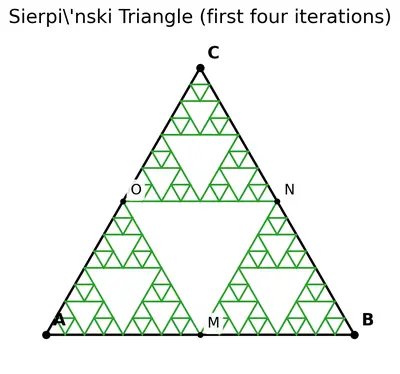
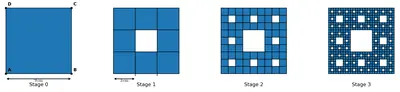
Observe the Sierpiński triangle and try to answer the following questions.
Fig. 8.7
Fig. 8.7

(a) How many black triangles are there in Stages 0 to 3 of Fig. 8.7?

Solution

Understanding the construction
In every step we join the mid–points of the three sides of every black (filled) equilateral triangle that is present, thus dividing it into four congruent smaller equilateral triangles. The open (white) central triangle is removed and the remaining three remain black. Hence

  • each black triangle of one stage produces exactly three black triangles in the next stage.

Counting stage by stage

StageReasoningNo. of black triangles
0Given single filled triangle$$1$$
1The only triangle of stage 0 produces 3 black ones$$3$$
2Each of the 3 triangles of stage 1 again produces 3 new ones: $$3\times3$$$$9$$
3Each of the 9 triangles of stage 2 again produces 3: $$9\times3$$$$27$$

Answer

(Stage 0,1,2,3) → 1, 3, 9, 27 black triangles respectively.

(b) Can you predict the number of black triangles at Stages 4 and 5?

Solution

Because every stage multiplies the previous count by 3, continue the pattern:

Stage 4: $$27\times3=81$$
Stage 5: $$81\times3=243$$

Answer

Stage 4 → 81 black triangles; Stage 5 → 243 black triangles.

(c) Can you find a rule for the number of black triangles at the $$n^{th}$$ stage?

Solution

Let $$T_n$$ denote the number of black triangles after the $$n^{\text{th}}$$ stage (counting the original filled triangle as Stage 0).

We observed that

  • $$T_0=1$$, and
  • for every $$n\ge 0$$, $$T_{n+1}=3\,T_n$$ because each existing black triangle gives three new ones.

This is a geometric progression with common ratio 3. Solving the recurrence,

$$T_n=1\times3^n.$$

Hence the rule is

\[T_n = 3^n\]

Answer

General rule: $$T_n=3^n$$ black triangles at Stage n.

(d) Suppose the area of the triangle (that is, the black region) in Stage 0 is 1 square unit. What is the area of the black region in Stages 1, 2 and 3? What will be the area of the black region in Stages 4 and 5? Find a rule for the area of the black region at the $$n^{th}$$ stage. What happens to this area as $$n$$, the number of stages, goes on increasing?

Solution

Step 1 Find the reduction factor for area
When we join the mid-points of a filled equilateral triangle, we cut it into four congruent smaller triangles; exactly one of them (the central one) is removed. Therefore only $$3$$ out of $$4$$ parts of the previous black area remain, i.e. $$\dfrac34$$ of the area survives from one stage to the next.

Step 2 Set up the progression
Let $$A_n$$ be the area (in square units) of the black region in Stage $$n$$; we are told $$A_0=1$$.

  • Stage 1: $$A_1=\dfrac34\,A_0=\dfrac34\times1=\dfrac34$$
  • Stage 2: $$A_2=\dfrac34\,A_1=\bigl(\dfrac34\bigr)^2=\dfrac{9}{16}$$
  • Stage 3: $$A_3=\dfrac34\,A_2=\bigl(\dfrac34\bigr)^3=\dfrac{27}{64}$$

Step 3 Continue to Stages 4 and 5

Stage 4: $$A_4=\bigl(\dfrac34\bigr)^4=\dfrac{81}{256}$$
Stage 5: $$A_5=\bigl(\dfrac34\bigr)^5=\dfrac{243}{1024}$$

Step 4 General rule

\[A_n = \Bigl(\dfrac34\Bigr)^n\quad\text{square units}\]

Step 5 Limiting behaviour
Because $$0<\dfrac34<1$$, the power $$\bigl(\dfrac34\bigr)^n$$ becomes smaller and approaches $$0$$ as $$n$$ grows without bound. Thus the black area tends to zero even though the boundary of the figure keeps getting more intricate.

Answer

Areas: Stage 1 = 3⁄4, Stage 2 = 9⁄16, Stage 3 = 27⁄64; Stage 4 = 81⁄256, Stage 5 = 243⁄1024. In general, $$A_n=(3/4)^n$$. As $$n\to\infty$$, $$A_n\to0$$.

Exercise Set 8.1

1 Find the first five terms of the sequence in which the $$n^{th}$$ term is given by

(i) $$t_n = 3n - 4$$

Solution

The general term is given by $$t_n = 3n - 4$$.

  1. For $$n = 1$$:
    $$t_1 = 3(1) - 4 = 3 - 4 = -1$$

  2. For $$n = 2$$:
    $$t_2 = 3(2) - 4 = 6 - 4 = 2$$

  3. For $$n = 3$$:
    $$t_3 = 3(3) - 4 = 9 - 4 = 5$$

  4. For $$n = 4$$:
    $$t_4 = 3(4) - 4 = 12 - 4 = 8$$

  5. For $$n = 5$$:
    $$t_5 = 3(5) - 4 = 15 - 4 = 11$$

Hence, the first five terms are $$-1,\,2,\,5,\,8,\,11$$.

Answer

$$-1,\,2,\,5,\,8,\,11$$

(ii) $$t_n = 2 - 5n$$

Solution

The general term is $$t_n = 2 - 5n$$.

  1. For $$n = 1$$:
    $$t_1 = 2 - 5(1) = 2 - 5 = -3$$

  2. For $$n = 2$$:
    $$t_2 = 2 - 5(2) = 2 - 10 = -8$$

  3. For $$n = 3$$:
    $$t_3 = 2 - 5(3) = 2 - 15 = -13$$

  4. For $$n = 4$$:
    $$t_4 = 2 - 5(4) = 2 - 20 = -18$$

  5. For $$n = 5$$:
    $$t_5 = 2 - 5(5) = 2 - 25 = -23$$

Hence, the first five terms are $$-3,\,-8,\,-13,\,-18,\,-23$$.

Answer

$$-3,\,-8,\,-13,\,-18,\,-23$$

(iii) $$t_n = n^2 - 2n + 3$$ for $$n \geq 1$$

Solution

The general term is $$t_n = n^2 - 2n + 3$$ for $$n \ge 1$$.

  1. For $$n = 1$$:
    $$t_1 = 1^2 - 2(1) + 3 = 1 - 2 + 3 = 2$$

  2. For $$n = 2$$:
    $$t_2 = 2^2 - 2(2) + 3 = 4 - 4 + 3 = 3$$

  3. For $$n = 3$$:
    $$t_3 = 3^2 - 2(3) + 3 = 9 - 6 + 3 = 6$$

  4. For $$n = 4$$:
    $$t_4 = 4^2 - 2(4) + 3 = 16 - 8 + 3 = 11$$

  5. For $$n = 5$$:
    $$t_5 = 5^2 - 2(5) + 3 = 25 - 10 + 3 = 18$$

Hence, the first five terms are $$2,\,3,\,6,\,11,\,18$$.

Answer

$$2,\,3,\,6,\,11,\,18$$

2 Find the 10$$^{th}$$ and 15$$^{th}$$ terms of the sequence $$t_n = 5n - 3$$ for $$n \geq 1$$.

Solution

We are given the general term (or nth term) of a sequence:

$$t_n = 5n - 3 \quad (n \ge 1).$$

To obtain any particular term, substitute the required value of $$n$$ into the expression.

1. 10th term

Take $$n = 10$$.

\[t_{10} = 5(10) - 3\]

First multiply: $$5 \times 10 = 50$$.

Then subtract 3: $$50 - 3 = 47$$.

Therefore, $$t_{10} = 47$$.

2. 15th term

Take $$n = 15$$.

\[t_{15} = 5(15) - 3\]

First multiply: $$5 \times 15 = 75$$.

Then subtract 3: $$75 - 3 = 72$$.

Therefore, $$t_{15} = 72$$.

Hence, the 10th term is $$47$$ and the 15th term is $$72$$.

Answer

$$t_{10} = 47, \;\; t_{15} = 72.$$

3 Determine whether 97 and 172 are terms of the sequence $$t_n = 5n - 3$$ for $$n \geq 1$$.

Solution

The sequence is defined by its general (nth) term

$$t_n = 5n - 3, \; n \ge 1$$

To check whether a given number belongs to the sequence, equate it with $$t_n$$ and solve for $$n$$. The number will be a term of the sequence only if the resulting $$n$$ is a positive integer.

1. Checking whether 97 is a term

Set $$t_n = 97$$:

$$5n - 3 = 97$$

Add 3 to both sides:

$$5n = 97 + 3 = 100$$

Divide by 5:

$$n = \dfrac{100}{5} = 20$$

Since $$n = 20$$ is a positive integer (and $$20 \ge 1$$), 97 is indeed the 20th term, i.e. $$97 = t_{20}$$.

2. Checking whether 172 is a term

Set $$t_n = 172$$:

$$5n - 3 = 172$$

Add 3 to both sides:

$$5n = 172 + 3 = 175$$

Divide by 5:

$$n = \dfrac{175}{5} = 35$$

Since $$n = 35$$ is a positive integer (and $$35 \ge 1$$), 172 is the 35th term, i.e. $$172 = t_{35}$$.

Conclusion

Both 97 and 172 correspond to positive integer values of $$n$$ (20 and 35, respectively). Therefore both numbers are terms of the given sequence.

Answer

97 = $$t_{20}$$ and 172 = $$t_{35}$$; therefore, both numbers are terms of the sequence.

4 Which term of the sequence $$t_n = 5n - 3$$ for $$n \geq 1$$ is 607?

Solution

The nth (general) term of the given arithmetic sequence is

$$t_n = 5n - 3, \; n \ge 1$$

We are asked to find which term equals 607, that is, to find the natural number $$n$$ such that

\[t_n = 607\]

Substituting the expression for $$t_n$$:

$$5n - 3 = 607$$

Now solve this simple linear equation step by step.

  1. Add 3 to both sides:

$$5n - 3 + 3 = 607 + 3$$
$$5n = 610$$

  1. Divide both sides by 5:

$$n = \dfrac{610}{5}$$
$$n = 122$$

Because $$n = 122$$ is a positive integer, it fits the condition $$n \ge 1$$. Hence,

\[\textbf{The 122nd term of the sequence is 607.}\]

Answer

122nd term

5 A sequence is given by the recursive rule $$t_1 = -5$$, $$t_{n+1} = t_n + 3$$ for $$n \geq 1$$. Find the first five terms of the sequence. Is 52 a term of this sequence? If so, which term is it?

Solution

Step 1 : Identify the type of sequence
Because every term is obtained by adding the fixed number $$3$$ to the preceding term, the sequence is an arithmetic progression (A.P.).
For an A.P. we have

  • first term $$a = t_1$$,
  • common difference $$d = t_{n+1}-t_n$$.

Step 2 : Read off the first term and the common difference
Given $$t_1 = -5$$, so $$a = -5$$.
Given $$t_{n+1} = t_n + 3$$, so each time we add $$3$$. Hence the common difference is
$$d = 3$$.

Step 3 : Write the first five terms
Start with $$t_1$$ and keep adding $$d = 3$$.

  • First term : $$t_1 = -5$$
  • Second term : $$t_2 = t_1 + 3 = -5 + 3 = -2$$
  • Third term : $$t_3 = t_2 + 3 = -2 + 3 = 1$$
  • Fourth term : $$t_4 = t_3 + 3 = 1 + 3 = 4$$
  • Fifth term : $$t_5 = t_4 + 3 = 4 + 3 = 7$$

Therefore the first five terms are
$$-5,\\ -2,\ 1,\ 4,\ 7.$$

Step 4 : Write the general (nth) term
For an A.P. the general term is
\[ t_n = a + (n-1)d \] Substituting $$a = -5$$ and $$d = 3$$, we get
$$t_n = -5 + (n-1)\times 3.$$

Step 5 : Check whether 52 is a term
We must see if some positive integer $$n$$ satisfies
$$t_n = 52.$$

Set the expression for $$t_n$$ equal to 52:

\[ -5 + (n-1)\times 3 = 52 \]

Solve for $$n$$ step by step:

  • Add 5 to both sides:
    $$ (n-1)\times 3 = 52 + 5 = 57 $$
  • Divide both sides by 3:
    $$ n - 1 = \frac{57}{3} = 19 $$
  • Add 1 to both sides:
    $$ n = 19 + 1 = 20 $$

$$n = 20$$ is a positive integer, so 52 is indeed a term of the sequence, namely the 20th term.

Conclusion
First five terms: $$-5,\;-2,\;1,\;4,\;7.$$
Yes, 52 appears and it is the 20th term.

Answer

First five terms = $$-5,-2,1,4,7$$.
Since $$t_n=-5+(n-1)\times3$$ gives $$n=20$$ when $$t_n=52$$, 52 is the 20th term.

6 Let $$T_1 = 1$$, $$T_2 = 2$$, $$T_3 = 4$$, and $$T_n = T_{n-1} + T_{n-2} + T_{n-3}$$ for $$n \geq 4$$. Find $$T_4$$, $$T_5$$, $$T_6$$, $$T_7$$, and $$T_8$$.

Solution

The sequence is defined by

$$T_1 = 1, \; T_2 = 2, \; T_3 = 4$$

and for every integer $$n \ge 4$$,

$$T_n = T_{n-1} + T_{n-2} + T_{n-3}.$$

We calculate each required term one by one.

Term $$T_4$$

$$\begin{aligned} T_4 &= T_3 + T_2 + T_1\\ &= 4 + 2 + 1\\ &= 7 \end{aligned}$$

Term $$T_5$$

$$\begin{aligned} T_5 &= T_4 + T_3 + T_2\\ &= 7 + 4 + 2\\ &= 13 \end{aligned}$$

Term $$T_6$$

$$\begin{aligned} T_6 &= T_5 + T_4 + T_3\\ &= 13 + 7 + 4\\ &= 24 \end{aligned}$$

Term $$T_7$$

$$\begin{aligned} T_7 &= T_6 + T_5 + T_4\\ &= 24 + 13 + 7\\ &= 44 \end{aligned}$$

Term $$T_8$$

$$\begin{aligned} T_8 &= T_7 + T_6 + T_5\\ &= 44 + 24 + 13\\ &= 81 \end{aligned}$$

Thus the next five terms of the sequence are:

\[T_4 = 7, \; T_5 = 13, \; T_6 = 24, \; T_7 = 44, \; T_8 = 81\]

Answer

$$T_4 = 7, \; T_5 = 13, \; T_6 = 24, \; T_7 = 44, \; T_8 = 81$$

Exercise Set 8.2

1 Find the 10$$^{th}$$ and 26$$^{th}$$ terms of the AP: 3, 8, 13, 18, ....

Solution

The given numbers 3, 8, 13, 18, \(\dots\) form an arithmetic progression (AP) because the difference between consecutive terms is constant.

First term:
$$a_1 = 3$$

Common difference:
$$d = 8 - 3 = 5$$
(You can verify that $$13 - 8 = 5$$ and $$18 - 13 = 5$$ as well.)

The $$n^{\text{th}}$$ term $$a_n$$ of an AP is found from

\[ a_n = a_1 + (n-1)d\]

(i) 10th term

Substitute $$n = 10$$:

$$a_{10} = 3 + (10 - 1) \times 5$$

$$a_{10} = 3 + 9 \times 5$$

$$a_{10} = 3 + 45 = 48$$

(ii) 26th term

Substitute $$n = 26$$:

$$a_{26} = 3 + (26 - 1) \times 5$$

$$a_{26} = 3 + 25 \times 5$$

$$a_{26} = 3 + 125 = 128$$

Hence, the 10th term is $$48$$ and the 26th term is $$128$$.

Answer

10th term = $$48$$; 26th term = $$128$$

2 Which term of the AP: 21, 18, 15, ... is –81? Also, is 0 a term of this AP? Give reasons for your answer.

Solution

First identify the parameters of the arithmetic progression (AP):

  • First term: $$a = 21$$
  • Common difference: $$d = 18 - 21 = -3$$

The general (nth) term of an AP is

\[a_n = a + (n-1)d\]


(i) Finding the term number whose value is –81

Put $$a_n = -81$$ and solve for $$n$$:

$$-81 = 21 + (n-1)(-3)$$

$$-81 - 21 = (n-1)(-3)$$

$$-102 = (n-1)(-3)$$

$$n - 1 = \frac{-102}{-3} = 34$$

$$n = 34 + 1 = 35$$

Hence, –81 is the 35th term of the AP.


(ii) Checking whether 0 is a term of the AP

Put $$a_n = 0$$ and solve for $$n$$:

$$0 = 21 + (n-1)(-3)$$

$$-21 = (n-1)(-3)$$

$$n - 1 = \frac{-21}{-3} = 7$$

$$n = 7 + 1 = 8$$

The value of $$n$$ obtained is a positive integer (8). Therefore 0 is a term of the given AP, specifically the 8th term.

Answer

–81 is the 35th term of the progression.
0 is a term (it is the 8th term) because the corresponding n-value obtained from the formula is a positive integer.

3 Find the $$n^{th}$$ term of the AP: 11, 8, 5, 2, ... Write the recursive rule for this AP.

Solution

Step 1 • Identify first term and common difference

The given arithmetic progression (AP) is

$$11,\;8,\;5,\;2,\;\ldots$$

The first term is

$$a_1 = 11$$

The common difference $$d$$ is obtained by subtracting any term from the next term:

$$d = 8 - 11 = -3$$

We may check with another pair to be sure:

$$5 - 8 = -3,\;\;2 - 5 = -3 \;\;(\text{same } d).$$

Step 2 • General (\(n^{\text{th}}\)) term

For any AP, the general term $$a_n$$ is given by

$$a_n = a_1 + (n-1)d$$

Substitute $$a_1 = 11$$ and $$d = -3$$:

$$a_n = 11 + (n-1)(-3)$$

Simplify step-by-step:

$$a_n = 11 - 3(n-1)$$

Distribute the $$-3$$:

$$a_n = 11 - 3n + 3$$

Combine like terms $$11 + 3 = 14$$:

$$a_n = 14 - 3n$$

The required \(n^{\text{th}}\) term is therefore

\[ a_n = 14 - 3n \]

Step 3 • Recursive rule

To express the AP recursively we start with the first term and relate each term to the previous one.

  • Initial condition: $$a_1 = 11$$
  • Recursive relation: each term is obtained by subtracting 3 from the previous term, i.e.

    $$a_{n+1} = a_n - 3\;\;\text{for } n \ge 1$$

Conclusion

The AP has \(n^{\text{th}}\) term $$a_n = 14 - 3n$$ and the recursive rule

$$a_1 = 11,\;a_{n+1} = a_n - 3.$$

Answer

$$a_n = 14 - 3n,\qquad a_1 = 11,\;a_{n+1} = a_n - 3$$

4 An AP consists of 50 terms in which the 3$$^{rd}$$ term is 12 and the last term is 106. Find the 29$$^{th}$$ term. (Hint: If '$$a$$' is the first term and '$$d$$' the common difference, then we arrive at the equations $$a + 2d = 12$$ and $$a + 49d = 106$$. Solve this pair of linear equations for '$$a$$' and '$$d$$'.)

Solution

An arithmetic progression (AP) is completely fixed once we know its first term $$a$$ and common difference $$d$$. For every positive integer $$n$$, the formula for the $$n^{\text{th}}$$ term is

\[T_n=a+(n-1)d\]

We are told:

  • The 3rd term is 12, so $$T_3=12$$.
  • The AP has 50 terms and the last (i.e. 50th) term is 106, so $$T_{50}=106$$.

Translate each fact with the general term formula.

For $$n=3:$$ $$T_3=a+(3-1)d=a+2d=12 \;\;\;(1)$$

For $$n=50:$$ $$T_{50}=a+(50-1)d=a+49d=106 \;\;\;(2)$$

Now solve the simultaneous linear equations (1) and (2).

Subtract (1) from (2):

$$\bigl(a+49d\bigr)-\bigl(a+2d\bigr)=106-12$$
$$a+49d-a-2d=94$$
$$47d=94$$
$$d=\dfrac{94}{47}=2$$

Substitute $$d=2$$ into equation (1):

$$a+2(2)=12 \;\Rightarrow\; a+4=12 \;\Rightarrow\; a=8$$

Thus, the AP is $$8,\;10,\;12,\;\dots$$ with $$d=2$$.

The 29th term is

$$T_{29}=a+(29-1)d=a+28d$$

Insert $$a=8$$ and $$d=2$$:

$$T_{29}=8+28\times2=8+56=64$$

Therefore, the 29th term of the AP is 64.

Answer

29th term = $$64$$

5 How many 2-digit numbers are divisible by 3? What is the sum of all these 2-digit numbers?

Solution

Step 1 : Identify the range of 2-digit numbers.

The two-digit natural numbers run from $$10$$ to $$99$$.

Step 2 : Find the smallest and largest 2-digit multiples of 3.

A number is divisible by $$3$$ when the remainder on division by $$3$$ is $$0$$. Checking the first few two-digit numbers, $$10$$ leaves remainder $$1$$, $$11$$ leaves remainder $$2$$, and $$12 = 3 \times 4$$ is exactly divisible. So the smallest 2-digit multiple of $$3$$ is $$12$$.

The largest 2-digit number is $$99$$, and $$99 \div 3 = 33$$ with no remainder, so the largest 2-digit multiple of $$3$$ is $$99$$.

Step 3 : Write the resulting sequence.

All the required numbers form the arithmetic progression

$$12,\; 15,\; 18,\; \ldots,\; 99$$

with first term $$a = 12$$ and common difference $$d = 3$$.

Step 4 : Find the number of terms $$n$$.

Using the formula for the $$n^{\text{th}}$$ term of an AP, $$l = a + (n-1)d$$:

\[99 = 12 + (n-1)\times 3\]

$$\Rightarrow\; 99 - 12 = (n-1)\times 3$$

$$\Rightarrow\; 87 = (n-1)\times 3$$

$$\Rightarrow\; n - 1 = 29$$

$$\Rightarrow\; n = 30.$$

Therefore, there are 30 two-digit numbers divisible by $$3$$.

Step 5 : Find the sum of these numbers.

The sum of all terms of an AP is

$$S = \dfrac{n}{2}\,(a + l).$$

Substituting $$n = 30$$, $$a = 12$$ and $$l = 99$$:

\[S = \dfrac{30}{2}\,(12 + 99) = 15 \times 111 = 1665.\]

So, the sum of all the 2-digit numbers divisible by $$3$$ is 1665.

Answer

There are 30 such numbers and their sum is $$1665$$.

6 Harish started work at an annual salary of ₹5,00,000 and received an increment of ₹20,000 each year. After how many years did his income reach ₹7,00,000?

Solution

Step 1 Identify the sequence of salaries
Harish’s salaries form an arithmetic progression (A.P.) because the amount increases by a fixed sum every year.

  • First term (salary in the 1st year): $$a = 5{,}00{,}000$$
  • Common difference (annual increment): $$d = 20{,}000$$
  • Let $$n$$ be the number of years after which the salary becomes $$7{,}00{,}000$$.

Step 2 Write the n-th term of the A.P.
For an arithmetic progression, the salary in the $$n$$-th year is given by

$$a_n = a + (n-1)d$$

Step 3 Set the n-th term equal to ₹7,00,000

Substituting the known values:

$$5{,}00{,}000 + (n-1)\times 20{,}000 = 7{,}00{,}000$$

Step 4 Solve for $$n$$

First isolate the term containing $$n$$:

$$ (n-1)\times 20{,}000 = 7{,}00{,}000 - 5{,}00{,}000 $$

$$ (n-1)\times 20{,}000 = 2{,}00{,}000 $$

Divide both sides by $$20{,}000$$:

$$ n - 1 = \frac{2{,}00{,}000}{20{,}000} = 10 $$

Add 1 to both sides:

$$ n = 10 + 1 = 11 $$

Step 5 Interpretation
The salary reaches ₹7,00,000 in the 11th year.

Answer

11 years

7 A child arranges marbles in rows so that the first row has 1 marble, the second has 2 marbles, the third has 3, and so on up to 25 rows. How many marbles does the child use in all?

Solution

The marbles in each row form the sequence

$$1, 2, 3, \ldots , 25$$

This is an arithmetic progression (AP) with common difference

$$d = 2 - 1 = 1$$

We need the sum of the first $$n = 25$$ terms of this AP.

For an AP, the sum $$S_n$$ of the first $$n$$ terms is

\[S_n = \frac{n}{2}(a + l)\]

where

  • first term $$a = 1$$,
  • last term $$l = 25$$,
  • number of terms $$n = 25$$.

Substitute these values:

$$S_{25} = \frac{25}{2}(1 + 25)$$

$$\phantom{S_{25}} = \frac{25}{2} \times 26$$

$$\phantom{S_{25}} = 25 \times 13$$

$$\phantom{S_{25}} = 325$$

Hence, the total number of marbles used is

\[325\text{ marbles}.\]

Answer

325 marbles

Exercise Set 8.3

1 Find the 12$$^{th}$$ term of a GP with common ratio 2, whose 8$$^{th}$$ term is 192.

Solution

The nth term of a geometric progression (GP) with first term $$a$$ and common ratio $$r$$ is

$$a_n = a r^{n-1}.$$

Given the common ratio $$r = 2$$ and the 8th term $$a_8 = 192$$, we substitute $$n = 8$$:

$$a_8 = a r^{8-1} = a (2)^{7}.$$

Hence,

$$a \times 128 = 192 \quad \Rightarrow \quad a = \frac{192}{128} = \frac{3}{2}.$$

Thus the first term is $$a = \frac{3}{2}$$.

To find the 12th term:

$$a_{12} = a r^{12-1} = \frac{3}{2} \times 2^{11}.$$

Since $$2^{11} = 2048$$,

$$a_{12} = \frac{3}{2} \times 2048 = 3 \times 1024 = 3072.$$

Therefore,

\[a_{12} = 3072\]

Answer

$$a_{12} = 3072$$

2 Find the 10$$^{th}$$ and $$n^{th}$$ terms of the GP: 5, 25, 125, ... .

Solution

Step 1 — Identify the first term and common ratio

The given sequence is 5, 25, 125, … .

  • First term: $$a = 5$$
  • Common ratio: $$r = \dfrac{25}{5} = 5$$ (and $$\dfrac{125}{25}=5$$, so the ratio is constant)

Therefore the sequence is a geometric progression (GP) with $$a = 5$$ and $$r = 5$$.

Step 2 — Formula for the $$n^{\text{th}}$$ term of a GP

For any GP, the $$n^{\text{th}}$$ term $$a_n$$ is given by

$$a_n = a r^{\,n-1}$$  for $$n \ge 1$$.

Step 3 — Find the 10th term

Substitute $$n = 10$$ in the formula:

$$a_{10} = a r^{10-1} = 5 \times 5^{9}$$

Combine the bases (recall $$5 \times 5^{9} = 5^{1} \times 5^{9} = 5^{10}$$):

\[a_{10} = 5^{10}\]

Calculate the value step by step:

  • $$5^2 = 25$$
  • $$5^3 = 125$$
  • $$5^4 = 625$$
  • $$5^5 = 3\,125$$
  • $$5^6 = 15\,625$$
  • $$5^7 = 78\,125$$
  • $$5^8 = 390\,625$$
  • $$5^9 = 1\,953\,125$$
  • $$5^{10} = 9\,765\,625$$

Hence the 10th term is $$9\,765\,625$$.

Step 4 — Find the general ( $$n^{\text{th}}$$ ) term

Using $$a = 5$$ and $$r = 5$$ in the formula $$a_n = a r^{\,n-1}$$:

$$a_n = 5 \times 5^{\,n-1}$$

Combine the bases (add exponents):

$$a_n = 5^{1} \times 5^{\,n-1} = 5^{n}$$

\[\boxed{\;a_n = 5^{n}\;}\]

Conclusion

  • 10th term: $$a_{10} = 5^{10} = 9\,765\,625$$
  • General term: $$a_n = 5^{n}$$

Answer

10th term: $$a_{10}=5^{10}=9\,765\,625$$
General term: $$a_n = 5^{n}$$

*3 A sequence is given by the recursive rule $$t_1 = 2$$, $$t_{n+1} = 3t_n - 2$$ for $$n \geq 1$$. Which term of the sequence is 730?

Solution

We are given the sequence defined recursively by

$$t_1 = 2, \; t_{n+1} = 3t_n - 2\;(n \ge 1).$$

The task is to locate the value of n for which $$t_n = 730$$.

Step 1: Find a closed-form (general) expression for $$t_n$$.

This is a linear first-order recurrence of the pattern $$t_{n+1} - 3t_n = -2$$.
We tackle it in two parts: a homogeneous solution and a particular solution.

  • Homogeneous part: Set the right–hand side to 0.
       $$t_{n+1}^{(h)} - 3t_n^{(h)} = 0 \;\Rightarrow\; t_{n+1}^{(h)} = 3t_n^{(h)}.$$
       Thus $$t_n^{(h)} = A\,3^{\,n-1},$$ where $$A$$ is a constant.
  • Particular part: Look for a constant solution $$t_n^{(p)} = C\;(\text{independent of }n).$$
       Substitute: $$C - 3C = -2 \;\Rightarrow\; -2C = -2 \;\Rightarrow\; C = 1.$$

Add the two parts:

\[t_n = A\,3^{\,n-1} + 1\]

Step 2: Determine the value of the constant $$A$$ using $$t_1 = 2$$.

$$t_1 = A\,3^{0} + 1 = A + 1 = 2 \;\Rightarrow\; A = 1.$$

Hence the explicit formula is

$$t_n = 3^{\,n-1} + 1.$$

Step 3: Solve $$t_n = 730$$.

Set $$t_n$$ equal to the required value:

$$3^{\,n-1} + 1 = 730 \;\Rightarrow\; 3^{\,n-1} = 729.$$

Recall that $$729 = 3^6.$

Therefore $$3^{\,n-1} = 3^6 \;\Rightarrow\; n - 1 = 6 \;\Rightarrow\; n = 7.$$

Step 4: Verification (optional but reassuring).

Using the closed form: $$t_7 = 3^{6} + 1 = 729 + 1 = 730,$$ which matches the target value.

Consequently, the number 730 appears as the 7th term of the sequence.

Answer

The 7th term.

4 Which term of the GP: 2, 6, 18, ... is 4374? Write the explicit formula as well as the recursive formula for the $$n^{th}$$ term.

Solution

Step 1  Identify the first term and the common ratio

The given GP is 2, 6, 18, …

  • First term: $$a = 2$$
  • Common ratio: $$r = \frac{6}{2} = 3$$ (and $$\frac{18}{6}=3$$, confirming the ratio).

Step 2  Write the general (explicit) formula for the nth term

For any GP the explicit formula is $$a_n = a\,r^{\,n-1}$$. Substituting $$a=2$$ and $$r=3$$, we get

\[a_n = 2 \cdot 3^{\,n-1}\]

Step 3  Use the formula to locate the term equal to 4374

We set $$a_n = 4374$$ and solve for n:

$$2 \cdot 3^{\,n-1} = 4374$$

Divide both sides by 2:

$$3^{\,n-1} = \frac{4374}{2} = 2187$$

Step 4  Express 2187 as a power of 3

Note that

$$3^5 = 243, \; 3^6 = 729, \; 3^7 = 2187$$

Hence $$3^{\,n-1} = 3^7$$, which implies $$n-1 = 7$$.

Therefore $$n = 7 + 1 = 8$$.

Conclusion

The number 4374 is the 8th term of the progression.

Explicit formula

\[a_n = 2 \cdot 3^{\,n-1}\]

Recursive formula

  • Initial term: $$a_1 = 2$$
  • Recursion: $$a_n = 3\,a_{n-1}\quad (n \ge 2)$$

Answer

4374 is the 8th term.
Explicit: $$a_n = 2\,3^{n-1}$$
Recursive: $$a_1 = 2,\; a_n = 3a_{n-1}\; (n\ge 2)$$

5 A ball is dropped from a height of 80 metres. After hitting the ground, it bounces back to 60% of the height from which it fell. It continues bouncing in this way—each time rising to 60% of the previous height.

(i) What height does the ball reach after the 5$$^{th}$$ bounce?

Solution

The ball is first dropped from $$80\,\text{m}$$ and, after every bounce, it rises to $$60\%$$ of the previous height.

Rebound heights form a geometric progression (G.P.):

  • First rebound (after the first hit): $$h_1 = 0.6 \times 80 = 48\,\text{m}$$
  • Common ratio: $$r = 0.6$$ (because each height is $$60\%$$ of the preceding one).

Height after the $$n^{\text{th}}$$ bounce is

$$h_n = 80 \times r^{\,n}\;.$$

For the $$5^{\text{th}}$$ bounce:

$$h_5 = 80 \times (0.6)^5.$$

Compute $$(0.6)^5$$ step-by-step:

$$0.6^2 = 0.36,\; 0.6^3 = 0.216,\; 0.6^4 = 0.1296,\; 0.6^5 = 0.07776.$$

Hence

\[h_5 = 80 \times 0.07776 = 6.2208\,\text{m}.\]

Rounded to two decimal places: $$6.22\,\text{m}$$.

Answer

$$6.22\,\text{m (approximately)}$$

(ii) What is the total vertical distance the ball has travelled by the time it hits the ground for the 6$$^{th}$$ time?

Solution

We need the total vertical distance travelled by the moment the ball hits the ground for the 6th time.

List the hits:

  1. Initial drop from $$80\,\text{m}$$ (1st ground hit).
  2. 1st rebound: rises to $$48\,\text{m}$$ and falls back $$48\,\text{m}$$ (2nd hit).
  3. 2nd rebound: rises to $$28.8\,\text{m}$$ and falls back $$28.8\,\text{m}$$ (3rd hit).
  4. 3rd rebound: rises to $$17.28\,\text{m}$$ and falls back $$17.28\,\text{m}$$ (4th hit).
  5. 4th rebound: rises to $$10.368\,\text{m}$$ and falls back $$10.368\,\text{m}$$ (5th hit).
  6. 5th rebound: rises to $$6.2208\,\text{m}$$ and falls back $$6.2208\,\text{m}$$ (6th hit).

Except for the very first drop, every rebound contributes an up-and-down pair. The "up" heights form the G.P.

First term of that G.P.: $$a = 48\,\text{m}$$, common ratio $$r = 0.6$$.

We need the sum of the first five rebound heights:

$$S_5 = a\,\frac{1-r^{5}}{1-r} = 48\times\frac{1-(0.6)^5}{1-0.6}.$$

$$(0.6)^5 = 0.07776 \;\Rightarrow\; 1-0.07776 = 0.92224.$$

$$S_5 = 48 \times \frac{0.92224}{0.4} = 48 \times 2.3056 = 110.6688\,\text{m}.$$

Total distance travelled:

$$\text{Distance} = \underbrace{80}_{\text{initial drop}} + 2\times S_5.$$

$$\text{Distance} = 80 + 2(110.6688) = 80 + 221.3376 = 301.3376\,\text{m}.$$

\[\boxed{\;\approx 301.34\,\text{metres}\;}.\]

Answer

$$\text{Total distance}\; \approx 301.34\,\text{m}$$

6 Which term of the sequence $$2, 2\sqrt{2}, 4, \ldots$$ is 128?

Solution

The sequence is

$$2,\;2\sqrt{2},\;4,\dots$$

Step 1 – Identify the common ratio.

  • First term: $$a = 2$$
  • Second ÷ first: $$r = \dfrac{2\sqrt{2}}{2}=\sqrt{2}$$
  • Third ÷ second: $$\dfrac{4}{2\sqrt{2}} = \sqrt{2}$$ (confirms the same ratio)

Hence it is a geometric progression (G.P.) with $$a = 2$$ and $$r = \sqrt{2}$$.

Step 2 – Write the n-th term.

For a G.P., $$T_n = a\,r^{\,n-1}$$.

Here, $$T_n = 2\,(\sqrt{2})^{n-1}$$.

Step 3 – Set the n-th term equal to 128.

$$2\,(\sqrt{2})^{n-1} = 128$$

Divide by 2:

$$(\sqrt{2})^{n-1} = 64$$

Step 4 – Express both sides with the same base.

$$64 = 2^6$$ and $$\bigl(\sqrt{2}\bigr)^{n-1} = \bigl(2^{1/2}\bigr)^{n-1} = 2^{\tfrac{n-1}{2}}$$

So

$$2^{\tfrac{n-1}{2}} = 2^6$$

Step 5 – Equate exponents.

$$\frac{n-1}{2} = 6 \;\Longrightarrow\; n - 1 = 12 \;\Longrightarrow\; n = 13$$

\[ n = 13 \]

Therefore, 128 is the 13th term of the given sequence.

Answer

It is the $$13^{\text{th}}$$ term.

7

Fig. 8.12 shows Stages 0 to 3 of the Sierpiński square carpet. Stage 0 of this fractal is a square sheet of paper. To construct Stage 1, each side of the square is trisected and the points of trisection of opposite sides are joined to obtain nine smaller squares. The centre square is then removed and the 8 smaller squares are retained, leaving a square hole in the centre. The same process is repeated on the eight smaller shaded squares to obtain Stage 2 and so on.

Look at Fig. 8.12 and try to answer the following questions.

Fig. 8.12
Fig. 8.12

(i) How many red squares are there in Stages 0 to 3?

Solution

Stage 0 is the original square, so there is only one red square.
To obtain the next stage every existing red square is cut into nine congruent smaller squares and its centre one is removed. Thus every red square of one stage gives rise to exactly eight red squares in the next stage.

Hence the number of red squares grows eight-fold from one stage to the next.

StageNumber of red squares
0$$1$$
1$$1\times 8 = 8$$
2$$8\times 8 = 64$$
3$$64\times 8 = 512$$

Answer

Stage 0 : 1    Stage 1 : 8    Stage 2 : 64    Stage 3 : 512

(ii) Can you predict the number of red squares in Stages 4 and 5?

Solution

From part (i) we have observed that the count is multiplied by 8 at every step. Continuing the same pattern:

Stage 4  : $$512\times 8 = 4096$$

Stage 5  : $$4096\times 8 = 32768$$

Answer

Stage 4 : 4096    Stage 5 : 32768

(iii) Can you find a rule for the number of red squares at the $$n^{th}$$ stage? Write the explicit formula as well as the recursive formula for the number of red squares at any stage.

Solution

Let $$R_n$$ denote the number of red squares in Stage $$n$$.

Because every red square produces 8 new ones in the next stage, we have $$R_{n}=8\,R_{n-1}$$.

With the initial value $$R_0=1$$, repeated multiplication gives

\[R_n = 8^n\]

Therefore

  • Explicit formula : $$R_n = 8^n$$
  • Recursive formula : $$R_0 = 1,\; R_n = 8\,R_{n-1}\; (n\ge 1)$$

Answer

$$R_n = 8^n$$   (with $$R_0=1$$)   or   $$R_0=1,\; R_n=8R_{n-1}$$

(iv) Suppose the area of the square in Stage 0 is 1 square unit. What is the area of the red region in Stages 1, 2 and 3? What will be the area of the red region in Stages 4 and 5? Find the explicit as well as the recursive formula for the area of the red region at the $$n^{th}$$ stage. What happens to this area as $$n$$, the number of stages, goes on increasing?

Solution

Let the area of the original square (Stage 0) be 1 square unit and denote the total red area in Stage $$n$$ by $$A_n$$.

Stage 1
The square is divided into 9 equal smaller squares; one (the centre) is removed. Hence

$$A_1 = 1 - \frac19 = \frac89$$.

Stage 2
Each of the 8 red squares of Stage 1 again loses its centre ninth. Thus every red square retains only $$\frac89$$ of its own area. Consequently

$$A_2 = \frac89\times A_1 = \frac89\times\frac89 = \left(\frac89\right)^2.$$

Stage 3
Exactly the same reasoning gives

$$A_3 = \frac89\times A_2 = \left(\frac89\right)^3.$$

Proceeding likewise we obtain a constant multiplying factor $$\dfrac89$$ at every step. Therefore

  • Stage 4 : $$A_4 = \left(\dfrac89\right)^4$$
  • Stage 5 : $$A_5 = \left(\dfrac89\right)^5$$

General formulae

  • Explicit : \[A_n = \left(\dfrac89\right)^n\]
  • Recursive : $$A_0 = 1,\; A_n = \dfrac89\,A_{n-1}\; (n\ge 1)$$

Behaviour as $$n$$ grows
Because $$0 < \dfrac89 < 1,$$ the power $$\left(\dfrac89\right)^n$$ gets smaller and tends to 0. Hence the total red area approaches zero as the number of stages becomes very large, even though the number of red squares explodes.

Answer

$$A_1=\frac89,\; A_2=\left(\frac89\right)^2,\; A_3=\left(\frac89\right)^3,\; A_4=\left(\frac89\right)^4,\; A_5=\left(\frac89\right)^5$$
Explicit : $$A_n=\left(\dfrac89\right)^n$$    Recursive : $$A_0=1,\; A_n=\dfrac89\,A_{n-1}$$    The red area tends to 0 as $$n\to\infty$$.

End-of-Chapter Exercises

1 Find the 31$$^{st}$$ term of an AP whose 11$$^{th}$$ term is 38 and 16$$^{th}$$ term is 73.

Solution

Let the first term of the arithmetic progression be $$a$$ and the common difference be $$d$$.

For any AP the $$n^{\text{th}}$$ term is $$a_n = a + (n-1)d$$.

Step 1 – Set up equations from the given terms

11th term:
$$a_{11}=a+(11-1)d=a+10d=38 \quad(1)$$

16th term:
$$a_{16}=a+(16-1)d=a+15d=73 \quad(2)$$

Step 2 – Find d

Subtract (1) from (2):

$$\bigl(a+15d\bigr)-\bigl(a+10d\bigr)=73-38$$

$$5d=35$$

$$d=7$$

Step 3 – Find a

Substitute $$d=7$$ into (1):

$$a+10(7)=38$$

$$a+70=38$$

$$a=38-70=-32$$

Step 4 – Find the 31st term

$$a_{31}=a+(31-1)d=a+30d$$

$$a_{31}=-32+30\times7$$

$$a_{31}=-32+210=178$$

Hence, the 31st term of the AP is 178.

Answer

$$a_{31}=178$$

2 Determine the AP whose third term is 16 and whose 7$$^{th}$$ term exceeds the 5$$^{th}$$ term by 12.

Solution

Given
The 3rd term of an arithmetic progression (AP) is 16.
The 7th term exceeds the 5th term by 12.

Step 1 · Write the general term
For an AP the nth term is $$T_n = a + (n-1)d$$ where $$a$$ is the first term and $$d$$ is the common difference.

Step 2 · Translate the first condition
3rd term: $$T_3 = a + (3-1)d = a + 2d$$
We are told $$T_3 = 16$$, therefore
$$a + 2d = 16 \ \ \ (1)$$

Step 3 · Translate the second condition
7th term: $$T_7 = a + (7-1)d = a + 6d$$
5th term: $$T_5 = a + (5-1)d = a + 4d$$
“7th term exceeds the 5th term by 12” means
$$T_7 - T_5 = 12$$

Substitute the expressions:
$$\big(a + 6d\big) - \big(a + 4d\big) = 12$$
Simplify:
$$a + 6d - a - 4d = 12$$
$$2d = 12$$
Therefore
$$d = 6 \ \ \ (2)$$

Step 4 · Find the first term
Substitute $$d = 6$$ in equation (1):
$$a + 2(6) = 16$$
$$a + 12 = 16$$
$$a = 16 - 12 = 4$$

Step 5 · Write the AP
The required AP has first term $$a = 4$$ and common difference $$d = 6$$.
Thus the sequence is
4, 10, 16, 22, 28, …

Verification (optional)
3rd term: $$4 + 2 \times 6 = 16$$ ✔️
Difference between 7th and 5th terms:
$$\big(4 + 6 \times 6\big) - \big(4 + 4 \times 6\big) = (4 + 36) - (4 + 24) = 40 - 28 = 12$$ ✔️

Therefore, the required AP is

\[ 4,\;10,\;16,\;22,\;28,\;\ldots \]

Answer

The AP is 4, 10, 16, 22, 28, … (first term 4, common difference 6).

*3 How many three-digit numbers are divisible by 7? (Hint: All three-digit numbers divisible by 7 form an AP. Find the smallest and largest such three-digit numbers.)

Solution

Step 1 : Identify the first three-digit multiple of 7

The smallest three-digit number is $$100$$. Divide by $$7$$ to locate the next higher multiple:

$$100 \div 7 = 14 \text{ remainder } 2.$$

Since a remainder appears, move to the next integer quotient, $$14+1 = 15$$.

Hence the first three-digit multiple of 7 is

$$7 \times 15 = 105.$$

Step 2 : Identify the last three-digit multiple of 7

The largest three-digit number is $$999$$. Divide by $$7$$:

$$999 \div 7 = 142 \text{ remainder } 5.$$

The remainder shows that $$999$$ itself is not divisible by $$7$$. The previous integer quotient is $$142$$, so the corresponding multiple is

$$7 \times 142 = 994.$$

Therefore the greatest three-digit multiple of 7 is $$994$$.

Step 3 : Recognise the numbers form an A.P.

All three-digit multiples of 7 form the sequence

$$105,\;112,\;119,\;\ldots,\;994$$

which is an arithmetic progression (A.P.) with

  • first term $$a = 105$$
  • common difference $$d = 7$$
  • last term (nth term) $$l = 994$$.

Step 4 : Use the nth-term formula to find how many terms

The nth term of an A.P. is

$$a_n = a + (n-1)d.$$

Put $$a_n = 994,\; a = 105,\; d = 7$$:

$$994 = 105 + (n-1)\times 7.$$

Simplify:

$$994 - 105 = (n-1)\times 7$$

$$889 = (n-1)\times 7$$

$$n - 1 = \dfrac{889}{7} = 127$$

$$n = 127 + 1 = 128.$$

Step 5 : Conclusion

There are 128 three-digit numbers that are divisible by 7.

Answer

128

*4 How many multiples of 4 lie between 10 and 250? (Hint: All multiples of 4 form an AP. Find the smallest and largest multiples of 4 between 10 and 250.)

Solution

We are asked to count the multiples of 4 that are strictly between 10 and 250.

Step 1 ∙ Identify the first and last relevant multiples of 4

  • The number immediately bigger than 10 that is divisible by 4 is
    $$10\div 4 = 2.5 \;\text{(remainder)} \;\Rightarrow\; 3\times4 = 12.$$
    So the smallest required multiple is $$a = 12.$$
  • The greatest number below 250 that is divisible by 4 is obtained similarly:
    $$250\div 4 = 62.5 \;\text{(remainder)} \;\Rightarrow\; 62\times4 = 248.$$
    Hence the largest required multiple is $$l = 248.$$

Step 2 ∙ Recognise the arithmetic progression (AP)

All multiples of 4 constitute an AP with common difference $$d = 4.$$ Here the AP that interests us is

$$12,\;16,\;20,\;\dots,\;248.$$

Step 3 ∙ Use the nth-term formula to count terms

For an AP, the nth term is $$a_n = a + (n-1)d.$$ We know the last term $$a_n = l = 248$$, so

$$248 = 12 + (n-1)\times4.$$

Isolate $$n$$:

\[\begin{aligned} 248 - 12 &= (n-1)\times4\\[2pt] 236 &= 4(n-1)\\[2pt] \frac{236}{4} &= n-1\\[2pt] 59 &= n-1\\[2pt] n &= 60. \end{aligned}\]

Step 4 ∙ State the result

There are $$n = 60$$ multiples of 4 lying between 10 and 250.

Answer

60

*5 Find a GP for which the sum of the first two terms is –4 and the fifth term is 4 times the third term.

Solution

Let the first term of the geometric progression (G.P.) be $$a$$ and the common ratio be $$r$$.

Then the terms of the G.P. are

$$a,\;ar,\;ar^2,\;ar^3,\;ar^4,\ldots$$

1. Translating the given conditions

  1. The sum of the first two terms is –4: $$a+ar=-4$$ which simplifies to $$a(1+r)=-4.\quad(1)$$
  2. The 5th term is four times the 3rd term: $$ar^4=4\,(ar^2)$$ Dividing both sides by $$ar^2\;(\neq0)$$ gives \[r^2=4.\quad(2)\]

2. Solving for the common ratio $$r$$

Equation (2) gives $$r=2\quad\text{or}\quad r=-2.$$

3. Finding the corresponding first term $$a$$

(i) If $$r=2$$, substitute in (1):

$$a(1+2)=-4\;\Longrightarrow\;3a=-4\;\Longrightarrow\;a=-\dfrac{4}{3}.$$

(ii) If $$r=-2$$, substitute in (1):

$$a(1-2)=-4\;\Longrightarrow\;-a=-4\;\Longrightarrow\;a=4.$$

4. Writing the two possible G.P.s

  • For $$a=-\dfrac43,\,r=2$$:
    $$-\dfrac43,\,-\dfrac83,\,-\dfrac{16}3,\,-\dfrac{32}3,\,-\dfrac{64}3,\ldots$$
  • For $$a=4,\,r=-2$$:
    $$4,\,-8,\,16,\,-32,\,64,\ldots$$

Both progressions satisfy the two given conditions, so they are the required answers.

Answer

Two such geometric progressions are

$$-\dfrac43,\,-\dfrac83,\,-\dfrac{16}3,\,-\dfrac{32}3,\,-\dfrac{64}3,\ldots$$
and
$$4,\,-8,\,16,\,-32,\,64,\ldots$$

*6 Find all possible ways of expressing 100 as the sum of consecutive natural numbers.

Solution

Step 1 : Set–up an algebraic model

Suppose 100 is written as the sum of n consecutive natural numbers. Let the first (smallest) term be $$a$$. The numbers are then $$a,\;a+1,\;a+2,\;\ldots,\;a+(n-1).$$

Their sum, by the well-known formula for an arithmetic progression, is

\[S = \frac{n}{2}\Bigl\{2a+(n-1)\Bigr\}.\quad(1)\]

Here this sum must equal 100, so from (1)

$$\frac{n}{2}\bigl(2a+n-1\bigr)=100$$

Multiplying both sides by 2 gives the key equation

\[n\,\bigl(2a+n-1\bigr)=200.\quad(2)\]

Step 2 : Convert the problem to a factor–pair search

Equation (2) shows that n must be a positive divisor of 200. For every such divisor, define

$$2a+n-1 = \frac{200}{n}$$ \[\Rightarrow\; a = \frac{200/n\; -\; n\; +\;1}{2}.\quad(3)\]

Because we want consecutive natural numbers, both $$n\ge 1$$ and $$a\ge 1$$ must hold, and the right-hand side of (3) has to be a positive integer.

Step 3 : List all divisors of 200

The positive divisors of 200 are

1, 2, 4, 5, 8, 10, 20, 25, 40, 50, 100, 200.

Step 4 : Test each divisor using formula (3)

n200/nValue of $$a$$ from (3)Acceptable?
1200$$(200-1+1)/2 = 100$$Yes
2100$$(100-2+1)/2 = 49.5$$No – not integer
450$$(50-4+1)/2 = 23.5$$No
540$$(40-5+1)/2 = 18$$Yes
825$$(25-8+1)/2 = 9$$Yes
1020$$(20-10+1)/2 = 5.5$$No
2010$$(10-20+1)/2 = -4.5$$No – negative
258$$(8-25+1)/2 = -8$$No
405$$(5-40+1)/2 = -17$$No
504$$(4-50+1)/2 = -22.5$$No
1002$$(2-100+1)/2 = -48.5$$No
2001$$(1-200+1)/2 = -99$$No

Step 5 : Write the actual sequences

  1. n=1, a=100 → 100
  2. n=5, a=18 → 18 + 19 + 20 + 21 + 22 = 100
  3. n=8, a=9 → 9 + 10 + 11 + 12 + 13 + 14 + 15 + 16 = 100

No other divisor of 200 produces a positive integer value for $$a$$, so the above list is complete.

Conclusion

Hence, 100 can be expressed as a sum of consecutive natural numbers in exactly three different ways (including the trivial one–term case).

Answer

100 can be written as a sum of consecutive natural numbers in only three ways:

  • 100
  • 18 + 19 + 20 + 21 + 22
  • 9 + 10 + 11 + 12 + 13 + 14 + 15 + 16

*7 The number of bacteria in a certain culture doubles every hour. If there were 30 bacteria present in the culture originally, how many bacteria will be present at the end of the 2$$^{nd}$$ hour, 4$$^{th}$$ hour and $$n^{th}$$ hour?

Solution

Given: At the start (time 0 h) the culture contains 30 bacteria.
Every hour the population doubles.

When a quantity doubles every equal interval of time, it is multiplied by 2 each interval. Hence, after every completed hour the number of bacteria is obtained by multiplying the previous count by 2.

Step 1 – Express the growth law algebraically

If $$N_0$$ is the initial count and $$N_t$$ the count after $$t$$ hours, then

$$N_t = N_0 \times 2^{t}$$   (because the factor 2 is applied $$t$$ times).

Here $$N_0 = 30$$, so

$$N_t = 30 \times 2^{t}.$$

Step 2 – Find the required counts

  1. At the end of the 2nd hour (that is, $$t = 2$$):
    $$N_2 = 30 \times 2^{2} = 30 \times 4 = 120.$$
    Therefore, 120 bacteria are present.

  2. At the end of the 4th hour (that is, $$t = 4$$):
    $$N_4 = 30 \times 2^{4} = 30 \times 16 = 480.$$
    Therefore, 480 bacteria are present.

  3. At the end of the $$n^{\text{th}}$$ hour (general case):
    \[N_n = 30 \times 2^{n}.\] Thus, after $$n$$ hours the culture contains $$30 \times 2^{n}$$ bacteria.

Hence, the population follows the geometric progression
30, 60, 120, 240, 480, … corresponding to $$t = 0, 1, 2, 3, 4, \dots$$ hours respectively.

Answer

At the end of the 2nd hour: 120 bacteria
At the end of the 4th hour: 480 bacteria
At the end of the $$n^{\text{th}}$$ hour: $$30 \times 2^{n}$$ bacteria

*8 The sum of the 4$$^{th}$$ and 8$$^{th}$$ terms of an AP is 24 and the sum of the 6$$^{th}$$ and 10$$^{th}$$ terms is 44. Find the first three terms of the AP.

Solution

Let the first term ( a ) and common difference ( d ) of the AP be unknown.

The general term is $$T_n = a + (n-1)d$$.

Forming the two given equations

  • 4th term: $$T_4 = a + 3d$$
    8th term: $$T_8 = a + 7d$$
    Given that their sum is 24:
    $$T_4 + T_8 = 24 \[0.2cm] (a + 3d) + (a + 7d) = 24 \[0.2cm] 2a + 10d = 24$$
    Dividing by 2 gives the first linear relation:
    $$a + 5d = 12 \quad(1)$$
  • 6th term: $$T_6 = a + 5d$$
    10th term: $$T_{10} = a + 9d$$
    Their sum is 44:
    $$T_6 + T_{10} = 44 \[0.2cm] (a + 5d) + (a + 9d) = 44 \[0.2cm] 2a + 14d = 44$$
    Dividing by 2 gives the second linear relation:
    $$a + 7d = 22 \quad(2)$$

Solving the simultaneous equations

Subtract (1) from (2):

$$\bigl(a + 7d\bigr) - \bigl(a + 5d\bigr) = 22 - 12$$

$$2d = 10 \;\;\Rightarrow\;\; d = 5$$

Substitute $$d = 5$$ in (1):

$$a + 5(5) = 12 \;\;\Rightarrow\;\; a + 25 = 12 \;\;\Rightarrow\;\; a = -13$$

First three terms

The terms are obtained with $$T_n = a + (n-1)d$$:

  • 1st term: $$T_1 = a = -13$$
  • 2nd term: $$T_2 = a + d = -13 + 5 = -8$$
  • 3rd term: $$T_3 = a + 2d = -13 + 10 = -3$$

Therefore, the first three terms of the AP are

\[\boxed{-13,\;-8,\;-3}\]

Answer

The first three terms of the AP are $$-13, -8, -3$$.

*9 Find the smallest value of $$n$$ such that the sum of the first $$n$$ natural numbers is greater than 1,000.

Solution

Let $$S_n$$ denote the sum of the first $$n$$ natural numbers.

We know the standard formula:

$$S_n = 1 + 2 + 3 + \dots + n = \frac{n\,(n+1)}{2}$$

We want this sum to be greater than 1 000, so we write the inequality

$$\frac{n(n+1)}{2} > 1000$$

Multiply both sides by 2 to clear the denominator:

$$n(n+1) > 2000$$

Expand the left side to get a quadratic inequality:

$$n^2 + n - 2000 > 0$$

First, find the roots of the corresponding quadratic equation $$n^2 + n - 2000 = 0$$ using the quadratic formula.

The discriminant is

$$\Delta = b^2 - 4ac = 1^2 - 4(1)(-2000) = 1 + 8000 = 8001$$

Hence the positive root is

$$n = \frac{-1 + \sqrt{8001}}{2}$$

Compute an approximate value of $$\sqrt{8001}$$:

$$89^2 = 7921 \quad \text{and} \quad 90^2 = 8100$$
Thus $$\sqrt{8001} \approx 89.45$$ (to two decimal places).

So

$$n \approx \frac{-1 + 89.45}{2} \approx \frac{88.45}{2} \approx 44.225$$

The quadratic opens upwards, so the expression $$n^2 + n - 2000$$ is positive for all $$n$$ greater than this root. Therefore, the smallest integer $$n$$ that satisfies the inequality must be the next whole number after 44.225, namely $$n = 45$$.

Verification

  • For $$n = 44$$: $$S_{44} = \frac{44\times45}{2} = 990 \lt 1000$$
  • For $$n = 45$$: $$S_{45} = \frac{45\times46}{2} = 1035 \gt 1000$$

Thus the smallest value of $$n$$ that makes the sum exceed 1 000 is 45.

Answer

$$n = 45$$

*10 Which term of the GP: 2, 8, 32, ... is 131072? Write the explicit formula as well as the recursive formula for the $$n^{th}$$ term.

Solution

Step 1 – Identify the first term and the common ratio

The given geometric progression (GP) is

$$2,\;8,\;32,\;\ldots$$

First term:
$$a = 2$$

Common ratio:
$$r = \frac{8}{2} = 4$$

Step 2 – Write the explicit (general) formula for the $$n^{\text{th}}$$ term

For any GP, if the first term is $$a$$ and the common ratio is $$r$$, the $$n^{\text{th}}$$ term $$a_n$$ is

$$a_n = a\,r^{\,n-1}$$

Substituting $$a = 2$$ and $$r = 4$$:

\[a_n = 2\,\times 4^{\,n-1}\quad(1)\]

Step 3 – Find the value of $$n$$ for which $$a_n = 131072$$

Set $$a_n$$ equal to $$131072$$ and use formula (1):

$$2\,\times 4^{\,n-1} = 131072$$

Divide by $$2$$ on both sides:

$$4^{\,n-1} = \frac{131072}{2} = 65536$$

Express $$65536$$ as a power of $$4$$. Listing a few powers:

  • $$4^5 = 1024$$
  • $$4^6 = 4096$$
  • $$4^7 = 16384$$
  • $$4^8 = 65536$$

Thus $$4^{\,8} = 65536$$, so

$$n - 1 = 8\quad\Longrightarrow\quad n = 9$$

\[\boxed{n = 9}\]

Hence $$131072$$ is the 9th term of the GP.

Step 4 – Summarise the formulas

  • Explicit formula: $$a_n = 2\,\times 4^{\,n-1}$$
  • Recursive formula:
    • Initial term: $$a_1 = 2$$
    • Recursion rule (for $$n \ge 2$$): $$a_n = 4\,a_{n-1}$$

Answer

The term is the 9th term.

Explicit: $$a_n = 2\,\times 4^{\,n-1}$$
Recursive: $$a_1 = 2$$,  $$a_n = 4\,a_{n-1}\; (n \ge 2)$$

*11 The sum of the first three terms of a GP is $$\frac{13}{12}$$ and their product is –1. Find the common ratio and the terms.

Solution

Let the first three terms of the G.P. be $$a,\;ar,\;ar^{2}$$ where $$a$$ is the first term and $$r$$ is the common ratio.

Step 1 : Translate the statements into equations

Sum of the first three terms:

$$a+ar+ar^{2}=\frac{13}{12}$$

Product of the first three terms:

$$a\,\cdot\,ar\,\cdot\,ar^{2}=a^{3}r^{3}=-1$$

Step 2 : Simplify the product equation

From $$a^{3}r^{3}=-1$$ we get

$$(ar)^{3}=-1\;\;\Longrightarrow\;\;ar=-1$$

Hence

$$a=\frac{-1}{r}$$

Step 3 : Substitute $$a=\dfrac{-1}{r}$$ in the sum equation

$$\frac{-1}{r}\bigl(1+r+r^{2}\bigr)=\frac{13}{12}$$

Multiply both sides by $$r$$:

$$-(1+r+r^{2})=\frac{13r}{12}$$

Clear the denominator by multiplying by $$12$$:

$$-12(1+r+r^{2})=13r$$

Remove the brackets:

$$-12-12r-12r^{2}=13r$$

Bring every term to one side:

$$-12r^{2}-25r-12=0$$

Multiply by $$-1$$ to obtain a standard quadratic:

$$12r^{2}+25r+12=0$$

Step 4 : Solve the quadratic for $$r$$

The discriminant is

$$\Delta=25^{2}-4\cdot12\cdot12=625-576=49$$

Hence

$$r=\frac{-25\pm7}{2\cdot12}=\frac{-25\pm7}{24}$$

Therefore

$$r_{1}=\frac{-25+7}{24}=\frac{-18}{24}=-\frac{3}{4},\qquad r_{2}=\frac{-25-7}{24}=\frac{-32}{24}=-\frac{4}{3}$$

Step 5 : Find the corresponding first terms and the three terms

  • For $$r=-\dfrac{3}{4}$$:
      $$a=\frac{-1}{r}=\frac{-1}{-3/4}=\frac{4}{3}$$
      Three terms: $$\frac{4}{3},\;\frac{4}{3}\Bigl(-\frac{3}{4}\Bigr)=-1,\;-1\Bigl(-\frac{3}{4}\Bigr)=\frac{3}{4}$$
  • For $$r=-\dfrac{4}{3}$$:
      $$a=\frac{-1}{r}=\frac{-1}{-4/3}=\frac{3}{4}$$
      Three terms: $$\frac{3}{4},\;\frac{3}{4}\Bigl(-\frac{4}{3}\Bigr)=-1,\;-1\Bigl(-\frac{4}{3}\Bigr)=\frac{4}{3}$$

Conclusion

The common ratio can be $$-\dfrac{3}{4}$$ or $$-\dfrac{4}{3}$$. Accordingly the first three terms of the G.P. are

  • $$\dfrac{4}{3},\;-1,\;\dfrac{3}{4}$$  when  $$r=-\dfrac{3}{4}$$, or
  • $$\dfrac{3}{4},\;-1,\;\dfrac{4}{3}$$  when  $$r=-\dfrac{4}{3}$$.

Answer

The common ratio is either $$r=-\dfrac{3}{4}$$ or $$r=-\dfrac{4}{3}$$.
The corresponding three terms are $$\dfrac{4}{3},\;-1,\;\dfrac{3}{4}$$ or $$\dfrac{3}{4},\;-1,\;\dfrac{4}{3}$$.

*12 If the 4$$^{th}$$, 10$$^{th}$$ and 16$$^{th}$$ terms of a GP are $$x$$, $$y$$ and $$z$$ respectively, prove that $$x, y, z$$ are in GP.

Solution

Given: In a geometric progression (GP),

  • the 4th term is $$x$$,
  • the 10th term is $$y$$,
  • the 16th term is $$z$$.

Let the first term of the GP be $$a$$ and the common ratio be $$r$$.

Step 1: Express each given term in algebraic form

The nth term $$T_n$$ of a GP is $$T_n = a r^{n-1}$$.

Therefore:

  • 4th term: $$T_4 = a r^{4-1} = a r^{3} = x$$     …(1)
  • 10th term: $$T_{10} = a r^{10-1} = a r^{9} = y$$   …(2)
  • 16th term: $$T_{16} = a r^{16-1} = a r^{15} = z$$ …(3)

Step 2: Show that $$y^2 = xz$$

Square equation (2):

$$y^2 = (a r^{9})^2 = a^2 r^{18}$$ …(4)

Multiply equations (1) and (3):

$$xz = (a r^{3})(a r^{15}) = a^2 r^{18}$$ …(5)

From (4) and (5): $$y^2 = a^2 r^{18} = xz$$.

Step 3: Conclude that $$x, y, z$$ form a GP

For any three positive numbers to be in GP, the middle term squared must equal the product of the other two, i.e. $$y^2 = xz$$.

Since we have proved precisely this relationship, the numbers $$x, y, z$$ are in geometric progression.

Hence proved.

Answer

Proved: $$y^2 = xz$$, so $$x, y, z$$ are in GP.

*13 The sum of the first three terms of a geometric progression is 26, and the sum of their squares is 364. Find the terms of the GP.

Solution

Let the first three terms of the required geometric progression (GP) be

$$a, \; ar, \; ar^2$$ where $$a$$ is the first term and $$r$$ is the common ratio.

Step 1 : Use the information about their sum

$$a + ar + ar^2 = 26 \;\Rightarrow\; a(1 + r + r^2) = 26 \quad(1)$$

Step 2 : Use the information about the sum of their squares

$$a^2 + a^2 r^2 + a^2 r^4 = 364 \;\Rightarrow\; a^2(1 + r^2 + r^4) = 364 \quad(2)$$

Step 3 : Eliminate $$a$$

From (1) we have $$a = \dfrac{26}{1 + r + r^2}$$. Substituting this in (2):

$$\left(\dfrac{26}{1 + r + r^2}\right)^2 \bigl(1 + r^2 + r^4\bigr) = 364$$

\[ \frac{676\,(1 + r^2 + r^4)}{(1 + r + r^2)^2} = 364 \]

Dividing by $$13^2=169$$ gives

$$\frac{1 + r^2 + r^4}{(1 + r + r^2)^2} = \frac{91}{169}$$

Cross–multiplying,

$$169(1 + r^2 + r^4) = 91(1 + r + r^2)^2$$

Expand the right-hand side:

$$(1 + r + r^2)^2 = 1 + r^2 + r^4 + 2r + 2r^2 + 2r^3$$

Hence

$$169(1 + r^2 + r^4) = 91\bigl(1 + r^2 + r^4 + 2r + 2r^2 + 2r^3\bigr)$$

Collecting like terms and bringing everything to the left:

$$3r^4 - 7r^3 - 4r^2 - 7r + 3 = 0 \quad(3)$$

Step 4 : Solve the quartic

Equation (3) is palindromic (coefficients read the same forwards and backwards), so divide by $$r^2$$ and set $$x = r + \dfrac{1}{r}$$:

$$3\bigl(r^2 + \frac{1}{r^2}\bigr) - 7\bigl(r + \frac{1}{r}\bigr) - 4 = 0$$

Since $$r^2 + \dfrac{1}{r^2} = x^2 - 2$$ we get

$$3(x^2 - 2) - 7x - 4 = 0 \;\Rightarrow\; 3x^2 - 7x - 10 = 0$$

The discriminant is $$(-7)^2 - 4\times 3\times(-10) = 49 + 120 = 169 = 13^2$$, so

$$x = \frac{7 \pm 13}{6} \;\Rightarrow\; x_1 = \frac{10}{3}, \; x_2 = -1$$

Case I: $$r + \dfrac{1}{r} = \frac{10}{3}$$

Multiplying by $$r$$, $$3r^2 - 10r + 3 = 0$$

The discriminant is $$64$$, giving $$r = \dfrac{10 \pm 8}{6} = 3 \text{ or } \dfrac13$$.

Case II: $$r + \dfrac{1}{r} = -1$$ gives $$r^2 + r + 1 = 0$$ which has no real roots (its discriminant is negative). Hence we discard this case for real GPs.

Step 5 : Find $$a$$ for each admissible $$r$$

  • For $$r = 3$$ : $$1 + r + r^2 = 1 + 3 + 9 = 13$$, so $$a = \dfrac{26}{13} = 2$$.
  • For $$r = \dfrac13$$ : $$1 + r + r^2 = 1 + \dfrac13 + \dfrac19 = \dfrac{13}{9}$$, so $$a = \dfrac{26}{13/9} = 18$$.

Step 6 : Write the two possible GPs

  • If $$r = 3$$: $$2,\; 2\times 3 = 6,\; 6\times 3 = 18$$.
  • If $$r = \dfrac13$$: $$18,\; 18\times \dfrac13 = 6,\; 6\times \dfrac13 = 2$$.

In both cases the conditions of the problem are satisfied (check: $$2^2 + 6^2 + 18^2 = 4 + 36 + 324 = 364$$).

Hence the three terms of the GP are either $$2,\;6,\;18$$ or $$18,\;6,\;2$$.

Answer

The three terms are $$2,6,18$$ or $$18,6,2$$.

*14 Suppose $$P_1 = 1$$, $$P_2 = 2$$ and for $$n > 2$$, $$P_n = P_1 + P_2 + \cdots + P_{n-1} + 1$$. Find the values of $$P_1, P_2, \ldots, P_8$$. Can you find a simpler recursive formula for $$P_n$$? Can you give an explicit formula?

Solution

Step 1 : Using the given rule to obtain the first few terms

The rule is

$$P_1 = 1, \; P_2 = 2,$$

and for every integer $$n > 2$$

$$P_n = P_1 + P_2 + \cdots + P_{n-1} + 1.$$

Compute term by term.

  • For $$n = 3$$ :
      $$P_3 = P_1 + P_2 + 1 = 1 + 2 + 1 = 4.$$
  • For $$n = 4$$ :
      $$P_4 = P_1 + P_2 + P_3 + 1 = 1 + 2 + 4 + 1 = 8.$$
  • For $$n = 5$$ :
      $$P_5 = P_1 + P_2 + P_3 + P_4 + 1 = 1 + 2 + 4 + 8 + 1 = 16.$$
  • For $$n = 6$$ :
      $$P_6 = 1 + 2 + 4 + 8 + 16 + 1 = 32.$$
  • For $$n = 7$$ :
      $$P_7 = 1 + 2 + 4 + 8 + 16 + 32 + 1 = 64.$$
  • For $$n = 8$$ :
      $$P_8 = 1 + 2 + 4 + 8 + 16 + 32 + 64 + 1 = 128.$$

Thus

$$P_1 = 1,\; P_2 = 2,\; P_3 = 4,\; P_4 = 8,\; P_5 = 16,\; P_6 = 32,\; P_7 = 64,\; P_8 = 128.$$

Step 2 : Finding a simpler recursive relation

Notice that for $$n > 2$$

\[ P_n - P_{n-1} = \bigl(P_1 + \cdots + P_{n-1} + 1\bigr)\; -\; \bigl(P_1 + \cdots + P_{n-2} + 1\bigr) = P_{n-1}. \]

Therefore

$$P_n = 2P_{n-1}\quad (n \ge 2).$$

So the whole sequence can be generated just by doubling the previous term.

Step 3 : Deriving an explicit formula

Because $$P_n = 2P_{n-1}$$ with the first term $$P_1 = 1,$$ the sequence is geometric with common ratio $$2$$. Hence

\[ P_n = 1 \times 2^{\,n-1} = 2^{n-1}\quad \text{for every positive integer } n. \]

Answer

$$P_1 = 1,\; P_2 = 2,\; P_3 = 4,\; P_4 = 8,\; P_5 = 16,\; P_6 = 32,\; P_7 = 64,\; P_8 = 128.$$
Simplest recursion: $$P_n = 2P_{n-1}\;(n\ge 2).$$
Explicit formula: $$P_n = 2^{n-1}\;(n\ge 1).$$

*15 Suppose $$W_1 = 1$$, $$W_2 = 2$$ and for $$n > 2$$, $$W_n = W_1 + W_2 + \cdots + W_{n-2} + 2$$. Find the values of $$W_1, W_2, \ldots, W_8$$. Do you recognise this sequence?

Solution

Given :  $$W_1 = 1$$,  $$W_2 = 2$$ and for every integer $$n > 2$$

$$W_n = W_1 + W_2 + \ldots + W_{n-2} + 2.$$

We have to evaluate $$W_1,\,W_2,\ldots ,W_8$$ and then identify the sequence.

Step 1 – Write down the first two terms.

  • $$W_1 = 1$$
  • $$W_2 = 2$$

Step 2 – Find the next terms using the given rule.

  1. For $$n = 3$$
    $$W_3 = W_1 + 2 = 1 + 2 = 3$$
  2. For $$n = 4$$
    $$W_4 = W_1 + W_2 + 2 = 1 + 2 + 2 = 5$$
  3. For $$n = 5$$
    $$W_5 = W_1 + W_2 + W_3 + 2 = 1 + 2 + 3 + 2 = 8$$
  4. For $$n = 6$$
    $$W_6 = W_1 + W_2 + W_3 + W_4 + 2 = 1 + 2 + 3 + 5 + 2 = 13$$
  5. For $$n = 7$$
    $$W_7 = W_1 + W_2 + W_3 + W_4 + W_5 + 2 = 1 + 2 + 3 + 5 + 8 + 2 = 21$$
  6. For $$n = 8$$
    $$W_8 = W_1 + W_2 + W_3 + W_4 + W_5 + W_6 + 2 = 1 + 2 + 3 + 5 + 8 + 13 + 2 = 34$$

Step 3 – Tabulate the results.

n12345678
$$W_n$$12358132134

Step 4 – Spotting the pattern.

Observe that from $$n \ge 3$$ each term equals the sum of the two immediately preceding terms:

$$\begin{aligned}W_3 &= 1 + 2,\\ W_4 &= 2 + 3,\\ W_5 &= 3 + 5,\\ &\;\vdots\end{aligned}$$

This is exactly the rule that generates the famous Fibonacci sequence. Our list starts 1, 2, 3, 5, 8, 13, 21, 34, which is the Fibonacci sequence except that the second “1” has been replaced by “2”.

Hence $$\{W_n\}$$ is a Fibonacci‐type sequence.

Answer

$$W_1 = 1,\; W_2 = 2,\; W_3 = 3,\; W_4 = 5,\; W_5 = 8,\; W_6 = 13,\; W_7 = 21,\; W_8 = 34.$$
This is (apart from the first two terms) the Fibonacci sequence.

NCERT Solutions for Class 9
Maths
NCERT Solutions for Class 9 Maths
Chapter-wise step-by-step
solutions with explanations
explore solutions Maths bg
Science
NCERT Solutions for Class 9 Science
Chapter-wise step-by-step
solutions with explanations
explore solutions Science bg

50,000+ JEE Students Trusted Our Score Calculator

Predict your JEE Main percentile, rank & performance in seconds