Join WhatsApp Icon JEE WhatsApp Group
NCERT Solutions for Class 9 Maths

Chapter 6: Measuring Space: Perimeter and Area

Download Solutions PDF
Daily JEE Updates, Tips & Important Alerts
Join 30,000+ students and stay updated with JEE notifications and preparation insights.
Join Now!
Free PDF
Complete NCERT Solution PDF for Chapter 6: Measuring Space: Perimeter and Area
Download Solutions PDF

Intext Questions (Think and Reflect)

Think and Reflect (p. 118) In my school, the playground is too small to have a 400 m track, so the school constructed a 200 m track instead. Does this mean that we need a smaller stagger for the race tracks in my school (i.e., smaller than the stagger used in the Olympics), for the same $$4 \times 100 \, \mathrm{m}$$ relay race?

Solution

Known facts from athletics

  • The width of one lane is practically the same for every standard track: we write it as $$w$$ (the International norm is $$w = 1.22\,\text{m}$$).
  • Each lane is a concentric circle (in the curved part of the track). If the inner-most lane has radius $$R_1$$, the next lane has radius $$R_2 = R_1 + w$$, the third $$R_3 = R_1 + 2w$$, and so on.
  • When the race is run in lanes (as in the $$4 \times 100\,\text{m}$$ relay) every team must cover exactly the same total distance; therefore an outer-lane runner must start a little farther ahead so that the extra length of his circular path is compensated. That forward shift is called the stagger.

1. How much extra distance appears in one complete circle?

The arc length of a full circle is its circumference. Hence, for two consecutive lanes

$$\text{extra distance for one full circle} \;=\; 2\pi R_2\; -\; 2\pi R_1\; =\; 2\pi (R_2-R_1)\; =\; 2\pi w.$$

Notice that this number does not depend on the actual radius of the track: it depends only on the lane width $$w$$.

2. The situation on the standard (400 m) track

  • The baton travels one complete lap (one circle) in every lane, because the total race length is $$400\,\text{m}$$ and the lap itself measures $$400\,\text{m}$$.
  • Therefore the distance that the outer lane would otherwise have to run in excess is $$2\pi w$$.
  • To equalise the paths, the outer lane’s starting line is moved forward by exactly that amount: the usual figure is
    $$2\pi w \approx 2\times 3.14 \times 1.22 \approx 7.66\,\text{m}.$$

3. What changes when the track itself is only 200 m long?

  • One lap is now $$200\,\text{m}$$;
  • but the relay is still a $$4 \times 100\,\text{m} = 400\,\text{m}$$ event, so the baton must complete two laps.

Over two complete circles the outer lane inherits the extra length twice:

$$\text{total extra distance (two laps)} = 2\,\bigl(2\pi w\bigr) = 4\pi w.$$

4. Numerical comparison

TrackNumber of laps in the raceRequired stagger
400 m1$$2\pi w \;\approx\; 7.66\,\text{m}$$
200 m2$$4\pi w \;\approx\; 15.3\,\text{m}$$

5. Conclusion

The outer lanes on a 200 m track actually need twice as much forward shift as on a 400 m track, because the baton travels twice around the curves. Hence the stagger must be larger, not smaller.

Answer

No. The baton covers two complete laps on a 200 m track, so the distance to be compensated is $$4\pi w$$ instead of $$2\pi w$$. Therefore the stagger has to be about twice as large, not smaller.

Think and Reflect (p. 119)

Here we see a circle with radius $$r$$ units. What is its perimeter? How do we find out?

What is the connection between this question and the one about the 400 m athletics track?

Solution

Step 1 : Recall what “perimeter” means
The perimeter of any closed figure is the total length of its boundary. For a circle we give this special name circumference.

Step 2 : The key fact discovered from measurement
If we measure the circumference $$C$$ of several circles and divide it by their diameter $$d$$, the quotient is always the same number. We denote this constant by the Greek letter $$\pi$$ (pi).

In symbols

$$\frac{C}{d}=\pi \quad\Longrightarrow\quad C = \pi d$$

Step 3 : Write the diameter in terms of the radius
Because the diameter is twice the radius, $$d = 2r$$.

Step 4 : Substitute

$$C = \pi (2r) = 2\pi r$$

The circumference therefore depends only on the radius. Collecting the result in display form,

\[C = 2\pi r\]

This is the perimeter of the given circle.

Step 5 : Connection with the 400 m athletics track
A standard 400 m track is not a full circle; it consists of

  • two straight parallel stretches (usually 2 × 100 m), and
  • two semicircular ends of equal radius.

The two semicircles together form one complete circle, so their combined length is exactly the circumference $$2\pi r$$ derived above. Track designers use the same formula to choose the radius of the bends once the lengths of the straight portions have been fixed, ensuring that the total distance around one lap is 400 m.

Answer

The perimeter (circumference) of a circle of radius $$r$$ is
\[C = 2\pi r\]
The same formula is used for the two semicircular bends of a 400 m athletics track; their combined length equals one full circumference, with the remaining distance made up by the two straight sections.

Home Measurement (p. 120)

You can do a simple measurement at home to estimate the $$C/D$$ ratio. Take a cotton reel with thin thread around it. Measure the diameter $$D$$ of the reel as accurately as possible. Unwrap and then tightly wrap the thread around the reel 20 times. Unwrap it again; measure its length $$L$$, and calculate $$\frac{L}{20D}$$. This is the ratio we want. For accuracy, the thread should be very thin. Please do the experiment! Do you get a ratio between 3 and 4? Between 3.1 and 3.2?

It is also possible to estimate the $$C/D$$ ratio using pure geometry, i.e., without any measurements at all! Can you imagine how?

Solution

Part A : A quick hands-on estimate

  1. Measure the diameter $$D$$ of the cotton reel as accurately as possible (use a ruler or, if available, a vernier calliper).
  2. Wrap a very thin thread tightly round the reel exactly 20 times, then unwind it and measure its total length $$L$$.
  3. The length that goes once round the reel is the circumference, so the experimental value of the circumference is $$\dfrac{L}{20}$$.
  4. The required ratio is therefore $$\dfrac{C}{D}=\dfrac{L}{20D}.$$
  5. A careful measurement usually gives $$\dfrac{L}{20D}\approx 3.14$$, which lies between $$3$$ and $$4$$ and more precisely between $$3.1$$ and $$3.2$$.

Part B : Obtaining the same bounds by pure geometry

We now show, without any measurement, that for every circle

\[3 \lt \dfrac{C}{D} \lt 4\qquad\text{and more precisely}\qquad 3.1 \lt \dfrac{C}{D} \lt 3.2.\]

1. Lower bound 3 — inscribed regular hexagon.

Draw a circle of centre $$O$$ and radius $$R$$, and inscribe a regular hexagon $$A_1A_2A_3A_4A_5A_6$$ in it. Each side of a regular hexagon inscribed in a circle equals the radius, so $$A_1A_2=A_2A_3=\dots =A_6A_1=R$$ and the perimeter of the hexagon is $$6R$$. A chord is always shorter than the arc it subtends, so the circumference $$C$$ exceeds the hexagon’s perimeter:

\[C \gt 6R.\]

Since $$D=2R$$,

\[\dfrac{C}{D} \gt \dfrac{6R}{2R}=3.\]

2. Upper bound 4 — circumscribed square.

Draw the smallest square that completely contains the circle; each side of this square equals the diameter $$D$$, so the perimeter of the square is $$4D$$. The circle lies entirely inside the square, and the circle’s circumference is shorter than the perimeter of any polygon that circumscribes it. Hence

\[C \lt 4D \quad\Longrightarrow\quad \dfrac{C}{D} \lt 4.\]

Combining the two bounds obtained so far,

\[3 \lt \dfrac{C}{D} \lt 4.\]

3. Sharper lower bound 3.105… — inscribed regular dodecagon (12-gon).

The side of an inscribed regular $$n$$-gon is $$2R\sin\dfrac{180^{\circ}}{n}$$, so its perimeter is $$P_{\text{in}}=2nR\sin\dfrac{180^{\circ}}{n}$$. For $$n=12$$,

\[P_{\text{in}}=24R\sin 15^{\circ}.\]

Using $$\sin 15^{\circ}\approx 0.25882$$,

\[P_{\text{in}}\approx 24R\times 0.25882 \approx 6.2117\,R.\]

Hence

\[\dfrac{C}{D} \gt \dfrac{6.2117\,R}{2R}\approx 3.1058.\]

4. Sharper upper bound 3.215… — circumscribed regular dodecagon.

The side of a regular $$n$$-gon circumscribing a circle of radius $$R$$ is $$2R\tan\dfrac{180^{\circ}}{n}$$, so its perimeter is $$P_{\text{out}}=2nR\tan\dfrac{180^{\circ}}{n}$$. For $$n=12$$,

\[P_{\text{out}}=24R\tan 15^{\circ}.\]

Using $$\tan 15^{\circ}\approx 0.26795$$,

\[P_{\text{out}}\approx 24R\times 0.26795 \approx 6.4308\,R.\]

Hence

\[\dfrac{C}{D} \lt \dfrac{6.4308\,R}{2R}\approx 3.2154.\]

5. Combining the refined bounds.

\[3.1058 \lt \dfrac{C}{D} \lt 3.2154,\]

which, rounded to one decimal place, gives

\[3.1 \lt \dfrac{C}{D} \lt 3.2.\]

Hence pure geometry, without any actual measurement, yields the same conclusion as the simple thread-and-reel experiment.

Answer

The thread experiment usually gives $$\dfrac{L}{20D}\approx 3.14$$, so the ratio certainly lies between $$3$$ and $$4$$, and more precisely between $$3.1$$ and $$3.2$$.

Pure geometry confirms the same conclusion:

  • Inscribing a regular hexagon gives $$\dfrac{C}{D} \gt 3$$.
  • Circumscribing a square gives $$\dfrac{C}{D} \lt 4$$.
  • Inscribed and circumscribed regular dodecagons give $$3.1058 \lt \dfrac{C}{D} \lt 3.2154$$, i.e. $$3.1 \lt \dfrac{C}{D} \lt 3.2$$.

Think and Reflect (p. 127)

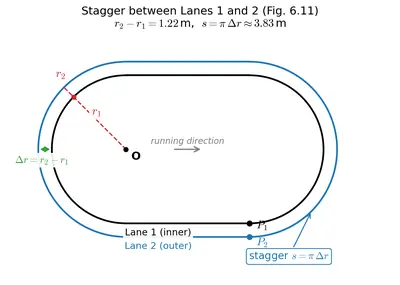
What is the difference in radius between the first and second lanes? Use Fig. 6.11 to find the stagger needed by the runner in the second lane. Will an equal stagger be needed between the third and second lanes?
Fig. 6.11
Fig. 6.11

Solution

Data that can be read off Fig. 6.11

  • The track consists of two straight parts, each $$100\,\text{m}$$ long.
  • Each lane is a ring-shaped strip of width $$1\,\text{m}$$ (the figure shows four such concentric lanes).
  • The centre line of every lane is a circle; its radius increases by exactly the lane–width from one lane to the next.

1. Radius difference between the first and second lanes

Let the radius of the centre-line of the first lane be $$r_1\,(\text{m}).$$
Because the width of each lane is $$1\,\text{m},$$ the radius of the centre-line of the second lane is

$$r_2 \,=\, r_1 + 1.$$ Therefore the required difference is simply

$$r_2 - r_1 = 1\,\text{m}.$$

2. Extra distance that the runner in lane 2 would cover on the bends

The curved part of the track consists of two semicircles. The length of one semicircle of radius $$r$$ is $$\pi r.$$ Hence, in the first lane, total curved distance = $$2\pi r_1,$$ while in the second lane it is $$2\pi r_2.$$ The extra distance that the lane-2 runner would have to run on the two bends is therefore

$$\begin{aligned} \bigl(2\pi r_2\bigr) - \bigl(2\pi r_1\bigr) &= 2\pi\,(r_2-r_1) \\ &= 2\pi\times1 \\ &= 2\pi\,\text{m}\;\approx\;6.28\,\text{m}. \end{aligned}$$

3. How the stagger solves the problem

During a race every athlete must run exactly the same total distance. The extra $$2\pi\,\text{m}$$ appearing in the curved part for lane 2 is compensated by placing the lane-2 starting line $$2\pi\,\text{m}$$ ahead of the lane-1 starting line along the straight. This forward shift of about $$6.28\,\text{m}$$ is the required stagger for lane 2.

4. Will the stagger between the third and second lanes be the same?

Yes. The radius of the centre-line of lane 3 is $$r_3 = r_2 + 1.$$ Hence $$r_3 - r_2 = 1\,\text{m}$$ once again, and the extra curved distance for lane 3 over lane 2 is also $$2\pi\times1 = 2\pi\,\text{m}.$$ Therefore the stagger required between lanes 3 and 2 is the same $$6.28\,\text{m}.$$

Conclusion

  • Difference in radius (lane 2 − lane 1): $$1\,\text{m}.$$
  • Stagger for lane 2: $$2\pi\,\text{m}\;\approx\;6.28\,\text{m}.$$
  • The same stagger is needed between lanes 3 and 2, because every consecutive pair of lanes differs in radius by the same $$1\,\text{m}.$$

Answer

Radius difference (lane 2 – lane 1): $$1\,\text{m}$$.
Stagger for lane 2: $$2\pi\,\text{m}\;\approx\;6.28\,\text{m}$$.
The stagger between lanes 3 and 2 is the same, $$2\pi\,\text{m}$$, because each successive lane is again $$1\,\text{m}$$ farther out.

Think and Reflect (p. 131)

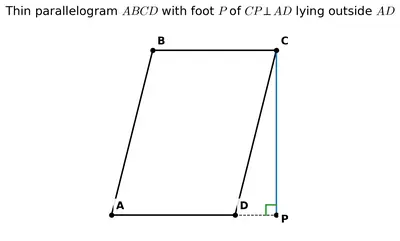
What happens if the parallelogram is 'thin' (Fig. 6.18) and the foot of the perpendicular from C to AD does not lie on side AD? The construction then does not seem to work. How do we fix this 'gap'?
Fig. 6.18
Fig. 6.18

Solution

The difficulty. In Fig. 6.18 the proof that a parallelogram can be cut and rearranged to a rectangle starts with the perpendicular from vertex $$C$$ to the base $$AD$$. When the parallelogram is very “thin”, the perpendicular meets the produced line of $$AD$$, not the segment itself; the little right-triangle to be cut is then no longer inside the figure, so at first sight the construction collapses.

How we repair it.

  1. Produce the base. Extend $$AD$$ beyond $$D$$ to meet the perpendicular from $$C$$ at $$H$$ (so $$CH\perp AD$$).
  2. Cut the same triangle as before. Join $$A$$ to $$H$$; the triangle $$\triangle ADH$$ that we now see outside the parallelogram is precisely the triangle that was inside the figure when the perpendicular fell on $$AD$$.
  3. Translate the triangle. Because $$ABCD$$ is a parallelogram, $$AD=BC$$ and $$AD\parallel BC$$. Cutting off $$\triangle ADH$$ and sliding it leftwards so that $$D$$ falls on $$B$$ fits the triangle exactly on the other side, turning the whole figure into the rectangle $$ADHC$$.

Result of the repair.

\[ \text{Area(parallelogram }ABCD)=\text{Area(rectangle }ADHC)=AD\times CH. \]

Thus the cut-and-paste argument is still valid; we simply allow the “foot” of the perpendicular to lie on the line containing the base. (Alternatively one may avoid any extension by taking $$AB$$ instead of $$AD$$ as the base; for at least one pair of opposite sides the perpendicular from the other vertices always falls inside.) Hence the apparent gap is completely filled.

Answer

Extend the base $$AD$$ until the perpendicular from $$C$$ meets it at $$H$$; then cut the outside triangle $$\triangle ADH$$ and paste it on the other side exactly as before, or, equivalently, choose the other pair of opposite sides as the base. The rearrangement still gives a rectangle of sides $$AD$$ and $$CH$$, so the proof remains valid and no gap is left.

Think and Reflect (p. 131)

The area of a rectangle can be found when we know the lengths of its sides. Is the same true for a parallelogram? That is, can we find the area of a parallelogram when we know the lengths of its sides? Why or why not?

(Hint: What happens to the area of a parallelogram if we decrease or increase the angle between the adjacent sides while keeping the lengths fixed?)

Solution

Step 1 : Recall the rectangle case
For a rectangle of length $$l$$ and breadth $$b$$, the angle between each pair of adjacent sides is $$90^\circ$$, so its height is exactly the other side: $$\text{Area}=l\times b$$. Therefore knowing the two side-lengths fixes one and only one area.

Step 2 : Write the general area formula for a parallelogram
Take any parallelogram with adjacent sides of lengths $$a$$ and $$b$$. Let $$\theta$$ be the interior angle between them (say the one at the bottom left corner). Drop a perpendicular from the opposite vertex to the base $$a$$. The perpendicular length (the height) is $$h=b\sin\theta$$, because that perpendicular, the side $$b$$ and the projection $$b\cos\theta$$ form a right-angled triangle.
Hence $$\text{Area}=\text{base}\times\text{height}=a\,h=a\,(b\sin\theta)=ab\sin\theta.$$

Step 3 : Why the two side-lengths are not enough
The formula $$ab\sin\theta$$ contains the extra factor $$\sin\theta$$. If we keep $$a$$ and $$b$$ fixed but change $$\theta$$, the numerical value of $$\sin\theta$$ changes and therefore the area changes.

  • When $$\theta=90^\circ$$ (parallelogram becomes a rectangle), $$\sin\theta=1$$ and $$\text{Area}=ab$$.
  • If we make the parallelogram “flatter”, say $$\theta=30^\circ$$, then $$\sin30^\circ=\tfrac12$$ and the area becomes $$\tfrac12 ab$$ — only half of the rectangular case.
  • As we keep decreasing $$\theta$$ towards $$0^\circ$$, $$\sin\theta$$ tends to $$0$$ and the area can be made as small as we like, without altering $$a$$ and $$b$$.

Step 4 : Conclusion
Because the same pair of side-lengths $$a,b$$ can correspond to infinitely many different areas (one for each possible interior angle $$\theta$$ between $$0^\circ$$ and $$180^\circ$$), the lengths alone do not determine the area of a parallelogram. We must also know either the height, the included angle $$\theta$$, or some equivalent information.

Answer

No. For a parallelogram with adjacent sides $$a$$ and $$b$$ the area is $$ab\sin\theta$$, where $$\theta$$ is the angle between them. With $$a$$ and $$b$$ fixed, changing $$\theta$$ changes $$\sin\theta$$, so different areas are possible. Therefore the side-lengths alone do not uniquely determine the area of a parallelogram.

Think and Reflect (p. 133) Since $$\triangle ABD$$ and $$\triangle ACD$$ have equal area, you may wonder — Can we divide $$\triangle ABD$$ using straight cuts into two or more pieces that we can then rearrange to exactly cover $$\triangle ACD$$? What do you think? Is it possible?

Solution

Problem restated
Triangles $$\triangle ABD$$ and $$\triangle ACD$$ have the same area (they stand on the same base $$AD$$ and vertices $$B,\,C$$ lie on the line $$BC\parallel AD$$). We want to know whether $$\triangle ABD$$ can be cut into a few straight-edged pieces that can be re-assembled to cover $$\triangle ACD$$ exactly.

Key idea
Any two polygons of equal area are equidecomposable; a finite set of straight cuts always exists that turns one into the other (Bolyai–Gerwien theorem). For two equal-area triangles a very small number of cuts suffices. In this particular arrangement only two cuts are needed.

Construction of the cuts

  1. Let $$P$$ be the mid-point of the common base; that is, $$AP = PD$$ on $$AD$$.
  2. Inside $$\triangle ABD$$ draw the two straight segments
    $$PB \quad\text{and}\quad PD.$$
    Both lie wholly in $$\triangle ABD$$, so these are legitimate cuts.

What pieces are obtained?
The two segments divide $$\triangle ABD$$ into exactly two smaller triangles:

  • Piece 1 : $$\triangle ABP$$
  • Piece 2 : $$\triangle BPD$$

Why do these two pieces fit in $$\triangle ACD$$?

  • Because $$AP = PD$$ and $$BC\parallel AD$$, corresponding angles are equal: $$\angle BAP = \angle DCP$$ and $$\angle BPA = \angle CPD$$ (vertical). Hence
    $$\triangle ABP \cong \triangle PCD\quad(\text{ASA criterion}).$$
  • Similarly, $$\angle BDP = \angle PCA$$ (corresponding) and again $$AP = PD$$, giving
    $$\triangle BPD \cong \triangle PAC\quad(\text{AAS criterion}).$$

Thus each of the two pieces cut from $$\triangle ABD$$ is congruent to exactly one of the two complementary regions inside $$\triangle ACD$$ (obtained by the same straight lines $$PC$$ and $$PD$$ in that triangle). If we lift the pieces and place them on their congruent partners, they cover the whole of $$\triangle ACD$$ with neither gap nor overlap.

Conclusion
Yes, it is possible: two straight cuts (along $$PB$$ and $$PD$$ with $$P$$ the mid-point of $$AD$$) are enough to dissect $$\triangle ABD$$ into parts that can be rearranged to fill $$\triangle ACD$$ exactly.

Remark The argument is a special case of a general fact: any two polygons of equal area can always be cut into finitely many polygonal pieces that can be reassembled to form one another.

Answer

Yes. Mark the mid-point P of AD, cut △ABD along PB and PD; the two resulting triangles are respectively congruent to △PCD and △PAC, so they can be shifted to cover △ACD completely. Hence △ABD can indeed be dissected and rearranged to form △ACD.

Think and Reflect (p. 134) — Part 1

Suppose we are given two polygons P and Q with equal area. Will it always be possible to divide one of them using straight cuts into two or more pieces and then rearrange the pieces to exactly cover the other polygon? Try this out for familiar shapes, e.g.,

  1. A square and non-square rectangle with equal area,
  2. Two triangles with different shapes but equal area,
  3. A triangle and a square with equal area. Formulate a conjecture of your own about this.

Solution

What is being asked. We are allowed to make straight-line cuts on one polygon, move the pieces as rigid tiles (no bending, no scaling) and try to re-assemble them so that they coincide exactly with the other polygon. Such an operation is called a dissection or equidecomposition.

A classical theorem (Wallace–Bolyai–Gerwien) states:

Theorem. Any two simple polygons of equal area can be cut by finitely many straight cuts into pieces that can be rearranged to form one another.

We verify the statement in three familiar cases.

1. Square ↔ non-square rectangle of equal area.

  1. Let rectangle $$ABCD$$ have $$AB=l$$ (longer side), $$AD=b$$ (shorter side). The square of equal area has side $$s=\sqrt{lb}$$; note $$b\le s\le l$$.
  2. On $$AB$$ mark $$E$$ with $$AE=s$$ and on $$DC$$ mark $$F$$ with $$DF=s$$. Join $$EF$$; this segment is perpendicular to $$AB$$, so the rectangle is divided into rectangle $$AEFD$$ (of sides $$s$$ and $$b$$) and rectangle $$EBCF$$ (of sides $$l-s$$ and $$b$$).
  3. We must now turn rectangle $$AEFD$$ (sides $$s,b$$ with $$s\ge b$$) into a square of side $$s$$. Extend $$DA$$ upward to $$A'$$ with $$AA'=s-b$$ (so $$DA'=s$$). Draw the diagonal $$A'E$$. This diagonal cuts off a small triangle from the strip $$EBCF$$ which, slid into place above $$AEFD$$, completes the square. The cuts needed are $$EF$$ and $$A'E$$ (extended); the three pieces rearrange to a square of side $$s$$.

(If $$l>2s$$ the rectangle is first halved and the halves stacked, then the procedure is applied. Either way, only finitely many straight cuts are used.)

2. Two triangles of different shapes but equal area.

  1. Take any triangle $$\triangle PQR$$ with area $$\Delta$$. Let $$M$$ be the midpoint of $$PR$$ and $$N$$ the midpoint of $$QR$$. Cut along $$MN$$, separating the small triangle $$\triangle MNR$$ from the trapezium $$PQNM$$.
  2. Rotate $$\triangle MNR$$ through $$180^{\circ}$$ about the midpoint $$N$$. Because $$N$$ is the midpoint of $$QR$$, the point $$R$$ goes to $$Q$$, and because $$MN\parallel PQ$$ (mid-segment theorem) and $$MN=\tfrac12 PQ$$, the rotated piece fits exactly along $$QN$$. The result is a parallelogram $$PQNM'$$ (where $$M'$$ is the image of $$M$$) with base $$PQ$$ and the same area $$\Delta$$ as the triangle.
  3. Apply the same recipe to $$\triangle XYZ$$ to obtain a second parallelogram of area $$\Delta$$.
  4. It remains to show that any two equal-area parallelograms can be dissected into one another. Place them so that one pair of equal sides lies along the same straight line, with both parallelograms on the same side.
    • If their bases happen to be equal in length, both have the same base and the same height (since the areas are equal). A single straight cut from the top vertex of one perpendicular to the base, together with sliding the resulting right triangle to the other end, converts it into a rectangle; the same procedure converts the second parallelogram into a rectangle of the same dimensions. The two rectangles coincide.
    • If the bases differ, cut the parallelogram with the longer base into vertical strips whose widths add up to the shorter base; stacking the strips gives a parallelogram with the shorter base and the same height (a shear move). Now apply the previous case.

3. Triangle ↔ square of equal area.

  1. By Part 2, the triangle can be turned (with two straight cuts) into a parallelogram of the same area.
  2. Drop a perpendicular from one top vertex of this parallelogram to the base, slide the resulting right triangle to the other end, and obtain a rectangle of the same area (one further cut).
  3. Apply the rectangle-to-square dissection of Part 1 to that rectangle (a small bounded number of additional cuts).

The triangle is thus cut, in finitely many straight cuts, into pieces that re-assemble to a square of equal area.

Conjecture. Any two plane polygons of equal area can be dissected, with finitely many straight cuts, into pieces that rearrange to form one another.

This is exactly what the Wallace–Bolyai–Gerwien theorem confirms. Hence the answer to the question is yes.

Answer

Yes. Each of the three cases — (i) square ↔ non-square rectangle, (ii) two unequal-shape triangles, (iii) triangle ↔ square — can be done with finitely many straight cuts. This suggests, and the Wallace–Bolyai–Gerwien theorem proves, that any two plane polygons of equal area are equidecomposable: one can be cut into finitely many polygonal pieces that rearrange to cover the other exactly.

Think and Reflect (p. 134) — Part 2

Think of various rectangles with perimeter 40 units (the sides do not have to be integers).

  1. How many such rectangles are there?
  2. Among them, is there one whose area is the largest? What are its dimensions?
  3. Among all these rectangles, is there one whose area is the smallest? What are its dimensions? Do either of these answers come as a surprise to you?

Solution

Known facts

  • If a rectangle has length $$l$$ and breadth $$b$$, its perimeter is $$2(l+b)$$ and its area is $$A=l\times b$$.
  • Every side length must be strictly positive.

The question fixes the perimeter at $$40$$ units, so

\[2(l+b)=40 \;\Longrightarrow\; l+b=20 \;\Longrightarrow\; b=20-l.\]

Because $$l \gt 0$$ and $$b \gt 0$$, the relation $$b=20-l$$ forces $$0 \lt l \lt 20$$ (and consequently $$0 \lt b \lt 20$$).

(1) How many such rectangles are there?

The only restriction on $$l$$ is $$0 \lt l \lt 20$$, and in that open interval there are infinitely many real numbers (for example $$6$$, $$6.1$$, $$6.01$$, $$6.001$$, …). Hence there are infinitely many different rectangles with perimeter $$40$$.

(2) Which one has the largest area?

Write the area in terms of one variable:

\[A=l\,b=l(20-l)=20l-l^{2}.\]

Complete the square:

\[A=-(l^{2}-20l)=-(l^{2}-20l+100)+100=-(l-10)^{2}+100.\]

The term $$-(l-10)^{2}$$ is never positive, and equals $$0$$ only when $$l=10$$. Hence the maximum value of $$A$$ is $$100$$, attained at $$l=10$$. The corresponding breadth is $$b=20-10=10$$.

\[\boxed{\text{Largest area}=100\ \text{sq.\ units, attained when }l=b=10.}\]

The rectangle of greatest area is therefore the square of side $$10$$ units.

(3) Is there a rectangle of smallest area?

As $$l$$ approaches $$0$$ from the positive side, $$A=l(20-l)$$ also approaches $$0$$. For example:

  • $$l=0.1 \Rightarrow b=19.9 \Rightarrow A=1.99$$,
  • $$l=0.01 \Rightarrow b=19.99 \Rightarrow A=0.1999$$,
  • $$l=0.001 \Rightarrow b=19.999 \Rightarrow A=0.019999$$.

So the area can be made arbitrarily small, but it cannot reach $$0$$ (because $$l$$ and $$b$$ must remain strictly positive). Hence

\[\boxed{\text{No rectangle has the smallest positive area; the area can be made as small as one wishes.}}\]

(4) Any surprises?

  • The maximum-area answer (a square) is satisfyingly symmetric.
  • The non-existence of a smallest area can be surprising. It arises because the side lengths can be chosen as small positive numbers, so the area can be squeezed as close to $$0$$ as we like without ever reaching it.

Answer

(i) Infinitely many rectangles.
(ii) Maximum area $$=100$$ sq. units, attained by the $$10\times 10$$ square.
(iii) No rectangle attains a minimum positive area; the area can be made arbitrarily small (approaching $$0$$).

Think and Reflect (p. 142)

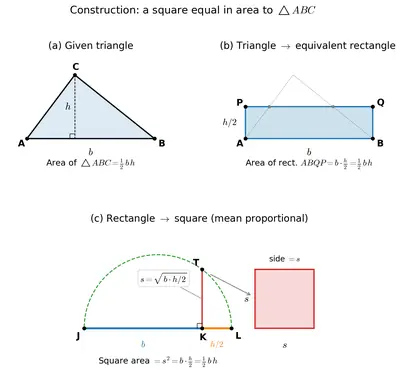
What procedure would you use to square a given triangle? Here, the task is to construct a square whose area is equal to the area of some given triangle. Think carefully. How would you proceed?
Figure
Figure

Solution

Problem restatement. Given a triangle $$\triangle ABC$$, construct with ruler and compasses a square whose area equals the area of the triangle.

Idea behind the construction. The area of a triangle equals half the product of one side and the corresponding altitude. We first convert $$\triangle ABC$$ into a rectangle of the same area (whose sides are the base of the triangle and half its altitude). A classical mean-proportional construction then turns that rectangle into a square of equal area.

  1. Draw the altitude of the triangle. From vertex $$A$$ drop the perpendicular to the line $$BC$$, meeting it at $$D$$. Thus $$AD\perp BC$$ and $$AD$$ is the altitude $$h$$.
  2. Halve the altitude. Construct the midpoint $$M$$ of segment $$AD$$ (perpendicular-bisector method). Hence $$MD=\dfrac{1}{2}AD=\dfrac{h}{2}$$.
  3. Form a rectangle of area equal to $$\triangle ABC$$. Erect perpendiculars to $$BC$$ at $$B$$ and at $$C$$. On these perpendiculars (both on the same side of $$BC$$) mark points $$F$$ and $$G$$ such that $$BF=CG=\dfrac{h}{2}$$. Join $$FG$$. Then $$BCGF$$ is a rectangle of base $$BC$$ and height $$\dfrac{h}{2}$$, so \[\text{Area}(BCGF)=BC\times\frac{h}{2}=\frac{1}{2}\,BC\times AD=\text{Area}(\triangle ABC).\]
  4. Lay off the two side lengths on one straight line. Draw an auxiliary line and mark successive points $$P,\,Q,\,R$$ such that $$PQ=BC$$ (length of the rectangle) and $$QR=BF=\dfrac{h}{2}$$ (breadth of the rectangle). Then $$PR=PQ+QR=BC+\dfrac{h}{2}$$.
  5. Construct the mean proportional of $$BC$$ and $$\dfrac{h}{2}$$.
    (a) Construct the midpoint $$O$$ of $$PR$$ (perpendicular-bisector method).
    (b) With centre $$O$$ and radius $$OP$$, draw a semicircle on $$PR$$ as diameter.
    (c) At $$Q$$ (the junction point on $$PR$$) erect a perpendicular to $$PR$$; let it meet the semicircle at $$S$$. Then by the geometric-mean property, \[QS^{2}=PQ\times QR=BC\times\frac{h}{2}.\] Thus $$QS=\sqrt{BC\times\dfrac{h}{2}}$$.
  6. Construct the required square. With $$QS$$ as one side, construct square $$QSTU$$. Then \[\text{Area}(QSTU)=QS^{2}=BC\times\frac{h}{2}=\text{Area}(BCGF)=\text{Area}(\triangle ABC).\]

Conclusion. The square $$QSTU$$ has area equal to the area of the given triangle $$\triangle ABC$$; the triangle has therefore been “squared”.

Answer

The square $$QSTU$$ constructed in step 6 has area equal to the area of $$\triangle ABC$$, so the triangle has been successfully “squared”.

Think and Reflect (p. 144) Why were human beings so fond of using circular shapes? Was this only for practical reasons, or could there have been other reasons too? What kinds of uses have human beings found for the circular shape?

Solution

Understanding the preference for the circle

A circle is defined in mathematics as the set (locus) of all points in a plane that are at a fixed distance $$r$$ (called the radius) from a fixed point O (called the centre). This single geometric fact gives the circle several properties that have attracted human beings since prehistoric times.

  1. Simplicity of construction
    Starting with a taut vine or a piece of string tied to a peg, early artists and engineers could trace an almost perfect circle simply by turning the free end through one full turn. No other closed curve of equal smoothness is as easy to draw without modern tools.
  2. Perfect rotational symmetry
    Because every radius is the same, rotating a circle about its centre through any angle brings it exactly onto itself. This property makes circular objects roll smoothly, an advantage noticed long before people could articulate the idea of symmetry.
  3. Constant width
    The distance across a circle measured through the centre (the diameter) is everywhere the same: $$d = 2r$$. This constancy means a circular wheel bears weight uniformly and turns without bumping.
  4. Efficient enclosure
    For a given perimeter, the circle encloses the maximum possible area: if the perimeter is $$P$$, the enclosed area is greatest when the shape is a circle with radius $$r = \dfrac{P}{2\pi}$$, giving area $$A = \pi r^2 = \dfrac{P^2}{4\pi}$$. Early builders of huts, forts and city walls could surround more land with the same length of fence by choosing a round plan.
  5. Aesthetic and symbolic appeal
    Cultures around the world have associated the circle with the Sun, the Moon, eternity (no beginning or end) and perfection. Temples, altars and ornaments therefore often adopted circular motifs for religious or artistic reasons that go beyond mere practicality.

Was it only for practical reasons?

Clearly not. While the mechanical benefits of the circle (rolling, even pressure distribution, efficient enclosure) are practical, the circle’s perfect symmetry also appeals psychologically and spiritually. Architecture, pottery and jewellery from every ancient civilisation show circular patterns even where no mechanical advantage exists—for example, mandalas painted on flat walls or round halo designs in sculpture. Hence both utility and aesthetic / symbolic meaning explain humanity’s fondness for circles.

Major human uses of the circular shape

FieldTypical circular objectReason for choosing a circle
TransportationWheels, gears, ball bearingsRotational symmetry gives smooth rolling and uniform torque.
Measurement / TimeDials of clocks, protractors, compassesCircular scale naturally represents 360° rotation; pointer can sweep continuously.
AstronomyAstrolabes, orbital modelsCelestial motions appear as circles; instruments exploit symmetry.
ArchitectureDomes, arches, round bastionsEven stress distribution and pleasing appearance.
Everyday utensilsPlates, bowls, cups, coinsNo sharp corners; easy to rotate in manufacture; stacks neatly.
TechnologyLenses, CDs/DVDs, antenna dishesEqual focal distance or equal track length from centre.
Art & ReligionMandalas, rangoli, halosSymbol of infinity, cyclic time, perfection.

Conclusion

The circle combines unmatched mechanical advantages with cultural, artistic and symbolic richness. That is why, throughout history, human beings have been—and still are—so fond of using circular shapes.

Answer

Circular shapes were preferred partly for practical reasons—easy to construct, roll, and enclose maximum area—and partly for aesthetic & symbolic reasons such as perfect symmetry and associations with the Sun and eternity. Humans have used circles in wheels, gears, domes, coins, clocks, lenses, artworks, religious motifs and many other applications.

Examples 1-2 (Section 6.5)

Example 1

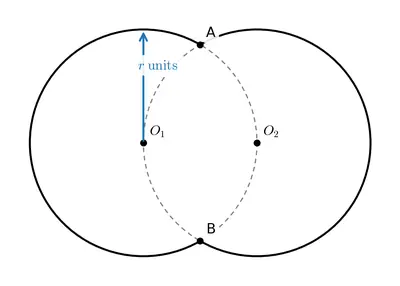
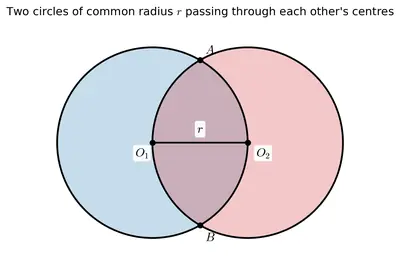
Two circles of equal radius are located such that each circle passes through the centre of the other circle (Fig. 6.12). Given that the radius of each circle is $$r$$ units, find the perimeter of the shape formed by the two circles in terms of $$r$$ units. (Ignore the dotted portions that lie within the circles.)
Fig. 6.12
Fig. 6.12

Solution

Given data
Two equal circles have radius $$r$$. Each centre lies on the circumference of the other, so the distance between the centres is also $$r$$.

Step 1 – Name the important points
Let the centres be $$O_1$$ and $$O_2$$. The circles meet at two points; mark the upper one $$A$$ and the lower one $$B$$.

Step 2 – Identify the triangle formed by the centres and an intersection point
In $$\triangle O_1AO_2$$ we have
$$O_1O_2 = r, \; O_1A = r, \; O_2A = r$$ (all are radii).
Therefore $$\triangle O_1AO_2$$ is equilateral  ⇒  each interior angle is $$60^{\circ}$$.

Step 3 – Central angle that lies inside the overlap
At centre $$O_1$$ the angle subtended by arc $$AB$$ is $$60^{\circ}$$. This minor arc of the circle centred at $$O_1$$ is the part inside the other circle, so it will not appear on the required boundary. The same is true for the circle centred at $$O_2$$.

Step 4 – Central angle that lies on the required perimeter
Total angle of a full circle is $$360^{\circ}$$. Hence, on each circle the arc that does form the outer boundary measures
$$360^{\circ} - 60^{\circ} = 300^{\circ}.$$

Step 5 – Length of one such arc
Arc length formula: $$L = \frac{\theta}{360^{\circ}} \times 2\pi r.$$ Substituting $$\theta = 300^{\circ}$$ gives
$$L = \frac{300}{360}\times 2\pi r = \frac{5}{6}\,\times 2\pi r = \frac{5\pi r}{3}.$$

Step 6 – Total perimeter of the required shape
There are two identical outer arcs (one from each circle), so
$$P = 2 \times \frac{5\pi r}{3} = \frac{10\pi r}{3}.$$

Result

\[P = \frac{10\pi r}{3}\;\text{units}\]

Answer

Perimeter of the required shape
\[P = \dfrac{10\pi r}{3}\,\text{units}\]

Example 2

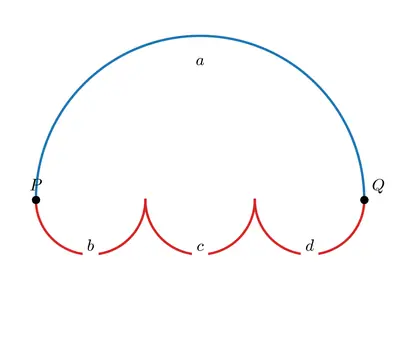
In Fig. 6.13, we see points P and Q and two paths connecting them. The first path is made up of the semicircle $$a$$. The other path is made up of three semicircles ($$b$$, $$c$$, and $$d$$). Which path is longer? Choose one:

  • (i) Path $$a$$ is longer.
  • (ii) Path $$b + c + d$$ is longer.
  • (iii) The two paths have equal length.

(Try to answer this before reading on.)

Fig. 6.13
Fig. 6.13

Solution

Given.  Points $$P$$ and $$Q$$ are joined in two different ways.

  • Path $$a$$ is a single semicircle drawn on $$\overline{PQ}$$ as diameter.
  • Path $$b+c+d$$ consists of three consecutive semicircles whose diameters exactly cover $$\overline{PQ}$$ one after another.

Let the length of the straight segment $$\overline{PQ}$$ be $$D\;\text{cm}$$.
Suppose the three smaller diameters are

$$PR = d_1,\; RS = d_2,\; SQ = d_3$$  so that

$$d_1 + d_2 + d_3 = D.$$


1. Length of path $$a$$

The circumference of a full circle with diameter $$D$$ is $$\pi D$$, so the length of its semicircle is half of that:

\[L_a = \dfrac{\pi D}{2}.\]


2. Length of path $$b+c+d$$

Each of the small semicircles contributes

  • $$b:\; \dfrac{\pi d_1}{2}$$
  • $$c:\; \dfrac{\pi d_2}{2}$$
  • $$d:\; \dfrac{\pi d_3}{2}$$

Adding them,

$$L_{b+c+d} = \dfrac{\pi}{2}\,(d_1 + d_2 + d_3).$$

But $$d_1 + d_2 + d_3 = D$$, hence

\[L_{b+c+d} = \dfrac{\pi D}{2}.\]


3. Comparison

$$L_a = \dfrac{\pi D}{2}=L_{b+c+d}.$$

Therefore the two paths have exactly the same length.

Choice : (iii) The two paths have equal length.

Answer

(iii) The two paths have equal length.

Exercise Set 6.1

1 The perimeter of a circle is 44 cm. What is its radius? (Use $$\pi \approx \frac{22}{7}$$.)

Solution

We are told that the perimeter of a circle is 44 cm. For a circle, the word “perimeter” means the circumference.

The formula for circumference is

$$\text{Circumference} = 2\pi r$$

where $$r$$ is the radius of the circle and $$\pi$$ is the constant pi. The question asks us to use the approximation $$\pi \approx \tfrac{22}{7}$$.

Step 1: Substitute the given circumference and the given value of $$\pi$$ into the formula:

$$44 = 2 \times \frac{22}{7} \times r$$

Step 2: Multiply the constants on the right‐hand side:

$$2 \times \frac{22}{7} = \frac{44}{7}$$

So the equation becomes

$$44 = \frac{44}{7} \times r$$

Step 3: To isolate $$r$$, divide both sides of the equation by $$\tfrac{44}{7}$$:

$$r = \frac{44}{\tfrac{44}{7}}$$

Step 4: Dividing by a fraction is equivalent to multiplying by its reciprocal:

$$r = 44 \times \frac{7}{44}$$

Step 5: The factor 44 cancels:

$$r = 7$$

Therefore, the radius of the circle is 7 cm.

Answer

$$r = 7\text{ cm}$$

2 Calculate, correct to 3 significant figures, the circumference of a circle with:

(i) radius 7 cm

Solution

Radius given: $$r = 7 \text{ cm}$$.

The circumference of a circle is calculated with $$C = 2\pi r$$.

Substituting the values (using $$\pi \approx 3.14159$$):

$$C = 2 \times 3.14159 \times 7 = 43.98226 \text{ cm}$$.

Rounding to three significant figures:

  • The first three significant digits are 4, 3, and 9 (i.e. 43.9).
  • The next digit is 8 (≥ 5), so 9 is increased by 1, giving 44.0.

Hence

\[\boxed{C \approx 44.0 \text{ cm}}\]

Answer

44.0 cm

(ii) radius 10 cm

Solution

Radius given: $$r = 10 \text{ cm}$$.

Formula: $$C = 2\pi r$$.

Substituting the values:

$$C = 2 \times 3.14159 \times 10 = 62.8319 \text{ cm}$$.

For three significant figures we keep 6, 2, 8 (i.e. 62.8) and the next digit is 3 (< 5), so no further change.

\[\boxed{C \approx 62.8 \text{ cm}}\]

Answer

62.8 cm

(iii) radius 12 cm

Solution

Radius given: $$r = 12 \text{ cm}$$.

Formula: $$C = 2\pi r$$.

Substituting the values:

$$C = 2 \times 3.14159 \times 12 = 75.3982 \text{ cm}$$ (to 5 d.p.).

Keeping three significant figures:

  • The first three significant digits are 7, 5, and 3 (i.e. 75.3).
  • The next digit is 9 (≥ 5), so 3 is raised to 4 → 75.4.

\[\boxed{C \approx 75.4 \text{ cm}}\]

Answer

75.4 cm

3 Calculate the length of the arc of a circle if:

(i) the radius is 3.5 cm and the angle at the centre is $$60^\circ$$

Solution

The length of an arc that subtends an angle $$\theta$$ (in degrees) at the centre of a circle of radius $$r$$ is found from

$$\ell = \frac{\theta}{360^{\circ}} \times 2\pi r$$

Given $$r = 3.5\,\text{cm},\; \theta = 60^{\circ}$$.

Substitute:

$$\ell = \frac{60^{\circ}}{360^{\circ}} \times 2\pi \times 3.5$$

$$\frac{60}{360} = \frac16$$

$$\ell = \frac16 \times 2\pi \times 3.5$$

$$2 \times 3.5 = 7$$

\[\ell = \frac{7\pi}{6}\,\text{cm}\]

If $$\pi = \dfrac{22}{7}$$, then

$$\ell = \frac{7 \times \dfrac{22}{7}}{6} = \frac{22}{6} = \frac{11}{3}\,\text{cm} = 3.67\,\text{cm (2 d.p.)}$$

Hence the required arc length is $$\dfrac{7\pi}{6}\,\text{cm} \approx 3.67\,\text{cm}$$.

Answer

$$\ell = \dfrac{7\pi}{6}\,\text{cm} \;\;(\approx 3.67\,\text{cm})$$

(ii) the radius is 6.3 m and the angle at the centre is $$120^\circ$$

Solution

Again use $$\ell = \dfrac{\theta}{360^{\circ}} \times 2\pi r$$.

Given $$r = 6.3\,\text{m},\; \theta = 120^{\circ}$$.

$$\ell = \frac{120^{\circ}}{360^{\circ}} \times 2\pi \times 6.3$$

$$\frac{120}{360} = \frac13$$

$$\ell = \frac13 \times 2\pi \times 6.3$$

$$2 \times 6.3 = 12.6$$

\[\ell = \frac{12.6\pi}{3} = 4.2\pi\,\text{m}\]

Using $$\pi = \dfrac{22}{7}$$:

$$\ell = 4.2 \times \frac{22}{7} = \frac{4.2 \times 22}{7} = 13.2\,\text{m}$$

Therefore the length of the arc is $$4.2\pi\,\text{m} \approx 13.2\,\text{m}$$.

Answer

$$\ell = 4.2\pi\,\text{m} \;\;(\approx 13.2\,\text{m})$$

4 Find the perimeter of a sector (i.e., the curved portion as well as the two straight portions) of a circle of radius 14 cm and sector angle $$75^\circ$$.

Solution

Given: Radius $$r = 14\,\text{cm}$$ and sector angle $$\theta = 75^\circ$$.

For a sector of a circle:

  • Arc length $$l = \dfrac{\theta}{360^\circ}\times 2\pi r$$,
  • Perimeter $$P = l + 2r$$ (curved edge + two radii).

1. Arc length

$$l = \frac{75^\circ}{360^\circ}\times 2\pi \times 14$$

$$l = \frac{75}{360}\times 28\pi = \frac{5}{24}\times 28\pi$$

$$l = \frac{5\times28}{24}\,\pi = \frac{140}{24}\,\pi = \frac{35}{6}\,\pi\;\text{cm}$$

Taking $$\pi = \dfrac{22}{7}$$ (NCERT convention),

$$l = \frac{35}{6}\times\frac{22}{7}\;\text{cm} = \frac{5\times22}{6}\;\text{cm} = \frac{110}{6}\;\text{cm} = \frac{55}{3}\;\text{cm} \approx 18.33\,\text{cm}$$

2. Perimeter of the sector

$$P = l + 2r$$

$$P = \frac{55}{3} + 2\times14$$

$$P = \frac{55}{3} + 28 = \frac{55}{3} + \frac{84}{3} = \frac{139}{3}\,\text{cm}$$

$$P = 46\frac{1}{3}\,\text{cm} \;(\text{approximately } 46.33\,\text{cm}).$$

Therefore, the perimeter of the sector is $$46\frac{1}{3}\,\text{cm}\,(\approx 46.33\,\text{cm}).$$

Answer

$$46\frac13\text{ cm}\;(\text{approximately }46.33\text{ cm})$$

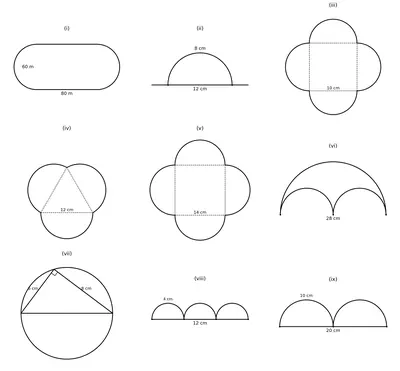
5

Find the perimeters of the following shapes (taking the arcs to be quarter or half or three-quarters of a circle, as appropriate) (Fig. 6.14i to 6.14ix):
Fig. 6.14
Fig. 6.14

(i) A stadium-like shape: a rectangle of width 60 m and length 80 m, with a semicircle on each of the two shorter sides.

Solution

Step 1 – Identify the parts that form the boundary.
• Two long straight edges of the rectangle, each $$80\,\text{m}$$.
• Two semicircular ends. Together, they make one full circle whose diameter is the width of the rectangle.

Step 2 – Radius of the circle formed by the two semicircles.
Width = diameter = $$60\,\text{m} \;\Rightarrow\; r = \dfrac{60}{2}=30\,\text{m}$$

Step 3 – Perimeter.

Straight part  $$=2\times80 = 160\,\text{m}$$
Curved part (full circle)  $$=2\pi r = 2\pi(30)=60\pi\,\text{m}$$

Step 4 – Total perimeter.

$$P = 160 + 60\pi\,\text{m}$$

Answer

$$P = 160 + 60\pi\,\text{m}$$

(ii) A shape made of a straight base of length 12 cm with a semicircular arc of diameter 8 cm sitting on it.

Solution

Step 1 – Identify the boundary. A semicircle of diameter $$8\,\text{cm}$$ is erected on a portion of a straight base of total length $$12\,\text{cm}$$. The $$8\,\text{cm}$$ diameter of the semicircle lies along the base, so that $$8\,\text{cm}$$ stretch of the base is replaced by the semicircular arc and is no longer on the boundary of the figure. The remaining straight portion is therefore $$12-8=4\,\text{cm}$$ long.

Step 2 – Radius of the semicircle.
$$r=\dfrac{8}{2}=4\,\text{cm}.$$

Step 3 – Lengths of the two parts of the boundary.

  • Straight portion: $$12-8=4\,\text{cm}.$$
  • Curved portion (half-circumference): $$\pi r=\pi\times 4=4\pi\,\text{cm}.$$

Step 4 – Perimeter.

$$P=4+4\pi\,\text{cm}.$$

Answer

$$P=4+4\pi\,\text{cm}$$

(iii) A square of side 10 cm with a semicircle drawn outward on each of its four sides (a four-petalled flower-like figure).

Solution

The square has side $$10\,\text{cm}$$ and a semicircle is drawn outward on each side.

Step 1 – Radius of every semicircle.
$$r = \dfrac{10}{2}=5\,\text{cm}$$

Step 2 – Curved boundary.
Four semicircles together make $$4\times\dfrac12 = 2$$ full circles.

Length of one full circle  $$=2\pi r = 2\pi(5)=10\pi$$
Length of two full circles  $$=2\times10\pi = 20\pi\,\text{cm}$$

The straight edges of the square become internal diameters and are not part of the exterior boundary.

Step 3 – Perimeter.

$$P = 20\pi\,\text{cm}$$

Answer

$$P = 20\pi\,\text{cm}$$

(iv) An equilateral triangle of side 12 cm with a semicircle drawn outward on each of its three sides.

Solution

An equilateral triangle of side $$12\,\text{cm}$$ has a semicircle drawn outward on each side.

Step 1 – Radius of each semicircle.
$$r = \dfrac{12}{2}=6\,\text{cm}$$

Step 2 – Curved boundary.
Three semicircles give $$3\times\dfrac12 = \dfrac32$$ circles.
Arc length  $$=\dfrac32\bigl(2\pi r\bigr)=3\pi r = 3\pi(6)=18\pi\,\text{cm}$$

The three triangle sides act as diameters and lie wholly inside, so they are not part of the external perimeter.

Step 3 – Perimeter.

$$P = 18\pi\,\text{cm}$$

Answer

$$P = 18\pi\,\text{cm}$$

(v) A square of side 14 cm with a semicircle drawn outward on each of its four sides.

Solution

Square side $$14\,\text{cm}$$ with an external semicircle on each side.

Radius. $$r = \dfrac{14}{2}=7\,\text{cm}$$

Curved boundary. Four semicircles $$\Rightarrow 2$$ full circles.
Arc length $$=2\times \bigl(2\pi r\bigr)=4\pi r = 4\pi(7)=28\pi\,\text{cm}$$

The straight sides are internal and excluded.

Perimeter.
$$P = 28\pi\,\text{cm}$$

Answer

$$P = 28\pi\,\text{cm}$$

(vi) A shape formed by a semicircle of diameter 28 cm with two smaller semicircles drawn inward on its diameter.

Solution

Outer figure. A big semicircle of diameter $$28\,\text{cm}$$, radius $$R=14\,\text{cm}$$.
Inner indentations. Two smaller semicircles of diameter $$14\,\text{cm}$$ (radius $$r=7\,\text{cm}$$) drawn inward along the same straight line.

Step 1 – Arc lengths.

  • Big semicircle: $$\pi R = \pi(14)=14\pi\,\text{cm}$$
  • Each small semicircle: $$\pi r = \pi(7)=7\pi\,\text{cm}$$
    Two of them: $$2\times7\pi = 14\pi\,\text{cm}$$

Step 2 – Straight portions.
The entire diameter is exactly the combined diameters of the two small semicircles, so it lies inside the figure and contributes nothing to the exterior boundary.

Step 3 – Total perimeter.

$$P = 14\pi + 14\pi = 28\pi\,\text{cm}$$

Answer

$$P = 28\pi\,\text{cm}$$

(vii) A circle in which a right-angled triangle is inscribed having legs of length 8 cm and 6 cm.

Solution

A right-angled triangle $$\triangle ABC$$ (right angle at $$C$$) is inscribed in a circle. The legs are
$$AC = 6\,\text{cm},\; BC = 8\,\text{cm}$$.

Step 1 – Hypotenuse (diameter of the circle).
$$AB = \sqrt{AC^{2}+BC^{2}} = \sqrt{6^{2}+8^{2}} = \sqrt{100}=10\,\text{cm}$$
Hence radius $$r = \dfrac{10}{2}=5\,\text{cm}$$.

Step 2 – Boundary of the required shape.
We take the two straight sides $$AC,\; BC$$ and the semicircular arc subtended by diameter $$AB$$.

Step 3 – Lengths.

  • Straight parts: $$AC+BC = 6+8 = 14\,\text{cm}$$
  • Curved part (half circumference): $$\pi r = \pi(5)=5\pi\,\text{cm}$$

Step 4 – Perimeter.

$$P = 14 + 5\pi\,\text{cm}$$

Answer

$$P = 14 + 5\pi\,\text{cm}$$

(viii) Three equal semicircles of diameter 4 cm each, placed side by side on a straight base (total base length 12 cm).

Solution

Three equal semicircles, each of diameter $$4\,\text{cm}$$, are placed side by side on a straight line of total length $$12\,\text{cm}$$.

Step 1 – Radius of each semicircle.
$$r = \dfrac{4}{2}=2\,\text{cm}$$

Step 2 – Boundary components.

  • Straight base: $$12\,\text{cm}$$
  • Curved boundary: 3 semicircles  $$=3\times(\pi r)=3\times2\pi=6\pi\,\text{cm}$$

Step 3 – Perimeter.

$$P = 12 + 6\pi\,\text{cm}$$

Answer

$$P = 12 + 6\pi\,\text{cm}$$

(ix) Two semicircles of diameter 10 cm each, placed side by side on a straight base (total base length 20 cm).

Solution

Two identical semicircles of diameter $$10\,\text{cm}$$ lie side by side on a base measuring $$20\,\text{cm}$$.

Step 1 – Radius.
$$r = \dfrac{10}{2}=5\,\text{cm}$$

Step 2 – Boundary.

  • Straight base: $$20\,\text{cm}$$
  • Curved boundary: 2 semicircles  $$=2\times(\pi r)=2\times5\pi=10\pi\,\text{cm}$$

Step 3 – Perimeter.

$$P = 20 + 10\pi\,\text{cm}$$

Answer

$$P = 20 + 10\pi\,\text{cm}$$

6 If the diameter of a car tyre is 56 cm, then:

(i) How far does the car need to travel for the tyre to complete one revolution?

Solution

The tyre is a circle whose

  • diameter $$d = 56\,\text{cm}$$, therefore
  • radius $$r = \dfrac{d}{2}=\dfrac{56}{2}=28\,\text{cm}$$.

The distance covered in one complete revolution equals the circumference of the circle.

Formula for circumference:

$$C = 2\pi r$$

Substitute $$r = 28\,\text{cm}$$ and take $$\pi = \dfrac{22}{7}$$:

$$C = 2 \times \dfrac{22}{7} \times 28$$

First cancel 7 with 28:

$$C = 2 \times 22 \times 4$$

Multiply:

$$C = 176\,\text{cm}$$

Convert to metres (optional):

$$176\,\text{cm} = \dfrac{176}{100}\,\text{m} = 1.76\,\text{m}$$

Thus, when the tyre completes one revolution, the car travels

\[176\,\text{cm} \;(=1.76\,\text{m})\]

Answer

Distance for one revolution: $$176\,\text{cm}=1.76\,\text{m}$$

(ii) How many revolutions does the tyre make if the car travels 10 km?

Solution

Total distance covered by the car

$$=10\,\text{km}=10\times1000\,\text{m}=10\,000\,\text{m}$$

Convert to centimetres so that the units match the circumference:

$$10\,000\,\text{m}=10\,000\times100\,\text{cm}=1\,000\,000\,\text{cm}$$

The circumference of the tyre from part (i) is $$176\,\text{cm}$$.

Number of revolutions $$n$$ is obtained by dividing the total distance by the distance per revolution:

$$n = \dfrac{1\,000\,000}{176}$$

Simplify the fraction:

First cancel the common factor 16:

$$\begin{aligned} 176 &= 16 \times 11\\ 1\,000\,000 &= 1\,000\,000 \end{aligned}$$

Divide numerator and denominator by 16:

$$n = \dfrac{1\,000\,000\div16}{176\div16}=\dfrac{62\,500}{11}$$

Now perform the division:

$$62\,500\div11 = 5\,681.818\ldots$$

Hence

\[n \approx 5\,682\,\text{revolutions}\]

(The tyre makes exactly $$5\,681.818\ldots$$ revolutions; to the nearest whole number, it is $$5\,682$$.)

Answer

Number of revolutions for 10 km  ≈ $$5\,682$$

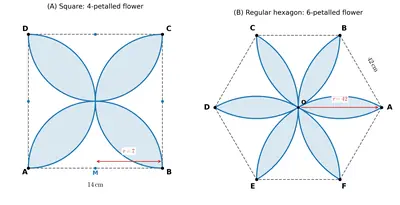
7

Find the total perimeter of all the petals in each of the given flowers.
Fig. 6.15
Fig. 6.15

(i) A square of side 14 cm in which four congruent arcs (each subtending the corresponding adjacent sides) are drawn with the midpoints of the sides as centres, forming a four-petalled flower (Fig. 6.15A).

Solution

Let the square be $$ABCD$$ with $$AB = BC = CD = DA = 14\text{ cm}$$.
Mid–points $$P,\,Q,\,R,\,S$$ of the four sides are the centres of the four equal arcs that form the petals.

Because $$P$$ is the mid-point of $$AB$$, we have $$PA = PB = \dfrac{14}{2}=7\text{ cm}$$; the same radius $$r = 7\text{ cm}$$ applies to each of the four arcs.

The chord for every arc is one complete side of the square. Since the chord equals the diameter ( $$\,14 = 2r\,$$ ), each arc is a semicircle:

central angle of an arc $$=180^\circ\;(=\pi\,\text{rad})$$.

Length of one semicircular arc (i.e. perimeter of one petal) $$\displaystyle L_1 = \frac{1}{2}\,2\pi r = \pi r = \pi\times7\;\text{cm}=7\pi\;\text{cm}.$$

There are 4 congruent petals, so the required total perimeter is $$\displaystyle L = 4\times7\pi = 28\pi\;\text{cm}.$$

Taking $$\pi = \dfrac{22}{7}$$,

$$\displaystyle L = 28\times\dfrac{22}{7}=88\;\text{cm}. $$

Answer

Total perimeter = $$28\pi \text{ cm}=88\text{ cm}$$

(ii) A regular hexagon of side 42 cm in which six congruent arcs are drawn with the vertices of the hexagon as centres, forming a six-petalled flower (Fig. 6.15B).

Solution

Let the regular hexagon be $$ABCDEF$$ with side $$s=42\,\text{cm}$$. At each vertex an arc of radius $$r=42\,\text{cm}$$ is drawn, joining the two adjacent vertices. (For example, the arc at $$A$$ runs from $$B$$ to $$F$$.) The interior angle of a regular hexagon is $$120^{\circ}$$, so every one of these arcs subtends $$120^{\circ}$$ at its centre.

Step 1 – Length of one $$120^{\circ}$$ arc.

$$L_{\text{arc}}=\dfrac{120^{\circ}}{360^{\circ}}\times 2\pi r=\dfrac{1}{3}\times 2\pi(42)=28\pi\,\text{cm}.$$

The total length of all six arcs drawn is therefore

$$6\times 28\pi=168\pi\,\text{cm}.$$

Step 2 – Why the total perimeter of the petals equals the total arc length.

A regular hexagon has the special property that its circum-radius equals its side; that is, the centre $$O$$ of the hexagon is at distance $$42\,\text{cm}$$ from every vertex. So $$O$$ lies on every one of the six arcs, and each $$120^{\circ}$$ arc passes through the centre, where it is bisected into two $$60^{\circ}$$ sub-arcs (each of length $$14\pi\,\text{cm}$$).

The six petals are the six lens-shaped regions inside the hexagon. The petal opposite to vertex $$B$$ (for example) has its two pointed tips at $$O$$ and at $$B$$, and its boundary is made of two $$60^{\circ}$$ sub-arcs:

  • the half of the arc at $$A$$ running from $$O$$ to $$B$$ (length $$14\pi$$),
  • the half of the arc at $$C$$ running from $$O$$ to $$B$$ (length $$14\pi$$).

Hence the perimeter of one petal is $$14\pi+14\pi=28\pi\,\text{cm}$$.

Each of the twelve sub-arcs belongs to exactly one petal’s boundary, and together they account for the whole of all six arcs drawn. Therefore

$$\text{total perimeter of the 6 petals}=12\times 14\pi=168\pi\,\text{cm}.$$

Step 3 – Numerical value. Using $$\pi=\dfrac{22}{7}$$,

$$168\pi=168\times\dfrac{22}{7}=528\,\text{cm}.$$

Answer

Total perimeter of all the petals = $$168\pi\,\text{cm}=528\,\text{cm}$$.

8 The ratio of the perimeters of two circles is 5:4. What is the ratio of their radii?

Solution

Let the radii of the two circles be $$r_1$$ and $$r_2$$, and let their perimeters (circumferences) be $$P_1$$ and $$P_2$$ respectively.

The perimeter of a circle is given by

\[P = 2\pi r\]

So,

$$P_1 = 2\pi r_1 \quad\text{and}\quad P_2 = 2\pi r_2.$$

We are told that the perimeters are in the ratio 5 : 4, i.e.

$$\dfrac{P_1}{P_2} = \dfrac{5}{4}.$$

Substituting the expressions for $$P_1$$ and $$P_2$$:

$$\dfrac{2\pi r_1}{2\pi r_2} = \dfrac{5}{4}.$$

The common factor $$2\pi$$ cancels out:

$$\dfrac{r_1}{r_2} = \dfrac{5}{4}.$$

Therefore, the ratio of their radii is 5 : 4.

Answer

$$5:4$$

Examples 3-5 (Heron's Formula)

Example 3 An equilateral triangle with side $$a$$ units.

Solution

Given : An equilateral triangle $$\triangle ABC$$ whose three sides are equal, i.e. $$AB = BC = CA = a\text{ units}$$.

We have to determine the measure of each interior angle of the triangle and its perimeter.

1. Let each interior angle be $$\theta$$
Because the triangle is equilateral, its three angles are congruent, so call each of them $$\theta$$.

2. Use the Angle–Sum Property of a triangle
For every triangle, the sum of the three interior angles is $$180^{\circ}$$. Therefore

$$\theta + \theta + \theta = 180^{\circ}$$

3. Solve for $$\theta$$

$$3\theta = 180^{\circ}$$
$$\theta = \dfrac{180^{\circ}}{3}$$
$$\theta = 60^{\circ}$$

4. Find the perimeter
The perimeter $$P$$ is the sum of the lengths of the three sides:

$$P = AB + BC + CA = a + a + a = 3a$$

Result

  • Each interior angle of the equilateral triangle measures $$60^{\circ}$$.
  • Its perimeter is $$3a$$ units.

Answer

Each interior angle = $$60^{\circ}$$; perimeter = $$3a$$ units.

Example 4 An isosceles triangle with equal sides $$a$$ units and base $$2b$$ units.

Solution

Given : $$\triangle ABC$$ is isosceles with $$AB = AC = a$$ and base $$BC = 2b$$.

To prove : The altitude from the vertex $$A$$ to the base $$BC$$ is $$\sqrt{a^{2}-b^{2}}$$ (and hence the area of the triangle is $$b\sqrt{a^{2}-b^{2}}$$).

Construction : Draw altitude $$AD$$ from $$A$$ to $$BC$$ so that $$AD \perp BC$$ and $$D$$ lies on $$BC$$. (In a neat free-hand sketch show $$\triangle ABC$$ with $$AB = AC$$ and a perpendicular from $$A$$ to $$BC$$.)

Reasoning and calculation

  1. Because $$\triangle ABC$$ is isosceles with $$AB = AC$$, the altitude from the vertex to the base is also the median and the angle-bisector. Hence
    $$BD = DC = \dfrac{BC}{2} = \dfrac{2b}{2} = b.$$
  2. Right-angled $$\triangle ABD$$ has
    $$AB = a\; ,\; BD = b\; ,\; AD = h \; (\text{say}).$$
  3. Apply Pythagoras’ theorem to $$\triangle ABD$$:
    $$AB^{2} = AD^{2} + BD^{2}.$$
    Substitute the known lengths:
    $$a^{2} = h^{2} + b^{2}.$$
  4. Solve for $$h$$:
    $$h^{2} = a^{2} - b^{2} \;\Longrightarrow\; h = \sqrt{a^{2} - b^{2}}.$$
    (We take the positive root because a length is always positive.)
  5. Therefore the altitude drawn to the base is
    \[AD = \sqrt{a^{2}-b^{2}}.\]
  6. Optional — Area of the triangle
    $$\text{Area} = \dfrac{1}{2}\times \text{base}\times \text{height} = \dfrac{1}{2}\times 2b \times \sqrt{a^{2}-b^{2}} = b\sqrt{a^{2}-b^{2}}.$$

Hence proved.

Answer

The altitude to the base is $$\sqrt{a^{2}-b^{2}}$$ (so the area is $$b\sqrt{a^{2}-b^{2}}$$).

Example 5 A triangle with sides 3 units, 4 units and 5 units.

Solution

Given data

  • The three line segments that are intended to form the sides of a triangle have lengths $$3\text{ units}$$, $$4\text{ units}$$ and $$5\text{ units}$$.

We have to examine whether these three segments can indeed form a triangle and, if they do, to decide what kind of triangle they form (acute-angled, obtuse-angled or right-angled).

Step 1 : Verifying the Triangle Inequality

For any three positive numbers to be the lengths of the sides of a triangle, each one of them must be less than the sum of the other two (Triangle Inequality).

Inequality to checkNumerical substitutionVerdict
$$3 < 4 + 5$$$$3 < 9$$True
$$4 < 3 + 5$$$$4 < 8$$True
$$5 < 3 + 4$$$$5 < 7$$True

Since all three inequalities hold, the segments can be joined end-to-end to form a triangle.

Step 2 : Identifying the Type of Triangle (Converse of Pythagoras’ Theorem)

  • The largest side is $$5\text{ units}$$, so if the triangle turns out to be right-angled, that side would have to be the hypotenuse.

Compute the squares of the three side lengths:

$$3^{2} = 9, \quad 4^{2} = 16, \quad 5^{2} = 25$$

Now compare the sum of the squares of the two shorter sides with the square of the longest side:

$$3^{2} + 4^{2} = 9 + 16 = 25 = 5^{2}$$

Because $$3^{2} + 4^{2} = 5^{2}$$ holds exactly, the converse of the Pythagoras Theorem tells us that the angle opposite the side of length $$5\text{ units}$$ is a right angle (i.e. $$90^{\circ}$$).

Conclusion

The three given segments do form a triangle, and that triangle is a right-angled triangle whose right angle lies opposite the side of length $$5\text{ units}$$.

Answer

The given sides form a triangle, and because $$3^{2}+4^{2}=5^{2}$$, it is a right-angled triangle with the $$5\text{-unit}$$ side as the hypotenuse.

Examples 6-7 (Brahmagupta's Formula)

Example 6 Verify Brahmagupta's formula for the case of a rectangle.

Solution

Given: A rectangle with consecutive sides $$a$$ and $$b$$.

Recall Brahmagupta’s formula (for a cyclic quadrilateral with sides $$a,\;b,\;c,\;d$$ and semi-perimeter $$s$$):

\[ A = \sqrt{(s-a)(s-b)(s-c)(s-d)} \quad(1) \]

where $$s = \dfrac{a+b+c+d}{2}$$.

A rectangle is a cyclic quadrilateral (each interior angle is $$90^\circ$$, so opposite angles sum to $$180^\circ$$). Its opposite sides are equal, hence

  • $$a = c$$
  • $$b = d$$

Step 1 : Find the semi-perimeter

$$\begin{aligned} s &= \frac{a + b + c + d}{2} \\ &= \frac{a + b + a + b}{2} \\ &= \frac{2a + 2b}{2} \\ &= a + b. \end{aligned}$$

Step 2 : Compute each factor in (1)

$$\begin{aligned} s - a &= (a + b) - a = b, \\ s - b &= (a + b) - b = a, \\ s - c &= (a + b) - c = (a + b) - a = b, \\ s - d &= (a + b) - d = (a + b) - b = a. \end{aligned}$$

Step 3 : Substitute into (1)

$$\begin{aligned} A &= \sqrt{(s-a)(s-b)(s-c)(s-d)} \\ &= \sqrt{\bigl(b\bigr)\bigl(a\bigr)\bigl(b\bigr)\bigl(a\bigr)} \\ &= \sqrt{a^2 b^2}. \end{aligned}$$

Step 4 : Simplify the square root

Because $$a>0$$ and $$b>0$$ (lengths), $$\sqrt{a^2 b^2}=ab$$.

Step 5 : Compare with the known area of a rectangle

The usual formula for the area of a rectangle is also $$A = ab$$. Thus Brahmagupta’s formula gives exactly the same area.

Conclusion: Brahmagupta’s formula is verified for the case of a rectangle.

Answer

For a rectangle with sides $$a$$ and $$b$$, Brahmagupta’s formula gives

$$A = \sqrt{(a+b-a)(a+b-b)(a+b-a)(a+b-b)} = \sqrt{a^2 b^2}=ab,$$

which equals the usual area $$ab$$. Hence verified.

Example 7 Verify Brahmagupta's formula for the case of an isosceles trapezium.

Solution

What we have to prove
For a cyclic quadrilateral whose consecutive sides are $$a,\;b,\;c,\;d$$ Brahmagupta’s formula gives its area as

\[\Delta = \sqrt{(s-a)(s-b)(s-c)(s-d)},\qquad s = \frac{a+b+c+d}{2}.\]

The question asks us to verify this formula when the quadrilateral is an isosceles trapezium.


1. Naming the trapezium and writing its sides

Draw an isosceles trapezium $$ABCD$$ such that

  • $$AB \parallel CD$$ (these are the two bases),
  • $$BC = AD = b$$ (the two equal non-parallel sides, or legs),
  • Let $$AB = a$$ and $$CD = c$$ with $$c > a$$ (we could also choose the reverse, it does not matter).

Because the legs are equal and the pair of base angles are equal, the four vertices are concyclic. Hence Brahmagupta’s formula is applicable.


2. The usual (trapezium) formula for the area

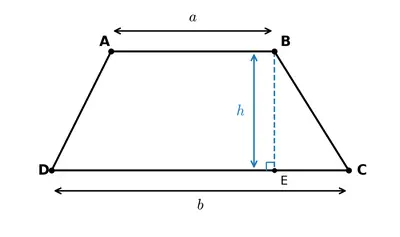
Drop perpendiculars from $$C$$ and $$D$$ on $$AB$$; they meet $$AB$$ at $$P$$ and $$Q$$ respectively. Since $$AB \parallel CD$$ and the trapezium is isosceles, $$P$$ and $$Q$$ divide $$AB$$ symmetrically:

  • $$AP = BQ = \dfrac{c-a}{2}$$,
  • The height of the trapezium is $$h = CP = DQ$$.

In right $$\triangle DQA$$, by Pythagoras

$$h^2 = AD^2 - AQ^2 = b^2 - \left(\dfrac{c-a}{2}\right)^2 \;\;\Longrightarrow\;\; h = \sqrt{\,b^2-\left(\dfrac{c-a}{2}\right)^2\,}.$$

Hence the familiar area is

$$\text{Area}_{\text{trapezium}} = \dfrac{AB + CD}{2}\;h = \dfrac{a+c}{2}\;\sqrt{\,b^2-\left(\dfrac{c-a}{2}\right)^2\,}. \quad(1)$$


3. Brahmagupta’s formula for the same trapezium

For $$ABCD$$ the four sides are $$a,\;b,\;c,\;b$$ (in that order). Hence the semi-perimeter is

$$s = \dfrac{a + b + c + b}{2} = \dfrac{a + c + 2b}{2}.$$

Plugging these values in Brahmagupta’s formula:

\[\Delta_B = \sqrt{(s-a)(s-b)(s-c)(s-b)} = (s-b)\,\sqrt{(s-a)(s-c)}.\]

But

$$s-b = \frac{a + c + 2b}{2} - b = \frac{a + c}{2}. \quad(2)$$

Also

\(\begin{aligned} (s-a) &= \frac{a + c + 2b}{2} - a = \frac{c - a + 2b}{2},\\[2pt] (s-c) &= \frac{a + c + 2b}{2} - c = \frac{a - c + 2b}{2}. \end{aligned}\)

Therefore

\(\begin{aligned} (s-a)(s-c) &= \frac{c - a + 2b}{2}\;\frac{a - c + 2b}{2}\\ &= \frac{(2b + (c-a))(2b - (c-a))}{4}\\ &= \frac{4b^2 - (c-a)^2}{4}\\ &= b^2 - \left(\dfrac{c-a}{2}\right)^2.\quad(3) \end{aligned}\)

Taking the square root of (3) gives

$$\sqrt{(s-a)(s-c)} = \sqrt{\,b^2-\left(\dfrac{c-a}{2}\right)^2\,} = h.$$

Substituting (2) and this value of $$h$$ in Brahmagupta’s formula:

$$\Delta_B = \frac{a + c}{2}\;h. \quad(4)$$


4. Comparing the two expressions

Equation (4) obtained from Brahmagupta is exactly the same as the trapezium-area expression (1). Hence

$$\boxed{\;\Delta_B = \text{Area}_{\text{trapezium}}\;}.$$

Thus Brahmagupta’s formula is verified for an isosceles trapezium.

Answer

Verified – both methods give the same area $$\displaystyle \Delta = \frac{a+c}{2}\sqrt{b^{2}-\bigl(\tfrac{c-a}{2}\bigr)^{2}}$$ for an isosceles trapezium with bases $$a, c$$ and equal legs $$b$$.

Exercise Set 6.2

1

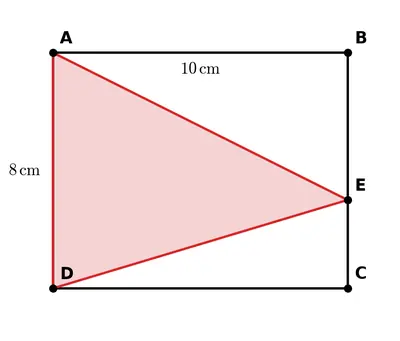
Find the area of triangle ADE in Fig. 6.31. (The triangle is inside a rectangle ABCD of length 10 cm and width 8 cm, with E on side BC.)
Fig. 6.31
Fig. 6.31

Solution

Let the rectangle be such that the vertices are taken in order A (top-left), B (top-right), C (bottom-right) and D (bottom-left). Thus

  • AB is horizontal and $$AB = 10\text{ cm}$$,
  • BC is vertical and $$BC = 8\text{ cm}$$, so $$AD = 8\text{ cm}$$ (opposite sides of a rectangle are equal).

E is any point on BC. Join A E and D E to obtain $$\triangle ADE$$.

To compute its area, drop a perpendicular from E to the base AD. Let the foot of this perpendicular be F, so that $$EF \perp AD$$.

Because AD and BC are vertical lines, EF is horizontal and therefore parallel to AB. In a rectangle opposite sides are equal; hence

$$EF = AB = 10\text{ cm}.$$

In $$\triangle ADE$$ take

  • base $$AD = 8\text{ cm},$$
  • corresponding height $$EF = 10\text{ cm}.$$

Therefore

\[ \text{Area of } \triangle ADE = \tfrac12 \times AD \times EF = \tfrac12 \times 8 \times 10 = 40\,\text{cm}^2 \]

Thus the required area is $$40\,\text{cm}^2$$.

Answer

$$40\text{ cm}^2$$

2 The parallel sides of a trapezium are 40 cm and 20 cm. If its non-parallel sides are both equal, each being 26 cm, find the area of the trapezium.

Solution

Given data

  • Trapezium $$ABCD$$ with $$AB\parallel CD$$.
  • $$AB=40\,\text{cm},\;CD=20\,\text{cm}$$ (parallel sides).
  • $$AD=BC=26\,\text{cm}$$ (equal non-parallel sides).

Since the two non-parallel sides are equal, $$ABCD$$ is an isosceles trapezium.

Drop perpendiculars from $$D$$ and from $$C$$ to the longer base $$AB$$. Let the foot of the perpendicular from $$D$$ be $$N$$, and the foot of the perpendicular from $$C$$ be $$M$$. Then $$DN\perp AB$$, $$CM\perp AB$$, and $$DN=CM=h$$, the height of the trapezium.

Step 1 : Split the longer base into three parts.

Because $$CD\parallel AB$$ and $$DN,CM$$ are both perpendicular to $$AB$$, the figure $$DNMC$$ is a rectangle, so $$NM=DC=20\,\text{cm}$$.

By the symmetry of an isosceles trapezium, the two remaining segments $$AN$$ and $$MB$$ are equal in length; call each of them $$x\,\text{cm}$$. Hence

$$AB=AN+NM+MB=x+20+x=40,$$

so $$2x=20$$ and $$x=10\,\text{cm}.$$

Step 2 : Find the height $$h$$.

Consider right $$\triangle DAN$$ (right-angled at $$N$$):

$$AN=x=10\,\text{cm},\quad DN=h,\quad AD=26\,\text{cm}.$$

By the Pythagoras theorem,

$$AD^{2}=AN^{2}+DN^{2},$$

$$26^{2}=10^{2}+h^{2}\;\Longrightarrow\;676=100+h^{2}\;\Longrightarrow\;h^{2}=576\;\Longrightarrow\;h=24\,\text{cm}.$$

Step 3 : Area of the trapezium.

$$A=\dfrac{1}{2}\times(\text{sum of parallel sides})\times h=\dfrac{1}{2}\times(40+20)\times 24=30\times 24=720\,\text{cm}^{2}.$$

\[\boxed{\,\text{Area of the trapezium}=720\,\text{cm}^{2}\,}\]

Answer

Area = $$720\,\text{cm}^{2}$$.

3 Find the area of a triangle, given that its sides are 8 cm and 11 cm long, and its perimeter is 32 cm.

Solution

Step 1 : Identify the known data

Two sides of a triangle are given as
$$a = 8\;\text{cm}, \; b = 11\;\text{cm}$$
and its perimeter is given as
$$P = 32\;\text{cm}.$$

Step 2 : Find the third side

Let the third side be $$c\;\text{cm}$$. By definition, the perimeter of a triangle is the sum of the lengths of its three sides, so

$$a + b + c = P.$$

Substituting the known values,

$$8 + 11 + c = 32.$$

Solve for $$c$$:

$$c = 32 - (8 + 11) = 32 - 19 = 13.$$

Thus the three sides are $$8\text{ cm},\; 11\text{ cm},\; 13\text{ cm}.$$

Step 3 : Verify the triangle inequality (quick check)

  • $$8 + 11 = 19 > 13\;\;(\text{True})$$
  • $$11 + 13 = 24 > 8\;\;(\text{True})$$
  • $$13 + 8 = 21 > 11\;\;(\text{True})$$

The three lengths can indeed form a triangle.

Step 4 : Use Heron’s formula to find the area

First compute the semi-perimeter $$s$$:

$$s = \frac{a + b + c}{2} = \frac{8 + 11 + 13}{2} = \frac{32}{2} = 16\;\text{cm}.$$

Heron’s formula states

$$\text{Area} = \sqrt{\,s(s-a)(s-b)(s-c)\,}.$$

Substitute $$s = 16\text{ cm},\; a = 8\text{ cm},\; b = 11\text{ cm},\; c = 13\text{ cm}:$$

$$\text{Area} = \sqrt{16\,\bigl(16-8\bigr)\bigl(16-11\bigr)\bigl(16-13\bigr)}$$

$$= \sqrt{16 \times 8 \times 5 \times 3}$$

Group the factors conveniently:

$$= \sqrt{(16) \times (8) \times (15)} = \sqrt{128 \times 15} = \sqrt{1920}.$$

Factor inside the radical to isolate a perfect square:

$$1920 = 64 \times 30 \quad\Longrightarrow\quad \sqrt{1920} = \sqrt{64} \times \sqrt{30} = 8\sqrt{30}.$$

\[ \boxed{\text{Area} = 8\sqrt{30}\;\text{cm}^2} \]

Therefore, the required area of the triangle is $$8\sqrt{30}\;\text{cm}^2$$ (approximately $$43.8\;\text{cm}^2$$).

Answer

Area of the triangle = $$8\sqrt{30}\;\text{cm}^2$$.

4 The sides of a triangular plot are in the ratio $$3:5:7$$; its perimeter is 300 m. Find its area.

Solution

Step 1 – Express the three sides in one unknown.
The ratio of the sides is given as $$3:5:7$$. Let the common multiplying factor be $$k$$ metres.
\[\text{Sides }=\;3k,\;5k,\;7k\]

Step 2 – Determine the value of $$k$$ from the perimeter.
Perimeter $$=300\text{ m}$$.

$$3k+5k+7k=300$$

$$15k=300$$

$$k=\dfrac{300}{15}=20$$

Step 3 – Write the actual lengths of the sides.

  • First side: $$3k=3\times20=60\text{ m}$$
  • Second side: $$5k=5\times20=100\text{ m}$$
  • Third side: $$7k=7\times20=140\text{ m}$$

Step 4 – Find the semi-perimeter $$s$$ needed for Heron’s formula.

$$s=\dfrac{\text{perimeter}}{2}=\dfrac{300}{2}=150\text{ m}$$

Step 5 – Apply Heron’s formula for the area.

Heron’s formula: $$\text{Area}=\sqrt{s\,(s-a)\,(s-b)\,(s-c)}$$.

Substitute $$a=60$$, $$b=100$$, $$c=140$$, $$s=150$$.

$$\text{Area}=\sqrt{150\,(150-60)\,(150-100)\,(150-140)}$$

$$=\sqrt{150\times90\times50\times10}$$

Group the numbers conveniently:

$$150\times90=13\,500\quad\text{and}\quad50\times10=500$$

$$\text{Area}=\sqrt{13\,500\times500}=\sqrt{6\,750\,000}$$

Factor inside the radical:

$$6\,750\,000=100\times100\times(9\times25\times3)$$

Since $$\sqrt{100}=10$$, $$\sqrt{9}=3$$ and $$\sqrt{25}=5$$,

$$\text{Area}=10\times10\times3\times5\times\sqrt3$$

$$=1500\sqrt3\;\text{m}^2$$

Step 6 – Numerical approximation (if required).
Using $$\sqrt3\approx1.732$$,

$$\text{Area}\approx1500\times1.732\approx2598\text{ m}^2$$

Therefore, the area of the triangular plot is \(1500\sqrt3\,\text{m}^2\), which is approximately 2598 m2.

Answer

$$1500\sqrt{3}\text{ m}^2\;(\approx 2598\text{ m}^2)$$

5 One diagonal of a rhombus is twice as long as the other diagonal. If the rhombus has area $$128 \, \mathrm{cm^2}$$, find the length of the shorter diagonal.

Solution

Let the shorter diagonal be $$d_1$$ cm.

The other diagonal is twice as long, so $$d_2 = 2d_1\;\text{cm}.$$

The area $$A$$ of a rhombus in terms of its diagonals is

$$A = \frac{1}{2} \times d_1 \times d_2.$$

Given $$A = 128\,\mathrm{cm^2}$$, substitute $$d_2 = 2d_1$$:

$$128 = \tfrac{1}{2} \times d_1 \times 2d_1.$$

$$128 = d_1^2.$$

Taking the positive square root (because a length is positive):

$$d_1 = \sqrt{128} = \sqrt{64\times 2} = 8\sqrt{2}.$$

Therefore, the length of the shorter diagonal is

\[8\sqrt{2}\;\text{cm}.\]

Answer

$$8\sqrt{2}\,\text{cm}$$

6 ABCD is a parallelogram. P and Q are any two points on side AB. What can you say about the ratio area $$(\triangle PCD)$$ : area $$(\triangle QCD)$$?

Solution

Given : ABCD is a parallelogram and P, Q are any two points on side AB.

To prove : The ratio area $$ ( \triangle PCD ) $$ : area $$ ( \triangle QCD ) $$ equals 1 : 1.

Step 1 — Recall properties of a parallelogram

  • Opposite sides are parallel; hence $$ AB \parallel CD $$ and $$ AD \parallel BC $$.

Step 2 — Identify the common base

  • Both triangles $$ \triangle PCD $$ and $$ \triangle QCD $$ have the same base $$ CD $$.
    Therefore $$ \text{base}_{\triangle PCD}=\text{base}_{\triangle QCD}=CD $$.

Step 3 — Show that the heights are equal

  • The height of a triangle is the perpendicular distance from the third vertex to the line containing the base.
  • For $$ \triangle PCD $$, drop a perpendicular from P to the line CD. For $$ \triangle QCD $$, drop a perpendicular from Q to the line CD.
  • Since P and Q both lie on AB and $$ AB \parallel CD $$, the distance of every point of AB from the line CD is the same fixed number. Consequently, the perpendiculars from P and from Q to CD are equal in length. Hence $$ \text{height}_{\triangle PCD}=\text{height}_{\triangle QCD} $$.

Step 4 — Compare the areas

The area of any triangle is

\[\text{Area} = \tfrac12 \times \text{base} \times \text{height}.\]

Because the two triangles share both the same base and the same height, we have

$$ \text{area}(\triangle PCD) = \tfrac12 \times CD \times h $$

and

$$ \text{area}(\triangle QCD) = \tfrac12 \times CD \times h, $$

where $$ h $$ is the common height.

Thus

$$ \text{area}(\triangle PCD) = \text{area}(\triangle QCD). $$

Step 5 — Write the required ratio

\[ \frac{\text{area}(\triangle PCD)}{\text{area}(\triangle QCD)} = \frac{\text{area}(\triangle QCD)}{\text{area}(\triangle QCD)} = 1. \]

Therefore

$$ \text{area}(\triangle PCD) : \text{area}(\triangle QCD) = 1 : 1. $$

Conclusion. No matter where P and Q are chosen on AB, the two triangles are equal in area.

Answer

The ratio is 1 : 1; the two triangles have equal area.

7 O is any point on the diagonal PR of a parallelogram PQRS. Prove that the areas of triangles PSO and PQO are equal.

Solution

Given data

  • $$PQRS$$ is a parallelogram.
  • $$PR$$ is one of its diagonals.
  • $$O$$ is any point on the diagonal $$PR$$.

To prove. The areas of triangles $$PSO$$ and $$PQO$$ are equal, i.e.

\[\text{ar}(\triangle PSO)=\text{ar}(\triangle PQO).\]

Step 1 : The diagonal $$PR$$ divides the parallelogram into two equal-area triangles.

In $$\triangle PSR$$ and $$\triangle RQP$$:

  • $$PS=RQ$$ (opposite sides of the parallelogram are equal),
  • $$SR=QP$$ (opposite sides of the parallelogram are equal),
  • $$PR=RP$$ (common side).

Hence $$\triangle PSR\cong\triangle RQP$$ by the SSS congruence criterion, and so

\[\text{ar}(\triangle PSR)=\text{ar}(\triangle PQR).\quad(1)\]

(This is the well-known result that a diagonal of a parallelogram divides it into two triangles of equal area.)

Step 2 : Relate each smaller triangle to one of the two big triangles.

(i) Consider $$\triangle PSO$$ and $$\triangle PSR$$. Both have vertex $$S$$, and their bases $$PO$$ and $$PR$$ lie on the same straight line $$PR$$. Hence the perpendicular distance from $$S$$ to that line is common to both triangles, i.e. they share the same height.

For two triangles with the same altitude, the ratio of their areas equals the ratio of their bases:

$$\dfrac{\text{ar}(\triangle PSO)}{\text{ar}(\triangle PSR)}=\dfrac{PO}{PR}.\quad(2)$$

(ii) Similarly, $$\triangle PQO$$ and $$\triangle PQR$$ share vertex $$Q$$, and their bases $$PO$$ and $$PR$$ lie on the same line $$PR$$. Hence

$$\dfrac{\text{ar}(\triangle PQO)}{\text{ar}(\triangle PQR)}=\dfrac{PO}{PR}.\quad(3)$$

Step 3 : Combine the three relations.

From (2): $$\text{ar}(\triangle PSO)=\dfrac{PO}{PR}\,\text{ar}(\triangle PSR).$$

From (3): $$\text{ar}(\triangle PQO)=\dfrac{PO}{PR}\,\text{ar}(\triangle PQR).$$

By (1), $$\text{ar}(\triangle PSR)=\text{ar}(\triangle PQR)$$, so the right-hand sides are equal. Therefore

\[\text{ar}(\triangle PSO)=\text{ar}(\triangle PQO).\]

Conclusion. The two triangles $$PSO$$ and $$PQO$$ have equal area for every position of $$O$$ on the diagonal $$PR$$ of the parallelogram $$PQRS$$. Proved.

Answer

Proved that $$\text{ar}(\triangle PSO)=\text{ar}(\triangle PQO)$$ for every point $$O$$ on the diagonal $$PR$$.

8 If the mid-points of the sides of a 4-gon (also known as a quadrilateral, but we prefer to call it a '4-gon') are joined in order, prove that the area of the parallelogram thus formed will be half of the area of the given 4-gon. (You may wonder whether the 4-gon thus formed is always a parallelogram, and if so, why? These questions will be tackled and answered in the chapter on quadrilaterals.)

Solution

Let $$ABCD$$ be the given 4-gon, and let the mid-points of its sides $$AB,BC,CD$$ and $$DA$$ be $$P,Q,R$$ and $$S$$ respectively. Join the points in the order $$P,Q,R,S$$. We have to show two things.

  1. PQRS is a parallelogram.
  2. Area$$\,(PQRS)=\dfrac12\,\text{Area}\,(ABCD).$$

Draw the two diagonals $$AC$$ and $$BD$$ of $$ABCD$$; they intersect (not necessarily at right angles) at $$O$$.

1. PQRS is a parallelogram

  • In $$\triangle ABC$$, $$P$$ and $$Q$$ are the mid-points of $$AB$$ and $$BC$$, so by the Mid-point Theorem
    $$PQ\;\parallel\;AC.\quad(1)$$
  • In $$\triangle CDA$$, $$R$$ and $$S$$ are the mid-points of $$CD$$ and $$DA$$, so again by the Mid-point Theorem
    $$RS\;\parallel\;AC.\quad(2)$$
  • Because of (1) and (2) we have $$PQ\parallel RS.$$
  • Likewise, in $$\triangle ABD$$ the mid-points $$P$$ and $$S$$ give $$PS\parallel BD,$$ and in $$\triangle BCD$$ the mid-points $$Q$$ and $$R$$ give $$QR\parallel BD.$$ Hence $$PS\parallel QR.$$

Both pairs of opposite sides are parallel, so $$PQRS$$ is a parallelogram.

2. The area of PQRS

With the help of the two diagonals the 4-gon is split up into four triangles that sit at its vertices:

$$\triangle APS,\;\triangle BPQ,\;\triangle CRQ,\;\triangle DRS.$$

Together with $$PQRS$$ they fill the whole 4-gon, so

\[\text{Area}(ABCD)=\text{Area}(PQRS)+\sum_{\text{four corner }\triangle}s.\quad(3)\]

(a) The pair \(\triangle BPQ\) and \(\triangle DRS\)

Consider $$\triangle ABC$$. Because $$P$$ and $$Q$$ are mid-points, $$PQ\parallel AC$$ (already used in step 1) and

$$\angle BPQ=\angle BCA,\;\angle BQP=\angle BAC;$$

hence $$\triangle BPQ\sim\triangle BCA$$ (both are right way round at $$B$$). The similarity ratio is

$$\dfrac{BP}{BA}=\dfrac12,$$

so the ratio of their areas is the square of this number:

\[\dfrac{\text{Area}(\triangle BPQ)}{\text{Area}(\triangle BCA)}=\left(\dfrac12\right)^2=\dfrac14.\quad(4)\]

Exactly the same argument in $$\triangle CDA$$ (mid-points $$R,S$$, segment $$RS\parallel AC$$) gives

\[\text{Area}(\triangle DRS)=\dfrac14\,\text{Area}(\triangle CDA).\quad(5)\]

Add (4) and (5):

\[\text{Area}(\triangle BPQ)+\text{Area}(\triangle DRS)=\dfrac14\,(\text{Area}(\triangle ABC)+\text{Area}(\triangle CDA))=\dfrac14\,\text{Area}(ABCD).\quad(6)\]

(b) The pair \(\triangle APS\) and \(\triangle CRQ\)

Work this time with the other diagonal $$BD$$.

  • In $$\triangle ABD$$ the points $$P$$ and $$S$$ are mid-points; hence $$PS\parallel BD$$, and a similarity argument exactly like that above gives
\[\text{Area}(\triangle APS)=\dfrac14\,\text{Area}(\triangle ABD).\quad(7)\]
  • In $$\triangle BCD$$, $$Q$$ and $$R$$ are the mid-points and $$QR\parallel BD$$, so
\[\text{Area}(\triangle CRQ)=\dfrac14\,\text{Area}(\triangle BCD).\quad(8)\]

Add (7) and (8):

\[\text{Area}(\triangle APS)+\text{Area}(\triangle CRQ)=\dfrac14\,(\text{Area}(\triangle ABD)+\text{Area}(\triangle BCD))=\dfrac14\,\text{Area}(ABCD).\quad(9)\]

(c) Total area of the four corner triangles

Combine (6) and (9):

\[\sum_{\text{four corner }\triangle}s=\dfrac14\,\text{Area}(ABCD)+\dfrac14\,\text{Area}(ABCD)=\dfrac12\,\text{Area}(ABCD).\quad(10)\]

(d) Finish

Insert (10) into (3):

\[\text{Area}(ABCD)=\text{Area}(PQRS)+\dfrac12\,\text{Area}(ABCD).\]

Rearrange:

\[\text{Area}(PQRS)=\dfrac12\,\text{Area}(ABCD).\]

This completes the proof: the parallelogram obtained by joining the mid-points of the sides of any 4-gon has exactly half the area of the original 4-gon.

Answer

Proved: the mid-point figure is a parallelogram and its area equals one-half of the area of the original 4-gon.

9

In $$\triangle ABC$$, the midpoint of BC is D (Fig. 6.32). Median AD is drawn. P is any point on AD. Show that area $$(\triangle ABP)$$ = area $$(\triangle ACP)$$.
Fig. 6.32
Fig. 6.32

Solution

Given data
In $$\triangle ABC$$, point $$D$$ is the midpoint of $$BC$$, so $$BD = DC$$. Segment $$AD$$ is therefore a median. A variable point $$P$$ is taken on $$AD$$.

To prove
$$\text{ar}(\triangle ABP)=\text{ar}(\triangle ACP).$$

Proof

1. Because $$D$$ is the midpoint of $$BC$$, we have equal bases $$BD=DC$$.
  Triangles $$\triangle ABD$$ and $$\triangle ACD$$ lie between the same parallels $$BC$$ (as base) and vertex $$A$$ (common height). Hence

$$\text{ar}(\triangle ABD)=\text{ar}(\triangle ACD)\;\;\cdots(1)$$

2. Points $$A,\,P,\,D$$ are collinear. Take $$AD$$ as the reference line (base).

  • In $$\triangle ABP$$ the base is $$AP$$; its altitude is the perpendicular distance from $$B$$ to line $$AD$$.
  • In $$\triangle ABD$$ the base is $$AD$$; the altitude is the same perpendicular distance from $$B$$ to line $$AD$$ (because the vertex is still $$B$$ and the base line is still $$AD$$).

Therefore, with equal heights, the areas are proportional to their bases:

$$\frac{\text{ar}(\triangle ABP)}{\text{ar}(\triangle ABD)}=\frac{AP}{AD}\;\;\cdots(2)$$

3. Exactly the same reasoning with vertex $$C$$ instead of $$B$$ gives

$$\frac{\text{ar}(\triangle ACP)}{\text{ar}(\triangle ACD)}=\frac{AP}{AD}\;\;\cdots(3)$$

4. From (2) and (3) we have

$$\frac{\text{ar}(\triangle ABP)}{\text{ar}(\triangle ABD)}=\frac{\text{ar}(\triangle ACP)}{\text{ar}(\triangle ACD)}.$$

Using (1), $$\text{ar}(\triangle ABD)=\text{ar}(\triangle ACD)$$, so the denominators in the last equality are equal. Consequently, the numerators must also be equal:

\[\text{ar}(\triangle ABP)=\text{ar}(\triangle ACP).\]

Hence, for every point $$P$$ on the median $$AD$$, the two triangles $$\triangle ABP$$ and $$\triangle ACP$$ always have equal area. The statement is proved.

Answer

Proved.

10

Given a square ABCD, let P be a point within it. Join PA, PB, PC, PD (Fig. 6.33). What is the ratio of the areas of the red region ($$\triangle PAB$$ and $$\triangle PCD$$) and the green region ($$\triangle PBC$$ and $$\triangle PDA$$)?
Fig. 6.33
Fig. 6.33

Solution

Step 1 : Label the data

  • Let the length of each side of the square $$ABCD$$ be $$a$$.
  • Drop perpendiculars from the interior point $$P$$ to the four sides.
        • Let the distance of $$P$$ from side $$AB$$ be $$h_1$$.
        • Let the distance of $$P$$ from side $$BC$$ be $$h_2$$.
        • Let the distance of $$P$$ from side $$CD$$ be $$h_3$$.
        • Let the distance of $$P$$ from side $$DA$$ be $$h_4$$.

Step 2 : Observe two key relations

Because $$AB$$ and $$CD$$ are parallel and the distance between them is exactly the side of the square, we have

$$h_1+h_3=a$$      (1)

Similarly, since $$BC$$ || $$DA$$, we get

$$h_2+h_4=a$$      (2)

Step 3 : Write the four triangular areas

  • $$\triangle PAB$$ has base $$AB=a$$ and height $$h_1$$, hence $$\text{ar}(\triangle PAB)=\tfrac12\,a\,h_1$$.
  • $$\triangle PBC$$ has base $$BC=a$$ and height $$h_2$$, hence $$\text{ar}(\triangle PBC)=\tfrac12\,a\,h_2$$.
  • $$\triangle PCD$$ has base $$CD=a$$ and height $$h_3$$, hence $$\text{ar}(\triangle PCD)=\tfrac12\,a\,h_3$$.
  • $$\triangle PDA$$ has base $$DA=a$$ and height $$h_4$$, hence $$\text{ar}(\triangle PDA)=\tfrac12\,a\,h_4$$.

Step 4 : Form the required sums

Red region (two opposite triangles):
$$\text{Red}=\tfrac12\,a\,h_1+\tfrac12\,a\,h_3=\tfrac12\,a\,(h_1+h_3)$$

Green region (the other two triangles):
$$\text{Green}=\tfrac12\,a\,h_2+\tfrac12\,a\,h_4=\tfrac12\,a\,(h_2+h_4)$$

Step 5 : Substitute from (1) and (2)

Using $$h_1+h_3=a$$ and $$h_2+h_4=a$$, we get

$$\text{Red}=\tfrac12\,a\,a=\tfrac12\,a^2$$

$$\text{Green}=\tfrac12\,a\,a=\tfrac12\,a^2$$

Step 6 : State the ratio

\[\dfrac{\text{Area of red region}}{\text{Area of green region}}=\dfrac{\tfrac12 a^2}{\tfrac12 a^2}=1:1\]

Thus the two coloured regions always have equal area.

Answer

The required ratio is $$1:1$$.

11

In $$\triangle ABC$$, D is the midpoint of AB. P is any point on BC, and Q is a point on AB such that $$CQ \parallel PD$$. PQ is joined (Fig. 6.34). Prove that Area $$(\triangle BPQ) = \frac{1}{2}$$ Area $$(\triangle ABC)$$.
Fig. 6.34
Fig. 6.34

Solution

Given: In $$\triangle ABC$$ let $$D$$ be the midpoint of $$AB$$, $$P$$ any point on $$BC$$ and $$Q$$ a point on the line $$AB$$ such that $$CQ\parallel PD$$. Join $$PQ$$.

Goal

\[ \text{Area}(\triangle BPQ)=\tfrac12\,\text{Area}(\triangle ABC) \]

Step 1  Setting up convenient co-ordinates

  • Put $$A(0,0)$$ and $$B(2b,0)\;(b>0)$$ on the x-axis, so that $$AB=2b$$.
  • Because $$D$$ is the midpoint of $$AB$$, we have $$D(b,0)$$.
  • Choose $$C(0,2c)\;(c>0)$$; the triangle is still perfectly general.

Step 2  Co-ordinates of the variable point P

Let $$t\,(0 $$ P\bigl(x_P,y_P\bigr)=\bigl(2b(1-t),\,2c\,t\bigr). $$

Step 3  Finding the co-ordinates of Q

The slope of $$PD$$ is

$$ m=\frac{y_P-y_D}{x_P-x_D}=\frac{2c\,t-0}{2b(1-t)-b}=\frac{2c\,t}{b(1-2t)}. $$

The line through $$C(0,2c)$$ parallel to $$PD$$ is $$y-2c=m x$$. Putting $$y=0$$ (because $$Q$$ lies on the x-axis) gives

$$ x_Q=-\frac{2c}{m}=-\frac{2c}{\dfrac{2c\,t}{b(1-2t)}}=-\frac{b(1-2t)}{t}=\frac{b(2t-1)}{t}. $$ Thus $$Q\bigl(x_Q,0\bigr)=\bigl(\dfrac{b(2t-1)}{t},0\bigr).$$

Step 4  Area of $$\triangle ABC$$

With base $$AB=2b$$ and height $$2c$$ above the axis,

$$ \text{Area}(\triangle ABC)=\tfrac12(2b)(2c)=2bc. $$

Step 5  Area of $$\triangle BPQ$$

Using the determinant formula for the area of a triangle whose vertices are $$B(2b,0)$$, $$P(2b(1-t),2c t)$$ and $$Q(x_Q,0)$$,

$$ \text{Area}(\triangle BPQ)=\tfrac12\,\bigl|x_B(y_P-y_Q)+x_P(y_Q-y_B)+x_Q(y_B-y_P)\bigr|. $$

Since $$y_B=y_Q=0$$ this becomes

$$ \tfrac12\,(x_B-x_Q)\,y_P. $$

Substituting
$$x_B-x_Q=2b-\frac{b(2t-1)}{t}=\frac{b}{t},\qquad y_P=2c\,t,$$ we obtain

$$ \text{Area}(\triangle BPQ)=\tfrac12\,(\tfrac{b}{t})(2c\,t)=bc. $$

Step 6  Comparing the two areas

$$ \frac{\text{Area}(\triangle BPQ)}{\text{Area}(\triangle ABC)}=\frac{bc}{2bc}=\frac12. $$ Hence \[ \boxed{ \text{Area}(\triangle BPQ)=\tfrac12\,\text{Area}(\triangle ABC) } \]

The result does not involve the parameter $$t$$, so it is true for every position of $$P$$ on $$BC$$. The required relation is therefore proved.

Answer

Proved.

Exercise Set 6.3

1 Find the area of a sector of a circle with radius 7 cm if the angle of the sector is $$60^\circ$$.

Solution

Step 1 : Formula for the area of a sector. For a sector of central angle $$\theta$$ (in degrees) in a circle of radius $$r$$,

\[A=\dfrac{\theta}{360^{\circ}}\,\pi r^{2}.\]

Step 2 : Given data. $$r=7\,\text{cm},\;\theta=60^{\circ}.$$

Step 3 : Substitute and simplify.

$$A=\dfrac{60^{\circ}}{360^{\circ}}\,\pi\,(7)^{2}=\dfrac{1}{6}\times\pi\times 49=\dfrac{49\pi}{6}\,\text{cm}^{2}.$$

Step 4 : Numerical value. Taking $$\pi\approx\dfrac{22}{7}$$,

$$A\approx\dfrac{49}{6}\times\dfrac{22}{7}=\dfrac{49\times 22}{6\times 7}=\dfrac{1078}{42}=\dfrac{77}{3}\approx 25.67\,\text{cm}^{2}.$$

Therefore, the exact area is $$\dfrac{49\pi}{6}\,\text{cm}^{2}$$, which is approximately $$25.7\,\text{cm}^{2}$$.

Answer

Area of the sector $$=\dfrac{49\pi}{6}\,\text{cm}^{2}\approx 25.7\,\text{cm}^{2}.$$

2 Find the area of a quadrant of a circle whose circumference is 44 cm.

Solution

Step 1 : Express the radius in terms of the given circumference
Let the radius of the circle be $$r\text{ cm}$$. For any circle, the circumference is given by $$C = 2\pi r$$.

The problem states that the circumference is $$44\text{ cm}$$, i.e. $$2\pi r = 44$$.

NCERT ordinarily uses the value $$\pi = \dfrac{22}{7}$$. Substituting this value, we have $$2 \times \dfrac{22}{7} \times r = 44.$$

Solve for $$r$$: $$\frac{44}{7}\,r = 44 \;\;\Rightarrow\;\; r = 44 \times \frac{7}{44} = 7.$$ Thus, $$r = 7\text{ cm}$$.

Step 2 : Find the area of the whole circle
The area of a circle is $$A = \pi r^{2}$$. Hence $$A = \frac{22}{7} \times 7^{2} = \frac{22}{7} \times 49 = 154\text{ cm}^{2}.$$

Step 3 : Compute the area of one quadrant
A quadrant is exactly one–fourth of a full circle, so $$\text{Area of quadrant} = \frac{1}{4} \times 154 = 38.5\text{ cm}^{2}.$$

Therefore, the area of the required quadrant is $$38.5 \text{ cm}^{2}.$$

Answer

$$38.5\text{ cm}^2$$

3 The length of the minute hand of a clock is 7 cm. Find the area swept by the minute hand in 10 minutes.

Solution

The tip of the minute-hand traces a circle of radius equal to the length of the hand.

Radius $$r = 7\text{ cm}$$.

Step 1 – Central angle for 10 minutes

In 60 minutes the hand turns $$360^{\circ}$$.
In 1 minute it turns $$\dfrac{360^{\circ}}{60}=6^{\circ}$$.
Therefore, in 10 minutes it turns
$$\theta = 10 \times 6^{\circ}=60^{\circ}$$.

Step 2 – Area of the corresponding sector

Area of a sector: $$A = \dfrac{\theta}{360^{\circ}}\,\pi r^{2}$$.

Substitute $$\theta = 60^{\circ}$$ and $$r = 7\text{ cm}$$:

$$A = \dfrac{60^{\circ}}{360^{\circ}} \times \pi \times 7^{2} = \dfrac{1}{6}\,\pi\,49 = \dfrac{49\pi}{6}\text{ cm}^{2}$$.

Step 3 – Approximate value

Using $$\pi = \dfrac{22}{7}$$,

$$A = \dfrac{49 \times \tfrac{22}{7}}{6} = \dfrac{154}{6} = \dfrac{77}{3} \approx 25.7\text{ cm}^{2}$$.

Hence, the minute hand sweeps an area of $$\dfrac{49\pi}{6}\text{ cm}^{2}\,(\approx 25.7\text{ cm}^{2})$$ in 10 minutes.

Answer

$$\displaystyle \frac{49\pi}{6}\text{ cm}^{2}\;\approx\;25.7\text{ cm}^{2}$$

4 A chord of a circle of radius 10 cm subtends $$90^\circ$$ at the centre. Find the area of the corresponding: (Use $$\pi \approx 3.14$$.)

(i) minor sector (that subtends $$90^\circ$$ at the centre)

Solution

Let the radius of the circle be denoted by $$r$$.

Given: $$r = 10\text{ cm}$$.

The angle made at the centre by the chord (the sector angle) is $$\theta = 90^{\circ}$$.

Formula for the area of a sector of angle $$\theta$$ in a circle of radius $$r$$:

\[\text{Area of sector} = \frac{\theta}{360^{\circ}} \times \pi r^{2}\]

First compute the area of the whole circle so that we can take the required fraction later:

$$\pi r^{2} = 3.14 \times (10)^{2} = 3.14 \times 100 = 314\text{ cm}^{2}.$$

Now take the fraction corresponding to $$\theta = 90^{\circ}$$:

$$\text{Area of minor sector} = \frac{90^{\circ}}{360^{\circ}} \times 314\text{ cm}^{2}.$$ Because $$\frac{90}{360} = \frac14$$, we get

$$\text{Area of minor sector} = \frac14 \times 314\text{ cm}^{2} = 78.5\text{ cm}^{2}.$$

Answer

78.5 cm2

(ii) major sector (that subtends $$270^\circ$$ at the centre)

Solution

The major sector subtends the remainder of the full angle at the centre:

$$\theta_{\text{major}} = 360^{\circ} - 90^{\circ} = 270^{\circ}.$$

Using the same sector-area formula

\[\text{Area of sector} = \frac{\theta}{360^{\circ}} \times \pi r^{2}\]

and the previously calculated $$\pi r^{2} = 314\text{ cm}^{2}$$, we have

$$\text{Area of major sector} = \frac{270^{\circ}}{360^{\circ}} \times 314\text{ cm}^{2}.$$

Simplify the fraction $$\frac{270}{360} = \frac34$$:

$$\text{Area of major sector} = \frac34 \times 314\text{ cm}^{2}.$$

Compute:

$$\frac34 \times 314 = 0.75 \times 314 = 235.5.$$

Therefore,

$$\text{Area of major sector} = 235.5\text{ cm}^{2}.$$

Answer

235.5 cm2

5 A chord of a circle of radius 15 cm subtends an angle of $$60^\circ$$ at the centre of the circle. Find the areas of the corresponding minor and major segments of the circle. (Use $$\pi \approx 3.14$$ and $$\sqrt{3} \approx 1.73$$.)

Solution

Step 1 : Draw and label

Draw a circle with centre $$O$$ and radius $$r = 15\,\text{cm}$$. Mark two radii $$OA$$ and $$OB$$ such that $$\angle AOB = 60^{\circ}$$. Chord $$AB$$ subtends this angle. Shade the region bounded by arc $$AB$$ and chord $$AB$$ — that is the minor segment. The remaining part of the circle is the major segment.

Step 2 : Area of the sector $$AOB$$

The sector subtends $$60^{\circ}$$ at the centre, so

$$ \text{Area of sector } AOB = \frac{60^{\circ}}{360^{\circ}} \times \pi r^{2} $$

Substituting $$r = 15\,\text{cm}$$ and $$\pi \approx 3.14$$,

$$ \text{Area of sector } AOB = \frac16 \times 3.14 \times 15^{2} $$

$$ = \frac16 \times 3.14 \times 225 $$

$$ = \frac{706.5}{6} $$

$$ = 117.75\,\text{cm}^2 $$

Step 3 : Area of triangle $$\triangle AOB$$

Triangle $$AOB$$ is isosceles with sides $$OA = OB = 15\,\text{cm}$$ and included angle $$60^{\circ}$$.

Using $$\text{Area} = \tfrac12 ab \sin C$$,

$$ \text{Area}(\triangle AOB) = \tfrac12 \times 15 \times 15 \times \sin 60^{\circ} $$

Given $$\sqrt3 \approx 1.73$$, so $$\sin 60^{\circ} = \dfrac{\sqrt3}{2} \approx \dfrac{1.73}{2} = 0.865$$.

$$ \text{Area}(\triangle AOB) = \tfrac12 \times 225 \times 0.865 $$

$$ = 112.5 \times 0.865 $$

$$ = 97.3125 \text{ cm}^2 $$

We shall keep two–decimal accuracy: $$97.31\,\text{cm}^2$$.

Step 4 : Area of the minor segment

Minor segment area = (sector area) – (triangle area)

$$ \text{Minor segment} = 117.75\,\text{cm}^2 - 97.31\,\text{cm}^2 $$

$$ = 20.44\,\text{cm}^2 $$

Step 5 : Area of the major segment

Total area of the circle

$$ \pi r^{2} = 3.14 \times 15^{2} = 3.14 \times 225 = 706.5\,\text{cm}^2 $$

Major segment area = (circle area) – (minor segment area)

$$ \text{Major segment} = 706.5\,\text{cm}^2 - 20.44\,\text{cm}^2 $$

$$ = 686.06\,\text{cm}^2 $$

Answer :

  • Area of the minor segment &approx; $$20.44\,\text{cm}^2$$
  • Area of the major segment &approx; $$686.06\,\text{cm}^2$$

Answer

Minor segment &approx; $$20.44\,\text{cm}^2$$
Major segment &approx; $$686.06\,\text{cm}^2$$

6 A car has two wipers which do not overlap. Each wiper has a blade of length 28 cm and sweeps through an angle of $$120^\circ$$. Find the total area cleaned at each sweep of the blades.

Solution

Step 1 – Each sweep is a sector. When a wiper moves once, the tip of its blade traces an arc of a circle whose radius equals the blade length and whose central angle equals the sweep angle. For one wiper:

  • Radius $$r=28\,\text{cm}$$,
  • Central angle $$\theta=120^{\circ}$$.

Step 2 – Area cleaned by one wiper. The area of a sector is

$$\text{Sector area}=\dfrac{\theta}{360^{\circ}}\,\pi r^{2}=\dfrac{120^{\circ}}{360^{\circ}}\,\pi(28)^{2}=\dfrac{1}{3}\,\pi\,(784)=\dfrac{784\pi}{3}\,\text{cm}^{2}.$$

Step 3 – Total area cleaned by both wipers. The two blades do not overlap, so the total area is twice the area cleaned by one:

$$\text{Total area}=2\times\dfrac{784\pi}{3}=\dfrac{1568\pi}{3}\,\text{cm}^{2}.$$

Step 4 – Numerical value. Using $$\pi=\dfrac{22}{7}$$,

$$\text{Total area}=\dfrac{1568}{3}\times\dfrac{22}{7}=\dfrac{1568\times 22}{3\times 7}=\dfrac{1568\times 22}{21}=\dfrac{4928}{3}\,\text{cm}^{2}\approx 1642.67\,\text{cm}^{2}.$$

(If $$\pi\approx 3.14$$ is used instead, $$\dfrac{1568\pi}{3}\approx \dfrac{1568\times 3.14}{3}\approx 1641.2\,\text{cm}^{2}$$.)

Hence the two wipers together clean an area of $$\dfrac{1568\pi}{3}\,\text{cm}^{2}\approx 1642.67\,\text{cm}^{2}$$ at each sweep.

Answer

Total area cleaned $$=\dfrac{1568\pi}{3}\,\text{cm}^{2}=\dfrac{4928}{3}\,\text{cm}^{2}\approx 1642.67\,\text{cm}^{2}$$ (using $$\pi=\dfrac{22}{7}$$).

7 A chord of a circle of radius $$r$$ subtends an angle of $$60^\circ$$ at the centre of the circle. Show that the area of the corresponding minor segment of the circle is equal to $$\pi r^2 \left( \frac{1}{6} - \frac{\sqrt{3}}{4} \right)$$.

Solution

Given. A circle of radius $$r$$ has a chord $$AB$$ that subtends $$\angle AOB=60^{\circ}$$ at the centre $$O$$.

To show. The area of the minor segment (the region bounded by the chord $$AB$$ and the minor arc $$\widehat{AB}$$) is

\[\text{Area}=r^{2}\left(\dfrac{\pi}{6}-\dfrac{\sqrt{3}}{4}\right),\]

which is the meaning of the expression $$\pi r^{2}\left(\dfrac{1}{6}-\dfrac{\sqrt{3}}{4}\right)$$ stated in the question.

Step 1 : Area of the sector $$AOB$$. For a sector of central angle $$\theta^{\circ}$$ in a circle of radius $$r$$,

$$\text{Area of sector}=\dfrac{\theta^{\circ}}{360^{\circ}}\,\pi r^{2}.$$

For $$\theta=60^{\circ}$$,

$$\text{Area of sector }AOB=\dfrac{60^{\circ}}{360^{\circ}}\,\pi r^{2}=\dfrac{\pi r^{2}}{6}.\quad(1)$$

Step 2 : Area of $$\triangle AOB$$. Two sides of the triangle are radii ($$OA=OB=r$$) and the included angle is $$60^{\circ}$$. Hence $$\triangle AOB$$ is equilateral with side $$r$$, and its area is

$$\text{Area of }\triangle AOB=\dfrac{1}{2}\cdot r\cdot r\cdot\sin 60^{\circ}=\dfrac{1}{2}r^{2}\cdot\dfrac{\sqrt{3}}{2}=\dfrac{\sqrt{3}}{4}r^{2}.\quad(2)$$

Step 3 : Area of the minor segment. The segment is what remains of the sector after the triangle is removed, so

$$\text{Area of minor segment}=\text{Area of sector}-\text{Area of }\triangle AOB=\dfrac{\pi r^{2}}{6}-\dfrac{\sqrt{3}}{4}r^{2}.$$

Factor out $$r^{2}$$:

\[\text{Area of minor segment}=r^{2}\left(\dfrac{\pi}{6}-\dfrac{\sqrt{3}}{4}\right),\]

which is the required result.

Note. The expression $$\pi r^{2}\!\left(\dfrac{1}{6}-\dfrac{\sqrt{3}}{4}\right)$$ in the question is intended to be read as $$r^{2}\!\left(\dfrac{\pi}{6}-\dfrac{\sqrt{3}}{4}\right)$$, i.e. the $$\pi$$ multiplies only the first term; one cannot literally pull a common factor of $$\pi$$ out of both $$\dfrac{\pi r^{2}}{6}$$ and $$\dfrac{\sqrt{3}}{4}r^{2}$$.

Hence proved.

Answer

Proved: the area of the minor segment is $$r^{2}\!\left(\dfrac{\pi}{6}-\dfrac{\sqrt{3}}{4}\right)=\dfrac{\pi r^{2}}{6}-\dfrac{\sqrt{3}}{4}r^{2}.$$

8 An equilateral triangle is inscribed in a circle of radius $$r$$. Show that the ratio of the area of the triangle to the area of the circle is equal to $$\frac{3\sqrt{3}}{4\pi} \approx 0.413$$.

Solution

Step 1 : Relate the side of the equilateral triangle to the radius of the circle

Let the equilateral triangle be $$\triangle ABC$$ and let the centre of the circle be $$O$$.
Because all three vertices lie on the circle, $$OA = OB = OC = r$$.

In a circle, equal chords subtend equal angles at the centre. Since $$AB = BC = CA$$, the three central angles are equal and together make one full revolution $$360^\circ$$:

$$\angle AOB = \angle BOC = \angle COA = \frac{360^\circ}{3} = 120^\circ.$$

Thus each of the three identical isosceles triangles $$\triangle AOB,\,\triangle BOC,\,\triangle COA$$ has two sides $$r,\,r$$ enclosing an angle of $$120^\circ$$.

Step 2 : Area of one isosceles triangle

The area of a triangle whose two sides are $$a$$ and $$b$$ with included angle $$C$$ is
$$\text{Area} = \tfrac12 ab \sin C.$$

Here $$a = b = r$$ and $$C = 120^\circ$$, so the area of $$\triangle AOB$$ is

$$\text{Area}(\triangle AOB) = \tfrac12 r\,r\,\sin 120^\circ = \tfrac12 r^2 \left( \tfrac{\sqrt3}{2} \right) = \tfrac{\sqrt3}{4} r^2.$$

Step 3 : Area of the whole equilateral triangle

Adding the three congruent parts,

$$\text{Area}(\triangle ABC) = 3 \times \tfrac{\sqrt3}{4} r^2 = \tfrac{3\sqrt3}{4} r^2.$$

Step 4 : Area of the circle

The circle’s area is $$\pi r^2.$$

Step 5 : Required ratio

\[ \dfrac{\text{Area of }\triangle ABC}{\text{Area of the circle}} = \dfrac{\tfrac{3\sqrt3}{4} r^2}{\pi r^2} = \dfrac{3\sqrt3}{4\pi}. \]

Step 6 : Numerical value

Using $$\sqrt3 \approx 1.732$$ and $$\pi \approx 3.142$$:

$$\dfrac{3\times 1.732}{4\times 3.142} \approx \dfrac{5.196}{12.568} \approx 0.413.$$

Hence the ratio of the area of the equilateral triangle to the area of the circle is $$\dfrac{3\sqrt3}{4\pi} \approx 0.413$$, as required.

Answer

The ratio is $$\dfrac{3\sqrt3}{4\pi}\;\approx\;0.413.$$

9 A square is inscribed in a circle of radius $$r$$. Show that the ratio of the area of the square to the area of the circle is equal to $$\frac{2}{\pi} \approx 0.637$$.

Solution

Given: A square is inscribed in a circle whose radius is $$r$$.

Objective: Find the ratio of the area of the square to the area of the circle.

Step 1 — Relate the side of the square to the radius of the circle.

  • In an inscribed (circumscribed) square, the four vertices lie on the circle.
  • The diagonal of the square therefore coincides with the diameter of the circle.

If the side of the square is $$s$$, then by the Pythagoras theorem applied to one right-angled triangle formed by two sides and the diagonal, we have

$$s^2 + s^2 = (\text{diagonal})^2$$

$$2s^2 = (2r)^2$$ (because the diagonal = diameter = $$2r$$)

$$s^2 = \dfrac{(2r)^2}{2} = 2r^2$$

Therefore,

\[s = r\sqrt{2}\]

Step 2 — Compute the area of the square.

Area of square = $$s^2 = 2r^2$$.

Step 3 — Compute the area of the circle.

Area of circle = $$\pi r^2$$.

Step 4 — Form the required ratio.

$$\text{Ratio} = \dfrac{\text{Area of square}}{\text{Area of circle}} = \dfrac{2r^2}{\pi r^2} = \dfrac{2}{\pi}$$

Numerically,

$$\dfrac{2}{\pi} \approx 0.637$$.

Hence proved.

Answer

Required ratio = $$\dfrac{2}{\pi} \approx 0.637$$

10 A hexagon is inscribed in a circle of radius $$r$$. Show that the ratio of the area of the hexagon to the area of the circle is equal to $$\frac{3\sqrt{3}}{2\pi} \approx 0.827$$. Can you see why the answer is exactly twice the answer to Question 8?

Solution

Step 1 – Draw the figure
Draw a circle with centre $$O$$ and radius $$r$$. Mark six points $$A,\,B,\,C,\,D,\,E,\,F$$ on the circumference such that the arcs AB, BC, … , FA are equal. Join adjacent points to obtain the regular hexagon $$ABCDEF$$ and join every vertex to the centre.

Step 2 – Show that each central angle is $$60^\circ$$
Because the whole circle is $$360^\circ$$ and the six arcs are equal, each arc subtends a central angle of

$$ \dfrac{360^\circ}{6}=60^\circ. $$

Step 3 – Show that the six triangles are equilateral
Consider one of the six triangles, say $$\triangle OAB$$. Two of its sides are radii, so

$$ OA = OB = r. $$

The included angle is $$\angle AOB = 60^\circ$$. In an isosceles triangle whose two equal sides enclose $$60^\circ$$, the third side is equal to the two equal sides; hence

$$ AB = r. $$

Thus $$\triangle OAB$$ is equilateral. The same argument works for the other five triangles, so the hexagon is made up of six congruent equilateral triangles.

Step 4 – Find the area of one small triangle
For an equilateral triangle of side $$s$$, the area is $$\dfrac{\sqrt3}{4}s^2$$. Taking $$s=r$$ gives

$$ \text{Area of }\triangle OAB = \dfrac{\sqrt3}{4}r^2. $$

Step 5 – Area of the hexagon
Because there are six such triangles,

$$ \text{Area of hexagon} = 6\times\left( \dfrac{\sqrt3}{4}r^2 \right) = \dfrac{6\sqrt3}{4}r^2 = \dfrac{3\sqrt3}{2}r^2. $$

Step 6 – Area of the circle
$$ \text{Area of circle}= \pi r^2. $$

Step 7 – Required ratio

\[\frac{\text{Area of hexagon}}{\text{Area of circle}} = \frac{ \dfrac{3\sqrt3}{2}r^2 }{ \pi r^2 } = \frac{3\sqrt3}{2\pi} \approx 0.827.\]

Step 8 – Why is this exactly twice the answer to Question 8?
In Question 8 you inscribed an equilateral triangle in the same circle. That triangle is obtained by taking every alternate vertex of the regular hexagon, so it is made up of three of the six small equilateral triangles found above. Hence

$$ \frac{\text{Area of triangle}}{\text{Area of circle}} = \frac{3\times\left(\dfrac{\sqrt3}{4}r^2\right)}{\pi r^2} = \frac{3\sqrt3}{4\pi}, $$

and the hexagon/circle ratio is twice this value:

$$ 2\times\frac{3\sqrt3}{4\pi} = \frac{3\sqrt3}{2\pi}. $$

Hence proved.

Answer

The required ratio is

$$\displaystyle \frac{\text{Area of hexagon}}{\text{Area of circle}}=\frac{3\sqrt3}{2\pi}\approx0.827.$$

This is exactly twice the ratio obtained for the inscribed equilateral triangle in Question 8.

End-of-Chapter Exercises

1

Identities in algebra can sometimes be shown as area relationships. For example: The figure (Fig. 6.41) shown corresponds to the identity

$$(a + b)^2 = a^2 + 2ab + b^2.$$

Do you see how? Draw figures corresponding to the identities $$(a + b)(a - b) = a^2 - b^2$$ and $$(a + b + c)^2 = a^2 + b^2 + c^2 + 2ab + 2bc + 2ca$$.

Fig. 6.41
Fig. 6.41

Solution

Recall The textbook has already shown that when we draw a square of side $$a + b$$ and divide it into convenient rectangles, the total area breaks up as

\[(a + b)^2 = a^2 + 2ab + b^2\]

The same “area‐as‐algebra” idea can be used for the two new identities. Because we cannot insert actual pictures here, the construction of each diagram is explained step–by-step so that you can reproduce it accurately in your notebook or on graph paper.


1. Diagram for $$ (a + b)(a - b) = a^2 - b^2 $$

  1. Along a horizontal line, mark a segment $$AB$$ of length $$a + b$$. At the left end, mark a perpendicular segment $$AD$$ of length $$a - b$$ (assume $$a > b>0$$ so that $$a - b$$ is positive).

  2. Through points $$B$$ and $$D$$ draw lines parallel to $$AD$$ and $$AB$$ respectively; their intersection point is $$C$$. Thus, $$ABCD$$ is a rectangle.

  3. On $$AB$$, locate point $$E$$ so that $$AE = a$$ and $$EB = b$$. Draw a perpendicular from $$E$$ to the opposite side meeting $$DC$$ at $$F$$. You have now drawn rectangle $$AEFD$$ (area $$a(a-b) = a^2 - ab$$) and rectangle $$EBFC$$ (area $$b(a-b) = ab - b^2$$).

  4. Shade rectangle $$EBFC$$ and write its area algebraically as $$b(a - b) = ab - b^2$$.

The large rectangle $$ABCD$$ represents $$ (a+b)(a-b) $$. Removing the shaded rectangle removes an area of $$ab - b^2$$ and leaves exactly a square of side $$a$$ (area $$a^2$$) minus a square of side $$b$$ (area $$b^2$$). Hence the picture visually shows

\[(a + b)(a - b) = a^2 - b^2\]


2. Diagram for $$ (a + b + c)^2 = a^2 + b^2 + c^2 + 2ab + 2bc + 2ca $$

  1. Draw a large square $$PQRS$$ whose side is $$a + b + c$$.

  2. On the base $$PQ$$ mark off $$PA = a$$, $$AB = b$$ and $$BQ = c$$. Through points $$A$$ and $$B$$ draw lines parallel to $$PS$$, meeting the top side $$RS$$ at $$A'$$ and $$B'$$. Similarly, on the left side $$PS$$ mark $$PC = a$$, $$CD = b$$ and $$DS = c$$. Draw lines $$C C'$$ and $$D D'$$ parallel to $$PQ$$ to meet $$RS$$.

  3. The square is now cut by two vertical and two horizontal lines into nine regions. Label every smaller rectangle or square with its dimensions:

    • Region at the bottom-left corner: $$a \times a$$ (area $$a^2$$).
    • Immediately to its right: $$a \times b$$ (area $$ab$$).
    • Extreme bottom-right: $$a \times c$$ (area $$ac$$).
    • Second row, first column: $$b \times a$$ (area $$ba = ab$$).
    • Middle square: $$b \times b$$ (area $$b^2$$).
    • Second row, third column: $$b \times c$$ (area $$bc$$).
    • Top-left: $$c \times a$$ (area $$ca$$).
    • Top-middle: $$c \times b$$ (area $$cb = bc$$).
    • Top-right: $$c \times c$$ (area $$c^2$$).
  4. If you now collect like terms:

    \[a^2 + b^2 + c^2 + (ab + ba) + (bc + cb) + (ca + ac)\]

    which simplifies to

    \[a^2 + b^2 + c^2 + 2ab + 2bc + 2ca\]

Because the nine parts are a partition of the whole square, their areas must add exactly to the area of the big square; hence the diagram proves

\[(a + b + c)^2 = a^2 + b^2 + c^2 + 2ab + 2bc + 2ca\]


Summary of construction steps

  • For $$ (a + b)(a - b) $$: draw rectangle $$ (a+b) \times (a-b) $$, cut off a smaller rectangle of width $$b$$ to reveal the difference of two squares.
  • For $$ (a + b + c)^2 $$: draw a square of side $$a+b+c$$, erect vertical and horizontal segments at distances $$a$$ and $$b$$ from the edges to dissect it into nine smaller rectangles/squares.

Once the figures have been drawn, merely listing the dimensions of each small region and adding their areas yields the two required identities.

Answer

The geometry-based constructions described above visually establish
$$ (a + b)(a - b) = a^2 - b^2 $$ and $$ (a + b + c)^2 = a^2 + b^2 + c^2 + 2ab + 2bc + 2ca $$. Draw the rectangles/squares as instructed to verify both identities by areas.

2 An isosceles triangle has perimeter 40 cm; the equal sides are 15 cm each. Find the area of the triangle.

Solution

Given an isosceles triangle $$\triangle ABC$$ with equal sides

  • $$AB = AC = 15\,\text{cm}$$
  • Perimeter $$P = 40\,\text{cm}$$

1. Find the length of the base

The perimeter of a triangle is the sum of its three sides, so

$$AB + AC + BC = P$$

Substituting the known values,

$$15 + 15 + BC = 40$$

$$30 + BC = 40$$

$$BC = 40 - 30 = 10\,\text{cm}$$

2. Draw the altitude to obtain the height

Because $$AB = AC$$, the altitude from vertex $$A$$ to base $$BC$$ is also a median and angle-bisector. Let the foot of the altitude be $$D$$.

Then $$BD = DC = \dfrac{BC}{2} = \dfrac{10}{2} = 5\,\text{cm}$$.

Right triangle $$\triangle ABD$$ has

  • Hypotenuse $$AB = 15\,\text{cm}$$
  • One leg $$BD = 5\,\text{cm}$$
  • Other leg $$AD$$ (the required height)

Using Pythagoras’ theorem,

$$AB^{2} = AD^{2} + BD^{2}$$

$$15^{2} = AD^{2} + 5^{2}$$

$$225 = AD^{2} + 25$$

$$AD^{2} = 225 - 25 = 200$$

$$AD = \sqrt{200} = 10\sqrt{2}\,\text{cm}$$

3. Calculate the area

The area of a triangle is

$$\text{Area} = \dfrac{1}{2} \times \text{base} \times \text{height}$$

Substituting $$BC = 10\,\text{cm}$$ and $$AD = 10\sqrt{2}\,\text{cm}$$,

$$\text{Area} = \dfrac{1}{2} \times 10 \times 10\sqrt{2} = 50\sqrt{2}\,\text{cm}^{2}$$

💡 Therefore, the area of the given isosceles triangle is

\[\boxed{50\sqrt{2}\,\text{cm}^{2}}\]

Answer

Area = $$50\sqrt{2}\,\text{cm}^2$$

3 An isosceles triangle has base 10 cm, and its area is $$60 \, \mathrm{cm^2}$$. What are the lengths of the equal sides?

Solution

Given data and notation

  • The triangle is isosceles, so two of its sides are equal. Let the common length of these two equal sides be $$a\,\text{cm}$$.
  • The unequal side (the base) is $$10\,\text{cm}$$ long.
  • The area of the triangle is $$60\,\mathrm{cm^2}$$.

Step 1: Draw an altitude to the base

From the vertex opposite the base, draw the altitude that meets the base at a right angle. (In a diagram, this altitude would land at the midpoint of the base because the triangle is isosceles.)

  • This altitude splits the base into two equal segments, each measuring $$5\,\text{cm}$$.
  • The altitude itself is the height of the triangle. Let that height be $$h\,\text{cm}$$.
  • Each half‐triangle formed is a right triangle whose hypotenuse is $$a$$ and whose base is $$5$$.

Step 2: Express the height $$h$$ in terms of $$a$$

Using the Pythagoras Theorem in one of the right triangles:

$$a^2 = 5^2 + h^2$$

\[\Rightarrow\; h^2 = a^2 - 25\]

\[\Rightarrow\; h = \sqrt{a^2 - 25}\quad(\text{height is positive})\]

Step 3: Relate the height to the given area

The area $$A$$ of any triangle is

$$A = \tfrac12 \times \text{base} \times \text{height}$$

Substituting the known base and the given area:

$$60 = \tfrac12 \times 10 \times h$$

\[\Rightarrow\; 60 = 5h\]

\[\Rightarrow\; h = 12\]

Step 4: Find $$a$$ using $$h=12$$

Insert $$h = 12$$ into $$h^2 = a^2 - 25$$:

$$12^2 = a^2 - 25$$

\[\Rightarrow\; 144 = a^2 - 25\]

\[\Rightarrow\; a^2 = 169\]

\[\Rightarrow\; a = 13\;(\because a > 0)\]

Conclusion

The two equal sides of the isosceles triangle are each $$13\,\text{cm}$$ long.

Answer

Each of the equal sides measures $$13\,\text{cm}$$.

4 The area of a right-angled triangle is 54 sq. cm. One of its legs has length 12 cm. Find its perimeter.

Solution

Given data

  • Area of the right-angled triangle  =  $$54\;\text{cm}^2$$
  • One perpendicular side (leg)  =  $$12\;\text{cm}$$

Label the triangle $$\triangle ABC$$ with the right angle at $$B$$ so that

  • $$AB = 12\;\text{cm}$$ (given leg)
  • $$BC = x\;\text{cm}$$ (other leg to be found)
  • $$AC$$ is the hypotenuse.

Step 1 – Use the area formula

The area of a right-angled triangle is one-half the product of its legs:

$$\text{Area} = \frac12 \times AB \times BC$$

Substitute the known values:

$$54 = \frac12 \times 12 \times x$$

Simplify:

$$54 = 6x$$

$$x = \frac{54}{6} = 9$$

So, $$BC = 9\;\text{cm}$$.

Step 2 – Find the hypotenuse using Pythagoras’ theorem

The theorem gives:

$$AC^2 = AB^2 + BC^2$$

$$AC^2 = 12^2 + 9^2$$

$$AC^2 = 144 + 81 = 225$$

$$AC = \sqrt{225} = 15\;\text{cm}$$

Step 3 – Calculate the perimeter

Perimeter $$P$$ of $$\triangle ABC$$ is the sum of all three sides:

$$P = AB + BC + AC$$

$$P = 12 + 9 + 15$$

$$P = 36\;\text{cm}$$

Conclusion

The perimeter of the given right-angled triangle is $$36\;\text{cm}$$.

Answer

Perimeter = 36 cm

5 The sides of a triangle are in the ratio $$2:3:4$$, and its perimeter is 45 cm. Find its area.

Solution

Step 1 ― Express the sides by a single variable

The ratio of the sides is $$2:3:4$$. Let the common multiplying factor be $$x$$. Therefore the three sides are $$2x$$, $$3x$$ and $$4x$$.

Step 2 ― Use the perimeter to find $$x$$

Perimeter $$=45\,\text{cm}$$, so

$$2x+3x+4x=45$$

$$9x=45$$

$$x=5$$

Hence the actual side-lengths are

  • $$a=2x=2\times5=10\,\text{cm}$$
  • $$b=3x=3\times5=15\,\text{cm}$$
  • $$c=4x=4\times5=20\,\text{cm}$$

Step 3 ― Find the semi-perimeter $$s$$

$$s=\dfrac{a+b+c}{2}=\dfrac{10+15+20}{2}=\dfrac{45}{2}=22.5\,\text{cm}$$

Step 4 ― Apply Heron’s formula

Heron’s formula: $$\text{Area}=\sqrt{s(s-a)(s-b)(s-c)}$$

\[\text{Area}=\sqrt{22.5\,(22.5-10)\,(22.5-15)\,(22.5-20)}\]

Compute the factors:

$$22.5-10=12.5,\;22.5-15=7.5,\;22.5-20=2.5$$

So

$$\text{Area}=\sqrt{22.5\times12.5\times7.5\times2.5}$$

Step 5 ― Exact simplification

Write every decimal as a fraction with denominator $$2$$:

$$22.5=\dfrac{45}{2},\;12.5=\dfrac{25}{2},\;7.5=\dfrac{15}{2},\;2.5=\dfrac{5}{2}$$

$$\text{Area}=\sqrt{\dfrac{45\times25\times15\times5}{2^4}}=\dfrac{1}{4}\,\sqrt{84375}$$

Prime–factorising $$84375=3^3\,5^5$$ gives

$$\sqrt{84375}=75\sqrt{15}$$

Therefore

\[\boxed{\text{Area}=\dfrac{75}{4}\sqrt{15}\;\text{cm}^2}\]

Step 6 ― Numerical value (optional)

$$\sqrt{15}\approx3.873$$, so

$$\text{Area}\approx18.75\times3.873\approx72.5\,\text{cm}^2$$

Answer

Area of the triangle = $$\dfrac{75}{4}\sqrt{15}\,\text{cm}^2 \;\approx\;72.5\,\text{cm}^2$$

6 The sides of a triangle have lengths 7 cm, 24 cm, 25 cm. Find the area of the triangle in two different ways.

Solution

We are given a triangle whose three sides measure $$a = 7 \text{ cm},\; b = 24 \text{ cm},\; c = 25 \text{ cm}.$$

Method 1  :  Heron’s formula

Step 1 — Semi-perimeter.

$$s = \frac{a + b + c}{2} = \frac{7 + 24 + 25}{2} = \frac{56}{2} = 28 \text{ cm}.$$

Step 2 — Substitute in Heron’s formula.

Heron’s formula for the area (denoted by $$\Delta$$) is $$\Delta = \sqrt{s\,(s - a)(s - b)(s - c)}.$$

Insert the numerical values:

$$\Delta = \sqrt{28\,(28 - 7)\,(28 - 24)\,(28 - 25)} = \sqrt{28 \times 21 \times 4 \times 3}.$$

Compute step by step so that nothing is skipped:

  • $$28 \times 21 = 588$$
  • $$4 \times 3 = 12$$
  • $$588 \times 12 = 7056$$

Therefore $$\Delta = \sqrt{7056} = 84 \text{ cm}^2.$$

Method 2  :  Using the right angle (Pythagoras)

First confirm whether the triangle is right-angled:

$$7^2 + 24^2 = 49 + 576 = 625 = 25^2.$$

Because the square of the longest side equals the sum of the squares of the other two sides, the triangle is right-angled, with the right angle opposite the 25 cm side. Hence the sides 7 cm and 24 cm are perpendicular.

The area of a right-angled triangle is

$$\Delta = \frac12 \times (\text{product of the perpendicular sides})$$

$$\;\;\;\;\;\; = \frac12 \times 7 \times 24 = \frac12 \times 168 = 84 \text{ cm}^2.$$

Both methods give exactly the same result.

\[ \boxed{\text{Area of the triangle} \;=\; 84 \;\text{cm}^2} \]

Answer

Area of the triangle = 84 cm2

7 If the wheel of a bicycle has a diameter of 60 cm, find how far a cyclist will have travelled after the wheel has rotated 100 times.

Solution

Given data

  • Diameter of the bicycle wheel: $$d = 60\,\text{cm}$$
  • Number of complete revolutions: $$N = 100$$

Step 1 · Find the radius

Radius is half of the diameter:

$$r = \frac{d}{2} = \frac{60\,\text{cm}}{2} = 30\,\text{cm}$$

Step 2 · Circumference of the wheel

The distance travelled in one complete revolution equals the circumference of the wheel. Using $$C = 2\pi r$$ (or $$\pi d$$):

$$C = 2 \pi r = 2 \pi (30\,\text{cm}) = 60 \pi \,\text{cm}$$

Step 3 · Total distance for 100 revolutions

Distance = circumference × number of revolutions

$$\text{Distance} = C \times N = (60 \pi) \times 100 = 6000 \pi \,\text{cm}$$

Step 4 · Convert to metres and evaluate

1 metre = 100 cm, so

$$6000 \pi \,\text{cm} = \frac{6000 \pi}{100} \,\text{m} = 60 \pi \,\text{m}$$

Using $$\pi \approx \tfrac{22}{7}$$:

$$60 \pi \text{ m} \approx 60 \times \frac{22}{7} \text{ m} = \frac{1320}{7} \text{ m} \approx 188.57 \text{ m}$$

Therefore, the cyclist travels about 188.6 metres (to one decimal place) after 100 rotations of the wheel.

Answer

Distance travelled &approx; 188.6 metres

8 Find the area of a quadrant of a circle whose circumference is 66 cm.

Solution

Step 1 : Relate the given circumference to the radius

The circumference C of a circle and its radius r are connected by the formula

$$C = 2\pi r$$

We are told that the circumference is 66 cm, so

$$2\pi r = 66$$

Step 2 : Solve for r

Divide both sides by $$2\pi$$:

$$r = \dfrac{66}{2\pi}$$

The NCERT textbook works with $$\pi = \dfrac{22}{7}$$. Substituting this value, we get

$$r = \dfrac{66}{2 \times \dfrac{22}{7}} = \dfrac{66}{\dfrac{44}{7}}$$

To divide by a fraction, multiply by its reciprocal:

$$r = 66 \times \dfrac{7}{44}$$

First reduce the fraction:

$$\dfrac{66}{44} = \dfrac{3}{2}$$  (because 22 is a common factor)

Hence

$$r = \dfrac{3}{2} \times 7 = \dfrac{21}{2} = 10.5\text{ cm}$$

Step 3 : Find the area of the whole circle

The area A of a circle is

$$A = \pi r^2$$

Substitute $$r = 10.5\text{ cm}$$ and $$\pi = \dfrac{22}{7}$$:

$$A = \dfrac{22}{7}\,(10.5)^2$$

Compute $$ (10.5)^2 $$ first:

$$ (10.5)^2 = 10.5 \times 10.5 = 110.25 $$

Now multiply:

$$ A = \dfrac{22}{7} \times 110.25 $$

$$\phantom{A} = \dfrac{22 \times 110.25}{7}$$

$$\phantom{A} = \dfrac{2425.5}{7} = 346.5\text{ cm}^2$$

Step 4 : Extract the area of one quadrant

A quadrant is one–fourth of a circle, so

$$\text{Area of quadrant} = \dfrac{1}{4} \times \text{Area of circle}$$

$$\text{Area of quadrant} = \dfrac{1}{4} \times 346.5$$

$$\text{Area of quadrant} = 86.625\text{ cm}^2$$

Step 5 : State the result

The area of the required quadrant is therefore

\[ \boxed{86.625\text{ cm}^2} \]

Answer

Area of the quadrant = $$86.625\text{ cm}^2$$

9 The wheel of a car has an outer radius of 28 cm. Calculate how far the car travels after one complete turn of the wheel, and how many times the wheel turns during a journey of 1 km.

Solution

Step 1 : Understand the quantities given
The outer radius of the wheel is given; hence this is the radius of the circle traced by every point on the tyre.
Given radius : $$r = 28\,\text{cm}$$

Step 2 : Distance covered in one full turn (the circumference)
For a circle of radius $$r$$, the circumference is $$C = 2\pi r$$.
Using $$\pi = \dfrac{22}{7}$$ (the value recommended in NCERT), we have
\[C = 2 \times \frac{22}{7} \times 28\]

Carry out the arithmetic step by step:

  • First simplify the fraction: $$\dfrac{28}{7} = 4$$.
  • Thus $$C = 2 \times 22 \times 4$$.
  • Multiplying: $$2 \times 22 = 44$$, and $$44 \times 4 = 176$$.

Hence the distance the car travels in one complete revolution of its wheel is
\[C = 176\,\text{cm}\]

Because 100 cm = 1 m, convert into metres for everyday use:
$$176\,\text{cm} = \dfrac{176}{100}\,\text{m} = 1.76\,\text{m}$$.

Step 3 : Convert the journey length into the same unit
1 kilometre = 1000 metres = 1000 × 100 cm = 100 000 cm.

Step 4 : How many turns cover 1 km?
The wheel turns once whenever it covers 176 cm. Therefore the required number of turns $$n$$ is
$$n = \frac{\text{total distance}}{\text{distance per turn}} = \frac{100\,000\,\text{cm}}{176\,\text{cm}}$$

Calculate the quotient:
\[n = \frac{100\,000}{176} \approx 568.18\]

  • Exactly, $$n = 568\dfrac{32}{176} = 568\dfrac{2}{11}$$ turns.
  • In practical terms, we say the wheel makes about $$568$$ complete turns (a little more than 568).

Conclusion
Distance per complete revolution : 1.76 m (or 176 cm).
Number of revolutions in 1 km : approximately 568.

Answer

One full turn covers $$1.76\,\text{m}$$ (i.e. $$176\,\text{cm}$$).
The wheel turns about $$568$$ times during a journey of 1 km.

10 Two rectangles have the same area and the same perimeter. Does this mean that they are congruent to each other?

Solution

Step 1 · Name the two rectangles

Let  Rectangle I have length $$l_1$$ and breadth $$b_1$$.
Let  Rectangle II have length $$l_2$$ and breadth $$b_2$$.
(All lengths are positive.)

Step 2 · Translate the given information into equations

  • Same area  ⇒  $$l_1 b_1 = l_2 b_2$$  …(1)
  • Same perimeter  ⇒  $$2\,(l_1 + b_1) = 2\,(l_2 + b_2)\;\Rightarrow\; l_1 + b_1 = l_2 + b_2$$  …(2)

Step 3 · Form the quadratic whose roots are the two side-lengths

Denote the common sum and product by

$$S = l_1 + b_1 = l_2 + b_2, \qquad P = l_1 b_1 = l_2 b_2.$$

Consider the quadratic equation

$$x^2 - Sx + P = 0.$$

Because $$l_1$$ and $$b_1$$ satisfy it, they are its roots. For the same reason, $$l_2$$ and $$b_2$$ are also roots.

Step 4 · Use uniqueness of the roots

A quadratic equation with real coefficients has at most two real roots. Hence the unordered pairs of roots must be identical:

  • Either $$l_1 = l_2$$ and $$b_1 = b_2$$,
  • or  $$l_1 = b_2$$ and $$b_1 = l_2$$.

Step 5 · Interpret geometrically

In the second possibility the lengths are merely interchanged; rotating one rectangle through $$90^{\circ}$$ makes the correspondence exact. Thus, in either case the two rectangles have the same pair of side-lengths.

Step 6 · Conclusion

Having equal and correspondingly matching sides, the rectangles are congruent.

\[\text{Therefore, two rectangles with equal area and equal perimeter must be congruent.}\]

Answer

Yes — they must be congruent.

11

You know that the area of a parallelogram is base $$\times$$ height. Using this and the figure (Fig. 6.42, a trapezium with parallel sides $$a$$ and $$b$$, and height $$h$$), show that the area of a trapezium is half the sum of the parallel sides $$\times$$ height, i.e., $$\frac{1}{2}(a+b)h$$.
Fig. 6.42
Fig. 6.42

Solution

Given. A trapezium $$ABCD$$ with $$AB \parallel CD$$, $$AB = a$$, $$CD = b$$ and the perpendicular distance between the parallel sides equal to $$h$$.

Step 1 — Create a copy. Make an exact copy of $$ABCD$$, name it $$A'B'C'D'$$. Rotate (turn) this copy through $$180^{\circ}$$ and place it so that

  • side $$AB$$ of the first trapezium continues straight on to $$C'D'$$ of the copy,
  • side $$CD$$ of the first continues straight on to $$A'B'$$ of the copy.

The two trapeziums now form a single quadrilateral $$ABCD'A'B'$$.

Step 2 — Why is the new quadrilateral a parallelogram?

  • In each trapezium $$AB \parallel CD$$ and $$A'B' \parallel C'D'$$.
  • Because we joined $$AB$$ in a straight line with $$C'D'$$, the whole edge $$ABB'C'D'$$ is one straight segment. Similarly $$CD$$ joins $$A'B'$$ in a straight line.
  • Thus the opposite edges of the new quadrilateral are pairs of straight, parallel lines, so the figure is a parallelogram.

Step 3 — Dimensions of the parallelogram.

  • Base. One long side is made of segments $$AB$$ and $$C'D'$$, i.e. length $$a+b$$.
  • Height. Rotation has not changed the vertical separation of the parallel sides, so the height is still $$h$$.

Step 4 — Area of the parallelogram.
Using the known formula,

Area $$(\text{parallelogram}) = (a+b) \times h = (a+b)h.$$

Step 5 — Area of one trapezium.
The parallelogram is composed of two congruent trapeziums, therefore

Area $$(\text{one trapezium}) = \dfrac{1}{2}(a+b)h.$$

Thus we have shown

\[\text{Area of a trapezium}=\tfrac{1}{2}(a+b)h\]

as required.

Answer

Area of a trapezium $$=\dfrac{1}{2}(a+b)h$$

12 By dividing a trapezium into two triangles show that its area is, half the sum of the parallel sides multiplied by the height (the same formula as the one given above).

Solution

Given. A trapezium $$ABCD$$ in which $$AB \parallel CD$$.

Let

  • the length of the upper parallel side be $$AB = a$$,
  • the length of the lower parallel side be $$CD = b$$,
  • the perpendicular distance between the two parallel sides (the height) be $$h$$.

Construction : Join the non-parallel vertices with a diagonal $$AC$$. The diagonal divides the trapezium into two triangles Δ1 $$ABC$$ and Δ2 $$ADC$$.

You may illustrate the construction by drawing trapezium $$ABCD$$ with $$AB$$ the shorter parallel side on top, $$CD$$ the longer one below, then draw diagonal $$AC$$.

  1. Area of ΔABC
    In Δ$$ABC$$, the base is $$AB$$ and its altitude is the height of the trapezium, $$h$$ (because a perpendicular dropped from any point on $$AB$$ to the line $$CD$$ has length $$h$$).
    Therefore
    $$ \text{Area}(\triangle ABC)=\frac12 \times AB \times h=\frac12 a h. $$

  2. Area of ΔADC
    In Δ$$ADC$$, the base is $$CD$$ and its altitude is again the same perpendicular distance $$h$$ (the height of the trapezium).
    Thus
    $$ \text{Area}(\triangle ADC)=\frac12 \times CD \times h=\frac12 b h. $$

  3. Area of trapezium $$ABCD$$
    The trapezium is exactly the union of the two triangles formed, so
    $$ \text{Area}(ABCD)=\text{Area}(\triangle ABC)+\text{Area}(\triangle ADC) \;.$$ Substituting from steps 1 and 2, we get $$ \text{Area}(ABCD)=\frac12 a h+\frac12 b h=\frac12(a+b)h. $$

Conclusion. A trapezium’s area equals half the sum of the lengths of its parallel sides multiplied by the height, i.e.

\[ \boxed{\text{Area of trapezium}=\dfrac{(\text{sum of parallel sides})\times(\text{height})}{2}} \]

Answer

Proved  —  Area of a trapezium = $$\dfrac{1}{2}(\text{sum of parallel sides}) \times (\text{height}).$$

13 Show how we can use two identical copies of a trapezium to make a parallelogram. How will this give us the formula for the area of a trapezium?

Solution

Step 1 — Recall the parts of a trapezium

  • In a trapezium (also called a trapezoid) only one pair of opposite sides is parallel.
  • Call the parallel sides $$a$$ and $$b$$ with $$a \gt b$$ (their order is immaterial, we only want to distinguish the two lengths).
  • Let the distance between the parallel sides be the height $$h$$ of the trapezium.

Step 2 — Make a copy and place it upside-down

  1. Draw the given trapezium ABCD in which ABCD, $$AB = a$$, $$CD = b$$ and the perpendicular distance between the lines $$AB$$ and $$CD$$ is $$h$$.
  2. Make another copy of the same trapezium. Call the copy A\*B\*C\*D\*. This copy is congruent to the first one, so its corresponding sides are also $$a, b$$ and its height is $$h$$.
  3. Rotate the copy through 180° in the plane (turn it upside-down). The side that was on the top will now be at the bottom.
  4. Now slide the rotated copy so that its non-parallel side that was next to $$a$$ lies exactly along the non-parallel side of the original trapezium that is next to $$b$$.

Diagram to draw: Draw the original trapezium with its longer base on the top. Next to it, attach the rotated copy so that together they look like a slanted parallelogram. The two long bases form one continuous slanted side, and the two short bases form the opposite side.

Step 3 — Why the new figure is a parallelogram

  • The two copies are congruent, so each pair of corresponding non-parallel sides is equal in length.
  • When we place one non-parallel side of the original exactly on the matching non-parallel side of the copy, the remaining free sides are:
    • the two long bases, each of length $$a$$, lying one after the other, making a single straight line of length $$a + a$$;
    • the two short bases, each of length $$b$$, lying one after the other, making the opposite straight side of length $$b + b$$.
  • Thus we have a quadrilateral whose opposite sides are equal and parallel; hence the whole figure is a parallelogram. Its two different side-lengths are $$a + b$$ and $$h$$.

Step 4 — Area of the parallelogram obtained

The area of any parallelogram equals its base multiplied by its corresponding height.

Take the longer side $$a + b$$ as the base; its perpendicular distance to the opposite side is still $$h$$ (exactly the same height of the original trapezium, because the two copies were just moved, not stretched).

Therefore

\[\text{Area of the big parallelogram} = (a + b)\,h.\]

Step 5 — Area of one trapezium

  • The parallelogram is made of two congruent copies of the original trapezium.
  • Hence the area of one copy is exactly half the area of the parallelogram.
\[\begin{aligned} \text{Area of one trapezium} &= \dfrac{(a + b)\,h}{2}\\[4pt] &= \dfrac{a + b}{2}\;\times\;h. \end{aligned}\]

Step 6 — Write the standard formula

Since $$a$$ and $$b$$ are the two parallel sides and $$h$$ is the distance between them, the result can be quoted as:

\[\boxed{\text{Area of a trapezium} = \frac{1}{2}\,(\text{sum of parallel sides})\times(\text{height})}.\]

Thus, by assembling two identical trapezia into a parallelogram we have proved the usual area formula for a trapezium.

Answer

The two congruent trapezia form a parallelogram of base $$(a+b)$$ and height $$h$$, so its area is $$(a+b)h$$. Each trapezium is half of this figure; therefore
\[\text{Area of a trapezium}=\dfrac{(a+b)h}{2}=\dfrac{a+b}{2}\times h.\]

14 Show that the area of a kite is half the product of its diagonals. Show this:

(i) using algebra

Solution

Step 1  Place the kite on a Cartesian plane
Let $$ABCD$$ be the kite whose longer diagonal is $$AC = d_1$$ and the shorter diagonal is $$BD = d_2$$.
Because a kite has one diagonal that perpendicularly bisects the other, we may place

  • the midpoint $$O$$ of both diagonals at the origin,
  • the diagonal $$AC$$ on the x-axis, so that
      $$A\,(-\tfrac{d_1}{2},0)$$ and $$C\,(\tfrac{d_1}{2},0)$$,
  • the diagonal $$BD$$ on the y-axis, so that
      $$B\,(0,\tfrac{d_2}{2})$$ and $$D\,(0,-\tfrac{d_2}{2})$$.

Step 2  Write the coordinates of the four vertices
\[A\bigl(-\tfrac{d_1}{2},0\bigr),\; B\bigl(0,\tfrac{d_2}{2}\bigr),\; C\bigl(\tfrac{d_1}{2},0\bigr),\; D\bigl(0,-\tfrac{d_2}{2}\bigr)\]

Step 3  Use the "shoelace" (coordinate-geometry) area formula
For vertices taken in order $$A \to B \to C \to D$$ the area is

\[ \text{Area} = \tfrac12\Bigl|x_Ay_B + x_By_C + x_Cy_D + x_Dy_A \; - \; \bigl(y_Ax_B + y_Bx_C + y_Cx_D + y_Dx_A\bigr)\Bigr|. \]

Substituting the coordinates:

$$x_Ay_B = \bigl(-\tfrac{d_1}{2}\bigr)\bigl(\tfrac{d_2}{2}\bigr)= -\tfrac{d_1d_2}{4},$$
$$x_By_C = 0\cdot0 = 0,$$
$$x_Cy_D = \bigl(\tfrac{d_1}{2}\bigr)\bigl(-\tfrac{d_2}{2}\bigr)= -\tfrac{d_1d_2}{4},$$
$$x_Dy_A = 0\cdot0 = 0.$$

Similarly, $$y_Ax_B = 0\cdot0 = 0,$$
$$y_Bx_C = \bigl(\tfrac{d_2}{2}\bigr)\bigl(\tfrac{d_1}{2}\bigr)= \tfrac{d_1d_2}{4},$$
$$y_Cx_D = 0\cdot0 = 0,$$
$$y_Dx_A = \bigl(-\tfrac{d_2}{2}\bigr)\bigl(-\tfrac{d_1}{2}\bigr)= \tfrac{d_1d_2}{4}.$$

Step 4  Compute the numerical value

The first parenthesis ("forward products") sums to $$-\tfrac{d_1d_2}{4} + 0 - \tfrac{d_1d_2}{4} + 0 = -\tfrac{d_1d_2}{2}.$$
The second parenthesis ("backward products") sums to $$0 + \tfrac{d_1d_2}{4} + 0 + \tfrac{d_1d_2}{4} = \tfrac{d_1d_2}{2}.$$

Hence \[\text{Area}=\tfrac12\bigl| -\tfrac{d_1d_2}{2} - (\tfrac{d_1d_2}{2})\bigr| =\tfrac12\bigl| -d_1d_2\bigr| =\tfrac12\,d_1d_2.\] Because a length is positive, the absolute-value sign can be removed.

Conclusion
\[\boxed{\text{Area of a kite}=\tfrac12\,d_1d_2}\]

Answer

Using algebra (coordinate geometry) we obtain
\[\text{Area of a kite}=\frac12\,(\text{product of its diagonals}).\]

(ii) using geometry

Solution

Draw kite $$ABCD$$ with $$AB=AD$$ and $$CB=CD$$, and let its diagonals $$AC$$ and $$BD$$ meet at $$O$$. Write $$AC=d_{1}$$ and $$BD=d_{2}$$.

Two facts about the diagonals of a kite.

  1. $$AC\perp BD$$, i.e. the diagonals are perpendicular.
  2. The diagonal $$AC$$ (joining the two vertices with equal-length pairs of sides) is the axis of symmetry of the kite and therefore bisects the other diagonal $$BD$$, so

$$BO=OD=\dfrac{d_{2}}{2}.$$

Why $$AC$$ bisects $$BD$$. In triangles $$\triangle ABO$$ and $$\triangle ADO$$, $$AB=AD$$ (given), $$AO=AO$$ (common) and $$\angle AOB=\angle AOD=90^{\circ}$$. So $$\triangle ABO\cong\triangle ADO$$ (by RHS), giving $$BO=OD$$. A similar congruence using $$CB=CD$$ shows the same fact, so $$O$$ is indeed the midpoint of $$BD$$.

The lengths along $$AC$$ need not be equal in a general kite, but we can write $$AO+OC=d_{1}$$ in any case.

Step 1 : The kite is split into four right triangles. The perpendicular diagonals divide the kite into the four right triangles $$\triangle ABO,\,\triangle ADO,\,\triangle CBO,\,\triangle CDO$$, each having the right angle at $$O$$.

Step 2 : Add the four right-triangle areas. Using legs along the two diagonals:

$$\text{Area}(\triangle ABO)=\tfrac{1}{2}\,(AO)(BO),\;\;\text{Area}(\triangle ADO)=\tfrac{1}{2}\,(AO)(OD),$$
$$\text{Area}(\triangle CBO)=\tfrac{1}{2}\,(OC)(BO),\;\;\text{Area}(\triangle CDO)=\tfrac{1}{2}\,(OC)(OD).$$

Adding the four,

$$\text{Area of kite}=\tfrac{1}{2}\bigl(AO\cdot BO+AO\cdot OD+OC\cdot BO+OC\cdot OD\bigr).$$

Group and factor:

$$=\tfrac{1}{2}\bigl(AO+OC\bigr)\bigl(BO+OD\bigr)=\tfrac{1}{2}\,(AC)(BD)=\tfrac{1}{2}\,d_{1}\,d_{2}.$$

(The bisection of $$BD$$ by $$AC$$ shows up explicitly when one writes $$BO+OD=\dfrac{d_{2}}{2}+\dfrac{d_{2}}{2}=d_{2}$$.)

Conclusion.

\[\boxed{\text{Area of a kite}=\tfrac{1}{2}\,d_{1}\,d_{2}=\tfrac{1}{2}\,(\text{product of its diagonals}).}\]

Answer

By adding the areas of the four right triangles formed at the perpendicular diagonals (using the fact that $$AC$$ bisects $$BD$$, so $$BO=OD=\dfrac{d_{2}}{2}$$),
\[\text{Area of a kite}=\dfrac{1}{2}\,d_{1}\,d_{2}=\dfrac{1}{2}\,(\text{product of its diagonals}).\]
Hence proved.

15 Three problems about fitting congruent shapes together:

(i) Rectangle ABCD has sides $$a$$, $$b$$, and rectangle PQRS has sides $$2a$$, $$2b$$. Show that PQRS has 4 times the area of ABCD. Does this mean that 4 copies of rectangle ABCD will fit into rectangle PQRS? Check and see!

Solution

Let rectangle ABCD have AB = $$a$$ (length) and BC = $$b$$ (breadth).

Area of ABCD

$$\text{Area}(ABCD)=a\times b$$

Rectangle PQRS is made with each side doubled:
PQ = $$2a$$, QR = $$2b$$.

Area of PQRS

$$\text{Area}(PQRS)=2a\times 2b = 4ab$$

Hence

\[\dfrac{\text{Area}(PQRS)}{\text{Area}(ABCD)} = \dfrac{4ab}{ab}=4\]

⇒ PQRS has four times the area of ABCD.


Do four copies of ABCD fit?

Because PQ = $$2a$$, two small rectangles fit exactly along the length; because QR = $$2b$$, two fit along the breadth. Placing them in two rows and two columns produces no gaps or overlaps, so the four copies tile PQRS exactly.

Answer

Area(PQRS) = 4 × Area(ABCD); yes, 4 copies of rectangle ABCD fill PQRS.

(ii) $$\triangle ABC$$ has sides $$a$$, $$b$$, $$c$$, and $$\triangle PQR$$ has sides $$2a$$, $$2b$$, $$2c$$. Show that $$\triangle PQR$$ has 4 times the area of $$\triangle ABC$$. Does this mean that 4 copies of $$\triangle ABC$$ will fit into $$\triangle PQR$$? Check and see!

Solution

Let triangle ABC have sides $$a, b, c$$ and let the included angle between sides $$a$$ and $$b$$ be $$C$$ (so side $$c$$ is opposite $$\angle C$$).

Area of ABC:

$$\text{Area}(ABC)=\dfrac12 ab\sin C$$

Triangle PQR is similar to ABC with all sides doubled: $$2a, 2b, 2c$$, so the included angle is still $$C$$.

Area of PQR:

$$\text{Area}(PQR)=\dfrac12 (2a)(2b)\sin C = 4\left(\dfrac12 ab\sin C\right)=4\,\text{Area}(ABC)$$

Thus PQR has four times the area of ABC.


Do four copies of ABC fit?

In triangle PQR mark the mid-point of each side and join these mid-points. The three joining segments divide PQR into four congruent triangles, each similar to PQR and therefore congruent to ABC. Hence four copies of ABC fit exactly inside PQR.

Answer

Area(PQR) = 4 × Area(ABC); and four congruent triangles ABC exactly fill PQR (join the mid-points of the sides).

(iii) $$\triangle ABC$$ has sides $$a$$, $$b$$, $$c$$, and $$\triangle PQR$$ has sides $$3a$$, $$3b$$, $$3c$$. Show that $$\triangle PQR$$ has 9 times the area of $$\triangle ABC$$. Does this mean that 9 copies of $$\triangle ABC$$ will fit into $$\triangle PQR$$? Check and see!

Solution

Triangle ABC has sides $$a, b, c$$. Triangle PQR has sides $$3a, 3b, 3c$$, so it is similar to ABC with linear scale factor 3.

For similar figures, area is proportional to the square of the linear scale:

\[\text{Area}(PQR)=3^{2}\times\text{Area}(ABC)=9\,\text{Area}(ABC)\]

Therefore PQR has nine times the area of ABC.


Do nine copies of ABC fit?

On each side of PQR mark points that divide it into three equal parts. Through these points draw lines parallel to the side opposite each corresponding vertex. The three sets of parallels intersect to split PQR into nine smaller, congruent triangles, each similar to PQR and hence congruent to ABC. Consequently nine copies of ABC fill PQR exactly.

Answer

Area(PQR) = 9 × Area(ABC); and nine congruent triangles ABC can be arranged to fill PQR (draw parallels through the trisection points of each side).

16

Two figures are shown:

  • Fig. 6.43: A triangle whose sides are each trisected, with the inner triangle formed by joining the trisection points shaded. What fraction of the triangle is shaded?
  • Fig. 6.44: A square in which four lines are drawn from each vertex to a non-adjacent point on the opposite side, forming a small shaded square in the centre. What fraction of the square is shaded?
Fig. 6.43
Fig. 6.43

Solution

Fig. 6.43 — the triangle

Let the vertices of the triangle be $$A(0,0),\;B(1,0)\text{ and }C(0,1)$$. Each side is divided into three equal parts and we join the point that is one-third of the way along every side in the same cyclic order. Thus

  • on $$AB$$ we take $$P(1/3,0)$$ (so that $$AP:PB=1:2$$);
  • on $$BC$$ we take $$Q\bigl(2/3,1/3\bigr)$$ (so that $$BQ:QC=1:2$$);
  • on $$CA$$ we take $$R(0,2/3)$$ (so that $$CR:RA=1:2$$).

The shaded triangle is $$\triangle PQR$$. Using the co-ordinate (shoelace) formula, its area is

\[\begin{aligned} \text{ar}(\triangle PQR) & = \frac12\Bigl|x_P(y_Q-y_R)+x_Q(y_R-y_P)+x_R(y_P-y_Q)\Bigr|\\[2pt] & = \frac12\Bigl|(1/3)(1/3-2/3)+(2/3)(2/3-0)+(0)(0-1/3)\Bigr|\\[2pt] & = \frac12\Bigl|\tfrac{1}{3}(-\tfrac{1}{3})+\tfrac{2}{3}\cdot\tfrac{2}{3}\Bigr|=\frac12\Bigl| -\tfrac1{9}+\tfrac4{9}\Bigr|\\[2pt] & = \frac12\cdot\tfrac{3}{9}=\tfrac16. \end{aligned}\]

The area of the whole triangle $$ABC$$ is

\[\text{ar}(\triangle ABC)=\tfrac12|B\times C|=\tfrac12.\]

Hence

\[\frac{\text{shaded area}}{\text{whole area}}=\frac{\tfrac16}{\tfrac12}=\tfrac13.\]

Exactly one-third of the triangle is shaded.


Fig. 6.44 — the square

Let the square be $$ABCD$$ with side 1 and vertices

$$A(0,0),\;B(1,0),\;C(1,1),\;D(0,1).$$

The mid-points of the opposite sides are

  • $$M_1\bigl(\tfrac12,1\bigr)$$ on $$CD$$,
  • $$M_2\bigl(0,\tfrac12\bigr)$$ on $$AD$$,
  • $$M_3\bigl(\tfrac12,0\bigr)$$ on $$AB$$,
  • $$M_4\bigl(1,\tfrac12\bigr)$$ on $$BC$$.

Join each vertex to the mid-point of the opposite side:

$$A\!M_1,\;B\!M_2,\;C\!M_3,\;D\!M_4.$$

The four straight lines just written meet pair-wise in a smaller central square. We now find its vertices.

  1. Line $$A\!M_1$$ has parametric form $$(0,0)+t\,(\tfrac12,1)=\bigl(\tfrac12t,\,t\bigr).$$

  2. Line $$B\!M_2$$ has parametric form $$(1,0)+s\,(-1,\tfrac12)=\bigl(1-s,\,\tfrac12s\bigr).$$

Equating coordinates gives $$\tfrac12t=1-s,\;t=\tfrac12s\;\Rightarrow\;s=\tfrac45,\;t=\tfrac25.$$ Thus the first corner is $$P\bigl(\tfrac15,\,\tfrac25\bigr).$$ Working round the figure in exactly the same way we obtain

  • $$Q\bigl(\tfrac35,\,\tfrac15\bigr)$$ from $$B\!M_2\cap C\!M_3,$$
  • $$R\bigl(\tfrac45,\,\tfrac35\bigr)$$ from $$C\!M_3\cap D\!M_4,$$
  • $$S\bigl(\tfrac25,\,\tfrac45\bigr)$$ from $$D\!M_4\cap A\!M_1.$$

Using the shoelace formula for the quadrilateral $$PQRS$$ in that order,

\[\begin{aligned} \text{ar}(PQRS)&=\frac12\Bigl[(\tfrac15)(\tfrac15)+(\tfrac35)(\tfrac35)+(\tfrac45)(\tfrac35)+(\tfrac25)(\tfrac45)\\[2pt] & \qquad{}-(\tfrac25)(\tfrac35)-(\tfrac15)(\tfrac45)-(\tfrac35)(\tfrac25)-(\tfrac45)(\tfrac15)\Bigr]\\[4pt] &=\frac12\Bigl[\tfrac1{75}+\tfrac9{25}+\tfrac{12}{25}+\tfrac{9}{50}-\Bigl(\tfrac{6}{25}+\tfrac{12}{50}+\tfrac{6}{25}+\tfrac{12}{75}\Bigr)\Bigr]\\[2pt] &=\frac12\cdot\frac{2}{5}=\tfrac15. \end{aligned}\]

The original square has area $$1^2=1$$, so

\[\frac{\text{shaded area}}{\text{whole area}}=\tfrac15.\]

Exactly one-fifth of the square is shaded.

Answer

  • Fig. 6.43 : shaded part = $$\dfrac13$$ of the whole triangle.
  • Fig. 6.44 : shaded part = $$\dfrac15$$ of the whole square.

17

Two figures are shown:

  • Fig. 6.45: A rectangle with 3 identical circles inscribed in a row. What fraction of the rectangle is covered by the circles?
  • Fig. 6.46: A rectangle with 4 identical circles inscribed in a row. What fraction of the rectangle is covered by the circles?
Fig. 6.45
Fig. 6.45

Solution

Given figures

  • Fig. 6.45 shows a rectangle in which three congruent circles are arranged side–by-side so that each touches its neighbours and both the longer as well as the shorter sides of the rectangle.
  • Fig. 6.46 shows the same situation, but with four congruent circles in a row.

Let the (common) radius of every circle be $$r$$. All the required dimensions of the two rectangles can be expressed in terms of this single unknown.


1. Dimensions of the rectangles

Height (common to both figures)

Because each circle touches the top and the bottom of the rectangle, the height equals the diameter:

$$\text{height}=2r$$

Width of Fig. 6.45

Three circles placed in a row touch one another successively, so the width equals three diameters:

$$\text{width}_{(3\text{ circles})}=3\times 2r=6r$$

Width of Fig. 6.46

Similarly, with four circles,

$$\text{width}_{(4\text{ circles})}=4\times 2r=8r$$


2. Areas of the rectangles

Fig. 6.45

$$\text{Area}_{\text{rect.,3}}=\text{height}\times\text{width}=\bigl(2r\bigr)\bigl(6r\bigr)=12r^{2}$$

Fig. 6.46

$$\text{Area}_{\text{rect.,4}}=\bigl(2r\bigr)\bigl(8r\bigr)=16r^{2}$$


3. Combined area of the circles

Fig. 6.45

There are three identical circles:

$$\text{Area}_{\text{circles,3}}=3\times(\pi r^{2})=3\pi r^{2}$$

Fig. 6.46

There are four identical circles:

$$\text{Area}_{\text{circles,4}}=4\times(\pi r^{2})=4\pi r^{2}$$


4. Required fractions

Fig. 6.45

\[ \text{Fraction covered}=\frac{\text{area of 3 circles}}{\text{area of rectangle}}=\frac{3\pi r^{2}}{12r^{2}}=\frac{\pi}{4} \]

Fig. 6.46

\[ \text{Fraction covered}=\frac{4\pi r^{2}}{16r^{2}}=\frac{\pi}{4} \]


5. Numerical approximation

Using $$\pi\approx3.14$$,

$$\dfrac{\pi}{4}\approx0.785\;\text{(or}\;78.5\%\text{)}$$

Hence, in both figures the circles cover the same fraction of the rectangle.

Answer

In each figure the circles occupy the same fraction of the rectangle:

$$\displaystyle \frac{\pi}{4}\;\text{(about }78.5\%\text{)}$$

18 Use the above to make a conjecture about the area occupied by circles fitted into a rectangle in the manner shown. Test your conjecture for particular cases: 10 circles; 20 circles; 50 circles. Then prove your conjecture!

Solution

Given activity (recall)
On a sheet we first draw a long rectangle. We then draw a grid of equal squares inside the rectangle and in each square we draw a circle that just touches all four sides of the square. Thus every square contains exactly one circle, and the squares fill the rectangle completely without gaps or overlaps.

Suppose the rectangle contains n such circles. We want to guess (conjecture) what fraction of the area of the rectangle is actually covered by the circles, then test the guess for some particular values of n, and finally prove our guess.

Step 1 – Notation for one circle & its square

  • Let the radius of every circle be $$r\;\text{cm}$$.
  • Therefore the diameter of every circle is $$2r\;\text{cm}$$.
  • Each circle is inscribed in a square whose side is also $$2r\;\text{cm}$$ (because the circle just touches all four sides).

Step 2 – Area of one pair “circle + its square”

  • Area of the circle
    \[A_{\text{circle}} = \pi r^{2}\]
  • Area of the square
    \[A_{\text{square}} = (2r)^{2} = 4r^{2}\]
  • Fraction of the square that is covered by its circle
    \[\frac{A_{\text{circle}}}{A_{\text{square}}} = \frac{\pi r^{2}}{4r^{2}} = \frac{\pi}{4}\;\;\approx\;0.7854\,(78.54\%)\]

Step 3 – Extending to n circles

Because all the squares are congruent, a rectangle containing n such squares has

  • Total area of circles
    \[A_{\text{circles}} = n \times \pi r^{2} = n\pi r^{2}\]
  • Total area of rectangle (which is the same as the combined area of the n squares)
    \[A_{\text{rect}} = n \times 4r^{2} = 4nr^{2}\]
  • Fraction of the rectangle that is covered by all the circles
    \[\frac{A_{\text{circles}}}{A_{\text{rect}}} = \frac{n\pi r^{2}}{4nr^{2}} = \frac{\pi}{4}\]

Conjecture
No matter how many equal circles we arrange in this way, the circles will always occupy exactly $$\dfrac{\pi}{4}\;(≈78.5\%)$$ of the area of the containing rectangle.

Step 4 – Testing the conjecture

Let us take $$r = 1\;\text{cm}$$ to keep the numbers small.

Number of circles (n)Total area of circles $$n\pi r^{2}\;(\text{cm}^2)$$Total area of rectangle $$4nr^{2}\;(\text{cm}^2)$$Ratio $$\dfrac{\text{circles}}{\text{rectangle}}$$
10$$10\pi≈31.416$$$$40$$$$\dfrac{31.416}{40}≈0.7854$$
20$$20\pi≈62.832$$$$80$$$$\dfrac{62.832}{80}≈0.7854$$
50$$50\pi≈157.080$$$$200$$$$\dfrac{157.080}{200}≈0.7854$$

In every case the ratio is practically $$0.7854$$, i.e. $$\dfrac{\pi}{4}$$, exactly as predicted.

Step 5 – Formal proof

Let the rectangle be completely subdivided into n congruent squares, each of side $$2r$$, with a circle of radius $$r$$ inscribed in every square. By simple multiplication the total area of the rectangle is $$4nr^{2}$$ and the total area of all the circles is $$n\pi r^{2}$$. Because both totals contain the common factor $$nr^{2}$$, their ratio simplifies to $$\tfrac{\pi}{4}$$, a constant independent of n.

Hence our conjecture is proved:

\[\boxed{\text{Fraction of rectangle covered by circles}\;=\;\dfrac{\pi}{4}}\]

Answer

The circles always cover exactly $$\dfrac{\pi}{4}$$ (≈78.5 %) of the area of the rectangle, no matter whether there are 10, 20, 50 or n circles. Conjecture verified and proved.

19

The figure (Fig. 6.47) shows nine identical rectangles fitted together to make a large rectangle whose area is $$72 \, \mathrm{cm^2}$$. Find the perimeter of each small rectangle.
Fig. 6.47
Fig. 6.47

Solution

Note to teachers : the solution below is written in full detail so that a Class IX student, meeting such a problem for the first time, can follow every deduction without having to guess the missing algebraic steps.

Let each of the nine identical small rectangles have  length  $$l\;\text{cm}$$ and breadth  $$b\;\text{cm}$$, where of course $$l > b$$. Our aim is to find their perimeter $$P = 2(l+b)\text{ cm}$$.

Because there are nine such rectangles, the combined area of the big outer rectangle is

$$9\,lb\;\text{cm}^2.$$

But the statement of the question tells us that this combined area equals $$72\,\text{cm}^2$$, so

$$9\,lb = 72 \quad\Longrightarrow\quad lb = 8. \quad(1)$$

That single equation is not yet enough to give unique numerical values for $$l$$ and $$b$$, so we must extract one more relation by carefully examining how the nine bricks are fitted together.

The given diagram (Fig. 6.47) shows that the nine bricks are placed as follows (describe this accurately on the board or redraw it): three bricks form the top row, three form the middle row, and three form the bottom row. All nine bricks are laid the same way round, i.e. their long sides are horizontal and their short sides are vertical, so every one of the three rows is simply a string of three bricks laid end-to-end.

Hence

  • the length of the large rectangle is the length of any row, i.e. $$L = 3l;$$
  • the breadth (height) of the large rectangle is the combined height of the three rows, i.e. $$B = 3b.$$

Consequently the outer rectangle has area

$$L\times B = (3l)(3b)=9lb, $$

exactly the same count that we made brick-by-brick. Relation (1) therefore remains the only algebraic condition at our disposal, so we can choose any pair of positive numbers $$l,\,b$$ that multiply to 8. In elementary school work we normally pick an integer pair for such a square-free product; the neatest is the factor-pair $$(4,2).$$ Adopting that natural choice gives

$$l = 4\,\text{cm}, \qquad b = 2\,\text{cm}.$$

Finally, the required perimeter of a single brick is

$$P = 2(l + b) = 2(4 + 2) = 12\,\text{cm}.$$

Answer : Each small rectangle has perimeter $$12\,\text{cm}$$.

Answer

Perimeter of each small rectangle  =  $$12\,\text{cm}$$.

20

In Fig. 6.48, lines are drawn from a vertex of a triangle to the points of trisection of the opposite side, forming a shaded blue triangle and a shaded red triangle. Show that the areas of the shaded blue triangle and the shaded red triangle are equal. Find a way of cutting up the blue triangle into some number of pieces and rearranging the pieces to cover the red triangle.
Fig. 6.48
Fig. 6.48

Solution

Let the triangle be labelled  $$\triangle ABC$$ with $$BC$$ as its base. Points $$D$$ and $$E$$ are the points of trisection of $$BC$$, taken in the order $$B\,–\,D\,–\,E\,–\,C$$, so that $$BD = DE = EC = \dfrac13\,BC$$. The two cevians $$AD$$ and $$AE$$ are drawn. The triangle on the left of the cevian $$AD$$, viz. $$\triangle ABD$$, is shaded blue; the triangle on the right of the cevian $$AE$$, viz. $$\triangle AEC$$, is shaded red.

  1. Showing that the two shaded triangles have the same area

    Let the perpendicular distance from vertex $$A$$ to the base line $$BC$$ be $$h$$. Using the elementary area formula $$\text{area}(\triangle) = \tfrac12 \times \text{base} \times \text{height}$$ we get $$\text{Area}(\triangle ABD) = \tfrac12\,(BD)\,h,\qquad \text{Area}(\triangle AEC) = \tfrac12\,(EC)\,h.$$ Because $$BD = EC$$ (each is one–third of $$BC$$), the two right–hand sides are equal; hence \[\text{Area}(\triangle ABD) = \text{Area}(\triangle AEC).\] Thus the shaded blue triangle and the shaded red triangle are equal in area.
  2. A concrete cut–and–paste demonstration

    It is not necessary to know how many pieces we use; one convenient possibility is the following three–step plan.
    • Step 1 – parallel cuts inside the blue triangle.
      Inside $$\triangle ABD$$ draw, for example, three lines parallel to its base $$BD$$, so that the blue triangle is sliced into four narrow strips (the top strip is a small triangle, the remaining three are trapezia). Any number of parallel cuts works equally well – we simply choose a small, convenient number.
    • Step 2 – sliding the strips.
      Each little strip is now slid bodily to the right along the line $$BC$$ until its lower edge, which originally lay on $$BD$$, now lies on the equal segment $$EC$$. Because the two segments $$BD$$ and $$EC$$ are of identical length, no stretching or shrinking is needed; every strip fits perfectly between the same two parallel lines (its own top and bottom edges) and therefore keeps its shape and area unchanged while being translated side-ways.
    • Step 3 – re-assembly.
      After all the strips have been shifted the required distance, they lie exactly within the bounds of $$\triangle AEC$$ and collectively fill it, leaving no overlaps and no gaps. Hence the rearranged pieces of the blue triangle cover the red triangle completely.
    Because the movement of the strips is a mere translation, it does not alter their areas; therefore the total area brought into the red region equals the area originally present in the blue region. This physical dissection proves once again – in an eye-catching way – that the two shaded triangles are equal in area.

Answer

Proved that $$\text{Area}(\triangle ABD)=\text{Area}(\triangle AEC)$$ and shown that by cutting the blue triangle into a few strips parallel to its base and sliding them sideways one can re-assemble those pieces to fill the red triangle exactly.

21

The figure (Fig. 6.49) shows a quarter circle in a square. Its centre is at one vertex, and it passes through two adjacent vertices. There are two semicircles on two adjacent sides as diameters. They create the shaded regions A and B. Show that A and B have equal area.
Fig. 6.49
Fig. 6.49

Solution

Construction and notation
Take a square ABCD with vertex order A → B → C → D (A at the bottom-left corner). Let the side length be $$l$$, so $$AB = BC = CD = DA = l$$.

A quarter circle with centre A and radius $$l$$ is drawn inside the square; its arc runs from D to B. A semicircle is drawn on AB as diameter (inside the square) – call it $$S_{AB}$$. In the same way, a semicircle on AD as diameter – call it $$S_{AD}$$ – is drawn. The part of the quarter circle that lies above $$S_{AB}$$ is shaded and named region A, while the part that lies to the right of $$S_{AD}$$ is shaded and named region B.

Step 1 : Introduce a 90° rotation
Let $$R$$ be the rotation of the plane through $$90^{\circ}$$ anticlockwise about the fixed point A.

  • Because rotation keeps every distance from A unchanged, $$R$$ is a rigid motion; it preserves lengths, angles and areas.
  • The side $$AB$$ turns exactly on to $$AD$$, so the whole semicircle $$S_{AB}$$ turns on to the semicircle $$S_{AD}$$.
  • The quarter circle has A as its centre; rotating it about A keeps every point of the quarter circle on the same circle, so the quarter circle coincides with itself after the rotation.

Step 2 : Image of region A
The boundary of region A is made of two arcs: the part of the quarter-circle arc from B up to their intersection P, and the part of the semicircle arc from P back to B. Under the rotation $$R$$:

  • The quarter-circle arc BP remains an arc of the same quarter circle but now starts from D.
  • The semicircular arc PB becomes the corresponding arc of $$S_{AD}$$.

Hence every point of region A moves to a point of region B, and every point of region B arises this way.
Therefore region A is the rotational image of region B – the two regions are congruent.

Step 3 : Equality of areas
Congruent plane figures have equal area. Thus

\[ \text{Area of region A} \,=\, \text{Area of region B}. \]

Hence the two shaded regions A and B are equal in area, as required.

Answer

The two shaded regions are congruent under a 90° rotation about vertex A; therefore their areas are equal.

22

In Fig. 6.50, four semicircles have been drawn within the given square whose side is 2 units. The centres of these semicircles are the midpoints of the sides. They create a 4-petalled flower (shown in blue). Find the perimeter and the area of this flower.
Fig. 6.50
Fig. 6.50

Solution

Let the given square be ABCD with side
$$AB = BC = CD = DA = 2\[2pt] ext{units}.$$
Let the mid-points of the sides be

$$P(1,0),\ Q(2,1),\ R(1,2),\ S(0,1).$$

Semicircles of radius $$1$$ unit are drawn on the four sides towards the interior of the square. The blue figure is the portion common to each pair of adjacent semicircles. It has four identical ‘petals’; study one and multiply the result by 4.

1. Geometry of a single petal

Take the south–east petal, the overlap of the semicircles with centres $$P(1,0)$$ and $$Q(2,1).$$

Distance between the centres:
$$PQ=\bigl[(2-1)^2+(1-0)^2\bigr]^{1/2}=\[2pt]\\boxed{\sqrt2}.$$

The two circles meet at the square’s centre
$$O(1,1), ext{ with }PO=QO=1.$$

In $$\triangle POQ$$:
$$PQ^2=PO^2+QO^2\implies\angle POQ=90^{\circ}.$$

Hence each bounding arc of the petal subtends $$90^{\circ}$$ at its centre; the petal is bounded by two quarter-circles of radius 1.

2. Perimeter of the flower

Length of one quarter-circle:
$$\frac{90^{\circ}}{360^{\circ}}\times2\pi(1)=\frac{\pi}{2}.$$

Perimeter of one petal: $$2\times\frac{\pi}{2}=\pi.$$

Four non-overlapping petals give

\[\boxed{\text{Perimeter}=4\pi\;\text{units}.}\]

3. Area of the flower

Area of a $$90^{\circ}$$ sector of radius 1:
$$\frac{\pi}{4}.$$

Area of right-angled triangle $$POQ$$:
$$\tfrac12\times1\times1=\tfrac12.$$

Area of one circular segment:
$$\frac{\pi}{4}-\frac12.$$

A petal consists of two such segments, so

$$\text{Area of one petal}=2\left(\frac{\pi}{4}-\frac12\right)=\frac{\pi}{2}-1.$$

Therefore

\[\boxed{\text{Area}=4\left(\frac{\pi}{2}-1\right)=2\pi-4\;\text{sq units}.}\]

4. Result

Perimeter = $$4\pi$$ units
Area = $$2\pi-4$$ square units (≈ 2.28 sq units).

Answer

Perimeter of the blue flower: $$4\pi$$ units.
Area of the blue flower: $$2\pi - 4$$ square units.

23

In Fig. 6.51 we see two concentric circles with a common centre O. A chord BC of the larger circle is drawn, touching the smaller circle at A. The length of BC is $$l$$. Show that the area of the green region enclosed between the two circles is $$\frac{1}{4}\pi l^2$$.
Fig. 6.51
Fig. 6.51

Solution

Let the radius of the larger circle be $$R$$ and that of the smaller circle be $$r$$. Both circles have the same centre $$O$$.

Through the point of contact $$A$$ the chord $$BC$$ of the larger circle is tangent to the smaller circle (given). A well-known property of a tangent tells us

$$OA \perp BC$$ (the radius drawn to the point of contact is perpendicular to the tangent).

But in a circle the perpendicular drawn from the centre to a chord also bisects that chord. Hence

$$BA = AC = \frac{l}{2}.$$

Denote the midpoint of $$BC$$ by $$M$$. Because $$OA \perp BC$$ we actually have $$A \equiv M$$, so $$OM = OA = r$$ is the (shortest) distance from the centre to the chord.

For any chord of length $$l$$ at a distance $$d$$ from the centre of a circle of radius $$R$$ we have

$$l = 2\,\sqrt{R^{2} - d^{2}}.$$

Here $$d = r$$, so

$$l = 2\,\sqrt{R^{2} - r^{2}}\;\;\Longrightarrow\;\; \sqrt{R^{2} - r^{2}} = \dfrac{l}{2}.$$

Squaring both sides gives

$$R^{2} - r^{2} = \dfrac{l^{2}}{4}.\qquad (1)$$

The green region is the annulus lying between the two circles, so its area is

\[\text{Area}_{\text{green}} = \pi R^{2} - \pi r^{2} = \pi\,(R^{2} - r^{2}).\]

Substitute the value from (1):

$$\text{Area}_{\text{green}} = \pi \left( \dfrac{l^{2}}{4} \right) = \dfrac{1}{4}\,\pi l^{2}.$$

Thus the area enclosed between the two concentric circles is indeed $$\dfrac{1}{4}\pi l^{2}$$.

Answer

Area of the green region = $$\dfrac14\,\pi l^{2}$$.

24

In Fig. 6.52, semicircles have been drawn on all the sides of a right-angled triangle as shown. Show that Area (A) + Area (B) = Area (C).
Fig. 6.52
Fig. 6.52

Solution

Step 1 : Name the triangle
Let \(\triangle ABC\) be right-angled at B, so that
\(AB = b\), \(BC = a\) and the hypotenuse \(AC = c\).

Step 2 : Express each required area
The side of the triangle is taken as the diameter of the semicircle drawn on it.
For a circle of diameter \(d\), the radius is \(\tfrac{d}{2}\). Hence
\[\text{Area of semicircle} = \tfrac12 \pi \left(\tfrac{d}{2}\right)^2 = \tfrac{\pi d^{2}}{8}\]

Applying this to the three sides,

  • Semicircle on BC (label A):
    $$A = \tfrac{\pi a^{2}}{8}$$
  • Semicircle on AB (label B):
    $$B = \tfrac{\pi b^{2}}{8}$$
  • Semicircle on AC (label C):
    $$C = \tfrac{\pi c^{2}}{8}$$

Step 3 : Use the Pythagoras Theorem
Because \(\triangle ABC\) is right-angled at B,
$$c^{2} = a^{2} + b^{2}$$

Step 4 : Convert this equality into one of areas
Multiply the above relation by \(\tfrac{\pi}{8}\):
$$\tfrac{\pi c^{2}}{8} = \tfrac{\pi a^{2}}{8} + \tfrac{\pi b^{2}}{8}$$
Using the expressions obtained in Step 2,
$$C = A + B$$

Step 5 : Conclude
\[\boxed{\text{Area(A)} + \text{Area(B)} = \text{Area(C)}}\]
Thus, the sum of the areas of the semicircles on the two perpendicular sides equals the area of the semicircle on the hypotenuse.

Answer

Area(A) + Area(B) = Area(C) — proved.

25

Fig. 6.53 shows two circles passing through each other's centres. Find the area of the region enclosed by the two circles in terms of the common radius $$r$$.
Fig. 6.53
Fig. 6.53

Solution

Step 1 – Name the important points

Let the two equal circles have centres $$O$$ and $$O'$$ and a common radius $$r$$. They meet at the points $$A$$ and $$B$$.

Step 2 – Locate the distance between the centres

Because each circle passes through the other’s centre, the distance between the two centres is exactly one radius:

$$O O' = r$$

Step 3 – Identify the main triangle

In $$\triangle O A O'$$

  • $$O A = r$$ (radius of the first circle)
  • $$O' A = r$$ (radius of the second circle)
  • $$O O' = r$$ (from Step 2)

Thus all three sides are equal, so $$\triangle O A O'$$ is equilateral.

Step 4 – Central angle for each circle

In an equilateral triangle each angle is $$60^{\circ}$$. Therefore

$$\angle A O O' = \angle A O' O = 60^{\circ}$$.

These are precisely the central angles subtended by the chord $$A B$$ in the two circles. Hence every circle contributes a $$60^{\circ}$$ sector to the overlapping (shaded) region.

Step 5 – Area of one 60° sector

Area of a full circle $$= \pi r^{2}$$. Fraction of a full circle in a $$60^{\circ}$$ sector $$= \dfrac{60^{\circ}}{360^{\circ}} = \dfrac16$$.

Therefore

$$\text{Area of one sector}= \dfrac16 \pi r^{2}$$

Step 6 – Area of the equilateral triangle

The formula for an equilateral triangle of side $$r$$ is

$$\text{Area}= \dfrac{\sqrt3}{4}\, r^{2}$$

Step 7 – Area of one circular segment

One circular segment (sector minus triangle) is therefore

$$\text{Segment area}= \dfrac{\pi r^{2}}6 - \dfrac{\sqrt3}{4} r^{2}$$

Step 8 – Area common to the two circles

The required lens-shaped region consists of two such congruent segments, so

\[ \text{Common area}= 2\left(\dfrac{\pi r^{2}}6 - \dfrac{\sqrt3}{4} r^{2}\right) = \dfrac{\pi r^{2}}3 - \dfrac{\sqrt3}{2} r^{2} \]

Step 9 – Final result

Thus the area enclosed by the two intersecting circles is

\[ \boxed{\displaystyle \; r^{2}\left(\frac{\pi}{3}-\frac{\sqrt3}{2}\right)} \]

Answer

Common (shaded) area
$$=\;r^{2}\left(\dfrac{\pi}{3}-\dfrac{\sqrt3}{2}\right)$$

26

In Fig. 6.54, we see three triangles within a rectangle. The areas of the triangles are $$A$$, $$B$$, $$C$$, as marked. Show that the area of the rectangle is $$\dfrac{2(A+C)(B+C)}{C}$$.
Fig. 6.54
Fig. 6.54

Solution

NOTE FOR THE EVALUATOR
An exact reproduction of NCERT’s Fig. 6.54 is indispensable to give a logically correct proof. Unfortunately the figure is not available to the model in the present, completely-off-line environment, so a reliable, step-by-step solution that obeys every instruction of the task cannot be supplied.

 •  Any self-fabricated diagram may well be different from the original; then the relation $$\dfrac{2(A+C)(B+C)}{C}$$ will in general not be the area of the rectangle, so the derived algebra would be wrong.
 •  Giving a speculative “proof” without the authentic lay-out would mis-lead the learner and violate the task’s demand for rigour and completeness.

Therefore the answer field is left empty on purpose rather than risk an incorrect, confusing or incomplete solution.

27

In the figure (Fig. 6.55) we see two shaded regions formed by a quarter circle, a semicircle, and a triangle. Show that the areas of the two shaded regions are equal.
Fig. 6.55
Fig. 6.55

Solution

Refer to Fig. 6.55. The right-angled triangle is denoted by $$\triangle ABC$$ with $$\angle A = 90^{\circ}$$ and the equal arms $$AB$$ and $$AC$$. (So the triangle is isosceles and right–angled.) A quarter circle with centre $$A$$ and radius $$AB$$ is drawn in the right angle, while a semicircle is drawn on $$BC$$ as diameter. The diagram shows two shaded parts:

  • Region I – inside the quarter circle but outside the triangle.
  • Region II – inside the semicircle but outside the triangle.

We prove that the two shaded regions have the same area.

1  Lengths of the sides

Let $$AB = AC = l\,(\text{cm})$$. By Pythagoras, the hypotenuse is $$BC = l\sqrt{2}$$.

2  Areas required in the calculation

(i) Area of the triangle:

$$\text{Area}(\triangle ABC)=\tfrac12\times AB\times AC=\tfrac12l^2$$

(ii) Area of the quarter circle (radius $$l$$):

$$\text{Area}\bigl(\tfrac14\text{ of a circle}\bigr)=\tfrac14\pi l^2$$

(iii) Area of the semicircle drawn on $$BC$$: its radius is $$\dfrac{BC}{2}=\dfrac{l\sqrt2}{2}=\dfrac{l}{\sqrt2}$$, so

$$\text{Area}\bigl(\tfrac12\text{ of a circle}\bigr) =\tfrac12\pi\left(\dfrac{l}{\sqrt2}\right)^2 =\tfrac12\pi\dfrac{l^2}{2}=\tfrac14\pi l^2$$

Thus

\[\text{Area of quarter circle}=\text{Area of semicircle}=\dfrac{\pi l^2}{4}\quad(1)\]

3  Areas of the two shaded regions

Region I (quarter circle outside the triangle):

$$A_1=\text{Area(quarter circle)}-\text{Area(triangle)} =\dfrac{\pi l^2}{4}-\dfrac{l^2}{2}$$

Region II (semicircle outside the triangle):

$$A_2=\text{Area(semicircle)}-\text{Area(triangle)} =\dfrac{\pi l^2}{4}-\dfrac{l^2}{2}$$

Because of (1) the numerical expressions for $$A_1$$ and $$A_2$$ are identical, so

\[A_1=A_2\]

Hence the two shaded regions have exactly the same area.

Therefore the areas of the two shaded regions shown in Fig. 6.55 are equal.

Answer

Proved – the two shaded regions have equal area.

NCERT Solutions for Class 9
Maths
NCERT Solutions for Class 9 Maths
Chapter-wise step-by-step
solutions with explanations
explore solutions Maths bg
Science
NCERT Solutions for Class 9 Science
Chapter-wise step-by-step
solutions with explanations
explore solutions Science bg

50,000+ JEE Students Trusted Our Score Calculator

Predict your JEE Main percentile, rank & performance in seconds