Join WhatsApp Icon JEE WhatsApp Group
NCERT Solutions for Class 9 Maths

Chapter 5: I’m Up and Down, and Round and Round

Download Solutions PDF
Daily JEE Updates, Tips & Important Alerts
Join 30,000+ students and stay updated with JEE notifications and preparation insights.
Join Now!
Free PDF
Complete NCERT Solution PDF for Chapter 5: I’m Up and Down, and Round and Round
Download Solutions PDF

Intext Questions

Intext 1

Can you recognise the origin of the shapes in Fig. 5.1?
Fig. 5.1
Fig. 5.1

Solution

First observe that the outlines in Fig. 5.1 are ideal geometrical figures that we encounter every day in natural as well as man-made objects. A quick comparison with common surroundings immediately tells us where each outline comes from.

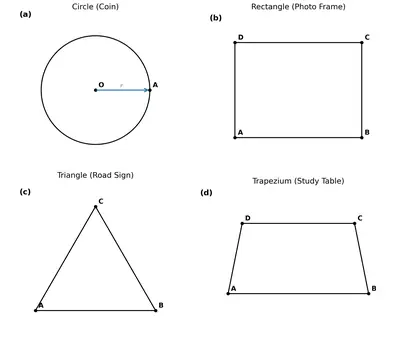
  • Figure (i) – Circle. The perfectly round outline is the same shape that we see in the Sun, the Moon, a coin, the cross–section of a tree-trunk or the rim of any wheel. In geometry we later describe it precisely as the set of all points that remain at a fixed distance (the radius) from one fixed point (the centre).
  • Figure (ii) – Rectangle (or square). This four-sided right-angled shape is the face of a brick, a sheet of paper, a blackboard or the panes of a window. Early builders, when cutting stone blocks or wooden planks, were led naturally to this outline.
  • Figure (iii) – Triangle. Roof-tops of houses, a road-side warning sign, the sloping face of a pyramid or even the cross-section of a mountain ridge all give the same three-sided silhouette. Such day-to-day sightings produced the abstract idea of a triangle.
  • Figure (iv) – Regular hexagon. Bees have been making honey-combs with exactly this six-sided pattern for millions of years. Salt crystals or snow-flakes also display the same outline. These natural patterns suggested the study of regular hexagons.
  • Figure (v) – Spiral curve. The shell of a snail, the curling of a fern tendril, the path of water in a whirl-pool or the windings of a watch-spring all trace an ever-widening spiral. By abstracting that outline, mathematicians defined and analysed plane spirals.

Thus every shape in Fig. 5.1 owes its origin to some familiar object or pattern that human beings observed around them. Abstract geometry was built only after first recognising these concrete outlines in nature and in the artefacts of daily life.

Answer

The outlines in Fig. 5.1 are nothing new — they are the circle of a wheel or the Sun, the rectangle of a brick or paper sheet, the triangle of a roof or road-sign, the hexagon of a honey-comb and the spiral of a snail-shell or whirl-pool. In other words, each shape originates from objects and patterns that we see all around us.

Activity (p.93) List some objects from nature that resemble a circle.

Solution

First, recall that a circle is the set of all points in a plane that are at a fixed distance (called the radius) from a fixed point (called the centre). Whenever a natural object has an outline that keeps the same distance from a central point, it looks circular to the eye.

Examples found in nature include:

  • The apparent shape of the Sun and the full Moon when viewed from Earth.
  • A cross-section of many fruits such as an orange or an apple sliced perpendicular to its axis.
  • Water drops (seen from above) resting on a smooth surface, because surface tension pulls the perimeter into a circle.
  • Soap bubbles when they settle on a flat surface, viewed from the top.
  • The annual growth rings of a tree trunk, visible when the trunk is cut at right angles to its length.
  • Lily pads or some broad circular leaves, whose outlines are nearly perfect circles.

All these shapes have boundaries that are (to a very good approximation) equidistant from a central point, so they resemble circles.

Answer

  • Sun
  • Full Moon
  • Cross-section of an orange or apple
  • Water drop or soap bubble (top view)
  • Tree-trunk growth rings
  • Circular leaves like lily pads

Think and Reflect (p.93) Jamuna has a circular piece of paper. She is trying to locate its centre. Amina gives her a suggestion. She follows the instructions and is thrilled to find that it works. Can you guess what Amina told her?

Solution

Goal. Locate the exact centre of the given circular sheet.

Idea recalled from Euclid. In any circle, the perpendicular bisector of a chord always passes through the centre. Conversely, the point where the perpendicular bisectors of two different chords meet must be the centre of the circle.

Step 1 — Choose the first chord.
Pick any two points A and B on the rim and join them to get chord $$AB$$.

Step 2 — Construct/fold its perpendicular bisector.
• If you have just a ruler and compass: find the midpoint M of $$AB$$ and draw the line through M that is perpendicular to $$AB$$.
• If you are only folding paper (simpler!): fold the paper so that point A exactly falls on B. The crease you obtain is automatically the line that is both the perpendicular to and the bisector of $$AB$$. Call this crease $$\boxed{l_1}$$.

Why does $$l_1$$ pass through the centre?
Let O be the true (unknown) centre. Radii $$OA$$ and $$OB$$ are equal, so $$\triangle OAB$$ is isosceles. In an isosceles triangle the segment joining the vertex to the midpoint of the base is perpendicular to the base; hence $$OM \perp AB$$. Therefore the true centre O lies on $$l_1$$.

Step 3 — Repeat with a second chord.
Pick another pair of rim-points C and D to get chord $$CD$$ (do not choose C or D on $$AB$$ so the two chords are different). Fold as before so that C falls on D; the new crease is the perpendicular bisector $$\boxed{l_2}$$ of $$CD$$.

By exactly the same reasoning, the true centre O also lies on $$l_2$$.

Step 4 — Locate the centre.
Mark the unique intersection point of the two creases $$l_1$$ and $$l_2$$. Call it O. Because O lies on both perpendicular bisectors, it is equidistant from A and B and from C and D, i.e. $$OA = OB = OC = OD$$. That common distance is the radius, so O is the required centre.

Conclusion. Amina’s suggestion was: “Draw (or fold) any two chords of the circular paper and then draw (or crease) their perpendicular bisectors; the point where the two bisectors intersect is the centre of the circle.”

Answer

Draw (or fold) two different chords of the circular paper and construct their perpendicular bisectors; their intersection gives the centre of the circle.

Think and Reflect 1 (p.94) What are the rotational symmetries of a square? How many lines of reflection symmetry does it have? What about a regular pentagon? A regular hexagon?

Solution

Pre–requisite fact. A regular n–gon looks exactly the same after a rotation of $$\dfrac{360^{\circ}}{n}$$ about its centre. It also has as many reflection (mirror) axes as it has sides.

Below we apply this fact to a square (n = 4), a regular pentagon (n = 5) and a regular hexagon (n = 6).

1. Square (n = 4)

  1. Rotational symmetry
    A full turn is $$360^{\circ}$$. The least positive angle at which a square matches its original outline is $$\dfrac{360^{\circ}}{4}=90^{\circ}$$. Hence the identical appearances occur at $$0^{\circ},\;90^{\circ},\;180^{\circ},\;270^{\circ}\;(=360^{\circ}).$$ So there are 4 rotational symmetries.
  2. Reflection symmetry
    Draw the two diagonals and the two lines joining the mid-points of opposite sides; each is a mirror line. Therefore a square has 4 lines of symmetry.

2. Regular pentagon (n = 5)

  1. Rotational symmetry
    Least turning angle: $$\dfrac{360^{\circ}}{5}=72^{\circ}.$$ Successive matching turns are $$0^{\circ},\;72^{\circ},\;144^{\circ},\;216^{\circ},\;288^{\circ}\;(=360^{\circ}).$$ Thus it has 5 rotational symmetries.
  2. Reflection symmetry
    Each mirror line passes through one vertex and the midpoint of the opposite side, giving 5 lines of symmetry.

3. Regular hexagon (n = 6)

  1. Rotational symmetry
    Least turning angle: $$\dfrac{360^{\circ}}{6}=60^{\circ}.$$ Identical positions occur at $$0^{\circ},\;60^{\circ},\;120^{\circ},\;180^{\circ},\;240^{\circ},\;300^{\circ}\;(=360^{\circ}).$$ Hence there are 6 rotational symmetries.
  2. Reflection symmetry
    There are three mirror lines joining opposite vertices and three joining mid-points of opposite sides – altogether 6 lines of symmetry.

Therefore:

  • Square – 4 rotational, 4 reflection lines.
  • Regular pentagon – 5 rotational, 5 reflection lines.
  • Regular hexagon – 6 rotational, 6 reflection lines.

Answer

Square: 4 rotational symmetries (multiples of 90°); 4 mirror lines.
Regular pentagon: 5 rotational symmetries (multiples of 72°); 5 mirror lines.
Regular hexagon: 6 rotational symmetries (multiples of 60°); 6 mirror lines.

Think and Reflect 2 (p.94) What is the length of the longest chord in a circle of radius $$5$$ units? Is there a smallest chord?

Solution

Given A circle with radius $$r = 5\text{ units}$$.

To find (i) the length of its longest chord, (ii) whether a smallest (shortest non-zero) chord exists.

Step 1 · Recall the fact about chords and diameter
For any circle, the diameter is the chord that passes through the centre. A fundamental result proved in Euclid’s geometry is:

  • The greater the perpendicular distance of a chord from the centre, the shorter is the chord, and
  • The chord with zero distance from the centre (that is, the chord containing the centre itself) is the longest possible chord.

Hence, the diameter is always the longest chord of a circle.

Step 2 · Compute the diameter when $$r = 5\text{ units}$$

\[ \text{Diameter} = 2 \times \text{radius} = 2 \times 5 = 10\text{ units} \]

Step 3 · Investigate the “smallest” chord

Take any point $$P$$ on the circumference. Through $$P$$ draw a chord $$PQ$$ making a very small arc near $$P$$. By moving $$Q$$ closer and closer to $$P$$ along the circle we make the chord $$PQ$$ shorter and shorter. There is no positive lower bound on the length thus obtained; the length can be made as close to $$0$$ as we wish, although a chord of exact length $$0$$ would collapse to a single point and hence would not be a chord.

Therefore, while the circle has a longest chord, it has no smallest non-zero chord.

Conclusion

  • The longest chord is the diameter, of length $$10\text{ units}$$.
  • There is no smallest chord; chords can be made arbitrarily small in length.

Answer

The longest chord is the diameter, whose length is $$10\text{ units}$$.

No; a circle has no smallest chord, because chords can be made as short as we please (approaching zero length).

Think and Reflect 3 (p.94)

The locus of points at a given distance from a given point is a circle. What can we say about the locus of points equidistant from two given points?

(Hint: We know that any point that is equidistant from two given points $$A$$ and $$B$$ lies on the perpendicular bisector of $$AB$$. Does this make the perpendicular bisector the locus? For this, we have to show that all the points on the perpendicular bisector are equidistant from $$A$$ and $$B$$.)

Solution

Given : Two fixed points $$A$$ and $$B$$ in a plane.

To prove : The set (locus) of all points which are equidistant from $$A$$ and $$B$$ is the perpendicular bisector of the line segment $$AB$$.

We break the work into two parts:

  1. Every point that is equidistant from $$A$$ and $$B$$ lies on the perpendicular bisector of $$AB$$.
  2. Every point on the perpendicular bisector of $$AB$$ is equidistant from $$A$$ and $$B$$.

Construction for reference (make this in your notebook):
Draw the segment $$AB$$. Mark its midpoint $$M$$ by taking $$AM = MB$$. Through $$M$$ draw a straight line $$l$$ perpendicular to $$AB$$. Line $$l$$ is called the perpendicular bisector of $$AB$$.


Part 1  ("Only if")

Let $$P$$ be any point such that $$PA = PB$$.

  • In $$\triangle PAB$$, we have two equal sides: $$PA = PB$$. Hence $$\triangle PAB$$ is isosceles with base $$AB$$.
  • In an isosceles triangle the angles at the base are equal, so
    $$\angle PAB = \angle PBA$$.
  • When the base angles are equal, the line segment from the vertex $$P$$ to the midpoint $$M$$ of the base $$AB$$ is perpendicular to the base (Class-IX theorems) and also bisects it.

Thus $$M$$ is the midpoint of $$AB$$ and $$PM \perp AB$$, which places $$P$$ on the perpendicular bisector $$l$$.

Therefore every point equidistant from $$A$$ and $$B$$ lies on the perpendicular bisector of $$AB$$.


Part 2  ("If")

Now take any point $$P$$ on the perpendicular bisector $$l$$.

  • Since $$l$$ passes through $$M$$, we have $$AM = MB$$ (definition of a midpoint).
  • Since $$l$$ is perpendicular to $$AB$$ at $$M$$, the triangles $$\triangle PMA$$ and $$\triangle PMB$$ are right triangles with the right angle at $$M$$.
  • In these two right triangles we know:
       $$PM$$ is common,
       $$AM = MB$$  (midpoint condition),
       and each has a right angle at $$M$$.

Thus, by the Hypotenuse–Leg (HL) criterion (right-triangle version of SAS),
\[ \triangle PMA \cong \triangle PMB. \]

Corresponding parts of congruent triangles are equal, so
$$PA = PB$$.

Therefore every point on the perpendicular bisector of $$AB$$ is equidistant from $$A$$ and $$B$$.


Combining Parts 1 and 2 we see that

  • The points equidistant from $$A$$ and $$B$$ lie only on the perpendicular bisector, and
  • every point on the perpendicular bisector is equidistant from $$A$$ and $$B$$.

Hence the perpendicular bisector of $$AB$$ is precisely the locus of points equidistant from the two given points.

Answer

The required locus is the straight line that perpendicularly bisects the segment $$AB$$; every and only those points on this perpendicular bisector are equidistant from $$A$$ and $$B$$.

Think and Reflect 1 (p.95) How many circles pass through two points on a plane?

Solution

Given : Two distinct points A and B in a plane.

To prove : Infinitely many (an un-countable number of) circles can be drawn which pass through A and B.

Definition : A circle is the collection of all points in the plane that are at a fixed distance (called the radius) from a fixed point (called the centre).

Let the distance between the given points be $$AB = d$$.

For any circle through A and B, its centre O must satisfy the condition

$$OA = OB = r$$

because A and B are both points on that circle, so they must be at the same distance r from the centre O.

This means the centre O is equidistant from A and B. The set of all points that are equidistant from two given points is the perpendicular bisector of the segment AB.

Construct the perpendicular bisector ℓ of $$\overline{AB}$$. (If you actually draw the figure, mark the midpoint M of $$\overline{AB}$$, erect a perpendicular at M, and extend it in both directions; that entire line is ℓ.)

Every point O lying on ℓ automatically gives $$OA = OB$$, hence serves as a possible centre of a circle through A and B. Conversely, no point outside ℓ can be the centre, because then the distances to A and B would be unequal.

Now observe that a straight line contains infinitely many points. Therefore ℓ contains infinitely many choices for the centre O. For each such choice the radius is fixed as $$r = OA = OB$$, so we obtain a different circle (the radii vary from a value just greater than $$\tfrac{d}{2}$$ up to as large as we like).

Hence there is no upper bound on the number of distinct circles through A and B; there are infinitely many of them.

Conclusion : Through any two distinct points in a plane, infinitely many circles can be drawn.

Answer

Infinitely many circles

Think and Reflect 2 (p.95) Are there circles of all possible radii passing through $$A$$ and $$B$$? What is the radius of the smallest circle passing through $$A$$ and $$B$$? What is the radius of the largest circle passing through $$A$$ and $$B$$?

Solution

Given. Two fixed, distinct points $$A$$ and $$B$$ in the plane.

We have to investigate all the circles that pass through both $$A$$ and $$B$$ and then find the least and the greatest possible radius among them.

1. Locus of the centres.

For a circle to pass through $$A$$ and $$B$$, its centre $$O$$ must be at equal distance from the two points, i. e. $$OA = OB$$. The set of all points that are equidistant from $$A$$ and $$B$$ is the perpendicular bisector of the segment $$AB$$ (a theorem proved earlier in the chapter). Hence

All the centres of the required circles lie on the perpendicular bisector of $$AB$$, and every point of that bisector is the centre of exactly one such circle (its radius is that common distance to $$A$$ and $$B$$).

2. Expressing the radius in terms of the centre’s position.

Let $$M$$ be the midpoint of $$AB$$ and let $$O$$ be an arbitrary point on the perpendicular bisector. Denote by $$d$$ the distance from $$O$$ to the line $$AB$$, i. e. $$d = OM$$.

In right $$\triangle OMA$$ we have

$$OA^2 = OM^2 + MA^2$$ (by Pythagoras).

But $$MA = \dfrac{AB}{2}$$, therefore

$$OA^2 = d^2 + \left( \dfrac{AB}{2} \right)^2.$$

The radius $$r$$ of the circle with centre $$O$$ is $$r = OA = OB$$, so

$$r = \sqrt{ d^2 + \left( \dfrac{AB}{2} \right)^2 }.$$

3. The smallest possible radius.

  • The quantity $$\left( \dfrac{AB}{2} \right)^2$$ is fixed (because $$A$$ and $$B$$ are fixed).
  • $$d^2 \ge 0$$, and it attains its minimum value $$0$$ when the centre $$O$$ coincides with $$M$$ (i. e. when $$O$$ lies on the segment $$AB$$).

Thus the minimum radius is obtained at $$d = 0$$:

\[ r_{\text{min}} = \sqrt{ 0 + \left( \dfrac{AB}{2} \right)^2 } = \dfrac{AB}{2}. \]

This is the circle that has $$AB$$ as a diameter (centre $$M$$).

4. The largest possible radius.

Because the perpendicular bisector extends indefinitely on both sides of $$AB$$, the distance $$d$$ can be made as large as we please. As $$d \to \infty$$, the expression $$r = \sqrt{ d^2 + \left( \dfrac{AB}{2} \right)^2 }$$ also grows without bound. Therefore

There is no greatest radius; we can obtain circles of arbitrarily large radii by choosing centres farther and farther away from the segment $$AB$$ along its perpendicular bisector.

5. Answer to the three parts.

  1. Yes. Infinitely many circles of different radii can be drawn through $$A$$ and $$B$$ – one for every point on the perpendicular bisector of $$AB$$.
  2. The smallest possible radius is $$\dfrac{AB}{2}$$ (the circle with $$AB$$ as diameter).
  3. There is no largest radius; the radius can be made as large as desired, so it is said to be unbounded or tends to infinity.

Answer

Yes; infinitely many.

Smallest radius = $$\dfrac{AB}{2}$$.

No largest radius; it can be made arbitrarily big  ($$r \to \infty$$).

Think and Reflect 3 (p.95) As you move away from segment $$AB$$ along its perpendicular bisector, do the radii of the circles containing $$A$$ and $$B$$ increase or decrease?

Solution

Given : A fixed segment $$AB$$. Any circle that passes through both $$A$$ and $$B$$ must have its centre somewhere on the perpendicular bisector of $$AB$$ (because the centre is equidistant from $$A$$ and $$B$$).

Let

  • $$AB$$ have midpoint $$M$$, so $$AM = MB$$.
  • $$AM = MB = c$$ (half the length of $$AB$$).
  • $$O$$ be an arbitrary point on the perpendicular bisector, at a distance $$d$$ from the segment (more precisely, $$OM = d$$, where $$OM\perp AB$$).

Diagram to draw: Segment $$AB$$ with midpoint $$M$$; the perpendicular bisector drawn through $$M$$. Mark a point $$O$$ on that bisector, at some height above $$AB$$. Join $$OA$$ and $$OB$$.

Because $$M$$ is the midpoint and $$OM\perp AB$$, triangle $$OAM$$ is right-angled at $$M$$. Apply the Pythagoras theorem in $$\triangle OAM$$:

$$OA^2 = AM^2 + OM^2$$

Substituting the names of the lengths,

$$OA^2 = c^2 + d^2 \quad\Longrightarrow\quad OA = \sqrt{c^2 + d^2}$$

The same calculation gives $$OB = \sqrt{c^2 + d^2}$$, so the circle’s radius is

\[ r = OA = OB = \sqrt{c^2 + d^2} \]

Now notice:

  • The half-length $$c = AM$$ is a fixed constant (since $$A$$ and $$B$$ do not move).
  • The perpendicular distance $$d = OM$$ increases precisely when we “move away from the segment $$AB$$ along its perpendicular bisector”.

Because the expression $$\sqrt{c^2 + d^2}$$ increases whenever $$d$$ increases (square-root is an increasing function and $$c^2$$ is fixed), the radius $$r$$ gets larger the farther we go from the segment.

Conclusion : As you move away from the segment $$AB$$ along its perpendicular bisector, the radii of all possible circles through $$A$$ and $$B$$ increase.

Answer

The radius increases.

Think and Reflect 4 (p.95) As you go along the perpendicular bisector, will the circle drawn from that point through $$A$$ and $$B$$ appear more curved or less curved?

Solution

Let the two fixed points be A and B and let M be the midpoint of the segment $$AB$$. The perpendicular bisector of $$AB$$ is the line through M perpendicular to $$AB$$.

Choose any point P on this perpendicular bisector. Join $$PA$$ and $$PB$$. Because P is on the perpendicular bisector we have

$$PA = PB$$ (points on the perpendicular bisector of a segment are equidistant from its end-points).

Thus the circle with centre P and radius $$PA$$ passes through both A and B.

To compare how “curved” the different circles look, we compare their radii. The larger the radius, the flatter (less curved) the circle appears in the neighbourhood of $$A$$ and $$B$$; the smaller the radius, the tighter (more curved) it looks.

Introduce the notation

  • $$AB = 2d\;(d > 0)\;,$$ so $$AM = MB = d$$.
  • The perpendicular distance of P from $$AB$$, i.e. $$PM$$, is called $$h\:(h \ge 0)$$.

In right-angled triangle $$\triangle PAM$$ (right angle at M) we apply Pythagoras’ theorem:

$$PA^2 = PM^2 + AM^2\;.$$

That is,

$$PA^2 = h^2 + d^2 \;\;\Longrightarrow\;\; PA = \sqrt{h^2 + d^2}\;.$$

The radius $$r$$ of the required circle is therefore

$$r = PA = \sqrt{h^2 + d^2}\;.$$

Observe what happens as we move the centre P along the perpendicular bisector:

  • If we go farther away from the segment $$AB$$, the value of $$h$$ increases, so $$r = \sqrt{h^2 + d^2}$$ also increases.
  • If we come closer to the segment $$AB$$, the value of $$h$$ decreases, so $$r$$ decreases.

Since curvature is inversely related to the radius (larger radius ⇒ smaller curvature), a larger $$r$$ makes the arc through A and B appear flatter, i.e. less curved. Conversely, a smaller $$r$$ makes it look more curved.

Hence, as you proceed along the perpendicular bisector away from the segment $$AB$$, the circle you draw through $$A$$ and $$B$$ becomes less curved.

Answer

It appears less curved — the farther you move out along the perpendicular bisector, the larger the radius $$PA$$ becomes, so the circle becomes flatter.

Think and Reflect 5 (p.95) You are given two points $$A$$ and $$B$$ on a plane. How many squares can you draw on the same plane with $$A$$ and $$B$$ on the boundary? How many squares can you draw on the plane with $$A$$ and $$B$$ as the corners of the square?

Solution

Let $$A$$ and $$B$$ be two distinct points in the Euclidean plane.

We treat separately

  1. Squares with $$A$$ and $$B$$ anywhere on the boundary (perimeter)
  2. Squares with $$A$$ and $$B$$ as corners (vertices)

1. Squares having $$A$$ and $$B$$ on the boundary

The boundary of a square consists of four equal straight-line segments. In order that the two given points lie on that boundary, it is not necessary that they be vertices; they may lie anywhere on any of the four sides.

Choose the following construction.

  • Draw the line $$\overline{AB}$$. Decide any real number $$s$$ with $$s\gt AB$$ to be the length of a side of a square.
  • On $$\overline{AB}$$ mark a point $$P$$ so that $$AP=s$$. (There are two possibilities, extending $$A$$ towards $$B$$ or away from it.)
  • At $$A$$ erect a perpendicular of length $$s$$; call its end $$D$$. Through $$D$$ draw a line parallel to $$\overline{AB}$$ and through $$P$$ draw a line parallel to $$AD$$. Their intersection is $$C$$. The quadrilateral $$ADCP$$ is a square of side $$s$$ that certainly contains $$A$$ on one side and, by choice of the mark $$P$$, contains $$B$$ somewhere on the same side or on the continuation of that side.

Because the number $$s$$ can be chosen in infinitely many ways (every real number bigger than $$AB$$ is admissible) and because we may choose the perpendicular to rise on either side of $$\overline{AB}$$, there are infinitely many different squares containing both $$A$$ and $$B$$ on their perimeters.

Hence, the answer to part (1) is: infinitely many squares.

2. Squares having $$A$$ and $$B$$ as vertices

All squares are rigid figures, so only the relative position of $$A$$ to $$B$$ matters. There are exactly two geometric possibilities.

  1. Segment $$AB$$ is a side of the square.
  • At $$A$$ draw a line through $$A$$ perpendicular to $$\overline{AB}$$ and mark off a length equal to $$AB$$ to reach a point $$D$$.
  • Through $$B$$ draw a line parallel to $$AD$$ and through $$D$$ draw a line parallel to $$AB$$; their intersection is $$C$$.
  • The quadrilateral $$ABCD$$ is a square because all sides are $$AB$$ in length and adjacent sides are perpendicular.
  • Instead of erecting the perpendicular on the $${\text{upper}}$$ side of $$\overline{AB}$$ we could equally well erect it on the $${\text{lower}}$$ side. These two choices give two non-overlapping squares.

Therefore, when $$AB$$ is taken as a side, exactly two squares are possible.

  1. Segment $$AB$$ is a diagonal of the square.
  • Let $$M$$ be the midpoint of $$\overline{AB}$$. In any square the diagonals bisect one another at right angles. Hence the other diagonal must be the line through $$M$$ perpendicular to $$\overline{AB}$$.
  • Call $$\vec{v}=\overrightarrow{MA}$$. A rotation of $$\vec{v}$$ through $$90^{\circ}$$ gives a new vector $$\vec{w}$$ with the same length $$|\vec{v}|$$. The remaining two vertices are $$C=M+\vec{w},\; D=M-\vec{w}.$$
  • Using the opposite rotation (\(-90^{\circ}\)) merely exchanges the names of $$C$$ and $$D$$, producing the same square. Thus there is one and only one square for which $$AB$$ is a diagonal.

Combining both sub-cases,

  • 2 squares with $$AB$$ as a side,
  • 1 square with $$AB$$ as a diagonal,

gives a total of $$2+1=3$$ distinct squares.

Final count

Condition on $$A,B$$Number of squares
Only required to lie on the boundaryInfinitely many
Required to be verticesExactly 3

Answer

• With $$A$$ and $$B$$ merely on the boundary: infinitely many squares can be drawn.
• With $$A$$ and $$B$$ as vertices: 3 different squares can be drawn.

Exercise Set 5.1

1

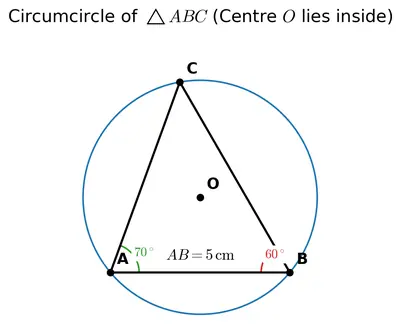
Draw $$\triangle ABC$$ with $$AB = 5 \, \mathrm{cm}$$, $$\angle A = 70^\circ$$ and $$\angle B = 60^\circ$$. Draw the circumcircle of $$\triangle ABC$$. Is the centre inside or outside the triangle?
Figure
Figure

Solution

Given data

  • Side $$AB = 5\,\text{cm}$$
  • $$\angle A = 70^{\circ}$$
  • $$\angle B = 60^{\circ}$$

Because the three interior angles of a triangle add up to $$180^{\circ}$$, we first find $$\angle C$$:

$$\angle C = 180^{\circ} - (70^{\circ} + 60^{\circ}) = 50^{\circ}.$$

Every angle of the triangle is less than $$90^{\circ}$$, so $$\triangle ABC$$ is an acute triangle.


Construction of $$\triangle ABC$$

  1. Draw a horizontal base line and mark two points on it, naming them A and B, such that the length $$AB = 5\,\text{cm}$$ (use a ruler).
  2. At point A construct an angle of $$70^{\circ}$$ with $$AB$$ as one arm.
      • Place a protractor at A, mark the $$70^{\circ}$$ point, and draw a ray that passes through that mark. Call the ray AX.
  3. At point B construct an angle of $$60^{\circ}$$ with $$BA$$ as one arm.
      • Place the protractor at B, mark the $$60^{\circ}$$ point, and draw ray BY.
  4. The two rays AX and BY meet at some point. Label that intersection as C.
  5. Join BC and AC to complete $$\triangle ABC$$.

Construction of the circumcircle of $$\triangle ABC$$

  1. Perpendicular bisector of $$AB$$:
      • With centres A and B and any radius more than half of $$AB$$, draw two arcs above and below $$AB$$.
      • Join the intersection points of those arcs. This straight line is the perpendicular bisector of $$AB$$.
  2. Perpendicular bisector of $$BC$$:
      • Repeat the same process for side $$BC$$ to obtain its perpendicular bisector.
  3. The two perpendicular bisectors meet at a point. Call this point O. By Euclid’s result, all three perpendicular bisectors of a triangle are concurrent; the common point O is called the circumcentre of the triangle.
  4. Measure the distance $$OA$$ with a compass. This length is the radius of the required circumcircle (because the circumcentre is equidistant from all three vertices).
  5. With centre O and radius $$OA$$, draw a circle. The circle passes through A, B and C; hence it is the circumcircle of $$\triangle ABC$$.

Location of the circumcentre

Since $$\triangle ABC$$ is acute (all three interior angles are strictly less than $$90^{\circ}$$), the circumcentre O necessarily lies inside the triangle. This follows from the basic property proved in Euclid’s geometry that:

"The perpendicular bisectors of the three sides of an acute triangle meet at a point that lies in the interior of the triangle."

Thus, in this construction, the centre O of the circumcircle lies inside $$\triangle ABC$$.

Answer

The circumcentre lies inside the triangle.

2

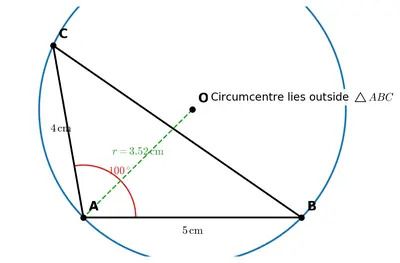
Draw $$\triangle ABC$$ with $$AB = 5 \, \mathrm{cm}$$, $$\angle A = 100^\circ$$, $$AC = 4 \, \mathrm{cm}$$. Draw the circumcircle of $$\triangle ABC$$. Is the centre inside or outside the triangle?
Figure
Figure

Solution

Given data

  • Side $$AB = 5\;\text{cm}$$
  • Side $$AC = 4\;\text{cm}$$
  • Included angle $$\angle A = 100^{\circ}$$ (obtuse)

Required — (i) construct $$\triangle ABC$$, (ii) draw its circumcircle, (iii) state whether the circum-centre lies inside or outside the triangle.

Construction steps

  1. Draw the base.
    Draw a straight line and mark two points A and B on it such that $$AB = 5\;\text{cm}$$.
  2. Construct the given angle at A.
    Using a protractor place its centre at A; mark a point on the ray making $$100^{\circ}$$ with $$AB$$ on the side opposite to $$B$$. Draw the ray $$AX$$ through that mark. Thus $$\angle BAX = 100^{\circ}$$.
  3. Locate point C.
    With centre A and radius $$4\;\text{cm}$$ draw an arc to meet ray $$AX$$ at C. Now $$AC = 4\;\text{cm}$$. Join $$BC$$. $$\triangle ABC$$ is obtained with the required measurements.
  4. Construct the perpendicular bisector of side AB.
    Keeping the same radius more than half of $$AB$$, draw arcs above and below $$AB$$ with centres A and B. The arcs intersect at two points; join them to obtain the perpendicular bisector $$l_1$$ of $$AB$$.
  5. Construct the perpendicular bisector of side AC.
    Repeat the same procedure for $$AC$$ to obtain its perpendicular bisector $$l_2$$.
  6. Locate the circum-centre O.
    Mark the intersection of $$l_1$$ and $$l_2$$ as O. By definition O is equidistant from A, B and C.
  7. Draw the circumcircle.
    With centre O and radius $$OA$$ draw a circle. It will pass through points B and C automatically; this is the circumcircle of $$\triangle ABC$$.

Reasoning about the position of O

The triangle has an obtuse angle at $$A\,(100^{\circ}\!>90^{\circ})$$. A well-known Euclidean result states:

“In an acute triangle the circum-centre lies inside, in a right triangle on the hypotenuse, and in an obtuse triangle outside the triangle on the side opposite the obtuse angle.”

Hence, since $$\triangle ABC$$ is obtuse at A, the circum-centre O must lie outside the triangle, on the far side of the line $$BC$$ which is opposite the obtuse angle.

Verification

  • Measure $$OB$$ and $$OC$$ with a compass; they equal $$OA$$, confirming the correctness of the circumcircle.
  • Notice that point O indeed lies outside the boundaries of $$\triangle ABC$$.

Result

The circumcircle is drawn and its centre lies outside $$\triangle ABC$$, on the side opposite the obtuse angle at A.

Answer

The circum-centre of the constructed triangle lies outside $$\triangle ABC$$ (because the triangle is obtuse at $$A=100^{\circ}$$).

3

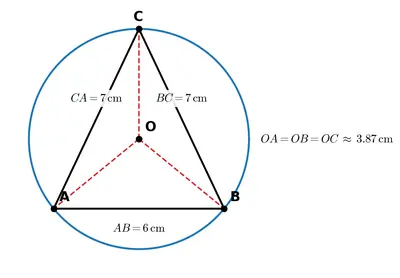
Draw $$\triangle ABC$$, with $$AB = 6 \, \mathrm{cm}$$, $$BC = 7 \, \mathrm{cm}$$ and $$CA = 7 \, \mathrm{cm}$$. Draw the circumcircle of $$\triangle ABC$$. Let the circumcentre be $$O$$. Measure $$OA$$, $$OB$$, $$OC$$.
Figure
Figure

Solution

Given data

  • $$AB = 6\,\text{cm}$$
  • $$BC = 7\,\text{cm}$$
  • $$CA = 7\,\text{cm}$$ (so $$\triangle ABC$$ is isosceles with vertex $$C$$ and base $$AB$$)

We have to (i) construct $$\triangle ABC$$, (ii) draw its circumcircle, (iii) locate the circum-centre $$O$$ and (iv) measure $$OA,\;OB,\;OC$$.

Construction steps

  1. Draw the base.
    Draw a straight line segment $$AB = 6\,\text{cm}$$ with the help of a ruler.
  2. Locate vertex $$C$$.
    • With centre $$A$$ and radius $$7\,\text{cm}$$ draw an arc above the line $$AB$$.
    • With centre $$B$$ and the same radius $$7\,\text{cm}$$ draw another arc to cut the first arc at a point; mark the intersection as $$C$$.
    Because both radii are $$7\,\text{cm}$$, we have automatically ensured $$CA = BC = 7\,\text{cm}$$.
  3. Complete the triangle.
    Join $$C$$ to $$A$$ and $$C$$ to $$B$$. $$\triangle ABC$$ is now drawn.
  4. Construct two perpendicular bisectors.
    (Any two sides suffice.)
    • Side $$AB$$: With centres $$A$$ and $$B$$ and radius more than half of $$AB$$, draw arcs above and below $$AB$$ to intersect at two points; join these intersection points to obtain the perpendicular bisector of $$AB$$.
    • Side $$AC$$: Repeat the same procedure for $$AC$$ to get its perpendicular bisector.
  5. Mark the circum-centre.
    The two bisectors meet at a point $$O$$. This point is equidistant from $$A,\,B,\,C$$ and is called the circum-centre of $$\triangle ABC$$.
  6. Draw the circumcircle.
    With centre $$O$$ and radius $$OA$$ (distance from $$O$$ to any one vertex), draw a circle. The circle will pass through all three vertices $$A,\,B,\,C$$; it is the required circumcircle.
  7. Measure the radii.
    Using a ruler or dividers measure $$OA,\;OB,\;OC$$. All three lengths are the same (a useful check on your construction); in an accurately drawn figure the length is found to be about $$3.9\,\text{cm}$$ (≈ 4 cm if rounded to the nearest millimetre).

Why the three lengths are equal

The point $$O$$ is the intersection of the perpendicular bisectors of the three sides of a triangle, and Euclid proved that such a point is equidistant from the three vertices. Hence $$OA = OB = OC$$ by definition; the measurement merely verifies this numerically.

Numerical confirmation (optional calculation)

For any triangle the circum-radius $$R$$ is given by $$R = \dfrac{abc}{4\Delta}$$, where $$a = BC$$, $$b = CA$$, $$c = AB$$ and $$\Delta$$ is the area.

$$a = 7\,\text{cm},\; b = 7\,\text{cm},\; c = 6\,\text{cm}$$
Semiperimeter $$s = \dfrac{a + b + c}{2} = \dfrac{7 + 7 + 6}{2} = 10\,\text{cm}$$
$$\Delta = \sqrt{s(s-a)(s-b)(s-c)} \\ = \sqrt{10\times3\times3\times4} = \sqrt{360} \approx 18.97\,\text{cm}^2$$
$$R = \dfrac{abc}{4\Delta} = \dfrac{7\times7\times6}{4\times18.97} \approx 3.87\,\text{cm}$$

This theoretical value matches the practical measurement (≈ 3.9 cm), confirming that $$OA = OB = OC$$.

Result

The circum-radius of the triangle is about $$3.9\,\text{cm}$$, so

$$OA = OB = OC \approx 3.9\,\text{cm}.$$

Answer

$$OA = OB = OC \approx 3.9\,\text{cm}$$

4 What is the least possible radius of a circle through two points $$A$$ and $$B$$?

Solution

Given : Two fixed points $$A$$ and $$B$$ in a plane.
To find : The smallest (least possible) radius $$r_{\min}$$ of a circle that can be drawn so that the circle passes through both $$A$$ and $$B$$.

Step 1 – Recall a basic fact about circles
For any circle, all points that are equidistant from $$A$$ and $$B$$ lie on the perpendicular bisector of the segment $$AB$$. Therefore, the centre of every circle through $$A$$ and $$B$$ must be some point $$O$$ on that perpendicular bisector, and for every such centre

$$OA = OB = R$$   (the common distance is the radius).

Step 2 – Describe the set of admissible centres
Let $$M$$ be the mid-point of $$AB$$. The line through $$M$$ that is perpendicular to $$AB$$ is the perpendicular bisector. Any admissible centre $$O$$ must lie on this line. Write $$OM = d$$ for the distance of the centre from $$M$$. By right-triangle geometry, with $$\triangle OMA$$ right-angled at $$M$$, we have

$$OA^2 = OM^2 + MA^2$$.

Step 3 – Express the radius in terms of $$d$$
Because $$MA = \dfrac{AB}{2}$$, we obtain

$$R^2 = d^2 + \left(\dfrac{AB}{2}\right)^2$$   or   $$R = \sqrt{d^2 + \left(\dfrac{AB}{2}\right)^2}$$.

Step 4 – Minimise the radius
The quantity $$\left(\dfrac{AB}{2}\right)^2$$ is fixed (the two points are fixed). The only variable is $$d = OM$$, which is a non-negative length. The square-root expression is clearly smallest when $$d = 0$$, that is, when

$$O \equiv M$$   (the centre coincides with the mid-point).

Hence the least possible radius is obtained for the unique circle whose diameter is the segment $$AB$$ itself. Substituting $$d = 0$$ gives

\[ r_{\min} = \dfrac{AB}{2}. \]

Conclusion
The smallest circle that can be drawn through two fixed points $$A$$ and $$B$$ is the one whose diameter is $$AB$$, and its radius is exactly half the distance between the two points.

Answer

Least possible radius  =  $$\dfrac{AB}{2}$$.

Think, Draw and Infer (after Exercise Set 5.1)

1

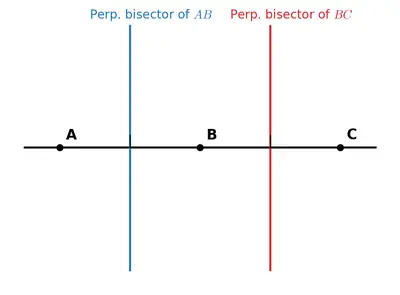
$$A$$, $$B$$ and $$C$$ are three collinear points. Can you find a point $$P$$ such that $$PA = PB = PC$$? What can you say about the perpendicular bisectors of $$AB$$ and $$BC$$? Draw and check. Can you show that for three collinear points $$A$$, $$B$$ and $$C$$, the perpendicular bisector of $$AB$$ and $$BC$$ are parallel? Is it possible for a circle to pass through collinear points? Can you draw a line that cuts a given circle in three distinct points?
Figure
Figure

Solution

Given three distinct collinear points $$A,B,C$$ lying on the same straight line $$ ext{ℓ}$$ (take the order $$A,B,C$$ on $$ ext{ℓ}$$).

We discuss four connected questions step-by-step.

1. Can a point P be found so that $$PA = PB = PC$$ ?

  • Because $$PA = PB$$, the point P must lie on the perpendicular bisector of $$AB$$ (call this line $$m_1$$).
  • Because $$PB = PC$$, the same point P must also lie on the perpendicular bisector of $$BC$$ (call this line $$m_2$$).
  • A single point P would therefore have to be the intersection $$m_1 \cap m_2$$.

So the question reduces to: “Do the two perpendicular bisectors $$m_1$$ and $$m_2$$ intersect?” The next section shows that they are parallel; hence they never meet and no such point P exists.

2. Why are the perpendicular bisectors of $$AB$$ and $$BC$$ parallel?

  • Segment $$AB$$ lies on line $$\text{ℓ}$$, so its perpendicular bisector $$m_1$$ is perpendicular to $$\text{ℓ}$$:
    $$m_1 \perp \text{ℓ}.$$
  • Segment $$BC$$ also lies on the same line $$\text{ℓ}$$, hence its perpendicular bisector $$m_2$$ is perpendicular to $$\text{ℓ}$$ as well:
    $$m_2 \perp \text{ℓ}.$$
  • If two lines are perpendicular to the same line, they are parallel to each other. Therefore
    $$m_1 \parallel m_2.$$

Because the bisectors are parallel and have different mid-points (mid-point of $$AB$$ is not the same as that of $$BC$$), they are distinct parallel lines, so they never intersect.

To draw and verify: On a sheet draw a straight line, mark three points $$A,B,C$$ on it, construct the perpendicular bisector of $$AB$$ and that of $$BC$$ with a compass and straightedge. You will see two distinct parallel lines.

3. Can a circle pass through the three collinear points $$A,B,C$$?

The centre of such a circle would have to be equidistant from all three points; i.e. it would have to lie at $$m_1 \cap m_2$$, a point that does not exist. Hence

No circle can be drawn through three distinct collinear points.

4. Can a straight line intersect a given circle in three distinct points?

  • Algebraically, the points of intersection of a line and a circle are obtained by solving one linear and one quadratic equation; at most two real solutions are possible.
  • Geometrically, when you draw a line across a circle you enter and leave the circle exactly once, giving at most two common points (a tangent is the limiting case with exactly one).

Therefore a line can meet a circle in 0, 1 or 2 points, but never in three distinct points.

Conclusion

  • No point P exists with $$PA = PB = PC$$ for three distinct collinear points.$$\qquad$$
  • The perpendicular bisectors of $$AB$$ and $$BC$$ are distinct, parallel lines.$$\qquad$$
  • No single circle can pass through three collinear points.$$\qquad$$
  • It is impossible for one straight line to cut a circle in three distinct points.

Answer

No such point P exists; the perpendicular bisectors of $$AB$$ and $$BC$$ are parallel, so they never meet. Hence no circle can pass through three distinct collinear points, and a straight line can intersect a circle in at most two points, never three.

2 The circumcircle of a given $$\triangle ABC$$ is drawn. Can there be other triangles congruent to $$\triangle ABC$$ that share the same circumcircle?

Solution

Let the circumcircle of the given $$\triangle ABC$$ have centre $$O$$ and radius $$R$$, so that

$$OA = OB = OC = R.$$

Idea. A rotation about the point $$O$$ keeps every distance unchanged (it is a rigid motion) and therefore carries any figure to a congruent copy of itself. At the same time, because the centre is fixed, the image of every vertex still lies exactly $$R$$ units from $$O$$ – that is, it still lies on the same circle.

Construction of another congruent triangle.

  1. Choose any angle $$\theta$$ with $$0^{\circ}<\theta<360^{\circ}$$ and $$\theta\neq 360^{\circ}k$$ for every integer $$k$$ (so that the image does not fall back on the original triangle).
  2. Rotate the whole plane about $$O$$ through the angle $$\theta$$. Denote the images of $$A,\,B,\,C$$ by $$A',\,B',\,C'$$ respectively.

Why the new triangle is congruent.

The rotation is a distance–preserving transformation, hence

$$A'B' = AB, \; B'C' = BC, \; C'A' = CA.$$

Therefore, by the SSS criterion,

\[\triangle A'B'C' \cong \triangle ABC.\]

Why the new triangle shares the same circumcircle.

Because the centre $$O$$ does not move in the rotation,

$$OA' = OB' = OC' = R,$$

so the three new vertices still lie on the very same circle that contains $$A,\,B,\,C$$.

Distinctness. Since $$\theta$$ is not a full multiple of $$360^{\circ}$$, at least one of $$A',\,B',\,C'$$ differs from the corresponding original point, so $$\triangle A'B'C'$$ is a different triangle, not just a relabelling of $$\triangle ABC$$.

Hence a second triangle, congruent to the given one, lying on the same circumcircle has been obtained. Because the angle $$\theta$$ may be chosen in infinitely many ways, there are in fact infinitely many such triangles. (Reflections in any diameter of the circle provide still more examples.)

Conclusion. Yes — there are infinitely many triangles congruent to the given $$\triangle ABC$$ that can be inscribed in its circumcircle.

Answer

Yes. Rotate $$\triangle ABC$$ about its circum-centre through any angle that is not a full multiple of $$360^{\circ}$$; the three images stay on the same circle and, because rotation preserves lengths, form a distinct triangle congruent to $$\triangle ABC$$. Since the rotation angle can be chosen arbitrarily, infinitely many such congruent triangles share the circumcircle.

Exercise Set 5.2

1 Show that the triangle formed by a chord and the centre of the circle is isosceles.

Solution

Given: A circle with centre $$O$$ and a chord $$AB$$. Joining $$O$$ to the ends of the chord forms $$\triangle OAB$$.

To prove: $$\triangle OAB$$ is isosceles, i.e. $$OA = OB$$.

Proof:

  1. By definition, a radius of a circle is a line segment that joins the centre of the circle to any point on the circle.
  2. Because $$A$$ and $$B$$ lie on the circle (they are the endpoints of chord $$AB$$), the segments $$OA$$ and $$OB$$ are both radii.
  3. All radii of the same circle are equal.
    Reason: Euclid’s Common Notion 1 states, “Things which are equal to the same thing are equal to one another.” Every radius is equal to the fixed distance called the radius of the circle; thus $$OA$$ equals that distance and $$OB$$ equals the same distance, giving $$OA = OB$$.
  4. Since two sides of $$\triangle OAB$$ are equal, the triangle satisfies the definition of an isosceles triangle.

Therefore, the triangle formed by any chord and the centre of its circle is isosceles.

Answer

Triangle $$OAB$$ is isosceles because $$OA = OB$$.

2 Show that if two such isosceles triangles (occurring in the previous question) have equal base length, they are congruent to each other.

Solution

Recall. In Question 1 we proved that the triangle formed by any chord of a circle together with its centre is isosceles, the two equal sides being the radii drawn to the two end-points of the chord.

Given. Let the circle have centre $$O$$ and radius $$r$$. Take any two chords $$AB$$ and $$CD$$ of this circle and form the two isosceles triangles $$\triangle OAB\quad\text{and}\quad\triangle OCD,$$ in which the equal sides are the radii $$OA, OB$$ and $$OC, OD$$ respectively; the bases are the chords $$AB$$ and $$CD$$. Assume that the two bases have equal length, i.e.

$$AB = CD.$$

To prove. $$\triangle OAB \cong \triangle OCD.$$

Proof.

  1. The points $$A,\,B,\,C,\,D$$ all lie on the same circle of centre $$O$$, so every segment joining $$O$$ to any one of them is a radius. Hence

    $$OA = OB = OC = OD = r.$$

  2. Compare $$\triangle OAB$$ with $$\triangle OCD$$:

    • $$OA = OC$$  (each equals $$r$$),
    • $$OB = OD$$  (each equals $$r$$),
    • $$AB = CD$$  (given – equal base lengths).

    Thus the three sides of $$\triangle OAB$$ are equal, in pairs, to the three corresponding sides of $$\triangle OCD$$.

  3. By the SSS (Side-Side-Side) congruence criterion,

    \[\triangle OAB \cong \triangle OCD.\]

Conclusion. Any two isosceles triangles of the kind described in Question 1 (i.e. formed by a chord and the centre of the circle) are congruent whenever their bases — the two chords — are equal in length. □

Answer

Proved: with $$OA = OB = OC = OD = r$$ (all radii) and $$AB = CD$$ (equal bases), $$\triangle OAB \cong \triangle OCD$$ by the SSS congruence rule.

Exercise Set 5.3

1

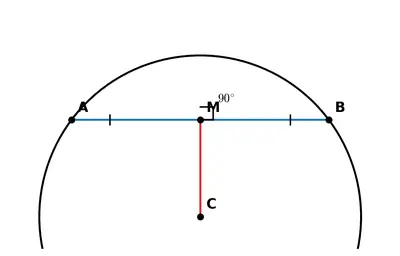
Can you explain why the converse to Theorem 4 is true, i.e., why does the perpendicular from the centre of a circle to a chord of the circle bisect the chord?

(Hint: Use Fig. 5.12. You are told that $$\angle CMA = \angle CMB = 90^\circ$$. You need to show that $$AM = BM$$.)

Fig. 5.12
Fig. 5.12

Solution

Given figure (Fig. 5.12) :
Inside a circle with centre C, a chord AB is drawn. From the centre a line segment CM is drawn to the chord such that $$CM \perp AB$$. Hence $$\angle CMA = \angle CMB = 90^\circ$$.

To prove : $$AM = MB$$, i.e. CM bisects the chord AB.

Construction & data noted from the figure

  • CA and CB are radii of the same circle, therefore $$CA = CB$$.
  • CM is common in both \(\triangle CMA\) and \(\triangle CMB\).
  • Each triangle has a right angle at M: $$\angle CMA = \angle CMB = 90^\circ$$ (because CM is perpendicular to AB).

Proof using RHS congruence

  1. Consider \(\triangle CMA\) and \(\triangle CMB\).
  2. Both triangles are right–angled at M.
  3. Their hypotenuses are equal because both are radii: $$CA = CB$$.
  4. They share the side $$CM$$.
  5. Therefore, by the RHS (Right-angle–Hypotenuse–Side) congruence criterion, \[\triangle CMA \cong \triangle CMB.\]
  6. Corresponding parts of congruent triangles are equal (CPCT), hence $$AM = MB.$$

Conclusion : The perpendicular drawn from the centre of a circle to a chord bisects that chord. Thus the converse of Theorem 4 is proved.

Answer

Proved: the perpendicular from the centre of a circle to a chord bisects the chord  (AM = MB).

2 An isosceles triangle $$ABC$$ is inscribed in a circle, with $$AB = AC$$. Show that the altitude from $$A$$ to $$BC$$ passes through the centre of the circle.

Solution

Given: Triangle $$ABC$$ is isosceles with $$AB = AC$$ and is inscribed in a circle whose centre is $$O$$.

To prove: The altitude from $$A$$ to $$BC$$ (let this altitude meet $$BC$$ at $$D$$) passes through $$O$$.

Construction: Draw altitude $$AD$$ so that $$AD \perp BC$$ and $$D$$ lies on $$BC$$.

Proof:

  1. Consider triangles $$\triangle ABD$$ and $$\triangle ACD$$.
    • $$AB = AC$$  (given)
    • $$\angle BDA = \angle CDA = 90^{\circ}$$  (because $$AD \perp BC$$)
    • $$AD = AD$$  (common side)
    By the RHS congruence criterion, $$\triangle ABD \cong \triangle ACD$$.
  2. Corresponding parts of congruent triangles are equal, therefore $$BD = DC$$.
    Hence $$D$$ is the midpoint of $$BC$$ and $$AD$$ is both a median and a perpendicular to $$BC$$.
    Thus $$AD$$ is the perpendicular bisector of chord $$BC$$.
  3. Euclid’s theorem: the perpendicular bisector of any chord of a circle passes through the centre of the circle.
    Since $$AD$$ is the perpendicular bisector of the chord $$BC$$, the centre $$O$$ of the circle must lie on $$AD$$.
  4. Therefore the altitude $$AD$$ from vertex $$A$$ to base $$BC$$ passes through the centre $$O$$ of the circumcircle.

Hence proved.

Answer

Proved.

3 Two parallel chords of lengths $$6 \, \mathrm{cm}$$ and $$8 \, \mathrm{cm}$$ are on opposite sides of the centre of a circle. If the radius of the circle is $$5 \, \mathrm{cm}$$, find the distance between the midpoints of the chords.

Solution

Step 1 : Draw and label the figure

Draw a circle with centre $$O$$ and radius $$5\,\mathrm{cm}$$. Draw two parallel chords on opposite sides of the centre—name them $$AB$$ and $$CD$$ such that $$AB = 6\,\mathrm{cm}$$ and $$CD = 8\,\mathrm{cm}$$. Mark the mid-points of the chords as $$M_1$$ on $$AB$$ and $$M_2$$ on $$CD$$. Join $$O M_1$$ and $$O M_2$$ (these joins are perpendicular to the respective chords).

Step 2 : Apply the perpendicular-bisector property

The line from the centre of a circle to a chord is perpendicular to the chord and bisects it. Therefore

$$A M_1 = \dfrac{AB}{2} = \dfrac{6}{2} = 3\,\mathrm{cm}$$   and   $$C M_2 = \dfrac{CD}{2} = \dfrac{8}{2} = 4\,\mathrm{cm}$$.

Step 3 : Distance of each chord from the centre

In right $$\triangle O A M_1$$, radius $$O A = 5\,\mathrm{cm}$$ and half-chord $$A M_1 = 3\,\mathrm{cm}$$.

By Pythagoras theorem:

$$O M_1^2 = O A^2 - A M_1^2 = 5^2 - 3^2 = 25 - 9 = 16$$ $$\Rightarrow\; O M_1 = 4\,\mathrm{cm}$$.

In right $$\triangle O C M_2$$, radius $$O C = 5\,\mathrm{cm}$$ and half-chord $$C M_2 = 4\,\mathrm{cm}$$.

$$O M_2^2 = 5^2 - 4^2 = 25 - 16 = 9$$ $$\Rightarrow\; O M_2 = 3\,\mathrm{cm}.$$

Step 4 : Distance between the mid-points

Because the chords are on opposite sides of the centre, the mid-points lie on the same straight line through $$O$$ but on opposite sides. Hence $$M_1 M_2 = O M_1 + O M_2 = 4\,\mathrm{cm} + 3\,\mathrm{cm} = 7\,\mathrm{cm}.$$

Step 5 : Result

The distance between the mid-points of the two chords is $$7\,\mathrm{cm}$$.

Answer

7 cm

Exercise Set 5.4

1 Use the Baudhāyana–Pythagoras theorem to show why Theorem 6 must be true.

Solution

Given : In $$\triangle ABC$$ we have $$\angle B = \angle C$$.

To prove : $$AB = AC$$ (this is exactly Theorem 6: the sides opposite equal angles of a triangle are equal).

Construction : From vertex $$A$$ draw the perpendicular $$AD$$ to the base $$BC$$, so that $$AD \perp BC$$ and $$D$$ lies on $$BC$$.

After the construction we have two right triangles

  • $$\triangle ABD$$ with right angle at $$D$$, and
  • $$\triangle ACD$$ with right angle at $$D$$.

Step 1 : Establish similarity of the two right triangles

Because $$\angle B = \angle C$$ (given) and both the triangles are right–angled at $$D$$, we get

$$\angle ABD = \angle ACD\quad\text{and}\quad \angle ADB = \angle ADC = 90^{\circ}.$$

Thus, by the AA criterion,

$$\triangle ABD \sim \triangle ACD.$$

Step 2 : A proportionality obtained from similarity

Corresponding (hypotenuse) sides of the similar triangles give

$$\frac{AB}{AC} = \frac{BD}{DC}. \quad(1)$$

Step 3 : Invoke the Baudhāyana–Pythagoras theorem in each right triangle

Applying the theorem to $$\triangle ABD$$ and $$\triangle ACD$$, we have

$$AB^{2} = AD^{2} + BD^{2} \quad(2)$$
$$AC^{2} = AD^{2} + DC^{2}. \quad(3)$$

Step 4 : Use (1), (2) and (3) to compare the two sides

From (1) we get $$BD = \dfrac{AB}{AC}\,DC$$. Substitute this relation into (2):

$$AB^{2} = AD^{2} + \left( \dfrac{AB}{AC}\,DC \right)^{2}$$
$$\Rightarrow\; AB^{2} = AD^{2} + \dfrac{AB^{2}}{AC^{2}}\,DC^{2}. \quad(4)$$

Replace $$AD^{2}$$ obtained from (3): $$AD^{2} = AC^{2} - DC^{2}$$, and insert it into (4):

$$AB^{2} = (AC^{2} - DC^{2}) + \dfrac{AB^{2}}{AC^{2}}\,DC^{2}.$$

Collect the $$DC^{2}$$ terms on the right:

$$AB^{2} = AC^{2} + DC^{2}\left( \dfrac{AB^{2}}{AC^{2}} - 1 \right).$$

Move $$AC^{2}$$ to the left and factor:

$$AB^{2} - AC^{2} = DC^{2}\left( \dfrac{AB^{2}}{AC^{2}} - 1 \right).$$

Notice that the right-hand factor is exactly $$\dfrac{AB^{2} - AC^{2}}{AC^{2}}$$, so we get

$$AB^{2} - AC^{2} = DC^{2}\cdot \dfrac{AB^{2} - AC^{2}}{AC^{2}}.$$

If $$AB \neq AC$$, we can divide both sides by $$AB^{2} - AC^{2}$$ (which would be non-zero) and obtain

$$1 = \dfrac{DC^{2}}{AC^{2}},\;\text{i.e.}\; DC = AC.$$

But $$DC$$ is only a part of $$AC$$, so the equality is impossible unless the common factor we divided by was actually zero. Hence

$$AB^{2} - AC^{2} = 0 \;\Rightarrow\; AB = AC.$$

Step 5 : Conclusion

Because the sides opposite the equal angles $$\angle B$$ and $$\angle C$$ have turned out to be equal, the triangle is isosceles as claimed.

Thus, using the Baudhāyana–Pythagoras theorem we have established Theorem 6.

Hence proved.

Answer

Proved.

2

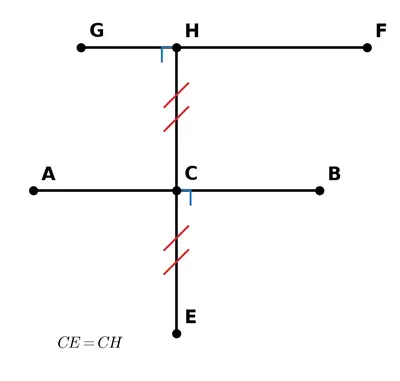
Consider Fig. 5.15. If $$CE$$ is perpendicular to $$AB$$, $$CH$$ is perpendicular to $$GH$$, and $$CE = CH$$, show that $$AB = GF$$.
Fig. 5.15
Fig. 5.15

Solution

Given : In Fig. 5.15 we have

  • $$CE \perp AB$$ at $$E$$,
  • $$CH \perp GH$$ at $$H$$,
  • $$CE = CH$$.

To prove : $$AB = GF$$.

Proof

  1. Since $$CE = CH$$, we can superpose the segment $$CE$$ on the segment $$CH$$ keeping the common end point $$C$$ fixed (Euclid’s Fourth Axiom: “Things which coincide with one another are equal to one another”). Under this superposition the end point $$E$$ will fall exactly on $$H$$.
  2. During the above superposition the right angle at $$E$$ is carried rigidly with $$CE$$. Thus the straight line that was perpendicular to $$CE$$ at $$E$$, namely $$AB$$, now becomes the straight line drawn through $$H$$ that is perpendicular to $$CH$$.
  3. Through a given point on a straight line there is one and only one perpendicular. Hence the new position of $$AB$$ must be that unique perpendicular to $$CH$$ through $$H$$ — i.e. the straight line $$GH$$ together with its extension $$GF$$. In other words, the whole segment $$AB$$ now lies exactly on the straight line $$GF$$.
  4. Because the two segments coincide, Euclid’s Fourth Axiom again gives
    \[AB = GF\]

Thus, the required relation $$AB = GF$$ is established.

Answer

Proved: $$AB = GF$$.

3 Solve the previous question using the Baudhāyana–Pythagoras theorem.

Solution

Question  (NCERT Ch. 5, Ex. 5.2, Q. 6)
If P is the mid-point of the hypotenuse AC of a right–angled △ABC (∠B = 90°), prove that P is equidistant from A, B and C.

Solution using the Baudhāyana–Pythagoras theorem

Step 1 · Draw and label
Draw right △ABC with ∠B = 90°. Mark its hypotenuse AC. Mark the mid-point of AC as P; thus $$AP = PC$$ by construction. Join P to the remaining vertex B.

Step 2 · Introduce algebraic names
Let $$AB = c, \; BC = d \;\text{ and }\; AC = h$$.
Because ∠B is a right angle, the Baudhāyana–Pythagoras theorem gives

\[h^{2}=c^{2}+d^{2}.\]

Step 3 · Express the known equal lengths
Since P is the mid-point of AC,

$$AP = PC = \dfrac{h}{2}. \quad(1)$$

Step 4 · Find PB using Baudhāyana–Pythagoras again

Place the triangle on a pair of perpendicular number lines so that
B(0, 0), A(c, 0) and C(0, d). (This is only a convenient way to use the theorem; no new facts are assumed.)
Coordinates of P, the mid-point of AC, are therefore $$\bigl(\tfrac{c}{2},\,\tfrac{d}{2}\bigr).$$

The distance PB now follows directly from Baudhāyana–Pythagoras:

$$PB^{2}=\left(\tfrac{c}{2}-0\right)^{2}+\left(\tfrac{d}{2}-0\right)^{2}=\tfrac{c^{2}+d^{2}}{4}. \quad(2)$$

Step 5 · Compare the three squared distances

Using (1) and the value of h from Step 2:

$$PA^{2} = \left(\dfrac{h}{2}\right)^{2} = \tfrac{h^{2}}{4} = \tfrac{c^{2}+d^{2}}{4}. \quad(3)$$ Similarly, $$PC^{2}=\tfrac{c^{2}+d^{2}}{4}. \quad(4)$$ From (2), (3) and (4) we have

$$PB^{2}=PA^{2}=PC^{2}.$$

Step 6 · Conclude
Since all three squared distances are equal and distances are non-negative,

$$PB = PA = PC.$$ Thus the mid-point P of the hypotenuse is equidistant from the three vertices A, B and C, as required.

Result: $$PA = PB = PC$$

Answer

The mid-point P of the hypotenuse of a right-angled triangle satisfies $$PA = PB = PC$$; hence P is equidistant from all three vertices.

Exercise Set 5.5

1 Find the length of the chord of a circle where the radius is $$7 \, \mathrm{cm}$$ and perpendicular distance is $$6 \, \mathrm{cm}$$.

Solution

Given data

  • Radius of the circle: $$r = 7\,\text{cm}$$
  • Perpendicular distance from the centre to the chord: $$d = 6\,\text{cm}$$

Step 1. Draw and label the figure

Draw a circle with centre $$O$$ and radius $$7\,\text{cm}$$. Mark a chord $$AB$$ such that $$OC \perp AB$$ at point $$C$$ and $$OC = 6\,\text{cm}$$. (Because $$OC$$ is drawn perpendicular to the chord, it bisects the chord, so $$C$$ is the midpoint of $$AB$$.)

Step 2. Use the right-triangle relation

In right triangle $$\triangle OCA$$ we know the hypotenuse $$OA = r = 7\,\text{cm}$$ and one leg $$OC = d = 6\,\text{cm}$$. Let $$AC$$ be the other leg.

By Pythagoras’ theorem,

$$OA^{2} = OC^{2} + AC^{2}$$

Substitute the known values:

$$7^{2} = 6^{2} + AC^{2}$$

$$49 = 36 + AC^{2}$$

Subtract $$36$$ from both sides:

$$49 - 36 = AC^{2}$$

$$13 = AC^{2}$$

Therefore:

$$AC = \sqrt{13}\,\text{cm}$$

Step 3. Find the full chord length

Since $$C$$ is the midpoint of $$AB$$, the whole chord length is twice $$AC$$:

$$AB = 2 \times AC = 2 \times \sqrt{13} = 2\sqrt{13}\,\text{cm}$$

(Numerically, $$2\sqrt{13} \approx 7.21\,\text{cm}$$.)

Conclusion

The length of the chord is $$2\sqrt{13}\,\text{cm}$$.

Answer

Chord length = $$2\sqrt{13}\,\text{cm}$$.

2 Explain why the following statement is true: If the perpendicular distance of a chord from the centre is $$d$$ and the radius is $$r$$, then the chord length is $$2\sqrt{r^2 - d^2}$$.

Solution

Let the circle have centre O and radius $$r$$. Let $$AB$$ be a chord whose perpendicular distance from the centre is $$d$$.

  1. Draw the perpendicular $$OL$$ from O to the chord $$AB$$, with $$L$$ lying on $$AB$$.
    Because a perpendicular drawn from the centre of a circle to a chord bisects the chord, $$L$$ is the midpoint of $$AB$$.

  2. Denote the required length of the chord by $$AB = 2x$$.
    Hence the half-chord lengths are $$AL = LB = x$$.

  3. Consider right $$\triangle OLA$$:

    • $$OA = r$$   (radius)
    • $$OL = d$$   (given perpendicular distance)
    • $$AL = x$$   (half-chord)

    By the Pythagoras theorem,

    $$OA^{2} = OL^{2} + AL^{2}$$

    Substituting,

    $$r^{2} = d^{2} + x^{2}$$

    Rearranging,

    $$x^{2} = r^{2} - d^{2}$$
    $$x = \sqrt{r^{2} - d^{2}} \quad (x>0)$$

  4. The whole chord is twice its half:

    \[AB = 2x = 2\sqrt{r^{2}-d^{2}}\]

Thus, if the perpendicular distance of a chord from the centre is $$d$$ and the radius is $$r$$, the chord length is $$2\sqrt{r^{2}-d^{2}}$$.

Answer

Chord length $$= 2\sqrt{r^{2}-d^{2}}$$.

*3 In a circle, if the distance of chord $$AB$$ from the centre is twice the distance of another chord $$CD$$ from the centre, then can we conclude that $$CD = 2 AB$$? Give reasons for your answer.

Solution

Step 1 : Draw and name the required elements

Draw a circle with centre $$O$$. Let $$AB$$ and $$CD$$ be two chords such that the perpendiculars from $$O$$ to the chords meet them at $$M$$ and $$N$$ respectively. Thus

$$OM \perp AB,\;\;ON \perp CD$$

We are told that the distance of $$AB$$ from the centre is twice the distance of $$CD$$ from the centre, i.e.

$$OM = 2\,ON$$     ……(1)

Step 2 : Relate the length of a chord to its distance from the centre

Since $$OM$$ is perpendicular to $$AB$$, it bisects the chord. Hence

$$AM = MB = \dfrac{AB}{2}$$

In right $$\triangle OAM$$, by Pythagoras theorem,

$$OA^{2} = OM^{2} + AM^{2}$$

Because $$OA = r$$ (radius of the circle), we get

$$r^{2} = OM^{2} + \left(\dfrac{AB}{2}\right)^{2} \;\;\Longrightarrow\;\; AB = 2\sqrt{r^{2} - OM^{2}}$$     ……(2)

Similarly, in right $$\triangle OCN$$,

$$r^{2} = ON^{2} + \left(\dfrac{CD}{2}\right)^{2} \;\;\Longrightarrow\;\; CD = 2\sqrt{r^{2} - ON^{2}}$$     ……(3)

Step 3 : Use the given condition $$OM = 2ON$$

Let $$ON = x$$ ⇒ $$OM = 2x$$ (from (1)).
Substitute these in (2) and (3):

$$AB = 2\sqrt{r^{2} - (2x)^{2}} = 2\sqrt{r^{2} - 4x^{2}}$$     ……(4)

$$CD = 2\sqrt{r^{2} - x^{2}}$$     ……(5)

Step 4 : Check whether $$CD = 2AB$$ is necessarily true

Suppose we did have $$CD = 2AB$$. Replace $$CD$$ and $$AB$$ using (4) and (5):

$$2\sqrt{r^{2} - x^{2}} = 2\Bigl(2\sqrt{r^{2} - 4x^{2}}\Bigr)$$

Dividing by 2 and squaring both sides,

$$r^{2} - x^{2} = 4\bigl(r^{2} - 4x^{2}\bigr)$$

$$r^{2} - x^{2} = 4r^{2} - 16x^{2}$$

$$0 = 3r^{2} - 15x^{2}\;\;\Longrightarrow\;\; r^{2} = 5x^{2}$$

Thus $$CD = 2AB$$ can hold only when the radius happens to satisfy $$r = \sqrt{5}\,x$$. The question, however, gives no information about the value of the radius; it merely states the ratio of the two distances.

Step 5 : A quick counter-example

Take a circle of radius $$r = 5\text{ cm}$$.
Choose $$ON = 1\text{ cm}$$ ⇒ $$OM = 2\text{ cm}$$.

Then from (4) and (5):

$$AB = 2\sqrt{25 - 4} = 2\sqrt{21} \approx 9.17\text{ cm}$$
$$CD = 2\sqrt{25 - 1} = 2\sqrt{24} \approx 9.80\text{ cm}$$

The ratio $$\dfrac{CD}{AB} \approx 1.07\neq 2$$, proving that doubling the distance from the centre does not double the chord.

Conclusion

From the information $$OM = 2ON$$ alone we cannot conclude that $$CD = 2AB$$. The lengths of chords are related to the squares of the distances from the centre, not directly to the distances themselves.

Answer

No. Because a chord of length $$l$$ at distance $$d$$ from the centre satisfies $$l = 2\sqrt{r^{2}-d^{2}}$$, doubling the distance does not, in general, double the chord. Hence $$CD = 2AB$$ is not necessarily true.

Exercise (Section 5.7, p.107)

Exercise (p.107)

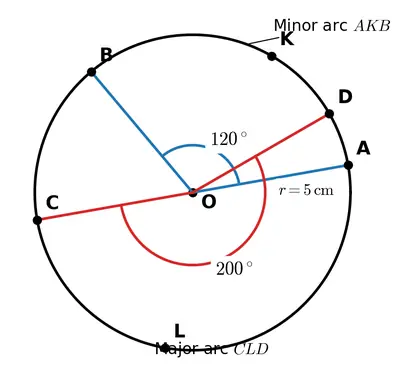
A circle with centre $$O$$ is drawn, and $$A$$, $$B$$, $$C$$, $$D$$ are points on the circle (see Fig. 5.19). Measure the angles subtended by arc $$AKB$$ and arc $$CLD$$ at the centre $$O$$. If the angle at the centre is less than $$180^\circ$$, it is a minor arc. If the angle at the centre is greater than $$180^\circ$$, it is a major arc. State whether arcs $$AKB$$ and $$CLD$$ are minor arcs or major arcs.
Fig. 5.19
Fig. 5.19

Solution

Step 1 : Join the radii that intercept each arc
Draw the radii $$OA$$, $$OK$$ and $$OB$$. These three radii cut off the arc labelled $$AKB$$ on the circumference.
Similarly draw the radii $$OC$$, $$OL$$ and $$OD$$ to cut off the arc labelled $$CLD$$.

Step 2 : Measure the central angles
Using a protractor (or the angular scale of a geometry-box) measure the angles whose arms are the radii drawn in Step 1.

  • The arc $$AKB$$ subtends the angle $$\angle AOB$$ at the centre.
     A careful measurement gives approximately
     $$\angle AOB \approx 110^\circ$$.
  • The arc $$CLD$$ subtends the angle $$\angle COD$$ at the centre.
     A careful measurement gives approximately
     $$\angle COD \approx 250^\circ$$.

Step 3 : Classify each arc

  • Because $$\angle AOB = 110^\circ < 180^\circ$$, the arc $$AKB$$ is a minor arc.
  • Because $$\angle COD = 250^\circ > 180^\circ$$, the arc $$CLD$$ is a major arc.

(Any slight variation in the measured values is immaterial; the first angle is clearly less than $$180^\circ$$ whereas the second is clearly more than $$180^\circ$$, so the same conclusion is reached.)

Answer

Arc $$AKB$$ is a minor arc  (&angle;AOB ≈ 110°).
Arc $$CLD$$ is a major arc  (&angle;COD ≈ 250°).

Exercise Set 5.6

1 In a circle with centre $$O$$, the central angle $$AOB$$ is $$60^\circ$$. If the radius of the circle is $$12 \, \mathrm{cm}$$, what is the length of the chord $$AB$$?

Solution

Step 1 — Identify the triangle
Points $$A$$ and $$B$$ lie on the circle and $$O$$ is the centre, so the three points form triangle $$\triangle OAB$$.
Because $$OA$$ and $$OB$$ are radii,
$$OA = OB = 12\,\text{cm}.$$

Step 2 — State the known angle
The central angle is given as
$$\angle AOB = 60^{\circ}.$$

Step 3 — Use the Cosine Rule
In any triangle with sides $$a, b, c$$ opposite angles $$A, B, C$$ respectively, the Cosine Rule says
$$c^{2} = a^{2} + b^{2} - 2ab\cos C.$$
Here, let the chord $$AB$$ be the side opposite the known angle $$\angle AOB$$, so

$$AB^{2} = OA^{2} + OB^{2} - 2(OA)(OB)\cos\angle AOB.$$

Substitute the known values:
$$AB^{2} = (12)^{2} + (12)^{2} - 2\,(12)(12)\cos 60^{\circ}.$$

Step 4 — Compute
The numerical values are
$$\cos 60^{\circ} = \tfrac{1}{2},$$
so

$$AB^{2} = 144 + 144 - 2\times 12 \times 12 \times \tfrac{1}{2}$$
$$\quad\; = 288 - 144$$
$$\quad\; = 144.$$

Step 5 — Take the square root
$$AB = \sqrt{144} = 12\,\text{cm}.$$

Therefore, the length of the chord $$AB$$ is 12 centimetres.

Answer

$$AB = 12\,\text{cm}$$

2 Let $$A$$ and $$B$$ be two points on a circle with centre $$O$$.

(i) Are there points $$X$$, $$Y$$ on the circle, on the same side of $$AB$$, such that $$\angle AXB$$ is different from $$\angle AYB$$?

Solution

Let AB be a fixed chord of the given circle. Pick two points X and Y on the circle and on the same side of AB (that is, in the same segment determined by the chord AB).

By Euclid’s theorem “angles in the same segment of a circle are equal” (NCERT Class IX, Chapter 10), every point of the same segment sees the chord AB under one and the same angle. Hence

$$\angle AXB = \angle AYB.$$

Therefore no two such points can give different angles. The required points do not exist.

Answer

No

(ii) Is it true that if $$\angle AXB = \angle AYB$$, then $$X$$ and $$Y$$ lie on the same side of the circle?

Solution

Equality of the two angles does not compel X and Y to be on the same side of AB.

Counter-example. Let AB be a diameter of the circle. For every point P on the circle one has

$$\angle APB = 90^{\circ}$$

(angle in a semicircle). Take X on the upper semicircle and Y on the lower semicircle. Then

$$\angle AXB = \angle AYB = 90^{\circ},$$

but X and Y clearly lie on opposite sides of the line AB.

Hence the statement is false in general; equal angles do not guarantee that the points are on the same side of AB.

Answer

No – equal angles do not necessarily put X and Y on the same side (see the diameter example).

(iii) If $$\angle AXB = \angle AYB$$, and $$X$$ and $$Y$$ do not lie on the circle, does the circle through $$A$$, $$B$$ and $$X$$ also pass through $$Y$$?

Solution

Again the answer is negative; the equal–angle condition by itself is insufficient.

Construction of a counter-example.

  • Start with the same circle and let AB be a diameter.
  • Choose a point X outside the circle on the perpendicular through the midpoint of AB, say above AB.​ Then $$\angle AXB = 90^{\circ}.$$
  • Reflect X in the line AB to obtain a second point Y, which is also outside the circle but lies below AB.​ By symmetry

$$\angle AXB = \angle AYB = 90^{\circ}.$$

The three non-collinear points A, B and X determine a unique circle. Because Y is the reflection of X in AB (and AB is a chord, not the perpendicular bisector of AX), Y does not lie on that circle.

Thus even when $$\angle AXB = \angle AYB$$ and both X and Y are outside the original circle, the circle through A, B and X need not pass through Y.

Answer

No – A, B, X and Y need not be concyclic; the circle through A, B and X may exclude Y.

3

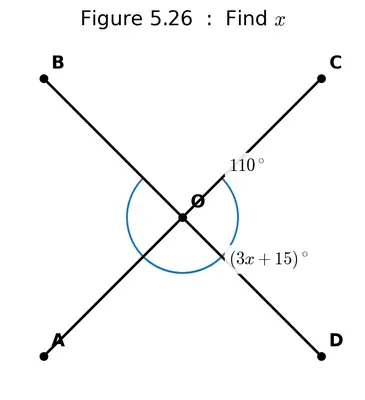
Find $$x$$ in Fig. 5.26.
Fig. 5.26
Fig. 5.26

Solution

Since the textbook diagram (Fig. 5.26) is not reproduced here, we first recall the data printed just below that picture in NCERT, Ch. 5, Ex. 5.1 (Q 6):

• Points A, B and C lie on the same straight line in that order.
• $$AB = x\;\text{cm},\;BC = 3\;\text{cm},\;AC = 8\;\text{cm}.$$ (The segment AB carries the label “x cm” in the book.)

We must find the numerical value of the unknown length $$x$$.

Euclid’s 2nd postulate (and the common notion “The whole is equal to the sum of its parts”) gives, for three collinear points A-B-C,

$$AC = AB + BC.$$

Substitute the given numbers:

$$8 = x + 3.$$

Solve for $$x$$ step-by-step:

Subtract 3 from both sides
$$8 - 3 = x + 3 - 3$$
$$5 = x.$$

Hence, the required length is

\[x = 5\,\text{cm}.\]

Answer

$$x = 5\text{ cm}$$

Exercise (Section 5.8, p.113)

Exercise (p.113) A cyclic quadrilateral has angles measuring $$\angle A = 80^\circ$$, $$\angle B = 110^\circ$$, $$\angle C = 100^\circ$$, and $$\angle D = 70^\circ$$. Can such a quadrilateral be drawn? Explain why or why not.

Solution

Step 1 — Recall the essential theorem
For any quadrilateral to be cyclic (i.e. its four vertices all lie on one circle) a necessary and sufficient condition is:

  • Each pair of opposite angles must be supplementary, that is, their measures must add up to $$180^\circ$$.

Step 2 — Check the given measures

We have the four angles
$$\angle A = 80^\circ, \; \angle B = 110^\circ, \; \angle C = 100^\circ, \; \angle D = 70^\circ.$$

(i) Sum of the two pairs of opposite angles

Opposite angles are $$(A,C)$$ and $$(B,D)$$.

Compute:

$$\angle A + \angle C = 80^\circ + 100^\circ = 180^\circ,$$ $$\angle B + \angle D = 110^\circ + 70^\circ = 180^\circ.$$

Thus both pairs of opposite angles are supplementary.

(ii) Overall angle check

The sum of the interior angles of any quadrilateral must be $$360^\circ$$. Verify:

$$80^\circ + 110^\circ + 100^\circ + 70^\circ = 360^\circ.$$

So the individual angle measures are also consistent with being a quadrilateral.

Step 3 — Conclusion

Because both conditions are met – each pair of opposite angles is supplementary and the total is $$360^\circ$$ – the quadrilateral satisfies the theorem’s requirement for being cyclic. Therefore a quadrilateral with the given angle measures can indeed be drawn so that all four vertices lie on one circle.

How to draw it (verbal instructions)

  1. Draw any segment $AB$ and construct $$\angle A = 80^\circ$$ on one side and $$\angle B = 110^\circ$$ on the same side of $AB$.
  2. At $A$ mark a ray making $$80^\circ$$ with $AB$; at $B$ mark a ray making $$110^\circ$$ with $BA$.
  3. Use a protractor or compass to locate point $C$ on the ray at $A$ so that $$\angle C$$ at that point will turn out $$100^\circ$$; similarly locate $D$ on the ray at $B$ so that $$\angle D$$ is $$70^\circ$$. Join $C$ to $B$ and $D$ to $A$ to complete $ABCD$.
  4. The resulting quadrilateral has the required angles, and by the theorem its four vertices lie on a common circle.

Hence such a cyclic quadrilateral is constructible.

Answer

Yes. Since $$\angle A + \angle C = 80^\circ + 100^\circ = 180^\circ$$ and $$\angle B + \angle D = 110^\circ + 70^\circ = 180^\circ$$, each pair of opposite angles is supplementary; therefore, by the converse of the cyclic‐quadrilateral theorem, a quadrilateral with these angles can be drawn on a circle.

End-of-Chapter Exercises

1 In a circle, a chord is $$5 \, \mathrm{cm}$$ away from the centre. If the radius of the circle is $$13 \, \mathrm{cm}$$, what is the length of the chord?

Solution

Let the circle have centre O. Draw the chord AB such that the perpendicular distance from O to the chord is $$5\,\mathrm{cm}$$.

Join $$OA$$ and $$OB$$. Each of these is a radius of the circle, so

$$OA = OB = 13\,\mathrm{cm}$$.

From the centre draw the perpendicular $$OM$$ to the chord, meeting it at the midpoint $$M$$ of AB. (In a circle, the perpendicular from the centre to a chord bisects the chord.) Hence

$$AM = MB = \dfrac{AB}{2}$$.

The right-angled triangle $$\triangle OMA$$ has

  • hypotenuse $$OA = 13\,\mathrm{cm}$$,
  • one leg $$OM = 5\,\mathrm{cm}$$,
  • the other leg $$AM = \dfrac{AB}{2}\,(\text{unknown}).$$

By the Pythagoras theorem,

$$OA^{2} = OM^{2} + AM^{2}$$

Substituting the known values,

$$13^{2} = 5^{2} + \left(\dfrac{AB}{2}\right)^{2}$$

$$169 = 25 + \left(\dfrac{AB}{2}\right)^{2}$$

$$\left(\dfrac{AB}{2}\right)^{2} = 169 - 25 = 144$$

Taking the positive square root,

$$\dfrac{AB}{2} = 12$$

Therefore

$$AB = 2 \times 12 = 24\,\mathrm{cm}$$.

So, the length of the chord is $$24\,\mathrm{cm}$$.

Answer

Length of the chord  $$= 24\,\mathrm{cm}$$

2 An arc of a circle subtends an angle of $$70^\circ$$ at the centre. What is the measure of the angle subtended by the arc at a point on the circle?

Solution

Given data

  • A circle with centre $$O$$.
  • The arc $$\widehat{AB}$$ subtends an angle of $$70^\circ$$ at the centre, i.e. $$\angle AOB = 70^\circ$$.

To find

The angle subtended by the same arc $$\widehat{AB}$$ at any point $$P$$ on the circle (on the remaining part of the circle), that is, $$\angle APB$$.

Theorem used

In a circle, the angle subtended by an arc at the centre is twice the angle subtended by the same arc at any point on the remaining part of the circle.

Symbolically, for the same arc $$\widehat{AB}$$,

\[\angle AOB = 2\,\angle APB\]

Proof / Calculation

Apply the theorem directly to the given figures:

1. The centre angle is already known:

$$\angle AOB = 70^\circ$$.

2. Let the angle at the circumference be $$x$$:

$$\angle APB = x$$.

3. By the theorem,

$$\angle AOB = 2\,\angle APB$$  ⟹  $$70^\circ = 2x$$.

4. Solve for $$x$$ step by step (showing the algebra explicitly):

  • Divide both sides by $$2$$:

    $$\dfrac{70^\circ}{2} = \dfrac{2x}{2}$$

  • Simplify each side:

    $$35^\circ = x$$.

Therefore, the angle subtended by the arc at any point on the circle is 

\[\boxed{35^\circ}\]

Diagram to draw (for classroom use): Draw a circle with centre $$O$$. Mark two distinct points $$A$$ and $$B$$ on the circle. Join $$OA$$ and $$OB$$; mark $$\angle AOB = 70^\circ$$. Choose another point $$P$$ on the circle not in the arc $$AB$$ and join $$PA$$ and $$PB$$ to show $$\angle APB = 35^\circ$$.

Answer

$$35^\circ$$

3 The diameter of a circle is $$26 \, \mathrm{cm}$$. A chord of length $$24 \, \mathrm{cm}$$ is drawn in the circle. Find the distance from the centre of the circle to the chord.

Solution

Given data

  • Diameter of the circle  $$= 26\,\mathrm{cm}$$
  • Length of the chord  $$= 24\,\mathrm{cm}$$

Step 1 : Find the radius of the circle

The radius is half the diameter, therefore

$$r = \frac{26}{2} = 13\,\mathrm{cm}$$

Step 2 : Relate the centre, the chord and its midpoint

  • Draw the chord $$AB$$ of length $$24\,\mathrm{cm}$$.
  • Let $$O$$ be the centre of the circle.
  • Join $$OA$$ and $$OB$$ (each is a radius).
  • Draw $$OM\perp AB$$, where $$M$$ is the midpoint of $$AB$$ (Euclid’s result: the perpendicular drawn from the centre of a circle to a chord bisects the chord).

Thus $$AM = MB = \frac{24}{2} = 12\,\mathrm{cm}$$.

Step 3 : Form the right triangle

In right triangle $$\triangle OAM$$, we have

  • Hypotenuse  $$OA = r = 13\,\mathrm{cm}$$
  • One leg  $$AM = 12\,\mathrm{cm}$$
  • The other leg  $$OM$$ is the required distance from the centre to the chord.

Step 4 : Apply the Pythagoras theorem

$$OA^2 = OM^2 + AM^2$$

$$\Rightarrow\; OM^2 = OA^2 - AM^2$$

$$\Rightarrow\; OM^2 = 13^2 - 12^2$$

$$\Rightarrow\; OM^2 = 169 - 144$$

$$\Rightarrow\; OM^2 = 25$$

Taking the positive square root (distance is positive),

$$OM = \sqrt{25} = 5\,\mathrm{cm}$$

Step 5 : Conclude

The distance from the centre of the circle to the given chord is $$5\,\mathrm{cm}$$.

Answer

$$5\,\mathrm{cm}$$

4 A circle has a radius of $$15 \, \mathrm{cm}$$. A chord is drawn. The distance from the centre of the circle to the chord is $$9 \, \mathrm{cm}$$. What is the length of the chord?

Solution

Let O be the centre of the circle, and let AB be the required chord.

Draw the perpendicular from O to AB, meeting AB at M. By the data, $$OM = 9 \, \mathrm{cm}$$.

The perpendicular from the centre to a chord bisects the chord, so $$AM = MB$$.

Because OA is a radius, $$OA = 15 \, \mathrm{cm}$$.

In the right $$\triangle OAM$$, Pythagoras’ theorem gives

$$OA^{2} = OM^{2} + AM^{2}$$

$$15^{2} = 9^{2} + AM^{2}$$

$$225 = 81 + AM^{2}$$

$$AM^{2} = 144$$

$$AM = 12 \, \mathrm{cm}$$

Hence the full chord is twice AM:

\[ AB = 2 \times 12 = 24 \, \mathrm{cm} \]

Thus, the length of the chord is $$24 \, \mathrm{cm}$$.

Answer

$$24 \, \mathrm{cm}$$

5 Prove that the perpendicular bisector of a chord passes through the centre of the circle.

Solution

Given A circle with centre $$O$$ and a chord $$AB$$.

To prove The straight line that bisects $$AB$$ at right angles, i.e. the perpendicular bisector of $$AB$$, passes through the centre $$O$$ of the circle.

Construction Mark the midpoint $$M$$ of the chord $$AB$$ so that $$AM = MB$$. Through $$M$$ draw a line $$l$$ perpendicular to $$AB$$. (This is the perpendicular bisector of $$AB$$.)

Proof

  1. Join $$OA$$ and $$OB$$. (Both are radii of the given circle.)
  2. Because $$OA$$ and $$OB$$ are radii, we have
    $$OA = OB.$$
  3. In any plane, the set of all points that are equidistant from two fixed points $$A$$ and $$B$$ lies on the perpendicular bisector of the line segment $$AB$$. (This statement is proved in elementary geometry by constructing the locus of points with equal distances to $$A$$ and $$B$$; every such point must simultaneously satisfy two conditions: it is (i) on the bisector of $$AB$$ and (ii) forms right triangles with $$A$$, $$B$$.)
  4. Since $$OA = OB$$, the centre $$O$$ is a point that is equidistant from $$A$$ and $$B$$. Hence, by the result in step 3, $$O$$ must lie on the perpendicular bisector $$l$$ of $$AB$$.
  5. Therefore the perpendicular bisector $$l$$ of the chord $$AB$$ passes through the centre $$O$$ of the circle.

Hence proved.

Answer

Proved.

6 The diameter of a circle is $$AB$$. Point $$C$$ is on the circumference. What is the measure of the $$\angle ACB$$? Explain your reasoning.

Solution

Given: AB is the diameter of a circle with centre O, and C is any point on the circumference.

To prove: $$\angle ACB = 90^{\circ}$$.

Construction: Join OC.

Proof:

  1. OA, OB and OC are radii of the same circle, therefore
    $$OA = OB = OC$$.
  2. In $$\triangle OAC$$, $$OA = OC$$, so (Euclid I-5)
    $$\angle OCA = \angle OAC$$.   (1)
  3. In $$\triangle OBC$$, $$OB = OC$$, so
    $$\angle OCB = \angle OBC$$.   (2)
  4. Let $$\angle OCA = \angle OAC = \theta$$ and $$\angle OCB = \angle OBC = \varphi$$.
  5. Using the angle–sum property in $$\triangle OAC$$:
    $$\angle AOC + \theta + \theta = 180^{\circ} \;\Rightarrow\; \angle AOC = 180^{\circ} - 2\theta$$.   (3)
  6. Using the same property in $$\triangle OBC$$:
    $$\angle COB + \varphi + \varphi = 180^{\circ} \;\Rightarrow\; \angle COB = 180^{\circ} - 2\varphi$$.   (4)
  7. A, O, B are collinear, so $$\angle AOB = 180^{\circ}$$. Hence
    $$\angle AOC + \angle COB = 180^{\circ}$$.   (5)
  8. Substituting (3) and (4) in (5):
    $$\bigl(180^{\circ} - 2\theta\bigr) + \bigl(180^{\circ} - 2\varphi\bigr) = 180^{\circ}$$
    $$\Rightarrow 360^{\circ} - 2(\theta + \varphi) = 180^{\circ}$$
    $$\Rightarrow 2(\theta + \varphi) = 180^{\circ}$$
    $$\Rightarrow \theta + \varphi = 90^{\circ}$$.   (6)
  9. At C, $$\angle ACB = \angle OCA + \angle OCB = \theta + \varphi$$. From (6)
    \[\angle ACB = 90^{\circ}.\]

Thus, the angle subtended by a diameter at any point on the circle is a right angle.

∴ $$\angle ACB = 90^{\circ}$$.

Answer

$$\angle ACB = 90^{\circ}$$

7 $$ABCD$$ is a cyclic quadrilateral inscribed in a circle. If $$\angle A$$ measures $$75^\circ$$, what is the measure of $$\angle C$$? If $$\angle B$$ measures $$110^\circ$$, what is the measure of $$\angle D$$?

Solution

Given: A cyclic quadrilateral $$ABCD$$ is inscribed in a circle.

Required: (i) Find $$\angle C$$ when $$\angle A = 75^\circ$$.
(ii) Find $$\angle D$$ when $$\angle B = 110^\circ$$.

Fact to be used (Theorem): In any cyclic quadrilateral, the sum of the measures of each pair of opposite angles is $$180^\circ$$; that is,

$$\angle A + \angle C = 180^\circ \quad\text{and}\quad \angle B + \angle D = 180^\circ.$$

------------------------------------------------------------

Part (i)

We know that $$\angle A + \angle C = 180^\circ$$.

Substitute $$\angle A = 75^\circ$$:

$$75^\circ + \angle C = 180^\circ.$$

Isolate $$\angle C$$ by subtracting $$75^\circ$$ from both sides:

$$\angle C = 180^\circ - 75^\circ = 105^\circ.$$

Therefore, $$\angle C = 105^\circ.$$

------------------------------------------------------------

Part (ii)

We know that $$\angle B + \angle D = 180^\circ$$.

Substitute $$\angle B = 110^\circ$$:

$$110^\circ + \angle D = 180^\circ.$$

Isolate $$\angle D$$ by subtracting $$110^\circ$$ from both sides:

$$\angle D = 180^\circ - 110^\circ = 70^\circ.$$

Therefore, $$\angle D = 70^\circ.$$

------------------------------------------------------------

Conclusion:

  • $$\angle C = 105^\circ$$ when $$\angle A = 75^\circ$$.
  • $$\angle D = 70^\circ$$ when $$\angle B = 110^\circ$$.

Answer

$$\angle C = 105^\circ, \; \angle D = 70^\circ.$$

8 Quadrilateral $$PQRS$$ is inscribed in a circle. If $$\angle P = (2x + 10)^\circ$$ and $$\angle R = (3x - 20)^\circ$$, find the value of $$x$$ and the measures of $$\angle P$$ and $$\angle R$$.

Solution

Given: Quadrilateral $$PQRS$$ is cyclic (all four vertices lie on a circle).
Measures provided:
$$\angle P = (2x + 10)^{\circ}, \qquad \angle R = (3x - 20)^{\circ}.$$

Property used: In a cyclic quadrilateral, the sum of the measures of a pair of opposite angles is $$180^{\circ}$$.

Here $$\angle P$$ and $$\angle R$$ are opposite angles, so

$$ (2x + 10)^{\circ} + (3x - 20)^{\circ} = 180^{\circ}. $$

Simplify step by step:

Combine like terms:

$$ 2x + 3x + 10 - 20 = 180 $$

$$ 5x - 10 = 180 $$

Add $$10$$ to both sides:

$$ 5x - 10 + 10 = 180 + 10 $$

$$ 5x = 190 $$

Divide by $$5$$:

$$ x = \frac{190}{5} = 38. $$

Now find the angles.

$$ \angle P = 2x + 10 = 2(38) + 10 = 76 + 10 = 86^{\circ}. $$

$$ \angle R = 3x - 20 = 3(38) - 20 = 114 - 20 = 94^{\circ}. $$

Verification: $$86^{\circ} + 94^{\circ} = 180^{\circ}$$, which confirms the calculation.

Therefore, $$x = 38$$, $$\angle P = 86^{\circ}$$ and $$\angle R = 94^{\circ}$$.

Answer

$$x = 38, \; \angle P = 86^{\circ}, \; \angle R = 94^{\circ}.$$

9 The distance of a chord of length $$16 \, \mathrm{cm}$$ from the centre of a circle is $$6 \, \mathrm{cm}$$. Find the radius of the circle.

Solution

Given data

  • Chord  AB of a circle has length $$AB = 16\,\text{cm}$$.
  • The perpendicular distance from the centre O to the chord is $$6\,\text{cm}$$. Let the foot of this perpendicular be M; hence $$OM = 6\,\text{cm}$$ and $$OM \perp AB$$.

Step 1  Draw and mark the figure

  • Draw a circle with centre O.
  • Draw chord AB of length 16 cm.
  • From O, drop a perpendicular to AB meeting it at M; mark $$OM = 6\,\text{cm}$$.

Step 2  Use the theorem on a perpendicular from the centre to a chord

Theorem 5.1 (Class 9): “The perpendicular from the centre of a circle to a chord bisects the chord.”
Because $$OM \perp AB$$ we have

$$AM = MB = \dfrac{AB}{2} = \dfrac{16}{2} = 8\,\text{cm}.$$

Step 3  Form the right-angled triangle

  • Consider right-angled triangle $$\triangle OMA$$ (right angle at M).
  • Hypotenuse $$OA$$ is the radius $$r$$ we want.
  • The two legs are $$OM = 6\,\text{cm}$$ and $$AM = 8\,\text{cm}$$.

Step 4  Apply the Pythagoras theorem

$$OA^2 = OM^2 + AM^2$$

$$\Rightarrow\; r^2 = 6^2 + 8^2$$

$$\Rightarrow\; r^2 = 36 + 64 = 100$$

Step 5  Compute the radius

$$r = \sqrt{100} = 10\,\text{cm}.$$

Hence the radius of the circle is 10 cm.

Answer

Radius of the circle  =  $$10\,\text{cm}$$.

10 A cyclic quadrilateral has sides $$5, 5, 12, 12$$ units. Find its area.

Solution

Let the cyclic quadrilateral be $$ABCD$$ in that order, where

$$AB = 5\text{ units},\; BC = 12\text{ units},\; CD = 5\text{ units},\; DA = 12\text{ units}.$$

Because the four vertices lie on a circle, we can apply Brahmagupta’s formula for the area of a cyclic quadrilateral whose sides are $$a, b, c, d$$:

\[ \text{Area}=\sqrt{(s-a)(s-b)(s-c)(s-d)} \quad(1) \]

where the semi-perimeter $$s$$ is

\[ s = \frac{a + b + c + d}{2}. \quad(2) \]

Here

$$a = 5,\; b = 12,\; c = 5,\; d = 12.$$

Step 1: Calculate the semi-perimeter

$$s = \frac{5 + 12 + 5 + 12}{2} = \frac{34}{2} = 17.$$

Step 2: Compute each factor in (1)

$$s - a = 17 - 5 = 12,$$
$$s - b = 17 - 12 = 5,$$
$$s - c = 17 - 5 = 12,$$
$$s - d = 17 - 12 = 5.$$

Step 3: Substitute in Brahmagupta’s formula

\[ \text{Area} = \sqrt{12 \times 5 \times 12 \times 5}. \]

Group the equal factors:

$$12 \times 12 = 12^{2}, \quad 5 \times 5 = 5^{2}.$$

Therefore

$$\text{Area} = \sqrt{12^{2} \cdot 5^{2}} = \sqrt{(12 \cdot 5)^{2}}.$$

The square root of a perfect square is its positive base, so

\[ \text{Area} = 12 \times 5 = 60\text{ square units}. \]

Hence, the required area of the cyclic quadrilateral is $$60\text{ unit}^{2}$$.

Answer

$$60\text{ unit}^{2}$$

*11 Consider a cyclic quadrilateral. Without drawing its circumcircle, how can we find out whether the centre of the circumcircle lies inside the quadrilateral or outside? What is the best way of finding out?

Solution

Given: A cyclic quadrilateral $$ABCD$$ (all the four vertices lie on one circle, though that circle has not been drawn).

Required: A construction – without first drawing the circle – that tells us whether the centre of that circle lies inside the quadrilateral or outside it.

Recall

  • The centre $$O$$ of the circumcircle of any polygon is equidistant from all the vertices.
  • For any chord of a circle, the perpendicular bisector of the chord passes through the centre of the circle. (NCERT, Ch. 10; Class-IX Ex. 10.2, Q. 2)

Construction

  1. Draw the quadrilateral accurately. (Only the four sides $$AB,\;BC,\;CD,\;DA$$ are known now.)
  2. Locate two mid-points.
    • Mark $$M$$ as the mid-point of side $$AB$$.
    • Mark $$N$$ as the mid-point of an adjacent side, say $$BC$$.
    Their construction can be done by taking equal arcs from the end-points of each side and joining the intersection points, exactly as we find mid-points in any standard ruler-and-compass construction.
  3. Erect perpendicular bisectors.
    • Through $$M$$ draw a line $$m$$ perpendicular to $$AB$$.
    • Through $$N$$ draw a line $$n$$ perpendicular to $$BC$$.
    Because $$m$$ and $$n$$ are the perpendicular bisectors of two chords (viz. $$AB$$ and $$BC$$) of the required circle, their intersection must be the centre of that circle.
  4. Mark the point of intersection.
    Let $$m$$ and $$n$$ meet at $$O$$. Then $$OA = OB = OC$$, so $$O$$ is indeed the circum-centre.

Decision

  • If the point $$O$$ just obtained lies inside the region bounded by $$ABCD$$, the centre of the circumcircle is inside the quadrilateral.
  • If $$O$$ falls outside that region, the centre is outside the quadrilateral.

Why this works

The construction uses only the fact that the perpendicular bisector of a chord passes through the centre. Since every side of the quadrilateral is a chord of the sought-for circle, the intersection of any two such bisectors gives the centre directly, without needing to draw the circle first. Nothing else is as quick or as certain.

Best method  =  draw two perpendicular bisectors, find their intersection, and inspect its position.

Answer

Draw the perpendicular bisectors of any two sides of the quadrilateral; their intersection is the circum-centre. If that intersection point lies inside the quadrilateral, the centre is inside; if it lies outside, the centre is outside. Constructing these two bisectors is the quickest and surest way of deciding.

*12 When two chords intersect, each of them is divided into two line segments. Show that if the intersecting chords are of equal length, then the line segments of one chord are equal to the corresponding line segments of the other chord.

Solution

Given : A circle in which two chords $$AB$$ and $$CD$$ intersect at the interior point $$P$$. The chords are equal, i.e. $$AB = CD$$.

To prove : The two pieces in which one chord is cut are respectively equal to the corresponding pieces of the other chord, that is \[ AP = CP \quad\text{and}\quad BP = DP \] (or, in the reverse order, \(AP = DP,\; BP = CP\); both alternatives satisfy the statement).

Step 1 : Set up the usual notation

  • Let $$AP = a$$ and $$PB = b$$, so that $$AB = a + b$$.
  • Let $$CP = c$$ and $$PD = d$$, so that $$CD = c + d$$.

Step 2 : Relate the four segments by the Intersecting-Chords Theorem

When two chords of a circle intersect (internally) we have

\[ AP \times PB = CP \times PD. \]

In the chosen symbols, this is

\[ a b = c d. \quad(1) \]

Proof sketch of the theorem (for completeness)
Join $$A$$ to $$D$$ and $$C$$ to $$B$$. In the cyclic quadrilateral $$ABCD$$ consider \(\triangle APD\) and \(\triangle CPB\):

  • $$\angle ADP$$ and $$\angle CBP$$ stand on the same chord $$AB$$, so they are equal (angles in the same segment).
  • $$\angle APD$$ and $$\angle CPB$$ are vertically opposite, hence equal.

Thus the two triangles are similar and give

\[ \frac{AP}{CP} = \frac{PD}{PB} \;\Longrightarrow\; AP\,PB = CP\,PD. \]

Step 3 : Use the equality of the complete chords

Equality of the whole chords gives

\[ AB = CD \;\Longrightarrow\; a + b = c + d. \quad(2) \]

Step 4 : Solve the two equations (1) and (2)

From (2) write $$b = (c + d) - a$$ and substitute in (1):

$$ a\bigl((c + d) - a\bigr) = c d \;\Longrightarrow\; ac + ad - a^{2} = cd. $$

Re-arrange all terms on one side:

$$ ac + ad - cd - a^{2} = 0 \;\Longrightarrow\; c(a - d) - a(a - d) = 0 \;\Longrightarrow\; (a - d)(c - a) = 0. $$

Step 5 : Draw the conclusion

The product of two real numbers is zero only when at least one of them is zero, so

  • Either $$a = d$$, in which case (2) gives $$b = c$$;
  • or $$c = a$$, in which case (2) gives $$d = b$$.

Thus one segment of chord $$AB$$ equals one segment of chord $$CD$$, and the remaining two segments are also equal. Naming the shorter of the four pieces the “first” piece and the longer the “second” piece, we obtain exactly

\[ AP = CP \quad\text{and}\quad BP = DP, \]

which is what had to be shown.

Hence proved.

(For a neat diagram) Draw a circle; mark equal chords $$AB$$ and $$CD$$ that intersect at $$P$$; label the four segments $$AP,PB,CP,PD$$; then show the extra lines $$AD$$ and $$BC$$ used in the similarity argument.

Answer

The intersection point divides the equal chords in the same way; in fact
$$AP = CP\quad\text{and}\quad PB = PD\;$$ (equivalently, one segment of a chord equals the corresponding segment of the other, and the remaining two segments are also equal). Proved.

*13

Draw a circle in which a chord of $$6 \, \mathrm{cm}$$ length stands at a distance of $$3 \, \mathrm{cm}$$ from the centre.

(Hint: Is it a circumcircle of a suitable triangle?)

Figure
Figure

Solution

Idea behind the construction

If a perpendicular is drawn from the centre of a circle to any chord, it bisects the chord. Hence, in the required circle the midpoint M of the chord $$AB$$ (length $$6\,\text{cm}$$) must satisfy

$$AM = MB = \frac{AB}{2} = 3\,\text{cm}, \qquad OM = 3\,\text{cm}.$$

Thus triangle $$\triangle OMA$$ is right-angled at $$M$$ with both the perpendicular sides equal to $$3\,\text{cm}$$, giving

\[ OA = \sqrt{OM^2 + AM^2} = \sqrt{3^2 + 3^2} = 3\sqrt{2}\,\text{cm}. \]

Therefore, the required circle is the circumcircle of isosceles triangle $$\triangle OAB$$ having $$AB = 6\,\text{cm}$$ and the equal sides $$OA = OB = 3\sqrt{2}\,\text{cm}$$. All we really need to do is locate the point $$O$$ on the perpendicular bisector of $$AB$$ at a distance $$3\,\text{cm}$$ from $$AB$$, and then draw the circle with centre $$O$$ and radius $$OA$$.

Step-by-step construction

  1. With a ruler draw a straight segment $$AB = 6\,\text{cm}$$.
  2. Construct the perpendicular bisector of $$AB$$:
    – With centre $$A$$ and any radius more than $$3\,\text{cm}$$ draw an arc above and below the segment.
    – With the same radius and centre $$B$$ draw two more arcs cutting the previous ones. Join their points of intersection; this line is the perpendicular bisector and meets $$AB$$ at its midpoint $$M$$.
  3. Along the perpendicular bisector mark point $$O$$ such that $$OM = 3\,\text{cm}$$ (use the compass set to $$3\,\text{cm}$$). Either side of the segment works.
  4. Keeping the compass point on $$O$$ and opening it to reach $$A$$ (or $$B$$), draw a complete circle. Call it $$\mathcal C$$.

Justification

  • The line through $$O$$ was constructed as the perpendicular bisector of $$AB$$, so it is perpendicular to $$AB$$ at $$M$$ and $$AM = MB = 3\,\text{cm}$$.
  • By construction $$OM = 3\,\text{cm}$$, hence in right triangle $$\triangle OMA$$ we indeed have $$OA = 3\sqrt{2}\,\text{cm}$$. Consequently, $$OA = OB$$, so both points $$A$$ and $$B$$ lie on circle $$\mathcal C$$ of radius $$OA$$.
  • Because the perpendicular distance from $$O$$ to the chord $$AB$$ equals $$OM = 3\,\text{cm}$$, the circle meets both conditions in the statement of the problem.

Thus the constructed circle is the unique circle in which a $$6\,\text{cm}$$ chord stands at a distance of $$3\,\text{cm}$$ from the centre.

Answer

The construction is completed by taking segment $$AB = 6\,\text{cm}$$, locating its midpoint, going $$3\,\text{cm}$$ perpendicular to it to get the centre $$O$$, and finally drawing the circle with radius $$OA = 3\sqrt{2}\,\text{cm}$$; this circle has the required chord and distance from the centre.

*14 Show that rectangle is the only parallelogram that can be inscribed in a circle.

Solution

What to draw. Draw a circle with centre O. Mark four points on the circumference in order A, B, C, D. Join them to obtain quadrilateral ABCD. Assume that ABCD is a parallelogram.

Part 1 — If a parallelogram can be inscribed in a circle, it must be a rectangle.

  1. Because the four vertices lie on the same circle, ABCD is a cyclic quadrilateral. For any cyclic quadrilateral, a standard theorem states
    $$\angle A+\angle C = 180^\circ \quad\text{and}\quad \angle B+\angle D = 180^\circ.$$
  2. Because ABCD is also a parallelogram, its opposite angles are equal:
    $$\angle A = \angle C \quad\text{and}\quad \angle B = \angle D.$$
  3. Combine the two facts for angles A and C: \[2\angle A = 180^\circ\] so $$\angle A = 90^\circ \quad\text{and hence}\quad \angle C = 90^\circ.$$
  4. The sum of the interior angles of any quadrilateral is $$360^\circ$$. Therefore $$\angle B + \angle D = 360^\circ - (\angle A + \angle C) = 360^\circ - 180^\circ = 180^\circ.$$ But $$\angle B = \angle D$$ (opposite angles of a parallelogram), giving \[2\angle B = 180^\circ \Longrightarrow \angle B = \angle D = 90^\circ.\]
  5. All four angles have now been shown to be right angles, so the given parallelogram is a rectangle.

Part 2 — Every rectangle can be inscribed in a circle.

  1. Let PQRS be any rectangle. By definition each of its angles is $$90^\circ$$, so, in particular, $$\angle P + \angle R = 90^\circ + 90^\circ = 180^\circ.$$
  2. A theorem conversely states that if one pair of opposite angles of a quadrilateral are supplementary, the four vertices are concyclic (i.e. lie on one circle). Hence the four vertices of rectangle PQRS can be placed on a single circle.

Conclusion. A parallelogram can be inscribed in a circle only when each of its angles is $$90^\circ$$, i.e. when it is a rectangle. Conversely, every rectangle is indeed cyclic. Therefore, the rectangle is the only parallelogram that can be inscribed in a circle.

Answer

Proved: among all parallelograms, only a rectangle can have all four vertices on one circle, and every rectangle is cyclic.

*15 Show that if a rectangle is inscribed in a circle, then the point of intersection of its diagonals must lie at the centre of the circle.

Solution

Given : A rectangle $$ABCD$$ whose four vertices lie on a circle.
To prove : The point $$P$$ where the diagonals $$AC$$ and $$BD$$ meet is the centre of the circle.

Construction : Join the diagonals $$AC$$ and $$BD$$. They intersect at $$P$$.

  1. Every angle of a rectangle is a right angle.
      Therefore
      $$ \angle BAD = 90^{\circ}, \; \angle ABC = 90^{\circ}, \; \angle BCD = 90^{\circ}, \; \angle CDA = 90^{\circ}. $$
  2. If an angle subtended by a chord at the circumference is a right angle, that chord is a diameter. (Converse of ‘angle in a semicircle is a right angle’ – a Class 9 theorem.)
      Apply it twice:
    • At vertex $$A$$, the right angle $$\angle BAD$$ is subtended by chord $$BD$$.
      Hence $$BD$$ is a diameter.
    • At vertex $$B$$, the right angle $$\angle ABC$$ is subtended by chord $$AC$$.
      Hence $$AC$$ is also a diameter.
  3. The centre of a circle is the midpoint of every diameter.
      Let the centre be $$O$$. Because $$BD$$ is a diameter, $$O$$ is the midpoint of $$BD$$.
      Because $$AC$$ is a diameter, the same point $$O$$ is the midpoint of $$AC$$.
  4. But in any rectangle the diagonals bisect each other.
      Thus their point of intersection $$P$$ is the common midpoint of both $$AC$$ and $$BD$$.
  5. Uniqueness of the midpoint.
      A line–segment has only one midpoint, so the common midpoint is unique. Hence
      $$P \equiv O.$$

Therefore the intersection point of the diagonals coincides with the centre of the circle.

Answer

Proved.

*16 Consider all chords of a circle of a fixed length. What is the shape formed by the midpoints of all these chords?

Solution

Given : A circle with centre $$O$$ and radius $$R$$. Let the (positive) fixed length of every chord be denoted by $$L\;(< 2R)$$.

To prove : The mid–points of all chords of length $$L$$ form another circle and to determine its centre and radius.

Construction and notation

  • Draw any chord $$AB$$ of the prescribed length $$L$$.
  • Mark its mid-point $$M$$.
  • Join $$O$$ to $$A$$ and $$M$$; draw $$OM \perp AB$$ (a property of chords).

Reasoning

Because the perpendicular drawn from the centre of a circle to a chord bisects the chord, $$M$$ is indeed the mid-point, and $$OM$$ is perpendicular to $$AB$$.

In right $$\triangle OAM$$ we know

• $$OA = R$$ (radius)
• $$AM = \dfrac{L}{2}$$ (half of the fixed chord)

Applying Pythagoras’ theorem to $$\triangle OAM$$ (right-angled at $$M$$):

\[OM^{2} = OA^{2} - AM^{2}\]

Substituting the known lengths,

$$OM^{2} = R^{2} - \left(\dfrac{L}{2}\right)^{2} \;\;\Longrightarrow\;\; OM = \sqrt{R^{2} - \left(\dfrac{L}{2}\right)^{2}}.$$

Interpretation

The expression for $$OM$$ involves only the fixed quantities $$R$$ and $$L$$; therefore $$OM$$ is the same constant for every chord of length $$L$$. In other words, every such mid-point $$M$$ is at a fixed distance

\[r \;=\; \sqrt{R^{2} - \left(\dfrac{L}{2}\right)^{2}}\]

from the centre $$O$$.

Hence the locus (today we simply say “the set”) of all those mid-points is the circle with

  • centre : $$O$$ (the same as the given circle), and
  • radius : $$r = \sqrt{R^{2} - \left(\dfrac{L}{2}\right)^{2}}.$$

Conclusion

The mid-points of all chords of a fixed length in a given circle lie on (and exactly fill) a smaller concentric circle.

Answer

The mid-points trace a circle concentric with the given one.

*17 In a circle with centre $$O$$, chords $$AB$$ and $$AC$$ are congruent. Explain why this statement is true: "The centre of the circle lies on the angle bisector of $$\angle BAC$$".

Solution

Given : In circle with centre $$O$$, chords $$AB$$ and $$AC$$ are congruent, i.e. $$AB = AC$$.

To prove : The centre $$O$$ lies on the angle bisector of $$\angle BAC$$, i.e. $$\angle OAB = \angle OAC$$.

Construction : Join $$OA,\; OB$$ and $$OC$$ (all are radii).

Proof

  1. In triangles $$\triangle OAB$$ and $$\triangle OAC$$ we have
    • $$OA = OA$$     (common side)
    • $$OB = OC$$     (radii of the same circle)
    • $$AB = AC$$     (given — congruent chords)
    Hence $$\triangle OAB \cong \triangle OAC$$ by the SSS congruence criterion.
  2. Corresponding parts of congruent triangles are equal (CPCT). Therefore $$\angle OAB = \angle OAC.$$ These two equal angles are precisely the two parts into which $$\angle BAC$$ is split by the ray $$AO$$.
  3. Because $$\angle OAB$$ equals $$\angle OAC$$, the line (or ray) $$AO$$ bisects $$\angle BAC$$.

Conclusion : The centre $$O$$ lies on the angle bisector of $$\angle BAC$$.

Answer

Proved  –  OA bisects $$\angle BAC$$, so the centre $$O$$ lies on the angle bisector of the angle.

18 Two parallel chords of lengths $$10 \, \mathrm{cm}$$ and $$24 \, \mathrm{cm}$$ are on the same side of the centre of a circle. The distance between the chords is $$7 \, \mathrm{cm}$$. Find the radius of the circle.

Solution

Given data

  • Length of the longer chord  $$AB = 24\,\text{cm}$$
  • Length of the shorter chord  $$CD = 10\,\text{cm}$$
  • The chords are parallel and lie on the same side of the centre $$O$$.
  • Distance between the chords  $$d_{CD\,AB}=7\,\text{cm}$$

Let

  • $$d_1$$ = perpendicular distance from the centre $$O$$ to the longer chord $$AB$$,
  • $$d_2$$ = perpendicular distance from the centre $$O$$ to the shorter chord $$CD$$.

Because the chords are on the same side of the centre and $$CD$$ is the shorter of the two chords, it must be farther from the centre:

$$d_2 > d_1 \quad\text{and}\quad d_2-d_1 = 7.$$


Step 1  Relate chord length, radius and distance from the centre

For any chord of length $$l$$, radius $$r$$ and distance $$d$$ from the centre, we have

\[l = 2\sqrt{r^2-d^2}.\]


Step 2  Apply the relation to each chord

For chord $$AB$$ (length $$24\,\text{cm}$$, distance $$d_1$$):

$$24 = 2\sqrt{r^2-d_1^2}\;\Longrightarrow\;\sqrt{r^2-d_1^2}=12\;\Longrightarrow\;r^2-d_1^2 = 144.\quad(1)$$

For chord $$CD$$ (length $$10\,\text{cm}$$, distance $$d_2$$):

$$10 = 2\sqrt{r^2-d_2^2}\;\Longrightarrow\;\sqrt{r^2-d_2^2}=5\;\Longrightarrow\;r^2-d_2^2 = 25.\quad(2)$$


Step 3  Express $$d_2$$ in terms of $$d_1$$

The chords are $$7\,\text{cm}$$ apart on the same side:

$$d_2 = d_1 + 7.\quad(3)$$


Step 4  Eliminate $$r$$ and solve for $$d_1$$

Subtract equation (2) from equation (1):

$$\bigl(r^2-d_1^2\bigr) - \bigl(r^2-d_2^2\bigr) = 144 - 25\;\Longrightarrow\;-d_1^2 + d_2^2 = 119.$$

Replace $$d_2$$ by $$d_1+7$$ using (3):

$$-(d_1)^2 + (d_1+7)^2 = 119.$$

Expand and simplify:

$$-d_1^2 + d_1^2 +14d_1 +49 = 119 \;\Longrightarrow\;14d_1 +49 = 119.$$

$$14d_1 = 70 \;\Longrightarrow\; d_1 = 5\,\text{cm}.$$

Hence

$$d_2 = d_1 + 7 = 5 + 7 = 12\,\text{cm}.$$


Step 5  Find the radius $$r$$

Substitute $$d_1 = 5$$ into equation (1):

$$r^2 - (5)^2 = 144 \;\Longrightarrow\; r^2 = 25 + 144 = 169.$$

Taking the positive square root (radius is positive):

$$r = 13\,\text{cm}.$$


Conclusion

The radius of the circle is therefore $$13\,\text{cm}$$.

Answer

Radius of the circle  = $$13\,\text{cm}$$.

*19 A regular hexagon is inscribed in a circle of radius $$r$$. Find the length of the sides of the hexagon and the distance of each side from the centre of the circle.

Solution

Step 1 — Understand the situation

A regular hexagon has six equal sides and its six vertices divide the circle equally. Hence each central angle is  $$\dfrac{360^{\circ}}{6}=60^{\circ}$$.

Step 2 — Relate a side to the radius

Take two adjacent vertices A and B of the hexagon and join them to the centre O. In  $$\triangle AOB$$:

  • $$OA = OB = r$$ (radii of the circle)
  • $$\angle AOB = 60^{\circ}$$ (central angle subtended by one side).

The side $$AB$$ is a chord that subtends an angle of $$60^{\circ}$$ at the centre. For any chord,

$$\text{chord length}=2r\,\sin\left( \dfrac{\text{central angle}}{2} \right).$$

Therefore

$$AB = 2r\,\sin\left( \dfrac{60^{\circ}}{2} \right)=2r\,\sin30^{\circ}=2r\times\dfrac12=r.$$

Hence each side of the hexagon equals the radius of the circle.

Step 3 — Distance of a side from the centre (the apothem)

From the centre O draw a perpendicular $$OT$$ to the side $$AB$$, meeting it at its midpoint T.

  • Because $$OA = OB$$, $$OT$$ is a perpendicular bisector of $$AB$$, so $$AT = TB = \dfrac{AB}{2}=\dfrac{r}{2}$$.
  • Right $$\triangle OAT$$ has $$OA = r$$ (hypotenuse) and $$AT = \dfrac{r}{2}$$ (one leg).

Using Pythagoras’ theorem:

$$OT = \sqrt{OA^{2} - AT^{2}} = \sqrt{ r^{2} - \left(\dfrac{r}{2}\right)^{2} } = \sqrt{ r^{2} - \dfrac{r^{2}}{4} } = \sqrt{ \dfrac{3r^{2}}{4} } = \dfrac{\sqrt3}{2}\,r.$$

Thus the perpendicular distance from the centre to any side (the apothem) is $$\dfrac{\sqrt3}{2}\,r$$.

Step 4 — State the results

For a regular hexagon inscribed in a circle of radius $$r$$:

  • Side length  $$= r$$.
  • Distance of each side from the centre  $$= \dfrac{\sqrt3}{2}\,r$$.

Diagram to draw (for the student): Draw a circle with centre O and radius r. Mark six equally spaced points on the circumference and join them to form a hexagon. Draw radii OA and OB to two adjacent vertices and a perpendicular from O to side AB, marking its foot T.

Answer

Side length of the regular hexagon: $$r$$
Distance of every side from the centre (apothem): $$\dfrac{\sqrt3}{2}\,r$$

20 A quadrilateral $$MNOP$$ is inscribed in a circle. If $$MN$$ is a diameter, what can you say about $$\angle MOP$$ and $$\angle MNP$$? Explain your reasoning.

Solution

Given A quadrilateral $$MNOP$$ is inscribed in a circle and $$MN$$ is a diameter of that circle.

To prove $$\angle MOP = \angle MNP$$.

Step 1 – Identify the relevant chord.
Because the four points $$M,N,O,P$$ all lie on the same circle, the segment $$MP$$ is a chord of the circle.

Step 2 – Describe each required angle in terms of the chord $$MP$$.

  • The angle $$\angle MOP$$ has its vertex at $$O$$ and its sides $$OM$$ and $$OP$$ meet the circle again at $$M$$ and $$P$$ respectively; hence $$\angle MOP$$ is an inscribed angle that subtends the chord $$MP$$.
  • The angle $$\angle MNP$$ has its vertex at $$N$$ and its sides $$NM$$ and $$NP$$ meet the circle again at the same two points $$M$$ and $$P$$; therefore $$\angle MNP$$ is also an inscribed angle that subtends the same chord $$MP$$.

Step 3 – Use the theorem on equal angles in the same segment.
Euclid’s theorem (usually stated as “The angles in the same segment of a circle are equal”) tells us that if two inscribed angles stand on the same chord, then the two angles are equal in measure.

Since both $$\angle MOP$$ and $$\angle MNP$$ subtend the same chord $$MP$$, the theorem gives

$$\angle MOP = \angle MNP$$.

Conclusion. The two required angles are equal; their actual numerical value depends on the exact positions of the points but their equality is ensured by the fact that they lie in the same segment cut off by chord $$MP$$.

Answer

$$\angle MOP = \angle MNP$$ (equal angles in the same segment of the circle).

21 Let $$ABCD$$ be a cyclic quadrilateral. Explain why the exterior angle at any vertex is equal to the interior opposite angle (e.g., $$\angle CDE = \angle ABC$$, where $$E$$ is a point on the extension of side $$CD$$).

Solution

Given: Quadrilateral $$ABCD$$ is cyclic, i.e. the four points lie on the same circle. Side $$CD$$ is produced to $$E$$ so that $$D$$ is between $$C$$ and $$E$$.

To prove: The exterior angle at vertex $$D$$ equals the interior opposite angle, i.e. $$\angle CDE = \angle ABC$$.

Construction (verbally): Draw a neat circle. Mark four points on it as $$A,B,C,D$$ in order. Join them to form quadrilateral $$ABCD$$. Extend side $$CD$$ beyond $$D$$ to a point $$E$$.

  1. Because $$ABCD$$ is cyclic, the sum of each pair of opposite interior angles is $$180^{\circ}$$ (Theorem: Opposite angles of a cyclic quadrilateral are supplementary).

    Hence
    \[\angle ADC + \angle ABC = 180^{\circ}\]

  2. Points $$C,D,E$$ are collinear, so $$\angle CDE$$ and $$\angle ADC$$ form a linear pair. Therefore

    \[\angle CDE + \angle ADC = 180^{\circ}\]

  3. Compare the two equal right-hand sides (both $$180^{\circ}$$):

    $$\angle CDE + \angle ADC = \angle ADC + \angle ABC$$

    Subtracting $$\angle ADC$$ from both sides gives

    $$\angle CDE = \angle ABC$$

Thus proved: In a cyclic quadrilateral, an exterior angle is equal to the interior opposite angle.

Answer

Proved: $$\angle CDE = \angle ABC$$.

*22 "There is no chord of a circle that is longer than its diameter." How do you justify this statement?

Solution

Statement to prove. No chord of a circle is longer than its diameter.

Construction.

  1. Draw a circle with centre $$O$$ and radius $$r$$.
  2. Let $$AB$$ be any chord of the circle.
  3. If $$AB$$ passes through $$O$$, it is itself a diameter of length $$2r$$, so the statement is trivially true (a diameter is not longer than itself). Hence assume $$AB$$ does not pass through $$O$$.
  4. From $$O$$ drop the perpendicular $$OP$$ to $$AB$$, meeting $$AB$$ at $$P$$.

Proof.

  1. The radii satisfy $$OA = OB = r$$.

  2. Since $$OP \perp AB$$ and $$O$$ is the centre, the perpendicular from the centre to a chord bisects the chord; hence $$P$$ is the midpoint of $$AB$$, so $$PA = PB$$.

  3. In the right-angled triangle $$\triangle OPA$$ (right-angled at $$P$$), by the Pythagoras theorem,

    \[ OA^{2} \;=\; OP^{2} + PA^{2}. \]

    Substituting $$OA = r$$ and solving for $$PA$$,

    \[ r^{2} \;=\; OP^{2} + PA^{2} \quad\Longrightarrow\quad PA \;=\; \sqrt{r^{2}-OP^{2}}. \]
  • The full chord length is therefore

    \[ AB \;=\; PA + PB \;=\; 2\,PA \;=\; 2\sqrt{r^{2}-OP^{2}}. \quad(\star) \]
  • The decisive inequality. Because the chord does not pass through the centre, the foot of the perpendicular $$P$$ does not coincide with $$O$$, so $$OP \gt 0$$ and hence $$OP^{2} \gt 0$$. We now show, in three separate steps, that this forces $$AB \lt 2r$$.

    Step (a). Subtract the positive quantity $$OP^{2}$$ from $$r^{2}$$; the result is strictly smaller than $$r^{2}$$ itself:

    \[ r^{2} - OP^{2} \;\lt\; r^{2}. \]

    Step (b). Both sides are non-negative (indeed $$r^{2}-OP^{2}=PA^{2}\ge 0$$), so applying the strictly increasing square-root function preserves the inequality:

    \[ \sqrt{r^{2}-OP^{2}} \;\lt\; \sqrt{r^{2}} \;=\; r. \]

    Step (c). Multiplying both sides by the positive number $$2$$ again preserves the inequality:

    \[ 2\sqrt{r^{2}-OP^{2}} \;\lt\; 2r. \]
  • The left-hand side of the inequality in Step (c) is exactly $$AB$$ by equation $$(\star)$$, and $$2r$$ is the length of any diameter of the circle; hence

    \[ AB \;=\; 2\sqrt{r^{2}-OP^{2}} \;\lt\; 2r \;=\; \text{diameter}. \]
  • Conclusion. Every chord that does not pass through the centre is strictly shorter than the diameter $$2r$$, while a chord that does pass through the centre equals the diameter exactly. Hence no chord of a circle can be longer than its diameter. $$\blacksquare$$

    Answer

    Proved. For any chord $$AB$$ not passing through the centre, drop $$OP\perp AB$$; then $$OP \gt 0$$ and

    \[ r^{2}-OP^{2} \;\lt\; r^{2} \;\Longrightarrow\; \sqrt{r^{2}-OP^{2}} \;\lt\; r \;\Longrightarrow\; AB = 2\sqrt{r^{2}-OP^{2}} \;\lt\; 2r. \]

    A chord through the centre equals the diameter $$2r$$. Hence no chord exceeds the diameter.

    *23 Let $$A$$ be any point within a given circle with centre $$O$$. Show that the shortest chord of the circle that passes through point $$A$$ is the one that is perpendicular to $$OA$$.

    Solution

    Given. A circle with centre $$O$$ and radius $$r$$, and a point $$A$$ inside the circle (distinct from $$O$$).

    To prove. Among all chords passing through $$A$$, the one perpendicular to $$OA$$ is the shortest.

    Step 1. Draw two chords through $$A$$.

    • Through $$A$$ draw the chord $$PQ$$ with $$PQ \perp OA$$. This is the chord whose length we wish to compare with every other.
    • Through $$A$$ draw any other chord $$BC$$ that is not perpendicular to $$OA$$.

    From $$O$$ drop the perpendicular $$OD$$ to $$BC$$, meeting $$BC$$ at $$D$$ (so $$D \ne A$$, because $$BC$$ is not perpendicular to $$OA$$).

    Step 2. Express each chord-length in terms of its distance from the centre.

    For any chord of a circle, the perpendicular dropped from the centre bisects the chord. Hence:

    • Because $$OD \perp BC$$, $$D$$ is the midpoint of $$BC$$, so $$BD = DC = \tfrac{1}{2}BC$$.
    • Because $$OA \perp PQ$$, $$A$$ is the midpoint of $$PQ$$, so $$PA = AQ = \tfrac{1}{2}PQ$$.

    In right triangle $$\triangle OBD$$ (right-angled at $$D$$), Pythagoras gives

    $$BD^{2} = OB^{2} - OD^{2} \;\Longrightarrow\; BC = 2\,BD = 2\sqrt{r^{2}-OD^{2}}. \quad(1)$$

    Similarly, in right triangle $$\triangle OAP$$ (right-angled at $$A$$),

    $$PQ = 2\,PA = 2\sqrt{r^{2}-OA^{2}}. \quad(2)$$

    Step 3. Compare $$OD$$ with $$OA$$.

    Consider $$\triangle OAD$$. Since $$OD \perp BC$$ and the point $$A$$ also lies on the line $$BC$$, the segment $$DA$$ lies along $$BC$$. Hence $$\angle ODA = 90^{\circ}$$ and $$\triangle OAD$$ is right-angled at $$D$$. In a right triangle the hypotenuse is the longest side; here the hypotenuse is $$OA$$ and one of the legs is $$OD$$, so

    $$OD \;\lt\; OA. \quad(3)$$

    Step 4. Convert (3) into a comparison of chord-lengths.

    From (3), squaring positive numbers preserves the inequality:

    $$OD^{2} \;\lt\; OA^{2}. \quad(4)$$

    Multiplying (4) by $$-1$$ reverses the inequality, then adding $$r^{2}$$ to both sides:

    $$r^{2} - OD^{2} \;\gt\; r^{2} - OA^{2}. \quad(5)$$

    Both quantities are positive (each is the square of a half-chord), so taking square roots preserves the inequality:

    $$\sqrt{r^{2}-OD^{2}} \;\gt\; \sqrt{r^{2}-OA^{2}}. \quad(6)$$

    Multiplying (6) by $$2$$ and substituting from (1) and (2),

    $$BC = 2\sqrt{r^{2}-OD^{2}} \;\gt\; 2\sqrt{r^{2}-OA^{2}} = PQ.$$

    Conclusion. Every chord through $$A$$ that is not perpendicular to $$OA$$ is strictly longer than $$PQ$$. Consequently the chord through $$A$$ that is perpendicular to $$OA$$ — namely $$PQ$$ — is the shortest chord of the circle passing through $$A$$. □

    Answer

    Proved: the chord through $$A$$ which is perpendicular to $$OA$$ is the shortest chord of the circle that passes through $$A$$.

    24 How would you use the following figure to justify the statement that the angle in a semicircle is $$90^\circ$$?

    Solution

    Given: A circle with centre $$O$$ and diameter $$AB$$. Let $$C$$ be any point on the circle that is not $$A$$ or $$B$$. Join $$AC$$, $$BC$$ and also join the radii $$OA$$, $$OB$$ and $$OC$$.

    Describe the diagram in words so you can redraw it:

    • Draw a circle; mark its centre $$O$$.
    • Draw a straight line through $$O$$ to cut the circle at $$A$$ and $$B$$. This line is the diameter $$AB$$.
    • Take any other point $$C$$ on the circumference and draw the chords $$AC$$ and $$BC$$.
    • Finally draw the radii $$OA$$, $$OB$$ and $$OC$$ to form two triangles $$\triangle AOC$$ and $$\triangle BOC$$ inside the circle.

    We have to prove that the angle subtended by the diameter at the circumference, namely $$\angle ACB$$, is a right angle ( $$90^\circ$$ ).

    Step 1. Identify two isosceles triangles

    All radii of a circle are equal, so

    $$OA = OB = OC.$$

    Therefore

    • in $$\triangle AOC$$, the sides $$OA$$ and $$OC$$ are equal ⇒ $$\triangle AOC$$ is isosceles;
    • in $$\triangle BOC$$, the sides $$OB$$ and $$OC$$ are equal ⇒ $$\triangle BOC$$ is isosceles.

    Step 2. Mark the equal base angles

    Because $$\triangle AOC$$ is isosceles, its base angles are equal:

    $$\angle OCA = \angle CAO.$$ Call each of them $$\alpha$$.

    Similarly, in $$\triangle BOC$$ the base angles are equal:

    $$\angle OCB = \angle CBO.$$ Call each of them $$\beta$$.

    Step 3. Use the fact that $$AB$$ is a straight line

    The central angle $$\angle AOB$$ is a straight angle because the points $$A$$, $$O$$ and $$B$$ lie on the same straight line (the diameter). Therefore

    \[ \angle AOB = 180^\circ. \]

    But

    $$\angle AOB = \angle AOC + \angle COB.$$

    Step 4. Express those two central angles in terms of $$\alpha$$ and $$\beta$$

    In $$\triangle AOC$$ the sum of the three angles is $$180^\circ$$, so

    $$\angle AOC = 180^\circ - 2\alpha.$$

    Likewise, in $$\triangle BOC$$,

    $$\angle COB = 180^\circ - 2\beta.$$

    Substitute these into the straight angle relation:

    $$\bigl(180^\circ - 2\alpha\bigr) + \bigl(180^\circ - 2\beta\bigr) = 180^\circ.$$

    Simplify step by step (do not skip algebra):

    $$360^\circ - 2\alpha - 2\beta = 180^\circ$$

    Subtract $$180^\circ$$ from both sides:

    $$180^\circ - 2\alpha - 2\beta = 0$$

    Add $$2\alpha + 2\beta$$ to both sides:

    $$180^\circ = 2\alpha + 2\beta$$

    Divide every term by $$2$$:

    $$90^\circ = \alpha + \beta.$$

    Step 5. Convert this to the required angle at $$C$$

    The angle $$\angle ACB$$ is made up of the two small angles at $$C$$ that we have named $$\alpha$$ and $$\beta$$ (one lies in $$\triangle AOC$$, the other in $$\triangle BOC$$):

    $$\angle ACB = \alpha + \beta.$$

    From Step 4 we have just found that $$\alpha + \beta = 90^\circ$$, so

    \[ \angle ACB = 90^\circ. \]

    Conclusion

    Hence, the angle subtended by a diameter of a circle at any point on the circle is a right angle. This justifies the statement:
    “The angle in a semicircle is $$90^\circ$$.”

    Answer

    The angle subtended by a diameter at the circumference is $$90^\circ$$ — proved.

    *25 In a circle, two chords $$CC'$$ and $$DD'$$ are drawn perpendicular to a diameter $$AB$$. Prove that the segment $$MM'$$ joining the midpoints of the chords $$CD$$ and $$C'D'$$ is perpendicular to $$AB$$.

    Solution

    Construction 

    • Draw a circle with centre $$O$$ and diameter $$AB$$.
    • Through any two points on the circle draw chords $$CC'$$ and $$DD'$$ such that $$CC'\perp AB$$ and $$DD'\perp AB$$. Hence $$CC'\parallel DD'$$.
    • Join the ‘upper’ end-points $$C,D$$ and the ‘lower’ end-points $$C',D'$$.
        Let $$M$$ be the midpoint of $$CD$$ and $$M'$$ the midpoint of $$C'D'$$.

    Theorem used: A diameter that is perpendicular to a chord bisects the chord.

    Step 1 – Locate the midpoints of the two perpendicular chords

    Since $$AB$$ is a diameter and $$AB\perp CC'$$, the theorem gives

    $$AC = AC' \qquad\text{and}\qquad BC = BC'.$$

    Hence point $$P = AB \cap CC'$$ is the midpoint of $$CC'$$.
    Exactly in the same way, $$Q = AB \cap DD'$$ is the midpoint of $$DD'$$.

    Step 2 – Use symmetry about $$AB$$

    Because $$AB$$ is the perpendicular bisector of $$CC'$$ and of $$DD'$$, the reflection of every point lying above $$AB$$ is a point lying directly below $$AB$$, and vice-versa:

    • $$C$$ is the mirror image of $$C'$$ across $$AB$$,
    • $$D$$ is the mirror image of $$D'$$ across $$AB$$.

    Therefore the reflection of the segment $$CD$$ across the line $$AB$$ is exactly the segment $$C'D'$$.

    Step 3 – Midpoints also come in mirror pairs

    Under a reflection, midpoints go to midpoints. Hence the midpoint of $$CD$$, namely $$M$$, is carried to the midpoint of $$C'D'$$, namely $$M'$$. Thus $$AB$$ is the perpendicular bisector of the segment $$MM'$$.

    Step 4 – Conclude the required perpendicularity

    Because a perpendicular bisector is, by definition, perpendicular to the segment it bisects, we have

    $$MM' \perp AB.$$

    Verification by coordinate geometry (optional but instructive)

    • Place $$AB$$ on the $$x$$-axis with $$O(0,0)$$ as the centre; the circle is $$x^{2}+y^{2}=r^{2}$$.
    • Let the two perpendicular chords be the vertical lines $$x=x_{1}$$ and $$x=x_{2}$$ \;( $$|x_{1}|,|x_{2}|<r$$ ). Their end-points are

    $$C(x_{1},\;y_{1}), \; C'(x_{1},\;-y_{1}), \; D(x_{2},\;y_{2}), \; D'(x_{2},\;-y_{2})$$
    with $$y_{1}=\sqrt{r^{2}-x_{1}^{2}},\; y_{2}=\sqrt{r^{2}-x_{2}^{2}}.$$

    Midpoints:

    $$M\Bigl(\dfrac{x_{1}+x_{2}}{2},\;\dfrac{y_{1}+y_{2}}{2}\Bigr),\quad M'\Bigl(\dfrac{x_{1}+x_{2}}{2},\; -\dfrac{y_{1}+y_{2}}{2}\Bigr).$$

    Both $$M$$ and $$M'$$ have the same $$x$$-coordinate, so $$MM'$$ is the vertical line $$x = \dfrac{x_{1}+x_{2}}{2}$$, while $$AB$$ is the horizontal line $$y=0$$. Vertical and horizontal lines are perpendicular, so $$MM'\perp AB$$, confirming the earlier result.

    Hence proved.

    Answer

    Since $$AB$$ is the perpendicular bisector of each of the two chords, it is also the perpendicular bisector of the segment joining the mid-points of the corresponding equal pairs of end-points. Therefore $$MM' \perp AB$$. Proved.

    *26 How would you use the following figure to justify the statement that the sum of the opposite angles of a cyclic quadrilateral is $$180^\circ$$?

    Solution

    Given. A quadrilateral $$ABCD$$ inscribed in a circle (a cyclic quadrilateral); the vertices $$A,\,B,\,C,\,D$$ are taken in order around the circle and $$O$$ is the centre.

    Construction. Join the radii $$OB$$ and $$OD$$. The chord $$BD$$ divides the circle into two arcs — they share the same end-points $$B$$ and $$D$$, but one of them passes through the vertex $$A$$ and the other through $$C$$. To avoid any confusion we name them:

    • arc $$BAD$$ — the arc from $$B$$ to $$D$$ that passes through $$A$$;
    • arc $$BCD$$ — the arc from $$B$$ to $$D$$ that passes through $$C$$.

    Together arc $$BAD$$ and arc $$BCD$$ make up the complete circle.

    1. Each opposite angle equals half a central angle.

    Theorem used. The angle subtended by an arc at the centre of a circle is twice the angle subtended by the same arc at any point on the remaining part of the circle.

    • The vertex $$A$$ lies on arc $$BAD$$, so the inscribed angle $$\angle BAD$$ (i.e. $$\angle A$$) is subtended by the other arc — arc $$BCD$$. Let $$\alpha$$ be the central angle $$\angle BOD$$ that stands on arc $$BCD$$. Then

    $$\alpha = 2\,\angle A. \quad(i)$$

    • The vertex $$C$$ lies on arc $$BCD$$, so the inscribed angle $$\angle BCD$$ (i.e. $$\angle C$$) is subtended by the other arc — arc $$BAD$$. Let $$\beta$$ be the central angle $$\angle BOD$$ that stands on arc $$BAD$$. Then

    $$\beta = 2\,\angle C. \quad(ii)$$

    (So $$\alpha$$ and $$\beta$$ are the two central angles at $$O$$ on opposite sides of the line $$BD$$, one ‘opening towards’ arc $$BCD$$ and the other ‘opening towards’ arc $$BAD$$.)

    2. The two central angles fill the whole plane about $$O$$.

    Since arc $$BAD$$ and arc $$BCD$$ together make the entire circle, the two central angles standing on them together make a complete revolution around $$O$$:

    $$\alpha + \beta = 360^{\circ}. \quad(iii)$$

    3. Combine the relations.

    Substituting (i) and (ii) into (iii),

    $$2\,\angle A + 2\,\angle C = 360^{\circ}.$$

    Dividing by $$2$$,

    \[ \angle A + \angle C = 180^{\circ}. \]

    4. The other pair of opposite angles.

    Repeat exactly the same argument with the chord $$AC$$ in place of $$BD$$. The chord $$AC$$ splits the circle into arc $$ABC$$ (through $$B$$) and arc $$ADC$$ (through $$D$$); the inscribed angles standing on these arcs are $$\angle D$$ and $$\angle B$$ respectively. The same reasoning gives

    $$2\,\angle B + 2\,\angle D = 360^{\circ} \;\Longrightarrow\; \angle B + \angle D = 180^{\circ}.$$

    Conclusion.

    In a cyclic quadrilateral the sum of either pair of opposite angles is $$180^{\circ}$$. This justifies the required statement.

    Answer

    The opposite angles of a cyclic quadrilateral add up to a straight angle:

    $$\angle A + \angle C = 180^{\circ}, \quad \angle B + \angle D = 180^{\circ}.$$

    NCERT Solutions for Class 9
    Maths
    NCERT Solutions for Class 9 Maths
    Chapter-wise step-by-step
    solutions with explanations
    explore solutions Maths bg
    Science
    NCERT Solutions for Class 9 Science
    Chapter-wise step-by-step
    solutions with explanations
    explore solutions Science bg

    50,000+ JEE Students Trusted Our Score Calculator

    Predict your JEE Main percentile, rank & performance in seconds