Examples 1-18
Example 1 Consider any three consecutive square numbers. For example, $$1, 4,$$ and $$9$$. Add the smallest and the largest squares. Thus, $$1 + 9 = 10$$. Then subtract twice the middle square from this sum. This leads to $$10 - (2 \times 4) = 10 - 8 = 2$$. Now try the same process with another set of three consecutive square numbers, say $$9, 16, 25$$, and again with $$25, 36, 49$$. Repeat this process with other sets of three consecutive square numbers. What pattern do you observe?
Solution
Step 1 : Perform the numerical experiment.
- First triple $$1,\;4,\;9$$ :
$$1+9=10\,,\qquad 2\times4=8\,,\qquad 10-8=2$$ - Second triple $$9,\;16,\;25$$ :
$$9+25=34\,,\qquad 2\times16=32\,,\qquad 34-32=2$$ - Third triple $$25,\;36,\;49$$ :
$$25+49=74\,,\qquad 2\times36=72\,,\qquad 74-72=2$$
In every case the final result is $$2$$. Now we prove that this always happens.
Step 2 : Represent the three consecutive square numbers algebraically.
Let the natural numbers whose squares we take be consecutive; call the first one $$n$$.
Then the three consecutive squares are
$$n^2,\;(n+1)^2,\;(n+2)^2.$$
Step 3 : Follow the same rule with the algebraic expressions.
Add the smallest and the largest squares:
$$n^2+(n+2)^2.$$
Next subtract twice the middle square:
\[ \bigl(n^2+(n+2)^2\bigr)-2\,(n+1)^2\quad(1) \]
Step 4 : Simplify expression (1).
First expand the square terms:
$(n+2)^2=n^2+4n+4$ and $(n+1)^2=n^2+2n+1$.
Substitute into (1):
$$n^2+\bigl(n^2+4n+4\bigr)-2\bigl(n^2+2n+1\bigr).$$
Combine like terms step by step:
$$n^2+n^2+4n+4-2n^2-4n-2=\bigl(2n^2-2n^2\bigr)+\bigl(4n-4n\bigr)+(4-2)=2.$$
Step 5 : State the conclusion.
No matter which three consecutive square numbers we start with, the prescribed operation always produces $$2$$.
Pattern observed: The result is a constant $$2$$ for every set of three consecutive square numbers.
Answer
The required expression is always equal to $$2$$; hence every set of three consecutive square numbers gives the final answer 2.
Example 2 Let $$a = -2$$ and $$b = -3$$. Verify that $$(a + b)^2 = a^2 + 2ab + b^2$$ holds for these negative numbers.
Solution
Given $$a=-2$$ and $$b=-3$$.
Left-hand side (LHS):
$$ (a+b)^2 = \left(-2 + (-3)\right)^2 = (-5)^2 = 25 $$
Right-hand side (RHS):
$$ a^2 + 2ab + b^2 = (-2)^2 + 2(-2)(-3) + (-3)^2 $$
Compute each term:
- $$ (-2)^2 = 4 $$
- $$ 2(-2)(-3) = 2 \times (-2) \times (-3) = 12 $$
- $$ (-3)^2 = 9 $$
Adding them gives
$$ 4 + 12 + 9 = 25 $$
Comparison: $$ \text{LHS} = 25 $$ and $$ \text{RHS} = 25 $$.
Since both sides are equal, the identity $$ (a+b)^2 = a^2 + 2ab + b^2 $$ is verified for these negative numbers.
Answer
Verified: both sides equal 25.
Example 3 Expand $$(5x + 2y)^2$$ using the identity $$(a + b)^2 = a^2 + 2ab + b^2$$.
Solution
The expansion asked for is based on the standard algebraic identity
$$ (a + b)^2 = a^2 + 2ab + b^2 $$
First, match each term in $$ (5x + 2y)^2 $$ with the identity:
- Let $$ a = 5x $$
- Let $$ b = 2y $$
Now substitute these into the identity, calculating each part step by step.
- Square of the first term
$$ a^2 = (5x)^2 = 25x^2 $$ - Twice the product of the two terms
$$ 2ab = 2 \times (5x) \times (2y) = 2 \times 10xy = 20xy $$ - Square of the second term
$$ b^2 = (2y)^2 = 4y^2 $$
Finally, add the three expressions obtained in steps 1–3:
\[ 25x^2 + 20xy + 4y^2 \]Hence, the required expansion is:
$$ (5x + 2y)^2 = 25x^2 + 20xy + 4y^2 $$
Answer
Example 4 Calculate $$43^2$$ using the identity $$(a + b)^2 = a^2 + 2ab + b^2$$.
Solution
To evaluate $$43^2$$, break the number into two convenient parts so that their sum is $$43$$.
Choose
$$a = 40, \; b = 3 \;\;\bigl(\text{since } 40 + 3 = 43\bigr).$$
Apply the algebraic identity $$ (a + b)^2 = a^2 + 2ab + b^2 $$. Here $$a = 40$$ and $$b = 3$$, so
$$43^2 = (40 + 3)^2.$$
Substitute in the identity:
$$ (40 + 3)^2 = 40^2 + 2 \times 40 \times 3 + 3^2. $$
Compute each term one by one.
- First term: $$40^2 = 1600.$$
- Second term: $$2 \times 40 \times 3 = 2 \times 120 = 240.$$
- Third term: $$3^2 = 9.$$
Add the three results:
$$1600 + 240 + 9 = 1849.$$
Hence,
\[ 43^2 = 1849. \]
Answer
$$43^2 = 1849$$
Example 5 Consider the algebraic expression $$x^2 + 4x + 4$$. Use the identity $$(a + b)^2 = a^2 + 2ab + b^2$$ to find its factors.
Solution
We have to factor the trinomial $$x^2 + 4x + 4$$ using the standard square‐of‐a‐sum identity.
Step 1 — Recall the identity
The identity to be used is $$ (a + b)^2 = a^2 + 2ab + b^2 $$.
Step 2 — Match each term
- The first term of the given expression is $$x^2$$. It must match $$a^2$$, so we take $$a = x$$.
- The middle term must match $$2ab$$. Substituting $$a = x$$ gives $$2 \cdot x \cdot b = 4x$$. Dividing by $$2x$$, we obtain $$b = 2$$.
- The last term predicted by the identity is $$b^2 = 2^2 = 4$$, which indeed equals the constant term in the trinomial.
Because all three terms line up exactly, $$x^2 + 4x + 4$$ is a perfect square trinomial.
Step 3 — Write the expression as a square
\[x^2 + 4x + 4 = (x + 2)^2\]
Step 4 — State the factors
Expanding the right‐hand side shows the two identical linear factors:
$$ (x + 2)^2 = (x + 2)(x + 2). $$
Thus the required factors are $$x + 2$$ and $$x + 2$$.
Answer
$$(x + 2)(x + 2)$$
Example 6 Find the factors of the algebraic expression $$36x^2 + 12x + 1$$.
Solution
We have to factorise the quadratic trinomial $$36x^2 + 12x + 1$$.
Step 1 : Check the product–sum condition for splitting the middle term.
The coefficient of $$x^2$$ is $$36$$ and the constant term is $$1$$. Their product is
$$36 \times 1 = 36$$.
We now need two numbers whose
- product is $$36$$, and
- sum is the coefficient of $$x$$, namely $$12$$.
The numbers $$6$$ and $$6$$ satisfy both requirements, because $$6 \times 6 = 36$$ and $$6 + 6 = 12$$.
Step 2 : Split the middle term using these numbers.
Rewrite $$12x$$ as $$6x + 6x$$:
$$36x^2 + 12x + 1 = 36x^2 + 6x + 6x + 1.$$
Step 3 : Group the terms and factor.
Group the first two terms together and the last two terms together:
$$36x^2 + 6x \; + \; 6x + 1.$$
First group: $$36x^2 + 6x$$ → take out the common factor $$6x$$:
$$36x^2 + 6x = 6x(6x + 1).$$
Second group: $$6x + 1$$ already has no common factor other than $$1$$, so we write
$$6x + 1 = 1(6x + 1).$$
Thus the original expression becomes
$$36x^2 + 6x + 6x + 1 = 6x(6x + 1) + 1(6x + 1).$$
Step 4 : Take out the common binomial factor.
Both terms contain the factor $$(6x + 1)$$, so factor it out:
\[ 36x^2 + 12x + 1 = (6x + 1)(6x + 1). \]Step 5 : Write the final factorisation.
Because the two factors are identical, we can also express the answer as a perfect square:
\[ 36x^2 + 12x + 1 = (6x + 1)^2. \]Hence, the factors of $$36x^2 + 12x + 1$$ are $$(6x + 1)$$ and $$(6x + 1)$$.
Answer
$$36x^2 + 12x + 1 = (6x + 1)^2$$
Example 7 Factor $$50p^2 + 60pq + 18q^2$$. What will $$a$$ and $$b$$ be in this case?
Solution
The given trinomial is $$50p^2 + 60pq + 18q^2$$.
Step 1 – Take out the HCF
The coefficients 50, 60 and 18 have a common factor 2:
$$50p^2 + 60pq + 18q^2 = 2(25p^2 + 30pq + 9q^2).$$
Step 2 – Match with the identity
Recall $$(a + b)^2 = a^2 + 2ab + b^2.$$
Write the expression inside the bracket accordingly:
$$25p^2 + 30pq + 9q^2 = (5p)^2 + 2(5p)(3q) + (3q)^2.$$
By direct comparison,
$$a = 5p \quad\text{and}\quad b = 3q.$$
Step 3 – Factorise
$$25p^2 + 30pq + 9q^2 = (5p + 3q)^2.$$
Bring back the common factor taken in Step 1:
\[50p^2 + 60pq + 18q^2 = 2(5p + 3q)^2.\]Hence, the required values are
$$a = 5p,\; b = 3q.$$
Answer
$$a = 5p,\; b = 3q$$
Example 8 Calculate $$29^2$$ using the identity $$(a - b)^2 = a^2 - 2ab + b^2$$.
Solution
We want to evaluate $$29^2$$ by expressing 29 as the difference of two convenient numbers.
Choose $$a = 30$$ and $$b = 1$$ so that $$a - b = 30 - 1 = 29$$.
Recall the algebraic identity $$ (a - b)^2 = a^2 - 2ab + b^2 $$.
Substitute $$a = 30$$ and $$b = 1$$ into the identity:
$$ (30 - 1)^2 = 30^2 - 2 \times 30 \times 1 + 1^2. $$
Compute each term separately:
$$ 30^2 = 900 $$
$$ 2 \times 30 \times 1 = 60 $$
$$ 1^2 = 1 $$
Combine the values according to the identity:
$$ 900 - 60 + 1 = 841. $$
Hence,
Answer
$$29^2 = 841$$
Example 9 Use the identity $$(a + b + c)^2 = a^2 + b^2 + c^2 + 2ab + 2bc + 2ca$$ to find the square of the number $$119$$.
Solution
First express the number as a sum of three convenient parts:
$$119 = 100 + 10 + 9$$
Put $$a = 100, \; b = 10, \; c = 9$$ so that $$a + b + c = 119$$.
The given identity is
$$ (a + b + c)^2 = a^2 + b^2 + c^2 + 2ab + 2bc + 2ca $$.
Compute every required term one by one:
- $$a^2 = 100^2 = 10000$$
- $$b^2 = 10^2 = 100$$
- $$c^2 = 9^2 = 81$$
- $$2ab = 2 \times 100 \times 10 = 2000$$
- $$2bc = 2 \times 10 \times 9 = 180$$
- $$2ca = 2 \times 9 \times 100 = 1800$$
Add all these values:
$$10000 + 100 + 81 + 2000 + 180 + 1800 = 14161$$
Therefore,
Answer
$$119^2 = 14161$$
Example 10 Factor $$x^2 + 7x + 12$$ by writing it in the form $$x^2 + (a + b)x + ab$$.
Solution
We want to express the quadratic in the form $$x^2+(a+b)x+ab$$, because that turns directly into the product $$(x+a)(x+b).$$
So we need numbers $$a$$ and $$b$$ that satisfy both conditions
- $$a+b = 7$$ (so that the coefficient of $$x$$ becomes 7) and
- $$ab = 12$$ (so that the constant term becomes 12).
List the factor pairs of 12 and check their sums:
| Possible $$a,b$$ | Sum $$a+b$$ |
|---|---|
| $$1,12$$ | $$13$$ |
| $$2,6$$ | $$8$$ |
| $$3,4$$ | $$7$$ |
The pair $$3$$ and $$4$$ gives the required sum $$7$$, so we choose $$a = 3$$ and $$b = 4$$.
Rewrite the middle term using these numbers:
$$x^2+7x+12 = x^2+(3+4)x+3\cdot4.$$
Split the middle term and factor by grouping:
$$x^2+7x+12 = x^2+3x+4x+12$$
$$= x(x+3)+4(x+3)$$
$$= (x+3)(x+4).$$
Hence, the quadratic factors neatly as $$(x+3)(x+4).$$
Answer
$$x^2+7x+12=(x+3)(x+4)$$
Example 11 Factor $$x^2 + 11x + 30$$ in the form $$x^2 + (a + b)x + ab$$.
Solution
The expression is already of the form $$x^2+(a+b)x+ab$$, but the numbers $$a$$ and $$b$$ are not yet known.
We require
- $$a+b=11$$ (to match the middle term), and
- $$ab=30$$ (to match the constant term).
List the factor pairs of $$30$$ and their sums:
| Pair $(a,b)$ | Sum $a+b$ |
|---|---|
| $$(1,30)$$ | $$31$$ |
| $$(2,15)$$ | $$17$$ |
| $$(3,10)$$ | $$13$$ |
| $$(5,6)$$ | $$11$$ |
Only the pair $$(5,6)$$ gives the required sum $$11$$.
Thus $$a=5,\;b=6$$.
Substituting, we get
\[x^2+11x+30 = x^2 + (5+6)x + 5\cdot 6.\]Consequently, the factorisation (if needed) is $$(x+5)(x+6)$$.
Answer
$$x^2+11x+30 = x^2 + (5+6)x + 5\cdot 6$$
Example 12 Factor $$x^2 - 5x + 6$$.
Solution
We are asked to factor the quadratic expression $$x^{2}-5x+6$$.
Recall the standard form of a quadratic: $$ax^{2}+bx+c$$. Here,
- $$a = 1$$ (coefficient of $$x^{2}$$),
- $$b = -5$$ (coefficient of $$x$$),
- $$c = 6$$ (constant term).
When $$a = 1$$, factoring amounts to finding two numbers that:
- multiply to $$c = 6$$, and
- add to $$b = -5$$.
Let those two numbers be $$p$$ and $$q$$. Then we need
$$p \times q = 6 \quad\text{and}\quad p + q = -5.$$
List the factor pairs of $$6$$ (including negative possibilities):
| Pair | Product | Sum |
|---|---|---|
| $$(1,6)$$ | $$1\times 6 = 6$$ | $$1+6 = 7$$ |
| $$(2,3)$$ | $$2\times 3 = 6$$ | $$2+3 = 5$$ |
| $${(-1,-6)}$$ | $${(-1)\times(-6)=6}$$ | $${-1-6=-7}$$ |
| $${(-2,-3)}$$ | $${(-2)\times(-3)=6}$$ | $${-2-3=-5}$$ |
The pair $$(-2,-3)$$ gives the required sum $$-5$$ and the correct product $$6$$. Hence,
$$p=-2, \; q=-3.$$
Rewrite the middle term $$-5x$$ using $$p$$ and $$q$$:
$$x^{2}-5x+6 = x^{2} + (-2x) + (-3x) + 6.$$
Group and factor by grouping:
$$x^{2}-2x -3x +6 = (x^{2}-2x) + (-3x+6).$$
Factor a common factor from each bracket:
- From $$x^{2}-2x$$ factor $$x$$: $$x(x-2)$$
- From $$-3x+6$$ factor $$-3$$: $$-3(x-2)$$
Now we have
$$x(x-2) - 3(x-2).$$
The binomial $$x-2$$ is common; factor it out:
$$x(x-2) - 3(x-2) = (x-2)(x-3).$$
Thus the complete factorisation is
\[(x-2)(x-3).\]
Answer
$$(x-2)(x-3)$$
Example 13 What is the side of the cube whose volume is $$p^3 + 6p^2q + 12pq^2 + 8q^3$$ cubic units?
Solution
Step 1 — Recall the relation between the side and the volume of a cube
For a cube, if the length of each edge (side) is $$s$$ units, then its volume $$V$$ is given by
\[ V = s^{3}. \]
Step 2 — Compare with the given volume
The volume given in the question is
\[ V = p^{3} + 6p^{2}q + 12pq^{2} + 8q^{3}. \]
We have to write this expression as a perfect cube so that we can identify $$s$$.
Step 3 — Factor the algebraic expression
Recall the standard identity
\[ (a + b)^{3} = a^{3} + 3a^{2}b + 3ab^{2} + b^{3}. \]
Choose $$a = p$$ and $$b = 2q$$; then
- $$a^{3} = p^{3}$$
- $$3a^{2}b = 3(p)^{2}(2q) = 6p^{2}q$$
- $$3ab^{2} = 3(p)(2q)^{2} = 3p \cdot 4q^{2} = 12pq^{2}$$
- $$b^{3} = (2q)^{3} = 8q^{3}$$
Step 4 — Read off the side of the cube
Since the volume $$V$$ equals $$(p + 2q)^{3}$$ and for a cube $$V = s^{3}$$, we must have
\[ s = p + 2q. \]
Conclusion
The length of each side of the cube is $$p + 2q$$ units.
Answer
Example 14 Consider the expression $$8n^3 - 60n^2m + 150nm^2 - 125m^3$$. If you write it in the form $$(a - b)^3$$, what will be $$a$$ and $$b$$?
Solution
We are given the polynomial expression
$$8n^3 - 60n^2m + 150nm^2 - 125m^3.$$
Our task is to rewrite it in the form $$(a - b)^3,$$ and then read off the values of $$a$$ and $$b$$.
1. Recall the standard identity
For any two algebraic quantities $$x$$ and $$y$$,
\[(x - y)^3 = x^3 - 3x^2y + 3xy^2 - y^3.\]
Comparing with the given expression, we see that the signs of the four terms already match the signs in the expansion formula above (namely, $$+,-,+,-$$).
2. Match the first and the last terms
- The first term of $$(a - b)^3$$ is $$a^3$$. Here, the first term is $$8n^3$$. Since $$8n^3 = (2n)^3$$, we take
$$a = 2n.$$
- The last term of $$(a - b)^3$$ is $$-b^3$$. Here, the last term is $$-125m^3$$. Because $$125m^3 = (5m)^3$$, we must have
$$b = 5m.$$
3. Verify the middle coefficients
Substitute $$a = 2n$$ and $$b = 5m$$ into the identity:
\[(2n - 5m)^3 = (2n)^3 - 3(2n)^2(5m) + 3(2n)(5m)^2 - (5m)^3.\]
Compute each term one by one:
- $$(2n)^3 = 8n^3,$$
- $$-3(2n)^2(5m) = -3 \times 4n^2 \times 5m = -60n^2m,$$
- $$+3(2n)(5m)^2 = 3 \times 2n \times 25m^2 = 150nm^2,$$
- $$-(5m)^3 = -125m^3.$$
Putting them together gives
$$8n^3 - 60n^2m + 150nm^2 - 125m^3,$$
which is exactly the original expression. Hence our choice of $$a$$ and $$b$$ is correct.
4. Final result
The given expression factorises as
\[(2n - 5m)^3.\]
Therefore,
$$a = 2n \quad\text{and}\quad b = 5m.$$
Answer
$$a = 2n, \; b = 5m$$
Example 15 The sum of three numbers is $$10$$ and their product is $$25$$. The sum of their squares is $$38$$. Use the identity $$(x + y + z)(x^2 + y^2 + z^2 - xy - xz - yz) = x^3 + y^3 + z^3 - 3xyz$$ to find the sum of the cubes of these three numbers.
Solution
Step 1 : Introduce variables
Let the three required numbers be $$x$$, $$y$$ and $$z$$.
Step 2 : Translate the statements into equations
- Sum : $$x + y + z = 10$$
- Product : $$xyz = 25$$
- Sum of squares : $$x^2 + y^2 + z^2 = 38$$
Step 3 : Find $$xy + yz + zx$$
Square the first equation:
Substitute the known values:
$$10^2 = 38 + 2(xy + yz + zx)$$ $$100 = 38 + 2(xy + yz + zx)$$ $$2(xy + yz + zx) = 100 - 38 = 62$$ $$xy + yz + zx = \dfrac{62}{2} = 31$$Step 4 : Evaluate $$x^2 + y^2 + z^2 - xy - yz - zx$$
$$x^2 + y^2 + z^2 - xy - yz - zx = 38 - 31 = 7$$Step 5 : Apply the given identity
\[ (x + y + z)(x^2 + y^2 + z^2 - xy - yz - zx) = x^3 + y^3 + z^3 - 3xyz \]Insert the known numbers:
$$10 \times 7 = x^3 + y^3 + z^3 - 3 \times 25$$ $$70 = x^3 + y^3 + z^3 - 75$$Step 6 : Solve for $$x^3 + y^3 + z^3$$
$$x^3 + y^3 + z^3 = 70 + 75 = 145$$Therefore, the sum of the cubes of the three numbers is
\[\boxed{145}\]Answer
$$x^3 + y^3 + z^3 = 145$$
Example 16 Simplify the rational expression $$\dfrac{x^2 - 7x + 12}{5x^2 + 5x - 100}$$, assuming that $$5x^2 + 5x - 100 \neq 0$$.
Solution
Step 1 : Factorise the numerator
The numerator is $$x^2-7x+12$$.
We need two numbers whose product is $$12$$ and whose sum is $$-7$$.
Those numbers are $$-3$$ and $$-4$$, so
$$x^2-7x+12=(x-3)(x-4).$$
Step 2 : Factorise the denominator
The denominator is $$5x^2+5x-100$$. First take out the common factor $$5$$:
$$5x^2+5x-100 = 5\bigl(x^2 + x - 20\bigr).$$
Now factorise the quadratic inside the brackets.
We need two numbers whose product is $$-20$$ and whose sum is $$1$$; they are $$5$$ and $$-4$$. Hence
$$x^2 + x - 20 = (x+5)(x-4).$$
So the denominator becomes
$$5x^2+5x-100 = 5(x+5)(x-4).$$
Step 3 : Write the expression in factored form
$$\dfrac{x^2-7x+12}{5x^2+5x-100} = \dfrac{(x-3)(x-4)}{5(x+5)(x-4)}.$$
Step 4 : Cancel the common factor
The factor $$x-4$$ appears in both numerator and denominator, so (provided $$x\neq4$$) we may cancel it:
\[\frac{x-3}{5(x+5)}\]Step 5 : State the non-permissible values
The original denominator $$5(x+5)(x-4)$$ must not be zero, so
$$x+5\neq0 \;\Longrightarrow\; x\neq-5$$, and $$x-4\neq0 \;\Longrightarrow\; x\neq4.$$
Therefore, the simplified expression is
\[\frac{x-3}{5(x+5)},\quad x\neq4,-5\]Answer
$$\dfrac{x-3}{5(x+5)}$$, with $$x\neq4,-5$$
Example 17 Saira has arranged a square of side $$x$$ units, $$8$$ rectangular strips of sides $$x$$ units and width $$1$$ unit, and $$15$$ squares of side $$1$$ unit to form a bigger rectangle. Find the length and breadth of the rectangle in terms of $$x$$.
Solution
Given pieces
- 1 square with side $$x$$ units ⇒ area = $$x^2$$ square units.
- 8 rectangular strips, each of length $$x$$ units and width $$1$$ unit ⇒ area of one strip = $$x \times 1 = x$$, so 8 such strips have area $$8x$$ square units.
- 15 small squares, each of side $$1$$ unit ⇒ area of one = $$1$$, so total area = $$15$$ square units.
Step 1 : Total area of the big rectangle
Total area = area of square + area of strips + area of small squares
$$\text{Total area}=x^2+8x+15.$$
Step 2 : Express the total area as a product of two linear factors
To obtain the length and breadth, factorise the quadratic expression $$x^2+8x+15$$.
We need two numbers whose sum is $$8$$ and product is $$15$$. These numbers are $$3$$ and $$5$$.
\[ x^2+8x+15=(x+3)(x+5). \]Step 3 : Interpret the factors as dimensions
The big rectangle therefore has one side of length $$(x+3)$$ units and the other side of length $$(x+5)$$ units (order does not matter—either may be called the length or the breadth).
Result
Length = $$(x+5)$$ units and Breadth = $$(x+3)$$ units (or vice-versa).
Answer
Length = $$(x+5)$$ units, Breadth = $$(x+3)$$ units.
Example 18 A rectangular pool is such that its breadth is $$4$$ metres less than its length and its area is $$96$$ sq. metres. Find the length and breadth of the pool.
Solution
Step 1 : Represent the unknowns
Let the length of the pool be $$x$$ metres.
The breadth is $$4$$ metres less, so breadth = $$(x-4)$$ metres.
Step 2 : Use the given area
Area = (length) × (breadth), therefore
$$x(x-4)=96$$.
Step 3 : Form and solve the quadratic equation
$$x^2-4x-96=0$$.
Discriminant:
$$D=(-4)^2-4(1)(-96)=16+384=400$$.
Hence
$$x=\dfrac{4\pm\sqrt{400}}{2}=\dfrac{4\pm20}{2}$$,
so $$x=12$$ or $$x=-8$$.
Step 4 : Select the valid root
Length cannot be negative, thus $$x=12$$ m.
Step 5 : Determine the breadth
Breadth = $$(x-4)=12-4=8$$ m.
The dimensions that satisfy all the conditions are
Answer
Length = $$12\,\text{m}$$; Breadth = $$8\,\text{m}$$.
Think and Reflect (Intext Questions)
Think and Reflect (1) Try and find other patterns like the one in Example 1. For example, you could consider $$4$$ consecutive squares and see if you can find a pattern.
Solution
Objective : To look at a fresh geometrical pattern, list the data it gives and obtain the linear equation that governs it.
Step 1 – Describe the new pattern
Imagine making a row of squares with match-sticks. Each square shares its side with the next one, exactly as in a fence made of adjoining rooms.
Draw (or visualise) the following.
- 1 square → its perimeter needs 4 match-sticks
- 2 consecutive squares → 7 match-sticks (one side is common)
- 3 consecutive squares → 10 match-sticks
- 4 consecutive squares → 13 match-sticks
Why do the numbers keep increasing by 3 ?
After the very first square every fresh square needs only three new sticks, because one stick (the common side) already exists.
Step 2 – Organise the data
| Number of squares (x) | Match-sticks required (y) |
|---|---|
| 1 | 4 |
| 2 | 7 |
| 3 | 10 |
| 4 | 13 |
| 5 | 16 |
Step 3 – Look for the relation between x and y
From the table the common difference in the y-column is always 3. That suggests a linear relation of the form $$y = mx + c$$.
Take the very first entry (x = 1, y = 4) and substitute it in $$y = mx + c$$.
$$4 = m \times 1 + c$$ ⟹ $$c = 4 - m$$ …(1)
Take the second entry (x = 2, y = 7).
$$7 = m \times 2 + c$$ ⟹ $$c = 7 - 2m$$ …(2)
Equating the two expressions for c from (1) and (2) :
$$4 - m = 7 - 2m$$
⟹ $$ -m + 2m = 7 - 4$$
⟹ $$m = 3$$
Put $$m = 3$$ back in (1) :
$$c = 4 - 3 = 1$$
Hence the required linear equation is
\[ y = 3x + 1 \]Step 4 – Verify the equation for 4 consecutive squares
For x = 4, the equation gives $$y = 3 \times 4 + 1 = 13$$, exactly what our counting produced. So the rule works.
Conclusion
For a row of $$x$$ consecutive squares made of match-sticks, the number of match-sticks required is always given by the linear equation $$y = 3x + 1$$. This is another neat pattern, just like the one discussed in Example 1 of the textbook.
Answer
The new pattern obeys the linear equation
$$y = 3x + 1$$
where x = number of consecutive squares
and y = number of match-sticks needed.
Think and Reflect (2)
Did you observe that $$(a + b)^2$$ and $$a^2 + b^2$$ are both positive? What term will decide which is larger? Use the expansion of $$(a + b)^2$$ to decide.
1 What can you say about $$a$$ and $$b$$ if $$(a + b)^2 < a^2 + b^2$$?
Solution
Expand $$(a + b)^2$$ and compare it with $$a^2 + b^2$$.
$$ (a + b)^2 = a^2 + 2ab + b^2 $$
Take the difference (so that we are comparing the two expressions):
$$ (a + b)^2 - (a^2 + b^2) = a^2 + 2ab + b^2 - (a^2 + b^2) $$
Simplify:
$$ (a + b)^2 - (a^2 + b^2) = 2ab $$
We are told $$ (a + b)^2 < a^2 + b^2 $$. Hence,
$$ 2ab < 0 \[\Rightarrow] ab < 0 $$
The product of two numbers is negative only when the two numbers have opposite signs. Therefore, one of $$a, b$$ is positive and the other is negative (neither is zero, because if one were zero the two expressions would be equal, not unequal).
Answer
$$a$$ and $$b$$ have opposite signs (one positive, the other negative).
2 What can you say about $$a$$ and $$b$$ if $$(a + b)^2 > a^2 + b^2$$?
Solution
Again use the expansion:
$$ (a + b)^2 - (a^2 + b^2) = 2ab $$
Now we are told $$ (a + b)^2 > a^2 + b^2 $$. Hence,
$$ 2ab > 0 \[\Rightarrow] ab > 0 $$
The product of two numbers is positive only when they have the same sign. Thus both $$a$$ and $$b$$ are either positive or both are negative (and neither is zero, otherwise the two expressions would be equal).
Answer
$$a$$ and $$b$$ have the same sign (both positive or both negative).
3 When will $$(a + b)^2$$ be equal to $$a^2 + b^2$$?
Solution
Step 1 : Expand and compare the two expressions.
Using the identity
$$(a + b)^2 = a^2 + 2ab + b^2,$$
subtract $$a^2 + b^2$$ from both sides to get the difference between the two expressions:
$$(a + b)^2 - (a^2 + b^2) = 2ab.$$
So $$(a + b)^2$$ and $$a^2 + b^2$$ differ by exactly the single term $$2ab$$, and the sign of $$ab$$ determines which side is larger.
Step 2 : Examine all three possible cases for the sign of $$ab$$.
Case 1 — $$ab > 0$$ (both $$a$$ and $$b$$ have the same non-zero sign).
Then $$2ab > 0$$, so
$$(a + b)^2 - (a^2 + b^2) > 0 \quad\Longrightarrow\quad (a + b)^2 > a^2 + b^2.$$
Case 2 — $$ab < 0$$ (one of $$a, b$$ is positive and the other is negative).
Then $$2ab < 0$$, so
$$(a + b)^2 - (a^2 + b^2) < 0 \quad\Longrightarrow\quad (a + b)^2 < a^2 + b^2.$$
For instance, with $$a = 3,\ b = -2$$: $$(a+b)^2 = 1$$ while $$a^2+b^2 = 13$$, confirming $$(a+b)^2 < a^2+b^2$$.
Case 3 — $$ab = 0$$ (at least one of $$a, b$$ is zero).
Then $$2ab = 0$$, so
$$(a + b)^2 - (a^2 + b^2) = 0 \quad\Longrightarrow\quad (a + b)^2 = a^2 + b^2.$$
Step 3 : Identify when equality holds.
From the three cases above, equality between $$(a + b)^2$$ and $$a^2 + b^2$$ occurs precisely when
$$2ab = 0 \quad\Longleftrightarrow\quad ab = 0.$$
The product $$ab$$ is zero exactly when at least one of $$a$$ or $$b$$ is zero (the other may be any real number, including zero).
Answer
$$(a + b)^2 = a^2 + b^2$$ exactly when $$ab = 0$$, i.e. when at least one of $$a$$ or $$b$$ is zero.
Think and Reflect (3) What if we replace $$b$$ by $$-b$$ in $$(a + b)^2 = a^2 + 2ab + b^2$$? What identity do you get?
Solution
We start with the known identity
$$ (a + b)^2 = a^2 + 2ab + b^2 $$
Now replace every occurrence of $$b$$ by $$-b$$ (that is, put $$b \mapsto -b$$).
Left-hand side (LHS):
$$ (a + (-b))^2 = (a - b)^2 $$
Right-hand side (RHS):
$$ a^2 + 2a(-b) + (-b)^2 $$
- Compute the middle term: $$ 2a(-b) = -2ab $$.
- Compute the last term: $$ (-b)^2 = (-b)(-b) = b^2 $$ (because the product of two negatives is positive).
So the RHS becomes
$$ a^2 - 2ab + b^2 $$
Equating the new LHS and RHS gives the required identity
\[ (a - b)^2 = a^2 - 2ab + b^2 \]
Answer
$$ (a - b)^2 = a^2 - 2ab + b^2 $$
Think and Reflect (4)

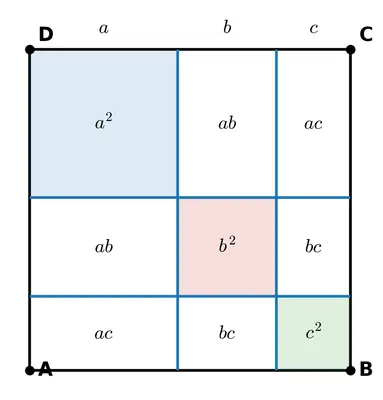
Solution
Step 1 : Draw the big square of side $$(a+b+c)$$
Take a square $$ABCD$$ such that each side is $$a+b+c$$ units long. This outside square will finally represent $$\,(a+b+c)^2$$ because its area equals its side square.
Step 2 : Mark off the three segment-lengths $$a,\,b,\,c$$ on one side
On the top side $$AB$$ measure from $$A$$ to $$E$$ a distance $$a$$, from $$E$$ to $$F$$ a distance $$b$$, and the remaining segment $$FB$$ will then automatically be $$c$$ (since $$AB=a+b+c$$).
Do the same marking down the left side $$AD$$, producing points $$P$$ and $$Q$$ such that $$AP=a,\;PQ=b,\;QD=c$$.
Step 3 : Produce the grid that cuts the square into 9 parts
Through $$E,\,F$$ draw vertical lines to the bottom side; through $$P,\,Q$$ draw horizontal lines to the right side. The grid cuts the big square into
- three small squares (lying on the main diagonal), and
- six rectangles (two in every off-diagonal position).
Step 4 : Identify the three squares
| Square obtained | Side length | Label written inside |
|---|---|---|
| $$AEPO$$ (top-left) | $$a$$ | $$a^2$$ |
| $$EQFR$$ (centre) | $$b$$ | $$b^2$$ |
| $$QFBC$$ (bottom-right) | $$c$$ | $$c^2$$ |
Step 5 : Identify and label the six rectangles
| Rectangle position in the grid | Dimensions | Label written inside |
|---|---|---|
| Top-middle (between $$a^2$$ and $$b^2$$) | $$a \times b$$ | $$ab$$ |
| Left-centre (between $$a^2$$ and $$b^2$$) | $$a \times b$$ | $$ab$$ |
| Middle-right (between $$b^2$$ and $$c^2$$) | $$b \times c$$ | $$bc$$ |
| Bottom-centre (between $$b^2$$ and $$c^2$$) | $$b \times c$$ | $$bc$$ |
| Top-right (between $$a^2$$ and $$c^2$$) | $$a \times c$$ | $$ac$$ |
| Bottom-left (between $$a^2$$ and $$c^2$$) | $$a \times c$$ | $$ac$$ |
Step 6 : Verify that areas add up to the algebraic identity
Because the nine regions exactly tile the outside square and do not overlap, the total area must be the sum of their individual areas:
Labeling the figure as described therefore makes the diagram a perfect geometric demonstration of $$ (a+b+c)^2 = a^2+b^2+c^2+2ab+2bc+2ca $$, exactly as required.
What to draw: sketch the big square, insert two equidistant vertical and two horizontal partition lines at the marked lengths, and write the labels inside the nine resulting regions following the tables above.
Answer
The three diagonal blocks are labelled $$a^2,\,b^2,\,c^2$$; the six off-diagonal blocks are labelled two each of $$ab,\,bc,\,ac$$ so that their combined area equals $$a^2+b^2+c^2+2ab+2bc+2ca=(a+b+c)^2$$.
Think and Reflect (5)

1
Try to evaluate the following using a suitable identity. Do you observe any interesting pattern?
- (i) $$35^2$$
- (ii) $$65^2$$
- (iii) $$85^2$$
- (iv) $$105^2$$
Solution
We want the square of each number, and every number ends with 5.
Write it in the form $$10n+5$$, so that we can apply the identity
\[(10n+5)^2 = (10n)^2 + 2(10n)(5) + 5^2 = 100n^2 + 100n + 25 = 100n(n+1) + 25.\]
(i) $$35^2$$
Here, $$n = 3$$ (because $$35 = 10\times3 + 5$$).
Therefore $$35^2 = 100\times3\times(3+1) + 25 = 100\times12 + 25 = 1200 + 25 = 1225.$$(ii) $$65^2$$
Here, $$n = 6$$.
$$65^2 = 100\times6\times(6+1) + 25 = 100\times42 + 25 = 4200 + 25 = 4225.$$(iii) $$85^2$$
Here, $$n = 8$$.
$$85^2 = 100\times8\times(8+1) + 25 = 100\times72 + 25 = 7200 + 25 = 7225.$$(iv) $$105^2$$
Here, $$n = 10$$.
$$105^2 = 100\times10\times(10+1) + 25 = 100\times110 + 25 = 11000 + 25 = 11025.$$
Pattern observed
Every number ending in 5 has a square that ends in 25, and the digits that come before 25 are obtained by multiplying the number formed by the digits in front of 5 (that is, $$n$$) with its successor $$n+1$$.
Answer
(i) $$35^2 = 1225$$
(ii) $$65^2 = 4225$$
(iii) $$85^2 = 7225$$
(iv) $$105^2 = 11025$$
For any number $$10n+5$$, $$\;(10n+5)^2 = 100n(n+1)+25,$$ so the square always ends in 25 and the preceding digits are $$n(n+1).$$
2 Observe the two rows of figures in Fig. 4.6. They represent an algebraic identity. Try to identify it. (The figures show a square of side $$a + b + c$$ stacked with rectangles of dimensions $$2b$$, $$2c$$, $$a + b - c$$, $$a - b + c$$, $$a - b - c$$, and a separate square of side $$2a$$ with $$2b$$ and $$2c$$ squares alongside.)
Solution
The first row in Fig. 4.6 contains four squares with sides
- $$a+b+c$$
- $$a+b-c$$
- $$a-b+c$$
- $$a-b-c$$
Their total area is
\[(a+b+c)^2 + (a+b-c)^2 + (a-b+c)^2 + (a-b-c)^2.\]Expand each square one by one.
\((a+b+c)^2 = a^2 + b^2 + c^2 + 2ab + 2bc + 2ca.\)
\((a+b-c)^2 = a^2 + b^2 + c^2 + 2ab - 2bc - 2ca.\)
\((a-b+c)^2 = a^2 + b^2 + c^2 - 2ab + 2bc - 2ca.\)
\((a-b-c)^2 = a^2 + b^2 + c^2 - 2ab - 2bc + 2ca.\)
Add the four expansions, term by term:
- The $$a^2, b^2, c^2$$ terms appear four times: $$4a^2 + 4b^2 + 4c^2.$$
- Each product term $$2ab,\,2bc,\,2ca$$ appears twice with a plus sign and twice with a minus sign, so they cancel out.
Hence
\[(a+b+c)^2 + (a+b-c)^2 + (a-b+c)^2 + (a-b-c)^2 = 4(a^2 + b^2 + c^2).\]The second row of the figure shows one square of side $$2a$$ and two small squares of sides $$2b$$ and $$2c$$. Their combined area is
\[(2a)^2 + (2b)^2 + (2c)^2 = 4a^2 + 4b^2 + 4c^2.\]Since the areas of the two rows are the same, the figure illustrates the identity
\[(a+b+c)^2 + (a+b-c)^2 + (a-b+c)^2 + (a-b-c)^2 = (2a)^2 + (2b)^2 + (2c)^2.\]Equivalently,
\[(a+b+c)^2 + (a+b-c)^2 + (a-b+c)^2 + (a-b-c)^2 = 4(a^2 + b^2 + c^2).\]Answer
The picture represents the identity
\[(a+b+c)^2 + (a+b-c)^2 + (a-b+c)^2 + (a-b-c)^2 = (2a)^2 + (2b)^2 + (2c)^2 = 4(a^2 + b^2 + c^2).\]
Think and Reflect (6) Suppose $$7x$$ in $$x^2 + 7x + 12$$ is split as $$2x + 5x$$; can a similar rectangular arrangement (using algebra tiles) be formed? Consider other possibilities and check.
Solution
Idea of an algebra-tile rectangular arrangement
• One large square represents $$x^{2}$$.
• Each long thin rectangle represents $$x$$ (length $$x$$, width 1).
• Each small square represents the number 1.
To lay out the tiles of a trinomial we try to pack them into one exact rectangle. If the arrangement is possible, the two outside lengths give the two linear factors.
Given expression $$x^{2}+7x+12$$
We already have:
- one $$x^{2}$$-tile,
- seven $$x$$-tiles,
- twelve unit tiles.
1. Try the suggested split $$7x = 2x + 5x$$
Placing the $$x^{2}$$-tile first, fix two $$x$$-tiles along its one side (so that side now measures $$x+2$$). Fix the remaining five $$x$$-tiles along the other side (so that side now measures $$x+5$$).
The corner that has to be filled to finish the rectangle is a plain number rectangle of size $$2 \times 5 = 10$$. But we possess twelve unit squares, not ten. Two unit squares are left over and cannot be fitted without spoiling the rectangular outline. Hence no single rectangle can be formed.
So the split $$2x+5x$$ does not lead to a rectangular arrangement.
2. Examine the other possible splits of $$7x$$
| Split of $$7x$$ | Corner to be filled | No. of unit squares required | Have 12 unit squares? | Rectangle possible? |
|---|---|---|---|---|
| $$1x + 6x$$ | $$1 \times 6$$ | 6 | Yes (extra 6 left) | No (extra pieces) |
| $$2x + 5x$$ | $$2 \times 5$$ | 10 | Yes (extra 2 left) | No |
| $$3x + 4x$$ | $$3 \times 4$$ | 12 | Exactly 12 | Yes |
| $$4x + 3x$$ | same as above | 12 | Exactly 12 | Yes |
| $$5x + 2x,\;6x + 1x$$ | same as corresponding above | 10 or 6 | 12 available | No |
3. Successful arrangement with $$3x + 4x$$
Place three $$x$$-tiles down one side of the $$x^{2}$$-tile and four $$x$$-tiles along the other side. The leftover corner is now $$3 \times 4$$ and needs exactly 12 unit squares, which we have. After filling them, the whole figure is a perfect rectangle.
Therefore the outside dimensions are $$(x+3)$$ and $$(x+4)$$, so
\[ (x+3)(x+4) = x^{2}+7x+12. \]Conclusion
The split $$7x = 2x + 5x$$ (and any other split except $$3x + 4x$$ or $$4x + 3x$$) fails to give a rectangular arrangement. Only the split $$3x + 4x$$ (or its reverse) works, confirming that $$x^{2}+7x+12$$ factors as $$(x+3)(x+4).$$
Answer
Only the split $$7x = 3x + 4x$$ (or $$4x + 3x$$) allows a complete rectangle; the proposed split $$2x + 5x$$ does not. Hence $$x^{2}+7x+12 = (x+3)(x+4).$$
Think and Reflect (7)
Algebra tiles can be used to represent products and find factors.
1 Figure out the product of $$x + 2$$ and $$x + 3$$ using algebra tiles.
Solution
Step 1 Decide the two side-lengths
We want the area of a rectangle whose length is $$(x+2)$$ and whose breadth is $$(x+3)$$. In tile language this means
- along one side place one $$x$$-tile followed by two unit tiles (total length $$x+2$$);
- along the adjacent side place one $$x$$-tile followed by three unit tiles (total length $$x+3$$).
Step 2 Fill the rectangle with tiles
Inside the frame every position is the intersection of the pieces laid on the two sides:
- $$x\times x$$ gives one $$x^2$$-tile;
- each of the remaining four intersections that include exactly one $$x$$ side and one unit side gives an $$x$$-tile; in total we get $$2+3=5$$ such $$x$$-tiles;
- each intersection of a unit segment on one side with a unit segment on the other is a unit square; we get $$2\times3=6$$ unit tiles.
Step 3 Read the product
The complete rectangle therefore contains
- 1 $$x^2$$-tile,
- 5 $$x$$-tiles,
- 6 unit tiles.
This is exactly the area represented by the tiles.
Answer
2 Lay out algebra tiles for $$x^2 + 11x + 30$$ in such a way that you will see its factors.
Solution
We are given the mixed collection of tiles for the expression $$x^2+11x+30$$ and must arrange them into one seamless rectangle (no gaps, no overlaps). Once that is achieved, the two side lengths of the rectangle will be the required factors.
Step 1 Sort the tiles
- 1 big square $$x^2$$-tile,
- 11 long $$x$$-tiles,
- 30 unit tiles.
Step 2 Look for two numbers whose
• sum is 11 (to match the $$11x$$-tiles) and
• product is 30 (to match the 30 unit tiles).
Trial list of factor pairs of 30: $$(1,30),\,(2,15),\,(3,10),\,(5,6).$$ Only $$5+6=11$$, so the promising pair is 5 and 6.
Step 3 Lay out the rectangle
- Place the single $$x^2$$-tile in the top-left corner; that fixes an $$x$$ along its top edge and an $$x$$ along its left edge.
- Extend the top edge by adding 6 unit tiles after the $$x$$ segment → total top length $$x+6$$.
- Extend the left edge by adding 5 unit tiles below the $$x$$ segment → total left length $$x+5$$.
- Fill the interior. The strip created by the $$x$$ on the left and the 6 units on the top needs $$6$$ more $$x$$-tiles; the strip created by the $$x$$ on the top and the 5 units on the left needs $$5$$ more $$x$$-tiles. That uses up all $$11$$ $$x$$-tiles.
- The remaining hole is a $$5\times6$$ rectangle, which is exactly covered by the 30 unit tiles.
The arrangement is perfect, so the outside dimensions of the finished rectangle are $$x+5$$ and $$x+6$$.
\[ x^2+11x+30=(x+5)(x+6) \]Thus the algebra-tile layout displays the required factors.
Answer
Think and Reflect (8) We have seen that $$(x + 3)(x + 4) = x^2 + 7x + 12$$. Also $$(x + 6)(x + 7) = x^2 + 13x + 42$$. Generalise the pattern to get an expression for $$(x + a)(x + b)$$.
Solution
The exercise asks us to discover a general rule that matches the numerical examples
- $$(x + 3)(x + 4) = x^2 + 7x + 12$$
- $$(x + 6)(x + 7) = x^2 + 13x + 42$$
and then state that rule for any two numbers $$a$$ and $$b$$.
Step 1 – Write the general product
Replace the concrete numbers $$3,4,6,7$$ by two arbitrary real numbers $$a$$ and $$b$$. We therefore consider the product
$$ (x + a)(x + b). $$
Step 2 – Apply the distributive property ("FOIL" method)
Multiply term by term:
- First terms: $$x \times x = x^2$$
- Outer terms: $$x \times b = bx$$
- Inner terms: $$a \times x = ax$$
- Last terms: $$a \times b = ab$$
Now add (because multiplication has been distributed over addition):
$$ x^2 + bx + ax + ab. $$
Step 3 – Collect like terms
The two middle terms are both multiples of $$x$$, so we combine them:
$$ x^2 + (a + b)x + ab. $$
Step 4 – State the generalised identity
We have therefore shown that
\[ (x + a)(x + b) = x^2 + (a + b)x + ab. \]This single formula reproduces the earlier examples automatically:
- Put $$a = 3,\;b = 4$$ ⇒ $$x^2 + (3 + 4)x + 3\cdot4 = x^2 + 7x + 12.$$
- Put $$a = 6,\;b = 7$$ ⇒ $$x^2 + (6 + 7)x + 6\cdot7 = x^2 + 13x + 42.$$
Hence the requested general expression is confirmed.
Answer
$$ (x + a)(x + b) = x^2 + (a + b)x + ab $$
Fill in the blanks (Section 4.5)
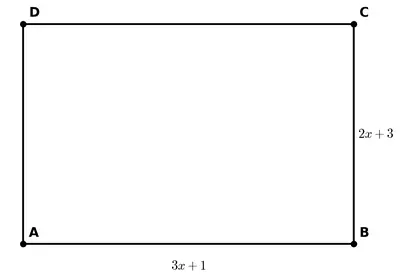
Consider a rectangle with sidelengths $$2x + 3$$ and $$3x + 1$$ (see Fig. 4.8). Fill in the blanks with the appropriate expressions to make the equation true.
$$(px + a)(qx + b) = (\underline{\quad\quad})x^2 + (\underline{\quad\quad})x + \underline{\quad\quad}.$$
Also, verify your answer using the distributive property.

Solution
Step 1 – Identify the two linear factors
The sides of the rectangle are $$2x+3$$ and $$3x+1$$.
Thus they fit the pattern $$(px+a)(qx+b)$$ with
- $$p = 2, \; a = 3$$
- $$q = 3, \; b = 1$$
Step 2 – Expand the product
\[ (2x+3)(3x+1)=2x\cdot3x + 2x\cdot1 + 3\cdot3x + 3\cdot1 \] \[ =6x^2 + 2x + 9x + 3 \] \[ =6x^2 + 11x + 3 \]Step 3 – Fill the blanks
Comparing with $$ (\underline{\qquad})x^2 + (\underline{\qquad})x + \underline{\qquad} $$, we get
- Coefficient of $$x^2$$ (first blank) : $$6$$
- Coefficient of $$x$$ (second blank) : $$11$$
- Constant term (third blank) : $$3$$
Step 4 – Verification
Re-expanding $$(2x+3)(3x+1)$$ exactly reproduces $$6x^2+11x+3$$, confirming the result.
Answer
The blanks are 6, 11 and 3; thus $$(2x+3)(3x+1)=6x^2+11x+3.$$
Think and Reflect (9)
James and Reshma were talking about algebraic identities they learnt in school.
James: $$(a - b)^2 (a + b) = (a^2 - 2ab + b^2)(a + b)$$.
Reshma: I have a different idea. $$(a - b)^2 (a + b) = (a - b)[(a - b)(a + b)] = (a - b)(a^2 - b^2)$$. I will find this product to get the answer.
According to you, who is correct and why? Try to combine more such identities and find new results.
Solution
Given expression: $$(a-b)^2(a+b).$$
We simplify it by the two different methods suggested and then compare the answers.
Method 1 — James' way
- First use the identity $$(a-b)^2 = a^2 - 2ab + b^2$$.
- Then multiply the result by $$(a+b)$$.
$$(a-b)^2(a+b) = (a^2 - 2ab + b^2)(a+b).$$
Distribute $$(a+b)$$ over each term:
$$(a^2 - 2ab + b^2)(a+b) = a^2(a+b) - 2ab(a+b) + b^2(a+b).$$
Expand every product:
$$= a^3 + a^2 b - 2a^2 b - 2ab^2 + ab^2 + b^3.$$
Collect like terms. The $$a^2 b$$ terms combine to give $$a^2 b - 2a^2 b = -a^2 b$$, and the $$ab^2$$ terms combine to give $$-2ab^2 + ab^2 = -ab^2$$. Therefore
\[ (a-b)^2(a+b) = a^3 - a^2 b - ab^2 + b^3. \]Method 2 — Reshma's way
- First pair $$(a-b)$$ with $$(a+b)$$ using $$(a-b)(a+b) = a^2 - b^2$$.
- Then multiply by the remaining $$(a-b)$$.
$$(a-b)^2(a+b) = (a-b)\bigl[(a-b)(a+b)\bigr] = (a-b)(a^2 - b^2).$$
Expand
$$(a-b)(a^2 - b^2) = a(a^2 - b^2) - b(a^2 - b^2) = a^3 - ab^2 - a^2 b + b^3.$$
Re-arranging the middle terms gives
\[ a^3 - a^2 b - ab^2 + b^3, \]which is exactly the same polynomial obtained by Method 1.
Conclusion: Both James and Reshma are correct. They merely grouped the factors differently; after full expansion they obtain the same simplified form $$a^3 - a^2 b - ab^2 + b^3$$.
Some more identities obtained by combining standard ones:
- $$(a+b)^2(a-b) = a^3 + a^2 b - ab^2 - b^3$$
- $$(a+b)^3 = a^3 + 3a^2 b + 3ab^2 + b^3$$
- $$(a-b)^3 = a^3 - 3a^2 b + 3ab^2 - b^3$$
- $$(a+b)(a^2 - b^2) = (a+b)(a-b)(a+b) = (a+b)^2(a-b) = a^3 + a^2 b - ab^2 - b^3$$
- $$(a-b)(a^2 + ab + b^2) = a^3 - b^3$$
- $$(a+b)(a^2 - ab + b^2) = a^3 + b^3$$
By systematically replacing one factor in a known identity with another identity, we can keep creating fresh products.
Answer
Both methods are correct and yield the same simplified form:
$$(a-b)^2(a+b) = a^3 - a^2 b - ab^2 + b^3.$$
Try to multiply (Section 4.7)
Now let us play with known identities to discover more identities. Try to multiply the following using the distributive property.
1 $$(x - y)(x^2 + xy + y^2)$$
Solution
Write the expression once for ready reference:
$$ (x - y)(x^2 + xy + y^2) $$
Using the distributive property (multiply the first bracket by each term of the second bracket):
$$ (x - y)(x^2 + xy + y^2)=x(x^2 + xy + y^2)-y(x^2 + xy + y^2). $$
Expand each product term-by-term.
1. First part $$(x)(x^2 + xy + y^2):$$
- $$x \times x^2 = x^3$$
- $$x \times xy = x^2y$$
- $$x \times y^2 = xy^2$$
Thus
$$x(x^2 + xy + y^2)=x^3 + x^2y + xy^2.$$
2. Second part $$(y)(x^2 + xy + y^2):$$
- $$y \times x^2 = x^2y$$
- $$y \times xy = xy^2$$
- $$y \times y^2 = y^3$$
Hence
$$y(x^2 + xy + y^2)=x^2y + xy^2 + y^3.$$
3. Subtract the two results:
$$ (x - y)(x^2 + xy + y^2)=(x^3 + x^2y + xy^2)-(x^2y + xy^2 + y^3). $$
Combine like terms (same powers of $$x$$ and $$y$$):
$$ =x^3 + \cancel{x^2y} + \cancel{xy^2}-\cancel{x^2y}-\cancel{xy^2}-y^3=x^3 - y^3. $$
Therefore the expansion is
\[ (x - y)(x^2 + xy + y^2)=x^3 - y^3. \]
Answer
$$(x - y)(x^2 + xy + y^2)=x^3 - y^3$$
2 $$(x + y)(x^2 - xy + y^2)$$
Solution
Start with the expression:
$$ (x + y)(x^2 - xy + y^2) $$
Apply the distributive property:
$$ (x + y)(x^2 - xy + y^2)=x(x^2 - xy + y^2)+y(x^2 - xy + y^2). $$
1. First part $$(x)(x^2 - xy + y^2):$$
- $$x \times x^2 = x^3$$
- $$x \times (-xy) = -x^2y$$
- $$x \times y^2 = xy^2$$
Hence
$$x(x^2 - xy + y^2)=x^3 - x^2y + xy^2.$$
2. Second part $$(y)(x^2 - xy + y^2):$$
- $$y \times x^2 = x^2y$$
- $$y \times (-xy) = -xy^2$$
- $$y \times y^2 = y^3$$
Thus
$$y(x^2 - xy + y^2)=x^2y - xy^2 + y^3.$$
3. Add the two results:
$$ (x + y)(x^2 - xy + y^2)=(x^3 - x^2y + xy^2)+(x^2y - xy^2 + y^3). $$
Simplify by cancelling opposite terms:
$$ =x^3 + \cancel{-x^2y}+\cancel{xy^2}+\cancel{x^2y}+\cancel{-xy^2}+y^3=x^3 + y^3. $$
Hence we get
\[ (x + y)(x^2 - xy + y^2)=x^3 + y^3. \]
Answer
$$(x + y)(x^2 - xy + y^2)=x^3 + y^3$$
Think and Reflect (10)
We already know that $$x^2 - y^2 = (x - y)(x + y)$$. Further, we have verified that $$x^3 - y^3 = (x - y)(x^2 + xy + y^2)$$. Observe that $$x - y$$ is a common factor of $$x^2 - y^2$$ and $$x^3 - y^3$$.
Do you think $$x - y$$ is also a factor of $$x^4 - y^4$$? Note that $$x^4 - y^4 = (x^2)^2 - (y^2)^2 = (x^2 - y^2)(x^2 + y^2)$$. Can you see how $$x - y$$ is a factor of $$x^4 - y^4$$? How about $$x^5 - y^5$$? Does this also have $$x - y$$ as a factor?
Solution
Recall
We already have
$$x^2-y^2=(x-y)(x+y),\[5pt]x^3-y^3=(x-y)(x^2+xy+y^2).$$
Thus $$(x-y)$$ is a factor of both expressions.
(i) Checking $$x^4-y^4$$
Write the fourth–power difference as a difference of squares:
$$x^4-y^4=(x^2)^2-(y^2)^2=(x^2-y^2)(x^2+y^2).$$
But $$x^2-y^2=(x-y)(x+y).$$ Therefore
\[x^4-y^4=(x-y)(x+y)(x^2+y^2).\]
The factor $$(x-y)$$ appears explicitly, so $$x^4-y^4$$ is divisible by $$(x-y).$$
Conclusion for (i): Yes, $$x-y$$ is a factor of $$x^4-y^4$$.
(ii) Checking $$x^5-y^5$$
Method 1 (Factor Theorem)
Regard $$f(x)=x^5-y^5$$ as a polynomial in $$x$$. Evaluate at $$x=y$$:
$$f(y)=y^5-y^5=0.$$
Since the polynomial becomes zero at $$x=y$$, the factor theorem says $$(x-y)$$ is a factor.
Method 2 (General identity)
The standard identity
\[x^n-y^n=(x-y)(x^{n-1}+x^{n-2}y+\dots+xy^{n-2}+y^{n-1})\]
gives, for $$n=5$$,
\[x^5-y^5=(x-y)(x^4+x^3y+x^2y^2+xy^3+y^4).\]
This again shows $$(x-y)$$ as a factor.
Conclusion for (ii): Yes, $$x-y$$ is a factor of $$x^5-y^5$$.
Overall
Both $$x^4-y^4$$ and $$x^5-y^5$$ contain $$(x-y)$$ as a factor. In fact, by the same reasoning, $$(x-y)$$ is a factor of $$x^n-y^n$$ for every positive integer $$n$$.
Answer
Yes. $$x^4-y^4=(x-y)(x+y)(x^2+y^2)$$ and $$x^5-y^5=(x-y)(x^4+x^3y+x^2y^2+xy^3+y^4).$$ Hence each expression is divisible by $$x-y$$.
Think and Reflect (11)
Try to simplify the following rational expression:
$$\dfrac{36s^2 - 12st + t^2}{t^2 + 2ts - 48s^2} = \dfrac{(6s - t)^2}{(\underline{\quad} + \underline{\quad})(\underline{\quad} + \underline{\quad})}.$$
(Hint: Factor $$t^2 + 2ts - 48s^2$$ and simplify the rational expression assuming that $$t^2 + 2ts - 48s^2 \neq 0$$.)
Solution
We start with the given rational expression
$$\dfrac{36s^2-12st+t^2}{t^2+2ts-48s^2}.$$
——————————————————————————
1. Factor the numerator
The numerator is a perfect square trinomial because
$$\bigl(6s - t\bigr)^2 = (6s)^2 - 2\cdot 6s\cdot t + t^2 = 36s^2 - 12st + t^2.$$
Therefore
$$36s^2 - 12st + t^2 = (6s - t)^2.$$
——————————————————————————
2. Factor the denominator
Look for two numbers whose product is $$-48$$ (the coefficient of $$s^2$$ times the constant term) and whose sum is $$2$$ (the coefficient of the middle term $$2ts$$). Those numbers are $$8$$ and $$-6$$, because
- $$8 + (-6) = 2,$$
- $$8 \times (-6) = -48.$$
Using these, split the middle term:
$$t^2 + 2ts - 48s^2 = t^2 + 8ts - 6ts - 48s^2.$$
Group and factor by grouping:
$$\begin{aligned} &= t\bigl(t + 8s\bigr) - 6s\bigl(t + 8s\bigr) \\[4pt] &= (t + 8s)\bigl(t - 6s\bigr). \end{aligned}$$
Hence
$$t^2 + 2ts - 48s^2 = (t + 8s)(t - 6s).$$
——————————————————————————
3. Rewrite the whole fraction using the factors
$$\dfrac{36s^2-12st+t^2}{t^2+2ts-48s^2} = \dfrac{(6s - t)^2}{(t + 8s)(t - 6s)}.$$
Notice that $$6s - t = -(t - 6s)$$, so
$$(6s - t)^2 = \bigl(-(t - 6s)\bigr)^2 = (t - 6s)^2.$$
Substituting this form makes cancellation obvious:
$$\dfrac{(t - 6s)^2}{(t + 8s)(t - 6s)}.$$
——————————————————————————
4. Cancel the common factor
Because $$t - 6s \neq 0$$ (this is part of the restriction that the original denominator must not be zero), one factor of $$t-6s$$ cancels:
\[ \dfrac{t - 6s}{t + 8s}. \]
——————————————————————————
5. State the simplified form and the restrictions
The expression simplifies to
$$\boxed{\dfrac{t - 6s}{t + 8s}}$$
provided that neither factor of the original denominator is zero, i.e.
- $$t + 8s \neq 0 \;\;\;(t \neq -8s),$$
- $$t - 6s \neq 0 \;\;\;(t \neq 6s).$$
Under these conditions the simplification is valid.
Answer
$$\dfrac{t - 6s}{t + 8s}$$ (with $$t \neq 6s$$ and $$t \neq -8s$$)
Exercise Set 4.1
1 Using the identity $$(a + b)^2 = a^2 + 2ab + b^2$$, expand the following:
(i) $$(7x + 4y)^2$$
Solution
Identity used: $$(a + b)^2 = a^2 + 2ab + b^2$$
Put $$a = 7x$$ and $$b = 4y$$.
Compute each term:
$$a^2 = (7x)^2 = 49x^2$$
$$2ab = 2 \times 7x \times 4y = 56xy$$
$$b^2 = (4y)^2 = 16y^2$$
Add the three terms:
\[ (7x + 4y)^2 = 49x^2 + 56xy + 16y^2 \]
Answer
(ii) $$\left(\dfrac{7}{5}x + \dfrac{3}{2}y\right)^2$$
Solution
Identity: $$(a + b)^2 = a^2 + 2ab + b^2$$
Take $$a = \dfrac{7}{5}x$$ and $$b = \dfrac{3}{2}y$$.
Square of the first term:
$$a^2 = \left(\dfrac{7}{5}x\right)^2 = \dfrac{49}{25}x^2$$
Twice the product:
$$2ab = 2 \times \dfrac{7}{5}x \times \dfrac{3}{2}y = \dfrac{21}{5}xy$$
Square of the second term:
$$b^2 = \left(\dfrac{3}{2}y\right)^2 = \dfrac{9}{4}y^2$$
Add them:
\[ \left(\dfrac{7}{5}x + \dfrac{3}{2}y\right)^2 = \dfrac{49}{25}x^2 + \dfrac{21}{5}xy + \dfrac{9}{4}y^2 \]
Answer
(iii) $$(2.5p + 1.5q)^2$$
Solution
Identity: $$(a + b)^2 = a^2 + 2ab + b^2$$
Let $$a = 2.5p$$ and $$b = 1.5q$$.
Calculate:
$$a^2 = (2.5p)^2 = 6.25p^2$$
$$2ab = 2 \times 2.5p \times 1.5q = 7.5pq$$
$$b^2 = (1.5q)^2 = 2.25q^2$$
Hence,
\[ (2.5p + 1.5q)^2 = 6.25p^2 + 7.5pq + 2.25q^2 \]
Answer
(iv) $$\left(\dfrac{3}{4}s + 8t\right)^2$$
Solution
Identity: $$(a + b)^2 = a^2 + 2ab + b^2$$
Choose $$a = \dfrac{3}{4}s$$ and $$b = 8t$$.
Now,
$$a^2 = \left(\dfrac{3}{4}s\right)^2 = \dfrac{9}{16}s^2$$
$$2ab = 2 \times \dfrac{3}{4}s \times 8t = 12st$$
$$b^2 = (8t)^2 = 64t^2$$
Adding,
\[ \left(\dfrac{3}{4}s + 8t\right)^2 = \dfrac{9}{16}s^2 + 12st + 64t^2 \]
Answer
(v) $$\left(x + \dfrac{1}{2y}\right)^2$$
Solution
Identity: $$(a + b)^2 = a^2 + 2ab + b^2$$
Set $$a = x$$ and $$b = \dfrac{1}{2y}$$.
Compute:
$$a^2 = x^2$$
$$2ab = 2 \times x \times \dfrac{1}{2y} = \dfrac{x}{y}$$
$$b^2 = \left(\dfrac{1}{2y}\right)^2 = \dfrac{1}{4y^2}$$
Therefore,
\[ \left(x + \dfrac{1}{2y}\right)^2 = x^2 + \dfrac{x}{y} + \dfrac{1}{4y^2} \]
Answer
(vi) $$\left(\dfrac{1}{x} + \dfrac{1}{y}\right)^2$$
Solution
Identity: $$(a + b)^2 = a^2 + 2ab + b^2$$
Let $$a = \dfrac{1}{x}$$ and $$b = \dfrac{1}{y}$$.
Then,
$$a^2 = \dfrac{1}{x^2}$$
$$2ab = 2 \times \dfrac{1}{x} \times \dfrac{1}{y} = \dfrac{2}{xy}$$
$$b^2 = \dfrac{1}{y^2}$$
Adding these terms:
\[ \left(\dfrac{1}{x} + \dfrac{1}{y}\right)^2 = \dfrac{1}{x^2} + \dfrac{2}{xy} + \dfrac{1}{y^2} \]
Answer
2 Using the same identity, find the values of the following:
(i) $$(64)^2$$
Solution
We use the algebraic identity
$$ (a + b)^2 = a^2 + 2ab + b^2 $$
For $$64^2$$ we split 64 as a convenient tens part and a units part:
$$64 = 60 + 4$$ so here $$a = 60$$ and $$b = 4$$.
Substituting in the identity:
$$64^2 = (60 + 4)^2$$
$$\phantom{64^2}= 60^2 + 2 \times 60 \times 4 + 4^2$$
Calculate each term one by one:
- $$60^2 = 3600$$
- $$2 \times 60 \times 4 = 480$$
- $$4^2 = 16$$
Add the three results:
$$3600 + 480 + 16 = 4096$$
Thus
\[64^2 = 4096\]
Answer
(ii) $$(105)^2$$
Solution
Again apply the same identity $$ (a + b)^2 = a^2 + 2ab + b^2 $$.
Write 105 as $$100 + 5$$ so that $$a = 100 ,\; b = 5$$.
$$105^2 = (100 + 5)^2$$
Break it using the identity:
$$= 100^2 + 2 \times 100 \times 5 + 5^2$$
- $$100^2 = 10000$$
- $$2 \times 100 \times 5 = 1000$$
- $$5^2 = 25$$
Add them:
$$10000 + 1000 + 25 = 11025$$
Hence
\[105^2 = 11025\]
Answer
(iii) $$(205)^2$$
Solution
Use the same identity $$ (a + b)^2 = a^2 + 2ab + b^2 $$.
Express 205 as $$200 + 5$$ giving $$a = 200 ,\; b = 5$$.
$$205^2 = (200 + 5)^2$$
Applying the identity:
$$= 200^2 + 2 \times 200 \times 5 + 5^2$$
- $$200^2 = 40000$$
- $$2 \times 200 \times 5 = 2000$$
- $$5^2 = 25$$
Add them:
$$40000 + 2000 + 25 = 42025$$
Therefore
\[205^2 = 42025\]
Answer
Exercise Set 4.2
1
Factor completely:
(Hint: $$2$$ was taken out as a common factor in Example 7. Is it possible to do something similar in Exercises (v) and (vi) below?)
(i) $$9x^2 + 24xy + 16y^2$$
Solution
The given trinomial is $$9x^2+24xy+16y^2$$.
Write it in the form $$A^2+2AB+B^2$$.
- First term $$9x^2=(3x)^2\Rightarrow A=3x$$.
- Last term $$16y^2=(4y)^2\Rightarrow B=4y$$.
- Middle term test: $$2AB=2\times(3x)\times(4y)=24xy$$, which matches the given middle term.
Hence the expression is a perfect-square trinomial:
\[ 9x^2+24xy+16y^2=(3x+4y)^2. \]Answer
(ii) $$4s^2 + 20st + 25t^2$$
Solution
For $$4s^2+20st+25t^2$$, compare with $$A^2+2AB+B^2$$.
- $$4s^2=(2s)^2\Rightarrow A=2s$$,
- $$25t^2=(5t)^2\Rightarrow B=5t$$,
- Middle term: $$2AB=2\times(2s)\times(5t)=20st$$ ✓
Therefore,
\[ 4s^2+20st+25t^2=(2s+5t)^2. \]Answer
(iii) $$49x^2 + 28xy + 4y^2$$
Solution
Given $$49x^2+28xy+4y^2$$.
- $$49x^2=(7x)^2\Rightarrow A=7x$$,
- $$4y^2=(2y)^2\Rightarrow B=2y$$,
- Test middle term: $$2AB=2\times(7x)\times(2y)=28xy$$ ✓
Thus,
\[ 49x^2+28xy+4y^2=(7x+2y)^2. \]Answer
(iv) $$64p^2 + \dfrac{32}{3}pq + \dfrac{4}{9}q^2$$
Solution
Expression: $$64p^2+\dfrac{32}{3}pq+\dfrac{4}{9}q^2$$.
- $$64p^2=(8p)^2\Rightarrow A=8p$$,
- $$\dfrac{4}{9}q^2=\left(\dfrac{2}{3}q\right)^2\Rightarrow B=\dfrac{2}{3}q$$,
- Middle term check: $$2AB=2\times(8p)\times\left(\dfrac{2}{3}q\right)=\dfrac{32}{3}pq$$ ✓
Hence,
\[ 64p^2+\dfrac{32}{3}pq+\dfrac{4}{9}q^2=\left(8p+\dfrac{2}{3}q\right)^2. \]Answer
*(v) $$3a^2 + 4ab + \dfrac{4}{3}b^2$$
Solution
Given $$3a^2+4ab+\dfrac{4}{3}b^2$$.
Step 1 — take out the common factor $$\dfrac{1}{3}$$ to clear fractions:
\[ 3a^2+4ab+\dfrac{4}{3}b^2=\dfrac{1}{3}\bigl(9a^2+12ab+4b^2\bigr). \]Step 2 — recognise the perfect square inside the brackets:
- $$(3a)^2=9a^2\;{\small(=A^2)},$$
- $$(2b)^2=4b^2\;{\small(=B^2)},$$
- $$2AB=2\times(3a)\times(2b)=12ab$$ matches the middle term.
Therefore,
\[ 9a^2+12ab+4b^2=(3a+2b)^2. \]Substituting back,
\[ 3a^2+4ab+\dfrac{4}{3}b^2=\dfrac{1}{3}(3a+2b)^2. \]Answer
*(vi) $$\dfrac{9}{5}s^2 + 6sv + 5v^2$$
Solution
Trinomial: $$\dfrac{9}{5}s^2+6sv+5v^2$$.
Step 1 — factor out $$\dfrac{1}{5}$$:
\[ \dfrac{9}{5}s^2+6sv+5v^2=\dfrac{1}{5}\bigl(9s^2+30sv+25v^2\bigr). \]Step 2 — check the bracketed quadratic:
- $$(3s)^2=9s^2\;{\small(=A^2)},$$
- $$(5v)^2=25v^2\;{\small(=B^2)},$$
- Middle term $$2AB=2\times(3s)\times(5v)=30sv$$ ✓
So,
\[ 9s^2+30sv+25v^2=(3s+5v)^2. \]Hence,
\[ \dfrac{9}{5}s^2+6sv+5v^2=\dfrac{1}{5}(3s+5v)^2. \]Answer
2 Find the values of the following using the identity $$(a - b)^2 = a^2 - 2ab + b^2$$:
(i) $$(79)^2$$
Solution
To evaluate $$(79)^2$$ we recognise that 79 is 1 less than 80, an easy number to square.
Let $$a = 80$$ and $$b = 1$$ so that $$79 = a - b$$.
Using the identity $$(a - b)^2 = a^2 - 2ab + b^2$$:
Compute each term step-by-step:
- $$a^2 = 80^2 = 6400$$
- $$2ab = 2 \times 80 \times 1 = 160$$
- $$b^2 = 1^2 = 1$$
Substitute in the identity:
$$79^2 = 6400 - 160 + 1$$
First subtraction: $$6400 - 160 = 6240$$
Final addition: $$6240 + 1 = 6241$$
Hence, $$79^2 = 6241$$.
Answer
6241
(ii) $$(193)^2$$
Solution
To evaluate $$(193)^2$$, notice that 193 is 7 less than 200.
Take $$a = 200$$ and $$b = 7$$ so that $$193 = a - b$$.
Apply the identity $$(a - b)^2 = a^2 - 2ab + b^2$$.
Compute each part:
- $$a^2 = 200^2 = 40000$$
- $$2ab = 2 \times 200 \times 7 = 2800$$
- $$b^2 = 7^2 = 49$$
Substitute:
$$193^2 = 40000 - 2800 + 49$$
Simplify in two steps:
First: $$40000 - 2800 = 37200$$
Then: $$37200 + 49 = 37249$$
Therefore, $$193^2 = 37249$$.
Answer
37249
(iii) $$(299)^2$$
Solution
To find $$(299)^2$$ we observe that 299 is 1 less than 300.
Choose $$a = 300$$ and $$b = 1$$ so $$299 = a - b$$.
Use the identity $$(a - b)^2 = a^2 - 2ab + b^2$$.
Calculate each expression:
- $$a^2 = 300^2 = 90000$$
- $$2ab = 2 \times 300 \times 1 = 600$$
- $$b^2 = 1^2 = 1$$
Insert these values:
$$299^2 = 90000 - 600 + 1$$
First: $$90000 - 600 = 89400$$
Then: $$89400 + 1 = 89401$$
Thus, $$299^2 = 89401$$.
Answer
89401
Exercise Set 4.3
1 Find the following squares using one of the above identities. Determine which of these identities will make these calculations easier.
(i) $$117^2$$
Solution
The convenient benchmark for $$117$$ is $$100$$, so write $$117 = 100 + 17$$.
Apply the identity $$ (a + b)^2 = a^2 + 2ab + b^2 $$ with
$$a = 100, \; b = 17$$.
- $$a^2 = 100^2 = 10000$$
- $$2ab = 2 \times 100 \times 17 = 3400$$
- $$b^2 = 17^2 = 289$$
Add the three terms:
\[117^2 = 10000 + 3400 + 289 = 13689\]Hence, the value is $$13689$$.
Answer
$$117^2 = 13689$$
(ii) $$78^2$$
Solution
The number $$78$$ is near $$80$$. Write $$78 = 80 - 2$$.
Use the identity $$ (a - b)^2 = a^2 - 2ab + b^2 $$ with
$$a = 80, \; b = 2$$.
- $$a^2 = 80^2 = 6400$$
- $$-2ab = -2 \times 80 \times 2 = -320$$
- $$b^2 = 2^2 = 4$$
Add the terms:
\[78^2 = 6400 - 320 + 4 = 6084\]So the square is $$6084$$.
Answer
$$78^2 = 6084$$
(iii) $$198^2$$
Solution
Write $$198 = 200 - 2$$, close to $$200$$.
Apply $$ (a - b)^2 = a^2 - 2ab + b^2 $$ with
$$a = 200, \; b = 2$$.
- $$a^2 = 200^2 = 40000$$
- $$-2ab = -2 \times 200 \times 2 = -800$$
- $$b^2 = 2^2 = 4$$
Adding gives
\[198^2 = 40000 - 800 + 4 = 39204\]Thus $$39204$$ is the required square.
Answer
$$198^2 = 39204$$
(iv) $$214^2$$
Solution
Write $$214 = 200 + 14$$.
Use $$ (a + b)^2 = a^2 + 2ab + b^2 $$ with
$$a = 200, \; b = 14$$.
- $$a^2 = 200^2 = 40000$$
- $$2ab = 2 \times 200 \times 14 = 5600$$
- $$b^2 = 14^2 = 196$$
Add them:
\[214^2 = 40000 + 5600 + 196 = 45796\]Hence the square is $$45796$$.
Answer
$$214^2 = 45796$$
(v) $$1104^2$$
Solution
Express $$1104$$ as $$1100 + 4$$.
Apply $$ (a + b)^2 = a^2 + 2ab + b^2 $$ with
$$a = 1100, \; b = 4$$.
- $$a^2 = 1100^2 = 1210000$$
- $$2ab = 2 \times 1100 \times 4 = 8800$$
- $$b^2 = 4^2 = 16$$
Adding:
\[1104^2 = 1210000 + 8800 + 16 = 1218816\]Therefore $$1104^2 = 1218816$$.
Answer
$$1104^2 = 1218816$$
(vi) $$1120^2$$
Solution
Write $$1120 = 1100 + 20$$.
Use $$ (a + b)^2 = a^2 + 2ab + b^2 $$ with
$$a = 1100, \; b = 20$$.
- $$a^2 = 1100^2 = 1210000$$
- $$2ab = 2 \times 1100 \times 20 = 44000$$
- $$b^2 = 20^2 = 400$$
Add them:
\[1120^2 = 1210000 + 44000 + 400 = 1254400\]Thus $$1120^2 = 1254400$$.
Answer
$$1120^2 = 1254400$$
2 Factor using suitable identities:
(i) $$16y^2 - 24y + 9$$
Solution
The given polynomial is $$16y^2-24y+9$$.
Recognise the pattern $$a^2-2ab+b^2=(a-b)^2$$.
Match each term:
- First term: $$16y^2=(4y)^2$$, so $$a=4y$$.
- Last term: $$9=3^2$$, so $$b=3$$.
- Middle term: $$-24y=-2\times(4y)\times3=-2ab$$ — exactly what the identity requires.
Therefore
\[16y^2-24y+9=(4y-3)^2\]Answer
(ii) $$\dfrac{9}{4}s^2 + 6st + 4t^2$$
Solution
The expression is $$\dfrac94s^2+6st+4t^2$$.
Recall the identity $$a^2+2ab+b^2=(a+b)^2$$.
Choose
- $$a=\dfrac{3}{2}s\quad\bigl(a^2=\dfrac{9}{4}s^2\bigr)$$
- $$b=2t\quad\bigl(b^2=4t^2\bigr)$$
Check the middle term:
$$2ab=2\times\dfrac32s\times2t=6st,$$ which matches.
Hence
\[\dfrac94s^2+6st+4t^2=\Bigl(\dfrac32s+2t\Bigr)^2\]Answer
(iii) $$\dfrac{m^2}{9} + \dfrac{mk}{3} + \dfrac{k^2}{4} + 3nk + 2mn + 9n^2$$
Solution
Write the polynomial term-wise:
$$\dfrac{m^2}{9}+\dfrac{mk}{3}+\dfrac{k^2}{4}+3nk+2mn+9n^2$$
Notice the first three terms form $$\bigl(\dfrac{m}{3}+\dfrac{k}{2}\bigr)^2$$, since
- $$\bigl(\dfrac{m}{3}\bigr)^2=\dfrac{m^2}{9}$$
- $$\bigl(\dfrac{k}{2}\bigr)^2=\dfrac{k^2}{4}$$
- $$2\cdot\dfrac{m}{3}\cdot\dfrac{k}{2}=\dfrac{mk}{3}$$
Next combine all six terms and check whether they come from squaring a trinomial. Let
$$a=\dfrac{m}{3},\;b=\dfrac{k}{2},\;c=3n.$$
Using $$(a+b+c)^2=a^2+b^2+c^2+2ab+2bc+2ca,$$ we get
- $a^2=\dfrac{m^2}{9}$
- $b^2=\dfrac{k^2}{4}$
- $c^2=9n^2$
- $2ab=\dfrac{mk}{3}$
- $2bc=3nk$
- $2ca=2mn$
These are exactly the six given terms. Therefore
\[\dfrac{m^2}{9}+\dfrac{mk}{3}+\dfrac{k^2}{4}+3nk+2mn+9n^2=\Bigl(\dfrac{m}{3}+\dfrac{k}{2}+3n\Bigr)^2\]Answer
(iv) $$\dfrac{p^2}{16} - 2 + \dfrac{16}{p^2}$$
Solution
The expression is $$\dfrac{p^2}{16}-2+\dfrac{16}{p^2}$$.
Compare with $$(a-b)^2=a^2-2ab+b^2$$ and choose
$$a=\dfrac{p}{4},\qquad b=\dfrac{4}{p}.$$
Check:
- $a^2=\dfrac{p^2}{16}$
- $b^2=\dfrac{16}{p^2}$
- $-2ab=-2\times\dfrac{p}{4}\times\dfrac{4}{p}=-2$
All three terms match, so
\[\dfrac{p^2}{16}-2+\dfrac{16}{p^2}=\left(\dfrac{p}{4}-\dfrac{4}{p}\right)^2\]Answer
(v) $$9a^2 + 4b^2 + c^2 - 12ab + 6ac - 4bc$$
Solution
Given polynomial:
$$9a^2+4b^2+c^2-12ab+6ac-4bc$$
Attempt $$(3a-2b+c)^2$$ and expand to verify.
Using $$(x+y+z)^2=x^2+y^2+z^2+2xy+2yz+2zx$$ with $x=3a,\;y=-2b,\;z=c$:
- $x^2=9a^2$
- $y^2=4b^2$
- $z^2=c^2$
- $2xy=2\times3a\times(-2b)=-12ab$
- $2yz=2\times(-2b)\times c=-4bc$
- $2zx=2\times c\times3a=6ac$
All six terms agree exactly, hence
\[9a^2+4b^2+c^2-12ab+6ac-4bc=(3a-2b+c)^2\]Answer
3 Expand the following using the identity $$(a + b + c)^2 = a^2 + b^2 + c^2 + 2ab + 2bc + 2ca$$:
(i) $$(p + 3q + 7r)^2$$
Solution
For the expression $$(p + 3q + 7r)^2$$ we compare it with the identity
$$ (a + b + c)^2 = a^2 + b^2 + c^2 + 2ab + 2bc + 2ca $$
Here we have
- $$a = p$$
- $$b = 3q$$
- $$c = 7r$$
Now compute each required term one by one.
- Squares of the individual terms:
$$a^2 = p^2$$
$$b^2 = (3q)^2 = 9q^2$$
$$c^2 = (7r)^2 = 49r^2$$ - Twice each pairwise product:
$$2ab = 2 \times p \times 3q = 6pq$$
$$2bc = 2 \times 3q \times 7r = 42qr$$
$$2ca = 2 \times 7r \times p = 14pr$$
Add all these six terms:
$$p^2 + 9q^2 + 49r^2 + 6pq + 42qr + 14pr$$
Thus
\[ (p + 3q + 7r)^2 = p^2 + 9q^2 + 49r^2 + 6pq + 42qr + 14pr \]Answer
$$(p + 3q + 7r)^2 = p^2 + 9q^2 + 49r^2 + 6pq + 42qr + 14pr$$
(ii) $$(3x - 2y + 4z)^2$$
Solution
For the expression $$(3x - 2y + 4z)^2$$ we again use the identity
$$ (a + b + c)^2 = a^2 + b^2 + c^2 + 2ab + 2bc + 2ca $$
This time choose
- $$a = 3x$$
- $$b = -2y$$
- $$c = 4z$$
Compute each component carefully, keeping the sign of b (that is, $$-2y$$).
- Squares of the individual terms:
$$a^2 = (3x)^2 = 9x^2$$
$$b^2 = (-2y)^2 = 4y^2$$
$$c^2 = (4z)^2 = 16z^2$$ - Twice each pairwise product:
$$2ab = 2 \times (3x) \times (-2y) = -12xy$$
$$2bc = 2 \times (-2y) \times 4z = -16yz$$
$$2ca = 2 \times 4z \times 3x = 24xz$$
Combine all terms:
$$9x^2 + 4y^2 + 16z^2 - 12xy - 16yz + 24xz$$
Hence
\[ (3x - 2y + 4z)^2 = 9x^2 + 4y^2 + 16z^2 - 12xy - 16yz + 24xz \]Answer
$$(3x - 2y + 4z)^2 = 9x^2 + 4y^2 + 16z^2 - 12xy - 16yz + 24xz$$
4 Is this an identity? $$(a + b - c)^2 + (a - b + c)^2 + (a - b - c)^2 = 2a^2 + 2b^2 + 2c^2.$$
Solution
Step 1 – Recall the meaning of an identity
An equation is called an identity when it is true for every admissible value of the variables it contains.
We must therefore verify whether the equality
\[ (a + b - c)^2 + (a - b + c)^2 + (a - b - c)^2 = 2a^2 + 2b^2 + 2c^2 \]
is satisfied for all real numbers $$a,\,b,\,c$$.
Step 2 – Expand the three squares on the left–hand side (LHS)
1. $$ (a + b - c)^2 = a^2 + b^2 + c^2 + 2ab - 2ac - 2bc $$
2. $$ (a - b + c)^2 = a^2 + b^2 + c^2 - 2ab + 2ac - 2bc $$
3. $$ (a - b - c)^2 = a^2 + b^2 + c^2 - 2ab - 2ac + 2bc $$
Step 3 – Add the three expressions
Adding term-wise:
• The $$a^2$$ terms: $$a^2 + a^2 + a^2 = 3a^2$$
• The $$b^2$$ terms: $$b^2 + b^2 + b^2 = 3b^2$$
• The $$c^2$$ terms: $$c^2 + c^2 + c^2 = 3c^2$$
• The $$2ab$$ terms: $$+2ab - 2ab - 2ab = -2ab$$
• The $$2ac$$ terms: $$-2ac + 2ac - 2ac = -2ac$$
• The $$2bc$$ terms: $$-2bc - 2bc + 2bc = -2bc$$
Hence the left–hand side simplifies to
$$ ext{LHS} = 3a^2 + 3b^2 + 3c^2 - 2ab - 2ac - 2bc. $$
Step 4 – Compare with the right–hand side (RHS)
The right–hand side is
$$ ext{RHS} = 2a^2 + 2b^2 + 2c^2. $$
Step 5 – Find the difference (LHS − RHS)
$$\begin{aligned} \text{LHS} - \text{RHS} & = \bigl(3a^2 + 3b^2 + 3c^2 - 2ab - 2ac - 2bc\bigr) \\[-4pt] &\quad - (2a^2 + 2b^2 + 2c^2) \\[2pt] & = a^2 + b^2 + c^2 - 2ab - 2ac - 2bc.\end{aligned}$$
The expression $$a^2 + b^2 + c^2 - 2ab - 2ac - 2bc$$ is not identically zero. For instance, choose $$a = b = c = 1$$:
$$ a^2 + b^2 + c^2 - 2ab - 2ac - 2bc = 1 + 1 + 1 - 2 - 2 - 2 = -3 \neq 0. $$
Since the difference can take non-zero values, the original equality fails for these values and therefore cannot be an identity.
Conclusion
The given equation is not an identity.
Answer
No, the equation is not an identity.
Exercise Set 4.4
1 Fill in the blanks to complete the following identities:
(i) $$s^2 - 11s + 24 = (\underline{\quad\quad})(\underline{\quad\quad})$$
Solution
We want two numbers whose:
- product is the constant term $$24$$, and
- sum is the coefficient of $$s$$, namely $$-11$$.
The pair $$(-3)$$ and $$(-8)$$ satisfies these conditions because
$$(-3)(-8)=24 \quad\text{and}\quad (-3)+(-8)=-11.$$
Split the middle term:
$$s^2-11s+24=s^2-3s-8s+24.$$
Group and factor:
$$s(s-3)-8(s-3)=(s-3)(s-8).$$
Hence
$$s^2-11s+24=(s-3)(s-8).$$
Answer
(ii) $$(\underline{\quad\quad})(x + 1) = (3x^2 - 4x - 7)$$
Solution
Let the missing factor be $$Q(x)$$. Then
$$Q(x)\,(x+1) = 3x^2 - 4x - 7.$$
So $$Q(x)$$ is the quotient when $$3x^2 - 4x - 7$$ is divided by $$x+1$$.
Step 1. Divide the leading term: $$3x^2 \div x = 3x.$$
Multiply: $$3x(x+1) = 3x^2 + 3x.$$
Subtract from $$3x^2 - 4x - 7$$, bringing down the constant term $$-7$$:
$$\bigl(3x^2 - 4x - 7\bigr) - \bigl(3x^2 + 3x\bigr) = -7x - 7.$$
Step 2. Divide the new leading term: $$-7x \div x = -7.$$
Multiply: $$-7(x+1) = -7x - 7.$$
Subtract: $$(-7x - 7) - (-7x - 7) = 0.$$ The remainder is $$0$$.
Hence $$Q(x) = 3x - 7$$, and
$$(3x - 7)(x + 1) = 3x^2 - 4x - 7.$$
Check: $$(3x-7)(x+1) = 3x^2 + 3x - 7x - 7 = 3x^2 - 4x - 7.$$ ✔
Answer
(iii) $$10x^2 - 11x - 6 = (2x - \underline{\quad})(\underline{\quad} + 2)$$
Solution
Assume a factorisation of the form
$$10x^2-11x-6=(2x-a)(bx+2).$$
1. Compare the $$x^2$$ coefficients:
$$2b=10\;\Longrightarrow\; b=5.$$
2. Compare the constant terms:
$$(-a)(2)=-6\;\Longrightarrow\; a=3.$$
3. Check the middle term:
Cross–product coefficient = $$(2)(2x)+(-a)(5x)=4x-5ax.$$ With $$a=3$$ this is $$4x-15x=-11x,$$ matching the given polynomial.
Hence
$$10x^2-11x-6=(2x-3)(5x+2).$$
Answer
(iv) $$6x^2 + 7x + 2 = (\underline{\quad\quad})(\underline{\quad\quad})$$
Solution
Multiply the leading and constant coefficients: $$6\times 2=12.$$ Find two numbers whose product is $$12$$ and sum is $$7$$: these are $$3$$ and $$4$$.
Split the middle term:
$$6x^2+7x+2=6x^2+3x+4x+2.$$
Group and factor:
$$3x(2x+1)+2(2x+1)=(3x+2)(2x+1).$$
Therefore
$$6x^2+7x+2=(3x+2)(2x+1).$$
Answer
2 Select and use the identity that will help you to find the following products without multiplying directly:
(i) $$(41)^2$$
Solution
Express 41 as $$40 + 1$$ and use the identity $$(a+b)^2 = a^2 + 2ab + b^2$$.
Take $$a = 40,\; b = 1$$. Then
$$(41)^2 = (40 + 1)^2 = 40^2 + 2 \times 40 \times 1 + 1^2 = 1600 + 80 + 1 = 1681.$$
Answer
(ii) $$(27)^2$$
Solution
Write 27 as $$30 - 3$$ and use the identity $$(a-b)^2 = a^2 - 2ab + b^2$$.
Take $$a = 30,\; b = 3$$. Then
$$(27)^2 = (30 - 3)^2 = 30^2 - 2 \times 30 \times 3 + 3^2 = 900 - 180 + 9 = 729.$$
Answer
(iii) $$(23 \times 17)$$
Solution
Both numbers are symmetric about $$20$$: $$23 = 20 + 3$$ and $$17 = 20 - 3$$.
Use the identity $$(a+b)(a-b) = a^2 - b^2$$ with $$a = 20,\; b = 3$$:
$$23 \times 17 = (20 + 3)(20 - 3) = 20^2 - 3^2 = 400 - 9 = 391.$$
Answer
(iv) $$(135)^2$$
Solution
Write 135 as $$100+35$$ and use $$(a+b)^2=a^2+2ab+b^2$$ with $$a=100,\;b=35$$.
$$135^2=100^2+2\times100\times35+35^2.$$
- $$100^2=10000$$
- $$2\times100\times35=7000$$
- Compute $$35^2$$ via $(30+5)^2$: $$35^2=30^2+2\times30\times5+5^2=900+300+25=1225$$
Adding: $$135^2=10000+7000+1225=18225.$$
Answer
(v) $$(97)^2$$
Solution
Represent 97 as $$100-3$$ and apply $$(a-b)^2=a^2-2ab+b^2$$ with $$a=100,\;b=3$$.
$$97^2=(100-3)^2=100^2-2\times100\times3+3^2=10000-600+9=9409.$$
Answer
(vi) $$(18 \times 29)$$
Solution
Convert 29 into $$30-1$$ so that one factor is a multiple of 10.
$$18\times29=18\times(30-1).$$
Use the distributive law $$a(b-c)=ab-ac$$:
$$18\times29=18\times30-18\times1=540-18=522.$$
Answer
(vii) $$(34 \times 43)$$
Solution
Take 30 as a convenient base:
$$34=30+4,\;43=30+13.$$
The identity $$(x+a)(x+b)=x^2+x(a+b)+ab$$ gives
$$34\times43=(30+4)(30+13)=30^2+30(4+13)+4\times13.$$
- $$30^2=900$$
- $$30(4+13)=30\times17=510$$
- $$4\times13=52$$
Sum: $$900+510+52=1462.$$
Answer
(viii) $$(205)^2$$
Solution
Write 205 as $$200+5$$ and use $$(a+b)^2=a^2+2ab+b^2$$ with $$a=200,\;b=5$$.
$$205^2=(200+5)^2=200^2+2\times200\times5+5^2=40000+2000+25=42025.$$
Answer
3 Factor the following:
(i) $$9a^2 + b^2 + 4c^2 - 6ab + 12ac - 4bc$$
Solution
The given expression is
$$9a^2 + b^2 + 4c^2 - 6ab + 12ac - 4bc.$$
We look for a perfect-square trinomial of the form
$$(A + B + C)^2 = A^2 + B^2 + C^2 + 2AB + 2BC + 2CA.$$
Match the square terms:
- $$9a^2 = (3a)^2,$$ so choose $$A = 3a.$$
- $$b^2 = (-b)^2,$$ choose $$B = -b$$ (the sign will be confirmed by the cross terms).
- $$4c^2 = (2c)^2,$$ choose $$C = 2c.$$
Now verify the cross terms with $$A = 3a,\; B = -b,\; C = 2c$$:
- $$2AB = 2(3a)(-b) = -6ab$$ ✔
- $$2BC = 2(-b)(2c) = -4bc$$ ✔
- $$2CA = 2(2c)(3a) = 12ac$$ ✔
All six terms match exactly, hence
\[ 9a^2 + b^2 + 4c^2 - 6ab + 12ac - 4bc = (3a - b + 2c)^2. \]Answer
(ii) $$16s^2 + 25t^2 - 40st$$
Solution
The expression is $$16s^2 + 25t^2 - 40st.$$
Notice the pattern $$(4s)^2 + ( -5t)^2 + 2(4s)(-5t),$$ which is the expansion of $$ (4s - 5t)^2 $$. Hence,
\[ 16s^2 + 25t^2 - 40st = (4s - 5t)^2. \]
Answer
(iii) $$r^2 - r - 42$$
Solution
We factor the quadratic $$r^2 - r - 42.$$
Find two numbers whose product is $$-42$$ and whose sum is $$-1$$. These numbers are $$-7$$ and $$6$$.
Split the middle term:
$$r^2 - r - 42 = r^2 - 7r + 6r - 42.$$
Group and factor:
$$r(r - 7) + 6(r - 7) = (r - 7)(r + 6).$$
Answer
(iv) $$49g^2 + 14gh + h^2$$
Solution
The expression is $$49g^2 + 14gh + h^2.$$
Recognise the perfect–square pattern:
$$(7g + h)^2 = (7g)^2 + 2(7g)(h) + h^2 = 49g^2 + 14gh + h^2.$$
Therefore,
\[ 49g^2 + 14gh + h^2 = (7g + h)^2. \]
Answer
(v) $$64u^2 + 121v^2 + 4w^2 - 176uv - 32uw + 44vw$$
Solution
The expression is
$$64u^2 + 121v^2 + 4w^2 - 176uv - 32uw + 44vw.$$
Assume it is a perfect square $$(Au + Bv + Cw)^2$$ with $$A=\pm8,\;B=\pm11,\;C=\pm2.$$
Choose signs so that all cross terms match the given ones:
- $$2(8u)(-11v) = -176uv$$ ✔︎
- $$2(8u)(-2w) = -32uw$$ ✔︎
- $$2(-11v)(-2w) = 44vw$$ ✔︎
These are obtained when $$A=8,\;B=-11,\;C=-2.$$ Thus,
$$ (8u - 11v - 2w)^2 = 64u^2 + 121v^2 + 4w^2 - 176uv - 32uw + 44vw.$$
Hence,
\[ 64u^2 + 121v^2 + 4w^2 - 176uv - 32uw + 44vw = (8u - 11v - 2w)^2. \]
Answer
Exercise Set 4.5
1 Simplify the following rational expressions assuming that the expressions in the denominators are not equal to zero:
(i) $$\dfrac{3p^2 - 3pq - 18q^2}{p^2 + 3pq - 10q^2}$$
Solution
Given expression:
$$\dfrac{3p^2-3pq-18q^2}{p^2+3pq-10q^2}$$
Step 1 Factor the numerator
Take out the common factor $$3$$:
$$3p^2-3pq-18q^2=3\bigl(p^2-pq-6q^2\bigr)$$
Now factor the quadratic inside the bracket:
$$p^2-pq-6q^2=p^2-3pq+2pq-6q^2=(p-3q)(p+2q)$$
Hence
$$3p^2-3pq-18q^2=3(p-3q)(p+2q)$$
Step 2 Factor the denominator
$$p^2+3pq-10q^2=p^2+5pq-2pq-10q^2=(p+5q)(p-2q)$$
Step 3 Write the fraction with factors and cancel
$$\dfrac{3(p-3q)(p+2q)}{(p+5q)(p-2q)}$$
No common non-constant factors are present in numerator and denominator, so no further cancellation is possible (recall the condition $$p^2+3pq-10q^2\neq0$$).
Simplified form:
$$\boxed{\dfrac{3(p-3q)(p+2q)}{(p+5q)(p-2q)}}$$
Answer
(ii) $$\dfrac{n^3 - 3n^2m + 3nm^2 - m^3}{5m^2 - 10mn + 5n^2}$$
Solution
Given expression:
$$\dfrac{n^3-3n^2m+3nm^2-m^3}{5m^2-10mn+5n^2}$$
Step 1 Recognise the cube expansion in the numerator
$$n^3-3n^2m+3nm^2-m^3=(n-m)^3$$
Step 2 Factor the denominator
Take out the common factor $$5$$:
$$5m^2-10mn+5n^2=5\bigl(m^2-2mn+n^2\bigr)=5(m-n)^2$$
Step 3 Cancel common factors
$$\dfrac{(n-m)^3}{5(n-m)^2}=\dfrac{n-m}{5}$$
Denominator is non-zero because $$n\neq m$$ (given in the question).
Simplified form:
$$\boxed{\dfrac{n-m}{5}}$$
Answer
(iii) $$\dfrac{w^3 - v^3 + x^3 + 3wvx}{w^2 + v^2 + x^2 - 2wv - 2vx + 2wx}$$
Solution
Given expression:
$$\dfrac{w^3-v^3+x^3+3wvx}{w^2+v^2+x^2-2wv-2vx+2wx}$$
Step 1 Factor the numerator using the identity
Identity: $$a^3+b^3+c^3-3abc=(a+b+c)\bigl(a^2+b^2+c^2-ab-bc-ca\bigr)$$.
Take $$a=w,\;b=x,\;c=-v$$.
Then
$$a^3+b^3+c^3-3abc=w^3+x^3+(-v)^3-3w x(-v)=w^3-v^3+x^3+3wvx$$
Hence
$$w^3-v^3+x^3+3wvx=(w+x-v)\bigl(w^2+x^2+v^2-wx+vx+vw\bigr)$$
Step 2 Factor the denominator
Notice that it matches the square of $$w+x-v$$:
$$\bigl(w+x-v\bigr)^2=w^2+x^2+v^2+2wx-2wv-2vx$$
This is precisely the denominator, so
$$w^2+v^2+x^2-2wv-2vx+2wx=(w+x-v)^2$$
Step 3 Cancel the common factor
$$\dfrac{(w+x-v)\bigl(w^2+x^2+v^2-wx+vx+vw\bigr)}{(w+x-v)^2}=\dfrac{w^2+x^2+v^2-wx+vx+vw}{w+x-v}$$
The denominator is non-zero because $$w+x\neq v$$.
Simplified form:
$$\boxed{\dfrac{w^{2}+v^{2}+x^{2}-wx+wv+vx}{\,w+x-v\,}}$$
Answer
(iv) $$\dfrac{4y^2 - 20yz + 25z^2}{(25z^2 - 4y^2)}$$
Solution
Given expression:
$$\dfrac{4y^2-20yz+25z^2}{25z^2-4y^2}$$
Step 1 Factor the numerator
Recognise it as a perfect square:
$$4y^2-20yz+25z^2=(2y-5z)^2$$
Step 2 Factor the denominator
It is a difference of two squares:
$$25z^2-4y^2=(5z)^2-(2y)^2=(5z-2y)(5z+2y)$$
Step 3 Cancel the common factor
Write the denominator as $$-(2y-5z)(5z+2y)$$ to show the common factor clearly:
$$\dfrac{(2y-5z)^2}{-(2y-5z)(5z+2y)}=-\dfrac{2y-5z}{5z+2y}=\dfrac{5z-2y}{5z+2y}$$
The denominator is non-zero because $$5z\pm2y\neq0$$.
Simplified form:
$$\boxed{\dfrac{5z-2y}{5z+2y}}$$
Answer
(v) $$\dfrac{(x^2 + x - 6)(x^2 - 7x + 12)}{(x^2 - 6x + 8)(x^2 - 9)}$$
Solution
Given expression:
$$\dfrac{(x^2+x-6)(x^2-7x+12)}{(x^2-6x+8)(x^2-9)}$$
Step 1 Factor each quadratic
- $$x^2+x-6=(x+3)(x-2)$$
- $$x^2-7x+12=(x-3)(x-4)$$
- $$x^2-6x+8=(x-2)(x-4)$$
- $$x^2-9=(x-3)(x+3)$$
Step 2 Rewrite the whole fraction with the factors
$$\dfrac{(x+3)(x-2)(x-3)(x-4)}{(x-2)(x-4)(x-3)(x+3)}$$
Step 3 Cancel every common factor
Each factor $$x+3,\;x-2,\;x-3,\;x-4$$ appears once in both numerator and denominator, so every one of them cancels:
$$=1$$
Restrictions: $$x\neq-3,\;2,\;3,\;4$$ (to keep the original denominators non-zero).
Simplified form:
$$\boxed{1}$$
Answer
(vi) $$\dfrac{p^4 - 16}{p^2 - 4p + 4}$$
Solution
Given expression:
$$\dfrac{p^4-16}{p^2-4p+4}$$
Step 1 Factor the numerator
It is a difference of squares:
$$p^4-16=(p^2)^2-4^2=(p^2-4)(p^2+4)$$
Further factor $$p^2-4$$:
$$p^2-4=(p-2)(p+2)$$
So
$$p^4-16=(p-2)(p+2)(p^2+4)$$
Step 2 Factor the denominator
$$p^2-4p+4=(p-2)^2$$
Step 3 Cancel the common factor $$p-2$$
$$\dfrac{(p-2)(p+2)(p^2+4)}{(p-2)^2}=\dfrac{(p+2)(p^2+4)}{p-2}$$
The denominator is non-zero because $$p\neq2$$.
Simplified form:
$$\boxed{\dfrac{(p+2)(p^2+4)}{p-2}}$$
Answer
End-of-Chapter Exercises
1 Use suitable identities to find the following products:
(i) $$(-3x + 4)^2$$
Solution
The expression is $$(-3x + 4)^2$$.
It matches $$(a + b)^2 = a^2 + 2ab + b^2$$ with $$a = -3x$$ and $$b = 4$$.
$$(-3x + 4)^2 = (-3x)^2 + 2(-3x)(4) + 4^2$$
$$ = 9x^2 - 24x + 16$$
Hence,
\[ (-3x + 4)^2 = 9x^2 - 24x + 16 \]Answer
(ii) $$(2s + 7)(2s - 7)$$
Solution
The factors are $$(2s + 7)(2s - 7)$$.
This is of the form $$(a + b)(a - b) = a^2 - b^2$$ with $$a = 2s$$ and $$b = 7$$.
$$(2s + 7)(2s - 7) = (2s)^2 - 7^2 = 4s^2 - 49$$
\[ (2s + 7)(2s - 7) = 4s^2 - 49 \]Answer
(iii) $$\left(p^2 + \dfrac{1}{2}\right)\left(p^2 - \dfrac{1}{2}\right)$$
Solution
Take $$\bigl(p^2 + \dfrac12\bigr)\bigl(p^2 - \dfrac12\bigr)$$.
Again $(a+b)(a-b)=a^2-b^2$ with $$a = p^2$$ and $$b = \dfrac12$$.
$$\left(p^2 + \dfrac12\right)\left(p^2 - \dfrac12\right) = (p^2)^2 - \left(\dfrac12\right)^2 = p^4 - \dfrac14$$
\[ \left(p^2 + \dfrac12\right)\left(p^2 - \dfrac12\right) = p^4 - \dfrac14 \]Answer
(iv) $$(2n + 7)(2n - 7)$$
Solution
The product is $$(2n + 7)(2n - 7)$$.
Using $(a+b)(a-b)=a^2-b^2\;(a=2n,\;b=7)$:
$$(2n + 7)(2n - 7) = (2n)^2 - 7^2 = 4n^2 - 49$$
\[ (2n + 7)(2n - 7) = 4n^2 - 49 \]Answer
(v) $$(s - 2t)(s^2 + 2st + 4t^2)$$
Solution
We have $$(s - 2t)(s^2 + 2st + 4t^2)$$.
Recall $$(a - b)(a^2 + ab + b^2) = a^3 - b^3$$ (difference of cubes) with $$a = s$$ and $$b = 2t$$.
$$(s - 2t)(s^2 + 2st + 4t^2) = s^3 - (2t)^3 = s^3 - 8t^3$$
\[ (s - 2t)(s^2 + 2st + 4t^2) = s^3 - 8t^3 \]Answer
(vi) $$\left(\dfrac{1}{2r} - 4r\right)^2$$
Solution
Take $$\left(\dfrac{1}{2r} - 4r\right)^2$$.
Use $(a - b)^2 = a^2 - 2ab + b^2$ with $$a = \dfrac{1}{2r},\;b = 4r$$.
$$\left(\dfrac{1}{2r}\right)^2 = \dfrac{1}{4r^2}$$
$$2ab = 2\left(\dfrac{1}{2r}\right)(4r) = 4$$
$$b^2 = (4r)^2 = 16r^2$$
Therefore
$$\left(\dfrac{1}{2r} - 4r\right)^2 = \dfrac{1}{4r^2} - 4 + 16r^2$$
\[ \left(\dfrac{1}{2r} - 4r\right)^2 = 16r^2 - 4 + \dfrac{1}{4r^2} \]Answer
(vii) $$(-3m + 4k - l)^2$$
Solution
Consider $$(-3m + 4k - l)^2$$.
For three terms $(a+b+c)^2 = a^2 + b^2 + c^2 + 2ab + 2bc + 2ca$ with
$$a = -3m,\; b = 4k,\; c = -l$$.
$a^2 = 9m^2$
$b^2 = 16k^2$
$c^2 = l^2$
$2ab = 2(-3m)(4k) = -24mk$
$2bc = 2(4k)(-l) = -8kl$
$2ca = 2(-l)(-3m) = 6lm$
Add them:
$$(-3m + 4k - l)^2 = 9m^2 + 16k^2 + l^2 - 24mk - 8kl + 6lm$$
\[ (-3m + 4k - l)^2 = 9m^2 + 16k^2 + l^2 - 24mk - 8kl + 6lm \]Answer
(viii) $$\left(x - \dfrac{1}{3}y\right)^3$$
Solution
The cube is $$\left(x - \dfrac13 y\right)^3$$.
Use $(a - b)^3 = a^3 - 3a^2b + 3ab^2 - b^3$ with $$a = x,\; b = \dfrac13 y$$.
$a^3 = x^3$
$-3a^2b = -3x^2\left(\dfrac13 y\right) = -x^2y$
$+3ab^2 = 3x\left(\dfrac13 y\right)^2 = 3x\left(\dfrac{y^2}{9}\right) = \dfrac13 xy^2$
$-b^3 = -\left(\dfrac13 y\right)^3 = -\dfrac{y^3}{27}$
Thus
\[ \left(x - \dfrac13 y\right)^3 = x^3 - x^2y + \dfrac13 xy^2 - \dfrac{y^3}{27} \]Answer
(ix) $$\left(\dfrac{7}{2}k - \dfrac{2}{3}m\right)^3$$
Solution
Compute $$\left(\dfrac{7}{2}k - \dfrac{2}{3}m\right)^3$$ using $(a - b)^3$ with
$$a = \dfrac{7}{2}k,\; b = \dfrac{2}{3}m$$.
$a^3 = \left(\dfrac{7}{2}\right)^3 k^3 = \dfrac{343}{8}k^3$
$-3a^2b$: $a^2 = \left(\dfrac{7}{2}\right)^2k^2 = \dfrac{49}{4}k^2$; then
$-3a^2b = -3\left(\dfrac{49}{4}k^2\right)\left(\dfrac{2}{3}m\right) = -\dfrac{49}{2}k^2m$
$+3ab^2$: $b^2 = \left(\dfrac{2}{3}\right)^2m^2 = \dfrac{4}{9}m^2$; so
$+3ab^2 = 3\left(\dfrac{7}{2}k\right)\left(\dfrac{4}{9}m^2\right) = \dfrac{14}{3}km^2$
$-b^3 = -\left(\dfrac{2}{3}\right)^3m^3 = -\dfrac{8}{27}m^3$
Collecting,
\[ \left(\dfrac{7}{2}k - \dfrac{2}{3}m\right)^3 = \dfrac{343}{8}k^3 - \dfrac{49}{2}k^2m + \dfrac{14}{3}km^2 - \dfrac{8}{27}m^3 \]Answer
2 Find the values using suitable identities:
(i) $$17 \times 21$$
Solution
Take the two numbers symmetrically about 19:
$$17=19-2, \; 21=19+2$$
Apply the identity $$\bigl(a-b\bigr)\bigl(a+b\bigr)=a^2-b^2$$ with $$a=19,\; b=2$$:
$$17\times21=(19-2)(19+2)=19^2-2^2$$
Compute each square:
$$19^2=361, \; 2^2=4$$
Subtract:
$$361-4=357$$
Hence
\[17\times21=357\]
Answer
357
(ii) $$104 \times 96$$
Solution
Write each number as a deviation from 100:
$$104=100+4, \; 96=100-4$$
Using $$\bigl(a+b\bigr)\bigl(a-b\bigr)=a^2-b^2$$ with $$a=100,\; b=4$$:
$$104\times96=(100+4)(100-4)=100^2-4^2$$
Compute:
$$100^2=10000, \; 4^2=16$$
Hence
$$10000-16=9984$$
\[104\times96=9984\]
Answer
9984
(iii) $$24 \times 16$$
Solution
Express the numbers around 20:
$$24=20+4, \; 16=20-4$$
Using $$\bigl(a+b\bigr)\bigl(a-b\bigr)=a^2-b^2$$ with $$a=20,\; b=4$$:
$$24\times16=(20+4)(20-4)=20^2-4^2$$
Compute:
$$20^2=400, \; 4^2=16$$
Therefore
$$400-16=384$$
\[24\times16=384\]
Answer
384
(iv) $$147^3$$
Solution
Write 147 as $$150-3$$ and use the cube identity $$\bigl(a-b\bigr)^3=a^3-3a^2b+3ab^2-b^3$$ with $$a=150,\; b=3$$:
$$147^3=(150-3)^3$$
Compute each term step by step:
- $$a^3=150^3=3\,375\,000$$
- $$3a^2b=3\times150^2\times3=3\times22\,500\times3=202\,500$$
- $$3ab^2=3\times150\times3^2=3\times150\times9=4\,050$$
- $$b^3=3^3=27$$
Combine with the required signs:
$$147^3=3\,375\,000-202\,500+4\,050-27$$
$$=3\,176\,523$$
\[147^3=3\,176\,523\]
Answer
3 176 523
(v) $$199^3$$
Solution
Write 199 as $$200-1$$. Use $$\bigl(a-b\bigr)^3=a^3-3a^2b+3ab^2-b^3$$ with $$a=200,\; b=1$$:
$$199^3=(200-1)^3$$
- $$a^3=200^3=8\,000\,000$$
- $$3a^2b=3\times200^2\times1=3\times40\,000=120\,000$$
- $$3ab^2=3\times200\times1=600$$
- $$b^3=1$$
Combine:
$$199^3=8\,000\,000-120\,000+600-1$$
$$=7\,880\,599$$
\[199^3=7\,880\,599\]
Answer
7 880 599
(vi) $$127^3$$
Solution
Express 127 as $$125+2$$ and apply $$\bigl(a+b\bigr)^3=a^3+3a^2b+3ab^2+b^3$$ with $$a=125,\; b=2$$:
$$127^3=(125+2)^3$$
- $$a^3=125^3=1\,953\,125$$
- $$3a^2b=3\times125^2\times2=3\times15\,625\times2=93\,750$$
- $$3ab^2=3\times125\times4=1\,500$$
- $$b^3=8$$
Add:
$$127^3=1\,953\,125+93\,750+1\,500+8$$
$$=2\,048\,383$$
\[127^3=2\,048\,383\]
Answer
2 048 383
(vii) $$(-107)^3$$
Solution
Because the cube of a negative number is negative, compute $$107^3$$ first and then attach a minus sign.
Write $$107=100+7$$. Using $$\bigl(a+b\bigr)^3=a^3+3a^2b+3ab^2+b^3$$ with $$a=100,\; b=7$$:
- $$a^3=100^3=1\,000\,000$$
- $$3a^2b=3\times100^2\times7=3\times10\,000\times7=210\,000$$
- $$3ab^2=3\times100\times49=14\,700$$
- $$b^3=343$$
Sum:
$$107^3=1\,000\,000+210\,000+14\,700+343=1\,225\,043$$
Therefore
$$(-107)^3=-1\,225\,043$$
\[(-107)^3=-1\,225\,043\]
Answer
-1 225 043
(viii) $$(-299)^3$$
Solution
Similarly, $$(-299)^3=-(299^3)$$.
Write $$299=300-1$$ and use $$\bigl(a-b\bigr)^3=a^3-3a^2b+3ab^2-b^3$$ with $$a=300,\; b=1$$:
- $$a^3=300^3=27\,000\,000$$
- $$3a^2b=3\times300^2\times1=3\times90\,000=270\,000$$
- $$3ab^2=3\times300\times1=900$$
- $$b^3=1$$
Combine:
$$299^3=27\,000\,000-270\,000+900-1=26\,730\,899$$
Thus
$$(-299)^3=-26\,730\,899$$
\[(-299)^3=-26\,730\,899\]
Answer
-26 730 899
3 Factor the following algebraic expressions:
(i) $$4y^2 + 1 + \dfrac{1}{16y^2}$$
Solution
Write the first and the last terms as perfect squares:
$$4y^2=(2y)^2\; ,\; \dfrac{1}{16y^2}=\left(\dfrac1{4y}\right)^2$$
Check the middle term of the square $$(2y+\dfrac1{4y})^2$$:
$$2\cdot(2y)\cdot\left(\dfrac1{4y}\right)=1,$$ which is exactly the given middle term. Hence the expression is a perfect square.
\[4y^2+1+\dfrac1{16y^2}=\left(2y+\dfrac1{4y}\right)^2\]
Answer
$$(2y+\dfrac1{4y})^2$$
(ii) $$9m^2 - \dfrac{1}{25n^2}$$
Solution
Rewrite each term as a square:
$$9m^2=(3m)^2\; ,\; \dfrac1{25n^2}=\left(\dfrac1{5n}\right)^2$$
The expression is a difference of two squares:
$$a^2-b^2=(a+b)(a-b)$$ with $$a=3m,\; b=\dfrac1{5n}$$
\[9m^2-\dfrac1{25n^2}=\left(3m+\dfrac1{5n}\right)\left(3m-\dfrac1{5n}\right)\]
Answer
$$(3m+\dfrac1{5n})(3m-\dfrac1{5n})$$
(iii) $$27b^3 - \dfrac{1}{64b^3}$$
Solution
Recognise each term as a cube:
$$27b^3=(3b)^3\; ,\; \dfrac1{64b^3}=\left(\dfrac1{4b}\right)^3$$
Use $$a^3-b^3=(a-b)(a^2+ab+b^2)$$ with $$a=3b,\; b=\dfrac1{4b}$$.
\[27b^3-\dfrac1{64b^3}=\left(3b-\dfrac1{4b}\right)\left[(3b)^2+3b\left(\dfrac1{4b}\right)+\left(\dfrac1{4b}\right)^2\right]\]
Simplify the second factor:
$$(3b)^2=9b^2,\; 3b\left(\dfrac1{4b}\right)=\dfrac34,\; \left(\dfrac1{4b}\right)^2=\dfrac1{16b^2}$$
So
\[27b^3-\dfrac1{64b^3}=\left(3b-\dfrac1{4b}\right)\left(9b^2+\dfrac34+\dfrac1{16b^2}\right)\]
Answer
$$(3b-\dfrac1{4b})(9b^2+\dfrac34+\dfrac1{16b^2})$$
(iv) $$x^2 + \dfrac{5x}{6} + \dfrac{1}{6}$$
Solution
Compare with $$x^2+(a+b)x+ab=(x+a)(x+b)$$.
Need two numbers whose
sum $$=\dfrac56$$ and product $$=\dfrac16$$.
The numbers $$\dfrac12,\;\dfrac13$$ satisfy these conditions.
Split the middle term:
$$x^2+\dfrac56x+\dfrac16=x^2+\dfrac12x+\dfrac13x+\dfrac16$$
Group and factor:
$$x(x+\dfrac12)+\dfrac13(x+\dfrac12)=(x+\dfrac12)(x+\dfrac13)$$
Answer
$$(x+\dfrac12)(x+\dfrac13)$$
(v) $$27u^3 - \dfrac{1}{125} - \dfrac{27u^2}{5} + \dfrac{9u}{25}$$
Solution
Assume the expression is the cube of a binomial $$ (3u-\dfrac15)^3 $$ and expand to verify.
$$(3u-\dfrac15)^3=(3u)^3-3(3u)^2\left(\dfrac15\right)+3(3u)\left(\dfrac15\right)^2-\left(\dfrac15\right)^3$$
$$=27u^3-\dfrac{27u^2}5+\dfrac{9u}{25}-\dfrac1{125}$$
The result matches the given expression exactly, so
\[27u^3-\dfrac1{125}-\dfrac{27u^2}5+\dfrac{9u}{25}=\left(3u-\dfrac15\right)^3\]
Answer
$$(3u-\dfrac15)^3$$
(vi) $$64y^3 + \dfrac{1}{125}z^3$$
Solution
Write both terms as cubes:
$$64y^3=(4y)^3\; ,\; \dfrac1{125}z^3=\left(\dfrac z5\right)^3$$
Use $$a^3+b^3=(a+b)(a^2-ab+b^2)$$ with $$a=4y,\; b=\dfrac z5$$.
\[64y^3+\dfrac1{125}z^3=(4y+\dfrac z5)\bigl(16y^2-\dfrac{4yz}5+\dfrac{z^2}{25}\bigr)\]
Answer
$$(4y+\dfrac z5)\left(16y^2-\dfrac{4yz}5+\dfrac{z^2}{25}\right)$$
(vii) $$p^3 + 27q^3 + r^3 - 9pqr$$
Solution
Regroup as $$a^3+b^3+c^3-3abc$$ with
$$a=p,\; b=r,\; c=3q\;(\text{since }(3q)^3=27q^3).$$
The identity is
$$a^3+b^3+c^3-3abc=(a+b+c)(a^2+b^2+c^2-ab-bc-ca).$$
Therefore
\[p^3+27q^3+r^3-9pqr=(p+r+3q)\left(p^2+r^2+9q^2-pr-3qr-3pq\right)\]
Answer
$$(p+r+3q)(p^2+r^2+9q^2-pr-3qr-3pq)$$
(viii) $$9m^2 - 12m + 4$$
Solution
Recognise the pattern $$(3m-2)^2=9m^2-12m+4.$$ Since the given expression is identical, it is a perfect square.
\[9m^2-12m+4=(3m-2)^2\]
Answer
$$(3m-2)^2$$
(ix) $$9x^3 - \dfrac{8}{3}y^3 + \dfrac{z^3}{3} + 6xyz$$
Solution
First factor out $$\dfrac13$$ for convenience:
$$9x^3-\dfrac83y^3+\dfrac{z^3}3+6xyz=\dfrac13\bigl(27x^3-8y^3+z^3+18xyz\bigr).$$
Inside the brackets set
$$a=3x,\; b=z,\; c=-2y.$$
Then $$a^3=27x^3,\; b^3=z^3,\; c^3=-8y^3,$$ and
$$-3abc=-3(3x)(z)(-2y)=+18xyz,$$ giving exactly the inner expression.
Hence it is of the form $$a^3+b^3+c^3-3abc$$.
Apply the identity:
\[a^3+b^3+c^3-3abc=(a+b+c)(a^2+b^2+c^2-ab-bc-ca).\]
Substitute $$a,b,c$$ and then divide by 3:
\[9x^3-\dfrac83y^3+\dfrac{z^3}3+6xyz=\dfrac13(3x+z-2y)\bigl(9x^2+z^2+4y^2-3xz+2yz+6xy\bigr)\]
Answer
$$\dfrac13\,(3x+z-2y)(9x^2+z^2+4y^2-3xz+2yz+6xy)$$
(x) $$4x^2 + 9y^2 + 36z^2 + 12xz + 36yz + 24xy$$
Solution
We attempt to recognise the expression as a perfect square using the identity
$$(A + B + C)^2 = A^2 + B^2 + C^2 + 2AB + 2BC + 2CA.$$
Step 1 : Read off $$A, B, C$$ from the cross-term coefficients.
Matching $$x, y, z$$ with $$A, B, C$$ respectively, the three cross terms give
- $$2AB = 24\;\Longrightarrow\; AB = 12,$$
- $$2BC = 36\;\Longrightarrow\; BC = 18,$$
- $$2CA = 12\;\Longrightarrow\; CA = 6.$$
Multiplying all three: $$(ABC)^2 = 12 \times 18 \times 6 = 1296,$$ so $$ABC = 36$$ (taking the positive root). Hence
$$A = \dfrac{ABC}{BC} = \dfrac{36}{18} = 2,\quad B = \dfrac{ABC}{CA} = \dfrac{36}{6} = 6,\quad C = \dfrac{ABC}{AB} = \dfrac{36}{12} = 3.$$
This identifies $$A = 2x,\; B = 6y,\; C = 3z.$$
Step 2 : Expand $$(2x + 6y + 3z)^2$$ to verify.
$$(2x + 6y + 3z)^2 = (2x)^2 + (6y)^2 + (3z)^2 + 2(2x)(6y) + 2(6y)(3z) + 2(3z)(2x)$$
$$= 4x^2 + 36y^2 + 9z^2 + 24xy + 36yz + 12xz.$$
Step 3 : Compare with the given expression.
Side by side:
| Term | Given | $$(2x + 6y + 3z)^2$$ |
|---|---|---|
| $$x^2$$ | $$4$$ | $$4$$ |
| $$y^2$$ | $$9$$ | $$36$$ |
| $$z^2$$ | $$36$$ | $$9$$ |
| $$xy$$ | $$24$$ | $$24$$ |
| $$yz$$ | $$36$$ | $$36$$ |
| $$xz$$ | $$12$$ | $$12$$ |
All three cross-term coefficients agree exactly. Only the coefficients of $$y^2$$ and $$z^2$$ appear interchanged in the printed expression: the textbook prints $$9y^2$$ and $$36z^2$$, whereas the perfect-square form requires $$36y^2$$ and $$9z^2.$$ This is a transcription slip in the question (no choice of real numbers $$A, B, C$$ can produce the printed combination consistently). Treating the squared coefficients of $$y$$ and $$z$$ as swapped, the intended factorisation is
\[ 4x^2 + 36y^2 + 9z^2 + 24xy + 36yz + 12xz = (2x + 6y + 3z)^2. \]Hence, with the typo corrected, the expression factorises as the perfect square $$(2x + 6y + 3z)^2.$$
Answer
$$(2x + 6y + 3z)^2$$ (after correcting the apparent typo: $$9y^2$$ and $$36z^2$$ in the question should read $$36y^2$$ and $$9z^2$$, since no $$(A+B+C)^2$$ form is consistent with the printed coefficients).
(xi) $$27u^3 - \dfrac{1}{216} - \dfrac{9u^2}{2} + \dfrac{u}{4}$$
Solution
Assume it is the cube of $$3u-\dfrac16$$ and expand to check:
$$(3u-\dfrac16)^3=(3u)^3-3(3u)^2\left(\dfrac16\right)+3(3u)\left(\dfrac16\right)^2-\left(\dfrac16\right)^3$$
$$=27u^3-\dfrac{27u^2}6+\dfrac{9u}{36}-\dfrac1{216}$$
Simplify the coefficients:
$$-\dfrac{27u^2}6=-\dfrac{9u^2}2,\; \dfrac{9u}{36}=\dfrac u4$$
These match the given terms, so
\[27u^3-\dfrac1{216}-\dfrac{9u^2}2+\dfrac u4=(3u-\dfrac16)^3\]
Answer
$$(3u-\dfrac16)^3$$
4 Simplify the following (assume that the denominators are not equal to $$0$$):
(i) $$\dfrac{4x^2 + 4x + 1}{4x^2 - 1}$$
Solution
The given rational expression is $$\dfrac{4x^2+4x+1}{4x^2-1}$$.
1. Factor the numerator.
$$4x^2+4x+1=(2x+1)^2.$$
2. Factor the denominator.
$$4x^2-1=(2x)^2-1^2=(2x-1)(2x+1).$$
3. Substitute the factors.
$$\dfrac{(2x+1)^2}{(2x-1)(2x+1)}.$$
4. Cancel the common factor $$2x+1$$ (which is non-zero by the given condition).
$$\dfrac{2x+1}{2x-1}.$$
Thus the simplified form is $$\dfrac{2x+1}{2x-1}$$, valid for $$x\neq\pm\dfrac12$$.
Answer
(ii) $$\dfrac{9(3a^3 - 24b^3)}{9a^2 - 36b^2}$$
Solution
The expression to be simplified is $$\dfrac{9(3a^3-24b^3)}{9a^2-36b^2}$$.
1. Take out common numerical factors.
$$9(3a^3-24b^3)=27(a^3-8b^3),\qquad 9a^2-36b^2=9(a^2-4b^2).$$
2. Factor by standard identities.
- Difference of cubes: $$a^3-(2b)^3=(a-2b)(a^2+2ab+4b^2).$$
- Difference of squares: $$a^2-4b^2=(a-2b)(a+2b).$$
So
$$27(a^3-8b^3)=27(a-2b)(a^2+2ab+4b^2),$$
$$9(a^2-4b^2)=9(a-2b)(a+2b).$$
3. Rewrite the fraction.
$$\dfrac{27(a-2b)(a^2+2ab+4b^2)}{9(a-2b)(a+2b)}.$$
4. Cancel the common factors. Since $$a\neq2b$$, divide numerator and denominator by $$9(a-2b)$$:
$$\dfrac{3(a^2+2ab+4b^2)}{a+2b}.$$
Hence the simplified form is $$\dfrac{3(a^2+2ab+4b^2)}{a+2b}$$, with the restrictions $$a\neq2b,\;a\neq-2b$$.
Answer
(iii) $$\dfrac{s^3 + 125t^3}{s^2 - 2st - 35t^2}$$
Solution
We have to simplify $$\dfrac{s^3+125t^3}{s^2-2st-35t^2}$$.
1. Factor the numerator (sum of cubes).
$$s^3+125t^3=s^3+(5t)^3=(s+5t)(s^2-5st+25t^2).$$
2. Factor the denominator (quadratic in $$s$$).
Find two numbers whose product is $$-35$$ and whose sum is $$-2$$; they are $$5$$ and $$-7$$. Hence
$$s^2-2st-35t^2=(s-7t)(s+5t).$$
3. Express the fraction in factored form.
$$\dfrac{(s+5t)(s^2-5st+25t^2)}{(s-7t)(s+5t)}.$$
4. Cancel the common factor $$s+5t$$ (with $$s\neq-5t$$).
$$\dfrac{s^2-5st+25t^2}{s-7t}.$$
Therefore the simplified expression is $$\dfrac{s^2-5st+25t^2}{s-7t}$$, provided $$s\neq-5t$$ and $$s\neq7t$$.
Answer
5 Find possible expressions for the length and breadth of each of the following rectangles whose areas are given by the following expressions in square units.
(i) $$25a^2 - 30ab + 9b^2$$
Solution
We compare the given area expression with the standard algebraic identity
- $$x^2 - 2xy + y^2 = (x - y)^2$$ or equivalently $$x^2 - 2xy + y^2 = (x - y)(x - y)$$
Write the coefficients of the given trinomial $$25a^2 - 30ab + 9b^2$$ in a suggestive squared form.
- Observe the first and last terms:
- $$25a^2 = (5a)^2$$
- $$9b^2 = (3b)^2$$
- Now check the middle term:
- For $$(5a)^2 - 2(5a)(3b) + (3b)^2$$ we would get the middle term $$-2 \times 5a \times 3b = -30ab$$, which matches exactly.
Hence the expression fits the identity with $$x = 5a$$ and $$y = 3b$$:
\[ 25a^2 - 30ab + 9b^2 = (5a - 3b)^2 = (5a - 3b)(5a - 3b) \]Therefore, if a rectangle has this area, one convenient pair of dimensions is
- Length $$= 5a - 3b$$ units,
- Breadth $$= 5a - 3b$$ units.
(Any arrangement that simply swaps “length” and “breadth” is equally acceptable because multiplying in the opposite order does not change the area.)
Answer
One possible set of dimensions is $$5a - 3b$$ units by $$5a - 3b$$ units.
(ii) $$36s^2 - 49t^2$$
Solution
The given area expression is $$36s^2 - 49t^2$$. It is a ‘difference of two squares’, so we recall the identity
- $$x^2 - y^2 = (x + y)(x - y)$$
Rewrite each square explicitly:
- $$36s^2 = (6s)^2$$
- $$49t^2 = (7t)^2$$
Apply the identity with $$x = 6s$$ and $$y = 7t$$:
\[ 36s^2 - 49t^2 = (6s + 7t)(6s - 7t) \]Thus, suitable dimensions for the rectangle are
- Length $$= 6s + 7t$$ units,
- Breadth $$= 6s - 7t$$ units.
(If it is required that the numerical value be positive, we must ensure $$6s \ge 7t$$ so that $$6s - 7t \ge 0$$, or simply choose the absolute values.)
Answer
One convenient pair of dimensions is $$6s + 7t$$ units by $$6s - 7t$$ units.
6 Find possible expressions for the length, breadth, and heights of each of the following cuboids whose volumes are given by the following expressions in cubic units.
(i) $$6a^2 - 24b^2$$
Solution
The volume of the cuboid is given by $$6a^2-24b^2$$.
Step 1 – Taking out the H.C.F.
The highest common factor of the two terms is $$6$$, so
$$6a^2-24b^2 = 6(a^2-4b^2).$$
Step 2 – Difference of squares
$$a^2-4b^2$$ can be written as $$a^2-(2b)^2$$, i.e. a difference of two squares:
$$a^2-4b^2=(a-2b)(a+2b).$$
Hence
\[6a^2-24b^2 = 6(a-2b)(a+2b).\]Since the volume of a cuboid equals $$\text{length}\times\text{breadth}\times\text{height}$$, we may take
- Length $$=6$$,
- Breadth $$=a-2b$$,
- Height $$=a+2b$$.
(Any permutation of these three factors is equally valid.)
Answer
One possible set is: Length $$=6$$, Breadth $$=a-2b$$, Height $$=a+2b$$.
(ii) $$3ps^2 - 15ps + 12p$$
Solution
The volume expression is $$3ps^2-15ps+12p$$.
Step 1 – Taking out the common factor
Every term contains $$3p$$, hence
$$3ps^2-15ps+12p = 3p(s^2-5s+4).$$
Step 2 – Factorising the quadratic
For $$s^2-5s+4$$, we need two numbers whose product is $$+4$$ and whose sum is $$-5$$. These numbers are $$-1$$ and $$-4$$.
Therefore
$$s^2-5s+4 = (s-1)(s-4).$$
Substituting back,
\[3ps^2-15ps+12p = 3p(s-1)(s-4).\]Thus the three factors can represent the three linear dimensions of a cuboid. Choose
- Length $$=3p$$,
- Breadth $$=s-1$$,
- Height $$=s-4$$.
(Any rearrangement of the three factors is acceptable.)
Answer
One possible set is: Length $$=3p$$, Breadth $$=s-1$$, Height $$=s-4$$.
7 The village playground is shaped as a square of side $$40$$ metres. A path of width $$s$$ metres is created around the playground for people to walk. Find an expression for the area of the path in terms of $$s$$.
Solution
The playground itself is a square with side $$40\text{ m}$$.
1. Area of the playground
The area of a square is the side squared, therefore
$$\text{Area of playground}=40\times40=40^{2}=1600\,\text{m}^2.$$
2. Side length of the outer square (playground + path)
A uniform path of width $$s$$ metres is laid all around. Hence the path adds $$s$$ metres to every side on the left and right, and another $$s$$ metres on the top and bottom. Thus
$$\text{Outer side}=40+2s\;\text{metres}.$$
3. Area of the outer square
$$\text{Outer area}=(40+2s)^2\;\text{m}^2.$$
4. Area of the path
The path area is obtained by subtracting the playground area from the total outer area:
\[ \text{Area of path}=(40+2s)^2-1600. \]
Expanding the square simplifies the expression:
$$(40+2s)^2=(40)^2+2\times40\times2s+(2s)^2=1600+160s+4s^2.$$
Therefore,
$$\text{Area of path}=\bigl(1600+160s+4s^2\bigr)-1600=160s+4s^2.$$
Factorising gives a neat final form:
$$\boxed{\text{Area of path}=4s(s+40)\;\text{m}^2}.$$
(Either $$ (40+2s)^2-1600 $$ or $$ 4s(s+40) $$ represents the same area in terms of $$s$$.)
Answer
$$4s(s+40)$$
8 If a number plus its reciprocal equals $$\dfrac{10}{3}$$, find the number.
Solution
Let the required number be $$x$$.
According to the statement of the question,
\[x+\dfrac{1}{x}=\dfrac{10}{3}\]To clear the fraction, multiply every term by $$3x$$ (which is non-zero because if $$x=0$$ the reciprocal $$\dfrac1x$$ is not defined):
$$3x\bigl(x+\dfrac1x\bigr)=3x\times\dfrac{10}{3}$$
Simplifying:
$$3x^2+3=10x$$
Bring all the terms to one side so that the right-hand side becomes zero:
$$3x^2-10x+3=0$$
We now have a quadratic equation. To solve it, first check if it can be factorised.
We look for two numbers whose product is $$(3)(3)=9$$ and whose sum is $$-10$$. The pair $$-9$$ and $$-1$$ works because $$(-9)(-1)=9$$ and $$-9+(-1)=-10$$.
Rewrite the middle term using these two numbers:
$$3x^2-9x-1x+3=0$$
Group the terms:
$$3x(x-3)-1(x-3)=0$$
Factor the common binomial $$x-3$$:
\[(3x-1)(x-3)=0\]A product of two factors is zero only when at least one factor is zero, so we get the two possible equations:
- $$3x-1=0$$, which gives $$3x=1\;\Rightarrow\;x=\dfrac{1}{3}$$
- $$x-3=0$$, which gives $$x=3$$
Both values are valid because each has a defined reciprocal and each satisfies the original condition:
For $$x=3$$: $$3+\dfrac13=\dfrac{9}{3}+\dfrac13=\dfrac{10}{3}$$
For $$x=\dfrac13$$: $$\dfrac13+3=\dfrac13+\dfrac{9}{3}=\dfrac{10}{3}$$
Hence the required numbers are $$3$$ and $$\dfrac13$$.
Answer
The number is either $$3$$ or $$\dfrac{1}{3}$$.
9 A rectangular pool has area $$2x^2 + 7x + 3$$ square hastas. If its width is $$2x + 1$$ hastas, find its length. Hasta was a unit used to measure length.
Solution
Given data
Area of the rectangular pool = $$2x^2 + 7x + 3$$ square hastas
Width of the pool = $$2x + 1$$ hastas
For a rectangle,
$$\text{Area} = \text{Length} \times \text{Width}$$
Therefore,
$$\text{Length} = \dfrac{\text{Area}}{\text{Width}} = \dfrac{2x^2 + 7x + 3}{2x + 1}$$
Method 1: Factoring the numerator
- First, express $$2x^2 + 7x + 3$$ so that we can factor by grouping.
We need two numbers whose product is $$2 \times 3 = 6$$ and whose sum is $$7$$. These numbers are $$6$$ and $$1$$. - Rewrite the middle term $$7x$$ using $$6x + 1x$$:
$$2x^2 + 7x + 3 = 2x^2 + 6x + 1x + 3$$ - Group and factor:
$$2x^2 + 6x + 1x + 3 = 2x(x + 3) + 1(x + 3)$$
$$= (2x + 1)(x + 3)$$
The area polynomial now looks like:
$$2x^2 + 7x + 3 = (2x + 1)(x + 3)$$
Divide by the given width
$$\text{Length} = \dfrac{(2x + 1)(x + 3)}{2x + 1}$$
The common factor $$2x + 1$$ in numerator and denominator cancels out:
\[ \text{Length} = x + 3 \]
Method 2: Polynomial long division (optional, reaches the same result)
- Divide $$2x^2$$ by $$2x$$ to get the first term $$x$$.
- Multiply: $$x \times (2x + 1) = 2x^2 + x$$, subtract from the dividend to obtain the new remainder $$6x + 3$$.
- Divide $$6x$$ by $$2x$$ to get $$+3$$.
- Multiply: $$3 \times (2x + 1) = 6x + 3$$, subtract; the remainder is $$0$$, so the quotient is $$x + 3$$.
Hence both methods confirm the same result.
Conclusion
The length of the pool is $$x + 3$$ hastas.
Answer
Length = $$x + 3$$ hastas
10 If both $$x - 2$$ and $$x - \dfrac{1}{2}$$ are factors of $$px^2 + 5x + r$$, show that $$p = r$$.
Solution
Given: Both $$x-2$$ and $$x-\dfrac12$$ are factors of the quadratic polynomial $$P(x)=px^{2}+5x+r$$.
Therefore, for each factor the polynomial must vanish at the corresponding root:
- Because $$x-2$$ is a factor, $$P(2)=0$$.
- Because $$x-\dfrac12$$ is a factor, $$P\!\left(\dfrac12\right)=0$$.
1. Using $$P(2)=0$$
$$P(2)=p(2)^{2}+5(2)+r=4p+10+r=0$$
\(\Rightarrow\) $$r=-4p-10$$ … (1)
2. Using $$P\left(\dfrac12\right)=0$$
\[P\!\left(\dfrac12\right)=p\left(\dfrac12\right)^{2}+5\left(\dfrac12\right)+r=\dfrac{p}{4}+\dfrac52+r=0\] … (2)
3. Eliminating $$r$$
Substitute (1) into (2):
$$\dfrac{p}{4}+\dfrac52+(-4p-10)=0$$
$$\dfrac{p}{4}-4p-\dfrac{15}{2}=0$$
Multiply by 4:
$$p-16p-30=0\;\;\Longrightarrow\;\;-15p-30=0$$
$$p=-2$$.
4. Finding $$r$$
From (1): $$r=-4(-2)-10=8-10=-2$$.
5. Conclusion
Both constants are equal, namely $$p=-2$$ and $$r=-2$$, so
\[p=r\]
Hence proved.
Answer
Proved: $$p=r$$ (indeed, $$p=-2=r$$).
11 If $$a + b + c = 5$$ and $$ab + bc + ca = 10$$, then prove that $$a^3 + b^3 + c^3 - 3abc = -25$$.
Solution
Given : $$a + b + c = 5$$ and $$ab + bc + ca = 10$$.
We have to show that $$a^3 + b^3 + c^3 - 3abc = -25$$.
Step 1 – Recall a standard factorisation
The algebraic identity which links the required expression with the given sums is
\[a^3 + b^3 + c^3 - 3abc = (a + b + c)(a^2 + b^2 + c^2 - ab - bc - ca)\]
Therefore, if we can evaluate each factor on the right–hand side, the result will follow.
Step 2 – Compute $$a^2 + b^2 + c^2$$
Begin with the square of the first given relation:
$$ (a + b + c)^2 = a^2 + b^2 + c^2 + 2(ab + bc + ca). $$
Substitute the known numerical values:
- $$a + b + c = 5 \;\Rightarrow\; (a + b + c)^2 = 5^2 = 25,$$
- $$ab + bc + ca = 10 \;\Rightarrow\; 2(ab + bc + ca) = 2 \times 10 = 20.$$
Hence
$$ 25 = a^2 + b^2 + c^2 + 20. $$
Rearranging,
$$ a^2 + b^2 + c^2 = 25 - 20 = 5. $$
Step 3 – Evaluate the factor $$a^2 + b^2 + c^2 - ab - bc - ca$$
Substitute the now–known totals:
$$ a^2 + b^2 + c^2 - ab - bc - ca = 5 - 10 = -5. $$
Step 4 – Put the numbers into the identity
We already have $$a + b + c = 5$$. Therefore
\[a^3 + b^3 + c^3 - 3abc = (a + b + c)(a^2 + b^2 + c^2 - ab - bc - ca) = 5 \times (-5) = -25.\]
Conclusion
Thus it is proved that $$a^3 + b^3 + c^3 - 3abc = -25$$ when $$a + b + c = 5$$ and $$ab + bc + ca = 10$$.
Answer
Proved: $$a^3 + b^3 + c^3 - 3abc = -25$$.
12 By factoring the expression, check that $$n^3 - n$$ is always divisible by $$6$$ for all natural numbers $$n$$. Give reasons.
Solution
We must prove that for every natural number n, the number $$n^3-n$$ has 6 as a factor.
1. Factorise the expression
Start by taking out the common factor n:
$$n^3-n = n\bigl(n^2-1\bigr).$$
Next recognise $$n^2-1$$ as a difference of two squares:
$$n^2-1 = (n-1)(n+1).$$
Putting both steps together, we get
\[n^3-n = n\,(n-1)\,(n+1)\]\
2. Interpret the factors
The three numbers $$(n-1),\;n,\;(n+1)$$ are consecutive natural numbers. We now show that their product is always a multiple of both 2 and 3.
- Multiple of 2 (evenness)
Among any three consecutive numbers, exactly one must be even (divisible by 2). Hence the product $$n(n-1)(n+1)$$ is even, i.e. divisible by 2. - Multiple of 3
Every third natural number is a multiple of 3, so in any block of three consecutive integers one of them is divisible by 3. Therefore the same product is divisible by 3.
3. Combine the two results
Because the product $$n(n-1)(n+1)$$ is divisible by both 2 and 3, it is divisible by their least common multiple, $$\operatorname{lcm}(2,3)=6.$$ Consequently the original expression $$n^3-n$$ is divisible by 6 for every natural number n.
Hence proved.
Answer
For every natural number n, $$n^3-n$$ is divisible by 6.
13 Find the value of:
(i) $$x^3 + y^3 - 12xy + 64$$, when $$x + y = -4$$
Solution
Given $$x+y=-4$$.
Recall the identity $$x^3+y^3=(x+y)^3-3xy(x+y).$$
Let the required value be $$E$$.
$$E=x^3+y^3-12xy+64$$
$$\;\;\;=(x+y)^3-3xy(x+y)-12xy+64$$ (using the identity)
Substitute $$x+y=-4$$:
$$E=(-4)^3-3xy(-4)-12xy+64=-64+12xy-12xy+64.$$
The $$xy$$ terms cancel and $$-64+64=0$$.
\[\boxed{0}\]
Answer
0
(ii) $$x^3 - 8y^3 - 36xy - 216$$, when $$x = 2y + 6$$
Solution
Given $$x=2y+6\;\Rightarrow\;x-2y=6.$$
Write the first two terms as a difference of cubes:
$$x^3-8y^3=(x-2y)(x^2+2xy+4y^2).$$
Since $$x-2y=6$$,
$$x^3-8y^3=6(x^2+2xy+4y^2).$$
Now the entire expression $$F$$ is
$$F=x^3-8y^3-36xy-216$$
$$\;\;\;=6(x^2+2xy+4y^2)-36xy-216.$$
Factor out 6:
$$F=6\bigl(x^2+2xy+4y^2-6xy-36\bigr).$$
Simplify inside the bracket:
$$x^2+2xy+4y^2-6xy-36=x^2-4xy+4y^2-36=(x-2y)^2-36.$$
But $$x-2y=6\;\Rightarrow\;(x-2y)^2=36$$, hence
$$(x-2y)^2-36=36-36=0.$$
Therefore $$F=6\times0=0.$$
\[\boxed{0}\]
Answer
0