Join WhatsApp Icon JEE WhatsApp Group
NCERT Solutions for Class 9 Maths

Chapter 3: The World of Numbers

Download Solutions PDF
Daily JEE Updates, Tips & Important Alerts
Join 30,000+ students and stay updated with JEE notifications and preparation insights.
Join Now!
Free PDF
Complete NCERT Solution PDF for Chapter 3: The World of Numbers
Download Solutions PDF

Exercise Set 3.1

1 A merchant in the port city of Lothal is exchanging bags of spices for copper ingots. He receives 15 ingots for every 2 bags of spices. If he brings 12 bags of spices to the market, how many copper ingots will he leave with?

Solution

Let $$x$$ be the number of copper ingots the merchant will get for 12 bags of spices.

The exchange rate given is:

$$15 \text{ ingots} \; : \; 2 \text{ bags}$$

Since the ratio must remain the same, we set up the proportion

$$\frac{15}{2} = \frac{x}{12}$$

Cross-multiply to solve for $$x$$:

$$15 \times 12 = 2x$$

Compute the product on the left:

$$180 = 2x$$

Divide both sides by 2 to isolate $$x$$:

$$x = \frac{180}{2}$$

$$x = 90$$

Therefore, the merchant will receive

\[x = 90\]

copper ingots for 12 bags of spices.

Answer

$$90$$ copper ingots

2 Look at the sequence of numbers on one column of the Ishango bone: 11, 13, 17, 19. What do these numbers have in common? List the next three numbers that fit this pattern.

Solution

The numbers written on one column of the Ishango bone are

$$11,\;13,\;17,\;19$$

To discover their common property, recall the definition of a prime number.

Definition. A positive integer $$n>1$$ is called prime if its only positive divisors are $$1$$ and $$n$$ itself.

We now test each of the four given numbers.

  • 11: possible divisors less than $$\sqrt{11}\approx3.32$$ are $$2$$ and $$3$$. Neither divides $$11$$, so $$11$$ is prime.

  • 13: possible divisors less than $$\sqrt{13}\approx3.61$$ are again $$2$$ and $$3$$. Neither divides $$13$$, so $$13$$ is prime.

  • 17: possible divisors less than $$\sqrt{17}\approx4.12$$ are $$2,\;3$$ and $$4$$. None divides $$17$$, so $$17$$ is prime.

  • 19: possible divisors less than $$\sqrt{19}\approx4.36$$ are $$2,\;3$$ and $$4$$. None divides $$19$$, so $$19$$ is prime.

All the numbers are therefore prime numbers. Hence the observed pattern is “successive prime numbers.”

To extend the sequence, we look for the primes that come immediately after $$19$$.

  1. 21: divisible by $$3\,(3\times7)\;\Rightarrow$$ not prime.

  2. 22: even $$\Rightarrow$$ not prime.

  3. 23: possible divisors less than $$\sqrt{23}\approx4.79$$ are $$2,\;3,\;4$$. None divides $$23$$, so $$23$$ is prime.

  4. 24,25,26,27,28: each is divisible by $$2,5,2,3,2$$ respectively $$\Rightarrow$$ none is prime.

  5. 29: possible divisors less than $$\sqrt{29}\approx5.39$$ are $$2,\;3,\;4,\;5$$. None divides $$29$$, so $$29$$ is prime.

  6. 30: even $$\Rightarrow$$ not prime.

  7. 31: possible divisors less than $$\sqrt{31}\approx5.57$$ are $$2,\;3,\;4,\;5$$. None divides $$31$$, so $$31$$ is prime.

The next three primes after $$19$$ are therefore

\[23,\;29,\;31\]

Answer

The numbers are all prime. The next three primes after 19 are $$23,\;29,\;31$$.

3 We know that Natural Numbers are closed under addition (the sum of any two natural numbers is always a natural number). Are they closed under subtraction? Provide a couple of examples to justify your answer.

Solution

Recall the definition of closure: a set is said to be closed under an operation if performing that operation on any two elements of the set always produces an element that is still in the same set.

Addition of natural numbers.

Let $$m,\;n$$ be any two natural numbers (1, 2, 3,…).

Their sum is $$m+n$$ which, by counting, is again a natural number. Hence natural numbers are closed under addition (as already stated in the question).

Subtraction of natural numbers.

Take two different pairs of natural numbers and perform subtraction:

  • Example 1: $$7-2=5$$. Here the result $$5$$ is a natural number.
  • Example 2: $$2-7=-5$$. The result $$-5$$ is not a natural number because natural numbers are all positive (they do not include negative integers).
  • Example 3: $$5-5=0$$. The result $$0$$ is also not counted as a natural number in the NCERT convention.

Because we have found legitimate natural numbers (2 and 7, 5 and 5) whose difference is not a natural number, we can say:

Natural numbers are not closed under subtraction.

Answer

No. For instance, $$2-7=-5$$ and $$5-5=0$$; neither −5 nor 0 is a natural number (NCERT takes natural numbers as 1, 2, 3,…). Therefore natural numbers are not closed under subtraction.

*4 Ancient Indians used the joints of their fingers to count, a practice still seen today. Each finger has 3 joints, and the thumb is used to count them. How many can you count on one hand? How does this relate to the ancient base-12 counting systems?

Solution

Step 1 : Identify the parts used for counting
A human hand (taken in the usual counting position) has

  • 4 fingers that are counted on  (index, middle, ring and little), and
  • 1 thumb that points to the places we wish to count.

Each of the four fingers possesses three visible joints (knuckles):

  • the joint closest to the palm,
  • the middle joint,
  • the joint just below the nail.

Step 2 : Find the total number of countable positions on one hand
Because every finger has $$3$$ joints and there are $$4$$ such fingers, the total number of distinct positions that the thumb can touch is

\[\text{Number of joints}=4\times 3 = 12\]

Thus, using the thumb as a pointer, you can count from $$1$$ up to $$12$$ on a single hand.

Step 3 : Link to base-12 (duodecimal) numeration
In a base-$$12$$ (duodecimal) system the single-digit symbols stand for the numbers $$0,1,2,\dots ,11$$. Our one-hand method supplies exactly $$12$$ distinct physical positions—one for each of these values. After the value $$11$$ (the twelfth count) you have used all joints, so the next count forces you to start over and record “one dozen” somewhere else (for example by raising a finger on the other hand). That external marker plays the role of the place-value for the next power of $$12$$, just the way we move to the next column after $$9$$ in the familiar base-$$10$$ system.

Hence the thumb-and-finger joint technique naturally realises a base-$$12$$ counting framework: one hand cycles through the $$12$$ single-digit values, while the other hand (or some other tally) keeps track of how many dozens have been completed.

Answer

You can count 12 different numbers on one hand (3 joints × 4 fingers). This set of 12 distinct positions corresponds exactly to the single-digit numerals 0 to 11 of the ancient base-12 (duodecimal) counting system.

Think and Reflect

Question Why does a negative times a negative equal a positive? Think of it in terms of action and debt. If a negative number represents a debt, then multiplying by a negative number represents the removal of that debt.
(Hint: If someone takes away (–) four of your debts that are each worth ₹3 (that is, –3), you are effectively ₹12 richer! Therefore, $$(-3) \times (-4) = +12$$.)

Solution

Goal Explain, step by step, why the product of two negative numbers is a positive number and illustrate it with the example $$(-3)\times(-4)=+12$$.

We shall give two complementary arguments, both accessible to a Class 9 student:

  1. ‘Debt–action’ (intuitive) model
  2. Algebraic proof using the distributive property

1. Debt–action interpretation

Think of money in the following way:

  • A positive amount means you possess money (a credit).
  • A negative amount means you owe money (a debt).
  • Multiplying by a positive number counts how many times an action is performed.
  • Multiplying by a negative number means the opposite action (removal) is performed that many times.

Example: each debt is $$-3$$ rupees. Having four such debts is

$$(-3)\times4 = -12 \;\text{rupees}$$

Now suppose someone removes (cancels) those four debts. A removal is represented by multiplying by $$-4$$, because

‘take away’ = negative action   ⇒   $$-4$$ times.

Therefore

$$(-3)\times(-4)$$

means “take away four debts of $$3$$ rupees each”. Once the debts are wiped out, you are richer by

$$3+3+3+3 = 12\;\text{rupees}$$

Hence

\[ (-3)\times(-4) = +12 \]

and, more generally, ‘negative × negative’ gives a positive result.

2. Algebraic proof via the distributive property

Start with the fact that $$0$$ multiplied by any number is $$0$$:

$$(-4)\times 0 = 0$$

But $$0$$ can be written as the sum of a number and its additive inverse, for example $$3 + (-3)$$:

$$0 = 3 + (-3)$$

Substitute this into the earlier equality and use the distributive law:

\[(-4)\times[3 + (-3)] = (-4)\times3 + (-4)\times(-3)\]

The left–hand side is still $$0$$, so

$$0 = (-4)\times3 + (-4)\times(-3)$$

We already know $$(-4)\times3 = -12$$, therefore

$$0 = -12 + (-4)\times(-3)$$

Add $$12$$ to both sides to isolate the unknown product:

$$12 = (-4)\times(-3)$$

Since multiplication is commutative, $$(-4)\times(-3)=(-3)\times(-4)$$, giving the same result as the debt model:

\[ (-3)\times(-4) = +12 \]

This purely algebraic argument shows that whenever the rules of arithmetic (especially distributivity and the definition of additive inverses) are respected, the product of two negative numbers must be positive.

Conclusion

Both intuition (removing debts) and formal algebra compel the rule

\[ (\text{negative})\times(\text{negative}) = (\text{positive}). \]

In the concrete example, cancelling four debts of ₹3 enriches you by ₹12, hence $$(-3)\times(-4)=+12$$.

Answer

The product of two negative numbers is positive; for example, cancelling four debts of ₹3 each makes you ₹12 richer, so $$(-3)\times(-4)=+12$$.

Exercise Set 3.2

1 The temperature in the high-altitude desert of Ladakh is recorded as $$4\,{}^\circ\mathrm{C}$$ at noon. By midnight, it drops by $$15\,{}^\circ\mathrm{C}$$. What is the midnight temperature?

Solution

Let the noon temperature be taken as the initial value.

Initial temperature = $$4\,{}^{\circ}\mathrm{C}$$

The phrase “drops by $$15\,{}^{\circ}\mathrm{C}$$” means the temperature decreases, i.e. we add a negative change of $$-15\,{}^{\circ}\mathrm{C}$$.

Change = $$-15\,{}^{\circ}\mathrm{C}$$

Final (midnight) temperature = Initial temperature + Change

Compute step by step:

\[4 + (-15) = 4 - 15 = -11\]

Therefore, the midnight temperature is $$-11\,{}^{\circ}\mathrm{C}$$.

Answer

$$-11\,{}^{\circ}\mathrm{C}$$

2 A spice trader takes a loan (debt) of ₹850. The next day, he makes a profit (fortune) of ₹1,200. The following week, he incurs a loss of ₹450. Write this sequence as an equation using integers and calculate his final financial standing.

Solution

Step 1 ― Translate the story into integers
Debt is represented by a negative integer, while profit or fortune is a positive integer.

  • Loan (debt): $$-850$$
  • Profit the next day: $$+1200$$
  • Loss the following week: $$-450$$

Step 2 ― Write the integer expression
The entire sequence of transactions is therefore written as
$$-850 + 1200 - 450$$

Step 3 ― Calculate step by step

  1. First two terms: $$-850 + 1200 = 1200 - 850 = 350$$  (because adding a negative number is the same as subtraction)
  2. Include the third term: $$350 - 450 = -(450 - 350) = -100$$

Step 4 ― State the final result

The final amount is a negative integer (debt):

\[-850 + 1200 - 450 = -100\]

Hence, the spice trader still owes ₹100.

Answer

Final standing: a debt of ₹100  ($$-100$$).

3 Calculate the following using Brahmagupta's laws:

(i) $$(-12) \times 5$$

Solution

We have to find $$(-12) \times 5$$.

Brahmagupta’s rule for multiplication states:

  • If the two integers have unlike signs, the product is negative.

Here, $$-12$$ is negative and $$5$$ is positive ⇒ unlike signs.

Compute the product of their absolute values: $$12 \times 5 = 60$$.

Apply the sign rule:

$$(-12) \times 5 = -(12 \times 5) = -60$$.

Hence,

\[(-12) \times 5 = -60\]

Answer

$$-60$$

(ii) $$(-8) \times (-7)$$

Solution

We have to find $$(-8) \times (-7)$$.

Brahmagupta’s rule for multiplication with like signs:

  • The product of two integers with the same sign is positive.

Both factors are negative ⇒ like signs.

Multiply absolute values: $$8 \times 7 = 56$$.

Because the signs are the same, the result is positive:

$$(-8) \times (-7) = +(8 \times 7) = 56$$.

\[(-8) \times (-7) = 56\]

Answer

$$56$$

(iii) $$0 - (-14)$$

Solution

We have to compute $$0 - (-14)$$.

Brahmagupta’s rule for subtraction:

  • Subtracting an integer is the same as adding its opposite (additive inverse).

So, $$0 - (-14) = 0 + 14$$.

Adding to zero leaves the number unchanged:

$$0 + 14 = 14$$.

\[0 - (-14) = 14\]

Answer

$$14$$

(iv) $$(-20) \div 4$$

Solution

We have to evaluate $$(-20) \div 4$$.

Brahmagupta’s rule for division mirrors multiplication:

  • If the integers have unlike signs, the quotient is negative.

$$-20$$ (negative) and $$4$$ (positive) ⇒ unlike signs.

Divide absolute values: $$20 \div 4 = 5$$.

Apply the sign rule:

$$(-20) \div 4 = -5$$.

\[(-20) \div 4 = -5\]

Answer

$$-5$$

4 Explain, using a real-world example of debt, why subtracting a negative number is the same as adding a positive number (e.g., $$10 - (-5) = 15$$).

Solution

Step 1  Recall what negative numbers mean in daily life

If you possess Rs 7, we record it as the positive number $$+7$$.
If you owe Rs 7 (a debt), we record it as the negative number $$-7$$.
Thus a negative sign “−” in front of a rupee amount tells us “this is money that has to be paid back”.

Step 2  Create the concrete situation

  • You have Rs 10 in your purse. → This is $$+10$$.
  • You also owe Rs 5 to a friend. → This is the debt $$-5$$.

Your present net position is therefore

$$10 + (-5) = 5.$$

On a number line you would be at the point $$+5$$.

Step 3  What does “subtracting a negative” mean here?

Suppose the friend now says, “Forget the loan, you no longer have to pay me the Rs 5.” In words, you have removed (subtracted) the debt of Rs 5.

Mathematically, “remove a debt of Rs 5” is written as $$-(-5)$$.

  • The first ‘−’ is the operation “subtract”.
  • The second ‘−’ (inside the brackets) is the sign of the number that represents the debt.

Step 4  Translate the story into symbols

Starting from the earlier net amount Rs 5 is not necessary—we can do the entire calculation in one line from the original Rs 10:

$$10 - (-5).$$

Step 5  Apply the rule “two negatives make a positive”

Inside the expression we see two successive negative signs: the subtraction sign followed by the negative sign of the number. Combining them turns them into a single “+”. Hence

$$10 - (-5) = 10 + 5.$$

Step 6  Complete the arithmetic

\[ 10 + 5 = 15. \]

Step 7  Interpret the answer

Your debt is wiped out and you keep the Rs 10 you already had, plus you are freed from having to pay Rs 5 later. Effectively your position has improved by Rs 5, so you now stand at Rs 15.

Therefore, subtracting a negative number (removing a debt) is the same as adding its positive counterpart (gaining that amount), which is exactly why $$10 - (-5) = 15$$.

Answer

Removing a debt of Rs 5 improves your balance by Rs 5, so $$10 - (-5) = 10 + 5 = 15$$.

Think and Reflect

Question Can you explain why we need $$q \neq 0$$ in the definition of a rational number?

Solution

A rational number is defined as any number that can be written in the fractional form $$\dfrac{p}{q}$$ where

  • $$p$$ is an integer ( … , –2, –1, 0, 1, 2, … )
  • $$q$$ is a non-zero integer, written as $$q \neq 0$$.

Why must we insist on $$q \neq 0$$? The reason comes from the meaning of a fraction.

  1. A fraction is division in disguise.

    Writing $$\dfrac{p}{q}$$ really means “divide $$p$$ by $$q$$”. Therefore we are asking for the value of the quotient $$p \div q$$.

  2. Division by zero is impossible.

    To see why, suppose for a moment we could divide by zero and that the result is some number $$x$$ such that

    \[0 \times x = p.\]

    But for any number, multiplying by zero always gives $$0$$:

    \[0 \times x = 0.\]

    Hence we would have $$0 = p$$, which is false for most integers $$p$$ (for example, when $$p = 1$$). This contradiction shows no number $$x$$ can satisfy $$p \div 0 = x$$. In other words, the operation “divide by zero” is undefined.

  3. An undefined operation cannot be used in a definition.

    Because the value of $$\dfrac{p}{0}$$ does not exist, any fraction with denominator $$0$$ is meaningless. Therefore, if we allowed $$q = 0$$ in the definition of rational numbers, we would be including expressions that are not numbers at all – which defeats the purpose of the definition.

Hence, to make every rational number a well-defined number that you can actually locate on the number line and use in calculations, we must explicitly state $$q \neq 0$$.

Answer

Because the fraction $$\dfrac{p}{q}$$ means “p divided by q”, and division by zero is undefined (there is no number $$x$$ with $$0 \times x = p$$ unless $$p = 0$$), the denominator must never be zero. Therefore, in the definition of a rational number we require $$q \neq 0$$.

Think and Reflect

1 While adding or subtracting two rational numbers having different denominators, how will you make the denominators equal?

Solution

Let the two rational numbers be $$\tfrac{a}{b}$$ and $$\tfrac{c}{d}$$ with $$b\neq d$$.

  1. Find the least common multiple (LCM) of the denominators:
    $$m = \operatorname{LCM}(b,d).$$

  2. Rewrite each fraction so that the new denominator is $$m$$. Multiply numerator and denominator by whatever factor is needed:

    First number
    $$\tfrac{a}{b} = \tfrac{a\,(m/b)}{b\,(m/b)} = \tfrac{a\,m/b}{m}.$$

    Second number
    $$\tfrac{c}{d} = \tfrac{c\,(m/d)}{d\,(m/d)} = \tfrac{c\,m/d}{m}.$$

  3. Both fractions now have the same denominator $$m$$, so you can add or subtract them directly:

    \[ \frac{a\,m/b}{m} \;\pm\; \frac{c\,m/d}{m} = \frac{a\,m/b \;\pm\; c\,m/d}{m}. \]

Hence, to equalise the denominators, express each rational number with the common denominator equal to the LCM of the original denominators before performing addition or subtraction.

Answer

Write each fraction with the common denominator equal to the LCM of the two denominators, then add or subtract the resulting numerators.

2 Verify the distributive law for rational numbers.

Solution

Distributive law. For any three rational numbers $$a,\,b,\,c$$ the law states

\[a\,(b+c)=a\,b+a\,c.\]

1. Algebraic verification. Let $$a=\dfrac{p}{q},\;b=\dfrac{r}{s},\;c=\dfrac{t}{u}$$ where $$p,q,r,s,t,u$$ are integers with $$q,s,u\neq 0$$.

Left-hand side. First add $$b$$ and $$c$$:

$$\dfrac{r}{s}+\dfrac{t}{u}=\dfrac{ru+ts}{su}.$$

Now multiply by $$a$$:

$$\text{LHS}=\dfrac{p}{q}\times\dfrac{ru+ts}{su}=\dfrac{p(ru+ts)}{qsu}=\dfrac{pru+pts}{qsu}.$$

Right-hand side. Multiply separately and then add:

$$\dfrac{p}{q}\times\dfrac{r}{s}=\dfrac{pr}{qs},\qquad \dfrac{p}{q}\times\dfrac{t}{u}=\dfrac{pt}{qu}.$$

With common denominator $$qsu$$,

$$\dfrac{pr}{qs}+\dfrac{pt}{qu}=\dfrac{pru}{qsu}+\dfrac{pts}{qsu}=\dfrac{pru+pts}{qsu}.$$

Both sides reduce to $$\dfrac{pru+pts}{qsu}$$, hence

\[a\,(b+c)=a\,b+a\,c\]

for all rational numbers $$a,\,b,\,c$$.

2. Numerical check. Take $$a=\dfrac{1}{2},\;b=\dfrac{1}{3},\;c=\dfrac{1}{4}$$.

  • LHS: $$\dfrac{1}{2}\left(\dfrac{1}{3}+\dfrac{1}{4}\right)=\dfrac{1}{2}\times\dfrac{4+3}{12}=\dfrac{1}{2}\times\dfrac{7}{12}=\dfrac{7}{24}.$$
  • RHS: $$\dfrac{1}{2}\times\dfrac{1}{3}+\dfrac{1}{2}\times\dfrac{1}{4}=\dfrac{1}{6}+\dfrac{1}{8}=\dfrac{4}{24}+\dfrac{3}{24}=\dfrac{7}{24}.$$

LHS = RHS, confirming the algebraic proof. Therefore the distributive law holds for all rational numbers.

Answer

Distributive law verified: for all rational numbers $$a, b, c$$, we have $$a(b+c)=ab+ac$$.

Exercise Set 3.3

1 Prove that the following rational numbers are equal:

(i) $$\dfrac{2}{3}$$ and $$\dfrac{4}{6}$$

Solution

To check whether $$\dfrac{2}{3}$$ and $$\dfrac{4}{6}$$ are equal, we use cross–multiplication.

Compute the cross products:

$$2 \times 6 = 12$$
$$3 \times 4 = 12$$

Both cross products are the same, therefore

$$\dfrac{2}{3} = \dfrac{4}{6}$$

Alternatively, reduce $$\dfrac{4}{6}$$ to its simplest form:

The HCF of 4 and 6 is 2, so divide numerator and denominator by 2:

$$\dfrac{4}{6} = \dfrac{4 \div 2}{6 \div 2} = \dfrac{2}{3}$$

Hence the two rational numbers are equal.

Answer

Equal — $$\dfrac{2}{3} = \dfrac{4}{6}$$.

(ii) $$\dfrac{5}{4}$$ and $$\dfrac{10}{8}$$

Solution

Verify equality of $$\dfrac{5}{4}$$ and $$\dfrac{10}{8}$$ by cross–multiplication.

Calculate:

$$5 \times 8 = 40$$
$$4 \times 10 = 40$$

Since the cross products match,

$$\dfrac{5}{4} = \dfrac{10}{8}$$

By reduction: the HCF of 10 and 8 is 2. Divide both terms of $$\dfrac{10}{8}$$ by 2:

$$\dfrac{10}{8} = \dfrac{10 \div 2}{8 \div 2} = \dfrac{5}{4}$$

Thus the two rational numbers are identical.

Answer

Equal — $$\dfrac{5}{4} = \dfrac{10}{8}$$.

(iii) $$-\dfrac{3}{5}$$ and $$-\dfrac{6}{10}$$

Solution

Check whether $$-\dfrac{3}{5}$$ and $$-\dfrac{6}{10}$$ are equal.

Cross–multiply:

$$(-3) \times 10 = -30$$
$$5 \times (-6) = -30$$

Both products are the same, therefore

$$-\dfrac{3}{5} = -\dfrac{6}{10}$$

Simplifying $$-\dfrac{6}{10}$$ gives the same result. HCF of 6 and 10 is 2:

$$-\dfrac{6}{10} = -\dfrac{6 \div 2}{10 \div 2} = -\dfrac{3}{5}$$

Hence the two rational numbers are equal.

Answer

Equal — $$-\dfrac{3}{5} = -\dfrac{6}{10}$$.

(iv) $$\dfrac{9}{3}$$ and $$3$$

Solution

Rewrite the whole number 3 as a rational number:

$$3 = \dfrac{3}{1}$$

Now compare $$\dfrac{9}{3}$$ with $$\dfrac{3}{1}$$ (which represents 3).

Cross–multiply:

$$9 \times 1 = 9$$
$$3 \times 3 = 9$$

Cross products are equal, so

$$\dfrac{9}{3} = 3$$

One may also cancel common factor 3 in $$\dfrac{9}{3}$$:

$$\dfrac{9}{3} = \dfrac{9 \div 3}{3 \div 3} = \dfrac{3}{1} = 3$$

Thus the two given numbers are the same.

Answer

Equal — $$\dfrac{9}{3} = 3$$.

2 Find the sum:

(i) $$\dfrac{2}{5} + \dfrac{3}{10}$$

Solution

We are required to add the rational numbers $$\tfrac{2}{5}$$ and $$\tfrac{3}{10}$$.

Step 1 – Find the LCM of the denominators.
The denominators are 5 and 10. Their least common multiple (LCM) is $$10$$.

Step 2 – Express each fraction with denominator 10.

  • For $$\tfrac{2}{5}$$: multiply numerator and denominator by 2 ––> $$\dfrac{2\times 2}{5\times 2}=\dfrac{4}{10}$$.
  • $$\tfrac{3}{10}$$ already has the denominator 10.

Step 3 – Add the numerators.

$$\dfrac{4}{10}+\dfrac{3}{10}=\dfrac{4+3}{10}=\dfrac{7}{10}$$

Thus,

\[\boxed{\dfrac{2}{5}+\dfrac{3}{10}=\dfrac{7}{10}}\]

Answer

$$\dfrac{7}{10}$$

(ii) $$\dfrac{7}{12} + \dfrac{5}{8}$$

Solution

We need to add $$\tfrac{7}{12}$$ and $$\tfrac{5}{8}$$.

Step 1 – Find the LCM of 12 and 8.
Prime factorisation: $$12=2^2\times3$$, $$8=2^3$$. Hence, LCM $$=2^3\times3=24$$.

Step 2 – Convert each fraction to denominator 24.

  • $$\dfrac{7}{12}=\dfrac{7\times2}{12\times2}=\dfrac{14}{24}$$ (multiply by 2)
  • $$\dfrac{5}{8}=\dfrac{5\times3}{8\times3}=\dfrac{15}{24}$$ (multiply by 3)

Step 3 – Add the numerators.

$$\dfrac{14}{24}+\dfrac{15}{24}=\dfrac{14+15}{24}=\dfrac{29}{24}$$

The result is an improper fraction. Converting to a mixed number:

$$29\div24=1$$ remainder $$5$$ \;\Rightarrow\; $$29/24 = 1\,\dfrac{5}{24}$$.

\[\boxed{\dfrac{7}{12}+\dfrac{5}{8}=\dfrac{29}{24}=1\,\dfrac{5}{24}}\]

Answer

$$\dfrac{29}{24}=1\,\dfrac{5}{24}$$

(iii) $$-\dfrac{4}{7} + \dfrac{3}{14}$$

Solution

We must add $$-\tfrac{4}{7}$$ and $$\tfrac{3}{14}$$.

Step 1 – Find the LCM of 7 and 14.
Clearly, the LCM is $$14$$.

Step 2 – Rewrite each fraction with denominator 14.

  • $$-\dfrac{4}{7}= -\dfrac{4\times2}{7\times2}= -\dfrac{8}{14}$$ (multiply by 2)
  • $$\dfrac{3}{14}$$ already has denominator 14.

Step 3 – Add the numerators.

$$-\dfrac{8}{14}+\dfrac{3}{14}=\dfrac{-8+3}{14}=\dfrac{-5}{14}$$

\[\boxed{ -\dfrac{4}{7}+\dfrac{3}{14}= -\dfrac{5}{14}}\]

Answer

$$-\dfrac{5}{14}$$

3 Find the difference:

(i) $$\dfrac{5}{6} - \dfrac{1}{4}$$

Solution

We need to evaluate the difference $$\dfrac{5}{6}-\dfrac{1}{4}$$.

Step 1 – Find a common denominator.
The denominators are 6 and 4. Their L.C.M. is $$12$$.

Step 2 – Convert each fraction to the denominator 12.
$$\dfrac{5}{6}=\dfrac{5\times2}{6\times2}=\dfrac{10}{12}, \qquad \dfrac{1}{4}=\dfrac{1\times3}{4\times3}=\dfrac{3}{12}$$

Step 3 – Subtract the numerators.
$$\dfrac{10}{12}-\dfrac{3}{12}=\dfrac{10-3}{12}=\dfrac{7}{12}$$

Thus, the required difference is

\[\dfrac{7}{12}\]

Answer

$$\dfrac{7}{12}$$

(ii) $$\dfrac{11}{8} - \dfrac{3}{4}$$

Solution

We must compute $$\dfrac{11}{8}-\dfrac{3}{4}$$.

Step 1 – Choose a common denominator.
The denominators are 8 and 4. The L.C.M. is $$8$$.

Step 2 – Rewrite each fraction with denominator 8.
The first fraction already has denominator 8.
For the second one:
$$\dfrac{3}{4}=\dfrac{3\times2}{4\times2}=\dfrac{6}{8}$$

Step 3 – Subtract.
$$\dfrac{11}{8}-\dfrac{6}{8}=\dfrac{11-6}{8}=\dfrac{5}{8}$$

Hence, the difference equals

\[\dfrac{5}{8}\]

Answer

$$\dfrac{5}{8}$$

(iii) $$-\dfrac{7}{9} - \left(-\dfrac{2}{3}\right)$$

Solution

The expression to be simplified is $$-\dfrac{7}{9}-\left(-\dfrac{2}{3}\right)$$.

Step 1 – Use the rule for subtracting a negative number.
Subtracting a negative is the same as adding its positive:
$$-\dfrac{7}{9}-\left(-\dfrac{2}{3}\right)= -\dfrac{7}{9}+\dfrac{2}{3}$$

Step 2 – Find a common denominator.
Denominators 9 and 3 have L.C.M. $$9$$.

Step 3 – Convert $$\dfrac{2}{3}$$ to denominator 9.
$$\dfrac{2}{3}=\dfrac{2\times3}{3\times3}=\dfrac{6}{9}$$

Step 4 – Add the fractions.
$$-\dfrac{7}{9}+\dfrac{6}{9}=\dfrac{-7+6}{9}= -\dfrac{1}{9}$$

Therefore,

\[-\dfrac{1}{9}\]

Answer

$$-\dfrac{1}{9}$$

4 Find the product:

(i) $$\dfrac{2}{3} \times \dfrac{3}{10}$$

Solution

We have to find the product of two rational numbers:

$$\frac{2}{3}\times\frac{3}{10}$$

Step 1 – Multiply the numerators.
Numerator: $$2\times3=6$$

Step 2 – Multiply the denominators.
Denominator: $$3\times10=30$$

Thus, before simplification,

$$\frac{2}{3}\times\frac{3}{10}=\frac{6}{30}$$

Step 3 – Simplify the fraction.
The greatest common divisor (GCD) of 6 and 30 is 6.

Divide both numerator and denominator by 6:

$$\frac{6\div6}{30\div6}=\frac{1}{5}$$

Hence,

\[\frac{2}{3}\times\frac{3}{10}=\frac{1}{5}\]

Answer

$$\frac{1}{5}$$

(ii) $$\dfrac{7}{11} \times \dfrac{5}{8}$$

Solution

We have to find:

$$\frac{7}{11}\times\frac{5}{8}$$

Step 1 – Multiply the numerators.
Numerator: $$7\times5=35$$

Step 2 – Multiply the denominators.
Denominator: $$11\times8=88$$

This gives

$$\frac{7}{11}\times\frac{5}{8}=\frac{35}{88}$$

Step 3 – Check for common factors.
The factors of 35 are 1, 5, 7, 35; the factors of 88 are 1, 2, 4, 8, 11, 22, 44, 88. There is no common factor other than 1, so the fraction is already in its simplest form.

\[\frac{7}{11}\times\frac{5}{8}=\frac{35}{88}\]

Answer

$$\frac{35}{88}$$

(iii) $$-\dfrac{4}{7} \times \dfrac{5}{14}$$

Solution

We need to compute:

$$-\frac{4}{7}\times\frac{5}{14}$$

Step 1 – Multiply the numerators.
Numerator: $$(-4)\times5=-20$$

Step 2 – Multiply the denominators.
Denominator: $$7\times14=98$$

Thus, before simplification,

$$-\frac{4}{7}\times\frac{5}{14}=\frac{-20}{98}$$

Step 3 – Simplify the fraction.
The GCD of 20 and 98 is 2.

Divide numerator and denominator by 2:

$$\frac{-20\div2}{98\div2}=\frac{-10}{49}$$

Hence,

\[-\frac{4}{7}\times\frac{5}{14}=-\frac{10}{49}\]

Answer

$$-\frac{10}{49}$$

5 Find the quotient:

(i) $$\dfrac{2}{3} \div \dfrac{3}{10}$$

Solution

To divide by a fraction, multiply by its reciprocal.

$$\frac{2}{3} \div \frac{3}{10}=\frac{2}{3}\times\frac{10}{3}$$

Multiply the numerators and denominators:

$$=\frac{2\times10}{3\times3}=\frac{20}{9}$$

No common factor other than 1, so the fraction is already in simplest form.

Hence,

\[ \frac{2}{3}\div\frac{3}{10}=\frac{20}{9} \]

Answer

$$\dfrac{20}{9}$$

(ii) $$\dfrac{7}{11} \div \dfrac{5}{8}$$

Solution

Divide by multiplying with the reciprocal of the divisor.

$$\frac{7}{11}\div\frac{5}{8}=\frac{7}{11}\times\frac{8}{5}$$

Compute the product:

$$=\frac{7\times8}{11\times5}=\frac{56}{55}$$

The numerator and denominator have no common factor other than 1, so it is in simplest form.

Therefore,

\[ \frac{7}{11}\div\frac{5}{8}=\frac{56}{55} \]

Answer

$$\dfrac{56}{55}$$

(iii) $$-\dfrac{4}{7} \div \dfrac{5}{14}$$

Solution

First write the reciprocal of the divisor $$\frac{5}{14}$$, which is $$\frac{14}{5}$$.

$$-\frac{4}{7}\div\frac{5}{14}=-\frac{4}{7}\times\frac{14}{5}$$

Multiply and then simplify:

$$=-\frac{4\times14}{7\times5}$$

Since $$14=7\times2$$, divide numerator and denominator by 7:

$$=-\frac{4\times2}{5}=-\frac{8}{5}$$

Thus,

\[ -\frac{4}{7}\div\frac{5}{14}=-\frac{8}{5} \]

Answer

$$-\dfrac{8}{5}$$

6 Show that: $$\left(\dfrac{1}{2} + \dfrac{3}{4}\right) \times \dfrac{8}{3} = \dfrac{1}{2} \times \dfrac{8}{3} + \dfrac{3}{4} \times \dfrac{8}{3}.$$

Solution

Objective Show that

$$\left(\dfrac12+\dfrac34\right)\times\dfrac83=\dfrac12\times\dfrac83+\dfrac34\times\dfrac83.$$

The statement is an instance of the distributive law of multiplication over addition, and we will verify it by calculating the left-hand side (LHS) and the right-hand side (RHS) separately.

1. Evaluate the LHS

First add the two fractions inside the bracket.

LCM of the denominators $$2$$ and $$4$$ is $$4$$.

$$\dfrac12=\dfrac{1\times2}{2\times2}=\dfrac24,$$ so

$$\dfrac24+\dfrac34=\dfrac{2+3}{4}=\dfrac54.$$

Now multiply by $$\dfrac83$$:

$$\dfrac54\times\dfrac83=\dfrac{5\times8}{4\times3}=\dfrac{40}{12}.$$

Divide numerator and denominator by $$4$$ to simplify:

$$\dfrac{40\div4}{12\div4}=\dfrac{10}{3}.$$

Thus,

LHS = $$\dfrac{10}{3}$$.

2. Evaluate the RHS

Compute each product separately.

First term:

$$\dfrac12\times\dfrac83=\dfrac{1\times8}{2\times3}=\dfrac{8}{6}=\dfrac{4}{3}.$$

Second term:

$$\dfrac34\times\dfrac83=\dfrac{3\times8}{4\times3}=\dfrac{24}{12}=2.$$

Add the two results. To add $$\dfrac43$$ and $$2,$$ write $$2$$ with denominator $$3$$:

$$2=\dfrac{2\times3}{1\times3}=\dfrac63.$$

Therefore,

$$\dfrac43+\dfrac63=\dfrac{4+6}{3}=\dfrac{10}{3}.$$

RHS = $$\dfrac{10}{3}$$.

3. Compare LHS and RHS

LHS = $$\dfrac{10}{3}$$ and RHS = $$\dfrac{10}{3}$$.

Since the two sides are identical, the given equality holds true.

Hence proved.

Answer

Proved: both sides equal $$\dfrac{10}{3}$$.

7 Simplify the following using the distributive property: $$\dfrac{7}{9}\left(\dfrac{6}{7} - \dfrac{3}{4}\right).$$

Solution

We have to simplify $$\dfrac{7}{9}\left(\dfrac{6}{7}-\dfrac{3}{4}\right).$$

Step 1 — Distribute:

Using $$a(b-c)=ab-ac$$,

$$\dfrac{7}{9}\left(\dfrac{6}{7}-\dfrac{3}{4}\right)=\dfrac{7}{9}\cdot\dfrac{6}{7}-\dfrac{7}{9}\cdot\dfrac{3}{4}.$$

Step 2 — Simplify each product:

First product:
$$\dfrac{7}{9}\cdot\dfrac{6}{7}=\dfrac{7\times6}{9\times7}=\dfrac{6}{9}=\dfrac{2}{3}.$$

Second product:
$$\dfrac{7}{9}\cdot\dfrac{3}{4}=\dfrac{7\times3}{9\times4}=\dfrac{21}{36}=\dfrac{7}{12}.$$

Step 3 — Subtract the fractions:

$$\dfrac{2}{3}-\dfrac{7}{12}=\dfrac{8}{12}-\dfrac{7}{12}=\dfrac{1}{12}.$$

Conclusion:

\[ \dfrac{7}{9}\left(\dfrac{6}{7}-\dfrac{3}{4}\right)=\dfrac{1}{12}. \]

Answer

$$\dfrac{1}{12}$$

8 Find the rational number $$x$$ such that: $$\dfrac{5}{6}\left(x + \dfrac{3}{5}\right) = \dfrac{5}{6}x + \dfrac{1}{2}.$$

Solution

Given the equation

$$\frac{5}{6}\left(x + \frac{3}{5}\right) = \frac{5}{6}x + \frac{1}{2}\;.$$

We simplify the left-hand side (LHS) by distributing \(\dfrac{5}{6}\):

$$\text{LHS} = \frac{5}{6}\cdot x + \frac{5}{6}\cdot\frac{3}{5}.$$

Multiply the fractions in the second term:

$$\frac{5}{6}\cdot\frac{3}{5} = \frac{5\times3}{6\times5} = \frac{15}{30} = \frac{1}{2}.$$

Hence

$$\text{LHS} = \frac{5}{6}x + \frac{1}{2}.$$

The right-hand side (RHS) is already

$$\text{RHS} = \frac{5}{6}x + \frac{1}{2}.$$

Therefore

\[\text{LHS} = \text{RHS}\]

for every value of \(x\). The equation is an identity; it is true for all real (and hence all rational) numbers.

So any rational number can be chosen for \(x\).

Answer

Any rational number; the equation is an identity.

Example 1

Example 1 Find the absolute values: $$\left|\dfrac{5}{3}\right|$$, $$\left|-\dfrac{5}{3}\right|$$, and $$|0|$$.

Solution

Concept — Absolute (modulus) value

For any real number $$x$$, its absolute value $$|x|$$ is defined as the non-negative number that represents the distance of $$x$$ from 0 on the number line:

  • If $$x \ge 0$$, then $$|x| = x$$.
  • If $$x < 0$$, then $$|x| = -x$$ (because $$-x$$ is positive).

We apply this rule to each given number.

(i) Absolute value of $$\dfrac{5}{3}$$

$$\dfrac{5}{3}$$ is positive (greater than 0). Therefore, using the first part of the definition,

$$\left|\dfrac{5}{3}\right| = \dfrac{5}{3}.$$

(ii) Absolute value of $$-\dfrac{5}{3}$$

$$-\dfrac{5}{3}$$ is negative (less than 0). Hence we must take its negative to make it positive:

$$\left|-\dfrac{5}{3}\right| = -\left(-\dfrac{5}{3}\right) = \dfrac{5}{3}.$$

(iii) Absolute value of $$0$$

Zero is neither positive nor negative but it satisfies $$x \ge 0$$, so

$$|0| = 0.$$

Conclusion

The required absolute values are:

$$\left|\dfrac{5}{3}\right| = \dfrac{5}{3},\qquad \left|-\dfrac{5}{3}\right| = \dfrac{5}{3},\qquad |0| = 0.$$

Answer

$$\left|\dfrac{5}{3}\right| = \dfrac{5}{3}, \; \left|-\dfrac{5}{3}\right| = \dfrac{5}{3}, \; |0| = 0$$

Think and Reflect

Question Try and represent $$\dfrac{8}{5}$$ and $$-\dfrac{7}{4}$$ on a number line.

Solution

Step 1 — Draw the number line. Draw a horizontal line. Pick a convenient point near the middle and mark it $$0$$. At equal distances mark $$1,2$$ to the right of $$0$$ and $$-1,-2$$ to the left.

Step 2 — Write each fraction as a mixed number.

  • $$\dfrac{8}{5}=1\dfrac{3}{5}$$ because $$8=5\times 1+3$$. So it lies between $$1$$ and $$2$$.
  • $$-\dfrac{7}{4}=-1\dfrac{3}{4}$$ because $$7=4\times 1+3$$. So it lies between $$-2$$ and $$-1$$.

Step 3 — Locate $$\dfrac{8}{5}$$. Between $$1$$ and $$2$$ mark five equal divisions, because the denominator is $$5$$. Starting from $$1$$, move three divisions to the right (numerator part $$3$$). Label that point $$\dfrac{8}{5}$$. Numerically $$\dfrac{8}{5}=1.6$$, which matches.

Step 4 — Locate $$-\dfrac{7}{4}$$. Between $$-2$$ and $$-1$$ mark four equal divisions, because the denominator is $$4$$. The four division points are

\[-2,\;-\tfrac{7}{4},\;-\tfrac{6}{4},\;-\tfrac{5}{4},\;-1.\]

So starting from $$-2$$, move one division to the right; that mark is $$-\dfrac{7}{4}$$. Equivalently, starting from $$-1$$, move three divisions to the left. Numerically $$-\dfrac{7}{4}=-1.75$$, which lies just to the right of $$-2$$ as expected.

What to draw.

  • A horizontal line with points $$-2,-1,0,1,2$$ marked at equal intervals.
  • Between $$1$$ and $$2$$, split the segment into five equal parts and mark the third division as $$\dfrac{8}{5}$$.
  • Between $$-2$$ and $$-1$$, split the segment into four equal parts and mark the first division to the right of $$-2$$ (which is the same as the third division to the left of $$-1$$) as $$-\dfrac{7}{4}$$.

Answer

The required points are
$$\dfrac{8}{5}=1.6$$ at the third of five equal divisions of the segment from $$1$$ to $$2$$, and
$$-\dfrac{7}{4}=-1.75$$ at the first division to the right of $$-2$$ (equivalently the third division to the left of $$-1$$) on the segment from $$-2$$ to $$-1$$.

Exercise Set 3.4

1 Represent the rational numbers $$\dfrac{2}{3}$$, $$-\dfrac{5}{4}$$ and $$1\dfrac{1}{2}$$ on a single number line.

Solution

Step 1 – Express every number in the same (improper-fraction) form

The three given numbers are

$$\frac{2}{3}, \; -\frac{5}{4}, \; 1\frac{1}{2}$$

Convert the mixed fraction to an improper fraction:

$$1\frac{1}{2}=\frac{(1\times2)+1}{2}=\frac{3}{2}$$

So we will actually plot

$$\frac{2}{3},\; -\frac{5}{4},\; \frac{3}{2}$$


Step 2 – Choose a common scale for one single number line

The denominators are $$3,\;4,\;2$$. A convenient common denominator is the LCM of these numbers:

$$\text{LCM}(3,4,2)=12$$

Hence we divide every unit interval on the number line into 12 equal parts.


Step 3 – Rewrite each fraction with denominator 12

  • $$\dfrac{2}{3}=\dfrac{2\times4}{3\times4}=\dfrac{8}{12}$$
  • $$-\dfrac{5}{4}= -\dfrac{5\times3}{4\times3}= -\dfrac{15}{12}$$
  • $$\dfrac{3}{2}=\dfrac{3\times6}{2\times6}=\dfrac{18}{12}$$

This tells us how many twelfths each point is from zero.


Step 4 – Locate the points

  1. Draw a straight horizontal line with arrow-heads at both ends; mark equally–spaced integers $$-2,-1,0,1,2$$.
  2. Between every pair of successive integers, make 12 equal small tick-marks.
  3. Starting from $$0$$(the origin):
    • Move 8 tick-marks to the right and put a dark point; label it $$\dfrac{2}{3}$$.
    • Move 15 tick-marks to the left and put a dark point; label it $$-\dfrac{5}{4}$$ (it will lie $$3$$ tick-marks left of $$-1$$).
    • Move 18 tick-marks to the right (or 6 tick-marks to the right of $$1$$) and put a dark point; label it $$\dfrac{3}{2}$$.

These three labelled dots give the required representation of $$\frac{2}{3},\; -\frac{5}{4},\; 1\frac{1}{2}$$ on one common number line.


(For the classroom sketch, show a number line from about $$-2$$ to $$2$$, divide each unit into 12 equal parts, then mark and label the three points as explained.)

Answer

The points $$\dfrac{2}{3}$$, $$-\dfrac{5}{4}$$ and $$1\dfrac{1}{2}\,(=\dfrac{3}{2})$$ are plotted at the positions $$\dfrac{8}{12}$$, $$-\dfrac{15}{12}$$ and $$\dfrac{18}{12}$$ respectively on the common number line divided into twelfths.

2 Find three distinct rational numbers that lie strictly between $$-\dfrac{1}{2}$$ and $$\dfrac{1}{4}$$.

Solution

We have to exhibit three distinct rational numbers that satisfy

$$-\dfrac{1}{2}<r<\dfrac{1}{4}.$$

1. Choose a convenient common denominator.
The denominators 2 and 4 have L.C.M. 4, but to create room for more fractions we take the larger common denominator 8.

  • $$-\dfrac{1}{2}= -\dfrac{1\times4}{2\times4}= -\dfrac{4}{8}$$
  • $$\dfrac{1}{4}= \dfrac{1\times2}{4\times2}= \dfrac{2}{8}$$

Hence the original interval becomes $$\bigl(-\dfrac{4}{8},\,\dfrac{2}{8}\bigr).$$

2. Pick integer numerators that lie strictly between –4 and 2.
The integers –3, –2 and –1 satisfy –4 < n < 2.

3. Form the corresponding fractions.

  • $$-\dfrac{3}{8}$$
  • $$-\dfrac{2}{8}= -\dfrac{1}{4}$$
  • $$-\dfrac{1}{8}$$

4. Verification.

We check the order:

\[-\dfrac{1}{2}<-\dfrac{3}{8}<-\dfrac{1}{4}<-\dfrac{1}{8}<\dfrac{1}{4}\]

Each of the three fractions is strictly between the given endpoints, so they meet the requirement.

Therefore, one possible set of three rational numbers is
$$-\dfrac{3}{8},\; -\dfrac{1}{4},\; -\dfrac{1}{8}.$$

Answer

$$-\dfrac{3}{8},\; -\dfrac{1}{4},\; -\dfrac{1}{8}$$

3 Simplify the expression: $$\left(-\dfrac{1}{4}\right) + \left(\dfrac{5}{12}\right).$$

Solution

We have to add two rational numbers:
$$\left(-\dfrac{1}{4}\right)+\left(\dfrac{5}{12}\right).$$

Step 1 – Find a common denominator.
The denominators are 4 and 12. Their LCM is 12, so we convert each fraction to denominator 12.

Step 2 – Rewrite each fraction with denominator 12.
For $$-\dfrac{1}{4}$$:
$$-\dfrac{1}{4}= -\dfrac{1\times 3}{4\times 3}= -\dfrac{3}{12}.$$
For $$\dfrac{5}{12}$$ the denominator is already 12, so it stays $$\dfrac{5}{12}.$$

Step 3 – Add the numerators.
$$-\dfrac{3}{12}+\dfrac{5}{12}=\dfrac{-3+5}{12}=\dfrac{2}{12}.$$

Step 4 – Simplify the fraction.
Both numerator and denominator are divisible by 2:
$$\dfrac{2}{12}=\dfrac{2\div 2}{12\div 2}=\dfrac{1}{6}.$$

Therefore, the simplified value is $$\dfrac{1}{6}$$.

Answer

$$\dfrac{1}{6}$$

4 A tailor has $$15\dfrac{3}{4}$$ metres of fine silk. If making one kurta requires $$2\dfrac{1}{4}$$ metres of silk, exactly how many kurtas can he make?

Solution

Step 1 : Express each mixed fraction as an improper fraction

Total silk available: $$15\dfrac{3}{4} = 15 + \dfrac{3}{4} = \dfrac{15\times 4 + 3}{4} = \dfrac{63}{4} \text{ metres}$$

Silk needed for one kurta: $$2\dfrac{1}{4} = 2 + \dfrac{1}{4} = \dfrac{2\times 4 + 1}{4} = \dfrac{9}{4} \text{ metres}$$

Step 2 : Form the quotient

The number of kurtas that can be stitched is obtained by dividing the total silk by the silk required for one kurta:

$$\text{Number of kurtas} = \dfrac{\dfrac{63}{4}}{\dfrac{9}{4}}$$

Step 3 : Simplify the fraction

Recall that dividing by a fraction is the same as multiplying by its reciprocal:

$$\dfrac{\dfrac{63}{4}}{\dfrac{9}{4}} = \dfrac{63}{4} \times \dfrac{4}{9}$$

Cancel the common factor $$4$$ in numerator and denominator:

$$\dfrac{63}{\cancel{4}} \times \dfrac{\cancel{4}}{9} = \dfrac{63}{9}$$

Finally, divide:

$$\dfrac{63}{9} = 7$$

Step 4 : State the result

The tailor can stitch

\[7\]

kurtas exactly from $$15\dfrac{3}{4}$$ metres of silk.

Answer

Exactly $$7$$ kurtas can be made.

5 Find three rational numbers between $$3.1415$$ and $$3.1416$$.

Solution

Step 1 – Express the two given numbers as fractions with the same (finite) denominator.

The numbers are given correct to four decimal places, i.e. each digit after the decimal point represents ten-thousandths.

Therefore

$$3.1415 = \frac{31415}{10000}, \qquad 3.1416 = \frac{31416}{10000}$$

Step 2 – Check whether any integer lies strictly between the two numerators.

The numerators differ by only 1:

$$31416 - 31415 = 1$$

Because there is no integer strictly between 31415 and 31416, the fractions with denominator 10000 do not give any new numbers between the two bounds.

Step 3 – Create room for intermediate numbers by multiplying the numerator and denominator of each fraction by the same natural number.

Choose 10 (any number > 1 works). Multiplying top and bottom by 10 keeps the values unchanged but increases the denominator to 100 000:

$$\begin{aligned} 3.1415 &= \frac{31415}{10000} = \frac{31415\,\times\,10}{10000\,\times\,10} = \frac{314150}{100000},\\[2mm] 3.1416 &= \frac{31416}{10000} = \frac{31416\,\times\,10}{10000\,\times\,10} = \frac{314160}{100000}. \end{aligned}$$

Step 4 – List integers that now lie strictly between the two new numerators.

The numerators are 314 150 and 314 160. The integers strictly between them are

314 151, 314 152, 314 153, 314 154, 314 155, 314 156, 314 157, 314 158, 314 159.

Any of these will generate rational numbers that lie strictly between the given bounds.

Step 5 – Form three such rational numbers and, if desired, rewrite them as decimals.

Taking the first three candidates:

$$\frac{314151}{100000},\; \frac{314152}{100000},\; \frac{314153}{100000}$$

or, as terminating decimals,

$$3.14151,\; 3.14152,\; 3.14153$$

Verification: each of these satisfies

$$3.1415 < 3.14151 < 3.1416,\quad 3.1415 < 3.14152 < 3.1416,\quad 3.1415 < 3.14153 < 3.1416.$$

Thus, the three required rational numbers are indeed between 3.1415 and 3.1416.

Answer

One possible set is $$3.14151,\; 3.14152,\; 3.14153.$$

*6 Can you think of other way(s) to find a rational number between any two rational numbers?

Solution

Recall the usual method. Between two rationals $$p$$ and $$q$$ with $$p\lt q$$, the arithmetic mean $$\dfrac{p+q}{2}$$ always lies strictly between them.

The question asks for other ways. Three further procedures are described below, each of which always succeeds.

1. Equal-denominator method. Rewrite the two rationals with the same positive denominator. If the new numerators differ by more than $$1$$, any integer strictly between them gives a rational in the gap. If they differ by exactly $$1$$, multiply numerator and denominator of both by a sufficiently large integer to widen the gap.

Example. Find a rational between $$\dfrac{3}{4}$$ and $$\dfrac{5}{6}$$.

  1. $$\mathrm{LCM}(4,6)=12$$, so $$\dfrac{3}{4}=\dfrac{9}{12}$$ and $$\dfrac{5}{6}=\dfrac{10}{12}$$.
  2. The numerators $$9$$ and $$10$$ differ by $$1$$; multiply both fractions by $$\dfrac{10}{10}$$: $$\dfrac{9}{12}=\dfrac{90}{120}$$, $$\dfrac{10}{12}=\dfrac{100}{120}$$.
  3. Pick any numerator between $$90$$ and $$100$$, say $$95$$. Then $$\dfrac{95}{120}=\dfrac{19}{24}$$ lies strictly between $$\dfrac{3}{4}$$ and $$\dfrac{5}{6}$$.

2. Mediant (Farey) method. If $$\dfrac{a}{b}\lt\dfrac{c}{d}$$ with $$b,d\gt 0$$, the mediant

\[\frac{a+c}{b+d}\]

always satisfies $$\dfrac{a}{b}\lt\dfrac{a+c}{b+d}\lt\dfrac{c}{d}$$.

Proof of the left inequality. Since $$\dfrac{a}{b}\lt\dfrac{c}{d}$$ and $$b,d\gt 0$$, cross-multiplying gives $$ad\lt bc$$. Multiply $$\dfrac{a}{b}\lt\dfrac{a+c}{b+d}$$ by the positive number $$b(b+d)$$:

$$a(b+d)\lt b(a+c)\;\Longleftrightarrow\; ab+ad\lt ab+bc\;\Longleftrightarrow\; ad\lt bc,$$

which is exactly the hypothesis. A symmetric argument (multiplying by $$d(b+d)$$) proves $$\dfrac{a+c}{b+d}\lt\dfrac{c}{d}$$.

Example. The mediant of $$\dfrac{7}{5}$$ and $$\dfrac{10}{7}$$ is

$$\dfrac{7+10}{5+7}=\dfrac{17}{12},$$

and indeed $$\dfrac{7}{5}=1.4\lt\dfrac{17}{12}\approx 1.4167\lt\dfrac{10}{7}\approx 1.4286$$.

3. Decimal-expansion method.

  1. Write each rational in decimal form.
  2. Locate the first decimal position at which the two expansions differ.
  3. If the digits there differ by at least $$2$$, increase the smaller digit by $$1$$ and set all later digits to $$0$$; that gives an in-between decimal.
  4. If they differ by only $$1$$, append additional zeros to both decimals (i.e. work to one more decimal place) and repeat.

Example. Between $$3.157$$ and $$3.158$$: write them as $$3.15700$$ and $$3.15800$$. Now insert $$3.15750$$ (or any digit pair in $$01,02,\dots,99$$ between the corresponding pair) which is plainly between them. As a fraction, $$3.15750=\dfrac{31575}{10000}=\dfrac{1263}{400}.$$

Why these methods work. All three rely on the fact that the rationals are densely ordered: between any two distinct rationals there are infinitely many rationals. Besides the arithmetic mean, the equal-denominator, mediant, and decimal-expansion techniques each produce one.

Answer

Yes. Other ways include: (i) write the rationals with a common denominator and pick a numerator strictly between the two numerators, (ii) take the mediant $$\dfrac{a+c}{b+d}$$ of $$\dfrac{a}{b}$$ and $$\dfrac{c}{d}$$, and (iii) use the decimal-expansion method by inserting an intermediate decimal digit. Each works because the rationals are densely ordered.

Think and Reflect

Question Can $$\sqrt{2}$$ be written as a rational number $$\dfrac{p}{q}$$?

Solution

We test the possibility that $$\sqrt{2}$$ is a rational number.

  1. Assume, for contradiction, that there exist two integers $$p$$ and $$q\;(q\neq 0)$$ such that
    \[\sqrt{2}=\dfrac{p}{q}\]
    and that the fraction $$\dfrac{p}{q}$$ is written in its lowest terms (that is, $$\gcd(p,q)=1$$).
  2. Square both sides:
    $$2=\dfrac{p^{2}}{q^{2}} \;\;\Longrightarrow\;\; p^{2}=2q^{2}.$$
  3. Because $$p^{2}$$ equals $$2q^{2}$$, it is an even number. A square is even only when the base number itself is even, so $$p$$ is even. Write $$p=2k$$ for some integer $$k$$.
  4. Substitute $$p=2k$$ back into the relation $$p^{2}=2q^{2}$$:
    $$ (2k)^{2}=2q^{2}\;\;\Longrightarrow\;\;4k^{2}=2q^{2}\;\;\Longrightarrow\;\;q^{2}=2k^{2}. $$
  5. Thus $$q^{2}$$ is also even, which means $$q$$ itself is even. Therefore both $$p$$ and $$q$$ are divisible by $$2$$.
  6. This contradicts our starting condition that $$p$$ and $$q$$ have no common factor other than $$1$$. The contradiction arose from the initial assumption that $$\sqrt{2}=\dfrac{p}{q}$$ is rational.

Hence the assumption is false. Therefore, $$\sqrt{2}$$ cannot be expressed as a rational number of the form $$\dfrac{p}{q}$$; it is irrational.

Answer

No. $$\sqrt{2}$$ is irrational; it cannot be written as $$\dfrac{p}{q}$$ with integers $$p$$ and $$q\;(q\neq 0).$$

Think and Reflect

Question Try to prove the irrationality of $$\sqrt{3}$$ using the approach of proof by contradiction. Will the same approach work for $$\sqrt{5}$$, $$\sqrt{7}$$, or $$\sqrt{10}$$?

Solution

Problem restatement

Prove that $$\sqrt{3}$$ is irrational by the method of contradiction. Decide whether the same method can be used to show that $$\sqrt{5}$$, $$\sqrt{7}$$ and $$\sqrt{10}$$ are irrational.

Key ideas required

  1. If a prime number divides a square, it also divides the base of that square. For example, if a prime number 3 divides $$p^2$$, then 3 divides $$p$$ itself.
  2. A rational number can be written in lowest terms as $$\dfrac{p}{q}$$ where $$p$$ and $$q$$ are integers having no common factor other than 1 (they are coprime).
  3. A proof by contradiction starts by assuming the opposite of what we want to prove, and then shows this assumption leads to an impossible situation.

Detailed proof for $$\sqrt{3}$$

  1. Assume, to get a contradiction, that $$\sqrt{3}$$ is a rational number.
  2. Then there exist coprime integers $$p$$ and $$q\,(q \neq 0)$$ such that \[\sqrt{3}=\dfrac{p}{q}.\]
  3. Square both sides (this is valid for positive numbers): \[3 = \dfrac{p^2}{q^2}.\]
  4. Multiply both sides by $$q^2$$: \[3q^2 = p^2.\quad(1)\]
  5. Equation (1) says $$p^2$$ is divisible by 3. Hence, by Key Idea 1, $$p$$ is also divisible by 3. Write $$p = 3k$$ for some integer $$k$$.
  6. Substitute $$p = 3k$$ into (1): \[3q^2 = (3k)^2 = 9k^2.\]
  7. Divide both sides by 3: \[q^2 = 3k^2.\quad(2)\]
  8. Equation (2) shows $$q^2$$ is divisible by 3, so $$q$$ is divisible by 3 as well.
  9. Thus 3 is a common factor of both $$p$$ and $$q$$, contradicting our statement that $$p$$ and $$q$$ are coprime.
  10. The contradiction arose from the initial assumption that $$\sqrt{3}$$ is rational. Therefore, $$\sqrt{3}$$ is irrational.

Does the same strategy work for $$\sqrt{5}$$, $$\sqrt{7}$$ and $$\sqrt{10}$$?

Yes. The argument is identical; only the integer inside the square root changes. Below is a brief outline for each.

NumberKey algebraic stepWhy contradiction appears
$$\sqrt{5}$$Assume $$\sqrt{5}=\dfrac{p}{q}$$, obtain $$5q^2=p^2$$.5 divides $$p$$, then 5 divides $$q$$, so $$p$$ and $$q$$ share the factor 5.
$$\sqrt{7}$$Assume $$\sqrt{7}=\dfrac{p}{q}$$, obtain $$7q^2=p^2$$.7 divides $$p$$, then 7 divides $$q$$, so $$p$$ and $$q$$ share the factor 7.
$$\sqrt{10}$$Assume $$\sqrt{10}=\dfrac{p}{q}$$, obtain $$10q^2=p^2$$.10=2·5. From $$p^2$$ divisible by 10, it is divisible by 2 and by 5, so $$p$$ is divisible by 2 and 5, hence by 10; the same happens to $$q$$.

In every case we again reach the impossible conclusion that the “lowest-terms” fraction $$\dfrac{p}{q}$$ has a common factor. Therefore $$\sqrt{5}$$, $$\sqrt{7}$$ and $$\sqrt{10}$$ are also irrational.

Remark. In fact, the same contradiction method proves that the square root of any positive integer that is not a perfect square is irrational.

Answer

All four numbers are irrational; the contradiction method works for each of them.

Think and Reflect

Question We have seen how to obtain a line whose length is a rational number. How do we obtain lines whose lengths are irrational?

Solution

Background. With ruler and compasses we can mark off any rational length on a fixed straight line. We also know two basic Euclidean constructions: erecting a perpendicular at a given point, and drawing a circle (compass arc) with chosen centre and radius. Together with the Pythagorean Theorem, these let us realise irrational lengths as hypotenuses of right triangles whose legs are rational.

Key idea. If the two perpendicular sides of a right triangle have rational lengths $$p$$ and $$q$$, then by the Pythagorean Theorem the hypotenuse has length

\[\sqrt{p^{2}+q^{2}}.\]

For most choices of $$p,q$$ this square root is irrational. We can then use a compass to transfer (“lay off”) the hypotenuse onto the number line.

Construction of $$\sqrt{2}$$.

  1. On a straight line mark $$O$$ for $$0$$ and $$A$$ one unit to its right, so $$OA=1$$.
  2. At $$A$$ erect a perpendicular and mark $$B$$ on it with $$AB=1$$.
  3. Join $$OB$$. Triangle $$OAB$$ is right-angled at $$A$$ with $$OA=AB=1$$, so $$OB=\sqrt{1^{2}+1^{2}}=\sqrt{2}$$.
  4. With centre $$O$$ and radius $$OB$$ draw an arc meeting the original line at $$P_{2}$$ to the right of $$O$$. Then $$OP_{2}=\sqrt{2}$$, so $$P_{2}$$ represents $$\sqrt{2}$$.

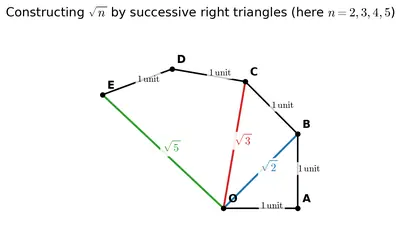
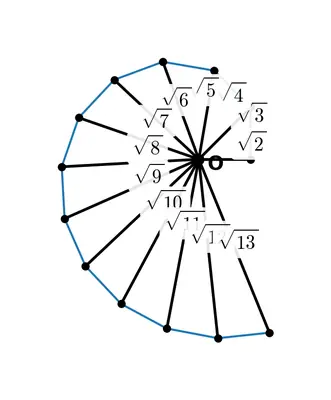
Spiral of Theodorus — obtaining $$\sqrt{3},\sqrt{5},\sqrt{6},\dots$$ successively. Continue from the segment $$OB$$ of length $$\sqrt{2}$$ instead of starting over each time:

  1. At $$B$$ erect a perpendicular to $$OB$$ and mark $$C$$ on it with $$BC=1$$.
  2. Join $$OC$$. Triangle $$OBC$$ is right-angled at $$B$$ with legs $$OB=\sqrt{2}$$ and $$BC=1$$, so $$OC=\sqrt{(\sqrt{2})^{2}+1^{2}}=\sqrt{3}$$.
  3. Repeating the step at $$C$$ (perpendicular to $$OC$$, unit segment) gives a new hypotenuse $$\sqrt{(\sqrt{3})^{2}+1^{2}}=\sqrt{4}=2$$. The next step gives $$\sqrt{5}$$, then $$\sqrt{6}$$, and so on.
  4. Each new hypotenuse can be transferred to the number line with a compass.

Note. Marking $$OA=n$$ units and erecting a unit perpendicular at $$A$$ does not give $$\sqrt{n}$$ — it gives the hypotenuse $$\sqrt{n^{2}+1}$$ (e.g. $$n=2$$ yields $$\sqrt{5}$$, not $$\sqrt{2}$$). To obtain $$\sqrt{n}$$ for an arbitrary natural number $$n$$, use the spiral of Theodorus above and stop at the $$(n-1)$$th step.

Conclusion. Irrational lengths are obtained by letting them appear as hypotenuses of right triangles whose other two sides we can already construct, and then transferring the hypotenuse onto the number line with a compass.

Answer

Draw a right-angled triangle whose two perpendicular sides have rational (constructible) lengths; the hypotenuse then has the desired irrational length and can be transferred to the number line with a compass. For example, legs $$1,1$$ give $$\sqrt{2}$$. To get $$\sqrt{3},\sqrt{5},\sqrt{6},\dots$$ successively, use the spiral of Theodorus: at each step erect a unit perpendicular on the previous hypotenuse and join its end to $$O$$; the new hypotenuse has length $$\sqrt{n+1}$$ if the previous was $$\sqrt{n}$$.

Think and Reflect

Question

Try to extend this method for constructing line segments of lengths $$\sqrt{3}$$ and $$\sqrt{5}$$ using a ruler and a compass. Generalise this method to construct a line segment of any length of the form $$\sqrt{n}$$, where $$n$$ is a positive integer.
Figure
Figure

Solution

Pre-requisite
If the perpendicular sides of a right–angled triangle measure $$a$$ and $$b$$, then the hypotenuse measures $$\sqrt{a^{2}+b^{2}}$$ (Pythagoras theorem). Therefore, whenever we are able to attach a fresh perpendicular side of length one unit to a segment whose length we already know, the hypotenuse produced will be the square root of “previous length squared + 1”. Repeating this idea produces the sequence $$1,\sqrt2,\sqrt3,\sqrt4,\dots$$. The figure that emerges is often called the square-root spiral (or spiral of Theodorus).

Throughout the constructions below the following well-known ruler–compass operations are used:

  • Copying a given length with a compass.
  • Erecting/ dropping a perpendicular from a point to a line by taking equal radii arcs and joining their intersection points.
  • Drawing a circle with a given centre and radius.

We begin with the unit segment and first obtain $$\sqrt2$$ exactly as done in the textbook; after that we extend the same technique for $$\sqrt3$$ and $$\sqrt5$$ and then state the general rule for any integer $$n\ge1$$.


A. Constructing $$\sqrt2$$ (already known, recalled briefly)

  1. Draw a straight line $$l$$ and mark a point $$O$$ on it.
  2. With ruler copy one unit along $$l$$ to a point $$A$$, so that $$OA=1$$.
  3. At $$A$$ construct a perpendicular to $$l$$. On this perpendicular cut off $$AB=1$$.
  4. Join $$OB$$. In right $$\triangle OAB$$, we have
    \[OB^{2}=OA^{2}+AB^{2}=1^{2}+1^{2}=2\] hence $$OB=\sqrt2$$.
  5. With centre $$O$$ and radius $$OB$$ draw an arc to intersect $$l$$ at $$P$$; the point $$P$$ represents $$\sqrt2$$ on the line. Keep the segment $$OP$$ for the next construction.

B. Constructing $$\sqrt3$$

  1. At point $$B$$ (obtained above) draw a line perpendicular to $$OB$$ (use intersecting arcs on either side of $$OB$$).
  2. With centre $$B$$ and radius one unit cut the perpendicular at a new point $$C$$, so that $$BC=1$$ and $$\angle OBC=90^{\circ}$$.
  3. Join $$OC$$. In right $$\triangle OBC$$,
    \[OC^{2}=OB^{2}+BC^{2}=(\sqrt2)^{2}+1^{2}=2+1=3\] therefore $$OC=\sqrt3$$.
  4. Using centre $$O$$ and radius $$OC$$ transfer this length to the original line $$l$$ to locate the point that is exactly $$\sqrt3$$ units from $$O$$.

C. Constructing $$\sqrt5$$ (two slightly different methods)

Method 1 – continuing the spiral

  1. Repeat the previous idea: at $$C$$ construct a perpendicular to $$OC$$; mark $$CD=1$$; join $$OD$$. This produces $$OD=\sqrt4=2$$ (check by Pythagoras).
  2. Again, at $$D$$ erect a perpendicular to $$OD$$; mark $$DE=1$$; join $$OE$$.
    Then in right $$\triangle ODE$$,
    \[OE^{2}=OD^{2}+DE^{2}=2^{2}+1^{2}=4+1=5\] so that $$OE=\sqrt5$$.
  3. As usual, swing the segment $$OE$$ on to the line $$l$$ with centre $$O$$. The intercepted point represents $$\sqrt5$$.

Method 2 – a one–step right triangle with legs 2 and 1

  1. On the original line draw $$OD=2$$ units straight away.
  2. Erect a perpendicular at $$D$$ and mark $$DE=1$$ unit.
  3. Join $$OE$$; right $$\triangle ODE$$ has
    \[OE^{2}=OD^{2}+DE^{2}=2^{2}+1^{2}=5\] hence $$OE=\sqrt5$$. Transfer $$OE$$ to the base line if desired.

D. General Rule – constructing $$\sqrt n$$ for any positive integer $$n$$

The constructions performed above show a clear pattern:

  • We already know the unit segment $$OA=1=\sqrt1$$.
  • Given the segment $$OP_{k}=\sqrt{k}$$, erect a perpendicular at $$P_{k}$$, mark off one unit on it to a point $$P_{k+1}$$ and join $$OP_{k+1}$$.

Because $$\triangle OP_{k}P_{k+1}$$ is right-angled at $$P_{k}$$, \[OP_{k+1}^{2}=OP_{k}^{2}+P_{k}P_{k+1}^{2}=k+1\] so $$OP_{k+1}=\sqrt{k+1}$$. Beginning with $$k=1$$ and repeating the step successively, we can reach any required natural number $$n$$ after exactly $$n-1$$ repetitions, thereby constructing $$\sqrt n$$.

Thus every line segment of the form $$\sqrt n$$ (for $$n\in\mathbb{N}$$) can be drawn by ruler and compass, and all such lengths lie successively on the famous square-root spiral.

Answer

Starting with a unit segment, draw a right-angled triangle whose other perpendicular side is also 1 unit; its hypotenuse gives $$\sqrt2$$. At the end of that hypotenuse erect a fresh perpendicular of 1 unit and join it to the origin to get $$\sqrt3$$. Repeating the same step once more yields $$\sqrt4$$, then $$\sqrt5$$, and so on. Hence, by successively adding a perpendicular side of one unit to each new hypotenuse, a ruler-and-compass construction of every length $$\sqrt n\;(n\in\mathbb N)$$ is obtained.

Examples 2-3

Example 2 Find the decimal expansion of $$\dfrac{3}{8}$$. (Can you tell for which rational numbers the decimal will be terminating?)

Solution

We want to write the rational number $$\dfrac{3}{8}$$ in decimal form.

Step 1 : Express the denominator as a factor of a power of 10

The powers of 10 are 10, 100, 1000, 10000, …  Notice that

$$8 \times 125 = 1000.$$

So if we multiply both the numerator and the denominator of $$\dfrac{3}{8}$$ by 125, the denominator will become 1000 (which is a power of 10).

$$\dfrac{3}{8} = \dfrac{3 \times 125}{8 \times 125} = \dfrac{375}{1000}.$$

Step 2 : Convert the fraction whose denominator is 1000 to a decimal

Dividing by 1000 moves the decimal point three places to the left:

$$\dfrac{375}{1000} = 0.375.$$

Check by long division (optional):

  • 8 goes into 30 three times (3 × 8 = 24), remainder 6.
  • Bring down 0 → 60; 8 goes into 60 seven times (7 × 8 = 56), remainder 4.
  • Bring down 0 → 40; 8 goes into 40 five times (5 × 8 = 40), remainder 0.

The quotient obtained is again $$0.375$$, confirming our result.

Step 3 : When does a rational number have a terminating decimal?

Reduce the rational number to its lowest terms. Its decimal expansion is terminating iff the denominator has no prime factors other than 2 and 5. In symbols, if the reduced form is

$$\dfrac{p}{q} \quad (p, q \in \mathbb{Z},\; \gcd(p,q)=1),$$

then the decimal expansion terminates exactly when

$$q = 2^{m}5^{n}\quad\text{for some non-negative integers }m,n.$$

In our example, $$8 = 2^{3}$$, so only the prime factor 2 appears; hence the decimal terminates.

Answer

The decimal form of $$\dfrac{3}{8}$$ is $$0.375$$.
In general, a reduced fraction $$\dfrac{p}{q}$$ has a terminating decimal expansion iff $$q = 2^{m}5^{n}$$ for some non-negative integers $$m,n$$.

Example 3 Find the decimal expansion of $$\dfrac{5}{11}$$.

Solution

Step 1 (“Set up”)
We want the decimal representation of the rational number $$\dfrac{5}{11}$$, so we shall divide 5 by 11.

Step 2 (“Make the dividend large enough”)
Because $$5 < 11$$, the whole-number part of the quotient is 0. We therefore place a decimal point and attach zeros to 5: $$5.0000\dotsc$$.

Step 3 (“Long division”)

  • First decimal place: 11 goes into 50 four times since $$11\times4=44\le 50$$.
      • Quotient digit = 4, remainder = $$50-44=6$$.
  • Second decimal place: Bring down the next 0 to make 60. Now 11 goes into 60 five times since $$11\times5=55\le60$$.
      • Quotient digit = 5, remainder = $$60-55=5$$.
  • Third decimal place: Bring down another 0 to make 50 again. This is exactly the same situation as at the first step, so the next digit is 4, remainder 6.
  • Fourth decimal place: Bring down 0, obtain 60, digit 5, remainder 5.

The remainders repeat in the cycle $$5,6,5,6,\dotsc$$, so the digits $$4,5$$ also repeat.

Step 4 (“Write the recurring decimal”)
The quotient is therefore

\[0.454545\ldots\]

To show the repeating block compactly, we write $$0.\overline{45}$$ (the bar denotes that 45 repeats forever).

Answer

$$0.\overline{45}$$

Think and Reflect

Question Try to find the decimal expansions of $$\dfrac{10}{3}$$ and $$\dfrac{11}{12}$$. What do you observe about the repetition of the digits after the decimal point?

Solution

We convert each fraction into its decimal form by the ordinary long-division algorithm. While doing so we keep track of the remainders; as soon as a remainder repeats, the subsequent digits also repeat because the division process is exactly the same from that point onward.

1. Decimal expansion of $$\dfrac{10}{3}$$

  • Step 1: Divide 10 by 3.
    $$10 = 3 \times 3 + 1$$ so the integral part is 3 and the first remainder is 1.
  • Step 2: Bring down a 0 (i.e. consider the remainder as 10).
    $$10 = 3 \times 3 + 1$$ again gives quotient digit 3 and remainder 1.
  • Because the remainder 1 has appeared before, the situation will repeat forever.

Hence

\[\dfrac{10}{3} = 3.333\ldots = 3.\overline{3}\]

2. Decimal expansion of $$\dfrac{11}{12}$$

  • Step 1: Divide 11 by 12.
    The integral part is 0, remainder 11.
  • Step 2: Multiply the remainder by 10 → 110.
    $$110 = 12 \times 9 + 2$$ gives first decimal digit 9 and remainder 2.
  • Step 3: Multiply remainder by 10 → 20.
    $$20 = 12 \times 1 + 8$$ gives next digit 1 and remainder 8.
  • Step 4: Multiply remainder by 10 → 80.
    $$80 = 12 \times 6 + 8$$ gives digit 6 and remainder 8.
  • The remainder 8 has appeared again, so from now on the digit 6 will keep repeating.

Therefore

\[\dfrac{11}{12} = 0.916666\ldots = 0.91\overline{6}\]

Observation about repetition

In both examples, after a certain stage the same remainder (and hence the same digit or block of digits) reoccurs. That makes the decimal expansion recurring:

  • For $$\dfrac{10}{3}$$ the single digit 3 repeats right from the first decimal place.
  • For $$\dfrac{11}{12}$$ the digit 6 repeats indefinitely, but only after the initial non-repeating part 0.91.

Thus rational numbers have decimal expansions that either terminate or show a repeating pattern of digits.

Answer

$$\dfrac{10}{3}=3.333\ldots = 3.\overline{3},\quad \dfrac{11}{12}=0.916666\ldots = 0.91\overline{6}.$$ In each case a digit (or block of digits) repeats indefinitely after some point.

Think and Reflect

Question The decimal expansion of $$\dfrac{p}{q}$$ will be terminating precisely when the prime factors of $$q$$ are only 2, only 5 or both 2 and 5. Can you explain why?

Solution

Idea of the proof   A decimal terminates when the denominator can be turned into a power of 10. Since the prime factors of 10 are only 2 and 5, the denominator after simplification must also contain no primes other than 2 or 5, and the converse is also true.

  1. Write the fraction in simplest form
    Take any rational number as $$\dfrac{p}{q}$$ with integers $$p,q\;(q\neq0)$$ and reduce it so that $$\gcd(p,q)=1$$. Only the denominator $$q$$ matters for deciding the type of decimal expansion.
  2. What does “terminating” mean algebraically?
    A decimal terminates after, say, $$n$$ places when we can write \[\dfrac{p}{q}=\dfrac{m}{10^n}\] for some integer $$m$$. Cross–multiplying gives $$p\,10^n = mq\;.$$ Because $$p$$ and $$q$$ are coprime, the whole of $$q$$ must divide the power $$10^n$$; if any prime remained in $$q$$ it would divide the left‐hand side but not the right‐hand side—impossible when $$\gcd(p,q)=1$$.
  3. Prime factorisation of a power of 10
    Remember $$10 = 2\times5$$, so $$10^n = 2^n 5^n$$. Therefore every prime factor of $$10^n$$ is either 2 or 5.
  4. First implication  (⇐)
    Suppose the prime factorisation of $$q$$ contains only 2s and 5s: \[q = 2^\alpha 5^\beta\quad(\alpha,\beta\ge0).\] Choose $$n\ge\max(\alpha,\beta)$$. Then $$10^n = 2^n5^n = 2^\alpha 5^\beta\;2^{n-\alpha}5^{n-\beta}=q\,k$$ for some integer $$k$$. Thus $$\dfrac{p}{q}=\dfrac{p\,k}{10^n},$$ a fraction whose denominator is a power of 10, so its decimal expansion ends after at most $$n$$ places. Hence the fraction is a terminating decimal.
  5. Second implication  (⇒)
    Conversely, if $$\dfrac{p}{q}$$ has a terminating decimal, we just argued in Step 2 that $$q$$ divides some power $$10^n=2^n5^n$$. Each prime factor of $$q$$ must therefore be either 2 or 5, because no other prime can divide $$10^n$$. Since $$q$$ was already in lowest terms, no additional primes are hidden in $$p$$.

Conclusion   The decimal expansion of $$\dfrac{p}{q}$$ terminates exactly when the reduced denominator has no prime factors except 2 and 5, that is, when
\[q = 2^\alpha 5^\beta \quad (\alpha,\beta \text{ non-negative integers}).\]

Answer

The decimal expansion of $$\dfrac{p}{q}$$ is terminating iff in lowest terms $$q$$ is of the form $$2^\alpha 5^\beta\;(\alpha,\beta\ge0)$$, i.e. its prime factors are only 2 and/or 5.

Examples 4-9

Example 4 Convert $$0.35$$ into the form $$\dfrac{p}{q}$$.

Solution

We want a fraction $$\dfrac{p}{q}$$ that equals the terminating decimal $$0.35$$.

Step 1 – Write the decimal as a division by 1
$$0.35 = \dfrac{0.35}{1}$$

Step 2 – Clear the decimal point
The number $$0.35$$ has two digits after the decimal point, so multiply numerator and denominator by $$10^2 = 100$$: $$\dfrac{0.35}{1}\times \dfrac{100}{100}=\dfrac{0.35\times100}{1\times100}=\dfrac{35}{100}$$

Step 3 – Reduce the fraction to lowest terms
Find the greatest common divisor (GCD) of 35 and 100.

  • $$35 = 5\times7$$
  • $$100 = 5\times20$$

The common factor is $$5$$. Divide numerator and denominator by $$5$$:

$$\dfrac{35}{100}=\dfrac{35\div5}{100\div5}=\dfrac{7}{20}$$

Thus the decimal $$0.35$$ can be written as the fraction

\[\boxed{\dfrac{7}{20}}\]

Answer

$$\dfrac{7}{20}$$

Example 5 Convert $$0.\overline{6}$$ into the form $$\dfrac{p}{q}$$.

Solution

We are asked to convert the non-terminating, repeating decimal $$0.\overline{6}$$ into a fraction of the form $$\dfrac{p}{q}$$.

Step 1 : Introduce a variable.
Let $$x = 0.\overline{6}$$.

Step 2 : Shift the repeating block.
The repeating block "6" is one digit long, so multiply by 10:
$$10x = 6.\overline{6}$$.

Step 3 : Eliminate the repeating part by subtraction.
Subtract the first equation from the second:
$$10x - x = 6.\overline{6} - 0.\overline{6}$$
$$9x = 6$$.

Step 4 : Solve for $$x$$.
$$x = \dfrac{6}{9}$$
Simplify by dividing numerator and denominator by 3:
$$x = \dfrac{2}{3}$$.

Thus, the required fraction is

\[\boxed{\dfrac{2}{3}}\]

Answer

$$\dfrac{2}{3}$$

Example 6 Convert $$0.\overline{45}$$ into the form $$\dfrac{p}{q}$$.

Solution

Let $$x = 0.\overline{45}$$.

The bar shows that the block $$45$$ repeats endlessly, so $$x = 0.454545\ldots$$.

Because the repeating block has two digits, multiply both sides by $$100$$ to shift the decimal two places to the right:

$$100x = 45.\overline{45}$$.

Write the two equations next to each other:

  • $$x = 0.\overline{45}$$
  • $$100x = 45.\overline{45}$$

Subtract the first equation from the second to remove the recurring part:

$$100x - x = 45.\overline{45} - 0.\overline{45}$$

$$99x = 45$$.

Divide both sides by $$99$$:

$$x = \dfrac{45}{99}$$.

Simplify the fraction by dividing numerator and denominator by their HCF, $$9$$:

$$x = \dfrac{45 \div 9}{99 \div 9} = \dfrac{5}{11}$$.

Hence,

\[0.\overline{45} = \dfrac{5}{11}\]

Answer

$$\dfrac{5}{11}$$

Example 7 Convert $$0.1\overline{6}$$ into the form $$\dfrac{p}{q}$$.

Solution

Let the given recurring decimal be denoted by $$x$$.

$$x = 0.1\overline{6} \; (= 0.1666\ldots)$$

The digit 6 is the only repeating digit, and it starts right after the first decimal place. Therefore multiply both sides by 10 (one power of 10) so that the recurring part lines up:

$$10x = 1.\overline{6} \; (= 1.6666\ldots)$$

Now subtract the original equation from this new one to eliminate the repeating part:

$$10x - x = 1.\overline{6} - 0.1\overline{6}$$

On the left, $$10x - x = 9x$$.

On the right, the recurring portions cancel, leaving only the non-recurring difference:

$$1.\overline{6} - 0.1\overline{6} = 1.5$$

Hence we have

$$9x = 1.5$$

Express $$1.5$$ as an exact fraction:

$$1.5 = \dfrac{15}{10} = \dfrac{3}{2}$$

Divide both sides by 9 to isolate $$x$$:

$$x = \dfrac{3}{2} \div 9 = \dfrac{3}{2} \times \dfrac{1}{9} = \dfrac{3}{18} = \dfrac{1}{6}$$

Therefore,

\[0.1\overline{6} = \dfrac{1}{6}\]

Answer

$$\displaystyle 0.1\overline{6} = \dfrac{1}{6}$$

Example 8 Convert $$2.35\overline{7}$$ into the form $$\dfrac{p}{q}$$.

Solution

Step 1 – Set up the number
Let $$x = 2.35\overline{7}$$. The bar is only on the digit 7, so
$$x = 2.357777\ldots$$

Step 2 – Identify the non-repeating and repeating parts
After the decimal point we have:

  • Non-repeating part: 35  (2 digits, so $$m = 2$$)
  • Repeating part: 7  (1 digit, so $$n = 1$$)

Step 3 – Multiply to shift the decimal
Multiply by $$10^{m+n}=10^{2+1}=1000$$:
$$1000x = 2357.777\ldots$$
Multiply by $$10^{m}=10^{2}=100$$:
$$100x = 235.777\ldots$$

Step 4 – Eliminate the recurring part
Subtract the two equations:

$$1000x - 100x = 2357.777\ldots - 235.777\ldots$$

This gives
$$900x = 2122$$

Step 5 – Solve for $$x$$

\[x = \dfrac{2122}{900}\]

Step 6 – Reduce the fraction
Divide numerator and denominator by 2:

$$x = \dfrac{1061}{450}$$

The numerator 1061 and the denominator 450 have no common factor other than 1, so this is already in simplest form.

Hence, $$2.35\overline{7} = \dfrac{1061}{450}$$.

Answer

$$\displaystyle \frac{1061}{450}$$

Example 9 Convert $$2.45\overline{37}$$ into the form $$\dfrac{p}{q}$$.

Solution

Let $$x = 2.45\overline{37} = 2.45373737\ldots$$ (the block $$37$$ is repeating).

The terminating part after the decimal has 2 digits (45) and the repeating block has 2 digits (37).

Step 1 – Shift only the non-repeating part
Multiply by $$10^2 = 100$$:

$$100x = 245.37373737\ldots$$

Step 2 – Shift one full repeating block
Multiply by $$10^{2+2}=10^4 = 10000$$:

$$10000x = 24537.37373737\ldots$$

Step 3 – Eliminate the repeating part

Subtract the first transformed equation from the second:

$$10000x - 100x = (24537.373737\ldots) - (245.373737\ldots)$$

$$9900x = 24292$$

Step 4 – Solve for $$x$$

$$x = \dfrac{24292}{9900}$$

Step 5 – Reduce to lowest terms

Prime factors:
$$24292 = 2^2 \times 6073$$,
$$9900 = 2^2 \times 3^2 \times 5^2 \times 11$$.

Cancelling the common factor $$2^2 = 4$$ gives

$$x = \dfrac{6073}{2475}$$

The numerator $$6073$$ has no common factors with the denominator $$2475$$, so the fraction is already in simplest form.

Therefore,

\[2.45\overline{37} = \dfrac{6073}{2475}\]

Answer

$$\dfrac{6073}{2475}$$

Exercise Set 3.5

1 Without performing long division, determine which of the following rational numbers will have terminating decimals and which will be repeating: $$\dfrac{7}{20}$$, $$\dfrac{4}{15}$$ and $$\dfrac{13}{250}$$. Then check your answers by explicitly performing the long divisions and expressing these rational numbers as decimals.

Solution

Concept recalled
For a fraction written in its lowest (simplest) form, its decimal expansion is :

  • terminating  iff the prime–factorisation of its denominator contains no primes except $$2$$ and/or $$5$$.
  • non-terminating (repeating)  iff the denominator has at least one other prime factor (for example $$3,7,11\,\dots$$).

Hence we first reduce every given rational number to lowest terms, factorise the denominator, decide the nature of the decimal, and only then verify by long division.


(i) Fraction  $$\dfrac{7}{20}$$

Step 1 : prime-factorise the denominator.

$$20 = 2^2 \times 5$$

Step 2 : the denominator involves only the primes $$2$$ and $$5$$.
Therefore the decimal expansion must terminate.

(No cancellation with the numerator is possible because $$7$$ is prime and does not divide $$20$$; the fraction is already in lowest form.)

Step 3 : verify by long-division.

  • Divide $$7.000$$ by $$20$$. (Add zeros to the dividend as required.)
    20 goes in 7 zero times. Bring down the first zero → 70.
    20 in 70 goes 3 times (3 × 20 = 60), remainder 10.
    Bring down next zero → 100.
    20 in 100 goes 5 times (5 × 20 = 100), remainder 0.
    The division stops.

Thus

\[\dfrac{7}{20}=0.35\]


(ii) Fraction  $$\dfrac{4}{15}$$

Step 1 : reduce to lowest terms.

$$\gcd(4,15)=1$$ so the fraction is already simplified.

Step 2 : factorise the denominator.

$$15 = 3 \times 5$$

The factor $$3$$ is neither $$2$$ nor $$5$$, hence the decimal expansion will be non-terminating, repeating.

Step 3 : verify by long-division (only first few steps are needed to see the repetition).

  • Divide $$4.0000$$ by $$15$$.
    15 in 4: 0 times.
    Bring down first zero → 40.
    15 in 40: 2 times (2 × 15 = 30), remainder 10.
    Bring down next zero → 100.
    15 in 100: 6 times (6 × 15 = 90), remainder 10 again.

The remainder has returned to $$10$$, so the digits $$6$$ will keep repeating.

\[\dfrac{4}{15}=0.26\overline{6}\;(=0.2666\ldots)\]


(iii) Fraction  $$\dfrac{13}{250}$$

Step 1 : prime-factorise the denominator.

$$250 = 2 \times 5^3$$

Only the primes $$2$$ and $$5$$ occur, so the decimal expansion will be terminating.

Step 2 : cancel any common factors (there are none because $$13$$ is prime and does not divide $$250$$).

Step 3 : verify by long-division.

  • Divide $$13.000$$ by $$250$$.
    250 in 13: 0 times.
    Bring down the first zero → 130.
    250 in 130: 0 times. Place a zero after decimal.
    Bring down next zero → 1300.
    250 in 1300: 5 times (5 × 250 = 1250), remainder 50.
    Bring down next zero → 500.
    250 in 500: 2 times (2 × 250 = 500), remainder 0.

Thus

\[\dfrac{13}{250}=0.052\]


Final classification

FractionFactorisation of denominatorType of decimalActual decimal
$$\dfrac{7}{20}$$$$2^2\!\times\!5$$Terminating$$0.35$$
$$\dfrac{4}{15}$$$$3\!\times\!5$$Repeating$$0.26\overline{6}$$
$$\dfrac{13}{250}$$$$2\!\times\!5^3$$Terminating$$0.052$$

Hence our predictions based on the prime factors of the denominators are completely verified by the long-division method.

Answer

Terminating : $$\dfrac{7}{20}=0.35\,,\;\dfrac{13}{250}=0.052$$
Repeating : $$\dfrac{4}{15}=0.26\overline{6}$$

2 Perform the long division for $$\dfrac{1}{13}$$. Identify the repeating block of digits. Does it show cyclic properties if you evaluate $$\dfrac{2}{13}$$? Now compute $$\dfrac{3}{13}$$, $$\dfrac{4}{13}$$, etc. What do you notice?

Solution

Step 1 – Long-division for $$\dfrac{1}{13}$$

StageWork (dividend ÷ 13)Quotient digitRemainder
01 is smaller than 13 ⇒ write the decimal point, attach a 0 ⇒ 10010
1100  (because we again bring down 0)7  since $$7\times13=91$$100−91=9
2906  because $$6\times13=78$$90−78=12
31209  because $$9\times13=117$$120−117=3
4302  because $$2\times13=26$$30−26=4
5403  because $$3\times13=39$$40−39=1
610 (same situation as at the very beginning)010

The remainder has returned to 10, which was the remainder after writing the very first digit. Hence the six digits we have just obtained will repeat forever.

\[ \dfrac{1}{13}=0.\overline{076\,923}\quad(period 6) \]

So the repeating block is 076 923.

Step 2 – Does $$\dfrac{2}{13}$$ display a cyclic property?

Instead of starting a new long-division, observe that

$$\dfrac{2}{13}=2\times\dfrac{1}{13}=2\times0.\overline{076923}=0.\overline{153846}.$$ The six digits have simply moved one place to the left and wrapped round. So the block 153 846 is a cyclic permutation of 076 923.

Step 3 – Listing the other fractions

nn / 13 (decimal form)Repeating block
10.\overline{076923}076923
20.\overline{153846}153846
30.\overline{230769}230769
40.\overline{307692}307692
50.\overline{384615}384615
60.\overline{461538}461538
70.\overline{538461}538461
80.\overline{615384}615384
90.\overline{692307}692307
100.\overline{769230}769230
110.\overline{846153}846153
120.\overline{923076}923076

Step 4 – What do we notice?

  • Every non-zero proper fraction with denominator 13 has a repeating decimal of exactly six digits.
  • The twelve different blocks are all cyclic permutations of the same six-digit string 076 923.
  • This makes 076 923 a classic example of a cyclic number: when it is multiplied by any integer from 1 to 12, the product is a cyclic rearrangement of the original digits.

Answer

The repeating block for $$\dfrac{1}{13}$$ is 076 923 (period 6).
For $$\dfrac{2}{13}$$ the block becomes 153 846, a cyclic left–shift of the same six digits, and the same happens for every $$n/13\;(1\le n\le12)$$. Thus all the fractions $$\dfrac{n}{13}$$ share the six digits 0-7-6-9-2-3 arranged in cyclic order.

3 Classify the following numbers as rational or irrational. Find the explicit fractions in case they are rational.

(i) $$\sqrt{81}$$

Solution

The number 81 is a perfect square because $$81 = 9 \times 9 = 9^2$$.

Therefore
\[\sqrt{81}=9\]

The value 9 is an integer. Every integer can be written as a fraction with denominator 1, that is $$9 = \dfrac{9}{1}$$, so it is rational.

Answer

Rational; $$\sqrt{81}=9=\dfrac{9}{1}$$

(ii) $$\sqrt{12}$$

Solution

Write 12 as the product of its prime factors:

$$12 = 2^2 \times 3$$

The factor 3 is not paired, so 12 is not a perfect square. Hence $$\sqrt{12}$$ is a non-terminating, non-repeating decimal.

Therefore $$\sqrt{12}$$ is irrational.

Answer

Irrational

(iii) $$0.33333\ldots$$

Solution

Let $$x = 0.33333\ldots$$ (digit 3 repeats endlessly).

Multiply by 10 to shift the decimal one place:

$$10x = 3.33333\ldots$$

Subtract the first equation from the second:

$$10x - x = 3.33333\ldots - 0.33333\ldots = 3$$
$$9x = 3 \;\;\Rightarrow\;\; x = \dfrac{3}{9}=\dfrac{1}{3}$$

Because it can be expressed as the fraction $$\dfrac{1}{3}$$, the number is rational.

Answer

Rational; $$0.33333\ldots = \dfrac{1}{3}$$

(iv) $$0.123451234512345\ldots$$

Solution

Let $$x = 0.123451234512345\ldots$$ (the block 12345 repeats).

The repeating block has 5 digits, so multiply by $$10^5 = 100000$$:

$$100000x = 12345.1234512345\ldots$$

Subtract the original $$x$$:

$$100000x - x = 12345.12345\ldots - 0.12345\ldots = 12345$$
$$99999x = 12345$$

\[x = \dfrac{12345}{99999}\]

Simplify the fraction (divide numerator and denominator by 3):

$$x = \dfrac{4115}{33333}$$

Since it equals a ratio of two integers, the number is rational.

Answer

Rational; $$0.1234512345\ldots = \dfrac{4115}{33333}$$

(v) $$1.01001000100001\ldots$$ (Notice the pattern: Is it repeating a single block?)

Solution

The decimal $$1.01001000100001\ldots$$ has 1 zero after the first 1, then 2 zeros, then 3 zeros, and so on. The block of digits that repeats keeps getting longer, so no fixed finite block repeats throughout.

Thus the decimal is non-terminating and non-repeating, which makes it irrational.

Answer

Irrational

(vi) $$23.560185612239874790120$$

Solution

The given number has finitely many decimal places:

$$23.560185612239874790120.$$

A finite (terminating) decimal can always be written as a fraction whose denominator is a power of $$10$$. There are $$21$$ digits after the decimal point, so

\[23.560185612239874790120 = \dfrac{23560185612239874790120}{10^{21}}.\]

This already exhibits the number as a ratio of integers, hence it is rational.

Reduction to lowest terms. Factor the powers of $$2$$ and $$5$$ out of the numerator. The numerator $$N=23560185612239874790120$$ ends in $$0$$, so it is divisible by $$10$$. After dividing by $$10$$:

$$N/10 = 2356018561223987479012.$$

This ends in $$2$$, so it is divisible by $$2$$ but not by $$5$$. Divide by $$2$$ twice more:

$$2356018561223987479012 \div 2 = 1178009280611993739506,$$

$$1178009280611993739506 \div 2 = 589004640305996869753.$$

The result $$589004640305996869753$$ ends in $$3$$, so it is odd and not divisible by $$5$$. Thus

$$N = 2^{3}\cdot 5\cdot 589004640305996869753.$$

Now $$10^{21}=2^{21}\cdot 5^{21}$$, so

\[\dfrac{N}{10^{21}} = \dfrac{2^{3}\cdot 5\cdot 589004640305996869753}{2^{21}\cdot 5^{21}} = \dfrac{589004640305996869753}{2^{18}\cdot 5^{20}}.\]

Since the numerator shares no common factor of $$2$$ or $$5$$ with the denominator (and the denominator has no other prime factors), this is the fraction in lowest terms.

Answer

Rational. $$23.560185612239874790120 = \dfrac{23560185612239874790120}{10^{21}}$$, which in lowest terms is $$\dfrac{589004640305996869753}{2^{18}\cdot 5^{20}}$$.

4 The number $$0.\overline{9}$$ (which means $$0.99999\ldots$$) is a rational number. Using algebra (let $$x = 0.\overline{9}$$, multiply by 10, and subtract), explain why $$0.\overline{9}$$ is exactly equal to 1.

Solution

Step 1 : Introduce a variable for the repeating decimal.

Let $$x = 0.\overline{9} = 0.99999\ldots$$.

Step 2 : Multiply by 10 to shift the decimal point one place to the right.

$$10x = 9.99999\ldots$$

Notice that the part after the decimal point, $$0.99999\ldots$$, is exactly the same as our original $$x$$.

Step 3 : Subtract the original equation from the new one.

\[10x - x = 9.99999\ldots - 0.99999\ldots\]

The infinite tails cancel digit-by-digit, leaving

$$9x = 9$$

Step 4 : Solve for $$x$$.

Divide both sides by 9:

$$x = 1$$

Step 5 : Conclude.

Since we began with $$x = 0.\overline{9}$$, we have proved that

\[0.\overline{9} = 1\]

Thus the repeating decimal $$0.\overline{9}$$ is exactly equal to 1, confirming that it is a rational number (it can be expressed as the ratio $$\dfrac{1}{1}$$).

Answer

Proved: $$0.\overline{9} = 1$$.

*5 We have seen that the repeating block of $$\dfrac{1}{7}$$ is a cyclic number. Try to find more numbers ($$n$$) whose reciprocals $$\left(\dfrac{1}{n}\right)$$ produce decimals with repeating blocks that are cyclic.

Solution

What is meant by a “cyclic” repeating block?

A block of digits is called cyclic if, when you multiply it successively by $$2,3,4,\ldots ,k$$ (keeping the same number of digits by inserting a zero at the left whenever a carry produces an extra digit), each product is just a rotation of the first block. For example

$$\dfrac1{7}=0.\overline{142857}$$ and

  • $$142857\times2 = 285714$$ (the same six digits rotated two places),
  • $$142857\times3 = 428571$$,
  • $$142857\times4 = 571428$$,
  • $$142857\times5 = 714285$$,
  • $$142857\times6 = 857142$$.

Thus the block $$142857$$ is cyclic.

How to look for more such numbers

Experience shows that if

  • the denominator $$n$$ is a prime number, and
  • the length of the repeating block of $$\dfrac1n$$ is exactly $$n-1$$ digits,

then the block is cyclic. (In more advanced language, $10$ is a “primitive root” of such a prime.) We therefore test prime numbers one by one and look at the length of their repetend.

1. The prime 17

Long-division of $$1\div17$$ gives

$$\dfrac1{17}=0.\overline{0588235294117647}$$ (16 digits, and $$16=17-1$$).

Now multiply the block $$0588235294117647$$ successively by $$2,3,\ldots ,16$$ (keeping 16 digits throughout):

MultiplierProduct (16-digit form)
21176470588235294
31764705882352941
42352941176470588
52941176470588235
63529411764705882
74117647058823529
84705882352941176
95294117647058823
105882352941176470
116470588235294117
127058823529411764
137647058823529411
148235294117647058
158823529411764705
169411764705882352

Each product is just a rotation of the original 16-digit block, so $$0588235294117647$$ is cyclic. Hence $$n=17$$ works.

2. The prime 19

$$\dfrac1{19}=0.\overline{052631578947368421}$$ (18 digits = $$19-1$$).

If you multiply the block $$052631578947368421$$ by $$2,3,\ldots ,18$$ you again obtain nothing but rotations of the same 18 digits. Therefore $$n=19$$ also produces a cyclic repetend.

3. The next few primes with the same property

Carrying out similar divisions (or checking with a calculator) shows that the primes

$$23,\;29,\;47,\;59,\;61,\;97,\;\ldots$$

have repetends of lengths $$22,28,46,58,60,96$$ respectively, and each of those blocks is cyclic. Every such prime gives another example.

Conclusion

  • The smallest numbers whose reciprocals give cyclic repeating blocks are $$n=7,17,19,23,29,47,59,61,97,\ldots$$.
  • All of them are primes for which the decimal expansion of $$\dfrac1n$$ has length exactly $$n-1$$.

Any one of these primes provides the kind of decimal expansion asked for in the question.

Answer

The next few numbers after 7 whose reciprocals have cyclic repeating blocks are

$$n = 17,\;19,\;23,\;29,\;47,\;59,\;61,\;97,\ldots$$

For each such prime, the repeating part of $$\dfrac1n$$ contains exactly $$n-1$$ digits and acts as a cyclic number.

Think and Reflect

Question Consider this puzzle: What is the square root of $$-1$$? We know that $$1 \times 1 = 1$$. We also know that $$(-1) \times (-1) = 1$$. There is no Real Number that, when multiplied by itself, results in a negative number. Thus, $$\sqrt{-1}$$ cannot exist on number line.

Solution

Goal. Show that $$\sqrt{-1}$$ is not a real number, i.e. there is no real number $$r$$ such that $$r\times r=-1$$.

Step 1 — Definition of a real square root. For a real number $$a$$, the (principal) square root $$\sqrt{a}$$ is defined only when $$a\ge 0$$, as the unique non-negative real number $$s$$ satisfying $$s\times s=a$$. So a priori $$\sqrt{-1}$$ is not even defined inside $$\mathbb{R}$$; we will show that no real value can satisfy the required squaring property either.

Step 2 — Assume, for contradiction, that there exists a real number $$r$$ with $$r\times r=-1$$.

Step 3 — Sign rules for the square of a real number. Every real $$r$$ falls into exactly one of three cases:

  • $$r\gt 0$$ (positive),
  • $$r=0$$,
  • $$r\lt 0$$ (negative).

Examine $$r^{2}=r\times r$$ in each case:

  1. If $$r\gt 0$$: positive $$\times$$ positive $$=$$ positive, so $$r^{2}\gt 0$$.
  2. If $$r=0$$: $$r^{2}=0$$.
  3. If $$r\lt 0$$: negative $$\times$$ negative $$=$$ positive, so $$r^{2}\gt 0$$.

In every case $$r^{2}\ge 0$$. A real square is never negative.

Step 4 — Contradiction. Our assumption forces $$r^{2}=-1\lt 0$$, but Step 3 shows $$r^{2}\ge 0$$. Both cannot hold, so no such real $$r$$ exists.

Conclusion.

\[\sqrt{-1}\text{ is not a real number.}\]

Remark (beyond the Class 9 syllabus). Mathematicians extend the real number system to the complex numbers by introducing a new symbol $$i$$ defined to satisfy $$i^{2}=-1$$. Within the real numbers, however, $$\sqrt{-1}$$ has no value and cannot be plotted on the number line.

Answer

No real number has square equal to $$-1$$, so $$\sqrt{-1}$$ is not a real number and cannot be placed on the number line.

End-of-Chapter Exercises

1 Convert the following rational numbers in the form of a terminating decimal or non-terminating and repeating decimal, whichever the case may be, by the process of long division:

(i) $$\dfrac{3}{50}$$

Solution

The given rational number is $$\dfrac{3}{50}$$.

Method 1 : Using an equivalent fraction with denominator a power of 10

The prime‐factorisation of the denominator is

$$50 = 2 \times 5^2$$

To convert the denominator to $$100 = 10^2 = 2^2 \times 5^2$$ we multiply numerator and denominator by 2:

$$\dfrac{3}{50}=\dfrac{3\,(\times 2)}{50\,(\times 2)}=\dfrac{6}{100}$$

Since the denominator is now $$10^2$$, the decimal form has exactly two places:

$$\dfrac{6}{100}=0.06$$

Method 2 : Long-division (as required in the question)

Divide 3.00 by 50.

  • 50 does not divide 3, so write 0 before the decimal point.
  • Place a decimal point and append a zero → 30. Still less than 50, so write 0 in the first decimal place.
  • Append another zero (now 300). 50 goes into 300 exactly 6 times. Remainder 0, so the division stops.

The quotient is $$0.06$$. Because the remainder becomes zero, the decimal terminates.

Therefore,

\[\dfrac{3}{50}=0.06\;\text{(terminating decimal)}\]

Answer

(i) $$0.06$$ (terminating)

(ii) $$\dfrac{2}{9}$$

Solution

The given rational number is $$\dfrac{2}{9}$$.

The denominator $$9=3^2$$ contains neither the prime factor 2 nor 5, so its decimal expansion will not terminate. We verify this by long division.

Long-division

  • Write dividend 2.0000… and divisor 9.
  • 9 does not divide 2, so put 0 before the decimal point. Place a decimal and carry the 2 as 20.
  • 9 fits in 20 exactly 2 times (2×9 = 18). Write 2 in the first decimal place; remainder 20−18 = 2.
  • Bring down another 0 ⇒ 20 again. The same step repeats: quotient digit 2, remainder 2.

Because the remainder 2 recurs indefinitely, the digit 2 keeps repeating.

\[\dfrac{2}{9}=0.222\dots =0.\overline{2}\;\text{(non-terminating, repeating)}\]

Answer

(ii) $$0.\overline{2}$$ (non-terminating, repeating)

2 Prove that $$\sqrt{5}$$ is an irrational number.

Solution

Objective: Show that the number $$\sqrt{5}$$ cannot be expressed as the ratio of two integers; that is, it is irrational.

Method: Proof by contradiction (also called the contrapositive method). We begin by assuming the opposite of what we want to prove and then show that this assumption leads to a logical impossibility.

Step 1 – Assume $$\sqrt{5}$$ is rational.
If $$\sqrt{5}$$ were rational, we could write it as a fraction of two integers that have no common factor other than 1 (i.e. they are coprime):

\[ \sqrt{5} = \dfrac{p}{q}, \qquad p,\,q \in \mathbb{Z},\; q \neq 0,\; \gcd(p,q)=1 \]

Meaning: $$p$$ and $$q$$ share no prime factor.

Step 2 – Square both sides to clear the square root.

\[ 5 = \frac{p^{2}}{q^{2}} \]

Multiplying both sides by $$q^{2}$$ (permitted because $$q \neq 0$$) gives

\[ p^{2} = 5q^{2}. \quad(1) \]

Step 3 – Deduce that 5 divides $$p^{2}$$ and hence divides $$p$$.

Equation (1) shows that $$p^{2}$$ is five times another integer $$(q^{2})$$, so

$$5 \mid p^{2}$$ (read “5 divides $$p^{2}$$”).

Recall a basic number-theory fact that every Class 9 student proves or accepts:

  • If a prime number divides the square of an integer, it divides that integer itself.

Because 5 is prime, $$5 \mid p^{2} \;\Rightarrow\; 5 \mid p$$.

Therefore we can write

$$p = 5k$$ for some integer $$k$$. (This simply encodes “$$p$$ is a multiple of 5”.)

Step 4 – Substitute $$p = 5k$$ back into Equation (1).

\[ (5k)^{2} = 5q^{2} \]

\[ 25k^{2} = 5q^{2} \]

Divide both sides by 5:

\[ 5k^{2} = q^{2}. \quad(2) \]

Step 5 – Conclude that 5 divides $$q^{2}$$ and hence divides $$q$$.

From Equation (2) we see that $$q^{2}$$ is five times another integer $$(k^{2})$$, so

$$5 \mid q^{2} \;\Rightarrow\; 5 \mid q$$ (again using the same fact for primes).

Thus $$q$$ is also a multiple of 5.

Step 6 – Arrive at a contradiction.

We have shown that both $$p$$ and $$q$$ are divisible by 5. Symbolically, $$5 \mid p$$ and $$5 \mid q$$, so 5 is a common factor of $$p$$ and $$q$$.

This contradicts our original stipulation that $$p$$ and $$q$$ were coprime (they were assumed to share no common prime factor).

Step 7 – Conclude.
Because the assumption that $$\sqrt{5}$$ is rational forces us into a contradiction, the assumption must be false. Therefore, $$\sqrt{5}$$ is irrational.

Hence proved.

Answer

Proved: $$\sqrt{5}$$ is irrational.

3 Convert the following decimal numbers in the form of $$\dfrac{p}{q}$$.

(i) $$12.6$$

Solution

The decimal $$12.6$$ terminates after one digit.

Write it over the corresponding power of ten:

$$12.6 = \dfrac{126}{10}$$

Simplify (divide numerator and denominator by $$2$$):

$$\dfrac{126}{10}=\dfrac{63}{5}$$

Answer

$$\dfrac{63}{5}$$

(ii) $$0.0120$$

Solution

The trailing zero does not change the value, so $$0.0120 = 0.012$$.

There are three digits after the decimal point:

$$0.012 = \dfrac{12}{1000}$$

Simplify by dividing numerator and denominator by $$4$$:

$$\dfrac{12}{1000}=\dfrac{3}{250}$$

Answer

$$\dfrac{3}{250}$$

(iii) $$3.0\overline{52}$$

Solution

Let $$x = 3.0\overline{52}=3.0525252\ldots$$

Non-repeating digits after the decimal: $$n=1$$ (the ‘0’).
Repeating block length: $$r=2$$ (the block ‘52’).

Multiply by $$10^n=10$$ to shift the non-repeating part:

$$10x = 30.525252\ldots$$

Now multiply this by $$10^r=100$$ (that is, overall by $$10^{n+r}=1000$$):

$$1000x = 3052.525252\ldots$$

Subtract to eliminate the repeating part:

$$1000x-10x = 3052.525252\ldots-30.525252\ldots=3022$$

$$990x = 3022$$

$$x = \dfrac{3022}{990} = \dfrac{1511}{495}$$ (divide by $$2$$).

Answer

$$\dfrac{1511}{495}$$

(iv) $$1.2\overline{35}$$

Solution

Let $$x = 1.2\overline{35}=1.2353535\ldots$$

Non-repeating digits after the decimal: $$n=1$$ (the ‘2’).
Repeating block length: $$r=2$$ (‘35’).

First shift the non-repeating digit:

$$10x = 12.353535\ldots$$

Now shift the repeating block as well (overall $$10^{n+r}=1000$$):

$$1000x = 1235.353535\ldots$$

Subtract:

$$1000x-10x = 1235.353535\ldots-12.353535\ldots=1223$$

$$990x = 1223$$

$$x = \dfrac{1223}{990}$$ (no further simplification is possible).

Answer

$$\dfrac{1223}{990}$$

(v) $$0.\overline{23}$$

Solution

Let $$x = 0.\overline{23}=0.232323\ldots$$

Repeating block length $$r=2$$ and there are no non-repeating digits.

Multiply by $$10^r=100$$:

$$100x = 23.232323\ldots$$

Subtract the original $$x$$:

$$100x-x = 23.232323\ldots-0.232323\ldots=23$$

$$99x = 23$$

$$x = \dfrac{23}{99}$$

Answer

$$\dfrac{23}{99}$$

(vi) $$2.0\overline{5}$$

Solution

Let $$x = 2.0\overline{5}=2.05555\ldots$$

Non-repeating digits: $$n=1$$ (‘0’).
Repeating block length: $$r=1$$ (‘5’).

Shift the non-repeating digit:

$$10x = 20.55555\ldots$$

Shift the repeating digit as well (overall $$10^{n+r}=100$$):

$$100x = 205.55555\ldots$$

Subtract:

$$100x-10x = 205.55555\ldots-20.55555\ldots=185$$

$$90x = 185$$

$$x = \dfrac{185}{90}=\dfrac{37}{18}$$ (divide by $$5$$).

Answer

$$\dfrac{37}{18}$$

(vii) $$2.12\overline{5}$$

Solution

Let $$x = 2.12\overline{5}=2.125555\ldots$$

Non-repeating digits after the decimal: $$n=2$$ (‘12’).
Repeating block length: $$r=1$$ (‘5’).

Shift the non-repeating part:

$$100x = 212.55555\ldots$$

Now shift the repeating part as well (overall $$10^{n+r}=1000$$):

$$1000x = 2125.55555\ldots$$

Subtract:

$$1000x-100x = 2125.55555\ldots-212.55555\ldots=1913$$

$$900x = 1913$$

$$x = \dfrac{1913}{900}$$ (already in lowest terms).

Answer

$$\dfrac{1913}{900}$$

(viii) $$3.12\overline{5}$$

Solution

Let $$x = 3.12\overline{5}=3.125555\ldots$$

Here $$n=2$$ (non-repeating ‘12’), $$r=1$$ (repeating ‘5’).

Shift the non-repeating part:

$$100x = 312.55555\ldots$$

Shift the repeating part as well (overall $$10^{n+r}=1000$$):

$$1000x = 3125.55555\ldots$$

Subtract:

$$1000x-100x = 3125.55555\ldots-312.55555\ldots=2813$$

$$900x = 2813$$

$$x = \dfrac{2813}{900}$$ (already in simplest form).

Answer

$$\dfrac{2813}{900}$$

(ix) $$2.\overline{1625}$$

Solution

Let $$x = 2.\overline{1625}=2.16251625\ldots$$

No non-repeating digits ($$n=0$$); repeating block length $$r=4$$ (‘1625’).

Multiply by $$10^r = 10000$$:

$$10000x = 21625.1625\ldots$$

Subtract the original $$x$$:

$$10000x - x = 21625.1625\ldots - 2.1625\ldots = 21623$$

$$9999x = 21623$$

$$x = \dfrac{21623}{9999}$$ (no common factor other than $$1$$).

Answer

$$\dfrac{21623}{9999}$$

4 Locate the following rational numbers on the number line.

(i) $$0.532$$

Solution

Step 1 – Write the decimal as a fraction
$$0.532 = \frac{532}{1000} = \frac{133}{250}$$
Thus the number is between $$0$$ and $$1$$, a little more than $$0.5$$.

Step 2 – Locate the interval 0 to 1
Draw a horizontal line and mark points $$0$$ and $$1$$. Divide the segment into ten equal parts; the marks represent $$0.1,\,0.2,\,\dots ,\,0.9$$.

Step 3 – Zoom into 0.5 to 0.6
The fifth division is $$0.5$$ and the sixth is $$0.6$$. Enlarge this portion. Divide it again into ten equal parts; the points are $$0.50,\,0.51,\,\dots ,\,0.59$$. The third of these is $$0.53$$ and the fourth is $$0.54$$.

Step 4 – Zoom into 0.53 to 0.54
Enlarge the tiny segment between $$0.53$$ and $$0.54$$ and split it into ten equal pieces (each represents $$0.001$$). The first mark is $$0.531$$, the second mark is $$0.532$$. Put a dark point there, and label it “$$0.532$$”.

Diagram: Draw the number-line as described; show three successive magnifications ending with the point at the second subdivision of the $$0.53\text{–}0.54$$ segment.

Answer

Point lying two thousandth divisions after $$0.53$$ on the number line—that is the point $$0.532$$.

(ii) $$1.1\overline{5}$$

Solution

Step 1 — Convert the recurring decimal to a fraction. Let

$$x=1.1\overline{5}=1.15555\ldots$$

Multiply by $$10$$ to shift one place:

$$10x=11.5555\ldots$$

Subtract:

$$10x-x=11.5555\ldots-1.15555\ldots=10.4,$$

so $$9x=10.4=\dfrac{104}{10}=\dfrac{52}{5}$$, giving

\[x=\dfrac{52}{45}=1+\dfrac{7}{45}.\]

Step 2 — Locate the basic interval. Since $$\dfrac{52}{45}=1+\dfrac{7}{45}$$ and $$0\lt\dfrac{7}{45}\lt 1$$, the number lies between $$1$$ and $$2$$, nearer to $$1$$.

Step 3 — Exact location by 45 equal subdivisions (recommended). Divide the segment from $$1$$ to $$2$$ into $$45$$ equal parts. Counting seven such parts to the right of $$1$$ lands exactly on $$\dfrac{52}{45}=1.1\overline{5}$$. Mark and label this point.

Step 4 — Successive magnification (approximate location). Pure tenths/thousandths subdivisions never land exactly on $$1.1\overline{5}$$ because the digit $$5$$ repeats forever, but we can localise the point as finely as we wish:

  • Tenths: $$1.1\lt x\lt 1.2$$ (so $$x$$ is in the segment between the first and second tenths after $$1$$).
  • Hundredths: $$1.15\lt x\lt 1.16$$ (between the $$5$$th and $$6$$th hundredths after $$1.1$$).
  • Thousandths: $$1.155\lt x\lt 1.156$$ (just to the right of $$1.155$$, between the $$5$$th and $$6$$th thousandths after $$1.15$$).
  • Ten-thousandths: $$1.1555\lt x\lt 1.1556$$, and so on.

At every stage $$x$$ falls strictly between successive marks (never on a finite-decimal mark), confirming that exact placement requires the $$45$$-part subdivision from Step 3.

Diagram. Draw the number line $$0,1,2$$. Magnify $$1$$ to $$2$$ and subdivide it into $$45$$ equal parts; place a bold dot at the $$7$$th mark from $$1$$ and label it $$1.1\overline{5}=\dfrac{52}{45}$$.

Answer

$$1.1\overline{5}=\dfrac{52}{45}$$. On the number line, divide the segment from $$1$$ to $$2$$ into $$45$$ equal parts and mark the $$7$$th part-point from $$1$$; that point represents $$1.1\overline{5}$$ exactly.

5 Find 6 rational numbers between 3 and 4.

Solution

Objective. Insert six rational numbers strictly between $$3$$ and $$4$$.

Step 1 — Choose a convenient common denominator. To create room for six fractions we need at least seven equal sub-intervals between $$3$$ and $$4$$. A natural choice is to express each integer as a fraction with denominator $$6+1=7$$:

$$3=\dfrac{3\times 7}{7}=\dfrac{21}{7},\qquad 4=\dfrac{4\times 7}{7}=\dfrac{28}{7}.$$

Step 2 — Pick the numerators in between. With denominator $$7$$, the integers strictly between $$21$$ and $$28$$ are $$22,23,24,25,26,27$$. So six candidate fractions are

$$\dfrac{22}{7},\;\dfrac{23}{7},\;\dfrac{24}{7},\;\dfrac{25}{7},\;\dfrac{26}{7},\;\dfrac{27}{7}.$$

Step 3 — Verify each is between $$3$$ and $$4$$. Compare each fraction with $$3=\dfrac{21}{7}$$ and $$4=\dfrac{28}{7}$$ (same denominator, so compare numerators):

  • $$\dfrac{22}{7}$$: $$21\lt 22\lt 28$$, so $$3\lt\dfrac{22}{7}\lt 4$$. (Numerically $$\dfrac{22}{7}\approx 3.143$$.)
  • $$\dfrac{23}{7}$$: $$21\lt 23\lt 28$$, so $$3\lt\dfrac{23}{7}\lt 4$$. (Numerically $$\approx 3.286$$.)
  • $$\dfrac{24}{7}$$: $$21\lt 24\lt 28$$, so $$3\lt\dfrac{24}{7}\lt 4$$. (Numerically $$\approx 3.429$$.)
  • $$\dfrac{25}{7}$$: $$21\lt 25\lt 28$$, so $$3\lt\dfrac{25}{7}\lt 4$$. (Numerically $$\approx 3.571$$.)
  • $$\dfrac{26}{7}$$: $$21\lt 26\lt 28$$, so $$3\lt\dfrac{26}{7}\lt 4$$. (Numerically $$\approx 3.714$$.)
  • $$\dfrac{27}{7}$$: $$21\lt 27\lt 28$$, so $$3\lt\dfrac{27}{7}\lt 4$$. (Numerically $$\approx 3.857$$.)

Every fraction in the list exceeds $$3$$ and is below $$4$$, as required.

Conclusion. Six rational numbers between $$3$$ and $$4$$ are

\[\dfrac{22}{7},\;\dfrac{23}{7},\;\dfrac{24}{7},\;\dfrac{25}{7},\;\dfrac{26}{7},\;\dfrac{27}{7}.\]

Answer

$$\dfrac{22}{7},\;\dfrac{23}{7},\;\dfrac{24}{7},\;\dfrac{25}{7},\;\dfrac{26}{7},\;\dfrac{27}{7}$$

6 Find 5 rational numbers between $$\dfrac{2}{5}$$ and $$\dfrac{3}{5}$$.

Solution

Step 1 : Write the two given numbers.
We have $$\dfrac{2}{5}$$ and $$\dfrac{3}{5}$$.

Step 2 : Choose a common multiple for the denominator that is large enough.
Because we need five numbers in between, we multiply both fractions by 10 (any number > 5 will do):

\[ \dfrac{2}{5}=\dfrac{2\times10}{5\times10}=\dfrac{20}{50}, \qquad \dfrac{3}{5}=\dfrac{3\times10}{5\times10}=\dfrac{30}{50} \]

Step 3 : List the numerators that lie strictly between 20 and 30.
The integers between 20 and 30 are 21, 22, 23, 24, 25, 26, 27, 28 and 29.
We need only five of them, so we select the first five: 21, 22, 23, 24 and 25.

Step 4 : Form the required fractions.
Using denominator 50 we get:

  • $$\dfrac{21}{50}$$
  • $$\dfrac{22}{50}$$
  • $$\dfrac{23}{50}$$
  • $$\dfrac{24}{50}$$
  • $$\dfrac{25}{50}=\dfrac{1}{2}$$

Each of these lies between $$\dfrac{20}{50}$$ and $$\dfrac{30}{50}$$, i.e. between $$\dfrac{2}{5}$$ and $$\dfrac{3}{5}$$.

Therefore, five rational numbers between $$\dfrac{2}{5}$$ and $$\dfrac{3}{5}$$ are
$$\dfrac{21}{50},\;\dfrac{22}{50},\;\dfrac{23}{50},\;\dfrac{24}{50}\;\text{and}\;\dfrac{25}{50}\;(=\dfrac{1}{2}).$$

Answer

$$\dfrac{21}{50},\; \dfrac{22}{50},\; \dfrac{23}{50},\; \dfrac{24}{50},\; \dfrac{25}{50}\;(=\dfrac{1}{2})$$

7 Find 5 rational numbers between $$\dfrac{1}{6}$$ and $$\dfrac{2}{5}$$.

Solution

Step 1: Find a common denominator.
The denominators are $$6$$ and $$5$$; their LCM is $$30$$.

Step 2: Rewrite each fraction with denominator 30.
$$\dfrac{1}{6}=\dfrac{1\times5}{6\times5}=\dfrac{5}{30}$$  and  $$\dfrac{2}{5}=\dfrac{2\times6}{5\times6}=\dfrac{12}{30}.$$ Hence we need five rational numbers that lie between $$\dfrac{5}{30}$$ and $$\dfrac{12}{30}$$.

Step 3: Pick numerators that lie strictly between 5 and 12.
The integers $$6,7,8,9,10$$ are suitable (there are also $$11$$, but we need only five numbers).

Step 4: Form the corresponding fractions.
$$\dfrac{6}{30},\;\dfrac{7}{30},\;\dfrac{8}{30},\;\dfrac{9}{30},\;\dfrac{10}{30}$$ are all between $$\dfrac{5}{30}$$ and $$\dfrac{12}{30}$$.

Step 5: Write each in lowest terms (optional).

  • $$\dfrac{6}{30}=\dfrac{1}{5}$$
  • $$\dfrac{7}{30}$$ (already simplest)
  • $$\dfrac{8}{30}=\dfrac{4}{15}$$
  • $$\dfrac{9}{30}=\dfrac{3}{10}$$
  • $$\dfrac{10}{30}=\dfrac{1}{3}$$
Thus, five rational numbers between $$\dfrac{1}{6}$$ and $$\dfrac{2}{5}$$ are $$\dfrac{1}{5},\;\dfrac{7}{30},\;\dfrac{4}{15},\;\dfrac{3}{10},\;\dfrac{1}{3}.$$

Answer

$$\dfrac{1}{5},\;\dfrac{7}{30},\;\dfrac{4}{15},\;\dfrac{3}{10},\;\dfrac{1}{3}$$

8 If $$\dfrac{x}{3} + \dfrac{x}{5} = \dfrac{16}{15}$$, find the rational number $$x$$.

Solution

The given equation is $$\dfrac{x}{3}+\dfrac{x}{5}=\dfrac{16}{15}$$.

Step 1: Find a common denominator.
The least common multiple of 3 and 5 is 15.

Step 2: Rewrite each fraction with denominator 15:

$$\dfrac{x}{3}=\dfrac{5x}{15},\qquad \dfrac{x}{5}=\dfrac{3x}{15}.$$

Step 3: Add the like fractions:

$$\dfrac{5x}{15}+\dfrac{3x}{15}=\dfrac{5x+3x}{15}=\dfrac{8x}{15}.$$

The equation now becomes

$$\dfrac{8x}{15}=\dfrac{16}{15}.$$

Step 4: Since the denominators are the same, equate the numerators:

$$8x=16.$$

Step 5: Divide both sides by 8:

$$x=\dfrac{16}{8}=2.$$

Hence, the required rational number is

\[x = 2\]

Answer

$$x = 2$$

9 Let $$a$$ and $$b$$ be two non-zero rational numbers such that $$a + \dfrac{1}{b} = 0$$. Without assigning any numerical values, determine whether $$ab$$ is positive or negative. Justify your answer.

Solution

We are given that $$a$$ and $$b$$ are non-zero rational numbers for which

$$a + \dfrac{1}{b} = 0$$.

  1. Isolate $$a$$:
    $$a = -\dfrac{1}{b}$$.
  2. Multiply both sides by $$b$$ (permitted because $$b \neq 0$$):
    $$ab = -1$$.
  3. The result $$ab = -1$$ is a negative rational number.

Hence the product $$ab$$ is negative.

Answer

Negative  \((ab=-1)\)

10 A rational number has a terminating decimal expansion whose last non-zero digit occurs in the 4th decimal place. Show that such a number can be written in the form $$\dfrac{p}{10^4}$$, where $$p$$ is an integer not divisible by 10. Is it necessary that the denominator of this rational number, when written in the lowest form, is divisible by $$2^4$$ or $$5^4$$? Give reasons.

Solution

Step 1 : Expressing the number as a fraction with denominator $$10^4$$

Let the required rational number be written as a terminating decimal

$$x = a.bcde$$

where

  • $$a$$ represents the integral part,
  • $$b,c,d,e$$ are the first, second, third and fourth decimal digits respectively, and
  • the digit $$e\;(\neq 0)$$ is the last non–zero digit (so every digit after the fourth place is $$0$$).

Hence there are exactly four digits after the decimal point. Shifting the decimal four places to the right makes $$x$$ an integer:

$$x \times 10^4 = abcde$$ (an integer).

Therefore

$$x = \dfrac{abcde}{10^4}.$$

Let $$p = abcde$$. Because the fourth–place digit $$e$$ is non-zero, $$p$$ is not a multiple of $$10$$ (its units digit is $$e$$, not $$0$$). Hence

\[x = \dfrac{p}{10^4}, \quad \text{where } p \in \mathbb{Z}\,\text{ and } 10 \nmid p.\]

Step 2 : The denominator in the lowest form

Write

$$x = \dfrac{p}{10^4} = \dfrac{p}{2^4\,5^4}.$$

Cancel all common factors of $$p$$ with the denominator to obtain the fraction in its lowest form. Let

  • $$p$$ contain $$k$$ factors of $$2$$ (where $$0 \le k \le 4$$), and
  • $$p$$ contain $$\,\ell\,$$ factors of $$5$$ (where $$0 \le \ell \le 4$$).

After cancelling we get

$$x = \dfrac{p'}{2^{4-k}\,5^{4-\ell}},$$

where $$p'$$ is an integer not divisible by either 2 or 5.

Thus the reduced denominator is of the form $$2^{m}5^{n}$$ with

$$0 \le m \le 4 \quad\text{and}\quad 0 \le n \le 4.$$

There is no necessity that it should still contain the full power $$2^4$$ or the full power $$5^4$$.

Illustrations

  • $$0.3125 = \dfrac{3125}{10000}=\frac{5}{2^{4}}.$$ The reduced denominator is $$2^4$$, not divisible by $$5$$ at all.
  • $$0.5 = \dfrac{5}{10}=\dfrac{1}{2}.$$ The reduced denominator is simply $$2$$, neither $$2^4$$ nor $$5^4$$.

Hence, while the original denominator $$10^4$$ is certainly divisible by both $$2^4$$ and $$5^4$$, the denominator of the fraction in its lowest form need not be divisible by either $$2^4$$ or $$5^4$$.

Answer

The number can be written as  $$\dfrac{p}{10^4}$$ with an integer $$p$$ whose units digit is non-zero. After cancelling common factors of $$2$$ and $$5$$, the denominator in lowest terms is $$2^{m}5^{n}$$ with $$0\le m,n\le4$$, so it need not contain the full factor $$2^4$$ or $$5^4$$. Hence such divisibility is not necessary.

11 Without performing division, determine whether the decimal expansion of $$\dfrac{18}{125}$$ is terminating or non-terminating. If it terminates, state the number of decimal places.

Solution

Step 1 : Reduce the fraction to its lowest terms

The given fraction is $$\dfrac{18}{125}$$.
Prime factorisations:

  • $$18 = 2 \times 3^2$$
  • $$125 = 5^3$$

Since 18 has no factor 5 and 125 has no factor 2 or 3, their highest common factor is 1.
Hence $$\dfrac{18}{125}$$ is already in simplest form.

Step 2 : Apply the terminating–non-terminating test

A rational number $$\dfrac{p}{q}$$ (in simplest form) has a terminating decimal expansion
iff the prime factorisation of $$q$$ contains only the primes 2 and/or 5.

Here $$q = 125 = 5^3$$, which involves only the prime 5.
Therefore, the decimal expansion of $$\dfrac{18}{125}$$ is terminating.

Step 3 : Find the number of decimal places

If the denominator is $$2^m 5^n$$ in simplest form, the decimal terminates after $$\max(m,n)$$ places.

For $$125 = 5^3$$ we have $$m = 0$$ and $$n = 3$$, so

\[\max(0,3) = 3\]

Hence the decimal expansion will stop after 3 decimal places.

(Optional check without long division)
Multiply numerator and denominator by $$2^3 = 8$$ to make the denominator 1000:

\[ \dfrac{18}{125} = \dfrac{18 \times 8}{125 \times 8} = \dfrac{144}{1000} = 0.144 \]

The result indeed has exactly three digits after the decimal point.

Answer

The decimal expansion is terminating; it ends after 3 decimal places.

12 A rational number in its lowest form has denominator $$2^3 \times 5$$. How many decimal places will its decimal expansion have? Explain your answer.

Solution

Let the rational number in its lowest form be

$$\dfrac{p}{2^{3}\times5}=\dfrac{p}{40},\quad\text{where }p\text{ is an integer and }\gcd(p,40)=1.$$

To write a terminating decimal, the denominator must be converted to an exact power of 10, i.e. $$10^{k}=2^{k}\times5^{k}$$ for some non-negative integer k.

Compare the exponents of the primes 2 and 5 in the given denominator:

  • Power of 2 is 3 (because of $$2^{3}$$).
  • Power of 5 is 1 (because of $$5^{1}$$).

The larger of the two exponents is 3. We must raise the smaller exponent (that of 5) to the same level so that both primes appear with equal powers and together form $$10^{3}$$.

Multiply numerator and denominator by $$5^{3-1}=5^{2}=25$$:

$$\dfrac{p}{40}\;=\;\dfrac{p\times25}{40\times25}\;=\;\dfrac{25p}{1000}.$$ The denominator is now $$1000=10^{3}$$.

Because the denominator is $$10^{3}$$ the decimal expansion must terminate after exactly 3 digits to the right of the decimal point.

Therefore, any rational number whose denominator (in lowest form) is $$2^{3}\times5$$ will have 3 decimal places in its terminating decimal representation.

Answer

3 decimal places

*13 Let $$a = \dfrac{7}{12}$$ and $$b = \dfrac{5}{6}$$. Express both $$a$$ and $$b$$ in the form $$\dfrac{k_1}{m}$$ and $$\dfrac{k_2}{m}$$ where $$k_1, k_2$$ and $$m$$ are integers and $$k_2 - k_1 > 6$$. Using the same denominator $$m$$, write exactly five distinct rational numbers lying between $$a$$ and $$b$$ keeping an integer numerator. Explain why the condition $$k_2 - k_1 > n + 1$$ is necessary to find $$n$$ such rational numbers between the two rational numbers $$a$$ and $$b$$ using this method.

Solution

Step 1 : Write both fractions with a common denominator
The least common multiple of the denominators 12 and 6 is 12, so first bring both fractions to denominator 12.
$$a = \dfrac{7}{12}, \qquad b = \dfrac{5}{6} = \dfrac{10}{12}$$
With denominator 12 the numerators differ by only $$10-7 = 3$$, which is not greater than 6. Therefore we multiply the denominator 12 by a whole number until the difference of the new numerators exceeds 6.

Step 2 : Choose $m$ so that $k_2-k_1>6$
Take $$m = 12\times3 = 36$$. Then
$$a = \dfrac{7}{12}=\dfrac{7\times3}{12\times3}=\dfrac{21}{36},\qquad b = \dfrac{5}{6}=\dfrac{5\times6}{6\times6}=\dfrac{30}{36}$$
Hence $$k_1 = 21,\; k_2 = 30,\; m = 36$$ and indeed $$k_2-k_1 = 30-21 = 9 > 6$$.

Step 3 : Insert five distinct rational numbers
Every fraction having denominator 36 and numerator strictly between 21 and 30 will lie between $$a$$ and $$b$$. The first five such numerators are 22, 23, 24, 25 and 26. Thus

\[\frac{22}{36},\;\frac{23}{36},\;\frac{24}{36},\;\frac{25}{36},\;\frac{26}{36}\]

are five different rational numbers between $$\dfrac{7}{12}$$ and $$\dfrac{5}{6}$$. (Any other five numerators lying strictly between 21 and 30 would also be correct.)

Step 4 : Why do we need $k_2-k_1>n+1$?
After rewriting $$a$$ and $$b$$ with a common denominator $$m$$ we have two integral numerators $$k_1 $$(k_2-k_1) - 1.$$ To be able to choose at least $$n$$ such integers we need $$(k_2-k_1) - 1 \ge n \;\Longrightarrow\; k_2-k_1 \ge n+1.$$ Taking $$k_2-k_1>n+1$$ guarantees the inequality and leaves us the required $$n$$ or more numerators to construct $$n$$ rational numbers between $$a$$ and $$b$$ by this method.

Answer

With denominator 36 we have  $$a=\dfrac{21}{36},\;b=\dfrac{30}{36}$$. Five rationals between them are  $$\dfrac{22}{36},\dfrac{23}{36},\dfrac{24}{36},\dfrac{25}{36},\dfrac{26}{36}$$. We need $$k_2-k_1>n+1$$ because only $$(k_2-k_1)-1$$ integers lie strictly between $$k_1$$ and $$k_2$$, and this number must be at least $$n$$ to obtain $$n$$ intermediate fractions.

*14 Three rational numbers $$x, y, z$$ satisfy $$x + y + z = 0$$ and $$xy + yz + zx = 0$$. Show that all the rational numbers $$x, y, z$$ must be simultaneously zero.

Solution

Let the three rational numbers be $$x,\;y$$ and $$z$$.

We are given two simultaneous conditions:

  • $$x + y + z = 0$$
  • $$xy + yz + zx = 0$$

------------------------------------------------------------

1. Express one variable in terms of the other two

From $$x + y + z = 0$$ we isolate $$z$$:

$$z = -(x + y)$$

------------------------------------------------------------

2. Substitute this value of $$z$$ into the second relation

Start with

$$xy + yz + zx = 0$$

Replace every occurrence of $$z$$ by $$-(x + y)$$:

$$xy + y\bigl(\!-(x + y)\bigr) + x\bigl(\!-(x + y)\bigr) = 0$$

Carefully multiply out each term.

  • The first term stays $$xy$$.
  • The second term is $$y \bigl( -x - y \bigr) = -yx - y^2$$.
  • The third term is $$x \bigl( -x - y \bigr) = -x^2 - xy$$.

Add them:

$$xy \;\; + \;\; (-yx - y^2) \;\; + \;\; (-x^2 - xy) = 0$$

Notice that $$xy$$ and $$-yx$$ cancel because they are the same number with opposite signs, and likewise $$+xy$$ and $$-xy$$ cancel. What is left is

$$-x^2 - y^2 = 0$$

Multiply both sides by $$-1$$ (which does not change the equality):

$$x^2 + y^2 = 0$$

------------------------------------------------------------

3. Conclude that each of $$x$$ and $$y$$ must be zero

Since $$x^2$$ and $$y^2$$ are non-negative rational numbers (squares can never be negative), their sum being zero forces each square—and hence each number—to be zero.

Therefore $$x = 0 \quad\text{and}\quad y = 0$$

------------------------------------------------------------

4. Determine $$z$$

Recall $$z = -(x + y)$$. Substituting $$x = 0$$ and $$y = 0$$ gives

$$z = -(0 + 0) = 0$$

------------------------------------------------------------

5. Final statement

All three rational numbers are simultaneously zero:

\[x = y = z = 0\]

Answer

Proved: $$x = y = z = 0$$

*15 Show that the rational number $$\dfrac{(a+b)}{2}$$ lies between the rational numbers $$a$$ and $$b$$.

Solution

Let $$a$$ and $$b$$ be two rational numbers.

Step 1 — Arrange the numbers. If $$a=b$$, then $$\dfrac{a+b}{2}=a=b$$ and the statement is trivial. Otherwise one is smaller; without loss of generality assume

\[a\lt b.\]

Step 2 — Compare $$\dfrac{a+b}{2}$$ with $$a$$. Subtract $$a$$:

$$\dfrac{a+b}{2}-a=\dfrac{a+b-2a}{2}=\dfrac{b-a}{2}.$$

Since $$b\gt a$$, we have $$b-a\gt 0$$ and so $$\dfrac{b-a}{2}\gt 0$$. Hence

\[\dfrac{a+b}{2}\gt a.\]

Step 3 — Compare $$\dfrac{a+b}{2}$$ with $$b$$. Subtract from $$b$$:

$$b-\dfrac{a+b}{2}=\dfrac{2b-(a+b)}{2}=\dfrac{b-a}{2}\gt 0,$$

so

\[b\gt \dfrac{a+b}{2}.\]

Step 4 — Combine. From Steps 2 and 3,

\[a\lt \dfrac{a+b}{2}\lt b,\]

which shows that $$\dfrac{a+b}{2}$$ lies strictly between $$a$$ and $$b$$ whenever $$a\neq b$$. (If $$b\lt a$$, the same argument with $$a$$ and $$b$$ interchanged gives $$b\lt\dfrac{a+b}{2}\lt a$$.) This completes the proof.

Answer

Proved: when $$a\neq b$$, $$\dfrac{a+b}{2}$$ satisfies $$a\lt\dfrac{a+b}{2}\lt b$$ (or the same with $$a,b$$ swapped); when $$a=b$$, $$\dfrac{a+b}{2}=a=b$$. Hence $$\dfrac{a+b}{2}$$ lies between $$a$$ and $$b$$.

16

Find the lengths of the hypotenuses of all the right triangles in Fig. 3.14 which is referred to as the square root spiral.
Fig. 3.14
Fig. 3.14

Solution

Let the first line segment $$OA$$ be 1 unit long and lie on the positive $$x$$–axis. From $$A$$ draw $$AB$$ of length 1 unit perpendicular to $$OA$$. Joining $$O$$ to $$B$$ gives right △$$OAB$$ with right angle at $$A$$. Thereafter the construction proceeds exactly the same way: at every new vertex we draw a 1-unit line segment perpendicular to the current hypotenuse; joining its free end to the origin produces the next right-angled triangle. In every step, therefore, the two perpendicular sides of the triangle are

  • the immediately preceding hypotenuse, and
  • a new line segment of length 1 unit.

Hence, if the length of the previous hypotenuse is $$h$$, the Pythagoras theorem gives for the new hypotenuse $$H$$,

$$H^2 = h^2 + 1^2 = h^2 + 1.$$

Starting with $$h = 1$$ (the very first side $$OA$$) we apply the formula repeatedly and obtain the following sequence of hypotenuse lengths.

Triangle
number
Perpendicular
sides (units)
Hypotenuse
length (units)
Calculation
11, 1$$\sqrt{2}$$$$\sqrt{1^2 + 1^2}$$
2$$\sqrt{2}, 1$$$$\sqrt{3}$$$$\sqrt{(\sqrt{2})^2 + 1^2}$$
3$$\sqrt{3}, 1$$$$\sqrt{4} = 2$$$$\sqrt{3 + 1}$$
42, 1$$\sqrt{5}$$$$\sqrt{2^2 + 1^2}$$
5$$\sqrt{5}, 1$$$$\sqrt{6}$$$$\sqrt{5 + 1}$$
6$$\sqrt{6}, 1$$$$\sqrt{7}$$$$\sqrt{6 + 1}$$
7$$\sqrt{7}, 1$$$$\sqrt{8} = 2\sqrt{2}$$$$\sqrt{7 + 1}$$
8$$2\sqrt{2}, 1$$$$\sqrt{9} = 3$$$$\sqrt{(2\sqrt{2})^2 + 1^2}$$
93, 1$$\sqrt{10}$$$$\sqrt{3^2 + 1^2}$$
10$$\sqrt{10}, 1$$$$\sqrt{11}$$$$\sqrt{10 + 1}$$
11$$\sqrt{11}, 1$$$$\sqrt{12} = 2\sqrt{3}$$$$\sqrt{11 + 1}$$
12$$2\sqrt{3}, 1$$$$\sqrt{13}$$$$\sqrt{(2\sqrt{3})^2 + 1^2}$$

Thus Fig. 3.14 (the square-root spiral) contains 12 right-angled triangles, and their hypotenuse lengths, in order, are

$$\sqrt{2}, \; \sqrt{3}, \; 2, \; \sqrt{5}, \; \sqrt{6}, \; \sqrt{7}, \; 2\sqrt{2}, \; 3, \; \sqrt{10}, \; \sqrt{11}, \; 2\sqrt{3}, \; \sqrt{13}.$$

Answer

The hypotenuses are, successively: $$\sqrt{2},\;\sqrt{3},\;2,\;\sqrt{5},\;\sqrt{6},\;\sqrt{7},\;2\sqrt{2},\;3,\;\sqrt{10},\;\sqrt{11},\;2\sqrt{3},\;\sqrt{13}.$$

NCERT Solutions for Class 9
Maths
NCERT Solutions for Class 9 Maths
Chapter-wise step-by-step
solutions with explanations
explore solutions Maths bg
Science
NCERT Solutions for Class 9 Science
Chapter-wise step-by-step
solutions with explanations
explore solutions Science bg

50,000+ JEE Students Trusted Our Score Calculator

Predict your JEE Main percentile, rank & performance in seconds