Join WhatsApp Icon JEE WhatsApp Group
NCERT Solutions for Class 9 Maths

Chapter 2: Introduction to Linear Polynomials

Download Solutions PDF
Daily JEE Updates, Tips & Important Alerts
Join 30,000+ students and stay updated with JEE notifications and preparation insights.
Join Now!
Free PDF
Complete NCERT Solution PDF for Chapter 2: Introduction to Linear Polynomials
Download Solutions PDF

Examples

Example 1

Raju went to a shop where there were sealed boxes of different colours on sale. The shop owner told him that the red boxes have 4 pens each and the blue boxes have 5 pencils each. Now, if Raju bought $$x$$ red boxes and $$y$$ blue boxes, how can he quickly figure out the total quantity of pens and pencils?

Also, if he got 3 extra pens free, how many pens and pencils did he get altogether?

Solution

Step 1  Identify what one box of each colour contains
Red box → $$4$$ pens     Blue box → $$5$$ pencils

Step 2  Translate the numbers of boxes into algebra
Number of red boxes bought  =  $$x$$
Number of blue boxes bought =  $$y$$

Step 3  Write an expression for the pens
Each red box gives $$4$$ pens, so total pens from red boxes
$$\text{Pens}=4 \times x = 4x$$

Step 4  Write an expression for the pencils
Each blue box gives $$5$$ pencils, so total pencils from blue boxes
$$\text{Pencils}=5 \times y = 5y$$

Step 5  Total writing items without any offer
Adding the two quantities gives
\[4x + 5y\]

Step 6  Account for the special offer
Raju gets $$3$$ extra pens free, so new number of pens
$$4x + 3$$
Total pens + pencils now become
$$(4x + 3) + 5y = 4x + 5y + 3$$

Result
Pens  =  $$4x + 3$$
Pencils =  $$5y$$
Total items =  $$4x + 5y + 3$$

Answer

Pens = $$4x+3$$,  Pencils = $$5y$$;  Total items = $$4x+5y+3$$.

Example 2

A rectangular garden of length $$l$$ metres and width $$w$$ metres has to be fenced and decorated. A wire fence is to be laid along the length costing ₹100 per metre and a wooden fence is to be built along the width costing ₹80 per metre. Special seeds have to be sown throughout the garden which will cost ₹50 per square metre. What will be the total cost incurred?

Solution

Step 1 : Understand the three different expenses

  • Wire fence to be put up along each length of the rectangle.
    Cost = ₹100 per metre.
  • Wooden fence to be built along each width of the rectangle.
    Cost = ₹80 per metre.
  • Special seeds to be sown over the entire area of the garden.
    Cost = ₹50 per square metre.

The garden has length $$l$$ metres and width $$w$$ metres.


Step 2 : Cost of the wire fence (along the lengths)

There are two opposite sides each of length $$l$$ metres.
Total length to be fenced with wire = $$2l$$ metres.

Cost per metre = ₹100, hence

\[ \text{Wire\ fence\ cost}=2l\times100 = 200l \text{ rupees}\]

Step 3 : Cost of the wooden fence (along the widths)

There are two opposite sides each of width $$w$$ metres.
Total length to be fenced with wood = $$2w$$ metres.

Cost per metre = ₹80, hence

\[ \text{Wooden\ fence\ cost}=2w\times80 = 160w \text{ rupees}\]

Step 4 : Cost of sowing special seeds (over the area)

Area of the rectangular garden = $$l\times w = lw\,\text{square metres}$$.

Cost per square metre = ₹50, hence

\[ \text{Seed\ cost}=lw\times50 = 50lw \text{ rupees}\]

Step 5 : Total cost

Add all three costs:

\[ \begin{aligned} \text{Total\ cost}&=&(200l) + (160w) + (50lw)\\ &=& 50lw + 200l + 160w\;\text{rupees}. \end{aligned}\]

This algebraic expression is a polynomial in the two variables $$l$$ and $$w$$.

Answer

The total cost incurred is $$50lw + 200l + 160w\text{ rupees}$$.

Example 3

A wire of length 20 cm is bent in different ways to form rectangles. For example, we can have a rectangle with length 7 cm and width 3 cm. We can also have one of length 5.5 cm and width 4.5 cm. (Think of a few more ways of forming such rectangles.) Can you write an expression for the area of such rectangles?

Solution

First understand what “bending a wire into a rectangle” means.

A rectangle has two equal long sides (length) and two equal short sides (width). The perimeter of a rectangle is therefore

$$\text{Perimeter}=2(\text{length}+\text{width}).$$

The wire is 20 cm long, so after bending we must have

$$2(\text{length}+\text{width}) = 20.$$

Let us denote the length by $$x$$ cm.
Then

$$2(x+\text{width}) = 20 \;\;\Longrightarrow\;\; x+\text{width}=10.$$

Solve this for the width:

$$\text{width}=10-x.$$

Because the wire really does form a rectangle, both $$x$$ and $$10-x$$ must be positive, so $$0<x<10.$$

The area of a rectangle is

$$\text{Area}=\text{length}\times\text{width}=x(10-x).$$

Multiplying out gives a polynomial in one variable:

$$x(10-x)=10x-x^{2}.$$

Thus the area, expressed only in terms of the chosen length $$x,$$ is the quadratic polynomial

\[A(x)=10x-x^{2}.\]

Check with the examples supplied in the question:

  • For a 7 cm × 3 cm rectangle: $$A(7)=10(7)-7^{2}=70-49=21 \text{ cm}^{2}.$$
  • For a 5.5 cm × 4.5 cm rectangle: $$A(5.5)=10(5.5)-(5.5)^{2}=55-30.25=24.75 \text{ cm}^{2}.$$

Other possibilities (all adding to 10):

Length (cm)Width (cm)Area via $$A(x)=10x-x^{2}$$ (cm2)
6424
8216
9.50.54.75

Every rectangle that can be made from this 20 cm wire has its area given by the polynomial $$10x-x^{2}$$, where $$x$$ is any number between 0 and 10 (exclusive).

Answer

The area polynomial is $$A = x(10 - x) = 10x - x^2\;\text{cm}^2,$$ where $$x$$ (the length) satisfies $$0 < x < 10.$$

Example 4 The perimeter of a square of side $$x$$ is $$4x$$, which is a linear polynomial in the variable $$x$$.

Solution

Step 1 : Write the expression for perimeter
For a square, the perimeter $$P$$ is the sum of the lengths of all four equal sides:
$$P = \text{side} + \text{side} + \text{side} + \text{side}$$

Step 2 : Substitute the given side length
If each side measures $$x$$ units, then
$$P = x + x + x + x$$

Step 3 : Add the like terms
Because all four terms are like terms (each is simply $$x$$), add their coefficients:
$$P = (1 + 1 + 1 + 1)x = 4x$$

Step 4 : Identify the type of polynomial
A polynomial is classified by the highest (greatest) power of its variable.
• In $$4x$$ the exponent of $$x$$ is $$1$$.
• A polynomial whose highest power of the variable is $$1$$ is called a linear polynomial.
Therefore, $$4x$$ is a linear polynomial in the variable $$x$$.

Conclusion
The perimeter of the square is $$4x$$, and since its highest power of $$x$$ is $$1$$, it is indeed a linear polynomial.

Answer

Perimeter = $$4x$$, which is a linear polynomial in $$x$$.

Example 5

A chess club charges a joining fee of ₹200 plus ₹50 for every match played. The following table shows the amount a player will have to pay as the number of matches varies.

Number of matches played12345...$$m$$
Amount paid (₹)250300350400450...$$200 + 50m$$

Solution

Let $$m$$ denote the number of chess matches a member plays.

  1. Fixed charge
    Joining fee = ₹200  =  $$200$$.
  2. Variable charge
    Each match costs ₹50.
    For $$m$$ matches this is ₹50 × $$m$$ = $$50m$$.
  3. Total amount
    Total amount to be paid
    \[A(m)=200+50m\]

The expression $$A(m)=200+50m$$ is a polynomial in one variable $$m$$. Its highest power of $$m$$ is $$1$$, so it is a linear polynomial.

Verification with the table

Matches $$m$$Formula value (₹)Table value (₹)
1$$200+50(1)=250$$250
2$$200+50(2)=300$$300
3$$200+50(3)=350$$350
4$$200+50(4)=400$$400
5$$200+50(5)=450$$450

Thus the polynomial $$A(m)=200+50m$$ correctly gives the amount a player has to pay for any whole number of matches $$m$$.

Answer

$$A(m)=200+50m$$

Example 6 The sum of two numbers is 64. One of the numbers is 10 more than the other. What are the two numbers?

Solution

Step 1 — Introduce the unknown.
Let the smaller number be $$x$$. Then the larger number is $$x+10$$ (because it is 10 more).

Step 2 — Form the equation from the given sum.
The sum of the two numbers is $$64$$:
$$x + (x+10) = 64$$

Step 3 — Solve for $$x$$.
Combine like terms: $$2x + 10 = 64$$
Subtract $$10$$ from both sides: $$2x = 64 - 10 = 54$$
Divide by $$2$$: $$x = \frac{54}{2} = 27$$

Step 4 — Determine the second number.
Second number $$= x + 10 = 27 + 10 = 37$$.

Step 5 — Verification.
Sum: $$27 + 37 = 64$$ (✓)
Difference: $$37 - 27 = 10$$ (✓)

Thus, the required numbers are $$27$$ and $$37$$.

Answer

27 and 37

Example 7 Bela has ₹100 for pocket money. She spends ₹5 every day. After how many days will she be left with ₹40?

Solution

Step 1 – Set up the relation
Bela starts with $$₹100$$ and spends $$₹5$$ each day.

Let $$n$$ be the number of days after which she has $$₹40$$ left.

Pocket money left after $$n$$ days
$$\text{Money left} = 100 - 5n$$

We need this to equal $$₹40$$, so

$$100 - 5n = 40$$

Step 2 – Solve the equation

  • Subtract $$100$$ from both sides: $$100 - 5n - 100 = 40 - 100$$
  • Simplify: $$-5n = -60$$
  • Divide by $$-5$$: $$n = \dfrac{-60}{-5}$$
  • Compute: $$n = 12$$

Conclusion
Bela will be left with $$₹40$$ after 12 days.

Answer

$$12$$ days

Example 8 An auto-rickshaw fare starts at ₹25 and remains the same for the initial 2 km. Then it increases by ₹15 per km. What will be the fare for a travel of 10 km?

Solution

Step 1 : Understand the tariff

  • The first 2 km cost a fixed amount of ₹25.
  • For every kilometre beyond those 2 km, the fare increases by ₹15 per km.

Step 2 : Set up an algebraic expression

Let the total distance travelled be $$x$$ km  (with $$x \ge 2$$, because the rule changes only after 2 km).

Additional kilometres beyond the first 2 km are therefore $$x-2$$ km.

Additional cost  = ₹15 per km × number of additional km
$$15(x-2)$$

Total fare $$F(x)$$ is then

$$F(x)=25+15(x-2)$$

Step 3 : Simplify the expression

$$\begin{aligned}F(x)&=25+15(x-2)\\&=25+15x-30\\&=15x-5\end{aligned}$$

So, for any trip longer than 2 km, the polynomial giving the fare is $$F(x)=15x-5$$ (with $$x\ge2$$).

Step 4 : Substitute $$x=10$$ km

For a 10 km journey:

$$\begin{aligned}F(10)&=15(10)-5\\&=150-5\\&=145\end{aligned}$$

Step 5 : State the answer

The auto-rickshaw fare for 10 km is ₹145.

Answer

₹145

Example 9 The cost of a journey is given by the linear function $$C(d) = 100 + 60d$$, where $$C$$ indicates total cost in rupees and $$d$$ the distance travelled in km. Let us make a table of values for $$d$$ varying from 0 to 10 km and show how the cost increases for every km.

Solution

Given linear function: $$C(d)=100+60d$$, where

  • $$C(d)$$ is the total cost (in rupees).
  • $$d$$ is the distance travelled (in kilometres).

To find how the cost changes every kilometre from $$d=0$$ km to $$d=10$$ km, substitute each integer value of $$d$$ into the formula.

  1. For $$d = 0$$: $$C(0)=100+60\times 0=100$$
  2. For $$d = 1$$: $$C(1)=100+60\times 1=160$$
  3. For $$d = 2$$: $$C(2)=100+60\times 2=220$$
  4. For $$d = 3$$: $$C(3)=100+60\times 3=280$$
  5. For $$d = 4$$: $$C(4)=100+60\times 4=340$$
  6. For $$d = 5$$: $$C(5)=100+60\times 5=400$$
  7. For $$d = 6$$: $$C(6)=100+60\times 6=460$$
  8. For $$d = 7$$: $$C(7)=100+60\times 7=520$$
  9. For $$d = 8$$: $$C(8)=100+60\times 8=580$$
  10. For $$d = 9$$: $$C(9)=100+60\times 9=640$$
  11. For $$d = 10$$: $$C(10)=100+60\times 10=700$$

Tabulating the results:

Distance $$d$$ (km)Total cost $$C(d)$$ (₹)
0100
1160
2220
3280
4340
5400
6460
7520
8580
9640
10700

The table clearly shows that the cost increases by a constant amount of ₹60 for every additional kilometre, which is consistent with the coefficient of $$d$$ in the linear function $$C(d)=100+60d$$.

Answer

d (km)C(d) (₹)
0100
1160
2220
3280
4340
5400
6460
7520
8580
9640
10700

Example 10 The height of water in a cylindrical tank is 3 m at the start of summer. The height $$h$$ m at the end of $$t$$ months is given by the linear function $$h(t) = 3 - 0.5t$$.

Solution

Step 1 : Identify the type of algebraic expression
The rule for the height is
$$h(t)=3-0.5t$$
This expression is a linear polynomial in the variable $$t$$ because the highest power of $$t$$ is 1.

Step 2 : Compare with the standard linear form
A linear polynomial in one variable is generally written as
$$y=mt+c$$,
where $$m$$ is the slope (rate of change) and $$c$$ is the y-intercept (initial value).
On comparing,
$$m=-0.5$$ and $$c=3$$.

Interpretation

  • The initial height of water at the start of summer ($$t=0$$) is
    $$h(0)=3-0.5\times0=3\;\text{m}$$.
  • The coefficient $$m=-0.5$$ tells us the level falls by $$0.5\,\text{m}$$ every month.

Step 3 : Find when the tank becomes empty
The tank is empty when $$h(t)=0$$.
$$3-0.5t=0$$
Add $$0.5t$$ to both sides:
$$3=0.5t$$
Divide by $$0.5$$:
$$t=\dfrac{3}{0.5}=6$$

Hence the tank will be empty 6 months after the start of summer.

Summary
\[\begin{aligned} \text{Initial height}&=3\,\text{m}\\[2pt] \text{Rate of fall}&=0.5\,\text{m per month}\\[2pt] \text{Tank empty after}&=6\,\text{months} \end{aligned}\]

Answer

(i) Initial height = $$3\,\text{m}$$
(ii) Water level falls at $$0.5\,\text{m month}^{-1}$$
(iii) Tank becomes empty after $$6$$ months.

Example 11 A telecom company charges a fixed monthly fee and an additional cost per GB of the internet data used. A student observes that when she used 10 GB, her bill was ₹350. When she used 20 GB, her bill was ₹550. If the monthly bill $$y$$ depends on the amount of data used, $$x$$ (in GB), according to the relation $$y = ax + b$$, find the values of $$a$$ and $$b$$.

Solution

The tariff is stated to follow a linear relation of the form $$y = ax + b$$, where

  • $$x$$ = data used (in GB)
  • $$y$$ = monthly bill (in rupees)

Two observations are supplied:

  • When $$x = 10$$, $$y = 350$$.
  • When $$x = 20$$, $$y = 550$$.

Substituting these ordered pairs into $$y = ax + b$$ gives two equations.

Data substitutedEquation obtained
$$x = 10,\;y = 350$$$$350 = a(10) + b$$
$$x = 20,\;y = 550$$$$550 = a(20) + b$$

So we have the system

$$10a + b = 350 \qquad\text{(1)}$$
$$20a + b = 550 \qquad\text{(2)}$$

Step 1: Eliminate $$b$$ to find $$a$$.

Subtract (1) from (2):

$$\bigl(20a + b\bigr) - \bigl(10a + b\bigr) = 550 - 350$$

$$20a - 10a = 200$$

$$10a = 200$$

$$a = \frac{200}{10} = 20$$

Step 2: Substitute $$a = 20$$ into either equation to find $$b$$.

Using (1):

$$10(20) + b = 350$$

$$200 + b = 350$$

$$b = 350 - 200 = 150$$

Hence,

\[a = 20,\quad b = 150\]

The required linear relation becomes

\[y = 20x + 150\]

Thus the company charges a fixed fee of ₹150 per month plus ₹20 per GB of data.

Answer

$$a = 20,\; b = 150$$

Example 12

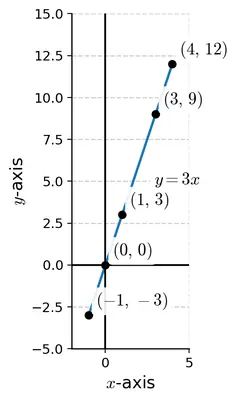
Let us plot the points $$(-1, -3)$$, $$(0, 0)$$, $$(1, 3)$$, $$(3, 9)$$, $$(4, 12)$$ in the coordinate plane on a graph paper as shown in Fig. 2.6. Join the points $$(-1, -3)$$ and $$(4, 12)$$ using a ruler. Doing so, observe that all five points lie on a straight line. Can you guess the equation of this line by looking at the relationship between the $$x$$ and $$y$$ coordinates of each point?
Fig. 2.6
Fig. 2.6

Solution

We are given the five points

  • $$A(-1,-3)$$
  • $$B(0,0)$$
  • $$C(1,3)$$
  • $$D(3,9)$$
  • $$E(4,12)$$

After plotting them on a graph sheet and joining the extreme points $$A$$ and $$E$$ with a ruler, we notice that all five points lie on the same straight line. A straight-line graph is always described by a linear equation of the form $$y = mx + c$$, where

  • $$m$$ is the slope (gradient) of the line, and
  • $$c$$ is the $$y$$-intercept.

1. Looking directly at the coordinates

Compare the $$x$$ and $$y$$ values of every point:

Point$$x$$$$y$$$$\dfrac{y}{x}$$ (when $$x \neq 0$$)
A$$-1$$$$-3$$$$\frac{-3}{-1}=3$$
B$$0$$$$0$$
C$$1$$$$3$$$$\frac{3}{1}=3$$
D$$3$$$$9$$$$\frac{9}{3}=3$$
E$$4$$$$12$$$$\frac{12}{4}=3$$

Except for the origin (where the ratio is not defined), every point gives the same constant value $$3$$ for $$\dfrac{y}{x}$$. This constant ratio tells us that $$y$$ is always three times $$x$$, i.e.

\[y = 3x\]

2. Confirming by slope–intercept form

If we pick any two of the points, say $$A(-1,-3)$$ and $$E(4,12)$$, the slope is

$$m = \dfrac{12 - (-3)}{4 - (-1)} = \dfrac{15}{5} = 3$$.

Using the point–slope form through $$A$$:

$$y - (-3) = 3\,(x - (-1)) \;\Longrightarrow\; y + 3 = 3(x + 1)$$

Simplifying gives $$y = 3x$$, which is identical to the result obtained above.

Conclusion

The single linear equation that passes through all five plotted points is therefore

\[y = 3x\]

Answer

$$y = 3x$$

Example 13

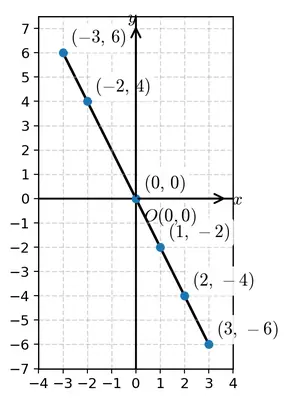
Let us plot the points $$(-3, 6)$$, $$(-2, 4)$$, $$(0, 0)$$, $$(1, -2)$$, $$(2, -4)$$, $$(3, -6)$$ in the coordinate plane on a graph paper as shown in Fig. 2.7. Join the points $$(-3, 6)$$ and $$(3, -6)$$ using a ruler. Doing so, observe that all five points lie on a straight line. Can you guess the equation of this line by looking at the relationship between the $$x$$ and $$y$$ coordinates of each point?
Fig. 2.7
Fig. 2.7

Solution

Given points : $$(-3,6),\;(-2,4),\;(0,0),\;(1,-2),\;(2,-4),\;(3,-6)$$

Step 1 : Plot and join
Plot the six ordered pairs on graph paper. Join the extreme points $$(-3,6)$$ and $$(3,-6)$$ with a ruler; every other point falls exactly on this same straight line, confirming that all six points are collinear.

Step 2 : Detect the numerical pattern

Point$$x$$$$y$$Check of $$y=-2x$$
$$(-3,6)$$$$-3$$$$6$$$$-2(-3)=6$$ ✔
$$(-2,4)$$$$-2$$$$4$$$$-2(-2)=4$$ ✔
$$(0,0)$$$$0$$$$0$$$$-2(0)=0$$ ✔
$$(1,-2)$$$$1$$$$-2$$$$-2(1)=-2$$ ✔
$$(2,-4)$$$$2$$$$-4$$$$-2(2)=-4$$ ✔
$$(3,-6)$$$$3$$$$-6$$$$-2(3)=-6$$ ✔

For every point, $$y=-2x$$ holds true, suggesting that this is the required linear relation.

Step 3 : Verification by slope–intercept form

Take the two extreme points to compute the slope:

$$m = \frac{-6-6}{3-(-3)} = \frac{-12}{6} = -2.$$

Using point $$(0,0)$$, the line in slope–intercept form is

\[y = -2x + 0 \Rightarrow y=-2x.\]

Thus, the equation satisfied by every plotted point—and hence by the whole line—is

\[\boxed{y=-2x}\]

Answer

The line joining the six given points is described by the equation $$y = -2x$$ (equivalently, $$2x + y = 0$$).

Example 14

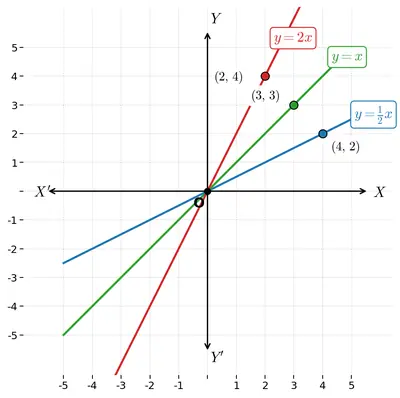
Draw the graphs of $$y = \frac{1}{2}x$$, $$y = x$$, $$y = 2x$$ by selecting suitable points on these lines. (Hint: In order to graph $$y = \frac{1}{2}x$$, we could take the points $$(0, 0)$$ and $$(4, 2)$$. Can you verify that these lie on the line?)
Figure
Figure

Solution

1  Choosing convenient points

All three equations are of the form $$y = mx$$, so the point $$O(0,0)$$ automatically lies on every line. To draw a straight line we need at least one more point on it; in practice we take several so that plotting is easier and possible errors can be spotted.

EquationChosen value of $$x$$Calculated $$y$$Ordered pair $$ (x , y) $$
$$y = \tfrac12 x$$$$-4$$$$y = \tfrac12(-4) = -2$$$$(-4 , -2)$$
$$-2$$$$y = \tfrac12(-2) = -1$$$$(-2 , -1)$$
$$0$$$$y = 0$$$$(0 , 0)$$
$$2$$$$y = \tfrac12(2) = 1$$$$ (2 , 1) $$
$$4$$$$y = \tfrac12(4) = 2$$$$ (4 , 2) $$
$$y = x$$$$-4$$$$y = -4$$$$(-4 , -4)$$
$$-1$$$$y = -1$$$$(-1 , -1)$$
$$0$$$$y = 0$$$$ (0 , 0) $$
$$2$$$$y = 2$$$$ (2 , 2) $$
$$4$$$$y = 4$$$$ (4 , 4) $$
$$y = 2x$$$$-3$$$$y = 2(-3) = -6$$$$(-3 , -6)$$
$$-1$$$$y = 2(-1) = -2$$$$(-1 , -2)$$
$$0$$$$y = 0$$$$ (0 , 0) $$
$$2$$$$y = 2(2) = 4$$$$ (2 , 4) $$
$$4$$$$y = 2(4) = 8$$$$ (4 , 8) $$

Notice in particular the two points suggested in the hint: for $$x = 0$$, $$y = 0$$ gives $$(0,0)$$, and for $$x = 4$$, $$y = 2$$ gives $$(4,2)$$; both satisfy $$y = \tfrac12 x$$.

2  Plotting the points

  • Draw a pair of perpendicular axes and mark equal units along both directions. A convenient scale is 1 cm = 1 unit on both axes.
  • Plot each ordered pair from the table in its correct quadrant.

3  Drawing the lines

  • Join the points corresponding to $$y = \tfrac12 x$$ with a ruler. Extend the line in both directions; label it.
  • Repeat for the sets belonging to $$y = x$$ and $$y = 2x$$.
  • All three lines pass through the origin, but their steepness (gradient) differs. The order from flattest to steepest is $$y = \tfrac12 x$$, then $$y = x$$, then $$y = 2x$$.

4  What the final graph should show

  1. The straight line $$y = \tfrac12 x$$ passing through $$(0,0)$$ and $$(4,2)$$ (and other plotted points).
  2. The straight line $$y = x$$ passing through $$(0,0)$$ and $$(4,4)$$.
  3. The straight line $$y = 2x$$ passing through $$(0,0)$$ and $$(4,8)$$.

These three lines illustrate how increasing the coefficient of $$x$$ increases the slope (gradient) of the line.

Description of the required sketch:
Draw the coordinate axes with the origin clearly marked. Plot the points listed in the tables, then draw three straight lines through those points. Label the lines as $$y = \frac12 x$$, $$y = x$$ and $$y = 2x$$ respectively. The line $$y = \frac12 x$$ will be the least steep, $$y = x$$ will make a $45^\circ$ angle with the positive $$x$$-axis, and $$y = 2x$$ will be the steepest.

Answer

The three straight lines through the origin corresponding to the equations $$y = \tfrac12 x$$, $$y = x$$ and $$y = 2x$$ have been plotted; the required graph consists of those three lines, with slopes in the ratio 1 : 2 : 4.

Example 15

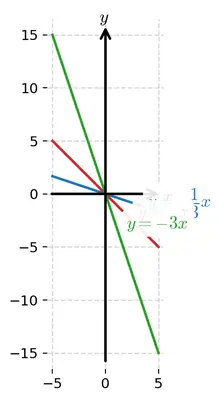
Now let us draw the graphs of $$y = \frac{-1}{3}x$$, $$y = -x$$, $$y = -3x$$ by selecting suitable points on these lines. Fig. 2.10 shows the graphs of these linear equations without any points labelled on them.
Fig. 2.10
Fig. 2.10

Solution

We are asked to draw the graphs of the three linear equations

  • $$y = \frac{-1}{3}x$$
  • $$y = -x$$
  • $$y = -3x$$

For a straight line, two points are enough to locate the line, but plotting at least three points helps us check that the line is drawn correctly. The simplest points to pick are those that make calculations easy—usually small integers. In all three formulae the constant term is 0, so the point $$x = 0$$ gives $$y = 0$$ for every line. Thus every line passes through the origin  $$O(0,0)$$.

1. Table of values for  $$y = -x$$

$$x$$$$y$$
$$-2$$$$2$$
$$-1$$$$1$$
$$0$$$$0$$
$$1$$$$-1$$
$$2$$$$-2$$

Plot any two or three of these, e.g.  $$(-2,2)$$, $$O(0,0)$$, $$ (2,-2)$$, and join them with a ruler to get the required straight line.

2. Table of values for  $$y = -3x$$

$$x$$$$y$$
$$-2$$$$6$$
$$-1$$$$3$$
$$0$$$$0$$
$$1$$$$-3$$
$$2$$$$-6$$

Again plot at least two points such as  $$(-1,3)$$, $$O(0,0)$$, $$ (1,-3)$$ and join them.

3. Table of values for  $$y = \frac{-1}{3}x$$

$$x$$$$y$$
$$-6$$$$2$$
$$-3$$$$1$$
$$0$$$$0$$
$$3$$$$-1$$
$$6$$$$-2$$

Choose, for instance,  $$(-3,1)$$, $$O(0,0)$$, $$ (3,-1)$$ and join them with a straight edge.

4. Drawing the three graphs on the same coordinate plane

  1. Draw the $$x$$-axis and $$y$$-axis perpendicular to each other, mark equal scales on both sides, and label the origin $$O(0,0)$$.
  2. Plot the chosen points for each equation:
    • For $$y=-x$$:  $$(-2,2)$$, $$O$$, $$ (2,-2)$$
    • For $$y=-3x$$:  $$(-1,3)$$, $$O$$, $$ (1,-3)$$
    • For $$y=-\frac13x$$:  $$(-3,1)$$, $$O$$, $$ (3,-1)$$
  3. With a ruler, draw straight lines through the sets of points. Use a different colour or style for each line and write its equation next to it.

Observation. All three lines meet at the origin because each equation has zero constant term. Their slopes are the coefficients of $$x$$:

  • $$m = -3$$ (steepest drop)
  • $$m = -1$$ (medium drop)
  • $$m = -\frac13$$ (gentlest drop)

Thus as the numerical value of the negative coefficient increases, the line gets steeper.

After plotting, the diagram will look like Fig. 2.10 in the textbook, now with the chosen points marked and labelled.

Answer

Suitable points:

  • $$y=-x$$:  $$(-2,2),(0,0),(2,-2)$$
  • $$y=-3x$$:  $$(-1,3),(0,0),(1,-3)$$
  • $$y=-\dfrac13x$$:  $$(-3,1),(0,0),(3,-1)$$

Plot each set and join with a ruler; the three straight lines intersect at the origin.

Example 16

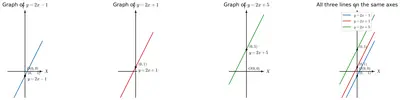
Let us now draw the graphs of $$y = 2x - 1$$, $$y = 2x + 1$$, $$y = 2x + 5$$, first individually (as shown in Fig. 2.12) and then on the same axes (as shown in Fig. 2.13).
Fig. 2.12
Fig. 2.12

Solution

Goal. Plot the straight-line graphs of  $$y = 2x - 1$$,  $$y = 2x + 1$$  and  $$y = 2x + 5$$  first one by one and then together.

Step 1 : Prepare co-ordinate points

EquationIf $$x = 0$$If $$x = 2$$(extra) $$x = -1$$
$$y = 2x - 1$$$$(0,-1)$$$$(2,3)$$$$(-1,-3)$$
$$y = 2x + 1$$$$(0,1)$$$$(2,5)$$$$(-1,-1)$$
$$y = 2x + 5$$$$(0,5)$$$$(2,9)$$$$(-1,3)$$

Two points are enough for a straight line; the third column is given only for extra checking.

Step 2 : Draw each graph separately (Fig. 2.12)

  • On squared paper draw the $$x$$-axis (horizontal) and the $$y$$-axis (vertical) through the origin.
  • For $$y = 2x - 1$$ plot the points $$(0,-1)$$ and $$(2,3)$$, join them with a ruler, extend the line on both sides and add arrows; write "$$y = 2x - 1$$" near it.
  • Repeat the same process on fresh axes for $$y = 2x + 1$$ and again for $$y = 2x + 5$$.

Step 3 : Draw the three graphs on a single pair of axes (Fig. 2.13)

  • Use one common coordinate system with equal scale on both axes.
  • Plot the six main points listed in the table.
  • Through $$(0,-1)$$ and $$(2,3)$$ draw the first line; through $$(0,1)$$ and $$(2,5)$$ draw the second line; through $$(0,5)$$ and $$(2,9)$$ draw the third line.
  • Use different colours or line styles so the three straight lines can be distinguished easily, and label each one.

What the finished picture shows

  • All three lines have the same slope $$m = 2$$, therefore they are parallel.
  • Their $$y$$-intercepts are $$-1$$, $$1$$ and $$5$$, so they cross the $$y$$-axis at those points.
  • The vertical distance between consecutive lines is $$2$$ units.

Thus the required individual graphs (Fig. 2.12) and the combined graph (Fig. 2.13) are complete.

Answer

The three required graphs are parallel straight lines of slope $$2$$ intersecting the $$y$$-axis at $$y=-1$$, $$y=1$$ and $$y=5$$ respectively.

Think and Reflect

Think and Reflect (after Example 2) Consider the algebraic expression $$200l + 160w + 50lw$$ obtained for the total cost of the rectangular garden in Example 2.

1 Can you identify the terms, variables and coefficients of this algebraic expression?

Solution

The given cost expression is

$$200l + 160w + 50lw$$

  1. Separating the individual terms
    Each part that is added or subtracted is a term.
    Hence the three terms are
    $$200l ,\;160w ,\;50lw$$
  2. Listing the variables
    A variable is a symbol whose value can change. In every term we see two symbols that are not ordinary numerals: $$l$$ and $$w$$.
    Variables: $$l ,\;w$$
  3. Finding the (numerical) coefficients
    The numerical coefficient of a term is the number that multiplies the variable part.
    • For the term $$200l$$ the coefficient is $$200$$.
    • For the term $$160w$$ the coefficient is $$160$$.
    • For the term $$50lw$$ the coefficient is $$50$$.

Thus

  • Terms : $$200l,\;160w,\;50lw$$
  • Variables : $$l,\;w$$
  • Coefficients : $$200,\;160,\;50$$

Answer

Terms: $$200l,\;160w,\;50lw$$
Variables: $$l,\;w$$
Coefficients: $$200,\;160,\;50$$

2 How is it different from the algebraic expression in Example 1?

Solution

Example 1 in the textbook involved an expression containing only one variable (say $$x$$). Such an expression is called a polynomial in one variable.

In contrast, the present expression

$$200l + 160w + 50lw$$

contains two different variables, $$l$$ and $$w$$.

Therefore

  • Example 1: polynomial in one variable; every term was a power of the same symbol.
  • Example 2: polynomial in two variables; one term, $$50lw$$, even involves the product of both variables.

Besides, Example 1 had a constant (numerical) term while the present expression has no constant term; but the major difference is the number of variables involved.

Answer

The expression in Example 1 is a polynomial in one variable, whereas $$200l+160w+50lw$$ is a polynomial in two variables (both $$l$$ and $$w$$ appear, and one term is their product). Hence the main difference lies in the number of variables present.

Think and Reflect (after Example 3) Consider the algebraic expression $$10x - x^2$$ obtained for the area of the rectangle in Example 3.

1 Can you identify the terms, variables and coefficients of this algebraic expression?

Solution

The given algebraic expression is $$10x - x^2$$.

  • Terms: The expression is the sum of two separate terms – $$10x$$ and $$-x^2$$.
  • Variable: Both terms contain the same variable, namely $$x$$.
  • Coefficients:
    • In the term $$10x$$ the numerical coefficient is $$10$$.
    • In the term $$-x^2$$ the numerical coefficient is $$-1$$ (because $$-x^2 = -1\,x^2$$).

There is no constant (number–only) term in the expression.

Answer

Terms: $$10x$$ and $$-x^2$$;  Variable: $$x$$;  Coefficients: $$10$$ (of $$10x$$) and $$-1$$ (of $$-x^2$$).

2 Can you point out any similarity or difference between the algebraic expressions obtained in Examples 1 and 3?

Solution

Example 1 of the textbook gives the polynomial (recalled here for convenience)

$$8y^3 - 5y^2 + 7y.$$

Example 3 gives the polynomial

$$10x - x^2.$$

  • Similarity: Both expressions are polynomials in one variable (Example 1 in $$y$$, Example 3 in $$x$$). Therefore each qualifies as a single-variable polynomial.
  • Differences:
    • The expression from Example 1 has three terms (it is a trinomial) and its highest power of the variable is $$3$$, so it is a cubic polynomial.
    • The expression from Example 3 has only two terms (a binomial) and the highest power of the variable is $$2$$, so it is a quadratic polynomial.
    • The variables used are different ( $$y$$ versus $$x$$ ), and in Example 3 the coefficient of the highest-degree term is negative, whereas in Example 1 all coefficients shown are positive for the highest-degree term.

Answer

Both are single-variable polynomials, but the Example 1 expression is a cubic trinomial, whereas the Example 3 expression $$10x - x^2$$ is a quadratic binomial; the variables ( $$y$$ vs. $$x$$ ) and number/sign of terms also differ.

Think and Reflect (after Example 4) Find the perimeter of squares with sides 1 cm, 1.5 cm, 2 cm, 2.5 cm and 3 cm. What will happen to the perimeters if the sides increase by 0.5 cm?

Solution

For any square the perimeter (P) is four times the length of one side (s): $$P = 4s$$.

Side (s) in cmPerimeter $$P = 4s$$ (cm)
1$$4\times 1 = 4$$
1.5$$4\times 1.5 = 6$$
2$$4\times 2 = 8$$
2.5$$4\times 2.5 = 10$$
3$$4\times 3 = 12$$

Now increase every side length by $$0.5\,\text{cm}$$. The new side length is $$s+0.5$$ and its perimeter becomes

$$P' = 4(s+0.5) = 4s + 2.$$

Thus each perimeter rises by exactly $$2\,\text{cm}$$. Calculated one–by–one:

New side (cm)New perimeter (cm)
1.5$$6$$
2$$8$$
2.5$$10$$
3$$12$$
3.5$$14$$

Observation: Adding $$0.5\,\text{cm}$$ to every side always adds $$2\,\text{cm}$$ to the perimeter of the square.

Answer

Original perimeters: 4 cm, 6 cm, 8 cm, 10 cm, 12 cm.
Each side +0.5 cm ⇒ each perimeter +2 cm, so new perimeters: 6 cm, 8 cm, 10 cm, 12 cm, 14 cm.

Think and Reflect (after Example 5) If a player paid ₹750, how many matches did he play?

Solution

Let $$x$$ be the number of matches the player played.

From the earlier part of the question, the polynomial giving the total amount (in rupees) that has to be paid after playing $$x$$ matches is

\[A(x) = 500 + 50x\]

where
• ₹500 is the fixed (one-time) membership fee, and
• ₹50 is the charge for each match played.

The player actually paid ₹750. Hence

$$A(x) = 750$$

Substituting this in the above expression:

$$500 + 50x = 750$$

Subtract 500 from both sides:

$$50x = 750 - 500$$
$$50x = 250$$

Divide both sides by 50 to isolate $$x$$:

$$x = \frac{250}{50}$$
$$x = 5$$

Therefore, the player played 5 matches.

Answer

He played 5 matches.

Think and Reflect (after Example 6) We have learnt that to evaluate the value of an algebraic expression, we substitute a value of the variable in the given expression. Consider Example 3, where the wire is bent to form a rectangle. Here, the area of the rectangle, $$10x - x^2$$, is a function of $$x$$. Can you interpret this as an input-output process? What value does the expression take when $$x = 6$$ cm?

Solution

Step 1 : Understanding the “input–output” idea

Think of the algebraic expression (here, the area of the rectangle) $$10x - x^2$$ as a machine:

  • We input a number for the variable $$x$$ (for example a possible breadth of the rectangle).
  • The “machine” performs the operations “multiply by 10” and “subtract the square” in the exact order shown.
  • The number that finally comes out is the output, which in this context represents the area (in $$ ext{cm}^2$$).

This is exactly what mathematicians call a function: every admissible input $$x$$ produces a unique output $$10x - x^2$$.

Step 2 : Substituting $$x = 6$$ cm

Insert the given value into the expression, showing each operation separately:

First, write the expression with brackets around the substituted value so there is no confusion about order:

$$10x - x^2 \;\longrightarrow\; 10(6) - (6)^2$$

Step 3 : Perform the multiplication

$$10(6) = 60$$, so the expression becomes

$$60 - (6)^2$$

Step 4 : Find the square of the input

$$6^2 = 6 \times 6 = 36$$. Thus

$$60 - 36$$

Step 5 : Complete the subtraction

$$60 - 36 = 24$$

Step 6 : Attach the correct unit

The original expression represents an area, so the unit is square centimetres (cm2).

\[ \boxed{24\;\text{cm}^2} \]

Thus, when the “function machine” receives the input $$x = 6$$ cm, the output (area of the rectangle) is $$24\;\text{cm}^2$$.

Answer

For $$x = 6$$ cm, the area is $$24\;\text{cm}^2$$.

Think and Reflect (square tiles pattern)

Predict the number of squares in the next three stages of the pattern (Fig. 2.4) and write the sequence of numbers up to Stage 7 of the pattern.
Fig. 2.4
Fig. 2.4

Solution

Step 1 : Observe the first three stages shown in Fig. 2.4
From the textbook figure we can read the number of unit (small) squares in each of the first three stages:

  • Stage 1 → 1 square
  • Stage 2 → 4 squares
  • Stage 3 → 9 squares

The jump from 1 → 4 → 9 suggests that the figure in Stage n is an n × n big square made up of unit squares. Hence the count in Stage n should be $$n^{2}$$.

Step 2 : Use the rule $$n^{2}$$ to predict the next three stages

Stage (n)Number of squares  $$=n^{2}$$
4$$4^{2}=16$$
5$$5^{2}=25$$
6$$6^{2}=36$$

Therefore the next three stages contain 16, 25 and 36 squares respectively.

Step 3 : Write the full sequence up to Stage 7
Listing the values $$n^{2}$$ for $$n = 1,2,3,4,5,6,7$$ gives:

Stage 1 : 1     Stage 2 : 4     Stage 3 : 9     Stage 4 : 16     Stage 5 : 25     Stage 6 : 36     Stage 7 : 49

Hence the required sequence is
$$1,\;4,\;9,\;16,\;25,\;36,\;49.$$

Answer

Next three stages contain 16, 25 and 36 squares, respectively.
Sequence up to Stage 7: 1, 4, 9, 16, 25, 36, 49.

Think and Reflect (after 2n - 1) Using the expression $$2n - 1$$, can you find out how many tiles will be there in the 15th stage and the 26th stage of the pattern? Also, which stage will contain 21 tiles and 47 tiles?

Solution

The pattern described in the textbook has its number of tiles at the n-th stage given by the polynomial (or algebraic expression)

$$2n - 1.$$

This is the general term of the sequence of consecutive odd numbers: 1, 3, 5, 7, … . We shall use it in two different ways:

  1. Substitution  (to find how many tiles are in a given stage).
  2. Equation solving  (to find which stage has a given number of tiles).

1. Tiles in the 15th and 26th stages

(i) For the 15th stage, put $$n = 15$$ in $$2n - 1$$:

$$2(15) - 1 = 30 - 1 = 29.$$

So, the 15th stage has 29 tiles.

(ii) For the 26th stage, put $$n = 26$$:

$$2(26) - 1 = 52 - 1 = 51.$$

Thus, the 26th stage has 51 tiles.

2. Stage that contains 21 tiles

Let the required stage number be $$n$$. Equate the formula to 21:

$$2n - 1 = 21.$$

Add 1 to both sides:

$$2n = 22.$$

Divide by 2:

$$n = 11.$$

Therefore, the 11th stage contains 21 tiles.

3. Stage that contains 47 tiles

Again, let the stage number be $$n$$ and equate:

$$2n - 1 = 47.$$

Add 1:

$$2n = 48.$$

Divide by 2:

$$n = 24.$$

Hence, the 24th stage contains 47 tiles.

All results collected:

[ 15\text{th stage} = 29\text{ tiles},\; 26\text{th stage} = 51\text{ tiles},\; 21\text{ tiles} \Rightarrow 11\text{th stage},\; 47\text{ tiles} \Rightarrow 24\text{th stage} ]

Answer

15th stage → 29 tiles
26th stage → 51 tiles
21 tiles occur at the 11th stage
47 tiles occur at the 24th stage

Think and Reflect (after Example 7) What amount will be left on the 15th day? How many days will it take for the entire amount to be spent?

Solution

Let the amount  (in rupees)  left with the person after n days be represented by the polynomial

$$A(n)=400-20n$$

(That is, the person started with Rs 400 and spends Rs 20 every day.)

1. Amount left on the 15th day

Substitute n = 15 in $$A(n)$$ :

$$A(15)=400-20\times15$$

$$=400-300$$

$$=100$$

Hence, Rs 100 will be left on the 15th day.

2. Number of days required to spend the entire amount

The entire amount is spent when the amount left becomes zero, i.e. when $$A(n)=0$$.

Set the polynomial equal to 0 and solve for n:

$$400-20n=0$$

$$20n=400$$

$$n=\frac{400}{20}=20$$

Therefore, it will take 20 days for the person to spend the whole amount.

Answer

Rs 100 will be left on the 15th day, and the whole amount will be spent in 20 days.

Think and Reflect (after Example 8) For how many km will the fare be ₹130?

Solution

Let $$x$$ denote the total distance (in km) covered by the taxi.

The fare pattern given in the question is :

  • Fare for the first kilometre  =  ₹10
  • Fare for every additional kilometre  =  ₹8

For a ride of $$x\;(x\ge 1)$$ kilometres, the number of additional kilometres is $$x-1$$. Hence the total fare, in rupees, is

$$F(x)=10+8(x-1).$$

Simplifying,

\[F(x)=10+8x-8=8x+2.\]

We are told that the fare is ₹130, so

$$8x+2 = 130.$$

Subtract 2 from both sides :

$$8x = 128.$$

Divide by 8 :

$$x = 16.$$

Therefore, the fare becomes ₹130 when the taxi is hired for 16 kilometres.

Answer

16 km

Think and Reflect (after Example 9) What is the cost for travelling 15 km? For how many kilometres will the cost of the journey be ₹700?

Solution

Let the total fare (in rupees) for travelling $$x$$ km be denoted by the polynomial $$C(x)$$ that was obtained in the earlier part of the question:

  • a fixed charge (flag-down fare) of ₹50 is paid the moment one hires the taxi, and
  • thereafter the charge is ₹10 per kilometre actually travelled.

Therefore

$$C(x)=50+10x\;.$$


(i) Cost of travelling 15 km

Substitute $$x=15$$ in $$C(x)$$:

$$C(15)=50+10\times15$$

$$=50+150$$

$$=200\;.$$

Hence the cost of a 15 km journey is ₹200.


(ii) Distance covered when the fare is ₹700

Set $$C(x)=700$$ and solve for $$x$$:

$$50+10x=700$$

$$10x=700-50$$

$$10x=650$$

$$x=\dfrac{650}{10}$$

$$x=65\;.$$

Therefore one can travel 65 km for a fare of ₹700.

Answer

Cost for 15 km = ₹200;
₹700 pays for 65 km.

Think and Reflect (after Example 10) What will be the height of the water at the end of 5 months?

Solution

The height of the water (in metres) after t months is represented by the polynomial

$$h(t) = 4t^{2} - 5t + 19$$

We have to find the height at the end of 5 months, i.e. for $$t = 5$$.

Step 1 – Substitute $$t = 5$$ in the polynomial.

$$h(5) = 4(5)^{2} - 5(5) + 19$$

Step 2 – Calculate the individual terms.

  • $$(5)^{2} = 25$$
  • So, $$4(5)^{2} = 4 \times 25 = 100$$
  • and $$-5(5) = -5 \times 5 = -25$$

Step 3 – Add the three terms carefully.

$$h(5) = 100 - 25 + 19$$

First add the positive numbers: $$100 + 19 = 119$$

Now subtract 25 from 119:

$$119 - 25 = 94$$

Hence, the height of the water after 5 months is

\[h(5) = 94\;\text{metres}\]

Answer

94 metres

Think and Reflect (after Example 11) Can you guess what the numbers 20 and 150 in the equation $$y = 20x + 150$$ represent?

Solution

We compare the given equation with the standard form of a linear equation in one variable:
\[ y = mx + c \]

Here

  • $$m$$ is called the slope (or gradient) of the line. It tells us how much $$y$$ changes when $$x$$ increases by one unit.
  • $$c$$ is the y‑intercept. It gives the value of $$y$$ when $$x = 0$$; in other words, the point where the line cuts the $$y$$-axis.

In the given equation

$$y = 20x + 150$$

we can immediately read

  • $$m = 20$$, so for every increase of 1 in $$x$$, the value of $$y$$ rises by $$20\,(=m\times1)$$ units. Thus 20 represents the rate of change of $$y$$ with respect to $$x$$.
  • $$c = 150$$, so when $$x = 0$$ we have
    \[ y = 20\times0 + 150 = 150. \]
    Hence 150 is the y-intercept; it is the value of $$y$$ when $$x$$ is zero.

Therefore:

  1. 20 is the coefficient of $$x$$ (the slope), indicating the unit change in $$y$$ per unit change in $$x$$.
  2. 150 is the constant term (the y-intercept), giving the initial value of $$y$$ when $$x = 0$$.

Answer

20 = slope (change in $$y$$ per unit change in $$x$$); 150 = y-intercept (value of $$y$$ at $$x = 0$$).

Think and Reflect (after Example 12)

Identify other points on the line $$y = 2x + 1$$ by completing the following table.

$$x$$125791220
$$y$$315

Solution

We are given the straight-line equation

$$y = 2x + 1$$

To find the missing entries in the table we substitute each given $$x$$–value into the formula and simplify.

  1. For $$x = 1$$ (already filled):

    $$y = 2(1) + 1 = 2 + 1 = 3$$

  2. For $$x = 2$$:

    $$y = 2(2) + 1 = 4 + 1 = 5$$

  3. For $$x = 5$$:

    $$y = 2(5) + 1 = 10 + 1 = 11$$

  4. For $$x = 7$$:

    $$y = 2(7) + 1 = 14 + 1 = 15$$

  5. For $$x = 9$$:

    $$y = 2(9) + 1 = 18 + 1 = 19$$

  6. For $$x = 12$$:

    $$y = 2(12) + 1 = 24 + 1 = 25$$

  7. For $$x = 20$$:

    $$y = 2(20) + 1 = 40 + 1 = 41$$

Thus the completed table is:

$$x$$125791220
$$y$$351115192541

Answer

The missing $$y$$-values are 5, 11, 15, 19, 25 and 41, giving the points:
(1, 3), (2, 5), (5, 11), (7, 15), (9, 19), (12, 25), (20, 41).

Think and Reflect (after Example 15) Differentiate between the graphs of the equations $$y = 3x + 1$$ and $$y = -3x + 1$$.

Solution

Step 1 – Identify the form of each equation

Both equations are in the slope–intercept form $$y = mx + c$$ where $$m$$ is the slope and $$c$$ is the y-intercept.

EquationSlope $$m$$y-intercept $$c$$
$$y = 3x + 1$$$$m = 3$$ (positive)$$c = 1$$
$$y = -3x + 1$$$$m = -3$$ (negative)$$c = 1$$

Step 2 – Plot a few points for each line

Choose $$x$$For $$y = 3x + 1$$  (points)For $$y = -3x + 1$$  (points)
$$x = 0$$$$(0,1)$$$$(0,1)$$
$$x = 1$$$$(1,4)$$$$(1,-2)$$
$$x = -1$$$$( -1,-2)$$$$( -1,4)$$

Step 3 – Draw the graphs

  • On graph paper mark the common point $$(0,1)$$ on the y-axis.
  • Through the points $$(1,4)$$ and $$( -1,-2)$$ draw a straight line; this is the graph of $$y = 3x + 1$$. It rises to the right (upward slant) making an acute angle with the positive x-axis.
  • Through the points $$(1,-2)$$ and $$( -1,4)$$ draw a straight line; this is the graph of $$y = -3x + 1$$. It falls to the right (downward slant) making an obtuse angle with the positive x-axis.

Diagram description: Draw a Cartesian plane. Mark the common intercept point (0, 1). Draw one line rising rightwards through (1, 4) and falling leftwards through (-1, -2). Draw the other line falling rightwards through (1, -2) and rising leftwards through (-1, 4). The two lines cross at (0, 1) and form a symmetrical ‘X’ shape.

Step 4 – Compare the two graphs

  • Slope: $$y = 3x + 1$$ has positive slope $$3$$; $$y = -3x + 1$$ has negative slope $$-3$$.
  • Direction: The first line slants upward from left to right; the second slants downward from left to right.
  • Common y-intercept: Both lines cut the y-axis at the same point $$(0,1)$$.
  • Symmetry: Because their slopes are equal in magnitude but opposite in sign and their intercepts are equal, the two graphs are mirror images of each other in the y-axis.

Conclusion

The graph of $$y = 3x + 1$$ is an upward-sloping straight line through $$(0,1)$$; the graph of $$y = -3x + 1$$ is a downward-sloping straight line through the same point. Thus, they differ only in the sign of their slope, giving opposite inclinations while sharing the same y-intercept.

Answer

Both lines meet the y-axis at (0, 1), but $$y = 3x + 1$$ rises to the right (slope = +3) while $$y = -3x + 1$$ falls to the right (slope = –3); hence they are mirror images of each other about the y-axis.

Think and Reflect (after Example 16) Does this help you to conclude anything about the linear equation $$y = ax + b$$ when $$a$$ is fixed but $$b$$ varies? (Hint: In these equations $$a = 2$$, and $$b$$ takes the values $$-1$$, $$1$$ and $$5$$, respectively.)

Solution

Step 1 : Choose convenient points for each equation

For any straight-line equation of the form $$y=ax+b$$ it is enough to locate two points.

EquationTake $$x=0$$Take $$x=1$$
$$y=2x-1$$$$y=2(0)-1=-1\Rightarrow (0,-1)$$$$y=2(1)-1=1\Rightarrow (1,1)$$
$$y=2x+1$$$$y=2(0)+1=1\Rightarrow (0,1)$$$$y=2(1)+1=3\Rightarrow (1,3)$$
$$y=2x+5$$$$y=2(0)+5=5\Rightarrow (0,5)$$$$y=2(1)+5=7\Rightarrow (1,7)$$

Step 2 : Plot and observe

  • All three graphs rise by the same amount when $$x$$ increases by 1: the change in $$y$$ is always $$a=2$$. This identical “steepness” (slope) means the lines never meet; they are parallel.
  • The only difference is their intercept on the $$y$$-axis: $$b=-1,\;1,\;5$$. Larger $$b$$ moves the whole line upward without altering its tilt.

Step 3 : General conclusion

If in $$y=ax+b$$ the coefficient $$a$$ (slope) is kept fixed while $$b$$ varies, every new value of $$b$$ simply shifts the graph up or down. Because the slopes are identical, the resulting lines are always parallel to one another.

Thus the effect of changing the constant term $$b$$ is a vertical translation; it does not change the direction of the line.

Answer

The family of equations $$y=ax+b$$ with a common slope $$a$$ but different $$b$$ values represents a set of straight lines that are all parallel; varying $$b$$ only moves the line up or down on the graph.

Exercise Set 2.1

1 Find the degrees of the following polynomials:

(i) $$2x^2 - 5x + 3$$

Solution

First list the terms of the polynomial $$2x^2 - 5x + 3$$.

  • Term 1: $$2x^2$$ – its exponent of $$x$$ is $$2$$.
  • Term 2: $$-5x$$ – its exponent of $$x$$ is $$1$$.
  • Term 3: $$3$$ – this is a constant term, which can be written as $$3x^0$$, so its exponent is $$0$$.

The degree of a polynomial is the highest exponent of the variable present in any term. The highest exponent among $$2,1,0$$ is $$2$$.

Therefore, the degree of the polynomial is

\[\text{degree} = 2\]

Answer

Degree = 2

(ii) $$y^3 + 2y - 1$$

Solution

The polynomial is $$y^3 + 2y - 1$$.

  • Term 1: $$y^3$$ – exponent of $$y$$ is $$3$$.
  • Term 2: $$2y$$ – exponent of $$y$$ is $$1$$.
  • Term 3: $$-1$$ – a constant term, written as $$-1\,y^0$$ with exponent $$0$$.

The largest exponent among $$3,1,0$$ is $$3$$.

Hence,

\[\text{degree} = 3\]

Answer

Degree = 3

(iii) $$-9$$

Solution

The given polynomial is the constant $$-9$$.

Any non-zero constant can be viewed as $$-9x^0$$, so the only exponent present is $$0$$.

Therefore, its degree is

\[\text{degree} = 0\]

Answer

Degree = 0

(iv) $$4z - 3$$

Solution

The polynomial is $$4z - 3$$.

  • Term 1: $$4z$$ – exponent of $$z$$ is $$1$$.
  • Term 2: $$-3$$ – a constant, which is $$-3z^0$$ with exponent $$0$$.

The highest exponent is $$1$$.

Hence,

\[\text{degree} = 1\]

Answer

Degree = 1

2 Write polynomials of degrees 1, 2 and 3.

Solution

Step 1 – Recall the meaning of “degree of a polynomial”
The degree of a polynomial in one variable (say, $$x$$) is the highest power (exponent) of $$x$$ that actually occurs in the expression with a non-zero coefficient.

For example, in the polynomial $$5x^{4} - 2x^{2} + 7$$ the highest power of $$x$$ present is $$4$$, so its degree is $$4$$.

Step 2 – Construct a polynomial of degree 1
The general form of a degree 1 (linear) polynomial in one variable is
\[a_{1}x + a_{0}\]
where $$a_{1} \neq 0$$.
Choose convenient non-zero coefficients, e.g. $$a_{1}=2$$ and $$a_{0}=1$$. Thus one suitable example is
\[2x + 1\]

Step 3 – Construct a polynomial of degree 2
The general form of a degree 2 (quadratic) polynomial is
\[a_{2}x^{2} + a_{1}x + a_{0}\]
with $$a_{2} \neq 0$$.
Select, say, $$a_{2}=3,\; a_{1}=-5,\; a_{0}=4$$. Hence an example is
\[3x^{2} - 5x + 4\]

Step 4 – Construct a polynomial of degree 3
The general form of a degree 3 (cubic) polynomial is
\[a_{3}x^{3} + a_{2}x^{2} + a_{1}x + a_{0}\]
with $$a_{3} \neq 0$$.
Choose $$a_{3}=1,\; a_{2}=-2,\; a_{1}=1,\; a_{0}=-7$$. Therefore an example is
\[x^{3} - 2x^{2} + x - 7\]

Conclusion
Three polynomials that meet the required degrees are:

  • Degree 1: $$2x + 1$$
  • Degree 2: $$3x^{2} - 5x + 4$$
  • Degree 3: $$x^{3} - 2x^{2} + x - 7$$

Answer

Examples:

  • Degree 1 (linear): $$2x + 1$$
  • Degree 2 (quadratic): $$3x^{2} - 5x + 4$$
  • Degree 3 (cubic): $$x^{3} - 2x^{2} + x - 7$$

3 What are the coefficients of $$x^2$$ and $$x^3$$ in the polynomial $$x^4 - 3x^3 + 6x^2 - 2x + 7$$?

Solution

Step 1 – Write the polynomial.

We are given the polynomial

$$P(x)=x^4-3x^3+6x^2-2x+7$$

Step 2 – Locate the x2 term and read its coefficient.

The term that contains $$x^2$$ is $$6x^2$$. The numerical part in front of $$x^2$$ is 6.

Therefore, the coefficient of $$x^2$$ is 6.

Step 3 – Locate the x3 term and read its coefficient.

The term that contains $$x^3$$ is $$-3x^3$$. The numerical part in front of $$x^3$$ is $$-3$$.

Therefore, the coefficient of $$x^3$$ is $$-3$$.

Step 4 – State the final answer.

\[ \text{Coefficient of }x^2 = 6, \qquad \text{Coefficient of }x^3 = -3 \]

Answer

Coefficient of $$x^2$$: 6
Coefficient of $$x^3$$: -3

4 What is the coefficient of $$z$$ in the polynomial $$4z^3 + 5z^2 - 11$$?

Solution

Objective : Find the coefficient of $$z$$ (that is, the term with exponent 1) in the polynomial $$4z^3 + 5z^2 - 11$$.

Step 1 – List the terms and their exponents

  • $$4z^3$$ has exponent $$3$$.
  • $$5z^2$$ has exponent $$2$$.
  • $$-11$$ can be written as $$-11z^0$$, so its exponent is $$0$$.

Step 2 – Look for the $$z^1$$ term

No term with exponent $$1$$ (i.e. $$z^1$$) appears in the expansion.

Step 3 – State the coefficient

When a power of the variable is missing, its coefficient is taken to be $$0$$. Hence the coefficient of $$z$$ is $$0$$.

Answer

$$0$$

5 What is the constant term of the polynomial $$9x^3 + 5x^2 - 8x - 10$$?

Solution

The given polynomial is $$9x^3 + 5x^2 - 8x - 10$$.

A constant term is the term in a polynomial that is independent of the variable; in other words, it is the term for which the power of $$x$$ is zero, i.e. $$x^0 = 1$$.

Let us list every term showing its power of $$x$$ explicitly:

  • $$9x^3$$ has power 3
  • $$5x^2$$ has power 2
  • $$-8x$$ has power 1
  • $$-10$$ can be written as $$-10x^0$$, so its power is 0

Because the power is zero in the last term, that last term is the required constant term.

Hence, the constant term of the polynomial $$9x^3 + 5x^2 - 8x - 10$$ is $$-10$$.

Answer

$$-10$$

Exercise Set 2.2

1 Find the value of the linear polynomial $$5x - 3$$ if:

(i) $$x = 0$$

Solution

The given polynomial is $$P(x)=5x-3$$.

Substitute $$x=0$$:

$$P(0)=5\times 0-3$$

$$=0-3$$

$$=-3$$

Answer

$$-3$$

(ii) $$x = -1$$

Solution

The polynomial is still $$P(x)=5x-3$$.

Substitute $$x=-1$$:

$$P(-1)=5\times(-1)-3$$

$$=-5-3$$

$$=-8$$

Answer

$$-8$$

(iii) $$x = 2$$

Solution

The polynomial is $$P(x)=5x-3$$.

Substitute $$x=2$$:

$$P(2)=5\times2-3$$

$$=10-3$$

$$=7$$

Answer

$$7$$

2 Find the value of the quadratic polynomial $$7s^2 - 4s + 6$$ if:

(i) $$s = 0$$

Solution

First write the polynomial as a function:

$$P(s)=7s^{2}-4s+6$$

To find its value at $$s=0$$, substitute $$s=0$$ everywhere in the expression:

$$P(0)=7(0)^{2}-4(0)+6$$

Work out each term one by one:

  • Square term: $$7(0)^{2}=7\times0=0$$
  • Linear term: $$-4(0)=-4\times0=0$$
  • Constant term is already $$6$$

Add the three results:

$$0+0+6=6$$

Answer

6

(ii) $$s = -3$$

Solution

Again start with the polynomial written as a function:

$$P(s)=7s^{2}-4s+6$$

Now take $$s=-3$$ and substitute:

$$P(-3)=7(-3)^{2}-4(-3)+6$$

  1. Square the number -3: $$(-3)^{2}=9$$
  2. Multiply by 7: $$7\times9=63$$
  3. Multiply -4 by -3: $$-4(-3)=+12$$ (product of two negatives is positive)

Put these computed values back into the sum:

$$P(-3)=63+12+6$$

Add step-by-step:

$$63+12=75$$

$$75+6=81$$

Answer

81

(iii) $$s = 4$$

Solution

The polynomial is

$$P(s)=7s^{2}-4s+6$$

Substitute $$s=4$$:

$$P(4)=7(4)^{2}-4(4)+6$$

  1. Square 4: $$4^{2}=16$$
  2. Multiply by 7: $$7\times16=112$$
  3. Multiply -4 by 4: $$-4\times4=-16$$

Combine all terms:

$$P(4)=112-16+6$$

Simplify the additions/subtractions in order:

$$112-16=96$$

$$96+6=102$$

Answer

102

3 The present age of Salil's mother is three times Salil's present age. After 5 years, their ages will add up to 70 years. Find their present ages.

Solution

Given information

  • Salil's mother is three times as old as Salil now.
  • Five years later, the sum of their ages will be 70 years.

Step 1 : Choose the variable

Let Salil's present age be $$x$$ years.

Step 2 : Express the mother's present age

Salil's mother's present age = three times $$x$$ = $$3x$$ years.

Step 3 : Write their ages after 5 years

  • Salil's age after 5 years: $$x + 5$$ years.
  • Mother's age after 5 years: $$3x + 5$$ years.

Step 4 : Translate the condition into an equation

Five years later, the sum of their ages is 70 years:

$$ (x + 5) + (3x + 5) = 70 $$

Step 5 : Solve the equation

Combine like terms:

$$ 4x + 10 = 70 $$

Subtract 10 from both sides:

$$ 4x = 60 $$

Divide by 4:

\[x = 15\]

So, Salil's present age is 15 years.

Step 6 : Find the mother's present age

Mother's age = $$3x = 3\times15 = 45$$ years.

Step 7 : Check (optional)

After 5 years:

  • Salil: $$15 + 5 = 20$$ years
  • Mother: $$45 + 5 = 50$$ years

Sum: $$20 + 50 = 70$$ years ✓

Therefore, the solution is consistent.

Conclusion

Salil is 15 years old now, and his mother is 45 years old.

Answer

Salil's present age = 15 years; Mother's present age = 45 years.

4 The difference between two positive integers is 63. The ratio of the two integers is 2:5. Find the two integers.

Solution

Let the required positive integers be $$a$$ and $$b$$ with $$a<b$$.

The ratio is given to be $$a:b = 2:5$$.
Therefore we can write

  • $$a = 2k$$
  • $$b = 5k$$

for some positive number $$k$$ (the common multiplier).

Their difference is given to be $$63$$, so

$$b - a = 63$$

Substituting $$a = 2k$$ and $$b = 5k$$, we get

$$5k - 2k = 63$$

$$3k = 63$$

\[k = 21\]

Substitute $$k=21$$ back to find the integers:

  • Smaller integer $$= 2k = 2\times21 = 42$$
  • Larger integer $$= 5k = 5\times21 = 105$$

Verification

  • Difference: $$105 - 42 = 63$$ ✅
  • Ratio: $$\dfrac{42}{105} = \dfrac{2}{5}$$ ✅

Both conditions of the problem are satisfied, hence the two integers are $$42$$ and $$105$$.

Answer

The two integers are $$42$$ and $$105$$.

5 Ruby has 3 times as many two-rupee coins as she has five rupee-coins. If she has a total ₹88, how many coins does she have of each type?

Solution

Step 1 — Introduce a variable
Let the number of five-rupee coins be $$x$$.
According to the question, the number of two-rupee coins is 3 times this amount, so it is $$3x$$.

Step 2 — Translate the money statement into an equation
Money coming from the five-rupee coins = number of coins $$\times$$ value per coin
$$5 \text{ rupees} \times x = 5x \text{ rupees}$$
Money coming from the two-rupee coins = $$2 \text{ rupees} \times 3x = 6x \text{ rupees}$$
The total money Ruby has is given to be ₹88, therefore
$$5x + 6x = 88.$$

Step 3 — Solve the linear equation
Combine like terms:
$$11x = 88$$
Divide both sides by 11:
$$x = 8.$$

Step 4 — Interpret the result
Number of five-rupee coins = $$x = 8$$.
Number of two-rupee coins = $$3x = 3 \times 8 = 24$$.

Step 5 — Verification
Total money = money from five-rupee coins + money from two-rupee coins
$$5 \times 8 + 2 \times 24 = 40 + 48 = 88 \text{ rupees},$$ which matches the given total. Hence our solution is correct.

Answer

Five-rupee coins: 8
Two-rupee coins: 24

6 A farmer cuts a 300 feet fence into two pieces of different sizes. The longer piece is four times as long as the shorter piece. How long are the two pieces?

Solution

Step 1 · Introduce a variable
Let the length of the shorter piece be $$x\text{ feet}$$.

Step 2 · Translate the condition into an algebraic expression
The longer piece is four times the shorter piece, so its length is $$4x\text{ feet}$$.

Step 3 · Form the equation
The two pieces together form the whole fence of $$300\text{ feet}$$: $$x + 4x = 300$$

Step 4 · Simplify the left-hand side
$$x + 4x = 5x$$, so the equation becomes $$5x = 300$$.

Step 5 · Solve for $$x$$
Divide both sides by $$5$$: $$x = \dfrac{300}{5} = 60$$.

Step 6 · Find the length of the longer piece
Longer piece = $$4x = 4(60) = 240\text{ feet}$$.

Step 7 · Verification
Add the two lengths: $$60 + 240 = 300$$, which matches the original fence length. Hence the solution is correct.

Answer

The shorter piece is $$60\text{ feet}$$ and the longer piece is $$240\text{ feet}$$.

7 If the length of a rectangle is three more than twice its width and its perimeter is 24 cm, what are the dimensions of the rectangle?

Solution

Let the width of the rectangle be denoted by the variable $$x$$ centimetres (cm).

According to the statement of the problem, the length is three centimetres more than twice the width. Hence

$$\text{length}=2x+3\;(\text{cm}).$$

The perimeter $$P$$ of a rectangle having length $$l$$ and width $$w$$ is given by the formula

$$P = 2(l + w).$$

Here the perimeter is given as 24 cm, so we substitute $$l = 2x+3$$ and $$w = x$$ into the formula:

$$2\bigl((2x+3)+x\bigr)=24.$$

Now simplify step by step:

  • Combine the like terms inside the parentheses:
    $$2\bigl(3x+3\bigr)=24.$$
  • Distribute the 2:
    $$6x+6=24.$$
  • Isolate the variable term by subtracting 6 from both sides:
    $$6x=18.$$
  • Divide both sides by 6 to solve for $$x$$:
    $$x=3.$$

Thus the width of the rectangle is $$3\text{ cm}.$$

Substitute $$x=3$$ back into the expression for the length:

$$\text{length}=2(3)+3=6+3=9\text{ cm}.$$

Hence the rectangle has

  • width = $$3\text{ cm}$$,
  • length = $$9\text{ cm}$$.

Verification

Compute the perimeter using these dimensions:

$$2(9+3)=2(12)=24\text{ cm},$$

which matches the given perimeter, confirming that the solution is correct.

Answer

Width = $$3\text{ cm}$$,   Length = $$9\text{ cm}$$.

Exercise Set 2.3

1 A student has ₹500 in her savings bank account. She gets ₹150 every month as pocket money. How much money will she have at the end of every month from the second month onwards? Find a linear expression to represent the amount she will have in the $$n^{th}$$ month.

Solution

Step 1 : Understand the situation
Initially the student has ₹500 in her savings account.
Every month she receives an additional pocket money of ₹150, which is deposited in the same account.

Step 2 : Work out the first few months

Month (completed)CalculationAmount (₹)
1stInitial 500 + 1 × 150650
2ndInitial 500 + 2 × 150800
3rdInitial 500 + 3 × 150950
4thInitial 500 + 4 × 1501100

From the second month onwards the amounts are:

  • 2nd month → ₹800
  • 3rd month → ₹950
  • 4th month → ₹1100
  • and so on.

Step 3 : Derive the general (linear) expression

Let $$n$$ denote the number of months completed.
Each month contributes an extra ₹150, so after $$n$$ months the total addition is $$150n$$.

Therefore, the amount in the account at the end of the $$n^{\text{th}}$$ month is

\[ 500 + 150n \]

This is a linear expression in $$n$$ because it can be written as $$150n + 500$$, whose highest power of $$n$$ is 1.

Answer to the questions

  1. Amounts from the second month onwards: ₹800, ₹950, ₹1100, … (increasing each month by ₹150).
  2. Linear expression for the amount after the $$n^{\text{th}}$$ month: $$150n + 500$$.

Answer

The amount at the end of the $$n^{\text{th}}$$ month is given by the linear expression
$$150n + 500\;(₹).$$

2 A rally starts with 120 members. Each hour, 9 members drop out of the group. How many members will remain after 1, 2, 3, ... hours? Find a linear expression to represent the number of members at the end of the $$n^{th}$$ hour.

Solution

Step 1 • Understand the situation
At the beginning (time 0 h) the rally has 120 members. Every hour, exactly 9 members leave.

Step 2 • Work out the first few cases

  • After 1 hour: there are $$120-9$$ members → $$111$$ members.
  • After 2 hours: another 9 leave, so $$120-2\times9$$ members → $$102$$ members.
  • After 3 hours: $$120-3\times9$$ members → $$93$$ members.
  • The pattern continues in the same way.

Step 3 • Look for the pattern
After each hour we subtract one more group of 9. Hence, after $$n$$ hours we must subtract $$n$$ groups of 9, i.e. $$9n$$ members in total.

Step 4 • Write the general (linear) expression

Number of rally members after $$n$$ hours \[120-9n\] This is a linear expression in $$n$$ (degree 1 polynomial).

Step 5 • State the final answer

The numbers of members remaining are 111, 102, 93, … and in general $$120-9n$$ members remain after the $$n^{\text{th}}$$ hour (as long as $$n\le13$$ so the number does not become negative).

Answer

After 1 h → 111, after 2 h → 102, after 3 h → 93, …
In general, after n hours: $$120-9n$$ members remain.

3

Suppose the length of a rectangle is 13 cm. Find the area if the breadth is (i) 12 cm, (ii) 10 cm, (iii) 8 cm. Find the linear pattern representing the area of the rectangle.

Solution

Given information

  • Length of the rectangle (fixed) : $$L = 13\,\text{cm}$$.
  • Breadth (variable) : call it $$b\,\text{cm}$$.

The area $$A$$ of a rectangle equals the product of its length and breadth:

$$A = L \times b$$.

Substituting the given length $$L = 13\,\text{cm}$$, we obtain the general (linear) expression for the area:

$$A = 13 b$$.

This single formula lets us calculate the area for any specified breadth. We now evaluate it for the three required breadths.

(i) Breadth = 12 cm

$$A = 13 \times 12 = 156$$

Therefore, $$A = 156\,\text{cm}^2$$.

(ii) Breadth = 10 cm

$$A = 13 \times 10 = 130$$

Therefore, $$A = 130\,\text{cm}^2$$.

(iii) Breadth = 8 cm

$$A = 13 \times 8 = 104$$

Therefore, $$A = 104\,\text{cm}^2$$.

Linear pattern for the area

The area as a function of breadth is the linear expression

$$A(b) = 13 b \;\text{cm}^2$$.

Because the coefficient of $$b$$ is $$13$$, every $$1\,\text{cm}$$ increase in breadth increases the area by $$13\,\text{cm}^2$$.

For the three breadths given in this question, $$b = 12,\,10,\,8\,\text{cm}$$, the breadth decreases by $$2\,\text{cm}$$ at each step, so the corresponding areas decrease by $$13 \times 2 = 26\,\text{cm}^2$$ each time, giving the pattern

$$156,\;130,\;104,\ldots\;\text{cm}^2$$ (consecutive terms differ by $$26\,\text{cm}^2$$).

Equivalently, if the breadth itself stepped down by $$1\,\text{cm}$$ each time (i.e. $$b = 12, 11, 10, 9, 8,\ldots$$), the areas would be $$156, 143, 130, 117, 104,\ldots\,\text{cm}^2$$ (consecutive terms differing by $$13\,\text{cm}^2$$), in line with the linear rule $$A(b)=13b$$.

Answer

(i) $$156\,\text{cm}^2$$;  (ii) $$130\,\text{cm}^2$$;  (iii) $$104\,\text{cm}^2$$
Linear pattern: $$A(b)=13b\,\text{cm}^2$$ (for the given breadths, which step down by $$2\,\text{cm}$$, the areas decrease by $$26\,\text{cm}^2$$ each time).

4

Suppose the length of a rectangular box is 7 cm and breadth is 11 cm. Find the volume if the height is (i) 5 cm, (ii) 9 cm, (iii) 13 cm. Find the linear pattern representing the volume of the rectangular box.

Solution

Given data

  • Length of the rectangular box, $$l = 7\text{ cm}$$
  • Breadth of the rectangular box, $$b = 11\text{ cm}$$

Step 1 · Write the general formula for volume

The volume $$V$$ of a rectangular (cuboid-shaped) box is obtained by multiplying its length, breadth and height:

$$V = l \times b \times h$$

Step 2 · Find the constant product $$l\,b$$

Because the length and breadth are fixed, first calculate their product:

$$l\,b = 7 \times 11 = 77$$

Hence

$$V = 77 \times h$$

This already shows that the volume varies linearly with the height.

Step 3 · Compute the volume for each required height

Height $$h$$ (cm)Volume $$V = 77h$$ (cm3)Working
5385$$V = 77 \times 5 = 385$$
9693$$V = 77 \times 9 = 693$$
131001$$V = 77 \times 13 = 1001$$

Step 4 · Describe the linear pattern

  • The first term (when $$h = 5$$) is $$385\text{ cm}^3$$.
  • The common difference between consecutive volumes is $$77\text{ cm}^3$$, because each time the height increases by 1 cm, the volume increases by $$77\text{ cm}^3$$.

Hence the linear pattern (rule) connecting height $$h$$ (in cm) and volume $$V$$ (in cm3) is

\[ V = 77h \]

or stated verbally: “Multiply the height by 77 to get the volume.”

Answer

(i) $$V = 385\text{ cm}^3$$,  (ii) $$V = 693\text{ cm}^3$$,  (iii) $$V = 1001\text{ cm}^3$$
The linear relation is $$V = 77h$$.

5 Sarita is reading a book of 500 pages. She reads 20 pages every day. How many pages will be left after 15 days? Express this as a linear pattern.

Solution

Let $$n$$ be the number of days that have passed since Sarita started reading.

Step 1 – Pages read in $$n$$ days
She reads 20 pages every day, so in $$n$$ days she will read

$$\text{pages read}=20 n$$

Step 2 – Pages left after $$n$$ days
Total pages in the book = 500, therefore

$$\text{pages left}=500-20 n$$

This expression, $$500-20 n$$, is a linear polynomial in $$n$$ because its highest power of $$n$$ is 1. Hence it represents the required linear pattern:

\[\boxed{\;P(n)=500-20 n\;}\]

Step 3 – Pages left after 15 days

Substitute $$n = 15$$ into the linear expression:

$$P(15)=500-20\times 15$$
$$\phantom{P(15)}=500-300$$
$$\phantom{P(15)}=200$$

Conclusion
After 15 days, Sarita will still have 200 pages left to read. The linear pattern for the pages remaining each day is $$P(n)=500-20 n$$.

Answer

The pages left after 15 days are $$200$$, and the linear pattern is $$P(n)=500-20 n$$.

Exercise Set 2.4

1 Suppose a plant has height 1.75 feet and it grows by 0.5 feet each month.

(i) Find the height after 7 months.

Solution

The plant is initially $$1.75\text{ ft}$$ tall.

It grows by $$0.5\text{ ft}$$ each month.

In $$7$$ months, the total increase in height is

$$0.5\times 7 = 3.5\text{ ft}$$.

Therefore, the height after $$7$$ months is

\[1.75 + 3.5 = 5.25\text{ ft}\]

Thus, the plant will be $$5.25\text{ ft}$$ tall after $$7$$ months.

Answer

$$5.25\text{ ft}$$

(ii) Make a table of values for $$t$$ varying from 0 to 10 months and show how the height, $$h$$, increases every month.

Solution

Let $$t$$ be the number of months after the start and $$h$$ the corresponding height in feet.

Every month the plant gains $$0.5\text{ ft}$$, so

$$h = 1.75 + 0.5t$$.

Substituting integer values of $$t$$ from $$0$$ to $$10$$ gives:

Month $$t$$Height $$h$$ (ft)
01.75
12.25
22.75
33.25
43.75
54.25
64.75
75.25
85.75
96.25
106.75

The table shows that the height increases by the same amount, $$0.5\text{ ft}$$, every month.

Answer

t (months)h (ft)
01.75
12.25
22.75
33.25
43.75
54.25
64.75
75.25
85.75
96.25
106.75

(iii) Find an expression that relates $$h$$ and $$t$$, and explain why it represents linear growth.

Solution

The plant starts at $$1.75\text{ ft}$$ and gains $$0.5\text{ ft}$$ each month. Hence, after $$t$$ months its height $$h$$ is

\[h = 1.75 + 0.5t\]

This formula is of the form $$h = mt + c$$ where $$m = 0.5$$ and $$c = 1.75$$ are constants. Because:

  • $$m$$ (the coefficient of $$t$$) is constant, the change in height per month is the same throughout.
  • The exponent of $$t$$ is $$1$$, so the graph of $$h$$ against $$t$$ is a straight line.

Therefore, the relation represents linear growth.

Answer

$$h = 1.75 + 0.5t$$ (linear growth)

2 A mobile phone is bought for ₹10,000. Its value decreases by ₹800 every year.

(i) Find the value of the phone after 3 years.

Solution

The phone is worth ₹ 10 000 when it is brand-new, i.e. when $$t = 0\text{ yr}$$.

Every year its value falls by ₹ 800. In 3 years the total fall (depreciation) is

$$\text{depreciation} = 3 \times 800 = 2400.$$

Hence the value after 3 years is

$$v = 10000 - 2400 = 7600.$$

Answer

₹ 7 600

(ii) Make a table of values for $$t$$ varying from 0 to 8 years and show how the value of the phone, $$v$$, depreciates with time.

Solution

For each whole number of years $$t=0,1,2,\ldots ,8$$ the value decreases by ₹ 800 from the previous year. Using $$v = 10000 - 800t$$ we obtain:

t (years)012345678
v (₹)1000092008400760068006000520044003600

This table shows the phone’s value falling by a constant ₹ 800 each year.

Answer

t (years)v (₹)
010000
19200
28400
37600
46800
56000
65200
74400
83600

(iii) Find an expression that relates $$v$$ and $$t$$, and explain why it represents linear decay.

Solution

The phone loses ₹ 800 each year. After $$t$$ years the total loss is $$800t$$, so

$$v = 10000 - 800t.$$

This equation is of the form $$v = c + mt$$ where $$c = 10000$$ and $$m = -800$$ (a constant). Because the change in $$v$$ is the same for every one-unit increase in $$t$$, the graph of $$v$$ against $$t$$ is a straight line with a constant negative slope. Hence the relation represents a linear (uniform) decay.

Answer

Relation: $$v = 10000 - 800t$$  — a linear decay with slope −800.

3 The initial population of a village is 750. Every year, 50 people move from a nearby city to the village.

(i) Find the population of the village after 6 years.

Solution

Let $$P_0 = 750$$ be the initial population.

Each year the population increases by $$50$$ people. So in $$t$$ years the total increase is $$50t$$.

For $$t = 6$$ years, the increase is

$$50 \times 6 = 300$$.

Hence the population after 6 years is

\[P = 750 + 300 = 1050.\]

Answer

After 6 years the population will be $$1050$$.

(ii) Make a table of values for $$t$$ varying from 0 to 10 years and show how the population, $$P$$, increases every year.

Solution

The population after $$t$$ years is given by $$P = 750 + 50t$$ (derived formally in part (iii)).

Substituting integral values of $$t$$ from 0 to 10:

Years, $$t$$Population, $$P = 750 + 50t$$
0750
1800
2850
3900
4950
51000
61050
71100
81150
91200
101250

The table shows that the population rises by a constant 50 people every year.

Answer

See the table: the population rises from $$750$$ at $$t=0$$ to $$1250$$ at $$t=10$$, increasing by $$50$$ each year.

(iii) Find an expression that relates $$P$$ and $$t$$, and explain why it represents linear growth.

Solution

Let $$t$$ (in years) be the time elapsed and $$P$$ be the population.

Initial population  $$P_0 = 750$$.

Every year the increase is a fixed number, $$50$$. Therefore, after $$t$$ years the total increase is $$50t$$.

Adding this increase to the initial population gives

\[P = 750 + 50t.\]

This is a linear polynomial in $$t$$ because the highest power of $$t$$ is 1. The difference between successive yearly values of $$P$$ is the constant $$50$$; hence the growth is linear.

Answer

Relation: $$P = 750 + 50t$$  (linear growth since the coefficient of $$t$$ is constant and the power of $$t$$ is 1).

4 A telecom company charges ₹600 for a certain recharge scheme. This prepaid balance is reduced by ₹15 each day after the recharge.

(i) Write an equation that models the remaining balance $$b(x)$$ after using the scheme for $$x$$ days. Explain why it represents linear decay.

Solution

Let the number of days that have passed since the recharge be denoted by the variable $$x$$.

• Initial prepaid balance on the day of recharge (when $$x = 0$$): $$₹\,600$$.
• Each subsequent day the balance falls by a fixed amount of $$₹\,15$$.

The remaining balance after $$x$$ days, denoted by $$b(x)$$, is therefore

$$b(x) = 600 - 15x$$

Why this represents linear decay

  • The term $$600$$ is the y-intercept, the starting value of the balance.
  • The coefficient $$-15$$ in $$-15x$$ is constant; it gives the slope (rate of change) of the line. A constant negative slope means the quantity decreases by the same amount every day.
  • Because the balance can be written in the form $$b(x) = mx + c$$ with a constant $$m = -15$$, its graph is a straight line: a hallmark of a linear function. Since $$m<0$$, the line slants downwards, giving a linear decay.

Answer

$$b(x) = 600 - 15x$$, a straight-line (linear) model with constant negative slope, so it represents linear decay.

(ii) After how many days will the balance run out?

Solution

The balance runs out when $$b(x) = 0$$.

Set up the equation using the expression found in part (i):

$$600 - 15x = 0$$

Solve for $$x$$ step by step:

$$15x = 600 \quad\Rightarrow\quad x = \frac{600}{15}$$

$$x = 40$$

Thus, after 40 full days of usage, the balance will be exactly zero.

Answer

The balance becomes zero after $$x = 40$$ days.

(iii) Make a table of values for $$x$$ varying from 1 to 10 days and show how the balance $$b(x)$$, reduces with time.

Solution

Using the formula $$b(x) = 600 - 15x$$, compute the balance for each day from $$x = 1$$ to $$x = 10$$.

Day ($$x$$)Balance $$b(x)$$ (₹)
1$$600 - 15(1) = 585$$
2$$600 - 15(2) = 570$$
3$$600 - 15(3) = 555$$
4$$600 - 15(4) = 540$$
5$$600 - 15(5) = 525$$
6$$600 - 15(6) = 510$$
7$$600 - 15(7) = 495$$
8$$600 - 15(8) = 480$$
9$$600 - 15(9) = 465$$
10$$600 - 15(10) = 450$$

The table clearly shows the balance decreasing by exactly ₹15 each successive day—confirming the linear nature of the decay.

Answer

From Day 1 to Day 10 the balances are: ₹585, ₹570, ₹555, ₹540, ₹525, ₹510, ₹495, ₹480, ₹465, ₹450 respectively.

Exercise Set 2.5

1 A learning platform charges a fixed monthly fee and an additional cost per digital learning module accessed. A student observes that when she accessed 10 modules, her bill was ₹400. When she accessed 14 modules, her bill was ₹500. If the monthly bill $$y$$ depends on the number of modules accessed, $$x$$, according to the relation $$y = ax + b$$, find the values of $$a$$ and $$b$$.

Solution

The relationship between the monthly bill $$y$$ (in rupees) and the number of modules accessed $$x$$ is given to be linear:

$$y = ax + b$$     (1)

The two observations supplied are:

  • When $$x = 10$$, the bill is $$y = 400$$.
  • When $$x = 14$$, the bill is $$y = 500$$.

We substitute each pair $$(x, y)$$ into equation (1) to obtain two simultaneous linear equations in the unknowns $$a$$ and $$b$$.

First substitution (10 modules):

$$400 = a(10) + b$$

Re-write neatly:

$$10a + b = 400$$     (2)

Second substitution (14 modules):

$$500 = a(14) + b$$

Re-write:

$$14a + b = 500$$     (3)

Now solve equations (2) and (3) for $$a$$ and $$b$$.

Step 1 – Eliminate $$b$$: Subtract (2) from (3):

$$\bigl(14a + b\bigr) - \bigl(10a + b\bigr) = 500 - 400$$

The $$b$$ terms cancel automatically:

$$14a - 10a = 100$$

$$4a = 100$$

Divide both sides by 4:

$$a = 25$$

Step 2 – Find $$b$$ using either equation (2) or (3). Substitute $$a = 25$$ in equation (2):

$$10(25) + b = 400$$

$$250 + b = 400$$

Subtract 250 from both sides:

$$b = 400 - 250 = 150$$

Hence, the numerical values are

\[a = 25,\qquad b = 150\]

The required linear relation therefore becomes

$$y = 25x + 150$$

Answer

$$a = 25, \; b = 150$$

2 A gym charges a fixed monthly fee and an additional cost per hour for using the badminton court. A student using the gym observed that when she used the badminton court for 10 hours, her bill was ₹800. When she used it for 15 hours, her bill was ₹1100. If the monthly bill $$y$$ depends on the hours of the use of the badminton court, $$x$$, according to the relation $$y = ax + b$$, find the values of $$a$$ and $$b$$.

Solution

Let x be the number of hours the badminton court is used in a month and y be the total monthly bill (in rupees).
According to the statement, the bill varies linearly with hours and is given by the polynomial
$$y = ax + b$$
where

  • $$a$$ = charge per hour for the badminton court,
  • $$b$$ = fixed monthly gym fee (irrespective of court usage).

Two observations are supplied:

  1. For $$x = 10$$ hours, $$y = 800$$ rupees.
  2. For $$x = 15$$ hours, $$y = 1100$$ rupees.

These give two simultaneous linear equations in $$a$$ and $$b$$.

Hours (x)Bill (y)Equation $$y = ax + b$$
10800$$10a + b = 800$$
151100$$15a + b = 1100$$

Step 1: Eliminate $$b$$

Subtract the first equation from the second:

\[ (15a + b) - (10a + b) = 1100 - 800 \]

Simplify:

$$5a = 300$$

Hence

$$a = \frac{300}{5} = 60$$

Step 2: Find $$b$$

Substitute $$a = 60$$ in, say, the first equation:

$$10(60) + b = 800$$ $$600 + b = 800$$ $$b = 800 - 600 = 200$$

Verification (optional)

Insert $$a = 60$$, $$b = 200$$ into the second observation:

$$15(60) + 200 = 900 + 200 = 1100$$, which matches the given bill, confirming the solution.

Therefore, the required constants are

\[ a = 60,\quad b = 200 \]

That is, the gym charges Rs 60 per hour for the badminton court and a fixed monthly fee of Rs 200.

Answer

$$a = 60, \; b = 200$$

3 Consider the relationship between temperature measured in degrees Celsius (°C) and degrees Fahrenheit (°F), which is given by $$°C = a \, °F + b$$. Find $$a$$ and $$b$$, given that ice melts at 0 degrees Celsius and 32 degrees Fahrenheit, and water boils at 100 degrees Celsius and 212 degrees Fahrenheit. (Hint: When $$°C = 0$$, $$°F = 32$$ and when $$°C = 100$$, $$°F = 212$$. Use this information to find $$a$$ and $$b$$, and thus, the linear relationship between °C and °F.)

Solution

Given relation

Let $$^{\circ}\!C$$ be represented by $$C$$ and $$^{\circ}\!F$$ by $$F$$ for short writing. We are told that

$$C = aF + b \qquad \text{(1)}$$

where $$a$$ and $$b$$ are constants to be determined.

Using the melting–point data

The melting point of ice is 0 °C and 32 °F, so

$$C = 0,\; F = 32$$ gives

$$0 = a\,(32) + b$$

\[32a + b = 0 \quad(2)\]

Using the boiling–point data

The boiling point of water is 100 °C and 212 °F, so

$$C = 100,\; F = 212$$ gives

$$100 = a\,(212) + b$$

\[212a + b = 100 \quad(3)\]

Solving the simultaneous equations

Subtract equation (2) from equation (3):

\[(212a + b)\; -\; (32a + b) = 100 - 0\]

\[180a = 100\]

\[a = \frac{100}{180} = \frac{5}{9}\]

Substitute $$a = \tfrac{5}{9}$$ into equation (2):

$$32\left(\frac{5}{9}\right) + b = 0$$

$$\frac{160}{9} + b = 0$$

\[b = -\,\frac{160}{9}\]

Linear relation between Celsius and Fahrenheit

Putting the found values of $$a$$ and $$b$$ back into (1):

$$C = \frac{5}{9}F - \frac{160}{9}$$

Factorising the right-hand side gives the familiar form

\[C = \frac{5}{9}\,(F - 32)\]

Hence the constants are

\[a = \frac{5}{9}, \qquad b = -\frac{160}{9}.\]

Answer

$$a = \dfrac{5}{9}, \; b = -\dfrac{160}{9}$$

Exercise Set 2.6

1 Draw the graphs of the following sets of lines. In each case, reflect on the role of '$$a$$' and '$$b$$'.

(i) $$y = 4x$$, $$y = 2x$$, $$y = x$$

Solution

The three equations are in slope–intercept form

$$y = ax + b$$ with $$b = 0$$ and $$a \in \{4,\;2,\;1\}$$.

  1. Table of values
Linexy = ax
$$y = 4x$$00
14
-1-4
$$y = 2x$$00
12
-1-2
$$y = x$$00
11
-1-1
  1. How to draw

Plot each pair of points and join them by a straight line. All three lines pass through the origin, because $$b = 0$$. The line with the largest $$a$$ (that is, $$a = 4$$) is the steepest; the line with the smallest $$a$$ (that is, $$a = 1$$) is the least steep. Every line slopes upward from left to right, because $$a > 0$$.

Role of $$a$$ and $$b$$

  • $$b = 0$$ → all three lines pass through the origin.
  • Greater positive $$a$$ → steeper rise.

Answer

All three pass through the origin (because $$b = 0$$); the bigger the value of $$a$$, the steeper the upward slope.

(ii) $$y = -6x$$, $$y = -3x$$, $$y = -x$$

Solution

The equations again have $$b = 0$$ but negative slopes:

$$y = -6x,\;y = -3x,\;y = -x.$$

  1. Table of values
Linexy
$$y = -6x$$00
1-6
-16
$$y = -3x$$00
1-3
-13
$$y = -x$$00
1-1
-11
  1. How to draw

Plot the points and join. Because $$a$$ is negative, all three lines fall from left to right. The greater the magnitude |a|, the steeper the fall: $$-6x$$ is steepest, $$-x$$ is least steep.

Role of $$a$$ and $$b$$

  • Again $$b = 0$$, so each line passes through the origin.
  • Negative $$a$$ produces a downward slope; larger |a| means greater steepness.

Answer

All three pass through the origin; negative $$a$$ makes the lines fall, and the bigger |a| is, the steeper the fall.

(iii) $$y = 5x$$, $$y = -5x$$

Solution

The pair is

$$y = 5x\quad (a = 5,\,b = 0),\qquad y = -5x\quad (a = -5,\,b = 0).$$

  1. Table of values
Linexy
$$y = 5x$$00
15
-1-5
$$y = -5x$$00
1-5
-15
  1. How to draw

Plot the two sets of points. Both lines intersect at the origin. They are mirror images of each other in the x-axis: one rises with slope +5, the other falls with slope −5.

Role of $$a$$ and $$b$$

  • Same |a| = 5 → equal steepness.
  • Opposite signs of $$a$$ → opposite directions.
  • $$b = 0$$ → intersection point at the origin.

Answer

Both lines pass through the origin; they have equal steepness (|a| = 5) but opposite directions because one slope is +5 and the other −5.

(iv) $$y = 3x - 1$$, $$y = 3x$$, $$y = 3x + 1$$

Solution

Now the slope is the same but the intercept changes:

$$y = 3x-1,\;y = 3x,\;y = 3x+1.$$

  1. Tables of values
Linexy
$$y = 3x-1$$0-1
12
-1-4
$$y = 3x$$00
13
-1-3
$$y = 3x+1$$01
14
-1-2
  1. How to draw

All three lines are parallel because they share the same slope $$a = 3$$ (they rise 3 units for every 1 unit right). Their $$y$$-intercepts are $$-1,\,0,\,1$$, so draw them cutting the y-axis at those points.

Role of $$a$$ and $$b$$

  • Equal $$a$$ → equal inclination, hence parallel lines.
  • Different $$b$$ → the whole line shifts up or down by that amount.

Answer

Because all three have the same slope $$a = 3$$ they are parallel; the intercept $$b$$ decides where each line meets the y-axis (at −1, 0 and 1).

(v) $$y = -2x - 3$$, $$y = -2x$$, $$y = 2x + 3$$

Solution

The three equations are

$$y = -2x-3,\;y = -2x,\;y = 2x+3.$$

  1. Tables of values
Linexy
$$y = -2x-3$$0-3
1-5
-1-1
$$y = -2x$$00
1-2
-12
$$y = 2x+3$$03
15
-11
  1. How to draw

Plot each pair of points.

  • The first two lines have the same slope $$a = -2$$, so they are parallel and both fall from left to right. They meet the y-axis at $$y = -3$$ and $$y = 0$$ respectively.
  • The third line has slope $$a = 2$$, so it rises and is not parallel to the others. It cuts the y-axis at $$y = 3$$.

Role of $$a$$ and $$b$$

  • Lines with equal $$a$$ (−2) are parallel.
  • Different $$a$$ values give different inclinations (−2 downward, +2 upward).
  • Intercept $$b$$ fixes the exact point at which each line crosses the y-axis.

Answer

The first two lines (a = −2) are parallel falling lines with y-intercepts −3 and 0; the third line (a = 2, b = 3) rises and is not parallel to them. The sign and magnitude of $$a$$ decide the slope, while $$b$$ decides the y-intercept.

End-of-Chapter Exercises

1 Write a polynomial of degree 3 in the variable $$x$$, in which the coefficient of the $$x^2$$ term is $$-7$$.

Solution

First recall what the question is asking:

  • We must write a polynomial in one variable, namely $$x$$.
  • The degree of the polynomial has to be 3. That means the highest power of $$x$$ that appears must be $$x^3$$ and its coefficient must be non-zero.
  • The coefficient of the $$x^2$$ term must be $$-7$$.

Start with the most general form of a cubic (degree 3) polynomial in $$x$$:

$$ax^3 + bx^2 + cx + d$$, where $$a \neq 0$$ to make sure the degree really is 3.

We are free to choose any values for $$a,\,b,\,c,\,d$$ except that two conditions must hold:

  1. $$a \neq 0$$ (to keep degree 3)
  2. The coefficient of $$x^2$$, i.e. $$b$$, must equal $$-7$$.

Pick simple values that satisfy these:

  • Let $$a = 1$$ (the simplest non-zero choice).
  • Set $$b = -7$$, exactly as required.
  • For ease, let $$c = 0$$ and $$d = 5$$ (you may choose any real numbers here).

Substituting these into the general form gives

$$1\,x^3 + (-7)\,x^2 + 0\,x + 5$$.

Simplifying the obvious 1’s and 0’s, the polynomial becomes

\[ x^3 - 7x^2 + 5. \]

This cubic (degree 3) polynomial clearly has the $$x^2$$ coefficient $$-7$$, so it satisfies all the given conditions.

Answer

One such polynomial is $$x^3 - 7x^2 + 5$$.

2 Find the values of the following polynomials at the indicated values of the variables.

(i) $$5x^2 - 3x + 7$$ if $$x = 1$$

Solution

Let the polynomial be denoted by $$P(x)=5x^2-3x+7$$ and we have to find $$P(1)$$ (i.e. the value of the polynomial when $$x=1$$).

Substitute $$x=1$$ everywhere in $$P(x)$$:

$$P(1)=5(1)^2-3(1)+7$$

Step-wise simplification:

  • Square first: $$(1)^2=1$$, so the first term becomes $$5\times1=5$$.
  • The middle term: $$-3\times1=-3$$.
  • The constant term remains $$+7$$.

Add the three results:

$$P(1)=5-3+7$$

$$P(1)=2+7$$

$$P(1)=9$$

Hence, the value of the polynomial at $$x=1$$ is

\[9\]

Answer

9

(ii) $$4t^3 - t^2 + 6$$ if $$t = a$$

Solution

Let the polynomial be $$Q(t)=4t^3-t^2+6$$. We must evaluate it at $$t=a$$.

Replace every $$t$$ by $$a$$:

$$Q(a)=4(a)^3-(a)^2+6$$

Now apply the powers:

  • $$(a)^3=a^3$$, so $$4(a)^3=4a^3$$.
  • $$(a)^2=a^2$$, so the second term is $$-a^2$$.

Combine all the terms:

$$Q(a)=4a^3-a^2+6$$

Since $$a$$ is an unspecified constant, no further numerical simplification is possible. Thus, the required value is

\[4a^3-a^2+6\]

Answer

$$4a^3-a^2+6$$

3 If we multiply a number by $$\frac{5}{2}$$ and add $$\frac{2}{3}$$ to the product, we get $$\frac{-7}{12}$$. Find the number.

Solution

Let the required number be $$x$$.

Multiplying the number by $$\frac{5}{2}$$ gives the product $$\frac{5}{2}x$$.

Adding $$\frac{2}{3}$$ to this product, the result becomes $$\frac{5}{2}x + \frac{2}{3}$$, and the question states that this equals $$\frac{-7}{12}$$. Hence

$$\frac{5}{2}x + \frac{2}{3} = \frac{-7}{12}$$

Step 1: Isolate the term containing $$x$$

Subtract $$\frac{2}{3}$$ from both sides:

$$\frac{5}{2}x = \frac{-7}{12} - \frac{2}{3}$$

Step 2: Simplify the right-hand side

Convert $$\frac{2}{3}$$ to twelfths so that the denominators match:

$$\frac{2}{3} = \frac{2}{3}\times\frac{4}{4} = \frac{8}{12}$$

Therefore

$$\frac{5}{2}x = \frac{-7}{12} - \frac{8}{12} = \frac{-15}{12}$$

Simplify $$\frac{-15}{12}$$ by dividing numerator and denominator by 3:

$$\frac{-15}{12} = \frac{-5}{4}$$

So we have

$$\frac{5}{2}x = \frac{-5}{4}$$

Step 3: Solve for $$x$$

Multiply both sides by the reciprocal $$\frac{2}{5}$$ of $$\frac{5}{2}$$:

$$x = \frac{-5}{4}\times\frac{2}{5}$$

Simplify: the 5s cancel, giving

$$x = \frac{-1}{4}\times 2 = \frac{-2}{4}$$

Reduce $$\frac{-2}{4}$$ by dividing numerator and denominator by 2:

$$x = \frac{-1}{2}$$

\[\boxed{x = -\dfrac{1}{2}}\]

Hence, the required number is $$-\frac{1}{2}$$.

Answer

$$x = -\frac{1}{2}$$

4 A positive number is 5 times another number. If 21 is added to both the numbers, then one of the new numbers becomes twice the other new number. What are the numbers?

Solution

Let the smaller positive number be $$x$$. Then the larger number, being five times the smaller, is $$5x$$.

Add $$21$$ to each number:

  • first new number: $$x+21$$;
  • second new number: $$5x+21$$.

One of these new numbers is twice the other, so one of the following must hold:

  1. $$5x+21 = 2(x+21)$$
  2. $$x+21 = 2(5x+21)$$

Case 1: $$5x+21 = 2(x+21)$$

$$5x+21 = 2x+42$$
$$3x = 21$$
$$x = 7$$ (positive, admissible)

The corresponding larger number is $$5x = 35$$.

Case 2: $$x+21 = 2(5x+21)$$

$$x+21 = 10x+42$$
$$-9x = 21$$
$$x = -\dfrac{7}{3}$$ (negative, not allowed)

Thus only Case 1 is valid.

Therefore the required numbers are $$7$$ and $$35$$. (Check: $$7+21=28$$, $$35+21=56$$ and $$56 = 2\times 28$$).

Answer

$$7$$ and $$35$$

5 If you have ₹800 and you save ₹250 every month, find the amount you have after (i) 6 months (ii) 2 years. Express this as a linear pattern.

Solution

Let us denote the number of whole months you continue to save by the variable $$n$$.

Step 1 · Form the algebraic (linear) pattern

You already have a fixed amount of ₹800 at the start. Every month you add ₹250 to this amount. Therefore the total amount of money you will have after $$n$$ months is

\[ A(n) = 800 + 250n \]

This rule is a linear polynomial in $$n$$ because the highest power of $$n$$ is 1.

Step 2 · Amount after 6 months

Put $$n = 6$$ in the formula:

$$A(6) = 800 + 250\times6$$

$$A(6) = 800 + 1500$$

\[ A(6) = 2300 \]

So, after 6 months you will have ₹2300.

Step 3 · Amount after 2 years

There are 12 months in a year, so 2 years contain $$12\times2 = 24$$ months. Put $$n = 24$$:

$$A(24) = 800 + 250\times24$$

$$A(24) = 800 + 6000$$

\[ A(24) = 6800 \]

So, after 2 years (24 months) you will have ₹6800.

Conclusion (linear pattern)

The money you possess after $$n$$ months follows the linear pattern

\[ \boxed{A(n) = 800 + 250n}\]

Substituting $$n = 6$$ gives ₹2300 and substituting $$n = 24$$ gives ₹6800, exactly as calculated.

Answer

(i) ₹2300    (ii) ₹6800
Linear pattern: $$A(n)=800+250n$$ (₹ after n months)

6 The digits of a two-digit number differ by 3. If the digits are interchanged, and the resulting number is added to the original number, we get 143. Find both the numbers.

Solution

Step 1 : Represent the two–digit number algebraically

Let the tens digit be $$x$$ and the ones (units) digit be $$y$$.
The value of the original two–digit number is therefore $$10x + y$$.

Step 2 : Translate each given condition into an equation

  1. The digits differ by 3.
    This means their absolute difference is 3, so we can write either $$x - y = 3$$ or $$y - x = 3$$   …(i)
  2. After interchanging the digits, the new number is $$10y + x$$.
    Adding this to the original number gives $$143$$, so

    $$(10x + y) + (10y + x) = 143$$

    Simplify: $$11x + 11y = 143$$
    Divide by 11: $$x + y = 13$$   …(ii)

Step 3 : Solve the simultaneous equations

We have the system
$$x + y = 13$$   …(ii)
and either $$x - y = 3$$ or $$x - y = -3$$ (from (i)).

Case A : $$x - y = 3$$
Add to (ii):
$$\bigl(x + y\bigr) + \bigl(x - y\bigr) = 13 + 3 \implies 2x = 16 \implies x = 8.$$
Substitute in (ii): $$8 + y = 13 \implies y = 5.$$
So the original number is $$10x + y = 10\times8 + 5 = 85$$ and the number with digits interchanged is $$58$$.

Case B : $$x - y = -3$$ (equivalently $$y - x = 3$$)
Add to (ii):
$$\bigl(x + y\bigr) + \bigl(x - y\bigr) = 13 - 3 \implies 2x = 10 \implies x = 5.$$
Then $$5 + y = 13 \implies y = 8.$$
Thus the original number is $$10x + y = 10\times5 + 8 = 58$$ and the interchanged number is $$85$$.

Step 4 : State the two numbers

Hence the two required numbers are 85 and 58. Depending on which one we start with as the “original”, its partner is obtained by interchanging the digits, and the pair always adds to 143.

Answer

The two numbers are 85 and 58.

7

Draw the graph of the following equations, and identify their slopes and y-intercepts. Also, find the coordinates of the points where these lines cut the y-axis.

Are any of the lines parallel?

(i) $$y = -3x + 4$$

Solution

The given equation is already in slope–intercept form: $$y=-3x+4$$, which we compare with the standard form $$y=mx+c$$.

  1. Slope
    The coefficient of $$x$$ gives the slope: $$m=-3$$.

  2. y-intercept
    The constant term is $$c=4$$. Thus the line meets the y-axis at $$y=4$$.

  3. Point where the line cuts the y-axis
    On the y-axis, $$x=0$$, so
    $$y=-3(0)+4=4$$
    Hence the point is $$(0,4)$$.

  4. Two convenient plotting points

    Choose $$x$$Compute $$y=-3x+4$$
    04
    1-3+4=1

    Plot $$(0,4)$$ and $$(1,1)$$, join them with a straight line, and extend the line in both directions with arrows.

We shall compare slopes of all four lines after treating every sub-part; the parallel pair turns out to be (ii) and (iv).

Answer

Slope $$m=-3$$; y-intercept $$c=4$$; the line cuts the y-axis at $$(0,4)$$. (The parallel lines among the four are (ii) and (iv).)

(ii) $$2y = 4x + 7$$

Solution

Start from $$2y=4x+7$$.

  1. Convert to slope–intercept form
    Divide by 2:
    $$y=2x+\frac72$$.

  2. Slope
    $$m=2$$.

  3. y-intercept
    $$c=\dfrac72=3.5$$.

  4. Point where the line cuts the y-axis
    Put $$x=0$$:
    $$y=\frac72$$
    Point: $$(0,\tfrac72)$$.

  5. Two plotting points

    $$x$$$$y=2x+\dfrac72$$
    0\dfrac72
    -2-4+\dfrac72=-\dfrac12

    Plot $$(0,\tfrac72)$$ and $$(-2,-\tfrac12)$$ and draw the straight line.

Comparing slopes later we see that this line is parallel to the line in part (iv) because both have slope 2.

Answer

Slope $$m=2$$; y-intercept $$c=\dfrac72$$; the line cuts the y-axis at $$(0,\tfrac72)$$. Lines (ii) and (iv) are parallel.

(iii) $$5y = 6x - 10$$

Solution

Given $$5y=6x-10$$.

  1. Convert to slope–intercept form
    Divide by 5:
    $$y=\frac65x-2$$.

  2. Slope
    $$m=\dfrac65$$.

  3. y-intercept
    $$c=-2$$.

  4. Point where the line cuts the y-axis
    Take $$x=0$$:
    $$y=-2$$
    Point: $$(0,-2)$$.

  5. Two plotting points

    $$x$$$$y=\dfrac65x-2$$
    0-2
    56-2=4

    Plot $$(0,-2)$$ and $$(5,4)$$ and join them.

This slope does not match any other, so the line is not parallel to the others. (Only lines (ii) and (iv) are parallel.)

Answer

Slope $$m=\dfrac65$$; y-intercept $$c=-2$$; the line cuts the y-axis at $$(0,-2)$$. Lines (ii) and (iv) are the only parallel pair.

(iv) $$3y = 6x - 11$$

Solution

Equation: $$3y=6x-11$$.

  1. Convert to slope–intercept form
    Divide by 3:
    $$y=2x-\frac{11}{3}$$.

  2. Slope
    $$m=2$$.

  3. y-intercept
    $$c=-\dfrac{11}{3}$$.

  4. Point where the line cuts the y-axis
    Put $$x=0$$:
    $$y=-\dfrac{11}{3}$$
    Thus the point is $$(0,-\tfrac{11}{3})$$.

  5. Two plotting points

    $$x$$$$y=2x-\dfrac{11}{3}$$
    0-\dfrac{11}{3}
    24-\dfrac{11}{3}=\dfrac{1}{3}

    Plot $$(0,-\tfrac{11}{3})$$ and $$(2,\tfrac13)$$ and draw the line.

Parallelism check
The slope is 2, identical to that of part (ii); therefore lines (ii) and (iv) are parallel. All other slopes differ, so no other pair is parallel.

Answer

Slope $$m=2$$; y-intercept $$c=-\dfrac{11}{3}$$; the line cuts the y-axis at $$(0,-\tfrac{11}{3})$$. This line is parallel to the line in part (ii).

8 If the temperature of a liquid can be measured in Kelvin units as $$x$$ K and in Fahrenheit units as $$y$$ °F, the relation between the two systems of measurement of temperature is given by the linear equation $$y = \frac{9}{5}(x - 273) + 32$$.

(i) Find the temperature of the liquid in Fahrenheit if the temperature of the liquid is 313 K.

Solution

The two temperature scales are related by the linear equation
$$y = \frac{9}{5}(x-273) + 32$$
where
$$x$$ = temperature in Kelvin (K) and $$y$$ = temperature in Fahrenheit (\(^\circ\!\mathrm F\)).

Given: $$x = 313\,\text{K}$$.

Step 1: Compute the difference from the Kelvin reference point.
$$x - 273 = 313 - 273 = 40$$

Step 2: Multiply by $$\tfrac95$$.
$$\frac95(x-273) = \frac95 \times 40$$
Simplify:
$$40 \div 5 = 8 \;\Longrightarrow\; 9 \times 8 = 72$$
So, $$\frac95(x-273) = 72$$.

Step 3: Add $$32$$ to get the Fahrenheit temperature.
$$y = 72 + 32 = 104$$

Therefore, the temperature of the liquid is

\[y = 104\,{}^{\circ}\!\mathrm F\]

Answer

104 °F

(ii) If the temperature is 158 °F, then find the temperature in Kelvin.

Solution

Again use the relation
$$y = \frac{9}{5}(x-273) + 32.$$ We are now given the Fahrenheit temperature.

Given: $$y = 158\,{}^{\circ}\!\mathrm F$$.

Step 1: Substitute $$y$$ and isolate the fractional term.
$$158 = \frac95(x-273) + 32$$
Subtract $$32$$ from both sides:
$$158 - 32 = \frac95(x-273)$$
$$126 = \frac95(x-273)$$

Step 2: Remove the fraction by multiplying by $$\tfrac59$$ (the reciprocal of $$\tfrac95$$).
$$\frac59 \times 126 = x - 273$$
Compute the product:
$$126 \div 9 = 14, \; 14 \times 5 = 70$$
So, $$x - 273 = 70$$.

Step 3: Solve for $$x$$ by adding $$273$$ to both sides.
$$x = 70 + 273 = 343$$

Therefore, the temperature of the liquid is

\[x = 343\,\text{K}\]

Answer

343 K

9

The work done by a body on the application of a constant force is the product of the constant force and the distance travelled by the body in the direction of the force. Express this in the form of a linear equation in two variables (work $$w$$ and distance $$d$$), and draw its graph by taking the constant force as 3 units. What is the work done when the distance travelled is 2 units? Verify it by plotting it on the graph.
Figure
Figure

Solution

Step 1 – Understand the physical relation
When a constant force $$F$$ acts on a body and the body moves a distance $$d$$ (in the direction of the force), the work done $$w$$ is given by

$$w = F d$$

Step 2 – Write the linear equation in two variables
The question fixes the force at 3 units, so put $$F = 3$$:

$$w = 3 d$$

This already shows a straight-line relation between the two variables $$w$$ and $$d$$. In the form linear equation in two variables we usually write all terms on one side:

$$w - 3 d = 0$$

Either form  $$w = 3d$$  or  $$w - 3d = 0$$  is acceptable as the required equation.

Step 3 – Prepare an ordered-pair table

Distance $$d$$ (units)Work $$w$$ (units)
0$$w = 3\times0 = 0$$
1$$w = 3\times1 = 3$$
2$$w = 3\times2 = 6$$

The three ordered pairs are (0,0), (1,3) and (2,6).

Step 4 – Draw the graph

  • Take a Cartesian plane with the horizontal axis labelled “Distance $$d$$ (units)” and the vertical axis labelled “Work $$w$$ (units)”.
  • Mark the points obtained above: (0,0), (1,3) and (2,6).
  • Join them with a ruler; all points lie on one straight line because the relation is linear.

What the student should see: a straight line through the origin that rises 3 units in $$w$$ for every 1 unit increase in $$d$$.

Step 5 – Find the work when the distance is 2 units

Substitute $$d = 2$$ in the equation:

$$w = 3 \times 2 = 6$$

Step 6 – Verify on the graph

  • Locate $$d = 2$$ on the horizontal axis, draw a vertical line up to the straight line.
  • The intersection point’s $$w$$-coordinate is read as 6, matching the algebraic result.

Hence the work done for a 2-unit displacement under a constant force of 3 units is 6 units, confirmed both algebraically and graphically.

Answer

The linear equation is $$w = 3d$$ (or $$w - 3d = 0$$).
For $$d = 2$$, the work done is $$w = 6$$ units, which is verified by the point (2, 6) lying on the drawn straight line.

10 The graph of a linear polynomial $$p(x)$$ passes through the points $$(1, 5)$$ and $$(3, 11)$$.

(i) Find the polynomial $$p(x)$$.

Solution

The graph is a straight line, so assume a linear polynomial
$$p(x)=ax+b$$ where $$a,b\in\mathbb{R}$$.

Because the line passes through $$(1,5)$$, substitute:

$$a(1)+b=5\;\;\Longrightarrow\;\;a+b=5.\quad(1)$$

Because it also passes through $$(3,11)$$, substitute again:

$$a(3)+b=11\;\;\Longrightarrow\;\;3a+b=11.\quad(2)$$

Solve the simultaneous equations (1) and (2).

  • Subtract (1) from (2): $$3a+b-(a+b)=11-5\;\Longrightarrow\;\;2a=6\;\Longrightarrow\;\;a=3.$$
  • Substitute $$a=3$$ in (1): $$3+b=5\;\Longrightarrow\;\;b=2.$$

Hence

\[p(x)=3x+2.\]

Answer

$$p(x)=3x+2$$

(ii) Find the coordinates where the graph of $$p(x)$$ cuts the axes.

Solution

For completeness, first re-derive $$p(x)$$ from the two given points $$(1,5)$$ and $$(3,11)$$ using the slope–intercept method, and then find where the line cuts the axes.

Step 1 : Slope of the line. Using the slope formula with the two given points,

$$m=\dfrac{y_2-y_1}{x_2-x_1}=\dfrac{11-5}{3-1}=\dfrac{6}{2}=3.$$

Step 2 : Constant term. Writing $$p(x)=3x+b$$ and substituting the point $$(1,5)$$,

$$5=3(1)+b\;\Longrightarrow\;b=5-3=2.$$

Hence $$p(x)=3x+2$$, in agreement with part (i).

Step 3 : Y-intercept (where the line cuts the y-axis). Put $$x=0$$:

$$p(0)=3(0)+2=2.$$ Therefore the graph meets the y-axis at $$(0,\,2)$$.

Step 4 : X-intercept (where the line cuts the x-axis). Put $$p(x)=0$$ and solve:

$$3x+2=0\;\Longrightarrow\;3x=-2\;\Longrightarrow\;x=-\dfrac{2}{3}.$$

Hence the graph meets the x-axis at $$\left(-\dfrac{2}{3},\,0\right)$$.

Answer

Y-axis at $$(0,\,2)$$; X-axis at $$\left(-\tfrac{2}{3},\,0\right)$$

(iii)

Draw the graph of $$p(x)$$ and verify your answers.
Figure
Figure

Solution

Steps to draw the graph of $$p(x)=3x+2$$ and verification.

  1. Mark the Cartesian axes with an appropriate scale (for example, 1 cm = 1 unit).
  2. Plot the two given points $$(1,5)$$ and $$(3,11)$$.
  3. Join these points with a straight line and extend it in both directions; this line represents $$y=3x+2$$.
  4. Locate the point where the line meets the y-axis (that is, where $$x=0$$). The reading on the y-scale is $$2$$, so the point is $$(0,2)$$, agreeing with part (ii).
  5. Locate the point where the line meets the x-axis (that is, where $$y=0$$). Read the corresponding $$x$$-value on the scale; it is $$-\dfrac23$$, giving the point $$\left(-\dfrac23,0\right)$$, again matching part (ii).

Thus the graph confirms both intercepts obtained algebraically.

(If graph paper is used, the straight line through $$(1,5)$$ and $$(3,11)$$ should indeed cross the y-axis at 2 units above the origin and the x-axis two-thirds of a unit to the left of the origin.)

Answer

Graph drawn as the straight line $$y=3x+2$$ through $$(1,5)$$ and $$(3,11)$$; intercepts verified at $$(0,2)$$ and $$(-\tfrac23,0)$$.

11

Let $$p(x) = ax + b$$ and $$q(x) = cx + d$$ be two linear polynomials such that:

(i) $$p(0) = 5$$.
(ii) The polynomial $$p(x) - q(x)$$ cuts the x-axis at $$(3, 0)$$.
(iii) The sum $$p(x) + q(x)$$ is equal to $$6x + 4$$ for all real $$x$$.

Find the polynomials $$p(x)$$ and $$q(x)$$.

Solution

Let the required linear polynomials be $$p(x)=ax+b$$ and $$q(x)=cx+d$$, where $$a,b,c,d\in\mathbb{R}$$.

(i) Using $$p(0)=5$$

$$p(0)=a\cdot0+b=b \implies b=5.$$

(ii) Using “$$p(x)-q(x)$$ cuts the x-axis at $$(3,0)$$”

The value of $$p(x)-q(x)$$ at $$x=3$$ is zero:

$$p(3)-q(3)=0.$$

Compute each value:

$$p(3)=3a+5,\quad q(3)=3c+d.$$

\[3a+5-(3c+d)=0\]

Simplifying,

$$3a-3c+5-d=0 \;\;\;\;\; (A).$$

(iii) Using “$$p(x)+q(x)=6x+4$$ for all real $$x$$”

First write the left-hand side:

$$p(x)+q(x)=(a+c)x+(b+d).$$

Since two polynomials are equal for every $$x$$, their corresponding coefficients must be equal:

Coefficient of $$x$$:  $$a+c=6 \;\;\;\;\; (1)$$
Constant term:    $$b+d=4 \;\;\;\;\; (2)$$

But $$b=5$$, so from (2)

$$5+d=4 \implies d=-1.$$

Substituting $$d=-1$$ in equation (A)

$$3a-3c+5-(-1)=0\;\Rightarrow\;3a-3c+6=0$$

Divide by $$3$$:

$$a-c+2=0 \implies a-c=-2 \;\;\;\;\; (3)$$

Solve the simultaneous equations (1) and (3):

$$\begin{aligned} a+c &= 6\\ a-c &= -2 \end{aligned}$$

Add the two equations:

$$2a=4 \implies a=2.$$

Substitute $$a=2$$ into $$a+c=6$$:

$$2+c=6 \implies c=4.$$

Hence

\[p(x)=2x+5,\qquad q(x)=4x-1.\]

Verification (optional):

  • $$p(0)=5$$ ✔
  • $$p(3)=2\times3+5=11,\; q(3)=4\times3-1=11 \Rightarrow p(3)-q(3)=0$$ ✔
  • $$p(x)+q(x)=(2x+5)+(4x-1)=6x+4$$ ✔

All conditions are satisfied, so the obtained polynomials are correct.

Answer

$$p(x)=2x+5,\; q(x)=4x-1$$

12 Look at the first three stages of a growing pattern of hexagons made using matchsticks. A new hexagon gets added at every stage which shares a side with the last hexagon of the previous stage.

(i)

Draw the next two stages of the pattern. How many matchsticks will be required at these stages?
Figure
Figure

Solution

Each fresh hexagon shares one side with the chain that already exists. Hence a new hexagon contributes only 5 new matchsticks (instead of 6).

  • Stage 4 – Draw one more hexagon joined to the open side of the third hexagon so that the four hexagons now form a straight chain. Because 3 shared sides exist in total, the matchsticks required are
    $$6+3\times5=6+15=21.$$
  • Stage 5 – Add yet another hexagon at the free side of Stage 4. The matchsticks required are now
    $$6+4\times5=6+20=26.$$

Thus the next two stages need 21 and 26 matchsticks respectively.

Answer

Stage 4: 21 matches; Stage 5: 26 matches.

(ii)

Complete the following table.

Stage Number12345...$$n$$
Number of matchsticks

Solution

The reasoning from part (i) shows that after the first hexagon each extra hexagon adds 5 matchsticks, so the numbers form an arithmetic progression with first term 6 and common difference 5.

Stage Number12345...$$n$$
Number of matchsticks611162126...$$5n+1$$

Answer

Completed table: 6, 11, 16, 21, 26, …, $$5n+1$$.

(iii) Find a rule to determine the number of matchsticks required for the $$n^{th}$$ stage.

Solution

Let $$M_n$$ be the number of matchsticks in Stage $$n$$.

For Stage 1, $$M_1=6$$.

Each new stage adds exactly 5 matchsticks, so

$$M_n = 6 + (n-1)\times5.$$

Simplifying,

$$M_n = 5n + 1.$$

Therefore, the rule is

\[ \boxed{M_n = 5n + 1} \]

Answer

Rule: $$M_n = 5n + 1$$ matchsticks for Stage $$n$$.

(iv) How many matchsticks will be required for the 15th stage of the pattern?

Solution

Put $$n=15$$ in the rule $$M_n=5n+1$$.

$$M_{15}=5\times15+1=75+1=76.$$

Hence 76 matchsticks are needed for the 15th stage.

Answer

76 matchsticks are required.

(v) Can 200 matchsticks form a stage in this pattern? Justify your answer.

Solution

We test whether 200 can be written as $$5n+1$$ for some whole number $$n$$.

If $$5n+1=200$$, then $$5n = 199$$ and $$n = 199/5 = 39.8$$, which is not an integer.

Because no natural number $$n$$ satisfies the equation, 200 matchsticks cannot correspond to any stage in the pattern.

Answer

No; 200 is not of the form $$5n+1$$, so it cannot be a stage of the pattern.

13

Let $$p(x) = ax + b$$ and $$q(x) = cx + d$$ be two linear polynomials such that:

(i) The graph of $$p(x)$$ passes through the points $$(2, 3)$$ and $$(6, 11)$$.
(ii) The graph of $$q(x)$$ passes through the point $$(4, -1)$$.
(iii) The graph of $$q(x)$$ is parallel to the graph of $$p(x)$$.

Find the polynomials $$p(x)$$ and $$q(x)$$. Also, find the coordinates of the point where these lines meet the x-axis.

Solution

Let

$$p(x)=ax+b\quad\text{and}\quad q(x)=cx+d$$

where $$a,b,c,d$$ are real numbers still to be determined.

1. Use the two given points on the graph of $$p(x)$$

The point $$(2,3)$$ lies on the line $$y=p(x)$$, so

$$p(2)=a\,(2)+b=3\;\;\;\Longrightarrow\;\;2a+b=3.\quad(1)$$

The point $$(6,11)$$ also lies on the same line, hence

$$p(6)=a\,(6)+b=11\;\;\Longrightarrow\;\;6a+b=11.\quad(2)$$

Subtract equation (1) from equation (2):

$$(6a+b)-(2a+b)=11-3\quad\Longrightarrow\quad4a=8\quad\Longrightarrow\quad a=2.$$

Substitute $$a=2$$ back into (1):

$$2(2)+b=3\;\;\Longrightarrow\;\;4+b=3\;\;\Longrightarrow\;\;b=-1.$$

Thus

\[p(x)=2x-1.\]

2. Determine the coefficients of $$q(x)$$

(i) Parallelism to $$p(x)$$ means both lines have the same slope, so

$$c=a=2.$$

(ii) The point $$(4,-1)$$ lies on $$y=q(x)$$, giving

$$q(4)=2\,(4)+d=-1\quad\Longrightarrow\quad8+d=-1\quad\Longrightarrow\quad d=-9.$$

Hence

\[q(x)=2x-9.\]

3. x–intercepts of the two lines

  • For $$p(x)$$: set $$p(x)=0\;\Rightarrow\;2x-1=0\;\Rightarrow\;x=\dfrac12$$. Thus the graph of $$p(x)$$ meets the x-axis at $$\bigl(\tfrac12,\,0\bigr)$$.
  • For $$q(x)$$: set $$q(x)=0\;\Rightarrow\;2x-9=0\;\Rightarrow\;x=\dfrac92$$. Thus the graph of $$q(x)$$ meets the x-axis at $$\bigl(\tfrac92,\,0\bigr)$$.

Final results

\[p(x)=2x-1,\qquad q(x)=2x-9.\]

Their x-intercepts are $$\bigl(\tfrac12,0\bigr)$$ for $$p(x)$$ and $$\bigl(\tfrac92,0\bigr)$$ for $$q(x)$$.

Answer

$$p(x)=2x-1, \; q(x)=2x-9.$$
The x-intercepts are $$\bigl(\tfrac12,0\bigr)$$ for $$p(x)$$ and $$\bigl(\tfrac92,0\bigr)$$ for $$q(x)$$.

14 What do all linear functions of the form $$f(x) = ax + a$$, $$a > 0$$, have in common?

Solution

Given: Every linear function in the family is
$$f(x)=ax+a,$$
where $$a>0$$ (so the graph is an upward–sloping straight line).

To discover what they all have in common, let us find the point(s) that every such line must pass through.

1. Find the x–intercept (where the graph cuts the x-axis)

The x-intercept is obtained by setting the y-value equal to $$0$$:

$$f(x)=0 \Longrightarrow ax+a=0.$$

Factor the left side:

$$a(x+1)=0.$$

The constant $$a$$ is positive and therefore cannot be zero. Hence the only way the product can be $$0$$ is

$$x+1=0 \Longrightarrow x=-1.$$

So every member of this family meets the x-axis at the point $$(-1,0).$$

2. Check that no other common point exists

The y-intercept of each line is obtained by putting $$x=0$$:

$$f(0)=a(0)+a=a.$$

This value depends on $$a$$, so the y-intercept varies from one line to another; the only shared point is therefore the one already found.

Conclusion

All lines of the form $$f(x)=ax+a$$ with $$a>0$$ pass through the single, common point

\[(-1,\,0).\]

No other point is common to the whole family.

Answer

They all pass through the same point: $$(-1,0).$$

NCERT Solutions for Class 9
Maths
NCERT Solutions for Class 9 Maths
Chapter-wise step-by-step
solutions with explanations
explore solutions Maths bg
Science
NCERT Solutions for Class 9 Science
Chapter-wise step-by-step
solutions with explanations
explore solutions Science bg

50,000+ JEE Students Trusted Our Score Calculator

Predict your JEE Main percentile, rank & performance in seconds