Join WhatsApp Icon JEE WhatsApp Group
NCERT Solutions for Class 9 Maths

Chapter 1: Orienting Yourself: The Use of Coordinates

Download Solutions PDF
Daily JEE Updates, Tips & Important Alerts
Join 30,000+ students and stay updated with JEE notifications and preparation insights.
Join Now!
Free PDF
Complete NCERT Solution PDF for Chapter 1: Orienting Yourself: The Use of Coordinates
Download Solutions PDF

Exercise Set 1.1

1

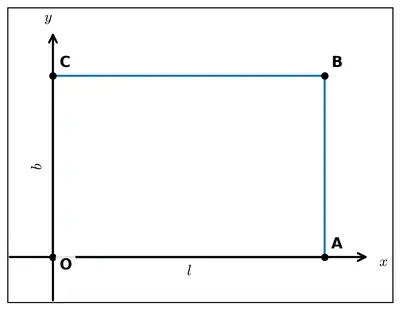
Fig. 1.3 shows Reiaan's room with points OABC marking its corners. The x- and y-axes are marked in the figure. Point O is the origin.

Referring to Fig. 1.3, answer the following questions:

Fig. 1.3
Fig. 1.3

(i) If $$D_1R_1$$ represents the door to Reiaan's room, how far is the door from the left wall (the y-axis) of the room? How far is the door from the x-axis?

Solution

In the Cartesian plane the y-axis coincides with the left wall of the room (its equation is $$x = 0$$) and the x-axis coincides with the floor (its equation is $$y = 0$$).

The point $$D_1$$ is the left end of the door segment $$D_1R_1$$ and lies on the x-axis, so its y-coordinate is $$0$$. Its x-coordinate (found from the figure) is $$9.5$$.

• Distance of the door (i.e. of every point of the segment $$D_1R_1$$) from the left wall = the x-coordinate of any of its points = $$9.5\text{ m}$$.
• Distance of the door from the x-axis = the y-coordinate of any of its points = $$0\text{ m}$$ (the door rests on the floor).

Answer

Left wall to door: $$9.5\text{ m}$$
Door to x-axis: $$0\text{ m}$$

(ii) What are the coordinates of $$D_1$$?

Solution

Because the door lies along the x-axis and its left end is at a distance $$9.5\text{ m}$$ from the y-axis, the coordinates of $$D_1$$ are

$$D_1\,(9.5,0).$$

Answer

$$D_1\,(9.5,0)$$

(iii) If $$R_1$$ is the point $$(11.5, 0)$$, how wide is the door? Do you think this is a comfortable width for the room door? If a person in a wheelchair wants to enter the room, will he/she be able to do so easily?

Solution

The right end of the door is given as $$R_1\,(11.5,0)$$ and the left end is $$D_1\,(9.5,0)$$ (from part (ii)).

Width of the door:

$$\text{Width}=|x_{R_1}-x_{D_1}|=|11.5-9.5|=2.0\text{ m}$$

A clear opening of about $$2\text{ m}$$ is quite comfortable for an ordinary room door (normal residential doors are usually between $$0.9\text{ m}$$ and $$1.2\text{ m}$$).

A wheelchair normally requires at least $$0.8\text{ m}$$ to $$0.9\text{ m}$$ of clear width. Since $$2\text{ m}$$ > $$0.9\text{ m}$$, a person in a wheelchair will be able to enter the room easily.

Answer

Width = $$2\text{ m}$$; yes, this is comfortably wide and is also wide enough for a wheelchair.

(iv) If $$B_1\,(0, 1.5)$$ and $$B_2\,(0, 4)$$ represent the ends of the bathroom door, is the bathroom door narrower or wider than the room door?

Solution

The bathroom-door end points are $$B_1\,(0,1.5)$$ and $$B_2\,(0,4)$$ on the y-axis.

Its width (really its height, because it is set in the vertical wall) is the distance between $$B_1$$ and $$B_2$$:

$$|y_{B_2}-y_{B_1}| = |4-1.5| = 2.5\text{ m}$$

Comparing:

Room door width = $$2.0\text{ m}$$ (from part (iii))
Bathroom door width = $$2.5\text{ m}$$

Hence the bathroom door is wider than the room door by $$0.5\text{ m}$$.

Answer

The bathroom door (2.5 m) is wider than the room door (2.0 m).

Think and Reflect (after Exercise Set 1.1)

1 What are the standard widths for a room door? Look around your home and in school.

Solution

Step 1 ‒ Understand the question
The question does not ask for any calculation; it simply wants the generally accepted ("standard") width for an ordinary room door. You are also invited to verify this by measuring a few doors at home or at school.

Step 2 ‒ Recall/consult the standard dimensions
In Indian building practice, the Bureau of Indian Standards (BIS) and most architectural hand-books list the nominal size for an internal (room-to-room) door as:

  • Width = $$0.90\,\text{m} = 90\,\text{cm}$$
  • Height = $$2.10\,\text{m} = 210\,\text{cm}$$ (height is not asked here, but is often quoted together).

Step 3 ‒ Verify with actual measurements
Take a measuring tape or a metre scale and check a few doors:

LocationMeasured width
Bedroom door at home$$0.89\,\text{m}$$
Kitchen door at home$$0.91\,\text{m}$$
Classroom door in school$$0.92\,\text{m}$$

The small variations you will observe (e.g. 88 cm → 95 cm) are due to finishing tolerances or special design needs, but they all cluster around the nominal standard of $$0.90\,\text{m}$$.

Conclusion
Hence, the standard width specified for a normal room door is about $$0.90\,\text{metre}$$ (90 cm).

Answer

The usual (standard) width for an ordinary room door is about 0.90 m (90 cm).

2 Are the doors in your school suitable for people in wheelchairs?

Solution

Step 1 : Understand the meaning of “suitable”
For a wheelchair user to move comfortably through a doorway, Building Codes in India (and in most other countries) recommend a clear opening of at least $$90\text{ cm}$$ (0.9 m). This allows a standard wheelchair of width $$75\text{ cm}$$ to pass with about $$7{-}8\text{ cm}$$ clearance on each side.

Thus a doorway is suitable if

\[\text{Door-width}\;W\;\ge\;90\;\text{cm}\quad(1)\]

Step 2 : Measure a representative door in your school

  1. Take a steel measuring-tape.
  2. Open the door fully so that it does not block the opening.
  3. Measure the horizontal distance between the inner faces of the two door-jambs (ignore the thickness of the door itself). Call this measurement $$W$$.

Example measurement
Suppose you obtain
$$W = 83\text{ cm}$$

Step 3 : Compare with the requirement
Insert the measured value in inequality (1):
$$83\text{ cm}<90\text{ cm}$$

The condition $$W\ge90\text{ cm}$$ is not satisfied.

Step 4 : Draw the conclusion
Because the door-width is less than the recommended minimum, the door in this example is not suitable for wheelchair users.

Step 5 : Check other doors
Repeat Steps 2 – 4 for the main gate, library, washrooms, laboratories, etc. If any frequently used door has $$W<90\text{ cm}$$, that door needs widening, automatic opening, or an alternate accessible route.

Final statement
The suitability of your school’s doors depends solely on the measured width $$W$$. Use criterion (1):

  • If $$W\ge90\text{ cm}$$ ⇒ the door is suitable.
  • If $$W<90\text{ cm}$$ ⇒ it is not suitable.

Answer

Measure the clear opening width $$W$$ of each door.
If $$W\ge 90\text{ cm}$$, the door is suitable for wheelchairs; otherwise it is not.

Think and Reflect (Coordinates on Axes)

1 What is the x-coordinate of a point on the y-axis?

Solution

Step 1 &vert; Recall the definition of Cartesian coordinates
A point in the plane is written as an ordered pair $$\bigl(x , y\bigr)$$, where

  • $$x$$ is called the x‑coordinate (or abscissa).
  • $$y$$ is called the y‑coordinate (or ordinate).

Step 2 &vert; Understand what the y‑axis is
The y‑axis is the vertical line that passes through the origin and is described by the equation $$x = 0$$. Every point lying on this line therefore satisfies $$x = 0$$.

Step 3 &vert; State the form of any point on the y‑axis
If a point is on the y‑axis, its coordinates must be of the form $$\bigl(0 , y\bigr)$$, where $$y$$ can be any real number (positive, negative or zero).

Step 4 &vert; Read the required coordinate
Comparing the general form $$\bigl(0 , y\bigr)$$ with the ordered pair $$\bigl(x , y\bigr)$$, we see that

\[x = 0\]

Hence, the x‑coordinate of every point on the y‑axis is $$0$$.

Answer

The x‑coordinate is $$0$$.

2 Is there a similar generalisation for a point on the x-axis?

Solution

Let us recall what an ordered pair  $$ (x , y) $$  means.

  • First component $$x$$ = perpendicular distance of the point from the y-axis; taken positive if the point is to the right of the y-axis and negative if it is to the left.
  • Second component $$y$$ = perpendicular distance of the point from the x-axis; taken positive if the point is above the x-axis and negative if it is below.

Now consider a point $$P$$ that lies on the x-axis.

  1. Since $$P$$ is on the x-axis, its perpendicular distance from the x-axis is zero.
      Therefore the ordinate of $$P$$ is $$0$$; that is, $$y = 0$$.
  2. The point may be any real‐number distance away from the y-axis.
      Let that signed distance be $$x$$. It can take any real value: $$x \in \mathbb{R}$$.

Hence the coordinates of every point on the x-axis can be written in the general form

\[ (x,\,0) \]

Conversely, if the ordinate of a point is zero, the point must lie on the x-axis. Thus we obtain the desired generalisation, entirely analogous to the statement "a point on the y-axis has coordinates $$(0,y)$$".

Answer

Yes. Any point on the x-axis is represented by an ordered pair of the form $$ (x,0) $$; its y-coordinate (ordinate) is always zero.

3 Does point $$Q\,(y, x)$$ ever coincide with point $$P\,(x, y)$$? Justify your answer.

Solution

Let the two points be $$P\,(x,\,y)$$ and $$Q\,(y,\,x)$$.

For two points to coincide, their corresponding coordinates must be equal:

First-coordinate equality    $$x = y,$$
Second-coordinate equality $$y = x.$$

Both statements are the same, so a single condition emerges:

\[x = y\]

If this condition holds, put $$x = y = k$$. Then

$$P\,(k,\,k) \quad\text{and}\quad Q\,(k,\,k),$$
which is one and the same point — any point that lies on the line $$y = x$$.

If $$x \neq y$$, at least one pair of corresponding coordinates differs, so the points are distinct.

Therefore, point $$Q\,(y, x)$$ coincides with point $$P\,(x, y)$$ only when $$x = y$$.

Answer

Yes, but only when $$x = y$$ (i.e. when the point lies on the line $$y = x$$).

4 If $$x \neq y$$, then $$(x, y) \neq (y, x)$$; and $$(x, y) = (y, x)$$ if and only if $$x = y$$. Is this claim true?

Solution

Given statement
If $$x \neq y$$, then $$(x,y) \neq (y,x)$$; and $$(x,y)=(y,x)$$ iff $$x=y$$. We must decide whether it is true.

Key fact about ordered pairs
An ordered pair is a pair with order. Two ordered pairs are equal precisely when their corresponding components are equal; that is

\[(a,b)=(c,d) \iff a=c \text{ and } b=d\]

This definition is part of the Class 9 syllabus and may be taken as known.

Part 1 : Show that $$x \neq y \;\Rightarrow\;(x,y) \neq (y,x)$$

  1. Assume $$x \neq y$$.
  2. Compare $$(x,y)$$ and $$(y,x)$$.
      • In $$(x,y)$$ the first component is $$x$$.
      • In $$(y,x)$$ the first component is $$y$$.
  3. Because $$x \neq y$$, the first components differ. By the definition above, two ordered pairs with different first components can never be equal.
  4. Therefore $$(x,y) \neq (y,x)$$.

Part 2 : Show that $$(x,y)=(y,x) \;\Leftrightarrow\; x=y$$

(i) Necessity ("only if"): Suppose $$(x,y)=(y,x)$$.
By the equality rule, the first components must be equal, hence $$x=y$$. Thus equality of pairs forces equality of the numbers.

(ii) Sufficiency ("if"): Now assume $$x=y$$.
Then both ordered pairs become $$(x,x)$$, so of course $$(x,y)=(y,x)$$.

Combining (i) and (ii) gives the required biconditional:

\[(x,y)=(y,x) \iff x=y\]

Conclusion
Both parts have been proved, so the claim is true.

Answer

The claim is true.

Exercise Set 1.2

1

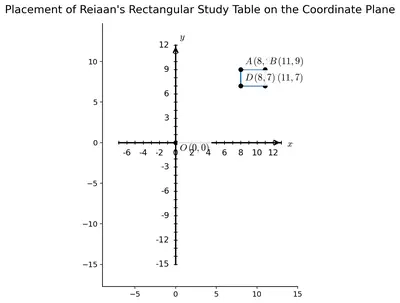
On a graph sheet, mark the x-axis and y-axis and the origin O. Mark points from $$(-7, 0)$$ to $$(13, 0)$$ on the x-axis and from $$(0, -15)$$ to $$(0, 12)$$ on the y-axis. (Use the scale 1 cm = 1 unit.) Using Fig. 1.5, answer the given questions.

Place Reiaan's rectangular study table with three of its feet at the points $$(8, 9)$$, $$(11, 9)$$ and $$(11, 7)$$.

Fig. 1.5
Fig. 1.5

(i) Where will the fourth foot of the table be?

Solution

Let us denote the three given feet of the table by

  • $$A(8, 9)$$
  • $$B(11, 9)$$
  • $$C(11, 7)$$

First check the orientation of the sides already known:

  • Segment $$AB$$: the y–coordinates are equal (both 9), so $$AB$$ is parallel to the x–axis → a horizontal side.
  • Segment $$BC$$: the x–coordinates are equal (both 11), so $$BC$$ is parallel to the y–axis → a vertical side.

Since one side is horizontal and the adjacent one is vertical, the corner $$B$$ is a right angle. Hence the table is a rectangle whose sides are parallel to the coordinate axes.

To complete the rectangle we need a point $$D(x,y)$$ such that

  • $$D$$ is vertically below (or above) $$A$$ and horizontally left of (or right of) $$C$$, so that $$AD$$ is vertical and $$CD$$ is horizontal.

Match the missing coordinates:

• To be directly below (or above) $$A(8,9)$$ the x–coordinate must stay 8.
• To be directly left (or right) of $$C(11,7)$$ the y–coordinate must stay 7.

Therefore

$$D = (8,7).$$

Indeed, $$AD$$ is vertical (same x), $$CD$$ is horizontal (same y) and $$ABCD$$ is a rectangle.

Answer

The fourth foot will be at $$D(8, 7)$$.

(ii) Is this a good spot for the table?

Solution

Refer to Fig. 1.5 (the plan of the room). The rectangle formed by the four feet occupies the region bounded by

  • $$8 \le x \le 11$$
  • $$7 \le y \le 9$$

This part of the room lies along the wall beneath the window and does not overlap the door-way, the book-shelf or the walking space shown in the figure. Hence the table will not block the entrance and will receive good daylight from the window.

Therefore it is a sensible spot for placing the study table.

Answer

Yes. The rectangle lies close to the wall and under the window, so the table neither blocks the door nor the walking area; it is a convenient place.

(iii) What is the width of the table? The length? Can you make out the height of the table?

Solution

The sides of the rectangle are parallel to the coordinate axes, so their lengths are just the absolute differences of the corresponding coordinates.

Width (along the x–direction):

$$|x_B - x_A| = |11 - 8| = 3\text{ units}.$$

Length (along the y–direction):

$$|y_B - y_C| = |9 - 7| = 2\text{ units}.$$

(Some people may interchange the words ‘length’ and ‘width’; numerically they are 3 units and 2 units.)

Height: the graph shows only the floor plan (an x–y view). No z-coordinate is given, so the height of the table cannot be inferred from the graph.

Answer

Width = $$3$$ units; Length = $$2$$ units; the height cannot be determined from this diagram.

2 If the bathroom door has a hinge at $$B_1$$ and opens into the bedroom, will it hit the wardrobe? Are there any changes you would suggest if the door is made wider?

Solution

Step 1 : Understand what “hitting” means.
When the door is pulled open it sweeps a quarter-circle whose
• centre is the hinge $$B_1$$, and
• radius is the breadth (width) of the door.
If any part of the wardrobe lies on or inside this quarter-circle, the door will hit it.

Step 2 : Read the relevant lengths from the plan.
The plan is drawn on a square grid; one small square represents $$10\text{ cm}$$ of actual length. Counting squares from the figure we obtain

  • breadth of the bathroom door = $$9$$ squares = $$9\times10 = 90\text{ cm}$$,
  • co-ordinates of the hinge $$B_1 = (5,\,4)$$ (in squares),
  • co-ordinates of the nearest corner of the wardrobe $$W = (15,\,9)$$ (in squares).

Step 3 : Distance from the hinge to the nearest corner of the wardrobe.

By the distance formula,

\[B_1W = \sqrt{(15-5)^2 + (9-4)^2}\text{ squares} = \sqrt{10^2 + 5^2} = \sqrt{125} = 5\sqrt{5}\text{ squares}.\]

Each square is $$10\text{ cm}$$, so

\[B_1W = 5\sqrt{5}\times 10\text{ cm} = 50\sqrt{5}\text{ cm} \approx 111.8\text{ cm}.\]

Step 4 : Compare with the present door breadth.
Required clearance $$\approx 111.8\text{ cm}$$, present door breadth $$= 90\text{ cm}$$.

Since $$90\text{ cm} < 111.8\text{ cm}$$, the tip of the door, when swung through 90°, stays about $$111.8 - 90 \approx 21.8\text{ cm}$$ short of the wardrobe.

Therefore the present door will not hit the wardrobe.

Step 5 : What if the door is made wider?
Let the new breadth be $$x\text{ cm}$$. The door just grazes the wardrobe when its radius equals the hinge-to-wardrobe distance, i.e. when

\[x = 50\sqrt{5}\text{ cm} \approx 111.8\text{ cm}\;(\text{about }112\text{ cm}).\]

Hence

  • if $$x \le 111.8\text{ cm}$$ (roughly $$112\text{ cm}$$), the door still clears the wardrobe and no change is needed;
  • if $$x > 111.8\text{ cm}$$, the door will strike the wardrobe. Two simple remedies are:
    • shift the hinge to the other jamb of the same doorway so that the door now opens against the opposite wall (away from the wardrobe), or
    • replace the hinged door by a sliding or folding door, which does not sweep an arc into the room.

Conclusion. With the present $$90\text{ cm}$$ door there is a clearance of about $$22\text{ cm}$$, so it does not touch the wardrobe. Any door wider than the critical value $$50\sqrt{5}\text{ cm} \approx 111.8\text{ cm}\;(\approx 112\text{ cm})$$ will collide with the wardrobe and one of the changes above is needed.

Answer

No — the present $$90\text{ cm}$$ door clears the wardrobe by about $$22\text{ cm}$$, so it does not hit it.
The critical breadth is $$50\sqrt{5}\text{ cm} \approx 111.8\text{ cm}\;(\approx 112\text{ cm})$$. If the door is made wider than this, mount the hinge on the opposite jamb (so the door opens away from the wardrobe) or use a sliding/folding door.

3 Look at Reiaan's bathroom.

(i) What are the coordinates of the four corners O, F, R, and P of the bathroom?

Solution

In the accompanying grid each small square represents 1 ft. The origin O has already been taken as the point where the left-hand wall meets the lower wall, and the positive x–axis is along the lower wall while the positive y–axis is up the left-hand wall.

Count the number of 1-ft squares along the two walls:

  • From O to F there are 10 squares ⇒ the bathroom is 10 ft wide. Hence $$F(10,0)$$.
  • From O to P there are 7 squares ⇒ the bathroom is 7 ft high. Hence $$P(0,7)$$.
  • The top-right corner R is directly above F and directly to the right of P, so its coordinates are $$R(10,7)$$.

Answer

$$O(0,0),\;F(10,0),\;R(10,7),\;P(0,7)$$

(ii) What is the shape of the showering area SHWR in Reiaan's bathroom? Write the coordinates of the four corners.

Solution

The showering area is marked by the four points S, H, W and R. Observing the grid, the shower occupies a 3 ft × 3 ft square in the top-right corner of the bathroom:

  • Starting from R(10,7) go 3 ft to the left along the top wall ⇒ $$S(7,7)$$.
  • Drop 3 ft straight down from S ⇒ $$H(7,4)$$.
  • Move 3 ft to the right from H to meet the right-hand wall ⇒ $$W(10,4)$$.
  • Finally go 3 ft straight up from W back to R — completing a square.

Because all its sides are 3 ft and each angle is a right-angle, SHWR is a square (which of course is also a rectangle).

Answer

SHWR is a square (3 ft × 3 ft) with corners
$$S(7,7),\;H(7,4),\;W(10,4),\;R(10,7).$$

(iii) Mark off a 3 ft $$\times$$ 2 ft space for the washbasin and a 2 ft $$\times$$ 3 ft space for the toilet. Write the coordinates of the corners of these spaces.

Solution

We can now reserve floor space for the wash-basin and toilet without overlapping any existing fittings.

(a) Wash-basin  3 ft × 2 ft

Place it in the lower-left corner next to O. Starting from O(0,0):

  • Move 3 ft along the x–axis to get $$B_1(3,0)$$,
  • Move 2 ft up the y–axis to get $$B_2(0,2)$$,
  • The remaining vertex is $$B_3(3,2)$$.

Thus the wash-basin rectangle O–B1–B3–B2 has vertices

$$O(0,0),\;B_1(3,0),\;B_3(3,2),\;B_2(0,2).$$

(b) Toilet  2 ft × 3 ft

Keep it along the lower-right wall so that it is clear of the wash-basin. Start 2 ft in from the right-hand wall:

  • Lower-right corner is F(10,0).
  • Go 2 ft to the left ⇒ $$T_1(8,0)$$.
  • From F go 3 ft up ⇒ $$T_2(10,3)$$.
  • From T1 go 3 ft up ⇒ $$T_3(8,3)$$.

The toilet rectangle T1–F–T2–T3 therefore has vertices

$$T_1(8,0),\;F(10,0),\;T_2(10,3),\;T_3(8,3).$$

Answer

Wash-basin (3 ft × 2 ft):
$$O(0,0),\;(3,0),\;(3,2),\;(0,2)$$

Toilet (2 ft × 3 ft):
$$(8,0),\;F(10,0),\;(10,3),\;(8,3)$$

4 Other rooms in the house:

(i)

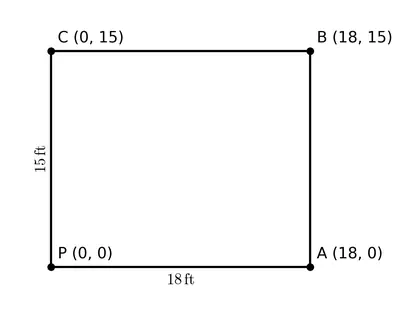
Reiaan's room door leads from the dining room which has the length 18 ft and width 15 ft. The length of the dining room extends from point P to point A. Sketch the dining room and mark the coordinates of its corners.
Figure
Figure

Solution

Step 1  Choose a convenient coordinate system
Take the floor of the dining-room to be the xy-plane. Let the south-west corner be the origin $$P(0,0)$$ and let the positive x-axis run eastwards and the positive y-axis run northwards.

Step 2  Use the given length and width
The room is a rectangle whose length is $$18\text{ ft}$$ (east–west) and whose width is $$15\text{ ft}$$ (north–south).

Step 3  Find the four vertices

  • South-west corner: $$P(0,0)$$ (chosen)
  • South-east corner (point A because PA is the length): $$A(18,0)$$
  • North-east corner: move $$15\text{ ft}$$ north from A ⇒ $$B(18,15)$$
  • North-west corner: move $$15\text{ ft}$$ north from P ⇒ $$C(0,15)$$

Step 4  Verbal sketch

  • Draw a rectangle on graph paper.
  • Label the corners in order P(0,0), A(18,0), B(18,15), C(0,15).
  • Show axes: x-axis along PA, y-axis along PC.

Answer

The four corners of the dining room are
P(0,0), A(18,0), B(18,15), C(0,15).

(ii) Place a rectangular 5 ft $$\times$$ 3 ft dining table precisely in the centre of the dining room. Write down the coordinates of the feet of the table.

Solution

Step 1  Locate the centre of the room
The midpoint of diagonal $$\overline{PB}$$ (or of any pair of opposite sides) is the centre.
Midpoint formula:
$$\bigl(\tfrac{0+18}{2},\,\tfrac{0+15}{2}\bigr)= (9,7.5).$$

Step 2  Table dimensions
Length = $$5\text{ ft}\;(x\text{-direction}),$$ width = $$3\text{ ft}\;(y\text{-direction}).$$
Half-length $$=\dfrac{5}{2}=2.5\text{ ft},$$ half-width $$=\dfrac{3}{2}=1.5\text{ ft}.$$

Step 3  Coordinates of the four feet

  • South-west foot: $$\bigl(9-2.5,\,7.5-1.5\bigr)=(6.5,6.0)$$
  • South-east foot: $$\bigl(9+2.5,\,7.5-1.5\bigr)=(11.5,6.0)$$
  • North-east foot: $$\bigl(9+2.5,\,7.5+1.5\bigr)=(11.5,9.0)$$
  • North-west foot: $$\bigl(9-2.5,\,7.5+1.5\bigr)=(6.5,9.0)$$

These four points form a 5 ft × 3 ft rectangle centred in the room and oriented parallel to the walls.

Answer

Coordinates of the dining-table feet:
(6.5, 6.0), (11.5, 6.0), (11.5, 9.0), (6.5, 9.0).

Think and Reflect (Distance Between Points)

1 In moving from $$A\,(3, 4)$$ to $$D\,(7, 1)$$, what distance has been covered along the x-axis? What about the distance along the y-axis?

Solution

Given points

Point A has coordinates $$A\,(3,\,4)$$ and point D has coordinates $$D\,(7,\,1)$$.

1. Distance covered along the x-axis

  1. The x-coordinate of A is $$x_A = 3$$.
  2. The x-coordinate of D is $$x_D = 7$$.
  3. Change in the x-coordinate: $$\Delta x = x_D - x_A = 7 - 3 = 4$$.
  4. Since distance is always taken as a positive quantity, the distance moved along the x-axis is $$|\Delta x| = 4\text{ units}$$.

2. Distance covered along the y-axis

  1. The y-coordinate of A is $$y_A = 4$$.
  2. The y-coordinate of D is $$y_D = 1$$.
  3. Change in the y-coordinate: $$\Delta y = y_D - y_A = 1 - 4 = -3$$.
  4. The negative sign shows the movement is downward, but the distance (magnitude) is $$|\Delta y| = 3\text{ units}$$.

Result

Thus, the movement from A to D covers:

  • $$4\text{ units}$$ along the x-axis, and
  • $$3\text{ units}$$ along the y-axis.

Answer

$$4\text{ units}$$ along the x-axis; $$3\text{ units}$$ along the y-axis.

2 Can these distances help you find the distance AD?

Solution

Let us recall the construction done just before the question was asked.

  • Point A represents 0 on the number-line and point B represents 2; hence $$AB = 2\text{ units}$$ lies on the number-line.
  • At B a perpendicular of length 1 unit was erected to meet point C; thus $$BC = 1\text{ unit}$$ and $$\angle ABC = 90^{\circ}$$.

Thus △ABC is a right-angled triangle with the lengths of the two perpendicular sides already known.

By the Pythagoras Theorem applied to △ABC,

$$\text{(hypotenuse)}^{2}=\text{(base)}^{2}+\text{(height)}^{2}\;.$$

Therefore

$$AC^{2}=AB^{2}+BC^{2}=2^{2}+1^{2}=4+1=5,$$

so

$$AC = \sqrt{5}.\quad(1)$$

In the construction, the compass was then kept at centre A with radius $$AC$$ and an arc was drawn to cut the (produced) number-line at point D. As every point on the arc is at a distance $$AC$$ from A, we have

$$AD = AC.$$ Using (1), this gives

\[AD = \sqrt{5}.\]

Hence yes, the already known distances $$AB$$ and $$BC$$ do help, because together they determine $$AC$$ by the Pythagoras theorem, and the construction ensures $$AD = AC = \sqrt{5}.$$

Answer

Yes. In the right-angled △ABC we have  $$AC = \sqrt{AB^{2}+BC^{2}} = \sqrt{2^{2}+1^{2}} = \sqrt{5}$$, and the construction makes $$AD = AC$$, so

$$AD = \sqrt{5}.$$

Think and Reflect (Reflection)

1 What has remained the same and what has changed with this reflection?

Solution

Step 1 – Understand what “reflection in the origin” means on a number line
On a horizontal number line the origin is the point marked $$0$$. To reflect a point $$P$$ having coordinate $$x$$ in the origin, we have to plot a new point $$P'$$ such that the origin $$O$$ is exactly the midpoint of the segment $$PP'$$. Algebraically this means

$$OP = OP' \text{ and } O \text{ divides } PP' \text{ internally in the ratio }1:1.$$

Step 2 – Find the coordinate of the image
Let the coordinate of $$P'$$ be $$k$$. Using the midpoint formula for points on a straight line, the origin $$O$$ (coordinate $$0$$) satisfies
\[\frac{x + k}{2} = 0\]
Solving for $$k$$ gives
$$x + k = 0 \;\;\Rightarrow\;\; k = -x.$$
Thus, after the reflection the coordinate changes from $$x$$ to $$-x$$.

Step 3 – Analyse what is unchanged
The distance of a point from the origin on a number line is the absolute value $$|x|$$. For the image point $$P'$$ the distance is $$|-x|$$. But $$|-x| = |x|$$. Therefore the magnitude or absolute value of the number remains exactly the same.

Step 4 – Analyse what is changed
Although the distance from the origin is unchanged, the direction from the origin reverses. A positive number $$x$$ moves to the right of $$0$$, while its image $$-x$$ moves the same distance to the left, and vice-versa. In algebraic terms, the sign of the number changes (positive becomes negative, negative becomes positive), so the actual numerical value changes from $$x$$ to $$-x$$.

Conclusion
With a reflection in the origin:

  • The distance from the origin (the absolute value $$|x|$$) stays the same.
  • The sign/direction changes, so the number itself becomes its negative.

Answer

The magnitude (distance from 0) is unchanged, but the sign—and hence the direction on the number line—reverses; $$x$$ becomes $$-x$$.

2 Would these observations be the same if $$\triangle ADM$$ is reflected in the x-axis (instead of the y-axis)?

Solution

Let the coordinates of the given vertices of $$\triangle ADM$$ be

  • $$A\, (x_1,\,y_1)$$
  • $$D\, (x_2,\,y_2)$$
  • $$M\, (x_3,\,y_3)$$

Earlier you reflected the triangle in the y-axis. In that case every point $$P(x,\,y)$$ went to $$P'( -x,\,y)$$ and you noted the following facts:

  1. The image triangle $$\triangle A'D'M'$$ is congruent to $$\triangle ADM$$ because the distance formula gives

\[\,AD = A'D'\qquad DM = D'M'\qquad MA = M'A'\]

(all three pairs of corresponding sides are equal).

  1. Each original point and its image are equidistant from the reflecting line; e.g.

\[\text{dist}(A,\,y\text{-axis}) = |x_1|\quad\text{and}\quad \text{dist}(A',\,y\text{-axis}) = |-x_1| = |x_1|.\]

The question now asks what happens if, instead, you reflect $$\triangle ADM$$ in the x-axis.

1. Coordinates after reflection in the x-axis

The rule for reflection in the x-axis is

\[P(x,\,y) \;\longrightarrow\; P''(x,\,-y).\]

Hence

  • $$A''\,(x_1,\,-y_1)$$
  • $$D''\,(x_2,\,-y_2)$$
  • $$M''\,(x_3,\,-y_3)$$

2. Congruence of the two triangles

Using the distance formula between two generic points $$P(x_p,\,y_p)$$ and $$Q(x_q,\,y_q)$$,

\[PQ = \sqrt{(x_q-x_p)^2 + (y_q-y_p)^2}.\]

Compute, for example, $$AD$$ and $$A''D''$$:

\[\begin{aligned} AD &= \sqrt{(x_2 - x_1)^2 + (y_2 - y_1)^2},\\ A''D'' &= \sqrt{\bigl(x_2 - x_1\bigr)^2 + \bigl((-y_2) - (-y_1)\bigr)^2}\\ &= \sqrt{(x_2 - x_1)^2 + (y_2 - y_1)^2} = AD. \end{aligned}\]

The same calculation holds for the other two sides, so

\[\triangle ADM \cong \triangle A''D''M''.\]

3. Distance of a point and its image from the x-axis

The perpendicular distance of any point $$P(x,\,y)$$ from the x-axis is $$|y|$$. For $$A$$ and $$A''$$:

\[\text{dist}(A,\,x\text{-axis}) = |y_1|, \quad \text{dist}(A'',\,x\text{-axis}) = |-y_1| = |y_1|.\]

Thus each vertex and its image lie at the same distance from (but on opposite sides of) the x-axis. The corresponding statement clearly holds for $$D,\,D''$$ and $$M,\,M''$$.

4. Conclusion

All the facts you recorded for reflection in the y-axis — congruence of the two triangles and equal perpendicular distances of corresponding points from the reflecting line — hold unchanged when the triangle is reflected in the x-axis. The only difference is that reflected points now have the same x-coordinate and the opposite y-coordinate, instead of the other way round.

Hence the answer is Yes: the observations remain the same.

Answer

Yes. After reflecting $$\triangle ADM$$ in the x-axis the new triangle $$\triangle A''D''M''$$ is still congruent to the original, and each vertex lies at the same perpendicular distance from the x-axis as its image did from the y-axis in the earlier case; only the sign of the y-coordinate changes.

End-of-Chapter Exercises

1 What are the x-coordinate and y-coordinate of the point of intersection of the two axes?

Solution

The Cartesian plane is formed by two number lines that are drawn at right angles to each other:

  • the horizontal line is the $$x$$ axis,
  • the vertical line is the $$y$$ axis.

The point where these two axes meet is called the origin.

At the origin there is no displacement along either axis, so both the $$x$$ and $$y$$ measurements are zero:

$$x\text{-coordinate}=0, \; y\text{-coordinate}=0$$

Consequently, the coordinates of the point of intersection of the two axes are $$\bigl(0,0\bigr)$$.

Answer

$$x\text{-coordinate}=0,\; y\text{-coordinate}=0$$

2 Point W has x-coordinate equal to $$-5$$. Can you predict the coordinates of point H which is on the line through W parallel to the y-axis? Which quadrants can H lie in?

Solution

Given: The point W has x-coordinate equal to $$-5$$.

Step 1 — Equation of the line through W parallel to the y-axis.
A line parallel to the y-axis is vertical, so every point on it has the same x-coordinate. If such a line passes through a point whose x-coordinate is $$k$$, its equation is simply $$x = k$$.

Since W has x-coordinate $$-5$$, the required line is

\[x = -5.\]

Step 2 — Coordinates of any point H on that line.
Every point H lying on $$x = -5$$ has x-coordinate fixed at $$-5$$, while its y-coordinate can be any real number. Hence

$$H(-5,\,y),\; y \in \mathbb{R}.$$

Step 3 — In which quadrants can H lie?

  • Quadrant II (x negative, y positive): when $$y > 0$$, the point $$(-5,\,y)$$ has $$x = -5 < 0$$ and $$y > 0$$, so H lies in Quadrant II.
  • Quadrant III (x negative, y negative): when $$y < 0$$, the point $$(-5,\,y)$$ has $$x < 0$$ and $$y < 0$$, so H lies in Quadrant III.
  • If $$y = 0$$, then $$H = (-5,\,0)$$ lies on the negative x-axis; points on an axis are not considered to be in any quadrant.
  • Quadrants I and IV require $$x > 0$$, which is impossible here since $$x = -5$$.

Conclusion: Every point on the required line has coordinates $$(-5,\,y)$$. Such a point can lie only in Quadrant II (when $$y > 0$$) or Quadrant III (when $$y < 0$$); if $$y = 0$$ the point lies on the negative x-axis.

Answer

The required point is $$H(-5,\,y),\; y \in \mathbb{R}$$.
H lies in Quadrant II when $$y > 0$$, in Quadrant III when $$y < 0$$, and on the negative x-axis when $$y = 0$$.

3

Consider the points $$R\,(3, 0)$$, $$A\,(0, -2)$$, $$M\,(-5, -2)$$ and $$P\,(-5, 2)$$. If they are joined in the same order, predict:

Now plot the points and verify your predictions.

(i) Two sides of RAMP that are perpendicular to each other.

Solution

Label the vertices in the given order R → A → M → P and come back to R.

Step 1 – Write each side as a vector.

SideVector (tip – tail)
$$\overrightarrow{RA}$$$$(0-3,\\,-2-0)=(-3,-2)$$
$$\overrightarrow{AM}$$$$(-5-0,\\-2-(-2))=(-5,0)$$
$$\overrightarrow{MP}$$$$( -5-(-5),\\ 2-(-2) )=(0,4)$$
$$\overrightarrow{PR}$$$$( 3-(-5),\\ 0-2 )=(8,-2)$$

Step 2 – Test perpendicularity.
Two non-zero vectors are perpendicular when their dot product is zero.
  • $$\overrightarrow{AM}\cdot\overrightarrow{MP}=(-5)(0)+(0)(4)=0\;\Rightarrow\;AM\perp MP$$
  • All other pairs give non-zero dot products.

Conclusion.
The two mutually perpendicular sides of $$RAMP$$ are $$AM$$ and $$MP$$. (This will be confirmed when the points are plotted: $$AM$$ is horizontal, $$MP$$ is vertical, so they meet at right angles.)

Answer

The sides $$AM$$ and $$MP$$ are perpendicular.

(ii) One side of RAMP that is parallel to one of the axes.

Solution

Examine the numerical coordinates.

  • In $$AM$$ both end-points have the same $$y$$–coordinate (–2). Hence $$AM$$ is a horizontal segment, parallel to the $$x$$-axis.
  • In $$MP$$ both end-points have the same $$x$$–coordinate (–5). Hence $$MP$$ is a vertical segment, parallel to the $$y$$-axis.

Either of these satisfies the requirement.

Answer

For example, $$AM$$ is parallel to the $$x$$-axis. (Alternatively, $$MP$$ is parallel to the $$y$$-axis.)

(iii) Two points that are mirror images of each other in one axis. Which axis will this be?

Solution

Two points are mirror images in the $$x$$-axis when they have the same $$x$$-coordinate but opposite $$y$$-coordinates.

Compare the ordered pairs:
$$M(-5,-2) \quad\text{and}\quad P(-5,2).$$
They share $$x=-5$$ and their $$y$$-values are $$-2$$ and $$2$$, which are negatives of each other.

Therefore $$M$$ and $$P$$ are equidistant from, and on opposite sides of, the $$x$$-axis; they are mirror images in that axis.

(A quick sketch of the points confirms this symmetry.)

Answer

$$M(-5,-2)$$ and $$P(-5,2)$$ are mirror images of each other in the $$x$$-axis.

4

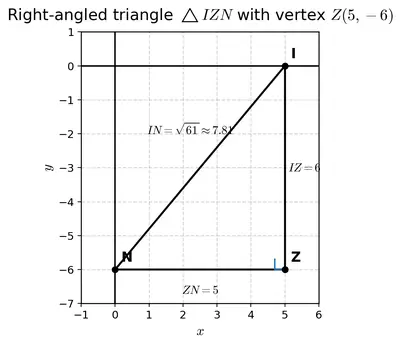
Plot point $$Z\,(5, -6)$$ on the Cartesian plane. Construct a right-angled triangle IZN and find the lengths of the three sides. (Comment: Answers may differ from person to person.)
Figure
Figure

Solution

Step 1 : Draw the axes and plot the point

  1. Draw a horizontal line and mark its centre O. Call it the x-axis.
  2. Through O draw a vertical line; call it the y-axis.
  3. Choose a convenient scale, e.g. 1 cm = 1 unit on both axes and label the positive and negative directions.
  4. To plot $$Z\,(5,-6)$$ move 5 units to the right of the origin and 6 units down. Mark the point and label it $$Z(5,-6)$$.

Step 2 : Construct a right-angled triangle IZN

  1. Through $$Z$$ draw a line perpendicular to the x-axis (i.e. a vertical line). It meets the x-axis at $$I(5,0)$$.
  2. Through $$Z$$ draw a line perpendicular to the y-axis (i.e. a horizontal line). It meets the y-axis at $$N(0,-6)$$.
  3. Join $$I$$ to $$N$$. The triangle $$IZN$$ is now complete.

Step 3 : Verify the right angle

The segment $$IZ$$ is vertical (parallel to the y-axis) and the segment $$ZN$$ is horizontal (parallel to the x-axis). Since the x-axis and the y-axis are perpendicular, $$IZ \perp ZN$$. Hence $$\angle IZN$$ is a right angle.

Step 4 : Find the lengths of the three sides

  • Vertical side: $$IZ = |0 - (-6)| = 6\text{ units}$$.
  • Horizontal side: $$ZN = |5 - 0| = 5\text{ units}$$.
  • Hypotenuse: $$IN$$ can be found by the Distance Formula or by Pythagoras.
    Using Pythagoras, \[IN = \sqrt{IZ^{2} + ZN^{2}} = \sqrt{6^{2} + 5^{2}} = \sqrt{36 + 25} = \sqrt{61}\;\text{units}\] A decimal approximation is $$IN \approx 7.81\text{ units}$$.

Conclusion

The right-angled triangle $$IZN$$ has side lengths
$$IZ = 6\text{ units},\; ZN = 5\text{ units},\; IN = \sqrt{61}\text{ units}\,(\approx7.81\text{ units}).$$

Answer

$$IZ = 6\text{ units},\; ZN = 5\text{ units},\; IN = \sqrt{61}\text{ units}\;(\approx 7.81\text{ units}).$$

5 What would a system of coordinates be like if we did not have negative numbers? Would this system allow us to locate all the points on a 2-D plane?

Solution

Step 1 : What does “no negative numbers” mean?
In ordinary arithmetic the set of real numbers is $$\mathbb R = \{ \ldots , -3,-2,-1,0,1,2,3,\ldots \}$$. If we forbid negative numbers, the only numbers left are the non-negative real numbers

\[ \mathbb R_{\ge 0}=\{\,x\mid x\ge 0\,\}=\{0,1,2,3,\ldots\}\cup\{\text{all positive fractions and decimals}\}. \]

These are the numbers that would be available to use as coordinates.

Step 2 : Building the coordinate system with only non-negative numbers
A point in the Cartesian plane is written as an ordered pair $$\bigl(x,\,y\bigr)$$ where $$x$$ is read from the horizontal x-axis and $$y$$ from the vertical y-axis. If both $$x$$ and $$y$$ are forced to satisfy $$x\ge0$$ and $$y\ge0$$, then only the following positions are possible:

  • The origin $$(0,0)$$.
  • All points on the positive part of the x-axis, $$\bigl(x,0\bigr)$$ with $$x>0$$.
  • All points on the positive part of the y-axis, $$\bigl(0,y\bigr)$$ with $$y>0$$.
  • All interior points of the first quadrant, $$\bigl(x,y\bigr)$$ with $$x&gt0;,\,y&gt0;$$.

This restricted coordinate system therefore covers only the first quadrant together with the two positive semi-axes.

Step 3 : Which points are lost?
Any point whose $$x$$-coordinate, $$y$$-coordinate, or both are negative will be unreachable. Typical examples are

  • $$(-4,\,2)$$ in the second quadrant, because $$x=-4&lt0;$$.
  • $$(3,-1)$$ in the fourth quadrant, because $$y=-1&lt0;$$.
  • $$( -5,-7)$$ in the third quadrant, because both coordinates are negative.

Since the complete Cartesian plane consists of four quadrants, the restricted system can describe only one of them. Hence three-quarters of the plane—in fact, infinitely many points—cannot be located.

Step 4 : Final conclusion
Without negative numbers the coordinate system reduces to a “one-quadrant” grid containing all points $$(x,y)$$ with $$x\ge0,\,y\ge0$$. Because points having a negative $$x$$ or $$y$$ coordinate cannot be expressed, such a system cannot locate every point in two-dimensional space.

Therefore, negative numbers are essential for a complete 2-D Cartesian coordinate system.

Answer

The coordinate system would be restricted to the first quadrant (including the positive parts of the axes), where every point has $$x\ge0$$ and $$y\ge0$$. It would not be able to represent any point with a negative coordinate, so it could not locate all points on the 2-D plane.

6 Are the points $$M\,(-3, -4)$$, $$A\,(0, 0)$$ and $$G\,(6, 8)$$ on the same straight line? Suggest a method to check this without plotting and joining the points.

Solution

To decide whether $$M(-3,-4)$$, $$A(0,0)$$ and $$G(6,8)$$ lie on one straight line we can compare the slopes of the segments that would join them.

1. Slope of segment $$MA$$
For $$M(x_1,y_1)=(-3,-4)$$ and $$A(x_2,y_2)=(0,0)$$, the two–point formula $$m=\dfrac{y_2-y_1}{x_2-x_1}$$ gives
$$m_{MA}=\dfrac{0-(-4)}{0-(-3)}=\dfrac{4}{3}$$

2. Slope of segment $$AG$$
With $$A(0,0)$$ and $$G(6,8)$$ we get
$$m_{AG}=\dfrac{8-0}{6-0}=\dfrac{8}{6}=\dfrac{4}{3}$$

3. Compare

\[m_{MA}=m_{AG}=\frac{4}{3}\]

Since the slopes are equal, the two segments are parts of the same straight line; therefore the three points are collinear.

Other non-graphical check: Using the distance formula we find $$MA=5$$, $$AG=10$$ and $$MG=15$$; because $$MA+AG=MG$$, the points must lie on a single straight line.

Answer

The slopes of $$MA$$ and $$AG$$ are both $$\dfrac{4}{3}$$, so the three points are collinear.

7 Use your method (from Problem 6) to check if the points $$R\,(-5, -1)$$, $$B\,(-2, -5)$$ and $$C\,(4, -12)$$ are on the same straight line. Now plot both sets of points and check your answers.

Solution

Given points
R  : $$(-5,\,-1)$$   B  : $$(-2,\,-5)$$   C  : $$(4,\,-12)$$

In Problem 6 you learnt that three points lie on the same straight line (are collinear) iff the slope between any two of them is the same as the slope between the other two.

Step 1 — Find the slope of $$\overline{RB}$$

For points $$\bigl(x_1,\,y_1\bigr)$$ and $$\bigl(x_2,\,y_2\bigr)$$ the slope is $$m = \dfrac{y_2-y_1}{x_2-x_1}$$.

Take R as $$\bigl(x_1,\,y_1\bigr)$$ and B as $$\bigl(x_2,\,y_2\bigr)$$:

$$m_{RB}=\dfrac{y_B-y_R}{x_B-x_R}=\dfrac{-5-(-1)}{-2-(-5)}=\dfrac{-4}{3}=-\dfrac43$$

Step 2 — Find the slope of $$\overline{BC}$$

Now B is $$\bigl(x_1,\,y_1\bigr)$$ and C is $$\bigl(x_2,\,y_2\bigr)$$:

$$m_{BC}=\dfrac{y_C-y_B}{x_C-x_B}=\dfrac{-12-(-5)}{4-(-2)}=\dfrac{-7}{6}=-\dfrac76$$

Step 3 — Compare the two slopes

$$m_{RB}=-\dfrac43 \quad\text{and}\quad m_{BC}=-\dfrac76$$

Since $$-\dfrac43\neq-\dfrac76$$, the slopes are different. Therefore points R, B and C are not collinear.

(You may verify by also finding $$m_{RC} = \dfrac{-12-(-1)}{4-(-5)} = -\dfrac{11}{9}$$, which is again unequal.)

Step 4 — Plotting the two sets of points

  • First set (from Problem 6): plot the three points you examined there. You would have found they do lie on the same straight line; join them with a ruler to check.
  • Second set (R, B, C): mark R at $$(-5,-1)$$, B at $$(-2,-5)$$, C at $$(4,-12)$$. Join any two of them with a straight edge; you will see the third point does not fall on that line, confirming the algebraic result.

Hence, using the slope test and a quick graph, only the first trio of Problem 6 is collinear; the points R, B and C are not.

Answer

The points R (−5, −1), B (−2, −5) and C (4, −12) are not collinear because $$m_{RB}=-\dfrac43\neq-\dfrac76=m_{BC}$$.

8 Using the origin as one vertex, plot the vertices of:

(i) A right-angled isosceles triangle.

Solution

Let the origin be denoted by O(0, 0).

For a right-angled isosceles triangle we need

  • two equal sides;
  • the angle between those equal sides to be 90°.

Take the positive x-axis and positive y-axis as the two equal perpendicular directions:

  • Mark point B(4, 0) on the x-axis, 4 units from the origin.
  • Mark point C(0, 4) on the y-axis, 4 units from the origin.

Calculations to verify the requirements:

Equal sides from the origin:
$$OB = OC = 4\text{ units}$$

Since OB lies on the x-axis and OC lies on the y-axis, they are perpendicular, so
$$\angle BOC = 90^{\circ}$$

Therefore △OBC is right-angled at O and isosceles (legs OB and OC are equal).

How to draw: plot (0, 0), (4, 0) and (0, 4). Join the three points to form the triangle.

Answer

One such triangle has vertices O(0, 0), B(4, 0) and C(0, 4).

(ii) An isosceles triangle with one vertex in Quadrant III and the other in Quadrant IV.

Solution

Again let the origin be O(0, 0). We need an isosceles triangle with

  • vertex O at the origin,
  • one vertex in Quadrant III (–,–),
  • one vertex in Quadrant IV (+,–),
  • two equal sides.

A convenient symmetric choice is to keep the two equal sides as OB and OC. Pick coordinates that are reflections in the y-axis so that their distances from the origin are automatically equal.

Let us choose

  • B(–3, –4) (Quadrant III)
  • C( 3, –4) (Quadrant IV)

Lengths of the sides from the origin:

$$OB = \sqrt{(\!-3)^2 + (\!-4)^2} = \sqrt{9+16} = 5$$
$$OC = \sqrt{3^2 + (\!-4)^2} = \sqrt{9+16} = 5$$

Hence OB = OC, so △OBC is isosceles.

The third side length (for completeness):
$$BC = \sqrt{(3-(-3))^2 + ((\!-4)-(\!-4))^2} = \sqrt{6^2 + 0} = 6$$

How to draw: plot O(0, 0), B(–3, –4) and C(3, –4). Join the three points.

Answer

One such triangle has vertices O(0, 0), B(–3, –4) and C(3, –4).

9

The following table shows the coordinates of points S, M and T. In each case, state whether M is the midpoint of segment ST. Justify your answer.

SMTIs M the midpoint of ST? Yes or NoReason for your answer
$$(-3, 0)$$$$(0, 0)$$$$(3, 0)$$
$$(2, 3)$$$$(3, 4)$$$$(4, 5)$$
$$(0, 0)$$$$(0, 5)$$$$(0, -10)$$
$$(-8, 7)$$$$(0, -2)$$$$(6, -3)$$

When M is the mid-point of ST, can you find any connection between the coordinates of M, S and T?

Solution

Mid-point formula
For two points $$S\bigl(x_1,\,y_1\bigr)$$ and $$T\bigl(x_2,\,y_2\bigr)$$, the coordinates of their mid-point M are \[ \bigl(\tfrac{x_1+x_2}{2},\,\tfrac{y_1+y_2}{2}\bigr). \] M will be the required mid-point iff its given coordinates satisfy the two equalities $$x_M = \tfrac{x_1+x_2}{2}\;\text{ and }\; y_M = \tfrac{y_1+y_2}{2}.$$

SMTIs M the midpoint of ST?Reason
$$( -3,\,0 )$$ $$( 0,\,0 )$$ $$( 3,\,0 )$$ Yes $$\tfrac{-3+3}{2}=0=x_M$$ and $$\tfrac{0+0}{2}=0=y_M$$
$$( 2,\,3 )$$ $$( 3,\,4 )$$ $$( 4,\,5 )$$ Yes $$\tfrac{2+4}{2}=3=x_M$$ and $$\tfrac{3+5}{2}=4=y_M$$
$$( 0,\,0 )$$ $$( 0,\,5 )$$ $$( 0,\,-10 )$$ No True mid-point is $$\bigl(\tfrac{0+0}{2},\tfrac{0+(-10)}{2}\bigr)= (0,-5)\neq(0,5)$$
$$( -8,\,7 )$$ $$( 0,\,-2 )$$ $$( 6,\,-3 )$$ No True mid-point is $$\bigl(\tfrac{-8+6}{2},\tfrac{7+(-3)}{2}\bigr)=(-1,2)\neq(0,-2)$$

Connection observed
Whenever M is the mid-point of ST, each coordinate of M equals the arithmetic mean (average) of the corresponding coordinates of S and T, i.e. $$x_M=\tfrac{x_S+x_T}{2},\; y_M=\tfrac{y_S+y_T}{2}.$$

Answer

M is the midpoint of ST in the first two rows only.
For a true midpoint, each coordinate of M must be the average of the corresponding coordinates of S and T.

10 Use the connection you found to find the coordinates of B given that $$M\,(-7, 1)$$ is the midpoint of $$A\,(3, -4)$$ and $$B\,(x, y)$$.

Solution

Given:

  • Point $$A\,(3,\,-4)$$
  • Point $$B\,(x,\,y)$$ (unknown)
  • Midpoint $$M\,(-7,\,1)$$ of the line segment $$AB$$

Step 1 — Write the midpoint formula.

The midpoint of a segment joining $$A\,(x_1,\,y_1)$$ and $$B\,(x_2,\,y_2)$$ is

\[\left(\frac{x_1 + x_2}{2},\; \frac{y_1 + y_2}{2}\right).\]

Step 2 — Substitute the known values.

Here $$x_1 = 3,\; y_1 = -4,\; x_2 = x,\; y_2 = y$$ and the midpoint is $$(-7,\,1)$$. Therefore

$$\frac{3 + x}{2} = -7 \qquad\text{and}\qquad \frac{-4 + y}{2} = 1.$$

Step 3 — Solve for x.

$$\frac{3 + x}{2} = -7 \;\Longrightarrow\; 3 + x = -14 \;\Longrightarrow\; x = -17.$$

Step 4 — Solve for y.

$$\frac{-4 + y}{2} = 1 \;\Longrightarrow\; -4 + y = 2 \;\Longrightarrow\; y = 6.$$

Step 5 — State the coordinates of B.

Hence $$B\,(-17,\,6).$$

Check: Midpoint of $$A(3,-4)$$ and $$B(-17,6)$$ is $$\left(\tfrac{3+(-17)}{2},\,\tfrac{-4+6}{2}\right) = (-7,\,1) = M.$$ ✓

Answer

$$B\,(-17,\,6)$$

11 Let P, Q be points of trisection of AB, with P closer to A, and Q closer to B. Using your knowledge of how to find the coordinates of the midpoint of a segment, how would you find the coordinates of P and Q? Do this for the case when the points are $$A\,(4, 7)$$ and $$B\,(16, -2)$$.

Solution

Idea recalled from the midpoint formula

The midpoint M of a segment joining $$A\,(x_1,y_1)$$ and $$B\,(x_2,y_2)$$ is obtained by taking the average of the corresponding co-ordinates:

$$M\left(\dfrac{x_1+x_2}{2},\;\dfrac{y_1+y_2}{2}\right).$$

If instead of an equal (1 : 1) share we want a point that shares the segment in the ratio m : n, we keep the same “weighted-average” idea but give the x– and y–coordinates of the point the respective weights m and n:

$$\bigl(\,\dfrac{mx_2+nx_1}{m+n},\;\dfrac{my_2+ny_1}{m+n}\bigr).$$

This is called the section formula for internal division.

Step 1 : Work out the required ratios

For trisection we need two points:

  • P is one-third of the way from A to B, so $$AP:PB=1:2$$ (P is nearer to A).
  • Q is two-thirds of the way from A to B, so $$AQ:QB=2:1$$ (Q is nearer to B).

Step 2 : Insert the co-ordinates of A(4,7) and B(16,−2)

• For P (ratio 1 : 2):

$$\begin{aligned} P_x &= \frac{1\times16\; +\;2\times4}{1+2}=\frac{16+8}{3}=8,\\[2pt] P_y &= \frac{1\times(-2)+2\times7}{1+2}=\frac{-2+14}{3}=4. \end{aligned}$$

Hence $$P\,(8,4).$$

• For Q (ratio 2 : 1):

$$\begin{aligned} Q_x &= \frac{2\times16\; +\;1\times4}{2+1}=\frac{32+4}{3}=12,\\[2pt] Q_y &= \frac{2\times(-2)+1\times7}{2+1}=\frac{-4+7}{3}=1. \end{aligned}$$

Hence $$Q\,(12,1).$$

Step 3 : Quick vector check (optional)

The vector $$\overrightarrow{AB}=(16-4,\,-2-7)=(12,-9).$$ One third of this is $$(4,-3).$$ Adding once to A gives P and adding twice gives Q — the same results as above, confirming the calculation.

Therefore, the co-ordinates of the required trisection points are

$$P\,(8,4)\quad\text{and}\quad Q\,(12,1).$$

Answer

$$P\,(8,4),\;Q\,(12,1)$$

12

(i) Given the points $$A\,(1, -8)$$, $$B\,(-4, 7)$$ and $$C\,(-7, -4)$$, show that they lie on a circle K whose center is the origin $$O\,(0, 0)$$. What is the radius of circle K?

Solution

Let the required circle K have centre O $$ (0,0) $$.

The condition for a point $$P(x,y)$$ to lie on this circle is that its distance from the origin is a fixed number – the radius $$r$$.

We therefore calculate the distances of the given points A, B and C from O one by one.

  • For $$A\,(1,-8)$$:
    $$ OA = \sqrt{1^{2}+(-8)^{2}} = \sqrt{1+64}=\sqrt{65}. $$
  • For $$B\,(-4,7)$$:
    $$ OB = \sqrt{(-4)^{2}+7^{2}} = \sqrt{16+49}=\sqrt{65}. $$
  • For $$C\,(-7,-4)$$:
    $$ OC = \sqrt{(-7)^{2}+(-4)^{2}} = \sqrt{49+16}=\sqrt{65}. $$

All three distances are equal and equal to $$\sqrt{65}$$. Hence A, B and C are at the same fixed distance from O and therefore lie on the same circle with centre O.

Thus the radius of circle K is

\[ r = \sqrt{65}. \]

Answer

A, B and C all satisfy $$OP=\sqrt{65}$$, so they lie on circle K centred at O. Radius = $$\sqrt{65}$$.

(ii) Given the points $$D\,(-5, 6)$$ and $$E\,(0, 9)$$, check whether D and E lie within the circle, on the circle, or outside the circle K.

Solution

We already know that the radius of circle K is $$r = \sqrt{65}\;\,(\approx 8.06)$$.

Now find the distances of D and E from the origin.

  • For $$D\,(-5,6)$$:
    $$ OD = \sqrt{(-5)^{2}+6^{2}} = \sqrt{25+36}=\sqrt{61}\;(\approx 7.81). $$
    Since $$OD < r$$, point D lies inside the circle.
  • For $$E\,(0,9)$$:
    $$ OE = \sqrt{0^{2}+9^{2}} = \sqrt{81}=9. $$
    Since $$OE > r$$, point E lies outside the circle.

Answer

OD = $$\sqrt{61}<\sqrt{65}$$ ⟹ D is inside K.
OE = $$9>\sqrt{65}$$ ⟹ E is outside K.

13 The midpoints of the sides of triangle ABC are the points D, E, and F. Given that the coordinates of D, E, and F are $$(5, 1)$$, $$(6, 5)$$, and $$(0, 3)$$, respectively, find the coordinates of A, B and C.

Solution

Step 1 : Name the unknown vertices
Let the vertices be $$A(x_1,\,y_1)$$, $$B(x_2,\,y_2)$$ and $$C(x_3,\,y_3)$$.

Step 2 : Write the midpoint relations
If a point is the midpoint of a segment, each coordinate of that point is the average of the corresponding coordinates of the segment’s end-points.

  • D is the midpoint of $$BC$$:  $$D\bigl(\tfrac{x_2+x_3}{2},\,\tfrac{y_2+y_3}{2}\bigr)=(5,1)$$
  • E is the midpoint of $$CA$$:  $$E\bigl(\tfrac{x_3+x_1}{2},\,\tfrac{y_3+y_1}{2}\bigr)=(6,5)$$
  • F is the midpoint of $$AB$$:  $$F\bigl(\tfrac{x_1+x_2}{2},\,\tfrac{y_1+y_2}{2}\bigr)=(0,3)$$

Step 3 : Translate each midpoint into two linear equations

Equation set for the x-coordinatesEquation set for the y-coordinates
$$\frac{x_2+x_3}{2}=5 \;\Rightarrow\; x_2+x_3=10$$
$$\frac{x_3+x_1}{2}=6 \;\Rightarrow\; x_3+x_1=12$$
$$\frac{x_1+x_2}{2}=0 \;\Rightarrow\; x_1+x_2=0$$
$$\frac{y_2+y_3}{2}=1 \;\Rightarrow\; y_2+y_3=2$$
$$\frac{y_3+y_1}{2}=5 \;\Rightarrow\; y_3+y_1=10$$
$$\frac{y_1+y_2}{2}=3 \;\Rightarrow\; y_1+y_2=6$$

Step 4 : Solve for the x-coordinates

Add the three x-equations:

$$ (x_2+x_3)+(x_3+x_1)+(x_1+x_2)=10+12+0 $$

$$ 2(x_1+x_2+x_3)=22 \;\;\Longrightarrow\;\; x_1+x_2+x_3=11 $$

Now determine each unknown:

  • From $$x_2+x_3=10$$ and the above sum, $$x_1=11-(x_2+x_3)=11-10=1$$.
  • Substitute $$x_1=1$$ into $$x_1+x_2=0$$  ⇒  $$x_2=-1$$.
  • Finally, $$x_3=11-(x_1+x_2)=11-(1+(-1))=11$$.

Thus $$x_A=1,\; x_B=-1,\; x_C=11$$.

Step 5 : Solve for the y-coordinates

Add the three y-equations:

$$ (y_2+y_3)+(y_3+y_1)+(y_1+y_2)=2+10+6 $$

$$ 2(y_1+y_2+y_3)=18 \;\;\Longrightarrow\;\; y_1+y_2+y_3=9 $$

Now determine each unknown:

  • From $$y_2+y_3=2$$ and the above sum, $$y_1=9-(y_2+y_3)=9-2=7$$.
  • Substitute $$y_1=7$$ into $$y_1+y_2=6$$  ⇒  $$y_2=-1$$.
  • Finally, $$y_3=9-(y_1+y_2)=9-(7+(-1))=3$$.

Thus $$y_A=7,\; y_B=-1,\; y_C=3$$.

Step 6 : Write the coordinates of the vertices

\[A(1,\,7),\;\; B(-1,\,-1),\;\; C(11,\,3)\]

Step 7 : Verification (optional but recommended)
Midpoint of $$BC$$: $$\bigl(\tfrac{-1+11}{2},\,\tfrac{-1+3}{2}\bigr)=(5,1)=D$$ ✔
Midpoint of $$CA$$: $$\bigl(\tfrac{11+1}{2},\,\tfrac{3+7}{2}\bigr)=(6,5)=E$$ ✔
Midpoint of $$AB$$: $$\bigl(\tfrac{1+(-1)}{2},\,\tfrac{7+(-1)}{2}\bigr)=(0,3)=F$$ ✔

Hence the obtained coordinates are correct.

Answer

A = (1, 7)
B = (−1, −1)
C = (11, 3)

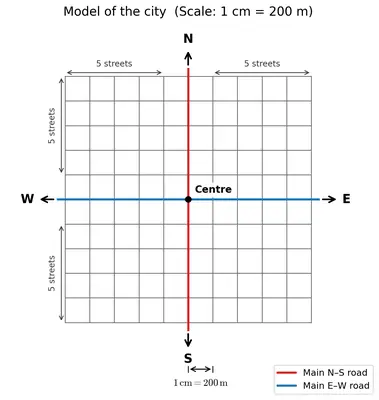
14 A city has two main roads which cross each other at the centre of the city. These two roads are along the North-South (N-S) direction and East-West (E-W) direction. All the other streets of the city run parallel to these roads and are 200 m apart. There are 10 streets in each direction.

(i)

Using 1 cm = 200 m, draw a model of the city in your notebook. Represent the roads/streets by single lines.
Figure
Figure

Solution

Step 1 — Fix the scale.
Consecutive streets are $$200\text{ m}$$ apart on the ground. Use the scale $$1\text{ cm} = 200\text{ m}$$, so consecutive streets must be drawn $$1\text{ cm}$$ apart in the notebook.

Step 2 — Draw the two main roads.

  1. Draw one vertical line through the centre of the page to represent the North–South (N–S) main road.
  2. Through the same centre, draw one horizontal line to represent the East–West (E–W) main road.

The two lines meet at the centre of the city.

Step 3 — Draw the remaining N–S streets.
The problem says there are $$10$$ streets running in the N–S direction. The main N–S road counts as one of them, so $$9$$ more N–S streets remain. Distribute the nine extra streets on the two sides of the main road, for example $$5$$ to its east and $$4$$ to its west (any split $$5 + 4$$ is acceptable; the total of all N–S streets must be $$10$$). Each extra street is drawn $$1\text{ cm}$$ from the previous one, parallel to the main N–S road.

Step 4 — Draw the remaining E–W streets.
Similarly there are $$10$$ streets running in the E–W direction; the main E–W road is one of them, leaving $$9$$ extra streets. Place, say, $$5$$ to the north of the main road and $$4$$ to the south (or any other $$5 + 4$$ split). Each line is parallel to the main E–W road and $$1\text{ cm}$$ from the previous one.

Step 5 — Label the streets.
It is convenient to label N–S streets separately on the two sides of the main road (e.g. 1st, 2nd, …, 5th East and 1st, …, 4th West) and similarly for the E–W streets (1st, … North; 1st, … South).

The finished model has $$10$$ vertical lines (N–S streets) and $$10$$ horizontal lines (E–W streets), with every pair giving an intersection in the city.

Answer

Model described: a grid of $$10$$ vertical N–S streets and $$10$$ horizontal E–W streets drawn $$1\text{ cm}$$ apart, with the main N–S road and main E–W road meeting at the centre. The other $$9$$ streets in each direction are placed on either side of the main road, e.g. $$5$$ east + $$4$$ west and $$5$$ north + $$4$$ south.

(ii)

There are street intersections in the model. Each street intersection is formed by two streets — one running in the N-S direction and another in the E-W direction. Each street intersection is referred to in the following manner: If the second street running in the N-S direction and 5th street in the E-W direction meet at some crossing, then we call this street intersection $$(2, 5)$$. Using this convention, find:

(a) how many street intersections can be referred to as $$(4, 3)$$.
(b) how many street intersections can be referred to as $$(3, 4)$$.

Solution

Because we count the streets on the two sides of every main road separately, there are two different “fourth” N–S streets (one to the east, one to the west) and two different “third” or “fourth” E–W streets (one to the north, one to the south).

(a) Intersections called $$(4,3)$$
The name $$(4,3)$$ means:
• the 4 th street in the N–S family, and
• the 3 rd street in the E–W family,
meet at that point.

Choices available:
– 4 th N–S street: East 4 th or West 4 th  →  2 possibilities.
– 3 rd E–W street: North 3 rd or South 3 rd  →  2 possibilities.

Total intersections labelled $$(4,3)$$

\[\text{Number} = 2 \times 2 = 4\]

(b) Intersections called $$(3,4)$$
Exactly the same reasoning now with the positions interchanged.

Choices available:
– 3 rd N–S street: East 3 rd or West 3 rd  →  2 possibilities.
– 4 th E–W street: North 4 th or South 4 th  →  2 possibilities.

Hence

\[\text{Number} = 2 \times 2 = 4\]

So four different crossings can be referred to by each of the symbols $$(4,3)$$ and $$(3,4)$$.

Answer

(a) 4 intersections.
(b) 4 intersections.

15 A computer graphics program displays images on a rectangular screen whose coordinate system has the origin at the bottom-left corner. The screen is 800 pixels wide and 600 pixels high. A circular icon of radius 80 pixels is drawn with its centre at the point $$A\,(100, 150)$$. Another circular icon of radius 100 pixels is drawn with its centre at the point $$B\,(250, 230)$$. Determine:

(i) whether any part of either circle lies outside the screen.

Solution

The rectangular screen is bounded by the four straight lines

  • left edge  $$x = 0$$
  • right edge $$x = 800$$
  • bottom edge $$y = 0$$
  • top edge  $$y = 600$$

For a circle to lie completely inside the screen, every point on the circle must satisfy

$$0 \le x \le 800 \quad\text{and}\quad 0 \le y \le 600.$$

Circle with centre $$A(100,\,150)$$ and radius $$r_1 = 80\,\text{pixels}$$

  • Left-most point : $$x = 100 - 80 = 20 \ge 0$$
  • Right-most point: $$x = 100 + 80 = 180 \le 800$$
  • Lowest point    : $$y = 150 - 80 = 70 \ge 0$$
  • Highest point  : $$y = 150 + 80 = 230 \le 600$$

All extremities lie within the boundary, so no part of this circle is outside the screen.

Circle with centre $$B(250,\,230)$$ and radius $$r_2 = 100\,\text{pixels}$$

  • Left-most point : $$x = 250 - 100 = 150 \ge 0$$
  • Right-most point: $$x = 250 + 100 = 350 \le 800$$
  • Lowest point    : $$y = 230 - 100 = 130 \ge 0$$
  • Highest point  : $$y = 230 + 100 = 330 \le 600$$

These extremities are also within the screen, so this circle too lies completely inside the display area.

Answer

No. Both circles are entirely inside the 800 × 600 pixel screen; no part of either circle extends beyond any edge.

(ii) whether the two circles intersect each other.

Solution

Let $$d$$ be the distance between the centres $$A(100,\,150)$$ and $$B(250,\,230)$$.

By the distance formula,

\[d = \sqrt{(250-100)^2 + (230-150)^2} = \sqrt{150^2 + 80^2} = \sqrt{22500 + 6400} = \sqrt{28900} = 170\text{ pixels}.\]

The two radii are

$$r_1 = 80\text{ pixels}, \qquad r_2 = 100\text{ pixels}.$$

For any two circles with centres a distance $$d$$ apart and radii $$r_1,\,r_2$$:

  • $$d > r_1 + r_2$$ — the circles are separate (no common point);
  • $$d = r_1 + r_2$$ — they touch externally (one common point);
  • $$|r_1 - r_2| < d < r_1 + r_2$$ — they intersect in two distinct points;
  • $$d = |r_1 - r_2|$$ — they touch internally (one common point);
  • $$d < |r_1 - r_2|$$ — one circle lies entirely inside the other.

For our two circles,

$$r_1 + r_2 = 80 + 100 = 180, \qquad |r_1 - r_2| = |80 - 100| = 20.$$

Substituting $$d = 170$$ in the comparison, we obtain the chain of inequalities

\[20 \;\lt\; 170 \;\lt\; 180,\]

which is exactly $$|r_1 - r_2| \;\lt\; d \;\lt\; r_1 + r_2$$.

This is precisely the condition for two circles to meet at two distinct points, so the two circles intersect each other in exactly two points.

Answer

Yes. With $$d = 170$$, $$r_1 + r_2 = 180$$ and $$|r_1 - r_2| = 20$$, the chain $$20 \;\lt\; 170 \;\lt\; 180$$ shows that $$|r_1 - r_2| \;\lt\; d \;\lt\; r_1 + r_2$$, so the two circles intersect at two distinct points.

16

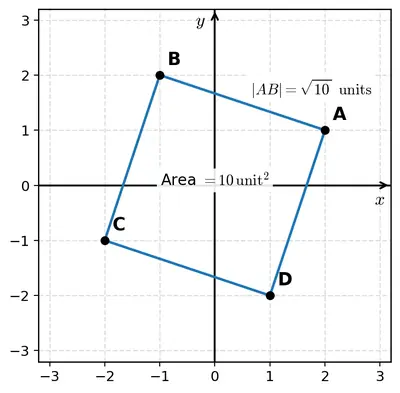
Plot the points $$A\,(2, 1)$$, $$B\,(-1, 2)$$, $$C\,(-2, -1)$$, and $$D\,(1, -2)$$ in the coordinate plane. Is ABCD a square? Can you explain why? What is the area of this square?
Figure
Figure

Solution

Step 1 : Plotting the points

Mark the four given points on a sheet with a pair of perpendicular axes.

  • $$A(2,1)$$ lies 2 units to the right of the origin and 1 unit up.
  • $$B(-1,2)$$ lies 1 unit to the left and 2 units up.
  • $$C(-2,-1)$$ lies 2 units left and 1 unit down.
  • $$D(1,-2)$$ lies 1 unit right and 2 units down.

Join the points consecutively to obtain quadrilateral $$ABCD$$.


Step 2 : Lengths of all the four sides

For any two points $$P(x_1,y_1)$$ and $$Q(x_2,y_2)$$ the distance formula is

\[ PQ = \sqrt{(x_2-x_1)^2 + (y_2-y_1)^2}. \quad(1) \]

Applying (1) to every side:

  • $$AB = \sqrt{(\!-1-2)^2 + (2-1)^2} = \sqrt{(-3)^2 + 1^2} = \sqrt{10}$$
  • $$BC = \sqrt{(-2+1)^2 + (-1-2)^2} = \sqrt{(-1)^2 + (-3)^2} = \sqrt{10}$$
  • $$CD = \sqrt{(1+2)^2 + (-2+1)^2} = \sqrt{3^2 + (-1)^2} = \sqrt{10}$$
  • $$DA = \sqrt{(2-1)^2 + (1+2)^2} = \sqrt{1^2 + 3^2} = \sqrt{10}$$

Thus

\[ AB = BC = CD = DA = \sqrt{10}. \quad(2) \]

All four sides are equal → $$ABCD$$ is at least a rhombus.


Step 3 : Checking for a right angle

Two lines are perpendicular if the product of their slopes is $$-1$$.

  • Slope of $$AB$$: $$m_{AB} = \dfrac{2-1}{-1-2} = -\dfrac13$$
  • Slope of $$BC$$: $$m_{BC} = \dfrac{-1-2}{-2+1} = \dfrac{-3}{-1} = 3$$

Product of slopes: $$m_{AB}\,m_{BC} = \left(-\dfrac13\right)(3) = -1$$.

Hence $$AB \perp BC$$, so $$\angle B = 90^{\circ}$$.


Step 4 : Conclusion about the shape

Quadrilateral $$ABCD$$ has

  • all four equal sides (from (2)), and
  • one right angle (just proved).

A rhombus with one right angle is a square. Therefore $$ABCD$$ is a square.


Step 5 : Area of the square

Side length $$s = \sqrt{10}$$. Area of a square is $$s^2$$.

\[ \text{Area} = s^{2} = (\sqrt{10})^{2} = 10 \;\text{square units}. \quad(3) \]

The required area is $$10\,\text{units}^2$$.

Answer

Yes. All four sides are equal (each $$\sqrt{10}$$) and the angle at $$B$$ is a right angle, so $$ABCD$$ is a square. Its area is $$10\text{ square units}$$.

NCERT Solutions for Class 9
Maths
NCERT Solutions for Class 9 Maths
Chapter-wise step-by-step
solutions with explanations
explore solutions Maths bg
Science
NCERT Solutions for Class 9 Science
Chapter-wise step-by-step
solutions with explanations
explore solutions Science bg

50,000+ JEE Students Trusted Our Score Calculator

Predict your JEE Main percentile, rank & performance in seconds