Join WhatsApp Icon JEE WhatsApp Group
NCERT Solutions for Class 8 Science

Chapter 9: The Amazing World of Solutes, Solvents, and Solutions

Download Solutions PDF
Daily JEE Updates, Tips & Important Alerts
Join 30,000+ students and stay updated with JEE notifications and preparation insights.
Join Now!
Free PDF
Complete NCERT Solution PDF for Chapter 9: The Amazing World of Solutes, Solvents, and Solutions
Download Solutions PDF

Probe and Ponder

1 What do you think is happening in the picture above?

Solution

The picture at the beginning of the chapter shows a person stirring a substance (like sugar or salt) into a glass of water. As stirring continues, the solid particles gradually seem to disappear — they cannot be seen by our eyes any more, but the liquid tastes sweet or salty.

This is the process of dissolution. The solid (the solute) breaks into extremely tiny particles and spreads uniformly throughout the water (the solvent). The uniform mixture that is formed is called a solution. Even though we cannot see the solute particles, they are still present in the liquid.

Answer

The picture shows a solute (such as sugar or salt) dissolving in water to form a uniform mixture called a solution.

2 What happens when you add too much sugar to your tea and it stops dissolving? How can you solve this problem?

Solution

Every liquid can dissolve only a limited amount of a solid at a given temperature. When we keep adding sugar to a cup of tea, a stage comes when the tea cannot hold any more sugar; the extra sugar simply settles at the bottom of the cup and does not dissolve. At this stage the tea has become a saturated solution of sugar.

To make the extra sugar dissolve, we can do one of the following:

  • Heat the tea. The solubility of sugar in water increases with temperature, so hot tea can hold more sugar than cold tea.
  • Add more liquid (more tea or hot water). A larger amount of solvent can dissolve more solute.
  • Stir the tea. Stirring speeds up dissolution, though it does not increase the total amount that can dissolve.

Answer

The tea becomes a saturated solution; the extra sugar settles at the bottom. Heating the tea, adding more tea (solvent), or stirring will help dissolve the extra sugar.

3 Why do sugar and salt dissolve in water but not in oil? Why is water considered a good solvent?

Solution

Whether a solute dissolves in a particular solvent depends on the nature of both. Sugar and common salt ($$\mathrm{NaCl}$$) are made of particles that are strongly attracted to water particles. Water is able to surround these particles and pull them apart from one another, so the solid breaks up and spreads uniformly through the water.

Oil, on the other hand, is made of particles that do not attract sugar or salt particles strongly. So the water-loving solids (sugar and salt) cannot be pulled apart by oil and remain undissolved.

Water is called a universal solvent or a good solvent because it can dissolve a very large variety of substances — many solids (sugar, salt, copper sulphate), many liquids (vinegar, alcohol), and many gases (oxygen, carbon dioxide). This is why water plays such an important role in living cells, cooking, and industries.

Answer

Sugar and salt dissolve in water but not in oil because their particles are attracted to water particles and not to oil particles. Water is called a good (universal) solvent because it can dissolve a very large number of different solids, liquids and gases.

4 Why are water bottles usually tall and cylindrical in shape instead of spherical?

Solution

A tall, cylindrical bottle has several practical advantages over a spherical one:

  • Easy to hold and carry. The straight sides of a cylinder fit comfortably in the hand, while a sphere would keep slipping out.
  • Stable and does not roll. A cylinder placed upright stays where it is kept; a sphere would roll off any surface that is not perfectly flat.
  • Fits neatly in bags, shelves and refrigerators. Cylinders can be lined up side by side and stacked, using space more efficiently than spheres, which leave large empty gaps between them.
  • Easy to pour and to measure water. A tall, narrow container allows even a small change in the amount of water to be seen clearly as a change in level. In a spherical container, a small change in volume gives an almost invisible change in level near the widest part.
  • Easy to manufacture and label. Cylindrical bottles are simpler to mould and their flat side surface is convenient to print or paste a label on.

Answer

Tall cylindrical bottles are easy to hold, do not roll, pack neatly, are simple to manufacture and label, and their tall narrow shape makes changes in water level (and hence in volume) clearly visible.

Intext Questions

5

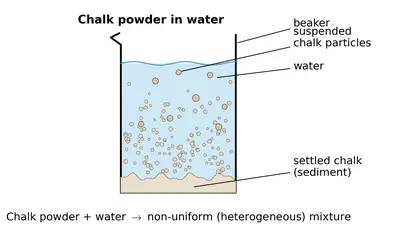
Can you predict whether this mixture is uniform or not (Fig. 9.1)? What happens when chalk powder is mixed with water—does it form a uniform mixture?
Fig. 9.1
Fig. 9.1

Solution

Fig. 9.1 shows sugar being stirred into water. After enough stirring the sugar completely disappears from view and the composition of the liquid becomes the same everywhere — any spoonful taken from the top, middle or bottom tastes equally sweet. Such a mixture is a uniform (or homogeneous) mixture. So the sugar–water mixture is a uniform mixture, i.e. a solution.

When chalk powder is stirred into water, the tiny chalk particles do not dissolve. They remain suspended for some time, giving the water a milky look, and then slowly settle at the bottom. Different parts of this liquid do not have the same composition — the bottom is thick with chalk while the top is nearly clear. Therefore chalk powder in water is a non-uniform (heterogeneous) mixture and is not a solution.

Answer

Sugar in water forms a uniform mixture (a solution). Chalk powder in water is a non-uniform mixture — the chalk does not dissolve and settles at the bottom.

6 We know air is a mixture. Would a mixture of gases also be considered a solution?

Solution

A solution is any uniform (homogeneous) mixture — the same composition is found everywhere in the mixture. The definition does not restrict solutions to only solids dissolved in liquids.

Air consists mainly of nitrogen (about $$78\%$$), oxygen (about $$21\%$$) and small amounts of carbon dioxide, water vapour and other gases. These gases mix so thoroughly that any sample of clean air, taken from any place, has practically the same composition. So air is a uniform mixture of gases and is therefore a solution — a gaseous solution in which nitrogen acts like the solvent and the other gases are the solutes.

Answer

Yes. Air is a uniform mixture of nitrogen, oxygen, carbon dioxide and other gases, so it is a solution (a gas-in-gas solution).

7 What will happen if we keep on adding more salt in a given amount of water?

Solution

Initially each spoon of salt added to the water dissolves completely on stirring and disappears from view. As we keep adding more and more salt, the water dissolves less and less of each new spoonful. Finally a stage comes when no more salt will dissolve at that temperature — the extra salt simply collects as undissolved crystals at the bottom of the vessel.

At this stage the water has taken the maximum amount of salt it can hold at that temperature. Such a solution is called a saturated solution. If we want the leftover salt to dissolve, we must either heat the water (to raise its solubility) or add more water.

Answer

In the beginning the salt keeps dissolving. After some time no more salt dissolves — the extra salt settles at the bottom. The solution has become saturated.

8 How many spoons of salt were you able to dissolve before some of it remained undissolved?

Solution

This is an activity-based question — the number depends on the actual size of the spoon and the amount of water used. For the setup described in the textbook (about $$100 \, \mathrm{mL}$$ of water at room temperature, roughly $$25\text{–}30^{\circ}\mathrm{C}$$, stirred with a small teaspoon), students usually observe that about $$6\text{–}7$$ level teaspoons of common salt dissolve; from the $$7^{\text{th}}$$ or $$8^{\text{th}}$$ spoon onwards the extra salt starts settling at the bottom.

This is consistent with the known solubility of salt in water at room temperature: about $$36 \, \mathrm{g}$$ of salt dissolves in $$100 \, \mathrm{g}$$ of water at $$25^{\circ}\mathrm{C}$$, which corresponds to roughly $$6\text{–}7$$ level teaspoons.

Answer

About 6–7 level teaspoons of common salt dissolve in 100 mL of water at room temperature; more than this remains undissolved (exact number depends on spoon size).

9 What does this indicate about the capacity of water to dissolve salt?

Solution

Since only a limited number of spoons of salt could be dissolved and the extra salt did not go into the solution, we learn that water cannot dissolve an unlimited amount of a solute at a given temperature. Every solvent can hold only a fixed maximum quantity of a particular solute at a particular temperature. Once this limit is reached the solution is called saturated and cannot accept any more solute.

The maximum amount of a solute that dissolves in a fixed amount of solvent at a particular temperature is called the solubility of that solute in that solvent at that temperature.

Answer

It shows that water has only a limited capacity to dissolve salt at a given temperature. Beyond a certain amount (its solubility) no more salt will dissolve and the solution becomes saturated.

10 Can you now reflect — which solution is more concentrated; 2 spoons of salt in $$100 \, \mathrm{mL}$$ of water or 4 spoons of salt in $$50 \, \mathrm{mL}$$ of water?

Solution

The concentration of a solution tells us how much solute is dissolved per unit amount of solvent. To compare the two solutions we work out the amount of salt in the same volume of water — say $$100 \, \mathrm{mL}$$.

Solution A: $$2$$ spoons of salt in $$100 \, \mathrm{mL}$$ of water $$\;\Rightarrow\;$$ $$2$$ spoons per $$100 \, \mathrm{mL}$$.

Solution B: $$4$$ spoons of salt in $$50 \, \mathrm{mL}$$ of water. If we had $$100 \, \mathrm{mL}$$ of water (double the amount), it would need double the salt to keep the same concentration, i.e. $$8$$ spoons per $$100 \, \mathrm{mL}$$.

So comparing per $$100 \, \mathrm{mL}$$ of water:

\[\text{A: } 2 \text{ spoons}, \qquad \text{B: } 8 \text{ spoons}.\]

Solution B has $$4$$ times as much salt in the same volume of water, so Solution B ($$4$$ spoons of salt in $$50 \, \mathrm{mL}$$ of water) is much more concentrated.

Answer

4 spoons of salt in 50 mL of water is the more concentrated solution (it contains 4 times as much salt per unit volume of water as 2 spoons in 100 mL).

11 Does temperature affect the solubility of a solute?

Solution

Yes, temperature has a strong effect on how much of a given solute a solvent can dissolve.

  • For most solids (sugar, salt, baking soda, copper sulphate, potassium nitrate, etc.) the solubility increases when the solvent is heated. Hot water can hold much more sugar than cold water. This is why we add sugar to hot milk more easily, and why crystals of copper sulphate come out of a solution as it cools.
  • For gases dissolved in liquids the trend is the opposite — solubility decreases when the liquid is heated. That is why boiling water shows bubbles of dissolved air escaping.

So, temperature definitely affects solubility, though the direction of the effect depends on the state of the solute.

Answer

Yes. The solubility of most solid solutes in water increases with a rise in temperature, while the solubility of gases in water decreases with a rise in temperature.

12 In Activity 9.2, after heating water containing undissolved baking soda from $$20^{\circ}\mathrm{C}$$ to $$50^{\circ}\mathrm{C}$$, what happens to the undissolved baking soda?

Solution

At $$20^{\circ}\mathrm{C}$$ the water in Activity 9.2 had already dissolved as much baking soda ($$\mathrm{NaHCO_3}$$) as it could hold, so the extra baking soda lay at the bottom of the beaker as an undissolved layer — the solution was saturated.

When this beaker is heated to $$50^{\circ}\mathrm{C}$$, the solubility of baking soda in water increases. Water at $$50^{\circ}\mathrm{C}$$ can now hold more baking soda than it could at $$20^{\circ}\mathrm{C}$$. As the water warms up, the undissolved baking soda at the bottom starts dissolving. On stirring at $$50^{\circ}\mathrm{C}$$, the whole of the earlier undissolved baking soda goes into solution and the bottom of the beaker becomes clear again.

Answer

The previously undissolved baking soda dissolves into the water because the solubility of baking soda increases as the temperature rises from 20°C to 50°C.

13 What do you infer from this experiment (Activity 9.2 on dissolution of baking soda in water at different temperatures)?

Solution

Activity 9.2 compares the amount of baking soda that dissolves in the same amount of water at two temperatures — $$20^{\circ}\mathrm{C}$$ and $$50^{\circ}\mathrm{C}$$. At $$20^{\circ}\mathrm{C}$$ some baking soda remains undissolved even after stirring, but at $$50^{\circ}\mathrm{C}$$ all of it goes into solution.

We can draw two important inferences:

  1. At any given temperature, water has a fixed (limited) capacity to dissolve baking soda; once that limit is reached, no more baking soda dissolves.
  2. The solubility of baking soda (and, in general, of most solid solutes) in water increases as the temperature is raised. So hot water can dissolve more solute than cold water.

Answer

The solubility of a solid solute (baking soda) in water is not fixed — it increases when the temperature of the water is increased.

14 What inspired Asima Chatterjee to work on medicinal plants?

Solution

Asima Chatterjee (1917–2006) was a great Indian chemist who spent her life studying the chemistry of Indian medicinal plants. Her inspiration came from two sources:

  • Her father, Dr. Indranarayan Mukherjee, was a medical doctor with a deep interest in traditional Indian herbal medicine. From childhood she watched him collect and study plants used in Ayurveda, and this sparked her curiosity about the healing power of plants.
  • She also saw that India has an enormous variety of medicinal plants and a long Ayurvedic tradition, but very little scientific work had been done to isolate the actual chemical substances in those plants that make them useful as medicines. She wanted to bring the tools of modern chemistry to this rich but under-explored knowledge.

These two influences led her to develop new drugs from Indian plants — most famously anti-malarial and anti-epileptic medicines derived from plants such as Alstonia scholaris and Rauwolfia serpentina.

Answer

She was inspired by her father, a medical doctor who was deeply interested in Ayurveda and Indian medicinal plants, and by the fact that India's rich tradition of plant-based medicine had not been studied using modern chemistry.

15 Do gases also dissolve in water?

Solution

Yes. Water can dissolve gases just as it dissolves solids and liquids. Some familiar examples are:

  • Oxygen dissolved in water: Fish, prawns and other aquatic animals breathe by taking in the oxygen dissolved in pond, river and sea water.
  • Carbon dioxide in soft drinks: The fizz in cola, lemonade and soda water is $$\mathrm{CO_2}$$ that has been dissolved in the water under pressure. When we open the bottle the pressure falls and bubbles of $$\mathrm{CO_2}$$ escape.
  • When freshly drawn tap water is kept in a glass, tiny bubbles collect on the inside of the glass — these are gases (mostly air) that were dissolved in the water and slowly come out.

Answer

Yes, gases dissolve in water. For example, oxygen dissolved in pond water is used for breathing by fish, and carbon dioxide is dissolved in soft drinks to give the fizz.

16 Is the mixture of gases in water a uniform or non-uniform mixture?

Solution

When a gas such as oxygen or carbon dioxide dissolves in water, its tiny particles spread evenly throughout the water. Every drop of water taken from the top, middle or bottom of the container has the same amount of dissolved gas in it, and the water still looks perfectly clear — we cannot see the gas separately.

Because the composition is the same in every part of the mixture, the gas-in-water mixture is a uniform (homogeneous) mixture. It is therefore a solution, in which water is the solvent and the gas is the solute.

Answer

It is a uniform (homogeneous) mixture — the dissolved gas is spread evenly throughout the water, so it is a solution.

17 Does temperature affect the solubility of gases in liquids also? If so, how?

Solution

Yes. Temperature affects the solubility of gases too, but the effect is opposite to what we see with most solid solutes.

The solubility of a gas in a liquid decreases when the temperature of the liquid is raised. As we heat the liquid, the dissolved gas particles gain energy, move about faster and escape out of the liquid as bubbles. This is easy to observe:

  • When water is heated on a stove, tiny bubbles of dissolved air begin to appear on the walls of the vessel much before the water actually boils.
  • A cold bottle of a soft drink retains its fizz for a longer time; a warm bottle loses its fizz quickly because the dissolved $$\mathrm{CO_2}$$ escapes faster.
  • Fish are more comfortable in cool water; warm pond or lake water holds less dissolved oxygen, which is one reason fish struggle in polluted, warm water.

Answer

Yes. The solubility of gases in liquids decreases with an increase in temperature — heating drives the dissolved gas out (e.g. bubbles form in water on heating, and a warm soft drink loses its fizz faster).

18 I observed that in some non-uniform mixtures, such as sawdust in water, the sawdust floats, whereas in the mixture of sand and water, the sand sinks. I wonder why that happens?

Solution

Whether an insoluble substance floats or sinks in water depends on how heavy the substance is for its size — that is, on its density. Density is defined as

\[\text{density} = \dfrac{\text{mass}}{\text{volume}}.\]

The density of water is about $$1 \, \mathrm{g/cm^3}$$. When a substance is placed in water:

  • If its density is less than that of water, it floats.
  • If its density is greater than that of water, it sinks.

Sawdust is made of wood, and wood has a lot of tiny air-filled cells inside it. So a piece of sawdust is very light for its size — its density (about $$0.4\text{–}0.7 \, \mathrm{g/cm^3}$$) is less than $$1 \, \mathrm{g/cm^3}$$. Therefore sawdust floats on water.

Sand, on the other hand, is made of small hard grains of rock (mostly silica). It is much heavier for its size; its density (about $$2.6 \, \mathrm{g/cm^3}$$) is greater than that of water. So sand sinks.

Answer

Sawdust floats because its density is less than that of water, while sand sinks because its density is greater than that of water.

19 How do scientists define density?

Solution

Scientists define the density of a substance as the mass of a unit volume of that substance. In other words,

\[\text{density} = \dfrac{\text{mass}}{\text{volume}}, \qquad d = \dfrac{m}{V}.\]

Density tells us how much matter is packed into a given amount of space. Two objects of the same size can have very different densities: a small piece of iron is much heavier than a piece of wood of the same volume, so iron has a much higher density than wood.

The SI unit of density is kilogram per cubic metre ($$\mathrm{kg/m^3}$$); in the laboratory it is often measured in grams per cubic centimetre ($$\mathrm{g/cm^3}$$). For example, the density of pure water at $$4^{\circ}\mathrm{C}$$ is $$1 \, \mathrm{g/cm^3} \;(= 1000 \, \mathrm{kg/m^3})$$.

Answer

Density is defined as the mass per unit volume of a substance: $$d = m/V$$. Its SI unit is $$\mathrm{kg/m^3}$$ and it is commonly expressed in $$\mathrm{g/cm^3}$$.

20

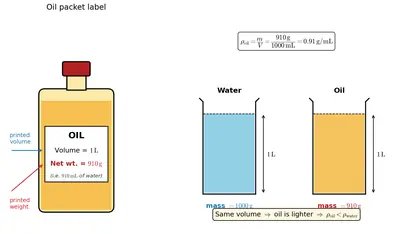
Have you noticed that some packets of ghee or oil are labelled with a volume of 1 litre but a weight of only say $$910 \, \mathrm{grams}$$ (Fig. 9.11)? What does this tell us about the density of the oil, and is it less or more than that of water?
Fig. 9.11
Fig. 9.11

Solution

Density is mass per unit volume:

\[d = \dfrac{m}{V}.\]

Density of the oil. The packet contains $$V = 1 \, \mathrm{L} = 1000 \, \mathrm{mL} = 1000 \, \mathrm{cm^3}$$ of oil weighing $$m = 910 \, \mathrm{g}$$. So

\[d_{\text{oil}} = \dfrac{910 \, \mathrm{g}}{1000 \, \mathrm{cm^3}} = 0.91 \, \mathrm{g/cm^3}.\]

Density of water. $$1 \, \mathrm{L}$$ of water weighs about $$1000 \, \mathrm{g}$$, so

\[d_{\text{water}} = \dfrac{1000 \, \mathrm{g}}{1000 \, \mathrm{cm^3}} = 1.00 \, \mathrm{g/cm^3}.\]

Since $$0.91 \, \mathrm{g/cm^3} < 1.00 \, \mathrm{g/cm^3}$$, the oil is less dense than water. This is why, when we pour cooking oil into a glass of water, the oil rises and floats on top of the water instead of mixing with it or sinking.

Answer

The density of the oil is $$910 \, \mathrm{g}/1000 \, \mathrm{cm^3} = 0.91 \, \mathrm{g/cm^3}$$, which is less than the density of water ($$1 \, \mathrm{g/cm^3}$$). So oil is less dense than water and floats on it.

21

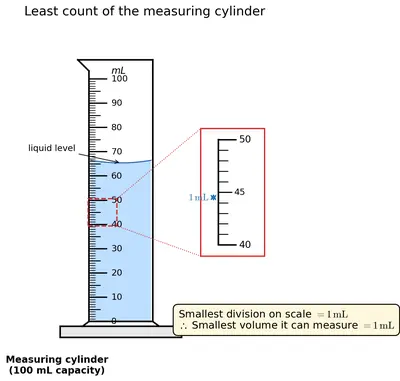
For the measuring cylinder shown in Fig. 9.16, what is the maximum volume it can measure?
Fig. 9.16
Fig. 9.16

Solution

The maximum volume that a measuring cylinder can measure is simply the highest volume mark on its scale — the total capacity of the cylinder.

In Fig. 9.16 the scale runs from $$10 \, \mathrm{mL}$$ at the bottom up to $$100 \, \mathrm{mL}$$ at the very top, and the label on the cylinder is $$100 \, \mathrm{mL}$$. So the maximum volume this cylinder can measure is $$100 \, \mathrm{mL}$$.

Answer

$$100 \, \mathrm{mL}$$.

22

What is the smallest volume it (the measuring cylinder in Fig. 9.16) can measure?
Fig. 9.16
Fig. 9.16

Solution

The smallest volume that a measuring cylinder can read is the volume represented by one small division on its scale — this is its least count.

Between two big marks on the cylinder in Fig. 9.16 (say $$10 \, \mathrm{mL}$$ and $$20 \, \mathrm{mL}$$) there are $$10$$ equal small divisions. The gap between the two big marks corresponds to $$10 \, \mathrm{mL}$$, so each small division represents

\[\dfrac{10 \, \mathrm{mL}}{10} = 1 \, \mathrm{mL}.\]

Therefore the smallest volume this measuring cylinder can measure is $$1 \, \mathrm{mL}$$.

Answer

$$1 \, \mathrm{mL}$$ — the value of one small division on the scale.

23 How much is the volume difference indicated between the two bigger marks (for example, between $$10 \, \mathrm{mL}$$ and $$20 \, \mathrm{mL}$$)?

Solution

The bigger (numbered) marks on the cylinder in Fig. 9.16 are labelled $$10, 20, 30, \ldots, 100 \, \mathrm{mL}$$. Two consecutive bigger marks differ by

\[20 \, \mathrm{mL} - 10 \, \mathrm{mL} = 10 \, \mathrm{mL}.\]

The same $$10 \, \mathrm{mL}$$ gap is seen between any two neighbouring bigger marks (for example, between $$40 \, \mathrm{mL}$$ and $$50 \, \mathrm{mL}$$).

Answer

$$10 \, \mathrm{mL}$$.

24 How many smaller divisions are there between the two bigger marks?

Solution

If we look carefully at the space between any two neighbouring bigger marks on the measuring cylinder in Fig. 9.16 (for example, between $$10 \, \mathrm{mL}$$ and $$20 \, \mathrm{mL}$$), we can count $$10$$ equal small divisions.

Answer

There are $$10$$ small divisions between two adjacent bigger marks.

25 How much volume does one small division indicate?

Solution

The value of one small division is obtained by dividing the volume difference between two bigger marks by the number of small divisions between them.

From the previous two questions:

  • Volume difference between two bigger marks $$= 10 \, \mathrm{mL}$$.
  • Number of small divisions between them $$= 10$$.

Therefore

\[\text{one small division} = \dfrac{10 \, \mathrm{mL}}{10} = 1 \, \mathrm{mL}.\]

So each small division on this measuring cylinder represents a volume of $$1 \, \mathrm{mL}$$.

Answer

$$1 \, \mathrm{mL}$$.

26 Why are measuring cylinders always designed narrow and tall instead of wider and short like a beaker?

Solution

Measuring cylinders are designed narrow and tall so that even a small change in the amount of liquid produces a clearly visible change in the height of the liquid column. This lets us measure the volume accurately.

Suppose $$1 \, \mathrm{mL}$$ (i.e. $$1 \, \mathrm{cm^3}$$) of water is added to two containers with the same cross-sectional area formula, $$\text{Volume} = \text{cross-sectional area} \times \text{height}$$, so

\[\text{rise in level} = \dfrac{\text{added volume}}{\text{cross-sectional area}}.\]
  • In a narrow tall measuring cylinder the cross-sectional area is small, so the rise in level for the same $$1 \, \mathrm{mL}$$ is large — easy to see and read off precisely.
  • In a wide short beaker the cross-sectional area is large, so the rise in level for $$1 \, \mathrm{mL}$$ is very small — hard to see and hard to read accurately.

A narrow tall shape therefore stretches the same volume across a long scale, letting us mark small divisions (e.g. $$1 \, \mathrm{mL}$$) that are far enough apart to be read without confusion.

Answer

Because a narrow, tall shape gives a large rise in liquid level for even a small amount of added liquid, allowing accurate measurement. A wide, short vessel like a beaker would show only a tiny change in level and cannot measure volume precisely.

27 I wonder how the level of a coloured liquid is measured?

Solution

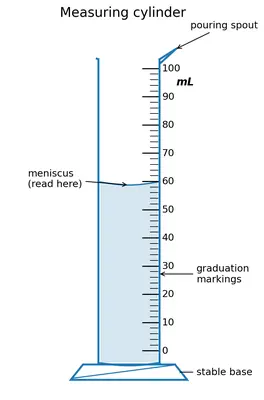
When a liquid is put in a narrow measuring cylinder, its upper surface is not flat — it curves near the walls of the cylinder because of the attraction between the liquid and the glass. This curved surface is called the meniscus.

For a colourless liquid such as water, the meniscus is concave (dips downwards in the middle). We read the mark that coincides with the bottom of the meniscus, with our eye at the same level as the meniscus.

For a coloured liquid the bottom of the meniscus is hidden under the dark colour of the liquid and cannot be seen clearly. Therefore, in the case of coloured liquids we read the mark on the cylinder that coincides with the top of the meniscus (the upper curved surface of the liquid). While doing so, the eye must again be kept exactly at the level of that surface to avoid parallax errors.

Answer

For a coloured liquid, read the mark on the measuring cylinder that coincides with the top of the meniscus (upper surface of the liquid), keeping the eye exactly at that level. For colourless liquids, the mark at the bottom of the meniscus is read instead.

28

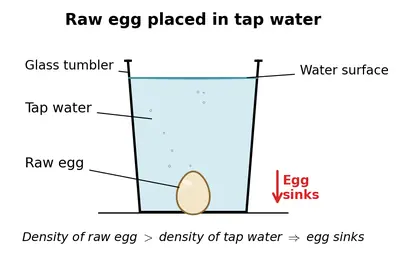
You take a glass tumbler filled with tap water and carefully place a raw whole egg into the water; the egg sinks to the bottom (Fig. 9.24). What change can you make to this setup to make the egg float in water instead of sinking?
Fig. 9.24
Fig. 9.24

Solution

Whether an object floats or sinks in a liquid depends on the comparison of their densities:

  • If the object is less dense than the liquid, it floats.
  • If the object is more dense than the liquid, it sinks.

The egg sinks because the density of a raw whole egg (about $$1.03 \, \mathrm{g/cm^3}$$) is slightly greater than the density of tap water (about $$1.00 \, \mathrm{g/cm^3}$$). To make the egg float we must change the density of the water so that it becomes greater than the density of the egg. The easiest way to do this is to dissolve a large amount of common salt (or sugar) in the water and stir well.

The dissolved salt adds mass to the water without appreciably changing its volume, so the density of the water rises well above $$1 \, \mathrm{g/cm^3}$$. Once the salt solution is denser than the egg, the egg rises up and floats. (This is the same reason why it is much easier to float in sea water, or in the very salty Dead Sea, than in ordinary pond or river water.)

Answer

Dissolve a good amount of common salt (or sugar) in the water and stir well. The dense salt solution becomes denser than the egg, so the egg floats.

Keep the Curiosity Alive

1 State whether the statements given below are True [T] or False [F]. Correct the false statement(s).

(i) Oxygen gas is more soluble in hot water rather than in cold water.

Solution

The statement is False. Unlike solids, the solubility of a gas in a liquid decreases when the liquid is heated. On warming, the dissolved gas molecules gain kinetic energy and escape out of the liquid as bubbles. That is why boiling water shows tiny bubbles of dissolved air escaping, and why cold pond water contains more dissolved oxygen (needed by fish) than warm pond water.

Corrected statement: Oxygen gas is more soluble in cold water rather than in hot water.

Answer

False. Oxygen gas is more soluble in cold water than in hot water — the solubility of gases in water decreases with a rise in temperature.

(ii) A mixture of sand and water is a solution.

Solution

The statement is False. A solution is a uniform (homogeneous) mixture. Sand does not dissolve in water; the sand grains stay separate and slowly settle at the bottom of the container. Different parts of the mixture do not have the same composition — the bottom is full of sand while the top is nearly clear water. So sand and water form a non-uniform (heterogeneous) mixture, not a solution.

Corrected statement: A mixture of sand and water is not a solution; it is a non-uniform (heterogeneous) mixture.

Answer

False. Sand does not dissolve in water and settles down, so sand + water is a non-uniform mixture, not a solution.

(iii) The amount of space occupied by any object is called its mass.

Solution

The statement is False. The amount of space occupied by an object is called its volume, not its mass. Mass is the amount of matter contained in an object.

Volume is measured in units such as $$\mathrm{cm^3}$$, $$\mathrm{mL}$$ or $$\mathrm{L}$$, while mass is measured in grams ($$\mathrm{g}$$) or kilograms ($$\mathrm{kg}$$).

Corrected statement: The amount of space occupied by any object is called its volume. (Or equivalently: The amount of matter present in an object is called its mass.)

Answer

False. The space occupied by an object is called its volume; mass is the amount of matter in the object.

(iv) An unsaturated solution has more solute dissolved than a saturated solution.

Solution

The statement is False. A saturated solution already holds the maximum amount of a solute that can be dissolved in a fixed amount of solvent at a given temperature — no more solute can be dissolved. An unsaturated solution, on the other hand, contains less than this maximum, so it can still dissolve more solute at the same temperature.

Corrected statement: A saturated solution has more solute dissolved than an unsaturated solution at the same temperature. (Equivalently: an unsaturated solution has less solute dissolved than a saturated solution.)

Answer

False. A saturated solution has the maximum solute that can dissolve at a given temperature; an unsaturated solution has less solute (and can dissolve more).

(v) The presence of different gases in the atmosphere is also a uniform mixture.

Solution

The statement is True. The atmosphere contains different gases — mainly nitrogen ($$\approx 78\%$$), oxygen ($$\approx 21\%$$) and small amounts of carbon dioxide, water vapour, argon, and other gases. These gases mix so thoroughly with one another that the composition of clean air is essentially the same everywhere. Air is therefore a uniform (homogeneous) mixture of gases — a gaseous solution.

Answer

True. The atmosphere is a uniform (homogeneous) mixture of nitrogen, oxygen, carbon dioxide and other gases — a gaseous solution.

2 Fill in the blanks.

(i) The volume of a solid can be measured by the method of displacement, where the solid is ________ in water and the __________ in water level is measured.

Solution

To find the volume of an irregularly shaped solid (like a stone), we use the displacement method. A measuring cylinder is filled with water up to some initial mark. The solid is tied with a thread and gently immersed (dipped/submerged) in the water. The water level in the cylinder rises. The rise (change/increase) in the water level equals the volume of water pushed aside by the solid, which is exactly the volume of the solid.

\[V_{\text{solid}} = V_{\text{final}} - V_{\text{initial}}.\]

Answer

The solid is immersed (dipped) in water and the rise (change) in water level is measured.

(ii) The maximum amount of ____________ dissolved in ____________ at a particular temperature is called solubility at that temperature.

Solution

Solubility is defined as the maximum amount of a solute that can be dissolved in a fixed amount ($$100 \, \mathrm{mL}$$) of a solvent at a particular temperature.

Answer

The maximum amount of solute dissolved in solvent (in a fixed quantity, e.g. $$100 \, \mathrm{mL}$$) at a particular temperature is called solubility at that temperature.

(iii) Generally, the density __________ with increase in temperature.

Solution

When a substance is heated, its particles move faster and spread apart. The mass of the substance stays the same but the volume increases. Since

\[d = \dfrac{m}{V},\]

an increase in volume (with the mass unchanged) means a decrease in density. Therefore, generally the density decreases with an increase in temperature. This is why hot air rises above cold air and why a hot-air balloon can float in the surrounding cooler air.

Answer

Generally, the density decreases with an increase in temperature.

(iv) The solution in which glucose has completely dissolved in water, and no more glucose can dissolve at a given temperature, is called a ________ solution of glucose.

Solution

A solution that already holds the maximum amount of a solute that the solvent can dissolve at a given temperature — so that no more of that solute can dissolve — is called a saturated solution. Hence, when water can hold no more glucose at a given temperature, we call it a saturated solution of glucose.

Answer

Saturated solution of glucose.

3 You pour oil into a glass containing some water. The oil floats on top. What does this tell you?
(i) Oil is denser than water
(ii) Water is denser than oil
(iii) Oil and water have the same density
(iv) Oil dissolves in water

Solution

An object (or a liquid) floats on another liquid only if it is less dense than the liquid below.

When oil is poured into a glass containing water, it stays as a separate layer on top of the water. So the oil must be less dense than the water — equivalently, water must be denser than oil.

Also, oil and water do not mix; they form two separate layers. So (iv) is wrong. Their densities are clearly different, so (iii) is wrong. Since oil floats, (i) is wrong.

The correct choice is (ii) Water is denser than oil.

Answer

(ii) Water is denser than oil.

4 A stone sculpture weighs $$225 \, \mathrm{g}$$ and has a volume of $$90 \, \mathrm{cm^3}$$. Calculate its density and predict whether it will float or sink in water.

Solution

Given. Mass $$m = 225 \, \mathrm{g}$$, volume $$V = 90 \, \mathrm{cm^3}$$.

Formula. Density is mass per unit volume:

\[d = \dfrac{m}{V}.\]

Calculation.

\[d = \dfrac{225 \, \mathrm{g}}{90 \, \mathrm{cm^3}} = 2.5 \, \mathrm{g/cm^3}.\]

Comparison with water. The density of water is $$1 \, \mathrm{g/cm^3}$$. Since

\[2.5 \, \mathrm{g/cm^3} > 1 \, \mathrm{g/cm^3},\]

the stone sculpture is denser than water, so it will sink in water.

Answer

Density $$= 225/90 = 2.5 \, \mathrm{g/cm^3}$$. Since $$2.5 \, \mathrm{g/cm^3} > 1 \, \mathrm{g/cm^3}$$ (the density of water), the sculpture will sink in water.

5 Which one of the following is the most appropriate statement, and why are the other statements not appropriate?
(i) A saturated solution can still dissolve more solute at a given temperature.
(ii) An unsaturated solution has dissolved the maximum amount of solute possible at a given temperature.
(iii) No more solute can be dissolved into the saturated solution at that temperature.
(iv) A saturated solution forms only at high temperatures.

Solution

Recall the definitions:

  • Saturated solution — the solvent has dissolved the maximum possible amount of solute at that temperature; no more solute will dissolve at that temperature.
  • Unsaturated solution — the solvent has dissolved less than the maximum possible amount of solute; more solute can still dissolve at that temperature.

Now let us check each option:

  • (i) Wrong. A saturated solution has already reached the limit and cannot dissolve any more solute at the same temperature.
  • (ii) Wrong. It is the saturated (not the unsaturated) solution that has the maximum amount of solute dissolved.
  • (iii) Correct. This is exactly the definition of a saturated solution.
  • (iv) Wrong. A solution can be saturated at any temperature — low, room, or high. What changes with temperature is the amount needed to saturate it. A saturated solution can also be prepared at, say, room temperature.

Hence the most appropriate statement is (iii).

Answer

(iii) is correct: no more solute can be dissolved in a saturated solution at that temperature. (i) is wrong (a saturated solution cannot dissolve more solute), (ii) is wrong (that is true of a saturated, not unsaturated, solution), and (iv) is wrong (saturation can be reached at any temperature).

6 You have a bottle with a volume of 2 litres. You pour $$500 \, \mathrm{mL}$$ of water into it. How much more water can the bottle hold?

Solution

Given. Total capacity of the bottle $$V_{\text{total}} = 2 \, \mathrm{L}$$ and water already poured $$V_{\text{poured}} = 500 \, \mathrm{mL}$$.

Convert to the same unit. Since $$1 \, \mathrm{L} = 1000 \, \mathrm{mL}$$,

\[V_{\text{total}} = 2 \, \mathrm{L} = 2 \times 1000 \, \mathrm{mL} = 2000 \, \mathrm{mL}.\]

Extra water the bottle can still hold.

\[V_{\text{extra}} = V_{\text{total}} - V_{\text{poured}} = 2000 \, \mathrm{mL} - 500 \, \mathrm{mL} = 1500 \, \mathrm{mL}.\]

That is, the bottle can hold $$1500 \, \mathrm{mL}$$ (i.e. $$1.5 \, \mathrm{L}$$) more water.

Answer

$$1500 \, \mathrm{mL}$$ (equivalently, $$1.5 \, \mathrm{L}$$).

7 An object has a mass of $$400 \, \mathrm{g}$$ and a volume of $$40 \, \mathrm{cm^3}$$. What is its density?

Solution

Given. Mass $$m = 400 \, \mathrm{g}$$, volume $$V = 40 \, \mathrm{cm^3}$$.

Formula.

\[d = \dfrac{m}{V}.\]

Calculation.

\[d = \dfrac{400 \, \mathrm{g}}{40 \, \mathrm{cm^3}} = 10 \, \mathrm{g/cm^3}.\]

So the density of the object is $$10 \, \mathrm{g/cm^3}$$. (Since this is much greater than the density of water, $$1 \, \mathrm{g/cm^3}$$, the object would sink in water.)

Answer

Density $$= 400/40 = 10 \, \mathrm{g/cm^3}$$.

8

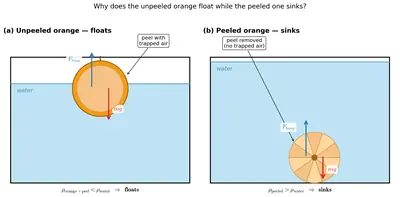
Analyse Fig. 9.25a and 9.25b. Why does the unpeeled orange float, while the peeled one sinks? Explain.
Fig. 9.25
Fig. 9.25

Solution

Whether an object floats or sinks depends on how its density compares with that of water. Water has a density of about $$1 \, \mathrm{g/cm^3}$$.

Unpeeled orange (Fig. 9.25a) — floats. The peel (rind) of an orange is spongy and full of tiny air-filled pockets. This air makes the peel very light for its size. When the orange is unpeeled, the trapped air greatly increases the total volume of the orange without adding much to its mass, so the overall density of the whole orange (fruit + peel + trapped air) becomes less than the density of water. Being less dense than water, the unpeeled orange floats.

Peeled orange (Fig. 9.25b) — sinks. When the peel is removed, the trapped air is also removed along with it. The remaining fruit pulp is heavier for its size — its density is a little greater than that of water. So the peeled orange sinks.

Thus the difference in behaviour is entirely explained by the air trapped in the peel, which lowers the density of the whole fruit when the peel is on.

Answer

The peel of an orange contains many air pockets. With the peel on, the average density of the whole orange is less than that of water, so it floats. Removing the peel removes this trapped air; the remaining fruit is denser than water, so the peeled orange sinks.

9 Object A has a mass of $$200 \, \mathrm{g}$$ and a volume of $$40 \, \mathrm{cm^3}$$. Object B has a mass of $$240 \, \mathrm{g}$$ and a volume of $$60 \, \mathrm{cm^3}$$. Which object is denser?

Solution

To compare denseness, compute the density of each object using $$d = m/V$$.

Object A.

\[d_A = \dfrac{200 \, \mathrm{g}}{40 \, \mathrm{cm^3}} = 5 \, \mathrm{g/cm^3}.\]

Object B.

\[d_B = \dfrac{240 \, \mathrm{g}}{60 \, \mathrm{cm^3}} = 4 \, \mathrm{g/cm^3}.\]

Comparison. $$d_A = 5 \, \mathrm{g/cm^3} > d_B = 4 \, \mathrm{g/cm^3}$$.

So Object A is denser than Object B, even though Object B is heavier — it has enough extra volume to lower its density.

Answer

Object A is denser: $$d_A = 200/40 = 5 \, \mathrm{g/cm^3}$$, $$d_B = 240/60 = 4 \, \mathrm{g/cm^3}$$, and $$d_A > d_B$$.

10 Reema has a piece of modeling clay that weighs $$120 \, \mathrm{g}$$. She first moulds it into a compact cube that has a volume of $$60 \, \mathrm{cm^3}$$. Later, she flattens it into a thin sheet. Predict what will happen to its density.

Solution

Density depends only on the mass and volume of the material:

\[d = \dfrac{m}{V}.\]

Density of the compact cube. $$m = 120 \, \mathrm{g}$$, $$V = 60 \, \mathrm{cm^3}$$, so

\[d = \dfrac{120 \, \mathrm{g}}{60 \, \mathrm{cm^3}} = 2 \, \mathrm{g/cm^3}.\]

What changes when the clay is flattened? Flattening the clay only changes its shape. The amount of clay (its mass) does not change — nothing is added or removed. Since the clay is not compressed or stretched into a different material either, the total volume it occupies also stays the same ($$60 \, \mathrm{cm^3}$$).

Because both mass and volume remain unchanged, the density remains the same:

\[d_{\text{sheet}} = \dfrac{120 \, \mathrm{g}}{60 \, \mathrm{cm^3}} = 2 \, \mathrm{g/cm^3}.\]

Thus the density of the modelling clay does not change on flattening. Density is a property of the material itself, not of its shape.

Answer

The density will remain the same, i.e. $$2 \, \mathrm{g/cm^3}$$. Changing shape does not change either the mass or the total volume of the clay, so the density is unchanged.

11 A block of iron has a mass of $$600 \, \mathrm{g}$$ and a density of $$7.9 \, \mathrm{g/cm^3}$$. What is its volume?

Solution

Given. Mass $$m = 600 \, \mathrm{g}$$, density $$d = 7.9 \, \mathrm{g/cm^3}$$.

Formula. Since $$d = m/V$$, rearranging for volume gives

\[V = \dfrac{m}{d}.\]

Calculation.

\[V = \dfrac{600 \, \mathrm{g}}{7.9 \, \mathrm{g/cm^3}} \approx 75.95 \, \mathrm{cm^3}.\]

Rounded to a suitable number of significant figures, the volume of the iron block is about $$76 \, \mathrm{cm^3}$$ (more precisely $$75.95 \, \mathrm{cm^3}$$).

Answer

Volume $$= 600/7.9 \approx 75.95 \, \mathrm{cm^3}$$ (about $$76 \, \mathrm{cm^3}$$).

12

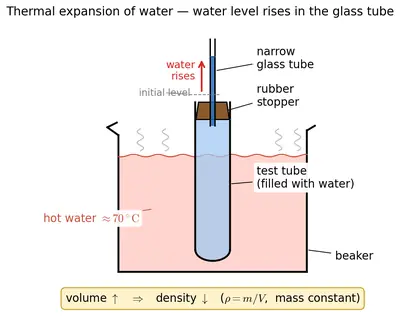
You are provided with an experimental setup as shown in Fig. 9.26a and 9.26b. On keeping the test tube (Fig 9.26b) in a beaker containing hot water (~$$70^{\circ}\mathrm{C}$$), the water level in the glass tube rises. How does it affect the density?
Fig. 9.26
Fig. 9.26

Solution

In Fig. 9.26 a test tube is completely filled with water and closed with a stopper through which a narrow glass tube passes. Some water stands in the glass tube at a certain level. When this test tube is placed in a beaker of hot water at about $$70^{\circ}\mathrm{C}$$, the water inside the test tube gets heated.

What happens to the water? On heating, the particles of water move about faster and spread apart. So the water inside the test tube expands. Since the test tube is closed, the extra volume has nowhere to go except up the narrow glass tube. That is why the level of water in the glass tube rises.

Effect on density. The amount of water in the closed system does not change on heating — its mass $$m$$ stays the same. But its volume $$V$$ has now increased. Applying

\[d = \dfrac{m}{V},\]

if $$m$$ is constant and $$V$$ increases, then $$d$$ must decrease.

So heating the water causes it to expand, and the density of the water decreases. This experiment shows, in general, that the density of a liquid decreases when its temperature is raised.

Answer

On heating, the water expands (its volume increases) while its mass stays the same. Using $$d = m/V$$, the density of the water decreases.
NCERT Solutions for Class 8
Maths
NCERT Solutions for Class 8 Maths
Chapter-wise step-by-step
solutions with explanations
explore solutions Maths bg
Science
NCERT Solutions for Class 8 Science
Chapter-wise step-by-step
solutions with explanations
explore solutions Science bg

50,000+ JEE Students Trusted Our Score Calculator

Predict your JEE Main percentile, rank & performance in seconds