Join WhatsApp Icon JEE WhatsApp Group
NCERT Solutions for Class 8 Science

Chapter 8: Nature of Matter: Elements, Compounds, and Mixtures

Download Solutions PDF
Daily JEE Updates, Tips & Important Alerts
Join 30,000+ students and stay updated with JEE notifications and preparation insights.
Join Now!
Free PDF
Complete NCERT Solution PDF for Chapter 8: Nature of Matter: Elements, Compounds, and Mixtures
Download Solutions PDF

Intext Questions

Probe and ponder 1 Which of the entities in the picture above consist of matter, and which of them do not?

Solution

What is matter? Anything that has mass and occupies space (i.e., has volume) is called matter. Solids, liquids and gases are all made up of matter.

Looking at the opening picture (which shows people, plants, animals, buildings, air, water, sunlight, sound of music, etc.), we can sort the entities into two groups:

Entities that consist of matter — because they have mass and occupy space:

  • Human beings (children, adults)
  • Plants and trees
  • Animals and birds
  • Water in the pond/river
  • Air (though invisible, air is a mixture of gases and has mass)
  • Soil, rocks, buildings, vehicles, clothes, food, etc.

Entities that do NOT consist of matter — because they are forms of energy, not substances; they have no mass and do not occupy space:

  • Sunlight (light energy)
  • Heat coming from the Sun or a fire
  • The sound of music or of people talking
  • Shadows (a shadow is only the absence of light, not a substance)
  • Rainbow colours in the sky (light of different wavelengths)

Thus, all the physical objects, living beings, water and air in the picture are matter, while light, heat, sound and shadows are not matter — they are forms of energy or optical effects.

Answer

Living beings, plants, animals, water, air, soil, rocks and all physical objects in the picture consist of matter (they have mass and occupy space). Sunlight, heat, sound and shadows do not consist of matter — they are forms of energy or optical effects with no mass or volume.

Probe and ponder 2 How can elements be combined to form a compound?

Solution

An element is a pure substance that cannot be broken down into simpler substances by ordinary chemical means. Examples: hydrogen ($$\mathrm{H}$$), oxygen ($$\mathrm{O}$$), iron ($$\mathrm{Fe}$$), sulfur ($$\mathrm{S}$$).

A compound is a pure substance made when two or more different elements chemically combine in a fixed proportion by mass. The atoms of the elements are not merely mixed — they are joined by chemical bonds so that a completely new substance, with new properties, is formed.

Elements can be made to combine into a compound in several ways, all of which involve a chemical reaction (a chemical change):

  • By burning (combustion) in oxygen. For example, when magnesium is burnt in air, magnesium metal combines with oxygen to give magnesium oxide: $$\mathrm{Magnesium + Oxygen \rightarrow Magnesium\ oxide}$$
  • By heating two elements together. When a mixture of iron filings and sulfur powder is heated strongly, iron combines with sulfur to form iron(II) sulfide: $$\mathrm{Iron + Sulfur \xrightarrow{\text{heat}} Iron\ sulfide}$$
  • By passing an electric current or a spark through a mixture of elements. For example, hydrogen and oxygen combine to form water when a spark is applied: $$\mathrm{Hydrogen + Oxygen \rightarrow Water}$$
  • By simply mixing (in cases where the elements react on contact). For example, sodium reacts vigorously with chlorine to form common salt, sodium chloride: $$\mathrm{Sodium + Chlorine \rightarrow Sodium\ chloride}$$

Two important features of every such combination:

  1. The elements combine in a fixed mass ratio (law of constant composition). For example, in water, hydrogen and oxygen are always in the mass ratio $$1:8$$.
  2. The compound formed has entirely new properties, different from those of the individual elements. For instance, hydrogen burns and oxygen supports burning, but the compound water actually puts out fire.

Answer

Elements combine to form a compound through a chemical reaction — by burning, heating, sparking or by direct contact — in which their atoms join in a fixed mass ratio. The resulting compound has entirely new properties (e.g. $$\mathrm{H_2 + O_2 \rightarrow H_2O}$$; $$\mathrm{Fe + S \rightarrow FeS}$$).

Probe and ponder 3 How could the discovery of a compound that absorbs carbon dioxide from the air contribute to solving environmental challenges?

Solution

Carbon dioxide ($$\mathrm{CO_2}$$) is a greenhouse gas. When its concentration in the atmosphere rises, it traps more of the Sun's heat near the Earth's surface and causes global warming and climate change. Human activities such as burning coal, petrol and diesel, deforestation, and industrial manufacture release huge amounts of $$\mathrm{CO_2}$$ every day.

If scientists discover a compound (a chemical "sponge") that can efficiently absorb $$\mathrm{CO_2}$$ from the air, it could help in the following ways:

  • Reducing the greenhouse effect: Removing $$\mathrm{CO_2}$$ from the atmosphere would slow down global warming and help stabilise the climate.
  • Cleaner air near cities and factories: The compound could be installed in the chimneys of thermal power plants, cement factories, and vehicle exhaust systems to capture $$\mathrm{CO_2}$$ before it escapes into the air. This is called carbon capture.
  • Protection of glaciers, polar ice and sea levels: By keeping the atmospheric $$\mathrm{CO_2}$$ low, melting of glaciers and polar ice caps would slow down, and coastal cities would be safer from rising sea levels.
  • Healthier ecosystems and oceans: Less $$\mathrm{CO_2}$$ in the atmosphere means less $$\mathrm{CO_2}$$ dissolving in seawater, so ocean acidification (which harms corals and marine life) would reduce.
  • Recycling of $$\mathrm{CO_2}$$: The absorbed $$\mathrm{CO_2}$$ can be converted into useful things — fuels, plastics, urea fertiliser, or fizzy drinks — turning a pollutant into a raw material.
  • Support for astronauts and submariners: Such compounds are also useful in closed spaces like submarines and spacecraft, where the $$\mathrm{CO_2}$$ breathed out by people has to be removed continuously.

Thus, a $$\mathrm{CO_2}$$-absorbing compound would be a powerful tool for reducing air pollution, tackling climate change, and protecting the environment.

Answer

Such a compound could be used to capture carbon dioxide from factory chimneys, vehicles and the open air — lowering the greenhouse effect, slowing global warming and climate change, protecting glaciers and coastal cities, reducing ocean acidification, and even recycling the captured $$\mathrm{CO_2}$$ into fuels or fertilisers. It would also make life-support in spacecraft and submarines easier.

Section 8.1 Can you identify a few more examples of non-uniform mixtures around you?

Solution

A non-uniform (heterogeneous) mixture is one in which the different components are not evenly distributed. We can usually see the different substances separately in different parts of the mixture, and their composition changes from one point to another.

Here are several everyday examples:

  • Sand and water — the sand settles at the bottom while water stays on top.
  • Oil and water — oil floats as a separate layer above the water.
  • Muddy pond water — clay and dust particles are suspended and slowly settle down.
  • Salad or vegetable curry — you can pick out separate pieces of tomato, cucumber, onion, etc.
  • Chana chaat, bhel, or a bowl of fruit salad — different pieces stay clearly separate.
  • Rice and pulses (dal) mixed together before cooking.
  • Soil — a mixture of sand, clay, humus, water and air, unevenly distributed.
  • Concrete — cement, sand, gravel, and water; the stones are visibly separate.
  • Granite and other rocks — different coloured mineral grains are visible.
  • Smoky air near a chimney or a burning candle — soot particles are unevenly suspended in air.
  • Chalk powder in water, or flour mixed with water — the powder does not dissolve and settles down.
  • Iron filings mixed with sulfur powder, or iron filings mixed with sand.

Answer

Sand + water, oil + water, muddy water, salad, fruit salad, bhel, chana chaat, rice + pulses, soil, concrete, granite/rocks, smoky air, chalk powder or flour in water, iron filings + sulfur powder — in each of these the components are visibly separate and unevenly distributed.

Section 8.1 Can you list a few uniform mixtures?

Solution

A uniform (homogeneous) mixture is one in which the components are so well mixed that the mixture looks the same throughout — we cannot see the different substances separately, and the composition is the same in every part.

Some common examples:

  • Air — a uniform mixture of nitrogen, oxygen, argon, carbon dioxide and water vapour.
  • Sugar dissolved in water (sugar solution) or salt dissolved in water (salt solution / seawater — after settling).
  • Vinegar — acetic acid dissolved uniformly in water.
  • Soda water / aerated drinks — carbon dioxide gas dissolved in water.
  • Lemonade or sharbat after stirring — sugar, lemon juice and water form one clear solution.
  • Tea or coffee (after mixing) — a uniform brown solution.
  • Tincture of iodine — iodine dissolved in alcohol.
  • Alcohol in water (e.g. hand-sanitizer solution).
  • Alloys such as brass (copper + zinc), bronze (copper + tin), steel (iron + carbon and other metals), and 22-carat gold (gold + copper/silver) — solid–solid uniform mixtures.
  • LPG cooking gas — a uniform mixture of butane and propane gases.

Answer

Air, sugar/salt solutions, vinegar, soda water, lemonade, tea, coffee, tincture of iodine, alcohol-in-water, LPG, and alloys such as brass, bronze, steel and 22-carat gold — all look the same throughout, so they are uniform (homogeneous) mixtures.

Activity 8.1

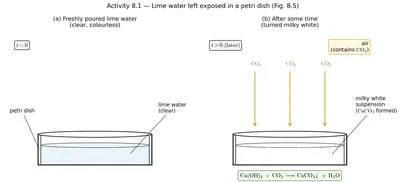
In Activity 8.1, lime water (a solution of calcium hydroxide) is left in a petri dish and observed at regular intervals.

What do you observe (Fig. 8.5b)? Does it turn milky? Can you explain why the solution has turned milky?

Fig. 8.5
Fig. 8.5

Solution

Observation. When the petri dish of clear lime water is left exposed to air for some time, a thin white/milky layer gradually appears on its surface. After a while, the whole solution looks milky (turbid). Yes, the lime water turns milky.

Explanation. Lime water is a solution of calcium hydroxide, $$\mathrm{Ca(OH)_2}$$, in water. The air around us always contains a small amount of carbon dioxide gas, $$\mathrm{CO_2}$$ (roughly $$0.04\%$$ of air), which we (and other animals) breathe out. When the lime water is left open, the $$\mathrm{CO_2}$$ from the air dissolves into it and reacts with the calcium hydroxide.

The reaction produces calcium carbonate, $$\mathrm{CaCO_3}$$, which is a white insoluble solid (chalk-like powder). Fine particles of $$\mathrm{CaCO_3}$$ remain suspended in the water, making it look milky:

$$\mathrm{Calcium\ hydroxide + Carbon\ dioxide \longrightarrow Calcium\ carbonate + Water}$$

In symbols: $$\mathrm{Ca(OH)_2 + CO_2 \longrightarrow CaCO_3 \downarrow + H_2O}$$

Because a new substance ($$\mathrm{CaCO_3}$$) is formed with new properties, this is a chemical change. It also acts as a simple test that shows carbon dioxide is present in the air around us.

Answer

Yes, the lime water turns milky. The carbon dioxide present in the air dissolves into the lime water and reacts with calcium hydroxide to form a white insoluble solid, calcium carbonate: $$\mathrm{Ca(OH)_2 + CO_2 \rightarrow CaCO_3 + H_2O}$$. The suspended $$\mathrm{CaCO_3}$$ particles give the milky appearance.

Table 8.1

Complete the third column (Uniform or non-uniform) of Table 8.1: Different types of mixtures.

S.No.Mixture-typeExamplesUniform or non-uniform
1.Gas and gasAirUniform
2.Gas and liquidAerated water (soda water); Oxygen dissolved in water_____
3.Solid and gasCarbon particles in air_____
4.Liquid and liquidAcetic acid in water (vinegar); Oil and water_____
5.Solid and liquidSand and water; Seawater_____
6.Solid and solidBaking powder (baking soda and tartaric acid); Alloys_____

Solution

We decide whether each mixture is uniform (homogeneous — looks the same everywhere, components not seen separately) or non-uniform (heterogeneous — components visibly separate).

  • Row 2 (Gas + Liquid): Soda water and dissolved oxygen in water are clear solutions of a gas in water — the gas is dispersed uniformly. So both are uniform.
  • Row 3 (Solid + Gas): Carbon particles in air (smoke) are unevenly distributed and can be seen as a separate black cloud — non-uniform.
  • Row 4 (Liquid + Liquid): Vinegar (acetic acid + water) is a single clear liquid → uniform. Oil and water form two visibly separate layers → non-uniform. So this row has both types.
  • Row 5 (Solid + Liquid): Sand and water — sand stays as separate solid grains at the bottom → non-uniform. Seawater — salts are completely dissolved and the water looks the same throughout → uniform. Again, both types.
  • Row 6 (Solid + Solid): Baking powder is a physical mixture of separate solid grains of baking soda and tartaric acid → non-uniform. Alloys such as brass or bronze are made by melting the metals together, so the atoms mix completely → uniform. Both types.

Completed Table 8.1:

S.No.Mixture-typeExamplesUniform or non-uniform
1.Gas and gasAirUniform
2.Gas and liquidAerated water; Oxygen dissolved in waterUniform
3.Solid and gasCarbon particles in airNon-uniform
4.Liquid and liquidVinegar / Oil and waterUniform (vinegar); Non-uniform (oil + water)
5.Solid and liquidSand and water / SeawaterNon-uniform (sand + water); Uniform (seawater)
6.Solid and solidBaking powder / AlloysNon-uniform (baking powder); Uniform (alloys)

Answer

S.No.ExamplesUniform / Non-uniform
2.Soda water; oxygen dissolved in waterUniform
3.Carbon particles in airNon-uniform
4.Vinegar / Oil + waterUniform / Non-uniform
5.Sand + water / SeawaterNon-uniform / Uniform
6.Baking powder / AlloysNon-uniform / Uniform

A step further (Sec. 8.2) According to science, how would you classify milk, packed fruit juice, baking soda, sugar, and soil — as mixtures or pure substances?

Solution

In science, a pure substance is one that contains only one kind of building block — either atoms of a single element or molecules of a single compound. Its composition is fixed. Anything containing two or more different substances is a mixture.

  • Milk — Mixture. Milk is a natural liquid that contains water, milk fat (globules), milk proteins (like casein), milk sugar (lactose), minerals and vitamins. Its fat is not truly dissolved but is dispersed as tiny droplets (an emulsion). So milk is a mixture — in fact, a non-uniform (colloidal) mixture.
  • Packed fruit juice — Mixture. A packed juice contains water, fruit pulp/juice, added sugar, citric acid, vitamins, preservatives, colours and flavours. Many different substances are mixed together, so it is a mixture.
  • Baking soda — Pure substance (compound). Chemically pure baking soda is sodium hydrogen carbonate, $$\mathrm{NaHCO_3}$$. It is made of only one kind of unit (the $$\mathrm{NaHCO_3}$$ formula unit) and its composition is fixed — so it is a pure substance (a compound).
  • Sugar — Pure substance (compound). Table sugar is sucrose, $$\mathrm{C_{12}H_{22}O_{11}}$$. Every crystal has the same fixed composition, so it is a pure substance (a compound).
  • Soil — Mixture. Soil contains sand, clay, humus (decayed matter), water, air, small stones and living micro-organisms. Its composition varies from place to place, so it is a non-uniform mixture.

Note. In everyday shopping language, we sometimes call unadulterated milk or juice "pure", meaning "not tampered with". Scientifically, however, only baking soda and sugar in the above list are pure substances.

Answer

Mixtures: milk, packed fruit juice, soil. Pure substances (compounds): baking soda ($$\mathrm{NaHCO_3}$$) and sugar ($$\mathrm{C_{12}H_{22}O_{11}}$$).

Activity 8.3

In Activity 8.3, when electricity is passed through water:

  • Do you observe the formation of any gas bubbles at both the terminals inside the test tubes?
  • Is the volume of the gas collected the same in both the test tubes?
  • On bringing a burning candle close to the mouth of each test tube, what happens in each case?
  • Which gas is present in each test tube?

Solution

In Activity 8.3, two graphite electrodes are dipped into acidified water (a few drops of dilute sulfuric acid are added to make water conducting), inverted test tubes are placed above them, and a battery is connected. This process is called electrolysis of water.

  1. Are gas bubbles formed at both terminals?
    Yes. Bubbles of gas rise from both the electrodes and get collected in the two inverted test tubes.
  2. Is the volume of gas the same in both tubes?
    No. The volumes are clearly different. The tube over the negative terminal (cathode) fills up to twice the volume of the tube over the positive terminal (anode). If we call the smaller volume $$V$$, the larger volume is $$2V$$ — i.e. the ratio is $$2:1$$.
  3. What happens when a burning candle / burning splint is brought near the mouth of each tube?
    • Tube with the larger volume (2V): When the burning splint is brought near, the gas catches fire with a "pop" sound. This is the characteristic test for hydrogen gas.
    • Tube with the smaller volume (V): The burning splint does not go out; instead it burns more brightly. This shows that the gas supports combustion, which is the test for oxygen gas.
  4. Identity of the gases:
    • Larger-volume tube (at the cathode / negative terminal) — Hydrogen ($$\mathrm{H_2}$$).
    • Smaller-volume tube (at the anode / positive terminal) — Oxygen ($$\mathrm{O_2}$$).

The overall chemical reaction is:

$$\mathrm{Water \xrightarrow{\text{electricity}} Hydrogen + Oxygen}$$

$$\mathrm{2\,H_2O \longrightarrow 2\,H_2 + O_2}$$

The 2 : 1 volume ratio matches the 2 : 1 mole ratio of hydrogen to oxygen in the equation. This experiment proves that water is a compound made of two elements — hydrogen and oxygen — in fixed proportions.

Answer

Yes, bubbles form at both electrodes. The volumes are unequal — hydrogen (over the negative terminal) is twice the volume of oxygen (over the positive terminal), i.e. $$V_{\mathrm{H_2}}:V_{\mathrm{O_2}}=2:1$$. The hydrogen-tube gives a "pop" sound with a burning splint; the oxygen-tube makes the splint burn more brightly. So the two gases are hydrogen ($$\mathrm{H_2}$$) and oxygen ($$\mathrm{O_2}$$), confirming $$\mathrm{2H_2O \rightarrow 2H_2 + O_2}$$.

Ever heard of ... When electric current is passed through water, it breaks down into hydrogen and oxygen. Is this a chemical change or a physical change?

Solution

To decide, recall the difference between the two kinds of change:

  • In a physical change, no new substance is formed; only the state, shape or appearance of the substance changes (for example, water freezing to ice or evaporating to steam — it is still $$\mathrm{H_2O}$$).
  • In a chemical change, one or more new substances, with new properties, are formed. The change is usually not easy to reverse.

When an electric current is passed through water, the water molecules break apart and completely new substances — the gases hydrogen and oxygen — are produced:

$$\mathrm{2\,H_2O \xrightarrow{\text{electricity}} 2\,H_2 + O_2}$$

The starting material is a liquid ($$\mathrm{H_2O}$$) that neither burns nor supports burning. The products are two gases whose properties are completely different from those of water: hydrogen burns with a pop, and oxygen supports combustion. Because entirely new substances are formed, the process (called electrolysis of water) is a chemical change — in fact, a chemical decomposition reaction.

Answer

It is a chemical change. Two brand-new substances — hydrogen gas and oxygen gas — with properties entirely different from water are formed, so a chemical reaction (electrolytic decomposition of water) has taken place: $$\mathrm{2H_2O \xrightarrow{\text{electricity}} 2H_2 + O_2}$$.

Activity 8.4

In Activity 8.4, a teaspoon of sugar is heated in a boiling tube. Small droplets of water are seen inside the boiling tube near its open end.

Where did this water come from? Was it in the dry sugar, or did it come by the condensation of water vapour in the air? Can you predict what is left behind?

Solution

Where did the water come from? The droplets of water did not come from the air. If they had come from the air, they would settle at the cooler upper end of the boiling tube even without heating. But we see droplets only when the sugar is heated, and they form when hot water vapour rising from the sugar meets the cooler upper part of the tube and condenses. So the water is actually coming out of the sugar itself.

Chemically, sugar (sucrose) is a compound made of the elements carbon, hydrogen and oxygen — its formula is $$\mathrm{C_{12}H_{22}O_{11}}$$. When it is heated strongly, the hydrogen and oxygen atoms inside the sugar molecule combine to form water vapour, which escapes from the molecule and condenses on the walls of the tube. This proves that sugar contains hydrogen and oxygen in the right proportion to give water.

What is left behind? After all the water has been driven off, the carbon in the sugar remains as a black spongy solid — charcoal (carbon). The sweet white sugar changes into a black shining mass, showing that a new substance has been formed — so this is a chemical change.

The overall change can be written as:

$$\mathrm{Sugar \xrightarrow{\text{heat}} Carbon\ (black\ residue) + Water\ vapour}$$

$$\mathrm{C_{12}H_{22}O_{11} \xrightarrow{\text{heat}} 12\,C + 11\,H_2O}$$

Because a compound (sugar) has been split into simpler substances (carbon and water), the experiment demonstrates that sugar is a compound, not an element.

Answer

The water was not present as such in the dry sugar, and did not come from the surrounding air. On heating, the hydrogen and oxygen atoms present in the sugar compound ($$\mathrm{C_{12}H_{22}O_{11}}$$) combined to give water vapour, which condensed on the cooler walls of the tube. The black residue of carbon (charcoal) is what is left behind: $$\mathrm{C_{12}H_{22}O_{11} \xrightarrow{\text{heat}} 12C + 11H_2O}$$.

Activity 8.5

In Activity 8.5, iron filings and sulfur powder are mixed thoroughly on a watch glass and labelled Sample A.

Is this a uniform or a non-uniform mixture? Can you still observe both iron and sulfur as separate substances?

Solution

When iron filings (grey, shining, magnetic) and sulfur powder (bright yellow, non-magnetic) are simply mixed on a watch glass, even after thorough stirring we can still see the two substances separately. Under a hand lens (and even by the naked eye) the grey metallic bits of iron are clearly distinguishable from the yellow specks of sulfur.

Because the composition is not the same in every tiny region — some spots have more iron, others more sulfur — this is a non-uniform (heterogeneous) mixture.

Two more pieces of evidence confirm this:

  • Magnet test: If a magnet is moved over the mixture, iron filings get attracted to it while sulfur is left behind. So the two substances have kept their individual properties — meaning no chemical bond has formed between them.
  • Carbon disulfide test: Sulfur dissolves in carbon disulfide but iron does not, so the two can be separated by this solvent. Again, this shows that iron and sulfur are just physically mixed.

So in Sample A, iron and sulfur are simply intermingled; no new substance has been formed.

Answer

Sample A is a non-uniform (heterogeneous) mixture. Yes — iron (grey, magnetic) and sulfur (yellow, non-magnetic) can still be seen as separate substances, and they can be pulled apart by a magnet, showing that no chemical combination has occurred.

Table 8.2

Compare Samples A (a mixture of iron filings and sulfur powder) and B (the black mass formed after heating Sample A) step by step and record your observations in Table 8.2.

S.No.ExperimentObservations — Sample AObservations — Sample B
1.Appearance: (i) Colour, (ii) Texture__________
2.Magnet test__________
3.Gas test: (i) Odour, (ii) Burning__________

Solution

Sample A is just a mixture of iron filings and sulfur powder. Sample B is what we get after this mixture is strongly heated — a single black solid, iron sulfide ($$\mathrm{FeS}$$), formed by a chemical reaction:

$$\mathrm{Iron + Sulfur \xrightarrow{\text{heat}} Iron\ sulfide}$$

$$\mathrm{Fe + S \xrightarrow{\text{heat}} FeS}$$

Each test in Table 8.2 exposes the difference between the physical mixture (A) and the new compound (B).

  1. Appearance. Sample A shows two distinct colours side by side — grey iron and yellow sulfur — with a granular, rough texture (you can see the two kinds of particles). Sample B is a single black (dark grey/blackish) solid mass; the yellow and grey have completely disappeared, and the texture is uniform.
  2. Magnet test. A magnet moved over Sample A picks up iron filings, so the iron in the mixture keeps its magnetic property. Sample B is not attracted by a magnet — iron sulfide is non-magnetic, so the iron has been chemically changed and no longer behaves as free iron.
  3. Gas test (add a few drops of dilute hydrochloric acid to each sample).
    • Sample A gives off a gas (hydrogen) that is odourless. When a burning splint is brought near, the gas burns with a "pop" sound. Reaction: $$\mathrm{Fe + 2HCl \rightarrow FeCl_2 + H_2 \uparrow}$$.
    • Sample B gives off a gas (hydrogen sulfide, $$\mathrm{H_2S}$$) with a very unpleasant smell of rotten eggs. This gas does not burn easily / does not give a pop; it is actually poisonous. Reaction: $$\mathrm{FeS + 2HCl \rightarrow FeCl_2 + H_2S \uparrow}$$.

Completed Table 8.2:

S.No.ExperimentObservations — Sample AObservations — Sample B
1.Appearance: (i) Colour, (ii) TextureTwo colours visible — grey iron + yellow sulfur; rough, grainyUniform black solid mass; hard, single texture
2.Magnet testIron filings get attracted to the magnet, sulfur is left behindNot attracted by the magnet at all
3.Gas test: (i) Odour, (ii) BurningColourless, odourless hydrogen gas; burns with a "pop" soundColourless gas with a foul "rotten-egg" smell (hydrogen sulfide); does not burn with a pop

Answer

TestSample A (mixture)Sample B (iron sulfide)
AppearanceGrey + yellow, grainySingle black solid mass
MagnetIron filings attractedNot attracted
With dilute HClOdourless $$\mathrm{H_2}$$; burns with pop$$\mathrm{H_2S}$$ with rotten-egg smell; does not pop

Some discussion points

Based on Activity 8.5 (Samples A and B), answer the following:

  • Do the Samples, A and B look the same?
  • Which sample exhibits magnetic properties?
  • Can we separate the components of Samples A and B?
  • On adding dilute hydrochloric acid, do gases evolve in both Samples A and B?
  • In both the cases, do the gases smell the same or different?
  • Also, categorise the substances used in this activity into mixtures, compounds, and elements.

Solution

Recall: Sample A is the plain physical mixture of iron filings and sulfur powder, and Sample B is the black solid, iron sulfide ($$\mathrm{FeS}$$), formed by strongly heating Sample A: $$\mathrm{Fe + S \xrightarrow{\text{heat}} FeS}$$.

  1. Do Samples A and B look the same? No. Sample A shows two clear colours — grey (iron) and yellow (sulfur). Sample B is a single, uniform black solid mass; the original colours have disappeared.
  2. Which sample exhibits magnetic properties? Sample A does — a magnet moved over it lifts up the iron filings while the sulfur is left behind. Sample B is not attracted by a magnet because the iron has combined chemically with sulfur to form a new (non-magnetic) substance.
  3. Can we separate the components of the two samples? Sample A can be separated by simple physical methods — a magnet removes iron; sulfur dissolves in carbon disulfide, iron does not. Sample B cannot be separated by any physical method. Its components (iron and sulfur) are now chemically joined, and only another chemical reaction can split them.
  4. On adding dilute hydrochloric acid, do gases evolve from both samples? Yes, gases evolve in both cases. From A: $$\mathrm{Fe + 2HCl \rightarrow FeCl_2 + H_2 \uparrow}$$. From B: $$\mathrm{FeS + 2HCl \rightarrow FeCl_2 + H_2S \uparrow}$$.
  5. Do the gases smell the same or different? Different. The gas from Sample A is hydrogen ($$\mathrm{H_2}$$), which is odourless and burns with a "pop". The gas from Sample B is hydrogen sulfide ($$\mathrm{H_2S}$$), which has a strong rotten-egg smell and is poisonous.
  6. Categorisation of substances used:
    • Elements: iron ($$\mathrm{Fe}$$), sulfur ($$\mathrm{S}$$), hydrogen ($$\mathrm{H_2}$$) — each is made of only one kind of atom.
    • Compounds: iron sulfide ($$\mathrm{FeS}$$), hydrochloric acid ($$\mathrm{HCl}$$), iron(II) chloride ($$\mathrm{FeCl_2}$$), hydrogen sulfide ($$\mathrm{H_2S}$$) — each contains two or more elements in a fixed ratio.
    • Mixture: Sample A (iron filings + sulfur powder). Dilute hydrochloric acid — a mixture of $$\mathrm{HCl}$$ and water — is also, in that sense, a mixture at the container level.

Answer

A and B look different; only A is magnetic; A can be separated by a magnet or carbon disulfide, but B cannot be separated by any physical method. Both give gases with dilute HCl, but the smells differ — hydrogen (odourless, pops) from A, hydrogen sulfide (rotten-egg smell) from B. Elements: Fe, S, H2. Compounds: FeS, HCl, FeCl2, H2S. Mixture: Sample A (iron filings + sulfur powder).

Keep the curiosity alive

1

Consider the following reaction where two substances, A and B, combine to form a product C:

\[\mathrm{A + B \rightarrow C}\]

Assume that A and B cannot be broken down into simpler substances by chemical reactions. Based on this information, which of the following statements is correct?

  1. (i) A, B, and C are all compounds and only C has a fixed composition.
  2. (ii) C is a compound, and A and B have a fixed composition.
  3. (iii) A and B are compounds, and C has a fixed composition.
  4. (iv) A and B are elements, C is a compound, and has a fixed composition.

Solution

We are told:

  • A and B cannot be broken down into simpler substances by chemical reactions.
  • A and B combine to give a single new substance C: $$\mathrm{A + B \rightarrow C}$$.

What can A and B be? By definition, a substance that cannot be broken into anything simpler by chemical means is an element. So both A and B must be elements.

What is C? C is made by chemically combining two different elements (A and B). A pure substance made by chemically combining two or more different elements is a compound, and by the law of constant composition, every compound has a fixed composition.

Let us now check each option:

  1. (i) "A, B and C are all compounds" — wrong, because A and B are elements, not compounds.
  2. (ii) "C is a compound, and A and B have a fixed composition" — wrong. C is indeed a compound, but the phrase "A and B have a fixed composition" wrongly suggests that A and B are compounds; elements are made of only one kind of atom, so "fixed composition" is not the right description for them.
  3. (iii) "A and B are compounds" — wrong, because A and B cannot be split into simpler substances, hence they are elements.
  4. (iv) "A and B are elements, C is a compound, and has a fixed composition" — correct. This matches the reasoning above.

Therefore, statement (iv) is the correct one.

Answer

(iv) A and B are elements, C is a compound and has a fixed composition.

2

Assertion: Air is a mixture.

Reason: A mixture is formed when two or more substances are mixed, without undergoing any chemical change.

  1. (i) Both Assertion and Reason are true and Reason is the correct explanation for Assertion.
  2. (ii) Both Assertion and Reason are true, but Reason is not the correct explanation for Assertion.
  3. (iii) Assertion is true, but Reason is false.
  4. (iv) Assertion is false, but Reason is true.

Solution

Step 1 — Is the Assertion true?
Air is made up of nitrogen ($$\approx 78\%$$), oxygen ($$\approx 21\%$$), argon, carbon dioxide, water vapour and traces of other gases. These gases are only physically mixed — they have not chemically combined with each other, and each retains its own properties. So air is indeed a mixture. The Assertion is true.

Step 2 — Is the Reason true?
The definition given ("a mixture is formed when two or more substances are mixed together without undergoing any chemical change") is exactly the scientific definition of a mixture. So the Reason is true.

Step 3 — Does the Reason explain the Assertion?
Yes. Air fits the definition of a mixture because its component gases (nitrogen, oxygen, etc.) are just mixed together without any chemical reaction, so each gas keeps its own properties. The Reason is therefore the correct explanation for the Assertion.

Hence, option (i) is correct.

Answer

(i) Both Assertion and Reason are true, and the Reason is the correct explanation for the Assertion.

3 Water, a compound, has different properties compared to those of the elements oxygen and hydrogen from which it is formed. Justify this statement.

Solution

When two elements combine chemically to form a compound, their atoms are joined by chemical bonds and completely rearranged. The compound is therefore a new substance, and its properties are usually quite different from the properties of the elements from which it is made.

Water is a compound formed by the chemical combination of hydrogen and oxygen: $$\mathrm{2\,H_2 + O_2 \longrightarrow 2\,H_2O}$$. To see how different water is from its parent elements, compare their main properties:

PropertyHydrogen ($$\mathrm{H_2}$$)Oxygen ($$\mathrm{O_2}$$)Water ($$\mathrm{H_2O}$$)
State at room temperatureColourless gasColourless gasColourless liquid
CombustibilityHighly combustible — burns with a "pop"Does not burn, but supports the burning of other substancesNeither burns nor supports burning — in fact, it is used to put out fires
Effect on lifeCannot support respiration by itselfEssential for respirationEssential for life (drinking, growing food)
Boiling point$$-253^{\circ}\mathrm{C}$$$$-183^{\circ}\mathrm{C}$$$$100^{\circ}\mathrm{C}$$
Density (at NTP)Very low ($$\approx 0.09\ \mathrm{g/L}$$, lighter than air)Low ($$\approx 1.43\ \mathrm{g/L}$$)$$\approx 1000\ \mathrm{g/L}$$ (much denser)

The reason for this dramatic change in properties is that in water, hydrogen and oxygen atoms are held together by chemical bonds in a fixed ratio (2 atoms of H : 1 atom of O). The molecule $$\mathrm{H_2O}$$ is completely different from separate $$\mathrm{H_2}$$ or $$\mathrm{O_2}$$ molecules.

This is why hydrogen — a flammable gas — and oxygen — a gas that supports burning — together produce a liquid that puts out fires. The example shows the key idea that a compound has properties of its own, entirely different from the properties of its constituent elements.

Answer

Water ($$\mathrm{H_2O}$$) is a chemical combination of hydrogen and oxygen in a fixed 2:1 atom-ratio, and hence has properties completely different from either element: it is a liquid (both are gases), it neither burns nor supports burning (hydrogen burns, oxygen supports burning), and it puts out fire. This proves that a compound's properties differ from those of its constituent elements.

4

In which of the following cases are all the examples correctly matched? Give reasons in support of your answers.

  1. (i) Elements — water, nitrogen, iron, air.
  2. (ii) Uniform mixtures — minerals, seawater, bronze, air.
  3. (iii) Pure substances — carbon dioxide, iron, oxygen, sugar.
  4. (iv) Non-uniform mixtures — air, sand, brass, muddy water.

Solution

We must check each list and see whether every example in it really belongs to the stated category. A single wrong item makes the whole option wrong.

  • (i) Elements — water, nitrogen, iron, air. Wrong. Nitrogen ($$\mathrm{N_2}$$) and iron ($$\mathrm{Fe}$$) are elements, but water ($$\mathrm{H_2O}$$) is a compound (H + O chemically combined) and air is a mixture of several gases.
  • (ii) Uniform mixtures — minerals, seawater, bronze, air. Wrong. Seawater, bronze (Cu + Sn alloy) and air are indeed uniform mixtures. But most naturally occurring "minerals" (rocks, ores) are non-uniform — you can see grains of different substances in them. So the whole list is not correctly matched.
  • (iii) Pure substances — carbon dioxide, iron, oxygen, sugar. Correct.
    • Carbon dioxide ($$\mathrm{CO_2}$$) — a compound (fixed composition) → pure substance. ✓
    • Iron ($$\mathrm{Fe}$$) — an element (only one kind of atom) → pure substance. ✓
    • Oxygen ($$\mathrm{O_2}$$) — an element → pure substance. ✓
    • Sugar ($$\mathrm{C_{12}H_{22}O_{11}}$$) — a compound with fixed composition → pure substance. ✓
    All four items are pure substances (either elements or compounds), so this list is correctly matched.
  • (iv) Non-uniform mixtures — air, sand, brass, muddy water. Wrong. Sand and muddy water are non-uniform, but air is a uniform mixture of gases and brass (Cu + Zn alloy) is a uniform solid mixture. So the whole list is not correctly matched.

Only option (iii) has every example correctly matched.

Answer

(iii) Pure substances — carbon dioxide, iron, oxygen, sugar (each is either an element or a compound with a fixed composition). The other options contain wrongly-classified items: water and air in (i), minerals in (ii), and air and brass in (iv).

5 Iron reacts with moist air to form iron oxide, and magnesium burns in oxygen to form magnesium oxide. Classify all the substances involved in the above reactions as elements, compounds or mixtures, with justification.

Solution

Let us first write down the two reactions and then look at every substance appearing in them.

Reaction 1 (rusting of iron):

$$\mathrm{Iron + Moist\ air\ (Oxygen + Water\ vapour) \longrightarrow Iron\ oxide\ (rust)}$$

Reaction 2 (burning of magnesium):

$$\mathrm{Magnesium + Oxygen \longrightarrow Magnesium\ oxide}$$

$$\mathrm{2\,Mg + O_2 \longrightarrow 2\,MgO}$$

Now we classify each substance:

SubstanceClassificationJustification
Iron ($$\mathrm{Fe}$$)ElementMade of only one type of atom (iron); cannot be broken down into simpler substances.
Moist airMixtureAir itself is a mixture of nitrogen, oxygen, argon and $$\mathrm{CO_2}$$, and "moist" air also contains water vapour. Its components are only physically mixed.
Oxygen ($$\mathrm{O_2}$$)ElementContains only one kind of atom (oxygen); cannot be split into anything simpler by ordinary chemical means.
Water vapour ($$\mathrm{H_2O}$$)CompoundFormed by chemical combination of hydrogen and oxygen in a fixed ratio (2:1 by atoms).
Iron oxide / rust (mainly $$\mathrm{Fe_2O_3\cdot xH_2O}$$)CompoundIron atoms have chemically combined with oxygen (and some water) in a fixed ratio to form a new substance with new properties.
Magnesium ($$\mathrm{Mg}$$)ElementContains only magnesium atoms; not further divisible chemically.
Magnesium oxide ($$\mathrm{MgO}$$)CompoundFormed by chemical combination of two elements — magnesium and oxygen — in a fixed 1:1 atom ratio.

Summary of the classification:

  • Elements: iron ($$\mathrm{Fe}$$), oxygen ($$\mathrm{O_2}$$), magnesium ($$\mathrm{Mg}$$).
  • Compounds: water/water vapour ($$\mathrm{H_2O}$$), iron oxide ($$\mathrm{Fe_2O_3}$$, rust), magnesium oxide ($$\mathrm{MgO}$$).
  • Mixture: moist air.

Answer

Elements: iron ($$\mathrm{Fe}$$), oxygen ($$\mathrm{O_2}$$), magnesium ($$\mathrm{Mg}$$) — each contains only one kind of atom. Compounds: water vapour ($$\mathrm{H_2O}$$), iron oxide/rust ($$\mathrm{Fe_2O_3}$$), magnesium oxide ($$\mathrm{MgO}$$) — each is formed by the chemical combination of two elements in fixed proportions. Mixture: moist air (a physical mixture of nitrogen, oxygen, water vapour, etc.).

6

Classify the following as elements, compounds, or mixtures in Table 8.3.

Carbon dioxide, sand, seawater, magnesium oxide, muddy water, aluminium, gold, oxygen, rust, iron sulfide, glucose, air, water, fruit juice, nitrogen, sodium chloride, sulfur, hydrogen, baking soda.

ElementsCompoundsMixtures
_______________

Identify pure substances amongst these and list them below.

Solution

Apply the definitions to each substance:

  • Element — pure substance made of only one type of atom.
  • Compound — pure substance made when two or more elements combine chemically in a fixed proportion.
  • Mixture — two or more substances mixed physically in any proportion; each substance keeps its own properties.

Sorting the 19 items:

  • Elements (single kind of atom): aluminium ($$\mathrm{Al}$$), gold ($$\mathrm{Au}$$), oxygen ($$\mathrm{O_2}$$), nitrogen ($$\mathrm{N_2}$$), sulfur ($$\mathrm{S}$$), hydrogen ($$\mathrm{H_2}$$).
  • Compounds (two or more elements chemically combined, fixed formula): carbon dioxide ($$\mathrm{CO_2}$$), magnesium oxide ($$\mathrm{MgO}$$), rust ($$\mathrm{Fe_2O_3\!\cdot\!xH_2O}$$), iron sulfide ($$\mathrm{FeS}$$), glucose ($$\mathrm{C_6H_{12}O_6}$$), water ($$\mathrm{H_2O}$$), sodium chloride ($$\mathrm{NaCl}$$), baking soda ($$\mathrm{NaHCO_3}$$).
  • Mixtures (variable composition, components only physically together): sand (mainly $$\mathrm{SiO_2}$$ plus impurities of clay/shells etc.), seawater (water + dissolved salts), muddy water (water + soil particles), air (gases mixed), fruit juice (water + sugars + pulp + acids + vitamins).

Table 8.3 — completed:

ElementsCompoundsMixtures
Aluminium, gold, oxygen, nitrogen, sulfur, hydrogenCarbon dioxide, magnesium oxide, rust, iron sulfide, glucose, water, sodium chloride, baking sodaSand, seawater, muddy water, air, fruit juice

Pure substances are those with fixed composition — i.e., all elements and all compounds:

Aluminium, gold, oxygen, nitrogen, sulfur, hydrogen, carbon dioxide, magnesium oxide, rust, iron sulfide, glucose, water, sodium chloride, baking soda.

Answer

ElementsCompoundsMixtures
Aluminium, gold, oxygen, nitrogen, sulfur, hydrogenCarbon dioxide, magnesium oxide, rust, iron sulfide, glucose, water, sodium chloride, baking sodaSand, seawater, muddy water, air, fruit juice

Pure substances: aluminium, gold, oxygen, nitrogen, sulfur, hydrogen, carbon dioxide, magnesium oxide, rust, iron sulfide, glucose, water, sodium chloride, baking soda (i.e. all the elements and all the compounds).

7 What new substance is formed when a mixture of iron filings and sulfur powder is heated, and how is it different from the original mixture? Also, write the word equation for the reaction.

Solution

When a mixture of iron filings (grey, magnetic) and sulfur powder (yellow, non-magnetic) is heated strongly, a chemical reaction takes place between the two elements and a completely new substance called iron(II) sulfide (also written iron sulfide, $$\mathrm{FeS}$$) is formed.

Word equation:

$$\mathrm{Iron + Sulfur \xrightarrow{\text{heat}} Iron\ sulfide}$$

With symbols:

$$\mathrm{Fe + S \xrightarrow{\text{heat}} FeS}$$

How is iron sulfide different from the original mixture?

PropertyIron + Sulfur mixtureIron sulfide ($$\mathrm{FeS}$$)
NatureA physical mixture — no reaction has occurredA new compound — iron and sulfur are chemically combined
AppearanceTwo colours visible: grey iron + yellow sulfur; grainy textureA single, uniform black solid mass
CompositionIron and sulfur can be present in any proportionIron and sulfur are combined in a fixed mass ratio ($$\mathrm{Fe:S} \approx 56:32 = 7:4$$)
Magnetic propertyIron in the mixture is still attracted by a magnetNot attracted by a magnet
SeparationCan be separated by simple physical methods (magnet, carbon disulfide solvent)Cannot be separated by any physical method — only by another chemical reaction
Reaction with dilute HClGives hydrogen gas (odourless, burns with a pop): $$\mathrm{Fe + 2HCl \rightarrow FeCl_2 + H_2 \uparrow}$$Gives hydrogen sulfide (foul rotten-egg smell): $$\mathrm{FeS + 2HCl \rightarrow FeCl_2 + H_2S \uparrow}$$
Properties of componentsIron and sulfur keep their own individual propertiesThe individual properties are lost; iron sulfide has completely new properties

Thus, heating brings about a chemical change: the physical mixture of two elements is converted into a single compound with entirely new physical and chemical properties.

Answer

The new substance formed on heating is iron sulfide ($$\mathrm{FeS}$$), a black solid. Word equation: $$\mathrm{Iron + Sulfur \xrightarrow{\text{heat}} Iron\ sulfide}$$. Unlike the original iron + sulfur mixture, iron sulfide has a uniform black colour, is non-magnetic, has a fixed composition, cannot be separated by physical methods, and gives foul-smelling $$\mathrm{H_2S}$$ (not odourless $$\mathrm{H_2}$$) with dilute HCl.

8 Is it possible for a substance to be classified as both an element and a compound? Explain why or why not.

Solution

No, a substance cannot be both an element and a compound at the same time. The two categories are defined in mutually exclusive ways.

Recall the definitions:

  • An element is a pure substance made of only one type of atom. It cannot be broken down into any simpler substance by ordinary chemical means. Examples: hydrogen ($$\mathrm{H_2}$$), oxygen ($$\mathrm{O_2}$$), iron ($$\mathrm{Fe}$$), sulfur ($$\mathrm{S}$$), gold ($$\mathrm{Au}$$).
  • A compound is a pure substance made when two or more different elements combine chemically in a fixed proportion. It can be broken down into its constituent elements by chemical means. Examples: water ($$\mathrm{H_2O}$$), carbon dioxide ($$\mathrm{CO_2}$$), sodium chloride ($$\mathrm{NaCl}$$).

These two definitions contradict each other:

  1. An element contains only one kind of atom, while a compound must contain at least two different kinds of atoms. So a single substance cannot satisfy both requirements simultaneously.
  2. An element cannot be split into simpler substances, while a compound can be split into its elements. The same substance cannot both be splittable and non-splittable.

For example, water is a compound (it can be broken into hydrogen and oxygen by electrolysis) — so water is not an element. And iron is an element (only iron atoms are present) — so iron is not a compound.

Note. Sometimes people say things like "oxygen gas is $$\mathrm{O_2}$$, so it must be a compound of two oxygens". This is wrong. A compound must have different elements. $$\mathrm{O_2}$$ is only oxygen atoms joined together, so it is still just the element oxygen.

Hence, no substance in the universe can be both an element and a compound; every pure substance is either one or the other.

Answer

No. An element contains only one type of atom and cannot be broken into simpler substances, whereas a compound contains two or more different elements chemically combined and can be broken into them. The two definitions contradict each other, so a substance is either an element or a compound — never both.

9 How would our daily lives be changed if water were not a compound but a mixture of hydrogen and oxygen?

Solution

Water is what it is because hydrogen and oxygen are joined chemically in a fixed ratio (2:1 by atoms) to form the compound $$\mathrm{H_2O}$$. This new compound has its own unique properties — it is a colourless liquid at room temperature, does not burn, puts out fire, dissolves many substances, and is essential for life.

If instead water were only a physical mixture of hydrogen gas ($$\mathrm{H_2}$$) and oxygen gas ($$\mathrm{O_2}$$), those properties would completely disappear, because in a mixture each component keeps its own properties. Some of the drastic consequences we would face:

  • No liquid to drink. Both hydrogen and oxygen are gases at room temperature. A physical mixture of these two gases would also be a gas, not a liquid. There would be no rivers, seas, ponds, tap water, or clouds of liquid water. Drinking water would simply not exist.
  • Everything would catch fire. Hydrogen is highly flammable and oxygen supports combustion. A mixture of $$\mathrm{H_2}$$ and $$\mathrm{O_2}$$ in the right proportions is called oxyhydrogen and explodes with a loud bang when a spark or flame reaches it. Instead of putting out fires, "water" would fuel or trigger huge explosions. Cooking, lighting a matchstick, or even switching on an electric appliance could be deadly.
  • No life as we know it. Life on Earth depends on liquid water — for cells to function, for plants to grow, for animals to drink, for rain and rivers. If water were a gaseous mixture, plants, animals and humans could not exist. Photosynthesis, digestion, blood circulation and respiration all need liquid water.
  • The composition would be variable. A mixture can be made in any proportion, so "water" in one place could be mostly hydrogen and in another place mostly oxygen. There would be no single reliable substance to depend on.
  • Weather and climate would fail. Rain, snow, dew, oceans and glaciers would all vanish. Without the water cycle, there would be no crops, no drinking water, no rainfall and no cooling breeze.
  • Industry and transport would collapse. Water is used to generate steam in power plants, to cool machines, to dissolve chemicals, to wash clothes, to bathe, and much more. None of these uses would be possible.
  • Separation would be trivial. A mixture of gases can be separated easily (for example, one gas would react while the other would not). So the "water" you started with could split apart into its components at any moment.

In short, if hydrogen and oxygen were not chemically combined to form the compound $$\mathrm{H_2O}$$, we would have no life-supporting liquid water. Life, weather, agriculture and modern civilisation as we know them would be impossible.

Answer

Water would then be a gaseous mixture of $$\mathrm{H_2}$$ and $$\mathrm{O_2}$$ (both are gases at room temperature), not a liquid — so there would be no rivers, seas, rain or drinking water. It would also be extremely explosive (a $$\mathrm{H_2}$$–$$\mathrm{O_2}$$ mixture explodes with a spark) instead of putting out fires. Life on Earth, agriculture, weather, and industry — all of which depend on the unique properties of the compound $$\mathrm{H_2O}$$ — would be impossible.

10

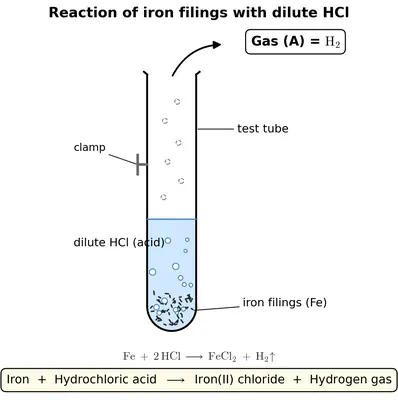
Analyse Fig. 8.24 (iron filings placed in dilute hydrochloric acid in a test tube, producing a gas labelled Gas (A)). Identify Gas A. Also, write the word equation of the chemical reaction.
Fig. 8.24
Fig. 8.24

Solution

Iron is a fairly reactive metal. When iron filings are dropped into dilute hydrochloric acid ($$\mathrm{HCl}$$), effervescence (bubbling) is seen — a colourless gas is produced. This gas is hydrogen ($$\mathrm{H_2}$$).

How do we know it is hydrogen? If we bring a burning matchstick or splint near the mouth of the test tube, the gas burns instantly with a characteristic "pop" sound. This pop-test is the standard identification test for hydrogen gas. Hydrogen is also the lightest of all gases and is colourless and odourless.

What happens chemically? The iron metal displaces hydrogen from the acid; the iron takes the place of hydrogen in $$\mathrm{HCl}$$ and forms iron(II) chloride ($$\mathrm{FeCl_2}$$), a soluble salt that stays in the solution and gives it a pale green colour.

Word equation:

$$\mathrm{Iron + Hydrochloric\ acid \longrightarrow Iron\ chloride + Hydrogen}$$

Using symbols and balancing the atoms:

$$\mathrm{Fe + 2\,HCl \longrightarrow FeCl_2 + H_2 \uparrow}$$

The upward arrow ($$\uparrow$$) shows that hydrogen leaves the test tube as a gas. So Gas (A) = Hydrogen ($$\mathrm{H_2}$$).

Answer

Gas (A) is hydrogen ($$\mathrm{H_2}$$). It is colourless, odourless and burns with a "pop" sound.
Word equation: $$\mathrm{Iron + Hydrochloric\ acid \rightarrow Iron\ chloride + Hydrogen}$$, i.e. $$\mathrm{Fe + 2HCl \rightarrow FeCl_2 + H_2 \uparrow}$$.

11 Write the names of any two compounds made only from non-metals, and also mention two uses of each of them.

Solution

Non-metals include hydrogen, oxygen, nitrogen, carbon, sulfur, chlorine, etc. When only such non-metals combine chemically, the compound formed contains no metal at all. Two familiar examples are water and carbon dioxide.

1. Water — $$\mathrm{H_2O}$$. Formed by chemical combination of the non-metals hydrogen and oxygen: $$\mathrm{2\,H_2 + O_2 \rightarrow 2\,H_2O}$$.

  • Used for drinking, cooking, bathing, washing and cleaning — it is essential for life.
  • Used as a solvent in laboratories, industries, medicines and in the human body, and as a coolant in power plants and car radiators.

2. Carbon dioxide — $$\mathrm{CO_2}$$. Formed by combining the non-metals carbon and oxygen, e.g. $$\mathrm{C + O_2 \rightarrow CO_2}$$.

  • Used by green plants for photosynthesis to make food (glucose): $$\mathrm{6\,CO_2 + 6\,H_2O \xrightarrow{\text{sunlight}} C_6H_{12}O_6 + 6\,O_2}$$.
  • Used in fire extinguishers (it is heavier than air and does not support burning) and to make fizzy drinks and soda water.

Other acceptable examples of non-metal–only compounds include ammonia ($$\mathrm{NH_3}$$ — used as a fertiliser and cleaner), hydrogen chloride ($$\mathrm{HCl}$$ — used in the manufacture of PVC and to clean metals), sulfur dioxide ($$\mathrm{SO_2}$$ — used as a preservative and in making sulfuric acid), and methane ($$\mathrm{CH_4}$$ — used as cooking gas and fuel).

Answer

Two compounds made only from non-metals: Water ($$\mathrm{H_2O}$$) — used for drinking/cooking/washing and as a solvent/coolant in industry. Carbon dioxide ($$\mathrm{CO_2}$$) — used by plants in photosynthesis to make food, and in fire extinguishers and fizzy drinks.

12 How can gold be classified as both a mineral and a metal?

Solution

The words mineral and metal describe two different aspects of a substance — the first about how it occurs in nature, the second about what kind of element it is. So a substance can genuinely belong to both categories.

Gold as a metal. Chemically, gold (symbol $$\mathrm{Au}$$) is an element made of only gold atoms. Like other metals it is:

  • lustrous — has a bright shining yellow surface;
  • malleable — can be beaten into extremely thin sheets (gold leaf);
  • ductile — can be drawn into thin wires used in jewellery and electronics;
  • a good conductor of electricity and heat;
  • dense and heavy.

Because it shows all the characteristic properties of a metal, gold is classified as a metal.

Gold as a mineral. A mineral is a naturally occurring solid substance, with a definite chemical composition, that is found in the Earth's crust. Gold occurs naturally, mostly in the free (native) state as tiny grains, flakes and nuggets embedded in quartz rocks and river sands. It has a fixed chemical composition (essentially pure $$\mathrm{Au}$$ atoms). It is dug out of the Earth, just like other minerals such as iron ore, copper ore or diamond. Because it satisfies all the requirements of a mineral, gold is also classified as a mineral.

Why both labels fit at once. "Metal" refers to gold's chemical/physical nature (an element with metallic properties), while "mineral" refers to its mode of natural occurrence (a naturally occurring solid with a fixed composition, mined from the Earth). Since these two viewpoints do not conflict, gold rightly belongs to both categories — it is a metallic mineral, or equivalently, a naturally occurring metal.

Answer

Gold ($$\mathrm{Au}$$) is a chemical element with typical metallic properties — it is shining, malleable, ductile, and a good conductor of heat and electricity — so it is a metal. At the same time it occurs naturally in the Earth's crust as free grains and nuggets with a fixed chemical composition, so it is also a mineral. The two labels describe different aspects (chemical nature vs. mode of occurrence) and are not in conflict.
NCERT Solutions for Class 8
Maths
NCERT Solutions for Class 8 Maths
Chapter-wise step-by-step
solutions with explanations
explore solutions Maths bg
Science
NCERT Solutions for Class 8 Science
Chapter-wise step-by-step
solutions with explanations
explore solutions Science bg

50,000+ JEE Students Trusted Our Score Calculator

Predict your JEE Main percentile, rank & performance in seconds