Intext Questions
1 Why is it possible to pile up stones or sand, but not a liquid like water?
Solution
Stones and sand are solids. Their constituent particles are held together by very strong interparticle forces of attraction and are locked into fixed positions. Because of these strong forces, a stone (or a grain of sand) keeps its own shape and does not flow. When we stack one stone on top of another, each piece keeps its shape, so the pile stands up.
Water, on the other hand, is a liquid. The interparticle forces between water particles are much weaker than in solids, so the particles are free to slide past one another. Water therefore has no fixed shape of its own — it flows and takes the shape of whatever container holds it. If we try to "pile up" water, the particles at the top immediately slip down over the ones below, and the water spreads out into a flat layer.
So the difference in the strength of interparticle attractions is the reason we can pile stones or sand but not water.
Answer
2 Why does water take the shape of folded hands but lose that shape when released?
Solution
Water is a liquid. The interparticle forces between water particles are strong enough to keep the particles close together (so water has a fixed volume), but they are much weaker than the forces in a solid. As a result, water particles can slide freely past one another and the liquid has no shape of its own — it always takes the shape of whatever holds it.
When you cup water in your folded hands, the hands act like a container. The water particles flow into the hollow of the cupped palms and take the shape of that hollow, so the water looks like it has the shape of the folded hands.
The moment you open your hands, this container is removed. Gravity pulls the water down and the freely moving particles slip past one another and spread out over your palms and the ground. The water therefore loses the shape of the folded hands as soon as it is released, because a liquid can only "borrow" the shape of a container — it cannot hold a shape on its own.
Answer
3 We cannot see air, so how does it add weight to an inflated balloon?
Solution
Air is matter — it is a mixture of gases such as nitrogen, oxygen, carbon dioxide and water vapour. Like every other kind of matter, it is made up of extremely tiny constituent particles, and every one of those particles has some mass.
The reason we cannot see air is not that it is weightless; it is because its particles are far apart and far too small for our eyes to detect. Individually, one air particle weighs almost nothing, but a balloon is filled with a very large number of them. When we add up the masses of all those particles, the total mass — and hence the weight — is small but not zero.
This is why an inflated balloon weighs slightly more than the same balloon when it is empty: the extra weight is the combined weight of the huge number of gas particles that we have packed inside. A sensitive balance can easily measure this difference.
Answer
4 Is the air we breathe today the same that existed thousands of years ago?
Solution
Air is made up of extremely small constituent particles (mainly the molecules of nitrogen, oxygen, carbon dioxide, water vapour and a few other gases). These particles are not created or destroyed in the ordinary processes that happen on the Earth — they are only recycled.
When we breathe, we take in oxygen particles and release carbon dioxide. Plants use those carbon dioxide particles during photosynthesis and give back oxygen. Water evaporates into the air and comes down again as rain. In this way, the same particles keep moving from one place to another — through living things, oceans, soil and the atmosphere — over and over again.
Because this recycling has been going on for millions of years, the air we breathe today contains many of the same particles that were present in the atmosphere thousands of years ago. The gas mixture is the same kind of air; only its exact composition has changed a little because of natural events and, more recently, human activities such as burning of fuels.
Answer
5
Activity 7.1: After breaking a stick of chalk into smaller pieces and grinding it into a fine powder using a mortar and pestle, observe the fine powder of chalk with a magnifying glass. What do you observe?
Solution
What looks like a smooth, continuous white powder to the naked eye is actually not smooth at all. Through a magnifying glass we can see that the powder is made up of a very large number of tiny, separate specks (grains) of chalk, each with its own irregular shape and size.
Some observations we can make:
- The powder is not a single continuous substance — it is a collection of countless small pieces.
- Each little grain is still white and still looks like a piece of chalk. Grinding has only made the pieces smaller; it has not turned the chalk into a new substance.
- The bigger, easily visible grains lie next to still smaller specks. This suggests that each speck can, in principle, be broken further into even smaller specks that we cannot see even with the magnifying glass.
This activity gives us the first hint that matter (like chalk) is not continuous — it is made up of a very large number of small constituent particles.
Answer
6 Is every speck of this fine chalk powder still composed of the same substance, or has it changed into something else on breaking or grinding?
Solution
Breaking a stick of chalk with our hands, or grinding it into a fine powder using a mortar and pestle, is a physical change — no new substance is produced.
What actually happens is this: the tiny constituent particles that make up the chalk are held together by strong forces of attraction. When we break or grind the chalk, we apply enough mechanical force to pull large groups of these particles apart from one another. The groups get smaller and smaller (that is why the pieces get finer), but the particles themselves are not changed. So each speck of powder — no matter how tiny — is still made of exactly the same constituent particles as the original stick of chalk.
That is why the powder tastes, looks and feels like chalk, and if we mixed all the specks back together with a little water we would still get chalk. So every speck of the fine powder is composed of the same substance; it has not changed into something else.
Answer
7 Are the units of chalk obtained in this manner considered the smallest units of chalk?
Solution
No. The specks that we obtain by breaking a chalk stick and grinding it in a mortar are small, but they are not the smallest possible units of chalk.
Even the finest speck that we can see under a magnifying glass is still made up of a huge number of smaller particles clumped together. If we could keep grinding this speck with even finer tools, we would keep getting smaller and smaller pieces. Ordinary hand-grinding simply cannot go beyond a certain size.
If we imagine this process continuing again and again, eventually we would reach a stage where the pieces cannot be broken down any further. These extremely tiny units, which cannot be seen even through an ordinary microscope, are the true constituent particles of chalk. It is these — not the visible specks in the powder — that are the smallest units that a piece of chalk is really made up of.
Answer
8 Recall the dissolution of sugar into water to form a solution. What happens to sugar when it is dissolved in water?
Solution
A grain of sugar is not a single object — it is made up of a very large number of extremely small constituent particles of sugar, held tightly together by strong interparticle forces of attraction.
When the sugar is put into water and stirred, the water particles slip in between the sugar particles and pull them apart. In this way, the sugar particles get separated from each other and mix with the water particles. They fit into the tiny empty spaces (interparticle spaces) between the water particles and spread evenly throughout the liquid.
So when sugar dissolves:
- The sugar itself is not destroyed — no new substance is formed.
- Each grain of sugar breaks up into its constituent particles, which are far too small to be seen even with a microscope.
- These tiny particles occupy the spaces between the water particles and get uniformly distributed, producing a clear, sweet-tasting solution.
We cannot see the sugar particles any more, but we can taste them — proving that they are still present, just spread out among the water particles.
Answer
9
Activity 7.2: Fill a glass tumbler with drinking water. Put two teaspoons of sugar into it. Do not stir the water. Taste a small spoonful of water from the top layer. Does the water taste sweet?
Solution
No — the water taken from the top layer does not taste sweet (at most it may taste only very faintly sweet).
When we drop sugar into water without stirring, the sugar grains are heavier than water and settle down at the bottom of the tumbler. The dissolving process does begin on its own — a few sugar particles slowly move into the water around the grains — but this happens very gradually. In the short time before we taste, hardly any sugar particles reach the top layer of water.
Because there are practically no sugar particles in the top layer yet, the water there tastes almost the same as plain drinking water, i.e. not sweet. This shows that we need to help the sugar particles spread throughout the water; stirring is one way to do this quickly.
Answer
10 Now, stir the water until the sugar dissolves completely and again taste a spoonful of water from the top layer. What difference in taste do you notice? Does it taste sweet?
Solution
After the sugar has been fully dissolved by stirring, the spoonful of water taken from the top layer does taste sweet — clearly sweeter than the same water tasted before stirring.
The reason is that stirring speeds up the dissolving process. It breaks up the sugar grains, pushes water particles between the sugar particles, and mixes the whole liquid so that the sugar particles are carried from the bottom all the way to the top. They occupy the interparticle spaces between the water particles and spread out uniformly through the entire tumbler.
So now, whether we taste the water from the top, the middle or the bottom, it tastes equally sweet. The change in taste (from not-sweet earlier to clearly sweet now) shows that the sugar particles have travelled up to the top layer and become evenly distributed throughout the water.
Answer
11 Since the top layer of water tastes sweet after dissolving sugar, it must be present in the solution. Do you observe any sugar particles in the solution?
Solution
No — even though the solution is clearly sweet, we cannot see any sugar particles in it. The liquid looks completely clear and transparent, just like plain water.
The reason is that a grain of sugar we can see with our eyes is actually made up of millions and millions of extremely tiny constituent particles of sugar. During dissolution, each grain breaks up into these tiny particles, which are far too small to be seen even under an ordinary microscope. These particles then slip into the interparticle spaces between the water particles and get spread out all over the tumbler.
So the sugar is very much there — that is why the water tastes sweet — but it now exists as extremely tiny, evenly distributed particles that our eyes simply cannot detect. Our tongue is more sensitive to their presence than our eyes are.
Answer
12 But, where did the sugar go?
Solution
The sugar has not disappeared, and it has not been destroyed either. It is still very much present in the tumbler — that is why the water tastes sweet — but it is now hidden from our eyes because its particles have become extremely tiny and spread out.
Here is what happens step by step:
- Each visible grain of sugar is made up of a huge number of very tiny constituent particles held together by strong forces.
- The water particles are also constantly moving, and there are small empty gaps (interparticle spaces) between them.
- During dissolution, the water particles pull the sugar particles apart from each other. The tiny sugar particles then slip into the interparticle spaces between the water particles.
- Stirring helps these sugar particles reach every part of the tumbler, so they get spread uniformly throughout the water.
Since the sugar particles are now individually very small and are scattered evenly among the water particles, we cannot see them — but they are all still there, just tucked away in the spaces between the water particles.
Answer
13 Chalk and sugar can both be broken down into their constituent particles. But how are the constituent particles held together to form the solid pieces we see?
Solution
The constituent particles of any substance are held together by attractive forces that act between them. These forces are called interparticle forces of attraction.
Some important points about these forces:
- They are always attractive: every particle pulls the particles around it towards itself.
- Their strength depends on the nature of the substance. Different substances have different interparticle attractions, which is why some solids (like iron) are extremely hard to break while others (like chalk) break easily.
- Their strength also depends on the distance between the particles. Even a small increase in interparticle distance decreases the force very sharply.
In a piece of chalk or a grain of sugar, the particles are packed very close together, so these attractive forces are strong. That is why the particles stay locked in fixed positions and the chalk or sugar behaves like a rigid solid with a definite shape and size. To break the solid, we have to apply enough force to overcome these attractions and separate large groups of particles from one another.
It is the strength of these interparticle attractions that finally decides whether a substance behaves as a solid, a liquid or a gas.
Answer
14
Activity 7.3: Collect a few solid objects, such as a piece of iron or an iron nail, a piece of rock salt, a stone, a piece of wood, a key, and a piece of aluminium. Observe their shapes and sizes. Try hammering them. In which of the above six objects do you think particles are strongly held together?
Solution
All six objects — the iron nail, rock salt, stone, wooden block, key and aluminium piece — are solids. Each of them has a definite shape and a definite size that does not change on its own. This tells us that in every one of them, the constituent particles are held together by strong interparticle forces of attraction.
However, when we hammer them, they do not behave in the same way, which shows that these forces are not equally strong in all of them:
| Object | Effect of hammering | Strength of interparticle attractions |
|---|---|---|
| Iron nail | Does not break; may bend a little or get slightly flattened. | Very strong |
| Key (metal) | Does not break; only a slight change in shape at best. | Very strong |
| Piece of aluminium | Does not break; flattens easily into a thin sheet. | Strong |
| Stone | Breaks into a few pieces with hard blows. | Fairly strong |
| Piece of wood | Splits or gets dented. | Moderately strong |
| Rock salt | Breaks easily into small crystals/powder. | Weakest of the six |
So the particles are held together most strongly in the iron nail and the key (both are metallic pieces), and the piece of aluminium is close behind. Rock salt has the weakest interparticle attractions among these six objects, which is why it crumbles most easily on hammering.
Answer
15 In the solid state, is there any way to move these particles apart?
Solution
Yes. In a solid, the particles are held in fixed positions by strong interparticle forces of attraction, but they are not completely still — they are constantly vibrating about their fixed positions. To move them apart, we have to give them enough energy to overcome these attractive forces.
The simplest way to do this is by heating the solid:
- When we supply heat, the constituent particles get extra energy and start vibrating more and more vigorously.
- At a certain temperature (called the melting point), the vibrations become so strong that the particles are able to break out of their fixed positions.
- The interparticle attractions get weakened, the interparticle spacing increases a little, and the particles begin to slide past one another. The solid then turns into a liquid.
- If we go on heating, the particles gain still more energy, move far apart from one another and eventually escape as a gas.
So by supplying heat (energy), we can definitely move the particles of a solid apart — first partly, when the solid melts into a liquid, and completely, when the liquid vaporises into a gas.
Answer
16 Solids have a definite volume; what about liquids and gases?
Solution
Volume is the amount of space that a substance occupies. Whether a state of matter has a fixed volume depends on how tightly its particles are held together.
Liquids — a liquid has a definite volume but no definite shape. The interparticle forces in a liquid are weaker than in a solid, so the particles can slide past one another. But these forces are still strong enough to keep the particles close together, so the total space occupied by the liquid does not change. If we pour $$200 \text{ mL}$$ of water into a bottle, a jug and a glass one after another, the shape of the water changes each time but the volume stays $$200 \text{ mL}$$.
Gases — a gas has neither a definite volume nor a definite shape. The interparticle forces in a gas are almost negligible, and the particles are free to move in all directions with large empty spaces between them. As a result, a gas spreads out and fills every corner of any container it is put into. If we move the same gas from a small container to a bigger one, its volume changes to match that container.
So to sum up:
| State | Shape | Volume |
|---|---|---|
| Solid | Fixed | Fixed |
| Liquid | Not fixed (takes shape of the container) | Fixed |
| Gas | Not fixed | Not fixed (fills the whole container) |
Answer
17
Activity 7.4: After transferring 200 mL of water between three containers of different shapes and observing the shape and level of the water, take some water in a shallow vessel and try to move your finger through it. Are you able to move your finger through the water?
Solution
Yes, we can easily move a finger through the water in the vessel — nothing has to be broken or torn. As we move the finger through the water, it feels slightly resistant (the water gently pushes back), but it does not stop us.
What this tells us:
- Unlike in a solid, the interparticle forces in a liquid are not strong enough to hold the particles in fixed positions. So water particles can slide past one another and move out of the finger's way.
- At the same time, the forces are still strong enough to keep the particles close together — that is why water has a fixed volume, and why the moment we remove the finger, the water flows back and closes the gap. The water returns to its original state as if nothing had happened.
- Trying to do the same thing with a solid (say, a piece of wood or stone) is not possible without breaking it, because the interparticle forces there are much stronger.
Together with the first part of Activity 7.4 (pouring $$200 \text{ mL}$$ of water from container A to B to C, where the shape changed but the volume stayed the same), this shows that the particles in a liquid can move freely but only within a limited space. So liquids have a fixed volume but no fixed shape.
Answer
18 Do gases also have a fixed volume?
Solution
No — gases do not have a fixed volume.
In a gas, the interparticle forces of attraction are almost negligible. The particles are far apart from one another, they move rapidly in all directions and there are large empty spaces between them. Because nothing is holding them together, the particles spread out until they hit the walls of the container.
As a result:
- A gas always fills up the entire container it is placed in, no matter how large or small the container is.
- If we transfer a fixed amount of gas from a small vessel into a big one, its particles spread apart and it takes up the bigger volume. If we push the same gas into a smaller vessel, its particles come closer and its volume decreases.
- This is quite different from a liquid, where $$200 \text{ mL}$$ of water stays $$200 \text{ mL}$$ in every container.
We can see this in Activity 7.5, in which smoke collected in one gas jar spreads out and completely fills a second, empty jar placed on top of it — showing that gases have neither a fixed volume nor a fixed shape.
Answer
19
Activity 7.6: Take a syringe without a needle. Pull the plunger of the syringe outwards in a fully extended position. Place your thumb over the open end of the syringe to prevent the air present inside the syringe from escaping. Push the plunger slowly and steadily inward. What do you observe?
Solution
Observations from the activity:
- Even though the open end of the syringe is completely closed by the thumb (so no air can escape), the plunger still moves inward when we press it. This means that the air trapped inside is getting squeezed into a smaller volume — its volume has decreased.
- As the plunger goes further in, it becomes harder and harder to push. We can feel the air pushing back against the plunger.
- When we suddenly release the plunger, it springs back outwards on its own, showing that the compressed air was under higher pressure than before.
- If we repeat the same experiment with water instead of air (a syringe filled with water and closed with the thumb), the plunger hardly moves at all — water is practically incompressible.
These observations show that air (a gas) can be compressed quite a lot, while water (a liquid) cannot.
Answer
20 What can we say about the behaviour of gas in the syringe?
Solution
The behaviour of the gas trapped inside the syringe tells us several things about how gas particles are arranged:
- Gases are highly compressible. Because the plunger goes inward, the same amount of gas is now occupying a smaller volume. This is only possible if there are large empty spaces (interparticle spaces) between the gas particles, into which the particles can be pushed closer together.
- Interparticle attractions are very weak in gases. The gas particles were spread over the full length of the syringe on their own; nothing was pulling them close together. This shows that the forces between gas particles are negligible.
- Gases exert pressure. The gas particles inside the syringe are constantly moving in all directions and hit the walls of the syringe (including the plunger). That is why we feel the gas pushing back as we compress it, and why the plunger springs back if we release it.
- Contrast with liquids. If the syringe were filled with water instead of air, the plunger would barely move — liquid particles are already very close together, so a liquid cannot be compressed noticeably.
So the behaviour of gas in the syringe shows that a gas is made of particles that are far apart, move freely, and have very weak forces between them — which is why they can be compressed and also why they always spread out to fill their container.
Answer
21
Activity 7.7: Take a glass vessel, fill it about half with water, and mark the level of water A. Add two teaspoons of sugar into it and mark the new water level on the glass vessel B. Predict whether the water level will increase or decrease with respect to the mark B when the sugar is stirred with a glass rod to dissolve.
Solution
Prediction: the water level should decrease below the mark B after the sugar dissolves.
Reasoning:
- Mark A is the original level of water.
- When we add two teaspoons of sugar, the sugar grains sit at the bottom of the vessel and push the water above them slightly higher. The new (higher) level is mark B. So B is at the level (volume of water) + (bulk volume of undissolved sugar).
- On stirring, each grain of sugar breaks up into extremely tiny constituent particles, and the water particles pull these apart from each other. These tiny sugar particles then slip into the small empty interparticle spaces that already exist between the water particles.
- Because the sugar particles are hiding inside the water's own interparticle spaces, they no longer add their full bulk to the total volume of the mixture. So the volume of the solution is less than the volume of water plus the volume of sugar we started with.
Therefore, after complete dissolution, the water level (mark C) should come down and lie somewhere below mark B (but still above mark A, since sugar has some volume of its own).
Answer
22 What difference do you observe in the water levels?
Solution
Three water levels have been marked on the glass vessel:
- Mark A — the level of the plain water we started with.
- Mark B — the level right after adding two teaspoons of undissolved sugar. It is higher than A because the sugar grains have taken up some space in the vessel and pushed the water up.
- Mark C — the level after the sugar has been completely dissolved by stirring.
What we observe is: C is lower than B (but still slightly higher than A). In other words, after the sugar dissolves, the level of the liquid comes down from B towards A, though it does not go all the way back to A.
The reason is that when sugar dissolves, its extremely tiny constituent particles slip into the small empty spaces (interparticle spaces) between the water particles, instead of sitting on top of them. Because the sugar particles are largely hidden inside these spaces, the total volume of the solution is less than the sum of the volumes of water and sugar taken separately. This is why the level falls from B to C. The small increase over A tells us that the interparticle spaces of water are not big enough to hide all the sugar, so a little extra volume still shows up.
Answer
23 Repeat Activity 7.7 with some other soluble solids, such as common salt or glucose, and insoluble solids, like sand and stone pieces. What do you observe in each case? Do the sand particles dissolve? Does the volume of water in the vessel change after mixing, and why?
Solution
The experiment is repeated with four substances added, one at a time, to a fixed volume of water.
| Substance added | Does it dissolve? | What happens to the water level after stirring? |
|---|---|---|
| Common salt | Yes, dissolves completely; the water becomes salty. | The level rises a little when the salt is added; on stirring it comes down again (below mark B, but above the original level A). |
| Glucose | Yes, dissolves completely; the water becomes sweet. | Same behaviour as with sugar — level rises on adding, and comes down (below B, slightly above A) on stirring. |
| Sand | No — the sand grains sink and settle at the bottom. Even after stirring, the water becomes cloudy for a while and then the sand settles again. | The water level rises when sand is added and stays higher — it does not come down. |
| Stone pieces | No — the stones simply sit at the bottom. | The water level rises and stays at the higher mark. |
Do the sand particles dissolve? No. The particles inside a sand grain are held together by very strong interparticle forces of attraction, and these are much stronger than the pull that the water particles can exert on them. So water particles are unable to pull sand particles apart, and the sand stays as it is.
Does the volume of water in the vessel change after mixing?
- With soluble solids (salt, glucose) — the total volume of the solution is less than the volume of water + volume of solid, because the tiny dissolved particles slip into the interparticle spaces between the water particles.
- With insoluble solids (sand, stones) — the solid does not break up, so it cannot fit into the interparticle spaces. Its full bulk simply pushes the water level higher, and the total volume becomes about equal to the volume of water + volume of solid.
Answer
24 Sugar and sand are both solids. Why does sugar dissolve in water but sand does not?
Solution
Whether a solid dissolves in water depends on how strongly its constituent particles are held together, compared to how strongly the water particles can pull them apart.
Case of sugar: The interparticle forces holding sugar particles together in a sugar grain, though strong enough to make sugar a solid, are still not too strong. When sugar is dropped into water and stirred, the constantly moving water particles are able to overcome these forces. They pull the sugar particles out of the grain, one after the other, and pack them into the small interparticle spaces between the water particles. In this way the sugar grain is broken up into individual particles that are uniformly spread through the water — i.e., sugar dissolves.
Case of sand: The interparticle forces in sand are much stronger. The particles of sand are held together so tightly that the moving water particles are simply not able to pull them apart. Because water particles cannot separate the sand particles from each other, the sand grains stay whole and settle at the bottom of the vessel; only their surface gets wet. That is why sand does not dissolve in water.
So even though sugar and sand are both solids, the strength of the interparticle attraction is very different in the two, and this is what makes sugar water-soluble and sand water-insoluble.
Answer
25 What do you think about the interparticle spacing in solids?
Solution
In solids, the constituent particles are held together by very strong interparticle forces of attraction. These forces pull the particles as close to each other as possible, so the particles are packed together in an orderly, tight arrangement. This means that the interparticle spacing in solids is the smallest of the three states of matter.
A few important points about this interparticle spacing:
- Although the particles are packed very closely, there is still a small empty space between them — solid particles are not glued together with no gap at all.
- These tiny gaps between the particles do not contain air; they contain nothing (vacuum). This is why solids look dense and continuous even under a magnifying glass.
- Because the particles are so close and the forces are so strong, the particles cannot move from one place to another — they can only vibrate about fixed positions. That is why solids have a definite shape and a definite volume.
- Since interparticle spaces are already very small, solids are extremely difficult to compress — even if we squeeze them very hard, there is barely any room for the particles to move closer.
In liquids the spacing is a little more than in solids, and in gases it is the maximum.
Answer
26
Activity 7.8: Take a glass tumbler containing water and put a few grains of potassium permanganate into it. What do you observe?
Solution
Observations from the activity:
- As soon as the grains of potassium permanganate ($$\mathrm{KMnO_4}$$) touch the water, thin pink (purple) streaks begin to spread out into the water from around each grain, even without any stirring.
- With time, more and more colour keeps coming out and slowly moves through the entire tumbler.
- After some more time, the whole water in the tumbler turns a uniform pink/purple colour. The grains at the bottom get smaller and smaller and finally disappear.
What this tells us:
- Potassium permanganate is dissolving in the water — the coloured particles from the grain are being pulled apart by water particles.
- Both the water particles and the dissolved $$\mathrm{KMnO_4}$$ particles are in constant motion. The water particles hit the grain, knock coloured particles off it, and then carry them all through the tumbler until they are uniformly spread.
- This spreading of one substance into another on its own — because of the constant movement of particles — is called diffusion.
This activity gives a visible proof that the constituent particles of liquids are continuously moving, even though we cannot see the particles themselves.
Answer
27
Think like a scientist — Try it yourself!
- Take three clean glass tumblers.
- Pour hot water in one of them, water at room temperature in the second and ice-cold water in the third.
- Drop a small grain of potassium permanganate into each of them.
Watch carefully and compare. What do you observe? Try to depict it by drawing a diagram.
Solution
Observations:
- Hot water tumbler — the pink colour of $$\mathrm{KMnO_4}$$ spreads out very fast. Within a short time, the whole tumbler turns a deep uniform pink.
- Room-temperature tumbler — the colour also spreads, but noticeably slower than in hot water. It takes a longer time before the water becomes uniformly pink.
- Ice-cold water tumbler — the colour spreads the slowest. Even after a fairly long time, only the water near the grain is coloured while the top of the tumbler still looks clear.
Why this happens: The speed with which the constituent particles of a liquid move depends on their energy, and this energy increases with temperature.
- In hot water, the water particles have the highest energy and move the fastest. So they pull off potassium permanganate particles quickly and carry them all through the tumbler in a short time.
- In water at room temperature, the particles move more slowly, so the spreading is slower.
- In ice-cold water, the water particles move very slowly, so it takes a long time for the coloured particles to reach every corner of the tumbler.
Conclusion: Heating a substance increases the movement (kinetic energy) of its constituent particles; therefore, the rate of diffusion increases with an increase in temperature.
Suggested diagram (to draw): Three tumblers side by side, labelled Hot water, Room-temperature water and Ice-cold water, each with a small $$\mathrm{KMnO_4}$$ grain at the bottom. Show the hot-water tumbler almost fully coloured pink; the room-temperature one half coloured with clearly visible streaks; and the ice-cold one with only a thin pink cloud near the grain and the rest still colourless.
Answer
28 How can we demonstrate the movement of gas particles that cannot be seen with the naked eye?
Solution
Gas particles are far too tiny to be seen, but we can prove that they are constantly moving by observing something that we can sense — usually a smell, a colour or a visible smoke — and watching how quickly it reaches us across a room. Here are three simple demonstrations:
- Incense stick / camphor / perfume in a room (Activity 7.9): Light an incense stick in one corner of a closed room. Within a short time, the fragrance is noticed at the opposite corner too. Nothing but the gas particles of the fragrance could have carried the smell across the room; the fact that they arrive at a distant point shows they are moving continuously in all directions.
- Smoke in a gas jar (Activity 7.5): Collect smoke from a burning incense stick in one gas jar, cover it with a glass plate, and place an empty gas jar upside-down on top. On slipping out the plate, the smoke is seen to travel upwards and fill the empty jar too. This visible movement of the smoke shows that the invisible gas particles are also moving.
- Iodine or bromine vapours in a closed jar: A small piece of solid iodine kept in a closed gas jar slowly turns into a violet-coloured vapour. Over time, the colour spreads uniformly through the whole jar without any stirring, proving that the gas particles move on their own to occupy all the available space.
All three demonstrations show diffusion of gases: gases spread out into any space available to them because their particles are in continuous, random motion.
Answer
29
Activity 7.9: Light an incense stick in one corner of the room. Wait for a few minutes and observe. Do you notice the fragrance from a distance?
Solution
Yes — even though the incense stick is burning in only one corner of the room, in a short while the fragrance is clearly noticed at other corners and even at the far end of the room.
Here is what is happening:
- When the incense stick burns, its fragrant substance changes into extremely tiny gas particles that mix with the air near the stick.
- The particles of air are already in continuous, random motion in all directions. They keep hitting these fragrance particles and push them a little further at every collision.
- Because of these countless collisions, the fragrance particles gradually spread out from the corner where the stick is burning to every part of the room. This is called diffusion of gases.
- The interparticle spaces in a gas are very large and the interparticle forces are almost negligible, so nothing holds the fragrance particles back — they can travel long distances easily.
So the very fact that we can smell the incense stick sitting far from it is a proof that gas particles (of both the fragrance and the surrounding air) are constantly moving.
Answer
30 Can you share a few other real-life situations where you have experienced the movement of gas particles?
Solution
The movement (diffusion) of gas particles is something we experience many times every day. A few common examples:
- Smell of cooking: When food is being cooked in the kitchen, the aroma soon reaches every room of the house. The fragrant gas particles from the food diffuse through the air.
- Perfume, deodorant or room freshener: Even a single spray in one corner of a room fills the whole room with fragrance within a few minutes.
- Smell of a burning agarbatti, dhoop or camphor during pooja — the fragrance reaches all corners of the room.
- LPG (cooking-gas) leak: A small leak near the stove can be smelt from a fair distance away in the house. This is because the strong-smelling gas (ethyl mercaptan) added to LPG diffuses rapidly through the air. It warns us before the concentration becomes dangerous.
- Smell of freshly cut fruits, flowers or wet earth after rain travels through the air by diffusion.
- Smoke from a chulha, chimney or vehicle exhaust spreads out to nearby areas — the smoke particles are being carried in all directions by moving air particles.
- Smell of an open bottle of nail polish or petrol quickly fills a room even without stirring.
- Room-heaters and coolers quickly change the temperature of the whole room, because the heated or cooled air particles diffuse away from the appliance.
- Naphthalene balls / mothballs in cupboards give out a smell that spreads through all the clothes — the solid slowly gives off gas particles that diffuse.
- Breathing: The oxygen we inhale diffuses from our lungs into the blood, and carbon dioxide diffuses out of the blood into the lungs to be exhaled.
In every one of these situations, we experience gas particles moving from one place to another on their own — which is exactly the property of gases.
Answer
Keep the curiosity alive
1
Choose the correct option.
The primary difference between solids and liquids is that the constituent particles are:
- closely packed in solids, while they are stationary in liquids.
- far apart in solids and have fixed position in liquids.
- always moving in solids and have fixed position in liquids.
- closely packed in solids and move past each other in liquids.
Solution
We check each option against what we know about the arrangement and movement of particles in the two states.
- (i) Closely packed in solids, while stationary in liquids — Incorrect. The first part is right (solid particles are closely packed), but liquid particles are not stationary. They keep moving and sliding past one another.
- (ii) Far apart in solids and have fixed position in liquids — Incorrect on both counts. Solid particles are close together, not far apart. Liquid particles do not have fixed positions.
- (iii) Always moving in solids and have fixed position in liquids — Incorrect. This is the opposite of the truth. In solids the particles only vibrate about fixed positions; in liquids they move around.
- (iv) Closely packed in solids and move past each other in liquids — Correct. In a solid, particles are tightly packed and locked in fixed positions by strong interparticle forces. In a liquid, the forces are weaker, so the particles stay close but are free to slide past one another. This is exactly the primary difference between the two states.
Therefore, the correct option is (iv).
Answer
2 Which of the following statements are true? Correct the false statements.
(i) Melting ice into water is an example of the transformation of a solid into a liquid.
Solution
Ice is the solid state of water. When ice is heated, its particles get more energy and vibrate more strongly. At $$0^{\circ}\mathrm{C}$$ (the melting point of ice), the vibrations become strong enough to break the fixed positions of the particles. The interparticle attractions get weakened, the particles begin to slide past one another, and the ice changes into liquid water. So melting of ice is indeed a change of state from solid to liquid.
The statement is TRUE.
Answer
(ii) Melting process involves a decrease in interparticle attractions during the transformation.
Solution
In a solid, the particles are locked in fixed positions by very strong interparticle forces of attraction and the interparticle spacing is minimum. During melting, heat is supplied to the solid; this energy is used to overcome (loosen) these strong attractions. As the particles move slightly apart from one another, the interparticle distance increases and the strength of the attractive forces decreases, allowing the particles to slide past each other and behave as a liquid.
So melting is accompanied by a definite decrease in the strength of the interparticle attractions. The statement is TRUE.
Answer
(iii) Solids have a fixed shape and a fixed volume.
Solution
In a solid, the constituent particles are held together by very strong interparticle forces of attraction. They are packed closely and can only vibrate about fixed positions — they cannot move from one place to another. This is exactly why a solid has both a definite shape and a definite volume; it does not need a container to hold its shape and its size does not change on its own. For example, a piece of chalk stays chalk-shaped and occupies the same volume whether we keep it on the table, in a box or in our hand.
The statement is therefore TRUE.
Answer
(iv) The interparticle interactions in solids are very strong, and the interparticle spaces are very small.
Solution
Among the three states of matter, the interparticle attractions are strongest in solids and weakest in gases. These strong attractions in a solid pull its particles as close together as possible, so the interparticle spacing in a solid is the smallest. This is exactly why solids are practically incompressible and have a definite shape and volume.
Both parts of the statement are correct, so it is TRUE.
Answer
(v) When we heat camphor in one corner of a room, the fragrance reaches all corners of the room.
Solution
Camphor is a solid at room temperature. On heating, it turns directly into a fragrant gas (this is called sublimation). The gas particles of camphor are extremely small, are far apart and move very rapidly. The moving air particles of the room keep hitting these camphor particles and push them in all directions. So the camphor particles diffuse through the whole room, and we can smell the fragrance even at corners far away from the burning camphor.
This is exactly the kind of everyday example used in the chapter to show diffusion of gases. The statement is TRUE.
Answer
(vi) On heating, we are adding energy to the camphor, and the energy is released as a smell.
Solution
This statement is FALSE. "Smell" is not a form of energy — it is a sensation produced when tiny particles of a substance reach the sensory cells in our nose. Energy cannot travel out from a substance as smell.
Corrected statement: On heating, we are adding energy to the camphor. This energy is used to overcome the interparticle forces of attraction between the camphor particles, so the solid camphor changes into a gas (sublimes). The fragrant gas particles then move rapidly and diffuse through the room. When these particles reach our nose, we experience the fragrance as "smell". So it is the moving particles of camphor that carry the fragrance, not the energy we supplied.
Answer
3
Choose the correct answer with justification. If we could remove all the constituent particles from a chair, what would happen?
- Nothing will change.
- The chair will weigh less due to lost particles.
- Nothing of the chair will remain.
Solution
We learnt in this chapter that matter is made up of extremely tiny constituent particles. A chair (whether it is made of wood, plastic or metal) is nothing but a huge number of these constituent particles held together by strong interparticle forces of attraction. There is no other "stuff" hidden inside the chair — its wood, colour, weight, shape, hardness all come from the arrangement and nature of these particles.
Now let us check the three options:
- (i) Nothing will change. This cannot be true. The whole chair is made of these particles; removing all of them cannot leave the chair unchanged.
- (ii) The chair will weigh less due to lost particles. This is also incorrect. "Weighing less" would mean that some of the chair is still left. But if we take away all the particles, there is no material left at all — so it is not that the chair is a little lighter, it is that no chair remains.
- (iii) Nothing of the chair will remain. This is correct. Since the chair is nothing but a collection of its constituent particles, removing every last particle leaves nothing behind. There would be no wood, no shape, no weight — the chair simply would not exist any more.
Justification: All matter is composed only of its constituent particles; if every particle is removed, no matter is left. Therefore the correct option is (iii) Nothing of the chair will remain.
Answer
4 Why do gases mix easily, while solids do not?
Solution
Whether two substances can mix on their own depends on how freely their particles can move and how much empty space is available between them.
In gases:
- The interparticle forces of attraction are almost negligible.
- The interparticle spaces are very large.
- The particles move rapidly in all directions, colliding with the walls and with each other.
When two gases are brought together, the particles of one gas easily slip into the huge empty spaces between the particles of the other, and their rapid random motion carries them all over the container. Within a very short time, the two gases become uniformly mixed on their own. This spontaneous mixing is called diffusion and it is why the smell of an incense stick, perfume or LPG spreads through a whole room so quickly.
In solids:
- The interparticle forces of attraction are very strong.
- The interparticle spaces are extremely small.
- The particles cannot move from one place to another; they only vibrate about their fixed positions.
Because the particles are locked in fixed positions and are packed as tightly as possible, the particles of one solid have no way to enter the tiny gaps in another solid and no way to travel through it. So two solid pieces kept together only touch each other at their surfaces — they do not mix on their own. If we press an iron block against a wooden block for years, we still get an iron block and a wooden block.
Hence, gases mix easily because their particles are far apart, move fast and have negligible attractions, whereas the particles of solids cannot move at all and are held in fixed positions by strong attractions.
Answer
5 When spilled on the table, milk in a glass tumbler, flows and spreads out, but the glass tumbler stays in the same shape. Justify this statement.
Solution
Milk and glass are in two different states of matter, and their particles are held together differently.
Behaviour of milk (a liquid):
- The interparticle forces of attraction between milk particles are much weaker than in a solid.
- These forces are strong enough to keep the particles close together, so milk has a fixed volume, but they are too weak to hold the particles in fixed positions.
- So the particles are able to slide past one another freely — the milk has no shape of its own and takes the shape of whatever holds it.
- The moment the tumbler tips over, there is no container to hold the milk in shape. Under gravity, the milk particles simply slide over the table surface and the liquid spreads out into a thin layer.
Behaviour of the glass tumbler (a solid):
- Glass is a solid; its particles are packed closely and held in fixed positions by very strong interparticle forces of attraction.
- These particles cannot move from one place to another — they can only vibrate about their fixed positions.
- So the glass has a definite shape and a definite size, and this shape is not affected by small disturbances like tipping over.
- The tumbler therefore remains in the same shape even after the milk has flowed out.
So the behaviour observed is a direct consequence of the difference in the strength of interparticle attractions in solids and in liquids.
Answer
6 Represent diagrammatically the changes in the arrangement of particles as ice melts and transforms into water vapour.
Solution
As heat is supplied, the same water particles are found in three different states — ice (solid), water (liquid) and water vapour (gas). Their arrangement, spacing and movement change as follows.
Description of the diagram (three side-by-side boxes labelled Ice, Water and Water vapour):
| State | Arrangement of particles (what to draw) | Interparticle spacing | Motion of particles |
|---|---|---|---|
| Ice (solid) | Draw a rectangular box completely filled with small circles arranged in neat rows and columns, touching one another (like a grid). | Minimum (particles almost touching) | Only small vibrations about fixed positions — show tiny arrows around each circle. |
| Water (liquid) | Draw the same box, now with the circles still close to one another but arranged irregularly (not in neat rows). The container is filled up to a level. | A little more than in ice | Particles slide past one another — show short curved arrows between neighbours. |
| Water vapour (gas) | Draw a much larger box with only a few scattered circles, far apart from one another, distributed randomly all over the box. | Very large (maximum) | Particles move rapidly in all directions — show long arrows in different directions from each circle. |
Changes as we go from ice to water to water vapour:
- The regular arrangement of ice becomes disordered on melting; the strong attractive forces in ice weaken and the particles start sliding past each other, forming liquid water.
- On further heating, the particles gain enough energy to overcome the interparticle attractions altogether and escape into the gaseous state.
- The interparticle spacing increases and the freedom of movement increases in the order: ice < water < water vapour.
Between the three boxes, draw two arrows marked "heat/melting" (ice → water) and "heat/boiling" (water → water vapour) to show the direction of change.
Answer
7 Draw a picture representing particles present in the following:
(i) Aluminium foil
Solution
Aluminium foil is a piece of the metal aluminium hammered/rolled into a thin sheet. It is a solid.
What to draw: Draw a small square or rectangle representing a tiny portion of the foil. Fill the whole rectangle with small circles of equal size representing the aluminium particles. Arrange the circles in neat, regular rows and columns, so that each circle is touching (or almost touching) its neighbours. Show tiny back-and-forth arrows around each circle to indicate that these particles can only vibrate about their fixed positions and cannot move around.
Reasoning:
- Aluminium being a solid, its constituent particles are held together by very strong interparticle forces.
- These forces pull the particles as close as possible, so the interparticle spacing is minimum and the arrangement is orderly.
- The particles are locked in fixed positions and can only vibrate; that is why a piece of aluminium (and hence the foil) keeps a definite shape and volume.
Answer
(ii) Glycerin
Solution
Glycerin (glycerol) is a thick, colourless liquid used in soaps, medicines and cosmetics. So its particles must be arranged like the particles of any other liquid.
What to draw: Draw the outline of a container (say a beaker) filled up to a level to show glycerin. Inside the liquid region, draw a large number of small circles of equal size. Keep the circles close to one another (only slightly farther apart than in aluminium foil), but arrange them irregularly, without any neat rows or columns. Add short curved arrows between neighbouring circles to indicate that these particles can slide past each other.
Reasoning:
- The interparticle attractions in glycerin are weaker than in a solid, so its particles are not held in fixed positions.
- They are still close enough to keep glycerin at a fixed volume, but they can slide past one another — that is why glycerin flows and takes the shape of its container.
- The interparticle spacing is a little more than in solids and there is no orderly pattern.
Answer
(iii) Methane gas
Solution
Methane ($$\mathrm{CH_4}$$) is the main component of the biogas / natural gas used as a fuel. It is a gas at room temperature.
What to draw: Draw the outline of a closed container (say a rectangular box or a gas jar). Scatter only a few circles inside this container, keeping them far apart from one another and placed randomly. From each circle, draw long arrows in different directions to show that the particles are moving rapidly all over the container.
Reasoning:
- The interparticle attractions in a gas are almost negligible, so nothing pulls the particles close.
- Therefore the interparticle spacing in methane is very large (maximum among the three states).
- The particles move freely and rapidly in all directions, colliding with each other and with the walls of the container. That is why methane (like any gas) fills up the entire container and has neither a fixed shape nor a fixed volume.
Answer
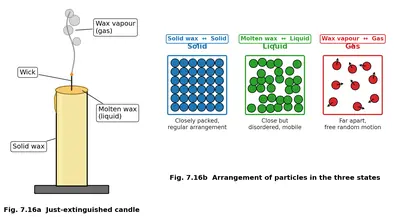
8

Solution
Around a burning candle, the same substance (wax) is present in three different states at the same time, because different parts of the wax are at different temperatures. Just after the candle is put out, we can identify all three of them in Fig. 7.16a:
- Solid wax — the outer body of the candle (the pale, hard cylinder that we hold). This wax is still cool. Its particles are packed closely in an orderly way, held tightly by strong interparticle attractions, and can only vibrate about fixed positions. This should be matched with the picture in Fig. 7.16b showing circles arranged in neat, regular rows and columns, packed very close together (the solid arrangement).
- Liquid wax — the pool of molten wax that has collected near the wick / at the top of the candle. Near the flame the wax has been heated above its melting point and turned into a liquid. Its particles are still close to each other but are not in fixed positions; they can slide past one another. This part should be matched with the picture in Fig. 7.16b showing circles that are still close together but arranged irregularly (the liquid arrangement).
- Gaseous wax (wax vapour) — the thin white smoke / vapour that we see rising from the wick just after the candle is blown out. Near the very hot wick, the wax first melts and then vaporises; when the flame goes out this hot vapour is briefly visible as smoke. Its particles are very far apart and are moving rapidly and randomly. This part should be matched with the picture in Fig. 7.16b showing only a few circles scattered far apart in a box (the gaseous arrangement).
Matching:
| Part of the candle in Fig. 7.16a | State of wax | Particle picture in Fig. 7.16b |
|---|---|---|
| Body of the candle (below the melting region) | Solid | Closely packed circles arranged in regular rows and columns |
| Molten pool of wax around the wick | Liquid | Circles close to each other but arranged irregularly |
| Wax vapour / smoke rising from the wick | Gas | A few circles scattered far apart, with lots of empty space |
This nicely shows that all three states of matter can exist for the same substance (wax) at the same time, and that the difference between the three states is simply the arrangement, spacing and motion of its constituent particles.
Answer
9 Why does the water in the ocean taste salty, even though the salt is not visible? Explain.
Solution
Ocean water is a solution of common salt (mainly sodium chloride, $$\mathrm{NaCl}$$) and several other salts dissolved in a very large amount of water.
Here is why we can taste the salt but not see it:
- A visible grain of salt is not a single object — it is made up of an enormous number of extremely tiny constituent particles held together by strong interparticle forces of attraction.
- When salt gets into water (for example, when rivers wash minerals down into the seas over millions of years), the water particles surround the salt grains and pull their particles apart, breaking each grain into its individual constituent particles.
- These tiny salt particles then slip into the small empty interparticle spaces between the water particles and get uniformly distributed throughout the ocean water.
- Because these particles are extremely small and are hidden inside the interparticle spaces of water, they cannot be seen even under an ordinary microscope. That is why the ocean water looks clear.
- But when a drop of this water reaches our tongue, the taste buds are sensitive enough to detect these salt particles. So we taste the water as salty.
So the salt is definitely present in the ocean; it is just not visible because it has broken up into extremely small particles that are spread evenly among the water particles. This is exactly what we observed on a small scale when we dissolved sugar in a glass of water in Activity 7.2.
Answer
10 Grains of rice and rice flour take the shape of the container when placed in different jars. Are they solids or liquids? Explain.
Solution
Both rice grains and rice flour are solids, not liquids — even though a collection of them appears to "flow" and take the shape of the jar we put them in.
The key idea is that the property of "having a fixed shape" or "taking the shape of the container" applies to a single piece of matter, not to a heap of many pieces. Let us look at each case carefully.
Rice grains:
- Take out a single grain of rice and look at it. It has a definite shape (long and oval) and a definite size that does not change when we put it in different jars.
- Its constituent particles are held together by strong interparticle forces of attraction; they are locked in fixed positions and can only vibrate.
- So each rice grain is a small solid piece.
- A heap of many such grains only appears to change shape because the grains slide over one another and rearrange themselves to fit the jar — the shape of the individual grain never changes.
Rice flour:
- Rice flour is nothing but rice broken into an extremely large number of very tiny grains (specks) by grinding — just like the chalk powder in Activity 7.1.
- Each tiny speck is still a solid piece of rice with a fixed shape and volume, only smaller.
- When we pour the flour into a jar, the very small size of the specks makes them slide over one another very easily, so the flour as a whole takes the shape of the jar. But every speck is still solid.
A true liquid (like water or milk) takes the shape of the container because its particles themselves slide past one another. In rice and rice flour, it is the individual grains that rearrange, not the particles inside a grain. Also, a liquid poured onto a flat surface spreads into a thin, level layer; a heap of rice grains or rice flour poured on a plate stays as a heap. This further confirms that they are solids.
Answer
11
Discover, design, and debate: Fix a balloon over the neck of a bottle and put the bottle in hot water. Explore what will happen?
Solution
Set-up. Take an empty plastic (or glass) bottle. Fit the mouth of a balloon tightly over the neck of the bottle so that the balloon lies flat and closes the bottle completely. Take a beaker or a large pot filled with fairly hot water (be careful — this needs adult supervision). Now dip the bottle in the hot water, keeping the balloon on top and above the water level.
Observation. Almost immediately, the balloon slowly starts standing up. Within a short time it puffs up on its own and gets partially inflated, even though nobody has blown air into it.
Explanation. Inside the bottle there is trapped air, which is a gas.
- When the bottle is placed in hot water, the walls of the bottle become hot and heat is transferred to the air inside.
- The gas particles gain more energy and start moving faster and in a wider range of directions. They hit the balloon and the walls of the bottle more often and with more force.
- As a result, the air tries to occupy a larger space. Since the bottle is rigid, the only place it can expand into is the balloon, so the balloon inflates.
- The air particles do not disappear or get created — the same number of particles simply spread over a larger volume because their motion has increased.
Reverse experiment. If we now take the bottle out of the hot water and put it in cold water (or leave it to cool), we see that the balloon deflates and comes back to its original flat shape. On cooling, the gas particles slow down, move less vigorously and occupy less space, so the balloon collapses again.
Conclusion. The experiment demonstrates that gases expand on heating and contract on cooling, because heating increases (and cooling decreases) the movement of the gas particles. This is exactly why hot-air balloons rise, and why we should never keep sealed aerosol cans (deodorants, room sprays) near a flame or in strong sunlight.
Answer
12
Discover, design, and debate: Debate in the class — 'Gases can spread and fill all the available space'. Is this property of gases beneficial or harmful?
Solution
Because the interparticle spaces in a gas are very large and the interparticle attractions are almost negligible, gas particles move rapidly in all directions and always spread out to fill up whatever container is available. This single property has many beneficial as well as many harmful effects. So the honest answer is: it is both — depending on how it is used.
Ways in which this property is beneficial:
- Breathing: Air (a mixture of gases) spreads through our whole respiratory system, so oxygen reaches every alveolus of our lungs and from there diffuses into every cell of the body. Without this spreading, life would not be possible.
- Cooking with LPG or PNG: When we open the valve, cooking gas spreads uniformly around the burner and mixes with air to give a steady flame — cooking becomes convenient.
- Detecting gas leaks: A small amount of a strong-smelling substance (ethyl mercaptan) is added to LPG. Because gases spread, even a tiny leak is quickly noticed anywhere in the kitchen, and we can turn off the cylinder in time to avoid an accident.
- Fragrances and room fresheners spread quickly through the whole room, making it pleasant.
- Ventilation and air-conditioning: Fresh air, cool air from an AC or warm air from a heater fills the entire room quickly because gas particles spread.
- Medical use: Anaesthetic gases, oxygen from a cylinder or nebulised medicines spread through the lungs and act on the patient.
- Balloons and airbags get filled uniformly because the gas takes the shape of the container.
- Photosynthesis: Carbon dioxide diffuses through the air and reaches the leaves of plants all over the world.
Ways in which this property is harmful:
- LPG or CNG leaks: Cooking gas is highly flammable. Because it spreads through the whole room, even a small spark can then cause a large explosion or fire.
- Toxic gas leaks: Poisonous gases such as chlorine, ammonia or methyl-isocyanate (as in the Bhopal gas tragedy) spread very quickly and can affect people over a very wide area.
- Air pollution: Harmful gases from vehicles, factories, burning of fuels and firecrackers (like $$\mathrm{SO_2}$$, $$\mathrm{NO_2}$$, $$\mathrm{CO}$$) spread through the atmosphere, causing breathing problems, acid rain and long-term climate change.
- Spread of airborne diseases: Tiny droplets released when a sick person coughs or sneezes are carried by gas particles and can infect people at a distance.
- Loss of unpleasant / valuable gases: Bad smells (from garbage, drains) also spread easily; and useful gases like the fragrance of a perfume soon get diluted and lost.
Conclusion for the debate: The tendency of a gas to spread and fill all the available space is neither purely good nor purely bad. It is essential for life (respiration, cooking, ventilation, gas-leak detection) but it is also the reason why gas leaks, toxic gases and air pollution can affect large areas so quickly. So it is important that we use gases carefully, handle cylinders and burners safely, control the release of polluting gases, and follow safety rules whenever we deal with them.
Answer