Probe and Ponder
1 Why does it feel harder to pedal a bicycle when going uphill than on flat ground?
Solution
While riding a bicycle, our muscular force (applied through the pedals) has to overcome the forces that oppose the motion of the bicycle.
On flat ground: The only opposing forces on the bicycle are the frictional force between the tyres and the road and the air resistance. The gravitational force of the Earth pulls the bicycle straight down; it does not oppose the forward motion, because the road pushes back up with an equal force. So we only need to apply enough force to overcome friction and air resistance.
While going uphill: In addition to friction and air resistance, we now have to work against a part of the gravitational pull of the Earth. When the road slopes upward, one component of gravity acts down along the slope, opposite to the direction in which we are moving. Because our muscles must overcome this extra downward-along-the-slope pull as well, a much larger push on the pedals is required. This is why pedalling uphill feels harder than pedalling on flat ground.
Answer
2 Why is it easier to slip on a wet surface?
Solution
When we walk, the sole of our shoe pushes backward against the ground. By friction, the ground pushes the shoe forward. This forward frictional force is what actually allows us to move without slipping.
Friction between two surfaces arises because the tiny bumps (irregularities) on both surfaces interlock with each other. The more strongly the two surfaces press into each other's irregularities, the greater the friction.
When a floor becomes wet, a thin film of water fills up the small bumps and hollows of both the shoe and the floor and keeps the two surfaces slightly apart. The bumps no longer interlock properly, so the frictional force between the shoe and the floor becomes much smaller than on a dry surface.
With very little friction available, the ground can no longer push our foot forward strongly enough to keep pace with the rest of our body. The foot slides forward while the upper body tends to continue moving, and we slip. This is why we slip much more easily on a wet surface than on a dry one.
Answer
3 Why do we feel 'light' or like we are 'floating' just after our swing reaches its highest point and begins to come down?
Solution
We normally feel our weight because the seat of the swing (or the ground, or a chair) pushes upward on us with a force equal to the gravitational pull of the Earth acting on our body. This upward push from the seat is what our body senses as the feeling of "weight".
At the highest point of a swing, our motion changes direction — we stop going up and start coming down. Just after this point, the swing (and we with it) begins to accelerate downward because of the Earth's gravitational pull. Since the seat and our body are both falling downward together, the seat presses against us with much less force than usual.
Because this upward push from the seat has become very small, our body feels almost weightless — as if we are "floating". The gravitational force of the Earth is still acting on us as strongly as before (our mass has not changed); it is only the pressing force of the seat that has decreased. This is the same reason astronauts and objects appear weightless when they are freely falling in a spacecraft.
Answer
Keep the curiosity alive
1
| Column A (Type of force) | Column B (Example) |
|---|---|
| (i) Muscular force | (a) A cricket ball stopping on its own just before touching the boundary line |
| (ii) Magnetic force | (b) A child lifting a school bag |
| (iii) Frictional force | (c) A fruit falling from a tree |
| (iv) Gravitational force | (d) Balloon rubbed on woollen cloth attracting hair strands |
| (v) Electrostatic force | (e) A compass needle pointing North |
Solution
We match each force with an example that is caused by that force:
- (i) Muscular force → (b) A child lifting a school bag. The child uses the force of the muscles of the arm to lift the bag against gravity, so this is an example of muscular force.
- (ii) Magnetic force → (e) A compass needle pointing North. The compass needle is a small magnet. The Earth itself behaves like a huge magnet, and the magnetic force between the Earth and the needle turns the needle so that one end always points towards the North.
- (iii) Frictional force → (a) A cricket ball stopping on its own just before touching the boundary line. No player is touching the ball, yet its speed decreases and it stops. The force that opposes its motion is the friction between the ball and the ground (along with a little air resistance).
- (iv) Gravitational force → (c) A fruit falling from a tree. A ripe fruit falls straight down towards the Earth because the Earth pulls it downward. This pull is the gravitational force.
- (v) Electrostatic force → (d) Balloon rubbed on woollen cloth attracting hair strands. Rubbing the balloon with wool gives the balloon an electric charge. The charged balloon attracts uncharged hair strands by the electrostatic force.
Answer
| Column A | Column B |
|---|---|
| (i) Muscular force | (b) A child lifting a school bag |
| (ii) Magnetic force | (e) A compass needle pointing North |
| (iii) Frictional force | (a) A cricket ball stopping on its own just before touching the boundary line |
| (iv) Gravitational force | (c) A fruit falling from a tree |
| (v) Electrostatic force | (d) Balloon rubbed on woollen cloth attracting hair strands |
2 State whether the following statements are True or False.
(i) A force is always required to change the speed of motion of an object.
Solution
One of the important effects of a force is that it can change the speed of an object. If a moving object is speeding up, slowing down, or stopping, some force must be acting on it — for example, the push of our foot on a pedal (speed increases), the friction between a rolling ball and the ground (speed decreases), or the brake applied to a moving cycle (speed decreases until it stops).
Similarly, a stationary object begins to move only when a force acts on it. So its speed cannot change from zero to some value without a force either.
Therefore any change in the speed of motion of an object — increase, decrease, or bringing it to rest — always requires a force. The statement is True.
Answer
(ii) Due to friction, the speed of the ball rolling on a flat ground increases.
Solution
Friction is the force that acts between two surfaces which are in contact and are moving, or trying to move, over each other. It always acts in a direction opposite to the direction in which the object is moving (or trying to move).
When a ball rolls on a flat ground, the direction of motion of the ball is horizontal. The frictional force between the ball and the ground therefore acts backwards — opposite to the ball's motion. A force acting opposite to the motion cannot make the ball go faster; instead, it slows the ball down and eventually brings it to rest.
So the speed of the rolling ball decreases due to friction, it does not increase. The statement is False.
Answer
(iii) There is no force between two charged objects placed at a small distance apart.
Solution
Electrostatic force is a non-contact force. This means that two charged objects need not touch each other for a force to act between them; the force acts through the empty space (or air) that separates them.
Two charged objects placed close to each other will attract each other (if they carry unlike charges) or repel each other (if they carry like charges). For example, when a balloon rubbed with a woollen cloth is brought near small pieces of paper without touching them, the balloon still pulls the paper pieces towards itself — showing clearly that a force acts between them even at a small distance.
Therefore it is not true that there is no force between two charged objects placed a small distance apart. The statement is False.
Answer
3 Two balloons rubbed with a woollen cloth are brought near each other. What would happen and why?
Solution
When a balloon is rubbed with a woollen cloth, some electric charge is transferred between the balloon and the cloth. As a result, the balloon becomes electrically charged. If both balloons are rubbed with the same kind of cloth (wool), they will pick up the same kind of charge on themselves — that is, both balloons will now carry like charges.
A charged body exerts an electrostatic force on another charged body without touching it. The rule for this force is:
- Two objects carrying like (same) charges repel each other.
- Two objects carrying unlike (opposite) charges attract each other.
Since both balloons carry the same kind of charge, when they are brought close to each other they will push each other away. If we hang them from threads, we can actually see the threads slanting outward — the balloons stay apart instead of hanging straight down.
Thus, the two rubbed balloons will repel each other, because of the electrostatic force of repulsion between like charges.
Answer
4 When you drop a coin in a glass of water, it sinks, but when you place a bigger wooden block in water, it floats. Explain.
Solution
When any object is placed in water, two forces act on it:
- The gravitational force of the Earth, which pulls the object downwards. This is nothing but the weight of the object.
- The upthrust or buoyant force of the water, which pushes the object upwards. By Archimedes' Principle, the size of this upward push is equal to the weight of the water that the object pushes aside (displaces).
Whether the object floats or sinks depends on which of these two forces is larger:
- If the weight of the object is greater than the maximum buoyant force the water can supply, the object sinks.
- If the weight of the object is equal to or less than the buoyant force, the object floats.
The coin: A coin is made of metal, which is much denser than water. Although the coin is small, the amount of water it can push aside is also very small, so the buoyant force on it is small. This buoyant force is much less than the weight of the coin. The downward pull wins, and the coin sinks to the bottom.
The wooden block: Wood is less dense than water. Even though the block is bigger and heavier than the coin, it is able to push aside a large volume of water while still keeping part of itself above the surface. The weight of the water displaced (the buoyant force) becomes equal to the weight of the block, so the two forces balance and the block floats.
So it is not the size of the object but the balance between its weight and the buoyant force acting on it that decides whether it sinks or floats.
Answer
5 If a ball is thrown upwards, it slows down, stops momentarily, and then falls back to the ground. Name the forces acting on the ball and specify their directions.
(i) During its upward motion
Solution
Once the ball has left the hand, no one is touching it. Yet, two natural forces continue to act on it while it moves upwards:
- Gravitational force of the Earth — the Earth constantly pulls the ball towards its centre. The direction of this force is vertically downwards. Because the ball is moving upwards while this force acts downwards, the gravitational force acts opposite to the ball's motion and continuously reduces its speed.
- Force of air resistance (friction due to air) — as the ball pushes its way up through the air, the air rubs against the ball and opposes its motion. During upward motion the ball is going up, so air resistance acts vertically downwards — again opposite to the direction of motion. This also slows the ball down.
Both forces are directed downwards, and both work together to make the ball's upward speed keep decreasing.
Answer
(ii) During its downward motion
Solution
After momentarily stopping at the highest point, the ball starts falling back towards the ground. The forces acting on it are:
- Gravitational force of the Earth — the Earth still pulls the ball towards its centre. Its direction is vertically downwards. Because the ball is now also moving downwards, gravity acts in the same direction as the ball's motion and makes the ball go faster and faster as it falls.
- Force of air resistance (friction due to air) — as the ball falls through the air, the air pushes back on it. Its direction is always opposite to the direction of motion. Since the ball is now moving downwards, air resistance now acts vertically upwards, opposing the fall and slightly reducing how much the speed increases.
So during the downward journey, gravity (downward) and air resistance (upward) act on the ball in opposite directions. Gravity is much stronger than the air resistance on an ordinary ball, so the ball still speeds up as it falls.
Answer
(iii) At its topmost position
Solution
At the topmost point of its journey, the ball has stopped for a moment before it begins to fall back — its speed is zero for that instant, but this does not mean that no force acts on it.
- The gravitational force of the Earth continues to act on the ball. As always, it is directed vertically downwards, pulling the ball back towards the Earth. In fact, it is this force that immediately makes the ball start moving downwards from the topmost point.
- At the highest point the ball is momentarily not moving. So there is essentially no motion for the air to oppose, and the force of air resistance is zero (or extremely small) at that instant.
Thus, at the topmost position, the only significant force acting on the ball is the gravitational force of the Earth, directed vertically downwards.
Answer
6

Solution
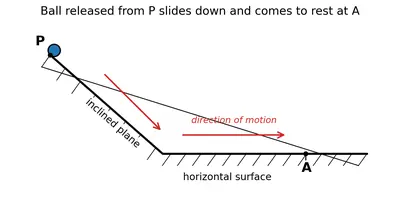
The ball is released from rest at P, gains speed as it rolls down the incline, and then rolls on the horizontal surface. It slows down and stops only because of the frictional force between the ball and the surface. The frictional force acts opposite to the ball's motion.
How soon (or how late) the ball stops depends mainly on how much friction acts on it: more friction → shorter distance, less friction → longer distance. The ball must be released from the same point P (so the starting height, and hence the initial speed on the horizontal part, is the same).
(i) To make the ball stop before point A — we need to increase the friction on the horizontal surface so that the ball loses speed more quickly.
- Spread a rough sheet — such as a sheet of sandpaper, a jute mat, a piece of cloth or a carpet — over the horizontal surface between the foot of the incline and point A.
- Alternatively, sprinkle sand, powder, or small pebbles on the horizontal part of the path.
Because friction is greater on a rough surface, the ball will be brought to rest before it reaches A.
(ii) To make the ball stop after crossing point A — we need to decrease the friction on the horizontal surface so that the ball loses speed more slowly and rolls further.
- Make the horizontal surface smoother — for example, cover it with a smooth polished sheet, a glass sheet, or a shiny plastic sheet.
- Alternatively, apply a lubricant such as oil, grease, soap water, or talcum powder on the horizontal part.
With less friction, the ball loses its speed more gradually and travels a longer distance, stopping at some point beyond A.
(In both cases the incline is left unchanged so that the ball still arrives at the foot of the incline with the same speed.)
Answer
7 Why do we sometimes slip on smooth surfaces like ice or polished floors? Explain.
Solution
Walking is possible because of friction between the sole of our foot (or shoe) and the ground. As we walk, our foot pushes the ground backwards. In return, by friction, the ground pushes the foot forwards. This forward frictional push is what actually moves us ahead without slipping.
Friction arises because every surface, even one that looks smooth, has tiny bumps and hollows on it. When two surfaces are in contact, the bumps of one surface interlock with the bumps of the other. The greater this interlocking, the greater the friction.
Polished floors and ice have very few and very small bumps on their surfaces — they are extremely smooth. There is almost no interlocking between the sole of our shoe and such a smooth surface, so the frictional force between them is very small.
Because friction is so small, when our foot pushes such a floor backwards, the floor is unable to push our foot forwards strongly enough. Our foot slides forward instead of gripping the surface, while the upper part of our body tends to keep moving. This mismatch causes us to lose balance — that is, we slip.
This is also why sportsmen wear shoes with grooved soles and why footpaths are made slightly rough — to increase friction and reduce the chance of slipping.
Answer
8 Is any force being applied to an object in a non-uniform motion?
Solution
Uniform motion means that the object covers equal distances in equal intervals of time; its speed does not change. Non-uniform motion means that the speed of the object is changing — the object is either speeding up, slowing down, or its direction of motion is changing.
One of the important effects of a force is that it can change the speed (and/or the direction of motion) of an object. Conversely, if the speed of an object is changing, some force must be acting on it. Without a force, an object either remains at rest or continues moving in a straight line with the same speed.
Since the speed of an object in non-uniform motion keeps changing, a net force must be acting on it. So the answer is Yes, a force is being applied to it.
Examples:
- A car speeds up when the driver presses the accelerator — the engine's force is acting on it.
- A cycle slows down when brakes are applied — the frictional force of the brake and the road is acting on it.
- A ball thrown up slows down as it rises — the gravitational force of the Earth is acting on it.
Answer
9 The weight of an object on the Moon becomes one-sixth of its weight on the Earth. What causes this change? Does the mass of the object also become one-sixth of its mass on the Earth?
Solution
We must first be careful about the difference between mass and weight.
- Mass of an object is the quantity of matter contained in it. It depends only on the object itself and does not change when the object is moved from one place to another. Its SI unit is the kilogram ($$\mathrm{kg}$$).
- Weight of an object is the force with which a celestial body (like the Earth or the Moon) attracts it towards itself. Its SI unit is the newton ($$\mathrm{N}$$). The weight depends on where the object is, because the strength of the gravitational pull is different at different places.
Why does the weight change? The gravitational pull that a body exerts depends on how much matter is in that body. The Moon has much less matter than the Earth (the Moon is a smaller, less massive body). Because of this, the Moon pulls objects towards itself much less strongly than the Earth does — the gravitational force of the Moon is roughly one-sixth of that of the Earth. So the same object gets pulled with one-sixth the force on the Moon, and hence its weight on the Moon is one-sixth of its weight on the Earth. We can write this as:
$$W_{\text{Moon}} = \dfrac{1}{6}\, W_{\text{Earth}}$$
Does the mass change? No. The amount of matter present in the object is exactly the same on the Moon as it was on the Earth — no matter has been added or taken away. The object contains the same number of atoms. Therefore its mass remains the same on the Moon as on the Earth:
$$m_{\text{Moon}} = m_{\text{Earth}}$$
Example: A boy of mass $$60\,\mathrm{kg}$$ has a weight of about $$60 \times 9.8 = 588\,\mathrm{N}$$ on the Earth. On the Moon, his mass is still $$60\,\mathrm{kg}$$, but his weight drops to about $$\dfrac{1}{6} \times 588 \approx 98\,\mathrm{N}$$.
So, the change in weight is caused by the smaller gravitational pull of the Moon compared to the Earth, but the mass of the object does not become one-sixth on the Moon — it stays the same.
Answer
10
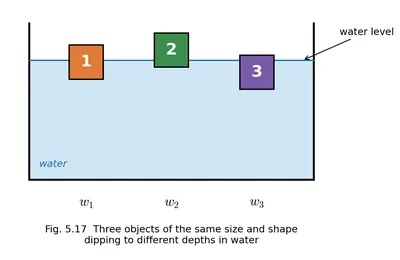
Three objects 1, 2, and 3 of the same size and shape but made of different materials are placed in the water. They dip to different depths as shown in Fig. 5.17. If the weights of the three objects 1, 2, and 3 are $$w_1$$, $$w_2$$, and $$w_3$$, respectively, then
- (i) $$w_1 = w_2 = w_3$$
- (ii) $$w_1 > w_2 > w_3$$
- (iii) $$w_2 > w_3 > w_1$$
- (iv) $$w_3 > w_1 > w_2$$

Solution
By Archimedes' Principle, when an object floats in water, the upward buoyant force on it equals the weight of the water that the object has pushed aside. When the object floats in equilibrium, this buoyant force must also equal the weight of the object itself:
$$w_{\text{object}} = \text{buoyant force} = \text{weight of water displaced}$$
The three objects have the same size and shape, so the same amount of an object dipped into water displaces the same volume of water. Therefore, an object that dips deeper into water pushes aside more water, and hence must be heavier. In short:
$$\text{Depth of dip} \uparrow \;\Longleftrightarrow\; \text{weight of the object} \uparrow$$
Looking at Fig. 5.17:
- Object 3 dips the most, so it displaces the most water and must be the heaviest. Hence $$w_3$$ is the largest.
- Object 2 dips the least, so it displaces the least water and must be the lightest. Hence $$w_2$$ is the smallest.
- Object 1 lies in between, so its weight is in between: $$w_3 > w_1 > w_2$$.
Comparing with the four choices, this matches option (iv).
Answer