Probe and ponder
1 Have you ever seen the Moon during the day? Why do you think it is sometimes visible when the Sun is up?
Solution
Yes, the Moon can often be seen during the day. It shines only because it reflects sunlight, so it is a bright object in the sky whenever it is above the horizon.
Whether we can see the Moon depends on two things — (i) is the Moon above the horizon at that time, and (ii) is enough of its bright side facing us? On a full Moon day the Moon is opposite the Sun, so it rises at sunset and is above the horizon only during the night. But on other days the Moon is not opposite the Sun. For example, near the first-quarter phase the Moon is roughly $$90^{\circ}$$ away from the Sun, so it rises around noon and is high overhead by sunset; near a waxing gibbous phase, it rises in the afternoon while the Sun is still up.
During such phases the Moon is above the horizon in daytime, and because sunlight is falling on the half of the Moon that faces us, its bright side is easily seen against the blue daytime sky.
Answer
2 Imagine you lived on the Moon instead of Earth. What would you mean by a day, a month or a year?
Solution
A unit of time is only useful if it matches a natural periodic event that we can actually observe. On Earth we use the spin of the Earth for a day, the phases of the Moon for a month and the Earth's orbit around the Sun for a year. On the Moon, the same three ideas exist, but the numbers become very different because the Moon itself has different motions.
Day. A day is the time between two successive sunrises. The Moon rotates about its own axis in the same time (about $$29.5$$ Earth-days) that it takes to go once around the Earth — that is why we always see the same face of the Moon. So on the Moon the Sun rises, stays up for about two Earth-weeks, sets, and does not rise again for another two Earth-weeks. A Moon-day is therefore about $$29.5$$ Earth-days long.
Month. On Earth we use the changing phases of the Moon to mark a month. From the surface of the Moon, the corresponding periodic sight would be the changing phases of the Earth — the Earth also goes through crescent, half, gibbous and full phases as viewed from the Moon, and one full cycle again takes about $$29.5$$ Earth-days. So a Moon-month is essentially the same length as a Moon-day.
Year. The Moon is a companion of the Earth and goes once around the Sun together with the Earth. So one Moon-year is the same as one Earth-year, about $$365.25$$ Earth-days, or roughly $$12$$ Moon-days.
Answer
3 What would happen if Earth had two moons instead of one? How would that change the night sky?
Solution
With two moons in orbit around the Earth, the sky and many natural cycles would look quite different.
- Brighter nights. Two moons reflect more sunlight than one, so, on many nights, the night sky would be noticeably brighter and it would be harder to see faint stars.
- More phases at once. The two moons would in general be at different points in their orbits, so each would show its own phase. On the same night you might see one moon as a full disc and the other as a thin crescent.
- Different rising and setting times. The two moons would rise and set at different times, so a moon could be seen at almost any hour of the night.
- More frequent eclipses. Solar eclipses (a moon coming between the Sun and the Earth) and lunar eclipses (a moon entering the Earth's shadow) would happen more often, since there are two moons that can line up with the Sun and the Earth.
- Stronger and more complicated tides. Ocean tides on Earth are mainly caused by the Moon's gravitational pull. With two moons pulling on the ocean water, the tides would be stronger at some times (when both moons pull together) and weaker at others (when they pull in different directions).
- Calendars would change. The lunar month and any lunar or luni-solar calendar based on a single moon's phase cycle would no longer be simple; time-keeping would need to combine the cycles of both moons.
Answer
4 If we didn't have clocks or calendars, how else could we measure time?
Solution
Human beings measured time long before clocks and printed calendars were invented. They did this by watching things in nature that repeat in a regular, predictable way. Some of these natural time-keepers are:
- The rising and setting of the Sun — this gives us the day, and lets us divide it into morning, noon, evening and night.
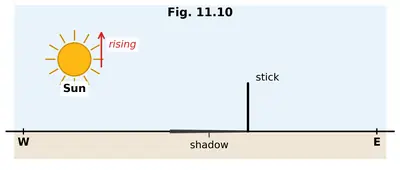
- The length and direction of a shadow — the shadow of a stick (a gnomon or sundial) is shortest at noon and points in different directions at different times of the day.
- The phases of the Moon — the full cycle from one full Moon to the next is about $$29.5$$ days, which gives a month.
- The changing seasons — spring, summer, monsoon, autumn and winter repeat once a year and can be used to define a year.
- The stars — the pattern of stars seen at night changes through the year; certain constellations rising at sunset mark particular seasons.
- Sunrise position on the horizon — it drifts northward from December to June (Uttarayan) and southward from June to December (Dakshinayan), marking the year.
- Water clocks, sand clocks (hour-glasses) and candle clocks — a fixed amount of water dripping, sand flowing, or a candle burning down measures short intervals of time.
- Living rhythms — flowers that open and close at fixed hours, birds that call at dawn, and even our own hunger and sleep cycles help us judge time roughly.
Answer
Intext Questions
5 Why does the illuminated portion of the Moon seen from the Earth decrease when it appears closer to the Sun?
Solution
The Moon itself does not give out light — one half of the Moon is always lit up by the Sun (the half that faces the Sun) and the other half is dark. What we see from the Earth is only that part of the Moon that is (a) facing us and (b) lit by the Sun.
When the Moon appears far from the Sun in the sky, we are looking at the Moon from a direction close to the Sun's direction. Almost the whole of the lit half then faces the Earth, so we see a large bright disc (near the full-Moon phase).
When the Moon appears close to the Sun in the sky, the Moon is on nearly the same side of the Earth as the Sun. The lit half of the Moon then points away from us, towards the Sun, and only a small sliver of the lit half is turned in our direction. So the illuminated portion we see shrinks to a thin crescent — and at new Moon, when the Moon is essentially in line with the Sun, none of the lit half faces us and the Moon appears dark.
Thus, as the angular separation between the Moon and the Sun in our sky decreases, the illuminated portion of the Moon visible from the Earth also decreases.
Answer
6 Why do most Indian festivals fall on different dates every year?
Solution
The dates we normally use — 1 January, 26 January, and so on — belong to the Gregorian calendar, which is a solar calendar. It has $$365$$ days in a year (with a leap day added every four years) and is tied to the cycle of seasons, i.e. to the Earth's revolution around the Sun.
Most Indian festivals, on the other hand, are fixed by lunar or luni-solar calendars. In such calendars a month is fixed by the cycle of the Moon's phases (about $$29.5$$ days), so:
- Diwali is on the new Moon of Kartika,
- Holi is on the full Moon of Phalguna,
- Buddha Purnima is on the full Moon of Vaisakha,
- Eid-ul-Fitr is at the end of the lunar month of Ramzan, and so on.
A lunar year of $$12$$ lunar months is only about $$354$$ days long, which is about $$11$$ days shorter than the solar year of $$365$$ days. So each year the same lunar date falls about $$11$$ days earlier in the Gregorian calendar. Luni-solar calendars correct for this drift by adding an extra intercalary month (Adhika Maasa) every $$2$$–$$3$$ years, which then jerks the festival back forward again in the Gregorian date.
Because of this mismatch between the Moon-based Indian calendars and the Sun-based Gregorian calendar, the Gregorian date of most Indian festivals shifts from year to year.
Answer
7 When I look at the night sky in early evening, I see some moving stars. What are they? Is their motion also periodic?
Solution
The tiny "stars" that appear to move across the night sky in the early evening are usually artificial satellites, not real stars. Real stars are extremely far away and stay essentially fixed in their constellations from night to night; they only appear to rise and set slowly along with the whole sky due to the Earth's rotation.
Artificial satellites orbit the Earth at heights of a few hundred kilometres, much closer than the stars, so their motion across the sky is easily noticeable — they look like a small, steady point of light gliding smoothly among the stars, without any twinkling or blinking. Most low-Earth-orbit satellites take roughly $$100$$ minutes to go once around the Earth. In the early evening they are lit up by sunlight coming from below the horizon, while the sky above us is already dark, which is why they become visible.
Yes, their motion is periodic — each satellite traces the same orbit around the Earth again and again in a fixed period, so it passes over the same regions of the Earth at regular intervals. That is why apps and websites can predict exactly when a particular satellite will pass over our head.
Answer
Keep the curiosity alive
1 State whether the following statements are True or False.
(i) We can only see that part of the Moon which reflects sunlight towards us.
Solution
The Moon does not emit light of its own; it shines only because it reflects sunlight. Out of the whole Moon, only the half that faces the Sun is lit, and, of this lit half, only the portion that also faces the Earth can send reflected sunlight into our eyes. The remaining portions either receive no sunlight or reflect sunlight in some other direction and cannot be seen from Earth.
Hence the statement is True.
Answer
(ii) The shadow of Earth blocks sunlight from reaching the Moon causing phases.
Solution
The phases of the Moon are not caused by Earth's shadow. They occur because, as the Moon revolves around the Earth, the fraction of the lit half of the Moon that faces us keeps changing — sometimes we see all of it (full Moon), sometimes none (new Moon), and sometimes a crescent or a gibbous portion in between.
The Earth's shadow does fall on the Moon on a full-Moon day only when the Sun, Earth and Moon are almost exactly in line — this rare event is a lunar eclipse, not the monthly cycle of phases.
Hence the statement is False.
Answer
(iii) Calendars are based on various astronomical cycles which repeat in a predictable manner.
Solution
Every calendar is built out of natural cycles that repeat with clock-like regularity. A day comes from the Earth's rotation on its axis, a month from the Moon's revolution around the Earth (its phase cycle of about $$29.5$$ days), and a year from the Earth's revolution around the Sun (about $$365.25$$ days, giving the cycle of seasons). Solar, lunar and luni-solar calendars combine these cycles in different ways.
Hence the statement is True.
Answer
(iv) The Moon can only be seen at night.
Solution
The Moon is a bright object because it reflects sunlight, and it can be spotted whenever it is above the horizon — this happens in the daytime as well as at night. Only around the full-Moon phase does the Moon rise at sunset and stay up all night. In every other phase (crescent, half, gibbous) the Moon is above the horizon for part of the daytime too, and can be seen against the daytime sky. (Recall Meera seeing the Moon during the daytime kite festival.)
Hence the statement is False.
Answer
2 Amol was born on 6th of May on a full Moon day. Does his birthday fall on the full Moon day every year? Explain your answer.
Solution
Amol's birthday of 6 May is a date in the Gregorian calendar, which is a solar calendar. Full Moons, on the other hand, are set by the cycle of the Moon's phases, which is a lunar event lasting about $$29.5$$ days.
A year of $$12$$ lunar months is about
\[12 \times 29.5 = 354 \text{ days},\]while a Gregorian year is about $$365$$ days (or $$366$$ in a leap year). So the same lunar phase repeats about
\[365 - 354 = 11 \text{ days earlier}\]in the Gregorian calendar each year. Therefore, if a full Moon fell on 6 May in one year, the next full Moon after that date will fall about $$11$$ days earlier — near 25 April of the next year — not on 6 May.
Because of this steady $$\approx 11$$-day drift each year, Amol's birthday (a fixed Gregorian date) will almost never coincide with a full Moon day again. It can coincide with a full Moon roughly once every $$19$$ years, when the Metonic cycle (about $$235$$ lunar months $$\approx 19$$ solar years) brings the two calendars back into step.
Answer
3

Solution
Figure 11.10 shows a fully dark disc of the Moon in the night sky, with a few bright stars sitting on the Moon's dark disc. Two things are wrong with this picture:
- A fully dark Moon (new Moon) cannot be seen in the night sky. When no part of the illuminated half of the Moon faces the Earth, it is the new-Moon day. On such a day the Moon is almost in the same direction as the Sun, so it rises with the Sun and sets with the Sun. It stays in the daytime sky, and its dark disc is lost in the glare of the Sun — we cannot see the Moon at all. So a dark Moon drawn against a starry night sky is incorrect.
- Stars are shown on top of the Moon's disc. The stars are extremely far behind the Moon; the solid body of the Moon blocks the light coming from any star that lies behind it. So no star can ever appear on (or inside) the Moon's disc — the disc itself should completely cover the stars behind it.
Answer
4

(i)
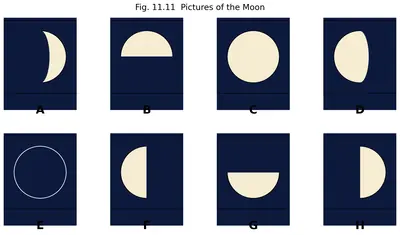
Write the correct panel number corresponding to the phases of the Moon shown in the pictures above.
| Picture label (e.g. A, B, C, etc.) | Phase of Moon |
|---|---|
| Three days after New Moon | |
| Full Moon | |
| Three days after Full Moon | |
| A week after Full Moon | |
| Day of New Moon |
Solution
Recall that one full cycle of the Moon's phases takes about $$29.5$$ days. So, starting from the new Moon:
- Day $$0$$ (new Moon): the disc is fully dark.
- Day $$3$$ (three days after new Moon): a thin waxing crescent — a small bright sliver on the right side.
- Day $$7$$–$$8$$ (a week after new Moon): a half Moon with the right half bright (waxing).
- Day $$15$$ (full Moon): the disc is fully bright.
- Day $$18$$ (three days after full Moon): a waning gibbous — mostly bright, a small dark portion on the right.
- Day $$22$$ (a week after full Moon): a half Moon with the left half bright (waning).
Matching these to the six pictures A – F in Fig. 11.11:
- A — a fully bright disc → Full Moon.
- B — a fully dark disc → Day of New Moon.
- C — a half-bright / half-dark disc with the left half bright → A week after Full Moon (waning half).
- D — mostly bright with a small dark bite on the right → Three days after Full Moon (waning gibbous).
- E — thin bright sliver on the right → Three days after New Moon (waxing crescent).
- F — mostly dark with only a thin bright edge / an orientation that never occurs from Earth (see part (ii)).
So the completed table is:
| Picture label | Phase of Moon |
|---|---|
| E | Three days after New Moon |
| A | Full Moon |
| D | Three days after Full Moon |
| C | A week after Full Moon |
| B | Day of New Moon |
Answer
| Picture label | Phase of Moon |
|---|---|
| E | Three days after New Moon |
| A | Full Moon |
| D | Three days after Full Moon |
| C | A week after Full Moon |
| B | Day of New Moon |
(ii) List the picture labels of the phases of the Moon that are never seen from Earth. Hint: You can use your observations from Activity 11.1 or Fig. 11.2 as reference.
Solution
From Fig. 11.2 (and the ball-and-lamp Activity 11.2), the illuminated portion of the Moon as we see it always has a very definite orientation, because the Sun always lights up the half of the Moon that faces the Sun.
- In the waxing half of the cycle (new Moon → full Moon) the bright side of the Moon is always on the right: we first see a thin waxing crescent with the right edge lit, then a right-half-bright waxing quarter, then a waxing gibbous with just a small dark bite on the left.
- In the waning half of the cycle (full Moon → new Moon) the bright side is always on the left: waning gibbous with a small dark bite on the right, then a left-half-bright waning quarter, then a thin waning crescent with the left edge lit.
Any picture that does not match this pattern shows an orientation that never occurs from Earth. In Fig. 11.11, panel F shows an orientation that does not match any real phase (for example, a thin crescent lit on the wrong side, or a waxing/waning combination that the Sun–Moon–Earth geometry cannot produce). So F is never seen from Earth.
Answer
5 Malini saw the Moon overhead in the sky at sunset.
(i) Draw the phase of the Moon that Malini saw.
Solution
The time (sunset) and the Moon's position in the sky (overhead) together fix its phase. At sunset the Sun is on the western horizon, so a Moon that is directly overhead is $$90^{\circ}$$ away from the Sun in the sky. In that geometry, exactly half of the Moon's illuminated portion faces the Earth — this is the first-quarter (half) Moon.
Because the Sun is setting in the west, the Moon overhead is lit by sunlight coming from the west. So the right half of the Moon's disc (from our point of view) is bright and the left half is dark.
How to draw it: Draw a circle. Divide it into two equal parts by a vertical straight line down the middle. Shade the left half completely dark. Leave the right half bright/unshaded. That is the first-quarter (waxing half) Moon that Malini saw.
Answer
(ii) Is the Moon in the waxing or the waning phase?
Solution
In part (i) we found that Malini saw a first-quarter (half) Moon with its right side lit. In the Moon's monthly cycle a right-half-lit Moon appears between the new Moon and the full Moon — the illuminated portion is growing from a thin crescent to a full disc.
The phase during which the illuminated portion is growing each day is called the waxing phase (called Shukla Paksha in India). So Malini's Moon is in the waxing phase.
(You can also see it from the sky-position rule: a waxing Moon is easiest to spot at sunset, whereas a waning Moon is easiest to spot at sunrise. Malini spotted her half Moon high overhead at sunset — that identifies it as a waxing Moon.)
Answer
6 Ravi said, "I saw a crescent Moon, and it was rising in the East, when the Sun was setting." Kaushalya said, "Once I saw the gibbous Moon during the afternoon in the East." Who out of the two is telling the truth?
Solution
Whether a claim about the Moon is possible depends on how far the Moon is from the Sun in the sky, which is fixed by the phase.
Checking Ravi's claim. A crescent Moon is a Moon that lies close to the Sun in the sky — it is almost in the direction of the Sun (only a thin sliver of its lit side is turned towards us). Since the Sun and the crescent Moon rise and set at nearly the same time, a crescent Moon must either be seen low in the west just after sunset, or low in the east just before sunrise. A Moon that rises in the east at the same moment that the Sun sets in the west is roughly $$180^{\circ}$$ away from the Sun in the sky — and that is the geometry of the full Moon, not a crescent. So Ravi's observation is impossible.
Checking Kaushalya's claim. A gibbous Moon is a Moon that is more than half illuminated and lies between roughly $$90^{\circ}$$ and $$180^{\circ}$$ from the Sun. A waxing gibbous Moon (a few days before full Moon) rises in the east in the afternoon, several hours before sunset. So on some afternoon, seeing a gibbous Moon rising in the eastern sky while the Sun is still up is entirely possible.
Therefore, Kaushalya's observation is consistent with how the Moon actually moves, while Ravi's is not.
Answer
7 Scientific studies show that the Moon is getting farther away from the Earth and slower in its revolution. Will luni-solar calendars need an intercalary month more often or less often?
Solution
A luni-solar calendar tries to keep its lunar months in step with the solar year. It uses lunar months of about $$29.5$$ days each, so $$12$$ lunar months add up to
\[12 \times 29.5 = 354 \text{ days},\]while a solar year is nearly $$365$$ days. Each year the lunar calendar therefore falls behind the solar year by about
\[365 - 354 = 11 \text{ days}.\]Every few years this shortfall grows to nearly one full lunar month, and an extra intercalary month (Adhika Maasa) is added to bring the two calendars back into step.
Now suppose the Moon moves farther from the Earth and revolves more slowly. Then one lunar month becomes longer than $$29.5$$ days. Twelve of these longer lunar months will add up to more than $$354$$ days — closer to the solar $$365$$ days. The yearly shortfall $$(365 - 12 \times \text{lunar month})$$ becomes smaller.
A smaller shortfall means the calendars drift apart more slowly, so it will take longer for the accumulated difference to reach one full month. In other words, an intercalary month will be needed less often.
Answer
8 A total of 37 full Moons happen during 3 years in a solar calendar. Show that at least two of the 37 full moons must happen during the same month of the solar calendar.
Solution
A solar calendar has $$12$$ months in a year. In $$3$$ years, the total number of months is
\[3 \times 12 = 36 \text{ months}.\]Now, every full Moon that happens during these $$3$$ years must fall in one of these $$36$$ months. Think of each full Moon as an object to be placed in a box, and each month of the $$3$$-year period as one box. We have $$37$$ full Moons (objects) to place into $$36$$ months (boxes).
By the pigeonhole principle (if you put more objects than boxes, at least one box must contain more than one object), some month must contain more than one full Moon. Since
\[37 > 36,\]at least one of the $$36$$ months must receive at least two full Moons.
Therefore, at least two of the $$37$$ full Moons must fall in the same month of the solar calendar. (Such a second full Moon in the same calendar month is popularly called a Blue Moon.)
Answer
9 On a particular night, Vaishali saw the Moon in the sky from sunset to sunrise. What phase of the Moon would she have noticed?
Solution
The times when a Moon rises and sets are set by its angular distance from the Sun in the sky.
- A crescent Moon lies close to the Sun. It rises and sets nearly with the Sun, so it is above the horizon for only a short time near sunset or near sunrise.
- A half Moon is $$90^{\circ}$$ from the Sun. It is above the horizon for only about half of the night.
- Only the full Moon lies almost opposite to the Sun in the sky (roughly $$180^{\circ}$$ from it). Therefore, on a full-Moon day the Moon rises in the east just as the Sun sets in the west, and it sets in the west just as the Sun rises in the east.
Vaishali saw the Moon all night — from sunset right up to sunrise. That means the Moon rose at sunset and set at sunrise, which is the geometry of the full Moon.
So the phase she noticed was the Full Moon (Purnima).
Answer
10 If we stopped having leap years, in approximately how many years would the Indian Independence day happen in winter?
Solution
The Earth actually takes about $$365\tfrac{1}{4}$$ days to go once around the Sun, i.e. one extra quarter of a day beyond the $$365$$-day calendar year. Leap years put this back in — one extra day every $$4$$ years — so on average the calendar keeps in step with the seasons. If we stopped having leap years, the calendar would gain about $$1$$ day every $$4$$ years relative to the seasons; put the other way, every date would drift earlier in the year of seasons by about $$1$$ day every $$4$$ years.
Indian Independence Day is on 15 August, which is the middle of the monsoon in India — clearly not winter. To reach the winter months (roughly December–January in India) the date 15 August would have to shift by about four months, i.e. about $$120$$ days, back through the seasons.
Using the drift rate $$1$$ day every $$4$$ years:
\[\text{time} \;=\; 120 \text{ days} \times 4 \text{ years per day} \;=\; 480 \text{ years}.\]So, without leap years, it would take approximately $$480$$ – $$500$$ years for 15 August to fall in the winter months.
(If, instead, we want 15 August to fall on the winter solstice around 22 December — a shift of about $$130$$ days — the answer is $$130 \times 4 \approx 520$$ years; both are close to about $$500$$ years.)
Answer
11 What is the purpose of launching artificial satellites?
Solution
Artificial satellites are man-made objects placed in orbit around the Earth. From high above the Earth they can see wide regions of the surface, remain in view of large parts of the world at a time, and observe the sky without our atmosphere in the way. This makes them extremely useful in many fields:
- Communication. Satellites relay telephone calls, television signals, radio and internet across continents (e.g. INSAT, GSAT).
- Weather monitoring and disaster management. Satellites take continuous pictures of clouds, storms and cyclones so that we can forecast the weather and warn people about disasters (INSAT-3D, INSAT-3DR).
- Navigation and mapping. Satellites like GPS or India's NavIC help ships, aircraft, vehicles and mobile phones know their exact position and find directions. Cartosat satellites help make detailed maps and plan cities.
- Remote sensing / natural resources. Satellites monitor land use, vegetation, forests, rivers, minerals, soil and pollution, helping in agriculture, water management and environment protection.
- Scientific research and space exploration. Astronomical satellites (like AstroSat) study stars and other objects without the blurring caused by our atmosphere; missions like Chandrayaan (Moon), Aditya-L1 (Sun) and Mangalyaan (Mars) explore other worlds.
- Military and security applications. Countries use satellites for surveillance and defence.
Answer
12 On which periodic phenomenon are the following measures of time based: (i) day (ii) month (iii) year?
Solution
Each of the three common units of time is built out of a different natural periodic motion in the Sun–Earth–Moon system.
(i) Day. A day is the time between two successive appearances of the Sun at its highest point in the sky (or equivalently, two successive sunrises). This apparent motion of the Sun is caused by the rotation of the Earth on its own axis, which takes about $$24$$ hours (the mean solar day).
(ii) Month. A month is fixed by the cycle of the phases of the Moon. From one full Moon to the next full Moon takes about $$29.5$$ days, which is the time the Moon takes to revolve once around the Earth (as seen in the changing Sun–Earth–Moon geometry).
(iii) Year. A year is the time in which one full cycle of seasons completes. This cycle is caused by the revolution of the Earth around the Sun, which takes about $$365\tfrac{1}{4}$$ days.
Answer
Discover, design, and debate
1

Solution
This is an outdoor observation activity. Do it on a clear evening (or morning) when you can see a crescent Moon. Do not look straight at the Sun.
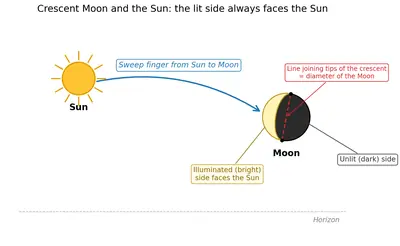
What you will do. Stand outside and point one arm straight at the Sun (keeping your eyes safely away from it). Slowly swing your arm through the sky along the shortest arc that goes from the Sun to the crescent Moon. Notice which side of the Moon your finger touches first.
What you will notice.
- The bright, curved edge of the crescent is always the edge that faces the Sun. Your finger, moving from the Sun towards the Moon, always crosses this bright, illuminated edge first before reaching the dark side of the Moon. This shows very clearly that the bright part of the Moon is the side that faces the Sun — i.e. we are seeing sunlight reflected off the Moon.
- The two sharp tips ("horns") of the crescent lie on the boundary between the illuminated and non-illuminated halves of the Moon (called the terminator). This boundary is a great circle on the Moon, seen edge-on from Earth as a straight line. Joining the two tips of the crescent by a straight line therefore gives us a diameter of the Moon.
- If you repeat the activity every evening for a few days, you will see the crescent grow (waxing) or shrink (waning), but the bright edge will always stay on the Sun-side of the Moon and the line joining the tips will always pass through the centre of the Moon.
These simple observations confirm two important ideas discussed in the chapter: (a) the Moon shines by reflecting sunlight, and (b) the phases of the Moon are produced by the changing angle between the Sun, the Moon, and the Earth (not by the Earth's shadow).
Answer
2 Most of the dates in the Indian National Calendar always map to the same dates in the Gregorian calendar. Can you find out which ones may differ for certain years?
Solution
The Indian National (Shaka) Calendar and the Gregorian calendar are both solar calendars of $$365$$ days, and both take care of the extra quarter-day of a year by inserting a leap day every $$4$$ years. In a normal (non-leap) year, the two calendars are locked together as follows:
- Chaitra (the first month) — $$30$$ days, starts on 22 March.
- Vaisakha — $$31$$ days, starts on 21 April.
- Jyeshtha — $$31$$ days, starts on 22 May.
- Ashadha — $$31$$ days, starts on 22 June.
- Shravana — $$31$$ days, starts on 23 July.
- Bhadrapada — $$31$$ days, starts on 23 August.
- Ashwina — $$30$$ days, starts on 23 September.
- Kartika — $$30$$ days, starts on 23 October.
- Agrahayana — $$30$$ days, starts on 22 November.
- Pausha — $$30$$ days, starts on 22 December.
- Magha — $$30$$ days, starts on 21 January.
- Phalguna — $$30$$ days, starts on 20 February.
The two calendars insert their leap day at different places. The Gregorian calendar adds an extra day at the end of February (29 February). The Indian National Calendar instead makes Chaitra, its first month, have $$31$$ days (instead of $$30$$) in a leap year, and correspondingly the year begins on 21 March in a leap year instead of 22 March.
Because of this, in a leap year all Gregorian dates from 1 March up to $$\approx 21$$ March are shifted by one day when written in the Indian National Calendar (compared to a normal year). In particular, the first day of Chaitra shifts:
- Non-leap year: 1 Chaitra = 22 March.
- Leap year: 1 Chaitra = 21 March.
So the dates that can differ between the two calendars for certain years are the dates lying in the month of Chaitra (and, equivalently, the corresponding late-March / early-April Gregorian dates), which get shifted by one day whenever the Gregorian year is a leap year.
Answer
3 Different states in India celebrate the New Year according to their local cultures. Find out the names of the New Year festival celebrated in any 10 states of India. Also find out whether it is based on the lunar calendar or the solar calendar or the luni-solar calendar.
Solution
India follows many regional calendars, so several different "New Year" festivals are celebrated across the country. Ten examples from different states, with the type of calendar each follows, are given below.
| State / region | Name of the New Year festival | Calendar it is based on |
|---|---|---|
| Maharashtra & Konkan | Gudi Padwa | Luni-solar (first day of Chaitra, after the new Moon) |
| Karnataka & Andhra Pradesh / Telangana | Ugadi | Luni-solar (first day of Chaitra, after the new Moon) |
| Punjab | Vaisakhi (Baisakhi) | Solar (sidereal — Sun's entry into Aries / Mesha, around 13/14 April) |
| Tamil Nadu | Puthandu (Tamil Puthandu) | Solar (sidereal — around 14 April) |
| Kerala | Vishu | Solar (sidereal — around 14/15 April) |
| Assam | Rongali Bihu (Bohag Bihu) | Solar (sidereal — around 14/15 April) |
| West Bengal & Tripura | Poila Baisakh (Nabo Barsho) | Solar (sidereal — around 14/15 April) |
| Odisha | Pana Sankranti (Maha Vishuba Sankranti) | Solar (sidereal — around 14 April) |
| Gujarat | Bestu Varas (day after Diwali) | Luni-solar (first day of Kartika, after the new Moon of Diwali) |
| Sindhi community (Sindh / western India) | Cheti Chand | Luni-solar (second day of Chaitra) |
A few other examples: Navreh in Kashmir (luni-solar), Losar among Ladakhi and Tibetan Buddhist communities (luni-solar), Cheiraoba in Manipur (luni-solar/solar), Chetichand — all based on natural cycles of the Sun and Moon.
Pattern. Most of the New-Year festivals that fall in mid-April (Vaisakhi, Puthandu, Vishu, Bihu, Poila Baisakh, Pana Sankranti) are tied to the Sun's position and use a solar (sidereal) calendar. Those tied to the phases of the Moon (Gudi Padwa, Ugadi, Cheti Chand, Bestu Varas) use a luni-solar calendar and therefore fall on different Gregorian dates each year.
Answer
4 Collect Gregorian calendars (the regular calendar you use every day) for the last five years with the help of your family members or teachers or the internet. For each year, look for the dates on which the festivals Eid-ul-Fitr and Diwali were celebrated and list them year wise in a tabular form. Do you notice that the date of Eid-ul-Fitr moves earlier each year — by about 11 days? If you have a corresponding lunar calendar at home or on the internet, check that the month and the day for Eid-ul-Fitr according to the lunar calendar remains the same. Does Diwali follow the same steady pattern, or are there some sudden jumps? Based on your chart, try to guess which year might have included an intercalary month (Adhikamaasa). Obtain a luni-solar calendar and confirm if there is an intercalary month between Diwali in the previous year and that year.
Solution
This is a data-collection activity. A sample of the observations you will make is shown below (dates for a central Indian location; dates for Eid-ul-Fitr can shift by a day depending on Moon sighting).
| Gregorian year | Eid-ul-Fitr (Gregorian date) | Diwali (Gregorian date) |
|---|---|---|
| 2021 | 13 May 2021 | 4 November 2021 |
| 2022 | 3 May 2022 | 24 October 2022 |
| 2023 | 22 April 2023 | 12 November 2023 |
| 2024 | 11 April 2024 | 1 November 2024 |
| 2025 | 31 March 2025 | 20 October 2025 |
Eid-ul-Fitr. Look at the successive Gregorian dates: 13 May, 3 May, 22 April, 11 April, 31 March. The date moves earlier by about $$10$$–$$11$$ days every year (13 May → 3 May: $$-10$$ d; 3 May → 22 April: $$-11$$ d; 22 April → 11 April: $$-11$$ d; 11 April → 31 March: $$-11$$ d). This confirms the expected drift: the Islamic calendar is a purely lunar calendar of $$12$$ lunar months ($$354$$ days), which is about $$11$$ days shorter than the $$365$$-day Gregorian year. On the Islamic (Hijri) calendar itself, Eid-ul-Fitr is always on the same day: 1 Shawwal. So the lunar date stays the same while the Gregorian date keeps sliding earlier.
Diwali. Look at the Diwali dates: 4 Nov, 24 Oct, 12 Nov, 1 Nov, 20 Oct. Going from one year to the next: $$-11$$ d, $$+19$$ d, $$-11$$ d, $$-12$$ d. So Diwali does not move steadily earlier every year. Most years the date moves back by about $$11$$ days (like Eid-ul-Fitr), but every $$2$$–$$3$$ years there is a sudden forward jump of about $$30$$ days. This happens because the Indian luni-solar calendar keeps its months in step with the seasons by adding an extra intercalary month (Adhika Maasa) every two to three years — an extra month pushes Diwali about $$30$$ days later on the Gregorian calendar.
In the sample table above, the big forward jump is between 2022 (24 October) and 2023 (12 November). So we expect an Adhika Maasa to have been inserted between Diwali 2022 and Diwali 2023. On checking a luni-solar (Hindu panchang) calendar, we indeed find Adhika Shravana in the year 2023 — an extra intercalary Shravana month — which confirms the guess.
Note: If you collect data for five different years, your table will look slightly different, but the pattern — steady $$11$$-day drift for Eid-ul-Fitr, mostly $$11$$-day drift for Diwali with occasional $$\approx 30$$-day forward jumps in the year of an intercalary month — will always be the same.
Answer
5 Every morning on your way to school, notice the direction in which the Sun rises. Decide on a spot and look towards east, with trees, poles, or buildings acting as markers. Sketch the eastern horizon in your notebook. For the next one year, at the start of each month, stand at the same spot and mark the Sun's position on your sketch. Label it with the name of the month. At the end of the year analyse your sketch. Do you find that the positions of sunrise shift in particular direction? Can you identify it with the Uttarayaan and Dakshinayaan that our ancestors noticed? (Refer the 'A step further' box on page 181).
Solution
This is a year-long observation activity. Here is what to do and what you will see.
How to make the sketch. Pick a place from which you have a clear view of the eastern horizon and to which you can easily return (say your terrace, or the same spot on your way to school). Sketch the horizon carefully, marking permanent objects — a tree, a lamp-post, a house corner — as reference points. Once every month (for example, on the $$1$$st of every month), at sunrise, stand at exactly the same spot and mark on your sketch the point on the horizon where the Sun's disc first appears. Label each mark with the name of the month.
What you will see at the end of a year. The Sun does not rise from the same point on the horizon every day. If you connect the marks in the order Jan → Feb → … → Dec, you will notice:
- From around 22 December to 21 June, the sunrise point moves steadily northward along the horizon. This apparent northward journey of the Sun is called Uttarayan. The Sun is farthest to the south around 22 December (winter solstice) and farthest to the north around 21 June (summer solstice).
- From around 21 June back to 22 December, the sunrise point moves steadily southward along the horizon. This southward journey is called Dakshinayan.
- On the two equinoxes, around 21 March and 23 September, the Sun rises very nearly at the exact East point on the horizon.
Why this happens. The Earth's spin-axis is tilted (by about $$23.5^{\circ}$$) with respect to its orbit around the Sun. As the Earth revolves around the Sun, the tilt causes the Sun to appear higher in our sky in one half of the year and lower in the other half. This same tilt also shifts the point on the horizon where the Sun rises — north of East in summer, south of East in winter. These extremes at the June and December solstices and the shift between them are exactly the Uttarayan (northward journey) and Dakshinayan (southward journey) that our ancestors observed — and, as the chapter mentions, the Taittiriya Samhita and the Surya Siddhanta already recorded this fact thousands of years ago.
So your one-year sketch will directly reproduce, from your own observations, one of the oldest astronomical patterns known in India.
Answer