Join WhatsApp Icon JEE WhatsApp Group
NCERT Solutions for Class 8 Science

Chapter 10: Light: Mirrors and Lenses

Download Solutions PDF
Daily JEE Updates, Tips & Important Alerts
Join 30,000+ students and stay updated with JEE notifications and preparation insights.
Join Now!
Free PDF
Complete NCERT Solution PDF for Chapter 10: Light: Mirrors and Lenses
Download Solutions PDF

Keep the curiosity alive

1

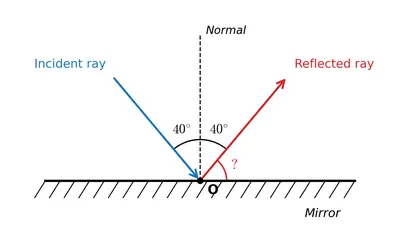
A light ray is incident on a mirror and gets reflected by it (Fig. 10.21). The angle made by the incident ray with the normal to the mirror is $$40^{\circ}$$. What is the angle made by the reflected ray with the mirror?
(i) $$40^{\circ}$$    (ii) $$50^{\circ}$$    (iii) $$45^{\circ}$$    (iv) $$60^{\circ}$$
Fig. 10.21
Fig. 10.21

Solution

Given. The angle of incidence, measured from the incident ray to the normal, is $$\angle i = 40^{\circ}$$.

Step 1 — Law of reflection. By the law of reflection, the angle of reflection (measured from the reflected ray to the normal) equals the angle of incidence. Hence

\[\angle r = \angle i = 40^{\circ}.\]

Step 2 — Angle with the mirror. The normal is drawn perpendicular to the mirror, so the angle between the normal and the mirror surface is $$90^{\circ}$$. The angle the reflected ray makes with the mirror is therefore

\[90^{\circ} - \angle r \;=\; 90^{\circ} - 40^{\circ} \;=\; 50^{\circ}.\]

Hence the correct option is (ii) $$50^{\circ}$$.

Answer

(ii) $$50^{\circ}$$

2

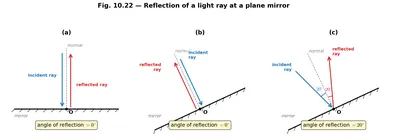
Fig. 10.22 shows three different situations where a light ray falls on a mirror. Draw the reflected ray in each case (Use a ruler and protractor for accurate drawing). What is the angle of reflection in each case?
Fig. 10.22
Fig. 10.22

(i) The light ray falls along the normal.

Solution

Here the incident ray travels along the normal to the mirror, so the angle between the incident ray and the normal is

\[\angle i = 0^{\circ}.\]

By the law of reflection $$\angle r = \angle i$$, therefore

\[\angle r = 0^{\circ}.\]

The reflected ray also lies along the normal and simply travels back along the same line as the incident ray (that is, the light retraces its path).

Answer

Angle of reflection $$= 0^{\circ}$$. The reflected ray travels back along the normal, retracing the incident ray.

(ii) The mirror is tilted, but the light ray still falls along the normal to the tilted surface.

Solution

The normal is drawn perpendicular to the mirror surface, no matter how the mirror is oriented. Since the incident ray is along this (tilted) normal,

\[\angle i = 0^{\circ}.\]

By the law of reflection, $$\angle r = \angle i$$, so

\[\angle r = 0^{\circ}.\]

The reflected ray again retraces the incident ray along the tilted normal. Tilting the mirror changes the direction of the normal, but not the fact that a ray striking along the normal comes straight back.

Answer

Angle of reflection $$= 0^{\circ}$$. The reflected ray goes back along the (tilted) normal, retracing the incident ray.

(iii) The mirror is tilted, and the light ray falls at an angle of $$20^{\circ}$$ from the normal.

Solution

The angle of incidence is measured between the incident ray and the normal to the tilted mirror:

\[\angle i = 20^{\circ}.\]

By the law of reflection,

\[\angle r = \angle i = 20^{\circ}.\]

To draw the reflected ray: at the point where the incident ray meets the mirror, first draw the normal (perpendicular to the mirror). The reflected ray lies on the other side of the normal, in the same plane as the incident ray, making $$20^{\circ}$$ with the normal. Use a protractor to measure the $$20^{\circ}$$ accurately.

Answer

Angle of reflection $$= 20^{\circ}$$. The reflected ray lies on the opposite side of the normal, making $$20^{\circ}$$ with it.

3

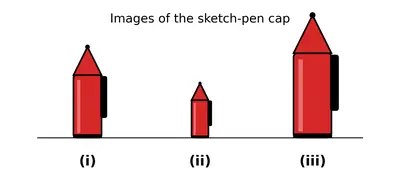
In Fig. 10.23, the cap of a sketch pen is placed in front of three types of mirrors. Match each image with the correct mirror.
ImageMirror
(i)Plane mirror
(ii)Convex mirror
(iii)Concave mirror
Fig. 10.23
Fig. 10.23

Solution

We identify each mirror by the size and orientation of the image it makes of the cap:

  • Plane mirror. A plane mirror forms an image of exactly the same size as the object and erect (upright). So the image labelled with a cap of the same size as the real one and standing upright corresponds to the plane mirror.
  • Convex mirror. A convex mirror always forms an image that is erect and smaller (diminished) than the object. So the image showing a smaller upright cap corresponds to the convex mirror.
  • Concave mirror. When an object is placed close to a concave mirror (within its focal length, as with the sketch-pen cap held in front of it), the image is erect and larger (magnified). So the image showing an enlarged upright cap corresponds to the concave mirror.

Reading the standard NCERT figure 10.23 from left to right — same-size image, smaller image, larger image — gives the matching below.

Answer

(i) same-size image → Plane mirror; (ii) smaller (diminished) image → Convex mirror; (iii) larger (magnified) image → Concave mirror.

4

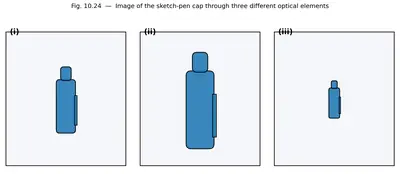
In Fig. 10.24, the cap of a sketch pen is placed behind a convex lens, a concave lens, and a flat transparent glass piece — all at the same distance. Match each image with the correct type of lens or glass.
ImageLens/glass type
(i)Flat transparent glass piece
(ii)Convex lens
(iii)Concave lens
Fig. 10.24
Fig. 10.24

Solution

We identify each optical piece by what happens to the size of the cap seen through it:

  • Flat transparent glass piece. A plane sheet of glass does not converge or diverge the light, so the cap looks the same size and erect through it.
  • Convex lens. A convex lens is a converging lens. When the cap is placed close to it (within one focal length), it acts like a magnifying glass and produces an erect, magnified image. So the enlarged image belongs to the convex lens.
  • Concave lens. A concave lens is a diverging lens; it always produces an erect, diminished (smaller) image of the object. So the smaller image belongs to the concave lens.

Matching the three images in Fig. 10.24 by size — same size, larger, smaller — with the three optical pieces:

Answer

(i) same-size image → Flat transparent glass piece; (ii) larger (magnified) image → Convex lens; (iii) smaller (diminished) image → Concave lens.

5 When the light is incident along the normal on the mirror, which of the following statements is true:
(i) Angle of incidence is $$90^{\circ}$$
(ii) Angle of incidence is $$0^{\circ}$$
(iii) Angle of reflection is $$90^{\circ}$$
(iv) No reflection of light takes place in this case

Solution

The angle of incidence is defined as the angle between the incident ray and the normal. If the light travels along the normal, the incident ray and the normal are the same line, so

\[\angle i = 0^{\circ}.\]

By the law of reflection $$\angle r = \angle i = 0^{\circ}$$, so the reflected ray also lies along the normal (it retraces its path). Reflection does take place — it is not zero. Therefore only option (ii) is correct.

Answer

(ii) Angle of incidence is $$0^{\circ}$$.

6

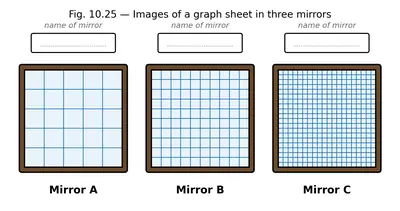
Three mirrors — plane, concave and convex are placed in Fig. 10.25. On the basis of the images of the graph sheet formed in the mirrors, identify the mirrors and write their names above the mirrors.
Fig. 10.25
Fig. 10.25

Solution

Look at how the graph-sheet squares appear in the image formed by each mirror.

  • Plane mirror. The squares of the graph sheet are seen with the same size as on the actual sheet, and the lines remain straight. Any distortion or change of size means the mirror is not plane.
  • Concave mirror. A concave mirror is a converging mirror. When the graph sheet is held close to it, the image of the sheet is magnified — the squares look larger than on the actual sheet.
  • Convex mirror. A convex mirror is a diverging mirror. It always makes objects look smaller, so the squares of the graph sheet appear diminished in its image, and a larger area of the sheet can be seen than the size of the mirror.

Rule for labelling in Fig. 10.25: above the mirror whose image shows same-size squares, write “Plane mirror”; above the mirror whose image shows larger squares, write “Concave mirror”; above the mirror whose image shows smaller squares, write “Convex mirror”.

Answer

Mirror with same-size squares → Plane mirror; mirror with enlarged squares → Concave mirror; mirror with diminished squares → Convex mirror.

7

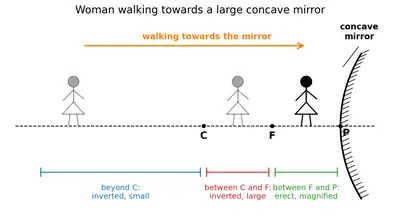
In a museum, a woman walks towards a large concave mirror (Fig. 10.26). She will see that:
(i) her erect image keeps decreasing in size.
(ii) her inverted image keeps decreasing in size.
(iii) her inverted image keeps increasing in size and eventually it becomes erect and magnified.
(iv) her erect image keeps increasing in size.
Fig. 10.26
Fig. 10.26

Solution

Behaviour of a large concave mirror as the object approaches it:

  • When the woman is far away from the concave mirror (well beyond its focal point), the mirror forms a real, inverted image of her. As she walks closer, this inverted image grows larger and larger.
  • When she crosses the focal point of the mirror and comes very close to it, the image becomes virtual, erect and magnified (this is exactly why a concave mirror is used as a shaving/make-up mirror).

So as she walks in, first she sees an inverted image that keeps growing in size, and finally, close to the mirror, the image flips to being erect and magnified. That description matches option (iii).

Options (i) and (iv) claim an erect image throughout, which is wrong because a large concave mirror shows an inverted image at large distances. Option (ii) says the inverted image keeps decreasing, which is the opposite of what happens as she approaches.

Answer

(iii) Her inverted image keeps increasing in size and eventually becomes erect and magnified.

8 Hold a magnifying glass over text and identify the distance where you can see the text bigger than they are written. Now move it away from the text. What do you notice? Which type of lens is a magnifying glass?

Solution

What we observe.

  • When the magnifying glass is held close to the text (within a certain small distance, less than its focal length), the letters appear larger and erect. This distance is the useful range of a magnifier.
  • As we slowly move the lens away from the text, the letters keep looking larger for a while, then at one particular distance they suddenly become blurred and finally, on moving still further, the letters look inverted and their size begins to decrease.

Why this happens. As long as the text is between the lens and its focal point, the lens forms a virtual, erect, magnified image (magnifying-glass action). When the text goes beyond the focal point, a real, inverted image is formed on the other side of the lens; that is what our eye sees as an upside-down image at large distance.

Type of lens. A magnifying glass converges light and produces a magnified erect image, so it is a convex lens (a converging lens).

Answer

A magnifying glass is a convex (converging) lens. Close to the text (within one focal length) it shows the text erect and enlarged; on moving it away past the focal point the image gradually inverts and shrinks.

9

Match the entries in Column I with those in Column II.
Column IColumn II
(i) Concave mirror(a) Spherical mirror with a reflecting surface that curves inwards.
(ii) Convex mirror(b) It forms an image which is always erect and diminished in size.
(iii) Convex lens(c) Object placed behind it may appear inverted at some distance.
(iv) Concave lens(d) Object placed behind it always appears diminished in size.

Solution

Take each item of Column I and match by definition/behaviour:

  • (i) Concave mirror → (a). A concave mirror is defined as a spherical mirror whose reflecting surface curves inwards (like the inside of a spoon). This is a pure definition, so it matches (a).
  • (ii) Convex mirror → (b). A convex mirror is a diverging spherical mirror. Whatever the position of the object in front of it, the image is virtual, erect and diminished, which is exactly statement (b).
  • (iii) Convex lens → (c). A convex (converging) lens forms a real, inverted image when the object is placed beyond its focal length. So looking through the lens at an object placed at a suitable distance behind it, one sees an inverted image — matching (c).
  • (iv) Concave lens → (d). A concave (diverging) lens always forms a virtual, erect, diminished image, no matter where the object is placed. So it corresponds to (d).

Answer

Column IColumn II
(i) Concave mirror(a)
(ii) Convex mirror(b)
(iii) Convex lens(c)
(iv) Concave lens(d)

10 The following question is based on Assertion/Reason.
Assertion: Convex mirrors are preferred for observing the traffic behind us.
Reason: Convex mirrors provide a significantly larger view area than plane mirrors.
Choose the correct option:
(i) Both Assertion and Reason are correct and Reason is the correct explanation for Assertion.
(ii) Both Assertion and Reason are correct but Reason is not the correct explanation for Assertion.
(iii) Assertion is correct but Reason is incorrect.
(iv) Both Assertion and Reason are incorrect.

Solution

Is the Assertion true? Yes. Rear-view mirrors of vehicles are indeed convex mirrors. A convex mirror always produces an erect image and covers a wide field of view, so the driver can see traffic on a large stretch of road behind the vehicle.

Is the Reason true? Yes. Because a convex mirror bulges outward, rays coming from a wide range of directions can hit it and get reflected towards the driver's eyes. Compared with a plane mirror of the same size, a convex mirror shows a much larger area of the scene — this is the well-known “wider field of view” of a convex mirror.

Does the Reason correctly explain the Assertion? Yes. The very reason we prefer convex mirrors as rear-view mirrors is that they let us see a much larger area of the road behind us than a plane mirror would. So Reason directly explains the Assertion.

Hence option (i) is correct.

Answer

(i) Both Assertion and Reason are correct and Reason is the correct explanation for the Assertion.

11

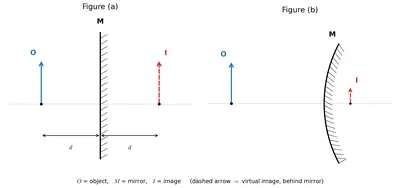
In Fig. 10.27, note that O stands for object, M for mirror, and I for image. Which of the following statements is true?
(i) Figure (a) indicates a plane mirror and Figure (b) indicates a concave mirror.
(ii) Figure (a) indicates a convex mirror and Figure (b) indicates a concave mirror.
(iii) Figure (a) indicates a concave mirror and Figure (b) indicates a convex mirror.
(iv) Figure (a) indicates a plane mirror and Figure (b) indicates a convex mirror.
Fig. 10.27
Fig. 10.27

Solution

We identify each mirror from the position (and size) of the image $$I$$ relative to the object $$O$$ and the mirror $$M$$.

Figure (a). The image $$I$$ appears at the same distance behind the mirror as the object $$O$$ is in front of it, and the arrow representing $$I$$ has the same height as the arrow representing $$O$$ (image of same size, erect). This is exactly the property of a plane mirror:

\[\text{distance of image from M} \;=\; \text{distance of object from M}.\]

Figure (b). The image $$I$$ is again behind the mirror and erect, but its distance from $$M$$ is smaller than the distance of $$O$$ from $$M$$. So the image lies between the pole of the mirror and where a plane-mirror image would sit, and it is diminished. Only a convex mirror forms such a virtual, erect image that lies between its pole and its focal point behind the mirror.

A concave mirror, in contrast, would produce either a real inverted image in front of the mirror (for distant objects) or a virtual, magnified image whose apparent position lies farther behind the mirror than the object is in front — neither of which matches (a) or (b).

Therefore Figure (a) is a plane mirror and Figure (b) is a convex mirror — option (iv).

Answer

(iv) Figure (a) indicates a plane mirror and Figure (b) indicates a convex mirror.

12

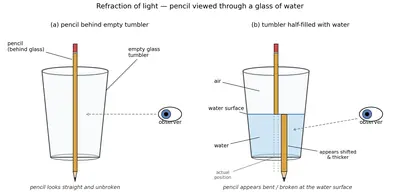
Place a pencil behind a transparent glass tumbler (Fig. 10.28a). Now fill the tumbler halfway with water (Fig. 10.28b). How does the pencil appear when viewed through the water? Explain why its shape appears changed.
Fig. 10.28
Fig. 10.28

Solution

Observation. With the tumbler empty (Fig. 10.28a) we see the pencil almost as it really is — a single straight rod behind the glass. When the tumbler is filled halfway with water (Fig. 10.28b), the pencil looks broken at the water surface: the part seen through water appears shifted sideways and often thicker/larger than the part seen above the water level (which is viewed only through air and glass).

Explanation. Light rays travel from the pencil to our eyes. They pass through different media on the way:

  • The upper half of the tumbler contains only air, so the light from the top part of the pencil is only slightly bent by the thin curved glass and reaches our eyes almost undeviated.
  • The lower half of the tumbler is filled with water. Light rays coming from the lower part of the pencil first enter water, then pass through the curved glass wall, then into air, before reaching our eyes.

Whenever light travels from one transparent medium to another of different optical density, it bends at the boundary. This bending is called refraction. Water is optically denser than air, so a ray of light passing from water to air (through the glass) is refracted — it changes direction.

Because the curved water-filled portion of the tumbler acts like a cylindrical convex lens, all the light coming from the submerged part of the pencil is bent inwards, giving a magnified, laterally shifted image of that portion. The part above the water is not refracted this way, so it appears in its original position and size. The mismatch between the two portions is what makes the pencil look bent, broken or thicker at the water level.

So the pencil's shape has not really changed — the change is only in the direction of the light rays reaching our eyes, caused by refraction at the water and the curved glass surfaces.

Answer

The pencil appears broken or bent at the water level, and its submerged portion looks shifted sideways and enlarged. This happens because light rays from the pencil bend (refract) as they pass from water to glass to air, and the curved water column acts like a cylindrical convex lens.
NCERT Solutions for Class 8
Maths
NCERT Solutions for Class 8 Maths
Chapter-wise step-by-step
solutions with explanations
explore solutions Maths bg
Science
NCERT Solutions for Class 8 Science
Chapter-wise step-by-step
solutions with explanations
explore solutions Science bg

50,000+ JEE Students Trusted Our Score Calculator

Predict your JEE Main percentile, rank & performance in seconds