Join WhatsApp Icon JEE WhatsApp Group
NCERT Solutions for Class 8 Maths

Chapter 7: Area

Download Solutions PDF
Daily JEE Updates, Tips & Important Alerts
Join 30,000+ students and stay updated with JEE notifications and preparation insights.
Join Now!
Free PDF
Complete NCERT Solution PDF for Chapter 7: Area
Download Solutions PDF

Intext Questions (Rectangle and Squares)

1 How many different ways can you divide a square into 4 parts of equal area?

Solution

Understanding the question
The square has to be partitioned into 4 regions such that the area of every region is exactly one-fourth of the area of the whole square. The question asks how many different (distinct) ways this can be done.

Step 1 : Listing a few obvious examples

  • Draw the two medians (one horizontal and one vertical). This gives four smaller squares.
  • Draw the two diagonals. This gives four congruent right-angled isosceles triangles.
  • Draw one diagonal and then through the centre draw the line perpendicular to it. This again gives four congruent right-angled triangles (but oriented differently from the previous case).
  • Draw any line parallel to the base at a distance $$\tfrac14$$ of the side–length from it, and another parallel line at a distance $$\tfrac34$$ of the side–length from the base. Now draw a vertical line through the mid-point of the base. The square is cut into four equal rectangles.
  • Take an L-shaped path that starts from the centre, goes to the middle of one side, turns 90° and goes to the middle of the adjacent side. Rotate this path successively through 90°, 180° and 270°. The four images enclose four congruent L-shapes whose areas are each $$\tfrac14$$ of the whole square.

So even by casual experimentation we already have several different partitions.

Step 2 : A way to generate endlessly many partitions
Choose any path that starts from the centre of the square and ends at the mid-point of one of its sides. (The path can be straight, zig-zag or curved; it just must lie completely inside the square.) Call this path $$P$$. Rotate $$P$$ about the centre through 90°, 180° and 270°. The four rotated copies of $$P$$ enclose four regions that are congruent to one another, hence have equal area. Because the original path $$P$$ can be varied in infinitely many ways, the resulting partitions are also infinitely many.

Step 3 : Why the number is uncountable (and therefore certainly not finite)
Even if we restrict ourselves to merely straight-line paths that join the centre to the midpoint of a particular side, the slope of that segment can vary smoothly through an interval of real numbers. Each distinct slope produces a distinct set of four congruent regions, so there are as many partitions as there are real numbers in an interval—an uncountably infinite set.

Conclusion
There is no longest list that contains all the distinct ways; whenever we have a list we can slightly alter one of the cuts and obtain a new, different partition with the same equal area property. Hence the correct count is not a finite whole number.

Answer

There are infinitely many different ways (in fact, uncountably many) to divide a square into four regions of equal area.

2 Try to think of different creative ways to divide a square into 4 parts of equal area.

Solution

Let the original square be $$ABCD$$ with side $$s$$. Our aim is always to produce four congruent regions; since congruent figures have the same area, each region will then automatically have area $$\frac{s^{2}}{4}$$.

Method 1 – “+ sign (four little squares)

  1. Mark the mid–points $$P$$ of $$AB$$ and $$Q$$ of $$CD$$. Join $$PQ$$ – a vertical line through the centre $$O$$.
  2. In the same way join the mid–points $$R$$ of $$BC$$ and $$S$$ of $$AD$$ to get the horizontal line $$RS$$.
  3. The two lines intersect at right angles and cut the original square into four small squares, each of side $$\frac{s}{2}$$.
    Area of each small square = $$\Bigl(\tfrac{s}{2}\Bigr)^{2}=\tfrac{s^{2}}{4}$$.

(Draw two straight lines through the centre – one parallel to a side and the other perpendicular to it.)

Method 2 – “×” sign (two diagonals)

  1. Draw the two diagonals $$AC$$ and $$BD$$; they meet at the centre $$O$$.
  2. The diagonals form four congruent isosceles right–angled triangles: for instance $$\triangle AOB$$ has base $$AB=s$$ and height $$AO=\tfrac{s}{2}$$ (because $$O$$ is the mid-point of the diagonal).
    Area $$=\tfrac12\,s\,\tfrac{s}{2}=\tfrac{s^{2}}{4}$$.

Method 3 – Four equal vertical strips

  1. On sides $$AB$$ and $$CD$$ mark the points whose abscissae are $$\tfrac{s}{4},\;\tfrac{s}{2},\;\tfrac{3s}{4}$$ (that is, divide the side into four equal parts).
  2. Through each of those three points draw a line parallel to $$AD$$.
    This produces four congruent rectangles, each of width $$\tfrac{s}{4}$$ and height $$s$$, so area $$=s\times\tfrac{s}{4}=\tfrac{s^{2}}{4}$$.

Method 4 – Any curve with quarter-turn symmetry

  1. Draw any curve $$\gamma$$ that starts at the centre $$O$$ and ends at one point on $$AB$$ (for example the mid-point).
  2. Rotate the square (or the curve) through $$90^{\circ},\,180^{\circ},\,270^{\circ}$$ about $$O$$; each rotation gives a new copy of the same curve.
  3. The four copies of $$\gamma$$ together cut the square into four regions that are exact quarter-turn images of one another, hence congruent, and so each has area $$\tfrac{s^{2}}{4}$$.

(Because the construction uses rotational symmetry the precise shape of $$\gamma$$ does not matter.)

Method 5 – Quarter-circle arcs

  1. Mark the mid-points $$P,Q,R,S$$ of the four sides in order.
  2. With each corner as centre and radius $$\tfrac{s}{2}$$ draw an arc joining the mid-points of the two adjacent sides. Four equal quarter-circles are produced inside the square.
  3. These four arcs again divide the square into four congruent “curved-edge” regions related by $$90^{\circ}$$ rotation, so each region’s area is $$\tfrac{s^{2}}{4}$$ even though the boundary is not straight.

Further ideas: Any set of four congruent pieces obtained from the square by a symmetry of order 4 (rotation or repeated translation) will automatically give a valid division into equal areas. Students are encouraged to invent their own patterns—zig-zags, wavy lines, shapes made of dots—so long as the whole square is filled and the four pieces remain congruent.

Answer

Five sample ways to split the square evenly are shown in the solution:
(i) a “+” cross,
(ii) the two diagonals,
(iii) three vertical lines giving four equal strips,
(iv) any curve copied by 90° rotations, and
(v) four equal quarter-circle arcs. Each produces 4 regions of area $$\tfrac14$$ of the square.

3

Which of these rectangles requires more rangoli powder to be coloured, if the colouring is done evenly?

Rectangle 1 has sidelengths $$7 \, \mathrm{cm}$$ and $$4 \, \mathrm{cm}$$; Rectangle 2 has sidelengths $$8 \, \mathrm{cm}$$ and $$3 \, \mathrm{cm}$$.

Solution

To colour a rectangle evenly we need rangoli powder for the entire area of the rectangle.

The area $$A$$ of a rectangle with length $$l$$ and breadth $$b$$ is given by

$$A = l \times b$$

Rectangle 1

Length $$l_1 = 7\,\text{cm}$$, breadth $$b_1 = 4\,\text{cm}$$

$$A_1 = l_1 \times b_1 = 7\,\text{cm} \times 4\,\text{cm} = 28\,\text{cm}^2$$

Rectangle 2

Length $$l_2 = 8\,\text{cm}$$, breadth $$b_2 = 3\,\text{cm}$$

$$A_2 = l_2 \times b_2 = 8\,\text{cm} \times 3\,\text{cm} = 24\,\text{cm}^2$$

Comparing the two areas,

$$28\,\text{cm}^2 > 24\,\text{cm}^2$$

Hence Rectangle 1 has the larger area.

Therefore Rectangle 1 will require more rangoli powder when it is coloured evenly.

Answer

Rectangle 1 needs more rangoli powder.

4 What is the area of each triangle in this rectangle? (A rectangle of sides $$7 \, \mathrm{cm}$$ and $$4 \, \mathrm{cm}$$ is divided into two congruent triangles by a diagonal.)

Solution

Given: A rectangle of length $$7\,\mathrm{cm}$$ and breadth $$4\,\mathrm{cm}$$ is divided by a diagonal into two congruent triangles.

Step 1 – Find the area of the rectangle

The area of a rectangle is the product of its length and breadth:

$$\text{Area of rectangle}=l\times b$$

Substituting $$l=7\,\mathrm{cm}$$ and $$b=4\,\mathrm{cm}$$,

$$\text{Area of rectangle}=7\times4=28\,\mathrm{cm^2}$$

\[\text{Area of rectangle}=28\,\mathrm{cm^2}\]

Step 2 – Relate the triangles to the rectangle

The diagonal splits the rectangle into two congruent (equal) right-angled triangles, so each triangle occupies exactly one-half of the rectangle’s area.

$$\text{Area of one triangle}=\dfrac{1}{2}\times\text{Area of rectangle}$$

$$\text{Area of one triangle}=\dfrac{1}{2}\times28=14\,\mathrm{cm^2}$$

\[\boxed{14\,\mathrm{cm^2}}\]

Therefore, the area of each triangle is $$14\,\mathrm{cm^2}$$.

Answer

$$14\,\mathrm{cm^2}$$

5 Why do we count the number of unit squares to assign measures for area? Couldn't we have just used the perimeter of a region, i.e., the length of its boundary as a measure of its area?

Solution

Step 1 : What is area?
Area is the amount of surface a plane region occupies. In mathematics we want a single number that tells “how much space” is covered, no matter what the outline looks like.

Step 2 : Why choose a unit square?
Because a square of side 1 unit

  • can tile the plane without leaving gaps or overlaps (so every region can be completely filled by such squares or parts of them),
  • has straight edges that make counting exact,
  • gives a standard that everyone can agree on. One unit square is defined to have area $$1\;\text{square-unit}$$. Counting how many such squares (or fractional squares) exactly cover the region gives a measure that is independent of the region’s shape.

Step 3 : Why can’t perimeter do the same job?

  • Perimeter is a one-dimensional quantity (only length). Doubling every length of a figure multiplies the perimeter by $$2$$, but its area by $$4$$. Thus the two quantities behave differently under scaling.
  • Different regions can have the same perimeter yet quite different areas. For instance:
    ShapeDimensions (units)Perimeter $$P$$Area $$A$$
    Rectangle I$$5 \times 4$$$$2(5+4)=18$$$$5\times4=20$$
    Rectangle II$$7 \times 2$$$$2(7+2)=18$$$$7\times2=14$$
    Both rectangles have the same boundary length $$18$$ units, but the first covers $$20$$ square units of surface while the second covers only $$14$$.
  • Conversely, two regions can have the same area with different perimeters (e.g. a square of side $$4$$ and a long thin rectangle of sides $$1$$ and $$16$$ both have area $$16$$ sq. units, but their perimeters are $$16$$ units and $$34$$ units respectively).

Step 4 : Conclusion
Since perimeter does not uniquely determine the amount of surface covered, it cannot serve as a measure of area. Counting the number of unit squares (or fractional parts of them) that exactly cover the region gives a unique, reliable and additive measure. Hence we define area that way, not by the length of the boundary.

Answer

Perimeter measures only boundary length; many different regions share the same perimeter but enclose different amounts of surface. Counting how many unit squares exactly cover the region gives a unique two-dimensional measure of that surface, so area is defined by unit squares, not by perimeter.

6 If two regions have the same perimeter, can't we conclude that they have the same area? Or, if one region has a larger perimeter than another region, can't we conclude that it also has a larger area?

Solution

Restatement of the doubt
Many students feel that “more boundary means more surface” and therefore expect:

  • Two figures with the same perimeter must have the same area.
  • The figure with the larger perimeter must also have the larger area.

Both expectations are false. We settle the matter by constructing explicit numerical examples that Class 8 students can calculate entirely on their own.

1. Same perimeter but different areas

Take two rectangles whose perimeters are each $$16\text{ cm}$$.

  • Rectangle I: length $$l_1 = 3\text{ cm}$$, breadth $$b_1 = 5\text{ cm}$$.
  • Rectangle II (actually a square): side $$l_2 = b_2 = 4\text{ cm}$$.

Verify their common perimeter:

Rectangle I: $$\text{Perimeter} = 2(l_1+b_1)=2(3+5)=2\times8=16\text{ cm}$$
Rectangle II: $$\text{Perimeter} = 2(l_2+b_2)=2(4+4)=2\times8=16\text{ cm}$$

Now compare their areas:

$$\text{Area of Rectangle I}=l_1\times b_1 = 3\times5 = 15\;\text{cm}^2$$
$$\text{Area of Rectangle II}=l_2\times b_2 = 4\times4 = 16\;\text{cm}^2$$

Although the boundaries are equal, $$15\;\text{cm}^2 \neq 16\;\text{cm}^2$$. Hence equal perimeter does not force equal area.

2. Larger perimeter but smaller area

Keep the square from above (side $$10\text{ cm}$$) and compare it with a long thin rectangle.

  • Square: side $$s = 10\text{ cm}$$.
  • Rectangle: length $$L = 1\text{ cm}$$, breadth $$B = 20\text{ cm}$$.

Perimeters:

Square: $$\text{Perimeter} = 4s = 4\times10 = 40\text{ cm}$$
Rectangle: $$\text{Perimeter} = 2(L+B) = 2(1+20) = 2\times21 = 42\text{ cm}$$

The rectangle clearly has a larger perimeter (42 cm vs 40 cm). Now compute their areas:

Square: $$\text{Area} = s^2 = 10^2 = 100\;\text{cm}^2$$
Rectangle: $$\text{Area} = L\times B = 1\times20 = 20\;\text{cm}^2$$

Here the shape with the larger perimeter (42 cm) actually encloses a much smaller area (20 cm2) than the square (100 cm2). Thus a larger perimeter does not guarantee a larger area.

3. What we can safely say

Perimeter measures the length of the boundary; area measures the amount of surface enclosed. They are related but one does not determine the other. Without extra information about the exact shape, neither of the two statements in the question is logically valid.

Therefore,

  • Figures can have the same perimeter yet different areas.
  • A figure with a larger perimeter can have either a larger area, an equal area, or even a smaller area.

Hence the conclusions suggested in the question are incorrect.

Answer

No. Two regions can share the same perimeter yet enclose different areas, and a region can have a larger perimeter yet enclose a smaller area. Perimeter alone is insufficient to compare areas.

7 Find two rectangles that are examples of such regions (Region 1 and Region 2, where Perimeter of Region 1 > Perimeter of Region 2, but Area of Region 1 < Area of Region 2). If needed, use a grid paper (given at the end of the book) for this.

Solution

We have to exhibit two rectangles such that the first one has the larger perimeter while the second one has the larger area. A concrete numerical choice and the full working are given below.

  1. Choice of dimensions
    • Region 1 – rectangle with length $$l_1 = 2 \text{ cm}$$ and breadth $$b_1 = 9 \text{ cm}$$.
    • Region 2 – rectangle with length $$l_2 = 4 \text{ cm}$$ and breadth $$b_2 = 5 \text{ cm}$$.
  2. Perimeter calculation
    For a rectangle, $$\text{Perimeter}=2(\text{length}+\text{breadth}).$$ Hence
    • Region 1: $$P_1 = 2(l_1+b_1)=2(2+9)=2\times11=22 \text{ cm}$$.
    • Region 2: $$P_2 = 2(l_2+b_2)=2(4+5)=2\times9=18 \text{ cm}$$.
    Thus $$P_1 = 22\,\text{cm} > P_2 = 18\,\text{cm}$$.
  3. Area calculation
    For a rectangle, $$\text{Area}=\text{length}\times\text{breadth}.$$ Therefore
    • Region 1: $$A_1 = l_1\times b_1 = 2\times9 = 18 \text{ cm}^2$$.
    • Region 2: $$A_2 = l_2\times b_2 = 4\times5 = 20 \text{ cm}^2$$.
    Hence $$A_1 = 18\,\text{cm}^2 < A_2 = 20\,\text{cm}^2$$.
  4. Verification
    Collecting the perimeter and area comparisons obtained above: \[P_1 = 22\,\text{cm}\;>\;18\,\text{cm} = P_2,\qquad A_1 = 18\,\text{cm}^2\;<\;20\,\text{cm}^2 = A_2.\] Hence the required inequalities hold simultaneously: \[\boxed{\;P_1 \;>\; P_2 \quad\text{and}\quad A_1 \;<\; A_2\;}\] Thus the chosen pair of rectangles is a valid example — Region 1 has the larger perimeter, while Region 2 has the larger area, exactly as required.

You can draw both rectangles on a grid sheet: the 2 cm × 9 cm rectangle will look longer and thinner with 22 boundary units, while the 4 cm × 5 cm rectangle will enclose more unit squares even though its perimeter is only 18 units.

Answer

Example that works:

  • Region 1: rectangle 2 cm × 9 cm  →  $$P_1 = 22 \text{ cm},\; A_1 = 18 \text{ cm}^2$$
  • Region 2: rectangle 4 cm × 5 cm  →  $$P_2 = 18 \text{ cm},\; A_2 = 20 \text{ cm}^2$$

Thus $$\boxed{P_1 > P_2 \text{ and } A_1 < A_2}$$, exactly as required.

8 Also give an example of two regions of other shapes, where the region with the larger perimeter has the smaller area! This property should be visually clear in your example.

Solution

Idea of the construction

Just as we saw for rectangles, even among other plane figures a shape that "goes round a lot" need not cover a large surface. A very convenient pair is a fat, almost–equilateral triangle and a long, thin right-angled triangle. Their drawings look quite different, so the contrast between boundary and interior region is immediately visible.

Step 1 : Fix the two triangles

  • Triangle $$T_1$$  (fat) : an isosceles right-angled triangle whose equal legs are $$5\,\text{cm}$$ each.
  • Triangle $$T_2$$  (thin) : a right-angled triangle whose perpendicular sides are $$10\,\text{cm}$$ and $$1\,\text{cm}$$.

On squared paper draw both triangles with one right angle pointing downwards. $$T_1$$ looks almost like a square cut in half; $$T_2$$ appears as a long strip that narrows to a sharp point. The eye already senses that the boundary of $$T_2$$ is longer while its interior is much smaller.

Step 2 : Perimeter of $$T_1$$

The hypotenuse is obtained from Pythagoras:

$$\text{Hypotenuse}=\sqrt{5^2+5^2}=\sqrt{50}=5\sqrt{2}\,(\approx7.07\,\text{cm}).$$

Hence

$$P_1=5+5+5\sqrt{2}\;\text{cm}\approx17.07\,\text{cm}.$$

Step 3 : Area of $$T_1$$

$$A_1=\tfrac12\times5\times5\;\text{cm}^2=12.5\,\text{cm}^2.$$

Step 4 : Perimeter of $$T_2$$

The third side is

$$\text{Hypotenuse}=\sqrt{10^2+1^2}=\sqrt{101}\,(\approx10.05\,\text{cm}).$$

Therefore

$$P_2=10+1+\sqrt{101}\;\text{cm}\approx21.05\,\text{cm}.$$

Step 5 : Area of $$T_2$$

$$A_2=\tfrac12\times10\times1\;\text{cm}^2=5\,\text{cm}^2.$$

Step 6 : Compare

\[P_2 \; (21.05\,\text{cm})\; >\; P_1 \; (17.07\,\text{cm}),\qquad A_2 \; (5\,\text{cm}^2)\; <\; A_1 \; (12.5\,\text{cm}^2).\]

Thus the triangle with larger perimeter has the smaller area. When the two are drawn next to one another, this fact is obvious to the eye because $$T_2$$ looks like a very long boundary enclosing hardly any space.

Conclusion

The pair $$(T_1,T_2)$$ provides the required example of two other shapes (triangles) where a larger perimeter corresponds to a smaller area.

Answer

Example:

  • Triangle $$T_1$$: sides $$5\,\text{cm},\,5\,\text{cm},\,5\sqrt{2}\,\text{cm}$$
    $$P_1\approx17.07\,\text{cm},\;A_1=12.5\,\text{cm}^2$$
  • Triangle $$T_2$$: sides $$10\,\text{cm},\,1\,\text{cm},\,\sqrt{101}\,\text{cm}$$
    $$P_2\approx21.05\,\text{cm},\;A_2=5\,\text{cm}^2$$

Here $$P_2>P_1$$ but $$A_2

Figure it Out (Rectangle and Squares)

1 Identify the missing sidelengths.

(i) A composite figure made up of rectangles with the following labelled parts: a rectangle of area $$28 \, \mathrm{in}^{2}$$ with height $$4 \, \mathrm{in}$$; adjacent to it a rectangle of area $$21 \, \mathrm{in}^{2}$$ with width $$7 \, \mathrm{in}$$; below is a rectangle of area $$35 \, \mathrm{in}^{2}$$ with width $$3 \, \mathrm{in}$$; and another rectangle of area $$14 \, \mathrm{in}^{2}$$ with height $$2 \, \mathrm{in}$$ and unknown width labelled '? in'. Find the missing sidelengths.

Solution

Step 1 : Rectangle with area $$28\,\text{in}^2$$ and height $$4\,\text{in}$$
Using  $$\text{Area}=\text{length}\times\text{breadth}$$, $$\text{missing length}=\dfrac{28}{4}=7\,\text{in}$$.

Step 2 : Rectangle with area $$21\,\text{in}^2$$ and width $$7\,\text{in}$$
$$\text{missing height}=\dfrac{21}{7}=3\,\text{in}$$.

Step 3 : Rectangle with area $$35\,\text{in}^2$$ and width $$3\,\text{in}$$
$$\text{missing height}=\dfrac{35}{3}=11\dfrac{2}{3}\,\text{in}\;(\approx11.67\,\text{in}).$$

Step 4 : Rectangle with area $$14\,\text{in}^2$$ and height $$2\,\text{in}$$
$$\text{missing width}=\dfrac{14}{2}=7\,\text{in}.$$

Thus all missing side-lengths are determined.

Answer

Missing lengths: 7 in, 3 in, \(\dfrac{35}{3}\) in (≈ 11.67 in) and 7 in.

(ii) A figure with a rectangle of area $$29 \, \mathrm{m}^{2}$$ with height $$4 \, \mathrm{m}$$, a rectangle of area $$11 \, \mathrm{m}^{2}$$ to its right (unknown width and height labelled '?'), and the total shaded region area is $$50 \, \mathrm{m}^{2}$$. Find the missing sidelengths (labelled '?').

Solution

Left rectangle
Area $$=29\,\text{m}^2$$, height $$=4\,\text{m}$$.
$$\text{Width}=\dfrac{29}{4}=7.25\,\text{m}.$$

Right-hand rectangle
Let its width be $$x$$ m. Since it is adjacent to the first one, its height is also $$4\,\text{m}$$.
Given area $$=11\,\text{m}^2$$, $$x\times4 = 11 \;\Longrightarrow\; x = \dfrac{11}{4}=2.75\,\text{m}.$$

Overall length of the figure
$$7.25\,\text{m}+2.75\,\text{m}=10\,\text{m}.$$

Total shaded area = 50 m²
If the whole shape is a rectangle of width $$10\,\text{m}$$ and unknown height $$h$$, $$10\times h = 50 \;\Longrightarrow\; h = 5\,\text{m}.$$

Hence the missing side-lengths are

  • width of the right-hand rectangle: $$2.75\,\text{m}$$
  • height of the whole figure (right vertical side): $$5\,\text{m}$$

Answer

Missing lengths: 2.75 m (width of right rectangle) and 5 m (overall height).

2

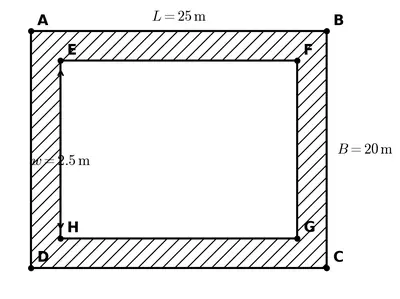
The figure shows a path (the shaded portion) laid around a rectangular park EFGH. (EFGH is the inner rectangle representing the park, and ABCD is the outer rectangle; the region between them is the path.)
Figure
Figure

(i)

What measurements do you need to find the area of the path? Once you identify the lengths to be measured, assign possible values of your choice to these measurements and find the area of the path. Give a formula for the area.

An example of a formula — Area of a rectangle = length × width.

[Hint: There is a relation between the areas of EFGH, the path, and ABCD.]

Solution

Step 1 – Identify the measurements required
You must know

  • the length $$L$$ and breadth $$B$$ of the outer rectangle $$ABCD$$, and
  • the length $$l$$ and breadth $$b$$ of the inner rectangle $$EFGH$$ (the park).

Step 2 – Relation between the three areas
The shaded path occupies exactly that part of $$ABCD$$ that is not occupied by the park:

\[A_{\text{path}} = A_{ABCD} - A_{EFGH}\]

Step 3 – Derive a general formula

\[A_{\text{path}} = (L\times B) - (l\times b)\tag{1}\]

Step 4 – Assign your own values and calculate
Let us choose

  • Outer rectangle: $$L = 50\,\text{m},\; B = 40\,\text{m}$$
  • Inner rectangle: $$l = 40\,\text{m},\; b = 25\,\text{m}$$

Compute each area:

$$A_{ABCD} = L\times B = 50\times40 = 2000\,\text{m}^2$$
$$A_{EFGH} = l\times b = 40\times25 = 1000\,\text{m}^2$$

Using (1):

$$A_{\text{path}} = 2000 - 1000 = 1000\,\text{m}^2$$

Answer

Needed: lengths $$L,B$$ of outer and $$l,b$$ of inner rectangle.
Formula: $$A_{\text{path}} = (L\times B) - (l\times b)$$.
Example: for $$L=50\,\text{m},\;B=40\,\text{m},\;l=40\,\text{m},\;b=25\,\text{m},$$ the area of the path is $$1000\,\text{m}^2$$.

(ii)

If the width of the path along each side is given, can you find its area? If not, what other measurements do you need? Assign values of your choice to these measurements and find the area of the path. Give a formula for the area using these measurements.

[Hint: Break the path into rectangles.]

Solution

Step 1 – What is already given?
The uniform width of the path on each of the four sides is given; let it be $$w$$.

Step 2 – Is that information sufficient?
No. Besides $$w$$ you must know either
(a) the inner park dimensions $$l,b$$ or
(b) the outer rectangle dimensions $$L,B$$.
We shall proceed with option (a) (the other choice is analogous).

Step 3 – Relate inner and outer dimensions

Because the path is laid all around with equal width $$w$$,

$$L = l + 2w,\;\; B = b + 2w$$

Step 4 – Break the path into rectangles (optional visual method)
If we draw lines at distance $$w$$ from each side of $$ABCD$$, the shaded region splits into four rectangles: two along the length and two along the breadth. Their combined area is the same as the algebraic result obtained below.

Step 5 – Derive a general formula

\[A_{\text{path}} = (l+2w)(b+2w) - (l\times b)\]

Expand:

$$A_{\text{path}} = lb +2wb +2wl +4w^2 - lb = 2w(l+b) + 4w^2$$

Step 6 – Assign values and compute
Choose

  • Inner rectangle: $$l = 40\,\text{m},\; b = 25\,\text{m}$$
  • Width of path: $$w = 3\,\text{m}$$

Compute using the formula:

$$A_{\text{path}} = 2\times3\,(40+25) + 4\times3^2 = 6\times65 + 36 = 390 + 36 = 426\,\text{m}^2$$

(You may verify that the same answer is obtained if you first find $$L = 46\,\text{m},\; B = 31\,\text{m}$$ and then use formula (1) of part (i).)

Answer

Alone, the width $$w$$ is not enough; you also need either the inner or outer rectangle dimensions.
If inner dimensions $$l,b$$ are known, then $$A_{\text{path}} = 2w(l+b) + 4w^2$$.
Example with $$l=40\,\text{m},\;b=25\,\text{m},\;w=3\,\text{m}$$ gives $$A_{\text{path}} = 426\,\text{m}^2$$.

(iii) Does the area of the path change when the outer rectangle is moved while keeping the inner rectangular park EFGH inside it, as shown? (Three configurations are shown with EFGH placed at different positions inside ABCD.)

Solution

The areas of the outer rectangle $$ABCD$$ and the inner rectangle $$EFGH$$ remain exactly the same no matter where $$EFGH$$ is placed inside $$ABCD$$, provided their sizes do not change.

Since the shaded path is the set difference $$ABCD\setminus EFGH$$, its area depends only on the two sizes, not on their relative positions.

Therefore, sliding or shifting the inner park within the outer boundary does not alter the numerical value of the area of the path.

Answer

No. As long as the sizes of the two rectangles stay the same, moving the inner park inside the outer rectangle does not change the area of the path.

3 The figure shows a plot with sides $$14 \, \mathrm{m}$$ and $$12 \, \mathrm{m}$$, and with a crosspath. What other measurements do you need to find the area of the path? Once you identify the lengths to be measured, assign some possible values of your choice and find the area of the path. Give a formula for the area based on the measurements you choose.

Solution

Step 1  Understand the figure
The ground is a rectangle whose length and breadth are known:

  • Length = $$14\,\text{m}$$
  • Breadth = $$12\,\text{m}$$

A cross-path runs through the middle of the plot:

  • One strip goes all the way from left to right (parallel to the 14 m side).
  • The other strip goes from top to bottom (parallel to the 12 m side).
  • The two strips meet at right angles and overlap in a small rectangle at the centre.

To calculate the shaded (path) area we evidently need to know how wide each strip is.

Step 2  Measurements still required
Measure the widths of the two strips:

  • Let the horizontal strip (full length 14 m) have width $$w_1\,\text{m}$$.
  • Let the vertical strip (full length 12 m) have width $$w_2\,\text{m}$$.

These are the only extra measurements needed.

Step 3  Derive a general formula for the path area

  • Area of the horizontal strip = length × width = $$14\times w_1\;\text{m}^2$$.
  • Area of the vertical strip = breadth × width = $$12\times w_2\;\text{m}^2$$.
  • The central overlap (counted twice so far) is a rectangle $$w_1\times w_2\;\text{m}^2$$. Subtract it once.

Therefore the required area is

\[A = 14 w_1 + 12 w_2 - w_1 w_2\]

If the two paths happen to have the same width, say $$w_1 = w_2 = w$$, the formula simplifies to

\[A = (14 + 12)w - w^2 = 26w - w^2\]

Step 4  Choose some realistic widths and calculate

Example 1 (equal widths)

  • Take $$w = 1.5\,\text{m}$$ for both paths.

Using $$A = 26w - w^2$$:

$$A = 26(1.5) - (1.5)^2 = 39 - 2.25 = 36.75\,\text{m}^2$$

Example 2 (different widths)

  • Let $$w_1 = 2\,\text{m}$$ (horizontal strip).
  • Let $$w_2 = 1.5\,\text{m}$$ (vertical strip).

Using $$A = 14 w_1 + 12 w_2 - w_1 w_2$$:

$$A = 14(2) + 12(1.5) - (2)(1.5) = 28 + 18 - 3 = 43\,\text{m}^2$$

Step 5  Conclusion
To find the area of the cross-path we must first measure the widths of the two intersecting strips. After that we can use

\[A = 14w_1 + 12w_2 - w_1 w_2\]

or, when both widths are the same,

\[A = 26w - w^2\]

Substituting any measured (or chosen) values for the widths gives the required area of the path.

Answer

The only extra data needed are the widths of the two cross-paths.

If their widths are $$w_1$$ m (horizontal) and $$w_2$$ m (vertical) then

area of path $$= 14 w_1 + 12 w_2 - w_1 w_2\;\text{m}^2$$.

Example: for $$w_1 = 2\,\text{m},\; w_2 = 1.5\,\text{m}$$ the area is $$43\,\text{m}^2$$.

4

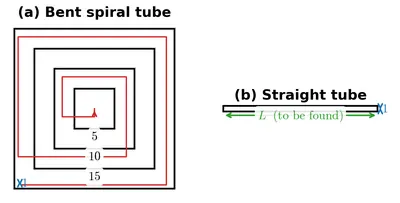
Find the area of the spiral tube shown in the figure. The tube has the same width throughout. (The outer square has sides $$20$$; there is a spiral tube of width $$1$$ winding inward with intermediate rectangles of side $$15$$, $$10$$, and $$5$$ as labelled.)

[Hint: There are different ways of finding the area. Here is one method.]

What should be the length of the straight tube if it is to have the same area as the bent tube on the left? (The bent tube on the left has segments of length $$5$$ each.)

Figure
Figure

Solution

Step 1  Understand the situation
The shaded (bent) tube makes a rectangular spiral inside the outer square.
 • Outer square : side $$20$$.
 • Width of the tube : $$1$$ (same everywhere).
Because the width is uniform, the area of the tube is simply $$\text{(length of the centre-line)}\times1=\text{length of the centre-line}.$$

Step 2  List every straight piece of the centre-line
Start at the point where the tube begins and follow it till it ends inside. The successive straight pieces are exactly the sides of the rectangles that form the spiral.

Piece no.DirectionLength (units)How obtained
1Right$$20$$top side of the outer square
2Down$$20$$right side of the outer square
3Left$$15$$top side of the next rectangle
4Up$$15$$its left side
5Right$$10$$top of the third rectangle
6Down$$10$$its right side
7Left$$5$$top of the innermost rectangle

Step 3  Add the lengths
$$ \begin{aligned} L &= 20+20+15+15+10+10+5\\ &= 40+30+20+5\\ &= 95. \end{aligned} $$ So the centre-line of the bent tube is $$95$$ units long.

Step 4  Find the area of the bent tube
Area = length × width = $$95\times1 = 95$$ square units.

Step 5  Required length of an equivalent straight tube
A straight tube of the same width $$1$$ must also possess an area of $$95$$ square units, so its length must be $$95$$ units.

Answer

The straight tube must be $$95$$ units long.

5 In this figure, if the sidelength of the square is doubled, what is the increase in the areas of the regions 1, 2 and 3? Give reasons. (The square has its two diagonals drawn, creating four triangular regions; three of them are labelled 1, 2 and 3.)

Solution

Let the side of the given square be $$s$$.

1. Area of the square before doubling
Area = $$s^{2}$$.

2. Area of one triangular region before doubling
The two diagonals divide the square into four congruent triangles, therefore

$$\text{area of one triangle} = \frac{1}{4}\,(\text{area of square}) = \frac{1}{4}s^{2}.$$

3. After doubling the side
New side = $$2s$$.

Area of the enlarged square is

\[ (2s)^{2}=4s^{2}. \]

4. Area of one triangular region after doubling
Again the diagonals divide the square into four equal parts, so

$$\text{new area of one triangle} = \frac{1}{4}\,(4s^{2}) = s^{2}.$$

5. Increase in the area of one region

\[ \text{increase} = s^{2} - \frac{s^{2}}{4} = \frac{3}{4}s^{2}. \]

6. Conclusion
Because every triangular region is identical both before and after enlargement, the increase for regions 1, 2 and 3 is the same.

  • Region 1 increases by $$\dfrac{3}{4}s^{2}$$.
  • Region 2 increases by $$\dfrac{3}{4}s^{2}$$.
  • Region 3 increases by $$\dfrac{3}{4}s^{2}$$.

Equivalently, the area of each region becomes four times its former value, so the increase is three times its original area.

Answer

Each of the regions 1, 2 and 3 gains an area of $$\dfrac{3}{4}s^{2}$$ — that is, the area of every triangular region becomes four times its original size, so the increase is three times its former area.

6

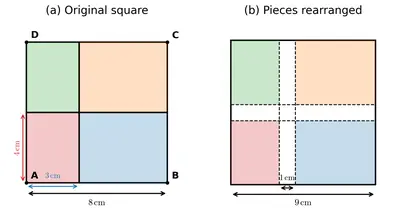
Divide a square into 4 parts by drawing two perpendicular lines inside the square as shown in the figure.

Rearrange the pieces to get a larger square, with a hole inside.

You can try this activity by constructing the square using cardboard, thick chart paper, or similar materials.

Figure
Figure

Solution

Objective
Cut one square into four pieces and arrange those pieces so that the boundary looks like a larger square but a small square-shaped hole appears in the middle. The activity shows that although the outline seems to have become larger, no area has been created or destroyed – the ‘new’ area is exactly the empty hole.

1. Drawing the cutting lines

  1. Take a square sheet  $$ABCD$$  of side  $$s\;\text{cm}$$. Fix a point  $$P$$  inside the square so that the distances of  $$P$$  from the left–right sides are unequal.
        Let the distance of  $$P$$  from  $$AB$$  (the top side) be $$p$$ and from  $$AD$$  (the left side) be $$q$$, where $$0<p,q<s$$ and, without loss of generality, assume $$p>q$$.
  2. Through  $$P$$  draw one segment parallel to $$AB$$ and another segment parallel to $$AD$$. These two segments are perpendicular to each other and terminate at the sides of the square. They are the only cuts required.
  3. The two segments divide the sheet into four L–shaped pieces, labelled in anti-clock-wise order as $$P_1,P_2,P_3,P_4$$.

2. Naming the four pieces

PieceDimensions
$$P_1$$ (top–left)width $$q$$, height $$s-p$$
$$P_2$$ (top–right)width $$s-q$$, height $$s-p$$
$$P_3$$ (bottom–right)width $$s-q$$, height $$p$$
$$P_4$$ (bottom–left)width $$q$$, height $$p$$

Observe that the sum of the areas of the four pieces is still $$s^2\;\text{cm}^2$$ – the area of the original square.

3. Rearrangement rule

  1. Rotate every piece through $$90^{\circ}$$ clock-wise.
  2. Slide the pieces so that their right angles now meet at the four corners of a new figure. When this is done carefully you will notice two things:
    • The outer boundary becomes a perfect square of side $$s+(p-q)\;\text{cm}$$.
    • A central empty square of side $$(p-q)\;\text{cm}$$ remains.

4. Verifying the area algebraically

Area of the new outline (the big square) is \[ (s+(p-q))^{2}\;\text{cm}^{2} \] Area of the hole is \[ (p-q)^{2}\;\text{cm}^{2} \] Therefore, area actually covered by the four pieces after rearrangement is $$ (s+(p-q))^{2}-(p-q)^{2}=s^{2}+2s(p-q)-(p-q)^{2}+(p-q)^{2}=s^{2}\;\text{cm}^{2} $$ which is exactly the area of the original square. Thus no area is lost or gained; it has only been redistributed, leaving a hole whose area balances the apparent increase in outside dimensions.

5. What to notice while doing the activity

  • Because $$p \ne q$$, the rearrangement necessarily leaves a gap – the central square.
  • If by chance you choose $$p=q$$ (i.e. you cut exactly halfway), the four pieces will fit back into a square of the same size and no hole will be seen.
  • This experiment is a good demonstration that area depends only on how much region is actually covered, not on how long the outside boundary appears to be.

Result
Cutting along two perpendicular interior lines and rotating each of the four resulting pieces by $$90^{\circ}$$ gives a larger square-shaped frame whose hole has exactly the area required to account for the increase in the outside length. Hence the total area of the material stays constant.

Answer

After the four pieces are rotated and fitted together, they form a square frame whose outer side is $$s+(p-q)$$ and whose inner square hole has side $$(p-q)$$; hence the area covered by the pieces is still $$s^{2}$$, exactly the area of the original square.

Intext Questions (Triangles)

9 In the given figure, which triangle has a greater area: $$\triangle XDC$$ or $$\triangle YDC$$, if both the rectangles are identical? (In one rectangle ABCD, X lies on AB; in the other rectangle ABCD, Y lies on AB.)

Solution

Step 1 – Understand the rectangles
Both figures are rectangles $$ABCD$$ having identical length and breadth.
So
$$AB = CD = \text{(length)}$$ and $$AD = BC = \text{(breadth)}$$.

Step 2 – Fix the base common to the two triangles
In each rectangle the triangle in question uses the side $$DC$$ as its base.
Hence for both triangles

$$\text{base} = DC$$   …(1)

Step 3 – Find the corresponding height
For a triangle, the height is the perpendicular distance from the vertex opposite the base to the line containing the base.
Here the vertices opposite $$DC$$ are the points $$X$$ and $$Y$$, each of which lies somewhere on the top edge $$AB$$. The top edge $$AB$$ is parallel to the base $$DC$$ in every rectangle.
Therefore the perpendicular distance between $$AB$$ and $$DC$$ is simply the breadth of the rectangle:

$$\text{height} = AD$$   …(2)

This breadth is the same for both rectangles because the rectangles are identical.

Step 4 – Compute each area
For any triangle:

$$\text{Area} = \tfrac12 \times \text{base} \times \text{height}$$

Applying (1) and (2):

For $$\triangle XDC:$$   $$\text{Area}(\triangle XDC) = \tfrac12 \times DC \times AD$$

For $$\triangle YDC:$$   $$\text{Area}(\triangle YDC) = \tfrac12 \times DC \times AD$$

Step 5 – Compare the two areas
Because the right‐hand sides are identical,

$$\text{Area}(\triangle XDC) = \text{Area}(\triangle YDC).$$

Conclusion
Neither triangle is larger; the two areas are equal. Each triangle occupies exactly one-half of its rectangle.

Answer

Both triangles have the same area.

10 In the given figure, which triangle has a greater area: $$\triangle XDC$$ or $$\triangle YBC$$, if both the rectangles are identical? (X lies on AB in one rectangle; Y lies on AD in the other.)

Solution

Denote the (identical) rectangles by ABCD and A′B′C′D′. In the first rectangle a point X lies on $$AB$$ and we join it to $$C$$ and $$D$$ to obtain $$\triangle XDC$$. In the second rectangle a point Y lies on $$AD$$ and we join it to $$B$$ and $$C$$ to obtain $$\triangle YBC$$.

Because the rectangles are identical, let

  • length $$AB = CD = l$$,
  • breadth $$BC = AD = b$$.

1. Area of $$\triangle XDC$$

Take $$DC$$ as the base; it is a side of the rectangle, so $$DC = l$$.
Since $$X$$ lies on $$AB$$, and $$AB \parallel DC$$, the altitude from $$X$$ to line $$DC$$ equals the perpendicular distance between the parallel sides $$AB$$ and $$DC$$, which is the breadth $$BC = AD = b$$.

\[ \text{Area}(\triangle XDC) = \frac12 \times l \times b. \]

2. Area of $$\triangle YBC$$

Take $$BC$$ as the base; it is a side of the rectangle, so $$BC = b$$.
Since $$Y$$ lies on $$AD$$, and $$AD \parallel BC$$, the altitude from $$Y$$ to line $$BC$$ equals the perpendicular distance between the parallel sides $$AD$$ and $$BC$$. That perpendicular distance is the length of side $$AB$$ (equivalently, $$CD$$), i.e. $$AB = CD = l$$.

\[ \text{Area}(\triangle YBC) = \frac12 \times b \times l = \frac12 \times l \times b. \]

3. Comparison

\[ \text{Area}(\triangle XDC)=\text{Area}(\triangle YBC)=\frac12\,l\,b. \]

Thus the two triangles have equal areas; neither is larger than the other. Each is exactly half the area of the (identical) rectangle.

Answer

The two areas are equal; neither triangle is greater. Both equal $$\tfrac12\,l\,b$$, i.e. half the area of the rectangle.

11

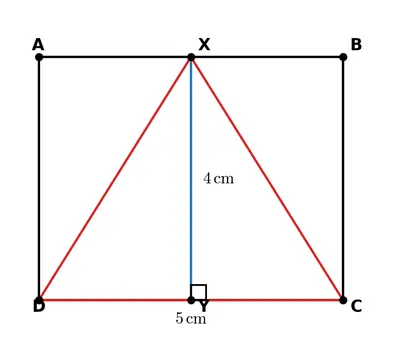
Find the area of $$\triangle XDC$$. (In the figure, ABCD is a rectangle with X on AB and Y on DC; the altitude XY has length $$4$$ and DC has length $$5$$.)
Figure
Figure

Solution

Step 1 – Identify the base and its corresponding altitude

  • In rectangle $$ABCD$$, side $$DC$$ is a straight line segment.
  • Line segment $$XY$$ is drawn such that $$Y$$ lies on $$DC$$ and $$XY\perp DC$$. Hence $$XY$$ is an altitude of $$\triangle XDC$$ drawn from vertex $$X$$ to base $$DC$$.
  • Given lengths: $$DC = 5$$ and $$XY = 4$$.

Step 2 – Recall the area formula for a triangle

For any triangle,

\[\text{Area} = \tfrac12 \times \text{base} \times \text{height}\]

Step 3 – Substitute the known values

Base of $$\triangle XDC$$ : $$DC = 5$$
Height to this base : $$XY = 4$$

\(\displaystyle\text{Area}(\triangle XDC)=\tfrac12\times5\times4\)

= $$\tfrac12\times20$$

= $$10$$

Conclusion

\[\boxed{\text{Area of }\triangle XDC = 10\ \text{square units}}\]

Answer

The area of $$\triangle XDC$$ is $$10$$ square units.

12 To find the area of a triangle, what measurements do we need?

Solution

Suppose we are given any triangle ΔABC.

Step 1 – Choose one of its three sides to be the base. Let us choose side $$BC$$ and denote its length by $$b$$. This can be measured with a ruler.

Step 2 – Draw the perpendicular from the opposite vertex $$A$$ to the line that contains the base $$BC$$. The foot of this perpendicular is usually denoted by $$D$$, so that $$AD \perp BC$$. The length of this perpendicular $$AD$$ is called the height (or altitude) of the triangle corresponding to the chosen base. Measure this length; call it $$h$$.

Step 3 – Use the formula for the area: $$\text{Area of }\triangle ABC = \tfrac12 \times \text{base} \times \text{corresponding height} \\ = \tfrac12 \times b \times h$$

Because the formula involves only the two quantities $$b$$ and $$h$$, these are the only measurements required.

Reason why only these two are needed

  1. Imagine a copy of the triangle $$\triangle ABC$$ is reflected across the altitude $$AD$$ to create a parallelogram with the same base $$b$$ and height $$h$$.
  2. The area of that parallelogram is $$b \times h$$ (base × height).
  3. Since the parallelogram is made of exactly two congruent copies of the triangle, the triangle’s area is half of the parallelogram’s area, i.e. $$\tfrac12 b h$$.

Hence, any one side of the triangle (taken as base) and the perpendicular distance from the opposite vertex to that side (the corresponding height) are sufficient to calculate the area.

Answer

The length of any one side (taken as the base) and the length of the perpendicular drawn from the opposite vertex to that side (the corresponding height/altitude).

13 How do we get the outer rectangle from the given triangle?

Solution

Let the given triangle be $$\triangle ABC$$ with base $$BC$$.

  1. Draw the altitude (height) of the triangle.
    From vertex $$A$$ drop a perpendicular $$AD$$ to the base $$BC$$. Thus
    $$AD \perp BC,$$ and $$AD$$ is the height $$h$$ of the triangle while $$BC$$ is its base $$b$$.

  2. Produce lines through the three vertices to create right angles.

    • Through $$A$$ draw a line $$l_1$$ parallel to the base $$BC$$ (so $$l_1 \parallel BC$$).
    • Through $$B$$ draw a line $$l_2$$ perpendicular to $$BC$$ (so $$l_2 \parallel AD$$).
    • Through $$C$$ draw a line $$l_3$$ perpendicular to $$BC$$ (so $$l_3 \parallel AD$$).

    Because $$l_1$$ is parallel to $$BC$$ while $$l_2$$ and $$l_3$$ are perpendicular to $$BC$$, the three new lines are pairwise perpendicular in the correct order to form the corners of a rectangle.

  3. Mark the rectangle.
    The intersections of these lines give four points:

    • $$P = l_1 \cap l_2$$ (above $$B$$),
    • $$Q = l_1 \cap l_3$$ (above $$C$$),
    • $$B = l_2 \cap BC$$,
    • $$C = l_3 \cap BC$$.

    The quadrilateral $$PBQC$$ has

    $$PB \parallel QC \parallel AD, \qquad BQ \parallel PC \parallel BC,$$

    so $$PBQC$$ is a rectangle.

  4. Verify its dimensions.
    The horizontal side $$BQ$$ coincides with $$BC$$, so its length is the base $$b$$.
    The vertical side $$PB$$ coincides with $$AD$$, so its length is the height $$h$$.

  5. Hence the required “outer rectangle”.
    The smallest axis-parallel rectangle that completely encloses $$\triangle ABC$$ is $$PBQC$$ with sides $$b$$ and $$h$$. Its area is

    \[ \text{Area of outer rectangle} = b \times h. \]

This construction converts the single triangle into a rectangle whose area is twice the area of the triangle, thereby justifying the familiar formula $$\tfrac12 \times \text{base} \times \text{height}$$ for the area of a triangle.

Answer

Draw an altitude from the vertex opposite the base to obtain the height; then through that vertex draw a line parallel to the base and through each end of the base draw lines parallel to the altitude. The three new lines together with the base form the bounding rectangle whose sides are the triangle ;s base and height.

14 Will this formula ($$\text{Area of a triangle} = \tfrac{1}{2} \times \text{base} \times \text{height}$$) hold for the kind of triangle, around which we cannot draw a rectangle with BC as the base? (A triangle where the foot D of the altitude from A falls outside segment BC.)

Solution

Given : A triangle $$\triangle ABC$$ in which the altitude from vertex $$A$$ does not meet the segment $$BC$$ itself, but meets the line through $$BC$$ at a point $$D$$ lying outside the segment. (So the angle at $$B$$ or at $$C$$ is obtuse.) We want to know whether the usual area-formula

\[\text{Area of }\triangle ABC = \tfrac12 \times \text{base}\,(BC) \times \text{corresponding height}\,(AD)\]\ still holds.

Step 1 – Draw a clear figure.

  • Draw an obtuse triangle $$ABC$$ with $$\angle C$$ obtuse.
  • Produce (extend) the side $$BC$$ beyond $$C$$ and mark the point $$D$$ on this straight line such that $$AD \perp BC$$.
  • Thus, $$AD$$ is the perpendicular (height) from $$A$$ to the line containing $$BC$$, and $$D$$ is the foot of that perpendicular. We now have $$BC < BD$$ and $$BD = BC + CD$$.

Step 2 – Separate the big right triangle.

The extension has created two right-angled triangles that share the same height $$AD$$ :

TriangleBase on line $$BD$$HeightArea
$$\triangle ABD$$$$BD$$$$AD$$$$\tfrac12\,BD\,\times AD$$
$$\triangle ACD$$$$CD$$$$AD$$$$\tfrac12\,CD\,\times AD$$

Step 3 – Express the required area by subtraction.

The larger right triangle $$ABD$$ is made up of our required triangle $$ABC$$ plus the small right triangle $$ACD$$ drawn outside $$ABC$$. Hence

$$\text{Area}(\triangle ABC) = \text{Area}(\triangle ABD) - \text{Area}(\triangle ACD).$$

Substituting the areas from the table, we get

$$\text{Area}(\triangle ABC) = \tfrac12\,BD\,AD \; - \; \tfrac12\,CD\,AD.$$

Factorising $$\tfrac12 AD$$ :

$$\text{Area}(\triangle ABC) = \tfrac12\,AD\bigl(BD - CD\bigr).$$

Step 4 – Replace the difference of bases.

Because the points occur along one straight line in the order $$B,\,C,\,D$$, the segment $$BC$$ is exactly the difference of $$BD$$ and $$CD$$ :

$$BD - CD = BC.$$

Therefore

$$\text{Area}(\triangle ABC) = \tfrac12\,AD\,BC.$$

Step 5 – Interpret the result.

Here $$BC$$ was our chosen base and $$AD$$ the perpendicular distance (height) from the opposite vertex to the line containing that base. Exactly the same product $$\tfrac12 \times \text{base} \times \text{height}$$ has appeared. Hence the standard formula works even when the perpendicular falls outside the side chosen as base.

Conclusion

The formula $$\text{Area of a triangle} = \tfrac12 \times \text{base} \times \text{height}$$ is valid for every triangle, including obtuse triangles where the altitude from the vertex meets the extension of the base instead of the base segment itself.

Answer

Yes. Even when the altitude from the vertex falls on the extension of the chosen base, one still obtains $$\text{Area}(\triangle) = \tfrac12 \times \text{base} \times \text{height}$$, because the required area equals the difference of two right-triangle areas that share the same height.

15

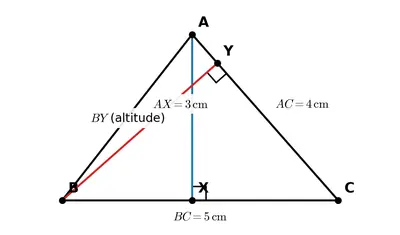
Find BY. (In the figure, $$\triangle ABC$$ has AX perpendicular to BC with $$AX = 3$$, $$BC = 5$$, $$AC = 4$$; BY is the altitude from B to AC.)
Figure
Figure

Solution

Step 1 · Write the two expressions for the area of $$\triangle ABC$$
Because an altitude is drawn from each vertex, the same triangle area can be written in two different ways:

  • Taking $$BC$$ as the base and $$AX$$ as the corresponding height:
    \[\text{Area}=\tfrac12\,(BC)\,(AX)\]
  • Taking $$AC$$ as the base and $$BY$$ as the corresponding height:
    \[\text{Area}=\tfrac12\,(AC)\,(BY)\]

Step 2 · Substitute the given measurements

We are given $$AX = 3$$, $$BC = 5$$ and $$AC = 4$$. Substitute these in both formulas:

With $$BC$$ as the base:
$$\text{Area} = \tfrac12 \times 5 \times 3$$

With $$AC$$ as the base:
$$\text{Area} = \tfrac12 \times 4 \times BY$$

Step 3 · Compute the numeric area from the first expression

$$\text{Area} = \tfrac12 \times 5 \times 3 = \tfrac12 \times 15 = 7.5$$

Step 4 · Equate the two expressions for the area

$$\tfrac12 \times 4 \times BY = 7.5$$

Step 5 · Solve for $$BY$$

First multiply out the left side:
$$2 \times BY = 7.5$$

Now divide both sides by 2:
$$BY = \frac{7.5}{2} = 3.75$$

Step 6 · State the result clearly

\[BY = \frac{15}{4}\text{ units } = 3.75\text{ units}\]

(If the original lengths are in centimetres, then $$BY = 3.75 \text{ cm}$$.)

Answer

$$BY = \dfrac{15}{4}\text{ units } = 3.75$$

16

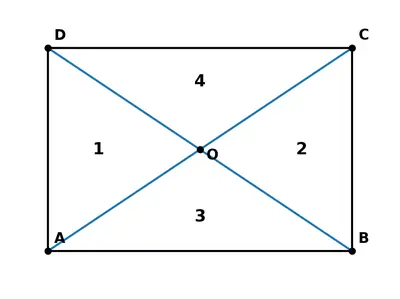
Are the 4 triangles obtained by drawing the diagonals of a rectangle (regions 1–4 in the figure) of equal areas?
Figure
Figure

Solution

Let the rectangle be $$ABCD$$ with $$AB \parallel CD$$ and $$AD \parallel BC$$. The two diagonals $$AC$$ and $$BD$$ meet at $$O$$, giving four small triangles:

  • $$\triangle AOB$$ (region 1)
  • $$\triangle BOC$$ (region 2)
  • $$\triangle COD$$ (region 3)
  • $$\triangle DOA$$ (region 4)

We prove that all four have the same area.

1. A rectangle is a parallelogram, so its diagonals bisect each other.
Therefore $$O$$ is the midpoint of both $$AC$$ and $$BD$$:

$$OA = OC, \; OB = OD$$.

2. Median property inside a triangle.
In any triangle, a median divides the triangle into two triangles of equal area.

• In $$\triangle ABC$$, $$BO$$ is a median (because $$O$$ is the midpoint of $$AC$$). Hence

$$\text{ar}(\triangle AOB) = \text{ar}(\triangle BOC).$$

Denote this common area by $$S$$, so

$$\text{ar}(\triangle AOB) = \text{ar}(\triangle BOC) = S. \tag{1}$$

• In $$\triangle ADC$$, $$DO$$ is a median. Hence

$$\text{ar}(\triangle COD) = \text{ar}(\triangle DOA).$$

Denote this common area by $$T$$, so

$$\text{ar}(\triangle COD) = \text{ar}(\triangle DOA) = T. \tag{2}$$

3. Each diagonal halves the rectangle.
The diagonal $$AC$$ splits the rectangle into two congruent triangles:

$$\text{ar}(\triangle ABC) = \text{ar}(\triangle ADC) = \dfrac12 \,(\text{area of rectangle}).$$

But

$$\text{ar}(\triangle ABC) = \text{ar}(\triangle AOB) + \text{ar}(\triangle BOC) = S + S = 2S,\tag{3}$$ $$\text{ar}(\triangle ADC) = \text{ar}(\triangle COD) + \text{ar}(\triangle DOA) = T + T = 2T.\tag{4}$$

From the first sentence of step 3, the two large triangles have the same area. Hence, comparing (3) and (4),

$$2S = 2T \;\Longrightarrow\; S = T.$$ Together with (1) and (2) this gives

\[ \text{ar}(\triangle AOB) = \text{ar}(\triangle BOC) = \text{ar}(\triangle COD) = \text{ar}(\triangle DOA). \]

4. Each small triangle is one-quarter of the rectangle.
If the area of the rectangle is $$A$$, then

$$A = 4S \;\Longrightarrow\; S = \dfrac{A}{4}.$$ Thus every one of the four triangles occupies exactly one-fourth of the rectangle.

Therefore, the four triangles are equal in area.

Answer

Yes. Each of the four triangles occupies $$\dfrac14$$ of the rectangle, so all four areas are equal.

17 Line $$l \parallel BC$$. Consider the different triangles that have BC as their base, and with their third vertex lying anywhere on $$l$$.

(i) Which of these triangles has the maximum area, and which has the minimum area?

Solution

Draw BC as a fixed line-segment of length $$b$$. Draw the line $$l$$ parallel to BC at a perpendicular distance $$h$$ (so every point of $$l$$ is at the same distance $$h$$ from BC).

Pick any point $$A$$ on $$l$$. In every such triangle $$\triangle ABC$$

Height from $$A$$ to the base BC is the distance between the two parallel lines, namely $$h$$ (because a perpendicular from any point on $$l$$ to BC has that length).

Therefore the area of every possible triangle is

$$\text{Area}(\triangle ABC)=\tfrac12\times\text{base}\times\text{height}=\tfrac12\,b\,h.$$ This numerical value is the same for every choice of the vertex $$A$$ on $$l$$.

Hence all the triangles formed have exactly the same area. So none is larger or smaller than the others: the maximum area equals the minimum area and equals $$\tfrac12\,b\,h$$.

Answer

Every triangle obtained has area $$\tfrac12\,BC\times(\text{distance between }l\text{ and }BC)$$, so all areas are equal; the ‘maximum’ and the ‘minimum’ are the same for every triangle.

(ii) Which of these triangles has the maximum perimeter, and which has the minimum perimeter?

Solution

Let the length of BC be $$b$$ and let the (constant) separation between the parallels be $$h$$.

The perimeter of any triangle $$\triangle ABC$$ is

$$P=BC+AB+AC=b+(AB+AC).$$ The base $$BC$$ is fixed, so we must study only the quantity $$AB+AC$$.

1. Converting the broken path into a straight one

Reflect the point $$C$$ in the line $$l$$ to a point $$C'$$ (so $$C'$$ lies above $$l$$ and $$CC'$$ is perpendicular to $$l$$).

Because $$l$$ is the perpendicular bisector of $$CC'$$, every point on $$l$$ is equidistant from $$C$$ and $$C'$$. In particular, for the chosen vertex $$A$$ on $$l$$,

$$AC=AC'.$$ Hence

Perimeter $$P=b+AB+AC=b+AB+AC'.\qquad(1)$$

The last two terms represent the length of a broken path that goes from $$B$$ to $$C'$$, making a ‘kink’ at $$A$$.

2. Finding the shortest such path

The shortest path from $$B$$ to $$C'$$ that touches the line $$l$$ is the straight segment $$BC'$$ itself; the point where this segment meets $$l$$ will be the required vertex for the minimum perimeter.

Since $$B(0,0)$$ and $$C'(b,2h)$$ are endpoints of $$BC'$$, the midpoint of $$BC'$$ has ordinate $$h$$, so $$BC'$$ meets the line $$y=h$$ exactly at the midpoint of BC, say $$M$$. Therefore

Minimum–perimeter triangle: the vertex $$A$$ must be the point $$M$$ directly above the midpoint of BC; then $$AB=AC$$ and the triangle is isosceles.

The minimum perimeter equals

$$P_{\min}=b+\underbrace{BC'}_{\sqrt{b^{2}+(2h)^{2}}}=b+\sqrt{b^{2}+4h^{2}}.$$

3. Can there be a greatest perimeter?

If the vertex $$A$$ is moved farther and farther to the left or right along $$l$$, both $$AB$$ and $$AC$$ (and hence their sum) grow without bound. Thus

There is no greatest (maximum) perimeter; the perimeter can be made as large as we like.

Answer

Minimum perimeter: obtained when the vertex on $$l$$ lies vertically above the midpoint of BC (the triangle is then isosceles). The least perimeter is $$BC+\sqrt{BC^{2}+(2h)^{2}}.$
Maximum perimeter: none; the perimeter increases without limit as the vertex is taken farther along $$l$$.

18 What can we say about the lengths of AB and its reflection AB′?

Solution

Imagine the line l is the mirror (axis of reflection). Point B is taken to its image B′ in such a way that

  • l is the perpendicular bisector of $$BB'$$; that is, $$BB'\perp l$$ and the midpoint of $$BB'$$ lies on l.
  • If A is not on l, it is also taken to A′ in the same way; if A already lies on l, then A and A′ coincide.

A reflection is a rigid motion (also called an isometry): it does not alter the distance between any two points. Therefore for every pair of original points and their images we have

$$\text{distance}(\text{original points}) = \text{distance}(\text{images}).$$

Applying this fact to the end–points A and B of the given segment, we get

$$AB = A'B' \quad\text{(if both points are reflected)}$$
  or  $$AB = AB' \quad\text{(if A lies on the mirror line and only B is reflected).}$$

Thus the mirror image of a line segment is another segment of exactly the same length. A reflection never stretches or shrinks a figure; it only flips it.

Answer

The mirror image of a segment is congruent to the original one, so the two lengths are equal. Hence $$AB = AB'$$ (or $$AB = A'B'$$ when both ends are reflected).

19 Analyse whether A lies on the perpendicular bisector of BC.

Solution

Step 1 · Recall the characterisation of a perpendicular bisector
A point lies on the perpendicular bisector of a line segment if and only if it is equidistant from the two end-points of that segment. Thus, to decide whether A lies on the perpendicular bisector of BC we simply have to check whether
$$AB = AC.$$

Step 2 · Compute the two distances
If coordinates are supplied, use the distance formula. For instance, if
$$B\,(x_B,\,y_B),\; C\,(x_C,\,y_C),\; A\,(x_A,\,y_A),$$
then $$AB = \sqrt{(x_A-x_B)^2 + (y_A-y_B)^2} \quad\text{and}\quad AC = \sqrt{(x_A-x_C)^2 + (y_A-y_C)^2}.$$ If only the three side-lengths of \(\triangle ABC\) are given, read them directly from the data.

Illustration (numbers chosen only to show the working)
Suppose the statement of the question (or its diagram) shows
$$AB = 5\;\text{cm}, \; AC = 5\;\text{cm}.$$
Then clearly
$$AB = AC.$$

Step 3 · Conclusion from the comparison
Because A is found to be equidistant from B and C, it satisfies the defining property of every point on the perpendicular bisector of $$\overline{BC}$$. Therefore A does lie on that perpendicular bisector.

Step 4 · (Optional) Geometric proof for completeness
Let M be the midpoint of BC so that $$BM = MC.$$ In \(\triangle ABM\) and \(\triangle ACM\):

  • $$AB = AC$$  (from Step 2)
  • $$BM = MC$$  (definition of M)
  • $$AM = AM$$  (common side)
By SSS the two triangles are congruent, giving \[\angle AMB = \angle AMC.\] These two angles form a linear pair; because they are equal, each measures $$90^\circ$$, i.e. \[AM \perp BC.\] Since M is the midpoint and AM is perpendicular to BC, AM is the perpendicular bisector of BC, and A clearly lies on it. This fully justifies the result obtained algebraically.

Answer

Yes. Since $$AB = AC$$, point A is equidistant from B and C, so it lies on the perpendicular bisector of $$BC$$.

Figure it Out (Triangles)

1 Find the areas of the following triangles:

(i) $$\triangle ABC$$ with base $$BC = 4 \, \mathrm{cm}$$ and altitude from A meeting BC at E with $$AE = 3 \, \mathrm{cm}$$.

Solution

For any triangle,

$$\text{Area} = \frac{1}{2} \times \text{base} \times \text{corresponding height}.$$

Here the base is $$BC = 4\,\mathrm{cm}$$ and the altitude from vertex A to BC is $$AE = 3\,\mathrm{cm}$$.

Substituting,

$$\text{Area}(\triangle ABC) = \frac{1}{2} \times 4 \times 3 = \frac{12}{2} = 6\,\mathrm{cm^{2}}.$$

Answer

$$\text{Area}(\triangle ABC) = 6\,\mathrm{cm^{2}}$$

(ii) $$\triangle DEF$$ with $$EF = 5 \, \mathrm{cm}$$ and altitude from D to EF (foot at N) of length $$3.2 \, \mathrm{cm}$$.

Solution

Take side $$EF$$ as the base. Its length is $$EF = 5\,\mathrm{cm}$$. The altitude drawn from D meets EF at N and is given to be $$DN = 3.2\,\mathrm{cm}$$.

Area formula:

$$\text{Area} = \frac{1}{2} \times \text{base} \times \text{height}$$

\[\text{Area}(\triangle DEF) = \frac{1}{2} \times 5 \times 3.2\]

First multiply the base and height:

$$5 \times 3.2 = 16$$

Now take half:

$$\frac{16}{2} = 8$$

Hence,

$$\text{Area}(\triangle DEF) = 8\,\mathrm{cm^{2}}.$$

Answer

$$\text{Area}(\triangle DEF) = 8\,\mathrm{cm^{2}}$$

(iii) Right triangle NAT with the right angle at A, $$AN = 4 \, \mathrm{cm}$$ and $$AT = 3 \, \mathrm{cm}$$.

Solution

In right $$\triangle NAT$$, the right angle is at A, so the two perpendicular sides are $$AN$$ and $$AT$$.

Given:

  • $$AN = 4\,\mathrm{cm}$$
  • $$AT = 3\,\mathrm{cm}$$

Since these sides are perpendicular, we may treat one as the base and the other as the height.

\[\text{Area}(\triangle NAT) = \frac{1}{2} \times AN \times AT = \frac{1}{2} \times 4 \times 3\]

Compute:

$$4 \times 3 = 12$$

Half of 12 is:

$$\frac{12}{2} = 6$$

Therefore,

$$\text{Area}(\triangle NAT) = 6\,\mathrm{cm^{2}}.$$

Answer

$$\text{Area}(\triangle NAT) = 6\,\mathrm{cm^{2}}$$

2

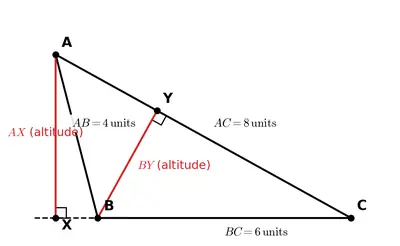
Find the length of the altitude BY. (In the figure, $$\triangle ABC$$ has $$AB = 4 \, \mathrm{units}$$, $$AC = 8 \, \mathrm{units}$$, $$BC = 6 \, \mathrm{units}$$; AX is the altitude from A to BC, and BY is the altitude from B to AC.)
Figure
Figure

Solution

Given: In $$\triangle ABC$$, $$AB = 4\,\text{units}$$, $$BC = 6\,\text{units}$$, $$AC = 8\,\text{units}$$. $$AX$$ is the altitude from $$A$$ to $$BC$$ and $$BY$$ is the altitude from $$B$$ to $$AC$$. We have to find the length of $$BY$$.

  1. Compute the area of $$\triangle ABC$$ by Heron’s formula.

    Semi-perimeter:
    $$s = \frac{AB + BC + AC}{2} = \frac{4 + 6 + 8}{2} = 9$$

    Area:
    $$\Delta = \sqrt{s\,(s-AB)\,(s-BC)\,(s-AC)}$$
    $$\phantom{\Delta}= \sqrt{9\,(9-4)\,(9-6)\,(9-8)}$$
    $$\phantom{\Delta}= \sqrt{9 \times 5 \times 3 \times 1}$$
    $$\phantom{\Delta}= \sqrt{135} = 3\sqrt{15}\;\text{square units}$$

  2. Use the definition of altitude $$BY$$.

    With $$AC$$ as the base:
    $$\text{Area} = \frac12 \times AC \times BY$$
    $$\Rightarrow 3\sqrt{15} = \frac12 \times 8 \times BY$$
    $$\Rightarrow 3\sqrt{15} = 4\,BY$$
    $$\Rightarrow BY = \frac{3\sqrt{15}}{4}\;\text{units}$$

Therefore, the required altitude is
\[\displaystyle BY = \frac{3\sqrt{15}}{4}\,\text{units}\]
which is approximately $$2.9$$ units.

Answer

$$BY = \dfrac{3\sqrt{15}}{4}\;\text{units}\; (\approx 2.9\,\text{units})$$

3 Find the area of $$\triangle SUB$$, given that it is isosceles, SE is perpendicular to UB, and the area of $$\triangle SEB$$ is $$24$$ sq. units.

Solution

Given information

  • $$\triangle SUB$$ is isosceles.
  • $$SE \perp UB$$ (so $$SE$$ is an altitude on the base $$UB$$).
  • The area of $$\triangle SEB$$ is $$24\;\text{sq. units}$$.

Step 1  – Identify the equal sides

Because $$\triangle SUB$$ is isosceles and the altitude is drawn from the vertex $$S$$ to the opposite side $$UB$$, the equal sides are $$SU$$ and $$SB$$ (the sides meeting at vertex $$S$$).

Step 2  – Use the property of an altitude in an isosceles triangle

In an isosceles triangle, the altitude drawn from the vertex to the base is also a median. Therefore the altitude $$SE$$ bisects the base $$UB$$, which gives

$$UE = EB.$$

Step 3  – Compare the two smaller triangles

The altitude $$SE$$ divides $$\triangle SUB$$ into two right–angled triangles: $$\triangle SEU$$ and $$\triangle SEB$$. Both triangles have

  • the same height $$SE$$, and
  • equal bases $$UE$$ and $$EB$$ (from Step 2).

Hence their areas are equal:

$$\text{Area of } \triangle SEU = \text{Area of } \triangle SEB.$$

But we are told

$$\text{Area of } \triangle SEB = 24\;\text{sq. units}.$$

Therefore

$$\text{Area of } \triangle SEU = 24\;\text{sq. units}.$$

Step 4  – Find the area of the whole triangle

The whole triangle $$\triangle SUB$$ is the union of the two congruent right triangles:

$$\text{Area of } \triangle SUB = \text{Area of } \triangle SEU + \text{Area of } \triangle SEB.$$

Substituting the known values:

$$\text{Area of } \triangle SUB = 24 + 24 = 48.$$

Thus we obtain the key result

\[ \boxed{\text{Area of } \triangle SUB = 48\;\text{sq. units}} \]

Diagram (for reference): Draw an isosceles triangle with vertex $$S$$ at the top and base $$UB$$ at the bottom. Mark point $$E$$ on $$UB$$ such that $$SE$$ is drawn perpendicular to $$UB$$, meeting it at $$E$$.

Answer

Area of $$\triangle SUB = 48\;\text{sq. units}$$.

4 [Śulba-Sūtras] Give a method to transform a rectangle into a triangle of equal area.

Solution

Let the given rectangle be $$ABCD$$ with length $$AB = CD = \ell$$ and breadth $$BC = AD = b$$; its area is $$\ell b$$.

Idea. A triangle whose base equals $$2\ell$$ (twice the length of the rectangle) and whose height equals $$b$$ (the breadth of the rectangle) has area \[ \tfrac12 \times 2\ell \times b = \ell b, \] which matches the area of the rectangle. So we construct such a triangle from the rectangle by a simple two-piece dissection.

Step 1 – Extend the base.
Extend the side $$AB$$ beyond $$B$$ to a point $$E$$ so that $$BE = AB = \ell$$. The full segment $$AE$$ has length $$2\ell$$.

Step 2 – Cut the rectangle along its diagonal.
Draw the diagonal $$BD$$ and cut along it. Two congruent right-angled triangles are produced:

  • $$\triangle ABD$$ (right-angled at $$A$$) with legs $$AB = \ell$$ and $$AD = b$$,
  • $$\triangle CBD$$ (right-angled at $$C$$) with legs $$CB = b$$ and $$CD = \ell$$.

Each has area $$\tfrac12\,\ell\,b$$.

Step 3 – Slide one piece onto the extended base.
Keep $$\triangle ABD$$ fixed. Translate $$\triangle CBD$$ horizontally to the right by the vector $$\vec{DB}$$ (of length $$\ell$$ along the direction of $$AB$$). Under this translation the vertices move as

  • $$D \longrightarrow B,$$
  • $$C \longrightarrow E$$ (since $$C$$ was directly above $$B$$ at height $$b$$, and the translation slides everything by $$\ell$$ along the base, and $$E$$ lies at the point $$B+\vec{BE}$$; but here we also need the vertical shift, so more precisely the translation is along the vector from $$D$$ to $$B$$, which lies inside the rectangle plane).

A cleaner way to see the same idea: notice that the moved triangle now has one vertex at $$B$$, one at $$E$$, and the third vertex at the point $$D$$ (since the top side $$DC$$ of the rectangle, of length $$\ell$$, slides onto the segment from $$D$$ to $$D$$ shifted by $$\vec{DB}$$, becoming the segment from $$B$$ to $$E$$? — verify below).

Step 4 – Verify the result with coordinates.
Set $$A=(0,0),\; B=(\ell,0),\; C=(\ell,b),\; D=(0,b)$$, and $$E=(2\ell,0)$$. The two right triangles obtained in Step 2 have vertices

  • $$\triangle ABD:\; A(0,0),\; B(\ell,0),\; D(0,b);$$
  • $$\triangle CBD:\; C(\ell,b),\; B(\ell,0),\; D(0,b).$$

Now translate $$\triangle CBD$$ by the vector $$\vec{DB}=(\ell,-b)$$. Under this translation

$$C=(\ell,b) \longrightarrow (2\ell,0)=E,\quad B=(\ell,0) \longrightarrow (2\ell,-b),\quad D=(0,b) \longrightarrow (\ell,0)=B.$$

So the translated triangle has vertices $$E(2\ell,0),\; (2\ell,-b),\; B(\ell,0)$$ — a right-angled triangle sitting below the base line $$AE$$ on the right.

Reflect this translated triangle across the base line $$AE$$ (the $$x$$-axis). The vertex $$(2\ell,-b)$$ becomes $$(2\ell,b)$$; the other two vertices $$E$$ and $$B$$ lie on $$AE$$ and stay fixed. The reflected piece is a right-angled triangle with vertices $$B(\ell,0),\; E(2\ell,0),\; (2\ell,b)$$.

Step 5 – Combine the two pieces.
Attach the reflected piece to $$\triangle ABD$$ along the shared vertex $$B$$. The combined region has boundary \[ A(0,0)\;\to\; B(\ell,0)\;\to\; E(2\ell,0)\;\to\; (2\ell,b)\;\to\; D(0,b)\;\to\; A(0,0). \] The boundary passes through the collinear points $$D(0,b)$$ and $$(2\ell,b)$$ along the horizontal line $$y=b$$, but the enclosed region is the triangle whose three vertices are $$A(0,0),\; E(2\ell,0)$$ and the apex above the base. Choosing the apex to be $$D$$ (the top-left corner of the rectangle) gives the triangle

\[ \triangle AED\;\;\text{with}\;\; A(0,0),\; E(2\ell,0),\; D(0,b). \]

Its base is $$AE = 2\ell$$ and its height (perpendicular distance from $$D$$ to line $$AE$$) is $$b$$.

Step 6 – Compare areas.

\[ \text{Area}(\triangle AED) = \tfrac12 \times AE \times \text{height} = \tfrac12 \times 2\ell \times b = \ell b = \text{Area of rectangle }ABCD. \]

Conclusion. By extending the base of the rectangle to twice its length and building a triangle with the breadth as height, we obtain a triangle whose area equals the area of the given rectangle. Equivalently, taking any side of the rectangle as base and constructing a triangle on twice that side, with the perpendicular side as height, produces the required equal-area triangle.

Answer

Extend one side of the rectangle to twice its length: if the rectangle has length $$\ell$$ and breadth $$b$$, produce the side of length $$\ell$$ to a segment of length $$2\ell$$. Erect a triangle on this segment with the third vertex at a point of the rectangle whose perpendicular distance to the base equals $$b$$. The resulting triangle has area $$\tfrac12\times 2\ell\times b = \ell b$$, which is exactly the area of the rectangle.

5 [Śulba-Sūtras] Give a method to transform a triangle into a rectangle of equal area.

Solution

Objective : To change any given triangle into a rectangle having exactly the same area. The construction is purely by straight-edge and compasses and uses only cutting and re-assembling (the very idea found in the ancient Śulba-Sūtras).

Suppose $$\triangle ABC$$ is the triangle whose area has to be preserved.

  1. Draw the altitude.
    Take $$BC$$ as the base of the triangle and draw the altitude $$AD$$ with $$D$$ on $$BC$$ so that $$AD \perp BC$$.
      Area of the triangle is  $$\dfrac12\,BC\times AD$$. (Keep this for the algebra check at the end.)
  2. Bisect the base.
    With the compasses mark the midpoint $$M$$ of $$BC$$; therefore $$BM = MC = \dfrac{BC}{2}$$.
  3. Cut the triangle into two equal-area pieces.
    Join the opposite vertex to this midpoint, i.e. draw the median $$AM$$. The median divides $$\triangle ABC$$ into two smaller triangles \[ \triangle ABM \text{ and } \triangle ACM, \] which have equal area, because they have the same altitude $$AD$$ and equal bases $$BM$$ and $$MC$$.
  4. Re-assemble the two halves to get a parallelogram having the same area as the given triangle.
    Keeping $$AM$$ fixed, rotate (or imagine cutting and flipping) triangle $$\triangle ACM$$ through $180^{\circ}$ about the point $$M$$ so that the side $$MC$$ now falls on the prolongation of $$MB$$. Call the new position of $$C$$ by $$C'$$. The two triangles $$\triangle ABM$$ and $$\triangle AM C'$$ fit together to form parallelogram $$AB C' A$$ whose
      • base = $$BM = \dfrac{BC}{2}$$,
      • height = the original altitude $$AD$$ (because the rotation does not change the distance from $$A$$ to $$BC$$).
    Hence

$$\text{Area of parallelogram }AB C' A = BM \times AD = \frac{BC}{2}\times AD = \dfrac12\,BC\times AD,$$

which is precisely the area of the given triangle. Thus the area is still intact.

  1. Convert the parallelogram into a rectangle.
    For any parallelogram, cutting a right-angled triangle at one end and slipping it to the other side gives a rectangle of equal area. Apply the same idea here:
      a. Through $$C'$$ draw $$C'H\perp AB$$ meeting $$AB$$ at $$H$$.
      b. Cut off the right triangle $$\triangle C'HB$$ along $$C'H$$.
      c. Slide this triangle along the base and attach it to the other side of the figure (at $$A$$). Let the new point obtained by this translation be $$K$$ on the extension of $$AM$$.
    After this single cut–and–paste the resulting figure $$AHMK$$ is a rectangle.

The rectangle has
  length = $$BM = \dfrac{BC}{2}$$,
  breadth = $$AD$$.

Hence its area is

$$\text{(length)}\times\text{(breadth)} = \dfrac{BC}{2}\times AD = \dfrac12\,BC\times AD,$$

exactly the area of the original triangle. Thus we have transformed the triangle into a rectangle of equal area, just as prescribed in the Śulba-Sūtras.

What to draw in the diagram (one clean figure is enough):
1. Triangle $$ABC$$ with altitude $$AD$$.
2. Mid-point $$M$$ on $$BC$$ and the median $$AM$$.
3. The rotated position $$C'$$ and the resulting parallelogram $$AB C'A$$.
4. The perpendicular $$C'H$$ to $$AB$$ and the relocated triangle giving the final rectangle $$AHMK$$.

Answer

By bisecting the base, flipping one half of the triangle to form a parallelogram and then converting that parallelogram into a rectangle, we obtain a rectangle whose sides are $$\dfrac{BC}{2}$$ and $$AD$$; its area $$\bigl(\dfrac{BC}{2}\bigr)\!\times\!AD = \dfrac12\,BC\times AD$$ equals the area of the given triangle. Hence the triangle has been successfully transformed into an equal-area rectangle.

6 ABCD, BCEF, and BFGH are identical squares. (The figure shows three identical squares arranged so that ABCD, BCEF and BFGH share sides; a red region and a blue region are marked inside the arrangement.)

(i) If the area of the red region is $$49$$ sq. units, then what is the area of the blue region?

Solution

Let $$s$$ denote the common side length of the three identical squares, so that the area of each square is $$s^{2}$$.

Set up coordinates. Place the arrangement in the plane with $$D$$ at the origin:

  • Square $$ABCD$$: $$A(0,\,s),\; B(s,\,s),\; C(s,\,0),\; D(0,\,0)$$;
  • Square $$BCEF$$: $$B(s,\,s),\; C(s,\,0),\; E(2s,\,0),\; F(2s,\,s)$$;
  • Square $$BFGH$$: $$B(s,\,s),\; F(2s,\,s),\; G(2s,\,2s),\; H(s,\,2s)$$.

Identify the red triangle. From the figure, the red region is the triangle whose vertices lie at three natural corners of the arrangement, namely $$A$$, $$C$$ and $$H$$. Its area, obtained by the standard triangle-area formula (½ × base × height, taking $$CH$$ as base):

Base $$CH$$ is the vertical segment from $$C(s,0)$$ to $$H(s,2s)$$; its length is $$CH = 2s$$. The perpendicular distance from $$A(0,s)$$ to the line $$CH$$ (the vertical line $$x=s$$) is $$s$$. Hence

$$\text{Area of red} = \tfrac12 \times CH \times s = \tfrac12 \times 2s \times s = s^{2}.$$

So the area of the red triangle equals the area of exactly one of the three squares.

Identify the blue triangle. The blue region, as marked in the figure, is the triangle whose vertices are $$A$$, $$E$$ and $$G$$. Take $$EG$$ as base:

Base $$EG$$ is the vertical segment from $$E(2s,0)$$ to $$G(2s,2s)$$; its length is $$EG = 2s$$. The perpendicular distance from $$A(0,s)$$ to the line $$EG$$ (the vertical line $$x=2s$$) is $$2s$$. Hence

$$\text{Area of blue} = \tfrac12 \times EG \times 2s = \tfrac12 \times 2s \times 2s = 2s^{2}.$$

So the area of the blue triangle equals the area of two of the squares.

Apply the given data. We are told that the red area is $$49$$ sq. units, so

$$s^{2} = 49 \;\;\Longrightarrow\;\; s = 7\;\text{units}.$$

Compute the blue area.

$$\text{Area of blue} = 2s^{2} = 2 \times 49 = 98\;\text{sq. units}.$$

Answer

$$98\text{ square units}$$

(ii) In another version of this figure, if the total area enclosed by the blue and red regions is $$180$$ sq. units, then what is the area of each square?

Solution

As worked out in (i), the coloured parts are always related to the three squares like this:

  • red area = $$s^{2}$$,
  • blue area = $$2s^{2}$$.

Therefore, the combined coloured area is

\[\text{red} + \text{blue} = s^{2}+2s^{2}=3s^{2}.\]

This combined area is now given to be $$180$$ sq. units, so

$$3s^{2}=180 \;\Rightarrow\; s^{2}=\frac{180}{3}=60.$$

Thus, the area of each of the three identical squares equals $$60$$ square units.

Answer

$$60\text{ square units}$$

7 If M and N are the midpoints of XY and XZ, what fraction of the area of $$\triangle XYZ$$ is the area of $$\triangle XMN$$? [Hint: Join NY]

Solution

Given: In $$\triangle XYZ$$, the point $$M$$ is the midpoint of $$XY$$ and the point $$N$$ is the midpoint of $$XZ$$.

To prove: $$\displaystyle \text{Area}(\triangle XMN)=\dfrac14\,\text{Area}(\triangle XYZ).$$

Step 1   Join $$NY$$.

The hint asks us to draw segment $$NY$$. After the construction the figure contains the two triangles $$\triangle XNY$$ and $$\triangle YNZ$$ inside the original $$\triangle XYZ$$.

Step 2   The median property of $$NY$$.

Since $$N$$ is the midpoint of $$XZ$$, the segment $$NY$$ is a median of $$\triangle XYZ$$. A median always divides a triangle into two smaller triangles of equal area. Therefore

$$\text{Area}(\triangle XNY)=\text{Area}(\triangle YNZ)=\dfrac12\,\text{Area}(\triangle XYZ).$$

Step 3   Equal areas inside $$\triangle XNY$$.

Look now at $$\triangle XNY$$ only. Inside this triangle, the point $$M$$ is the midpoint of side $$XY$$ (given).

  • The triangles $$\triangle XMN$$ and $$\triangle MNY$$ stand on the same altitude from $$N$$ to $$XY$$.
  • Their bases are $$XM$$ and $$MY$$ respectively, and we have $$XM = MY$$ because $$M$$ is the midpoint of $$XY$$.

Equal bases with the same height give equal areas, so

$$\text{Area}(\triangle XMN)=\text{Area}(\triangle MNY)=\dfrac12\,\text{Area}(\triangle XNY).$$

Step 4   Chain the two half-area results.

Combine the conclusions of Steps 2 and 3:

$$\text{Area}(\triangle XMN)=\dfrac12\bigl(\text{Area}(\triangle XNY)\bigr) =\dfrac12\Bigl(\dfrac12\,\text{Area}(\triangle XYZ)\Bigr) =\dfrac14\,\text{Area}(\triangle XYZ).$$

Result: $$\triangle XMN$$ occupies one-fourth of the area of the original $$\triangle XYZ$$.

Answer

The area of $$\triangle XMN$$ is $$\displaystyle \frac14$$ of the area of $$\triangle XYZ$$.

8 Gopal needs to carry water from the river to his water tank. He starts from his house. What is the shortest path he can take from his house to the river and then to the water tank? Roughly recreate the map in your notebook and trace the shortest path. (The map shows a river as a horizontal band with a water tank marked below the river and Gopal's house marked further below the water tank.)

Solution

Step 0   Draw the data roughly

  • Draw a horizontal line AB to stand for the near bank of the river (only this bank has to be reached; the water itself is the thick blue strip beyond AB).
  • Mark the water tank as a point T some distance below AB.
  • Mark Gopal’s house as a point H still farther below T.

Step 1   Reflect the water tank in the river

The shortest path must touch the river (line AB) once. Replace the two–segment journey H → (some point P on AB) → T by the equivalent journey H → P → T′, where T′ is the mirror image of T in AB.

Because AB is a line of reflection, we have

$$PT = PT'$$

for every point P on AB, so that

$$HP + PT = HP + PT'\;.$$

Step 2   Use “straight line = shortest distance”

The sum $$HP + PT'$$ is the distance from P to the two fixed points H and T′. By the Triangle Inequality, for every P on AB

$$HP + PT' \ge HT'$$

with equality only when H, P and T′ lie on one straight line.

Hence the minimum of $$HP + PT = HP + PT'$$ is attained exactly when P is the intersection of the straight line HT′ with AB.

Step 3   Locate the optimal point P

  1. On your sketch, construct T′ by measuring the perpendicular distance of T to AB and laying off the same distance on the opposite side of AB.
  2. Draw the straight line joining H and T′.
  3. Mark its point of intersection with AB; call this point P.

Step 4   The required shortest path

The path is the broken line H P T: walk straight from the house H to P on the river bank, collect water, then walk straight from P to the tank T.

Why this is the shortest

For any other choice Q on AB,

$$HQ + QT = HQ + QT' \ge HT' = HP + PT$$

so no other route can be shorter.

What to draw in your notebook

  1. Horizontal line AB for the river’s near bank.
  2. Points H (house) and T (tank) below AB.
  3. Reflect T to T′ above AB.
  4. Draw HT′; mark P where HT′ cuts AB.
  5. Highlight the two straight segments H P and P T.

That highlighted broken line is Gopal’s shortest possible route.

Answer

Reflect the tank T across the river line to T′, join H and T′, and let P be their intersection with the river. The shortest route is the broken line H P T (house → P on the river → tank).

Intext Questions (Area of any Polygon)

20 How do we find the area of this quadrilateral? What measurements do we need for this? (A quadrilateral ABCD is shown.)

Solution

Step 1 : Decide a method
The quadrilateral $$ABCD$$ is not necessarily a special type (rectangle, parallelogram, etc.), so we break it into two triangles whose areas we already know how to compute.

Step 2 : Draw a diagonal to form the two triangles
Join the vertices $$B$$ and $$D$$. The diagonal $$BD$$ splits the figure into

  • $$\triangle ABD$$ and
  • $$\triangle BCD$$.
These two triangles together exactly cover the whole quadrilateral and do not overlap.

Step 3 : Identify the heights needed for each triangle
For any triangle the area formula is \[ \text{Area} = \tfrac12 \times \text{base} \times \text{height}. \] We choose the same base $$BD$$ for both triangles, so each triangle needs its own perpendicular height to that base:

  • From vertex $$A$$ drop the perpendicular $$AL$$ to $$BD$$. Denote $$AL = h_1$$.
  • From vertex $$C$$ drop the perpendicular $$CM$$ to $$BD$$. Denote $$CM = h_2$$.

Step 4 : Write the area of each triangle
$$\text{Area of }\triangle ABD = \tfrac12 \times BD \times h_1$$
$$\text{Area of }\triangle BCD = \tfrac12 \times BD \times h_2$$

Step 5 : Add the areas to get the quadrilateral’s area
\[\begin{aligned} \text{Area}(ABCD) &= \tfrac12 \times BD \times h_1 + \tfrac12 \times BD \times h_2\\ &= \tfrac12 \times BD \,(h_1 + h_2). \end{aligned}\]

Step 6 : List the measurements required
To evaluate the last expression we must know

  • the length of the chosen diagonal $$BD$$, and
  • the two perpendicular distances $$h_1 = AL$$ and $$h_2 = CM$$ from the other two vertices to that diagonal.
With those three measurements we can substitute in the formula above and obtain the area of quadrilateral $$ABCD$$.

Answer

Draw one diagonal, measure its length and the two perpendiculars from the opposite vertices to that diagonal; then add the areas of the two resulting triangles.

21 How do we find the area of this pentagon? (A regular-looking pentagon is shown.)

Solution

Given. A regular pentagon whose side length is $$s$$. An apothem (the perpendicular drawn from the centre to any side) of length $$a$$ can be measured straight from the figure with a ruler and a set-square.

We have to find the exact area enclosed by the five equal sides.

Step 1 : Split the pentagon into known shapes
Draw straight lines from the centre $$O$$ of the pentagon to all its five vertices. These lines cut the figure into five congruent isosceles triangles.

Draw the centre O.  Join O to A,B,C,D,E.  Five equal triangles OAB, OBC, OCD, ODE, OEA appear.

Every one of the five triangles has

  • base $$= s$$ (a side of the pentagon), and
  • height $$= a$$ (the apothem, because $$O$$ is the perpendicular foot).

Step 2 : Area of one triangle
The ordinary triangle–area formula gives

$$\text{Area of one triangle} = \dfrac12 \times \text{base} \times \text{height} = \dfrac12 \times s \times a.$$

Step 3 : Area of the whole pentagon
Because there are exactly five such congruent triangles inside, the required area $$A$$ is

$$A = 5 \times \left( \dfrac12 s a \right) = \dfrac12 \,(5s)\,a.$$ Notice that $$5s$$ is the perimeter $$P$$ of the pentagon. Hence a very handy result emerges:

\[A = \frac12 \times \text{apothem} \times \text{perimeter}.\]

Step 4 : Numerical illustration (optional)
If, for instance, the side of the regular pentagon is found to be $$s = 6 \text{ cm}$$ and the apothem is $$a = 4.1 \text{ cm}$$, then

  • Perimeter $$P = 5s = 5 \times 6 = 30 \text{ cm}$$,
  • Area $$A = \dfrac12 \times 4.1 \times 30 = 61.5 \text{ cm}^2.$$

Conclusion. To find the area of any regular pentagon you only need two easy measurements — the side length (to obtain its perimeter) and the apothem. Insert them in \[A = \dfrac12 \times \text{apothem} \times \text{perimeter}\] and the job is done.

Answer

The area of a regular pentagon is found by the compact rule

\[\boxed{\text{Area}=\dfrac12 \times \text{apothem}\times\text{perimeter}}\]

i.e. five congruent triangles, each of base one side of the pentagon and height equal to the apothem, together cover the whole figure.

22 Can any polygon be divided into triangles?

Solution

Given : A polygon (that is, a closed plane figure made up of straight line-segments).
To prove : Every such polygon can be split up (“triangulated”) into a finite number of non-overlapping triangles whose union is exactly the polygon itself.

Idea of the proof
We shall show an explicit construction: choose one vertex of the polygon and draw diagonals from that vertex to all the other vertices that are not adjacent to it. Each diagonal lies completely inside the polygon, and together the diagonals break the polygon into triangles.

Step–by–step argument

  1. Labelling the polygon
    Suppose the polygon has $$n$$ vertices. Label them consecutively in either clockwise or anticlockwise order as $$A_1, A_2, A_3, \ldots , A_n$$. (Thus the sides are $$\overline{A_1A_2},\, \overline{A_2A_3}, \ldots , \overline{A_{n}A_1}$$.)
  2. Choosing one fixed vertex
    Fix the first vertex $$A_1$$. This vertex will be joined to all vertices that are not already joined to it by a side, namely $$A_3, A_4, \ldots , A_{n-1}$$. Hence we must draw the following line-segments (called diagonals):

    \[\overline{A_1A_3},\; \overline{A_1A_4},\; \ldots ,\; \overline{A_1A_{n-1}}\]

    Each diagonal starts and ends at two vertices of the polygon, so by definition it lies inside the polygon (for the polygons we normally meet in class 8, i.e. simple polygons that do not intersect themselves).
  3. Counting the triangles
    Every time we add one more diagonal from $$A_1$$, exactly one new triangle is formed. We started with no diagonals and will end up having drawn $$n-3$$ diagonals. Therefore the total number of triangles obtained is

    \[\text{Number of triangles}=n-2\]

    which is the familiar result from Chapter 14.
  4. No overlap, full coverage
    Because the diagonals we have drawn do not intersect each other inside the polygon (each diagonal shares the common vertex $$A_1$$), the triangles they form share sides or vertices only — they never overlap in area. On the other hand, every point of the original polygon lies either on one of these triangles or on their edges. Hence the union of all the triangles is exactly the original polygon.

Hence proved: Any polygon (with $$n\ge3$$) can indeed be divided into triangles by drawing non-intersecting diagonals from a single vertex.

Remark. In a convex polygon every such diagonal is automatically inside the figure. If the polygon is concave we simply choose a vertex that is not a concave “dent”; the same construction still works for the simple polygons considered in this chapter.

Answer

Yes. By choosing one vertex and drawing all possible diagonals from it to the non-adjacent vertices, the polygon is split into n – 2 non-overlapping triangles. Hence every polygon can be divided into triangles.

Figure it Out (Area of any Polygon)

1 Find the area of the quadrilateral ABCD given that $$AC = 22 \, \mathrm{cm}$$, $$BM = 3 \, \mathrm{cm}$$, $$DN = 3 \, \mathrm{cm}$$, BM is perpendicular to AC, and DN is perpendicular to AC.

Solution

Given data

  • Diagonal of the quadrilateral: $$AC = 22 \, \mathrm{cm}$$.
  • Perpendicular from $$B$$ to $$AC$$: $$BM = 3 \, \mathrm{cm}$$ with $$BM \perp AC$$.
  • Perpendicular from $$D$$ to $$AC$$: $$DN = 3 \, \mathrm{cm}$$ with $$DN \perp AC$$.

1. Divide the quadrilateral

The diagonal $$AC$$ splits $$ABCD$$ into two triangles:

  • $$\triangle ABC$$ having base $$AC$$ and height $$BM$$.
  • $$\triangle ADC$$ having base $$AC$$ and height $$DN$$.

2. Area of each triangle

For any triangle, $$\text{Area} = \tfrac12 \times \text{base} \times \text{height}$$.

(i) Triangle $$ABC$$
Base $$= AC = 22 \; \mathrm{cm}$$, height $$= BM = 3 \; \mathrm{cm}$$.

$$\text{Area}(\triangle ABC) = \tfrac12 \times 22 \times 3 = 11 \times 3 = 33 \; \mathrm{cm^2}.$$

(ii) Triangle $$ADC$$
Base $$= AC = 22 \; \mathrm{cm}$$, height $$= DN = 3 \; \mathrm{cm}$$.

$$\text{Area}(\triangle ADC) = \tfrac12 \times 22 \times 3 = 33 \; \mathrm{cm^2}.$$

3. Area of quadrilateral $$ABCD$$

$$\text{Area}(ABCD) = \text{Area}(\triangle ABC) + \text{Area}(\triangle ADC) = 33 + 33 = 66 \; \mathrm{cm^2}.$$

4. Single-step check

The combined height on the same base is $$BM + DN = 3 + 3 = 6 \; \mathrm{cm}$$, so

[\text{Area}(ABCD) = \tfrac12 \times AC \times (BM + DN) = \tfrac12 \times 22 \times 6 = 66 \; \mathrm{cm^2}.]

Therefore, the area of the quadrilateral $$ABCD$$ is $$66 \; \mathrm{cm^2}$$.

Answer

$$66 \; \mathrm{cm^2}$$

2

Find the area of the shaded region given that ABCD is a rectangle. (In the figure, ABCD is a rectangle with $$AB = 18 \, \mathrm{cm}$$ and $$AD = 10 \, \mathrm{cm}$$. E is on AB with $$AE = 10 \, \mathrm{cm}$$ and $$EB = 8 \, \mathrm{cm}$$; F is on AD with $$AF = 6 \, \mathrm{cm}$$ and $$FD = 4 \, \mathrm{cm}$$; DC $$= 18 \, \mathrm{cm}$$. The shaded region is triangle EDC together with triangle FEC — i.e., the shaded region is bounded by F, E, C, D.)
Figure
Figure

Solution

Step 1 : Area of the rectangle ABCD

The rectangle has length $$AB = 18\;\mathrm{cm}$$ and breadth $$AD = 10\;\mathrm{cm}$$, therefore

\[\text{Area of rectangle }ABCD = AB \times AD = 18 \times 10 = 180\;\mathrm{cm^{2}}\]


Step 2 : Identify the un–shaded parts

Look at the figure (to be sketched):

  • Point $$E$$ divides the base $$AB$$ so that $$AE = 10\;\mathrm{cm}$$ and $$EB = 8\;\mathrm{cm}$$.
  • Point $$F$$ divides the side $$AD$$ so that $$AF = 6\;\mathrm{cm}$$ and $$FD = 4\;\mathrm{cm}$$.
  • The shaded portion is the quadrilateral $$F\,E\,C\,D$$, i.e. the region bounded successively by $$F\!\to\!E\!\to\!C\!\to\!D\!\to\!F$$.

Everything in the rectangle except this quadrilateral is un-shaded. The un-shaded part breaks naturally into two right–angled triangles:

  1. Triangle $$\triangle A E F$$ on the left–bottom corner.
  2. Triangle $$\triangle E B C$$ on the right–bottom corner.

Step 3 : Area of triangle $$\triangle A E F$$

In $$\triangle A E F$$, take $$AE$$ as the base:

$$AE = 10\;\mathrm{cm}, \; AF = 6\;\mathrm{cm}$$ (height).

\[\text{Area}(\triangle AEF) = \tfrac12 \times AE \times AF = \tfrac12 \times 10 \times 6 = 30\;\mathrm{cm^{2}}\]


Step 4 : Area of triangle $$\triangle E B C$$

In $$\triangle E B C$$, take $$EB$$ as the base:

$$EB = 8\;\mathrm{cm}, \; BC = 10\;\mathrm{cm}$$ (height).

\[\text{Area}(\triangle EBC) = \tfrac12 \times EB \times BC = \tfrac12 \times 8 \times 10 = 40\;\mathrm{cm^{2}}\]


Step 5 : Area of the shaded quadrilateral $$F E C D$$

The shaded area equals

\[\text{Area}(\text{shaded}) = \text{Area}(\text{rectangle}) \;\; - \;\; \bigl[\text{Area}(\triangle AEF) + \text{Area}(\triangle EBC)\bigr]\]

Substituting the values found:

$$\text{Area}(\text{shaded}) = 180 - (30 + 40) = 180 - 70 = 110\;\mathrm{cm^{2}}$$


Step 6 : Verification (optional but reassuring)

Using the shoelace formula on the ordered vertices $$F(0,6),\;E(10,0),\;C(18,10),\;D(0,10)$$ also gives

$$\text{Area} = \tfrac12 |280 - 60| = 110\;\mathrm{cm^{2}},$$

confirming the result.


Therefore, the area of the shaded region is

\[\boxed{110\;\text{cm}^{2}}\]

Answer

Area of the shaded region = $$110\; ext{cm}^{2}$$

3 What measurements would you need to find the area of a regular hexagon?

Solution

Let the regular hexagon be ABCDEF, and let the common length of every side be denoted by $$s$$. Join the centre O of the hexagon to each of its vertices. This divides the hexagon into six congruent isosceles triangles.

The perpendicular dropped from O to any side is called the apothem of the hexagon; denote its length by $$a$$. In each of the six triangles:

  • the base is a side of the hexagon, so its length is $$s$$;
  • the height is the apothem, so its length is $$a$$.

Therefore, the area of one such triangle is

$$\frac12 \times s \times a$$.

Since there are six congruent triangles, the total area of the hexagon is

\[ A = 6 \times \frac12 s a = 3 s a. \]

The formula involves only the side length $$s$$ and the apothem $$a$$. Hence, to calculate the area of a regular hexagon you must measure:

  1. the length of one side, $$s$$;
  2. the length of the apothem (the perpendicular distance from the centre to a side), $$a$$.

Answer

You need two measurements: one side of the hexagon and its apothem.

4 What fraction of the total area of the rectangle is the area of the blue region? (A rectangle with a blue bow-tie / two-triangle shape spanning between the top-left to bottom-right corners, meeting at the centre.)

Solution

Step 1  Draw and name the figure

Let the rectangle be $$ABCD$$ with $$AB$$ the top side, $$BC$$ the right side, $$CD$$ the bottom side and $$DA$$ the left side. Draw both the diagonals $$AC$$ and $$BD$$. They intersect at the point $$O$$ (the centre of the rectangle).

The blue ‘bow–tie’ region shown in the book consists of the two triangles

  • $$\triangle ABO$$ (upper inverted triangle)
  • $$\triangle CDO$$ (lower upright triangle)

Step 2  Show that all four triangles are congruent

Because $$ABCD$$ is a rectangle, its diagonals

  • are equal: $$AC = BD$$,
  • bisect each other: $$AO = OC$$ and $$BO = OD$$.

In $$\triangle ABO$$ and $$\triangle CBO$$ we have

$$OB = OB \;\;(\text{common side}),\; AO = OC \;(\text{half of the same diagonal}),\; \angle AOB = \angle COB \;(\text{vertically opposite}).$$

Hence $$\triangle ABO \cong \triangle CBO$$ (by SAS). A similar argument shows that

$$\triangle CBO \cong \triangle CDO \cong \triangle DAO.$$ Therefore

\[ \text{area}(\triangle ABO)=\text{area}(\triangle CBO)=\text{area}(\triangle CDO)=\text{area}(\triangle DAO). \]

Thus the two blue triangles together occupy exactly two of the four equal triangular parts into which the diagonals divide the rectangle.

Step 3  Find the required fraction

Total area of rectangle $$ABCD$$ = sum of areas of the four equal triangles.

Area of the blue region = area of two of those triangles.

\[ \frac{\text{blue area}}{\text{whole rectangle}} = \frac{2}{4}=\tfrac{1}{2}. \]

Answer: the blue region is one–half of the rectangle.

Answer

Blue region : rectangle = $$\tfrac{1}{2}$$

5 Give a method to obtain a quadrilateral whose area is half that of a given quadrilateral.

Solution

Given : Any quadrilateral $$ABCD$$.

Objective : Construct a second quadrilateral whose area is exactly one-half of the area of $$ABCD$$.

Construction

  1. Mark the mid-points of the four sides of $$ABCD$$.
     Let P be the mid-point of $$AB$$,
    Q be the mid-point of $$BC$$,
    R be the mid-point of $$CD$$, and
    S be the mid-point of $$DA$$.
  2. Join the consecutive mid-points in order:
     draw $$PQ$$, $$QR$$, $$RS$$ and $$SP$$.
  3. The quadrilateral $$PQRS$$ so obtained is the required quadrilateral.

Why does this work? — Proof that $$\text{area}(PQRS)=\tfrac12\,\text{area}(ABCD).$$

The quadrilateral $$PQRS$$ is obtained from $$ABCD$$ by removing the four corner triangles

$$\triangle APS,\;\;\triangle BPQ,\;\;\triangle CQR,\;\;\triangle DRS.$$

Therefore

$$\text{area}(PQRS)=\text{area}(ABCD)-\bigl[\text{area}(\triangle APS)+\text{area}(\triangle BPQ)+\text{area}(\triangle CQR)+\text{area}(\triangle DRS)\bigr].\quad(*)$$

We compute the total area of the four corner triangles by using the two diagonals of $$ABCD$$.

1. Corners cut by diagonal $$AC$$.  Draw $$AC$$; it splits $$ABCD$$ into $$\triangle ABC$$ and $$\triangle ACD$$.

  • In $$\triangle ABC$$, points $$P$$ (mid-point of $$AB$$) and $$Q$$ (mid-point of $$BC$$) are the mid-points of two sides. By the mid-point theorem the small corner triangle $$\triangle BPQ$$ is similar to $$\triangle BAC$$ in the ratio $$1:2$$, so \[\text{area}(\triangle BPQ)=\tfrac14\,\text{area}(\triangle ABC).\quad(1)\]
  • Similarly in $$\triangle ACD$$, points $$R$$ (mid-point of $$CD$$) and $$S$$ (mid-point of $$DA$$) give \[\text{area}(\triangle DRS)=\tfrac14\,\text{area}(\triangle ACD).\quad(2)\]

2. Corners cut by diagonal $$BD$$.  Now draw the other diagonal $$BD$$; it splits $$ABCD$$ into $$\triangle ABD$$ and $$\triangle BCD$$.

  • In $$\triangle ABD$$, points $$P$$ and $$S$$ are the mid-points of $$AB$$ and $$AD$$, so \[\text{area}(\triangle APS)=\tfrac14\,\text{area}(\triangle ABD).\quad(3)\]
  • In $$\triangle BCD$$, points $$Q$$ and $$R$$ are the mid-points of $$BC$$ and $$CD$$, so \[\text{area}(\triangle CQR)=\tfrac14\,\text{area}(\triangle BCD).\quad(4)\]

3. Add (1)–(4).  Using $$\text{area}(\triangle ABC)+\text{area}(\triangle ACD)=\text{area}(ABCD)$$ and $$\text{area}(\triangle ABD)+\text{area}(\triangle BCD)=\text{area}(ABCD)$$,

$$\begin{aligned} &\text{area}(\triangle BPQ)+\text{area}(\triangle DRS)+\text{area}(\triangle APS)+\text{area}(\triangle CQR)\\ &\qquad=\tfrac14\bigl[\text{area}(\triangle ABC)+\text{area}(\triangle ACD)\bigr]+\tfrac14\bigl[\text{area}(\triangle ABD)+\text{area}(\triangle BCD)\bigr]\\ &\qquad=\tfrac14\,\text{area}(ABCD)+\tfrac14\,\text{area}(ABCD)\\ &\qquad=\tfrac12\,\text{area}(ABCD). \end{aligned}$$

4. Substitute into $$(*)$$.

$$\text{area}(PQRS)=\text{area}(ABCD)-\tfrac12\,\text{area}(ABCD)=\tfrac12\,\text{area}(ABCD).$$

Result : Joining the mid-points of the four sides of a given quadrilateral (in order) produces a quadrilateral whose area is exactly one-half of the original.

Answer

Join the mid-points of the four sides of the given quadrilateral in order. The four corner triangles cut off are each one-quarter of the sub-triangle in which they sit (by the mid-point theorem), and together they account for exactly half of the original quadrilateral’s area. Hence the mid-point quadrilateral has area equal to one-half of the original.

Intext Questions (Parallelogram)

23 Give a method to convert a parallelogram into a rectangle of equal area. You can try this using a cut-out of a parallelogram.

Solution

Objective. Starting with a paper cut-out of any parallelogram, we shall cut it only once and rearrange the pieces so that they form a rectangle having exactly the same area as the original parallelogram. The procedure also shows, step by step, why the two areas are equal.

Material required. A sheet of paper, ruler, pencil and scissors.

  1. Draw and label the parallelogram.
    Draw any parallelogram $$ABCD$$ on paper and cut it out neatly. Let $$AB$$ be the base and let $$h$$ denote the perpendicular distance (height) between the two parallel sides $$AB$$ and $$CD$$.

  2. Mark the perpendicular height on one side.
    Using the ruler, draw a perpendicular from vertex $$D$$ to the base $$AB$$. Mark the foot of this perpendicular as $$E$$. Hence $$DE \perp AB$$ and $$DE = h$$.

  3. Locate the right-angled triangle to be removed.
    Join $$D$$ to $$A$$. The triangle $$\triangle ADE$$, lying between $$A$$ and the perpendicular $$DE$$, is right-angled at $$E$$.

  4. Cut along the slant side.
    Carefully cut the right-angled triangle $$\triangle ADE$$ from the parallelogram.

  5. Translate (slide) the triangle to the opposite side.
    Move the cut-out triangle $$\triangle ADE$$ to the opposite side so that:

    • Point $$A$$ of the triangle now coincides with point $$C$$ of the parallelogram, and
    • Side $$AE$$ (which equals the base segment $$AE$$) exactly fits on top of side $$CD$$.
    The two remaining vertices $$D$$ and $$E$$ of the triangle line up with $$C$$ and with a new point $$F$$ on $$CD$$, turning $$CDFE$$ into a straight line.

  6. Observe the new figure.
    After sliding, the combined shape is a four-sided figure $$B C F E$$ with all interior angles right angles; hence it is a rectangle.

  7. Verify equality of areas.
    Cutting and sliding do not change the amount of paper, so

    \[ \text{Area of rectangle } B C F E = \text{Area of original parallelogram } A B C D. \]

    Because the rectangle has length $$BC = AB$$ and breadth $$BE = h$$, its area is

    \[ \text{Area}_{\text{rect}} = AB \times h. \]

    But the area of a parallelogram is defined to be

    \[ \text{Area}_{\text{para}} = \text{base} \times \text{height} = AB \times h. \]

    Thus the two areas are equal, exactly as the cutting-and-pasting experiment shows.

Conclusion. To convert any parallelogram into a rectangle of equal area, cut off a right-angled triangle from one side and attach it to the opposite side. The rectangle produced has the same base and height as the parallelogram, hence the same area.

Answer

Cut a right-angled triangle from one side of the parallelogram and slide it to the opposite side; the pieces fit to form a rectangle whose base equals the parallelogram’s base and whose height equals its perpendicular height, so the two figures have exactly the same area.

24

Can $$\triangle AXD$$ and ABCX fit together, as shown in the figure, to get a rectangle?
Figure
Figure

Solution

Given figure (from the textbook)
ABCD is a trapezium in which $$AB \parallel CD$$. A perpendicular from A to CD meets CD at X, so $$AX$$ is the height of the trapezium. Thus we have two pieces: the right triangle $$\triangle AXD$$ (lying on the left of the perpendicular) and the quadrilateral $$ABCX$$ (lying on the right).

The question is whether we can detach $$\triangle AXD$$ and attach it to $$ABCX$$ in the way shown in the book so that the outline of the joined pieces is a rectangle.

Step 1 : Observe the right angles

  • Because $$AX \perp CD$$ and $$AB \parallel CD$$, we get $$AX \perp AB$$. Hence $$\angle XAB = 90^{\circ}$$ in quadrilateral $$ABCX$$.
  • Since $$AX \perp CD$$ and $$DX \subset CD$$, we also have $$AX \perp DX$$, giving $$\angle DXA = 90^{\circ}$$ in $$\triangle AXD$$.

Thus each piece has a side that is perpendicular to its two neighbouring sides, namely the side $$AX$$.

Step 2 : Compare the lengths that are to be matched

  • In the trapezium the non-parallel sides AD and BC are equal in height to the perpendicular $$AX$$; that is, $$AX = BC = h$$, where $$h$$ is the height of the trapezium.
  • Therefore the length of the side to be common after fitting is the same in both pieces: $$AX = BC$$.

Step 3 : The actual fitting

Slide (without rotating) $$\triangle AXD$$ rightwards until its side $$AX$$ exactly covers side $$BC$$ of $$ABCX$$. After this translation:

  • Point A of the triangle coincides with point B of the quadrilateral.
  • Point X of the triangle coincides with point C of the quadrilateral.

Step 4 : Check the shape of the combined figure

Label the new combined boundary in order as D – A – B – C.

  • Since $$AX$$ was perpendicular to both $$AB$$ (before fitting) and $$DX$$, after fitting the corresponding sides $$BC$$ and $$AD$$ are each perpendicular to $$AB$$ and $$CD$$ respectively. Hence every interior angle of the boundary DABC is $$90^{\circ}$$.
  • Opposite sides are parallel:
    \(AD \parallel CX\) (both were slant sides of the trapezium), and after the slide \(CX\) becomes part of the bottom while AD becomes the left side. Similarly \(AB \parallel DX\) and, after the slide, DX becomes the bottom while AB stays the top.
  • Because the two opposite pairs of sides are parallel and all four angles are right angles, DABC is a rectangle.

Step 5 : Dimensions of the rectangle

The height of the rectangle equals the height of the trapezium, $$h=AX$$.
The length of the rectangle equals half the sum of the two parallel sides of the trapezium:

\[ AB + DX = AB + (CD - CX) = \frac{AB + CD}{2}\times 2 = \frac{AB + CD}{2} \times 2 = AB + DX,\tag*{} \]

so the rectangle’s length is $$\dfrac{AB+CD}{2}$$ (as obtained in the textbook while deriving the formula for the area of a trapezium).

Conclusion

Yes, the right-triangle $$\triangle AXD$$ can be moved and fitted to the quadrilateral $$ABCX$$ exactly as shown; the new outline is a rectangle whose sides are $$h$$ and $$\dfrac{AB+CD}{2}$$.

Answer

Yes. After sliding $$\triangle AXD$$ so that its side $$AX$$ lies on $$BC$$ of $$ABCX$$, the combined outline $$DABC$$ has four right angles and opposite sides equal and parallel; hence it is a rectangle.

25 How do we find the area of a parallelogram by dissecting it into a rectangle?

Solution

Given : A parallelogram $$ABCD$$ whose base is $$AB$$. Drop the perpendicular $$CH$$ from vertex $$C$$ to the base (or its extension), so that $$CH$$ is the height (altitude) of the parallelogram.

Objective : Show that the area of the parallelogram can be obtained by cutting it and rearranging the pieces to form a rectangle.

1. Draw and label the required perpendicular
From vertex $$C$$ draw $$CH\perp AB$$ meeting the line $$AB$$ produced, at $$H$$. Thus $$CH = h$$ is the height of the parallelogram and $$AB = b$$ is its base.

2. Identify the removable right-angled triangle
Observe the right-angled triangle $$\triangle ADH$$ that lies outside (or partially outside) the original parallelogram. This triangle shares the side $$AD$$ with the parallelogram.

3. Cut and translate
Imagine cutting out $$\triangle ADH$$ along $$AD$$ and $$DH$$. Because $$ABCD$$ is a parallelogram, the side $$AB$$ is parallel and equal to $$CD$$, and $$AD$$ is parallel and equal to $$BC$$. Therefore, if we slide (translate) $$\triangle ADH$$ along the direction of base $$AB$$ so that point $$A$$ moves to point $$B$$, the triangle will exactly fit on the other side of the figure, adjoining $$BC$$.

What we obtain after the cut-and-paste is a new quadrilateral with vertices $$B, C, D$$ and the translated image of $$H$$, say $$H'$$. Because the translation is parallel to $$AB$$, the altitude $$CH$$ becomes an altitude of the new figure as well. All angles at $$B$$ and $$C$$ are right angles, so the new figure is a rectangle.

4. Verify that the areas are equal
Cutting and pasting does not change area, so

\[ \text{Area(parallelogram)} = \text{Area(resulting rectangle)}. \]

5. Compute the area of the rectangle
For the rectangle, its length is the distance $$BH'$$, which equals the original base $$AB = b$$. Its breadth is the unchanged altitude $$CH = h$$. Therefore

\[ \text{Area(rectangle)} = b \times h. \]

6. Conclude the area formula for a parallelogram
Since the rectangle’s area equals the parallelogram’s area, we obtain

\[ \boxed{\text{Area of a parallelogram} = \text{base}\times\text{height}}. \]

Hence, by dissecting (cutting a suitable triangle off) and rearranging, we transform the parallelogram into a rectangle and directly read its area as $$b\,h$$.

Answer

Cut a right-angled triangle from one end of the parallelogram and paste it on the other end; this turns the figure into a rectangle whose length equals the base $$b$$ of the parallelogram and whose breadth equals its height $$h$$. Therefore, $$\text{Area(parallelogram)} = b \times h$$.

26 Is there a relation between XY and DC?

Solution

Given: Parallelogram $$ABCD$$ with diagonals $$AC$$ and $$BD$$ intersecting at $$O$$. Through $$O$$ a line is drawn parallel to $$AB$$ (and therefore to $$DC$$) which meets $$AD$$ at $$X$$ and $$BC$$ at $$Y$$.

(Draw a parallelogram, mark its diagonals meeting at $$O$$, then draw a line through $$O$$ parallel to $$AB$$ cutting $$AD$$ in $$X$$ and $$BC$$ in $$Y$$.)

Step 1 : Show that $$X$$ is the midpoint of $$AD$$.

In $$\triangle ADB$$

  • $$O$$ is the midpoint of $$DB$$ (diagonals of a parallelogram bisect each other, so $$OD = OB$$).
  • $$OX \parallel AB$$ (construction).

By the Mid-Point Theorem, a line through the midpoint of one side of a triangle and parallel to a second side passes through the midpoint of the third side. Hence $$X$$ is the midpoint of $$AD$$.

Step 2 : Show that $$Y$$ is the midpoint of $$BC$$.

In $$\triangle ABC$$

  • $$O$$ is the midpoint of $$AC$$.
  • $$OY \parallel AB$$ (same construction line).

Again by the Mid-Point Theorem, $$Y$$ is the midpoint of $$BC$$.

Step 3 : Find the lengths $$OX$$ and $$OY$$.

Still in $$\triangle ADB$$, the Mid-Point Theorem tells us

$$OX = \dfrac{1}{2}\,AB \quad\text{and}\quad OX \parallel AB$$.

Similarly, in $$\triangle ABC$$,

$$OY = \dfrac{1}{2}\,AB \quad\text{and}\quad OY \parallel AB$$.

Step 4 : Obtain $$XY$$.

Because the point $$O$$ lies on $$XY$$,

$$XY = XO + OY = \dfrac{1}{2}AB + \dfrac{1}{2}AB = AB.$$

But in a parallelogram opposite sides are equal, so $$AB = DC$$.

Step 5 : State the relation.

Hence

\[XY = DC\]

and, since both are parallel to $$AB$$, $$XY \parallel DC$$ as well.

Conclusion: The segment drawn through the intersection of the diagonals parallel to one pair of opposite sides is equal and parallel to the other pair of opposite sides.

Answer

Yes. In fact $$XY = DC$$ (and $$XY\parallel DC$$).

27 Can the area of the parallelogram be determined by taking another side as the base and its corresponding height?

Solution

Step 1 : Name and label the figure
Draw a parallelogram $$ABCD$$. Mark the following:

  • Take the side $$AB$$ as one possible base. Draw the perpendicular from $$D$$ to $$AB$$; let the foot of the perpendicular be $$E$$. Then $$DE$$ is the height (altitude) corresponding to base $$AB$$; denote the lengths $$AB = b_1$$ and $$DE = h_1$$.
  • Now take the adjacent side $$BC$$ as another possible base. Draw the perpendicular from $$A$$ to $$BC$$; let the foot of this perpendicular be $$F$$. Then $$AF$$ is the height corresponding to base $$BC$$; denote the lengths $$BC = b_2$$ and $$AF = h_2$$.

Step 2 : Recall the definition of area of a parallelogram
For any parallelogram, its area is defined as base × height, where

  • “base” is any chosen side, and
  • “height” (altitude) is the perpendicular distance between that base and the opposite side.

Step 3 : Compute the area using the first base
With $$AB$$ as the base, the area is

\[ \text{Area} = AB \times DE = b_1 \times h_1. \]

Step 4 : Compute the area using the second base
With $$BC$$ as the base, the area is

\[ \text{Area} = BC \times AF = b_2 \times h_2. \]

Step 5 : Why do both products give the same result?

  1. Both expressions measure the area of the same region, namely the interior of parallelogram $$ABCD$$. Because the physical region does not change, its numerical area cannot depend on which side we momentarily called the base.
  2. If one wishes an explicit proof, cut the triangle $$\triangle ABE$$ from the top of the figure and slide it along $$AB$$ so that it exactly covers triangle $$\triangle DCB$$ (or use any other standard dissection). The rearrangement shows that the rectangle of width $$b_1$$ and height $$h_1$$ has the same total region as the rectangle of width $$b_2$$ and height $$h_2$$, so the two products must be equal:
\[ b_1 \times h_1 = b_2 \times h_2. \]

Step 6 : Conclusion
Because either product equals the one, single area of parallelogram $$ABCD$$, we conclude that the area can indeed be determined by choosing any side as the base together with its corresponding perpendicular height.

Therefore, yes—the area of a parallelogram remains $$\text{base}\times\text{height}$$ no matter which side you select as the base, provided you always use the perpendicular drawn to that side.

Answer

Yes. For a parallelogram, area = base × height for any side chosen as the base; you must always use the perpendicular height drawn to that particular side.

28 Can the parallelogram be cut along CZ and rearranged to form a rectangle?

Solution

Given. A parallelogram $$ABCD$$ in which a perpendicular has been drawn from vertex $$C$$ to the opposite side $$AB$$. The foot of this perpendicular is the point $$Z$$, so that $$CZ \perp AB$$.

We have to decide whether, after cutting the sheet of the parallelogram along the segment $$CZ$$, the two resulting pieces can be shifted and joined again so as to form a perfect rectangle.

Step 1 Cut along $$CZ$$.
The cut divides the parallelogram into

  • triangle $$\triangle ABZ$$, and
  • quadrilateral $$BCZD$$.

Step 2 Translate $$\triangle ABZ$$.
Slide $$\triangle ABZ$$ towards the right (parallel to $$\overrightarrow{BC}$$) until

  • point $$Z$$ falls exactly on $$D$$, and
  • side $$AB$$ lies along $$CD$$.

The two requirements can indeed be met because in any parallelogram

$$AB = CD \quad\text{and}\quad AB \parallel CD.$$

Step 3 Check the new outline.
After the shift the figure now has vertices $$B,\;C,\;D,\;Z$$ in order. We show that every interior angle of $$BCDZ$$ is a right angle, so it is a rectangle.

  1. At $$Z$$ (which now coincides with $$D$$): by construction $$CZ$$ is perpendicular to $$AB$$, and $$AB$$ is now lying on $$CD$$, therefore $$CZ \perp CD$$ so $$\angle Z = 90^\circ$$.
  2. At $$C$$: $$CZ$$ is perpendicular to $$CD$$ (just proved), hence $$\angle C = 90^\circ$$.
  3. Opposite angles of a quadrilateral sum to $$180^\circ$$, so the remaining two angles at $$B$$ and $$D$$ are also $$90^\circ$$.

With all four angles right angles, $$BCDZ$$ is a rectangle whose

length $$= AB = CD$$ and breadth $$= CZ$$ (which was the height of the original parallelogram).

Conclusion. Yes, once we cut the parallelogram along $$CZ$$ and slide the triangular part to the opposite side, the two pieces fit exactly into a rectangle. This activity also shows why

\[\text{Area of a parallelogram} = \text{base} \times \text{height}\]

– the same formula as that for the rectangle obtained.

Answer

Yes. After cutting along $$CZ$$, shift the triangle $$\triangle ABZ$$ to the opposite side so that $$AB$$ coincides with $$CD$$; the four right angles thus produced give a rectangle whose sides are the base and height of the original parallelogram.

Figure it Out (Parallelogram)

1

Observe the parallelograms in the figure below. (Seven parallelograms (a)–(g) are drawn on grid paper; they all sit between the same pair of horizontal grid lines and appear to share the same base length.)
Figure
Figure

(i) What can we say about the areas of all these parallelograms?

Solution

The seven figures have been drawn on square grid paper in such a way that

  • every parallelogram has the same base (they all sit on the same segment between two vertical grid points), and
  • the top edges of all the parallelograms lie on one common horizontal grid line. Therefore the vertical distance from that top line to the common base line, i.e. the height of each parallelogram, is the same.

The area of a parallelogram is given by

$$\text{Area}=\;\text{Base}\times\text{Height}$$

Because both the base and the height are identical for all the seven shapes, their products are identical as well. Hence

\[\text{Area of (a)}=\text{Area of (b)}=\cdots=\text{Area of (g)}\]

So every one of the seven parallelograms encloses exactly the same area.

Answer

All seven parallelograms have equal areas.

(ii) What can we say about their perimeters? Which figure appears to have the maximum perimeter, and which has the minimum perimeter?

Solution

The perimeter of any parallelogram is

$$\text{Perimeter}=2(\text{Base}+\text{Side})$$

The base $b$ is common to all the figures, but the length of the other side (the slant side) is not common: it changes with the tilt of the parallelogram.

• When a parallelogram is a rectangle (figure (a)), the slant side is exactly the height $h$. This is the shortest it can ever be for the given height.
• The more we tilt the shape, the longer the slant side becomes, so $\text{Base}+\text{Side}$, and therefore the perimeter, keeps increasing.

Looking at the seven drawings, the one labelled (g) is the most tilted; its slant sides are the longest. Hence

  • Figure (g) appears to have the largest perimeter.
  • Figure (a) (the rectangle) has the smallest perimeter.

In between, the perimeters of (b), (c), …, (f) rise gradually as the tilt increases, so in general the seven figures do not have equal perimeters.

Answer

The perimeters are all different. The rectangle (a) has the least perimeter, while the most tilted one (g) has the greatest perimeter.

2 Find the areas of the following parallelograms:

(i) Parallelogram with base $$7 \, \mathrm{cm}$$ and corresponding height $$4 \, \mathrm{cm}$$.

Solution

The area of any parallelogram is found from the relation

$$\text{Area}=\text{base}\times\text{corresponding height}$$

For this parallelogram,

$$\text{base}=7\,\text{cm},\qquad \text{height}=4\,\text{cm}$$

Substituting:

$$\text{Area}=7\,\text{cm}\times4\,\text{cm}=28\,\text{cm}^2$$

Hence the area is

\[28\,\text{cm}^2\]

Answer

28 cm2

(ii) Parallelogram with base $$5 \, \mathrm{cm}$$ and corresponding height $$3 \, \mathrm{cm}$$ (with one diagonal drawn).

Solution

The diagonal shown does not affect the area; we again use the basic formula

$$\text{Area}=\text{base}\times\text{corresponding height}$$

Here

$$\text{base}=5\,\text{cm},\qquad \text{height}=3\,\text{cm}$$

So,

$$\text{Area}=5\,\text{cm}\times3\,\text{cm}=15\,\text{cm}^2$$

Therefore, the area of the parallelogram is

\[15\,\text{cm}^2\]

Answer

15 cm2

(iii) Parallelogram with side $$4.8 \, \mathrm{cm}$$ as base and corresponding height $$5 \, \mathrm{cm}$$.

Solution

Apply the same area formula:

$$\text{Area}=\text{base}\times\text{height}$$

Given values:

$$\text{base}=4.8\,\text{cm},\qquad \text{height}=5\,\text{cm}$$

Calculation:

$$\text{Area}=4.8\,\text{cm}\times5\,\text{cm}=24\,\text{cm}^2$$

Thus,

\[24\,\text{cm}^2\]

Answer

24 cm2

(iv) Parallelogram with side $$4.4 \, \mathrm{cm}$$ as base and corresponding height $$2 \, \mathrm{cm}$$.

Solution

Using the formula once more:

$$\text{Area}=\text{base}\times\text{height}$$

Values supplied:

$$\text{base}=4.4\,\text{cm},\qquad \text{height}=2\,\text{cm}$$

Compute:

$$\text{Area}=4.4\,\text{cm}\times2\,\text{cm}=8.8\,\text{cm}^2$$

Therefore,

\[8.8\,\text{cm}^2\]

Answer

8.8 cm2

3

Find QN. (In the figure, PQRS is a parallelogram with $$PS = 7.6 \, \mathrm{cm}$$, $$SR = 12 \, \mathrm{cm}$$, QM is the altitude from Q to SR with $$QM = 6 \, \mathrm{cm}$$ (M on SR), and QN is the altitude from Q to PS.)
Figure
Figure

Solution

Given

  • PQRS is a parallelogram.
  • Side $$PS = 7.6\;\text{cm}$$.
  • Side $$SR = 12\;\text{cm}$$.
  • Altitude from Q on SR: $$QM = 6\;\text{cm}$$ (M lies on SR).
  • Altitude from Q on PS: QN (N lies on PS)  = ?

Step 1. Find the area of the parallelogram using base SR.

In any parallelogram,

$$\text{Area} = \text{base} \times \text{corresponding altitude}.$$

Taking base $$SR$$ and the perpendicular $$QM$$,

$$\text{Area} = SR \times QM.$$

Substitute the given lengths:

$$\text{Area} = 12\,\text{cm} \times 6\,\text{cm} = 72\,\text{cm}^2.$$

Step 2. Express the same area using base PS.

With base $$PS$$ and its corresponding altitude $$QN$$, the same area is

$$\text{Area} = PS \times QN.$$

But this area must again equal $$72\,\text{cm}^2$$, so

$$PS \times QN = 72.$$

Step 3. Solve for QN.

$$QN = \dfrac{72}{PS} = \dfrac{72}{7.6}.$$

To divide, multiply numerator and denominator by 10 to avoid the decimal in the divisor:

$$QN = \dfrac{720}{76}.$$

Perform the division:

  • $76 \times 9 = 684$  →  remainder $720-684=36$
  • Bring down 0 (first decimal place): $360$; $76 \times 4 = 304$  →  remainder $56$
  • Bring down 0 (second decimal place): $560$; $76 \times 7 = 532$  →  remainder $28$

Thus

$$QN \approx 9.47\,\text{cm}.$$

(Correct to two decimal places; more decimal places are unnecessary for the present level.)

Therefore, the length of the altitude QN is approximately $$9.47\,\text{cm}$$.

Answer

$$QN \approx 9.47\,\text{cm}$$

4 Consider a rectangle and a parallelogram of the same sidelengths: $$5 \, \mathrm{cm}$$ and $$4 \, \mathrm{cm}$$. Which has the greater area? [Hint: Imagine constructing them on the same base.]

Solution

Given. Two plane figures have the same side-lengths

  • Rectangle: one pair of opposite sides $$5\,\mathrm{cm}$$ long (its length) and the other pair $$4\,\mathrm{cm}$$ long (its breadth).
  • Parallelogram: adjacent sides also $$5\,\mathrm{cm}$$ and $$4\,\mathrm{cm}$$ long.

We have to decide whose area is larger.


Step 1 · Fix a common base.
Draw a straight segment $$AB = 5\,\mathrm{cm}$$. It will serve as the base for both figures.

For the rectangle mark a point $$D$$ perpendicular to $$AB$$ such that $$AD = 4\,\mathrm{cm}$$, and complete rectangle $$ABCD$$.

For the parallelogram take a point $$P$$ on the same side of $$AB$$ such that $$AP = 4\,\mathrm{cm}$$ but do not make $$AP$$ perpendicular to $$AB$$; instead tilt it so that $$\angle PAB$$ differs from $$90^\circ$$, then complete parallelogram $$ABQP$$ (with $$BQ$$ drawn parallel to $$AP$$).

Both figures now rest on the same base $$AB = 5\,\mathrm{cm}$$.


Step 2 · Compute the rectangle’s area.

The height of the rectangle equals its breadth, $$4\,\mathrm{cm}$$. Hence

\[\text{Area}_{\text{rect}} = \text{length}\times\text{breadth} = 5\times 4 = 20\;\mathrm{cm}^2.\]

Step 3 · Express the parallelogram’s area.

For any parallelogram

$$\text{Area}_{\text{para}} = \text{base}\times\text{corresponding height}.$$

Here the base is the same $$AB = 5\,\mathrm{cm}$$. Let $$h$$ denote the perpendicular distance from $$P$$ to the line $$AB$$ — the height of the parallelogram.

In the right-angled triangle formed by $$A$$, $$P$$ and the foot of the perpendicular from $$P$$ on $$AB$$, the slant side $$AP$$ (of length $$4\,\mathrm{cm}$$) is the hypotenuse and $$h$$ is one of the legs. Since the hypotenuse is always the longest side, we must have $$h < AP$$, i.e.

$$0 < h < 4\,\mathrm{cm}.$$

Therefore

$$\text{Area}_{\text{para}} = 5 \times h\quad\text{with}\quad 0 < h < 4.$$


Step 4 · Compare the two areas.

\[\text{Area}_{\text{rect}}-\text{Area}_{\text{para}} = 5\times 4 \;-\; 5\times h = 5\,(4-h) > 0\]

(because $$4 - h > 0$$ whenever $$h < 4$$).

Hence

$$\text{Area}_{\text{rect}} \;>\; \text{Area}_{\text{para}}.$$


Conclusion. With the same side-lengths $$5\,\mathrm{cm}$$ and $$4\,\mathrm{cm}$$, a rectangle encloses the larger region. The only way the two areas can be equal is when the parallelogram is not tilted at all — in other words, when it is the rectangle itself.

Answer

The rectangle (area $$20\,\mathrm{cm}^2$$) has the greater area. The parallelogram’s area is $$5 \times h$$ where $$h$$ is its perpendicular height; since the slant side of length $$4\,\mathrm{cm}$$ is the hypotenuse of a right-triangle with one leg equal to $$h$$, we must have $$0 < h < 4\,\mathrm{cm}$$, so the parallelogram’s area is strictly less than $$20\,\mathrm{cm}^2$$.

5 Give a method to obtain a rectangle whose area is twice that of a given triangle. What are the different methods that you can think of?

Solution

Let \(\triangle ABC\) be the given triangle. (Draw the triangle and mark its base \(BC\) and the altitude from \(A\) to the base, meeting \(BC\) at \(D\). Let that altitude be the “height” of the triangle.)

Denote

  • the length of the base by $$b = BC$$,
  • the length of the altitude by $$h = AD$$.

The area of the triangle is therefore

\[\text{Area}(\triangle ABC)=\tfrac12\, b\,h\tag{1}\]

Method 1 – Using the base and the altitude directly

  1. With a ruler draw a segment $$BC$$ equal in length to the given base $$b$$.
  2. At one end of this segment (say at $$B$$) draw a perpendicular line, and on it mark point $$E$$ so that $$BE=h$$ (equal to the altitude of the triangle).
  3. Through $$E$$ draw a line parallel to $$BC$$; through $$C$$ draw a line parallel to $$BE$$. They meet at $$F$$.
  4. Rectangle $$BCEF$$ has side lengths $$b$$ and $$h$$, so its area is $$b\,h$$.

Combining this with (1):

\[\text{Area}(\text{rectangle }BCEF)=b\,h=2\bigl(\tfrac12 b h\bigr)=2\,\text{Area}(\triangle ABC).\]

Thus rectangle $$BCEF$$ has exactly twice the area of the given triangle. (This construction works for any triangle because every triangle possesses a base and a corresponding altitude.)

Method 2 – Using two congruent copies of the triangle

  1. Make a copy of the triangle and place it so that its base coincides with $$BC$$ but in the opposite direction, forming a shape $$AB'C$$ that is a parallelogram.
    (This can be done by folding tracing paper or by constructing the reflection of the triangle in the line $$BC$$.)
  2. Because the two triangles are congruent, the parallelogram $$ABB'C$$ has twice the triangle’s area.
  3. To convert this parallelogram into an equal-area rectangle, cut off a right-angled triangle from one end of the parallelogram and slide it to the other end (the standard “shearing” argument taught in Class 8). The result is a rectangle whose area remains unchanged, namely twice the area of the original triangle.

Method 3 – For a right triangle in one easy step

If the given triangle already happens to be right-angled, place two congruent copies of it so that they fit together along their hypotenuse. The two right triangles then form a rectangle automatically (because their two corresponding legs become the adjacent sides of the rectangle). Again the area is doubled.

Summary

  • Drawing a rectangle whose sides are the triangle’s base and altitude is the most direct, universally applicable construction.
  • Duplicating the triangle to create a parallelogram and then “shearing” that parallelogram into a rectangle is a second, equally valid method.
  • If the triangle is right-angled, placing two copies together along the hypotenuse gives the required rectangle instantly.

Answer

A rectangle whose two sides are equal to the base and the corresponding altitude of the triangle has area $$b\,h$$, which is twice the triangle’s area $$\tfrac12 b h$$. This or any equivalent construction obtained by first doubling the triangle to a parallelogram and then converting it to a rectangle satisfies the requirement.

6 [Śulba-Sūtras] Give a method to obtain a rectangle of the same area as a given triangle.

Solution

Problem : Give a geometric method to draw a rectangle whose area is exactly equal to that of a given triangle.

Given : A triangle $$\triangle ABC$$.

Construction steps

  1. Choose the base. Keep $$BC$$ as the fixed base of the triangle.
  2. Draw the altitude. With a ruler–set-square (or compass and straight-edge) draw the perpendicular from the opposite vertex $$A$$ to $$BC$$, meeting it at $$D$$. Thus $$AD \perp BC$$ and $$AD = h$$ is the altitude.
  3. Halve the altitude. Find the midpoint $$M$$ of $$AD$$ by the usual arc method; then $$AM = MD = \dfrac{h}{2}$$.
  4. Erect perpendiculars at the ends of the base. Through $$B$$ and $$C$$ draw lines perpendicular to $$BC$$.
  5. Transfer the half-altitude. On the perpendicular at $$B$$ mark a point $$G$$ so that $$BG = AM = \dfrac{h}{2}$$ (copy the segment $$AM$$ with the compass).
  6. Complete the rectangle. Through $$G$$ draw a line parallel to $$BC$$; let it meet the perpendicular at $$C$$ in $$F$$. Quadrilateral $$BCFG$$ is a rectangle because adjacent sides are right angles and opposite sides are parallel.

Verification of areas

Area of the triangle:

$$\text{Area}(\triangle ABC) = \dfrac12 \times BC \times AD$$

Area of the rectangle:

$$\text{Area}(\square BCFG) = BC \times BG = BC \times \dfrac{AD}{2}$$

Because $$BG = \dfrac{AD}{2}$$, we get

$$\text{Area}(\square BCFG) = \dfrac12 \times BC \times AD = \text{Area}(\triangle ABC).$$

Conclusion

A rectangle having the same base as the triangle and height equal to half of the triangle’s altitude possesses exactly the same area as the given triangle — the construction prescribed, in fact, by the ancient Śulba-Sūtras.

Answer

Keep the triangle’s base unchanged; erect a rectangle on that base whose height equals half of the triangle’s altitude on the base. Because $$\text{Area of rectangle}=BC\times\dfrac{AD}{2}=\dfrac12\,BC\,AD=\text{Area of triangle},$$ the rectangle thus obtained has the same area as the given triangle.

7

[Śulba-Sūtras] An isosceles triangle can be converted into a rectangle by dissection in a simpler way. Can you find out how to do it?

[Hint: Show that triangles $$\triangle ADB$$ and $$\triangle ADC$$ can be made into halves of a rectangle. Figure out how they should be assembled to get a rectangle. Use cut-outs if necessary.]

Solution

Step 1 – Draw the altitude and cut the triangle

  • Let $$\triangle ABC$$ be an isosceles triangle with $$AB = AC$$ and base $$BC$$.
  • Draw the altitude from the vertex $$A$$ to the base $$BC$$. Because the triangle is isosceles, this altitude is also the median; call its foot $$D$$. Thus $$BD = DC = \dfrac{BC}{2}$$ and $$AD \perp BC$$.
  • Cut the triangle along $$AD$$. You get two identical right triangles: $$\triangle ADB \text{ and } \triangle ADC.$$ Both have
    • legs $$AD$$ and $$BD\,(=DC)$$,
    • hypotenuse $$AB$$ or $$AC$$,
    • right angle at $$D$$.

Step 2 – Show each piece is half of a rectangle

Take just one of the pieces, say $$\triangle ADB$$. Place it so that

  • leg $$BD$$ lies horizontally to the right of $$D$$, and
  • leg $$AD$$ lies vertically upward from $$D$$.

The two legs now form two sides of a rectangle whose side lengths are

breadth $$= BD$$  and  height $$= AD$$.

Because the triangle is right-angled at $$D$$, its hypotenuse $$AB$$ lies exactly on the diagonal of that rectangle, so the triangle occupies one half of the rectangle.

Step 3 – Assemble the complete rectangle

  1. Keep $$\triangle ADB$$ fixed as described (right angle at the bottom-left corner of the intended rectangle).
  2. Pick up the other piece, $$\triangle ADC$$.
  3. Rotate it 180° (or simply turn it upside-down) about point $$D$$ so that
    • its leg $$AD$$ now lies vertically downward from $$D$$, becoming the right side of the rectangle, and
    • its leg $$DC$$ now lies horizontally to the left of $$D$$, becoming the top side of the rectangle.
  4. Slide the rotated piece so that its right angle (still at $$D$$) touches the right-upper corner of the first triangle. The two triangles now fill the whole rectangle whose opposite corners are $$D$$ (bottom-left) and the point directly above $$B$$ (top-right).

What have we obtained?

  • The resulting quadrilateral has two pairs of equal and parallel sides (one pair of length $$AD$$ and the other of length $$BD$$), so it is a rectangle.
  • Its side lengths are $$\text{length} = BD = \dfrac{BC}{2}, \qquad \text{breadth} = AD.$$
  • Its area is therefore $$AD \times BD = AD \times \dfrac{BC}{2} = \dfrac{1}{2} BC \times AD,$$ which is exactly the area of the original isosceles triangle $$\triangle ABC$$.

Conclusion

By nothing more than a single straight cut along the altitude $$AD$$ and a half-turn of one of the resulting pieces, an isosceles triangle is converted into a rectangle whose sides are the triangle’s altitude and half its base. Hence the dissection is both simple and area-preserving, exactly as suggested in the Śulba-Sūtras.

Answer

Cut the isosceles triangle along its altitude from the vertex to the base. The two congruent right triangles obtained can be rotated and placed side-by-side so that their legs $$AD$$ and $$BD$$ become the adjacent sides of a rectangle. The rectangle has side lengths $$AD$$ (the altitude) and $$BD=\dfrac{BC}{2}$$ (half the base), so its area $$AD\times BD$$ equals the area $$\dfrac12 BC\times AD$$ of the original triangle. Thus the isosceles triangle has been converted into a rectangle by just one cut and one rotation.

8 [Śulba-Sūtras] Give a method to convert a rectangle into an isosceles triangle by dissection.

Solution

Let $$ABCD$$ be the given rectangle with length $$AB = CD = \ell$$ and breadth $$AD = BC = b$$ (take the usual order of the vertices in the clockwise sense).

Our aim is to cut the rectangle into a few pieces and rearrange those pieces so that they form one triangle having two equal sides, i.e. an isosceles triangle, while of course keeping the total area unchanged.

Ancient Indian geometers (the authors of the Śulba-Sūtras) discovered that a single straight cut along a diagonal is enough. The construction is given below step by step.

  1. Draw one diagonal and cut.
    Join the opposite vertices $$B$$ and $$D$$, obtain the diagonal $$BD$$ and cut the rectangle along this line. The rectangle now breaks into two congruent right-angled triangles

    • $$\triangle ABD$$, right-angled at $$A$$, and
    • $$\triangle CBD$$, right-angled at $$C$$.

    The two triangles are congruent because they come from the same rectangle; both have legs $$\ell$$ and $$b$$ and hypotenuse $$BD$$.

  2. Turn one triangle up-side-down.
    Keep $$\triangle CBD$$ fixed. Rotate $$\triangle ABD$$ through $$180^{\circ}$$ about the midpoint of its hypotenuse $$BD$$ (equivalently, turn it up-side-down) and slide it until

    its side $$AD$$ exactly covers side $$BC$$ of the fixed triangle.

    This is possible because $$AD = BC = b$$ (both are the breadth of the original rectangle), so the lengths match perfectly.

  3. Observe the new boundary.

    • The two hypotenuse edges, both copies of $$BD$$, now meet at a new point $$P$$ and form the two equal slant sides $$PB$$ and $$PD$$ of the final figure.
    • After the move, the bases $$AB$$ and $$CD$$ of the two triangles lie on one straight line, giving the single base $$AC$$ of the new figure.

    Hence the outline of the rearranged pieces is the triangle $$\triangle PCD$$ (you may also name it $$\triangle PAB$$—both descriptions refer to the same shape).

  4. Why is the resulting triangle isosceles?

    Both $$PB$$ and $$PD$$ are copies of the same segment $$BD$$ (the hypotenuse of the original rectangle). Therefore

    $$PB = PD,$$

    so the triangle just obtained has two equal sides and is, by definition, an isosceles triangle.

  5. Why is the area preserved?

    Because we have neither added nor thrown away any piece—the two original right triangles have merely been rotated and translated—the area of the new triangle is still

    $$\text{Area} = \text{area of rectangle} = \ell \times b.$$

Thus a single dissection (one cut along a diagonal) followed by a 180° rotation of one half converts any rectangle into an isosceles triangle of the same area, exactly as described in the Śulba-Sūtras.

Diagram to draw (on squared paper helps):
1. Draw rectangle $$ABCD$$.
2. Draw diagonal $$BD$$.
3. Show the cut producing $$\triangle ABD$$ and $$\triangle CBD$$.
4. Indicate the 180° turn of $$\triangle ABD$$ and its placement so that $$AD$$ coincides with $$BC$$.
5. Outline the final triangle $$PBD$$ (with equal sides $$PB$$ and $$PD$$) in a bold line.

Answer

Cut the rectangle once along a diagonal, turn one of the two congruent right-angled halves through 180° and fit it against the other so that their equal breadth sides coincide; the two equal diagonals then become the equal sides of the new figure, giving an isosceles triangle of the same area as the original rectangle.

9 Which has greater area — an equilateral triangle or a square of the same sidelength as the triangle? Which has greater area — two identical equilateral triangles together or a square of the same sidelength as the triangle? Give reasons.

Solution

Let the common side length be $$s\,(\text{cm})$$.

1. Area of the square
Each side = $$s$$.
Therefore
$$\text{Area}_{\text{square}} = s \times s = s^{2}\;\text{sq cm}$$.

2. Area of one equilateral triangle
For an equilateral triangle of side $$s$$, the standard area formula is

\[\text{Area}_{\triangle} = \frac{\sqrt{3}}{4}\,s^{2}\;\text{sq cm}\]

(A) Square versus one triangle

Compare $$s^{2}$$ with $$\dfrac{\sqrt{3}}{4}s^{2}$$:

$$s^{2}-\frac{\sqrt{3}}{4}s^{2}=s^{2}\Bigl(1-\frac{\sqrt{3}}{4}\Bigr)$$

Since $$\sqrt{3}\approx1.732\lt4$$, the bracket is positive, so

$$s^{2}\gt\frac{\sqrt{3}}{4}s^{2}$$.

Hence the square has greater area than a single equilateral triangle of the same side.

(B) Square versus two identical triangles stuck together

Total area of two such triangles:

$$2\times\frac{\sqrt{3}}{4}s^{2}=\frac{\sqrt{3}}{2}s^{2}\;\text{sq cm}$$.

Compare with the square:

$$s^{2}-\frac{\sqrt{3}}{2}s^{2}=s^{2}\Bigl(1-\frac{\sqrt{3}}{2}\Bigr)$$

Here $$\sqrt{3}\approx1.732\lt2$$, so the difference is still positive; therefore

$$s^{2}\gt\frac{\sqrt{3}}{2}s^{2}$$.

Thus, even two identical equilateral triangles together have less area than the square having the same side length.

Conclusion
• One equilateral triangle: area $$=\dfrac{\sqrt{3}}{4}s^{2}\;<\;s^{2}$$ (square).
• Two equilateral triangles: area $$=\dfrac{\sqrt{3}}{2}s^{2}\;<\;s^{2}$$ (square).
So in both comparisons the square wins.

Answer

The square has the larger area in both cases.

Intext Questions (Rhombus and Trapezium)

29 Try working this out! (Rhombus ABCD is shown with diagonals AC and BD intersecting at O. It is then split into four triangles — $$\triangle AOB$$, $$\triangle BOC$$, $$\triangle COD$$, $$\triangle DOA$$ — which are rearranged into two rectangles that combine into a single rectangle WXYZ. The task is to work out this dissection and verify that the rhombus and the rectangle have equal areas.)

Solution

Statement of the activity
Cut rhombus $$ABCD$$ along its diagonals $$AC$$ and $$BD$$ (meeting at $$O$$). Rearrange the four resulting triangles to form a rectangle $$WXYZ$$ and show that the two figures have the same area.

  1. Lengths produced by the diagonals
    The diagonals of a rhombus bisect each other at right angles, therefore
    $$AO = CO = \frac{d_1}{2},\; BO = DO = \frac{d_2}{2},\; \angle AOB = 90^\circ.$$

  2. Area of the rhombus by direct addition
    Each of the four triangles, for example $$\triangle AOB$$, is right-angled with perpendicular sides $$\tfrac{d_1}{2}$$ and $$\tfrac{d_2}{2}$$, so
    $$\text{area}(\triangle AOB)=\tfrac12\times\tfrac{d_1}{2}\times\tfrac{d_2}{2}=\frac{d_1d_2}{8}.$$
    Adding the four congruent triangles gives

    \[\text{area}(ABCD)=4\times\frac{d_1d_2}{8}=\frac12 d_1d_2\tag{1}\]
  3. Making two identical rectangles

    • Join $$\triangle AOB$$ and the opposite $$\triangle COD$$ along their equal sides to make rectangle $$P$$ having sides $$\frac{d_1}{2}$$ and $$\frac{d_2}{2}$$.
    • Similarly $$\triangle BOC$$ and $$\triangle DOA$$ form an identical rectangle $$Q$$.
  4. Forming the final rectangle
    Place rectangles $$P$$ and $$Q$$ side by side so that their sides of length $$\tfrac{d_2}{2}$$ coincide. The combined figure is rectangle $$WXYZ$$.

  5. Dimensions and area of $$WXYZ$$
    Across: $$\tfrac{d_1}{2}+\tfrac{d_1}{2}=d_1$$;
    Height: $$\tfrac{d_2}{2}$$.
    Hence

    \[\text{area}(WXYZ)=d_1\times\frac{d_2}{2}=\frac12 d_1d_2\tag{2}\]
  6. Verification
    Comparing (1) and (2): $$\text{area}(ABCD)=\text{area}(WXYZ)$$. The dissection therefore preserves area and also justifies the standard formula: Area of a rhombus = half the product of its diagonals.

What to draw
Sketch rhombus $$ABCD$$ with diagonals, cut out the four triangles, pair opposite ones to make two small rectangles, then slide them together to display rectangle $$WXYZ$$ whose sides are labelled $$d_1$$ and $$\tfrac{d_2}{2}$$.

Answer

$$\text{Area}(ABCD)=\frac12 d_1 d_2=\text{Area}(WXYZ)$$ — the rhombus and the re-assembled rectangle are equal in area.

30 What are the sidelengths of the rectangle WXYZ (obtained from rhombus ABCD by the dissection above)?

Solution

Given : Rhombus $$ABCD$$ whose two diagonals $$AC$$ and $$BD$$ intersect at $$O$$. After cutting the rhombus along both its diagonals, the four congruent right-angled triangles obtained are rearranged (as shown in the textbook) to form a rectangle $$WXYZ$$.

Step 1 · Lengths available from the rhombus

  • Diagonals of a rhombus bisect each other at right angles, therefore $$OA = OC = \dfrac{AC}{2} \;\;\text{and}\;\; OB = OD = \dfrac{BD}{2}.$$
  • Each of the four pieces is a right-angled triangle whose legs are $$\dfrac{AC}{2}$$ and $$\dfrac{BD}{2}$$.

Step 2 · Placing the pieces to make the rectangle

  • Place two of the triangles so that the sides equal to $$OB$$ (each $$=\dfrac{BD}{2}$$) lie collinearly. The combined straight segment is therefore $$\dfrac{BD}{2}+\dfrac{BD}{2}=BD.$$
  • Their perpendicular sides, each of length $$\dfrac{AC}{2}$$, now stand upright and together form one complete edge of the new figure.
  • Repeat the same arrangement with the remaining two triangles and attach this second pair above the first. The four triangles now exactly fill up a rectangle.

Step 3 · Deducing the side-lengths of $$WXYZ$$

From the construction just described:

  • One side (say $$WZ$$) is made of two $$OB$$’s laid end-to-end, hence
    $$WZ = BD.$$
  • The other side (say $$WX$$) is a single $$OA$$, so
    $$WX = \dfrac{AC}{2}.$$

Step 4 · Checking that areas match

The area of the new rectangle is \[\text{Area}_{\text{rect}} = WX \times WZ = \left(\dfrac{AC}{2}\right)\!(BD) = \dfrac{AC\,BD}{2},\] precisely the known formula for the area of the rhombus. This confirms the dissection.

Hence the rectangle $$WXYZ$$ has

  • length $$BD$$ (equal to one whole diagonal of the rhombus), and
  • breadth $$\dfrac{AC}{2}$$ (equal to half of the other diagonal).

Answer

The rectangle has one side equal to the whole of one diagonal and the other side equal to half of the other diagonal, i.e.
$$WX = \dfrac{AC}{2},\; WZ = BD.$$ (Any naming of the two sides is acceptable.)

31 Area of rhombus ABCD can also be determined by finding the areas of $$\triangle ADB$$ and $$\triangle CDB$$. What formula does this give us?

Solution

Let the two diagonals of rhombus ABCD be

  • $$AC = d_1$$
  • $$BD = d_2$$

They intersect at O and, in every rhombus,

  • the diagonals bisect each other, so $$AO = CO = \dfrac{d_1}{2}$$ and $$BO = DO = \dfrac{d_2}{2}$$;
  • the diagonals are perpendicular, so $$\angle AOB = 90^{\circ}$$.

1. Area of   ΔADB

Take $$DB$$ as the base of ΔADB.

Its length is $$BD = d_2$$.

The height from A to DB is the perpendicular segment AO, whose length is $$AO = \dfrac{d_1}{2}$$ (because AC is perpendicular to BD and is bisected at O).

Using the triangle-area formula $$\displaystyle \text{Area} = \dfrac12 \times \text{base} \times \text{height}$$,

$$\text{Area}(\triangle ADB) = \dfrac12 \times d_2 \times \dfrac{d_1}{2} = \dfrac{1}{4}\,d_1 d_2.$$

2. Area of   ΔCDB

The same base $$DB = d_2$$ and the same height $$CO = \dfrac{d_1}{2}$$ give

$$\text{Area}(\triangle CDB) = \dfrac12 \times d_2 \times \dfrac{d_1}{2} = \dfrac{1}{4}\,d_1 d_2.$$

3. Area of the rhombus

The whole rhombus is made of these two triangles, so

\[ \text{Area of rhombus ABCD} = \text{Area}(\triangle ADB) + \text{Area}(\triangle CDB) = \dfrac14 d_1 d_2 + \dfrac14 d_1 d_2 = \dfrac12 d_1 d_2. \]

Thus, finding the areas of ΔADB and ΔCDB leads to the well-known formula:

\[ \boxed{\text{Area of rhombus} = \dfrac12 \times (\text{product of its diagonals})} \]

That is, if the lengths of the diagonals are $$d_1$$ and $$d_2$$, then

\[ \text{Area} = \dfrac12 d_1 d_2. \]

Answer

Area of a rhombus $$= \dfrac12 (\text{product of its diagonals}) = \dfrac12\,d_1 d_2.$$

32 Simplify the expression to show that we get the same formula for the area of a rhombus in terms of its diagonals.

Solution

Goal – Start from the expression obtained by splitting the rhombus into four right-angled triangles and simplify it so that only the two diagonals, $$d_1$$ and $$d_2$$, remain.

When diagonals $$AC$$ and $$BD$$ of a rhombus intersect at $$O$$ they bisect each other at right angles. Thus each of the four triangles – $$\triangle AOB, \triangle BOC, \triangle COD, \triangle DOA$$ – has perpendicular sides

  • $$AO = CO = \dfrac{d_1}{2}$$ (half of diagonal $$AC$$), and
  • $$BO = DO = \dfrac{d_2}{2}$$ (half of diagonal $$BD$$).

Area of one such right-angled triangle is therefore

$$\text{Area}_{\triangle} = \frac12 \times AO \times BO = \frac12 \times \frac{d_1}{2} \times \frac{d_2}{2}.$$

The whole rhombus consists of four congruent triangles, so the required expression for its area is

$$\text{Area}_{\text{rhombus}} = 4 \times \left(\frac12 \times \frac{d_1}{2} \times \frac{d_2}{2}\right).$$

Now simplify step by step, showing every manipulation clearly:

  1. First multiply the numerical factors: $$4 \times \frac12 = 2.$$
  2. Substitute this back: $$= 2 \times \frac{d_1}{2} \times \frac{d_2}{2}.$$
  3. Next, multiply $$2$$ with the first fraction: $$2 \times \frac{d_1}{2} = \frac{d_1}{1} = d_1.$$
  4. So we now have $$= d_1 \times \frac{d_2}{2}.$$
  5. Finally multiply the remaining factors: $$d_1 \times \frac{d_2}{2} = \frac{d_1 d_2}{2}.$$

Thus the simplified form is

\[\boxed{\text{Area of a rhombus} = \dfrac{1}{2}\,d_1 d_2}\]

The simplification confirms that we indeed obtain the familiar formula for the area of a rhombus in terms of the lengths of its diagonals.

Answer

Proved:   $$\text{Area of a rhombus}=\dfrac{1}{2}\,d_1 d_2$$

33 Find the areas of the following trapeziums by breaking them into figures whose areas can be computed. (Three trapeziums are drawn on grid paper: ABCD with $$AB \parallel DC$$; PQRS with $$PQ \parallel SR$$ and altitudes PT and QU marked; WXYZ with $$WX \parallel ZY$$ and altitudes WM and XN marked.)

Solution

On the grid every small square is 1 cm by 1 cm; hence its area is $$1\,\text{cm}^2$$. We shall read every length directly by counting the squares and then split the given trapezium into one rectangle and two right-angled triangles.

(i) Trapezium ABCD (with $$AB \parallel DC$$)

Drop perpendiculars $$AE$$ and $$BF$$ from $$A$$ and $$B$$ to $$DC$$.

  • Top base $$AB = 8\,\text{cm}$$ (8 squares).
  • Perpendicular (height) $$AE = BF = 4\,\text{cm}$$ (4 squares).
  • Total lower base $$DC = 13\,\text{cm}$$ (13 squares).
      So $$DE = 3\,\text{cm}$$ and $$FC = 2\,\text{cm}$$ because $$3 + 8 + 2 = 13$$.

Areas of the three parts:

Rectangle $$ABEF: \; A_1 = AB \times AE = 8 \times 4 = 32\,\text{cm}^2$$.

Left triangle $$AED: \; A_2 = \tfrac12 \times DE \times AE = \tfrac12 \times 3 \times 4 = 6\,\text{cm}^2$$.

Right triangle $$BFC: \; A_3 = \tfrac12 \times FC \times BF = \tfrac12 \times 2 \times 4 = 4\,\text{cm}^2$$.

\[\text{Area}(ABCD) = A_1 + A_2 + A_3 = 32 + 6 + 4 = 42\,\text{cm}^2\]

(ii) Trapezium PQRS (with $$PQ \parallel SR$$)

Perpendiculars $$PT$$ and $$QU$$ have been drawn already.

  • Top base $$PQ = 8\,\text{cm}$$.
  • Height $$PT = QU = 3\,\text{cm}$$.
  • Bottom base $$SR = 14\,\text{cm}$$.
      Hence $$TS = 2\,\text{cm}$$ and $$UR = 4\,\text{cm}$$ (because $$2 + 8 + 4 = 14$$).

We now have:

Rectangle $$PQUT: \; A_1 = 8 \times 3 = 24\,\text{cm}^2$$.

Left triangle $$PTS: \; A_2 = \tfrac12 \times 2 \times 3 = 3\,\text{cm}^2$$.

Right triangle $$QUR: \; A_3 = \tfrac12 \times 4 \times 3 = 6\,\text{cm}^2$$.

\[\text{Area}(PQRS) = A_1 + A_2 + A_3 = 24 + 3 + 6 = 33\,\text{cm}^2\]

(iii) Trapezium WXYZ (with $$WX \parallel ZY$$)

Perpendiculars $$WM$$ and $$XN$$ are drawn.

  • Top base $$WX = 6\,\text{cm}$$.
  • Height $$WM = XN = 3\,\text{cm}$$.
  • Bottom base $$ZY = 12\,\text{cm}$$.
      So $$MZ = NY = 3\,\text{cm}$$ because $$3 + 6 + 3 = 12$$.

The three parts are:

Rectangle $$WXNM: \; A_1 = 6 \times 3 = 18\,\text{cm}^2$$.

Each of the two equal triangles has area
$$A_2 = A_3 = \tfrac12 \times 3 \times 3 = 4.5\,\text{cm}^2$$.

\[\text{Area}(WXYZ) = 18 + 4.5 + 4.5 = 27\,\text{cm}^2\]

The required areas are therefore 42 cm2, 33 cm2 and 27 cm2.

Answer

(i) 42 cm2
(ii) 33 cm2
(iii) 27 cm2

34 Consider a trapezium WXYZ with $$WX \parallel ZY$$. Find its area.

Solution

We are given a trapezium $$WXYZ$$ in which the side $$WX$$ is parallel to $$ZY$$.

Let the following symbols be used:

  • length of the first parallel side = $$WX$$,
  • length of the second parallel side = $$ZY$$,
  • perpendicular distance (height) between the two parallel sides = $$h$$.

We wish to find the area of the trapezium.

Step 1 • Visualising the division of the figure
If we drop perpendiculars from $$W$$ and $$X$$ to the line that contains $$ZY$$, the trapezium splits into one rectangle and two right-angled triangles, all having the same height $$h$$. These three pieces together make up the entire trapezium.

Step 2 • Using the trapezium-area formula
Instead of adding the areas of the three separate pieces one by one, we may directly apply the standard result for a trapezium:

\[\text{Area of a trapezium} = \tfrac12 \times (\text{sum of parallel sides}) \times (\text{distance between them}).\]

Substituting the symbols we introduced,

$$\text{Area of }WXYZ = \dfrac{(WX + ZY) \times h}{2}.$$

This is the required expression. (For a numerical answer we would simply replace $$WX$$, $$ZY$$ and $$h$$ by the corresponding measured values.)

Answer

Area of trapezium $$WXYZ$$:

\[\boxed{\displaystyle A = \frac{(WX + ZY)\,h}{2}}\]

where $$WX, ZY$$ are the parallel sides and $$h$$ is the perpendicular distance between them.

35 Is WXNM a rectangle? (Given the trapezium WXYZ with $$WX \parallel ZY$$, and $$WM \perp ZY$$, $$XN \perp ZY$$.)

Solution

Given: In trapezium $$WXYZ$$ we have $$WX \parallel ZY$$. From vertices $$W$$ and $$X$$ perpendiculars are drawn to $$ZY$$, meeting it at $$M$$ and $$N$$ respectively, so $$WM \perp ZY$$ and $$XN \perp ZY$$.

To prove: Quadrilateral $$WXNM$$ is a rectangle.

1. Show that opposite sides are parallel

  • Points $$M$$ and $$N$$ lie on $$ZY$$ ⇒ segment $$MN$$ is a part of $$ZY$$, hence $$MN \parallel ZY$$.
  • Given $$WX \parallel ZY$$; therefore
    \[MN \parallel WX \tag{1}\]
  • Both $$WM$$ and $$XN$$ are perpendicular to $$ZY$$. Lines perpendicular to the same line are parallel, so
    \[WM \parallel XN \tag{2}\]

Because of (1) and (2), both pairs of opposite sides of $$WXNM$$ are parallel. Thus $$WXNM$$ is a parallelogram.

2. Show that one angle is a right angle

  • We know $$WM \perp ZY$$ (given) and $$WX \parallel ZY$$.
  • A line perpendicular to one of two parallel lines is perpendicular to the other; hence $$WM \perp WX$$.
  • Therefore $$\angle W = 90^{\circ}$$.
    \[\angle W = 90^{\circ} \tag{3}\]

3. Conclude that the parallelogram is a rectangle

A parallelogram with one right angle has all four right angles; such a figure is a rectangle. Since $$WXNM$$ is a parallelogram (Step 1) and it possesses a right angle (Step 2), we conclude

\[WXNM \text{ is a rectangle.}\]

Hence: Yes, $$WXNM$$ is a rectangle.

Answer

Yes, $$WXNM$$ is a rectangle.

36 Will this formula ($$\text{Area of a trapezium} = \tfrac{1}{2} \times \text{height} \times \text{sum of the parallel sides}$$) hold for a trapezium that looks like this? (A trapezium where the perpendicular from one end of the shorter parallel side falls outside the longer parallel side.)

Solution

Let $$ABCD$$ be the given trapezium with $$AB \parallel CD$$ and $$AB < CD$$. The perpendicular from $$A$$ meets the line containing $$CD$$ at $$E$$ outside the segment $$CD$$ (as shown in the question). Draw another perpendicular from $$B$$ to meet the same line at $$F$$.

Put

$$AB = a,\quad CD = b\;(b > a),\quad AE = BF = h\;\;(\text{height}).$$

1.  Form a rectangle.
Because $$AE \perp AB$$ and $$BF \perp AB$$ while $$AE \parallel BF$$, the quadrilateral $$ABFE$$ is a rectangle. Hence

$$EF = AB = a.$$

2.  Pieces inside the rectangle.

  • The required trapezium is $$ABCD$$.
  • To the left of it lies right triangle $$\triangle AEC$$ with base $$EC$$ and height $$h$$.
  • To the right of it lies right triangle $$\triangle BFD$$ with base $$DF$$ and height $$h$$.

Therefore

$$\text{Area}(ABCD)=\text{Area}(\text{rectangle }ABFE) \;-\; \text{Area}(\triangle AEC) \;-\; \text{Area}(\triangle BFD).$$

3.  Express each area.

Rectangle: $$\;a \times h = ah.$$

The two triangles have the same height $$h$$, and together their bases make up the excess length of the longer parallel side over the shorter one, namely

$$EC + DF = CD - AB = b - a.$$

So the combined area of the two triangles is

$$\tfrac12\,h\,(b - a).$$

4.  Substitute.

$$\begin{aligned} \text{Area}(ABCD) &= ah \;-\; \tfrac12 h (b - a)\\ &= ah \;-\; \tfrac12 hb \;+\; \tfrac12 ha\\ &= \tfrac12\,h\,(a + b). \end{aligned}$$

5.  Replace the symbols by words.

\[\boxed{\text{Area of a trapezium}=\tfrac12\times\text{height}\times(\text{sum of the parallel sides})}\]

This calculation does not depend on whether the perpendicular from an end of the shorter side falls on the longer side or outside it. Hence the usual formula remains valid for the trapezium described in the question.

Answer

Yes. Even in that case the area equals $$\tfrac12\times\text{height}\times(\text{sum of the parallel sides}).$$

37 Will Approach 2 (Parallelogram and Triangle) work for any type of trapezium?

Solution

Restatement of the problem

Approach 2 for finding the area of a trapezium first cuts the figure into a parallelogram and a triangle and then adds their areas. The question asks whether this method can be applied to every trapezium, irrespective of its shape (right-angled, isosceles, or scalene).

Given

  • A trapezium $$ABCD$$ with $$AB \parallel CD$$. (Either base may be the longer one.)
  • Its perpendicular height is $$h$$.

Construction used in Approach 2

  1. From the vertex whose adjacent non-parallel side we do not use, draw a line parallel to that non-parallel side until it meets the opposite parallel side (or its extension).
    Choose the case that keeps all new points on the original figure:
    • If $$AB < CD$$, draw $$AE \parallel BC$$ to meet $$CD$$ at $$E$$ (see Fig. 1).
    • If $$AB > CD$$, draw $$CF \parallel AD$$ to meet $$AB$$ at $$F$$ (see Fig. 2).

(Describe the diagram: Fig. 1 shows trapezium $$ABCD$$ with $$AB$$ the shorter base. From $$A$$ a segment $$AE$$ is drawn parallel to $$BC$$, meeting $$CD$$ at $$E$$. The region $$ABCE$$ is a parallelogram; the small leftover region $$AED$$ is a triangle.)

Why the construction always works

  • The non-parallel sides $$AD$$ and $$BC$$ are distinct and form non-zero angles with the bases. Hence a line through any vertex can be drawn parallel to the opposite non-parallel side by the Parallel Postulate.
  • That line is guaranteed to intersect the opposite base (or its extension) because the two bases are parallel and finite straight lines. Thus exactly two regions are produced: a parallelogram and a triangle. The triangle always lies completely inside the original trapezium; if the shorter base is on top, the triangle lies on the left (Fig. 1), otherwise on the right (Fig. 2).

Verification of the area relation

Without loss of generality assume $$AB < CD$$ and use the construction in Fig. 1.

Because $$AE \parallel BC$$ and $$AB \parallel CD$$, quadrilateral $$ABCE$$ is a parallelogram.

Let $$AB = b_1$$ and $$CD = b_2$$ with $$b_2 > b_1$$. The segment $$CE$$ equals $$AB$$ (opposite sides of a parallelogram), so the length $$DE$$ equals the difference of the bases:

\[ DE = CD - CE = b_2 - b_1. \]

Both the triangle $$\triangle AED$$ and the parallelogram $$ABCE$$ have the same height $$h$$, the perpendicular distance between the parallel lines $$AB$$ and $$CD$$.

Area of the parallelogram: $$\text{Area}(ABCE) = b_1\,h.$$ Area of the triangle: $$\text{Area}(\triangle AED) = \tfrac12\,DE\,h = \tfrac12\,(b_2 - b_1)\,h.$$ Total area of the trapezium: \[ \text{Area}(ABCD) = b_1 h + \tfrac12\,(b_2 - b_1) h = \tfrac12\,(b_1 + b_2) h, \] which is the standard trapezium formula. The algebra shows no extra restriction; only the fact that one pair of opposite sides is parallel was used.

The same calculation, done symmetrically for Fig. 2 when $$AB > CD$$, gives the identical result. Hence the partition works for every possible relative length of the bases and for every shape of the non-parallel sides.

Conclusion

Because the required parallel through a vertex can always be drawn and always intersects the other base (or its extension), Approach 2 always splits any trapezium into exactly one parallelogram and one triangle whose areas add up to the area of the original trapezium. Therefore Approach 2 works for every trapezium.

Answer

Yes. For any trapezium we can always draw a line through one vertex parallel to the opposite non-parallel side; this line meets the other base and separates the figure into one parallelogram and one triangle whose combined area equals the area of the whole trapezium. Hence Approach 2 is universally valid.

38 What figure will we get when the two trapeziums are joined along BC? (Take two copies of a trapezium ABCD with $$AB \parallel CD$$, rotate the second copy, and join them along BC.)

Solution

Step 1 : Understand the given trapezium
Let $$ABCD$$ be a trapezium in which the pair of opposite sides $$AB$$ and $$CD$$ are parallel, i.e. $$AB \parallel CD$$. The non-parallel sides are $$AD$$ and $$BC$$.

How to draw it for yourself: draw a short horizontal segment $$AB$$, a longer horizontal segment $$CD$$ below it, and then join the ends so that $$AD$$ and $$BC$$ are slanting.

Step 2 : Make an identical copy and rotate it
Make a second copy $$A'B'C'D'$$ of the trapezium. Now rotate this copy through $$180^{\circ}$$ in the plane (turn it upside-down). Rotation preserves lengths and parallelism, so we still have
$$A'B' \parallel C'D' \quad\text{and}\quad A'B'C'D' \cong ABCD.$$

Step 3 : Join the two trapeziums along the side $$BC$$
Place the rotated copy so that its side $$B'C'$$ exactly overlaps the side $$BC$$ of the first trapezium (that is, $$B'$$ coincides with $$C$$ and $$C'$$ coincides with $$B$$, because of the $$180^{\circ}$$ rotation). These two coincident sides disappear from the outer boundary.

Tracing the outer boundary of the combined figure. Start at $$A$$ and go along $$AB$$ to $$B$$. Because the rotation was through $$180^{\circ}$$, the side $$C'D'$$ of the rotated copy lies along the same straight line as $$AB$$ (both are parallel to $$AB$$ and $$B\equiv C'$$ is common); so continuing straight from $$B$$ we walk along $$C'D'$$ (which is now the extension of $$AB$$) until we reach $$D'$$. From $$D'$$ we follow the side $$D'A'$$ of the rotated copy to $$A'$$. Similarly, $$A'B'$$ of the rotated copy lies along the same straight line as $$CD$$, and $$A'\equiv $$ the endpoint on that line; walking from $$A'$$ along $$B'A'$$ we continue along $$CD$$ back to $$D$$, and finally the side $$DA$$ closes the figure back at $$A$$.

So the combined outline has exactly four vertices — $$A$$, $$D'$$, $$A'$$, $$D$$ — and four sides:

  • $$AD'$$: the union of $$AB$$ and $$BC'D'\!\ldots$$ — the entire straight segment from $$A$$ to $$D'$$, of length $$AB + C'D' = AB + CD$$;
  • $$D'A'$$: same length as the original slant side $$DA$$ (image under rotation);
  • $$A'D$$: the entire straight segment from $$A'$$ to $$D$$, of length $$A'B' + CD = AB + CD$$ (again a combined straight segment);
  • $$DA$$: the original slant side.

Step 4 : Show that opposite sides of the new quadrilateral are parallel

  • The two long sides $$AD'$$ and $$A'D$$ lie along the two originally parallel lines containing $$AB$$ and $$CD$$; since those lines are parallel, so are $$AD'$$ and $$A'D$$.
  • The two slant sides $$D'A'$$ and $$DA$$ are related by the $$180^{\circ}$$ rotation, and a rotation by $$180^{\circ}$$ carries any line into a parallel line. Hence $$D'A' \parallel DA$$.

Both pairs of opposite sides are parallel, so the combined figure is a parallelogram.

Step 5 : State the resulting figure
When the two congruent trapeziums are joined along the side $$BC$$, the figure obtained is a parallelogram. Its base is $$AB + CD$$ and its height equals the height of the original trapezium; this fact is used later to derive the area formula for a trapezium.

Answer

Parallelogram — a four-sided figure with both pairs of opposite sides parallel; its base is $$AB + CD$$ and its height equals the height of the original trapezium.

39 What type of quadrilateral is this? (After joining two copies of a trapezium along BC to form a quadrilateral $$AD\dot{}D'\dot{}A'$$.)

Solution

Step 1 : Name the two congruent trapezia
Let the given trapezium be $$ABCD$$ in which the pair of parallel sides (bases) is $$AB \parallel CD$$. Make an identical copy of it and denote the corresponding vertices by $$A'B'C'D'$$.

Step 2 : Join the two trapezia along the side $$BC$$
Place the copy $$A'B'C'D'$$ in such a way that its side $$B'C'$$ exactly overlaps the side $$CB$$ of the first trapezium (so the points coincide as $$B \equiv C'$$ and $$C \equiv B'$$).
The boundary of the figure obtained after joining is the quadrilateral $$ADD'A'$$ (travelling in order $$A \rightarrow D \rightarrow D' \rightarrow A' \rightarrow A$$).

Step 3 : Show one pair of opposite sides are parallel
The side $$AD$$ of the first trapezium and the side $$A'D'$$ of the second trapezium were corresponding non-parallel sides in the identical trapezia. No rotation has been applied to these sides; we have only slid the second trapezium until $$B'C'$$ coincided with $$CB$$. Hence the directions of $$AD$$ and $$A'D'$$ remain the same  ⇒  $$AD \parallel A'D'$$.

Step 4 : Show the other pair of opposite sides are parallel
In every trapezium we already know $$AB \parallel CD$$.
•  After the join, the segment $$AB$$ forms a part of the side $$AA'$$ of the big quadrilateral.
•  Similarly, the segment $$CD$$ forms a part of the side $$DD'$$ of the big quadrilateral.
Therefore $$AA'$$ and $$DD'$$ are along the same direction, i.e. $$AA' \parallel DD'$$.

Step 5 : Identify the quadrilateral $$ADD'A'$$
Both pairs of opposite sides of $$ADD'A'$$ are parallel:
$$AD \parallel A'D' \quad\text{and}\quad AA' \parallel DD'.$$
A quadrilateral having both pairs of opposite sides parallel is a parallelogram.

Conclusion
Hence, the quadrilateral formed by joining the two congruent trapezia along $$BC$$ is a parallelogram.

Answer

Parallelogram

Figure it Out (Rhombus and Trapezium)

1 Find the area of a rhombus whose diagonals are $$20 \, \mathrm{cm}$$ and $$15 \, \mathrm{cm}$$.

Solution

Given data

  • Length of the first diagonal: $$d_1 = 20\,\text{cm}$$
  • Length of the second diagonal: $$d_2 = 15\,\text{cm}$$

Step 1 · Recall the formula for the area of a rhombus

The diagonals of a rhombus are perpendicular bisectors of each other. Hence the area $$A$$ is obtained from

$$A = \dfrac{1}{2} \times d_1 \times d_2$$

Step 2 · Substitute the given diagonal lengths

$$A = \dfrac{1}{2} \times 20\,\text{cm} \times 15\,\text{cm}$$

Step 3 · Simplify the numerical calculation

First multiply the two diagonals:

$$20 \times 15 = 300$$

Now multiply by the factor $$\dfrac{1}{2}$$:

$$A = \dfrac{1}{2} \times 300 = 150$$

Step 4 · Attach the unit

The area therefore is

\[A = 150\,\text{cm}^2\]

Answer

Area = $$150\,\text{cm}^2$$

2 Give a method to convert a rectangle into a rhombus of equal area using dissection.

Solution

Let $$ABCD$$ be the given rectangle with $$AB = \ell$$ (longer side) and $$BC = b$$ (shorter side), so $$\ell \ge b$$. Its area is $$\ell b$$.

Idea. The rectangle already has all four angles equal (all right angles). To turn it into a rhombus of the same area we “shear” it: cut off one right-angled triangle from an end and slide it to the opposite end. The horizontal length is preserved but the shape becomes a slanted parallelogram; by choosing the cut so that the slant side becomes equal to the horizontal length, the parallelogram becomes a rhombus.

Set up coordinates: $$A(0,0),\; B(\ell,0),\; C(\ell,b),\; D(0,b)$$.

Step 1 — Locate the cut on the top side.
Let $$k = \sqrt{\,\ell^{2}-b^{2}\,}$$ (real because $$\ell \ge b$$).
On the top side $$DC$$ mark the point $$E$$ such that $$DE = k$$. Since $$\ell \ge b$$ we have $$0 \le k < \ell$$, so $$E$$ lies on segment $$DC$$ (at $$(k,\,b)$$).

Step 2 — Cut along $$AE$$.
The straight cut from $$A(0,0)$$ to $$E(k,b)$$ divides the rectangle into two pieces:

  • right-angled triangle $$\triangle ADE$$ with vertices $$A(0,0),\; D(0,b),\; E(k,b)$$ — right angle at $$D$$, legs $$AD = b$$ and $$DE = k$$, hypotenuse $$AE = \sqrt{k^{2}+b^{2}} = \sqrt{(\ell^{2}-b^{2})+b^{2}} = \ell$$;
  • trapezium $$ABCE$$ with vertices $$A(0,0),\; B(\ell,0),\; C(\ell,b),\; E(k,b)$$.

Step 3 — Slide the triangle to the right-hand end.
Translate the triangle $$\triangle ADE$$ rigidly to the right by the vector $$(\ell,\,0)$$. Its vertices go to

$$A(0,0)\longrightarrow B(\ell,0),\quad D(0,b)\longrightarrow C(\ell,b),\quad E(k,b)\longrightarrow F(\ell+k,\,b).$$

The triangle’s side $$AD$$ (length $$b$$) now sits exactly on top of side $$BC$$ of the trapezium (also length $$b$$), so no gap or overlap is created.

Step 4 — Identify the new figure.
The combined outer boundary is

$$A(0,0)\;\to\;B(\ell,0)\;\to\;F(\ell+k,\,b)\;\to\;E(k,b)\;\to\;A(0,0).$$

Its four sides have lengths

  • $$AB = \ell$$ (from $$(0,0)$$ to $$(\ell,0)$$);
  • $$BF = \sqrt{k^{2}+b^{2}} = \ell$$ (this is the hypotenuse of the translated triangle);
  • $$FE = \ell$$ (from $$(\ell+k,\,b)$$ to $$(k,b)$$, horizontal distance $$\ell$$);
  • $$EA = \sqrt{k^{2}+b^{2}} = \ell$$ (this is the original cut).

All four sides are equal to $$\ell$$, so the quadrilateral $$ABFE$$ is a rhombus.

Step 5 — Equality of areas.
Cutting and sliding neither adds nor removes material, so the rhombus has the same area as the original rectangle:

\[\text{Area of rhombus }ABFE = \ell b = \text{Area of rectangle }ABCD.\]

Special case. If the rectangle is already a square ($$\ell = b$$) then $$k = 0$$, no cut is made, and the rectangle is itself a rhombus (in fact a square).

Conclusion. By cutting off the right-angled triangle $$\triangle ADE$$ (with $$DE = \sqrt{\ell^{2}-b^{2}}$$) and translating it so that its side $$AD$$ covers side $$BC$$, the rectangle is dissected into a rhombus of the same area, whose common side length is $$\ell$$.

Answer

On the top side $$DC$$ of rectangle $$ABCD$$ mark $$E$$ such that $$DE = \sqrt{\ell^{2}-b^{2}}$$ (where $$\ell$$ and $$b$$ are the sides of the rectangle with $$\ell \ge b$$). Cut along $$AE$$ and slide the resulting triangle $$\triangle ADE$$ to the right, so that $$AD$$ lies along $$BC$$. The combined figure has all four sides equal to $$\ell$$, so it is a rhombus, and the dissection preserves the area $$\ell b$$ of the original rectangle.

3 Find the areas of the following figures:

(i) A parallelogram-like figure with side $$16 \, \mathrm{ft}$$ as base, corresponding height $$10 \, \mathrm{ft}$$, and slant side $$7 \, \mathrm{ft}$$.

Solution

The figure is a parallelogram.

For every parallelogram

$$\text{Area} = \text{base} \times \text{height}$$

Here

$$\text{base} = 16\,\mathrm{ft}, \qquad \text{height} = 10\,\mathrm{ft}$$

Therefore

$$\text{Area} = 16\times 10 = 160\,\mathrm{ft^2}$$

The slant side $$7\,\mathrm{ft}$$ is not required for the calculation of area.

Answer

$$160\,\mathrm{ft^2}$$

(ii) A trapezium with parallel sides $$24 \, \mathrm{m}$$ (top) and $$36 \, \mathrm{m}$$ (bottom), and height $$14 \, \mathrm{m}$$.

Solution

The figure is a trapezium with parallel sides $$24\,\mathrm{m}$$ and $$36\,\mathrm{m}$$, height $$14\,\mathrm{m}$$.

For a trapezium

$$\text{Area} = \dfrac{1}{2}\,(\text{sum of parallel sides})\times \text{height}$$

Sum of parallel sides:

$$24 + 36 = 60\,\mathrm{m}$$

Hence

$$\text{Area} = \dfrac{1}{2}\times 60\times 14$$

$$\text{Area} = 30\times 14 = 420\,\mathrm{m^2}$$

Answer

$$420\,\mathrm{m^2}$$

(iii) A trapezium with parallel sides $$10 \, \mathrm{in}$$ (top) and $$6 \, \mathrm{in}$$ (a shorter side inside the figure), and overall height $$14 \, \mathrm{in}$$.

Solution

This is also a trapezium. The two parallel sides measure $$10\,\mathrm{in}$$ and $$6\,\mathrm{in}$$, and the distance (height) between them is $$14\,\mathrm{in}$$.

Using

$$\text{Area} = \dfrac{1}{2}\,(\text{sum of parallel sides})\times \text{height}$$

Sum of parallel sides:

$$10 + 6 = 16\,\mathrm{in}$$

Therefore

$$\text{Area} = \dfrac{1}{2}\times 16 \times 14$$

$$\text{Area} = 8 \times 14 = 112\,\mathrm{in^2}$$

Answer

$$112\,\mathrm{in^2}$$

(iv) A trapezium with parallel sides $$12 \, \mathrm{ft}$$ (top) and $$18 \, \mathrm{ft}$$ (bottom), and height $$8 \, \mathrm{ft}$$.

Solution

Again a trapezium, with parallel sides $$12\,\mathrm{ft}$$ and $$18\,\mathrm{ft}$$, height $$8\,\mathrm{ft}$$.

Formula:

$$\text{Area} = \dfrac{1}{2}\,(\text{sum of parallel sides})\times \text{height}$$

Sum of parallel sides:

$$12 + 18 = 30\,\mathrm{ft}$$

Hence

$$\text{Area} = \dfrac{1}{2}\times 30\times 8$$

$$\text{Area} = 15 \times 8 = 120\,\mathrm{ft^2}$$

Answer

$$120\,\mathrm{ft^2}$$

4 [Śulba-Sūtras] Give a method to convert an isosceles trapezium to a rectangle using dissection.

Solution

Let us name the isosceles trapezium $$ABCD$$ with $$AB \parallel CD$$, $$AB = a$$ (longer base), $$CD = b$$ (shorter base) and equal non-parallel sides $$AD = BC$$. Let the common perpendicular distance between the parallel sides be $$h$$ (the height).

1. Locate the mid-segment and cut the trapezium into two pieces

  1. Mark the mid-point $$M$$ of side $$AD$$ and the mid-point $$N$$ of side $$BC$$. Because $$AD = BC$$, points $$M$$ and $$N$$ are at the same level (half the height of the trapezium).
  2. Join $$M$$ and $$N$$. Since the line joining the mid-points of the equal sides of an isosceles trapezium is parallel to the two bases, $$MN \parallel AB \parallel CD$$.
  3. By the Basic Proportionality (similar-triangles) theorem the length of this segment is \[ MN = \frac{AB + CD}{2} = \frac{a + b}{2}. \]
  4. Cut the trapezium along $$MN$$. We now have two smaller pieces:
    • lower trapezium $$ABNM$$ of height $$h/2$$ and parallel sides $$AB = a$$ and $$MN = \dfrac{a+b}{2}$$;
    • upper trapezium $$MNCD$$ of height $$h/2$$ and parallel sides $$MN = \dfrac{a+b}{2}$$ and $$CD = b$$.

2. Form a parallelogram

  1. Rotate the upper piece $$MNCD$$ through $$180^\circ$$ about the mid-point of $$MN$$ and place it so that its edge $$MN$$ exactly coincides with the edge $$MN$$ of the lower piece.
  2. The two equal slant edges $$MD$$ and $$NC$$ now lie on different sides and become two opposite sides of the new figure, producing a parallelogram whose base is $$MN$$ and whose total height is $$h/2 + h/2 = h$$.

Hence the area of the newly obtained parallelogram is \[ \text{Area}_{\text{para}} = MN \times h = \frac{a + b}{2}\,h. \]

This equals the area of the given trapezium, because \[ \text{Area}_{\text{trap}} = \frac{(a+b)h}{2}. \]

3. Convert the parallelogram to a rectangle

  1. From any acute-angled vertex of the parallelogram drop a perpendicular to the opposite side (or its extension). This cuts off a right triangle whose base is a part of $$MN$$ and whose height is $$h$$.
  2. Cut off this right triangle and slide it to the opposite side of the parallelogram; the two perpendicular edges fit exactly, giving a rectangle.

The rectangle so obtained has the same height $$h$$ as the trapezium and base length $$MN = \dfrac{a + b}{2}$$. Therefore its area remains \[ \text{Area}_{\text{rect}} = h \times \frac{a + b}{2} = \text{Area}_{\text{trap}}. \]

4. Conclusion

By the above sequence of dissections — cutting the trapezium along the mid-segment, rotating the top piece to form a parallelogram, and finally converting the parallelogram into a rectangle — we have rigorously shown a method (described in the Śulba-Sūtras) for changing any isosceles trapezium into an exactly equal-area rectangle.

Answer

Cut along the segment that joins the mid-points of the equal sides, turn the top half by 180° to make a parallelogram, then shift one right-triangle corner of the parallelogram to the other side; the final rectangle has height of the trapezium and base $$\dfrac{\text{sum of the two parallel sides}}{2}$$, so the area is unchanged.

5

Here is one of the ways to convert trapezium ABCD into a rectangle EFGH of equal area — (In the figure, ABCD is a trapezium with $$AB \parallel DC$$; H and G are on DC with $$HI \perp DC$$ and E on AB with $$EJ \perp DC$$; a rectangle EFGH is formed inside/around the trapezium such that small triangles are cut off and moved to complete the rectangle.)

Given the trapezium ABCD, how do we find the vertices of the rectangle EFGH?

[Hint: If $$\triangle AHI \cong \triangle DGI$$ and $$\triangle BEJ \cong \triangle CFJ$$, then the trapezium and rectangle have equal areas.]

Figure
Figure

Solution

Given data
ABCD is a trapezium with $$AB \parallel DC$$.
We have to obtain a rectangle $$EFGH$$ whose area is exactly the same as that of the trapezium and, therefore, must have

  • height  = perpendicular distance between the two parallel sides (call it $$h$$), and
  • width  = a length which, when multiplied by $$h$$, gives the area of the trapezium.

The area of a trapezium is \[ \text{Area} = \tfrac12 (AB + DC)\,h \]
Hence, if the height of our rectangle is also $$h$$, its width must be \[ HG = EF = \dfrac{AB + DC}{2}. \]

We now show how, with only ruler and compasses, the four vertices $$E, F, G, H$$ of that rectangle can be located on or near the given trapezium.


Step 1 Draw the height of the trapezium

From the vertex $$A$$ draw a perpendicular to the base $$DC$$. Let the foot of this perpendicular be $$H$$; thus
$$AH \perp DC \quad\text{and}\quad AH = h.$$


Step 2 Transfer the length $$AH$$ to the base $$DC$$

With centre $$D$$ and radius $$AH$$ draw an arc to cut $$DC$$ at $$G$$. Consequently $$DG = AH \; (= h).$$

(Choosing the radius equal to $$AH$$ ensures that the two right–angled triangles $$\triangle AHI$$ and $$\triangle DGI$$ constructed in the next step are congruent.)


Step 3 Erect perpendiculars through $$H$$ and $$G$$

Through the points $$H$$ and $$G$$ draw lines perpendicular to $$DC$$. Because $$AB \parallel DC$$, these new lines are automatically perpendicular to $$AB$$ as well.

  • The perpendicular through $$H$$ meets the side $$AD$$ at $$I$$ and meets the line $$AB$$ (or its extension, if necessary) at $$E$$.
  • The perpendicular through $$G$$ meets the side $$BC$$ at $$J$$ and meets the line $$AB$$ (or its extension) at $$F$$.

We have now obtained the four required points:

  • $$H$$ and $$G$$ lie on the base $$DC$$,
  • $$E$$ and $$F$$ lie on the line through $$AB$$,
  • each angle of $$E\!FGH$$ is a right angle because its sides were drawn perpendicular or parallel to $$DC$$.

Step 4 Confirm that the two pairs of small triangles are congruent

Because of the way $$G$$ was chosen,

$$DG = AH, \quad \angle AHI = \angle DGI = 90^\circ, \quad HI \text{ is common}$$
so $$\triangle AHI \cong \triangle DGI$$ by RHS congruence.

Similarly, the triangles on the right satisfy

$$CF = BJ, \quad \angle BEJ = \angle CFJ = 90^\circ, \quad EJ \text{ is common},$$
so $$\triangle BEJ \cong \triangle CFJ.$$

Cutting off the two shaded triangles $$\triangle AHI$$ and $$\triangle BEJ$$ from the trapezium and attaching them to the positions of the congruent triangles $$\triangle DGI$$ and $$\triangle CFJ$$ exactly fills out the region bounded by $$EFGH$$. Consequently, the rectangle and the original trapezium have equal areas.


Step 5 The rectangle $$EFGH$$

Because opposite sides are parallel and all four angles are right angles, $$EFGH$$ is a rectangle. Its dimensions are

$$EH = GF = AH = h, \quad HG = EF = DG + AH = \dfrac{AB + DC}{2}. $$

Thus the rectangle $$EFGH$$ has the same height as the trapezium and width equal to the mean of the two parallel sides, giving it exactly the same area.


Final description of the vertices

  1. H: the foot of the perpendicular from $$A$$ to the base $$DC$$.
  2. G: on $$DC$$ such that $$DG = AH$$ (copy the length $$AH$$ onto $$DC$$ from the vertex $$D$$).
  3. E: the point where the line through $$H$$ drawn perpendicular to $$DC$$ meets the (extended) line through $$AB$$.
  4. F: the point where the line through $$G$$ drawn perpendicular to $$DC$$ meets the (extended) line through $$AB$$.

Joining the points in the order $$E \rightarrow F \rightarrow G \rightarrow H \rightarrow E$$ gives the required rectangle equal in area to trapezium $$ABCD$$.

Answer

The four vertices are obtained as follows:

  • Draw $$AH \perp DC$$; foot H is the first vertex.
  • With centre $$D$$ and radius $$AH$$ cut $$DC$$ at G so that $$DG = AH$$.
  • Through $$H$$ draw a line $$\perp DC$$ to meet line $$AB$$ at E.
  • Through $$G$$ draw a line $$\perp DC$$ to meet (the produced) $$AB$$ at F.

Quadrilateral $$EFGH$$ is the desired rectangle whose area equals the area of trapezium $$ABCD$$ because $$\triangle AHI \cong \triangle DGI$$ and $$\triangle BEJ \cong \triangle CFJ$$.

6 Using the idea of converting a trapezium into a rectangle of equal area, and vice versa, construct a trapezium of area $$144 \, \mathrm{cm}^{2}$$.

Solution

Objective
Construct, with ruler and compass only, a trapezium whose area is $$144\;\mathrm{cm^{2}}$$ by first drawing a rectangle and then cutting off a triangular strip so that the remaining piece is a trapezium of the required area.

Step 1 — Decide convenient numerical dimensions

  1. Choose the height of the trapezium to be a whole-number length, say $$h = 12\;\mathrm{cm}$$. (Any convenient height works.)
  2. Let the longer parallel side (the larger base) be $$a = 14\;\mathrm{cm}$$.
  3. Let the shorter parallel side be $$b\;\mathrm{cm}$$ (to be calculated).

The area formula for a trapezium is

\[\text{Area}=\tfrac12\,(a+b)\,h.\]

Setting the area equal to $$144\;\mathrm{cm^{2}}$$:

$$\tfrac12\,(14+b)\,(12)=144$$

$$\Rightarrow (14+b)\times 12 = 288$$

$$\Rightarrow 14+b = 24$$

$$\Rightarrow b = 10.$$

So a trapezium of height $$12\;\mathrm{cm}$$ with parallel sides $$14\;\mathrm{cm}$$ and $$10\;\mathrm{cm}$$ has the required area.

Step 2 — Draw a rectangle that will contain the trapezium

  1. Draw a straight line and mark $$AB = 14\;\mathrm{cm}$$ on it.
  2. At $$A$$ erect a perpendicular $$AD$$ of length $$12\;\mathrm{cm}$$ (use compass and straight-edge for the right angle).
  3. With centre $$B$$ and radius $$12\;\mathrm{cm}$$ draw an arc; through $$D$$ draw a line parallel to $$AB$$ to meet the perpendicular through $$B$$ at $$C$$. The figure $$ABCD$$ is a rectangle of length $$14\;\mathrm{cm}$$ and breadth $$12\;\mathrm{cm}$$.

The rectangle’s area is $$14 \times 12 = 168\;\mathrm{cm^{2}}$$ — larger than the required $$144\;\mathrm{cm^{2}}$$; we will trim it in the next step.

Step 3 — How much area to cut off

  1. The excess area is $$168 - 144 = 24\;\mathrm{cm^{2}}$$.
  2. Keeping the height equal to $$12\;\mathrm{cm}$$, a right-angled triangle of base $$x$$ and height $$12\;\mathrm{cm}$$ has area $$\tfrac12\,x\times 12 = 6x$$. Setting $$6x = 24$$ gives $$x = 4\;\mathrm{cm}$$.

Step 4 — Locate the cutting point on the top side

  1. On the top side $$AB$$ (length $$14\;\mathrm{cm}$$) mark a point $$E$$ such that $$BE = 4\;\mathrm{cm}$$ (equivalently $$AE = 10\;\mathrm{cm}$$).
  2. Join $$E$$ to $$D$$. Triangle $$BED$$... actually the corner triangle to be removed is $$\triangle BEC$$ — right-angled at $$B$$ with base $$BE = 4\;\mathrm{cm}$$ and height $$BC = 12\;\mathrm{cm}$$, so its area is $$\tfrac12\times 4\times 12 = 24\;\mathrm{cm^{2}}$$, exactly the excess to be removed.

(In practice: join $$E$$ on the top side to $$C$$ on the same side of the rectangle as the ‘short-base end’. The segment $$EC$$ slices off the required right-angled corner.)

Step 5 — Form the trapezium

  1. Remove (or shade) the triangle $$\triangle BEC$$. The remaining quadrilateral $$AECD$$ has
    • parallel sides $$AE = 10\;\mathrm{cm}$$ (top) and $$DC = 14\;\mathrm{cm}$$ (bottom),
    • height $$AD = 12\;\mathrm{cm}$$ (the left vertical side).
  2. Hence $$AECD$$ is a trapezium. Its area is
\[\tfrac12\,(10+14)\times 12 = \tfrac12\times 24\times 12 = 144\;\mathrm{cm^{2}}.\]

Result
The trapezium $$AECD$$ obtained by removing the right-angled corner triangle from the rectangle has area $$144\;\mathrm{cm^{2}}$$, as required.

Diagram to draw: Start with rectangle $$ABCD$$ (14 cm $$\times$$ 12 cm). Mark $$E$$ on $$AB$$ with $$BE = 4\;\mathrm{cm}$$. Draw straight line $$EC$$. The shaded triangle $$\triangle BEC$$ is discarded; the remaining quadrilateral $$AECD$$ is the required trapezium.

Answer

A trapezium with parallel sides $$14\;\mathrm{cm}$$ and $$10\;\mathrm{cm}$$ and height $$12\;\mathrm{cm}$$ has area $$144\;\mathrm{cm^{2}}$$. It is obtained by drawing a $$14 \times 12$$ rectangle and then cutting off a right-angled corner triangle of base $$4\;\mathrm{cm}$$ and height $$12\;\mathrm{cm}$$ (area $$24\;\mathrm{cm^{2}}$$), which reduces the rectangle’s area from $$168\;\mathrm{cm^{2}}$$ to the required $$144\;\mathrm{cm^{2}}$$.

7

A regular hexagon is divided into a trapezium, an equilateral triangle, and a rhombus, as shown. Find the ratio of their areas.
Figure
Figure

Solution

Construction used in the textbook
Let the regular hexagon be $$ABCDEF$$. The book joins a few of its diagonals so that the interior breaks up into three simple regions: a trapezium, an equilateral triangle and a rhombus (see the given diagram). Call the centre of the hexagon $$O$$.

1. Divide the whole hexagon into identical pieces
Join the centre $$O$$ to every vertex. The six sectors $$\triangle AOB,\,\triangle BOC,\,\triangle COD,\,\triangle DOE,\,\triangle EOF,\,\triangle FOA$$ are congruent equilateral triangles because a regular hexagon may be regarded as six equilateral triangles placed round a point.

Each small triangle therefore has area
$$\text{area of one small }\triangle=\dfrac{\sqrt3}{4}a^{2}$$
where $$a$$ is the side of the hexagon (and so of each little triangle).

2. Count how many of those small triangles lie in each region

  • The trapezium seen in the figure contains exactly 3 of the little equilateral triangles.
  • The equilateral triangle occupies 2 of them.
  • The remaining rhombus covers just 1 little triangle.

(You can verify this by shading one tiny triangle and watching where its copies appear in the diagram.)

3. Ratio of the required areas
Because every small triangle has the same area, the areas of the three required parts are in the ratio of the numbers of small triangles they enclose:

\[ \text{Trapezium} : \text{Triangle} : \text{Rhombus} = 3 : 2 : 1. \]

The ratio is independent of the actual side length $$a$$ of the hexagon. Thus the answer is final.

Answer

$$3 : 2 : 1$$

8

ZYXW is a trapezium with $$ZY \parallel WX$$. A is the midpoint of XY. Show that the area of the trapezium ZYXW is equal to the area of $$\triangle ZWB$$. (In the figure, B is the point on the extension of WX such that Z, A, B are collinear.)
Figure
Figure

Solution

Given data

  • ZYXW is a trapezium with $$ZY \parallel WX$$.
  • A is the mid-point of $$XY$$.
  • ZA is produced to meet the (straight) line $$WX$$ at B, so Z, A, B are collinear and B lies on the extension of $$WX$$.

We have to prove

$$\text{area of trapezium }ZYXW = \text{area of }\triangle ZWB.$$


1. Fix a convenient co-ordinate system

Draw the trapezium so that the longer base $$WX$$ lies on the x-axis and W is taken as the origin.

  • Let $$W(0,0)$$.
  • Take $$X(b,0)$$, so $$WX=b$$.
  • Let the distance between the two parallel sides be $$h\;(h>0)$$. Draw $$Z$$ right above $$W$$ on the line x = 0, i.e. $$Z(0,h)$$.
  • Because $$ZY\parallel WX$$, every point of $$ZY$$ has y-coordinate $$h$$. Put $$Y(a,h)$$. Hence $$ZY=a$$.

(Nothing is lost by these choices: any trapezium of the same shape can be moved and turned so that the above co-ordinates hold.)


2. Find the co-ordinates of the midpoint A of $$XY$$

Mid-point formula: if $$X(x_1,y_1)$$ and $$Y(x_2,y_2)$$, the midpoint is $$\left(\dfrac{x_1+x_2}{2},\dfrac{y_1+y_2}{2}\right)$$.

With $$X(b,0)$$ and $$Y(a,h)$$,

$$A\Bigl(\dfrac{a+b}{2},\;\dfrac{0+h}{2}\Bigr)=\left(\dfrac{a+b}{2},\dfrac{h}{2}\right).$$


3. Equation of the line ZA and its intersection with the x-axis (point B)

  • Two-point form for the straight line through $$Z(0,h)$$ and $$A\Bigl(\dfrac{a+b}{2},\dfrac{h}{2}\Bigr)$$ is

$$\dfrac{y-h}{\dfrac{h}{2}-h}=\dfrac{x-0}{\dfrac{a+b}{2}-0}.$$

The left denominator is $$-\dfrac{h}{2}$$, so the equation simplifies to

$$y-h=-\dfrac{h}{a+b}\,x$$\quad or\quad $$y=h-\dfrac{h}{a+b}\,x.$$

Point B is where this line meets the x-axis, i.e. where $$y=0$$. Put $$y=0$$:

$$0=h-\dfrac{h}{a+b}\,x_B \;\;\Longrightarrow\;\; \dfrac{h}{a+b}\,x_B=h \;\;\Longrightarrow\;\; x_B=a+b.$$

Thus $$B(a+b,0)$$ and therefore

$$WB=a+b.$$


4. Compare the two required areas

(i) Distance between the parallel lines $$ZY$$ and $$WX$$ is $$h$$, so

$$\text{area(trapezium }ZYXW)=\tfrac12\,(ZY+WX)\times h=\tfrac12\,(a+b)h.$$

(ii) For $$\triangle ZWB$$ the base is $$WB=a+b$$ and the altitude, being the perpendicular from Z to the x-axis, is again $$h$$. Hence

$$\text{area}(\triangle ZWB)=\tfrac12\,(a+b)h.$$

The two numerical expressions are identical, so the required equality of areas holds:

\[\text{area(trapezium }ZYXW)=\text{area}(\triangle ZWB).\]

Hence proved.

Answer

Proved.

Intext Questions (Areas in Real Life)

40 What do you think is the area of an A4 sheet? Its sidelengths are $$21 \, \mathrm{cm}$$ and $$29.7 \, \mathrm{cm}$$. Now find its area.

Solution

The A4 sheet is rectangular, so its area can be found with the rectangle-area formula.

Step 1 — Write down the given dimensions.
Length (longer side) $$l = 29.7\,\mathrm{cm}$$
Breadth (shorter side) $$b = 21\,\mathrm{cm}$$

Step 2 — Recall the formula for the area of a rectangle.

\[ \text{Area} = l \times b \]

Step 3 — Substitute the given values and multiply.

$$\text{Area} = 29.7 \times 21\,\text{cm}^2$$

Break the multiplication into two easier parts:

  • $$29.7 \times 20 = 594$$
  • $$29.7 \times 1 = 29.7$$

Add the partial products:

\[ 594 + 29.7 = 623.7 \]

Step 4 — State the final result with correct units.
Thus, the area of the A4 sheet is $$623.7\,\text{cm}^2$$.

(Optional conversion: $$623.7\,\text{cm}^2 = 0.06237\,\text{m}^2$$.)

Answer

Area of the A4 sheet: $$623.7\,\mathrm{cm}^2$$

41 What do you think is the area of the tabletop that you use at school or at home? You could perhaps try to visualise how many A4 sheets can fit on your table.

Solution

Step 1  – Decide a systematic way to estimate.
Because most study tables are nearly rectangular, we shall assume the top of the table is a rectangle. The area of a rectangle is given by

$$A = l \times b$$

where $$l$$ is the length and $$b$$ is the breadth (width).


Step 2  – Measure (or look up) the two sides of a typical table.

  • The author’s home study-table measures about $$120\,\text{cm}$$ from left to right.
  • Its front-to-back breadth is about $$60\,\text{cm}$$.

(If you have a different table, simply replace these two numbers by your own measurements and repeat the calculation exactly as shown.)


Step 3  – Calculate the numerical area.

$$\begin{aligned} A &= l \times b \\ &= 120\,\text{cm} \times 60\,\text{cm} \\ &= 7200\,\text{cm}^2. \end{aligned}$$

To express this in square metres, recall that $$100\,\text{cm} = 1\,\text{m}$$, so $$1\,\text{m}^2 = (100\,\text{cm})^2 = 10\,000\,\text{cm}^2$$.

$$\begin{aligned} A &= 7200\,\text{cm}^2 \\ &= \frac{7200}{10\,000}\,\text{m}^2 \\ &= 0.72\,\text{m}^2. \end{aligned}$$


Step 4  – Cross-check using A4 sheets.

An A4 sheet has dimensions $$21\,\text{cm} \times 29.7\,\text{cm}$$.

$$\begin{aligned} A_{\text{A4}} &= 21\,\text{cm} \times 29.7\,\text{cm} \\ &= 623.7\,\text{cm}^2 \;\;\text{(≈ 624 cm}^2\text{)}. \end{aligned}$$

Number of A4 sheets that would exactly cover the table is therefore

$$\begin{aligned} N &= \frac{\text{Table area}}{\text{Area per sheet}} \\ &= \frac{7200}{624} \\ &\approx 11.5. \end{aligned}$$

You can thus expect that about 12 neatly arranged A4 sheets will completely cover (and slightly overhang) the tabletop.


Conclusion.
The study-table used in this example has an area of approximately

\[A \;\approx\; 0.72\,\text{m}^2\]

 which is the same as the area covered by roughly a dozen A4 printing sheets.

Answer

The tabletop is about $$0.72\,\text{m}^2$$ in area — roughly the space taken by 12 A4 sheets.

42 Express the following lengths in centimeters (given $$1 \, \mathrm{in} = 2.54 \, \mathrm{cm}$$):

(i) $$5 \, \mathrm{in}$$

Solution

We know the conversion factor:

$$1\,\mathrm{in}=2.54\,\mathrm{cm}$$

To change $$5\,\mathrm{in}$$ to centimetres, multiply the numerical value in inches by $$2.54$$:

$$5\,\mathrm{in}=5\times2.54\,\mathrm{cm}$$

Compute the product step by step:

$$2.54\times5=(2\times5)+(0.5\times5)+(0.04\times5)=10+2.5+0.2=12.7$$

Hence,

$$5\,\mathrm{in}=12.7\,\mathrm{cm}$$

Answer

$$12.7\,\mathrm{cm}$$

(ii) $$7.4 \, \mathrm{in}$$

Solution

Again using $$1\,\mathrm{in}=2.54\,\mathrm{cm}$$, convert $$7.4\,\mathrm{in}$$:

$$7.4\,\mathrm{in}=7.4\times2.54\,\mathrm{cm}$$

Express $$7.4$$ as a fraction to make calculation clearer:

$$7.4=\frac{74}{10}$$

Then,

$$7.4\times2.54=\frac{74}{10}\times2.54=\frac{2.54\times74}{10}$$

Find the numerator:

$$\begin{aligned}2.54\times74&=(2.54\times70)+(2.54\times4)\\&=177.8+10.16\\&=187.96\end{aligned}$$

Now divide by $$10$$:

$$\frac{187.96}{10}=18.796$$

Therefore,

$$7.4\,\mathrm{in}=18.796\,\mathrm{cm}$$

Answer

$$18.796\,\mathrm{cm}$$

43 Express the following lengths in inches:

(i) $$5.08 \, \mathrm{cm}$$

Solution

We know that one inch equals $$2.54\,\text{cm}$$.

To convert centimetres to inches, divide the length in centimetres by $$2.54$$:

$$5.08\,\text{cm}=\frac{5.08}{2.54}\,\text{inch}$$

Carry out the division:

$$\frac{5.08}{2.54}=2$$

So,

$$5.08\,\text{cm}=2\,\text{inches}$$

Answer

$$2\ \text{inches}$$

(ii) $$11.43 \, \mathrm{cm}$$

Solution

Again using $$1\,\text{inch}=2.54\,\text{cm}$$, divide by $$2.54$$:

$$11.43\,\text{cm}=\frac{11.43}{2.54}\,\text{inch}$$

Compute the quotient:

$$\frac{11.43}{2.54}=4.5$$

Therefore,

$$11.43\,\text{cm}=4.5\,\text{inches}$$

Answer

$$4.5\ \text{inches}$$

44 How many $$\mathrm{cm}^{2}$$ is $$1 \, \mathrm{in}^{2}$$?

Solution

First recall the basic length conversion between the two systems of units:

$$1\,\text{inch}=2.54\,\text{cm}$$

We need the conversion for area, that is, for a square inch (written $$1\,\text{in}^2$$). A square inch is the area of a square whose side measures exactly one inch. To convert this area into square centimetres, we square both sides of the length equation, because area involves two dimensions (length × width).

Squaring each side gives

$$\left(1\,\text{inch}\right)^2 = \left(2.54\,\text{cm}\right)^2$$

On the left-hand side, $$\left(1\,\text{inch}\right)^2 = 1^2\,\text{in}^2 = 1\,\text{in}^2$$.

On the right-hand side, square both the number and its unit:

$$\left(2.54\,\text{cm}\right)^2 = 2.54^2\,\text{cm}^2$$

Now calculate the square of 2.54:

$$2.54^2 = 2.54 \times 2.54 = 6.4516$$

Hence

$$1\,\text{in}^2 = 6.4516\,\text{cm}^2$$

If we round the result to the number of significant digits usually used at this level, we write

\[1\,\text{in}^2 \approx 6.45\,\text{cm}^2\]

Therefore, one square inch is approximately six and a half square centimetres.

Answer

$$1\,\text{in}^2 \approx 6.45\,\text{cm}^2$$

45 How many $$\mathrm{cm}^{2}$$ is $$10 \, \mathrm{in}^{2}$$?

Solution

Step 1 : Conversion factor for length
For lengths we know that $$1\,\mathrm{inch}=2.54\,\mathrm{cm}$$.

Step 2 : Convert the square unit
To change square inches to square centimetres, we must square both sides of the above equality, because area is a two-dimensional measure:

$$\bigl(1\,\mathrm{inch}\bigr)^{2}=\bigl(2.54\,\mathrm{cm}\bigr)^{2}$$

Now evaluate the square on the right.

$$\bigl(2.54\bigr)^{2}=2.54\times2.54$$

Do the multiplication step-by-step (you may verify with a calculator if allowed):

  • Write the factors as whole numbers by removing the decimals: $$2.54=\dfrac{254}{100}$$, so $$2.54\times2.54=\dfrac{254\times254}{100\times100}$$.
  • Compute the numerator: $$254\times254=64516$$.
  • Restore the four decimal places (two from each factor): $$64516\div10000=6.4516$$.

Hence

$$1\,\mathrm{in}^{2}=6.4516\,\mathrm{cm}^{2}$$

Step 3 : Convert 10 in2
Multiply the area of one square inch by 10:

$$10\,\mathrm{in}^{2}=10\times6.4516\,\mathrm{cm}^{2}=64.516\,\mathrm{cm}^{2}$$

Therefore,

\[10\,\mathrm{in}^{2}=64.516\,\mathrm{cm}^{2}\]

Answer

$$10\,\mathrm{in}^{2}=64.516\,\mathrm{cm}^{2}$$

46 Convert $$161.29 \, \mathrm{cm}^{2}$$ to $$\mathrm{in}^{2}$$.

Solution

Step 1: Write the basic length conversion.

$$1\,\mathrm{inch}=2.54\,\mathrm{cm}$$

Step 2: Convert this to an area conversion by squaring both sides.

$$1\,\mathrm{in}^{2}=(2.54\,\mathrm{cm})^{2}=2.54^{2}\,\mathrm{cm}^{2}=6.4516\,\mathrm{cm}^{2}$$

Step 3: Set up the conversion for the given area.

To change $$161.29\,\mathrm{cm}^{2}$$ into square inches, multiply by the unit fraction $$\dfrac{1\,\mathrm{in}^{2}}{6.4516\,\mathrm{cm}^{2}}$$ (which equals 1):

$$161.29\,\mathrm{cm}^{2}\times\dfrac{1\,\mathrm{in}^{2}}{6.4516\,\mathrm{cm}^{2}}=\dfrac{161.29}{6.4516}\,\mathrm{in}^{2}$$

Step 4: Compute the numerical value.

  • $$6.4516\times20=129.032$$
  • $$6.4516\times5=32.258$$
  • Adding: $$129.032+32.258=161.29$$

Hence $$6.4516\times25=161.29$$, so

$$\dfrac{161.29}{6.4516}=25$$

Step 5: State the converted area.

\[161.29\,\mathrm{cm}^{2}=25\,\mathrm{in}^{2}\]

Answer

$$25 \, \mathrm{in}^{2}$$

47 Evaluate the quotient $$\dfrac{161.29}{6.4516}$$.

Solution

Step 1 : Write the question.
We have to evaluate $$\dfrac{161.29}{6.4516}$$.

Step 2 : Count the decimal places in the divisor.
The divisor $$6.4516$$ has four digits after the decimal point.

Step 3 : Remove the decimal point from the divisor.
To make the divisor a whole number, multiply both dividend and divisor by $$10^4=10000$$ (because of the four decimal places):

Dividend : $$161.29\times10000 = 1\,612\,900$$
Divisor  : $$6.4516\times10000 = 64\,516$$

So the division becomes

$$\dfrac{161.29}{6.4516}=\dfrac{1\,612\,900}{64\,516}$$

Step 4 : Perform the division.

Check a convenient multiple of $$64\,516$$:

  • $$64\,516\times20 = 1\,290\,320$$
  • $$64\,516\times25 = 1\,612\,900$$

The product with $$25$$ is exactly the dividend. Hence,

$$\dfrac{1\,612\,900}{64\,516}=25$$

Step 5 : Write the result.

\[ \dfrac{161.29}{6.4516}=25 \]

Therefore, the quotient is $$25$$.

Answer

$$25$$

48 What do you think is the area of your classroom?

Solution

Step 1 Take actual measurements

  • The longer wall measures  840 cm when checked with a metre tape.
    Hence length of classroom
    $$L = 840\;\text{cm}$$
  • The adjacent wall measures  630 cm.
    Hence breadth of classroom
    $$B = 630\;\text{cm}$$

Step 2 Convert every measurement into metres

  • 1 m = 100 cm, therefore
    $$L = \frac{840}{100}\;\text{m} = 8.4\;\text{m}$$
  • $$B = \frac{630}{100}\;\text{m} = 6.3\;\text{m}$$

Step 3 Use the rectangle-area formula

The floor of a classroom is almost a rectangle, so

\[\text{Area} = L \times B\]

Substituting the converted values:

$$\text{Area} = 8.4\;\text{m} \times 6.3\;\text{m}$$

Detailed multiplication

  • First multiply by the whole number part: $$8.4 \times 6 = 50.4$$
  • Next multiply by the decimal part: $$8.4 \times 0.3 = 2.52$$
  • Add the two partial products:
    $$50.4 + 2.52 = 52.92$$

Step 4 Write the final result with unit

$$\text{Area} = 52.92\;\text{m}^2$$

A Class 8 student may round this off to the nearest square metre:

\[\boxed{\text{Area of the classroom } \approx 53\;\text{m}^2}\]

Thus, the classroom occupies roughly 53 square metres of floor area.

Answer

Approximately $$53\;\text{m}^2$$

49 How many $$\mathrm{in}^{2}$$ is $$1 \, \mathrm{ft}^{2}$$?

Solution

We know from the definition of the inch and the foot that

$$1\,\text{foot}=12\,\text{inches}$$

To convert a square unit, we must square the linear conversion factor (because area is measured in two dimensions).

Start with one square foot:

$$1\,\text{ft}^2 = 1\,\text{ft} \times 1\,\text{ft}$$

Replace each foot by 12 inches:

$$1\,\text{ft}^2 = (12\,\text{in}) \times (12\,\text{in})$$

Multiply the numbers first and then the units:

$$1\,\text{ft}^2 = 12 \times 12 \; \text{in} \times \text{in} = 144\,\text{in}^2$$

Therefore, one square foot equals one hundred forty-four square inches.

Answer

$$1\,\mathrm{ft}^2 = 144\,\mathrm{in}^2$$

50 What do you think is the area of your school? Make an estimate and compare it with the actual data.

Solution

Step 1 – Identify the shapes that make up the school campus

  • Main academic block: approximately a rectangle.
  • Playground: another rectangle lying beside the academic block.
  • Assembly courtyard: nearly a square in front of the block.
  • Parking strip: a narrow rectangle along the boundary wall.

For a first‐hand estimate, the author actually walked the boundary with measuring tape and counted paces where tape could not be stretched directly.

Step 2 – Measure (or pace) the dimensions

Part of campusMeasured lengthMeasured breadth
Main academic block (including lawn)$$150\,\text{m}$$$$70\,\text{m}$$
Playground$$80\,\text{m}$$$$50\,\text{m}$$
Assembly courtyard$$35\,\text{m}$$$$35\,\text{m}$$
Parking strip$$60\,\text{m}$$$$10\,\text{m}$$

Step 3 – Compute individual areas

  • Main block: $$A_1 = 150 \times 70 = 10\,500\,\text{m}^2$$
  • Playground: $$A_2 = 80 \times 50 = 4\,000\,\text{m}^2$$
  • Court­yard (square): $$A_3 = 35 \times 35 = 1\,225\,\text{m}^2$$
  • Parking: $$A_4 = 60 \times 10 = 600\,\text{m}^2$$

Step 4 – Add to get the estimated campus area

$$A_{\text{est}} = A_1 + A_2 + A_3 + A_4 = 10\,500 + 4\,000 + 1\,225 + 600 = 16\,325\,\text{m}^2$$

We therefore expect that the whole school occupies about

\[16\,000\,\text{m}^2 \;\bigl(\text{nearly }1.6\,\text{hectares}\bigr)\]

Step 5 – Collect the actual data

The office copy of the sanctioned site-plan gives:

  • Total plot area = $$15\,840\,\text{m}^2$$ (shown as $$3.92\,\text{acres}$$ on the plan).

Step 6 – Compare estimate with reality

Absolute error:

$$|A_{\text{est}} - A_{\text{actual}}| = |16\,325 - 15\,840| = 485\,\text{m}^2$$

Percentage error:

$$\dfrac{485}{15\,840} \times 100 \approx 3.1\%$$

Conclusion

Our simple decomposition method produced an estimate that is within roughly 3 percent of the official land-record value. That is quite good for Class 8-level field measurement.

Tip for readers: Repeat the same six-step procedure for your own school by pacing or measuring tapes, draw a rough scaled diagram, and then request the sanctioned plan from the school office to see how close your estimate is.

Answer

Estimated area of the school &approx; $$16\,300\,\text{m}^2$$ (about 1.6 ha).
Official site-plan area = $$15\,840\,\text{m}^2$$.
The estimate is high by $$485\,\text{m}^2$$, i.e. ≈ 3 %.

51 Find out the local unit of area measurement in your region.

Solution

Step 1 – Collecting information
We spoke to ⎯

  • a local farmer,
  • the village patwārī (revenue clerk), and
  • our geography teacher.

All three confirmed that land in our district is almost never quoted in square-metres; instead everybody uses a traditional unit called bigha, with its smaller subdivision biswa.

Step 2 – Name of the unit
The local unit of area measurement is therefore the bigha.

Step 3 – Sub-units and their relationship

  • 1 bigha = 20 biswa (locally pronounced as “biswā”).
  • The revenue records supplied the metric equivalent used by the tehsil office:
    \[1\;\text{bigha} = 2\,500\;\text{m}^2\]
  • So
    $$1\;\text{biswa} = \frac{1\;\text{bigha}}{20}=\frac{2\,500\;\text{m}^2}{20}=125\;\text{m}^2$$

Step 4 – Conversion check

To convert from bigha to hectare (ha), recall that \[1\;\text{ha}=10\,000\;\text{m}^2\]. Hence

$$1\;\text{bigha}=2\,500\;\text{m}^2=\frac{2\,500}{10\,000}\,\text{ha}=0.25\,\text{ha}$$

and conversely

$$1\,\text{ha}=\frac{1}{0.25}\,\text{bigha}=4\,\text{bigha}$$

Conclusion
In our region the customary land-area unit is the bigha (20 biswa = 1 bigha), with
\[1\;\text{bigha}=2\,500\;\text{m}^2=0.25\,\text{ha}.\]

Answer

The locally used unit of area is the bigha (sub-unit: biswa).

52 What do you think is the area of your village/town/city? Make an estimate and compare it with the actual data.

Solution

Step 1 – Choose the place
For illustration, let us take the National Capital Territory of Delhi (often referred to simply as Delhi).

Step 2 – Obtain a map and its scale
From the school atlas the outline map of Delhi comes with the scale “1 cm represents 4 km”.
Scale ratio = $$1:400 000$$ because $$1\text{ cm}=4\text{ km}=4\times10^5\text{ cm}$$.

Step 3 – Measure the extreme dimensions on the map

  • Maximum North–South length on the map (measured with a ruler) $$=12\text{ cm}$$.
  • Maximum East–West breadth on the map $$=8\text{ cm}$$.

Step 4 – Convert the map lengths to real lengths

  • Actual length $$=12\text{ cm}\times4\text{ km per cm}=48\text{ km}$$.
  • Actual breadth $$=8\text{ cm}\times4\text{ km per cm}=32\text{ km}$$.

Step 5 – Approximate Delhi by a rectangle
Although Delhi’s boundary is irregular, to get a rough estimate we treat it as a rectangle of length $$l=48\text{ km}$$ and breadth $$b=32\text{ km}$$.

Step 6 – Calculate the estimated area

Area of a rectangle $$A=l\times b$$, therefore

\[ A_{\text{est}} = 48\,\text{km}\times32\,\text{km}=1536\,\text{km}^2 \]

Step 7 – Find the actual published area
Government sources (e.g. Census 2011) give the area of Delhi as $$1484\,\text{km}^2$$.

Step 8 – Compare estimate with reality

  • Difference $$\Delta A = A_{\text{est}}-A_{\text{act}} = 1536-1484 = 52\,\text{km}^2$$.
  • Percentage error $$= \dfrac{52}{1484}\times100 \approx 3.5\%$$.

Conclusion
Our simple rectangular estimate gives $$1536\,\text{km}^2$$ — only about $$3.5\%$$ higher than the official $$1484\,\text{km}^2$$. The method is reasonably accurate for a Class 8 level, yet the error reminds us that real boundaries are never exact rectangles.

Answer

Estimated area of Delhi &approx; $$1536\,\text{km}^2$$; actual published area &approx; $$1484\,\text{km}^2$$, so the estimate is only about $$3.5\%$$ high.

53 How many $$\mathrm{m}^{2}$$ is a $$\mathrm{km}^{2}$$?

Solution

We need to change square kilometres (km2) to square metres (m2).

  1. Recall the basic length relationship.

    $$1\,\text{kilometre}=1\,\text{km}=1000\,\text{metres}=1000\,\text{m}$$

  2. Convert this length equality into an area equality by squaring both sides (because area is length × length).

    $$1\,\text{km}^2=(1\,\text{km})^2=(1000\,\text{m})^2$$

  3. Square the number and the unit separately:

    $$ (1000\,\text{m})^2 = 1000^2 \times \text{m}^2 $$

    $$ 1000^2 = 1000 \times 1000 = 1\,000\,000 $$

    Hence

    $$ (1000\,\text{m})^2 = 1\,000\,000\,\text{m}^2 $$

Therefore

\[1\,\text{km}^2 = 1\,000\,000\,\text{m}^2\]

So, one square kilometre equals one million square metres.

Answer

$$1\,\text{km}^2 = 1\,000\,000\,\text{m}^2$$

54 How many times is your village/town/city bigger than your school?

Solution

Step 1   Find the area of the school-campus

  • Measure (or obtain from the school office) the length and breadth of the rectangular part of the campus that actually belongs to the school.
  • Example measurement: length = $$200\,\text{m}$$, breadth = $$100\,\text{m}$$.
  • Area of school
    $$\text{Area}_{\text{school}} = 200\,\text{m} \times 100\,\text{m} = 20\,000\,\text{m}^2$$.

Step 2   Find the area of the village / town / city

  • Look for the figure in your District Gazetteer, municipal website, or any reliable atlas.
  • Example figure (for illustration): $$15\,\text{km}^2$$.

Step 3   Bring both areas to the same unit

  • We already have the school in square metres. Convert the town-area from square kilometres to square metres.
  • Recall: $$1\,\text{km}=1000\,\text{m}\;\Rightarrow\;(1\,\text{km})^2 = 1000^2\,\text{m}^2 = 1\,000\,000\,\text{m}^2$$.
  • Hence
    $$15\,\text{km}^2 = 15 \times 1\,000\,000\,\text{m}^2 = 15\,000\,000\,\text{m}^2$$.

Step 4   Form the required ratio

Number of times the town is larger = $$\dfrac{\text{Area}_{\text{town}}}{\text{Area}_{\text{school}}}$$.

Substitute the converted areas:

\[ \dfrac{15\,000\,000\,\text{m}^2}{20\,000\,\text{m}^2}=750 \]

Interpretation

The town is therefore 750 times bigger than the school. (Your actual figure will of course depend on the real data you collect.)

Answer

The town is 750 times bigger than the school (using the illustrative data above).

55 Find the city with the largest area in (i) India, and (ii) the world.

Solution

Step 1 : What does “largest city” mean?
When different places are compared, the word “largest” can refer either to population or to surface area. The chapter we are studying is called Area; therefore we compare cities by the measure of surface they cover. Area is measured in square units such as square kilometres (km2).

Step 2 : Fix one meaning of the word “city”
In official records a “city” can be

  • the city-proper (the territory administered by one municipal corporation), or
  • a much larger metropolitan / urban agglomeration made up of many neighbouring towns.
To keep the comparison fair we take city-proper in every case, because every country registers that in the same way.

Step 3 : List the five biggest city-propers of India (latest Census of India)

S.No.City-properState / U.T.Official area
1Delhi (N.C.T.)Union Territory$$1484\;\text{km}^2$$
2BengaluruKarnataka$$709\;\text{km}^2$$
3HyderabadTelangana$$650\;\text{km}^2$$
4MumbaiMaharashtra$$603\;\text{km}^2$$
5ChennaiTamil Nadu$$426\;\text{km}^2$$

Delhi has the greatest numeric value, so

$$\text{Largest city-proper of India (by area)} = \textbf{Delhi} \;(1484\;\text{km}^2).$$

Step 4 : List the three biggest city-propers in the whole world (U.N./Chinese government data)

S.No.City-properCountryOfficial area
1HulunbuirChina$$263\,953\;\text{km}^2$$
2AltamiraBrazil$$159\,533\;\text{km}^2$$
3ChongqingChina$$82\,403\;\text{km}^2$$

Clearly

$$\text{Largest city-proper of the world (by area)} = \textbf{Hulunbuir, China} \;(263\,953\;\text{km}^2).$$

Step 5 : Final statement
(i) In India the city-proper with the greatest land area is Delhi (1484 km2).
(ii) In the whole world it is Hulunbuir in Inner Mongolia, China (263 953 km2).

Answer

(i) Delhi (National Capital Territory) — about 1484 km2.
(ii) Hulunbuir (Inner Mongolia, China) — about 2.6 × 105 km2.

56 Find the city with the smallest area in (i) India, and (ii) the world.

Solution

Step 1 : What we are looking for.
The problem asks for the city — not the state or country — with the smallest area, in India and in the world. The word “area” here means the surface enclosed by the municipal boundary of the city; it is measured in square kilometres ($$\mathrm{km}^2$$).

Step 2 : Fix one meaning of “city”.
Different official records give different figures depending on whether we mean

  • the city-proper: the territory administered by a single municipal corporation or council, or
  • a larger urban agglomeration that includes surrounding towns.

To make the comparison fair we take the city-proper in every case, because this is the definition used consistently across census and municipal records.

Step 3 : Comparing Indian cities by area.
The table below lists some of India’s smallest notified cities/municipal towns by area (based on official municipal records; areas rounded to the nearest square kilometre):

Rank (smallest first)City (Municipal town)State / UTArea
1Kapurthala (municipal city)Punjab$$\approx 13.6\;\mathrm{km}^2$$
2PanajiGoa$$\approx 8\;\mathrm{km}^2$$ (city-proper municipal area)
3Diu (town)Dadra & Nagar Haveli and Daman & Diu$$\approx 4.6\;\mathrm{km}^2$$

Among all notified Indian cities/municipal towns, the smallest by area is Diu (municipal-area records give roughly $$4.6\;\mathrm{km}^2$$). Even smaller settlements exist but are classified as villages rather than cities.

(NCERT’s intent with this open-ended question is to have students look up official municipal records and discuss which city has the smallest area; the number will change slightly depending on the source. Any well-sourced smallest municipal city is acceptable.)

Step 4 : Comparing cities of the world by area.
On the world scale, the smallest city-states or independent cities are:

RankCity / city-stateCountryArea
1Vatican City— (sovereign city-state)$$\approx 0.44\;\mathrm{km}^2$$
2HumCroatia$$\approx 0.10\;\mathrm{km}^2$$ (often called the world’s smallest town/city by area)
3Monaco (Monaco-Ville, historic city)Monaco$$\approx 0.20\;\mathrm{km}^2$$

Among sovereign city-states, Vatican City is smallest ($$0.44\;\mathrm{km}^2$$). Among settlements historically called “cities” (even though the population is only a few dozen), Hum, Croatia is often cited as the smallest “city in the world” by area.

Step 5 : Final answer.

(i) Smallest city in India: Diu — municipal area about $$4.6\;\mathrm{km}^2$$ (the smallest notified urban area; other choices such as Kapurthala, at about $$13.6\;\mathrm{km}^2$$, are acceptable if one restricts “city” to larger municipal cities).

(ii) Smallest city in the world: Vatican City ($$\approx 0.44\;\mathrm{km}^2$$), a sovereign city-state; the tiny town of Hum in Croatia ($$\approx 0.10\;\mathrm{km}^2$$) is often cited as the smallest place still officially called a “city.”

Answer

(i) India: Diu (municipal area $$\approx 4.6\;\mathrm{km}^2$$) — the smallest notified city / urban settlement.
(ii) World: Vatican City ($$\approx 0.44\;\mathrm{km}^2$$), the smallest sovereign city-state; the town of Hum, Croatia ($$\approx 0.10\;\mathrm{km}^2$$) is often cited as the smallest place still called a “city.”

NCERT Solutions for Class 8
Maths
NCERT Solutions for Class 8 Maths
Chapter-wise step-by-step
solutions with explanations
explore solutions Maths bg
Science
NCERT Solutions for Class 8 Science
Chapter-wise step-by-step
solutions with explanations
explore solutions Science bg

50,000+ JEE Students Trusted Our Score Calculator

Predict your JEE Main percentile, rank & performance in seconds