Join WhatsApp Icon JEE WhatsApp Group
NCERT Solutions for Class 8 Maths

Chapter 7: Proportional Reasoning-1

Download Solutions PDF
Daily JEE Updates, Tips & Important Alerts
Join 30,000+ students and stay updated with JEE notifications and preparation insights.
Join Now!
Free PDF
Complete NCERT Solution PDF for Chapter 7: Proportional Reasoning-1
Download Solutions PDF

Intext Questions

1

Observe the set of images below (Image A, Image B, Image C, Image D, Image E). We can see that all the images are of different sizes.

Which images look similar and which ones look different?

Solution

Two images look similar when one looks like a scaled (enlarged or reduced) copy of the other — the shape stays the same even though the size is different.

Comparing the five pictures by eye, Images A, C and D show the same picture at different sizes: none of them is stretched or squashed. They just look like bigger or smaller versions of one another.

Image B looks flatter (stretched sideways) and Image E looks more square-like (stretched top-to-bottom). So they do not look like scaled copies of A, C or D.

Hence, Images A, C and D look similar to each other, while Images B and E look different from the rest.

Answer

Images A, C and D look similar to each other. Images B and E look different from the rest (B looks stretched horizontally, E looks stretched vertically).

2 Do images B and E look like the other three images?

Solution

No. Images A, C and D are just scaled (bigger or smaller) versions of the same picture, so they all keep the same shape.

Image B looks stretched out sideways (it is wider than it should be for its height), and Image E looks squashed vertically or stretched to be almost square. Because their shapes have been changed and not merely their sizes, B and E do not look like the other three images.

Answer

No. B and E are stretched or squashed differently, so their shapes do not match A, C and D.

3

The measurements of the images are as follows:

ImageWidth (in mm)Height (in mm)
Image A6040
Image B4020
Image C3020
Image D9060
Image E6060

What makes images A, C, and D appear similar, and B and E different?

Solution

Let us find the width-to-height ratio of each image in its simplest form.

Image A: $$60 : 40 = \dfrac{60}{40} = \dfrac{3}{2} = 3 : 2$$.

Image B: $$40 : 20 = \dfrac{40}{20} = \dfrac{2}{1} = 2 : 1$$.

Image C: $$30 : 20 = \dfrac{30}{20} = \dfrac{3}{2} = 3 : 2$$.

Image D: $$90 : 60 = \dfrac{90}{60} = \dfrac{3}{2} = 3 : 2$$.

Image E: $$60 : 60 = \dfrac{60}{60} = \dfrac{1}{1} = 1 : 1$$.

Images A, C and D all have the same width-to-height ratio $$3 : 2$$. That is why one looks like a scaled copy of the others — the shape is preserved.

Images B $$(2 : 1)$$ and E $$(1 : 1)$$ have different width-to-height ratios, so their shapes are different from A, C and D and from each other.

Answer

Images A, C and D all have width : height $$= 3 : 2$$, so they are scaled copies of each other. Image B has ratio $$2 : 1$$ and Image E has ratio $$1 : 1$$, which are different from $$3 : 2$$, so their shapes look different.

4 Can you check by what factors the width and height of image D change as compared to image A? Are the factors the same?

Solution

Image A has width $$60$$ mm and height $$40$$ mm. Image D has width $$90$$ mm and height $$60$$ mm.

Factor by which width changed:

$$\text{width factor} = \dfrac{\text{width of D}}{\text{width of A}} = \dfrac{90}{60} = \dfrac{3}{2}.$$

Factor by which height changed:

$$\text{height factor} = \dfrac{\text{height of D}}{\text{height of A}} = \dfrac{60}{40} = \dfrac{3}{2}.$$

Both the width and height are multiplied by the same factor $$\dfrac{3}{2}$$. That is why Image D looks like a proper enlargement of Image A.

Answer

Yes. Both the width and the height of Image D are $$\dfrac{3}{2}$$ times those of Image A.

5 By what factor should we multiply the ratio $$60 : 40$$ (image A) to get $$90 : 60$$ (image D)?

Solution

Both terms of the ratio must be multiplied by the same number. Let that factor be $$k$$. Then

$$60 \times k = 90 \quad\Rightarrow\quad k = \dfrac{90}{60} = \dfrac{3}{2}.$$

Check the other term:

$$40 \times \dfrac{3}{2} = 60. \checkmark$$

So multiplying each term of $$60 : 40$$ by $$\dfrac{3}{2}$$ gives $$90 : 60$$.

Answer

The factor is $$\dfrac{3}{2}$$ (that is, $$1.5$$).

6

Filter coffee is a beverage made by mixing coffee decoction with milk. Manjunath usually mixes 15 mL of coffee decoction with 35 mL of milk to make one cup of filter coffee in his coffee shop. In this case, the ratio of coffee decoction to milk is $$15 : 35$$.

If customers want 'stronger' filter coffee, Manjunath mixes 20 mL of decoction with 30 mL of milk. The ratio here is $$20 : 30$$.

And when they want 'lighter' filter coffee, he mixes 10 mL of coffee and 40 mL of milk, making the ratio $$10 : 40$$.

The following table shows the different ratios in which Manjunath mixes coffee decoction with milk. Write in the last column if the coffee is stronger or lighter than the regular coffee.

Coffee Decoction (in mL)Milk (in mL)Regular/Strong/Light
300600
150500
200400
2456
100300

Solution

The regular coffee has coffee : milk $$= 15 : 35 = 3 : 7$$. As a decimal, coffee is $$\dfrac{3}{7} \approx 0.4286$$ times the milk.

A mix is stronger than regular if $$\dfrac{\text{coffee}}{\text{milk}} > \dfrac{3}{7}$$ (i.e. more coffee per unit of milk), lighter if $$\dfrac{\text{coffee}}{\text{milk}} < \dfrac{3}{7}$$, and regular if the ratio equals $$\dfrac{3}{7}$$.

We compare each row's ratio with $$\dfrac{3}{7}$$.

  • $$300 : 600 = \dfrac{300}{600} = \dfrac{1}{2} = 0.5 > \dfrac{3}{7}$$  →  Stronger.
  • $$150 : 500 = \dfrac{150}{500} = \dfrac{3}{10} = 0.3 < \dfrac{3}{7}$$  →  Lighter.
  • $$200 : 400 = \dfrac{200}{400} = \dfrac{1}{2} = 0.5 > \dfrac{3}{7}$$  →  Stronger.
  • $$24 : 56 = \dfrac{24}{56} = \dfrac{3}{7}$$  →  Regular (proportional to $$15 : 35$$).
  • $$100 : 300 = \dfrac{100}{300} = \dfrac{1}{3} \approx 0.333 < \dfrac{3}{7}$$  →  Lighter.

Answer

Coffee (mL)Milk (mL)Regular / Strong / Light
300600Strong
150500Light
200400Strong
2456Regular
100300Light

7 Why is this coffee stronger? (Manjunath mixes 20 mL of decoction with 30 mL of milk, ratio $$20 : 30$$.)

Solution

Strength depends on how much coffee decoction there is compared to milk. Compare the given ratio with the regular one.

Regular coffee: $$15 : 35 = \dfrac{15}{35} = \dfrac{3}{7} \approx 0.43$$.

Given mix: $$20 : 30 = \dfrac{20}{30} = \dfrac{2}{3} \approx 0.67$$.

Since $$\dfrac{2}{3} > \dfrac{3}{7}$$, for every mL of milk there is more coffee decoction in the new mix than in the regular one. More decoction per unit milk gives a stronger flavour, so the coffee tastes stronger.

Answer

Because coffee : milk $$= 20 : 30 = \dfrac{2}{3}$$ is greater than the regular ratio $$\dfrac{3}{7}$$, i.e. there is more decoction per mL of milk.

8 Why is this coffee lighter? (Manjunath mixes 10 mL of coffee and 40 mL of milk, making the ratio $$10 : 40$$.)

Solution

Compare with the regular ratio $$15 : 35 = \dfrac{3}{7} \approx 0.43$$.

Given mix: $$10 : 40 = \dfrac{10}{40} = \dfrac{1}{4} = 0.25$$.

Since $$\dfrac{1}{4} < \dfrac{3}{7}$$, there is less coffee decoction per mL of milk than in the regular coffee. That is why this coffee tastes lighter (milkier).

Answer

Because coffee : milk $$= 10 : 40 = \dfrac{1}{4}$$ is smaller than the regular $$\dfrac{3}{7}$$; there is less decoction per mL of milk.

9 Does the drawing (of a human figure with head, torso, arms, and legs drawn to your friend's proportions) look more realistic if the ratios are proportional? Why? Why not?

Solution

Yes. A real human body has fixed relationships between the sizes of its parts — for example the head is about a certain fraction of the torso, the arms are about a certain fraction of the torso, and so on.

When your drawing keeps the same ratios (head : torso, torso : arms, torso : legs) as your friend's actual body, every part is a scaled copy of the real part. So the whole figure looks like a shrunken version of your friend and appears realistic.

If instead you draw, say, a very long head with tiny legs, the ratios are no longer proportional to real ones — the figure looks like a cartoon or a caricature, not a real person.

Answer

Yes — a figure looks realistic only when the ratios between head, torso, arms and legs are proportional to those of a real human body; otherwise, some part looks too big or too small and the figure looks distorted.

Activity 1 Take your favourite dish. Find out all the ingredients and their respective quantities needed to make the dish for your family. Suppose you are celebrating a festival and you want to invite 15 guests. Find out the quantities of the ingredients required to cook the same dish for them.

Solution

This is a hands-on activity — the answer will depend on your dish and your family size. Here is one worked example so you can follow the same method for your own recipe.

Chosen dish: Vegetable pulao for a family of 4.

IngredientQuantity for 4 people
Rice2 cups
Water4 cups
Mixed vegetables1 cup
Ghee/oil2 tablespoons
Salt1 teaspoon

Now we want to cook for $$4 + 15 = 19$$ people. The scaling factor is

$$k = \dfrac{\text{new number of people}}{\text{original number of people}} = \dfrac{19}{4}.$$

Multiply every quantity by $$k = \dfrac{19}{4}$$.

IngredientWorkingQuantity for 19 people
Rice$$2 \times \dfrac{19}{4}$$$$9\tfrac{1}{2}$$ cups
Water$$4 \times \dfrac{19}{4}$$$$19$$ cups
Mixed vegetables$$1 \times \dfrac{19}{4}$$$$4\tfrac{3}{4}$$ cups
Ghee/oil$$2 \times \dfrac{19}{4}$$$$9\tfrac{1}{2}$$ tbsp
Salt$$1 \times \dfrac{19}{4}$$$$4\tfrac{3}{4}$$ tsp

For your own recipe, list your ingredients, note the number of people it feeds, compute $$k = \dfrac{\text{total guests}}{\text{original people}}$$, and multiply every quantity by $$k$$.

Answer

Scale every ingredient by the same factor $$k = \dfrac{\text{new number of people}}{\text{original number of people}}$$. (Sample: for pulao for 4 scaled to 19, multiply every ingredient by $$\dfrac{19}{4}$$.)

10

Puneeth's father went from Lucknow to Kanpur in 2 hours by riding his motorcycle at a speed of 50 km/h. If he drives at 75 km/h, how long will it take him to reach Kanpur? Can we form this problem as a proportion —

$$50 : 2 :: 75 : \square$$

Would it take Puneeth's father more time or less time to reach Kanpur? Think about it.

Solution

First find the distance between Lucknow and Kanpur.

$$\text{Distance} = \text{speed} \times \text{time} = 50 \;\text{km/h} \times 2 \;\text{h} = 100 \;\text{km}.$$

The distance does not change. If he now drives at $$75$$ km/h, the time taken is

$$\text{time} = \dfrac{\text{distance}}{\text{speed}} = \dfrac{100}{75} = \dfrac{4}{3} \;\text{hours} = 1\;\text{hour }20\;\text{minutes}.$$

Since he is going faster, he reaches Kanpur in less time.

Can it be written as $$50 : 2 :: 75 : \square$$? No — that proportion would give

$$\square = \dfrac{2 \times 75}{50} = 3 \;\text{hours},$$

which means he takes more time when he goes faster. That is the wrong relationship. Speed and time (for a fixed distance) are inversely proportional, not directly proportional. The correct proportion is

$$50 \times 2 = 75 \times \square,$$

giving $$\square = \dfrac{100}{75} = \dfrac{4}{3}$$ hours.

Answer

He will take $$\dfrac{4}{3}$$ hours $$= 1$$ hour $$20$$ minutes (less time, since higher speed means less time). The direct proportion $$50 : 2 :: 75 : \square$$ is not valid here because speed and time are inversely related.

Activity 2

Go to the market and collect the prices of different sizes of shampoo containers of the same shampoo and create a table like the one given below. See if the volume of shampoo is proportional to the price.

ContainerVolumePrice
Sachet6 mL₹2
Small Bottle180 mL₹154
Medium Bottle340 mL₹276
Large Bottle1000 mL₹540

Why do you think that the ratio of the prices is not proportional to the ratio of the volumes?

Solution

Let us compute the price per mL for each container.

ContainerVolume (mL)Price (₹)Price per mL (₹)
Sachet62$$\dfrac{2}{6} \approx 0.33$$
Small bottle180154$$\dfrac{154}{180} \approx 0.86$$
Medium bottle340276$$\dfrac{276}{340} \approx 0.81$$
Large bottle1000540$$\dfrac{540}{1000} = 0.54$$

The price per mL is different for every container, so volume and price are not in the same proportion.

Notice also that the sachet costs $$\dfrac{2}{6} \approx \text{₹}0.33$$ per mL — cheaper than the small and medium bottles — while the large bottle is the cheapest per mL. The reasons are:

  • Fixed costs: The price of a container includes the packing, printing, transport, shopkeeper's margin and GST. These costs do not double when the volume doubles.
  • Discounts on bulk: Companies deliberately sell bigger bottles at a lower price per mL to encourage customers to buy larger quantities.
  • Small units for affordability: Sachets are priced low so that customers who cannot afford a bottle can still buy the product, even though the price per mL is not the cheapest.

Because price = (cost of shampoo) + (fixed costs) + (profit), and fixed costs do not scale with volume, the price is not directly proportional to the volume.

Answer

No. Price per mL is not the same for every container (roughly ₹0.33, ₹0.86, ₹0.81, ₹0.54 for the four sizes). Prices are not proportional to volumes because a bottle's price also includes fixed costs (packaging, transport, shop margin) and bulk discounts on large bottles.

Activity 3 Form a pair. Collect 12 countable objects or counters (it can be coins, seeds, or pebbles). Now, share them between the two of you in different ways.

Solution

This is a hands-on activity — the two of you can split 12 counters in many different ways. Any pair of whole numbers that adds up to $$12$$ is a possible sharing.

Here are all the ways of dividing 12 counters between two people (partner : you), together with the ratio of the two shares in simplest form:

PartnerYouRatio (partner : you)
012$$0 : 12 = 0 : 1$$
111$$1 : 11$$
210$$2 : 10 = 1 : 5$$
39$$3 : 9 = 1 : 3$$
48$$4 : 8 = 1 : 2$$
57$$5 : 7$$
66$$6 : 6 = 1 : 1$$
75$$7 : 5$$
84$$8 : 4 = 2 : 1$$
93$$9 : 3 = 3 : 1$$
102$$10 : 2 = 5 : 1$$
111$$11 : 1$$
120$$12 : 0 = 1 : 0$$

Try a few of these physically and check that in each case the two shares add up to $$12$$.

Answer

Any split $$a + b = 12$$ works; the ratio is $$a : b$$. Common splits: $$6 : 6 = 1 : 1$$, $$4 : 8 = 1 : 2$$, $$3 : 9 = 1 : 3$$, $$8 : 4 = 2 : 1$$, and so on.

11 If you divide them equally, what is the ratio of the number of counters with each of you?

Solution

There are $$12$$ counters in all and they are divided equally between the two of you. Each of you therefore gets

$$\dfrac{12}{2} = 6 \text{ counters.}$$

The ratio of your counters to your partner's counters is

$$6 : 6 = \dfrac{6}{6} = \dfrac{1}{1} = 1 : 1.$$

Answer

Each of you gets $$6$$ counters. The ratio is $$6 : 6 = 1 : 1$$.

12 If your partner gets 5 counters, how many objects will you get? What is the ratio of the counters?

Solution

The two of you together have $$12$$ counters, and your partner takes $$5$$. So you get

$$12 - 5 = 7 \text{ counters.}$$

The ratio of your partner's counters to your counters is

$$5 : 7.$$

Since $$5$$ and $$7$$ have no common factor greater than $$1$$, the ratio is already in its simplest form.

Answer

You get $$7$$ counters. Ratio (partner : you) $$= 5 : 7$$.

13 Now, if you want to share the counters between the two of you in the ratio of $$3 : 1$$, how many counters would each of you get?

Solution

The ratio $$3 : 1$$ splits the $$12$$ counters into $$3 + 1 = 4$$ equal groups. Then one person takes $$3$$ groups and the other takes $$1$$ group.

Size of each group:

$$\dfrac{12}{4} = 3 \text{ counters.}$$

Larger share $$= 3$$ groups $$= 3 \times 3 = 9$$ counters.
Smaller share $$= 1$$ group $$= 1 \times 3 = 3$$ counters.

Check: $$9 + 3 = 12$$ and $$9 : 3 = 3 : 1$$. ✓

Answer

One person gets $$9$$ counters and the other gets $$3$$ counters ($$9 : 3 = 3 : 1$$).

14 Now, if you want to share 42 counters between the two of you in the ratio of $$4 : 3$$, how will you do it?

Solution

The ratio $$4 : 3$$ means we split the counters into $$4 + 3 = 7$$ equal groups. Your partner takes $$4$$ groups and you take $$3$$ groups.

Size of one group:

$$\dfrac{42}{7} = 6 \text{ counters.}$$

Partner's share $$= 4 \times 6 = 24$$ counters.
Your share $$= 3 \times 6 = 18$$ counters.

Check: $$24 + 18 = 42$$ and $$24 : 18 = 4 : 3$$. ✓

Answer

Partner gets $$24$$ counters and you get $$18$$ counters.

15 What is the size of each group? (when sharing 42 counters in the ratio $$4 : 3$$, splitting into 4 groups for your partner and 3 groups for you)

Solution

The total number of groups is $$4 + 3 = 7$$. The $$42$$ counters are distributed equally among these $$7$$ groups, so the size of each group is

$$\dfrac{42}{7} = 6 \text{ counters.}$$

Answer

Each group has $$6$$ counters.

Examples

Example 1 Are the ratios $$3 : 4$$ and $$72 : 96$$ proportional?

Solution

Two ratios $$a : b$$ and $$c : d$$ are proportional if $$\dfrac{a}{b} = \dfrac{c}{d}$$, i.e. $$a \times d = b \times c$$.

Method 1 — reduce the second ratio.

$$\dfrac{72}{96} = \dfrac{72 \div 24}{96 \div 24} = \dfrac{3}{4}.$$

So $$72 : 96 = 3 : 4$$. The two ratios are equal, hence proportional.

Method 2 — cross-multiply.

$$3 \times 96 = 288 \quad\text{and}\quad 4 \times 72 = 288.$$

The two cross-products are equal, so $$3 : 4 :: 72 : 96$$.

Answer

Yes. $$3 : 4 :: 72 : 96$$ because $$3 \times 96 = 4 \times 72 = 288$$ (equivalently, $$72 : 96$$ reduces to $$3 : 4$$).

Example 2

Kesang wanted to make lemonade for a celebration. She made 6 glasses of lemonade in a vessel and added 10 spoons of sugar to the drink. Her father expected more people to join the celebration. So he asked her to make 18 more glasses of lemonade.

To make the lemonade with the same sweetness, how many spoons of sugar should she add?

Solution

For the same sweetness, glasses of lemonade and spoons of sugar must be in the same ratio throughout.

She has already used $$6$$ glasses with $$10$$ spoons of sugar. She now wants to make $$18$$ more glasses. Let the sugar needed for these $$18$$ glasses be $$x$$ spoons.

Set up the proportion glasses : sugar

$$6 : 10 :: 18 : x.$$

Cross-multiplying,

$$6 \times x = 10 \times 18,$$
$$6x = 180,$$
$$x = \dfrac{180}{6} = 30.$$

Alternative reasoning: $$18$$ glasses is $$3$$ times $$6$$ glasses, so the sugar must also be tripled: $$10 \times 3 = 30$$ spoons.

Check: $$18 : 30 = \dfrac{18}{30} = \dfrac{3}{5}$$ and $$6 : 10 = \dfrac{6}{10} = \dfrac{3}{5}$$. ✓

Answer

She should add $$30$$ spoons of sugar to the new $$18$$ glasses.

Example 3

Nitin and Hari were constructing a compound wall around their house. Nitin was building the longer side, 60 ft in length, and Hari was building the shorter side, 40 ft in length. Nitin used 3 bags of cement but Hari used only 2 bags of cement. Nitin was worried that the wall Hari built would not be as strong as the wall he built because she used less cement.

Is Nitin correct in his thinking?

Solution

Strength depends on how much cement is used per unit length of wall, not on the total number of bags. Let us find the cement-per-foot for each wall.

Nitin's wall: $$3$$ bags for $$60$$ ft, so $$\dfrac{3}{60} = \dfrac{1}{20}$$ bag per foot.

Hari's wall: $$2$$ bags for $$40$$ ft, so $$\dfrac{2}{40} = \dfrac{1}{20}$$ bag per foot.

Both walls have the same cement per foot. Equivalently, the ratio of cement to length is

$$3 : 60 = 1 : 20 \quad\text{and}\quad 2 : 40 = 1 : 20,$$

which are proportional. So the two walls are equally strong; Hari simply needed less cement because her wall was shorter.

Answer

No, Nitin is not correct. The ratio $$3 : 60 = 2 : 40 = 1 : 20$$, i.e. both walls use the same amount of cement per foot, so they are equally strong.

Example 4

In my school, there are 5 teachers and 170 students. The ratio of teachers to students in my school is $$5 : 170$$. Count the number of teachers and students in your school. What is the ratio of teachers to students in your school? Write it below.

____ : ____

Is the teacher-to-student ratio in your school proportional to the one in my school?

Solution

This question needs data from your own school. The method is:

Step 1. Count the number of teachers $$T$$ and the number of students $$S$$ in your school. Write the ratio $$T : S$$ and reduce it to simplest form by dividing both numbers by their HCF.

Step 2. Reduce the given ratio $$5 : 170$$ to simplest form:

$$5 : 170 = \dfrac{5}{170} = \dfrac{1}{34} = 1 : 34.$$

So one teacher looks after $$34$$ students.

Step 3. Compare $$T : S$$ (in simplest form) with $$1 : 34$$. They are proportional exactly when $$\dfrac{T}{S} = \dfrac{1}{34}$$, i.e. when $$S = 34\, T$$ or equivalently $$34\, T = S$$.

Illustration. Suppose your school has $$8$$ teachers and $$240$$ students. Then $$T : S = 8 : 240 = 1 : 30$$. Since $$1 : 30 \neq 1 : 34$$, your ratio is not proportional to $$5 : 170$$. Cross-check: $$5 \times 240 = 1200$$ and $$170 \times 8 = 1360$$; the two products differ, confirming the ratios are not proportional.

If instead you had $$10$$ teachers and $$340$$ students, then $$10 : 340 = 1 : 34$$, which is proportional to $$5 : 170$$.

Answer

Write your school's ratio $$T : S$$ in simplest form, then compare with $$5 : 170 = 1 : 34$$. They are proportional iff $$S = 34\,T$$ (equivalently $$5S = 170T$$).

Example 5

Measure the width and height (to the nearest cm) of the blackboard in your classroom. What is the ratio of width to height of the blackboard?

____ : ____

Can you draw a rectangle in your notebook whose width and height are proportional to the ratio of the blackboard? Compare the rectangle you have drawn to those drawn by your classmates. Do they all look the same?

Solution

Use a metre-scale and measure the blackboard's width $$W$$ and height $$H$$ in centimetres. Reduce $$W : H$$ to its simplest form. A typical school blackboard might be $$W = 240$$ cm and $$H = 120$$ cm, giving

$$W : H = 240 : 120 = \dfrac{240}{120} = 2 : 1.$$

Drawing a proportional rectangle. Pick any scale factor $$k$$ and draw a rectangle of width $$k\,W$$ and height $$k\,H$$. For example, with $$k = \dfrac{1}{20}$$ we get $$12 \text{ cm} \times 6 \text{ cm}$$.

Do the rectangles look the same? All the rectangles that keep the ratio $$2 : 1$$ have the same shape, but they can have different sizes because different classmates may pick different scale factors $$k$$. So they all look like scaled copies of the blackboard, not identical rectangles.

Answer

Measure and simplify the ratio $$W : H$$ (e.g. $$240 \text{ cm} : 120 \text{ cm} = 2 : 1$$). Any rectangle of width $$k\,W$$ and height $$k\,H$$ is proportional; rectangles by classmates using different scale factors will have the same shape but different sizes.

Example 6 When Neelima was 3 years old, her mother's age was 10 times her age. What is the ratio of Neelima's age to her mother's age? What would be the ratio of their ages when Neelima is 12 years old? Would it remain the same?

Solution

When Neelima is 3. Her mother is $$10 \times 3 = 30$$ years old. So

$$\text{Neelima} : \text{Mother} = 3 : 30 = \dfrac{3}{30} = \dfrac{1}{10} = 1 : 10.$$

Age difference between them. Mother is older by $$30 - 3 = 27$$ years. This difference stays the same forever.

When Neelima is 12. Her mother is $$12 + 27 = 39$$ years old. So

$$\text{Neelima} : \text{Mother} = 12 : 39 = \dfrac{12}{39} = \dfrac{12 \div 3}{39 \div 3} = \dfrac{4}{13} = 4 : 13.$$

Since $$\dfrac{1}{10} \neq \dfrac{4}{13}$$, the ratio has changed.

Would it remain the same? No. Both ages increase by the same number of years each year, but a ratio changes when the same number is added to both terms (unless they were already equal). As Neelima grows up, the ratio Neelima : Mother keeps increasing towards $$1 : 1$$.

Answer

Ratio at age $$3$$: $$3 : 30 = 1 : 10$$. Ratio at age $$12$$: $$12 : 39 = 4 : 13$$. No — the ratio does not stay the same; it changes with time because their ages grow by the same amount, not in the same ratio.

Example 7

Fill in the missing numbers for the following ratios that are proportional to $$14 : 21$$.

____ : 42     6 : ____     2 : ____

Solution

First simplify $$14 : 21$$:

$$14 : 21 = \dfrac{14}{21} = \dfrac{2}{3} = 2 : 3.$$

So a ratio $$a : b$$ is proportional to $$14 : 21$$ iff $$\dfrac{a}{b} = \dfrac{2}{3}$$, i.e. $$3a = 2b$$.

(i) $$\square : 42$$. Here $$b = 42$$, so $$a = \dfrac{2}{3} \times 42 = 28$$. Answer: $$28 : 42$$.

(ii) $$6 : \square$$. Here $$a = 6$$, so $$b = \dfrac{3}{2} \times 6 = 9$$. Answer: $$6 : 9$$.

(iii) $$2 : \square$$. Here $$a = 2$$, so $$b = \dfrac{3}{2} \times 2 = 3$$. Answer: $$2 : 3$$.

Check each: $$28 : 42 = 2 : 3$$, $$6 : 9 = 2 : 3$$, $$2 : 3 = 2 : 3$$. All are proportional to $$14 : 21$$. ✓

Answer

$$28 : 42$$, $$\;6 : 9$$, $$\;2 : 3$$.

Example 8 For the mid-day meal in a school with 120 students, the cook usually makes 15 kg of rice. On a rainy day, only 80 students came to school. How many kilograms of rice should the cook make so that the food is not wasted?

Solution

The rice needed is directly proportional to the number of students. Let $$x$$ kg of rice be needed for $$80$$ students.

$$120 \text{ students} : 15 \text{ kg} :: 80 \text{ students} : x \text{ kg}.$$

Cross-multiplying,

$$120 \times x = 15 \times 80,$$
$$120 x = 1200,$$
$$x = \dfrac{1200}{120} = 10.$$

Alternative reasoning: rice per student $$= \dfrac{15}{120} = \dfrac{1}{8}$$ kg. For $$80$$ students the cook needs $$80 \times \dfrac{1}{8} = 10$$ kg.

Answer

The cook should make $$10$$ kg of rice.

Example 9 A car travels 90 km in 150 minutes. If it continues at the same speed, what distance will it cover in 4 hours?

Solution

First convert both time measurements to the same unit. Take minutes.

$$4 \text{ hours} = 4 \times 60 = 240 \text{ minutes.}$$

At a constant speed, distance is directly proportional to time. Let $$x$$ km be the distance covered in $$240$$ minutes.

$$90 \text{ km} : 150 \text{ min} :: x \text{ km} : 240 \text{ min},$$

so

$$\dfrac{90}{150} = \dfrac{x}{240} \quad\Rightarrow\quad x = \dfrac{90 \times 240}{150} = \dfrac{21600}{150} = 144.$$

Alternative check via speed:

$$\text{Speed} = \dfrac{90 \text{ km}}{150 \text{ min}} = \dfrac{90}{150} = 0.6 \text{ km/min} = 36 \text{ km/h}.$$

$$\text{Distance in }4\text{ h} = 36 \times 4 = 144 \text{ km}. \checkmark$$

Answer

The car will cover $$144$$ km in $$4$$ hours.

Example 10 A small farmer in Himachal Pradesh sells each 200 g packet of tea for ₹200. A large estate in Meghalaya sells each 1 kg packet of tea for ₹800. Are the weight-to-price ratios in both places proportional? Which tea is more expensive?

Solution

Bring both weights to the same unit. Take grams.

$$1 \text{ kg} = 1000 \text{ g}.$$

Himachal: weight : price $$= 200 \text{ g} : \text{₹}200$$, so price per gram $$= \dfrac{200}{200} = \text{₹}1$$.

Meghalaya: weight : price $$= 1000 \text{ g} : \text{₹}800$$, so price per gram $$= \dfrac{800}{1000} = \text{₹}0.80$$.

Are the ratios proportional? Reduce each:

$$200 : 200 = 1 : 1, \qquad 1000 : 800 = 5 : 4.$$

Since $$1 : 1 \neq 5 : 4$$, the two weight-to-price ratios are not proportional.

Comparing prices per gram, Himachal tea costs ₹$$1$$ per gram while Meghalaya tea costs ₹$$0.80$$ per gram. So Himachal tea is more expensive.

Answer

No, the ratios are not proportional ($$200 : 200 = 1 : 1$$, but $$1000 : 800 = 5 : 4$$). Himachal tea is more expensive: ₹$$1$$/g vs. ₹$$0.80$$/g.

Example 11 Prashanti and Bhuvan started a food cart business near their school. Prashanti invested ₹75,000 and Bhuvan invested ₹25,000. At the end of the first month, they gained a profit of ₹4,000. They decided that they would share the profit in the same ratio as that of their investment. What is each person's share of the profit?

Solution

First find the ratio of investments in its simplest form.

$$\text{Prashanti} : \text{Bhuvan} = 75000 : 25000 = \dfrac{75000}{25000} : 1 = 3 : 1.$$

The ratio $$3 : 1$$ splits the profit into $$3 + 1 = 4$$ equal parts. So one part is

$$\dfrac{\text{₹}4000}{4} = \text{₹}1000.$$

Prashanti's share $$= 3 \times \text{₹}1000 = \text{₹}3000$$.
Bhuvan's share $$= 1 \times \text{₹}1000 = \text{₹}1000$$.

Check: $$\text{₹}3000 + \text{₹}1000 = \text{₹}4000$$ and $$3000 : 1000 = 3 : 1$$. ✓

Answer

Prashanti gets ₹$$3000$$ and Bhuvan gets ₹$$1000$$.

Example 12 A mixture of 40 kg contains sand and cement in the ratio of $$3 : 1$$. How much cement should be added to the mixture to make the ratio of sand to cement $$5 : 2$$?

Solution

Step 1 — find how much sand and cement are already there.

Ratio $$3 : 1$$ means $$3 + 1 = 4$$ parts in $$40$$ kg. One part is $$\dfrac{40}{4} = 10$$ kg.

Sand $$= 3 \times 10 = 30$$ kg. Cement $$= 1 \times 10 = 10$$ kg.

Step 2 — set up the new ratio.

Only cement is added; sand stays at $$30$$ kg. Let the cement added be $$x$$ kg, so the new cement weight is $$(10 + x)$$ kg. We want

$$\dfrac{\text{sand}}{\text{cement}} = \dfrac{30}{10 + x} = \dfrac{5}{2}.$$

Step 3 — solve. Cross-multiplying,

$$5\,(10 + x) = 2 \times 30,$$
$$50 + 5x = 60,$$
$$5x = 10,$$
$$x = 2.$$

Check: new cement $$= 10 + 2 = 12$$ kg. Ratio $$= 30 : 12 = \dfrac{30}{12} = \dfrac{5}{2} = 5 : 2$$. ✓

Answer

Add $$2$$ kg of cement.

Figure it Out (Page 165)

1 Circle the following statements of proportion that are true.

(i) $$4 : 7 :: 12 : 21$$

Solution

Cross-multiply: $$4 \times 21 = 84$$ and $$7 \times 12 = 84$$. The two products are equal, so the ratios are equal.

Equivalently, reduce $$12 : 21 = \dfrac{12}{21} = \dfrac{12 \div 3}{21 \div 3} = \dfrac{4}{7} = 4 : 7$$.

Answer

True. $$4 : 7 :: 12 : 21$$ (both cross-products are $$84$$).

(ii) $$8 : 3 :: 24 : 6$$

Solution

Cross-multiply: $$8 \times 6 = 48$$ and $$3 \times 24 = 72$$.

Since $$48 \neq 72$$, the ratios are not equal. Reducing, $$24 : 6 = 4 : 1$$, which is not equal to $$8 : 3$$.

Answer

False. Cross-products $$48$$ and $$72$$ differ; $$24 : 6 = 4 : 1 \neq 8 : 3$$.

(iii) $$7 : 12 :: 12 : 7$$

Solution

Cross-multiply: $$7 \times 7 = 49$$ and $$12 \times 12 = 144$$.

Since $$49 \neq 144$$, the two ratios are not equal. In fact $$\dfrac{7}{12} < 1$$ but $$\dfrac{12}{7} > 1$$, so they cannot be equal.

Answer

False. Cross-products $$49$$ and $$144$$ differ.

(iv) $$21 : 6 :: 35 : 10$$

Solution

Cross-multiply: $$21 \times 10 = 210$$ and $$6 \times 35 = 210$$. The products are equal, so the ratios are equal.

Equivalently, $$21 : 6 = \dfrac{21}{6} = \dfrac{7}{2}$$ and $$35 : 10 = \dfrac{35}{10} = \dfrac{7}{2}$$.

Answer

True. Both ratios reduce to $$7 : 2$$ (cross-products $$= 210$$).

(v) $$12 : 18 :: 28 : 12$$

Solution

Cross-multiply: $$12 \times 12 = 144$$ and $$18 \times 28 = 504$$.

Since $$144 \neq 504$$, the ratios are not equal. Reducing, $$12 : 18 = 2 : 3$$ but $$28 : 12 = 7 : 3$$.

Answer

False. $$12 : 18 = 2 : 3$$ but $$28 : 12 = 7 : 3$$.

(vi) $$24 : 8 :: 9 : 3$$

Solution

Cross-multiply: $$24 \times 3 = 72$$ and $$8 \times 9 = 72$$. Equal cross-products, so the ratios are equal.

Equivalently, $$24 : 8 = \dfrac{24}{8} = 3 = 3 : 1$$ and $$9 : 3 = 3 : 1$$.

Answer

True. Both ratios equal $$3 : 1$$ (cross-products $$= 72$$).

2 Give 3 ratios that are proportional to $$4 : 9$$.
____ : ____     ____ : ____     ____ : ____

Solution

Ratios proportional to $$4 : 9$$ are obtained by multiplying (or dividing) both terms by the same non-zero number. Multiplying by $$2, 3, 4$$:

$$4 \times 2 : 9 \times 2 = 8 : 18,$$
$$4 \times 3 : 9 \times 3 = 12 : 27,$$
$$4 \times 4 : 9 \times 4 = 16 : 36.$$

Check each ratio by cross-multiplying with $$4 : 9$$: $$4 \times 18 = 72 = 9 \times 8$$, $$4 \times 27 = 108 = 9 \times 12$$, $$4 \times 36 = 144 = 9 \times 16$$. ✓

Other correct answers include $$20 : 45$$, $$40 : 90$$, $$100 : 225$$, and so on.

Answer

$$8 : 18$$, $$\;12 : 27$$, $$\;16 : 36$$ (any three ratios obtained by multiplying both $$4$$ and $$9$$ by the same number).

3 Fill in the missing numbers for these ratios that are proportional to $$18 : 24$$.
3 : ____     12 : ____     20 : ____     27 : ____

Solution

First simplify $$18 : 24$$:

$$18 : 24 = \dfrac{18}{24} = \dfrac{3}{4} = 3 : 4.$$

So each ratio $$a : b$$ must satisfy $$\dfrac{a}{b} = \dfrac{3}{4}$$, i.e. $$b = \dfrac{4a}{3}$$.

(i) $$3 : \square$$. $$b = \dfrac{4 \times 3}{3} = 4$$. Answer: $$3 : 4$$.

(ii) $$12 : \square$$. $$b = \dfrac{4 \times 12}{3} = 16$$. Answer: $$12 : 16$$.

(iii) $$20 : \square$$. $$b = \dfrac{4 \times 20}{3} = \dfrac{80}{3}$$. Answer: $$20 : \dfrac{80}{3}$$ (i.e. $$60 : 80$$).

(iv) $$27 : \square$$. $$b = \dfrac{4 \times 27}{3} = 36$$. Answer: $$27 : 36$$.

Check each pair reduces to $$3 : 4$$. ✓

Answer

$$3 : 4$$, $$\;12 : 16$$, $$\;20 : \dfrac{80}{3}$$ (equivalently $$60 : 80$$), $$\;27 : 36$$.

4 Look at the following rectangles (labelled A, B, C, D, E). Which rectangles are similar to each other? You can verify this by measuring the width and height using a scale and comparing their ratios.

Solution

Two rectangles are similar iff their width : height ratios are equal.

Measure the width $$w$$ and height $$h$$ of each rectangle A, B, C, D, E in your book with a scale. For each, compute the simplified ratio $$w : h$$.

Group rectangles with the same simplified ratio — those form one similarity class.

Sample working with the sizes printed in the NCERT textbook:

RectangleWidth (cm)Height (cm)Ratio $$w : h$$
A42$$2 : 1$$
B62$$3 : 1$$
C32$$3 : 2$$
D63$$2 : 1$$
E93$$3 : 1$$

Since $$A$$ and $$D$$ both have ratio $$2 : 1$$, they are similar. $$B$$ and $$E$$ both have ratio $$3 : 1$$, so they are similar. Rectangle $$C$$ (ratio $$3 : 2$$) does not match any other, so it is not similar to the rest.

Use your own measured values, but the method is the same — rectangles with equal width-to-height ratios are similar.

Answer

Rectangles with equal $$w : h$$ ratios are similar. With the values shown, $$A \sim D$$ (ratio $$2 : 1$$) and $$B \sim E$$ (ratio $$3 : 1$$); rectangle $$C$$ (ratio $$3 : 2$$) is not similar to any of the others.

5 Look at the following rectangle. Can you draw a smaller rectangle and a bigger rectangle with the same width to height ratio in your notebooks? Compare your rectangles with your classmates' drawings.
Are all of them the same? If they are different from yours, can you think why? Are they wrong?

Solution

Measure the given rectangle. Suppose its width is $$w$$ cm and its height is $$h$$ cm. In simplest form let the ratio be $$w : h$$ (for example, if $$w = 8$$ and $$h = 4$$, then $$w : h = 2 : 1$$).

To draw another rectangle with the same $$w : h$$ ratio, choose a scale factor $$k$$ and draw a rectangle of width $$kw$$ and height $$kh$$:

  • Smaller: pick $$k < 1$$. E.g. $$k = \dfrac{1}{2}$$ gives $$4 \text{ cm} \times 2 \text{ cm}$$.
  • Bigger: pick $$k > 1$$. E.g. $$k = \dfrac{3}{2}$$ gives $$12 \text{ cm} \times 6 \text{ cm}$$.

Are all the classmates' drawings the same? No — different classmates will pick different scale factors, so their rectangles will be of different sizes. But every rectangle drawn with the correct ratio will look like a scaled version of the original — the shape is the same.

Are they wrong? No. All rectangles with the same $$w : h$$ ratio are equally correct — they are all similar to the given rectangle, just different in size.

Answer

Yes — pick any scale factor $$k$$ and draw a rectangle with sides $$kw$$ and $$kh$$. Classmates may draw rectangles of different sizes, but as long as each has the same $$w : h$$ ratio, none of them is wrong.

6 The following figure shows a small portion of a long brick wall with patterns made using coloured bricks. Each wall continues this pattern throughout the wall. What is the ratio of grey bricks to coloured bricks? Try to give the ratios in their simplest form.

(a) A brick-wall pattern with red coloured bricks arranged in a repeating design against grey bricks.

Solution

To find the ratio for the whole wall it is enough to find it for the smallest repeating unit — the pattern then just repeats with the same ratio.

The wall has two rows. In one repeating block:

  • Top row: $$3$$ red bricks are followed by $$3$$ grey bricks and then the pattern repeats.
  • Bottom row (all grey, offset by half a brick): $$6$$ grey bricks per repeat.

So one repeating unit contains

$$\text{coloured (red)} = 3, \quad \text{grey} = 3 + 6 = 9.$$

The ratio of grey to coloured bricks is

$$9 : 3 = \dfrac{9}{3} : 1 = 3 : 1.$$

Answer

Grey : coloured $$= 9 : 3 = 3 : 1$$.

(b) A brick-wall pattern with orange/brown coloured bricks arranged in a diamond-like repeating design against grey bricks.

Solution

The wall has four rows and the pattern repeats horizontally. In one repeating block:

  • Top row: $$6$$ grey bricks.
  • Second row (top half of a diamond): $$4$$ orange bricks and $$2$$ grey bricks.
  • Third row (bottom half of a diamond): $$4$$ orange bricks and $$2$$ grey bricks.
  • Bottom row: $$6$$ grey bricks.

Adding up one repeating unit:

$$\text{coloured (orange)} = 4 + 4 = 8,$$
$$\text{grey} = 6 + 2 + 2 + 6 = 16.$$

Ratio of grey to coloured bricks:

$$16 : 8 = \dfrac{16}{8} : 1 = 2 : 1.$$

Answer

Grey : coloured $$= 16 : 8 = 2 : 1$$.

7

Let us draw some human figures. Measure your friend's body — the lengths of their head, torso, arms, and legs. Write the ratios as mentioned below—

head : torso
____ : ____

torso : arms
____ : ____

torso : legs
____ : ____

Now, draw a figure with head, torso, arms, and legs with equivalent ratios as above.

Solution

This is an activity — the exact numbers depend on your friend's actual measurements. Here is a worked example so you can copy the method.

Suppose you measure your friend and get

  • Head $$= 24$$ cm
  • Torso $$= 60$$ cm
  • Arms $$= 66$$ cm
  • Legs $$= 90$$ cm

Then

$$\text{head : torso} = 24 : 60 = \dfrac{24}{60} = \dfrac{2}{5} = 2 : 5,$$

$$\text{torso : arms} = 60 : 66 = \dfrac{60}{66} = \dfrac{10}{11} = 10 : 11,$$

$$\text{torso : legs} = 60 : 90 = \dfrac{60}{90} = \dfrac{2}{3} = 2 : 3.$$

Drawing the figure. Choose a scale factor $$k$$ (say $$k = \dfrac{1}{6}$$, so $$1$$ cm on your friend becomes $$\dfrac{1}{6}$$ cm on paper). Multiply every real length by $$k$$:

  • Head: $$24 \times \dfrac{1}{6} = 4$$ cm
  • Torso: $$60 \times \dfrac{1}{6} = 10$$ cm
  • Arms: $$66 \times \dfrac{1}{6} = 11$$ cm
  • Legs: $$90 \times \dfrac{1}{6} = 15$$ cm

Because you have multiplied every length by the same $$k$$, the ratios head : torso, torso : arms, and torso : legs stay the same as those of your friend's real body — so the drawn figure looks like a proper scaled copy.

Answer

Measure your friend's head, torso, arms and legs and write the three ratios in simplest form. Then choose a single scale factor $$k$$ and draw the figure with each part multiplied by $$k$$ — this keeps every ratio the same as in real life.

Figure it Out (Page 170)

1 The Earth travels approximately 940 million kilometres around the Sun in a year. How many kilometres will it travel in a week?

Solution

At a (roughly) constant speed, distance is proportional to time. There are $$52$$ weeks in a year, so let the distance travelled in one week be $$x$$ million kilometres.

$$\dfrac{\text{distance in 1 year}}{\text{weeks in 1 year}} = \dfrac{940}{52}.$$

Therefore

$$x = \dfrac{940}{52} \approx 18.08 \text{ million km.}$$

Being a bit more careful, a year is $$365.25$$ days $$= 52.18$$ weeks, giving $$x \approx \dfrac{940}{52.18} \approx 18.02$$ million km, essentially the same answer.

So in one week the Earth covers about $$18$$ million kilometres, i.e. approximately $$1.8 \times 10^{7}$$ km.

Answer

About $$\dfrac{940}{52} \approx 18.08$$ million km (roughly $$1.8 \times 10^{7}$$ km) per week.

2

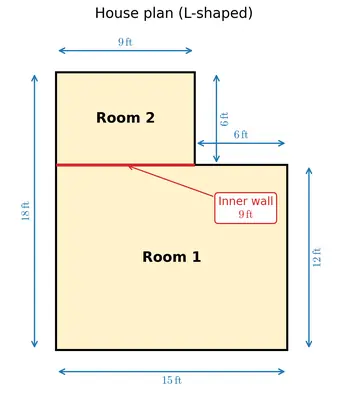
A mason is building a house in the shape shown in the diagram. He needs to construct both the outer walls and the inner wall that separates two rooms. To build a wall of 10-feet, he requires approximately 1450 bricks. How many bricks would he need to build the house? Assume all walls are of the same height and thickness. (The diagram shows an L-shaped house: a larger rectangle of $$12\,\mathrm{ft} \times 15\,\mathrm{ft}$$ combined with a smaller rectangle of $$9\,\mathrm{ft} \times 6\,\mathrm{ft}$$, with an inner wall of $$9\,\mathrm{ft}$$ separating the two rooms.)
Figure
Figure

Solution

Since all walls have the same height and thickness, the number of bricks is directly proportional to the total length of wall to be built. So first find the total wall length.

Step 1 — Outer perimeter of the L-shape.

Place the big rectangle so it is $$12$$ ft wide and $$15$$ ft tall. Attach the small rectangle ($$9$$ ft $$\times$$ $$6$$ ft) so that its $$9$$ ft side lies along the bigger rectangle (this makes the shared boundary the $$9$$-ft inner wall). Walking round the L, the sides are

$$18 + 9 + 6 + 6 + 12 + 15 = 66 \text{ ft.}$$

Check by another method: Perimeter of big + perimeter of small $$- 2 \times$$ (shared side) $$= 2(12+15) + 2(9+6) - 2(9) = 54 + 30 - 18 = 66$$ ft. ✓

Step 2 — Add the inner wall. The inner wall between the two rooms is $$9$$ ft.

$$\text{Total wall length} = 66 + 9 = 75 \text{ ft.}$$

Step 3 — Bricks by proportion. $$10$$ ft of wall needs $$1450$$ bricks. Let $$x$$ bricks be needed for $$75$$ ft:

$$10 : 1450 :: 75 : x \quad\Rightarrow\quad x = \dfrac{1450 \times 75}{10} = 145 \times 75.$$

Now $$145 \times 75 = 145 \times 75 = 10{,}875$$. So he needs approximately $$10{,}875$$ bricks.

Answer

Total wall length $$= 66 + 9 = 75$$ ft; bricks required $$= \dfrac{1450}{10} \times 75 \approx 10{,}875$$ bricks.

Figure it Out (Page 175)

1 Divide ₹4,500 into two parts in the ratio $$2 : 3$$.

Solution

The ratio $$2 : 3$$ splits the money into $$2 + 3 = 5$$ equal parts.

$$\text{Value of one part} = \dfrac{\text{₹}4500}{5} = \text{₹}900.$$

First part $$= 2 \times 900 = \text{₹}1800$$.
Second part $$= 3 \times 900 = \text{₹}2700$$.

Check: $$1800 + 2700 = 4500$$ and $$1800 : 2700 = 2 : 3$$. ✓

Answer

₹$$1800$$ and ₹$$2700$$.

2 In a science lab, acid and water are mixed in the ratio of $$1 : 5$$ to make a solution. In a bottle that has 240 mL of the solution, how much acid and water does the solution contain?

Solution

The ratio $$1 : 5$$ divides the solution into $$1 + 5 = 6$$ equal parts.

$$\text{Volume of one part} = \dfrac{240}{6} = 40 \text{ mL.}$$

Acid $$= 1 \times 40 = 40$$ mL.
Water $$= 5 \times 40 = 200$$ mL.

Check: $$40 + 200 = 240$$ mL and $$40 : 200 = 1 : 5$$. ✓

Answer

Acid $$= 40$$ mL and water $$= 200$$ mL.

3 Blue and yellow paints are mixed in the ratio of $$3 : 5$$ to produce green paint. To produce 40 mL of green paint, how much of these two colours are needed? To make the paint a lighter shade of green, I added 20 mL of yellow to the mixture. What is the new ratio of blue and yellow in the paint?

Solution

Step 1 — Split 40 mL in the ratio $$3 : 5$$.

Total parts $$= 3 + 5 = 8$$. One part $$= \dfrac{40}{8} = 5$$ mL.

Blue $$= 3 \times 5 = 15$$ mL.
Yellow $$= 5 \times 5 = 25$$ mL.

Step 2 — Add 20 mL of yellow.

New yellow $$= 25 + 20 = 45$$ mL. Blue is unchanged at $$15$$ mL.

Step 3 — Simplify the new ratio.

$$\text{Blue : Yellow} = 15 : 45 = \dfrac{15}{45} = \dfrac{1}{3} = 1 : 3.$$

Answer

Original mix: $$15$$ mL of blue and $$25$$ mL of yellow.
After adding $$20$$ mL of yellow, new ratio blue : yellow $$= 15 : 45 = 1 : 3$$.

4 To make soft idlis, you need to mix rice and urad dal in the ratio of $$2 : 1$$. If you need 6 cups of this mixture to make idlis tomorrow morning, how many cups of rice and urad dal will you need?

Solution

The ratio $$2 : 1$$ divides the mixture into $$2 + 1 = 3$$ equal parts.

$$\text{Volume of one part} = \dfrac{6}{3} = 2 \text{ cups.}$$

Rice $$= 2 \times 2 = 4$$ cups.
Urad dal $$= 1 \times 2 = 2$$ cups.

Check: $$4 + 2 = 6$$ cups and $$4 : 2 = 2 : 1$$. ✓

Answer

Rice $$= 4$$ cups and urad dal $$= 2$$ cups.

5 I have one bucket of orange paint that I made by mixing red and yellow paints in the ratio of $$3 : 5$$. I added another bucket of yellow paint to this mixture. What is the ratio of red paint to yellow paint in the new mixture?

Solution

Suppose one bucket holds $$V$$ litres. The orange bucket has red and yellow in the ratio $$3 : 5$$, split into $$3 + 5 = 8$$ equal parts of $$\dfrac{V}{8}$$ each.

$$\text{Red in orange bucket} = 3 \times \dfrac{V}{8} = \dfrac{3V}{8}.$$
$$\text{Yellow in orange bucket} = 5 \times \dfrac{V}{8} = \dfrac{5V}{8}.$$

Now we add one full bucket of yellow, i.e. $$V$$ litres of yellow.

$$\text{New yellow} = \dfrac{5V}{8} + V = \dfrac{5V + 8V}{8} = \dfrac{13V}{8}.$$

Red is unchanged at $$\dfrac{3V}{8}$$. The new ratio is

$$\text{Red : Yellow} = \dfrac{3V}{8} : \dfrac{13V}{8} = 3 : 13.$$

Answer

Red : yellow $$= 3 : 13$$.

Figure it Out (Page 176)

1 Anagh mixes 600 mL of orange juice with 900 mL of apple juice to make a fruit drink. Write the ratio of orange juice to apple juice in its simplest form.

Solution

Ratio of orange juice to apple juice:

$$600 : 900 = \dfrac{600}{900}.$$

Divide the numerator and denominator by their HCF. $$\text{HCF}(600, 900) = 300$$, so

$$\dfrac{600}{900} = \dfrac{600 \div 300}{900 \div 300} = \dfrac{2}{3} = 2 : 3.$$

Answer

Orange : apple $$= 2 : 3$$.

2 Last year, we hired 3 buses for the school trip. We had a total of 162 students and teachers who went on that trip and all the buses were full. This year we have 204 students. How many buses will we need? Will all the buses be full?

Solution

Step 1 — Seating capacity of one bus. Since $$3$$ full buses seated $$162$$ people,

$$\text{seats per bus} = \dfrac{162}{3} = 54.$$

Step 2 — Buses needed for 204 students.

$$\dfrac{204}{54} = 3\dfrac{42}{54} = 3\dfrac{7}{9}.$$

Three buses can seat only $$3 \times 54 = 162$$ students, which is less than $$204$$. So the school must hire a fourth bus.

Step 3 — Will all the buses be full?

$$4 \text{ buses} \times 54 = 216 \text{ seats.}$$

But there are only $$204$$ students. Three buses will be full ($$162$$ students) and the fourth bus will carry $$204 - 162 = 42$$ students, leaving $$54 - 42 = 12$$ seats empty.

Answer

They will need $$4$$ buses. Not all of them will be full — three buses will be full ($$54$$ each) and the fourth will carry $$42$$ students, with $$12$$ empty seats.

3 The area of Delhi is 1,484 sq. km and the area of Mumbai is 550 sq. km. The population of Delhi is approximately 30 million and that of Mumbai is 20 million people. Which city is more crowded? Why do you say so?

Solution

Crowdedness is measured by population density, i.e. the number of people per square kilometre. A city with more people per square km is more crowded.

Delhi:

$$\text{density} = \dfrac{\text{population}}{\text{area}} = \dfrac{30{,}000{,}000}{1484} \approx 20{,}215 \text{ people/sq km.}$$

Mumbai:

$$\text{density} = \dfrac{20{,}000{,}000}{550} \approx 36{,}364 \text{ people/sq km.}$$

Since $$36{,}364 > 20{,}215$$, Mumbai has more people packed into every square kilometre.

Delhi has more people in total, but it also has a much bigger area, so the people are spread out. Mumbai has fewer people but is squeezed into less than half the area, so it is more crowded.

Answer

Mumbai is more crowded. Density $$\approx 36{,}400$$ people/sq km in Mumbai vs. $$\approx 20{,}200$$ in Delhi — Mumbai has more people packed into each square kilometre.

4 A crane of height 155 cm has its neck and the rest of its body in the ratio $$4 : 6$$. For your height, if your neck and the rest of the body also had this ratio, how tall would your neck be?

Solution

Let the neck be $$4x$$ and the rest of the body be $$6x$$. Then

$$\text{total height} = 4x + 6x = 10x.$$

So $$\text{neck} : \text{total height} = 4 : 10 = 2 : 5$$, i.e. the neck is $$\dfrac{2}{5}$$ of the total height.

Check with the crane: total $$= 155$$ cm, so $$x = \dfrac{155}{10} = 15.5$$. Neck $$= 4 \times 15.5 = 62$$ cm and rest $$= 6 \times 15.5 = 93$$ cm. Sum $$= 155$$ cm. ✓

For yourself. If your height is $$H$$ cm, then

$$\text{your neck} = \dfrac{2}{5} \times H = \dfrac{2H}{5} \text{ cm.}$$

Example: if $$H = 150$$ cm, your neck would be $$\dfrac{2 \times 150}{5} = 60$$ cm. (For comparison, a real human neck is only about $$10\text{–}15$$ cm — so a crane's neck is proportionally much longer than a person's.)

Answer

Your neck would be $$\dfrac{2H}{5}$$ cm long, where $$H$$ is your height in cm. (For a height of $$150$$ cm, that is $$60$$ cm.)

5 Let us try an ancient problem from Lilavati. At that time weights were measured in a unit named palas and niskas was a unit of money. "If $$2\frac{1}{2}$$ palas of saffron costs $$\frac{3}{7}$$ niskas, O expert businessman! tell me quickly what quantity of saffron can be bought for 9 niskas?"

Solution

The weight of saffron is directly proportional to the money spent. Let $$x$$ palas be the quantity that can be bought for $$9$$ niskas. Then

$$\dfrac{2\tfrac{1}{2} \text{ palas}}{\tfrac{3}{7} \text{ niskas}} = \dfrac{x \text{ palas}}{9 \text{ niskas}}.$$

Writing $$2\tfrac{1}{2} = \dfrac{5}{2}$$ and cross-multiplying,

$$x \times \dfrac{3}{7} = 9 \times \dfrac{5}{2},$$
$$\dfrac{3x}{7} = \dfrac{45}{2},$$
$$3x = \dfrac{45}{2} \times 7 = \dfrac{315}{2},$$
$$x = \dfrac{315}{6} = \dfrac{105}{2} = 52\tfrac{1}{2}.$$

Check by unit-rate method. For $$\dfrac{3}{7}$$ niskas you get $$\dfrac{5}{2}$$ palas, so for $$1$$ niska you get

$$\dfrac{5/2}{3/7} = \dfrac{5}{2} \times \dfrac{7}{3} = \dfrac{35}{6} \text{ palas.}$$

For $$9$$ niskas: $$9 \times \dfrac{35}{6} = \dfrac{315}{6} = 52\tfrac{1}{2}$$ palas. ✓

Answer

You can buy $$52\tfrac{1}{2}$$ palas of saffron for $$9$$ niskas.

6 Harmain is a 1-year-old girl. Her elder brother is 5 years old. What will be Harmain's age when the ratio of her age to her brother's age is $$1 : 2$$?

Solution

The difference of their ages stays the same forever: brother is always older by

$$5 - 1 = 4 \text{ years.}$$

Let Harmain's age be $$x$$ years when the ratio Harmain : brother is $$1 : 2$$. Then brother's age is $$2x$$, and the difference is

$$2x - x = x = 4.$$

So Harmain will be $$4$$ years old. At that time, brother will be $$2 \times 4 = 8$$ years old, and $$4 : 8 = 1 : 2$$. ✓

(This happens $$4 - 1 = 3$$ years from now.)

Answer

Harmain will be $$4$$ years old (when her brother is $$8$$).

7 The mass of equal volumes of gold and water are in the ratio $$37 : 2$$. If 1 litre of water is 1 kg in mass, what is the mass of 1 litre of gold?

Solution

For the same volume $$V$$, mass of gold : mass of water $$= 37 : 2$$. Let the mass of $$1$$ litre of gold be $$m$$ kg. Since $$1$$ litre of water is $$1$$ kg,

$$\dfrac{m}{1} = \dfrac{37}{2}.$$

Therefore

$$m = \dfrac{37}{2} = 18.5 \text{ kg.}$$

(Indeed, gold has density about $$19.3$$ g/cm³, so this is close to the real value.)

Answer

$$1$$ litre of gold has a mass of $$\dfrac{37}{2} = 18.5$$ kg.

8 It is good farming practice to apply 10 tonnes of cow manure for 1 acre of land. A farmer is planning to grow tomatoes in a plot of size 200 ft by 500 ft. How much manure should he buy? (Please refer to the section on Unit Conversions earlier in this chapter.)

Solution

Step 1 — Area of the plot in square feet.

$$\text{Area} = 200 \text{ ft} \times 500 \text{ ft} = 1{,}00{,}000 \text{ sq ft.}$$

Step 2 — Convert to acres. From the unit-conversions section, $$1 \text{ acre} = 43{,}560 \text{ sq ft}$$. Therefore

$$\text{Area in acres} = \dfrac{1{,}00{,}000}{43{,}560} \approx 2.296 \text{ acres.}$$

Step 3 — Apply the proportion. Manure needed is directly proportional to area:

$$\text{manure} = 2.296 \times 10 \approx 22.96 \text{ tonnes.}$$

So the farmer should buy about $$23$$ tonnes of cow manure.

Answer

About $$23$$ tonnes of cow manure (plot area $$= 1{,}00{,}000$$ sq ft $$\approx 2.3$$ acres, and $$2.3 \times 10 \approx 23$$ tonnes).

9 A tap takes 15 seconds to fill a mug of water. The volume of the mug is 500 mL. How much time does the same tap take to fill a bucket of water if the bucket has a 10-litre capacity?

Solution

Same tap ⇒ same flow rate. Time is directly proportional to the volume filled.

Convert the bucket to mL: $$10$$ L $$= 10 \times 1000 = 10{,}000$$ mL.

Let $$t$$ be the time (in seconds) to fill the bucket.

$$500 : 15 :: 10{,}000 : t.$$

Cross-multiplying,

$$500 \times t = 15 \times 10{,}000,$$
$$500 t = 1{,}50{,}000,$$
$$t = \dfrac{1{,}50{,}000}{500} = 300 \text{ seconds.}$$

$$300 \text{ seconds} = \dfrac{300}{60} = 5 \text{ minutes.}$$

Alternative: flow rate $$= \dfrac{500 \text{ mL}}{15 \text{ s}} = \dfrac{100}{3}$$ mL/s. Time to fill $$10{,}000$$ mL $$= \dfrac{10{,}000}{100/3} = 300$$ s. ✓

Answer

$$300$$ seconds $$= 5$$ minutes.

10 One acre of land costs ₹15,00,000. What is the cost of 2,400 square feet of the same land?

Solution

Cost is directly proportional to area, but the two areas are in different units. Convert them to the same unit — square feet.

$$1 \text{ acre} = 43{,}560 \text{ sq ft.}$$

So $$43{,}560$$ sq ft costs ₹$$15{,}00{,}000$$. Let $$C$$ be the cost of $$2{,}400$$ sq ft. Then

$$43{,}560 : 15{,}00{,}000 :: 2{,}400 : C,$$

i.e.

$$C = \dfrac{15{,}00{,}000 \times 2{,}400}{43{,}560}.$$

Compute in steps:

$$C = \dfrac{15{,}00{,}000}{43{,}560} \times 2{,}400 \approx 34.4353 \times 2{,}400 \approx 82{,}644.6.$$

So the cost of $$2{,}400$$ sq ft is approximately ₹$$82{,}645$$ (roughly ₹$$82{,}650$$).

Answer

About ₹$$82{,}645$$ (i.e. $$\dfrac{2400}{43560} \times 15{,}00{,}000$$).

11 A tractor can plough the same area of a field 4 times faster than a pair of oxen. A farmer wants to plough his 20-acre field. A pair of oxen takes 6 hours to plough an acre of land. How much time would it take if the farmer used a pair of oxen to plough the field? How much time would it take him if he decides to use a tractor instead?

Solution

Oxen. Time is directly proportional to area to be ploughed.

$$1 \text{ acre} \rightarrow 6 \text{ hours,} \quad 20 \text{ acres} \rightarrow 20 \times 6 = 120 \text{ hours.}$$

Tractor. "4 times faster" means the tractor takes $$\dfrac{1}{4}$$ of the time the oxen take for the same area. So

$$\text{tractor time} = \dfrac{120}{4} = 30 \text{ hours.}$$

(Equivalently, if the oxen take $$6$$ h per acre, the tractor takes $$\dfrac{6}{4} = 1.5$$ h per acre, so $$20$$ acres $$\rightarrow 20 \times 1.5 = 30$$ h.)

Answer

Oxen: $$120$$ hours. Tractor: $$30$$ hours.

12 The ₹10 coin is an alloy of copper and nickel called 'cupro-nickel'. Copper and nickel are mixed in a $$3 : 1$$ ratio to get this alloy. The mass of the coin is 7.74 grams. If the cost of copper is ₹906 per kg and the cost of nickel is ₹1,341 per kg, what is the cost of these metals in a ₹10 coin?

Solution

Step 1 — Mass of each metal in the coin.

Ratio $$3 : 1$$ splits the total mass into $$3 + 1 = 4$$ equal parts.

$$\text{one part} = \dfrac{7.74}{4} = 1.935 \text{ g.}$$

Copper $$= 3 \times 1.935 = 5.805$$ g.
Nickel $$= 1 \times 1.935 = 1.935$$ g.

Step 2 — Cost per gram of each metal.

$$1 \text{ kg} = 1000 \text{ g,}$$

$$\text{copper cost per g} = \dfrac{906}{1000} = \text{₹}0.906,$$

$$\text{nickel cost per g} = \dfrac{1341}{1000} = \text{₹}1.341.$$

Step 3 — Cost of the metals in one coin.

Cost of copper $$= 5.805 \times 0.906 \approx \text{₹}5.26$$.
Cost of nickel $$= 1.935 \times 1.341 \approx \text{₹}2.59$$.

$$\text{Total} = 5.26 + 2.59 \approx \text{₹}7.85.$$

So the copper and nickel in one ₹$$10$$ coin together are worth about ₹$$7.85$$ (a little less than the face value of the coin).

Answer

Copper $$5.805$$ g worth ≈ ₹$$5.26$$; nickel $$1.935$$ g worth ≈ ₹$$2.59$$; total metal cost per coin ≈ ₹$$7.85$$.

NCERT Solutions for Class 8
Maths
NCERT Solutions for Class 8 Maths
Chapter-wise step-by-step
solutions with explanations
explore solutions Maths bg
Science
NCERT Solutions for Class 8 Science
Chapter-wise step-by-step
solutions with explanations
explore solutions Science bg

50,000+ JEE Students Trusted Our Score Calculator

Predict your JEE Main percentile, rank & performance in seconds