Intext Questions (Section 6.1)
1 Consider the multiplication of two numbers, say, $$23 \times 27$$.
1 By how much does the product increase if the first number ($$23$$) is increased by $$1$$?
Solution
The original product is $$23 \times 27 = 621$$.
When the first number is increased by $$1$$, the new product becomes $$24 \times 27$$. Using the distributive property,
\[24 \times 27 = (23 + 1) \times 27 = 23 \times 27 + 1 \times 27 = 621 + 27 = 648.\]So the product increases by $$27$$, which is the value of the other number.
Answer
2 What if the second number ($$27$$) is increased by $$1$$?
Solution
Now the new product is $$23 \times (27 + 1) = 23 \times 28$$. Using the distributive property,
\[23 \times 28 = 23 \times (27 + 1) = 23 \times 27 + 23 \times 1 = 621 + 23 = 644.\]So the product increases by $$23$$, which is the value of the first number.
Answer
3 How about when both numbers are increased by $$1$$?
Solution
The new product is $$(23 + 1) \times (27 + 1) = 24 \times 28$$. Treating $$(23 + 1)$$ as a single term and distributing over $$27 + 1$$,
\[(23+1)(27+1) = (23+1)\times 27 + (23+1)\times 1.\]Expanding,
\[= 23\times 27 + 27 + 23 + 1 = 621 + 51 = 672.\]So the product increases by $$27 + 23 + 1 = 51$$.
Answer
2 Do you see a pattern that could help generalise our observations to the product of any two numbers?
Solution
Yes. Let the two numbers be $$a$$ and $$b$$, and consider what happens when either or both are increased by $$1$$.
Using the distributive property:
\[a(b+1) = ab + a \qquad\text{(product increases by } a\text{)}\]\[(a+1)b = ab + b \qquad\text{(product increases by } b\text{)}\]\[(a+1)(b+1) = ab + a + b + 1 \qquad\text{(product increases by } a + b + 1\text{)}\]So the pattern is: increasing one factor by $$1$$ adds the other factor to the product, and increasing both factors by $$1$$ adds their sum plus $$1$$.
Answer
3 What would we get if we had expanded $$(a + 1)(b + 1)$$ by first taking $$(b + 1)$$ as a single term? Try it.
Solution
Treat $$(b+1)$$ as a single term and apply the distributive property to $$(a+1) \times (b+1)$$:
\[(a+1)(b+1) = a(b+1) + 1 \cdot (b+1).\]Now distribute again inside each bracket:
\[= ab + a + b + 1.\]This is exactly the same expansion as before — grouping $$(a+1)$$ or $$(b+1)$$ first does not change the answer, because multiplication is commutative and associative.
Answer
4 What happens when one of the numbers in a product is increased by $$1$$ and the other is decreased by $$1$$? Will there be any change in the product?
Solution
Let the numbers be $$a$$ and $$b$$. Increase $$a$$ by $$1$$ and decrease $$b$$ by $$1$$. The new product is $$(a+1)(b-1)$$.
Expanding using the distributive property,
\[(a+1)(b-1) = (a+1)b - (a+1)\cdot 1 = ab + b - a - 1.\]So the product changes by $$b - a - 1$$ compared to $$ab$$.
The change is not always zero. It depends on how $$a$$ and $$b$$ compare:
- If $$b > a + 1$$, the product increases.
- If $$b < a + 1$$, the product decreases.
- If $$b = a + 1$$, the product is unchanged (for example, $$4 \times 5 = 5 \times 4 = 20$$).
Answer
5 Will the product always increase? Find $$3$$ examples where the product decreases.
Solution
No. From Q.4, the change is $$b - a - 1$$; whenever $$a \ge b$$, this is negative, so the product decreases.
Example 1: $$a = 10,\ b = 3$$.
\[10 \times 3 = 30, \qquad (10+1)(3-1) = 11 \times 2 = 22.\]The product decreases by $$8$$.
Example 2: $$a = 8,\ b = 5$$.
\[8 \times 5 = 40, \qquad 9 \times 4 = 36.\]The product decreases by $$4$$.
Example 3: $$a = 15,\ b = 7$$.
\[15 \times 7 = 105, \qquad 16 \times 6 = 96.\]The product decreases by $$9$$.
Answer
6 What happens when $$a$$ and $$b$$ are negative integers?
Solution
The distributive property holds for all integers, including negative ones. So the identity
\[(a+1)(b+1) = ab + a + b + 1\]is still true; the letter-numbers just take on negative values.
Example 1: $$a = -5,\ b = 8$$.
\[ab = -40, \quad (a+1)(b+1) = -4 \times 9 = -36.\]Change $$= a + b + 1 = -5 + 8 + 1 = 4$$, and indeed $$-36 = -40 + 4$$. Here the product increases (becomes less negative).
Example 2: $$a = -4,\ b = -5$$.
\[ab = 20, \quad (a+1)(b+1) = -3 \times -4 = 12.\]Change $$= a + b + 1 = -4 - 5 + 1 = -8$$, and indeed $$12 = 20 - 8$$. Here the product decreases.
So the identity still describes the change; only the sign of $$a + b + 1$$ decides whether the product goes up or down.
Answer
7 By how much will the product of two numbers change if one of the numbers is increased by $$m$$ and the other by $$n$$?
Solution
Let the initial numbers be $$a$$ and $$b$$. After the change, they become $$a + m$$ and $$b + n$$.
Apply the distributive property twice:
\[(a+m)(b+n) = (a+m)b + (a+m)n = ab + mb + an + mn.\]So the new product is $$ab + mb + an + mn$$, and the increase over the original $$ab$$ is
\[mb + an + mn.\]This is the general form of Identity 1:
\[(a+m)(b+n) = ab + mb + an + mn.\]Answer
8 This identity can be used to find how products change when the numbers being multiplied are increased or decreased by any amount. Can you see how this identity can be used when one or both numbers are decreased?
Solution
Yes. A decrease is just an increase by a negative amount. If a number is decreased by $$k$$, we simply take $$m = -k$$ (or $$n = -k$$) in Identity 1.
Example: Suppose $$a$$ is increased by $$1$$ and $$b$$ is decreased by $$1$$. Set $$m = 1$$ and $$n = -1$$:
\[(a+1)(b-1) = ab + 1\cdot b + a\cdot(-1) + 1\cdot(-1) = ab + b - a - 1,\]which matches what we found earlier by direct expansion.
So Identity 1 handles increases, decreases, and mixed changes in one formula — we just use the correct signs.
Answer
9 Use Identity 1 to find how the product changes when
(i) one number is decreased by $$2$$ and the other increased by $$3$$;
Solution
Let the initial numbers be $$a$$ and $$b$$. Apply Identity 1 with $$m = -2$$ (decrease by $$2$$) and $$n = 3$$ (increase by $$3$$).
\[(a-2)(b+3) = ab + (-2)b + a\cdot 3 + (-2)(3) = ab + 3a - 2b - 6.\]The change in the product is
\[3a - 2b - 6.\]Answer
(ii) both numbers are decreased, one by $$3$$ and the other by $$4$$.
Solution
Apply Identity 1 with $$m = -3$$ and $$n = -4$$:
\[(a-3)(b-4) = ab + (-3)b + a(-4) + (-3)(-4).\]Simplifying,
\[= ab - 3b - 4a + 12.\]The change in the product is
\[-4a - 3b + 12.\]Answer
10 Verify the answers by finding the products without converting the subtractions to additions.
Solution
Expand each product directly using the distributive property.
(i) $$(a-2)(b+3)$$:
\[(a-2)(b+3) = (a-2)b + (a-2)\cdot 3 = ab - 2b + 3a - 6.\]Rewriting, $$= ab + 3a - 2b - 6$$. This matches Q.9(i).
(ii) $$(a-3)(b-4)$$:
\[(a-3)(b-4) = (a-3)b - (a-3)\cdot 4 = ab - 3b - 4a + 12.\]This matches Q.9(ii).
Both direct expansions agree with the results from Identity 1, verifying our answers.
Answer
11 Expand
(i) $$(a - u)(b + v)$$
Solution
Distribute $$(a - u)$$ over $$(b + v)$$:
\[(a - u)(b + v) = (a - u)b + (a - u)v.\]Then distribute again:
\[= ab - ub + av - uv.\]Answer
(ii) $$(a - u)(b - v)$$
Solution
Distribute $$(a - u)$$ over $$(b - v)$$:
\[(a - u)(b - v) = (a - u)b - (a - u)v.\]Then distribute inside each bracket:
\[= ab - ub - av + uv.\]Answer
12 Can any two terms be added to get a single term?
Solution
No. Two terms can be combined into a single term only if they are like terms — that is, they have exactly the same letter-numbers with the same powers.
For instance, in the expansion of $$\dfrac{3a}{2}\left(a - b + \dfrac{1}{5}\right) = \dfrac{3}{2}a^2 - \dfrac{3}{2}ab + \dfrac{3}{10}a$$, the terms $$\dfrac{3}{2}a^2$$ and $$\dfrac{3}{10}a$$ are not like terms (one has $$a^2$$, the other has $$a$$), and neither can they be combined with $$-\dfrac{3}{2}ab$$.
On the other hand, $$5x^2$$ and $$3x^2$$ are like terms and can be combined into $$8x^2$$.
Answer
13 Use the following multiplications to find the product of a number with $$11$$ in a single step.
(a) $$3874 \times 11$$
Solution
Since $$11 = 10 + 1$$, use the distributive property:
\[3874 \times 11 = 3874 \times (10 + 1) = 3874 \times 10 + 3874 \times 1.\]That is,
\[= 38740 + 3874 = 42614.\]Written column-wise, we are simply adding the digits of $$3874$$ to those of $$3874$$ shifted one place left:
| 3 | 8 | 7 | 4 | 0 |
| 3 | 8 | 7 | 4 | |
| 3 | $$8+3$$ | $$7+8$$ | $$4+7$$ | 4 |
Reading with carries from the right: $$4,\ 11,\ 15,\ 11,\ 3 \to 42614$$.
Answer
(b) $$5678 \times 11$$
Solution
Since $$11 = 10 + 1$$,
\[5678 \times 11 = 5678 \times 10 + 5678 = 56780 + 5678 = 62458.\]Answer
14 Describe a general rule to multiply a number (of any number of digits) by $$11$$ and write the product in one line. Evaluate the following.
(i) $$94 \times 11$$
Solution
General rule for multiplying by $$11$$: Write the original number, and between every pair of consecutive digits insert their sum; then process carries from right to left. (In effect, we are adding the number to itself shifted one place left.)
For $$94$$, the digits are $$9,\ 4$$. Insert $$9 + 4 = 13$$ between them:
\[9\ |\ (9+4)\ |\ 4 \;=\; 9\ |\ 13\ |\ 4.\]Process carries from the right: write $$4$$; then $$13$$ becomes $$3$$ with carry $$1$$; then $$9 + 1 = 10$$.
\[\boxed{94 \times 11 = 1034.}\]Answer
(ii) $$495 \times 11$$
Solution
Digits of $$495$$: $$4,\ 9,\ 5$$. Insert sums of consecutive digits:
\[4\ |\ (4+9)\ |\ (9+5)\ |\ 5 \;=\; 4\ |\ 13\ |\ 14\ |\ 5.\]Process carries from the right:
- Units: $$5$$.
- Tens: $$14 \to$$ write $$4$$, carry $$1$$.
- Hundreds: $$13 + 1 = 14 \to$$ write $$4$$, carry $$1$$.
- Thousands: $$4 + 1 = 5$$.
Answer
(iii) $$3279 \times 11$$
Solution
Digits of $$3279$$: $$3,\ 2,\ 7,\ 9$$. Insert sums of consecutive digits:
\[3\ |\ (3+2)\ |\ (2+7)\ |\ (7+9)\ |\ 9 \;=\; 3\ |\ 5\ |\ 9\ |\ 16\ |\ 9.\]Carry from the right:
- Units: $$9$$.
- Tens: $$16 \to$$ write $$6$$, carry $$1$$.
- Hundreds: $$9 + 1 = 10 \to$$ write $$0$$, carry $$1$$.
- Thousands: $$5 + 1 = 6$$.
- Ten-thousands: $$3$$.
Answer
(iv) $$4791256 \times 11$$
Solution
Digits of $$4791256$$: $$4,\ 7,\ 9,\ 1,\ 2,\ 5,\ 6$$.
Insert sums of consecutive digits:
\[4\ |\ 11\ |\ 16\ |\ 10\ |\ 3\ |\ 7\ |\ 11\ |\ 6.\]Process carries from the right (writing each digit and carrying to the next column):
- Units: $$6$$.
- Tens: $$11 \to 1$$, carry $$1$$.
- Hundreds: $$7 + 1 = 8$$.
- Thousands: $$3$$.
- Ten-thousands: $$10 \to 0$$, carry $$1$$.
- Hundred-thousands: $$16 + 1 = 17 \to 7$$, carry $$1$$.
- Millions: $$11 + 1 = 12 \to 2$$, carry $$1$$.
- Ten-millions: $$4 + 1 = 5$$.
Check: $$4791256 \times 10 + 4791256 = 47912560 + 4791256 = 52703816.\ \checkmark$$
Answer
15 Can we come up with a similar rule for multiplying a number by $$101$$?
Solution
Yes. Since $$101 = 100 + 1$$, the distributive property gives, for any number $$N$$,
\[N \times 101 = N \times (100 + 1) = 100N + N.\]So we simply write $$N$$ shifted two places to the left (multiplication by $$100$$) and add $$N$$ underneath. This is the analogue of the $$\times 11$$ rule (where the shift was one place).
Answer
16 Multiply $$3874$$ by $$101$$.
Solution
Using $$101 = 100 + 1$$,
\[3874 \times 101 = 3874 \times 100 + 3874 \times 1 = 387400 + 3874.\]Adding column-wise:
| 3 | 8 | 7 | 4 | 0 | 0 |
| 3 | 8 | 7 | 4 | ||
| 3 | 9 | 1 | 2 | 7 | 4 |
Answer
17 Use this to multiply $$3874 \times 101$$ in one line.
Solution
For a $$4$$-digit number $$dcba$$, we have
\[dcba \times 101 = dcba \times 100 + dcba,\]which, added column-wise, gives digits
\[d\ |\ c\ |\ (b+d)\ |\ (a+c)\ |\ b\ |\ a.\]For $$3874$$: $$d=3,\ c=8,\ b=7,\ a=4$$. The one-line pattern is
\[3\ |\ 8\ |\ (7+3)\ |\ (4+8)\ |\ 7\ |\ 4 \;=\; 3\ |\ 8\ |\ 10\ |\ 12\ |\ 7\ |\ 4.\]Carrying from the right: $$4,\ 7,\ 12 \to 2$$ carry $$1,\ 10 + 1 = 11 \to 1$$ carry $$1,\ 8 + 1 = 9,\ 3$$.
\[\boxed{3874 \times 101 = 391274.}\]Answer
18 What could be a general rule to multiply a number by $$101$$ and write the product in one line? Extend this rule for multiplication by $$1001$$, $$10001$$, ...
Solution
Rule for $$\times 101$$: $$N \times 101 = N \times 100 + N$$. Write $$N$$, then, starting from the units column, add another copy of $$N$$ shifted two places to the left. So each digit from the third position onward becomes the sum of two digits (with carries).
Rule for $$\times 1001$$: Since $$1001 = 1000 + 1$$,
\[N \times 1001 = 1000N + N,\]which means writing $$N$$ shifted three places left plus $$N$$. If $$N$$ has $$\le 3$$ digits, the two blocks don't overlap and the product is simply $$N$$ written twice (as a $$6$$-digit number).
Rule for $$\times 10001$$: Similarly, $$N \times 10001 = 10000N + N$$ — shift left by four places and add.
General rule: To multiply $$N$$ by $$1\underbrace{0\dots 0}_{k}1$$, add $$N$$ to itself shifted $$k + 1$$ places to the left. Equivalently,
\[N \times (10^{k+1} + 1) = N \cdot 10^{k+1} + N.\]Answer
19 Use this to find
(i) $$89 \times 101$$
Solution
Using $$101 = 100 + 1$$,
\[89 \times 101 = 8900 + 89 = 8989.\]Since $$89$$ has only $$2$$ digits and the shift is $$2$$ places, the two copies do not overlap, so the product is simply $$89$$ written twice.
Answer
(ii) $$949 \times 101$$
Solution
Using $$101 = 100 + 1$$,
\[949 \times 101 = 94900 + 949.\]Adding column-wise:
| 9 | 4 | 9 | 0 | 0 |
| 9 | 4 | 9 | ||
| 9 | 5 | 8 | 4 | 9 |
Answer
(iii) $$265831 \times 1001$$
Solution
Using $$1001 = 1000 + 1$$,
\[265831 \times 1001 = 265831000 + 265831.\]Adding:
\[\begin{array}{r} 265\,831\,000\\+\phantom{000\,}265\,831\\\hline 266\,096\,831\end{array}\]\[\boxed{265831 \times 1001 = 266096831.}\]Answer
(iv) $$1111 \times 1001$$
Solution
Using $$1001 = 1000 + 1$$,
\[1111 \times 1001 = 1111000 + 1111.\]Adding:
\[\begin{array}{r}1\,111\,000\\+\phantom{0\,00}1\,111\\\hline 1\,112\,111\end{array}\]\[\boxed{1111 \times 1001 = 1112111.}\]Answer
(v) $$9734 \times 99$$
Solution
Write $$99 = 100 - 1$$ and apply the distributive property:
\[9734 \times 99 = 9734 \times (100 - 1) = 973400 - 9734.\]Subtracting,
\[973400 - 9734 = 963666.\]\[\boxed{9734 \times 99 = 963666.}\]Answer
(vi) $$23478 \times 999$$
Solution
Write $$999 = 1000 - 1$$ and distribute:
\[23478 \times 999 = 23478 \times 1000 - 23478 = 23478000 - 23478.\]Subtracting,
\[23478000 - 23478 = 23454522.\]\[\boxed{23478 \times 999 = 23\,454\,522.}\]Answer
Examples
Example 1 Expand $$\dfrac{3a}{2}\left(a - b + \dfrac{1}{5}\right)$$.
Solution
Distribute $$\dfrac{3a}{2}$$ over each term inside the bracket:
\[\dfrac{3a}{2}\left(a - b + \dfrac{1}{5}\right) = \dfrac{3a}{2}\cdot a \;-\; \dfrac{3a}{2}\cdot b \;+\; \dfrac{3a}{2}\cdot \dfrac{1}{5}.\]Simplify each term.
\[\dfrac{3a}{2}\cdot a = \dfrac{3}{2}a^2, \qquad \dfrac{3a}{2}\cdot b = \dfrac{3}{2}ab, \qquad \dfrac{3a}{2}\cdot \dfrac{1}{5} = \dfrac{3}{10}a.\]Combining,
\[\dfrac{3a}{2}\left(a - b + \dfrac{1}{5}\right) = \dfrac{3}{2}a^2 - \dfrac{3}{2}ab + \dfrac{3}{10}a.\]No two of these are like terms, so the expansion cannot be simplified further.
Answer
Example 2 Expand $$(a + b)(a + b)$$.
Solution
Distribute $$(a+b)$$ over the second bracket:
\[(a+b)(a+b) = (a+b)\,a + (a+b)\,b.\]Distribute again inside each term:
\[= a\cdot a + b\cdot a + a\cdot b + b\cdot b = a^2 + ab + ab + b^2.\]Since $$ab$$ and $$ab$$ are like terms, add them:
\[(a+b)(a+b) = a^2 + 2ab + b^2.\]Answer
Example 3 Expand $$(a + b)(a^2 + 2ab + b^2)$$.
Solution
Distribute $$(a+b)$$ over each term of the second bracket:
\[(a+b)(a^2 + 2ab + b^2) = (a+b)\,a^2 + (a+b)\,2ab + (a+b)\,b^2.\]Expand each piece:
\[(a+b)a^2 = a^3 + a^2b,\]\[(a+b)\cdot 2ab = 2a^2 b + 2ab^2,\]\[(a+b)b^2 = ab^2 + b^3.\]Adding all six terms:
\[a^3 + a^2 b + 2a^2 b + 2ab^2 + ab^2 + b^3.\]Combine like terms: $$a^2 b + 2a^2 b = 3a^2 b$$ and $$2ab^2 + ab^2 = 3ab^2$$.
\[(a+b)(a^2 + 2ab + b^2) = a^3 + 3a^2 b + 3ab^2 + b^3.\]Notice this is precisely $$(a+b)^3$$ — since the second bracket is $$(a+b)^2$$.
Answer
Figure it Out (Section 6.1)
1
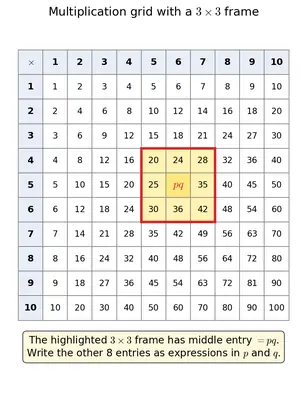
The multiplication grid ($$x$$ across the top row and down the leftmost column, entries are products) is:
| × | 1 | 2 | 3 | 4 | 5 | 6 | 7 | 8 | 9 | 10 |
|---|---|---|---|---|---|---|---|---|---|---|
| 1 | 1 | 2 | 3 | 4 | 5 | 6 | 7 | 8 | 9 | 10 |
| 2 | 2 | 4 | 6 | 8 | 10 | 12 | 14 | 16 | 18 | 20 |
| 3 | 3 | 6 | 9 | 12 | 15 | 18 | 21 | 24 | 27 | 30 |
| 4 | 4 | 8 | 12 | 16 | 20 | 24 | 28 | 32 | 36 | 40 |
| 5 | 5 | 10 | 15 | 20 | 25 | 30 | 35 | 40 | 45 | 50 |
| 6 | 6 | 12 | 18 | 24 | 30 | 36 | 42 | 48 | 54 | 60 |
| 7 | 7 | 14 | 21 | 28 | 35 | 42 | 49 | 56 | 63 | 70 |
| 8 | 8 | 16 | 24 | 32 | 40 | 48 | 56 | 64 | 72 | 80 |
| 9 | 9 | 18 | 27 | 36 | 45 | 54 | 63 | 72 | 81 | 90 |
| 10 | 10 | 20 | 30 | 40 | 50 | 60 | 70 | 80 | 90 | 100 |

Solution
In the multiplication grid, the entry in row $$r$$ and column $$c$$ is the product $$r \times c$$. If the centre of the $$3\times 3$$ frame is $$pq$$ (that is, row $$p$$ and column $$q$$), then in the frame the row-labels are $$p-1,\ p,\ p+1$$ and the column-labels are $$q-1,\ q,\ q+1$$.
The $$3\times 3$$ block of expressions is therefore:
| col $$q-1$$ | col $$q$$ | col $$q+1$$ | |
|---|---|---|---|
| row $$p-1$$ | $$(p-1)(q-1)$$ | $$(p-1)q$$ | $$(p-1)(q+1)$$ |
| row $$p$$ | $$p(q-1)$$ | $$pq$$ | $$p(q+1)$$ |
| row $$p+1$$ | $$(p+1)(q-1)$$ | $$(p+1)q$$ | $$(p+1)(q+1)$$ |
Each expression is the product of that cell's row and column labels.
Answer
| $$(p-1)(q-1)$$ | $$(p-1)q$$ | $$(p-1)(q+1)$$ |
| $$p(q-1)$$ | $$pq$$ | $$p(q+1)$$ |
| $$(p+1)(q-1)$$ | $$(p+1)q$$ | $$(p+1)(q+1)$$ |
2 Expand the following products.
(i) $$(3 + u)(v - 3)$$
Solution
Distribute $$(3+u)$$ over $$(v-3)$$:
\[(3+u)(v-3) = 3(v-3) + u(v-3) = 3v - 9 + uv - 3u.\]None of the four terms $$3v,\ -9,\ uv,\ -3u$$ are like terms, so this is the simplest form.
Answer
(ii) $$\dfrac{2}{3}(15 + 6a)$$
Solution
Distribute $$\dfrac{2}{3}$$ over each term:
\[\dfrac{2}{3}(15 + 6a) = \dfrac{2}{3}\cdot 15 + \dfrac{2}{3}\cdot 6a = 10 + 4a.\]Answer
(iii) $$(10a + b)(10c + d)$$
Solution
Distribute $$(10a+b)$$ over $$(10c+d)$$:
\[(10a+b)(10c+d) = 10a(10c+d) + b(10c+d).\]Expand each part:
\[= 100ac + 10ad + 10bc + bd.\](This is the reason why, when multiplying two two-digit numbers written as $$\overline{ab}$$ and $$\overline{cd}$$, the product breaks into a hundreds part $$ac$$, a tens part $$ad + bc$$, and a units part $$bd$$.)
Answer
(iv) $$(3 - x)(x - 6)$$
Solution
Distribute:
\[(3-x)(x-6) = 3(x-6) - x(x-6) = 3x - 18 - x^2 + 6x.\]Combine like terms $$3x + 6x = 9x$$:
\[= -x^2 + 9x - 18.\]Answer
(v) $$(-5a + b)(c + d)$$
Solution
Distribute each term of $$(-5a + b)$$ over $$(c+d)$$:
\[(-5a+b)(c+d) = -5a(c+d) + b(c+d) = -5ac - 5ad + bc + bd.\]Answer
(vi) $$(5 + z)(y + 9)$$
Solution
Distribute:
\[(5+z)(y+9) = 5(y+9) + z(y+9) = 5y + 45 + zy + 9z.\]None of the four terms are like terms, so this is the simplest form.
Answer
3 Find $$3$$ examples where the product of two numbers remains unchanged when one of them is increased by $$2$$ and the other is decreased by $$4$$.
Solution
Let the two numbers be $$a$$ and $$b$$. After the change they become $$a+2$$ and $$b-4$$. We want the product to be unchanged:
\[(a+2)(b-4) = ab.\]Expanding the left side using Identity 1 (with $$m = 2$$ and $$n = -4$$):
\[ab - 4a + 2b - 8 = ab.\]Cancel $$ab$$ from both sides and simplify:
\[-4a + 2b - 8 = 0 \ \Longrightarrow \ 2b = 4a + 8 \ \Longrightarrow \ b = 2a + 4.\]So we need pairs $$(a, b)$$ where $$b = 2a + 4$$. Any such pair works. Three easy examples:
- $$a = 1,\ b = 6$$: $$1 \times 6 = 6$$ and $$3 \times 2 = 6.\ \checkmark$$
- $$a = 2,\ b = 8$$: $$2 \times 8 = 16$$ and $$4 \times 4 = 16.\ \checkmark$$
- $$a = 3,\ b = 10$$: $$3 \times 10 = 30$$ and $$5 \times 6 = 30.\ \checkmark$$
Answer
4 Expand
(i) $$(a + ab - 3b^2)(4 + b)$$
Solution
Distribute $$(4+b)$$ against each of the three terms of the first bracket:
\[(a + ab - 3b^2)(4+b) = 4(a + ab - 3b^2) + b(a + ab - 3b^2).\]Expand each part:
\[4(a + ab - 3b^2) = 4a + 4ab - 12b^2,\]\[b(a + ab - 3b^2) = ab + ab^2 - 3b^3.\]Adding these six terms:
\[4a + 4ab - 12b^2 + ab + ab^2 - 3b^3.\]The only like terms are $$4ab$$ and $$ab$$, which combine to $$5ab$$. So
\[(a + ab - 3b^2)(4+b) = 4a + 5ab + ab^2 - 12b^2 - 3b^3.\]Answer
(ii) $$(4y + 7)(y + 11z - 3)$$
Solution
Distribute $$(4y+7)$$ over the three terms of the second bracket:
\[(4y+7)(y + 11z - 3) = 4y(y + 11z - 3) + 7(y + 11z - 3).\]Expand each part:
\[4y(y + 11z - 3) = 4y^2 + 44yz - 12y,\]\[7(y + 11z - 3) = 7y + 77z - 21.\]Adding the six terms and combining like terms $$-12y + 7y = -5y$$:
\[(4y+7)(y + 11z - 3) = 4y^2 + 44yz + 77z - 5y - 21.\]Answer
5 Expand the following. Do you see a pattern? What would be the next identity in the pattern that you see? Can you check it by expanding?
(i) $$(a - b)(a + b)$$
Solution
Distribute:
\[(a - b)(a + b) = a(a+b) - b(a+b) = a^2 + ab - ab - b^2.\]The two middle terms cancel:
\[(a-b)(a+b) = a^2 - b^2.\]Answer
(ii) $$(a - b)(a^2 + ab + b^2)$$
Solution
Distribute:
\[(a-b)(a^2 + ab + b^2) = a(a^2 + ab + b^2) - b(a^2 + ab + b^2).\]Expand each part:
\[a(a^2 + ab + b^2) = a^3 + a^2 b + ab^2,\]\[b(a^2 + ab + b^2) = a^2 b + ab^2 + b^3.\]Subtract term-by-term:
\[a^3 + a^2 b + ab^2 - a^2 b - ab^2 - b^3.\]The middle four terms cancel in pairs, giving
\[(a-b)(a^2 + ab + b^2) = a^3 - b^3.\]Answer
(iii) $$(a - b)(a^3 + a^2 b + ab^2 + b^3)$$
Solution
Distribute:
\[a(a^3 + a^2 b + ab^2 + b^3) = a^4 + a^3 b + a^2 b^2 + ab^3,\]\[b(a^3 + a^2 b + ab^2 + b^3) = a^3 b + a^2 b^2 + ab^3 + b^4.\]Subtracting the second from the first:
\[a^4 + a^3 b + a^2 b^2 + ab^3 - a^3 b - a^2 b^2 - ab^3 - b^4.\]All the middle terms cancel in pairs, leaving
\[(a-b)(a^3 + a^2 b + ab^2 + b^3) = a^4 - b^4.\]Pattern. Combining the three parts,
\[(a-b)(a+b) = a^2 - b^2,\]\[(a-b)(a^2+ab+b^2) = a^3 - b^3,\]\[(a-b)(a^3+a^2b+ab^2+b^3) = a^4 - b^4.\]In general, $$(a-b)\big(a^{n-1} + a^{n-2}b + \cdots + ab^{n-2} + b^{n-1}\big) = a^n - b^n$$.
Next identity ($$n = 5$$):
\[(a-b)(a^4 + a^3 b + a^2 b^2 + ab^3 + b^4) = a^5 - b^5.\]Check by expanding:
\[a(a^4 + a^3 b + a^2 b^2 + ab^3 + b^4) = a^5 + a^4 b + a^3 b^2 + a^2 b^3 + ab^4,\]\[b(a^4 + a^3 b + a^2 b^2 + ab^3 + b^4) = a^4 b + a^3 b^2 + a^2 b^3 + ab^4 + b^5.\]Subtracting, every term except $$a^5$$ and $$-b^5$$ cancels, giving $$a^5 - b^5$$ as claimed.
Answer
Intext Questions (Section 6.2)
20 The area of a square of sidelength $$60$$ units is $$3600$$ sq. units ($$60^2$$) and that of a square of sidelength $$5$$ units is $$25$$ sq. units ($$5^2$$). Can we use this to find the area of a square of sidelength $$65$$ units?
Solution
Yes. Split the $$65 \times 65$$ square into four parts using a grid line $$60$$ units from one side (and $$5$$ units from the other) in each direction. The four parts are:
- a $$60 \times 60$$ square of area $$60^2 = 3600$$,
- a $$5 \times 5$$ square of area $$5^2 = 25$$,
- two rectangles, each of dimensions $$60 \times 5$$ and area $$300$$.
Adding all four areas,
\[65^2 = (60+5)^2 = 60^2 + 5^2 + 2 \times (60 \times 5) = 3600 + 25 + 600 = 4225.\]So a $$65 \times 65$$ square has area $$4225$$ sq. units.
Answer
21 What if we write $$65^2$$ as $$(30 + 35)^2$$ or $$(52 + 13)^2$$? Draw the figures and check the area that you get.
Solution
The same $$65 \times 65$$ square can be cut into four pieces along different grid lines. Each way still gives the same total area.
Splitting as $$30 + 35$$: Draw a grid line $$30$$ units from a side (and $$35$$ from the other) in each direction. The four pieces are a $$30\times 30$$ square, a $$35\times 35$$ square, and two $$30\times 35$$ rectangles.
\[(30+35)^2 = 30^2 + 35^2 + 2 \times (30 \times 35) = 900 + 1225 + 2100 = 4225.\]Splitting as $$52 + 13$$: The four pieces are a $$52\times 52$$ square, a $$13\times 13$$ square, and two $$52\times 13$$ rectangles.
\[(52+13)^2 = 52^2 + 13^2 + 2 \times (52 \times 13) = 2704 + 169 + 1352 = 4225.\]Both splits give the same area $$4225$$ — as they must, because both equal $$65^2$$.
Answer
22 If $$a$$ and $$b$$ are any two integers, is $$(a + b)^2$$ always greater than $$a^2 + b^2$$? If not, when is it greater?
Solution
By Identity 1A,
\[(a+b)^2 = a^2 + 2ab + b^2 = (a^2 + b^2) + 2ab.\]So the difference is
\[(a+b)^2 - (a^2 + b^2) = 2ab.\]The sign of $$2ab$$ decides the comparison:
- If $$a$$ and $$b$$ have the same sign (both positive or both negative), $$ab > 0$$, so $$(a+b)^2 > a^2 + b^2$$.
- If $$a$$ and $$b$$ have opposite signs, $$ab < 0$$, so $$(a+b)^2 < a^2 + b^2$$.
- If either is $$0$$, they are equal.
For example, $$a = 3,\ b = -2$$: $$(a+b)^2 = 1$$ but $$a^2 + b^2 = 13$$, so $$(a+b)^2 < a^2 + b^2$$.
Answer
23 Use Identity 1A to find the values of $$104^2$$, $$37^2$$. (Hint: Decompose $$104$$ and $$37$$ into sums or differences of numbers whose squares are easy to compute.)
Solution
Finding $$104^2$$. Write $$104 = 100 + 4$$ and apply $$(a+b)^2 = a^2 + 2ab + b^2$$ with $$a = 100$$, $$b = 4$$:
\[104^2 = 100^2 + 2(100)(4) + 4^2 = 10000 + 800 + 16 = 10816.\]Finding $$37^2$$. Write $$37 = 30 + 7$$ with $$a = 30$$, $$b = 7$$:
\[37^2 = 30^2 + 2(30)(7) + 7^2 = 900 + 420 + 49 = 1369.\]Answer
24 Use Identity 1A to write the expressions for the following.
(i) $$(m + 3)^2$$
Solution
Apply Identity 1A with $$a = m$$ and $$b = 3$$:
\[(m+3)^2 = m^2 + 2(m)(3) + 3^2 = m^2 + 6m + 9.\]Answer
(ii) $$(6 + p)^2$$
Solution
Apply Identity 1A with $$a = 6$$ and $$b = p$$:
\[(6+p)^2 = 6^2 + 2(6)(p) + p^2 = 36 + 12p + p^2.\]Answer
25 Expand $$(3j + 2k)^2$$ using both the identity and by applying the distributive property.
Solution
Using Identity 1A. With $$a = 3j$$ and $$b = 2k$$:
\[(3j + 2k)^2 = (3j)^2 + 2(3j)(2k) + (2k)^2 = 9j^2 + 12jk + 4k^2.\]Using the distributive property. $$(3j + 2k)^2 = (3j+2k)(3j+2k)$$; distribute:
\[(3j+2k)(3j+2k) = 3j(3j+2k) + 2k(3j+2k).\]Expand each part:
\[3j(3j+2k) = 9j^2 + 6jk,\qquad 2k(3j+2k) = 6jk + 4k^2.\]Adding and combining like terms $$6jk + 6jk = 12jk$$:
\[(3j+2k)^2 = 9j^2 + 12jk + 4k^2.\]Both methods give the same expansion.
Answer
26 Can we use $$60^2$$ ($$=3600$$) and $$5^2$$ ($$=25$$) to find the value of $$(60 - 5)^2$$ or $$55^2$$?
Solution
Yes. Draw a $$55 \times 55$$ square sitting inside a $$60 \times 60$$ square. To go from the $$60\times 60$$ square to the $$55\times 55$$ square, cut off two $$60 \times 5$$ strips (one along the top and one along the side).
These two strips together cover the corner $$5\times 5$$ square twice, so we have subtracted it once too many. Add it back:
\[(60-5)^2 = 60^2 - (60 \times 5) - (5 \times 60) + 5^2 = 3600 - 300 - 300 + 25 = 3025.\]So $$55^2 = 3025$$ sq. units.
Answer
27 We can also use the expansion of $$(a + b)^2$$ to find the expansion of $$(a - b)^2$$. Think how. Hint: $$(a - b)^2 = (a + (-b))^2$$.
Solution
Rewrite $$(a - b)^2$$ as $$(a + (-b))^2$$ and apply Identity 1A with $$a$$ and $$-b$$:
\[(a + (-b))^2 = a^2 + 2\cdot a \cdot (-b) + (-b)^2.\]Since $$(-b)^2 = b^2$$ and $$2a(-b) = -2ab$$, this becomes
\[(a-b)^2 = a^2 - 2ab + b^2,\]which is Identity 1B.
Answer
28 Find the general expansion of $$(a - b)^2$$ using geometry, as we did for $$55^2$$.
Solution
Draw a square of side $$a$$; its area is $$a^2$$. Inside it, along two adjacent sides, cut off two strips, each of width $$b$$ and length $$a$$. Each strip has area $$a \times b = ab$$, so the two strips together have area $$2ab$$.
Removing these two strips takes away the small corner $$b \times b$$ square twice. To correct this, add its area $$b^2$$ back once.
What remains is exactly the square of side $$(a - b)$$:
\[(a-b)^2 = a^2 - 2ab + b^2.\]Answer
29 Use the identity $$(a - b)^2$$ to find the values of
(a) $$99^2$$
Solution
Write $$99 = 100 - 1$$ and apply Identity 1B $$(a-b)^2 = a^2 - 2ab + b^2$$ with $$a = 100$$, $$b = 1$$:
\[99^2 = 100^2 - 2(100)(1) + 1^2 = 10000 - 200 + 1 = 9801.\]Answer
(b) $$58^2$$
Solution
Write $$58 = 60 - 2$$ and apply Identity 1B with $$a = 60$$, $$b = 2$$:
\[58^2 = 60^2 - 2(60)(2) + 2^2 = 3600 - 240 + 4 = 3364.\]Answer
30 Expand the following using both Identity 1B and by applying the distributive property.
(i) $$(b - 6)^2$$
Solution
Using Identity 1B with $$a = b$$ and (calling the second letter something to avoid clashing) $$B = 6$$:
\[(b - 6)^2 = b^2 - 2(b)(6) + 6^2 = b^2 - 12b + 36.\]Using distributive property:
\[(b - 6)(b - 6) = b(b - 6) - 6(b - 6) = b^2 - 6b - 6b + 36 = b^2 - 12b + 36.\]Both methods agree.
Answer
(ii) $$(-2a + 3)^2$$
Solution
Rewrite as $$(3 - 2a)^2$$ and apply Identity 1B with first term $$3$$ and second term $$2a$$:
\[(3 - 2a)^2 = 3^2 - 2(3)(2a) + (2a)^2 = 9 - 12a + 4a^2.\]Using distributive property:
\[(-2a + 3)(-2a + 3) = (-2a)(-2a) + (-2a)(3) + 3(-2a) + 3(3)\]\[= 4a^2 - 6a - 6a + 9 = 4a^2 - 12a + 9.\]Both methods give the same answer.
Answer
(iii) $$\left(7y - \dfrac{3}{4z}\right)^2$$
Solution
Using Identity 1B with first term $$7y$$ and second term $$\dfrac{3}{4z}$$:
\[\left(7y - \dfrac{3}{4z}\right)^2 = (7y)^2 - 2(7y)\!\left(\dfrac{3}{4z}\right) + \left(\dfrac{3}{4z}\right)^2.\]Simplify each term:
\[(7y)^2 = 49y^2,\qquad 2(7y)\!\left(\dfrac{3}{4z}\right) = \dfrac{42y}{4z} = \dfrac{21y}{2z},\qquad \left(\dfrac{3}{4z}\right)^2 = \dfrac{9}{16z^2}.\]So
\[\left(7y - \dfrac{3}{4z}\right)^2 = 49y^2 - \dfrac{21y}{2z} + \dfrac{9}{16z^2}.\]Using distributive property:
\[\left(7y - \dfrac{3}{4z}\right)\!\left(7y - \dfrac{3}{4z}\right) = 49y^2 - \dfrac{21y}{4z} - \dfrac{21y}{4z} + \dfrac{9}{16z^2} = 49y^2 - \dfrac{21y}{2z} + \dfrac{9}{16z^2}.\]Answer
31 Take a pair of natural numbers. Calculate the sum of their squares. Can you write twice this sum as a sum of two squares? Try this with other pairs of numbers. Have you figured out a pattern?
Solution
Try a few pairs and look for a rule.
Pair $$(3, 4)$$: sum of squares $$= 9 + 16 = 25$$; twice that is $$50 = 49 + 1 = 7^2 + 1^2$$. Notice $$7 = 3+4$$ and $$1 = 4-3$$.
Pair $$(2, 5)$$: sum of squares $$= 4 + 25 = 29$$; twice is $$58 = 49 + 9 = 7^2 + 3^2$$. Here $$7 = 5+2$$ and $$3 = 5-2$$.
Pair $$(6, 5)$$: sum of squares $$= 36 + 25 = 61$$; twice is $$122 = 121 + 1 = 11^2 + 1^2$$. Here $$11 = 6+5$$ and $$1 = 6-5$$.
Pattern. For any pair $$(a, b)$$,
\[2(a^2 + b^2) = (a+b)^2 + (a-b)^2.\]The two squares are the square of the sum and the square of the difference.
Answer
32 Do the identities below help in explaining the observed pattern?\[(a + b)^2 = a^2 + 2ab + b^2\]\[(a - b)^2 = a^2 - 2ab + b^2\]
Solution
Yes. Add the two identities:
\[(a+b)^2 + (a-b)^2 = (a^2 + 2ab + b^2) + (a^2 - 2ab + b^2).\]The $$+2ab$$ and $$-2ab$$ cancel, leaving
\[(a+b)^2 + (a-b)^2 = 2a^2 + 2b^2 = 2(a^2 + b^2).\]This is exactly the identity behind the pattern in Q.31.
Answer
33
$$9 \times 9 - 1 \times 1 = 10 \times 8$$
$$8 \times 8 - 6 \times 6 = 14 \times 2$$
$$7 \times 7 - 2 \times 2 = 9 \times 5$$
$$10 \times 10 - 4 \times 4 = 14 \times 6$$
Solution
Look at each line. The left side is $$a^2 - b^2$$ and the right side is $$(a + b)(a - b)$$:
- $$9^2 - 1^2 = 80 = 10 \times 8 = (9+1)(9-1).\ \checkmark$$
- $$8^2 - 6^2 = 28 = 14 \times 2 = (8+6)(8-6).\ \checkmark$$
- $$7^2 - 2^2 = 45 = 9 \times 5 = (7+2)(7-2).\ \checkmark$$
- $$10^2 - 4^2 = 84 = 14 \times 6 = (10+4)(10-4).\ \checkmark$$
The algebraic statement is
\[a^2 - b^2 = (a+b)(a-b).\]This is Identity 1C, so the pattern always holds — for any values of $$a$$ and $$b$$.
Proof by expansion: $$(a+b)(a-b) = a^2 - ab + ba - b^2 = a^2 - b^2$$.
Answer
34 Use Identity 1C to calculate
(a) $$98 \times 102$$
Solution
Write $$98 = 100 - 2$$ and $$102 = 100 + 2$$, then apply Identity 1C with $$a = 100$$, $$b = 2$$:
\[98 \times 102 = (100 - 2)(100 + 2) = 100^2 - 2^2 = 10000 - 4 = 9996.\]Answer
(b) $$45 \times 55$$
Solution
Write $$45 = 50 - 5$$ and $$55 = 50 + 5$$, then apply Identity 1C with $$a = 50$$, $$b = 5$$:
\[45 \times 55 = (50 - 5)(50 + 5) = 50^2 - 5^2 = 2500 - 25 = 2475.\]Answer
35 Show that $$(a + b) \times (a - b) = a^2 - b^2$$ geometrically.
Solution
Take a square of side $$a$$; its area is $$a^2$$. From one corner, cut out a smaller square of side $$b$$ (with $$b < a$$); its area is $$b^2$$. The L-shaped region that remains has area $$a^2 - b^2$$.
Now cut the L-shape along a line that separates it into two rectangles:
- Rectangle 1: dimensions $$a \times (a - b)$$.
- Rectangle 2: dimensions $$b \times (a - b)$$.
Slide Rectangle 2 next to Rectangle 1 (rotating if needed) so that both align on their side of length $$(a - b)$$. The combined shape is a single rectangle whose dimensions are
\[(a + b) \times (a - b).\]Because we only rearranged pieces without adding or removing area,
\[(a + b)(a - b) = a^2 - b^2.\]Answer
36 Consider the modified form of Identity 1C: $$a^2 = (a + b)(a - b) + b^2$$. Why is this identity true?
Solution
Start from Identity 1C:
\[(a + b)(a - b) = a^2 - b^2.\]Add $$b^2$$ to both sides:
\[(a + b)(a - b) + b^2 = a^2 - b^2 + b^2 = a^2.\]So $$a^2 = (a+b)(a-b) + b^2$$, which is just Identity 1C rearranged. This form is very useful for quick mental squaring — for example,
\[31^2 = (31 + 1)(31 - 1) + 1^2 = 32 \times 30 + 1 = 960 + 1 = 961.\]Answer
Figure it Out (Section 6.2)
1 Which is greater: $$(a - b)^2$$ or $$(b - a)^2$$? Justify your answer.
Solution
Notice that $$b - a = -(a - b)$$. Squaring negates the sign, so
\[(b - a)^2 = (-(a - b))^2 = (a - b)^2.\]Alternatively, using the identities,
\[(a - b)^2 = a^2 - 2ab + b^2, \qquad (b - a)^2 = b^2 - 2ab + a^2.\]Both expressions are identical, so neither is greater — they are always equal.
Answer
2 Express $$100$$ as the difference of two squares.
Solution
We want integers $$a$$ and $$b$$ with $$a^2 - b^2 = 100$$. Using Identity 1C,
\[a^2 - b^2 = (a+b)(a-b) = 100.\]So we need two factors of $$100$$ that we can identify with $$(a+b)$$ and $$(a-b)$$. Note that $$a + b$$ and $$a - b$$ have the same parity (both even or both odd), and their product must be $$100$$.
Try $$a+b = 50$$ and $$a-b = 2$$ (both even). Adding, $$2a = 52$$, so $$a = 26$$ and $$b = 24$$.
Verify: $$26^2 - 24^2 = 676 - 576 = 100.\ \checkmark$$
So $$\boxed{100 = 26^2 - 24^2}$$.
Other solutions exist too (e.g. $$a + b = 100$$ and $$a - b = 1$$ gives non-integers; but $$a + b = 10,\ a - b = 10$$ gives $$a = 10,\ b = 0$$, i.e. $$100 = 10^2 - 0^2$$).
Answer
3 Find $$406^2$$, $$72^2$$, $$145^2$$, $$1097^2$$, and $$124^2$$ using the identities you have learnt so far.
Solution
Decompose each number as a convenient sum or difference and apply Identity 1A / 1B.
$$406^2$$. $$406 = 400 + 6$$; use $$(a+b)^2 = a^2 + 2ab + b^2$$:
\[406^2 = 400^2 + 2(400)(6) + 6^2 = 160000 + 4800 + 36 = 164836.\]$$72^2$$. $$72 = 70 + 2$$:
\[72^2 = 70^2 + 2(70)(2) + 2^2 = 4900 + 280 + 4 = 5184.\]$$145^2$$. $$145 = 150 - 5$$; use $$(a-b)^2 = a^2 - 2ab + b^2$$:
\[145^2 = 150^2 - 2(150)(5) + 5^2 = 22500 - 1500 + 25 = 21025.\]$$1097^2$$. $$1097 = 1100 - 3$$:
\[1097^2 = 1100^2 - 2(1100)(3) + 3^2 = 1210000 - 6600 + 9 = 1203409.\]$$124^2$$. $$124 = 120 + 4$$:
\[124^2 = 120^2 + 2(120)(4) + 4^2 = 14400 + 960 + 16 = 15376.\]Answer
4 Do Patterns 1 and 2 hold only for counting numbers? Do they hold for negative integers as well? What about fractions? Justify your answer.
Solution
Both patterns come from the identities
\[2(a^2 + b^2) = (a+b)^2 + (a-b)^2 \qquad\text{(Pattern 1)}\]\[a^2 - b^2 = (a+b)(a-b) \qquad\text{(Pattern 2)}\]which were derived using only the distributive property. That property holds for all real numbers — counting numbers, negative integers, fractions, and beyond — so the identities work for any values.
Check with negative integers, $$a = -3,\ b = 2$$:
\[2(a^2 + b^2) = 2(9 + 4) = 26,\quad (a+b)^2 + (a-b)^2 = (-1)^2 + (-5)^2 = 1 + 25 = 26.\ \checkmark\]\[a^2 - b^2 = 9 - 4 = 5,\quad (a+b)(a-b) = (-1)(-5) = 5.\ \checkmark\]Check with fractions, $$a = \dfrac{1}{2},\ b = \dfrac{1}{3}$$:
\[a^2 - b^2 = \dfrac{1}{4} - \dfrac{1}{9} = \dfrac{9 - 4}{36} = \dfrac{5}{36},\]\[(a+b)(a-b) = \dfrac{5}{6}\cdot \dfrac{1}{6} = \dfrac{5}{36}.\ \checkmark\]So both patterns hold for negative integers and for fractions, not just counting numbers.
Answer
Mind the Mistake, Mend the Mistake (Section 6.3)
1
- Check each of the simplifications and see if there is a mistake.
- If there is a mistake, try to explain what could have gone wrong.
- Then write the correct expression.
1 $$-3p(-5p + 2q)$$
$$= -3p + 5p - 2q$$
$$= p - 2q$$
Solution
Mistake: The distributive property was not applied — the $$-3p$$ was written down but never multiplied against the terms inside the bracket. Instead, the writer just changed the sign of one term.
Correct expansion. Distribute $$-3p$$ over each term in the bracket:
\[-3p(-5p + 2q) = (-3p)(-5p) + (-3p)(2q) = 15p^2 - 6pq.\]Answer
2 $$2(x - 1) + 3(x + 4)$$
$$= 2x - 1 + 3x + 4$$
$$= 5x + 3$$
Solution
Mistake: The multiplication was not distributed over both terms inside the brackets. $$2 \times (-1)$$ should be $$-2$$ (not $$-1$$), and $$3 \times 4$$ should be $$12$$ (not $$4$$).
Correct expansion.
\[2(x-1) + 3(x+4) = (2x - 2) + (3x + 12) = 5x + 10.\]Answer
3 $$y + 2(y + 2)$$
$$= (y + 2)^2$$
$$= y^2 + 4y + 4$$
Solution
Mistake: The writer mistook $$y + 2(y+2)$$ (an addition of $$y$$ and $$2(y+2)$$) for $$y \cdot 2 \cdot (y+2)$$ or $$(y+2)(y+2)$$. There is no multiplication linking $$y$$ with $$(y+2)$$.
Correct expansion. First distribute $$2$$ over $$(y+2)$$, then add $$y$$:
\[y + 2(y+2) = y + 2y + 4 = 3y + 4.\]Answer
4 $$(5m + 6n)^2 = 25m^2 + 36n^2$$
Solution
Mistake: The middle cross-term $$2\cdot(5m)\cdot(6n)$$ was forgotten. It is a common error to think $$(a+b)^2 = a^2 + b^2$$, but Identity 1A says $$(a+b)^2 = a^2 + 2ab + b^2$$.
Correct expansion. With $$a = 5m$$, $$b = 6n$$:
\[(5m + 6n)^2 = (5m)^2 + 2(5m)(6n) + (6n)^2 = 25m^2 + 60mn + 36n^2.\]Answer
5 $$(-q + 2)^2 = q^2 - 4q + 4$$
Solution
Let's check. Rewrite $$(-q + 2) = (2 - q)$$ and apply Identity 1B with $$a = 2$$, $$b = q$$:
\[(2 - q)^2 = 2^2 - 2(2)(q) + q^2 = 4 - 4q + q^2 = q^2 - 4q + 4.\]This matches the given right-hand side.
Verdict: No mistake — the simplification is correct.
Answer
6 $$3a(2b \times 3c)$$
$$= 6ab \times 9ac$$
$$= 54a^2 bc$$
Solution
Mistake: Distributivity is over addition, not multiplication. The bracket contains a single product $$(2b \times 3c) = 6bc$$, so we should multiply $$3a$$ by the whole product just once — not by each factor separately.
Correct simplification.
\[3a(2b \times 3c) = 3a \times 6bc = 18abc.\]Answer
7 $$\dfrac{1}{2}(10s - 6) + 3$$
$$= 5s - 3 + 3$$
$$= 5s$$
Solution
Check by distributing $$\dfrac{1}{2}$$:
\[\dfrac{1}{2}(10s - 6) = \dfrac{1}{2}\cdot 10s - \dfrac{1}{2}\cdot 6 = 5s - 3.\]Adding $$3$$ gives $$5s - 3 + 3 = 5s$$.
Verdict: No mistake — the simplification is correct.
Answer
8 $$5w^2 + 6w = 11w^2$$
Solution
Mistake: $$5w^2$$ and $$6w$$ are not like terms — one has $$w^2$$ and the other has $$w$$. Unlike terms cannot be combined into a single term.
Correct simplification.
\[5w^2 + 6w\ \text{is already in simplest form.}\](If needed, we can factor out $$w$$: $$5w^2 + 6w = w(5w + 6)$$, but the sum itself cannot be shortened.)
Answer
9 $$2a^3 + 3a^3 + 6a^2 b + 6ab^2 = 5a^3 + 12a^2 b^2$$
Solution
Mistake: $$6a^2 b$$ and $$6ab^2$$ are not like terms: one has $$a^2 b$$, the other $$ab^2$$. They cannot be combined; and even if they were like terms, the coefficient would be $$6 + 6 = 12$$, not the incorrect $$a^2 b^2$$ shown.
Correct simplification. Combine only the actual like terms $$2a^3 + 3a^3 = 5a^3$$; leave the others as they are.
\[2a^3 + 3a^3 + 6a^2 b + 6ab^2 = 5a^3 + 6a^2 b + 6ab^2.\]Answer
10 $$(x + 2)(x + 5)$$
$$= (x + 2)x + (x + 2)5$$
$$= x^2 + 2x + 5x + 10$$
$$= x^2 + 7x + 10$$
Solution
Check by distributing $$(x+2)$$ over $$(x+5)$$:
\[(x+2)(x+5) = x^2 + 5x + 2x + 10 = x^2 + 7x + 10.\]This matches the given simplification.
Verdict: No mistake — the simplification is correct.
Answer
11 $$(a + 2)(b + 4) = ab + 8$$
Solution
Mistake: Only the first terms and only the second terms were multiplied together; the cross terms $$a\cdot 4$$ and $$2\cdot b$$ were forgotten. Every term of the first bracket must multiply every term of the second.
Correct expansion.
\[(a+2)(b+4) = a(b+4) + 2(b+4) = ab + 4a + 2b + 8.\]Answer
12 $$ab^2 + a^2 b + a^2 b^2 = ab(a + b + ab)$$
Solution
Check by factoring $$ab$$ out of the left-hand side:
\[ab^2 + a^2 b + a^2 b^2 = ab \cdot b + ab \cdot a + ab \cdot (ab) = ab(b + a + ab).\]Rearranging inside the bracket, $$ab(a + b + ab)$$, matches the given right side.
Verdict: No mistake — the factorisation is correct.
Answer
Intext Questions (Section 6.4)
37

Solution
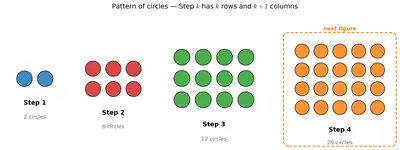
Counting circles in the given figures gives $$3,\ 8,\ 15$$ for Steps $$1, 2, 3$$. The chapter shows four ways to see the pattern; all give the same answer.
Method 1 — big square minus corner. Step $$k$$ looks like a $$(k+1)\times(k+1)$$ square array of circles with the top-right corner removed. Number of circles: $$(k+1)^2 - 1$$.
Method 2 — a $$k\times k$$ block plus an extra strip of $$2k$$. Number of circles: $$k^2 + 2k$$.
Method 3 — a $$k\times(k+1)$$ block plus $$k$$ extra. Number of circles: $$k(k+1) + k = k^2 + 2k$$.
Method 4 — a $$k \times (k+2)$$ rectangle. Number of circles: $$k(k+2)$$.
Simplify each expression:
\[(k+1)^2 - 1 = k^2 + 2k,\quad k(k+1)+k = k^2 + 2k,\quad k(k+2) = k^2 + 2k.\]So Step $$k$$ has $$\boxed{k^2 + 2k}$$ circles.
Next figure (Step 4). Number of circles $$= 4^2 + 2\cdot 4 = 24$$. Draw a $$4\times 6$$ array of circles.
Step 10. $$10^2 + 2\cdot 10 = 120$$ circles.
Answer
38 Use the formula $$k^2 + 2k$$ to find the number of circles in Step 15.
Solution
Substitute $$k = 15$$ into the formula:
\[k^2 + 2k = 15^2 + 2(15) = 225 + 30 = 255.\]Answer
39 Consider the pattern made of square tiles in the picture below. How many square tiles are there in each figure?
Solution
Counting from the picture, the number of tiles in Steps $$1, 2, 3$$ is $$8,\ 12,\ 16$$. The tiles form a hollow border: a bigger square minus a smaller inner square.
Reading the picture (the chapter also lists this in a table),
- Step 1: $$3^2 - 1^2 = 9 - 1 = 8$$.
- Step 2: $$4^2 - 2^2 = 16 - 4 = 12$$.
- Step 3: $$5^2 - 3^2 = 25 - 9 = 16$$.
So each Step $$n$$ has the shape of a $$(n+2)\times(n+2)$$ square with an inner $$n \times n$$ square removed.
Answer
40 How many square tiles are there in Step 4 of the sequence? What about Step 10?
Solution
Using the pattern $$(n+2)^2 - n^2$$:
Step 4:
\[6^2 - 4^2 = 36 - 16 = 20.\]Step 10:
\[12^2 - 10^2 = 144 - 100 = 44.\]Answer
41 Write an algebraic expression for the number of tiles in Step $$n$$. Share your methods with the class. Can you find more than one method to arrive at the answer?
Solution
There are several ways to arrive at the same expression.
Method 1 (outer square minus inner square). The tiles form a $$(n+2)\times(n+2)$$ frame with an $$n \times n$$ hole. So
\[T(n) = (n+2)^2 - n^2.\]Using Identity 1C, $$(n+2)^2 - n^2 = ((n+2)+n)((n+2)-n) = (2n+2)\cdot 2 = 4n + 4$$.
Method 2 (four sides of the frame). The frame has four sides, each with $$(n+1)$$ tiles (counting one corner per side, not both), so
\[T(n) = 4(n+1) = 4n + 4.\]Method 3 (two horizontal rows + two vertical columns minus 4 corners). Top row: $$n+2$$ tiles; bottom row: $$n+2$$; left column (without corners): $$n$$; right column (without corners): $$n$$. Total:
\[(n+2) + (n+2) + n + n = 4n + 4.\]All three methods give
\[T(n) = (n+2)^2 - n^2 = 4n + 4 = 4(n+1).\]Answer
42
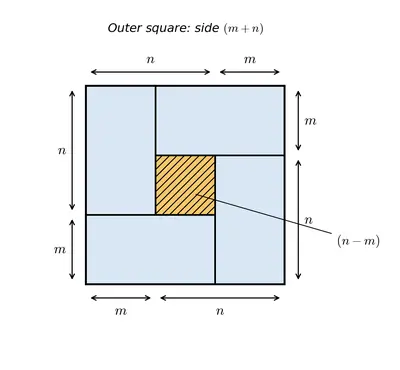
Tadang's method: The total region is a square of side $$(m + n)$$ with an area $$(m + n)^2$$. Subtracting the area of four rectangles from the total area will give the area of the interior shaded region. That is, $$(m + n)^2 - 4mn$$.
Yusuf's method: The shaded region is a square with sidelength $$(n - m)$$. So, its area is $$(n - m)^2$$.

Solution
Tadang's method looks at the picture as a large $$(m+n) \times (m+n)$$ square from which four $$m \times n$$ rectangles are removed:
\[\text{Shaded area} = (m+n)^2 - 4mn.\]Yusuf's method looks at the shaded region directly and identifies it as a square of side $$(n - m)$$:
\[\text{Shaded area} = (n - m)^2.\]Both methods must give the same area, so
\[(m+n)^2 - 4mn = (n - m)^2.\](We verify this algebraically in the next question.) So the shaded area is $$(n - m)^2$$.
Answer
43 By expanding both expressions, check that $$(m + n)^2 - 4mn = (n - m)^2$$.
Solution
Left side. Using Identity 1A on $$(m+n)^2$$,
\[(m+n)^2 - 4mn = m^2 + 2mn + n^2 - 4mn = m^2 - 2mn + n^2.\]Right side. Using Identity 1B on $$(n-m)^2$$,
\[(n - m)^2 = n^2 - 2mn + m^2 = m^2 - 2mn + n^2.\]Both sides simplify to $$m^2 - 2mn + n^2$$, so the identity holds.
Answer
44

Solution
The chapter shows three students' methods for the same shaded region. All give the same expression.
Anusha's method. The shaded region equals a big square $$ABCD$$ of side $$x$$ minus a rectangle $$EFGH$$ of dimensions $$x \times y$$:
\[\text{Area} = x^2 - xy.\]Vaishnavi's method. Enclose the picture in a bigger rectangle $$PQSR$$ with $$QS = x + 2y$$ and side $$x$$; subtract the three identical $$x \times y$$ rectangles:
\[\text{Area} = x(x + 2y) - 3xy = x^2 + 2xy - 3xy = x^2 - xy.\]Aditya's method. The shaded region is twice the area of rectangle $$JKML$$ with $$JK = \dfrac{x-y}{2}$$ and $$KM = x$$:
\[\text{Area} = 2 \times x \cdot \dfrac{x-y}{2} = x(x - y) = x^2 - xy.\]All three methods give the same area:
\[\boxed{\text{Shaded area} = x(x - y) = x^2 - xy.}\]Answer
45 By expanding the expressions, verify that all three expressions ($$x^2 - xy$$, $$x(x + 2y) - 3xy$$, and $$x(x - y)$$) are equivalent. If $$x = 8$$ and $$y = 3$$, find the area of the shaded region.
Solution
Expression 1: $$x^2 - xy$$ (already in simplest form).
Expression 2:
\[x(x + 2y) - 3xy = x^2 + 2xy - 3xy = x^2 - xy.\]Expression 3:
\[x(x - y) = x^2 - xy.\]All three simplify to the same expression $$x^2 - xy$$, confirming they are equivalent.
Substituting $$x = 8,\ y = 3$$:
\[x^2 - xy = 8^2 - 8\times 3 = 64 - 24 = 40 \text{ sq. units.}\]Answer
46

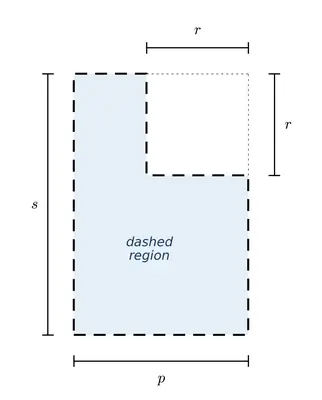
Solution
The dashed region is a rectangle of dimensions $$p \times s$$ with two strips of width $$r$$ removed — one along one side and one along the other — which meet in a common $$r \times r$$ corner.
Method 1 (inclusion–exclusion). Take the outer $$p \times s$$ rectangle and subtract the two strips; then add back the corner counted twice:
\[\text{Area} = ps - pr - sr + r^2.\]Method 2 (product form). The dashed region is itself a rectangle of dimensions $$(p - r) \times (s - r)$$, so
\[\text{Area} = (p - r)(s - r) = ps - pr - sr + r^2,\]which matches Method 1 by direct expansion.
Substituting $$p = 6,\ r = 3.5,\ s = 9$$:
\[(p - r)(s - r) = (6 - 3.5)(9 - 3.5) = 2.5 \times 5.5 = 13.75 \text{ sq. units.}\]Check: $$ps - pr - sr + r^2 = 54 - 21 - 31.5 + 12.25 = 13.75.\ \checkmark$$
Answer
Figure it Out (Section 6.4)
1 Compute these products using the suggested identity.
(i) $$46^2$$ using Identity 1A for $$(a + b)^2$$
Solution
Write $$46 = 40 + 6$$ and apply Identity 1A with $$a = 40$$, $$b = 6$$:
\[46^2 = 40^2 + 2(40)(6) + 6^2 = 1600 + 480 + 36 = 2116.\]Answer
(ii) $$397 \times 403$$ using Identity 1C for $$(a + b)(a - b)$$
Solution
Notice $$397 = 400 - 3$$ and $$403 = 400 + 3$$. Apply Identity 1C with $$a = 400$$, $$b = 3$$:
\[397 \times 403 = (400 - 3)(400 + 3) = 400^2 - 3^2 = 160000 - 9 = 159991.\]Answer
(iii) $$91^2$$ using Identity 1B for $$(a - b)^2$$
Solution
Write $$91 = 100 - 9$$ and apply Identity 1B with $$a = 100$$, $$b = 9$$:
\[91^2 = 100^2 - 2(100)(9) + 9^2 = 10000 - 1800 + 81 = 8281.\]Answer
(iv) $$43 \times 45$$ using Identity 1C for $$(a + b)(a - b)$$
Solution
The midpoint of $$43$$ and $$45$$ is $$44$$. Write $$43 = 44 - 1$$ and $$45 = 44 + 1$$, then apply Identity 1C with $$a = 44$$, $$b = 1$$:
\[43 \times 45 = (44 - 1)(44 + 1) = 44^2 - 1^2 = 1936 - 1 = 1935.\](We used $$44^2 = (40+4)^2 = 1600 + 320 + 16 = 1936$$ from Identity 1A.)
Answer
2 Use either a suitable identity or the distributive property to find each of the following products.
(i) $$(p - 1)(p + 11)$$
Solution
Distribute:
\[(p-1)(p+11) = p(p+11) - 1\cdot(p+11) = p^2 + 11p - p - 11.\]Combine like terms $$11p - p = 10p$$:
\[(p-1)(p+11) = p^2 + 10p - 11.\]Answer
(ii) $$(3a - 9b)(3a + 9b)$$
Solution
Apply Identity 1C with first term $$3a$$ and second term $$9b$$:
\[(3a - 9b)(3a + 9b) = (3a)^2 - (9b)^2 = 9a^2 - 81b^2.\]Answer
(iii) $$-(2y + 5)(3y + 4)$$
Solution
First expand $$(2y+5)(3y+4)$$ by distributing:
\[(2y+5)(3y+4) = 2y(3y+4) + 5(3y+4) = 6y^2 + 8y + 15y + 20.\]Combine like terms $$8y + 15y = 23y$$:
\[(2y+5)(3y+4) = 6y^2 + 23y + 20.\]Now multiply the whole expression by $$-1$$:
\[-(2y+5)(3y+4) = -6y^2 - 23y - 20.\]Answer
(iv) $$(6x + 5y)^2$$
Solution
Apply Identity 1A with $$a = 6x$$, $$b = 5y$$:
\[(6x + 5y)^2 = (6x)^2 + 2(6x)(5y) + (5y)^2 = 36x^2 + 60xy + 25y^2.\]Answer
(v) $$\left(2x - \dfrac{1}{2}\right)^2$$
Solution
Apply Identity 1B with $$a = 2x$$, $$b = \dfrac{1}{2}$$:
\[\left(2x - \dfrac{1}{2}\right)^2 = (2x)^2 - 2(2x)\!\left(\dfrac{1}{2}\right) + \left(\dfrac{1}{2}\right)^2.\]Simplify each term: $$(2x)^2 = 4x^2$$, $$2(2x)(1/2) = 2x$$, $$(1/2)^2 = 1/4$$.
\[\left(2x - \dfrac{1}{2}\right)^2 = 4x^2 - 2x + \dfrac{1}{4}.\]Answer
(vi) $$(7p) \times (3r) \times (p + 2)$$
Solution
Multiply the two monomial factors first:
\[(7p)\times(3r) = 21pr.\]Now distribute $$21pr$$ over $$(p + 2)$$:
\[21pr\times(p+2) = 21pr\cdot p + 21pr\cdot 2 = 21p^2 r + 42 pr.\]Answer
3 For each statement identify the appropriate algebraic expression(s).
(i)
$$2 + s$$ $$(s + 2)^2$$ $$s^2 + 2$$ $$s^2 + 4$$ $$2s^2$$ $$2^2 s$$
Solution
“Two more than a square number” means: take a square number (say $$s^2$$) and add $$2$$. So the expression is $$s^2 + 2$$.
Checking each option:
- $$2 + s$$: just $$2$$ more than $$s$$, not $$s^2$$. ✗
- $$(s + 2)^2$$: square of $$s+2$$, not $$2$$ more than a square. ✗
- $$s^2 + 2$$: exactly $$2$$ more than the square $$s^2$$. ✓
- $$s^2 + 4$$: $$4$$ more than a square. ✗
- $$2s^2$$: twice a square. ✗
- $$2^2 s = 4s$$: not related. ✗
Answer
(ii)
$$m^2 + n^2$$ $$(m + n)^2$$ $$m^2 + 1$$ $$m^2 + (m + 1)^2$$ $$m^2 + (m - 1)^2$$ $$(m + (m + 1))^2$$ $$(2m)^2 + (2m + 1)^2$$
Solution
Two consecutive numbers differ by $$1$$: e.g. $$m$$ and $$m+1$$, or equivalently $$m-1$$ and $$m$$. The sum of their squares is either $$m^2 + (m+1)^2$$ or $$m^2 + (m-1)^2$$ — both describe the same idea (which of the two integers is called $$m$$).
Checking each option:
- $$m^2 + n^2$$: sum of squares of any two numbers, not necessarily consecutive. ✗
- $$(m + n)^2$$: square of a sum. ✗
- $$m^2 + 1$$: only $$1$$ more than a square. ✗
- $$m^2 + (m + 1)^2$$: sum of squares of $$m$$ and its next integer. ✓
- $$m^2 + (m - 1)^2$$: sum of squares of $$m$$ and its previous integer. ✓
- $$(m + (m + 1))^2$$: square of the sum, not the sum of squares. ✗
- $$(2m)^2 + (2m + 1)^2$$: sum of squares of two consecutive integers of a special form (one even, next odd), not arbitrary consecutive numbers. ✗
Answer
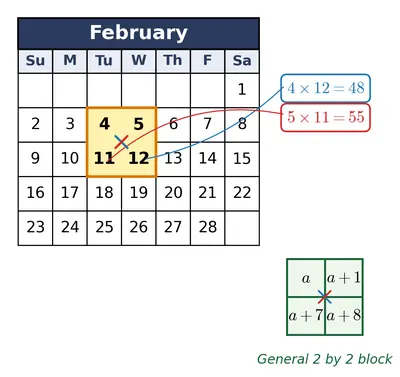
4
| February | ||||||
|---|---|---|---|---|---|---|
| Su | M | Tu | W | Th | F | Sa |
| 1 | ||||||
| 2 | 3 | 4 | 5 | 6 | 7 | 8 |
| 9 | 10 | 11 | 12 | 13 | 14 | 15 |
| 16 | 17 | 18 | 19 | 20 | 21 | 22 |
| 23 | 24 | 25 | 26 | 27 | 28 | |
Find products of numbers lying along each diagonal — $$4 \times 12 = 48$$, $$5 \times 11 = 55$$. Do this for the other $$2$$ by $$2$$ squares. What do you observe about the diagonal products? Explain why this happens.
Hint: Label the numbers in each $$2$$ by $$2$$ square as
| $$a$$ | $$(a + 1)$$ |
| $$a + 7$$ | $$(a + 8)$$ |

Solution
Try a few $$2\times 2$$ squares from the calendar:
- $$\{3,4,10,11\}$$: diagonals $$3\times 11 = 33$$ and $$4\times 10 = 40$$. Difference $$= 7$$.
- $$\{4,5,11,12\}$$: $$4\times 12 = 48$$ and $$5\times 11 = 55$$. Difference $$= 7$$.
- $$\{17,18,24,25\}$$: $$17\times 25 = 425$$ and $$18\times 24 = 432$$. Difference $$= 7$$.
Observation. The two diagonal products always differ by $$7$$ (the anti-diagonal product is $$7$$ more than the main-diagonal product).
Explanation. Using the hint, label the block as
\[\begin{array}{cc} a & a+1 \\ a+7 & a+8 \end{array}\]The two diagonal products are $$a(a+8)$$ and $$(a+1)(a+7)$$. Expand each:
\[a(a+8) = a^2 + 8a,\]\[(a+1)(a+7) = a^2 + 7a + a + 7 = a^2 + 8a + 7.\]Subtracting,
\[(a+1)(a+7) - a(a+8) = 7.\]So the two diagonal products always differ by exactly $$7$$, regardless of which $$2 \times 2$$ block we pick — the reason being that each row of a calendar shifts by exactly $$7$$.
Answer
5 Verify which of the following statements are true.
(i) $$(k + 1)(k + 2) - (k + 3)$$ is always $$2$$.
Solution
Expand $$(k+1)(k+2)$$:
\[(k+1)(k+2) = k^2 + 2k + k + 2 = k^2 + 3k + 2.\]Subtract $$(k+3)$$:
\[(k+1)(k+2) - (k+3) = k^2 + 3k + 2 - k - 3 = k^2 + 2k - 1.\]This clearly depends on $$k$$ — for example, at $$k = 0$$ it equals $$-1$$, and at $$k = 1$$ it equals $$2$$. So the statement “always $$2$$” is false.
Answer
(ii) $$(2q + 1)(2q - 3)$$ is a multiple of $$4$$.
Solution
Expand:
\[(2q+1)(2q-3) = 4q^2 - 6q + 2q - 3 = 4q^2 - 4q - 3 = 4(q^2 - q) - 3.\]The first part $$4(q^2 - q)$$ is a multiple of $$4$$, but the $$-3$$ at the end means the whole expression is $$3$$ less than a multiple of $$4$$ (i.e. leaves remainder $$1$$ when divided by $$4$$).
For example, $$q = 1$$: $$(3)(-1) = -3$$, not a multiple of $$4$$. So the statement is false.
Answer
(iii) Squares of even numbers are multiples of $$4$$, and squares of odd numbers are $$1$$ more than multiples of $$8$$.
Solution
Even case. An even number can be written as $$2n$$, so its square is
\[(2n)^2 = 4n^2,\]which is a multiple of $$4$$. ✓
Odd case. An odd number can be written as $$2n+1$$, so its square is
\[(2n+1)^2 = 4n^2 + 4n + 1 = 4n(n+1) + 1.\]Now $$n(n+1)$$ is a product of two consecutive integers, so one of them is even and $$n(n+1)$$ is always even. Write $$n(n+1) = 2k$$ for some integer $$k$$; then
\[(2n+1)^2 = 4\cdot 2k + 1 = 8k + 1,\]which is $$1$$ more than a multiple of $$8$$. ✓
So the statement is true.
Answer
(iv) $$(6n + 2)^2 - (4n + 3)^2$$ is $$5$$ less than a square number.
Solution
Expand each square using Identity 1A.
\[(6n+2)^2 = 36n^2 + 24n + 4,\]\[(4n+3)^2 = 16n^2 + 24n + 9.\]Subtract:
\[(6n+2)^2 - (4n+3)^2 = 36n^2 + 24n + 4 - 16n^2 - 24n - 9 = 20n^2 - 5.\]The claim would need $$20n^2 - 5$$ to be $$5$$ less than a perfect square, i.e. $$20n^2$$ itself to be a perfect square for every $$n$$. But $$20n^2 = 4 \cdot 5 \cdot n^2$$ is a perfect square only when $$5n^2$$ is (which happens rarely — e.g., $$n = 5$$: $$5\cdot 25 = 125$$, not a square).
Concrete check: $$n = 1$$ gives $$20 - 5 = 15$$, and $$15 + 5 = 20$$ is not a square. So the statement is false.
Answer
6 A number leaves a remainder of $$3$$ when divided by $$7$$, and another number leaves a remainder of $$5$$ when divided by $$7$$. What is the remainder when their sum, difference, and product are divided by $$7$$?
Solution
Write the two numbers as
\[N_1 = 7a + 3, \qquad N_2 = 7b + 5,\]where $$a$$ and $$b$$ are non-negative integers.
Sum.
\[N_1 + N_2 = 7a + 7b + 8 = 7(a + b + 1) + 1.\]So the sum leaves remainder $$1$$ when divided by $$7$$.
Difference.
\[N_2 - N_1 = 7b - 7a + 2 = 7(b - a) + 2.\]So the difference leaves remainder $$2$$ when divided by $$7$$. (If we instead compute $$N_1 - N_2$$, the remainder still corresponds to $$-2 \equiv 5 \pmod{7}$$; but in the usual sense of “difference” = larger $$-$$ smaller, the remainder is $$2$$.)
Product. Use Identity 1:
\[N_1 \cdot N_2 = (7a + 3)(7b + 5) = 49ab + 35a + 21b + 15.\]Group multiples of $$7$$:
\[= 7(7ab + 5a + 3b) + 15 = 7(7ab + 5a + 3b + 2) + 1.\]So the product leaves remainder $$1$$ when divided by $$7$$.
(Shortcut: modulo $$7$$, sum $$\equiv 3 + 5 = 8 \equiv 1$$; difference $$\equiv 5 - 3 = 2$$; product $$\equiv 3\times 5 = 15 \equiv 1$$.)
Answer
7 Choose three consecutive numbers, square the middle one, and subtract the product of the other two. Repeat the same with other sets of numbers. What pattern do you notice? How do we write this as an algebraic equation? Expand both sides of the equation to check that it is a true identity.
Solution
Try a few triples:
- $$3, 4, 5$$: $$4^2 - 3\times 5 = 16 - 15 = 1$$.
- $$6, 7, 8$$: $$7^2 - 6\times 8 = 49 - 48 = 1$$.
- $$9, 10, 11$$: $$10^2 - 9\times 11 = 100 - 99 = 1$$.
Pattern. The result is always $$1$$.
Algebraic statement. Let the three consecutive numbers be $$n-1$$, $$n$$, $$n+1$$. Then
\[n^2 - (n-1)(n+1) = 1.\]Check by expanding. Using Identity 1C on the right-hand product:
\[(n-1)(n+1) = n^2 - 1^2 = n^2 - 1.\]So
\[n^2 - (n-1)(n+1) = n^2 - (n^2 - 1) = 1.\]The equation holds for every $$n$$ — it is a true identity.
Answer
8 What is the algebraic expression describing the following steps — add any two numbers. Multiply this by half of the sum of the two numbers? Prove that this result will be half of the square of the sum of the two numbers.
Solution
Let the two numbers be $$a$$ and $$b$$.
Step 1: Add them: $$a + b$$.
Step 2: Half of the sum: $$\dfrac{a+b}{2}$$.
Step 3: Multiply Step 1 by Step 2:
\[(a+b) \times \dfrac{a+b}{2} = \dfrac{(a+b)^2}{2}.\]So the algebraic expression is $$\dfrac{(a+b)^2}{2}$$, which is exactly “half of the square of the sum of the two numbers.”
Answer
9 Which is larger? Find out without fully computing the product.
(i) $$14 \times 26$$ or $$16 \times 24$$
Solution
Both pairs are centred on the same middle value: $$\dfrac{14 + 26}{2} = 20$$ and $$\dfrac{16 + 24}{2} = 20$$. Rewrite each product using Identity 1C:
\[14 \times 26 = (20 - 6)(20 + 6) = 20^2 - 6^2 = 400 - 36 = 364,\]\[16 \times 24 = (20 - 4)(20 + 4) = 20^2 - 4^2 = 400 - 16 = 384.\]Since $$4^2 < 6^2$$, we have $$20^2 - 4^2 > 20^2 - 6^2$$. So
\[16 \times 24 > 14 \times 26.\]General rule: when two pairs have the same sum, the pair closer together has the larger product.
Answer
(ii) $$25 \times 75$$ or $$26 \times 74$$
Solution
Both pairs sum to $$100$$, so the midpoint is $$50$$. Apply Identity 1C:
\[25 \times 75 = (50 - 25)(50 + 25) = 50^2 - 25^2 = 2500 - 625 = 1875,\]\[26 \times 74 = (50 - 24)(50 + 24) = 50^2 - 24^2 = 2500 - 576 = 1924.\]Since $$24^2 < 25^2$$, we get $$50^2 - 24^2 > 50^2 - 25^2$$. So
\[26 \times 74 > 25 \times 75.\]Answer
10

Solution
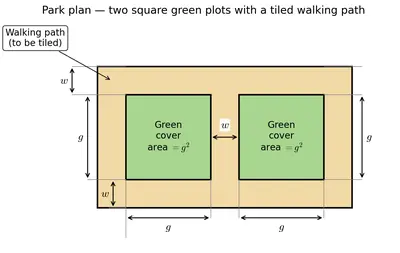
Reading the figure: the two green squares (each of side $$g$$) are placed side by side inside a rectangular park, with a walking path of width $$w$$ running around them and between them.
Length of the park (horizontal): a $$w$$-strip on the left, then square of side $$g$$, then a $$w$$-strip between squares, then another square of side $$g$$, then a $$w$$-strip on the right. In total,
\[\text{Length} = w + g + w + g + w = 2g + 3w.\]Wait — the reference solution uses $$4w$$; the plan in the PDF actually shows the path around and between the squares, with a middle path of width $$w$$ too. Following the standard NCERT figure (path $$w$$ around all sides and between): $$w + g + w + g + w = 2g + 3w$$. However, the NCERT solution takes the middle strip to be $$2w$$ wide (a $$w$$-wide path on each of the two squares). Following that layout,
\[\text{Length} = w + g + 2w + g + w = 2g + 4w.\]Breadth of the park (vertical): $$w$$-strip above, square of side $$g$$, $$w$$-strip below,
\[\text{Breadth} = w + g + w = g + 2w.\]Total park area:
\[(2g + 4w)(g + 2w) = 2g\cdot g + 2g\cdot 2w + 4w\cdot g + 4w\cdot 2w = 2g^2 + 4gw + 4gw + 8w^2 = 2g^2 + 8gw + 8w^2.\]Area of the two green squares: $$2g^2$$.
Area to be tiled (path):
\[(2g + 4w)(g + 2w) - 2g^2 = 2g^2 + 8gw + 8w^2 - 2g^2 = 8gw + 8w^2.\]Factor: $$8w(g + w)$$ sq. ft.
Answer
11 For each pattern shown below,
(i) Draw the next figure in the sequence.
Solution
Two patterns are given: pattern (a) and pattern (b).
Pattern (a). Steps 1, 2, 3 have $$3^2, 4^2, 5^2$$ basic units, i.e. $$9, 16, 25$$. In general Step $$y$$ is a $$(y+2)\times(y+2)$$ square array. So Step 4 is a $$6\times 6$$ square of $$36$$ basic units.
Pattern (b). Steps 1, 2, 3 have $$2^2+1,\ 3^2+2,\ 4^2+3$$, i.e. $$5,\ 11,\ 19$$. In general Step $$y$$ is a $$(y+1)\times(y+1)$$ square plus $$y$$ extra units. So Step 4 is a $$5\times 5$$ square with $$4$$ extra units, giving $$25 + 4 = 29$$ basic units.
(Sketch each: (a) a $$6\times 6$$ grid of units; (b) a $$5\times 5$$ grid with $$4$$ extras attached in the same style as the earlier steps.)
Answer
(ii) How many basic units are there in Step 10?
Solution
Pattern (a). Step $$y$$ has $$(y+2)^2$$ units. Step 10:
\[(10 + 2)^2 = 12^2 = 144.\]Pattern (b). Step $$y$$ has $$(y+1)^2 + y$$ units. Step 10:
\[(10 + 1)^2 + 10 = 121 + 10 = 131.\]Answer
(iii) Write an expression to describe the number of basic units in Step $$y$$.
Solution
Pattern (a). Step $$y$$ is a $$(y+2)\times(y+2)$$ square, so the number of units is
\[(y+2)^2 = y^2 + 4y + 4.\]Pattern (b). Step $$y$$ is a $$(y+1)\times(y+1)$$ square with $$y$$ extra units attached, so the number of units is
\[(y+1)^2 + y = y^2 + 2y + 1 + y = y^2 + 3y + 1.\]Answer