Intext Questions
1 Observe the following figures. Figs. (i), (ii), and (iii) are quadrilaterals, and the others are not. Why?
Solution
A quadrilateral is a closed plane figure bounded by exactly four straight line segments such that:
- each vertex is shared by exactly two sides,
- no two sides cross each other, and
- the figure is closed (no gaps or free ends).
Figures (i), (ii) and (iii) satisfy all three conditions — they are made of four straight sides joined end-to-end, forming a closed shape.
The other figures fail one of these conditions. For example, a figure could:
- have curved sides (not made only of straight line segments),
- be open (the sides do not close up), or
- have more than four sides, or two sides that cross each other.
Because of any such failure, they cannot be called quadrilaterals.
Answer
2 Are there other ways to define a rectangle?
Solution
Yes. The usual definition — a quadrilateral with opposite sides equal and all four angles equal to $$90^{\circ}$$ — contains more information than is actually needed. A rectangle can be defined equivalently in several shorter ways, each of which forces every other rectangle property to hold. Some standard equivalent definitions are:
- Diagonal definition: a quadrilateral whose diagonals are equal in length and bisect each other.
- Angle definition: a quadrilateral in which all four angles equal $$90^{\circ}$$.
- Parallelogram definition: a parallelogram in which one angle is $$90^{\circ}$$ (this forces all four angles to be $$90^{\circ}$$).
- Parallelogram definition (via diagonals): a parallelogram whose diagonals are equal in length.
Each of these gives exactly the same shape as the usual definition, so any one of them can be taken as the definition of a rectangle.
Answer
3
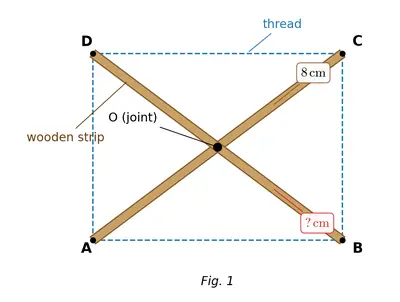
A Carpenter's Problem: A carpenter needs to put together two thin strips of wood, as shown in Fig. 1, so that when a thread is passed through their endpoints, it forms a rectangle. She already has one $$8 \, \mathrm{cm}$$ long strip. What should be the length of the other strip? Where should they both be joined?
Let us first model the structure that the carpenter has to make. The strips can be modelled as line segments. They are the diagonals of the quadrilateral formed by their endpoints. For the quadrilateral to be a rectangle, we need to answer the following questions —

1 What is the length of the other diagonal?
Solution
The two wooden strips are the diagonals of the rectangle. A rectangle has the property that its diagonals are equal in length. So if one strip (diagonal) is $$8 \, \mathrm{cm}$$ long, the other strip must also be $$8 \, \mathrm{cm}$$ long.
Answer
2 What is the point of intersection of the two diagonals?
Solution
The diagonals of a rectangle bisect each other. So each diagonal must be joined at its own midpoint, which is also the midpoint of the other. The carpenter should therefore join the two strips at the point that is exactly $$4 \, \mathrm{cm}$$ from either end of each $$8 \, \mathrm{cm}$$ strip — i.e. at the midpoint of each strip.
Answer
3 What should the angle be between the diagonals?
Solution
Once we fix that the two diagonals are equal and bisect each other, the quadrilateral obtained by joining their endpoints is automatically a rectangle for any angle between the diagonals (other than $$0^{\circ}$$ or $$180^{\circ}$$). The angle between the diagonals is not fixed — it only decides the shape (length-to-breadth ratio) of the rectangle.
So the carpenter is free to choose any angle between $$0^{\circ}$$ and $$180^{\circ}$$ (not equal to $$0^{\circ}$$ or $$180^{\circ}$$). Different angles will simply give rectangles of different proportions.
Answer
4
Can the following equalities be used to establish that $$\triangle AOD \cong \triangle COB$$?
$$AO = CO$$ (proved above)
$$\angle AOB = \angle COD$$ (vertically opposite angles)
$$AD = CB$$
Solution
No. To use the SAS congruence rule, the angle used must be the angle included between the two given equal sides of the triangle.
In $$\triangle AOD$$, the side $$AO$$ and the side $$AD$$ do not form the angle $$\angle AOB$$. The angle between $$AO$$ and $$OD$$ in $$\triangle AOD$$ is $$\angle AOD$$, not $$\angle AOB$$. Similarly, in $$\triangle COB$$, the angle between $$CO$$ and $$OB$$ is $$\angle COB$$, not $$\angle COD$$.
Also, the angle $$\angle AOB$$ is not even an angle of $$\triangle AOD$$, and $$\angle COD$$ is not an angle of $$\triangle COB$$. So this set of equalities does not match the SAS pattern, and the given data cannot be used to conclude $$\triangle AOD \cong \triangle COB$$.
The correct set of equalities is $$AO = CO$$, $$OD = OB$$, and the included angle $$\angle AOD = \angle COB$$ (vertically opposite angles). With these, $$\triangle AOD \cong \triangle COB$$ by SAS.
Answer
5

Solution
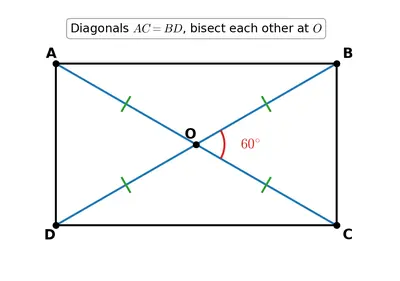
Let the diagonals $$AC$$ and $$BD$$ of the quadrilateral $$ABCD$$ meet at $$O$$. We are given $$AC = BD$$, $$OA = OC$$, $$OB = OD$$, and one of the angles at $$O$$ is $$60^{\circ}$$.
The four angles at $$O$$ come in two pairs of vertically-opposite angles, and each pair of adjacent angles is a linear pair (adds to $$180^{\circ}$$).
If $$\angle AOB = 60^{\circ}$$, then:
$$\angle COD = \angle AOB = 60^{\circ}$$ (vertically opposite).
$$\angle BOC = 180^{\circ} - 60^{\circ} = 120^{\circ}$$ (linear pair with $$\angle AOB$$).
$$\angle AOD = \angle BOC = 120^{\circ}$$ (vertically opposite).
Answer
6 In $$\triangle AOB$$, since $$OA = OB$$, the angles opposite them are equal, say $$a$$. Can you find the value of $$a$$?
Solution
In $$\triangle AOB$$, $$OA = OB$$, so it is an isosceles triangle. The angles opposite the equal sides are equal, so $$\angle OAB = \angle OBA = a$$.
The angle at $$O$$ inside this triangle is $$\angle AOB = 60^{\circ}$$ (from the previous step).
By the angle-sum property of a triangle,
$$a + a + 60^{\circ} = 180^{\circ}$$
$$2a = 120^{\circ}$$
$$a = 60^{\circ}$$
Answer
7 Can we now identify what type of quadrilateral $$ABCD$$ is?
Solution
Applying the same argument to each of the four triangles formed by the diagonals ($$\triangle AOB, \triangle BOC, \triangle COD, \triangle DOA$$), we find that all four are isosceles (since $$OA = OB = OC = OD$$, as the two equal diagonals bisect each other).
Going through each triangle, the base angles come out to be $$60^{\circ}$$, $$30^{\circ}$$, $$60^{\circ}$$, $$30^{\circ}$$ around the quadrilateral. The angle at vertex $$A$$ is $$\angle DAO + \angle OAB = 30^{\circ} + 60^{\circ} = 90^{\circ}$$. Similarly each of the four vertex angles of $$ABCD$$ equals $$90^{\circ}$$.
Also, using the isosceles triangles, we get $$AB = CD$$ and $$AD = BC$$ (opposite sides equal).
Hence $$ABCD$$ is a rectangle.
Answer
8 What can we say about its sides?
Solution
Since the diagonals of $$ABCD$$ bisect each other, we have $$OA = OC$$ and $$OB = OD$$. Also, vertically opposite angles at $$O$$ are equal.
By the SAS congruence rule, $$\triangle AOB \cong \triangle COD$$, giving $$AB = CD$$. Similarly, $$\triangle BOC \cong \triangle DOA$$, giving $$BC = DA$$.
Hence, the opposite sides of $$ABCD$$ are equal:
$$AB = CD \quad \text{and} \quad BC = DA.$$
Answer
9 Will $$ABCD$$ remain a rectangle if the angles between the diagonals are changed? Can we generalise this? Take one of the angles between the diagonals as $$x$$.
Solution
Yes. Suppose the two diagonals are equal and bisect each other, and one of the angles between them is $$x$$ (where $$0^{\circ} < x < 180^{\circ}$$). We will show that $$ABCD$$ is always a rectangle, no matter what $$x$$ is.
Since the diagonals bisect each other, $$OA = OC$$ and $$OB = OD$$. Because the diagonals are equal, $$OA = OB = OC = OD$$ (each equals half of the common diagonal length). So each of the four triangles $$\triangle AOB, \triangle BOC, \triangle COD, \triangle DOA$$ is isosceles.
We will show in the next few steps that each angle of $$ABCD$$ turns out to be $$90^{\circ}$$ regardless of $$x$$. Hence $$ABCD$$ is a rectangle for every $$x$$.
Answer
10 We can compute the four angles between the diagonals to be $$x, x, 180 - x$$, and $$180 - x$$. Can you find the other angles?
Solution
The two vertically opposite angles at $$O$$ that equal $$x$$ are $$\angle AOB$$ and $$\angle COD$$. The other two, $$\angle BOC$$ and $$\angle DOA$$, are the linear-pair supplements, so each equals $$180^{\circ} - x$$.
Now look at $$\triangle AOB$$. It is isosceles with $$OA = OB$$, so the base angles $$\angle OAB$$ and $$\angle OBA$$ are equal. Using the angle sum:
$$\angle OAB + \angle OBA + x = 180^{\circ}$$
$$\angle OAB = \angle OBA = \dfrac{180^{\circ} - x}{2} = 90^{\circ} - \dfrac{x}{2}.$$
Similarly, in $$\triangle COD$$ (isosceles with $$OC = OD$$ and included angle $$x$$),
$$\angle OCD = \angle ODC = 90^{\circ} - \dfrac{x}{2}.$$
In $$\triangle BOC$$ (isosceles with $$OB = OC$$ and included angle $$180^{\circ}-x$$),
$$\angle OBC = \angle OCB = \dfrac{180^{\circ} - (180^{\circ}-x)}{2} = \dfrac{x}{2}.$$
Similarly, in $$\triangle DOA$$,
$$\angle ODA = \angle OAD = \dfrac{x}{2}.$$
Answer
11 Since we know that $$\triangle AOB$$ is isosceles, we can denote the measures of both of its base angles by $$a$$. What is the value of $$a$$ (in degrees) in terms of $$x$$?
Solution
In $$\triangle AOB$$, $$OA = OB$$, so the base angles $$\angle OAB$$ and $$\angle OBA$$ are equal — call each of them $$a$$. The included angle at the vertex $$O$$ is $$\angle AOB = x$$.
By the angle-sum property,
$$a + a + x = 180^{\circ}$$
$$2a = 180^{\circ} - x$$
$$a = 90^{\circ} - \dfrac{x}{2}.$$
Answer
12 What can we say about $$AB$$ and $$CD$$, and $$AD$$ and $$BC$$?
Solution
Consider $$\triangle AOB$$ and $$\triangle COD$$. We have
$$OA = OC, \quad OB = OD, \quad \angle AOB = \angle COD \text{ (vertically opposite)}.$$
By SAS congruence, $$\triangle AOB \cong \triangle COD$$, so the corresponding sides satisfy
$$AB = CD.$$
Similarly, $$\triangle BOC \cong \triangle DOA$$ (by SAS with $$OB = OD$$, $$OC = OA$$ and $$\angle BOC = \angle DOA$$), so
$$BC = DA.$$
Hence, in $$ABCD$$, the opposite sides are equal.
Answer
13 In the earlier definition, we stated that a rectangle has (a) opposite sides of equal length, and (b) all angles equal to $$90^{\circ}$$. Would we be wrong if we just define a rectangle as a quadrilateral in which all the angles are $$90^{\circ}$$?
Solution
No — this shorter definition is not wrong. As we will show (in Deduction 4), once we insist that all four angles of a quadrilateral are $$90^{\circ}$$, the property that opposite sides are equal follows automatically. So condition (a) is a consequence of condition (b), and stating (b) alone is enough to characterise a rectangle.
Answer
14 If you think that this definition is incomplete, try constructing a quadrilateral in which the angles are all $$90^{\circ}$$ but the opposite sides are not equal. Are you able to construct such a quadrilateral?
Solution
No, such a quadrilateral cannot be constructed. Every attempt to draw a quadrilateral with all four angles equal to $$90^{\circ}$$ ends up with opposite sides equal. This suggests that the property “all angles $$= 90^{\circ}$$” is enough to force the shape to be a rectangle.
The reason is proved in the next question (Deduction 4): using the diagonal $$BD$$, we can show $$\triangle BAD \cong \triangle DCB$$, which forces $$AB = DC$$ and $$AD = BC$$.
Answer
15
Deduction 4 — What is the shape of a quadrilateral with all the angles equal to $$90^{\circ}$$?
Consider a quadrilateral $$ABCD$$ with all angles measuring $$90^{\circ}$$. What can we say about the opposite sides of such a quadrilateral? Join $$BD$$. $$\triangle BAD$$ and $$\triangle DCB$$ seem congruent. Can we justify this claim? Two equalities can be directly seen in the triangles. What can we say about $$\angle 1$$ and $$\angle 2$$?
Solution
Look at $$\triangle BAD$$ and $$\triangle DCB$$. Two things are directly visible:
1. $$\angle A = \angle C = 90^{\circ}$$ (given).
2. $$BD$$ is common to both triangles, so $$BD = DB$$.
Let $$\angle 1 = \angle ABD$$ (in $$\triangle BAD$$) and $$\angle 2 = \angle CDB$$ (in $$\triangle DCB$$).
In $$\triangle BAD$$, by the angle-sum property,
$$\angle A + \angle ABD + \angle ADB = 180^{\circ}$$
$$90^{\circ} + \angle 1 + \angle ADB = 180^{\circ}$$
$$\angle 1 = 90^{\circ} - \angle ADB.$$
Now the full angle $$\angle ADC = 90^{\circ}$$, so $$\angle ADB + \angle BDC = 90^{\circ}$$, which gives $$\angle BDC = 90^{\circ} - \angle ADB$$. That is, $$\angle 2 = \angle BDC = 90^{\circ} - \angle ADB = \angle 1$$.
Hence $$\angle 1 = \angle 2$$.
Now in $$\triangle BAD$$ and $$\triangle DCB$$ we have:
- $$\angle A = \angle C = 90^{\circ}$$,
- $$BD = DB$$ (common),
- $$\angle 1 = \angle 2$$.
By ASA (angle–side–angle), $$\triangle BAD \cong \triangle DCB$$. Corresponding sides give $$AB = CD$$ and $$AD = CB$$.
Answer
16 Is it wrong to write $$\triangle BAD \cong \triangle CDB$$? Why?
Solution
Yes, it is wrong. In a congruence statement, the order of the vertices matters — the vertices in corresponding positions must actually correspond to each other.
From the earlier work, the correct correspondence is
$$B \leftrightarrow D, \quad A \leftrightarrow C, \quad D \leftrightarrow B,$$
which is exactly what $$\triangle BAD \cong \triangle DCB$$ says.
Writing $$\triangle BAD \cong \triangle CDB$$ would mean $$B \leftrightarrow C, A \leftrightarrow D, D \leftrightarrow B$$, i.e. $$BA = CD, AD = DB, BD = CB$$. This is not the correspondence given by the congruence proof, so this statement is wrong.
Answer
17 Are the opposite sides of a rectangle parallel? Notice that $$AB$$ acts as a transversal to $$AD$$ and $$BC$$, and that $$\angle A + \angle B = 90^{\circ} + 90^{\circ} = 180^{\circ}$$. Can you similarly show that $$AB$$ is parallel to $$DC$$ ($$AB \parallel DC$$)?
Solution
Yes. In rectangle $$ABCD$$, take $$AD$$ as the transversal cutting $$AB$$ and $$DC$$. The two co-interior (same-side interior) angles it makes are $$\angle A$$ and $$\angle D$$. Since each is $$90^{\circ}$$,
$$\angle A + \angle D = 90^{\circ} + 90^{\circ} = 180^{\circ}.$$
When co-interior angles formed by a transversal add to $$180^{\circ}$$, the two lines it cuts are parallel. Hence,
$$AB \parallel DC.$$
The same argument with $$AB$$ as transversal to $$AD$$ and $$BC$$ gives $$AD \parallel BC$$. So both pairs of opposite sides of a rectangle are parallel.
Answer
18 Let us consider the Carpenter's Problem again. If the wooden strips have to be placed such that the thread passing through their endpoints forms a square, what must be done?
Solution
A square is a special rectangle, so we still need:
- the two strips (diagonals) to be of equal length, and
- joined at their midpoints (diagonals bisect each other).
Both of these together guarantee we get a rectangle. To make it a square, we additionally need all four sides of the resulting quadrilateral to be equal. As we shall see, this happens exactly when the two diagonals are perpendicular to each other. So, apart from being equal and bisecting each other, the strips must also be placed at right angles.
Answer
19 What more needs to be done to get equal sidelengths as well? Can this be achieved by properly choosing the angle between the diagonals? See if you can reason and/or experiment to figure this out!
Solution
Yes. Recall from Question 10 that if $$x$$ is the angle between the diagonals, the four isosceles triangles $$\triangle AOB, \triangle BOC, \triangle COD, \triangle DOA$$ (with $$OA = OB = OC = OD = \tfrac{d}{2}$$ where $$d$$ is the common diagonal length) have vertex angles $$x, 180^{\circ}-x, x, 180^{\circ}-x$$ at $$O$$.
Using the isosceles-triangle formula for the base (with equal sides $$r = \tfrac{d}{2}$$ and vertex angle $$\theta$$), the side of the quadrilateral opposite the vertex angle $$\theta$$ depends on $$\theta$$. So $$AB$$ and $$CD$$ (from triangles with vertex angle $$x$$) will be equal to each other, and $$BC$$ and $$DA$$ (from vertex angle $$180^{\circ}-x$$) will be equal to each other, but $$AB$$ will equal $$BC$$ only when $$x = 180^{\circ}-x$$, i.e. $$x = 90^{\circ}$$.
Hence, all four sides are equal exactly when the two diagonals meet at $$90^{\circ}$$.
Answer
20
Deduction 5 — What should be the angle formed by the diagonals?
By the SSS condition for congruence, $$\triangle BOA \cong \triangle BOC$$. Can this be used to find the angles $$\angle BOA$$ and $$\angle BOC$$ formed by the diagonals?
Solution
Since $$\triangle BOA \cong \triangle BOC$$, the corresponding angles are equal:
$$\angle BOA = \angle BOC.$$
But $$\angle BOA$$ and $$\angle BOC$$ together form the straight angle $$\angle AOC$$ along the diagonal $$AC$$:
$$\angle BOA + \angle BOC = 180^{\circ}.$$
So $$2 \angle BOA = 180^{\circ}$$, giving
$$\angle BOA = \angle BOC = 90^{\circ}.$$
Hence the two diagonals of a square meet at right angles.
Answer
21 Using this fact, construct a square with a diagonal of length $$8 \, \mathrm{cm}$$.
Solution
Steps of construction:
- Draw a line segment $$AC$$ of length $$8 \, \mathrm{cm}$$. This will be one diagonal.
- Locate its midpoint $$O$$, so that $$OA = OC = 4 \, \mathrm{cm}$$.
- At $$O$$, using a protractor (or a compass construction), draw a line perpendicular to $$AC$$.
- On this perpendicular, mark two points $$B$$ and $$D$$ (one on each side of $$AC$$) such that $$OB = OD = 4 \, \mathrm{cm}$$. (This makes $$BD = 8 \, \mathrm{cm}$$, equal to $$AC$$.)
- Join $$AB, BC, CD, DA$$.
Then $$ABCD$$ is a square because its diagonals $$AC$$ and $$BD$$ are equal ($$8 \, \mathrm{cm}$$), bisect each other at $$O$$, and are perpendicular. On measuring, each side of the square is about $$5.66 \, \mathrm{cm}$$ (which matches $$\dfrac{8}{\sqrt{2}}$$).
Answer
22 Since a square is a special type of rectangle, all the properties of a rectangle hold true for a square. Verify if this is true by going through geometric reasoning in Deduction 1 and Deduction 2, and see if they apply to a square as well.
Solution
A square is obtained by adding one extra condition (all sides equal, or equivalently, diagonals perpendicular) to a rectangle. So every property that Deductions 1 and 2 prove for a rectangle continues to hold for a square:
- Deduction 1 (diagonals equal): the diagonals of a square are equal in length. This is clearly true — indeed, in the construction $$AC = BD = 8 \, \mathrm{cm}$$.
- Deduction 2 (diagonals bisect each other): in a square the two diagonals bisect each other. Again true — $$O$$ is the midpoint of both diagonals.
- All four angles of a square are $$90^{\circ}$$ (as in a rectangle).
- Opposite sides of a square are equal and parallel (as in a rectangle) — in fact, all four sides are equal.
So the reasoning of Deduction 1 and Deduction 2 applies word-for-word to a square, confirming that a square inherits every rectangle property.
Answer
23
What are the measures of $$\angle 1, \angle 2, \angle 3$$, and $$\angle 4$$? See if you can reason and/or experiment to figure this out!
In $$\triangle ADC$$, we have $$\angle 1 + \angle 3 + 90 = 180$$. Since $$AD = DC$$, we have $$\angle 1 = \angle 3$$. Thus, $$\angle 1 = \angle 3 = 45^{\circ}$$. Similarly, find $$\angle 2$$ and $$\angle 4$$.
Solution
Consider the diagonal $$AC$$ of the square $$ABCD$$; it splits the square into two right-angled isosceles triangles.
In $$\triangle ADC$$: angle at $$D$$ is $$90^{\circ}$$, and the two sides $$AD = DC$$ give equal base angles, so $$\angle 1 = \angle DAC = \angle 3 = \angle DCA = 45^{\circ}$$.
Similarly, in $$\triangle ABC$$: angle at $$B$$ is $$90^{\circ}$$ and $$AB = BC$$, so $$\angle 2 = \angle BAC$$ and $$\angle 4 = \angle BCA$$ are equal. Using the angle sum,
$$\angle 2 + \angle 4 + 90^{\circ} = 180^{\circ},$$
and since $$\angle 2 = \angle 4$$, each equals $$45^{\circ}$$.
Hence $$\angle 1 = \angle 2 = \angle 3 = \angle 4 = 45^{\circ}$$. This shows that in a square each diagonal bisects the corresponding pair of vertex angles into two $$45^{\circ}$$ parts.
Answer
24 Is it possible to construct a quadrilateral with three angles equal to $$90^{\circ}$$ and the fourth angle not equal to $$90^{\circ}$$?
Solution
No, it is not possible. Whatever three $$90^{\circ}$$ angles we mark, the fourth angle is forced to be $$90^{\circ}$$ too, as we prove in the next step using the angle-sum property of a quadrilateral.
Answer
25 But why not? (Why is it not possible to construct a quadrilateral with three angles equal to $$90^{\circ}$$ and the fourth angle not equal to $$90^{\circ}$$?)
Solution
The sum of the four interior angles of any quadrilateral is $$360^{\circ}$$. If three of the angles are each $$90^{\circ}$$, then the fourth angle equals
$$360^{\circ} - (90^{\circ} + 90^{\circ} + 90^{\circ}) = 360^{\circ} - 270^{\circ} = 90^{\circ}.$$
So the fourth angle is forced to be $$90^{\circ}$$ — it cannot be anything else. Hence no such quadrilateral exists.
Answer
26 Are there quadrilaterals that have parallel opposite sides that are not rectangles?
Solution
Yes. A quadrilateral whose both pairs of opposite sides are parallel is called a parallelogram. Every rectangle is a parallelogram, but a general parallelogram need not have all angles $$90^{\circ}$$ — its adjacent angles need only be supplementary.
For example, a parallelogram with adjacent sides $$4 \, \mathrm{cm}$$ and $$5 \, \mathrm{cm}$$ and an included angle of $$60^{\circ}$$ has all four opposite sides parallel, but is not a rectangle because its angles are not $$90^{\circ}$$. A rhombus that is not a square is another example.
Answer
27 Construct such a figure by recalling how parallel lines can be constructed using a ruler and a set-square, or a compass and a ruler.
Solution
Steps of construction for a parallelogram $$ABCD$$ with $$AB = 5 \, \mathrm{cm}$$, $$AD = 4 \, \mathrm{cm}$$ and $$\angle A = 60^{\circ}$$:
- Draw $$AB = 5 \, \mathrm{cm}$$ using the ruler.
- At $$A$$, using a protractor (or a $$60^{\circ}$$ set-square), draw a ray making an angle of $$60^{\circ}$$ with $$AB$$. On this ray mark $$D$$ so that $$AD = 4 \, \mathrm{cm}$$.
- Through $$D$$, draw a line parallel to $$AB$$ (use a ruler and a set-square: slide the set-square along the ruler placed along $$AB$$ so that a fixed edge of the set-square passes through $$D$$; the second parallel edge gives the parallel line).
- Through $$B$$, similarly draw a line parallel to $$AD$$.
- These two lines meet at $$C$$. Then $$ABCD$$ is the required parallelogram (opposite sides parallel, but $$\angle A = 60^{\circ} \ne 90^{\circ}$$, so it is not a rectangle).
Answer
28 Is a rectangle a parallelogram?
Solution
Yes. A parallelogram is a quadrilateral in which both pairs of opposite sides are parallel. In Question 17 we showed that in a rectangle $$ABCD$$ (with all angles $$90^{\circ}$$),
$$AB \parallel DC \quad \text{and} \quad AD \parallel BC$$
because the co-interior angles on each pair add up to $$180^{\circ}$$. Hence every rectangle has both pairs of opposite sides parallel, i.e. every rectangle is a parallelogram.
Answer
29 Draw a parallelogram with adjacent sides of lengths $$4 \, \mathrm{cm}$$ and $$5 \, \mathrm{cm}$$, and an angle of $$30^{\circ}$$ between them.
Solution
Steps of construction for parallelogram $$ABCD$$ with $$AB = 5 \, \mathrm{cm}, AD = 4 \, \mathrm{cm}$$ and $$\angle A = 30^{\circ}$$:
- Draw $$AB = 5 \, \mathrm{cm}$$.
- At $$A$$ construct $$\angle BAX = 30^{\circ}$$ using a protractor. On the ray $$AX$$, mark $$D$$ with $$AD = 4 \, \mathrm{cm}$$.
- With centre $$B$$ and radius $$4 \, \mathrm{cm}$$, draw an arc.
- With centre $$D$$ and radius $$5 \, \mathrm{cm}$$, draw another arc, cutting the first arc at $$C$$.
- Join $$BC$$ and $$DC$$. Then $$ABCD$$ is the required parallelogram (with $$BC = AD = 4 \, \mathrm{cm}$$ and $$DC = AB = 5 \, \mathrm{cm}$$).
Answer
30 What are the remaining angles of the parallelogram? What are the lengths of the remaining sides? See if you can reason out and/or experiment to figure these out.
Solution
Take the parallelogram $$ABCD$$ of Question 29 with $$\angle A = 30^{\circ}$$ and adjacent sides $$AB = 5 \, \mathrm{cm}, AD = 4 \, \mathrm{cm}$$.
Sides. In a parallelogram, opposite sides are equal, so
$$DC = AB = 5 \, \mathrm{cm}, \qquad BC = AD = 4 \, \mathrm{cm}.$$
Angles. $$AD \parallel BC$$ with $$AB$$ as transversal, so co-interior angles are supplementary:
$$\angle A + \angle B = 180^{\circ} \implies \angle B = 180^{\circ} - 30^{\circ} = 150^{\circ}.$$
Similarly, $$AB \parallel DC$$ with $$BC$$ as transversal gives $$\angle B + \angle C = 180^{\circ}$$, so $$\angle C = 30^{\circ}$$. And $$\angle C + \angle D = 180^{\circ}$$ gives $$\angle D = 150^{\circ}$$.
Answer
31 What about the opposite angles? Will they be equal in all parallelograms? If yes, how can we be sure?
Solution
Yes. In every parallelogram, opposite angles are equal.
Reason. Let $$ABCD$$ be a parallelogram, so $$AB \parallel DC$$ and $$AD \parallel BC$$. Taking $$AD$$ as transversal to the parallel lines $$AB$$ and $$DC$$,
$$\angle A + \angle D = 180^{\circ} \quad \text{(co-interior)}.$$
Taking $$DC$$ as transversal to the parallel lines $$AD$$ and $$BC$$,
$$\angle D + \angle C = 180^{\circ}.$$
Subtracting, $$\angle A = \angle C$$. In the same way, $$\angle B = \angle D$$.
Answer
32 Is it wrong to write $$\triangle ABD \cong \triangle CBD$$? Why?
Solution
Yes. The correct congruence in parallelogram $$ABCD$$ (with diagonal $$BD$$) is $$\triangle ABD \cong \triangle CDB$$, coming from
$$AB = CD, \; AD = CB, \; BD = DB.$$
The correspondence given by this is $$A\leftrightarrow C, B\leftrightarrow D, D\leftrightarrow B$$.
Writing $$\triangle ABD \cong \triangle CBD$$ would demand the correspondence $$A\leftrightarrow C, B\leftrightarrow B, D\leftrightarrow D$$, i.e. $$AB=CB, BD=BD, AD=CD$$. This is not what the given equalities say. Hence the statement $$\triangle ABD \cong \triangle CBD$$ is wrong.
Answer
33 Are the diagonals of a parallelogram always equal? Check with the parallelogram that you have constructed.
Solution
No. In general the diagonals of a parallelogram are not equal.
On measuring the diagonals of the parallelogram from Question 29 ($$\angle A = 30^{\circ}$$, $$AB = 5 \, \mathrm{cm}$$, $$AD = 4 \, \mathrm{cm}$$), one finds $$AC \approx 8.72 \, \mathrm{cm}$$ and $$BD \approx 2.68 \, \mathrm{cm}$$ — very different values. So the diagonals are unequal in a general parallelogram; they turn out to be equal only in the special case of a rectangle (and hence a square).
Answer
34 Do they (the diagonals of a parallelogram) bisect each other (do they intersect at their midpoints)? Reason and/or experiment to figure this out.
Solution
Yes — the diagonals of every parallelogram bisect each other.
Proof. Let the diagonals $$AC$$ and $$BD$$ of the parallelogram $$ABCD$$ meet at $$O$$. Consider $$\triangle AOB$$ and $$\triangle COD$$:
- $$AB = CD$$ (opposite sides of a parallelogram),
- $$\angle OAB = \angle OCD$$ (alternate angles, since $$AB \parallel DC$$ with $$AC$$ as transversal),
- $$\angle OBA = \angle ODC$$ (alternate angles, since $$AB \parallel DC$$ with $$BD$$ as transversal).
By ASA, $$\triangle AOB \cong \triangle COD$$. Corresponding sides give $$OA = OC$$ and $$OB = OD$$. Hence $$O$$ is the midpoint of both $$AC$$ and $$BD$$.
Answer
35 Is it wrong to write $$\triangle AOE \cong \triangle SOY$$? Why?
Solution
Yes, it is wrong. In the parallelogram $$EASY$$ (with diagonals $$ES$$ and $$AY$$ intersecting at $$O$$), the two triangles formed on opposite sides of $$O$$ are $$\triangle AOE$$ and $$\triangle YOS$$ (or equivalently $$\triangle SOY$$ traversed the other way).
Using the standard argument, we have $$AE = SY$$ (opposite sides), $$\angle EAO = \angle YSO$$ (alternate angles), and $$\angle AEO = \angle SYO$$ (alternate angles). This gives the correspondence
$$A \leftrightarrow S, \quad O \leftrightarrow O, \quad E \leftrightarrow Y,$$
so the correct statement is $$\triangle AOE \cong \triangle SOY$$ only if vertices are matched exactly like this. If someone writes it as $$\triangle AOE \cong \triangle SOY$$ but really means $$A\leftrightarrow Y, O\leftrightarrow O, E\leftrightarrow S$$, the congruence statement is wrong because the vertex order does not reflect the actual matching of corresponding sides.
In short: a congruence statement is wrong whenever the vertex order does not put corresponding vertices in the same position on both sides.
Answer
36 Do the diagonals of a parallelogram intersect at a particular angle?
Solution
No, the diagonals of a general parallelogram meet at no fixed angle — the angle depends on the shape of the parallelogram. In the parallelogram of Question 29, for example, the diagonals meet at about $$14^{\circ}$$ and $$166^{\circ}$$. A different parallelogram (different side lengths or vertex angle) gives a different intersection angle.
The diagonals meet at a fixed angle only in special cases — for instance, they are perpendicular ($$90^{\circ}$$) precisely when the parallelogram is a rhombus (or a square).
Answer
37 Are squares the only quadrilaterals that have equal sidelengths? Let us explore this question through construction. Draw two equal sides $$AD$$ and $$AB$$, that are not perpendicular to each other.
Solution
No — squares are not the only quadrilaterals with all sides equal. To see this, start the construction:
- Draw a segment $$AB$$ of some convenient length, say $$4 \, \mathrm{cm}$$.
- At $$A$$, draw another segment $$AD$$ of the same length $$4 \, \mathrm{cm}$$, making an angle $$\angle DAB$$ that is not $$90^{\circ}$$ (say $$60^{\circ}$$).
So far $$AD = AB$$, but $$\angle DAB \ne 90^{\circ}$$, so if we manage to complete this into a quadrilateral with all sides equal, it will be a rhombus that is not a square.
Answer
38 Can we complete this quadrilateral so that all its sides are of the same length?
Solution
Yes. Continue the construction of Question 37 as follows.
- Let $$s$$ be the common side length ($$AD = AB = s$$).
- With centre $$B$$ and radius $$s$$, draw an arc.
- With centre $$D$$ and radius $$s$$, draw another arc.
- These arcs meet at a point $$C$$ (on the far side of $$BD$$ from $$A$$). Join $$BC$$ and $$DC$$.
Since $$BC = s$$ and $$DC = s$$ by construction, all four sides $$AB, BC, CD, DA$$ are equal to $$s$$. Hence $$ABCD$$ is a quadrilateral with all sides equal. This is a rhombus. Because we chose $$\angle DAB \ne 90^{\circ}$$, it is a rhombus that is not a square.
Answer
39 What are the other angles of the rhombus $$ABCD$$ that we have constructed? Reason and/or experiment to figure this out.
Solution
Since all four sides of a rhombus are equal, opposite sides are also equal. In particular, $$AB \parallel DC$$ and $$AD \parallel BC$$ (a rhombus is a parallelogram — see Question 40 for the reasoning). Hence the rules for parallelogram angles apply: adjacent angles are supplementary and opposite angles are equal.
If we constructed the rhombus with $$\angle A = 60^{\circ}$$, then:
$$\angle B = 180^{\circ} - 60^{\circ} = 120^{\circ},$$
$$\angle C = \angle A = 60^{\circ},$$
$$\angle D = \angle B = 120^{\circ}.$$
Answer
40 It can be seen that $$\triangle GAE \cong \triangle MAE$$ (How?)
Solution
In the rhombus $$GAME$$, join the diagonal $$AE$$. In $$\triangle GAE$$ and $$\triangle MAE$$:
- $$GA = MA$$ (sides of the rhombus),
- $$GE = ME$$ (sides of the rhombus),
- $$AE = AE$$ (common side).
By the SSS congruence rule, $$\triangle GAE \cong \triangle MAE$$.
Corresponding angles then give $$\angle GAE = \angle MAE$$ and $$\angle GEA = \angle MEA$$ — i.e. the diagonal $$AE$$ bisects both $$\angle A$$ and $$\angle E$$ of the rhombus.
Answer
41 So a rhombus is a parallelogram, and a rectangle is also a parallelogram. How can this be represented using a Venn diagram?
Solution
We draw one big oval labelled “Parallelograms”. Inside it, we draw two smaller ovals — one labelled “Rhombuses” and one labelled “Rectangles”. Both smaller ovals lie inside the parallelogram oval because every rhombus and every rectangle is a parallelogram.
The two smaller ovals overlap in a lens-shaped region — this overlap represents quadrilaterals that are both a rectangle and a rhombus (i.e. all sides equal and all angles $$90^{\circ}$$), which is exactly a square.
Answer
42 Where will the set of squares occur in this diagram?
Solution
A square is at the same time a rectangle (all angles $$90^{\circ}$$) and a rhombus (all sides equal). So the set of squares lies exactly in the region where the “Rectangles” oval and the “Rhombuses” oval overlap, inside the big “Parallelograms” oval.
Answer
43 Are the diagonals of a rhombus equal?
Solution
No, not in general. On measuring the diagonals of the rhombus $$ABCD$$ constructed with $$\angle A = 60^{\circ}$$ and side $$4 \, \mathrm{cm}$$, we get $$AC = 4 \, \mathrm{cm}$$ (the shorter diagonal, spanning the two $$60^{\circ}$$ angles) and $$BD \approx 6.93 \, \mathrm{cm}$$ (the longer diagonal, spanning the two $$120^{\circ}$$ angles). These are unequal.
The diagonals of a rhombus are equal only in the special case when all four angles are $$90^{\circ}$$ — i.e. when the rhombus is a square.
Answer
44 Do the diagonals of a rhombus intersect at any particular angle? Reason out and/or experiment to figure this out!
Solution
Yes — the diagonals of a rhombus always intersect at $$90^{\circ}$$.
Reasoning. Let $$ABCD$$ be a rhombus with diagonals meeting at $$O$$. Since a rhombus is a parallelogram, its diagonals bisect each other, so $$OA = OC$$ and $$OB = OD$$.
Now compare $$\triangle AOB$$ and $$\triangle COB$$:
- $$AB = CB$$ (sides of the rhombus),
- $$OA = OC$$ (proved above),
- $$OB$$ is common.
By SSS, $$\triangle AOB \cong \triangle COB$$. Corresponding angles give $$\angle AOB = \angle COB$$. But these two angles form a linear pair along $$AC$$, so $$\angle AOB + \angle COB = 180^{\circ}$$. Hence each equals $$90^{\circ}$$.
So the diagonals of every rhombus meet at right angles.
Answer
45 In the rhombus $$GAME$$, we have $$\triangle GEO \cong \triangle MEO$$ (why?).
Solution
Let $$O$$ be the point where the diagonals of the rhombus $$GAME$$ intersect. Since the diagonals of a rhombus (a parallelogram) bisect each other, $$GO = MO$$.
Now consider $$\triangle GEO$$ and $$\triangle MEO$$:
- $$GE = ME$$ (sides of the rhombus),
- $$GO = MO$$ (diagonals bisect each other, so the diagonal $$GM$$ is bisected at $$O$$),
- $$EO$$ is common.
By the SSS congruence rule, $$\triangle GEO \cong \triangle MEO$$.
Answer
46
Geoboard Activity: Take a geoboard and some rubber bands. Place two rubber bands perpendicular to each other, forming diagonals of equal length. Join the ends.
What is the quadrilateral that you get? Justify your answer.
Solution
The quadrilateral obtained is a square.
Justification. The two rubber-band diagonals have:
- equal length,
- they bisect each other (since they are placed to cross at their midpoints on the geoboard), and
- they are perpendicular to each other ($$90^{\circ}$$ between them).
Equal + bisect-each-other ⇒ rectangle. Add “perpendicular diagonals” ⇒ all sides are equal too. A rectangle with all sides equal is a square. Hence the quadrilateral obtained is a square.
Answer
47 Extend one of the diagonals on both sides by $$2 \, \mathrm{cm}$$. What quadrilateral will you get now? Justify your answer.
Solution
Say we started with a square whose diagonals were of length $$d$$. When we extend one diagonal by $$2 \, \mathrm{cm}$$ on both sides, the two diagonals are still
- bisecting each other (the added lengths are equal on the two sides), and
- perpendicular (only the length changed, not the direction),
but they are no longer of equal length (one is now $$d + 4 \, \mathrm{cm}$$, the other is still $$d$$).
A quadrilateral whose diagonals bisect each other at right angles is a rhombus. It is not a square because the diagonals are now of different lengths. So the resulting quadrilateral is a rhombus (not a square).
Answer
48 Take two cardboard cutouts of an equilateral triangle of sidelength $$8 \, \mathrm{cm}$$. Can you join them to get a quadrilateral?
Solution
Yes. Place the two equilateral triangles so that one side of the first triangle exactly matches one side of the second triangle, and glue them along that common edge. Since every side of every equilateral triangle has the same length ($$8 \, \mathrm{cm}$$), any pair of sides can be used as the common edge — the two triangles fit together perfectly. The resulting figure is bounded by the four remaining sides, so it is a quadrilateral.
Answer
49 What type of a quadrilateral is this (obtained by joining two equilateral triangles of side $$8 \, \mathrm{cm}$$)? Justify your answer.
Solution
Let the two equilateral triangles be $$\triangle ABD$$ and $$\triangle CBD$$, glued along the common side $$BD$$, forming the quadrilateral $$ABCD$$. The four sides are $$AB, BC, CD, DA$$, each equal to $$8 \, \mathrm{cm}$$ (since every side of an equilateral triangle of side $$8 \, \mathrm{cm}$$ is $$8 \, \mathrm{cm}$$).
So all four sides of $$ABCD$$ are equal ($$= 8 \, \mathrm{cm}$$). A quadrilateral with all sides equal is a rhombus.
The interior angles at $$B$$ and $$D$$ are each made of two $$60^{\circ}$$ angles of the equilateral triangles, so $$\angle B = \angle D = 120^{\circ}$$. The angles at $$A$$ and $$C$$ are $$60^{\circ}$$ each (one angle of an equilateral triangle). These are not $$90^{\circ}$$, so the rhombus is not a square.
Answer
50 Take two cardboard cutouts of an isosceles triangle with sidelengths $$8 \, \mathrm{cm}, 8 \, \mathrm{cm}$$, and $$6 \, \mathrm{cm}$$. What are the different ways they can be joined to get a quadrilateral?
Solution
To form a quadrilateral by joining two triangles along a matching side, the shared side must have the same length in both triangles. The two isosceles triangles each have sides $$8 \, \mathrm{cm}, 8 \, \mathrm{cm}$$ and $$6 \, \mathrm{cm}$$, so the possible common edges are:
- Joining along an $$8 \, \mathrm{cm}$$ side of each triangle. Even within this case, the two triangles can be placed with the equal sides ($$8, 8$$) on the same side of the common edge (mirror image) or on opposite sides (rotated), giving two visually distinct quadrilaterals. Both have side lengths $$\{8, 6, 8, 6\}$$ or $$\{8, 8, 6, 6\}$$ depending on the orientation.
- Joining along the $$6 \, \mathrm{cm}$$ side of each triangle. Only one arrangement — the two $$8 \, \mathrm{cm}$$ sides of each triangle become the remaining sides of the quadrilateral, giving all four remaining sides equal to $$8 \, \mathrm{cm}$$.
So there are essentially three different quadrilaterals (a kite, a parallelogram, and a rhombus) — see the next question for their identification.
Answer
51 What quadrilaterals are these (obtained by joining two isosceles triangles with sides $$8 \, \mathrm{cm}, 8 \, \mathrm{cm}, 6 \, \mathrm{cm}$$)? Justify your answers.
Solution
Using the three arrangements identified in Question 50:
- Join along an $$8 \, \mathrm{cm}$$ side, mirror image (both $$6 \, \mathrm{cm}$$ sides on one end, both remaining $$8 \, \mathrm{cm}$$ sides on the other): the resulting quadrilateral has two adjacent sides of $$6 \, \mathrm{cm}$$ and two adjacent sides of $$8 \, \mathrm{cm}$$. This is a kite (two pairs of adjacent equal sides).
- Join along an $$8 \, \mathrm{cm}$$ side, rotated (one $$6 \, \mathrm{cm}$$ side and one $$8 \, \mathrm{cm}$$ side meeting at each of the two ‘other’ vertices): the sides are $$6, 8, 6, 8$$ around, and each pair of opposite sides is equal and parallel. This is a parallelogram.
- Join along the $$6 \, \mathrm{cm}$$ side (the only $$6 \, \mathrm{cm}$$ edge of each triangle): all four remaining sides are $$8 \, \mathrm{cm}$$. So it is a quadrilateral with all sides equal — a rhombus.
Justification of the parallelogram case. Label the joined quadrilateral $$ABCD$$ with $$AB = 6, BC = 8, CD = 6, DA = 8$$. In $$\triangle ABD$$ and $$\triangle CDB$$ we have $$AB = CD = 6$$, $$AD = CB = 8$$ and common side $$BD$$; by SSS, they are congruent, giving $$\angle ABD = \angle CDB$$, so $$AB \parallel CD$$; similarly $$AD \parallel BC$$. Hence it is a parallelogram.
Justification of the rhombus case. All four sides equal $$\Rightarrow$$ rhombus (in fact a parallelogram with equal adjacent sides).
Answer
52 Take two cardboard cutouts of an scalene triangle with sides $$6 \, \mathrm{cm}, 9 \, \mathrm{cm}$$, and $$12 \, \mathrm{cm}$$. What are the different ways they can be joined to get a quadrilateral?
Solution
Two triangles fit together along a common side only if that side has the same length in both. Since the triangles are scalene, each side length ($$6, 9, 12 \, \mathrm{cm}$$) appears exactly once in each triangle. So the possible common edges are:
- Join along the $$6 \, \mathrm{cm}$$ side.
- Join along the $$9 \, \mathrm{cm}$$ side.
- Join along the $$12 \, \mathrm{cm}$$ side.
For each choice of common edge, the second triangle can additionally be flipped (mirror image) — so it can be placed in two positions: with equal sides matched (mirror) or with unequal sides swapped (rotated). This gives up to $$3 \times 2 = 6$$ different quadrilaterals in all.
Answer
53 Are you able to identify the different quadrilaterals that are obtained by joining the (scalene) triangles? Justify your answer whenever you identify a quadrilateral.
Solution
Look at each of the six arrangements from Question 52.
- Mirror joins (the two triangles reflect through the common edge): the two sides of one triangle meeting the common edge equal, respectively, the corresponding two sides of the second triangle meeting the common edge (i.e. adjacent pairs are equal). This is exactly the definition of a kite. Since the triangles are scalene, each of the three mirror joins gives a distinct kite.
- Rotated joins (the two triangles are related by a $$180^{\circ}$$ turn about the midpoint of the common edge): opposite sides of the resulting quadrilateral are equal (each side of one triangle becomes the opposite side of the other). By SSS ($$\triangle$$ divided by the diagonal), one can show that both pairs of opposite sides are parallel. So each rotated join gives a parallelogram. Since the triangles are scalene, none of these parallelograms is a rectangle, rhombus, or square. The three rotated joins give three distinct parallelograms.
Hence, joining two scalene triangles produces six different quadrilaterals — three kites and three parallelograms.
Answer
54
Property 1: In the kite $$ABCD$$ (with $$AB = BC$$ and $$CD = DA$$), show that the diagonal $$BD$$
Hint: Is $$\triangle AOB \cong \triangle COB$$?
(i) bisects $$\angle ABC$$ and $$\angle ADC$$,
Solution
In the kite $$ABCD$$ with $$AB = BC$$ and $$CD = DA$$, consider $$\triangle ABD$$ and $$\triangle CBD$$:
- $$AB = CB$$ (given),
- $$AD = CD$$ (given),
- $$BD$$ is common.
By SSS, $$\triangle ABD \cong \triangle CBD$$.
Corresponding angles give:
$$\angle ABD = \angle CBD, \quad \text{so } BD \text{ bisects } \angle ABC.$$
$$\angle ADB = \angle CDB, \quad \text{so } BD \text{ bisects } \angle ADC.$$
Answer
(ii) bisects the diagonal $$AC$$, that is, $$AO = OC$$, and is perpendicular to it.
Solution
Let the diagonals $$AC$$ and $$BD$$ meet at $$O$$. Consider $$\triangle AOB$$ and $$\triangle COB$$:
- $$AB = CB$$ (given),
- $$\angle ABO = \angle CBO$$ (from part (i), $$BD$$ bisects $$\angle ABC$$),
- $$BO$$ is common.
By SAS, $$\triangle AOB \cong \triangle COB$$. Corresponding parts give:
$$AO = OC \quad \text{(so } BD \text{ bisects } AC\text{),}$$
and
$$\angle AOB = \angle COB.$$
But $$\angle AOB$$ and $$\angle COB$$ form a linear pair along $$AC$$, so
$$\angle AOB + \angle COB = 180^{\circ},$$
giving $$\angle AOB = \angle COB = 90^{\circ}$$. Hence $$BD \perp AC$$.
Answer
55

Solution
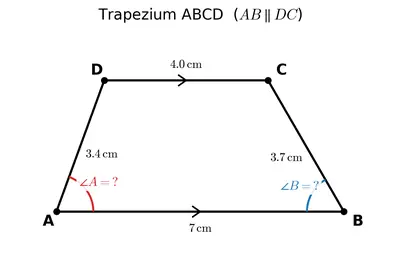
Steps of construction for a trapezium $$ABCD$$ with $$AB \parallel CD$$:
- Draw the longer base $$AB$$ of some length, say $$6 \, \mathrm{cm}$$.
- At $$A$$, using a protractor, draw a ray making an angle, say $$70^{\circ}$$, with $$AB$$.
- At $$B$$, draw another ray making some other angle, say $$60^{\circ}$$, with $$BA$$.
- Mark $$D$$ on the ray from $$A$$ with $$AD = 3 \, \mathrm{cm}$$.
- Through $$D$$, draw a line parallel to $$AB$$ (with a set-square and ruler), meeting the ray from $$B$$ at $$C$$.
- $$ABCD$$ is the required trapezium.
On measuring the two base angles at $$A$$ and $$B$$ (the ones between the parallel side $$AB$$ and the non-parallel sides), we get $$\angle A = 70^{\circ}$$ and $$\angle B = 60^{\circ}$$ (values will depend on how you choose to construct).
Answer
56 Can you find the remaining angles (of the trapezium) without measuring them?
Solution
Yes. In a trapezium $$ABCD$$ with $$AB \parallel CD$$, the non-parallel side $$AD$$ acts as a transversal cutting the two parallel lines. So co-interior angles are supplementary:
$$\angle A + \angle D = 180^{\circ} \implies \angle D = 180^{\circ} - \angle A.$$
Similarly, $$BC$$ is a transversal, giving
$$\angle B + \angle C = 180^{\circ} \implies \angle C = 180^{\circ} - \angle B.$$
Using the base angles from Question 55 ($$\angle A = 70^{\circ}, \angle B = 60^{\circ}$$),
$$\angle D = 180^{\circ} - 70^{\circ} = 110^{\circ},$$
$$\angle C = 180^{\circ} - 60^{\circ} = 120^{\circ}.$$
Answer
57 How do we construct an isosceles trapezium?
Solution
An isosceles trapezium is a trapezium in which the two non-parallel sides are equal in length. So the construction is the same as an ordinary trapezium, but with the two base angles at $$A$$ and $$B$$ chosen equal.
Steps:
- Draw the longer base $$AB$$ of a chosen length.
- At $$A$$ and at $$B$$, draw rays making equal angles with $$AB$$ (both angles pointing inward). Call the common angle $$\theta$$.
- Mark $$D$$ on the ray from $$A$$ and $$C$$ on the ray from $$B$$ such that $$AD = BC$$.
- Join $$DC$$. Then $$AB \parallel DC$$ automatically (because the two rays make equal angles with $$AB$$ and $$DC$$).
Alternatively: draw $$AB$$, draw a line parallel to $$AB$$ at the required height, and mark $$D$$ and $$C$$ on this parallel line symmetrically about the perpendicular bisector of $$AB$$. Joining them gives an isosceles trapezium.
Answer
58 Construct an isosceles trapezium $$UVWX$$, with $$UV \parallel XW$$. Measure $$\angle U$$.
Solution
Sample construction (take $$UV = 8 \, \mathrm{cm}$$ as the longer base, $$XW = 4 \, \mathrm{cm}$$, and equal non-parallel sides $$UX = VW = 3 \, \mathrm{cm}$$):
- Draw $$UV = 8 \, \mathrm{cm}$$.
- Locate the midpoint $$M$$ of $$UV$$.
- Draw the perpendicular to $$UV$$ at $$M$$; on this perpendicular mark a segment $$XW$$ (of length $$4 \, \mathrm{cm}$$) symmetric about $$M$$ and at some fixed height above $$UV$$. That is, mark points $$X'$$ (above $$U$$'s side) and $$W'$$ (above $$V$$'s side) such that $$X'W' = 4 \, \mathrm{cm}$$ and $$M$$ is the midpoint of $$X'W'$$.
- Adjust the height until $$UX' = VW' = 3 \, \mathrm{cm}$$ (use compass arcs of radius $$3 \, \mathrm{cm}$$ from $$U$$ and $$V$$, intersecting the horizontal line at $$X$$ and $$W$$).
- Join $$UX, XW, WV$$. Then $$UVWX$$ is the required isosceles trapezium.
On measuring $$\angle U$$ with a protractor (using the sample values above), we get approximately $$\angle U \approx 48^{\circ}$$. In general the exact value depends on the chosen dimensions; for the sample, $$\cos \angle U = \dfrac{(UV - XW)/2}{UX} = \dfrac{2}{3}$$, so $$\angle U \approx 48^{\circ}$$.
Answer
59 Consider line segments $$XY$$ and $$WZ$$ perpendicular to $$UV$$. What type of quadrilateral is $$XWZY$$?
Solution
In the isosceles trapezium $$UVWX$$ (with $$UV \parallel XW$$), drop perpendiculars from $$X$$ and $$W$$ to $$UV$$, meeting $$UV$$ at $$Y$$ and $$Z$$ respectively.
Then $$XY \perp UV$$ and $$WZ \perp UV$$, so $$XY \parallel WZ$$. Also, $$XW \parallel YZ$$ (both are horizontal — $$XW$$ by assumption and $$YZ$$ is a part of $$UV$$).
So $$XWZY$$ has both pairs of opposite sides parallel — it is a parallelogram. Moreover, its angles at $$Y$$ and $$Z$$ are $$90^{\circ}$$ (by construction), so all four angles are $$90^{\circ}$$. Hence $$XWZY$$ is a rectangle.
Answer
60 Now, it can be shown that $$\triangle UXY \cong \triangle VWZ$$. (How?)
Solution
In $$\triangle UXY$$ and $$\triangle VWZ$$:
- $$UX = VW$$ (equal non-parallel sides of the isosceles trapezium),
- $$XY = WZ$$ (opposite sides of rectangle $$XWZY$$),
- $$\angle UYX = \angle VZW = 90^{\circ}$$ (both perpendiculars to $$UV$$).
By the RHS (right-angle–hypotenuse–side) congruence rule, $$\triangle UXY \cong \triangle VWZ$$.
A consequence: the corresponding parts give $$UY = VZ$$ and $$\angle YUX = \angle ZVW$$, i.e. the base angles $$\angle U$$ and $$\angle V$$ of the isosceles trapezium are equal.
Answer
Figure it Out (Page 94)
1 Find all the other angles inside the following rectangles.
(i) Rectangle $$ABCD$$ with diagonals meeting at a point, and $$\angle DBA = 30^{\circ}$$.
(ii) Rectangle $$PQRS$$ with diagonals meeting at $$O$$, and $$\angle QOR = 110^{\circ}$$.
Solution
(i) Rectangle $$ABCD$$ with $$\angle DBA = 30^{\circ}$$.
Let the diagonals meet at $$O$$. In a rectangle the diagonals are equal and bisect each other, so $$OA = OB = OC = OD$$.
All four angles of the rectangle are $$90^{\circ}$$. At vertex $$B$$: $$\angle ABC = 90^{\circ}$$ splits into $$\angle ABD + \angle DBC = 90^{\circ}$$. Given $$\angle ABD = 30^{\circ}$$, we get $$\angle DBC = 60^{\circ}$$.
In $$\triangle AOB$$, $$OA = OB$$, so it is isosceles with base angles $$\angle OAB = \angle OBA = 30^{\circ}$$. Then $$\angle AOB = 180^{\circ} - 30^{\circ} - 30^{\circ} = 120^{\circ}$$. Vertically opposite: $$\angle COD = 120^{\circ}$$. Linear pair: $$\angle BOC = \angle AOD = 60^{\circ}$$.
At vertex $$A$$: $$\angle DAB = 90^{\circ}$$ splits by diagonal $$AC$$ into $$\angle DAC + \angle CAB = 90^{\circ}$$. In isosceles $$\triangle AOB$$, $$\angle CAB = \angle OAB = 30^{\circ}$$, so $$\angle DAC = 60^{\circ}$$.
At vertex $$C$$: by symmetry, $$\angle BCA = 30^{\circ}$$ and $$\angle DCA = 60^{\circ}$$.
At vertex $$D$$: $$\angle ADB = 60^{\circ}$$ and $$\angle BDC = 30^{\circ}$$ (alternate interior angles / isosceles $$\triangle AOD$$).
(ii) Rectangle $$PQRS$$ with $$\angle QOR = 110^{\circ}$$.
Vertically opposite angles at $$O$$: $$\angle POS = 110^{\circ}$$. Linear pair: $$\angle POQ = \angle ROS = 180^{\circ} - 110^{\circ} = 70^{\circ}$$.
In $$\triangle POQ$$, $$OP = OQ$$ (diagonals of a rectangle bisect each other into equal halves), so it is isosceles. The base angles are $$\dfrac{180^{\circ} - 70^{\circ}}{2} = 55^{\circ}$$, i.e. $$\angle OPQ = \angle OQP = 55^{\circ}$$.
In $$\triangle QOR$$ (isosceles, $$OQ = OR$$), the base angles are $$\dfrac{180^{\circ} - 110^{\circ}}{2} = 35^{\circ}$$, i.e. $$\angle OQR = \angle ORQ = 35^{\circ}$$.
By symmetry, $$\angle ORS = \angle OSR = 55^{\circ}$$ and $$\angle OSP = \angle OPS = 35^{\circ}$$. As a check: $$\angle P = \angle OPQ + \angle OPS = 55^{\circ} + 35^{\circ} = 90^{\circ}$$ ✓.
Answer
(ii) At $$O$$: $$\angle QOR = \angle POS = 110^{\circ}, \angle POQ = \angle ROS = 70^{\circ}$$. At the vertices: $$\angle OPQ = \angle OQP = \angle ORS = \angle OSR = 55^{\circ}$$ and $$\angle OQR = \angle ORQ = \angle OPS = \angle OSP = 35^{\circ}$$.
2 Draw a quadrilateral whose diagonals have equal lengths of $$8 \, \mathrm{cm}$$ that bisect each other, and intersect at an angle of
(i) $$30^{\circ}$$
Solution
Since the two diagonals are equal ($$8 \, \mathrm{cm}$$) and bisect each other, whatever angle they meet at, the resulting quadrilateral is a rectangle. The specific angle only decides the length-to-breadth ratio.
Construction.
- Draw diagonal $$AC = 8 \, \mathrm{cm}$$. Mark its midpoint $$O$$.
- At $$O$$, using a protractor, draw a line making an angle of $$30^{\circ}$$ with $$AC$$.
- On this line, mark $$B$$ and $$D$$ on opposite sides of $$O$$ with $$OB = OD = 4 \, \mathrm{cm}$$ (so $$BD = 8 \, \mathrm{cm}$$).
- Join $$AB, BC, CD, DA$$.
Then $$ABCD$$ is a rectangle. Its short side (opposite the $$30^{\circ}$$ angle at $$O$$) is $$2 \times 4 \sin 15^{\circ} \approx 2.07 \, \mathrm{cm}$$ and its long side (opposite the $$150^{\circ}$$ angle at $$O$$) is $$2 \times 4 \cos 15^{\circ} \approx 7.73 \, \mathrm{cm}$$ — a long, thin rectangle.
Answer
(ii) $$40^{\circ}$$
Solution
Follow the same construction as in (i), but at $$O$$ draw a line making $$40^{\circ}$$ with $$AC$$ instead of $$30^{\circ}$$.
- Draw $$AC = 8 \, \mathrm{cm}$$, midpoint $$O$$.
- Draw a line through $$O$$ making $$40^{\circ}$$ with $$AC$$.
- Mark $$B, D$$ on this line on opposite sides of $$O$$ with $$OB = OD = 4 \, \mathrm{cm}$$.
- Join the vertices.
Again the resulting quadrilateral $$ABCD$$ is a rectangle. Its sides are $$2 \times 4 \sin 20^{\circ} \approx 2.74 \, \mathrm{cm}$$ and $$2 \times 4 \cos 20^{\circ} \approx 7.52 \, \mathrm{cm}$$.
Answer
(iii) $$90^{\circ}$$
Solution
With the same construction and the angle at $$O$$ chosen as $$90^{\circ}$$:
- Draw $$AC = 8 \, \mathrm{cm}$$, midpoint $$O$$.
- At $$O$$, draw a perpendicular to $$AC$$.
- Mark $$B, D$$ on the perpendicular with $$OB = OD = 4 \, \mathrm{cm}$$.
- Join the vertices.
Now all four isosceles triangles at $$O$$ have vertex angle $$90^{\circ}$$, so all four sides of $$ABCD$$ are equal to $$2 \times 4 \sin 45^{\circ} = 4\sqrt{2} \approx 5.66 \, \mathrm{cm}$$. All four angles of $$ABCD$$ are $$90^{\circ}$$. Hence the quadrilateral is a square of side $$\approx 5.66 \, \mathrm{cm}$$.
Answer
(iv) $$140^{\circ}$$
Solution
Same construction, but at $$O$$ draw a line making $$140^{\circ}$$ with $$AC$$. Note that $$140^{\circ}$$ and its supplement $$40^{\circ}$$ describe the same pair of intersecting lines, so the resulting shape is the same as in part (ii).
- Draw $$AC = 8 \, \mathrm{cm}$$, midpoint $$O$$.
- Draw a line through $$O$$ making $$140^{\circ}$$ with $$AC$$ (equivalently, $$40^{\circ}$$ on the other side).
- Mark $$B, D$$ on this line with $$OB = OD = 4 \, \mathrm{cm}$$.
- Join the vertices.
The result is a rectangle. The two sides of the rectangle are $$2 \times 4 \sin 70^{\circ} \approx 7.52 \, \mathrm{cm}$$ and $$2 \times 4 \sin 20^{\circ} \approx 2.74 \, \mathrm{cm}$$ — the same shape as (ii), just labelled differently.
Answer
3 Consider a circle with centre $$O$$. Line segments $$PL$$ and $$AM$$ are two perpendicular diameters of the circle. What is the figure $$APML$$? Reason and/or experiment to figure this out.
Solution
Since $$PL$$ and $$AM$$ are diameters of the same circle, they have the same length:
$$PL = AM.$$
Both diameters pass through the centre $$O$$, and $$O$$ is the midpoint of each (a diameter is bisected by the centre). So the two diameters are two segments of equal length that bisect each other. In addition, they are perpendicular (given).
Now consider the quadrilateral $$APML$$ with vertices at the four endpoints (taken in the order around the circle: $$A, P, M, L$$). Its diagonals are $$AM$$ and $$PL$$ — precisely the two diameters — which are equal in length, bisect each other, and are perpendicular.
A quadrilateral whose diagonals are equal, bisect each other and are perpendicular is a square. Hence $$APML$$ is a square.
(You can also see this by symmetry: rotating the figure through $$90^{\circ}$$ about $$O$$ carries $$A \to P \to M \to L \to A$$, so all four sides are equal and all four angles are $$90^{\circ}$$.)
Answer
4 We have seen how to get $$90^{\circ}$$ using paper folding. Now, suppose we do not have any paper but two sticks of equal length, and a thread. How do we make an exact $$90^{\circ}$$ using these?
Solution
Use the diagonal property of a square. Steps:
- Locate the midpoint of each stick (fold or measure).
- Cross the two sticks at their midpoints — i.e. they meet at their own centres.
- Adjust the sticks until the four endpoints all lie on a common circle (equivalently, until the thread, when wrapped around all four endpoints, forms a rhombus with all four sides equal).
- Fix the sticks in this position.
Now the two sticks are diagonals of a quadrilateral that are equal (same length), bisect each other (crossed at midpoints) and give four equal sides (checked using the thread). By the reasoning of Question 3, this quadrilateral is a square, and its diagonals are perpendicular. So the angle between the sticks is exactly $$90^{\circ}$$.
Alternatively: cross the two sticks at their midpoints and use the thread to check that each of the two sticks divides the quadrilateral into two congruent triangles. When the four thread-sides are all equal, the sticks are perpendicular.
Answer
5 We saw that one of the properties of a rectangle is that its opposite sides are parallel. Can this be chosen as a definition of a rectangle? In other words, is every quadrilateral that has opposite sides parallel and equal, a rectangle?
Solution
No. A quadrilateral in which both pairs of opposite sides are parallel (and hence equal) is a parallelogram, not necessarily a rectangle.
Counterexample. The parallelogram we constructed in Question 29 has $$AB = CD = 5 \, \mathrm{cm}$$, $$AD = BC = 4 \, \mathrm{cm}$$, $$AB \parallel CD$$ and $$AD \parallel BC$$, but its angles are $$30^{\circ}, 150^{\circ}, 30^{\circ}, 150^{\circ}$$ — clearly not $$90^{\circ}$$. So it is not a rectangle.
Hence “opposite sides parallel and equal” is not a definition of a rectangle. To get a rectangle we need one extra condition, e.g. one angle equal to $$90^{\circ}$$ (which forces all four to be $$90^{\circ}$$), or the diagonals equal.
Answer
Figure it Out (Page 102)
1 Find the remaining angles in the following quadrilaterals.
(i) Parallelogram $$PRAE$$ with $$PR \parallel EA$$, $$PE \parallel RA$$, and $$\angle P = 40^{\circ}$$.
Solution
In parallelogram $$PRAE$$ (with vertices in order $$P, R, A, E$$), opposite angles are equal and adjacent angles are supplementary.
Given $$\angle P = 40^{\circ}$$:
$$\angle A = \angle P = 40^{\circ} \text{ (opposite angles)},$$
$$\angle R = 180^{\circ} - \angle P = 180^{\circ} - 40^{\circ} = 140^{\circ} \text{ (adjacent, supplementary)},$$
$$\angle E = \angle R = 140^{\circ} \text{ (opposite angles)}.$$
Check: $$40^{\circ} + 140^{\circ} + 40^{\circ} + 140^{\circ} = 360^{\circ}$$ ✓.
Answer
(ii) Parallelogram $$PSRQ$$ with $$SR \parallel PQ$$, $$PS \parallel QR$$, and $$\angle P = 110^{\circ}$$.
Solution
In parallelogram $$PSRQ$$ (vertices in order $$P, S, R, Q$$), opposite angles are equal and adjacent angles supplementary.
Given $$\angle P = 110^{\circ}$$:
$$\angle R = \angle P = 110^{\circ} \text{ (opposite)},$$
$$\angle S = 180^{\circ} - 110^{\circ} = 70^{\circ} \text{ (adjacent)},$$
$$\angle Q = \angle S = 70^{\circ} \text{ (opposite)}.$$
Check: $$110^{\circ}+70^{\circ}+110^{\circ}+70^{\circ} = 360^{\circ}$$ ✓.
Answer
(iii) Rhombus $$XWVU$$ (with all sides equal — $$XW = WV = VU = XU$$), with $$\angle WVU = 30^{\circ}$$.
Solution
A rhombus is a parallelogram, so opposite angles are equal and adjacent angles are supplementary.
In rhombus $$XWVU$$ (vertices in order $$X, W, V, U$$), given $$\angle V = \angle WVU = 30^{\circ}$$:
$$\angle X = \angle V = 30^{\circ} \text{ (opposite)},$$
$$\angle W = 180^{\circ} - 30^{\circ} = 150^{\circ} \text{ (adjacent)},$$
$$\angle U = \angle W = 150^{\circ} \text{ (opposite)}.$$
Check: $$30^{\circ}+150^{\circ}+30^{\circ}+150^{\circ} = 360^{\circ}$$ ✓.
Answer
(iv) Rhombus $$OIEA$$ (with all sides equal — $$OI = IE = EA = OA$$), with $$\angle IEA = 20^{\circ}$$.
Solution
Rhombus $$OIEA$$ has vertices in the order $$O, I, E, A$$. Given $$\angle E = \angle IEA = 20^{\circ}$$:
$$\angle O = \angle E = 20^{\circ} \text{ (opposite)},$$
$$\angle I = 180^{\circ} - 20^{\circ} = 160^{\circ} \text{ (adjacent)},$$
$$\angle A = \angle I = 160^{\circ} \text{ (opposite)}.$$
Check: $$20^{\circ}+160^{\circ}+20^{\circ}+160^{\circ} = 360^{\circ}$$ ✓.
Answer
2 Using the diagonal properties, construct a parallelogram whose diagonals are of lengths $$7 \, \mathrm{cm}$$ and $$5 \, \mathrm{cm}$$, and intersect at an angle of $$140^{\circ}$$.
Solution
Key property: the diagonals of a parallelogram bisect each other. So the two diagonals must cross at their midpoints — the halves are $$\dfrac{7}{2} = 3.5 \, \mathrm{cm}$$ and $$\dfrac{5}{2} = 2.5 \, \mathrm{cm}$$.
Steps of construction:
- Draw a segment $$AC = 7 \, \mathrm{cm}$$ and mark its midpoint $$O$$ (so $$OA = OC = 3.5 \, \mathrm{cm}$$).
- At $$O$$, using a protractor, draw a line making an angle of $$140^{\circ}$$ with $$AC$$.
- On this line, mark $$B$$ and $$D$$ on opposite sides of $$O$$ such that $$OB = OD = 2.5 \, \mathrm{cm}$$ (so $$BD = 5 \, \mathrm{cm}$$).
- Join $$AB, BC, CD, DA$$.
The quadrilateral $$ABCD$$ has diagonals $$AC = 7 \, \mathrm{cm}$$ and $$BD = 5 \, \mathrm{cm}$$ meeting at $$O$$ (their common midpoint) at $$140^{\circ}$$. Since the diagonals bisect each other, $$ABCD$$ is a parallelogram. Measuring, its sides are approximately $$AB = DC \approx 5.71 \, \mathrm{cm}$$ and $$BC = AD \approx 2.16 \, \mathrm{cm}$$.
Answer
3 Using the diagonal properties, construct a rhombus whose diagonals are of lengths $$4 \, \mathrm{cm}$$ and $$5 \, \mathrm{cm}$$.
Solution
Key property: the diagonals of a rhombus bisect each other at right angles. So the diagonals cross at their midpoints, and the angle between them is $$90^{\circ}$$.
Steps of construction:
- Draw $$AC = 5 \, \mathrm{cm}$$ and mark its midpoint $$O$$ (so $$OA = OC = 2.5 \, \mathrm{cm}$$).
- At $$O$$, draw a perpendicular to $$AC$$.
- On this perpendicular, mark $$B$$ and $$D$$ on opposite sides of $$O$$ with $$OB = OD = 2 \, \mathrm{cm}$$ (so $$BD = 4 \, \mathrm{cm}$$).
- Join $$AB, BC, CD, DA$$.
Since the diagonals bisect each other at $$90^{\circ}$$, the quadrilateral $$ABCD$$ is a rhombus. Its side is $$\sqrt{OA^2 + OB^2} = \sqrt{2.5^2 + 2^2} = \sqrt{10.25} \approx 3.20 \, \mathrm{cm}$$.
Answer
Figure it Out (Page 107)
1 Find all the sides and the angles of the quadrilateral obtained by joining two equilateral triangles with sides $$4 \, \mathrm{cm}$$.
Solution
Take two equilateral triangles $$\triangle ABD$$ and $$\triangle CBD$$, each with side $$4 \, \mathrm{cm}$$, and glue them along the common side $$BD$$. The resulting quadrilateral is $$ABCD$$.
Sides. The four sides are $$AB, BC, CD, DA$$. Each of these is a side of one of the equilateral triangles, so
$$AB = BC = CD = DA = 4 \, \mathrm{cm}.$$
Angles. Each interior angle of an equilateral triangle is $$60^{\circ}$$. So:
At vertex $$A$$: only one triangle contributes, giving $$\angle A = 60^{\circ}$$.
At vertex $$C$$: similarly $$\angle C = 60^{\circ}$$.
At vertex $$B$$: both triangles contribute, so $$\angle B = 60^{\circ} + 60^{\circ} = 120^{\circ}$$.
At vertex $$D$$: similarly $$\angle D = 120^{\circ}$$.
Check: $$60^{\circ}+120^{\circ}+60^{\circ}+120^{\circ} = 360^{\circ}$$ ✓.
The quadrilateral has all sides equal and unequal adjacent angles — it is a rhombus (not a square).
Answer
2 Construct a kite whose diagonals are of lengths $$6 \, \mathrm{cm}$$ and $$8 \, \mathrm{cm}$$.
Solution
Recall (from Question 54) that in a kite $$ABCD$$ (with $$AB = BC$$ and $$CD = DA$$), the diagonal $$BD$$ is the axis of symmetry: it is perpendicular to the other diagonal $$AC$$ and bisects it. So $$AC$$ is bisected by $$BD$$, but $$BD$$ itself need not be bisected by $$AC$$ (they meet at some interior point $$O$$ with $$AO = OC$$, but $$BO$$ and $$OD$$ can be different).
Steps of construction (take $$BD = 8 \, \mathrm{cm}$$ as the axis of symmetry and $$AC = 6 \, \mathrm{cm}$$ as the other diagonal, with $$O$$ splitting $$BD$$ into $$OB = 3 \, \mathrm{cm}$$ and $$OD = 5 \, \mathrm{cm}$$, say):
- Draw segment $$BD = 8 \, \mathrm{cm}$$.
- On $$BD$$, choose an interior point $$O$$ (say at $$3 \, \mathrm{cm}$$ from $$B$$; you may pick a different split).
- At $$O$$, draw a line perpendicular to $$BD$$.
- On the perpendicular, mark $$A$$ and $$C$$ on opposite sides of $$O$$ with $$OA = OC = 3 \, \mathrm{cm}$$ (so $$AC = 6 \, \mathrm{cm}$$).
- Join $$AB, BC, CD, DA$$.
Then $$ABCD$$ is a kite. By construction, $$OA = OC$$, so $$\triangle AOB \cong \triangle COB$$ (SAS with common $$OB$$ and right angles at $$O$$), giving $$AB = CB$$; similarly $$AD = CD$$. So $$ABCD$$ has two pairs of adjacent equal sides — a kite.
Answer
3 Find the remaining angles in the following trapeziums —
(i) A trapezium with the two parallel sides marked with arrows. The two base angles at the bottom are $$135^{\circ}$$ and $$105^{\circ}$$.
Solution
Call the trapezium $$ABCD$$ with $$AB$$ (top) parallel to $$DC$$ (bottom), and let $$\angle D = 135^{\circ}, \angle C = 105^{\circ}$$.
Since $$AB \parallel DC$$, the two non-parallel sides act as transversals. Co-interior angles between the parallel sides are supplementary:
$$\angle A + \angle D = 180^{\circ} \implies \angle A = 180^{\circ} - 135^{\circ} = 45^{\circ},$$
$$\angle B + \angle C = 180^{\circ} \implies \angle B = 180^{\circ} - 105^{\circ} = 75^{\circ}.$$
Check: $$45^{\circ} + 75^{\circ} + 105^{\circ} + 135^{\circ} = 360^{\circ}$$ ✓.
Answer
(ii) A trapezium with the two parallel sides marked with arrows and the two non-parallel sides marked as equal (isosceles trapezium). One of the angles is $$100^{\circ}$$.
Solution
In an isosceles trapezium the two base angles on the same parallel side are equal. Let $$ABCD$$ be the isosceles trapezium with $$AB \parallel DC$$, $$AD = BC$$, and let $$\angle A = 100^{\circ}$$ be the given angle.
Base angles at the same parallel side: $$\angle A = \angle B = 100^{\circ}$$.
The other two base angles are supplementary to these:
$$\angle D = 180^{\circ} - \angle A = 80^{\circ},$$
$$\angle C = 180^{\circ} - \angle B = 80^{\circ}.$$
Check: $$100^{\circ}+100^{\circ}+80^{\circ}+80^{\circ} = 360^{\circ}$$ ✓.
Answer
4 Draw a Venn diagram showing the set of parallelograms, kites, rhombuses, rectangles, and squares. Then, answer the following questions —
(i) What is the quadrilateral that is both a kite and a parallelogram?
Solution
A kite has two pairs of adjacent equal sides — say $$AB = BC$$ and $$CD = DA$$. A parallelogram has both pairs of opposite sides equal, i.e. $$AB = CD$$ and $$BC = DA$$.
If a quadrilateral is both, we get
$$AB = BC = CD = DA,$$
so all four sides are equal — the quadrilateral is a rhombus.
Answer
(ii) Can there be a quadrilateral that is both a kite and a rectangle?
Solution
Yes — but only the square. A rectangle is a parallelogram, and by part (i) a kite that is also a parallelogram is a rhombus. So a kite that is also a rectangle must be both a rhombus and a rectangle, which is the square.
Answer
(iii) Is every kite a rhombus? If not, what is the correct relationship between these two types of quadrilaterals?
Solution
No — a kite need only have two pairs of adjacent equal sides. A kite with $$AB = BC = 6 \, \mathrm{cm}$$ and $$CD = DA = 4 \, \mathrm{cm}$$ is a genuine kite but is not a rhombus (its four sides are not all equal).
The correct relationship is: every rhombus is a kite, but not every kite is a rhombus. In a Venn diagram, the set of rhombuses is a proper subset of the set of kites.
Answer
5
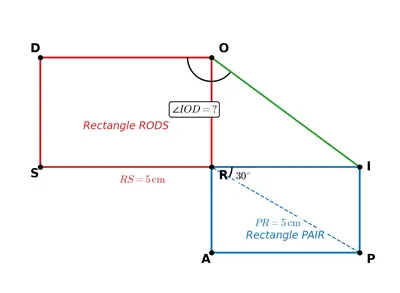
In the figure, $$PAIR$$ has $$PR = 5 \, \mathrm{cm}$$, $$\angle IRP = 30^{\circ}$$ (angle marked at $$R$$ inside $$PAIR$$), and $$RODS$$ is a rectangle attached at $$R$$ with $$RS = 5 \, \mathrm{cm}$$.

Solution
From the figure, $$R$$ is the common vertex of the two rectangles. In rectangle $$PAIR$$, the diagonal $$PI$$ passes through $$R$$-region, and the angle marked $$30^{\circ}$$ at $$R$$ is the angle $$\angle IRP$$ that the diagonal from $$R$$ makes with side $$RP$$. Since $$PR = 5 \, \mathrm{cm}$$ and the two rectangles are congruent (also $$RS = 5 \, \mathrm{cm}$$), the corresponding diagonal in $$RODS$$ makes the same $$30^{\circ}$$ angle with its side.
In rectangle $$PAIR$$ let the diagonals $$PI$$ and $$AR$$ meet at their common midpoint (call it $$M$$). Since the diagonals of a rectangle are equal and bisect each other, $$\triangle MRP$$ is isosceles with $$MR = MP$$, so the base angles are equal: $$\angle MPR = \angle MRP = 30^{\circ}$$. Hence $$\angle PMR = 180^{\circ} - 30^{\circ} - 30^{\circ} = 120^{\circ}$$, so the diagonals of $$PAIR$$ meet at $$120^{\circ}$$ and $$60^{\circ}$$.
Now, apply the same reasoning to rectangle $$RODS$$. Its diagonals $$RD$$ and $$OS$$ meet at their common midpoint. By the same $$30^{\circ}$$ argument on the corresponding side, the diagonals of $$RODS$$ also meet at $$60^{\circ}$$ and $$120^{\circ}$$.
Since $$O$$ is a vertex of rectangle $$RODS$$ and $$I$$ lies collinearly with $$R$$ and $$D$$ on the shared bottom line, the angle $$\angle IOD$$ is exactly the base angle of the isosceles triangle formed at $$O$$ by half-diagonals — and by the same $$30^{\circ}$$ analysis,
$$\angle IOD = 30^{\circ}.$$
Answer
6 Construct a square with diagonal $$6 \, \mathrm{cm}$$ without using a protractor.
Solution
A square is characterised by its two diagonals being (i) equal, (ii) bisecting each other, and (iii) perpendicular. We can construct the perpendicular bisector of a segment using only a compass and a ruler.
Steps of construction:
- Draw the segment $$AC = 6 \, \mathrm{cm}$$.
- With centre $$A$$ and any radius greater than $$3 \, \mathrm{cm}$$, draw arcs above and below $$AC$$.
- With centre $$C$$ and the same radius, draw two more arcs; they cut the first arcs at two points. The line joining these two points is the perpendicular bisector of $$AC$$; it meets $$AC$$ at the midpoint $$O$$ (with $$OA = OC = 3 \, \mathrm{cm}$$) and is perpendicular to $$AC$$.
- On this perpendicular bisector, mark two points $$B$$ and $$D$$ on opposite sides of $$O$$, each at distance $$3 \, \mathrm{cm}$$ from $$O$$ (use the compass with radius $$3 \, \mathrm{cm}$$ centred at $$O$$).
- Join $$AB, BC, CD, DA$$.
The two diagonals $$AC$$ and $$BD$$ are equal ($$6 \, \mathrm{cm}$$ each), bisect each other at $$O$$, and are perpendicular (by construction). Hence $$ABCD$$ is a square. On measuring, each side is $$3\sqrt{2} \approx 4.24 \, \mathrm{cm}$$.
Answer
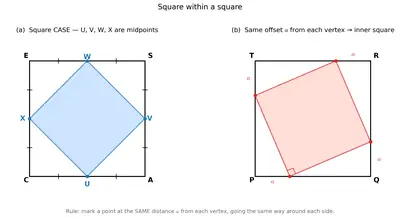
7

Solution
Let the square $$CASE$$ have side $$s$$, and let $$U, V, W, X$$ be the midpoints of sides $$CA, AS, SE, EC$$ respectively.
Sides of $$UVWX$$. Consider $$\triangle AUV$$: it is a right triangle at $$A$$ with legs $$AU = AV = s/2$$. So
$$UV = \sqrt{(s/2)^2 + (s/2)^2} = \dfrac{s}{\sqrt{2}}.$$
By symmetry (the same argument at each corner of $$CASE$$), all four sides of $$UVWX$$ equal $$s/\sqrt{2}$$. So $$UVWX$$ has all four sides equal.
Angles of $$UVWX$$. $$\triangle AUV$$ is an isosceles right triangle at $$A$$, so $$\angle AVU = 45^{\circ}$$; similarly $$\angle SVW = 45^{\circ}$$. The straight angle at $$V$$ along $$AS$$ is $$180^{\circ}$$, so
$$\angle UVW = 180^{\circ} - 45^{\circ} - 45^{\circ} = 90^{\circ}.$$
By symmetry, all four angles of $$UVWX$$ are $$90^{\circ}$$.
Since all sides are equal and all angles are $$90^{\circ}$$, $$UVWX$$ is a square.
Construction and measurement. Draw square $$CASE$$ (say side $$4 \, \mathrm{cm}$$). Mark midpoints of its sides using a ruler. Join them. On measurement, all sides come out equal ($$\approx 2.83 \, \mathrm{cm} = 4/\sqrt{2}$$) and all angles $$90^{\circ}$$.
Other inner squares (Fig (b)). Instead of taking midpoints, on each side of $$CASE$$ mark a point at the same distance $$k$$ from one endpoint (say $$k$$ from $$C$$ on $$CA$$, $$k$$ from $$A$$ on $$AS$$, $$k$$ from $$S$$ on $$SE$$, $$k$$ from $$E$$ on $$EC$$). By a similar SAS argument (each corner triangle is a right triangle with legs $$k$$ and $$s-k$$), the inner quadrilateral has all four sides equal and all four angles $$90^{\circ}$$ — it is again a square. Varying $$k$$ from $$0$$ to $$s$$ gives infinitely many such inner squares (the midpoint case $$k = s/2$$ produces the smallest inner square).
Answer
8 If a quadrilateral has four equal sides and one angle of $$90^{\circ}$$, will it be a square? Find the answer using geometric reasoning as well as by construction and measurement.
Solution
Yes. Let $$ABCD$$ have $$AB = BC = CD = DA = s$$ and $$\angle A = 90^{\circ}$$.
Since all four sides are equal, $$ABCD$$ is a rhombus, and hence a parallelogram. In a parallelogram, opposite angles are equal and adjacent angles are supplementary. So
$$\angle C = \angle A = 90^{\circ}, \qquad \angle B = 180^{\circ} - \angle A = 90^{\circ}, \qquad \angle D = 90^{\circ}.$$
Hence all four angles are $$90^{\circ}$$ and all four sides are equal — the definition of a square.
By construction. Draw $$AB = 4 \, \mathrm{cm}$$. At $$A$$, construct a $$90^{\circ}$$ angle and mark $$D$$ with $$AD = 4 \, \mathrm{cm}$$. With centre $$B$$ and radius $$4 \, \mathrm{cm}$$, draw an arc; with centre $$D$$ and radius $$4 \, \mathrm{cm}$$, draw another arc; they meet at $$C$$. Measuring shows $$BC = DC = 4 \, \mathrm{cm}$$ and all angles of $$ABCD$$ are $$90^{\circ}$$ — a square.
Answer
9 What type of a quadrilateral is one in which the opposite sides are equal? Justify your answer.
Hint: Draw a diagonal and check for congruent triangles.
Solution
Such a quadrilateral is a parallelogram. That is, if $$ABCD$$ has $$AB = CD$$ and $$AD = BC$$, then $$AB \parallel CD$$ and $$AD \parallel BC$$.
Proof. Draw the diagonal $$BD$$. In $$\triangle ABD$$ and $$\triangle CDB$$:
- $$AB = CD$$ (given),
- $$AD = CB$$ (given),
- $$BD = DB$$ (common side).
By SSS, $$\triangle ABD \cong \triangle CDB$$.
Corresponding angles give $$\angle ABD = \angle CDB$$. These are alternate interior angles at the transversal $$BD$$ cutting lines $$AB$$ and $$CD$$. Alternate interior angles being equal ⇒ the lines are parallel:
$$AB \parallel CD.$$
Similarly, $$\angle ADB = \angle CBD$$ (alternate angles at $$BD$$ cutting $$AD$$ and $$BC$$) ⇒ $$AD \parallel BC$$.
So both pairs of opposite sides are parallel, i.e. $$ABCD$$ is a parallelogram.
Answer
10 Will the sum of the angles in a quadrilateral such as the following one also be $$360^{\circ}$$? Find the answer using geometric reasoning as well as by constructing this figure and measuring. (The figure shown is a non-convex/concave quadrilateral $$ABDC$$ with a reflex angle at $$D$$.)
Solution
Yes. The angle sum of every quadrilateral — convex or concave — is $$360^{\circ}$$, provided we measure the interior angles (using the reflex angle at a concave vertex).
Reason. Draw a diagonal that lies entirely inside the quadrilateral (in a concave quadrilateral, one of the two possible diagonals does lie inside; the other stays outside). This diagonal splits the quadrilateral into two triangles.
Each triangle has angle sum $$180^{\circ}$$. Adding these two sums gives $$360^{\circ}$$. When we do the addition, the two ‘pieces’ of the interior angle at the concave vertex re-combine to give the full reflex interior angle. So the sum of the four interior angles of the quadrilateral is
$$180^{\circ} + 180^{\circ} = 360^{\circ}.$$
By construction. On drawing such a concave quadrilateral, on measuring the three non-reflex angles and the reflex angle at $$D$$ with a protractor (careful to measure the interior, i.e. reflex, angle at $$D$$), the total comes out to $$360^{\circ}$$.
Answer
11 State whether the following statements are true or false. Justify your answers.
(i) A quadrilateral whose diagonals are equal and bisect each other must be a square.
Solution
False. Equal diagonals that bisect each other characterise a rectangle, not a square. A square is the special case in which the diagonals are also perpendicular; otherwise we get a non-square rectangle.
For example, in Question 2 of Exercise 4.1 with diagonals of length $$8 \, \mathrm{cm}$$ meeting at $$30^{\circ}$$, the resulting quadrilateral is a rectangle but not a square (sides $$\approx 2.07$$ and $$7.73 \, \mathrm{cm}$$).
Answer
(ii) A quadrilateral having three right angles must be a rectangle.
Solution
True. The sum of the interior angles of a quadrilateral is $$360^{\circ}$$. If three of them are $$90^{\circ}$$, the fourth is
$$360^{\circ} - 3 \times 90^{\circ} = 90^{\circ}.$$
So all four angles are $$90^{\circ}$$. As shown in Deduction 4 (Question 15), a quadrilateral with all four angles $$90^{\circ}$$ has opposite sides equal, and is a rectangle.
Answer
(iii) A quadrilateral whose diagonals bisect each other must be a parallelogram.
Solution
True. Let the diagonals of $$ABCD$$ meet at $$O$$ with $$OA = OC$$ and $$OB = OD$$. In $$\triangle AOB$$ and $$\triangle COD$$:
- $$OA = OC$$,
- $$OB = OD$$,
- $$\angle AOB = \angle COD$$ (vertically opposite).
By SAS, $$\triangle AOB \cong \triangle COD$$, so $$AB = CD$$ and $$\angle OAB = \angle OCD$$. The equal alternate angles at $$AC$$ (transversal) give $$AB \parallel CD$$. Similarly, $$\triangle BOC \cong \triangle DOA$$ gives $$BC = DA$$ and $$BC \parallel DA$$. Hence $$ABCD$$ is a parallelogram.
Answer
(iv) A quadrilateral whose diagonals are perpendicular to each other must be a rhombus.
Solution
False. Perpendicular diagonals are also a property of every kite, and a general kite is not a rhombus. For example, a kite $$ABCD$$ with $$AB = BC = 4 \, \mathrm{cm}$$ and $$CD = DA = 6 \, \mathrm{cm}$$ has perpendicular diagonals but is not a rhombus (its four sides are not all equal).
For a rhombus we need both: perpendicular diagonals and the diagonals bisect each other.
Answer
(v) A quadrilateral in which the opposite angles are equal must be a parallelogram.
Solution
True. Let $$ABCD$$ have $$\angle A = \angle C$$ and $$\angle B = \angle D$$. The angle sum is $$360^{\circ}$$, so
$$2\angle A + 2\angle B = 360^{\circ} \implies \angle A + \angle B = 180^{\circ}.$$
Now $$AB$$ is a transversal to $$AD$$ and $$BC$$, and $$\angle A + \angle B = 180^{\circ}$$ are co-interior angles. So $$AD \parallel BC$$.
Similarly, $$\angle A + \angle D = 180^{\circ}$$ (from $$\angle A + \angle B = 180^{\circ}$$ and $$\angle B = \angle D$$), so $$AB \parallel DC$$.
Both pairs of opposite sides are parallel — $$ABCD$$ is a parallelogram.
Answer
(vi) A quadrilateral in which all the angles are equal is a rectangle.
Solution
True. If all four angles are equal, each equals $$\dfrac{360^{\circ}}{4} = 90^{\circ}$$. A quadrilateral with all four angles $$90^{\circ}$$ is a rectangle (Deduction 4, Question 15).
Answer
(vii) Isosceles trapeziums are parallelograms.
Solution
False. A trapezium has exactly one pair of parallel sides (in the NCERT convention). Its two non-parallel sides being equal (isosceles trapezium) does not make the second pair of opposite sides parallel. For example, in Question 58 the isosceles trapezium $$UVWX$$ has $$UV \parallel XW$$ but $$UX$$ is not parallel to $$VW$$ (the two non-parallel sides slope inward towards each other).
Hence an isosceles trapezium is not a parallelogram (which requires both pairs of opposite sides parallel).
Answer