Intext Questions (The Mechanism of Counting)
Q1
(Tackle this without using the number names or written numbers of the Hindu number system.)
Solution
The idea is to use one-to-one correspondence. We do not need to know how many cows there are — we only need to check whether each cow has come back.
Before letting the herd out, keep a collection of tokens (say, pebbles) in a pot. As each cow walks out for grazing, drop one pebble into the pot — one pebble per cow. When the cows return in the evening, take out one pebble as each cow enters the shed.
Three cases can occur:
- If the pot becomes exactly empty when the last cow returns, every cow is back.
- If some pebbles are still left in the pot, that many cows are still missing.
- If the pot is emptied before all the cows are counted in, an extra cow has joined the herd.
The whole check is done without ever naming or writing a number.
Answer
Q2
(Tackle this without using the number names or written numbers of the Hindu number system.)
Solution
Again we use one-to-one correspondence, without ever counting.
Line up our cows in a row and the neighbour's cows in a parallel row, and pair them off — one of ours facing one of the neighbour's. Keep pairing until one side runs out.
- If our row finishes first while some of the neighbour's cows remain unpaired, we have fewer cows.
- If both rows finish together, we have the same number.
- If the neighbour's row finishes first, we have more cows.
Alternatively, we can walk with a bagful of pebbles — one pebble per cow of ours — and drop one pebble for every neighbour's cow. Whichever side runs out first tells us the answer.
Answer
Q3
(Tackle this without using the number names or written numbers of the Hindu number system.)
Solution
After pairing our cows with the neighbour's cows as in the previous question, look at the neighbour's cows that are left unpaired. Those are the “extra” cows the neighbour has.
For each unpaired neighbour's cow, place one pebble into a fresh pot (or make one mark on a stick). We do not need a number name for the total — the collection of pebbles is the answer. That many more cows are needed so both herds are of the same size.
Later, when we do get more cows, we can pair each new cow with a pebble from the pot; when the pot is empty, we have exactly the right number.
Answer
4 How will you use such sticks to answer the other two questions (Q2 and Q3)?
Solution
The sticks are just another form of tokens (like the pebbles). One stick stands for one cow.
For Q2 (are we fewer?): keep one bundle of sticks for our herd and another bundle for the neighbour's. Pair them off, taking out one stick from each bundle at a time. The bundle that finishes first belongs to whoever has fewer cows.
For Q3 (how many more?): after pairing, whatever sticks remain in the neighbour's bundle form a smaller bundle — that small bundle is the number of extra cows we need. We can carry this small bundle around as our ‘target’: whenever we buy a new cow, we throw away one stick from it, and the day the bundle is empty we know our herd has caught up with the neighbour's.
Answer
5 How many numbers can you represent in this way using the sounds of the letters of your language?
Solution
In Method 2, every number is assigned the sound of one letter — so the largest number we can represent is limited by how many letters (distinct sounds) the language has.
For example:
- In English, using the 26 letters $$a, b, c, \ldots, z$$, we can name only the numbers $$1, 2, 3, \ldots, 26$$.
- In Hindi, using the (approximately) 46 letters of the Devanagari alphabet ($$\text{a, aa, i, ii, u, uu,} \ldots$$), we can name about 46 numbers.
- In Tamil, using its 12 vowels + 18 consonants + 1 aytam = 31 base letters, we can name about 31 numbers.
In every case, if the language has $$N$$ letter-sounds, we can represent only the numbers $$1$$ up to $$N$$. Beyond $$N$$ we run out of fresh sounds. This is the main weakness of Method 2.
Answer
6
(Refer to the Roman-style method shown in Table 1, where I, II, III, ..., X represent 1 through 10 and XI, XII, ..., XX represent 11 through 20.)
Solution
Yes. Instead of inventing a fresh symbol for every number, we pick a few landmark numbers and get all others by combining the landmark symbols.
The Roman-style example uses two landmarks:
- $$I = 1$$ (a single stroke)
- $$X = 10$$ (a cross)
Now:
- Numbers $$1, 2, 3, \ldots, 9$$ are $$I, II, III, \ldots, VIIII$$ (repeat the small landmark).
- $$10 = X$$.
- Numbers $$11$$ to $$19$$ are $$XI, XII, \ldots, XVIIII$$ (one $$X$$ followed by the required $$I$$s).
- $$20 = XX$$, and $$21, 22, \ldots, 29$$ are $$XXI, XXII, \ldots$$, and so on.
By introducing more landmarks — for example $$V = 5$$, $$L = 50$$, $$C = 100$$, $$M = 1000$$ — we can go as far as we like. This is exactly how the Roman number system works. The key idea is: a small fixed set of landmark symbols, combined by writing them side by side, can represent arbitrarily large numbers.
Answer
Figure it Out (page 54)
1 Suppose you are using the number system that uses sticks to represent numbers, as in Method 1. Without using either the number names or the numerals of the Hindu number system, give a method for adding, subtracting, multiplying and dividing two numbers or two collections of sticks.
Solution
Let the two collections of sticks be pile $$A$$ and pile $$B$$.
Addition ($$A + B$$): put pile $$B$$ on top of pile $$A$$. The single resulting pile is the sum.
Subtraction ($$A - B$$, with pile $$A$$ larger): pair off one stick from $$A$$ with one stick from $$B$$ and set both aside. Repeat until pile $$B$$ is empty. Whatever remains in pile $$A$$ is the difference. (If pile $$A$$ runs out first, then $$A$$ was actually smaller and we cannot subtract $$B$$ from $$A$$ in the whole-number world.)
Multiplication ($$A \times B$$): make $$B$$ copies of pile $$A$$ — that is, for every stick in $$B$$, take out a fresh copy of pile $$A$$ and set it beside the previous ones. When $$B$$ is exhausted, combine all the copies of $$A$$ into a single pile. That pile is the product.
Division ($$A \div B$$): repeatedly pick up a bundle of $$B$$ sticks from pile $$A$$ and set it aside as one bundle. Keep going until pile $$A$$ can no longer supply a full bundle of $$B$$ sticks. The number of bundles (represented by yet another pile of tally-sticks — one tally-stick per bundle) is the quotient. The stray sticks left in pile $$A$$ form the remainder.
Notice that at no stage do we say a number name; the sticks themselves carry the information.
Answer
2 One way of extending the number system in Method 2 is by using strings with more than one letter—for example, we could use 'aa' for 27. How can you extend this system to represent all the numbers? There are many ways of doing it!
Solution
Method 2 assigned $$a, b, c, \ldots, z$$ to the numbers $$1, 2, 3, \ldots, 26$$. Beyond $$26$$ we ran out of letters. The trick is to reuse the same letters in combinations, exactly the way the Hindu system reuses only ten digits.
A natural extension — think of it like base 26. Assign
- single letters $$a, b, \ldots, z$$ to $$1, 2, \ldots, 26$$,
- two-letter strings $$aa, ab, ac, \ldots, az, ba, bb, \ldots, zz$$ to $$27, 28, \ldots, 26 + 26^{2}$$,
- three-letter strings $$aaa, aab, \ldots, zzz$$ to the next block, and so on.
With $$k$$-letter strings we cover $$26^{k}$$ more numbers. Since $$26 + 26^{2} + 26^{3} + \cdots$$ grows without bound, every number gets a name.
Another natural extension — letters as landmarks. Fix landmark values (say $$a = 1$$, $$b = 10$$, $$c = 100$$, $$d = 1000$$) and combine them Roman-style: $$27 = bb\,aaaaaaa$$ (two “$$b$$”s for the tens, seven “$$a$$”s for the units). Any large number can then be assembled.
Both approaches (positional and additive) work. The first is closer to how our own Hindu system works, and is dramatically shorter for large numbers.
Answer
3 Try making your own number system.
Solution
This is an open-ended question, so any consistent design is acceptable. Here is one simple example a student may try — a base-8 additive system (like the Egyptian one but with $$8$$ replacing $$10$$).
Pick landmark numbers $$1, 8, 8^{2} = 64, 8^{3} = 512, 8^{4} = 4096, \ldots$$ and give each a symbol:
| Landmark | Symbol |
|---|---|
| $$1$$ | a dot $$\bullet$$ |
| $$8$$ | a small circle $$\circ$$ |
| $$64$$ | a square $$\square$$ |
| $$512$$ | a triangle $$\triangle$$ |
| $$4096$$ | a star $$\star$$ |
Rule. Write each number as a bunch of these landmark symbols side by side, repeating a symbol at most $$7$$ times (because $$8$$ of a symbol equals one of the next-higher landmark).
Examples.
- $$5 = 5 \times 1$$ — five dots.
- $$10 = 8 + 2$$ — one circle and two dots.
- $$100 = 64 + 32 + 4 = 1\times 64 + 4\times 8 + 4\times 1$$ — one square, four circles and four dots.
Students may equally invent a positional system (like the Hindu one) with different digit symbols — both count as valid answers.
Answer
Intext Questions (Some Early Number Systems)
10
(The Gumulgal number names are: 1. urapon, 2. ukasar, 3. ukasar-urapon, 4. ukasar-ukasar, 5. ukasar-ukasar-urapon, 6. ukasar-ukasar-ukasar.)
Solution
The Gumulgal use only two number words:
- urapon $$= 1$$
- ukasar $$= 2$$
Every larger number is written as a string of these two words, added together. Read the string from left to right and sum:
| Number | Name | Grouping |
|---|---|---|
| $$1$$ | urapon | $$1$$ |
| $$2$$ | ukasar | $$2$$ |
| $$3$$ | ukasar-urapon | $$2 + 1$$ |
| $$4$$ | ukasar-ukasar | $$2 + 2$$ |
| $$5$$ | ukasar-ukasar-urapon | $$2 + 2 + 1$$ |
| $$6$$ | ukasar-ukasar-ukasar | $$2 + 2 + 2$$ |
So the Gumulgal count in groups of two and add a leftover urapon if the number is odd. It is a base-$$2$$ additive system with landmark $$2$$.
Answer
11
(Refer also to the Bakairi and Bushmen number names given in the source.)
Solution
The Bakairi and Bushmen systems are again additive with a small landmark. Each has just a couple of basic words — usually a word for $$1$$ and a word for $$2$$ — and all bigger numbers are built by stringing these together and summing.
For instance, the Bakairi call:
- $$1$$ — tokale
- $$2$$ — ahage
- $$3$$ — ahage-tokale $$(2 + 1)$$
- $$4$$ — ahage-ahage $$(2 + 2)$$
- $$5$$ — ahage-ahage-tokale $$(2 + 2 + 1)$$
- $$6$$ — ahage-ahage-ahage $$(2 + 2 + 2)$$
The Bushmen use a similar pattern with their own words for $$1$$ and $$2$$. In general the rule is the same as the Gumulgal:
Write the number as a sum of $$2$$s and, if odd, one extra $$1$$ — then say the corresponding words in the same order.
So a Class-$$8$$ student can read off any number in these systems the moment they know the two words — the “$$2$$” word gives the number of pairs, and the “$$1$$” word (if present) tells us there is one leftover.
Answer
12
(Nine boxes are shown in the source containing hens, flowers, matryoshka dolls, planks, a dog, grapes, cherries, sticks, and pyramids.)
Up to what group size could you immediately see the number of objects without counting?
Solution
Try it: glance at each box for a fraction of a second and note down what “jumps out” without counting.
You will find that for boxes containing $$1, 2, 3$$ or $$4$$ objects, the exact number is obvious at a glance. For $$5$$ objects it is still fairly quick (especially if the objects are arranged like the dots on a die). But once the group has $$6, 7, 8, 9$$ or more objects, you cannot “see” the number — you have to actually count.
This is a well-known feature of human perception, called subitising. The upper limit of the group size we can immediately grasp is around $$4$$ objects (rarely up to $$5$$).
That is precisely why almost every early number system needed a way of grouping larger collections into smaller, easily-perceived bunches — groups of $$5$$, $$10$$, $$20$$, etc.
Answer
13 What could be the difficulties with using a number system that counts only in groups of a single particular size? How would you represent a number like 1345 in a system that counts only by 5s?
Solution
The difficulty. If we have only one group size (say $$5$$), a large number needs a very large number of “$$5$$”-symbols. Reading, writing and remembering such a symbol becomes impractical. The system also has no way of grouping the $$5$$s themselves, so we cannot distinguish a “bunch of $$5$$s” from a “bunch of bunches” — there is no landmark higher than $$5$$.
Representing $$1345$$ using only $$5$$s. We first divide:
$$1345 \div 5 = 269 \text{ with remainder } 0.$$
So $$1345 = 269 \times 5$$ exactly. In a system that counts only by $$5$$s, we would need to write the symbol for $$5$$ two hundred and sixty-nine times:
$$\underbrace{5 + 5 + 5 + \cdots + 5}_{269\ \text{times}} = 1345.$$
Even for a modest four-digit number we would have to write $$269$$ identical symbols — too clumsy to be practical. This is exactly why real systems introduced bigger landmarks ($$25, 125, 625, \ldots$$).
Answer
Example (The Roman Numerals)
Example
(To get the Roman numeral for any number till 39, it is first grouped into as many 10s as possible, the remaining is grouped into as many 5s as possible, and finally the remaining is grouped into 1s. I stands for 1, V for 5, X for 10.)
Solution
Group $$27$$ starting from the largest available landmark.
Step 1 — how many $$10$$s?
$$27 = 2 \times 10 + 7 \quad \Rightarrow \quad \text{two } X\text{s and a remainder of } 7.$$
Step 2 — how many $$5$$s in the remainder $$7$$?
$$7 = 1 \times 5 + 2 \quad \Rightarrow \quad \text{one } V \text{ and a remainder of } 2.$$
Step 3 — the final $$2$$ as $$1$$s.
$$2 = 2 \times 1 \quad \Rightarrow \quad \text{two } I\text{s}.$$
Putting them together (largest to smallest):
$$27 = XX + V + II = XXVII.$$
Answer
Figure it Out (page 59)
1 Represent the following numbers in the Roman system.
(i) 1222
Solution
Start from the largest landmark ($$M = 1000$$) and work down.
$$1222 = 1 \times 1000 + 2 \times 100 + 2 \times 10 + 2 \times 1.$$
So:
- $$1 \times M = M$$
- $$2 \times C = CC$$
- $$2 \times X = XX$$
- $$2 \times I = II$$
Putting them side by side (largest first):
$$1222 = M\,CC\,XX\,II = MCCXXII.$$
Answer
(ii) 2999
Solution
Break the number into landmarks, largest first, following the additive style used in this chapter (no subtractive $$IV$$, $$IX$$, $$XL$$, $$\ldots$$).
$$2999 = 2 \times 1000 + 9 \times 100 + 9 \times 10 + 9 \times 1.$$
Now write each piece using the landmarks $$M = 1000$$, $$D = 500$$, $$C = 100$$, $$L = 50$$, $$X = 10$$, $$V = 5$$, $$I = 1$$:
- $$2 \times M = MM$$
- $$9 \times 100 = 1 \times 500 + 4 \times 100 = DCCCC$$
- $$9 \times 10 = 1 \times 50 + 4 \times 10 = LXXXX$$
- $$9 \times 1 = 1 \times 5 + 4 \times 1 = VIIII$$
Combining:
$$2999 = MM\,DCCCC\,LXXXX\,VIIII = MMDCCCCLXXXXVIIII.$$
Answer
(iii) 302
Solution
Group $$302$$ into landmark values:
$$302 = 3 \times 100 + 0 \times 10 + 2 \times 1.$$
- $$3 \times C = CCC$$
- $$0 \times X = \text{(nothing)}$$
- $$2 \times I = II$$
$$\therefore\ 302 = CCC\,II = CCCII.$$
Answer
(iv) 715
Solution
Group $$715$$ into landmarks.
$$715 = 1 \times 500 + 2 \times 100 + 1 \times 10 + 1 \times 5 + 0 \times 1.$$
- $$1 \times D = D$$
- $$2 \times C = CC$$
- $$1 \times X = X$$
- $$1 \times V = V$$
$$\therefore\ 715 = D\,CC\,X\,V = DCCXV.$$
Answer
Example (Adding Roman Numerals)
Example
(a) CCXXXII + CCCCXIII
(Find the total number of Is, Xs, and Cs, and group them starting from the largest landmark number. Remember that 5 Cs make a D, 5 Xs make an L, and 5 Is make a V.)
Solution
Pool together the $$C$$s, the $$X$$s and the $$I$$s from both numerals.
| Landmark | From $$CCXXXII$$ | From $$CCCCXIII$$ | Total |
|---|---|---|---|
| $$C$$ ($$100$$) | $$2$$ | $$4$$ | $$6\,C$$s |
| $$X$$ ($$10$$) | $$3$$ | $$1$$ | $$4\,X$$s |
| $$I$$ ($$1$$) | $$2$$ | $$3$$ | $$5\,I$$s |
Now regroup, largest first, using the rules $$5\,C = D$$, $$5\,X = L$$, $$5\,I = V$$.
Cs: $$6\,C = 5\,C + 1\,C = D + C$$.
Xs: $$4\,X$$ stays as $$XXXX$$ (fewer than $$5$$, no regrouping).
Is: $$5\,I = V$$.
Combining, from largest to smallest:
$$CCXXXII + CCCCXIII = D + C + XXXX + V = DCXXXXV.$$
Check (converting to Hindu numerals): $$232 + 413 = 645 = DCXXXXV$$. ✓
Answer
Intext Questions (Roman Numerals — pages 60)
15
(b) LXXXVII + LXXVIII
(Add the two Roman numerals without converting them to Hindu numerals.)
Solution
Break the two numerals into their landmark letters and pool them.
| Landmark | From $$LXXXVII$$ | From $$LXXVIII$$ | Total |
|---|---|---|---|
| $$L$$ ($$50$$) | $$1$$ | $$1$$ | $$2\,L$$ |
| $$X$$ ($$10$$) | $$3$$ | $$2$$ | $$5\,X$$ |
| $$V$$ ($$5$$) | $$1$$ | $$1$$ | $$2\,V$$ |
| $$I$$ ($$1$$) | $$2$$ | $$3$$ | $$5\,I$$ |
Now regroup, using $$2\,L = C$$, $$5\,X = L$$, $$2\,V = X$$, $$5\,I = V$$.
Is: $$5\,I = V$$. Add this new $$V$$ to the earlier $$V$$s.
Vs: we now have $$2\,V + 1\,V = 3\,V$$? Let us re-do it carefully. The starting $$V$$s from the sum are $$2$$; the regrouped $$5\,I$$ contributes one more $$V$$. So we have $$3\,V = V + V + V = X + V$$ (since $$2\,V = X$$).
Xs: starting $$5\,X$$ plus the new $$X$$ from the $$V$$s gives $$6\,X = 5\,X + 1\,X = L + X$$.
Ls: starting $$2\,L$$ plus the new $$L$$ from the $$X$$s gives $$3\,L$$. Since $$2\,L = C$$, we get $$3\,L = C + L$$.
What remains at each level:
- $$1\,C$$
- $$1\,L$$
- $$1\,X$$
- $$1\,V$$
- $$0\,I$$
$$\therefore\ LXXXVII + LXXVIII = C + L + X + V = CLXV.$$
Check: $$87 + 78 = 165 = CLXV$$. ✓
Answer
16 How will you multiply two numbers given in Roman numerals, without converting them to Hindu numerals? Try to find the product of the following pairs of landmark numbers:
(a) $$V \times L$$
Solution
Use the fact that $$V = 5$$ and $$L = 50 = X \times V$$. So
$$V \times L = V \times (X \times V) = (V \times V) \times X = XXV \times X.$$
Here $$V \times V = XXV$$ (since $$5 \times 5 = 25 = XXV$$). Multiplying by $$X$$ means each landmark shifts one step up: $$X \to C$$, $$V \to L$$, $$I \to X$$. So $$XXV \times X = CCL$$.
$$\therefore\ V \times L = CCL\ (= 250).$$
Answer
(b) $$L \times D$$
Solution
$$L = 50$$ and $$D = 500$$, so $$L \times D = 50 \times 500 = 25000$$.
Since the largest Roman landmark introduced here is $$M = 1000$$, we write $$25000$$ as $$25$$ copies of $$M$$:
$$L \times D = \underbrace{MM \cdots M}_{25\ Ms}\ (= 25000).$$
The Romans themselves did not have a compact symbol for numbers this big — this is exactly the kind of thing that makes their system awkward for large numbers.
Answer
(c) $$V \times D$$
Solution
$$V = 5$$, $$D = 500$$, so $$V \times D = 5 \times 500 = 2500$$.
In landmarks: $$2500 = 2 \times M + 1 \times D = MMD$$.
$$\therefore\ V \times D = MMD\ (= 2500).$$
Answer
(d) $$VII \times IX$$
Solution
Here neither factor is a single landmark. Break each into landmarks and use the distributive property:
$$VII = V + II, \qquad IX = VIIII = V + IIII.$$
Then
$$VII \times IX = (V + II)(V + IIII) = V\!\cdot\!V + V\!\cdot\!IIII + II\!\cdot\!V + II\!\cdot\!IIII.$$
Compute each piece:
- $$V \times V = XXV$$ ($$5 \times 5 = 25$$)
- $$V \times IIII = XX$$ ($$5 \times 4 = 20$$)
- $$II \times V = X$$ ($$2 \times 5 = 10$$)
- $$II \times IIII = VIII$$ ($$2 \times 4 = 8$$)
Add these Roman numerals by pooling landmarks:
$$XXV + XX + X + VIII = XXXXX + V + VIII.$$
Count: $$5\,X = L$$, and $$V + V = X$$, so the $$VIII$$'s $$V$$ combines with the loose $$V$$ to give another $$X$$; the leftover is $$III$$.
Landmarks: $$1\,L + 1\,X + 0\,V + 3\,I = LXIII.$$
$$\therefore\ VII \times IX = LXIII\ (= 63).$$
Check: $$7 \times 9 = 63 = LXIII$$. ✓
Answer
Figure it Out (pages 60–61)
1 A group of indigenous people in a Pacific island use different sequences of number names to count different objects. Why do you think they do this?
Solution
Such languages have a system of numeral classifiers. The name of a number changes with the kind of object being counted, so that a listener automatically knows what is being talked about — even before the noun is uttered.
Possible reasons this may have developed:
- The objects have very different importance in daily life. Fish, canoes, coconuts and people all played different roles in island economy, so it was useful for a single word to convey both the quantity and the category.
- The objects come in different natural ‘units’. Fish are counted individually, coconuts in bunches, days in cycles — a specialised counting sequence keeps track of these different natural groupings.
- It avoids ambiguity in spoken conversation. If someone says “five”, five what? A classifier-number instantly answers the question.
- It carries cultural meaning. Certain sequences may be reserved for sacred, ceremonial or valuable objects, marking them off from ordinary things.
English does something mild similar (“a pair of shoes”, “a herd of cattle”, “a flock of sheep”), but the Pacific-island languages take the idea much further — a completely different word for “three” is used with fish than with people.
Answer
2 Consider the extension of the Gumulgal number system beyond 6 in the same way of counting by 2s. Come up with ways of performing the different arithmetic operations ($$+$$, $$-$$, $$\times$$, $$\div$$) for numbers occurring in this system, without using Hindu numerals. Use this to evaluate the following:
(i) (ukasar-ukasar-ukasar-ukasar-urapon) + (ukasar-ukasar-ukasar-urapon)
Solution
Convert each name to a count of ukasars (each worth $$2$$) and urapons (each worth $$1$$):
- ukasar-ukasar-ukasar-ukasar-urapon $$= 4\text{ ukasars} + 1\text{ urapon}$$.
- ukasar-ukasar-ukasar-urapon $$= 3\text{ ukasars} + 1\text{ urapon}$$.
Adding. Pool the ukasars and the urapons:
$$(4\text{ ukasar} + 1\text{ urapon}) + (3\text{ ukasar} + 1\text{ urapon}) = 7\text{ ukasar} + 2\text{ urapon}.$$
Now regroup: $$2$$ urapons $$= 1$$ ukasar. So $$7$$ ukasars $$+ 2$$ urapons $$= 8$$ ukasars.
Answer: ukasar-ukasar-ukasar-ukasar-ukasar-ukasar-ukasar-ukasar (i.e. $$8$$ ukasars, which is $$16$$).
Answer
(ii) (ukasar-ukasar-ukasar-ukasar-urapon) – (ukasar-ukasar-ukasar-ukasar)
Solution
Write each name as a count of ukasars ($$2$$) and urapons ($$1$$):
- ukasar-ukasar-ukasar-ukasar-urapon $$= 4\text{ ukasar} + 1\text{ urapon}$$ (i.e. $$9$$).
- ukasar-ukasar-ukasar-ukasar $$= 4\text{ ukasar}$$ (i.e. $$8$$).
Subtracting. Pair off ukasars with ukasars and remove them: $$4$$ ukasars $$-$$ $$4$$ ukasars $$= 0$$. There are no urapons in the second number, so the $$1$$ urapon in the first number is left as is.
Answer: urapon $$(= 1)$$.
Answer
(iii) (ukasar-ukasar-ukasar-ukasar-urapon) $$\times$$ (ukasar-ukasar)
Solution
Values: $$4\text{ ukasar} + 1\text{ urapon} = 9$$; $$\ 2\text{ ukasar} = 4$$.
Multiplication as repeated addition. Multiplying by ukasar-ukasar (i.e. $$4$$) means adding the first number to itself $$4$$ times:
$$(4\text{ ukasar} + 1\text{ urapon}) + (4\text{ ukasar} + 1\text{ urapon}) + (4\text{ ukasar} + 1\text{ urapon}) + (4\text{ ukasar} + 1\text{ urapon}).$$
Total: $$16\text{ ukasar} + 4\text{ urapon}$$. Now regroup: $$4$$ urapons $$= 2$$ ukasars, so the count becomes $$16 + 2 = 18$$ ukasars.
Answer: a string of $$18$$ ukasars.
$$\text{ukasar-ukasar-ukasar-ukasar-ukasar-ukasar-ukasar-ukasar-ukasar-ukasar-}$$ $$\text{ukasar-ukasar-ukasar-ukasar-ukasar-ukasar-ukasar-ukasar}\ (= 36).$$
Answer
(iv) (ukasar-ukasar-ukasar-ukasar-ukasar-ukasar-ukasar-ukasar) $$\div$$ (ukasar-ukasar)
Solution
Values: $$8\text{ ukasar} = 16$$; $$\ 2\text{ ukasar} = 4$$.
Division as repeated subtraction. Keep removing groups of ukasar-ukasar ($$4$$) from the dividend and tally each removal with a fresh ukasar (or urapon) to build up the quotient.
$$16 - 4 = 12$$ (one removal — tally: urapon)
$$12 - 4 = 8$$ (second — tally becomes ukasar)
$$8 - 4 = 4$$ (third — tally: ukasar-urapon)
$$4 - 4 = 0$$ (fourth — tally: ukasar-ukasar).
Exactly $$4$$ removals were possible, so the quotient is $$4 = $$ ukasar-ukasar.
Answer: ukasar-ukasar $$(= 4)$$.
Answer
3 Identify the features of the Hindu number system that make it efficient when compared to the Roman number system.
Solution
The Hindu number system beats the Roman system on several counts.
- Very few basic symbols. Only ten digits ($$0, 1, 2, 3, 4, 5, 6, 7, 8, 9$$) suffice to represent every number, no matter how large. The Roman system needs an ever-growing supply of new letters as numbers get bigger — $$I, V, X, L, C, D, M, \ldots$$ — and even runs out for the very large ones.
- Place value. The position of a digit decides its value: in $$237$$, the $$2$$ means $$200$$, but in $$523$$, the same $$2$$ means only $$20$$. The Roman system has no positional meaning — the $$X$$ in $$XX$$ always means $$10$$, so we cannot compress long strings.
- Zero. The Hindu system has a symbol for ‘nothing at this place’, $$0$$. This one invention makes place value unambiguous ($$105$$, $$150$$, $$15$$ are all clearly different), and lets us fill any gap. The Roman system has no zero, so writing large numbers is clumsy and can even be ambiguous.
- Compactness. Any number less than $$10000$$ needs at most $$4$$ Hindu digits, while the same number can need up to $$15$$ Roman letters (e.g. $$2999 = MMDCCCCLXXXXVIIII$$).
- Simple algorithms. Because of place value, we can add, subtract, multiply and divide using short column-based rules, exactly the ones taught in school. In Roman numerals every operation needs regrouping tricks (as we saw with $$LXXXVII + LXXVIII$$) and there is no clean algorithm for large multiplications.
- Uniqueness. Each positive integer has exactly one Hindu representation. Roman numerals sometimes have several forms (e.g. $$IIII$$ vs $$IV$$ for $$4$$).
Answer
4 Using the ideas discussed in this section, try refining the number system you might have made earlier.
Solution
The section highlights two big ideas that make a number system efficient:
- use bigger and bigger landmark numbers so that the same collection of symbols is not repeated too often; and
- use position to tell landmarks apart (place value), together with a symbol for ‘nothing here’ (zero), so that the writing stays compact.
So we can refine the system built in Q$$3$$ (say the base-$$8$$ additive system with landmarks $$1, 8, 64, 512, 4096, \ldots$$) in the following ways.
- Cap the repetitions. Never write a symbol more than $$7$$ times; if you have $$8$$ of a symbol, replace them with one of the next-higher symbol. This is the same regrouping rule that makes the Egyptian system work.
- Switch to place value. Introduce eight digit symbols $$d_{0}, d_{1}, \ldots, d_{7}$$ (for $$0, 1, \ldots, 7$$). Write a number as a string of digits; the value of each digit is $$d \times 8^{k}$$, where $$k$$ is the position counted from the right.
- Include zero. Reserve $$d_{0}$$ (or any distinct symbol) for ‘nothing at this place’. Now numbers like $$8, 64, 512, \ldots$$ have short, unambiguous forms: $$10_{8}, 100_{8}, 1000_{8}$$.
- Adopt simple algorithms. With place value you get column-wise addition, subtraction, multiplication and division — the same procedures used in base $$10$$, only the “carry” happens at $$8$$ instead of $$10$$.
The resulting system will look and feel much like the Hindu one — just with a different base.
Answer
Figure it Out (page 62)
1
(In the Egyptian system, 1 is a single stroke, 10 is $$\cap$$, 100 is a coiled rope, 1000 is a lotus, $$10^{4}$$ is a pointing finger, $$10^{5}$$ is a tadpole, $$10^{6}$$ is a seated god, and $$10^{7}$$ is a sun disk.)
Solution
For each number, split it into powers of ten and then take that many copies of the corresponding symbol.
$$10458 = 1\times 10^{4} + 0\times 1000 + 4\times 100 + 5\times 10 + 8\times 1$$
$$\Rightarrow$$ $$1$$ pointing finger $$+$$ $$4$$ coils $$+$$ $$5$$ arches $$+$$ $$8$$ strokes.
$$1023 = 1\times 1000 + 0\times 100 + 2\times 10 + 3\times 1$$
$$\Rightarrow$$ $$1$$ lotus $$+$$ $$2$$ arches $$+$$ $$3$$ strokes.
$$2660 = 2\times 1000 + 6\times 100 + 6\times 10 + 0\times 1$$
$$\Rightarrow$$ $$2$$ lotuses $$+$$ $$6$$ coils $$+$$ $$6$$ arches.
$$784 = 7\times 100 + 8\times 10 + 4\times 1$$
$$\Rightarrow$$ $$7$$ coils $$+$$ $$8$$ arches $$+$$ $$4$$ strokes.
$$1111 = 1\times 1000 + 1\times 100 + 1\times 10 + 1\times 1$$
$$\Rightarrow$$ $$1$$ lotus $$+$$ $$1$$ coil $$+$$ $$1$$ arch $$+$$ $$1$$ stroke.
$$70707 = 7\times 10^{4} + 0\times 1000 + 7\times 100 + 0\times 10 + 7\times 1$$
$$\Rightarrow$$ $$7$$ pointing fingers $$+$$ $$7$$ coils $$+$$ $$7$$ strokes.
Answer
| Number | Egyptian representation |
|---|---|
| $$10458$$ | $$1$$ pointing finger, $$4$$ coils, $$5$$ arches, $$8$$ strokes |
| $$1023$$ | $$1$$ lotus, $$2$$ arches, $$3$$ strokes |
| $$2660$$ | $$2$$ lotuses, $$6$$ coils, $$6$$ arches |
| $$784$$ | $$7$$ coils, $$8$$ arches, $$4$$ strokes |
| $$1111$$ | $$1$$ lotus, $$1$$ coil, $$1$$ arch, $$1$$ stroke |
| $$70707$$ | $$7$$ pointing fingers, $$7$$ coils, $$7$$ strokes |
2 What numbers do these numerals stand for?
(i) An Egyptian numeral shown in the source made up of 2 coils ($$100$$), 6 arches ($$\cap$$) and 7 strokes.
Solution
The Egyptian system is purely additive. Multiply each symbol by its value and add:
$$2 \times 100 + 6 \times 10 + 7 \times 1 = 200 + 60 + 7 = 267.$$
Answer
(ii) An Egyptian numeral shown in the source made up of 4 pointing fingers ($$10^{4}$$), 3 coils ($$100$$), 2 arches ($$\cap$$) and 2 strokes.
Solution
Multiply each symbol by its value and add:
$$4 \times 10^{4} + 3 \times 100 + 2 \times 10 + 2 \times 1$$
$$= 40000 + 300 + 20 + 2 = 40322.$$
Answer
Intext Questions (Variations on the Egyptian System)
23 Instead of grouping together 10 collections of size equal to the previous landmark number (as in the case of the Egyptian system), can we get a number system by grouping together 5 collections of size equal to the previous landmark number? Can this 5 be replaced by any positive integer?
Solution
Grouping by 5. Yes — there is nothing sacred about $$10$$. If we regroup every $$5$$ copies of a landmark into one of the next-higher landmark, we get a perfectly good system whose landmarks are
$$5^{0} = 1,\ 5^{1} = 5,\ 5^{2} = 25,\ 5^{3} = 125,\ 5^{4} = 625,\ \ldots$$
Every positive integer can be expressed as $$a_{0} + a_{1}\!\cdot 5 + a_{2}\!\cdot 25 + a_{3}\!\cdot 125 + \cdots$$ with each $$a_{i} \in \{0, 1, 2, 3, 4\}$$.
Can we use any positive integer $$n$$ as the base? Yes, provided $$n \ge 2$$. Its landmark numbers are the powers $$n^{0}, n^{1}, n^{2}, n^{3}, \ldots$$ and every positive integer can be written as a sum of these with digits from $$\{0, 1, \ldots, n-1\}$$.
Why not $$n = 1$$? If $$n = 1$$, all “landmark numbers” $$1, 1, 1, \ldots$$ are the same, so we lose the grouping idea and are left with plain tally marks. So the base must be at least $$2$$.
Answer
24
(Use the base-5 landmark numbers: $$5^{0} = 1$$, $$5^{1} = 5$$, $$5^{2} = 25$$, $$5^{3} = 125$$, $$5^{4} = 625$$, $$5^{5} = 3125$$, with symbols $$\triangle$$, $$\square$$, hexagon, circle, curve, and arrow respectively.)
Solution
Start with the biggest landmark that fits into $$143$$ and peel it off.
The biggest is $$125$$ (the circle):
$$143 = 1 \times 125 + 18. \quad \text{Remainder: } 18.$$
Next biggest that fits into $$18$$ is $$5$$ (the square):
$$18 = 3 \times 5 + 3.\quad \text{Remainder: } 3.$$
Finally, $$3 = 3 \times 1$$ (three triangles).
Putting it together:
$$143 = 1 \times 125 + 0 \times 25 + 3 \times 5 + 3 \times 1.$$
In symbols: $$1$$ circle $$+$$ $$3$$ squares $$+$$ $$3$$ triangles.
Answer
Figure it Out (page 63)
1 Write the following numbers in the above base-5 system using the symbols in Table 2: 15, 50, 137, 293, 651.
Solution
For each number, keep peeling off the largest landmark that still fits, until the remainder is $$0$$.
$$15$$ — the biggest landmark $$\le 15$$ is $$5$$.
$$15 = 3 \times 5 + 0.$$
$$\Rightarrow 3$$ squares.
$$50$$ — the biggest landmark $$\le 50$$ is $$25$$.
$$50 = 2 \times 25 + 0.$$
$$\Rightarrow 2$$ hexagons.
$$137$$ — the biggest landmark $$\le 137$$ is $$125$$.
$$137 = 1 \times 125 + 12,\ \ 12 = 0 \times 25 + 2 \times 5 + 2.$$
$$\Rightarrow 1$$ circle $$+ 2$$ squares $$+ 2$$ triangles.
$$293$$ — the biggest landmark $$\le 293$$ is $$125$$.
$$293 = 2 \times 125 + 43,\ \ 43 = 1 \times 25 + 18,\ \ 18 = 3 \times 5 + 3.$$
$$\Rightarrow 2$$ circles $$+ 1$$ hexagon $$+ 3$$ squares $$+ 3$$ triangles.
$$651$$ — the biggest landmark $$\le 651$$ is $$625$$.
$$651 = 1 \times 625 + 26,\ \ 26 = 1 \times 25 + 1.$$
$$\Rightarrow 1$$ curve $$+ 1$$ hexagon $$+ 1$$ triangle.
Answer
| Number | Base-5 representation |
|---|---|
| $$15$$ | $$3$$ squares |
| $$50$$ | $$2$$ hexagons |
| $$137$$ | $$1$$ circle, $$2$$ squares, $$2$$ triangles |
| $$293$$ | $$2$$ circles, $$1$$ hexagon, $$3$$ squares, $$3$$ triangles |
| $$651$$ | $$1$$ curve, $$1$$ hexagon, $$1$$ triangle |
2 Is there a number that cannot be represented in our base-5 system above? Why or why not?
Solution
The table gives us six landmark symbols: triangle ($$1$$), square ($$5$$), hexagon ($$25$$), circle ($$125$$), curve ($$625$$) and arrow ($$3125$$). Each may be repeated up to $$4$$ times (five copies would regroup into one of the next-higher symbol).
So the biggest number we can write using only these six symbols is
$$4 \times 3125 + 4 \times 625 + 4 \times 125 + 4 \times 25 + 4 \times 5 + 4 \times 1$$
$$= 4 \times (3125 + 625 + 125 + 25 + 5 + 1) = 4 \times 3906 = 15624.$$
Any number from $$1$$ to $$15624$$ can be written. But $$15625 = 5^{6}$$ and anything larger cannot, since we have no symbol for the next landmark $$5^{6}$$.
The remedy is to introduce fresh symbols for higher landmarks $$5^{6}, 5^{7}, 5^{8}, \ldots$$. Once we allow that, every positive integer can be represented — the base-$$5$$ system itself has no upper bound; only the given table does.
Answer
3 Compute the landmark numbers of a base-7 system. In general, what are the landmark numbers of a base-$$n$$ system?
Solution
In any base, the landmark numbers are the powers of the base.
Base $$7$$. The landmarks are
$$7^{0} = 1,\ \ 7^{1} = 7,\ \ 7^{2} = 49,\ \ 7^{3} = 343,\ \ 7^{4} = 2401,\ \ 7^{5} = 16807,\ \ldots$$
General base $$n\ (n \ge 2)$$. The landmarks are the successive powers of $$n$$:
$$n^{0} = 1,\ \ n^{1} = n,\ \ n^{2},\ \ n^{3},\ \ n^{4},\ \ldots$$
i.e. every landmark is obtained by multiplying the previous one by $$n$$ (which is exactly the “$$n$$ collections of the previous landmark” rule).
Answer
Example (Adding Egyptian Numerals)
Example
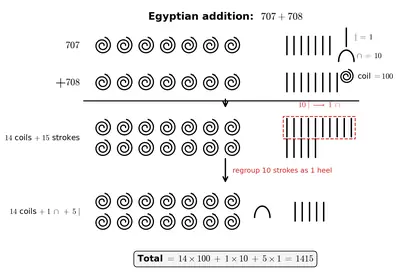
(The two Egyptian numerals to add, as shown in the source, are: first numeral consisting of 2 coils ($$100$$) + 3 coils ($$100$$) + 2 coils ($$100$$) = 7 coils, and 3 strokes + 3 strokes + 1 stroke = 7 strokes, i.e. $$700 + 7 = 707$$; and second numeral consisting of 3 coils + 3 coils + 1 coil = 7 coils, and 3 strokes + 3 strokes + 2 strokes = 8 strokes, i.e. $$700 + 8 = 708$$.)
Find the total number of $$|$$ and $$\cap$$ and group them starting from the largest possible landmark number. Since 10 $$\cap$$s gives the next landmark number (the coil for $$100$$), and 10 $$|$$s gives a $$\cap$$, regroup as needed.

Solution
We are adding $$707 + 708$$ in Egyptian notation.
Step 1 — pool the symbols.
| Symbol | From $$707$$ | From $$708$$ | Total |
|---|---|---|---|
| coil ($$100$$) | $$7$$ | $$7$$ | $$14$$ |
| arch $$\cap$$ ($$10$$) | $$0$$ | $$0$$ | $$0$$ |
| stroke $$|$$ ($$1$$) | $$7$$ | $$8$$ | $$15$$ |
Step 2 — regroup, starting from the smallest.
$$15 \text{ strokes} = 1\,\cap + 5 \text{ strokes}$$ (since $$10$$ strokes make an arch).
Arches now: $$0 + 1 = 1$$.
Coils are already $$14 \ge 10$$, so regroup:
$$14 \text{ coils} = 1 \text{ lotus} + 4 \text{ coils}$$ (since $$10$$ coils make a lotus).
Step 3 — final count.
$$1 \text{ lotus} + 4 \text{ coils} + 1 \text{ arch} + 5 \text{ strokes}.$$
Check: $$1000 + 400 + 10 + 5 = 1415 = 707 + 708$$. ✓
Answer
Figure it Out (page 65)
1 Add the following Egyptian numerals:
(i) First numeral (shown in the source): 6 pointing-finger symbols ($$10^{4}$$) + 6 coils ($$100$$) + 2 strokes + 3 strokes + 3 strokes; and second numeral: 2 coils + 3 coils + 3 strokes + 4 strokes. Add them.
Solution
First read off each numeral (a purely additive sum).
First: $$6 \times 10^{4} + 6 \times 100 + (2 + 3 + 3) \times 1 = 60000 + 600 + 8 = 60608.$$
Second: $$(2 + 3) \times 100 + (3 + 4) \times 1 = 500 + 7 = 507.$$
Pool the symbols.
| Symbol | First | Second | Total |
|---|---|---|---|
| pointing finger ($$10^{4}$$) | $$6$$ | $$0$$ | $$6$$ |
| coil ($$100$$) | $$6$$ | $$5$$ | $$11$$ |
| stroke ($$1$$) | $$8$$ | $$7$$ | $$15$$ |
Regroup, smallest first.
$$15$$ strokes $$= 1\,\cap + 5$$ strokes. Arches now: $$0 + 1 = 1$$.
$$11$$ coils $$= 1$$ lotus $$+ 1$$ coil. Lotuses now: $$0 + 1 = 1$$.
$$6$$ pointing fingers stay as $$6$$ (below $$10$$).
Final sum: $$6$$ pointing fingers $$+\ 1$$ lotus $$+\ 1$$ coil $$+\ 1$$ arch $$+\ 5$$ strokes.
Check: $$60000 + 1000 + 100 + 10 + 5 = 61115 = 60608 + 507$$. ✓
Answer
(ii) First numeral (shown in the source): 1 pointing-finger ($$10^{4}$$) + 3 arches ($$\cap$$) + 3 arches + 2 arches; and second numeral: 3 arches + 1 arch + 3 strokes + 3 strokes. Add them.
Solution
Read off each numeral first.
First: $$1 \times 10^{4} + (3+3+2) \times 10 = 10000 + 80 = 10080.$$
Second: $$(3+1) \times 10 + (3+3) \times 1 = 40 + 6 = 46.$$
Pool the symbols.
| Symbol | First | Second | Total |
|---|---|---|---|
| pointing finger ($$10^{4}$$) | $$1$$ | $$0$$ | $$1$$ |
| coil ($$100$$) | $$0$$ | $$0$$ | $$0$$ |
| arch $$\cap$$ ($$10$$) | $$8$$ | $$4$$ | $$12$$ |
| stroke ($$1$$) | $$0$$ | $$6$$ | $$6$$ |
Regroup, smallest first.
$$6$$ strokes stay as $$6$$ (below $$10$$).
$$12$$ arches $$= 1$$ coil $$+ 2$$ arches. Coils now: $$0 + 1 = 1$$.
$$1$$ pointing finger stays.
Final sum: $$1$$ pointing finger $$+\ 1$$ coil $$+\ 2$$ arches $$+\ 6$$ strokes.
Check: $$10000 + 100 + 20 + 6 = 10126 = 10080 + 46$$. ✓
Answer
2
(First numeral shown as: 1 circle ($$5^{3}$$) + 1 hexagon ($$5^{2}$$) + 1 hexagon + 1 square ($$5^{1}$$) + 2 triangles ($$5^{0}$$); and second numeral: 4 circles + 1 hexagon + 2 squares + 2 triangles.)
Remember that in this system, 5 times a landmark number gives the next one!
Solution
Read off each numeral (each symbol multiplied by its landmark value).
First numeral: $$1 \times 125 + 2 \times 25 + 1 \times 5 + 2 \times 1 = 125 + 50 + 5 + 2 = 182.$$
Second numeral: $$4 \times 125 + 1 \times 25 + 2 \times 5 + 2 \times 1 = 500 + 25 + 10 + 2 = 537.$$
Pool the symbols.
| Landmark | First | Second | Total |
|---|---|---|---|
| circle ($$125$$) | $$1$$ | $$4$$ | $$5$$ |
| hexagon ($$25$$) | $$2$$ | $$1$$ | $$3$$ |
| square ($$5$$) | $$1$$ | $$2$$ | $$3$$ |
| triangle ($$1$$) | $$2$$ | $$2$$ | $$4$$ |
Regroup, smallest first. ($$5$$ of any symbol becomes one of the next-higher symbol.)
$$4$$ triangles stay as $$4$$ (below $$5$$).
$$3$$ squares stay as $$3$$.
$$3$$ hexagons stay as $$3$$.
$$5$$ circles $$= 1$$ curve, so replace them: $$0$$ circles $$+ 1$$ curve.
Final sum: $$1$$ curve $$+\ 3$$ hexagons $$+\ 3$$ squares $$+\ 4$$ triangles.
Check: $$625 + 75 + 15 + 4 = 719 = 182 + 537$$. ✓
Answer
Intext Questions (Multiplication in Egyptian Numerals — pages 66–68)
30 How to multiply two numbers in Egyptian numerals?
Solution
Multiplying two Egyptian numerals uses just two ideas.
Idea 1: A landmark times another landmark is again a landmark. The landmark values are $$1, 10, 100, 1000, 10^{4}, 10^{5}, \ldots$$ — i.e. the powers $$10^{0}, 10^{1}, 10^{2}, 10^{3}, \ldots$$. Multiplying two of them just adds the exponents:
$$10^{a} \times 10^{b} = 10^{a+b}.$$
So, for example, the arch $$\cap$$ ($$10$$) times the coil ($$100$$) is the lotus ($$1000$$); the coil times the coil is the pointing finger ($$10^{4}$$); and so on.
Idea 2: Distributive property. To multiply a general number by another general number, break each into a sum of landmark pieces and use
$$(a_{1} + a_{2} + \cdots)(b_{1} + b_{2} + \cdots) = \sum_{i,j} a_{i}\, b_{j}.$$
Every $$a_{i}\, b_{j}$$ is a landmark times a landmark — a single landmark by Idea 1. Add up all these landmarks (pooling as in ordinary Egyptian addition) and regroup, and we have the product.
Answer
31 What is any landmark number multiplied by $$\cap$$ (that is 10)? Find the following products—
(i) $$\cap \times \cap$$, i.e. $$10 \times 10$$
Solution
$$\cap \times \cap = 10^{1} \times 10^{1} = 10^{2} = 100.$$
The landmark for $$100$$ is the coil.
Answer
(ii) coil (100) $$\times \cap$$, i.e. $$100 \times 10$$
Solution
$$\text{coil} \times \cap = 10^{2} \times 10^{1} = 10^{3} = 1000.$$
The landmark for $$1000$$ is the lotus.
Answer
(iii) lotus (1000) $$\times \cap$$, i.e. $$1000 \times 10$$
Solution
$$\text{lotus} \times \cap = 10^{3} \times 10^{1} = 10^{4}.$$
The landmark for $$10^{4}$$ is the pointing finger.
Answer
(iv) pointing finger ($$10^{4}$$) $$\times \cap$$, i.e. $$10^{4} \times 10$$
Solution
$$\text{pointing finger} \times \cap = 10^{4} \times 10^{1} = 10^{5}.$$
The landmark for $$10^{5}$$ is the tadpole.
Answer
32 What is any landmark number multiplied by the coil symbol representing $$10^{2}$$? Find the following products—
(i) $$\cap \times$$ coil, i.e. $$10 \times 100$$
Solution
$$\cap \times \text{coil} = 10^{1} \times 10^{2} = 10^{3} = 1000.$$
The landmark for $$1000$$ is the lotus.
Answer
(ii) coil $$\times$$ coil, i.e. $$100 \times 100$$
Solution
$$\text{coil} \times \text{coil} = 10^{2} \times 10^{2} = 10^{4}.$$
The landmark for $$10^{4}$$ is the pointing finger.
Answer
(iii) lotus (1000) $$\times$$ coil, i.e. $$1000 \times 100$$
Solution
$$\text{lotus} \times \text{coil} = 10^{3} \times 10^{2} = 10^{5}.$$
The landmark for $$10^{5}$$ is the tadpole.
Answer
(iv) pointing finger ($$10^{4}$$) $$\times$$ coil, i.e. $$10^{4} \times 100$$
Solution
$$\text{pointing finger} \times \text{coil} = 10^{4} \times 10^{2} = 10^{6}.$$
The landmark for $$10^{6}$$ is the seated god.
Answer
33 Find the following products—
(i) $$\cap \times$$ tadpole ($$10^{5}$$), i.e. $$10 \times 10^{5}$$
Solution
$$\cap \times \text{tadpole} = 10^{1} \times 10^{5} = 10^{6}.$$
The landmark for $$10^{6}$$ is the seated god.
Answer
(ii) coil ($$100$$) $$\times$$ lotus ($$1000$$), i.e. $$100 \times 1000$$
Solution
$$\text{coil} \times \text{lotus} = 10^{2} \times 10^{3} = 10^{5}.$$
The landmark for $$10^{5}$$ is the tadpole.
Answer
(iii) lotus ($$1000$$) $$\times$$ lotus ($$1000$$), i.e. $$1000 \times 1000$$
Solution
$$\text{lotus} \times \text{lotus} = 10^{3} \times 10^{3} = 10^{6}.$$
The landmark for $$10^{6}$$ is the seated god.
Answer
(iv) pointing finger ($$10^{4}$$) $$\times$$ seated god ($$10^{6}$$), i.e. $$10^{4} \times 10^{6}$$
Solution
$$\text{pointing finger} \times \text{seated god} = 10^{4} \times 10^{6} = 10^{10}.$$
This is beyond the Egyptian table (the highest listed landmark is the sun disk $$10^{7}$$). $$10^{10}$$ would need a brand-new landmark symbol — a limitation of the additive system.
Answer
34 Does this property (i.e. the product of any two landmark numbers is another landmark number) hold true in the base-5 system that we created? Does this hold for any number system with a base?
Solution
Yes, this property is a general fact about landmarks.
Base-$$5$$. Every landmark is a power of $$5$$: $$5^{0}, 5^{1}, 5^{2}, 5^{3}, \ldots$$. Multiplying two of them:
$$5^{a} \times 5^{b} = 5^{a+b}.$$
Since $$a + b$$ is again a non-negative integer, $$5^{a+b}$$ is again one of the landmarks. So the property holds.
General base $$n$$. Landmarks are $$n^{0}, n^{1}, n^{2}, \ldots$$ and
$$n^{a} \times n^{b} = n^{a+b},$$
which is again a landmark. So the property holds for every base-$$n$$ system — because the landmarks are always the successive powers of $$n$$, and adding exponents keeps us within that set.
Answer
35 What can we conclude about the product of a number and $$\cap$$ (10), in the Egyptian system?
Solution
Any Egyptian numeral is just a sum of its landmark pieces. Multiplying that sum by $$\cap = 10$$ multiplies each landmark piece by $$10$$ (using the distributive law), and by the previous questions, multiplying a landmark by $$\cap$$ simply pushes it one step up.
So the rule is very clean: to multiply an Egyptian numeral by $$\cap$$, replace every symbol with the next-higher landmark symbol. Explicitly,
- each stroke $$|$$ becomes an arch $$\cap$$,
- each arch $$\cap$$ becomes a coil ($$100$$),
- each coil becomes a lotus ($$1000$$),
- each lotus becomes a pointing finger ($$10^{4}$$),
and so on. The count of each type of symbol stays the same — only the type changes.
Answer
36 Now find the following products—
(i) ($$5$$ coils $$+ 2$$ arches $$+ 2$$ strokes) $$\times \cap$$, i.e. $$522 \times 10$$
Solution
Apply the shift-up rule from Q35:
- each coil ($$100$$) becomes a lotus ($$1000$$),
- each arch ($$10$$) becomes a coil ($$100$$),
- each stroke ($$1$$) becomes an arch ($$10$$).
Counts are preserved:
$$5\text{ coils} + 2\text{ arches} + 2\text{ strokes} \ \xrightarrow{\ \times \cap\ } \ 5\text{ lotuses} + 2\text{ coils} + 2\text{ arches}.$$
Check: $$5 \times 1000 + 2 \times 100 + 2 \times 10 = 5220 = 522 \times 10$$. ✓
Answer
(ii) (pointing finger ($$10^{4}$$) $$+$$ arch ($$10$$)) $$\times \cap$$, i.e. $$10010 \times 10$$
Solution
Shift each symbol one landmark up:
- pointing finger ($$10^{4}$$) $$\to$$ tadpole ($$10^{5}$$),
- arch ($$10$$) $$\to$$ coil ($$100$$).
Result: $$1$$ tadpole $$+\ 1$$ coil.
Check: $$100000 + 100 = 100100 = 10010 \times 10$$. ✓
Answer
37 What would be a simple rule to multiply a number with $$\cap$$?
Solution
The rule discovered in Q$$35$$ and $$36$$: replace every symbol by the next higher landmark symbol. No counting or regrouping is needed — the number of each symbol simply moves up one notch.
In our familiar Hindu numerals this becomes the well-known rule “multiplying by $$10$$ appends a $$0$$”: the digit at the units place moves to the tens place, the tens digit moves to the hundreds place, and so on. Both rules are really the same rule, dressed differently.
Answer
Figure it Out (pages 69–70)
1 Can there be a number whose representation in Egyptian numerals has one of the symbols occurring 10 or more times? Why not?
Solution
No, a proper Egyptian representation never has any symbol appearing $$10$$ or more times.
Reason. Ten copies of any landmark equal one copy of the next-higher landmark: $$10 \times |=\cap$$, $$10 \times \cap = \text{coil}$$, $$10 \times \text{coil} = \text{lotus}$$, and so on. So the moment a symbol reaches a count of $$10$$, we would regroup it into one of the next-bigger symbol.
Hence, in the fully-simplified form, every symbol occurs at most $$9$$ times — matching the fact that in Hindu place value, each digit is between $$0$$ and $$9$$.
Answer
2 Create your own number system of base 4, and represent numbers from 1 to 16.
Solution
Pick landmark numbers $$4^{0} = 1$$, $$4^{1} = 4$$, $$4^{2} = 16$$, $$4^{3} = 64$$, $$\ldots$$ and give each a symbol. Let us use
- a dot $$\bullet$$ for $$1$$,
- a circle $$\circ$$ for $$4$$,
- a square $$\square$$ for $$16$$.
Rule: repeat each symbol at most $$3$$ times; four copies of a symbol regroup to one copy of the next-higher symbol.
| Number | Grouping | Symbols |
|---|---|---|
| $$1$$ | $$1$$ | $$\bullet$$ |
| $$2$$ | $$1+1$$ | $$\bullet\bullet$$ |
| $$3$$ | $$1+1+1$$ | $$\bullet\bullet\bullet$$ |
| $$4$$ | $$4$$ | $$\circ$$ |
| $$5$$ | $$4+1$$ | $$\circ\bullet$$ |
| $$6$$ | $$4+2$$ | $$\circ\bullet\bullet$$ |
| $$7$$ | $$4+3$$ | $$\circ\bullet\bullet\bullet$$ |
| $$8$$ | $$4+4$$ | $$\circ\circ$$ |
| $$9$$ | $$4+4+1$$ | $$\circ\circ\bullet$$ |
| $$10$$ | $$4+4+2$$ | $$\circ\circ\bullet\bullet$$ |
| $$11$$ | $$4+4+3$$ | $$\circ\circ\bullet\bullet\bullet$$ |
| $$12$$ | $$4+4+4$$ | $$\circ\circ\circ$$ |
| $$13$$ | $$4+4+4+1$$ | $$\circ\circ\circ\bullet$$ |
| $$14$$ | $$4+4+4+2$$ | $$\circ\circ\circ\bullet\bullet$$ |
| $$15$$ | $$4+4+4+3$$ | $$\circ\circ\circ\bullet\bullet\bullet$$ |
| $$16$$ | $$16$$ | $$\square$$ |
At $$16$$ the four circles have regrouped into a single square — the next landmark.
Answer
3 Give a simple rule to multiply a given number by 5 in the base-5 system that we created.
Solution
The rule is the same as multiplying by $$\cap$$ in the Egyptian system: replace every landmark symbol by the next-higher landmark symbol.
Concretely, since every landmark is a power of $$5$$,
$$5^{a} \times 5 = 5^{a+1},$$
so multiplying by $$5$$ pushes each landmark one step up:
- triangle ($$1$$) $$\to$$ square ($$5$$),
- square ($$5$$) $$\to$$ hexagon ($$25$$),
- hexagon ($$25$$) $$\to$$ circle ($$125$$),
- circle ($$125$$) $$\to$$ curve ($$625$$),
- curve ($$625$$) $$\to$$ arrow ($$3125$$),
and so on. The counts stay the same.
Example. $$1$$ circle $$+ 3$$ squares $$+ 3$$ triangles ($$= 143$$) $$\ \times 5 \ = \ 1$$ curve $$+ 3$$ hexagons $$+ 3$$ squares ($$= 715$$). ✓
Answer
Examples (Mesopotamian Number System)
Example
(The Mesopotamian sexagesimal system uses landmark numbers $$1, 60, 60^{2} = 3600, 60^{3} = 216000, \ldots$$. The symbol for 1 is a small wedge and the symbol for 10 is a left-pointing wedge. Group $$640 = (10) \times 60 + 40$$.)
Solution
The Mesopotamians grouped by $$60$$, so we split $$640$$ using powers of $$60$$.
Step 1 — how many $$60$$s?
$$640 \div 60 = 10 \text{ remainder } 40, \quad \text{i.e. } 640 = 10 \times 60 + 40.$$
So the ‘$$60$$s’ column has $$10$$, and the ‘$$1$$s’ column has $$40$$.
Step 2 — write each column using the two Mesopotamian symbols.
Inside a column, use small wedges for $$1$$s and left-pointing wedges for $$10$$s.
- $$60$$s column: $$10 = $$ one left-pointing wedge.
- $$1$$s column: $$40 = 4 \times 10 =$$ four left-pointing wedges.
Step 3 — place the columns side by side, largest column on the left, small gap between.
$$640 \ =\ \underbrace{\text{(one left-wedge)}}_{60\text{s column}}\ \underbrace{\text{(four left-wedges)}}_{1\text{s column}}.$$
Answer
Example
(Group as $$7530 = (2) \times 3600 + (5) \times 60 + 30$$ and write in Mesopotamian numerals.)
Solution
Divide by the largest available landmark first.
Step 1 — how many $$3600$$s ($$= 60^{2}$$)?
$$7530 \div 3600 = 2 \text{ remainder } 330,\ \text{i.e. } 7530 = 2 \times 3600 + 330.$$
Step 2 — how many $$60$$s in the remainder?
$$330 \div 60 = 5 \text{ remainder } 30,\ \text{i.e. } 330 = 5 \times 60 + 30.$$
So $$7530 = 2 \times 3600 + 5 \times 60 + 30.$$
Step 3 — write each column using small wedges ($$1$$s) and left-pointing wedges ($$10$$s).
- $$3600$$s column: $$2 = $$ two small wedges.
- $$60$$s column: $$5 = $$ five small wedges.
- $$1$$s column: $$30 = 3 \times 10 = $$ three left-pointing wedges.
Step 4 — place the three columns side by side, largest on the left.
$$7530\ =\ \underbrace{\text{(two small wedges)}}_{3600\text{s}}\ \underbrace{\text{(five small wedges)}}_{60\text{s}}\ \underbrace{\text{(three left-wedges)}}_{1\text{s}}.$$
Answer
Intext Questions (Mesopotamian Number System)
41
(Referring to the Mesopotamian representation of 640 written using explicit symbols for each power of 60.)
Solution
Yes — the Mesopotamians used a place-value idea: the position of a group of wedges decides which power of $$60$$ it represents. We do not need a distinct symbol for $$60$$, another for $$3600$$, another for $$216000$$ and so on.
For $$640 = 10 \times 60 + 40 \times 1$$, we simply write two columns of wedges, one after the other:
(one left-wedge) (four left-wedges)
The leftmost column stands for $$60$$s, the next column for $$1$$s. So “one wedge, then four wedges” means $$1 \times 60 + 4 \times 1 = 64$$, and “one left-wedge, then four left-wedges” means $$10 \times 60 + 40 \times 1 = 640$$.
The compact representation therefore uses only two basic symbols (the small wedge and the left-pointing wedge) plus position; the higher landmarks $$60, 3600, 216000, \ldots$$ do not need their own symbols. This is the seed of the place-value system, later perfected in the Hindu numerals.
Answer
Figure it Out (page 73)
1 Represent the following numbers in the Mesopotamian system —
(i) 63
Solution
$$63 \div 60 = 1 \text{ remainder } 3$$, so $$63 = 1 \times 60 + 3.$$
- $$60$$s column: $$1$$ small wedge.
- $$1$$s column: $$3$$ small wedges.
Answer
(ii) 132
Solution
$$132 \div 60 = 2 \text{ remainder } 12$$, so $$132 = 2 \times 60 + 12.$$ Now $$12 = 1 \times 10 + 2 \times 1$$.
- $$60$$s column: $$2$$ small wedges.
- $$1$$s column: $$1$$ left-pointing wedge and $$2$$ small wedges.
Answer
(iii) 200
Solution
$$200 \div 60 = 3 \text{ remainder } 20$$, so $$200 = 3 \times 60 + 20$$; here $$20 = 2 \times 10$$.
- $$60$$s column: $$3$$ small wedges.
- $$1$$s column: $$2$$ left-pointing wedges.
Answer
(iv) 60
Solution
$$60 = 1 \times 60 + 0$$.
- $$60$$s column: $$1$$ small wedge.
- $$1$$s column: nothing — the Mesopotamians left a space here.
Without a symbol for zero, a lone wedge could equally well mean $$1$$, $$60$$ or $$3600$$! Context (or a wider space) was needed to tell them apart — a real weakness of the system.
Answer
(v) 3605
Solution
$$3605 \div 3600 = 1 \text{ remainder } 5$$, so $$3605 = 1 \times 3600 + 0 \times 60 + 5.$$
- $$3600$$s column: $$1$$ small wedge.
- $$60$$s column: nothing.
- $$1$$s column: $$5$$ small wedges.
Again the empty middle column shows why a symbol for zero would be so useful: without one, this can look identical to $$65 = 1 \times 60 + 5$$.
Answer
Intext Questions (Mesopotamian, Mayan, and Hindu Systems)
43 Look at the representation of 60. What will be the representation for 3,600?
Solution
In the Mesopotamian place-value system, the number $$60$$ is written as
one small wedge (empty $$1$$s column)
because $$60 = 1 \times 60 + 0 \times 1$$.
Similarly, $$3600 = 60^{2} = 1 \times 3600 + 0 \times 60 + 0 \times 1$$, so it would be written as
one small wedge (empty $$60$$s column) (empty $$1$$s column).
The three representations $$1$$, $$60$$ and $$3600$$ all look like a single small wedge in the leftmost occupied column, distinguished only by how many empty columns follow on the right — a serious ambiguity that only the invention of a zero symbol could clear up.
Answer
44 Represent the following numbers using the Mayan system:
(i) 77
Solution
Mayan is a place-value base-$$20$$ system, written vertically, with the smallest place at the bottom. Within a place, a dot means $$1$$ and a bar means $$5$$; a shell means $$0$$.
$$77 \div 20 = 3 \text{ remainder } 17$$, so $$77 = 3 \times 20 + 17$$; and $$17 = 3 \times 5 + 2$$.
- Top (the $$20$$s place): $$3$$ dots.
- Bottom (the $$1$$s place): $$3$$ bars stacked, with $$2$$ dots on top of them.
Answer
(ii) 100
Solution
$$100 = 5 \times 20 + 0$$, and $$5 = 1 \times 5$$.
- Top ($$20$$s place): $$1$$ bar.
- Bottom ($$1$$s place): a shell (Mayan zero).
Answer
(iii) 361
Solution
In pure vigesimal Mayan (places $$1, 20, 400, \ldots$$):
$$361 \div 20 = 18 \text{ remainder } 1$$, so $$361 = 0 \times 400 + 18 \times 20 + 1.$$
Now $$18 = 3 \times 5 + 3$$.
- $$400$$s place: not needed (the highest occupied place is $$20$$s).
- $$20$$s place: $$3$$ bars with $$3$$ dots above them.
- $$1$$s place: $$1$$ dot.
Answer
(iv) 721
Solution
Using places $$1, 20, 400, \ldots$$:
$$721 \div 400 = 1 \text{ remainder } 321;\ \ 321 \div 20 = 16 \text{ remainder } 1.$$
So $$721 = 1 \times 400 + 16 \times 20 + 1$$. Also $$16 = 3 \times 5 + 1$$.
- $$400$$s place (top): $$1$$ dot.
- $$20$$s place (middle): $$3$$ bars with $$1$$ dot above them.
- $$1$$s place (bottom): $$1$$ dot.
Answer
45 Where does the Hindu/Indian number system figure in the evolution of ideas of number representation? What are its landmark numbers? And does it use a place value system?
Solution
The Hindu number system stands at the culmination of the story of number representation. Earlier systems solved parts of the problem: the Egyptians used landmarks and a base-$$10$$ additive scheme, the Mesopotamians used place value (base $$60$$), and the Mayans used place value with a zero (base $$20$$). But each had drawbacks — too many symbols, ambiguity from missing zeros, awkward bases.
The Hindu system combined all the best ideas into one clean system:
- Base $$10$$. Landmarks are the powers of ten: $$1, 10, 100, 1000, 10000, 100000, \ldots$$, i.e. $$10^{0}, 10^{1}, 10^{2}, \ldots$$.
- Place value. Every number is written as a string of digits; the value of a digit is the digit itself times the power of $$10$$ for its position.
- Zero. A distinct symbol $$0$$ makes empty places explicit, so representations are unique and unambiguous.
- Only ten digits. $$0, 1, 2, 3, 4, 5, 6, 7, 8, 9$$ suffice for any number, however large.
This concise, unambiguous system spread from India to the Arab world and then to Europe, and today it is the number system used almost everywhere in the world.
Answer
Figure it Out (page 80)
1 Why do you think the Chinese alternated between the Zong and Heng symbols? If only the Zong symbols were to be used, how would 41 be represented? Could this numeral be interpreted in any other way if there is no significant space between two successive positions?
Solution
Why alternate? Both Zong (vertical strokes) and Heng (horizontal strokes) show a digit as a bundle of thin strokes; without any visual difference, the boundaries between successive place-value columns would vanish. The Chinese therefore agreed to use Zong in the odd columns ($$1$$s, $$100$$s, $$10000$$s, $$\ldots$$) and Heng in the even columns ($$10$$s, $$1000$$s, $$100000$$s, $$\ldots$$). The style of the strokes itself tells you which column you are looking at, so the two adjacent columns can never be confused.
$$41$$ using only Zong. With just vertical strokes, the digit $$4$$ (in the $$10$$s column) becomes $$4$$ vertical strokes and the digit $$1$$ (in the $$1$$s column) becomes $$1$$ vertical stroke:
| | | | |
Any ambiguity? Yes — if we do not leave a clear gap between the two columns, this is just five vertical strokes in a row, which could be read as $$5$$ (a single digit in the $$1$$s column), or as $$14$$, $$23$$, $$32$$, $$41$$, $$50$$, $$41$$, $$104$$, and many other numbers. The reader would have no way to tell where the $$10$$s digit ends and the $$1$$s digit begins. This is exactly the ambiguity that alternating Zong/Heng was invented to remove.
Answer
2 Form a base-2 place value system using 'ukasar' and 'urapon' as the digits. Compare this system with that of the Gumulgal's.
Solution
In a place-value base-$$2$$ system, we need exactly two digit-symbols. Use
- urapon for the digit $$0$$,
- ukasar for the digit $$1$$.
The columns, from right to left, represent the powers $$1, 2, 4, 8, 16, \ldots$$. The first few counting numbers become
| Number | Binary | In our words |
|---|---|---|
| $$1$$ | $$1$$ | ukasar |
| $$2$$ | $$10$$ | ukasar-urapon |
| $$3$$ | $$11$$ | ukasar-ukasar |
| $$4$$ | $$100$$ | ukasar-urapon-urapon |
| $$5$$ | $$101$$ | ukasar-urapon-ukasar |
| $$6$$ | $$110$$ | ukasar-ukasar-urapon |
| $$7$$ | $$111$$ | ukasar-ukasar-ukasar |
| $$8$$ | $$1000$$ | ukasar-urapon-urapon-urapon |
Comparison with the Gumulgal system.
- Both systems use only the two words ukasar and urapon.
- In the Gumulgal system, the words are used additively: each ukasar contributes $$2$$, each urapon contributes $$1$$, and the string may repeat as much as needed. So $$6 = $$ ukasar-ukasar-ukasar (three $$2$$s), and to write $$1000$$ we would need about $$500$$ ukasars in a row — extremely long.
- In the place-value binary system, the same two words behave as digits: their position determines their contribution ($$1, 2, 4, 8, 16, \ldots$$). So $$6 = $$ ukasar-ukasar-urapon (i.e. $$110$$), and $$1000 = 1111101000$$ — only $$10$$ words.
The place-value system is dramatically more compact for large numbers — the length grows only like $$\log_{2} N$$ instead of $$N/2$$.
Answer
3 Where in your daily lives, and in which professions, do the Hindu numerals, and 0, play an important role? How might our lives have been different if our number system and 0 hadn't been invented or conceived of?
Solution
In our daily life we use Hindu numerals and $$0$$ almost constantly:
- time, dates, calendars — clocks show $$00{:}00$$, dates like $$01/01/2026$$;
- money — prices, salaries, bank balances, tax computations;
- phone numbers, house numbers, pin codes, roll numbers;
- measurements — height, weight, temperature ($$0^{\circ}\mathrm{C}$$!), distances;
- scores in games and exams (a $$0$$ is very different from a $$1$$).
In many professions the role is central.
- Bankers and accountants keep ledgers where columns of digits and $$0$$s must balance.
- Engineers and scientists use place value and $$0$$ every time they compute lengths, forces, currents, and orbits.
- Doctors record dosages, blood pressures ($$120/80$$) and lab values.
- Shopkeepers, cooks, tailors and carpenters measure quantities using base-$$10$$ numerals.
- Programmers and computer scientists rely on $$0$$ and place value at the deepest level — binary $$0$$s and $$1$$s are the language of computers.
Without the Hindu numerals and $$0$$, we would still be writing numbers like Roman numerals — long strings of letters. Simple arithmetic ($$236 \times 47$$, say) would take pages. Advanced mathematics, science, economics and technology would grind to a halt. There would be no easy decimals, no negative numbers built cleanly from $$0$$, no computers, no calculators, no scientific notation. Life would be much slower, less quantitative, and less connected.
Answer
4 The ancient Indians likely used base 10 for the Hindu number system because humans have 10 fingers, and so we can use our fingers to count. But what if we had only 8 fingers? How would we be writing numbers then? What would the Hindu numerals look like if we were using base 8 instead? Base 5? Try writing the base-10 Hindu numeral 25 as base-8 and base-5 Hindu numerals, respectively. Can you write it in base-2?
Solution
If humans had only $$8$$ fingers, it would have been natural to group by $$8$$ instead of $$10$$. The number system would still be a place-value system, but with $$8$$ digits instead of $$10$$: $$0, 1, 2, 3, 4, 5, 6, 7$$. Each column would stand for a power of $$8$$: $$8^{0}, 8^{1}, 8^{2}, \ldots = 1, 8, 64, 512, \ldots$$.
Similarly a base-$$5$$ system would use digits $$0, 1, 2, 3, 4$$ and columns for $$1, 5, 25, 125, \ldots$$; a base-$$2$$ (binary) system would use only $$0$$ and $$1$$ with columns for $$1, 2, 4, 8, 16, \ldots$$.
$$25$$ in base $$8$$. Divide:
$$25 = 3 \times 8 + 1 \ \Rightarrow \ 25 = (31)_{8}.$$
$$25$$ in base $$5$$. Since $$25 = 5^{2}$$:
$$25 = 1 \times 25 + 0 \times 5 + 0 \times 1 \ \Rightarrow \ 25 = (100)_{5}.$$
$$25$$ in base $$2$$. Break it into powers of $$2$$:
$$25 = 16 + 8 + 1 = 2^{4} + 2^{3} + 2^{0}.$$
So the digits (from the $$16$$s column down to the $$1$$s column) are $$1, 1, 0, 0, 1$$:
$$25 = (11001)_{2}.$$
Check: $$1{\cdot}16 + 1{\cdot}8 + 0{\cdot}4 + 0{\cdot}2 + 1{\cdot}1 = 25$$. ✓
Notice that as the base gets smaller, the number of digits needed grows: $$25$$ needs $$2$$ digits in base $$10$$, $$2$$ in base $$8$$, $$3$$ in base $$5$$, and $$5$$ in base $$2$$.
Answer