 91- 6303239042


Let Us Enhance Our Learning
1
Solution
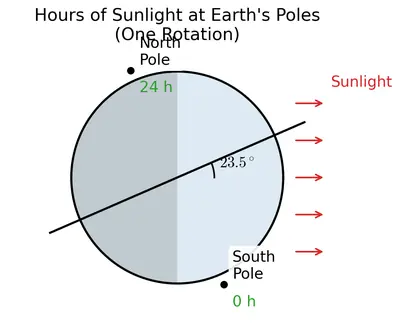
Let us first recall what Fig. 12.17 shows.
- The drawing represents the June solstice, when the Earth’s axis is tilted towards the Sun by about $$23.5^{\circ}$$.
- The circle that separates day from night (called the circle of illumination) is such that the entire region around the North Pole lies inside the daylight half, while the region around the South Pole lies completely inside the night half.
Now consider one complete rotation of the Earth (one full day):
- North Pole
Because the North Pole never crosses into the night half at this time of the year, it remains lit for the whole 24-hour period.
Therefore, hours of sunlight at the North Pole = $$24\,\text{h}$$. - South Pole
Conversely, the South Pole is entirely inside the dark half. As the Earth rotates, it never receives direct sunlight.
Therefore, hours of sunlight at the South Pole = $$0\,\text{h}$$.
Thus, during the June solstice pictured in Fig. 12.17, the North Pole enjoys continuous daylight while the South Pole remains in continuous darkness.
Answer
North Pole: 24 h of sunlight | South Pole: 0 h of sunlight
2 Fill in the blanks
(i) Stars rise in the _______ and set in the _________.
Solution
The Earth spins from west to east. Because of this rotation, celestial objects appear to move in the opposite direction—exactly the same reason the scenery seems to move backward when you look out of a moving train.
Therefore every star becomes visible first on the horizon that faces east, climbs up the sky, and later disappears below the horizon that faces west.
Answer
east, west
(ii) Day and night are caused by the Earth's _____________.
Solution
Half of the Earth is lit by the Sun at any instant. As the Earth continuously turns about its own axis once every 24 h, different parts move into and out of the illuminated half.
This turning motion is called the rotation of the Earth. Hence the regular alternation of daylight and darkness is a direct consequence of the Earth’s rotation.
Answer
rotation
(iii) When the Moon fully covers the Sun from our view, it is called a __________ solar eclipse.
Solution
A solar eclipse occurs when the Moon comes between the Earth and the Sun. If the apparent size of the Moon is large enough to hide the Sun completely, no direct sunlight reaches the observer for a short time. Such an eclipse, in which the Sun is totally obscured, is called a total solar eclipse.
Answer
total
3 State whether True or False
(i) Lunar eclipse occurs when the Sun comes between the Earth and the Moon.
Solution
The shadow arrangement during eclipses is as follows:
- Lunar eclipse: The Earth comes between the Sun and the Moon, so the Moon moves into Earth’s shadow and becomes dark.
- If instead the Sun were between Earth and Moon, its light would still fall on the Moon and no lunar eclipse could happen.
Hence the given description is incorrect.
Answer
False
(ii) Sunrise happens earlier in Gujarat than in Jharkhand.
Solution
Gujarat lies roughly between longitudes $$68^{\circ}\,\text{E}$$ and $$74^{\circ}\,\text{E}$$, while Jharkhand lies around $$83^{\circ}\,\text{E}$$ to $$87^{\circ}\,\text{E}$$. Thus Jharkhand is east of Gujarat by roughly $$13^{\circ}$$ of longitude.
The Earth rotates from west to east, so places situated farther east face the Sun a little earlier each day.
Estimate of the time difference. The Earth turns through $$360^{\circ}$$ in $$24\,\text{h}$$, i.e. $$15^{\circ}$$ per hour, or about $$4\,\text{min}$$ per degree of longitude. Hence the sunrise time difference is approximately
\[ 13^{\circ} \times 4\,\text{min/}^{\circ} \;\approx\; 52\,\text{min}. \]
Therefore sunrise is earlier in Jharkhand than in Gujarat (by roughly $$50$$–$$55$$ minutes), not the other way round. The given statement is false.
Answer
False
(iii) In Chennai, the longest day occurs on the summer solstice.
Solution
The summer solstice (about 21 June) is the date on which the Northern Hemisphere is tilted most toward the Sun. All places north of the equator—including Chennai (latitude about $$13^{\circ}\,\text{N}$$)—receive their maximum duration of daylight on this day.
Hence Chennai experiences its longest day on the summer solstice, making the statement true.
Answer
True
(iv) We should watch the solar eclipse directly with our naked eye.
Solution
During a solar eclipse most of the Sun is hidden, but the exposed rim still emits very intense visible and ultraviolet light that can permanently damage the eyes.
Therefore we must never observe a solar eclipse with the naked eye; we should use approved filters or indirect projection methods instead.
Answer
False
(v) Seasons occur due to the tilt of Earth's axis of rotation and its spherical shape.
Solution
Seasons change because:
- The Earth’s axis is tilted by about $$23.5^{ ext{o}}$$ with respect to the plane of its orbit.
- The Earth revolves around the Sun once every year.
The spherical shape of Earth does not create seasons; it just causes the amount of light to differ with latitude at any given moment. Without the axial tilt, every place would have nearly the same length of day and night throughout the year and seasons would not occur, even though the Earth is spherical.
Because the statement replaces “revolution” with “spherical shape,” it is incorrect.
Answer
False
(vi) The Earth's revolution around the Sun causes day and night.
Solution
Day and night occur because the Earth rotates about its axis once in roughly 24 hours. As a point on Earth’s surface turns toward the Sun it experiences day; when it turns away it experiences night.
The Earth’s revolution around the Sun (one year) determines the progression of seasons, not day and night.
Answer
False
4 Padmashree saw the Orion constellation nearly overhead at 8 pm yesterday. When will she see Orion overhead today?
Solution
Observation provided
Yesterday (Day 1) the constellation Orion was almost exactly overhead at 8 pm.
1. Why do constellations shift their overhead time?
The Earth has two simultaneously running motions:
- Rotation about its own axis: one solar day = 24 h.
- Revolution around the Sun: one year = 365 days.
Because the Earth advances a little (about $$1^{\circ}$$) along its orbit each day, it has to turn through slightly more than $$360^{\circ}$$ to bring the Sun back to the meridian. Hence the interval between two successive “noons” (a solar day) is longer than the interval between two successive alignments with a distant star (a sidereal day).
2. Length of a sidereal day
Actual values
$$\text{Solar day}=24\,\text{h}=1440\,\text{min}$$
$$\text{Sidereal day}=23\,\text{h}\;56\,\text{min}\;4\,\text{s}\approx1436.1\,\text{min}$$
Extra time the Sun needs each day:
$$1440\,\text{min}-1436.1\,\text{min}\approx3.9\,\text{min}\approx4\,\text{min}$$
Therefore every fixed star or constellation appears about 4 minutes earlier in the sky on each successive night.
3. Applying the 4-minute rule
Time Orion was overhead yesterday: $$8{:}00\,\text{pm}$$.
Shift next night: $$4\,\text{min}$$ earlier.
$$8{:}00\,\text{pm}-0{:}04=7{:}56\,\text{pm}$$
4. Conclusion
Padmashree will find Orion nearly overhead today at about 7 : 56 pm (roughly four minutes earlier).
Answer
At about 7 : 56 pm — roughly four minutes earlier than yesterday.
5 Nandhini saw a group of stars rising at midnight on 21 June. When will she see the same group of stars rising at midnight next year?
Solution
Step 1 – Recall the daily shift of the night sky
Because the Earth goes once round the Sun in a year, the night-side of the Earth faces slightly different directions from one night to the next. A given star therefore rises about 4 minutes earlier every day.
Step 2 – Find how many days make the star come back to the same clock time
If the star has to rise at the same clock time (midnight) again, the total advance must add up to a full 24 h.
Time that has to be gained = $$24 \text{ h}=24\times 60\;\text{min}=1440\;\text{min}$$
Daily advance = $$4\;\text{min per day}$$
Number of days needed = $$\dfrac{1440\;\text{min}}{4\;\text{min day}^{-1}} = 360\;\text{days}$$
Step 3 – Convert 360 days into a calendar date
Starting from 21 June, 360 days bring us to 16 June of the next calendar year (5 days earlier than the starting date).
Step 4 – Conclusion
Hence the same group of stars will again rise exactly at midnight about 360 days later, i.e. on ~16 June of the next year.
Answer
About 16 June next year.
6 Abhay noticed that when it was daytime in India, his uncle who was in the USA was generally sleeping as it was night-time there. What is the reason behind this difference?
Solution
Concept 1 : The Earth is a sphere that rotates about its own axis
The rotation is from west to east and takes 24 hours for one complete turn. Because of this rotation
- the face that is turned towards the Sun is illuminated → day-time,
- the opposite face is in the Earth’s own shadow → night-time.
Concept 2 : Angular speed of rotation
The Earth sweeps $$360^{\circ}$$ in 24 h, so the angular speed is
$$\dfrac{360^{\circ}}{24\;\text{h}} = 15^{\circ}\;\text{per hour}.$$/p>
Concept 3 : Longitude decides local time
Every $$15^{\circ}$$ of longitude toward the east makes the local time 1 hour ahead; toward the west it is 1 hour behind.
Data for the two places
- India’s standard meridian: $$82.5^{\circ}\text{E}$$
- (One of) U.S.A. central meridian: about $$90^{\circ}\text{W}$$
The total longitudinal separation is
$$82.5^{\circ} + 90^{\circ} = 172.5^{\circ}.$$/p>
Time difference
$$\text{Time difference} = \dfrac{172.5^{\circ}}{15^{\circ}/\text{h}} = 11.5\;\text{h}\;\bigl(11\,\text{h}\,30\,\text{min}\bigr).$$
Thus local time in the U.S.A. is roughly 11–12 hours behind that in India. When it is about 10 a.m. in India, it will be
$$10\,\text{a.m.} - 11.5\,\text{h} \approx 10\,\text{p.m. (previous day)}$$
in the central United States, which is normal sleeping time.
Conclusion
Day and night do not occur everywhere on Earth at the same moment because the Earth keeps turning. Places lying toward the east (India) receive sunlight earlier, while places far to the west (U.S.A.) face away from the Sun at that instant, making it night there. This rotational effect produces the familiar time-zone differences that Abhay observed.
Answer
Because the Earth rotates from west to east, India (farther east) faces the Sun about 11–12 hours earlier than most of the U.S.A. (farther west). Hence it is daytime in India while, being on the dark half of the globe, it is still night in the U.S.A., so Abhay’s uncle is asleep.
7
Four friends used the following ways to see the solar eclipse. Who among them was being careless?
- (i) Ravikiran used a solar eclipse goggle.
- (ii) Jyothi used a mirror to project the Sun's image.
- (iii) Adithya saw the Sun directly with his eyes.
- (iv) Aruna attended a programme arranged by a planetarium.
Solution
Concept recall — Why can looking at the Sun be dangerous?
- The Sun is an extremely strong source of visible and invisible (infra-red and ultraviolet) radiation.
- The lens of our eye focuses this intense light on a very small spot of the retina. Even a few seconds of direct exposure during an eclipse can burn that spot permanently (a condition called solar retinopathy).
- Therefore the only safe methods are those that reduce the intensity by many thousand times before the light enters our eyes.
Check each friend’s method
- Ravikiran: He used a pair of certified solar-eclipse goggles (made with special Mylar or black polymer film). These filters cut down the Sun’s brightness by a factor of about $$10^{5}$$, so they are safe.
- Jyothi: She turned her back to the Sun and used a small mirror to project the Sun’s image onto a distant wall/screen. The light never goes directly into her eyes, hence this indirect projection method is also safe.
- Adithya: He looked straight at the Sun with his unaided eyes. Nothing reduced the Sun’s brightness, so this is unsafe and careless.
- Aruna: She watched the eclipse through arrangements made by a planetarium. Such programmes always provide safe filters or projection devices, so her method is safe.
Conclusion
Only Adithya’s action involves direct viewing without protection, which can seriously damage eyesight.
Answer
Adithya (method iii) was careless.
8
Solution
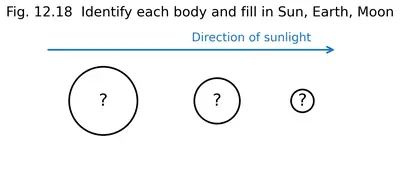
The three empty circles in Fig. 12.18 represent the three bodies that take part in the Earth–Moon–Sun system. We decide which is which by comparing two obvious facts that you already know.
- The source of light. One circle has arrows (or rays) coming out of it. The only real source of light in this trio is the Sun. Hence that largest, ray-emitting circle must be filled with the word Sun.
- Relative sizes.
The radii of the three bodies follow the order $$R_{\text{Sun}} \;\gg\; R_{\text{Earth}} \;>\; R_{\text{Moon}}.$$ Therefore:- the biggest remaining circle (after the Sun) stands for the Earth,
- the smallest circle stands for the Moon.
Writing the names inside the circles, from the largest to the smallest, gives the correct labelling:
- Sun → Earth → Moon
Thus the figure should read “Sun” in the largest, ray-emitting circle, “Earth” in the medium circle, and “Moon” in the smallest circle.
Answer
Sun — Earth — Moon
9 The Moon is much smaller than the Sun, yet it can block the Sun completely from our view during a total solar eclipse. Why is it possible?
Solution
Given fact to be explained — In a total solar eclipse the Moon, although far smaller than the Sun, hides the whole solar disc from an observer on the Earth.
To understand this we have to compare the apparent (angular) sizes of the two bodies as seen from Earth. An object of physical diameter $$D$$ situated at distance $$d$$ from the eye subtends an angular diameter $$\theta$$ that, for small angles, is
$$\theta \approx \dfrac{D}{d}\;,\qquad(\text{in radians}).$$
Step 1 : List the necessary data
| Quantity | Symbol | Approx. value |
|---|---|---|
| Diameter of the Sun | $$D_S$$ | $$1.39\times10^6\,\text{km}$$ |
| Mean distance Earth – Sun | $$d_S$$ | $$1.496\times10^8\,\text{km}$$ |
| Diameter of the Moon | $$D_M$$ | $$3.48\times10^3\,\text{km}$$ |
| Mean distance Earth – Moon | $$d_M$$ | $$3.84\times10^5\,\text{km}$$ |
Step 2 : Calculate the Sun’s apparent (angular) diameter
$$\theta_S = \dfrac{D_S}{d_S} = \dfrac{1.39\times10^6}{1.496\times10^8}\,\text{rad} \approx 0.0093\,\text{rad} \;\;(\approx 0.53^{\circ}).$$
Step 3 : Calculate the Moon’s apparent (angular) diameter
$$\theta_M = \dfrac{D_M}{d_M} = \dfrac{3.48\times10^3}{3.84\times10^5}\,\text{rad} \approx 0.0091\,\text{rad} \;\;(\approx 0.52^{\circ}).$$
Step 4 : Compare the two angles
The numerical results show that $$\theta_M$$ and $$\theta_S$$ are practically equal. Stated as a proportion
\[ \frac{D_M}{d_M} \;\approx\; \frac{D_S}{d_S}. \]
This means the Moon and the Sun appear almost the same size on the sky. Therefore, when the Moon happens to line up exactly between the Earth and the Sun, its disc can cover the Sun’s disc completely, producing a total solar eclipse.
Key idea in one sentence — The Sun is about 400 times larger in diameter than the Moon but it is also about 400 times farther away, so their apparent diameters are nearly equal, letting the nearer (and therefore apparently equally large) Moon hide the farther Sun.
Answer
The Moon can blot out the Sun because, although $$D_M \ll D_S$$, the ratio $$\dfrac{D_M}{d_M}$$ is almost the same as $$\dfrac{D_S}{d_S}$$. Hence their apparent diameters are nearly equal, and the nearer Moon can cover the distant Sun completely when they line up.
10 The Indian cricket team matches in Australia are often held in December. Should they pack winter or summer clothes for their trip?
Solution
Step 1 – Recall the reason for seasons.
The Earth’s axis is tilted by about $$23.5^{\circ}$$ with respect to the line perpendicular to its orbital plane. Because of this tilt, as the Earth goes around the Sun, each hemisphere is inclined either towards or away from the Sun at different times of the year. The hemisphere tilted towards the Sun receives more direct sunlight and has summer; the opposite hemisphere receives slanting rays and has winter.
Step 2 – Link months to hemispheres.
In the Northern Hemisphere (where India lies):
- June–August ⇒ summer
- September–November ⇒ autumn
- December–February ⇒ winter
- March–May ⇒ spring
- December–February ⇒ summer
- March–May ⇒ autumn
- June–August ⇒ winter
- September–November ⇒ spring
Step 3 – Locate Australia.
Australia is south of the equator, so it is in the Southern Hemisphere.
Step 4 – Determine the Australian season in December.
From Step 2, December belongs to the Southern Hemisphere’s summer period.
Step 5 – Conclude what clothes are needed.
Since December is summertime in Australia, the Indian cricket team will experience hot weather there. Therefore they should pack summer clothes (light cotton clothing, caps, sunglasses, etc.), not woollens.
(Optional diagram to draw): Show the Earth in its orbit with the axis tilted. Mark the position where the South Pole is inclined towards the Sun (December). Shade the Southern Hemisphere to indicate larger sunlight area and label it “summer in Australia”.
Answer
They should pack summer clothes because December is summertime in Australia (Southern Hemisphere).
11 Why do you think lunar eclipses can be seen from a large part of the Earth when they happen, but total solar eclipse can be seen by only a small part of the Earth?
Solution
Step 1 · Recall how eclipses are produced
- A lunar eclipse happens when the Earth comes between the Sun and the Moon. The Moon then goes through Earth’s shadow.
- A solar eclipse happens when the Moon comes between the Sun and the Earth. A part of Earth then enters the Moon’s shadow.
In both cases two shadow zones are formed:
- Umbra – the central, completely dark cone.
- Penumbra – the outer, partially shaded region.
Step 2 · Compare the sizes of the bodies
For the same distance from the Sun we have
$$\text{Diameter of Earth} \approx 4\,\text{times the diameter of Moon}$$
Because the Earth is far larger than the Moon, its umbral cone is also much wider where the Moon crosses it, while the Moon’s umbral cone is much narrower where it meets Earth.
Step 3 · Understand the shadow cones geometrically
- Umbra of Earth at the Moon’s distance
The width of Earth’s umbra at the distance of $$3.8\times10^5\,\text{km}$$ (the Moon’s orbit) is about $$\sim 9000\,\text{km}$$. This is wider than the Moon itself ($$\sim 3500\,\text{km}$$), so the whole Moon can fit inside the dark cone. - Umbra of Moon at Earth’s surface
Because the Moon is small, its shadow tapers to only about $$\sim 100\!–\!200\,\text{km}$$ wide when it reaches Earth. That is narrower than a typical country!
Step 4 · Consequences for observers on Earth
- Lunar eclipse – Anyone located on the night-side hemisphere of Earth (roughly half the globe) can look up and see the Moon pass through Earth’s large umbra or penumbra. Therefore the event is visible from a very large part of Earth simultaneously.
- Total solar eclipse – To see totality your position must fall inside the Moon’s tiny umbra. As Earth rotates, this spot sweeps out a narrow track a few thousand kilometres long but only about $$100$$ – $$200\,\text{km}$$ wide. Only the people situated along that thin path see a total eclipse; those just outside see only a partial eclipse or none at all.
Step 5 · Key idea in one sentence
The Earth’s shadow is huge at the Moon’s distance, while the Moon’s shadow is tiny at Earth’s surface; hence a lunar eclipse is visible from the whole night side of Earth but a total solar eclipse is restricted to a narrow strip.
(Suggestion for the textbook diagram): Draw two separate pictures to scale: (a) Earth casting a wide cone that completely covers the Moon; shade the night-side hemisphere of Earth to show where the eclipse can be seen. (b) Moon casting a very narrow cone that just touches a small patch of Earth; shade only that path to indicate totality.
Answer
Because Earth is much larger than the Moon, its umbral shadow that reaches the Moon is wide enough for the whole Moon, so everyone on Earth’s night side can see the lunar eclipse. The Moon’s umbral shadow that reaches Earth is only about 100–200 km wide, so total solar eclipse is visible only to the small region that the narrow shadow crosses.
12 If the Earth's axis were not tilted with respect to the axis of revolution, explain what would be the effect on seasons?
Solution
Step 1 · Present situation
The Earth’s axis is inclined to the perpendicular drawn to the plane of its orbit (the ecliptic) by about $$\theta = 23.5^{\circ}$$. Because of this tilt, while the Earth revolves around the Sun, sometimes the Northern Hemisphere is turned towards the Sun (more heat → summer there, winter in the South) and six months later the reverse happens. These regular changes in the angle of sunlight give us the four seasons.
Step 2 · Assume the axis is not tilted
If the axis were exactly perpendicular to the orbital plane, then $$\theta = 0^{\circ}$$.
Step 3 · Consequences for sunlight
- The Sun’s rays would strike the Equator at $$90^{\circ}$$ every day of the year.
- The “circle of illumination” (the boundary between day and night) would always pass through both the North and South Poles.
- Hence every place on Earth would experience exactly 12 h of daylight and 12 h of night all year.
- The noon-time height of the Sun over any latitude $$L$$ would be constant, given by
\[ h = 90^{\circ} - |L| \]
and would never change with date.
Step 4 · Effect on temperature
Because the altitude of the Sun and the duration of daylight decide how much heat reaches the ground, a constant value of $$h$$ and a fixed 12-hour day mean each latitude would receive the same amount of solar energy every single day.
Step 5 · Final conclusion
With no periodic change in either the angle or the duration of sunlight, there would be no seasons at all. The Equator would stay permanently hot, the Poles permanently cold, and the intermediate latitudes would have an unchanging moderate climate. Spring, summer, autumn and winter would never occur.
Answer
Without the tilt the Earth would receive the same pattern of sunlight every day of the year; hence no place would experience a periodic change in temperature or day-length. Therefore seasons would disappear—each latitude would keep the same climate all year (equator always hot, poles always cold, no spring-summer-autumn-winter cycle).
Exploratory Projects
1 Repeat Activity 12.2 but replace the torch with an electric lamp. Then place the globe at different positions on a circle around the lamp while maintaining the tilt of the globe.
(i) Note down your observations regarding how much of the Northern and Southern hemispheres of the globe are illuminated at different positions.
Solution
Step 1 : Setting up the model
We keep an electric lamp on a stool and draw a circle of radius about 1 m around it. The lamp represents the Sun. A globe with its axis fixed at about $$23.5^{\circ}$$ (i.e. $$23\tfrac{1}{2}^{\circ}$$) to the vertical represents the Earth.
Step 2 : Choosing four standard positions
Mark four points on the circle that are quarter turns apart. We shall call them A, B, C, D so that the sequence A →B →C →D →A goes counter-clockwise. We always keep the globe’s North Pole pointing in the same direction in the room (for example, towards a window), just as Earth’s axis keeps its direction in space.
Step 3 : Observations at the four positions
| Position of globe | Tilt of the North Pole with respect to lamp | Illumination seen on the globe |
|---|---|---|
| A | North Pole tilted towards lamp | More than half of the Northern Hemisphere is lit; the Antarctic region is entirely dark. |
| B | Axis side-on (pole neither towards nor away) | Exactly one half of each hemisphere is lit; the day-night line (terminator) passes through both poles. |
| C | North Pole tilted away from lamp | More than half of the Southern Hemisphere is lit; the Arctic region is entirely dark. |
| D | Axis again side-on (opposite of B) | Exactly one half of each hemisphere is lit, same as at B. |
Conclusion for (i)
At positions A and C the two hemispheres do not receive equal light: at A the Northern Hemisphere gets a larger illuminated area, while at C the Southern Hemisphere does. At B and D both hemispheres receive equal halves of light.
Answer
(i) When the North Pole faces the lamp (position A) more than half of the Northern Hemisphere is illuminated; when it is turned away (position C) the Southern Hemisphere receives the larger illuminated part. At the side-on positions B and D each hemisphere is exactly half-lit.
(ii) Rotate the globe and take a note of the length of the day and night on different parts of the globe.
Solution
Step 1 : Choosing a latitude line
With the globe still at position A (North Pole tilted towards the lamp) put a small paper flag on three points: (a) the Equator, (b) 30° N (e.g. near Cairo), and (c) 70° N (within the Arctic Circle).
Step 2 : One complete rotation
Turn the globe once about its axis and watch each flag move from the illuminated half into darkness and back. Use a stop-watch (or simply count seconds) to measure how long the flag remains in light.
Step 3 : Results at position A
| Latitude | Approx. day-time fraction | Approx. night-time fraction |
|---|---|---|
| Equator | $$\frac{1}{2}$$ of 24 h = 12 h | 12 h |
| 30° N | about $$\frac{2}{3}$$ of 24 h ≃ 16 h | about 8 h |
| 70° N | 24 h (flag never enters darkness) ⇒ midnight Sun | 0 h |
Explanation
The part of a latitude circle that lies in light during one full spin gives the length of day there. Because the Northern Hemisphere is more strongly illuminated at A, higher northern latitudes have very long days and short (even zero) nights, whereas the equator still keeps equal day and night.
Answer
(ii) With the North Pole tilted towards the lamp, equatorial places still have about 12 h day / 12 h night, 30° N has roughly 16 h day / 8 h night, while inside the Arctic Circle the Sun never sets (24-h day).
(iii) Repeat (ii) for different positions of globe on the circle.
Solution
We now repeat the rotation-test of part (ii) at the other three orbital positions.
Position B (equinox 1) – axis side-on
- Every latitude except exactly at the poles receives equal halves of day and night: 12 h day + 12 h night.
- The terminator passes through both poles, so even the poles get half-day, half-night.
Position C (North Pole away from lamp)
| Latitude | Approx. day (h) | Approx. night (h) |
|---|---|---|
| Equator | 12 | 12 |
| 30° S | 16 | 8 |
| 70° S (Antarctic Circle) | 24 | 0 |
Now the Southern Hemisphere enjoys long days, the Northern has long nights.
Position D (equinox 2) – axis side-on again
- Situation identical to position B: day and night are 12 h each everywhere (except any small experimental error in our set-up).
Overall pattern observed
- At the two equinox points (B and D) all parts of the Earth have equal day and night.
- At the two solstice-like points (A and C) one hemisphere gets longer days while the opposite one gets longer nights. Beyond the relevant polar circle, there can be continuous daylight or continuous darkness.
Answer
(iii) When the globe stands at the side-on equinox positions day and night are 12-12 h everywhere. At the opposite solstice position (North Pole away) the Southern Hemisphere has long days (up to 24 h inside the Antarctic Circle) and the Northern Hemisphere long nights. The pattern is exactly the reverse of that recorded in (ii).
2
Solution
Step 1 : Fix the scale
At the given scale,
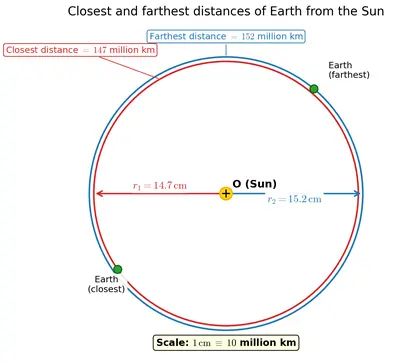
- $$1\,\text{cm} \Longrightarrow 10\,\text{million km}$$
Step 2 : Convert the two radii into real distances
| Radius on paper | Real distance from the Sun |
|---|---|
| $$14.7\,\text{cm}$$ | $$14.7\times10\,\text{million km}=147\,\text{million km}$$ |
| $$15.2\,\text{cm}$$ | $$15.2\times10\,\text{million km}=152\,\text{million km}$$ |
Step 3 : Find the difference between the two distances
$$152\,\text{million km}-147\,\text{million km}=5\,\text{million km}$$
Step 4 : Notice how small the difference is
The average Earth–Sun distance is
$$\frac{147+152}{2}=149.5\,\text{million km}$$
Percentage difference:
$$\frac{5}{149.5}\times100\%\approx3.3\%$$
What to draw
- Mark a point to represent the Sun as the common centre.
- With a compass, draw Circle 1 of radius $$14.7\,\text{cm}$$.
- Without shifting the centre, draw Circle 2 of radius $$15.2\,\text{cm}$$.
The inner circle shows Earth at its closest (perihelion ≈ 147 million km), and the outer circle shows Earth at its farthest (aphelion ≈ 152 million km). The two circles almost overlap, visually demonstrating that Earth’s orbit is only slightly oval.
Answer
3 Suppose the tilt of the Earth's axis of rotation increases. Will it cause more extreme seasons? Find out if the tilt of Uranus is more than the Earth and about the seasons there. Write an interesting article for a newspaper or your school magazine about it.
Solution
Chapter 12 — EARTH, MOON AND THE SUN
Worked Solution | NCERT Class 7 Science
Question. Suppose the tilt of the Earth's axis of rotation increases. Will it cause more extreme seasons? Find out if the tilt of Uranus is more than the Earth and about the seasons there. Write an interesting article for a newspaper or your school magazine about it.
1. Present tilt of the Earth
The Earth’s axis is not upright; it is tilted by about $$23.5^{\circ}$$ with respect to the perpendicular to its orbital plane (the ecliptic).
This tilt is called the axial tilt or obliquity. Because of it, the two hemispheres receive different amounts of sunlight at different times of the year, giving us the four seasons.
2. What if the tilt becomes larger?
Intensity of sunlight on a surface depends on the angle $$\theta$$ between the Sun’s rays and a line perpendicular to the ground. For the same beam of sunlight, the power received per unit area is
$$I = I_{0}\cos \theta$$
where $$I_{0}$$ is the intensity when rays fall straight down. A smaller $$\theta$$ (Sun high in the sky) makes $$\cos\theta$$ larger, so the ground heats up more.
- In summer the hemisphere tilted towards the Sun has a smaller $$\theta$$, so it becomes warm.
- In winter the same hemisphere is tilted away; $$\theta$$ is larger and it becomes cold.
If the tilt increased from $$23.5^{\circ}$$ to, say, $$30^{\circ}$$ or $$40^{\circ}$$, the difference between summer and winter $$\theta$$ values would grow. Therefore
\[\text{Bigger tilt }\Rightarrow\ \text{more extreme seasons (hotter summers, colder winters).}\]
The tropics would extend farther from the equator, and the polar circles would creep closer to it.
3. Uranus — the planet lying on its side
- Measured axial tilt of Uranus: $$97.86^{\circ}\;\text{(≈}98^{\circ}\text{)}$$.
- This is far greater than Earth’s $$23.5^{\circ}$$, in fact the planet is almost rolling around the Sun!
- One Uranian year = 84 Earth years. During about 42 years one pole points almost directly at the Sun and the other pole is in total darkness. After half a revolution the situation reverses.
- Result: the most bizarre seasons in the Solar System – each pole has a 42-year “day” followed by a 42-year “night”. Equatorial regions get sunlight in brief but rapid cycles during the planet’s 17-hour rotation.
4. Newspaper / School-magazine article
HEADLINE : Will Earth One Day Have 6-Month Days? – Lessons from Uranus
Have you ever complained about a sweltering summer afternoon or a freezing winter night? Be thankful you don’t live on Uranus! Scientists report that Earth’s gentle axial tilt of $$23.5^{\circ}$$ is just right for the moderate seasons we know. If our planet leaned over a little more, every June would sizzle and every December would bite.
Think of sunlight as a torch shining on a globe. When you tilt the globe further, the top half soaks up a more concentrated beam while the bottom half is left in the dark. Mathematically the warmth you feel is given by $$I = I_{0}\cos \theta$$. Make the tilt larger and the summer side turns the torch straight on – instant heatwave! Six months later the same place will catch the torch at a very slanted angle – deep-freeze.
Uranus takes this idea to the extreme. Lying almost on its side with a spectacular $$98^{\circ}$$ tilt, it gives each pole a 42-year long day followed by 42 years of night. Any school on Uranus would have two very, very long terms!
Could Earth’s tilt change? Yes – the Moon and the Sun gently wobble it between $$22.1^{\circ}$$ and $$24.5^{\circ}$$ every 41,000 years, but that is mild. A much bigger nudge from a giant asteroid could set Earth on a crazier path. Until then, enjoy the rhythm of four seasons – they could have been a lot wilder.
— Submitted by the Class 7 Science Club
Conclusion
• Increasing the Earth’s tilt would indeed make summers hotter and winters colder.
• Uranus, with an axial tilt of about $$98^{\circ}$$, proves the rule by experiencing the most extreme seasons in the Solar System.
Answer
The greater the axial tilt, the larger the swing in sunlight angle; therefore a bigger tilt would give Earth hotter summers and colder winters. Uranus is tilted by about $$98^{\circ}$$—more than four times Earth’s tilt—so each of its poles faces 42 years of continuous daylight followed by 42 years of darkness: the most extreme seasons in the Solar System.


