 91- 6303239042


Let Us Enhance Our Learning
1 Which of the following are luminous objects?
Mars, Moon, Pole Star, Sun, Venus, Mirror
Solution
Step 1 : Recall the definition of a luminous object
An object that produces and sends out its own light is called a luminous object. If an object can be seen only because it reflects light coming from some other source, it is non-luminous.
Step 2 : Examine each object in the list
- Mars : A planet; it shines because it reflects sunlight. Hence, non-luminous.
- Moon : A natural satellite; it reflects sunlight. Hence, non-luminous.
- Pole Star : A star; stars produce their own light. Hence, luminous.
- Sun : Our nearest star; it generates its own light and heat. Hence, luminous.
- Venus : A planet; its brightness is due to reflected sunlight. Hence, non-luminous.
- Mirror : A highly polished surface; it only reflects light falling on it. Hence, non-luminous.
Step 3 : List the luminous objects
From the analysis above, the only objects that emit their own light are the Pole Star and the Sun.
Answer
Pole Star, Sun
2
| Column A | Column B |
|---|---|
| Pinhole camera | Blocks light completely |
| Opaque object | The dark region formed behind the object |
| Transparent object | Forms an inverted image |
| Shadow | Light passes almost completely through it |
Solution
Step 1 – Recall the meanings of each word
- Pinhole camera: a simple camera made with a tiny hole that lets light from an object fall on a screen.
- Opaque object: an object that does not allow light to pass through it at all.
- Transparent object: an object through which light can pass almost completely; we can clearly see through it.
- Shadow: the dark patch formed on a surface when an opaque object blocks the path of light.
Step 2 – Recall the properties linked with the words in Column B
- Blocks light completely: no light gets through; this is the defining property of an opaque object.
- The dark region formed behind the object: this is exactly the definition of a shadow.
- Forms an inverted image: the image produced is upside-down; a pinhole camera is famous for giving such an image.
- Light passes almost completely through it: describes transparent materials like clear glass or clean water.
Step 3 – Make the correct matches
| Column A | Correct match from Column B |
|---|---|
| Pinhole camera | Forms an inverted image |
| Opaque object | Blocks light completely |
| Transparent object | Light passes almost completely through it |
| Shadow | The dark region formed behind the object |
All four items are now matched, and each pairing is supported by the definitions and properties recalled above.
Answer
Pinhole camera → Forms an inverted image
Opaque object → Blocks light completely
Transparent object → Light passes almost completely through it
Shadow → The dark region formed behind the object
3
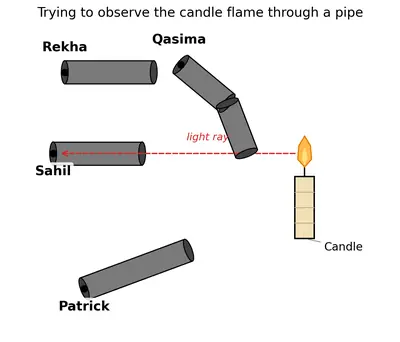
Solution
Step 1 — Recall the principle involved
Light always travels in straight lines through a homogeneous medium. Therefore, we can see an object only when an unbroken straight-line path can be drawn from the object to our eyes.
Step 2 — Apply the principle to the set-up of Fig. 11.16
Each child is holding two identical pieces of a straight, hollow pipe. The eye must receive light coming from the candle flame along the common central axis of both pipe pieces. Hence both pipe pieces must lie exactly one behind the other so that their centres form one straight line with the candle flame.
Step 3 — Examine the four cases shown
- Sahil — the two pipes are slightly tilted with respect to each other, so their centres are not collinear with the flame. No straight-line path exists; the flame is not visible.
- Rekha — the two pipes are perfectly aligned; their centres and the flame all lie on one straight line. Light passes through both pipes and reaches the eye without deviation, so the flame will be seen.
- Patrick — the second pipe is shifted sideways; the centres again fail to line up. The straight-line path is broken and the flame is not visible.
- Qasima — the first pipe is inclined upward with respect to the second. The line of sight is blocked; the flame is not visible.
Step 4 — Conclusion
Only one arrangement (Rekha’s) satisfies the condition of an unobstructed straight-line path for light from the candle to the eye. Therefore, only Rekha can see the candle flame through the pipe.
Answer
Rekha alone can see the candle flame.
4
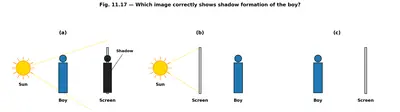
Solution
Step 1 : Recall the three necessary things for a shadow
To observe a shadow we must have –
- an opaque object (the boy),
- a source of light (the candle),
- a screen (the wall/ground on which the shadow is caught).
Step 2 : Test each arrangement in Fig. 11.17
| Image | Order along the straight line | Will the boy's shadow appear on the screen? |
|---|---|---|
| (a) | Screen → Boy → Candle | No. The screen blocks the light first; the boy receives hardly any light, so no shadow of the boy can fall on the screen. |
| (b) | Candle → Boy → Screen | Yes. The candle light first reaches the boy; the boy blocks part of the light, and the remaining light reaches the screen, producing the shadow. |
| (c) | Boy → Candle → Screen | No. Light from the candle does not get blocked by the boy before reaching the screen; hence no shadow of the boy can form. |
Step 3 : Choose the correct image
Only in image (b) is the sequence $$\text{Source} \;\longrightarrow\; \text{Opaque Object} \;\longrightarrow\; \text{Screen}$$ satisfied. Therefore image (b) correctly depicts the formation of the boy's shadow.
Conclusion
The arrangement shown in image (b) is the correct one for producing the boy's shadow.
Answer
Image (b) is correct.
5
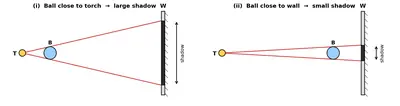
Solution
Known facts
- The torch behaves like (or very nearly like) a point source of light.
- The wall (screen) and the torch remain fixed; only the ball is shifted.
- Light travels in straight lines, so the outlines of a shadow can be analysed with straight-line geometry (similar triangles).
Naming the distances
- Let L be the position of the torch (light).
- Let O be the centre of the ball (object).
- Let W be the wall (screen).
- LO = d is the distance of the ball from the torch.
- LW = D is the distance of the wall from the torch (fixed).
- The diameter of the ball itself is taken as h.
Geometry of the shadow
The edge rays from the torch that just graze the top and bottom of the ball form two similar triangles:
$$\text{(size of ball)}: \text{(size of shadow)} = LO : LW$$ $$\Rightarrow \; \frac{h}{\text{shadow size}} = \frac{d}{D}$$ $$\Rightarrow \; \text{shadow size} = h\;\frac{D}{d}$$
What the formula tells us
- The fraction $$\frac{D}{d}$$ increases when d becomes smaller (ball moved nearer to the torch).
- Hence the shadow becomes larger when the ball is closer to the torch.
- Conversely, when the ball is shifted close to the wall, d increases and the shadow contracts, becoming almost the same size as the ball.
Applying to the two situations
- Situation (i) — ball closer to the torch (small d): the wall receives a large shadow.
- Situation (ii) — ball closer to the wall (large d): the wall receives a smaller, almost true-size shadow.
Selecting the correct option
Among the two drawings provided in the textbook, the correct one must therefore show:
- a big, wide circular shadow for (i), and
- a noticeably smaller circular shadow for (ii).
Only option (b) satisfies this description.
Answer
(b)
6
| Column A | Column B |
|---|---|
| If the torch is close to the ball | The shadow would be smaller |
| If the torch is far away | The shadow would be larger |
| If the ball is removed from the set-up | Two shadows would appear on the screen |
| If two torches are present in the set-up on the left side of the ball | A bright spot would appear on the screen |
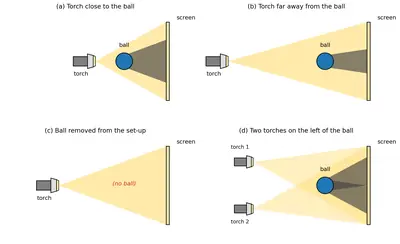
Solution
Concept recalled
- A shadow is formed when an opaque object blocks light coming from a source.
- The size and sharpness of the shadow depend on two distances: (i) distance between the light source (torch) and the object (ball), and (ii) distance between the object and the screen.
- When the light source is brought closer to the object, the diverging rays cover a larger area on the screen, so the umbra (dark part) becomes bigger.
- When the source is moved away from the object, the rays reaching the screen are almost parallel, so the umbra becomes smaller.
- If the object is removed, nothing blocks the light and the screen is fully illuminated → it appears as a bright region.
- With two torches on the same side of the ball, each torch makes its own shadow. Hence two overlapping shadows (two umbra regions) are seen.
Matching step by step
| Column A (situation) | Reasoning | Matched item from Column B |
|---|---|---|
| If the torch is close to the ball | Large divergence of rays → bigger umbra | The shadow would be larger |
| If the torch is far away | Rays almost parallel → smaller umbra | The shadow would be smaller |
| If the ball is removed from the set-up | No obstruction → whole screen lit | A bright spot would appear on the screen |
| If two torches are present on the left side of the ball | Each torch gives a separate shadow | Two shadows would appear on the screen |
Final matching
- (a) Torch close → Shadow larger
- (b) Torch far → Shadow smaller
- (c) Ball removed → Bright spot
- (d) Two torches → Two shadows
Answer
Torch close ➔ larger shadow; Torch far ➔ smaller shadow; Ball removed ➔ bright spot; Two torches ➔ two shadows.
7
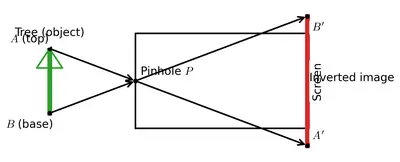
Solution
Step 1 — Recall how a pinhole camera forms an image
A pinhole camera has a tiny hole (the pinhole) and a translucent screen placed opposite to it. Each point on the object sends a cone of light; only the single straight ray that can pass through the pinhole reaches the screen. Thus rays from different points cross at the pinhole and fall on different positions on the screen.
Step 2 — Trace two extreme rays
Label the top-most point of the tree as $$A$$ and the bottom-most point (where the trunk touches the ground) as $$B$$. Let $$O$$ be the pinhole and $$S$$ the screen:
- Ray $$A O$$ goes straight through the pinhole and meets the screen at point $$A'$$.
- Ray $$B O$$ passes through the pinhole and meets the screen at point $$B'$$.
Because the rays cross at $$O$$, the upper point $$A$$ reaches the lower point $$A'$$ on the screen, while the lower point $$B$$ reaches the upper point $$B'$$. Hence the vertical orientation gets reversed (top becomes bottom).
Step 3 — Check the lateral (left–right) orientation
Take a point $$L$$ on the left edge of the crown and a point $$R$$ on the right edge. Rays $$L O$$ and $$R O$$ cross at the pinhole, so $$L$$ falls on the right side of the screen at $$L'$$ and $$R$$ falls on the left at $$R'$$. Thus the image is laterally inverted as well.
Step 4 — Describe the complete image
The image is inverted both vertically and laterally; in other words it is rotated through $$180^{\circ}$$ with respect to the actual tree. It will also be smaller than the object because the screen is usually placed nearer to the pinhole than the tree is.
Step 5 — How to sketch the outline
- Draw a rectangle to represent the translucent screen inside the pinhole camera box.
- On this rectangle sketch the trunk of the tree at the top centre.
- Sketch the broad leafy crown at the bottom of the rectangle.
- If the original tree leans a little to the right, draw the image leaning to the left, and vice-versa.
The resulting picture is an upside-down (and left–right reversed) outline of the original tree.
Answer
The image inside the pinhole camera will be upside down and left–right reversed: draw the trunk at the top of the screen and the leafy crown at the bottom, with the left branches appearing on the right and vice-versa.
8
Solution
Step 1 : Performing the activity
- Take a small sheet of plain white paper.
- With a dark pencil or sketch-pen write your name in normal handwriting, e.g. AMIT.
- Hold the paper so that its written face is parallel and very close to a clean plane mirror.
- Look straight into the mirror and observe the image of the written name.
Step 2 : What do we see?
- Each letter is clearly visible in the mirror.
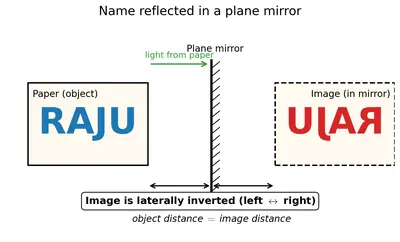
- The sequence of letters is reversed; what was at the left edge of the paper now appears at the right edge of the image and vice-versa.
- Individual letters that are not symmetrical (such as R, K, N) appear turned round as though viewed from the back of the paper.
For example, the object reads
AMIT
while the mirror image is seen as
TIMA
Step 3 : Sketch to be drawn
Draw a vertical line to represent the mirror. In front of this line sketch the sheet showing the word AMIT. Behind the mirror (at the same distance as the sheet) draw the image sheet; write the letters in reverse order (TIMA) so that the first letter A appears farthest to the right in the image. Join one or two corresponding points (for example the left edge of the letter A) to the mirror with straight perpendicular lines to show that object distance and image distance are equal.
Step 4 : Explaining the difference — lateral inversion
The observed reversal is called lateral inversion, i.e. interchange of left and right.
Why does it happen?
- Consider the mirror as the yz-plane. A point on the paper has co-ordinates $$(x, \, y, \, z)$$, where the x-axis is perpendicular to the mirror.
- After reflection the light seems to come from a point behind the mirror at the same perpendicular distance but on the opposite side, i.e. $$(-x,\, y,\, z)$$.
This relation may be written as the key result
[\,(x,\,y,\,z) \longrightarrow (-x,\,y,\,z)\,]Thus:
- Distances perpendicular to the mirror remain the same (so the image is the same size and upright).
- The x-coordinate changes sign; what was on our left (positive x) now appears on the right (negative x) in the image. Top and bottom (the y-direction) are not affected, so they appear unchanged.
This left-right interchange of every point on the object produces the reversed (mirror-written) spelling that we observe.
Step 5 : Laws of reflection involved
The ordinary laws of reflection explain the formation of the image:
- $$\angle i = \angle r$$ (angle of incidence equals angle of reflection).
- The incident ray, reflected ray and the normal all lie in one plane.
- Because these laws hold for every point on the paper, each point and its image are on a line perpendicular to the mirror and equally distant from it, giving the perfect left-right reversal but the same height and orientation.
Conclusion : The image of the name in a plane mirror is laterally inverted because in reflection every point is displaced to the opposite side of the mirror along a perpendicular, changing $$x$$ to $$-x$$ while keeping $$y$$ and $$z$$ unchanged.
Answer
The image of the written name appears laterally inverted: the left and right sides are interchanged while top and bottom remain the same. This happens because each point $$\bigl(x, y, z\bigr)$$ on the paper is reflected to $$\bigl(-x, y, z\bigr)$$ behind the mirror; the change of sign of the perpendicular coordinate produces left–right reversal, a phenomenon called lateral inversion.
9 Measure the length of your shadow at 9 AM, 12 PM, and 4 PM with the help of your friend. Write down your observations:
(i) At which of the given times is your shadow the shortest?
Solution
Ask a friend to hold a measuring tape from the tip of your shoes to the far end of the dark patch formed on the ground (your shadow). Note the three readings:
| Time | Measured shadow-length (example) |
|---|---|
| 9 AM | ≈ 2.8 m |
| 12 PM | ≈ 1.4 m |
| 4 PM | ≈ 2.5 m |
Comparing the three values, the noon (12 PM) reading is the smallest.
Answer
Your shadow is shortest at 12 PM (noon).
(ii) Why do you think this happens?
Solution
The Sun appears to move across the sky from east to west. Its altitude (the angle it makes with the ground) keeps changing:
- At 9 AM the Sun is still fairly low in the eastern sky, so its rays strike the ground at a small angle. A small angle of incidence means the shadow must stretch a long distance to reach the ground, giving a long shadow.
- By 12 PM the Sun is almost overhead. The incident rays now make the largest possible angle (close to 90°) with the ground. When the light hits almost vertically, the obstruction (your body) needs only a short horizontal distance before the ray reaches the ground, so the shadow becomes very short.
- After noon the Sun starts descending toward the west. At 4 PM its altitude is again lower, the rays hit at a shallow angle, and the shadow lengthens once more.
Thus the shadow is shortest at noon because the Sun is highest in the sky and its rays fall almost vertically downward.
Answer
At noon the Sun is nearly overhead, so its rays strike the ground most steeply; the steeper the rays, the shorter the shadow. Before and after noon the Sun is lower, the rays are slanting, and the shadow gets longer.
10
Statement A: Image formed by a plane mirror is laterally inverted.
Statement B: Images of alphabets T and O appear identical to themselves in a plane mirror.
- Both statements are true
- Both statements are false
- Statement A is true, but statement B is false
- Statement A is false, but statement B is true
Solution
Step 1 : Verify Statement A
For any object in front of a plane mirror, the right side of the object appears as the left side of the image and vice-versa. This left–right interchange is called lateral inversion. Hence,
$$\text{Statement A is true.}$$
Step 2 : Verify Statement B
- Alphabet T: A capital T has a vertical line of symmetry exactly down its centre. When the letter is laterally inverted in a plane mirror, every point on the right half goes to the corresponding point on the left half and vice-versa, so the shape remains unchanged. Therefore its mirror image looks exactly like the original T.
- Alphabet O: A capital O is a perfect circle. It is symmetric about every diameter, so its mirror image is always identical to the original O.
Hence,
$$\text{Statement B is also true.}$$
Step 3 : Choose the correct option
Since both statements are correct, the appropriate choice is
Option 1: Both statements are true.
Answer
11
Solution
Step 1 – What is needed for a periscope?
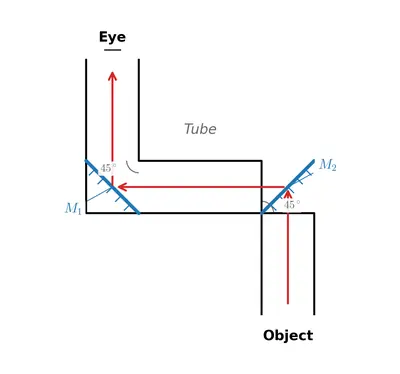
A simple periscope works with two plane mirrors. Each mirror must:
- intercept the incoming ray and send it round a corner, using the law $$i = r$$ (angle of incidence equals angle of reflection);
- be set at $$45^{\circ}$$ to the straight part of the tube so that light is turned through $$90^{\circ}$$ twice.
Step 2 – Look at the shape of the given tube (Fig. 11.20)
The tube first goes straight up, then turns sideways, and finally turns down (overall it is like a flattened letter “Z”). Those two corners are exactly the places where we need to change the direction of light.
Step 3 – Fixing mirror M1
• At the upper bend, place a plane mirror across the full cross-section of the tube.
• Tilt it so that it makes an angle of $$45^{\circ}$$ with the vertical part of the tube; its reflecting surface must face the opening at the top. Incoming light from an object enters the top opening, strikes M1, and is reflected side-ways through $$90^{\circ}$$.
Step 4 – Fixing mirror M2
• At the lower bend, place the second mirror exactly like the first one, again filling the whole cross-section.
• This mirror must also be at $$45^{\circ}$$, but its reflecting surface must face the first mirror so that the sideways ray coming from M1 is reflected downward toward the eye-piece opening.
Step 5 – Parallel reflecting faces
Because both mirrors are at $$45^{\circ}$$ and their reflecting faces are parallel, the final image is not laterally inverted and appears upright to the observer.
Step 6 – Ray diagram to draw
Sketch the given Z-shaped tube. Mark the two bends. Draw mirror M1 at the upper bend and mirror M2 at the lower bend, each shown as a small rectangle crossing the tube at $$45^{\circ}$$. Draw a ray entering the top opening, reflecting from M1, travelling horizontally, reflecting from M2, and finally coming out through the bottom opening to the eye.
Hence, the tube can indeed be converted into a periscope by mounting the two mirrors at the two bends as described.
Answer
Yes. Fix one mirror at the upper bend and the other at the lower bend of the tube so that each mirror lies across the whole cross-section at $$45^{\circ}$$ to the adjoining arm of the tube. The reflecting faces must face one another and remain parallel; this arrangement turns the light twice through $$90^{\circ}$$ and the tube works as a periscope.
12 We do not see the shadow on the ground of a bird flying high in the sky. However, the shadow is seen on the ground when the bird swoops near the ground. Think and explain why it is so.
Solution
Key ideas needed
- Light travels in straight lines, and an opaque object casts a shadow only where its dark region actually reaches a screen (here, the ground).
- The Sun is huge but very far away, so it acts as an extended source of light, not a point source.
- The shadow of any object in sunlight has two parts:
- Umbra – the region where light from no part of the Sun reaches; it is completely dark.
- Penumbra – the region where light from some (but not all) of the Sun reaches; it is only partially dark and looks very faint.
Step 1 – Picture the shadow of the bird
Draw rays from the two opposite edges of the Sun’s disc that just graze the bird’s body. Behind the bird these rays cross over to form a narrow cone. Inside the cone is the umbra (fully dark); outside it, but still partially blocked, is the penumbra.
(Sketch: Sun at the top, bird below it, two grazing rays tangent to the bird crossing behind it to form a narrow umbral cone that tapers to a point; ground at the bottom.)
Step 2 – How long is the bird’s umbra?
The Sun’s angular diameter in our sky is about $$0.53^\circ$$, so its angular radius is
\[ \alpha \;\approx\; 0.265^\circ \;=\; 0.0046\ \text{rad}. \]By simple geometry, the length $$L$$ of the umbral cone behind a small object of size $$d$$ is approximately
\[ L \;\approx\; \frac{d}{\alpha}. \]Taking a bird about $$d \approx 0.2\ \text{m}$$ across,
\[ L \;\approx\; \frac{0.2}{0.0046} \;\approx\; 43\ \text{m}. \]So the bird’s umbral cone is only a few tens of metres long – certainly nothing like the hundreds of metres at which a bird usually flies.
Step 3 – Why we do not see a shadow when the bird is high
- If the bird’s height $$h$$ is much greater than $$L$$ (about $$40$$–$$50\ \text{m}$$), the umbral cone tapers to a point in mid-air before it can reach the ground.
- Only the very faint penumbra reaches the ground, and it is spread over such a large area that it is far too dim for our eyes to notice.
Step 4 – Why we do see a shadow when the bird swoops low
- When the bird flies low enough that $$h < L$$, the umbra actually reaches the ground.
- A small, distinct dark patch (the umbra) now appears on the ground, surrounded by a thin lighter region (the penumbra), and we clearly see it as the bird’s shadow.
Conclusion
Because the Sun is an extended source, the bird’s umbra is only a few tens of metres long. When the bird is high in the sky, the umbra ends in the air, so only an extremely faint penumbra falls on the ground and no shadow is seen. When the bird swoops near the ground, the umbra finally touches the ground and a clear dark shadow becomes visible.
Answer
The Sun is an extended source, so the bird’s umbra is a narrow cone of length $$L \approx d/\alpha \approx 0.2/0.0046 \approx 43\ \text{m}$$ – only a few tens of metres. When the bird is high in the sky (well above this length), the umbra tapers to a point before reaching the ground; only a very faint penumbra falls on the ground and no shadow is noticed. When the bird swoops near the ground, the umbra is able to reach the ground and we clearly see a dark shadow.


