 91- 6303239042


Examples 1–2
Example 1 A farmer had 5 grandchildren. She distributed $$\frac{2}{3}$$ acre of land to each of her grandchildren. How much land in all did she give to her grandchildren?
Solution
Given data
- Number of grandchildren $$=5$$
- Land given to each grandchild $$=\frac{2}{3}$$ acre
Step 1 · Write the repeated addition
The farmer gives $$\frac{2}{3}$$ acre five times:
$$\frac{2}{3}+\frac{2}{3}+\frac{2}{3}+\frac{2}{3}+\frac{2}{3}$$
Step 2 · Convert repeated addition to multiplication
Adding the same fraction repeatedly is the same as multiplying that fraction by the count:
$$5\times\frac{2}{3}$$
Step 3 · Multiply the whole number and the fraction
When a whole number multiplies a fraction, we multiply the numerators and keep the denominator the same:
$$5\times\frac{2}{3}=\frac{5\times2}{3}=\frac{10}{3}\text{ acre}$$
Step 4 · Write the answer as a mixed number
Divide the numerator by the denominator:
- $$10\div3=3$$ (quotient)
- Remainder $$=10-3\times3=1$$
So
$$\frac{10}{3}=3\,\frac{1}{3}$$
Conclusion
The farmer distributed
\[3\,\frac{1}{3}\text{ acres of land}\]to her five grandchildren in all.
Answer
Total land distributed $$=3\,\frac13$$ acres.
Example 2 1 hour of internet time costs ₹8. How much will $$1\frac{1}{4}$$ hours of internet time cost?
Solution
Given: 1 hour of internet time costs ₹8.
We need the cost of $$1\frac{1}{4}$$ hours.
- Convert the mixed fraction to an improper fraction.
$$1\frac{1}{4} = 1 + \frac{1}{4}$$
$$= \frac{4}{4} + \frac{1}{4} = \frac{5}{4}$$ - Set up the multiplication for the cost.
1 hour → ₹8 so $$\frac{5}{4}$$ hours will cost $$8 \times \frac{5}{4}$$ - Write 8 as a fraction and multiply.
$$8 = \frac{8}{1}$$, therefore
$$\text{Cost} = \frac{8}{1} \times \frac{5}{4}$$ - Multiply numerators and denominators.
$$\text{Cost} = \frac{8 \times 5}{1 \times 4} = \frac{40}{4}$$ - Simplify.
$$\frac{40}{4} = 10$$
Answer
₹10
Figure it Out (Page 176)
1 Tenzin drinks $$\frac{1}{2}$$ glass of milk every day. How many glasses of milk does he drink in a week? How many glasses of milk did he drink in the month of January?
Solution
Given: Tenzin drinks $$\frac{1}{2}$$ glass of milk every day.
Part A — Milk consumed in one week
- A week has $$7$$ days.
- Milk per day × number of days gives milk per week:
$$\frac{1}{2}\times7$$ - Multiply the numerator by the whole number (denominator remains the same):
$$\frac{1\times7}{2}=\frac{7}{2}$$ - Convert the improper fraction $$\frac{7}{2}$$ to a mixed fraction:
Divide $$7$$ by $$2$$: quotient $$=3$$, remainder $$=1$$.
So $$\frac{7}{2}=3\frac{1}{2}$$.
Therefore, in one week Tenzin drinks
\[3\frac{1}{2}\text{ glasses of milk}\]Part B — Milk consumed in the month of January
- January has $$31$$ days.
- Milk per day × number of days gives milk for January:
$$\frac{1}{2}\times31$$ - Multiply the numerator by the whole number:
$$\frac{1\times31}{2}=\frac{31}{2}$$ - Convert $$\frac{31}{2}$$ to a mixed fraction:
Divide $$31$$ by $$2$$: quotient $$=15$$, remainder $$=1$$.
So $$\frac{31}{2}=15\frac{1}{2}$$.
Hence, in January Tenzin drinks
\[15\frac{1}{2}\text{ glasses of milk}\]Answer
In one week = $$3\frac{1}{2}$$ glasses; in January = $$15\frac{1}{2}$$ glasses.
2 A team of workers can make 1 km of a water canal in 8 days. So, in one day, the team can make ___ km of the water canal. If they work 5 days a week, they can make ___ km of the water canal in a week.
Solution
The work rate of the team can be found from the information “1 km in 8 days”.
Step 1 — Canal length made in one day
The fraction of 1 km that can be built in a single day is $$\dfrac{1\;\text{km}}{8\;\text{days}} = \dfrac{1}{8}\;\text{km}.$$
So, in one day the team can make one-eighth kilometre.
Step 2 — Canal length made in one week (5 working days)
In a week they work 5 days, and each day they produce $$\dfrac{1}{8}\;\text{km}$$. Therefore, $$5 \times \dfrac{1}{8}\;\text{km} = \dfrac{5}{8}\;\text{km}.$$
Hence, in one working week the team can make five-eighths kilometre.
Completed blanks
- Canal made in one day: $$\dfrac{1}{8}\;\text{km}$$
- Canal made in one 5-day week: $$\dfrac{5}{8}\;\text{km}$$
Answer
$$\dfrac{1}{8}\;\text{km},\;\dfrac{5}{8}\;\text{km}$$
3 Manju and two of her neighbours buy 5 litres of oil every week and share it equally among the 3 families. How much oil does each family get in a week? How much oil will one family get in 4 weeks?
Solution
Step 1 · Identify the known quantities
- Total oil bought by the three families each week = $$5\text{ litres}$$
- Number of families sharing the oil = $$3$$
Step 2 · Oil received by one family in one week
The oil is divided equally, so we divide the total quantity by the number of families:
$$\text{Oil per family per week}=\dfrac{5}{3}\text{ litres}$$
Convert the improper fraction to a mixed number:
$$\dfrac{5}{3}=1\dfrac{2}{3}\text{ litres}$$
Thus, each family receives $$1\dfrac{2}{3}\text{ L}$$ of oil every week.
Step 3 · Oil received by one family in four weeks
In one week a family gets $$\dfrac{5}{3}\text{ L}$$. In four weeks the quantity will be four times as much:
$$\text{Oil in 4 weeks}=4\times\dfrac{5}{3}=\dfrac{20}{3}\text{ litres}$$
Convert again to a mixed number:
$$\dfrac{20}{3}=6\dfrac{2}{3}\text{ litres}$$
Conclusion
• Each family receives $$1\dfrac{2}{3}\text{ litres}$$ of oil per week.
• In four weeks, one family receives $$6\dfrac{2}{3}\text{ litres}$$ of oil.
Answer
Per week: $$\dfrac{5}{3}\text{ L}=1\dfrac{2}{3}\text{ L}$$
In 4 weeks: $$\dfrac{20}{3}\text{ L}=6\dfrac{2}{3}\text{ L}$$
4 Safia saw the Moon setting on Monday at 10 pm. Her mother, who is a scientist, told her that every day the Moon sets $$\frac{5}{6}$$ hour later than the previous day. How many hours after 10 pm will the moon set on Thursday?
Solution
Step 1 – Daily change
The Moon sets $$\frac{5}{6}$$ hour later each day.
Step 2 – Number of daily intervals from Monday to Thursday
- Monday → Tuesday: 1 interval
- Tuesday → Wednesday: 1 interval
- Wednesday → Thursday: 1 interval
Total intervals = 1 + 1 + 1 = 3.
Step 3 – Total delay
$$3 \times \frac{5}{6}\text{ hour} = \frac{3 \times 5}{6} = \frac{15}{6}\text{ hour}$$
Step 4 – Simplify
$$\frac{15}{6} = \frac{15 \div 3}{6 \div 3} = \frac{5}{2}\text{ hour} = 2\frac{1}{2}\text{ hours}$$
Step 5 – Conclusion
The Moon will set 2 hours 30 minutes after 10 pm on Thursday (i.e. at 12:30 am early Friday).
Answer
$$2\dfrac{1}{2}$$ hours ( = 2 h 30 min)
5 Multiply and then convert it into a mixed fraction:
(a) $$7 \times \frac{3}{5}$$
Solution
Step 1 Write the whole number as a fraction with denominator 1.
$$7 = \frac{7}{1}$$
Step 2 Multiply the two fractions (numerator × numerator and denominator × denominator).
$$\frac{7}{1} \times \frac{3}{5} = \frac{7 \times 3}{1 \times 5} = \frac{21}{5}$$
Step 3 Convert the improper fraction to a mixed fraction.
Divide 21 by 5.
Quotient = 4, Remainder = 1.
Hence $$\frac{21}{5}=4\frac{1}{5}$$.
Answer
$$4\dfrac{1}{5}$$
(b) $$4 \times \frac{1}{3}$$
Solution
Step 1 Write the whole number 4 as a fraction.
$$4 = \frac{4}{1}$$
Step 2 Multiply the fractions.
$$\frac{4}{1} \times \frac{1}{3} = \frac{4 \times 1}{1 \times 3} = \frac{4}{3}$$
Step 3 Convert to a mixed fraction.
Divide 4 by 3.
Quotient = 1, Remainder = 1.
Therefore $$\frac{4}{3}=1\frac{1}{3}$$.
Answer
$$1\dfrac{1}{3}$$
(c) $$\frac{9}{7} \times 6$$
Solution
Step 1 Write the whole number 6 as a fraction.
$$6 = \frac{6}{1}$$
Step 2 Multiply the fractions.
$$\frac{9}{7} \times \frac{6}{1} = \frac{9 \times 6}{7 \times 1} = \frac{54}{7}$$
Step 3 Convert to a mixed fraction.
Divide 54 by 7.
Quotient = 7, Remainder = 5.
Thus $$\frac{54}{7}=7\frac{5}{7}$$.
Answer
$$7\dfrac{5}{7}$$
(d) $$\frac{13}{11} \times 6$$
Solution
Step 1 Express 6 as a fraction.
$$6 = \frac{6}{1}$$
Step 2 Multiply the fractions.
$$\frac{13}{11} \times \frac{6}{1} = \frac{13 \times 6}{11 \times 1} = \frac{78}{11}$$
Step 3 Convert to a mixed fraction.
Divide 78 by 11.
Quotient = 7, Remainder = 1.
Hence $$\frac{78}{11}=7\frac{1}{11}$$.
Answer
$$7\dfrac{1}{11}$$
Figure it Out (Page 180–181)
1 Find the following products. Use a unit square as a whole for representing the fractions. Now, find $$\frac{1}{12} \times \frac{1}{18}$$.
(a) $$\frac{1}{3} \times \frac{1}{5}$$
Solution
Part 1 — Compute $$\frac{1}{3}\times\frac{1}{5}$$ using a unit square.
Think of one whole as a unit square.
- First divide the square into 3 equal vertical strips and shade 1 strip. This shaded part represents $$\frac{1}{3}$$ of the whole.
- Next divide the same square into 5 equal horizontal strips and, with a different colour, shade 1 of these horizontal strips. This second shading shows $$\frac{1}{5}$$ of the whole.
- The tiny rectangles that now carry both colours form the overlap region. They represent $$\frac{1}{3}\times\frac{1}{5}$$ of the whole square.
- Because the square is cut into $$3\times5=15$$ equal tiny rectangles, exactly 1 of them is doubly shaded. Therefore the overlapping area is $$\frac{1}{15}$$ of the square.
Algebraically we get the same value:
$$\frac{1}{3}\times\frac{1}{5}=\frac{1\times1}{3\times5}=\frac{1}{15}$$
Hence
\[\frac{1}{3}\times\frac{1}{5}=\frac{1}{15}\]Part 2 — Now compute $$\frac{1}{12}\times\frac{1}{18}$$ (the extra product the question asks for).
The same rule applies: multiply the numerators together and the denominators together.
$$\frac{1}{12}\times\frac{1}{18}=\frac{1\times1}{12\times18}=\frac{1}{216}$$
Picture check: if we cut the unit square into 12 equal vertical strips and 18 equal horizontal strips, we obtain $$12\times18=216$$ identical tiny rectangles. The overlap of one vertical strip with one horizontal strip is exactly one of these rectangles, i.e. $$\frac{1}{216}$$ of the whole.
\[\frac{1}{12}\times\frac{1}{18}=\frac{1}{216}\]Answer
$$\dfrac{1}{3}\times\dfrac{1}{5}=\dfrac{1}{15}$$ and $$\dfrac{1}{12}\times\dfrac{1}{18}=\dfrac{1}{216}$$.
(b) $$\frac{1}{4} \times \frac{1}{3}$$
Solution
Part 1 — Compute $$\frac{1}{4}\times\frac{1}{3}$$ using a unit square.
- Divide a unit square into 4 equal vertical strips and shade 1 strip → $$\frac{1}{4}$$.
- Now divide the same square into 3 equal horizontal strips and shade 1 of those → $$\frac{1}{3}$$.
- The overlapping region is made of $$4\times3=12$$ tiny rectangles; 1 of them is doubly shaded. So the overlap equals $$\frac{1}{12}$$ of the whole.
By the multiplication rule:
$$\frac{1}{4}\times\frac{1}{3}=\frac{1\times1}{4\times3}=\frac{1}{12}$$
\[\frac{1}{4}\times\frac{1}{3}=\frac{1}{12}\]Part 2 — Now compute $$\frac{1}{12}\times\frac{1}{18}$$ (the additional product asked at the end of the question).
Multiply numerators together and denominators together:
$$\frac{1}{12}\times\frac{1}{18}=\frac{1\times1}{12\times18}=\frac{1}{216}$$
Picture check: dividing a unit square into 12 vertical strips and 18 horizontal strips produces $$12\times18=216$$ identical tiny rectangles. The overlap of one vertical strip and one horizontal strip is just one of these rectangles, i.e. $$\frac{1}{216}$$ of the whole square.
\[\frac{1}{12}\times\frac{1}{18}=\frac{1}{216}\]Answer
$$\dfrac{1}{4}\times\dfrac{1}{3}=\dfrac{1}{12}$$ and $$\dfrac{1}{12}\times\dfrac{1}{18}=\dfrac{1}{216}$$.
(c) $$\frac{1}{5} \times \frac{1}{2}$$
Solution
Represent the whole by a square.
- Cut it into 5 equal vertical parts and shade 1 → $$\frac{1}{5}$$.
- Cut the same square into 2 equal horizontal parts and shade 1 → $$\frac{1}{2}$$.
- The square is now split into $$5\times2=10$$ tiny rectangles; 1 of them is doubly shaded, giving $$\frac{1}{10}$$ of the whole.
Algebraic check:
$$\frac{1}{5}\times\frac{1}{2}=\frac{1\times1}{5\times2}=\frac{1}{10}$$
\[\frac{1}{10}\]Answer
(d) $$\frac{1}{6} \times \frac{1}{5}$$
Solution
Take a unit square.
- Split it into 6 equal vertical strips and shade 1 → $$\frac{1}{6}$$.
- Split the same square into 5 equal horizontal strips and shade 1 → $$\frac{1}{5}$$.
- There are $$6\times5=30$$ tiny rectangles in all; 1 of them is doubly shaded, i.e. $$\frac{1}{30}$$ of the whole.
Computed directly:
$$\frac{1}{6}\times\frac{1}{5}=\frac{1\times1}{6\times5}=\frac{1}{30}$$
\[\frac{1}{30}\]Answer
2 Find the following products. Use a unit square as a whole for representing the fractions and carrying out the operations.
(a) $$\frac{2}{3} \times \frac{4}{5}$$
Solution
Step 1 — Represent each fraction on one side of a unit square.
Draw a square and call the whole square 1 unit.
• First divide it vertically into 3 equal strips; shade 2 of those 3. The shaded part now shows $$\tfrac{2}{3}$$ of the square.
• Next divide the same square horizontally into 5 equal parts; mark 4 of the 5 horizontal parts along one side. Moving these lines right across the square cuts every vertical strip into 5 small rectangles, so the square is now partitioned into $$3\times5=15$$ equal small rectangles.
Step 2 — Identify the region common to both fractions.
The region that lies in the 2 shaded vertical strips and also in the 4 selected horizontal rows is the overlap. Count those overlapping rectangles:
$$2\;(\text{columns}) \times 4\;(\text{rows}) = 8$$ rectangles are common.
Step 3 — Form the product as a fraction of the whole.
Total tiny rectangles in the unit square = 15.
Overlapping (double–shaded) rectangles = 8.
Therefore
$$\frac{2}{3} \times \frac{4}{5} = \frac{8}{15}.$$
There is no common factor between 8 and 15, so the fraction is already in lowest terms.
Answer
(b) $$\frac{1}{4} \times \frac{2}{3}$$
Solution
Visual model.
Draw a unit square.
• Divide it vertically into 4 equal parts; shade 1 of them to show $$\tfrac{1}{4}$$.
• Now divide the same square horizontally into 3 equal strips and mark 2 of the 3 rows. The square is now cut into $$4\times3=12$$ identical small rectangles.
The overlapping (double–shaded) region lies in 1 vertical strip and 2 horizontal rows:
$$1\times2 = 2$$ rectangles are common out of 12.
Hence
$$\frac{1}{4}\times\frac{2}{3}=\frac{2}{12}=\frac{1}{6}\;\;(\text{dividing numerator and denominator by }2).$$
Answer
(c) $$\frac{3}{5} \times \frac{1}{2}$$
Solution
Unit-square illustration.
• Split the square vertically into 5 equal parts; shade 3 of them to show $$\tfrac{3}{5}$$.
• Now split the square horizontally into 2 equal rows; keep 1 of these rows. Altogether we get $$5\times2=10$$ small rectangles.
The intersection of the 3 shaded columns and the single chosen row contains
$$3\times1 = 3$$ rectangles out of 10.
Therefore
$$\frac{3}{5}\times\frac{1}{2}=\frac{3}{10}.$$
No further simplification is possible.
Answer
(d) $$\frac{4}{6} \times \frac{3}{5}$$
Solution
Step 1 — Fraction model inside a square.
• Divide the square vertically into 6 equal parts; shade 4 parts for $$\tfrac{4}{6}$$.
• Divide it horizontally into 5 equal strips; mark 3 rows for $$\tfrac{3}{5}$$. The whole square is now cut into $$6\times5=30$$ equal rectangles.
Step 2 — Count the overlap.
Common rectangles = $$4\times3 = 12$$ out of 30.
Step 3 — Write and simplify the product.
$$\frac{4}{6}\times\frac{3}{5}=\frac{12}{30}.$$ Both numbers are divisible by 6:
$$\frac{12\div6}{30\div6}=\frac{2}{5}.$$
Answer
Figure it Out (Page 183–184)
1 A water tank is filled from a tap. If the tap is open for 1 hour, $$\frac{7}{10}$$ of the tank gets filled. How much of the tank is filled if the tap is open for
(a) $$\frac{1}{3}$$ hour ____________
Solution
The tap fills $$\frac{7}{10}$$ of the tank in 1 hour.
Fraction of tank filled in 1 hour = $$\frac{7}{10}$$.
Time given = $$\frac{1}{3}$$ hour.
Fraction filled = $$\left(\frac{1}{3}\right)\times\left(\frac{7}{10}\right)$$
= $$\frac{1\times7}{3\times10}=\frac{7}{30}$$.
Answer
$$\frac{7}{30}$$ of the tank
(b) $$\frac{2}{3}$$ hour ____________
Solution
Fraction filled in 1 hour = $$\frac{7}{10}$$.
Time given = $$\frac{2}{3}$$ hour.
Fraction filled = $$\left(\frac{2}{3}\right)\times\left(\frac{7}{10}\right)$$
= $$\frac{2\times7}{3\times10}=\frac{14}{30}=\frac{7}{15}$$.
Answer
$$\frac{7}{15}$$ of the tank
(c) $$\frac{3}{4}$$ hour ____________
Solution
Fraction filled in 1 hour = $$\frac{7}{10}$$.
Time given = $$\frac{3}{4}$$ hour.
Fraction filled = $$\left(\frac{3}{4}\right)\times\left(\frac{7}{10}\right)$$
= $$\frac{3\times7}{4\times10}=\frac{21}{40}$$.
Answer
$$\frac{21}{40}$$ of the tank
(d) $$\frac{7}{10}$$ hour ____________
Solution
Fraction filled in 1 hour = $$\frac{7}{10}$$.
Time given = $$\frac{7}{10}$$ hour.
Fraction filled = $$\left(\frac{7}{10}\right)\times\left(\frac{7}{10}\right)$$
= $$\frac{49}{100}$$.
Answer
$$\frac{49}{100}$$ of the tank
(e) For the tank to be full, how long should the tap be running?
Solution
Let the required time be $$t$$ hours.
Fraction filled in 1 hour = $$\frac{7}{10}$$.
In $$t$$ hours, fraction filled = $$t\times\frac{7}{10}$$.
For the tank to be full, this fraction must be 1.
So, $$t\times\frac{7}{10}=1$$.
Solving for $$t$$:
$$t=1\div\frac{7}{10}=1\times\frac{10}{7}=\frac{10}{7}\text{ hours}$$.
Thus, the tap must run for $$\frac{10}{7}=1\,\frac{3}{7}$$ hours.
(This is about 1 hour 25 minutes 43 seconds.)
Answer
The tap must run for $$\frac{10}{7}\text{ hours}=1\,\frac{3}{7}\text{ hours}$$
2
The government has taken $$\frac{1}{6}$$ of Somu's land to build a road. What part of the land remains with Somu now? She gives half of the remaining part of the land to her daughter Krishna and $$\frac{1}{3}$$ of it to her son Bora. After giving them their shares, she keeps the remaining land for herself.
(a) What part of the original land did Krishna get?
Solution
Let the whole land be represented by $$1$$.
Land taken by the government = $$\frac{1}{6}$$.
Land left with Somu $$= 1-\frac{1}{6}=\frac{6}{6}-\frac{1}{6}=\frac{5}{6}$$.
Krishna receives half of this leftover land.
Part received by Krishna $$=\frac{1}{2}\times\frac{5}{6}$$.
Multiply the numerators and the denominators:
$$\frac{1}{2}\times\frac{5}{6}=\frac{1\times5}{2\times6}=\frac{5}{12}$$.
Therefore, Krishna got $$\frac{5}{12}$$ of the original land.
Answer
(b) What part of the original land did Bora get?
Solution
Land left after the government’s share $$=\frac{5}{6}$$ (already found in part (a)).
Bora receives one–third of this leftover land.
Part received by Bora $$=\frac{1}{3}\times\frac{5}{6}$$.
$$\frac{1}{3}\times\frac{5}{6}=\frac{1\times5}{3\times6}=\frac{5}{18}$$.
Hence, Bora got $$\frac{5}{18}$$ of the original land.
Answer
(c) What part of the original land did Somu keep for herself?
Solution
Total land left with Somu before distributing to her children $$=\frac{5}{6}$$.
Shares already given:
- Krishna: $$\frac{5}{12}$$ (from part (a))
- Bora: $$\frac{5}{18}$$ (from part (b))
Add the children’s shares:
LCM of 12 and 18 is 36.
$$\frac{5}{12}=\frac{5\times3}{12\times3}=\frac{15}{36},\qquad \frac{5}{18}=\frac{5\times2}{18\times2}=\frac{10}{36}$$
Sum $$=\frac{15}{36}+\frac{10}{36}=\frac{25}{36}$$.
Convert $$\frac{5}{6}$$ to denominator 36:
$$\frac{5}{6}=\frac{5\times6}{6\times6}=\frac{30}{36}$$.
Land Somu keeps $$=\frac{30}{36}-\frac{25}{36}=\frac{5}{36}$$.
Thus, Somu kept $$\frac{5}{36}$$ of the original land for herself.
Answer
3 Find the area of a rectangle of sides $$3\frac{3}{4}$$ ft and $$9\frac{3}{5}$$ ft.
Solution
Step 1: Write the measures in fractional form.
The two sides of the rectangle are given as mixed numbers:
Side 1 = $$3\frac{3}{4}$$ ft Side 2 = $$9\frac{3}{5}$$ ft
Step 2: Convert each mixed number to an improper fraction.
- For $$3\frac{3}{4}$$: multiply the whole part 3 by the denominator 4, then add the numerator 3.
$$3\frac{3}{4}=\frac{3\times4+3}{4}=\frac{12+3}{4}=\frac{15}{4}$$ - For $$9\frac{3}{5}$$: multiply the whole part 9 by the denominator 5, then add the numerator 3.
$$9\frac{3}{5}=\frac{9\times5+3}{5}=\frac{45+3}{5}=\frac{48}{5}$$
Step 3: Apply the area formula for a rectangle.
$$\text{Area}=\text{length}\times\text{breadth}=\frac{15}{4}\times\frac{48}{5}\;\text{sq ft}$$
Step 4: Simplify before multiplying.
Look for common factors between any numerator and any denominator.
Cancel the factor 5 shared by the numerator 15 (since $$15=5\times3$$) and the denominator 5:
$$\frac{15}{4}\times\frac{48}{5}=\frac{15\div5}{4}\times\frac{48}{5\div5}=\frac{3}{4}\times\frac{48}{1}$$
Cancel the factor 4 shared by the denominator 4 and the numerator 48 (since $$48=4\times12$$):
$$\frac{3}{4}\times\frac{48}{1}=\frac{3}{4\div4}\times\frac{48\div4}{1}=\frac{3}{1}\times\frac{12}{1}$$
Step 5: Multiply the simplified numerators and denominators.
$$\frac{3}{1}\times\frac{12}{1}=\frac{3\times12}{1\times1}=\frac{36}{1}=36$$
Step 6: Attach the correct unit.
The area of the rectangle is therefore
\[36\;\text{square feet.}\]Answer
Area = $$36\;\text{square feet}$$.
4
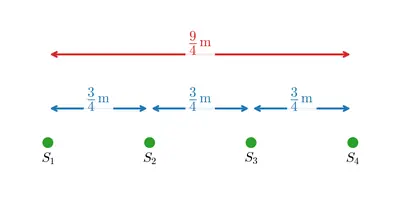
Solution
Step 1 : Understand the situation
Tsewang has four saplings in a straight row. Between any two consecutive saplings the gap is $$\tfrac{3}{4}\ \text{m}$$.
Step 2 : Count the gaps
If we label the saplings S1, S2, S3, S4, then the gaps are
- gap 1 : S1–S2
- gap 2 : S2–S3
- gap 3 : S3–S4
Thus, number of equal gaps from the first to the last sapling:
$$\text{number of gaps} = 4 - 1 = 3$$
Step 3 : Total distance
Each gap measures $$\tfrac{3}{4}\ \text{m}$$, so
$$\text{total distance}=3 \times \tfrac{3}{4}\,\text{m}$$
Write 3 as a fraction and multiply:
$$3 = \tfrac{3}{1},\qquad \tfrac{3}{1}\times\tfrac{3}{4}=\tfrac{9}{4}\,\text{m}$$
Step 4 : Convert to mixed number
Divide 9 by 4:
$$9 = 8 + 1 = 2\times4 +1\;\Rightarrow\;\tfrac{9}{4}=2\tfrac{1}{4}$$
Distance between the first and the last sapling
\[2\tfrac{1}{4}\ \text{metres}\]Diagram suggestion (for the student to draw): Draw four dots in a line, label them S1 to S4. Mark each adjoining segment as $$\tfrac{3}{4}\,\text{m}$$. The three equal segments together show the required distance.
Answer
Distance between the first and last sapling = $$2\tfrac{1}{4}\text{ m}$$.
5 Which is heavier: $$\frac{12}{15}$$ of 500 grams or $$\frac{3}{20}$$ of 4 kg?
Solution
Step 1 — Write the two quantities that have to be compared.
- Quantity A: $$\frac{12}{15}$$ of 500 g
- Quantity B: $$\frac{3}{20}$$ of 4 kg
Step 2 — Calculate Quantity A.
First simplify the fraction $$\frac{12}{15}$$:
$$\frac{12}{15}=\frac{12\div3}{15\div3}=\frac{4}{5}.$$
Now find $$\frac{4}{5}$$ of 500 g:
$$\frac{4}{5}\times500=500\times\frac{4}{5}=100\times4=400.$$
So Quantity A = 400 g.
Step 3 — Convert 4 kg into grams for Quantity B.
1 kg = 1000 g, therefore
$$4\,\text{kg}=4\times1000=4000\,\text{g}.$$
Step 4 — Calculate Quantity B.
Find $$\frac{3}{20}$$ of 4000 g:
$$\frac{3}{20}\times4000=4000\times\frac{3}{20}=\frac{4000}{20}\times3=200\times3=600.$$
So Quantity B = 600 g.
Step 5 — Compare the two masses.
Quantity A = 400 g
Quantity B = 600 g
Clearly, $$600\,\text{g} > 400\,\text{g}$$.
Conclusion
$$\frac{3}{20}\text{ of }4\,\text{kg}$$ is heavier than $$\frac{12}{15}\text{ of }500\,\text{g}$$.
Answer
The heavier quantity is $$\displaystyle \frac{3}{20}\text{ of }4\,\text{kg}=600\,\text{g}$$.
Examples 3–5
Example 3 Leena made 5 cups of tea. She used $$\frac{1}{4}$$ litre of milk for this. How much milk is there in each cup of tea?
Solution
Given: Leena prepares 5 cups of tea with a total of $$\frac{1}{4}$$ litre of milk.
We have to find the milk used per cup.
Step 1 · Identify the operation
"Milk per cup" means we must divide the total milk by the number of cups.
So we need to calculate
$$\text{Milk per cup}=\frac{\tfrac{1}{4}\;\text{litre}}{5}$$
Step 2 · Write the division of a fraction by a whole number
Dividing by 5 is the same as multiplying by its reciprocal $$\frac{1}{5}$$:
$$\frac{\tfrac{1}{4}}{5}=\frac{1}{4}\times\frac{1}{5}$$
Step 3 · Multiply the two fractions
Multiply numerators and denominators separately:
$$\frac{1\times1}{4\times5}=\frac{1}{20}$$
Step 4 · State the result clearly
\[\frac{1}{20}\;\text{litre}\]
If you wish to convert it into millilitres (since $$1$$ litre = $$1000$$ mL):
$$\frac{1}{20}\times1000\,\text{mL}=50\,\text{mL}$$
Therefore, each cup of tea contains $$\frac{1}{20}$$ litre (that is, 50 mL) of milk.
Answer
Each cup has $$\frac{1}{20}$$ litre = 50 mL of milk.
Example 4
Some of the oldest examples of working with non-unit fractions occur in humanity's oldest geometry texts, the Śhulbasūtra. Here is an example from Baudhāyana's Śhulbasūtra (c. 800 BCE).
Cover an area of $$7\frac{1}{2}$$ square units with square bricks each of whose sides is $$\frac{1}{5}$$ units. How many such square bricks are needed?
Solution
Step 1 : Convert the mixed fraction for the total area.
$$7\frac{1}{2}=7+\frac{1}{2}=\frac{14}{2}+\frac{1}{2}=\frac{15}{2}$$
Step 2 : Find the area of one square brick.
Side of one brick = $$\frac{1}{5}$$ unit
Area of one brick = $$\bigl(\tfrac{1}{5}\bigr)^2 = \frac{1}{5}\times\frac{1}{5}=\frac{1}{25}$$ square unit
Step 3 : Calculate how many such bricks are required.
Number of bricks = $$\frac{\text{Total area}}{\text{Area of one brick}}=\frac{\tfrac{15}{2}}{\tfrac{1}{25}}$$
Dividing by a fraction is the same as multiplying by its reciprocal:
$$\frac{15}{2}\times\frac{25}{1}=\frac{15\times25}{2}=\frac{375}{2}=187\tfrac{1}{2}$$
Step 4 : A fraction of a brick cannot practically be used, so we must round up to the next whole brick.
Hence, the required number of square bricks is 188.
Answer
188 square bricks
Example 5
This problem was posed by Chaturveda Pṛthūdakasvāmī (c. 860 CE) in his commentary on Brahmagupta's book Brāhmasphuṭasiddhānta.
Four fountains fill a cistern. The first fountain can fill the cistern in a day. The second can fill it in half a day. The third can fill it in a quarter of a day. The fourth can fill the cistern in one fifth of a day. If they all flow together, in how much time will they fill the cistern?
Solution
Step 1 : Assign a convenient “whole”
Take the capacity of the cistern as one complete unit.
Step 2 : Express the working rates
The rate tells how much of the cistern each fountain can fill in one day.
- First fountain: it needs 1 day to fill 1 cistern, so in 1 day it fills $$1$$ cistern.
Rate $$R_1 = 1\text{ cistern per day}$$. - Second fountain: it needs $$\dfrac12$$ day, so in 1 full day it could fill
$$\dfrac{1}{\frac12}=2$$ cisterns.
Rate $$R_2 = 2$$ cisterns per day. - Third fountain: it needs $$\dfrac14$$ day, so in 1 day it could fill
$$\dfrac{1}{\frac14}=4$$ cisterns.
Rate $$R_3 = 4$$ cisterns per day. - Fourth fountain: it needs $$\dfrac15$$ day, so in 1 day it could fill
$$\dfrac{1}{\frac15}=5$$ cisterns.
Rate $$R_4 = 5$$ cisterns per day.
Step 3 : Add the rates when all fountains run together
Total rate
$$R = R_1 + R_2 + R_3 + R_4 = 1 + 2 + 4 + 5 = 12$$
This means together they can fill 12 cisterns in one day.
Step 4 : Find the time needed to fill exactly one cistern
The time $$t$$ (in days) is the reciprocal of the combined rate:
\[ t = \dfrac{1}{R} = \dfrac{1}{12}\;\text{day}. \]Step 5 : Convert the answer into hours (optional but useful)
1 day = 24 hours, so
$$t = \dfrac{1}{12}\times 24\text{ h} = 2\text{ h}.$$ Thus, the cistern will be full in exactly 2 hours.
Answer
They will fill the cistern in $$\dfrac1{12}$$ day, i. e. 2 hours.
Intext Question (Page 193)
1
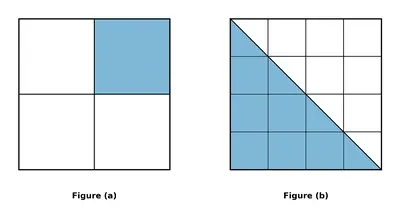
(a) Figure (a)
Solution
Step 1 – Identify equal parts of the big square
In the figure the big square has been drawn as a 4 × 4 grid. Hence it is cut into
$$4\times 4 = 16$$ congruent (equal-sized) small squares.
Step 2 – Count the shaded parts
Exactly 8 of those 16 small squares are shaded.
Step 3 – Form the required fraction
Fraction of the whole square that is shaded is therefore
$$\frac{\text{number of shaded equal parts}}{\text{total equal parts}} = \frac{8}{16}.$$
We simplify the fraction by dividing numerator and denominator by the common factor 8:
Thus, the shaded region occupies one-half of the big square.
Answer
$$\displaystyle \frac12$$
(b) Figure (b)
Solution
Step 1 – Identify equal parts of the big square
Again the big square is a 4 × 4 grid, so there are
$$4\times 4 = 16$$ identical small squares in all.
Step 2 – Count the shaded parts
This time 12 of the 16 small squares are shaded.
Step 3 – Form the required fraction
Fraction of the big square that is shaded
$$=\;\frac{12}{16}.$$
Divide numerator and denominator by their HCF (4):
So three-fourths of the big square is shaded.
Answer
$$\displaystyle \frac34$$
Figure it Out (Page 196–197)
1 Evaluate the following:
(i) $$3 \div \frac{7}{9}$$
Solution
Write the whole number as a fraction: $$3 = \frac{3}{1}$$
To divide by a fraction, multiply by its reciprocal:
$$\frac{3}{1} \div \frac{7}{9} = \frac{3}{1}\times\frac{9}{7}$$
Multiply numerators and denominators: $$= \frac{3\times 9}{1\times 7}=\frac{27}{7}$$
The answer can stay as an improper fraction or be written as a mixed number:
$$\frac{27}{7}=3\,\frac{6}{7}$$
Answer
(ii) $$\frac{14}{4} \div 2$$
Solution
Simplify the dividend first: $$\frac{14}{4}=\frac{7}{2}$$
Write the divisor as a fraction: $$2=\frac{2}{1}$$
Change division to multiplication by the reciprocal:
$$\frac{7}{2}\div \frac{2}{1}=\frac{7}{2}\times\frac{1}{2}=\frac{7}{4}$$
Convert to a mixed number if desired: $$\frac{7}{4}=1\,\frac{3}{4}$$
Answer
(iii) $$\frac{2}{3} \div \frac{2}{3}$$
Solution
Both fractions are the same. Dividing a number by itself gives 1, but we show the reciprocal step:
$$\frac{2}{3}\div\frac{2}{3}=\frac{2}{3}\times\frac{3}{2}=1$$
Answer
(iv) $$\frac{14}{6} \div \frac{7}{3}$$
Solution
Simplify both fractions first: $$\frac{14}{6}=\frac{7}{3}$$
Now divide: $$\frac{7}{3}\div\frac{7}{3}=\frac{7}{3}\times\frac{3}{7}=1$$
Answer
(v) $$\frac{4}{3} \div \frac{3}{4}$$
Solution
Keep the first fraction, multiply by the reciprocal of the second:
$$\frac{4}{3}\div\frac{3}{4}=\frac{4}{3}\times\frac{4}{3}=\frac{16}{9}$$
As a mixed number: $$\frac{16}{9}=1\,\frac{7}{9}$$
Answer
(vi) $$\frac{7}{4} \div \frac{1}{7}$$
Solution
Multiply by the reciprocal of $$\frac{1}{7}$$:
$$\frac{7}{4}\div\frac{1}{7}=\frac{7}{4}\times\frac{7}{1}=\frac{49}{4}$$
Mixed number: $$\frac{49}{4}=12\,\frac{1}{4}$$
Answer
(vii) $$\frac{8}{2} \div \frac{4}{15}$$
Solution
Simplify the dividend: $$\frac{8}{2}=4=\frac{4}{1}$$
Now divide by $$\frac{4}{15}$$:
$$\frac{4}{1}\div\frac{4}{15}=\frac{4}{1}\times\frac{15}{4}=\frac{60}{4}=15$$
Answer
(viii) $$\frac{1}{5} \div \frac{1}{9}$$
Solution
Multiply by the reciprocal of $$\frac{1}{9}$$:
$$\frac{1}{5}\div\frac{1}{9}=\frac{1}{5}\times\frac{9}{1}=\frac{9}{5}=1\,\frac{4}{5}$$
Answer
(ix) $$\frac{1}{6} \div \frac{11}{12}$$
Solution
Use the reciprocal of $$\frac{11}{12}$$:
$$\frac{1}{6}\div\frac{11}{12}=\frac{1}{6}\times\frac{12}{11}=\frac{12}{66}$$
Simplify: divide numerator and denominator by 6
$$=\frac{2}{11}$$
Answer
(x) $$3\frac{2}{3} \div 1\frac{3}{8}$$
Solution
Convert the mixed numbers to improper fractions:
$$3\,\frac{2}{3}=\frac{3\times3+2}{3}=\frac{11}{3}$$
$$1\,\frac{3}{8}=\frac{1\times8+3}{8}=\frac{11}{8}$$
Divide by multiplying with the reciprocal of $$\frac{11}{8}$$:
$$\frac{11}{3}\div\frac{11}{8}=\frac{11}{3}\times\frac{8}{11}=\frac{8}{3}$$
As a mixed number: $$\frac{8}{3}=2\,\frac{2}{3}$$
Answer
2 For each of the questions below, choose the expression that describes the solution. Then simplify it.
(a)
Maria bought 8 m of lace to decorate the bags she made for school. She used $$\frac{1}{4}$$ m for each bag and finished the lace. How many bags did she decorate?
- (i) $$8 \times \frac{1}{4}$$
- (ii) $$\frac{1}{8} \times \frac{1}{4}$$
- (iii) $$8 \div \frac{1}{4}$$
- (iv) $$\frac{1}{4} \div 8$$
Solution
Total lace available = $$8\text{ m}$$.
Lace required for one bag = $$\frac{1}{4}\text{ m}$$.
Number of bags = (total length) ÷ (length per bag).
Correct choice: option (iii) $$8 \div \frac{1}{4}$$.
Calculation:
Write $$8 = \frac{8}{1}$$. Dividing by a fraction is the same as multiplying by its reciprocal, so
$$\frac{8}{1} \div \frac{1}{4} = \frac{8}{1} \times \frac{4}{1} = \frac{32}{1} = 32$$.
Maria decorated 32 bags.
Answer
(b)
$$\frac{1}{2}$$ meter of ribbon is used to make 8 badges. What is the length of the ribbon used for each badge?
- (i) $$8 \times \frac{1}{2}$$
- (ii) $$\frac{1}{2} \div \frac{1}{8}$$
- (iii) $$8 \div \frac{1}{2}$$
- (iv) $$\frac{1}{2} \div 8$$
Solution
Total ribbon used = $$\frac{1}{2}\text{ m}$$ for 8 badges.
Ribbon per badge = (total length) ÷ (number of badges).
Correct choice: option (iv) $$\frac{1}{2} \div 8$$.
Calculation:
$$\frac{1}{2} \div 8 = \frac{1}{2} \times \frac{1}{8} = \frac{1}{16}$$.
Each badge needs $$\frac{1}{16}\text{ m}$$ of ribbon.
Answer
(c)
A baker needs $$\frac{1}{6}$$ kg of flour to make one loaf of bread. He has 5 kg of flour. How many loaves of bread can he make?
- (i) $$5 \times \frac{1}{6}$$
- (ii) $$\frac{1}{6} \div 5$$
- (iii) $$5 \div \frac{1}{6}$$
- (iv) $$5 \times 6$$
Solution
Flour available = $$5\text{ kg}$$.
Flour needed for one loaf = $$\frac{1}{6}\text{ kg}$$.
Number of loaves = (total flour) ÷ (flour per loaf).
Correct choice: option (iii) $$5 \div \frac{1}{6}$$.
Calculation:
Write $$5 = \frac{5}{1}$$.
$$\frac{5}{1} \div \frac{1}{6} = \frac{5}{1} \times 6 = 30$$.
The baker can make 30 loaves.
Answer
3 If $$\frac{1}{4}$$ kg of flour is used to make 12 rotis, how much flour is used to make 6 rotis?
Solution
Given information
To make 12 rotis, the flour required is $$\frac{1}{4}$$ kg.
Step 1 : Find flour needed for 1 roti
"Per–roti" flour = total flour ÷ number of rotis:
$$\text{Flour for 1 roti}=\frac{\tfrac{1}{4}\,\text{kg}}{12}$$
A fraction divided by a whole number is the same as multiplying the fraction by the reciprocal of the whole number:
$$\frac{\tfrac{1}{4}}{12}=\frac{1}{4}\times\frac{1}{12}=\frac{1}{48}$$
So, one roti needs $$\frac{1}{48}$$ kg of flour.
Step 2 : Find flour needed for 6 rotis
Multiply the "per–roti" quantity by 6:
$$\text{Flour for 6 rotis}=6\times\frac{1}{48}=\frac{6}{48}$$
Simplify the fraction by dividing numerator and denominator by 6:
$$\frac{6\div6}{48\div6}=\frac{1}{8}$$
\[\boxed{\text{Flour required}=\frac{1}{8}\,\text{kg}}\]Therefore, $$\frac{1}{8}$$ kg of flour is used to make 6 rotis.
Answer
$$\displaystyle \frac{1}{8}\,\text{kg}$$
4 Pāṭīgaṇita, a book written by Sridharacharya in the 9th century CE, mentions this problem: "Friend, after thinking, what sum will be obtained by adding together $$1 \div \frac{1}{6}$$, $$1 \div \frac{1}{10}$$, $$1 \div \frac{1}{13}$$, $$1 \div \frac{1}{9}$$, and $$1 \div \frac{1}{2}$$". What should the friend say?
Solution
The question asks us to add the following five quantities:
- $$1 \div \frac{1}{6}$$
- $$1 \div \frac{1}{10}$$
- $$1 \div \frac{1}{13}$$
- $$1 \div \frac{1}{9}$$
- $$1 \div \frac{1}{2}$$
For any non-zero fraction $$\frac{a}{b}$$ we know
$$1 \div \frac{a}{b} = 1 \times \frac{b}{a} = \frac{b}{a}.$$ That is, dividing by a fraction is the same as multiplying by its reciprocal.
First term:
$$1 \div \frac{1}{6} = 1 \times 6 = 6$$
Second term:
$$1 \div \frac{1}{10} = 1 \times 10 = 10$$
Third term:
$$1 \div \frac{1}{13} = 1 \times 13 = 13$$
Fourth term:
$$1 \div \frac{1}{9} = 1 \times 9 = 9$$
Fifth term:
$$1 \div \frac{1}{2} = 1 \times 2 = 2$$
Now add the five results:
$$6 + 10 + 13 + 9 + 2 = 40$$
Thus, the required sum is
\[40\]So the friend should answer: "The sum is 40."
Answer
40
5 Mira is reading a novel that has 400 pages. She read $$\frac{1}{5}$$ of the pages yesterday and $$\frac{3}{10}$$ of the pages today. How many more pages does she need to read to finish the novel?
Solution
Mira’s novel has a total of $$400$$ pages.
Step 1 : Pages read yesterday
She read $$\frac{1}{5}$$ of the book:
$$\frac{1}{5}\times 400 = \frac{400}{5} = 80$$.
Step 2 : Pages read today
She read $$\frac{3}{10}$$ of the book:
$$\frac{3}{10}\times 400 = \frac{400\times 3}{10} = \frac{1200}{10} = 120$$.
Step 3 : Total pages read so far
$$80 + 120 = 200$$ pages.
Step 4 : Pages still to read
$$400 - 200 = 200$$.
Mira still has to read 200 pages to finish the novel.
Answer
$$200$$ pages
6 A car runs 16 km using 1 litre of petrol. How far will it go using $$2\frac{3}{4}$$ litres of petrol?
Solution
Step 1 · Write the information given.
The car covers $$16\text{ km}$$ for every $$1$$ litre of petrol.
Step 2 · Express the amount of petrol as an improper fraction.
$$2\dfrac34 = \dfrac{(2\times4)+3}{4} = \dfrac{11}{4}\;\text{litres}$$
Step 3 · Set up the multiplication.
Distance travelled $$=16\times\dfrac{11}{4}\;\text{km}$$
Step 4 · Perform the multiplication.
$$16=\dfrac{16}{1}$$, so
$$\dfrac{16}{1}\times\dfrac{11}{4}=\dfrac{16\times11}{1\times4}=\dfrac{176}{4}\;\text{km}$$
Step 5 · Simplify the fraction.
Both numerator and denominator are divisible by $$4$$:
$$\dfrac{176\div4}{4\div4}=\dfrac{44}{1}=44\;\text{km}$$
Therefore, the car will travel
\[44\text{ kilometres}\]Answer
44 km
7 Amritpal decides on a destination for his vacation. If he takes a train, it will take him $$5\frac{1}{6}$$ hours to get there. If he takes a plane, it will take him $$\frac{1}{2}$$ hour. How many hours does the plane save?
Solution
Step 1 – Convert the train time to an improper fraction
$$5\frac16 = 5 + \frac16 = \frac{5\times6 + 1}{6} = \frac{31}{6}\text{ hours}$$
Step 2 – Express the plane time with the same denominator (6)
$$\frac12 = \frac{1\times3}{2\times3} = \frac{3}{6}\text{ hour}$$
Step 3 – Find the saving by subtraction
$$\text{Saving} = \frac{31}{6} - \frac{3}{6} = \frac{31 - 3}{6} = \frac{28}{6}$$
Step 4 – Simplify the fraction
Divide numerator and denominator by 2:
$$\frac{28}{6} = \frac{28 \div 2}{6 \div 2} = \frac{14}{3}$$
Step 5 – Convert to a mixed number
3 goes into 14 four times with remainder 2, so
$$\frac{14}{3} = 4\frac23\text{ hours}$$
Conclusion
The plane saves:
\[4\frac23 \text{ hours}\]Answer
Time saved by taking the plane = $$4\frac23$$ hours.
8 Mariam's grandmother baked a cake. Mariam and her cousins finished $$\frac{4}{5}$$ of the cake. The remaining cake was shared equally by Mariam's three friends. How much of the cake did each friend get?
Solution
Step 1 – Find the uneaten part of the cake.
The whole cake is represented by $$1$$.
Mariam and her cousins finished $$\frac{4}{5}$$ of it.
So, the part left over is
$$1 - \frac{4}{5} = \frac{1}{5}$$.
Step 2 – Share the remaining cake equally among 3 friends.
To find each friend’s share we divide the leftover fraction by $$3$$:
$$\frac{1}{5} \div 3 = \frac{1}{5} \times \frac{1}{3} = \frac{1}{15}$$.
Conclusion.
Each friend received $$\frac{1}{15}$$ of the original cake.
Answer
Each friend got $$\frac{1}{15}$$ of the cake.
9
Choose the option(s) describing the product of $$\left(\frac{565}{465} \times \frac{707}{676}\right)$$:
- (a) $$> \frac{565}{465}$$
- (b) $$< \frac{565}{465}$$
- (c) $$> \frac{707}{676}$$
- (d) $$< \frac{707}{676}$$
- (e) $$> 1$$
- (f) $$< 1$$
Solution
Step 1 — Check whether each fraction is greater than or less than 1.
A positive fraction is greater than 1 when its numerator is larger than its denominator.
- For $$\frac{565}{465}$$: numerator $$565 \gt 465$$ (denominator), so $$\frac{565}{465} \gt 1$$.
- For $$\frac{707}{676}$$: numerator $$707 \gt 676$$ (denominator), so $$\frac{707}{676} \gt 1$$.
So both fractions are greater than 1.
Step 2 — Key idea about multiplying by a number greater than 1.
If a positive number is multiplied by a number greater than 1, the result becomes larger than the original number. Symbolically: if $$x \gt 0$$ and $$y \gt 1$$, then $$x \times y \gt x$$.
Conversely, the product can never become smaller than the original number when the multiplier is greater than 1.
Step 3 — Test each of the six options.
Let $$P=\frac{565}{465}\times\frac{707}{676}$$ be the product.
Option (a): Is $$P \gt \frac{565}{465}$$?
Here we multiply $$\frac{565}{465}$$ by $$\frac{707}{676}$$, and $$\frac{707}{676} \gt 1$$. By the rule in Step 2, the product is larger than $$\frac{565}{465}$$. Option (a) is CORRECT.
Option (b): Is $$P \lt \frac{565}{465}$$?
We just showed that $$P \gt \frac{565}{465}$$. The product cannot be both greater than and less than the same number, so $$P \lt \frac{565}{465}$$ is false. Option (b) is WRONG.
Option (c): Is $$P \gt \frac{707}{676}$$?
Reading the product as $$\frac{707}{676}\times\frac{565}{465}$$, we are now multiplying $$\frac{707}{676}$$ by $$\frac{565}{465}$$, and $$\frac{565}{465} \gt 1$$. By the same rule, the product is larger than $$\frac{707}{676}$$. Option (c) is CORRECT.
Option (d): Is $$P \lt \frac{707}{676}$$?
We just showed that $$P \gt \frac{707}{676}$$, so $$P \lt \frac{707}{676}$$ is false. Option (d) is WRONG.
Option (e): Is $$P \gt 1$$?
Both factors are greater than 1, so their product is also greater than 1 (in fact, $$P \gt \frac{565}{465} \gt 1$$). Option (e) is CORRECT.
Option (f): Is $$P \lt 1$$?
We just showed $$P \gt 1$$, so $$P \lt 1$$ is false. Option (f) is WRONG.
Conclusion. The options that correctly describe the product are (a), (c) and (e).
Answer
The correct options are (a), (c) and (e).
10 What fraction of the whole square is shaded?
Solution
Step 1 — Identify how many equal parts the big square has been split into
From the diagram we see a 4 × 4 grid.
Therefore, the whole square has
$$4 \times 4 = 16$$ equal small squares.
Step 2 — Count the shaded parts
Carefully counting the shaded small squares gives
$$6$$ shaded squares.
Step 3 — Write the required fraction
Fraction of the whole square that is shaded
$$= \dfrac{\text{number of shaded parts}}{\text{total number of equal parts}}
= \dfrac{6}{16}.$$
Step 4 — Reduce the fraction to its simplest form
Both 6 and 16 have a common factor 2. Divide numerator and denominator by 2:
$$\dfrac{6 \div 2}{16 \div 2} = \dfrac{3}{8}.$$
Conclusion
\[\dfrac{3}{8}\]Hence, three-eighths of the whole square is shaded.
Answer
$$\dfrac{3}{8}$$ of the square is shaded.
11
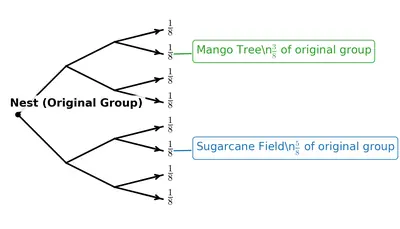
Solution
Step 1 Understand the way the ants branch out
In Fig. 8.7 (NCERT), every time the ants come to a branching point they divide equally and each half moves along a different path. Starting from the nest the paths go as follows:
- The very first fork splits the whole colony into two equal parts, so along each arm goes $$\tfrac12$$ of the original ants.
- The right-hand arm ends after that first fork; it leads directly to the food lying near the sugarcane field.
Therefore, the fraction that reaches the sugarcane field is still $$\tfrac12$$. - The left-hand arm, which is also carrying $$\tfrac12$$ of the ants, meets another fork before reaching food. At that second fork this half again splits equally: each of the two new sub-arms therefore gets \[\tfrac12 \times \tfrac12 = \tfrac14\] of the original colony.
- Both of those sub-arms coming from the second fork finally meet near the mango tree. Hence the mango tree actually receives two lots of $$\tfrac14$$ of the original ants.
Step 2 Add the fractions that reach each food source
- Mango tree: one branch $$=\tfrac14$$, the other branch $$=\tfrac14$$.
Total at mango tree $$\tfrac14 + \tfrac14 = \tfrac12$$. - Sugarcane field: directly from the first fork $$=\tfrac12$$.
Step 3 Check that all ants have been accounted for
$$\tfrac12 + \tfrac12 = 1,$$ so every ant is included once and only once.
Result
The original colony finally splits into two equal halves: one half reaches the mango tree and the other half reaches the sugarcane field.
Answer
Exactly one-half of the original ants (\(\tfrac12\)) reach the mango tree and the remaining one-half (\(\tfrac12\)) reach the sugarcane field.
12
What is $$1 - \frac{1}{2}$$?
$$\left(1 - \frac{1}{2}\right) \times \left(1 - \frac{1}{3}\right)$$?
$$\left(1 - \frac{1}{2}\right) \times \left(1 - \frac{1}{3}\right) \times \left(1 - \frac{1}{4}\right) \times \left(1 - \frac{1}{5}\right)$$?
$$\left(1 - \frac{1}{2}\right) \times \left(1 - \frac{1}{3}\right) \times \left(1 - \frac{1}{4}\right) \times \left(1 - \frac{1}{5}\right) \times \left(1 - \frac{1}{6}\right) \times \left(1 - \frac{1}{7}\right) \times \left(1 - \frac{1}{8}\right) \times \left(1 - \frac{1}{9}\right) \times \left(1 - \frac{1}{10}\right)$$?
Make a general statement and explain.
Solution
Step 1 Calculate $$1-\frac{1}{2}$$.
$$1-\frac{1}{2}=\frac{2}{2}-\frac{1}{2}=\frac{1}{2}$$
Step 2 Calculate $$\left(1-\frac{1}{2}\right)\times\left(1-\frac{1}{3}\right)$$.
First write each bracket as a single fraction: $$1-\frac{1}{3}=\frac{2}{3}.$$ So
$$\left(1-\frac{1}{2}\right)\times\left(1-\frac{1}{3}\right)=\frac{1}{2}\times\frac{2}{3}.$$
Multiply numerators and denominators:
$$\frac{1\times2}{2\times3}=\frac{2}{6}=\frac{1}{3}.$$
Step 3 Calculate
$$\left(1-\frac{1}{2}\right)\times\left(1-\frac{1}{3}\right)\times\left(1-\frac{1}{4}\right)\times\left(1-\frac{1}{5}\right).$$
Convert every bracket:
$$\frac{1}{2}\times\frac{2}{3}\times\frac{3}{4}\times\frac{4}{5}.$$
Notice that every numerator (except the first 1) cancels with the preceding denominator:
$$\cancel{1}\;\mathbf{/}2\times2/\cancel{3}\times\cancel{3}/4\times4/5=\frac{1}{5}.$$
Step 4 Calculate
$$\left(1-\frac{1}{2}\right)\left(1-\frac{1}{3}\right)\left(1-\frac{1}{4}\right)\left(1-\frac{1}{5}\right)\left(1-\frac{1}{6}\right)\left(1-\frac{1}{7}\right)\left(1-\frac{1}{8}\right)\left(1-\frac{1}{9}\right)\left(1-\frac{1}{10}\right).$$
Write each bracket as one fraction and place them in order:
$$\frac{1}{2}\times\frac{2}{3}\times\frac{3}{4}\times\frac{4}{5}\times\frac{5}{6}\times\frac{6}{7}\times\frac{7}{8}\times\frac{8}{9}\times\frac{9}{10}.$$
This is a telescoping product—all the middle numbers cancel:
$$\frac{\mathbf{\cancel{1}}}{2}\times2/\cancel{3}\times\cancel{3}/4\times\cancel{4}/5\times\cancel{5}/6\times\cancel{6}/7\times\cancel{7}/8\times\cancel{8}/9\times\cancel{9}/10=\frac{1}{10}.$$
Step 5 – General statement
Consider $$\left(1-\frac{1}{2}\right)\left(1-\frac{1}{3}\right)\cdots\left(1-\frac{1}{n}\right)$$ where $$n\ge 2$$.
Each factor is $$\frac{n-1}{n}$$ with its own value of n. Re-write the whole product:
$$\frac{1}{2}\times\frac{2}{3}\times\frac{3}{4}\times\cdots\times\frac{n-1}{n}.$$
Everything cancels except the very first numerator (1) and the very last denominator (n):
\[\frac{1}{n}.\]Hence
$$\left(1-\frac{1}{2}\right)\left(1-\frac{1}{3}\right)\cdots\left(1-\frac{1}{n}\right)=\frac{1}{n}.$$
So the product always equals the reciprocal of the largest denominator appearing in the brackets.
Answer
(i) $$1-\frac{1}{2}=\frac{1}{2}$$
(ii) $$\left(1-\frac{1}{2}\right)\left(1-\frac{1}{3}\right)=\frac{1}{3}$$
(iii) $$\left(1-\frac{1}{2}\right)\left(1-\frac{1}{3}\right)\left(1-\frac{1}{4}\right)\left(1-\frac{1}{5}\right)=\frac{1}{5}$$
(iv) The long product up to $$1-\frac{1}{10}$$ equals $$\frac{1}{10}$$.
In general, $$\displaystyle\prod_{k=2}^{n}\left(1-\frac{1}{k}\right)=\frac{1}{n}.$$


