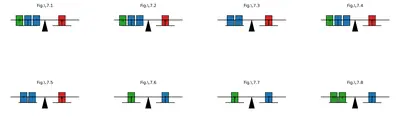
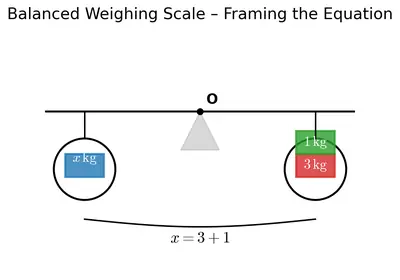
Let each sack weigh $$s\,\mathrm{kg}$$. Since the scale is balanced, the total weight on the left plate equals the total weight on the right plate. We use the hint of removing equal weights from both plates.
Fig. 7.9. One sack and a $$2\,\mathrm{kg}$$ weight sit on the left; a $$10\,\mathrm{kg}$$ weight sits on the right.
$$s + 2 = 10.$$
Subtracting $$2\,\mathrm{kg}$$ from both plates:
$$s = 10 - 2 = 8.$$
So one sack weighs $$8\,\mathrm{kg}$$.
Fig. 7.10. All sacks weigh the same. Two sacks sit on the left; one sack together with the $$10\,\mathrm{kg}$$ and $$4\,\mathrm{kg}$$ weights sits on the right:
$$s + s = s + 10 + 4.$$
Following the hint, remove one sack from each plate:
$$s = 10 + 4 = 14.$$
So each sack weighs $$14\,\mathrm{kg}$$.
Fig. 7.11. Reading the picture, four sacks sit on the left and one sack together with the three weights $$1\,\mathrm{kg}$$, $$10\,\mathrm{kg}$$ and $$10\,\mathrm{kg}$$ sits on the right:
$$4s = s + 1 + 10 + 10 = s + 21.$$
Subtracting one sack from both plates:
$$3s = 21, \quad \text{so } s = 7.$$
Each sack weighs $$7\,\mathrm{kg}$$.
Fig. 7.12. Twenty sacks along with a $$50\,\mathrm{kg}$$ weight sit on the left, while sixty sacks along with a $$500\,\mathrm{kg}$$ box sit on the right. Following the hint, first remove the twenty sacks from both plates so that sacks appear only on the right:
$$20s + 50 = 60s + 500 \;\Rightarrow\; 50 = 40s + 500 \;\Rightarrow\; 40s = 50 - 500 = -450,$$
which would give a negative sack weight. So the arrangement must actually be reversed — the sixty sacks with the $$50\,\mathrm{kg}$$ weight are on one plate, and the twenty sacks with the $$500\,\mathrm{kg}$$ box are on the other. Then
$$60s + 50 = 20s + 500.$$
Subtracting $$20s$$ and $$50$$ from both plates:
$$40s = 450, \quad \text{so } s = \dfrac{450}{40} = \dfrac{45}{4} = 11.25.$$
Each sack weighs $$11.25\,\mathrm{kg}$$.
 91- 6303239042