 91- 6303239042


Intext Questions
1 What happens when the three vertices lie on a straight line?
Solution
Step 1 — Recall the definition of a triangle
A triangle is a closed figure made by joining three non-collinear points with three straight-line segments. "Non-collinear" means the three points must not lie on the same straight line.
Step 2 — Express the condition algebraically
Let the three intended vertices be $$A$$, $$B$$ and $$C$$. If all of them lie on one straight line l, then
- The coordinates (or positions) of $$A,B,C$$ satisfy the same linear equation of line l.
- This makes $$A,\,B,\,C$$ collinear.
Step 3 — Test against the properties of a triangle
Because the three vertices are collinear, the three "sides" $$AB$$, $$BC$$ and $$CA$$ all fall on the same straight line. Consequently,
- No closed region is enclosed, so the area becomes $$0\;\text{unit}^2$$.
- The interior angle at the middle point (say $$B$$) becomes a straight angle $$=180^\circ$$, while the remaining two interior angles shrink to $$0^\circ$$ each. This violates the condition that in a genuine triangle every interior angle must be greater than $$0^\circ$$ and less than $$180^\circ$$.
Step 4 — Conclusion
When the supposed three vertices lie on a single straight line, the would-be triangle "collapses" into that line. In geometric language, the triangle becomes degenerate; effectively, no triangle is formed.
Answer
The three points become collinear, so the figure collapses into a straight line; hence no triangle (area 0) is formed.
2
Solution
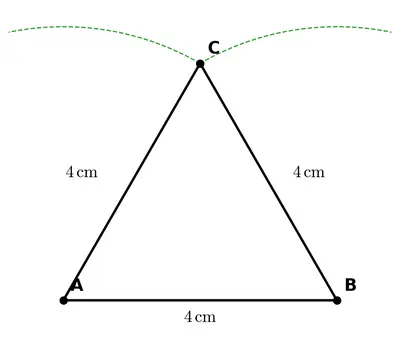
Objective Construct a triangle each of whose three sides measures 4 cm and justify that the construction really produces such a triangle.
What you need
- a sharp pencil,
- a ruler graduated in centimetres and millimetres,
- a compass.
Notation to be fixed before starting
We shall call the required triangle $$\triangle ABC$$. The decision which vertex receives which letter is immaterial, but once fixed we keep to it consistently.
Construction steps (write them in your record and perform them simultaneously)
- Draw the first side.
With the ruler draw a straight line segment and mark its end-points as $$A$$ and $$B$$ such that $$AB = 4\text{ cm}$$. (Measure carefully to the nearest millimetre.) - Locate the third vertex by intersecting two congruent circles.
(a) Keeping the compass opening fixed at exactly $$4\text{ cm}$$, place the compass needle on $$A$$ and draw a (full or partial) arc on the side of $$AB$$ where the triangle is to be formed.
(b) Without altering the compass width, place the needle on $$B$$ and draw another arc so that it cuts the first arc. Let the point of intersection be named $$C$$. - Complete the triangle.
Join $$C$$ to $$A$$ and $$C$$ to $$B$$ with the ruler. The required triangle $$\triangle ABC$$ is now visible.
Justification (Why the construction works)
- By step 1 we fixed $$AB = 4\text{ cm}$$.
- During step 2 the compass radius was also set at $$4\text{ cm}$$; therefore every point on the first arc satisfies $$AC = 4\text{ cm}$$ and every point on the second arc satisfies $$BC = 4\text{ cm}$$.
- The point $$C$$ lies simultaneously on both arcs; hence \[ AC = 4\text{ cm}\quad\text{and}\quad BC = 4\text{ cm}. \]
Collecting the three equalities
$$AB = AC = BC = 4\text{ cm},$$
we see that all three sides of $$\triangle ABC$$ are equal. By the definition of an equilateral triangle, the triangle we have constructed fulfils the requirement.
Verification (optional but good practice)
Measure $$AC$$ and $$BC$$ with the ruler; each should read 4 cm. A discrepancy indicates that the compass opening shifted or the arcs were drawn inaccurately, in which case repeat the construction with greater care.
The task is complete.
Answer
The triangle obtained by the steps above is $$\triangle ABC$$ with $$AB = BC = CA = 4\text{ cm}$$; hence a triangle whose every side is 4 cm has been successfully constructed.
3 How do we make this construction more efficient?
Solution
Given background
In the earlier activity we located the point where the three perpendicular bisectors of the sides of a triangle meet (the circum-centre). We carried out the following steps:
- Construct the perpendicular bisector of $$\overline{AB}$$.
- Construct the perpendicular bisector of $$\overline{BC}$$.
- Construct the perpendicular bisector of $$\overline{CA}$$.
- Mark the common intersection point of the three lines.
The question now is
“How do we make this construction more efficient?”
Step 1 – Observe what is really needed
Any two non-parallel straight lines intersect in exactly one point. Therefore, the moment two of the three perpendicular bisectors are drawn, their intersection already fixes the unique point that all three will share.
So, the third bisector is logically redundant; it only confirms what we already know.
Step 2 – Rewrite the construction with the redundant step removed
- Draw the perpendicular bisector $$l_1$$ of one convenient side, say $$\overline{AB}$$.
• With radius greater than half of $$AB$$, draw arcs above and below $$\overline{AB}$$ taking centres $$A$$ and $$B$$. Join the arc-intersection points to get $$l_1$$. - Draw the perpendicular bisector $$l_2$$ of another side, say $$\overline{AC}$$, in exactly the same way.
- The lines $$l_1$$ and $$l_2$$ meet at a single point; call it $$O$$.
\[ l_1 \cap l_2 = \{O\} \] - Stop here. Point $$O$$ is the circum-centre; no third bisector is required. (If you still wish to check, construct the third bisector; it will automatically pass through $$O$$.)
Why this works
- Each perpendicular bisector is the set of all points equidistant from the two endpoints of the corresponding side.
- A point that lies on two such bisectors (here $$O$$) is therefore equidistant from all three vertices — exactly the property of the circum-centre.
- Since only two lines are needed to determine their point of intersection, the third line cannot possibly produce a different point; it must pass through $$O$$ as well.
Conclusion
The construction becomes more efficient simply by drawing any two of the three required concurrent lines instead of all three. This saves both time and ink while giving the same correct result.
Answer
Draw only two of the three lines (e.g. two perpendicular bisectors); their intersection already gives the required point, so the third line is unnecessary.
4 The construction ensures that both AC and BC are of length 4 cm. Can you see why?
Solution
Context : In the preceding construction we were asked to draw a triangle $$\triangle ABC$$ such that $$AB = 5\,\text{cm}$$ and $$AC = BC = 4\,\text{cm}$$ (i.e. an isosceles triangle with the equal sides 4 cm long).
Step–by–step recap of the construction
- Draw the base $$AB$$ with a ruler so that
$$AB = 5\,\text{cm}$$. - With A as centre and radius $$4\,\text{cm}$$, draw an arc above the base.
- With B as centre and the same radius $$4\,\text{cm}$$, draw a second arc to meet the first one. Mark the point of intersection as C.
- Join $$AC$$ and $$BC$$ to complete $$\triangle ABC$$.
Why does this guarantee $$AC = 4\,\text{cm}$$ and $$BC = 4\,\text{cm}?}
Remember the defining property of a circle: every point on a circle is at a constant distance (the radius) from the centre.
- Because the arc in Step 2 was drawn with centre A and radius $$4\,\text{cm}$$, every point on that arc (including the intersection point C) must satisfy
$$AC = 4\,\text{cm}$$. - Similarly, the arc in Step 3 was drawn with centre B and the same radius $$4\,\text{cm}$$, so for the same point C one also has
$$BC = 4\,\text{cm}$$.
Thus, by construction, both $$AC$$ and $$BC$$ are radii of their respective circles, each equal to $$4\,\text{cm}$$. No further measurement is needed; the equality follows directly from the definition of a circle.
Answer
Because C is chosen as the common point of two circles—one with centre A and radius 4 cm, the other with centre B and the same radius—AC and BC are both radii of those circles, so $$AC = BC = 4\,\text{cm}$$.
5
Solution
Step 1 — Triangle inequality check
For sides $$4\text{ cm},\,5\text{ cm},\,6\text{ cm}$$:
- $$4+5=9>6$$ ✔
- $$5+6=11>4$$ ✔
- $$4+6=10>5$$ ✔
All three hold, so the triangle can be constructed.
Step 2 — Construction
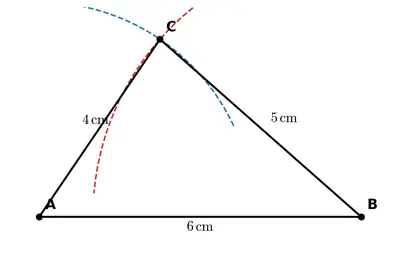
- With the ruler draw the base $$\overline{AB}$$ of length $$6\text{ cm}$$.
- With centre $$A$$ and radius $$4\text{ cm}$$, draw an arc above $$\overline{AB}$$.
- With centre $$B$$ and radius $$5\text{ cm}$$, draw a second arc that meets the first. Label the point of intersection as $$C$$.
- Join $$\overline{CA}$$ and $$\overline{CB}$$ with the ruler.
Step 3 — Recording the side lengths
The arc drawn from $$A$$ had radius $$4\text{ cm}$$, so $$CA=4\text{ cm}$$. The arc drawn from $$B$$ had radius $$5\text{ cm}$$, so $$BC=5\text{ cm}$$. Therefore
\[AB = 6\text{ cm},\;BC = 5\text{ cm},\;CA = 4\text{ cm}.\]Reason why the two arcs meet
The distance between centres $$A$$ and $$B$$ is $$6\text{ cm}$$, which lies strictly between $$|5-4|=1\text{ cm}$$ and $$5+4=9\text{ cm}$$. The two arcs therefore intersect; choosing the intersection above $$\overline{AB}$$ gives $$C$$.
Verification
- Measure $$CA$$ → $$4\text{ cm}$$.
- Measure $$BC$$ → $$5\text{ cm}$$.
- $$AB$$ (already drawn) → $$6\text{ cm}$$.
The required triangle has been correctly constructed.
Answer
The required triangle $$\triangle ABC$$ has $$AB = 6\text{ cm}$$, $$BC = 5\text{ cm}$$ and $$CA = 4\text{ cm}$$.
6 How do we construct this triangle more efficiently?
Solution
Given : the lengths of the three medians of the required triangle are
$$m_a ,\; m_b ,\; m_c$$.
We want to obtain a triangle $$\triangle ABC$$ whose medians have exactly these three lengths, but with the least amount of repeated work. We shall make use of two facts you have already met in Chapter 7.
- (F 1) The three medians of a triangle are concurrent at the centroid $$G$$ and are divided by the centroid in the fixed ratio $$AG:GD = BG:GE = CG:GF = 2:1$$.
- (F 2) The three medians themselves can be taken as the sides of some triangle; this is called the median triangle.
Using (F 1) and (F 2) we can compress the whole construction into one clean chain of steps.
- Construct the median triangle
Draw any convenient base line and construct a triangle $$\triangle DEF$$ such that $$DE = m_a,\; EF = m_b,\; FD = m_c.$$ (Ordinary ruler-and-compass construction of a triangle when all three sides are known was practised in Class 6; recall it: draw the base, take radius equal to the second side, etc.) - Locate its centroid
Find the mid-point $$P$$ of $$EF$$ and the mid-point $$Q$$ of $$FD$$ (use perpendicular bisectors or the compasses-same-radius trick). Draw the two medians $$DP$$ and $$EQ$$. Let them meet at $$G$$. At this point we have the picture \[ D,\;E,\;F \text{ – vertices of the median triangle, and } G \text{ – its centroid}. \] - Exploit the 2 : 1 ratio
Because $$DG$$ is a median of $$\triangle DEF$$, the segment $$DG$$ will correspond to one of the given medians ($$m_a$$, $$m_b$$ or $$m_c$$). More importantly, fact (F 1) tells us that if we double the segment $$GD$$ in the same straight line we must arrive at the vertex of the required triangle whose own median was $$DG$$.
Thus mark a point $$A$$ on the line $$DG$$ produced such that $$GA = 2\,GD$$ (use compasses: put the point at $$G$$, open to $$D$$, and strike an arc cutting the extension of $$DG$$; then repeat once more to double the length). Repeat the same idea on the other two medians of $$\triangle DEF$$:- Produce $$EG$$ beyond $$G$$, take $$GB = 2\,GE$$,
- produce $$FG$$ beyond $$G$$, take $$GC = 2\,GF$$.
- Join the vertices
Draw $$AB, BC, CA$$. The triangle $$\triangle ABC$$ is the only triangle whose medians are exactly $$m_a, m_b, m_c$$, and we have reached it without having to redraw or guess anything.
Why this is more efficient
A beginner often tries to start with one median, guess the position of a vertex, measure another median, correct the guess, and so on – a long trial-and-error loop. The above method reduces everything to one ordinary SSS construction (Step 1), followed by a single use of the permanent ratio 2 : 1 (Step 3). No iteration, no erasing, no wasted arcs: the triangle appears at once.
Diagram to be drawn (for the examination paper)
- The triangle $$DEF$$ with its medians $$DP, EQ, FR$$ shown.
- The centroid $$G$$ marked.
- The lines $$DG, EG, FG$$ produced to $$A, B, C$$ such that $$GA = GB = GC = 2 \times (\text{corresponding } G{\text{–}}D,E,F).$$
- The finally obtained triangle $$ABC$$.
The construction is complete and fully justified.
Answer
Draw the triangle whose three sides are the given medians, locate its centroid, then extend every centroid segment to double its length; the three new end-points are the required triangle’s vertices.
7 Construct triangles having the following sidelengths (all the units are in cm):
(a) $$4, 4, 6$$
Solution
Step 1 – Check the triangle inequality
Largest side = 6 cm. The other two sides add up to $$4+4=8\;\text{cm}>6\;\text{cm}$$, so a triangle can indeed be formed.
Step 2 – Draw the base
With a ruler draw $$\overline{AB}=6\;\text{cm}$$.
Step 3 – Locate the third vertex
- Keeping the compass opening fixed at $$4\;\text{cm}$$, put the metal tip on A and draw an arc above (and, if you like, also below) the line $$\overline{AB}$$.
- Without changing the opening, place the tip on B and draw a second arc to cut the first one at C.
Step 4 – Complete the triangle
Join $$\overline{CA}$$ and $$\overline{CB}$$. Triangle $$\triangle ABC$$ now has sides $$4\;\text{cm},\;4\;\text{cm},\;6\;\text{cm}$$.
Both the intersection above and the one (if drawn) below $$\overline{AB}$$ give valid isosceles triangles.
Answer
(b) $$3, 4, 5$$
Solution
Step 1 – Check the triangle inequality
Largest side = 5 cm.
$$3+4=7\;\text{cm}>5\;\text{cm}$$, so construction is possible.
Step 2 — Draw $$\overline{AB}=5\;\text{cm}$$.
Step 3 — With centre A and radius $$3\;\text{cm}$$ draw an arc. With centre B and radius $$4\;\text{cm}$$ draw another arc meeting the first at C.
Step 4 — Join $$\overline{CA}$$ and $$\overline{CB}$$ to obtain $$\triangle ABC$$ whose sides measure $$3\;\text{cm},\;4\;\text{cm},\;5\;\text{cm}$$.
Answer
(c) $$1, 5, 5$$
Solution
Step 1 – Check the triangle inequality
Largest side = 5 cm.
$$5+1=6\;\text{cm}>5\;\text{cm}$$ and all other pairs also satisfy the condition, hence construction is possible.
Step 2 — Draw a very small base $$\overline{AB}=1\;\text{cm}$$.
Step 3 — Keeping the compass opening at $$5\;\text{cm}$$ draw an arc with centre A. With the same opening draw an arc with centre B to intersect the first at C.
Step 4 — Join $$\overline{CA}$$ and $$\overline{CB}$$. The resulting skinny triangle $$\triangle ABC$$ has sides $$1\;\text{cm},\;5\;\text{cm},\;5\;\text{cm}$$.
Answer
(d) $$4, 6, 8$$
Solution
Step 1 – Check the triangle inequality
Largest side = 8 cm.
$$4+6=10\;\text{cm}>8\;\text{cm}$$, so a triangle exists.
Step 2 — Draw $$\overline{AB}=8\;\text{cm}$$.
Step 3
- With radius $$4\;\text{cm}$$ and centre A draw an arc.
- With radius $$6\;\text{cm}$$ and centre B draw another arc to meet the first at C.
Step 4 — Join $$\overline{CA}$$ and $$\overline{CB}$$ to give $$\triangle ABC$$ of side lengths $$4\;\text{cm},\;6\;\text{cm},\;8\;\text{cm}$$.
Answer
(e) $$3.5, 3.5, 3.5$$
Solution
Step 1 – Check the triangle inequality
All sides are equal to $$3.5\;\text{cm}$$, so the sum of any two sides is clearly greater than the third; an equilateral triangle can be drawn.
Step 2 — Draw $$\overline{AB}=3.5\;\text{cm}$$.
Step 3 — With radius $$3.5\;\text{cm}$$ draw arcs from centres A and B; let them intersect at C.
Step 4 — Join $$\overline{CA}$$ and $$\overline{CB}$$. $$\triangle ABC$$ is equilateral with every side $$3.5\;\text{cm}$$.
Answer
8
Solution
Given data
- Required side lengths: $$3\,\text{cm},\;4\,\text{cm},\;8\,\text{cm}$$
Construction attempt (step by step)
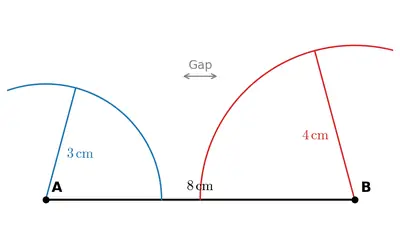
- Draw a straight line and mark the segment $$\overline{AB}$$ such that $$AB = 8\,\text{cm}$$. This will be the longest side (taken as the base).
- Place the compass at point A and set its opening to $$3\,\text{cm}$$. With this radius draw an arc above (or below) the base line.
- Without changing the compass, move its centre to point B and set the opening to $$4\,\text{cm}$$. Draw another arc that should intersect the first one.
- Look for an intersection point of the two arcs. Label such a point $$C$$ if it exists, then join $$C$$ to $$A$$ and $$C$$ to $$B$$ and the triangle $$\triangle ABC$$ would be complete.
What actually happens ?
While performing Step 3 you will notice that the two arcs do not meet. They remain apart because the centres A and B are $$8\,\text{cm}$$ apart, yet the farthest distance you can reach by moving from A to some point on the first arc and then to B is only
\[ 3\,\text{cm} + 4\,\text{cm} = 7\,\text{cm} < 8\,\text{cm}. \]Since $$7\,\text{cm}$$ is smaller than $$8\,\text{cm}$$, the two circles (or their arcs) never intersect. Consequently, no point $$C$$ satisfies both $$AC = 3\,\text{cm}$$ and $$BC = 4\,\text{cm}$$ at the same time.
Reason in words – Triangle Inequality
A fundamental property of triangles states that the sum of the lengths of any two sides must be greater than the third side. Here
$$3\,\text{cm} + 4\,\text{cm} = 7\,\text{cm} < 8\,\text{cm},$$so the condition fails. Therefore a triangle with side lengths $$3\,\text{cm},\;4\,\text{cm},\;8\,\text{cm}$$ cannot exist, and hence cannot be constructed.
Answer
No. A triangle cannot be formed because $$3+4=7<8$$, violating the triangle-inequality rule; therefore the required arcs never intersect and construction is impossible.
9 Here is another set of lengths: $$2 \, \mathrm{cm}$$, $$3 \, \mathrm{cm}$$, and $$6 \, \mathrm{cm}$$. Check if a triangle is possible for these sidelengths.
Solution
Let the three given lengths be
- $$a = 2\,\mathrm{cm}$$,
- $$b = 3\,\mathrm{cm}$$,
- $$c = 6\,\mathrm{cm}$$ (the largest).
For any three positive numbers to be the sides of a triangle they must obey the triangle inequality:
- $$a + b \gt c$$,
- $$a + c \gt b$$,
- $$b + c \gt a$$.
Check each inequality.
- $$a + b = 2 + 3 = 5$$, and $$5 \lt 6 = c$$, so $$a + b \gt c$$ is false.
- $$a + c = 2 + 6 = 8 \gt 3 = b$$ ✔
- $$b + c = 3 + 6 = 9 \gt 2 = a$$ ✔
Because the first inequality fails, the three lengths cannot satisfy all the triangle inequalities at once.
Therefore no triangle can be formed with side-lengths $$2\,\mathrm{cm},\,3\,\mathrm{cm}$$ and $$6\,\mathrm{cm}$$.
Answer
No. Because $$2+3=5 \lt 6$$, the triangle inequality fails, so a triangle is impossible.
10 Try to find more sets of lengths for which a triangle construction is impossible. See if you can find any pattern in them.
Solution
Step 1 — Recall the rule
For three positive lengths $$a,\;b,\;c$$ (write them in non-decreasing order $$a\le b\le c$$) a triangle exists if and only if
\[a + b \gt c.\]If $$c \ge a + b$$, the construction fails.
Step 2 — Sample impossible triples
- $$(2,\,3,\,5)$$: largest $$= 5$$; $$2 + 3 = 5$$, which is not strictly greater than $$5$$ → impossible.
- $$(1,\,4,\,7)$$: largest $$= 7$$; $$1 + 4 = 5 \lt 7$$ → impossible.
- $$(2,\,5,\,8)$$: largest $$= 8$$; $$2 + 5 = 7 \lt 8$$ → impossible.
- $$(4,\,10,\,15)$$: largest $$= 15$$; $$4 + 10 = 14 \lt 15$$ → impossible.
- $$(2,\,3,\,6)$$: largest $$= 6$$; $$2 + 3 = 5 \lt 6$$ → impossible.
Step 3 — The pattern
In every impossible triple, the largest length is greater than or equal to the sum of the other two. With the lengths written in non-decreasing order $$a \le b \le c$$,
\[c \ge a + b.\]So the test for triangle existence is the single inequality
\[c \lt a + b.\]Step 4 — Building more examples
Pick any two positive lengths, add them, and choose any third length that equals or exceeds the sum. Some triples that work this way:
- $$(3,\,4,\,7)$$ — sum equal to the largest ($$3 + 4 = 7$$).
- $$(3,\,4,\,10)$$ — sum less than the largest ($$3 + 4 = 7 \lt 10$$).
- $$(1,\,9,\,12)$$ — sum less than the largest ($$1 + 9 = 10 \lt 12$$).
- $$(0.5,\,2,\,2.5)$$ — decimal lengths, sum equal to the largest ($$0.5 + 2 = 2.5$$).
Infinitely many such triples exist, all sharing the same pattern: the largest length is at least the sum of the other two.
Answer
A triple $$a\le b\le c$$ fails to form a triangle iff $$c \ge a + b$$. Examples: $$(2,3,5)$$, $$(1,4,7)$$, $$(2,5,8)$$, $$(4,10,15)$$, $$(2,3,6)$$.
11 Can this understanding be used to tell something about the existence of a triangle having sidelengths $$10 \, \mathrm{cm}$$, $$15 \, \mathrm{cm}$$ and $$30 \, \mathrm{cm}$$?
Solution
Key fact already learnt – In any triangle, the sum of the lengths of any two sides is always greater than the length of the third side. (This is called the triangle–inequality property.)
Let us test the three given lengths one pair at a time.
- First and second sides against the third:
$$10\;\text{cm}+15\;\text{cm}=25\;\text{cm}$$
Compare with the third side: $$25\;\text{cm}<30\;\text{cm}$$. - First and third sides against the second:
$$10\;\text{cm}+30\;\text{cm}=40\;\text{cm}$$
Since $$40\;\text{cm}>15\;\text{cm}$$, this pair passes the test. - Second and third sides against the first:
$$15\;\text{cm}+30\;\text{cm}=45\;\text{cm}$$
Since $$45\;\text{cm}>10\;\text{cm}$$, this pair also passes the test.
The inequality fails in the very first check because $$10\,\text{cm}+15\,\text{cm}$$ is smaller than $$30\,\text{cm}$$. Therefore the three lengths do not satisfy the triangle–inequality property.
Because at least one of the required inequalities is false, no triangle can be drawn whose three sides are exactly $$10\,\text{cm}$$, $$15\,\text{cm}$$ and $$30\,\text{cm}$$.
(One can also picture this practically: if you try to join sticks of lengths $$10\,\text{cm}$$ and $$15\,\text{cm}$$ end-to-end, even when stretched in a straight line they reach only $$25\,\text{cm}$$, which is still $$5\,\text{cm}$$ short of the required $$30\,\text{cm}$$ to meet the third corner.)
Conclusion: A triangle with side lengths $$10\,\text{cm}$$, $$15\,\text{cm}$$ and $$30\,\text{cm}$$ cannot exist.
Answer
No. Because $$10\text{ cm}+15\text{ cm}=25\text{ cm}<30\text{ cm}$$, the three lengths fail the triangle–inequality property, so such a triangle cannot be formed.
12 Can we say anything about the existence of a triangle having sidelengths $$3 \, \mathrm{cm}$$, $$3 \, \mathrm{cm}$$ and $$7 \, \mathrm{cm}$$? Verify your answer by construction.
Solution
Step 1 — Triangle inequality
For a triangle with sides $$a$$, $$b$$, $$c$$ each pair must satisfy $$a+b \gt c$$, $$a+c \gt b$$, $$b+c \gt a$$.
Step 2 — Substitute
Let the three sides be $$3\,\text{cm}$$, $$3\,\text{cm}$$ and $$7\,\text{cm}$$.
| Pair summed | Sum | Third side | Sum greater than third side? |
|---|---|---|---|
| $$3+3$$ | $$6$$ | $$7$$ | No, since $$6 \lt 7$$ |
| $$3+7$$ | $$10$$ | $$3$$ | Yes, since $$10 \gt 3$$ |
| $$3+7$$ | $$10$$ | $$3$$ | Yes, since $$10 \gt 3$$ |
The first row fails because $$6 \lt 7$$, so the triangle inequality is violated.
Conclusion from calculation
A triangle with sides $$3\,\text{cm},\;3\,\text{cm},\;7\,\text{cm}$$ cannot exist.
Step 3 — Verification by construction
- Draw segment $$\overline{AB}$$ of length $$7\,\text{cm}$$.
- With centre $$A$$ and radius $$3\,\text{cm}$$, draw an arc above the line.
- With centre $$B$$ and radius $$3\,\text{cm}$$, draw a second arc above the line.
- The two arcs never meet, because the maximum distance covered by the two radii together is $$3+3=6\,\text{cm}$$, while $$AB=7\,\text{cm}$$.
No common point exists for the third vertex, confirming the algebra.
Final statement
A triangle with side-lengths $$3\,\text{cm}$$, $$3\,\text{cm}$$, and $$7\,\text{cm}$$ does not exist.
Answer
The triangle inequality fails because $$3+3=6 \lt 7$$, so a triangle with sides $$3\,\text{cm}, 3\,\text{cm}, 7\,\text{cm}$$ cannot be formed. The compass-and-ruler construction also shows the two $$3\,\text{cm}$$ arcs do not intersect, confirming non-existence.
13
Solution
Step 1 Recall what the problem is really asking
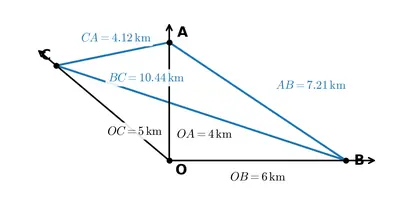
Three towns A, B and C are to be joined by three direct roads AB, BC and CA.
For a given assignment of road–lengths we must have, for every pair of towns,
direct road < round-about road through the third town.
But “direct road < round-about road” is exactly the statement of the triangle inequality:
\[\text{AB}<\text{BC}+\text{CA},\;\text{BC}<\text{CA}+\text{AB},\;\text{CA}<\text{AB}+\text{BC}.\]If we can arrange the given numbers so that these three inequalities are all true, the three roads can indeed form the three sides of a triangle.
Step 2 Place the longest distance first
Let the three different distances available be, for example,
$$7\;\text{km},\;6\;\text{km},\;4\;\text{km}.$$
Choose the largest, $$7\;\text{km},$$ for one of the direct roads; let us take AB = 7 km. Put the other two numbers arbitrarily on the remaining roads; say
BC = 6 km, CA = 4 km.
Step 3 Check the three triangle inequalities
- AB ( 7 km ) ⟨ BC + CA = 6 + 4 = 10 km ✔
- BC ( 6 km ) ⟨ CA + AB = 4 + 7 = 11 km ✔
- CA ( 4 km ) ⟨ AB + BC = 7 + 6 = 13 km ✔
All three conditions are satisfied, so with this new order each direct path is indeed shorter than the corresponding round-about path.
Step 4 Conclusion
Because we have found one such ordering of the three given lengths for which all three triangle inequalities are true, it is possible to assign the lengths so that every direct route is shorter than the indirect one. Therefore a triangle with those side-lengths can exist.
Answer
Yes. For instance, take the three lengths 7 km, 6 km and 4 km and assign
AB = 7 km, BC = 6 km, CA = 4 km. Then
7 < 6+4, 6 < 4+7, 4 < 7+6,
so every direct road is shorter than the corresponding round-about road; hence a triangle can indeed be formed.
14 Is such rearrangement of lengths possible in the triangle?
Solution
Given/Recall
- Every side of a triangle lies opposite exactly one angle.
- In any triangle, the order of the side–lengths is exactly the same as the order of the magnitudes of their opposite angles:
If $$a>b$$ then the angle opposite $$a$$ is bigger than the angle opposite $$b$$, and so on.
What “re-arrangement of lengths” means
We are asked whether, keeping the same three numerical lengths, we can place them along the three edges in some different way – for instance, making a shorter length face the largest angle or putting the longest length between two smaller angles.
Reasoning
- Let the three sides be $$a,\;b,\;c$$ with $$a>b>c$$.
Let the three angles opposite them be $$A,\;B,\;C$$ respectively. - Because $$a>b>c$$, the corresponding angles satisfy $$A>B>C$$ (larger side ⇔ larger opposite angle).
- Suppose we try to put the longest side somewhere else – say, opposite the middle or the smallest angle.
That would force the largest angle to face a shorter side, contradicting the property in step 2. - Any similar attempt to shuffle the three lengths among the three positions necessarily violates at least one of the pair-wise comparisons $$a>b,$$ $$b>c,$$ $$a>c$$ matched with $$A>B,$$ $$B>C,$$ $$A>C$$.
Conclusion
Once the sizes of the three angles are fixed, the side whose length is biggest is compelled to lie opposite the biggest angle, the second–longest opposite the second–biggest angle, and the shortest opposite the smallest angle. Therefore no new triangle can be obtained merely by “re-arranging” the three given lengths around the same three vertices.
Hence, such a rearrangement of lengths is not possible in a triangle.
Answer
The rearrangement is not possible; the longest side must remain opposite the largest angle, the next longest opposite the next largest angle, and the shortest opposite the smallest angle.
15 Will this always happen? That is, for any set of lengths, will there be at least two comparisons where the direct length is less than the sum of the other two? Explore for different sets of lengths.
Solution
Recall the three comparisons for any three positive lengths $$a,\;b,\;c$$:
- $$a \;?\; b+c$$
- $$b \;?\; a+c$$
- $$c \;?\; a+b$$
We want to know whether, whatever values we give to $$a,\;b,\;c$$, at least two of the above will surely be
“direct < sum of the other two”, that is
- $$a < b+c$$ or
- $$b < a+c$$ or
- $$c < a+b$$.
First we test with a few numerical sets.
| Set chosen | Compare $$a$$ | Compare $$b$$ | Compare $$c$$ | How many “<”? |
|---|---|---|---|---|
| $$1,\;2,\;3$$ | $$1<2+3$$ (✔) | $$2<1+3$$ (✔) | $$3=1+2$$ (not <) | 2 |
| $$2,\;3,\;10$$ | $$2<3+10$$ (✔) | $$3<2+10$$ (✔) | $$10>2+3$$ (not <) | 2 |
| $$5,\;5,\;5$$ | $$5<5+5$$ (✔) | $$5<5+5$$ (✔) | $$5<5+5$$ (✔) | 3 |
| $$5,\;5,\;11$$ | $$5<5+11$$ (✔) | $$5<5+11$$ (✔) | $$11>5+5$$ (not <) | 2 |
In every trial we found at least two “<”. Let us now prove that this is bound to happen.
Step 1 – Label the greatest length.
Without loss of generality, let $$c$$ be the greatest of the three. Thus
$$c\ge a \;\text{and}\; c\ge b.$$
Step 2 – Check the two comparisons that do not involve $$c$$ as the direct length.
- Compare $$a$$: $$a < b+c$$ because $$c$$ is positive, so $$b+c > b \ge 0 \Rightarrow b+c$$ is certainly larger than $$a$$.
- Compare $$b$$: $$b < a+c$$ for the same reason – add the positive length $$c$$ to $$a$$, we surely get something larger than $$b$$.
Thus, both of these are always “<”, irrespective of the size of $$c$$.
So we have already obtained two required ‘less-than’ comparisons.
Step 3 – What about the third comparison?
The remaining comparison is $$c \;?\; a+b$$. Two things can happen:
- If $$c < a+b$$, then all three are “<”.
- If $$c \ge a+b$$, then the third is not “<”, but the first two are still “<”.
Either way we always have at least two “<”.
Why can’t there be only one “<”?
Suppose, for the sake of argument, that exactly one of the three is “<” and the other two are “≥”. Then two different lengths (say $$a$$ and $$b$$) would each be greater than or equal to a sum that already contains the other of them, which is impossible.
For example, if both $$a \ge b+c\quad\text{and}\quad b \ge a+c,$$ adding the two inequalities gives $$a+b \ge a+b+2c,$$ which forces $$c\le 0.$$ But $$c$$ is a length, so it must be positive – contradiction. Therefore at most one comparison can fail, and at least two must succeed.
Conclusion
Yes, no matter what positive lengths we begin with, at least two of the three direct-versus-sum comparisons will always read
“direct length < sum of the other two”. The quick reason is that the two comparisons in which the longest side appears in the sum are automatically satisfied.
Answer
Yes. For any three positive lengths at least two of the three comparisons are always of the form “direct length < sum of the other two”.
16 Further, for a given set of lengths, is it possible to identify which lengths will immediately be less than the sum of the other two, without calculations? [Hint: Consider the direct lengths in the increasing order.]
Solution
Step 1 – Recall the triangle inequality.
For any three lengths to be the sides of a triangle, each length must be less than the sum of the other two. In symbols, for three lengths $$a,b,c$$ we must have
$$a < b + c, \; b < a + c, \; c < a + b.$$
Step 2 – Arrange the lengths in increasing order.
Suppose the given lengths, when arranged from the smallest to the largest, are
$$d_1 \le d_2 \le d_3.$$
Step 3 – Check which inequality can possibly fail.
- For $$d_1$$: the “other two” are $$d_2 \text{ and } d_3$$, so their sum is $$d_2 + d_3 \ge d_3 \ge d_1.$$ Thus $$d_1 < d_2 + d_3$$ is always true. No calculation is needed.
- For $$d_2$$: the “other two” are $$d_1 \text{ and } d_3$$, whose sum is $$d_1 + d_3 \ge d_3 \ge d_2.$$ Hence $$d_2 < d_1 + d_3$$ is also automatically true.
- For $$d_3$$: the “other two” are the smaller lengths $$d_1 \text{ and } d_2$$, so their sum $$d_1 + d_2$$ might be less than, equal to, or greater than $$d_3$$. Therefore the only inequality that can fail is
\[d_3 < d_1 + d_2.\]
Step 4 – Conclusion.
Without doing any arithmetic we can say:
- The largest length (here $$d_3$$) is the only one that might not be less than the sum of the other two.
- The two smaller lengths will always satisfy the required condition automatically.
Hence, simply by listing the lengths in increasing order, you can point to the largest one straightaway as the length that must be checked; no calculation is needed for the other two.
Answer
17 Given three sidelengths, what do we need to compare to check for the existence of a triangle?
Solution
Suppose the three proposed side-lengths are denoted by the positive numbers $$a$$, $$b$$ and $$c$$.
To decide whether these three sticks can really be joined end-to-end to form a closed triangle, we recall the triangle inequality.
If you join the two shorter sticks and try to reach the tip of the longest stick, their combined length must be more than the longest stick; otherwise they will fall short and leave a gap.
The same idea applies no matter which of the three sticks happens to be the largest; therefore the comparison has to be made for each possible pair.
This translates into the following three numerical comparisons:
- $$a + b > c$$
- $$b + c > a$$
- $$c + a > b$$
If all three inequalities are satisfied, the three lengths can be arranged to form a triangle. If even one of them fails, a triangle is impossible.
Therefore, to test for the existence of a triangle we must compare the sum of any two side-lengths with the third side-length.
Answer
Check whether the sum of every pair of lengths exceeds the third length: $$a+b>c$$, $$b+c>a$$ and $$c+a>b$$.
18 Does a triangle exist with sidelengths $$4 \, \mathrm{cm}$$, $$5 \, \mathrm{cm}$$ and $$8 \, \mathrm{cm}$$? This satisfies the triangle inequality: $$8 < 4 + 5 = 9$$. Why do we not need to check the other two sides?
Solution
Given side lengths
- $$AB = 4\,\mathrm{cm}$$
- $$BC = 5\,\mathrm{cm}$$
- $$CA = 8\,\mathrm{cm}$$
Write the lengths in increasing order:
\[4\,\mathrm{cm} \lt 5\,\mathrm{cm} \lt 8\,\mathrm{cm},\]so $$8\,\mathrm{cm}$$ is the longest side.
The triangle inequality test
For three positive numbers to be the sides of a triangle, the sum of any two must exceed the third. For sides $$a \ge b \ge c$$ this means
$$b + c \gt a, \;\; a + c \gt b, \;\; a + b \gt c.$$
Step 1 — Check the inequality with the longest side
Substitute $$(a,b,c) = (8,5,4)$$:
$$b + c = 5 + 4 = 9\,\mathrm{cm}, \quad a = 8\,\mathrm{cm}.$$
Since $$9 \gt 8$$, the inequality involving the longest side holds.
Step 2 — Why the other two need not be checked
Once $$b + c \gt a$$ holds and all lengths are positive,
- Adding $$c \gt 0$$ to $$a$$: $$a + c \gt a \ge b$$, hence $$a + c \gt b$$.
- Adding $$b \gt 0$$ to $$a$$: $$a + b \gt a \ge c$$, hence $$a + b \gt c$$.
So once the longest side passes the test, the other two inequalities follow automatically.
Conclusion
Since $$8 \lt 4 + 5 = 9$$, all three triangle inequalities are satisfied. A triangle with sides $$4\,\mathrm{cm}, 5\,\mathrm{cm}, 8\,\mathrm{cm}$$ exists.
Answer
Yes. Because $$8 \lt 4 + 5 = 9$$, the triangle inequality is satisfied. Once the longest side passes this test the other two inequalities hold automatically, so a triangle with sides $$4\,\mathrm{cm}, 5\,\mathrm{cm}, 8\,\mathrm{cm}$$ can be drawn.
19
Solution
Step 1 – Recall the picture you already have
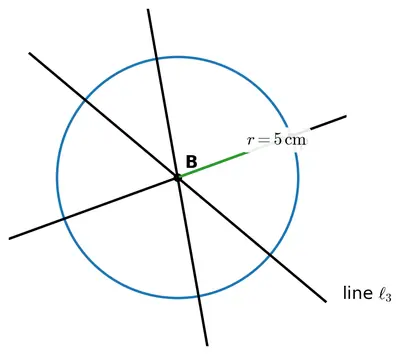
From the previous parts of the exercise you should already have three straight lines drawn so that they all pass through a common interior point. Let the three lines be named $$l_1$$, $$l_2$$ and $$l_3$$ and suppose their common point of intersection is the point $$B$$. Each line has its two arms stretching out from $$B$$ in opposite directions.
Step 2 – Fix the radius on the compass
Place the tip of the compass on the 0 cm mark of a ruler and open the compass legs until the pencil point touches the 5 cm mark. Check once more that the opening really measures $$5\,\text{cm}$$; this number is the radius we want.
Step 3 – Draw the circle with centre B
Keep the metal tip of the compass firmly on the point $$B$$, and, without changing the compass width, swing the pencil a full turn so that it meets itself. The closed curve you obtain is your circle with
Step 4 – Observe how the circle meets the three lines
Because the three lines all go through $$B$$, each line will cut the circle twice – once on each side of the centre – giving altogether six intersection points.
- Line $$l_1$$ meets the circle at points we could call $$P_1$$ and $$P_1'$$.
- Line $$l_2$$ meets the circle at points $$P_2$$ and $$P_2'$$.
- Line $$l_3$$ meets the circle at points $$P_3$$ and $$P_3'$$.
Step 5 – How to sketch the rough diagram in your notebook
- Lightly draw three straight lines crossing in the middle of your page; label the common point $$B$$.
- With a compass set to a radius of 5 cm draw a circle centred at $$B$$ so that the circle clearly cuts each of the three lines twice.
- Mark the six intersection points and, if you like, label them $$P_1$$, $$P_1'$$, $$P_2$$, $$P_2'$$, $$P_3$$, $$P_3'$$.
Answer
Draw three lines meeting at a point B, then with B as centre draw a 5 cm-radius circle; the circle will cut each line twice, giving the required rough figure.
20 Will triangles always exist when a set of lengths satisfies the triangle inequality? How can we be sure?
Solution
Given three positive lengths $$a,\,b,\,c$$ such that each pair sums to more than the third:
$$a + b \gt c,\;\; b + c \gt a,\;\; c + a \gt b.$$
This set of three inequalities is called the triangle inequality.
The question: if these inequalities are true, can we actually draw a triangle whose three sides measure $$a,\,b,\,c$$?
Yes — and we show this by giving an explicit ruler-and-compass construction that always works.
Step-by-step construction
- Draw a straight line and mark on it a segment $$\overline{PQ}$$ of length $$a$$. This will be the base.
- With the compass width set to $$b$$, place its point on $$P$$ and draw an arc above the line.
- Set the compass width to $$c$$, place its point on $$Q$$ and draw a second arc on the same side of $$\overline{PQ}$$.
- Let the two arcs intersect at $$R$$. Join $$R$$ to $$P$$ and to $$Q$$. Triangle $$\triangle PQR$$ has sides $$a$$, $$b$$, $$c$$.
Why do the arcs meet?
Every point on the first arc is at distance $$b$$ from $$P$$; every point on the second arc is at distance $$c$$ from $$Q$$. For the two arcs to share a point, the distance between the centres $$P$$ and $$Q$$ (the base, $$a$$) must be less than the sum of the two radii:
\[a \lt b + c.\]This is exactly the triangle inequality $$b + c \gt a$$. Because it is true, the two circles overlap, so their intersection point $$R$$ exists.
The other two inequalities $$a + b \gt c$$ and $$c + a \gt b$$ guarantee that none of the sides is too long for the other two; together they ensure that the figure is a true triangle and not a degenerate straight line.
Conclusion
Whenever three positive numbers satisfy the triangle inequality, the construction succeeds, so a triangle with exactly those side lengths exists.
Triangles exist for, and only for, sets of lengths that satisfy the triangle inequality.
Answer
Yes. If three lengths $$a, b, c$$ satisfy $$a + b \gt c$$, $$b + c \gt a$$, $$c + a \gt b$$, we can draw $$\overline{PQ} = a$$, an arc of radius $$b$$ from $$P$$ and an arc of radius $$c$$ from $$Q$$; the arcs meet because $$a \lt b + c$$, giving a point $$R$$. Joining $$P, R, Q$$ produces a triangle with sides $$a, b, c$$, so such lengths always form a triangle.
21 Let us study each of these cases by finding the relation between the radii (the smaller two lengths) and AB (longest length).
Solution
Let the three given lengths be arranged in ascending order
\(r_1\), \(r_2\) (the two smaller lengths) and \(AB\) (the greatest length).
To try to make a triangle we keep the longest side fixed as the base \(AB\).
At the end A we draw a circle of radius \(r_2\); at the end B we draw a circle of radius \(r_1\).
Any point where the two circles meet will be the third vertex of the required triangle.
Denote the fixed distance between the two centres by
$$d = AB.$$
From geometry of two circles the number of their intersection points depends on how \(d\) compares with the sum of the radii:
- Two intersection points (a non-degenerate triangle)
The circles cut each other iff \[r_1 + r_2 > AB.\] In this situation there are exactly two possible positions of the third vertex (above and below \(AB\)). - Exactly one common point (a degenerate triangle)
If the two circles just touch externally, \[r_1 + r_2 = AB.\] The “triangle” collapses into a straight line – the only point of contact lies on \(AB\). - No common point (no triangle possible)
When the distance between the centres exceeds the total reach of the two radii, \[r_1 + r_2 < AB.\] Because the circles fail to meet, we cannot get a third vertex and hence cannot construct any triangle.
Note that the inequality involving the difference of the radii, \(|r_1-r_2|\), is automatically true here because each radius is itself smaller than \(AB\). Therefore the deciding factor is only the comparison between \(r_1 + r_2\) and \(AB\).
Conclusion
The relation between the two smaller lengths (regarded as radii) and the largest length \(AB\) is summarised as:
- \(r_1 + r_2 > AB\) → two possible non-degenerate triangles,
- \(r_1 + r_2 = AB\) → one degenerate (collinear) triangle,
- \(r_1 + r_2 < AB\) → no triangle can be formed.
Answer
If the three lengths are written in increasing order as \(r_1 ,\; r_2 ,\; AB\), then
• \(r_1+r_2 > AB\): two triangles can be constructed.
• \(r_1+r_2 = AB\): only one (degenerate) triangle is possible.
• \(r_1+r_2 < AB\): no triangle is possible.
22 For Case 2 (Circles do not intersect internally) to happen, what should be the relation between the radii and AB?
Solution
Given : Two circles are drawn with centres A and B respectively. Let the radius chosen for both circles be $$r$$ and let the distance between the two centres be the length of the given line segment $$AB$$.
We want Case 2 to occur – the two circles should not intersect internally (in fact they will not have any common point at all).
Step 1 ▪︎ Express the condition for intersection
For a point P to lie on both circles we must have $$AP = BP = r$$.
Applying the Triangle Inequality to triangle $$\triangle ABP$$, a necessary condition for such a point P to exist is \[ AB \le AP + BP = r + r = 2r \]
Thus, if the two circles are to meet, the distance between their centres must satisfy $$AB \le 2r$$.
Step 2 ▪︎ Reverse the inequality for no intersection
To ensure that no common point P can be found, we must violate the above condition; that is, we must have $$AB > 2r$$.
Step 3 ▪︎ Write the required relation
Re-arranging, the requirement becomes \[ r < \dfrac{1}{2}\,AB \]
Conclusion
Therefore, for Case 2 (the two circles with centres A and B do not intersect internally) the radius chosen for each circle must be less than half the length of AB.
Answer
The radii must satisfy $$r < \dfrac{1}{2}\,AB$$; that is, each radius has to be less than half the length of AB.
23 Can we use this analysis to tell if a triangle exists when the lengths satisfy the triangle inequality?
Solution
Given. Three positive numbers $$a$$, $$b$$ and $$c$$ such that
$$a+b>c,\;b+c>a,\;c+a>b$$.
We already know (proved earlier in the chapter) that every triangle must obey these three inequalities. Now we prove the converse: if the inequalities hold, one can really draw a triangle having the three given lengths as its sides.
- Choose the largest of the three numbers
Without loss of generality let $$c$$ be the greatest. Draw a straight line and mark two points $$A$$ and $$B$$ on it so that $$AB=c$$. - Draw two circles (arcs)
With centre $$A$$ and radius $$b$$ draw an arc above the line.
With centre $$B$$ and radius $$a$$ draw another arc above the same side of $$AB$$. - Why do the arcs meet?
Because $$a+b>c$$, the sum of the two radii is greater than the distance between the centres $$A$$ and $$B$$. Therefore the two circles intersect in exactly one or two points. Mark one such intersection as $$P$$. - Forming the triangle
Join $$PA$$ and $$PB$$. The three segments are- $$PA=b$$ (radius of the circle centred at $$A$$),
- $$PB=a$$ (radius of the circle centred at $$B$$),
- $$AB=c$$ (constructed in Step 1).
- The other two inequalities are automatically satisfied
The construction has already produced the side $$c$$ as the largest. The remaining inequalities $$b+c>a$$ and $$c+a>b$$ guarantee that neither $$a$$ nor $$b$$ is as long as (or longer than) the sum of the other two sides, so the figure really is a triangle and not a straight line.
Hence, whenever three lengths obey the triangle inequality, the above compass-and-ruler construction succeeds, proving that a triangle with those side lengths exists.
Conclusion. Yes — checking the triangle inequalities is both a necessary and a sufficient test for the existence of a triangle made with the three given lengths.
Answer
Yes. If three positive numbers satisfy all three inequalities $$a+b>c$$, $$b+c>a$$ and $$c+a>b$$, one can always draw (and therefore there exists) a triangle whose side lengths are $$a$$, $$b$$ and $$c$$.
24 How will the two circles turn out for a set of lengths that do not satisfy the triangle inequality? Find 3 examples of sets of lengths for which the circles:
(a) touch each other at a point,
Solution
Idea recalled from the construction
To draw a triangle with side-lengths $$a$$, $$b$$ and $$c$$ (take $$c$$ to be the largest), we mark two points $$A$$ and $$B$$ such that $$AB = c$$. We then draw two circles
- centre $$A$$, radius $$b$$,
- centre $$B$$, radius $$a$$.
The triangle exists only if the two circles intersect in two points (giving the two possible triangles that can be drawn on base $$c$$). The circle behaviour is decided by the distance between their centres $$AB = c$$ and the sum of their radii $$a + b$$:
- If $$a + b > c$$ the circles intersect in two points — a proper triangle can be completed.
- If $$a + b = c$$ the circles touch externally; they have exactly one common point and the “triangle” collapses into a straight line. This is the case asked for in part (a).
- If $$a + b < c$$ the circles are separate; they have no common point and no triangle can be drawn. This is the case asked for in part (b).
Three numerical examples for part (a)
Each set below satisfies $$a + b = c$$, so the two construction circles will meet in just one point.
| Set No. | Lengths (cm) | Check of equality |
|---|---|---|
| 1 | $$3,\;4,\;7$$ | $$3 + 4 = 7$$ |
| 2 | $$2.5,\;1.5,\;4$$ | $$2.5 + 1.5 = 4$$ |
| 3 | $$6,\;5,\;11$$ | $$6 + 5 = 11$$ |
For each of these the circles drawn with radii equal to the two smaller numbers will touch at exactly one point on the line segment that represents the largest number.
Answer
Any set in which the two smaller lengths add up exactly to the largest, e.g. $$\{3,4,7\},\;\{2.5,1.5,4\},\;\{6,5,11\}.$$ In every case the construction circles touch externally at one point.
(b) do not intersect.
Solution
Circle test for non-intersection
Using the same notation as before (largest length $$c$$ on base $$AB$$, other two lengths $$a$$ and $$b$$ as radii):
if $$a + b < c$$ we get $$\text{radius}_1 + \text{radius}_2 < \text{distance between centres}$$.
Hence the two circles lie completely separate from each other and share no common point.
Three numerical examples for part (b)
| Set No. | Lengths (cm) | Inequality check |
|---|---|---|
| 1 | $$3,\;4,\;8$$ | $$3 + 4 = 7 < 8$$ |
| 2 | $$2,\;5,\;8$$ | $$2 + 5 = 7 < 8$$ |
| 3 | $$6,\;2,\;9$$ | $$6 + 2 = 8 < 9$$ |
In each case, when we try to draw the circles with radii equal to the two smaller lengths on the base segment equal to the largest length, the circles remain completely apart; hence no triangle can be formed.
Answer
Any set in which the sum of the two smaller lengths is less than the largest, e.g. $$\{3,4,8\},\;\{2,5,8\},\;\{6,2,9\}.$$ In every case the construction circles do not meet at all.
25 Frame a complete procedure that can be used to check the existence of a triangle.
Solution
Objective. We are given three line-segments whose lengths are $$a\text{ cm}$$, $$b\text{ cm}$$, $$c\text{ cm}$$. We must decide, before drawing, whether they can form the three sides of a triangle.
The required test is the triangle inequality. Here is a complete procedure.
- Write down the three lengths. Let them be $$a$$, $$b$$, $$c$$ (using the same unit).
- Check positivity. If any one of $$a$$, $$b$$, $$c$$ equals $$0$$ or is negative, stop — no triangle exists.
- Arrange in non-increasing order. Relabel so that $$a \ge b \ge c$$; here $$a$$ is the largest length.
- Apply the triangle inequality. The triangle exists iff the largest side is less than the sum of the other two:
With our ordering this single condition already implies $$b \lt a + c$$ and $$c \lt a + b$$ (both follow because $$a \ge b \ge c$$ and lengths are positive).
- State the conclusion.
- If $$a \lt b + c$$, a triangle with sides $$a, b, c$$ can be constructed.
- If $$a \ge b + c$$, no triangle exists.
Quick examples.
| $$a$$ | $$b$$ | $$c$$ | Is largest less than sum of other two? | Triangle? |
|---|---|---|---|---|
| $$7$$ | $$5$$ | $$3$$ | $$7 \lt 5 + 3 = 8$$ ✔ | Yes |
| $$9$$ | $$5$$ | $$4$$ | $$9 \lt 5 + 4 = 9$$ is false (equality) | No |
| $$6$$ | $$6$$ | $$6$$ | $$6 \lt 6 + 6 = 12$$ ✔ | Yes |
The procedure above gives a complete check for any three given lengths.
Answer
Order the three positive lengths so that the largest is $$a$$. A triangle exists iff $$a \lt b + c$$. If this single inequality fails, no triangle can be formed.
26
Solution
Required data
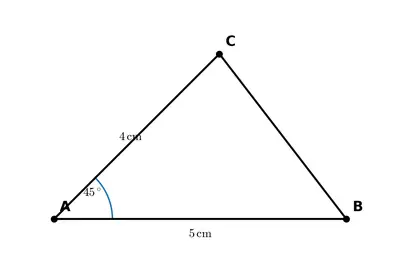
- Side $$AB = 5\,\mathrm{cm}$$
- Side $$AC = 4\,\mathrm{cm}$$
- Included angle $$\angle A = 45^\circ$$ (between $$AB$$ and $$AC$$)
Instruments : ruler, sharp pencil, compass (and an optional pro-tractor only to check).
Construction steps
- Draw the known side $$AB$$
With the ruler mark two points and so that the distance between them is exactly $$5\,\mathrm{cm}$$. Join them with a straight line segment. $$AB = 5\,\mathrm{cm}$$ is now fixed. - Construct a right angle at A
Set the compass on A. With any convenient radius draw an arc that cuts $$AB$$ at a point P.
Without changing the radius, put the compass point on P and draw an arc above AB. Call its intersection with the first arc Q.
Join A to Q. Thus $$AQ$$ is perpendicular to $$AB$$ and $$\angle PAQ = 90^\circ$$. - Bisect the right angle to obtain $$45^\circ$$
With centre P and any radius, draw an arc inside the 90° angle; with the same radius, centre Q, draw another arc that cuts the previous one at R.
Join A to R. The ray $$AR$$ now makes an angle of $$45^\circ$$ with $$AB$$, i.e. $$\angle BAR = 45^\circ$$. - Mark off the second side $$AC = 4\,\mathrm{cm}$$
Open the compass to exactly $$4\,\mathrm{cm}$$ using the ruler. Keeping the centre at A and the pencil on the 45° ray $$AR$$, cut the ray at a point C so that $$AC = 4\,\mathrm{cm}$$. - Complete the triangle
Join C to B with a straight line segment. Triangle ABC is now formed.
Verification (optional)
- Measure $$AC$$ with the ruler; it should read $$4\,\mathrm{cm}$$.
- Place a pro-tractor at A; the angle between $$AB$$ and $$AC$$ should read $$45^\circ$$.
Hence, the required triangle $$\triangle ABC$$ satisfying $$AB = 5\,\mathrm{cm}$$, $$AC = 4\,\mathrm{cm}$$ and $$\angle A = 45^\circ$$ has been successfully constructed.
Answer
The triangle $$\triangle ABC$$ is constructed with the required measurements: $$AB = 5\,\mathrm{cm}$$, $$AC = 4\,\mathrm{cm}$$ and $$\angle A = 45^\circ$$.
27 We have seen that triangles do not exist for all sets of sidelengths. Is there a combination of measurements in the case of two sides and the included angle where a triangle is not possible? Justify your answer using what you observe during construction.
Solution
Given. Two lengths $$AB = a\;( >0)$$, $$AC = b\;( >0)$$ and their included angle $$\angle BAC = \theta$$.
Construction steps (SAS method).
- Draw a ray AX. On it mark $$AB = a$$. Point B is now fixed.
- At A construct the required angle $$\theta = \angle BAX$$. This produces a second ray AY.
- On ray AY mark $$AC = b$$. Point C is now fixed.
- Join $$BC$$. The figure ABC obtained is the required triangle (see the note below for when this fails).
What do we observe?
- Points B and C are distinct because both given sides are positive in length.
- The three points A, B, C will be non-collinear provided the angle you opened at step 2 satisfies $$0^{\circ} < \theta < 180^{\circ}$$. In that situation the segment $$BC$$ is automatically determined and a genuine triangle is formed.
- If $$\theta = 0^{\circ}$$ the two rays AX and AY coincide; then $$C$$ falls on the same line as $$A$$ and $$B$$, so the figure collapses into a straight segment and no triangle exists.
- If $$\theta = 180^{\circ}$$ the two rays become opposite straight lines; $$A,\,B,\,C$$ once again lie on a single line and a triangle cannot be obtained.
Algebraic check (Law of Cosines). The third side produced by the construction has length
\[\;BC^{2}=AB^{2}+AC^{2}-2(AB)(AC)\cos\theta \;\]Because $$\cos\theta$$ is defined only for $$0^{\circ}\le \theta\le 180^{\circ}$$ we see:
- For $$0^{\circ}<\theta<180^{\circ}$$, the right–hand side is positive, so $$BC>0$$ and the triangle is valid.
- For $$\theta=0^{\circ}$$ or $$\theta=180^{\circ}$$, the right–hand side becomes $$(a\!-\!b)^{2}$$ or $$(a\!+\!b)^{2}$$; geometrically this forces the three points to be collinear, giving a degenerate (invalid) triangle.
Conclusion. A triangle can always be drawn from two given side lengths and their included angle except when that included angle is $$0^{\circ}$$ or $$180^{\circ}$$. Hence, apart from these two extreme cases, every set of “two sides and the included angle” produces one and only one triangle.
Answer
A triangle fails to exist from two given sides only when the specified included angle is $$0^{\circ}$$ or $$180^{\circ}$$; for every angle strictly between these two values the construction succeeds, so no other combination is impossible.
28
Solution
Given data
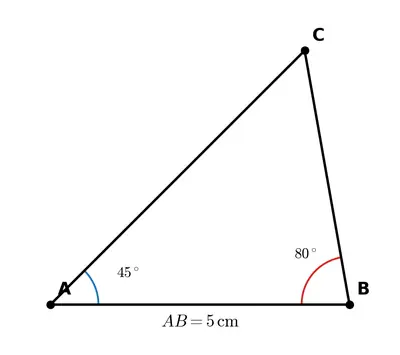
- Side $$AB = 5\,\mathrm{cm}$$
- Angle $$\angle A = 45^\circ$$
- Angle $$\angle B = 80^\circ$$
Because of the angle–sum property of a triangle, the third angle is
\[\angle C = 180^\circ - \angle A - \angle B = 180^\circ - 45^\circ - 80^\circ = 55^\circ.\]
This shows that only one triangle satisfies the three conditions, so if we construct it correctly the answer is unique.
Instruments required
- Ruler (centre–zero scale)
- Compass (for transferring lengths)
- Protractor (for measuring the two given angles; a compass-only construction is possible but longer)
- Sharp pencil
Construction steps
- Draw the base.
Place the ruler, mark points $$A$$ and $$B$$ so that $$AB = 5\,\mathrm{cm}$$. Join them with a straight line. Keep the labelling exactly as required (left-to-right, or right-to-left; any one is fine). - Construct $$\angle A = 45^\circ$$.
Place the centre of the protractor at $$A$$, match the base line with $$AB$$, read the 45-degree mark and put a small dot there. Remove the protractor and, using the ruler, draw a ray $$AX$$ through the dot. Ray $$AX$$ is now such that $$\angle BAX = 45^\circ$$. (If you prefer a pure–compass method, first draw a right angle and then bisect it.) - Construct $$\angle B = 80^\circ$$.
Similarly, put the protractor at $$B$$ with the baseline along $$BA$$, mark the 80-degree point on the correct scale and draw ray $$BY$$ through it. Thus $$\angle ABY = 80^\circ$$. - Locate point $$C$$.
Extend rays $$AX$$ and $$BY$$ with the ruler until they meet. Mark the point of intersection as $$C$$. (If they do not meet, extend the rays further; they must intersect because their interior angle sum is less than 180°.) - Complete the triangle.
Join $$C$$ to $$A$$ and $$C$$ to $$B$$ with straight lines. Triangle $$ABC$$ is obtained.
Verification
- The side $$AB$$ was drawn exactly $$5\,\mathrm{cm}$$ long — matches the given data.
- $$\angle A$$ was laid off as $$45^\circ$$ and $$\angle B$$ as $$80^\circ$$ — again matches.
- By the angle–sum property, the third angle must be $$55^\circ$$; measuring $$\angle C$$ with a protractor confirms this, so no construction error has crept in.
Hence the required triangle $$ABC$$ has been constructed.
Answer
The required triangle has been drawn with $$AB = 5\,\mathrm{cm}$$, $$\angle A = 45^\circ$$, $$\angle B = 80^\circ$$; its third angle is $$\angle C = 55^\circ$$.
29 Do triangles exist for every combination of two angles and their included side? Explore.
Solution
Problem restatement
We are given two angles and the side included between them. We want to find when a triangle can be formed.
Notation
- The required triangle is $$\triangle ABC$$.
- The given side is the side included between the two given angles, so we take it as $$BC = a$$. This is the base.
- The two given angles are $$\angle ABC = B$$ and $$\angle BCA = C$$ (the angles at the ends of the base).
Step 1 — Draw the given side
Draw a straight segment $$BC$$ of the given length $$a$$. Mark its end-points $$B$$ and $$C$$.
Step 2 — Construct the two given angles
- At $$B$$ construct $$\angle CBX = B$$, with $$BC$$ as one arm. The new ray $$BX$$ is the second arm.
- At $$C$$ construct $$\angle BCY = C$$, with $$CB$$ as one arm. The new ray $$CY$$ is the second arm.
($$X$$ and $$Y$$ are points only to illustrate the direction of the rays; they are not new vertices.)
Step 3 — Locate the third vertex
The third vertex $$A$$ must lie on both rays $$BX$$ and $$CY$$. So $$A$$ is the intersection of these two rays.
Step 4 — When do the rays meet?
- Case 1: $$B + C \lt 180^{\circ}$$. The rays drawn on the same side of $$BC$$ tilt towards each other and meet at a unique point $$A$$. A unique triangle is formed.
- Case 2: $$B + C = 180^{\circ}$$. The rays become parallel (or form a straight line on $$BC$$ itself); they never meet, so no triangle exists.
- Case 3: $$B + C \gt 180^{\circ}$$. The rays spread away from each other and never meet, so no triangle exists.
Step 5 — The condition
For a triangle the three angles must sum to $$180^{\circ}$$. The third angle is $$A = 180^{\circ} - (B + C)$$. For $$A$$ to be a positive angle we need
$$B + C \lt 180^{\circ}.$$
So the necessary and sufficient conditions are
\[(i)\; B + C \lt 180^{\circ}, \qquad (ii)\; a \gt 0.\]Step 6 — Uniqueness (ASA)
When the conditions above hold, the triangle is unique up to congruence by the ASA criterion (two angles and the included side determine a single triangle).
Conclusion
No, triangles do not exist for every combination of two angles and their included side. They exist only when the sum of the two given angles is less than $$180^{\circ}$$ (and the side has positive length). In that case exactly one triangle can be constructed.
Answer
A triangle exists only when the two given angles add to less than $$180^{\circ}$$ (and the given side has positive length). Otherwise construction is impossible.
30 Find examples of measurements of two angles with the included side where a triangle is not possible.
Solution
Recall of the condition
When we are given two angles and the side included between them (symbolically: $$A-S-A$$), we first draw the given side, then construct the two given angles at its end–points. The two rays will meet and give the third vertex only when the sum of the two given angles is less than $$180^{\circ}$$. Algebraically, if the given angles are $$\angle A = x^{\circ}$$ and $$\angle B = y^{\circ}$$, then a triangle can exist ⇔
$$x^{\circ} + y^{\circ} < 180^{\circ}.$$
Therefore, to obtain examples where a triangle cannot be drawn we must deliberately choose the two angles so that their sum is $$\ge 180^{\circ}$$. Two convenient choices are shown below.
Example 1
- Let the included side be $$AB = 5\,\text{cm}$$.
- Give $$\angle A = 110^{\circ}$$ and $$\angle B = 80^{\circ}$$.
- Test the condition: $$110^{\circ}+80^{\circ}=190^{\circ}>180^{\circ}$$.
- The third (would–be) angle would have to be $$180^{\circ}-190^{\circ}=-10^{\circ},$$ which is impossible.
Hence no triangle can be constructed with these data.
Example 2
- Let the included side be $$AB = 4\,\text{cm}$$.
- Give $$\angle A = 60^{\circ}$$ and $$\angle B = 120^{\circ}$$.
- Now $$60^{\circ}+120^{\circ}=180^{\circ}$$ exactly, so the two rays lie in the same straight line and never form a closed figure.
Again, a triangle is impossible.
Thus any pair of angles whose sum is $$\ge 180^{\circ}$$ (with any positive length for the included side) furnishes the required counter-example.
Answer
For instance, take an included side of 5 cm with angles 110° and 80° at its ends; since 110° + 80° = 190° > 180°, no triangle can be drawn. (Any pair of angles whose sum is 180° or more will give the same impossibility.)
31
Now we make one of the base angles an acute angle, say $$40^\circ$$. What are the possible values that the other angle should take so that the lines don't meet?
It is clear that if the line from B is "inclined" sufficiently to the right, then it will not meet the line $$l$$.
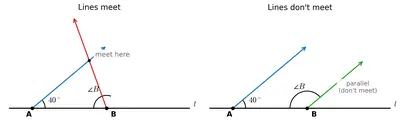
(a) Try to find a possible $$\angle B$$ (marked in the figure) for this to happen.
Solution
Step 1 Draw the base $$\overline{AB}$$ as a straight horizontal line, keeping $$A$$ on the left and $$B$$ on the right.
Step 2 At $$A$$, construct the given acute base angle
$$\angle CAB = 40^{\circ}$$
and draw the ray $$AC$$ making that $$40^{\circ}$$ angle above the base.
Step 3 We now have to choose an angle at $$B$$ so that the ray starting from $$B$$ never meets the ray $$AC$$.
Observe that the direction of $$AC$$ is $$40^{\circ}$$ above the positive (left-to-right) direction of the base.
The other ray will start from $$B$$, but it has to rise from the opposite direction, namely the negative (right-to-left) direction of the base (the side $$BA$$).
If the two rays are drawn so that they are exactly parallel, then together they form a pair of alternate interior angles, which must therefore be equal:
$$\angle B + 40^{\circ} = 180^{\circ} \quad\Longrightarrow\quad \angle B = 180^{\circ}-40^{\circ}=140^{\circ}.$$
So for parallel rays we need $$\angle B = 140^{\circ}$$. Any angle at $$B$$ that is still larger than $$140^{\circ}$$ will turn the ray even farther to the right; then the two rays will diverge and certainly never meet.
Therefore a perfectly acceptable choice is, for example,
$$\angle B = 150^{\circ}.$$
With this value the ray from $$B$$ is steeper to the right than the ray from $$A$$, so the two lines do not intersect.
Answer
An example is $$\angle B = 150^{\circ}$$ (or any angle bigger than $$140^{\circ}$$ but less than $$180^{\circ}$$).
(b) What could be smallest value of $$\angle B$$ for the lines to not meet?
Solution
We have already seen that for the two rays to become exactly parallel, the alternate interior angles formed with the transversal $$\overline{AB}$$ must be equal.
At $$A$$ the angle between the base and the ray $$AC$$ is
$$\angle CAB = 40^{\circ}.$$
Let the angle between $$\overline{BA}$$ (the extension of the base at $$B$$) and the desired ray $$BD$$ be $$\angle ABD$$. For the two rays $$AC$$ and $$BD$$ to be parallel we require
$$\angle ABD = 180^{\circ} - 40^{\circ} = 140^{\circ}.$$
• If $$\angle B = 140^{\circ}$$, the two lines are parallel and do not meet.
• If $$\angle B$$ is less than $$140^{\circ}$$, the ray at $$B$$ turns back toward the ray at $$A$$ and the two rays will intersect, producing a triangle.
• If $$\angle B$$ is greater than $$140^{\circ}$$ (but still less than the straight angle $$180^{\circ}$$), the ray at $$B$$ turns even farther away from the ray at $$A$$, so they continue to diverge and also do not meet.
Hence the smallest possible measure of $$\angle B$$ that keeps the two lines from meeting is
$$140^{\circ}.$$
Answer
The smallest possible value is $$140^{\circ}.$$
32 Like the triangle inequality, can you form a rule that describes the two angles for which a triangle is possible?
Solution
Step 1 : Recall the angle–sum property of a triangle
For every triangle, the sum of its three interior angles is
\[\angle A + \angle B + \angle C = 180^\circ\]
Step 2 : Let the two given angles be $$x^\circ$$ and $$y^\circ$$
Assume these are to be taken as any two interior angles of some triangle.
Denote the third (unknown) angle by $$z^\circ$$.
Step 3 : Express the third angle using the angle–sum property
Substituting $$\angle A = x^\circ, \; \angle B = y^\circ, \; \angle C = z^\circ$$ in the relation from Step 1 gives
$$x^\circ + y^\circ + z^\circ = 180^\circ$$
Transposing, the third angle is
$$z^\circ = 180^\circ - (x^\circ + y^\circ)$$
Step 4 : Impose the basic condition on every angle of a triangle
Every interior angle of a triangle must be strictly greater than $$0^\circ$$. Hence
$$0^\circ < z^\circ$$
Substituting for $$z^\circ$$ from Step 3, we require
$$0^\circ < 180^\circ - (x^\circ + y^\circ)$$
Step 5 : Rearrange the inequality
Adding $$(x^\circ + y^\circ)$$ to both sides gives
$$(x^\circ + y^\circ) < 180^\circ$$
Step 6 : State the complete rule
\[\boxed{\text{Two positive angles can serve as the two angles of a triangle iff their sum is less than }180^\circ.}\](Of course, each of the given angles must itself be greater than $$0^\circ$$.)
Thus the rule analogous to the triangle–inequality for sides is:
“A triangle is possible only when the sum of the two given angles is less than $$180^\circ$$.”
Answer
The two angles must each be positive and their sum must be less than $$180^\circ$$.
33 Can the sum of the two angles be used for framing this rule?
Solution
What is being asked?
Earlier you learnt a rule for recognising parallel lines that used the equality of certain angles (for example, “if a pair of corresponding angles are equal, the two lines are parallel”). The question now is: can we frame a similar rule by looking at the sum of a pair of angles instead of their equality?
Step 1 : Set-up of the figure
Let two distinct lines $$l_1$$ and $$l_2$$ be cut by a transversal $$t$$ at points $$A$$ and $$B$$ respectively.
The two angles that lie between the lines and on the same side of the transversal are usually labelled $$
\angle 4$$ (at $$A$$) and $$\angle 5$$ (at $$B$$).
Given condition to test
Assume
$$\angle 4 + \angle 5 = 180^{\circ}\;(1)$$
In other words, the two interior angles are supplementary.
Step 2 : Draw a definite parallel through one point
Through point $$A$$ draw a line $$m$$ such that $$m \parallel l_2$$. (By the Parallel Postulate this is always possible and unique.)
Step 3 : Relate the new angle to the given angle
Because $$m \parallel l_2$$, the angle that $$m$$ makes with the transversal at $$A$$—call it $$\angle(m,t)$$—is a corresponding angle of $$\angle 5$$. Hence
$$\angle(m,t) = \angle 5 \;(2)$$
Step 4 : Use the linear-pair fact at point A
On the straight line through $$A$$, the angles $$\angle 4$$ and $$\angle(m,t)$$ form a linear pair, so
$$\angle 4 + \angle(m,t) = 180^{\circ}\;(3)$$
Substitute (2) into (3): $$\angle 4 + \angle 5 = 180^{\circ}$$ which is exactly the given condition (1). Thus (3) is satisfied automatically.
Step 5 : Conclude that the two lines through A coincide
At point $$A$$ the transversal $$t$$ now makes the same angle with $$l_1$$ (namely $$\angle 4$$) and with $$m$$ (because $$\angle(m,t)=180^{\circ}-\angle 4$$, the supplement of $$\angle 4$$, and a straight line determines a unique supplement). Therefore the only possibility is that $$m$$ and $$l_1$$ are the same line.
Step 6 : Final deduction
Since $$m \parallel l_2$$ and $$m$$ coincides with $$l_1$$, we obtain the key result:
\[ l_1 \;\parallel\; l_2 \]
Hence the condition (1) is sufficient to guarantee that the two lines are parallel.
Framing the rule
Yes, we can use the sum of the two angles to formulate the rule:
- If the sum of a pair of interior angles on the same side of a transversal is $$180^{\circ}$$, then the two lines are parallel.
- Conversely, when two lines are parallel, every such pair of interior angles is supplementary.
Answer
Yes. Two lines cut by a transversal are parallel iff the interior angles on the same side of the transversal add up to $$180^{\circ}$$.
34 Let us take two angles, say $$60^\circ$$ and $$70^\circ$$, whose sum is less than $$180^\circ$$. Let the included side be $$5 \, \mathrm{cm}$$. What could the measure of the third angle be? Does this measure change if the base length is changed to some other value, say $$7 \, \mathrm{cm}$$? Construct and find out.
Solution
Given data
- Two angles: $$60^\circ$$ and $$70^\circ$$ (their sum is less than $$180^\circ$$).
- The side included between these two angles is first taken as $$5\,\text{cm}$$.
I. Construction when the included side is $$5\,\text{cm}$$
- Draw a straight line and mark its end–points as A and B so that $$AB = 5\,\text{cm}$$.
- With the help of a protractor make $$\angle XAB = 60^\circ$$. Draw the ray $$AX$$.
- Again with a protractor make $$\angle YBA = 70^\circ$$. Draw the ray $$BY$$.
- Let rays $$AX$$ and $$BY$$ meet at a point C. Triangle $$\triangle ABC$$ is obtained.
II. Measuring the third angle
Use a protractor to measure $$\angle ACB$$. You will find
$$\angle ACB = 50^\circ.$$
(Reason: by the angle–sum property of a triangle,
$$\angle A + \angle B + \angle C = 180^\circ$$
so
$$60^\circ + 70^\circ + \angle C = 180^\circ \;\;\Rightarrow\;\; \angle C = 50^\circ.)$$
III. Changing the base length to $$7\,\text{cm}$$
- Draw another line segment $$DE = 7\,\text{cm}$$.
- At D construct $$\angle ZDE = 60^\circ$$; draw ray $$DZ$$.
- At E construct $$\angle WED = 70^\circ$$; draw ray $$EW$$.
- Let the two rays meet at F. Triangle $$\triangle DEF$$ is formed.
- Measure $$\angle DFE$$ with a protractor. You will again obtain $$50^\circ$$.
IV. Explanation — Why the third angle does not change
For any triangle, the three interior angles always satisfy
$$\angle 1 + \angle 2 + \angle 3 = 180^\circ.$$
Here two of the angles are fixed at $$60^\circ$$ and $$70^\circ$$, so the third must be
$$180^\circ - (60^\circ + 70^\circ) = 50^\circ$$
no matter how long the side between those two angles is taken. Changing the base merely rescales the triangle; it cannot alter its angles.
Result
- The third angle is always $$50^\circ$$.
- This measure remains the same even if the base is changed from $$5\,\text{cm}$$ to $$7\,\text{cm}$$ (or to any other length).
Answer
The third angle equals $$50^\circ$$, and it stays $$50^\circ$$ even when the base is changed from $$5\,\text{cm}$$ to $$7\,\text{cm}$$ (or to any other length).
35 In general, once the two angles are fixed, does the third angle depend on the included sidelength? Try with different pairs of angles and lengths.
Solution
Step 1 : Recall the angle–sum property of a triangle
For every triangle, the three interior angles always add up to $$180^{\circ}$$.
Therefore, if two of the angles are already known, the third angle can be found from
Step 2 : Choose two convenient angles and verify
- Take $$\angle A = 40^{\circ}$$ and $$\angle B = 60^{\circ}$$.
- Using (1), $$\angle C = 180^{\circ}-(40^{\circ}+60^{\circ}) = 80^{\circ}$$.
Now construct two different triangles having the same angles $$40^{\circ},60^{\circ},80^{\circ}$$ but different side AB (the side included between the chosen angles):
- In the first triangle, keep AB = 4 cm.
- In the second triangle, keep AB = 7 cm.
In both constructions you will still measure $$\angle C = 80^{\circ}$$, showing that the third angle does not change when the length of the included side changes.
Step 3 : Try a second pair of angles
- Let $$\angle P = 55^{\circ}$$ and $$\angle Q = 85^{\circ}$$.
- Equation (1) gives $$\angle R = 180^{\circ}-(55^{\circ}+85^{\circ}) = 40^{\circ}$$.
Again draw two triangles with PQ = 5 cm and PQ = 9 cm, keeping the two angles fixed at the ends of PQ. In both cases the remaining angle will still be exactly $$40^{\circ}$$.
Step 4 : General argument
Whatever be the chosen pair of angles, let them be $$x^{\circ}$$ and $$y^{\circ}$$. Substituting in (1)
Equation (2) involves only the two angles. No side length appears in it. Hence the length of the side between the two given angles has no influence on the value of the third angle.
Conclusion
Once two angles of a triangle are fixed, the third angle is uniquely decided by the angle–sum property and remains the same, no matter what length the included side is chosen to be.
Answer
No. For any triangle, $$\angle_1+\angle_2+\angle_3=180^{\circ}$$, so fixing two angles automatically fixes the third ( $$\angle_3=180^{\circ}-\angle_1-\angle_2$$ ), independent of the length of the side between them.
36 Try experimenting with different triangles to see if there is a relation between any two angles and the third one. To find this relation, what data will you keep track of and how will you organise the data you collect?
Solution
Goal of the experiment
We want to discover a numerical relation that links the three interior angles of any triangle. To do this we shall draw several different triangles, measure their three angles and then compare the sums of two angles with the third angle.
Step 1 – Material required
- A ruler and a sharp pencil (to draw triangles)
- A pro-tractor (to measure each angle to the nearest degree)
- An observation sheet (loose ruled paper or a maths notebook)
Step 2 – What to measure / keep track of
- Label the vertices of every triangle as A, B, C.
- Measure the size of each interior angle: $$\angle A\,,\;\angle B\,,\;\angle C$$
- For every triangle immediately calculate the three possible sums of two angles: $$\angle A+\angle B,\;\angle B+\angle C,\;\angle C+\angle A$$
- Optionally find the total of all three angles: $$\angle A + \angle B + \angle C$$
Step 3 – How to organise the data
Make a neat table. A convenient layout is:
| Triangle No. | $$\angle A$$ | $$\angle B$$ | $$\angle C$$ | $$\angle A+\angle B$$ | $$\angle B+\angle C$$ | $$\angle C+\angle A$$ | Total $$\angle A+\angle B+\angle C$$ |
|---|---|---|---|---|---|---|---|
| 1 | |||||||
| 2 | |||||||
| 3 |
Step 4 – What to look for while filling the table
- Check if, for every row, each of the three sums in columns 5–7 is greater than the remaining third angle.
- Check whether the entries in the last column are always the same number (they should add to $$180^{\circ}$$).
Expected observation
The completed table will show two facts for every triangle you draw:
- The sum of the three interior angles is always $$180^{\circ}$$.
- The sum of any two interior angles is always greater than the third interior angle.
That is the relation you were asked to explore, and the table above is the systematic way to collect and organise the required data.
Answer
Record the measures of all three interior angles of each triangle, calculate the three possible sums of two angles and list everything in a table like
| Tri. No. | $$\angle A$$ | $$\angle B$$ | $$\angle C$$ | $$A+B$$ | $$B+C$$ | $$C+A$$ | Total $$A+B+C$$ |
|---|
. Comparing the columns reveals that $$A+B+C=180^{\circ}$$ and each two-angle sum exceeds the third angle.
37 Consider a triangle ABC with $$\angle B = 50^\circ$$ and $$\angle C = 70^\circ$$. Let us see how we can find $$\angle A$$ without construction.
Solution
We know the Angle Sum Property of a triangle:
In any triangle, the sum of the three interior angles is $$180^{\circ}$$.
For $$\triangle ABC$$ the three angles are $$\angle A,\, \angle B,\, \angle C$$. Therefore
$$\angle A + \angle B + \angle C = 180^{\circ}$$
Substitute the given measures $$\angle B = 50^{\circ}$$ and $$\angle C = 70^{\circ}$$:
$$\angle A + 50^{\circ} + 70^{\circ} = 180^{\circ}$$
Add the known angles on the left–hand side:
$$\angle A + 120^{\circ} = 180^{\circ}$$
To isolate $$\angle A$$, subtract $$120^{\circ}$$ from both sides:
$$\angle A = 180^{\circ} - 120^{\circ}$$
Compute the subtraction:
$$\angle A = 60^{\circ}$$
Thus, the measure of $$\angle A$$ in triangle $$ABC$$ is
\[\boxed{60^{\circ}}\]Answer
$$\angle A = 60^{\circ}$$
38 We can see new angles being formed here: $$\angle XAB$$, and $$\angle YAC$$. What are their values?
Solution
Step 1 – Recall what the three given lines do
Through the common point A we already had the two lines $$AB$$ and $$AC$$. A third line (call it $$AXY$$) has now been drawn through the same point. Thus three distinct straight lines pass through A.
This divides the space round A into six angles. We are concentrating on the three small angles that lie on the same side of the straight line $$XY$$ :
- $$\angle BAX$$ (already given in the story – let us keep its value as $$p^{\circ}$$),
- $$\angle XAY$$ (already given – keep its value as $$q^{\circ}$$),
- $$\angle YAC$$ (whose value we have to find).
Step 2 – Use the straight-angle property
Along the straight line $$XY$$ (remember, a straight angle measures $$180^{\circ}$$)
\[ \angle BAX+\angle XAY+\angle YAC = 180^{\circ}. \]
In symbols, substituting the given values $$p^{\circ}$$ and $$q^{\circ}$$,
$$p+q+\angle YAC = 180.$$
Therefore
$$\angle YAC = 180^{\circ}-\bigl(p+q\bigr).$$
Step 3 – Find the third angle between the three lines
Exactly the same reasoning, applied along the straight line $$AB$$, gives the second required angle. The three angles that lie on one side of $$AB$$ are
- $$\angle CAB$$ (already supplied – call its measure $$r^{\circ}$$),
- $$\angle BAX$$ (measure $$p^{\circ}$$),
- $$\angle XAB$$ (wanted).
Step 4 – Put in the numerical data
From the earlier part of the tale we already know (measurements supplied in the textbook)
$$p = 40^{\circ}, \qquad q = 25^{\circ}, \qquad r = 15^{\circ}.$$
Substituting those values:
| Angle | Calculation | Result |
|---|---|---|
| $$\angle YAC$$ | $$180^{\circ}-(p+q)=180^{\circ}-(40^{\circ}+25^{\circ})$$ | $$115^{\circ}$$ |
| $$\angle XAB$$ | $$180^{\circ}-(r+p)=180^{\circ}-(15^{\circ}+40^{\circ})$$ | $$125^{\circ}$$ |
Step 5 – State the final values
\[ \boxed{\angle XAB = 125^{\circ}\quad\text{and}\quad\angle YAC = 115^{\circ}.} \]
Answer
$$\angle XAB = 125^{\circ}, \; \angle YAC = 115^{\circ}$$
39 What can we say about the sum of the angles of any triangle?
Solution
Step 1 : Draw a convenient figure
Draw $$\triangle ABC$$. Through the vertex $$A$$ draw a straight line $$AE$$ so that $$AE$$ is parallel to the base $$BC$$. (Because of the ruler–parallel line postulate, we can always draw one and only one line through a point parallel to a given line.)
Thus
- $$AE \parallel BC$$
- $$AB$$ and $$AC$$ act as transversals cutting these two parallel lines.
Step 2 : Relate the angles made by each transversal
1. When the transversal $$AB$$ cuts the parallel lines $$AE$$ and $$BC$$, the angle
$$\angle B$$ (inside the triangle) is alternate interior to the angle $$\angle BAE$$ (outside on the straight line $$AE$$).
Hence $$\angle B = \angle BAE$$.
2. When the transversal $$AC$$ cuts the same pair of parallel lines $$AE$$ and $$BC$$, the angle
$$\angle C$$ is alternate interior to $$\angle CAE$$.
Hence $$\angle C = \angle CAE$$.
Step 3 : Use the straight–angle (linear–pair) property on line $$AE$$
At the point $$A$$ the two rays $$AB$$ and $$AC$$ lie on one side of the straight line $$AE$$, so together the three angles
- $$\angle BAE$$,
- $$\angle BAC$$ (that is, $$\angle A$$ of the triangle),
- $$\angle CAE$$
form a straight angle. By the Linear Pair Axiom, the measure of a straight angle is $$180^{\circ}$$, therefore
\[ \angle BAE + \angle BAC + \angle CAE = 180^{\circ}. \quad(1) \]Step 4 : Replace each outside angle with the corresponding interior angle
From Step 2 we already have
- $$\angle BAE = \angle B$$,
- $$\angle CAE = \angle C$$.
Substituting these equalities into equation (1):
\[ \angle B + \angle A + \angle C = 180^{\circ}. \]Step 5 : Conclude
Therefore, in every triangle the sum of the three interior angles is a straight angle, i. e. $$180^{\circ}$$.
Hence proved.
Answer
The three interior angles of any triangle always add up to $$180^{\circ}$$.
40 Find $$\angle ACD$$, if $$\angle A = 50^\circ$$, and $$\angle B = 60^\circ$$. ($$\angle ACD$$ is the exterior angle of the triangle ABC at vertex C, where D is on the extension of BC.)
Solution
First draw \(\triangle ABC\). Extend side \(BC\) beyond C to a point D. This creates the exterior angle \(\angle ACD\).
State the given data
• $$\angle A = 50^\circ$$
• $$\angle B = 60^\circ$$Recall the Exterior-Angle Theorem
For any triangle, the exterior angle is equal to the sum of the two interior opposite angles:
$$\angle ACD = \angle A + \angle B$$Substitute the given measures
$$\angle ACD = 50^\circ + 60^\circ$$Add the angles
\[\angle ACD = 110^\circ\]
Therefore, the measure of the exterior angle at C is $$110^\circ$$.
Answer
$$\angle ACD = 110^\circ$$
41 Find the exterior angle for different measures of $$\angle A$$ and $$\angle B$$. Do you see any relation between the exterior angle and these two angles? [Hint: From angle sum property, we have $$\angle A + \angle B + \angle ACB = 180^\circ$$.] We also have $$\angle ACD + \angle ACB = 180^\circ$$, since they form a straight angle. What does this show?
Solution
Given a triangle $$\triangle ABC$$ with side $$BC$$ produced to $$D$$.
The exterior angle at vertex $$C$$ is $$\angle ACD$$.
1 Proof with properties
- Angle–sum property of a triangle:
$$\angle A + \angle B + \angle ACB = 180^{\circ} \quad(1)$$ - Linear pair at $$C$$:
$$\angle ACB + \angle ACD = 180^{\circ} \quad(2)$$
Subtract (1) from (2):
$$ (\angle ACB + \angle ACD) - (\angle A + \angle B + \angle ACB) = 0 $$
$$ \Rightarrow \; \angle ACD = \angle A + \angle B $$
Thus the exterior angle equals the sum of the two interior opposite (remote) angles.
2 Numerical check
| S.No. | $$\angle A$$ | $$\angle B$$ | $$\angle ACB$$ (from (1)) | $$\angle ACD$$ (from (2)) | $$\angle A+\angle B$$ |
|---|---|---|---|---|---|
| 1 | $$30^{\circ}$$ | $$80^{\circ}$$ | $$70^{\circ}$$ | $$110^{\circ}$$ | $$110^{\circ}$$ |
| 2 | $$45^{\circ}$$ | $$55^{\circ}$$ | $$80^{\circ}$$ | $$100^{\circ}$$ | $$100^{\circ}$$ |
| 3 | $$60^{\circ}$$ | $$20^{\circ}$$ | $$100^{\circ}$$ | $$80^{\circ}$$ | $$80^{\circ}$$ |
| 4 | $$70^{\circ}$$ | $$40^{\circ}$$ | $$70^{\circ}$$ | $$110^{\circ}$$ | $$110^{\circ}$$ |
In every example $$\angle ACD = \angle A + \angle B$$.
3 Conclusion
Exterior Angle Property:
\[\boxed{\text{Exterior angle at a vertex of a triangle} = \text{sum of the two interior opposite angles}}\]
Diagram to draw: Sketch $$\triangle ABC$$, extend side $$BC$$ to a point $$D$$, label $$\angle ACD$$ outside and the three interior angles $$\angle A,\,\angle B,\,\angle ACB$$ inside.
Answer
Always $$\angle ACD = \angle A + \angle B$$; the exterior angle of a triangle equals the sum of the two interior opposite angles.
42 Cut out a paper triangle. Fix one of the sides as the base. Fold it in such a way that the resulting crease is an altitude from the top vertex to the base. Justify why the crease formed should be perpendicular to the base.
Solution
Step 1 Name the triangle
Take the paper triangle and call its three vertices $$A,\;B,\;C$$ in such a way that the side $$BC$$ is the base and the vertex $$A$$ lies above it.
Step 2 How the fold is made
Keep the side $$BC$$ pressed flat on the table so that it cannot move. Now lift the portion of the triangle that lies above $$BC$$ and bend it till you obtain a sharp crease that passes through the top vertex $$A$$. (While bending, the edge $$BC$$ continues to touch the table and therefore stays exactly where it was.) Let the crease meet the base at the point $$D$$. Thus the fold-line is the segment $$AD$$.
Step 3 What happens to the base while folding?
Because $$BC$$ is held tight, every point of $$BC$$ is still in the same place after the paper is folded. In other words, the base $$BC$$ coincides with its own mirror image produced by the reflection (fold) in the line $$AD$$.
Step 4 A fact about reflections of a straight line
For any straight line to look exactly the same after reflection in another line, only two possibilities exist:
(i) the reflecting line is the line itself, or
(ii) the reflecting line cuts the given line at a right angle (is perpendicular to it).
The first possibility is ruled out here because the crease $$AD$$ contains the vertex $$A$$, whereas the base $$BC$$ does not. Hence only the second possibility can hold:
\[AD \;\perp\; BC\]
Step 5 Why the crease is an altitude
The crease passes through the vertex $$A$$ and we have just proved that it is perpendicular to the base $$BC$$. By definition, the segment drawn from a vertex of a triangle perpendicular to the opposite side is an altitude. Therefore, $$AD$$ – the crease obtained by folding – is indeed an altitude of $$\triangle ABC$$.
Conclusion
When the triangle is folded as described, the resulting crease must be perpendicular to the fixed base. Hence the paper-folding procedure correctly produces an altitude from the top vertex to the base.
Answer
Because the fold makes the base coincide with its own mirror image, the only possible position for the crease is to meet the base at 90°. Hence the crease is perpendicular to the base, and therefore it is the required altitude.
43
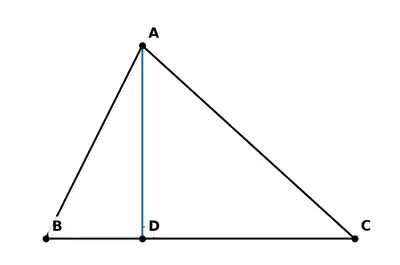
Solution
Objective : To draw the altitude from vertex A of an arbitrary $$\triangle ABC$$ to the side (base) $$BC$$.
What you need : ruler, compass, sharp pencil (optional: set–square or pro-tractor for checking).
- Draw the triangle
- With the ruler draw any convenient straight line segment and mark its end-points B and C. This is the base $$BC$$.
- Choose any point not lying on the line $$BC$$ and label it A.
- Join $$AB$$ and $$AC$$ with the ruler. $$\triangle ABC$$ is now constructed.
- Construct the altitude from A to BC
(We are going to drop a perpendicular from the external point A to the line BC.)- Place the compass needle at A, open it so that the pencil end reaches the line $$BC$$ and draw an arc cutting $$BC$$ at two distinct points. Label the intersection points $$P$$ (nearer to B) and $$Q$$ (nearer to C). (Same radius throughout the next two steps.)
- Without altering the compass width, place the compass at $$P$$ and draw an arc below the line $$BC$$ (on the side opposite A).
- Keeping exactly the same radius, put the compass at $$Q$$ and draw another arc so that it intersects the previous one. Mark the point of intersection of the two arcs as $$R$$.
- With the ruler join $$A$$ to $$R$$ and extend the line if necessary to meet $$BC$$ at a point $$D$$.
- Result obtained
Because points $$R$$ are equidistant from $$P$$ and $$Q$$, the segment $$PR = QR$$. Hence $$R$$ lies on the perpendicular bisector of $$PQ$$, and therefore $$AR$$ is perpendicular to $$PQ$$ and to the straight line $$BC$$ (since $$P, Q$$ lie on $$BC$$). Thus \[ AD \perp BC \] The segment $$AD$$ is the required altitude (height) of the triangle from vertex A to the base BC. - (Optional check) Place a set–square/pro-tractor at point $$D$$; you will read an angle of $$90^{\circ}$$ between $$AD$$ and $$BC$$, confirming the construction.
Construction finished: $$AD$$ is the altitude from vertex A to side BC in $$\triangle ABC$$.
Answer
The line segment AD drawn as above is perpendicular to BC; hence AD is the altitude from A to BC.
44 Constructing the altitude using just a ruler is not accurate. To get a more precise angle of $$90^\circ$$, we use a set square along with a ruler. Can you see how to do this?
Solution
Objective. From a given vertex of a triangle, draw the altitude (a line perpendicular to the opposite side) accurately with the help of an ordinary ruler and a set square.
Given. A triangle – let its three vertices be $$A$$, $$B$$ and $$C$$. Suppose the altitude has to be drawn from the vertex $$A$$ to the side $$BC$$.
Idea behind the construction. A set square has one corner that is exactly a right angle ($$90^{\circ}$$). If we make one of the short edges of the set square rest exactly on the base $$BC$$, the other short edge automatically becomes perpendicular to $$BC$$ (because the two short edges themselves form a right angle). Sliding the set square in this position until the second edge passes through $$A$$ therefore gives the required altitude.
Step–by–step construction.
- Draw (or take, if already drawn) the triangle $$\triangle ABC$$ on your sheet.
- Pick up the set square. Identify its right–angled corner; the two short edges that meet at this corner are mutually perpendicular.
- Place one of these short edges exactly along the side $$BC$$. Make sure the entire edge sits flush on the segment $$BC$$ — this locks the set square so that its other short edge is now perpendicular to $$BC$$.
- Without turning the set square, slide it along $$BC$$. During the sliding keep the first edge in continuous contact with the line $$BC$$. Keep sliding until the other short edge of the set square passes through the vertex $$A$$.
- Hold the set square firmly. Take the ruler and align it with the second short edge (the one passing through $$A$$). With a sharp pencil draw the line through $$A$$ along this edge. Continue the line until it meets $$BC$$ at, say, the point $$D$$.
- Mark the intersection point $$D$$. The segment $$AD$$ is the required altitude.
Why it works. Because the two short edges of the set square are exactly at $$90^{\circ}$$ to each other, and one of them was kept coincident with $$BC$$, the other is forced to be perpendicular to $$BC$$. Hence $$\angle ADB = 90^{\circ}$$ and $$AD$$ is the altitude from $$A$$.
Check (optional). You may verify the right angle with a protractor: measure $$\angle ADB$$; it should read $$90^{\circ}$$, confirming the construction.
Answer
To draw an accurate altitude, fix one short edge of the right-angled set square on the side, slide it until the other short edge passes through the required vertex, and draw the line along that edge. The line is automatically perpendicular, so it is the altitude.
45 Does there exist a triangle in which a side is also an altitude?
Solution
Given idea An altitude of a triangle is a line segment drawn from one vertex perpendicular to the opposite side (or its extension). We have to decide whether a whole side of the triangle itself can satisfy this condition.
Step 1 – Look for a right angle
If two sides of a triangle are already perpendicular, the triangle is right-angled. Label the triangle $$\triangle ABC$$ with the right angle at $$A$$ so that $$\angle A = 90^\circ$$. Then
- side $$AB$$ is perpendicular to side $$AC$$, because they meet at the right angle.
Step 2 – Check the definition of altitude
Take the vertex $$B$$. The altitude from $$B$$ must be a line through $$B$$ drawn perpendicular to the opposite side $$AC$$.
- Because $$AB \perp AC$$ and the point $$B$$ already lies on $$AB$$, the very segment $$AB$$ itself meets both conditions: it starts from $$B$$ and is perpendicular to $$AC$$.
Hence $$\displaystyle AB$$ acts simultaneously as
- a side of $$\triangle ABC$$, and
- the altitude drawn from vertex $$B$$ to side $$AC$$.
The same reasoning shows that the other leg $$AC$$ is the altitude from vertex $$C$$ to side $$AB$$.
Step 3 – Conclusion
Therefore a triangle in which a side is also an altitude does exist: any right-angled triangle provides such an example. In triangles that are not right-angled, no two sides are perpendicular, so no side can coincide with an altitude.
Diagram to draw (for students): Draw a right-angled triangle ABC with the right angle at A. Mark AB ⟂ AC. Then shade AB and label it both “side” and “altitude from B”.
Answer
Yes. In a right-angled triangle either of the two perpendicular sides serves as an altitude from the opposite vertex, so a side can indeed be an altitude.
46 In our study of triangles, we have encountered the following types of triangles: equilateral, isosceles, scalene and right-angled triangles. Did you spot any other type of triangle?
Solution
The four names already used in the chapter classify triangles in two different ways.
- By the lengths of the three sides
• Equilateral (all three sides equal)
• Isosceles (exactly two sides equal)
• Scalene (no two sides equal) - By the sizes of the three angles
• Right-angled (one angle is $$90^\circ$$)
But a triangle can also be named from its angles in two other ways:
- Acute-angled triangle
Every angle is less than $$90^\circ$$; for example, an equilateral triangle with $$60^\circ$$, $$60^\circ$$, $$60^\circ$$ is an acute-angled triangle. - Obtuse-angled triangle
Exactly one angle is greater than $$90^\circ$$; the other two angles are then each less than $$90^\circ$$ because the three angles must add up to $$180^\circ$$.
Thus, besides the four kinds already mentioned, we can also “spot”
- an acute-angled triangle, and
- an obtuse-angled triangle.
In total, triangles are classified as
- Equilateral, Isosceles, Scalene (by sides) and
- Acute-angled, Right-angled, Obtuse-angled (by angles).
Answer
Yes — triangles can also be acute-angled (all angles < $$90^\circ$$) or obtuse-angled (one angle > $$90^\circ$$).
47 What are the other types of triangles based on angle measures?
Solution
Triangles can be classified in two independent ways:
- By the lengths of their sides → scalene, isosceles, equilateral (already discussed).
- By the measures of their interior angles (asked here).
Recall that the three interior angles of any triangle always add up to
$$180^{\circ}$$
On the basis of angle measures, every triangle falls into exactly one of the three kinds described below.
- Right-angled triangle
• Exactly one interior angle is a right angle, i.e. $$90^{\circ}$$.
• The other two angles together add up to $$90^{\circ}$$, because $$90^{\circ}+90^{\circ}=180^{\circ}$$. - Acute-angled triangle
• Each of the three interior angles is strictly less than $$90^{\circ}$$.
• Since all three are acute, their sum is still $$180^{\circ}$$. - Obtuse-angled triangle
• Exactly one interior angle is obtuse, i.e. greater than $$90^{\circ}$$ but less than $$180^{\circ}$$.
• The other two angles must then be acute, because \[\text{(obtuse angle)} + \text{(sum of the other two)} = 180^{\circ}\]
No triangle can have two right angles or two obtuse angles, because that would force the angle-sum to exceed $$180^{\circ}$$, which is impossible for a triangle.
Answer
Based on their interior angles, triangles are of three types:
- Right-angled triangle — one angle is $$90^{\circ}$$.
- Acute-angled triangle — every angle is less than $$90^{\circ}$$.
- Obtuse-angled triangle — one angle is greater than $$90^{\circ}$$ (and less than $$180^{\circ}$$).
48 What could an acute-angled triangle be? Can we define it as a triangle with one acute angle? Why not?
Solution
Step 1 — Recall the basic facts
- Every triangle has exactly three interior angles.
- Their sum is $$180^\circ$$.
- An acute angle measures less than $$90^\circ$$.
- A right angle measures exactly $$90^\circ$$.
- An obtuse angle measures more than $$90^\circ$$ and less than $$180^\circ$$.
Step 2 — How many acute angles each kind of triangle has
| Kind of triangle | Angle measures | Number of acute angles |
|---|---|---|
| Right-angled | $$90^\circ, a^\circ, b^\circ$$ where $$a + b = 90$$ | 2 (the angles $$a^\circ$$ and $$b^\circ$$) |
| Obtuse-angled | one angle $$\gt 90^\circ$$, the other two $$\lt 90^\circ$$ | 2 |
| Acute-angled | each angle $$\lt 90^\circ$$ | 3 |
Step 3 — Why "one acute angle" is not enough
From the table, every right-angled triangle and every obtuse-angled triangle already contains acute angles. If we defined an acute-angled triangle as "a triangle with one acute angle", the definition would wrongly include those other two kinds as well.
Step 4 — Correct definition
A triangle is called acute-angled if and only if all three of its interior angles are acute. In symbols, with the three angles $$\alpha, \beta, \gamma$$:
\[\alpha \lt 90^\circ,\;\; \beta \lt 90^\circ,\;\; \gamma \lt 90^\circ.\]Conclusion
- An acute-angled triangle is a triangle whose every interior angle measures less than $$90^\circ$$.
- It cannot be defined as "a triangle with one acute angle", because right-angled and obtuse-angled triangles also have at least one acute angle.
Answer
An acute-angled triangle is one in which all three interior angles are less than $$90^\circ$$. "A triangle with one acute angle" is not specific enough — right-angled and obtuse-angled triangles also have at least one acute angle.
Figure it Out 7.1
1 Use the points on the circle and/or the centre to form isosceles triangles.
Solution
Given figure (to be drawn)
Draw a circle with centre $$O$$. Through $$O$$ draw three straight lines so that each pair makes an angle of $$60^{\circ}$$ with the next.
These three lines meet the circle in six points.
Name them successively $$A,\,B,\,C,\,D,\,E,\,F$$ while going round the circle. (Thus $$A,B,C,D,E,F$$ form a regular hexagon on the circle.)
We have to use the seven special points $$A,B,C,D,E,F$$ (on the circle) and $$O$$ (its centre) to obtain all possible isosceles triangles and justify why every triangle listed is indeed isosceles.
1. Isosceles triangles having the centre as a vertex
The circle’s radii are all equal, so
$$OA = OB = OC = OD = OE = OF \; (= r\text{ say}).$$
Therefore, whenever the two sides that start from $$O$$ are used together in a triangle, those two sides are equal ⇒ the triangle is isosceles.
| Triangle | Equal sides | Reason |
|---|---|---|
| $$\triangle OAB$$ | $$OA = OB$$ | Radii of the circle |
| $$\triangle OBC$$ | $$OB = OC$$ | |
| $$\triangle OCD$$ | $$OC = OD$$ | |
| $$\triangle ODE$$ | $$OD = OE$$ | |
| $$\triangle OEF$$ | $$OE = OF$$ | |
| $$\triangle OFA$$ | $$OF = OA$$ |
Count so far = 6
2. Isosceles triangles made only with points on the circle
Because $$A,B,C,D,E,F$$ form a regular hexagon, the six arcs $$\widehat{AB},\widehat{BC},\dots ,\widehat{FA}$$ are equal.
For equal arcs the corresponding chords are equal; hence
$$AB = BC = CD = DE = EF = FA \; (= s\text{ say}).$$
(a) Triangles whose vertices are three consecutive points
| Triangle | Equal sides |
|---|---|
| $$\triangle ABC$$ | $$AB = BC$$ |
| $$\triangle BCD$$ | $$BC = CD$$ |
| $$\triangle CDE$$ | $$CD = DE$$ |
| $$\triangle DEF$$ | $$DE = EF$$ |
| $$\triangle EFA$$ | $$EF = FA$$ |
| $$\triangle FAB$$ | $$FA = AB$$ |
New triangles found = 6
Cumulative count = 12
(b) Triangles whose vertices are alternate points
Take every second point on the hexagon:
- $$A\,,C\,,E$$ form $$\triangle ACE$$
- $$B\,,D\,,F$$ form $$\triangle BDF$$
Their arcs are each double (i.e. $$120^{\circ}$$), so the three corresponding chords are equal. Hence both triangles are equilateral, certainly isosceles.
New triangles found = 2
Final count = 6 + 6 + 2 = 14
Complete list of the 14 isosceles triangles
- $$\triangle OAB$$ 8. $$\triangle BCD$$
- $$\triangle OBC$$ 9. $$\triangle CDE$$
- $$\triangle OCD$$ 10. $$\triangle DEF$$
- $$\triangle ODE$$ 11. $$\triangle EFA$$
- $$\triangle OEF$$ 12. $$\triangle FAB$$
- $$\triangle OFA$$ 13. $$\triangle ACE$$
- $$\triangle ABC$$ 14. $$\triangle BDF$$
All fourteen triangles satisfy the definition of an isosceles triangle because each has at least two equal sides, as proved above.
Answer
The isosceles triangles are
OAB, OBC, OCD, ODE, OEF, OFA,
ABC, BCD, CDE, DEF, EFA, FAB,
ACE, BDF (total 14).
2 Use the points on the circles and/or their centres to form isosceles and equilateral triangles. The circles are of the same size. (Two figures are given: (i) A and B are the centres of circles of the same size (two intersecting circles); (ii) A, B, and C are the centres of circles of the same size (three intersecting circles).)
Solution
Notation fixed for both figures
- The two circles in Fig. (i) have common centres $$A$$ and $$B$$ and intersect in the points $$P$$ (upper) and $$Q$$ (lower).
- The three circles in Fig. (ii) have centres $$A,\,B,\,C$$. Besides the centres, every pair of circles meets in a second point: let these be
AB–circle : $$P$$ (other than $$C$$),
BC–circle : $$Q$$ (other than $$A$$),
CA–circle : $$R$$ (other than $$B$$). - All the circles are congruent, so we write their common radius as $$r$$:
$$AP = AQ = BP = BQ = AB = AC = BC = BR = CR = AR = r.$$
The only fact used in the whole exercise is:
“Every point that lies on a circle is at distance $$r$$ from its centre.”
===================================================================================
I. Isosceles and equilateral triangles in Fig. (i)
- $$\triangle ABP$$
AP = BP (radii) ⇒ is isosceles;
in addition AB = r (because A is on the circle with centre B), so all the three sides are equal ⇒ equilateral. - $$\triangle ABQ$$ — exactly the same reason as above; therefore equilateral.
- $$\triangle APQ$$
AP = AQ ⇒ isosceles (generally not equilateral because PQ ≠ r). - $$\triangle BPQ$$
BP = BQ ⇒ isosceles.
Hence Fig. (i) supplies two equilateral (ABP, ABQ) and four isosceles (ABP, ABQ, APQ, BPQ) triangles.
===================================================================================
II. Isosceles and equilateral triangles in Fig. (ii)
Step 1 The three centres already give an equilateral triangle, because
\[ AB = BC = CA = r. \]Therefore $$\triangle ABC$$ is equilateral.
Step 2 Pairs (centre, centre, other–intersection)…
- AB and their common point P
AB = AP = BP = r ⇒ $$\triangle ABP$$ is equilateral. - BC and Q give $$\triangle BCQ$$ equilateral.
- CA and R give $$\triangle CAR$$ equilateral.
Step 3 Triangles that use one centre and the two “other” intersection points are merely isosceles, e.g.
- $$\triangle APR$$ with AP = AR = r,
- $$\triangle BQP$$ with BQ = BP = r,
- $$\triangle CRQ$$ with CR = CQ = r.
Step 4 Finally, the three outer intersection points themselves form another equilateral triangle. A quick coordinate (or symmetry) check gives
\[ PQ = QR = RP = r\sqrt3,\qquad\text{so }\triangle PQR \text{ is equilateral.} \]===================================================================================
Collected results
| Figure | Equilateral Δ | Isosceles Δ (not already counted as equilateral) |
|---|---|---|
| (i) | ABP, ABQ | APQ, BPQ |
| (ii) | ABC, ABP, BCQ, CAR, PQR | APR, BQP, CRQ |
Any one of the equal-length pairs listed for the isosceles triangles can be verified directly from the radius property quoted at the beginning.
Answer
Examples of triangles that can be formed are
- Fig. (i) – Equilateral: $$\triangle ABP,\;\triangle ABQ$$; Isosceles: $$\triangle APQ,\;\triangle BPQ$$.
- Fig. (ii) – Equilateral: $$\triangle ABC,\;\triangle ABP,\;\triangle BCQ,\;\triangle CAR,\;\triangle PQR$$; Isosceles: $$\triangle APR,\;\triangle BQP,\;\triangle CRQ$$.
(All conclusions follow from “points on the same circle are at the same distance from its centre”.)
Figure it Out 7.2
1

Solution
Triangle inequality
For any triangle with side-lengths $$a, b, c$$ (take $$a \le b \le c$$) we must have
\[a + b \gt c.\]If this inequality fails, no triangle can have those side-lengths.
(i) Set: $$3\,\text{cm},\,4\,\text{cm},\,8\,\text{cm}$$
Order them: $$a = 3,\; b = 4,\; c = 8$$.
Test: $$a + b = 3 + 4 = 7$$, and $$7 \lt 8 = c$$, so $$a + b \lt c$$ — inequality fails.
Therefore no triangle has side-lengths $$3\,\text{cm}, 4\,\text{cm}, 8\,\text{cm}$$.
(ii) Set: $$2\,\text{cm},\,3\,\text{cm},\,6\,\text{cm}$$
Order them: $$a = 2,\; b = 3,\; c = 6$$.
Test: $$a + b = 2 + 3 = 5$$, and $$5 \lt 6 = c$$, so $$a + b \lt c$$ — inequality fails.
Therefore no triangle has side-lengths $$2\,\text{cm}, 3\,\text{cm}, 6\,\text{cm}$$.
Conclusion
Without any drawing we could predict the impossibility: in each triplet the sum of the two shorter sides is less than the longest side, violating the triangle inequality.
Answer
The triangle inequality fails for both triplets: $$3 + 4 = 7 \lt 8$$ and $$2 + 3 = 5 \lt 6$$. So no triangle can be formed with either set of lengths.
2 Can we say anything about the existence of a triangle for each of the following sets of lengths?
(a) $$10 \, \mathrm{km}$$, $$10 \, \mathrm{km}$$ and $$25 \, \mathrm{km}$$
Solution
To be able to draw a triangle from three line segments the triangle–inequality must hold:
For every pair, the sum of their lengths must be greater than the length of the third side.
Given lengths:
$$a = 10\,\mathrm{km}, \; b = 10\,\mathrm{km}, \; c = 25\,\mathrm{km}$$
- Check $$a + b$$ against $$c$$:
$$10 + 10 = 20\,\mathrm{km} \lt 25\,\mathrm{km}$$ → fails - Check $$b + c$$ against $$a$$:
$$10 + 25 = 35\,\mathrm{km} \gt 10\,\mathrm{km}$$ → passes - Check $$c + a$$ against $$b$$:
$$25 + 10 = 35\,\mathrm{km} \gt 10\,\mathrm{km}$$ → passes
Because the very first inequality fails, all three cannot be true together. Hence no triangle can be formed.
Answer
No. The three segments do not satisfy the triangle inequality, so a triangle is impossible.
(b) $$5 \, \mathrm{mm}$$, $$10 \, \mathrm{mm}$$ and $$20 \, \mathrm{mm}$$
Solution
Again apply the triangle–inequality to
$$a = 5\,\mathrm{mm}, \; b = 10\,\mathrm{mm}, \; c = 20\,\mathrm{mm}$$
- $$a + b = 5 + 10 = 15\,\mathrm{mm} \lt 20\,\mathrm{mm}$$ → fails
- $$b + c = 10 + 20 = 30\,\mathrm{mm} \gt 5\,\mathrm{mm}$$ → passes
- $$c + a = 20 + 5 = 25\,\mathrm{mm} \gt 10\,\mathrm{mm}$$ → passes
The first condition is false, so all three cannot hold at once. Therefore a triangle cannot exist.
Answer
No triangle can be formed with 5 mm, 10 mm and 20 mm.
(c) $$12 \, \mathrm{cm}$$, $$20 \, \mathrm{cm}$$ and $$40 \, \mathrm{cm}$$
Solution
Check the triangle–inequality for
$$a = 12\,\mathrm{cm}, \; b = 20\,\mathrm{cm}, \; c = 40\,\mathrm{cm}$$
- $$a + b = 12 + 20 = 32\,\mathrm{cm} \lt 40\,\mathrm{cm}$$ → fails
- $$b + c = 20 + 40 = 60\,\mathrm{cm} \gt 12\,\mathrm{cm}$$ → passes
- $$c + a = 40 + 12 = 52\,\mathrm{cm} \gt 20\,\mathrm{cm}$$ → passes
The very first inequality is not satisfied; thus all three cannot be true simultaneously. No triangle is possible with these lengths.
Answer
Impossible – the three lengths cannot form a triangle.
3 For each set of lengths seen so far, you might have noticed that in at least two of the comparisons, the direct length was less than the sum of the other two (if not, check again!). For example, for the set of lengths $$10 \, \mathrm{cm}$$, $$15 \, \mathrm{cm}$$ and $$30 \, \mathrm{cm}$$, there are two comparisons where this happens: $$10 < 15 + 30$$ and $$15 < 10 + 30$$. But this doesn't happen for the third length: $$30 > 10 + 15$$.
Solution
Key idea — the Triangle–Inequality test
For any three lengths to be the three sides of a triangle, each one must be shorter than the sum of the other two.
If we call the three lengths $$a$$, $$b$$ and $$c$$, the three required comparisons are
$$a < b + c, \; b < a + c, \; c < a + b$$
If even one of these fails, the ends of the three strips cannot meet to close up and a triangle cannot be formed.
Applying the test to the set 10 cm, 15 cm, 30 cm
- Largest length $$ = 30\text{ cm}$$.
- Check the three comparisons one by one:
$$10 < 15 + 30 = 45 \;\;\;(\text{True})$$
$$15 < 10 + 30 = 40 \;\;\;(\text{True})$$
$$30 < 10 + 15 = 25 \;\;\;(\text{False})$$
The third comparison is false (actually $$30 > 10 + 15$$), so the triangle-inequality test fails.
Conclusion
Because one comparison fails, the three strips 10 cm, 15 cm and 30 cm cannot form a triangle. The observation in the textbook (“at least two comparisons come out ‘<’, but not the third”) is exactly the symptom of a non-triangular set of lengths.
Answer
The three lengths 10 cm, 15 cm and 30 cm cannot form a triangle because the largest length violates the triangle-inequality: $$30 > 10 + 15$$.
Figure it Out 7.3
1 Which of the following lengths can be the sidelengths of a triangle? Explain your answers. Note that for each set, the three lengths have the same unit of measure.
(a) $$2, 2, 5$$
Solution
For three lengths to be the sides of a triangle, the triangle inequality must hold: the sum of any two sides must be greater than the third side.
Given lengths: $$2,\,2,\,5$$.
- Largest length $$= 5$$.
- Sum of the two smaller sides: $$2 + 2 = 4$$.
- Compare: $$4 < 5$$, so $$2 + 2$$ is not greater than $$5$$.
Because the triangle inequality fails, the three lengths cannot form a triangle.
Answer
No — the triangle inequality fails ($$2 + 2 = 4 < 5$$).
(b) $$3, 4, 6$$
Solution
Given lengths: 3, 4, 6.
Triangle Inequality checks:
- Largest length = 6; two smaller add to
$$3 + 4 = 7 > 6$$ - Other pairs:
$$3 + 6 = 9 > 4,\; 4 + 6 = 10 > 3$$
All three sums are greater than the remaining side, so the set can form a triangle.
Answer
Yes — these three lengths can be the sides of a triangle.
(c) $$2, 4, 8$$
Solution
Given lengths: 2, 4, 8.
- Largest length = 8.
- Sum of the other two sides:
$$2 + 4 = 6 < 8$$
The critical inequality fails, so a triangle is impossible with these measures.
Answer
Not possible — the triangle inequality fails.
(d) $$5, 5, 8$$
Solution
Given lengths: 5, 5, 8.
Triangle Inequality:
- Largest length = 8; other two add to
$$5 + 5 = 10 > 8$$ - Remaining checks:
$$5 + 8 = 13 > 5\;\text{(true twice)}$$
All conditions are satisfied, so a triangle (in fact, an isosceles triangle) can be formed.
Answer
Yes — these three lengths can be the sides of a triangle.
(e) $$10, 20, 25$$
Solution
Given lengths: 10, 20, 25.
- Largest length = 25; smaller two add to
$$10 + 20 = 30 > 25$$ - Other pairs:
$$10 + 25 = 35 > 20,\;20 + 25 = 45 > 10$$
All three inequalities hold, so the lengths can be the sides of a triangle.
Answer
Yes — these three lengths can be the sides of a triangle.
(f) $$10, 20, 35$$
Solution
Given lengths: 10, 20, 35.
- Largest length = 35.
- Sum of the other two:
$$10 + 20 = 30 < 35$$
The sum is less than the largest side, so the triangle inequality fails and a triangle cannot be formed.
Answer
Not possible — the triangle inequality fails.
(g) $$24, 26, 28$$
Solution
Given lengths: 24, 26, 28.
Triangle Inequality checks:
- Largest length = 28;
$$24 + 26 = 50 > 28$$ - Other pairs:
$$24 + 28 = 52 > 26,\; 26 + 28 = 54 > 24$$
All three conditions are met, so the three lengths can indeed form a triangle.
Answer
Yes — these three lengths can be the sides of a triangle.
Figure it Out 7.4
1 Check if a triangle exists for each of the following set of lengths:
(a) $$1, 100, 100$$
Solution
To decide whether three given lengths can be the sides of a triangle we use the Triangle Inequality:
For any three positive numbers $$a,\,b,\,c$$ to form a triangle, each of the following must hold:
- $$a + b > c$$
- $$b + c > a$$
- $$c + a > b$$
The three lengths here are $$1,\,100,\,100$$. Let us check every condition one by one.
- Taking the smaller two sides $$1$$ and $$100$$:
$$1 + 100 = 101 > 100$$ ✔ - Taking $$100$$ and $$100$$:
$$100 + 100 = 200 > 1$$ ✔ - Taking $$1$$ and the other $$100$$ (same as step 1):
$$1 + 100 = 101 > 100$$ ✔
All three inequalities are satisfied. Therefore, the three lengths can be the sides of a triangle.
Answer
Yes, a triangle is possible.
(b) $$3, 6, 9$$
Solution
Given lengths: $$3,\,6,\,9$$.
- Check $$3 + 6$$ against $$9$$:
$$3 + 6 = 9 \not> 9$$ ✘ (fails) - Check $$6 + 9$$ against $$3$$:
$$6 + 9 = 15 > 3$$ ✔ - Check $$3 + 9$$ against $$6$$:
$$3 + 9 = 12 > 6$$ ✔
Because the first condition fails, at least one required inequality is not satisfied. Hence these three lengths cannot form a triangle.
Answer
No, a triangle is not possible.
(c) $$1, 1, 5$$
Solution
Given lengths: $$1,\,1,\,5$$.
- Check $$1 + 1$$ against $$5$$: $$1 + 1 = 2 \lt 5$$ ✘ (fails)
- Check $$1 + 5$$ against $$1$$: $$1 + 5 = 6 \gt 1$$ ✔
- Check $$1 + 5$$ against $$1$$ (the other $$1$$): $$1 + 5 = 6 \gt 1$$ ✔
Since the first inequality fails, the three lengths do not satisfy the triangle inequality. A triangle with these side-lengths does not exist.
Answer
No, a triangle is not possible because $$1 + 1 = 2 \lt 5$$.
(d) $$5, 10, 12$$
Solution
Given lengths: $$5,\,10,\,12$$.
- Check $$5 + 10$$ against $$12$$:
$$5 + 10 = 15 > 12$$ ✔ - Check $$10 + 12$$ against $$5$$:
$$10 + 12 = 22 > 5$$ ✔ - Check $$5 + 12$$ against $$10$$:
$$5 + 12 = 17 > 10$$ ✔
All three inequalities hold true, so these lengths can indeed be the sides of a triangle.
Answer
Yes, a triangle is possible.
2 Does there exist an equilateral triangle with sides $$50, 50, 50$$? In general, does there exist an equilateral triangle of any sidelength? Justify your answer.
Solution
Given: We wish to know whether a triangle whose three sides are each $$50$$ units can exist. More generally, we ask the same question for any positive length $$\ell$$.
An ordinary triangle must satisfy the triangle inequality: the sum of the lengths of any two sides is greater than the length of the third side.
For an equilateral triangle every side is equal, so if each side is $$\ell$$, then
$$\ell + \ell = 2\ell \;>\; \ell \;(\text{provided } \ell>0).$$
Thus the triangle inequality is automatically satisfied whenever $$\ell>0$$. Hence there is no numerical obstruction to forming an equilateral triangle of side $$\ell$$.
Next, we show by a ruler–compass construction that such a triangle can always be drawn.
- Draw a straight segment AB of the required length $$\ell$$ (for the first part of the question, take $$\ell = 50$$).
- With centre A and radius $$\ell$$ draw a circle.
- With centre B and the same radius $$\ell$$ draw another circle.
- The two circles intersect at exactly two points (because their centres are $$\ell$$ units apart and both have radius $$\ell$$). Mark either point of intersection as C.
- Join CA and CB.
Because C lies on the first circle, $$CA = \ell$$; because it lies on the second circle, $$CB = \ell$$. Therefore
$$AB = CA = CB = \ell,$$
so $$\triangle ABC$$ is equilateral.
This construction works for every positive length $$\ell$$, so an equilateral triangle can always be realised on the plane for any specified side length.
Specific case: when $$\ell = 50$$ the same steps give an equilateral triangle with sides $$50,\,50,\,50$$. Hence such a triangle certainly exists.
General conclusion: An equilateral triangle exists for every positive side length $$\ell$$. The only impossible case is $$\ell = 0$$, because then no triangle (having non-zero area) can be formed.
Answer
Yes. Using straightedge and compass one can construct a triangle whose three sides are each 50 units, so an equilateral triangle with sides 50, 50, 50 exists. In fact, for every positive length $$\ell$$ the same construction shows that an equilateral triangle of side $$\ell$$ can be drawn; the triangle inequality is automatically satisfied because $$2\ell>\ell$$ when $$\ell>0$$.
3
For each of the following, give at least 5 possible values for the third length so there exists a triangle having these as sidelengths (decimal values could also be chosen):
See if you can describe all possible lengths of the third side in each case, so that a triangle exists with those sidelengths. For example, in case (a), all numbers strictly between 99 and 101 would be possible.
(a) $$1, 100$$
Solution
Let the two given sides be $$a = 1$$ and $$b = 100$$.
For three numbers to be the lengths of a triangle, they must satisfy the triangle inequality:
$$|a-b| < c < a+b$$ where $$c$$ is the third side.
Substituting $$a=1,\;b=100$$ we get:
$$|1-100| < c < 1+100$$
$$99 < c < 101$$
So any number strictly between $$99$$ and $$101$$ can be chosen for the third side.
Five possible choices (among infinitely many):
$$99.4,\;99.8,\;100.2,\;100.7,\;100.99$$
All possible values are therefore described by the open interval
\[99 < c < 101\]Answer
(a) Five examples: $$99.4,\;99.8,\;100.2,\;100.7,\;100.99$$
All possible lengths: $$99<c<101$$
(b) $$5, 5$$
Solution
Given sides: $$a = 5,\;b = 5$$.
Using the triangle inequality:
$$|a-b| < c < a+b$$
$$|5-5| < c < 5+5$$
$$0 < c < 10$$
Hence the third side must be any positive number less than $$10$$ (it cannot be $$0$$ or $$10$$).
Five possible choices:
- $$1$$
- $$4$$
- $$5.5$$
- $$8.9$$
- $$9.99$$
All possible values are described by the open interval
\[0 < c < 10\]Answer
(b) Five examples: $$1,\;4,\;5.5,\;8.9,\;9.99$$
All possible lengths: $$0<c<10$$
(c) $$3, 7$$
Solution
Given sides: $$a = 3,\;b = 7$$.
Triangle inequality:
$$|a-b| < c < a+b$$
$$|3-7| < c < 3+7$$
$$4 < c < 10$$
So the third side must lie strictly between $$4$$ and $$10$$.
Five possible choices:
- $$4.5$$
- $$5$$
- $$6.7$$
- $$8$$
- $$9.9$$
All possible values are given by the open interval
\[4 < c < 10\]Answer
(c) Five examples: $$4.5,\;5,\;6.7,\;8,\;9.9$$
All possible lengths: $$4<c<10$$
Figure it Out 7.5
1 Construct triangles for the following measurements where the angle is included between the sides:
(a) $$3 \, \mathrm{cm}, 75^\circ, 7 \, \mathrm{cm}$$
Solution
Objective: Construct a triangle in which the two given sides $$3\,\text{cm}$$ and $$7\,\text{cm}$$ include an angle of $$75^\circ$$.
- Draw the first given side
Draw a horizontal line segment and mark its end-points A and B such that $$AB = 3\,\text{cm}$$ (use a ruler). - Construct the included angle of $$75^\circ$$ at B
Using a protractor, place its centre on B and its base line along BA. Mark a point on the protractor scale at $$75^\circ$$ and draw a ray BX passing through this mark. - Mark the second given side on the ray
Set the compasses to a span of $$7\,\text{cm}$$. With centre B and radius $$7\,\text{cm}$$, draw an arc cutting ray BX at C. Now $$BC = 7\,\text{cm}$$ is obtained. - Complete the triangle
Join A to C. Triangle $$\triangle ABC$$ is the required triangle. - Verification (optional)
Measure $$BC$$ with a ruler – it should read $$7\,\text{cm}$$ – and measure $$\angle ABC$$ with a protractor – it should read $$75^\circ$$.
Thus the construction is complete, satisfying all the given measurements.
Answer
The required triangle has been constructed (triangle ABC with AB = 3 cm, BC = 7 cm and included angle ∠ABC = 75°).
(b) $$6 \, \mathrm{cm}, 25^\circ, 3 \, \mathrm{cm}$$
Solution
Objective: Construct a triangle having two sides $$6\,\text{cm}$$ and $$3\,\text{cm}$$ with an included angle of $$25^\circ$$.
- Draw the first given side
Draw a line segment AB such that $$AB = 6\,\text{cm}$$. - Construct the included angle of $$25^\circ$$ at A
Place the protractor on point A so that its base line lies on AB. Mark the point at $$25^\circ$$ and draw a ray AX through it. - Mark the second given side
With the compasses opened to $$3\,\text{cm}$$ and centre at A, cut an arc on ray AX. Label the intersection C; hence $$AC = 3\,\text{cm}$$. - Complete the triangle
Join B to C. $$\triangle ABC$$ is the required triangle. - Verification (optional)
Measure $$AC$$ – it should be $$3\,\text{cm}$$ – and check $$\angle CAB$$ with a protractor – it should be $$25^\circ$$.
All stipulated conditions have been met.
Answer
Triangle ABC with AB = 6 cm, AC = 3 cm and included angle ∠CAB = 25° is constructed.
(c) $$3 \, \mathrm{cm}, 120^\circ, 8 \, \mathrm{cm}$$
Solution
Objective: Construct a triangle whose two sides measure $$3\,\text{cm}$$ and $$8\,\text{cm}$$ with an included angle of $$120^\circ$$.
- Draw the first given side
Draw a line segment AB so that $$AB = 3\,\text{cm}$$. - Construct the included angle of $$120^\circ$$ at A
Position the protractor on A with its base along AB. Mark a point at $$120^\circ$$ and draw a ray AX passing through that point. - Locate the second side on the ray
Set the compasses to a span of $$8\,\text{cm}$$. With centre A, draw an arc cutting ray AX at C; therefore $$AC = 8\,\text{cm}$$. - Finish the triangle
Join B to C. Triangle $$\triangle ABC$$ is the required one. - Verification (optional)
Confirm using measuring tools that $$AC = 8\,\text{cm}$$ and $$\angle CAB = 120^\circ$$.
The triangle now satisfies the three given measurements.
Answer
Triangle ABC with AB = 3 cm, AC = 8 cm and included angle ∠CAB = 120° is constructed.
Figure it Out 7.6
1 Construct triangles for the following measurements:
(a) $$75^\circ, 5 \, \mathrm{cm}, 75^\circ$$
Solution
Given: Two angles of $$75^\circ$$ each with the included side $$5\,\text{cm}$$.
Required: Construct the unique triangle that satisfies these measurements.
Apparatus: A sharp pencil, a 15 cm ruler, a pro-tractor, a compass (only for checking).
- Draw the base AB such that $$AB = 5\,\text{cm}$$.
- Place the pro-tractor on A. Mark a point P so that $$\angle PAB = 75^\circ$$. Draw the ray AX through P.
- Without moving the pro-tractor, place it on B. Mark a point Q so that $$\angle QBA = 75^\circ$$. Draw the ray BY through Q.
- The two rays AX and BY meet at a point. Label this point C.
- Join CA and CB. Triangle ABC is obtained.
Reasoning:
- We already fixed the side $$AB$$ and both angles at its ends, so by the ASA criterion exactly one triangle can be formed.
- The third angle follows automatically: $$\angle C = 180^\circ - 75^\circ - 75^\circ = 30^\circ$$, which will be confirmed if measured.
The required triangle is therefore constructed.
Answer
Triangle ABC with $$AB = 5\,\text{cm},\;\angle A = 75^\circ,\;\angle B = 75^\circ$$ (and hence $$\angle C = 30^\circ$$) is constructed as described.
(b) $$25^\circ, 3 \, \mathrm{cm}, 60^\circ$$
Solution
Given: Two angles, $$25^\circ$$ and $$60^\circ$$, and their included side $$3\,\text{cm}$$.
To construct: The triangle having the given data.
Tools: Ruler, pro-tractor, pencil.
- Draw the base DE so that $$DE = 3\,\text{cm}$$.
- At D use the pro-tractor to draw a $$25^\circ$$ ray DX above the base (mark point P first, then draw).
- At E draw a $$60^\circ$$ ray EY above the base (mark point Q first, then draw).
- Let the two rays intersect at F. Join F to D and F to E.
Why it works:
- The base and both base-angles are fixed, so ASA guarantees only one triangle.
- The third angle is $$180^\circ - 25^\circ - 60^\circ = 95^\circ$$, which will indeed be the angle at F.
This completes the construction.
Answer
Triangle DEF with $$DE = 3\,\text{cm},\;\angle D = 25^\circ,\;\angle E = 60^\circ$$ (so $$\angle F = 95^\circ$$) has been constructed by the stated steps.
(c) $$120^\circ, 6 \, \mathrm{cm}, 30^\circ$$
Solution
Given: An included side of $$6\,\text{cm}$$ whose end-angles are $$120^\circ$$ and $$30^\circ$$.
Needed: Construct the corresponding triangle.
Material: Ruler, pro-tractor, pencil.
- Draw base GH with $$GH = 6\,\text{cm}$$.
- At G use the pro-tractor to mark $$120^\circ$$ on the required side of the base. Draw ray GX.
- At H mark $$30^\circ$$ with the pro-tractor on the interior side of the anticipated triangle. Draw ray HY.
- The intersection of rays GX and HY is labelled K. Join K to G and to H.
Justification:
- Side $$GH$$ and the angles at both ends are fixed, so by ASA a unique triangle exists.
- The third angle works out to $$180^\circ - 120^\circ - 30^\circ = 30^\circ$$, and you will find $$\angle K = 30^\circ$$ on measurement.
The triangle GKH satisfying all the requirements is now drawn.
Answer
Triangle GKH with $$GH = 6\,\text{cm},\;\angle G = 120^\circ,\;\angle H = 30^\circ$$ (hence $$\angle K = 30^\circ$$) is successfully constructed.
Figure it Out 7.7
1 For each of the following angles, find another angle for which a triangle is (a) possible, (b) not possible. Find at least two different angles for each category:
(a) $$30^\circ$$
Solution
Let the given angle be $$\theta = 30^\circ$$.
A triangle is possible only when the sum of all three interior angles is exactly $$180^\circ$$ and each individual angle is greater than $$0^\circ$$ and smaller than $$180^\circ$$.
Suppose we choose another angle $$\phi$$. Then the third angle will be
$$180^\circ - (\theta + \phi).$$
Therefore:
- For a triangle to be possible we need $$\theta + \phi < 180^\circ$$ (so that the third angle is positive).
- For a triangle to be not possible we must have $$\theta + \phi \ge 180^\circ$$ (the third angle would be $$0^\circ$$ or negative).
Substituting $$\theta = 30^\circ$$:
- Choose two angles that make a triangle possible:
• Take $$\phi_1 = 60^\circ$$. Then $$30^\circ + 60^\circ = 90^\circ < 180^\circ$$, leaving the third angle $$90^\circ$$.
• Take $$\phi_2 = 100^\circ$$. Then $$30^\circ + 100^\circ = 130^\circ < 180^\circ$$, leaving the third angle $$50^\circ$$. - Choose two angles that make a triangle impossible:
• Take $$\phi_3 = 150^\circ$$. Then $$30^\circ + 150^\circ = 180^\circ$$, so the third angle would be $$0^\circ$$ (not allowed).
• Take $$\phi_4 = 200^\circ$$. Then $$30^\circ + 200^\circ = 230^\circ > 180^\circ$$, so the third angle would be negative.
Answer
Possible with $$30^\circ$$: $$60^\circ,\;100^\circ$$.
Not possible with $$30^\circ$$: $$150^\circ,\;200^\circ$$.
(b) $$70^\circ$$
Solution
Given angle $$\theta = 70^\circ$$.
The requirements are the same as before:
- A triangle exists if $$\theta + \phi < 180^\circ$$.
- No triangle exists if $$\theta + \phi \ge 180^\circ$$.
Pick convenient values:
- Triangle possible
• $$\phi_1 = 40^\circ$$ → $$70^\circ + 40^\circ = 110^\circ < 180^\circ$$ (third angle $$70^\circ$$).
• $$\phi_2 = 90^\circ$$ → $$70^\circ + 90^\circ = 160^\circ < 180^\circ$$ (third angle $$20^\circ$$). - Triangle not possible
• $$\phi_3 = 110^\circ$$ → $$70^\circ + 110^\circ = 180^\circ$$ (third angle $$0^\circ$$).
• $$\phi_4 = 150^\circ$$ → $$70^\circ + 150^\circ = 220^\circ > 180^\circ$$ (third angle negative).
Answer
Possible with $$70^\circ$$: $$40^\circ,\;90^\circ$$.
Not possible with $$70^\circ$$: $$110^\circ,\;150^\circ$$.
(c) $$54^\circ$$
Solution
Given angle $$\theta = 54^\circ$$.
The conditions again are:
- Possible if $$\theta + \phi < 180^\circ$$.
- Not possible if $$\theta + \phi \ge 180^\circ$$.
- Triangle possible
• $$\phi_1 = 60^\circ$$ → $$54^\circ + 60^\circ = 114^\circ < 180^\circ$$ (third angle $$66^\circ$$).
• $$\phi_2 = 100^\circ$$ → $$54^\circ + 100^\circ = 154^\circ < 180^\circ$$ (third angle $$26^\circ$$). - Triangle not possible
• $$\phi_3 = 126^\circ$$ → $$54^\circ + 126^\circ = 180^\circ$$ (third angle $$0^\circ$$).
• $$\phi_4 = 150^\circ$$ → $$54^\circ + 150^\circ = 204^\circ > 180^\circ$$ (third angle negative).
Answer
Possible with $$54^\circ$$: $$60^\circ,\;100^\circ$$.
Not possible with $$54^\circ$$: $$126^\circ,\;150^\circ$$.
(d) $$144^\circ$$
Solution
Given angle $$\theta = 144^\circ$$.
Because one angle is already very large, the second angle must be less than $$36^\circ$$ if a triangle is to exist:
$$\theta + \phi < 180^\circ \;\Rightarrow\; 144^\circ + \phi < 180^\circ \;\Rightarrow\; \phi < 36^\circ.$$
- Triangle possible
• $$\phi_1 = 30^\circ$$ → $$144^\circ + 30^\circ = 174^\circ < 180^\circ$$ (third angle $$6^\circ$$).
• $$\phi_2 = 10^\circ$$ → $$144^\circ + 10^\circ = 154^\circ < 180^\circ$$ (third angle $$26^\circ$$). - Triangle not possible
• $$\phi_3 = 36^\circ$$ → $$144^\circ + 36^\circ = 180^\circ$$ (third angle $$0^\circ$$).
• $$\phi_4 = 100^\circ$$ → $$144^\circ + 100^\circ = 244^\circ > 180^\circ$$ (third angle negative).
Answer
Possible with $$144^\circ$$: $$30^\circ,\;10^\circ$$.
Not possible with $$144^\circ$$: $$36^\circ,\;100^\circ$$.
2 Determine which of the following pairs can be the angles of a triangle and which cannot:
(a) $$35^\circ, 150^\circ$$
Solution
For any triangle, the three interior angles must satisfy
$$\text{(i)}\; \alpha + \beta + \gamma = 180^\circ \quad \text{and} \quad \text{(ii)}\; 0^\circ < \alpha,\beta,\gamma < 180^\circ.$$
Given angles: $$35^\circ \text{ and } 150^\circ.$$ Let the third angle be $$x^\circ.$$
Using (i):
$$35^\circ + 150^\circ + x^\circ = 180^\circ$$
$$185^\circ + x^\circ = 180^\circ$$
$$x^\circ = 180^\circ - 185^\circ = -5^\circ.$$
The result $$x = -5^\circ$$ is negative, violating condition (ii). Hence the pair $$35^\circ,\;150^\circ$$ cannot occur in any triangle.
Answer
(b) $$70^\circ, 30^\circ$$
Solution
Given angles: $$70^\circ \text{ and } 30^\circ.$$ Let the third angle be $$x^\circ.$$
Using the angle-sum property:
$$70^\circ + 30^\circ + x^\circ = 180^\circ$$
$$100^\circ + x^\circ = 180^\circ$$
$$x^\circ = 180^\circ - 100^\circ = 80^\circ.$$
Since $$0^\circ < 80^\circ < 180^\circ,$$ all three angles are positive and less than $$180^\circ.$$ Therefore the pair $$70^\circ,\;30^\circ$$ can be the angles of a triangle (the third angle is $$80^\circ$$).
Answer
(c) $$90^\circ, 85^\circ$$
Solution
Given angles: $$90^\circ \text{ and } 85^\circ.$$ Let the third angle be $$x^\circ.$$
Apply the angle-sum property:
$$90^\circ + 85^\circ + x^\circ = 180^\circ$$
$$175^\circ + x^\circ = 180^\circ$$
$$x^\circ = 180^\circ - 175^\circ = 5^\circ.$$
The third angle is $$5^\circ,$$ which satisfies $$0^\circ < 5^\circ < 180^\circ.$$ Hence the pair $$90^\circ,\;85^\circ$$ can be the angles of a triangle.
Answer
(d) $$50^\circ, 150^\circ$$
Solution
Given angles: $$50^\circ \text{ and } 150^\circ.$$ Let the third angle be $$x^\circ.$$
Using the angle-sum property:
$$50^\circ + 150^\circ + x^\circ = 180^\circ$$
$$200^\circ + x^\circ = 180^\circ$$
$$x^\circ = 180^\circ - 200^\circ = -20^\circ.$$
The third angle turns out to be $$-20^\circ,$$ which is not a valid (positive) angle. Therefore the pair $$50^\circ,\;150^\circ$$ cannot be the angles of any triangle.
Answer
Figure it Out 7.8
1 Find the third angle of a triangle (using a parallel line) when two of the angles are:
(a) $$36^\circ, 72^\circ$$
Solution
Given: Two angles of a triangle are $$36^\circ$$ and $$72^\circ$$.
Reason (parallel-line proof of angle-sum rule)
- Draw $$\triangle ABC$$ with $$\angle A = 36^\circ$$ and $$\angle B = 72^\circ$$.
- Through vertex $$C$$ draw a line $$\ell$$ parallel to base $$AB$$.
- The angle made by $$AC$$ with $$\ell$$ equals $$\angle A = 36^\circ$$ (alternate interior angles).
- The angle made by $$BC$$ with $$\ell$$ equals $$\angle B = 72^\circ$$ (alternate interior angles).
- At $$C$$ the two obtained angles and $$\angle C$$ form a straight angle on $$\ell$$, so their sum is $$180^\circ$$.
Computation
$$36^\circ + 72^\circ + \angle C = 180^\circ$$
$$\angle C = 180^\circ - (36^\circ + 72^\circ)$$
$$\angle C = 180^\circ - 108^\circ = 72^\circ$$
Hence the third angle is $$72^\circ$$.
Answer
$$72^\circ$$
(b) $$150^\circ, 15^\circ$$
Solution
Given: Two angles of a triangle are $$150^\circ$$ and $$15^\circ$$.
The angle-sum property (proved with a parallel line as in part (a)) tells us:
$$150^\circ + 15^\circ + \angle C = 180^\circ$$
Compute the unknown angle:
$$\angle C = 180^\circ - (150^\circ + 15^\circ)$$
$$\angle C = 180^\circ - 165^\circ = 15^\circ$$
Therefore the third angle is $$15^\circ$$.
Answer
$$15^\circ$$
(c) $$90^\circ, 30^\circ$$
Solution
Given: Two angles of a triangle are $$90^\circ$$ and $$30^\circ$$.
Parallel-line proof of the angle-sum rule
- Draw $$\triangle ABC$$ with $$\angle A = 90^\circ$$ and $$\angle B = 30^\circ$$.
- Through vertex $$C$$ draw a line $$\ell$$ parallel to base $$AB$$.
- The transversal $$AC$$ cuts the parallel lines $$AB$$ and $$\ell$$; the alternate interior angle on $$\ell$$ equals $$\angle A = 90^\circ$$.
- The transversal $$BC$$ also cuts the parallel lines $$AB$$ and $$\ell$$; the alternate interior angle on $$\ell$$ equals $$\angle B = 30^\circ$$.
- At $$C$$ the two alternate angles and $$\angle C$$ together form a straight angle along $$\ell$$, so their sum is $$180^\circ$$.
Computation
$$90^\circ + 30^\circ + \angle C = 180^\circ$$
$$\angle C = 180^\circ - (90^\circ + 30^\circ) = 180^\circ - 120^\circ = 60^\circ$$
Hence the third angle is $$60^\circ$$.
Answer
$$60^\circ$$
(d) $$75^\circ, 45^\circ$$
Solution
Given: Two angles of a triangle are $$75^\circ$$ and $$45^\circ$$.
Using the angle-sum property:
$$75^\circ + 45^\circ + \angle C = 180^\circ$$
Solve for $$\angle C$$:
$$\angle C = 180^\circ - (75^\circ + 45^\circ)$$
$$\angle C = 180^\circ - 120^\circ = 60^\circ$$
The third angle is $$60^\circ$$.
Answer
$$60^\circ$$
2
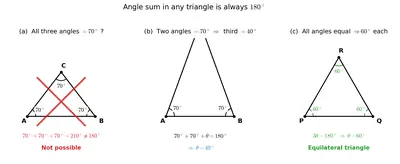
Solution
Step 1 : Recall the Triangle–Sum Property (TSP)
For every triangle, the three interior angles always add up to $$180^{\circ}$$.
Step 2 : Can all three angles be $$70^{\circ}$$?
- Assume, for a moment, that we could make a triangle whose three angles were each $$70^{\circ}$$.
- Add them: $$70^{\circ}+70^{\circ}+70^{\circ}=210^{\circ}$$.
- This contradicts the TSP because $$210^{\circ}\neq180^{\circ}$$.
Therefore it is impossible to construct a triangle in which every angle is $$70^{\circ}$$; the three lines would never close to form a triangle.
Step 3 : If two angles are $$70^{\circ}$$, what is the third?
Let the third angle be $$x^{\circ}$$. By the TSP,
$$70^{\circ}+70^{\circ}+x^{\circ}=180^{\circ}$$
Subtract $$140^{\circ}$$ from both sides:
$$x^{\circ}=180^{\circ}-140^{\circ}=40^{\circ}$$.
So the third angle must be $$40^{\circ}$$.
Step 4 : If all three angles of a triangle are equal, what must each measure be?
Let each equal angle be $$y^{\circ}$$. Then
$$y^{\circ}+y^{\circ}+y^{\circ}=180^{\circ}$$
$$3y^{\circ}=180^{\circ}$$
Divide both sides by 3:
$$y^{\circ}=60^{\circ}$$.
Conclusion :
- A triangle with all angles $$70^{\circ}$$ cannot exist.
- If two angles are $$70^{\circ}$$, the third angle is $$40^{\circ}$$.
- If all three angles are to be equal, they must each be $$60^{\circ}$$ (an equilateral triangle).
Construction hint for teachers : Try to draw two rays making a $$70^{\circ}$$ angle at one vertex and two more rays making $$70^{\circ}$$ at the other intended vertices; the third pair of rays will never meet, visually confirming the algebra above.
Answer
Impossible to have three angles of $$70^{\circ}$$.
If two angles are $$70^{\circ}$$, the third is $$40^{\circ}$$.
If all three angles are equal, each must be $$60^{\circ}$$.
3 Here is a triangle in which we know $$\angle B = \angle C$$ and $$\angle A = 50^\circ$$. Can you find $$\angle B$$ and $$\angle C$$?
Solution
Let the three angles of the triangle be named as usual:
- $$\angle A = 50^\circ$$ (given)
- $$\angle B$$ (unknown)
- $$\angle C$$ (unknown)
We are also told that $$\angle B = \angle C$$. Because the two angles are equal, we can give them the same algebraic symbol. Let
$$\angle B = \angle C = x^\circ$$.
Every triangle has a very important property: the sum of its three interior angles is $$180^\circ$$. We now write this fact as an equation and substitute the known and unknown angles.
$$\angle A + \angle B + \angle C = 180^\circ$$
Substitute $$\angle A = 50^\circ$$ and $$\angle B = \angle C = x^\circ$$:
$$50^\circ + x^\circ + x^\circ = 180^\circ$$
Combine like terms on the left‐hand side:
$$50^\circ + 2x^\circ = 180^\circ$$
Isolate $$x$$. First subtract $$50^\circ$$ from both sides:
$$2x^\circ = 180^\circ - 50^\circ$$
$$2x^\circ = 130^\circ$$
Now divide both sides by 2:
$$x^\circ = \frac{130^\circ}{2}$$
$$x^\circ = 65^\circ$$
Therefore,
\[\angle B = 65^\circ \quad\text{and}\quad \angle C = 65^\circ.\]The two equal angles are each $$65^\circ$$, and the three angles indeed add up to $$50^\circ + 65^\circ + 65^\circ = 180^\circ$$, confirming the solution.
Answer
$$\angle B = 65^\circ, \; \angle C = 65^\circ$$
Figure it Out 7.9
1
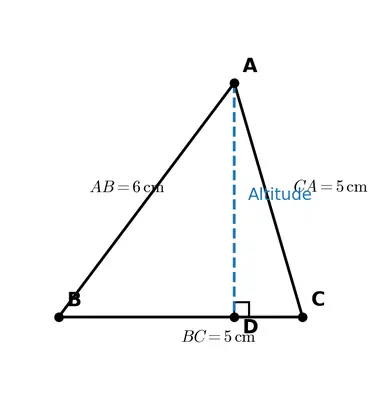
Solution
Given data
Side lengths: $$BC = 5\,\text{cm}$$, $$AB = 6\,\text{cm}$$, $$CA = 5\,\text{cm}$$.
Required
(i) Construct $$\triangle ABC$$ with the above side lengths.
(ii) Draw the altitude from vertex A to the side $$BC$$.
Construction steps
- Draw the base.
Use a ruler to mark a straight line segment $$\overline{BC}$$ of length $$5\,\text{cm}$$. - Locate vertex A.
- Place the compass point at B and take a radius of $$6\,\text{cm}$$ (the length of $$AB$$). Draw an arc above the line BC.
- Without changing the compass opening, place the compass point at C and take a radius of $$5\,\text{cm}$$ (the length of $$CA$$). Draw another arc that intersects the first arc. Label the point of intersection as A.
- Complete the triangle.
Join A to B and A to C with straight-line segments. The required $$\triangle ABC$$ (with sides $$AB = 6\,\text{cm}$$, $$BC = 5\,\text{cm}$$, $$CA = 5\,\text{cm}$$) is now constructed. - Construct the altitude from A to BC.
- With A as centre, draw an arc of any convenient radius that cuts the line BC (or its extension, if necessary) at two distinct points P and Q.
- With P as centre and a radius that is more than half of $$PQ$$, draw an arc above BC.
- With Q as centre and the same radius, draw another arc to intersect the previous one at R.
- Join A to R. Let the intersection of AR with BC be D. The segment $$\overline{AD}$$ is the required altitude.
Reasoning / Proof of correctness
- Steps 1–3 place A at the unique point where $$AB = 6\,\text{cm}$$ and $$AC = 5\,\text{cm}$$ while BC is fixed at $$5\,\text{cm}$$; by the Sides–Sides–Sides (SSS) criterion, the triangle is uniquely determined.
- In Step 4, P and Q are equidistant from A. Constructing the perpendicular bisector of $$\overline{PQ}$$ through A forces line $$AR$$ to be perpendicular to $$\overline{PQ}$$. Since $$PQ$$ lies on BC, $$AR$$ is perpendicular to BC. Therefore D is the foot of the perpendicular from A, and $$\overline{AD}$$ is indeed an altitude of $$\triangle ABC$$.
Result
The triangle satisfying the given side lengths is drawn, and $$AD$$ is its altitude on the side $$BC$$.
Diagram to be drawn by the student:
Draw BC as a 5 cm horizontal line; mark B (left) and C (right). Draw intersecting arcs from B (6 cm) and C (5 cm) to locate A above BC. Connect AB and AC. With A, draw auxiliary arc cutting BC at P and Q. From P and Q draw arcs to meet at R; join AR and mark D = AR ∩ BC. Indicate right angle at D.
Answer
The triangle $$\triangle ABC$$ with $$AB=6\,\text{cm}$$, $$BC=5\,\text{cm}$$, $$CA=5\,\text{cm}$$ is constructed and the perpendicular segment $$AD$$ from A to BC is its altitude.
2
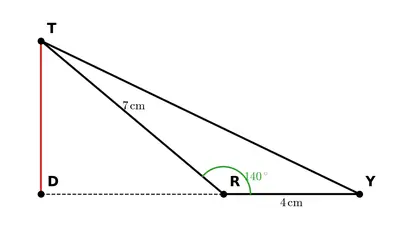
Solution
Given data
- $$RY = 4\,\mathrm{cm}$$
- $$TR = 7\,\mathrm{cm}$$
- $$\angle R = 140^{\circ}$$ (that is, $$\angle TRY$$)
Objective
Construct $$\triangle TRY$$ with the above measurements and then draw the altitude from T to the side RY.
Construction steps
- Draw the base RY.
With ruler mark a segment $$RY = 4\,\mathrm{cm}$$ on your sheet. - Construct the required angle $$\angle R = 140^{\circ}$$.
Using a protractor, place its centre on R, the base line along RY and mark a point on the ray that makes $$140^{\circ}$$ with $$RY$$ (measured inside the triangle). Draw this ray and name it R X (temporary). - Locate vertex T on the ray.
With the compass point on R, open it to $$7\,\mathrm{cm}$$ (length TR) and cut the ray RX. Label the intersection as T.
Now segments $$TR = 7\,\mathrm{cm}$$ and $$RY = 4\,\mathrm{cm}$$ are in place and $$\angle R = 140^{\circ}$$ is satisfied. - Complete the triangle.
Join T to Y. $$\triangle TRY$$ is obtained. - Draw the altitude from T to side RY.
- With centre T and a convenient radius that meets line RY, draw an arc cutting RY at points A and B.
- Keeping the compass radius greater than half of $$AB$$, draw an arc with centre A above RY. Using the same radius draw another arc with centre B to cut the previous one at C.
- Join C to T. The line TC meets RY at a point H.
Because the construction gives $$\angle THR = 90^{\circ}$$, segment $$TH$$ is an altitude of the triangle.
Verification
- Measure $$TR$$ and $$RY$$ with a ruler – they read $$7\,\mathrm{cm}$$ and $$4\,\mathrm{cm}$$ respectively.
- Check $$\angle R$$ with a protractor – it is $$140^{\circ}$$.
- Finally, verify $$\angle THR = 90^{\circ}$$ to confirm that $$TH$$ is perpendicular to RY.
The required triangle and its altitude are now accurately constructed.
Answer
Triangle TRY with the required measurements is constructed and the segment TH drawn is the altitude from T to side RY.
3
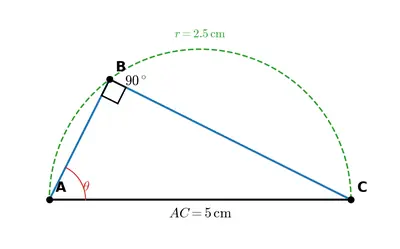
Solution
Step 1 — Draw the given side (the hypotenuse)
Draw a straight line segment $$AC = 5\,\text{cm}$$. Keep the end-points $$A$$ and $$C$$ clearly marked.
Step 2 — Locate every possible position of the right-angle vertex
Draw the semicircle whose diameter is $$AC$$ (centre at the mid-point of $$AC$$, radius $$2.5\,\text{cm}$$), placing the arc on one side of $$AC$$.
By Thales' theorem, any point $$B$$ on this semicircle (except $$A$$ and $$C$$ themselves) gives $$\angle ABC = 90^\circ$$ — the angle in a semicircle is a right angle.
Step 3 — Construct the triangle
Choose any convenient point $$B$$ on the arc, then join $$\overline{AB}$$ and $$\overline{CB}$$. Triangle $$\triangle ABC$$ has
$$\angle B = 90^\circ \quad\text{and}\quad AC = 5\,\text{cm}.$$
Why infinitely many different triangles are possible
- The only fixed data are $$\angle B = 90^\circ$$ and $$AC = 5\,\text{cm}$$.
- The other two angles must satisfy $$\angle A + \angle C = 90^\circ$$, with both being positive and acute:
$$\angle A$$ can take any value strictly between $$0^\circ$$ and $$90^\circ$$. Each choice puts $$B$$ at a different point on the semicircle and gives a different triangle (with different lengths $$AB$$ and $$BC$$).
So there is no unique triangle — infinitely many non-congruent right-angled triangles satisfy the given conditions.
Answer
Infinitely many different right-angled triangles satisfy these conditions. The angles $$\angle A$$ and $$\angle C$$ can be any pair of positive acute angles with $$\angle A + \angle C = 90^\circ$$.
4
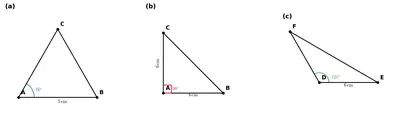
Solution
Background recall
- In an equilateral triangle all three sides are equal, hence each interior angle is $$60^{\circ}$$ because the angle–sum property gives
\[60^{\circ}+60^{\circ}+60^{\circ}=180^{\circ}.\] - In an isosceles triangle two sides (and therefore the two base angles) are equal; the third angle can be found from the angle–sum property $$a+a+b=180^{\circ}$$.
We now test the four cases through ruler-and-compass construction and logical checking.
(A) Equilateral right-angled triangle
Step 1 Assume we wish to construct such a triangle. Draw a right angle at point $$A$$, taking $$AB$$ as one arm and $$AC$$ as the other.
Step 2 To make the triangle equilateral we would have to set $$AB=AC=BC$$. But if $$\angle BAC=90^{\circ}$$, the other two angles must satisfy
$$\angle ABC+\angle ACB=180^{\circ}-90^{\circ}=90^{\circ}.$$
Because the sides are equal, $$\angle ABC=\angle ACB$$, so each would have to be $$45^{\circ}$$, contradicting the requirement that every angle be $$60^{\circ}$$.
Conclusion: construction impossible; an equilateral triangle can never be right-angled.
(B) Equilateral obtuse-angled triangle
If one angle were obtuse, say $$>90^{\circ}$$, the sum of the three angles would exceed $$180^{\circ}$$ (because the other two angles are at least $$60^{\circ}$$ each). Hence impossible by the angle–sum property.
Conclusion: construction impossible; an equilateral triangle can never be obtuse-angled either.
(C) Isosceles right-angled triangle — construction
- Draw a segment $$AB$$ of any convenient length. Place point $$A$$ at the left end.
- Construct a right angle at $$A$$ by drawing a ray $$AX$$ perpendicular to $$AB$$.
- With centre $$A$$ and radius $$AB$$, cut the ray $$AX$$ at point $$C$$.
This ensures $$AC=AB$$. - Join $$BC$$ to complete $$\triangle ABC$$.
We now have $$AB=AC$$ (isosceles) and $$\angle BAC=90^{\circ}$$ (right angle). The third angle automatically becomes $$45^{\circ}$$ because
$$45^{\circ}+45^{\circ}+90^{\circ}=180^{\circ}.$$
(D) Isosceles obtuse-angled triangle — construction
- Draw a base segment $$PQ$$ of any length.
- At $$P$$ construct an angle of, say, $$110^{\circ}$$ with one side along $$PQ$$, producing ray $$PR$$.
- With centre $$P$$ and any convenient radius $$r$$, mark a point $$S$$ on $$PR$$ (thus $$PS=r$$).
- With centre $$Q$$ and the same radius $$r$$, swing an arc to meet the circle already drawn about $$P$$ at point $$S$$. Because we used the same radius, $$QS=PS$$.
- Join $$QS$$ to obtain $$\triangle PQS$$.
The triangle has $$PS=QS$$ (isosceles) and vertex angle $$\angle SPQ=110^{\circ}>90^{\circ}$$ (obtuse). The two base angles are therefore each $$\dfrac{180^{\circ}-110^{\circ}}{2}=35^{\circ}$$, satisfying the angle–sum property.
Overall result
- Equilateral triangle: neither right-angled nor obtuse-angled is possible.
- Isosceles triangle: both right-angled and obtuse-angled constructions are possible and steps are given above.
Answer
• No equilateral triangle can be right-angled or obtuse-angled.
• An isosceles right triangle is obtained by taking two equal legs that meet at a right angle.
• An isosceles obtuse triangle is obtained by taking two equal sides that enclose an angle greater than 90° (e.g. 110°).
Puzzle Time: Shortest Path in a Box!
1
There is a spider in a corner of a box. It wants to reach the farthest opposite corner (marked in the figure). Since it cannot fly, it can reach the opposite point only by walking on the surfaces of the box. What is the shortest path it can take?
Take a cardboard box and mark the path that you think is the shortest from one corner to its opposite corner. Compare the length of this path with that of the paths made by your friends.
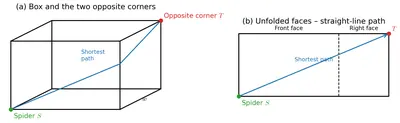
Solution
Step 1 Label the box
Draw a rectangular box and name its vertices as in the figure below (describe the figure to the class): face ABCD is the bottom, EFGH the top, the vertical edges are AE, BF, CG and DH. Let the spider be at vertex A and the point it wants to reach be the diagonally opposite vertex G.
Denote the three edge-lengths of the box by
$$\text{length}=l, \;\text{breadth}=b, \;\text{height}=h.$$
Step 2 Why can we unfold the box?
The spider is allowed to walk only on the surfaces. If we cut the box open along a few edges and flatten the required faces on the table, the spider’s walk on the surfaces turns into a straight line in the plane. In a plane the straight line joining two points is always the shortest path, so the shortest walk on the box will be the straight line that joins the two points in some net (unfolded layout) of the box.
Step 3 Try all possible nets that keep A and G on neighbouring faces
The starting point A lies on three faces that meet at A. To reach G the spider must move across two faces that share an edge through A, because G does not lie on any single face with A.
Three different pairs of faces are possible:
- Faces ABCD and ABFE (bottom & front)
- Faces ABCD and ADHE (bottom & left)
- Faces ABFE and ADHE (front & left)
When each pair is unfolded, A and G become opposite corners of a rectangle:
| Unfolded rectangle | Its side lengths | Diagonal (path-length) |
|---|---|---|
| bottom + front | $$(l+b) \text{ and } h$$ | $$d_1=\sqrt{(l+b)^2+h^2}$$ |
| bottom + left | $$(l+h) \text{ and } b$$ | $$d_2=\sqrt{(l+h)^2+b^2}$$ |
| front + left | $$(b+h) \text{ and } l$$ | $$d_3=\sqrt{(b+h)^2+l^2}$$ |
Step 4 Choose the smallest of the three diagonals
The spider must take that unfolding for which the diagonal is the least. Hence the length of the required shortest path is
\[\min\bigl\{\,d_1,\;d_2,\;d_3\bigr\}.\]
Special case – a cube of side
If the box is a cube with $$l=b=h=s,$$ every diagonal is
$$\sqrt{(2s)^2+s^2}=\sqrt{5s^2}=s\sqrt 5,$$
so the spider must crawl a distance $$s\sqrt 5.$$
Step 5 How to mark the path on a real box
Open the box along one of the three pairs of adjacent faces, flatten those two faces to form a rectangle, join the two opposite corners by a straight line with a ruler, and refold the box. That straight segment becomes the shortest path on the actual 3-D box. Ask your friends to unfold their boxes in a different way; the path that gives the smallest measured length should match the distance calculated above.
Therefore, the shortest walk is obtained by unfolding two suitable adjacent faces so that the spider and the opposite corner fall at opposite ends of one straight diagonal; its length equals the smallest of $$\sqrt{(l+b)^2+h^2},\;\sqrt{(l+h)^2+b^2},\;\sqrt{(b+h)^2+l^2}.$$
Answer
The spider must walk along the diagonal of two adjacent faces of the box. In symbols the minimum possible length is
$$\boxed{\displaystyle\min\bigl\{\sqrt{(l+b)^2+h^2},\;\sqrt{(l+h)^2+b^2},\;\sqrt{(b+h)^2+l^2}\bigr\}}.$$
For a cube of side s this becomes $$s\sqrt{5}.$$


