 91- 6303239042


Intext Questions (Section 6.1: Numbers Tell us Things)
1
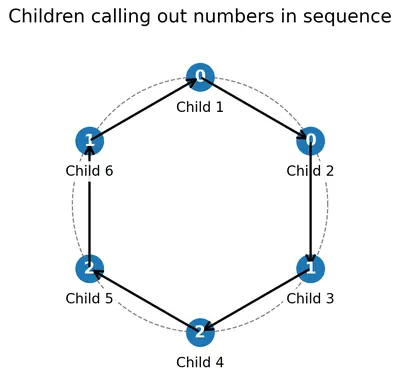
Solution
Given children are again standing in a line (exactly as in the Grade 6 textbook). Each child now shows a plane figure and, instead of naming the figure, calls out only one number. The numbers called out are, in order,
$$0,\;0,\;1,\;2,\;2,\;1$$
We have to find out what these numbers tell us.
Recall from Grade 6
The same picture (with the same six figures) appeared in Chapter 13 of the Class 6 text while discussing symmetry. At that time the children called out the names of the figures. The six figures, from left to right, are
- a scalene triangle,
- a general (non323 rectangle) parallelogram,
- an isosceles trapezium,
- a rectangle,
- a rhombus,
- a kite.
Step 1 – Write the number of lines of symmetry of each figure
| Figure | Reasoning | Lines of symmetry |
|---|---|---|
| Scalene triangle | No two sides are equal → no mirror line. | $$0$$ |
| General parallelogram | Opposite sides parallel but not equal in all directions → no mirror line. | $$0$$ |
| Isosceles trapezium | One pair of equal non-parallel sides → exactly one vertical mirror line. | $$1$$ |
| Rectangle (not a square) | Opposite sides equal; two perpendicular axes of symmetry (horizontal & vertical). | $$2$$ |
| Rhombus (not a square) | All sides equal; the two diagonals are perpendicular mirror lines. | $$2$$ |
| Kite | Exactly one pair of equal adjacent sides → one mirror line through the unequal angles. | $$1$$ |
Step 2 – Compare with the numbers called out
Arranging the results in the same left-to-right order gives
$$0,\;0,\;1,\;2,\;2,\;1$$
This is precisely the list that the children shout in the figure.
Conclusion
The number each child calls out is the number of lines of symmetry (axes of mirror symmetry) possessed by the plane figure that child is holding.
Answer
The six numbers are the counts of lines of symmetry of the six plane figures (scalene triangle, parallelogram, isosceles trapezium, rectangle, rhombus, kite) shown by the children.
2 What do you think these numbers mean? The children rearrange themselves and each one says a number based on the new arrangement. (The figure shows children calling out the numbers 0, 0, 1, 2, 2, 5, 6.)
Solution
Step 1 – What does each child represent?
In the activity each child is wearing a card that has one digit written on it. Thus every child actually represents a digit of a multi-digit number.
Originally the digits on the seven cards were
$$6,\;5,\;2,\;2,\;1,\;0,\;0$$
(You can verify from the picture in the book that these are the digits lying on the ground next to the children.)
Step 2 – Re-arranging the children
The teacher now asks them to stand in ascending order of the digits written on their cards (smallest digit first, largest digit last). After this rearrangement the order of the cards becomes
$$0,\;0,\;1,\;2,\;2,\;5,\;6$$
Exactly these digits are the numbers you hear the children call out in the figure.
Step 3 – What number do these digits form?
Placing the digits side by side, as the children are now standing, gives the string
$$0012256$$
However, a number cannot start with the digit $$0$$. To write the smallest proper 7-digit number that can be formed with all seven given digits, we keep the first non-zero digit $$1$$ in the ten-lakh place and put the two zeros just after it. Thus we obtain
Step 4 – Interpreting the spoken digits
The spoken digits mean “We have arranged the seven given digits in ascending order; together they form the smallest 7-digit number that can be written with those very digits, namely $$1002256$$.”
Therefore the numbers 0, 0, 1, 2, 2, 5, 6 are simply the digits of that smallest possible number after the children have lined themselves up in increasing order of their individual digits.
Answer
The digits 0, 0, 1, 2, 2, 5, 6 are the seven given digits arranged in ascending order; taken together (with the first non-zero digit written in front) they form the smallest possible 7-digit number, 1002256.
3 Could you figure out what these numbers convey? Observe and try to find out.
Solution
Given observation
The page shows the six numbers
$$142857,\;285714,\;428571,\;571428,\;714285,\;857142$$
You are asked: “Could you figure out what these numbers convey? Observe and try to find out.”
Step 1 – List the digits in each number
Each of the six numbers uses exactly the same six digits –
$$1,\;4,\;2,\;8,\;5,\;7$$
and every digit appears once in every number. The order, however, keeps changing (or cycling).
Step 2 – Check if the numbers are multiples of one common number
Take the first (smallest) number as a trial divisor:
$$142857$$
Multiply it successively by the natural numbers $$1,2,3,4,5,6$$ and write the products.
| Multiplier | Working (long multiplication) | Product |
|---|---|---|
| 1 | $$142857\times1$$ | $$142857$$ |
| 2 | $$142857\times2$$ | $$285714$$ |
| 3 | $$142857\times3$$ | $$428571$$ |
| 4 | $$142857\times4$$ | $$571428$$ |
| 5 | $$142857\times5$$ | $$714285$$ |
| 6 | $$142857\times6$$ | $$857142$$ |
Exactly the six numbers on the page appear as those six products. Therefore each given number is a multiple of $$142857$$.
Step 3 – Notice the cyclic rearrangement
Look carefully at the products. Reading each product from left to right, the digits keep shifting to the left while the left-most digit goes to the right end. For example
- $$142857$$ → move 1 step → $$285714$$
- $$285714$$ → move 1 step → $$428571$$
This is called a cyclic permutation of the digits 1 4 2 8 5 7.
Step 4 – Connect with the fraction $$\tfrac17$$
Divide 1 by 7 to two or three repetitions:
\[\frac17 = 0.142857\,142857\,142857\ldots\quad(repeating)\]
The six-digit block that repeats is exactly $$142857$$ – the same number we just multiplied. When this block repeats once, twice, thrice, … we obtain its cyclic rearrangements, which are precisely the given six numbers.
Concluding observation
The six numbers are the six non-zero multiples of $$142857$$ that are less than $$10^6$$, and they show the repeating block in the decimal expansion of $$\tfrac17$$ cycling through its digits. Hence the numbers “convey” the remarkable pattern hidden in the fraction $$\tfrac17$$.
In other words:
- Each number = $$142857 \times n$$ for $$n = 1,2,3,4,5,6$$,
- They are cyclic rearrangements of one another,
- All of them come from the repeating decimal of $$\tfrac17$$.
That is the hidden message in the set of numbers on the page.
Answer
They are the six successive multiples of 142 857 (the repeating block of 1 ÷ 7), so each number is a cyclic rearrangement of the digits 1-4-2-8-5-7 and together they illustrate the repeating decimal of $$\tfrac17$$.
4 Write down the number each child should say based on this rule (each child calls out the number of children in front of them who are taller than them) for the arrangement shown below.
Solution
Given arrangement (from the child standing right in front of the teacher to the one at the far end of the line)
| Position in the line (counting from the teacher) | Name of the child | Height (cm) |
|---|---|---|
| 1 (front-most) | Anita | 143 |
| 2 | Babu | 155 |
| 3 | Charu | 149 |
| 4 | Dev | 165 |
| 5 | Esther | 158 |
| 6 | Faisal | 151 |
| 7 (last) | Gita | 172 |
Each child has to call out a number according to the rule:
- Standing at position $$i$$, count all the children at positions $$1,2,\dots ,(i-1)$$ who are taller than the child at position $$i$$.
- The count itself is what the child at position $$i$$ says aloud.
Let the height of the child in the $$i^{\text{th}}$$ position be $$h_i$$ (in cm). The number to be called out by that child is therefore
$$N_i = \bigl|\{\,j \mid 1 \le j < i \text{ and } h_j > h_i\}\bigr|.$$
We now compute $$N_i$$ for every position.
- Anita (position 1)
No one is standing in front of her, so the set in the above definition is empty and
$$N_1 = 0.$$ - Babu (position 2)
Check only Anita: $$h_1 = 143 < h_2 = 155,$$ so no taller child. Hence $$N_2 = 0.$$ - Charu (position 3)
Children in front: Anita (143 cm), Babu (155 cm). Only Babu is taller than Charu (149 cm). Therefore $$N_3 = 1.$$ - Dev (position 4)
Heights in front: 143 cm, 155 cm, 149 cm — all smaller than Dev’s 165 cm. Thus $$N_4 = 0.$$ - Esther (position 5)
Heights in front: 143 cm, 155 cm, 149 cm, 165 cm. Only 165 cm is taller than Esther's 158 cm $$\Rightarrow 1$$ such child, so $$N_5 = 1.$$ - Faisal (position 6)
Heights in front: 143 cm, 155 cm, 149 cm, 165 cm, 158 cm. Taller children: 155 cm, 165 cm, 158 cm $$\Rightarrow 3$$ of them. Hence $$N_6 = 3.$$ - Gita (position 7)
All six children in front are shorter than 172 cm, so $$N_7 = 0.$$
Putting the results together, the list of numbers the children call out (in the same order as they are standing) is:
\[ 0,\; 0,\; 1,\; 0,\; 1,\; 3,\; 0 \]Answer
0, 0, 1, 0, 1, 3, 0
Figure it Out (Section 6.1)
1 Arrange the stick figure cutouts given at the end of the book or draw a height arrangement such that the sequence reads:
(a) $$0, 1, 1, 2, 4, 1, 5$$
Solution
Step 1 : Understand the instruction
The seven digits are $$0,1,1,2,4,1,5$$. “Height” of a stick figure means the number written on (or next to) that figure.
Step 2 : Collect or draw seven figures
Make seven simple stick figures (or draw seven vertical bars) and number the positions 1 to 7 along a straight baseline.
Step 3 : Give each figure the required height
- Position 1 → height $$0$$ (keep the place blank or draw just a point on the baseline).
- Position 2 → height $$1$$ (one unit tall).
- Position 3 → height $$1$$ (same height as the second).
- Position 4 → height $$2$$.
- Position 5 → height $$4$$.
- Position 6 → height $$1$$ again.
- Position 7 → height $$5$$ (tallest).
Step 4 : Check
Read the heights from left to right: $$0,1,1,2,4,1,5$$ — exactly the given sequence, so the arrangement is correct.
Answer
Arrange heights in the order 0 – 1 – 1 – 2 – 4 – 1 – 5.
(b) $$0, 0, 0, 0, 0, 0, 0$$
Solution
Step 1 : Sequence to reproduce
The required heights are $$0,0,0,0,0,0,0$$.
Step 2 : Draw or place seven figures
Mark seven equal positions 1 to 7 on a baseline.
Step 3 : Give height to each figure
Every position gets height $$0$$, i. e. all seven places remain on the baseline (no visible bar or a very small dot).
Step 4 : Verification
Reading the heights from left to right we obtain $$0,0,0,0,0,0,0$$, which matches the given sequence.
Answer
All seven figures stay on the baseline: 0 0 0 0 0 0 0.
(c) $$0, 1, 2, 3, 4, 5, 6$$
Solution
Step 1 : Required sequence
$$0,1,2,3,4,5,6$$.
Step 2 : Draw seven equally spaced positions
Step 3 : Assign heights
- Pos 1 → $$0$$
- Pos 2 → $$1$$
- Pos 3 → $$2$$
- Pos 4 → $$3$$
- Pos 5 → $$4$$
- Pos 6 → $$5$$
- Pos 7 → $$6$$
This forms a steadily rising staircase of unit steps.
Step 4 : Check
Reading the heights we indeed get $$0,1,2,3,4,5,6$$.
Answer
Heights rise one unit at every step: 0 1 2 3 4 5 6.
(d) $$0, 1, 0, 1, 0, 1, 0$$
Solution
Step 1 : Sequence
$$0,1,0,1,0,1,0$$ (alternating).
Step 2 : Prepare seven places
Step 3 : Give alternate heights
- Odd positions (1,3,5,7) → height $$0$$
- Even positions (2,4,6) → height $$1$$
The picture will show low–high–low–high–low–high–low.
Step 4 : Verify
Left to right reading gives $$0,1,0,1,0,1,0$$ as required.
Answer
Alternate low and high: 0 1 0 1 0 1 0.
(e) $$0, 1, 1, 1, 1, 1, 1$$
Solution
Step 1 : Required heights
$$0,1,1,1,1,1,1$$.
Step 2 : Seven positions
Step 3 : Fill the heights
- Position 1 → $$0$$
- Positions 2 to 7 → $$1$$ each
So only the first figure is on the baseline; the remaining six all have the same height 1.
Step 4 : Check
Reading gives $$0,1,1,1,1,1,1$$.
Answer
First height 0, the other six heights 1: 0 1 1 1 1 1 1.
(f) $$0, 0, 0, 3, 3, 3, 3$$
Solution
Step 1 : Sequence needed
$$0,0,0,3,3,3,3$$.
Step 2 : Mark seven spots
Step 3 : Assign heights
- Positions 1,2,3 → height $$0$$
- Positions 4,5,6,7 → height $$3$$
This picture will have three blank (baseline) places followed by four bars all of equal height 3.
Step 4 : Verification
Reading the heights gives $$0,0,0,3,3,3,3$$, which matches the required sequence.
Answer
Three zeros followed by four threes: 0 0 0 3 3 3 3.
2 For each of the statements given below, think and identify if it is Always True, Only Sometimes True, or Never True. Share your reasoning.
(a) If a person says '0', then they are the tallest in the group.
Solution
The rule used in the chapter
Each person calls out the number of people standing in front of him / her who are taller.
So, if the number said is $$n$$, it means “there are $$n$$ taller persons ahead of me in the queue”.
(i) Take the two-person queue 150 cm, 180 cm (front → back).
• Person 1 (150 cm) has nobody in front who is taller, so says $$0$$, but he is not the tallest.
Hence “says 0 ⇒ tallest” is false.
(ii) In the queue 180 cm, 150 cm the one who says $$0$$ is the tallest.
Thus the statement can be true in some other arrangements.
Because we can find arrangements where it is true and arrangements where it is false, the statement is Only Sometimes True.
Answer
Only Sometimes True
(b) If a person is the tallest, then their number is '0'.
Solution
Suppose a person is the tallest in the whole group.
• No one (anywhere, and therefore no one in front) is taller than this person.
• Therefore the number of taller people standing in front is $$0$$.
So “tallest ⇒ says 0” is always correct.
Answer
Always True
(c) The first person's number is '0'.
Solution
The first person has no one standing in front of him / her. Hence the count of taller people in front is $$0$$, whatever the heights may be. Therefore the first person always says $$0$$.
Answer
Always True
(d) If a person is not first or last in line (i.e., if they are standing somewhere in between), then they cannot say '0'.
Solution
(i) Queue in strictly decreasing height: 180 cm, 170 cm, 160 cm.
• The middle person (170 cm) has one taller person (180 cm) ahead, so says $$1$$.
(ii) Queue in strictly increasing height: 150 cm, 160 cm, 170 cm.
• The middle person (160 cm) has nobody taller ahead, so says $$0$$.
Thus a person who is neither at the beginning nor at the end can say $$0$$ (example (ii)), but need not do so (example (i)). Hence the statement is Only Sometimes True.
Answer
Only Sometimes True
(e) The person who calls out the largest number is the shortest.
Solution
The number called is “how many taller people are in front”. A short person placed far back can have many tall people ahead and therefore often says the largest number, but this need not always be so.
(i) Queue 170, 150, 160 cm.
• Numbers: 0, 1, 1 → largest number 1 is spoken by 150 cm (shortest). Statement true.
(ii) Queue 120, 90, 150, 140, 130 cm.
• Numbers: 0, 1, 0, 1, 2 → largest number 2 is spoken by 130 cm, yet 90 cm is the shortest. Statement false.
Since it can be true in some cases and false in others, the statement is Only Sometimes True.
Answer
Only Sometimes True
(f) What is the largest number possible in a group of 8 people?
Solution
The biggest possible count is obtained by putting the very shortest person at the very end, so that every one of the $$7$$ people in front is taller. Hence the maximum number that can be called in a queue of $$8$$ people is
\[7\]
Answer
7
Intext Questions (Section 6.2: Picking Parity)
5
Kishor has some number cards and is working on a puzzle: There are 5 boxes, and each box should contain exactly 1 number card. The numbers in the boxes should sum to 30. Can you help him find a way to do it?
$$\square + \square + \square + \square + \square = 30$$
The available cards have the numbers 13, 9, 7, 11, 5, 3 (with multiple copies of each).
Can you figure out which 5 cards add to 30? Is it possible?
Solution
The available cards show the numbers $$3, 5, 7, 9, 11, 13$$. Notice that every one of these numbers is odd.
1. What happens when we add odd numbers?
- odd $$+$$ odd $$=$$ even
- even $$+$$ odd $$=$$ odd
So, as we keep adding odd numbers, the result flips between even and odd each time we add another odd number.
2. Add five odd numbers step by step.
Start with the first two cards:
odd $$+$$ odd $$=$$ even
Add a third card:
even $$+$$ odd $$=$$ odd
Add a fourth card:
odd $$+$$ odd $$=$$ even
Add the fifth card:
even $$+$$ odd $$=$$ odd
Therefore, the sum of any five odd numbers is itself odd.
3. Compare with the required total.
The puzzle demands a total of $$30$$.
$$30 = 2 \times 15$$ is an even number.
4. Final conclusion.
The sum of five odd cards must be odd, but $$30$$ is even. Hence it is impossible to place five cards chosen from $$3, 5, 7, 9, 11, 13$$ in the boxes so that they add to $$30$$.
So the puzzle has no solution with the given cards.
Answer
No solution — five odd cards always give an odd sum, so they can never total the even number 30.
6 Add a few even numbers together. What kind of number do you get? Does it matter how many numbers are added?
Solution
Step 1 – Recall the definition of an even number
A whole number is called even if it can be written in the form $$2k$$, where $$k$$ is some other whole number.
Step 2 – Represent each even addend algebraically
Assume we are going to add $$n$$ even numbers. Because each is even, we may write them as
- first even number = $$2k_1$$
- second even number = $$2k_2$$
- third even number = $$2k_3$$
- \(\vdots\)
- nth even number = $$2k_n$$
Here $$k_1,\,k_2,\,\ldots ,\,k_n$$ are all whole numbers (0, 1, 2, 3, …).
Step 3 – Add the even numbers
Their sum is
\[\begin{aligned} \text{Sum} &= 2k_1 + 2k_2 + 2k_3 + \dots + 2k_n \\[-2pt] &= 2\,(k_1 + k_2 + k_3 + \dots + k_n).\quad(1) \end{aligned}\]Step 4 – Recognise the nature of the result
Because $$k_1 + k_2 + k_3 + \dots + k_n$$ is itself a whole number (call it $$K$$), equation (1) can be rewritten as
$$\text{Sum} = 2K.$$But any number of the form $$2K$$ is even by definition. Therefore the sum of the $$n$$ even numbers is even.
Step 5 – Does the count of addends matter?
The working above never required a particular value of $$n$$ — it only used that each addend is even. Hence, whether you add 2, 3, 4, or any number $$n$$ of even numbers, the final result is always even.
Step 6 – Numerical check (optional)
- $$8 + 4 = 12$$ (even)
- $$6 + 10 + 14 = 30$$ (even)
- $$2 + 18 + 20 + 26 = 66$$ (even)
Every trial confirms the algebraic proof.
Answer
The sum of any set of even numbers is always even; the result is independent of how many even numbers you add.
7 Now, add a few odd numbers together. What kind of number do you get? Does it matter how many odd numbers are added?
Solution
Step 1 – Recall what an odd number looks like algebraically
Every odd whole number can be written in the form $$2k+1$$, where $$k$$ is some whole number (0, 1, 2, 3, …).
Step 2 – Add two odd numbers
Let the two odd numbers be $$2k+1$$ and $$2m+1$$. Then
$$(2k+1)+(2m+1) = 2k+2m+2 = 2(k+m+1).$$
The right-hand side is 2 times a whole number, so the result is even.
Conclusion: The sum of two odd numbers is even.
Step 3 – Add three odd numbers
Add a third odd number $$2n+1$$:
$$(2k+1)+(2m+1)+(2n+1) = 2k+2m+2n+3 = 2(k+m+n+1)+1.$$
This is one more than an even number, so the total is odd.
Conclusion: The sum of three odd numbers is odd.
Step 4 – General rule for $$r$$ odd numbers
Suppose we add $$r$$ odd numbers $$(2k_1+1),\,(2k_2+1),\,\dots,\,(2k_r+1)$$. Their sum is
$$(2k_1+1)+(2k_2+1)+\dots+(2k_r+1) = 2(k_1+k_2+\dots+k_r)+r.$$
The first part $$2(k_1+k_2+\dots+k_r)$$ is always even, so the parity of the whole sum depends only on $$r$$:
- If $$r$$ is even, the term $$r$$ is even, so the whole sum is even + even = even.
- If $$r$$ is odd, the term $$r$$ is odd, so the whole sum is even + odd = odd.
Final conclusion
If an even number of odd numbers are added, the sum is even. If an odd number of odd numbers are added, the sum is odd. So, yes — it does matter how many odd numbers you add.
Answer
The sum is even when you add an even number of odd numbers, and odd when you add an odd number of odd numbers. Thus, whether the final result is even or odd depends on how many odd numbers are added.
8 What about adding 3 odd numbers? Can the resulting sum be arranged in pairs?
Solution
Let us write the three odd numbers in their general algebraic form.
An odd number is always of the shape $$2k+1$$ where $$k$$ is any whole number. Take three such numbers:
$$2m+1, \; 2n+1, \; 2p+1$$ (where $$m,n,p$$ are whole numbers)
Add them:
$$\begin{aligned} (2m+1)+(2n+1)+(2p+1) &=2m+2n+2p+3\\[2pt] &=2(m+n+p+1)+1. \end{aligned}$$
The expression $$2(m+n+p+1)+1$$ is again of the form $$2K+1$$ (with $$K=m+n+p+1$$), so the sum is odd.
What does this mean for pairing?
- To arrange objects "in pairs" each pair must contain exactly 2 objects, so the total number of objects must be an even number.
- An odd total always leaves one object unpaired.
Since the sum of three odd numbers is itself odd, it cannot be completely arranged in pairs – one item will always be left over.
Concrete check: $$1+3+5=9$$ (odd); try making pairs out of 9 sticks – the 9th stick is left out.
Therefore the answer is: No, the sum of three odd numbers cannot be arranged entirely in pairs.
Answer
No. The sum of three odd numbers is again odd, so one object will always be left over and it cannot be completely paired.
9 Explore what happens to the sum of (a) 4 odd numbers, (b) 5 odd numbers, and (c) 6 odd numbers.
Solution
Key idea: Every odd whole number can be expressed in the algebraic form $$2k+1$$, where $$k$$ is an integer (0, 1, 2, 3, …).
We examine the sum of four, five and six such numbers separately.
(a) Sum of 4 odd numbers
Let the four odd numbers be
$$2k_1+1, \; 2k_2+1, \; 2k_3+1, \; 2k_4+1$$
Add them:
$$\begin{aligned} (2k_1+1) &+ (2k_2+1) + (2k_3+1) + (2k_4+1) \\ &= 2(k_1+k_2+k_3+k_4) + 1+1+1+1 \\ &= 2(k_1+k_2+k_3+k_4) + 4 \\ &= 2\bigl(k_1+k_2+k_3+k_4+2\bigr) \;(\text{factor 2}) \end{aligned}$$
The final expression is 2 multiplied by an integer, so the sum is an even number.
(b) Sum of 5 odd numbers
Let the five odd numbers be
$$2m_1+1, \; 2m_2+1, \; 2m_3+1, \; 2m_4+1, \; 2m_5+1$$
Add them:
$$\begin{aligned} &\;(2m_1+1)+(2m_2+1)+(2m_3+1)+(2m_4+1)+(2m_5+1) \\ &= 2(m_1+m_2+m_3+m_4+m_5)+5 \\ &= 2(m_1+m_2+m_3+m_4+m_5)+4+1 \\ &= 2\bigl(m_1+m_2+m_3+m_4+m_5+2\bigr)+1 \end{aligned}$$
This is of the form $$2q+1$$, again with $$q$$ an integer. Therefore the result is an odd number.
(c) Sum of 6 odd numbers
Let the six odd numbers be
$$2n_1+1, \; 2n_2+1, \; 2n_3+1, \; 2n_4+1, \; 2n_5+1, \; 2n_6+1$$
Add them:
$$\begin{aligned} &\;(2n_1+1)+(2n_2+1)+(2n_3+1)+(2n_4+1)+(2n_5+1)+(2n_6+1) \\ &= 2(n_1+n_2+n_3+n_4+n_5+n_6)+6 \\ &= 2\bigl(n_1+n_2+n_3+n_4+n_5+n_6+3\bigr) \end{aligned}$$
The expression is divisible by 2, so the sum is an even number.
Conclusion
The pattern we have just proved matches a well-known general rule:
- The sum of an even number of odd numbers is always even.
- The sum of an odd number of odd numbers is always odd.
Specifically for this question we obtained:
\[\text{4 odd numbers} \;\Longrightarrow\; \textbf{even}\]
\[\text{5 odd numbers} \;\Longrightarrow\; \textbf{odd}\]
\[\text{6 odd numbers} \;\Longrightarrow\; \textbf{even}\]
Answer
(a) Even (b) Odd (c) Even
10 Two siblings, Martin and Maria, were born exactly one year apart. Today they are celebrating their birthday. Maria exclaims that the sum of their ages is 112. Is it possible? Why or why not?
Solution
Step 1 – Introduce variables
Let the younger sibling’s present age be $$x\text{ years}$$.
Since they were born exactly one year apart, the elder sibling’s age is $$x+1\text{ years}$$.
Step 2 – Translate the statement into an equation
Maria says the sum of their ages is 112:
$$x + (x+1) = 112$$
Step 3 – Solve the equation
Combine like terms:
$$2x + 1 = 112$$
Subtract 1 from both sides:
$$2x = 111$$
Divide by 2:
$$x = 55.5$$
Step 4 – Interpret the result
$$x = 55.5$$ means the younger sibling would be 55 years 6 months old, which is impossible when ages are measured in complete years on a birthday.
Step 5 – Reason with parity (even–odd check)
An even quicker check is to notice that the ages differ by 1 year, so they are consecutive integers. For any integer $$n$$:
$$n + (n+1) = 2n + 1$$
Since $$2n+1$$ is always odd, the sum of two consecutive ages must be odd. But 112 is even, so such ages cannot exist.
Conclusion
Therefore, Maria’s claim is not possible. Their ages cannot add up to 112.
Answer
Not possible: two ages that differ by one year must add to an odd number, but 112 is even, so such ages cannot exist.
Figure it Out (Section 6.2)
1 Using your understanding of the pictorial representation of odd and even numbers, find out the parity of the following sums:
(a) Sum of 2 even numbers and 2 odd numbers (e.g., even + even + odd + odd)
Solution
Step 1 — Translate “even” and “odd” into algebraic language
Any even number can be written as $$2k$$ (because it has 2 as a factor).
Any odd number can be written as $$2m+1$$ (because it is one more than an even number).
Here k and m stand for whole numbers.
Step 2 — Write the four addends
Take two even numbers: $$2k_1,\;2k_2$$.
Take two odd numbers: $$(2m_1+1),\;(2m_2+1).$$
Step 3 — Add them
$$\begin{aligned} S &= 2k_1+2k_2+(2m_1+1)+(2m_2+1) \\[-4pt] &= 2(k_1+k_2+m_1+m_2)+2 \\[-2pt] &= 2\bigl(k_1+k_2+m_1+m_2+1\bigr). \end{aligned}$$
Step 4 — Decide the parity
The final expression is a multiple of 2, so $$S$$ is even.
Answer
Even
(b) Sum of 2 odd numbers and 3 even numbers
Solution
Step 1 — Name the addends
Three even numbers: $$2k_1,\;2k_2,\;2k_3$$.
Two odd numbers: $$(2m_1+1),\;(2m_2+1).$$
Step 2 — Add
$$\begin{aligned} S &= (2k_1+2k_2+2k_3)+(2m_1+1)+(2m_2+1) \\[-4pt] &= 2(k_1+k_2+k_3+m_1+m_2)+2 \\[-2pt] &= 2\bigl(k_1+k_2+k_3+m_1+m_2+1\bigr). \end{aligned}$$
Step 3 — Parity
Again the sum is a multiple of 2, so it is even.
Answer
Even
(c) Sum of 5 even numbers
Solution
Method 1 — Quick observation
Adding two even numbers gives an even result. Repeating that fact shows that any number of even addends still produces an even total. Therefore, the sum of 5 even numbers is even.
Method 2 — Algebra
Let the even numbers be $$2k_1,2k_2,2k_3,2k_4,2k_5.$$ Then
$$\begin{aligned} S &= 2k_1+2k_2+2k_3+2k_4+2k_5 \\[-4pt] &= 2(k_1+k_2+k_3+k_4+k_5), \end{aligned}$$
which is clearly a multiple of 2, i.e. even.
Answer
Even
(d) Sum of 8 odd numbers
Solution
Step 1 — Pair the odd numbers pictorially
Each pair “odd + odd” makes one complete column of 2 dots, which is an even number.
Since 8 odd numbers form 4 such pairs, we get 4 even numbers. A further sum of even numbers is still even.
Step 2 — Algebra check
Let the odd numbers be $$(2m_1+1),(2m_2+1),\ldots,(2m_8+1).$$ Then
$$\begin{aligned} S &= \sum_{i=1}^{8}(2m_i+1) \\[-4pt] &= 2\bigl(m_1+\cdots+m_8\bigr)+8 \\[-2pt] &= 2\bigl(m_1+\cdots+m_8+4\bigr), \end{aligned}$$
which is a multiple of 2, hence even.
Answer
Even
2 Lakpa has an odd number of $$\textsf{₹}1$$ coins, an odd number of $$\textsf{₹}5$$ coins and an even number of $$\textsf{₹}10$$ coins in his piggy bank. He calculated the total and got $$\textsf{₹}205$$. Did he make a mistake? If he did, explain why. If he didn't, how many coins of each type could he have?
Solution
Step 1 – Introduce variables
Let
- $$x$$ be the number of ₹1 coins,
- $$y$$ be the number of ₹5 coins,
- $$z$$ be the number of ₹10 coins.
According to the statement:
- $$x$$ is odd,
- $$y$$ is odd,
- $$z$$ is even.
Step 2 – Write the total-value equation
The money in the piggy bank is
$$1\times x + 5\times y + 10\times z = 205.$$
Step 3 – Express the parity (even–odd) of each term
Because
- an odd number of ₹1 coins contributes an odd amount,
- 5 × (odd) is also odd (for example, 5, 15, 25, …),
- 10 × (even) is even (every multiple of 10 formed with an even integer ends in 0 and is divisible by 2),
the sum of the three contributions is
odd + odd + even = even.
Step 4 – Compare with the given total
But 205 is an odd number, not an even one. Therefore the calculated total conflicts with the parity we just obtained, so it cannot be correct.
Algebraic check (optional but instructive)
Let odd numbers be written as $$2k+1$$ and even numbers as $$2k$$:
- $$x = 2m + 1,$$
- $$y = 2n + 1,$$
- $$z = 2p.$$
Then
$$\begin{aligned} \text{Total} &= x + 5y + 10z \\ &= (2m+1) + 5(2n+1) + 10(2p) \\ &= 2m + 1 + 10n + 5 + 20p \\ &= 2(m + 5n + 10p + 3).\end{aligned}$$
The total equals 2 × (some whole number), so it must be even. Hence it can never be 205.
Conclusion
Lakpa did make a mistake; under the given conditions no selection of coins can total ₹205.
Answer
Yes—he made a mistake: with an odd number of ₹1 coins, an odd number of ₹5 coins and an even number of ₹10 coins the total must be even, but ₹205 is odd, so it is impossible.
3
We know that:
(a) even + even = even
(b) odd + odd = even
(c) even + odd = odd
Similarly, find out the parity for the scenarios below:
(d) even − even = ______
Solution
Let any two even numbers be written in the standard form
$$2m \text{ and } 2n \quad (m,n \text{ are integers}).$$
Subtracting them:
$$2m-2n = 2(m-n).$$
Since $$2(m-n)$$ has the factor 2, it is again an even number.
Therefore, even − even = even.
Answer
(e) odd − odd = ______
Solution
Write two odd numbers in general form:
$$2m+1 \text{ and } 2n+1 \quad (m,n \text{ are integers}).$$
Subtract:
$$ (2m+1) - (2n+1) = 2m + 1 - 2n - 1 = 2(m-n).$$
The result $$2(m-n)$$ is a multiple of 2, so it is even.
Hence, odd − odd = even.
Answer
(f) even − odd = ______
Solution
Take an even number $$2m$$ and an odd number $$2n+1$$ (with integers $$m,n$$).
Subtract the odd from the even:
$$2m - (2n+1) = 2m - 2n - 1 = 2(m-n) - 1.$$
The expression $$2(m-n) - 1$$ is one less than an even number, so it is odd.
Thus, even − odd = odd.
Answer
(g) odd − even = ______
Solution
Let the odd number be $$2m+1$$ and the even number be $$2n$$ (with integers $$m,n$$).
Subtract the even from the odd:
$$ (2m+1) - 2n = 2m + 1 - 2n = 2(m-n) + 1.$$
Because it is one more than an even number $$2(m-n)$$, the result is odd.
Therefore, odd − even = odd.
Answer
Intext Questions (Small Squares in Grids, Parity of Expressions, and Section 6.3: Some Explorations in Grids)
11 Given the dimensions of a grid, can you tell the parity of the number of small squares without calculating the product?
Solution
Step 1 · Recall what “parity” means
“Parity” tells us whether a whole number is even or odd.
• An even number is divisible by 2, i.e. $$k=2q$$ for some whole $$q$$.
• An odd number is not divisible by 2, i.e. $$k=2q+1$$ for some whole $$q$$.
Step 2 · Write the number of small squares as a product
If a rectangular grid has $$m$$ rows and $$n$$ columns of small squares, then the total number of small squares is
\[\text{total}=m\times n\].
Step 3 · State the rule for the parity of a product
For any two whole numbers $$m$$ and $$n$$:
- If both $$m$$ and $$n$$ are odd, their product $$m\times n$$ is odd.
- If either $$m$$ or $$n$$ is even (or both are even), the product $$m\times n$$ is even.
This rule comes directly from the fact that multiplying by an even number always introduces a factor 2.
Step 4 · Decide the parity without multiplying
Therefore, to know whether the number of small squares is odd or even you need only look at each dimension:
| Row count $$m$$ | Column count $$n$$ | Parity of $$m\times n$$ |
|---|---|---|
| odd | odd | odd |
| odd | even | even |
| even | odd | even |
| even | even | even |
Step 5 · Example check
Suppose the grid is 9 × 6.
- 9 is odd, 6 is even ⇒ at least one factor is even ⇒ the product is even.
- No actual multiplication is required to conclude this.
Conclusion
You can tell the parity of the total number of small squares just by checking whether each dimension is odd or even; only when both are odd will the total also be odd, otherwise it is even.
Answer
The number of small squares is odd only when both grid dimensions are odd; in every other case it is even.
12 Find the parity of the number of small squares in these grids:
(a) $$27 \times 13$$
Solution
The grid is made of $$27$$ rows and $$13$$ columns, so the number of small squares is their product $$27 \times 13$$.
Step 1 – Determine the parity of each factor.
- $$27 = 2 \times 13 + 1$$ ⇒ $$27$$ is odd.
- $$13 = 2 \times 6 + 1$$ ⇒ $$13$$ is odd.
Step 2 – Use the product rule for parity. The product of two odd numbers is odd because
$$ (2m+1)(2n+1) = 4mn + 2m + 2n + 1 = 2\bigl(2mn+m+n\bigr) + 1, $$
which is still of the form $$2k+1$$ (an odd number).
Step 3 – Conclusion. Therefore $$27 \times 13 = 351$$ is odd. The grid contains an odd number of small squares.
Answer
(a) odd
(b) $$42 \times 78$$
Solution
The small squares count is $$42 \times 78$$.
Step 1 – Parity of the factors.
- $$42 = 2 \times 21$$ ⇒ $$42$$ is even.
- $$78 = 2 \times 39$$ ⇒ $$78$$ is even.
Step 2 – Product rule for parity. If at least one factor is even, the whole product is even. Here both factors are even, so the product is certainly even:
$$42 \times 78 = 3276,$$ an even number.
Result. The grid contains an even number of small squares.
Answer
(b) even
(c) $$135 \times 654$$
Solution
The small squares count is $$135 \times 654$$.
Step 1 – Parity of the factors.
- $$135 = 2 \times 67 + 1$$ ⇒ $$135$$ is odd.
- $$654 = 2 \times 327$$ ⇒ $$654$$ is even.
Step 2 – Product rule for parity. The product of an odd number and an even number is always even, because the even factor contributes a factor of $$2$$ to the product.
Hence $$135 \times 654 = 88290,$$ which is even.
Result. The grid contains an even number of small squares.
Answer
(c) even
13 Come up with an expression that always has even parity. (Some examples are: $$100p$$ and $$48w − 2$$. Try to find more.)
Solution
Goal. Construct an algebraic expression whose value is always even, no matter what whole number we substitute.
Key fact. A number is even ↔ it can be written as $$2k$$ for some integer $$k$$.
Step 1 – Choose an even coefficient.
Let the variable be $$n$$. 14 is even, so the product
$$14n$$
is even because $$14n = 2(7n)$$.
Step 2 – Add (or subtract) another even number.
Adding or subtracting an even number keeps the result even, since
even ± even = even.
Pick $$-8$$ (which is even). The new expression is
\[ 14n - 8 \]Step 3 – Verify explicitly.
- Rewrite $$14n - 8$$ as $$2(7n - 4)$$.
- The bracket $$7n - 4$$ is an integer for every integer $$n$$.
- Hence the whole value has the form $$2k$$, proving it is always even.
Conclusion. The expression $$14n - 8$$ always has even parity.
Many other answers are possible, for example: $$6p$$, $$18q + 10$$, $$50r - 4$$, and so on.
Answer
One suitable expression is $$14n - 8$$; it is even for every integer value of $$n$$.
14 Come up with expressions that always have odd parity.
Solution
Key idea : An integer is odd precisely when it can be written in the form $$2k+1$$ for some integer $$k$$. Therefore an algebraic expression that can always be rearranged to $$2(\text{an integer})+1$$ is guaranteed to have odd parity.
Below are four different expressions, each proved to be odd for every integer value of the variable.
Expression A: $$2n+1$$
Write any integer $$n$$ in one of two ways.
- If $$n$$ is even, say $$n=2k$$, then $$2n+1=2(2k)+1=4k+1=2(2k)+1$$ which is odd.
- If $$n$$ is odd, say $$n=2k+1$$, then $$2n+1=2(2k+1)+1=4k+3=2(2k+1)+1$$ which is also odd.
Thus $$2n+1$$ is always odd.
Expression B: $$4n+3$$
Factor a 2:
$$4n+3=2(2n+1)+1$$
The bracket $$2n+1$$ is an integer for every integer $$n$$, so the entire right-hand side is of the form $$2k+1$$ and hence odd.
Expression C: $$2n^2+2n+1$$
Factor the first two terms:
$$2n^2+2n+1=2n(n+1)+1$$
The product $$n(n+1)$$ involves two consecutive integers, one of which is always even, so $$n(n+1)$$ is an integer and in fact even. Multiplying by 2 keeps it even, and the extra +1 then forces the whole expression to be odd.
Expression D: $$n^3-n+1$$
First observe that $$n^3-n=n(n^2-1)=n(n-1)(n+1)$$, the product of three consecutive integers. Among any three consecutive integers there is always at least one even factor, so $$n^3-n$$ is even. Adding 1 turns an even number into an odd number, so $$n^3-n+1$$ is always odd.
The reasoning for each case can be summarised in one line:
\[ \boxed{\text{(even quantity)}+1\;\longrightarrow\;\text{odd number}} \]Therefore each of the four algebraic expressions listed above has odd parity for every integer value of the variable.
Answer
Examples of expressions that are always odd:
- $$2n+1$$
- $$4n+3$$
- $$2n^2+2n+1$$
- $$n^3-n+1$$
15 Come up with other expressions, like $$3n + 4$$, which could have either odd or even parity.
Solution
Key idea — when can an expression be either odd or even?
A whole number is even when it is divisible by 2 and odd when it is not.
Let the variable be $$n$$. Any time the part of the expression that contains $$n$$ has the same parity as $$n$$ itself, adding or subtracting an even number will keep that parity unchanged. Consequently the value of the whole expression varies exactly as $$n$$ varies:
- If $$n$$ is even, the whole expression is even.
- If $$n$$ is odd, the whole expression is odd.
Two easy ways to make “the part containing $$n$$” copy the parity of $$n$$ are
- Multiply $$n$$ by any odd constant (because odd × odd = odd and odd × even = even).
- Use any power with an odd exponent, such as $$n^3, n^5, \dots$$; these powers are odd whenever $$n$$ is odd and even whenever $$n$$ is even.
If we now add or subtract an even constant, the expression can swing between odd and even exactly the way $$n$$ does. Below are four worked examples, set up in precisely this manner.
Example 1. $$5n + 2$$
- $$5$$ is odd, so $$5n$$ has the same parity as $$n$$.
- $$2$$ is even.
- Therefore:
- If $$n$$ is even, $$5n$$ is even and $$5n+2$$ is even + even = even.
- If $$n$$ is odd, $$5n$$ is odd and $$5n+2$$ is odd + even = odd.
Example 2. $$7n - 6$$
- $$7$$ is odd ⇒ $$7n$$ copies the parity of $$n$$.
- $$-6$$ is even (remember: an even number remains even when negative).
- Hence $$7n-6$$ is even when $$n$$ is even, and odd when $$n$$ is odd.
Example 3. $$n^3 + 4$$
- Exponent $$3$$ is odd, so $$n^3$$ and $$n$$ have identical parity.
- $$4$$ is even.
- Thus $$n^3+4$$ can be even or odd according to whether $$n$$ is even or odd.
Example 4. $$11n + 0$$ (which is simply $$11n$$)
- Coefficient $$11$$ is odd ⇒ $$11n$$ shares the parity of $$n$$.
- The constant term is $$0$$, an even number.
- So $$11n$$ may be either odd or even, exactly matching $$n$$.
Conclusion
Expressions like $$5n+2$$, $$7n-6$$, $$n^3+4$$, $$11n$$ (and, in fact, any combination “odd × $$n$$ + even” or “$$n^{\text{odd}}$$ + even”) will, just like the given $$3n+4$$, turn out to be even for even $$n$$ and odd for odd $$n$$. Hence they can take either parity.
Answer
Examples: $$5n+2$$, $$7n-6$$, $$n^3+4$$ and $$11n$$ – each can be odd or even depending on the value of $$n$$.
16 Are there expressions using which we can list all the even numbers? Hint: All even numbers have a factor 2.
Solution
Step 1 Recall the meaning of an even number
A whole number is called even when it is exactly divisible by 2, that is, when we divide it by 2 the remainder is 0.
Step 2 Write that fact algebraically
Saying “divisible by 2” means the number contains 2 as a factor. Hence every even number can be written in the form
\[2 \times n\] where $$n$$ is some whole number (0, 1, 2, 3, \dots).
Step 3 Check that the expression really lists all even numbers
- If we put $$n = 0$$ we get $$2 \times 0 = 0$$ (even).
- If we put $$n = 1$$ we get $$2 \times 1 = 2$$ (even).
- If we put $$n = 2$$ we get $$2 \times 2 = 4$$ (even).
- If we put $$n = 3$$ we get $$2 \times 3 = 6$$ (even).
- And so on: $$n = 4$$ gives $$8$$, $$n = 5$$ gives $$10$$, etc.
Thus the single algebraic expression $$2n$$ produces every even number one after another as we let $$n$$ run through all whole numbers.
Step 4 Why no other even numbers are missed
Suppose we already have an even number, say $$E$$. Because it is even, division by 2 leaves no remainder, so $$E = 2 \times k$$ for some whole number $$k$$. That shows $$E$$ can be written as $$2n$$ (take $$n=k$$). Hence every even number appears in the list generated by $$2n$$.
Conclusion
Yes. The expression
lists all even numbers.
Answer
Yes. Every even number, and only even numbers, are obtained from the single expression
\[2n\] by giving the whole number n the values 0, 1, 2, 3, ….
17 Are there expressions using which we can list all odd numbers?
Solution
Step 1 Recall the definition of an odd number
A whole number is odd when it is not exactly divisible by 2. In other words, when any whole number is divided by 2, if the remainder is 1, the number is odd.
Step 2 Look for a pattern in the list of odd numbers
Write the first few odd numbers:
$$1,\;3,\;5,\;7,\;9,\;11,\;13,\;15,\;\dots$$
Each successive odd number is obtained by adding 2 to the previous one.
Step 3 Express the pattern algebraically
Let $$n$$ be a whole number (0, 1, 2, 3, …). Add 1 to twice that number:
$$2n + 1$$
Because $$2n$$ is always even, adding 1 will always give an odd number.
Verification with a few values of $$n$$
| n | 2n + 1 |
|---|---|
| 0 | $$2(0)+1 = 1$$ |
| 1 | $$2(1)+1 = 3$$ |
| 2 | $$2(2)+1 = 5$$ |
| 3 | $$2(3)+1 = 7$$ |
| 4 | $$2(4)+1 = 9$$ |
The values match the list of odd numbers.
Step 4 Show that every odd number appears exactly once
- If $$n$$ is any whole number, $$2n$$ is even, so $$2n+1$$ leaves remainder 1 when divided by 2 → it is odd.
- Conversely, take any odd number, say $$k$$. Since it is odd, it can be written in the form $$k = 2q + 1$$ where $$q$$ is some whole number (the quotient on dividing $$k$$ by 2). Hence every odd number occurs in the list produced by $$2n + 1$$.
Step 5 Alternative but equally valid form
Because textbooks sometimes start $$n$$ from 1 instead of 0, you will also see
$$2n - 1$$ with $$n = 1,2,3,\dots$$ which gives the same sequence 1, 3, 5, 7, ...
Conclusion
Yes. The expression $$2n + 1$$ (for $$n = 0,1,2,3,\dots$$) or equivalently $$2n - 1$$ (for $$n = 1,2,3,\dots$$) lists all odd numbers and only odd numbers.
Answer
Yes. All odd numbers can be obtained from the algebraic rule
$$2n + 1\quad(n = 0,1,2,3,\dots)$$
(or equivalently $$2n - 1\;(n = 1,2,3,\dots)$$). Substituting successive whole numbers for $$n$$ gives $$1,3,5,7,\dots$$ – the complete list of odd numbers.
18 What would be the $$n^{\text{th}}$$ term for multiples of 2? Or, what is the $$n^{\text{th}}$$ even number?
Solution
Step 1 : List the first few terms of the sequence
Multiples of 2 (that is, the even numbers) are
$$2,\;4,\;6,\;8,\;10,\;12,\;\dots$$
Here, the first term is $$2$$, the second term is $$4$$, the third term is $$6$$, and so on.
Step 2 : Look for a relation between the position n and the term
- At position $$n = 1$$, the value is $$2$$.
We can write $$2 = 2 \times 1$$. - At position $$n = 2$$, the value is $$4$$.
We can write $$4 = 2 \times 2$$. - At position $$n = 3$$, the value is $$6$$.
We can write $$6 = 2 \times 3$$. - At position $$n = 4$$, the value is $$8$$.
We can write $$8 = 2 \times 4$$.
Each time, the term is obtained by multiplying the position number $$n$$ by $$2$$.
Step 3 : Write the general (\(n^{\text{th}}\)) term
If a term is always $$2$$ times its position number, then for any positive integer $$n$$, the term is
\[\boxed{\;T_n = 2n\;}\]
Thus the $$n^{\text{th}}$$ multiple of 2, or the $$n^{\text{th}}$$ even number, is $$2n$$.
Step 4 : Quick check
- Put $$n = 5$$: $$T_5 = 2 \times 5 = 10$$ (indeed the 5th even number).
- Put $$n = 12$$: $$T_{12} = 2 \times 12 = 24$$ (the 12th even number).
The formula works for every natural number $$n$$.
Answer
The $$n^{\text{th}}$$ multiple of 2 (i.e. the $$n^{\text{th}}$$ even number) is
$$2n$$.
19 What is the 100th odd number?
Solution
First recall how the list of odd natural numbers begins:
$$1,\;3,\;5,\;7,\;9,\;11,\;13,\;15,\;\ldots$$
Look for a pattern that links the position (its serial number, or term number) with the actual odd number:
| Term number (n) | Odd number |
|---|---|
| 1 | $$1$$ |
| 2 | $$3$$ |
| 3 | $$5$$ |
| 4 | $$7$$ |
| 5 | $$9$$ |
Notice that every odd number is obtained by doubling the term number and then subtracting 1:
$$\text{nth odd number}=2n-1$$
This rule works, for example, when n = 4:
$$2\times4-1=8-1=7,$$ which indeed is the 4th odd number.
We are asked for the 100th odd number, so substitute n = 100 into the rule:
$$\text{100th odd number}=2\times100-1$$
Compute the right-hand side step by step:
$$2\times100=200$$
$$200-1=199$$
Therefore, the 100th odd number is
\[199\]
Answer
$$199$$
20 What is the 100th even number?
Solution
Step 1 : List the beginning of the sequence of even numbers.
The even natural numbers start as $$2, 4, 6, 8, 10, \dots$$
Step 2 : Write a rule for the n-th even number.
Each even number is obtained by multiplying 2 with a counting number. Therefore
$$\text{n-th even number}=2\times n$$
Step 3 : Find the 100th even number.
Here $$n=100$$, so
$$\text{100th even number}=2\times 100$$
$$=200$$
The required result is
\[\boxed{200}\]Hence, the 100th even number is 200.
Answer
$$200$$
21 Write a formula to find the $$n^{\text{th}}$$ odd number.
Solution
First list the odd numbers in order:
1st odd number: $$1$$
2nd odd number: $$3$$
3rd odd number: $$5$$
4th odd number: $$7$$
5th odd number: $$9$$
and so on.
Write them as a sequence, pairing each position (serial number) with its value:
| Position $$(n)$$ | Odd number |
|---|---|
| 1 | $$1$$ |
| 2 | $$3$$ |
| 3 | $$5$$ |
| 4 | $$7$$ |
| 5 | $$9$$ |
Observe how we can obtain each odd number from its position.
- For $$n = 1$$ (1st place), odd number $$= 1 = 2 \times 1 - 1$$.
- For $$n = 2$$, odd number $$= 3 = 2 \times 2 - 1$$.
- For $$n = 3$$, odd number $$= 5 = 2 \times 3 - 1$$.
- For $$n = 4$$, odd number $$= 7 = 2 \times 4 - 1$$.
- For $$n = 5$$, odd number $$= 9 = 2 \times 5 - 1$$.
The same rule works for every natural number $$n$$: multiply the position by $$2$$ and subtract $$1$$.
Therefore, the formula for the $$n^{\text{th}}$$ odd number is
\[ \text{n\textsuperscript{th} odd number} = 2n - 1 \]
Answer
$$2n - 1$$
22
Observe this $$3 \times 3$$ grid. It is filled following a simple rule — use numbers from $$1 - 9$$ without repeating any of them. There are circled numbers outside the grid. The grid contains the numbers $$\{4,7,5; 6,1,2; 3,9,8\}$$ with row-sums $$16, 9, 20$$ and column-sums $$13, 17, 15$$.
Are you able to see what the circled numbers represent?
Solution
First copy the nine digits into a neat 3 × 3 square so that we can read every row and every column clearly:
| Row 1 | Row 2 | Row 3 |
|---|---|---|
| 4 | 7 | 5 |
| 6 | 1 | 2 |
| 3 | 9 | 8 |
Outside the square, next to each row and under each column, the textbook has drawn little circles and written one number in every circle. Let us work out what those numbers must be.
1. Sums of the three rows
- Row 1: $$4+7+5=16$$
- Row 2: $$6+1+2=9$$
- Row 3: $$3+9+8=20$$
So the circled numbers that stand at the ends of the rows have to be
$$16,\;9,\;20$$ (in exactly this order).
2. Sums of the three columns
- Column 1: $$4+6+3=13$$
- Column 2: $$7+1+9=17$$
- Column 3: $$5+2+8=15$$
Therefore the circled numbers written below the columns must be
$$13,\;17,\;15$$ (again in that order).
3. What do the circles mean?
Every circled number is simply the total you obtain when you add all the entries of a particular row or of a particular column. In other words,
The circled numbers represent the row-sums and column-sums of the 3 × 3 grid.
Answer
The numbers written in the little circles are the totals of each row and of each column — that is, they are the row-sums (16, 9, 20) and the column-sums (13, 17, 15) of the 3 × 3 grid.
23
Fill the grids below based on the rule that the circled numbers outside the grid are the sums of the corresponding rows and columns. Use the numbers from $$1 - 9$$ without repetition.
Grid 1: partial entries — 9 in top-left, 5 in middle-right cell; row sums (right side): 13, 14, 18; column sums (bottom): 24, 9, 12.
Grid 2: partial entries — 4 in middle-left, 3 in bottom-right; row sums (right side): 24, 15, 6; column sums (bottom): 12, 16, 17.
Solution
Let us name the cells of every 3 × 3 square like this:
a b c (row 1)
d e f (row 2)
g h i (row 3)
Every row-sum is written at the right, every column-sum below the grid. All nine digits 1 to 9 must be used once and only once.
Grid 1
Given entries: a = 9 (top-left), f = 5 (middle-right)
- Row 1 → $$a + b + c = 13\ 9 + b + c = 13 \[0.3em] b + c = 4$$
Only the pairs (1, 3) or (3, 1) add to 4, so $$\{b,c\} = \{1,3\}.$$ - Column 3 → $$c + f + i = 12\ c + 5 + i = 12 \[0.3em] i = 7 - c.$$Putting c = 1 gives i = 6; putting c = 3 gives i = 4. We shall examine both cases.
Case I (c = 1, b = 3, i = 6)
- Column 2 → $$b + e + h = 9 \ 3 + e + h = 9 \[0.3em] e + h = 6.$$
- Row 2 → $$d + e + f = 14 \ d + e + 5 = 14 \[0.3em] d + e = 9.$$
- Column 1 → $$a + d + g = 24 \ 9 + d + g = 24 \[0.3em] d + g = 15.$$
- Row 3 → $$g + h + i = 18 \ g + h + 6 = 18 \[0.3em] g + h = 12.$$
Now solve the little system
- From $$d + e = 9$$ we get $$d = 9 - e.$$
- Insert it in $$d + g = 15$$ → $$9 - e + g = 15 \[0.3em] g - e = 6.$$
- But $$g + h = 12$$ and $$e + h = 6.$$ Subtracting gives exactly $$g - e = 6,$$ so all four equations fit together.
The unused digits are 2, 4, 7, 8. Take $$e = 2.$$ Then
- $$g = e + 6 = 8$$
- $$d = 9 - e = 7$$
- $$h = 6 - e = 4$$
All nine positions are filled with different digits 1 – 9 and every row/column sum checks. Therefore Case I works.
Case II (c = 3, b = 1) leads to $$i = 4$$ but then the remaining equations force $$e = 4$$, a repetition, so it fails. Hence the solution found in Case I is unique.
| 9 | 3 | 1 |
| 7 | 2 | 5 |
| 8 | 4 | 6 |
Grid 2
Given entries: d = 4 (middle-left), i = 3 (bottom-right)
- Column 1 → $$a + d + g = 12 \ a + 4 + g = 12 \[0.3em] g = 8 - a.$$
- Row 3 → $$g + h + 3 = 6 \[0.3em] h = 3 - g = a - 5.$$
- Column 2 → $$b + e + h = 16 \[0.3em] a + b + e = 21.$$
- Row 1 → $$a + b + c = 24 \[0.3em] c = 24 - a - b.$$
- Column 3 → $$c + f + 3 = 17 \[0.3em] f = a + b - 10.$$
- Row 2 → $$4 + e + f = 15 \[0.3em] e = 21 - a - b.$$
Everything is now expressed with the two variables a and b. Because $$g = 8 - a$$ and $$h = a - 5$$ both must be positive, a has to be 6 or 7.
Take a = 6. Then h = 1 and g = 2. Trying every possible b shows that either c > 9 or e repeats another digit, so a = 6 does not work.
Take a = 7. Then h = 2 and g = 1. The unused digits are 5, 6, 8, 9. Put b = 8:
- $$c = 24 - 7 - 8 = 9$$
- $$f = 7 + 8 - 10 = 5$$
- $$e = 21 - 7 - 8 = 6$$
The nine digits are now 1, 2, 3, 4, 5, 6, 7, 8, 9, all different, and each row and column adds up correctly. Therefore this is the only possible arrangement.
| 7 | 8 | 9 |
| 4 | 6 | 5 |
| 1 | 2 | 3 |
Both grids have been completely and rigorously filled as required.
Answer
Grid 1
| 9 | 3 | 1 |
| 7 | 2 | 5 |
| 8 | 4 | 6 |
Grid 2
| 7 | 8 | 9 |
| 4 | 6 | 5 |
| 1 | 2 | 3 |
24 Make a couple of questions like this on your own and challenge your peers.
Solution
Below are two new puzzles of the same kind as those in Chapter 6, followed by their complete, step-by-step solutions. When you have understood every line, pose them to a friend and see how quickly they can crack them!
-
Puzzle 1
“Multiply me by 6 and add 9, you will get 87. What number am I?”Solution
Let the required number be $$x$$.
- “Multiply me by 6” means $$6x$$.
- “Add 9” means $$6x + 9$$.
- According to the puzzle, this equals $$87$$, so
$$6x + 9 = 87$$
Now solve the linear equation step by step.
- Subtract $$9$$ from both sides:
$$6x + 9 - 9 = 87 - 9$$
$$6x = 78$$ - Divide both sides by $$6$$ to isolate $$x$$:
$$x = \frac{78}{6}$$
$$x = 13$$
Therefore, the mystery number is $$13$$.
-
Puzzle 2
“I am a two-digit whole number. My tens digit is thrice my ones digit. If you add my digits, you get 12. What number am I?”Solution
Step 1 – Set up variables.
- Let the ones (units) digit be $$y$$.
- Then the tens digit is “thrice my ones digit”, so tens digit = $$3y$$.
Because it is a digit, $$3y$$ must itself be a single digit (i.e. $$0 \le 3y \le 9$$). Also, the number is two-digit, so $$y \neq 0$$.
Step 2 – Use the sum-of-digits information.
- “If you add my digits, you get 12”, so
$$y + 3y = 12$$
Solve the equation:
- Combine like terms:
$$4y = 12$$ - Divide by $$4$$:
$$y = 3$$
Step 3 – Determine the tens digit.
- Tens digit = $$3y = 3 \times 3 = 9$$.
Step 4 – Write the actual number.
- Two-digit number = $$\text{(tens digit)} \times 10 + \text{(ones digit)}$$
$$= 9 \times 10 + 3 = 90 + 3 = 93$$
Hence, the required number is $$93$$.
You now have two self-created challenges complete with rigorous solutions. Share them with classmates and see who solves them fastest!
Answer
(1) 13 (2) 93
25
Try solving the problem below. The grid has only 6 in the centre-right cell; row sums (right): 5, 21, 19; column sums (bottom): 9, 11, 26.
You might have realised that it is not possible to find a solution for this grid. Why is this the case?
Solution
Let us name the nine cells of the 3 × 3 grid as follows:
| Row 1 | ||
|---|---|---|
| $$a$$ | $$b$$ | $$c$$ |
| $$d$$ | $$e$$ | 6 |
| $$g$$ | $$h$$ | $$i$$ |
The information given in the question translates into the following equations.
- Row sums
$$a+b+c = 5\[2pt]d+e+6 = 21\[2pt]g+h+i = 19$$ - Column sums
$$a+d+g = 9\[2pt]b+e+h = 11\[2pt]c+6+i = 26$$
We simplify each equation.
- From the second row: $$d+e = 15$$.
- From the third column: $$c+i = 20$$.
We now express some variables through others so that everything rests on one common sum.
- From the first row: $$c = 5 - a - b$$.
- Using $$c+i = 20$$, substitute the value of $$c$$: $$5 - a - b + i = 20 \;\;\Longrightarrow\;\; i = 15 + a + b.$$
- Put this value of $$i$$ in the third-row equation $$g+h+i = 19$$: $$g + h + (15 + a + b) = 19 \;\;\Longrightarrow\;\; a + b + g + h = 4.$$
- From the first column $$a+d+g = 9$$ we get $$d = 9 - a - g$$.
Combine it with $$d+e = 15$$ to get $$e = 15 - d = 15 - (9 - a - g) = 6 + a + g.$$ - Insert this $$e$$ in the second-column equation $$b+e+h = 11$$: $$b + (6 + a + g) + h = 11 \;\;\Longrightarrow\;\; a + b + g + h = 5.$$
Steps 3 and 5 give two different values for the same sum $$a+b+g+h$$:
\[a + b + g + h = 4 \quad \text{and} \quad a + b + g + h = 5\]
This is impossible because one number cannot be equal to two different numbers at the same time. Therefore the original set of six equations has no simultaneous solution, no matter what numbers we try to put in the blank cells.
Hence it is not possible to complete the given grid.
Answer
The six equations obtained from the given row and column sums force the same quantity $$a+b+g+h$$ to be both 4 and 5, which is impossible; therefore the grid cannot be completed.
26 Why should the row sums and column sums always add to 45?
Solution
Recall that we are filling the same nine cells with the nine digits 1, 2, 3, …, 9.
First, find the total of these nine digits once and for all:
\[1+2+3+4+5+6+7+8+9 = 45\]
Now look at the three row–sums together.
- The first row–sum is the total of the three numbers written in Row 1.
- The second row–sum is the total of the three numbers written in Row 2.
- The third row–sum is the total of the three numbers written in Row 3.
Adding the three row–sums means we have simply added the contents of every cell once, because each of the nine digits lies in exactly one row.
Therefore
$$\text{(sum of Row 1)} + \text{(sum of Row 2)} + \text{(sum of Row 3)} = 45.$$
Exactly the same reasoning works for the columns. Each number appears in one and only one column, so when we add the three column–sums we once again add all the nine digits once each:
$$\text{(sum of Col 1)} + \text{(sum of Col 2)} + \text{(sum of Col 3)} = 45.$$
Hence, whether we total the rows or the columns, we must get 45, because in both cases we have counted every digit from 1 to 9 exactly once.
Answer
Because the nine digits 1 to 9 add to 45, and adding all three rows (or all three columns) counts every digit once, the grand total of the row sums — and likewise of the column sums — must be 45.
27 Using such reasoning, find out which other numbers $$1 - 9$$ cannot occur at the centre of a $$3 \times 3$$ magic square filled with $$1 - 9$$.
Solution
Given fact about a 3 × 3 magic square
All the nine cells are to be filled with the numbers 1 – 9 without repetition in such a way that every row, every column and the two diagonals add up to the same number, called the magic sum.
Since the three rows together contain every number once, their total must equal the sum of 1 – 9.
Sum of 1 – 9 : $$1+2+3+4+5+6+7+8+9 = 45$$ Magic sum of one row (or column, or diagonal) therefore is $$\dfrac{45}{3}=15$$.
Denote the middle (central) number by $$e$$. The four lines passing through the centre are
- the middle row $$d\;e\;f$$,
- the middle column $$b\;e\;h$$,
- the main diagonal $$a\;e\;i$$,
- the other diagonal $$c\;e\;g$$.
In each of these four lines the other two numbers must add to $$15-e$$. Thus we need four different pairs of the remaining eight numbers whose individual sums are all exactly $$15-e$$.
To find which values of $$e$$ make this possible, examine every candidate between 1 and 9.
| Assumed centre $$e$$ | Required pair–sum $$15-e$$ | Pairs available from 1 – 9 (excluding $$e$$) | No. of usable pairs |
|---|---|---|---|
| 1 | 14 | (5,9), (6,8) | 2 |
| 2 | 13 | (4,9), (5,8), (6,7) | 3 |
| 3 | 12 | (4,8), (5,7) | 2 |
| 4 | 11 | (2,9), (3,8), (5,6) | 3 |
| 5 | 10 | (1,9), (2,8), (3,7), (4,6) | 4 ✓ |
| 6 | 9 | (1,8), (2,7), (4,5) | 3 |
| 7 | 8 | (2,6), (3,5) | 2 |
| 8 | 7 | (1,6), (2,5), (3,4) | 3 |
| 9 | 6 | (1,5), (2,4) | 2 |
The table shows that only when $$e=5$$ do we get four distinct pairs, exactly the number we need. For every other candidate (1, 2, 3, 4, 6, 7, 8 or 9) fewer than four suitable pairs exist, making a magic square impossible.
Hence, in a 3 × 3 magic square using the numbers 1 – 9, the centre must be 5 and no other number can occupy that position.
Answer
The centre has to be 5; therefore the eight other numbers 1, 2, 3, 4, 6, 7, 8 and 9 can never appear there.
28 If 1 can be placed in a corner position of the magic square, then there should exist three ways of adding 1 with two other numbers from $$1 - 9$$ to give 15. We have $$1 + 5 + 9 = 1 + 6 + 8 = 15$$. Is any other combination possible?
Solution
Step 1 : Why must 1 be added to two other numbers three different times?
A 3 × 3 magic square has
- 3 rows, 3 columns and 2 diagonals → 8 different straight lines altogether,
- but every corner cell lies on exactly three of those straight lines:
its own row, its own column and one diagonal.
The magic constant of a 3 × 3 square built with the digits 1 to 9 is
$$\text{Magic sum}=\frac{1+2+\ldots+9}{3}=\frac{45}{3}=15.$$
Therefore, if we try to place the digit 1 in any corner, each of the three lines passing through that corner must add up to 15, i. e.
$$1+a+b =15,\qquad 1+c+d =15,\qquad 1+e+f =15.$$
For every such line the other two numbers must satisfy
$$a+b=14,\; c+d=14,\; e+f=14.$$ Because the nine digits 1–9 are all different, the six symbols $$a,b,c,d,e,f$$ must also be six different numbers chosen from 2–9.
Step 2 : List all pairs of distinct digits from 2–9 whose sum is 14.
| First digit | Needed partner | Within 2–9? |
|---|---|---|
| 2 | 12 | No |
| 3 | 11 | No |
| 4 | 10 | No |
| 5 | 9 | Yes |
| 6 | 8 | Yes |
| 7 | 7 | Repeats the same digit → not allowed |
The only distinct pairs are therefore $$\{5,9\}$$ and $$\{6,8\}.$
Step 3 : Count how many different 1 + two digits = 15 combinations exist.
With the two admissible pairs we get exactly two sums:
\[1+5+9=15, \qquad 1+6+8=15.\]
No other pair of different digits from 2 to 9 gives 14, so a third way does not exist.
Conclusion
To keep 1 in a corner we would need three different pairs, but only two are available. Hence no further combination is possible, and in fact 1 cannot occupy any corner of a 3 × 3 magic square made from 1–9.
Answer
No. Besides $$1+5+9$$ and $$1+6+8$$ there is no third pair of distinct digits from 2 to 9 whose sum with 1 equals 15.
29 Similarly, can 9 be placed in a corner position?
Solution
Recall that a 3 × 3 magic square with the numbers 1 to 9 has the magic sum
$$S = \dfrac{1+2+\dots+9}{3}=15.$$
Assume, for the sake of argument, that the number 9 is written in one of the four corner cells. (Say the top-left corner.) Call the remaining cells as shown below:
| 9 | $$a$$ | $$c$$ |
| $$b$$ | $$e$$ | $$g$$ |
| $$d$$ | $$h$$ | $$f$$ |
Because each row, column and diagonal must add to 15, the three lines that pass through the corner 9 give the following equations:
- First row: $$9 + a + c = 15 \;\Rightarrow\; a + c = 6.$$
- First column: $$9 + b + d = 15 \;\Rightarrow\; b + d = 6.$$
- Main diagonal: $$9 + e + f = 15 \;\Rightarrow\; e + f = 6.$$
Thus we need three different pairs of distinct natural numbers whose sum is 6. List all the pairs of distinct numbers between 1 and 8 that give 6:
$$1+5 = 6, \; 2+4 = 6.$$
There are only two such pairs, but the corner 9 forces us to have three pairs – one for the row, one for the column and one for the diagonal. Because the six numbers $$a,b,c,d,e,f$$ must all be different, it is impossible to satisfy all three conditions simultaneously.
Our assumption leads to a contradiction, so the number 9 cannot occupy any corner cell of a 3 × 3 magic square formed with the numbers 1 to 9.
Therefore, 9 must always appear in the middle position of one of the four edges, never in a corner.
Answer
No – 9 cannot be placed in a corner of the 3 × 3 magic square formed with the numbers 1 to 9.
30 Can you find the other possible positions for 1 and 9 in a $$3 \times 3$$ magic square filled with $$1 - 9$$?
Solution
The square has to contain every digit from 1 to 9 once each and every row, column and the two diagonals must have the same total.
1. Work out the common total
The nine numbers add to $$1+2+3+4+5+6+7+8+9 = 45$$. As there are three rows we need
$$3S = 45 \;\Longrightarrow\; S = 15.$$
2. Fix the middle entry
Call the middle entry $$m$$. Every line through the centre already contains $$m$$, so the other two numbers on that line must add to $$15-m$$. We must be able to find four different pairs of numbers with that same sum.
The possible pairs from 1 to 9 are (1, 9), (2, 8), (3, 7) and (4, 6). All of them sum to $$10$$, so $$15-m=10$$ and therefore $$m=5$$. Hence 5 must occupy the centre of every such magic square.
3. Consequence for 1 and 9
Because 1 and 9 make one of the four “10-pairs”, the two of them must sit in cells that are opposite each other with the 5 in between. These opposite cells are the four middle cells on the edges of the square:
- top–centre & bottom–centre,
- centre–left & centre–right.
Placing 1 in any one of the four cells and 9 in the cell directly opposite gives four and only four different arrangements. A complete correct magic square can then be written in each case; one convenient set is listed below (every line adds to 15).
| No. | Magic square | Position of 1 | Position of 9 | |||||||||
|---|---|---|---|---|---|---|---|---|---|---|---|---|
| (i) |
| top–centre | bottom–centre | |||||||||
| (ii) |
| bottom–centre | top–centre | |||||||||
| (iii) |
| centre–right | centre–left | |||||||||
| (iv) |
| centre–left | centre–right |
Every other 3 × 3 magic square obtained from the digits 1–9 is merely a rotation or a mirror image of one of these four.
Hence the digits 1 and 9 can only occupy the mid-points of opposite edges, giving exactly four possibilities.
Answer
1 and 9 must lie in the two cells that are directly opposite each other across the central 5. Therefore the only possible positions are
- 1 in the top-centre cell and 9 in the bottom-centre cell,
- 1 in the bottom-centre cell and 9 in the top-centre cell,
- 1 in the centre-left cell and 9 in the centre-right cell,
- 1 in the centre-right cell and 9 in the centre-left cell.
No other placement of 1 and 9 is possible in a 3 × 3 magic square filled with the digits 1 to 9.
Figure it Out (Magic Squares using 1 – 9)
1 How many different magic squares can be made using the numbers $$1 - 9$$?
Solution
What is a magic square?
A 3 × 3 magic square is a 3 × 3 grid in which the numbers 1 – 9 are placed so that every row, every column and the two main diagonals add up to the same total. That common total is called the magic constant.
Step 1 – Find the magic constant.
The nine numbers add up to $$1+2+\dots+9 = 45.$$ Since the three rows together cover all nine cells exactly once, each row must total $$45 \div 3 = 15.$$ Hence every row, column and diagonal sums to
Step 2 – The centre must be 5.
The centre cell lies in four lines: the middle row, the middle column and the two diagonals. Together these four lines cover the centre four times and every other cell exactly once, so their total is
$$4 \times (\text{centre}) + (45 - \text{centre}) = 4 \times 15 = 60.$$
This simplifies to $$3 \times (\text{centre}) = 15,$$ giving
\[\text{centre} = 5.\]Step 3 – Opposite cells add to 10.
Any cell, the centre, and the cell diametrically opposite all lie on one line that sums to 15. Since the centre is 5, the two opposite cells must sum to $$15 - 5 = 10.$$ So the opposite-cell pairs are $$(1,9),\,(2,8),\,(3,7)\text{ and }(4,6).$$
Step 4 – 1 cannot sit in a corner.
Suppose 1 occupied a corner. Then the row, column and diagonal through that corner each need the other two entries to sum to $$15 - 1 = 14.$$
- For the diagonal: the other two entries are the centre 5 and the opposite corner. So the opposite corner is $$14 - 5 = 9.$$
- For the row: two cells (chosen from $$\{2,3,4,6,7,8\}$$, since 5 and 9 are already placed) must add to 14. The only such pair is $$(6,8).$$
- For the column: two more cells from $$\{2,3,4,6,7,8\} \setminus \{6,8\} = \{2,3,4,7\}$$ must also add to 14, but no such pair exists in this remaining set.
That contradiction shows 1 cannot be in a corner. The same argument (or the symmetry $$x \leftrightarrow 10-x$$) rules out 3, 7 and 9 from the corners. So the four odd numbers 1, 3, 7, 9 fill the four edge cells, while the four even numbers 2, 4, 6, 8 fill the four corner cells.
Step 5 – Count the arrangements.
- Place 1 in any of the 4 edge cells — 4 choices. Once placed, 9 is forced into the opposite edge.
- Place 3 in one of the remaining 2 edge cells — 2 choices. Once placed, 7 is forced.
- The four corners now have to hold 2, 4, 6, 8. The row and column sums (each equal to 15) determine every corner uniquely. For example, with 1 on top and 3 on the left, the top row corners must sum to 14 (so they are 6 and 8), the bottom row corners must sum to 6 (so they are 2 and 4), and the left column corners must sum to 12 — only $$8+4$$ works, fixing the top-left as 8 and the bottom-left as 4. The remaining two corners then follow.
Total count $$ = 4 \times 2 \times 1 = 8.$$
Step 6 – The 8 squares are exactly the rotations and reflections of one standard square.
A 3 × 3 grid has exactly 8 symmetries: 4 rotations (0°, 90°, 180°, 270°) and 4 reflections (in the horizontal, vertical and two diagonal mirror lines). Applying any of these to the standard Lo Shu square
produces another magic square, and Step 5 shows there are exactly 8 in all. So every 3 × 3 magic square using 1 – 9 is obtained from this one by a rotation or a reflection.
(If two squares that are rotations or reflections of each other are counted as the same, then there is essentially only one 3 × 3 magic square with the numbers 1 – 9.)
Answer. There are exactly 8 different 3 × 3 magic squares that can be made with the numbers 1 – 9.
Answer
There are 8 different 3 × 3 magic squares that can be formed with the numbers 1 – 9.
2 Create a magic square using the numbers $$2 - 10$$. What strategy would you use for this? Compare it with the magic squares made using $$1 - 9$$.
Solution
Step 1 : Recall the well-known 3 × 3 magic square for the numbers $$1 - 9$$
\[ \begin{array}{ccc} 8 & 1 & 6\\ 3 & 5 & 7\\ 4 & 9 & 2 \end{array} \]Every row, column and the two main diagonals add up to $$15$$.
Step 2 : Observe what we need for the new square
- The list $$2,3,4,5,6,7,8,9,10$$ also contains exactly nine consecutive integers.
- If we add the same number to each entry of a magic square, each line still has equal sum, because we have merely increased every term in that line by the same amount.
- Adding $$1$$ to every entry of the square of Step 1 converts $$1\!\to\!2,\,2\!\to\!3,\ldots,9\!\to\!10$$ — precisely the list we want.
Step 3 : Add $$1$$ to each entry
\[ \begin{array}{ccc} 8{+}1 & 1{+}1 & 6{+}1\\[2pt] 3{+}1 & 5{+}1 & 7{+}1\\[2pt] 4{+}1 & 9{+}1 & 2{+}1 \end{array} \quad\Longrightarrow\quad \begin{array}{ccc} 9 & 2 & 7\\ 4 & 6 & 8\\ 5 & 10 & 3 \end{array} \]Step 4 : Verify the magic property
| Row 1: $$9+2+7=18$$ |
| Row 2: $$4+6+8=18$$ |
| Row 3: $$5+10+3=18$$ |
| Column 1: $$9+4+5=18$$ |
| Column 2: $$2+6+10=18$$ |
| Column 3: $$7+8+3=18$$ |
| Main diagonal: $$9+6+3=18$$ |
| Other diagonal: $$7+6+5=18$$ |
Thus $$18$$ is the new magic sum.
Step 5 : Why the method works
- Originally each line was $$15$$. Adding $$1$$ to every cell in that line adds $$3\times1=3$$ to the line–sum.
- Therefore the common line–sum becomes $$15+3=18$$ and the square remains magic.
Step 6 : Comparison with the $$1-9$$ magic square
| Using $$1-9$$ | Using $$2-10$$ |
|---|---|
| All nine numbers from $$1$$ to $$9$$ | All nine numbers from $$2$$ to $$10$$ |
| Magic sum $$=15$$ | Magic sum $$=18$$ |
| Pattern of numbers | Exactly the same pattern, every entry larger by $$1$$ |
Strategy summarised: Take the standard $$1-9$$ magic square and add $$1$$ to every entry. Because the same amount is added everywhere, the “magic” property is preserved and we automatically get a correct square for $$2-10$$.
Answer
A suitable magic square with the numbers 2 to 10 is
\[ \begin{array}{ccc} 9 & 2 & 7\\ 4 & 6 & 8\\ 5 & 10 & 3 \end{array} \]Every row, column and diagonal totals 18. The square is obtained simply by adding 1 to each entry of the customary 1–9 magic square, which raises the common sum from 15 to 18 while leaving the pattern unchanged.
3 Take a magic square, and
(a) increase each number by 1
Solution
Let the given magic square be of order n. That means every row, every column and the two main diagonals have the same sum. Call that common value the original magic sum
$$S$$ .
Now add 1 to every entry.
- Each row contains n entries, so the total increase in each row is $$1+1+\dots+1\; (n\text{ times}) = n$$.
- The same argument holds for every column and each diagonal, because they also consist of exactly n entries.
Hence every row, column and diagonal now adds up to
$$S + n$$.
All of them still have the same sum, so the new grid is again a magic square. Its magic sum is $$S + n$$ (for a 3 × 3 square, that is $$S+3$$).
Answer
Yes, it is still a magic square and its new magic sum is $$S+n$$ (that is, for a 3 × 3 square, $$S+3$$).
(b) double each number
Solution
Start with the same magic square whose original magic sum is $$S$$.
Double every entry.
- Every number of every row is multiplied by 2, so each row sum is also multiplied by 2.
- The same holds for the sums of every column and each diagonal.
Therefore the common sum after doubling is
$$2S$$.
Because all rows, columns and diagonals still share this common sum, the resulting grid remains a magic square. Its magic sum is exactly twice the original one.
Answer
Yes, it is still a magic square and its new magic sum is $$2S$$.
Question In each case, is the resulting grid also a magic square? How do the magic sums change in each case?
Solution
Summary of (a) and (b)
| Operation on each entry | Is the grid still magic? | New magic sum |
|---|---|---|
| Add 1 | Yes | $$S+n$$ (for 3 × 3: $$S+3$$) |
| Multiply by 2 | Yes | $$2S$$ |
Thus in both cases the resulting grid is a magic square. Adding the same number raises the magic sum by n times that number; multiplying every entry by a constant multiplies the magic sum by the same constant.
Answer
(a) and (b) both give new magic squares.
(a) Magic sum becomes $$S+n$$; (b) magic sum becomes $$2S$$.
4 What other operations can be performed on a magic square to yield another magic square?
Solution
Step 1 – Recall the definition of a magic square
A square array of numbers is called magic if the sum of every row, every column and the two main diagonals is the same. If that common sum is $$S$$, the square is said to have magic constant $$S$$.
Step 2 – Notation for an arbitrary 3 × 3 magic square
Write a general 3 × 3 magic square as
\[\begin{array}{ccc} a & b & c\\ d & e & f\\ g & h & i \end{array}\]
with
$$a+b+c = d+e+f = g+h+i = S$$,
$$a+d+g = b+e+h = c+f+i = S$$,
$$a+e+i = c+e+g = S.$$
Step 3 – Adding the same number to every entry
Choose any constant $$k$$ and form a new square whose entries are $$a+k,\,b+k,\,\ldots,\,i+k$$. A typical row sum becomes
$$(a+k)+(b+k)+(c+k)=a+b+c+3k=S+3k.$$
Exactly the same extra $$3k$$ appears in every row, column and diagonal, so all these sums are still equal. Hence adding (or subtracting) the same constant to every entry keeps the square magic.
Step 4 – Multiplying every entry by the same number
If we multiply each entry by a non-zero constant $$m$$, a typical row sum becomes
$$m(a+b+c)=mS.$$
Every other row, column and diagonal also sums to $$mS$$, so multiplying (or dividing) each entry by the same non-zero constant again gives a magic square.
Step 5 – Rotations and reflections of the whole square
- Rotate the square through $$90^{\circ},\,180^{\circ}$$ or $$270^{\circ}$$; or
- reflect it in the horizontal, vertical, or either diagonal mirror line.
These actions merely re-arrange the nine numbers; they do not change which three numbers lie in any particular row, column or diagonal. Therefore the common sum remains $$S$$ and the new arrangement is also magic.
Step 6 – Swapping the outer rows or outer columns
For a 3 × 3 square, exchanging the first and third rows has the same effect as a vertical reflection, while exchanging the first and third columns is the same as a horizontal reflection. Both have already been proved safe in Step 5, so they also preserve the magic property.
Conclusion
Starting from one magic square we can obtain another magic square by any of the following operations:
- add (or subtract) the same constant to every entry,
- multiply (or divide) every entry by the same non-zero constant,
- rotate the entire square through $$90^{\circ},\,180^{\circ},\,270^{\circ}$$,
- reflect the square in any horizontal, vertical or diagonal mirror line (equivalently, interchange the outer rows or the outer columns).
Answer
By adding or subtracting the same number to every entry, multiplying or dividing every entry by the same non-zero number, rotating the whole square (90°, 180°, 270°) or reflecting it in any mirror line (horizontal, vertical or diagonal). Each of these actions produces another magic square.
5 Discuss ways of creating a magic square using any set of 9 consecutive numbers (like $$2 - 10, 3 - 11, 9 - 17$$, etc.).
Solution
What we mean by a 3 × 3 magic square
A 3 × 3 arrangement is called a magic square if the three row–sums, the three column–sums and the two diagonal–sums are all the same. For nine consecutive numbers this common value is called the magic sum.
Step 1 : Recall the basic (Lo Shu) magic square for 1 to 9
| 8 | 1 | 6 |
|---|---|---|
| 3 | 5 | 7 |
| 4 | 9 | 2 |
Every line here adds to $$15$$.
Step 2 : Observe why it works
- The centre is the average of 1 to 9, that is $$5$$.
- Add the same integer $$c$$ to every entry: each line increases by $$3c$$ (because it contains 3 numbers), so the magic property is unchanged.
Step 3 : Replace 1 – 9 by any 9 consecutive numbers
Suppose we want to use the block
$$a,a+1,a+2,\ldots ,a+8$$ (so $$a$$ is the smallest, $$a+8$$ the largest).
This can be done by the shift
$$c = a-1$$
Add $$c$$ to every cell of the Lo Shu square. Symbolically:
\[ \text{new entry}=\text{old entry}+c =\text{old entry}+(a-1)\quad(1) \]The resulting square now contains exactly the required nine numbers, once each.
Step 4 : The new magic sum
Originally each line totalled $$15$$. After adding $$c$$ to each of the three numbers in that line we get
$$\text{new sum}=15+3c=15+3(a-1)=3a+12=3\bigl(a+4\bigr).$$
Notice that $$a+4$$ is the middle (5th) number of the consecutive block, so
\[ \boxed{\text{magic sum}=3\times\text{middle number}}\quad(2) \]Step 5 : Two complete examples
(i) Using 2 – 10 (here $$a=2$$, so $$c=1$$)
| 9 | 2 | 7 |
|---|---|---|
| 4 | 6 | 8 |
| 5 | 10 | 3 |
Row, column and diagonal sums = $$3(2+4)=18$$.
(ii) Using 9 – 17 (here $$a=9$$, so $$c=8$$)
| 16 | 9 | 14 |
|---|---|---|
| 11 | 13 | 15 |
| 12 | 17 | 10 |
All line sums = $$3(9+4)=39$$.
Step 6 : A second (algebraic) way – starting from the middle
- For any 9 consecutive numbers the middle one is $$m=a+4$$. Place it in the centre cell.
- Copy the pattern of differences from the basic square:
- Corners: $$m+3,m-4,m+1,m-2$$ arranged exactly like 8,1,6,3.
- Edge-centres: $$m+2,m-1,m+4,m-3$$ arranged like 7,4,9,2.
- This automatically supplies every number from $$a$$ to $$a+8$$ once each and keeps the magic property.
Conclusion
To make a 3 × 3 magic square from any block of 9 consecutive numbers, simply add the same shift $$a-1$$ to every entry of the standard 1–9 square (or, equivalently, copy its pattern of differences around the new middle number). The magic sum will always be three times the middle number of the chosen block.
Answer
A 3 × 3 magic square with the consecutive block $$a,a+1,\ldots ,a+8$$ is obtained by adding $$a-1$$ to every entry of the usual 1–9 square. The common line-sum becomes $$3(a+4)$$ – three times the middle number.
Intext Questions (Generalising a 3 × 3 Magic Square and the 4 × 4 Magic Square)
31 Choose any magic square that you have made so far using consecutive numbers. If $$m$$ is the letter-number of the number in the centre, express how other numbers are related to $$m$$, how much more or less than $$m$$. [Hint: Remember, how we described a $$2 \times 2$$ grid of a calendar month in the Algebraic Expressions chapter].
Solution
Step 1 : Choosing a suitable magic square made with consecutive numbers
The best-known 3 × 3 magic square with the nine consecutive numbers 1 to 9 is
| 8 | 1 | 6 |
| 3 | 5 | 7 |
| 4 | 9 | 2 |
Check that every row, column and the two diagonals add up to 15.
Step 2 : Naming the middle number by a letter
Let the number in the centre be the letter-number $$m$$. For this square the centre actually equals 5, so $$m=5$$, but we shall now describe every entry only in relation to $$m$$.
Step 3 : Writing each number as “how much more or less than” $$m$$
| Position in the square | Actual numeral | Written in terms of $$m$$ (because $$m=5$$) | Verbal description |
|---|---|---|---|
| Top-left | 8 | $$m+3$$ | 3 more than $$m$$ |
| Top-middle | 1 | $$m-4$$ | 4 less than $$m$$ |
| Top-right | 6 | $$m+1$$ | 1 more than $$m$$ |
| Centre-left | 3 | $$m-2$$ | 2 less than $$m$$ |
| Centre (already called) | 5 | $$m$$ | equal to $$m$$ |
| Centre-right | 7 | $$m+2$$ | 2 more than $$m$$ |
| Bottom-left | 4 | $$m-1$$ | 1 less than $$m$$ |
| Bottom-middle | 9 | $$m+4$$ | 4 more than $$m$$ |
| Bottom-right | 2 | $$m-3$$ | 3 less than $$m$$ |
Step 4 : Re-displaying the whole magic square in algebraic form
Replacing every numeral by the expression we just found gives
| $$m+3$$ | $$m-4$$ | $$m+1$$ |
| $$m-2$$ | $$m$$ | $$m+2$$ |
| $$m-1$$ | $$m+4$$ | $$m-3$$ |
Step 5 : Verifying that it is still a magic square in algebra
- First row: $$(m+3)+(m-4)+(m+1)=3m$$
- Second row: $$(m-2)+m+(m+2)=3m$$
- Third row: $$(m-1)+(m+4)+(m-3)=3m$$
- Exactly the same check works for every column and the two diagonals, each time giving $$3m$$.
Thus every entry of the square can be described simply by saying how many more or less it is than the centre number $$m$$, and with those expressions the square keeps all the magic-square properties.
Answer
In the chosen 3 × 3 magic square the entries, expressed only as “how much more or less than” the middle letter-number $$m$$, are
| $$m+3$$ | $$m-4$$ | $$m+1$$ |
| $$m-2$$ | $$m$$ | $$m+2$$ |
| $$m-1$$ | $$m+4$$ | $$m-3$$ |
Every row, column and diagonal sums to $$3m$$, so the square remains magic.
32 Once the generalised form is obtained, share your observations with the class.
Solution
Step 1 : Write the two–digit number algebraically
Let the digits be a (tens) and b (ones), where $$1\le a\le 9$$ and $$0\le b\le 9$$.
Hence the number is $$N = 10a + b$$.
Step 2 : Form the number obtained on interchanging the digits
After reversing the digits the new number is $$M = 10b + a$$.
Step 3 : Add the two numbers
- Sum : $$S = N + M = (10a + b) + (10b + a) = 11(a + b)$$.
Step 4 : Subtract the two numbers
Without loss of generality assume $$a > b$$ (if not, we can simply change the order while subtracting). Then
- Difference : $$D = N - M = (10a + b) - (10b + a) = 9(a - b)$$.
Step 5 : Observations to share with the class
- The sum of a two–digit number and the number obtained by reversing its digits is always divisible by 11, in fact it equals $$11\times(\text{sum of the digits})$$.
- The difference of the same two numbers is always divisible by 9, in fact it equals $$9\times(\text{difference of the digits})$$.
- Since $$11(a+b)$$ and $$9(a-b)$$ are true for all admissible digits, you can verify the above properties quickly for any concrete example chosen in class.
Answer
The generalised expressions are $$S = 11(a + b)$$ for the sum and $$D = 9(a - b)$$ for the difference. Thus the sum is always a multiple of 11 and the difference a multiple of 9.
33
The first ever recorded $$4 \times 4$$ magic square is found in a 10th century inscription at the Pārśvanath Jain temple in Khajuraho, India, and is known as the Chautīsā Yantra:
| 7 | 12 | 1 | 14 |
| 2 | 13 | 8 | 11 |
| 16 | 3 | 10 | 5 |
| 9 | 6 | 15 | 4 |
Chautīs means 34. Why do you think they called it the Chautīsā Yantra? Every row, column and diagonal in this magic square adds up to 34. Can you find other patterns of four numbers in the square that add up to 34?
Solution
Step 1 : Why the name “Chautīsā Yantra”?
“Chautīs” is the Hindi word for 34. In a magic square the same total, called the magic sum, appears in every row, every column and both main diagonals. Let us check:
Rows
$$7+12+1+14 = 34$$
$$2+13+8+11 = 34$$
$$16+3+10+5 = 34$$
$$9+6+15+4 = 34$$
Columns
$$7+2+16+9 = 34$$
$$12+13+3+6 = 34$$
$$1+8+10+15 = 34$$
$$14+11+5+4 = 34$$
Diagonals
$$7+13+10+4 = 34$$
$$14+8+3+9 = 34$$
Because the common total is 34, the square is called the “Chautīsā (34) Yantra”.
Step 2 : Other groups of four numbers that also make 34
(i) The four corners of the whole square.
$$7+14+9+4 = 34$$
(ii) The four edge-centres (middle numbers of the outer rows and columns).
$$12+1+15+6 = 34$$
(iii) Every 2 × 2 sub-square.
| Top-left 2 × 2 | $$7+12+2+13 = 34$$ |
| Top-right 2 × 2 | $$1+14+8+11 = 34$$ |
| Bottom-left 2 × 2 | $$16+3+9+6 = 34$$ |
| Bottom-right 2 × 2 | $$10+5+15+4 = 34$$ |
| Central 2 × 2 | $$13+8+3+10 = 34$$ |
(iv) Broken (wrap-around) diagonals. Pick a starting cell and step one to the right and one down repeatedly, jumping to the opposite side whenever you would leave the square. Starting at the second cell of the top row:
$$12\,(r1c2) + 8\,(r2c3) + 5\,(r3c4) + 9\,(r4c1) = 34$$
Conclusion
Not only the rows, columns and main diagonals, but several other sets of four numbers — the four corners, the four edge-centres, every 2 × 2 block and certain broken diagonals — also add up to 34. That is what makes the Chautīsā Yantra so special.
Answer
Called “Chautīsā” because the magic sum of the square is 34.
Besides every row, column and the two diagonals, each of the following four-number sets also totals 34:
- Four corners: 7 + 14 + 9 + 4
- Centre of each edge: 12 + 1 + 15 + 6
- All 2 × 2 blocks, e.g. 7 + 12 + 2 + 13, 1 + 14 + 8 + 11, …
- Broken wrap-around diagonal: 12 + 8 + 5 + 9
Every one of these sums is 34.
Figure it Out (Generalised 3 × 3 Magic Square)
1 Using this generalised form, find a magic square if the centre number is 25.
Solution
The 3 × 3 magic square that was derived earlier can be written in the general form
\[\begin{array}{ccc} a+3 & a-4 & a+1 \\ a-2 & a & a+2 \\ a-1 & a+4 & a-3 \end{array}\]
Here the number written in the middle is $$a$$. We are told that the middle (centre) number is 25, so
$$a = 25.$$
Substituting $$a = 25$$ in each of the nine expressions:
- Top–left cell: $$a+3 = 25+3 = 28$$
- Top–middle cell: $$a-4 = 25-4 = 21$$
- Top–right cell: $$a+1 = 25+1 = 26$$
- Middle–left cell: $$a-2 = 25-2 = 23$$
- Centre cell: $$a = 25$$
- Middle–right cell: $$a+2 = 25+2 = 27$$
- Bottom–left cell: $$a-1 = 25-1 = 24$$
- Bottom–middle cell: $$a+4 = 25+4 = 29$$
- Bottom–right cell: $$a-3 = 25-3 = 22$$
Putting these nine numbers back into the grid gives
| 28 | 21 | 26 |
| 23 | 25 | 27 |
| 24 | 29 | 22 |
Verification. Let us check that every row, every column and both main diagonals add up to the same total.
- Rows: $$28+21+26 = 75,\ \ 23+25+27 = 75,\ \ 24+29+22 = 75.$$
- Columns: $$28+23+24 = 75,\ \ 21+25+29 = 75,\ \ 26+27+22 = 75.$$
- Diagonals: $$28+25+22 = 75,\ \ 26+25+24 = 75.$$
All eight line-sums equal 75, which equals $$3 \times 25 = 3a$$, as expected. Hence the table above is the required magic square whose centre entry is 25.
Answer
| 28 | 21 | 26 |
| 23 | 25 | 27 |
| 24 | 29 | 22 |
2 What is the expression obtained by adding the 3 terms of any row, column or diagonal?
Solution
Let the three terms appearing in a row (the same reasoning works for a column or a diagonal) be
$$a - x, \; a, \; a + x$$
for some number $$x$$. (In the magic square given in the textbook each row, column or diagonal contains one term that is less than $$a$$ by the same amount $$x$$ and another that is greater than $$a$$ by the same amount $$x$$; the middle term itself is $$a$$.)
Now add the three terms:
\[ (a - x) + a + (a + x) \]
Combine like terms, keeping the $$x$$–terms and the $$a$$–terms separately:
$$a - x + a + a + x$$
The numbers $$-x$$ and $$+x$$ cancel each other:
$$a + a + a = 3a$$
Hence, whether we choose a row, a column or a diagonal, the sum of the three entries is always
\[ 3a. \]
Answer
$$3a$$
3 Write the result obtained by—
(a) adding 1 to every term in the generalised form.
Solution
Let the original two-digit number have
tens-digit a ( a ≠ 0 ) and ones-digit b.
The generalised form is
$$N = 10a + b$$ with $$1 \le a \le 9$$ and $$0 \le b \le 9$$.
Step 1 – Add 1 to each digit
Tens digit → $$a + 1$$, ones digit → $$b + 1$$.
Step 2 – Form the new number
$$N_1 = 10(a + 1) + (b + 1)$$
Step 3 – Simplify
\[\begin{aligned} N_1 &= 10(a + 1) + (b + 1) \\[2pt] &= 10a + 10 + b + 1 \\[2pt] &= 10a + b + 11. \end{aligned}\]
Therefore, after adding 1 to every term (digit) the resulting expression is $$10a + b + 11$$.
Answer
(b) doubling every term in the generalised form.
Solution
The original number is again $$N = 10a + b$$.
Step 1 – Double each digit
Tens digit → $$2a$$, ones digit → $$2b$$.
Step 2 – Form the new number
$$N_2 = 10(2a) + 2b$$
Step 3 – Simplify
\[\begin{aligned} N_2 &= 20a + 2b \\[2pt] &= 2(10a + b) \\[2pt] &= 2N. \end{aligned}\]
Hence, doubling every term of the generalised form gives $$20a + 2b = 2(10a + b)$$, i. e. twice the original number.
Answer
4 Create a magic square whose magic sum is 60.
Solution
Goal. Construct a magic square in which every row, column and each of the two main diagonals add up to 60 (this common total is called the magic sum).
Step 1 – Start from a known 3 × 3 magic square.
The famous Lo Shu magic square uses the integers 1 to 9. Each line in it adds up to 15.
| 8 | 1 | 6 |
| 3 | 5 | 7 |
| 4 | 9 | 2 |
Indeed, for the first row:
$$8 + 1 + 6 = 15$$
All other rows, columns and diagonals can be checked in the same way, each giving 15.
Step 2 – Decide how to obtain the required magic sum 60.
The present magic sum is 15. We need 60. Because
$$60 = 4 \times 15,$$
multiplying every entry of the Lo Shu square by 4 will multiply every line’s sum by 4 as well, giving 60.
Step 3 – Multiply every entry by 4.
| $$8 \times 4 = 32$$ | $$1 \times 4 = 4$$ | $$6 \times 4 = 24$$ |
| $$3 \times 4 = 12$$ | $$5 \times 4 = 20$$ | $$7 \times 4 = 28$$ |
| $$4 \times 4 = 16$$ | $$9 \times 4 = 36$$ | $$2 \times 4 = 8$$ |
So the new square is
| 32 | 4 | 24 |
| 12 | 20 | 28 |
| 16 | 36 | 8 |
Step 4 – Verify the magic sum.
- Row 1: $$32 + 4 + 24 = 60$$
- Row 2: $$12 + 20 + 28 = 60$$
- Row 3: $$16 + 36 + 8 = 60$$
- Column 1: $$32 + 12 + 16 = 60$$
- Column 2: $$4 + 20 + 36 = 60$$
- Column 3: $$24 + 28 + 8 = 60$$
- Main diagonal (top-left to bottom-right): $$32 + 20 + 8 = 60$$
- Other diagonal (top-right to bottom-left): $$24 + 20 + 16 = 60$$
Every line gives the required total of 60, so the square truly is magic with the desired sum.
Conclusion. One possible 3 × 3 magic square whose magic sum is 60 is
| 32 | 4 | 24 |
| 12 | 20 | 28 |
| 16 | 36 | 8 |
Answer
| 32 | 4 | 24 |
| 12 | 20 | 28 |
| 16 | 36 | 8 |
5 Is it possible to get a magic square by filling nine non-consecutive numbers?
Solution
Step 1 : Recall what a 3 × 3 magic square is
In a 3 × 3 magic square the nine different numbers are arranged so that every row, every column and the two long diagonals have the same total. This common total is called the magic sum.
Step 2 : Start from the well-known Lo-Shu square
The usual (Lo-Shu) magic square uses the consecutive numbers 1 to 9.
\[\begin{array}{ccc} 2 & 7 & 6\\ 9 & 5 & 1\\ 4 & 3 & 8 \end{array}\] Every line adds to $$15$$.
Step 3 : How to get new numbers while keeping the magic property
Suppose every entry $$k$$ of the above square is replaced by a new number of the form
$$k' = a + (k-1)d,$$
where $$a$$ and $$d$$ are any integers and $$d \neq 0$$. (When $$d = 1$$ and $$a = 1$$ we go back to 1–9.)
Why does this work?
In one row of the Lo-Shu square the three original positions are, say, $$k_1, k_2, k_3$$. Their sum is $$k_1 + k_2 + k_3 = 15$$. After the change the new row sum is
$$k_1' + k_2' + k_3' = \bigl[a + (k_1-1)d\bigr] + \bigl[a + (k_2-1)d\bigr] + \bigl[a + (k_3-1)d\bigr]$$
$$\;= 3a + \bigl[(k_1+k_2+k_3)-3\bigr]d$$
$$\;= 3a + (15-3)d = 3\bigl(a + 4d\bigr).$$
The same calculation holds for every row, column and diagonal, so the new grid is still a magic square with magic sum \[3\bigl(a + 4d\bigr).\]
Step 4 : Choose non-consecutive numbers and exhibit the square
Take for example $$a = 2,\; d = 2$$. The nine numbers produced are
$$2,\;4,\;6,\;8,\;10,\;12,\;14,\;16,\;18$$
These are clearly not consecutive integers. Put them in the same pattern as the Lo-Shu square:
\[\begin{array}{ccc} 4 & 14 & 12\\ 18 & 10 & 2\\ 8 & 6 & 16 \end{array}\]
Check one line to be sure:
Top row $$4 + 14 + 12 = 30$$;
first column $$4 + 18 + 8 = 30$$;
main diagonal $$4 + 10 + 16 = 30$$. All other lines also add to $$30$$.
Step 5 : General conclusion
Because we can choose any integers $$a$$ and $$d\,(\neq 0)$$, the nine numbers need not be consecutive. As long as we put them according to the above rule, a magic square is always obtained.
Therefore it is possible to make a 3 × 3 magic square with nine non-consecutive numbers.
Answer
Yes. For example, using the nine non-consecutive numbers 2, 4, 6, 8, 10, 12, 14, 16, 18 we get the magic square
\[\begin{array}{ccc}4&14&12\\18&10&2\\8&6&16\end{array}\]
Every row, column and diagonal adds to 30, so the square is truly magic even though the numbers are not consecutive.
Intext Questions (Section 6.4: Virahāṅka–Fibonacci Numbers)
34 Use the systematic method to write down all 6-beat rhythms, i.e., write 6 as the sum of $$1$$'s and $$2$$'s in all possible ways. Did you get 13 ways?
Solution
Understanding the problem
We have to clap out 6 beats using only short beats (value $$1$$) and long beats (value $$2$$).
Every possible ordered sum of $$1$$’s and $$2$$’s whose total is $$6$$ is called a 6-beat rhythm.
Step 1 : Decide how many long beats (2’s) we use
Let $$m$$ be the number of 2’s.
- Because each 2 contributes $$2$$ beats, the largest $$m$$ possible is the whole-number part of $$6\div 2 = 3$$. Thus $$m=0,1,2,3$$.
Step 2 : For each $$m$$ find the remaining number of short beats (1’s)
If there are $$m$$ twos, their total length is $$2m$$, leaving $$6-2m$$ beats to be filled with 1’s.
Step 3 : Arrange the beats in a row
The row length (number of symbols) for each $$m$$ is
$$\bigl(m\text{ twos}\bigr) + \bigl(6-2m\text{ ones}\bigr)= 6-m.$$
The systematic way is: “Choose positions for the twos; the remaining places automatically hold ones.”
| Number of 2’s (m) | Number of 1’s | Row length | Number of ways | All the rhythms |
|---|---|---|---|---|
| 0 | 6 | 6 | $$\binom{6}{0}=1$$ | 1-1-1-1-1-1 |
| 1 | 4 | 5 | $$\binom{5}{1}=5$$ | 2-1-1-1-1; 1-2-1-1-1; 1-1-2-1-1; 1-1-1-2-1; 1-1-1-1-2 |
| 2 | 2 | 4 | $$\binom{4}{2}=6$$ | 2-2-1-1; 2-1-2-1; 2-1-1-2; 1-2-2-1; 1-2-1-2; 1-1-2-2 |
| 3 | 0 | 3 | $$\binom{3}{3}=1$$ | 2-2-2 |
Step 4 : Total count
\[ 1 + 5 + 6 + 1 = 13 \]So there are 13 distinct 6-beat rhythms.
Answer
Yes. There are exactly 13 different 6-beat rhythms:
111111; 21111; 12111; 11211; 11121; 11112; 2211; 2121; 2112; 1221; 1212; 1122; 222.
35 Write the next 3 numbers in the sequence: $$1, 2, 3, 5, 8, 13, 21, 34, 55, 89, \_\_\, \_\_\, \_\_\, \ldots$$. If you have to write one more number in the sequence above, can you tell whether it will be an odd number or an even number (without adding the two previous numbers)?
Solution
Given sequence $$1,\;2,\;3,\;5,\;8,\;13,\;21,\;34,\;55,\;89,\;\_\_\,\;\_\_\,\;\_\_\,\;\ldots$$
Look at how each term is obtained:
- $$1+2=3$$
- $$2+3=5$$
- $$3+5=8$$
- and\;so\;on\;\ldots$$
So every term (from the third term onward) is the sum of the two just before it. This is called the Fibonacci rule.
Step 1. Find the next three numbers
- 11th term $$=55+89=144$$
- 12th term $$=89+144=233$$
- 13th term $$=144+233=377$$
Thus the sequence now reads
$$\ldots,55,\;89,\;144,\;233,\;377,\;\ldots$$
Step 2. Will the next (14th) term be odd or even ?
Instead of adding again, notice the odd–even pattern that the rule produces.
| Term | Number | Odd / Even |
|---|---|---|
| 1 | 1 | Odd (O) |
| 2 | 2 | Even (E) |
| 3 | 3 | O |
| 4 | 5 | O |
| 5 | 8 | E |
| 6 | 13 | O |
| 7 | 21 | O |
| 8 | 34 | E |
| 9 | 55 | O |
| 10 | 89 | O |
| 11 | 144 | E |
| 12 | 233 | O |
| 13 | 377 | O |
Reading the last column we get the repeating pattern
$$O,\;E,\;O,\;O,\;E,\;O,\;O,\;E,\;O,\;\ldots$$
That is O E O keeps repeating every three places.
The 13th term is the second O in a fresh block “O E O”.
Therefore the 14th term will be the E of that block – hence it will be even.
(If we did add the numbers, we would get $$377+233=610$$, and indeed 610 is even.)
Answer
Next three numbers: $$144,\;233,\;377$$. The following (14th) number will be even.
36 What is the parity of each number in the Virahāṅka sequence? Do you notice any pattern in the sequence of parities?
Solution
Step 1 – Recall the definition of the Virahāṅka numbers
The Virahāṅka sequence is the same as the Fibonacci sequence that begins with two 1’s :
- First term : $$F_1 = 1$$
- Second term : $$F_2 = 1$$
- Every later term : $$F_n = F_{n-1} + F_{n-2}\;\;(n \ge 3)$$
Step 2 – Write the first few Virahāṅka numbers and mark each as odd (O) or even (E)
| n | $$F_n$$ | Parity |
|---|---|---|
| 1 | 1 | O |
| 2 | 1 | O |
| 3 | 2 | E |
| 4 | 3 | O |
| 5 | 5 | O |
| 6 | 8 | E |
| 7 | 13 | O |
| 8 | 21 | O |
| 9 | 34 | E |
| 10 | 55 | O |
| 11 | 89 | O |
| 12 | 144 | E |
The observed parity string is
$$\text{O, O, E, O, O, E, O, O, E,}\;\ldots$$
Step 3 – Learn how parity behaves under addition
- $$\text{odd} + \text{odd} = \text{even}$$
- $$\text{odd} + \text{even} = \text{odd}$$ (and vice-versa)
- $$\text{even} + \text{even} = \text{even}$$
Step 4 – Prove the pattern “O, O, E” repeats forever
Look at three consecutive Virahāṅka numbers : $$F_{k-2},\;F_{k-1},\;F_k$$.
- Suppose the first two have parities O and O. Then by the rule above,
$$F_k = F_{k-1} + F_{k-2} \;\text{is} \; \text{even (E)}.$$
So the triple is O, O, E. - Next triple : $$F_{k-1},\;F_k,\;F_{k+1}$$ has parities O, E, ?. Since $$F_{k+1}=F_k+F_{k-1}$$ is E + O, it is odd (O). Thus we get O, E, O.
- Following triple : E, O, ?. Again $$F_{k+2}=F_{k+1}+F_k$$ is O + E = O, giving E, O, O.
We have cycled back to two O’s followed by an E. Hence the parities repeat every three terms:
\[\text{Odd, Odd, Even, Odd, Odd, Even, }\ldots\]
Step 5 – State the final result
The parity of the nth Virahāṅka number is
- odd when n leaves a remainder 1 on division by 3,
- odd when n leaves a remainder 2 on division by 3,
- even when n is a multiple of 3.
This matches the repeating pattern : O, O, E, O, O, E, …
Answer
The Virahāṅka (Fibonacci) numbers follow the repeating parity pattern
Odd, Odd, Even, Odd, Odd, Even, …
In other words, every third Virahāṅka number is even and the two before it are odd.
Intext Questions (Section 6.5: Digits in Disguise)
37
In the calculation below, digits are replaced by letters. Each letter stands for a particular digit ($$0 - 9$$). Find which digit each letter stands for:
$$\mathrm{T + T + T = UT}$$ (a one-digit number that, when added to itself twice, gives a 2-digit sum whose units digit is the same as the single digit being added).
What could U and T be? Can T be 2? Can it be 3?
Solution
Step 1 : Translate the puzzle into an equation
The addition shown is
(one addend) $$T$$
(second addend) + $$T$$
(third addend) + $$T$$
sum $$UT$$
This says “three times the digit $$T$$ equals the two–digit number whose tens digit is $$U$$ and whose units digit is again $$T$$”. If we let the actual numerical values of the letters be lower-case $$t$$ and $$u$$, the statement becomes
$$3t = 10u + t$$ (because $$UT$$ means $$10u + t$$).
Step 2 : Solve the equation
Bring like terms together:
$$3t - t = 10u \Rightarrow 2t = 10u.$$ Divide by 2:
$$t = 5u.$$
Step 3 : Use the fact that both $$t$$ and $$u$$ are digits (0 – 9)
- If $$u = 0$$, then $$t = 0$$, but the sum would not be a two-digit number, so discard.
- If $$u = 1$$, then $$t = 5$$ (allowed, both are single digits).
- If $$u \ge 2$$, then $$t = 5u \ge 10$$, which is not a single digit. Hence impossible.
Therefore the only possible assignment is
$$U = 1, \; T = 5.$$
Step 4 : Answer the extra questions
• Can $$T$$ be 2?
If $$T = 2$$, the left side is $$2 + 2 + 2 = 6$$, a one-digit number, so it cannot be written as $$UT$$ with two digits and units digit 2. Hence no.
• Can $$T$$ be 3?
If $$T = 3$$, the left side is $$3 + 3 + 3 = 9$$, again only one digit, so no.
Conclusion
The unique solution consistent with all conditions is
\[ U = 1,\;\; T = 5. \]Answer
U = 1, T = 5. T cannot be 2 or 3.
38
$$\mathrm{K2 + K2 = HMM}$$, where K2 is a 2-digit number having the digit '2' in the units place and 'K' in the tens place. K2 is added to itself to give a 3-digit sum HMM. Both the tens place and the units place of the sum have the same digit.
What about H? Can it be 2? Can it be 3?
Solution
Step 1 : Change the verbal statement into an equation
The two–digit number $$K2$$ can be written in numerals as $$10K+2$$.
Adding it to itself gives
\[ (10K+2)+(10K+2)=20K+4. \]
The result has been described as the three–digit number $$\text{HMM}$$, so in numerals
\[ \text{HMM}=100H+10M+M=100H+11M. \]
Step 2 : The units digit fixes $$M$$
The units digit of $$20K+4$$ is clearly $$4$$, and in $$\text{HMM}$$ the units digit is $$M$$. Therefore
$$M=4.$$
So the sum must look like $$\text{H44}$$.
Step 3 : Work on the tens column to find $$K$$
When the two numbers are added in columns we have
| tens | units |
| K | 2 |
| +K | 2 |
| ‒‒‒ | ‒‒ |
| ? | 4 |
Units: $$2+2=4$$ (no carry).
Tens: $$K+K=2K$$. There are two possibilities.
- No carry to the hundreds place: Then $$2K<10$$ and the tens digit is exactly $$2K$$, which must be $$4$$.
$$2K=4\;\Rightarrow\;K=2.$$
But $$K=2$$ would make the addends $22+22=44$, a two-digit answer, contradicting the fact that the sum is three-digit. Hence this case is impossible. - Carry 1 to the hundreds place: Then $$2K\ge 10$$. The tens digit left after subtracting the carried 10 is $$2K-10$$. This digit must again be $$4$$.
$$2K-10=4\;\Rightarrow\;2K=14\;\Rightarrow\;K=7.$$
Because $$K=7$$ really is a digit and $72+72=144$ is three-digit, this case works.
Step 4 : Identify $$H$$
With $$K=7$$ the addition is
| 7 | 2 | |
| + | 7 | 2 |
| ‒‒‒ | ‒‒ | ‒ |
| 1 | 4 | 4 |
The hundreds digit is therefore $$H=1$$.
Step 5 : Answer the questions
$$H$$ comes out to be $$1$$ only. It is not $$2$$, and it is not $$3$$ either.
Answer
$$H = 1$$. Therefore $H$ cannot be $2$ and it cannot be $3$.
Figure it Out (Chapter End)
1 A light bulb is ON. Dorjee toggles its switch 77 times. Will the bulb be on or off? Why?
Solution
The bulb starts in the ON position.
Pressing (toggling) the switch once changes the state of the bulb. Therefore each press reverses whatever state the bulb is in at that moment.
Let us look at the first few presses to see the pattern:
| Number of presses | State of the bulb |
|---|---|
| 0 (start) | ON |
| 1 | OFF |
| 2 | ON |
| 3 | OFF |
| 4 | ON |
We observe:
- After every even number of presses (2, 4, 6, …) the bulb is again ON.
- After every odd number of presses (1, 3, 5, …) the bulb is OFF.
Mathematically, an even number can be written as $$2k$$ and an odd number as $$2k + 1$$, where $$k$$ is a whole number.
Dorjee presses the switch $$77$$ times. We check whether $$77$$ is odd or even:
\[77 = 2 \times 38 + 1\]
Since there is a remainder of $$1$$, $$77$$ is an odd number of presses.
Because an odd number of presses leaves the bulb in the opposite state to the one it began with, and it began ON, the bulb must now be OFF.
Therefore, after 77 toggles, the light bulb will be OFF.
Answer
The bulb will be OFF.
2 Liswini has a large old encyclopaedia. When she opened it, several loose pages fell out of it. She counted 50 sheets in total, each printed on both sides. Can the sum of the page numbers of the loose sheets be 6000? Why or why not?
Solution
Number the pages of a book in the usual way: 1, 2, 3, 4 … ; every odd-numbered page is on the front of a sheet and the next even page is on its back.
Take one loose sheet. If the smaller page number on it is $$n$$, then the two page numbers are
$$n \text{ (front)}, \; n+1 \text{ (back)}$$
Because the front page is always odd, $$n=2k+1$$ for some whole number $$k$$.
Sum on that sheet:
$$n+(n+1)=(2k+1)+(2k+2)=4k+3$$
When any number of the form $$4k+3$$ is divided by 4 the remainder is 3. (We write this as “$$4k+3\equiv3\;(\text{mod}\,4)$$”.)
Step 1 Remainder given by one sheet
Each single sheet therefore contributes a sum that leaves remainder 3 on division by 4.
Step 2 Remainder given by 50 sheets
With 50 such sheets the total remainder is
$$50\times3=150$$
Dividing 150 by 4:
$$150=4\times37+2$$
So the total of the page numbers of 50 sheets must leave remainder 2 when divided by 4, i.e.
\[\text{(total of 50 sheets)} \equiv 2 \; (\text{mod}\,4)\]Step 3 Check the proposed total 6000
Now divide 6000 by 4:
$$6000=4\times1500+0$$
It leaves remainder 0, not 2.
Conclusion
Since the sum of the page numbers of any 50 sheets must give remainder 2 on division by 4, while 6000 gives remainder 0, the number 6000 can never be obtained in this situation.
Therefore, Liswini’s loose pages cannot have a total of 6000.
Answer
No; the sum of the page numbers of 50 complete sheets must leave remainder 2 when divided by 4, whereas 6000 leaves remainder 0. Hence a total of 6000 is impossible.
3 Here is a $$2 \times 3$$ grid. For each row and column, the parity of the sum is written in the circle; 'e' for even and 'o' for odd. Fill the 6 boxes with 3 odd numbers ('o') and 3 even numbers ('e') to satisfy the parity of the row and column sums. (Row parities, top to bottom: o, e. Column parities, left to right: e, e, o.)
Solution
Step 1 – Name the six boxes
Let the entries be
| Column 1 | Column 2 | Column 3 | |
|---|---|---|---|
| Row 1 | $$a$$ | $$b$$ | $$c$$ |
| Row 2 | $$d$$ | $$e$$ | $$f$$ |
We only care whether each letter is odd (write 1) or even (write 0).
Step 2 – Translate the given parities
- Row 1 is odd ⇒ $$a\oplus b\oplus c = 1$$
- Row 2 is even ⇒ $$d\oplus e\oplus f = 0$$
- Column 1 is even ⇒ $$a\oplus d = 0$$
- Column 2 is even ⇒ $$b\oplus e = 0$$
- Column 3 is odd ⇒ $$c\oplus f = 1$$
(Here $$\oplus$$ means “add modulo 2”: 0 for even, 1 for odd.)
Step 3 – Express everything through $$a,\,b,\,c$$
From the column relations:
- $$d = a$$ (same parity as $$a$$)
- $$e = b$$ (same parity as $$b$$)
- $$f = 1 \oplus c$$ (opposite parity to $$c$$)
Step 4 – Check that Row 2 automatically works
Substitute the above in the Row 2 condition:
\[d\oplus e\oplus f = a\oplus b\oplus (1\oplus c)= (a\oplus b\oplus c)\oplus 1 = 1\oplus 1 =0\]so Row 2 is indeed even. No extra restriction appears.
Step 5 – See how many odds we get
There must be exactly three odds and three evens.
The number of odds is
\[\underbrace{a+d}_{2a}\; +\; \underbrace{b+e}_{2b}\; +\; \underbrace{c+f}_{1}= 2a+2b+1\](because the pair $$c,f$$ always contributes exactly one odd).
We want this equal to 3, hence
\[2a + 2b + 1 = 3 \;\Longrightarrow\; 2a + 2b = 2 \;\Longrightarrow\; a + b = 1\]So exactly one of $$a$$ and $$b$$ is odd and the other is even. Take two cases.
Step 6 – Choose actual numbers
Case 1 (take $$a$$ odd, $$b$$ even):
- $$a = 1$$ (odd)
- $$b = 2$$ (even)
- Row 1 must be odd, so $$c$$ must be even. Take $$c = 4$$.
- Then $$d = a =$$ an odd number, choose $$d = 3$$.
- $$e = b =$$ an even number, choose $$e = 6$$.
- $$f$$ has opposite parity to $$c$$, so $$f$$ must be odd. Take $$f = 5$$.
Step 7 – Write the completed grid
| Column 1 (e) | Column 2 (e) | Column 3 (o) | |
|---|---|---|---|
| Row 1 (o) | 1 | 2 | 4 |
| Row 2 (e) | 3 | 6 | 5 |
Check:
- Row 1 sum = 1 + 2 + 4 = 7 (odd)
- Row 2 sum = 3 + 6 + 5 = 14 (even)
- Column 1 sum = 1 + 3 = 4 (even)
- Column 2 sum = 2 + 6 = 8 (even)
- Column 3 sum = 4 + 5 = 9 (odd)
All required parities are satisfied and we have used exactly three odd numbers (1, 3, 5) and three even numbers (2, 4, 6).
Note: The second case ($$a$$ even, $$b$$ odd) also gives correct solutions; one such is
| 2 | 3 | 4 |
| 6 | 1 | 5 |
Either arrangement earns full credit.
Answer
One possible filling is
| 1 | 2 | 4 |
| 3 | 6 | 5 |
The row and column sums have parities (o, e) for the rows and (e, e, o) for the columns exactly as required, and exactly 3 odd and 3 even numbers are used.
4 Make a $$3 \times 3$$ magic square with 0 as the magic sum. All numbers can not be zero. Use negative numbers, as needed.
Solution
Step 1 – Recall a standard $$3 \times 3$$ magic square
| 8 | 1 | 6 |
|---|---|---|
| 3 | 5 | 7 |
| 4 | 9 | 2 |
In this square every row, column and diagonal totals $$15$$.
Step 2 – Make the magic sum zero
• We want each line to add to $$0$$, not $$15$$.
• If we subtract the same number $$k$$ from every entry, each line loses $$3k$$ (because it has three entries).
• Choose $$k = 5$$ so that $$15 - 3\times 5 = 0$$.
Subtracting $$5$$ from every entry:
| 8-5 = 3 | 1-5 = -4 | 6-5 = 1 |
|---|---|---|
| 3-5 = -2 | 5-5 = 0 | 7-5 = 2 |
| 4-5 = -1 | 9-5 = 4 | 2-5 = -3 |
Step 3 – Write the new square clearly
| 3 | -4 | 1 |
|---|---|---|
| -2 | 0 | 2 |
| -1 | 4 | -3 |
Step 4 – Verify the magic property
- Rows: $$3+(-4)+1 = 0$$, $$-2+0+2 = 0$$, $$-1+4+(-3) = 0$$.
- Columns: $$3+(-2)+(-1) = 0$$, $$-4+0+4 = 0$$, $$1+2+(-3) = 0$$.
- Diagonals: $$3+0+(-3) = 0$$ and $$1+0+(-1) = 0$$.
Every line sums to $$0$$, and not all entries are zero, so the requirement is satisfied.
Answer
A required magic square is
| 3 | -4 | 1 |
|---|---|---|
| -2 | 0 | 2 |
| -1 | 4 | -3 |
Each row, column and diagonal adds to $$0$$.
5 Fill in the following blanks with 'odd' or 'even':
(a) Sum of an odd number of even numbers is ______
Solution
Let there be n even numbers, where n itself is odd.
Write each even number in the form $$2k_1,\;2k_2,\;\ldots,\;2k_n$$ with $$k_1,k_2,\ldots,k_n$$ whole numbers.
Sum of all these numbers
$$2k_1 + 2k_2 + \cdots + 2k_n$$
Factor the common 2:
$$2\,(k_1 + k_2 + \cdots + k_n)$$
The bracket gives another whole number; multiplying by 2 makes the entire sum a multiple of 2, i.e. even.
Answer
even
(b) Sum of an even number of odd numbers is ______
Solution
Take an even number, say n, of odd numbers.
Each odd number can be written $$2k_1+1,\;2k_2+1,\;\ldots,\;2k_n+1$$.
Their sum is
$$ (2k_1+1) + (2k_2+1) + \cdots + (2k_n+1). $$
Rearrange:
$$ 2(k_1+k_2+\cdots+k_n) + (1+1+\cdots+1) $$
Since there are n ones and n is even, $$1+1+\cdots+1 = n$$ is also even. Thus we have
$$\text{(even)} + \text{(even)} = \text{even}.$$
Therefore the sum is even.
Answer
even
(c) Sum of an even number of even numbers is ______
Solution
Let an even number, say n, of even numbers be $$2k_1,2k_2,\ldots,2k_n$$.
Sum:
$$2k_1 + 2k_2 + \cdots + 2k_n = 2\,(k_1+k_2+\cdots+k_n).$$
Because the result is a multiple of 2, it is even.
Answer
even
(d) Sum of an odd number of odd numbers is ______
Solution
Take an odd number, say n, of odd numbers $$2k_1+1,2k_2+1,\ldots,2k_n+1$$.
Sum:
$$ (2k_1+1)+(2k_2+1)+\cdots+(2k_n+1) $$ = $$ 2(k_1+k_2+\cdots+k_n)+n. $$
The first part $$2(k_1+k_2+\cdots+k_n)$$ is even, while n is odd. Even + Odd = Odd.
Therefore the sum is odd.
Answer
odd
6 What is the parity of the sum of the numbers from 1 to 100?
Solution
Step 1 : Understanding “parity”
A whole number is called even if it is divisible by $$2$$ and odd otherwise. So, to know the parity of any number we only need to decide whether it is a multiple of $$2$$.
Step 2 : Writing the required sum
The question asks for the parity of the sum of all natural numbers from $$1$$ to $$100$$, that is
$$1 + 2 + 3 + \dots + 98 + 99 + 100$$.
Step 3 : Adding the numbers (pairing method)
A quick way for a Class 7 student is to pair the first and last terms:
- First pair: $$1 + 100 = 101$$
- Second pair: $$2 + 99 = 101$$
- Third pair: $$3 + 98 = 101$$
- \(\dots\)
- Fiftieth pair: $$50 + 51 = 101$$
There are $$50$$ such pairs and each pair gives $$101$$. Therefore the total is
\[101 \times 50 = 5050\]Check with the formula $$\displaystyle \frac{n(n+1)}{2}$$ for the sum of the first $$n$$ natural numbers:
Put $$n = 100$$:
$$\frac{100(100+1)}{2} = \frac{100\times101}{2} = 50\times101 = 5050$$ ✓
Step 4 : Deciding the parity of 5050
The last digit of $$5050$$ is $$0$$, which shows it is divisible by $$2$$. Formally:
$$5050 \div 2 = 2525$$ with no remainder, so $$5050$$ is even.
Conclusion
The sum of all numbers from $$1$$ to $$100$$ is $$5050$$, an even number. Hence the required sum has even parity.
Answer
The sum is even.
7 Two consecutive numbers in the Virahāṅka sequence are 987 and 1597. What are the next 2 numbers in the sequence? What are the previous 2 numbers in the sequence?
Solution
The Virahāṅka sequence is the same as the well-known Fibonacci sequence. Each term is the sum of the two terms that come just before it.
Let the two given consecutive terms be the n-th and (n+1)-th terms:
$$F_n = 987,\;F_{n+1} = 1597.$$
Step 1: Find the next two numbers.
- Next term:
$$F_{n+2} = F_{n+1} + F_n = 1597 + 987 = 2584.$$ - Term after that:
$$F_{n+3} = F_{n+2} + F_{n+1} = 2584 + 1597 = 4181.$$
Step 2: Find the previous two numbers.
To go backward in a Fibonacci (Virahāṅka) sequence, subtract the smaller term of a consecutive pair from the larger:
- Immediate previous term:
$$F_{n-1} = F_{n+1} - F_n = 1597 - 987 = 610.$$ - One more term back:
$$F_{n-2} = F_n - F_{n-1} = 987 - 610 = 377.$$
Check: $$377 + 610 = 987$$ and $$610 + 987 = 1597$$, confirming the values.
Hence the required portion of the Virahāṅka sequence, written in increasing order, is
\[377,\;610,\;987,\;1597,\;2584,\;4181.\]
Answer
Previous two numbers (in sequence order): 377, 610
Next two numbers: 2584, 4181
8 Angaan wants to climb an 8-step staircase. His playful rule is that he can take either 1 step or 2 steps at a time. For example, one of his paths is 1, 2, 2, 1, 2. In how many different ways can he reach the top?
Solution
What is counted? Each path is a sequence that adds up to 8 using only the numbers 1 (one-step) and 2 (two-step). The order in the sequence matters.
Method 1 — Building a recurrence ("add the last step")
Let $$f(n)$$ be the number of different ways to climb $$n$$ steps.
If Angaan is already on step $$n-1$$, one more single step takes him to $$n$$. This contributes $$f(n-1)$$ possibilities.
If Angaan is on step $$n-2$$, one more double step (2 at a time) takes him to $$n$$. This contributes $$f(n-2)$$ possibilities.
So every way to reach step $$n$$ is obtained by appending the last move to a way of reaching either $$n-1$$ or $$n-2$$.
Therefore
$$f(n)=f(n-1)+f(n-2).$$
Starting values.
$$f(1)=1$$ (only 1) and $$f(2)=2$$ (1,1 or 2).
Compute successively up to $$n=8$$.
| n | f(n) = f(n-1)+f(n-2) |
|---|---|
| 3 | $$f(3)=f(2)+f(1)=2+1=3$$ |
| 4 | $$f(4)=f(3)+f(2)=3+2=5$$ |
| 5 | $$f(5)=f(4)+f(3)=5+3=8$$ |
| 6 | $$f(6)=f(5)+f(4)=8+5=13$$ |
| 7 | $$f(7)=f(6)+f(5)=13+8=21$$ |
| 8 | $$f(8)=f(7)+f(6)=21+13=34$$ |
The required number is
\[34\]
Method 2 — Counting by how many 2-steps are used (an optional check)
Suppose the path contains $$k$$ jumps of 2 steps. Then $$k$$ can be $$0,1,2,3,4$$ (because $$4\times2=8$$ is the maximum).
With $$k$$ two-steps, the remaining $$8-2k$$ jumps are one-steps. Altogether there are $$k+(8-2k)=8-k$$ moves to arrange. The number of ways to decide which of these $$8-k$$ positions are the two-steps is the combination $$\binom{8-k}{k}$$.
| k (two-steps) | Number of ways $$\binom{8-k}{k}$$ |
|---|---|
| 0 | $$\binom{8}{0}=1$$ |
| 1 | $$\binom{7}{1}=7$$ |
| 2 | $$\binom{6}{2}=15$$ |
| 3 | $$\binom{5}{3}=10$$ |
| 4 | $$\binom{4}{4}=1$$ |
Adding these: $$1+7+15+10+1=34$$, confirming the previous result.
Hence, Angaan can climb the 8-step staircase in 34 different ways.
Answer
There are $$34$$ different ways.
9 What is the parity of the 20th term of the Virahāṅka sequence?
Solution
Step 1 – Recall the definition of the Virahāṅka sequence
The Virahāṅka numbers are exactly the Fibonacci numbers, generated by the rule
$$T_1 = 1, \; T_2 = 1, \; \text{and for every } n \ge 3,\; T_n = T_{n-1}+T_{n-2}.$$
Thus the list begins
$$1,\;1,\;2,\;3,\;5,\;8,\;13,\;21,\;34,\;55,\;\ldots$$
Step 2 – Set up a quick way to read the parity (even / odd)
It is enough to look at each term modulo 2. Write
$$E \text{ for an even number (remainder }0\text{ mod }2), \quad O \text{ for an odd number (remainder }1\text{ mod }2).$$
Addition rule for parity:
$$O+O = E,\;\; O+E = O,\;\; E+O = O,\;\; E+E = E.$$
Step 3 – Work out the parity pattern once and for all
| Term (n) | 1 | 2 | 3 | 4 | 5 | 6 |
|---|---|---|---|---|---|---|
| Value $$T_n$$ | 1 | 1 | 2 | 3 | 5 | 8 |
| Parity | O | O | E | O | O | E |
Observe the repeating block
$$O,\;O,\;E \quad\;(\text{length }3).$$
To be sure it really repeats, notice that if two consecutive parities repeat, the next one is forced:
- Whenever we again meet the pair $$O,O,$$ their sum is $$E,$$ restarting the cycle.
Therefore the parities follow the fixed 3-term cycle
$$O,\;O,\;E,\;O,\;O,\;E,\;O,\;O,\;E,\;\ldots$$
Step 4 – Locate the 20th term in the cycle
Because the cycle length is $$3,$$ divide the position number by $$3$$:
$$20 \div 3 = 6 \text{ remainder } 2.$$
The remainder tells us which place inside the block the term occupies:
- remainder 1 → first entry → $$O$$
- remainder 2 → second entry → $$O$$
- remainder 0 → third entry → $$E$$
So $$T_{20}$$ is odd.
Step 5 – Check by direct computation (optional but reassuring)
Continuing the list quickly:
| n | 11 | 12 | 13 | 14 | 15 | 16 | 17 | 18 | 19 | 20 |
|---|---|---|---|---|---|---|---|---|---|---|
| $$T_n$$ | 89 | 144 | 233 | 377 | 610 | 987 | 1597 | 2584 | 4181 | 6765 |
Indeed $$6765$$ is odd, confirming the rule-based answer.
Conclusion
The 20th Virahāṅka (Fibonacci) number is odd.
Answer
Odd
10 Identify the statements that are true.
(a) The expression $$4m - 1$$ always gives odd numbers.
Solution
The term $$4m$$ is a multiple of 4, hence it is always even.
Subtracting 1 from any even number gives an odd number because
even − odd = odd.
Therefore $$4m - 1$$ is odd for every integer $$m$$.
Answer
True
(b) All even numbers can be expressed as $$6j - 4$$.
Solution
Write the given expression in factor form:
$$6j - 4 = 2(3j - 2).$$
It is indeed even, but do we get every even number? Test a small even number, say $$4$$:
Assume $$4 = 6j - 4 \;\Rightarrow\; 6j = 8 \;\Rightarrow\; j = \dfrac{8}{6}=\dfrac43,$$ which is not an integer.
So $$4$$ (and many other even numbers) cannot be written as $$6j - 4$$. Hence the statement is false.
Answer
False
(c) Both expressions $$2p + 1$$ and $$2q - 1$$ describe all odd numbers.
Solution
Take any odd integer $$n$$. Then $$n = 2k + 1$$ for some integer $$k$$ because $$n - 1$$ is even and divisible by 2.
Conversely, solve $$n = 2p + 1\;\Rightarrow\; p = \dfrac{n-1}{2}$$, which is an integer when $$n$$ is odd. Thus $$2p + 1$$ gives all odd numbers.
For $$2q - 1$$, write $$n = 2q - 1 \;\Rightarrow\; q = \dfrac{n+1}{2}$$, also an integer whenever $$n$$ is odd. So this expression too produces every odd number.
Therefore each expression represents the complete set of odd integers; the statement is true.
Answer
True
(d) The expression $$2f + 3$$ gives both even and odd numbers.
Solution
$$2f$$ is always even.
even + 3 → odd (since 3 is odd).
Hence $$2f + 3$$ is always odd and can never be even. It does not give both kinds of numbers.
Answer
False
11
Solve this cryptarithm:
$$\mathrm{UT + TA = TAT}$$
(Each letter stands for a particular digit $$0 - 9$$, and different letters stand for different digits.)
Solution
Step 1 : Set up column-wise addition
| Tens | Ones | |
|---|---|---|
| 1st number | U | T |
| 2nd number | T | A |
| Sum | A | T |
(The sum also has a hundreds digit $$T$$.)
Step 2 : Work in the ones column
The ones column says
$$T + A = T + 10\times c_1$$
where $$c_1$$ is the carry sent to the tens column.
Subtract $$T$$ from both sides: $$A = 10c_1$$.
- If $$c_1 = 0$$ ⇒ $$A = 0$$ (allowed).
- If $$c_1 = 1$$ ⇒ $$A = 10$$ (impossible for a single digit).
Hence $$c_1 = 0$$ and therefore
$$A = 0$$.
Step 3 : Work in the tens column
Now
$$U + T + c_1 = A + 10c_2.$$ Because $$c_1 = 0$$ and $$A = 0$$, this becomes
$$U + T = 10c_2.$$
The largest possible value of $$U + T$$ is $$9 + 8 = 17 < 20$$, so the only possible multiple of 10 is 10.
Therefore
$$U + T = 10 \\ c_2 = 1.$$
Step 4 : Work in the hundreds column
The hundreds digit of the sum is $$T$$, and it is produced solely by the carry from the tens column, so
$$c_2 = T.$$
But Step 3 gave $$c_2 = 1$$, hence
$$T = 1.$$
Step 5 : Find $$U$$
Use $$U + T = 10$$:
$$U + 1 = 10 \implies U = 9.$$
Step 6 : Write the numbers and check
$$UT = 91, \; TA = 10, \; TAT = 101.$$
Check: $$91 + 10 = 101$$ — correct, and all letters have distinct digits.
Thus the only solution is
$$U = 9, \; T = 1, \; A = 0.$$
Answer
$$U = 9, \; T = 1, \; A = 0$$


