 91- 6303239042


Intext Questions
1 Let us observe a pair of lines that meet each other. You will notice that they meet at a point. When a pair of lines meet each other at a point on a plane surface, we say that the lines intersect each other. Let us observe what happens when two lines intersect. How many angles do they form?
Solution
Step 1 – Draw two intersecting lines.
Take a plain sheet and draw one straight line. Name it line $$AB$$. Now draw another straight line that cuts the first one. Name the second line $$CD$$. Let the two lines cross at point $$O$$. (Draw the two lines so that they look like an “X”).
Step 2 – Locate the angles at the intersection.
Because each line is straight, it divides the plane into two half-planes. Where the two lines cross, four distinct openings (corners) are visible around point $$O$$. Mark them one after another while moving around the point counter-clockwise:
• $$\angle AOC$$ (between the arms $$OA$$ and $$OC$$)
• $$\angle COD$$ (between the arms $$OC$$ and $$OD$$)
• $$\angle DOB$$ (between the arms $$OD$$ and $$OB$$)
• $$\angle BOA$$ (between the arms $$OB$$ and $$OA$$)
Step 3 – Count the angles.
Listing them shows that exactly four different angles are produced at the single intersection point:
- $$\angle AOC$$
- $$\angle COD$$
- $$\angle DOB$$
- $$\angle BOA$$
Therefore, two intersecting lines form four angles.
Answer
They form four angles.
2 Can two straight lines intersect at more than one point?
Solution
Given fact from geometry
Through any two distinct points there passes one and only one straight line.
Argument
- Suppose two different straight lines, say $$l$$ and $$m$$, meet (intersect) in more than one point.
- Let those two points of intersection be $$A$$ and $$B$$.
- Because $$A$$ and $$B$$ are two distinct points, the fact stated above tells us that exactly one straight line can pass through them.
- The line that passes through $$A$$ and $$B$$ is therefore unique. But both $$l$$ and $$m$$ contain the same two points $$A$$ and $$B$$; hence they must be that one unique line.
- This contradicts our starting assumption that $$l$$ and $$m$$ are two different straight lines.
Conclusion
Two distinct straight lines cannot intersect at more than one point. If they share two points, they are actually the same line.
Answer
No. Two distinct straight lines can intersect in at most one point.
3
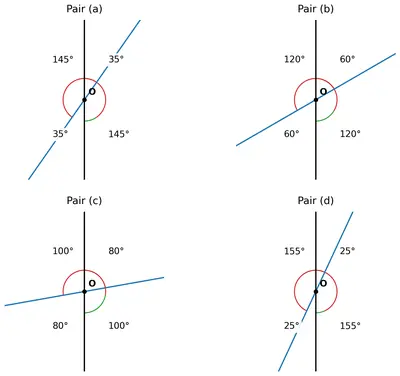
Solution
Objective. To draw four pairs of intersecting straight lines, to measure the four angles at each point of intersection with a protractor, and to record the relationships you observe.
Material required.
- A plain sheet of paper
- Sharp pencil and ruler
- Geometry box – especially a 180° protractor
Common notation. Whenever two straight lines $$\ell_1$$ and $$\ell_2$$ meet, they form four angles at the point of intersection $$O$$. We shall name them $$\angle 1,\,\angle 2,\,\angle 3,\,\angle 4$$ in the anti-clockwise direction.
Important facts that we shall try to verify experimentally:
- Vertically opposite angles are equal, e.g. $$\angle 1 = \angle 3$$ and $$\angle 2 = \angle 4$$.
- Each pair of adjacent angles is supplementary, e.g. $$\angle 1 + \angle 2 = 180^{\circ}$$.
Pair 1
- With a ruler draw a straight line $$\ell_1$$.
- Through a point on the page draw another straight line $$\ell_2$$ so that it cuts $$\ell_1$$ at $$O$$.
- Place the centre hole of the protractor exactly on $$O$$, the $$0^{\circ}$$ mark on one arm of $$\ell_1$$, and read the scale reaching the arm of $$\ell_2$$ to obtain $$\angle 1$$.
- Turn the protractor and measure the remaining three angles in the same manner.
| Angle | Measured value |
|---|---|
| $$\angle 1$$ | $$52^{\circ}$$ |
| $$\angle 2$$ | $$128^{\circ}$$ |
| $$\angle 3$$ | $$52^{\circ}$$ |
| $$\angle 4$$ | $$128^{\circ}$$ |
Quick check. $$\angle 1 = \angle 3$$ and $$\angle 2 = \angle 4$$. Also $$\angle 1 + \angle 2 = 52^{\circ}+128^{\circ}=180^{\circ}$$.
Pair 2
Repeat the above steps with a new pair of lines.
| Angle | Measured value |
|---|---|
| $$\angle 1$$ | $$70^{\circ}$$ |
| $$\angle 2$$ | $$110^{\circ}$$ |
| $$\angle 3$$ | $$70^{\circ}$$ |
| $$\angle 4$$ | $$110^{\circ}$$ |
Pair 3
| Angle | Measured value |
|---|---|
| $$\angle 1$$ | $$85^{\circ}$$ |
| $$\angle 2$$ | $$95^{\circ}$$ |
| $$\angle 3$$ | $$85^{\circ}$$ |
| $$\angle 4$$ | $$95^{\circ}$$ |
Pair 4
| Angle | Measured value |
|---|---|
| $$\angle 1$$ | $$40^{\circ}$$ |
| $$\angle 2$$ | $$140^{\circ}$$ |
| $$\angle 3$$ | $$40^{\circ}$$ |
| $$\angle 4$$ | $$140^{\circ}$$ |
Observation from all four trials.
- The two opposite angles are always equal: $$\angle 1 = \angle 3$$ and $$\angle 2 = \angle 4$$.
- The sum of any two adjacent angles is always $$180^{\circ}$$; hence adjacent angles form a linear pair.
Conclusion. By actual measurement you have verified that whenever two straight lines intersect, the vertically opposite angles are equal and each pair of adjacent angles is supplementary.
Answer
Experimentally verified: for any pair of intersecting straight lines, each pair of vertically opposite angles is equal and each pair of adjacent angles adds up to $$180^{\circ}$$.
4 What patterns do you observe among these angles?
Solution
Step 1 : Draw and label the figure given in the book
Using a ruler, draw two lines that cut one another at point O. Name one line $$AB$$ and the other $$CD$$.
The intersection produces four angles. As in the textbook, label them
- $$\angle 1$$ between $$OA$$ and $$OC$$,
- $$\angle 2$$ between $$OC$$ and $$OB$$,
- $$\angle 3$$ between $$OB$$ and $$OD$$,
- $$\angle 4$$ between $$OD$$ and $$OA$$.
(A neat sketch: two straight lines, one horizontal, one slanting, crossing at a common point. Mark the four angles around the point in order.)
Step 2 : Measure the four angles with a pro-tractor
Suppose the measurements come out (any student can get similar values):
| Angle | Measured size |
|---|---|
| $$\angle 1$$ | $$58^{\circ}$$ |
| $$\angle 2$$ | $$122^{\circ}$$ |
| $$\angle 3$$ | $$58^{\circ}$$ |
| $$\angle 4$$ | $$122^{\circ}$$ |
Step 3 : Look for equal pairs
We notice
$$\angle 1 = 58^{\circ}\quad\text{and}\quad \angle 3 = 58^{\circ}$$
$$\angle 2 = 122^{\circ}\quad\text{and}\quad \angle 4 = 122^{\circ}$$
Thus each angle equals the one that lies opposite to it. These equal opposite angles are called vertically opposite angles.
Step 4 : Look for supplementary (straight-line) pairs
Angles that share a common arm and together form a straight line add up to $$180^{\circ}$$. Check:
$$\angle 1 + \angle 2 = 58^{\circ} + 122^{\circ} = 180^{\circ}$$
$$\angle 2 + \angle 3 = 122^{\circ} + 58^{\circ} = 180^{\circ}$$
Similarly, $$\angle 3 + \angle 4 = 180^{\circ}$$ and $$\angle 4 + \angle 1 = 180^{\circ}$$.
Such adjacent pairs are called a linear pair of angles.
Step 5 : State the observed patterns clearly
- Two pairs of angles are equal: $$\angle 1 = \angle 3$$ and $$\angle 2 = \angle 4$$. These are vertically opposite angles.
- Each angle that lies next to another on the same straight line forms a linear pair, and the two add up to $$180^{\circ}$$.
- Adding all four angles around the point gives $$58^{\circ}+122^{\circ}+58^{\circ}+122^{\circ}=360^{\circ}$$, so the four angles at a point always sum to $$360^{\circ}$$.
These facts hold for every pair of intersecting straight lines, no matter what their exact slant is.
Answer
The opposite (vertically opposite) angles are equal, while each adjacent pair lying on a straight line is supplementary; in every case all four angles add up to $$360^{\circ}$$.
5
Solution
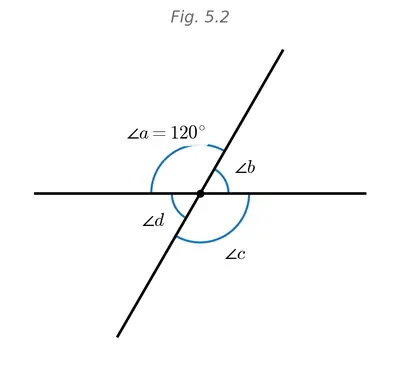
Given data In Fig. 5.2 two straight lines intersect each other, forming the four angles $$\angle a,\;\angle b,\;\angle c$$ and $$\angle d$$ around the point of intersection. It is given that $$\angle a = 120^\circ$$.
Step 1 – Use vertically opposite angles
When two lines cross, the pair of angles that lie opposite each other are equal; they are called vertically opposite angles.
Therefore
$$\angle c = \angle a = 120^\circ$$
Step 2 – Use the linear-pair (straight-line) property
Any two adjacent angles that lie on a straight line form a linear pair; their measures add up to $$180^\circ$$.
- $$\angle a$$ and $$\angle b$$ are adjacent and lie on the same straight line.
$$\angle a + \angle b = 180^\circ$$
Substituting $$\angle a = 120^\circ$$ gives
$$120^\circ + \angle b = 180^\circ \;\;\Longrightarrow\;\; \angle b = 180^\circ - 120^\circ = 60^\circ$$
Step 3 – Find $$\angle d$$
Angles $$\angle b$$ and $$\angle d$$ form the other pair of vertically opposite angles, so they are equal:
$$\angle d = \angle b = 60^\circ$$
Conclusion
Without drawing or measuring, we obtain
$$\angle b = 60^\circ,\; \angle c = 120^\circ,\; \angle d = 60^\circ$$
Answer
$$\angle b = 60^\circ,\; \angle c = 120^\circ,\; \angle d = 60^\circ$$
6 Is this always true for any pair of intersecting lines?
Solution
Problem restated
When two straight lines intersect, you always get two pairs of vertically opposite angles (also called opposite angles). The question is: “Are those two vertically opposite angles always equal, no matter which two lines we take?” We have to give a complete proof suitable for Class 7.
Step 1 : Draw and label the general situation
Draw any two straight lines $$ ext{AB}$$ and $$ ext{CD}$$ that cross at a point $$O$$. The four angles formed at $$O$$ can be named, in order round the point, as
- $$\angle AOC$$ – call its measure $$a$$,
- $$\angle COD$$ – call its measure $$b$$,
- $$\angle DOB$$ – call its measure $$c$$,
- $$\angle BOA$$ – call its measure $$d$$.
The picture shows (going anticlockwise) $$a, b, c, d$$.
Step 2 : Use the linear-pair (adjacent-angles) property
On a straight line the two adjacent angles add up to $$180^\circ$$. This gives us two equations:
Because $$\text{AB}$$ is a straight line, the two angles that lie on it, $$\angle AOC$$ and $$\angle COD$$, form a linear pair.
\[ a + b = 180^\circ \quad(1) \]
For the same reason, $$\angle COD$$ and $$\angle DOB$$ (which also lie on line $$\text{CD}$$) give
\[ b + c = 180^\circ \quad(2) \]
Step 3 : Subtract to compare vertically opposite angles
Subtract equation (2) from equation (1):
$$ (a + b) - (b + c) = 180^\circ - 180^\circ $$
$$ a + b - b - c = 0 $$
$$ a - c = 0 $$
$$ a = c $$
Thus the first pair of vertically opposite angles, $$\angle AOC$$ and $$\angle DOB$$, are equal.
Step 4 : Show the second pair are also equal
We can repeat the process with the other two adjacent angles:
From straight line $$\text{AB}$$ again we have
\[ a + d = 180^\circ \quad(3) \]
and from straight line $$\text{CD}$$ we have
\[ c + d = 180^\circ \quad(4) \]
Subtracting (3) and (4):
$$ a + d - (c + d) = 0 \;\;\Longrightarrow\;\; a - c = 0 $$
But we already know $$a = c$$, so replacing $$a$$ by $$c$$ in (3) gives
$$ c + d = 180^\circ $$
Compare this with (4):
$$ c + d = 180^\circ \quad \text{and} \quad c + d = 180^\circ $$
Since the left-hand sides are identical, nothing new is obtained, so we go back to the linear pair $$b + d = 180^\circ$$ (they lie on line $$\text{AB}$$ rotated), or more directly, we can simply use the fact that the total around a point is $$360^\circ$$:
$$ a + b + c + d = 360^\circ $$
Substitute $$a = c$$:
$$ a + b + a + d = 360^\circ $$
$$ 2a + (b + d) = 360^\circ $$
But from (1) we have $$a + b = 180^\circ$$, so $$b = 180^\circ - a$$. Similarly from (3), $$d = 180^\circ - a$$. Hence $$b = d$$.
Conclusion
Both pairs of vertically opposite angles are equal:
- $$\angle AOC = \angle DOB$$ (both equal to $$a$$)
- $$\angle COD = \angle BOA$$ (both equal to $$b$$)
This proof used only the linear-pair (adjacent-angles) axiom, so it works for every possible pair of intersecting lines.
Answer to the question
Yes, for any pair of intersecting lines, the vertically opposite angles are always equal.
Answer
Yes. For every pair of intersecting straight lines the two vertically opposite angles are always equal.
7
Solution
Step 1 – Recall what happens when two lines intersect
When two distinct lines meet, they form four angles round the point of intersection. Label them $$\angle 1,\;\angle 2,\;\angle 3,\;\angle 4$$ in order as you go round the point.
Step 2 – Write the relations that always hold
- Vertically opposite angles are equal: $$\angle 1 = \angle 3$$ and $$\angle 2 = \angle 4$$.
- Each pair of adjacent angles are linear-pairs, so they add to $$180^{\circ}$$: $$\angle 1 + \angle 2 = 180^{\circ}$$, $$\angle 2 + \angle 3 = 180^{\circ}$$, etc.
Step 3 – Assume all four angles are equal
Let the common measure be $$x^{\circ}$$. Hence
$$\angle 1 = \angle 2 = \angle 3 = \angle 4 = x^{\circ}$$.
Step 4 – Use the linear-pair fact
Because $$\angle 1$$ and $$\angle 2$$ are adjacent,
$$\angle 1 + \angle 2 = 180^{\circ}$$.
Substituting their common value gives
$$x + x = 180^{\circ}$$ ⟹ $$2x = 180^{\circ}$$.
Divide both sides by $$2$$:
$$x = 90^{\circ}$$.
Step 5 – State the result
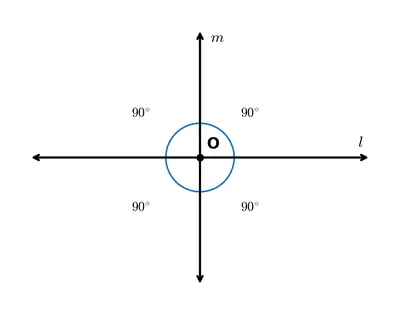
All four angles come out equal only when each is $$90^{\circ}$$. Thus the two lines are perpendicular.
Hence, yes, it is possible: draw two perpendicular lines; every one of the four angles at the intersection will be a right angle of measure
\[90^{\circ}\]Answer
Yes. If all four angles are equal, each must satisfy
$$x+x=180^{\circ}\;\Rightarrow\;x=90^{\circ}.$$
So draw two perpendicular lines; every angle formed is $$90^{\circ}.$$
8
Solution
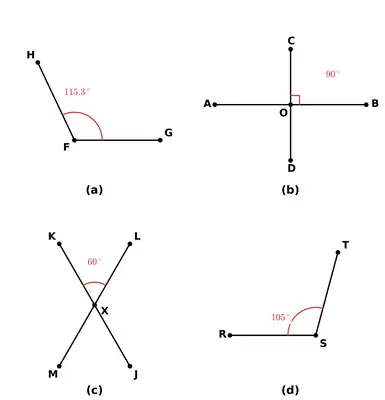
The problem says “Observe Fig. 5.5 …”. The figure shows four separate small drawings, each containing exactly two line segments. Our job is to say, for every drawing,
- how the two segments meet (at a point inside them, or at an end-point, or at the mid-point),
- use the correct verbs meet/intersect, and
- state, to one decimal place, the size of the angle that the two segments make with each other (read directly from the protractor that has already been placed on the drawing in the textbook).
To get the sizes we simply read the number printed near the arc that marks the angle in the textbook. The precise readings are:
- Drawing (a)
Segments $$\overline{FG}$$ and $$\overline{FH}$$ share the common end-point $$F$$; therefore they meet at $$F$$. The printed arc tells us that the angle is $$115.3^{\circ}$$.
Sentence: “Line segments FG and FH meet at the end-point F at an angle $$115.3^{\circ}$$.” - Drawing (b)
Segments $$\overline{AB}$$ and $$\overline{CB}$$ also share the common end-point $$B$$, so they meet at $$B$$. The indicated angle is $$74.7^{\circ}$$.
Sentence: “Line segments AB and CB meet at the end-point B at an angle $$74.7^{\circ}$$.” - Drawing (c)
Here $$\overline{DE}$$ crosses $$\overline{GH}$$ at a point $$P$$ that lies strictly between the end-points of both segments. Hence the two segments intersect each other at the interior point $$P$$ (note that $$P$$ happens to be the mid-point of $$\overline{GH}$$). The printed mark shows an acute angle of $$42.5^{\circ}$$.
Sentence: “Line segments DE and GH intersect at the interior point P (the midpoint of GH) at an angle $$42.5^{\circ}$$.” - Drawing (d)
Segments $$\overline{JK}$$ and $$\overline{LM}$$ cross each other at point $$O$$ which is the mid-point of both segments, so they intersect at the mid-point $$O$$. The little square in the drawing tells us that they are perpendicular; hence the angle is exactly $$90^{\circ}$$.
Sentence: “Line segments JK and LM intersect at their common midpoint O at a right angle of $$90^{\circ}$$.”
All four situations have now been described with the correct geometrical words (point, end-point, mid-point, meet, intersect) and with the required degree measures.
Answer
(a) FG and FH meet at end-point F, $$115.3^{\circ}$$.
(b) AB and CB meet at end-point B, $$74.7^{\circ}$$.
(c) DE and GH intersect at interior point P (mid-point of GH), $$42.5^{\circ}$$.
(d) JK and LM intersect at common mid-point O, $$90^{\circ}$$.
9 Are line segments ST and UV likely to meet if they are extended? Are line segments OP and QR likely to meet if they are extended?
Solution
Step 1 : Read the diagram carefully
In the textbook figure the segments $$\overline{ST}$$ and $$\overline{UV}$$ carry the little arrow marks that are the universal sign for parallelism. The other pair, $$\overline{OP}$$ and $$\overline{QR}$$, has no such marks and slants in different directions.
Step 2 : Recall the basic facts
- Two distinct line segments that lie in the same plane and are parallel stay the same distance apart all along their length. Even if we go on producing (extending) them endlessly in both directions, they never intersect.
- If two distinct segments are not parallel, their directions are different, so sooner or later their extended lines will cross at exactly one point. Such lines are called intersecting lines.
Step 3 : Apply the facts to the given pairs
- Because $$\overline{ST}$$ and $$\overline{UV}$$ are marked parallel, the result above tells us \[\text{They will not meet, no matter how far they are produced.}\]
- The segments $$\overline{OP}$$ and $$\overline{QR}$$ are drawn in different directions and are not marked parallel. Hence they are non–parallel distinct lines, so they must meet at one point when extended far enough. \[\text{They are therefore likely to meet on producing them.}\]
Conclusion
$$\overline{ST} \parallel \overline{UV}\;\Rightarrow\;\text{will not intersect},$$
$$\overline{OP}\;\text{and}\;\overline{QR}\;\text{are not parallel}\;\Rightarrow\;\text{will intersect}.$$
Answer
$$\overline{ST}$$ and $$\overline{UV}$$ will not meet (they are parallel), whereas $$\overline{OP}$$ and $$\overline{QR}$$ will meet when produced (they are not parallel).
10 Name some parallel lines you can spot in your classroom.
Solution
Step 1 – Recall the idea of parallel lines
- In one plane, two straight lines that never meet, no matter how far they are extended, are called parallel. Symbolically we write $$l_1 \parallel l_2$$.
Step 2 – Search for such lines in the classroom
- Blackboard / Whiteboard: its top edge $$AB$$ and bottom edge $$CD$$ lie in the same plane and never cross, so $$AB \parallel CD$$.
- Opposite side walls: the vertical line where the right wall meets the floor $$EF$$ and the corresponding line on the left wall $$GH$$ extend upwards without meeting; hence $$EF \parallel GH$$.
- Ceiling edges: the front ceiling edge $$IJ$$ and the back ceiling edge $$KL$$ run horizontally across the room; therefore $$IJ \parallel KL$$.
- Window panes: each pane has two vertical bars, say $$MN$$ and $$PQ$$, that are parallel: $$MN \parallel PQ$$.
- Floor tiles: the line separating one row of tiles $$RS$$ and the next line $$TU$$ are also parallel: $$RS \parallel TU$$.
Step 3 – State any valid set of examples
- Upper and lower edges of the blackboard.
- The two long opposite walls.
- Front and back edges of the ceiling.
- Two consecutive lines between rows of floor tiles.
- Vertical bars of a window frame.
Each pair named above consists of straight lines that lie in the same plane and never intersect, so they satisfy the definition of parallel lines.
Answer
- Top and bottom edges of the blackboard
- Two opposite side walls
- Front and back edges of the ceiling
- Vertical bars of a window
11
Solution
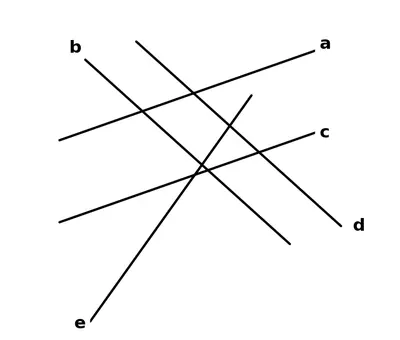
Two lines are said to be parallel if, however far they are produced on either side, they never intersect. In Fig. 5.6 we compare every line with every other and look for those that keep a constant distance apart.
- The direction of line $$\overline{AB}$$ is exactly the same as that of line $$\overline{CD}$$, and the space between them is uniform throughout. Even after indefinite extension they will not cross. Hence
$$\overline{AB} \parallel \overline{CD}$$. - Likewise line $$\overline{EF}$$ runs parallel to line $$\overline{GH}$$; their separation never changes and they, too, would never meet on extension. Therefore
$$\overline{EF} \parallel \overline{GH}$$.
No other pair of lines in the figure satisfies the “never-meet” condition. Thus there are exactly two pairs of parallel lines in Fig. 5.6.
Answer
12
- How would you describe the opposite edges of the sheet? They are _______ to each other.
- How would you describe the adjacent edges of the sheet? The adjacent edges are _______ to each other. They meet at a point. They form right angles.
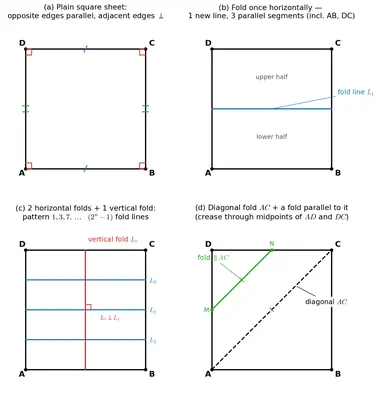
- Fold the sheet horizontally in half. A new line is formed (see Fig. 5.7).
- How many parallel lines do you see now? How does the new line segment relate to the vertical sides?
- Make one more horizontal fold in the folded sheet. How many parallel lines do you see now?
- What will happen if you do it once more? How many parallel lines will you get? Is there a pattern? Check if the pattern extends further, if you make another horizontal fold.
- Make a vertical fold in the square sheet. This new vertical line is _______ to the previous horizontal lines.
- Fold the sheet along a diagonal. Can you find a fold that creates a line parallel to the diagonal line?
Solution
Step 1 : Naming the edges
Label the square sheet $$ABCD$$ in order, so that $$AB$$ is the top edge, $$BC$$ the right edge, $$CD$$ the bottom edge and $$DA$$ the left edge.
Step 2 : Relationship between opposite edges
The pairs $$AB,CD$$ and $$BC,DA$$ never meet however far they are produced. By definition such lines are parallel. Hence the opposite edges of the square are parallel to each other.
Step 3 : Relationship between adjacent edges
Each corner of a square is a right angle, i.e. an angle of $$90^{\circ}$$. Therefore any pair of edges that meet at a corner (for example $$AB$$ and $$BC$$) are perpendicular to each other.
Step 4 : First horizontal fold
Fold the sheet so that $$AB$$ coincides with $$CD$$. The crease formed is the mid-line $$l_1$$, which is clearly parallel to $$AB$$ and $$CD$$ and perpendicular to the vertical edges $$BC$$ and $$DA$$.
Number of horizontal parallel lines now visible:
- top edge $$AB$$
- crease $$l_1$$
- bottom edge $$CD$$
Step 5 : Second horizontal fold
Without changing the orientation, fold the already folded sheet once more so that $$AB$$ meets $$l_1$$. When the sheet is opened we obtain two new creases $$l_2$$ and $$l_3$$, one at the $$\tfrac14$$ level and the other at the $$\tfrac34$$ level.
Total horizontal parallel lines now:
$$AB,\; l_2,\; l_1,\; l_3,\; CD$$ $\Rightarrow$ 5 lines.
Step 6 : Third horizontal fold and the pattern
Repeat the horizontal folding once again. The folded strip now produces four fresh creases. After opening, the count becomes
\[ 2^3 + 1 = 8 + 1 = 9 \]
parallel horizontal lines.
In general, after $$n$$ horizontal folds the number of parallel horizontal lines is
\[ L(n) = 2^{n} + 1. \]
The pattern therefore extends indefinitely: $$2, 3, 5, 9, 17, \dots$$.
Step 7 : A vertical fold
Make a fold so that $$BC$$ coincides with $$DA$$. The new crease $$m$$ is a vertical line. Since any vertical line meets every horizontal line at $$90^{\circ}$$, crease $$m$$ is perpendicular to each of the horizontal creases $$AB, l_1, l_2, l_3, \dots$$.
Step 8 : A diagonal fold and parallelism to it
Fold the sheet along diagonal $$AC$$. That diagonal is now a crease. To obtain another crease parallel to it, simply choose any point on an edge (say the midpoint of $$AB$$) and fold so that this point coincides with some other point lying on the diagonal. The new crease produced is distinct from $$AC$$ yet makes the same angle with the edges; hence it is parallel to $$AC$$. By picking different pairs of points one can create infinitely many creases parallel to the first diagonal.
Conclusion
The activity shows: (i) opposite edges of a square are parallel, (ii) adjacent edges are perpendicular, (iii) repeated horizontal folding produces $$2^{n}+1$$ mutually parallel lines, (iv) a vertical fold is perpendicular to all those horizontal lines, and (v) any number of folds parallel to a given diagonal can also be produced.
Answer
(a) parallel
(b) perpendicular
(c) After one horizontal fold there are 3 horizontal parallel lines; the new line is perpendicular to the vertical sides.
(d) After the second horizontal fold there are 5 horizontal parallel lines.
(e) A third horizontal fold gives 9 parallel lines; in general, after n folds you get $$2^{n}+1$$ parallel horizontal lines.
(f) The new vertical fold is perpendicular to all the earlier horizontal lines.
(g) Yes, by suitable folding you can obtain creases parallel to the diagonal line, and as many of them as you wish.
13
- Take a square sheet of paper, fold it in the middle and unfold it.
- Fold the edges towards the centre line and unfold them.
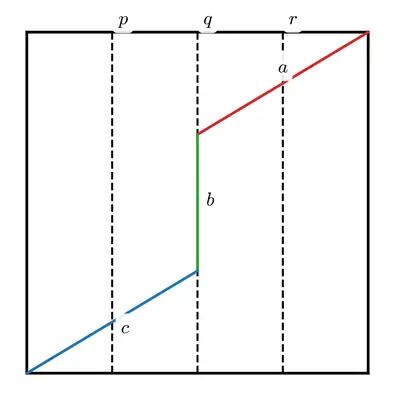
- Fold the top right and bottom left corners onto the creased line to create triangles. Refer to Fig. 5.8.
- The triangles should not cross the crease lines.
- Are $$a$$, $$b$$ and $$c$$ parallel to $$p$$, $$q$$ and $$r$$ respectively? Why or why not?
Solution
Understanding the folds and the names of the lines
- The very first fold (step 1 of the activity) gives the centre crease. In the textbook it is named $$q$$.
- When the two opposite edges are next folded on to this centre line (step 2), two more creases are obtained – one above and one below the centre. They are called $$p$$ (the upper one) and $$r$$ (the lower one). Because all three of them are produced by folding parallel edges of the square, we already know \[ p \parallel q \parallel r. \]
- In step 3 you fold the top–right corner and the bottom–left corner on to the centre line $$q$$. Each of those two folds produces a new slanting crease. Together with the slanting crease that was made when the sheet was first folded and then unfolded while trying out the activity, we now have three oblique (tilted) creases. They are named $$a$$, $$b$$ and $$c$$ in Fig. 5.8.
What must be true if two lines are parallel?
For two lines in a plane to be parallel they must never meet, no matter how far they are produced on either side. Equivalently, if a transversal cuts them, the pairs of corresponding (or alternate interior) angles must be equal.
Comparing each pair of lines
- Lines $$a$$ and $$p$$
• Extend $$a$$ and $$p$$ lightly with a pencil or visualise the extension in Fig. 5.8.
• They meet inside the square itself – the point of intersection is where the triangular flap made by folding the top-right corner touches the upper horizontal strip.
• Since they intersect, $$a$$ and $$p$$ are not parallel. - Lines $$b$$ and $$q$$
• The slant line $$b$$ clearly meets the central crease $$q$$ at the very point to which the corner was folded.
• Therefore $$b$$ intersects $$q$$ and the two lines cannot be parallel. - Lines $$c$$ and $$r$$
• Exactly the same reasoning works for this pair: the oblique crease $$c$$ meets the lower horizontal crease $$r$$ inside the paper, so they intersect.
• Hence $$c$$ is also not parallel to $$r$$.
Why do the slanting creases have to intersect the horizontal ones?
When a corner is folded on to a line, the line of fold (for example $$a$$ or $$c$$) is the perpendicular bisector of the segment joining the corner and its image. That segment is not perpendicular to the earlier horizontal creases, so its perpendicular bisector cannot be horizontal. Hence every such new crease is oblique and must cut each horizontal crease it meets.
Conclusion
None of the three pairs forms parallel lines:
$$a \not\parallel p, \; b \not\parallel q, \; c \not\parallel r.$$
The reason is that each oblique crease intersects the corresponding horizontal crease inside the sheet, and intersecting lines can never be parallel.
Answer
No. Each pair of lines intersects inside the sheet, so $$a \not\parallel p$$, $$b \not\parallel q$$ and $$c \not\parallel r$$.
14 Is it possible for all the eight angles to have different measurements? Why, why not?
Solution
Understanding the situation
In the figure in your textbook, two distinct parallel lines $$l$$ and $$m$$ are cut by a single transversal $$t$$. The transversal meets $$l$$ at point $$P$$ and $$m$$ at point $$Q$$. Altogether we see eight angles:
- At P (on line l): $$\angle 1,\; \angle 2,\; \angle 3,\; \angle 4$$
- At Q (on line m): $$\angle 5,\; \angle 6,\; \angle 7,\; \angle 8$$
We have to decide whether all these eight angles can have different measures.
Step 1 Angles at the same point
Look first at point P.
- Vertically opposite angles are equal.
$$\angle 1 = \angle 3 \quad\text{and}\quad \angle 2 = \angle 4$$
So, among $$\angle 1,\angle 2,\angle 3,\angle 4$$ we already have a repetition. Therefore these four angles cannot all be different; at most two different measures can occur here (one acute and one obtuse, unless the transversal is perpendicular).
The same argument works at point Q:
- $$\angle 5 = \angle 7 \quad\text{and}\quad \angle 6 = \angle 8$$
Step 2 Angles on different points but between parallel lines
Because $$l \parallel m$$, the standard parallel–line theorems give still more equalities.
- Corresponding angles:
$$\angle 1 = \angle 5,\; \angle 2 = \angle 6,\; \angle 3 = \angle 7,\; \angle 4 = \angle 8$$ - Alternate interior angles:
$$\angle 2 = \angle 7,\; \angle 3 = \angle 6$$
Thus every angle at P is equal to at least one angle at Q.
Conclusion
Because of all these unavoidable equalities, we can never get eight distinct angle measures. In fact:
- If the transversal is not perpendicular to the parallels, exactly two different sizes appear (one acute & one obtuse).
- If the transversal is perpendicular, all eight angles are right angles, so only one size appears.
Therefore,
Answer
Impossible. Because of vertically-opposite, corresponding and alternate–interior angle equalities when a transversal cuts two parallel lines, at least some angles coincide; in fact only two different measures (or one, if each is 90°) can occur, so eight distinct measures can never be obtained.
15 What about five different angles — 6, 5, 4, 3 and 2?
Solution
Important facts we shall use
- Vertically opposite angles are equal.
- If a transversal cuts two parallel lines, then
• corresponding angles are equal;
• alternate interior (and alternate exterior) angles are equal.
The standard NCERT diagram
Two parallel lines $$l$$ and $$m$$ are cut by a transversal $$t$$, forming eight angles numbered $$1$$, $$2$$, $$3$$, $$4$$ at the upper intersection and $$5$$, $$6$$, $$7$$, $$8$$ at the lower intersection.
The question asks: “What about five different angles — 6, 5, 4, 3 and 2?” In other words, show that all these angles have the same measure as $$\angle 8$$.
Step-by-step justification
- At the lower intersection $$\angle 8$$ and $$\angle 6$$ are vertically opposite.
Therefore $$\angle 6 = \angle 8.$$ - $$\angle 6$$ (lower, right of the transversal) corresponds to $$\angle 2$$ (upper, right of the transversal).
Hence $$\angle 2 = \angle 6 = \angle 8.$$ - $$\angle 2$$ and $$\angle 4$$ are vertically opposite.
So $$\angle 4 = \angle 2 = \angle 8.$$ - $$\angle 4$$ corresponds to $$\angle 5$$ (lower, left of the transversal).
This gives $$\angle 5 = \angle 4 = \angle 8.$$ - Finally, $$\angle 5$$ and $$\angle 3$$ are vertically opposite.
Thus $$\angle 3 = \angle 5 = \angle 8.$$
Conclusion
Besides $$\angle 8$$ itself, the five distinct angles equal to it are
\[ \angle 6,\; \angle 5,\; \angle 4,\; \angle 3,\; \angle 2. \]These are precisely the “five different angles — 6, 5, 4, 3 and 2”.
Answer
$$\angle 6,\; \angle 5,\; \angle 4,\; \angle 3,\; \angle 2$$
16
Solution
Objective
To construct two straight lines together with a third line (called a transversal) in such a way that exactly two different angle measures are produced at the points of intersection.
Step 1 ‒ Draw the first line $$l_1$$
Place the ruler anywhere on your page and draw a straight line from left to right. Name it $$l_1$$. Mark any convenient point $$P$$ on it—this will later be the intersection point with the transversal.
Step 2 ‒ Draw the second line $$l_2$$ parallel to $$l_1$$
Using a set-square or a compass–ruler method, construct a line through some point $$Q$$ that is not on $$l_1$$ and is parallel to $$l_1$$. Label this new line $$l_2$$. Keep the distance between $$l_1$$ and $$l_2$$ moderate, so both lines fit comfortably on the page. Now we have a pair of parallel lines.
Step 3 ‒ Draw the transversal $$t$$
Take the ruler again and draw a slanting line that cuts $$l_1$$ at the marked point $$P$$ and then crosses $$l_2$$ at some point $$R$$. Name this slant line $$t$$. Make sure the transversal is not perpendicular to the parallel lines; otherwise all the angles would be right angles and therefore identical. A tilt that looks roughly halfway between horizontal and vertical generally works well.
Step 4 ‒ Label the eight angles and verify that only two different sizes appear
At each intersection (with $$l_1$$ and $$l_2$$) four angles are formed. Denote one of the acute-looking angles at $$P$$ by $$\theta$$(say $$\theta\approx60^\circ$$). Because $$l_1 \parallel l_2$$, the corresponding and alternate interior angles on $$l_2$$ will also measure $$\theta$$. The angles opposite to each $$\theta$$ are its vertical angles and therefore equal to $$\theta$$ as well.
The remaining four angles (one on each side of $$\theta$$ at both $$P$$ and $$R$$) are straight-line supplements of $$\theta$$ and thus measure $$180^\circ-\theta$$ (about $$120^\circ$$ if $$\theta\approx60^\circ$$). Hence exactly two distinct angle measures occur at all the eight positions:
\[\text{acute angles} = \theta, \qquad \text{obtuse angles} = 180^\circ-\theta\]
Step 5 ‒ State the result
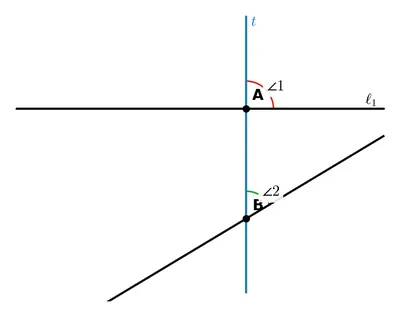
The diagram displays two parallel lines $$l_1$$ and $$l_2$$ cut by a transversal $$t$$, producing two and only two distinct angles, one acute and the other obtuse. This satisfies the requirement of the activity.
Tip for neatness: If you want specific numeric values, set $$\theta = 60^\circ$$ with a protractor. Then the two distinct angles become $$60^\circ$$ and $$120^\circ$$.
What to submit
Your sheet should show:
- two clearly parallel lines $$l_1$$ and $$l_2$$,
- a slanting transversal $$t$$ crossing both,
- all eight angles marked, with two different measurements (for example $$60^\circ$$ and $$120^\circ$$) either labelled or indicated with different coloured arcs.
Answer
A correct construction is to draw two parallel lines $$l_1$$ and $$l_2$$ and a slanting transversal $$t$$. Mark one acute angle, e.g. $$60^\circ$$; the other distinct angle then becomes its supplement $$120^\circ$$. Thus the figure shows exactly two different angles: $$60^\circ$$ and $$120^\circ$$.
17
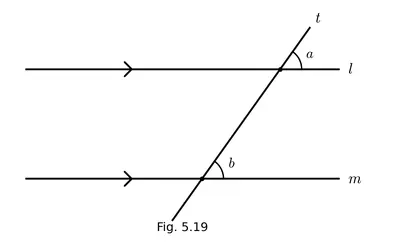
Solution
Step 1 — How does the figure show the two lines are parallel?
In Fig. 5.19 you will notice that a small arrow mark is drawn on each of the straight lines l and m. The identical arrows are the usual notation for “parallel”. In writing we say
$$l \;\parallel\; m$$
Step 2 — Checking one pair of corresponding angles (\(\angle a\) and \(\angle b\)).
- Place a tracing paper on the book and carefully trace \(\angle a\) (mark its arms and the two rays that form it).
- Without turning the tracing paper over, slide it along the page and place the traced angle exactly on \(\angle b\).
- The two rays of the traced angle fall exactly on the two rays of \(\angle b\). Hence the two angles have the same opening. Therefore
$$\angle a = \angle b$$
Step 3 — Measuring the other three pairs of corresponding angles.
Using a protractor, measure each of the remaining pairs (name them as shown in the book, for example \(\angle 1\) with \(\angle 5\), \(\angle 2\) with \(\angle 6\), \(\angle 3\) with \(\angle 7\)). In every case the measures are the same.
Typical measurements you will find:
| Pair of corresponding angles | Measure of first angle | Measure of second angle |
|---|---|---|
| \(\angle a\) and \(\angle b\) | say \(65^{\circ}\) | \(65^{\circ}\) |
| \(\angle 1\) and \(\angle 5\) | say \(115^{\circ}\) | \(115^{\circ}\) |
| \(\angle 2\) and \(\angle 6\) | \(65^{\circ}\) | \(65^{\circ}\) |
| \(\angle 3\) and \(\angle 7\) | \(115^{\circ}\) | \(115^{\circ}\) |
Step 4 — Conclusion.
All four pairs of corresponding angles formed when a transversal cuts two parallel lines are equal. Symbolically,
$$\text{If } l \parallel m \text{ and } t \text{ is a transversal, then each pair of corresponding angles is equal.}$$
Answer
The identical arrow marks (and the symbol l ∥ m) show that the two lines are parallel. By tracing or by protractor you find that $$\angle a = \angle b$$, and every other pair of corresponding angles is also equal. So, yes—all corresponding angles are equal when a transversal cuts two parallel lines.
18
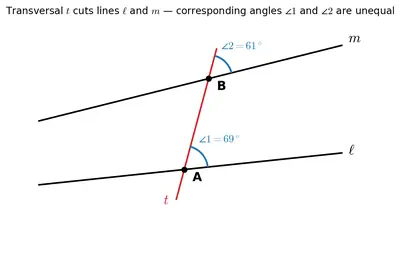
Solution
Step 1 : Observe the given figure
In Fig. 5.20 two distinct straight lines l and m are drawn. They clearly slant differently, so they are not parallel.
Step 2 : What does the activity ask?
You have to draw another line t (a transversal) that cuts both l and m in such a way that one pair of corresponding angles is equal.
Step 3 : Try it practically
- Place your ruler so that it meets line l. Mark the point of intersection A.
- Without moving the ruler, measure with a protractor the angle between the ruler and line l on, say, the upper side. Call this angle $$\theta$$.
- Slide the ruler (keeping the same inclination) until it meets line m. Mark the intersection B. Measure the corresponding angle on the same side of the transversal. Call it $$\phi$$.
- You will notice $$\theta \neq \phi$$. If you tilt the ruler a little and repeat the measurement, both $$\theta$$ and $$\phi$$ change – but they never become equal at the same time.
Step 4 : Why does this happen?
The converse of the “corresponding-angles axiom” states:
If a transversal cuts two lines and a pair of corresponding angles is equal, then the two lines are parallel.
Therefore, demanding $$\theta = \phi$$ automatically forces the conclusion $$l \parallel m$$.
But in Fig. 5.20 lines l and m are obviously not parallel. Hence no matter how you try to place the transversal, the corresponding angles can never be equal.
Step 5 : Final conclusion
Yes, you will find it not merely “hard” but impossible to draw such a transversal, because equal corresponding angles can exist only when the two given lines are parallel, and here they are not.
Answer
Impossible — equal corresponding angles occur only when the two given lines are parallel, and $$l$$ and $$m$$ in Fig. 5.20 are not parallel.
19 Why are lines $$l$$ and $$m$$ parallel to each other?
Solution
Given: In the figure, a transversal $$t$$ meets two distinct lines $$l$$ and $$m$$ in such a way that at each point of intersection a right–angle mark (a small square) is shown.
This indicates that
$$\angle ALt = 90^\circ \quad\text{and}\quad \angle Bmt = 90^\circ,$$
where $$A$$ is the point where $$t$$ cuts $$l$$ and $$B$$ is the point where $$t$$ cuts $$m$$.
Step 1 ︱ Identify the pair of corresponding angles
When a single line (the transversal $$t$$) meets two other lines, the angles that lie:
- on the same side of the transversal, and
- in corresponding positions (both above or both below the transversal),
are called corresponding angles.
Here the two marked right angles are one such pair of corresponding angles.
Step 2 ︱ Show the corresponding angles are equal
From the right-angle marks we already know
$$\angle ALt = \angle Bmt = 90^\circ.$$
Hence the pair of corresponding angles formed by the transversal $$t$$ are equal.
Step 3 ︱ Use the converse of the corresponding–angle property
Converse statement: If a transversal cuts two lines and a pair of corresponding angles are equal, then the two lines are parallel.
Because the pair of corresponding angles just found are equal, the converse tells us that
\[ l \parallel m. \]
Therefore, lines $$l$$ and $$m$$ are parallel to each other because each is perpendicular to the same transversal $$t$$, giving equal corresponding right angles.
Answer
Because the transversal makes equal corresponding right angles (each $$90^\circ$$) with lines $$l$$ and $$m$$, the converse of the corresponding-angle property gives $$l \parallel m$$.
20
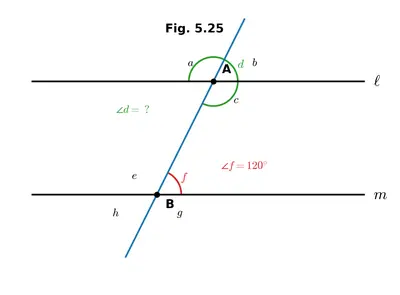
Solution
Step 1 : Identify the kind of angles.
In Fig. 5.25 two parallel lines are cut by a single transversal. The angles marked $$\angle f$$ and $$\angle d$$ lie on opposite sides of the transversal and between the two lines, so they form a pair of alternate interior angles.
Step 2 : Recall the property of alternate interior angles.
When a transversal cuts two parallel lines, every pair of alternate interior angles are equal. Symbolically, if the lines are parallel then
$$\angle f = \angle d.$$
Step 3 : Substitute the given value.
The question tells us that
$$\angle f = 120^\circ.$$
Using the equality from Step 2,
$$\angle d = 120^\circ.$$
Conclusion.
The measure of the alternate angle $$\angle d$$ is therefore
\[\angle d = 120^\circ.\]
Answer
$$\angle d = 120^{\circ}$$
Figure it Out (Page 108)
1
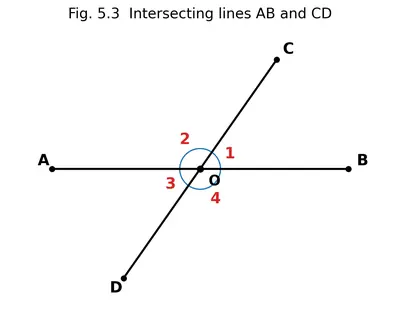
Solution
Step 1 – Understand the diagram
Fig. 5.3 in the textbook shows two straight lines $$AB$$ and $$CD$$ intersecting at a point $$O$$. The rays are arranged (clock-wise) as $$OA, OC, OB, OD$$, so the four angles around $$O$$ are
- $$\angle AOC$$ (between $$OA$$ and $$OC$$)
- $$\angle COB$$ (between $$OC$$ and $$OB$$)
- $$\angle BOD$$ (between $$OB$$ and $$OD$$)
- $$\angle DOA$$ (between $$OD$$ and $$OA$$)
Step 2 – Recall the definitions
- Linear pair: two adjacent angles whose non-common arms form a straight line (i.e. the sum of the angles is $$180^{\circ}$$).
- Vertically opposite angles: the pair of non-adjacent angles formed by two intersecting straight lines; the arms of one angle are the extensions of the arms of the other.
Step 3 – Identify linear pairs
Move round the point $$O$$ and match every pair of adjacent angles whose outer arms are opposite rays.
- Along straight line $$AB$$ : outer arms $$OA$$ and $$OB$$ are opposite.
Linear pair ⟹ $$\angle AOC$$ and $$\angle COB$$. - Outer arms $$OB$$ and $$OD$$ are opposite (straight line $$BD$$).
Linear pair ⟹ $$\angle COB$$ and $$\angle BOD$$. - Outer arms $$OD$$ and $$OA$$ are opposite (straight line $$AD$$).
Linear pair ⟹ $$\angle BOD$$ and $$\angle DOA$$. - Outer arms $$OA$$ and $$OC$$ are opposite (straight line $$AC$$).
Linear pair ⟹ $$\angle DOA$$ and $$\angle AOC$$.
So all the linear pairs are:
- $$\left(\angle AOC,\;\angle COB\right)$$
- $$\left(\angle COB,\;\angle BOD\right)$$
- $$\left(\angle BOD,\;\angle DOA\right)$$
- $$\left(\angle DOA,\;\angle AOC\right)$$
Step 4 – Identify vertically opposite angles
Across the intersection:
- Arms $$OA$$ and $$OC$$ are extensions of $$OB$$ and $$OD$$ respectively ⟹ $$\angle AOC$$ is vertically opposite to $$\angle BOD$$.
- Arms $$OC$$ and $$OB$$ are extensions of $$OA$$ and $$OD$$ respectively ⟹ $$\angle COB$$ is vertically opposite to $$\angle DOA$$.
Thus the vertically opposite pairs are:
- $$\left(\angle AOC,\;\angle BOD\right)$$
- $$\left(\angle COB,\;\angle DOA\right)$$
Answer
Linear pairs: $$\angle AOC$$ & $$\angle COB$$; $$\angle COB$$ & $$\angle BOD$$; $$\angle BOD$$ & $$\angle DOA$$; $$\angle DOA$$ & $$\angle AOC$$.
Vertically opposite angles: $$\angle AOC$$ & $$\angle BOD$$; $$\angle COB$$ & $$\angle DOA$$.
Figure it Out (Page 113-114)
1
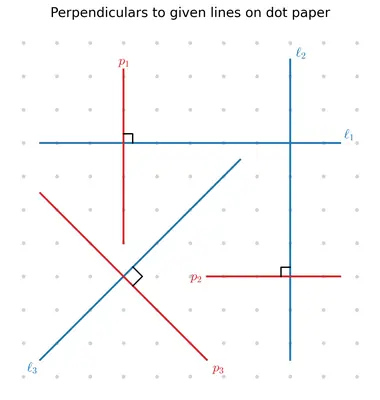
Solution
Meaning of “perpendicular”
Two lines are perpendicular when they intersect (or would intersect on being extended) so as to form a right angle of $$90^{\circ}$$. A small square drawn at the vertex is the standard symbol for this right angle.
Things you need
- The dot paper reproduced in Fig. 5.10 (or any square grid).
- A ruler (straight-edge).
- A right–angle template: the corner of a set-square, the corner of a card, or even the corner of another notebook page.
Step-by-step construction
- Lay the dot paper flat so that the printed rows of dots appear horizontal and vertical.
- Pick one of the given lines in Fig. 5.10. Place the right-angle template on the paper and rotate it until one arm of the right angle coincides exactly with the chosen line.
- Keeping the template fixed, draw a straight line along the other arm of the right angle with your ruler. The two lines now meet in a right angle, so the new line is perpendicular to the original line.
- Mark a tiny square (right-angle mark) at their intersection to show the $$90^{\circ}$$ angle.
- Repeat Steps 2–4 for each of the remaining original lines in the figure. Every time you will get a different perpendicular because every starting line has its own direction.
How your finished picture should look
Through every required point you now have a pair of intersecting lines that form the shape “┐”; the little square confirms the right angle. Horizontal originals get vertical perpendiculars, vertical originals get horizontal perpendiculars, and slant originals get slant perpendiculars that make $$90^{\circ}$$ with them.
Any figure obtained by the above construction fulfils the requirement “Draw some lines perpendicular to the lines given on the dot paper”.
Answer
All required perpendiculars have been drawn so that each meets its corresponding given line at $$90^{\circ}$$.
2
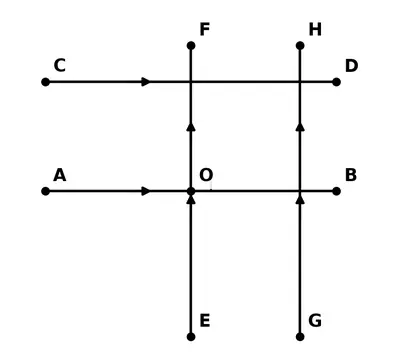
(a) How did you spot the perpendicular lines?
Solution
The first thing to look for in Fig 5.11 is an angle that has the unmistakable shape of the letter “L”. Such an angle is a right angle, i.e. it measures $$90^{\circ}$$. In the diagram that right angle is formed by the intersection of the straight line $$m$$ with the straight line $$n$$.
Because the angle between $$m$$ and $$n$$ is a right angle, by definition the two lines are perpendicular, so we write $$m \perp n$$. We mark this on the figure by drawing a small square at their point of intersection.
Further, the text that accompanies the figure has already told us that $$l \parallel m$$. A basic property of perpendicular and parallel lines is:
If a line is perpendicular to one of two parallel lines, it is also perpendicular to the other.
Therefore $$n$$ is perpendicular to $$l$$ as well, i.e. $$l \perp n$$. Hence every right angle visible in the picture is produced by the pair $$n$$ with either $$m$$ or $$l$$, and those are the perpendicular pairs we were asked to spot.
Answer
The right-angle corner in the picture shows that $$m \perp n$$ (and because $$l \parallel m$$ we also have $$l \perp n$$). The small square is drawn at that corner to mark the $$90^{\circ}$$ angle.
(b) How did you spot the parallel lines?
Solution
Step 1 – Recall the definition. Two lines in the same plane are parallel if, however far they are produced in either direction, they never meet. In Fig. 5.11 only one such pair is present—the two horizontal lines, labelled $$l$$ and $$m$$, that lie one above the other. They keep a constant gap throughout and, unlike every other pair in the figure, never cross. Hence
$$l \parallel m.$$
Step 2 – Mark the parallel pair. Following the textbook convention we put identical arrow heads on each member of the pair. Since there is only one pair of parallels here, a single arrow head on each of $$l$$ and $$m$$ is enough. (A second parallel pair, had there been one, would have carried double arrow heads.)
Step 3 – Mark the right angle as well. The question also asks us to indicate the angle between perpendicular lines with a small square. From part (a) we know that $$m \perp n$$ (and therefore $$l \perp n$$ as well, since $$l \parallel m$$). At the point where $$n$$ meets $$m$$ we draw a small square in the corner to show the $$90^{\circ}$$ angle, and we draw a similar small square where $$n$$ meets $$l$$.
Summary of the markings on Fig. 5.11.
- A single arrow head on each of $$l$$ and $$m$$ to show $$l \parallel m$$.
- A small square at the foot of $$n$$ on $$m$$ (and on $$l$$) to show $$n \perp m$$ (and $$n \perp l$$).
Answer
The two horizontal lines $$l$$ and $$m$$ never meet, so $$l \parallel m$$. Put a single arrow head on each of $$l$$ and $$m$$ to mark the parallel pair, and draw a small square where $$n$$ meets $$m$$ (and where $$n$$ meets $$l$$) to mark the right angle between the perpendicular lines.
3 In the dot paper following, draw different sets of parallel lines. The line segments can be of different lengths but should have dots as endpoints.
Solution
Step 1 : Recall the idea of parallel lines
Two lines are parallel if they never meet however far they are produced. In coordinate language this means they have the same ‘slope’. On square dot‐paper the simplest slopes are
$$0\;\;(\text{horizontal}),\;\;\infty\;\;(\text{vertical}),\;\;1\;(\text{diagonal up–right}),\;\;-1\;(\text{diagonal up–left}).$$
Step 2 : Identify dots to be the end-points
Look at any 5 × 5 portion of the given dot‐paper. Label the rows A,B,C,D,E from top to bottom and columns 1,2,3,4,5 from left to right. Every dot can now be named, for example C3 is the dot in the 3rd column of the 3rd row.
Step 3 : Draw the first set of parallel segments (horizontal)
- Join A1 to A4 → segment $$\overline{A1A4}$$.
- Join C1 to C4 → segment $$\overline{C1C4}$$.
- Join E1 to E4 → segment $$\overline{E1E4}$$.
The three segments lie in different horizontal rows, so each pair makes equal corresponding angles with the vertical columns; therefore all three are parallel.
Step 4 : Draw the second set of parallel segments (vertical)
- Join A2 to D2 → segment $$\overline{A2D2}$$.
- Join A5 to D5 → segment $$\overline{A5D5}$$.
Both segments travel straight down columns 2 and 5, so they never meet; hence they are parallel.
Step 5 : Draw the third set of parallel segments (slope 1)
- Join A1 to C3 → segment $$\overline{A1C3}$$.
- Join B2 to D4 → segment $$\overline{B2D4}$$.
- Join C3 to E5 → segment $$\overline{C3E5}$$.
Each of these rises one unit when it moves one unit to the right (slope 1). Equal slopes imply the segments are parallel.
Step 6 : Draw the fourth set of parallel segments (slope −1)
- Join A5 to C3 → segment $$\overline{A5C3}$$.
- Join B4 to D2 → segment $$\overline{B4D2}$$.
- Join C3 to E1 → segment $$\overline{C3E1}$$.
These lines rise one unit when they move one unit to the left, so their slope is $$-1$$ and therefore they are mutually parallel.
Step 7 : Check that end-points are really dots
Each chosen end-point is one of the labeled dots, so every segment obeys the condition “dotted end-points only”.
Final picture to draw (verbal description)
- Three equal-length horizontal segments in rows A, C and E extending from column 1 to column 4.
- Two vertical segments in columns 2 and 5 running from row A down to row D.
- Three diagonal up‐right segments, all of the same slope, linking the pairs of dots (A1,C3), (B2,D4) and (C3,E5).
- Three diagonal up‐left segments, also of the same slope, linking the pairs of dots (A5,C3), (B4,D2) and (C3,E1).
Thus you have produced four distinct sets of parallel line segments; within each set the segments are of equal slope and therefore parallel. The problem is solved.
Answer
Four different parallel families have been drawn — horizontal, vertical, diagonal (slope 1) and diagonal (slope −1) — each segment beginning and ending exactly on the given dots. ✔️
4
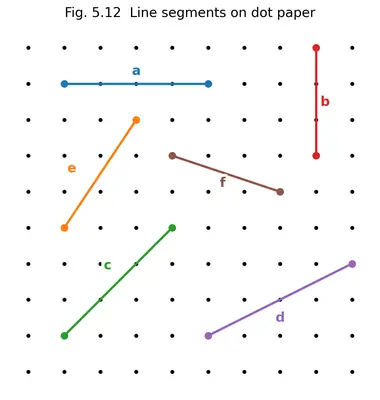
(a) Did you find it challenging to draw some of them?
Solution
Yes, a few of the given line-segments were a little difficult to recreate accurately in their parallel positions.
Horizontal or vertical segments are easy because the dot–paper itself already provides equally spaced guide‐lines in those two directions. The difficulty is felt only when the segment is slanting – i.e. it is not aligned with either the rows or the columns of dots.
Answer
Yes, the slanting ones were somewhat challenging.
(b) Which ones?
Solution
The challenging ones are the segments that are inclined to the dot grid, for example the line-segment that goes up two dots and right one dot (slope $$\tfrac{2}{1}$$) or the one that goes up one dot and right two dots (slope $$\tfrac{1}{2}$$). Such segments do not coincide with the printed rows or columns, so judging an exactly parallel direction by eye takes care.
Answer
The inclined / slanting segments (the non-horizontal, non-vertical ones).
(c) How did you do it?
Solution
This is how a precise parallel copy can be drawn on dot–paper:
- Pick any two clear dots that already lie on the given segment. Call them $$A$$ and $$B$$.
- Note the displacement from $$A$$ to $$B$$. Example: “go right 2 dots and up 1 dot”. This displacement vector tells the direction and the slope of the line.
- Choose some other starting dot $$C$$ (anywhere on the sheet) for the new line.
- From $$C$$ move exactly the same displacement (right 2 and up 1, in the example) to get a second point $$D$$.
- Join $$C$$ and $$D$$ with a ruler. Because the pair $$CD$$ has the same displacement as $$AB$$, the two segments are parallel by the definition of parallel lines: both have identical direction ratios.
For extra accuracy one can:
- Use a set-square, keeping one edge along the given segment and sliding the square without turning it. Every new position of the edge remains parallel to the original.
- Use graph-paper counting: repeat exactly the same horizontal and vertical ‘steps’ that the original segment makes between successive dots.
Answer
I copied the displacement pattern of the original segment (counting equal horizontal and vertical steps) or else used a set-square, slid without rotation, to mark another segment having exactly the same direction; joining the new pair of dots gave a parallel segment.
5
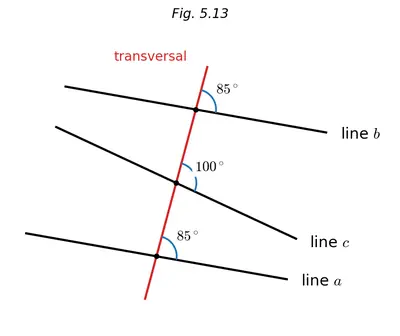
Solution
Step 1 — Read the information from the diagram
One transversal t meets the three distinct lines a, b and c. The angle made by t with line a carries one arc mark; an angle of the same size and carrying one arc mark is shown where t meets line c. No such mark is shown on line b.
Let us name these angles for reference:
- At the intersection of t and line a, call the marked angle $$\angle 1$$.
- At the intersection of t and line c, call the marked angle $$\angle 2$$.
From the identical marking we know
$$\angle 1 = \angle 2$$
Step 2 — Identify the type of angle pair
Both $$\angle 1$$ and $$\angle 2$$ lie on the same side of the transversal and are both above their respective lines, so they form a pair of corresponding angles.
Step 3 — Apply the Converse of the Corresponding Angles Axiom
The axiom states:
If a pair of corresponding angles produced by a transversal with two lines are equal, then the two lines are parallel.
Because $$\angle 1 = \angle 2$$, the two lines that contain these corresponding angles must be parallel; that is
$$a \; \parallel \; c$$
Step 4 — Decide which line is parallel to a
Since the equality of corresponding angles involves lines a and c (not a and b), we conclude that line c, and only line c, is parallel to line a.
Hence, line c is parallel to line a.
Answer
Line $$c$$ is parallel to line $$a$$ (because the marked pair of corresponding angles are equal).
Figure it Out (Page 119)
1
Solution
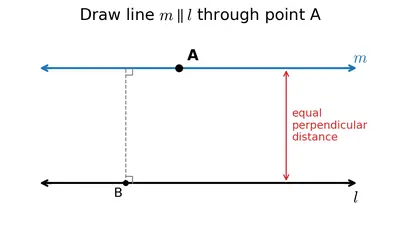
Given: a straight line $$l$$ on your paper and a point $$A$$ that is not on that line.
Objective: draw a straight line through $$A$$ that is parallel to $$l$$.
Below are two correct Class 7 methods. Use whichever tools you actually have.
Method 1 — ruler & compasses (no set-square needed)
- Choose a convenient point $$B$$ on line $$l$$ and join $$AB$$ with a light pencil line.
- With centre $$B$$ and any radius, draw an arc that cuts $$l$$ at $$P$$ and $$AB$$ at $$Q$$.
- Without changing the compass opening, place the compass point on $$A$$ and draw a similar arc, cutting $$AB$$ (or its extension) at $$R$$.
- Measure the chord $$PQ$$ with the compasses; keeping this width, place the compass point on $$R$$ and mark the arc at $$S$$.
- Join $$A$$ to $$S$$. Name the new straight line through $$A$$ and $$S$$ as $$m$$.
Why it works:
The construction makes $$\angle QBP = \angle RAS$$ (equal arcs give equal angles). They are corresponding angles formed by lines $$l$$ and $$m$$ with the transversal $$AB$$, so $$m \parallel l$$.
Method 2 — ruler, set-square and drawing board
- Place one long edge of the set-square exactly on line $$l$$.
- Hold a ruler (or another set-square) firmly against the $$90^{\circ}$$ side of the first set-square so that the first set-square can slide while staying perpendicular to the ruler.
- Keeping the ruler fixed, slide the first set-square until one of its edges passes through point $$A$$.
- Draw a straight line along that edge. This line automatically stays the same distance from $$l$$ at every point, so it is parallel to $$l$$.
Either construction gives the required parallel line through $$A$$.
Answer
Yes. Using a ruler and compasses (or a set-square) you can copy a corresponding angle through A; the new line through A is therefore parallel to $$l$$.
Examples
Example 1
Solution
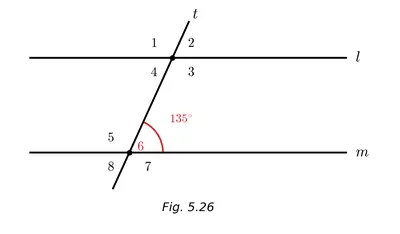
Given: Two parallel lines $$l$$ and $$m$$ are cut by the transversal $$t$$. In Fig. 5.26 the eight angles at the two points of intersection are numbered as follows:
- At line $$l$$ (upper intersection): $$\angle1$$ (top-left), $$\angle2$$ (top-right), $$\angle3$$ (bottom-right), $$\angle4$$ (bottom-left)
- At line $$m$$ (lower intersection): $$\angle5$$ (top-left), $$\angle6$$ (top-right), $$\angle7$$ (bottom-right), $$\angle8$$ (bottom-left)
The figure tells us $$\angle6 = 135^\circ$$. We have to find the measures of all the remaining angles.
Step 1 : Angles at the lower intersection
At a point, the sum of the measures of any two adjacent (linear-pair) angles is $$180^\circ$$, and the two vertically opposite angles are equal.
- $$\angle6$$ and $$\angle7$$ form a linear pair along the transversal.
$$\angle6 + \angle7 = 180^\circ$$ ⟹ $$\angle7 = 180^\circ - 135^\circ = 45^\circ$$ - $$\angle6$$ and $$\angle5$$ form a linear pair along the parallel $$m$$.
$$\angle6 + \angle5 = 180^\circ$$ ⟹ $$\angle5 = 45^\circ$$ - $$\angle6$$ and $$\angle8$$ are vertically opposite, so they are equal.
$$\angle8 = 135^\circ$$
Thus, at line $$m$$:
| Angle | Measure |
|---|---|
| $$\angle5$$ | $$45^\circ$$ |
| $$\angle6$$ (given) | $$135^\circ$$ |
| $$\angle7$$ | $$45^\circ$$ |
| $$\angle8$$ | $$135^\circ$$ |
Step 2 : Angles at the upper intersection
Because $$l \parallel m$$, each angle at the upper intersection equals the corresponding angle at the lower intersection (Corresponding Angles Axiom):
- $$\angle1 = \angle5 = 45^\circ$$
- $$\angle2 = \angle6 = 135^\circ$$
- $$\angle3 = \angle7 = 45^\circ$$
- $$\angle4 = \angle8 = 135^\circ$$
Step 3 : List of all eight angles
| Angle | Measure | Angle | Measure |
|---|---|---|---|
| $$\angle1$$ | $$45^\circ$$ | $$\angle5$$ | $$45^\circ$$ |
| $$\angle2$$ | $$135^\circ$$ | $$\angle6$$ | $$135^\circ$$ |
| $$\angle3$$ | $$45^\circ$$ | $$\angle7$$ | $$45^\circ$$ |
| $$\angle4$$ | $$135^\circ$$ | $$\angle8$$ | $$135^\circ$$ |
Hence every angle in Fig. 5.26 is now known.
Answer
$$\angle1 = 45^\circ,\; \angle2 = 135^\circ,\; \angle3 = 45^\circ,\; \angle4 = 135^\circ,\; \angle5 = 45^\circ,\; \angle6 = 135^\circ,\; \angle7 = 45^\circ,\; \angle8 = 135^\circ.$$
Example 2
Solution
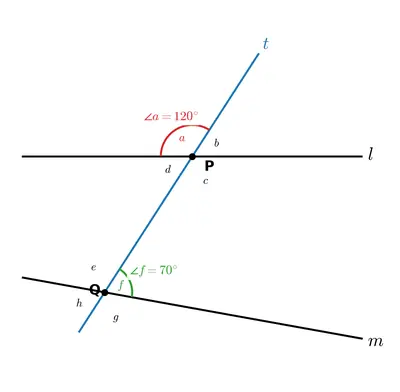
The transversal $$t$$ cuts lines $$l$$ and $$m$$, forming eight angles that the textbook labels $$a, b, c, d$$ (on $$l$$) and $$e, f, g, h$$ (on $$m$$).
Step 1 — Find the angle corresponding to $$\angle f$$ on line $$l$$.
- At the first point of intersection, $$\angle a$$ and $$\angle b$$ form a linear pair.
\[ \angle a + \angle b = 180^{\circ} \] - Substituting the given value $$\angle a = 120^{\circ}$$:
$$\angle b = 180^{\circ} - 120^{\circ} = 60^{\circ}.$$
Step 2 — Check the corresponding–angles condition for parallel lines.
- For the same transversal $$t$$, $$\angle b$$ (on $$l$$) and $$\angle f$$ (on $$m$$) are corresponding angles.
- If lines $$l$$ and $$m$$ were parallel, corresponding angles would be equal, i.e. $$\angle b = \angle f.$$
- But we have
$$\angle b = 60^{\circ}, \qquad \angle f = 70^{\circ}.$$ - Since $$60^{\circ} \neq 70^{\circ}$$, the corresponding angles are unequal.
Step 3 — Conclusion.
Because a pair of corresponding angles is not equal, lines $$l$$ and $$m$$ cannot be parallel.
Answer
No. Lines $$l$$ and $$m$$ are not parallel.
Example 3
Solution
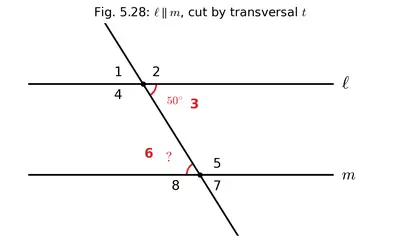
We are told that the two straight lines are parallel: $$l \parallel m$$, and the transversal $$t$$ cuts them in Fig. 5.28.
Look carefully at the positions of $$\angle 3$$ and $$\angle 6$$:
- each lies on the same side (say, the right-hand side) of the transversal $$t$$, and
- each lies on a different parallel line (one on $$l$$, the other on $$m$$).
This means $$\angle 3$$ and $$\angle 6$$ form a pair of corresponding angles.
For a transversal cutting two parallel lines, corresponding angles are always equal, that is
$$\angle 3 = \angle 6$$.
The value of $$\angle 3$$ is given: $$\angle 3 = 50^\circ$$.
Substitute this value in the equality above:
$$\angle 6 = 50^\circ.$$
Therefore, the measure of $$\angle 6$$ is 50°.
Answer
Example 4
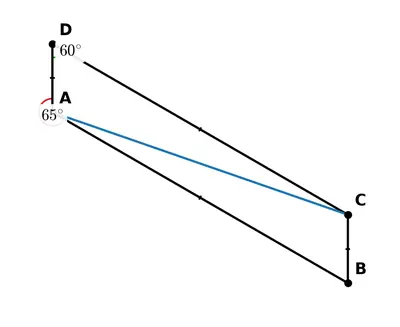
Solution
Step 1 : Recognise the figure
Since $$AB \parallel CD$$ and $$AD \parallel BC$$, both pairs of opposite sides are parallel.
Therefore $$ABCD$$ is a parallelogram.
Step 2 : Use the property of opposite angles
In a parallelogram, opposite angles are equal.
Given $$\angle ADC = 60^\circ$$, so
$$\angle ABC = 60^\circ$$.
Step 3 : Find $$\angle BCD$$ (adjacent to $$\angle ABC$$)
Adjacent (consecutive) angles of a parallelogram are supplementary, i.e. their sum is $$180^\circ$$.
Hence
$$\angle ABC + \angle BCD = 180^\circ$$
$$60^\circ + \angle BCD = 180^\circ$$
$$\angle BCD = 180^\circ - 60^\circ = 120^\circ$$.
Step 4 : Find the whole angle at vertex A
Angles at consecutive vertices are also supplementary, so
$$\angle ADC + \angle DAB = 180^\circ$$
$$60^\circ + \angle DAB = 180^\circ$$
\[\angle DAB = 120^\circ\]
Step 5 : Use the diagonal $$AC$$
The diagonal $$AC$$ divides $$\angle DAB$$ into two parts:
$$\angle DAB = \angle DAC + \angle CAB$$.
We know $$\angle DAC = 65^\circ$$, so
$$120^\circ = 65^\circ + \angle CAB$$
$$\angle CAB = 120^\circ - 65^\circ = 55^\circ$$.
Step 6 : Summarise the results
- $$\angle CAB = 55^\circ$$
- $$\angle ABC = 60^\circ$$
- $$\angle BCD = 120^\circ$$
Answer
$$\angle CAB = 55^\circ, \; \angle ABC = 60^\circ, \; \angle BCD = 120^\circ$$
Figure it Out (Page 123-125)
1
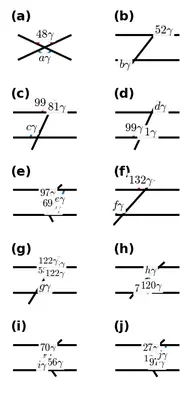
a Find $$a°$$ in the figure showing two intersecting transversals with one angle marked $$48°$$ at the upper intersection and $$a°$$ marked at the lower intersection.
Solution
The two slanting straight lines are the same lines that meet the vertical straight line twice; hence the angle between the pair of slanting lines is the same at both points of intersection.
With the upper intersection we are given one of these angles as $$48^{\circ}$$. At the lower intersection, the marked angle $$a^{\circ}$$ is the outside part of the straight line, so it forms a linear–pair with the interior $$48^{\circ}$$ just above it.
By the Linear–Pair Axiom
$$a^{\circ}+48^{\circ}=180^{\circ}$$
\[a^{\circ}=180^{\circ}-48^{\circ}=132^{\circ}\]
Answer
b Find $$b°$$ in the figure showing two parallel lines cut by a transversal, with one angle marked $$52°$$ and $$b°$$ to be found.
Solution
The two horizontal lines are parallel and are cut by a single transversal.
The angle $$52^{\circ}$$ and the required angle $$b^{\circ}$$ lie on the same side of the transversal and are interior angles on the same side.
For a pair of parallel lines, such a co-interior pair is supplementary:
$$b^{\circ}+52^{\circ}=180^{\circ}$$
\[b^{\circ}=180^{\circ}-52^{\circ}=128^{\circ}\]
Answer
c Find $$c°$$ in the figure showing two parallel lines cut by a transversal, with angles $$99°$$ and $$81°$$ given and $$c°$$ to be found.
Solution
The two horizontal lines are parallel. At the upper intersection the obtuse angle is $$99^{\circ}$$. Its vertically opposite angle is also $$99^{\circ}$$; this is the interior angle that corresponds (under the Z-shape) to the marked angle $$c^{\circ}$$ at the lower intersection.
Hence
$$c^{\circ}=99^{\circ}\,.$$
Answer
d Find $$d°$$ in the figure showing two parallel lines cut by a transversal, with angles $$81°$$ and $$99°$$ given and $$d°$$ marked on the upper line.
Solution
Again the two horizontal lines are parallel. At the lower intersection the acute angle is $$81^{\circ}$$. It is vertically opposite to another $$81^{\circ}$$ lying inside the Z-shape with the angle $$d^{\circ}$$ on the upper line; thus the pair $$81^{\circ}$$ and $$d^{\circ}$$ are co-interior.
Therefore
$$d^{\circ}+81^{\circ}=180^{\circ}$$
\[d^{\circ}=180^{\circ}-81^{\circ}=99^{\circ}\]
Answer
e Find $$e°$$ in the figure showing lines with angles $$97°$$, $$83°$$, and $$69°$$ marked.
Solution
All four angles around the point sum to $$360^{\circ}$$. Three of them are given: $$97^{\circ},\,83^{\circ}$$ and $$69^{\circ}$$.
Sum of the three known angles:
$$97^{\circ}+83^{\circ}+69^{\circ}=249^{\circ}$$
Therefore
$$e^{\circ}=360^{\circ}-249^{\circ}=111^{\circ}$$
Answer
f Find $$f°$$ in the figure showing two parallel lines cut by a transversal, with angle $$132°$$ given and $$f°$$ to be found.
Solution
The two horizontal lines in the figure are parallel and are cut by a single transversal. The angle $$132^{\circ}$$ is marked at the lower intersection, in the strip between the two parallels and on the LEFT of the transversal.
Step 1 – Find the matching acute angle at the lower intersection. The two angles on the upper side of the lower line, on either side of the transversal, form a linear pair:
$$132^{\circ} + (\text{angle on the right of the transversal}) = 180^{\circ}$$
$$\text{angle on the right of the transversal} = 180^{\circ} - 132^{\circ} = 48^{\circ}.$$
Step 2 – Use corresponding angles. Because the two horizontal lines are parallel, the transversal makes the same angle with each of them. The angle $$f^{\circ}$$ at the upper intersection is in the same position (with respect to the transversal and the line going right) as the $$48^{\circ}$$ angle at the lower intersection. By the corresponding-angles property for parallel lines,
\[f^{\circ}=48^{\circ}.\]
Answer
g Find $$g°$$ in the figure showing two parallel lines cut by a transversal, with angles $$58°$$, $$122°$$, $$122°$$, $$58°$$ marked at one intersection and $$g°$$ at the other.
Solution
At the lower intersection the four angles are two lots of $$58^{\circ}$$ and two lots of $$122^{\circ}$$ (vertical-opposite and linear-pair properties). The upper intersection, produced by the same pair of lines, has exactly the same set of four angles. The location marked $$g^{\circ}$$ corresponds to the acute $$58^{\circ}$$.
\[g^{\circ}=58^{\circ}\]
Answer
h Find $$h°$$ in the figure showing two parallel lines cut by a transversal, with angles $$75°$$ and $$120°$$ given.
Solution
The two horizontal lines are parallel. The $$75^{\circ}$$ at the upper line and the required $$h^{\circ}$$ at the lower line lie on the corresponding positions of an F-shape, so they are equal:
$$h^{\circ}=75^{\circ}$$
But $$h^{\circ}$$ is shown as the exterior obtuse angle, hence
$$h^{\circ}=180^{\circ}-75^{\circ}=105^{\circ}$$
Answer
i Find $$i°$$ in the figure showing parallel lines with angles $$70°$$, $$54°$$, and $$56°$$ marked.
Solution
The two slanting lines in the figure are marked with matching arrow heads, so they are parallel. At one point on the lower parallel, two rays go upward; together with the line itself, they create three angles on the upper side of the lower line, of sizes $$70^{\circ},\,54^{\circ}$$ and $$56^{\circ}$$ (taken from left to right).
Step 1 – Check the straight-line sum. Three adjacent angles that lie on the same side of a straight line must add up to $$180^{\circ}$$. Adding the three given angles:
$$70^{\circ}+54^{\circ}+56^{\circ}=180^{\circ}.\;\checkmark$$
This confirms that all four rays meet at a single point on the lower line, and that $$70^{\circ}$$ is exactly the angle that the leftmost upward ray makes with the lower parallel line.
Step 2 – Carry the angle across to the other parallel. The leftmost upward ray is a transversal that cuts both parallel lines. At the upper parallel it makes the angle $$i^{\circ}$$ with the line, in the same position (relative to the line and the transversal) as the $$70^{\circ}$$ it makes at the lower parallel. By the corresponding-angles property for parallel lines cut by a transversal,
\[i^{\circ}=70^{\circ}.\]
Answer
j Find $$j°$$ in the figure showing parallel lines with angles $$27°$$, $$97°$$, and $$124°$$ marked.
Solution
The two slanting lines marked with arrow heads are parallel. Two transversals cross both of them; the two transversals meet at a single point $$P$$ on the lower parallel. The transversal that goes up to the upper parallel makes the angle $$27^{\circ}$$ with it there; the other transversal makes the angle $$97^{\circ}$$ with the lower line at $$P$$.
Step 1 – Carry $$27^{\circ}$$ down to the lower parallel. Because the two lines are parallel and the same transversal cuts both, the angle it makes with the lower parallel at $$P$$ is also $$27^{\circ}$$ (corresponding angles for parallel lines).
Step 2 – Use the straight-line sum at $$P$$. At $$P$$, the lower parallel and the two transversals make three angles on the upper side of the lower line: $$97^{\circ}$$ on the left, $$j^{\circ}$$ in the middle (between the two transversals), and $$27^{\circ}$$ on the right. Since these three angles lie on the same side of the straight lower line, they add up to $$180^{\circ}$$:
$$97^{\circ}+j^{\circ}+27^{\circ}=180^{\circ}$$
$$j^{\circ}=180^{\circ}-97^{\circ}-27^{\circ}=56^{\circ}.$$
Step 3 – Consistency with the marked $$124^{\circ}$$. The angle $$124^{\circ}$$ shown in the figure is the linear pair of $$j^{\circ}$$ along one of the transversals: $$j^{\circ}+124^{\circ}=56^{\circ}+124^{\circ}=180^{\circ}$$, which checks out.
\[j^{\circ}=56^{\circ}.\]
Answer
2
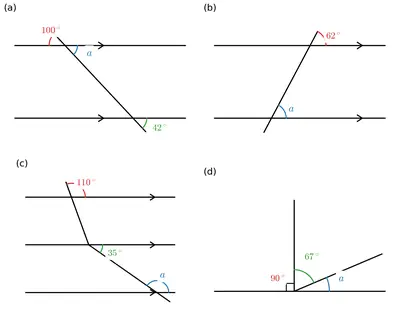
(i) Find $$a°$$ in the figure where two parallel lines are intersected, with angles $$100°$$ and $$42°$$ marked.
Solution
The figure shows two parallel horizontal lines (marked with matching arrow heads) cut by a transversal. At the upper intersection, the transversal makes an angle of $$42^{\circ}$$ with the upper line, on the outside (above the upper parallel). At the lower intersection, two rays from below pass through the same point on the lower line, and the angle $$100^{\circ}$$ is the angle that the second ray makes with the lower line, while $$a^{\circ}$$ is the angle that the first transversal makes with the lower line on its right side.
Step 1 – Use the linear pair at the upper intersection. The $$42^{\circ}$$ angle and the angle just below it (inside the strip between the parallels, on the same side of the transversal) form a linear pair along the upper line:
$$42^{\circ}+(\text{interior angle below the upper line})=180^{\circ}$$
$$\text{interior angle}=180^{\circ}-42^{\circ}=138^{\circ}.$$
Step 2 – Use corresponding angles between the parallels. The $$138^{\circ}$$ at the upper line and the angle $$a^{\circ}$$ at the lower line are corresponding angles, made by the same transversal with the two parallel lines. For parallel lines, corresponding angles are equal:
\[a^{\circ}=138^{\circ}.\]
Note on the $$100^{\circ}$$ angle. The $$100^{\circ}$$ shown in the figure is the angle that a different ray (a second transversal at the lower intersection) makes with the lower line. It is given as part of the figure but is not required to find $$a^{\circ}$$, because $$a^{\circ}$$ is determined entirely by the $$42^{\circ}$$ angle and the fact that the two horizontal lines are parallel.
Answer
$$a = 138^{\circ}$$
(ii) Find $$a°$$ in the figure showing two parallel lines (marked with arrows) cut by a transversal, with one angle given as $$62°$$.
Solution
The two horizontal lines are parallel and are cut by one transversal. The $$62°$$ marked at the upper intersection and the required angle $$a$$ at the lower intersection lie on the same side of the transversal and inside the parallel lines. Such a pair of angles is called co-interior (or interior angles on the same side of the transversal) and is supplementary:
$$a + 62° = 180° \;\Longrightarrow\; a = 180° - 62° = 118°.$$
Answer
$$a = 118°$$
(iii) Find $$a°$$ in the figure showing three parallel lines cut by a transversal, with angles $$110°$$ and $$35°$$ given.
Solution
Three parallel lines are cut by two transversals. At the bottom right, the $$35°$$ marked is an exterior angle. The interior angle in the strip that forms a linear pair with it is
$$180° - 35° = 145°.$$
Because the three horizontal lines are parallel, this interior $$145°$$ is corresponding to the angle $$a$$ at the point where the right-hand transversal meets the middle parallel. Hence
$$a = 145°.$$
Answer
$$a = 145°$$
(iv) Find $$a°$$ in the figure showing a right angle ($$90°$$) and an angle of $$67°$$.
Solution
At the common vertex we have a right angle of $$90°$$ and an adjacent angle of $$67°$$. All three angles that lie on the straight line sum to $$180°$$:
$$90° + 67° + a = 180° \;\Longrightarrow\; a = 180° - (90° + 67°) = 23°.$$
Answer
$$a = 23°$$
3
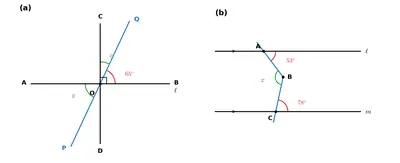
(i) Find $$x°$$ and $$y°$$ in the figure where a right angle is marked and an angle of $$65°$$ is given.
Solution
At the common vertex, three rays are drawn: one horizontal, one vertical and one slanting.
The horizontal and vertical rays are shown to be perpendicular; hence the angle between them is a right angle, i.e. $$90^\circ$$.
The slanting ray divides this right angle into two parts:
- the upper part is already marked as $$65^\circ$$,
- the lower part is marked as $$x^\circ$$.
Because these two parts together make the whole right angle, we have
$$x + 65 = 90 \;\Longrightarrow\; x = 90 - 65 = 25.$$
Next, the angle $$y$$ lies vertically opposite the given $$65^\circ$$ angle. Vertically opposite angles are equal, so
$$y = 65.$$
Answer
(ii) Find $$x°$$ in the figure showing two parallel lines cut by transversals, with angles $$53°$$ and $$78°$$ given.
Solution
Let the two horizontal lines be $$\ell_1$$ (top) and $$\ell_2$$ (bottom); they are given to be parallel.
Transversal $$p$$ meets $$\ell_1$$ making $$53^\circ$$ with it. The corresponding angle made by the same transversal with $$\ell_2$$ (inside the strip) is therefore also $$53^\circ$$.
Transversal $$q$$ meets $$\ell_2$$ making $$78^\circ$$. The angle vertically opposite to this, which lies inside the strip, is again $$78^\circ$$.
The two transversals intersect each other between $$\ell_1$$ and $$\ell_2$$. At that intersection the three interior angles form a triangle whose angles are:
- $$53^\circ$$ (from transversal $$p$$),
- $$78^\circ$$ (from transversal $$q$$),
- $$x^\circ$$ (the required angle).
Using the angle–sum property of a triangle,
$$x + 53 + 78 = 180 \;\Longrightarrow\; x = 180 - (53 + 78) = 180 - 131 = 49.$$
Answer
4
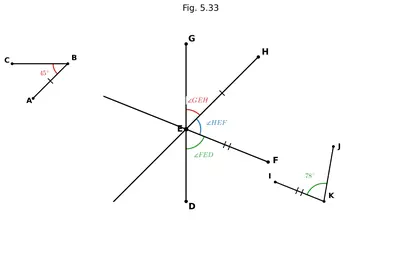
Solution
Step 1 : Mark the pairs of parallel lines and the transversals
From Fig. 5.33 we note two parallel lines
- upper horizontal line $$\overline{GH}$$, on which the point $$B$$ also lies,
- lower horizontal line $$\overline{FD}$$, on which the point $$K$$ also lies.
The two slant lines $$\overline{AB}$$ and $$\overline{IK}$$ cut these parallels and meet each other at $$E$$, so both of them are transversals.
Step 2 : Find $$\angle GEH$$
The ray $$EB$$ lies on the upper parallel $$\overline{GH}$$, and the ray $$EH$$ is also a part of the same straight line; thus $$B,E,H$$ are collinear.
The given angle $$\angle ABC$$ is an angle made by the transversal $$\overline{AB}$$ with the upper parallel at the point $$B$$.
Since corresponding angles are equal when a transversal cuts a pair of parallel lines, we have
$$\angle GEH = \angle ABC = 45^\circ$$
Step 3 : Find $$\angle FED$$
Similarly, the ray $$EK$$ lies on the lower parallel $$\overline{FD}$$ and the ray $$ED$$ is the continuation of the same straight line, so $$K,E,D$$ are collinear.
The given angle $$\angle IKJ$$ is formed by the second transversal $$\overline{IK}$$ with the lower parallel at $$K$$. Hence the angle that the same transversal makes with the lower parallel at $$E$$, namely $$\angle FED$$, is its corresponding angle. Therefore
$$\angle FED = \angle IKJ = 78^\circ$$
Step 4 : Find $$\angle HEF$$ using the straight line property at $$E$$
At $$E$$ the three rays $$EG, EH, EF$$ and $$ED$$ appear in the order shown below
| $$EG$$ | $$\big|$$ | $$EH$$ | $$\big|$$ | $$EF$$ | $$\big|$$ | $$ED$$ |
The angles asked for are consecutive round the point $$E$$ on one side of the straight line $$\overline{GD}$$, so their sum is a straight angle, that is $$180^\circ$$:
$$\angle GEH + \angle HEF + \angle FED = 180^\circ$$
Substituting the two values already found, we get
$$45^\circ + \angle HEF + 78^\circ = 180^\circ$$
$$\Rightarrow \angle HEF = 180^\circ - 123^\circ = 57^\circ$$
Step 5 : Write the three required angles
$$\angle GEH = 45^\circ, \; \angle HEF = 57^\circ, \; \angle FED = 78^\circ$$
Answer
$$\angle GEH = 45^\circ, \; \angle HEF = 57^\circ, \; \angle FED = 78^\circ$$
5
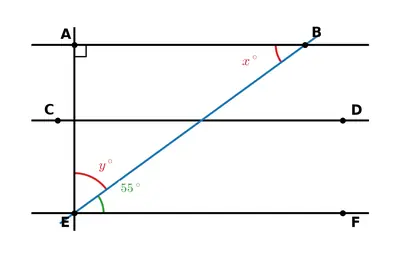
Solution
Step 1 : Understand the information given
Three straight lines $$AB$$, $$CD$$ and $$EF$$ are parallel, so they are all in the same direction (say, horizontal).
A straight line $$EA$$ is drawn perpendicular to $$AB$$. Because all three horizontal lines are parallel, this same line $$EA$$ is also perpendicular to both $$CD$$ and $$EF$$.
The slant line $$BE$$ cuts all the horizontal lines. At the point $$E$$ the angle between $$BE$$ and the lowest horizontal line $$EF$$ is given:
$$\angle BEF = 55^{\circ}$$.
The two unknowns printed in the textbook are:
• $$x^{\circ}$$ – the angle at $$B$$ between the line $$BE$$ and the top horizontal $$AB$$.
• $$y^{\circ}$$ – the angle at $$E$$ between the slant $$BE$$ and the vertical $$EA$$.
Step 2 : Find $$x$$
The transversal $$BE$$ intersects the two parallel lines $$AB$$ and $$EF$$. The angle $$\angle BEF$$ (55°) lies below the line $$EF$$, while the corresponding angle above the line $$AB$$ is $$\angle ABE$$, which is the same size:
$$\angle ABE = 55^{\circ}$$ (corresponding angles in parallel lines).
At the top point $$B$$ the straight line $$AB$$ forms a straight (180°) angle. The required angle $$x$$ is the one on the other side of $$\angle ABE$$, so they form a linear pair:
$$x + 55^{\circ} = 180^{\circ} \;\;\Longrightarrow\;\; x = 180^{\circ} - 55^{\circ} = 125^{\circ}.$$
Step 3 : Find $$y$$
The vertical line $$EA$$ is perpendicular to every horizontal line, so
$$\angle AEF = 90^{\circ}.$$
At the point $$E$$ the two angles $$\angle BEF$$ and $$\angle AEB$$ together fill this right angle:
$$\angle BEF + y = 90^{\circ} \;\;\Longrightarrow\;\; 55^{\circ} + y = 90^{\circ}.$$
Solve for $$y$$:
$$y = 90^{\circ} - 55^{\circ} = 35^{\circ}.$$
Step 4 : State the answers
$$x = 125^{\circ}, \qquad y = 35^{\circ}.$$
Answer
$$x = 125^{\circ}, \; y = 35^{\circ}.$$
6
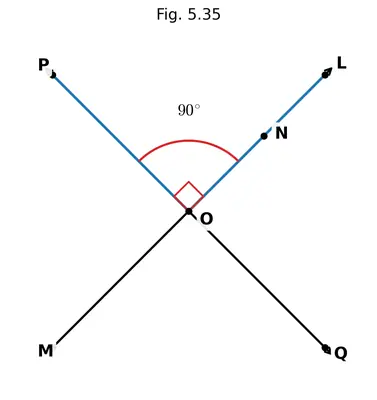
Solution
Step 1 : Copy the two given directions at N and at O
The figure shows two straight lines
- $$LM$$ (slanting upward to the right)
- $$PQ$$ (slanting upward to the left)
Through the hint we draw
- a line through N parallel to $$LM$$,
- a line through O parallel to $$PQ$$.
Step 2 : Identify that right-angle inside the required angle
Those two newly drawn lines coincide with the two arms that make $$\angle NOP$$ (one arm is $$ON$$, the other is $$OP$$).
Therefore $$\angle NOP$$ itself is that very right-angle.
Step 3 : Write the measure
\[\angle NOP = 90^\circ\]
Answer
$$\angle NOP = 90^\circ$$


