 91- 6303239042


Examples
Example 1 Shabnam is 3 years older than Aftab. When Aftab's age 10 years, Shabnam's age will be 13 years. Now Aftab's age is 18 years, what will Shabnam's age be? ______
Solution
Step 1 – Introduce letters
Let $$A$$ represent Aftab’s present age (in years) and $$S$$ represent Shabnam’s present age (in years).
Step 2 – Translate the information into an equation
We are told that Shabnam is 3 years older than Aftab, so
$$S = A + 3$$
Step 3 – Check the relation with the given example
When Aftab’s age is 10 years (i.e. $$A = 10$$), the relation predicts
$$S = 10 + 3 = 13$$,
exactly as stated. Hence the equation is correct.
Step 4 – Use the equation for the required case
We are now told that Aftab’s present age is 18 years, so $$A = 18$$. Substitute this value in the equation:
$$S = 18 + 3$$
$$S = 21$$
Step 5 – Conclusion
Shabnam’s present age is therefore 21 years.
Answer
Shabnam is 21 years old.
Example 2
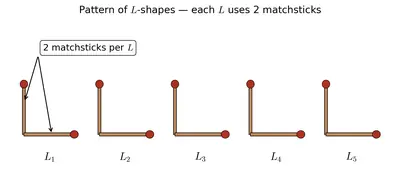
Solution
The figure shows that one L-shape is made from exactly 2 matchsticks (one vertical, one horizontal).
Step 1 – Look at a few specific cases
- For 1 L → $$1 \times 2 = 2$$ matchsticks
- For 5 Ls → $$5 \times 2 = 10$$ matchsticks
- For 7 Ls → $$7 \times 2 = 14$$ matchsticks
- For 45 Ls → $$45 \times 2 = 90$$ matchsticks
Step 2 – Introduce a letter for the general case
Let $$n$$ stand for the number of Ls Parthiv makes.
Step 3 – Write an expression
Because each L needs 2 sticks, the total number of sticks is
\[ \text{number of sticks} = 2 \times \text{number of } L\text{s} \]With the letter $$n$$ this becomes the algebraic expression
$$2n$$.
Conclusion
If Parthiv makes $$n$$ Ls, he needs $$2n$$ matchsticks. Thus, the required relation is:
\[ \boxed{\text{Matchsticks} = 2 \times \text{(number of }L\text{s)}} \]Answer
The number of matchsticks required is $$2n$$, where $$n$$ is the number of L-shapes.
Example 3 Ketaki prepares and supplies coconut-jaggery laddus. The price of a coconut is ₹35 and the price of 1 kg jaggery is ₹60.
Solution
Given data
- Price of one coconut = ₹ 35
- Price of 1 kg jaggery = ₹ 60
We have to write, using letters (variables), the total cost when Ketaki buys some number of coconuts and some kilograms of jaggery.
Step 1 – Choose suitable letters.
Let
- $$c$$ = number of coconuts Ketaki buys,
- $$j$$ = kilograms of jaggery she buys.
Both $$c$$ and $$j$$ can take any whole-number value depending on her order.
Step 2 – Write the cost of each item with the chosen letters.
- Cost of $$c$$ coconuts = price of one coconut × number of coconuts
$$= 35 imes c = 35c$$ - Cost of $$j$$ kg jaggery = price of 1 kg jaggery × kilograms bought
$$= 60 imes j = 60j$$
Step 3 – Add the two amounts to get the total cost.
Total cost $$= 35c + 60j$$
Step 4 – State the final algebraic expression clearly.
The required algebraic expression for the total amount Ketaki has to pay, when she buys $$c$$ coconuts and $$j$$ kilograms of jaggery, is
\[35c + 60j\]There are no like terms to combine further, so this is the simplest form of the expression.
Answer
$$35c + 60j$$
Example 4 We are familiar with calculating the perimeters of simple shapes. Write expressions for perimeters.
Solution
Concept recalled
The perimeter of a plane figure is the total length of its boundary, i.e. the sum of the lengths of all its sides.
Let us write algebraic expressions for the perimeters of the most common simple shapes, using letters to stand for their side–lengths.
- Square
If each side of the square is $$s$$, then the four sides are $$s,\;s,\;s,\;s$$.
Adding them, the perimeter is \[\text{Perimeter of square}=s+s+s+s=4s.\] - Rectangle
Let the length be $$l$$ and the breadth be $$b$$. The rectangle has $$l,\;b,\;l,\;b$$ as its four sides.
Hence $$\text{Perimeter}=l+b+l+b=2l+2b=2\,(l+b).$$ - Equilateral triangle
All three sides are equal; let each be $$a$$.
Therefore $$\text{Perimeter}=a+a+a=3a.$$ - Isosceles triangle
Suppose the two equal sides are each $$p$$ and the unequal side is $$q$$.
Then $$\text{Perimeter}=p+p+q=2p+q.$$ - Regular pentagon
All five sides are equal; call each side $$x$$.
Thus $$\text{Perimeter}=x+x+x+x+x=5x.$$
Each expression is written entirely in terms of letters that stand for the corresponding side–length(s). A numerical value for the perimeter can be obtained by substituting any particular measurements in these expressions.
Answer
- Square: $$4s$$
- Rectangle: $$2\,(l+b)$$
- Equilateral triangle: $$3a$$
- Isosceles triangle: $$2p+q$$
- Regular pentagon: $$5x$$
Example 5
Here is a table showing the number of pencils and erasers sold in a shop. The price per pencil is $$c$$, and the price per eraser is $$d$$. Find the total money earned by the shopkeeper during these three days.
| Day 1 | Day 2 | Day 3 | |
|---|---|---|---|
| Pencils (Price '$$c$$') | 5 | 3 | 10 |
| Erasers (Price '$$d$$') | 4 | 6 | 1 |
Solution
Given Price of one pencil = $$c$$, Price of one eraser = $$d$$.
Sales record:
| Day 1 | Day 2 | Day 3 | |
|---|---|---|---|
| Pencils | 5 | 3 | 10 |
| Erasers | 4 | 6 | 1 |
1. Money earned each day
- Day 1: Money from pencils = $$5\times c = 5c$$;
Money from erasers = $$4\times d = 4d$$;
Total = $$5c + 4d$$. - Day 2: Money from pencils = $$3\times c = 3c$$;
Money from erasers = $$6\times d = 6d$$;
Total = $$3c + 6d$$. - Day 3: Money from pencils = $$10\times c = 10c$$;
Money from erasers = $$1\times d = d$$;
Total = $$10c + d$$.
2. Add the three daily totals
$$ (5c + 4d) + (3c + 6d) + (10c + d) $$
3. Combine like terms
- $$c$$ terms: $$5c + 3c + 10c = 18c$$
- $$d$$ terms: $$4d + 6d + d = 11d$$
4. Total money earned in three days
\[ 18c + 11d \]Answer
Total earned: $$18c + 11d$$
Example 6
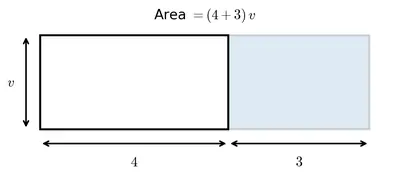
Solution
Given figure (to be sketched by the student): A rectangle of height $$v$$ is cut vertically into two smaller rectangles. The left part has width 4 units, the right part has width 3 units.
Step 1 — Write the area of each small rectangle
- Left rectangle: width 4, height $$v$$.
Area = $$4 \times v = 4v$$. - Right rectangle: width 3, height $$v$$.
Area = $$3 \times v = 3v$$.
Step 2 — Add the two areas to get the area of the big rectangle
Area(big) = $$4v + 3v$$.
Step 3 — Simplify the expression
Both terms are like terms (they each contain $$v$$), so we add their numerical coefficients:
$$4v + 3v = (4 + 3)v = 7v$$.
Therefore, the expression that represents the area of the whole rectangle is
\[7v\]
Alternative check: Since the whole width is $$4 + 3 = 7$$, multiplying by the common height $$v$$ directly also gives $$7v$$.
Answer
Example 7
A shop rents out chairs and tables for a day's use. To rent them, one has to first pay the following amount per piece.
| Item | Amount |
|---|---|
| Chair | ₹40 |
| Table | ₹75 |
When the furniture is returned, the shopkeeper pays back some amount as follows.
| Amount returned | |
|---|---|
| Chair | ₹6 |
| Table | ₹10 |
Write an expression for the total number of rupees paid if $$x$$ chairs and $$y$$ tables are rented.
Solution
Let $$x$$ be the number of chairs and $$y$$ be the number of tables rented for a day.
Step 1 ∙ Amount paid at the time of renting
- For each chair: ₹40 ⇒ for $$x$$ chairs: $$40 \times x = 40x$$
- For each table: ₹75 ⇒ for $$y$$ tables: $$75 \times y = 75y$$
Total deposited at the start = $$40x + 75y$$
Step 2 ∙ Amount returned when the furniture is brought back
- For each chair: ₹6 ⇒ for $$x$$ chairs: $$6 \times x = 6x$$
- For each table: ₹10 ⇒ for $$y$$ tables: $$10 \times y = 10y$$
Total returned = $$6x + 10y$$
Step 3 ∙ Net amount finally paid
Net paid = (amount deposited) − (amount returned)
$$\bigl(40x + 75y\bigr) \, - \, \bigl(6x + 10y\bigr)$$
Simplify by subtracting like terms:
$$40x - 6x = 34x, \qquad 75y - 10y = 65y$$
Therefore the total number of rupees finally paid is
\[34x + 65y\]
So, for $$x$$ chairs and $$y$$ tables, one finally spends ₹34x + ₹65y.
Answer
₹34x + ₹65y
Example 8 Charu has been through three rounds of a quiz. Her scores in the three rounds are $$7p - 3q$$, $$8p - 4q$$, and $$6p - 2q$$. Here, $$p$$ represents the score for a correct answer and $$q$$ represents the penalty for an incorrect answer.
Solution
What is asked?
We have to find Charu’s total score after the three quiz-rounds.
Given expressions for each round
- Round 1: $$7p - 3q$$
- Round 2: $$8p - 4q$$
- Round 3: $$6p - 2q$$
Here, $$p$$ = marks for every correct answer and $$q$$ = marks lost for every wrong answer.
Step 1 : Write an expression for the total.
Total score = (Score in Round 1) + (Score in Round 2) + (Score in Round 3)
$$\bigl(7p - 3q\bigr) + \bigl(8p - 4q\bigr) + \bigl(6p - 2q\bigr)$$
Step 2 : Remove brackets.
$$7p - 3q + 8p - 4q + 6p - 2q$$
Step 3 : Collect like terms.
Group the p-terms together and the q-terms together:
$$\bigl(7p + 8p + 6p\bigr) + \bigl(-3q - 4q - 2q\bigr)$$
Step 4 : Add the coefficients.
For $$p$$: $$7 + 8 + 6 = 21$$ ⇒ $$21p$$
For $$q$$: $$-3 - 4 - 2 = -9$$ ⇒ $$-9q$$
Step 5 : Write the simplified total.
\[21p - 9q\]
Optional: factorising the common factor $$3$$ gives $$3(7p - 3q)$$, but $$21p - 9q$$ is already a correct simplified form.
Therefore, Charu’s total score for the three rounds is $$21p - 9q$$.
Answer
Charu’s total score = $$21p - 9q$$
Example 9 Simplify the expression $$4(x + y) - y$$.
Solution
We start with the given algebraic expression
$$4\,(x + y) - y$$
Step 1 Apply the distributive (or multiplication) law
The number $$4$$ is multiplied by each term inside the bracket:
$$4\,(x + y)=4\times x + 4\times y$$
Substituting this back, the whole expression becomes
$$4x + 4y - y$$
Step 2 Collect like terms
Both $$4y$$ and $$-y$$ are like terms (they involve the same letter $$y$$). Combine them by adding their coefficients:
$$4y - y = (4 - 1)y = 3y$$
Thus the expression simplifies to
$$4x + 3y$$
Therefore
\[4x + 3y\]
Answer
$$4x + 3y$$
Example 10 Are the expressions $$5u$$ and $$5 + u$$ equal to each other?
Solution
Step 1 – Meaning of each expression
In algebra we omit the multiplication sign, so $$5u$$ means $$5 \times u$$. The expression $$5 + u$$ means we add $$u$$ to 5.
Step 2 – Check with a few simple values
- Let $$u = 0$$:
$$5u = 5 \times 0 = 0$$
$$5 + u = 5 + 0 = 5$$
The results (0 and 5) are different. - Let $$u = 2$$:
$$5u = 5 \times 2 = 10$$
$$5 + u = 5 + 2 = 7$$
Again the results (10 and 7) are different.
Because the two expressions do not give the same value for every choice of $$u$$, they are not equal as algebraic expressions.
Step 3 – Can they ever be equal?
Set them equal and solve for $$u$$:
\[ 5u = 5 + u \]Move the $$u$$-terms to one side:
\[ 5u - u = 5 \]Simplify:
\[ 4u = 5 \]Divide by 4:
\[ u = \frac{5}{4} \]So the two expressions take the same value only when $$u = \frac{5}{4}$$ (that value is $$\frac{25}{4}$$).
Conclusion
The expressions $$5u$$ and $$5+u$$ are not equal in general. They coincide only for the single value $$u = \frac{5}{4}$$.
Answer
No. They give the same result only when $$u = \frac{5}{4}$$.
Example 11 What is the sum of the numbers in the picture (unknown values are denoted by letter-numbers)? The picture has four rows: top row of four 3's, then a row of $$r, s$$, then another row of $$r, s$$, then bottom row of four 3's.
Solution
Observe the picture. There are four rows:
- Top row: 3, 3, 3, 3
- Second row: $$r,\;s$$
- Third row: $$r,\;s$$
- Bottom row: 3, 3, 3, 3
We need the sum of all these entries.
Step 1 – Add the known numbers 3.
The first and the last row each contain four 3’s, so the total number of 3’s is
$$4 + 4 = 8$$
Their combined value is therefore
$$3 \times 8 = 24$$
Step 2 – Add the unknown (letter-number) entries.
Rows 2 and 3 together provide
- two $$r$$’s, whose sum is $$r + r = 2r$$
- two $$s$$’s, whose sum is $$s + s = 2s$$
Step 3 – Form the overall sum.
Total value of all rows:
$$24 + 2r + 2s$$
Factoring out the common 2 if desired,
[ 24 + 2r + 2s = 2(r + s + 12) ]
Hence, the required sum is $$24 + 2r + 2s$$.
Answer
$$24 + 2r + 2s$$
Example 12 Somji noticed a repeating pattern along the border of a saree. (The pattern shows six designs labelled A, B, C, D, E, F.)
Solution
Step 1 – Understand the pattern
The motif on the saree border is
A → B → C → D → E → F → A → B → C → D → E → F → \(\dots\)
Every block therefore contains exactly 6 designs.
Step 2 – Express the position number n
Let the required position be numbered by the natural number $$n$$.
When we divide $$n$$ by 6 we always get a remainder between 0 and 5. Write
$$n = 6q + r \qquad (0 \le r \le 5)$$
where $$q$$ is the quotient (how many full blocks of six are completed) and $$r$$ is the remainder (how far we have moved in the next block).
Step 3 – Match the remainder with the design
| Remainder $$r$$ | Design obtained |
|---|---|
| 1 | A (1st design of a block) |
| 2 | B (2nd) |
| 3 | C (3rd) |
| 4 | D (4th) |
| 5 | E (5th) |
| 0 | F (6th; a remainder 0 means we have just finished a block) |
Step 4 – Give the general rule
If $$n$$ leaves remainder $$r$$ on division by 6, then the design at the $$n^{\text{th}}$$ place is
- A when $$r = 1$$,
- B when $$r = 2$$,
- C when $$r = 3$$,
- D when $$r = 4$$,
- E when $$r = 5$$,
- F when $$r = 0$$.
Step 5 – Examples (for practice)
- 37th design : $$37 \div 6 = 6\text{ remainder }1 \;\Rightarrow\; A.$
- 54th design : $$54 \div 6 = 9\text{ remainder }0 \;\Rightarrow\; F.$
- 100th design : $$100 \div 6 = 16\text{ remainder }4 \;\Rightarrow\; D.$
Thus the remainder on division by 6 completely decides which of the six designs, A to F, occupies any given position along the border.
Answer
The design at position n is:
A if n ≡ 1 (mod 6); B if 2; C if 3; D if 4; E if 5; and F if n ≡ 0 (mod 6).
Intext Questions
1 Given Aftab's age, how will you find out Shabnam's age?
Solution
Let us denote Aftab’s present age by a letter, say $$x$$ years.
The statement in the question (given just before this part of the exercise) tells us that Shabnam is 3 years younger than Aftab.
'Younger by 3 years' means we have to subtract 3 from Aftab’s age to obtain Shabnam’s age.
Therefore
\[\text{Shabnam\’s age} = x - 3\]
So, once Aftab’s age is known, simply subtract 3 to get Shabnam’s age.
Answer
If Aftab is $$x$$ years old, then Shabnam is $$x-3$$ years old.
2 Can we write this as an expression?
Solution
Yes. Whenever a statement involves an (as yet) unknown number, we introduce a letter to stand for that number and then translate the words into the usual arithmetic symbols. The resulting symbolic sentence is called an algebraic expression.
How it is done
1. Choose a letter for the unknown quantity.
Example: let the unknown number be $$x$$.
2. Translate each phrase into a mathematical operation.
• “sum” → $$+$$ • “difference” → $$-$$ • “times” → $$\times$$ • “quotient” → $$\div$$, etc.
3. Write the parts in the given order to obtain the required expression.
Illustration
- Verbal statement: “Twice a number increased by 5.”
Unknown number → $$x$$.
“Twice a number” → $$2x$$.
“increased by 5” → add 5 ⇒ $$2x + 5$$.
Hence we can (and do) write such statements as algebraic expressions.
Answer
Yes, it is possible to translate the given verbal statement into an algebraic expression.
3 If $$a$$ is 23 (Aftab's age in years), then what is Shabnam's age?
Solution
Known relation between the two ages
If Aftab’s present age is denoted by the variable $$a$$, then Shabnam’s present age is expressed as
$$\frac{a}{2} - 2$$ (half of Aftab’s age, 2 years less).
Substitute the given value of $$a$$
Aftab’s actual age is given to be $$a = 23$$ years, so
$$\text{Shabnam\’s age} = \frac{a}{2} - 2 = \frac{23}{2} - 2$$
Simplify step by step
- First divide: $$\frac{23}{2} = 11.5$$
- Then subtract: $$11.5 - 2 = 9.5$$
Conclusion
Shabnam is, therefore, $$9.5\text{ years}$$ old.
Answer
$$9.5\text{ years}$$
4 Given the age of Shabnam, write an expression to find Aftab's age.
Solution
Step 1 – Choose a variable for Shabnam’s age.
Let Shabnam’s present age be denoted by the letter-number (variable) $$x$$ years.
Step 2 – Read the relation given in words.
The statement tells us that Aftab is 3 years younger than Shabnam.
Step 3 – Convert the verbal relation into algebra.
“3 years younger” means we subtract $$3$$ from Shabnam’s age. Hence Aftab’s age is
\[ x - 3 \]
Conclusion.
The required algebraic expression for Aftab’s age, when Shabnam’s age is $$x$$ years, is $$x - 3$$.
Answer
$$x - 3$$
5 Use this expression to find Aftab's age if Shabnam's age is 20.
Solution
Earlier we wrote Aftab’s age in terms of Shabnam’s age.
Let Shabnam’s age be represented by the variable $$s$$ (in years).
If Aftab is 2 years older than Shabnam, then
\[\text{Aftab\’s age} = s + 2\]Now we are told that Shabnam is 20 years old, so
$$s = 20$$Substituting this value of $$s$$ in the expression for Aftab’s age:
$$\text{Aftab\’s age} = 20 + 2 = 22$$Hence, Aftab is 22 years old.
Answer
22 years
6 How much should she pay if she buys 10 coconuts and 5 kg jaggery?
Solution
Let the cost (in rupees) of
- 1 coconut be $$x$$,
- 1 kg jaggery be $$y$$.
Step 1 – Cost of 10 coconuts
For each coconut the cost is $$x$$ rupees, so for 10 coconuts:
$$\text{Cost of 10 coconuts}=10 \times x = 10x$$ rupees.
Step 2 – Cost of 5 kg jaggery
For each kilogram the cost is $$y$$ rupees, so for 5 kg jaggery:
$$\text{Cost of 5 kg jaggery}=5 \times y = 5y$$ rupees.
Step 3 – Total amount to be paid
Add the two individual costs:
\[\text{Total payment}=10x + 5y \;\text{rupees}\]
Thus, she has to pay $$10x + 5y$$ rupees altogether.
Answer
She should pay $$10x + 5y$$ rupees.
7 How much should she pay if she buys 8 coconuts and 9 kg jaggery?
Solution
Let the price of one coconut be $$c$$ rupees and the price of 1 kg jaggery be $$j$$ rupees.
She buys:
- 8 coconuts
- 9 kg jaggery
Total cost of coconuts = $$8 \times c = 8c$$ rupees
Total cost of jaggery = $$9 \times j = 9j$$ rupees
Therefore, the amount she has to pay is
\[T = 8c + 9j\]
So, she should pay $$8c + 9j$$ rupees in all.
Answer
Amount to be paid: $$8c + 9j$$ rupees
8 Write an algebraic expression to find the total amount to be paid for a given number of coconuts and quantity of jaggery.
Solution
Step 1 : Choose suitable letters for every variable
- Number of coconuts to be purchased → $$c$$
- Quantity of jaggery to be purchased (in kilograms) → $$j$$
- Price of one coconut (in rupees) → $$p_c$$
- Price of one kilogram of jaggery (in rupees) → $$p_j$$
Step 2 : Express the cost of each item
- Cost of all coconuts: $$p_c \times c = p_c c$$
- Cost of the jaggery: $$p_j \times j = p_j j$$
Step 3 : Form the required expression for the total amount
Adding the two individual costs, the total amount to be paid is
\[ T = p_c c + p_j j \]Hence, the algebraic expression that gives the total amount to be paid for buying $$c$$ coconuts and $$j$$ kilograms of jaggery is $$p_c c + p_j j$$.
Answer
$$p_c c + p_j j$$
9 Use this expression (or formula) to find the total amount to be paid for 7 coconuts and 4 kg jaggery.
Solution
Let the cost of one coconut be denoted by $$c$$ rupees and that of one kilogram of jaggery by $$j$$ rupees.
The given expression for the total amount to be paid when buying $$n$$ coconuts and $$m$$ kg jaggery is
\[ \text{Amount} = nc + mj \]
For the present purchase we have
- number of coconuts, $$n = 7$$,
- kilograms of jaggery, $$m = 4$$.
Substituting these numbers in the formula:
$$\text{Amount} = (7)c + (4)j$$
Simplifying:
$$\text{Amount} = 7c + 4j$$
Hence, the total amount to be paid for 7 coconuts and 4 kg jaggery is $$7c + 4j$$ rupees.
Answer
$$7c + 4j$$ rupees
10 What is the perimeter of a square with sidelength 7 cm? Use the expression to find out.
Solution
Step 1 — Recall the algebraic expression for the perimeter of a square
For any square whose side–length is represented by the letter $$s$$ (in centimetres), its perimeter $$P$$ is obtained by adding the four equal sides:
$$P = s + s + s + s$$.
Grouping like terms, this becomes the compact literal–number expression
$$P = 4 \times s$$.
Step 2 — Substitute the given side–length
The question says the side–length is $$7\,\text{cm}$$, so put $$s = 7$$ in the expression:
$$P = 4 \times 7\,\text{cm}$$.
Step 3 — Simplify the numerical product
Calculate $$4 \times 7$$:
$$4 \times 7 = 28$$.
Therefore
\[P = 28\,\text{cm}\]
Conclusion
The perimeter of the square is $$28\,\text{cm}$$.
Answer
11 Find an algebraic expression to get the $$n$$th term of this sequence: $$4, 8, 12, 16, 20, 24, 28, \ldots$$
Solution
We observe the list of numbers:
$$4,\;8,\;12,\;16,\;20,\;24,\;28,\;\ldots$$
Let us write them together with their position numbers (term numbers):
| Term number | Value of the term |
|---|---|
| $$n=1$$ | $$4$$ |
| $$n=2$$ | $$8$$ |
| $$n=3$$ | $$12$$ |
| $$n=4$$ | $$16$$ |
| $$n=5$$ | $$20$$ |
| $$n=6$$ | $$24$$ |
| $$n=7$$ | $$28$$ |
Step 1: Look for a common difference.
Each number is larger than the previous one by
$$8-4 = 4,\; 12-8 = 4,\; 16-12 = 4,\;\dots$$
So the common difference is $$d = 4$$. This makes the sequence an arithmetic progression (AP).
Step 2: Write the general formula for an AP.
For an AP with first term $$a$$ and common difference $$d$$, the $$n$$-th term $$T_n$$ is
\[ T_n = a + (n-1)\,d \]Step 3: Substitute the values from our sequence.
The first term is $$a = 4$$ and the difference is $$d = 4$$, so
$$T_n = 4 + (n-1) \times 4$$
Step 4: Simplify the expression.
$$T_n = 4 + 4(n-1) = 4 + 4n - 4 = 4n$$
Therefore, the algebraic expression for the $$n$$-th term is
\[ 4n \]That is, the rule "multiply the term number by 4" produces every member of the sequence.
Answer
nth term = $$4n$$
12 If $$c$$ = ₹50, find the total amount earned by the sale of pencils.
Solution
Step 1 – Write the algebraic expression for the earning
One pencil is sold for ₹ $$c$$.
If a total of $$10$$ pencils are sold, the money collected is represented by
$$\text{Amount earned}=10c$$
Step 2 – Substitute the given value of $$c$$
We are told that $$c = 50$$ (i.e. each pencil is ₹ 50). Replacing $$c$$ by 50 gives
$$\text{Amount earned}=10 \times 50$$
Step 3 – Calculate
$$\text{Amount earned}=500$$
The total amount obtained from the sale of the pencils is therefore ₹ 500.
Answer
₹ 500
13 Write the expression for the total money earned by selling erasers. Then, simplify the expression.
Solution
Step 1 – Choose the letters (variables).
Let
- $$p$$ be the price (in rupees) of one eraser,
- $$n$$ be the number of erasers sold.
Step 2 – Translate the statement into an algebraic expression.
Total money earned = (number of erasers sold) × (price of one eraser).
$$\text{Total money earned}= n \times p$$
Step 3 – Simplify the expression.
In algebra, the multiplication sign is omitted when two factors are written together;
$$n \times p = np$$
Result.
Hence, the simplified expression for the total money earned by selling erasers is
$$np$$ rupees.
Answer
$$np$$
14 Can the expression $$18c + 11d$$ be simplified further?
Solution
Step 1 – Identify the terms and their literal (letter) parts.
The expression has two terms:
- First term : $$18c$$ → literal part is $$c$$.
- Second term : $$11d$$ → literal part is $$d$$.
Step 2 – Check if the terms are like terms.
Two terms are like terms only when their literal parts are identical (the same letters with the same powers).
Here the first term contains $$c$$ while the second term contains $$d$$. Because the letters are different, the two terms are unlike terms.
Step 3 – Combine only like terms.
Rules of algebra allow us to add or subtract only like terms. Since $$18c$$ and $$11d$$ are unlike terms, they cannot be combined or simplified by addition or subtraction.
Conclusion
No further simplification is possible. The given expression is already in its simplest form:
\[18c + 11d\]
Answer
No. Because $$18c$$ and $$11d$$ are unlike terms, the expression is already in its simplest form.
15 Check that both expressions take the same value when $$c$$ is replaced by different numbers.
Solution
Given expressions
Expression I: $$E_1 = c(c+1)$$
Expression II: $$E_2 = c^{2}+c$$
Step 1 : Evaluate the two expressions for different numerical values of $$c$$
| Chosen value of $$c$$ | Value of $$E_1 = c(c+1)$$ | Value of $$E_2 = c^{2}+c$$ | Are the two values equal? |
|---|---|---|---|
| $$0$$ | $$0(0+1)=0$$ | $$0^{2}+0=0$$ | Yes |
| $$1$$ | $$1(1+1)=2$$ | $$1^{2}+1=2$$ | Yes |
| $$2$$ | $$2(2+1)=6$$ | $$2^{2}+2=6$$ | Yes |
| $$5$$ | $$5(5+1)=30$$ | $$5^{2}+5=30$$ | Yes |
| $$10$$ | $$10(10+1)=110$$ | $$10^{2}+10=110$$ | Yes |
For every trial value of $$c$$, both expressions give exactly the same numerical answer.
Step 2 : Show algebraically that the two expressions are identical
Start with Expression I:
$$E_1 = c(c+1)$$
Distribute (multiply) $$c$$ over the bracket: $$E_1 = c\times c + c\times 1$$
But $$c\times c = c^{2}$$ and $$c\times1 = c$$, so
\[c(c+1)=c^{2}+c\]Thus $$E_1 = c^{2}+c = E_2$$ for every value of $$c$$.
Conclusion
Whether we verify by substituting particular numbers or prove through algebra, the two expressions always produce the same value. Hence they are equivalent.
Answer
The two expressions are identical because $$c(c+1)=c^{2}+c$$, so they give the same value for every choice of $$c$$.
16 Describe the procedure to get these amounts (the total amount paid at the beginning and the amount one gets back after returning the furniture, for $$x$$ chairs and $$y$$ tables).
Solution
The variable symbols $$x$$ (chairs) and $$y$$ (tables) stand for numbers. To get the required money amounts we follow the same two operations again and again:
- Multiply the amount for one article by the number of such articles to get the total for that article.
- Add the two totals (one for chairs, one for tables).
Denote the amounts given in the question as follows:
- deposit on one chair = Rs $$d_1$$
- deposit on one table = Rs $$d_2$$
- refund on one chair = Rs $$r_1$$
- refund on one table = Rs $$r_2$$
Step 1 : Total amount paid at the beginning
- For chairs: $$d_1 \times x = d_1x$$
- For tables: $$d_2 \times y = d_2y$$
Step 2 : Amount one gets back after returning the furniture
- For chairs: $$r_1 \times x = r_1x$$
- For tables: $$r_2 \times y = r_2y$$
Thus, once the numerical values of $$d_1,\,d_2,\,r_1,\,r_2$$ are read from the question, substituting them in the two boxed expressions instantly gives the required answers in terms of $$x$$ and $$y$$.
Answer
Initial payment $$=d_1x+d_2y$$; refund on return $$=r_1x+r_2y$$.
17 Can we simplify this expression? If yes, how? If not, why not? (Referring to $$(40x + 75y) - (6x + 10y)$$.)
Solution
We are asked whether the expression $$(40x + 75y) - (6x + 10y)$$ can be simplified. Yes, it can, by following the usual algebraic rules for brackets and like terms.
- Remove the brackets.
Remember that a minus sign in front of a bracket changes the sign of every term inside that bracket:$$ (40x + 75y) - (6x + 10y) = 40x + 75y - 6x - 10y $$
- Group like terms.
Collect the terms containing x together and the terms containing y together:$$ (40x - 6x) + (75y - 10y) $$
- Simplify each pair.
Subtract the coefficients:$$ 40x - 6x = 34x, \;\; 75y - 10y = 65y $$
- Write the final simplified form. \[ 34x + 65y \]
No further simplification is possible because 34 and 65 have no common factor other than 1, and the terms involve different variables (x and y).
Answer
$$34x + 65y$$
18 Could we have written the initial expression as $$(40x + 75y) + (- 6x - 10y)$$?
Solution
Given: We begin with an expression in which one bracket is being subtracted from another:
$$ (40x + 75y) - (6x + 10y) $$.
Step 1 Recall the rule about subtraction.
To subtract any quantity, we may instead add its additive inverse (its “negative”). In symbols, for any algebraic expression $$A$$,
$$ -A = +(-A). $$
Step 2 Identify the subtrahend and form its additive inverse.
Here the subtrahend is the entire bracket $$ (6x + 10y) $$.
The additive inverse of that bracket is obtained by changing the sign of every term inside it:
$$ (6x + 10y) \longrightarrow (-6x - 10y). $$
Step 3 Rewrite the original subtraction as an addition.
Replace the single “minus” sign in front of the bracket by “plus” and use the additive inverse found in Step 2:
$$ (40x + 75y) - (6x + 10y) = (40x + 75y) + (-6x - 10y). $$
Step 4 Verify (optional but reassuring).
Distribute the signs to check that both forms really give the same expanded expression:
• From the subtraction form:
$$ (40x + 75y) - (6x + 10y) = 40x + 75y - 6x - 10y. $$
• From the addition-of-inverse form:
$$ (40x + 75y) + (-6x - 10y) = 40x + 75y + (-6x) + (-10y) \;=\; 40x + 75y - 6x - 10y. $$
Both give the identical simplified result, so the two bracketed forms are equivalent.
Conclusion. Yes, we are perfectly free to write the given subtraction as the addition of the additive inverse, hence as $$ (40x + 75y) + (-6x - 10y). $$
Answer
Yes. Because subtracting an expression is the same as adding its additive inverse,
$$ (40x+75y)-(6x+10y)=(40x+75y)+(-6x-10y). $$
19 What do each of the expressions $$7p - 3q$$, $$8p - 4q$$, and $$6p - 2q$$ mean? If the score for a correct answer is 4 ($$p = 4$$) and the penalty for a wrong answer is 1 ($$q = 1$$), find Charu's score in the first round. What are her scores in the second and third rounds? What if there is no penalty? What will be the value of $$q$$ in that situation? What is her final score after the three rounds?
Solution
Step 1 : Meaning of the three expressions
- $$7p - 3q$$ is the total score when 7 answers are correct (each earns $$p$$ marks) and 3 answers are wrong (each loses $$q$$ marks).
- $$8p - 4q$$ is the score for 8 correct and 4 wrong answers.
- $$6p - 2q$$ is the score for 6 correct and 2 wrong answers.
Step 2 : Scores when one correct answer gives 4 marks and one wrong answer loses 1 mark
Given $$p = 4$$ and $$q = 1$$:
First round:
$$7p - 3q = 7\times4 - 3\times1 = 28 - 3 = 25$$
Second round:
$$8p - 4q = 8\times4 - 4\times1 = 32 - 4 = 28$$
Third round:
$$6p - 2q = 6\times4 - 2\times1 = 24 - 2 = 22$$
Step 3 : If there is no penalty for a wrong answer
No penalty ⇒ $$q = 0$$.
- First round: $$7p - 3q = 7\times4 - 3\times0 = 28$$
- Second round: $$8p - 4q = 8\times4 - 4\times0 = 32$$
- Third round: $$6p - 2q = 6\times4 - 2\times0 = 24$$
Step 4 : Final score without penalty
Total score $$= 28 + 32 + 24 = 84$$
Answer
With $$p = 4,\; q = 1$$ : first-round score = 25, second = 28, third = 22.
If no penalty (so $$q = 0$$) the scores become 28, 32 and 24; the total after three rounds is 84.
20 Give some possible scores for Krishita in the three rounds so that they add up to give $$23p - 7q$$.
Solution
Step 1 – Understand the requirement
Krishita plays three rounds. If her scores in the three rounds are, respectively,
- $$S_1$$ in Round 1,
- $$S_2$$ in Round 2,
- $$S_3$$ in Round 3,
then the condition given in the question is
\[S_1 + S_2 + S_3 = 23p - 7q\]Step 2 – Write a general form for each score
Because every score itself must be expressed by letters and numbers, let us take
- $$S_1 = x_1p - y_1q$$,
- $$S_2 = x_2p - y_2q$$,
- $$S_3 = x_3p - y_3q$$,
where $$x_1, x_2, x_3$$ and $$y_1, y_2, y_3$$ are ordinary (numerical) coefficients.
Step 3 – Match the required total
For the three expressions to add up to $$23p - 7q$$ we must have
- $$x_1 + x_2 + x_3 = 23$$ (for the coefficient of $$p$$), and
- $$y_1 + y_2 + y_3 = 7$$ (for the coefficient of $$q$$).
Step 4 – Choose any convenient numbers
One easy choice is
- $$x_1 = 10,\; x_2 = 8,\; x_3 = 5$$ (they add to $$23$$),
- $$y_1 = 3,\; y_2 = 2,\; y_3 = 2$$ (they add to $$7$$).
Step 5 – Write down the three scores
| Round | Score chosen |
|---|---|
| 1 | $$S_1 = 10p - 3q$$ |
| 2 | $$S_2 = 8p - 2q$$ |
| 3 | $$S_3 = 5p - 2q$$ |
Step 6 – Verify the sum
Adding the three scores:
$$S_1 + S_2 + S_3 = (10p - 3q) + (8p - 2q) + (5p - 2q)$$
$$= (10p + 8p + 5p) - (3q + 2q + 2q)$$
$$= 23p - 7q$$
which is exactly the required total. Therefore the chosen scores are valid.
Remark: Many other answers are possible as long as the three $$p$$-coefficients total $$23$$ and the three $$q$$-coefficients total $$7$$.
Answer
One possible set of scores is:
- Round 1 = $$10p - 3q$$
- Round 2 = $$8p - 2q$$
- Round 3 = $$5p - 2q$$
They add up to $$23p - 7q$$.
21 Can we say who scored more? Can you explain why?
Solution
Restatement of the question
Two players have their scores written with the help of a letter (say $$x$$). We are asked whether, on the basis of those letter-expressions alone, we can tell who has the larger score.
Step 1 – Understand what a letter (variable) means
A letter like $$x$$ does not stand for one particular number; it can take any number the situation allows. Therefore a score written, for example, as $$x+7$$ is not a single fixed number – it changes whenever the value of $$x$$ changes.
Step 2 – Compare two typical score-expressions
| Player | Score written with a letter |
|---|---|
| Player A | $$x+7$$ |
| Player B | $$2x+3$$ |
• Put $$x=2$$ (one possible value).
Player A: $$2+7=9$$; Player B: $$2\times2+3=7$$ → A scores more.
• Put $$x=6$$ (another possible value).
Player A: $$6+7=13$$; Player B: $$2\times6+3=15$$ → B scores more.
The result flips when we change the value of $$x$$. This shows that without knowing the actual value of $$x$$ we cannot reach a definite conclusion.
Step 3 – General reason
An algebraic expression with a variable does not have one permanent value; it can represent many different numbers. Therefore two such expressions usually cannot be compared once for all, unless their difference is clearly always positive or always negative (for example $$x+5$$ is always larger than $$x+2$$ because their difference is the fixed number $$3$$). In the present question no such information is given.
Conclusion
Because the value of the variable is unknown, the two score-expressions can take different numerical values on different occasions. Hence we cannot say who scored more merely from the expressions; extra information about the variable’s value would be necessary.
Answer
No; without knowing the value of the variable we cannot decide which score is larger, because the numerical values of the two expressions change with the variable.
22 Simplify this expression further: $$23p - 7q - (21p - 9q)$$.
Solution
Given expression:
$$23p - 7q - (21p - 9q)$$
Step 1 – Open the brackets.
The minus sign before the bracket reverses every sign inside it:
$$-(21p - 9q)= -21p + 9q$$
So,
$$23p - 7q - (21p - 9q)=23p - 7q -21p + 9q$$
Step 2 – Collect like terms.
Terms in $$p$$: $$23p - 21p$$
Terms in $$q$$: $$-7q + 9q$$
Step 3 – Simplify each group.
$$23p - 21p = 2p$$
$$-7q + 9q = 2q$$
Step 4 – Write the simplified expression.
[2p + 2q]
Optional factorisation: $$2p + 2q = 2(p + q)$$.
Hence, the simplified form is $$2p + 2q$$.
Answer
$$2p + 2q$$
23 Fill in the blanks below by replacing the letter-numbers by numbers; an example is shown. Then compare the values that $$5u$$ and $$5 + u$$ take. (Two diagrams are given: one with $$5u$$ at the centre and the values $$u = 11, u = 2, u = 8, u = 5$$ at the four corners, and another with $$5 + u$$ at the centre with the same values of $$u$$.)
Solution
Step 1 Evaluate $$5u$$
| Given value of $$u$$ | Calculation | Result for $$5u$$ |
|---|---|---|
| 11 | $$5u = 5 \times 11$$ | $$55$$ |
| 2 | $$5u = 5 \times 2$$ | $$10$$ |
| 8 | $$5u = 5 \times 8$$ | $$40$$ |
| 5 | $$5u = 5 \times 5$$ | $$25$$ |
The four blanks around the central circle marked 5u are therefore 55, 10, 40, 25.
Step 2 Evaluate $$5 + u$$
| Given value of $$u$$ | Calculation | Result for $$5 + u$$ |
|---|---|---|
| 11 | $$5 + u = 5 + 11$$ | $$16$$ |
| 2 | $$5 + u = 5 + 2$$ | $$7$$ |
| 8 | $$5 + u = 5 + 8$$ | $$13$$ |
| 5 | $$5 + u = 5 + 5$$ | $$10$$ |
The four blanks around the central circle marked 5 + u are therefore 16, 7, 13, 10.
Step 3 Comparison of the two expressions
| $$u$$ | $$5u$$ | $$5 + u$$ | Which is larger? |
|---|---|---|---|
| 11 | 55 | 16 | $$5u$$ |
| 2 | 10 | 7 | $$5u$$ |
| 8 | 40 | 13 | $$5u$$ |
| 5 | 25 | 10 | $$5u$$ |
For each of the given values $$5u > 5 + u$$. In fact, whenever $$u > 1$$ we have
\[5u \;>\; 5 + u\]so the product expression always produces the greater number (when $$u = 1$$ the two expressions are equal).
Answer
Filled numbers
- For the diagram with centre $$5u$$: 55, 10, 40, 25
- For the diagram with centre $$5 + u$$: 16, 7, 13, 10
Each time $$5u$$ is larger than $$5 + u$$ for the given values of $$u$$ (11, 2, 8, 5).
24 After filling in the two diagrams, do you think the two expressions $$10y - 3$$ and $$10(y - 3)$$ are equal?
Solution
Step 1 – Read the two expressions carefully
We are comparing the expressions $$10y - 3$$ and $$10(y - 3)$$.
Step 2 – Understand what each expression means
- In $$10y - 3$$ we first find the product of 10 and $$y$$, then subtract 3.
- In $$10(y - 3)$$ we first find the difference $$(y-3)$$, then multiply the result by 10.
Step 3 – Expand $$10(y-3)$$ using the distributive law
Distributive law: $$a(b-c)=ab-ac$$. Here $$a=10$$, $$b=y$$, $$c=3$$.
So:
\[ 10(y-3)=10·y-10·3=10y-30. \]Step 4 – Compare the simplified forms
We now have
- First expression: $$10y-3$$;
- Second expression after expansion: $$10y-30$$.
The two are different because $$-3\neq -30$$. The only way they could match would be if $$-3=-30$$, which is impossible.
Step 5 – Numerical check (optional but convincing)
Take $$y=5$$:
- $$10y-3=10\times5-3=50-3=47$$;
- $$10(y-3)=10\times(5-3)=10\times2=20$$.
Since $$47\neq20$$, the expressions give different results.
Conclusion
Therefore the two expressions are not equal in general.
Answer
No. In general
\[10(y-3)=10y-30\neq10y-3\]
25 Take a look at all the corrected simplest forms (i.e. brackets are removed, like terms are added, and terms with only numbers are also added). Is there any relation between the number of terms and the number of letter-numbers these expressions have?
Solution
Step 1 : Recall the meaning of “letter-number”
In Class 7 the word letter-number is used for every product in which a number is multiplied by at least one letter, for example $$3x,\; -5ab,\; \tfrac12p^2$$. A term that contains only numbers, like $$7\text{ or }-3$$, is not called a letter-number.
Step 2 : Write some expressions, reduce them to the simplest form and count
| S. No. | Expression given | Simplest form (brackets removed, like terms added) | No. of terms | No. of letter-numbers |
|---|---|---|---|---|
| 1 | $$(3x-5x)+4x$$ | $$2x$$ | 1 | 1 |
| 2 | $$7y+5-2y-3$$ | $$5y+2$$ | 2 | 1 |
| 3 | $$4p+3q-2+5q-4p$$ | $$8q-2$$ | 2 | 1 |
| 4 | $$(6m-3)+(2n-8m)$$ | $$-2m+2n-3$$ | 3 | 2 |
| 5 | $$5a+4b-9+3a-4b+9$$ | $$8a$$ | 1 | 1 |
Step 3 : Observe the counts
- Whenever the simplest form does not contain any pure number (examples 1 and 5) the two counts are exactly the same.
- Whenever the simplest form does contain a pure number (examples 2, 3 and 4) the number of terms is one more than the number of letter-numbers because of that extra constant term.
Step 4 : General statement
Let an expression be reduced fully. Call
- $$t$$ = number of terms in the simplified expression,
- $$\,l$$ = number of letter-numbers in it.
Exactly two situations can occur:
- No constant term present → $$t = l$$.
- One constant term present → $$t = l + 1$$.
Hence the relation
\[\boxed{\;t = l\;\text{ or }\; t = l+1\;}\]The difference “+1” appears precisely when the expression also contains a term made of only numbers.
Answer
Yes. After an expression is written in its simplest form,
number of terms = number of letter-numbers
if no pure-number term is present, and
number of terms = number of letter-numbers + 1
if there is one constant (pure-number) term.
26 Find out the formula of this number machine. (Inputs and outputs: $$(5,2) \to 8$$, $$(8,1) \to 15$$, $$(9,11) \to 7$$, $$(10,10) \to 10$$, $$(6,4) \to ?$$)
Solution
Step 1 : Look for a simple operation that joins the two inputs.
Take the first pair $$(5,2)$$. If we double the first number and then subtract the second number we get
$$2\times5-2=10-2=8,$$ which matches the given output.
Step 2 : Test the same idea on the other examples.
- Pair $$(8,1)$$: $$2\times8-1=16-1=15\;(\checkmark)$$
- Pair $$(9,11)$$: $$2\times9-11=18-11=7\;(\checkmark)$$
- Pair $$(10,10)$$: $$2\times10-10=20-10=10\;(\checkmark)$$
The rule works for every given pair, so it must be the correct formula.
Step 3 : Write the general formula.
Let $$x$$ be the first input and $$y$$ be the second input. The number machine performs
\[\text{Output}=2x-y.\]
Step 4 : Use the formula for the missing output $$(6,4)$$.
$$2\times6-4=12-4=8.$$
So the required output is $$8$$.
Answer
The rule is $$\text{Output}=2x-y$$, so $$(6,4)\to8$$.
27
Find the formulas of the number machines below and write the expression for each set of inputs.
Machine 1 (blue): inputs $$(5,2) \to 5$$, $$(8,1) \to 7$$, $$(9,11) \to 18$$, $$(10,10) \to 18$$, $$(a,b) \to ?$$
Machine 2 (purple): inputs $$(4,1) \to 5$$, $$(6,0) \to 1$$, $$(3,2) \to 7$$, $$(10,3) \to ?$$, $$(a,b) \to ?$$
Solution
Step 1 — Study the examples for Machine 1 (blue)
| First input ($$a$$) | Second input ($$b$$) | Output |
|---|---|---|
| 5 | 2 | 5 |
| 8 | 1 | 7 |
| 9 | 11 | 18 |
| 10 | 10 | 18 |
Look at the sum $$a+b$$ in each row:
- $$5+2=7$$, but the machine gives $$5=7-2$$.
- $$8+1=9$$, machine gives $$7=9-2$$.
- $$9+11=20$$, machine gives $$18=20-2$$.
- $$10+10=20$$, machine gives $$18=20-2$$.
In every case the machine’s result is the sum minus 2. Hence
\[\text{Machine 1 rule: }\boxed{\;\;\text{output}=a+b-2\;}\]
For any pair $$(a,b)$$ the expression is therefore $$a+b-2$$.
Step 2 — Study the examples for Machine 2 (purple)
| First input ($$a$$) | Second input ($$b$$) | Output |
|---|---|---|
| 4 | 1 | 5 |
| 6 | 0 | 1 |
| 3 | 2 | 7 |
Check the product $$ab$$ and compare with the output:
- $$4\times1=4$$; output $$5=4+1$$.
- $$6\times0=0$$; output $$1=0+1$$.
- $$3\times2=6$$; output $$7=6+1$$.
Each time, the machine adds 1 to the product. So
\[\text{Machine 2 rule: }\boxed{\;\;\text{output}=ab+1\;}\]
Step 3 — Find the missing outputs
- Machine 2 for inputs $$(10,3):\;10\times3+1=30+1=31$$.
- Machine 1 for $$(a,b):\;a+b-2$$ (already found).
- Machine 2 for $$(a,b):\;ab+1$$.
Final expressions
- Machine 1 (blue): $$a+b-2$$
- Machine 2 (purple): $$ab+1$$ with $$(10,3)\to31$$
Answer
Machine 1: $$a+b-2$$
Machine 2: $$ab+1$$ (so $$(10,3)\to31$$)
28 Now, make a formula on your own. Write a few number machines as examples using that formula. Challenge your classmates to figure it out!
Solution
Step 1 – Decide the chain of operations
To invent a new “secret rule” (formula), pick any short sequence of simple operations that Class 7 students already know. For example, let us decide to do the following four operations to whatever number the machine is fed with:
- Add 7
- Multiply the result by 3
- Subtract 4
- Stop – the answer that comes out is the machine’s output
Step 2 – Translate the operations into algebra
Let the input number be denoted by the letter $$n$$ (you may use $$x$$, $$y$$, etc.; any letter is allowed). Carry out the operations on $$n$$ one by one, writing each intermediate step:
| Action | Algebraic writing |
|---|---|
| Start | $$n$$ |
| Add 7 | $$n+7$$ |
| Multiply by 3 | $$3(n+7)$$ |
| Simplify (remove brackets) | $$3n+21$$ |
| Subtract 4 | $$(3n+21)-4$$ |
| Simplify again | $$3n+17$$ |
Thus the formula produced by this number machine is
\[\boxed{\;3n+17\;}\]
In words: “Multiply the input by 3 and then add 17.”
Step 3 – Check the formula with a test value
Take any convenient test value, say $$n=2$$:
According to the long description: 2 + 7 = 9, 9 × 3 = 27, 27 – 4 = 23.
According to the compact formula: $$3(2)+17=6+17=23$$.
Both give the same answer, so the algebra is correct.
Step 4 – Prepare the “number-machine” challenge table
Choose any five distinct inputs (positive, zero, negative – your choice). Feed them into the secret machine and list only the outputs. Do not print the rule beside the table when you hand the sheet to your classmates!
| Input (goes in) | Output (comes out) |
|---|---|
| 0 | $$17$$ |
| 2 | $$23$$ |
| 5 | $$32$$ |
| 10 | $$47$$ |
| -3 | $$8$$ |
Now write a short instruction like:
- “The same secret rule was used each time. Can you find that rule?”
- “Hint: first look for the pattern in how the outputs are rising.”
Step 5 – How a solver might work it out
Your friends will probably notice that every time the input increases by 1, the output increases by 3. That is a strong clue that the rule involves ‘multiply by 3’. Then they can try to discover that 17 has been added at the end.
Congratulations – you have designed and fully explained your own algebraic formula and number machine!
Answer
The machine’s hidden rule is $$3n+17$$.
29 Somjit wonders if there is a way to describe all the positions where the (i) Design A occurs, (ii) Design B occurs, and (iii) Design C occurs.
Solution
Step 1 Look at the first few tiles in the row
According to the drawing given in the textbook, the designs follow this order, repeating without a break:
A, B, C, A, B, C, A, B, C …
If we write the positions underneath, we get
| Position number | 1 | 2 | 3 | 4 | 5 | 6 | 7 | 8 | 9 | … |
| Design | A | B | C | A | B | C | A | B | C | … |
Step 2 Observe the jump (the “gap”) between successive occurrences
- Design A appears at 1, 4, 7, 10, … The gap between two successive A’s is 3 positions.
- Design B appears at 2, 5, 8, 11, … Again the gap is 3.
- Design C appears at 3, 6, 9, 12, … Gap = 3.
So every third tile we come back to the same design.
Step 3 Use a letter (say n) to write the rule
Let $$n$$ stand for any natural number $$1,2,3,\ldots$$
- To reach the 1st, 4th, 7th, … positions (all A’s) we need to move ahead in steps of 3, starting from 1.
That sequence can be written as $$1, 1+3, 1+2\times3, 1+3\times3,\ldots$$
Compactly: $$3n-2\;(n=1,2,3,\ldots)$$ - For B we start from 2 and again add multiples of 3: $$2, 2+3, 2+2\times3,\ldots$$
This is $$3n-1\;(n=1,2,3,\ldots)$$ - For C we start from 3: $$3, 3+3, 3+2\times3,\ldots$$
This is simply $$3n\;(n=1,2,3,\ldots)$$
Step 4 Summarise
- All positions of Design A: $$3n-2$$ (remainder 1 when divided by 3)
- All positions of Design B: $$3n-1$$ (remainder 2 when divided by 3)
- All positions of Design C: $$3n$$ (exact multiples of 3)
Here $$n$$ can take any natural number value 1, 2, 3, …, giving the infinite set of positions for each design.
Answer
(i) Positions of Design A: $$3n-2$$ (for n = 1,2,3,…)
(ii) Positions of Design B: $$3n-1$$ (for n = 1,2,3,…)
(iii) Positions of Design C: $$3n$$ (for n = 1,2,3,…)
30 Where would design C appear for the $$n$$th time?
Solution
Step 1 — Observe the repeating block.
The designs repeat in the fixed order
A, B, C | A, B, C | A, B, C | …
Each block contains exactly three designs.
Step 2 — List the positions of design C.
From the pattern we read:
| Occurrence of C | Position number |
|---|---|
| 1st time | 3 |
| 2nd time | 6 |
| 3rd time | 9 |
| 4th time | 12 |
The position numbers form the sequence
$$3,\,6,\,9,\,12,\,\ldots$$
Step 3 — Recognise the arithmetic sequence.
The first term is $$a = 3$$ and the common difference is $$d = 3$$.
Step 4 — Write the general term.
For an arithmetic sequence the $$n$$th term is given by
$$a_n = a + (n - 1)d$$.
Putting $$a = 3$$ and $$d = 3$$, we get
$$a_n = 3 + (n - 1)\times 3$$
$$ = 3 + 3n - 3$$
$$ = 3n$$.
Step 5 — Interpret the result.
Therefore, the design C will be seen at position number $$3n$$ when it appears for the $$n$$th time.
Answer
Design C appears at position number $$3n$$ when it occurs for the $$n$$th time.
31 Similarly, find the formula that gives the position where the other Designs appear for the $$n$$th time.
Solution
Step 1 – Write down the positions that each design occupies.
| Design | 1st time | 2nd time | 3rd time | 4th time |
|---|---|---|---|---|
| I | 1 | 5 | 9 | 13 |
| II | 2 | 6 | 10 | 14 |
| III | 3 | 7 | 11 | 15 |
| IV | 4 | 8 | 12 | 16 |
In every row the difference between consecutive positions is $$4$$. Hence, for each design we get an arithmetic progression (A.P.) with common difference $$d = 4$$.
Step 2 – Recall the nth-term formula for an A.P.
If the first term of an A.P. is $$a$$ and the common difference is $$d$$, the nth term is
\[T_n = a + (n - 1)d\]
Step 3 – Find the formula for each design.
Design I
Here $$a = 1,\; d = 4$$.
$$T_n = 1 + (n - 1)\times 4 = 4n - 3$$Design II
Here $$a = 2,\; d = 4$$.
$$T_n = 2 + (n - 1)\times 4 = 4n - 2$$Design III
Here $$a = 3,\; d = 4$$.
$$T_n = 3 + (n - 1)\times 4 = 4n - 1$$Design IV
Here $$a = 4,\; d = 4$$.
$$T_n = 4 + (n - 1)\times 4 = 4n$$
Step 4 – State the required formulas.
Therefore, the position at which each design appears for the $$n$$th time is:
| Design | Position of its $$n$$th appearance |
|---|---|
| I | $$4n - 3$$ |
| II | $$4n - 2$$ |
| III | $$4n - 1$$ |
| IV | $$4n$$ |
Answer
Design I : $$4n-3$$ Design II : $$4n-2$$
Design III : $$4n-1$$ Design IV : $$4n$$
32 Given a position number can we find out the design that appears there? Which Design appears at Position 122?
Solution
Observe the row of designs reproduced from the textbook:
| Position (n) | 1 | 2 | 3 | 4 | 5 | 6 | 7 | 8 | 9 | … |
|---|---|---|---|---|---|---|---|---|---|---|
| Design | I | II | III | I | II | III | I | II | III | … |
We notice that the three designs I, II and III keep repeating in the same order. Therefore the cycle length is 3.
To know which design will appear at any position number n, we divide n by 3 and look at the remainder:
Let the quotient be $q$ and the remainder be $r$.
$$n = 3q + r, \qquad 0 \le r \le 2$$
- if $r = 1$ → Design I
- if $r = 2$ → Design II
- if $r = 0$ → Design III (because a remainder 0 means the position ends exactly at the third design of a cycle)
Now take position 122:
Divide 122 by 3.
$$122 \div 3 = 40 \text{ with remainder } 2$$
That is, $$122 = 3\times40 + 2$$
Here the remainder $r = 2$, so the design at position 122 is the second design of the cycle, namely Design II.
Hence, given any position number, we can always find the corresponding design by finding the remainder on dividing by 3. For position 122 the answer is Design II.
Answer
Design II
33
Can the remainder obtained by dividing the position number by 3 be used for this? Observe the table below.
| Position no. | Quotient on division by 3 | Remainder |
|---|---|---|
| 99 | 33 | 0 |
| 122 | 40 | 2 |
| 148 | 49 | 1 |
Solution
We want to know which letter of the repeating pattern
$$A\;B\;C\;A\;B\;C\;A\;B\;C\;\ldots$$
occurs at any given position number.
Step 1 – Write the position number in the form
Let the required position be $$n$$. Dividing $$n$$ by 3 always gives
\[n = 3q + r, \quad 0 \le r < 3\]
where $$q$$ is the quotient and $$r$$ the remainder.
Because the pattern repeats after every 3 letters, each group of three consecutive positions is
| Position | Letter | Remainder $$r$$ |
|---|---|---|
| $$3q\!+\!1$$ | A (1st letter) | 1 |
| $$3q\!+\!2$$ | B (2nd letter) | 2 |
| $$3q\!+\!3=3(q\!+\!1)$$ | C (3rd letter) | 0 |
Thus the remainder itself tells the letter:
- $$r = 1 \;\Rightarrow\; \text{letter } A$$
- $$r = 2 \;\Rightarrow\; \text{letter } B$$
- $$r = 0 \;\Rightarrow\; \text{letter } C$$
Step 2 – Check with the given positions
| Position no. | Division by 3 | Remainder | Letter obtained |
|---|---|---|---|
| 99 | $$99 = 3\times33 + 0$$ | 0 | C |
| 122 | $$122 = 3\times40 + 2$$ | 2 | B |
| 148 | $$148 = 3\times49 + 1$$ | 1 | A |
The letters C, B and A obtained by using the remainders are exactly what the pattern gives at those positions, so our rule works.
Conclusion
Yes, to find the letter at any position in the pattern ABC ABC ABC …, simply divide the position number by 3 and use its remainder. Remainder 1 means A, remainder 2 means B, and remainder 0 means C.
Answer
Yes. Divide the position number by 3:
- remainder 1 → A
- remainder 2 → B
- remainder 0 → C
For example, 99 → remainder 0 (C), 122 → remainder 2 (B), 148 → remainder 1 (A).
34 Use this to find what design appears at positions 99, 122, and 148.
Solution
Step 1 – Identify the cycle
The border repeats the three–design cycle in exactly the same order:
| Position | 1 | 2 | 3 | 4 | 5 | 6 | … |
|---|---|---|---|---|---|---|---|
| Design | Triangle | Square | Circle | Triangle | Square | Circle | … |
Thus every third place is a circle, the place just before a multiple of 3 is a square, and the place just after a multiple of 3 is a triangle.
Step 2 – Translate the pattern into arithmetic
Number any position by $$n$$. On dividing $$n$$ by 3 we get one of the three possible remainders.
- Remainder 1 ⇒ Triangle
- Remainder 2 ⇒ Square
- Remainder 0 ⇒ Circle
Step 3 – Find each remainder
- For position 99: \(99 = 3 \times 33 + 0\) ⇒ remainder $$0$$, so Circle.
- For position 122: \(122 = 3 \times 40 + 2\) ⇒ remainder $$2$$, so Square.
- For position 148: \(148 = 3 \times 49 + 1\) ⇒ remainder $$1$$, so Triangle.
Step 4 – State the results
The required designs are therefore
- 99th place – Circle
- 122nd place – Square
- 148th place – Triangle
Answer
99th → Circle
122nd → Square
148th → Triangle
35 Will the diagonal sums be equal in every $$2 \times 2$$ square in this endless grid? How can we be sure?
Solution
Objective : Prove that the two diagonal sums are the same in every $$2 \times 2$$ square of the endless number-grid.
Pick any $$2 \times 2$$ square and call the number in its top-left corner $$n$$.
| $$n$$ | $$n+1$$ |
| $$n+d$$ | $$n+d+1$$ |
- Moving one step to the right always adds $$1$$, so the entry to the right of $$n$$ is $$n+1$$.
- Moving one step down adds the same fixed amount to every number in that column; call this vertical increase $$d$$. Hence the numbers in the second row are $$n+d$$ and $$n+d+1$$.
Now add the numbers on each diagonal:
- Main diagonal (\,top-left \( \to \) bottom-right):
$$n+(n+d+1)=2n+d+1$$ - Other diagonal (\,top-right \( \to \) bottom-left):
$$(n+1)+(n+d)=2n+d+1$$
Both totals reduce to the same expression $$2n+d+1$$; therefore
\[\text{sum of one diagonal}=\text{sum of the other diagonal}\]No specific value of $$n$$ or $$d$$ was needed, so this equality holds for every position in the grid. Thus, the diagonal sums are always equal in every $$2 \times 2$$ square of the endless grid.
Answer
Yes. Writing the four numbers as $$n,\;n+1,\;n+d,\;n+d+1$$ gives both diagonal sums equal to $$2n+d+1$$, so they are identical in every $$2 \times 2$$ square.
36 Given that we know the top left number, how do we find the other numbers in this $$2 \times 2$$ square?
Solution
Step 1 : Name the known (top–left) number
Let the number written in the top–left cell be denoted by the letter $$x$$.
| Column 1 | Column 2 | |
|---|---|---|
| Row 1 | $$x$$ | ? |
| Row 2 | ? | ? |
Step 2 : Introduce the (equal) row–sum / column–sum
Because every row as well as every column of the square is to have the same total, let us call that common total $$S$$ (you may be told its value in the actual problem).
Step 3 : Work out the three unknown entries one by one
- Top–right cell
The first row must add to $$S$$, so $$x + \text{(top–right)} = S\;\;\Rightarrow\;\;\text{top–right} = S - x.$$ - Bottom–left cell
The first column must also add to $$S$$, hence $$x + \text{(bottom–left)} = S\;\;\Rightarrow\;\;\text{bottom–left} = S - x.$$
Notice that the top–right and bottom–left numbers automatically turn out to be equal. - Bottom–right cell
Use the second column now: $$(S - x) + \text{(bottom–right)} = S.$$ Therefore $$\text{bottom–right} = S - (S - x) = x.$$
Step 4 : Write the finished square
| Column 1 | Column 2 | |
|---|---|---|
| Row 1 | $$x$$ | $$S - x$$ |
| Row 2 | $$S - x$$ | $$x$$ |
Thus, once we know the top-left number $$x$$ and the common sum $$S$$, all the other three numbers are fixed as shown above. If the problem supplies the numerical value of $$S$$, simply substitute it in the expressions $$S - x$$ and $$x$$ to obtain the actual numbers.
Answer
Other three entries are
top-right = bottom-left = $$S-x$$ and bottom-right = $$x$$.
37 Verify this expression for diagonal sums by considering any $$2 \times 2$$ square and taking its top left number to be '$$a$$'.
Solution
Given. We have to check the algebraic rule obtained earlier for the sum of the two diagonals of any consecutive–number $$2\times 2$$ square. We are asked to do this verification by denoting the number in the top-left position by the letter $$a$$.
Step 1 : Write the four entries in algebraic form
Since the four numbers are consecutive and are arranged row-wise, each step to the right increases the number by 1 and each step downwards also increases the number by 1 after finishing the row. Thus:
| top left | = | $$a$$ |
| top right | = | $$a+1$$ |
| bottom left | = | $$a+2$$ |
| bottom right | = | $$a+3$$ |
Step 2 : Find the sum of the first diagonal
The first diagonal joins the top-left and the bottom-right numbers:
$$\text{First diagonal sum}=a+(a+3)=2a+3$$
Step 3 : Find the sum of the other diagonal
The other diagonal joins the top-right and the bottom-left numbers:
$$\text{Second diagonal sum}=(a+1)+(a+2)=2a+3$$
Step 4 : Compare the two sums
Both diagonal sums are identical:
$$2a+3=2a+3$$
Conclusion. The two diagonals of every $$2\times 2$$ consecutive-number square add up to the same value, namely $$2a+3$$. Hence the expression for the diagonal sums is verified.
Answer
Verified — each diagonal of the $$2\times 2$$ square sums to the same expression, $$2a + 3$$.
38
Consider a set of numbers from the calendar (having endless rows) forming under the following shape:
| 8 | ||
| 14 | 15 | 16 |
| 22 |
Find the sum of all the numbers. Compare it with the number in the centre: 15. Repeat this for another set of numbers that forms this shape. What do you observe?
Solution
Step 1 – Read the five numbers
From the calendar shape we have
- just above the centre = 8
- just to the left = 14
- centre = 15
- just to the right = 16
- just below = 22
Step 2 – Add them
$$8+14+15+16+22=75$$
Step 3 – Compare with the middle number
The middle number is 15 and
$$75 = 5\times 15$$
Thus the total is five times the centre number.
Step 4 – Try another set
Choose any other date, say $$20$$, as the centre.
Calendar neighbours are then
- above: $$20-7=13$$
- left: $$20-1=19$$
- centre: $$20$$
- right: $$20+1=21$$
- below: $$20+7=27$$
Sum
$$13+19+20+21+27=100$$
and $$100=5\times20$$, so the same relation holds.
Step 5 – General explanation with letters
Let the centre be $$x$$.
- above: $$x-7$$
- left: $$x-1$$
- right: $$x+1$$
- below: $$x+7$$
\[S=(x-7)+(x-1)+x+(x+1)+(x+7)\] \[S=5x\]
Observation
No matter which date you choose, the five numbers in this “plus” shape always add up to five times the number in the centre.
Answer
The five numbers always add up to five times the middle number.
For the given set $$8+14+15+16+22=75=5\times15$$, and in general $$\text{Sum}=5\times\text{(centre date)}$$.
39 Will this always happen? How do you show this? [Hint: Consider a general set of numbers that forms this shape. Take the number at the centre to be '$$a$$'. Express the other numbers in terms of '$$a$$'.] Find other shapes for which the sum of the numbers within the figure is always a multiple of one of the numbers.
Solution
In the textbook a 3 × 3 square made with nine consecutive natural numbers is shown.
If we denote the number written in the centre by $$a$$ then, because the numbers rise by 1 each time as we move left to right and top to bottom, the whole square can be written only in terms of $$a$$ as
\[ \begin{array}{ccc} a-4 & a-3 & a-2\\[2pt] a-1 & a & a+1\\[2pt] a+2 & a+3 & a+4 \end{array} \]
(Check: if $$a = 5$$ we indeed get 1 – 9.)
1. Will the property shown in the book always hold?
The property was: “Add the five numbers lying at the four corners and at the centre; the sum is 25 in the example shown.”
Taking the general array above, the required five numbers are
- top-left corner $$a-4$$
- top-right corner $$a-2$$
- bottom-left corner $$a+2$$
- bottom-right corner $$a+4$$
- centre $$a$$
Their sum is
$$ S = (a-4) + (a-2) + (a+2) + (a+4) + a = 5a. $$
Because $$S = 5a$$, the total is always exactly five times the middle number, no matter which consecutive numbers were taken. Hence the phenomenon will always happen.
2. Why does this happen?
Each number we add occurs in a pair equidistant from the centre:
$$ (a-4)+(a+4)=2a, \;\; (a-2)+(a+2)=2a. $$
Adding the centre $$a$$ itself gives $$2a+2a+a=5a$$. Since every term is a multiple of $$a$$, the result is automatically a multiple of the centre number.
3. Other shapes having the same kind of property
The same idea—taking numbers that occur in equal steps on the two sides of $$a$$—works for many other figures in the same 3 × 3 square. A few examples are listed below; in each case the sum turns out to be a fixed multiple of one of the numbers in the figure.
| Shape | Numbers involved (written in terms of $$a$$) | Sum | Multiple of |
|---|---|---|---|
| ‘Plus’ (+) shape (middle row & column) | $$(a-3),(a-1),a,(a+1),(a+3)$$ | $$(a-3)+(a-1)+a+(a+1)+(a+3)=5a$$ | centre $$a$$ |
| Vertical line of three numbers | $$(a-1),a,(a+1)$$ | $$(a-1)+a+(a+1)=3a$$ | middle one $$a$$ |
| Horizontal line of three numbers | $$(a-1),a,(a+1)$$ | $$3a$$ | middle one $$a$$ |
| Main diagonal | $$(a-4),a,(a+4)$$ | $$(a-4)+a+(a+4)=3a$$ | middle one $$a$$ |
| Four corners only | $$(a-4),(a-2),(a+2),(a+4)$$ | $$(a-4)+(a-2)+(a+2)+(a+4)=4a$$ | any of them is a factor, particularly centre is not used |
| All nine numbers | the entire grid | $$9a$$ | centre $$a$$ |
Whenever the chosen numbers can be paired so that each pair is equally above and below the centre value $$a$$, their sum will turn out to be a whole-number multiple of $$a$$. Thus many symmetric shapes in the square possess this attractive property.
Answer
The result is always true. Writing the 3 × 3 square with the centre as $$a$$ gives the five numbers
$$a-4,\;a-2,\;a,\;a+2,\;a+4$$ whose sum is $$5a$$, a multiple of the centre.
Any symmetric choice of cells that can be paired at equal distances from the centre (rows, columns, diagonals, the ‘+’ sign, the four corners, even the whole square) likewise gives sums of $$3a,4a,5a,9a$$, etc.—all multiples of one of the numbers involved.
40 How many matchsticks will there be in Step 33, Step 84, and Step 108? Of course, we can draw and count, but is there a quicker way to find the answers using the pattern present here?
Solution
What the pattern looks like
In the textbook picture, Step 1 is one complete square made with 4 matchsticks. In Step 2 a second square is placed right next to the first one; because the two squares share one side, the new square needs only 3 more matchsticks. In every new step we simply keep attaching one more square to the row; each additional square therefore contributes exactly 3 fresh sticks.
Collecting the data
| Step number ($$n$$) | Matchsticks used ($$M$$) | Extra sticks gained from the previous step |
|---|---|---|
| 1 | 4 | – |
| 2 | 7 | $$7-4=3$$ |
| 3 | 10 | $$10-7=3$$ |
The ‘+3’ difference remains the same every time, so $$M$$ grows linearly with $$n$$.
Writing an algebraic rule
The first square already contributes 4 sticks. After that, each of the remaining $$(n-1)$$ squares adds 3 sticks. Hence
$$M = 4 + 3\,(n-1)$$
Simplifying,
$$M = 4 + 3n - 3 = 3n + 1$$
This single formula tells us the number of matchsticks in any step $$n$$ without having to draw the figure.
Calculations for the required steps
- For Step 33: $$M = 3\times33 + 1 = 99 + 1 = 100$$
- For Step 84: $$M = 3\times84 + 1 = 252 + 1 = 253$$
- For Step 108: $$M = 3\times108 + 1 = 324 + 1 = 325$$
So, instead of drawing 33, 84 or 108 squares, the pattern rule $$M = 3n + 1$$ lets us obtain the answers in just a few seconds.
Answer
Step 33 → 100 matchsticks
Step 84 → 253 matchsticks
Step 108 → 325 matchsticks
41 Does the above expression $$2y + 1$$ also give the number of matchsticks at each step correctly? Are these expressions the same?
Solution
Setting the scene We already know that in this match-stick pattern, if the step number is called $$x$$ then the required number of sticks is given by the rule
$$\text{Number of sticks}=2x+1$$
The textbook now writes the expression with another letter, namely $$y$$, and asks whether this new expression also works and whether it is really any different from the old one.
1. Check the rule with concrete values
| Step number (value of $$y$$) | Calculate using $$2y+1$$ | Predicted sticks |
|---|---|---|
| 1 | $$2\times1+1=2+1$$ | $$3$$ |
| 2 | $$2\times2+1=4+1$$ | $$5$$ |
| 3 | $$2\times3+1=6+1$$ | $$7$$ |
These are exactly the numbers we had earlier (3, 5, 7 …), so $$2y+1$$ gives the correct count at every step.
2. Are the two expressions different?
In algebra a letter is just a placeholder for a number. Whether we write
$$2x+1,\; 2y+1,\; 2n+1 \text{ or } 2k+1$$
does not change the rule at all, provided the letter stands for the same quantity (here, the step number). Only the name of the variable has been changed; the numerical part “$$2\square+1$$” is identical.
Conclusion
Yes, the expression $$2y+1$$ gives the correct number of matchsticks for every step, and it is exactly the same rule as $$2x+1$$ — the difference is only the choice of the variable letter.
Answer
Yes. When $$y$$ stands for the step number, substituting $$y=1,2,3,\dots$$ into $$2y+1$$ gives 3, 5, 7, … — the correct match-stick counts. The expressions $$2y+1$$ and $$2x+1$$ (or any other letter in place of the variable) are the same rule; only the name of the variable is different.
42 What are these numbers (number of matchsticks placed horizontally and number placed diagonally) in Step 3 and Step 4?
Solution
From the figures given in the textbook we already know the counts for the first two steps:
| Step | Horizontal sticks | Diagonal sticks |
|---|---|---|
| 1 | $$3$$ | $$2$$ |
| 2 | $$5$$ | $$4$$ |
The growth from one step to the next is regular: exactly two additional sticks of each kind are needed.
- Horizontal: $$+2$$ each step
- Diagonal : $$+2$$ each step
If we denote by $$H_n$$ and $$D_n$$ the numbers of horizontal and diagonal sticks in Step $$n$$, then for every $$n\ge 2$$
$$H_n = H_{n-1}+2,\qquad D_n = D_{n-1}+2.$$
Starting with $$H_1 = 3,\; D_1 = 2$$ we obtain successively
| Step | Horizontal $$H_n$$ | Diagonal $$D_n$$ |
|---|---|---|
| 3 | $$H_3 = H_2 + 2 = 5 + 2 = 7$$ | $$D_3 = D_2 + 2 = 4 + 2 = 6$$ |
| 4 | $$H_4 = H_3 + 2 = 7 + 2 = 9$$ | $$D_4 = D_3 + 2 = 6 + 2 = 8$$ |
Therefore the required numbers are:
- Step 3: $$7$$ horizontal, $$6$$ diagonal
- Step 4: $$9$$ horizontal, $$8$$ diagonal
(In general, $$H_n = 2n + 1$$ and $$D_n = 2n$$.)
Answer
Step 3 : 7 horizontal, 6 diagonal
Step 4 : 9 horizontal, 8 diagonal
43 How does the number of matchsticks change in each orientation as the steps increase? Write an expression for the number of matchsticks at Step '$$y$$' in each orientation. Do the two expressions add up to $$2y + 1$$?
Solution
Step 1: Observe and record the counts
Place the staircase so that its right edge is vertical: we call this Orientation A.
Turn the same staircase through a right angle so that its left edge is vertical: we call this Orientation B.
| Step (n) | Match-sticks in Orientation A | Match-sticks in Orientation B |
|---|---|---|
| 1 | 2 | 1 |
| 2 | 3 | 2 |
| 3 | 4 | 3 |
| … | … | … |
The numbers in each column increase by 1 every time the step number goes up by 1.
Step 2: Write an algebraic rule for each orientation
- Orientation A starts with 2 sticks and gains 1 stick per new step.
So at Step y,
$$\text{sticks in A}=2+(y-1)=y+1$$
- Orientation B starts with 1 stick and also gains 1 stick per new step. Hence
$$\text{sticks in B}=1+(y-1)=y$$
Step 3: Do the two expressions add up to $$2y+1$$?
Add the two expressions just obtained:
$$\bigl(y+1\bigr)+y=2y+1$$
The sum is exactly $$2y+1$$, so yes, the two separate formulae together make the given expression.
Answer
Orientation A: $$y+1$$ Orientation B: $$y$$
Yes, because $$\left(y+1\right)+y=2y+1$$.
Figure it Out (Section 4.1)
1 Write formulas for the perimeter of:
(a) triangle with all sides equal.
Solution
Let each side of the equilateral triangle have length $$a$$.
The perimeter is obtained by adding the lengths of all three equal sides:
$$\text{Perimeter}=a+a+a$$
Combine like terms:
\[P=3a\]Thus, the formula for the perimeter of a triangle with all sides equal is $$P=3a$$.
Answer
$$P = 3a$$
(b) a regular pentagon (as we have learnt last year, we use the word 'regular' to say that all sidelengths and angle measures are equal)
Solution
In a regular pentagon all five sides are equal. Let each side be $$a$$.
The perimeter is the sum of the five equal sides:
$$\text{Perimeter}=a+a+a+a+a$$
Simplify the sum:
\[P=5a\]Therefore, the perimeter of a regular pentagon is given by $$P=5a$$.
Answer
$$P = 5a$$
(c) a regular hexagon
Solution
A regular hexagon has six equal sides. Let each side have length $$a$$.
Add the six equal side lengths to find the perimeter:
$$\text{Perimeter}=a+a+a+a+a+a$$
Simplifying gives:
\[P=6a\]Hence, the perimeter of a regular hexagon is $$P=6a$$.
Answer
$$P = 6a$$
2 Munirathna has a 20 m long pipe. However, he wants a longer watering pipe for his garden. He joins another pipe of some length to this one. Give the expression for the combined length of the pipe. Use the letter-number '$$k$$' to denote the length in meters of the other pipe.
Solution
We know one pipe is 20 m long.
Let the length of the extra pipe be denoted by the letter-number $$k$$ metres.
When the two pipes are joined end-to-end, the total (combined) length is obtained by adding the two individual lengths:
\[\text{Total length} = 20 + k\]
Hence, the required algebraic expression for the combined length (in metres) is $$20 + k$$.
Answer
Combined length = $$20 + k$$ metres.
3
What is the total amount Krithika has, if she has the following numbers of notes of ₹100, ₹20 and ₹5? Complete the following table:
| No. of ₹100 notes | No. of ₹20 notes | No. of ₹5 notes | Expression and total amount |
|---|---|---|---|
| 3 | 5 | 6 | |
| $$6 \times 100 + 4 \times 20 + 3 \times 5 = 695$$ | |||
| 8 | 4 | $$z$$ | |
| $$x$$ | $$y$$ | $$z$$ |
Solution
For every kind of note we multiply the number of notes by the value of one note and then add the three amounts.
Let us do this row by row.
| Row | Working |
|---|---|
| 1 |
Amount from ₹100 notes : $$3 \times 100 = 300$$ Amount from ₹20 notes : $$5 \times 20 = 100$$ Amount from ₹5 notes : $$6 \times 5 = 30$$ Total : $$300 + 100 + 30 = 430$$ |
| 2 | The expression already given is $$6 \times 100 + 4 \times 20 + 3 \times 5$$. Calculating each part: $$6 \times 100 = 600$$, $$4 \times 20 = 80$$, $$3 \times 5 = 15$$. Hence the total is $$600 + 80 + 15 = 695$$. |
| 3 |
Expression : $$8 \times 100 + 4 \times 20 + z \times 5$$ Simplify the known products: $$8 \times 100 = 800$$, $$4 \times 20 = 80$$. Therefore the amount is $$800 + 80 + 5z = 880 + 5z$$ (in rupees). |
| 4 |
With $$x, y, z$$ notes respectively the expression is $$x \times 100 + y \times 20 + z \times 5$$. Removing the multiplication signs gives the compact form $$100x + 20y + 5z$$. |
The fully completed table is therefore:
| No. of ₹100 notes | No. of ₹20 notes | No. of ₹5 notes | Expression and total amount |
|---|---|---|---|
| 3 | 5 | 6 | $$3 \times 100 + 5 \times 20 + 6 \times 5 = 430$$ |
| 6 | 4 | 3 | $$6 \times 100 + 4 \times 20 + 3 \times 5 = 695$$ |
| 8 | 4 | $$z$$ | $$8 \times 100 + 4 \times 20 + z \times 5 = 880 + 5z$$ |
| $$x$$ | $$y$$ | $$z$$ | $$x \times 100 + y \times 20 + z \times 5 = 100x + 20y + 5z$$ |
Answer
| No. of ₹100 notes | No. of ₹20 notes | No. of ₹5 notes | Expression and total amount |
|---|---|---|---|
| 3 | 5 | 6 | $$3 \times 100 + 5 \times 20 + 6 \times 5 = 430$$ |
| 6 | 4 | 3 | $$6 \times 100 + 4 \times 20 + 3 \times 5 = 695$$ |
| 8 | 4 | $$z$$ | $$8 \times 100 + 4 \times 20 + z \times 5 = 880 + 5z$$ |
| $$x$$ | $$y$$ | $$z$$ | $$x \times 100 + y \times 20 + z \times 5 = 100x + 20y + 5z$$ |
4 Venkatalakshmi owns a flour mill. It takes 10 seconds for the roller mill to start running. Once it is running, each kg of grain takes 8 seconds to grind into powder. Which of the expressions below describes the time taken to complete grind '$$y$$' kg of grain, assuming the machine is off initially?
(a) $$10 + 8 + y$$
(b) $$(10 + 8) \times y$$
(c) $$10 \times 8 \times y$$
(d) $$10 + 8 \times y$$
(e) $$10 \times y + 8$$
Solution
Step 1 – Understand the two parts of the job.
- Starting the machine: always takes $$10$$ seconds, no matter how much grain we grind.
- Grinding the grain: takes $$8$$ seconds for each kilogram.
Step 2 – Write an algebraic expression for the grinding time.
If $$y$$ kg of grain are to be ground, the grinding part needs
$$8 \times y$$ seconds.
Step 3 – Combine the two times to get the total time.
Total time = starting time + grinding time
$$10 + 8 \times y$$
Step 4 – Match with the given options.
- (a) $$10 + 8 + y$$ — adds instead of multiplying; incorrect.
- (b) $$(10 + 8) \times y$$ — multiplies the 10-second start time by $$y$$; incorrect.
- (c) $$10 \times 8 \times y$$ — multiplies everything; incorrect.
- (d) $$10 + 8 \times y$$ — exactly what we obtained; correct.
- (e) $$10 \times y + 8$$ — multiplies the wrong number by $$y$$; incorrect.
Therefore, the expression that represents the required time is option (d).
Answer
(d) $$10 + 8 \times y$$
5 Write algebraic expressions using letters of your choice.
(a) 5 more than a number
Solution
Step 1 — Choose a letter for “the number”.
Let the number be denoted by $$n$$.
Step 2 — Translate the words “5 more than”.
“5 more than” means we add 5 to the number.
Algebraic expression
$$n + 5$$
Answer
$$n + 5$$
(b) 4 less than a number
Solution
Step 1 — Choose a letter.
Let the number be $$n$$.
Step 2 — Translate “4 less than”.
“4 less than” means we subtract 4 from the number.
Algebraic expression
$$n - 4$$
Answer
$$n - 4$$
(c) 2 less than 13 times a number
Solution
Step 1 — Choose a letter for the number:
Let it be $$n$$.
Step 2 — “13 times a number” is written as $$13n$$ (multiply).
Step 3 — “2 less than” this product means subtract 2.
Algebraic expression
$$13n - 2$$
Answer
$$13n - 2$$
(d) 13 less than 2 times a number
Solution
Step 1 — Choose a letter, say $$n$$, for the number.
Step 2 — “2 times a number” → $$2n$$.
Step 3 — “13 less than” this product means subtract 13.
Algebraic expression
$$2n - 13$$
Answer
$$2n - 13$$
6 Describe situations corresponding to the following algebraic expressions:
(a) $$8 \times x + 3 \times y$$
Solution
We have to think of a day-to-day situation whose total outcome is written as the expression $$8 \times x + 3 \times y$$.
Choose a context. The simplest is shopping, where price is “rate × number of items”. Since the coefficients are 8 and 3, we can talk about two articles costing Rs 8 and Rs 3 each.
Introduce the unknowns.
- Let $$x$$ be the number of notebooks you buy. Each notebook costs Rs 8.
- Let $$y$$ be the number of pens you buy. Each pen costs Rs 3.
Write the cost of each kind of article.
- Cost of the notebooks = $$8 \times x$$ rupees.
- Cost of the pens = $$3 \times y$$ rupees.
Total amount to be paid.
Total cost = (cost of notebooks) + (cost of pens)
\[8 \times x + 3 \times y\]
Thus, the expression $$8 \times x + 3 \times y$$ describes the amount of money you have to pay when you buy $$x$$ notebooks priced at Rs 8 each and $$y$$ pens priced at Rs 3 each.
Answer
Buying $$x$$ notebooks at Rs 8 each and $$y$$ pens at Rs 3 each; the total bill is $$8x+3y$$ rupees.
(b) $$15 \times j - 2 \times k$$
Solution
Here the expression is $$15 \times j - 2 \times k$$; one term is being subtracted from the other. A common real-life situation where something is added and then something is taken away is “money earned minus money spent”.
Choose the context. Think of pocket money earned for doing chores and money spent on snacks.
Introduce the variables.
- Let $$j$$ be the number of chores completed, and each chore earns Rs 15.
- Let $$k$$ be the number of ice-creams bought, and each ice-cream costs Rs 2.
Money earned. Earnings = $$15 \times j$$ rupees.
Money spent. Spending = $$2 \times k$$ rupees.
Net amount of money left.
Net money with you = (earnings) – (spending)
\[15 \times j - 2 \times k\]
Hence, the algebraic expression $$15 \times j - 2 \times k$$ represents the amount of money left after earning Rs 15 for each of $$j$$ chores and then spending Rs 2 on each of $$k$$ ice-creams.
Answer
Amount of money left after earning Rs 15 for each of $$j$$ chores and then spending Rs 2 for each of $$k$$ ice-creams: net money = $$15j-2k$$ rupees.
7
(The picture shows November 2024 with a $$2 \times 3$$ grid highlighted around 12, 13, 14, 19, 20, 21, and a separate $$2 \times 3$$ grid with three blank cells in the top row and the bottom row labelled $$w - 1$$, $$w$$, blank.)
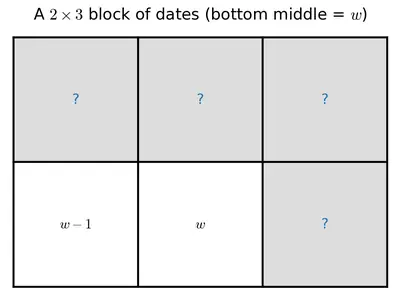
Solution
We are looking at any two rows and three consecutive columns of a calendar. Every column in a calendar stands for one particular day-of-the-week, so
- moving one step to the right increases the date by $$1$$,
- moving one step down (to the next week) increases the date by $$7$$.
Let us copy the unknown calendar strip and fill in the dates step by step. The six positions are named by their relative places in the grid.
| top left | top middle | top right |
| bottom left | bottom middle | bottom right |
The question already tells us the number in the bottom middle cell and in the bottom left cell:
| $$w-1$$ | $$w$$ |
We now fill the remaining four cells.
- Bottom right
Going one step to the right from $$w$$ adds $$1$$:
$$\text{bottom right}=w+1$$ - Top middle
Going one step up from $$w$$ subtracts $$7$$:
$$\text{top middle}=w-7$$ - Top left
Top left is one step left of top middle, so subtract another $$1$$:
$$\text{top left}=(w-7)-1=w-8$$ - Top right
Top right is one step right of top middle, so add $$1$$:
$$\text{top right}=(w-7)+1=w-6$$
Putting everything back in the table we get
| $$w-8$$ | $$w-7$$ | $$w-6$$ |
| $$w-1$$ | $$w$$ | $$w+1$$ |
Thus the required algebraic expressions for the six positions, when the bottom-middle date is $$w$$, are:
- top left : $$w-8$$
- top middle : $$w-7$$
- top right : $$w-6$$
- bottom left : $$w-1$$ (already given)
- bottom middle : $$w$$ (given)
- bottom right : $$w+1$$
Answer
Top row: $$w-8$$, $$w-7$$, $$w-6$$
Bottom row: $$w-1$$, $$w$$, $$w+1$$
Revisiting Arithmetic Expressions (Section 4.2)
1 Find the value of the expression: $$23 - 10 \times 2$$
Solution
The given expression is $$23 - 10 \times 2$$.
Step 1 – Apply the order of operations (BODMAS):
First, carry out the multiplication.
$$10 \times 2 = 20$$
Step 2 – Substitute the result into the expression and subtract:
$$23 - 20 = 3$$
Hence, the value of the expression is $$3$$.
Answer
$$3$$
2 Find the value of the expression: $$83 + 28 - 13 + 32$$
Solution
The numerical expression is
$$83 + 28 - 13 + 32$$
Step 1: Combine the first two numbers.
$$83 + 28 = 111$$
Now the expression becomes
$$111 - 13 + 32$$
Step 2: Perform the subtraction.
$$111 - 13 = 98$$
The expression is now
$$98 + 32$$
Step 3: Add the remaining numbers.
$$98 + 32 = 130$$
Therefore, the value of the given expression is
\[130\]
Answer
$$130$$
3 Find the value of the expression: $$34 - 14 + 20$$
Solution
We have to simplify the numerical expression
$$34 - 14 + 20$$
Step 1 – Start from the leftmost operation (because addition and subtraction have the same priority and we proceed left to right).
Subtract: $$34 - 14 = 20$$
After carrying out this subtraction, the expression becomes
$$20 + 20$$
Step 2 – Add the two numbers:
$$20 + 20 = 40$$
Thus the value of the given expression is
\[40\]
Answer
$$40$$
4 Find the value of the expression: $$42 + 15 - (8 - 7)$$
Solution
We must simplify the numerical expression step by step, following the correct order of operations (brackets first, then addition/subtraction from left to right).
-
Write the given expression.
$$42 + 15 - (8 - 7)$$ -
Simplify the brackets.
First evaluate what is inside the inner brackets: $$8 - 7 = 1$$ Insert this result back into the main expression: $$42 + 15 - 1$$ -
Add the first two numbers.
$$42 + 15 = 57$$ So the expression becomes $$57 - 1$$ -
Subtract to obtain the final value.
$$57 - 1 = 56$$
Hence, the value of the expression is
\[56\]
Answer
$$56$$
5 Find the value of the expression: $$68 - (18 + 13)$$
Solution
Step 1 – Identify the order of operations.
According to the BODMAS/PEMDAS rule, we must simplify the brackets first.
Step 2 – Simplify the expression inside the brackets.
The bracket contains the sum $$18 + 13$$.
Compute it: $$18 + 13 = 31$$.
The whole expression now becomes $$68 - 31$$.
Step 3 – Subtract.
Find the difference: $$68 - 31 = 37$$.
Final value.
\[68 - (18 + 13) = 37\]
Answer
$$37$$
6 Find the value of the expression: $$7 \times 4 + 9 \times 6$$
Solution
The given numerical expression is
$$7 \times 4 + 9 \times 6$$
Step 1 – Multiply $$7$$ by $$4$$:
$$7 \times 4 = 28$$
Step 2 – Multiply $$9$$ by $$6$$:
$$9 \times 6 = 54$$
Step 3 – Add the two products:
$$28 + 54 = 82$$
Thus, the value of the given expression is
\[82\]
Answer
$$82$$
7 Find the value of the expression: $$20 + 8 \times (16 - 6)$$
Solution
The expression to be simplified is: $$20 + 8 \times (16 - 6)$$
Step 1 – Simplify the bracket
The first operation (by the BODMAS rule) is inside the brackets:
$$16 - 6 = 10$$
Replace the bracketed part by its value:
$$20 + 8 \times 10$$
Step 2 – Perform the multiplication
Next, carry out the multiplication before addition:
$$8 \times 10 = 80$$
The expression now becomes:
$$20 + 80$$
Step 3 – Perform the addition
Add the two numbers:
$$20 + 80 = 100$$
The simplified value of the given expression is therefore
\[100\]
Answer
$$100$$
Mind the Mistake, Mend the Mistake (Section 4.3)
Mind the Mistake (4.3)
Some simplifications are shown below where the letter-numbers are replaced by numbers and the value of the expression is obtained.
- Observe each of them and identify if there is a mistake.
- If you think there is a mistake, try to explain what might have gone wrong.
- Then, correct it and give the value of the expression.
1 If $$a = -4$$, then $$10 - a = 6$$.
Solution
The given expression is $$10 - a$$ and the value of the letter-number is $$a = -4$$.
Step 1 : Substitute the value.
$$10 - a = 10 - (-4)$$
Step 2 : Subtracting a negative number is the same as adding its opposite.
$$10 - (-4) = 10 + 4$$
Step 3 : Add.
$$10 + 4 = 14$$
Mistake spotted: The simplification shown treated $$-4$$ as if it were $$+4$$ and simply did $$10 - 4 = 6$$. But when the letter-number is negative, the double minus becomes plus.
Answer
Incorrect. The correct value is $$14$$.
2 If $$d = 6$$, then $$3d = 36$$.
Solution
The expression is $$3d$$ with $$d = 6$$.
Step 1 : Substitute.
$$3d = 3 \times 6$$
Step 2 : Multiply.
$$3 \times 6 = 18$$
Mistake spotted: Someone multiplied twice (perhaps $$6 \times 6$$) and got $$36$$ instead of multiplying by the coefficient $$3$$ once.
Answer
Incorrect. The correct value is $$18$$.
3 If $$s = 7$$, then $$3s - 2 = 15$$.
Solution
The expression is $$3s - 2$$ and $$s = 7$$.
Step 1 : Substitute.
$$3s - 2 = 3 \times 7 - 2$$
Step 2 : Multiply.
$$3 \times 7 = 21$$ so the expression becomes $$21 - 2$$.
Step 3 : Subtract.
$$21 - 2 = 19$$
Mistake spotted: The worked answer jumped to $$15$$—most likely they subtracted before multiplying (took $$7 - 2 = 5$$ and then multiplied by $$3$$).
Answer
Incorrect. The correct value is $$19$$.
4 If $$r = 8$$, then $$2r + 1 = 29$$.
Solution
The expression is $$2r + 1$$ with $$r = 8$$.
Step 1 : Substitute.
$$2r + 1 = 2 \times 8 + 1$$
Step 2 : Multiply.
$$2 \times 8 = 16$$ so we get $$16 + 1$$.
Step 3 : Add.
$$16 + 1 = 17$$
Mistake spotted: The shown answer $$29$$ looks as if the digits of $$2$$ and $$r = 8$$ were written side by side to read $$2r$$ as the two-digit number $$28$$, and then $$1$$ was added to get $$28 + 1 = 29$$. But $$2r$$ stands for the product $$2 \times r$$, not the two-digit number formed by placing $$2$$ next to $$r$$.
Answer
Incorrect. The correct value is $$17$$.
5 If $$j = 5$$, then $$2j = 10$$.
Solution
Expression: $$2j$$, value: $$j = 5$$.
Step 1 : Substitute.
$$2j = 2 \times 5$$
Step 2 : Multiply.
$$2 \times 5 = 10$$
This matches the given simplification, so there is no mistake.
Answer
Correct. The value is $$10$$.
6 If $$m = -6$$, then $$3(m + 1) = 19$$.
Solution
The expression is $$3(m + 1)$$ with $$m = -6$$.
Step 1 : Work inside the brackets.
$$m + 1 = -6 + 1 = -5$$
Step 2 : Multiply the result by $$3$$.
$$3(m + 1) = 3 \times (-5) = -15$$
Mistake spotted: The given answer $$19$$ ignores the negative sign and the bracket rule.
Answer
Incorrect. The correct value is $$-15$$.
7 If $$f = 3$$, $$g = 1$$ then $$2f - 2g = 2$$.
Solution
The expression is $$2f - 2g$$ with $$f = 3$$ and $$g = 1$$.
Step 1 : Substitute.
$$2f - 2g = 2 \times 3 - 2 \times 1$$
Step 2 : Multiply each term.
$$2 \times 3 = 6$$ and $$2 \times 1 = 2$$ so the expression becomes $$6 - 2$$.
Step 3 : Subtract.
$$6 - 2 = 4$$
Mistake spotted: The shown answer $$2$$ comes from computing only $$f - g = 3 - 1 = 2$$ and forgetting to multiply each of $$f$$ and $$g$$ by the coefficient $$2$$ first. The coefficients in $$2f$$ and $$2g$$ must be applied before the subtraction is carried out.
Answer
Incorrect. The correct value is $$4$$.
8 If $$t = 4$$, $$b = 3$$ then $$2t + b = 24$$.
Solution
The expression is $$2t + b$$ with $$t = 4$$ and $$b = 3$$.
Step 1 : Substitute.
$$2t + b = 2 \times 4 + 3$$
Step 2 : Multiply.
$$2 \times 4 = 8$$ so the expression becomes $$8 + 3$$.
Step 3 : Add.
$$8 + 3 = 11$$
Mistake spotted: The answer $$24$$ seems to come from multiplying every number ($$2 \times 4 \times 3$$) instead of following the given operators in order.
Answer
Incorrect. The correct value is $$11$$.
9 If $$h = 5$$, $$n = 6$$ then $$h - (3 - n) = 4$$.
Solution
The expression is $$h - (3 - n)$$ with $$h = 5$$ and $$n = 6$$.
Step 1 : Evaluate the bracket first.
$$3 - n = 3 - 6 = -3$$
Step 2 : Substitute back.
$$h - (3 - n) = 5 - (-3)$$
Step 3 : Subtracting a negative number becomes addition.
$$5 - (-3) = 5 + 3 = 8$$
Mistake spotted: The given answer $$4$$ forgot to change the double minus to plus.
Answer
Incorrect. The correct value is $$8$$.
Figure it Out (Section 4.4)
1 Add the numbers in each picture below. Write their corresponding expressions and simplify them. Try adding the numbers in each picture in a couple different ways and see that you get the same thing.
(i)
Picture 1 (two rows of three):
| $$5y$$ | $$-6$$ | $$x$$ |
| $$x$$ | $$2$$ | $$5y$$ |
Solution
The six numbers that appear are
$$5y,\;-6,\;x,\;x,\;2,\;5y$$
Add them. First write one long sum:
$$5y+(-6)+x+x+2+5y$$
Re-arrange so that like terms stand next to one another (commutative law of addition):
$$x+x+5y+5y+(-6)+2$$
Now add the like terms.
- The $$x$$ terms: $$x+x=2x$$
- The $$y$$ terms: $$5y+5y=10y$$
- The constant terms: $$-6+2=-4$$
Put these three results together:
$$2x+10y-4$$
So, no matter in what order you add the six numbers, the simplified expression is
\[2x+10y-4\]
Answer
(ii)
Picture 2 (four rows of varying widths):
| $$2p$$ | $$3q$$ | $$-2$$ | $$3$$ |
| $$3q$$ | $$2p$$ | $$3$$ | $$-2$$ |
| $$2p$$ | $$3q$$ | ||
| $$3q$$ | $$2p$$ |
Solution
List every number that occurs in the picture.
- Row 1: $$2p,\;3q,\;-2,\;3$$
- Row 2: $$3q,\;2p,\;3,\;-2$$
- Row 3: $$2p,\;3q$$
- Row 4: $$3q,\;2p$$
Count each kind of term.
- $$2p$$ appears 4 times → $$4\times2p=8p$$
- $$3q$$ appears 4 times → $$4\times3q=12q$$
- $$-2$$ appears 2 times → $$2\times(-2)=-4$$
- $$3$$ appears 2 times → $$2\times3=6$$
Add all these results:
$$8p+12q+(-4)+6$$
Combine the constants:
$$8p+12q+2$$
Therefore the simplified expression for the whole picture is
\[8p+12q+2\]
Answer
(iii)
Picture 3 (four rows of four):
| $$-5g$$ | $$5k$$ | $$5k$$ | $$-5g$$ |
| $$5k$$ | $$5k$$ | $$5k$$ | $$5k$$ |
| $$5k$$ | $$5k$$ | $$5k$$ | $$5k$$ |
| $$-5g$$ | $$5k$$ | $$5k$$ | $$-5g$$ |
Solution
Write down how many times each different term occurs.
- Term $$-5g$$: first row (2), fourth row (2)
→ $$4\times(-5g)=-20g$$ - Term $$5k$$: first row (2), second row (4), third row (4), fourth row (2)
→ $$12\times5k=60k$$
No other kinds of terms are present, so the total sum is
$$60k + (-20g)$$
Simplify the sign of the second term:
$$60k-20g$$
Thus, whichever order we add the sixteen entries, the combined result is
\[60k-20g\]
Answer
2 Simplify each of the following expressions:
(a) $$p + p + p + p$$, $$p + p + p + q$$
Solution
First expression
Add the four like terms $$p$$:
$$p + p + p + p = (1 + 1 + 1 + 1)\,p = 4p$$
Second expression
The three $$p$$’s are like terms; $$q$$ is different and stays as it is.
$$p + p + p + q = (1 + 1 + 1)\,p + q = 3p + q$$
Answer
$$4p \text{ and } 3p + q$$
(b) $$p + q + p - q$$
Solution
Group like terms. The two $$p$$’s add, the $$q$$ and $$-q$$ cancel.
$$p + q + p - q = (p + p) + (q - q) = 2p + 0 = 2p$$
Answer
$$2p$$
(c) $$p - q + p - q$$
Solution
Combine $$p$$’s and $$q$$’s separately.
$$p - q + p - q = (p + p) + (-q - q) = 2p - 2q$$
Answer
$$2p - 2q$$
(d) $$p + q - p + q$$
Solution
Like terms together:
$$p + q - p + q = (p - p) + (q + q) = 0 + 2q = 2q$$
Answer
$$2q$$
(e) $$p + q - (p + q)$$
Solution
Expand the parentheses:
$$p + q - (p + q) = p + q - p - q$$
Now combine like terms:
$$(p - p) + (q - q) = 0 + 0 = 0$$
Answer
$$0$$
(f) $$p - q - p - q$$
Solution
Group the $$p$$’s and $$q$$’s:
$$p - q - p - q = (p - p) + (-q - q) = 0 - 2q = -2q$$
Answer
$$-2q$$
(g) $$2d - d - d - d$$
Solution
Start with the first two terms:
$$2d - d = d$$
Then continue subtracting $$d$$ twice more:
$$d - d = 0 \quad\text{and}\quad 0 - d = -d$$
So,
$$2d - d - d - d = -d$$
Answer
$$-d$$
(h) $$2d - d - d - c$$
Solution
Combine the $$d$$ terms first:
$$2d - d - d = 0$$
What remains is
$$0 - c = -c$$
Answer
$$-c$$
(i) $$2d - d - (d - c)$$
Solution
Remove the parentheses by changing the signs:
$$2d - d - (d - c) = 2d - d - d + c$$
Combine the $$d$$ terms:
$$2d - d - d = 0$$
Therefore,
$$0 + c = c$$
Answer
$$c$$
(j) $$2d - (d - d) - c$$
Solution
Evaluate the bracket first:
$$(d - d) = 0$$
Substitute back:
$$2d - 0 - c = 2d - c$$
Answer
$$2d - c$$
(k) $$2d - d - c - c$$
Solution
Simplify the $$d$$ terms:
$$2d - d = d$$
Simplify the $$c$$ terms:
$$-c - c = -2c$$
Put them together:
$$d - 2c$$
Answer
$$d - 2c$$
Mind the Mistake, Mend the Mistake (Section 4.4)
Mind the Mistake (4.4)
Some simplifications of algebraic expressions are done below. The expression on the right-hand side should be in its simplest form.
- Observe each of them and see if there is a mistake.
- If you think there is a mistake, try to explain what might have gone wrong.
- Then, simplify it correctly.
1 Expression: $$3a + 2b$$ Simplest Form: $$5$$
Solution
The two terms $$3a$$ and $$2b$$ contain different letters, so they are unlike terms. Unlike terms cannot be added (or subtracted) by just operating on the numerical coefficients.
Therefore no further combination is possible and the expression is already in its simplest form:
$$3a + 2b$$
Answer
2 Expression: $$3b - 2b - b$$ Simplest Form: $$0$$
Solution
Combine the like terms step by step:
$$3b-2b=b$$
Now subtract the remaining $$b$$:
$$b-b=0$$
The working shown in the book is correct; the simplified value is zero.
Answer
3 Expression: $$6(p + 2)$$ Simplest Form: $$6p + 8$$
Solution
Use distributive law $$a(b+c)=ab+ac$$:
$$6(p+2)=6\times p+6\times 2=6p+12$$
The number $$2$$ was multiplied by $$6$$ to give $$12$$, not $$8$$. That was the slip in the given work.
Answer
4 Expression: $$(4x + 3y) - (3x + 4y)$$ Simplest Form: $$x + y$$
Solution
First remove the bracket; remember that the minus sign changes every sign inside the bracket:
$$(4x+3y)-(3x+4y)=4x+3y-3x-4y$$
Combine like terms:
$$(4x-3x)+(3y-4y)=x-y$$
The wrong result $$x+y$$ arose because the sign of $$4y$$ was not changed.
Answer
5 Expression: $$5 - (2 - 6z)$$ Simplest Form: $$3 - 6z$$
Solution
Write the outer minus as multiplication by $$-1$$:
$$5-(2-6z)=5+\bigl[(-1)\times2+(-1)\times(-6z)\bigr]=5-2+6z$$
Now simplify the constants:
$$5-2=3$$
So the simplest form is:
$$3+6z$$
The sign of $$6z$$ was taken as negative in the incorrect answer.
Answer
6 Expression: $$2 + (x + 3)$$ Simplest Form: $$2x - 6$$
Solution
There is no minus sign in front of the bracket, so simply drop the bracket:
$$2+(x+3)=2+x+3$$
Combine the numbers $$2$$ and $$3$$:
$$x+5$$
The wrong working must have tried to multiply where only addition was required.
Answer
7 Expression: $$2y + (3y - 6)$$ Simplest Form: $$- y + 6$$
Solution
Again drop the bracket because nothing is to be distributed:
$$2y+(3y-6)=2y+3y-6$$
Combine like terms $$2y+3y=5y$$:
$$5y-6$$
The error in the given answer came from subtracting instead of adding the $$y$$-terms and also changing the sign of the constant.
Answer
8 Expression: $$7p - p + 5q - 2q$$ Simplest Form: $$7p + 3q$$
Solution
Simplify the $$p$$-terms and the $$q$$-terms separately:
$$7p-p=(7-1)p=6p$$
$$5q-2q=(5-2)q=3q$$
Putting them together:
$$6p+3q$$
The coefficient of $$p$$ was kept as $$7$$ in the incorrect answer instead of $$6$$.
Answer
9 Expression: $$5(2w + 3x + 4w)$$ Simplest Form: $$10w + 15x + 20w$$
Solution
First simplify inside the bracket:
$$2w+4w=6w$$
So $$5(2w+3x+4w)=5(6w+3x)$$
Now apply the distributive property:
$$=5\times6w+5\times3x=30w+15x$$
The given answer multiplied correctly but failed to combine the two $$w$$-terms.
Answer
10 Expression: $$3j + 6k + 9h + 12$$ Simplest Form: $$3(j + 2k + 3h + 4)$$
Solution
Factor the common number $$3$$ out of every term:
$$3j+6k+9h+12=3(j+2k+3h+4)$$
Each original term equals $$3$$ times the corresponding term inside the bracket, so the factorisation is correct and represents a perfectly acceptable simplest form.
Answer
11 Expression: $$4(2r + 3s + 5)$$ Simplest Form: $$- 20 - 8r - 12s$$
Solution
Use the distributive law:
$$4(2r+3s+5)=4\times2r+4\times3s+4\times5$$
Calculate each product:
$$=8r+12s+20$$
The wrong answer has all signs reversed; this would happen only if there were a $$-4$$ in front, not $$4$$.
Answer
Figure it Out (Chapter Exercise)
1 One plate of Jowar roti costs ₹30 and one plate of Pulao costs ₹20. If $$x$$ plates of Jowar roti and $$y$$ plates of pulao were ordered in a day, which expression(s) describe the total amount in rupees earned that day?
(a) $$30x + 20y$$
(b) $$(30 + 20) \times (x + y)$$
(c) $$20x + 30y$$
(d) $$(30 + 20) \times x + y$$
(e) $$30x - 20y$$
Solution
Let $$x$$ be the number of plates of Jowar roti and $$y$$ be the number of plates of Pulao supplied in one day.
Step 1 – Cost of each item
- Cost of one plate of Jowar roti = ₹30.
Cost of $$x$$ such plates = $$30 \times x = 30x$$. - Cost of one plate of Pulao = ₹20.
Cost of $$y$$ such plates = $$20 \times y = 20y$$.
Step 2 – Total earning for the day
\[ 30x + 20y \]Step 3 – Check the given options
| Option | Expression | Verdict / Reason |
|---|---|---|
| (a) | $$30x + 20y$$ | Correct total (matches Step 2). |
| (b) | $$(30 + 20)(x + y) = 50x + 50y$$ | Counts each dish at the wrong combined price; too large. |
| (c) | $$20x + 30y$$ | Prices for the two dishes are interchanged. |
| (d) | $$(30 + 20) x + y = 50x + y$$ | Adds only one plate of Pulao and wrong price for Jowar roti. |
| (e) | $$30x - 20y$$ | Subtracts instead of adding the two earnings. |
Therefore, only option (a) represents the correct expression for the total amount earned that day.
Answer
(a) $$30x + 20y$$
2 Pushpita sells two types of flowers on Independence day: champak and marigold. '$$p$$' customers only bought champak, '$$q$$' customers only bought marigold, and '$$r$$' customers bought both. On the same day, she gave away a tiny national flag to every customer. How many flags did she give away that day?
(a) $$p + q + r$$
(b) $$p + q + 2r$$
(c) $$2 \times (p + q + r)$$
(d) $$p + q + r + 2$$
(e) $$p + q + r + 1$$
(f) $$2 \times (p + q)$$
Solution
Step 1 – Understand the information
Pushpita has three kinds of customers on Independence day:
- Only champak buyers → $$p$$ customers
- Only marigold buyers → $$q$$ customers
- Buyers of both champak and marigold → $$r$$ customers
Every customer—whoever he or she is—gets exactly one little national flag.
Step 2 – List the distinct customers
A customer can belong to one, and only one, of the above three groups, because the headings already separate them:
- The first group (only champak) contains $$p$$ different people.
- The second group (only marigold) contains $$q$$ different people.
- The third group (both flowers) contains $$r$$ different people.
Notice that a person counted in the third line is not counted in the first or second line, so there is no double-counting.
Step 3 – Add them to get the total customers
Total customers = (only champak) + (only marigold) + (both)
\[\text{Total customers}=p+q+r\]
Step 4 – Translate customers to flags
Each customer receives exactly one flag, so the number of flags is the same as the number of customers:
Step 5 – Match with the given options
The expression $$p+q+r$$ appears as option (a).
Answer
(a) $$p + q + r$$
3 A snail is trying to climb along the wall of a deep well. During the day it climbs up '$$u$$' cm and during the night it slowly slips down '$$d$$' cm. This happens for 10 days and 10 nights.
(a) Write an expression describing how far away the snail is from its starting position.
Solution
Let
- $$u$$ be the distance (in cm) the snail climbs up each day.
- $$d$$ be the distance (in cm) it slips down each night.
Step 1 – Net progress in one day–night cycle
After climbing up $$u$$ cm and then sliding down $$d$$ cm, the snail’s net displacement for one complete cycle is
$$u - d\;\text{cm}.$$
Step 2 – Net progress in 10 cycles
The question says the same thing happens for 10 days and 10 nights, i.e. 10 identical cycles. Hence the total displacement after 10 cycles is
$$10 \times (u - d) = 10(u - d)\;\text{cm}.$$
This algebraic expression gives how far the snail is from its starting point after the given period.
Answer
(b) What can we say about the snail's movement if $$d > u$$?
Solution
When $$d > u$$, the nightly slip is larger than the daytime climb.
Net displacement in one cycle is still $$u - d$$, but now
$$u - d < 0,$$
so the quantity is negative. That means the snail actually ends the cycle below the level where it started the day.
After 10 cycles its position relative to the start is
$$10(u - d),$$
a negative number equal in magnitude to $$10(d - u)$$ centimetres downward. Thus the snail keeps losing height each day–night pair and will never make upward progress; it steadily moves farther down the wall of the well.
Answer
4 Radha is preparing for a cycling race and practices daily. The first week she cycles 5 km every day. Every week she increases the daily distance cycled by '$$z$$' km. How many kilometers would Radha have cycled after 3 weeks?
Solution
Given: In the first week Radha rides 5 km each day and, every new week, she increases the daily distance by $$z$$ km.
Step 1 – Daily and weekly distances
- Week 1: daily distance = $$5$$ km
- Week 2: daily distance = $$5+z$$ km (increased by $$z$$)
- Week 3: daily distance = $$5+2z$$ km (increased again by another $$z$$)
Step 2 – Convert each week’s daily distance into the total for that week
Each week has $$7$$ days, so multiply each daily figure by $$7$$:
- Week 1: $$7 \times 5 = 35$$ km
- Week 2: $$7 \times (5+z) = 35 + 7z$$ km
- Week 3: $$7 \times (5+2z) = 35 + 14z$$ km
Step 3 – Add the three weekly totals
$$\begin{aligned} \text{Total distance} &= 35 + (35 + 7z) + (35 + 14z) \\ &= (35+35+35) + (7z + 14z) \\ &= 105 + 21z \,\text{km}. \end{aligned}$$
\[ \boxed{\text{Distance after 3 weeks} = 105 + 21z\;\text{km}} \]Answer
$$105 + 21z\;\text{km}$$
5 In the following figure, observe how the expression $$w + 2$$ becomes $$4w + 20$$ along one path. Fill in the missing blanks on the remaining paths. The ovals contain expressions and the boxes contain operations. (Upper path: ___ $$\xleftarrow{\times 3}$$ $$w - 3$$ $$\xleftarrow{-5}$$ (centre $$w + 2$$) $$\xrightarrow{+3}$$ $$w + 5$$ $$\xrightarrow{\times 4}$$ $$4w + 20$$. Lower path: ___ $$\xleftarrow{-4}$$ ___ $$\xleftarrow{-8}$$ (centre $$w + 2$$) $$\xrightarrow{-4}$$ ___ $$\xrightarrow{\times 3}$$ $$3w - 6$$.)
Solution
How to read the diagram
- Each oval carries an expression.
- Each boxed arrow shows the operation to be performed when we move in the direction of the arrow.
1. Upper path (moving from the centre towards the left)
- Start from the centre oval: $$w + 2$$.
- First arrow is labelled “−5”, so $$w + 2 - 5 = w - 3$$. The oval just left of the centre therefore contains $$w - 3$$ (this matches the figure).
- Next arrow is “× 3”, so multiply the last result by 3: $$3\bigl(w - 3\bigr) = 3w - 9$$.
Hence the blank oval on the extreme left of the upper path is $$3w - 9$$.
2. Lower path (moving from the centre towards the right)
- Start again from the centre: $$w + 2$$.
- Arrow shows “−4”, so $$w + 2 - 4 = w - 2$$. This is the first blank oval on the right side.
- Next arrow is “× 3”, so $$3\bigl(w - 2\bigr) = 3w - 6$$, which indeed equals the given final oval.
Thus the blank oval just right of the centre is $$w - 2$$.
3. Lower path (moving from the centre towards the left)
- Start from the centre: $$w + 2$$.
- Arrow shows “−8”, so $$w + 2 - 8 = w - 6$$. This fills the middle blank oval on the left.
- Next arrow (further left) is “−4”, so $$w - 6 - 4 = w - 10$$.
Hence the extreme-left blank oval on the lower path is $$w - 10$$.
4. Summary of all missing expressions
- Upper path, leftmost oval: $$3w - 9$$
- Lower path, leftmost oval: $$w - 10$$
- Lower path, middle oval (after “−8”): $$w - 6$$
- Lower path, rightmost blank oval (after “−4”): $$w - 2$$
Answer
Upper blank: $$3w - 9$$
Lower blanks (from left to right): $$w - 10,\; w - 6,\; w - 2$$
6 A local train from Yahapur to Vahapur stops at three stations at equal distances along the way. The time taken in minutes to travel from one station to the next station is the same and is denoted by $$t$$. The train stops for 2 minutes at each of the three stations.
(a) If $$t = 4$$, what is the time taken to travel from Yahapur to Vahapur?
Solution
Step 1 – Understand the journey
From Yahapur to Vahapur the train passes the following points in order:
- Start : Yahapur
- Station 1 (stop for 2 min)
- Station 2 (stop for 2 min)
- Station 3 (stop for 2 min)
- Finish : Vahapur
Thus, there are four equal travel sections: (Yahapur→1), (1→2), (2→3), (3→Vahapur).
Step 2 – Write the total time when $$t=4$$ minutes
• Travelling time for one section = $$t = 4$$ minutes.
• Number of travel sections = 4.
Therefore total travelling time = $$4\times t = 4\times4 = 16$$ minutes.
• Stoppage at each of the three stations = 2 minutes.
• Number of such stops = 3.
Therefore total stoppage time = $$3\times2 = 6$$ minutes.
Step 3 – Add travelling and stoppage times
\[ \text{Total time} = 16 + 6 = 22\;\text{minutes} \]Answer
(a) 22 minutes
(b)
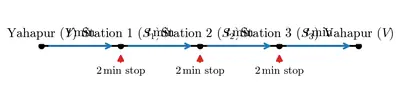
Solution
Step 1 – Visualise the route
Draw five dots in a straight line and label them in order: Yahapur, Station 1, Station 2, Station 3, Vahapur. Mark the four equal sections between consecutive dots. At each of the three intermediate stations show a small pause of 2 minutes. This picture helps us count the number of trips and stops correctly.
Step 2 – Travelling time
Number of equal travelling sections = 4, each taking $$t$$ minutes.
Hence travelling time = $$4t$$ minutes.
Step 3 – Stoppage time
Number of intermediate stops = 3, each stop = 2 minutes.
Hence stoppage time = $$3\times2 = 6$$ minutes.
Step 4 – Total time
\[ \text{Total time} = 4t + 6\;\text{minutes} \]This is the required algebraic expression.
Answer
(b) $$4t + 6$$ minutes
7 Simplify the following expressions:
(a) $$3a + 9b - 6 + 8a - 4b - 7a + 16$$
Solution
Original expression:
$$3a + 9b - 6 + 8a - 4b - 7a + 16$$
Step 1 – Group like terms
• "a-terms" $$3a,\;8a,\;-7a$$
• "b-terms" $$9b,\;-4b$$
• constants $$-6,\;16$$
Step 2 – Add/subtract the coefficients
- For a: $$3 + 8 - 7 = 4\;\Rightarrow\;4a$$
- For b: $$9 - 4 = 5\;\Rightarrow\;5b$$
- For constants: $$-6 + 16 = 10$$
Step 3 – Write the simplified expression
$$4a + 5b + 10$$
Answer
(b) $$3(3a - 3b) - 8a - 4b - 16$$
Solution
Original expression:
$$3(3a - 3b) - 8a - 4b - 16$$
Step 1 – Remove brackets (distribute 3)
$$3(3a) = 9a, \quad 3(-3b) = -9b$$
So we get:
$$9a - 9b - 8a - 4b - 16$$
Step 2 – Group like terms
- a-terms: $$9a,\;-8a$$
- b-terms: $$-9b,\;-4b$$
- constant: $$-16$$
Step 3 – Add/subtract the coefficients
- For a: $$9 - 8 = 1\;\Rightarrow\;a$$
- For b: $$-9 - 4 = -13\;\Rightarrow\;-13b$$
Step 4 – Simplified form
$$a - 13b - 16$$
Answer
(c) $$2(2x - 3) + 8x + 12$$
Solution
Original expression:
$$2(2x - 3) + 8x + 12$$
Step 1 – Expand the bracket
$$2 \times 2x = 4x, \quad 2 \times (-3) = -6$$
Expression becomes:
$$4x - 6 + 8x + 12$$
Step 2 – Group like terms
- x-terms: $$4x,\;8x$$
- constants: $$-6,\;12$$
Step 3 – Combine
- x: $$4 + 8 = 12\;\Rightarrow\;12x$$
- constant: $$-6 + 12 = 6$$
Step 4 – Simplified form
$$12x + 6$$
Answer
(d) $$8x - (2x - 3) + 12$$
Solution
Original expression:
$$8x - (2x - 3) + 12$$
Step 1 – Remove the bracket
The minus sign changes every term inside:
$$(2x - 3) \longrightarrow -2x + 3$$
Now we have:
$$8x - 2x + 3 + 12$$
Step 2 – Group like terms
- x-terms: $$8x,\;-2x$$
- constants: $$3,\;12$$
Step 3 – Combine
- x: $$8 - 2 = 6\;\Rightarrow\;6x$$
- constant: $$3 + 12 = 15$$
Step 4 – Simplified form
$$6x + 15$$
Answer
(e) $$8h - (5 + 7h) + 9$$
Solution
Original expression:
$$8h - (5 + 7h) + 9$$
Step 1 – Remove the bracket
$$-(5 + 7h) = -5 - 7h$$
So:
$$8h - 5 - 7h + 9$$
Step 2 – Group like terms
- h-terms: $$8h,\;-7h$$
- constants: $$-5,\;9$$
Step 3 – Combine
- h: $$8 - 7 = 1\;\Rightarrow\;h$$
- constant: $$-5 + 9 = 4$$
Step 4 – Simplified form
$$h + 4$$
Answer
(f) $$23 + 4(6m - 3n) - 8n - 3m - 18$$
Solution
Original expression:
$$23 + 4(6m - 3n) - 8n - 3m - 18$$
Step 1 – Expand the bracket
$$4 \times 6m = 24m, \quad 4 \times (-3n) = -12n$$
Now:
$$23 + 24m - 12n - 8n - 3m - 18$$
Step 2 – Group like terms
- m-terms: $$24m,\;-3m$$
- n-terms: $$-12n,\;-8n$$
- constants: $$23,\;-18$$
Step 3 – Combine
- m: $$24 - 3 = 21\;\Rightarrow\;21m$$
- n: $$-12 - 8 = -20\;\Rightarrow\;-20n$$
- constant: $$23 - 18 = 5$$
Step 4 – Simplified form
$$21m - 20n + 5$$
Answer
8 Add the expressions given below:
(a) $$4d - 7c + 9$$ and $$8c - 11 + 9d$$
Solution
The two expressions are $$4d - 7c + 9$$ and $$8c - 11 + 9d$$.
We add them term-by-term:
$$\bigl(4d - 7c + 9\bigr) + \bigl(8c - 11 + 9d\bigr)=4d - 7c + 9 + 8c - 11 + 9d$$
- Like $$d$$-terms: $$4d + 9d = 13d$$
- Like $$c$$-terms: $$-7c + 8c = c$$
- Constants: $$9 - 11 = -2$$
Putting the combined like terms together we get
\[ 13d + c - 2 \]
Answer
$$13d + c - 2$$
(b) $$-6f + 19 - 8s$$ and $$-23 + 13f + 12s$$
Solution
The expressions are $$-6f + 19 - 8s$$ and $$-23 + 13f + 12s$$.
Add the two:
$$\bigl(-6f + 19 - 8s\bigr)+\bigl(-23 + 13f + 12s\bigr)=-6f + 19 - 8s - 23 + 13f + 12s$$
- $$f$$-terms: $$-6f + 13f = 7f$$
- $$s$$-terms: $$-8s + 12s = 4s$$
- Constants: $$19 - 23 = -4$$
Hence
\[ 7f + 4s - 4 \]
Answer
$$7f + 4s - 4$$
(c) $$8d - 14c + 9$$ and $$16c - (11 + 9d)$$
Solution
The expressions are $$8d - 14c + 9$$ and $$16c - (11 + 9d)$$.
First remove the bracket in the second expression:
$$16c - (11 + 9d)=16c - 11 - 9d$$
Now add:
$$\bigl(8d - 14c + 9\bigr)+\bigl(16c - 11 - 9d\bigr)=8d - 14c + 9 + 16c - 11 - 9d$$
- $$d$$-terms: $$8d - 9d = -d$$
- $$c$$-terms: $$-14c + 16c = 2c$$
- Constants: $$9 - 11 = -2$$
Therefore
\[ 2c - d - 2 \]
Answer
$$2c - d - 2$$
(d) $$6f - 20 + 8s$$ and $$23 - 13f - 12s$$
Solution
The expressions are $$6f - 20 + 8s$$ and $$23 - 13f - 12s$$.
Add them:
$$\bigl(6f - 20 + 8s\bigr)+\bigl(23 - 13f - 12s\bigr)=6f - 20 + 8s + 23 - 13f - 12s$$
- $$f$$-terms: $$6f - 13f = -7f$$
- $$s$$-terms: $$8s - 12s = -4s$$
- Constants: $$-20 + 23 = 3$$
Thus
\[ -7f - 4s + 3 \]
Answer
$$-7f - 4s + 3$$
(e) $$13m - 12n$$ and $$12n - 13m$$
Solution
The expressions are $$13m - 12n$$ and $$12n - 13m$$.
Adding gives
$$\bigl(13m - 12n\bigr)+\bigl(12n - 13m\bigr)=13m - 12n + 12n - 13m$$
Each variable’s coefficients cancel:
- $$m$$-terms: $$13m - 13m = 0$$
- $$n$$-terms: $$-12n + 12n = 0$$
No constant terms are present. Hence the sum is
\[ 0 \]
Answer
$$0$$
(f) $$-26m + 24n$$ and $$26m - 24n$$
Solution
The expressions are $$-26m + 24n$$ and $$26m - 24n$$.
Add them:
$$\bigl(-26m + 24n\bigr)+\bigl(26m - 24n\bigr)=-26m + 24n + 26m - 24n$$
- $$m$$-terms: $$-26m + 26m = 0$$
- $$n$$-terms: $$24n - 24n = 0$$
No constant term is left, so the sum is
\[ 0 \]
Answer
$$0$$
9 Subtract the expressions given below:
(a) $$9a - 6b + 14$$ from $$6a + 9b - 18$$
Solution
To subtract $$9a - 6b + 14$$ from $$6a + 9b - 18$$ we write
$$\bigl(6a + 9b - 18\bigr) - \bigl(9a - 6b + 14\bigr).$$
Remove the second bracket by changing every sign:
$$6a + 9b - 18 - 9a + 6b - 14.$$
Combine like terms:
- $$a\text{-terms}:\;6a - 9a = -3a$$
- $$b\text{-terms}:\;9b + 6b = 15b$$
- Constants: $$-18 - 14 = -32$$
Thus the result is $$-3a + 15b - 32$$.
Answer
(b) $$-15x + 13 - 9y$$ from $$7y - 10 + 3x$$
Solution
Subtract $$-15x + 13 - 9y$$ from $$7y - 10 + 3x$$:
$$\bigl(7y - 10 + 3x\bigr) - \bigl(-15x + 13 - 9y\bigr).$$
Change the signs of all terms in the second bracket:
$$7y - 10 + 3x + 15x - 13 + 9y.$$
Combine like terms:
- $$x\text{-terms}:\;3x + 15x = 18x$$
- $$y\text{-terms}:\;7y + 9y = 16y$$
- Constants: $$-10 - 13 = -23$$
The required difference is $$18x + 16y - 23$$.
Answer
(c) $$17g + 9 - 7h$$ from $$11 - 10g + 3h$$
Solution
Subtract $$17g + 9 - 7h$$ from $$11 - 10g + 3h$$:
$$\bigl(11 - 10g + 3h\bigr) - \bigl(17g + 9 - 7h\bigr).$$
Change the signs of the second bracket:
$$11 - 10g + 3h - 17g - 9 + 7h.$$
Combine like terms:
- $$g\text{-terms}:\;-10g - 17g = -27g$$
- $$h\text{-terms}:\;3h + 7h = 10h$$
- Constants: $$11 - 9 = 2$$
The result is $$-27g + 10h + 2$$.
Answer
(d) $$9a - 6b + 14$$ from $$6a - (9b + 18)$$
Solution
The minuend is $$6a - (9b + 18)$$ and the subtrahend is $$9a - 6b + 14$$.
First simplify the minuend:
$$6a - (9b + 18) = 6a - 9b - 18.$$
Now perform the subtraction:
$$\bigl(6a - 9b - 18\bigr) - \bigl(9a - 6b + 14\bigr).$$
Change the signs in the second bracket:
$$6a - 9b - 18 - 9a + 6b - 14.$$
Combine like terms:
- $$a\text{-terms}:\;6a - 9a = -3a$$
- $$b\text{-terms}:\;-9b + 6b = -3b$$
- Constants: $$-18 - 14 = -32$$
The required difference is $$-3a - 3b - 32$$.
Answer
(e) $$10x + 2 + 10y$$ from $$-3y + 8 - 3x$$
Solution
Subtract $$10x + 2 + 10y$$ from $$-3y + 8 - 3x$$:
$$\bigl(-3y + 8 - 3x\bigr) - \bigl(10x + 2 + 10y\bigr).$$
Change the signs of the second bracket:
$$-3y + 8 - 3x - 10x - 2 - 10y.$$
Combine like terms:
- $$x\text{-terms}:\;-3x - 10x = -13x$$
- $$y\text{-terms}:\;-3y - 10y = -13y$$
- Constants: $$8 - 2 = 6$$
The required difference is $$-13x - 13y + 6$$.
Answer
(f) $$8g + 4h - 10$$ from $$7h - 8g + 20$$
Solution
Subtract $$8g + 4h - 10$$ from $$7h - 8g + 20$$:
$$\bigl(7h - 8g + 20\bigr) - \bigl(8g + 4h - 10\bigr).$$
Change the signs of the second bracket:
$$7h - 8g + 20 - 8g - 4h + 10.$$
Combine like terms:
- $$g\text{-terms}:\;-8g - 8g = -16g$$
- $$h\text{-terms}:\;7h - 4h = 3h$$
- Constants: $$20 + 10 = 30$$
The result is $$-16g + 3h + 30$$.
Answer
10 Describe situations corresponding to the following algebraic expressions:
(a) $$8x + 3y$$
Solution
Suppose a stationery shop keeps two kinds of items.
- One notebook costs $$x$$ rupees.
- One pen costs $$y$$ rupees.
If a customer buys 8 notebooks, the cost of the notebooks is
$$8 \times x = 8x$$ rupees.
If the same customer also buys 3 pens, the cost of the pens is
$$3 \times y = 3y$$ rupees.
The total money the customer has to pay is the sum of these two amounts:
\[\text{Total cost}=8x+3y\]
Hence the algebraic expression $$8x+3y$$ describes the total amount (in rupees) needed to buy 8 notebooks and 3 pens when the price of one notebook is $$x$$ rupees and the price of one pen is $$y$$ rupees.
Answer
Total cost of buying 8 notebooks at Rs $$x$$ each and 3 pens at Rs $$y$$ each.
(b) $$15x - 2x$$
Solution
Let a fruit seller pack $$x$$ apples in one basket.
He has 15 such baskets; hence the total number of apples is
$$15 \times x = 15x$$ apples.
If he sells 2 baskets, the number of apples sold is
$$2 \times x = 2x$$ apples.
The apples still left with him are found by subtracting:
\[\text{Apples left}=15x-2x=13x\]
Therefore the expression $$15x-2x$$ (which simplifies to $$13x$$) represents the number of apples remaining after the seller sells 2 out of his 15 baskets, each basket containing $$x$$ apples.
Answer
Apples left when a fruit seller who had 15 baskets each containing $$x$$ apples sells 2 of those baskets (left = $$15x-2x$$).
11
Solution
Understanding the situation
The rope is cut exactly once, but before cutting it we may fold it a certain number of times. Whenever we fold, additional layers are placed one over the other, so the scissor (or knife) passes through all the layers together.
Step 1 Relate number of folds to number of layers
- 0 folds → 1 layer
- 1 fold → 2 layers
- 2 folds → 3 layers
- …
- r folds → r + 1 layers
Step 2 How many cut points are produced?
The single cut meets every layer, therefore after unfolding we see one cut point on each layer. Thus the number of cut points along the original straight rope is also r + 1.
Step 3 Convert cut points into pieces
A straight object cut at n different points separates into n + 1 pieces. Here n = r + 1, so
\[ \text{pieces}= (r+1) + 1 = r + 2 \]
Step 4 Check with the given information
r = 0: pieces = 0+2 = 2 (matches the figure)
r = 1: pieces = 1+2 = 3 (matches the figure)
Step 5 Use the formula
For r = 10 folds: $$\text{pieces}=10+2=12$$.
Conclusion
When the rope is folded r times and cut once, we obtain $$r+2$$ pieces. In particular, ten folds give 12 pieces.
Answer
For 10 folds: $$10+2 = 12$$ pieces.
In general, the number of pieces after $$r$$ folds and one cut is $$r+2$$.
12 Look at the matchstick pattern below. Observe and identify the pattern. How many matchsticks are required to make 10 such squares. How many are required to make $$w$$ squares? (The pattern shows squares made of matchsticks attached side by side: 1 square, 2 squares, 3 squares, 4 squares.)
Solution
Step 1 : Observe the first few figures
| Number of side-by-side squares ($$n$$) | Matchsticks used |
|---|---|
| 1 | 4 |
| 2 | 7 |
| 3 | 10 |
| 4 | 13 |
We notice that each time we add one more square, we do not need another 4 matchsticks because the new square shares one complete side with the previous square.
Step 2 : Work out the change from one figure to the next
- Going from 1 square to 2 squares, matchsticks increase from 4 to 7 ⇒ increase of $$3$$.
- Going from 2 squares to 3 squares, matchsticks increase from 7 to 10 ⇒ increase of $$3$$ again.
- Every additional square therefore needs exactly $$3$$ new matchsticks.
Step 3 : Build an algebraic rule
Start with 1 square (needs 4 sticks). For each extra square beyond the first, add 3 sticks.
If $$n$$ is the number of squares, we can write
Number of matchsticks = $$4 + (n-1)\times 3$$.
Simplify this expression:
$$4 + (n-1)\times 3 = 4 + 3n - 3 = 3n + 1$$.
So the general rule is
\[ \text{Matchsticks}(n) = 3n + 1 \]
Step 4 : Use the rule for the required cases
- For 10 squares ($$n = 10$$):
$$3\times 10 + 1 = 30 + 1 = 31$$ matchsticks. - For $$w$$ squares: simply replace $$n$$ by $$w$$ in the rule:
$$3w + 1$$ matchsticks.
Answer
10 squares need $$31$$ matchsticks.
$$w$$ squares need $$3w + 1$$ matchsticks.
13 Have you noticed how the colours change in a traffic signal? The sequence of colour changes is shown below. Find the colour at positions 90, 190, and 343. Write expressions to describe the positions for each colour. (Sequence: Red, Yellow, Green, Yellow, Red, ... at positions 1, 2, 3, 4, 5, ...)
Solution
First, copy a few terms of the list that is given in the question.
$$\text{Position} : 1 \; 2 \; 3 \; 4 \; 5 \; 6 \; 7 \; 8 \; 9 \; 10 \; 11 \; 12 \;\ldots$$
$$\text{Colour} : R \; Y \; G \; Y \; R \; Y \; G \; Y \; R \; Y \; G \; Y \;\ldots$$
We see that after every four places the same order Red, Yellow, Green, Yellow repeats. Hence the sequence has a period (length of one full cycle) equal to 4.
1. A quick way to locate any position
For any position number $$n$$ we divide $$n$$ by 4 and read its remainder (also called the modulus). There are only four possible remainders:
| Remainder of $$n \div 4$$ | Actual place inside a block | Colour obtained |
|---|---|---|
| $$1$$ | first place | Red |
| $$2$$ | second place | Yellow |
| $$3$$ | third place | Green |
| $$0$$ | fourth place | Yellow |
2. Finding the three required colours
-
Position $$90$$
Divide by 4:
$$90 = 4 \times 22 + 2$$ (since $$4 \times 22 = 88$$ and $$90-88 = 2$$).
Remainder $$=2 \;\Rightarrow$$ second place ⇒ Yellow.
-
Position $$190$$
$$190 = 4 \times 47 + 2$$ (because $$4 \times 47 = 188$$).
Remainder $$=2 \;\Rightarrow$$ second place ⇒ Yellow.
-
Position $$343$$
$$343 = 4 \times 85 + 3$$ (because $$4 \times 85 = 340$$).
Remainder $$=3 \;\Rightarrow$$ third place ⇒ Green.
3. General expressions for every colour
- Red appears at positions $$1,5,9,13,\ldots$$. Each of these numbers can be written as \[ n = 4k + 1 \] where $$k$$ is any whole number $$0,1,2,3,\ldots$$
- Green appears at positions $$3,7,11,15,\ldots$$. Each of these numbers is of the form \[ n = 4k + 3 \]
- Yellow appears at positions $$2,4,6,8,10,12,\ldots$$, i.e. whenever the remainder is $$2$$ or $$0$$. Therefore the positions are \[ n = 4k \quad \text{or} \quad n = 4k + 2 \]
Writing them together:
| Colour | All possible positions (in algebraic form) |
|---|---|
| Red | $$n = 4k + 1$$ |
| Yellow | $$n = 4k \;\text{or}\; n = 4k + 2$$ |
| Green | $$n = 4k + 3$$ |
4. Summary
At position $$90$$ ⇒ Yellow;
At position $$190$$ ⇒ Yellow;
At position $$343$$ ⇒ Green.
Answer
Colour at 90th place = Yellow;
Colour at 190th place = Yellow;
Colour at 343rd place = Green.
Positions of each colour:
Red → $$n = 4k+1$$; Green → $$n = 4k+3$$; Yellow → $$n = 4k$$ or $$n = 4k+2$$.
14 Observe the pattern below. How many squares will be there in Step 4, Step 10, Step 50? Write a general formula. How would the formula change if we want to count the number of vertices of all the squares?
Solution
Step–by–step analysis of the picture pattern
1 Look for a numerical pattern
The first three figures supplied in the textbook look like this (draw them as small square–grids):
- Step 1 → 1 small square
- Step 2 → 4 small squares (arranged 2 × 2)
- Step 3 → 9 small squares (arranged 3 × 3)
The numbers 1, 4, 9 are the perfect squares of the counting numbers 1, 2, 3.
2 Express the count for any step n
If a step contains $$n$$ little squares along one side, then the arrangement is an $$n \times n$$ grid, so the total number of little squares is obtained by multiplying:
3 Use the rule to answer the specific questions
- Step 4: $$N(4)=4^{2}=16$$ squares
- Step 10: $$N(10)=10^{2}=100$$ squares
- Step 50: $$N(50)=50^{2}=2500$$ squares
Hence the general formula for the number of squares in Step $$n$$ is
\[\boxed{\;N(n)=n^{2}\;}\]Counting vertices instead of squares
When there are $$n$$ little squares along a side, we need one extra corner to close the row, so each horizontal and vertical line shows $$(n+1)$$ points. Putting these in a rectangular array gives
\[V(n)=(n+1)\times(n+1)=(n+1)^{2}=n^{2}+2n+1\]Therefore the relationship changes from $$n^{2}$$ to $$(n+1)^{2}$$ when we shift our attention from squares to their vertices.
Illustrations:
- Step 4 has $$V(4)=(4+1)^{2}=25$$ vertices
- Step 10 has $$V(10)=121$$ vertices
- Step 50 has $$V(50)=2601$$ vertices
Summary
- Squares in Step $$n$$ : $$n^{2}$$
- Vertices in Step $$n$$ : $$(n+1)^{2}$$
Answer
Squares: Step 4 → 16, Step 10 → 100, Step 50 → 2500.
General rule: $$n^{2}$$.
Vertices: rule becomes $$(n+1)^{2}$$ (so 25, 121, 2601 in the three steps).
15
Numbers are written in a particular sequence in this endless 4-column grid.
| 1 | 2 | 3 | 4 |
|---|---|---|---|
| 1 | 2 | 3 | 4 |
| 5 | 6 | 7 | 8 |
| 9 | 10 | 11 | 12 |
| 13 | 14 | 15 | 16 |
(a) Give expressions to generate all the numbers in a given column (1, 2, 3, 4).
Solution
Step 1 — Name the row number
Let the row number be denoted by the letter $$r$$. The first row has $$r = 1$$, the second row $$r = 2$$ and so on.
Step 2 — Look at the pattern in each column
| Column 1 | Column 2 | Column 3 | Column 4 |
|---|---|---|---|
| 1 | 2 | 3 | 4 |
| 5 | 6 | 7 | 8 |
| 9 | 10 | 11 | 12 |
| 13 | 14 | 15 | 16 |
Every time we move down one row in any fixed column, the number increases by 4. Hence all four columns form arithmetic progressions (A.P.) with common difference 4.
Step 3 — Write the general term of each A.P.
- Column 1: first term 1, common difference 4.
General term $$= 1 + (r-1)\times 4 = 4r - 3$$. - Column 2: first term 2, common difference 4.
General term $$= 2 + (r-1)\times 4 = 4r - 2$$. - Column 3: first term 3, common difference 4.
General term $$= 3 + (r-1)\times 4 = 4r - 1$$. - Column 4: first term 4, common difference 4.
General term $$= 4 + (r-1)\times 4 = 4r$$.
Thus the required expressions are:
- Column 1 ⇒ $$4r - 3$$
- Column 2 ⇒ $$4r - 2$$
- Column 3 ⇒ $$4r - 1$$
- Column 4 ⇒ $$4r$$
Answer
Numbers in row $$r$$ (where $$r = 1,2,3,\dots$$):
Column 1 ⇒ $$4r - 3$$;
Column 2 ⇒ $$4r - 2$$;
Column 3 ⇒ $$4r - 1$$;
Column 4 ⇒ $$4r$$.
(b) In which row and column will the following numbers appear: (i) 124, (ii) 147, (iii) 201?
Solution
Let the required number be denoted by $$n$$.
When we divide any positive integer by 4 we obtain a quotient $$q$$ and a remainder $$r$$ with $$0 \le r \le 3$$:
$$n = 4q + r$$.
- If $$r = 1$$ the number lies in column 1.
- If $$r = 2$$ the number lies in column 2.
- If $$r = 3$$ the number lies in column 3.
- If $$r = 0$$ (no remainder) the number lies in column 4.
The row number is obtained as $$\text{row} =\begin{cases} q &\text{if } r = 0,\\[2pt] q+1 &\text{if } r \neq 0. \end{cases}$$
Now work out each given number.
- 124
124 ÷ 4 = 31 remainder 0 ($$q=31,\;r=0$$).
Row = 31, Column = 4. - 147
147 ÷ 4 = 36 remainder 3 ($$q=36,\;r=3$$).
Row = 36+1 = 37, Column = 3. - 201
201 ÷ 4 = 50 remainder 1 ($$q=50,\;r=1$$).
Row = 50+1 = 51, Column = 1.
Answer
(i) 124 ⇒ Row 31, Column 4
(ii) 147 ⇒ Row 37, Column 3
(iii) 201 ⇒ Row 51, Column 1
(c) What number appears in row $$r$$ and column $$c$$?
Solution
Let $$r$$ be the row number (starting from 1) and $$c$$ the column number (1, 2, 3 or 4).
When we move down from one row to the next in the same column, the number increases by 4. Hence between two successive rows the increase is always $$4$$, i.e. $$4(r-1)$$ after the first row.
Inside any particular row the four columns contain consecutive integers. The first (column 1) is therefore $$4(r-1)+1$$, the second $$4(r-1)+2$$ and so on. Therefore the number situated in row $$r$$ and column $$c$$ is
$$n = 4(r-1) + c.$$
Answer
Required number $$n = 4(r-1) + c$$.
(d) Observe the positions of multiples of 3. Do you see any pattern in it? List other patterns that you see.
Solution
1. Positions of multiples of 3
| Multiple | Row | Column |
|---|---|---|
| 3 | 1 | 3 |
| 6 | 2 | 2 |
| 9 | 3 | 1 |
| 12 | 3 | 4 |
| 15 | 4 | 3 |
| 18 | 5 | 2 |
| 21 | 6 | 1 |
| 24 | 6 | 4 |
Reading the column numbers gives the repeating cycle 3, 2, 1, 4, 3, 2, 1, 4, … . Each step from one multiple of 3 to the next adds 3, and inside this four-column grid that addition works out in one of two ways:
- Usually the next multiple sits one row lower and one column to the left (for example $$3\to6$$, $$6\to9$$, $$12\to15$$, $$15\to18$$, $$18\to21$$). This is the slanting “diagonal” move.
- When the previous multiple is in column 1 (such as $$9$$ or $$21$$), the next multiple stays in the same row and jumps to column 4 instead (so $$9\to12$$ stays in row 3, and $$21\to24$$ stays in row 6). This is because adding 3 to a column-1 entry simply moves us three places to the right within the same row.
So the multiples of 3 form a repeating “slant-then-wrap” pattern: the column cycles 3, 2, 1, 4 and a fresh row begins only after each wrap.
2. Other patterns you may notice
- All multiples of 4 occur in column 4 (because $$n=4q$$ leaves remainder 0).
- All odd numbers are confined to columns 1 and 3 (remainders 1 and 3 when divided by 4).
- The last digit in column 2 cycles 2, 6, 0, 4, 8, 2, 6, 0, 4, 8, … (each entry is 4 more than the one above).
- The sum of the four numbers in row $$r$$ is $$[4(r-1)+1]+[4(r-1)+2]+[4(r-1)+3]+[4(r-1)+4]=16(r-1)+10=16r-6$$. Checking: row 1 sum = $$10$$, row 2 sum = $$26$$, row 3 sum = $$42$$, each matching $$16r-6$$.
Answer
Multiples of 3 follow a “slant-then-wrap” pattern: column numbers cycle 3, 2, 1, 4 and move one row down at each step except the wrap from column 1 to column 4, which keeps us in the same row (e.g. $$9\to12$$ and $$21\to24$$). Other observations: (i) every multiple of 4 is in column 4; (ii) all odd numbers lie only in columns 1 and 3; (iii) the four numbers in row $$r$$ add up to $$16r-6$$.


