NCERT Solutions for Class 7 Maths

Chapter 3: Finding Common Ground

Download Solutions PDF
Daily JEE Updates, Tips & Important Alerts
Join 30,000+ students and stay updated with JEE notifications and preparation insights.
Join Now!
Free PDF
Complete NCERT Solution PDF for Chapter 3: Finding Common Ground

NCERT Solutions For Class 7 Maths Part 2 Chapter 3 Finding Common Ground helps students explore mathematical relationships where different quantities or figures share common characteristics. The page offers detailed NCERT Solutions that guide learners through the concepts and problem-solving situations presented in the chapter. NCERT Solutions For Class 7 Maths make the exercises easier to approach by breaking complex relationships into smaller, understandable steps. The chapter encourages students to compare mathematical objects and identify connections between them. This approach develops logical reasoning and helps learners recognise common patterns. Students can download the chapter PDF for quick reference during revision and homework. The solved exercises provide useful practice for strengthening Class 7 Maths concepts.
Download Solutions PDF

Intext Questions

1 Sameeksha is building her new house. The main room of the house is 12 ft by 16 ft. She feels that the room would look nice if the floor is covered with square tiles of the same size. She also wants to use as few tiles as possible, and for the length of the tile to be a whole number of feet. What size tiles should she buy?

Solution

The tile is a square of side $$L$$ ft (whole number). To cover the floor without cutting any tile, $$L$$ must divide both $$12$$ and $$16$$ exactly.

So $$L$$ is a common factor of $$12$$ and $$16$$.

Factors of $$12$$: $$1, 2, 3, 4, 6, 12$$.
Factors of $$16$$: $$1, 2, 4, 8, 16$$.
Common factors: $$1, 2, 4$$.

To use the fewest tiles, the tile side must be as large as possible. So $$L$$ = the largest common factor $$ = 4$$ ft.

Answer

Tiles of side $$4$$ ft $$\times\; 4$$ ft.

2

How many tiles of this size should she purchase?

What if Sameeksha did not insist on the length of the tile to be a whole number of feet and the length could be a fractional number of feet? Would the answer change?

Solution

The tile size is $$4$$ ft $$\times\; 4$$ ft. Along the $$12$$ ft side she needs $$12 \div 4 = 3$$ tiles, and along the $$16$$ ft side she needs $$16 \div 4 = 4$$ tiles.

Total number of tiles $$= 3 \times 4 = 12$$.

Fractional lengths allowed: Suppose the side is $$L$$ (a positive number, not necessarily whole). We still need $$12/L$$ and $$16/L$$ to be whole numbers, say $$12/L = a$$ and $$16/L = b$$. Then $$L = 12/a = 16/b$$, which gives $$b/a = 16/12 = 4/3$$. The smallest whole numbers $$a$$ and $$b$$ with this ratio are $$a = 3$$ and $$b = 4$$, giving the same $$L = 4$$ ft and the same $$a\times b = 12$$ tiles.

So the answer does not change even if fractional lengths are allowed.

Answer

$$12$$ tiles. Allowing fractional side length does not reduce the number of tiles.

3 Lekhana purchases rice from two farms and sells it in the market. She bought 84 kg of rice from one farm and 108 kg from the other farm. She wants the rice to be packed in bags, so each bag has rice from only one farm and all bags have the same weight that is a whole number of kg. If she wants to use as few bags as possible, what should the weight of each bag be?

Solution

Let each bag weigh $$w$$ kg (a whole number). Since a bag contains rice from only one farm, $$w$$ must divide $$84$$ exactly and also divide $$108$$ exactly. So $$w$$ is a common factor of $$84$$ and $$108$$.

To use the fewest bags, $$w$$ must be the largest common factor, i.e., the HCF.

Prime factorisation:
$$84 = 2 \times 2 \times 3 \times 7$$
$$108 = 2 \times 2 \times 3 \times 3 \times 3$$

Common primes: two $$2$$s and one $$3$$.
$$\text{HCF} = 2 \times 2 \times 3 = 12$$.

So each bag should hold $$12$$ kg. Number of bags $$= 84/12 + 108/12 = 7 + 9 = 16$$ bags.

Answer

$$12$$ kg per bag.

4 Do you remember the 'Jump Jackpot' game from Grade 6 (see the chapter 'Prime Time')? Grumpy places a treasure on a number and Jumpy chooses a jump size and tries to collect the treasure. In each case below, the two numbers upon which treasures are kept are given. Find the longest jump size (starting from 0) using which Jumpy can land on both the numbers having the treasure.

(a) 14 and 30

Solution

Jumpy starts at $$0$$ and lands on both $$14$$ and $$30$$ using jumps of equal size $$j$$. So $$j$$ must divide $$14$$ and $$30$$. The longest such $$j$$ is the HCF.

$$14 = 2 \times 7$$, $$30 = 2 \times 3 \times 5$$. Common prime: $$2$$.

$$\text{HCF}(14, 30) = 2$$.

Answer

Longest jump size $$= 2$$.

(b) 7 and 11

Solution

$$7$$ and $$11$$ are both prime, and different. So they share no factor other than $$1$$.

$$\text{HCF}(7, 11) = 1$$.

Jumpy has to take jumps of size $$1$$ (single steps).

Answer

Longest jump size $$= 1$$.

(c) 30 and 50

Solution

$$30 = 2 \times 3 \times 5$$ and $$50 = 2 \times 5 \times 5$$. Common primes: one $$2$$ and one $$5$$.

$$\text{HCF}(30, 50) = 2 \times 5 = 10$$.

Answer

Longest jump size $$= 10$$.

(d) 28 and 42

Solution

$$28 = 2 \times 2 \times 7$$ and $$42 = 2 \times 3 \times 7$$. Common primes: one $$2$$ and one $$7$$.

$$\text{HCF}(28, 42) = 2 \times 7 = 14$$.

Answer

Longest jump size $$= 14$$.

5 Is the longest jump size for the numbers the same as their HCF? Explain why it is so.

Solution

Yes. Jumpy starts at $$0$$ and makes jumps of equal size $$j$$. The numbers he can land on are $$0, j, 2j, 3j, \ldots$$ β€” the multiples of $$j$$.

For Jumpy to land on both treasure numbers, both must be multiples of $$j$$, i.e., $$j$$ must be a common factor of the two numbers.

The longest jump that still lands on both numbers is therefore the largest common factor, i.e., the HCF.

Answer

Yes β€” the longest jump size is exactly the HCF, because the jump size must divide both numbers and the HCF is the largest such divisor.

6 Can this process be simplified? Can it be made more reliable?

Solution

Yes. Listing every factor of each number is slow and error-prone β€” for large numbers we may miss some factors.

A simpler, more reliable process is to use prime factorisation:

  1. Write each number as a product of primes.
  2. Pick the primes that appear in both factorisations, taking each prime with the smallest power that appears.
  3. The product of these picked primes is the HCF.

This method is systematic (we never miss a common factor) and works even for very large numbers.

Answer

Yes β€” use prime factorisation. The HCF is the product of the common primes (each taken with the smallest power in either factorisation).

7 Is $$2 \times 2 \times 7 = 28$$ a factor of 840?

Solution

Prime factorisation of $$840$$:

$$840 = 2 \times 2 \times 2 \times 3 \times 5 \times 7$$.

To be a factor of $$840$$, a number's prime factorisation must be built out of the primes above, and no prime may appear more times than it does in $$840$$.

Now $$28 = 2 \times 2 \times 7$$ uses two $$2$$s (allowed, since $$840$$ has three) and one $$7$$ (allowed, since $$840$$ has one). So $$28$$ divides $$840$$.

Check: $$840 \div 28 = 30$$, a whole number.

Answer

Yes, $$28$$ is a factor of $$840$$.

8 If yes, what should it be multiplied by to get 840?

Solution

Since $$840 = 2 \times 2 \times 2 \times 3 \times 5 \times 7$$ and $$28 = 2 \times 2 \times 7$$, the primes left over in $$840$$ after taking out those of $$28$$ are one $$2$$, one $$3$$ and one $$5$$.

Their product: $$2 \times 3 \times 5 = 30$$.

Check: $$28 \times 30 = 840$$. βœ“

Answer

$$28$$ should be multiplied by $$30$$.

9

Similarly, is $$2 \times 7 = 14$$ a factor of 840? Why or why not?

Is $$2 \times 2 \times 2$$ a factor of 840? Why or why not?

Is $$3 \times 3 \times 3$$ a factor of 840? Why or why not?

Solution

Recall $$840 = 2 \times 2 \times 2 \times 3 \times 5 \times 7$$ β€” three $$2$$s, one $$3$$, one $$5$$, one $$7$$.

Is $$2 \times 7 = 14$$ a factor? $$14$$ uses one $$2$$ and one $$7$$. Both are present in $$840$$'s primes, in sufficient number. So yes, $$14$$ is a factor. (Check: $$840 \div 14 = 60$$.)

Is $$2 \times 2 \times 2 = 8$$ a factor? $$8$$ uses three $$2$$s. $$840$$ has exactly three $$2$$s. So yes, $$8$$ is a factor. (Check: $$840 \div 8 = 105$$.)

Is $$3 \times 3 \times 3 = 27$$ a factor? $$27$$ needs three $$3$$s, but $$840$$ has only one $$3$$. So no, $$27$$ is not a factor. (Check: $$840 \div 27 = 31.11\ldots$$, not a whole number.)

Answer

$$14$$ β€” yes (uses primes available in $$840$$). $$8$$ β€” yes ($$840$$ has three $$2$$s). $$27$$ β€” no ($$840$$ has only one $$3$$, but $$27$$ needs three).

10 Find the factors of 225 using prime factorisation.

Solution

Prime factorise: $$225 = 9 \times 25 = 3 \times 3 \times 5 \times 5$$.

Every factor of $$225$$ is built by choosing $$0$$, $$1$$ or $$2$$ of the $$3$$s and $$0$$, $$1$$ or $$2$$ of the $$5$$s.

Listing them:

no $$5$$one $$5$$two $$5$$s
no $$3$$$$1$$$$5$$$$25$$
one $$3$$$$3$$$$15$$$$75$$
two $$3$$s$$9$$$$45$$$$225$$

So the factors of $$225$$ are $$1, 3, 5, 9, 15, 25, 45, 75, 225$$ ($$9$$ factors in all).

Answer

$$1, 3, 5, 9, 15, 25, 45, 75, 225$$.

11 Check that all the factors of 225 occur in this list.

Solution

We verify by direct division. $$225 \div 1 = 225$$, $$225 \div 3 = 75$$, $$225 \div 5 = 45$$, $$225 \div 9 = 25$$, $$225 \div 15 = 15$$, $$225 \div 25 = 9$$, $$225 \div 45 = 5$$, $$225 \div 75 = 3$$, $$225 \div 225 = 1$$ β€” every division gives a whole number.

Any number not in the list, for example $$2, 4, 6, 7, 8, 10, 11, \ldots$$, does not divide $$225$$ (because their prime factors don't appear in $$225 = 3 \times 3 \times 5 \times 5$$).

So all nine factors are captured, and no factor is missing.

Answer

Verified β€” all $$9$$ factors of $$225$$ appear in the list.

12

Anshu and Guna make torans out of strips of cloth. Multiple strips are placed one next to another to make a toran. Anshu uses strips of length 6 cm and Guna uses strips of 8 cm length. If both have to make torans of the same length, what is the smallest possible length, the torans could be?

What is the length of the shortest toran that they can both make?

Solution

Anshu's toran length is a multiple of $$6$$ (i.e., $$6, 12, 18, 24, 30, \ldots$$).
Guna's toran length is a multiple of $$8$$ (i.e., $$8, 16, 24, 32, \ldots$$).

They must pick a common length β€” a common multiple of $$6$$ and $$8$$. The smallest one is the LCM.

$$6 = 2 \times 3$$, $$8 = 2 \times 2 \times 2$$.
Taking each prime with its highest power: $$\text{LCM}(6, 8) = 2 \times 2 \times 2 \times 3 = 24$$.

Anshu will use $$24 \div 6 = 4$$ strips and Guna will use $$24 \div 8 = 3$$ strips.

Answer

The shortest common length is $$24$$ cm.

13 A sweet shop gives out free gajak to school children on Mondays. Today is a Monday and Kabamai enjoyed eating the gajak. But she visits the sweet shop once every 10 days. When is the next time she would be able to get free gajak from Sweet shop? (Answer in number of days.)

Solution

Free gajak days: every $$7$$ days (Mondays), i.e., day $$7, 14, 21, 28, 35, 42, 49, 56, 63, 70, \ldots$$ from today.

Kabamai's visit days: every $$10$$ days, i.e., day $$10, 20, 30, 40, 50, 60, 70, \ldots$$ from today.

She gets free gajak on days that are common to both lists. The next such day is the LCM of $$7$$ and $$10$$.

$$7$$ is prime, $$10 = 2 \times 5$$ β€” they share no prime.
$$\text{LCM}(7, 10) = 7 \times 10 = 70$$.

Answer

After $$70$$ days.

14

Do you remember the 'Idli-Vada' game from Grade 6 (see chapter 'Prime Time')? Two numbers are chosen and whenever players come to their multiples, 'idli' or 'vada' should be called out depending on whose multiple the number is. If the number happens to be a common multiple, then 'idli-vada' should be called out. In each problem below, the two numbers corresponding to 'idli' and 'vada' are given. Find the first number for which 'idli-vada' will be called out:

Is the answer always the LCM of the two numbers? Explain.

(a) 4 and 6

Solution

'Idli-vada' is called out at the first common multiple of $$4$$ and $$6$$.

Multiples of $$4$$: $$4, 8, 12, 16, 20, \ldots$$
Multiples of $$6$$: $$6, 12, 18, 24, \ldots$$

First common multiple: $$12$$.

Check with prime factorisation: $$4 = 2^2$$, $$6 = 2 \times 3$$, so $$\text{LCM}(4,6) = 2^2 \times 3 = 12$$.

Answer

First 'idli-vada' number $$= 12$$.

(b) 7 and 11

Solution

Both $$7$$ and $$11$$ are primes, and different. They share no prime factor, so their LCM is simply the product.

$$\text{LCM}(7, 11) = 7 \times 11 = 77$$.

Answer

First 'idli-vada' number $$= 77$$.

(c) 14 and 30

Solution

$$14 = 2 \times 7$$, $$30 = 2 \times 3 \times 5$$.

Taking each prime with its highest power in either factorisation:
$$\text{LCM}(14, 30) = 2 \times 3 \times 5 \times 7 = 210$$.

Answer

First 'idli-vada' number $$= 210$$.

(d) 15 and 55

Solution

$$15 = 3 \times 5$$, $$55 = 5 \times 11$$. Common prime: $$5$$.

Taking each prime with its highest power in either factorisation:
$$\text{LCM}(15, 55) = 3 \times 5 \times 11 = 165$$.

Answer

First 'idli-vada' number $$= 165$$.

15 How do we find the LCM of two numbers using their prime factors?

Solution

Write each number as a product of its primes. Then, for every prime that appears in either factorisation, take it the maximum number of times it appears in a single factorisation. Multiply these together β€” that product is the LCM.

Example: find $$\text{LCM}(12, 18)$$.
$$12 = 2 \times 2 \times 3$$ (two $$2$$s, one $$3$$).
$$18 = 2 \times 3 \times 3$$ (one $$2$$, two $$3$$s).
Take the maximum of each prime: two $$2$$s and two $$3$$s.
$$\text{LCM} = 2 \times 2 \times 3 \times 3 = 36$$.

Why this works: the LCM must be divisible by each number, so it must contain at least as many copies of each prime as either number has. Taking the maximum gives the smallest such number.

Answer

For each prime, take the highest power appearing in either number's prime factorisation, and multiply the results together.

16 Is $$2 \times 3 \times 5 \times 7$$ also a common multiple?

Solution

The two numbers under discussion are $$14 = 2 \times 7$$ and $$35 = 5 \times 7$$.

Consider $$N = 2 \times 3 \times 5 \times 7 = 210$$.

Does $$14$$ divide $$210$$? $$14 = 2 \times 7$$, and $$210$$ contains one $$2$$ and one $$7$$. Yes. ($$210 \div 14 = 15$$.)

Does $$35$$ divide $$210$$? $$35 = 5 \times 7$$, and $$210$$ contains one $$5$$ and one $$7$$. Yes. ($$210 \div 35 = 6$$.)

So $$210$$ is a common multiple of $$14$$ and $$35$$. (It is not the lowest β€” the LCM is $$70$$ β€” but it is a common multiple, because it contains all the primes needed by both numbers.)

Answer

Yes, $$2 \times 3 \times 5 \times 7 = 210$$ is a common multiple of $$14$$ and $$35$$ (though not the smallest).

17 What is the lowest among all the common multiples of 14 and 35?

Solution

$$14 = 2 \times 7$$, $$35 = 5 \times 7$$.

Take each prime with its highest power in either number: one $$2$$, one $$5$$, one $$7$$.

$$\text{LCM}(14, 35) = 2 \times 5 \times 7 = 70$$.

Verify: $$70 \div 14 = 5$$ and $$70 \div 35 = 2$$. Both whole. And no smaller positive multiple of $$14$$ (namely $$14, 28, 42, 56$$) is a multiple of $$35$$, so $$70$$ is indeed the least.

Answer

$$70$$.

18 How many 2s should the LCM contain?

Solution

The numbers under discussion are $$14 = 2 \times 7$$ and $$35 = 5 \times 7$$. The LCM must be divisible by each, so it must contain as many $$2$$s as the number that has the most $$2$$s.

$$14$$ has one $$2$$; $$35$$ has zero $$2$$s. Maximum $$= 1$$.

So the LCM contains exactly one $$2$$.

Answer

One $$2$$.

19 How many 3s should the LCM contain?

Solution

Look at the two numbers $$14 = 2 \times 7$$ and $$35 = 5 \times 7$$. Neither number has $$3$$ as a prime factor.

So the LCM needs zero $$3$$s β€” including a $$3$$ would only make it larger, not required for divisibility.

Answer

Zero $$3$$s (no $$3$$ appears in the LCM).

20 How many 5s should the LCM contain?

Solution

$$14 = 2 \times 7$$ has zero $$5$$s; $$35 = 5 \times 7$$ has one $$5$$. Maximum $$= 1$$.

So the LCM must contain exactly one $$5$$.

Answer

One $$5$$.

21 Find more such number pairs where the HCF is one of the two numbers. How can we describe such pairs of numbers?

Solution

Some examples of pairs whose HCF is one of the two numbers:

  • $$(5, 15)$$ β€” $$\text{HCF} = 5$$
  • $$(6, 12)$$ β€” $$\text{HCF} = 6$$
  • $$(7, 21)$$ β€” $$\text{HCF} = 7$$
  • $$(9, 36)$$ β€” $$\text{HCF} = 9$$
  • $$(11, 11)$$ β€” $$\text{HCF} = 11$$

In each example, the smaller number is itself the HCF. This happens exactly when the smaller number divides the larger number, because then the smaller number is a common factor of both, and no factor of a number can be larger than the number itself.

Description: Pairs $$(a, b)$$ where $$a$$ divides $$b$$ (i.e., $$b$$ is a multiple of $$a$$).

Answer

Such pairs are those where one number is a multiple of the other β€” equivalently, where the smaller number divides the larger.

22 For number pairs satisfying this property (i.e., one of the numbers is the HCF),

(a) if $$m$$ is a number, what could be the other number?

Solution

The HCF is one of the two numbers, so one number must divide the other. Given the number $$m$$, the other number must be a multiple of $$m$$.

So the other number is $$m, 2m, 3m, 4m, \ldots$$, or in general $$km$$ for some positive integer $$k$$.

Answer

$$km$$ for some positive integer $$k$$ (i.e., any multiple of $$m$$).

(b) if $$7k$$ is a number, what could be the other number?

Solution

The other number must be a multiple of $$7k$$, so it is $$7k, 14k, 21k, 28k, \ldots$$, or in general $$7kn$$ for some positive integer $$n$$.

Equivalently, the other number is $$7k \times n$$.

Answer

$$7kn$$ for some positive integer $$n$$ (i.e., any multiple of $$7k$$).

23 What happens to the HCF of two numbers if both numbers are doubled? Take some pairs of numbers and explore. Are you able to see why the HCF will also double?

Solution

Explore:

PairHCFDoubled pairHCF of doubled pair
$$4, 6$$$$2$$$$8, 12$$$$4$$
$$9, 15$$$$3$$$$18, 30$$$$6$$
$$14, 21$$$$7$$$$28, 42$$$$14$$

In every case the HCF also doubles.

Why: Doubling multiplies each number by $$2$$, so it adds one extra $$2$$ to each of their prime factorisations. The HCF picks the common primes with the smallest count. Since each number now has (at least) one extra $$2$$, the count of common $$2$$s goes up by exactly $$1$$. Multiplying the old HCF by this extra $$2$$ gives an HCF that is doubled.

In symbols: if $$a$$ and $$b$$ have HCF $$h$$, then $$2a$$ and $$2b$$ have HCF $$2h$$.

Answer

The HCF also doubles. Doubling both numbers adds exactly one extra factor of $$2$$ to their common part, so $$\text{HCF}(2a, 2b) = 2 \times \text{HCF}(a, b)$$.

24 Consider the following two multiples of 14 β€” $$14 \times 6$$, $$14 \times 9$$. What is their HCF?

Solution

Both numbers share the factor $$14$$. Beyond that, the leftover parts are $$6$$ and $$9$$; their HCF is $$3$$.

So $$\text{HCF}(14 \times 6,\; 14 \times 9) = 14 \times \text{HCF}(6, 9) = 14 \times 3 = 42$$.

Check with actual values: $$14 \times 6 = 84 = 2^2 \times 3 \times 7$$ and $$14 \times 9 = 126 = 2 \times 3^2 \times 7$$. Common primes: $$2 \times 3 \times 7 = 42$$. βœ“

Answer

$$\text{HCF} = 42$$.

25 Here are some more numbers where both numbers are multiples of the same number. Find their HCF:

(a) $$18 \times 10$$, $$18 \times 15$$

Solution

Both numbers have $$18$$ as a common factor. Beyond that, the leftover parts are $$10$$ and $$15$$; their HCF is $$5$$.

$$\text{HCF}(18 \times 10,\; 18 \times 15) = 18 \times \text{HCF}(10, 15) = 18 \times 5 = 90$$.

Answer

$$\text{HCF} = 90$$.

(b) $$10 \times 38$$, $$10 \times 21$$

Solution

Common factor $$10$$; leftover parts $$38$$ and $$21$$.

$$38 = 2 \times 19$$, $$21 = 3 \times 7$$. No common prime, so $$\text{HCF}(38, 21) = 1$$.

$$\text{HCF}(10 \times 38,\; 10 \times 21) = 10 \times 1 = 10$$.

Answer

$$\text{HCF} = 10$$.

(c) $$5 \times 13$$, $$5 \times 20$$

Solution

Common factor $$5$$; leftover parts $$13$$ and $$20$$.

$$13$$ is prime and does not divide $$20 = 2^2 \times 5$$, so $$\text{HCF}(13, 20) = 1$$.

$$\text{HCF}(5 \times 13,\; 5 \times 20) = 5 \times 1 = 5$$.

Answer

$$\text{HCF} = 5$$.

(d) $$12 \times 16$$, $$12 \times 20$$

Solution

Common factor $$12$$; leftover parts $$16$$ and $$20$$.

$$16 = 2^4$$, $$20 = 2^2 \times 5$$. Common: $$2^2 = 4$$, so $$\text{HCF}(16, 20) = 4$$.

$$\text{HCF}(12 \times 16,\; 12 \times 20) = 12 \times 4 = 48$$.

Answer

$$\text{HCF} = 48$$.

26 In which of these cases is the HCF the same as the common multiplier, like problem (b) where the HCF is 10? Explore a few more examples of this type to understand when this happens.

Solution

Recall the HCFs from question 25:

CaseMultiplierOther pairHCF of pairHCF of numbersHCF = multiplier?
(a)$$18$$$$10, 15$$$$5$$$$90$$No
(b)$$10$$$$38, 21$$$$1$$$$10$$Yes
(c)$$5$$$$13, 20$$$$1$$$$5$$Yes
(d)$$12$$$$16, 20$$$$4$$$$48$$No

The HCF equals the common multiplier in cases (b) and (c) β€” exactly the cases where the two leftover parts are co-prime (share no factor other than $$1$$).

General rule: If two numbers are written as $$c \times p$$ and $$c \times q$$ with $$\text{HCF}(p, q) = 1$$, then $$\text{HCF}(cp, cq) = c$$. If $$p$$ and $$q$$ share a factor, the HCF is larger than $$c$$.

Answer

HCF equals the common multiplier in cases (b) and (c). This happens exactly when the two 'leftover' factors are co-prime.

27 How do we use this to find the HCF of 84 and 180? Explore. [Hint: Observe that $$84 = 2 \times 2 \times 3 \times 7$$, and $$180 = 2 \times 2 \times 3 \times 15$$ similar to prime factorisation]

Solution

Write both numbers pulling out common pieces:

$$84 = (2 \times 2 \times 3) \times 7$$
$$180 = (2 \times 2 \times 3) \times 15$$

The common multiplier is $$c = 2 \times 2 \times 3 = 12$$. The leftover factors are $$7$$ and $$15$$.

Is $$\text{HCF}(7, 15) = 1$$? $$7$$ is prime and $$15 = 3 \times 5$$, so yes β€” $$7$$ and $$15$$ share no common prime.

By the rule from question 26, $$\text{HCF}(84, 180) = c \times \text{HCF}(7, 15) = 12 \times 1 = 12$$.

Answer

$$\text{HCF}(84, 180) = 12$$.

28 Find the HCF in the following cases.

(a) 300, 150

Solution

Notice that $$300 = 2 \times 150$$, so $$150$$ already divides $$300$$.

When the smaller number divides the larger, the smaller number is itself the HCF.

Prime factorisation check: $$300 = 2^2 \times 3 \times 5^2$$, $$150 = 2 \times 3 \times 5^2$$. Common: $$2 \times 3 \times 5^2 = 150$$. βœ“

Answer

$$\text{HCF}(300, 150) = 150$$.

(b) 630, 770

Solution

Prime factorise both numbers.

$$630 = 2 \times 3 \times 3 \times 5 \times 7$$
$$770 = 2 \times 5 \times 7 \times 11$$

Common primes: one $$2$$, one $$5$$, one $$7$$.

$$\text{HCF}(630, 770) = 2 \times 5 \times 7 = 70$$.

Answer

$$\text{HCF}(630, 770) = 70$$.

29 Why are these the LCMs? [Hint: Will the product of the factors marked as the LCM of 300 and 150 contain the prime factorisations of both 300 and 150? Is this the smallest such number?]

Solution

A common multiple of two numbers $$a$$ and $$b$$ must be divisible by both β€” so its prime factorisation must contain the prime factorisation of $$a$$ and the prime factorisation of $$b$$.

The least such number is obtained by taking each prime with the highest power occurring in either $$a$$ or $$b$$ (any less, and one of $$a, b$$ would fail to divide it; any more, and it would no longer be the smallest).

Example (300 and 150): $$300 = 2^2 \times 3 \times 5^2$$, $$150 = 2 \times 3 \times 5^2$$. Highest powers: $$2^2, 3, 5^2$$. So $$\text{LCM} = 2^2 \times 3 \times 5^2 = 300$$. Both $$300$$ and $$150$$ divide $$300$$, and no smaller positive multiple of $$300$$ exists. Since $$150$$ already divides $$300$$, the LCM is just $$300$$.

This is why the method β€” 'multiply each prime to its highest power in either factorisation' β€” always produces the LCM.

Answer

Because the product contains the prime factorisation of both numbers (so it is a common multiple), and taking each prime to the highest power in either factorisation makes it the smallest such number.

30 You can try this method for these pairs of numbers.

(a) 90 and 150

Solution

Prime factorise both numbers.

$$90 = 2 \times 3 \times 3 \times 5 = 2 \times 3^2 \times 5$$
$$150 = 2 \times 3 \times 5 \times 5 = 2 \times 3 \times 5^2$$

HCF: take each prime with its smallest power in either.
$$\text{HCF} = 2 \times 3 \times 5 = 30$$.

LCM: take each prime with its largest power in either.
$$\text{LCM} = 2 \times 3^2 \times 5^2 = 2 \times 9 \times 25 = 450$$.

Cross-check: $$\text{HCF} \times \text{LCM} = 30 \times 450 = 13500 = 90 \times 150$$. βœ“

Answer

$$\text{HCF} = 30$$, $$\text{LCM} = 450$$.

(b) 84 and 132

Solution

Prime factorise both numbers.

$$84 = 2 \times 2 \times 3 \times 7 = 2^2 \times 3 \times 7$$
$$132 = 2 \times 2 \times 3 \times 11 = 2^2 \times 3 \times 11$$

HCF: $$2^2 \times 3 = 12$$.

LCM: $$2^2 \times 3 \times 7 \times 11 = 12 \times 77 = 924$$.

Cross-check: $$\text{HCF} \times \text{LCM} = 12 \times 924 = 11088 = 84 \times 132$$. βœ“

Answer

$$\text{HCF} = 12$$, $$\text{LCM} = 924$$.

31 Which is greater β€” the LCM of two numbers or their product?

Solution

The product is always $$\ge$$ the LCM. They are equal only when the two numbers are co-prime.

Examples:

  • $$4$$ and $$6$$: product $$= 24$$, LCM $$= 12$$. Product is greater.
  • $$8$$ and $$9$$: product $$= 72$$, LCM $$= 72$$. Equal (co-prime).
  • $$6$$ and $$10$$: product $$= 60$$, LCM $$= 30$$. Product is greater.

Why: the product $$a \times b$$ is a common multiple of $$a$$ and $$b$$ (since $$a$$ divides $$ab$$, and $$b$$ divides $$ab$$). Being a common multiple, it is at least as big as the least common multiple.

Answer

The product is $$\ge$$ the LCM; they are equal exactly when the two numbers are co-prime.

32 You could analyse the above statement using examples. Then try to reason or prove, why the LCM is never greater than the product of the numbers. [Hint: Is the product also a common multiple of the two numbers?]

Solution

Reasoning: Let the two numbers be $$a$$ and $$b$$, and let $$P = a \times b$$.

Is $$P$$ a multiple of $$a$$? Yes β€” $$P = a \times b$$, so $$a$$ divides $$P$$.
Is $$P$$ a multiple of $$b$$? Yes β€” $$P = b \times a$$, so $$b$$ divides $$P$$.

So the product $$P$$ is a common multiple of $$a$$ and $$b$$.

By definition, the LCM is the least (smallest) common multiple. So the LCM cannot exceed $$P$$; the most it can be is $$P$$ itself.

Therefore $$\text{LCM}(a, b) \le a \times b$$, with equality exactly when $$a$$ and $$b$$ have no common prime factor (i.e., are co-prime).

Answer

Because $$a \times b$$ is itself a common multiple of $$a$$ and $$b$$, the least common multiple can be at most $$a \times b$$. Equality holds when $$a$$ and $$b$$ are co-prime.

33 Consider the numbers 105 and 95. Find their LCM.

Solution

Prime factorise:

$$105 = 3 \times 5 \times 7$$
$$95 = 5 \times 19$$

Take each prime to its highest power in either factorisation: $$3, 5, 7, 19$$.

$$\text{LCM}(105, 95) = 3 \times 5 \times 7 \times 19 = 15 \times 133 = 1995$$.

Answer

$$\text{LCM}(105, 95) = 1995$$.

34 Explore whether the LCM is a factor of the product in the following cases. If yes, identify the number that the LCM should be multiplied by to get the product. Do you see any pattern? Use these numbers:

(a) 45, 105

Solution

$$45 = 3^2 \times 5$$, $$105 = 3 \times 5 \times 7$$.

$$\text{LCM} = 3^2 \times 5 \times 7 = 315$$.

Product: $$45 \times 105 = 4725$$.

Is LCM a factor of the product? $$4725 \div 315 = 15$$ β€” a whole number. Yes.

The multiplier is $$15$$. Notice: $$\text{HCF}(45, 105) = 3 \times 5 = 15$$. So multiplier = HCF.

Answer

Yes. $$\text{LCM} = 315$$, multiplier $$= 15 = \text{HCF}(45, 105)$$.

(b) 275, 352

Solution

$$275 = 5^2 \times 11$$, $$352 = 2^5 \times 11$$.

$$\text{LCM} = 2^5 \times 5^2 \times 11 = 32 \times 25 \times 11 = 8800$$.

Product: $$275 \times 352 = 96800$$.

Is LCM a factor of the product? $$96800 \div 8800 = 11$$ β€” a whole number. Yes.

The multiplier is $$11 = \text{HCF}(275, 352)$$.

Answer

Yes. $$\text{LCM} = 8800$$, multiplier $$= 11 = \text{HCF}(275, 352)$$.

(c) 222, 370

Solution

$$222 = 2 \times 3 \times 37$$, $$370 = 2 \times 5 \times 37$$.

$$\text{LCM} = 2 \times 3 \times 5 \times 37 = 1110$$.

Product: $$222 \times 370 = 82140$$.

Is LCM a factor of the product? $$82140 \div 1110 = 74$$ β€” a whole number. Yes.

The multiplier is $$74 = 2 \times 37 = \text{HCF}(222, 370)$$.

Pattern: the multiplier is always the HCF of the two given numbers, so $$\text{LCM} \times \text{HCF} = \text{product}$$.

Answer

Yes. $$\text{LCM} = 1110$$, multiplier $$= 74 = \text{HCF}(222, 370)$$.

35 Do you see that, in each case, the number by which the LCM is multiplied to get the product is actually the HCF?

Solution

Yes. Collecting the results:

PairLCMProductProduct $$\div$$ LCMHCF
$$45, 105$$$$315$$$$4725$$$$15$$$$15$$
$$275, 352$$$$8800$$$$96800$$$$11$$$$11$$
$$222, 370$$$$1110$$$$82140$$$$74$$$$74$$

In every row, product $$\div$$ LCM $$= $$ HCF. So $$\text{HCF} \times \text{LCM} = $$ product of the two numbers.

Answer

Yes β€” the multiplier is exactly the HCF, giving $$\text{HCF} \times \text{LCM} = a \times b$$.

36 Why does this happen? Can you give an explanation or proof? [Hint: Consider the prime factorisation of the given numbers. Among their prime factors, some are common to both factorisations, and the rest occur in only one of them. Between the HCF and the LCM, see how the common and non-common prime factors get distributed. In the product, observe how these two kinds of prime factors occur. Compare them.]

Solution

Take two numbers $$a$$ and $$b$$. Look at any prime $$p$$ and suppose it appears $$x$$ times in $$a$$ and $$y$$ times in $$b$$ (either $$x$$ or $$y$$ can be $$0$$).

Then:

  • $$p$$ appears $$\min(x, y)$$ times in the HCF (the smaller count).
  • $$p$$ appears $$\max(x, y)$$ times in the LCM (the larger count).
  • $$p$$ appears $$x + y$$ times in the product $$a \times b$$.

But for any two whole numbers, $$\min(x, y) + \max(x, y) = x + y$$. So the total count of $$p$$ in HCF $$\times$$ LCM is $$\min(x, y) + \max(x, y) = x + y$$, which is exactly the count of $$p$$ in $$a \times b$$.

Since this is true for every prime, HCF $$\times$$ LCM and $$a \times b$$ have the same prime factorisation and must be equal.

Concrete example: $$a = 45 = 3^2 \times 5$$, $$b = 105 = 3 \times 5 \times 7$$.
HCF $$= 3^1 \times 5^1 = 15$$. LCM $$= 3^2 \times 5^1 \times 7^1 = 315$$.
HCF $$\times$$ LCM $$= 3^{1+2} \times 5^{1+1} \times 7^{0+1} = 3^3 \times 5^2 \times 7 = 4725 = 45 \times 105$$. βœ“

Answer

For every prime $$p$$, the HCF has the smaller of the two counts of $$p$$, and the LCM has the larger. Their sum (which is what appears in HCF $$\times$$ LCM) equals the total count in $$a \times b$$. Hence $$\text{HCF} \times \text{LCM} = a \times b$$.

37 Explore whether this property holds when 3 numbers are considered.

Solution

Test with $$2$$, $$4$$, $$6$$.

$$\text{HCF}(2, 4, 6) = 2$$.
$$\text{LCM}(2, 4, 6) = 12$$.
HCF $$\times$$ LCM $$= 2 \times 12 = 24$$.
Product $$= 2 \times 4 \times 6 = 48$$.

Since $$24 \ne 48$$, the property fails for three numbers.

Why the argument breaks: For a prime $$p$$ occurring $$x_1, x_2, x_3$$ times in the three numbers, the HCF has $$\min(x_1, x_2, x_3)$$ copies, the LCM has $$\max(x_1, x_2, x_3)$$ copies, and the product has $$x_1 + x_2 + x_3$$ copies. In general $$\min + \max \ne x_1 + x_2 + x_3$$ β€” it leaves out the middle value β€” so the identity does not hold with three (or more) numbers.

Try another example: $$4, 6, 9$$. $$\text{HCF} = 1$$, $$\text{LCM} = 36$$, HCF $$\times$$ LCM $$= 36$$; product $$= 4 \times 6 \times 9 = 216$$. Again unequal.

Answer

No β€” the property fails for three (or more) numbers. For example, with $$2, 4, 6$$: HCF $$\times$$ LCM $$= 2 \times 12 = 24$$, but the product is $$48$$.

Figure it Out (Factors)

1 List all the factors of the following numbers:

(a) 90

Solution

Prime factorise: $$90 = 2 \times 3 \times 3 \times 5 = 2 \times 3^2 \times 5$$.

Factors of $$90$$ are formed by choosing $$0$$ or $$1$$ of the $$2$$, $$0$$, $$1$$ or $$2$$ of the $$3$$s, and $$0$$ or $$1$$ of the $$5$$. That gives $$2 \times 3 \times 2 = 12$$ factors.

Listing them in order:

$$1, 2, 3, 5, 6, 9, 10, 15, 18, 30, 45, 90$$.

Answer

$$1, 2, 3, 5, 6, 9, 10, 15, 18, 30, 45, 90$$ ($$12$$ factors).

(b) 105

Solution

Prime factorise: $$105 = 3 \times 5 \times 7$$.

Each prime appears exactly once, so factors are all subsets of $$\{3, 5, 7\}$$ β€” $$2 \times 2 \times 2 = 8$$ in total.

Listing them in order:

$$1, 3, 5, 7, 15, 21, 35, 105$$.

Answer

$$1, 3, 5, 7, 15, 21, 35, 105$$ ($$8$$ factors).

(c) 132

Solution

Prime factorise: $$132 = 2 \times 2 \times 3 \times 11 = 2^2 \times 3 \times 11$$.

Number of factors $$= (2+1)(1+1)(1+1) = 12$$.

Listing them in order:

$$1, 2, 3, 4, 6, 11, 12, 22, 33, 44, 66, 132$$.

Answer

$$1, 2, 3, 4, 6, 11, 12, 22, 33, 44, 66, 132$$ ($$12$$ factors).

(d) 360 (this number has 24 factors)

Solution

Prime factorise: $$360 = 2^3 \times 3^2 \times 5$$.

Number of factors $$= (3+1)(2+1)(1+1) = 4 \times 3 \times 2 = 24$$. βœ“

Build them by choosing a power of $$2$$ ($$1, 2, 4, 8$$), a power of $$3$$ ($$1, 3, 9$$), and a power of $$5$$ ($$1, 5$$), and multiplying:

$$1, 2, 3, 4, 5, 6, 8, 9, 10, 12, 15, 18, 20, 24, 30, 36, 40, 45, 60, 72, 90, 120, 180, 360$$.

Answer

$$1, 2, 3, 4, 5, 6, 8, 9, 10, 12, 15, 18, 20, 24, 30, 36, 40, 45, 60, 72, 90, 120, 180, 360$$ ($$24$$ factors).

(e) 840 (this number has 32 factors)

Solution

Prime factorise: $$840 = 2^3 \times 3 \times 5 \times 7$$.

Number of factors $$= (3+1)(1+1)(1+1)(1+1) = 4 \times 2 \times 2 \times 2 = 32$$. βœ“

Build them by choosing a power of $$2$$ from $$\{1, 2, 4, 8\}$$ and any subset of $$\{3, 5, 7\}$$, and multiplying:

$$1, 2, 3, 4, 5, 6, 7, 8, 10, 12, 14, 15, 20, 21, 24, 28,$$
$$30, 35, 40, 42, 56, 60, 70, 84, 105, 120, 140, 168, 210, 280, 420, 840$$.

Answer

$$1, 2, 3, 4, 5, 6, 7, 8, 10, 12, 14, 15, 20, 21, 24, 28, 30, 35, 40, 42, 56, 60, 70, 84, 105, 120, 140, 168, 210, 280, 420, 840$$ ($$32$$ factors).

2 After observing a few prime factorisations, Anshu claims "The larger a number is the longer its prime factorisation will be". What do you think of Anshu's claim?

Solution

Anshu's claim is wrong. Bigger numbers do not always have longer prime factorisations.

Counterexample 1: $$90 = 2 \times 3 \times 3 \times 5$$ ($$4$$ prime factors), but the larger number $$97$$ is prime, so its factorisation is just $$97$$ ($$1$$ prime factor).

Counterexample 2: $$30 = 2 \times 3 \times 5$$ ($$3$$ prime factors), while the much larger $$1024 = 2^{10}$$ has $$10$$ prime factors β€” but any large prime like $$1009$$ still has only $$1$$.

The length of a prime factorisation depends on which primes divide the number and how many times, not on how big the number is. Any prime number, no matter how large, has factorisation length $$1$$.

Answer

The claim is false. For example, $$90$$ has $$4$$ prime factors ($$2, 3, 3, 5$$) but the larger number $$97$$ is prime and has just $$1$$ prime factor. Length of the factorisation depends on the structure of the number, not its size.

Examples

Example 1 Find the common factors, and the HCF of 45 and 75.

Solution

List factors of each number.

Factors of $$45$$: $$1, 3, 5, 9, 15, 45$$.
Factors of $$75$$: $$1, 3, 5, 15, 25, 75$$.

Common factors: $$1, 3, 5, 15$$.

HCF is the largest common factor: $$\text{HCF}(45, 75) = 15$$.

Prime-factorisation check: $$45 = 3^2 \times 5$$, $$75 = 3 \times 5^2$$; common primes with smallest powers: $$3 \times 5 = 15$$. βœ“

Answer

Common factors: $$1, 3, 5, 15$$. $$\text{HCF} = 15$$.

Example 2 Find the common factors, and the HCF of 112 and 84.

Solution

Prime factorise:

$$112 = 2^4 \times 7$$
$$84 = 2^2 \times 3 \times 7$$

Common primes taken with smallest powers: $$2^2 \times 7 = 28$$. So $$\text{HCF}(112, 84) = 28$$.

Common factors are exactly the factors of the HCF. Factors of $$28$$: $$1, 2, 4, 7, 14, 28$$.

Answer

Common factors: $$1, 2, 4, 7, 14, 28$$. $$\text{HCF} = 28$$.

Example 3 Find the common factors and the HCF of 96 and 275.

Solution

Prime factorise:

$$96 = 2^5 \times 3$$
$$275 = 5^2 \times 11$$

The two prime factorisations share no prime, so the only common factor is $$1$$.

$$\text{HCF}(96, 275) = 1$$ (the numbers are co-prime).

Answer

Common factor: $$1$$ only. $$\text{HCF} = 1$$.

Example 4 Find the HCF of 30 and 72.

Solution

Prime factorise:

$$30 = 2 \times 3 \times 5$$
$$72 = 2 \times 2 \times 2 \times 3 \times 3 = 2^3 \times 3^2$$

Common primes (with smallest count in either number): one $$2$$, one $$3$$.

$$\text{HCF}(30, 72) = 2 \times 3 = 6$$.

Answer

$$\text{HCF}(30, 72) = 6$$.

Example 5 Find the HCF of 225 and 750.

Solution

Prime factorise:

$$225 = 3 \times 3 \times 5 \times 5 = 3^2 \times 5^2$$
$$750 = 2 \times 3 \times 5 \times 5 \times 5 = 2 \times 3 \times 5^3$$

Common primes with smallest counts: one $$3$$, two $$5$$s (the count of $$5$$s in $$225$$).

$$\text{HCF}(225, 750) = 3 \times 5^2 = 75$$.

Answer

$$\text{HCF}(225, 750) = 75$$.

Example 6 Find the LCM of 14 and 35.

Solution

Prime factorise:

$$14 = 2 \times 7$$
$$35 = 5 \times 7$$

Take each prime with its highest count in either number: one $$2$$, one $$5$$, one $$7$$.

$$\text{LCM}(14, 35) = 2 \times 5 \times 7 = 70$$.

Answer

$$\text{LCM}(14, 35) = 70$$.

Example 7 Find the LCM of 96 and 360.

Solution

Prime factorise:

$$96 = 2^5 \times 3$$
$$360 = 2^3 \times 3^2 \times 5$$

Highest power of each prime in either number: $$2^5, 3^2, 5$$.

$$\text{LCM}(96, 360) = 2^5 \times 3^2 \times 5 = 32 \times 9 \times 5 = 1440$$.

Answer

$$\text{LCM}(96, 360) = 1440$$.

Figure it Out (Common Factors and HCF)

1 Find the common factors and the HCF of the following numbers:

(a) 50, 60

Solution

Prime factorise:

$$50 = 2 \times 5 \times 5 = 2 \times 5^2$$
$$60 = 2 \times 2 \times 3 \times 5 = 2^2 \times 3 \times 5$$

Common primes (smallest counts): one $$2$$, one $$5$$.
$$\text{HCF}(50, 60) = 2 \times 5 = 10$$.

Common factors are all factors of the HCF: $$1, 2, 5, 10$$.

Answer

Common factors: $$1, 2, 5, 10$$. $$\text{HCF} = 10$$.

(b) 140, 275

Solution

Prime factorise:

$$140 = 2 \times 2 \times 5 \times 7 = 2^2 \times 5 \times 7$$
$$275 = 5 \times 5 \times 11 = 5^2 \times 11$$

Common prime: only $$5$$, appearing once in $$140$$ and twice in $$275$$. Take the smaller count: one $$5$$.
$$\text{HCF}(140, 275) = 5$$.

Common factors: $$1, 5$$.

Answer

Common factors: $$1, 5$$. $$\text{HCF} = 5$$.

(c) 77, 725

Solution

Prime factorise:

$$77 = 7 \times 11$$
$$725 = 5 \times 5 \times 29 = 5^2 \times 29$$

No prime appears in both factorisations, so the numbers are co-prime.
$$\text{HCF}(77, 725) = 1$$.

Common factor: $$1$$ only.

Answer

Common factor: $$1$$. $$\text{HCF} = 1$$.

(d) 370, 592

Solution

Prime factorise:

$$370 = 2 \times 5 \times 37$$
$$592 = 2 \times 2 \times 2 \times 2 \times 37 = 2^4 \times 37$$

Common primes (smallest counts): one $$2$$, one $$37$$.
$$\text{HCF}(370, 592) = 2 \times 37 = 74$$.

Common factors are all factors of $$74$$: $$1, 2, 37, 74$$.

Answer

Common factors: $$1, 2, 37, 74$$. $$\text{HCF} = 74$$.

(e) 81, 243

Solution

Prime factorise:

$$81 = 3^4$$
$$243 = 3^5$$

Notice $$81$$ divides $$243$$ ($$243 = 81 \times 3$$), so $$81$$ is itself the HCF.

Common prime: $$3$$ with smaller count $$4$$. $$\text{HCF}(81, 243) = 3^4 = 81$$.

Common factors are factors of $$81$$: $$1, 3, 9, 27, 81$$.

Answer

Common factors: $$1, 3, 9, 27, 81$$. $$\text{HCF} = 81$$.

Figure it Out (HCF using Prime Factorisation)

1 Find the HCF of the following numbers:

(a) 24, 180

Solution

Prime factorise:

$$24 = 2^3 \times 3$$
$$180 = 2^2 \times 3^2 \times 5$$

Common primes with smallest counts: $$2^2$$ and $$3^1$$.

$$\text{HCF}(24, 180) = 2^2 \times 3 = 12$$.

Answer

$$\text{HCF} = 12$$.

(b) 42, 75, 24

Solution

Prime factorise:

$$42 = 2 \times 3 \times 7$$
$$75 = 3 \times 5^2$$
$$24 = 2^3 \times 3$$

A prime is common to all three only if it appears in each. Here only $$3$$ appears in all three (once in each).

$$\text{HCF}(42, 75, 24) = 3$$.

Answer

$$\text{HCF} = 3$$.

(c) 240, 378

Solution

Prime factorise:

$$240 = 2^4 \times 3 \times 5$$
$$378 = 2 \times 3^3 \times 7$$

Common primes with smallest counts: one $$2$$ and one $$3$$.

$$\text{HCF}(240, 378) = 2 \times 3 = 6$$.

Answer

$$\text{HCF} = 6$$.

(d) 400, 2500

Solution

Prime factorise:

$$400 = 2^4 \times 5^2$$
$$2500 = 2^2 \times 5^4$$

Common primes with smallest counts: $$2^2$$ and $$5^2$$.

$$\text{HCF}(400, 2500) = 2^2 \times 5^2 = 4 \times 25 = 100$$.

Answer

$$\text{HCF} = 100$$.

(e) 300, 800

Solution

Prime factorise:

$$300 = 2^2 \times 3 \times 5^2$$
$$800 = 2^5 \times 5^2$$

Common primes with smallest counts: $$2^2$$ and $$5^2$$ (no $$3$$ in $$800$$).

$$\text{HCF}(300, 800) = 2^2 \times 5^2 = 4 \times 25 = 100$$.

Answer

$$\text{HCF} = 100$$.

2 Consider the numbers 72 and 144. Suppose they are factorised into composite numbers as: $$72 = 6 \times 12$$ and $$144 = 8 \times 18$$. Seeing this, can one say that these two numbers have no common factor other than 1? Why not?

Solution

No, one cannot conclude that. Comparing composite factors like $$\{6, 12\}$$ with $$\{8, 18\}$$ misses common factors hidden inside those composites.

For example, $$6$$ and $$8$$ share the factor $$2$$, and $$12$$ and $$18$$ share $$6$$. These shared factors show up only when we go all the way down to primes.

Do this properly with prime factorisation:

$$72 = 6 \times 12 = (2 \times 3) \times (2^2 \times 3) = 2^3 \times 3^2$$
$$144 = 8 \times 18 = 2^3 \times (2 \times 3^2) = 2^4 \times 3^2$$

Common primes: $$2^3$$ and $$3^2$$. So $$\text{HCF}(72, 144) = 2^3 \times 3^2 = 72$$.

Actually, $$72$$ divides $$144$$ ($$144 = 2 \times 72$$), so $$72$$ is a common factor. The composite factorisation was misleading β€” always break down to primes before comparing.

Answer

No. Composite factorisations can hide shared primes; only prime factorisation reveals every common factor. In fact $$\text{HCF}(72, 144) = 72$$ (since $$72$$ divides $$144$$).

Figure it Out (LCM)

1 Find the LCM of the following numbers:

(a) 30, 72

Solution

Prime factorise:

$$30 = 2 \times 3 \times 5$$
$$72 = 2^3 \times 3^2$$

Take each prime with its highest count in either number: $$2^3, 3^2, 5$$.

$$\text{LCM}(30, 72) = 2^3 \times 3^2 \times 5 = 8 \times 9 \times 5 = 360$$.

Answer

$$\text{LCM} = 360$$.

(b) 36, 54

Solution

Prime factorise:

$$36 = 2^2 \times 3^2$$
$$54 = 2 \times 3^3$$

Highest power of each prime: $$2^2, 3^3$$.

$$\text{LCM}(36, 54) = 2^2 \times 3^3 = 4 \times 27 = 108$$.

Answer

$$\text{LCM} = 108$$.

(c) 105, 195, 65

Solution

Prime factorise all three:

$$105 = 3 \times 5 \times 7$$
$$195 = 3 \times 5 \times 13$$
$$65 = 5 \times 13$$

Highest power of each prime across the three: $$3^1, 5^1, 7^1, 13^1$$.

$$\text{LCM}(105, 195, 65) = 3 \times 5 \times 7 \times 13 = 1365$$.

Answer

$$\text{LCM} = 1365$$.

(d) 222, 370

Solution

Prime factorise:

$$222 = 2 \times 3 \times 37$$
$$370 = 2 \times 5 \times 37$$

Highest power of each prime: $$2, 3, 5, 37$$.

$$\text{LCM}(222, 370) = 2 \times 3 \times 5 \times 37 = 1110$$.

Answer

$$\text{LCM} = 1110$$.

Figure it Out (Properties of HCF and LCM)

1 Make a general statement about the HCF for the following pairs of numbers. You could consider examples before coming up with general statements. Look for possible explanations of why they hold. Share your observations with the class.

(a) Two consecutive even numbers

Solution

Two consecutive even numbers differ by $$2$$. Examples: $$(4, 6), (10, 12), (24, 26)$$.

Any common factor $$d$$ divides both numbers, so it must divide their difference $$2$$. So $$d = 1$$ or $$d = 2$$. Since both numbers are even, $$2$$ divides them, so the HCF is $$2$$.

Check: $$\text{HCF}(4, 6) = 2$$, $$\text{HCF}(10, 12) = 2$$, $$\text{HCF}(24, 26) = 2$$.

General statement: The HCF of two consecutive even numbers is always $$2$$.

Answer

$$\text{HCF} = 2$$ always.

(b) Two consecutive odd numbers

Solution

Two consecutive odd numbers also differ by $$2$$. Examples: $$(3, 5), (7, 9), (15, 17)$$.

Any common factor $$d$$ divides their difference $$2$$, so $$d \in \{1, 2\}$$. But both numbers are odd, so $$2$$ does not divide them. Hence $$d = 1$$.

Check: $$\text{HCF}(3, 5) = 1$$, $$\text{HCF}(7, 9) = 1$$, $$\text{HCF}(15, 17) = 1$$.

General statement: The HCF of two consecutive odd numbers is always $$1$$ (they are always co-prime).

Answer

$$\text{HCF} = 1$$ always (they are co-prime).

(c) Two even numbers

Solution

Both numbers are divisible by $$2$$, so $$2$$ is a common factor. Their HCF is therefore at least $$2$$.

Beyond that, the HCF depends on which even numbers we pick. Examples:

  • $$\text{HCF}(4, 6) = 2$$
  • $$\text{HCF}(4, 8) = 4$$
  • $$\text{HCF}(6, 18) = 6$$
  • $$\text{HCF}(24, 60) = 12$$

General statement: The HCF of two even numbers is always an even number (at least $$2$$); the exact value depends on the numbers.

Answer

The HCF is always even (at least $$2$$), and can be larger depending on the pair.

(d) Two consecutive numbers

Solution

Two consecutive whole numbers differ by $$1$$. Examples: $$(6, 7), (14, 15), (99, 100)$$.

Any common factor $$d$$ divides both numbers, so $$d$$ divides their difference, which is $$1$$. So $$d = 1$$.

Check: $$\text{HCF}(6, 7) = 1$$, $$\text{HCF}(14, 15) = 1$$, $$\text{HCF}(99, 100) = 1$$.

General statement: Two consecutive numbers are always co-prime; their HCF is $$1$$.

Answer

$$\text{HCF} = 1$$ always.

(e) Two co-prime numbers

Solution

By definition, two numbers are co-prime when their HCF is $$1$$.

Examples: $$\text{HCF}(8, 15) = 1$$, $$\text{HCF}(21, 25) = 1$$, $$\text{HCF}(35, 48) = 1$$.

General statement: The HCF of any two co-prime numbers is $$1$$ β€” that is exactly what 'co-prime' means.

Answer

$$\text{HCF} = 1$$ (by definition of co-prime).

2 The LCM of 3 and 24 is 24 (it is one of the two given numbers).

(a) Find more such number pairs where the LCM is one of the two numbers.

Solution

The LCM equals one of the two numbers exactly when the smaller number divides the larger. Some examples:

  • $$(5, 10) \to \text{LCM} = 10$$
  • $$(4, 20) \to \text{LCM} = 20$$
  • $$(7, 21) \to \text{LCM} = 21$$
  • $$(9, 45) \to \text{LCM} = 45$$
  • $$(11, 22) \to \text{LCM} = 22$$
  • $$(12, 60) \to \text{LCM} = 60$$

Answer

Examples: $$(5, 10), (4, 20), (7, 21), (9, 45), (11, 22), (12, 60)$$ β€” in each pair, the larger number is a multiple of the smaller, so the LCM is the larger.

(b) Make a general statement about such numbers. Describe such number pairs using algebra.

Solution

General statement: $$\text{LCM}(a, b)$$ equals one of the two numbers exactly when one number is a multiple of the other, i.e., when the smaller number divides the larger.

Reason: if $$a$$ divides $$b$$, then $$b$$ itself is already a multiple of both $$a$$ and $$b$$, and it is the smallest such positive number β€” so the LCM is $$b$$.

Algebraic description: the pair looks like $$(m, km)$$ where $$m$$ is any positive integer and $$k$$ is a positive integer. Then $$\text{LCM}(m, km) = km$$.

Answer

The pair is of the form $$(m, km)$$ for some positive integers $$m$$ and $$k$$; the LCM is $$km$$ (the larger number).

3 Make a general statement about the LCM for the following pairs of numbers. You could consider examples before coming up with these general statements. Look for possible explanations of why they hold.

(a) Two multiples of 3

Solution

If both numbers are multiples of $$3$$, they are both divisible by $$3$$. Any common multiple of the two must also be divisible by $$3$$. So the LCM is a multiple of $$3$$.

Examples: $$\text{LCM}(6, 9) = 18$$, $$\text{LCM}(12, 15) = 60$$, $$\text{LCM}(21, 24) = 168$$ β€” each divisible by $$3$$.

General statement: The LCM of two multiples of $$3$$ is also a multiple of $$3$$.

Answer

The LCM is always a multiple of $$3$$.

(b) Two consecutive even numbers

Solution

Two consecutive even numbers can be written as $$2n$$ and $$2n + 2 = 2(n+1)$$. Their HCF is $$2$$ (from part 1a).

Using $$\text{HCF} \times \text{LCM} = $$ product:

$$\text{LCM}(2n, 2n+2) = \dfrac{2n \times (2n+2)}{2} = 2n(n+1) = \dfrac{(2n)(2n+2)}{2}$$.

In words: the LCM is half the product.

Examples: $$\text{LCM}(4, 6) = \dfrac{4 \times 6}{2} = 12$$; $$\text{LCM}(10, 12) = \dfrac{10 \times 12}{2} = 60$$; $$\text{LCM}(24, 26) = \dfrac{24 \times 26}{2} = 312$$.

General statement: LCM of two consecutive even numbers $$ = $$ (product of the two numbers) $$\div\; 2$$.

Answer

LCM $$= \dfrac{a \times b}{2}$$ (half of the product), because their HCF is $$2$$.

(c) Two consecutive numbers

Solution

Two consecutive numbers have HCF $$1$$ (from part 1d), so they are co-prime.

Using $$\text{HCF} \times \text{LCM} = $$ product: LCM $$= $$ product of the two numbers.

Examples: $$\text{LCM}(6, 7) = 42$$; $$\text{LCM}(14, 15) = 210$$; $$\text{LCM}(99, 100) = 9900$$.

General statement: LCM of two consecutive numbers $$ = $$ their product.

Answer

LCM $$= a \times b$$ (product of the two numbers), because they are co-prime.

(d) Two co-prime numbers

Solution

Two co-prime numbers have HCF $$1$$.

Using $$\text{HCF} \times \text{LCM} = a \times b$$: $$\text{LCM}(a, b) = a \times b$$.

Examples: $$\text{LCM}(8, 15) = 120$$; $$\text{LCM}(9, 20) = 180$$; $$\text{LCM}(7, 11) = 77$$.

General statement: The LCM of two co-prime numbers equals their product.

Answer

LCM $$= a \times b$$ (product), since the HCF is $$1$$.

Figure it Out (End of Chapter)

1

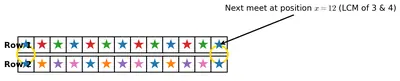
In the two rows below, colours repeat as shown. When will the blue stars meet next?
Figure
Figure

Solution

Read off the two rows carefully. The top row's colour pattern repeats every $$6$$ stars, with a blue star occurring once per cycle. The bottom row's pattern repeats every $$4$$ stars, again with one blue star per cycle. Both rows have their first blue star at the same starting column.

So in the top row, blue stars appear at columns $$4, 10, 16, 22, \ldots$$ (every $$6$$ steps).
In the bottom row, blue stars appear at columns $$4, 8, 12, 16, 20, \ldots$$ (every $$4$$ steps).

They meet again wherever a column is a common multiple of $$6$$ and $$4$$ apart from the first meeting. The next meeting is exactly $$\text{LCM}(6, 4)$$ columns after the first.

$$6 = 2 \times 3$$, $$4 = 2^2$$. $$\text{LCM}(6, 4) = 2^2 \times 3 = 12$$.

So the next meeting is $$12$$ columns after the first β€” i.e., at column $$4 + 12 = 16$$.

Answer

After a gap of $$\text{LCM}(6, 4) = 12$$ stars β€” at the $$16^{\text{th}}$$ column (the next common position after the initial one).

2 Answer the following:

(a) Is $$5 \times 7 \times 11 \times 11$$ a multiple of $$5 \times 7 \times 7 \times 11 \times 2$$?

Solution

Let $$A = 5 \times 7 \times 11 \times 11 = 5 \times 7 \times 11^2$$ and $$B = 5 \times 7 \times 7 \times 11 \times 2 = 2 \times 5 \times 7^2 \times 11$$.

$$A$$ is a multiple of $$B$$ iff every prime in $$B$$ occurs in $$A$$ at least as many times.

Compare:

  • $$B$$ has one $$2$$; $$A$$ has no $$2$$. Fails already.
  • (Also: $$B$$ has two $$7$$s; $$A$$ has only one $$7$$.)

So $$A$$ is not a multiple of $$B$$.

Numerically: $$A = 4235$$, $$B = 5390$$; and $$A < B$$, so $$A$$ cannot be a positive multiple of $$B$$ at all.

Answer

No β€” $$A$$ is missing the factor $$2$$ that $$B$$ has, and has only one $$7$$ where $$B$$ has two.

(b) Is $$5 \times 7 \times 11 \times 11$$ a factor of $$5 \times 7 \times 7 \times 11 \times 2$$?

Solution

$$A = 5 \times 7 \times 11^2$$ is a factor of $$B = 2 \times 5 \times 7^2 \times 11$$ iff every prime in $$A$$ occurs in $$B$$ at least as many times.

Compare:

  • $$A$$ has two $$11$$s; $$B$$ has only one $$11$$. Fails.

So $$A$$ is not a factor of $$B$$.

Numerically: $$B \div A = 5390 \div 4235 = 14/11$$ β€” not a whole number.

Answer

No β€” $$A$$ has two $$11$$s but $$B$$ has only one, so $$A$$ cannot divide $$B$$.

3 Find the HCF and LCM of the following (state your answers in the form of prime factorisations):

(a) $$3 \times 3 \times 5 \times 7 \times 7$$ and $$12 \times 7 \times 11$$

Solution

Rewrite each number as a product of primes.

$$A = 3 \times 3 \times 5 \times 7 \times 7 = 3^2 \times 5 \times 7^2$$
$$B = 12 \times 7 \times 11 = 2^2 \times 3 \times 7 \times 11$$

HCF β€” common primes with smallest count. Common primes: $$3$$ (min count $$1$$) and $$7$$ (min count $$1$$).

$$\text{HCF} = 3 \times 7 = 21$$.

LCM β€” each prime with largest count.

$$\text{LCM} = 2^2 \times 3^2 \times 5 \times 7^2 \times 11$$.

Numerical value: $$4 \times 9 \times 5 \times 49 \times 11 = 97020$$.

Answer

$$\text{HCF} = 3 \times 7 = 21$$. $$\text{LCM} = 2^2 \times 3^2 \times 5 \times 7^2 \times 11 = 97020$$.

(b) 45 and 36

Solution

Prime factorise:

$$45 = 3^2 \times 5$$
$$36 = 2^2 \times 3^2$$

Common prime with smallest count: $$3^2$$.
$$\text{HCF} = 3^2 = 9$$.

Each prime with largest count: $$2^2, 3^2, 5$$.
$$\text{LCM} = 2^2 \times 3^2 \times 5 = 4 \times 9 \times 5 = 180$$.

Answer

$$\text{HCF} = 3^2 = 9$$. $$\text{LCM} = 2^2 \times 3^2 \times 5 = 180$$.

4 Find two numbers whose HCF is 1 and LCM is 66.

Solution

If HCF $$= 1$$, the two numbers $$a, b$$ are co-prime, and $$\text{HCF} \times \text{LCM} = a \times b$$ gives $$a \times b = 66$$.

Factor $$66 = 2 \times 3 \times 11$$. Split its primes into two co-prime groups:

  • $$1 \times 66 = 66$$ β€” pair $$(1, 66)$$, HCF $$= 1$$, LCM $$= 66$$. βœ“
  • $$2 \times 33 = 66$$ β€” pair $$(2, 33)$$, and $$33 = 3 \times 11$$ shares no prime with $$2$$. HCF $$= 1$$, LCM $$= 66$$. βœ“
  • $$3 \times 22 = 66$$ β€” pair $$(3, 22)$$, $$22 = 2 \times 11$$, coprime with $$3$$. HCF $$= 1$$, LCM $$= 66$$. βœ“
  • $$6 \times 11 = 66$$ β€” pair $$(6, 11)$$, $$6 = 2 \times 3$$, coprime with $$11$$. HCF $$= 1$$, LCM $$= 66$$. βœ“

Any of these pairs works. A common choice is $$\boxed{(6, 11)}$$.

Answer

Any of $$(1, 66), (2, 33), (3, 22), (6, 11)$$ works. For example, $$6$$ and $$11$$.

5 A cowherd took all his cows to graze in the fields. The cows came to a crossing with 3 gates. An equal number of cows passed through each gate. Later at another crossing with 5 gates again an equal number of cows passed through each gate. The same happened at the third crossing with 7 gates. If the cowherd had less than 200 cows, how many cows did he have? (Based on the folklore mathematics from Karnataka.)

Solution

Let $$N$$ be the number of cows. From the story:

  • $$3$$ divides $$N$$ (equal split across $$3$$ gates).
  • $$5$$ divides $$N$$ (equal split across $$5$$ gates).
  • $$7$$ divides $$N$$ (equal split across $$7$$ gates).

So $$N$$ must be a common multiple of $$3, 5, 7$$. The smallest is

$$\text{LCM}(3, 5, 7) = 3 \times 5 \times 7 = 105$$ (since the numbers are pairwise co-prime).

The multiples of $$105$$ less than $$200$$ are just $$105$$ ($$210 > 200$$).

So the cowherd had $$105$$ cows.

Answer

$$105$$ cows.

6 The length, width, and height of a box are 12 cm, 18 cm, and 36 cm respectively. Which of the following sized cubes can be packed in this box without leaving gaps?

(a) 9 cm

Solution

To pack cubes of side $$c$$ into a box of dimensions $$12 \times 18 \times 36$$ cm with no gaps, $$c$$ must divide each of $$12$$, $$18$$ and $$36$$.

Does $$9$$ divide $$12$$? $$12 \div 9 = 1.33\ldots$$ β€” no.

So cubes of side $$9$$ cm cannot fill the box exactly along the $$12$$ cm side.

Answer

No β€” $$9$$ does not divide $$12$$.

(b) 6 cm

Solution

Check: $$12 \div 6 = 2$$, $$18 \div 6 = 3$$, $$36 \div 6 = 6$$ β€” all whole numbers.

So $$6$$ cm cubes fit exactly. Total number $$= 2 \times 3 \times 6 = 36$$ cubes.

Answer

Yes β€” $$6$$ divides $$12$$, $$18$$ and $$36$$. ($$36$$ cubes fit.)

(c) 4 cm

Solution

Check: $$12 \div 4 = 3$$ (whole), but $$18 \div 4 = 4.5$$ β€” not whole.

So $$4$$ cm cubes cannot fill the box exactly along the $$18$$ cm side.

Answer

No β€” $$4$$ does not divide $$18$$.

(d) 3 cm

Solution

Check: $$12 \div 3 = 4$$, $$18 \div 3 = 6$$, $$36 \div 3 = 12$$ β€” all whole.

So $$3$$ cm cubes fit exactly. Total number $$= 4 \times 6 \times 12 = 288$$ cubes.

Answer

Yes β€” $$3$$ divides all three dimensions. ($$288$$ cubes fit.)

(e) 2 cm

Solution

Check: $$12 \div 2 = 6$$, $$18 \div 2 = 9$$, $$36 \div 2 = 18$$ β€” all whole.

So $$2$$ cm cubes fit exactly. Total number $$= 6 \times 9 \times 18 = 972$$ cubes.

Note: The valid cube sides are exactly the common factors of $$12, 18, 36$$. Since $$\text{HCF}(12, 18, 36) = 6$$, valid sides are $$1, 2, 3, 6$$ cm.

Answer

Yes β€” $$2$$ divides all three dimensions. ($$972$$ cubes fit.)

7 Among the numbers below, which is the largest number that perfectly divides both 306 and 36?

(a) 36

Solution

We need a number that divides both $$306$$ and $$36$$. Check $$36$$: it divides $$36$$ (obvious), but does it divide $$306$$? $$306 \div 36 = 8.5$$ β€” not a whole number.

So $$36$$ is not a common divisor.

Answer

No β€” $$36$$ does not divide $$306$$.

(b) 612

Solution

$$612 > 306$$, so $$612$$ cannot divide $$306$$ (a positive divisor of a number cannot exceed the number).

Answer

No β€” $$612 > 306$$ so it cannot divide $$306$$.

(c) 18

Solution

Check: $$306 \div 18 = 17$$ (whole) and $$36 \div 18 = 2$$ (whole). So $$18$$ divides both.

Is it the largest? Compute $$\text{HCF}(306, 36)$$.

$$306 = 2 \times 3^2 \times 17$$; $$36 = 2^2 \times 3^2$$. Common: $$2 \times 3^2 = 18$$.

So $$\text{HCF}(306, 36) = 18$$, and no larger common divisor exists.

Among the options, $$18$$ is the largest common divisor.

Answer

Yes β€” this is the largest common divisor. $$\text{HCF}(306, 36) = 18$$.

(d) 3

Solution

$$306 \div 3 = 102$$ and $$36 \div 3 = 12$$. So $$3$$ divides both β€” but $$3 < 18$$, so $$3$$ is not the largest such divisor.

Answer

$$3$$ divides both, but is not the largest (since $$18$$ also works).

(e) 2

Solution

$$306 \div 2 = 153$$ and $$36 \div 2 = 18$$. So $$2$$ divides both β€” but $$2 < 18$$, so it is not the largest.

Answer

$$2$$ divides both, but is not the largest.

(f) 360

Solution

$$360 > 306$$, so $$360$$ cannot divide $$306$$.

Answer

No β€” $$360 > 306$$ so it cannot divide $$306$$.

8 Find the smallest number that is divisible by 3, 4, 5 and 7, but leaves a remainder of 10 when divided by 11.

Solution

Any number divisible by all of $$3, 4, 5, 7$$ is a multiple of $$\text{LCM}(3, 4, 5, 7)$$. Since these are pairwise co-prime (except $$4$$, which shares nothing with $$3, 5, 7$$),

$$\text{LCM}(3, 4, 5, 7) = 3 \times 4 \times 5 \times 7 = 420$$.

So the number must be $$420k$$ for some positive integer $$k$$.

We also need $$420k$$ to leave remainder $$10$$ when divided by $$11$$.

First find $$420 \bmod 11$$: $$11 \times 38 = 418$$, so $$420 - 418 = 2$$. Hence $$420 \equiv 2 \pmod{11}$$, and $$420k \equiv 2k \pmod{11}$$.

We need $$2k \equiv 10 \pmod{11}$$. Try small $$k$$: $$k = 5$$ gives $$2 \times 5 = 10 \equiv 10 \pmod{11}$$. βœ“

Smallest number: $$420 \times 5 = 2100$$.

Verify: $$2100 \div 11 = 190$$ remainder $$10$$ (since $$11 \times 190 = 2090$$ and $$2100 - 2090 = 10$$). βœ“

Answer

$$2100$$.

9 Children are playing 'Fire in the Mountain'. When the number 6 was called out, no one got out. When the number 9 was called out, no one got out. But when the number 10 was called out, some people got out. How many children could have been playing initially?

(a) 72

Solution

In 'Fire in the Mountain', when a number $$k$$ is called out, children form groups of $$k$$; anyone left over is 'out'. So 'no one gets out on $$k$$' means $$k$$ divides $$N$$, and 'some get out on $$k$$' means $$k$$ does not divide $$N$$.

From the story: $$6 \mid N$$, $$9 \mid N$$, and $$10 \nmid N$$.

Check $$N = 72$$: $$72 \div 6 = 12$$ βœ“, $$72 \div 9 = 8$$ βœ“, $$72 \div 10 = 7.2$$ (not whole) βœ“.

So $$72$$ satisfies all conditions.

Answer

Possible β€” $$72$$ is divisible by $$6$$ and $$9$$ but not by $$10$$.

(b) 90

Solution

Check $$N = 90$$: $$90 \div 6 = 15$$ βœ“, $$90 \div 9 = 10$$ βœ“, $$90 \div 10 = 9$$ β€” whole, meaning no one should have got out on $$10$$. But some did get out.

So $$N = 90$$ contradicts the story.

Answer

Not possible β€” $$90$$ is divisible by $$10$$, so no one would have got out on $$10$$.

(c) 45

Solution

Check $$N = 45$$: $$45 \div 6 = 7.5$$ β€” not whole. So $$6$$ does not divide $$45$$, meaning some would have got out on $$6$$. That contradicts the story.

Answer

Not possible β€” $$45$$ is not divisible by $$6$$.

(d) 3

Solution

$$N = 3$$: only $$3$$ children β€” there aren't even $$6$$ to form a group. In particular $$6 \nmid 3$$ and $$9 \nmid 3$$, so many would have got out on $$6$$ or $$9$$. Contradicts the story.

Answer

Not possible β€” $$3$$ is not divisible by $$6$$ or $$9$$.

(e) 36

Solution

Check $$N = 36$$: $$36 \div 6 = 6$$ βœ“, $$36 \div 9 = 4$$ βœ“, $$36 \div 10 = 3.6$$ (not whole) βœ“.

So $$N = 36$$ satisfies all conditions.

Answer

Possible β€” $$36$$ is divisible by $$6$$ and $$9$$ but not by $$10$$.

(f) None of these

Solution

Since options (a) $$72$$ and (e) $$36$$ both satisfy the conditions, 'None of these' is not correct.

General valid $$N$$: multiples of $$\text{LCM}(6, 9) = 18$$ that are not multiples of $$10$$. So $$N \in \{18, 36, 54, 72, 108, 126, \ldots\}$$.

Answer

Not the right choice β€” both $$72$$ and $$36$$ work.

10 Tick the correct statement(s). The LCM of two different prime numbers ($$m, n$$) can be:

(a) Less than both numbers

Solution

If $$m$$ and $$n$$ are different primes, they share no common factor other than $$1$$, so $$\text{LCM}(m, n) = m \times n$$.

Since $$m, n \ge 2$$, $$m \times n \ge 2 \times 3 = 6$$ β€” and in general $$m \times n > m$$ and $$m \times n > n$$. So the LCM is never less than both.

Answer

False β€” the LCM cannot be less than both.

(b) In between the two numbers

Solution

$$\text{LCM}(m, n) = m \times n \ge $$ the larger of the two, so it is never strictly between them.

Answer

False β€” the LCM is never strictly between the two numbers.

(c) Greater than both numbers

Solution

Since $$\text{LCM}(m, n) = m \times n$$ and $$m, n \ge 2$$, we have $$m \times n > m$$ (multiply $$m$$ by $$n \ge 2$$) and similarly $$m \times n > n$$.

So the LCM is always greater than both numbers. True.

Answer

True β€” LCM $$= m \times n$$ is greater than both $$m$$ and $$n$$.

(d) Less than $$m \times n$$

Solution

$$\text{LCM}(m, n) = m \times n$$ (equal, not less), since two different primes are always co-prime.

Answer

False β€” the LCM equals $$m \times n$$, not less than it.

(e) Greater than $$m \times n$$

Solution

The LCM of any two positive numbers can never exceed their product, and for two different primes it equals $$m \times n$$. So the LCM is not greater than $$m \times n$$.

Answer

False β€” the LCM equals $$m \times n$$; it is never greater.

11 A dog is chasing a rabbit that has a head start of 150 feet. It jumps 9 feet every time the rabbit jumps 7 feet. In how many leaps does the dog catch up with the rabbit?

Solution

They leap at the same time: for every one leap the dog takes, the rabbit also takes one.

In one such pair of leaps, the dog covers $$9$$ ft while the rabbit only covers $$7$$ ft. So the dog closes the gap by $$9 - 7 = 2$$ ft per leap.

Initial gap $$= 150$$ ft. Number of leaps needed:

$$\dfrac{150}{2} = 75$$ leaps.

Verify: after $$75$$ leaps, the dog has moved $$75 \times 9 = 675$$ ft; the rabbit has moved $$75 \times 7 = 525$$ ft. Rabbit's total distance from dog's start $$= 150 + 525 = 675$$ ft. Both are at the same spot. βœ“

Answer

$$75$$ leaps.

12 What is the smallest number that is a multiple of 1, 2, 3, 4, 5, 6, 8, 9, 10? Do you remember the answer from Grade 6, Chapter 5?

Solution

The smallest common multiple is the LCM. Prime factorise each number:

$$1$$ β€” no primes.
$$2 = 2$$, $$3 = 3$$, $$4 = 2^2$$, $$5 = 5$$, $$6 = 2 \times 3$$, $$8 = 2^3$$, $$9 = 3^2$$, $$10 = 2 \times 5$$.

For each prime, take the highest power occurring in any of the numbers:

  • $$2^3$$ (from $$8$$)
  • $$3^2$$ (from $$9$$)
  • $$5^1$$ (from $$5$$ or $$10$$)

$$\text{LCM} = 2^3 \times 3^2 \times 5 = 8 \times 9 \times 5 = 360$$.

Check that $$360$$ is indeed a multiple of every number in the list: $$360 = 1 \times 360 = 2 \times 180 = 3 \times 120 = 4 \times 90 = 5 \times 72 = 6 \times 60 = 8 \times 45 = 9 \times 40 = 10 \times 36$$. βœ“

Answer

$$360$$.

13 Here is a problem posed by the ancient Indian Mathematician Mahaviracharya (850 C.E.). Add together $$\frac{8}{15}$$, $$\frac{1}{20}$$, $$\frac{7}{36}$$, $$\frac{11}{63}$$ and $$\frac{1}{21}$$. What do you get? How can we find this sum efficiently?

Solution

To add fractions with different denominators, use a common denominator. The most efficient choice is the LCM of all denominators.

Prime factorise each denominator:

$$15 = 3 \times 5$$
$$20 = 2^2 \times 5$$
$$36 = 2^2 \times 3^2$$
$$63 = 3^2 \times 7$$
$$21 = 3 \times 7$$

Highest power of each prime: $$2^2, 3^2, 5, 7$$.
$$\text{LCM} = 4 \times 9 \times 5 \times 7 = 1260$$.

Convert each fraction to denominator $$1260$$:

$$\dfrac{8}{15} = \dfrac{8 \times 84}{1260} = \dfrac{672}{1260}$$ (since $$1260 \div 15 = 84$$)
$$\dfrac{1}{20} = \dfrac{1 \times 63}{1260} = \dfrac{63}{1260}$$ (since $$1260 \div 20 = 63$$)
$$\dfrac{7}{36} = \dfrac{7 \times 35}{1260} = \dfrac{245}{1260}$$ (since $$1260 \div 36 = 35$$)
$$\dfrac{11}{63} = \dfrac{11 \times 20}{1260} = \dfrac{220}{1260}$$ (since $$1260 \div 63 = 20$$)
$$\dfrac{1}{21} = \dfrac{1 \times 60}{1260} = \dfrac{60}{1260}$$ (since $$1260 \div 21 = 60$$)

Add the numerators:

$$672 + 63 + 245 + 220 + 60 = 1260$$.

So the sum is $$\dfrac{1260}{1260} = 1$$.

The efficient trick: find the LCM of all denominators using prime factorisation once (rather than doing pairwise additions).

Answer

The sum is $$1$$. The efficient method is to use the LCM of all denominators ($$= 1260$$) as the common denominator.
NCERT Solutions for Class 7
Maths
NCERT Solutions for Class 7 Maths
Chapter-wise step-by-step
solutions with explanations
explore solutions Maths bg
Science
NCERT Solutions for Class 7 Science
Chapter-wise step-by-step
solutions with explanations
explore solutions Science bg

Frequently Asked Questions

50,000+ JEE Students Trusted Our Score Calculator

Predict your JEE Main percentile, rank & performance in seconds