 91- 6303239042


Intext Questions
Intext Q1 In the following figure, screws are placed above a scale. Measure them and write their length in the space provided.
Solution
Given. Four metal screws have been kept exactly above a metric scale graduated in centimetres (cm) and millimetres (mm). Their left-hand (head) ends are made to coincide with the zero mark of the scale. We have to read the marking that comes just under the right-hand (tip) end of each screw and express the distance from 0 cm to that mark.
Recall that
- 1 cm = 10 mm, so one small division on the centimetre ruler represents $$0.1\text{ cm}=1\text{ mm}$$.
- While writing the reading, the part on the left of the decimal point gives the whole centimetres and the single digit on the right of the point gives the additional millimetres counted in tens.
Now we read each screw one by one.
- Screw A
The tip is exactly over 3 cm 6 mm mark. Therefore
$$\text{Length of screw A}=3\;\text{cm}+6\;\text{mm}=3\;\text{cm}+0.6\;\text{cm}=\boldsymbol{3.6\;\text{cm}}.$$ - Screw B
The tip is exactly over 4 cm 2 mm mark. Hence
$$\text{Length of screw B}=4\;\text{cm}+2\;\text{mm}=4\;\text{cm}+0.2\;\text{cm}=\boldsymbol{4.2\;\text{cm}}.$$ - Screw C
The tip is exactly over 4 cm 9 mm mark. Thus
$$\text{Length of screw C}=4\;\text{cm}+9\;\text{mm}=4\;\text{cm}+0.9\;\text{cm}=\boldsymbol{4.9\;\text{cm}}.$$ - Screw D
The tip is exactly over 5 cm 4 mm mark. Consequently
$$\text{Length of screw D}=5\;\text{cm}+4\;\text{mm}=5\;\text{cm}+0.4\;\text{cm}=\boldsymbol{5.4\;\text{cm}}.$$
Hence the measured lengths, expressed in centimetres with one decimal place, are written alongside the screws as required.
Answer
- Screw A : $$3.6\,\text{cm}$$
- Screw B : $$4.2\,\text{cm}$$
- Screw C : $$4.9\,\text{cm}$$
- Screw D : $$5.4\,\text{cm}$$
Intext Q2 Which scale helped you measure the length of the screws accurately? Why?
Solution
To find out why one scale gives a better reading than the other, recall the idea of least count – the length represented by the smallest division marked on the scale.
Scale I (ordinary ruler)
- Only whole-centimetre marks are shown: 0 cm, 1 cm, 2 cm, …
- Smallest division = $$1\;\text{cm}$$
Scale II (the detailed ruler)
- Each centimetre is further split into 10 equal parts (millimetres).
- Smallest division = $$1\;\text{mm}=0.1\;\text{cm}$$
Suppose the actual length of a screw is $$3.7\;\text{cm}$$.
| Using Scale I | Using Scale II |
|---|---|
| The reading lies between 3 cm and 4 cm. We can only guess the fractional part. | The pointer exactly reaches the 7th millimetre after the 3 cm mark. Reading = $$3\;\text{cm}+7\times0.1\;\text{cm}=3.7\;\text{cm}$$ (no guessing). |
Because Scale II has a least count of $$0.1\;\text{cm}$$, which is ten times smaller than the $$1\;\text{cm}$$ least count of Scale I, it can record one more digit after the decimal point. That extra place value makes the measurement more precise.
Therefore, the scale with millimetre (0.1 cm) markings helped you measure the length of the screws accurately, because its smaller least count allows finer and more reliable readings.
Answer
The ruler that is marked in millimetres (each small division = 0.1 cm) gives the accurate measurement, because its smaller least count lets you read one extra digit after the decimal point and therefore measure the screw length more precisely.
Intext Q3 What is the meaning of $$2\frac{7}{10}$$ cm (the length of the first screw)?
Solution
We read the symbol $$2\frac{7}{10}\;\text{cm}$$ as a mixed fraction.
A mixed fraction always has two parts:
- An integer part, written in front, which tells how many whole units we have.
- A fractional part, written after it, which tells the part of the next unit that is added on.
In $$2\frac{7}{10}\;\text{cm}$$:
- The integer part is $$2$$. So we already have $$2$$ whole centimetres.
- The fractional part is $$\frac{7}{10}$$. This means seven out of ten equal parts of one centimetre, i.e. seven-tenths of a centimetre.
Putting the two pieces together, $$2\frac{7}{10}\;\text{cm}$$ literally means
$$2\;\text{cm} + \frac{7}{10}\;\text{cm}.$$ Because $$\frac{7}{10} = 0.7,$$ the total length can also be written as $$2.7\;\text{cm}.$$
Therefore, the length of the first screw is two centimetres and seven-tenths of a centimetre, that is $$2.7\;\text{cm}.$
Answer
It means a length of two centimetres and seven-tenths of a centimetre, i.e. $$2.7\;\text{cm}.$$
Intext Q4 Can you explain why the unit was divided into smaller parts to measure the screws?
Solution
To understand the need for splitting a unit into tinier pieces, recall what a unit does:
- It is a fixed “one-whole” with which every measurement is compared.
- If the object is much smaller than that whole, simply counting how many wholes fit into it gives a useless answer (normally zero!).
A common wooden screw you use at home is only a few millimetres long. Compare that with the metre (or even a centimetre) on your ruler:
- Length of a metre scale: $$1 \text{ m}=100 \text{ cm}=1000 \text{ mm}$$
- Length of an ordinary screw: about $$3 \text{ cm}=30 \text{ mm}$$ or even smaller.
If we try to measure the screw directly in metres, we would get
\[\text{Length}=0.03\;\text{m}\]
Reading or marking three-hundredths of a metre on an ordinary metre scale is impossible: the mark would lie between the first and second centimetre divisions.
Therefore, we break the unit again and again:
- First, divide the metre into $$100$$ equal parts: each part is a centimetre.
- If the centimetre is still too big, divide it into $$10$$ equal parts: each part is a millimetre.
- Each step creates a smaller piece that can match the size of what we are measuring.
Only after these subdivisions do we obtain millimetre marks that line up neatly with the end of the screw. Thus, the unit is divided into smaller parts so that
- the scale can show marks that are close enough together,
- we can match one of those marks to the exact end of the small object, and
- we can write the measurement conveniently using decimals, e.g. $$3.7\;\text{cm}=37\;\text{mm}$$.
Without such subdivisions, every length shorter than a full centimetre (or metre) would have to be written as a fraction like $$\tfrac{3}{100}\;\text{m}$$, which is hard to mark and read. Dividing the unit therefore gives the precision and clarity needed for objects as tiny as screws.
Answer
The unit (metre or centimetre) was divided into still smaller parts so that its marks lie close enough together to line up exactly with the tiny length of a screw; only after subdividing into millimetres (or further) can we read such small lengths accurately and conveniently.
Intext Q5
Solution
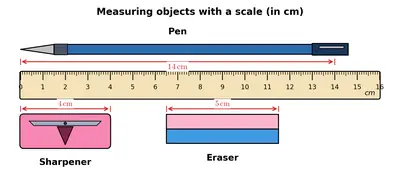
Step 1 : Collect the objects and a 15 cm plastic scale
- Pen
- Sharpener
- Eraser (chosen as the “any other object”)
- 15 cm ruler marked in centimetres (cm) and millimetres (mm = $$0.1\text{ cm}$$)
Step 2 : Recall the correct way to read a ruler
- Always keep the object’s left-hand end exactly at the $$0$$ mark of the ruler, not at the edge of the plastic.
- Make sure your eye is vertically above the reading point to avoid parallax error.
- The centimetre number gives the whole centimetres; the small division lines (10 per centimetre) give the millimetres. Each millimetre is $$1\text{ mm}=0.1\text{ cm}$$.
Step 3 : Measure each object
| Object | Position of left end | Position of right end | Calculation of length | Length written in cm |
|---|---|---|---|---|
| Pen | $$0\text{ cm}$$ | The mark between $$14\text{ cm}$$ and $$15\text{ cm}$$ that is 2 small divisions past $$14$$ | $$14\text{ cm}+2\times0.1\text{ cm}=14.2\text{ cm}$$ | $$14.2\text{ cm}$$ |
| Sharpener | $$0\text{ cm}$$ | The mark half-way between $$3\text{ cm}$$ and $$4\text{ cm}$$ (i.e. 5 mm past $$3$$) | $$3\text{ cm}+5\times0.1\text{ cm}=3.5\text{ cm}$$ | $$3.5\text{ cm}$$ |
| Eraser | $$0\text{ cm}$$ | The mark 3 small divisions past $$4\text{ cm}$$ | $$4\text{ cm}+3\times0.1\text{ cm}=4.3\text{ cm}$$ | $$4.3\text{ cm}$$ |
Step 4 : Write the result in a sentence
The length of the pen is $$14.2\text{ cm}$$, the length of the sharpener is $$3.5\text{ cm}$$ and the length of the eraser is $$4.3\text{ cm}$$.
Answer
Pen : $$14.2\text{ cm}$$
Sharpener : $$3.5\text{ cm}$$
Eraser : $$4.3\text{ cm}$$
Intext Q6 Write the measurements of the objects shown in the picture (an eraser, a pencil and a piece of chalk, each placed above a scale).
Solution
Step 1 : How to read a ruler with centimetres and millimetres
- The long numbered marks are centimetres (cm).
- The ten short un–numbered divisions between any two consecutive centimetre marks are millimetres (mm).
- Because $$10\text{ mm}=1\text{ cm}$$, every millimetre is $$\dfrac{1}{10}\text{ cm}=0.1\text{ cm}$$.
Whenever an object is kept with one end at the zero mark, the reading at its other end gives the length directly.
Step 2 : Measuring the eraser
- The right-hand end of the eraser coincides with the mark between $$4\text{ cm}$$ and $$5\text{ cm}$$.
- It is three small (millimetre) divisions past the $$4\text{ cm}$$ mark, i.e. $$3\text{ mm}=0.3\text{ cm}$$.
Hence,
\[\text{Length of eraser}=4\text{ cm}+0.3\text{ cm}=4.3\text{ cm}\]
Step 3 : Measuring the pencil
- The right-hand end of the pencil is two small divisions beyond the $$7\text{ cm}$$ mark.
- Those two divisions represent $$2\text{ mm}=0.2\text{ cm}$$.
Thus,
\[\text{Length of pencil}=7\text{ cm}+0.2\text{ cm}=7.2\text{ cm}\]
Step 4 : Measuring the piece of chalk
- The chalk ends eight small divisions after the $$5\text{ cm}$$ mark.
- Eight millimetres equal $$8\text{ mm}=0.8\text{ cm}$$.
Therefore,
\[\text{Length of chalk}=5\text{ cm}+0.8\text{ cm}=5.8\text{ cm}\]
Conclusion
| Object | Length |
|---|---|
| Eraser | $$4.3\text{ cm}$$ |
| Pencil | $$7.2\text{ cm}$$ |
| Piece of chalk | $$5.8\text{ cm}$$ |
Answer
Eraser = $$4.3\text{ cm}$$; Pencil = $$7.2\text{ cm}$$; Chalk = $$5.8\text{ cm}$$
Intext Q7
For the objects shown below, write their lengths in two ways and read them aloud. An example is given for the USB cable. (Note that the unit length used in each diagram is not the same.)
The length of the USB cable is $$4\frac{8}{10}$$ units or $$\frac{48}{10}$$ units. Write similar measurements for the pencil box, the closed fist (palm width), and the leaf shown in the picture.
Solution
Step 1 – Understand the scale in each drawing
Just as the USB–cable picture had ten equal little parts in every 1-unit strip, the other three drawings are also divided into ten equal parts for every full unit shown. One small division therefore represents the fraction $$\tfrac1{10}$$ of a unit (one-tenth of a unit).
Step 2 – Measure the pencil box
- Full 1-unit segments counted = 5
- Extra small divisions beyond the fifth unit = 2
Hence length = $$5+\tfrac{2}{10}=5\tfrac{2}{10}$$ units.
Change to a single (improper) fraction:
$$5\tfrac{2}{10}=\frac{5\times10+2}{10}=\frac{52}{10}$$ units.
Read aloud: “five and two-tenths units” or “fifty-two tenths of a unit”.
Step 3 – Measure the closed fist (palm width)
- Full 1-unit segments counted = 3
- Extra small divisions beyond the third unit = 5
Length = $$3+\tfrac{5}{10}=3\tfrac{5}{10}$$ units.
As an improper fraction:
$$3\tfrac{5}{10}=\frac{3\times10+5}{10}=\frac{35}{10}$$ units.
Read aloud: “three and five-tenths units” or “thirty-five tenths of a unit”.
Step 4 – Measure the leaf
- Full 1-unit segments counted = 2
- Extra small divisions beyond the second unit = 7
Length = $$2+\tfrac{7}{10}=2\tfrac{7}{10}$$ units.
As an improper fraction:
$$2\tfrac{7}{10}=\frac{2\times10+7}{10}=\frac{27}{10}$$ units.
Read aloud: “two and seven-tenths units” or “twenty-seven tenths of a unit”.
Summary of the two equivalent forms
| Object | Mixed number form | Improper fraction form |
|---|---|---|
| Pencil box | $$5\tfrac{2}{10}$$ | $$\tfrac{52}{10}$$ |
| Closed fist | $$3\tfrac{5}{10}$$ | $$\tfrac{35}{10}$$ |
| Leaf | $$2\tfrac{7}{10}$$ | $$\tfrac{27}{10}$$ |
Each answer is now written in the two ways required and can be read correctly using the language of tenths.
Answer
Pencil box = $$5\frac{2}{10}=\frac{52}{10}$$ units
Closed fist = $$3\frac{5}{10}=\frac{35}{10}$$ units
Leaf = $$2\frac{7}{10}=\frac{27}{10}$$ units
Intext Q8
Arrange these lengths in increasing order:
(a) $$\frac{9}{10}$$ (b) $$1\frac{7}{10}$$ (c) $$\frac{130}{10}$$ (d) $$13\frac{1}{10}$$ (e) $$10\frac{5}{10}$$ (f) $$7\frac{6}{10}$$ (g) $$6\frac{7}{10}$$ (h) $$\frac{4}{10}$$
Solution
Given lengths
- (a) $$\dfrac{9}{10}$$
- (b) $$1\dfrac{7}{10}$$
- (c) $$\dfrac{130}{10}$$
- (d) $$13\dfrac{1}{10}$$
- (e) $$10\dfrac{5}{10}$$
- (f) $$7\dfrac{6}{10}$$
- (g) $$6\dfrac{7}{10}$$
- (h) $$\dfrac{4}{10}$$
Step 1 — Express every mixed number as an improper fraction with the same denominator 10.
| Original form | Calculation | Improper fraction |
|---|---|---|
| (a) $$\dfrac{9}{10}$$ | already a fraction | $$\dfrac{9}{10}$$ |
| (b) $$1\dfrac{7}{10}$$ | $$1\times10+7=17$$ | $$\dfrac{17}{10}$$ |
| (c) $$\dfrac{130}{10}$$ | already a fraction | $$\dfrac{130}{10}$$ |
| (d) $$13\dfrac{1}{10}$$ | $$13\times10+1=131$$ | $$\dfrac{131}{10}$$ |
| (e) $$10\dfrac{5}{10}$$ | $$10\times10+5=105$$ | $$\dfrac{105}{10}$$ |
| (f) $$7\dfrac{6}{10}$$ | $$7\times10+6=76$$ | $$\dfrac{76}{10}$$ |
| (g) $$6\dfrac{7}{10}$$ | $$6\times10+7=67$$ | $$\dfrac{67}{10}$$ |
| (h) $$\dfrac{4}{10}$$ | already a fraction | $$\dfrac{4}{10}$$ |
Step 2 — Compare the numerators.
Because every fraction now has the same denominator 10, the one with the smaller numerator represents the shorter length. The list of numerators is:
$$9,\;17,\;130,\;131,\;105,\;76,\;67,\;4.$$
Arranging these in increasing order gives:
\[4 \lt 9 \lt 17 \lt 67 \lt 76 \lt 105 \lt 130 \lt 131.\]Step 3 — Rewrite the corresponding lengths.
- (h) $$\dfrac{4}{10}$$
- (a) $$\dfrac{9}{10}$$
- (b) $$1\dfrac{7}{10}$$
- (g) $$6\dfrac{7}{10}$$
- (f) $$7\dfrac{6}{10}$$
- (e) $$10\dfrac{5}{10}$$
- (c) $$\dfrac{130}{10}$$
- (d) $$13\dfrac{1}{10}$$
Step 4 — Check by writing them as decimals (optional).
\[0.4 \lt 0.9 \lt 1.7 \lt 6.7 \lt 7.6 \lt 10.5 \lt 13.0 \lt 13.1.\]Therefore, the lengths in increasing order are:
\[\frac{4}{10} \lt \frac{9}{10} \lt 1\frac{7}{10} \lt 6\frac{7}{10} \lt 7\frac{6}{10} \lt 10\frac{5}{10} \lt \frac{130}{10} \lt 13\frac{1}{10}.\]Answer
Increasing order: $$\dfrac{4}{10},\;\dfrac{9}{10},\;1\dfrac{7}{10},\;6\dfrac{7}{10},\;7\dfrac{6}{10},\;10\dfrac{5}{10},\;\dfrac{130}{10},\;13\dfrac{1}{10}$$.
Intext Q9 Arrange the following lengths in increasing order: $$4\frac{1}{10}, \frac{4}{10}, \frac{41}{10}, 41\frac{1}{10}$$.
Solution
Given lengths: $$4\frac{1}{10},\;\dfrac{4}{10},\;\dfrac{41}{10},\;41\frac{1}{10}$$.
Step 1 — Convert every length to the same form.
- $$4\frac{1}{10}=\dfrac{4\times10+1}{10}=\dfrac{41}{10}$$.
- $$41\frac{1}{10}=\dfrac{41\times10+1}{10}=\dfrac{411}{10}$$.
- The other two numbers are already fractions with denominator 10: $$\dfrac{4}{10},\;\dfrac{41}{10}$$.
So, expressed with the common denominator 10, the four lengths are:
\[\dfrac{4}{10},\;\dfrac{41}{10},\;\dfrac{41}{10},\;\dfrac{411}{10}.\]Step 2 — Compare the numerators (because the denominators are equal).
The numerators are 4, 41, 41 and 411. Arranged in increasing order:
\[4 \;\lt\; 41 \;=\; 41 \;\lt\; 411.\]Hence the corresponding fractions satisfy
\[\dfrac{4}{10} \;\lt\; \dfrac{41}{10} \;=\; \dfrac{41}{10} \;\lt\; \dfrac{411}{10}.\]Step 3 — Write the original numbers in the corresponding order.
Increasing order:
\[\dfrac{4}{10} \;\lt\; 4\frac{1}{10} \;=\; \dfrac{41}{10} \;\lt\; 41\frac{1}{10}.\](Both $$4\frac{1}{10}$$ and $$\dfrac{41}{10}$$ represent the same length, so they appear together.)
Answer
$$\dfrac{4}{10},\;4\dfrac{1}{10},\;\dfrac{41}{10},\;41\dfrac{1}{10}$$.
Intext Q10
The lengths of the body parts of a honeybee are given. Find its total length.
- Head: $$2\frac{3}{10}$$ units
- Thorax: $$5\frac{4}{10}$$ units
- Abdomen: $$7\frac{5}{10}$$ units
Solution
Given
- Head length $$= 2\frac{3}{10}$$ units
- Thorax length $$= 5\frac{4}{10}$$ units
- Abdomen length $$= 7\frac{5}{10}$$ units
We have to find the total length of the honeybee.
Method 1: Add the mixed numbers directly
Step 1: Add the fractional parts.
$$\frac{3}{10}+\frac{4}{10}+\frac{5}{10}=\frac{12}{10}=1\frac{2}{10}$$
Step 2: Add the whole-number parts and include the extra 1 just obtained.
Whole parts $$=2+5+7=14$$
Total length $$=14+1\frac{2}{10}=15\frac{2}{10}$$
Step 3: Simplify $$\frac{2}{10}$$ by dividing top and bottom by 2:
$$\frac{2}{10}=\frac{1}{5}$$
Hence
\[\text{Total length}=15\frac{1}{5}\;\text{units}\]
In decimal form this is
$$15\frac{1}{5}=15.2$$
Method 2: Work with improper fractions
| Body part | Mixed form | Improper fraction |
|---|---|---|
| Head | $$2\frac{3}{10}$$ | $$\dfrac{(2\times10)+3}{10}=\dfrac{23}{10}$$ |
| Thorax | $$5\frac{4}{10}$$ | $$\dfrac{(5\times10)+4}{10}=\dfrac{54}{10}$$ |
| Abdomen | $$7\frac{5}{10}$$ | $$\dfrac{(7\times10)+5}{10}=\dfrac{75}{10}$$ |
Add them (same denominator 10):
$$\dfrac{23}{10}+\dfrac{54}{10}+\dfrac{75}{10}=\dfrac{23+54+75}{10}=\dfrac{152}{10}$$
Convert back to a mixed number:
$$\dfrac{152}{10}=15\dfrac{2}{10}=15\dfrac{1}{5}=15.2$$
Therefore, the total length of the honeybee is $$15.2$$ units (that is, $$15\dfrac{1}{5}$$ units).
Answer
$$15.2\text{ units}\;(=15\dfrac{1}{5}\text{ units})$$
Intext Q11
Solution
We are told:
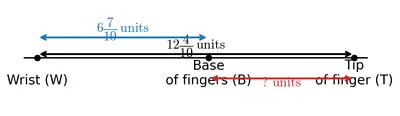
- Total length of Shylaja’s hand (from wrist to the tip of the middle finger) = $$12\frac{4}{10}$$ units.
- Length of Shylaja’s palm (from wrist to the base of the fingers) = $$6\frac{7}{10}$$ units.
The longest (middle) finger is the part of the hand that lies beyond the palm, so
Finger length = Hand length − Palm length
Both measurements are already given in tenths, i.e. as decimals:
- Hand length = $$12.4$$ units
- Palm length = $$6.7$$ units
Setting up the subtraction (lining up decimal points):
| $$12.4$$ |
| − $$6.7$$ |
| ─────── |
To avoid confusion, write one extra zero so both numbers have two decimal places:
$$12.4 = 12.40, \quad 6.7 = 6.70$$
- Hundredths: $$0-0=0$$
- Tenths: We need $$4-7$$, impossible without borrowing, so borrow 1 whole (10 tenths) from the units column: $$14-7=7$$ tenths
- Units: After borrowing, $$11-6=5$$ units
Thus the result is $$5.70$$, which is simply $$5.7$$.
Therefore,
Shylaja’s longest finger measures $$5\frac{7}{10}$$ units.
Answer
$$5\frac{7}{10}$$ units
Intext Q12 Try computing the difference by converting both lengths to tenths.
Solution
Let the two lengths given in the textbook be
$$\ell_1 = 3.659\,\text{m}$$
$$\ell_2 = 1.74\,\text{m}$$
We have to find their difference by first changing both the measurements to tenths of a metre; “tenths of a metre” are called decimetres (dm).
Step 1 — Write every length in decimetres.
The conversion factor is
$$1\,\text{dm}=0.1\,\text{m}\;\;(\text{or }1\,\text{m}=10\,\text{dm}).$$
- For $$\ell_1$$:
$$3.659\,\text{m}=3.659\times10\,\text{dm}=36.59\,\text{dm}.$$ - For $$\ell_2$$:
$$1.74\,\text{m}=1.74\times10\,\text{dm}=17.4\,\text{dm}.$$
Notice that after the conversion both numbers now have at most one place after the decimal, so subtracting will not involve any awkward borrowing across many decimal places.
Step 2 — Subtract the two decimetre measures.
Align both numbers as ordinary decimals and subtract:
\[36.59\,\text{dm}-17.40\,\text{dm}=19.19\,\text{dm}.\]
Step 3 — Convert the answer back to metres (optional).
Because $$10\,\text{dm}=1\,\text{m},$$ divide by 10:
$$19.19\,\text{dm}=\frac{19.19}{10}\,\text{m}=1.919\,\text{m}.$$
Conclusion. Whether you keep the result in decimetres or change it back to metres, the difference between the two given lengths is
\[\boxed{19.19\,\text{dm}=1.919\,\text{m}}.\]
Thus, converting every measurement to tenths first makes the subtraction a straightforward whole-number calculation and produces exactly the same numerical difference as the direct method.
Answer
The difference is
\[19.19\,\text{dm}=1.919\,\text{m}.\]
Intext Q13 A Celestial Pearl Danio's length is $$2\frac{4}{10}$$ cm, and the length of a Philippine Goby is $$\frac{9}{10}$$ cm. What is the difference in their lengths?
Solution
We want the difference (larger length − smaller length).
Step 1 — Write every length with the same kind of number.
The fractional parts have denominator 10, so we keep that denominator.
- Celestial Pearl Danio: $$2\frac{4}{10}=2+\frac{4}{10}$$
- Philippine Goby: $$\frac{9}{10}$$
Step 2 — Change the mixed number into an improper fraction.
First write the whole 2 using denominator 10:
$$2 = 2 \times \frac{10}{10}=\frac{20}{10}.$$
Add the fractional part:
$$\frac{20}{10}+\frac{4}{10}=\frac{24}{10}.$$
So, the Danio length is $$\dfrac{24}{10}\text{ cm}$$.
Step 3 — Subtract the two fractions (same denominator 10).
$$\frac{24}{10}-\frac{9}{10}=\frac{24-9}{10}=\frac{15}{10}.$$
Step 4 — Simplify the answer.
Divide numerator and denominator by 5:
$$\frac{15 \div 5}{10 \div 5}=\frac{3}{2}=1\frac{1}{2}.$$
In decimal form, the difference is 1.5 cm.
\[\text{Difference in lengths}=1\frac{1}{2}\,\text{cm}=1.5\,\text{cm}.\]Since $$1\,\text{cm}=10\,\text{mm}$$, we have $$1.5\,\text{cm}=15\,\text{mm}$$. Therefore, the Celestial Pearl Danio is 1 cm 5 mm (i.e. 15 mm, one and a half centimetres) longer than the Philippine Goby.
Answer
Difference in lengths = $$1\frac{1}{2}\,\text{cm}=1.5\,\text{cm}=15\,\text{mm}$$.
Intext Q14 How big are these fish compared to your finger?
Solution
Step 1 · Decide a unit for comparison
In the picture given in the book, your own finger is drawn once. We shall use the length of that drawn finger as one unit. Call it ‘‘1 finger–unit’’.
Step 2 · Measure the finger–unit with a ruler
Place a centimetre scale on the picture and note the length of the finger that has been printed.
Suppose the length you read is
$$l_f = 1.8\,\text{cm}$$
Step 3 · Measure each fish
Using the same centimetre scale, measure from the nose to the tail of every fish that is printed.
| Fish | Measured length (cm) |
|---|---|
| A | $$l_A = 2.1$$ |
| B | $$l_B = 4.2$$ |
| C | $$l_C = 6.6$$ |
| D | $$l_D = 9.0$$ |
(Your numbers may vary a little because the printing in every book is not exactly identical. That is perfectly all right; the method stays the same.)
Step 4 · Express each fish in finger–units
For each fish, divide its length by the finger–unit length:
For Fish A:
$$\text{Number of finger–units} = \frac{l_A}{l_f} = \frac{2.1}{1.8} = 1.166\ldots \approx 1.2$$
For Fish B:
$$\frac{l_B}{l_f} = \frac{4.2}{1.8} = 2.333\ldots \approx 2.3$$
For Fish C:
$$\frac{l_C}{l_f} = \frac{6.6}{1.8} = 3.666\ldots \approx 3.7$$
For Fish D:
$$\frac{l_D}{l_f} = \frac{9.0}{1.8} = 5.0$$
Step 5 · State the result clearly
The lengths of the four fish expressed in finger–units are therefore approximately
\[ \begin{aligned} \text{Fish A}&\;\approx\;1.2\;\text{fingers} \\ \text{Fish B}&\;\approx\;2.3\;\text{fingers} \\ \text{Fish C}&\;\approx\;3.7\;\text{fingers} \\ \text{Fish D}&\;=\;5\;\text{fingers} \end{aligned} \]So Fish D is the biggest (about five times the finger), while Fish A is the smallest (a little more than one finger). The comparison has been made in decimals, just as the chapter title “A Peek Beyond the Point” requires.
Answer
Approximate sizes (using the printed finger as one unit)
- Fish A ≈ 1.2 finger
- Fish B ≈ 2.3 fingers
- Fish C ≈ 3.7 fingers
- Fish D ≈ 5 fingers
Intext Q15 Observe the given sequences of numbers. Identify the change after each term and extend the pattern:
(a) $$4, \; 4\frac{3}{10}, \; 4\frac{6}{10}, \; \underline{\hspace{1em}}, \; \underline{\hspace{1em}}, \; \underline{\hspace{1em}}, \; \underline{\hspace{1em}}$$
Solution
Look at the first two jumps:
From $$4$$ to $$4\frac{3}{10}$$ the increase is $$4.3-4.0=0.3$$ (that is, $$\frac{3}{10}$$).
From $$4\frac{3}{10}$$ to $$4\frac{6}{10}$$ the increase is again $$4.6-4.3=0.3$$.
So add $$0.3$$ (or $$\frac{3}{10}$$) each time.
- Third–fourth term $$4.6+0.3=4.9=4\frac{9}{10}$$
- Fourth–fifth term $$4.9+0.3=5.2=5\frac{2}{10}$$
- Fifth–sixth term $$5.2+0.3=5.5=5\frac{5}{10}$$
- Sixth–seventh term $$5.5+0.3=5.8=5\frac{8}{10}$$
Answer
$$4\frac{9}{10},\;5\frac{2}{10},\;5\frac{5}{10},\;5\frac{8}{10}$$
(b) $$8\frac{2}{10}, \; 8\frac{7}{10}, \; 9\frac{2}{10}, \; \underline{\hspace{1em}}, \; \underline{\hspace{1em}}, \; \underline{\hspace{1em}}, \; \underline{\hspace{1em}}$$
Solution
Check the common change:
$$8\frac{7}{10}-8\frac{2}{10}=0.5$$ and $$9\frac{2}{10}-8\frac{7}{10}=0.5$$.
Hence we add $$0.5$$ (or $$\frac{5}{10}$$) each step.
- $$9\frac{2}{10}+0.5=9.7=9\frac{7}{10}$$
- $$9\frac{7}{10}+0.5=10.2=10\frac{2}{10}$$
- $$10\frac{2}{10}+0.5=10.7=10\frac{7}{10}$$
- $$10\frac{7}{10}+0.5=11.2=11\frac{2}{10}$$
Answer
$$9\frac{7}{10},\;10\frac{2}{10},\;10\frac{7}{10},\;11\frac{2}{10}$$
(c) $$7\frac{6}{10}, \; 8\frac{7}{10}, \; \underline{\hspace{1em}}, \; \underline{\hspace{1em}}, \; \underline{\hspace{1em}}, \; \underline{\hspace{1em}}$$
Solution
Find the first change:
$$8\frac{7}{10}-7\frac{6}{10}=1.1=\frac{11}{10}$$.
The rule is therefore add $$1.1$$ (or $$\frac{11}{10}$$) each time.
- $$8\frac{7}{10}+1.1=9.8=9\frac{8}{10}$$
- $$9\frac{8}{10}+1.1=10.9=10\frac{9}{10}$$
- $$10\frac{9}{10}+1.1=12.0=12$$
- $$12+1.1=13.1=13\frac{1}{10}$$
Answer
$$9\frac{8}{10},\;10\frac{9}{10},\;12,\;13\frac{1}{10}$$
(d) $$5\frac{7}{10}, \; 5\frac{3}{10}, \; \underline{\hspace{1em}}, \; \underline{\hspace{1em}}, \; \underline{\hspace{1em}}, \; \underline{\hspace{1em}}$$
Solution
First difference:
$$5\frac{3}{10}-5\frac{7}{10}=-0.4=-\frac{4}{10}$$.
So we subtract $$0.4$$ (or $$\frac{4}{10}$$) each step.
- $$5\frac{3}{10}-0.4=4.9=4\frac{9}{10}$$
- $$4\frac{9}{10}-0.4=4.5=4\frac{5}{10}$$
- $$4\frac{5}{10}-0.4=4.1=4\frac{1}{10}$$
- $$4\frac{1}{10}-0.4=3.7=3\frac{7}{10}$$
Answer
$$4\frac{9}{10},\;4\frac{5}{10},\;4\frac{1}{10},\;3\frac{7}{10}$$
(e) $$13\frac{5}{10}, \; 13, \; 12\frac{5}{10}, \; \underline{\hspace{1em}}, \; \underline{\hspace{1em}}, \; \underline{\hspace{1em}}, \; \underline{\hspace{1em}}$$
Solution
Find the common difference:
$$13-13\frac{5}{10}=-0.5\;\;\text{and}\;\;12\frac{5}{10}-13=-0.5$$.
Thus subtract $$0.5$$ (or $$\frac{5}{10}$$) each time.
- $$12\frac{5}{10}-0.5=12$$
- $$12-0.5=11.5=11\frac{5}{10}$$
- $$11\frac{5}{10}-0.5=11$$
- $$11-0.5=10.5=10\frac{5}{10}$$
Answer
$$12,\;11\frac{5}{10},\;11,\;10\frac{5}{10}$$
(f) $$11\frac{5}{10}, \; 10\frac{4}{10}, \; 9\frac{3}{10}, \; \underline{\hspace{1em}}, \; \underline{\hspace{1em}}, \; \underline{\hspace{1em}}, \; \underline{\hspace{1em}}$$
Solution
First jump:
$$10\frac{4}{10}-11\frac{5}{10}=-1.1=-\frac{11}{10}$$ and $$9\frac{3}{10}-10\frac{4}{10}=-1.1$$.
Hence we subtract $$1.1$$ (or $$\frac{11}{10}$$) each time.
- $$9\frac{3}{10}-1.1=8.2=8\frac{2}{10}$$
- $$8\frac{2}{10}-1.1=7.1=7\frac{1}{10}$$
- $$7\frac{1}{10}-1.1=6.0=6$$
- $$6-1.1=4.9=4\frac{9}{10}$$
Answer
$$8\frac{2}{10},\;7\frac{1}{10},\;6,\;4\frac{9}{10}$$
Intext Q16 What is the length of this smaller part? How many such smaller parts make a unit length?
Solution
A unit segment is first cut into 10 equal big parts.
Length of one big part = $$\frac{1}{10}$$ unit.
Each big part is again divided into 10 equal smaller parts, so the length of one smaller part is
\[ \frac{1}{10}\times\frac{1}{10}=\frac{1}{100}=0.01 \]
Hence the length of one smaller part = $$\frac{1}{100}$$ unit.
Number of such smaller parts needed to make one full unit:
\[ 1\div\frac{1}{100}=1\times100=100 \]
Therefore, 100 of these smaller parts together give exactly 1 unit length.
Answer
Length of each smaller part = $$\frac{1}{100}$$ unit.
100 such smaller parts make one unit length.
Intext Q17 How many one-hundredths make one-tenth? Can we also say that the length is 4 units and 45 one-hundredths?
Solution
Step 1 : What do the two words mean?
One-tenth is the fraction $$\frac{1}{10}$$.
One-hundredth is the fraction $$\frac{1}{100}$$.
Step 2 : Convert one-tenth into hundredths
Make the denominators the same by multiplying the numerator and denominator of $$\frac{1}{10}$$ by 10.
\[ \frac{1}{10}=\frac{1\times10}{10\times10}=\frac{10}{100} \]
The numerator 10 tells us that 10 copies of $$\frac{1}{100}$$ are exactly equal to one copy of $$\frac{1}{10}$$.
Therefore, 10 one-hundredths make one-tenth.
Step 3 : Interpreting the decimal 4.45
Write the decimal in expanded form:
\[ 4.45 = 4 + 0.45 \]
The decimal part is
$$0.45=\frac{45}{100}$$ (forty-five hundredths).
So
\[ 4.45 = 4 + \frac{45}{100} \]
This reads as “4 whole units and 45 one-hundredths of a unit.”
Conclusion
- Exactly 10 one-hundredths make one-tenth.
- Yes, we can say that a length of 4.45 units is “4 units and 45 one-hundredths.”
Answer
10 one-hundredths make one-tenth; and 4.45 units can indeed be read as “4 units and 45 one-hundredths.”
Intext Q18
Solution
Step 1 — Read the picture carefully
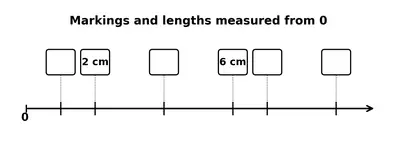
From the left–hand end the line starts at 0 and ends at 1. Between 0 and 1 the segment is split into ten equal parts (the 10 tiny marks we see).
Hence each small part represents the length obtained by dividing the unit length 1 by 10:
$$\text{length of one small part}=\dfrac{1}{10}=0.1$$
Step 2 — Assign a decimal to every tick-mark
| Number of small parts counted from 0 | Length from 0 |
|---|---|
| 1 | $$0+0.1=0.1$$ |
| 2 | $$0+2\times0.1=0.2$$ |
| 3 | $$0+3\times0.1=0.3$$ |
| 4 | $$0+4\times0.1=0.4$$ |
| 5 | $$0+5\times0.1=0.5$$ |
| 6 | $$0+6\times0.1=0.6$$ |
| 7 | $$0+7\times0.1=0.7$$ |
| 8 | $$0+8\times0.1=0.8$$ |
| 9 | $$0+9\times0.1=0.9$$ |
| 10 | $$0+10\times0.1=1.0$$ |
Step 3 — Copy the values into the boxes
The book had already written 0.3 and 0.9 in two of the boxes. We now fill the remaining eight boxes with the other numbers obtained in Step 2.
The completed list, in order from left to right, is:
$$0.1,\;0.2,\;0.3,\;0.4,\;0.5,\;0.6,\;0.7,\;0.8,\;0.9,\;1.0$$
Thus every empty box now shows the correct length measured from 0.
Answer
Fill the empty boxes with
$$0.1,\;0.2,\;0.4,\;0.5,\;0.6,\;0.7,\;0.8,\;1.0$$
Intext Q19 For the lengths shown below write the measurements and read out the measures in words.
Solution
Idea behind the reading
Every small division on a standard metric ruler is 1 mm. Since $$10\text{ mm}=1\text{ cm}$$, each millimetre represents $$\dfrac1{10}\text{ cm}=0.1\text{ cm}$$. Hence
$$\text{length (in cm)}=\text{whole-cm divisions}+\dfrac{\text{mm past that mark}}{10}.$$
We read the position of the right end of every segment exactly in this way.
(a)
- Right end: 5 mm beyond 7 cm.
- Whole centimetres $$=7$$
- Extra $$=5\text{ mm}=0.5\text{ cm}$$
In words: seven point five centimetres.
(b)
- Right end: 3 mm beyond 4 cm.
In words: four point three centimetres.
(c)
- Right end: 8 mm beyond 2 cm.
In words: two point eight centimetres.
(d)
- Right end exactly at 9 cm mark (0 mm extra).
In words: nine point zero centimetres (usually read simply as nine centimetres).
All the required measurements have thus been written in numerals and read out in words.
Answer
(a) $$7.5\text{ cm}$$ – seven point five centimetres
(b) $$4.3\text{ cm}$$ – four point three centimetres
(c) $$2.8\text{ cm}$$ – two point eight centimetres
(d) $$9.0\text{ cm}$$ – nine point zero centimetres
Intext Q20 In each group, identify the longest and the shortest lengths. Mark each length on the scale.
(a) $$\frac{3}{10}, \; \frac{3}{100}, \; \frac{33}{100}$$
Solution
Step 1 Write each length as a decimal having the same number of decimal places.
| Fraction given | Decimal form | Written with two decimal places |
|---|---|---|
| $$\dfrac{3}{10}$$ | $$0.3$$ | $$0.30$$ |
| $$\dfrac{3}{100}$$ | $$0.03$$ | $$0.03$$ |
| $$\dfrac{33}{100}$$ | $$0.33$$ | $$0.33$$ |
Step 2 Compare the numbers from the left.
$$0.03 \lt 0.30 \lt 0.33$$
Hence
Shortest length = $$0.03\;\text{cm}$$ (that is $$\dfrac{3}{100}\text{ cm}$$)
Longest length = $$0.33\;\text{cm}$$ (that is $$\dfrac{33}{100}\text{ cm}$$).
Marking on the scale
Draw a 1 cm number line and divide the first centimetre into 100 equal parts (hundredths). Mark the points 0.03, 0.30 and 0.33. The point 0.03 will be the nearest to zero, 0.30 at the 30-th hundredth, and 0.33 at the 33-rd hundredth.
Answer
Shortest = $$\dfrac{3}{100}$$, Longest = $$\dfrac{33}{100}$$
(b) $$3\frac{1}{10}, \; \frac{30}{10}, \; 1\frac{3}{10}$$
Solution
Convert each to a decimal.
| Length given | Decimal form |
|---|---|
| $$3\dfrac{1}{10}$$ | $$3+0.1=3.1$$ |
| $$\dfrac{30}{10}$$ | $$3.0$$ |
| $$1\dfrac{3}{10}$$ | $$1+0.3=1.3$$ |
Arrange them:
$$1.3 \lt 3.0 \lt 3.1$$
Shortest = $$1\dfrac{3}{10}\;(1.3\text{ cm})$$
Longest = $$3\dfrac{1}{10}\;(3.1\text{ cm})$$
Marking on the scale
Draw a number line from 0 cm to 4 cm. Mark 1.3 cm a little beyond 1 cm, 3 cm exactly at the 3-cm mark and 3.1 cm one-tenth beyond it.
Answer
Shortest = $$1\dfrac{3}{10}$$, Longest = $$3\dfrac{1}{10}$$
(c) $$\frac{45}{100}, \; \frac{54}{100}, \; 5\frac{5}{10}, \; \frac{4}{10}$$
Solution
Decimal equivalents:
| Length | Decimal |
|---|---|
| $$\dfrac{45}{100}$$ | $$0.45$$ |
| $$\dfrac{54}{100}$$ | $$0.54$$ |
| $$5\dfrac{5}{10}$$ | $$5+0.5=5.5$$ |
| $$\dfrac{4}{10}$$ | $$0.4$$ |
Order:
$$0.4 \lt 0.45 \lt 0.54 \lt 5.5$$
Shortest = $$\dfrac{4}{10}\;(0.4\text{ cm})$$
Longest = $$5\dfrac{5}{10}\;(5.5\text{ cm})$$
Marking on the scale
Draw one number line 0 cm to 1 cm and mark 0.40, 0.45, 0.54. Draw another from 5 cm to 6 cm and mark 5.5 cm halfway between 5 cm and 6 cm.
Answer
Shortest = $$\dfrac{4}{10}$$, Longest = $$5\dfrac{5}{10}$$
(d) $$3\frac{6}{10}, \; 3\frac{6}{100}, \; 3\frac{6}{10}\frac{6}{100}$$
Solution
Write each as a decimal.
| Length | Decimal |
|---|---|
| $$3\dfrac{6}{10}$$ | $$3.6$$ |
| $$3\dfrac{6}{100}$$ | $$3.06$$ |
| $$3\dfrac{6}{10}\dfrac{6}{100}$$ | $$3.66$$ |
Comparison:
$$3.06 \lt 3.6 \lt 3.66$$
Shortest = $$3\dfrac{6}{100}\;(3.06\text{ cm})$$
Longest = $$3\dfrac{6}{10}\dfrac{6}{100}\;(3.66\text{ cm})$$
Marking on the scale
Draw a number line from 3 cm to 4 cm and divide the centimetre into 100 equal parts (hundredths). Mark 3.06, 3.6 and 3.66 at their respective positions.
Answer
Shortest = $$3\dfrac{6}{100}$$, Longest = $$3\dfrac{6}{10}\dfrac{6}{100}$$
(e) $$\frac{8}{10}\frac{2}{100}, \; \frac{9}{100}, \; 1\frac{8}{100}$$
Solution
Convert to decimals.
| Length | Decimal |
|---|---|
| $$\dfrac{8}{10}\dfrac{2}{100}$$ | $$0.82$$ |
| $$\dfrac{9}{100}$$ | $$0.09$$ |
| $$1\dfrac{8}{100}$$ | $$1.08$$ |
Order:
$$0.09 \lt 0.82 \lt 1.08$$
Shortest = $$\dfrac{9}{100}\;(0.09\text{ cm})$$
Longest = $$1\dfrac{8}{100}\;(1.08\text{ cm})$$
Marking on the scale
First number line 0 cm–1 cm: mark 0.09 and 0.82. Second number line 1 cm–2 cm: mark 1.08.
Answer
Shortest = $$\dfrac{9}{100}$$, Longest = $$1\dfrac{8}{100}$$
(f) $$7\frac{3}{10}\frac{5}{100}, \; 7\frac{5}{10}, \; 7\frac{41}{100}$$
Solution
Decimal forms:
| Length | Decimal |
|---|---|
| $$7\dfrac{3}{10}\dfrac{5}{100}$$ | $$7.35$$ |
| $$7\dfrac{5}{10}$$ | $$7.5$$ |
| $$7\dfrac{41}{100}$$ | $$7.41$$ |
Arrange:
$$7.35 \lt 7.41 \lt 7.5$$
Shortest = $$7\dfrac{3}{10}\dfrac{5}{100}\;(7.35\text{ cm})$$
Longest = $$7\dfrac{5}{10}\;(7.5\text{ cm})$$
Marking on the scale
Draw a number line from 7 cm to 8 cm, divide it into hundredths and mark the three positions 7.35, 7.41 and 7.5.
Answer
Shortest = $$7\dfrac{3}{10}\dfrac{5}{100}$$, Longest = $$7\dfrac{5}{10}$$
(g) $$\frac{65}{10}\frac{15}{100}, \; 5\frac{87}{100}, \; 5\frac{7}{100}$$
Solution
Change to decimals.
| Length | Decimal |
|---|---|
| $$\dfrac{65}{10}\dfrac{15}{100}$$ | $$6.65$$ |
| $$5\dfrac{87}{100}$$ | $$5.87$$ |
| $$5\dfrac{7}{100}$$ | $$5.07$$ |
Order:
$$5.07 \lt 5.87 \lt 6.65$$
Shortest = $$5\dfrac{7}{100}\;(5.07\text{ cm})$$
Longest = $$\dfrac{65}{10}\dfrac{15}{100}\;(6.65\text{ cm})$$
Marking on the scale
Draw a number line from 5 cm to 7 cm, marked in hundredths. Plot 5.07 (just beyond 5 cm), 5.87 (near 6 cm) and 6.65 (past the 6.5 cm mark).
Answer
Shortest = $$5\dfrac{7}{100}$$, Longest = $$\dfrac{65}{10}\dfrac{15}{100}$$
Intext Q21 What will be the sum of $$15\frac{3}{10}\frac{4}{100}$$ and $$2\frac{6}{10}\frac{8}{100}$$?
Solution
Step 1 – Expand each mixed number
$$15\frac{3}{10}\frac{4}{100}=15+\frac{3}{10}+\frac{4}{100}$$
$$2\frac{6}{10}\frac{8}{100}=2+\frac{6}{10}+\frac{8}{100}$$
Step 2 – Express all fractions with denominator 100
- $$\frac{3}{10}=\frac{30}{100}$$
- $$\frac{4}{100}=\frac{4}{100}$$
- $$\frac{6}{10}=\frac{60}{100}$$
- $$\frac{8}{100}=\frac{8}{100}$$
Step 3 – Combine the fractional parts
First number: $$\frac{30}{100}+\frac{4}{100}=\frac{34}{100}\;\Rightarrow\;15\frac{34}{100}$$
Second number: $$\frac{60}{100}+\frac{8}{100}=\frac{68}{100}\;\Rightarrow\;2\frac{68}{100}$$
Step 4 – Add the mixed numbers
$$15\frac{34}{100}+2\frac{68}{100}=(15+2)+\frac{34+68}{100}=17+\frac{102}{100}$$
Step 5 – Convert the improper fraction
$$\frac{102}{100}=1+\frac{2}{100}$$
Thus, $$17+\frac{102}{100}=17+1+\frac{2}{100}=18\frac{2}{100}$$
Step 6 – Write as a decimal
$$\frac{2}{100}=0.02\;\Rightarrow\;18\frac{2}{100}=18.02$$
Therefore, the required sum is $$18.02$$.
Answer
$$18.02$$
Intext Q22 Are both these methods different?
Solution
Background given in the textbook
To multiply a decimal number by 10, 100, 1000, … the book shows two methods.
Method 1 (Fraction method)
Write the decimal as a fraction and then do ordinary whole-number multiplication.
Method 2 (Place-value or “shift” method)
Simply move the decimal point to the right by as many places as there are zeroes in 10, 100, 1000, … .
Example to compare the two methods
Let us multiply $$3.67$$ by $$100$$.
Method 1 (convert to a fraction)
$$3.67 = \frac{367}{100}$$
Now multiply by $$100$$:
$$3.67 \times 100 = \frac{367}{100} \times 100$$
Because $$100$$ in the numerator and denominator cancel, we get
\[3.67 \times 100 = 367\]Method 2 (shift the decimal point)
When we multiply by $$100$$ (two zeroes), we move the point two places to the right:
$$3.\!67 \xrightarrow[\times\,100]{} 367$$
Both methods give exactly the same answer, $$367$$.
Why do they coincide? A general argument
Take any decimal with $$n$$ places after the point; write it as
$$x = \frac{m}{10^{n}}\;,$$ where $$m$$ is a whole number.
Multiplying by $$10^{n}$$ by the fraction method gives
$$x \times 10^{n} = \frac{m}{10^{n}} \times 10^{n} = m.$$
In the place-value method multiplying by $$10^{n}$$ means shifting the point $$n$$ places to the right, which also produces the whole number $$m$$. Thus both approaches are identical in effect.
Conclusion
The two procedures are not mathematically different; Method 2 is merely a shortcut that follows directly from Method 1. Both always lead to the same result.
Answer
No. They are two equivalent ways of doing the same multiplication; they always give the same answer.
Intext Q23 Observe the addition done below for $$483 + 268$$. Do you see any similarities between the methods shown above? \[(400 + 80 + 3) + (200 + 60 + 8)\] \[= (400 + 200) + (80 + 60) + (3 + 8)\] \[= 600 + 140 + 11\] \[= 600 + 150 + 1\] \[= 700 + 50 + 1\] \[= 751\]
Solution
First write both numbers in expanded (place-value) form.
$$483 = 400 + 80 + 3, \qquad 268 = 200 + 60 + 8.$$
Add the corresponding place values:
\[\begin{aligned} (400+80+3) + (200+60+8) &= (400+200) + (80+60) + (3+8) \\ &= 600 + 140 + 11. \end{aligned}\]Regroup (carry) wherever a place value exceeds 9:
- The 11 ones consist of 10 ones (which is 1 ten) and 1 one left over.
So $$11 = 1\text{ ten}+1\text{ one} = 10+1$$. - Add the carried 1 ten to the 140 in the tens column. Since $$140 = 14\text{ tens}$$, after the carry we have $$14\text{ tens}+1\text{ ten}=15\text{ tens}=150$$.
Now $$150 = 1\text{ hundred}+5\text{ tens} = 100+50$$.
Putting these regroupings together:
$$600 + 140 + 11 = 600 + (100+40) + (10+1) = (600+100) + 50 + 1 = 700 + 50 + 1.$$
Thus
\[483 + 268 = 751.\]Comparing with the usual column (vertical) method
| Carry | 1 | 1 | |
| 4 | 8 | 3 | |
| + | 2 | 6 | 8 |
| 7 | 5 | 1 |
- Add ones: $$3+8=11$$ — write 1, carry 1 ten.
- Add tens: $$1+8+6=15$$ — write 5, carry 1 hundred.
- Add hundreds: $$1+4+2=7$$ — write 7.
The expanded-form method and the column method are therefore identical in spirit: both add ones first, then tens, then hundreds, and both use regrouping (carrying) whenever the total in a place value reaches 10 or more.
Answer
Yes. Both the expanded-form working and the ordinary column addition follow the same steps: add ones, regroup any extra ones as tens; add tens, regroup extra tens as hundreds; finally add hundreds. Both methods therefore give the same result $$751$$.
Intext Q24 What is the difference: $$25\frac{9}{10} - 6\frac{4}{10}\frac{7}{100}$$?
Solution
We are asked to find the difference
$$25\frac{9}{10}-6\frac{4}{10}\frac{7}{100}$$
A mixed decimal such as $$6\frac{4}{10}\frac{7}{100}$$ means
$$6+\frac{4}{10}+\frac{7}{100}$$
because the 4 is in the tenths place and the 7 is in the hundredths place.
Step 1 Make the denominations the same
For subtraction, it is convenient to express both numbers with hundredths as the smallest part.
- $$25\frac{9}{10}=25+\frac{9}{10}=25+\frac{90}{100}=25\frac{90}{100}$$
- $$6\frac{4}{10}\frac{7}{100}=6+\frac{40}{100}+\frac{7}{100}=6\frac{47}{100}$$
Step 2 Subtract the whole-number parts
Subtract the whole numbers first:
$$25-6=19$$
Step 3 Subtract the hundredths
Now subtract the fractional parts:
$$\frac{90}{100}-\frac{47}{100}=\frac{90-47}{100}=\frac{43}{100}$$
Step 4 Combine the results
Adding the results from Steps 2 and 3:
$$19+\frac{43}{100}=19\frac{43}{100}$$
Therefore,
\[25\frac{9}{10}-6\frac{4}{10}\frac{7}{100}=19\frac{43}{100}\]
We can also write the answer as the decimal $$19.43$$.
Answer
$$19\frac{43}{100}$$ (that is, $$19.43$$)
Intext Q25 Solve this by converting to hundredths.
Solution
Question. Solve $$1.5 + 3.04$$ by converting to hundredths.
Step 1 : Rewrite each number so that it shows hundredths
Hundredths means two places after the decimal point.
| Original number | Written to hundredths |
|---|---|
| $$1.5$$ | $$1.50$$ (added one zero) |
| $$3.04$$ | $$3.04$$ (already in hundredths) |
Step 2 : Add the like decimals
\[ \begin{aligned} &1.50\\[2pt] + &3.04\\ \hline &4.54 \end{aligned} \]Step 3 : Write the final result
The sum is $$4.54$$.
Answer
$$4.54$$
Intext Q26 What is the difference $$15\frac{3}{10}\frac{4}{100} - 2\frac{6}{10}\frac{8}{100}$$?
Solution
We have to subtract two mixed numbers whose fractional parts are given in tenths and hundredths.
First write each mixed number as a single fraction. Begin with the minuend:
$$15\frac{3}{10}\frac{4}{100}=15+\frac{3}{10}+\frac{4}{100}.$$
Convert the tenths to hundredths so that all fractions have the same denominator:
$$\frac{3}{10}=\frac{3\times10}{10\times10}=\frac{30}{100}.$$
Now add the two fractions:
$$\frac{30}{100}+\frac{4}{100}=\frac{34}{100}.$$
Thus
$$15\frac{3}{10}\frac{4}{100}=15+\frac{34}{100}=\frac{1500}{100}+\frac{34}{100}=\frac{1534}{100}.$$
Next, treat the subtrahend in the same way:
$$2\frac{6}{10}\frac{8}{100}=2+\frac{6}{10}+\frac{8}{100}.$$
Convert $$\frac{6}{10}$$ to hundredths:
$$\frac{6}{10}=\frac{6\times10}{10\times10}=\frac{60}{100}.$$
Add the two fractions:
$$\frac{60}{100}+\frac{8}{100}=\frac{68}{100}.$$
Therefore,
$$2\frac{6}{10}\frac{8}{100}=2+\frac{68}{100}=\frac{200}{100}+\frac{68}{100}=\frac{268}{100}.$$
Because both numbers are now over the same denominator $$100$$, we can subtract them directly:
$$15\frac{3}{10}\frac{4}{100}-2\frac{6}{10}\frac{8}{100}=\frac{1534}{100}-\frac{268}{100}=\frac{1534-268}{100}.$$
Compute the numerator:
$$1534-268=1266.$$
So the difference is
$$\frac{1266}{100}.$$
Write this improper fraction back as a mixed number (or a decimal):
$$\frac{1266}{100}=12+\frac{66}{100}=12.66=12\frac{66}{100}.$$
The fractional part $$\frac{66}{100}$$ can be reduced by dividing numerator and denominator by $$2$$:
$$\frac{66}{100}=\frac{33}{50}.$$
Hence an equivalent mixed–fraction form of the answer is
$$12\frac{33}{50}.$$
Therefore,
$$15\frac{3}{10}\frac{4}{100}-2\frac{6}{10}\frac{8}{100}=12.66=12\frac{33}{50}.$$
Answer
$$12.66 \;\bigl(\text{that is }12\frac{33}{50}\bigr)$$
Intext Q27 Can we not split a unit into 4 equal parts, 5 equal parts, 8 equal parts, or any other number of equal parts instead?
Solution
Background : why we first choose “10 equal parts”
Our ordinary place–value system is a base 10 system. Each new place is obtained by multiplying or dividing by 10. Hence, when we wish to describe „parts of a whole‟ in the same place–value language, the most convenient choice is to split the unit into $$10,\;100,\;1000,\ldots$$ equal parts — tenths, hundredths, thousandths, and so on. These are what we call decimals.
Nothing stops us from making some other number of equal parts
Suppose the unit length is the 1 m strip drawn below (you may draw a straight line and mark its ends 0 m and 1 m).
- If we mark three interior points that divide this strip into 4 equal sub-strips, each part is $$\dfrac14$$ of a metre. Numerically $$\dfrac14=0.25$$, because
\[ \dfrac14 = \dfrac{25}{100}= 0.25. \quad(1)\]
What (1) is really telling us is: “first break the metre into 4 parts, then each of those parts can itself be seen as 25 of the ‘hundredth’ parts in the decimal picture”.
- Likewise, splitting the metre into 5 equal parts gives the fraction $$\dfrac15$$. Since
\[ \dfrac15 = \dfrac{2}{10} = 0.2, \quad(2)\]
each ‘fifth’ contains exactly 2 tenths.
- For 8 equal parts we get $$\dfrac18$$. By converting its denominator to a power of 10 we find
\[ \dfrac18=\dfrac{125}{1000}=0.125. \quad(3)\]
Thus one eighth is nothing but 125 of the thousandth parts.
The key idea
Yes, a unit can be divided into 4, 5, 8 or any natural number of equal parts. However, to express those parts with the decimal place-value system, we finally rewrite the fraction so that its denominator is a power of 10. Then the resulting numerator tells us how many tenths, hundredths, thousandths, … are required.
Therefore, there is no mathematical restriction; we choose 10, 100, 1000 chiefly for convenience, because they fit directly into our base-10 place-value chart.
Answer
Yes, a unit can be cut into 4, 5, 8 or any number of equal parts; the resulting parts are the fractions $$\dfrac14,\,\dfrac15,\,\dfrac18,\ldots$$. We later rewrite these fractions with a power of 10 in the denominator (e.g. $$\dfrac14=0.25,\;\dfrac15=0.2,\;\dfrac18=0.125$$) so that they can be read in our base-10 place-value (decimal) system. Thus 10 equal parts are used only for convenience, not by necessity.
Intext Q28 Then why split a unit into 10 parts every time?
Solution
Step 1 : Recall the place‑value rule of our number system
We write whole numbers such as $$3471$$ by putting the digits in place holders that stand for Ones, Tens, Hundreds, Thousands, … .
Moving left, every place is $$10$$ times the value of the place on its right.
- $$1$$ (One) → multiply by $$10$$ → $$10$$ (Tens)
- $$10$$ (Tens) → multiply by $$10$$ → $$100$$ (Hundreds)
- and so on …
This repeated factor “$$10$$” is why we call it a base 10, or decimal, system.
Step 2 : Apply the same logic to fractions of a unit
If we move right from the Ones place, the values must become $$\frac1{10}$$ each time (just the opposite of multiplying by $$10$$).
Thus the places after the point are
- $$\frac1{10}$$ of a unit → tenths
- $$\frac1{10}$$ of a tenth → $$\frac1{100}$$ of a unit → hundredths
- and so on …
Step 3 : See how this helps in writing any fraction as a decimal
Imagine you want to show $$\frac25$$ of a chocolate bar.
- Split the bar into 10 equal parts (because a tenth is the first place after the point).
$$\frac25 = 0.4$$, because 4 of the ten parts make the required fraction. - If the fraction needs finer pieces, split each tenth again into 10 equal bits → hundredths.
Example: $$\frac14 = 0.25$$ because $$\frac14 = \frac{25}{100}$$, i.e. 25 hundredths.
Step 4 : Summarise the reason
We always divide by $$10$$ each step because:
- Our system already works in powers of $$10$$ for whole numbers; keeping the same factor keeps the table of place values seamless on both sides of the point.
- Using any other factor (say $$8$$ or $$12$$) would break the neat chain Ones → Tenths → Hundredths … and force us to invent new symbols.
- With the ten familiar digits 0–9 we can now write numbers smaller than 1 just as easily as we write large numbers.
Therefore, a unit is split into $$10$$ equal parts each time because the decimal (base 10) place-value system grows or shrinks in powers of 10. This single rule covers all numbers on one continuous scale.
Answer
Because our entire place-value system is built on powers of 10, so moving one place to the right of the point must make the value one-tenth of what it was. Hence we split the unit into 10 equal parts each step (tenths, hundredths, thousandths, …).
Intext Q29 Can we extend this further?
Solution
Understanding what has been asked
The question refers to the place–value chart that you have just seen in the textbook. On the left of the decimal point we already have the usual places – ones, tens, hundreds, thousands, and so on. On the right of the decimal point the book has listed
- tenths ($$\tfrac1{10}=0.1$$),
- hundredths ($$\tfrac1{100}=0.01$$),
- thousandths ($$\tfrac1{1000}=0.001$$).
The natural doubt is: do we stop here, or can we keep creating new places?
Step 1 : Noting the pattern
Every time we move one place to the right of the decimal point, the value of that place becomes one–tenth of the previous place.
| Place | Fractional value | Decimal form |
|---|---|---|
| Ones | $$1$$ | $$1$$ |
| Tenths | $$\dfrac{1}{10}$$ | $$0.1$$ |
| Hundredths | $$\dfrac{1}{100}$$ | $$0.01$$ |
| Thousandths | $$\dfrac{1}{1000}$$ | $$0.001$$ |
Notice the denominator is being multiplied by $$10$$ each time.
Step 2 : Continuing the division by 10
If we divide $$\tfrac1{1000}$$ by $$10$$ once more we get
\[\frac{1}{1000}\times\frac1{10}=\frac{1}{10\,000}=0.0001\]This new place is called the ten-thousandths place.
Repeating the same idea, we obtain one new place every time:
- ten-thousandths ($$\tfrac1{10\,000}=0.0001$$),
- hundred-thousandths ($$\tfrac1{100\,000}=0.00001$$),
- millionths ($$\tfrac1{1\,000\,000}=0.000001$$),
- and so on without any upper limit.
Step 3 : Conclusion
Because we can keep dividing by $$10$$ again and again, there is no last place on the right of the decimal point. Therefore the place–value chart can be extended as far as we please, giving us an endless supply of smaller and smaller fractional parts.
Hence, yes — the chart (and therefore the decimal expansion of any number) can be extended indefinitely beyond the thousandths place.
Answer
Yes. After thousandths come ten-thousandths, hundred-thousandths, millionths and so on; by continuing to divide by 10 we can extend the place–value chart indefinitely.
Intext Q30 What will the fraction be when $$\frac{1}{100}$$ is split into 10 equal parts?
Solution
The fraction we start with is $$\frac{1}{100}$$.
“Splitting into 10 equal parts” means dividing that fraction by 10:
\[\frac{1}{100} \div 10\]
To divide by a whole number, multiply by its reciprocal (that is, by $$\frac{1}{10}$$):
$$\frac{1}{100} \div 10 = \frac{1}{100} \times \frac{1}{10}$$
Multiply the numerators and the denominators separately:
$$\frac{1 \times 1}{100 \times 10} = \frac{1}{1000}$$
Hence, when $$\frac{1}{100}$$ is split into 10 equal parts, each part is $$\frac{1}{1000}$$ of the whole.
Answer
$$\frac{1}{1000}$$
Intext Q31 We can ask similar questions about fractional parts:
(a) How many thousandths make one unit?
Solution
The size of one thousandth is
$$\dfrac{1}{1000}=0.001.$$
Let $$n$$ thousandths add up to one whole unit (1).
So
$$n\times\dfrac{1}{1000}=1.$$
Multiply both sides by 1000:
$$n=1\times1000=1000.$$
Therefore, 1000 thousandths make one unit.
Answer
$$1000$$
(b) How many thousandths make one tenth?
Solution
One thousandth $$=\dfrac{1}{1000}.$$ One tenth $$=\dfrac{1}{10}=0.1.$$
If $$n$$ thousandths make one tenth, then
$$n\times\dfrac{1}{1000}=\dfrac{1}{10}.$$
Multiply by 1000:
$$n=\dfrac{1}{10}\times1000=100.$$
Hence, 100 thousandths are needed to make one tenth.
Answer
$$100$$
(c) How many thousandths make one hundredth?
Solution
One hundredth $$=\dfrac{1}{100}=0.01.$$ One thousandth $$=\dfrac{1}{1000}=0.001.$$
Let $$n$$ thousandths equal one hundredth:
$$n\times\dfrac{1}{1000}=\dfrac{1}{100}.$$
Multiply both sides by 1000:
$$n=\dfrac{1}{100}\times1000=10.$$
Thus, 10 thousandths make one hundredth.
Answer
$$10$$
(d) How many tenths make one ten?
Solution
One tenth $$=\dfrac{1}{10}=0.1.$$ One ten $$=10.$$
Assume $$n$$ tenths add up to 10:
$$n\times0.1=10.$$
Divide both sides by 0.1 (or multiply by 10):
$$n=10\div0.1=100.$$
Hence, 100 tenths make one ten.
Answer
$$100$$
(e) How many hundredths make one ten?
Solution
One hundredth $$=\dfrac{1}{100}=0.01.$$ One ten $$=10.$$
If $$n$$ hundredths give 10, then
$$n\times0.01=10.$$
Divide by 0.01 (or multiply by 100):
$$n=10\div0.01=1000.$$
Therefore, 1000 hundredths make one ten.
Answer
$$1000$$
Intext Q32 Make a few more questions of this kind and answer them.
Solution
The textbook asks you to "make a few more questions of this kind and answer them". Below are four fresh questions on decimal operations together with full, step-by-step solutions.
- Question 1 — Find the value of $$12.384 + 6.75 + 0.215$$.
- Question 2 — Subtract $$45.908$$ from $$98.65$$.
- Question 3 — Multiply $$4.2$$ by $$3.06$$.
- Question 4 — Divide $$15.12$$ by $$0.8$$.
Solutions
Question 1 — Addition of three decimals
Add the numbers two at a time, keeping the decimal points in one column.
Step 1: $$12.384 + 6.75 = 12.384 + 6.750 = 19.134.$$
Step 2: $$19.134 + 0.215 = 19.349.$$
Therefore, the required sum is $$19.349$$.
Question 2 — Subtraction of decimals
Write $$98.65$$ as $$98.650$$ to match the three decimal places of $$45.908$$, then subtract column by column from the right.
\[\begin{aligned} &\phantom{-}98.650 \\ &-45.908 \\ \hline &\phantom{-}52.742 \end{aligned}\]
Step-by-step borrowing:
- Thousandths: $$0-8$$ is not possible. Borrow 1 hundredth (which equals 10 thousandths), making the digit 10. Then $$10-8=2$$ thousandths.
- Hundredths: After lending out 1, the hundredths digit becomes $$5-1=4$$. So $$4-0=4$$ hundredths.
- Tenths: $$6-9$$ is not possible. Borrow 1 unit (which equals 10 tenths), making the digit 16. Then $$16-9=7$$ tenths.
- Units: After lending out 1, the units digit becomes $$8-1=7$$. So $$7-5=2$$ units.
- Tens: $$9-4=5$$ tens.
Putting the digits together, the difference is $$52.742$$.
Question 3 — Multiplication of decimals
Write the two numbers without decimals, multiply, and then re-insert the decimal point.
$$4.2 = \frac{42}{10},\qquad 3.06 = \frac{306}{100}.$$
Product without decimals: $$42 \times 306 = 12852.$$
Total decimal places in the factors: $$1 + 2 = 3$$.
Hence the product is obtained by placing the decimal point three digits from the right:
$$12852 \longrightarrow 12.852.$$
Therefore, $$4.2 \times 3.06 = 12.852$$.
Question 4 — Division of a decimal by a decimal
Convert the divisor into a whole number by multiplying both dividend and divisor by 10:
$$15.12 \div 0.8 = \frac{15.12 \times 10}{0.8 \times 10} = \frac{151.2}{8}.$$
Now divide $$151.2$$ by $$8$$ using short division: $$8\times18 = 144$$ with remainder $$7$$; bring down the decimal digit 2 to get $$72$$, and $$72 \div 8 = 9$$. So $$151.2 \div 8 = 18.9$$.
Therefore, $$15.12 \div 0.8 = 18.9$$.
Answer
- $$19.349$$
- $$52.742$$
- $$12.852$$
- $$18.9$$
Intext Q33 Can the quantity $$4\frac{2}{10}$$ be written as 42 (skipping the $$\frac{1}{10}$$ in $$2 \times \frac{1}{10}$$)?
Solution
First write the mixed number in expanded form:
$$4\frac{2}{10}=4+\frac{2}{10}$$
Convert the whole number 4 to tenths so that both parts have the same denominator:
$$4=4\times\frac{10}{10}=\frac{40}{10}$$
Now add the two fractions:
$$\frac{40}{10}+\frac{2}{10}=\frac{42}{10}$$
Thus
\[4\frac{2}{10}=\frac{42}{10}=4.2\]
Notice the denominator is still 10. If we simply wrote "42", we would be treating the quantity as
$$42=\frac{42}{1}$$
Comparing $$\frac{42}{10}$$ and $$\frac{42}{1}$$, the latter is ten times larger. Skipping the factor $$\tfrac{1}{10}$$ therefore changes the value drastically.
Conclusion: The quantity $$4\frac{2}{10}$$ cannot be written as 42. The place-value $$\tfrac{1}{10}$$ in the decimal part must not be omitted.
Answer
No. $$4\frac{2}{10}=\frac{42}{10}=4.2\neq42.$$
Intext Q34 Make a place value table similar to the one above. Write each quantity in decimal form and in terms of place value, and read the number:
(a) 2 ones, 3 tenths and 5 hundredths
Solution
Given: 2 ones, 3 tenths, 5 hundredths.
First write the value contributed by each part:
- 2 ones → $$2$$
- 3 tenths → $$3\times\dfrac1{10}=0.3$$
- 5 hundredths → $$5\times\dfrac1{100}=0.05$$
Add them:
$$2+0.3+0.05 = 2.35$$
Place–value table
| Hundreds | Tens | Ones | Tenths | Hundredths | Thousandths |
|---|---|---|---|---|---|
| 0 | 0 | 2 | 3 | 5 | 0 |
Expanded form: $$2+\dfrac3{10}+\dfrac5{100}$$
Reading the number: "Two point three five" (or "Two and thirty-five hundredths").
Answer
(a) Decimal number: $$2.35$$ Read as: Two point three five.
(b) 1 ten and 5 tenths
Solution
Given: 1 ten and 5 tenths.
- 1 ten → $$10$$
- 5 tenths → $$5\times\dfrac1{10}=0.5$$
Adding: $$10+0.5 = 10.5$$
Place–value table
| Hundreds | Tens | Ones | Tenths | Hundredths | Thousandths |
|---|---|---|---|---|---|
| 0 | 1 | 0 | 5 | 0 | 0 |
Expanded form: $$10+\dfrac5{10}$$
Reading the number: "Ten point five" (or "Ten and five tenths").
Answer
(b) Decimal number: $$10.5$$ Read as: Ten point five.
(c) 4 ones and 6 hundredths
Solution
Given: 4 ones and 6 hundredths.
- 4 ones → $$4$$
- 6 hundredths → $$6\times\dfrac1{100}=0.06$$
Adding: $$4+0.06 = 4.06$$
Place–value table
| Hundreds | Tens | Ones | Tenths | Hundredths | Thousandths |
|---|---|---|---|---|---|
| 0 | 0 | 4 | 0 | 6 | 0 |
Expanded form: $$4+\dfrac6{100}$$
Reading the number: "Four point zero six" (or "Four and six hundredths").
Answer
(c) Decimal number: $$4.06$$ Read as: Four point zero six.
(d) 1 hundred, 1 one and 1 hundredth
Solution
Given: 1 hundred, 1 one, 1 hundredth.
- 1 hundred → $$100$$
- 1 one → $$1$$
- 1 hundredth → $$\dfrac1{100}=0.01$$
Adding: $$100+1+0.01 = 101.01$$
Place–value table
| Hundreds | Tens | Ones | Tenths | Hundredths | Thousandths |
|---|---|---|---|---|---|
| 1 | 0 | 1 | 0 | 1 | 0 |
Expanded form: $$100+1+\dfrac1{100}$$
Reading the number: "One hundred one point zero one" (or "One hundred and one and one hundredth").
Answer
(d) Decimal number: $$101.01$$ Read as: One hundred one point zero one.
(e) $$\frac{8}{100}$$ and $$\frac{9}{10}$$
Solution
Given: $$\dfrac{9}{10}$$ and $$\dfrac{8}{100}$$.
Convert each to a decimal:
- $$\dfrac{9}{10}=0.9$$ (9 tenths)
- $$\dfrac{8}{100}=0.08$$ (8 hundredths)
Together they give one number having 9 tenths and 8 hundredths:
$$0.9+0.08=0.98.$$
Place–value table
| Ones | Tenths | Hundredths |
|---|---|---|
| 0 | 9 | 8 |
Expanded form: $$0.98 = 0\times 1 + 9\times\dfrac{1}{10}+8\times\dfrac{1}{100}=\dfrac{9}{10}+\dfrac{8}{100}.$$
Reading the number: "Zero point nine eight" (or "Ninety-eight hundredths").
Answer
(e) Decimal number: $$0.98$$ Read as: Zero point nine eight.
(f) $$\frac{5}{100}$$
Solution
Given: $$\dfrac5{100}$$.
Decimal form: $$\dfrac5{100}=0.05.$$
Place–value table
| Hundreds | Tens | Ones | Tenths | Hundredths |
|---|---|---|---|---|
| 0 | 0 | 0 | 0 | 5 |
Expanded form (writing each place value explicitly):
\[0.05 = 0\times 100 + 0\times 10 + 0\times 1 + 0\times \dfrac{1}{10} + 5\times \dfrac{1}{100} = \dfrac{5}{100}.\]Reading the number: "Zero point zero five" (or "Five hundredths").
Answer
(f) Decimal number: $$0.05$$ Read as: Zero point zero five.
(g) $$\frac{1}{10}$$
Solution
Given: $$\dfrac1{10}$$.
Decimal form: $$\dfrac1{10}=0.1.$$
Place–value table
| Ones | Tenths |
|---|---|
| 0 | 1 |
Expanded form (writing the tenths place explicitly):
\[0.1 = 0\times 1 + 1\times \dfrac{1}{10} = \dfrac{1}{10}.\]Reading the number: "Zero point one" (or "One tenth").
Answer
(g) Decimal number: $$0.1$$ Read as: Zero point one.
(h) $$2\frac{1}{100}, \; 4\frac{1}{10}$$ and $$7\frac{7}{1000}$$
Solution
The part has three mixed numbers; we convert each one.
- $$2\dfrac1{100}$$
Fractional part $$\dfrac1{100}=0.01$$, so the decimal is $$2.01$$.Hundreds Tens Ones Tenths Hundredths Thousandths 0 0 2 0 1 0 Read as: "Two point zero one" (or "Two and one hundredth").
- $$4\dfrac1{10}$$
Fractional part $$\dfrac1{10}=0.1$$, so the decimal is $$4.1$$.Hundreds Tens Ones Tenths Hundredths Thousandths 0 0 4 1 0 0 Read as: "Four point one" (or "Four and one tenth").
- $$7\dfrac7{1000}$$
Fractional part $$\dfrac7{1000}=0.007$$, so the decimal is $$7.007$$.Hundreds Tens Ones Tenths Hundredths Thousandths 0 0 7 0 0 7 Read as: "Seven point zero zero seven" (or "Seven and seven thousandths").
Answer
(h) $$2\dfrac1{100}=2.01$$; $$4\dfrac1{10}=4.1$$; $$7\dfrac7{1000}=7.007$$.
Intext Q35 How can we write 234 tenths in decimal form?
Solution
We are asked to express “234 tenths” as an ordinary decimal number.
Step 1 — Translate the words into a fraction.
One “tenth” means $$\frac{1}{10}$$ of a whole. Therefore
$$234 \text{ tenths} = 234 \times \frac{1}{10}.$$
Step 2 — Multiply.
Multiplying by $$\frac{1}{10}$$ is the same as dividing by 10:
$$234 \times \frac{1}{10} = \frac{234}{10}.$$
Step 3 — Perform the division.
Dividing a whole number by 10 shifts every digit one place to the right of the decimal point:
$$\frac{234}{10} = 23.4.$$
Result.
\[23.4\]
Answer
23.4
Intext Q36 Write these quantities in decimal form: (a) 234 hundredths, (b) 105 tenths.
Solution
Concept recall
• The word “hundredths” means each unit is divided into 100 equal parts. Thus “234 hundredths” is represented by the fraction $$\dfrac{234}{100}$$.
• The word “tenths” means each unit is divided into 10 equal parts. Thus “105 tenths” is represented by the fraction $$\dfrac{105}{10}$$.
(a) 234 hundredths
Write the quantity as a fraction:
$$234\;\text{hundredths}=\dfrac{234}{100}$$
Convert the fraction to a decimal by dividing the numerator by 100 (shift the decimal point two places to the left):
$$\dfrac{234}{100}=2.34$$
Therefore, 234 hundredths in decimal form is $$2.34$$.
(b) 105 tenths
Write the quantity as a fraction:
$$105\;\text{tenths}=\dfrac{105}{10}$$
Convert the fraction to a decimal by dividing the numerator by 10 (shift the decimal point one place to the left):
$$\dfrac{105}{10}=10.5$$
Therefore, 105 tenths in decimal form is $$10.5$$.
Answer
(a) $$2.34$$
(b) $$10.5$$
Intext Q37 How many cm is 1 mm?
Solution
The metric (SI) system relates millimetres and centimetres through the basic fact that there are ten millimetres in one centimetre.
Write that fact as a mathematical equation:
$$1\,\text{cm} = 10\,\text{mm}$$
We need the length of one millimetre expressed in centimetres. Start with the equality above and divide both sides by 10 (so that the right-hand side becomes 1 mm):
$$\frac{1\,\text{cm}}{10} = \frac{10\,\text{mm}}{10}$$
Simplifying each side gives
$$\bigl(1 \div 10\bigr)\,\text{cm} = 1\,\text{mm}$$
$$0.1\,\text{cm} = 1\,\text{mm}$$
Now reverse the order to match the question (“How many cm is 1 mm?”):
$$1\,\text{mm} = 0.1\,\text{cm}$$
Hence, one millimetre equals one-tenth of a centimetre.
Answer
$$1\,\text{mm} = 0.1\,\text{cm}$$
Intext Q38 How many cm is (a) 5 mm? (b) 12 mm?
Solution
Concept Used : In the metric system the basic relation between centimetres (cm) and millimetres (mm) is
\[10\;\text{mm}=1\;\text{cm}\]
This can be rewritten for conversion in either direction.
To change millimetres into centimetres, divide the number of millimetres by 10.
(a) Convert 5 mm to cm
Step 1 : Write the quantity to be converted.
$$5\;\text{mm}$$
Step 2 : Divide by 10 (because $$10\;\text{mm}=1\;\text{cm}$$).
$$5\;\text{mm}=\frac{5}{10}\;\text{cm}$$
Step 3 : Carry out the division.
$$\frac{5}{10}=0.5$$
Therefore
$$5\;\text{mm}=0.5\;\text{cm}$$
(b) Convert 12 mm to cm
Step 1 : Write the quantity.
$$12\;\text{mm}$$
Step 2 : Divide by 10.
$$12\;\text{mm}=\frac{12}{10}\;\text{cm}$$
Step 3 : Perform the division.
$$\frac{12}{10}=1.2$$
Therefore
$$12\;\text{mm}=1.2\;\text{cm}$$
Answer
(a) 0.5 cm (b) 1.2 cm
Intext Q39
Fill in the blanks below (mm <-> cm):
| 12 mm = 1.2 cm | 56 mm = 5.6 cm | 70 mm = ______ |
| ______ = 0.9 cm | 134 mm = ______ | ______ = 203.6 cm |
Solution
Key fact for metric length units
- 1 centimetre (cm) is the same length as $$10\;\text{millimetres (mm)}$$.
Hence:
- To change millimetres to centimetres, divide by 10.
- To change centimetres to millimetres, multiply by 10.
We use this rule for each blank.
(i) 70 mm → cm
Since $$1\text{ cm}=10\text{ mm}$$,
$$70\text{ mm}=\frac{70}{10}\text{ cm}=7\text{ cm}.$$
So 70 mm = 7 cm.
(ii) ? mm = 0.9 cm
Change centimetres to millimetres by multiplying by 10:
$$0.9\text{ cm}=0.9\times10\text{ mm}=9\text{ mm}.$$
So 9 mm = 0.9 cm.
(iii) 134 mm → cm
$$134\text{ mm}=\frac{134}{10}\text{ cm}=13.4\text{ cm}.$$
So 134 mm = 13.4 cm.
(iv) ? mm = 203.6 cm
$$203.6\text{ cm}=203.6\times10\text{ mm}=2036\text{ mm}.$$
So 2036 mm = 203.6 cm.
Completed table
| 12 mm = 1.2 cm | 56 mm = 5.6 cm | 70 mm = 7 cm |
| 9 mm = 0.9 cm | 134 mm = 13.4 cm | 2036 mm = 203.6 cm |
Answer
70 mm = 7 cm;
9 mm = 0.9 cm;
134 mm = 13.4 cm;
2036 mm = 203.6 cm
Intext Q40 How many m is (a) 10 cm? (b) 15 cm?
Solution
We know $$1\, \text{m}=100\, \text{cm}$$.
To change centimetres into metres we divide by $$100$$.
- (a) $$10\, \text{cm}=\dfrac{10}{100}\, \text{m}=0.1\, \text{m}$$
- (b) $$15\, \text{cm}=\dfrac{15}{100}\, \text{m}=0.15\, \text{m}$$
Hence, $$10\, \text{cm}=0.1\, \text{m}$$ and $$15\, \text{cm}=0.15\, \text{m}$$.
Answer
(a) $$0.1\, \text{m}$$
(b) $$0.15\, \text{m}$$
Intext Q41
Fill in the blanks below (cm <-> m):
| 36 cm = ______ | 50 cm = ______ | ______ = 0.89 m |
| 4 cm = ______ | 325 cm = ______ | ______ = 2.07 m |
Solution
Key fact: The metre–centimetre relation is $$1\,\text{m}=100\,\text{cm}$$. Therefore
- to change centimetres to metres we divide by 100,
- to change metres to centimetres we multiply by 100.
| Blank | Explanation |
|---|---|
| $$36\,\text{cm}=0.36\,\text{m}$$ | $$36\div100=0.36$$ |
| $$50\,\text{cm}=0.50\,\text{m}$$ | $$50\div100=0.50$$ |
| $$89\,\text{cm}=0.89\,\text{m}$$ | $$0.89\times100=89$$ |
| $$4\,\text{cm}=0.04\,\text{m}$$ | $$4\div100=0.04$$ |
| $$325\,\text{cm}=3.25\,\text{m}$$ | $$325\div100=3.25$$ |
| $$207\,\text{cm}=2.07\,\text{m}$$ | $$2.07\times100=207$$ |
Placing each result in the original table:
| 36 cm = 0.36 m | 50 cm = 0.50 m | 89 cm = 0.89 m |
| 4 cm = 0.04 m | 325 cm = 3.25 m | 207 cm = 2.07 m |
Answer
36 cm = 0.36 m, 50 cm = 0.50 m, 89 cm = 0.89 m,
4 cm = 0.04 m, 325 cm = 3.25 m, 207 cm = 2.07 m
Intext Q42 How many mm does 1 meter have?
Solution
The question asks us to change metres (m) into millimetres (mm). We recall the basic metric-length relationships:
- $$1\,\text{m}=100\,\text{cm}$$ (a metre contains one hundred centimetres)
- $$1\,\text{cm}=10\,\text{mm}$$ (a centimetre contains ten millimetres)
Convert the given $$1\,\text{m}$$ step by step:
- First change metres to centimetres:
$$1\,\text{m}=100\,\text{cm}$$ - Next change those centimetres to millimetres:
Each centimetre is $$10\,\text{mm}$$, so \[100\,\text{cm}\times10\,\tfrac{\text{mm}}{\text{cm}}=1000\,\text{mm}\]
Therefore, $$1\,\text{m}=1000\,\text{mm}$$.
Answer
$$1\,\text{m}=1000\,\text{mm}$$
Intext Q43 Can we write $$1 \, \mathrm{mm} = \frac{1}{1000} \, \mathrm{m}$$?
Solution
We recall two standard metric relationships:
$$1 \,\mathrm{m} = 100 \,\mathrm{cm}$$ and $$1 \,\mathrm{cm} = 10 \,\mathrm{mm}$$
Step 1 – Turn centimetres into millimetres.
$$100 \,\mathrm{cm} = 100 \times 10 \,\mathrm{mm} = 1000 \,\mathrm{mm}$$
Step 2 – Replace $$100 \,\mathrm{cm}$$ by $$1 \,\mathrm{m}$$ (from the first fact):
$$1 \,\mathrm{m} = 1000 \,\mathrm{mm}$$
Step 3 – Isolate 1 millimetre.
Divide both sides by $$1000$$:
$$\frac{1}{1000} \,\mathrm{m} = 1 \,\mathrm{mm}$$
Step 4 – Write the required form.
$$1 \,\mathrm{mm} = \frac{1}{1000} \,\mathrm{m}$$
Thus, the equality is correct.
Answer
Yes. $$1 \,\mathrm{mm} = \frac{1}{1000} \,\mathrm{m}$$.
Intext Q44 How many kilograms is 5 g?
Solution
We know that a kilogram is a larger unit than a gram.
Relationship between the two units:
$$1 \text{ kg} = 1000 \text{ g}$$
Convert this relation so that it gives kilograms in terms of grams:
$$1 \text{ g} = \frac{1}{1000} \text{ kg}$$
Now convert 5 g to kilograms:
$$5 \text{ g} = 5 \times \frac{1}{1000} \text{ kg}$$
Simplify the product:
$$5 \times \frac{1}{1000} = \frac{5}{1000}$$
$$\frac{5}{1000} = 0.005$$
Therefore,
$$5 \text{ g} = 0.005 \text{ kg}$$
Answer
$$0.005 \text{ kg}$$
Intext Q45 How many kilograms is 10 g?
Solution
We must change grams (g) to kilograms (kg).
Recall the basic fact:
$$1\text{ kg}=1000\text{ g}$$
To find how many kilograms make up 10 g, divide by 1000 because 1 kg has 1000 g:
$$10\text{ g}=\frac{10}{1000}\text{ kg}$$
Simplify the fraction:
$$\frac{10}{1000}=\frac{1}{100}=0.01$$
Therefore,
\[10\text{ g}=0.01\text{ kg}\]
Answer
$$0.01\text{ kg}$$
Intext Q46
Fill in the blanks below (g <-> kg):
| 465 g = ______ | 68 g = ______ | 1560 g = ______ |
| 704 g = ______ | ______ = 0.56 kg | ______ = 2.5 kg |
Solution
Basic fact: $$1 \text{ kg}=1000 \text{ g}$$
Therefore,
- to change grams to kilograms divide by $$1000$$, and
- to change kilograms to grams multiply by $$1000$$.
- For 465 g:
$$465\text{ g}=\dfrac{465}{1000}\text{ kg}=0.465\text{ kg}$$ - For 68 g:
$$68\text{ g}=\dfrac{68}{1000}\text{ kg}=0.068\text{ kg}$$ - For 1560 g:
$$1560\text{ g}=\dfrac{1560}{1000}\text{ kg}=1.560\text{ kg}=1.56\text{ kg}$$ - For 704 g:
$$704\text{ g}=\dfrac{704}{1000}\text{ kg}=0.704\text{ kg}$$ - For 0.56 kg:
$$0.56\text{ kg}=0.56\times1000\text{ g}=560\text{ g}$$ - For 2.5 kg:
$$2.5\text{ kg}=2.5\times1000\text{ g}=2500\text{ g}$$
Completed table:
| 465 g = 0.465 kg | 68 g = 0.068 kg | 1560 g = 1.56 kg |
| 704 g = 0.704 kg | 560 g = 0.56 kg | 2500 g = 2.5 kg |
Answer
| 0.465 kg | 0.068 kg | 1.56 kg |
| 0.704 kg | 560 g | 2500 g |
Intext Q47
Fill in the blanks below (rupee <-> paise):
| 10 p = ______ | ______ p = ₹ 0.05 | ______ p = ₹ 0.36 |
| ______ = ₹ 0.50 | 99 p = ______ | 250 p = ______ |
Solution
Key fact : In our money system
$$1\;\text{rupee}=100\;\text{paise}$$
Therefore, to change rupees to paise we multiply by 100, and to change paise to rupees we divide by 100.
We fill each blank one by one.
10 p to rupees
$$10\;\text{p}=\dfrac{10}{100}\;\text{rupee}=0.10\;\text{rupee}$$
So, 10 p = ₹ 0.10.
₹ 0.05 to paise
$$0.05\;\text{rupee}=0.05\times100\;\text{p}=5\;\text{p}$$
Thus, 5 p = ₹ 0.05.
₹ 0.36 to paise
$$0.36\;\text{rupee}=0.36\times100\;\text{p}=36\;\text{p}$$
Hence, 36 p = ₹ 0.36.
₹ 0.50 in paise
$$0.50\;\text{rupee}=0.50\times100\;\text{p}=50\;\text{p}$$
Therefore, 50 p = ₹ 0.50.
99 p to rupees
$$99\;\text{p}=\dfrac{99}{100}\;\text{rupee}=0.99\;\text{rupee}$$
So, 99 p = ₹ 0.99.
250 p to rupees
$$250\;\text{p}=\dfrac{250}{100}\;\text{rupee}=2.50\;\text{rupee}$$
Thus, 250 p = ₹ 2.50.
Completed table
| 10 p = ₹ 0.10 | 5 p = ₹ 0.05 | 36 p = ₹ 0.36 |
| 50 p = ₹ 0.50 | 99 p = ₹ 0.99 | 250 p = ₹ 2.50 |
Answer
10 p = ₹ 0.10, 5 p = ₹ 0.05, 36 p = ₹ 0.36, 50 p = ₹ 0.50, 99 p = ₹ 0.99, 250 p = ₹ 2.50
Intext Q48 Name all the divisions between 1 and 1.1 on the number line.
Solution
The points marked on a number line are equally spaced. Between $$1$$ and $$1.1$$ the distance is $$1.1 - 1 = 0.1$$.
If this interval has been divided into ten equal small parts (the usual convention), the length of one small part is $$\dfrac{0.1}{10} = 0.01.$$ So each successive tick is obtained by repeatedly adding $$0.01$$ to $$1$$.
Starting from $$1$$ and adding $$0.01$$ step-by-step gives
- after one step: $$1 + 0.01 = 1.01$$
- after two steps: $$1 + 0.02 = 1.02$$
- after three steps: $$1 + 0.03 = 1.03$$
- after four steps: $$1 + 0.04 = 1.04$$
- after five steps: $$1 + 0.05 = 1.05$$
- after six steps: $$1 + 0.06 = 1.06$$
- after seven steps: $$1 + 0.07 = 1.07$$
- after eight steps: $$1 + 0.08 = 1.08$$
- after nine steps: $$1 + 0.09 = 1.09$$
The tenth step would land exactly at $$1.1$$, the end of the interval. Hence the nine intermediate divisions (points) lying strictly between $$1$$ and $$1.1$$ are
\[1.01,\;1.02,\;1.03,\;1.04,\;1.05,\;1.06,\;1.07,\;1.08,\;1.09\]
Answer
The divisions between 1 and 1.1 are: 1.01, 1.02, 1.03, 1.04, 1.05, 1.06, 1.07, 1.08 and 1.09.
Intext Q49 Identify and write the decimal numbers against the letters A, B, C and D shown on the number line (with markings at 5, 5.1, 5.3 and 5.4).
Solution
Step 1 : Read the scale on every part of the line
- Between $$5$$ and $$5.1$$ the gap is $$0.1$$. 10 small divisions are shown, so one small division represents $$\dfrac{0.1}{10}=0.01$$.
- Between $$5.1$$ and $$5.3$$ the gap is $$0.2$$. 10 small divisions are shown, so one small division represents $$\dfrac{0.2}{10}=0.02$$.
- Between $$5.3$$ and $$5.4$$ the gap is $$0.1$$. 10 small divisions are shown, so one small division represents $$\dfrac{0.1}{10}=0.01$$.
Step 2 : Calculate the value at each letter
| Letter | Observed position | Computation | Value |
|---|---|---|---|
| A | 6th tick after $$5$$ | $$5+6\times0.01=5.06$$ | $$5.06$$ |
| B | 1st tick after $$5.1$$ | $$5.1+1\times0.02=5.12$$ | $$5.12$$ |
| C | 9th tick after $$5.1$$ | $$5.1+9\times0.02=5.28$$ | $$5.28$$ |
| D | 6th tick after $$5.3$$ | $$5.3+6\times0.01=5.36$$ | $$5.36$$ |
Step 3 : Final result
Thus
\[A = 5.06, \; B = 5.12, \; C = 5.28, \; D = 5.36\]
Answer
A = $$5.06$$, B = $$5.12$$, C = $$5.28$$, D = $$5.36$$
Intext Q50 Sonu says that 0.2 can also be written as 0.20, 0.200; Zara thinks that putting zeros on the right side may alter the value of the decimal number. What do you think?
Solution
Step 1 – Recall what the digits mean in a decimal number
For any decimal number, every digit has a place value that is a power of 10:
- Immediately after the decimal point we have tenths $$\left(\dfrac1{10}\right)$$,
- next come the hundredths $$\left(\dfrac1{100}\right)$$,
- then the thousandths $$\left(\dfrac1{1000}\right)$$, and so on.
Therefore
$$0.2 = 2 \times \dfrac1{10} = \dfrac{2}{10}. $$
Step 2 – Write $$0.20$$ in fraction form
$$0.20 = 2 \times \dfrac1{10} + 0 \times \dfrac1{100} = \dfrac{2}{10} + 0 = \dfrac{2}{10}. $$
The fraction obtained is exactly the same as in Step 1, so $$0.2$$ and $$0.20$$ represent the same quantity.
Step 3 – Write $$0.200$$ in fraction form
$$0.200 = 2 \times \dfrac1{10} + 0 \times \dfrac1{100} + 0 \times \dfrac1{1000} = \dfrac{2}{10} + 0 + 0 = \dfrac{2}{10}. $$
Again we reach the fraction $$\dfrac{2}{10}$$, so $$0.200$$ has the same value.
Step 4 – Why the value does not change
Zeros written to the right of the last non‐zero digit are multiplying the place values $$\dfrac1{100},\,\dfrac1{1000},\,\dots$$ by zero. Adding 0 does not change the sum, hence the overall value stays the same.
Conclusion
Putting any number of zeros after the last non-zero digit of a decimal does not change its value. Therefore Sonu is correct and Zara’s worry is unfounded.
Answer
The value remains the same; $$0.2 = 0.20 = 0.200$$. Sonu is correct.
Intext Q51 Can you tell which of these is the smallest and which is the largest (among $$0.2, \; 0.20, \; 0.200, \; 0.02, \; 0.002$$)?
Solution
The decimals to be compared are
$$0.2,\;0.20,\;0.200,\;0.02,\;0.002.$$
Step 1 — Make like decimals. The greatest number of digits after the decimal point in the list is 3, so write every number with three decimal places (adding zeros on the right does not change the value):
- $$0.2 = 0.200$$
- $$0.20 = 0.200$$
- $$0.200 = 0.200$$
- $$0.02 = 0.020$$
- $$0.002 = 0.002$$
Now the numbers are $$0.200,\;0.200,\;0.200,\;0.020,\;0.002.$$
Step 2 — Compare place values.
| Decimal | Tenths | Hundredths | Thousandths |
|---|---|---|---|
| $$0.200$$ | 2 | 0 | 0 |
| $$0.020$$ | 0 | 2 | 0 |
| $$0.002$$ | 0 | 0 | 2 |
Since the tenths digit decides first, any decimal with tenths $$=2$$ is larger than one whose tenths $$=0$$. Hence
\[0.200 > 0.020 > 0.002.\]Step 3 — Identify smallest and largest.
- Largest: $$0.2$$ (equal to its forms $$0.20$$ and $$0.200$$).
- Smallest: $$0.002$$.
Arranged from smallest to largest, all five numbers in sequence:
\[0.002 \;<\; 0.02 \;<\; 0.2 \;=\; 0.20 \;=\; 0.200.\]Answer
Smallest = $$0.002$$
Largest = $$0.2 = 0.20 = 0.200$$
Intext Q52 Which of these are the same: $$4.5, \; 4.05, \; 0.405, \; 4.050, \; 4.50, \; 4.005, \; 04.50$$?
Solution
Step 1: Recall the two facts about decimal numbers
- Adding trailing zeros to the right of the decimal part does not change the value.
For example, $$7.3 = 7.30 = 7.300$$. - Adding leading zeros to the left of the whole-number part also does not change the value.
For example, $$05.2 = 5.2$$.
Step 2: Rewrite every number with exactly three decimal places
| Original number | Rewritten up to thousandths |
|---|---|
| $$4.5$$ | $$4.500$$ |
| $$4.05$$ | $$4.050$$ |
| $$0.405$$ | $$0.405$$ |
| $$4.050$$ | $$4.050$$ |
| $$4.50$$ | $$4.500$$ |
| $$4.005$$ | $$4.005$$ |
| $$04.50$$ | $$4.500$$ |
Step 3: Compare the rewritten values
- $$4.500$$ appears for $$4.5,\;4.50,\;04.50$$ ⇒ these three are the same.
- $$4.050$$ appears for $$4.05,\;4.050$$ ⇒ these two are the same.
- $$0.405$$ has no match ⇒ it is unique.
- $$4.005$$ has no match ⇒ it is unique.
Step 4: State the final groups
The numbers that represent the same value are:
- Group A: $$4.5 = 4.50 = 04.50$$
- Group B: $$4.05 = 4.050$$
The remaining numbers $$0.405$$ and $$4.005$$ do not equal any other number in the list.
Answer
Same values:
- $$4.5,\;4.50,\;04.50$$
- $$4.05,\;4.050$$
$$0.405$$ and $$4.005$$ are different from all the others.
Intext Q53 Identify the decimal number in the last number line in Figure (b) denoted by '?'.
Solution
Step 1 : Observe the first number line
It is graduated from $$0$$ to $$1$$ in ten equal parts, so each small division represents $$0.1$$ (one-tenth).
The mark ‘?’ lies between the labels $$0.3$$ and $$0.4$$.
Hence the required decimal is more than $$0.3$$ but less than $$0.4$$, i.e. it starts with $$0.3\_\$$.
Step 2 : Observe the second (magnified) number line
This line is only the part between $$0.3$$ and $$0.4$$ of the first line, again cut into ten equal parts.
Now every tiny division is $$0.01$$ (one-hundredth).
The mark ‘?’ is situated between $$0.37$$ and $$0.38$$, so the number is $$0.37\$$.
Step 3 : Observe the third (further magnified) number line
This is the segment between $$0.37$$ and $$0.38$$ split into ten equal parts.
Each of these still smaller divisions is $$0.001$$ (one-thousandth).
The point ‘?’ is exactly at the 5th small tick after $$0.37$$, i.e. halfway between $$0.37$$ and $$0.38$$.
The extra amount beyond $$0.37$$ is therefore
\[5 \times 0.001 = 0.005\]Add this to $$0.37$$:
\[0.37 + 0.005 = 0.375\]Conclusion: the point marked ‘?’ represents the decimal number $$0.375$$.
Answer
$$0.375$$
Intext Q54 Make such number lines for the decimal numbers: (a) 9.876 (b) 0.407.
Solution
Goal : To locate the given decimals on two separate number lines. In each case we start with the nearest integers, then successively zoom in (divide the interval) into tenths, hundredths and thousandths until the required point is isolated.
(a) Locating $$9.876$$
- Nearest integers
The decimal $$9.876$$ lies between the integers $$9$$ and $$10$$. Draw a horizontal line, mark $$9$$ at the left end of the useful part and $$10$$ at the right. - Divide into tenths
For one–decimal–place accuracy we split the interval $$[9,10]$$ into ten equal parts.
The first division point is $$9.1$$, the second $$9.2$$, …, and the ninth $$9.9$$.
Because $$9.876 = 9 + 0.876$$ and $$0.876 > 0.8$$ but $$< 0.9$$, the number is in the sub-interval $$[9.8,9.9]$$. Circle that little strip on the line. - Zoom into hundredths in $$[9.8,9.9]$$
Draw an enlarged view of the segment from $$9.8$$ to $$9.9$$. Again split it into ten equal parts.- Left end: $$9.80$$
- First mark: $$9.81$$
- …
- Ninth mark: $$9.89$$
- Zoom into thousandths in $$[9.87,9.88]$$
Enlarge the strip from $$9.87$$ to $$9.88$$ and cut it into ten equal parts (each represents $$0.001$$). Starting at $$9.870$$:- 1st mark $$9.871$$
- …
- 6th mark $$9.876$$
- Final diagram description
Three separate sketches are usually drawn one beneath the other: the broad view $$9$$–$$10$$, then the zoomed $$9.8$$–$$9.9$$, and finally the tiny $$9.87$$–$$9.88$$ strip where the exact point appears at the sixth tick.
(b) Locating $$0.407$$
- Nearest integers
$$0.407$$ is between $$0$$ and $$1$$. Draw that interval first. - Divide into tenths
Mark $$0.1,0.2,0.3,0.4,0.5,\dots,1.0$$. Because $$0.407$$ lies between $$0.4$$ and $$0.5$$, focus on $$[0.4,0.5]$$. - Hundredths in $$[0.4,0.5]$$
Enlarge $$0.4$$–$$0.5$$ and cut into ten hundredth-long segments:- Left end: $$0.40$$
- 1st mark: $$0.41$$
- …
- Ninth mark: $$0.49$$
- Thousandths in $$[0.40,0.41]$$
Zoom in once more, partition $$0.40$$ to $$0.41$$ into ten equal parts (each $$0.001$$ wide).- Left end: $$0.400$$
- …
- 7th mark: $$0.407$$
- Final diagram description
Again provide the three-step view: the big scale $$0$$–$$1$$, the zoomed $$0.4$$–$$0.5$$, and the finest $$0.40$$–$$0.41$$ segment with the seventh tick shaded.
Tip for the actual drawing: Use a ruler for equally spaced divisions. Clearly write the numbers below the ticks and shade or circle the final required point.
Answer
(a) Mark the point 9.876 on the sixth tick when the segment 9.87–9.88 is split into ten equal thousandths.
(b) Mark the point 0.407 on the seventh tick when the segment 0.40–0.41 is split into ten equal thousandths.
Intext Q55 In the number line shown below (running from 5 to 10 with 10 equal divisions), what decimal numbers do the boxes labelled 'a', 'b', and 'c' denote?
Solution
Step 1 – Find the value of one small division
The end-points on the number line are $$5$$ and $$10$$. The difference between them is
\[ 10-5 = 5 \]
This length is cut into 10 equal parts, so the length (value) represented by each small division is
$$\dfrac{5}{10}=0.5$$.
Step 2 – Write the value at every tick-mark
Starting from $$5$$ and adding $$0.5$$ successively, the marks are
| Serial no. | Position on the number line |
|---|---|
| 0 | $$5.0$$ (given) |
| 1 | $$5.5$$ |
| 2 | $$6.0$$ |
| 3 | $$6.5$$ |
| 4 | $$7.0$$ |
| 5 | $$7.5$$ |
| 6 | $$8.0$$ |
| 7 | $$8.5$$ |
| 8 | $$9.0$$ |
| 9 | $$9.5$$ |
| 10 | $$10.0$$ (given) |
Step 3 – Read the positions of the three labelled boxes
From the diagram:
- box a is on the 3rd small tick after $$5$$, so
$$a = 6.5$$. - box b is on the 6th small tick after $$5$$, so
$$b = 8.0$$ (usually written simply as $$8$$). - box c is on the 9th small tick after $$5$$, so
$$c = 9.5$$.
Thus the three required decimal numbers are $$6.5,\;8\;(=8.0)\text{ and }9.5$$ respectively.
Answer
$$a = 6.5, \; b = 8, \; c = 9.5$$
Intext Q56 Using similar reasoning find out the decimal numbers in the boxes labelled 'd' and 'e' (on a number line from 8 to 8.1) and 'f', 'g', and 'h' (on a number line from 4.3 to 4.8).
Solution
Step 1 Get the size of one small division
(a) For the line from 8 to 8.1
- End-points differ by
$$8.1-8=0.1.$$ - The segment is divided into 10 equal parts (10 short ticks are shown), so one part represents
$$\frac{0.1}{10}=0.01.$$
(b) For the line from 4.3 to 4.8
- End-points differ by
$$4.8-4.3=0.5.$$ - The segment again has 10 equal parts, hence one part represents
$$\frac{0.5}{10}=0.05.$$
Step 2 Locate the required boxes
(a) On the 8 – 8.1 line
- The box d is at the 2nd short tick after 8.
Value of d: $$8+2\times0.01=8.02.$$ - The box e is at the 8th short tick after 8.
Value of e: $$8+8\times0.01=8.08.$$
(b) On the 4.3 – 4.8 line
- The box f is at the 1st short tick after 4.3.
Value of f: $$4.3+1\times0.05=4.35.$$ - The box g is at the 6th short tick after 4.3.
Value of g: $$4.3+6\times0.05=4.6.$$ - The box h is at the 9th short tick after 4.3.
Value of h: $$4.3+9\times0.05=4.75.$$
Step 3 Write the answers
The decimal numbers represented by the boxes are:
- d = $$8.02$$
- e = $$8.08$$
- f = $$4.35$$
- g = $$4.6$$
- h = $$4.75$$
Answer
$$d = 8.02, \; e = 8.08, \; f = 4.35, \; g = 4.6, \; h = 4.75$$
Intext Q57 Which is larger: 6.456 or 6.465?
Solution
To know which of the two decimal numbers $$6.456$$ and $$6.465$$ is larger, compare them digit by digit from the left.
- Ones place. Both numbers have the same ones digit: $$6 = 6$$. So we move to the next place.
- Tenths place. Each has 4 tenths, since $$0.4 = 0.4$$. Still equal, so we move to the hundredths place.
- Hundredths place. The number $$6.456$$ has 5 hundredths, while $$6.465$$ has 6 hundredths. The digits differ here: \[6\text{ hundredths} \;>\; 5\text{ hundredths},\] so $$6.465 > 6.456$$. There is no need to look any further — once the first differing place is found, the comparison is decided.
Therefore $$6.465$$ is the larger number.
Answer
$$6.465$$ is larger.
Intext Q58 Why can we stop comparing at this point? Can we be sure that whatever digits are there after this will not affect our conclusion?
Solution
Step 1 · Recall how a decimal number is built
Every extra digit that we write after the decimal point is one-tenth of the value of the digit just before it.
For a number $$7.8346$$ we really have $$7.8346 = 7 + \frac{8}{10} + \frac{3}{10^2} + \frac{4}{10^3} + \frac{6}{10^4}$$ The thousandths part $$\left(\dfrac{4}{10^3}\right)$$ is already ten times smaller than the hundredths part $$\left(\dfrac{3}{10^2}\right)$$, and so on.
Step 2 · What happens when the first different digit appears?
Suppose we are comparing two decimals that have been identical up to the $$n^{\text{th}}$$ place after the point:
$$A = \overline{d_0.d_1d_2\dots d_n\,p\,a_{n+2}a_{n+3}\dots}$$
$$B = \overline{d_0.d_1d_2\dots d_n\,q\,b_{n+2}b_{n+3}\dots}$$
with $$p \neq q$$ and (say) $$p > q$$.
The first different digit is at the $$\bigl(n+1\bigr)^{\text{th}}$$ place and its value in the number is
$$\text{value of }p = \dfrac{p}{10^{\;n+1}},\qquad \text{value of }q = \dfrac{q}{10^{\;n+1}}.$$
Step 3 · Can later digits change the order?
All the remaining digits of either number together can add up, at most, to
$$\dfrac{9}{10^{\;n+2}} + \dfrac{9}{10^{\;n+3}} + \dfrac{9}{10^{\;n+4}} + \dots = \dfrac{9}{10^{\;n+2}}\Bigl(1 + \tfrac1{10} + \tfrac1{10^2}+\dots\Bigr) = \dfrac{9}{10^{\;n+2}}\,\times\,\dfrac{10}{9} = \dfrac{1}{10^{\;n+1}}.$$
The largest total that all later digits can possibly contribute is therefore exactly one-tenth of the place where $$p$$ and $$q$$ differ.
Step 4 · Why we may stop
Because $$p \gt q$$, the difference made just by that digit is at least
$$\dfrac{p-q}{10^{\;n+1}}\;\ge\;\dfrac{1}{10^{\;n+1}}.$$
This minimum difference is already as big as, or bigger than the maximum that all later digits put together could possibly make. Therefore no combination of the remaining digits can overturn the order determined at the first place where the digits differ. Hence:
- If $$p > q$$, then $$A > B$$,
- If $$p < q$$, then $$A < B$$.
So, the very moment we spot the first unequal pair of digits, we may safely stop comparing; anything written after that will never alter the conclusion.
Answer
We may stop because the very first place where the digits differ is worth ten times as much as the entire collection of all places to its right; hence later digits can never reverse the inequality decided at that place.
Intext Q59 Which decimal number is greater?
(a) 1.23 or 1.32
Solution
Write both numbers with the same number of decimal places (two places are already given):
$$1.23 = 1.23$$ and $$1.32 = 1.32$$
Step 1 — Compare the integral parts.
Both have the integral part $$1$$, so we turn to the decimal part.
Step 2 — Compare the tenths.
$$\text{Tenths of }1.23 = 2$$
$$\text{Tenths of }1.32 = 3$$
Because $$3 > 2$$, the entire number with $$3$$ in the tenths place is larger.
Conclusion.
\[1.32 \;>\; 1.23\]
Answer
1.32 is greater.
(b) 3.81 or 13.800
Solution
First make the number of decimal places equal (three places):
$$3.81 = 3.810 \qquad\text{and}\qquad 13.800 = 13.800.$$
Step 1 — Compare the integral parts. The integral part of $$3.810$$ is 3, and the integral part of $$13.800$$ is 13. Since $$3 \lt 13$$, we conclude $$13.800 \gt 3.810$$ — we do not even need to look at the decimal part.
Conclusion.
\[13.800 \;>\; 3.810.\]Answer
13.800 (that is, 13.8) is greater.
(c) 1.009 or 1.090
Solution
Express both numbers with three decimal places (already done):
$$1.009 = 1.009$$ and $$1.090 = 1.090$$
Step 1 — Compare the integral parts.
Both have integral part $$1$$.
Step 2 — Compare the tenths.
$$\text{Tenths of }1.009 = 0$$
$$\text{Tenths of }1.090 = 0$$
The tenths digits are equal, so we move to the hundredths.
Step 3 — Compare the hundredths.
$$\text{Hundredths of }1.009 = 0$$
$$\text{Hundredths of }1.090 = 9$$
Because $$9 > 0$$, the number with $$9$$ in the hundredths place is greater.
Conclusion.
\[1.090 \;>\; 1.009\]
Answer
1.090 is greater.
Intext Q60 Which of the above is closest to 1.09 (among 0.9, 1.1, 1.01, and 1.11)?
Solution
To decide which of the four given numbers lies nearest to $$1.09$$, compare how far each one is from $$1.09$$. The "distance" between two decimals is found by taking the absolute value (the positive value) of their difference.
First convert all numbers so that they show the same number of decimal places. Writing two digits after the decimal point makes comparison easier:
- $$0.90$$ (for $$0.9$$)
- $$1.10$$ (for $$1.1$$)
- $$1.01$$ (already has two decimal places)
- $$1.11$$ (already has two decimal places)
- Target number: $$1.09$$
Now find the absolute difference of each number from $$1.09$$.
1. For $$0.90$$:
$$|1.09-0.90| = |0.19| = 0.19$$
2. For $$1.10$$:
$$|1.09-1.10| = |-0.01| = 0.01$$
3. For $$1.01$$:
$$|1.09-1.01| = |0.08| = 0.08$$
4. For $$1.11$$:
$$|1.09-1.11| = |-0.02| = 0.02$$
The distances obtained are:
- $$0.90$$ is $$0.19$$ away from $$1.09$$
- $$1.10$$ is $$0.01$$ away from $$1.09$$
- $$1.01$$ is $$0.08$$ away from $$1.09$$
- $$1.11$$ is $$0.02$$ away from $$1.09$$
The smallest distance is $$0.01$$, which corresponds to $$1.10$$. Therefore, $$1.10$$ (i.e. $$1.1$$) is the closest to $$1.09$$.
Answer
$$1.1$$ is the closest to $$1.09$$.
Intext Q61 Which among these is closest to 4: 3.56, 3.65, 3.099?
Solution
To decide which decimal number is nearest to 4, we compare how far each one lies from 4 on the number line. Mathematically, that distance is the absolute difference $$|4 - \text{number}|$$.
Step 1: Find the distance of 3.56 from 4.
Because 3.56 is less than 4, subtract it from 4:
$$4 - 3.56 = 0.44$$
Thus the distance is $$|4 - 3.56| = 0.44$$.
Step 2: Find the distance of 3.65 from 4.
$$4 - 3.65 = 0.35$$
So $$|4 - 3.65| = 0.35$$.
Step 3: Find the distance of 3.099 from 4.
$$4 - 3.099 = 0.901$$
Hence $$|4 - 3.099| = 0.901$$.
Step 4: Compare the three distances.
The distances are
- 0.44 (for 3.56)
- 0.35 (for 3.65)
- 0.901 (for 3.099)
The smallest of these is $$0.35$$. A smaller distance means the number is closer to 4.
Conclusion
Since 0.35 is the least distance, the number 3.65 is the closest to 4.
Answer
3.65
Intext Q62 Which among these is closest to 1: 0.8, 0.69, 1.08?
Solution
To find out which of the three numbers is closest to 1, we calculate how far (the difference) each number is from 1.
For every number we evaluate the absolute difference
$$\text{distance from }1 = |1 - \text{number}|.$$
-
For $$0.8$$:
$$|1 - 0.8| = 0.2.$$ -
For $$0.69$$:
$$|1 - 0.69| = 0.31.$$ -
For $$1.08$$:
$$|1 - 1.08| = 0.08.$$
Now we compare the three distances we have obtained:
- $$0.2$$
- $$0.31$$
- $$0.08$$
The smallest distance is $$0.08$$. Therefore, the number corresponding to this distance, $$1.08$$, is the nearest to 1.
Answer
1.08
Intext Q63
In each case below use the digits 4, 1, 8, 2, and 5 exactly once and try to make a decimal number as close as possible to 25.
- A number of the form $$\square\square.\square\square\square$$ (two digits before the decimal, three after).
- A number of the form $$\square.\square\square\square$$ (one digit before the decimal, three after).
- A number of the form $$\square\square\square.\square\square$$ (three digits before the decimal, two after).
Solution
Given digits : 1, 2, 4, 5 and 8 (each must be used exactly once in every number we form).
For every pattern we work in two steps.
- Fix the whole-number (the part on the left of the decimal point) so that the entire number is as near to 25 as possible.
- Arrange the remaining digits on the right of the decimal point to make the number still closer to 25.
(a) Number of the form $$\square\square.\square\square\square$$
Two places lie to the left of the decimal, so the whole-number part can be 12, 14, 15, 18, 21, … , 85, 92 and so on. To be near 25 we clearly want 24, 25 or 26, the only admissible choices (because we have the digits 2,4,5).
- Whole part 25 → digits 2 and 5 are used, the three unused digits are 1,4,8.
To keep the value as small as possible (therefore as close as possible to 25) we arrange those three digits in ascending order: $$0.148$$.
Number obtained : $$25.148$$ Distance from 25 : $$|25.148-25| = 0.148$$. - Whole part 24 → digits 2 and 4 are used, the unused digits are 1,5,8.
Now we want the decimal part to be as large as possible, because 24 already lies below 25. The largest arrangement is $$0.851$$.
Number obtained : $$24.851$$ Distance from 25 : $$|24.851-25| = 0.149$$. - Whole part 26 is impossible because we do not have the digit 6.
The smallest distance we were able to get is $$0.148$$, therefore
\[ \boxed{\displaystyle 25.148} \]is the required number for part (a).
(b) Number of the form $$\square.\square\square\square$$
This pattern gives us one digit before and three digits after the decimal point, altogether four positions for digits. Because we must use all five given digits and may not repeat any one of them, it is impossible to fill only four places without leaving out exactly one digit. Hence no number satisfying both conditions (the given pattern and the use of every digit exactly once) exists.
Therefore part (b) has no solution.
(c) Number of the form $$\square\square\square.\square\square$$
The whole part now needs three digits, so it will be at least 100. The entire number must therefore exceed 100, whereas 25 is our target. To come as close as we can, we make the whole part as small as possible.
- The numerically smallest 3-digit integer using our digits once each is 124 (digits 1,2,4).
- The two digits left (5 and 8) have to sit after the decimal point. To keep the total again as small as possible we place them in ascending order: $$0.58$$.
Hence the number is $$124.58$$.
The distance from 25 is
$$|124.58-25| = 99.58,$$and every other choice of the three digits in front (for example 125, 128, 142, …) would make the distance even larger. So
\[ \boxed{\displaystyle 124.58} \]is the best we can do in part (c).
Final answers
| Pattern | Number closest to 25 |
|---|---|
| (a) $$\square\square.\square\square\square$$ | $$25.148$$ |
| (b) $$\square.\square\square\square$$ | No number possible (pattern has only 4 slots but 5 distinct digits must be used). |
| (c) $$\square\square\square.\square\square$$ | $$124.58$$ |
Answer
(a) 25.148
(b) No such number can be formed
(c) 124.58
Intext Q64 Priya requires 2.7 m of cloth for her skirt, and Shylaja requires 3.5 m for her kurti. What is the total quantity of cloth needed?
Solution
The quantity of cloth Priya needs is represented by the decimal number
$$P = 2.7\text{ m}.$$
The quantity of cloth Shylaja needs is represented by
$$S = 3.5\text{ m}.$$
To find the total quantity of cloth, we add the two decimal numbers:
1. First write both numbers with an equal number of digits after the decimal point (this does not change their value):
$$2.7 = 2.70, \qquad 3.5 = 3.50.$$
2. Add them column-wise, keeping the decimal points in a straight line:
| Ones | . | Tenths | Hundredths | |
|---|---|---|---|---|
| Priya ($$P$$) | 2 | . | 7 | 0 |
| Shylaja ($$S$$) | 3 | . | 5 | 0 |
| Sum | 5 + 1 (carry) | . | 2 | 0 |
The hundredths column: $$0 + 0 = 0.$}
The tenths column: $$7 + 5 = 12,$$ write $$2$$ and carry $$1$$ to the ones column.
The ones column: $$2 + 3 + 1 = 6.$}
So the exact sum is
\[2.70 + 3.50 = 6.20\]
Since a trailing zero to the right of the decimal point does not change the value, $$6.20\text{ m} = 6.2\text{ m}.$$
Total quantity of cloth required = $$6.2\text{ metres}$$.
Answer
$$6.2\text{ m}$$
Intext Q65 How much longer is Shylaja's cloth compared to Priya's?
Solution
Given
Priya has a piece of cloth that is 4 m 50 cm long.
Shylaja has a piece of cloth that is 5 m 75 cm long.
Step 1 – Express both lengths in the same unit
We shall convert the centimetres into metres and write each length as a decimal.
- Priya’s cloth
\[4\text{ m }50\text{ cm}=4\text{ m}+50\text{ cm}=4+\frac{50}{100}\text{ m}=4.50\text{ m}\] - Shylaja’s cloth
\[5\text{ m }75\text{ cm}=5\text{ m}+75\text{ cm}=5+\frac{75}{100}\text{ m}=5.75\text{ m}\]
Step 2 – Find the difference
To know how much longer Shylaja’s cloth is, subtract Priya’s length from Shylaja’s length.
Arrange the numbers with their decimal points one under the other and subtract:
\[\begin{aligned} &5.75\\ -&\;4.50\\ \hline &1.25 \end{aligned}\]
Step 3 – Interpret the result
The difference is $$1.25\text{ m}$$.
Step 4 – Optional: change back to metres and centimetres
\[1.25\text{ m}=1\text{ m}+0.25\text{ m}=1\text{ m}+25\text{ cm}=1\text{ m }25\text{ cm}\]
Conclusion
Shylaja’s cloth is 1 m 25 cm (or $$1.25\text{ m}$$) longer than Priya’s.
Answer
Shylaja’s cloth is $$1.25\,\text{m}$$ (that is, 1 m 25 cm) longer than Priya’s.
Intext Q66 Write the detailed place value computation for $$84.691 - 77.345$$, and its compact form.
Solution
Objective. Find the difference $$84.691 - 77.345$$ by showing the value at every place (tens, ones, tenths, hundredths, thousandths) and then write the ordinary vertical subtraction.
Step 1 – Write each digit in its place-value column.
| Ten (10) | One (1) | Tenth (\(\tfrac1{10}\)) | Hundredth (\(\tfrac1{100}\)) | Thousandth (\(\tfrac1{1000}\)) |
|---|---|---|---|---|
| 8 | 4 | 6 | 9 | 1 |
| 7 | 7 | 3 | 4 | 5 |
The first row is $$84.691$$, the second row is $$77.345$$.
Step 2 – Subtract, starting from the smallest place.
- Thousandths: $$1 - 5$$ is not possible. Borrow $$1$$ hundredth $$= 10$$ thousandths.
New thousandths $$= 1 + 10 = 11$$ and hundredths reduce to $$9 - 1 = 8$$.
Now $$11 - 5 = 6$$ thousandths. - Hundredths: $$8 - 4 = 4$$ hundredths.
- Tenths: $$6 - 3 = 3$$ tenths.
- Ones: $$4 - 7$$ is not possible. Borrow $$1$$ ten $$= 10$$ ones.
New ones $$= 4 + 10 = 14$$ and tens reduce to $$8 - 1 = 7$$.
Now $$14 - 7 = 7$$ ones. - Tens: $$7 - 7 = 0$$ tens.
Collecting the results: $$0$$ tens, $$7$$ ones, $$3$$ tenths, $$4$$ hundredths, $$6$$ thousandths.
The difference is therefore
\[7.346\]Step 3 – Compact (vertical) form.
| $$84.691$$ |
| $$-\;77.345$$ |
| $$\underline{\;7.346\;}$$ |
Hence, $$84.691 - 77.345 = 7.346$$.
Answer
$$84.691 - 77.345 = 7.346$$
Intext Q67 Continue this sequence and write the next 3 terms: $$4.4, \; 4.8, \; 5.2, \; 5.6, \; 6.0, \; \ldots$$
Solution
The terms that have been given are
$$4.4,\; 4.8,\; 5.2,\; 5.6,\; 6.0$$
To see the pattern, find the difference from one term to the next:
- Second term − first term: $$4.8 - 4.4 = 0.4$$
- Third term − second term: $$5.2 - 4.8 = 0.4$$
- Fourth term − third term: $$5.6 - 5.2 = 0.4$$
- Fifth term − fourth term: $$6.0 - 5.6 = 0.4$$
Every time we move to the next term, we add $$0.4$$. Hence, to continue the sequence, keep adding $$0.4$$ repeatedly.
Next term:
$$6.0 + 0.4 = 6.4$$
Term after that:
$$6.4 + 0.4 = 6.8$$
Third new term:
$$6.8 + 0.4 = 7.2$$
Thus the next three terms are:
$$6.4,\; 6.8,\; 7.2$$
Answer
$$6.4,\; 6.8,\; 7.2$$
Intext Q68 Similarly, identify the change and write the next 3 terms for each sequence given below. Try to do this computation mentally.
(a) $$4.4, \; 4.45, \; 4.5, \; \ldots$$
Solution
First difference: $$4.45-4.4=0.05$$.
Second difference: $$4.5-4.45=0.05$$.
So each term is obtained by adding $$0.05$$.
Next terms:
- Fourth term: $$4.5+0.05=4.55$$
- Fifth term: $$4.55+0.05=4.60$$
- Sixth term: $$4.60+0.05=4.65$$
Answer
$$4.55,\;4.60,\;4.65$$
(b) $$25.75, \; 26.25, \; 26.75, \; \ldots$$
Solution
Difference between consecutive terms:
$$26.25-25.75=0.50,\qquad 26.75-26.25=0.50$$
Constant increase $$=0.50$$.
Next terms:
- $$26.75+0.50=27.25$$
- $$27.25+0.50=27.75$$
- $$27.75+0.50=28.25$$
Answer
$$27.25,\;27.75,\;28.25$$
(c) $$10.56, \; 10.67, \; 10.78, \; \ldots$$
Solution
Common difference:
$$10.67-10.56=0.11,\qquad 10.78-10.67=0.11$$
Increase each time is $$0.11$$.
Next terms:
- $$10.78+0.11=10.89$$
- $$10.89+0.11=11.00$$
- $$11.00+0.11=11.11$$
Answer
$$10.89,\;11.00,\;11.11$$
(d) $$13.5, \; 16, \; 18.5, \; \ldots$$
Solution
Difference:
$$16-13.5=2.5,\qquad 18.5-16=2.5$$
Common addition $$=2.5$$.
Next terms:
- $$18.5+2.5=21.0$$
- $$21.0+2.5=23.5$$
- $$23.5+2.5=26.0$$
Answer
$$21.0,\;23.5,\;26.0$$
(e) $$8.5, \; 9.4, \; 10.3, \; \ldots$$
Solution
Common difference:
$$9.4-8.5=0.9,\qquad 10.3-9.4=0.9$$
Add $$0.9$$ each time.
Next terms:
- $$10.3+0.9=11.2$$
- $$11.2+0.9=12.1$$
- $$12.1+0.9=13.0$$
Answer
$$11.2,\;12.1,\;13.0$$
(f) $$5, \; 4.95, \; 4.90, \; \ldots$$
Solution
Successive differences:
$$4.95-5=-0.05,\qquad 4.90-4.95=-0.05$$
Each term is $$0.05$$ less than the previous one.
Next terms:
- $$4.90-0.05=4.85$$
- $$4.85-0.05=4.80$$
- $$4.80-0.05=4.75$$
Answer
$$4.85,\;4.80,\;4.75$$
(g) $$12.45, \; 11.95, \; 11.45, \; \ldots$$
Solution
Common difference:
$$11.95-12.45=-0.50,\qquad 11.45-11.95=-0.50$$
Decrease by $$0.50$$ each step.
Next terms:
- $$11.45-0.50=10.95$$
- $$10.95-0.50=10.45$$
- $$10.45-0.50=9.95$$
Answer
$$10.95,\;10.45,\;9.95$$
(h) $$36.5, \; 33, \; 29.5, \; \ldots$$
Solution
Check the difference:
$$33-36.5=-3.5,\qquad 29.5-33=-3.5$$
Each term is $$3.5$$ less than the one before.
Next terms:
- $$29.5-3.5=26.0$$
- $$26.0-3.5=22.5$$
- $$22.5-3.5=19.0$$
Answer
$$26.0,\;22.5,\;19.0$$
Intext Q69 Make your own sequences and challenge your classmates to extend the pattern.
Solution
Objective
The textbook invites you to invent some number-patterns yourself. Below are five different sequences. For each, we:
- show how the first few terms were produced,
- write a clear “rule”, both in words and in algebra,
- use the rule to obtain the next three terms, giving every step so that a Class 7 student can follow the working.
After you understand one example, try hiding the rule and asking a friend to guess the next terms. That is exactly what the exercise means by “challenge your classmates”.
Sequence A (an arithmetic pattern)
First four terms given to a friend: $$7,\;11,\;15,\;19,\;\ldots$$
Why these numbers appear
The same number is being added each time.
If the first term is $$a_1=7$$ and the common difference is $$d=4$$, then the $$n^{\text{th}}$$ term is
\[a_n=a_1+(n-1)d=7+(n-1)\times4=4n+3.\]Extending the pattern
Add $$d=4$$ repeatedly:
- After $$19$$ we get $$19+4=23$$.
- Next → $$23+4=27$$.
- Next → $$27+4=31$$.
Sequence A so far: $$7,\;11,\;15,\;19,\;23,\;27,\;31,\;\ldots$$
Sequence B (a geometric pattern)
First four terms given: $$3,\;6,\;12,\;24,\;\ldots$$
Each term is obtained by multiplying the previous one by $$2$$, so the common ratio is $$r=2$$.
With first term $$a_1=3$$, the general term is
\[a_n=a_1\,r^{\,n-1}=3\times2^{\,n-1}.\]Next three terms
- $$24\times2=48$$
- $$48\times2=96$$
- $$96\times2=192$$
Sequence B: $$3,\;6,\;12,\;24,\;48,\;96,\;192,\;\ldots$$
Sequence C (based on perfect squares)
First six terms shown: $$0,\;3,\;8,\;15,\;24,\;35,\;\ldots$$
Observe that
- $$0=1^2-1$$
- $$3=2^2-1$$
- $$8=3^2-1$$
- $$\ldots$$
So rule: the $$n^{\text{th}}$$ term is $$a_n=n^2-1$$.
Next three terms
- 7th term $$a_7=7^2-1=49-1=48$$
- 8th term $$a_8=8^2-1=64-1=63$$
- 9th term $$a_9=9^2-1=81-1=80$$
Sequence C: $$0,\;3,\;8,\;15,\;24,\;35,\;48,\;63,\;80,\;\ldots$$
Sequence D (alternating signs)
First five terms: $$1,\;-2,\;4,\;-8,\;16,\;\ldots$$
Here every term is obtained by multiplying the previous term by $$-2$$.
Hence $$a_n=1\times(-2)^{\,n-1}=(-2)^{\,n-1}$$.
Next three terms
- $$16\times(-2)=-32$$
- $$-32\times(-2)=64$$
- $$64\times(-2)=-128$$
Sequence D: $$1,\;-2,\;4,\;-8,\;16,\;-32,\;64,\;-128,\;\ldots$$
Sequence E (a fractional pattern)
First four terms: $$\tfrac12,\;\tfrac23,\;\tfrac34,\;\tfrac45,\;\ldots$$
The numerator increases by $$1$$ each time, and so does the denominator. Therefore
\[a_n=\frac{n}{n+1}.\]Next three terms
- 5th term $$a_5=\dfrac{5}{6}$$
- 6th term $$a_6=\dfrac{6}{7}$$
- 7th term $$a_7=\dfrac{7}{8}$$
Sequence E: $$\tfrac12,\;\tfrac23,\;\tfrac34,\;\tfrac45,\;\tfrac56,\;\tfrac67,\;\tfrac78,\;\ldots$$
How to turn these into a classroom challenge
- Write only the first four terms of any one sequence on the board.
- Ask everyone to guess the next three terms and explain their reasoning.
- After discussion, reveal the rule (or let a student do so) and check the answers together.
Creating and analysing patterns like these is the heart of Chapter 3, and now you have at least five ready-made puzzles for your friends!
Answer
(A) 23, 27, 31 (B) 48, 96, 192 (C) 48, 63, 80 (D) –32, 64, –128 (E) 5⁄6, 6⁄7, 7⁄8
Intext Q70 What do you think about this claim (that the sum of two decimal numbers is always greater than the sum of their whole number parts and less than 2 more than the sum of their whole number parts)? Verify if this is true for these numbers. Will it work for any 2 decimal numbers?
Solution
What is being claimed?
If we add any two decimal numbers, then
- their sum is greater than the sum of their whole–number parts, and
- their sum is less than the number obtained by adding 2 to that same whole–part–sum.
We shall first check the claim with the numbers given in the textbook and then give a general proof that works for every pair of decimal numbers.
1. Verifying with the numbers mentioned in the book
The textbook asks us to test the claim for the pair
$$7.3 \quad\text{and}\quad 2.48$$
(If your copy of the book lists some other pair, do the same steps with those figures.)
| Step | Working |
|---|---|
| Whole–number parts | $$7\text{ and }2$$ |
| Sum of the whole parts | $$7+2 = 9$$ |
| Actual sum of the decimals | $$7.3 + 2.48 = 9.78$$ |
| Add 2 to the whole-part-sum | $$9+2 = 11$$ |
The result $$9.78$$ satisfies
$$9 < 9.78 < 11$$
so the claim is true for this pair.
Try one more pair on your own, say $$23.45$$ and $$6.71$$. The whole parts are $$23$$ and $$6$$ (sum = $$29$$). The actual sum is $$30.16$$, and $$29 < 30.16 < 31$$, again agreeing with the claim.
2. Why the claim is always true
Let the two decimal numbers be called $$a$$ and $$b$$. Write each of them in the form
$$a = m + x,\qquad b = n + y$$
where
- $$m,n$$ are their whole–number parts (so $$m,n$$ are whole numbers), and
- $$x,y$$ are their fractional parts. By definition
$$0 \le x < 1,\qquad 0 \le y < 1$$
Adding the two numbers gives
$$a+b = (m+n) + (x+y)$$
Now notice the range of the fractional sum $$x+y$$:
- Its smallest possible value is $$0$$ (when both $$x$$ and $$y$$ are $$0$$),
- Its largest possible value is $$2$$ but never reaches $$2$$, because each of $$x,y$$ is strictly less than $$1$$. Therefore
$$0 \le x+y < 2$$
Adding $$m+n$$ to all three parts of the inequality gives
$$m+n \le (m+n)+(x+y) < m+n+2$$
But $$a+b = (m+n)+(x+y)$$, so we have proved
\[ \boxed{\;m+n \le a+b < m+n+2\;} \]and the left-hand inequality is strict (> rather than ≥) whenever at least one of $$x,y$$ is non-zero—that is, whenever we are truly adding decimals rather than whole numbers.
Since the argument made no special assumptions about the particular values of $$a$$ and $$b$$, it works for any two decimal numbers.
Conclusion: The claim is true for the numbers provided in the textbook and, in fact, for every possible pair of decimal numbers.
Answer
The statement is always true. For any two decimal numbers their sum lies between the sum of their whole‐number parts and a number that is 2 more than that sum.
Intext Q71 What about for the sum of 25.93603259 and 8.202?
Solution
First write the two numbers so that their decimal points are exactly one below the other and every digit occupies its correct place-value column (ones, tenths, hundredths, etc.).
Because $$25.93603259$$ has eight digits after the decimal point while $$8.202$$ has only three, we rewrite $$8.202$$ by appending extra zeroes on the right (these do not change its value):
$$8.202 = 8.20200000.$$
Now add the numbers column-wise, starting from the extreme right.
| Place | (A) 25.93603259 | (B) 8.20200000 | Sum |
|---|---|---|---|
| Hundred-millionths $$\left(\tfrac{1}{10^{8}}\right)$$ | 9 | 0 | 9 |
| Ten-millionths $$\left(\tfrac{1}{10^{7}}\right)$$ | 5 | 0 | 5 |
| Millionths $$\left(\tfrac{1}{10^{6}}\right)$$ | 2 | 0 | 2 |
| Hundred-thousandths $$\left(\tfrac{1}{10^{5}}\right)$$ | 3 | 0 | 3 |
| Ten-thousandths $$\left(\tfrac{1}{10^{4}}\right)$$ | 0 | 0 | 0 |
| Thousandths $$\left(\tfrac{1}{10^{3}}\right)$$ | 6 | 2 | 8 |
| Hundredths $$\left(\tfrac{1}{10^{2}}\right)$$ | 3 | 0 | 3 |
| Tenths $$\left(\tfrac{1}{10}\right)$$ | 9 | 2 | 11 → write 1, carry 1 to next column |
| Ones | 5 (+ carry 1) | 8 | 14 → write 4, carry 1 to tens |
| Tens | 2 (+ carry 1) | — | 3 |
Reading the result, we get
\[34.13803259.\]Hence, the sum of $$25.93603259$$ and $$8.202$$ is $$34.13803259$$.
Answer
$$34.13803259$$
Intext Q72 Similarly, come up with a way to narrow down the range of whole numbers within which the difference of two decimal numbers will lie.
Solution
Suppose the two decimal numbers are written as
$$x = W_1 + f_1, \qquad y = W_2 + f_2,$$
where $$W_1,\,W_2$$ are the whole (integral) parts and $$0 \le f_1,\, f_2 \lt 1$$ are the fractional parts.
Then
$$x - y = (W_1 - W_2) + (f_1 - f_2).$$
Because each fractional part lies between 0 and 1, their difference is bounded by
$$-1 \lt f_1 - f_2 \lt 1.$$
Adding $$W_1 - W_2$$ to every term gives
\[(W_1 - W_2) - 1 \;\lt\; x - y \;\lt\; (W_1 - W_2) + 1.\]So the difference $$x - y$$ is strictly bounded above and below by two whole numbers that are just one more and one less than $$W_1-W_2$$.
Rule to narrow the range. Let $$d = W_1 - W_2$$.
- The exact value of $$x - y$$ is generally not a whole number — it is a decimal.
- However, it is sandwiched between the two consecutive whole numbers $$d - 1$$ and $$d + 1$$. In other words, $$x-y$$ lies in one of the two unit-long intervals $$(d-1,\,d)$$ or $$(d,\,d+1)$$ (or it can equal $$d$$ itself if $$f_1=f_2$$).
- So $$d-1$$ and $$d+1$$ are the bounding integers; they are not possible exact values for $$x-y$$, just the limits of its range.
Example. Let $$x = 37.46$$ and $$y = 24.89$$. Here $$W_1 = 37,\;W_2 = 24,$$ so $$d = 13$$. By the rule, $$x-y$$ must satisfy
$$12 \lt x - y \lt 14,$$
that is, $$x-y$$ lies between the bounding integers 12 and 14. Indeed,
$$37.46 - 24.89 = 12.57,$$ which sits inside the interval $$(12,\,13)$$, confirming the rule.
Answer
If the whole parts differ by $$d$$, then the difference $$x-y$$ of the two decimals is strictly bounded by the two integers $$d-1$$ and $$d+1$$, i.e. $$d-1 < x-y < d+1$$. These are the bounding integers, not exact values.
Intext Q73 Where else can we see such 'non-decimals' with a decimal-like notation?
Solution
Step 1 Recalling what the chapter called a “non-decimal”
In the lesson we met numerals such as $$7.4$$ (in old money) or $$16.5$$ (in cricket) where the dot is not a decimal point. In each case the part written after the dot is not based on ten. Such numerals were named “non-decimals with a decimal-like point”.
Step 2 Looking for the same idea in daily life
- Cricket overs
When the score board shows, say, $$12.4$$ overs, the “$$.4$$” means 4 balls (and an over is 6 balls). Hence
\[12.4\;\text{overs}=12+\frac{4}{6}=12\dfrac{2}{3}\;\text{overs}.\]
The dot merely separates “complete overs” from “extra balls”; it is not a decimal fraction. - Old Indian currency (before 1957)
1 rupee = 16 annas. Prices were written like $$3.8$$ meaning 3 rupees 8 annas. Since $$8/16=0.5$$ rupee and not 0.8 rupee, the notation is again a non-decimal. - Feet–inch measurement
A person’s height may be written $$5.11$$, that is 5 feet 11 inches. Because 1 foot = 12 inches, the “11” is out of 12, not out of 10 – another non-decimal.
Step 3 Answering the question
Thus we see the same dotted, but non-decimal, notation in many familiar contexts – most commonly in cricket scoring, in the old rupee-anna money system, and in feet-and-inches for height or length.
Answer
For example, on a cricket score board: “$$12.4$$ overs”. The part after the dot counts balls (out of 6), not tenths, so the number is written like a decimal but is not a true decimal.
Figure it Out (Page 58)
1 Find the sums and differences:
(a) $$\frac{3}{10} + 3\frac{4}{100}$$
Solution
Write each quantity as a decimal.
- $$\frac{3}{10}=0.3$$ (3 tenths)
- $$3\frac{4}{100}=3+\frac{4}{100}=3+0.04=3.04$$ (3 wholes and 4 hundredths)
Add the two decimals, keeping the decimal points one below the other:
$$0.3+3.04=0.30+3.04=3.34$$
Thus,
\[3.34\]
Answer
(b) $$9\frac{5}{10}\frac{7}{100} + 2\frac{1}{10}\frac{3}{100}$$
Solution
Convert each mixed number to a decimal.
- $$9\frac{5}{10}\frac{7}{100}=9+\frac{5}{10}+\frac{7}{100}=9+0.5+0.07=9.57$$
- $$2\frac{1}{10}\frac{3}{100}=2+\frac{1}{10}+\frac{3}{100}=2+0.1+0.03=2.13$$
Now add:
$$9.57+2.13=11.70$$
Therefore,
\[11.70\]
Answer
(c) $$15\frac{6}{10}\frac{4}{100} + 14\frac{3}{10}\frac{6}{100}$$
Solution
Change to decimals first.
- $$15\frac{6}{10}\frac{4}{100}=15+0.6+0.04=15.64$$
- $$14\frac{3}{10}\frac{6}{100}=14+0.3+0.06=14.36$$
Add:
$$15.64+14.36=30.00$$
Hence,
\[30.00\]
Answer
(d) $$7\frac{7}{100} - 4\frac{4}{100}$$
Solution
Write the numbers as decimals.
- $$7\frac{7}{100}=7+\frac{7}{100}=7.07$$
- $$4\frac{4}{100}=4+\frac{4}{100}=4.04$$
Subtract:
$$7.07-4.04=3.03$$
Therefore,
\[3.03\]
Answer
(e) $$8\frac{6}{100} - 5\frac{3}{100}$$
Solution
Convert to decimals.
- $$8\frac{6}{100}=8+\frac{6}{100}=8.06$$
- $$5\frac{3}{100}=5+\frac{3}{100}=5.03$$
Subtract:
$$8.06-5.03=3.03$$
So,
\[3.03\]
Answer
(f) $$12\frac{6}{100}\frac{2}{1000} - \frac{9}{10}\frac{9}{100}$$
Solution
Step 1: Write each quantity as a decimal.
- $$12\frac{6}{100}\frac{2}{1000}=12+0.06+0.002=12.062$$
- $$\frac{9}{10}\frac{9}{100}=\frac{9}{10}+\frac{9}{100}=0.9+0.09=0.99$$
Step 2: Subtract:
$$12.062-0.99=12.062-0.990=11.072$$
Thus,
\[11.072\]
Answer
Figure it Out (Page 75)
1 Find the sums.
(a) $$5.3 + 2.6$$
Solution
Write both addends in a column so that the decimal points fall one exactly under the other:
$$\begin{array}{r} 5.3 \ +2.6 \\\hline \end{array}$$
Add the digits starting from the right-most (the tenths place).
- Tenths: $$3 + 6 = 9$$
- Units: $$5 + 2 = 7$$
Place the decimal point in the answer directly under the other decimal points to get $$7.9$$.
Answer
(b) $$18 + 8.8$$
Solution
Line up the decimal points (the whole number 18 has an "invisible" decimal point after the units digit):
$$\begin{array}{r} 18.0 \ + 8.8 \\\hline \end{array}$$
- Tenths: $$0 + 8 = 8$$
- Units: $$8 + 8 = 16$$ write 6, carry 1
- Tens: $$1 + 1 = 2$$
Thus the sum is $$26.8$$.
Answer
(c) $$2.15 + 5.26$$
Solution
Place the numbers so that hundredths are under hundredths, tenths under tenths, etc.:
$$\begin{array}{r} 2.15 \ +5.26 \\\hline \end{array}$$
- Hundredths: $$5 + 6 = 11$$ write 1, carry 1
- Tenths: $$1 + 1 + 2 = 4$$
- Units: $$2 + 5 = 7$$
Therefore, $$2.15 + 5.26 = 7.41$$.
Answer
(d) $$9.01 + 9.10$$
Solution
Align the decimals:
$$\begin{array}{r} 9.01 \ +9.10 \\\hline \end{array}$$
- Hundredths: $$1 + 0 = 1$$
- Tenths: $$0 + 1 = 1$$
- Units: $$9 + 9 = 18$$
So the sum is $$18.11$$.
Answer
(e) $$29.19 + 9.91$$
Solution
Write them one below the other:
$$\begin{array}{r} 29.19 \ + 9.91 \\\hline \end{array}$$
- Hundredths: $$9 + 1 = 10$$ write 0, carry 1
- Tenths: $$1 + 9 + 1 = 11$$ write 1, carry 1
- Units: $$9 + 9 + 1 = 19$$ write 9, carry 1
- Tens: $$2 + 1 = 3$$
This gives $$39.10$$, which we usually write as $$39.1$$.
Answer
(f) $$0.934 + 0.6$$
Solution
Add by placing the decimal points in a vertical line. Remember that $$0.6 = 0.600$$ (adding extra zeroes after the decimal does not change the value):
$$\begin{array}{r} 0.934 \ +0.600 \\\hline \end{array}$$
- Thousandths: $$4 + 0 = 4$$
- Hundredths: $$3 + 0 = 3$$
- Tenths: $$9 + 6 = 15$$ write 5, carry 1
- Units: $$0 + 0 + 1 = 1$$
Hence $$0.934 + 0.6 = 1.534$$.
Answer
(g) $$0.75 + 0.03$$
Solution
Line up the decimal points:
$$\begin{array}{r} 0.75 \ +0.03 \\\hline \end{array}$$
- Hundredths: $$5 + 3 = 8$$
- Tenths: $$7 + 0 = 7$$
- Units: $$0 + 0 = 0$$
Thus, $$0.75 + 0.03 = 0.78$$.
Answer
(h) $$6.236 + 0.487$$
Solution
Add after aligning the decimal points. Write an extra zero if required to make the same number of decimal places; here it is not required because both numbers already have three decimal places:
$$\begin{array}{r} 6.236 \ +0.487 \\\hline \end{array}$$
- Thousandths: $$6 + 7 = 13$$ write 3, carry 1
- Hundredths: $$3 + 8 + 1 = 12$$ write 2, carry 1
- Tenths: $$2 + 4 + 1 = 7$$
- Units: $$6 + 0 = 6$$
Therefore, $$6.236 + 0.487 = 6.723$$.
Answer
2 Find the differences.
(a) $$5.6 - 2.3$$
Solution
Write the two numbers one below the other so that their decimal points line up. Both numbers have the same number of decimal places (one), so we can subtract directly.
\[\begin{aligned} &\phantom{-}5.6 \\ &-2.3 \\ \hline &\phantom{-}3.3 \end{aligned}\]
Subtract the tenths first, then the units:
- Tenths: $$6 - 3 = 3$$
- Units: $$5 - 2 = 3$$
Thus
$$5.6 - 2.3 = 3.3.$$
Answer
$$3.3$$
(b) $$18 - 8.8$$
Solution
First write a zero in the tenths place for 18 to make the number of decimal places equal.
$$18=18.0$$
Now align and subtract:
$$\begin{aligned} &18.0\\ -&\;8.8\\ \hline &\;9.2\end{aligned}$$
So
$$18-8.8=9.2$$
Answer
$$9.2$$
(c) $$10.4 - 4.5$$
Solution
Both numbers have one decimal place, so subtract directly:
$$\begin{aligned} &10.4\\ -&\;4.5\\ \hline &\;5.9\end{aligned}$$
Therefore
$$10.4-4.5=5.9$$
Answer
$$5.9$$
(d) $$17 - 16.198$$
Solution
Add three zeroes to 17 to match the three decimal places in 16.198:
$$17=17.000$$
Subtract:
$$\begin{aligned} &17.000\\ -&16.198\\ \hline &\;0.802\end{aligned}$$
Hence
$$17-16.198=0.802$$
Answer
$$0.802$$
(e) $$17 - 0.05$$
Solution
Write 17 with two decimal places:
$$17=17.00$$
Subtract:
$$\begin{aligned} &17.00\\ -&\;0.05\\ \hline &16.95\end{aligned}$$
Thus
$$17-0.05=16.95$$
Answer
$$16.95$$
(f) $$34.505 - 18.1$$
Solution
Equalise decimal places by writing 18.1 as 18.100:
$$\begin{aligned} &34.505\\ -&18.100\\ \hline &16.405\end{aligned}$$
Therefore
$$34.505-18.1=16.405$$
Answer
$$16.405$$
(g) $$9.9 - 9.09$$
Solution
Add a zero so that both numbers have two decimal places:
$$9.9=9.90$$
Subtract:
$$\begin{aligned} &9.90\\ -&9.09\\ \hline &0.81\end{aligned}$$
So
$$9.9-9.09=0.81$$
Answer
$$0.81$$
(h) $$6.236 - 0.487$$
Solution
Both numbers already have three decimal places after adding the necessary zero to the subtrahend if needed (here none is needed).
Subtract:
$$\begin{aligned} &6.236\\ -&0.487\\ \hline &5.749\end{aligned}$$
Hence
$$6.236-0.487=5.749$$
Answer
$$5.749$$
Figure it Out (End of Chapter)
1 Convert the following fractions into decimals:
(a) $$\frac{5}{100}$$
Solution
To change a fraction into a decimal we divide the numerator by the denominator.
Here the fraction is $$\frac{5}{100}$$.
The denominator is $$100$$, which is the same as moving the decimal point two places to the left (because $$100 = 10^2$$).
Start with the whole number $$5$$, write it as $$5.0$$ (putting the decimal point after the units place).
Move the decimal point two places to the left:
$$5.0 \;\longrightarrow\; 0.05$$
Thus, $$\frac{5}{100} = 0.05$$.
Answer
0.05
(b) $$\frac{16}{1000}$$
Solution
We need to divide $$16$$ by $$1000$$.
Write $$16$$ as a decimal: $$16.000$$ (adding three zeroes because $$1000 = 10^3$$).
Move the decimal point three places to the left:
$$16.000 \;\longrightarrow\; 0.016$$
Therefore, $$\frac{16}{1000} = 0.016$$.
Answer
0.016
(c) $$\frac{12}{10}$$
Solution
The denominator is $$10$$, so we must move the decimal point one place to the left.
Write $$12$$ as $$12.0$$.
Move the decimal point one place left:
$$12.0 \;\longrightarrow\; 1.2$$
Hence, $$\frac{12}{10} = 1.2$$.
Answer
1.2
(d) $$\frac{254}{1000}$$
Solution
The denominator $$1000$$ tells us to shift the decimal three places left.
Write $$254$$ as $$254.000$$.
Move the decimal point three places left:
$$254.000 \;\longrightarrow\; 0.254$$
Thus, $$\frac{254}{1000} = 0.254$$.
Answer
0.254
2 Convert the following decimals into a sum of tenths, hundredths and thousandths:
(a) $$0.34$$
Solution
Write the decimal with each digit under its place-value column:
| Ones | Tenths | Hundredths | Thousandths |
|---|---|---|---|
| 0 | 3 | 4 | 0 |
The digit in the tenths place represents $$3\times\frac1{10}$$, that in the hundredths place represents $$4\times\frac1{100}$$, and there are no thousandths.
Hence
$$0.34 = \frac{3}{10}+\frac{4}{100}+0\times\frac1{1000}$$
Answer
$$0.34 = \frac{3}{10}+\frac{4}{100}$$
(b) $$1.02$$
Solution
Place-value table:
| Ones | Tenths | Hundredths | Thousandths |
|---|---|---|---|
| 1 | 0 | 2 | 0 |
Therefore
$$1.02 = 1 + 0\times\frac1{10} + 2\times\frac1{100} + 0\times\frac1{1000}$$
Answer
$$1.02 = 1 + \frac{2}{100}$$
(c) $$0.8$$
Solution
Place-value table:
| Ones | Tenths | Hundredths | Thousandths |
|---|---|---|---|
| 0 | 8 | 0 | 0 |
Hence
$$0.8 = 8\times\frac1{10} + 0\times\frac1{100} + 0\times\frac1{1000}$$
Answer
$$0.8 = \frac{8}{10}$$
(d) $$0.362$$
Solution
Place-value table:
| Ones | Tenths | Hundredths | Thousandths |
|---|---|---|---|
| 0 | 3 | 6 | 2 |
Thus
$$0.362 = 3\times\frac1{10} + 6\times\frac1{100} + 2\times\frac1{1000}$$
Answer
$$0.362 = \frac{3}{10}+\frac{6}{100}+\frac{2}{1000}$$
3 What decimal number does each letter represent in the number line below (showing markings at 6.4, 6.5 and 6.6, with boxes labelled a, c and b)?
Solution
The portion of the number line shown runs from the mark $$6.4$$ to the mark $$6.6$$. Between any two consecutive tenths (for example between $$6.4$$ and $$6.5$$) the segment has been divided into ten equal parts, so each tiny division represents $$0.01$$.
That is, starting at $$6.4$$ we get the sequence
$$6.41,\;6.42,\;6.43,\;\dots ,\;6.49,\;6.5$$
and, starting at $$6.5$$, the next tenths-long segment is
$$6.51,\;6.52,\;6.53,\;\dots ,\;6.59,\;6.6.$$
Now read the positions of the three labelled points.
- Point a is the third small tick after $$6.4$$:
number of steps $$=3\Rightarrow a=6.4+3\times0.01=6.43$$. - Point c is the second small tick after $$6.5$$:
number of steps $$=2\Rightarrow c=6.5+2\times0.01=6.52$$. - Point b is the eighth small tick after $$6.5$$:
number of steps $$=8\Rightarrow b=6.5+8\times0.01=6.58$$.
Thus the three letters stand for the decimal numbers listed below.
| Letter | Decimal number |
|---|---|
| a | $$6.43$$ |
| c | $$6.52$$ |
| b | $$6.58$$ |
Answer
$$a = 6.43, bsp; c = 6.52, bsp; b = 6.58$$
4 Arrange the following quantities in descending order:
(a) $$11.01, \; 1.011, \; 1.101, \; 11.10, \; 1.01$$
Solution
Step 1 – Equalise the number of decimal places.
We add zeroes on the right so that every number shows three digits after the decimal:
| Original | Three–decimal form |
|---|---|
| $$11.01$$ | $$11.010$$ |
| $$1.011$$ | $$1.011$$ |
| $$1.101$$ | $$1.101$$ |
| $$11.10$$ | $$11.100$$ |
| $$1.01$$ | $$1.010$$ |
Step 2 – Compare from the whole-number part, then digit by digit.
- Whole-number part 11 > 1, so the two numbers starting with 11 are the largest.
- Between $$11.100$$ and $$11.010$$ we compare the decimals: $$100 > 010$$, so $$11.100$$ is bigger.
- Among the numbers with whole-number part 1, compare the decimals:
$$1.101 > 1.011 > 1.010.$$
Step 3 – Write the answer in the original form.
Answer
$$11.10 > 11.01 > 1.101 > 1.011 > 1.01$$
(b) $$2.567, \; 2.675, \; 2.768, \; 2.499, \; 2.698$$
Solution
All the numbers already have three digits after the decimal, so compare them directly.
- Whole-number parts are all $$2$$, so look at the first decimal digit:
$$2.768,\;2.698,\;2.675,\;2.567,\;2.499$$.
Thus any number beginning with $$2.7$$ is the greatest, and $$2.4$$ the least. - Between $$2.768$$ and the rest, $$2.768$$ is clearly the largest.
- Between the numbers beginning with $$2.69$$ and $$2.67$$:
$$2.698 > 2.675.$$ - Finally, $$2.567 > 2.499.$$
Answer
$$2.768 > 2.698 > 2.675 > 2.567 > 2.499$$
(c) $$4.678 \, \mathrm{g}, \; 4.595 \, \mathrm{g}, \; 4.600 \, \mathrm{g}, \; 4.656 \, \mathrm{g}, \; 4.666 \, \mathrm{g}$$
Solution
Step 1 – Equalise to three decimal places (add zeroes where necessary).
| Original | Three-decimal form (g) |
|---|---|
| $$4.678\,\mathrm{g}$$ | $$4.678$$ |
| $$4.595\,\mathrm{g}$$ | $$4.595$$ |
| $$4.600\,\mathrm{g}$$ | $$4.600$$ |
| $$4.656\,\mathrm{g}$$ | $$4.656$$ |
| $$4.666\,\mathrm{g}$$ | $$4.666$$ |
Step 2 – Compare the whole-number part: all are $$4$$, so examine the decimals.
Order of the decimal parts: $$678 > 666 > 656 > 600 > 595$$.
Step 3 – Write the answer, retaining the unit gram (g).
Answer
$$4.678\,\mathrm{g} > 4.666\,\mathrm{g} > 4.656\,\mathrm{g} > 4.600\,\mathrm{g} > 4.595\,\mathrm{g}$$
(d) $$33.13 \, \mathrm{m}, \; 33.31 \, \mathrm{m}, \; 33.133 \, \mathrm{m}, \; 33.331 \, \mathrm{m}, \; 33.313 \, \mathrm{m}$$
Solution
Step 1 – Convert all lengths to three decimal places by adding zeroes.
| Original | Three-decimal form (m) |
|---|---|
| $$33.13\,\mathrm{m}$$ | $$33.130$$ |
| $$33.31\,\mathrm{m}$$ | $$33.310$$ |
| $$33.133\,\mathrm{m}$$ | $$33.133$$ |
| $$33.331\,\mathrm{m}$$ | $$33.331$$ |
| $$33.313\,\mathrm{m}$$ | $$33.313$$ |
Step 2 – All whole-number parts equal $$33$$, so compare the decimals:
$$331 > 313 > 310 > 133 > 130.$$
Step 3 – Write in the original form with metres (m).
Answer
$$33.331\,\mathrm{m} > 33.313\,\mathrm{m} > 33.31\,\mathrm{m} > 33.133\,\mathrm{m} > 33.13\,\mathrm{m}$$
5 Using the digits 1, 4, 0, 8, and 6 make:
(a) the decimal number closest to 30
Solution
Available digits: 1, 4, 0, 8 and 6 (each to be used exactly once).
We have to arrange them with one decimal point so that the resulting decimal number is as near to 30 as possible.
Step 1 – Fix the whole-number (integral) part
Only two or three of the given digits can stand to the left of the decimal point. We list every possible integral part and measure its distance from 30.
| Integral part we can form | Distance from 30 |
|---|---|
| 10 | $$|30-10|=20$$ |
| 14 | $$|30-14|=16$$ |
| 16 | $$|30-16|=14$$ |
| 18 | $$|30-18|=12$$ |
| 40 | $$|40-30|=10$$ |
| 41 | $$|41-30|=11$$ |
| 46 | $$|46-30|=16$$ |
| 48 | $$|48-30|=18$$ |
| (All other two-digit or three-digit choices are still farther.) |
The closest integral part obtainable is $$40$$, only $$10$$ units above 30. Any integral part below 30 is at least 12 units away, so 40 is our best choice.
Step 2 – Place the remaining digits after the decimal point
The digits left after choosing 4 and 0 for the integral part are 1, 6 and 8. To keep the value of the number as small as possible (and hence as close as possible to 30) we must write the fractional part in ascending order:
$$0.168$$ is smaller than either $$0.186,\;0.618,\;0.681,\;0.816\text{ or }0.861$$.
Step 3 – Form the required decimal
Putting everything together gives
Step 4 – Verify closeness
$$40.168-30=10.168$$.
Every other admissible arrangement is at least $$10.186$$ or more away from 30, so $$40.168$$ is indeed the closest.
Answer
$$40.168$$
(b) the smallest possible decimal number between 100 and 1000.
Solution
Again we must use each digit 1, 4, 0, 8 and 6 exactly once to obtain the smallest decimal number that lies between 100 and 1000.
Step 1 – Choose the hundreds, tens and units digits
To be between 100 and 1000 the number must have three digits to the left of the decimal point. Making the value as small as possible means:
- The hundreds digit should be the smallest possible non-zero digit: 1.
- For the tens digit we now pick the smallest remaining digit that is allowed in that position (0).
- The units digit should be the smallest of those still unused (4).
Thus the integral part will be $$104$$.
Step 2 – Fill the decimal part
The two unused digits are 6 and 8. To keep the number minimal we again write them in ascending order:
fractional part $$=0.68$$.
Step 3 – Write the required number
\[104.68\]This uses every digit exactly once, lies between 100 and 1000, and no other such arrangement can be smaller because any smaller integral part would be below 100.
Answer
$$104.68$$
6 Will a decimal number with more digits be greater than a decimal number with fewer digits?
Solution
Let us examine what a “digit” means in a decimal number.
Suppose we write a decimal number in its expanded form. For the whole–number part, we have the usual places (ones, tens, hundreds …). For the part after the point, the first digit shows tenths, the next shows hundredths, the next thousandths, and so on.
Therefore, to decide which of two decimals is larger we must compare their place values from left to right, not simply count how many digits lie after the point.
Step 1 – Compare the whole-number parts
If one decimal has a larger whole-number part, it is automatically greater, no matter how many digits appear after the point.
Example: $$12.3$$ has fewer digits than $$9.876$$ but $$12.3$$ > $$9.876$$ because $$12 > 9$$.
Step 2 – If the whole-number parts are equal, compare digits after the point one by one
- Write both decimals so that corresponding places line up.
- If necessary, add zeroes to the end of the shorter decimal. Adding zeroes on the right does not change its value because $$0$$ in the thousandths, ten-thousandths, … places means “no contribution”.
Example A: $$0.9$$ or $$0.99$$?
Line up tenths, hundredths:
$$0.9 = 0.90$$ (after adding a zero) and $$0.99$$.
The tenths are equal ($$9$$ and $$9$$). Move to the hundredths: $$0 < 9$$, so $$0.90 < 0.99$$. Here the decimal with more digits is larger.
Example B: $$3.8$$ or $$3.75$$?
Write $$3.8 = 3.80$$. Tenths: $$8$$ vs $$7$$. Since $$8 > 7$$, we stop; $$3.80 > 3.75$$. Here the decimal with fewer digits is larger.
Conclusion
Whether one decimal is greater than another depends on the values of their digits in the respective places. Extra digits do not automatically make a number larger or smaller; the actual digits and their place values decide.
Answer
No. A decimal with more digits is not necessarily greater; you must compare the digits place by place to know which number is larger.
7 Mahi purchases 0.25 kg of beans, 0.3 kg of carrots, 0.5 kg of potatoes, 0.2 kg of capsicums, and 0.05 kg of ginger. Calculate the total weight of the items she bought.
Solution
Step 1 – List the given data
| Item | Weight (kg) |
|---|---|
| Beans | $$0.25$$ |
| Carrots | $$0.30$$ |
| Potatoes | $$0.50$$ |
| Capsicums | $$0.20$$ |
| Ginger | $$0.05$$ |
We have to add all the five decimal numbers to get the total weight.
Step 2 – Add the first two numbers
$$0.25 + 0.30 = 0.55$$
Step 3 – Add the next number
$$0.55 + 0.50 = 1.05$$
Step 4 – Add the fourth number
$$1.05 + 0.20 = 1.25$$
Step 5 – Add the last number
$$1.25 + 0.05 = 1.30$$
Step 6 – Write the result clearly
The total weight of all the vegetables Mahi bought is
\[1.30\;\text{kg}\]
Answer
$$1.30\text{ kg}$$
8 Pinto supplies 3.79 L, 4.2 L, and 4.25 L of milk to a milk dairy in the first three days. In 6 days, he supplies 25 litres of milk. Find the total quantity of milk supplied to the dairy in the last three days.
Solution
Step 1 – Convert every measurement to like decimals
The three quantities for the first three days are
- $$3.79\,\text{L}$$
- $$4.2\,\text{L}=4.20\,\text{L}$$ (written with two decimal places)
- $$4.25\,\text{L}$$
Step 2 – Add the milk supplied in the first three days
First add the first two days:
$$3.79+4.20=7.99$$
Now add the third day’s amount:
$$7.99+4.25=12.24$$
Thus the total milk supplied in the first three days is $$12.24\,\text{L}$$.
Step 3 – Find the amount supplied in the last three days
The milk supplied over all six days is given as $$25\,\text{L}$$.
Therefore
$$\text{Milk in last 3 days}=25\,\text{L}-12.24\,\text{L}=12.76\,\text{L}$$
Conclusion
Pinto supplied 12.76 litres of milk to the dairy in the last three days.
Answer
Quantity supplied in the last three days = $$12.76\,\text{L}$$
9 Tinku weighed 35.75 kg in January and 34.50 kg in February. Has he gained or lost weight? How much is the change?
Solution
Step 1 — Identify the two weights.
January’s weight: $$W_J = 35.75\text{ kg}$$
February’s weight: $$W_F = 34.50\text{ kg}$$
Step 2 — Calculate the change in weight.
Subtract February’s weight from January’s weight:
$$\text{Change} = W_J - W_F = 35.75 - 34.50$$
| $$35.75$$ |
| $$-\;34.50$$ |
| $$\;\;1.25$$ |
The magnitude of the change is $$1.25\text{ kg}$$.
Step 3 — Interpret the result.
Because February’s weight is smaller, the change indicates a loss of weight.
Conclusion.
Tinku has lost $$1.25\text{ kg}$$ from January to February.
Answer
Lost 1.25 kg
10 Extend the pattern: $$5.5, \; 6.4, \; 6.39, \; 7.29, \; 7.28, \; 6.18, \; 6.17, \; \underline{\hspace{2em}}, \; \underline{\hspace{2em}}$$
Solution
The given list is $$5.5,\;6.4,\;6.39,\;7.29,\;7.28,\;6.18,\;6.17$$.
Show every number with two digits after the point so that all of them look alike:
- $$5.50$$
- $$6.40$$
- $$6.39$$
- $$7.29$$
- $$7.28$$
- $$6.18$$
- $$6.17$$
Now read only the digits that lie to the right of the decimal point.
| Position in the list | Complete number | Digits after the point |
|---|---|---|
| 1 (odd) | $$5.50$$ | $$50$$ |
| 2 (even) | $$6.40$$ | $$40$$ |
| 3 (odd) | $$6.39$$ | $$39$$ |
| 4 (even) | $$7.29$$ | $$29$$ |
| 5 (odd) | $$7.28$$ | $$28$$ |
| 6 (even) | $$6.18$$ | $$18$$ |
| 7 (odd) | $$6.17$$ | $$17$$ |
We can now see two separate arithmetic patterns.
- Odd places (1st, 3rd, 5th, 7th …): $$50,\,39,\,28,\,17$$
Each time we go down by $$11$$ because $$50-11=39$$, $$39-11=28$$, $$28-11=17$$. - Even places (2nd, 4th, 6th …): $$40,\,29,\,18$$
Again we subtract $$11$$ each step, i-e $$40-11=29$$ and $$29-11=18$$.
Continue the same rule one more time in each list:
- Next even term: $$18-11=07$$ → write as $$0.07$$.
- Next odd term: $$17-11=06$$ → write as $$0.06$$.
The whole-number (integer) part also follows a simple “double repeat” pattern:
$$5,\;6,\;6,\;7,\;7,\;6,\;6,\;5,\;5,\ldots$$
So after the two sixes we must now have two fives.
Putting the new whole-number parts together with the decimal parts we just found gives
- 8th number: $$5.07$$
- 9th number: $$5.06$$
Hence, the extended pattern is
$$5.5,\;6.4,\;6.39,\;7.29,\;7.28,\;6.18,\;6.17,\;5.07,\;5.06$$
Answer
$$5.07,\;5.06$$
11 How many millimeters make 1 kilometer?
Solution
First recall the standard length conversions that a Class 7 student is expected to know.
Between kilometre and metre:
$$1 \text{ kilometre (km)} = 1000 \text{ metres (m)}$$
Between metre and centimetre:
$$1 \text{ metre (m)} = 100 \text{ centimetres (cm)}$$
Between centimetre and millimetre:
$$1 \text{ centimetre (cm)} = 10 \text{ millimetres (mm)}$$
We need to express one kilometre directly in millimetres. To do that, convert kilometre → metre, then metre → centimetre, and finally centimetre → millimetre.
Convert kilometre to metres:
$$1 \text{ km} = 1000 \text{ m}$$
Convert those metres to centimetres:
$$1000 \text{ m} = 1000 \times 100 \text{ cm} = 100\,000 \text{ cm}$$
Convert those centimetres to millimetres:
$$100\,000 \text{ cm} = 100\,000 \times 10 \text{ mm} = 1\,000\,000 \text{ mm}$$
Hence, one kilometre equals one million millimetres.
The answer can also be written in scientific notation as $$1\times10^6 \text{ mm}$$.
Answer
$$1\text{ kilometre}=1\,000\,000\text{ millimetres}$$
12 Indian Railways offers optional travel insurance for passengers who book e-tickets. It costs 45 paise per passenger. If 1 lakh people opt for insurance in a day, what is the total insurance fee paid?
Solution
Let the number of passengers who have taken the insurance be denoted by $$N$$ and the insurance fee per passenger be denoted by $$c$$.
According to the question,
- Number of passengers (in one day): $$N = 1\text{ lakh} = 1\times10^5 = 100\,000$$
- Insurance fee per passenger: $$c = 45\text{ paise}$$
Step 1: Calculate the total fee in paise
The total insurance fee (in paise) is obtained by multiplying the number of passengers by the fee per passenger:
$$\text{Total paise} = N \times c$$
Substituting the values:
$$\text{Total paise} = 100\,000 \times 45 = 4\,500\,000\text{ paise}$$
Step 2: Convert the total paise into rupees
We know that $$100\text{ paise} = 1\text{ rupee}$$. Therefore, to convert paise to rupees we divide by 100:
$$\text{Total rupees} = \dfrac{4\,500\,000\text{ paise}}{100} = 45\,000\text{ rupees}$$
Result
The total insurance fee paid by all the passengers in one day is
\[45\,000 \text{ rupees}\]
Answer
Rs 45,000
13 Which is greater?
(a) $$\frac{10}{1000}$$ or $$\frac{1}{10}$$?
Solution
We compare $$\dfrac{10}{1000}$$ and $$\dfrac{1}{10}$$.
Simplify $$\dfrac{10}{1000}$$:
Divide numerator and denominator by 10:
$$\dfrac{10 \div 10}{1000 \div 10}=\dfrac{1}{100}$$
Write both numbers as decimals:
$$\dfrac{1}{100}=0.01 \quad \text{and} \quad \dfrac{1}{10}=0.1$$
Since $$0.1>0.01$$, we have
\[\dfrac{1}{10} > \dfrac{10}{1000}\]
Answer
$$\dfrac{1}{10}$$
(b) One-hundredth or 90 thousandths?
Solution
"One-hundredth" means $$\dfrac{1}{100}=0.01$$.
"90 thousandths" means $$\dfrac{90}{1000}$$.
Simplify:
Divide numerator and denominator by 10:
$$\dfrac{90}{1000}=\dfrac{9}{100}=0.09$$
Compare the decimals:
$$0.09>0.01$$, so
\[90\;\text{thousandths} > 1\;\text{hundredth}\]
Answer
90 thousandths
(c) One-thousandth or 90 hundredths?
Solution
"One-thousandth" means $$\dfrac{1}{1000}=0.001$$.
"90 hundredths" means $$\dfrac{90}{100}=0.9$$.
Compare the decimals:
$$0.9>0.001$$, so
\[90\;\text{hundredths} > 1\;\text{thousandth}\]
Answer
90 hundredths
14 Write the decimal forms of the quantities mentioned (an example is given):
(a) 87 ones, 5 tenths and 60 hundredths = 88.10
Solution
We translate every part into its decimal form.
- 87 ones = $$87$$
- 5 tenths = $$\dfrac{5}{10}=0.5$$
- 60 hundredths = $$\dfrac{60}{100}=0.60$$
Adding them:
$$87 + 0.5 + 0.60 = 88.10$$
Hence the required decimal is $$88.10$$.
Answer
(b) 12 tens and 12 tenths
Solution
Convert each quantity to a decimal.
- 12 tens = $$12\times10=120$$
- 12 tenths = $$\dfrac{12}{10}=1.2$$
Add the two amounts:
$$120 + 1.2 = 121.2$$
Therefore, the decimal form is $$121.2$$.
Answer
(c) 10 tens, 10 ones, 10 tenths, and 10 hundredths
Solution
Express each part in decimals.
- 10 tens = $$10\times10 = 100$$
- 10 ones = $$10\times1 = 10$$
- 10 tenths = $$\dfrac{10}{10} = 1.0$$
- 10 hundredths = $$\dfrac{10}{100} = 0.10$$
Add them in order:
$$100 + 10 + 1.0 + 0.10 = 111.10$$
The decimal representation is $$111.10$$.
Answer
(d) 25 tens, 25 ones, 25 tenths, and 25 hundredths
Solution
Write each quantity as a decimal.
- 25 tens = $$25\times10 = 250$$
- 25 ones = $$25\times1 = 25$$
- 25 tenths = $$\dfrac{25}{10} = 2.5$$
- 25 hundredths = $$\dfrac{25}{100} = 0.25$$
Now add them:
$$250 + 25 + 2.5 + 0.25 = 277.75$$
Thus the required decimal is $$277.75$$.
Answer
15 Using each digit 0 – 9 not more than once, fill the boxes below so that the sum is closest to 10.5: \[\square \, . \, \square \, \square \, \square \;+\; \square \, . \, \square \, \square \, \square\]
Solution
Let the two required numbers be written as
$$a . b c d + e . f g h$$
where each symbol stands for one of the ten digits 0 – 9 and no digit is to be used more than once.
To make their sum as close as possible to $$10.5$$ we proceed step by step.
- Decide the whole-number parts.
Because $$10.5$$ has 10 to the left of the decimal point, the easiest way is to choose the two 1-digit whole numbers so that they add to 10.
• We cannot take $$5+5$$ (the digit 5 would repeat).
• Possible distinct pairs are $$4+6,\;3+7,\;2+8,\;1+9.$$
Among them, $$4+6$$ is the pair whose digits lie closest to 5, so the sum of their fractional parts will have to be adjusted by only about one-half. - Work out the fractional parts.
With $$4.\_\_\_ + 6.\_\_\_$$ chosen, the whole-number parts already give 10. Hence we want $$0.bcd + 0.fgh$$ to be as close as possible to $$0.500$$. - Why $$0.500$$ itself is impossible.
Writing $$0.500$$ needs two zeros, but the rule allows the digit 0 only once in the entire calculation. Therefore we must try to reach $$0.499$$ or $$0.501$$ instead; both differ from $$0.500$$ by just $$0.001$$. - Search for $$bcd+fgh = 499\;\text{or}\;501$$ without repeating digits.
- Trying $$499$$ first, one convenient split is
$$320 + 179 = 499.$$ - The six digits involved are 3, 2, 0, 1, 7, 9 – all different and none of them is 4 or 6, so no digit repeats anywhere.
$$4.320 \quad\text{and}\quad 6.179.$$ - Trying $$499$$ first, one convenient split is
- Check the sum.
$$4.320 + 6.179 = 10.499.$$
The difference from $$10.5$$ is
$$|10.5 - 10.499| = 0.001,$$
only one-thousandth, which is the closest we can get under the “no-repetition” rule. - Verify that no digit is repeated.
Digits used: 4, 3, 2, 0, 6, 1, 7, 9 – eight different digits. 5 and 8 remain unused, which is allowed.
Therefore the boxes can be filled as
| First number | Second number | |
|---|---|---|
| 4 | . | 6 |
| 3 | 1 | |
| 2 | 7 | |
| 0 | 9 |
That is,
\[4.320 + 6.179 = 10.499\]which is the sum closest to $$10.5$$ obtainable without repeating any digit.
Answer
The digits can be arranged as 4.320 + 6.179, giving the sum
4.320 + 6.179 = 10.499, only 0.001 away from 10.5.
16 Write the following fractions in decimal form:
(a) $$\frac{1}{2}$$
Solution
To change a fraction to a decimal we divide the numerator by the denominator.
Here the fraction is $$\frac{1}{2}$$, so we perform the division “1 ÷ 2”.
- 2 does not go into 1, so we put a zero in the ones place and write a decimal point.
$$1.0 \div 2$$ - Bring down the 0 in the tenths place and divide: $$10 \div 2 = 5$$.
- No remainder is left, so the quotient stops here.
Thus
\[\frac{1}{2} = 0.5\]
Answer
0.5
(b) $$\frac{3}{2}$$
Solution
Write $$\frac{3}{2}$$ as a decimal by division: 3 ÷ 2.
- 2 goes into 3 one time; write 1 in the ones place and subtract: $$3-2=1$$.
- Bring down a 0 (put a decimal point): we now have 10.
$$10 \div 2 = 5$$ with remainder 0.
Therefore
\[\frac{3}{2} = 1.5\]
Answer
1.5
(c) $$\frac{1}{4}$$
Solution
The denominator 4 is a factor of 100, so multiply numerator and denominator by 25 to get an equivalent fraction whose denominator is 100:
$$\frac{1}{4}=\frac{1\times25}{4\times25}=\frac{25}{100}$$
The fraction $$\frac{25}{100}$$ reads “25 hundredths,” which in decimal form is 0.25.
Hence
\[\frac{1}{4}=0.25\]
Answer
0.25
(d) $$\frac{3}{4}$$
Solution
First write $$\frac{3}{4}$$ with denominator 100 (because 4 × 25 = 100):
$$\frac{3}{4}=\frac{3\times25}{4\times25}=\frac{75}{100}$$
“75 hundredths” equals 0.75 in decimal notation.
Therefore
\[\frac{3}{4}=0.75\]
Answer
0.75
(e) $$\frac{1}{5}$$
Solution
Denominator 5 is a factor of 10. Multiply numerator and denominator by 2:
$$\frac{1}{5}=\frac{1\times2}{5\times2}=\frac{2}{10}$$
“2 tenths” is written 0.2.
So,
\[\frac{1}{5}=0.2\]
Answer
0.2
(f) $$\frac{4}{5}$$
Solution
Again use the fact that 5 × 2 = 10:
$$\frac{4}{5}=\frac{4\times2}{5\times2}=\frac{8}{10}$$
“8 tenths” equals 0.8 in decimal form.
Therefore
\[\frac{4}{5}=0.8\]
Answer
0.8


