NCERT Solutions for Class 7 Maths

Chapter 2: Operations With Integers

Download Solutions PDF
Daily JEE Updates, Tips & Important Alerts
Join 30,000+ students and stay updated with JEE notifications and preparation insights.
Join Now!
Free PDF
Complete NCERT Solution PDF for Chapter 2: Operations With Integers

NCERT Solutions For Class 7 Maths Part 2 Chapter 2 Operations with Integers helps students become more confident while working with positive and negative whole numbers. The page contains comprehensive NCERT Solutions that explain different operations involving integers and the rules used to perform them correctly. NCERT Solutions For Class 7 Maths provide clear methods for handling calculations and understanding how signs affect the result. The chapter strengthens numerical reasoning and prepares students for algebraic operations involving positive and negative quantities. Students can refer to the worked-out exercises to identify errors and understand the correct approach. A downloadable PDF makes it easier to revise the rules and practise questions offline. The solutions are useful for regular study, homework, and Class 7 Maths examinations.
Download Solutions PDF

Intext Questions

Intext 1

Rakesh gives you a challenge. "I have thought of two numbers," he says. "Their sum is 25, and their difference is 11."

Can you tell me the two numbers?

You don't need to use any formulas. Just try different pairs of numbers and then check:

  1. Do the two numbers add up to 25?
  2. Is the difference between them 11?

(Remember: the difference means first number – second number.)

Solution

Let the two numbers be the first number $$a$$ and the second number $$b$$. We need $$a+b=25$$ and $$a-b=11$$.

Try a few pairs adding to $$25$$ and check the difference:

$$a$$$$b$$$$a+b$$$$a-b$$
$$20$$$$5$$$$25$$$$15$$
$$19$$$$6$$$$25$$$$13$$
$$18$$$$7$$$$25$$$$11$$

The pair $$18$$ and $$7$$ satisfies both conditions.

Check: $$18+7=25$$ and $$18-7=11$$. Both are correct.

Answer

The two numbers are $$18$$ and $$7$$.

Intext 2

Now that you've found the correct pair, Rakesh gives you a second challenge:

"Think of two numbers whose sum is 25, but their difference is $$-11$$."

Use the same method. Try different pairs of numbers and fill in the table again.

Solution

We need $$a+b=25$$ and $$a-b=-11$$. Since $$a-b$$ is negative, the first number is smaller than the second.

$$a$$$$b$$$$a+b$$$$a-b$$
$$10$$$$15$$$$25$$$$-5$$
$$8$$$$17$$$$25$$$$-9$$
$$7$$$$18$$$$25$$$$-11$$

The pair $$a=7$$ and $$b=18$$ works: $$7+18=25$$ and $$7-18=-11$$.

Notice that this is the same pair as before with the two numbers swapped β€” swapping changes only the sign of the difference.

Answer

First number $$=7$$, second number $$=18$$.

Intext 3

A carrom coin is struck to move it to the right. Each strike moves the coin a certain number of units of distance rightwards based on the force of the strike.

To begin with, the coin is at point $$0$$. If the coin is struck twice, with the first strike moving it by $$4$$ units and the second strike moving it by $$3$$ units, what will be the final position of the coin?

Solution

Both strikes move the coin to the right, so the total rightward distance is the sum.

Starting at $$0$$: after the first strike, the coin is at $$0+4=4$$.

After the second strike: $$4+3=7$$.

Hence the coin ends at position $$7$$ units to the right of $$0$$.

Answer

Final position $$=7$$.

Intext 4 If the coin is struck twice, and if the two movements are known, can you give a formula for the final position of the coin?

Solution

Let the first strike move the coin by $$a$$ units and the second strike move it by $$b$$ units. Since both are rightward, the total distance moved from $$0$$ is $$a+b$$.

So the final position is

\[\mathrm{P}=a+b.\]

Answer

$$\mathrm{P}=a+b$$, where $$a$$ and $$b$$ are the two movements.

Intext 5

Now, suppose the coin can be struck to move it in either direction β€” left or right.

The coin is at $$0$$. If it is struck twice (the direction of the two strikes may be the same or different) can you give a formula for the final position of the coin?

Solution

Adopt the convention that rightward is positive and leftward is negative. Then a rightward strike of $$5$$ units is $$+5$$ and a leftward strike of $$5$$ units is $$-5$$.

Let $$a$$ be the first movement and $$b$$ the second (each a positive or negative integer). Adding the two signed movements gives the final position:

\[\mathrm{P}=a+b.\]

The same formula covers all four cases (both right, both left, or one of each).

Answer

$$\mathrm{P}=a+b$$, where rightward movements are positive and leftward movements are negative.

Intext 6

Suppose the first strike moves the coin rightward by $$5$$ units from $$0$$, and the second strike leftward by $$7$$ units, so that the First Movement $$= 5$$ units and the Second Movement $$= -7$$ units.

What is the final position of the coin?

Solution

Using the formula $$\mathrm{P}=a+b$$ with $$a=5$$ and $$b=-7$$:

\[\mathrm{P}=5+(-7)=-2.\]

The coin ends up $$2$$ units to the left of $$0$$.

Answer

Final position $$=-2$$ (that is, $$2$$ units left of $$0$$).

Intext 7 Based on this new model (rightward is positive, leftward is negative, final position $$\mathrm{P} = a + b$$), answer the following questions:

1 If the first movement is $$-4$$ and the final position is $$5$$, what is the second movement?

Solution

From $$\mathrm{P}=a+b$$ we get $$b=\mathrm{P}-a$$.

Substituting $$\mathrm{P}=5$$ and $$a=-4$$:

\[b=5-(-4)=5+4=9.\]

So the second movement is $$9$$ units to the right.

Answer

Second movement $$=9$$ (rightward).

2 If there are multiple strikes causing movements in the order $$1, -2, 3, -4, \ldots, -10$$, what is the final position of the coin?

Solution

The final position is the sum of all the signed movements:

\[\mathrm{P}=1+(-2)+3+(-4)+5+(-6)+7+(-8)+9+(-10).\]

Group the terms in consecutive pairs:

\[\mathrm{P}=(1-2)+(3-4)+(5-6)+(7-8)+(9-10).\]

Each pair equals $$-1$$, and there are $$5$$ pairs:

\[\mathrm{P}=(-1)\times 5=-5.\]

Answer

Final position $$=-5$$.

Intext 8

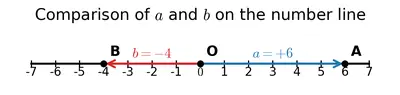
From the figures below, what can you conclude about the magnitudes of $$a$$ and $$b$$ compared to each other, and what are their directions? Remember to start from $$0$$.
Figure
Figure

1 A figure showing two arrows $$a$$ and $$b$$ both going leftward from $$0$$, with $$b$$ longer than $$a$$, ending at a point $$\mathrm{P}$$ on the negative side of the number line.

Solution

Both arrows point leftward, so both $$a$$ and $$b$$ are negative integers.

Since arrow $$b$$ is longer than arrow $$a$$, the magnitude of $$b$$ is greater than that of $$a$$; that is $$|b|>|a|$$ (in signed form, $$b

The final position is $\mathrm{P}=a+b$, which is negative and equals $-(|a|+|b|)$.

Answer

Both $$a$$ and $$b$$ are negative; $$|b|>|a|$$. Their sum $$\mathrm{P}=a+b$$ is negative.

2 A figure showing two arrows $$a$$ and $$b$$ both going rightward from $$0$$, with $$a$$ longer than $$b$$, ending at a point $$\mathrm{P}$$ on the positive side of the number line.

Solution

Both arrows point rightward, so both $$a$$ and $$b$$ are positive integers.

Since arrow $$a$$ is longer than arrow $$b$$, $$|a|>|b|$$; that is, $$a>b>0$$.

The final position is $$\mathrm{P}=a+b$$, which is positive.

Answer

Both $$a$$ and $$b$$ are positive; $$a>b>0$$. Their sum $$\mathrm{P}=a+b$$ is positive.

3 A figure showing an arrow $$a$$ going leftward from $$0$$ and an arrow $$b$$ going rightward, of equal magnitude, ending at the point $$\mathrm{P} = 0$$.

Solution

Arrow $$a$$ points leftward, so $$a$$ is negative. Arrow $$b$$ points rightward, so $$b$$ is positive.

The magnitudes are equal, so $$|a|=|b|$$, which means $$a=-b$$ (equivalently, $$a$$ and $$b$$ are additive inverses of each other).

Therefore $$\mathrm{P}=a+b=(-b)+b=0$$, confirming the picture.

Answer

$$a$$ is negative, $$b$$ is positive, $$|a|=|b|$$; they are additive inverses so $$\mathrm{P}=a+b=0$$.

Intext 9

Recall from Grade 6 the token model, where a green ($$+$$) token represents $$+1$$ and a red ($$-$$) token represents $$-1$$; together they make zero.

Find $$(+7) - (+18)$$.

Solution

Start with $$7$$ green tokens (representing $$+7$$). We must remove $$18$$ green tokens, but there are only $$7$$ to begin with.

Add $$11$$ zero-pairs (each pair is one green + one red, worth $$0$$). The bag now has $$7+11=18$$ green tokens and $$11$$ red tokens. The total value is unchanged.

Now remove $$18$$ green tokens. What is left: $$11$$ red tokens.

Therefore

\[(+7)-(+18)=-11.\]

Answer

$$(+7)-(+18)=-11$$.

Intext 10 Using tokens, argue out the following statements.

(a) $$7 - 18 = 7 + (-18)$$ (additive inverse of $$18$$ is $$-18$$)

Solution

LHS $$7-18$$: Start with $$7$$ green tokens. To remove $$18$$ greens we add $$11$$ zero-pairs, giving $$18$$ green + $$11$$ red. Remove $$18$$ green β†’ $$11$$ red remain = $$-11$$.

RHS $$7+(-18)$$: Start with $$7$$ green tokens. Add $$18$$ red tokens. Now there are $$7$$ green and $$18$$ red. Cancel $$7$$ zero-pairs β†’ $$11$$ red remain = $$-11$$.

Both sides give the same result, so $$7-18=7+(-18)$$.

Answer

Both sides equal $$-11$$, so $$7-18=7+(-18)$$.

(b) $$4 - (-12) = 4 + 12$$ (additive inverse of $$-12$$ is $$12$$)

Solution

LHS $$4-(-12)$$: Start with $$4$$ green tokens. We must remove $$12$$ red tokens, but there are no reds. Add $$12$$ zero-pairs, giving $$4+12=16$$ green tokens and $$12$$ red tokens. Remove $$12$$ red β†’ $$16$$ green remain = $$16$$.

RHS $$4+12$$: Start with $$4$$ green tokens. Add $$12$$ more green tokens β†’ $$16$$ green = $$16$$.

Both sides equal $$16$$, so $$4-(-12)=4+12$$.

Answer

Both sides equal $$16$$, so $$4-(-12)=4+12$$.

Intext 11

Suppose we put some positive tokens into an empty bag: two green tokens placed $$4$$ times.

How many positives are in the bag now?

Solution

Two green tokens added $$4$$ times gives

\[2+2+2+2=8\text{ green tokens}.\]

In multiplication form, $$4\times 2=8$$. So there are $$8$$ positive tokens in the bag, representing $$+8$$.

Answer

$$8$$ positive (green) tokens, that is $$+8$$.

Intext 12 Similarly find the values of $$4 \times (-6)$$ and $$9 \times (-7)$$. How can we interpret $$(-4) \times 2$$?

Solution

$$4\times(-6)$$: Put $$6$$ red tokens ($$-6$$) into the bag $$4$$ times. Total red tokens $$=6\times 4=24$$. So $$4\times(-6)=-24$$.

$$9\times(-7)$$: Put $$7$$ red tokens into the bag $$9$$ times. Total red tokens $$=7\times 9=63$$. So $$9\times(-7)=-63$$.

Interpreting $$(-4)\times 2$$: A positive multiplier means "put in", so a negative multiplier $$-4$$ can be interpreted as "remove" $$4$$ times. Thus $$(-4)\times 2$$ means remove $$2$$ (green tokens) from the bag $$4$$ times. Starting from an empty bag, we first add $$4$$ zero-pairs ($$8$$ green and $$8$$ red) so we can remove $$2$$ greens on each of the $$4$$ occasions; after all removals only $$8$$ red tokens remain, giving $$(-4)\times 2=-8$$.

Answer

$$4\times(-6)=-24$$; $$9\times(-7)=-63$$; $$(-4)\times 2$$ is interpreted as removing $$2$$ green tokens $$4$$ times, giving $$-8$$.

Intext 13 Why are we trying to remove green tokens and not red tokens (when modelling $$(-4) \times 2$$ with tokens)?

Solution

In the expression $$(-4)\times 2$$, the multiplicand is $$2$$, which stands for $$2$$ green tokens (green tokens represent positive units).

The multiplier $$-4$$ is a negative integer, and we interpret a negative multiplier as "remove" that many times. So we must remove what the multiplicand represents β€” i.e. remove $$2$$ green tokens, $$4$$ times.

If we removed red tokens instead, we would be modelling $$(-4)\times(-2)$$, a completely different expression.

Answer

Because $$2$$ (the multiplicand) stands for $$2$$ green tokens; the multiplier $$-4$$ tells us to remove those greens $$4$$ times.

Intext 14 What happens when both the integers in the multiplication are negative? How do we model $$(-4) \times (-2)$$ with tokens?

Solution

The multiplicand $$-2$$ represents $$2$$ red tokens. The multiplier $$-4$$ means "remove" $$4$$ times. So $$(-4)\times(-2)$$ means: remove $$2$$ red tokens from the bag, $$4$$ times.

Starting from an empty bag, we add $$4$$ zero-pairs (each pair is $$1$$ green + $$1$$ red, worth $$0$$). Actually, to be able to remove $$2$$ red tokens on each of $$4$$ occasions, we need at least $$8$$ reds β€” so add $$8$$ zero-pairs (i.e. $$8$$ greens + $$8$$ reds), value still $$0$$.

Now remove $$2$$ red tokens $$4$$ times ($$= 8$$ red tokens removed). We are left with $$8$$ green tokens.

Hence $$(-4)\times(-2)=+8$$. The product of two negative integers is positive.

Answer

$$(-4)\times(-2)=8$$; the product of two negative integers is positive.

Intext 15

Consider the numbers represented by the following token sets β€” all three sets represent $$-2$$:

  • (a) two red tokens;
  • (b) four red tokens with two green tokens;
  • (c) six red tokens with four green tokens.

Now, take $$4$$ times each of these token sets (place each set into the empty bag $$4$$ times).

What integer do we get as the final answer in each case? Do we get different answers because the sets look different, or the same answer because they all represent $$-2$$?

Solution

(a) $$2$$ red $$\times\, 4 = 8$$ red $$=-8$$.

(b) $$(4\,\text{red}+2\,\text{green})\times 4 = 16$$ red $$+\;8$$ green. Cancelling $$8$$ zero-pairs leaves $$8$$ red $$=-8$$.

(c) $$(6\,\text{red}+4\,\text{green})\times 4 = 24$$ red $$+\;16$$ green. Cancelling $$16$$ zero-pairs leaves $$8$$ red $$=-8$$.

All three give the same answer, $$-8$$. This is not a coincidence: since each set has value $$-2$$, multiplying by $$4$$ must produce $$-8$$ regardless of how the value $$-2$$ is arranged in tokens.

Answer

All three give $$-8$$. The answer depends only on the value of the multiplicand ($$-2$$), not on how it is represented in tokens.

Intext 16 Check this (that the answer does not depend on which token set is chosen) for $$5 \times 4$$, by taking different token sets corresponding to $$4$$.

Solution

The number $$4$$ can be represented by many token sets: e.g. (i) $$4$$ green tokens; (ii) $$5$$ green + $$1$$ red; (iii) $$7$$ green + $$3$$ red. Each set has value $$4$$.

(i) $$4$$ green $$\times 5 = 20$$ green $$=20$$.

(ii) $$(5\text{ green}+1\text{ red})\times 5 = 25$$ green $$+5$$ red. Cancel $$5$$ zero-pairs β†’ $$20$$ green $$=20$$.

(iii) $$(7\text{ green}+3\text{ red})\times 5 = 35$$ green $$+15$$ red. Cancel $$15$$ zero-pairs β†’ $$20$$ green $$=20$$.

All three give $$5\times 4=20$$. The answer does not depend on which token set is chosen.

Answer

In every case $$5\times 4=20$$. The product depends only on the value of the multiplicand.

Intext 17 Using this understanding of multiplication and additive inverses, can $$-4 \times 2$$ be defined through a process of addition of tokens instead of removal of tokens?

Solution

Yes. Instead of "remove $$2$$ green tokens $$4$$ times", we can equivalently add the additive inverse of $$2$$, which is $$-2$$ (i.e. $$2$$ red tokens), $$4$$ times.

Adding $$2$$ red tokens $$4$$ times gives $$8$$ red tokens in the bag, which represents $$-8$$.

So $$(-4)\times 2$$ can be defined as "add $$-2$$ four times", giving

\[(-4)\times 2=(-2)+(-2)+(-2)+(-2)=-8.\]

Both interpretations (removal or addition of inverses) yield the same result.

Answer

Yes. $$(-4)\times 2$$ means adding the additive inverse of $$2$$ (that is $$-2$$) four times, giving $$-8$$.

Intext 18

Consider the pattern:

\[\begin{aligned}4 \times 3 &= 12 \\ 3 \times 3 &= 9 \\ 2 \times 3 &= 6 \\ 1 \times 3 &= 3 \\ 0 \times 3 &= 0\end{aligned}\]

What do you notice in this pattern? Can you describe it?

Solution

Reading down the list, the multiplier decreases by $$1$$ at each step: $$4,3,2,1,0,\ldots$$

Correspondingly, the product decreases by $$3$$ at each step: $$12,9,6,3,0,\ldots$$

So the pattern is: every time the multiplier goes down by $$1$$, the product goes down by $$3$$ (which is the multiplicand).

Answer

As the multiplier decreases by $$1$$, the product decreases by $$3$$ (the value of the multiplicand).

Intext 19 Will this pattern continue when the multiplier goes below zero and becomes a negative number? Extend the pattern to $$(-1) \times 3$$, $$(-2) \times 3$$, $$(-3) \times 3$$.

Solution

Yes, the pattern continues. Each step the product decreases by $$3$$:

\[\begin{aligned}0\times 3 &= 0 \\ (-1)\times 3 &= 0-3 = -3 \\ (-2)\times 3 &= -3-3 = -6 \\ (-3)\times 3 &= -6-3 = -9\end{aligned}\]

This is consistent with our token interpretation: $$(-1)\times 3$$ means "remove $$3$$ greens once", giving $$-3$$; similarly for the others.

Answer

$$(-1)\times 3=-3$$; $$(-2)\times 3=-6$$; $$(-3)\times 3=-9$$.

Intext 20

What is the pattern when the multiplicand is a negative integer? Consider:

\[\begin{aligned}4 \times (-3) &= -12 \\ 3 \times (-3) &= -9 \\ 2 \times (-3) &= -6 \\ 1 \times (-3) &= -3 \\ 0 \times (-3) &= 0\end{aligned}\]

Describe the pattern.

Solution

Reading down the list, the multiplier decreases by $$1$$ each step: $$4,3,2,1,0,\ldots$$

The product now increases by $$3$$ each step: $$-12,-9,-6,-3,0,\ldots$$

So when the multiplicand is $$-3$$: every time the multiplier goes down by $$1$$, the product goes up by $$3$$ (i.e. the product changes by $$-(-3)=+3$$).

Answer

As the multiplier decreases by $$1$$, the product increases by $$3$$ (that is, it changes by $$-(-3)=+3$$).

Intext 21 Will this pattern continue when the multiplier goes below zero and becomes a negative integer? Extend the pattern to $$(-1) \times (-3)$$, $$(-2) \times (-3)$$, $$(-3) \times (-3)$$.

Solution

Continuing the same rule (the product goes up by $$3$$ each time the multiplier drops by $$1$$):

\[\begin{aligned}0\times(-3) &= 0 \\ (-1)\times(-3) &= 0+3 = 3 \\ (-2)\times(-3) &= 3+3 = 6 \\ (-3)\times(-3) &= 6+3 = 9\end{aligned}\]

All three products are positive, consistent with the rule: negative times negative equals positive.

Answer

$$(-1)\times(-3)=3$$; $$(-2)\times(-3)=6$$; $$(-3)\times(-3)=9$$.

Intext 22

We know that $$1 \times a = a$$ for all positive integers $$a$$.

Is this true for all negative integers too?

Solution

Yes. If $$a$$ is a negative integer, then $$1\times a$$ means "put $$a$$ into the bag once", which of course gives $$a$$.

For example, $$1\times(-5)=-5$$ and $$1\times(-100)=-100$$.

So $$1\times a=a$$ holds for every integer $$a$$, positive, negative, or zero. The number $$1$$ is the multiplicative identity.

Answer

Yes, $$1\times a=a$$ for every integer $$a$$, including negative integers.

Intext 23

In the case of integers, is the product the same when we swap the multiplier and the multiplicand? Try this for some numbers.

Observe the following pairs of multiplications (fill in the blanks where needed):

$$3 \times -4 = -12$$$$-4 \times 3 = -12$$
$$-30 \times 12 = $$ ____$$12 \times -30 = $$ ____
$$-15 \times -8 = 120$$$$-8 \times -15 = 120$$
$$14 \times -5 = -70$$$$-5 \times $$ ____ $$= -70$$

Solution

Compute each blank using the rules for signed multiplication.

Row 2: $$-30\times 12$$: magnitudes multiply to $$30\times 12=360$$; signs are $$-$$ and $$+$$ so the product is negative. $$-30\times 12=-360$$. Similarly $$12\times -30=-360$$.

Row 4: We need $$-5\times \underline{\phantom{x}}=-70$$. Divide: $$-70\div(-5)=14$$. So the missing number is $$14$$, matching $$14\times -5=-70$$.

Completed table:

$$3\times -4=-12$$$$-4\times 3=-12$$
$$-30\times 12=-360$$$$12\times -30=-360$$
$$-15\times -8=120$$$$-8\times -15=120$$
$$14\times -5=-70$$$$-5\times 14=-70$$

Answer

$$-30\times 12=-360$$, $$12\times -30=-360$$, and $$-5\times 14=-70$$.

Intext 24 What do you notice in these pairs of multiplication statements?

Solution

In every pair, swapping the two integers being multiplied does not change the product. For instance, $$3\times(-4)=-12$$ and $$(-4)\times 3=-12$$; $$(-15)\times(-8)=120$$ and $$(-8)\times(-15)=120$$.

The magnitudes of the two products are the same (because $$a\times b=b\times a$$ for whole numbers) and the signs are the same (because the sign of the product is determined only by the parity of negative signs, not their order).

Answer

The order of the two integers does not affect the product; each pair gives the same value.

Intext 25 Will this always happen (that the product remains the same when we swap the multiplier and multiplicand)?

Solution

Yes, this always happens. For any two integers $$a$$ and $$b$$,

\[a\times b=b\times a.\]

This is called the commutative property of multiplication. It holds for positive integers, negative integers, and zero.

Answer

Yes. Multiplication of integers is commutative: $$a\times b=b\times a$$ for all integers $$a,b$$.

Intext 26 Does the sign of the product change if we swap the multiplier and multiplicand?

Solution

No. Since $$a\times b=b\times a$$, both the magnitude and the sign of the product remain the same after swapping.

For example, $$3\times(-4)=-12$$ and $$(-4)\times 3=-12$$; both are negative. Similarly $$(-15)\times(-8)=(-8)\times(-15)=120$$; both are positive.

Answer

No, the sign of the product does not change on swapping.

Intext 27 (Following Example 1.) What are the maximum possible marks in the exam? What are the minimum possible marks?

Solution

The exam has $$50$$ questions, $$+5$$ for each correct answer and $$-2$$ for each wrong answer.

Maximum: all $$50$$ answers correct, none wrong.

\[50\times 5+0\times(-2)=250+0=250.\]

Minimum: all $$50$$ answers wrong, none correct.

\[0\times 5+50\times(-2)=0-100=-100.\]

Answer

Maximum $$=250$$ marks; minimum $$=-100$$ marks.

Intext 28 Find the solution to part (b) of Example 2 using Method 1 (subtraction) described above.

Solution

In Example 2(b), the elevator starts at $$+15$$ m (above ground) and descends at $$3$$ m per minute for $$45$$ minutes.

Method 1 (subtraction): Compute the total descent and subtract it from the starting position.

Total descent $$=3\times 45=135$$ m.

\[\text{Final position}=15-135=-120\text{ m}.\]

So the elevator is $$120$$ m below ground level.

Answer

Final position $$=-120$$ m, i.e. $$120$$ m below ground.

Intext 29

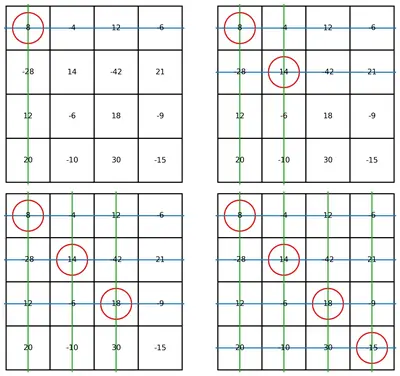
A Magic Grid of Integers. A grid containing some numbers is given below. Follow the steps as shown until no number is left.

$$8$$$$-4$$$$12$$$$-6$$
$$-28$$$$14$$$$-42$$$$21$$
$$12$$$$-6$$$$18$$$$-9$$
$$20$$$$-10$$$$30$$$$-15$$

Steps: Circle any number. Strike out the row and the column containing that number. Circle any unstruck number. Repeat. When there are no more unstruck numbers, stop. Multiply the circled numbers.

Try again with different starting numbers. What product did you get? Was it different from the first time? Try a few more times with different numbers!

Play the same game with the grid below. What answer do you get?

$$8$$$$-4$$$$12$$$$-6$$
$$-28$$$$14$$$$-42$$$$21$$
$$12$$$$-6$$$$18$$$$-9$$
$$20$$$$-10$$$$30$$$$-15$$

What is so special about these grids? Is the magic in the numbers or the way they are arranged or both? Can you make more such grids?

Figure
Figure

Solution

Each entry in the grid is a product of a row-value and a column-value. Writing the row-values on the side and column-values on the top:

$$4$$$$-2$$$$6$$$$-3$$
$$2$$$$8$$$$-4$$$$12$$$$-6$$
$$-7$$$$-28$$$$14$$$$-42$$$$21$$
$$3$$$$12$$$$-6$$$$18$$$$-9$$
$$5$$$$20$$$$-10$$$$30$$$$-15$$

The game forces you to pick exactly one entry from each row and each column. So the four picked entries are $$r_1\,c_{\sigma(1)},\;r_2\,c_{\sigma(2)},\;r_3\,c_{\sigma(3)},\;r_4\,c_{\sigma(4)}$$ for some rearrangement $$\sigma$$ of the columns.

Their product is

\[(r_1\, r_2\, r_3\, r_4)\times(c_{\sigma(1)}\, c_{\sigma(2)}\, c_{\sigma(3)}\, c_{\sigma(4)})=(r_1 r_2 r_3 r_4)(c_1 c_2 c_3 c_4).\]

Computing: rows give $$2\times(-7)\times 3\times 5=-210$$; columns give $$4\times(-2)\times 6\times(-3)=144$$. So every product equals

\[(-210)\times 144=-30240.\]

The two grids in the problem are identical, so the answer for both grids is $$-30240$$, regardless of the starting number.

What is special: The grid is a full multiplication table. The magic is in the arrangement β€” any grid that is a product table (entry $$(i,j)=r_i\times c_j$$) will have this property. You can build your own by choosing any row-values and column-values, filling in the products, and playing the game.

Answer

The product is always $$-30240$$ for both grids. Both grids are multiplication tables β€” the product of chosen entries always equals (product of row-values) $$\times$$ (product of column-values) $$=(-210)(144)=-30240$$.

Intext 30 Can you summarise the rules for integer division looking at the pattern above (that $$(-100) \div 25 = -4$$, $$(-100) \div (-4) = 25$$, $$50 \div (-25) = -2$$, etc.)?

Solution

Rules for the sign of a quotient are the same as for multiplication:

  • positive $$\div$$ positive $$=$$ positive, e.g. $$100\div 25=4$$.
  • negative $$\div$$ positive $$=$$ negative, e.g. $$(-100)\div 25=-4$$.
  • positive $$\div$$ negative $$=$$ negative, e.g. $$50\div(-25)=-2$$.
  • negative $$\div$$ negative $$=$$ positive, e.g. $$(-100)\div(-4)=25$$.

In short: same signs give a positive quotient, different signs give a negative quotient. The magnitude is obtained by dividing the absolute values in the usual way.

Answer

Same signs β†’ positive quotient; different signs β†’ negative quotient. Magnitudes divide as with whole numbers.

Intext 31 What is the value of the expression $$5 \times -3 \times 4$$? Does it matter whether we multiply $$5 \times -3$$ and then multiply the product with $$4$$, or if we multiply $$-3 \times 4$$ first and then multiply the product with $$5$$?

Solution

First way $$((5\times -3)\times 4)$$:

\[(5\times -3)\times 4=(-15)\times 4=-60.\]

Second way $$(5\times(-3\times 4))$$:

\[5\times(-3\times 4)=5\times(-12)=-60.\]

Both give $$-60$$. So it does not matter how we group the numbers β€” this is the associative property of multiplication.

Answer

Both groupings give $$5\times(-3)\times 4=-60$$; grouping does not matter.

Intext 32 Take a few more examples of multiplication of $$3$$ integers and check this property (associativity). What do you observe?

Solution

Example 1: $$2\times(-5)\times 3$$.
$$(2\times -5)\times 3=-10\times 3=-30$$.
$$2\times(-5\times 3)=2\times -15=-30$$. Same.

Example 2: $$(-4)\times(-2)\times 5$$.
$$((-4)\times(-2))\times 5=8\times 5=40$$.
$$(-4)\times((-2)\times 5)=(-4)\times(-10)=40$$. Same.

Example 3: $$(-6)\times 7\times(-1)$$.
$$((-6)\times 7)\times(-1)=-42\times -1=42$$.
$$(-6)\times(7\times -1)=(-6)\times -7=42$$. Same.

Observation: Whichever way we group three integers in a multiplication, the product is the same. Multiplication of integers is associative:

\[(a\times b)\times c=a\times(b\times c).\]

Answer

In every example the two groupings give the same product; multiplication of integers is associative.

Intext 33 Are there orders in which $$5 \times -3 \times 4$$ can be evaluated? Will the product be the same in all these cases?

Solution

Using commutativity, the three factors $$5,\;-3,\;4$$ can be arranged in $$3!=6$$ orders:

\[5\times -3\times 4,\;\;5\times 4\times -3,\;\;-3\times 5\times 4,\;\;-3\times 4\times 5,\;\;4\times 5\times -3,\;\;4\times -3\times 5.\]

Each evaluates to

\[5\times(-3)\times 4=-60,\]

because multiplication of integers is both commutative and associative, so any order gives the same product.

Answer

Yes, all $$6$$ possible orders give the same value $$-60$$.

Intext 34 Multiply the expression $$25 \times -6 \times 12$$ in all the different orders and check if the product is the same in all cases.

Solution

All six orders of $$25,\,-6,\,12$$:

OrderStep 1Step 2
$$25\times -6\times 12$$$$25\times -6=-150$$$$-150\times 12=-1800$$
$$25\times 12\times -6$$$$25\times 12=300$$$$300\times -6=-1800$$
$$-6\times 25\times 12$$$$-6\times 25=-150$$$$-150\times 12=-1800$$
$$-6\times 12\times 25$$$$-6\times 12=-72$$$$-72\times 25=-1800$$
$$12\times 25\times -6$$$$12\times 25=300$$$$300\times -6=-1800$$
$$12\times -6\times 25$$$$12\times -6=-72$$$$-72\times 25=-1800$$

Every order gives $$-1800$$, confirming commutativity and associativity for these integers.

Answer

All six orders give the same product $$-1800$$.

Intext 35

Look at the following series of multiplications:

\[\begin{aligned}-1 \times -1 &= 1 \\ -1 \times -1 \times -1 &= -1 \\ -1 \times -1 \times -1 \times -1 &= 1 \\ -1 \times -1 \times -1 \times -1 \times -1 &= -1\end{aligned}\]

When $$-1$$ is multiplied $$2$$ or $$4$$ times the product is positive. When it is multiplied $$3$$ or $$5$$ times the product is negative. Can you generalise these statements further?

Solution

Yes. Every additional factor of $$-1$$ flips the sign of the product. Starting from $$1$$ and flipping repeatedly:

  • If $$-1$$ appears an even number of times, the sign flips back to positive: the product is $$+1$$.
  • If $$-1$$ appears an odd number of times, the sign lands on negative: the product is $$-1$$.

In symbols, for a positive integer $$n$$:

\[\underbrace{(-1)\times(-1)\times\cdots\times(-1)}_{n\text{ times}}=\begin{cases}+1 & \text{if }n\text{ is even},\\ -1 & \text{if }n\text{ is odd}.\end{cases}\]

Answer

$$(-1)$$ multiplied by itself $$n$$ times equals $$+1$$ if $$n$$ is even and $$-1$$ if $$n$$ is odd.

Intext 36 Using this understanding of multiplication of many integers, can you give a simple rule to find the sign of the product of many integers?

Solution

Count how many negative integers appear among the factors (ignore the positives):

  • If the count of negative factors is even (including $$0$$), the product is positive.
  • If the count of negative factors is odd, the product is negative.

The magnitude of the product is the product of the magnitudes.

Reason: Each negative factor can be split as $$(-1)\times(\text{its magnitude})$$. Collecting all the $$-1$$s gives $$(-1)^{k}$$ where $$k$$ is the number of negatives; this is $$+1$$ for even $$k$$ and $$-1$$ for odd $$k$$.

Answer

Count the negative factors: even count β†’ positive product; odd count β†’ negative product. The magnitude is the product of the magnitudes.

Intext 37 Now, consider the expression $$5 \times (4 + (-2))$$. As in the case of positive integers, is this expression equal to $$5 \times 4 + 5 \times (-2)$$?

Solution

LHS: $$5\times(4+(-2))=5\times 2=10$$.

RHS: $$5\times 4+5\times(-2)=20+(-10)=10$$.

Both sides equal $$10$$, so yes, the expressions are equal. This is the distributive property of multiplication over addition β€” it holds for integers just as for positive integers:

\[a\times(b+c)=a\times b+a\times c.\]

Answer

Yes, both sides equal $$10$$; the distributive property holds.

Intext 38 Check if the distributive property holds for $$(-2) \times (4 + (-3))$$ (that is, if this expression equals $$(-2) \times 4 + (-2) \times (-3)$$), and for a few other such expressions of your choice.

Solution

Given expression:

LHS $$=(-2)\times(4+(-3))=(-2)\times 1=-2$$.

RHS $$=(-2)\times 4+(-2)\times(-3)=-8+6=-2$$. Equal. βœ“

Example 1: $$3\times(5+(-8))$$.
LHS $$=3\times(-3)=-9$$. RHS $$=15+(-24)=-9$$. Equal. βœ“

Example 2: $$(-4)\times((-6)+2)$$.
LHS $$=(-4)\times(-4)=16$$. RHS $$=24+(-8)=16$$. Equal. βœ“

Example 3: $$(-5)\times((-3)+(-7))$$.
LHS $$=(-5)\times(-10)=50$$. RHS $$=15+35=50$$. Equal. βœ“

The distributive property holds for all integers.

Answer

In each case LHS $$=$$ RHS; the distributive property $$a\times(b+c)=a\times b+a\times c$$ holds for integers.

Intext 39 Can you visually show the distributive property for an expression like $$-4 \times (2 + (-3))$$? [Hint: Use the fact that multiplying a number by $$-4$$ is adding the inverse of the number $$4$$ times.]

Solution

First simplify: $$2+(-3)=-1$$. So $$(-4)\times(2+(-3))=(-4)\times(-1)$$.

Using the hint, multiplying by $$-4$$ means "add the additive inverse $$4$$ times". The additive inverse of $$-1$$ is $$+1$$ (one green token). Adding one green token $$4$$ times gives $$4$$ green tokens $$=+4$$.

\[(-4)\times(2+(-3))=4.\]

Right-hand side visually: $$(-4)\times 2+(-4)\times(-3)$$.

$$(-4)\times 2$$: add the inverse of $$+2$$ (i.e. $$2$$ red tokens) four times β†’ $$8$$ red tokens $$=-8$$.

$$(-4)\times(-3)$$: add the inverse of $$-3$$ (i.e. $$3$$ green tokens) four times β†’ $$12$$ green tokens $$=+12$$.

Sum: $$-8+12=+4$$.

Both sides visually give $$4$$ green tokens, confirming distributivity.

Answer

Both sides equal $$4$$ (i.e. $$4$$ green tokens), confirming $$(-4)\times(2+(-3))=(-4)\times 2+(-4)\times(-3)$$.

Intext 40

Pick the Pattern β€” Machine 1. A pattern machine takes $$3$$ numbers, does some operations and gives out the result. Machine 1 shows the following inputs and outputs:

InputsOutput
$$5, 8, 3$$$$10$$
$$10, 11, 12$$$$9$$
$$5, 8, -3$$$$16$$
$$-3, 10, 2$$$$5$$
$$-4, -1, -6$$$$1$$
$$-10, -12, -9$$?

Find the operations being done by Machine 1. So, the result of the last group will be, $$(-10) + (-12) - (-9) = $$ ____.

Solution

Guess the operation as $$a+b-c$$ and test it on the rows:

  • $$5+8-3=10$$ βœ“
  • $$10+11-12=9$$ βœ“
  • $$5+8-(-3)=13+3=16$$ βœ“
  • $$-3+10-2=5$$ βœ“
  • $$-4+(-1)-(-6)=-5+6=1$$ βœ“

The machine computes $$a+b-c$$. For the last row:

\[(-10)+(-12)-(-9)=-22+9=-13.\]

Answer

The machine computes $$a+b-c$$; the missing output is $$(-10)+(-12)-(-9)=-13$$.

Intext 41

Pick the Pattern β€” Machine 2. Machine 2 shows the following inputs and outputs:

InputsOutput
$$4, 8, -3$$$$-29$$
$$6, -11, 12$$$$54$$
$$5, 3, 7$$$$-22$$
$$-3, 9, -8$$$$35$$
$$-7, 4, 6$$$$22$$
$$-10, -12, -9$$?

Find the operations being done by Machine 2 and fill in the blank. Then make your own machine and challenge your peers in finding its operations.

Solution

Try the rule $$-(a\times b+c)$$ (that is, take the negative of $$a\times b+c$$):

  • $$-(4\times 8+(-3))=-(32-3)=-29$$ βœ“
  • $$-(6\times(-11)+12)=-(-66+12)=-(-54)=54$$ βœ“
  • $$-(5\times 3+7)=-(15+7)=-22$$ βœ“
  • $$-((-3)\times 9+(-8))=-(-27-8)=-(-35)=35$$ βœ“
  • $$-((-7)\times 4+6)=-(-28+6)=-(-22)=22$$ βœ“

So Machine 2 computes $$-(a\times b+c)$$. For the last row with $$a=-10,\;b=-12,\;c=-9$$:

\[a\times b+c=(-10)\times(-12)+(-9)=120-9=111.\]\[\text{Output}=-111.\]

Answer

Machine 2 computes $$-(a\times b+c)$$; the missing output is $$-((-10)\times(-12)+(-9))=-111$$.

Examples

Example 1 An exam has $$50$$ multiple choice questions. $$5$$ marks are given for every correct answer and $$2$$ negative marks for every wrong answer. What are Mala's total marks if she had $$30$$ correct answers and $$20$$ wrong answers?

Solution

Marks from correct answers: $$30\times 5=150$$.

Marks from wrong answers: $$20\times(-2)=-40$$.

Total marks:

\[150+(-40)=110.\]

Answer

Mala's total marks $$=110$$.

Example 2 There is an elevator in a mining shaft that moves above and below the ground. The elevator's positions above the ground are represented as positive integers and positions below the ground are represented as negative integers.

(a) The elevator moves $$3$$ metres per minute. If it descends into the shaft from the ground level ($$0$$), what will be its position after one hour?

Solution

Descending means moving into the shaft, so each minute the position changes by $$-3$$ m.

One hour $$=60$$ minutes.

Change in position $$=60\times(-3)=-180$$ m.

Starting position is $$0$$, so the final position is

\[0+(-180)=-180\text{ m}.\]

The elevator is $$180$$ m below ground level.

Answer

Position after one hour $$=-180$$ m (i.e. $$180$$ m below ground).

(b) If it begins to descend from $$15$$ m above the ground, what will be its position after $$45$$ minutes?

Solution

Starting position: $$+15$$ m. Each minute the position changes by $$-3$$ m.

Change over $$45$$ min $$=45\times(-3)=-135$$ m.

Final position:

\[15+(-135)=-120\text{ m}.\]

So the elevator is $$120$$ m below ground level.

Answer

Position after $$45$$ min $$=-120$$ m (i.e. $$120$$ m below ground).

Figure it Out (Page 25)

1 Let us try to find a few more pairs of numbers from their sums and differences:

(a) Sum $$= 27$$, Difference $$= 9$$

Solution

Let $$a$$ be the first number and $$b$$ the second. Then $$a+b=27$$ and $$a-b=9$$.

Adding the two equations: $$(a+b)+(a-b)=27+9$$, i.e. $$2a=36$$, so $$a=18$$.

Subtracting: $$(a+b)-(a-b)=27-9$$, i.e. $$2b=18$$, so $$b=9$$.

Check: $$18+9=27$$ βœ“ and $$18-9=9$$ βœ“.

Answer

First number $$=18$$, second number $$=9$$.

(b) Sum $$= 4$$, Difference $$= 12$$

Solution

$$a+b=4$$ and $$a-b=12$$.

Adding: $$2a=16$$, so $$a=8$$.

Subtracting: $$2b=4-12=-8$$, so $$b=-4$$.

Check: $$8+(-4)=4$$ βœ“ and $$8-(-4)=12$$ βœ“.

Answer

First number $$=8$$, second number $$=-4$$.

(c) Sum $$= 0$$, Difference $$= 10$$

Solution

$$a+b=0$$ and $$a-b=10$$.

Adding: $$2a=10$$, so $$a=5$$.

Subtracting: $$2b=0-10=-10$$, so $$b=-5$$.

Check: $$5+(-5)=0$$ βœ“ and $$5-(-5)=10$$ βœ“.

Answer

First number $$=5$$, second number $$=-5$$.

(d) Sum $$= 0$$, Difference $$= -10$$

Solution

$$a+b=0$$ and $$a-b=-10$$.

Adding: $$2a=-10$$, so $$a=-5$$.

Subtracting: $$2b=0-(-10)=10$$, so $$b=5$$.

Check: $$-5+5=0$$ βœ“ and $$-5-5=-10$$ βœ“.

Answer

First number $$=-5$$, second number $$=5$$.

(e) Sum $$= -7$$, Difference $$= -1$$

Solution

$$a+b=-7$$ and $$a-b=-1$$.

Adding: $$2a=-8$$, so $$a=-4$$.

Subtracting: $$2b=-7-(-1)=-6$$, so $$b=-3$$.

Check: $$-4+(-3)=-7$$ βœ“ and $$-4-(-3)=-1$$ βœ“.

Answer

First number $$=-4$$, second number $$=-3$$.

(f) Sum $$= -7$$, Difference $$= -13$$

Solution

$$a+b=-7$$ and $$a-b=-13$$.

Adding: $$2a=-20$$, so $$a=-10$$.

Subtracting: $$2b=-7-(-13)=6$$, so $$b=3$$.

Check: $$-10+3=-7$$ βœ“ and $$-10-3=-13$$ βœ“.

Answer

First number $$=-10$$, second number $$=3$$.

Figure it Out (Page 31)

1 Using the token interpretation, find the values of:

(a) $$3 \times (-2)$$

Solution

$$3\times(-2)$$ means put $$-2$$ (two red tokens) into the bag $$3$$ times.

Total: $$2\times 3=6$$ red tokens in the bag, representing $$-6$$.

\[3\times(-2)=-6.\]

Answer

$$3\times(-2)=-6$$.

(b) $$(-5) \times (-2)$$

Solution

$$(-5)\times(-2)$$ means "remove $$-2$$ (two red tokens) from the bag, $$5$$ times".

Start with an empty bag and add $$10$$ zero-pairs ($$10$$ green + $$10$$ red) so that we have $$2$$ red available on each of the $$5$$ occasions. Value is still $$0$$.

Now remove $$2$$ red tokens $$5$$ times, i.e. $$10$$ red tokens in all. What remains: $$10$$ green tokens.

\[(-5)\times(-2)=10.\]

Answer

$$(-5)\times(-2)=10$$.

(c) $$(-4) \times (-1)$$

Solution

$$(-4)\times(-1)$$ means "remove $$1$$ red token, $$4$$ times".

Add $$4$$ zero-pairs to the empty bag ($$4$$ green + $$4$$ red), value $$0$$.

Remove $$1$$ red token four times β†’ $$4$$ red tokens gone. What remains: $$4$$ green tokens.

\[(-4)\times(-1)=4.\]

Answer

$$(-4)\times(-1)=4$$.

(d) $$(-7) \times 3$$

Solution

$$(-7)\times 3$$ means "remove $$3$$ green tokens from the bag, $$7$$ times".

Add $$21$$ zero-pairs ($$21$$ green + $$21$$ red) so we can remove $$3$$ green tokens on each of $$7$$ occasions. Value still $$0$$.

Remove $$3$$ green tokens seven times β†’ $$21$$ green tokens gone. What remains: $$21$$ red tokens.

\[(-7)\times 3=-21.\]

Answer

$$(-7)\times 3=-21$$.

2 If $$123 \times 456 = 56088$$, without calculating, find the value of:

(a) $$(-123) \times 456$$

Solution

The magnitudes are $$123$$ and $$456$$; their product is $$56088$$. The signs are $$-$$ and $$+$$, so the product is negative.

\[(-123)\times 456=-56088.\]

Answer

$$(-123)\times 456=-56088$$.

(b) $$(-123) \times (-456)$$

Solution

Magnitudes multiply to $$123\times 456=56088$$. Both signs are negative, so the product is positive.

\[(-123)\times(-456)=56088.\]

Answer

$$(-123)\times(-456)=56088$$.

(c) $$(123) \times (-456)$$

Solution

Magnitudes multiply to $$56088$$. One factor is positive, the other negative, so the product is negative.

\[123\times(-456)=-56088.\]

Answer

$$123\times(-456)=-56088$$.

3 Try to frame a simple rule to multiply two integers.

Solution

Rule for multiplying two integers:

  1. Multiply their absolute values (magnitudes) using the usual whole-number multiplication.
  2. Decide the sign:
    • If both integers have the same sign (both positive or both negative), the product is positive.
    • If the two integers have different signs, the product is negative.
  3. If either factor is $$0$$, the product is $$0$$.

For example, $$(-6)\times(-4)$$: magnitudes give $$24$$; both signs negative β†’ product $$+24$$. And $$7\times(-9)$$: magnitudes give $$63$$; signs differ β†’ product $$-63$$.

Answer

Multiply the magnitudes. The product is positive if both integers have the same sign, and negative if the signs differ; the product is $$0$$ if either factor is $$0$$.

Figure it Out (Page 33)

1 Find the following products.

(a) $$4 \times (-3)$$

Solution

Magnitudes: $$4\times 3=12$$. One positive, one negative β†’ product is negative.

\[4\times(-3)=-12.\]

Answer

$$4\times(-3)=-12$$.

(b) $$(-6) \times (-3)$$

Solution

Magnitudes: $$6\times 3=18$$. Both signs negative β†’ product is positive.

\[(-6)\times(-3)=18.\]

Answer

$$(-6)\times(-3)=18$$.

(c) $$(-5) \times (-1)$$

Solution

Magnitudes: $$5\times 1=5$$. Both negative β†’ product positive.

\[(-5)\times(-1)=5.\]

Answer

$$(-5)\times(-1)=5$$.

(d) $$(-8) \times 4$$

Solution

Magnitudes: $$8\times 4=32$$. Signs differ β†’ product negative.

\[(-8)\times 4=-32.\]

Answer

$$(-8)\times 4=-32$$.

(e) $$(-9) \times 10$$

Solution

Magnitudes: $$9\times 10=90$$. Signs differ β†’ product negative.

\[(-9)\times 10=-90.\]

Answer

$$(-9)\times 10=-90$$.

(f) $$10 \times (-17)$$

Solution

Magnitudes: $$10\times 17=170$$. Signs differ β†’ product negative.

\[10\times(-17)=-170.\]

Answer

$$10\times(-17)=-170$$.

Figure it Out (Page 39)

1 Find the values of:

(a) $$14 \times (-15)$$

Solution

Magnitudes: $$14\times 15=210$$. Signs differ β†’ product negative.

\[14\times(-15)=-210.\]

Answer

$$14\times(-15)=-210$$.

(b) $$-16 \times (-5)$$

Solution

Magnitudes: $$16\times 5=80$$. Both signs negative β†’ product positive.

\[-16\times(-5)=80.\]

Answer

$$-16\times(-5)=80$$.

(c) $$36 \div (-18)$$

Solution

Magnitudes: $$36\div 18=2$$. Signs differ β†’ quotient negative.

\[36\div(-18)=-2.\]

Answer

$$36\div(-18)=-2$$.

(d) $$(-46) \div (-23)$$

Solution

Magnitudes: $$46\div 23=2$$. Both negative β†’ quotient positive.

\[(-46)\div(-23)=2.\]

Answer

$$(-46)\div(-23)=2$$.

2 A freezing process requires that the room temperature be lowered from $$32^{\circ}\mathrm{C}$$ at the rate of $$5^{\circ}\mathrm{C}$$ every hour. What will be the room temperature $$10$$ hours after the process begins?

Solution

The temperature falls by $$5^{\circ}\mathrm{C}$$ each hour, so each hour changes the temperature by $$-5^{\circ}\mathrm{C}$$.

Total change in $$10$$ hours:

\[10\times(-5)=-50^{\circ}\mathrm{C}.\]

Starting temperature is $$32^{\circ}\mathrm{C}$$. Final temperature:

\[32+(-50)=-18^{\circ}\mathrm{C}.\]

Answer

Room temperature after $$10$$ hours $$=-18^{\circ}\mathrm{C}$$.

3 A cement company earns a profit of β‚Ή$$8$$ per bag of white cement sold and a loss of β‚Ή$$5$$ per bag of grey cement sold. [Represent the profit/loss as integers.]

(a) The company sells $$3{,}000$$ bags of white cement and $$5{,}000$$ bags of grey cement in a month. What is its profit or loss?

Solution

Represent profit as $$+8$$ per white bag and loss as $$-5$$ per grey bag.

From white cement: $$3000\times 8=24000$$.

From grey cement: $$5000\times(-5)=-25000$$.

Net profit/loss:

\[24000+(-25000)=-1000.\]

The negative sign indicates a loss.

Answer

Net result $$=-\text{β‚Ή}1000$$, i.e. a loss of β‚Ή$$1000$$.

(b) If the number of bags of grey cement sold is $$6{,}400$$ bags, what is the number of bags of white cement the company must sell to have neither profit nor loss?

Solution

Loss from grey cement: $$6400\times(-5)=-32000$$ (i.e. β‚Ή$$32000$$ loss).

To break even, profit from white cement must equal β‚Ή$$32000$$. Let $$n$$ be the required number of white bags. Then

\[8n=32000\quad\Longrightarrow\quad n=\frac{32000}{8}=4000.\]

Answer

The company must sell $$4000$$ bags of white cement.

4 Replace the blank with an integer to make a true statement.

(a) $$(-3) \times $$ ____ $$= 27$$

Solution

The missing factor is $$27\div(-3)$$. Magnitudes: $$27\div 3=9$$; signs differ β†’ negative.

\[27\div(-3)=-9.\]

Check: $$(-3)\times(-9)=27$$ βœ“.

Answer

$$(-3)\times(-9)=27$$, so the blank is $$-9$$.

(b) $$5 \times $$ ____ $$= (-35)$$

Solution

The missing factor is $$(-35)\div 5$$. Magnitudes: $$35\div 5=7$$; signs differ β†’ negative.

\[(-35)\div 5=-7.\]

Check: $$5\times(-7)=-35$$ βœ“.

Answer

$$5\times(-7)=-35$$, so the blank is $$-7$$.

(c) ____ $$\times (-8) = (-56)$$

Solution

The missing factor is $$(-56)\div(-8)$$. Magnitudes: $$56\div 8=7$$; both signs negative β†’ positive.

\[(-56)\div(-8)=7.\]

Check: $$7\times(-8)=-56$$ βœ“.

Answer

$$7\times(-8)=-56$$, so the blank is $$7$$.

(d) ____ $$\times (-12) = 132$$

Solution

The missing factor is $$132\div(-12)$$. Magnitudes: $$132\div 12=11$$; signs differ β†’ negative.

\[132\div(-12)=-11.\]

Check: $$(-11)\times(-12)=132$$ βœ“.

Answer

$$(-11)\times(-12)=132$$, so the blank is $$-11$$.

(e) ____ $$\div (-8) = 7$$

Solution

If $$x\div(-8)=7$$, then $$x=7\times(-8)=-56$$.

Check: $$(-56)\div(-8)=7$$ βœ“.

Answer

$$(-56)\div(-8)=7$$, so the blank is $$-56$$.

(f) ____ $$\div 12 = -11$$

Solution

If $$x\div 12=-11$$, then $$x=(-11)\times 12=-132$$.

Check: $$(-132)\div 12=-11$$ βœ“.

Answer

$$(-132)\div 12=-11$$, so the blank is $$-132$$.

Figure it Out (End-of-chapter)

1 Find the values of the following expressions:

(a) $$(-5) \times (18 + (-3))$$

Solution

First simplify the bracket:

\[18+(-3)=15.\]

Then multiply:

\[(-5)\times 15=-75.\]

Answer

$$(-5)\times(18+(-3))=-75$$.

(b) $$(-7) \times 4 \times (-1)$$

Solution

Group from the left:

\[(-7)\times 4=-28,\]\[-28\times(-1)=28.\]

(Alternatively, there are $$2$$ negative factors β€” an even number β€” so the product is positive; magnitudes multiply to $$7\times 4\times 1=28$$.)

Answer

$$(-7)\times 4\times(-1)=28$$.

(c) $$(-2) \times (-1) \times (-5) \times (-3)$$

Solution

There are $$4$$ negative factors β€” an even number β€” so the product is positive. Magnitudes multiply to $$2\times 1\times 5\times 3=30$$.

\[(-2)\times(-1)\times(-5)\times(-3)=30.\]

Check step-by-step:

\[(-2)\times(-1)=2,\;\;2\times(-5)=-10,\;\;(-10)\times(-3)=30.\]

Answer

$$(-2)\times(-1)\times(-5)\times(-3)=30$$.

2 Find the values of the following expressions:

(a) $$(-27) \div 9$$

Solution

Magnitudes: $$27\div 9=3$$. Signs differ β†’ quotient negative.

\[(-27)\div 9=-3.\]

Answer

$$(-27)\div 9=-3$$.

(b) $$84 \div (-4)$$

Solution

Magnitudes: $$84\div 4=21$$. Signs differ β†’ quotient negative.

\[84\div(-4)=-21.\]

Answer

$$84\div(-4)=-21$$.

(c) $$(-56) \div (-2)$$

Solution

Magnitudes: $$56\div 2=28$$. Both negative β†’ quotient positive.

\[(-56)\div(-2)=28.\]

Answer

$$(-56)\div(-2)=28$$.

3 Find the integer whose product with $$(-1)$$ is:

(a) $$27$$

Solution

We need an integer $$x$$ with $$(-1)\times x=27$$. Since multiplying by $$-1$$ changes only the sign, $$x$$ is the negative of $$27$$.

\[x=-27.\]

Check: $$(-1)\times(-27)=27$$ βœ“.

Answer

The integer is $$-27$$.

(b) $$-31$$

Solution

We need $$(-1)\times x=-31$$, so $$x=31$$.

Check: $$(-1)\times 31=-31$$ βœ“.

Answer

The integer is $$31$$.

(c) $$-1$$

Solution

$$(-1)\times x=-1 \Rightarrow x=1$$.

Check: $$(-1)\times 1=-1$$ βœ“.

Answer

The integer is $$1$$.

(d) $$1$$

Solution

$$(-1)\times x=1 \Rightarrow x=-1$$.

Check: $$(-1)\times(-1)=1$$ βœ“.

Answer

The integer is $$-1$$.

(e) $$0$$

Solution

$$(-1)\times x=0$$. Since a product is $$0$$ only when one of the factors is $$0$$, and $$-1\ne 0$$, we must have $$x=0$$.

Check: $$(-1)\times 0=0$$ βœ“.

Answer

The integer is $$0$$.

4 If $$47 - 56 + 14 - 8 + 2 - 8 + 5 = -4$$, then find the value of $$-47 + 56 - 14 + 8 - 2 + 8 - 5$$ without calculating the full expression.

Solution

Compare the two expressions term by term:

OriginalNew
$$47$$$$-47$$
$$-56$$$$+56$$
$$+14$$$$-14$$
$$-8$$$$+8$$
$$+2$$$$-2$$
$$-8$$$$+8$$
$$+5$$$$-5$$

Every sign is reversed, so the new sum is the additive inverse of the old sum:

\[-47+56-14+8-2+8-5=-(47-56+14-8+2-8+5)=-(-4)=4.\]

Answer

$$-47+56-14+8-2+8-5=4$$.

5

Do you remember the Collatz Conjecture from last year? Try a modified version with integers. The rule is β€” start with any number; if the number is even, take half of it; if the number is odd, multiply it by $$-3$$ and add $$1$$; repeat. An example sequence is shown below.

$$-7 \to 22 \to 11 \to 32 \to -16 \to -8 \to -4 \to -2 \to -1 \to 4 \to 2 \to 1$$

Try this with different starting numbers: $$(-21)$$, $$(-6)$$, and so on. Describe the patterns you observe.

Solution

Rule. If the current number $$n$$ is even, replace it with $$n\div 2$$; if it is odd, replace it with $$n\times(-3)+1$$.

Start $$-21$$: $$-21$$ is odd, so $$-21\times(-3)+1=63+1=64$$.
$$-21\to 64\to 32\to 16\to 8\to 4\to 2\to 1$$.

Start $$-6$$: $$-6$$ is even, so $$-6\div 2=-3$$. Then $$-3$$ is odd, $$-3\times(-3)+1=10$$. And so on:
$$-6\to -3\to 10\to 5\to -14\to -7\to 22\to 11\to 32\to -16\to -8\to -4\to -2\to -1\to 4\to 2\to 1$$.

Start $$5$$: $$5\to -14\to -7\to 22\to 11\to 32\to -16\to -8\to -4\to -2\to -1\to 4\to 2\to 1$$.

Start $$-1$$: $$-1\to 4\to 2\to 1$$.

Pattern observed: All starting numbers we try eventually reach $$1$$, after which the sequence enters the loop $$1\to -2\to -1\to 4\to 2\to 1\to\cdots$$ (odd $$1$$: $$1\times(-3)+1=-2$$; then $$-2\to -1\to 4\to 2\to 1$$). So the sequence always ends up cycling through $$\{1,-2,-1,4,2\}$$.

Answer

For every starting number tried, the sequence eventually reaches $$1$$ and then cycles through $$1\to -2\to -1\to 4\to 2\to 1\to\ldots$$

6 In a test, $$(+4)$$ marks are given for every correct answer and $$(-2)$$ marks are given for every incorrect answer.

(a) Anita answered all the questions in the test. She scored $$40$$ marks even though $$15$$ of her answers were correct. How many of her answers were incorrect? How many questions are in the test?

Solution

Marks from correct answers: $$15\times 4=60$$.

Anita's total is $$40$$, so marks lost from wrong answers must add up to

\[40-60=-20.\]

Let the number of wrong answers be $$w$$. Each wrong answer contributes $$-2$$, so

\[w\times(-2)=-20\quad\Longrightarrow\quad w=(-20)\div(-2)=10.\]

Since she answered every question, total questions $$=$$ correct $$+$$ wrong $$=15+10=25$$.

Answer

Incorrect answers $$=10$$; total questions in the test $$=25$$.

(b) Anil scored $$(-10)$$ marks even though he had $$5$$ correct answers. How many of his answers were incorrect? Did he leave any questions unanswered?

Solution

Marks from correct answers: $$5\times 4=20$$.

Anil's total is $$-10$$, so marks from wrong answers must add up to

\[-10-20=-30.\]

Let the number of wrong answers be $$w$$. Then

\[w\times(-2)=-30\quad\Longrightarrow\quad w=(-30)\div(-2)=15.\]

Anil answered $$5+15=20$$ questions. From part (a) the test has $$25$$ questions, so questions left unanswered

\[=25-20=5.\]

Answer

Incorrect answers $$=15$$; unanswered questions $$=5$$.

7

Pick the pattern β€” find the operations done by the machine shown below.

InputsOutput
$$4, 8, -3$$$$28$$
$$6, 9, 6$$$$-48$$
$$2, 3, -2$$$$8$$
$$-9, 5, -8$$$$31$$
$$7, -4, -6$$$$-17$$
$$-16, -6, -9$$?

Solution

Guess the rule as $$a-b\times c$$ and verify:

  • $$4-8\times(-3)=4-(-24)=28$$ βœ“
  • $$6-9\times 6=6-54=-48$$ βœ“
  • $$2-3\times(-2)=2-(-6)=8$$ βœ“
  • $$-9-5\times(-8)=-9-(-40)=31$$ βœ“
  • $$7-(-4)\times(-6)=7-24=-17$$ βœ“

So the machine computes $$a-b\times c$$. For the last row with $$a=-16,\;b=-6,\;c=-9$$:

\[-16-(-6)\times(-9)=-16-54=-70.\]

Answer

The machine computes $$a-b\times c$$; the missing output is $$-16-(-6)\times(-9)=-70$$.

8 Imagine you're in a place where the temperature drops by $$5^{\circ}\mathrm{C}$$ each hour. If the temperature is currently at $$8^{\circ}\mathrm{C}$$, write an expression which denotes the temperature after $$4$$ hours.

Solution

Each hour the temperature changes by $$-5^{\circ}\mathrm{C}$$. Over $$4$$ hours, total change $$=4\times(-5)^{\circ}\mathrm{C}$$.

Starting temperature is $$8^{\circ}\mathrm{C}$$. The expression for the temperature after $$4$$ hours is

\[8+4\times(-5)\;\;{}^{\circ}\mathrm{C}=8-20=-12\;\;{}^{\circ}\mathrm{C}.\]

Answer

Expression: $$8+4\times(-5)=-12^{\circ}\mathrm{C}$$.

9 Find $$3$$ consecutive numbers with a product of (a) $$-6$$, (b) $$120$$.

(a) product $$= -6$$

Solution

We need three consecutive integers $$n-1,\;n,\;n+1$$ whose product is $$-6$$.

The magnitude $$|-6|=6$$. Try small consecutive triples:

  • $$1\times 2\times 3=6$$ (too positive)
  • $$-1\times 0\times 1=0$$
  • $$-2\times -1\times 0=0$$
  • $$-3\times -2\times -1=-6$$ βœ“

So the three consecutive integers are $$-3,\;-2,\;-1$$.

Answer

The three consecutive integers are $$-3,\;-2,\;-1$$ ($$-3\times -2\times -1=-6$$).

(b) product $$= 120$$

Solution

Try small positive consecutive triples:

  • $$3\times 4\times 5=60$$
  • $$4\times 5\times 6=120$$ βœ“

So the three consecutive integers are $$4,\;5,\;6$$.

(Since the product is positive and the numbers grow, this is the only positive triple. There is no negative triple giving $$+120$$, because three negative integers multiply to a negative number.)

Answer

The three consecutive integers are $$4,\;5,\;6$$ ($$4\times 5\times 6=120$$).

10

An alien society uses a peculiar currency called 'pibs' with just two denominations of coins β€” a $$+13$$ pibs coin and a $$-9$$ pibs coin. You have several of these coins. Is it possible to purchase an item that costs $$+85$$ pibs?

Yes, we can use $$10$$ coins of $$+13$$ pibs and $$5$$ coins of $$-9$$ pibs to make a total of $$+85$$. Using the two denominations, try to get the following totals:

(a) $$+20$$

Solution

Use $$x$$ coins of $$+13$$ pibs and $$y$$ coins of $$-9$$ pibs, both non-negative. Then $$13x-9y=20$$.

Try $$x=5$$: $$65-9y=20\Rightarrow 9y=45\Rightarrow y=5$$. βœ“

So $$5$$ coins of $$+13$$ and $$5$$ coins of $$-9$$ give

\[5\times 13+5\times(-9)=65-45=20.\]

Answer

$$5$$ coins of $$+13$$ pibs and $$5$$ coins of $$-9$$ pibs: $$65-45=20$$.

(b) $$+40$$

Solution

Solve $$13x-9y=40$$. Doubling part (a): $$13\times 10-9\times 10=130-90=40$$.

So use $$10$$ coins of $$+13$$ and $$10$$ coins of $$-9$$:

\[10\times 13+10\times(-9)=130-90=40.\]

Answer

$$10$$ coins of $$+13$$ pibs and $$10$$ coins of $$-9$$ pibs: $$130-90=40$$.

(c) $$-50$$

Solution

Solve $$13x-9y=-50$$. Try $$x=1$$: $$13-9y=-50\Rightarrow 9y=63\Rightarrow y=7$$. βœ“

So use $$1$$ coin of $$+13$$ and $$7$$ coins of $$-9$$:

\[1\times 13+7\times(-9)=13-63=-50.\]

Answer

$$1$$ coin of $$+13$$ pibs and $$7$$ coins of $$-9$$ pibs: $$13-63=-50$$.

(d) $$+8$$

Solution

Solve $$13x-9y=8$$. Try $$x=2$$: $$26-9y=8\Rightarrow 9y=18\Rightarrow y=2$$. βœ“

So use $$2$$ coins of $$+13$$ and $$2$$ coins of $$-9$$:

\[2\times 13+2\times(-9)=26-18=8.\]

Answer

$$2$$ coins of $$+13$$ pibs and $$2$$ coins of $$-9$$ pibs: $$26-18=8$$.

(e) $$+10$$

Solution

Solve $$13x-9y=10$$. Try $$x=7$$: $$91-9y=10\Rightarrow 9y=81\Rightarrow y=9$$. βœ“

So use $$7$$ coins of $$+13$$ and $$9$$ coins of $$-9$$:

\[7\times 13+9\times(-9)=91-81=10.\]

Answer

$$7$$ coins of $$+13$$ pibs and $$9$$ coins of $$-9$$ pibs: $$91-81=10$$.

(f) $$-2$$

Solution

Solve $$13x-9y=-2$$. Try $$x=4$$: $$52-9y=-2\Rightarrow 9y=54\Rightarrow y=6$$. βœ“

So use $$4$$ coins of $$+13$$ and $$6$$ coins of $$-9$$:

\[4\times 13+6\times(-9)=52-54=-2.\]

Answer

$$4$$ coins of $$+13$$ pibs and $$6$$ coins of $$-9$$ pibs: $$52-54=-2$$.

(g) $$+1$$ [Hint: Writing down a few multiples of $$13$$ and $$9$$ can help.]

Solution

Solve $$13x-9y=1$$. List a few multiples of $$13$$: $$13,26,39,52,65,78,91,\ldots$$ and of $$9$$: $$9,18,27,36,45,54,63,72,81,90,\ldots$$

We want a multiple of $$13$$ that is $$1$$ more than a multiple of $$9$$. Compare: $$91$$ vs $$90$$ β†’ difference is $$1$$. βœ“

So $$13\times 7-9\times 10=91-90=1$$. Use $$7$$ coins of $$+13$$ and $$10$$ coins of $$-9$$.

Answer

$$7$$ coins of $$+13$$ pibs and $$10$$ coins of $$-9$$ pibs: $$91-90=1$$.

(h) Is it possible to purchase an item that costs $$1568$$ pibs?

Solution

Yes. From part (g), $$13\times 7-9\times 10=1$$. Multiplying both sides by $$1568$$:

\[13\times(7\times 1568)-9\times(10\times 1568)=1568,\]

which gives an (unnecessarily large) solution. A smaller solution comes from small numbers of coins: solve $$13x-9y=1568$$.

Try $$x=122$$: $$13\times 122=1586$$, and $$1586-1568=18=9\times 2$$, so $$y=2$$. βœ“

Hence use $$122$$ coins of $$+13$$ pibs and $$2$$ coins of $$-9$$ pibs:

\[122\times 13+2\times(-9)=1586-18=1568.\]

So it is possible.

Answer

Yes. For example, $$122$$ coins of $$+13$$ pibs and $$2$$ coins of $$-9$$ pibs: $$1586-18=1568$$.

11 Find the values of:

(a) $$(32 \times (-18)) \div ((-36))$$

Solution

Compute the numerator: $$32\times(-18)=-576$$.

Now divide: $$(-576)\div(-36)$$. Magnitudes: $$576\div 36=16$$; both negative β†’ positive.

\[(32\times(-18))\div(-36)=16.\]

Answer

$$(32\times(-18))\div(-36)=16$$.

(b) $$(32) \div ((-36) \times (-18))$$

Solution

Compute the denominator: $$(-36)\times(-18)=36\times 18=648$$ (both negative β†’ positive).

Divide: $$32\div 648$$. Simplify by cancelling common factors: $$\gcd(32,648)=8$$, giving $$32\div 8=4$$ and $$648\div 8=81$$.

\[32\div((-36)\times(-18))=\frac{32}{648}=\frac{4}{81}.\]

Answer

$$32\div((-36)\times(-18))=\dfrac{4}{81}$$.

(c) $$(25 \times (-12)) \div ((45) \times (-27))$$

Solution

Numerator: $$25\times(-12)=-300$$.

Denominator: $$45\times(-27)=-1215$$.

Divide: $$(-300)\div(-1215)$$. Both negative β†’ positive; magnitudes: $$300\div 1215$$. Cancel $$\gcd(300,1215)=15$$: $$300\div 15=20,\;1215\div 15=81$$.

\[\frac{-300}{-1215}=\frac{20}{81}.\]

Answer

$$(25\times(-12))\div((45)\times(-27))=\dfrac{20}{81}$$.

(d) $$(280 \times (-7)) \div ((-8) \times (-35))$$

Solution

Numerator: $$280\times(-7)=-1960$$.

Denominator: $$(-8)\times(-35)=280$$.

Divide: $$(-1960)\div 280$$. Magnitudes: $$1960\div 280=7$$; signs differ β†’ negative.

\[(280\times(-7))\div((-8)\times(-35))=-7.\]

Answer

$$(280\times(-7))\div((-8)\times(-35))=-7$$.

12 Arrange the expressions given below in increasing order.

(a) $$(-348) + (-1064)$$

Solution

Both are negative, so add the magnitudes and keep the negative sign:

\[(-348)+(-1064)=-(348+1064)=-1412.\]

Answer

$$(-348)+(-1064)=-1412$$.

(b) $$(-348) - (-1064)$$

Solution

Subtracting a negative is adding its magnitude:

\[(-348)-(-1064)=-348+1064=1064-348=716.\]

Answer

$$(-348)-(-1064)=716$$.

(c) $$348 - (-1064)$$

Solution

Subtracting a negative is adding its magnitude:

\[348-(-1064)=348+1064=1412.\]

Answer

$$348-(-1064)=1412$$.

(d) $$(-348) \times (-1064)$$

Solution

Both signs negative β†’ product positive. Magnitudes: $$348\times 1064$$.

$$348\times 1064=348\times 1000+348\times 64=348000+22272=370272$$.

\[(-348)\times(-1064)=370272.\]

Answer

$$(-348)\times(-1064)=370272$$.

(e) $$348 \times (-1064)$$

Solution

Signs differ β†’ product negative. Magnitudes: $$348\times 1064=370272$$ (from part (d)).

\[348\times(-1064)=-370272.\]

Answer

$$348\times(-1064)=-370272$$.

(f) $$348 \times 964$$

Solution

Both positive. Compute:

\[348\times 964=348\times 1000-348\times 36=348000-12528=335472.\]

Answer

$$348\times 964=335472$$.

13 Given that $$(-548) \times 972 = -532656$$, write the values of:

(a) $$(-547) \times 972$$

Solution

Write $$-547=-548+1$$. Using distributivity:

\[(-547)\times 972=(-548+1)\times 972=(-548)\times 972+1\times 972.\]

We are told $$(-548)\times 972=-532656$$, so

\[(-547)\times 972=-532656+972=-531684.\]

Answer

$$(-547)\times 972=-531684$$.

(b) $$(-548) \times 971$$

Solution

Write $$971=972-1$$. Using distributivity:

\[(-548)\times 971=(-548)\times(972-1)=(-548)\times 972-(-548)\times 1.\]

Substitute the given value:

\[(-548)\times 971=-532656-(-548)=-532656+548=-532108.\]

Answer

$$(-548)\times 971=-532108$$.

(c) $$(-547) \times 971$$

Solution

From part (a), $$(-547)\times 972=-531684$$. Now $$971=972-1$$, so

\[(-547)\times 971=(-547)\times 972-(-547)\times 1=-531684-(-547)=-531684+547=-531137.\]

Answer

$$(-547)\times 971=-531137$$.

14 Given that $$207 \times (-33 + 7) = -5382$$, write the value of $$-207 \times (33 - 7) = $$ ____.

Solution

Note that $$-33+7=-26$$ and $$33-7=26$$, which are additive inverses of each other. So

\[-207\times(33-7)=-207\times 26=(-1)\times 207\times 26=(-1)\times\bigl(207\times(-1)\times(-26)\bigr).\]

More directly, observe that

\[-207\times(33-7)=(-1)\times 207\times(-1)\times(-33+7)=207\times(-33+7)=-5382.\]

Alternatively: $$-207\times(33-7)=-(207\times(33-7))=-(207\times 26)$$. And $$207\times(-33+7)=207\times(-26)=-5382$$, so $$207\times 26=5382$$, giving $$-(207\times 26)=-5382$$.

Answer

$$-207\times(33-7)=-5382$$.

15 Use the numbers $$3, -2, 5, -6$$ exactly once and the operations '$$+$$', '$$-$$', and '$$\times$$' exactly once and brackets as necessary to write an expression such that β€”

(a) the result is maximum possible

Solution

We must use the four numbers $$3,\;-2,\;5,\;-6$$ each exactly once, and the three operations $$+,\;-,\;\times$$ each exactly once (with brackets allowed).

Because $$\times$$ contributes the largest magnitude, aim for a large positive product. Multiplying $$-6$$ by a negative sum makes it positive:

\[(-2)-5=-7,\qquad -6\times(-7)=42.\]

Then add the remaining number $$3$$ (using the remaining $$+$$ sign):

\[-6\times((-2)-5)+3=42+3=45.\]

Checking a few other arrangements shows none exceeds $$45$$, e.g. $$-6\times(5+3)-(-2)=-46$$, $$5\times(-6-3)+(-2)=-47$$, $$5\times(3-(-2))+(-6)=19$$, etc. So the maximum value is $$45$$.

Answer

Maximum value is $$45$$, from $$-6\times((-2)-5)+3=45$$.

(b) the result is minimum possible

Solution

To make the result as small (most negative) as possible, aim for a large-magnitude negative product. Multiplying $$5$$ by a very negative number does this:

\[-6-3=-9,\qquad 5\times(-9)=-45.\]

Then add the remaining number $$-2$$ (using the remaining $$+$$ sign):

\[5\times(-6-3)+(-2)=-45+(-2)=-47.\]

Trying other arrangements (e.g. $$-6\times(5+3)-(-2)=-46$$, $$3\times(-6+(-2))-5=-29$$, $$(-6-5)\times 3+(-2)=-35$$) does not go below $$-47$$. So the minimum value is $$-47$$.

Answer

Minimum value is $$-47$$, from $$5\times(-6-3)+(-2)=-47$$.

16 Fill in the blanks in at least $$5$$ different ways with integers:

(a) ____ $$+$$ ____ $$\times$$ ____ $$= -36$$

Solution

Since $$\times$$ is done before $$+$$, we need $$a+b\times c=-36$$, i.e. $$b\times c=-36-a$$. Choosing $$a$$ and then any factor pair of $$-36-a$$ gives a valid solution. Five different ways:

  1. $$0+4\times(-9)=0-36=-36$$
  2. $$0+(-6)\times 6=0-36=-36$$
  3. $$4+8\times(-5)=4-40=-36$$
  4. $$-6+(-6)\times 5=-6-30=-36$$
  5. $$-1+5\times(-7)=-1-35=-36$$

Answer

Five ways: $$0+4\times(-9)$$; $$0+(-6)\times 6$$; $$4+8\times(-5)$$; $$-6+(-6)\times 5$$; $$-1+5\times(-7)$$ β€” each equal to $$-36$$.

(b) $$($$ ____ $$-$$ ____ $$) \times $$ ____ $$= 12$$

Solution

We need $$(a-b)\times c=12$$, so $$(a-b)$$ and $$c$$ must be factors of $$12$$. Five different ways:

  1. $$(5-1)\times 3=4\times 3=12$$
  2. $$(7-3)\times 3=4\times 3=12$$
  3. $$(2-(-2))\times 3=4\times 3=12$$
  4. $$(10-4)\times 2=6\times 2=12$$
  5. $$(0-(-6))\times 2=6\times 2=12$$

Answer

Five ways: $$(5-1)\times 3$$; $$(7-3)\times 3$$; $$(2-(-2))\times 3$$; $$(10-4)\times 2$$; $$(0-(-6))\times 2$$ β€” each equal to $$12$$.

(c) $$($$ ____ $$- ($$ ____ $$-$$ ____ $$)) = -1$$

Solution

The expression $$a-(b-c)$$ simplifies to $$a-b+c$$. We need $$a-b+c=-1$$. Choose $$a,c$$ freely, then $$b=a+c+1$$. Five different ways:

  1. $$0-(2-1)=0-1=-1$$
  2. $$1-(5-3)=1-2=-1$$
  3. $$-2-(3-4)=-2-(-1)=-1$$
  4. $$0-(5-4)=0-1=-1$$
  5. $$3-(7-3)=3-4=-1$$

Answer

Five ways: $$0-(2-1)$$; $$1-(5-3)$$; $$-2-(3-4)$$; $$0-(5-4)$$; $$3-(7-3)$$ β€” each equal to $$-1$$.
NCERT Solutions for Class 7
Maths
NCERT Solutions for Class 7 Maths
Chapter-wise step-by-step
solutions with explanations
explore solutions Maths bg
Science
NCERT Solutions for Class 7 Science
Chapter-wise step-by-step
solutions with explanations
explore solutions Science bg

Frequently Asked Questions

50,000+ JEE Students Trusted Our Score Calculator

Predict your JEE Main percentile, rank & performance in seconds