Part 1: $$\triangle ABC \cong \triangle ADC$$.
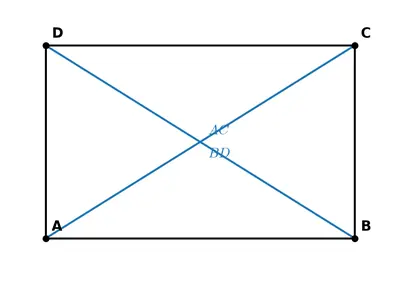
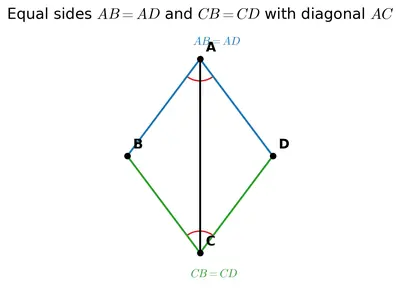
In the square $$ABCD$$, all four sides are equal and every angle is $$90^{\circ}$$. The diagonal $$AC$$ splits the square into $$\triangle ABC$$ and $$\triangle ADC$$.
Compare $$\triangle ABC$$ and $$\triangle ADC$$:
$$AB = AD \quad (\text{sides of the square}),$$
$$BC = DC \quad (\text{sides of the square}),$$
$$AC = AC \quad (\text{common diagonal}).$$
By the SSS criterion, $$\triangle ABC \cong \triangle ADC$$.
Part 2: Is $$\triangle ABC$$ also congruent to $$\triangle CDA$$?
Check the correspondence given by writing $$\triangle ABC \cong \triangle CDA$$: $$A \leftrightarrow C$$, $$B \leftrightarrow D$$, $$C \leftrightarrow A$$. Under this correspondence:
$$AB \text{ pairs with } CD, \quad BC \text{ pairs with } DA, \quad CA \text{ pairs with } AC.$$
Since $$AB = CD$$, $$BC = DA$$ (sides of the square) and $$CA = AC$$, by SSS the congruence holds too:
$$\triangle ABC \cong \triangle CDA.$$
So $$\triangle ABC$$ is congruent to $$\triangle ADC$$ in two different ways — as $$\triangle ABC \cong \triangle ADC$$ and as $$\triangle ABC \cong \triangle CDA$$. (Geometrically: the diagonal $$AC$$ is an axis of symmetry of the square, so we can either flip $$\triangle ABC$$ across $$AC$$ to get $$\triangle ADC$$ in the first way, or additionally rotate through $$180^{\circ}$$ to get the second correspondence.)
Part 3: More examples of "two ways".
Take an isosceles triangle $$\triangle PQR$$ with $$PQ = PR$$. Compared with itself, we have
- $$\triangle PQR \cong \triangle PQR$$ (the identity correspondence), and
- $$\triangle PQR \cong \triangle PRQ$$ (flip across the axis of symmetry through $$P$$; uses $$PQ = PR$$, common side $$P$$-something, and equal base angles).
Another example: two congruent isosceles trapezium halves. In general, any triangle that has a line of symmetry — an isosceles triangle — is congruent to itself in exactly two ways.
Part 4: Six different ways.
A triangle can be re-labelled in $$3! = 6$$ orders. If every such re-labelling gives a valid congruence, we get six different ways.
This happens precisely when all three sides (and all three angles) of the triangle are equal, i.e. when the triangle is equilateral. For an equilateral triangle $$\triangle ABC$$ (with $$AB = BC = CA$$), we have
$$\triangle ABC \cong \triangle ABC,\; \triangle ACB,\; \triangle BCA,\; \triangle BAC,\; \triangle CAB,\; \triangle CBA,$$
all six of which are correct. So any equilateral triangle is congruent to itself in six different ways.
 91- 6303239042