Join WhatsApp Icon JEE WhatsApp Group
NCERT Solutions for Class 6 Science

Chapter 7: Temperature and its Measurement

Download Solutions PDF
Daily JEE Updates, Tips & Important Alerts
Join 30,000+ students and stay updated with JEE notifications and preparation insights.
Join Now!
Free PDF
Complete NCERT Solution PDF for Chapter 7: Temperature and its Measurement

NCERT Solutions For Class 6 Science Chapter 7 Temperature and its Measurement helps students understand the concept of temperature, methods of measuring temperature, and the importance of thermometers in daily life. The page includes well-explained NCERT Solutions designed according to the Class 6 Science curriculum to help students answer textbook questions effectively. NCERT Solutions For Class 6 Science make learning easier by explaining topics such as hot and cold objects, different types of thermometers, temperature scales, and correct measurement techniques. The chapter develops students’ understanding of how temperature affects various objects and situations around them. These solutions help complete assignments, prepare notes, revising concepts, and improving exam performance. Students can also download the chapter PDF for convenient learning anytime. The detailed explanations help students develop better scientific observation and reasoning skills.

Download Solutions PDF

Intext Questions

Intext 1 Can it always be correctly judged, that a person has a fever, only by touching the person?

Solution

Step 1 – Recall the normal body temperature
For a healthy human being the average body temperature is $$37\;{}^{\circ}\text{C}$$ (often written as $$98.6\;{}^{\circ}\text{F}$$).

Step 2 – Understand how we usually judge fever by touch
When we place the back of our hand on someone’s forehead we only compare two temperatures:

  • the skin temperature of the other person, and
  • the temperature of our own hand.
If the other person’s skin feels warmer than our hand, we suspect fever; if it feels the same or cooler, we assume there is no fever.

Step 3 – Why touch is unreliable

  1. Subjective sensation: Different people sense ‘warm’ and ‘cold’ differently. A person coming from an air-conditioned room will feel almost every object warm.
  2. External factors: The skin temperature of the patient changes with room temperature, sweating, exposure to wind, etc. These changes do not always reflect the actual internal body temperature.
  3. Small differences are hard to feel: A rise of only $$1\;{}^{\circ}\text{C}$$–$$2\;{}^{\circ}\text{C}$$ above normal (e.g. from $$37\;{}^{\circ}\text{C}$$ to $$38\;{}^{\circ}\text{C}$$) may be enough to call it fever, but such a small increase is usually impossible to detect accurately by touch.

Step 4 – Reliable method
The dependable way to know whether a person has fever is to measure the body temperature with a clinical thermometer. The thermometer gives a numerical value that can be compared with the standard $$37\;{}^{\circ}\text{C}$$.

Conclusion
Because the sense of touch is subjective and affected by many outside conditions, it cannot always tell us correctly whether a person has fever. A thermometer measurement is necessary for a reliable judgment.

Answer

No. Touch alone is unreliable; the correct way is to measure the body temperature with a thermometer.

Intext 2 Then how do we find out how hot or cold a body is?

Solution

Our skin can sense warmness or coldness only in a rough and often misleading way. For example, if you place one hand in hot water and the other in cold water and then dip both hands into lukewarm water, the same water will feel cold to the first hand and warm to the second. Therefore scientists decided to measure hotness or coldness with an instrument instead of relying on feelings.

The measurable physical quantity that tells us how hot or cold a body is called its temperature. Temperature is defined as the degree of hotness or coldness of a body and is represented by the symbol $$T$$. The standard unit of temperature in the SI system is the kelvin (K), but in everyday life we commonly use degrees Celsius $$(^{\circ}\text{C})$$.

To find the temperature of a body we use a thermometer. A thermometer contains a substance (usually mercury or coloured alcohol) that expands uniformly when heated. The amount of expansion is made to rise along a narrow glass tube that has a scale marked on it. The scale is calibrated so that every mark corresponds to a definite temperature value. Thus the height of the mercury (or alcohol) column gives the temperature directly.

Steps to find out how hot or cold a body is:

  1. Choose the proper thermometer (clinical thermometer for body temperature, laboratory thermometer for experiments, etc.).
  2. Place the bulb of the thermometer in contact with the body whose temperature is to be measured; wait till the reading becomes steady.
  3. Read the value against the calibrated scale. If the top of the mercury column stands at the mark $$36.5^{\circ}\text{C}$$, the body’s temperature is $$36.5^{\circ}\text{C}$$; if it stands at $$80^{\circ}\text{C}$$, that is the temperature, and so on.

Therefore, by using a thermometer and reading the scale we obtain a numerical value of temperature, which objectively tells us how hot or cold the body is.

Answer

We find out how hot or cold a body is by measuring its temperature with a thermometer and reading the value marked on its scale.

Intext 3 During the COVID-19 pandemic, some special thermometers were used, which could measure the temperature of a person from a distance. What were those?

Solution

Step 1 – The problem in ordinary thermometers
Ordinary clinical thermometers (mercury or digital) have to be kept in the armpit, under the tongue, or pressed against the skin. This means the instrument touches the patient. During an infectious disease such as COVID-19 this contact could spread the virus from one person to the next.

Step 2 – The idea of “measuring from a distance”
The safe way is to read a person’s temperature without letting the instrument touch the body. For this we must use a kind of energy that the human body sends out by itself and which can be detected a short distance away. Every warm object, including our body (average temperature about $$37^{\circ}\mathrm{C}$$), constantly gives out invisible heat waves called infra-red (IR) radiation.

Step 3 – Principle behind the special thermometer
A sensor inside the special thermometer collects the infra-red radiation coming from the forehead or wrist. More radiation means a higher body temperature. An electronic circuit converts the detected IR energy into an ordinary temperature reading that can be shown on a screen. The user simply aims the instrument like a torch and presses a button; there is no contact at all.

Step 4 – Name of the device
Because the instrument works with infra-red rays and never touches the person, it is called a non-contact infra-red thermometer. People also say “IR thermometer”, “infra-red gun”, or “thermal screening thermometer”, but all these names refer to the same device.

Step 5 – Final statement
Thus, the special thermometers used during the COVID-19 pandemic were non-contact infra-red thermometers.

Answer

They were non-contact infra-red (IR) thermometers, also called IR temperature guns.

Intext 4 I have seen a friend of mine using a digital thermometer that reads temperature on a different scale. It shows the normal temperature of a healthy human body as $$98.6 \, \mathrm{^\circ F}$$. What is the reason for this difference?

Solution

Given information: A digital thermometer shows the normal human‐body temperature as $$98.6\,\mathrm{^\circ F}$$ instead of the familiar $$37\,\mathrm{^\circ C}$$.

Idea: Different thermometers can be calibrated on different temperature scales. The two most common scales are the Celsius (or centigrade) scale and the Fahrenheit scale. We must show how a temperature written on one scale is converted to the other.

Step 1 – Relation between the two scales

The ice point (freezing point of water) is $$0\,\mathrm{^\circ C}$$ and $$32\,\mathrm{^\circ F}$$. The steam point (boiling point of water at normal pressure) is $$100\,\mathrm{^\circ C}$$ and $$212\,\mathrm{^\circ F}$$. Hence

$$\frac{C}{100}=\frac{F-32}{180}$$

because $$100=212-32=180$$.

Step 2 – Formulae for conversion

  • To change Fahrenheit to Celsius: $$C=\frac{5}{9}\,(F-32)$$
  • To change Celsius to Fahrenheit: $$F=\frac{9}{5}\,C+32$$

Step 3 – Convert the known normal body temperature

Normal body temperature in the Celsius scale is $$C=37\,\mathrm{^\circ C}$$.

Using $$F=\tfrac{9}{5}C+32$$:

  • Multiply: $$\tfrac{9}{5}\times37=\tfrac{333}{5}=66.6$$
  • Add $$32$$: $$66.6+32=98.6$$

So $$F=98.6\,\mathrm{^\circ F}$$.

Step 4 – Conclusion

The thermometer your friend used is graduated on the Fahrenheit scale. Although the number looks different, it represents exactly the same physical temperature—$$37\,\mathrm{^\circ C}$$ and $$98.6\,\mathrm{^\circ F}$$ are equal.

Hence the "difference" arises only because two different temperature scales are being used.

Answer

Because that thermometer is marked in the Fahrenheit scale; the normal body temperature of 37 °C is equal to 98.6 °F.

Intext 5 Can a clinical thermometer be used for measuring the temperature of boiling water? Or for measuring the temperature of ice?

Solution

Step 1 – Range of a clinical thermometer

A clinical thermometer is designed only for measuring the temperature of the human body. Its scale therefore covers a narrow range, from $$35\,^{\circ}\mathrm{C}$$ at the lower end to $$42\,^{\circ}\mathrm{C}$$ at the upper end. We may write this as

\[35\,^{\circ}\mathrm{C} \;\le\; T_{\text{clinical}} \;\le\; 42\,^{\circ}\mathrm{C}.\]

Any temperature lying outside this range cannot be read on it.

Step 2 – Boiling water

At normal atmospheric pressure, water boils at about $$100\,^{\circ}\mathrm{C}$$. Comparing this with the upper end of the clinical scale ($$42\,^{\circ}\mathrm{C}$$):

\[T_{\text{boil}} \;=\; 100\,^{\circ}\mathrm{C} \;\gt\; 42\,^{\circ}\mathrm{C}.\]

So the boiling-water temperature is far higher than the largest value marked on the clinical thermometer. The mercury would try to expand beyond the top of the scale and the bulb might even burst. Hence a clinical thermometer cannot be used to measure the temperature of boiling water.

Step 3 – Ice (melting point)

Melting ice (ice in contact with water) has a temperature of about $$0\,^{\circ}\mathrm{C}$$. Comparing this with the lower end of the clinical scale ($$35\,^{\circ}\mathrm{C}$$):

\[T_{\text{ice}} \;=\; 0\,^{\circ}\mathrm{C} \;\lt\; 35\,^{\circ}\mathrm{C}.\]

So the temperature of ice is well below the smallest value marked on the clinical thermometer. The mercury column would stay inside the bulb and no reading could be taken. Hence a clinical thermometer cannot be used to measure the temperature of ice either.

Step 4 – Conclusion

  • Boiling water ($$\approx 100\,^{\circ}\mathrm{C}$$): cannot be measured by a clinical thermometer because $$100\,^{\circ}\mathrm{C}$$ is greater than $$42\,^{\circ}\mathrm{C}$$ (above the clinical range).
  • Ice ($$\approx 0\,^{\circ}\mathrm{C}$$): cannot be measured by a clinical thermometer because $$0\,^{\circ}\mathrm{C}$$ is less than $$35\,^{\circ}\mathrm{C}$$ (below the clinical range).

For both cases one should instead use a laboratory thermometer, whose typical range is $$-10\,^{\circ}\mathrm{C}$$ to $$110\,^{\circ}\mathrm{C}$$. This range easily covers both the temperature of ice ($$0\,^{\circ}\mathrm{C}$$) and the temperature of boiling water ($$100\,^{\circ}\mathrm{C}$$), so a laboratory thermometer is the correct instrument in either situation.

Answer

No, in both cases. A clinical thermometer reads only from $$35\,^{\circ}\mathrm{C}$$ to $$42\,^{\circ}\mathrm{C}$$. Boiling water ($$\approx 100\,^{\circ}\mathrm{C}$$) lies above this range, and ice ($$\approx 0\,^{\circ}\mathrm{C}$$) lies below it. A laboratory thermometer (range $$-10\,^{\circ}\mathrm{C}$$ to $$110\,^{\circ}\mathrm{C}$$) must be used instead.

Intext 6 How can we measure temperatures beyond the range of a clinical thermometer?

Solution

Step 1 — Understand the limitation of the clinical thermometer
A clinical thermometer is designed only for measuring human body temperature. Its scale starts at about $$35\,{}^{\circ}\mathrm{C}$$ and ends near $$42\,{}^{\circ}\mathrm{C}$$. Anything colder than $$35\,{}^{\circ}\mathrm{C}$$ or hotter than $$42\,{}^{\circ}\mathrm{C}$$ lies outside its range, so its mercury column will neither fall low enough nor rise high enough to give a reading.

Step 2 — Choose an instrument with a wider range
To measure higher or lower temperatures we must pick a thermometer whose scale actually includes those values. Two common choices at Class-6 level are:

  • Laboratory (mercury-in-glass) thermometer  – typical range $$0\,{}^{\circ}\mathrm{C}\;\text{to}\;110\,{}^{\circ}\mathrm{C}$$, marked in $$1\,{}^{\circ}\mathrm{C}$$ divisions.
  • Digital thermometer (electronic sensor)  – many models cover roughly $$-50\,{}^{\circ}\mathrm{C}$$ to $$+150\,{}^{\circ}\mathrm{C}$$ or even more.

Step 3 — Using a laboratory thermometer correctly

  1. Hold the thermometer upright so that the mercury can move freely.
  2. Make sure the bulb is fully immersed in the substance whose temperature you want to measure. (If it is a liquid such as hot water, the bulb should not touch the container’s sides or bottom.)
  3. Wait until the mercury thread stops rising or falling; this shows that thermal equilibrium is reached.
  4. Keep your eye level with the top of the mercury thread and read the temperature marked on the scale.
  5. Remove the thermometer and allow it to cool before putting it away.

Step 4 — Why this works
A laboratory or digital thermometer has a scale that extends well beyond human-body values. Because its range includes the desired high or low temperature, the expansion (or sensor reading) can be recorded accurately, something impossible with a clinical instrument.

Final conclusion
Whenever the temperature you need to measure is below $$35\,{}^{\circ}\mathrm{C}$$ or above $$42\,{}^{\circ}\mathrm{C}$$, switch from a clinical thermometer to a laboratory thermometer or a suitable digital thermometer.

Answer

Use a thermometer whose scale is wider than the clinical thermometer’s 35 °C – 42 °C range, e.g. a laboratory thermometer (≈ 0 °C – 110 °C) or a digital thermometer; then measure in the usual way with its bulb/sensor fully in the substance and read the value on its extended scale.

Intext 7 Can we use a laboratory thermometer for measuring body temperature of a person?

Solution

Given question  Can we use a laboratory thermometer for measuring the body temperature of a person?

Facts we already know

  • The laboratory thermometer usually has a scale from about $$-10\,{}^{\circ}\mathrm{C}$$ to $$110\,{}^{\circ}\mathrm{C}$$.
  • Its capillary tube is straight; there is no constriction (kink) between the bulb and the scale.
  • When a laboratory thermometer is taken out of the hot (or cold) substance, the bulb immediately comes in contact with the cooler room air. The mercury (or coloured alcohol) therefore begins to contract and sinks down at once.
  • The clinical (doctor’s) thermometer that we normally use for body temperature does have a small kink just above the bulb. The kink stops the mercury column from falling back quickly, so we can remove the thermometer from the mouth/arm-pit and still read the temperature.

Step-by-step reasoning

  1. To record a person’s body temperature we have to insert the thermometer into the mouth or place it in the armpit for about one minute so that the bulb reaches the same temperature as the body (about $$37\,{}^{\circ}\mathrm{C}$$).
  2. After that we must take the thermometer out in order to read the scale.
  3. In a laboratory thermometer there is no kink, so the moment we take it out, the bulb is exposed to cooler air (roughly $$25\,{}^{\circ}\mathrm{C}$$). The mercury column begins to contract immediately: $$\text{observed height} \downarrow \;(\text{falls back})$$ Hence the reading we try to note is smaller than the real body temperature.
  4. Because the temperature starts changing the instant the thermometer is removed, we get no time to read the correct value. The result is inaccurate and unreliable.
  5. Therefore a laboratory thermometer is not suitable for measuring body temperature. A clinical thermometer, with its kink, is specially designed for this purpose.

Additional points (for completeness)

  • Clinical thermometers are generally graduated only from $$35\,{}^{\circ}\mathrm{C}$$ to $$42\,{}^{\circ}\mathrm{C}$$, the normal possible range of human body temperature, making them easier to read precisely.
  • They are also made with a shorter and thinner bulb so that they reach body temperature quickly.

Conclusion

A laboratory thermometer cannot be used to measure body temperature because, lacking a constriction, the mercury level falls as soon as the thermometer is removed from the body, so the correct temperature cannot be read.

Answer

No. A laboratory thermometer has no constriction to hold the mercury column, so the reading falls the moment it is taken out of the person’s body; therefore it cannot give the correct body temperature.

Let us enhance our learning

1

The normal temperature of a healthy human being is close to ____ .

  1. (i) $$98.6 \, \mathrm{^\circ C}$$
  2. (ii) $$37.0 \, \mathrm{^\circ C}$$
  3. (iii) $$32.0 \, \mathrm{^\circ C}$$
  4. (iv) $$27.0 \, \mathrm{^\circ C}$$

Solution

Step 1 – Recall the accepted normal body temperature
Doctors usually say that a healthy person has a temperature of about $$98.6\,\mathrm{^{\circ}F}$$ (degrees Fahrenheit).

Step 2 – Convert this Fahrenheit value to the Celsius scale
The relation between the two scales is

$$T_{\!\,\mathrm{C}} = \bigl(T_{\!\,\mathrm{F}} - 32\bigr) \times \frac{5}{9}$$

Put $$T_{\!\,\mathrm{F}} = 98.6$$:

\[T_{\!\,\mathrm{C}} = (98.6 - 32) \times \frac{5}{9}\]

First subtract 32:

$$98.6 - 32 = 66.6$$

Now multiply by $$\tfrac{5}{9}$$:

$$66.6 \times \frac{5}{9} = 37.0$$

Step 3 – Match with the given choices
The calculated result is $$37.0\,\mathrm{^{\circ}C}$$, which appears as option (ii).
Note that option (i) shows $$98.6\,\mathrm{^{\circ}C}$$, not $$98.6\,\mathrm{^{\circ}F}$$; such a high Celsius temperature would be fatal, so it cannot be right.

Therefore, the normal temperature of a healthy human being is closest to option (ii): $$37.0\,\mathrm{^{\circ}C}$$.

Answer

(ii) $$37.0\,\mathrm{^{\circ}C}$$

2

$$37 \, \mathrm{^\circ C}$$ is the same temperature as ____ .

  1. (i) $$97.4 \, \mathrm{^\circ F}$$
  2. (ii) $$97.6 \, \mathrm{^\circ F}$$
  3. (iii) $$98.4 \, \mathrm{^\circ F}$$
  4. (iv) $$98.6 \, \mathrm{^\circ F}$$

Solution

To compare the Celsius temperature $$37\,\mathrm{^\circ C}$$ with the Fahrenheit scale, we must change the units using the standard conversion rule.

Step 1 — Write the conversion formula

The relation between the two temperature scales is

$$F = \frac{9}{5}\,C + 32$$

where

  • $$F$$ is the temperature in degrees Fahrenheit (°F), and
  • $$C$$ is the temperature in degrees Celsius (°C).

Step 2 — Substitute $$C = 37$$ into the formula

$$F = \frac{9}{5} \times 37 + 32$$

Step 3 — Carry out the multiplication

First find $$\dfrac{9}{5}\times 37$$:

$$9 \times 37 = 333$$
$$\frac{333}{5} = 66.6$$

Step 4 — Add 32 to the product

$$F = 66.6 + 32 = 98.6$$

Step 5 — Write the final temperature

\[F = 98.6\,\mathrm{^\circ F}\]

Among the given choices, 98.6 °F corresponds to option (iv).

Answer

(iv) $$98.6\,\mathrm{^\circ F}$$

3 Fill in the blanks:

(i) The hotness or coldness of a system is determined by its ____ .

Solution

The common physical quantity that tells us how hot or cold an object is called its temperature.

Hence, we fill the blank with the word “temperature”.

Answer

temperature

(ii) The temperature of ice-cold water cannot be measured by a ____ thermometer.

Solution

A clinical thermometer is designed only for measuring human body temperature. Its scale generally ranges from $$35\,{}^{\circ}\mathrm{C}$$ to $$42\,{}^{\circ}\mathrm{C}$$.

Ice-cold water has a temperature close to $$0\,{}^{\circ}\mathrm{C}$$, which lies outside this range. Therefore a clinical thermometer cannot be used.

Answer

clinical thermometer

(iii) The unit of temperature is degree ____ .

Solution

The blank asks for the name of the temperature scale that appears just after the word “degree”.

In the SI system the base unit of temperature is the kelvin (K), which is written without the word “degree”. The everyday unit marked on ordinary thermometers, and used throughout this NCERT chapter, is the degree Celsius, written as $$^{\circ}\mathrm{C}$$.

Since the sentence already provides the word “degree”, the blank must be filled by the name of the scale, namely Celsius.

Answer

Celsius

4

The range of a laboratory thermometer is usually ____ .

  1. (i) $$10 \, \mathrm{^\circ C}$$ to $$100 \, \mathrm{^\circ C}$$
  2. (ii) $$-10 \, \mathrm{^\circ C}$$ to $$110 \, \mathrm{^\circ C}$$
  3. (iii) $$32 \, \mathrm{^\circ C}$$ to $$45 \, \mathrm{^\circ C}$$
  4. (iv) $$35 \, \mathrm{^\circ C}$$ to $$42 \, \mathrm{^\circ C}$$

Solution

Step 1: What does “range of a thermometer” mean?

The range is the lowest temperature marked on the scale up to the highest temperature marked. A thermometer must be able to read any temperature that falls in this interval.

Step 2: Facts from the textbook

  • A clinical thermometer is intended only for measuring human-body temperature, so its range is short, about $$35\,{}^\circ\mathrm{C}$$ to $$42\,{}^\circ\mathrm{C}$$.
  • A laboratory thermometer must work in many experiments. Some mixtures can be colder than the freezing point of water ($$0\,{}^\circ\mathrm{C}$$) and many can be hotter than its boiling point ($$100\,{}^\circ\mathrm{C}$$). Hence the laboratory thermometer is made with a much wider scale that goes below $$0\,{}^\circ\mathrm{C}$$ and well above $$100\,{}^\circ\mathrm{C}$$.

Step 3: Check the given options

  1. $$10\,{}^\circ\mathrm{C}$$ to $$100\,{}^\circ\mathrm{C}$$ – does not go below freezing or far above boiling.
  2. $$-10\,{}^\circ\mathrm{C}$$ to $$110\,{}^\circ\mathrm{C}$$ – covers a wide span on both sides of $$0\,{}^\circ\mathrm{C}$$ and $$100\,{}^\circ\mathrm{C}$$; suited to laboratory work.
  3. $$32\,{}^\circ\mathrm{C}$$ to $$45\,{}^\circ\mathrm{C}$$ – much too narrow; near body temperature.
  4. $$35\,{}^\circ\mathrm{C}$$ to $$42\,{}^\circ\mathrm{C}$$ – exactly the clinical-thermometer range.

Step 4: Conclusion

The usual range of a laboratory thermometer is $$-10\,{}^\circ\mathrm{C}$$ to $$110\,{}^\circ\mathrm{C}$$, i.e. option (ii).

Answer

(ii) $$-10 \,{}^\circ\mathrm{C}$$ to $$110 \,{}^\circ\mathrm{C}$$

5

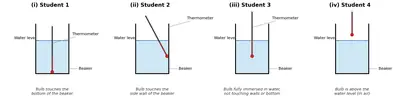
Four students used a laboratory thermometer to measure the temperature of water as shown in Fig. 7.6:

Who do you think followed the correct way for measuring temperature?

  1. (i) Student 1
  2. (ii) Student 2
  3. (iii) Student 3
  4. (iv) Student 4
Fig. 7.6
Fig. 7.6

Solution

Step 1 – Recall the rules for using a laboratory thermometer

  • The bulb must be completely immersed in the substance whose temperature is to be measured, but it must not touch the bottom or the walls of the container; otherwise the glass will conduct extra heat and give a wrong reading.
  • The thermometer has to be kept upright (vertical); if it is slanted, the mercury thread does not settle at the correct mark.
  • The reading must be taken with the bulb still in the water and with the eye exactly in the plane of the mercury level, to avoid parallax error.

Step 2 – Examine what each student in Fig. 7.6 is doing

StudentWhat the picture showsDoes it break a rule?
1Bulb touching the bottom of the beakerYes  →  wrong
2Thermometer vertical, bulb well inside water, not touching glass; reading taken at eye levelNo  →  correct
3Thermometer held slant (inclined)Yes  →  wrong
4Thermometer taken out of water for readingYes  →  wrong

Step 3 – Identify the correct student

Only Student 2 follows all the rules: upright position, bulb not touching the container, eye at the mercury level, and thermometer still in the water.

Conclusion

Therefore, the correct way of measuring the temperature is shown by Student 2.

Answer

(ii) Student 2

6

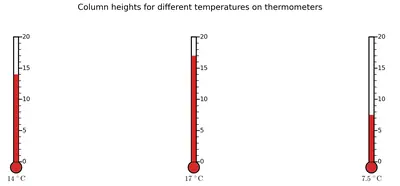
Colour to show the red column on the drawings of thermometers (Fig. 7.7) as per the temperatures written below: $$14 \, \mathrm{^\circ C}$$, $$17 \, \mathrm{^\circ C}$$, $$7.5 \, \mathrm{^\circ C}$$.
Fig. 7.7
Fig. 7.7

Solution

Step 1 – Understand the scale printed on Fig. 7.7
The blank thermometers drawn in your textbook have a vertical stem with small, equally-spaced marks. Every tenth division is numbered 0 °C, 10 °C, 20 °C, 30 °C and so on. The nine short, un-numbered divisions between any two consecutive numbers therefore show 1 °C each.

Step 2 – Locate 14 °C

  • 14 °C lies between 10 °C and 20 °C.
  • Count four small divisions above the 10 °C mark (10 °C → 11 °C → 12 °C → 13 °C → 14 °C).
  • What to draw: Starting from the bulb, colour the tube red up to the fourth small division past the 10 °C line. Stop exactly at that fourth tick. Leave the space above it clear.

Step 3 – Locate 17 °C

  • 17 °C is also between 10 °C and 20 °C.
  • Count seven small divisions above the 10 °C mark (stop three divisions short of 20 °C).
  • What to draw: Shade the red column continuously from the bulb up to the seventh small tick above 10 °C. Leave everything above that point blank.

Step 4 – Locate 7.5 °C

  • 7.5 °C lies between 5 °C and 10 °C.
  • Exactly halfway between 7 °C and 8 °C is 7.5 °C. That is also five small divisions above the 5 °C mark or two and a half divisions below the 10 °C mark.
  • What to draw: Begin at the bulb and colour the column steadily until you reach a point midway between the seventh and eighth small ticks above 0 °C (or halfway between the fifth and sixth ticks above 5 °C). Stop there so that the top of the red column sits exactly at the centre between those two ticks.

Step 5 – Check your work

  1. The 14 °C column ends four divisions above 10 °C.
  2. The 17 °C column ends seven divisions above 10 °C.
  3. The 7.5 °C column ends halfway between the ticks for 7 °C and 8 °C.

If each thermometer in Fig. 7.7 has been shaded as directed, the activity is complete.

Answer

Shade the mercury (red) column
• up to 14 °C on the first thermometer,
• up to 17 °C on the second,
• and halfway between 7 °C and 8 °C (7.5 °C) on the third.

7

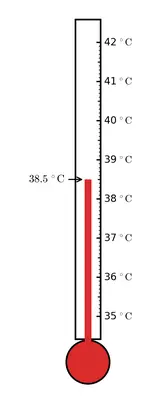
Observe the part of thermometer shown in Fig. 7.8 and answer the following questions:
Fig. 7.8
Fig. 7.8

(i) What type of thermometer is it?

Solution

The scale shown goes only from about 35 °C to 42 °C, which is exactly the range required for measuring the temperature of the human body. Such a limited-range thermometer, fitted with a constriction (kink) to hold the mercury column in place after removal from the mouth or armpit, is called a clinical thermometer.

Answer

It is a clinical thermometer.

(ii) What is the reading of the thermometer?

Solution

Between every two marked degrees (for example, between 37 °C and 38 °C) there are ten equally spaced small divisions.

  • Value of one small division = $$\dfrac{1\;{}^{\circ}\mathrm{C}}{10}=0.1\;{}^{\circ}\mathrm{C}$$
  • The mercury tip is at the fifth small division above the 37 °C mark.
  • Rise above 37 °C = $$5\times0.1\;{}^{\circ}\mathrm{C}=0.5\;{}^{\circ}\mathrm{C}$$

Therefore,

\[T = 37\;{}^{\circ}\mathrm{C} + 0.5\;{}^{\circ}\mathrm{C} = 37.5\;{}^{\circ}\mathrm{C}\]

The thermometer is reading 37.5 °C.

Answer

The reading is 37.5 °C.

(iii) What is the smallest value that this thermometer can measure?

Solution

The smallest value that can be read on this thermometer is the value of one small division.

As calculated above,

\[\text{Least count} = 0.1\;{}^{\circ}\mathrm{C}\]

Hence the thermometer can measure temperature changes as small as one-tenth of a degree Celsius.

Answer

Least count = 0.1 °C.

8 A laboratory thermometer is not used to measure our body temperature. Give a reason.

Solution

Reason, step by step

  1. The temperature of a healthy human body is only about $$37\,{}^{\circ}\mathrm{C}$$  (between $$35\,{}^{\circ}\mathrm{C}$$ and $$42\,{}^{\circ}\mathrm{C}$$).
  2. A clinical thermometer is specially designed for this job. It has
    • a short scale, from $$35\,{}^{\circ}\mathrm{C}$$ to $$42\,{}^{\circ}\mathrm{C}$$, marked very clearly, and
    • a kink (a tiny constriction) just above the bulb. After the thermometer is taken out of the mouth, the kink stops the mercury from flowing back, so we can read the temperature safely.
  3. A laboratory thermometer
    • has a wide range (typically $$-10\,{}^{\circ}\mathrm{C}$$ to $$110\,{}^{\circ}\mathrm{C}$$), so the body-temperature region is crowded and difficult to read accurately, and
    • does not have a kink. The moment we take it away from the body the mercury column slips back immediately, so the correct reading cannot be noted.

Because of the absence of a kink (and its unsuitable scale), a laboratory thermometer cannot hold the reading once removed from the body, so it is not used for measuring human body temperature.

Answer

A laboratory thermometer has no kink; as soon as it is taken out of contact with the body the mercury falls back, so the correct body temperature cannot be read. Hence it is not used for measuring our body temperature.

9

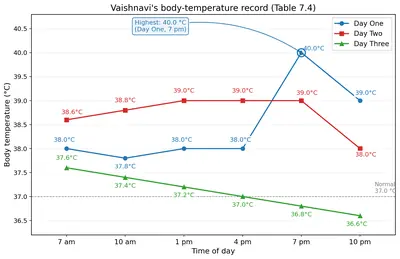
Vaishnavi has not gone to school as she is ill. Her mother has kept a record of her body temperature for three days as shown in Table 7.4.

Table 7.4: Body temperature record of Vaishnavi

DAY7am10am1pm4pm7pm10pm
One$$38.0 \, \mathrm{^\circ C}$$$$37.8 \, \mathrm{^\circ C}$$$$38.0 \, \mathrm{^\circ C}$$$$38.0 \, \mathrm{^\circ C}$$$$40.0 \, \mathrm{^\circ C}$$$$39.0 \, \mathrm{^\circ C}$$
Two$$38.6 \, \mathrm{^\circ C}$$$$38.8 \, \mathrm{^\circ C}$$$$39.0 \, \mathrm{^\circ C}$$$$39.0 \, \mathrm{^\circ C}$$$$39.0 \, \mathrm{^\circ C}$$$$38.0 \, \mathrm{^\circ C}$$
Three$$37.6 \, \mathrm{^\circ C}$$$$37.4 \, \mathrm{^\circ C}$$$$37.2 \, \mathrm{^\circ C}$$$$37.0 \, \mathrm{^\circ C}$$$$36.8 \, \mathrm{^\circ C}$$$$36.6 \, \mathrm{^\circ C}$$
Figure
Figure

(i) What was Vaishnavi's highest recorded temperature?

Solution

To know Vaishnavi’s highest body temperature, look through every entry in Table 7.4.

  • Day One readings (in $$\mathrm{^\circ C}$$): $$38.0,\;37.8,\;38.0,\;38.0,\;40.0,\;39.0$$  ⟹  maximum $$=40.0$$.
  • Day Two readings: $$38.6,\;38.8,\;39.0,\;39.0,\;39.0,\;38.0$$  ⟹  maximum $$=39.0$$.
  • Day Three readings: $$37.6,\;37.4,\;37.2,\;37.0,\;36.8,\;36.6$$  ⟹  maximum $$=37.6$$.

Comparing the three daily maxima,

$$40.0\,\mathrm{^\circ C} > 39.0\,\mathrm{^\circ C} > 37.6\,\mathrm{^\circ C}$$

Therefore the highest recorded temperature was $$40.0\,\mathrm{^\circ C}$$.

Answer

$$40.0\,\mathrm{^\circ C}$$

(ii) On which day and at what time was Vaishnavi's highest temperature recorded?

Solution

From the detailed search made in part (i) we already know the maximum value was $$40.0\,\mathrm{^\circ C}$$.

Now locate this value in Table 7.4.

  • It appears only once: on Day One at the 7 pm reading.

Hence Vaishnavi’s highest temperature of $$40.0\,\mathrm{^\circ C}$$ was recorded on Day One at 7 pm.

Answer

Day One, 7 pm

(iii) On which day did Vaishnavi's temperature return to normal?

Solution

The normal human body temperature is taken as $$37\,\mathrm{^\circ C}$$.

Scan the temperatures day-wise until we first meet a reading that is $$\le 37\,\mathrm{^\circ C}$$.

  • Day One: all readings are above $$38\,\mathrm{^\circ C}$$.
  • Day Two: all readings are $$\ge 38\,\mathrm{^\circ C}$$.
  • Day Three:
    • 7 am $$37.6\,\mathrm{^\circ C}$$ (still high)
    • 10 am $$37.4\,\mathrm{^\circ C}$$ (still high)
    • 1 pm $$37.2\,\mathrm{^\circ C}$$ (slightly high)
    • 4 pm $$37.0\,\mathrm{^\circ C}$$  ⟹  back to normal

Thus her temperature returned to normal on Day Three (first evident at 4 pm).

Answer

Day Three

10

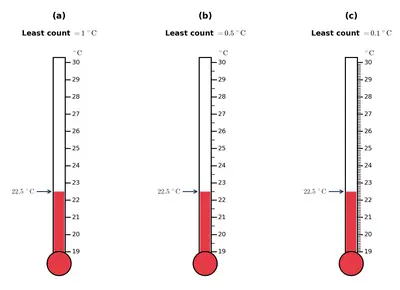
If you have to measure the temperature $$22.5 \, \mathrm{^\circ C}$$, which of the following three thermometers will you use (Fig. 7.9)? Explain.
Fig. 7.9
Fig. 7.9

Solution

Step 1 – Recall the working range of each thermometer shown in Fig. 7.9

  • Thermometer A: a clinical thermometer. The scale on its stem starts from $$35\,\mathrm{^\circ C}$$ and ends at $$42\,\mathrm{^\circ C}$$ because it is meant only for measuring the temperature of the human body.
  • Thermometer B: a laboratory thermometer. Its glass stem is graduated from about $$-10\,\mathrm{^\circ C}$$ to $$110\,\mathrm{^\circ C}$$ so that it can be used for many laboratory experiments.
  • Thermometer C: a digital/room thermometer (its exact graduation is not printed; it merely shows the reading on a small screen). The textbook wants us to decide on the basis of the printed scales, so for this question we consider only the two glass thermometers whose scales we can see clearly.

Step 2 – Locate the required temperature on each scale

We have to measure $$T=22.5\,\mathrm{^\circ C}$$.

  • On Thermometer A the lowest mark is $$35\,\mathrm{^\circ C}$$.
    Because $$22.5\,\mathrm{^\circ C} < 35\,\mathrm{^\circ C}$$, this value lies outside the scale of the clinical thermometer. Hence Thermometer A is unsuitable.
  • On Thermometer B the scale begins from about $$-10\,\mathrm{^\circ C}$$ and goes well beyond the required value.
    Because $$-10\,\mathrm{^\circ C} \le 22.5\,\mathrm{^\circ C} \le 110\,\mathrm{^\circ C}$$, the required temperature falls neatly inside this range. Thermometer B is therefore suitable.

Step 3 – Choose the correct thermometer

A thermometer must be able to show a value of $$22.5\,\mathrm{^\circ C}$$ on its scale. Only the laboratory thermometer (Thermometer B) satisfies this condition, so it is the correct choice.

Conclusion

To measure $$22.5\,\mathrm{^\circ C}$$ we should use the laboratory thermometer shown in Fig. 7.9 (Thermometer B) because its range includes the required temperature whereas the clinical thermometer does not.

Answer

Use the laboratory thermometer (Thermometer B); its scale −10 °C to 110 °C covers 22.5 °C, whereas the clinical thermometer’s 35 – 42 °C range does not.

11

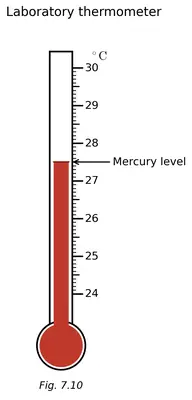
The temperature shown by the thermometer in Fig. 7.10 is

  1. (i) $$28.0 \, \mathrm{^\circ C}$$
  2. (ii) $$27.5 \, \mathrm{^\circ C}$$
  3. (iii) $$26.5 \, \mathrm{^\circ C}$$
  4. (iv) $$25.3 \, \mathrm{^\circ C}$$
Fig. 7.10
Fig. 7.10

Solution

Step 1 – Locate the two numbered marks between which the mercury level lies.
The bulb’s column ends between the long marks labelled $$27\,{}^{\circ}\mathrm C$$ and $$28\,{}^{\circ}\mathrm C$$.

Step 2 – Find the value of one small division.
Difference between these two long marks = $$1\,{}^{\circ}\mathrm C$$.
There are two equal short lines in this interval (one at the centre). Hence

$$\text{value of one small division}=\dfrac{1\,{}^{\circ}\mathrm C}{2}=0.5\,{}^{\circ}\mathrm C$$.

Step 3 – Count the divisions above the lower mark.
The mercury top is exactly on the middle short line, i.e. one small division above $$27\,{}^{\circ}\mathrm C$$.

Step 4 – Add this to the lower reading:

$$27\,{}^{\circ}\mathrm C+0.5\,{}^{\circ}\mathrm C=27.5\,{}^{\circ}\mathrm C$$.

Hence the thermometer shows 27.5 °C, which corresponds to option (ii).

Answer

(ii) $$27.5\,{}^{\circ}\mathrm C$$

12 A laboratory thermometer has 50 divisions between $$0 \, \mathrm{^\circ C}$$ and $$100 \, \mathrm{^\circ C}$$. What does each division of this thermometer measure?

Solution

Given data

  • Lower fixed point (melting ice)  $$0\,\mathrm{^\circ C}$$
  • Upper fixed point (boiling water)  $$100\,\mathrm{^\circ C}$$
  • Number of equal divisions between these two points  $$= 50$$

Step 1 – Find the total temperature range

The thermometer scale starts at $$0\,\mathrm{^\circ C}$$ and ends at $$100\,\mathrm{^\circ C}$$, so the total temperature difference is

$$100\,\mathrm{^\circ C}-0\,\mathrm{^\circ C}=100\,\mathrm{^\circ C}.$$

Step 2 – Find the value of one division

The 100-degree span is divided into 50 equal parts, so each part (each division) represents

$$\text{Value per division}=\frac{\text{Total temperature range}}{\text{Number of divisions}}=\frac{100\,\mathrm{^\circ C}}{50}=2\,\mathrm{^\circ C}.$$

Conclusion

Each division on the laboratory thermometer corresponds to a temperature change of $$2\,\mathrm{^\circ C}$$.

Answer

Each division measures $$2\,\mathrm{^\circ C}$$.

13

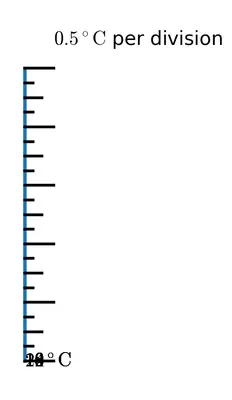
Draw the scale of a thermometer in which the smallest division reads $$0.5 \, \mathrm{^\circ C}$$. You may draw only the portion between $$10 \, \mathrm{^\circ C}$$ and $$20 \, \mathrm{^\circ C}$$.
Figure
Figure

Solution

To draw the required part of the thermometer scale, follow these steps one by one. Keep a sharpened pencil, a ruler and some coloured pencils ready.

  1. Fix the limits.
    You have to show the scale only between $$10\,\mathrm{^\circ C}$$ and $$20\,\mathrm{^\circ C}$$.
  2. Decide the least count (smallest division).
    The problem states that the smallest division must read $$0.5\,\mathrm{^\circ C}$$. So every tiny step on the scale should represent half–a–degree.
  3. Find how many intervals are needed.
    The temperature difference to be covered is $$20\,\mathrm{^\circ C}-10\,\mathrm{^\circ C}=10\,\mathrm{^\circ C}\;.$$ Since one interval is $$0.5\,\mathrm{^\circ C}$$, the number of equal intervals is $$\frac{10\,\mathrm{^\circ C}}{0.5\,\mathrm{^\circ C}}=20\;.$$ Therefore the portion from $$10$$ to $$20$$ must be split into 20 equal steps.
  4. Mark the positions.
    Because there are 20 equal intervals, there will be $$20+1 = 21$$ line positions: $$10.0, 10.5, 11.0, 11.5, \ldots , 19.5, 20.0\;.$$
  5. Draw the main stem.
    Draw one long vertical straight line about 10 cm high. This will act as the stem of the thermometer.
  6. Put the divisions.
    Along this line, start at the bottom and move upward. Mark 21 short horizontal strokes at equal spacing. Use the ruler so that the gaps are truly equal.
  7. Distinguish major and minor marks.
    • Every alternate stroke (representing whole degrees: 10, 11, 12, …, 20) should be drawn longer and a bit thicker.
    • The strokes in-between (representing 10.5, 11.5, …, 19.5) are drawn shorter.
  8. Label the whole-degree marks.
    Write the numbers 10, 11, 12, … up to 20 neatly just to the right of each long stroke. Leave the half-degree marks unlabeled; their value is understood.
  9. Add a title (optional).
    At the top you may write “Portion of thermometer (LC = 0.5 °C)”.

What the figure should finally look like

  • A single straight vertical line.
  • Between its bottom and top are 21 equally spaced ticks.
  • Long ticks (numbered 10 to 20) are twice the length of the short ticks.
  • Exactly one short tick lies midway between any two consecutive long ticks, indicating the additional 0.5 °C.

If you follow the above nine steps, your drawing will faithfully reproduce the section of a thermometer whose smallest division (least count) is $$0.5\,\mathrm{^\circ C}$$ between $$10\,\mathrm{^\circ C}$$ and $$20\,\mathrm{^\circ C}$$.

Answer

Between $$10\,\mathrm{^\circ C}$$ and $$20\,\mathrm{^\circ C}$$ mark 21 equal ticks, every alternate one longer; label the long ticks 10, 11, 12, …, 20. Each interval (long ↔ short or short ↔ long) represents $$0.5\,\mathrm{^\circ C}$$, so the scale has the required least count.

14 Komal tells you that she has a fever of 101 degrees. Does she mean it on the Celsius scale or Fahrenheit scale?

Solution

To decide which temperature scale Komal is using, compare the meaning of 101 degrees on the two common thermometric scales.

  • Normal human body temperature
      • Celsius scale: about $$37\;{}^\circ \mathrm{C}$$.
      • Fahrenheit scale: about $$98.6\;{}^\circ \mathrm{F}$$.
  • Given temperature: 101 degrees.

If Komal were talking about the Celsius scale, her temperature would be \[101\;{}^\circ \mathrm{C}\] which is even higher than the boiling point of water at ordinary pressure (100 °C). No human body can reach this and survive, so it is clearly impossible.

Check the same 101 reading on the Fahrenheit scale:

First convert 101 °F to Celsius to see how high a fever it is:

$$^\circ \mathrm{C} = \frac{5}{9}\bigl(^\circ \mathrm{F} - 32\bigr)$$

$$^\circ \mathrm{C} = \frac{5}{9}(101 - 32) = \frac{5}{9}\times 69 = 38.3\;{}^\circ \mathrm{C}\;(\text{approx.})$$

A body temperature of about 38 °C is a moderate fever and quite common, so 101 degrees is perfectly reasonable if the scale is Fahrenheit.

Conclusion: When someone says “101 degrees” in the context of body temperature, they virtually always mean 101 °F.

Answer

She means 101 °F (Fahrenheit scale).

NCERT Solutions for Class 6
Maths
NCERT Solutions for Class 6 Maths
Chapter-wise step-by-step
solutions with explanations
explore solutions Maths bg
Science
NCERT Solutions for Class 6 Science
Chapter-wise step-by-step
solutions with explanations
explore solutions Science bg

Frequently Asked Questions

50,000+ JEE Students Trusted Our Score Calculator

Predict your JEE Main percentile, rank & performance in seconds