Given information
- There are three identical bar magnets.
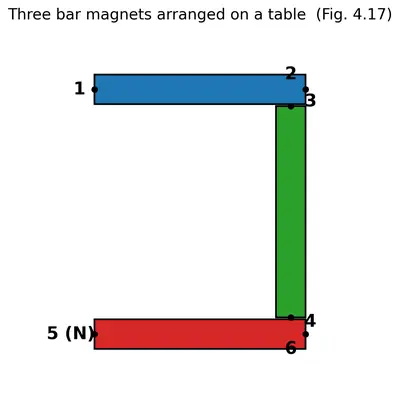
- Their free ends are numbered 1, 2, 3, 4, 5 and 6 as in Fig. 4.17 of the textbook (top magnet – ends 1 & 2; right-side vertical magnet – ends 5 & 6; bottom magnet – ends 3 & 4).
- The arrangement forms a ∟-shaped chain: end 2 touches end 5, and end 3 touches end 6.
- Polarity of end 5 is given – it is a $$S$$ (south) pole.
Facts about magnets that we shall use
- Every bar magnet has exactly two poles: one $$N$$ (north) and the other $$S$$ (south).
- Like poles repel, unlike poles attract. Therefore, if two ends are sticking together, they must be unlike (one $$N$$, the other $$S$$).
Step 1 – Find the pole at end 2 (touches 5)
End 2 is in direct contact with end 5. Since end 5 is already known to be a $$S$$ pole and the two ends attract each other, end 2 must be the opposite pole, i.e. a $$N$$ pole.
Step 2 – Find the pole at end 1 (other end of the same magnet as 2)
Ends 1 and 2 are the two opposite ends of the same bar magnet (the top one). Hence if end 2 is $$N$$, the far end 1 must be the opposite pole $$S$$.
Step 3 – Find the pole at end 6 (opposite end of the magnet having 5)
Ends 5 and 6 are the two ends of the right-side vertical magnet. Therefore, if end 5 is $$S$$, the opposite end 6 must be $$N$$.
Step 4 – Find the pole at end 3 (touches 6)
End 3 is sticking to end 6. Because end 6 has just been found to be $$N$$, the touching end 3 must be $$S$$ (unlike poles attract).
Step 5 – Find the pole at end 4 (other end of the same magnet as 3)
Ends 3 and 4 belong to the same bottom bar magnet. Since end 3 is $$S$$, the opposite end 4 must be $$N$$.
Summary of the polarities
| End number | Polarity |
|---|
| 1 | $$S$$ |
| 2 | $$N$$ |
| 3 | $$S$$ |
| 4 | $$N$$ |
| 5 | $$S$$ (given) |
| 6 | $$N$$ |
Thus all unknown poles have been identified consistently using the two basic rules of magnetism.
 91- 6303239042