Concept recalled
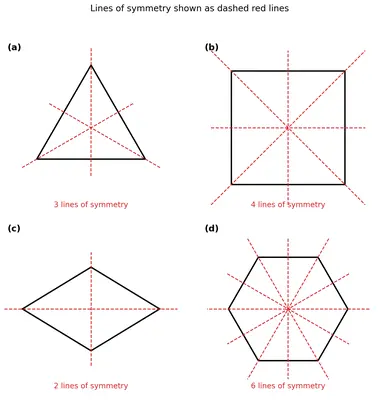
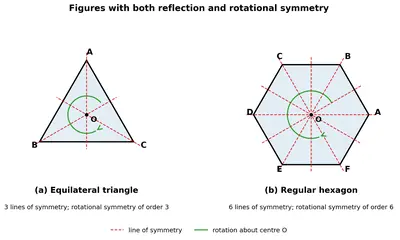
A line of symmetry (also called an axis of symmetry) is a straight line about which a figure can be folded so that the two halves coincide exactly. While looking for such a line we can imagine (or actually try by paper–folding) placing one half of the figure over the other; if they match perfectly, the crease gives a line of symmetry.
Below every part-figure is discussed exactly the way a Class 6 student can check by folding, tracing or using a mirror. Each time we state how many lines of symmetry exist and name (or sketch) them.
Note for drawing during study – in your notebook reproduce the figure, draw the claimed axis/axes with a ruler and then fold along that line to verify.
(a) Figure (a) – an isosceles triangle having the two equal sides slanting upwards and meeting at a top vertex.
- Place the base horizontally. Try folding along the vertical line through the top vertex and the mid-point of the base.
- The left half comes exactly over the right half → the fold is a line of symmetry.
- Any other fold (say horizontal or slant) leaves the halves unmatched.
Hence figure (a) has 1 line of symmetry – the vertical line through the top vertex and mid-point of the base.
(b) Figure (b) – an arrow pointing right, drawn so that its upper and lower edges are mirror images.
- Keep the arrow pointing right. Fold along the horizontal line passing through the middle of the arrow shaft (equal distance from its top and bottom edges).
- The top half covers the bottom half perfectly → horizontal line is a line of symmetry.
- The vertical line through the centre fails (the arrow head does not match its tail); diagonals also fail.
Therefore figure (b) possesses exactly 1 line of symmetry – the horizontal middle line.
(c) Figure (c) – a cross-shaped design whose left half looks like the right half **and** whose upper half looks like the lower half.
- Fold vertically: halves coincide → vertical line is a symmetry.
- Fold horizontally: halves also coincide → horizontal line is another symmetry.
- Folding along either diagonal does not work because the arms of the cross differ in length along the diagonal direction.
So figure (c) has 2 lines of symmetry – one vertical and one horizontal.
(d) Figure (d) – a perfect square.
- A square is well-known to be the most symmetric quadrilateral.
- Vertical and horizontal diameters are axes of symmetry.
- Both diagonals are also axes (because opposite vertices and side lengths match under this fold).
Hence the square has 4 lines of symmetry – vertical, horizontal and the two diagonals.
(e) Figure (e) – a general scalene triangle (all sides different).
- Try every conceivable fold – no single line can bring all three vertices into matching positions because side lengths and angles are all unequal.
Thus figure (e) has no line of symmetry.
(f) Figure (f) – the English capital letter ‘A’ written in block style with equal feet.
- Fold along the vertical mid-line that passes through the apex and the mid-point of the bar joining the two legs. The left leg overlaps the right leg and the bar matches itself.
- Any other fold fails.
Therefore figure (f) has 1 line of symmetry – the vertical axis.
(g) Figure (g) – the block capital letter ‘B’ drawn with two equal semicircular bulges.
- Keeping the letter upright, fold along the horizontal line that passes through the middle of the vertical backbone; the upper bulge coincides with the lower bulge.
- Vertical and diagonal folds fail.
Thus figure (g) has 1 line of symmetry – the horizontal middle line.
(h) Figure (h) – a circle.
- Choose any diameter, fold the circle along that diameter – the halves coincide. Because one can draw infinitely many diameters, a circle has infinitely many axes of symmetry.
So figure (h) has infinitely many lines of symmetry – every diameter is an axis.
Summary table
| Figure | Number of lines of symmetry | Name/description of line(s) |
|---|
| (a) | 1 | Vertical (through apex & base mid-point) |
| (b) | 1 | Horizontal mid-line |
| (c) | 2 | Vertical & horizontal |
| (d) | 4 | Vertical, horizontal, two diagonals |
| (e) | 0 | None |
| (f) | 1 | Vertical central line |
| (g) | 1 | Horizontal middle line |
| (h) | Infinite | Every diameter |
All required lines of symmetry have been found and justified.
 91- 6303239042