Join WhatsApp Icon JEE WhatsApp Group
NCERT Solutions for Class 6 Maths

Chapter 5: Prime Time

Download Solutions PDF
Daily JEE Updates, Tips & Important Alerts
Join 30,000+ students and stay updated with JEE notifications and preparation insights.
Join Now!
Free PDF
Complete NCERT Solution PDF for Chapter 5: Prime Time

NCERT Solutions For Class 6 Maths Chapter 5 Prime Time introduces students to the concepts of prime numbers, factors, multiples, divisibility, and number relationships. The page provides comprehensive NCERT Solutions that help students understand each concept through simple explanations and solved examples. NCERT Solutions For Class 6 Maths make learning topics like prime factorisation, common factors, common multiples, and divisibility rules easier for students. This chapter plays an important role in strengthening number sense and preparing students for advanced mathematical concepts. The solutions help students solve textbook exercises confidently and improve their problem-solving approach. Students can use the chapter PDF for quick revision and additional practice. The detailed explanations make complex number concepts simple and easy to understand.
Download Solutions PDF

Intext Questions — Idli-Vada Game

Intext

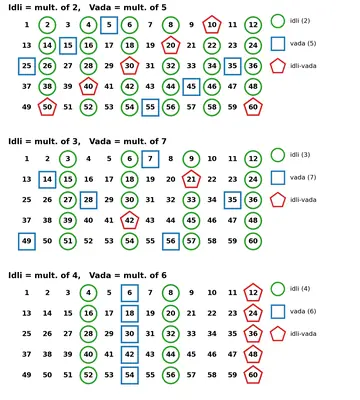
Let us now play the 'idli-vada' game with different pairs of numbers. We will say 'idli' for multiples of the smaller number, 'vada' for multiples of the larger number and 'idli-vada' for common multiples. Draw a figure similar to Fig. 5.1 if the game is played up to 60.

Fig. 5.1
Fig. 5.1

a $$2$$ and $$5$$

Solution

We have to play the idli-vada game with the pair $$2$$ (smaller) and $$5$$ (larger) up to $$60$$.

  1. Multiples of the smaller number (idli).
    Multiples of $$2$$ not exceeding $$60$$ are
    $$2,\,4,\,6,\,8,\,10,\,12,\,14,\,16,\,18,\,20,\,22,\,24,\,26,\,28,\,30,\,32,\,34,\,36,\,38,\,40,\,42,\,44,\,46,\,48,\,50,\,52,\,54,\,56,\,58,\,60.$$ All of these will be called “idli”.
  2. Multiples of the larger number (vada).
    Multiples of $$5$$ not exceeding $$60$$ are
    $$5,\,10,\,15,\,20,\,25,\,30,\,35,\,40,\,45,\,50,\,55,\,60.$$ These will be called “vada”.
  3. Common multiples (idli-vada).
    Numbers that appear in both lists are
    $$10,\,20,\,30,\,40,\,50,\,60.$$ Each of these will be called “idli-vada”.

How to draw the figure (similar to Fig. 5.1)

  • Draw a horizontal line and mark the points $$1,2,3,\dots ,60$$ at equal intervals.
  • Put a small circle around every multiple of $$2$$ and write the word “idli” just below it.
  • Put a small square around every multiple of $$5$$ and write “vada” just above it.
  • Where a number is a common multiple (listed in step 3), superimpose the circle and square and write “idli-vada”.

When finished, the numbers $$10,20,30,40,50,60$$ will show both shapes and the word “idli-vada”, the remaining multiples of $$2$$ will show only the idli mark and the remaining multiples of $$5$$ will show only the vada mark.

Answer

Up to 60:
idli (multiples of 2): 2,4,6,8,12,14,16,18,22,24,26,28,32,34,36,38,42,44,46,48,52,54,56,58.
vada (multiples of 5): 5,15,25,35,45,55.
idli-vada (common): 10,20,30,40,50,60.

b $$3$$ and $$7$$

Solution

Play the game with $$3$$ (smaller) and $$7$$ (larger) up to $$60$$.

  1. Multiples of 3 (idli)
    $$3,\,6,\,9,\,12,\,15,\,18,\,21,\,24,\,27,\,30,\,33,\,36,\,39,\,42,\,45,\,48,\,51,\,54,\,57,\,60.$$
  2. Multiples of 7 (vada)
    $$7,\,14,\,21,\,28,\,35,\,42,\,49,\,56.$$
  3. Common multiples (idli-vada)
    Members common to both lists are $$21$$ and $$42$$.

Figure description

  • Draw a straight line, mark numbers $$1\text{ to }60$$.
  • Circle (idli) every multiple of $$3$$; square (vada) every multiple of $$7$$.
  • At $$21$$ and $$42$$ both symbols overlap and the label “idli-vada” is written.

Answer

Up to 60:
idli: 3,6,9,12,15,18,24,27,30,33,36,39,45,48,51,54,57,60.
vada: 7,14,28,35,49,56.
idli-vada: 21,42.

c $$4$$ and $$6$$

Solution

Play the game with $$4$$ (smaller) and $$6$$ (larger) up to $$60$$.

  1. Multiples of 4 (idli)
    $$4,\,8,\,12,\,16,\,20,\,24,\,28,\,32,\,36,\,40,\,44,\,48,\,52,\,56,\,60.$$
  2. Multiples of 6 (vada)
    $$6,\,12,\,18,\,24,\,30,\,36,\,42,\,48,\,54,\,60.$$
  3. Common multiples (idli-vada)
    The overlap is $$12,\,24,\,36,\,48,\,60.$$

Figure description

  • Draw the number line from $$1$$ to $$60$$.
  • Circle every multiple of $$4$$ and label it “idli”.
  • Square every multiple of $$6$$ and label it “vada”.
  • Where both occur (listed in step 3) put both shapes and write “idli-vada”.

Answer

Up to 60:
idli: 4,8,16,20,28,32,40,44,52,56.
vada: 6,18,30,42,54.
idli-vada: 12,24,36,48,60.

Intext

Yesterday, we played the 'idli-vada' game with two numbers. We ended up saying just 'idli' or 'idli-vada' and nobody said just 'vada'! One of the numbers was $$4$$. Which of the following could be the other number: $$2, 3, 5, 8, 10$$?

Solution

Step 1  – Recall the rules of the “idli-vada” game
Choose two whole numbers. While counting 1, 2, 3, …

  • say idli for every multiple of the first number;
  • say vada for every multiple of the second number;
  • say idli-vada for a number that is a multiple of both.

Here the first number is $$4$$ and the second number is yet to be chosen.

Step 2  – Interpret the given clue
Nobody said just ‘vada’” means there was no counting number that was a multiple of the second number alone.

So, whenever a number was a multiple of the second number, it was also a multiple of $$4$$. In symbols:

if a number $$n$$ is a multiple of the second number, then $$n$$ is a multiple of $$4$$.

This can happen only when every multiple of the second number is contained in the set of multiples of $$4$$. Therefore

second number must be a multiple of $$4$$.

Step 3  – Examine the given options

OptionIs it a multiple of $$4$$?
$$2$$No  ($$2\div4$$ is not a whole number)
$$3$$No
$$5$$No
$$8$$Yes  ($$8=4\times2$$)
$$10$$No

Step 4  – Conclusion
Only $$8$$ is a multiple of $$4$$, so choosing $$8$$ as the second number guarantees that every “vada” will automatically be an “idli-vada”. Hence nobody will ever say just “vada”.

Answer

The other number could only be $$8$$.

Figure it Out (Page 108)

1 At what number is 'idli-vada' said for the 10th time?

Solution

Step 1  Understand the rule of the game
Whenever a number is:

  • a multiple of 3  →  players say Idli
  • a multiple of 5  →  players say Vada
  • a multiple of both 3 and 5  →  players say Idli-Vada
So we need the numbers that are multiples of both 3 and 5.

Step 2  Find a quick way to get common multiples of 3 and 5
The common multiples of two numbers are the multiples of their LCM (Least Common Multiple).
Because 3 and 5 have no common factor other than 1, their LCM is simply their product:
$$\text{LCM}(3,5)=3\times5=15$$ Therefore every multiple of 15 gives an Idli-Vada.

Step 3  List the first ten multiples of 15

Count of
“Idli-Vada”
Multiple of 15
1st$$15$$
2nd$$30$$
3rd$$45$$
4th$$60$$
5th$$75$$
6th$$90$$
7th$$105$$
8th$$120$$
9th$$135$$
10th$$150$$

Step 4  State the required number
The 10th time Idli-Vada is spoken when the number $$150$$ is reached.

Answer

150

2 If the game is played for the numbers $$1$$ to $$90$$, find out:

a How many times would the children say 'idli' (including the times they say 'idli-vada')?

Solution

The children say “idli” whenever the number is a multiple of 2.

Multiples of 2 between 1 and 90 are

$$2,4,6,\dots,90$$

This is an arithmetic progression with first term $$a_1 = 2$$, common difference $$d = 2$$ and last term $$a_n = 90$$.

To find how many such numbers there are, divide 90 by 2:

$$\dfrac{90}{2} = 45$$

So there are $$45$$ multiples of 2. These already include the multiples of 10 (because every multiple of 10 is also a multiple of 2), and the question tells us to include those occasions. Therefore

\[\boxed{\text{“idli” is said } 45 \text{ times}}\]

Answer

45

b How many times would the children say 'vada' (including the times they say 'idli-vada')?

Solution

The children say “vada” whenever the number is a multiple of 5.

Multiples of 5 between 1 and 90 are

$$5,10,15,\dots,90$$

Again, count them by dividing 90 by 5:

$$\dfrac{90}{5} = 18$$

Thus there are $$18$$ multiples of 5. As required, this total already includes the multiples of 10 (where the children actually say “idli-vada”). Hence

\[\boxed{\text{“vada” is said } 18 \text{ times}}\]

Answer

18

c How many times would the children say 'idli-vada'?

Solution

The children say “idli-vada” when the number is a multiple of both 2 and 5. Such numbers are the multiples of their LCM, $$\text{lcm}(2,5)=10$$.

Multiples of 10 between 1 and 90 are

$$10,20,30,40,50,60,70,80,90$$

Count them by dividing 90 by 10:

$$\dfrac{90}{10} = 9$$

\[\boxed{\text{“idli-vada” is said } 9 \text{ times}}\]

Answer

9

3 What if the game was played till $$900$$? How would your answers change?

Solution

Step 1 | The rules of the game stay the same; only the upper limit changes.
In the ‘idli-vada’ game the players say
• idli for every multiple of $$3$$,
• vada for every multiple of $$5$$, and
• idli-vada for every number that is a multiple of both $$3$$ and $$5$$, that is, every multiple of $$\operatorname{lcm}(3,5)=15$$.

Earlier we played from $$1$$ to $$90$$; this time we play from $$1$$ to $$900$$.

Step 2 | Number of times “idli” is said (multiples of 3)
The multiples of $$3$$ between $$1$$ and $$900$$ are
$$3,\;6,\;9,\;\dots ,\;900.$$
How many such numbers are there? Divide $$900$$ by $$3$$:
\[\dfrac{900}{3}=300.\]
So “idli” is said $$300$$ times (this already includes the occasions when the children say “idli-vada”).

Step 3 | Number of times “vada” is said (multiples of 5)
The multiples of $$5$$ between $$1$$ and $$900$$ are
$$5,\;10,\;15,\;\dots ,\;900.$$
Their count is
\[\dfrac{900}{5}=180.\]
So “vada” is said $$180$$ times (again, “idli-vada”s are included in this count).

Step 4 | Number of times “idli-vada” is said (multiples of 15)
The multiples of $$15$$ between $$1$$ and $$900$$ are
$$15,\;30,\;45,\;\dots ,\;900.$$
Their count is
\[\dfrac{900}{15}=60.\]
So “idli-vada” is said $$60$$ times.

Step 5 | How the answers of question 2 change
The new range $$1$$–$$900$$ is exactly $$10$$ times the old range $$1$$–$$90$$. Because counting multiples of a fixed number depends only on the size of the range, every count is simply multiplied by $$10$$:

What the children sayCounts up to 90Counts up to 900
“idli” (multiples of 3)$$30$$$$300$$
“vada” (multiples of 5)$$18$$$$180$$
“idli-vada” (multiples of 15)$$6$$$$60$$

Conclusion
If the game is played from $$1$$ to $$900$$, then “idli” is said $$300$$ times, “vada” is said $$180$$ times and “idli-vada” is said $$60$$ times. Each of the earlier answers (for $$1$$–$$90$$) gets multiplied by $$10$$, but the method of finding them does not change.

Answer

If the game is played from $$1$$ to $$900$$:
“idli” is said $$\dfrac{900}{3}=300$$ times,
“vada” is said $$\dfrac{900}{5}=180$$ times,
“idli-vada” is said $$\dfrac{900}{15}=60$$ times.
Each of the earlier counts (for $$1$$–$$90$$) is multiplied by $$10$$; the method of finding them stays the same.

4

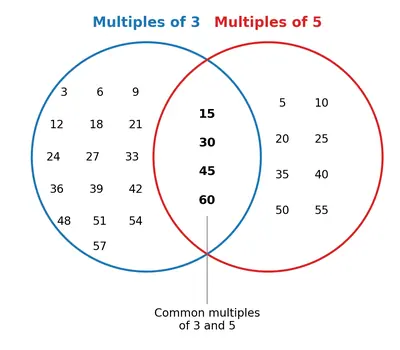
Is this figure somehow related to the 'idli-vada' game? Hint: Imagine playing the game till $$30$$. Draw the figure if the game is played till $$60$$.

(Fig. 5.1 shows two overlapping circles labelled 'Multiples of 3' and 'Multiples of 5'. The left circle contains $$3, 9, 12, 18, 21, 24, 27$$; the right circle contains $$5, 10, 20, 25$$; and the overlapping (intersection) region contains $$15$$ and $$30$$, which are labelled 'Common multiples of 3 and 5'.)

Fig. 5.1
Fig. 5.1

Solution

Step 1 – Recall the rules of the “idli-vada” game
• When you clap out the numbers in order, you say
  • “idli” instead of every multiple of 3;
  • “vada” instead of every multiple of 5;
  • “idli-vada” instead of every number that is a multiple of both 3 and 5.

Step 2 – Relate the given Venn diagram to the game
• The left circle is the list of numbers that would be called “idli”.
• The right circle is the list of numbers that would be called “vada”.
• The overlapping part shows the numbers for which we say “idli-vada”.
Thus the figure is exactly the record of an “idli-vada” game played up to 30.

Step 3 – Play the game further, up to 60
(a) Multiples of 3 up to 60:
$$3,6,9,12,15,18,21,24,27,30,33,36,39,42,45,48,51,54,57,60$$
(b) Multiples of 5 up to 60:
$$5,10,15,20,25,30,35,40,45,50,55,60$$
(c) Common multiples (multiples of 15) up to 60:
$$15,30,45,60$$

Step 4 – Sort them for the Venn diagram
Only “idli” (multiples of 3, not of 5)
$$3,6,9,12,18,21,24,27,33,36,39,42,48,51,54,57$$
Only “vada” (multiples of 5, not of 3)
$$5,10,20,25,35,40,50,55$$
“Idli-vada” (common multiples)
$$15,30,45,60$$

Step 5 – Describe the new figure
Draw two equal, overlapping circles.
• Title of the left circle: “Multiples of 3 (idli)”. Write inside it:
  3, 6, 9, 12, 18, 21, 24, 27, 33, 36, 39, 42, 48, 51, 54, 57.
• Title of the right circle: “Multiples of 5 (vada)”. Write inside it:
  5, 10, 20, 25, 35, 40, 50, 55.
• In the overlapping strip between the two circles write:
  15, 30, 45, 60.
Label that strip “Common multiples of 3 and 5 (idli-vada)”.
This is the required diagram for an “idli-vada” game played up to 60.

Answer

Yes. The figure shows exactly what you speak in the “idli-vada” game (idli = multiples of 3, vada = multiples of 5, idli-vada = multiples of 15).

For the game played up to 60 draw two intersecting circles:

Left (multiples of 3 only): 3, 6, 9, 12, 18, 21, 24, 27, 33, 36, 39, 42, 48, 51, 54, 57.
Intersection (multiples of 15): 15, 30, 45, 60.
Right (multiples of 5 only): 5, 10, 20, 25, 35, 40, 50, 55.

Intext Questions — Jump Jackpot & Common Multiples Table

Intext What jump size can reach both $$15$$ and $$30$$? There are multiple jump sizes possible. Try to find them all.

Solution

Step 1 | Understand “jump size”
If we start at 0 on a number line and keep adding the same number each time, we make equal jumps. A jump size $$k$$ reaches a point like $$15$$ exactly when $$15$$ is a multiple of $$k$$, that is, when $$k$$ is a factor of $$15$$. To reach both $$15$$ and $$30$$ the same size $$k$$ must be a factor of both numbers.

Step 2 | List all factors of each number

  • Factors of $$15$$: check divisors one-by-one.
      $$15\div1=15$$ (no remainder) → $$1$$ is a factor.
      $$15\div2=7.5$$ (remainder) → $$2$$ is not a factor.
      $$15\div3=5$$ (no remainder) → $$3$$ is a factor.
      $$15\div4$$ leaves a remainder → $$4$$ not a factor.
      $$15\div5=3$$ (no remainder) → $$5$$ is a factor.
      Continuing up to $$15$$ we also get $$15$$ itself.
    Hence the factor list of $$15$$ is
    $$1,\;3,\;5,\;15$$.
  • Factors of $$30$$: repeat the test.
    $$30\div1=30\;(\checkmark),\;30\div2=15\;(\checkmark),\;30\div3=10\;(\checkmark),\;30\div4$$ has remainder, $$30\div5=6\;(\checkmark),\;30\div6=5\;(\checkmark)$$ and finally $$10,\;15,\;30$$ itself.
    So the factor list of $$30$$ is
    $$1,\;2,\;3,\;5,\;6,\;10,\;15,\;30$$.

Step 3 | Common factors
Compare the two lists and keep only the numbers that appear in both:

$$1,\;3,\;5,\;15$$

Step 4 | Interpretation
Each common factor is a possible positive jump size. For example, jumps of size $$5$$ land on $$0,5,10,15,20,25,30,\dots$$ so we indeed reach both $$15$$ and $$30$$.

Hence all possible jump sizes that reach both 15 and 30 are

\[1,\;3,\;5,\;15\]

Answer

The possible jump sizes are $$1,\;3,\;5,\;15$$.

Intext

Look at the table below. What do you notice?

31323334353637383940
41424344454647484950
51525354555657585960
61626364656667686970

In the table, the circled numbers are $$32, 36, 40, 44, 48, 52, 56, 60, 64, 68$$ and the shaded numbers are $$33, 36, 39, 42, 45, 48, 51, 54, 57, 60, 63, 66, 69$$.

1 Is there anything common among the shaded numbers?

Solution

List the shaded numbers:

$$33,\;36,\;39,\;42,\;45,\;48,\;51,\;54,\;57,\;60,\;63,\;66,\;69$$

Rule for divisibility by $$3$$: add the digits; if that sum is a multiple of $$3$$ the original number is also a multiple of $$3$$.

NumberDigit-sumMultiple of 3?
333+3 = 6Yes
363+6 = 9Yes
393+9 = 12Yes
424+2 = 6Yes
454+5 = 9Yes
484+8 = 12Yes
515+1 = 6Yes
545+4 = 9Yes
575+7 = 12Yes
606+0 = 6Yes
636+3 = 9Yes
666+6 = 12Yes
696+9 = 15Yes

All shaded numbers are divisible by $$3$$. Hence the common property is that they are multiples of $$3$$.

Answer

The shaded numbers are all multiples of 3.

2 Is there anything common among the circled numbers?

Solution

List the circled numbers:

$$32,\;36,\;40,\;44,\;48,\;52,\;56,\;60,\;64,\;68$$

Rule for divisibility by $$4$$: look at the last two digits; if those two-digit numbers form a multiple of $$4$$, so does the whole number.

NumberLast two digitsMultiple of 4?
3232Yes ( $$4\times8$$ )
3636Yes ( $$4\times9$$ )
4040Yes ( $$4\times10$$ )
4444Yes ( $$4\times11$$ )
4848Yes ( $$4\times12$$ )
5252Yes ( $$4\times13$$ )
5656Yes ( $$4\times14$$ )
6060Yes ( $$4\times15$$ )
6464Yes ( $$4\times16$$ )
6868Yes ( $$4\times17$$ )

Every circled number is divisible by $$4$$. Therefore they are all multiples of $$4$$.

Answer

The circled numbers are all multiples of 4.

3 Which numbers are both shaded and circled? What are these numbers called?

Solution

Numbers that appear in both lists are:

$$36,\;48,\;60$$

Each of these numbers is a multiple of $$3$$ (from the shaded list) and a multiple of $$4$$ (from the circled list). Thus they are common multiples of $$3$$ and $$4$$. In fact, since $$\operatorname{lcm}(3,4)=12$$, they are multiples of $$12$$:

$$36 = 12\times3,\;48 = 12\times4,\;60 = 12\times5$$

Answer

Both shaded & circled: 36, 48, 60. These are common multiples of 3 and 4 (multiples of 12).

Figure it Out (Page 110–111)

1 Find all multiples of $$40$$ that lie between $$310$$ and $$410$$.

Solution

Step 1 – Express a general multiple of 40
Any multiple of 40 can be written as
$$40\times n$$
where $$n$$ is a whole (natural) number.

Step 2 – Translate the condition “between 310 and 410”
We need those multiples that satisfy
$$310 < 40\times n < 410$$

Step 3 – Isolate $$n$$ by dividing every part by 40
$$\frac{310}{40} < n < \frac{410}{40}$$
$$7.75 < n < 10.25$$

Step 4 – List the integer values of $$n$$ that fit
Because $$n$$ must be a whole number, the only possibilities in the range $$7.75<n<10.25$$ are
$$n = 8,\;9,\;10$$

Step 5 – Write the required multiples

  • For $$n=8$$: $$40\times8 = 320$$
  • For $$n=9$$: $$40\times9 = 360$$
  • For $$n=10$$: $$40\times10 = 400$$

The multiples of 40 that lie between 310 and 410 are therefore

\[320,\;360,\;400\]

Answer

$$320,\;360,\;400$$

2 Who am I?

a I am a number less than $$40$$. One of my factors is $$7$$. The sum of my digits is $$8$$.

Solution

We are looking for a whole number that satisfies all of the following conditions:

  • It is less than $$40$$.
  • It has $$7$$ as one of its factors (so it is a multiple of $$7$$).
  • The sum of its digits is $$8$$.

Step 1 – List all multiples of $$7$$ which are smaller than $$40$$.

The first few multiples of $$7$$ are

$$7 \times 1 = 7, \; 7 \times 2 = 14, \; 7 \times 3 = 21, \; 7 \times 4 = 28, \; 7 \times 5 = 35, \; 7 \times 6 = 42$$

Only those that are less than $$40$$ can be considered:

$$7, 14, 21, 28, 35$$

Step 2 – Find the digit sums of the above numbers.

NumberSum of its digits
$$7$$$$7$$
$$14$$$$1+4 = 5$$
$$21$$$$2+1 = 3$$
$$28$$$$2+8 = 10$$
$$35$$$$3+5 = 8$$

Only the number $$35$$ has a digit–sum equal to $$8$$.

Conclusion

\[35\]

Answer

$$35$$

b I am a number less than $$100$$. Two of my factors are $$3$$ and $$5$$. One of my digits is $$1$$ more than the other.

Solution

The number must meet three conditions:

  • It is less than $$100$$.
  • Both $$3$$ and $$5$$ are its factors (so the number is a common multiple of $$3$$ and $$5$$).
  • One of its digits is exactly $$1$$ more than the other digit.

Step 1 – Find the common multiples of $$3$$ and $$5$$ below $$100$$.

The least common multiple of $$3$$ and $$5$$ is $$15$$. Hence every common multiple is a multiple of $$15$$.

Multiples of $$15$$ less than $$100$$ are

$$15, 30, 45, 60, 75, 90$$

Step 2 – Check the digit condition for each candidate.

NumberIts two digitsDifference between the digits
$$15$$$$1, 5$$$$5-1 = 4$$
$$30$$$$3, 0$$$$3-0 = 3$$
$$45$$$$4, 5$$$$5-4 = 1$$ ✓
$$60$$$$6, 0$$$$6-0 = 6$$
$$75$$$$7, 5$$$$7-5 = 2$$
$$90$$$$9, 0$$$$9-0 = 9$$

Only $$45$$ has one digit that is exactly $$1$$ greater than the other.

Conclusion

\[45\]

Answer

$$45$$

3 A number for which the sum of all its factors is equal to twice the number is called a perfect number. The number $$28$$ is a perfect number. Its factors are $$1, 2, 4, 7, 14$$ and $$28$$. Their sum is $$56$$ which is twice $$28$$. Find a perfect number between $$1$$ and $$10$$.

Solution

Step 1 : Recall the definition

A number is called a perfect number if

$$\text{sum of all its factors}=2\times(\text{the number}).$$

So we must look for a number between $$1$$ and $$10$$ whose factor–sum equals twice the number itself.

Step 2 : List every number between $$1$$ and $$10$$ and write all its factors

NumberFactors
1$$1$$
2$$1,\;2$$
3$$1,\;3$$
4$$1,\;2,\;4$$
5$$1,\;5$$
6$$1,\;2,\;3,\;6$$
7$$1,\;7$$
8$$1,\;2,\;4,\;8$$
9$$1,\;3,\;9$$
10$$1,\;2,\;5,\;10$$

Step 3 : Find the sum of the factors of each number

NumberSum of factors
1$$1$$
2$$1+2=3$$
3$$1+3=4$$
4$$1+2+4=7$$
5$$1+5=6$$
6$$1+2+3+6=12$$
7$$1+7=8$$
8$$1+2+4+8=15$$
9$$1+3+9=13$$
10$$1+2+5+10=18$$

Step 4 : Compare each sum with $$2\times\text{(the number)}$$

  • For $$1$$: $$2\times1=2\;(\neq1)$$
  • For $$2$$: $$2\times2=4\;(\neq3)$$
  • For $$3$$: $$2\times3=6\;(\neq4)$$
  • For $$4$$: $$2\times4=8\;(\neq7)$$
  • For $$5$$: $$2\times5=10\;(\neq6)$$
  • For $$6$$: $$2\times6=12\;(=12)$$
  • For $$7$$: $$2\times7=14\;(\neq8)$$
  • For $$8$$: $$2\times8=16\;(\neq15)$$
  • For $$9$$: $$2\times9=18\;(\neq13)$$
  • For $$10$$: $$2\times10=20\;(\neq18)$$

The only number between $$1$$ and $$10$$ whose factor–sum equals twice the number is $$6$$.

Step 5 : Write the conclusion

Hence, the perfect number between $$1$$ and $$10$$ is $$6$$.

Answer

$$6$$

4 Find the common factors of:

a $$20$$ and $$28$$

Solution

Step 1: Write all the factors of $$20$$.

  • Divide $$20$$ by each whole number starting from $$1$$.
  • Exactly divisible numbers give its factors: $$1, 2, 4, 5, 10, 20$$.

So, $$\text{Factors of }20 = \{1, 2, 4, 5, 10, 20\}$$.

Step 2: Write all the factors of $$28$$.

  • In the same way, the exact divisors of $$28$$ are $$1, 2, 4, 7, 14, 28$$.

So, $$\text{Factors of }28 = \{1, 2, 4, 7, 14, 28\}$$.

Step 3: Pick the numbers that occur in both lists.

Common numbers: $$1, 2, 4$$.

Answer

Common factors: $$1, 2, 4$$

b $$35$$ and $$50$$

Solution

Step 1: Factors of $$35$$.

Divisors of $$35$$ that give remainder $$0$$ are $$1, 5, 7, 35$$.

Step 2: Factors of $$50$$.

Exact divisors are $$1, 2, 5, 10, 25, 50$$.

Step 3: Common entries in the two lists.

$$1$$ and $$5$$ occur in both.

Answer

Common factors: $$1, 5$$

c $$4, 8$$ and $$12$$

Solution

Step 1: Factors of $$4$$ → $$\{1, 2, 4\}$$.

Step 2: Factors of $$8$$ → $$\{1, 2, 4, 8\}$$.

Step 3: Factors of $$12$$ → $$\{1, 2, 3, 4, 6, 12\}$$.

Step 4: Numbers common to all three sets are $$1, 2, 4$$.

Answer

Common factors: $$1, 2, 4$$

d $$5, 15$$ and $$25$$

Solution

Step 1: Factors of $$5$$ → $$\{1, 5\}$$.

Step 2: Factors of $$15$$ → $$\{1, 3, 5, 15\}$$.

Step 3: Factors of $$25$$ → $$\{1, 5, 25\}$$.

Step 4: The only numbers present in all three lists are $$1$$ and $$5$$.

Answer

Common factors: $$1, 5$$

5 Find any three numbers that are multiples of $$25$$ but not multiples of $$50$$.

Solution

Step 1 — Recall the definition of a multiple.
A number is a multiple of $$25$$ if it can be written in the form $$25 \times n$$ where $$n$$ is a whole number (1, 2, 3, …).

Step 2 — Write down a few multiples of $$25$$.

$$25 \times 1 = 25$$,
$$25 \times 2 = 50$$,
$$25 \times 3 = 75$$,
$$25 \times 4 = 100$$,
$$25 \times 5 = 125$$,
$$25 \times 6 = 150$$, …

Step 3 — Understand the second condition.
A number is a multiple of $$50$$ if it can be written as $$50 \times m$$ for some whole number $$m$$. Notice that $$50 = 25 \times 2$$, so any multiple of $$50$$ is actually $$25 \times (2m)$$, meaning the factor of $$25$$ is being multiplied by an even number.

Step 4 — Pick the multiples of $$25$$ that are not multiples of $$50$$.
From the list in Step 2, remove those that are divisible by $$50$$ (that is, whose factor $$n$$ is even).

  • $$25 = 25 \times 1$$  (factor 1 is odd; not a multiple of $$50$$)
  • $$50 = 25 \times 2$$  (factor 2 is even; is a multiple of $$50$$) » reject
  • $$75 = 25 \times 3$$  (factor 3 is odd; not a multiple of $$50$$)
  • $$100 = 25 \times 4$$  (factor 4 is even; is a multiple of $$50$$) » reject
  • $$125 = 25 \times 5$$  (factor 5 is odd; not a multiple of $$50$$)

Step 5 — State any three acceptable numbers.
Three numbers that satisfy both conditions are:

$$25,\; 75,\; 125$$

Answer

25, 75, 125

6 Anshu and his friends play the 'idli-vada' game with two numbers, which are both smaller than $$10$$. The first time anybody says 'idli-vada' is after the number $$50$$. What could the two numbers be which are assigned 'idli' and 'vada'?

Solution

Step 1 – Understand the condition
The shout “idli-vada” is made exactly at the common multiples of the two chosen numbers.
The first time it can occur is therefore the least common multiple (LCM) of the two numbers.
The question tells us that this first shout is after the number 50, so we need

$$\text{LCM of the two numbers} > 50$$

Both numbers are whole numbers smaller than 10, so each of them can only be one of
$$2,\;3,\;4,\;5,\;6,\;7,\;8,\;9.$$

Step 2 – Note a quick fact
For any number $$n$$ not exceeding 5 and for every number $$m<10$$ we always have $$\text{LCM}(n,m)\le 45,$$ because the largest product that can appear is $$5\times9=45$$ (and many LCMs are even smaller).
Since we need an LCM bigger than 50, at least one of the two numbers must be $$7,\;8,\text{ or }9$$.

Step 3 – Examine all possible pairs

PairLCMIs LCM > 50?
2 & 7$$14$$No
2 & 8$$8$$No
2 & 9$$18$$No
3 & 7$$21$$No
3 & 8$$24$$No
3 & 9$$9$$No
4 & 7$$28$$No
4 & 8$$8$$No
4 & 9$$36$$No
5 & 7$$35$$No
5 & 8$$40$$No
5 & 9$$45$$No
6 & 7$$42$$No
6 & 8$$24$$No
6 & 9$$18$$No
7 & 8$$56$$Yes
7 & 9$$63$$Yes
8 & 9$$72$$Yes

Step 4 – Conclusion
Exactly three pairs of numbers below 10 have an LCM greater than 50, hence any one of these pairs can be the numbers assigned “idli” and “vada”.

They are:

  • $$7 \text{ and } 8\;(\text{LCM}=56),$$
  • $$7 \text{ and } 9\;(\text{LCM}=63),$$
  • $$8 \text{ and } 9\;(\text{LCM}=72).$$

With any of these choices the first shout of “idli-vada” comes only after the number 50.

Answer

The required pair can be any one of the following:
$$7\text{ and }8,\;7\text{ and }9,\;8\text{ and }9.$$

7 In the treasure hunting game, Grumpy has kept treasures on $$28$$ and $$70$$. What jump sizes will land on both the numbers?

Solution

To reach a number by equal jumps, the jump size must be a factor of that number.
Therefore, a jump size that lands on both 28 and 70 must be a factor of 28 and a factor of 70 — in other words, a common factor.

  1. List all factors of each number.

    NumberFactors (pair-checking)Complete list
    28$$1\times28=28$$,


    $$2\times14=28$$,


    $$4\times7 =28$$
    1, 2, 4, 7, 14, 28
    70$$1\times70=70$$,


    $$2\times35=70$$,


    $$5\times14=70$$,


    $$7\times10=70$$
    1, 2, 5, 7, 10, 14, 35, 70
  2. Pick the factors that appear in both lists:

    Common factors = $$1,\;2,\;7,\;14$$

  3. Interpretation for the game:

    Any of these four numbers can be chosen as the jump size, because starting from 0 they will land exactly on both 28 and 70:

    • Jump of $$1$$: 0, 1, 2, …, 28, …, 70
    • Jump of $$2$$: 0, 2, 4, …, 28, …, 70
    • Jump of $$7$$: 0, 7, 14, 21, 28, …, 70
    • Jump of $$14$$: 0, 14, 28, 42, 56, 70

    Hence these four jump sizes meet the requirement.

Answer

The possible jump sizes are $$1,\;2,\;7,\;14$$.

8

In the diagram below, Guna has erased all the numbers except the common multiples. Find out what those numbers could be and fill in the missing numbers in the empty regions.

(The diagram shows two overlapping circles labelled 'Multiples of ___' and 'Multiples of ___'. The overlapping region (common multiples) contains the numbers $$72, 48,$$ and $$24$$.)

Figure
Figure

Solution

Step 1  Which two tables is the diagram talking about?
The three numbers written in the overlapping part are $$24,\;48\text{ and }72$$.
If they lie in the overlap, each of them must be a multiple of both of the hidden numbers.
So every hidden number must divide 24, 48 and 72.

• The common factors of 24, 48 and 72 are
$$1,\;2,\;3,\;4,\;6,\;8,\;12\text{ and }24.$$

• We now need two different factors whose first common multiple is 24 (because 24 is the smallest number lying in the overlap).
The neatest such pair is $$6$$ and $$8$$ because

  • $$6$$ and $$8$$ are both in the factor-list above,
  • their least common multiple is
    \[\operatorname{LCM}(6,8)=24\]
  • and hence the first three common multiples of 6 and 8 are
    $$24,\;48,\;72,$$ exactly the numbers already written in the overlap.

Therefore the two headings must be “Multiples of 6” and “Multiples of 8”.

Step 2  List the multiples and fill the diagram (taking numbers below 75, so that the given 24, 48, 72 are the only common ones that appear).

Multiples of 6Multiples of 8
68
1216
1824 (common)
24 (common)32
3040
3648 (common)
4256
48 (common)64
5472 (common)
60
66
72 (common)

Step 3  Write the numbers in their proper regions.

  • Left-only part (multiples of 6 but not 8):
    $$6,\;12,\;18,\;30,\;36,\;42,\;54,\;60,\;66$$
  • Overlap (already given):
    $$24,\;48,\;72$$
  • Right-only part (multiples of 8 but not 6):
    $$8,\;16,\;32,\;40,\;56,\;64$$

After filling, the Venn diagram will show:

  • Left circle caption → Multiples of 6
  • Right circle caption → Multiples of 8
  • Numbers placed exactly as listed above.

Answer

The headings should be “Multiples of 6” and “Multiples of 8”.

Left-only region : 6, 12, 18, 30, 36, 42, 54, 60, 66
Overlap (already present) : 24, 48, 72
Right-only region : 8, 16, 32, 40, 56, 64

9 Find the smallest number that is a multiple of all the numbers from $$1$$ to $$10$$, except for $$7$$.

Solution

To be a multiple of every number from $$1$$ to $$10$$ (except $$7$$), the required number must contain every prime factor that appears in the factorisations of

$$1,\;2,\;3,\;4,\;5,\;6,\;8,\;9,\;10.$$

We write each of them as a product of primes.

  • $$1$$ – no primes needed.
  • $$2 = 2$$
  • $$3 = 3$$
  • $$4 = 2^2$$
  • $$5 = 5$$
  • $$6 = 2 \times 3$$
  • $$8 = 2^3$$
  • $$9 = 3^2$$
  • $$10 = 2 \times 5$$

From these factorisations we take, for each prime, the highest power that appears:

  • Prime $$2$$ – highest power is $$2^3$$ (from $$8$$).
  • Prime $$3$$ – highest power is $$3^2$$ (from $$9$$).
  • Prime $$5$$ – highest power is $$5$$ (from $$5$$ or $$10$$).

(There is no need for the prime $$7$$ because $$7$$ is not in our list.)

The least common multiple (LCM) is therefore

$$2^3 \times 3^2 \times 5$$.

Multiply step by step:

$$2^3 = 8,\;\;3^2 = 9$$

$$8 \times 9 = 72$$

$$72 \times 5 = 360$$

Hence,

\[\text{LCM} = 360\]

So the smallest number that is a multiple of all the given numbers (except $$7$$) is $$360$$.

Answer

$$360$$

10 Find the smallest number that is a multiple of all the numbers from $$1$$ to $$10$$.

Solution

The smallest number that is a multiple of every number from 1 to 10 is called their least common multiple (LCM).

Step 1 – Write the prime-factorisation of each number.

NumberPrime factors
1– (no prime factors)
2$$2$$
3$$3$$
4$$2 \times 2 = 2^2$$
5$$5$$
6$$2 \times 3$$
7$$7$$
8$$2 \times 2 \times 2 = 2^3$$
9$$3 \times 3 = 3^2$$
10$$2 \times 5$$

Step 2 – Choose, for each prime, the highest power that appears in the list:

  • Prime $$2$$ appears as $$2^3$$ in 8 (highest power).
  • Prime $$3$$ appears as $$3^2$$ in 9 (highest power).
  • Prime $$5$$ appears as $$5^1$$ in 5 and 10.
  • Prime $$7$$ appears as $$7^1$$ in 7.

Step 3 – Multiply these highest powers to obtain the LCM.

Calculations:

$$2^3 = 8$$

$$8 \times 3^2 = 8 \times 9 = 72$$

$$72 \times 5 = 360$$

$$360 \times 7 = 2520$$

Therefore,

\[ \text{LCM}(1,2,3,4,5,6,7,8,9,10) = 2520 \]

So, the smallest number that is a multiple of every number from 1 to 10 is 2520.

Answer

$$2520$$

Intext Questions — Prime Numbers

Intext How many prime numbers are there from $$21$$ to $$30$$? How many composite numbers are there from $$21$$ to $$30$$?

Solution

Step 1 — Recall the definitions

  • A prime number has exactly two distinct factors: $$1$$ and the number itself.
  • A composite number has more than two factors.
  • The number $$1$$ is neither prime nor composite, but it does not appear in the present range, so we need not worry about it here.

Step 2 — Write all whole numbers from $$21$$ to $$30$$

$$21,\;22,\;23,\;24,\;25,\;26,\;27,\;28,\;29,\;30$$

Step 3 — Test each number for primality

For every number we only have to divide by primes that do not exceed its square root.

NumberSmallest primes to testDivisible?Prime / Composite
$$21$$$$2,3,5$$ (since $$\sqrt{21}\approx4.6$$)$$21\div3=7$$Composite
$$22$$$$2,3,5$$ ( $$\sqrt{22}\approx4.7$$)$$22\div2=11$$Composite
$$23$$$$2,3,5$$ ( $$\sqrt{23}\approx4.8$$)Not divisible by $$2,3,5$$Prime
$$24$$$$2$$$$24\div2=12$$Composite
$$25$$$$2,3,5$$ ( $$\sqrt{25}=5$$)$$25\div5=5$$Composite
$$26$$$$2,3,5$$ ( $$\sqrt{26}\approx5.1$$)$$26\div2=13$$Composite
$$27$$$$2,3,5$$$$27\div3=9$$Composite
$$28$$$$2$$$$28\div2=14$$Composite
$$29$$$$2,3,5$$ ( $$\sqrt{29}\approx5.4$$)Not divisible by $$2,3,5$$Prime
$$30$$$$2$$$$30\div2=15$$Composite

Step 4 — Count them

  • Prime numbers: $$23,\;29$$ → 2 primes
  • Composite numbers: all the remaining eight → 8 composites

Answer

Between $$21$$ and $$30$$ (both inclusive) there are 2 prime numbers and 8 composite numbers.

Answer

Primes  =  2  (namely 23 and 29).
Composites  =  8.

Figure it Out (Page 114–115)

1 We see that $$2$$ is a prime and also an even number. Is there any other even prime?

Solution

Step 1 – Recall the meanings of “even” and “prime”.

  • An even number is any number that has $$2$$ as a factor, i.e. it can be written as $$2 \times k$$ where $$k$$ is a whole number.
  • A prime number is a number greater than $$1$$ that has exactly two factors: $$1$$ and the number itself.

Step 2 – Consider an arbitrary even number larger than 2.

Take an even number $$n$$ such that $$n > 2$$. Because it is even,

$$n = 2 \times k,$$

where $$k$$ is a whole number and $$k \ge 2$$.

Step 3 – Identify the factors of $$n$$.

Writing $$n = 2 \times k$$ shows that $$2$$ and $$k$$ are both factors of $$n$$. Thus the factors of $$n$$ include

  • $$1$$,
  • $$2$$,
  • $$n$$ itself (because $$1 \times n = n$$).

So $$n$$ has at least three factors: $$1$$, $$2$$ and $$n$$.

Step 4 – Use the definition of prime.

A prime number must have only two factors. Since our even number $$n$$ has more than two, it cannot be prime.

Step 5 – State the result.

Every even number greater than $$2$$ is composite. Therefore the only even number that is prime is $$2$$ itself.

Hence,

there is no other even prime number besides $$2$$.

Answer

No. 2 is the only even prime number.

2 Look at the list of primes till $$100$$. What is the smallest difference between two successive primes? What is the largest difference?

Solution

Step 1 – Recall what “successive primes” means
When we write the primes in increasing order, each number is called the successor of the one just before it. For example, after $$5$$ the next prime is $$7$$, so $$5$$ and $$7$$ are successive primes.

Step 2 – List every prime number from $$2$$ to $$100$$
The NCERT book already shows this list, but let us write it out once more so we can work with it:

$$2,\;3,\;5,\;7,\;11,\;13,\;17,\;19,\;23,\;29,\;31,\;37,\;41,\;43,\;47,\;53,\;59,\;61,\;67,\;71,\;73,\;79,\;83,\;89,\;97$$

There are $$25$$ primes in all up to $$100$$.

Step 3 – Find the difference between every pair of successive primes

1st prime $$p_n$$Next prime $$p_{n+1}$$Difference $$p_{n+1}-p_n$$
$$2$$$$3$$$$1$$
$$3$$$$5$$$$2$$
$$5$$$$7$$$$2$$
$$7$$$$11$$$$4$$
$$11$$$$13$$$$2$$
$$13$$$$17$$$$4$$
$$17$$$$19$$$$2$$
$$19$$$$23$$$$4$$
$$23$$$$29$$$$6$$
$$29$$$$31$$$$2$$
$$31$$$$37$$$$6$$
$$37$$$$41$$$$4$$
$$41$$$$43$$$$2$$
$$43$$$$47$$$$4$$
$$47$$$$53$$$$6$$
$$53$$$$59$$$$6$$
$$59$$$$61$$$$2$$
$$61$$$$67$$$$6$$
$$67$$$$71$$$$4$$
$$71$$$$73$$$$2$$
$$73$$$$79$$$$6$$
$$79$$$$83$$$$4$$
$$83$$$$89$$$$6$$
$$89$$$$97$$$$8$$

Step 4 – Read the smallest and largest differences
Going through the “Difference” column:

  • The smallest number we see is $$1$$ (between $$2$$ and $$3$$).
  • The largest number we see is $$8$$ (between $$89$$ and $$97$$).

Conclusion
Hence, among all successive primes not exceeding $$100$$, the smallest gap is $$1$$ and the largest gap is $$8$$.

Answer

The smallest difference is $$1$$ and the largest difference is $$8$$.

3 Are there an equal number of primes occurring in every row in the table on the previous page? Which decades have the least number of primes? Which have the most number of primes?

Solution

First recall that a prime number has only two factors, $$1$$ and the number itself. We scan every number from $$1$$ to $$100$$, decide whether it is prime or not and then count how many primes appear in each horizontal row (each “decade”) of the 10 × 10 hundred-chart.

Row (decade)Numbers in the rowPrime numbers in the rowNumber of primes
1$$1$$–$$10$$$$2,\,3,\,5,\,7$$$$4$$
2$$11$$–$$20$$$$11,\,13,\,17,\,19$$$$4$$
3$$21$$–$$30$$$$23,\,29$$$$2$$
4$$31$$–$$40$$$$31,\,37$$$$2$$
5$$41$$–$$50$$$$41,\,43,\,47$$$$3$$
6$$51$$–$$60$$$$53,\,59$$$$2$$
7$$61$$–$$70$$$$61,\,67$$$$2$$
8$$71$$–$$80$$$$71,\,73,\,79$$$$3$$
9$$81$$–$$90$$$$83,\,89$$$$2$$
10$$91$$–$$100$$$$97$$$$1$$

Observations

  • The counts are $$4,4,2,2,3,2,2,3,2,1$$, so the numbers of primes are not equal in every row.
  • The decade with the least primes is $$91$$–$$100$$ (only $$97$$), i.e. just $$1$$ prime.
  • The decades with the most primes are $$1$$–$$10$$ and $$11$$–$$20$$, each containing $$4$$ primes.

Answer

No. The rows do not all contain the same number of primes.

Least primes: 91–100 (only 1 prime).

Most primes: 1–10 and 11–20 (each has 4 primes).

4 Which of the following numbers are prime: $$23, 51, 37, 26$$?

Solution

Definition of a prime number
A number greater than $$1$$ that has exactly two factors – $$1$$ and the number itself – is called prime.

To test any number we only have to try dividing it by all prime numbers that are not larger than the square-root of the number. If none of those primes divides it, the number is prime.

Below we examine each of the given numbers.

NumberSquare-root boundaryPrimes to testWorkConclusion
$$23$$ $$\sqrt{23}\approx4.8$$ $$2,3$$ (only primes $$\le4.8$$) $$23\div2=11\text{ remainder }1$$  → not divisible


Sum of digits $$2+3=5$$ is not a multiple of $$3$$ → not divisible by $$3$$
Only factors $$1$$ and $$23$$ → prime
$$51$$ $$\sqrt{51}\approx7.1$$ $$2,3,5,7$$ $$51$$ is odd → not divisible by $$2$$


Digit sum $$5+1=6$$, and $$6$$ is a multiple of $$3$$, so $$51\div3=17$$ → divisible by $$3$$
Has factor $$3$$ → composite
$$37$$ $$\sqrt{37}\approx6.1$$ $$2,3,5$$ $$37$$ is odd → not divisible by $$2$$


Digit sum $$3+7=10$$, not a multiple of $$3$$ → not divisible by $$3$$


Ends in $$7$$, not $$0$$ or $$5$$ → not divisible by $$5$$
No divisors other than $$1,37$$ → prime
$$26$$ $$\sqrt{26}\approx5.1$$ $$2,3,5$$ $$26$$ is even, so $$26\div2=13$$ → divisible by $$2$$ Has factor $$2$$ → composite

Therefore, among the numbers given, the primes are $$23$$ and $$37$$.

Answer

The prime numbers are $$23$$ and $$37$$.

5 Write three pairs of prime numbers less than $$20$$ whose sum is a multiple of $$5$$.

Solution

Step 1   List all prime numbers smaller than 20.
They are $$2,\;3,\;5,\;7,\;11,\;13,\;17,\;19$$.

Step 2   Recall when a sum is a multiple of 5.
A number is a multiple of 5 when it leaves no remainder on dividing by 5; that is, when it is congruent to $$0$$ (mod 5).

Step 3   Find the “remainder 5” (modulus 5) of every prime found.

PrimeRemainder after ÷ 5 (mod 5)
$$2$$$$2$$
$$3$$$$3$$
$$5$$$$0$$
$$7$$$$2$$
$$11$$$$1$$
$$13$$$$3$$
$$17$$$$2$$
$$19$$$$4$$

Step 4   Work out which pairs of remainders add up to $$0$$ (mod 5).
To make a sum divisible by 5, the two remainders must be one of the following combinations:

  • $$2 + 3 = 5 \;(\equiv 0\;\text{mod }5)$$
  • $$1 + 4 = 5 \;(\equiv 0\;\text{mod }5)$$
  • $$0 + 0 = 0 \;(\equiv 0\;\text{mod }5)$$

Step 5   Match the actual primes using these combinations.

  • From the pair $$2$$ (remainder 2) and $$3$$ (remainder 3):
    $$2 + 3 = 5$$, which is a multiple of 5.
  • From the pair $$7$$ (remainder 2) and $$13$$ (remainder 3):
    $$7 + 13 = 20$$, which is a multiple of 5.
  • From the pair $$11$$ (remainder 1) and $$19$$ (remainder 4):
    $$11 + 19 = 30$$, which is a multiple of 5.

Step 6   State any three suitable pairs.

\[ (2,3),\; (7,13),\; (11,19) \] All six numbers are prime, each is below 20, and every pair’s sum is a multiple of 5.

Answer

$$ (2,3),\; (7,13),\; (11,19) $$

6 The numbers $$13$$ and $$31$$ are prime numbers. Both these numbers have same digits $$1$$ and $$3$$. Find such pairs of prime numbers up to $$100$$.

Solution

Step 1 : List all prime numbers up to 100

A prime number has exactly two factors, $$1$$ and the number itself. The primes up to $$100$$ are

$$2,\;3,\;5,\;7,\;11,\;13,\;17,\;19,\;23,\;29,\;31,\;37,\;41,\;43,\;47,\;53,\;59,\;61,\;67,\;71,\;73,\;79,\;83,\;89,\;97.$$

Step 2 : Keep only the two-digit primes

The one-digit primes ($$2,3,5,7$$) cannot form a pair like $$13\;\text{and}\;31$$ because they have only one digit. The two-digit primes are

$$11,13,17,19,23,29,31,37,41,43,47,53,59,61,67,71,73,79,83,89,97.$$

Step 3 : Reverse the digits of each two-digit prime

PrimeDigits reversedIs the reverse prime?
1111prime, but gives the same number ‑- not a pair
1331prime
1771prime
1991$$91 = 7 \times 13$$, not prime
2332even → not prime
2992even → not prime
3113prime
3773prime
4114even → not prime
4334even → not prime
4774even → not prime
5335$$35 = 5 \times 7$$, not prime
5995$$95 = 5 \times 19$$, not prime
6116even → not prime
6776even → not prime
7117prime
7337prime
7997prime
8338even → not prime
8998even → not prime
9779prime

Step 4 : Collect the required pairs

Whenever both the original number and its reverse are prime (and the two numbers are different), we get a valid pair:

  • $$(13,31)$$
  • $$(17,71)$$
  • $$(37,73)$$
  • $$(79,97)$$

Each pair contains the same two digits in opposite order, and every number in the list is less than $$100$$.

Answer

(13,31), (17,71), (37,73), (79,97)

7 Find seven consecutive composite numbers between $$1$$ and $$100$$.

Solution

Step 1 — Recall the meaning of “composite”.

A composite number is a whole number that has more than two factors; in other words, it can be divided exactly by some whole number other than $$1$$ and itself.


Step 2 — Plan how to find seven such numbers in a row.

  • The numbers must lie between $$1$$ and $$100$$.
  • The seven numbers must be consecutive (one after another in counting order).
  • Every one of the seven must be composite (none may be prime or $$1$$).

Instead of checking every block of seven numbers, notice that primes become rarer among larger numbers. So it is sensible to begin our search near $$100$$ and move backwards.


Step 3 — Test the block from $$90$$ to $$96$$.

NumberReason it is composite
$$90$$Even, so $$90 = 2 \times 45$$
$$91$$$$91 = 7 \times 13$$
$$92$$Even, so $$92 = 2 \times 46$$
$$93$$Divisible by $$3$$, since $$9+3 = 12$$ (multiple of $$3$$); $$93 = 3 \times 31$$
$$94$$Even, so $$94 = 2 \times 47$$
$$95$$Ends in $$5$$, so divisible by $$5$$; $$95 = 5 \times 19$$
$$96$$Even, so $$96 = 2 \times 48$$

Every number in the list $$90,91,92,93,94,95,96$$ has a factor other than $$1$$ and itself. Therefore each is composite.


Step 4 — State the required block.

We have found seven consecutive composite numbers:

\[90,\;91,\;92,\;93,\;94,\;95,\;96\]

All of them lie between $$1$$ and $$100$$, and there is no prime within the block. Hence the task is complete.

Answer

The seven consecutive composite numbers are
$$90,\;91,\;92,\;93,\;94,\;95,\;96$$.

8 Twin primes are pairs of primes having a difference of $$2$$. For example, $$3$$ and $$5$$ are twin primes. So are $$17$$ and $$19$$. Find the other twin primes between $$1$$ and $$100$$.

Solution

Step 1 : Recall the definition

A pair of prime numbers is called twin primes if the difference between the two numbers is $$2$$.

We have to find all such pairs that lie between $$1$$ and $$100$$ (both numbers of the pair must themselves be within this range).

Step 2 : List all prime numbers up to $$100$$

First, write every prime number from $$2$$ to $$100$$.

$$2,\;3,\;5,\;7,\;11,\;13,\;17,\;19,\;23,\;29,\;31,\;37,\;41,\;43,\;47,\;53,\;59,\;61,\;67,\;71,\;73,\;79,\;83,\;89,\;97$$

Step 3 : Check successive primes for a difference of $$2$$

Start from the first prime and move to the next, subtracting the two each time.

  • $$3-2 = 1$$ (not $$2$$)  →  no twin pair here.
  • $$5-3 = 2$$  →  $$(3,5)$$ is a twin-prime pair. (Already given in the question.)
  • $$7-5 = 2$$  →  $$(5,7)$$ is a twin-prime pair.
  • $$11-7 = 4$$  →  not twin.
  • $$13-11 = 2$$  →  $$(11,13)$$ is a twin-prime pair.
  • $$17-13 = 4$$  →  not twin.
  • $$19-17 = 2$$  →  $$(17,19)$$ is a twin-prime pair. (Given in the question.)
  • $$23-19 = 4$$  →  not twin.
  • $$29-23 = 6$$  →  not twin.
  • $$31-29 = 2$$  →  $$(29,31)$$ is a twin-prime pair.
  • $$37-31 = 6$$  →  not twin.
  • $$41-37 = 4$$  →  not twin.
  • $$43-41 = 2$$  →  $$(41,43)$$ is a twin-prime pair.
  • $$47-43 = 4$$  →  not twin.
  • $$53-47 = 6$$  →  not twin.
  • $$59-53 = 6$$  →  not twin.
  • $$61-59 = 2$$  →  $$(59,61)$$ is a twin-prime pair.
  • $$67-61 = 6$$  →  not twin.
  • $$71-67 = 4$$  →  not twin.
  • $$73-71 = 2$$  →  $$(71,73)$$ is a twin-prime pair.
  • All later differences between successive primes up to $$100$$ are larger than $$2$$.

Step 4 : Collect only the pairs not already mentioned in the question

The question already lists $$(3,5)$$ and $$(17,19)$$. Therefore, the other twin-prime pairs between $$1$$ and $$100$$ are:

$$(5,7),\;(11,13),\;(29,31),\;(41,43),\;(59,61),\;(71,73).$$

Result

Hence, excluding the examples given, there are six more twin-prime pairs between $$1$$ and $$100$$.

Answer

The other twin-prime pairs between $$1$$ and $$100$$ are
$$(5,7),\;(11,13),\;(29,31),\;(41,43),\;(59,61),\;(71,73).$$

9 Identify whether each statement is true or false. Explain.

a There is no prime number whose units digit is $$4$$.

Solution

Any number whose units digit is 4 is of the form $$10k+4$$, where $$k$$ is a whole number (for example, 4, 14, 24, 34, …).

Such a number is even because it is divisible by $$2$$. An even number greater than $$2$$ always has at least three factors – $$1$$, $$2$$ and the number itself – so it is composite, not prime.

Therefore a number that ends in $$4$$ can never be prime, and the statement is true.

Answer

True

b A product of primes can also be prime.

Solution

A “product of primes” means we are multiplying two or more prime numbers. Let the primes be $$p$$ and $$q$$ (they may be equal). Then the product is $$pq$$.

The number $$pq$$ has at least the following factors: $$1, p, q$$ and $$pq$$ itself. That is four factors (or three if $$p=q$$), so $$pq$$ has more than two factors and is therefore composite, not prime.

Hence the statement is false.

Answer

False

c Prime numbers do not have any factors.

Solution

By definition, a prime number has exactly two factors – $$1$$ and the number itself. For example, $$5$$ has the factors $$1$$ and $$5$$ only.

Saying it has “no factors” is therefore incorrect. The statement is false.

Answer

False

d All even numbers are composite numbers.

Solution

All even numbers except $$2$$ are composite because they are divisible by $$2$$. However, the number $$2$$ itself is even and prime (its only factors are $$1$$ and $$2$$).

Since there exists at least one even number that is not composite, the statement is false.

Answer

False

e $$2$$ is a prime and so is the next number, $$3$$. For every other prime, the next number is composite.

Solution

The prime $$2$$ is followed by $$3$$, which is also prime.

For any other prime number $$p>2$$:
• $$p$$ is odd (all primes except $$2$$ are odd).
• The next integer is $$p+1$$, which is even.
• Any even number greater than $$2$$ is divisible by $$2$$, so it is composite.

Thus, after every prime other than $$2$$, the very next number is indeed composite. The statement is true.

Answer

True

10 Which of the following numbers is the product of exactly three distinct prime numbers: $$45, 60, 91, 105, 330$$?

Solution

Step 1 – Understand the requirement
We have to find the number that can be written in the form $$p\times q\times r$$ where $$p,q,r$$ are different prime numbers. Each prime must occur once.

Step 2 – Prime-factorise each candidate

NumberDivision steps (short-division)Prime factorisationHow many distinct primes?
45$$45\div 3=15$$
$$15\div 3=5$$
$$5\div 5=1$$
$$45 = 3\times 3\times 5 = 3^{2}\times 5$$2 (3 and 5; 3 repeats)
60$$60\div 2=30$$
$$30\div 2=15$$
$$15\div 3=5$$
$$5\div 5=1$$
$$60 = 2\times 2\times 3\times 5 = 2^{2}\times 3\times 5$$3 distinct primes, but 2 repeats
91$$91\div 7=13$$
$$13\div 13=1$$
$$91 = 7\times 13$$2 (7 and 13)
105$$105\div 3=35$$
$$35\div 5=7$$
$$7\div 7=1$$
$$105 = 3\times 5\times 7$$3  – all different, each once ✅
330$$330\div 2=165$$
$$165\div 3=55$$
$$55\div 5=11$$
$$11\div 11=1$$
$$330 = 2\times 3\times 5\times 11$$4 distinct primes

Step 3 – Selection
Only $$105$$ is the product of exactly three distinct prime numbers and each prime appears once: $$105 = 3\times 5\times 7$$.

Answer
The required number is $$105$$.

Answer

$$105$$

11 How many three-digit prime numbers can you make using each of $$2, 4$$ and $$5$$ once?

Solution

Step 1 – List all the three-digit numbers we can form.

We must use each of the digits $$2,4,5$$ once. The total number of different arrangements is

$$3! = 3 \times 2 \times 1 = 6$$.

Writing them out gives:

  • $$245$$
  • $$254$$
  • $$425$$
  • $$452$$
  • $$524$$
  • $$542$$

Step 2 – Check each number for primality.

A prime number greater than $$10$$ cannot end in $$0,2,4,5,6$$ or $$8$$ because:

  • If it ends in $$0,2,4,6,8$$ it is even, so it is divisible by $$2$$.
  • If it ends in $$5$$ it is divisible by $$5$$.

Now observe the last digit of every number in our list:

  • $$245$$ ends in $$5 \Rightarrow$$ divisible by $$5$$.
  • $$254$$ ends in $$4 \Rightarrow$$ even, divisible by $$2$$.
  • $$425$$ ends in $$5 \Rightarrow$$ divisible by $$5$$.
  • $$452$$ ends in $$2 \Rightarrow$$ even, divisible by $$2$$.
  • $$524$$ ends in $$4 \Rightarrow$$ even, divisible by $$2$$.
  • $$542$$ ends in $$2 \Rightarrow$$ even, divisible by $$2$$.

Each of the six numbers has a factor other than $$1$$ and itself, so none of them is prime.

Step 3 – Count the prime numbers.

\[\text{Number of three–digit primes formed} = 0\]

Hence, we cannot make any three-digit prime number using the digits $$2,4,5$$ exactly once.

Answer

$$0$$

12 Observe that $$3$$ is a prime number, and $$2 \times 3 + 1 = 7$$ is also a prime. Are there other primes for which doubling and adding $$1$$ gives another prime? Find at least five such examples.

Solution

Step 1 – Recall the task
We have to look for prime numbers $$p$$ such that after we double the number and add $$1$$, the new number $$2p + 1$$ is also prime.

Step 2 – List the first few primes
The first few prime numbers are
$$2,\;3,\;5,\;7,\;11,\;13,\;17,\;19,\;23,\;29,\;31,\;37,\;41,\;43,\;47,\ldots$$

Step 3 – Test each prime one by one

Prime $$p$$Compute $$2\times p + 1$$Is the result prime?Reason (quick divisibility check)
$$2$$$$2\times2+1=5$$Yes$$5$$ has no factors other than $$1$$ and $$5$$.
$$3$$$$2\times3+1=7$$Yes$$7$$ has no factors other than $$1$$ and $$7$$.
$$5$$$$2\times5+1=11$$Yes$$11$$ is not divisible by $$2,3,5$$.
$$7$$$$2\times7+1=15$$No$$15=3\times5$$.
$$11$$$$2\times11+1=23$$Yes$$23$$ is not divisible by $$2,3,5$$.
$$13$$$$2\times13+1=27$$No$$27=3\times9$$.
$$17$$$$2\times17+1=35$$No$$35=5\times7$$.
$$19$$$$2\times19+1=39$$No$$39=3\times13$$.
$$23$$$$2\times23+1=47$$Yes$$47$$ is not divisible by $$2,3,5,7$$.
$$29$$$$2\times29+1=59$$Yes$$59$$ is not divisible by $$2,3,5,7$$.

Step 4 – Collect at least five successful pairs
From the table we see that the following primes work:

  • $$p = 2: \;2p+1 = 5$$
  • $$p = 3: \;2p+1 = 7$$
  • $$p = 5: \;2p+1 = 11$$
  • $$p = 11: \;2p+1 = 23$$
  • $$p = 23: \;2p+1 = 47$$
  • $$p = 29: \;2p+1 = 59$$

That already gives more than the required five examples.

Step 5 – State the result
So, besides $$3$$, there are many other primes with the same property. Six of them are listed above, and you can continue checking bigger primes in exactly the same way if you wish.

Answer

Examples: $$p = 2,\;3,\;5,\;11,\;23,\;29$$ give $$2p + 1 = 5,\;7,\;11,\;23,\;47,\;59$$ respectively, and each of these results is also prime. Thus there are at least five such primes.

Intext Questions — Co-prime Numbers

Intext

Where should Grumpy place the treasures so that Jumpy cannot reach both the treasures? (Recall: Jumpy chooses one jump size, starts at $$0$$ and lands only on multiples of that size; a jump size of $$1$$ is not allowed.) Check if these pairs are safe:

a $$15$$ and $$39$$

Solution

Jumpy starts at $$0$$ and keeps adding one fixed jump size $$d>1$$. Therefore he can stand exactly on those numbers that are multiples of his chosen $$d$$.

If both treasure positions are multiples of the same number $$d>1$$, then Jumpy can reach both. That happens precisely when the two positions have a common factor greater than $$1$$, i.e. their highest common factor (HCF) is not $$1$$.

Prime factorisation

  • $$15 = 3 \times 5$$
  • $$39 = 3 \times 13$$

The only common prime factor is $$3$$, so

\[\gcd(15,39)=3>1\]

Jump size $$d=3$$ lets Jumpy land on $$0,3,6,9,\ldots,15,\ldots,39,\ldots$$; hence he can reach both treasures. The pair is not safe.

Answer

Not safe.

b $$4$$ and $$15$$

Solution

For safety the two numbers must have HCF $$1$$.

Prime factorisation

  • $$4 = 2 \times 2$$
  • $$15 = 3 \times 5$$

They have no common prime factor, so

\[\gcd(4,15)=1\]

No jump size $$d>1$$ divides both numbers. Therefore Jumpy can never land on both treasures in one game. The pair is safe.

Answer

Safe.

c $$18$$ and $$29$$

Solution

Again, the pair is safe when their HCF is $$1$$.

Prime factorisation

  • $$18 = 2 \times 3 \times 3$$
  • $$29$$ is a prime number.

They share no common factor other than $$1$$, hence

\[\gcd(18,29)=1\]

Because no jump size $$d>1$$ divides both $$18$$ and $$29$$, Jumpy cannot reach both treasures. The pair is safe.

Answer

Safe.

d $$20$$ and $$55$$

Solution

Find the HCF.

Prime factorisation

  • $$20 = 2 \times 2 \times 5$$
  • $$55 = 5 \times 11$$

The common prime factor is $$5$$, so

\[\gcd(20,55)=5>1\]

If Jumpy chooses jump size $$d=5$$ he lands on $$0,5,10,15,\ldots,20,\ldots,55,\ldots$$ and reaches both treasures. Thus the pair is not safe.

Answer

Not safe.

Intext Which of the following pairs of numbers are co-prime?

a $$18$$ and $$35$$

Solution

Step 1 – find the factors of each number
18 : $$1,2,3,6,9,18$$
35 : $$1,5,7,35$$

Step 2 – common factors
The only common factor is $$1$$.

Step 3 – decision
Because the highest common factor (HCF) is $$1$$, the numbers 18 and 35 are co-prime.

Answer

Co-prime

b $$15$$ and $$37$$

Solution

Step 1 – factors
15 : $$1,3,5,15$$
37 : $$1,37$$  (37 is a prime number)

Step 2 – common factors
Only $$1$$ is common.

Step 3 – decision
HCF = $$1$$ ⇒ 15 and 37 are co-prime.

Answer

Co-prime

c $$30$$ and $$415$$

Solution

Method 1 – prime factorisation
30 = $$2\times3\times5$$
415 = $$5\times83$$ (because $$415\div5=83$$ and 83 is prime)

Common prime factor : $$5$$
So HCF = $$5>1$$.

Conclusion
Since the HCF is not 1, 30 and 415 are not co-prime.

Answer

Not co-prime

d $$17$$ and $$69$$

Solution

Step 1 – factors
17 : $$1,17$$ (17 is prime)
69 : $$1,3,23,69$$

Step 2 – common factors
Only $$1$$ is common.

Step 3 – decision
HCF = $$1$$, so 17 and 69 are co-prime.

Answer

Co-prime

e $$81$$ and $$18$$

Solution

Step 1 – factors
81 : $$1,3,9,27,81$$
18 : $$1,2,3,6,9,18$$

Step 2 – common factors
Common factors : $$1,3,9$$
Greatest common factor = $$9$$.

Step 3 – decision
Because HCF = $$9\,\neq1$$, 81 and 18 are not co-prime.

Answer

Not co-prime

Intext

While playing the 'idli-vada' game with different number pairs, Anshu observed something interesting!

  1. Sometimes the first common multiple was the same as the product of the two numbers.
  2. At other times the first common multiple was less than the product of the two numbers.

Find examples for each of the above. How is it related to the number pair being co-prime?

Solution

Key idea recalled from the chapter
When we list the multiples of two natural numbers, the first (i.e. smallest) common multiple is called their least common multiple, written LCM. The chapter also showed that

$$\text{LCM of }a\text{ and }b\;=\;\dfrac{a\times b}{\text{HCF}(a,b)}$$

so the HCF (highest common factor) decides whether the LCM equals, or is smaller than, the product $$a\times b$$.


1. When the first common multiple equals the product

Take the pair 4 and 9.

  • Multiples of 4: 4, 8, 12, 16, 20, 24, 28, 32, 36, …
  • Multiples of 9: 9, 18, 27, 36, …

The first common multiple is $$36$$.

Product of the two numbers: $$4\times 9 = 36$$.

Since the LCM is the same as the product, Anshu’s first observation is illustrated.

Why did this happen? List their factors:

  • Factors of 4: 1, 2, 4
  • Factors of 9: 1, 3, 9

The only common factor is 1, so the numbers are co-prime. For co-prime numbers the HCF is 1, and the formula above gives

\[\text{LCM}=\dfrac{4\times 9}{1}=36,\] which is exactly the product.


2. When the first common multiple is smaller than the product

Take the pair 6 and 8.

  • Multiples of 6: 6, 12, 18, 24, 30, 36, 42, 48, …
  • Multiples of 8: 8, 16, 24, 32, 40, 48, …

The first common multiple is $$24$$.

Product of the two numbers: $$6\times 8 = 48\; (>24)$$.

Why is the LCM smaller here? Look at their common factor:

  • Factors of 6: 1, 2, 3, 6
  • Factors of 8: 1, 2, 4, 8

The HCF is 2 (greater than 1). Using the formula,

\[\text{LCM}=\dfrac{6\times 8}{2}=24,\] clearly less than the product.


Connection with being co-prime

  • If the two numbers are co-prime (HCF = 1), no prime factor is repeated in both, so none can be “cancelled” in the fraction above. Hence $$\text{LCM}=a\times b$$.
  • If the numbers share any common factor (>1), that factor divides the product in the formula, making the LCM smaller than the product.

Therefore, Anshu’s observation is exactly explained by whether the number pair is co-prime or not.

Answer

Example where LCM = product: 4 and 9 (they are co-prime, LCM = 36 = 4×9).
Example where LCM < product: 6 and 8 (not co-prime, LCM = 24 < 6×8 = 48).
The equality happens only for co-prime pairs; otherwise the common factor reduces the LCM below the product.

Intext

Observe the following thread art. The first diagram has $$12$$ pegs and the thread is tied to every fourth peg (we say that the thread-gap is $$4$$). The second diagram has $$13$$ pegs and the thread-gap is $$3$$. What about the other diagrams? Observe these pictures, share and discuss your findings in class.

In some diagrams, the thread is tied to every peg. In some, it is not. Is it related to the two numbers (the number of pegs and the thread-gap) being co-prime?

Make such pictures for the following:

a $$15$$ pegs, thread-gap of $$10$$

Solution

Step 1 – Number the pegs
Mark 15 equally spaced dots on a circle and label them in order 0, 1, 2,…,14.

Step 2 – Follow the thread-gap rule
With thread-gap 10 we keep adding 10 and always come back into the 0–14 range ("go round the circle"):

$$0\to 0+10=10\to 10+10=20\equiv5\pmod{15}\to 5+10=15\equiv0$$

The list is $$0,10,5$$ and then the first peg 0 repeats. So the thread touches only three pegs and forms a triangle 0-10-5.

Step 3 – Why does it stop so soon?
The common factor of 15 and 10 is
$$\gcd(15,10)=5.$$
Because 15 and 10 are not co-prime, the tour closes early.

Step 4 – Complete the picture
Start the same jumping process from peg 1. You get 1-11-6-1, another triangle. In all, 5 such identical triangles (one from each of the starting pegs 0,1,2,3,4) appear, leaving every fifth peg untouched by a particular triangle but covered by some other one.

What to draw
Draw a circle with 15 dots. Join 0→10→5→0 with straight lines. Repeat the same jump pattern beginning from pegs 1, 2, 3 and 4. You will see 5 small inter-laced triangles arranged like a five-pointed flower.

Answer

The thread keeps returning after only three pegs (0, 10, 5) because $$\gcd(15,10)=5\gt1$$. We get five separate small triangles; the thread never visits all 15 pegs.

b $$10$$ pegs, thread-gap of $$7$$

Solution

Step 1 – Draw 10 equally spaced pegs and label them 0–9.

Step 2 – Jump by 7 each time:

$$0,7,14\equiv4,11\equiv1,8,15\equiv5,12\equiv2,9,16\equiv6,13\equiv3,10\equiv0.$$

We have met all the numbers 0–9 before coming back to 0, so every peg is reached.

Step 3 – Check co-primeness $$\gcd(10,7)=1,$$ therefore 10 and 7 are co-prime and the thread covers the whole circle in one go.

What to draw
Join the pegs in the visiting order 0→7→4→1→8→5→2→9→6→3→0. The result is a single 10-point star (the same shape that would be obtained with a jump of 3 because 7≡−3 (mod 10)).

Answer

Because 10 and 7 are co-prime, the thread visits all 10 pegs once and forms one continuous 10-point star.

c $$14$$ pegs, thread-gap of $$6$$

Solution

Step 1 – Put 14 labelled pegs 0–13 on a circle.

Step 2 – Move by 6 pegs each time:

$$0,6,12,18\equiv4,10,16\equiv2,8,14\equiv0.$$

So we have visited the seven pegs 0,2,4,6,8,10,12 and then returned to 0.

Step 3 – Reason $$\gcd(14,6)=2.$$
Since the numbers are not co-prime, the path closes after 7 stops (14/2). The remaining seven pegs 1,3,5,7,9,11,13 can start an identical second tour if we begin with any one of them.

What to draw
(a) First star: join 0→6→12→4→10→2→8→0 – a 7-point star on alternate pegs.
(b) Second star: starting at peg 1 do 1→7→13→5→11→3→9→1 – another 7-point star. The two stars are inter-laced and together use all 14 pegs.

Answer

Only every second peg is reached in one circuit because $$\gcd(14,6)=2$$. Hence two identical 7-point stars are formed, covering all 14 pegs together.

d $$8$$ pegs, thread-gap of $$3$$

Solution

Step 1 – Mark 8 pegs (0–7) on a circle.

Step 2 – Apply thread-gap 3:

$$0,3,6,9\equiv1,4,7,10\equiv2,5,8\equiv0.$$

All eight numbers appear before we return to 0.

Step 3 – Check co-prime condition $$\gcd(8,3)=1,$$ so 8 and 3 are co-prime and the thread goes through every peg.

What to draw
Connect the pegs in the order 0→3→6→1→4→7→2→5→0. You will see one continuous 8-point star (equivalent to a jump of 5 because 3≡−5 (mod 8)).

Answer

The pair (8, 3) is co-prime, so one complete 8-point star is formed and the thread touches every peg exactly once before returning to the start.

Intext Questions — Checking Co-prime

Intext

To check if $$56$$ and $$63$$ are co-prime, Anshu wrote $$56 = 14 \times 4$$ and $$63 = 21 \times 3$$. So, $$14$$ and $$4$$ are factors of $$56$$, and $$21$$ and $$3$$ are factors of $$63$$. He concluded there are no common factors, so the numbers are co-prime. But Guna wrote $$56 = 7 \times 8$$ and $$63 = 9 \times 7$$, showing that $$7$$ is a common factor, so they are not co-prime. Clearly Guna is right, as $$7$$ is a common factor. But where did Anshu go wrong?

Solution

Step 1 : Recall the meaning of “co-prime”
Two natural numbers are co-prime if the only common factor between them is $$1$$.
So, to decide whether $$56$$ and $$63$$ are co-prime we must look at all their factors (or at least all their prime factors).

Step 2 : List (or factorise) the numbers correctly

  • Prime factorisation of $$56$$:
    $$56 = 2 \times 2 \times 2 \times 7 = 2^{3}\,\times 7$$.
  • Prime factorisation of $$63$$:
    $$63 = 3 \times 3 \times 7 = 3^{2}\,\times 7$$.

Step 3 : Find the common factor(s)
Both numbers contain the prime $$7$$, so $$7$$ is a common factor. Hence their greatest common factor (HCF) is $$7$$, not $$1$$, which means the numbers are not co-prime.

Step 4 : What was Anshu’s mistake?
Anshu wrote only one convenient factor pair for each number: $$56 = 14 \times 4$$ and $$63 = 21 \times 3$$. Because neither of these particular pairs shows a common factor, Anshu hastily concluded that no common factor exists.
However, a number usually has several factor pairs. To decide about co-primeness we must look at all the factors (or do a complete prime factorisation). By ignoring other factor pairs Anshu missed the factor $$7$$ that both numbers share.

Therefore Anshu went wrong because he did not list all factors (or do a complete prime-factorisation); he checked only one pair of factors and, as a result, overlooked the common factor $$7$$.

Answer

Anshu considered just one factor pair of each number and assumed that was enough. Since he did not list all factors (or perform a full prime-factorisation), he missed the common factor $$7$$; therefore his method and conclusion were wrong.

Figure it Out (Page 120)

1 Find the prime factorisations of the following numbers: $$64, 104, 105, 243, 320, 141, 1728, 729, 1024, 1331, 1000$$.

Solution

The best way to obtain the prime factorisation of any whole number is to keep dividing it by the smallest possible prime number until we finally reach 1. At each step we write down the prime we have divided by. Repeating this gives every prime that occurs in the factorisation.

1. Number : 64

  • $$64 \div 2 = 32$$ (2 is prime)
  • $$32 \div 2 = 16$$
  • $$16 \div 2 = 8$$
  • $$8 \div 2 = 4$$
  • $$4 \div 2 = 2$$
  • $$2 \div 2 = 1$$

We used the prime 2 exactly six times, so
$$64 = 2 \times 2 \times 2 \times 2 \times 2 \times 2 = 2^{6}.$$

2. Number : 104

  • $$104 \div 2 = 52$$
  • $$52 \div 2 = 26$$
  • $$26 \div 2 = 13$$ (13 is prime and cannot be divided further except by itself)
  • $$13 \div 13 = 1$$

Hence
$$104 = 2 \times 2 \times 2 \times 13 = 2^{3} \times 13.$$

3. Number : 105

  • $$105 \div 3 = 35$$
  • $$35 \div 5 = 7$$
  • $$7 \div 7 = 1$$

The prime factorisation is
$$105 = 3 \times 5 \times 7.$$

4. Number : 243

  • $$243 \div 3 = 81$$
  • $$81 \div 3 = 27$$
  • $$27 \div 3 = 9$$
  • $$9 \div 3 = 3$$
  • $$3 \div 3 = 1$$

We have used the prime 3 five times, so
$$243 = 3^{5}.$$

5. Number : 320

  • $$320 \div 2 = 160$$
  • $$160 \div 2 = 80$$
  • $$80 \div 2 = 40$$
  • $$40 \div 2 = 20$$
  • $$20 \div 2 = 10$$
  • $$10 \div 2 = 5$$
  • $$5 \div 5 = 1$$

There are six 2’s and one 5, so
$$320 = 2^{6} \times 5.$$

6. Number : 141

  • $$141 \div 3 = 47$$ (47 is a prime)
  • $$47 \div 47 = 1$$

Thus
$$141 = 3 \times 47.$$

7. Number : 1728

  • $$1728 \div 2 = 864$$
  • $$864 \div 2 = 432$$
  • $$432 \div 2 = 216$$
  • $$216 \div 2 = 108$$
  • $$108 \div 2 = 54$$
  • $$54 \div 2 = 27$$
  • $$27 \div 3 = 9$$
  • $$9 \div 3 = 3$$
  • $$3 \div 3 = 1$$

This gives six 2’s and three 3’s, so
$$1728 = 2^{6} \times 3^{3}.$$

8. Number : 729

  • $$729 \div 3 = 243$$
  • $$243 \div 3 = 81$$
  • $$81 \div 3 = 27$$
  • $$27 \div 3 = 9$$
  • $$9 \div 3 = 3$$
  • $$3 \div 3 = 1$$

We used the prime 3 six times, so
$$729 = 3^{6}.$$

9. Number : 1024

This number is a known power of 2, but we can still show the divisions:

  • $$1024 \div 2 = 512$$
  • $$512 \div 2 = 256$$
  • $$256 \div 2 = 128$$
  • $$128 \div 2 = 64$$
  • $$64 \div 2 = 32$$
  • $$32 \div 2 = 16$$
  • $$16 \div 2 = 8$$
  • $$8 \div 2 = 4$$
  • $$4 \div 2 = 2$$
  • $$2 \div 2 = 1$$

Hence
$$1024 = 2^{10}.$$

10. Number : 1331

  • $$1331 \div 11 = 121$$
  • $$121 \div 11 = 11$$
  • $$11 \div 11 = 1$$

Thus
$$1331 = 11^{3}.$$

11. Number : 1000

  • $$1000 \div 2 = 500$$
  • $$500 \div 2 = 250$$
  • $$250 \div 2 = 125$$
  • $$125 \div 5 = 25$$
  • $$25 \div 5 = 5$$
  • $$5 \div 5 = 1$$

Therefore
$$1000 = 2^{3} \times 5^{3}.$$

Final summary

  • $$64 = 2^{6}$$
  • $$104 = 2^{3} \times 13$$
  • $$105 = 3 \times 5 \times 7$$
  • $$243 = 3^{5}$$
  • $$320 = 2^{6} \times 5$$
  • $$141 = 3 \times 47$$
  • $$1728 = 2^{6} \times 3^{3}$$
  • $$729 = 3^{6}$$
  • $$1024 = 2^{10}$$
  • $$1331 = 11^{3}$$
  • $$1000 = 2^{3} \times 5^{3}$$

Answer

$$64 = 2^{6}$$
$$104 = 2^{3} \times 13$$
$$105 = 3 \times 5 \times 7$$
$$243 = 3^{5}$$
$$320 = 2^{6} \times 5$$
$$141 = 3 \times 47$$
$$1728 = 2^{6} \times 3^{3}$$
$$729 = 3^{6}$$
$$1024 = 2^{10}$$
$$1331 = 11^{3}$$
$$1000 = 2^{3} \times 5^{3}$$

2 The prime factorisation of a number has one $$2$$, two $$3$$s, and one $$11$$. What is the number?

Solution

We know the required number is obtained by multiplying together all its prime factors.

  • one $$2$$,
  • two $$3$$s,
  • one $$11$$.

Write them side by side (order does not matter when we multiply):

$$2 \times 3 \times 3 \times 11$$

Multiply step by step.

  1. First the two equal factors:
    $$3 \times 3 = 9$$
  2. Multiply this result by $$2$$:
    $$9 \times 2 = 18$$
  3. Finally multiply by $$11$$:
    $$18 \times 11 = 198$$

So the number whose prime factorisation contains one $$2$$, two $$3$$s and one $$11$$ is

\[ 198 \]

Answer

$$198$$

3 Find three prime numbers, all less than $$30$$, whose product is $$1955$$.

Solution

We must split the number $$1955$$ into three prime factors. Because each factor has to be less than $$30$$, the easiest way is to carry out an ordinary prime-factorisation and then read off the three primes we get.

Step 1 – Check divisibility by the smallest primes.

  • $$1955$$ is odd, so it is not divisible by $$2$$.
  • The sum of its digits is $$1+9+5+5 = 20$$, which is not a multiple of $$3$$, so it is not divisible by $$3$$.
  • Its last digit is $$5$$, so it is divisible by $$5$$.

Step 2 – Divide by $$5$$.

Perform the division:

$$1955 \div 5 = 391$$

Thus we already have one required prime:

$$1955 = 5 \times 391$$

Step 3 – Factorise $$391$$.

We again test the smaller primes.

  • $$391$$ is odd  ⇒  not divisible by $$2$$.
  • Digit-sum $$3+9+1 = 13$$  ⇒  not divisible by $$3$$.
  • It does not end in $$0$$ or $$5$$  ⇒  not divisible by $$5$$.
  • Try $$7$$:  $$391 \div 7 = 55.857\dots$$ (not an integer).
  • Try $$11$$:  $$391 \div 11 = 35.545\dots$$ (not an integer).
  • Try $$13$$:  $$391 \div 13 = 30.076\dots$$ (not an integer).
  • Try $$17$$:  $$391 \div 17 = 23$$ — an exact division!

So

$$391 = 17 \times 23$$

Both $$17$$ and $$23$$ are primes, and both are certainly less than $$30$$ (a quick glance at the prime table for numbers below $$30$$ confirms this).

Step 4 – Write the full prime factorisation.

Combining all the steps we have

\[1955 = 5 \times 17 \times 23\]

Step 5 – Answer the question.

The required three prime numbers, each less than $$30$$, are therefore:

$$5,\;17,\;23$$

Answer

$$5,\;17,\;23$$

4 Find the prime factorisation of these numbers without multiplying first

a $$56 \times 25$$

Solution

We must break each number into prime pieces, then put all those pieces together.

  1. Factorise 56
    First divide by the smallest prime 2.
    $$56 = 2 \times 28$$
    Again divide 28 by 2.
    $$28 = 2 \times 14$$
    One more 2 goes into 14.
    $$14 = 2 \times 7$$
    Now 7 itself is prime, so we stop.
    Hence $$56 = 2 \times 2 \times 2 \times 7$$.
  2. Factorise 25
    $$25 = 5 \times 5$$ because 5 is the only prime that divides 25.
  3. Combine the two lists
    The prime factors of the product $$56 \times 25$$ are simply all the prime factors we have just found:
    $$56 \times 25 = (2 \times 2 \times 2 \times 7) \times (5 \times 5).$$
    Writing them in ascending order gives
    \[2 \times 2 \times 2 \times 5 \times 5 \times 7\]

Answer

Prime factorisation: $$2^3 \times 5^2 \times 7$$

b $$108 \times 75$$

Solution

Again break each number separately.

  1. Factorise 108
    • $$108 = 2 \times 54$$
    • $$54 = 2 \times 27$$
    • $$27 = 3 \times 9$$
    • $$9 = 3 \times 3$$
    So $$108 = 2 \times 2 \times 3 \times 3 \times 3$$, that is $$2^2 \times 3^3$$.
  2. Factorise 75
    $$75 = 3 \times 25 = 3 \times 5 \times 5 = 3 \times 5^2$$.
  3. Combine the prime factors
    $$108 \times 75 = (2^2 \times 3^3) \times (3 \times 5^2).$$
    Collecting like primes:
    $$= 2^2 \times 3^{3+1} \times 5^2 = 2^2 \times 3^4 \times 5^2.$$
    Listing every prime separately we get
    \[2 \times 2 \times 3 \times 3 \times 3 \times 3 \times 5 \times 5\]

Answer

Prime factorisation: $$2^2 \times 3^4 \times 5^2$$

c $$1000 \times 81$$

Solution

Factor each number on its own.

  1. Factorise 1000
    Because $$1000 = 10^3$$ and $$10 = 2 \times 5$$,
    $$1000 = (2 \times 5)^3 = 2^3 \times 5^3.$$
  2. Factorise 81
    $$81 = 9 \times 9 = (3 \times 3) \times (3 \times 3) = 3^4.$$
  3. Combine the factors
    $$1000 \times 81 = (2^3 \times 5^3) \times 3^4.$$
    No primes are repeated between 2 and 3 and 5 except for their own powers, so the final result is
    \[2^3 \times 3^4 \times 5^3\]
    Listed singly:
    $$2 \times 2 \times 2 \times 3 \times 3 \times 3 \times 3 \times 5 \times 5 \times 5$$

Answer

Prime factorisation: $$2^3 \times 3^4 \times 5^3$$

5 What is the smallest number whose prime factorisation has:

a three different prime numbers?

Solution

The prime factorisation of the desired number must contain exactly three different prime numbers.

To obtain the smallest such number, we:

  1. Pick the three smallest primes: $$2,\;3,\;5$$.
  2. Use the lowest possible exponent, which is $$1$$, for each prime (any higher power would make the number larger).
  3. Form the product:
    $$2\times3\times5 = 30$$.

Therefore, the least number whose prime factorisation contains three different primes is $$30$$.

Answer

$$30$$

b four different prime numbers?

Solution

Here we need a number whose prime factorisation involves four different primes.

For the smallest such number:

  1. Choose the four smallest primes: $$2,\;3,\;5,\;7$$.
  2. Again keep each with exponent $$1$$.
  3. Multiply:
    $$2\times3\times5\times7 = 210$$.

Thus the least number having four different primes in its factorisation is $$210$$.

Answer

$$210$$

Figure it Out (Page 122)

1 Are the following pairs of numbers co-prime? Guess first and then use prime factorisation to verify your answer.

a $$30$$ and $$45$$

Solution

First, make a guess
30 and 45 are both multiples of 15, so they probably are not co-prime.

Prime factorisation

  • $$30 = 2 \times 3 \times 5$$
  • $$45 = 3 \times 3 \times 5 = 3^2 \times 5$$

Common prime factors: $$3$$ and $$5$$.

Hence the highest common factor is

\[\mathrm{HCF}(30,45)=3\times5=15\]

Because the HCF is not $$1$$, the two numbers are not co-prime.

Answer

(a) 30 and 45 are not co-prime (HCF = 15).

b $$57$$ and $$85$$

Solution

First, make a guess
57 ends in 7 and 85 ends in 5; they look unrelated, so they may be co-prime.

Prime factorisation

  • $$57 = 3 \times 19$$
  • $$85 = 5 \times 17$$

Common prime factors: none.

Therefore

\[\mathrm{HCF}(57,85)=1\]

Since the HCF is $$1$$, 57 and 85 are co-prime.

Answer

(b) 57 and 85 are co-prime (HCF = 1).

c $$121$$ and $$1331$$

Solution

First, make a guess
Both numbers look like powers of 11, so they are probably not co-prime.

Prime factorisation

  • $$121 = 11 \times 11 = 11^2$$
  • $$1331 = 11 \times 121 = 11^3$$

Common prime factor: $$11$$.

Hence

\[\mathrm{HCF}(121,1331)=11\]

Because the HCF is not $$1$$, the pair is not co-prime.

Answer

(c) 121 and 1331 are not co-prime (HCF = 11).

d $$343$$ and $$216$$

Solution

First, make a guess
343 is a power of 7 while 216 ends in 6; they may be co-prime.

Prime factorisation

  • $$343 = 7 \times 7 \times 7 = 7^3$$
  • $$216 = 6 \times 6 \times 6 = (2 \times 3)^3 = 2^3 \times 3^3$$

Common prime factors: none.

Therefore

\[\mathrm{HCF}(343,216)=1\]

Since the HCF is $$1$$, the numbers are co-prime.

Answer

(d) 343 and 216 are co-prime (HCF = 1).

2 Is the first number divisible by the second? Use prime factorisation.

a $$225$$ and $$27$$

Solution

First find the prime factorisations.

For $$225$$:
$$225 = 25 \times 9$$
$$25 = 5 \times 5 \;\Rightarrow\; 25 = 5^2$$
$$9 = 3 \times 3 \;\Rightarrow\; 9 = 3^2$$
Therefore $$225 = 3^2 \times 5^2$$.

For $$27$$:
$$27 = 3 \times 9 = 3 \times 3 \times 3 = 3^3$$.

Compare the two lists of prime factors.

  • The second number $$27$$ needs three 3’s (i.e. $$3^3$$).
  • The first number $$225$$ has only two 3’s (i.e. $$3^2$$).

Since not all the prime factors required for $$27$$ are present in $$225$$, $$225$$ is not divisible by $$27$$.

Answer

225 is not divisible by 27.

b $$96$$ and $$24$$

Solution

Prime factorise each.

For $$96$$:
$$96 = 12 \times 8$$
$$12 = 2^2 \times 3$$ and $$8 = 2^3$$
So $$96 = 2^{2+3} \times 3 = 2^5 \times 3$$.

For $$24$$:
$$24 = 2^3 \times 3$$.

Check whether all the prime factors of $$24$$ appear in $$96$$ with at least the same powers:

  • Factor 2: $$24$$ needs $$2^3$$; $$96$$ has $$2^5$$ – enough.
  • Factor 3: both have a single 3.

Since every required prime factor is present (and in equal or higher power), $$96$$ is divisible by $$24$$.

The exact quotient is
$$\dfrac{96}{24}=4$$.

Answer

96 is divisible by 24 (quotient 4).

c $$343$$ and $$17$$

Solution

Prime factorise.

For $$343$$:
$$343 = 7 \times 49 = 7 \times 7 \times 7 = 7^3$$.

For $$17$$: 17 itself is prime, so its factorisation is simply $$17$$.

The prime $$17$$ does not occur at all in the factorisation of $$343$$. Hence $$343$$ is not divisible by $$17$$.

Answer

343 is not divisible by 17.

d $$999$$ and $$99$$

Solution

Prime factorise both numbers.

For $$999$$:
$$999 = 9 \times 111$$
$$9 = 3^2$$
$$111 = 3 \times 37$$ (since $$111 \div 3 = 37$$ and 37 is prime)
Thus $$999 = 3^2 \times 3 \times 37 = 3^3 \times 37$$.

For $$99$$:
$$99 = 9 \times 11 = 3^2 \times 11$$.

Compare the prime factors:

  • Factor 3: $$99$$ needs $$3^2$$; $$999$$ has $$3^3$$ – enough.
  • Factor 11: $$99$$ needs one 11; $$999$$ has none (it has 37 instead).

Since the factor 11 is missing, $$999$$ is not divisible by $$99$$.

Answer

999 is not divisible by 99.

3 The first number has prime factorisation $$2 \times 3 \times 7$$ and the second number has prime factorisation $$3 \times 7 \times 11$$. Are they co-prime? Does one of them divide the other?

Solution

Step 1 : Write down the two numbers from their prime-factor form.

First number  $$=2 \times 3 \times 7$$
Second number $$=3 \times 7 \times 11$$

Multiplying we get the ordinary (composite) numbers:

  • First number  $$2 \times 3 \times 7 = 42$$
  • Second number $$3 \times 7 \times 11 = 231$$

Step 2 : Find the common prime factors.

The prime factors of the first number are $$2,3,7$$.
The prime factors of the second number are $$3,7,11$$.

The common prime factors are $$3$$ and $$7$$. Their product is

$$3 \times 7 = 21$$.

Step 3 : Decide whether the numbers are co-prime.

Two numbers are co-prime if their HCF (highest common factor) is $$1$$. Here the common factor is $$21\,(\neq1)$$, so

The two numbers are not co-prime.

Step 4 : Check whether one number divides the other.

For $$42$$ to divide $$231$$, the second number would need the factor $$2$$ (because $$42=2\times3\times7$$). But $$231$$ has no factor $$2$$, so $$42\nmid231$$.

For $$231$$ to divide $$42$$, the first number would need the factor $$11$$ (because $$231=3\times7\times11$$). The number $$42$$ has no factor $$11$$, so $$231\nmid42$$.

Therefore neither number divides the other.

Answer

The two numbers are not co-prime (their HCF is 21), and neither number divides the other.

4 Guna says, "Any two prime numbers are co-prime". Is he right?

Solution

Step 1  Recall the meanings of the two words.

  • A prime number has exactly two distinct factors, namely $$1$$ and the number itself.
  • Two whole numbers are called co-prime (or relatively prime) when their only common factor is $$1$$. In other words, their HCF (highest common factor) is $$1$$.

Step 2  Check the truth of Guna’s statement with examples.

(i) Take two different prime numbers, say $$2$$ and $$3$$.

  • Factors of $$2: \;1,2$$
  • Factors of $$3: \;1,3$$
  • The only common factor is $$1$$, so $$2$$ and $$3$$ are co-prime.

This looks as if Guna might be right, but we must test all possibilities, not just one pair.

(ii) Now take two same prime numbers, for example $$2$$ and $$2$$.

  • Factors of the first $$2: \;1,2$$
  • Factors of the second $$2: \;1,2$$
  • Common factors: $$1$$ and $$2$$
  • Therefore the HCF is $$2\neq1$$, so the numbers are not co-prime.

This single counter-example is enough to show Guna’s statement is false.

Step 3  State the conclusion clearly.

Only two different prime numbers are always co-prime; if the two numbers are the same prime, they are not co-prime. Hence, saying “any two prime numbers are co-prime” is incorrect.

Answer

No. Example: $$2$$ and $$2$$ are both prime, but their HCF is $$2$$, so they are not co-prime.

Intext Questions — Divisibility Tests

Intext Consider this statement: Numbers that are divisible by $$10$$ are those that end with '$$0$$'. Do you agree?

Solution

Step 1 :  Understand the statement
We have to check whether the following is always true or not:
“Numbers that are divisible by $$10$$ are exactly those numbers that end with $$0$$.”

Step 2 :  Recall the meaning of “divisible by $$10$$”
A whole number $$N$$ is divisible by $$10$$ if, when we divide $$N$$ by $$10$$, the remainder is $$0$$. In symbols, we can write
\[ N = 10 \times q + r \quad (0 \le r < 10) \]
where $$q$$ is the quotient and $$r$$ is the remainder. If $$r = 0$$, then $$N$$ is divisible by $$10$$.

Step 3 :  What does the remainder $$r$$ represent?
Because $$10$$ is the base of our place-value system, the remainder $$r$$ is precisely the ones-place digit (the last digit) of the number $$N$$. Therefore

  • if the last digit is $$0$$, then $$r = 0$$;
  • if the last digit is anything other than $$0$$, then $$r \ne 0$$.

Step 4 :  Prove each direction

  • Direction A   (If divisible by $$10$$, then last digit is $$0$$)
    Suppose $$N$$ is divisible by $$10$$. That means $$r = 0$$ in the equation $$N = 10q + r$$. Hence the ones-place digit of $$N$$ is $$0$$. So the number ends in $$0$$.
  • Direction B   (If last digit is $$0$$, then divisible by $$10$$)
    Suppose the last digit of $$N$$ is $$0$$. Then the remainder $$r$$, when $$N$$ is divided by $$10$$, is $$0$$. Therefore $$N$$ is divisible by $$10$$.

Step 5 :  State the conclusion
Both directions are true, so the given statement is correct. Every number ending in $$0$$ is divisible by $$10$$, and no other numbers are.

Answer

Yes. A whole number is divisible by $$10$$ iff its ones-place digit (last digit) is $$0$$.

Intext Consider this statement: Numbers that are divisible by $$5$$ are those that end with either a '$$0$$' or a '$$5$$'. Do you agree?

Solution

Statement to check: “Numbers that are divisible by $$5$$ are exactly those that end with either a $$0$$ or a $$5$$.”

Idea of the proof
Write every whole number $$N$$ in the “tens + units” form

$$N = 10q + r$$   where  $$q$$ is the number of tens and $$r$$ (the units digit) satisfies $$0 \le r \le 9$$.

The two directions we must justify are

  1. If the units digit $$r$$ is $$0$$ or $$5$$, then $$N$$ is divisible by $$5$$.
  2. If $$N$$ is divisible by $$5$$, then its units digit $$r$$ can be only $$0$$ or $$5$$.

Direction 1 – From last digit to divisibility

  • Suppose $$r = 0$$. Then $$N = 10q + 0 = 5(2q)$$, which is a multiple of $$5$$.
  • Suppose $$r = 5$$. Then $$N = 10q + 5 = 5(2q + 1)$$, again a multiple of $$5$$.

In both cases $$5$$ divides $$N$$.

Direction 2 – From divisibility to last digit

If $$N$$ is divisible by $$5$$, we have $$N = 5k$$ for some whole number $$k$$. Rewrite $$N$$ as $$10q + r$$ again. Because $$10q = 5(2q)$$ is already a multiple of $$5$$, the only possible remainder when we divide by $$5$$ comes from $$r$$. For divisibility we need that remainder to be $$0$$, so $$r$$ itself must give remainder $$0$$ on division by $$5$$. Among the one-digit numbers $$0,1,2,3,4,5,6,7,8,9$$, only $$0$$ and $$5$$ do that. Hence the units digit must be $$0$$ or $$5$$.

Conclusion

Both directions are true, so the original statement is correct.

Quick check with examples

  • $$45 = 5 \times 9$$ (ends in $$5$$)  ✓
  • $$120 = 5 \times 24$$ (ends in $$0$$)  ✓
  • $$67$$ ends in $$7$$, not divisible by $$5$$  ✓

Therefore, yes, a number is divisible by $$5$$ exactly when it ends in $$0$$ or $$5$$.

Answer

Yes. A whole number is divisible by $$5$$ if and only if its units digit is $$0$$ or $$5$$.

Intext

Consider this statement: Numbers that are divisible by $$2$$ are those that end with '$$0$$', '$$2$$', '$$4$$', '$$6$$' or '$$8$$'. Do you agree?

What are all the multiples of $$2$$ between $$399$$ and $$411$$?

Solution

Step 1 · Understanding the statement

A number is divisible by $$2$$ when it gives remainder $$0$$ on division by $$2$$. Such numbers are called even numbers.

When we divide a number by $$10$$, its ones digit (last digit) tells us what remainder the number will give on division by $$10$$. In the same way, to see the remainder on division by $$2$$ we need to look only at the ones digit, because $$10 = 2 \times 5$$ and every full group of $$10$$ already contains a factor $$2$$.

  • If the ones digit is $$0,2,4,6$$ or $$8$$, that ones digit itself is divisible by $$2$$, so the whole number is divisible by $$2$$.
  • If the ones digit is $$1,3,5,7$$ or $$9$$, that ones digit leaves remainder $$1$$ on division by $$2$$, so the whole number also leaves remainder $$1$$ and is not divisible by $$2$$.

Therefore the statement is correct: numbers whose last digit is $$0,2,4,6$$ or $$8$$ are exactly the numbers divisible by $$2$$.

Step 2 · Listing numbers from 399 to 411

The numbers in this range are

$$399,\;400,\;401,\;402,\;403,\;404,\;405,\;406,\;407,\;408,\;409,\;410,\;411.$$

Step 3 · Selecting the multiples of 2

Using the test explained in Step 1, pick out the numbers whose ones digit is $$0,2,4,6$$ or $$8$$:

  • $$400$$ — ends in $$0$$
  • $$402$$ — ends in $$2$$
  • $$404$$ — ends in $$4$$
  • $$406$$ — ends in $$6$$
  • $$408$$ — ends in $$8$$
  • $$410$$ — ends in $$0$$

None of the other numbers (399, 401, 403, 405, 407, 409, 411) qualify because their last digits are odd.

Step 4 · Final list

Hence the multiples of $$2$$ between $$399$$ and $$411$$ are

\[ 400,\;402,\;404,\;406,\;408,\;410. \]

Answer

The statement is correct.

Multiples of $$2$$ from $$399$$ to $$411$$: 400, 402, 404, 406, 408, 410.

Intext Find numbers between $$330$$ and $$340$$ that are divisible by $$4$$. Also, find numbers between $$1730$$ and $$1740$$, and $$2030$$ and $$2040$$, that are divisible by $$4$$. What do you observe?

Solution

Divisibility rule for 4
A whole number is divisible by 4 if and only if the number formed by its last two digits is divisible by 4.

We shall use this rule in every part.

(1) Numbers between $$330$$ and $$340$$

  • Look at the last two digits 30, 31, 32, 33, 34, 35, 36, 37, 38, 39, 40.
  • Among these, the numbers divisible by 4 are $$32$$, $$36$$ and $$40$$, because $$32 \div 4 = 8$$, $$36 \div 4 = 9$$, $$40 \div 4 = 10$$.
  • Hence the required whole numbers are
    $$332,\;336,\;340.$$

(2) Numbers between $$1730$$ and $$1740$$

  • Consider the last two digits again: 30, 31, 32, … , 40.
  • The same two–digit multiples of 4 (32, 36, 40) now give the four–digit numbers
    $$1732,\;1736,\;1740.$$

(3) Numbers between $$2030$$ and $$2040$$

  • Using the very same last two digits 32, 36, 40 we get
    $$2032,\;2036,\;2040.$$

Observation

  • In every case the numbers that work end in the same two–digit endings: 32, 36 and 40.
  • This shows clearly that only the last two digits decide divisibility by 4; the other digits (hundreds, thousands, …) make no difference.
  • So, between any consecutive tens $$n30$$ and $$n40$$, the numbers divisible by 4 will always be $$n32, n36, n40$$.

Answer

Required numbers: $$332,\;336,\;340;\;1732,\;1736,\;1740;\;2032,\;2036,\;2040.$$

Observation: the deciding factor is the last two digits; every time they are $$32, 36, 40$$, the number is divisible by 4.

Intext Is $$8536$$ divisible by $$4$$?

Solution

To find out whether $$8536$$ is divisible by $$4$$, we can use the divisibility rule for 4.

Rule: A whole number is divisible by $$4$$ iff (if and only if) the number formed by its last two digits is divisible by $$4$$.

Write the number and highlight its last two digits:

$$8536 = 85\,\mathbf{36}$$

  1. Consider only the last two digits: $$36$$.

  2. Check whether $$36$$ is divisible by $$4$$:

    Divide: $$36 \div 4 = 9$$ exactly, with remainder $$0$$.

  3. Because the remainder is $$0$$, $$36$$ is divisible by $$4$$.

  4. Therefore, by the rule, the whole number $$8536$$ is also divisible by $$4$$.

We can state the conclusion in one line:

\[ 4 \mid 8536 \quad \text{(read: 4 divides 8536)} \]

Answer

Yes, $$8536$$ is divisible by $$4$$.

Intext Consider these statements. Do you agree? Why or why not?

1 Only the last two digits matter when deciding if a given number is divisible by $$4$$.

Solution

Let the given whole number be $$N$$.

Write $$N$$ in the form

$$N = 100q + r$$

where

  • $$q$$ is the quotient obtained on dividing $$N$$ by 100, and
  • $$r$$ is the remainder, so $$0 \le r \le 99$$. Thus $$r$$ is precisely the number formed by the last two digits of $$N$$.

Because $$100 = 4 \times 25$$, we know that $$100$$ is always divisible by $$4$$. Therefore

$$100q$$ is divisible by $$4$$ for every whole number $$q$$.

So the divisibility of $$N = 100q + r$$ by $$4$$ depends only on whether the remainder $$r$$ is divisible by $$4$$. In other words, to decide if the whole number $$N$$ is divisible by $$4$$, we only need to examine its last two-digit number $$r$$.

Hence the statement is true.

Answer

Yes. When a number is written as $$N = 100q + r$$, the term $$100q$$ is always divisible by $$4$$, so only the last two digits $$r$$ affect divisibility by $$4$$.

2 If the number formed by the last two digits is divisible by $$4$$, then the original number is divisible by $$4$$.

Solution

Again write the whole number as $$N = 100q + r$$, with $$r$$ the last two-digit number.

Given condition: "the number formed by the last two digits is divisible by $$4$$" ⇒ $$4 \mid r$$.

Because $$4 \mid 100q$$ (since $$100 = 4 \times 25$$), we have

$$4 \mid (100q + r) = N.$$

Hence, whenever the last two-digit number is divisible by $$4$$, the whole number itself is divisible by $$4$$. So the statement is true.

Answer

True. If the last two digits form a multiple of $$4$$, then $$N = 100q + r$$ is also a multiple of $$4$$ because both $$100q$$ and $$r$$ are divisible by $$4$$.

3 If the original number is divisible by $$4$$, then the number formed by the last two digits is divisible by $$4$$.

Solution

Assume now that the original whole number $$N$$ is itself divisible by $$4$$, i.e. $$4 \mid N$$.

Write $$N$$ as before:

$$N = 100q + r\quad(0 \le r \le 99).$$

Because $$4 \mid 100q$$, the only way $$4$$ can divide the sum $$100q + r$$ is that it also divides the remainder $$r$$. Formally, if $$4 \mid (100q + r)$$ and $$4 \mid 100q$$, then their difference $$r = N - 100q$$ is also a multiple of $$4$$.

But $$r$$ is exactly the number formed by the last two digits of $$N$$. Therefore that two-digit number must be divisible by $$4$$ as well.

The statement is thus true.

Answer

True. If the whole number is divisible by $$4$$, its remainder on division by $$100$$ (the last two digits) must also be divisible by $$4$$.

Intext Find numbers between $$120$$ and $$140$$ that are divisible by $$8$$. Also find numbers between $$1120$$ and $$1140$$, and $$3120$$ and $$3140$$, that are divisible by $$8$$. What do you observe?

Solution

Step 1 : Recall the divisibility test for 8
A number is divisible by 8 if the number formed by its last three digits is divisible by 8. (Because $$1000 = 8 \times 125$$, every extra thousand only adds a multiple of 8.)

Step 2 : List the multiples of 8 that lie in each required range

  • Multiples of 8 near 120: $$8 \times 15 = 120, \; 8 \times 16 = 128, \; 8 \times 17 = 136, \; 8 \times 18 = 144$$.

The numbers between 120 and 140 are therefore 120, 128 and 136.

  • To get the numbers between 1120 and 1140 we simply add 1000 to each of the above, because 1000 is itself divisible by 8:
    1120 = 120 + 1000,  1128 = 128 + 1000,  1136 = 136 + 1000.

Hence the numbers between 1120 and 1140 that are divisible by 8 are 1120, 1128 and 1136.

  • Likewise, for the range 3120–3140 add 3000 (which is three thousands, and $$3 \times 1000$$ is also divisible by 8):
    3120 = 120 + 3000,  3128 = 128 + 3000,  3136 = 136 + 3000.

Thus the numbers between 3120 and 3140 that are divisible by 8 are 3120, 3128 and 3136.

Step 3 : Observation
Adding 1000, 2000, 3000, … (any whole number of thousands) to a number does not change its divisibility by 8, because $$1000 = 8 \times 125$$ is itself a multiple of 8. Therefore the pattern of numbers divisible by 8 repeats every 1000.

Answer

120, 128, 136;
1120, 1128, 1136;
3120, 3128, 3136.
Adding any whole number of thousands to a number keeps it divisible by 8, so the pattern repeats every 1000.

Intext Change the last two digits of $$8560$$ so that the resulting number is a multiple of $$8$$.

Solution

Step 1 — Recall the test for divisibility by 8
A whole number is a multiple of 8 exactly when the three–digit number formed by its last three digits is a multiple of 8.

Step 2 — Keep thousands and hundreds places fixed
In 8560 the thousands and hundreds digits (8 and 5) will stay as they are. Write the required new number as $$85ab$$, where $$a$$ is the tens digit and $$b$$ is the ones digit we have to choose.

Step 3 — Set up the divisibility condition
The last three digits of $$85ab$$ are $$5ab$$. Numerically, that three–digit number is $$500 + ab$$. We need

$$500 + ab\text{ to be divisible by }8.$$

Step 4 — Find the required remainder
First divide 500 by 8:

$$500 = 8 \times 62 + 4 \quad\Longrightarrow\quad 500 \equiv 4 \pmod 8.$$

Therefore we must have

$$ab \equiv 4 \pmod 8.$$

Step 5 — List all two–digit numbers with remainder 4 on division by 8

$$04,\;12,\;20,\;28,\;36,\;44,\;52,\;60,\;68,\;76,\;84,\;92$$

Step 6 — Write the corresponding four–digit multiples of 8

  • 8504
  • 8512
  • 8520
  • 8528
  • 8536
  • 8544
  • 8552
  • 8560
  • 8568
  • 8576
  • 8584
  • 8592

Any one of these answers the question. For example, replacing the last two digits by 04 gives 8504, and

$$8504 \div 8 = 1063,$$

so 8504 is indeed a multiple of 8.

Answer

The last two digits can be any of
04, 12, 20, 28, 36, 44, 52, 60, 68, 76, 84 or 92.
For instance, changing 8560 to 8504 makes the number a multiple of 8.

Intext Consider these statements. Do you agree? Why or why not?

1 Only the last three digits matter when deciding if a given number is divisible by $$8$$.

Solution

Let the whole number be written in expanded form as

$$N = 1000 \times A + B$$

where

  • $$A$$ contains all the digits that are to the left of the last three digits,
  • $$B$$ is the three–digit number formed by the last three digits (it can be anything from $$000$$ to $$999$$).

Notice that

$$1000 = 8 \times 125$$

so $$1000$$ is always divisible by $$8$$. Therefore the part $$1000 \times A$$ is divisible by $$8$$ for every whole $$A$$. The only part that can affect divisibility by $$8$$ is the remainder $$B$$. Thus, to decide whether $$N$$ is divisible by $$8$$ we only need to look at $$B$$, i.e. the last three digits.

Hence the statement is correct.

Answer

Agree. Divisibility by $$8$$ depends only on the last three digits because $$1000$$ (and therefore every multiple $$1000A$$) is already divisible by $$8$$.

2 If the number formed by the last three digits is divisible by $$8$$, then the original number is divisible by $$8$$.

Solution

Using the same split as before,

$$N = 1000 \times A + B$$

If the three–digit number $$B$$ is divisible by $$8$$, we can write $$B = 8k$$ for some whole $$k$$. Then

$$N = 1000A + 8k = 8(125A + k).$$

Because $$N$$ is written as a product with factor $$8$$, the whole number $$N$$ is divisible by $$8$$.

So the statement is true.

Answer

Agree. When the last-three-digit number is divisible by $$8$$, the entire number can be expressed as a multiple of $$8$$, so the original number is also divisible by $$8$$.

3 If the original number is divisible by $$8$$, then the number formed by the last three digits is divisible by $$8$$.

Solution

Take the same expression

$$N = 1000A + B$$

and assume the whole number $$N$$ is divisible by $$8$$. Then there is some whole number $$m$$ such that

$$N = 8m.$$

Because $$1000A$$ is divisible by $$8$$ (since $$1000 = 8 \times 125$$), subtracting it from $$N$$ still leaves a multiple of $$8$$:

$$N - 1000A = 8m - 1000A = B.$$

Therefore $$B$$ itself is divisible by $$8$$. But $$B$$ is exactly the three-digit number formed by the last three digits of $$N$$. Hence the statement is correct.

Answer

Agree. If the whole number is divisible by $$8$$, the remainder $$B$$ (= last three digits) after removing multiples of $$1000$$ must also be divisible by $$8$$.

Figure it Out (Page 125–126)

1 $$2024$$ is a leap year (as February has $$29$$ days). Leap years occur in the years that are multiples of $$4$$, except for those years that are evenly divisible by $$100$$ but not $$400$$.

a From the year you were born till now, which years were leap years?

Solution

Step 1 : Recall the rule for a leap year
A year is a leap year if it is

  • exactly divisible by 4, and
  • not a century year (ending in 00) unless it is also divisible by 400.
So we test each year one by one: if the year satisfies the rule, we keep it.

Step 2 : List the years from your birth year up to the present year
Suppose (for illustration) a student was born in $$2011$$ and is answering in $$2024$$. The years to check are $$2011,2012,\dots ,2024$$.

Step 3 : Pick out the leap years

YearDivisible by 4?Century & 400 ruleLeap year?
2011NoNo
2012YesNot a century yearYes
2013NoNo
2014NoNo
2015NoNo
2016YesNot a century yearYes
2017NoNo
2018NoNo
2019NoNo
2020YesNot a century yearYes
2021NoNo
2022NoNo
2023NoNo
2024YesNot a century yearYes

Step 4 : Write the final list
For the sample birth year $$2011$$, the leap years are
$$2012,\;2016,\;2020,\;2024.$$

Important : Each student will get a different answer, because it depends on his or her own year of birth and the current year when the question is answered. Follow Steps 1–4 with your years to obtain the correct list.

Answer

The leap years are the years in your list that obey the rule: “divisible by 4, and if a century year, also divisible by 400.” (Example for a student born in 2011: 2012, 2016, 2020, 2024.)

b From the year $$2024$$ till $$2099$$, how many leap years are there?

Solution

Step 1 : Identify the first and last multiples of 4 in the interval 2024 to 2099
First multiple of 4 ≥ 2024: clearly $$2024$$ itself.
Last multiple of 4 ≤ 2099: divide $$2099$$ by 4.
$$2099 \div 4 = 524.75$$, so the whole–number quotient is $$524$$ and
$$524 \times 4 = 2096.$$ Hence the last multiple of 4 in the interval is $$2096$$.

Step 2 : Count those multiples of 4
The multiples of 4 from $$2024$$ to $$2096$$ form an arithmetic progression with
first term $$a_1 = 2024$$, common difference $$d = 4$$, last term $$a_n = 2096$$. The number of terms $$n$$ is found from
\[ n = \frac{a_n - a_1}{d} + 1 \] Substituting,\[ n = \frac{2096 - 2024}{4} + 1 = \frac{72}{4} + 1 = 18 + 1 = 19. \]

Step 3 : Exclude years that are not leap years even though they are multiples of 4
A century year (ending in 00) must also be divisible by 400 to be a leap year. The only century year near our range is $$2100$$, which is outside the interval 2024–2099. Therefore none of the 19 numbers found in Step 2 need to be excluded.

Step 4 : Conclusion
Hence every multiple of 4 in the list is a leap year, so the total number of leap years between 2024 and 2099 (inclusive) is $$19$$.

Optional check : List of those years
$$2024,\;2028,\;2032,\;2036,\;2040,\;2044,\;2048,\;2052,\;2056,\;2060,\;2064,\;2068,\;2072,\;2076,\;2080,\;2084,\;2088,\;2092,\;2096.$$ All of them are leap years.

Answer

There are 19 leap years between 2024 and 2099 (inclusive).

2 Find the largest and smallest $$4$$-digit numbers that are divisible by $$4$$ and are also palindromes.

Solution

Step 1 – Form of a 4-digit palindrome
Any 4-digit palindrome looks like $$a b b a$$. Here $$a$$ and $$b$$ are single digits, with $$a\neq 0$$ so that the number really has four digits.

Step 2 – Use the rule for divisibility by 4
A whole number is divisible by 4 when the number made by its last two digits is divisible by 4.
For $$a b b a$$ the last two digits are $$b$$ (tens place) and $$a$$ (ones place).
Their value is $$10b + a$$.
So we must have
\[10b + a \text{ is a multiple of } 4.\]

Step 3 – Find the smallest required number

Trial value of $$a$$Condition on $$b$$ coming from $$10b+a \equiv 0 \pmod 4$$Possible?
$$a=1$$$$10b+1\equiv 2b+1\equiv 0 \pmod 4$$ → impossibleNo
$$a=2$$$$10b+2\equiv 2b+2\equiv 0 \pmod 4$$, so $$b$$ must be oddYes

The smallest odd digit is $$b=1$$. Hence the smallest 4-digit palindrome divisible by 4 is $$2\,1\,1\,2 = 2112$$.

Step 4 – Find the largest required number

Trial value of $$a$$Condition on $$b$$Possible?
$$a=9$$$$10b+9\equiv 2b+1\equiv 0 \pmod 4$$ → impossibleNo
$$a=8$$$$10b+8\equiv 2b \equiv 0 \pmod 4$$, so $$b$$ must be evenYes

The largest even digit is $$b=8$$. Hence the largest 4-digit palindrome divisible by 4 is $$8\,8\,8\,8 = 8888$$.

Step 5 – Quick check

  • $$2112 \div 4 = 528$$ → divisible
  • $$8888 \div 4 = 2222$$ → divisible

Therefore, the required numbers are correctly found.

Answer

Smallest required number: $$2112$$
Largest required number: $$8888$$

3 Explore and find out if each statement is always true, sometimes true or never true. You can give examples to support your reasoning.

a Sum of two even numbers gives a multiple of $$4$$.

Solution

Let the two even numbers be written in the general form

$$2m \text{ and } 2n$$ where $$m,n$$ are whole numbers.

Their sum is

$$2m+2n=2(m+n).$$

For this result to be a multiple of  4, it must be possible to write it as $$4k$$ for some whole number $$k$$. In other words,

$$2(m+n)=4k \;\;\Longrightarrow\;\; m+n=2k.$$

This last equation says that $$m+n$$ has to be even. But $$m+n$$ is not always even: it is

  • even when both $$m$$ and $$n$$ are even or both are odd (e.g. $$m=1,n=3\;\Rightarrow\; m+n=4$$), and
  • odd when one is even and the other is odd (e.g. $$m=2,n=3\;\Rightarrow\; m+n=5$$).

Therefore

  • If $$m+n$$ is even, the sum $$2(m+n)$$ equals $$4k$$ and is indeed a multiple of $$4$$. For example, $$2+6=8$$ is a multiple of 4.
  • If $$m+n$$ is odd, the sum $$2(m+n)$$ equals $$4k+2$$, which is not a multiple of $$4$$. For example, $$2+4=6$$ is not divisible by 4.

Hence the statement is true in some cases and false in others.

Answer

Sometimes true.

b Sum of two odd numbers gives a multiple of $$4$$.

Solution

Write the two odd numbers in the form

$$2m+1 \text{ and } 2n+1$$ where $$m,n$$ are whole numbers.

Their sum is

$$ (2m+1)+(2n+1)=2m+2n+2 = 2(m+n+1). $$

We want to know when this result is a multiple of  4; that is, when

$$2(m+n+1)=4k\;\;\Longrightarrow\;\; m+n+1=2k.$$

So $$m+n+1$$ must be even. Observe:

  • $$m+n+1$$ is even when $$m+n$$ is odd (e.g. $$m=1,n=2\;\Rightarrow\; m+n=3$$, so $$m+n+1=4$$).
  • $$m+n+1$$ is odd when $$m+n$$ is even (e.g. $$m=1,n=1\;\Rightarrow\; m+n=2$$, so $$m+n+1=3$$).

Thus:

  • If $$m+n$$ is odd, the sum $$2(m+n+1)$$ equals $$4k$$ and is a multiple of 4  (example: $$1+3=4$$).
  • If $$m+n$$ is even, the sum equals $$4k+2$$ and is not a multiple of 4  (example: $$1+5=6$$).

Therefore the statement holds only in some cases, not in all.

Answer

Sometimes true.

4 Find the remainders obtained when each of the following numbers are divided by (a) $$10$$, (b) $$5$$, (c) $$2$$.
$$78, 99, 173, 572, 980, 1111, 2345$$

Solution

The division relation. When a whole number $$N$$ is divided by a non-zero whole number $$d$$, we obtain a quotient $$q$$ and a remainder $$r$$ satisfying

\[N \;=\; d \times q + r, \qquad 0 \;\le\; r \;\lt\; d.\]

That is, the remainder is at least $$0$$ and strictly less than the divisor $$d$$.

Below we use this relation to find the remainder when each given number is divided by (a) $$10$$, (b) $$5$$ and (c) $$2$$. The following shortcuts will be handy:

  • Dividing by $$10$$ — the remainder is the units digit (a value from $$0$$ to $$9$$).
  • Dividing by $$5$$ — subtract $$5$$ from the units digit if the units digit is $$5$$ or more; the result (always between $$0$$ and $$4$$) is the remainder.
  • Dividing by $$2$$ — the remainder is $$0$$ if the number is even and $$1$$ if it is odd.
  1. $$78$$
    (a) $$78 = 10 \times 7 + 8$$  ⇒  remainder $$8$$.
    (b) $$78 = 5 \times 15 + 3$$  ⇒  remainder $$3$$.
    (c) $$78 = 2 \times 39 + 0$$  ⇒  remainder $$0$$.
  2. $$99$$
    (a) $$99 = 10 \times 9 + 9$$  ⇒  remainder $$9$$.
    (b) $$99 = 5 \times 19 + 4$$  ⇒  remainder $$4$$.
    (c) $$99 = 2 \times 49 + 1$$  ⇒  remainder $$1$$.
  3. $$173$$
    (a) $$173 = 10 \times 17 + 3$$  ⇒  remainder $$3$$.
    (b) $$173 = 5 \times 34 + 3$$  ⇒  remainder $$3$$.
    (c) $$173 = 2 \times 86 + 1$$  ⇒  remainder $$1$$.
  4. $$572$$
    (a) $$572 = 10 \times 57 + 2$$  ⇒  remainder $$2$$.
    (b) $$572 = 5 \times 114 + 2$$  ⇒  remainder $$2$$.
    (c) $$572 = 2 \times 286 + 0$$  ⇒  remainder $$0$$.
  5. $$980$$
    (a) $$980 = 10 \times 98 + 0$$  ⇒  remainder $$0$$.
    (b) $$980 = 5 \times 196 + 0$$  ⇒  remainder $$0$$.
    (c) $$980 = 2 \times 490 + 0$$  ⇒  remainder $$0$$.
  6. $$1111$$
    (a) $$1111 = 10 \times 111 + 1$$  ⇒  remainder $$1$$.
    (b) $$1111 = 5 \times 222 + 1$$  ⇒  remainder $$1$$.
    (c) $$1111 = 2 \times 555 + 1$$  ⇒  remainder $$1$$.
  7. $$2345$$
    (a) $$2345 = 10 \times 234 + 5$$  ⇒  remainder $$5$$.
    (b) $$2345 = 5 \times 469 + 0$$  ⇒  remainder $$0$$.
    (c) $$2345 = 2 \times 1172 + 1$$  ⇒  remainder $$1$$.

In every line the remainder $$r$$ satisfies $$0 \le r \lt d$$ — when dividing by $$10$$ the remainders lie in $$\{0,1,\dots,9\}$$; when dividing by $$5$$ they lie in $$\{0,1,2,3,4\}$$; and when dividing by $$2$$ they are $$0$$ or $$1$$.

Summary of all remainders

Number$$\div\,10$$$$\div\,5$$$$\div\,2$$
$$78$$$$8$$$$3$$$$0$$
$$99$$$$9$$$$4$$$$1$$
$$173$$$$3$$$$3$$$$1$$
$$572$$$$2$$$$2$$$$0$$
$$980$$$$0$$$$0$$$$0$$
$$1111$$$$1$$$$1$$$$1$$
$$2345$$$$5$$$$0$$$$1$$

Answer

Number$$\div\,10$$$$\div\,5$$$$\div\,2$$
$$78$$$$8$$$$3$$$$0$$
$$99$$$$9$$$$4$$$$1$$
$$173$$$$3$$$$3$$$$1$$
$$572$$$$2$$$$2$$$$0$$
$$980$$$$0$$$$0$$$$0$$
$$1111$$$$1$$$$1$$$$1$$
$$2345$$$$5$$$$0$$$$1$$

5 The teacher asked if $$14560$$ is divisible by all of $$2, 4, 5, 8$$ and $$10$$. Guna checked for divisibility of $$14560$$ by only two of these numbers and then declared that it was also divisible by all of them. What could those two numbers be?

Solution

Step 1 – Recall the divisibility rules

  • $$n$$ is divisible by $$2$$  &hspace;{1em}⟺  the last digit of $$n$$ is even.
  • $$n$$ is divisible by $$4$$  &hspace;{1em}⟺  the number formed by the last two digits of $$n$$ is divisible by $$4$$.
  • $$n$$ is divisible by $$5$$  &hspace;{1em}⟺  the last digit of $$n$$ is $$0$$ or $$5$$.
  • $$n$$ is divisible by $$8$$  &hspace;{1em}⟺  the number formed by the last three digits of $$n$$ is divisible by $$8$$.
  • $$n$$ is divisible by $$10$$  &hspace;{1em}⟺  the last digit of $$n$$ is $$0$$.

Step 2 – Which two tests are enough?
Guna wants two tests whose success automatically guarantees the other three.

(i) One of the tests must be for $$8$$.
  • If a number is divisible by $$8$$, it is automatically divisible by $$4$$ and by $$2$$ because $$8=2\times4$$.
So, checking $$8$$ at once settles divisibility by $$2$$ and $$4$$ as well.

(ii) To settle the remaining numbers, we still need to make sure the given number is divisible by $$5$$ (so that the condition for $$10$$ is fulfilled).
There are two ways to do this from the given list:

  • Check divisibility by $$5$$ itself, or
  • Check divisibility by $$10$$ (because a number divisible by $$10$$ is automatically divisible by both $$2$$ and $$5$$; the extra factor $$2$$ is already handled by the test for $$8$$).

Therefore, any one of the two pairs below will do the job:

  • $$8$$ and $$5$$   (guarantees $$2,4,8,5,10$$)
  • $$8$$ and $$10$$  (guarantees $$2,4,8,5,10$$ as well)

Step 3 – Verify with the actual number $$14560$$

  • Last three digits are $$560$$; since $$560\div8 = 70$$, $$14560$$ is divisible by $$8$$.
  • Last digit is $$0$$; hence the number is divisible by both $$5$$ and $$10$$.

Because the number passes the two selected tests, Guna could confidently announce that it is divisible by all the given numbers.

Conclusion
The two tests Guna could have used are either $$8$$ and $$5$$, or $$8$$ and $$10$$. (The textbook usually expects the first pair, $$8$$ and $$5$$.)

Answer

The two numbers could be $$8$$ and $$5$$ (checking these two is enough to ensure divisibility by $$2,4,5,8,10$$).

6 Which of the following numbers are divisible by all of $$2, 4, 5, 8$$ and $$10$$: $$572, 2352, 5600, 6000, 77622160$$.

Solution

Step 1 : Recall the divisibility rules we need.

  • Divisible by $$2$$ ⇔ last digit is even (i.e. $$0,2,4,6,8$$).
  • Divisible by $$5$$ ⇔ last digit is $$0$$ or $$5$$.
  • Divisible by $$10$$ ⇔ last digit is $$0$$ (this at once makes the number divisible by $$2$$ and $$5$$).
  • Divisible by $$4$$ ⇔ the number formed by the last two digits is a multiple of $$4$$.
  • Divisible by $$8$$ ⇔ the number formed by the last three digits is a multiple of $$8$$.

Because a number must be divisible by all of $$2,4,5,8,10$$, it has to pass every one of these tests.

Step 2 : Quick elimination using $$10$$.
Any number divisible by $$10$$ must end in $$0$$. So we can discard at once every number that does not end in $$0$$:

  • $$572$$ ends in $$2\;\Rightarrow\;$$ not divisible by $$10$$ ⇒ reject.
  • $$2352$$ ends in $$2\;\Rightarrow\;$$ not divisible by $$10$$ ⇒ reject.

The remaining candidates are therefore only:

  • $$5600$$
  • $$6000$$
  • $$77622160$$

(All three end in $$0$$, so they are already divisible by $$2,5$$ and $$10$$.)

Step 3 : Check divisibility by $$4$$ and $$8$$ for the remaining numbers.

NumberLast two digitsMultiple of $$4$$?Last three digitsMultiple of $$8$$?
$$5600$$$$00$$Yes, $$00 = 4 \times 0$$$$600$$Yes, $$600 = 8 \times 75$$
$$6000$$$$00$$Yes, $$00 = 4 \times 0$$$$000$$Yes, $$000 = 8 \times 0$$
$$77622160$$$$60$$Yes, $$60 = 4 \times 15$$$$160$$Yes, $$160 = 8 \times 20$$

All three numbers satisfy the conditions for $$4$$ and $$8$$, so each of them is divisible by every one of $$2,4,5,8,10$$.

Conclusion

The numbers that are divisible by all of $$2,4,5,8$$ and $$10$$ are $$5600,\;6000\text{ and }77622160$$.

Answer

$$5600,\;6000\text{ and }77622160$$

7 Write two numbers whose product is $$10000$$. The two numbers should not have $$0$$ as the units digit.

Solution

Step 1 – Prime-factorise 10000

Write 10000 as a product of tens:

$$10000 = 10 \times 10 \times 10 \times 10$$

Each 10 is $$2 \times 5$$, so

$$10000 = (2 \times 5)^4 = 2^4 \times 5^4.$$

Step 2 – Understand the "units digit 0" condition

A number ends in 0 exactly when it has one factor 2 and one factor 5 (because $$2 \times 5 = 10$$ places a 0 at the end).

Therefore, to stop a number from ending in 0, it must miss at least one of those two factors.

Step 3 – Separate the factors

  • Put all the 2’s (and none of the 5’s) in the first number.
    First number  = $$2^4 = 16.$$
  • Put all the 5’s (and none of the 2’s) in the second number.
    Second number = $$5^4 = 625.$$

Step 4 – Check

$$16 \times 625 = 2^4 \times 5^4 = 10000.$$

The units digits are 6 and 5, neither of which is 0. Hence the pair works.

So one possible answer is $$\boxed{16 \text{ and } 625}$$ (many other pairs are also possible).

Answer

$$16$$ and $$625$$

Intext Questions — Fun with Numbers

Intext

There are four numbers in this box. Which number looks special to you? Why do you say so?

$$9$$$$16$$
$$25$$$$43$$

Solution

First list the factors of each number (remember: a factor is a whole number that divides exactly with no remainder).

NumberFactor listHow many factors?
$$9$$$$1,\;3,\;9$$More than 2 ⇒ composite
$$16$$$$1,\;2,\;4,\;8,\;16$$More than 2 ⇒ composite
$$25$$$$1,\;5,\;25$$More than 2 ⇒ composite
$$43$$$$1,\;43$$Exactly 2 ⇒ prime

Observation:

  • $$9=3\times3=3^2$$, $$16=4\times4=2^4$$ and $$25=5\times5=5^2$$ are all perfect squares (and therefore composite).
  • $$43$$ is not a perfect square; it has no factor other than $$1$$ and itself, so it is a prime number.

Hence $$43$$ stands out (is special) because it is the only prime number in the box, whereas the other three numbers are composite perfect squares.

Answer

The special number is $$43$$ because it is the only prime number; the other three (9, 16, 25) are composite perfect squares.

Intext

Below are some boxes with four numbers in each box. Within each box try to say how each number is special compared to the rest. Share with your classmates and find out who else gave the same reasons as you did. Did anyone give different reasons that may not have occurred to you?

a

$$5$$$$7$$
$$12$$$$35$$

Solution

Look at each number and compare it with the other three.

  • 5 : It is the only number in the box that ends with the digit 5. It is also the smallest prime in the set and is a factor of 35.
  • 7 : It is the only number whose units-digit is 7. It is also the largest prime in the box.
  • 12 : It is the only even number; hence it is the only one divisible by 2, 4 and 6.
  • 35 : It is the only number that can be written as the product of the two primes that also appear in the box: $$35 = 5 \times 7$$.

Answer

5 — only number ending in 5 (smallest prime, factor of 35);
7 — only number ending in 7 (largest prime);
12 — only even number;
35 — only number that equals 5 × 7.

b

$$3$$$$8$$
$$11$$$$24$$

Solution

For each number, point out a feature that none of the other three share.

  • $$3$$: the only one-digit number, and the smallest prime in the box.
  • $$8$$: the only perfect cube, since $$8 = 2^3$$.
  • $$11$$: the only two-digit prime (note $$24$$ is not prime and $$11$$ does not divide $$24$$).
  • $$24$$: the only composite number in the box, and the only number that is a common multiple of $$3$$ and $$8$$, since $$24 = 3 \times 8$$. It is also the largest number in the box. (However $$24$$ is not a multiple of $$11$$, so it is not a common multiple of every other number in the box.)

Answer

$$3$$ — only one-digit number (smallest prime);
$$8$$ — only perfect cube ($$2^3$$);
$$11$$ — only two-digit prime;
$$24$$ — only composite number, and the only common multiple of $$3$$ and $$8$$ ($$24 = 3 \times 8$$).

c

$$27$$$$3$$
$$123$$$$31$$

Solution

Compare the four numbers and find a property unique to each one.

  • $$3$$: the only one-digit number in the box; it is a prime that divides two of the other entries ($$27$$ and $$123$$).
  • $$27$$: the only perfect cube, since $$27 = 3^3$$.
  • $$31$$: the only two-digit number, and the only one that is not divisible by $$3$$ (since the digit-sum $$3+1=4$$ is not a multiple of $$3$$). It is also prime.
  • $$123$$: the only three-digit number in the box; its digit-sum $$1+2+3 = 6$$ is a multiple of $$3$$, so $$123$$ is divisible by $$3$$ (in fact, $$123 = 3 \times 41$$), but it is not a power of $$3$$.

Answer

$$3$$ — only one-digit number (prime factor of $$27$$ and $$123$$);
$$27$$ — only perfect cube ($$3^3$$);
$$31$$ — only two-digit prime, and the only number not divisible by $$3$$;
$$123$$ — only three-digit number ($$=3 \times 41$$).

d

$$17$$$$27$$
$$44$$$$65$$

Solution

Pick a distinguishing property for each number.

  • 17 : The only prime in the box.
  • 27 : The only perfect cube, $$27 = 3^3$$, and the only multiple of 3.
  • 44 : The only even number; therefore the only one divisible by 2.
  • 65 : The only number that ends with 5, hence the only multiple of 5 (it is $$65 = 5 \times 13$$).

Answer

17 — only prime;
27 — only perfect cube and only multiple of 3;
44 — only even number;
65 — only number ending in 5 (multiple of 5).

Intext

A prime puzzle. The figure on the left shows the puzzle. The figure on the right shows the solution of the puzzle. Think what the rules can be to solve the puzzle.

Puzzle grid (with row-products to the right of each row and column-products below each column):

$$75$$
$$42$$
$$102$$
$$170$$$$30$$$$63$$

Solution grid:

$$5$$$$5$$$$3$$$$75$$
$$2$$$$3$$$$7$$$$42$$
$$17$$$$2$$$$3$$$$102$$
$$170$$$$30$$$$63$$

Solution

The question asks: “Look at the solved picture and guess the rules of the puzzle.” We therefore have to explain what players are allowed (or required) to do and why the nine numbers written in the solved grid satisfy those rules.

Step 1  Examine the information printed on the frame

$$75$$
$$42$$
$$102$$
$$170$$$$30$$$$63$$

The three numbers written on the right of the blank squares are called row-products: they are what you should get after multiplying the three numbers that will finally stand in that row.

The three numbers written under the blank squares are called column-products: they are what you should get after multiplying the three numbers that will finally stand in that column.

Step 2  Prime-factorise every product

  • Row products
      $$75 = 3 \times 5 \times 5$$
      $$42 = 2 \times 3 \times 7$$
      $$102 = 2 \times 3 \times 17$$
  • Column products
      $$170 = 2 \times 5 \times 17$$
      $$30 = 2 \times 3 \times 5$$
      $$63 = 3 \times 3 \times 7$$

Observation All factors that appear are prime numbers (2, 3, 5, 7, 17). That strongly suggests the puzzle is to place only prime numbers inside the boxes.

Step 3  Count how often each prime occurs

Across the three rows we have:

  • $$2: 2\text{ times}$$
  • $$3: 3\text{ times}$$
  • $$5: 2\text{ times}$$
  • $$7: 1\text{ time}$$
  • $$17: 1\text{ time}$$

Exactly the same list is obtained from the three columns. That is necessary, because whatever numbers we write must be counted both in a row and in a column.

Step 4  Start with a prime that is unique

The only prime that appears once in the whole list is $$17$$. It must sit in the row whose product is $$102$$ (because that row contains 17) and in the column whose product is $$170$$ (because that column also contains 17). Those two intersect at the square in the 3rd row, 1st column, so we must write

Third row, first column → $$17$$.

Step 5  Update the remaining factors

  • Row 3 now still needs $$2 \times 3 = 6$$.
  • Column 1 now still needs $$2 \times 5 = 10$$.

Step 6  Look for the next forced move

Column 2 has the product $$30 = 2 \times 3 \times 5$$. Row 1 also contains two copies of 5. A convenient place to continue is Row 1, because two of its three factors are equal.

Try Row 1: we must arrange 5, 5 and 3, in some order.

If we place one of the 5’s in Column 1 we would violate Column 1’s need for the factor 5 later (it already needs 5). So the safest decision is

  • Row 1, Column 1 → $$5$$ (now Column 1 need is $$2$$);
  • Row 1, Column 2 → $$5$$ (now Column 2 need is $$2 \times 3$$);
  • Row 1, Column 3 → $$3$$ (Column 3 need is $$3 \times 7$$).

Step 7  Complete Column 1

Column 1 still requires a factor 2. The only empty position in that column is Row 2, Column 1, so we must write

Row 2, Column 1 → $$2$$.

Column 1 is now $$5 \times 2 \times 17 = 170$$ ✔️

Step 8  Finish Row 2

Row 2 already contains $$2$$ and must end at $$42 = 2 \times 3 \times 7$$. The missing factors are therefore $$3$$ and $$7$$.

  • Row 2, Column 2 → $$3$$ (Column 2 now satisfied: $$5 \times 3 \times 2 = 30$$ ✔️)
  • Row 2, Column 3 → $$7$$ (Column 3 now also satisfied: $$3 \times 7 \times 3 = 63$$ ✔️)

Step 9  Finish Row 3

Row 3 already has $$17$$; the remaining product required is $$2 \times 3$$, exactly the two empty places:

  • Row 3, Column 2 → $$2$$
  • Row 3, Column 3 → $$3$$

Row 3 is $$17 \times 2 \times 3 = 102$$ ✔️. Every row and column now matches the given product, so the filled grid is unique and complete.

Final filled grid

\[ \begin{array}{|c|c|c||c|} 5 & 5 & 3 & 75\\ 2 & 3 & 7 & 42\\ 17 & 2 & 3 & 102\\ \hline 170 & 30 & 63 & \; \end{array} \]

The RULES of the puzzle (deduced)

  • Only prime numbers may be written in the nine blank squares.
  • For every row, the product of the three primes in that row must equal the number printed at the end of that row.
  • For every column, the product of the three primes in that column must equal the number printed below that column.
  • The same prime may be used more than once if the factorisation demands it.

If a player follows precisely these rules, the unique solution reproduced above is obtained.

Answer

Rule: write a prime number in every square so that the product of the three primes in each row equals the number at the end of that row and the product of the three primes in each column equals the number below that column.

Intext

Rules: Fill the grid with prime numbers only so that the product of each row is the number to the right of the row and the product of each column is the number below the column.

a

$$105$$
$$20$$
$$30$$
$$28$$$$125$$$$18$$

Solution

Step 1 : Prime-factorise every given product
$$105 = 3\times 5\times 7,\;20 = 2^2\times 5,\;30 = 2\times 3\times 5$$
$$28 = 2^2\times 7,\;125 = 5^3,\;18 = 2\times 3^2$$

Step 2 : Use the column product $$125=5^3$$
The only prime factor is $$5$$, so every entry in column 2 must be $$5$$.
Thus $$a_{12}=a_{22}=a_{32}=5$$.

Step 3 : Complete Row 2
Row 2 product $$20$$ gives
$$a_{21}\times 5 \times a_{23}=20\implies a_{21}\times a_{23}=4=2\times2$$
Therefore $$a_{21}=2,\;a_{23}=2$$.

Step 4 : Complete Row 3
Row 3 product $$30$$ gives
$$a_{31}\times 5 \times a_{33}=30\implies a_{31}\times a_{33}=6=2\times3$$
So $$\{a_{31},a_{33}\}=\{2,3\}$$ (order to be fixed later).

Step 5 : Use Column 1 product $$28$$
$$a_{11}\times a_{21}\times a_{31}=28\;\;(2^2\times7)$$
Substituting $$a_{21}=2$$ and trying $$a_{31}=2$$ gives
$$a_{11}\times2\times2=28\implies a_{11}=7$$ (prime).
Trying $$a_{31}=3$$ would make $$a_{11}=14/3$$ — not an integer, so $$a_{31}=2$$ is the only choice and $$a_{11}=7$$.

Step 6 : Use Column 3 product $$18$$
$$a_{13}\times a_{23}\times a_{33}=18$$
With $$a_{23}=2,\;a_{33}=3$$ we get
$$a_{13}\times2\times3=18\implies a_{13}=3$$.

Step 7 : Verify every row and column

753105
25220
25330
2812518

All entries are prime and every product matches. Hence the grid is correct.

Answer

753
252
253

b

$$8$$
$$105$$
$$70$$
$$30$$$$70$$$$28$$

Solution

Step 1 : Prime factors
Row products: $$8=2^3,\;105=3\times5\times7,\;70=2\times5\times7$$
Column products: $$30=2\times3\times5,\;70=2\times5\times7,\;28=2^2\times7$$

Step 2 : Fill Row 1  ($$8=2^3$$) → every entry in Row 1 is $$2$$.
So $$b_{11}=b_{12}=b_{13}=2$$.

Step 3 : Work column by column

  • Column 1 product $$30$$: $$2\times b_{21}\times b_{31}=30\implies b_{21}\times b_{31}=15=3\times5$$ → $$\{b_{21},b_{31}\}=\{3,5\}$$.
  • Column 2 product $$70$$: $$2\times b_{22}\times b_{32}=70\implies b_{22}\times b_{32}=35=5\times7$$ → $$\{b_{22},b_{32}\}=\{5,7\}$$.
  • Column 3 product $$28$$: $$2\times b_{23}\times b_{33}=28\implies b_{23}\times b_{33}=14=2\times7$$ → $$\{b_{23},b_{33}\}=\{2,7\}$$.

Step 4 : Satisfy Row 2  ($$105=3\times5\times7$$)
Row 2 already has $$b_{21}=3$$, so it still needs $$5$$ and $$7$$. Take them as $$b_{22}=5$$ and $$b_{23}=7$$.

Step 5 : Fix the remaining three cells

  • Column 2 now has $$b_{12}=2,\;b_{22}=5$$, so $$b_{32}=7$$ to complete $$2\times5\times7=70$$.
  • Column 3 now has $$b_{13}=2,\;b_{23}=7$$, so $$b_{33}=2$$ to complete $$2\times7\times2=28$$.
  • Column 1 automatically gives $$b_{31}=5$$ (already chosen) making $$2\times3\times5=30$$.

Step 6 : Check Row 3
Row 3 is $$5,7,2$$ whose product is $$70$$ – correct.

2228
357105
57270
307028

The grid is complete with primes only.

Answer

222
357
572

c

$$63$$
$$27$$
$$190$$
$$45$$$$42$$$$171$$

Solution

Step 1 : Prime factors
Rows: $$63=3^2\times7,\;27=3^3,\;190=2\times5\times19$$
Columns: $$45=3^2\times5,\;42=2\times3\times7,\;171=3^2\times19$$

Step 2 : Row 2 is easy
$$27=3^3$$, so Row 2 (middle row) is all $$3$$:
$$c_{21}=c_{22}=c_{23}=3$$.

Step 3 : Work through the columns

  • Column 1 (product $$45$$): $$3\times c_{11}\times c_{31}=45\implies c_{11}\times c_{31}=15=3\times5$$ → $$\{c_{11},c_{31}\}=\{3,5\}$$.
  • Column 2 (product $$42$$): $$3\times c_{12}\times c_{32}=42\implies c_{12}\times c_{32}=14=2\times7$$ → $$\{c_{12},c_{32}\}=\{2,7\}$$.
  • Column 3 (product $$171$$): $$3\times c_{13}\times c_{33}=171\implies c_{13}\times c_{33}=57=3\times19$$ → $$\{c_{13},c_{33}\}=\{3,19\}$$.

Step 4 : Complete Row 1  ($$63=3^2\times7$$)
Row 1 already contains $$c_{12}$$ which must be one of $$\{2,7\}$$. It cannot be $$2$$ (factor $$2$$ is not in $$63$$), so $$c_{12}=7$$ and $$c_{32}=2$$.
Now Row 1 needs two $$3\;\text{s}$$ to make $$63$$, so $$c_{11}=3,\;c_{13}=3$$.

Step 5 : Determine the remaining cells
Column 1 is now $$3,3,?$$ so $$c_{31}=5$$.
Column 3 is $$3,3,?$$ so $$c_{33}=19$$.
Row 3 is $$5,2,19$$ whose product is $$190$$ – as required.

37363
33327
5219190
4542171

All nine entries are prime and every product checks.

Answer

373
333
5219

d

$$343$$
$$66$$
$$44$$
$$28$$$$154$$$$231$$

Solution

Step 1 : Prime factors
Rows: $$343=7^3,\;66=2\times3\times11,\;44=2^2\times11$$
Columns: $$28=2^2\times7,\;154=2\times7\times11,\;231=3\times7\times11$$

Step 2 : Fill Row 1 (all 7 s)
$$d_{11}=d_{12}=d_{13}=7$$.

Step 3 : Use Column 1 product $$28$$
$$7\times d_{21}\times d_{31}=28\implies d_{21}\times d_{31}=4=2\times2$$
Therefore $$d_{21}=2,\;d_{31}=2$$.

Step 4 : Complete Row 2  ($$66$$)
$$2\times d_{22}\times d_{23}=66\implies d_{22}\times d_{23}=33=3\times11$$ → $$\{d_{22},d_{23}\}=\{3,11\}$$ for the moment.

Step 5 : Satisfy Column 2 product $$154$$
Column 2 already has $$d_{12}=7$$, so
$$7\times d_{22}\times d_{32}=154=2\times7\times11\implies d_{22}\times d_{32}=2\times11$$.
That forces $$d_{22}=11,\;d_{32}=2$$ (if $$d_{22}=3$$ the product could not be $$2\times11$$).

Step 6 : Finalise Row 2
Now $$d_{23}=3$$ to give $$2\times11\times3=66$$.

Step 7 : Complete Row 3
Row 3 already has $$d_{31}=2,\;d_{32}=2$$. To obtain $$44$$ we need
$$d_{33}=11\;\;(2\times2\times11=44).$$

Step 8 : Check Column 3 product $$231$$
$$7\times3\times11=231$$ – correct.

777343
211366
221144
28154231

The grid fulfils all the conditions with prime numbers only.

Answer

777
2113
2211
NCERT Solutions for Class 6
Maths
NCERT Solutions for Class 6 Maths
Chapter-wise step-by-step
solutions with explanations
explore solutions Maths bg
Science
NCERT Solutions for Class 6 Science
Chapter-wise step-by-step
solutions with explanations
explore solutions Science bg

Frequently Asked Questions

50,000+ JEE Students Trusted Our Score Calculator

Predict your JEE Main percentile, rank & performance in seconds