Join WhatsApp Icon JEE WhatsApp Group
NCERT Solutions for Class 6 Maths

Chapter 1: Patterns in Mathematics

Download Solutions PDF
Daily JEE Updates, Tips & Important Alerts
Join 30,000+ students and stay updated with JEE notifications and preparation insights.
Join Now!
Free PDF
Complete NCERT Solution PDF for Chapter 1: Patterns in Mathematics

NCERT Solutions For Class 6 Mathematics Chapter 1 Patterns in Mathematics introduces students to the fascinating world of patterns, sequences, and mathematical relationships. This page provides detailed NCERT Solutions that help students understand textbook exercises through simple explanations and step-by-step methods. NCERT Solutions For Class 6 Maths are designed to make concepts like number patterns, visual patterns, and logical sequences easier to learn. The chapter develops observation skills and encourages students to identify mathematical patterns in everyday situations. These solutions are useful for completing assignments, revising concepts, and preparing for school examinations. Students can access the chapter PDF for quick practice and better understanding. The detailed approach helps build a strong foundation for advanced mathematical concepts.

Download Solutions PDF

Exercise 1.1

Question 1. Can you think of other examples where mathematics helps us in our everyday lives?

Solution

Understanding the question

The textbook asks us to look around and recognise situations in daily life where mathematics is quietly working. We shall list several such situations and, for each one, show exactly what mathematics is being used. Even if no long calculation is involved, we shall still write the relevant numbers, units or simple algebra so that every Class 6 student can see the hidden mathematics.

Example 1 – Reading the Clock

  • We measure time in hours and minutes. The minute-hand makes one full revolution in $$60\text{ minutes}$$, so each small division on the dial is $$\dfrac{60}{60}=1$$ minute.
  • If it is 4:35, the hour-hand has already moved $$\dfrac{35}{60}$$ of the way from 4 to 5. Thus fractions tell us the exact position of the hour-hand.

Example 2 – Shopping with Money

  • Price of a pen = ₹12,
    price of a notebook = ₹25.
  • Total cost $$=12+25=37$$ rupees. We use whole-number addition.
  • If we pay with a ₹50 note, change returned $$=50-37=13$$ rupees. That is subtraction.

Example 3 – Cooking and Recipes

  • A recipe needs $$\dfrac12$$ cup of oil. To cook double the quantity we multiply: $$2\times\dfrac12=1$$ cup.
  • Temperature conversions, such as $$180^{\circ}\text{C}=356^{\circ}\text{F}$$, also involve arithmetic (Class 8 syllabus, but the idea is mathematical).

Example 4 – Keeping Sports Scores

  • In cricket, if a team scores 278 runs in 50 overs, the average run-rate is $$\dfrac{278}{50}=5.56\text{ runs/over}$$ (rounded off to two decimal places).
  • Comparing averages is pure division.

Example 5 – Using the Calendar

  • Every seventh day, the same weekday repeats. Thus, if 15 August is a Monday, then
    $$15+7=22$$ August is also a Monday.

Example 6 – Painting a Wall (Area)

  • Wall length = 4 m, height = 3 m.
  • Area to be painted
    $$=4\times3=12\,\text{m}^2.$$
  • If 1 litre of paint covers $$2\,\text{m}^2$$, litres required
    $$=\dfrac{12}{2}=6$$ litres.

Example 7 – Mobile Data and Memory

  • 1 GB = $$1024$$ MB. If we have 3.5 GB data left, that is
    $$3.5\times1024=3584\,\text{MB}.$$
  • Estimation helps us realise 3.5 GB ≈ 3500 MB.

Example 8 – Travelling (Speed, Distance, Time)

  • Distance home → school = 9 km.
  • Bus speed = 30 km/h. Time taken
    $$=\dfrac{\text{distance}}{\text{speed}}=\dfrac{9}{30}=0.3$$ hours.
    Because $$0.3\times60=18$$ minutes, the ride lasts 18 minutes.

Example 9 – Passwords and Codes (Combinations)

  • A 4-digit phone PIN uses digits 0–9.
  • Number of possible PINs $$=10^4=10\times10\times10\times10=10000$$ possibilities. Counting principles show why a strong PIN is hard to guess.

Example 10 – Weather Reports (Graphs)

  • Daily temperatures are plotted on a line graph. Reading the peak and lowest points involves understanding the coordinate grid—another branch of mathematics.

Conclusion

Whether we tell the time, handle money, cook, watch sports or travel, we rely on numbers, shapes, measurements or logical patterns—in short, on mathematics. Recognising these uses makes the subject meaningful and enjoyable.

Answer

Clock reading, shopping with money, cooking measurements, sports scoring, calendar patterns, painting/area calculation, mobile data sizes, speed–distance–time while travelling, counting phone PINs, and reading weather graphs are all everyday activities that use mathematics.

Question 2. How has mathematics helped propel humanity forward? (You might think of examples involving: carrying out scientific experiments; running our economy and democracy; building bridges, houses or other complex structures; making TVs, mobile phones, computers, bicycles, trains, cars, planes, calendars, clocks, etc.)

Solution

Solution. The question does not ask us to calculate anything; instead it invites us to look around and notice how the ideas and tools of mathematics make almost every modern activity possible. Below we organise the answer in four clear steps that a Class 6 student can follow.

  1. Making careful observations and experiments
    • Scientists write their observations with numbers — for instance, the temperature of boiling water is written as $$100^{\circ}\text{C}$$. If we could not measure and compare, science would be guess-work.
    • Graphs drawn on square-ruled paper (coordinate geometry) help us see patterns quickly: a straight line shows a constant speed, a steepening curve shows acceleration, and so on.
    • Exact calculations tell us how much medicine (say, $$5\text{ mL}$$ of cough syrup) a patient should take; too little is useless and too much can be harmful.
  2. Running our economy and democracy
    • Banking depends on arithmetic. When people deposit money at an interest rate of, say, $$4\%$$ per year, the bank uses the formula $$\text{Interest}=\frac{\text{Principal}\times\text{Rate}\times\text{Time}}{100}$$ to decide how much extra money to pay them.
    • Election results are totals and percentages. Without addition and division we could not declare winners fairly.
    • Statistics helps governments know, for example, the average life expectancy or literacy rate so that they can plan schools and hospitals.
  3. Building safely
    • Architects draw scale diagrams. If $$1\text{ cm}$$ on paper represents $$1\text{ m}$$ in real life, then a wall of $$5\text{ m}$$ length appears as $$5\text{ cm}$$ on the blueprint.
    • Engineers must check that the weight a bridge can safely carry (its load limit) is more than the forces acting on it. They use algebra and geometry to compute the stress $$\bigl(\text{force per unit area}\bigr)$$ on every beam.
    • Pythagoras’ theorem $$a^{2}+b^{2}=c^{2}$$ lets carpenters test whether a corner is a right angle: if a wooden frame measures $$3\text{ ft},4\text{ ft},5\text{ ft}$$ on its three sides, the angle is exactly $$90^{\circ}$$.
  4. Designing modern gadgets and organising daily life
    • Mobile phones and computers convert sound, pictures and videos into long strings of binary digits (0s and 1s). This is pure mathematics called number systems.
    • Timetables for trains, buses and airplanes are based on arithmetic with the 24-hour clock; without it, travel would be chaotic.
    • Calendars use the idea of leap years: every $$4^{\text{th}}$$ year has $$366$$ days instead of $$365$$ so that our seasons do not drift away from the months.
    • Even a bicycle depends on the concept of gear ratios. If the front chain-ring has $$44$$ teeth and the rear sprocket has $$22$$, each full turn of the pedal makes the back wheel turn $$\frac{44}{22}=2$$ times, allowing us to move faster with the same effort.

Conclusion. From holding buildings upright to keeping money safe in banks, from curing diseases to sending rockets into space, mathematics is the language in which we describe, predict and improve the world. Because of it, humanity has travelled farther, built stronger and lived longer than would otherwise have been possible.

Answer

Mathematics gives us the language and tools to measure, count, calculate, predict and design; that is why we can conduct scientific experiments, run banks and elections, build safe bridges and houses, and create gadgets such as phones, computers, vehicles, clocks and calendars. In short, maths has powered nearly every advance of modern civilisation.

Exercise 1.2

Question 1. Can you recognise the pattern in each of the sequences in Table 1?

Solution

Table 1 (reproduced)

RowSequence in the book
(i)1, 2, 3, 4, 5, …
(ii)2, 4, 6, 8, 10, …
(iii)3, 6, 9, 12, 15, …
(iv)4, 8, 12, 16, 20, …
(v)5, 10, 15, 20, 25, …

To recognise the pattern we look at the difference between any two successive terms in every row.

  • (i) $$2-1 = 1,\; 3-2 = 1,\; 4-3 = 1,\; 5-4 = 1$$. Each new term is obtained by adding 1.
    Hence $$a_n = n$$ – the natural (counting) numbers.
  • (ii) $$4-2 = 2,\; 6-4 = 2,\; 8-6 = 2,\; 10-8 = 2$$. Each new term is obtained by adding 2.
    Hence $$a_n = 2n$$ – the even numbers (multiples of 2).
  • (iii) $$6-3 = 3,\; 9-6 = 3,\; 12-9 = 3,\; 15-12 = 3$$. Each new term is obtained by adding 3.
    Hence $$a_n = 3n$$ – the multiples of 3.
  • (iv) $$8-4 = 4,\; 12-8 = 4,\; 16-12 = 4,\; 20-16 = 4$$. Each new term is obtained by adding 4.
    Hence $$a_n = 4n$$ – the multiples of 4.
  • (v) $$10-5 = 5,\; 15-10 = 5,\; 20-15 = 5,\; 25-20 = 5$$. Each new term is obtained by adding 5.
    Hence $$a_n = 5n$$ – the multiples of 5.

Therefore, every row in Table 1 shows a list of successive multiples of its first number:

RowRule in wordsGeneral term
(i)Add 1 each time$$a_n = n$$
(ii)Add 2 each time$$a_n = 2n$$
(iii)Add 3 each time$$a_n = 3n$$
(iv)Add 4 each time$$a_n = 4n$$
(v)Add 5 each time$$a_n = 5n$$

That is the recognised pattern for every sequence listed in the table.

Answer

  • (i) Counting numbers: add 1 ⇒ $$a_n=n$$.
  • (ii) Even numbers: add 2 ⇒ $$a_n=2n$$.
  • (iii) Multiples of 3: add 3 ⇒ $$a_n=3n$$.
  • (iv) Multiples of 4: add 4 ⇒ $$a_n=4n$$.
  • (v) Multiples of 5: add 5 ⇒ $$a_n=5n$$.

Question 2. Rewrite each sequence of Table 1 in your notebook, along with the next three numbers in each sequence! After each sequence, write in your own words what is the rule for forming the numbers in the sequence.

Solution

Worked Solution

The sequences given in Table 1 are rewritten below. In each case we first produce the next three terms and then explain, in simple words, the rule (or pattern) that generates the sequence.

  1. $$5,\;10,\;15,\;20,\;25,\;\boxed{30},\;\boxed{35},\;\boxed{40}$$

    Rule in words : Start from $$5$$ and keep adding 5 to get the next number.

  2. $$2,\;4,\;8,\;16,\;\boxed{32},\;\boxed{64},\;\boxed{128}$$

    Rule in words : Begin with $$2$$ and each time multiply by 2 to reach the next term.

  3. $$1,\;4,\;9,\;16,\;\boxed{25},\;\boxed{36},\;\boxed{49}$$

    Rule in words : These are the squares of natural numbers: $$1^2,2^2,3^2,4^2,5^2,6^2,7^2\;(=1,4,9,\ldots).$$

  4. $$100,\;90,\;80,\;70,\;\boxed{60},\;\boxed{50},\;\boxed{40}$$

    Rule in words : We begin at $$100$$ and keep subtracting 10 to get the following numbers.

  5. $$1,\;1,\;2,\;3,\;5,\;\boxed{8},\;\boxed{13},\;\boxed{21}$$

    Rule in words : Every term (from the third one onward) is obtained by adding the two numbers just before it. This is the famous Fibonacci pattern.

Answer

(a) 30, 35, 40   Rule: add 5 each time.
(b) 32, 64, 128   Rule: multiply by 2 each time.
(c) 25, 36, 49   Rule: successive square numbers $$n^2$$.
(d) 60, 50, 40   Rule: subtract 10 each time.
(e) 8, 13, 21   Rule: each term = sum of the previous two (Fibonacci).

Exercise 1.3

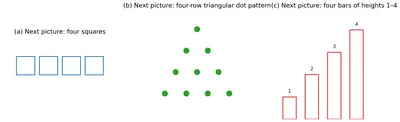
Question 1.Copy the pictorial representations of the number sequences in Table 2 in your notebook, and draw the next picture for each sequence!

Figure
Figure

Solution

Objective : Each row of Table 2 contains four dot-pictures that represent the first four terms of a number sequence. We must recognise the rule followed in every row and then sketch the next (fifth) picture.

  1. Row 1 – Counting numbers

    • The pictures show $$1,2,3,4$$ dots placed in a straight horizontal line.
    • Rule : add one more dot each time ⇒ $$a_n=n.$$
    • Next picture : $$a_5=5$$ dots in one horizontal row. Draw five equally-spaced dots side by side.
  2. Row 2 – Odd numbers (‘L’ pattern)

    • The pictures contain $$1,3,5,7$$ dots. Each new picture is formed by fixing an ‘L’-shaped strip of two extra dots to the previous square.
    • Rule : odd numbers $$a_n=2n-1.$$
    • Next picture : $$a_5=2\times5-1=9.$$ Draw a $$3\times3$$ square of dots (or, if continuing the ‘L’, attach an ‘L’ of two dots to the previous 7-dot shape so the total becomes 9).
  3. Row 3 – Square numbers

    • The pictures are perfect squares of dots: $$1,4,9,16.$$
    • Rule : $$a_n=n^{2}.$$
    • Next picture : $$a_5=5^{2}=25.$$ Draw a perfect square of side 5: 5 rows and 5 columns of dots.
  4. Row 4 – Triangular numbers

    • The pictures form triangular arrangements with $$1,3,6,10$$ dots.
    • Rule : $$a_n=\frac{n(n+1)}{2}.$$
    • Compute the fifth term: \[a_5=\frac{5\times6}{2}=15.\]
    • Next picture : Arrange 15 dots in 5 rows: bottom row 5 dots, then 4, 3, 2 and a single dot at the top to complete an equilateral triangle.

After analysing the rule behind every row, we know exactly how many dots – and what shape – must be drawn for the fifth picture in each sequence.

Answer

  1. Row 1 : 5 dots in one straight line.
  2. Row 2 : 9 dots (next odd-number ‘L’, i.e. a 3 × 3 square).
  3. Row 3 : 25 dots forming a 5 × 5 square.
  4. Row 4 : 15 dots arranged as a triangle with 5 rows.

Question 2. Why are $$1, 3, 6, 10, 15, \ldots$$ called triangular numbers? Why are $$1, 4, 9, 16, 25, \ldots$$ called square numbers or squares? Why are $$1, 8, 27, 64, 125, \ldots$$ called cubes?

Solution

Let us build shapes with identical dots (or unit cubes) and count how many are needed each time.

1. Triangular numbers  $$1,\,3,\,6,\,10,\,15,\ldots$$

  • Start with one dot. One dot alone already forms the smallest possible equilateral triangle. So the first triangular number is $$1$$.
  • To make a triangle whose each side has two dots, we place one more dot under the first row and two dots in the second row (draw two dots touching each other exactly below the top dot). Total dots used = $$1+2 = 3$$. Hence $$3$$ is the next triangular number.
  • For a triangle with three dots on each side, draw three dots in the bottom row, two in the middle row, one on the top. Dots used = $$1+2+3 = 6$$.
  • Continue in the same way: for side–length $$n$$ you get $$1+2+3+\cdots+n$$ dots altogether. Using algebra (Class 8 students prove this later) the sum is \[T_n = \frac{n(n+1)}{2}.\]

    Because every number in the list counts the total dots of some triangular arrangement, they are called triangular numbers.

2. Square numbers  $$1,\,4,\,9,\,16,\,25,\ldots$$

  • Place one dot: you have a square of side 1 dot, so $$1$$ is a square number.
  • Now draw a square whose each side has two dots: you obtain a 2 × 2 square grid (four dots altogether). Hence $$4$$ is called a square number.
  • For three dots per side we need a 3 × 3 grid. The total dots are $$3\times3 = 9$$.
  • In general, a square grid with $$n$$ dots along every side contains $$n \times n = n^2$$ dots. Therefore the square numbers are exactly \[1^2,\;2^2,\;3^2,\;4^2,\ldots\] namely $$1,4,9,16,25,\ldots$$.

3. Cubes  $$1,\,8,\,27,\,64,\,125,\ldots$$

  • Move to three–dimensional space. A cube of side 1 unit consists of exactly one little unit cube, so $$1$$ is the first cube number.
  • A cube with side 2 units is made from 2 × 2 × 2 = 8 unit cubes, so $$8$$ is the next.
  • Side 3 units: 3 × 3 × 3 = 27 unit cubes; side 4 units: 4 × 4 × 4 = 64; and so on.
  • Thus a cube with side $$n$$ consists of $$n \times n \times n = n^3$$ unit cubes, giving the list \[1^3,\;2^3,\;3^3,\;4^3,\ldots\] i.e. $$1,8,27,64,125,\ldots$$. These numbers are therefore called cubes or cube numbers.

Conclusion. The three sequences get their names from the geometric shapes they count:

  1. $$n(n+1)/2$$ dots form a triangle → triangular numbers.
  2. $$n^2$$ dots form an n × n square → square numbers (squares).
  3. $$n^3$$ unit cubes build an n × n × n cube → cubes.

Answer

Because each list counts how many identical points (or unit cubes) are needed to build the corresponding geometric shape of side n:

  • $$1,3,6,10,15,\ldots = \dfrac{n(n+1)}{2}$$ dots make successive equilateral triangles → triangular numbers.
  • $$1,4,9,16,25,\ldots = n^{2}$$ dots fill n × n squares → square numbers (or squares).
  • $$1,8,27,64,125,\ldots = n^{3}$$ unit cubes assemble n × n × n cubes → cubes.

Question 3.

You will have noticed that 36 is both a triangular number and a square number! That is, 36 dots can be arranged perfectly both in a triangle and in a square. Make pictures in your notebook illustrating this!

This shows that the same number can be represented differently, and play different roles, depending on the context. Try representing some other numbers pictorially in different ways!

Solution

Step 1 — Recall the two patterns

  • Square number: a number that can be put in a perfect square array of dots.
      If there are $$s$$ dots on each side, the total is $$s^2$$.
  • Triangular number: a number that can be put in a triangle with successive rows 1, 2, 3 … dots.
      If there are $$n$$ rows, the total is $$\displaystyle\frac{n(n+1)}{2}$$.

Step 2 — Show that 36 is a square number

Take side $$s=6$$ dots.

Then the total number of dots is $$s^2 = 6^2 = 36$$.

What to draw: In your notebook make 6 horizontal rows, each containing 6 evenly spaced dots. You will get a neat 6 × 6 square.

Step 3 — Show that 36 is also a triangular number

We want an integer $$n$$ such that

$$\frac{n(n+1)}{2}=36.$$

Multiply both sides by 2:

$$n(n+1)=72.$$

Bring everything to one side:

$$n^2+n-72=0.$$

Solve the quadratic by factorisation:

$$n^2+9n-8n-72=0\;\;\Rightarrow\;\;(n+9)(n-8)=0.$$

Discard the negative root and keep $$n=8$$.

So 36 is the 8th triangular number.

What to draw: Make 8 rows of dots. Put 1 dot in the first row, 2 in the second, 3 in the third and so on up to 8 dots in the eighth row. Count them: you will have

$$1+2+3+4+5+6+7+8 = 36$$

— exactly the same number of dots as in the 6 × 6 square.

Step 4 — Other numbers with more than one pictorial form

The idea is: different factor pairs give different rectangles, and if the number is triangular or square you get those shapes too. Here are a few small examples you can try drawing.

NumberPossible shapesHow to draw
1square 1 × 1
triangle with 1 row
Just one dot
6triangle (rows 1,2,3)
rectangle 2 × 3
Draw both patterns and count the dots
10triangle (rows 1–4)
rectangle 2 × 5
Do the same
12rectangle 3 × 4
rectangle 2 × 6
Try two different rectangles
25square 5 × 5
L-shape (5 + 4 + 3 + 2 + 1 + 10) — be creative!
Invent your own pattern

What we learn

The same number can ‘play different roles’ because its dots may be arranged in several distinct geometric patterns. 36 is a special example that is both a perfect square and a perfect triangle, but even simpler numbers can appear in more than one picture when we use their factor pairs or triangular arrangement.

Answer

36 dots form a 6 × 6 square and an 8-row triangle (1 + 2 + 3 + 4 + 5 + 6 + 7 + 8 = 36).

Question 4. What would you call the following sequence of numbers? $$1, 7, 19, 37, \ldots$$ That's right, they are called hexagonal numbers! Draw these in your notebook. What is the next number in the sequence?

Solution

Given sequence: 1, 7, 19, 37, …

Step 1 — Look at the first differences

Term1234
Number (an)171937
First difference (an−an−1)$$7-1=6$$$$19-7=12$$$$37-19=18$$

The first differences are 6, 12, 18.

Step 2 — Look at the second differences

  • $$12-6 = 6$$
  • $$18-12 = 6$$

The second differences are constant (all equal to 6). A constant second difference means the rule for the numbers involves $$n^2$$ (a quadratic rule).

Step 3 — Predict the next first difference

The first differences increase by 6 each time:
6 → 12 (added 6), 12 → 18 (added 6).
So the next first difference should be $$18 + 6 = 24$$.

Step 4 — Find the next term

Last known term = 37.
Add the predicted first difference:

\[37 + 24 = 61\]

Therefore the next number in the sequence is $$61$$.

Optional — formula for any term (for the curious)

Starting from 1 and adding $$6, 12, 18, 24, \ldots = 6 \times 1, 6 \times 2, 6 \times 3, 6 \times 4, \ldots$$ gives

\[a_n = 1 + 6\bigl(1 + 2 + 3 + \cdots + (n-1)\bigr) = 1 + 6 \times \frac{(n-1)n}{2} = 1 + 3(n-1)n\]

Checking: for $$n=4$$, $$a_4 = 1 + 3 \times 3 \times 4 = 37$$, which matches.

Why they are called “hexagonal numbers”

Draw dots as follows (do this in your notebook):

  1. One dot for 1.
  2. Place 6 dots around it to make a small hexagon. Now you have 1 + 6 = 7 dots.
  3. Add another “ring” of 12 dots around the previous picture; total dots = 19.
  4. Add a third ring of 18 dots; total dots = 37.
  5. The next ring would need 24 dots, giving 61 dots in all.

Each new ring makes the figure grow as a perfect hexagon, so these totals are called hexagonal numbers.

Answer

The next number is $$61$$.

Question 5. Can you think of pictorial ways to visualise the sequence of Powers of 2? Powers of 3?

Solution

Introduction – What does “power” mean?

In primary classes you already know how to multiply the same number again and again. Writing it many times is long, so mathematicians use powers:

If we write $$2^n$$ (read as “two raised to n”), it means

\[ 2^n = \underbrace{2 \times 2 \times \cdots \times 2}_{\text{n times}} \]

The same idea works for any other number, for example $$3^n$$.

Why pictures help

Powers grow very fast – a drawing lets us see the growth instead of only reading figures.


PART A  – Visualising the Powers of 2

We shall make every new picture by doubling the one before it. Keep each dot the same size so that the total number of dots really shows the value.

Exponent $$n$$Value $$2^n$$How to draw it
0$$1$$Draw one dot.
1$$2$$Copy the first dot right next to it – now you have a row of two dots.
2$$4$$Take the entire row of 2 dots and copy it just below; you now get a little 2 × 2 square of dots (total 4).
3$$8$$Copy the 2×2 square alongside itself to make a 2 × 4 rectangle (4 + 4 = 8 dots).
4$$16$$Copy the entire 2×4 rectangle just underneath it: you have a 4 × 4 square of 16 dots.

Continue the same doubling rule and every new picture will always contain exactly twice as many dots as the previous – that is why the sequence you are seeing is 1, 2, 4, 8, 16, …

Alternative picture: Draw a branching tree. Start from one point; from each point draw two new branches. At level n you will have $$2^n$$ branch-tips.


PART B  – Visualising the Powers of 3

Replace “double” by “triple”. Each stage is now made by reproducing the previous picture three times.

Exponent $$n$$Value $$3^n$$How to draw it
0$$1$$A single small square.
1$$3$$Place three identical squares in one row.
2$$9$$Copy the row of 3 squares below itself two more times. You get a neat 3 × 3 grid (total 9 squares).
3$$27$$Imagine your 3×3 grid is a flat layer. Stack two more identical layers one above another (like a pile of biscuits). All together you now have a 3 × 3 × 3 cube made of 27 little cubes. In a drawing you may show this as three neighbouring 3×3 grids, or you can sketch a 3-D cube divided into 27 tiny cubes.

Again the picture at each step is clearly three times larger (in number of small units) than the previous one, so the numbers 1, 3, 9, 27, 81, … appear.

Alternative picture: A “triple-branching” tree – each tip gives birth to three new tips. The count at level n becomes $$3^n$$.


Why these pictures work

  • Creating the next picture by repeating the whole of the current one guarantees multiplication.
  • Repeating it twice corresponds to multiplying by 2 – hence powers of 2; repeating it thrice corresponds to multiplying by 3 – hence powers of 3.

So, yes – simple dot/ square arrays, stacks of layers, or branching trees are all effective pictorial ways to see the sequences $$2^n$$ and $$3^n$$.

Answer

Yes. Draw the previous picture and then copy it twice (for powers of 2) or three times (for powers of 3):

  • Powers of 2 : 1 dot → 2-dot row → 2 × 2 block (4) → 2 × 4 block (8) → 4 × 4 block (16) → … Each picture doubles the dots.
  • Powers of 3 : 1 square → 3-square row → 3 × 3 grid (9) → 3 × 3 × 3 cube (27) → … Each picture triples the small units.

The same idea can be shown with 2-branch or 3-branch trees; the number of branch-tips at level n is $$2^n$$ or $$3^n$$ respectively.

Exercise 1.4

Question 1. Why does this happen? Do you think it will happen forever?

Solution

Look at the pattern of consecutive square numbers and the difference between them:

Square numberValueNext squareValueDifference
$$1^2$$$$1$$$$2^2$$$$4$$$$4 - 1 = 3$$
$$2^2$$$$4$$$$3^2$$$$9$$$$9 - 4 = 5$$
$$3^2$$$$9$$$$4^2$$$$16$$$$16 - 9 = 7$$
$$4^2$$$$16$$$$5^2$$$$25$$$$25 - 16 = 9$$

Each difference we have obtained (3, 5, 7, 9, …) is an odd number. Why does every difference come out odd?

Take any whole number $$n$$. The two consecutive squares are $$n^2$$ and $$(n + 1)^2$$. Subtract the smaller square from the next one:

\[(n + 1)^2 - n^2\]

Simplify step by step so nothing is skipped:

$$ (n + 1)^2 = (n + 1)(n + 1) $$

$$ (n + 1)(n + 1) = n^2 + n + n + 1 = n^2 + 2n + 1 $$

Therefore

$$ (n + 1)^2 - n^2 = \bigl(n^2 + 2n + 1\bigr) - n^2 $$

$$ = n^2 + 2n + 1 - n^2 $$

$$ = 2n + 1 $$

The expression $$2n + 1$$ is always odd because:

  • $$2n$$ is even for every whole number $$n$$ (it is “two times” something).
  • An even number plus 1 gives an odd number.

So the difference between any two consecutive square numbers is always odd. That fully explains why the pattern of odd differences appears.

Will it happen forever? Yes. The argument above did not depend on any particular value of $$n$$. It works for every natural number, and there is no largest natural number. Hence each new pair of consecutive squares will keep giving an odd difference, and the pattern will continue without end.

Answer

The difference between two consecutive square numbers is always $$2n+1$$, an odd number, so the gaps 3, 5, 7, 9, … keep appearing for every natural number $$n$$. Because there is no largest natural number, this odd–difference pattern will go on forever.

Question 2. How can we partition the dots in a square grid into odd numbers of dots: $$1, 3, 5, 7, \ldots$$ ?

Solution

Step 1 – Begin with the smallest square
Take one dot. This single dot already forms a 1 × 1 square, so we label that group as $$1$$ dot.

Step 2 – Build the next larger square and count the new dots
To change the 1 × 1 square into a 2 × 2 square we must place one new dot on the right, one below and one on the diagonal corner. Altogether we have added $$3$$ new dots. We have now partitioned the 4 dots of the 2 × 2 square into two groups:

  • the original $$1$$ dot,
  • the newly added $$3$$ dots.
So far, $$1 + 3 = 4 = 2^2$$.

Step 3 – Form a 3 × 3 square
Around the 2 × 2 square we place a new row of dots at the bottom and a new column on the right. Each of these lines has 3 dots, but the corner dot belongs to both lines, so we actually add $$3 + 3 - 1 = 5$$ fresh dots. Now the 9 dots of a 3 × 3 square are split into three odd-sized groups:

  • $$1$$ dot,
  • $$3$$ dots,
  • $$5$$ dots.
Indeed, $$1 + 3 + 5 = 9 = 3^2$$.

Step 4 – Continue the pattern
Repeat the same idea: every time we enlarge an n × n square to an (n + 1) × (n + 1) square we add one new row and one new column of dots. Each has (n + 1) dots. Because the corner dot is common to both, the number of fresh dots is $$ (n+1) + (n+1) - 1 = 2n + 1, $$ which is always an odd number.

Step 5 – General statement
After performing the step n times, the total number of dots in the final square is \[n^2 = 1 + 3 + 5 + \dots + (2n-1).\] Thus the dots in every square grid can be partitioned into the consecutive odd numbers $$1, 3, 5, 7, \ldots$$ . Each new outer ‘L-shaped’ layer contributes the next odd number of dots.

What to draw?
Draw successive squares made of dots (1 dot, 2 × 2, 3 × 3, 4 × 4). Shade or colour the layers differently so that the first layer has 1 dot, the second has 3, the third has 5, and so on. Label each layer with the number of dots it contains.

Answer

By adding one new outer ‘L’-shaped layer at each step we successively add $$1,3,5,7,\ldots$$ dots, so that
\[n^2 = 1 + 3 + 5 + \dots + (2n-1).\]
Hence the dots of every square grid can be partitioned into the odd numbers $$1,3,5,7,\ldots$$.

Question 3. By drawing a similar picture, can you say what is the sum of the first 10 odd numbers?

Solution

Draw dots so that each succeeding odd number builds a thicker square:

  • Start with one dot – a 1 × 1 square (total $$1$$).
  • Add the next odd number, $$3$$ dots, all round it. You now have a 2 × 2 square (total $$1+3=4$$).
  • Add $$5$$ more dots round this. It closes into a 3 × 3 square (total $$1+3+5=9$$).
  • Every time you add the next odd number, the picture closes into the next perfect square.
n (how many odd numbers)Sum of first n odd numbersSquare formed
1$$1$$$$1\times1$$
2$$1+3=4$$$$2\times2$$
3$$1+3+5=9$$$$3\times3$$
4$$1+3+5+7=16$$$$4\times4$$

Looking at the pattern we conclude

\[ 1+3+5+\dots+(2n-1)=n^2 \]

Thus, for $$n=10$$ the first ten odd numbers

$$1,3,5,7,9,11,13,15,17,19$$

add up to

$$10^2=100$$.

So the sum of the first 10 odd numbers is $$100$$.

Answer

$$100$$

Question 4. Now by imagining a similar picture, or by drawing it partially, as needed, can you say what is the sum of the first 100 odd numbers?

Solution

Observation with a small picture

Imagine we keep putting successive L-shaped strips of unit squares around an ever-growing square.

  • Start with one unit square. That is the first odd number $$1$$.
  • To turn it into a $$2\times2$$ square we must add a strip of three new unit squares. Now the total is $$1+3=4$$.
  • To turn the $$2\times2$$ square into a $$3\times3$$ square we must add a strip of five new squares. Now the total is $$1+3+5=9$$.
  • The next strip has seven squares, giving $$1+3+5+7=16$$, and so on.

Each time we complete the L-shaped border we get a perfect square, and the sequence of totals is

$$1,\;4,\;9,\;16,\;\ldots$$

These are exactly the square numbers $$1^2,2^2,3^2,4^2,\ldots$$.

Making the pattern explicit

After adding the first $$n$$ odd numbers we have built an $$n\times n$$ square. Therefore

\[\text{Sum of first }n\text{ odd numbers}=n^2.\]

Applying the rule to 100 odd numbers

Here $$n=100$$, so

$$\text{Sum}=100^2=100\times100=10000.$$

Therefore

\[1+3+5+\cdots+199 = 10000.\]

Answer

The sum of the first 100 odd numbers is $$10000$$.

Question 5. Can you find a similar pictorial explanation?

Solution

What the textbook has just done

Just before this question, the book has shown a picture in which

  • a single dot gives the number $$1$$,
  • three more dots added as an L shape round it give $$1+3=4$$,
  • five more dots added as the next L shape give $$1+3+5=9$$.

The picture looks like three nested squares made of dots:

  1. first square: 1 dot1 × 1 square,
  2. second square: 4 dots2 × 2 square,
  3. third square: 9 dots3 × 3 square.

So the picture proves $$1+3+5=9=3^2$$. The question now asks us to draw a similar picture for the next step and then for the general case.

Step 1 – Draw the next layer (for 4 × 4)

  1. Start from the last (3 × 3) square of dots that has 9 dots.
  2. Now put an L shape of seven new dots:
  • four dots go on the right side of the existing square,
  • three dots go at the bottom of the existing square.
  • The new large square has side $$4$$ and therefore contains $$4\times4=16$$ dots.
  • Thus the next line in the pattern is

    \[1+3+5+7=16=4^2\]

    Step 2 – Understand the pattern

    Every time we increase the side length of the square from $$n$$ to $$(n+1)$$, exactly

    $$2(n+1)-1$$

    new dots are needed. That number is the next odd number in the list $$1,3,5,7,\ldots$$.

    Step 3 – General pictorial explanation

    1. Draw a single dot. It is a $$1\times1$$ square → sum of first odd number $$=1^2$$.
    2. To make a $$2\times2$$ square, add $$3$$ dots round two sides → sum of first two odd numbers $$=2^2$$.
    3. To make a $$3\times3$$ square, add $$5$$ dots → sum of first three odd numbers $$=3^2$$.
    4. Continue like this. To get an $$n\times n$$ square, add the $$n^{\text{th}}$$ odd number $$2n-1$$.

    After the $$n^{\text{th}}$$ step, the picture is a perfect square of side $$n$$ built out of dots, so it contains exactly $$n^2$$ dots. But the dots were added in amounts $$1,3,5,\ldots,(2n-1)$$, so

    \[1+3+5+\cdots+(2n-1)=n^2\]

    This chain of pictures is therefore a pictorial proof of the fact that the sum of the first $$n$$ odd numbers is $$n^2$$.

    How to show it in your notebook

    1. With a pencil, first draw a small 1 × 1 box and put one dot inside.
    2. Around it draw a 2 × 2 box and place three new dots in an L shape.
    3. Around that draw a 3 × 3 box and add five new dots in the next L shape.
    4. Repeat once more to get the 4 × 4 square (add seven dots).
    5. Label the numbers of dots beside each square and write the equalities:
    • $$1=1^2$$
    • $$1+3=4=2^2$$
    • $$1+3+5=9=3^2$$
    • $$1+3+5+7=16=4^2$$

    That completes a clear pictorial explanation similar to the one shown in the textbook.

    Answer

    Yes. Keep adding odd-numbered “L”-shaped strips of dots (1, 3, 5, 7, …) round the previous square. After the nth strip you get an n × n square, so the picture shows directly that

    $$1+3+5+\dots+(2n-1)=n^2$$.

    Exercise 1.5

    Question 1. Can you find a similar pictorial explanation for why adding counting numbers up and down, i.e., $$1, 1 + 2 + 1, 1 + 2 + 3 + 2 + 1, \ldots$$, gives square numbers?

    Solution

    Step 1 – Write down the first few sums and notice the result

    n (highest number)Sum that goes up and then comes downTotalPerfect square
    1$$1$$$$1$$$$1^{2}=1$$
    2$$1+2+1$$$$4$$$$2^{2}=4$$
    3$$1+2+3+2+1$$$$9$$$$3^{2}=9$$
    4$$1+2+3+4+3+2+1$$$$16$$$$4^{2}=16$$

    Each time we get the square of the largest number.

    Step 2 – Draw the pattern with dots (pictorial explanation)

    • n = 1: Draw a single dot – a 1 × 1 square.
    • n = 2:
      Draw a row of 1 dot, a row of 2 dots, and a row of 1 dot, all centred one below the other. You will see a complete 2 × 2 square of dots.
    • n = 3:
      Draw rows of 1, 2, 3, 2, 1 dots, again keeping every row centred. The picture exactly fills a 3 × 3 square.
    • n = 4:
      Draw rows of 1, 2, 3, 4, 3, 2, 1 dots. The result is a complete 4 × 4 square.

    What to draw, step by step (example n = 4):

    1. Make seven horizontal rows.
    2. Put 1 dot in the first row, 2 in the second, 3 in the third, 4 in the fourth (middle) row, then 3, 2, 1 in the next three rows.
    3. Keep each row centred so that the leftmost and rightmost dots line up to form straight vertical sides.
    4. Count the dots: there are 16, arranged in a perfect 4 × 4 square.

    Because the dots exactly fill an n × n square, their number must be $$n^{2}$$.

    Step 3 – Algebra check

    The sum that “goes up and then comes down” for the number $$n$$ is

    $$S = 1+2+3+\ldots+(n-1)+n+(n-1)+\ldots+3+2+1.$$

    Break it into two parts:

    Upwards: $$1+2+3+\ldots+n = \dfrac{n(n+1)}{2}.$$

    Downwards (which stops at $$1$$, so the top term is $$n-1$$): $$1+2+\ldots+(n-1) = \dfrac{(n-1)n}{2}.$$

    Add the two halves:

    $$S = \dfrac{n(n+1)}{2} + \dfrac{(n-1)n}{2} = \dfrac{n\bigl[(n+1)+(n-1)\bigr]}{2} = \dfrac{n(2n)}{2} = n^{2}.$$

    This matches exactly what the dot-picture shows.

    Conclusion

    Both the picture of centred rows of dots and the algebra confirm that

    \[ 1+2+3+\ldots+(n-1)+n+(n-1)+\ldots+3+2+1 = n^{2}, \]

    so the “counting up and counting down” pattern always produces a perfect square.

    Answer

    Yes. Place rows of dots with lengths 1, 2, …, n, n-1, …, 2, 1; they fit exactly into an n × n square, showing pictorially that the sum is $$n^{2}$$. Algebraically,

    $$1+2+\dots+n+(n-1)+\dots+2+1=\dfrac{n(n+1)}{2}+\dfrac{(n-1)n}{2}=n^{2},$$

    confirming the diagram.

    Question 2. By imagining a large version of your picture, or drawing it partially, as needed, can you see what will be the value of $$1 + 2 + 3 + \cdots + 99 + 100 + 99 + \cdots + 3 + 2 + 1$$?

    Solution

    Step 1 – Read the pattern carefully.
    We have to add the numbers

    $$1+2+3+\cdots+99+100+99+\cdots+3+2+1.$$

    This is a single staircase that first climbs up from $$1$$ to $$100$$ and then comes back down to $$1$$.

    Step 2 – Split the staircase into two separate sums.
    Going up gives

    $$1+2+3+\cdots+99+100,$$

    and coming down gives

    $$99+98+\cdots+3+2+1.$$

    The second part is exactly the same set of numbers as $$1+2+3+\cdots+98+99$$, only written in reverse order. So

    $$1+2+3+\cdots+99+100+99+\cdots+3+2+1 \\ =\;(1+2+3+\cdots+99+100)\; +\; (1+2+3+\cdots+98+99).$$

    Step 3 – Use the formula for the sum of the first $$n$$ natural numbers.
    For any natural number $$n$$,

    $$1+2+3+\cdots+n = \dfrac{n(n+1)}{2}.$$

    We therefore find

    • For $$n = 100$$:  $$1+2+\cdots+100 = \dfrac{100\,(100+1)}{2}=\dfrac{100\times101}{2}=5050.$$
    • For $$n = 99$$:  $$1+2+\cdots+99 = \dfrac{99\,(99+1)}{2}=\dfrac{99\times100}{2}=99\times50 = 4950.$$

    Step 4 – Add the two partial sums.

    $$5050 + 4950 = 10000.$$

    Step 5 – State the result clearly.

    \[10000\]

    So the given long pattern of numbers adds up exactly to $$10000$$.

    Answer

    10000

    Question 3. Which sequence do you get when you start to add the All 1's sequence up? What sequence do you get when you add the All 1's sequence up and down?

    Solution

    Step 1 : Recall the “All 1’s” sequence
    The All 1’s sequence is made of numbers that contain only the digit 1:

    • First term → $$1$$
    • Second term → $$11$$
    • Third term → $$111$$
    • Fourth term → $$1111$$, and so on.

    In symbols, the n-th term is
    $$T_{n}=\underbrace{11\ldots1}_{n\text{ ones}}.$$

    Step 2 : “Add the All 1’s sequence up” (take running or cumulative totals)

    How many terms are added?Addition carried outCumulative total obtained
    1$$1$$$$1$$
    2$$1+11$$$$12$$
    3$$1+11+111$$$$123$$
    4$$1+11+111+1111$$$$1234$$
    5$$1+11+111+1111+11111$$$$12345$$

    Continuing in the same way we obtain the sequence

    $$1,\;12,\;123,\;1234,\;12345,\;\ldots$$

    Hence, adding the All 1’s sequence up gives the counting–number pattern whose n-th term is the number made by writing the digits 1 to n in order.

    Step 3 : “Add the All 1’s sequence up and down” (place every term underneath the previous ones and do the usual vertical addition)

    Take, for instance, the first five terms and write them one below the other:

    \[\begin{array}{r} 11111\\ \;1111\\ \;\;111\\ \;\;\;11\\ \;\;\;\;1\\ \hline \end{array}\]

    Now add downwards (column addition):

    • Units column: $$1+1+1+1+1=5$$
    • Tens column: $$1+1+1+1=4$$
    • Hundreds column: $$1+1+1=3$$
    • Thousands column: $$1+1=2$$
    • Ten-thousands column: $$1$$

    The result is $$12345$$, exactly the same answer we got after adding the five terms up in Step 2.

    If we take six terms, the vertical (downward) addition goes

    \[\begin{array}{r} 111111\\ \;11111\\ \;\;1111\\ \;\;\;111\\ \;\;\;\;11\\ \;\;\;\;\;1\\ \hline \end{array}\;=\;123456\]

    Again we get the consecutive–digit number $$123456$$, matching the 6-term cumulative total in Step 2.

    Why does this always happen?
    For any chosen $$n$$, exactly n numbers are written. Each column (starting from the right) contains fewer and fewer 1’s:

    • Units column → n ones
    • Tens column → n −1 ones
    • Hundreds column → n −2 ones, and so on,

    so the column-totals come out $$n,(n-1),(n-2),\ldots ,3,2,1$$ – exactly the digits of the number $$123\ldots n$$ written from left to right. Thus vertical (downward) addition automatically reproduces the same pattern obtained by the running totals.

    Step 4 : State the two sequences clearly

    1. Adding the All 1’s sequence up (running totals) gives

      $$1,12,123,1234,12345,\ldots$$
    2. Adding the All 1’s sequence up and down (ordinary column addition after stacking the numbers) also produces

      $$1,12,123,1234,12345,\ldots$$

    Thus both ways of adding lead to the same beautiful pattern of consecutive digits.

    Answer

    The running totals, as well as the ordinary vertical total of the first n All 1’s, give the same sequence:

    $$1,\;12,\;123,\;1234,\;12345,\;\ldots$$ – the number formed by writing the digits 1 to n in order.

    Question 4. Which sequence do you get when you start to add the counting numbers up? Can you give a smaller pictorial explanation?

    Solution

    Step 1 – Add the counting numbers one by one

    The counting numbers are $$1, 2, 3, 4, 5, \dots$$

    Start adding them successively and write down each sum:

    • First sum  $$1 = 1$$
    • Second sum  $$1 + 2 = 3$$
    • Third sum  $$1 + 2 + 3 = 6$$
    • Fourth sum  $$1 + 2 + 3 + 4 = 10$$
    • Fifth sum  $$1 + 2 + 3 + 4 + 5 = 15$$
    • and so on $$\dots$$

    Thus the sequence you obtain is

    $$1,\; 3,\; 6,\; 10,\; 15,\; 21,\; 28,\; \dots$$

    This sequence is called the triangular numbers.

    Step 2 – Why are they called triangular numbers?

    Each number in the list can be shown as a triangular arrangement of equally spaced dots. For example:

    • 3 dots: draw one dot in the first (top) row and two dots in the second row just below it to form a small triangle.
    • 6 dots: draw one dot in the first row, two in the second row and three in the third row – the dots again form a bigger triangle.
    • 10 dots: draw rows of 1, 2, 3 and 4 dots.

    Each new row adds the next counting number of dots and makes a larger triangle, so the partial sums are called triangular numbers.

    Step 3 – General rule (optional)

    If you continue this process up to the $$n^{\text{th}}$$ counting number, the total number of dots—hence the $$n^{\text{th}}$$ triangular number—is

    \[ T_n = 1 + 2 + 3 + \cdots + n = \frac{n(n+1)}{2}. \]

    At this stage you only need to recognise the pattern: successive partial sums of counting numbers give the triangular number sequence.

    Answer

    The successive sums are $$1, 3, 6, 10, 15, 21, 28, \dots$$ — these are called the triangular numbers, because that many dots can be arranged in equilateral triangles.

    Question 5. What happens when you add up pairs of consecutive triangular numbers? That is, take $$1 + 3, 3 + 6, 6 + 10, 10 + 15, \ldots$$ Which sequence do you get? Why? Can you explain it with a picture?

    Solution

    Step 1 Recall the triangular numbers.
    The n-th triangular number is the total number of dots that can be arranged in an equilateral triangle with n dots on each side. Numerically it is

    $$T_n = \dfrac{n(n+1)}{2}$$

    So the first few triangular numbers are

    $$T_1 = 1, \; T_2 = 3, \; T_3 = 6, \; T_4 = 10, \; T_5 = 15,\ldots$$


    Step 2 Add consecutive triangular numbers and look at the results.

    nFirst term $$T_n$$Next term $$T_{n+1}$$Sum $$T_n+T_{n+1}$$
    1134
    2369
    361016
    4101525

    The sequence we obtain is
    $$4,\;9,\;16,\;25,\ldots$$

    These are exactly the perfect squares $$2^2,\;3^2,\;4^2,\;5^2,\ldots$$


    Step 3 Algebraic proof that the sum is always a square.

    Add two consecutive triangular numbers in the general case:

    $$T_n + T_{n+1} = \dfrac{n(n+1)}{2} + \dfrac{(n+1)(n+2)}{2}$$

    Factor out the common denominator 2 and the common factor $$(n+1):$$

    $$= \dfrac{(n+1)\bigl[n + (n+2)\bigr]}{2}$$

    Simplify the bracket:

    $$n + (n+2) = 2n + 2$$

    So

    $$T_n + T_{n+1} = \dfrac{(n+1)(2n+2)}{2}$$

    Again factor 2 from $$(2n+2):$$

    $$= \dfrac{(n+1)\,2(n+1)}{2} = (n+1)(n+1)$$

    Hence

    \[(\text{Sum of }T_n\text{ and }T_{n+1}) = (n+1)^2\]

    This is the square of the integer $$(n+1)$$.
    Therefore every pair of consecutive triangular numbers adds up to a perfect square.


    Step 4 A picture explanation.

    Take the concrete example $$n = 4,$$ where we want to see that $$T_4 + T_5 = 10 + 15 = 25 = 5^2.$$

    • Draw a right-angled triangular array of dots for $$T_5 = 15.$$ Stack rows of $$1, 2, 3, 4, 5$$ dots so that the left edge is vertical and the bottom edge is horizontal — a right triangle with $$5$$ dots along each of those two edges.
    • Draw a second right-angled triangular array of dots for $$T_4 = 10.$$ Stack rows of $$1, 2, 3, 4$$ dots in the same way — a right triangle with $$4$$ dots along each of its two short edges.
    • Flip the $$T_4$$ triangle upside down and slide it against the slanted (hypotenuse) edge of the $$T_5$$ triangle. The slanted edges have matching staircase shapes, so the two triangles interlock to fill a complete $$5 \times 5$$ square containing $$T_4 + T_5 = 25$$ dots.

    The same construction works for any $$n:$$ the staircase edges of $$T_n$$ and $$T_{n+1}$$ always fit together to make an $$(n+1) \times (n+1)$$ square of dots, which is exactly the algebraic identity $$T_n + T_{n+1} = (n+1)^2.$$

    Conclusion. Adding any two consecutive triangular numbers always gives the next perfect square: $$4, 9, 16, 25, \ldots$$

    Answer

    The sums are perfect squares:

    $$1+3=4=2^2,\;3+6=9=3^2,\;6+10=16=4^2,\;10+15=25=5^2,\ldots$$

    In general $$T_n+T_{n+1}=(n+1)^2,$$ so the sequence obtained is $$4,9,16,25,\dots,$$ i.e. the square numbers.

    Question 6. What happens when you start to add up powers of 2 starting with 1, i.e., take $$1, 1 + 2, 1 + 2 + 4, 1 + 2 + 4 + 8, \ldots$$ ? Now add 1 to each of these numbers—what numbers do you get? Why does this happen?

    Solution

    Step 1 : Write down the successive sums

    1. First number: $$S_1 = 1$$

    2. First two numbers: $$S_2 = 1 + 2 = 3$$

    3. First three numbers: $$S_3 = 1 + 2 + 4 = 7$$

    4. First four numbers: $$S_4 = 1 + 2 + 4 + 8 = 15$$

    5. And so on: $$S_5 = 31,\; S_6 = 63,\;\dots$$

    So the list of partial sums is

    $$1,\;3,\;7,\;15,\;31,\dots$$

    Step 2 : Add 1 to every partial sum

    $$1+1=2,\;3+1=4,\;7+1=8,\;15+1=16,\;31+1=32,\dots$$

    The new list is

    $$2,\;4,\;8,\;16,\;32,\dots$$

    These are exactly the powers of 2 — $$2^1,2^2,2^3,2^4,2^5,\dots$$.

    Step 3 : Why does this always happen?

    Let us give a name to the n-th partial sum:

    $$S_n = 1 + 2 + 4 + \cdots + 2^{n-1}$$

    Multiply both sides by 2:

    $$2S_n = 2 + 4 + 8 + \cdots + 2^{n}$$

    Subtract the first equation from the second:

    $$2S_n - S_n = (2 + 4 + 8 + \cdots + 2^{n}) - (1 + 2 + 4 + \cdots + 2^{n-1})$$

    Everything cancels except the first 1 on the right and the last term $$2^{n}$$, giving

    \[S_n = 2^{n} - 1\]

    Finally add 1 to both sides:

    $$S_n + 1 = 2^{n}$$

    Thus every time you add 1 to the sum of the first n powers of 2, you land exactly on the next power of 2. That is why the sequence obtained is $$2,4,8,16,32,\dots$$.

    Conclusion: The sum of the first n powers of 2 is always one less than the next power of 2, so adding 1 turns it into that exact power of 2.

    Answer

    Each partial sum is one less than a power of 2: $$1,3,7,15,31,\ldots=2^{1}-1,2^{2}-1,2^{3}-1,\ldots$$. Adding 1 therefore gives the powers of 2 themselves: $$2,4,8,16,32,\ldots$$.

    Question 7. What happens when you multiply the triangular numbers by 6 and add 1? Which sequence do you get? Can you explain it with a picture?

    Solution

    Step 1 – Recall the triangular numbers

    The n-th triangular number is the total number of dots that can be arranged in an equilateral triangle with n dots on each side:

    $$T_n = \frac{n(n+1)}{2}$$

    nPicture-idea*$$T_n$$
    1single dot1
    2triangle of 3 dots3
    3triangle of 6 dots6
    4···10
    5···15

    *Draw a dot-pattern shaped like a triangle for each n.

    Step 2 – Multiply each triangular number by 6

    n$$T_n$$$$6\,T_n$$
    116
    2318
    3636
    41060
    51590

    Step 3 – Add 1

    n$$6\,T_n$$$$6\,T_n+1$$
    167
    21819
    33637
    46061
    59091
    6126127

    The new sequence is $$7,\;19,\;37,\;61,\;91,\;127,\;\ldots$$

    Step 4 – General formula

    Starting from the formula of a triangular number, we compute:

    $$\begin{aligned} 6T_n+1 & = 6\left(\frac{n(n+1)}{2}\right)+1\\[4pt] & = 3n(n+1)+1.\qquad (1) \end{aligned}$$

    Step 5 – Identify the sequence

    The centred hexagonal (also called hexagonal pyramid) numbers are defined by

    $$H_k = 3k(k-1)+1\quad (k=1,2,3,\ldots)$$

    Putting $$k=n+1$$ we get

    $$H_{n+1}=3(n+1)n+1,$$

    which is exactly the expression in (1). Therefore

    $$6\,T_n+1 = H_{n+1}.$$

    So the sequence you obtain — 7, 19, 37, 61, 91, 127, … — is the sequence of centred hexagonal numbers (starting from the second term).

    Step 6 – Picture explanation

    • Draw one dot in the centre.
    • Around it draw a ring of 6 dots making a small hexagon: total 1 + 6 = 7 dots (the first term).
    • Add the next hexagonal ring containing 12 dots: total 7 + 12 = 19 dots (second term).
    • The next ring has 18 dots: total 19 + 18 = 37 dots, and so on.

    Each new ring adds 6 more dots than the previous ring, forming bigger and bigger hexagons. These totals match exactly the numbers found in Step 3.

    Hence, multiplying triangular numbers by 6 and then adding 1 produces the sequence of centred hexagonal numbers.

    Answer

    The numbers you get are 7, 19, 37, 61, 91, 127, … – the centred hexagonal numbers.

    Question 8. What happens when you start to add up hexagonal numbers, i.e., take $$1, 1 + 7, 1 + 7 + 19, 1 + 7 + 19 + 37, \ldots$$ ? Which sequence do you get? Can you explain it using a picture of a cube?

    Solution

    Step 1 – Write down the numbers we are adding
    A centred hexagonal number (hexagonal dot‐pattern with one dot in the middle) is

    $$H_1 = 1,\; H_2 = 7,\; H_3 = 19,\; H_4 = 37,\;\ldots$$

    So the running sums the question talks about are

    $$S_1 = 1$$
    $$S_2 = 1 + 7 = 8$$
    $$S_3 = 1 + 7 + 19 = 27$$
    $$S_4 = 1 + 7 + 19 + 37 = 64$$
    …and so on.

    Step 2 – Look for a pattern
    The totals we just found are

    $$1,\;8,\;27,\;64,\;\ldots$$

    These are exactly the perfect cubes:

    $$1 = 1^{3},\; 8 = 2^{3},\; 27 = 3^{3},\; 64 = 4^{3},\;\ldots$$

    So the sequence we get is the sequence of cube numbers $$n^{3}$$.

    Step 3 – Why is this true? An algebra check
    First write a general formula for the n-th centred hexagonal number. Counting the dots gives

    $$H_n = 3n(n-1) + 1.$$

    Notice something special:

    $$n^{3} - (n-1)^{3} = n^{3} - \bigl(n^{3} - 3n^{2} + 3n - 1\bigr) = 3n^{2} - 3n + 1.$$

    But $$3n^{2} - 3n + 1$$ is exactly $$H_n$$ (because
    $$3n^{2} - 3n + 1 = 3n(n-1)+1$$). Therefore

    $$H_n = n^{3} - (n-1)^{3}.$$

    Now add the first $$k$$ such numbers:

    $$S_k = \sum_{n=1}^{k} H_n = \sum_{n=1}^{k} \bigl[n^{3} - (n-1)^{3}\bigr].$$

    The sum telescopes — every term except the very first and very last cancels:

    $$S_k = k^{3} - 0^{3} = k^{3}.$$

    Hence the running totals are always perfect cubes.

    Step 4 – A picture proof with cubes

    • Build a solid cube of side length $$k$$ from unit cubes. It contains $$k^{3}$$ small cubes.
    • Put the cube so that you look along a space diagonal (from one corner toward the opposite back corner).
    • If you cut the big cube by parallel slices perpendicular to that diagonal, the layers you get have exactly
      $$1,\;7,\;19,\;37,\;\ldots$$ unit cubes.
    • Stacking the first $$k$$ such hexagonal layers therefore reconstructs the whole $$k\times k\times k$$ cube, showing that $$1 + 7 + 19 + 37 + \cdots + H_k = k^{3}.$$

    (To draw it, sketch a $$4 \times 4 \times 4$$ cube of small blocks. Shade the blocks in the front‐left‐bottom corner –– there is 1. Move one block’s thickness along the diagonal and shade the next slice –– you will shade 7. Continue: the next slice has 19, then 37. All four slices together make the whole cube, proving the count.)

    Conclusion
    Adding centred hexagonal numbers one by one gives the perfect cubes:

    \[\boxed{\;1,\;8,\;27,\;64,\;125,\;\ldots\; = \;n^{3}\;}\]

    Answer

    The running sums are $$1,8,27,64,125, aisebox{0.4ex}{…}$$ – the perfect cubes $$n^{3}$$. Thus $$1+7+19+\cdots+H_n = n^{3}$$, which you can see by slicing a $$n\times n\times n$$ cube along its diagonal.

    Question 9. Find your own patterns or relations in and among the sequences in Table 1. Can you explain why they happen with a picture or otherwise?

    Solution

    Given sequences in Table 1 (as they usually appear in the NCERT text)

    Name of the sequenceFirst few terms
    (A) Natural numbers1, 2, 3, 4, 5, 6, …
    (B) Odd numbers1, 3, 5, 7, 9, 11, …
    (C) Square numbers1, 4, 9, 16, 25, 36, …
    (D) Triangular numbers1, 3, 6, 10, 15, 21, …

    We shall discover four interesting patterns linking these sequences and give a picture or a small proof for each.

    1. Consecutive squares differ by odd numbers

    Look at two neighbouring square numbers: $$n^2$$ and $$(n-1)^2$$.

    The difference is

    $$n^2 - (n-1)^2 = n^2 - \bigl(n^2 - 2n + 1\bigr) = 2n - 1$$.

    The expression $$2n-1$$ is always odd, so the gap between squares is exactly the next odd number. For example:

    • $$4-1 = 3$$ (odd)
    • $$9-4 = 5$$ (odd)
    • $$16-9 = 7$$ (odd)

    Dot-picture: Draw a 3 × 3 square (9 dots). Remove the inside 2 × 2 square (4 dots). The L-shaped “frame” left over has 5 dots, showing the difference 9 − 4 = 5.

    2. Each square is the sum of consecutive odd numbers

    Add the first few odd numbers one by one:

    Sum of first n odd numbersResult
    11 = $$1^2$$
    1 + 34 = $$2^2$$
    1 + 3 + 59 = $$3^2$$
    1 + 3 + 5 + 716 = $$4^2$$

    Why? From Pattern 1 we already know each new odd number “completes” the next square frame around the existing dots, so piling the frames together builds a bigger square.

    Algebraically, add up to the n-th odd number:

    $$1 + 3 + 5 + \dots + (2n-1) = n^2.$$

    3. Consecutive triangular numbers differ by natural numbers

    The n-th triangular number is the sum of the first n naturals:

    $$T_n = 1 + 2 + 3 + \dots + n.$$ Therefore

    $$T_n - T_{n-1} = n,$$

    so sequence (A) appears inside sequence (D).

    Dot-picture: A triangle of 6 dots (for $$T_3$$) becomes one of 10 dots (for $$T_4$$) by adding a new row of 4 dots — exactly the next natural number.

    4. A square number is the sum of two consecutive triangular numbers

    We claim

    $$n^2 = T_n + T_{n-1}.$$

    Proof: Substitute the formula $$T_n = \dfrac{n(n+1)}{2}$$.

    $$T_n + T_{n-1} = \frac{n(n+1)}{2} + \frac{(n-1)n}{2} = \frac{n\bigl[(n+1)+(n-1)\bigr]}{2} = \frac{n(2n)}{2} = n^2.$$

    Picture idea: Draw a staircase triangle of side n dots (Tn) next to one of side n−1 dots (Tn−1). Together they exactly fill a neat n × n square array of dots.

    What we learnt

    • Odd numbers link squares; natural numbers link triangular numbers.
    • Add odd numbers → squares; add natural numbers → triangles.
    • Squares can be “cut” into two triangles.

    These visual-algebraic patterns show how different sequences (A) to (D) are connected.

    Answer

    Key patterns found:
    (i) $$n^2-(n-1)^2=2n-1$$ (square–odd link)
    (ii) $$1+3+5+\dots+(2n-1)=n^2$$
    (iii) $$T_n-T_{n-1}=n$$ where $$T_n=1+2+\dots+n$$
    (iv) $$n^2=T_n+T_{n-1}$$

    Exercise 1.6

    Question 1. Can you recognise the pattern in each of the sequences in Table 3?

    Solution

    First reproduce the six rows that appear in Table 3 of the textbook.

    RowSequence written in the book
    (a)$$1,\;2,\;4,\;8,\;16,\;32,\;\ldots$$
    (b)$$1,\;3,\;5,\;7,\;9,\;\ldots$$
    (c)$$1,\;4,\;9,\;16,\;25,\;36,\;\ldots$$
    (d)$$1,\;2,\;6,\;24,\;120,\;720,\;\ldots$$
    (e)$$1,\;1,\;2,\;3,\;5,\;8,\;13,\;21,\;\ldots$$
    (f)$$2,\;3,\;5,\;7,\;11,\;13,\;17,\;19,\;\ldots$$

    We now read the hidden rule—the pattern—of every row one by one.

    1. Row (a) – powers of 2

      Start with $$1$$ and multiply by $$2$$ each time:

      $$1\times2=2,\;2\times2=4,\;4\times2=8,\;8\times2=16,\;\ldots$$

      Thus the general or $$n^{\text{th}}$$ term is $$T_n = 2^{\,n-1}$$.

    2. Row (b) – consecutive odd numbers

      The gap between neighbouring terms is always $$+2$$:

      $$3-1=2,\;5-3=2,\;7-5=2,\;\ldots$$

      The sequence therefore lists all odd natural numbers. In compact form $$T_n = 2n-1$$.

    3. Row (c) – square numbers

      Each term equals the square of its position number:

      $$1=1^2,\;4=2^2,\;9=3^2,\;16=4^2,\;25=5^2,\;\ldots$$

      Hence $$T_n = n^{2}$$.

    4. Row (d) – factorials

      Observe the running products inside successive terms:

      $$1 = 1!,\; 2 = 2!,\; 6 = 3!,\; 24 = 4!,\; 120 = 5!,\; 720 = 6!$$

      In general $$T_n = n! = 1\times2\times3\times\cdots\times n$$.

    5. Row (e) – Fibonacci numbers

      Besides the first two 1’s, every entry is the sum of the two entries just before it:

      $$1,\;1,\;1+1=2,\;1+2=3,\;2+3=5,\;3+5=8,\;\ldots$$

      Symbolically $$T_1=T_2=1$$ and for $$n\ge3$$, $$T_n = T_{n-1}+T_{n-2}$$.

    6. Row (f) – prime numbers

      The list $$2,3,5,7,11,13,17,\ldots$$ is simply the prime numbers written in ascending order. A prime number is a whole number greater than $$1$$ having exactly two factors: $$1$$ and the number itself.

    Thus the pattern governing every sequence in Table 3 has been clearly identified.

    Answer

    (a) Doubling every time → $$T_n = 2^{n-1}$$ (powers of 2).
    (b) Add 2 each time → odd numbers $$T_n = 2n-1$$.
    (c) Perfect squares $$T_n = n^{2}$$.
    (d) Factorials $$T_n = n!$$.
    (e) Fibonacci rule $$T_n=T_{n-1}+T_{n-2}$$ with $$T_1=T_2=1$$.
    (f) List of prime numbers in order.

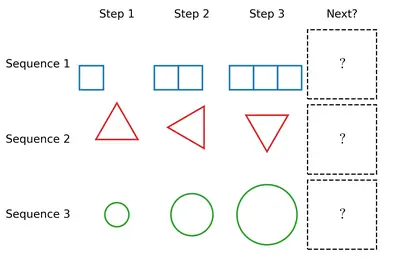
    Question 2.

    Try and redraw each sequence in Table 3 in your notebook. Can you draw the next shape in each sequence? Why or why not? After each sequence, describe in your own words what is the rule or pattern for forming the shapes in the sequence.
    Figure
    Figure

    Solution

    Preliminary note for the student
    Open your textbook at Chapter 1, Table 3. Three independent rows of pictures are shown there. In this write-up we shall call them Sequence I, Sequence II and Sequence III (from top to bottom). Your own drawings must follow exactly what you see in the book; here we only describe the pictures in words and explain the hidden rule in each case.

    Sequence I

    • Picture 1 is a single unit square.
    • Picture 2 is made of 2 unit squares joined edge-to-edge to form an L-shape.
    • Picture 3 has 3 unit squares and looks like a three-step staircase.
    • Picture 4 has 4 unit squares, again forming a staircase that is one step higher than the previous one.

    The number $$n$$ of unit squares used so far is therefore
    $$1,\;2,\;3,\;4$$.
    The staircase grows by adding one more square at the open end each time. Hence the next picture (Picture 5) must contain $$n = 5$$ unit squares and will look like a staircase of five steps.

    Rule in words: “Start with one square and keep adding one more square at the lower-right end so that a staircase one step higher is obtained each time.”


    Sequence II

    • Picture 1 is an arrow pointing upwards.
    • Picture 2 shows exactly the same arrow but rotated through $$90^\circ$$ clockwise, so it points to the right.
    • Picture 3 is again the same arrow, now rotated another $$90^\circ$$ clockwise, so it points downwards.
    • Picture 4 has the arrow after one more $$90^\circ$$ clockwise turn; it now points to the left.

    Every move is a rotation of $$90^\circ$$ in the clockwise direction. Because four such turns bring an object back to its original position, the next turn will again point the arrow upwards. Thus Picture 5 will look exactly like Picture 1.

    Rule in words: “Keep the shape unchanged but rotate it $$90^\circ$$ clockwise each time.”


    Sequence III

    • Picture 1 is a shaded square.
    • Picture 2 is a blank (unshaded) square.
    • Picture 3 is again a shaded square.

    Only three pictures are given. From these alone we might guess two possible continuations:

    1. Alternate shading –> the next square should be blank.
    2. Group of three shaded squares followed by three blank ones –> the next square should still be shaded.

    Because two (and in fact many more) perfectly sensible rules fit the same first three pictures, we cannot be sure what the book really intends without extra information. Therefore we cannot draw the next shape with certainty.

    Rule in words: “No unique rule can be fixed from the data provided; more terms are needed.”

    In summary:

    SequenceCan the next shape be drawn?The next shapePattern/rule (in words)
    IYesStaircase of 5 unit squaresAdd one unit square at the open end each time.
    IIYesArrow pointing upRotate the arrow 90° clockwise each step.
    IIINoNot uniqueInsufficient information; several rules are possible.

    Answer

    Sequence I – next picture: staircase made of 5 squares (rule: add one square each time).
    Sequence II – next picture: arrow again pointing up (rule: rotate 90° clockwise each step).
    Sequence III – next picture cannot be fixed because more than one rule fits the first three shapes.

    Exercise 1.7

    Question 1. Count the number of sides in each shape in the sequence of Regular Polygons. Which number sequence do you get? What about the number of corners in each shape in the sequence of Regular Polygons? Do you get the same number sequence? Can you explain why this happens?

    Solution

    Step 1. Look at the regular polygons in order.

    • Regular triangle (equilateral triangle)
    • Regular quadrilateral (square)
    • Regular pentagon
    • Regular hexagon
    • Regular heptagon
    • Regular octagon
    • … and so on.

    To help yourself, draw each of these shapes neatly, one after another, on dotted or squared paper. Leave a little space under every picture so that you can write the two counts you need:

    • “Number of sides =”
    • “Number of corners =”

    Step 2. Count the sides of each polygon.

    Regular polygonNumber of sides
    Triangle$$3$$
    Square$$4$$
    Pentagon$$5$$
    Hexagon$$6$$
    Heptagon$$7$$
    Octagon$$8$$
    Nonagon$$9$$
    Decagon$$10$$

    The list of the side–counts is therefore

    $$3,\;4,\;5,\;6,\;7,\;8,\;9,\;10,\;\dots$$

    So the number sequence you obtain is $$3,4,5,6,7,8,9,10,\dots$$ (the natural numbers starting from 3).

    Step 3. Count the corners (vertices) of each polygon.

    Regular polygonNumber of corners
    Triangle$$3$$
    Square$$4$$
    Pentagon$$5$$
    Hexagon$$6$$
    Heptagon$$7$$
    Octagon$$8$$
    Nonagon$$9$$
    Decagon$$10$$

    The corner–counts form exactly the same sequence:

    $$3,\;4,\;5,\;6,\;7,\;8,\;9,\;10,\;\dots$$

    Step 4. Why do the two sequences coincide?

    • Take any polygon. Choose one of its sides. That side has an endpoint at its left and another at its right.
    • An endpoint of a side is precisely a corner (vertex). Therefore each side contributes exactly one new corner.
    • The process also works in reverse: start at any corner, follow the edge that leaves that corner until you reach the next corner. You have just traced one side.

    Thus there is a one-to-one correspondence between sides and corners, so both counts are equal:

    $$\text{number of sides}=\text{number of corners}=n$$ for an $$n$$-sided polygon.

    Because the two counts are always equal, listing them in order for regular polygons of 3, 4, 5, … sides naturally gives the same number sequence twice.

    Answer

    The sequence of side–counts for the regular triangle, square, pentagon, hexagon, … is
    $$3,4,5,6,7,8,9,10,\dots$$

    The sequence of corner (vertex) counts is exactly the same:
    $$3,4,5,6,7,8,9,10,\dots$$

    This happens because in every polygon each side begins and ends at a corner, and each corner joins exactly two sides, so the number of sides and the number of corners are always equal (both equal to $$n$$ for an $$n$$-gon).

    Question 2. Count the number of lines in each shape in the sequence of Complete Graphs. Which number sequence do you get? Can you explain why?

    Solution

    Step 1 – What is a “complete graph”?
    Place some points
    (called vertices). Join every pair of points with a straight line segment. The collection of all those segments is called a complete graph for that number of points.
    For example, with 3 points we get a triangle, with 4 points we get the usual square plus the two diagonals, and so on.

    Step 2 – Count the lines one graph after another

    No. of points (n)Picture you would drawNew lines added when this point is joinedTotal lines so far
    1a single dot0
    2two dots joined10 + 1 = 1
    3triangleEach of the 3rd point’s joins:
    to point 1 and to point 2 → 2 new lines
    1 + 2 = 3
    4square with both diagonals4th point must join to points 1, 2, 3 → 3 new lines3 + 3 = 6
    5pentagon with all chords5th point joins to 1, 2, 3, 4 → 4 new lines6 + 4 = 10
    6hexagon with all chords5 new lines10 + 5 = 15

    So the number sequence we obtain for 1, 2, 3, 4, 5, 6 points is
    $$0,\;1,\;3,\;6,\;10,\;15,\;\dots$$

    Step 3 – Why does this happen?

    • When the n-th point is put in, it must be joined to all the earlier points.
    • There are already $$n-1$$ earlier points, so exactly $$n-1$$ new lines appear.
    • The total number of lines is therefore the sum of the first $$n-1$$ natural numbers:
      $$1+2+3+\dots+(n-1).$$

    A well-known result for this sum is
    \[\text{Total lines}=\frac{n(n-1)}{2}\]

    Because $$\frac{n(n-1)}{2}=1+2+3+\dots+(n-1)$$ produces the triangular numbers, the sequence 0, 1, 3, 6, 10, 15, … is called the sequence of triangular numbers.

    Hence, counting the lines in successive complete graphs leads to the triangular-number sequence, and the reason is that each new point contributes exactly one line to every point already present, making the total $$\frac{n(n-1)}{2}$$.

    Answer

    The counts are 0, 1, 3, 6, 10, 15, … — the triangular-number sequence.

    Question 3. How many little squares are there in each shape of the sequence of Stacked Squares? Which number sequence does this give? Can you explain why?

    Solution

    Step 1 : Look carefully at the first four shapes.

    • Shape 1 is just one little square.
    • Shape 2 is made by putting a new row of 3 little squares under Shape 1. Altogether it now has 1 + 3 = 4 little squares.
    • Shape 3 is made by adding another row, this time of 5 little squares. The total becomes 1 + 3 + 5 = 9 little squares.
    • Shape 4 adds a row of 7 little squares, so the count is 1 + 3 + 5 + 7 = 16 little squares.

    We can put the counts in a table:

    Shape number (n)Little squares added in the new outer layerTotal little squares
    111
    234
    359
    4716
    5925

    Step 2 : Observe the numbers you add each time.

    The numbers 1, 3, 5, 7, 9, … are the odd numbers. So every time we move to the next shape we add the next odd number.

    Step 3 : Work out a rule for the total number of little squares.

    For Shape n we add the first n odd numbers:

    $$1 + 3 + 5 + \dots + (2n-1)$$

    A well-known result (easy to check by direct addition for small n) is

    \[1 + 3 + 5 + \dots + (2n-1) = n^2.\]

    Therefore, the total number of little squares in Shape n is $$n^2$$.

    Step 4 : State the number sequence obtained.

    If we list the totals for n = 1, 2, 3, 4, 5, … we get

    $$1,\;4,\;9,\;16,\;25,\;\dots$$

    This is the sequence of perfect squares.

    Step 5 : Explain why the rule makes sense.

    • Each new outer layer has one square more on every side than the previous layer, so the number added must be odd.
    • Because the first n odd numbers always add up to $$n^2$$, Shape n is an n × n big square made of little squares, which is exactly what we see in the drawing.

    Hence, the sequence of Stacked Squares contains $$n^2$$ little squares in the nth shape, giving the number sequence 1, 4, 9, 16, 25, ….

    Answer

    The shapes contain 1, 4, 9, 16, 25, … little squares; in general the nth shape has $$n^2$$ squares because each new layer adds the next odd number, and the sum of the first n odd numbers is $$n^2$$.

    Question 4. How many little triangles are there in each shape of the sequence of Stacked Triangles? Which number sequence does this give? Can you explain why? (Hint: In each shape in the sequence, how many triangles are there in each row?)

    Solution

    Step 1 – Look carefully at one shape in the chain of “Stacked Triangles”

    Each shape is built with tiny congruent equilateral triangles. The first shape has only one such triangle. The second shape has two rows, the third has three rows, and so on.

    Step 2 – Count the little triangles row by row

    • Row 1 (the top row) always contains exactly $$1$$ little triangle.
    • Row 2 (if it exists) contains exactly $$2$$ little triangles.
    • Row 3 contains $$3$$ little triangles.
    • Row $$n$$ (the bottom row of the $$n^{ ext{th}}$$ shape) contains $$n$$ little triangles.

    Step 3 – Add the triangles in all rows

    So, for a shape that has $$n$$ rows, the total number of little triangles is

    \[1 + 2 + 3 + \cdots + n\]

    Step 4 – Write the sum using a rule

    Adding these numbers one by one forms the “triangular numbers.” They grow like this:

    Number of rows (n)Little triangles in the whole shapeRunning list of totals
    1$$1$$1
    2$$1 + 2 = 3$$1, 3
    3$$1 + 2 + 3 = 6$$1, 3, 6
    4$$1 + 2 + 3 + 4 = 10$$1, 3, 6, 10
    5$$1 + 2 + 3 + 4 + 5 = 15$$1, 3, 6, 10, 15

    The pattern continues: 21, 28, 36, …

    Step 5 – Explain why the list follows one clear formula

    Mathematicians call the numbers $$1, 3, 6, 10, 15, \dots$$ the triangular numbers. For the $$n^{\text{th}}$$ triangular number, the total is the sum of the first $$n$$ counting numbers. A quick way to find that sum is

    \[\frac{n(n+1)}{2}\]

    This formula gives the same results already listed:

    • For $$n = 1$$: $$\frac{1\cdot 2}{2} = 1$$
    • For $$n = 2$$: $$\frac{2\cdot 3}{2} = 3$$
    • For $$n = 3$$: $$\frac{3\cdot 4}{2} = 6$$
    • ⋯ and so on.

    Why does the formula work? If we place two identical stacks back-to-back, they form a neat rectangle whose sides measure $$n$$ by $$n+1$$ little triangles. Because two stacks make that whole rectangle, one stack is exactly half of it, giving $$\tfrac{n(n+1)}{2}$$ triangles.

    Final observation

    Thus, counting the little triangles row by row produces the sequence $$1,\,3,\,6,\,10,\,15,\dots$$, which is the sequence of triangular numbers, and every shape with $$n$$ rows contains $$\frac{n(n+1)}{2}$$ little triangles.

    Answer

    The number of little triangles in the successive shapes is
    $$1, 3, 6, 10, 15, \dots$$ – the triangular numbers – because a shape with $$n$$ rows contains $$1 + 2 + \cdots + n = \frac{n(n+1)}{2}$$ little triangles.

    Question 5. To get from one shape to the next shape in the Koch Snowflake sequence, one replaces each line segment '—' by a 'speed bump' . As one does this more and more times, the changes become tinier and tinier with very very small line segments. How many total line segments are there in each shape of the Koch Snowflake? What is the corresponding number sequence? (The answer is $$3, 12, 48, \ldots$$, i.e., 3 times Powers of 4; this sequence is not shown in Table 1.)

    Solution

    Step 1 : Understand the rule

    We begin with one equilateral triangle. Each of its sides is one straight line segment. The rule for drawing the next shape says:

    • Take every old line segment, cut it into three equal parts,
    • erase the middle part,
    • draw two new equal parts that make an extra little equilateral triangle (a tiny “speed bump”).

    The erased middle part plus the two new parts give four short segments in place of the single long segment. So,

    One old segment → four new segments, that is, each segment is multiplied by $$4$$.


    Step 2 : Count the segments stage by stage

    StageDescriptionHow many segments?Reason
    0The starting triangle$$3$$3 sides of a triangle
    1First “speed-bump” turn$$3 \times 4 = 12$$every old side becomes 4 sides
    2Second turn$$12 \times 4 = 48$$again multiply by 4
    3Third turn$$48 \times 4 = 192$$again multiply by 4

    Continuing in the same way the next shapes would have

    $$192 \times 4 = 768,\; 768 \times 4 = 3072,\; \text{and so on.}$$


    Step 3 : Write the pattern as a number sequence

    Reading only the totals we have the sequence

    $$3,\; 12,\; 48,\; 192,\; 768,\; 3072,\; \ldots$$

    Each term is obtained by multiplying the previous term by $$4$$. In mathematical language, if $$n$$ counts how many times we have done the replacement (so Stage 0 means no replacement yet), then

    \[\text{Number of segments at Stage } n = 3 \times 4^{\,n}.\]

    Thus the rule “3 times powers of 4” generates the desired sequence.

    Answer

    The total number of line segments after each stage is the sequence

    $$3,\;12,\;48,\;192,\;768,\;\ldots$$

    In general, after $$n$$ replacements there are $$3\times4^{\,n}$$ segments.

    NCERT Solutions for Class 6
    Maths
    NCERT Solutions for Class 6 Maths
    Chapter-wise step-by-step
    solutions with explanations
    explore solutions Maths bg
    Science
    NCERT Solutions for Class 6 Science
    Chapter-wise step-by-step
    solutions with explanations
    explore solutions Science bg

    Frequently Asked Questions

    50,000+ JEE Students Trusted Our Score Calculator

    Predict your JEE Main percentile, rank & performance in seconds