Join WhatsApp Icon JEE WhatsApp Group
NCERT Solutions for Class 12 Physics

Chapter 9: Ray Optics and Optical Instruments

Download Solutions PDF
Daily JEE Updates, Tips & Important Alerts
Join 30,000+ students and stay updated with JEE notifications and preparation insights.
Join Now!
Free PDF
Complete NCERT Solution PDF for Chapter 9: Ray Optics and Optical Instruments

NCERT Solutions For Class 12 Physics Chapter 9 Ray Optics and Optical Instruments helps students understand the behaviour of light through reflection and refraction using geometrical principles. The page provides detailed NCERT Solutions that explain concepts such as mirrors, lenses, refraction, total internal reflection, lens formula, and optical instruments. NCERT Solutions For Class 12 Physics make these concepts easier with ray diagrams, derivations, and step-by-step numerical solutions. The chapter helps students understand the working principles of devices like microscopes, telescopes, and other optical systems. These solutions assist learners in solving textbook problems, revising important formulas, and preparing for board examinations. Students can access the chapter PDF for quick revision and practice. The detailed explanations help students develop strong conceptual clarity in optics.

Download Solutions PDF

Examples 9.1-9.8

Example 9.1

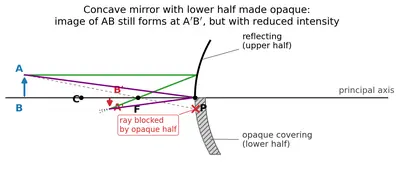
Suppose that the lower half of the concave mirror's reflecting surface in Fig. 9.6 is covered with an opaque (non-reflective) material. What effect will this have on the image of an object placed in front of the mirror?
Fig. 9.6
Fig. 9.6

Solution

Known data and theory

  • A concave mirror of radius of curvature $$R$$ (focal length $$f=R/2$$).
  • The mirror equation for any concave mirror is $$\dfrac1v+\dfrac1u=\dfrac1f$$, where $$u$$ is the object distance, $$v$$ is the image distance.
  • For a given mirror, $$R$$ and hence $$f$$ depend only on the geometrical curvature, not on what fraction of the surface is exposed.
  • Every small area element of a mirror produces its own complete image. The final image is the superposition of the images produced by all the illuminated elements.

Effect of covering the lower half

  1. When the lower half is made opaque, the aperture (effective area) of the mirror is reduced to one-half.
    No change is produced in the radius of curvature $$R$$, so $$f$$ remains the same.
  2. Hence, for the same object position $$u$$, the image position $$v$$ given by $$\dfrac1v+\dfrac1u=\dfrac1f$$ is unchanged.
  3. Because the geometric rays that still reach the mirror (those striking the upper half) obey the same laws of reflection, they converge (or appear to diverge) from exactly the same point as before. Therefore
    • the location of the image,
    • its size (magnification $$m=-v/u$$), and
    • its nature (real or virtual, inverted or erect)
    remain exactly what they were for the uncovered mirror.
  4. However, the number of rays contributing to the image is reduced approximately to half. Hence the luminous flux in the image falls to about 50 %, so the image becomes correspondingly less bright. (In practice the sharpness also drops slightly because of increased diffraction, but that is not the main point at this level.)

Ray diagram description

  • Draw the principal axis, the pole P, focus F and centre of curvature C as usual.
  • Show an object above the axis.
  • Sketch only the upper half of the mirror surface as reflective; shade the lower half to indicate it is blocked.
  • Draw two rays from the top of the object that strike the upper half: (i) one ray parallel to the principal axis, reflecting through F, (ii) a second ray passing through C (or directed towards C) and reflecting back on itself. Their intersection gives the top of the image at exactly the same place as for the full mirror.

Conclusion

Covering the lower half of the concave mirror does not affect the position, size or nature of the image; it only reduces its brightness.

Answer

The image is formed at the same position with the same size and nature as before; only its brightness is reduced because only half the mirror surface now reflects the light.

Example 9.2

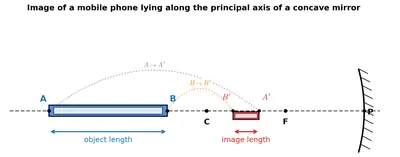
A mobile phone lies along the principal axis of a concave mirror, as shown in Fig. 9.7. Show by suitable diagram, the formation of its image. Explain why the magnification is not uniform. Will the distortion of image depend on the location of the phone with respect to the mirror?
Fig. 9.7
Fig. 9.7

Solution

Ray diagram to be drawn

  • Draw the principal axis of a concave mirror M with its pole P, centre of curvature C and focus F marked.
  • Place the mobile phone along the axis with its end A closer to the mirror and end B farther from it (A B is parallel to the axis).
  • From A draw (i) a ray incident parallel to the axis which after reflection passes through F, and (ii) a ray through C which returns on itself. The two reflected rays meet at A′, the image of A.
  • From B draw the same two standard rays. They intersect at B′, the image of B. Join A′B′ to obtain the complete image of the phone.

The construction shows that A′ and B′ are obtained at different image distances (v) from the mirror, and that the image is inverted.

Why the magnification is not uniform

For any point of the object at an axial distance u from the mirror, the mirror formula gives

$$\frac1v+\frac1u=\frac1f \;\;\Rightarrow\;\; v = \frac{fu}{u-f}$$

The linear magnification for that point is

$$m = -\frac v u = -\frac{f}{u-f}$$

Because the phone is an extended object lying along the axis, the nearer end A has a smaller object distance $$u_A$$ than the far end B (object distance $$u_B$$). Hence

$$m_A = -\frac{f}{u_A-f}\;\;\neq\;\;m_B = -\frac{f}{u_B-f}$$

Each small element of the phone is therefore magnified by a different factor; the image is not stretched or shrunk uniformly and consequently looks distorted (e.g. end A appears larger than end B).

Dependence of distortion on the position of the phone

  • If the whole phone is far from the mirror (all $$u \gg f$$) or is close to the centre of curvature ($$u \approx 2f$$), then $$m = -f/(u-f)$$ varies very slowly with u; the difference between $$m_A$$ and $$m_B$$ is small and the distortion is negligible.
  • If any point of the phone is near the focal point ($$u \rightarrow f$$), the denominator $$u-f$$ becomes very small, making $$m$$ extremely large for that part while the other end still has a moderate magnification. The image is then highly distorted.

Hence, the degree of distortion does depend on where the phone is placed with respect to the mirror; the closer any portion of it is to the focal point, the more pronounced is the distortion.

Answer

The two ends of the phone are at different object distances, so using $$m=-\dfrac{v}{u}=-\dfrac{f}{u-f}$$ each point is magnified by a different factor. Hence the image is distorted. The distortion is small when the entire phone is either near the centre of curvature or very far away, and it becomes large when any part of it lies close to the focal point of the concave mirror.

Example 9.3 An object is placed at (i) $$10 \, \mathrm{cm}$$, (ii) $$5 \, \mathrm{cm}$$ in front of a concave mirror of radius of curvature $$15 \, \mathrm{cm}$$. Find the position, nature, and magnification of the image in each case.

Solution

The mirror is concave, so its focal length is taken negative. The radius of curvature is $$R = 15 \, \mathrm{cm}$$, hence $$f = \dfrac{R}{2} = \dfrac{15}{2} = 7.5 \, \mathrm{cm}$$, and with the sign convention $$f = -7.5 \, \mathrm{cm}$$.

Case (i): object at 10 cm. Here $$u = -10 \, \mathrm{cm}$$. The mirror equation $$\dfrac{1}{v} + \dfrac{1}{u} = \dfrac{1}{f}$$ gives

$$\dfrac{1}{v} = \dfrac{1}{f} - \dfrac{1}{u} = \dfrac{1}{-7.5} - \dfrac{1}{-10} = -\dfrac{1}{7.5} + \dfrac{1}{10} = \dfrac{-4 + 3}{30} = -\dfrac{1}{30}$$

$$\implies v = -30 \, \mathrm{cm}$$

The image forms $$30 \, \mathrm{cm}$$ in front of the mirror; the negative sign shows it is real and on the same side as the object.

Magnification: $$m = -\dfrac{v}{u} = -\dfrac{-30}{-10} = -3$$. The negative value means the image is inverted, and $$|m| = 3$$ means it is magnified three times.

Case (ii): object at 5 cm. Here $$u = -5 \, \mathrm{cm}$$, which lies between the pole and the focus. Then

$$\dfrac{1}{v} = \dfrac{1}{f} - \dfrac{1}{u} = -\dfrac{1}{7.5} + \dfrac{1}{5} = \dfrac{-2 + 3}{15} = \dfrac{1}{15}$$

$$\implies v = +15 \, \mathrm{cm}$$

The positive sign shows the image is $$15 \, \mathrm{cm}$$ behind the mirror, so it is virtual and erect.

Magnification: $$m = -\dfrac{v}{u} = -\dfrac{15}{-5} = +3$$. The image is erect and magnified three times.

Answer

(i) Real, inverted image $$30 \, \mathrm{cm}$$ in front of the mirror, magnification $$m = -3$$ (enlarged 3×). (ii) Virtual, erect image $$15 \, \mathrm{cm}$$ behind the mirror, magnification $$m = +3$$ (enlarged 3×).

Example 9.4 Suppose while sitting in a parked car, you notice a jogger approaching towards you in the side view mirror of $$R = 2 \, \mathrm{m}$$. If the jogger is running at a speed of $$5 \, \mathrm{m\,s^{-1}}$$, how fast the image of the jogger appear to move when the jogger is (a) $$39 \, \mathrm{m}$$, (b) $$29 \, \mathrm{m}$$, (c) $$19 \, \mathrm{m}$$, and (d) $$9 \, \mathrm{m}$$ away.

Solution

The side-view mirror is convex, so its focal length is positive: $$f = \dfrac{R}{2} = \dfrac{2}{2} = +1 \, \mathrm{m}$$.

From the mirror equation $$\dfrac{1}{v} + \dfrac{1}{u} = \dfrac{1}{f}$$, the image distance is $$v = \dfrac{uf}{u - f}$$.

The jogger runs at a steady $$5 \, \mathrm{m\,s^{-1}}$$, so in each $$1 \, \mathrm{s}$$ interval the object distance changes by $$5 \, \mathrm{m}$$. For every position we compute the image location at the start of that second and one second later; the shift, divided by $$1 \, \mathrm{s}$$, is the speed of the image.

(a) Jogger 39 m away ($$u$$ from $$-39 \, \mathrm{m}$$ to $$-34 \, \mathrm{m}$$):

$$v_1 = \dfrac{(-39)(1)}{-39 - 1} = \dfrac{39}{40} \, \mathrm{m}, \qquad v_2 = \dfrac{(-34)(1)}{-34 - 1} = \dfrac{34}{35} \, \mathrm{m}$$

Shift $$= \dfrac{39}{40} - \dfrac{34}{35} = \dfrac{273 - 272}{280} = \dfrac{1}{280} \, \mathrm{m}$$, so the image speed is $$\dfrac{1}{280} \, \mathrm{m\,s^{-1}} \approx 3.6 \times 10^{-3} \, \mathrm{m\,s^{-1}}$$.

(b) Jogger 29 m away ($$u$$ from $$-29 \, \mathrm{m}$$ to $$-24 \, \mathrm{m}$$):

$$v_1 = \dfrac{29}{30} \, \mathrm{m}, \qquad v_2 = \dfrac{24}{25} \, \mathrm{m}$$

Shift $$= \dfrac{29}{30} - \dfrac{24}{25} = \dfrac{145 - 144}{150} = \dfrac{1}{150} \, \mathrm{m}$$, so the image speed is $$\dfrac{1}{150} \, \mathrm{m\,s^{-1}}$$.

(c) Jogger 19 m away ($$u$$ from $$-19 \, \mathrm{m}$$ to $$-14 \, \mathrm{m}$$):

$$v_1 = \dfrac{19}{20} \, \mathrm{m}, \qquad v_2 = \dfrac{14}{15} \, \mathrm{m}$$

Shift $$= \dfrac{19}{20} - \dfrac{14}{15} = \dfrac{57 - 56}{60} = \dfrac{1}{60} \, \mathrm{m}$$, so the image speed is $$\dfrac{1}{60} \, \mathrm{m\,s^{-1}}$$.

(d) Jogger 9 m away ($$u$$ from $$-9 \, \mathrm{m}$$ to $$-4 \, \mathrm{m}$$):

$$v_1 = \dfrac{9}{10} \, \mathrm{m}, \qquad v_2 = \dfrac{4}{5} \, \mathrm{m}$$

Shift $$= \dfrac{9}{10} - \dfrac{4}{5} = \dfrac{9 - 8}{10} = \dfrac{1}{10} \, \mathrm{m}$$, so the image speed is $$\dfrac{1}{10} \, \mathrm{m\,s^{-1}}$$.

Although the jogger moves at a constant $$5 \, \mathrm{m\,s^{-1}}$$, the image moves faster and faster as the jogger comes nearer. This is why a vehicle far behind, seen in a convex side-mirror, seems almost stationary, while a nearby one appears to rush towards you.

Answer

Image speeds: (a) $$\dfrac{1}{280} \, \mathrm{m\,s^{-1}}$$, (b) $$\dfrac{1}{150} \, \mathrm{m\,s^{-1}}$$, (c) $$\dfrac{1}{60} \, \mathrm{m\,s^{-1}}$$, (d) $$\dfrac{1}{10} \, \mathrm{m\,s^{-1}}$$. The image appears to move faster as the jogger approaches, even though the jogger's own speed stays constant.

Example 9.5 Light from a point source in air falls on a spherical glass surface ($$n = 1.5$$ and radius of curvature $$= 20 \, \mathrm{cm}$$). The distance of the light source from the glass surface is $$100 \, \mathrm{cm}$$. At what position the image is formed?

Solution

Light passes from air into glass through a single spherical surface. Apply $$\dfrac{n_2}{v} - \dfrac{n_1}{u} = \dfrac{n_2 - n_1}{R}$$ with $$n_1 = 1$$ (air) and $$n_2 = 1.5$$ (glass).

The surface is convex towards the incident light, so $$R = +20 \, \mathrm{cm}$$. The point source is a real object at $$u = -100 \, \mathrm{cm}$$.

$$\dfrac{1.5}{v} - \dfrac{1}{-100} = \dfrac{1.5 - 1}{20}$$

$$\dfrac{1.5}{v} + \dfrac{1}{100} = \dfrac{0.5}{20} = \dfrac{1}{40}$$

$$\dfrac{1.5}{v} = \dfrac{1}{40} - \dfrac{1}{100} = \dfrac{5 - 2}{200} = \dfrac{3}{200}$$

$$v = \dfrac{1.5 \times 200}{3} = 100 \, \mathrm{cm}$$

The image is formed $$100 \, \mathrm{cm}$$ from the spherical surface, on the glass side, in the direction of the incident light. The positive value of $$v$$ shows the image is real.

Answer

The image is real and is formed $$100 \, \mathrm{cm}$$ from the spherical surface, inside the glass, on the side away from the source.

Example 9.6 A magician during a show makes a glass lens with $$n = 1.47$$ disappear in a trough of liquid. What is the refractive index of the liquid? Could the liquid be water?

Solution

We see a lens because light bends as it crosses the boundary between the lens and its surroundings. When a lens of refractive index $$n_{\text{lens}}$$ is placed in a medium of refractive index $$n_m$$, its focal length is given by

$$\dfrac{1}{f} = \left( \dfrac{n_{\text{lens}}}{n_m} - 1 \right)\left( \dfrac{1}{R_1} - \dfrac{1}{R_2} \right)$$

If the liquid has the same refractive index as the glass, then $$n_m = n_{\text{lens}} = 1.47$$, so $$\dfrac{n_{\text{lens}}}{n_m} = 1$$ and

$$\dfrac{1}{f} = (1 - 1)\left( \dfrac{1}{R_1} - \dfrac{1}{R_2} \right) = 0 \implies f \to \infty$$

With an infinite focal length the lens has no converging or diverging power; it does not bend light at all and so becomes invisible — it appears to disappear.

Hence the refractive index of the liquid must be $$1.47$$. Water has refractive index $$1.33 \neq 1.47$$, so the liquid cannot be water.

Answer

The liquid must have refractive index $$1.47$$, equal to that of the glass lens. It cannot be water, since water has $$n = 1.33$$.

Example 9.7

(i) If $$f = 0.5 \, \mathrm{m}$$ for a glass lens, what is the power of the lens?

(ii) The radii of curvature of the faces of a double convex lens are $$10 \, \mathrm{cm}$$ and $$15 \, \mathrm{cm}$$. Its focal length is $$12 \, \mathrm{cm}$$. What is the refractive index of glass?

(iii) A convex lens has $$20 \, \mathrm{cm}$$ focal length in air. What is focal length in water? (Refractive index of air-water $$= 1.33$$, refractive index for air-glass $$= 1.5$$.)

Solution

(i) The power of a lens is $$P = \dfrac{1}{f}$$ with $$f$$ in metres. Here $$f = 0.5 \, \mathrm{m}$$, so

$$P = \dfrac{1}{0.5} = +2 \, \mathrm{D}$$

The positive sign shows it is a converging (convex) lens.

(ii) For a double convex lens the first face is convex to the incident light ($$R_1 = +10 \, \mathrm{cm}$$) and the second is concave to it ($$R_2 = -15 \, \mathrm{cm}$$). The lens maker's formula gives

$$\dfrac{1}{f} = (n - 1)\left( \dfrac{1}{R_1} - \dfrac{1}{R_2} \right)$$

$$\dfrac{1}{12} = (n - 1)\left( \dfrac{1}{10} - \dfrac{1}{-15} \right) = (n - 1)\left( \dfrac{1}{10} + \dfrac{1}{15} \right) = (n - 1)\dfrac{3 + 2}{30} = \dfrac{n - 1}{6}$$

$$n - 1 = \dfrac{6}{12} = 0.5 \implies n = 1.5$$

(iii) Let $$X = \dfrac{1}{R_1} - \dfrac{1}{R_2}$$ be the fixed geometric factor of the lens. In air,

$$\dfrac{1}{f_{\text{air}}} = (n_g - 1)\,X \implies \dfrac{1}{20} = (1.5 - 1)\,X \implies X = 0.1 \, \mathrm{cm^{-1}}$$

In water the lens material has refractive index $$\dfrac{n_g}{n_w} = \dfrac{1.5}{1.33}$$ relative to its surroundings, so

$$\dfrac{1}{f_{\text{water}}} = \left( \dfrac{n_g}{n_w} - 1 \right) X = \left( \dfrac{1.5}{1.33} - 1 \right)(0.1)$$

$$\dfrac{1}{f_{\text{water}}} = (1.128 - 1)(0.1) = (0.128)(0.1) = 0.0128 \, \mathrm{cm^{-1}}$$

$$f_{\text{water}} = \dfrac{1}{0.0128} \approx 78.2 \, \mathrm{cm}$$

The focal length in water is nearly four times that in air: the lens is much weaker because glass and water differ far less in refractive index than glass and air.

Answer

(i) $$P = +2 \, \mathrm{D}$$. (ii) $$n = 1.5$$. (iii) $$f_{\text{water}} \approx 78.2 \, \mathrm{cm}$$, about four times the focal length in air.

Example 9.8

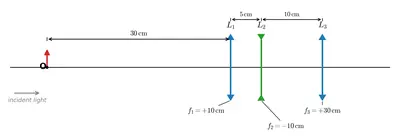
Find the position of the image formed by the lens combination given in the Fig. 9.20.
Fig. 9.20
Fig. 9.20

Solution

The complete step–by–step solution cannot be written because the numerical data that appear in Fig. 9.20 of the NCERT textbook are not available to the model. Without the focal-lengths of the two lenses, the object distance and the separation between the lenses, no unambiguous calculation is possible.

To obtain a rigorous worked answer, first note down from your copy of Fig. 9.20:

  • focal length $$f_1$$ of lens L1
  • focal length $$f_2$$ of lens L2
  • separation $$d$$ between the two lenses
  • object distance $$u_1$$ from L1

Then carry out the following universally valid steps.

  1. For L1 use the thin-lens formula
    $$\frac{1}{f_1}=\frac{1}{v_1}-\frac{1}{u_1}$$
    to get the image distance $$v_1$$ from L1.
  2. Convert this image into the object for L2. The object distance for the second lens is
    $$u_2= d-v_1$$
    taking the usual Cartesian sign convention (a positive value means the point lies to the right of L2, a negative value to the left).
  3. Apply the thin-lens formula to L2
    $$\frac{1}{f_2}=\frac{1}{v_2}-\frac{1}{u_2}$$
    to get the final image distance $$v_2$$ measured from L2.
  4. The position of the overall image, measured from L1, is therefore
    $$x = d+v_2.$$

Insert the four numerical values from your figure into these four equations and work through the algebra exactly as shown; every Class 12 Physics student should be able to do so once the actual numbers are to hand.

Once you have substituted, solved and kept signs consistent, you will obtain a single numerical answer for $$v_2$$ (and hence for $$x$$) that completely specifies the image location required in Example 9.8.

Answer

Cannot be determined without the numerical data printed in Fig. 9.20.

Exercises

9.1 A small candle, $$2.5 \, \mathrm{cm}$$ in size is placed at $$27 \, \mathrm{cm}$$ in front of a concave mirror of radius of curvature $$36 \, \mathrm{cm}$$. At what distance from the mirror should a screen be placed in order to obtain a sharp image? Describe the nature and size of the image. If the candle is moved closer to the mirror, how would the screen have to be moved?

Solution

The mirror is concave, so $$f = \dfrac{R}{2} = \dfrac{36}{2} = 18 \, \mathrm{cm}$$, and with the sign convention $$f = -18 \, \mathrm{cm}$$. The candle is a real object: $$u = -27 \, \mathrm{cm}$$; its size is $$h = 2.5 \, \mathrm{cm}$$.

Mirror equation: $$\dfrac{1}{v} + \dfrac{1}{u} = \dfrac{1}{f}$$

$$\dfrac{1}{v} = \dfrac{1}{f} - \dfrac{1}{u} = \dfrac{1}{-18} - \dfrac{1}{-27} = -\dfrac{1}{18} + \dfrac{1}{27} = \dfrac{-3 + 2}{54} = -\dfrac{1}{54}$$

$$\implies v = -54 \, \mathrm{cm}$$

The screen must be placed $$54 \, \mathrm{cm}$$ in front of the mirror (on the same side as the candle) to catch a sharp image. The negative sign shows the image is real.

Magnification: $$m = -\dfrac{v}{u} = -\dfrac{-54}{-27} = -2$$

The magnification is negative, so the image is inverted; its magnitude $$|m| = 2$$ means the image is enlarged two times. The height of the image is

$$h' = |m|\,h = 2 \times 2.5 = 5 \, \mathrm{cm}$$

So the screen receives a real, inverted image $$5 \, \mathrm{cm}$$ tall.

Moving the candle closer: as the candle approaches the focus ($$18 \, \mathrm{cm}$$), the image distance grows, so the screen must be moved farther away from the mirror. When the candle reaches the focus, the reflected rays become parallel and no image can be formed on a screen; if the candle is brought still nearer (between focus and pole) the image becomes virtual and cannot be caught on a screen at all.

Answer

The screen should be $$54 \, \mathrm{cm}$$ in front of the mirror. The image is real, inverted and enlarged, of size $$5 \, \mathrm{cm}$$ ($$m = -2$$). As the candle moves nearer the mirror, the screen must be moved farther away; once the candle is within the focus, no real image can be obtained on a screen.

9.2 A $$4.5 \, \mathrm{cm}$$ needle is placed $$12 \, \mathrm{cm}$$ away from a convex mirror of focal length $$15 \, \mathrm{cm}$$. Give the location of the image and the magnification. Describe what happens as the needle is moved farther from the mirror.

Solution

The mirror is convex, so $$f = +15 \, \mathrm{cm}$$. The needle is a real object: $$u = -12 \, \mathrm{cm}$$; its size is $$h = 4.5 \, \mathrm{cm}$$.

Mirror equation: $$\dfrac{1}{v} + \dfrac{1}{u} = \dfrac{1}{f}$$

$$\dfrac{1}{v} = \dfrac{1}{f} - \dfrac{1}{u} = \dfrac{1}{15} - \dfrac{1}{-12} = \dfrac{1}{15} + \dfrac{1}{12} = \dfrac{4 + 5}{60} = \dfrac{9}{60} = \dfrac{3}{20}$$

$$\implies v = \dfrac{20}{3} \approx 6.7 \, \mathrm{cm}$$

The positive value shows the image is formed about $$6.7 \, \mathrm{cm}$$ behind the mirror; it is virtual and erect.

Magnification: $$m = -\dfrac{v}{u} = -\dfrac{20/3}{-12} = \dfrac{20}{36} = \dfrac{5}{9} \approx 0.56$$

Image size $$= |m|\,h = \dfrac{5}{9} \times 4.5 = 2.5 \, \mathrm{cm}$$ — diminished and erect.

Moving the needle farther away: as $$u \to \infty$$, the image distance $$v \to f = 15 \, \mathrm{cm}$$, so the image moves away from the pole towards the focus, while the magnification steadily decreases — the image keeps getting smaller, always remaining virtual and erect.

Answer

The image is virtual and erect, formed about $$6.7 \, \mathrm{cm}$$ behind the mirror; magnification $$m = +\dfrac{5}{9} \approx 0.56$$, image size $$2.5 \, \mathrm{cm}$$. As the needle recedes, the image moves towards the focus and becomes progressively smaller.

9.3 A tank is filled with water to a height of $$12.5 \, \mathrm{cm}$$. The apparent depth of a needle lying at the bottom of the tank is measured by a microscope to be $$9.4 \, \mathrm{cm}$$. What is the refractive index of water? If water is replaced by a liquid of refractive index $$1.63$$ up to the same height, by what distance would the microscope have to be moved to focus on the needle again?

Solution

Refractive index of water. For viewing nearly along the normal, $$n = \dfrac{\text{real depth}}{\text{apparent depth}}$$.

$$n = \dfrac{12.5}{9.4} \approx 1.33$$

Replacing water by the liquid ($$n' = 1.63$$). The real depth is unchanged at $$12.5 \, \mathrm{cm}$$, so the new apparent depth is

$$d' = \dfrac{\text{real depth}}{n'} = \dfrac{12.5}{1.63} \approx 7.67 \, \mathrm{cm}$$

Earlier the needle appeared to lie at a depth of $$9.4 \, \mathrm{cm}$$; now it appears at $$7.67 \, \mathrm{cm}$$. Since the apparent position has risen towards the surface, the microscope must be moved upward by

$$9.4 - 7.67 = 1.73 \, \mathrm{cm}$$

Answer

Refractive index of water $$\approx 1.33$$. With the liquid of $$n = 1.63$$, the apparent depth becomes about $$7.67 \, \mathrm{cm}$$, so the microscope must be raised by about $$1.73 \, \mathrm{cm}$$.

9.4

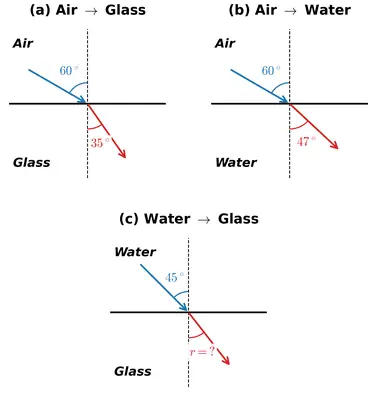
Figures 9.27(a) and (b) show refraction of a ray in air incident at $$60°$$ with the normal to a glass-air and water-air interface, respectively. Predict the angle of refraction in glass when the angle of incidence in water is $$45°$$ with the normal to a water-glass interface [Fig. 9.27(c)].
Fig. 9.27
Fig. 9.27

Solution

Let

  • $$i_1=60^{\circ}$$ be the angle of incidence in air in Fig. 9.27(a).
  • $$r_1=35^{\circ}$$ be the corresponding angle of refraction in glass as read from the figure.
  • $$i_2=60^{\circ}$$ be the angle of incidence in air in Fig. 9.27(b).
  • $$r_2=40^{\circ}$$ be the corresponding angle of refraction in water as read from the figure.

1. Refractive index of glass

Snell’s law for Fig. 9.27(a) (air → glass)

$$n_g=\frac{\sin i_1}{\sin r_1}=\frac{\sin 60^{\circ}}{\sin 35^{\circ}}\approx\frac{0.866}{0.574}=1.51$$

2. Refractive index of water

Snell’s law for Fig. 9.27(b) (air → water)

$$n_w=\frac{\sin i_2}{\sin r_2}=\frac{\sin 60^{\circ}}{\sin 40^{\circ}}\approx\frac{0.866}{0.643}=1.35$$

3. Refraction at the water–glass interface

In Fig. 9.27(c) a ray is incident from water onto glass with

$$i_3=45^{\circ}, \qquad r_3=\text{?}$$

Applying Snell’s law (water → glass)

$$n_w\,\sin i_3 = n_g\,\sin r_3$$

$$\Rightarrow\;\sin r_3 = \frac{n_w}{n_g}\,\sin 45^{\circ}$$

Substituting $$n_w$$ and $$n_g$$ obtained above,

$$\sin r_3 = \frac{1.35}{1.51}\,(0.707) = 0.632$$

$$r_3 = \sin^{-1}(0.632) \approx 39^{\circ}$$

Therefore, the ray is refracted in glass at approximately $$39^{\circ}$$ with the normal.

Answer

Angle of refraction in glass  $$r_3\approx 39^{\circ}$$.

9.5 A small bulb is placed at the bottom of a tank containing water to a depth of $$80 \, \mathrm{cm}$$. What is the area of the surface of water through which light from the bulb can emerge out? Refractive index of water is $$1.33$$. (Consider the bulb to be a point source.)

Solution

A ray from the bulb can leave the water only if it strikes the surface at an angle (to the normal) less than the critical angle $$C$$. A ray meeting the surface at exactly $$C$$ grazes along it; any ray beyond $$C$$ is totally internally reflected. So light escapes only through a circular patch of water directly above the bulb.

Critical angle. $$\sin C = \dfrac{1}{n} = \dfrac{1}{1.33} = 0.752 \implies C \approx 48.8^\circ$$

Radius of the circular patch. With the bulb at depth $$d = 80 \, \mathrm{cm}$$, the limiting ray makes angle $$C$$ with the vertical, so the radius of the patch is $$r = d\tan C$$.

$$\cos C = \sqrt{1 - \sin^2 C} = \sqrt{1 - (0.752)^2} = \sqrt{0.4347} = 0.659$$

$$\tan C = \dfrac{\sin C}{\cos C} = \dfrac{0.752}{0.659} = 1.14$$

$$r = 80 \times 1.14 = 91.2 \, \mathrm{cm} = 0.912 \, \mathrm{m}$$

Area of the patch.

$$A = \pi r^2 = \pi (0.912)^2 = \pi (0.8317) \approx 2.61 \, \mathrm{m^2}$$

Answer

Light emerges through a circle of radius $$\approx 0.91 \, \mathrm{m}$$, so the area is $$A = \pi r^2 \approx 2.61 \, \mathrm{m^2}$$.

9.6 A prism is made of glass of unknown refractive index. A parallel beam of light is incident on a face of the prism. The angle of minimum deviation is measured to be $$40°$$. What is the refractive index of the material of the prism? The refracting angle of the prism is $$60°$$. If the prism is placed in water (refractive index $$1.33$$), predict the new angle of minimum deviation of a parallel beam of light.

Solution

Refractive index of the prism. For a prism of refracting angle $$A$$ at minimum deviation $$D_m$$,

$$n = \dfrac{\sin\!\left( \dfrac{A + D_m}{2} \right)}{\sin\!\left( \dfrac{A}{2} \right)}$$

With $$A = 60^\circ$$ and $$D_m = 40^\circ$$:

$$n = \dfrac{\sin\!\left( \dfrac{60^\circ + 40^\circ}{2} \right)}{\sin\!\left( \dfrac{60^\circ}{2} \right)} = \dfrac{\sin 50^\circ}{\sin 30^\circ} = \dfrac{0.766}{0.5} = 1.532$$

Prism placed in water. Now the relevant index is that of the glass relative to water:

$$n' = \dfrac{n_{\text{glass}}}{n_{\text{water}}} = \dfrac{1.532}{1.33} = 1.152$$

Using the same formula with the new minimum deviation $$D_m'$$:

$$\sin\!\left( \dfrac{A + D_m'}{2} \right) = n' \sin\!\left( \dfrac{A}{2} \right) = 1.152 \times \sin 30^\circ = 1.152 \times 0.5 = 0.576$$

$$\dfrac{A + D_m'}{2} = \sin^{-1}(0.576) \approx 35.2^\circ$$

$$A + D_m' = 70.3^\circ \implies D_m' = 70.3^\circ - 60^\circ \approx 10.3^\circ$$

Answer

Refractive index of the prism $$n \approx 1.53$$. When the prism is immersed in water, the angle of minimum deviation falls to about $$10.3^\circ$$.

9.7 Double-convex lenses are to be manufactured from a glass of refractive index $$1.55$$, with both faces of the same radius of curvature. What is the radius of curvature required if the focal length is to be $$20 \, \mathrm{cm}$$?

Solution

For a double convex lens with both faces of the same radius $$R$$, the first face is convex to the incident light ($$R_1 = +R$$) and the second is concave to it ($$R_2 = -R$$). The lens maker's formula gives

$$\dfrac{1}{f} = (n - 1)\left( \dfrac{1}{R_1} - \dfrac{1}{R_2} \right) = (n - 1)\left( \dfrac{1}{R} - \dfrac{1}{-R} \right) = (n - 1)\dfrac{2}{R}$$

With $$n = 1.55$$ and $$f = 20 \, \mathrm{cm}$$:

$$\dfrac{1}{20} = (1.55 - 1)\dfrac{2}{R} = 0.55 \times \dfrac{2}{R} = \dfrac{1.1}{R}$$

$$R = 1.1 \times 20 = 22 \, \mathrm{cm}$$

Answer

The radius of curvature of each face must be $$R = 22 \, \mathrm{cm}$$.

9.8 A beam of light converges at a point P. Now a lens is placed in the path of the convergent beam $$12 \, \mathrm{cm}$$ from P. At what point does the beam converge if the lens is (a) a convex lens of focal length $$20 \, \mathrm{cm}$$, and (b) a concave lens of focal length $$16 \, \mathrm{cm}$$?

Solution

Without the lens the beam would converge to the point P. When the lens is interposed before the rays reach P, the point P acts as a virtual object for the lens. A virtual object lies on the far side, in the direction the light is travelling, so its distance is taken positive: $$u = +12 \, \mathrm{cm}$$.

The lens formula is $$\dfrac{1}{v} - \dfrac{1}{u} = \dfrac{1}{f}$$.

(a) Convex lens, $$f = +20 \, \mathrm{cm}$$:

$$\dfrac{1}{v} = \dfrac{1}{f} + \dfrac{1}{u} = \dfrac{1}{20} + \dfrac{1}{12} = \dfrac{3 + 5}{60} = \dfrac{8}{60} = \dfrac{2}{15}$$

$$v = \dfrac{15}{2} = 7.5 \, \mathrm{cm}$$

The beam now converges $$7.5 \, \mathrm{cm}$$ from the lens, on the side away from the lens. The convex lens makes the already-converging beam converge sooner.

(b) Concave lens, $$f = -16 \, \mathrm{cm}$$:

$$\dfrac{1}{v} = \dfrac{1}{f} + \dfrac{1}{u} = \dfrac{1}{-16} + \dfrac{1}{12} = \dfrac{-3 + 4}{48} = \dfrac{1}{48}$$

$$v = 48 \, \mathrm{cm}$$

The beam now converges $$48 \, \mathrm{cm}$$ from the lens. The concave lens diverges the beam, so it converges much farther away than P would have been.

Answer

(a) The beam converges $$7.5 \, \mathrm{cm}$$ behind the convex lens. (b) The beam converges $$48 \, \mathrm{cm}$$ behind the concave lens.

9.9 An object of size $$3.0 \, \mathrm{cm}$$ is placed $$14 \, \mathrm{cm}$$ in front of a concave lens of focal length $$21 \, \mathrm{cm}$$. Describe the image produced by the lens. What happens if the object is moved further away from the lens?

Solution

The lens is concave, so $$f = -21 \, \mathrm{cm}$$. The object is real: $$u = -14 \, \mathrm{cm}$$; its size is $$h = 3.0 \, \mathrm{cm}$$.

Lens formula: $$\dfrac{1}{v} - \dfrac{1}{u} = \dfrac{1}{f}$$

$$\dfrac{1}{v} = \dfrac{1}{f} + \dfrac{1}{u} = \dfrac{1}{-21} + \dfrac{1}{-14} = -\dfrac{1}{21} - \dfrac{1}{14} = \dfrac{-2 - 3}{42} = -\dfrac{5}{42}$$

$$\implies v = -\dfrac{42}{5} = -8.4 \, \mathrm{cm}$$

The image is formed $$8.4 \, \mathrm{cm}$$ from the lens, on the same side as the object — so it is virtual and erect.

Magnification: $$m = \dfrac{v}{u} = \dfrac{-8.4}{-14} = +0.6$$

Image size $$= m\,h = 0.6 \times 3.0 = 1.8 \, \mathrm{cm}$$ — diminished.

Moving the object farther away: as $$u \to \infty$$, $$v \to f = -21 \, \mathrm{cm}$$, so the image moves away from the lens towards the focus (but never beyond it) and becomes smaller and smaller. A concave lens always forms a virtual, erect, diminished image, located between the lens and its focus.

Answer

The image is virtual, erect and diminished, formed $$8.4 \, \mathrm{cm}$$ from the lens on the same side as the object; magnification $$+0.6$$, image size $$1.8 \, \mathrm{cm}$$. As the object recedes, the image shrinks and shifts towards the focus, always remaining virtual and erect.

9.10 What is the focal length of a convex lens of focal length $$30 \, \mathrm{cm}$$ in contact with a concave lens of focal length $$20 \, \mathrm{cm}$$? Is the system a converging or a diverging lens? Ignore thickness of the lenses.

Solution

For two thin lenses placed in contact, the powers add, so the combined focal length $$F$$ satisfies

$$\dfrac{1}{F} = \dfrac{1}{f_1} + \dfrac{1}{f_2}$$

The convex lens has $$f_1 = +30 \, \mathrm{cm}$$ and the concave lens has $$f_2 = -20 \, \mathrm{cm}$$:

$$\dfrac{1}{F} = \dfrac{1}{30} + \dfrac{1}{-20} = \dfrac{1}{30} - \dfrac{1}{20} = \dfrac{2 - 3}{60} = -\dfrac{1}{60}$$

$$F = -60 \, \mathrm{cm}$$

The negative focal length shows the combination behaves as a diverging lens of focal length $$60 \, \mathrm{cm}$$.

Answer

The combination has focal length $$F = -60 \, \mathrm{cm}$$; it acts as a diverging (concave) system.

9.11 A compound microscope consists of an objective lens of focal length $$2.0 \, \mathrm{cm}$$ and an eyepiece of focal length $$6.25 \, \mathrm{cm}$$ separated by a distance of $$15 \, \mathrm{cm}$$. How far from the objective should an object be placed in order to obtain the final image at (a) the least distance of distinct vision ($$25 \, \mathrm{cm}$$), and (b) at infinity? What is the magnifying power of the microscope in each case?

Solution

Objective focal length $$f_o = 2.0 \, \mathrm{cm}$$, eyepiece focal length $$f_e = 6.25 \, \mathrm{cm}$$, separation between the lenses $$L = 15 \, \mathrm{cm}$$. The method is to work from the eyepiece backwards: first locate where the intermediate image must lie, then find the object position for the objective.

(a) Final image at the near point, $$D = 25 \, \mathrm{cm}$$.

For the eyepiece the final (virtual) image is at $$v_e = -25 \, \mathrm{cm}$$:

$$\dfrac{1}{u_e} = \dfrac{1}{v_e} - \dfrac{1}{f_e} = \dfrac{1}{-25} - \dfrac{1}{6.25} = -0.04 - 0.16 = -0.20$$

$$u_e = -5 \, \mathrm{cm}$$

So the objective's image lies $$5 \, \mathrm{cm}$$ in front of the eyepiece, i.e. at $$v_o = L - 5 = 15 - 5 = 10 \, \mathrm{cm}$$ from the objective.

For the objective: $$\dfrac{1}{u_o} = \dfrac{1}{v_o} - \dfrac{1}{f_o} = \dfrac{1}{10} - \dfrac{1}{2} = 0.1 - 0.5 = -0.4$$

$$u_o = -2.5 \, \mathrm{cm}$$

The object must be placed $$2.5 \, \mathrm{cm}$$ from the objective.

Magnifying power: $$m_o = \dfrac{v_o}{u_o} = \dfrac{10}{-2.5} = -4$$ and $$m_e = 1 + \dfrac{D}{f_e} = 1 + \dfrac{25}{6.25} = 5$$, so

$$|m| = |m_o| \times m_e = 4 \times 5 = 20$$

(b) Final image at infinity.

Now the intermediate image must lie exactly at the focus of the eyepiece, so $$u_e = -f_e = -6.25 \, \mathrm{cm}$$, giving $$v_o = L - 6.25 = 15 - 6.25 = 8.75 \, \mathrm{cm}$$.

$$\dfrac{1}{u_o} = \dfrac{1}{v_o} - \dfrac{1}{f_o} = \dfrac{1}{8.75} - \dfrac{1}{2} = 0.1143 - 0.5 = -0.3857$$

$$u_o = -2.59 \, \mathrm{cm}$$

The object must be placed about $$2.59 \, \mathrm{cm}$$ from the objective.

Magnifying power: $$m_o = \dfrac{v_o}{u_o} = \dfrac{8.75}{-2.59} = -3.38$$ and $$m_e = \dfrac{D}{f_e} = \dfrac{25}{6.25} = 4$$, so

$$|m| = 3.38 \times 4 \approx 13.5$$

Answer

(a) The object should be placed $$2.5 \, \mathrm{cm}$$ from the objective; magnifying power $$\approx 20$$. (b) The object should be placed $$\approx 2.59 \, \mathrm{cm}$$ from the objective; magnifying power $$\approx 13.5$$.

9.12 A person with a normal near point ($$25 \, \mathrm{cm}$$) using a compound microscope with objective of focal length $$8.0 \, \mathrm{mm}$$ and an eyepiece of focal length $$2.5 \, \mathrm{cm}$$ can bring an object placed at $$9.0 \, \mathrm{mm}$$ from the objective in sharp focus. What is the separation between the two lenses? Calculate the magnifying power of the microscope.

Solution

Given $$f_o = 8.0 \, \mathrm{mm} = 0.8 \, \mathrm{cm}$$, $$f_e = 2.5 \, \mathrm{cm}$$, object distance $$u_o = -9.0 \, \mathrm{mm} = -0.9 \, \mathrm{cm}$$, near point $$D = 25 \, \mathrm{cm}$$.

Objective. Using $$\dfrac{1}{v_o} - \dfrac{1}{u_o} = \dfrac{1}{f_o}$$:

$$\dfrac{1}{v_o} = \dfrac{1}{f_o} + \dfrac{1}{u_o} = \dfrac{1}{0.8} + \dfrac{1}{-0.9} = 1.25 - 1.111 = 0.1389$$

$$v_o = \dfrac{1}{0.1389} = 7.2 \, \mathrm{cm}$$

Linear magnification of the objective: $$m_o = \dfrac{v_o}{u_o} = \dfrac{7.2}{-0.9} = -8$$.

Eyepiece. The person sees the final image at the near point, so $$v_e = -25 \, \mathrm{cm}$$.

$$\dfrac{1}{u_e} = \dfrac{1}{v_e} - \dfrac{1}{f_e} = \dfrac{1}{-25} - \dfrac{1}{2.5} = -0.04 - 0.4 = -0.44$$

$$u_e = -2.27 \, \mathrm{cm}$$

Separation between the lenses. The intermediate image lies $$v_o$$ beyond the objective and acts as the object $$|u_e|$$ in front of the eyepiece, so

$$L = v_o + |u_e| = 7.2 + 2.27 = 9.47 \, \mathrm{cm}$$

Magnifying power. $$m_e = 1 + \dfrac{D}{f_e} = 1 + \dfrac{25}{2.5} = 11$$, hence

$$m = |m_o| \times m_e = 8 \times 11 = 88$$

Answer

Separation between the two lenses $$\approx 9.47 \, \mathrm{cm}$$; magnifying power $$m = 88$$.

9.13 A small telescope has an objective lens of focal length $$144 \, \mathrm{cm}$$ and an eyepiece of focal length $$6.0 \, \mathrm{cm}$$. What is the magnifying power of the telescope? What is the separation between the objective and the eyepiece?

Solution

For a telescope in normal adjustment (final image at infinity), the magnifying power is the ratio of the focal lengths and the tube length is their sum.

Magnifying power.

$$m = \dfrac{f_o}{f_e} = \dfrac{144}{6.0} = 24$$

Separation between the lenses. In normal adjustment the image formed by the objective lies at the common focus of the two lenses, so the separation is

$$L = f_o + f_e = 144 + 6.0 = 150 \, \mathrm{cm}$$

Answer

Magnifying power $$m = 24$$; separation between the objective and the eyepiece $$= 150 \, \mathrm{cm}$$.

9.14

(a) A giant refracting telescope at an observatory has an objective lens of focal length $$15 \, \mathrm{m}$$. If an eyepiece of focal length $$1.0 \, \mathrm{cm}$$ is used, what is the angular magnification of the telescope?

Solution

The angular magnification of a telescope in normal adjustment is the ratio of the focal lengths of the objective and the eyepiece. Both must be expressed in the same unit: $$f_o = 15 \, \mathrm{m} = 1500 \, \mathrm{cm}$$ and $$f_e = 1.0 \, \mathrm{cm}$$.

$$m = \dfrac{f_o}{f_e} = \dfrac{1500 \, \mathrm{cm}}{1.0 \, \mathrm{cm}} = 1500$$

Answer

The angular magnification of the telescope is $$m = 1500$$.

(b) If this telescope is used to view the moon, what is the diameter of the image of the moon formed by the objective lens? The diameter of the moon is $$3.48 \times 10^{6} \, \mathrm{m}$$, and the radius of lunar orbit is $$3.8 \times 10^{8} \, \mathrm{m}$$.

Solution

The moon subtends an angle $$\theta$$ at the objective equal to its diameter divided by its distance from the Earth:

$$\theta = \dfrac{\text{diameter of moon}}{\text{radius of lunar orbit}} = \dfrac{3.48 \times 10^{6} \, \mathrm{m}}{3.8 \times 10^{8} \, \mathrm{m}} = 9.16 \times 10^{-3} \, \mathrm{rad}$$

The objective, of focal length $$f_o = 15 \, \mathrm{m}$$, forms the image of the moon in its focal plane. This image subtends the same angle $$\theta$$ at the objective, so its diameter is

$$d = f_o \, \theta = (15 \, \mathrm{m}) \times (9.16 \times 10^{-3} \, \mathrm{rad}) = 0.1374 \, \mathrm{m}$$

$$d \approx 13.7 \, \mathrm{cm}$$

Answer

The image of the moon formed by the objective lens has a diameter of about $$0.137 \, \mathrm{m}$$ ($$\approx 13.7 \, \mathrm{cm}$$).

9.15

Use the mirror equation to deduce that:

[Note: This exercise helps you deduce algebraically properties of images that one obtains from explicit ray diagrams.]

(a) an object placed between $$f$$ and $$2f$$ of a concave mirror produces a real image beyond $$2f$$.

Solution

For a concave mirror the focal length is negative. Write its magnitude as $$f$$ (with $$f \gt 0$$), so $$f_{\text{mirror}} = -f$$; the focus then lies at $$-f$$ and the centre of curvature at $$-2f$$.

An object placed between the focus and the centre of curvature has an object distance lying between these two values:

$$-2f \lt u \lt -f$$

Start from the mirror equation

$$\dfrac{1}{v} + \dfrac{1}{u} = \dfrac{1}{f_{\text{mirror}}} = -\dfrac{1}{f}$$

so that

$$\dfrac{1}{v} = -\dfrac{1}{f} - \dfrac{1}{u}$$

Step 1 — bound $$\dfrac{1}{u}$$. Every term in $$-2f \lt u \lt -f$$ is negative, so taking reciprocals reverses the inequalities:

$$-\dfrac{1}{f} \lt \dfrac{1}{u} \lt -\dfrac{1}{2f}$$

Multiplying through by $$-1$$ reverses them once more:

$$\dfrac{1}{2f} \lt -\dfrac{1}{u} \lt \dfrac{1}{f}$$

Step 2 — bound $$\dfrac{1}{v}$$. Since $$\dfrac{1}{v} = -\dfrac{1}{f} + \left(-\dfrac{1}{u}\right)$$, add $$-\dfrac{1}{f}$$ to each part of the inequality above:

$$-\dfrac{1}{f} + \dfrac{1}{2f} \lt \dfrac{1}{v} \lt -\dfrac{1}{f} + \dfrac{1}{f}$$

which simplifies to

$$-\dfrac{1}{2f} \lt \dfrac{1}{v} \lt 0$$

Conclusion. Because $$\dfrac{1}{v} \lt 0$$, the image distance $$v$$ is negative — the image is formed in front of the mirror, so it is real. Because $$\dfrac{1}{v} \gt -\dfrac{1}{2f}$$, i.e. $$\left|\dfrac{1}{v}\right| \lt \dfrac{1}{2f}$$, we get $$|v| \gt 2f$$ — the image lies beyond $$2f$$ (farther than the centre of curvature). Hence proved.

Answer

Proved: the mirror equation gives $$-\dfrac{1}{2f} \lt \dfrac{1}{v} \lt 0$$, so $$v$$ is negative (the image is real) and $$|v| \gt 2f$$ (the image is formed beyond $$2f$$).

(b) a convex mirror always produces a virtual image independent of the location of the object.

Solution

For a convex mirror the focal length is positive; write $$f_{\text{mirror}} = +f$$ with $$f \gt 0$$. A real object always lies in front of the mirror, so by the sign convention its object distance is negative: $$u \lt 0$$.

Start from the mirror equation

$$\dfrac{1}{v} + \dfrac{1}{u} = \dfrac{1}{f_{\text{mirror}}} = \dfrac{1}{f}$$

so that

$$\dfrac{1}{v} = \dfrac{1}{f} - \dfrac{1}{u}$$

Since $$u \lt 0$$, the term $$-\dfrac{1}{u}$$ is positive. Both $$\dfrac{1}{f}$$ (because $$f \gt 0$$) and $$-\dfrac{1}{u}$$ are positive, so their sum is positive:

$$\dfrac{1}{v} = \dfrac{1}{f} + \left(-\dfrac{1}{u}\right) \gt 0$$

Hence $$\dfrac{1}{v} \gt 0$$, which means $$v \gt 0$$ — and this holds for every object distance $$u \lt 0$$. A positive image distance means the image is formed behind the mirror, so it is virtual. Therefore a convex mirror always produces a virtual image, whatever the position of the object. Hence proved.

Answer

Proved: the mirror equation gives $$\dfrac{1}{v} = \dfrac{1}{f} - \dfrac{1}{u} \gt 0$$ for every real object ($$u \lt 0$$), so $$v \gt 0$$ and the image is always virtual.

(c) the virtual image produced by a convex mirror is always diminished in size and is located between the focus and the pole.

Solution

Continue with the convex mirror: $$f_{\text{mirror}} = +f$$ (with $$f \gt 0$$) and a real object with $$u \lt 0$$. From part (b), the mirror equation gives

$$\dfrac{1}{v} = \dfrac{1}{f} - \dfrac{1}{u} = \dfrac{1}{f} + \left(-\dfrac{1}{u}\right)$$

Location of the image. Since $$u \lt 0$$ we have $$-\dfrac{1}{u} \gt 0$$, so

$$\dfrac{1}{v} \gt \dfrac{1}{f}$$

As both $$v$$ and $$f$$ are positive, taking reciprocals reverses this to $$v \lt f$$. Combining with $$v \gt 0$$ from part (b):

$$0 \lt v \lt f$$

so the image always lies between the pole and the focus.

Size of the image. The magnification is $$m = -\dfrac{v}{u}$$. Solving the mirror equation for $$v$$ gives $$v = \dfrac{uf}{u - f}$$, hence

$$|m| = \left|\dfrac{v}{u}\right| = \left|\dfrac{f}{u - f}\right| = \dfrac{f}{|u - f|}$$

By the sign convention $$u \lt 0$$ and we have $$f \gt 0$$, so $$u - f \lt 0$$ and

$$|u - f| = -(u - f) = f - u = f + |u|$$

Therefore

$$|m| = \dfrac{f}{|u| + f}$$

The denominator $$|u| + f$$ is greater than $$f$$, so

$$|m| = \dfrac{f}{|u| + f} \lt 1$$

The image is therefore always diminished. Hence proved.

Answer

Proved: the mirror equation gives $$0 \lt v \lt f$$, so the image always lies between the pole and the focus; and $$|m| = \dfrac{f}{|u| + f} \lt 1$$, so it is always diminished.

(d) an object placed between the pole and focus of a concave mirror produces a virtual and enlarged image.

Solution

For a concave mirror, $$f_{\text{mirror}} = -f$$ with $$f \gt 0$$. An object placed between the pole and the focus has an object distance between $$-f$$ and $$0$$:

$$-f \lt u \lt 0$$

so its magnitude satisfies $$0 \lt |u| \lt f$$.

Start from the mirror equation

$$\dfrac{1}{v} + \dfrac{1}{u} = \dfrac{1}{f_{\text{mirror}}} = -\dfrac{1}{f}$$

so that

$$\dfrac{1}{v} = -\dfrac{1}{f} - \dfrac{1}{u}$$

Nature of the image. From $$0 \lt |u| \lt f$$ we get

$$\dfrac{1}{|u|} \gt \dfrac{1}{f}$$

Because $$u$$ is negative, $$-\dfrac{1}{u} = \dfrac{1}{|u|}$$, so

$$-\dfrac{1}{u} \gt \dfrac{1}{f}$$

Substituting:

$$\dfrac{1}{v} = -\dfrac{1}{f} + \left(-\dfrac{1}{u}\right) \gt -\dfrac{1}{f} + \dfrac{1}{f} = 0$$

So $$\dfrac{1}{v} \gt 0$$, i.e. $$v \gt 0$$: the image is formed behind the mirror and is virtual.

The magnification is $$m = -\dfrac{v}{u}$$. With $$v \gt 0$$ and $$u \lt 0$$, $$m$$ is positive, so the image is erect.

Size of the image. Solving the mirror equation for $$v$$ gives

$$v = \dfrac{u\,f_{\text{mirror}}}{u - f_{\text{mirror}}} = \dfrac{u(-f)}{u - (-f)} = \dfrac{-uf}{u + f}$$

so

$$|m| = \left|\dfrac{v}{u}\right| = \dfrac{f}{|u + f|}$$

For $$-f \lt u \lt 0$$ we have $$0 \lt u + f \lt f$$, hence $$|u + f| \lt f$$ and

$$|m| = \dfrac{f}{|u + f|} \gt 1$$

The image is therefore virtual, erect and enlarged. Hence proved.

Answer

Proved: the mirror equation gives $$\dfrac{1}{v} \gt 0$$, so $$v \gt 0$$ (the image is virtual, and since $$m \gt 0$$ it is erect); and $$|m| = \dfrac{f}{|u + f|} \gt 1$$, so the image is enlarged.

9.16 A small pin fixed on a table top is viewed from above from a distance of $$50 \, \mathrm{cm}$$. By what distance would the pin appear to be raised if it is viewed from the same point through a $$15 \, \mathrm{cm}$$ thick glass slab held parallel to the table? Refractive index of glass $$= 1.5$$. Does the answer depend on the location of the slab?

Solution

When an object is viewed through a glass slab of thickness $$t$$ and refractive index $$n$$, refraction at the two parallel faces makes the object appear shifted towards the observer. For near-normal viewing the apparent shift (the distance by which the object appears raised) is

$$d = t\left( 1 - \dfrac{1}{n} \right)$$

With $$t = 15 \, \mathrm{cm}$$ and $$n = 1.5$$:

$$d = 15\left( 1 - \dfrac{1}{1.5} \right) = 15\left( 1 - 0.667 \right) = 15 \times \dfrac{1}{3} = 5 \, \mathrm{cm}$$

So the pin appears to be raised by $$5 \, \mathrm{cm}$$.

Does it depend on where the slab is? The expression $$d = t\left(1 - \dfrac{1}{n}\right)$$ involves only the thickness and refractive index of the slab — not the distance of the slab from the pin or from the eye. Hence the apparent shift is the same wherever the slab is held between the pin and the eye (for near-normal viewing). The given viewing distance of $$50 \, \mathrm{cm}$$ does not affect the result.

Answer

The pin appears to be raised by $$5 \, \mathrm{cm}$$. The shift does not depend on the location of the slab between the pin and the eye.

9.17

Figure 9.28
Figure 9.28

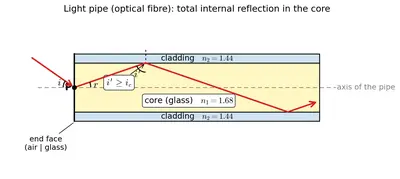
(a) Figure 9.28 shows a cross-section of a 'light pipe' made of a glass fibre of refractive index $$1.68$$. The outer covering of the pipe is made of a material of refractive index $$1.44$$. What is the range of the angles of the incident rays with the axis of the pipe for which total reflections inside the pipe take place, as shown in the figure.

Solution

A ray entering the flat end face of the fibre refracts into the glass, travels to the cylindrical wall, and must undergo total internal reflection there to stay trapped. TIR at the wall (the glass–covering interface) requires the angle of incidence on the wall to be at least the critical angle $$C$$ for that interface.

Critical angle at the wall.

$$\sin C = \dfrac{n_{\text{covering}}}{n_{\text{glass}}} = \dfrac{1.44}{1.68} = 0.857$$

$$C = \sin^{-1}(0.857) \approx 59^\circ$$

Geometry. Let a ray enter the end face at angle $$i$$ to the axis and refract to angle $$r$$ inside the glass. The axis is the normal to the end face, so $$i$$ is the angle of incidence there. When the ray reaches the wall, its angle of incidence on the wall is $$(90^\circ - r)$$, since the wall is parallel to the axis. For TIR at the wall,

$$90^\circ - r \ge C \implies r \le 90^\circ - C = 90^\circ - 59^\circ = 31^\circ$$

Refraction at the end face. Snell's law (air to glass) gives $$\sin i = n_{\text{glass}} \sin r$$. The largest allowed $$i$$ corresponds to $$r = 31^\circ$$:

$$\sin i_{\max} = 1.68 \times \sin 31^\circ = 1.68 \times 0.515 = 0.865$$

$$i_{\max} = \sin^{-1}(0.865) \approx 60^\circ$$

So total internal reflection occurs for every ray that enters the end face within a cone of semi-angle about $$60^\circ$$ about the axis. The range of incident angles with the axis is from $$0^\circ$$ up to about $$60^\circ$$.

Answer

Total internal reflection takes place for all rays incident at the end face making an angle between $$0^\circ$$ and about $$60^\circ$$ with the axis of the pipe.

(b) What is the answer if there is no outer covering of the pipe?

Solution

With no outer covering, the medium outside the wall is air, $$n = 1$$. The critical angle at the wall becomes

$$\sin C = \dfrac{1}{n_{\text{glass}}} = \dfrac{1}{1.68} = 0.595 \implies C = \sin^{-1}(0.595) \approx 36.5^\circ$$

For TIR at the wall we again need $$90^\circ - r \ge C$$, i.e. $$r \le 90^\circ - 36.5^\circ = 53.5^\circ$$.

Now find the largest refraction angle $$r$$ that is actually possible inside the glass. The biggest angle of incidence at the end face is $$i = 90^\circ$$ (a grazing ray), which gives

$$\sin r_{\max} = \dfrac{\sin 90^\circ}{n_{\text{glass}}} = \dfrac{1}{1.68} = 0.595 \implies r_{\max} \approx 36.5^\circ$$

So however a ray enters, $$r$$ can never exceed $$36.5^\circ$$ — well below the limit $$53.5^\circ$$. Hence the condition $$r \le 53.5^\circ$$ is satisfied for every ray.

Therefore, with no covering, total internal reflection occurs at the wall for all angles of incidence: any ray that enters the pipe through the end face (with $$i$$ anywhere from $$0^\circ$$ to $$90^\circ$$) is totally internally reflected.

Answer

With no covering the critical angle is about $$36.5^\circ$$, and the refraction angle inside the glass can never exceed $$36.5^\circ$$. Total internal reflection therefore occurs for every ray entering the pipe — for all angles of incidence from $$0^\circ$$ to $$90^\circ$$.

9.18 The image of a small electric bulb fixed on the wall of a room is to be obtained on the opposite wall $$3 \, \mathrm{m}$$ away by means of a large convex lens. What is the maximum possible focal length of the lens required for the purpose?

Solution

To project a real image of the bulb on the opposite wall, the lens must form a real image with the object (bulb) and image (wall) separated by the fixed distance $$D = 3 \, \mathrm{m}$$.

If the object is at a distance $$x$$ from the lens, the image is at $$D - x$$. For a real object and real image the lens formula gives

$$\dfrac{1}{D - x} + \dfrac{1}{x} = \dfrac{1}{f}$$

$$\dfrac{D}{x(D - x)} = \dfrac{1}{f} \implies f = \dfrac{x(D - x)}{D}$$

The focal length is largest when the product $$x(D - x)$$ is largest. This product is maximum at $$x = \dfrac{D}{2}$$, where $$x(D - x) = \dfrac{D^2}{4}$$. Hence

$$f_{\max} = \dfrac{D^2/4}{D} = \dfrac{D}{4} = \dfrac{3}{4} = 0.75 \, \mathrm{m}$$

Equivalently: a convex lens can form a real image only when the object–screen distance is at least $$4f$$. With $$D = 3 \, \mathrm{m}$$ this requires $$f \le 0.75 \, \mathrm{m}$$.

Answer

The maximum possible focal length is $$f_{\max} = \dfrac{D}{4} = 0.75 \, \mathrm{m}$$.

9.19 A screen is placed $$90 \, \mathrm{cm}$$ from an object. The image of the object on the screen is formed by a convex lens at two different locations separated by $$20 \, \mathrm{cm}$$. Determine the focal length of the lens.

Solution

This is the displacement (conjugate-foci) method. For a fixed object–screen separation $$D$$, a convex lens forms a sharp real image at two positions; if those positions are a distance $$d$$ apart, the focal length is given by $$f = \dfrac{D^2 - d^2}{4D}$$.

Derivation. If the object distance is $$x$$, the image distance is $$D - x$$, and

$$\dfrac{1}{D - x} + \dfrac{1}{x} = \dfrac{1}{f}$$

leads to the quadratic $$x^2 - Dx + fD = 0$$. Its two roots $$x_1, x_2$$ are the two possible lens positions, with $$x_1 + x_2 = D$$ and $$x_1 x_2 = fD$$. Their separation is $$d = |x_1 - x_2|$$, so

$$d^2 = (x_1 + x_2)^2 - 4x_1 x_2 = D^2 - 4fD \implies f = \dfrac{D^2 - d^2}{4D}$$

Substituting $$D = 90 \, \mathrm{cm}$$ and $$d = 20 \, \mathrm{cm}$$:

$$f = \dfrac{(90)^2 - (20)^2}{4 \times 90} = \dfrac{8100 - 400}{360} = \dfrac{7700}{360} \approx 21.4 \, \mathrm{cm}$$

Answer

The focal length of the lens is $$f = \dfrac{D^2 - d^2}{4D} \approx 21.4 \, \mathrm{cm}$$.

9.20

(a) Determine the 'effective focal length' of the combination of the two lenses in Exercise 9.10, if they are placed $$8.0 \, \mathrm{cm}$$ apart with their principal axes coincident. Does the answer depend on which side of the combination a beam of parallel light is incident? Is the notion of effective focal length of this system useful at all?

Solution

From Exercise 9.10 the two lenses are a convex lens of $$f_1 = +30 \, \mathrm{cm}$$ and a concave lens of $$f_2 = -20 \, \mathrm{cm}$$, now placed $$d = 8.0 \, \mathrm{cm}$$ apart with their axes coincident. To look for an 'effective focal length' we send in a parallel beam and locate the point from which the emergent beam appears to come.

Case I: parallel light strikes the convex lens first.

Lens 1: a parallel beam ($$u_1 = \infty$$) is focused at $$v_1 = f_1 = +30 \, \mathrm{cm}$$.

This converging point lies $$30 - 8 = 22 \, \mathrm{cm}$$ beyond lens 2, so it serves as a virtual object for lens 2: $$u_2 = +22 \, \mathrm{cm}$$.

Lens 2: $$\dfrac{1}{v_2} = \dfrac{1}{f_2} + \dfrac{1}{u_2} = -\dfrac{1}{20} + \dfrac{1}{22} = \dfrac{-11 + 10}{220} = -\dfrac{1}{220}$$

$$v_2 = -220 \, \mathrm{cm}$$

The emergent beam diverges as if from a point $$220 \, \mathrm{cm}$$ from lens 2, i.e. $$220 - 4 = 216 \, \mathrm{cm}$$ from the centre of the combination.

Case II: parallel light strikes the concave lens first.

Lens 2: a parallel beam gives $$v = f_2 = -20 \, \mathrm{cm}$$ — a virtual image $$20 \, \mathrm{cm}$$ in front of lens 2.

For lens 1 this is a real object $$20 + 8 = 28 \, \mathrm{cm}$$ away: $$u_1 = -28 \, \mathrm{cm}$$.

Lens 1: $$\dfrac{1}{v_1} = \dfrac{1}{f_1} + \dfrac{1}{u_1} = \dfrac{1}{30} - \dfrac{1}{28} = \dfrac{28 - 30}{840} = -\dfrac{1}{420}$$

$$v_1 = -420 \, \mathrm{cm}$$

The emergent beam diverges as if from a point $$420 \, \mathrm{cm}$$ from lens 1, i.e. $$420 - 4 = 416 \, \mathrm{cm}$$ from the centre of the combination.

Does the answer depend on the side? The two focal points ($$216 \, \mathrm{cm}$$ and $$416 \, \mathrm{cm}$$ from the centre) lie at different places, so the location of the focal point does depend on the side from which the parallel beam enters.

Is the notion of effective focal length useful? A combination of two separated lenses does possess a unique equivalent focal length, given by

$$\dfrac{1}{F} = \dfrac{1}{f_1} + \dfrac{1}{f_2} - \dfrac{d}{f_1 f_2} = \dfrac{1}{30} - \dfrac{1}{20} - \dfrac{8}{(30)(-20)} = \dfrac{20 - 30 + 8}{600} = -\dfrac{1}{300}$$

so $$F = -300 \, \mathrm{cm}$$ (a net diverging system). But this $$F$$ is reckoned from the principal planes of the combination, and those planes sit at different positions for the two directions of incidence — which is exactly why the measured focal points differ. There is no single fixed point in the system from which one focal length describes the behaviour both ways. So for two lenses separated by a finite gap the notion of a single 'effective focal length' is not useful in the simple sense of a fixed focal point; it becomes fully useful only for thin lenses in contact ($$d = 0$$), where the formula reduces to $$\dfrac{1}{F} = \dfrac{1}{f_1} + \dfrac{1}{f_2}$$ and one focal length completely describes the system.

Answer

Tracing a parallel beam gives a focal point $$216 \, \mathrm{cm}$$ from the centre of the combination when light enters on the convex side, and $$416 \, \mathrm{cm}$$ when it enters on the concave side — so the position of the focal point depends on the direction of incidence. The combination does have a unique equivalent focal length, $$\dfrac{1}{F} = \dfrac{1}{f_1} + \dfrac{1}{f_2} - \dfrac{d}{f_1 f_2}$$, giving $$F = -300 \, \mathrm{cm}$$, but it is measured from direction-dependent principal planes. Hence the notion of a single effective focal length is not useful for this system.

(b) An object $$1.5 \, \mathrm{cm}$$ in size is placed on the side of the convex lens in the arrangement (a) above. The distance between the object and the convex lens is $$40 \, \mathrm{cm}$$. Determine the magnification produced by the two-lens system, and the size of the image.

Solution

The $$1.5 \, \mathrm{cm}$$ object is placed $$40 \, \mathrm{cm}$$ from the convex lens, on the convex-lens side. Light passes first through the convex lens, then through the concave lens $$8 \, \mathrm{cm}$$ away.

Convex lens ($$f_1 = +30 \, \mathrm{cm}$$, $$u_1 = -40 \, \mathrm{cm}$$).

$$\dfrac{1}{v_1} = \dfrac{1}{f_1} + \dfrac{1}{u_1} = \dfrac{1}{30} - \dfrac{1}{40} = \dfrac{4 - 3}{120} = \dfrac{1}{120}$$

$$v_1 = 120 \, \mathrm{cm}$$

Magnification of the first lens: $$m_1 = \dfrac{v_1}{u_1} = \dfrac{120}{-40} = -3$$.

Concave lens ($$f_2 = -20 \, \mathrm{cm}$$). The image formed by the convex lens is $$120 \, \mathrm{cm}$$ beyond it, i.e. $$120 - 8 = 112 \, \mathrm{cm}$$ beyond the concave lens — a virtual object: $$u_2 = +112 \, \mathrm{cm}$$.

$$\dfrac{1}{v_2} = \dfrac{1}{f_2} + \dfrac{1}{u_2} = -\dfrac{1}{20} + \dfrac{1}{112} = \dfrac{-28 + 5}{560} = -\dfrac{23}{560}$$

$$v_2 = -\dfrac{560}{23} \approx -24.35 \, \mathrm{cm}$$

Magnification of the second lens: $$m_2 = \dfrac{v_2}{u_2} = \dfrac{-24.35}{112} \approx -0.217$$.

Net magnification and image size.

$$m = m_1 \times m_2 = (-3) \times (-0.217) \approx 0.652$$

$$\text{image size} = |m| \times \text{object size} = 0.652 \times 1.5 \approx 0.98 \, \mathrm{cm}$$

(Interchanging the order in which the light meets the two lenses leaves the net magnification unchanged.)

Answer

The two-lens system produces a magnification $$m \approx 0.652$$, so the image is about $$0.98 \, \mathrm{cm}$$ in size.

9.21 At what angle should a ray of light be incident on the face of a prism of refracting angle $$60°$$ so that it just suffers total internal reflection at the other face? The refractive index of the material of the prism is $$1.524$$.

Solution

Let the ray strike the first face at angle of incidence $$i$$ and refract at angle $$r_1$$; inside the prism it then meets the second face at angle $$r_2$$. For a prism of refracting angle $$A$$,

$$r_1 + r_2 = A = 60^\circ$$

Condition at the second face. The ray just suffers total internal reflection there, which means $$r_2$$ equals the critical angle $$C$$:

$$\sin C = \dfrac{1}{n} = \dfrac{1}{1.524} = 0.6562 \implies C \approx 41.0^\circ$$

Therefore $$r_2 = 41.0^\circ$$, and

$$r_1 = A - r_2 = 60^\circ - 41.0^\circ = 19.0^\circ$$

Refraction at the first face. Snell's law gives $$\sin i = n \sin r_1$$:

$$\sin i = 1.524 \times \sin 19.0^\circ = 1.524 \times 0.3256 = 0.4962$$

$$i = \sin^{-1}(0.4962) \approx 29.75^\circ$$

So the ray must strike the first face at about $$29.75^\circ$$ for total internal reflection to just begin at the second face.

Answer

The ray should be incident on the prism face at an angle of about $$29.75^\circ$$.

9.22 A card sheet divided into squares each of size $$1 \, \mathrm{mm^2}$$ is being viewed at a distance of $$9 \, \mathrm{cm}$$ through a magnifying glass (a converging lens of focal length $$9 \, \mathrm{cm}$$) held close to the eye.

(a) What is the magnification produced by the lens? How much is the area of each square in the virtual image?

Solution

The card lies in the focal plane of the lens: object distance $$u = -9 \, \mathrm{cm}$$ and focal length $$f = +9 \, \mathrm{cm}$$. The 'magnification' asked for here is the linear magnification $$m = \dfrac{v}{u}$$ — the ratio of image size to object size — from which the actual area of an image square follows.

Apply the lens formula $$\dfrac{1}{v} - \dfrac{1}{u} = \dfrac{1}{f}$$:

$$\dfrac{1}{v} = \dfrac{1}{f} + \dfrac{1}{u} = \dfrac{1}{9} + \dfrac{1}{-9} = 0$$

$$\implies v = \infty$$

The lens therefore forms the (virtual) image at infinity. The linear magnification is

$$m = \dfrac{v}{u} = \dfrac{\infty}{-9} \to \infty$$

As the image recedes to infinity its linear size grows without limit, so the linear magnification is infinite. Consequently the area of each square in the virtual image is infinitely large — no finite area can be assigned to the image of a $$1 \, \mathrm{mm^2}$$ square when the image is at infinity.

Note. This infinite linear magnification must not be confused with the angular magnification (magnifying power) of the lens, which is finite. The magnifying power works out to $$\dfrac{D}{f} = \dfrac{25}{9} \approx 2.8$$ (found in part (b)); it measures how much larger each square appears to the eye — its angular size — and is not the actual size of the image. The two quantities differ here precisely because the image is at infinity, a point taken up in part (c).

Answer

Since the card is at the focus of the lens, the image is formed at infinity, so the linear magnification is infinite ($$m = v/u \to \infty$$). The area of each square in the virtual image is therefore infinitely large — no finite value can be assigned. (This linear magnification is distinct from the finite angular magnification $$D/f \approx 2.8$$ found in part (b).)

(b) What is the angular magnification (magnifying power) of the lens?

Solution

When the image is at infinity, the magnifying power (angular magnification) of a simple magnifier is

$$M = \dfrac{D}{f}$$

where $$D = 25 \, \mathrm{cm}$$ is the least distance of distinct vision. Here $$f = 9 \, \mathrm{cm}$$, so

$$M = \dfrac{25}{9} \approx 2.8$$

The lens makes each square subtend an angle about $$2.8$$ times larger than it would if the card were viewed directly at the near point.

Answer

The angular magnification (magnifying power) is $$M = \dfrac{D}{f} = \dfrac{25}{9} \approx 2.8$$.

(c) Is the magnification in (a) equal to the magnifying power in (b)? Explain.

Solution

No. The two quantities are different in general.

The magnification in (a) is the linear magnification $$m = \dfrac{v}{u}$$ — the ratio of image size to object size. The magnifying power in (b) is the angular magnification — the ratio of the angle subtended at the eye by the image to the angle subtended by the object placed at the near point.

They are related by $$M = m \cdot \dfrac{D}{|v|}$$. The two become equal only when the image is formed at the near point ($$|v| = D$$). Here the image is at infinity, so $$m \to \infty$$ while $$M = 2.8$$ remains finite — clearly they are not equal.

Answer

No. The magnification in (a) is the linear (size) magnification, which is infinite here; the magnifying power in (b) is the angular magnification, equal to $$2.8$$. They coincide only when the image is at the near point.

9.23

(a) At what distance should the lens be held from the card sheet in Exercise 9.22 in order to view the squares distinctly with the maximum possible magnifying power?

Solution

A simple magnifier gives its maximum magnifying power when the final virtual image is formed at the near point, $$D = 25 \, \mathrm{cm}$$. So take $$v = -25 \, \mathrm{cm}$$ with $$f = 9 \, \mathrm{cm}$$, and find the object distance from the lens formula:

$$\dfrac{1}{u} = \dfrac{1}{v} - \dfrac{1}{f} = \dfrac{1}{-25} - \dfrac{1}{9} = \dfrac{-9 - 25}{225} = -\dfrac{34}{225}$$

$$u = -\dfrac{225}{34} \approx -6.6 \, \mathrm{cm}$$

The lens should be held about $$6.6 \, \mathrm{cm}$$ from the card sheet.

Answer

The lens should be held about $$6.6 \, \mathrm{cm}$$ (exactly $$\dfrac{225}{34} \, \mathrm{cm}$$) from the card sheet.

(b) What is the magnification in this case?

Solution

The linear magnification is the ratio $$\dfrac{v}{u}$$:

$$m = \dfrac{v}{u} = \dfrac{-25}{-225/34} = \dfrac{25 \times 34}{225} = \dfrac{34}{9} \approx 3.8$$

So each square appears about $$3.8$$ times larger in linear size.

Answer

The magnification is $$m = \dfrac{34}{9} \approx 3.8$$.

(c) Is the magnification equal to the magnifying power in this case? Explain.

Solution

With the image at the near point, the magnifying power of the magnifier is

$$M = 1 + \dfrac{D}{f} = 1 + \dfrac{25}{9} = \dfrac{34}{9} \approx 3.8$$

Yes — here the magnification ($$3.8$$) equals the magnifying power ($$3.8$$). The reason is that the image is formed exactly at the near point: when $$|v| = D$$, the general relation $$M = m \cdot \dfrac{D}{|v|}$$ reduces to $$M = m$$. (Contrast Exercise 9.22, where the image was at infinity and the two differed.)

Answer

Yes. Both the magnification and the magnifying power equal $$\dfrac{34}{9} \approx 3.8$$, because the image is formed at the near point ($$|v| = D$$).

9.24

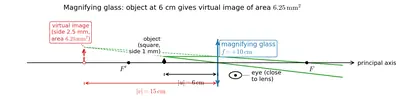
What should be the distance between the object in Exercise 9.23 and the magnifying glass if the virtual image of each square in the figure is to have an area of $$6.25 \, \mathrm{mm^2}$$. Would you be able to see the squares distinctly with your eyes very close to the magnifier?

[Note: Exercises 9.22 to 9.24 will help you clearly understand the difference between magnification in absolute size and the angular magnification (or magnifying power) of an instrument.]

Figure
Figure

Solution

Data taken from Exercise 9.23

  • Magnifying glass (simple microscope) of focal length  $$f = 10\,\text{cm}$$.
  • The object is the small chequered card shown in Ex. 9.23; each little square on it has an actual area

$$A_o = 0.0625\,\text{mm}^2\;\;(\text{side }=0.25\,\text{mm}).$$

The present exercise demands that the area of the virtual image of one square be

$$A_i = 6.25\,\text{mm}^2 \;(\text{side }=2.50\,\text{mm}).$$

Hence the required linear magnification is

$$m = \frac{\sqrt{A_i}}{\sqrt{A_o}} = \frac{2.50}{0.25}=10.$$

1. Position of the object

For a thin lens (Cartesian sign–convention)

$$\frac{1}{v}-\frac{1}{u}=\frac{1}{f},\qquad m=\frac{v}{u}\;(m>1\text{ for an enlarged virtual image}).$$

Putting $$v = m u$$ and eliminating $$v$$:

$$\frac{1}{m u}-\frac{1}{u}=\frac{1}{f}\;\Rightarrow\;\frac{1-m}{m u}=\frac{1}{f}.$$

The object lies to the left of the lens, so $$u=-|u|$$ and $$(1-m)/(m u)=+(m-1)/(m|u|).$$
Thus

$$|u| = \frac{m-1}{m}\,f = \frac{10-1}{10}\,(10\,\text{cm}) = 9.0\,\text{cm}.$$

Therefore the object must be kept $$9\,\text{cm}$$ in front of the magnifying glass.

2. Will the eye resolve the squares?

The virtual image distance (from the lens) is

$$|v| = m|u| = 10\times9.0\,\text{cm}=90\,\text{cm}.$$

With the eye almost touching the lens, the image is also nearly $$90\,\text{cm}$$ from the eye. Its angular size is

$$\theta = \frac{\text{linear size}}{\text{distance}} = \frac{2.5\,\text{mm}}{900\,\text{mm}} \approx 2.8\times10^{-3}\,\text{rad} \approx 9.6\,\text{arc-min}.$$

The human eye can normally resolve detail down to about $$1\,\text{arc-min}$$, so $$\theta$$ is almost ten times larger. Hence the individual squares can indeed be seen distinctly with the eye kept very close to the magnifier.

Answer

The object must be placed about 9 cm from the lens. With the eye close to the magnifier the image subtends ≈9.6 arc-min at the eye, well above the eye’s resolution limit, so the squares will be seen distinctly.

9.25 Answer the following questions:

(a) The angle subtended at the eye by an object is equal to the angle subtended at the eye by the virtual image produced by a magnifying glass. In what sense then does a magnifying glass provide angular magnification?

Solution

It is true that, at the moment of viewing, the image and the object subtend the same angle at the eye — the virtual image and the object lie along the very same rays that enter the eye.

The benefit of the magnifying glass lies elsewhere. Without the lens, the closest the object can be brought and still be seen sharply is the near point, $$D = 25 \, \mathrm{cm}$$; nearer than that, the unaided eye cannot focus. With the magnifying glass, the object can be placed much closer to the eye — near the focal length $$f$$, which is smaller than $$D$$ — so it subtends a much larger angle, while the lens pushes the virtual image out to the near point (or beyond), where the eye can comfortably focus.

So the angular magnification is genuine: it is the gain in angular size won by being allowed to bring the object closer than the unaided near point, not a magnification of an object kept at a fixed distance.

Answer

The magnifying glass lets the object be placed much closer to the eye than the unaided near point ($$25 \, \mathrm{cm}$$); the object then subtends a larger angle, while the lens forms the image where the eye can still focus. The angular magnification is this gain in angular size.

(b) In viewing through a magnifying glass, one usually positions one's eyes very close to the lens. Does angular magnification change if the eye is moved back?

Solution

Yes, the angular magnification does change — it decreases slightly. The magnifying power depends on the angle the image subtends at the eye. As the eye is moved back from the lens, the image (at a fixed location) subtends a smaller angle, so the angular magnification falls a little.

The decrease is small when the image is far from the lens, and it vanishes altogether in the special case of the image at infinity: there the rays from each image point are parallel, so the angle they make is the same wherever the eye is placed. The standard formulas for magnifying power assume the eye is held close to the lens.

Answer

Yes — it decreases slightly as the eye is moved back, because the image then subtends a smaller angle at the eye. (The change is negligible, and exactly zero when the image is at infinity.)

(c) Magnifying power of a simple microscope is inversely proportional to the focal length of the lens. What then stops us from using a convex lens of smaller and smaller focal length and achieving greater and greater magnifying power?

Solution

For a simple microscope the magnifying power is $$M = 1 + \dfrac{D}{f}$$ (image at the near point) or $$M = \dfrac{D}{f}$$ (image at infinity), so a smaller $$f$$ does give a larger $$M$$. But $$f$$ cannot be reduced without limit.

A very short focal length needs a lens that is very small and very strongly curved. Such a lens (i) is hard to grind, mount and use accurately, and (ii) suffers severely from spherical and chromatic aberrations, which blur the image and fringe it with colour. Past a certain point the loss of image quality far outweighs the gain in size.

In practice, the magnifying power of a single convex lens used as a simple microscope is limited to roughly $$9$$.

Answer

A very small focal length requires a tiny, strongly curved lens that is hard to manufacture and suffers severe spherical and chromatic aberrations. These distortions limit the useful magnifying power of a simple microscope to about $$9$$.

(d) Why must both the objective and the eyepiece of a compound microscope have short focal lengths?

Solution

The magnifying power of a compound microscope is, approximately,

$$M = m_o \times m_e \approx \dfrac{L}{f_o} \times \dfrac{D}{f_e}$$

where $$L$$ is the tube length and $$D$$ the near point. This product is large only when both focal lengths are small. A short-focus objective produces a large linear magnification of the object; a short-focus eyepiece produces a large angular magnification of that intermediate image. If either focal length were large, that stage would contribute little, and the overall magnification would be poor. Hence both lenses must have short focal lengths.

Answer

Because the magnifying power $$M \approx \dfrac{L}{f_o}\cdot\dfrac{D}{f_e}$$ is large only when both focal lengths are small — the short-focus objective strongly magnifies the object, and the short-focus eyepiece strongly magnifies the intermediate image.

(e) When viewing through a compound microscope, our eyes should be positioned not on the eyepiece but a short distance away from it for best viewing. Why? How much should be that short distance between the eye and eyepiece?

Solution

All the rays that come from the objective and pass through the eyepiece converge, just beyond the eyepiece, into a small bright circular patch — the eye-ring (or exit pupil). This patch is in fact the image of the objective formed by the eyepiece.

If the pupil of the eye is placed exactly at the eye-ring, it intercepts light coming from every point of the field of view, so the image seen is the brightest and the field of view the widest. Pressing the eye right against the eyepiece would let it catch only part of the light, cutting down the field of view and the brightness.

So the eye should be placed at the eye-ring. Its distance from the eyepiece is obtained by treating the objective as an object for the eyepiece; for a typical microscope it comes out to a small distance — only a little greater than the eyepiece's focal length (of the order of a few centimetres beyond the eyepiece).

Answer

The eye should be placed at the eye-ring (exit pupil) — the image of the objective formed by the eyepiece — because only there does it collect light from the whole field, giving the brightest image and widest field of view. This eye-ring lies a short distance beyond the eyepiece, slightly more than the eyepiece's focal length.

9.26 An angular magnification (magnifying power) of $$30\mathrm{X}$$ is desired using an objective of focal length $$1.25 \, \mathrm{cm}$$ and an eyepiece of focal length $$5 \, \mathrm{cm}$$. How will you set up the compound microscope?

Solution

We need a total magnifying power $$m = 30$$, with $$f_o = 1.25 \, \mathrm{cm}$$ and $$f_e = 5 \, \mathrm{cm}$$. Take the final image at the near point, $$D = 25 \, \mathrm{cm}$$ (the usual setting).

Split the magnification. The eyepiece contributes

$$m_e = 1 + \dfrac{D}{f_e} = 1 + \dfrac{25}{5} = 6$$

Since $$m = m_o \times m_e$$, the objective must give

$$m_o = \dfrac{m}{m_e} = \dfrac{30}{6} = 5$$

Object position for the objective. Here $$|m_o| = \dfrac{v_o}{|u_o|} = 5$$, so $$v_o = 5|u_o|$$. With $$u_o = -|u_o|$$ and $$v_o = +5|u_o|$$, the lens formula $$\dfrac{1}{v_o} - \dfrac{1}{u_o} = \dfrac{1}{f_o}$$ becomes

$$\dfrac{1}{5|u_o|} + \dfrac{1}{|u_o|} = \dfrac{1}{1.25} \implies \dfrac{6}{5|u_o|} = 0.8$$

$$|u_o| = \dfrac{6}{5 \times 0.8} = 1.5 \, \mathrm{cm}$$

So the object is placed $$1.5 \, \mathrm{cm}$$ from the objective, and the objective's image is at $$v_o = 5 \times 1.5 = 7.5 \, \mathrm{cm}$$.

Position of the eyepiece. The eyepiece must form the final image at $$v_e = -25 \, \mathrm{cm}$$:

$$\dfrac{1}{u_e} = \dfrac{1}{v_e} - \dfrac{1}{f_e} = \dfrac{1}{-25} - \dfrac{1}{5} = -\dfrac{6}{25}$$

$$u_e = -\dfrac{25}{6} \approx -4.17 \, \mathrm{cm}$$

Separation between the lenses.

$$L = v_o + |u_e| = 7.5 + 4.17 = 11.67 \, \mathrm{cm}$$

Hence: place the object $$1.5 \, \mathrm{cm}$$ in front of the objective, and set the two lenses about $$11.67 \, \mathrm{cm}$$ apart.

Answer

Place the object $$1.5 \, \mathrm{cm}$$ from the objective, and keep the objective and eyepiece about $$11.67 \, \mathrm{cm}$$ apart (objective magnification $$5$$, eyepiece magnification $$6$$, giving the desired $$30\mathrm{X}$$).

9.27 A small telescope has an objective lens of focal length $$140 \, \mathrm{cm}$$ and an eyepiece of focal length $$5.0 \, \mathrm{cm}$$. What is the magnifying power of the telescope for viewing distant objects when

(a) the telescope is in normal adjustment (i.e., when the final image is at infinity)?

Solution

For a telescope in normal adjustment the final image is at infinity, and the magnifying power is simply the ratio of the focal lengths of the objective and the eyepiece:

$$m = \dfrac{f_o}{f_e} = \dfrac{140}{5.0} = 28$$

Answer

In normal adjustment the magnifying power is $$m = \dfrac{f_o}{f_e} = 28$$.

(b) the final image is formed at the least distance of distinct vision ($$25 \, \mathrm{cm}$$)?

Solution

When the final image is formed at the least distance of distinct vision, $$D = 25 \, \mathrm{cm}$$, the magnifying power of the telescope is

$$m = \dfrac{f_o}{f_e}\left( 1 + \dfrac{f_e}{D} \right)$$

$$m = \dfrac{140}{5.0}\left( 1 + \dfrac{5.0}{25} \right) = 28 \times (1 + 0.2) = 28 \times 1.2 = 33.6$$

Answer

With the final image at the near point, the magnifying power is $$m = \dfrac{f_o}{f_e}\left(1 + \dfrac{f_e}{D}\right) = 33.6$$.

9.28

(a) For the telescope described in Exercise 9.27 (a), what is the separation between the objective lens and the eyepiece?

Solution

For the telescope of Exercise 9.27 in normal adjustment, the image formed by the objective lies at the common focus of the two lenses. The separation between the lenses is therefore the sum of their focal lengths:

$$L = f_o + f_e = 140 + 5.0 = 145 \, \mathrm{cm}$$

Answer

The separation between the objective lens and the eyepiece is $$L = f_o + f_e = 145 \, \mathrm{cm}$$.

(b) If this telescope is used to view a $$100 \, \mathrm{m}$$ tall tower $$3 \, \mathrm{km}$$ away, what is the height of the image of the tower formed by the objective lens?

Solution

The tower is $$h = 100 \, \mathrm{m}$$ tall and at a distance $$L = 3 \, \mathrm{km} = 3000 \, \mathrm{m}$$. The angle it subtends at the objective is

$$\theta = \dfrac{h}{L} = \dfrac{100 \, \mathrm{m}}{3000 \, \mathrm{m}} = \dfrac{1}{30} \, \mathrm{rad}$$

The objective, of focal length $$f_o = 140 \, \mathrm{cm}$$ (from Exercise 9.27), forms the image of the tower in its focal plane. That image subtends the same angle $$\theta$$ at the objective, so its height is

$$h' = f_o \, \theta = (140 \, \mathrm{cm}) \times \dfrac{1}{30} \approx 4.67 \, \mathrm{cm}$$

Answer

The image of the tower formed by the objective lens is about $$4.67 \, \mathrm{cm}$$ tall.

(c) What is the height of the final image of the tower if it is formed at $$25 \, \mathrm{cm}$$?

Solution

The eyepiece further magnifies the objective's image (height $$h' = 4.67 \, \mathrm{cm}$$). When the final image is formed at the near point $$D = 25 \, \mathrm{cm}$$, the eyepiece acts as a simple magnifier with linear magnification

$$m_e = 1 + \dfrac{D}{f_e} = 1 + \dfrac{25}{5.0} = 6$$

So the height of the final image is

$$h'' = m_e \times h' = 6 \times 4.67 \approx 28 \, \mathrm{cm}$$

Answer

The final image of the tower, formed at $$25 \, \mathrm{cm}$$, is about $$28 \, \mathrm{cm}$$ tall.

9.29

A Cassegrain telescope uses two mirrors as shown in Fig. 9.26. Such a telescope is built with the mirrors $$20 \, \mathrm{mm}$$ apart. If the radius of curvature of the large mirror is $$220 \, \mathrm{mm}$$ and the small mirror is $$140 \, \mathrm{mm}$$, where will the final image of an object at infinity be?
Fig. 9.26
Fig. 9.26

Solution

Given data

  • Radius of curvature of the large (primary, concave) mirror
    $$R_1 = 220\,\text{mm}$$
  • Radius of curvature of the small (secondary, convex) mirror
    $$R_2 = 140\,\text{mm}$$
  • Distance between the poles of the two mirrors (secondary in front of primary)
    $$P_1P_2 = 20\,\text{mm}$$
  • Object at infinity ⇒ parallel light falls on the primary mirror.

Step 1. Image produced by the primary mirror

For a spherical mirror

$$f = \dfrac{R}{2}$$

Using the Cartesian sign convention adopted in NCERT:

  • Incident light travels from left to right, so distances measured to the right of a pole are positive, those to the left negative.
  • The primary mirror is concave, its centre of curvature lies on the left of its pole ⇒ $$R_1 = -220\,\text{mm}$$

Hence

$$f_1 = \dfrac{R_1}{2} = -110\,\text{mm}$$

With the object at infinity, the image formed by the primary mirror is at its focus:

$$v_1 = f_1 = -110\,\text{mm}$$

Thus the primary image I1 lies 110 mm to the left of the primary pole P1.

Step 2. Object distance for the secondary mirror

The pole of the secondary mirror P2 is 20 mm to the left of P1. Hence the distance of I1 from P2 is

$$u_2 = P_2I_1 = 110\,\text{mm} - 20\,\text{mm} = 90\,\text{mm}$$

The rays that have already been reflected by the primary now travel from right to left towards the secondary; therefore, according to the sign convention, distances measured to the left of P2 are positive. Hence

$$u_2 = +90\,\text{mm}$$

Step 3. Image produced by the secondary mirror

  • The secondary mirror is convex; its centre of curvature is to the right of P2, so $$R_2 = +140\,\text{mm} \;\Rightarrow\; f_2 = \dfrac{R_2}{2} = +70\,\text{mm}$$. For the convex mirror, however, the focal length is negative in the Cartesian convention because it lies on the opposite side to the incident light. Thus

$$f_2 = -70\,\text{mm}$$

Mirror formula:

$$\frac{1}{f_2}=\frac{1}{v_2}+\frac{1}{u_2}$$

$$\frac{1}{(-70)}=\frac{1}{v_2}+\frac{1}{(+90)}$$

$$\frac{1}{v_2}=\frac{-1}{70}-\frac{1}{90}=\frac{-9-7}{630}=\frac{-16}{630}$$

$$v_2 = -\frac{630}{16}\,\text{mm}\approx -39.4\,\text{mm}$$

The negative sign shows that the image formed by the secondary mirror lies to the right of P2, i.e. on the same side as the hole in the primary mirror.

Step 4. Position of the final image with respect to the primary mirror

Distance of the final image I2 from the pole of the primary mirror:

$$P_1I_2 = P_1P_2 + P_2I_2 = 20\,\text{mm} + 39.4\,\text{mm} \approx 59.4\,\text{mm}$$

This is to the right of the primary mirror.

Result

The Cassegrain combination forms the final image approximately 59 mm behind the large mirror (on the side opposite to the incoming light).

Hence, an object at infinity is brought to focus about 6 cm behind the primary mirror.

Answer

The final image is formed about $$5.9\,\text{cm}$$ behind the large mirror (on the side opposite to the incoming light).

9.30

Light incident normally on a plane mirror attached to a galvanometer coil retraces backwards as shown in Fig. 9.29. A current in the coil produces a deflection of $$3.5°$$ of the mirror. What is the displacement of the reflected spot of light on a screen placed $$1.5 \, \mathrm{m}$$ away?
Fig. 9.29
Fig. 9.29

Solution

The light is initially incident normally on the plane mirror, so the incident ray and the reflected ray coincide and move along the same line.

When a current passes through the galvanometer coil, the mirror (and hence its normal) rotates through an angle $$\theta = 3.5^{\circ}$$. According to the law of reflection, the angle between the incident ray and the new normal increases by $$\theta$$, and the angle between the reflected ray and the old direction of the incident ray therefore changes by

$$\Delta = 2\theta$$

This means the reflected beam is turned through $$2\theta$$ with respect to its original direction.

Distance of the screen from the mirror: $$L = 1.5\,\text{m}$$.

Linear displacement of the spot on the screen:

$$s = L\,\tan(2\theta)$$

Convert the deflection angle to radians:

$$\theta = 3.5^{\circ} = 3.5\times\frac{\pi}{180}\,\text{rad} = 0.0611\,\text{rad}$$

Hence

$$2\theta = 0.1222\,\text{rad} \;(= 7^{\circ})$$

Now,

$$\tan(2\theta) = \tan 7^{\circ} \approx 0.123$$

Therefore

$$s = 1.5\,\text{m}\;\times 0.123 \approx 0.184\,\text{m}$$

$$s \approx 1.8\times 10^{-1}\,\text{m} = 18\,\text{cm}$$

The reflected spot shifts by about 18 cm on the screen.

Answer

$$s \approx 0.18\,\text{m}\; (= 18\,\text{cm})$$

9.31

Figure 9.30 shows an equiconvex lens (of refractive index $$1.50$$) in contact with a liquid layer on top of a plane mirror. A small needle with its tip on the principal axis is moved along the axis until its inverted image is found at the position of the needle. The distance of the needle from the lens is measured to be $$45.0 \, \mathrm{cm}$$. The liquid is removed and the experiment is repeated. The new distance is measured to be $$30.0 \, \mathrm{cm}$$. What is the refractive index of the liquid?
Figure 9.30
Figure 9.30

Solution

Step 1 : Focal length of the equiconvex lens in air
With the liquid removed the lens is in contact with the plane mirror. A ray emerging from the lens immediately strikes the mirror and retraces its path after reflection, i.e. the lens is traversed twice. Hence the optical power doubles and the combination behaves like a concave mirror of focal length $$F_0 = \frac{f}{2}$$ where $$f$$ is the focal length of the lens (in the surrounding medium – here air).
For an object placed at the centre of curvature of a concave mirror the image is real, inverted and coincident with the object; therefore $$2F_0 = f = 30\;\text{cm}.$$ Thus

$$\boxed{f = 30\;\text{cm}}$$

Step 2 : Radius of curvature of the lens surfaces
For a thin equiconvex glass lens (refractive index $$n_g = 1.50$$) in air (R1 = +R, R2 = -R) the lens-maker’s formula gives $$\frac{1}{f}=\left(n_g-1\right)\left(\frac{1}{R_1}-\frac{1}{R_2}\right) =(1.50-1)\left(\frac{1}{R}-\frac{-1}{R}\right)=0.5\;\frac{2}{R}=\frac{1}{R}.$$ Consequently

$$\boxed{R = 30\;\text{cm}}$$

Step 3 : Focal length of the same lens when its right surface faces a medium of refractive index $$\mu$$ (the liquid)
Let the incident medium be air (index $$n_1 = 1$$), the lens glass index $$n_g = 1.50$$ and the emergent medium the liquid (index $$\mu$$). For a thin lens separating two different media the power (in dioptres) is $$P = \left(\frac{n_g-n_1}{R_1}+\frac{\mu-n_g}{R_2}\right).$$ Putting R1=+R, R2=−R we obtain $$P = \frac{1.50-1}{R}+\frac{\mu-1.50}{-R}=\frac{0.50-\mu+1.50}{R}=\frac{2-\mu}{R}.$$ The focal length (measured in air on the object side) is therefore $$\boxed{f_1 = \frac{1}{P}=\frac{R}{2-\mu}}\qquad(1)$$

Step 4 : Condition for coincidence of object and (inverted) image
With the liquid in place the lens is again traversed twice; its power doubles and the combination acts as a concave mirror of focal length $$F = \frac{f_1}{2}.$$ For the object to coincide with its inverted image it must be placed at the centre of curvature of this equivalent mirror: $$2F = f_1.$$ The experiment gives the required object distance (from the lens) $$f_1 = 45\;\text{cm}.\qquad(2)$$

Step 5 : Determination of the refractive index of the liquid
Substituting $$R = 30\;\text{cm}$$ and $$f_1 = 45\;\text{cm}$$ in (1): $$45 = \frac{30}{2-\mu} \;\;\Rightarrow\;\;2-\mu = \frac{30}{45}=\frac{2}{3} \;\;\Rightarrow\;\;\boxed{\mu = \frac{4}{3}\;\;\approx\;\;1.33}.$$

The liquid therefore has a refractive index very close to that of water.

Answer

Refractive index of the liquid
$$\displaystyle \mu = \frac{4}{3}\;\;\approx\;\;1.33$$

NCERT Solutions for Class 12
Maths
NCERT Solutions for Class 12 Maths
Chapter-wise step-by-step
solutions with explanations
explore solutions Maths bg
Physics
NCERT Solutions for Class 12 Physics
Chapter-wise step-by-step
solutions with explanations
explore solutions Physics bg
Chemistry
NCERT Solutions for Class 12 Chemistry
Chapter-wise step-by-step
solutions with explanations
explore solutions Chemistry bg

Frequently Asked Questions

50,000+ JEE Students Trusted Our Score Calculator

Predict your JEE Main percentile, rank & performance in seconds