Join WhatsApp Icon JEE WhatsApp Group
NCERT Solutions for Class 12 Physics

Chapter 8: Electromagnetic Waves

Download Solutions PDF
Daily JEE Updates, Tips & Important Alerts
Join 30,000+ students and stay updated with JEE notifications and preparation insights.
Join Now!
Free PDF
Complete NCERT Solution PDF for Chapter 8: Electromagnetic Waves

NCERT Solutions For Class 12 Physics Chapter 8 Electromagnetic Waves helps students understand the nature, properties, and applications of electromagnetic radiation. The page provides comprehensive NCERT Solutions that explain concepts such as electromagnetic wave propagation, electromagnetic spectrum, properties of waves, and their practical uses. NCERT Solutions For Class 12 Physics simplify these concepts with clear explanations and examples from the NCERT textbook. The chapter helps students understand the connection between electric fields and magnetic fields in wave propagation. These solutions support revision, textbook practice, and board exam preparation. Students can access the chapter PDF for easy learning and quick review. The detailed explanations help learners understand different regions of the electromagnetic spectrum and their applications.
Download Solutions PDF

Examples 8.1-8.2

Example 8.1 A plane electromagnetic wave of frequency $$25 \, \mathrm{MHz}$$ travels in free space along the $$x$$-direction. At a particular point in space and time, $$\mathbf{E} = 6.3 \, \hat{\mathbf{j}} \, \mathrm{V/m}$$. What is $$\mathbf{B}$$ at this point?

Solution

In an electromagnetic wave travelling in free space, the magnitudes of the electric and magnetic fields are related through the speed of light: $$c = \dfrac{E}{B}$$.

Step 1 - Magnitude of B.

$$B = \dfrac{E}{c} = \dfrac{6.3 \, \mathrm{V/m}}{3 \times 10^{8} \, \mathrm{m/s}} = 2.1 \times 10^{-8} \, \mathrm{T}$$

Step 2 - Direction of B.

The wave propagates along $$+x$$ (the $$\hat{\mathbf{i}}$$ direction) and the electric field points along $$+y$$ (the $$\hat{\mathbf{j}}$$ direction). In an electromagnetic wave the vectors $$\mathbf{E}$$, $$\mathbf{B}$$ and the direction of propagation form a right-handed set, with $$\mathbf{E} \times \mathbf{B}$$ pointing along the direction of propagation.

We therefore need $$\mathbf{E} \times \mathbf{B}$$ to point along $$+x$$. Since $$\hat{\mathbf{j}} \times \hat{\mathbf{k}} = \hat{\mathbf{i}}$$, the magnetic field must lie along $$+z$$ (the $$\hat{\mathbf{k}}$$ direction).

Hence $$\mathbf{B} = 2.1 \times 10^{-8} \, \hat{\mathbf{k}} \, \mathrm{T}$$.

Answer

$$\mathbf{B} = 2.1 \times 10^{-8} \, \hat{\mathbf{k}} \, \mathrm{T}$$ - magnitude $$2.1 \times 10^{-8} \, \mathrm{T}$$, directed along the $$+z$$-axis.

Example 8.2

The magnetic field in a plane electromagnetic wave is given by

$$B_y = (2 \times 10^{-7}) \, \mathrm{T} \, \sin(0.5 \times 10^3 x + 1.5 \times 10^{11} t)$$

(a) What is the wavelength and frequency of the wave?

(b) Write an expression for the electric field.

Solution

The given magnetic field is $$B_y = (2 \times 10^{-7}) \, \mathrm{T} \, \sin(0.5 \times 10^{3} x + 1.5 \times 10^{11} t)$$.

Compare this with the standard form of a plane wave $$B_y = B_0 \sin(kx + \omega t)$$. This gives the angular wave number and the angular frequency:

$$k = 0.5 \times 10^{3} \, \mathrm{rad/m} = 500 \, \mathrm{rad/m}, \qquad \omega = 1.5 \times 10^{11} \, \mathrm{rad/s}$$

(a) Wavelength and frequency.

$$\lambda = \dfrac{2\pi}{k} = \dfrac{2\pi}{500 \, \mathrm{rad/m}} = 1.26 \times 10^{-2} \, \mathrm{m}$$

$$\nu = \dfrac{\omega}{2\pi} = \dfrac{1.5 \times 10^{11}}{2\pi} \, \mathrm{Hz} = 2.39 \times 10^{10} \, \mathrm{Hz}$$

(As a check, $$\nu\lambda = (2.39 \times 10^{10})(1.26 \times 10^{-2}) \approx 3 \times 10^{8} \, \mathrm{m/s} = c$$.)

(b) Expression for the electric field.

The amplitude of the electric field is $$E_0 = cB_0 = (3 \times 10^{8})(2 \times 10^{-7}) = 60 \, \mathrm{V/m}$$.

The phase is $$kx + \omega t$$, so the wave moves along the $$-x$$ direction, and $$\mathbf{B}$$ oscillates along $$y$$. For $$\mathbf{E} \times \mathbf{B}$$ to point along $$-x$$, the electric field must oscillate along the $$z$$-axis, since $$\hat{\mathbf{k}} \times \hat{\mathbf{j}} = -\hat{\mathbf{i}}$$.

Therefore $$E_z = 60 \, \mathrm{V/m} \, \sin(0.5 \times 10^{3} x + 1.5 \times 10^{11} t)$$, with $$E_x = E_y = 0$$.

Answer

(a) $$\lambda = 1.26 \times 10^{-2} \, \mathrm{m}$$ and $$\nu = 2.39 \times 10^{10} \, \mathrm{Hz}$$.

(b) $$E_z = 60 \, \mathrm{V/m} \, \sin(0.5 \times 10^{3} x + 1.5 \times 10^{11} t)$$ - the electric field oscillates along the $$z$$-axis.

Exercises

8.1

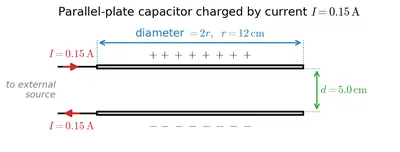
Figure 8.5 shows a capacitor made of two circular plates each of radius $$12 \, \mathrm{cm}$$, and separated by $$5.0 \, \mathrm{cm}$$. The capacitor is being charged by an external source (not shown in the figure). The charging current is constant and equal to $$0.15 \, \mathrm{A}$$.
Figure 8.5
Figure 8.5

(a) Calculate the capacitance and the rate of change of potential difference between the plates.

Solution

Capacitance. The circular plates have radius $$r = 12 \, \mathrm{cm} = 0.12 \, \mathrm{m}$$ and are separated by $$d = 5.0 \, \mathrm{cm} = 0.05 \, \mathrm{m}$$. The area of each plate is

$$A = \pi r^{2} = \pi (0.12)^{2} = 0.0452 \, \mathrm{m^{2}}$$

For a parallel-plate capacitor with air between the plates,

$$C = \dfrac{\varepsilon_0 A}{d} = \dfrac{(8.85 \times 10^{-12})(0.0452)}{0.05} = 8.0 \times 10^{-12} \, \mathrm{F} = 8.0 \, \mathrm{pF}$$

Rate of change of potential difference. The charge stored is $$q = CV$$, so the charging current is $$I = \dfrac{dq}{dt} = C \dfrac{dV}{dt}$$ (since $$C$$ is constant). Therefore

$$\dfrac{dV}{dt} = \dfrac{I}{C} = \dfrac{0.15}{8.0 \times 10^{-12}} = 1.87 \times 10^{10} \, \mathrm{V/s}$$

Answer

$$C = 8.0 \, \mathrm{pF}$$ and $$\dfrac{dV}{dt} = 1.87 \times 10^{10} \, \mathrm{V/s}$$.

(b) Obtain the displacement current across the plates.

Solution

The displacement current is defined through the changing electric flux between the plates:

$$I_d = \varepsilon_0 \dfrac{d\Phi_E}{dt}$$

Between the plates the electric field is $$E = \dfrac{q}{\varepsilon_0 A}$$, so the electric flux through the gap is

$$\Phi_E = EA = \dfrac{q}{\varepsilon_0}$$

Hence

$$I_d = \varepsilon_0 \dfrac{d\Phi_E}{dt} = \varepsilon_0 \cdot \dfrac{1}{\varepsilon_0}\dfrac{dq}{dt} = \dfrac{dq}{dt} = I$$

So the displacement current across the gap equals the conduction (charging) current in the wires:

$$I_d = 0.15 \, \mathrm{A}$$

Answer

$$I_d = 0.15 \, \mathrm{A}$$ - equal to the conduction current charging the capacitor.

(c) Is Kirchhoff's first rule (junction rule) valid at each plate of the capacitor? Explain.

Solution

Yes - Kirchhoff's junction rule holds at each plate, provided the current is understood to include the displacement current along with the conduction current.

Consider one plate. A conduction current $$I = 0.15 \, \mathrm{A}$$ flows through the connecting wire into the plate. No charge crosses the gap between the plates, so there is no conduction current leaving the plate on the gap side.

However, as the plate charges up, the electric field (and hence the electric flux) between the plates increases, and this produces a displacement current $$I_d = 0.15 \, \mathrm{A}$$ that effectively leaves the plate on the gap side.

Thus the total current (conduction $$+$$ displacement) entering the plate equals the total current leaving it: $$I = I_d$$. In this generalised sense the current is continuous, and Kirchhoff's first rule is satisfied at each plate.

Answer

Yes. The junction rule is valid at each plate when the total current is taken as the sum of the conduction current and the displacement current: the conduction current $$0.15 \, \mathrm{A}$$ entering a plate is continued as an equal displacement current $$0.15 \, \mathrm{A}$$ across the gap.

8.2

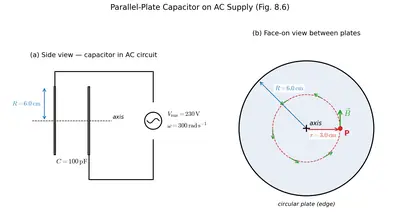
A parallel plate capacitor (Fig. 8.6) made of circular plates each of radius $$R = 6.0 \, \mathrm{cm}$$ has a capacitance $$C = 100 \, \mathrm{pF}$$. The capacitor is connected to a $$230 \, \mathrm{V}$$ ac supply with a (angular) frequency of $$300 \, \mathrm{rad \, s^{-1}}$$.
Fig. 8.6
Fig. 8.6

(a) What is the rms value of the conduction current?

Solution

The rms current in a purely capacitive a.c. circuit is

$$I_{\mathrm{rms}} = \dfrac{V_{\mathrm{rms}}}{X_C} = V_{\mathrm{rms}}\,\omega C$$

Given $$V_{\mathrm{rms}} = 230\;\mathrm{V},\; \omega = 300\;\mathrm{rad\,s^{-1}},\; C = 100\;\mathrm{pF}=100\times10^{-12}\;\mathrm{F}$$

$$I_{\mathrm{rms}} = 230\times300\times100\times10^{-12}\;\mathrm{A}$$

$$I_{\mathrm{rms}} = 6.9\times10^{-6}\;\mathrm{A}=6.9\;\mu\mathrm{A}$$

Answer

(a) $$I_{\mathrm{rms}} \approx 6.9\;\mu\mathrm{A}$$

(b) Is the conduction current equal to the displacement current?

Solution

Inside an ideal capacitor no free charges move across the gap; instead a displacement current $$I_d$$ is set up by the changing electric field. Maxwell’s amended Ampère law demands that the line integral of $$\mathbf B$$ depend on the total current (conduction + displacement).

The same charge that leaves one plate per unit time enters the other plate, so the conduction current in the wires $$I_c$$ equals, at every instant, the rate of change of electric flux between the plates, i.e. the displacement current. Hence

$$I_c(t)=I_d(t)$$

Answer

(b) Yes. For an ideal capacitor the instantaneous conduction current equals the displacement current.

(c) Determine the amplitude of $$\mathbf{B}$$ at a point $$3.0 \, \mathrm{cm}$$ from the axis between the plates.

Solution

The peak (amplitude) conduction current is

$$I_0 = \omega C V_0$$

with $$V_0 = \sqrt2\,V_{\mathrm{rms}} = \sqrt2\times230\,\mathrm{V}=3.25\times10^{2}\,\mathrm{V}$$

$$I_0 = 300\times100\times10^{-12}\times3.25\times10^{2}=9.8\times10^{-6}\,\mathrm{A}$$

Only the portion of displacement current enclosed by a circle of radius $$r=0.03\,\mathrm{m}$$ contributes to the integral of $$\mathbf B$$. Because the electric field (and therefore the displacement current density) is uniform between the plates, the enclosed peak displacement current is

$$I_{d0}(r)=I_0\frac{r^{2}}{R^{2}}=9.8\,\mu\mathrm{A}\times\Bigl(\frac{0.03}{0.06}\Bigr)^{2}=2.45\,\mu\mathrm{A}$$

Use Maxwell–Ampère law for a circular Amperian loop of radius $$r$$ between the plates:

$$\oint\mathbf B\cdot\mathrm d\mathbf l=B_0(2\pi r)=\mu_0I_{d0}(r)$$

$$\Rightarrow\; B_0 = \frac{\mu_0 I_{d0}(r)}{2\pi r}$$

$$B_0 = \frac{4\pi\times10^{-7}\,\mathrm{T\,m\,A^{-1}}}{2\pi}\;\frac{2.45\times10^{-6}\,\mathrm{A}}{0.03\,\mathrm{m}}$$

$$B_0 = 2\times10^{-7}\times\frac{2.45\times10^{-6}}{0.03}=1.6\times10^{-11}\,\mathrm{T}$$

Answer

(c) Amplitude of magnetic field at 3 cm from the axis:
$$B_0 \approx 1.6\times10^{-11}\,\text{T}$$

8.3 What physical quantity is the same for X-rays of wavelength $$10^{-10} \, \mathrm{m}$$, red light of wavelength $$6800 \, \mathrm{\AA}$$ and radiowaves of wavelength $$500 \, \mathrm{m}$$?

Solution

All three — X-rays, visible red light and radio-waves — are electromagnetic (EM) waves.
For every electromagnetic wave propagating through vacuum (or through air to an excellent approximation) the speed is a universal constant
$$v = c = 3.0 \times 10^{8}\;\text{m\,s}^{-1}.$$

The speed v of any wave is linked to its wavelength $$\lambda$$ and frequency $$\nu$$ by $$v = \nu\,\lambda.$$

Because the wavelengths are different, their frequencies are necessarily different, viz.

  • For the X-ray: $$\nu_X = \dfrac{c}{\lambda_X} = \dfrac{3.0\times10^{8}}{1.0\times10^{-10}} \text{ Hz} \approx 3.0\times10^{18}\;\text{Hz},$$
  • For red light: $$\nu_R = \dfrac{c}{\lambda_R} = \dfrac{3.0\times10^{8}}{6.8\times10^{-7}} \text{ Hz} \approx 4.4\times10^{14}\;\text{Hz},$$
  • For the radio-wave: $$\nu_{rad} = \dfrac{c}{\lambda_{rad}} = \dfrac{3.0\times10^{8}}{500} \text{ Hz} \approx 6.0\times10^{5}\;\text{Hz},$$

Although the frequencies differ widely, inserting any pair $$\nu$$ and $$\lambda$$ into $$v = \nu\lambda$$ always yields the same numerical value $$3.0\times10^{8}\;\text{m\,s}^{-1}$$.

Hence the only physical quantity that is identical for all three given waves is their speed in vacuum (or air).

Answer

Their speed in vacuum (approximately $$3\times10^{8}\,\text{m s}^{-1}$$) is the same for all three.

8.4 A plane electromagnetic wave travels in vacuum along $$z$$-direction. What can you say about the directions of its electric and magnetic field vectors? If the frequency of the wave is $$30 \, \mathrm{MHz}$$, what is its wavelength?

Solution

Directions of $$\vec{E}$$ and $$\vec{B}$$. For a plane electromagnetic wave the wave-vector $$\vec{k}$$, the electric field $$\vec{E}$$ and the magnetic field $$\vec{B}$$ are mutually perpendicular and obey the right-hand rule $$\vec{k} \propto \vec{E} \times \vec{B}$$. Both $$\vec{E}$$ and $$\vec{B}$$ are therefore perpendicular to the direction of propagation.

The wave travels along the $$+z$$ axis, i.e. $$\vec{k} = k\,\hat{z}$$. Hence both $$\vec{E}$$ and $$\vec{B}$$ lie in the $$x$$-$$y$$ plane. A convenient choice that satisfies the right-hand rule is

  • $$\vec{E}$$ along $$+x$$, i.e. $$\vec{E} = E_0\,\hat{x}$$
  • $$\vec{B}$$ along $$+y$$, i.e. $$\vec{B} = B_0\,\hat{y}$$

(any other pair of mutually perpendicular transverse directions for which $$\vec{E} \times \vec{B}$$ points along $$+z$$ is equally valid).

Wavelength. For an electromagnetic wave in vacuum, $$c = \nu\,\lambda$$, so

$$\lambda = \dfrac{c}{\nu}$$

With $$c = 3.0 \times 10^{8}\,\mathrm{m\,s^{-1}}$$ and $$\nu = 30\,\mathrm{MHz} = 3.0 \times 10^{7}\,\mathrm{Hz}$$,

$$\lambda = \dfrac{3.0 \times 10^{8}\,\mathrm{m\,s^{-1}}}{3.0 \times 10^{7}\,\mathrm{Hz}} = 10\,\mathrm{m}$$

Answer

Both $$\vec{E}$$ and $$\vec{B}$$ are perpendicular to the direction of propagation and to each other; for propagation along $$+z$$, one valid orientation is $$\vec{E}$$ along $$+x$$ and $$\vec{B}$$ along $$+y$$. The wavelength corresponding to $$\nu = 30\,\mathrm{MHz}$$ is $$\lambda = 10\,\mathrm{m}$$.

8.5 A radio can tune in to any station in the $$7.5 \, \mathrm{MHz}$$ to $$12 \, \mathrm{MHz}$$ band. What is the corresponding wavelength band?

Solution

Given: Frequency range that the radio can receive is from $$f_{\min}=7.5\,\text{MHz}$$ to $$f_{\max}=12\,\text{MHz}$$.

Convert the limits to hertz so that the speed–frequency–wavelength relation can be used:

$$f_{\min}=7.5\,\text{MHz}=7.5\times10^{6}\,\text{Hz}$$
$$f_{\max}=12\,\text{MHz}=12\times10^{6}\,\text{Hz}$$

The speed of electromagnetic waves in free space is
$$c=3.0\times10^{8}\,\text{m\,s}^{-1}$$

The wavelength corresponding to any frequency is obtained from
$$\lambda=\dfrac{c}{f}$$

For the lower-frequency end (7.5 MHz):

$$\lambda_{\max}=\dfrac{3.0\times10^{8}}{7.5\times10^{6}}\,\text{m}$$

$$\lambda_{\max}=0.4\times10^{2}\,\text{m}=40\,\text{m}$$

For the higher-frequency end (12 MHz):

$$\lambda_{\min}=\dfrac{3.0\times10^{8}}{12\times10^{6}}\,\text{m}$$

$$\lambda_{\min}=0.25\times10^{2}\,\text{m}=25\,\text{m}$$

Therefore, the radio’s wavelength band is from 25 m to 40 m.

Answer

$$25\,\text{m}\;\text{to}\;40\,\text{m}$$

8.6 A charged particle oscillates about its mean equilibrium position with a frequency of $$10^9 \, \mathrm{Hz}$$. What is the frequency of the electromagnetic waves produced by the oscillator?

Solution

An accelerating charge radiates an electromagnetic wave. When the charge undergoes simple harmonic motion at frequency $$\nu$$, the time-dependent electric dipole moment oscillates at the same frequency, and the radiated electric and magnetic fields therefore vary in time with that same frequency.

Hence the frequency of the emitted electromagnetic wave equals the mechanical oscillation frequency of the source:

$$\nu_{\mathrm{em}} = \nu = 10^{9}\,\mathrm{Hz}$$

So the oscillator radiates electromagnetic waves of frequency $$1\,\mathrm{GHz}$$ (in the microwave region of the spectrum).

Answer

$$\nu_{\mathrm{em}} = 10^{9}\,\mathrm{Hz} = 1\,\mathrm{GHz}$$

8.7 The amplitude of the magnetic field part of a harmonic electromagnetic wave in vacuum is $$B_0 = 510 \, \mathrm{nT}$$. What is the amplitude of the electric field part of the wave?

Solution

Given data

  • Amplitude of the magnetic field: $$B_0 = 510\;\text{nT}$$

Step 1 · Convert $$B_0$$ to tesla

Because $$1\;\text{nT}=10^{-9}\;\text{T}$$,

$$B_0 = 510\,\text{nT} = 510\times10^{-9}\;\text{T} = 5.10\times10^{-7}\;\text{T}$$

Step 2 · Use the relation between field amplitudes in vacuum

For an electromagnetic (EM) wave moving in vacuum the electric and magnetic field amplitudes are related by

$$E_0 = c\,B_0$$

where $$c = 3.0\times10^{8}\;\text{m\,s}^{-1}$$ is the speed of light.

Step 3 · Calculate $$E_0$$

$$E_0 = (3.0\times10^{8}\;\text{m\,s}^{-1})(5.10\times10^{-7}\;\text{T})$$

Combine the numerical factors and powers of ten:

$$E_0 = (3.0\times5.10)\times10^{8-7}\;\text{V\,m}^{-1}$$

$$E_0 = 15.3\times10^{1}\;\text{V\,m}^{-1}$$

Simplifying,

$$E_0 = 153\;\text{V\,m}^{-1}$$

Thus the electric field amplitude of the EM wave is 153 V m−1.

Answer

$$E_0 = 1.53\times10^{2}\;\text{V\,m}^{-1}$$

8.8 Suppose that the electric field amplitude of an electromagnetic wave is $$E_0 = 120 \, \mathrm{N/C}$$ and that its frequency is $$\nu = 50.0 \, \mathrm{MHz}$$. (a) Determine, $$B_0$$, $$\omega$$, $$k$$, and $$\lambda$$. (b) Find expressions for $$\mathbf{E}$$ and $$\mathbf{B}$$.

Solution

Given data

Electric–field amplitude: $$E_0 = 120\;\mathrm{N\,C^{-1}}$$
Frequency: $$\nu = 50.0\;\mathrm{MHz}=50.0\times10^{6}\;\mathrm{Hz}$$
Speed of light in vacuum: $$c = 3.00\times10^{8}\;\mathrm{m\,s^{-1}}$$

The angular frequency, wave number and wavelength of a uniform electromagnetic (EM) wave in free space are related by

$$\omega = 2\pi\nu,\qquad k = \dfrac{\omega}{c}=\dfrac{2\pi}{\lambda},\qquad \lambda = \dfrac{c}{\nu}.$$

(a) Evaluation of $$B_0,\;\omega,\;k,\;\lambda$$

  1. Magnetic–field amplitude

    The amplitudes satisfy $$E_0 = cB_0\;\Rightarrow\;B_0 = \dfrac{E_0}{c}.$$
    $$B_0 = \dfrac{120}{3.00\times10^{8}}\;\mathrm{T} = 4.0\times10^{-7}\;\mathrm{T}.$$

  2. Angular frequency

    $$\omega = 2\pi\nu = 2\pi(50.0\times10^{6})\;\mathrm{rad\,s^{-1}} = 3.14\times10^{8}\;\mathrm{rad\,s^{-1}}.$$

  3. Wave number

    $$k = \dfrac{\omega}{c} = \dfrac{3.14\times10^{8}}{3.00\times10^{8}}\;\mathrm{rad\,m^{-1}} = 1.05\;\mathrm{rad\,m^{-1}}.$$

  4. Wavelength

    $$\lambda = \dfrac{c}{\nu} = \dfrac{3.00\times10^{8}}{50.0\times10^{6}}\;\mathrm{m} = 6.0\;\mathrm{m}.$$

(b) Space–time expressions for $$\mathbf E$$ and $$\mathbf B$$

Choose the wave to travel in the +x–direction. Let the electric field oscillate along +y and the magnetic field along +z, so that $$\mathbf E,\;\mathbf B,\;\mathbf k$$ form a right–handed set.

With this choice, the phase of both fields is $$kx-\omega t$$. Hence

  • Electric field:
    $$\mathbf E(x,t)=\hat{\jmath}\,E_0\sin(kx-\omega t).$$

  • Magnetic field:
    $$\mathbf B(x,t)=\hat{\mathbf k}\,B_0\sin(kx-\omega t).$$

Substituting the numerical amplitudes,

$$\mathbf E(x,t)=\hat{\jmath}\,(120\;\mathrm{N\,C^{-1}})\sin\!(1.05x-3.14\times10^{8}t),$$
$$\mathbf B(x,t)=\hat{\mathbf k}\,(4.0\times10^{-7}\;\mathrm{T})\sin\!(1.05x-3.14\times10^{8}t),$$

where $$x$$ is in metres and $$t$$ in seconds.

Answer

(a) $$B_0 = 4.0\times10^{-7}\;\mathrm T,$$ $$\omega = 3.14\times10^{8}\;\mathrm{rad\,s^{-1}},$$ $$k = 1.05\;\mathrm{rad\,m^{-1}},$$ $$\lambda = 6.0\;\mathrm m$$
(b) $$\mathbf E(x,t)=\hat\jmath\,120\sin(1.05x-3.14\times10^{8}t)\;\mathrm{N\,C^{-1}},$$
$$\mathbf B(x,t)=\hat{\mathbf{k}}\,4.0\times10^{-7}\sin(1.05x-3.14\times10^{8}t)\;\mathrm T$$

8.9 The terminology of different parts of the electromagnetic spectrum is given in the text. Use the formula $$E = h\nu$$ (for energy of a quantum of radiation: photon) and obtain the photon energy in units of $$\mathrm{eV}$$ for different parts of the electromagnetic spectrum. In what way are the different scales of photon energies that you obtain related to the sources of electromagnetic radiation?

Solution

Setting up the conversion. The energy of one photon of frequency $$\nu$$ is

$$E = h\,\nu, \qquad h = 6.626 \times 10^{-34}\,\mathrm{J\,s}$$

To express $$E$$ in electron-volts, divide by $$1\,\mathrm{eV} = 1.602 \times 10^{-19}\,\mathrm{J}$$:

$$\dfrac{h}{1\,\mathrm{eV}} = \dfrac{6.626 \times 10^{-34}}{1.602 \times 10^{-19}}\,\mathrm{eV\,s} = 4.136 \times 10^{-15}\,\mathrm{eV\,s}$$

Hence, for any frequency $$\nu$$ in hertz,

$$E\;(\mathrm{eV}) = 4.136 \times 10^{-15}\,\nu\;(\mathrm{Hz})$$

Photon energies across the electromagnetic spectrum.

Spectral regionTypical frequency $$\nu$$ (Hz)Representative $$\nu$$ (Hz)Photon energy $$E$$ (eV)Typical sources
Radio$$10^{4}$$ to $$10^{8}$$$$10^{6}$$$$\approx 4 \times 10^{-9}$$ eV (a few neV)LC oscillators, broadcast antennas; celestial synchrotron sources
Microwave$$10^{8}$$ to $$10^{11}$$$$10^{10}$$$$\approx 4 \times 10^{-5}$$ eV (tens of $$\mu$$eV)Magnetrons, klystrons, microwave ovens; molecular rotational transitions
Infra-red$$10^{11}$$ to $$4 \times 10^{14}$$$$10^{13}$$$$\approx 4 \times 10^{-2}$$ eV ($$\sim 40$$ meV)Red-hot bodies; molecular vibrational transitions
Visible$$4 \times 10^{14}$$ to $$7.5 \times 10^{14}$$$$5.5 \times 10^{14}$$$$\approx 2.3$$ eV (range $$1.65$$ to $$3.1$$ eV)Outer-shell atomic electron transitions in the Sun and in lamps
Ultraviolet$$8 \times 10^{14}$$ to $$3 \times 10^{16}$$$$10^{15}$$$$\approx 4$$ eV (range $$3$$ to $$125$$ eV)Electric arcs, mercury-vapour lamps, very hot stars
X-ray$$3 \times 10^{16}$$ to $$3 \times 10^{19}$$$$10^{18}$$$$\approx 4 \times 10^{3}$$ eV ($$0.1$$ to $$120$$ keV)Bremsstrahlung and characteristic emission from heavy-metal targets
Gamma-ray$$> 3 \times 10^{19}$$$$10^{20}$$$$\approx 4 \times 10^{5}$$ eV ($$> 0.1$$ MeV)Nuclear energy-level transitions; cosmic-ray interactions

Relation between energy scale and source. Each photon carries an energy that matches the characteristic energy change of the physical process producing it. The progression from radio to gamma rays parallels the energy scale of the source:

  • Low-frequency electrical oscillations in antennas radiate nano-eV radio photons.
  • Molecular rotational transitions ($$\sim 10^{-5}$$ to $$10^{-2}$$ eV) and vibrational transitions ($$\sim 10^{-2}$$ to $$10^{-1}$$ eV) emit microwaves and infra-red, respectively.
  • Outer-shell electron transitions in atoms involve a few eV, so atoms emit and absorb visible and ultraviolet light.
  • Sudden deceleration of fast (keV) electrons in X-ray tubes converts that kinetic energy into keV X-ray photons; inner-shell electronic transitions also emit X-rays.
  • Transitions between nuclear states involve $$10^{5}$$ to $$10^{7}$$ eV, producing gamma rays.

Thus, as one moves from the radio end to the gamma end of the spectrum, both the photon energy and the characteristic energy scale of the radiating mechanism rise by many orders of magnitude.

Answer

Using $$E = h\nu$$ with $$h/(1\,\mathrm{eV}) = 4.136 \times 10^{-15}\,\mathrm{eV\,s}$$, representative photon energies are:

  • Radio ($$10^{4}$$ to $$10^{8}$$ Hz): $$\sim 10^{-10}$$ to $$10^{-7}$$ eV
  • Microwave ($$10^{8}$$ to $$10^{11}$$ Hz): $$\sim 10^{-7}$$ to $$10^{-4}$$ eV
  • Infra-red ($$10^{11}$$ to $$4 \times 10^{14}$$ Hz): $$\sim 10^{-4}$$ to $$1.6$$ eV
  • Visible ($$4 \times 10^{14}$$ to $$7.5 \times 10^{14}$$ Hz): $$1.65$$ to $$3.1$$ eV
  • Ultraviolet ($$8 \times 10^{14}$$ to $$3 \times 10^{16}$$ Hz): $$3$$ to $$125$$ eV
  • X-ray ($$3 \times 10^{16}$$ to $$3 \times 10^{19}$$ Hz): $$0.1$$ to $$120$$ keV
  • Gamma-ray ($$> 3 \times 10^{19}$$ Hz): $$> 0.1$$ MeV

Each band's photon energy matches the characteristic energy change of its source: electrical circuits (neV), molecular rotations and vibrations ($$\mu$$eV to meV), atomic electron transitions (eV), inner-shell or bremsstrahlung processes (keV), and nuclear transitions (MeV).

8.10 In a plane electromagnetic wave, the electric field oscillates sinusoidally at a frequency of $$2.0 \times 10^{10} \, \mathrm{Hz}$$ and amplitude $$48 \, \mathrm{V \, m^{-1}}$$.

(a) What is the wavelength of the wave?

Solution

The speed of light in free space is the speed of any plane electromagnetic wave:

$$c = 3 \times 10^{8} \, \mathrm{m\,s^{-1}}$$

For a wave, the fundamental relation is $$c = f\lambda$$, so

$$\lambda = \frac{c}{f} = \frac{3 \times 10^{8} \, \mathrm{m\,s^{-1}}}{2.0 \times 10^{10} \, \mathrm{Hz}}$$

$$\lambda = 1.5 \times 10^{-2} \, \mathrm{m} = 1.5\,\mathrm{cm}$$

Answer

$$\lambda = 1.5 \times 10^{-2}\;\mathrm{m} = 1.5\;\mathrm{cm}$$

(b) What is the amplitude of the oscillating magnetic field?

Solution

For a plane electromagnetic wave in vacuum, the peak fields satisfy

$$E_0 = c B_0$$

Given $$E_0 = 48\, \mathrm{V\,m^{-1}}$$ and $$c = 3 \times 10^{8}\, \mathrm{m\,s^{-1}}$$:

$$B_0 = \frac{E_0}{c} = \frac{48}{3 \times 10^{8}}\, \mathrm{T}$$

$$B_0 = 1.6 \times 10^{-7}\, \mathrm{T}$$

Answer

$$B_0 = 1.6 \times 10^{-7}\;\mathrm{T}$$

(c) Show that the average energy density of the $$\mathbf{E}$$ field equals the average energy density of the $$\mathbf{B}$$ field. [$$c = 3 \times 10^8 \, \mathrm{m \, s^{-1}}$$.]

Solution

Let the instantaneous fields be sinusoidal:

$$E = E_0\sin(kx-\omega t), \quad B = B_0\sin(kx-\omega t)$$

The instantaneous energy densities are

$$u_E = \tfrac{1}{2}\varepsilon_0 E^2, \qquad u_B = \tfrac{1}{2\mu_0}B^2$$

Time-averaging over a full cycle uses $$\langle\sin^2\theta\rangle = \tfrac{1}{2}$$:

$$u_E^{\text{avg}} = \tfrac{1}{2}\varepsilon_0 \langle E^2\rangle = \tfrac{1}{2}\varepsilon_0 \bigl(\tfrac{E_0^2}{2}\bigr) = \tfrac{1}{4}\varepsilon_0 E_0^2$$

$$u_B^{\text{avg}} = \tfrac{1}{2\mu_0}\langle B^2\rangle = \tfrac{1}{2\mu_0} \bigl(\tfrac{B_0^2}{2}\bigr) = \tfrac{1}{4\mu_0} B_0^2$$

For a plane electromagnetic wave in free space $$E_0 = c B_0$$ and $$c = 1/\sqrt{\mu_0\varepsilon_0}$$. Hence

$$u_B^{\text{avg}} = \tfrac{1}{4\mu_0}\Bigl(\frac{E_0}{c}\Bigr)^{2} = \tfrac{1}{4\mu_0}\,E_0^{2}\,\mu_0\varepsilon_0 = \tfrac{1}{4}\varepsilon_0 E_0^2$$

Therefore

$$u_E^{\text{avg}} = u_B^{\text{avg}}$$

i.e. the average energy densities of the electric and magnetic fields are equal.

Answer

$$u_E^{\text{avg}} = u_B^{\text{avg}} = \dfrac{1}{4}\,\varepsilon_0 E_0^{2}$$ — proved.
NCERT Solutions for Class 12
Maths
NCERT Solutions for Class 12 Maths
Chapter-wise step-by-step
solutions with explanations
explore solutions Maths bg
Physics
NCERT Solutions for Class 12 Physics
Chapter-wise step-by-step
solutions with explanations
explore solutions Physics bg
Chemistry
NCERT Solutions for Class 12 Chemistry
Chapter-wise step-by-step
solutions with explanations
explore solutions Chemistry bg

Frequently Asked Questions

50,000+ JEE Students Trusted Our Score Calculator

Predict your JEE Main percentile, rank & performance in seconds