Join WhatsApp Icon JEE WhatsApp Group
NCERT Solutions for Class 12 Physics

Chapter 5: Magnetism and Matter

Download Solutions PDF
Daily JEE Updates, Tips & Important Alerts
Join 30,000+ students and stay updated with JEE notifications and preparation insights.
Join Now!
Free PDF
Complete NCERT Solution PDF for Chapter 5: Magnetism and Matter

NCERT Solutions For Class 12 Physics Chapter 5 Magnetism and Matter helps students understand the magnetic properties of materials and the behaviour of magnets in different situations. The page provides detailed NCERT Solutions that explain concepts such as magnetic field, magnetic dipole, earth’s magnetism, magnetic materials, and their classifications. NCERT Solutions For Class 12 Physics make these concepts easier by providing clear explanations, diagrams, and solved examples from the NCERT textbook. The chapter helps students understand the connection between magnetic properties and real-world applications. These solutions support learners in revising important concepts, solving textbook questions, and preparing for board examinations. Students can access the chapter PDF for convenient revision and practice. The structured explanations help students develop a deeper understanding of magnetism and magnetic materials.
Download Solutions PDF

Examples 5.1-5.5

Example 5.1

(a) What happens if a bar magnet is cut into two pieces: (i) transverse to its length, (ii) along its length?

Solution

Cutting a bar magnet is fundamentally different from cutting an electric dipole, because the magnetism of a magnet arises from the alignment of countless tiny atomic current loops (atomic dipoles) spread throughout its volume — not from separated 'magnetic charges'.

(i) Cut transverse to its length: Each of the two shorter pieces is itself a complete magnet. On the piece that contains the original north end, the freshly exposed cut face behaves as a new south pole; on the other piece, the exposed cut face behaves as a new north pole. So each piece has both an N pole and an S pole.

(ii) Cut along its length: Again, each thinner piece is a complete magnet, with both a north pole and a south pole.

In either case one obtains two magnets, each having a north pole and a south pole. An isolated single pole (a magnetic monopole) can never be produced this way.

Answer

In either case one gets two magnets, each with a north pole and a south pole; isolated single poles cannot be obtained.

(b) A magnetised needle in a uniform magnetic field experiences a torque but no net force. An iron nail near a bar magnet, however, experiences a force of attraction in addition to a torque. Why?

Solution

In a uniform magnetic field the forces on the north and south poles of a dipole are equal in magnitude and opposite in direction, so the net force is zero; only a torque $$\vec{\tau} = \vec{m}\times\vec{B}$$ acts. This is the situation for the magnetised needle placed in the uniform field.

An iron nail placed near a bar magnet sits in the magnet's own field, which is non-uniform (it grows stronger closer to the magnet). The nail is unmagnetised iron, but the magnet's field induces a magnetic moment in it: the nail end facing the magnet's north pole becomes an induced south pole, and the far end becomes an induced north pole.

Because the field is non-uniform, the induced south pole (which is nearer the magnet's north pole) lies in a stronger field than the induced north pole (which is farther away). The attractive force on the near (induced S) pole therefore exceeds the repulsive force on the far (induced N) pole, giving a net force of attraction. The two poles also form a couple, so the nail experiences a torque as well.

Answer

A uniform field exerts only a torque (equal, opposite forces on the two poles). The bar magnet's field is non-uniform; it induces a moment in the nail, and since the induced near pole lies in a stronger field, there is a net attractive force in addition to the torque.

(c) Must every magnetic configuration have a north pole and a south pole? What about the field due to a toroid?

Solution

No — not every magnetic configuration has a distinct north and south pole. Recognisable N and S poles appear only when the source has a net non-zero magnetic (dipole) moment, as a bar magnet does.

Consider a toroid (a solenoid bent round into a closed ring). Its magnetic field is entirely confined within the body of the toroid, forming closed loops; there is no field outside and no point from which the field lines start or end. Hence a toroid has no north or south pole at all.

The same is true of the field of a long straight current-carrying conductor: the field lines are concentric circles around the wire, with no poles anywhere.

Answer

No. Distinct N and S poles appear only when the source has a net magnetic moment. A toroid (and a straight infinite conductor) has its field in closed loops and possesses no poles.

(d) Two identical looking iron bars A and B are given, one of which is definitely known to be magnetised. (We do not know which one.) How would one ascertain whether or not both are magnetised? If only one is magnetised, how does one ascertain which one? [Use nothing else but the bars A and B.]

Solution

Step 1 — Are both bars magnetised? Bring an end of bar A close to an end of bar B and try the various pole-to-pole combinations. If in any orientation a repulsion is observed, then both bars are magnetised — because repulsion can occur only between two like poles, which requires both bars to be magnets. (An unmagnetised iron bar is only ever attracted to a magnet, never repelled.) If every relative orientation gives only attraction, then exactly one of the two bars is unmagnetised.

Step 2 — If only one is magnetised, which one? Use the fact that in a bar magnet the field is strongest at the two ends (poles) and weakest near the middle, whereas a magnet attracts a piece of plain iron equally well anywhere along its length.

Take one bar, say A, and bring one of its ends first near an end of B and then near the middle of B:

  • If A is pulled strongly near B's end but feels no force near the middle of B, then B is the magnet (its field vanishes at the neutral central region).
  • If A is attracted with no change from B's end to B's middle, then A is the magnet (A's pole attracts the plain iron bar B equally everywhere).

This locates the magnetised bar using nothing but the two bars themselves.

Answer

If any orientation gives repulsion, both bars are magnetised; if all give only attraction, exactly one is. To find which: bring one bar's end to an end of the other and then to its middle — no force at the middle identifies that bar as the magnet; equal attraction throughout identifies the bar being held as the magnet.

Example 5.2

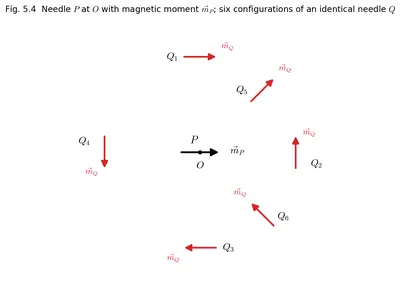
Figure 5.4 shows a small magnetised needle P placed at a point O. The arrow shows the direction of its magnetic moment. The other arrows show different positions (and orientations of the magnetic moment) of another identical magnetised needle Q.

Figure 5.4
Figure 5.4

(a) In which configuration the system is not in equilibrium?

Solution

The needle P at O has its magnetic moment $$\vec{m}_P$$ pointing vertically upward. P sets up a magnetic field whose form depends on direction:

On the axis of P (vertically above or below O), the field is parallel to $$\vec{m}_P$$:

$$\vec{B}_P = \dfrac{\mu_0}{4\pi}\dfrac{2\vec{m}_P}{r^3}$$

On the normal bisector of P (horizontally to the left or right of O), the field is anti-parallel to $$\vec{m}_P$$:

$$\vec{B}_P = -\dfrac{\mu_0}{4\pi}\dfrac{\vec{m}_P}{r^3}$$

A needle Q is in equilibrium only when its moment $$\vec{m}_Q$$ is along $$\vec{B}_P$$ (parallel ⇒ stable) or opposite to it (anti-parallel ⇒ unstable). If $$\vec{m}_Q$$ is perpendicular to $$\vec{B}_P$$, a torque $$\tau = m_Q B_P\sin\theta$$ acts and there is no equilibrium.

Q1 and Q2 lie on the normal bisector, where $$\vec{B}_P$$ points vertically (downward). Their moments point horizontally — i.e. perpendicular to $$\vec{B}_P$$ — so a non-zero torque acts on them.

The system is not in equilibrium in configurations PQ1 and PQ2.

Answer

PQ1 and PQ2.

(b) In which configuration is the system in (i) stable, and (ii) unstable equilibrium?

Solution

Equilibrium occurs when $$\vec{m}_Q$$ lies along $$\vec{B}_P$$ (parallel ⇒ stable, lowest energy) or opposite to $$\vec{B}_P$$ (anti-parallel ⇒ unstable, highest energy). Recall that $$\vec{m}_P$$ points up; on P's axis $$\vec{B}_P$$ is parallel to $$\vec{m}_P$$ (points up), while on P's normal bisector $$\vec{B}_P$$ is anti-parallel to $$\vec{m}_P$$ (points down).

Q3: on the normal bisector ⇒ $$\vec{B}_P$$ points down; $$\vec{m}_{Q3}$$ points down ⇒ parallel ⇒ stable.

Q6: on the axis (below P) ⇒ $$\vec{B}_P$$ points up; $$\vec{m}_{Q6}$$ points up ⇒ parallel ⇒ stable.

Q4: on the axis (above P) ⇒ $$\vec{B}_P$$ points up; $$\vec{m}_{Q4}$$ points down ⇒ anti-parallel ⇒ unstable.

Q5: on the normal bisector ⇒ $$\vec{B}_P$$ points down; $$\vec{m}_{Q5}$$ points up ⇒ anti-parallel ⇒ unstable.

Therefore: (i) stable equilibrium in PQ3 and PQ6; (ii) unstable equilibrium in PQ5 and PQ4.

Answer

(i) Stable: PQ3 and PQ6. (ii) Unstable: PQ5 and PQ4.

(c) Which configuration corresponds to the lowest potential energy among all the configurations shown?

Solution

The potential energy of needle Q in P's field is $$U = -\vec{m}_Q\cdot\vec{B}_P$$. It is most negative (lowest) when $$\vec{m}_Q$$ is parallel to $$\vec{B}_P$$ — that is, in a stable configuration. The two stable configurations are PQ3 and PQ6, so the lowest energy is one of these.

To choose between them, compare the strength of $$\vec{B}_P$$ at the two locations, both at the same distance $$r$$ from O:

  • Q3 is on the normal bisector: $$B_P = \dfrac{\mu_0}{4\pi}\dfrac{m_P}{r^3}$$
  • Q6 is on the axis: $$B_P = \dfrac{\mu_0}{4\pi}\dfrac{2m_P}{r^3}$$

The axial field is twice the equatorial field at the same distance. For a stable configuration $$U = -m_Q B_P$$, so the larger value of $$B_P$$ gives the more negative (lower) energy.

Hence PQ6 has the lowest potential energy among all the configurations shown.

Answer

PQ6.

Example 5.3

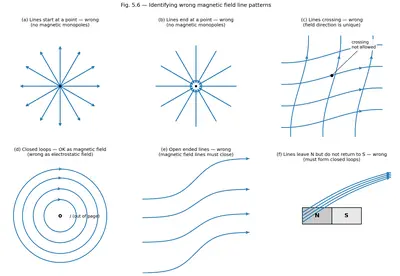
Many of the diagrams given in Fig. 5.6 show magnetic field lines (thick lines in the figure) wrongly. Point out what is wrong with them. Some of them may describe electrostatic field lines correctly. Point out which ones.
Fig. 5.6
Fig. 5.6

Solution

(a) Wrong. Magnetic field lines can never emanate from a point. Over any closed surface the net flux of $$\vec{B}$$ must be zero, so as many lines must enter a surface as leave it. The lines drawn here actually represent the electric field of a long, positively charged straight wire. The correct magnetic field lines of a straight current-carrying conductor are concentric circles around it.

(b) Wrong. Magnetic field lines (like electric field lines) can never cross one another — at a crossing point the direction of the field would be ambiguous. There is a further error: a closed loop of a static magnetic field line must enclose a region through which a current passes, so magnetostatic field lines cannot form closed loops around empty space. (Electrostatic field lines, by contrast, can never form closed loops at all.)

(c) Right. The magnetic field lines are completely confined within the toroid and form closed loops, each loop enclosing a region across which current passes. (For clarity only a few of the interior lines are drawn; in fact the entire region enclosed by the windings contains field.)

(d) Wrong. The field lines of a solenoid cannot be perfectly straight and confined at its ends and outside; such a picture violates Ampère's law. The lines must curve outwards at both ends and eventually meet to form closed loops.

(e) Right. These are the field lines inside and outside a bar magnet. Note carefully the direction of the lines inside the magnet: not all lines emanate out of the N pole or converge into the S pole — around both the N pole and the S pole the net flux of the field is zero.

(f) Wrong. These cannot be magnetic field lines: all the lines appear to emanate from the shaded plate, so the net flux through a surface surrounding that plate would be non-zero, which is impossible for a magnetic field. They are in fact the electrostatic field lines around a positively charged upper plate and a negatively charged lower plate.

(g) Wrong. Magnetic field lines between two pole pieces cannot be exactly straight right up to the ends — some fringing of the lines is inevitable, otherwise Ampère's law would be violated. (The same fringing is true of electric field lines between charged plates.)

Answer

Wrong: (a), (b), (d), (f), (g). Correct (as magnetic field lines): (c) [toroid] and (e) [bar magnet]. Diagrams (a) and (f) correctly depict electrostatic field lines.

Example 5.4

(a) Magnetic field lines show the direction (at every point) along which a small magnetised needle aligns (at the point). Do the magnetic field lines also represent the lines of force on a moving charged particle at every point?

Solution

No. Magnetic field lines give the direction along which a small compass needle aligns, but they do not represent the lines of force on a moving charged particle.

The force on a charge $$q$$ moving with velocity $$\vec{v}$$ in a field $$\vec{B}$$ is

$$\vec{F} = q\,\vec{v}\times\vec{B}$$

Because of the cross product, $$\vec{F}$$ is always perpendicular to $$\vec{B}$$ (and to $$\vec{v}$$). The force is therefore never directed along the field line. For this reason it is misleading to call magnetic field lines 'lines of force'.

Answer

No. The magnetic force $$q\vec{v}\times\vec{B}$$ is always perpendicular to $$\vec{B}$$, so field lines are not lines of force on a moving charge.

(b) If magnetic monopoles existed, how would the Gauss's law of magnetism be modified?

Solution

Gauss's law of magnetism states that the net magnetic flux through any closed surface is zero:

$$\oint_S \vec{B}\cdot d\vec{S} = 0$$

This holds precisely because isolated magnetic poles (monopoles) do not exist — there is no magnetic 'charge' to act as a source or sink of $$\vec{B}$$.

If magnetic monopoles did exist, the law would be modified — in analogy with Gauss's law of electrostatics — so that the right-hand side equals the enclosed magnetic charge:

$$\oint_S \vec{B}\cdot d\vec{S} = \mu_0\, q_m$$

where $$q_m$$ is the total magnetic (monopole) charge enclosed by the surface $$S$$.

Answer

It would become $$\oint_S \vec{B}\cdot d\vec{S} = \mu_0 q_m$$, where $$q_m$$ is the enclosed magnetic monopole charge (instead of being zero).

(c) Does a bar magnet exert a torque on itself due to its own field? Does one element of a current-carrying wire exert a force on another element of the same wire?

Solution

A bar magnet exerts no torque on itself. A system cannot exert a net force or torque on itself through the field it produces — the internal forces between its parts cancel in pairs (Newton's third law). So a bar magnet feels no torque due to its own field.

One element of a current-carrying wire does, in general, exert a force on another element of the same wire. The field produced by one current element acts on a different element, so there is an internal force (and torque) between elements of the same wire. No element, however, exerts a force on itself. For the special case of a straight wire, the net force on any element due to the rest of the wire works out to be zero.

Answer

No, a bar magnet exerts no torque on itself. Yes, one current element exerts a force on another element of the same wire (this net force is zero for a straight wire).

(d) Magnetic field arises due to charges in motion. Can a system have magnetic moments even though its net charge is zero?

Solution

Yes. A magnetic moment does not require a net charge — it requires charges in motion (current loops).

In a system the total (net) electric charge can be zero, yet the individual charges may still circulate and constitute current loops, each with its own magnetic moment. If these elementary moments do not all cancel, the system possesses a net magnetic moment despite its zero net charge.

A real example is a paramagnetic material: its atoms are electrically neutral (net charge zero), but the orbital and spin motions of their electrons give each atom a net magnetic dipole moment.

Answer

Yes. Even with zero net charge, moving charges form current loops; if their magnetic moments do not cancel, the system has a net magnetic moment (e.g. the atoms of a paramagnetic material).

Example 5.5 A solenoid has a core of a material with relative permeability 400. The windings of the solenoid are insulated from the core and carry a current of 2A. If the number of turns is 1000 per metre, calculate (a) $$H$$, (b) $$M$$, (c) $$B$$ and (d) the magnetising current $$I_m$$.

Solution

Given: relative permeability $$\mu_r = 400$$, current in windings $$I = 2\,\mathrm{A}$$, number of turns per unit length $$n = 1000\,\mathrm{m^{-1}}$$.

(a) Magnetic intensity $$H$$. The field $$H$$ is set by the free (conduction) current in the windings alone — it does not depend on the core material:

$$H = nI = 1000\times 2.0 = 2\times 10^{3}\,\mathrm{A\,m^{-1}}$$

(b) Magnetisation $$M$$. Using $$M = \chi H$$ together with $$\chi = \mu_r - 1$$:

$$M = (\mu_r - 1)H = (400-1)\times 2\times 10^{3} = 399\times 2\times 10^{3}$$

$$M = 7.98\times 10^{5}\,\mathrm{A\,m^{-1}} \approx 8\times 10^{5}\,\mathrm{A\,m^{-1}}$$

(c) Magnetic field $$B$$. With the core present, $$B = \mu_r\mu_0 H$$:

$$B = 400\times(4\pi\times 10^{-7})\times(2\times 10^{3})$$

$$B = 400\times(1.2566\times 10^{-6})\times(2\times 10^{3})$$

$$B \approx 1.0\,\mathrm{T}$$

(d) Magnetising current $$I_m$$. The magnetising current is the additional current the windings would need to carry, in the absence of the core, to produce the same field $$B$$. Without a core, $$B = \mu_0 n (I + I_m)$$, so:

$$I + I_m = \dfrac{B}{\mu_0 n} = \dfrac{1.0}{(4\pi\times 10^{-7})(1000)} = \dfrac{1.0}{1.2566\times 10^{-3}}$$

$$I + I_m \approx 795.8\,\mathrm{A}$$

$$I_m = 795.8 - 2 \approx 794\,\mathrm{A}$$

Answer

(a) $$H = 2\times 10^{3}\,\mathrm{A\,m^{-1}}$$; (b) $$M \approx 8\times 10^{5}\,\mathrm{A\,m^{-1}}$$; (c) $$B \approx 1.0\,\mathrm{T}$$; (d) $$I_m \approx 794\,\mathrm{A}$$.

Exercises

5.1 A short bar magnet placed with its axis at $$30^\circ$$ with a uniform external magnetic field of $$0.25 \, \mathrm{T}$$ experiences a torque of magnitude equal to $$4.5 \times 10^{-2} \, \mathrm{J}$$. What is the magnitude of magnetic moment of the magnet?

Solution

A magnetic dipole of moment $$m$$ placed at an angle $$\theta$$ to a uniform field $$B$$ experiences a torque of magnitude

$$\tau = mB\sin\theta$$

Given: $$\theta = 30^\circ$$, $$B = 0.25\,\mathrm{T}$$, $$\tau = 4.5\times 10^{-2}\,\mathrm{J}$$.

Rearranging to find the magnetic moment:

$$m = \dfrac{\tau}{B\sin\theta} = \dfrac{4.5\times 10^{-2}}{0.25\times\sin 30^\circ}$$

$$m = \dfrac{4.5\times 10^{-2}}{0.25\times 0.5} = \dfrac{4.5\times 10^{-2}}{0.125}$$

$$m = 0.36\,\mathrm{J\,T^{-1}}$$

Answer

$$m = 0.36\,\mathrm{J\,T^{-1}}$$ (equivalently $$0.36\,\mathrm{A\,m^2}$$).

5.2 A short bar magnet of magnetic moment $$m = 0.32 \, \mathrm{J\,T^{-1}}$$ is placed in a uniform magnetic field of $$0.15 \, \mathrm{T}$$. If the bar is free to rotate in the plane of the field, which orientation would correspond to its (a) stable, and (b) unstable equilibrium? What is the potential energy of the magnet in each case?

Solution

The potential energy of a magnetic dipole of moment $$m$$ in a uniform field $$B$$, when its moment makes angle $$\theta$$ with the field, is

$$U(\theta) = -\vec{m}\cdot\vec{B} = -mB\cos\theta$$

Given: $$m = 0.32\,\mathrm{J\,T^{-1}}$$, $$B = 0.15\,\mathrm{T}$$.

(a) Stable equilibrium. $$U$$ is a minimum when $$\cos\theta$$ is maximum, i.e. at $$\theta = 0^\circ$$ — the moment is aligned parallel to the field. Then:

$$U_{\text{stable}} = -mB\cos 0^\circ = -mB = -(0.32)(0.15)$$

$$U_{\text{stable}} = -4.8\times 10^{-2}\,\mathrm{J}$$

(b) Unstable equilibrium. $$U$$ is a maximum when $$\theta = 180^\circ$$ — the moment is anti-parallel to the field. Then:

$$U_{\text{unstable}} = -mB\cos 180^\circ = +mB = +(0.32)(0.15)$$

$$U_{\text{unstable}} = +4.8\times 10^{-2}\,\mathrm{J}$$

Answer

(a) Stable: magnetic moment parallel to the field ($$\theta = 0^\circ$$), $$U = -4.8\times 10^{-2}\,\mathrm{J}$$. (b) Unstable: magnetic moment anti-parallel to the field ($$\theta = 180^\circ$$), $$U = +4.8\times 10^{-2}\,\mathrm{J}$$.

5.3 A closely wound solenoid of 800 turns and area of cross section $$2.5 \times 10^{-4} \, \mathrm{m^2}$$ carries a current of $$3.0 \, \mathrm{A}$$. Explain the sense in which the solenoid acts like a bar magnet. What is its associated magnetic moment?

Solution

A closely wound current-carrying solenoid produces an external field pattern exactly like that of a bar magnet: the field lines emerge from one end (which behaves as the north pole) and enter the other end (the south pole). The end from which the current, viewed face-on, appears to circulate anticlockwise acts as the N pole. In this sense the solenoid is equivalent to a bar magnet — it is a magnetic dipole: it produces a dipole field and experiences a torque when placed in an external magnetic field.

The magnetic moment of a coil of $$N$$ turns, each of area $$A$$, carrying current $$I$$ is

$$m = N I A$$

Given: $$N = 800$$, $$A = 2.5\times 10^{-4}\,\mathrm{m^2}$$, $$I = 3.0\,\mathrm{A}$$.

$$m = 800\times 3.0\times (2.5\times 10^{-4})$$

$$m = 2400\times 2.5\times 10^{-4}$$

$$m = 0.60\,\mathrm{J\,T^{-1}}$$

The moment is directed along the axis of the solenoid, pointing from its S end to its N end.

Answer

The solenoid acts as a bar magnet — one end is an N pole, the other an S pole, and it produces a dipole field. Its magnetic moment is $$m = NIA = 0.60\,\mathrm{J\,T^{-1}}$$ ($$=0.60\,\mathrm{A\,m^2}$$), directed along the axis.

5.4 If the solenoid in Exercise 5.5 is free to turn about the vertical direction and a uniform horizontal magnetic field of $$0.25 \, \mathrm{T}$$ is applied, what is the magnitude of torque on the solenoid when its axis makes an angle of $$30^\circ$$ with the direction of applied field?

Solution

(The reference to 'Exercise 5.5' is a misprint in the textbook — the solenoid intended is the one of Exercise 5.3, which has magnetic moment $$m = 0.60\,\mathrm{J\,T^{-1}}$$.)

The torque on a magnetic dipole of moment $$m$$ in a uniform field $$B$$, when the dipole axis makes angle $$\theta$$ with the field, is

$$\tau = mB\sin\theta$$

Given: $$m = 0.60\,\mathrm{J\,T^{-1}}$$, $$B = 0.25\,\mathrm{T}$$, $$\theta = 30^\circ$$.

$$\tau = (0.60)(0.25)\sin 30^\circ$$

$$\tau = (0.60)(0.25)(0.5)$$

$$\tau = 7.5\times 10^{-2}\,\mathrm{N\,m}$$

Answer

$$\tau = mB\sin\theta = 7.5\times 10^{-2}\,\mathrm{N\,m}$$.

5.5 A bar magnet of magnetic moment $$1.5 \, \mathrm{J\,T^{-1}}$$ lies aligned with the direction of a uniform magnetic field of $$0.22 \, \mathrm{T}$$.

(a) What is the amount of work required by an external torque to turn the magnet so as to align its magnetic moment: (i) normal to the field direction, (ii) opposite to the field direction?

Solution

The work done by an external torque in turning the magnet from an initial orientation $$\theta_1$$ to a final orientation $$\theta_2$$ equals the change in its potential energy ($$U = -mB\cos\theta$$):

$$W = U(\theta_2) - U(\theta_1) = -mB\cos\theta_2 - (-mB\cos\theta_1) = mB(\cos\theta_1 - \cos\theta_2)$$

Initially the magnet is aligned with the field, so $$\theta_1 = 0^\circ$$ and $$\cos\theta_1 = 1$$:

$$W = mB(1 - \cos\theta_2)$$

Given: $$m = 1.5\,\mathrm{J\,T^{-1}}$$, $$B = 0.22\,\mathrm{T}$$, so $$mB = 1.5\times 0.22 = 0.33\,\mathrm{J}$$.

(i) Moment normal to the field ($$\theta_2 = 90^\circ$$, $$\cos 90^\circ = 0$$):

$$W = mB(1 - 0) = mB = 0.33\,\mathrm{J}$$

(ii) Moment opposite to the field ($$\theta_2 = 180^\circ$$, $$\cos 180^\circ = -1$$):

$$W = mB\big(1 - (-1)\big) = 2mB = 2\times 0.33 = 0.66\,\mathrm{J}$$

Answer

(i) $$W = mB = 0.33\,\mathrm{J}$$. (ii) $$W = 2mB = 0.66\,\mathrm{J}$$.

(b) What is the torque on the magnet in cases (i) and (ii)?

Solution

The torque on the magnet in the field is

$$\tau = mB\sin\theta$$

with $$mB = 1.5\times 0.22 = 0.33\,\mathrm{J}$$.

(i) Moment normal to the field ($$\theta = 90^\circ$$):

$$\tau = mB\sin 90^\circ = 0.33\times 1 = 0.33\,\mathrm{N\,m}$$

This torque is a maximum, and it tends to rotate the magnet back into alignment with the field.

(ii) Moment opposite to the field ($$\theta = 180^\circ$$):

$$\tau = mB\sin 180^\circ = 0.33\times 0 = 0$$

The torque is zero — this anti-parallel orientation is an equilibrium position (an unstable one).

Answer

(i) $$\tau = mB\sin 90^\circ = 0.33\,\mathrm{N\,m}$$. (ii) $$\tau = mB\sin 180^\circ = 0$$.

5.6 A closely wound solenoid of 2000 turns and area of cross-section $$1.6 \times 10^{-4} \, \mathrm{m^2}$$, carrying a current of $$4.0 \, \mathrm{A}$$, is suspended through its centre allowing it to turn in a horizontal plane.

(a) What is the magnetic moment associated with the solenoid?

Solution

The magnetic moment of a closely wound solenoid (or coil) of $$N$$ turns, each of cross-sectional area $$A$$, carrying current $$I$$ is

$$m = N I A$$

Given: $$N = 2000$$, $$A = 1.6\times 10^{-4}\,\mathrm{m^2}$$, $$I = 4.0\,\mathrm{A}$$.

$$m = 2000\times 4.0\times (1.6\times 10^{-4})$$

$$m = 8000\times 1.6\times 10^{-4}$$

$$m = 1.28\,\mathrm{J\,T^{-1}}$$

The moment is directed along the axis of the solenoid.

Answer

$$m = NIA = 1.28\,\mathrm{J\,T^{-1}}$$ ($$=1.28\,\mathrm{A\,m^2}$$), directed along the axis of the solenoid.

(b) What is the force and torque on the solenoid if a uniform horizontal magnetic field of $$7.5 \times 10^{-2} \, \mathrm{T}$$ is set up at an angle of $$30^\circ$$ with the axis of the solenoid?

Solution

Force. The applied field is uniform. In a uniform field the forces on the two ends (poles) of the dipole are equal in magnitude and opposite in direction, so the net force is zero.

$$F = 0$$

Torque. The torque on the dipole is

$$\tau = mB\sin\theta$$

Given: $$m = 1.28\,\mathrm{J\,T^{-1}}$$ (from part a), $$B = 7.5\times 10^{-2}\,\mathrm{T}$$, $$\theta = 30^\circ$$.

$$\tau = (1.28)(7.5\times 10^{-2})\sin 30^\circ$$

$$\tau = (1.28)(7.5\times 10^{-2})(0.5)$$

$$\tau = 4.8\times 10^{-2}\,\mathrm{N\,m}$$

Answer

Force $$= 0$$ (the field is uniform). Torque $$\tau = mB\sin 30^\circ = 4.8\times 10^{-2}\,\mathrm{N\,m}$$.

5.7 A short bar magnet has a magnetic moment of $$0.48 \, \mathrm{J\,T^{-1}}$$. Give the direction and magnitude of the magnetic field produced by the magnet at a distance of $$10 \, \mathrm{cm}$$ from the centre of the magnet on (a) the axis, (b) the equatorial lines (normal bisector) of the magnet.

Solution

For a short bar magnet of moment $$m$$, at a distance $$r$$ much larger than the magnet's size, the field has standard forms on the axis and on the equatorial line.

Given: $$m = 0.48\,\mathrm{J\,T^{-1}}$$, $$r = 10\,\mathrm{cm} = 0.10\,\mathrm{m}$$, and $$\dfrac{\mu_0}{4\pi} = 10^{-7}\,\mathrm{T\,m\,A^{-1}}$$. Note that $$r^3 = (0.10)^3 = 10^{-3}\,\mathrm{m^3}$$.

(a) On the axis (end-on position). The axial field is

$$B_A = \dfrac{\mu_0}{4\pi}\dfrac{2m}{r^3}$$

$$B_A = 10^{-7}\times\dfrac{2\times 0.48}{10^{-3}} = 10^{-7}\times\dfrac{0.96}{10^{-3}}$$

$$B_A = 10^{-7}\times 960 = 9.6\times 10^{-5}\,\mathrm{T}$$

Its direction is along the axis, parallel to the magnetic moment — i.e. pointing from the S pole towards the N pole of the magnet (along the $$SN$$ direction).

(b) On the equatorial line (normal bisector, broadside-on position). The equatorial field is

$$B_E = \dfrac{\mu_0}{4\pi}\dfrac{m}{r^3}$$

$$B_E = 10^{-7}\times\dfrac{0.48}{10^{-3}} = 10^{-7}\times 480$$

$$B_E = 4.8\times 10^{-5}\,\mathrm{T}$$

Its direction is anti-parallel to the magnetic moment — i.e. parallel to the magnet's axis but pointing in the $$NS$$ direction (from N towards S). As expected, $$B_A = 2B_E$$ at the same distance.

Answer

(a) Axial field: $$B_A = \dfrac{\mu_0}{4\pi}\dfrac{2m}{r^3} = 9.6\times 10^{-5}\,\mathrm{T}$$, directed from S to N (parallel to the magnetic moment). (b) Equatorial field: $$B_E = \dfrac{\mu_0}{4\pi}\dfrac{m}{r^3} = 4.8\times 10^{-5}\,\mathrm{T}$$, directed anti-parallel to the magnetic moment (in the N→S direction).
NCERT Solutions for Class 12
Maths
NCERT Solutions for Class 12 Maths
Chapter-wise step-by-step
solutions with explanations
explore solutions Maths bg
Physics
NCERT Solutions for Class 12 Physics
Chapter-wise step-by-step
solutions with explanations
explore solutions Physics bg
Chemistry
NCERT Solutions for Class 12 Chemistry
Chapter-wise step-by-step
solutions with explanations
explore solutions Chemistry bg

Frequently Asked Questions

50,000+ JEE Students Trusted Our Score Calculator

Predict your JEE Main percentile, rank & performance in seconds