Join WhatsApp Icon JEE WhatsApp Group
NCERT Solutions for Class 12 Physics

Chapter 4: Moving Charges and Magnetism

Download Solutions PDF
Daily JEE Updates, Tips & Important Alerts
Join 30,000+ students and stay updated with JEE notifications and preparation insights.
Join Now!
Free PDF
Complete NCERT Solution PDF for Chapter 4: Moving Charges and Magnetism

NCERT Solutions For Class 12 Physics Chapter 4 Moving Charges and Magnetism helps students understand the relationship between moving electric charges and magnetic fields. The page provides complete NCERT Solutions that explain concepts such as magnetic force, Lorentz force, motion of charged particles, Biot-Savart law, Ampere’s law, and applications of magnetism. NCERT Solutions For Class 12 Physics simplify these concepts through diagrams, formulas, and detailed problem-solving methods. The chapter introduces important principles required for understanding electromagnetism and modern electrical devices. These solutions help students practise numerical questions and strengthen their conceptual understanding. Students can access the chapter PDF for revision and exam preparation. The detailed explanations make magnetic field concepts easier to understand and apply.
Download Solutions PDF

Examples 4.1-4.12

Example 4.1

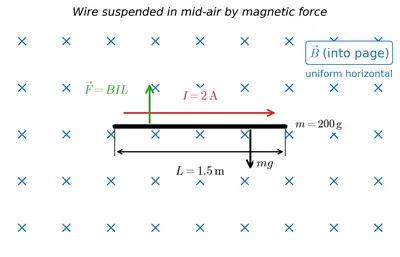
A straight wire of mass 200 g and length 1.5 m carries a current of 2 A. It is suspended in mid-air by a uniform horizontal magnetic field $$\mathbf{B}$$ (Fig. 4.3). What is the magnitude of the magnetic field?
Fig. 4.3
Fig. 4.3

Solution

For the wire to be suspended in mid-air, the upward magnetic force on the current-carrying wire must exactly balance its weight, which acts downward.

The weight of the wire is $$W = mg$$, and the magnetic force on a straight wire of length $$L$$ carrying a current $$I$$ in a field $$B$$ perpendicular to it is $$F = BIL$$.

For equilibrium the two are equal:

$$BIL = mg$$

$$B = \frac{mg}{IL}$$

Substituting $$m = 200 \, \mathrm{g} = 0.2 \, \mathrm{kg}$$, $$L = 1.5 \, \mathrm{m}$$, $$I = 2 \, \mathrm{A}$$ and $$g = 9.8 \, \mathrm{m/s^2}$$:

$$B = \frac{0.2 \times 9.8}{2 \times 1.5} = \frac{1.96}{3} \approx 0.65 \, \mathrm{T}$$

The field must be horizontal and perpendicular to the wire, directed so that the force $$I\,\mathbf{L}\times\mathbf{B}$$ points vertically upward.

Answer

$$B \approx 0.65 \, \mathrm{T}$$, horizontal and perpendicular to the wire (directed so that the magnetic force on the wire is vertically upward).

Example 4.2

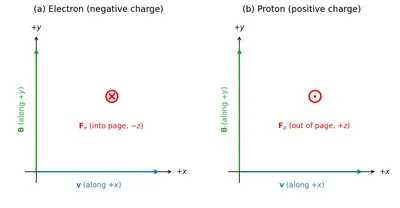
If the magnetic field is parallel to the positive $$y$$-axis and the charged particle is moving along the positive $$x$$-axis (Fig. 4.4), which way would the Lorentz force be for (a) an electron (negative charge), (b) a proton (positive charge).
Fig. 4.4
Fig. 4.4

Solution

The magnetic (Lorentz) force on a charge $$q$$ moving with velocity $$\mathbf{v}$$ in a field $$\mathbf{B}$$ is $$\mathbf{F} = q\,\mathbf{v}\times\mathbf{B}$$.

Here $$\mathbf{v} = v\,\hat{\mathbf{i}}$$ (along $$+x$$) and $$\mathbf{B} = B\,\hat{\mathbf{j}}$$ (along $$+y$$). The vector product is

$$\mathbf{v}\times\mathbf{B} = (v\,\hat{\mathbf{i}})\times(B\,\hat{\mathbf{j}}) = vB\,(\hat{\mathbf{i}}\times\hat{\mathbf{j}}) = vB\,\hat{\mathbf{k}}$$

So $$\mathbf{v}\times\mathbf{B}$$ points along the positive $$z$$-axis.

(a) Electron (charge $$q = -e$$):

$$\mathbf{F} = (-e)(vB\,\hat{\mathbf{k}}) = -evB\,\hat{\mathbf{k}}$$

The force is directed along the negative $$z$$-axis.

(b) Proton (charge $$q = +e$$):

$$\mathbf{F} = (+e)(vB\,\hat{\mathbf{k}}) = evB\,\hat{\mathbf{k}}$$

The force is directed along the positive $$z$$-axis.

The two forces are equal in magnitude and opposite in direction, as expected for charges of opposite sign moving the same way.

Answer

(a) For the electron the force is along the negative $$z$$-axis. (b) For the proton the force is along the positive $$z$$-axis.

Example 4.3 What is the radius of the path of an electron (mass $$9 \times 10^{-31} \, \mathrm{kg}$$ and charge $$1.6 \times 10^{-19} \, \mathrm{C}$$) moving at a speed of $$3 \times 10^{7} \, \mathrm{m/s}$$ in a magnetic field of $$6 \times 10^{-4} \, \mathrm{T}$$ perpendicular to it? What is its frequency? Calculate its energy in keV. ($$1 \, \mathrm{eV} = 1.6 \times 10^{-19} \, \mathrm{J}$$).

Solution

Radius of the path. The magnetic force provides the centripetal force needed for the circular motion:

$$qvB = \frac{mv^2}{r} \quad\Rightarrow\quad r = \frac{mv}{qB}$$

Substituting $$m = 9\times10^{-31}\,\mathrm{kg}$$, $$v = 3\times10^{7}\,\mathrm{m/s}$$, $$q = 1.6\times10^{-19}\,\mathrm{C}$$ and $$B = 6\times10^{-4}\,\mathrm{T}$$:

$$r = \frac{(9\times10^{-31})(3\times10^{7})}{(1.6\times10^{-19})(6\times10^{-4})} = \frac{2.7\times10^{-23}}{9.6\times10^{-23}} \approx 0.28 \, \mathrm{m}$$

Frequency. The frequency of revolution is

$$\nu = \frac{v}{2\pi r} = \frac{qB}{2\pi m}$$

$$\nu = \frac{(1.6\times10^{-19})(6\times10^{-4})}{2\pi(9\times10^{-31})} = \frac{9.6\times10^{-23}}{5.655\times10^{-30}} \approx 1.7\times10^{7} \, \mathrm{Hz}$$

That is about $$17 \, \mathrm{MHz}$$.

Energy. The kinetic energy of the electron is

$$E = \frac{1}{2}mv^2 = \frac{1}{2}(9\times10^{-31})(3\times10^{7})^2 = \frac{1}{2}(9\times10^{-31})(9\times10^{14})$$

$$E = 4.05\times10^{-16} \, \mathrm{J}$$

Converting to electron-volts using $$1 \, \mathrm{eV} = 1.6\times10^{-19} \, \mathrm{J}$$:

$$E = \frac{4.05\times10^{-16}}{1.6\times10^{-19}} \, \mathrm{eV} \approx 2.5\times10^{3} \, \mathrm{eV} = 2.5 \, \mathrm{keV}$$

Answer

$$r \approx 0.28 \, \mathrm{m}$$; frequency $$\nu \approx 1.7\times10^{7} \, \mathrm{Hz}$$ ($$\approx 17 \, \mathrm{MHz}$$); kinetic energy $$E \approx 2.5 \, \mathrm{keV}$$.

Example 4.4

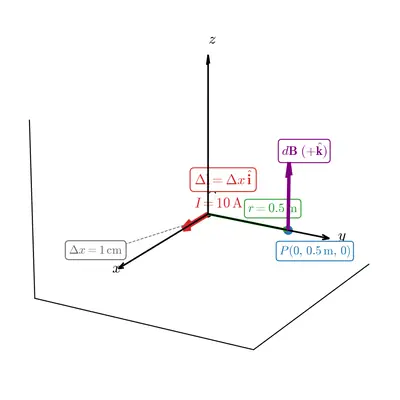
An element $$\Delta \mathbf{l} = \Delta x \, \hat{\mathbf{i}}$$ is placed at the origin and carries a large current $$I = 10 \, \mathrm{A}$$ (Fig. 4.8). What is the magnetic field on the $$y$$-axis at a distance of 0.5 m. $$\Delta x = 1 \, \mathrm{cm}$$.
Fig. 4.8
Fig. 4.8

Solution

The Biot–Savart law gives the field of a small current element as

$$\Delta\mathbf{B} = \frac{\mu_0}{4\pi}\,\frac{I\,\Delta\mathbf{l}\times\hat{\mathbf{r}}}{r^2}$$

Here the element $$\Delta\mathbf{l} = \Delta x\,\hat{\mathbf{i}}$$ sits at the origin, and the field point lies on the $$y$$-axis, so the position vector is $$\mathbf{r} = r\,\hat{\mathbf{j}}$$ with $$r = 0.5 \, \mathrm{m}$$. The element points along $$x$$ while $$\mathbf{r}$$ points along $$y$$, so the angle between them is $$90°$$ and $$\sin\theta = 1$$.

Magnitude.

$$\Delta B = \frac{\mu_0}{4\pi}\,\frac{I\,\Delta x\,\sin\theta}{r^2} = \frac{\mu_0}{4\pi}\,\frac{I\,\Delta x}{r^2}$$

With $$\dfrac{\mu_0}{4\pi} = 10^{-7} \, \mathrm{T\,m/A}$$, $$I = 10 \, \mathrm{A}$$, $$\Delta x = 1 \, \mathrm{cm} = 10^{-2}\,\mathrm{m}$$ and $$r = 0.5 \, \mathrm{m}$$:

$$\Delta B = 10^{-7}\times\frac{10\times10^{-2}}{(0.5)^2} = 10^{-7}\times\frac{0.1}{0.25} = 4\times10^{-8} \, \mathrm{T}$$

Direction. $$\Delta\mathbf{l}\times\mathbf{r} = (\Delta x\,\hat{\mathbf{i}})\times(r\,\hat{\mathbf{j}}) = \Delta x\,r\,(\hat{\mathbf{i}}\times\hat{\mathbf{j}}) = \Delta x\,r\,\hat{\mathbf{k}}$$, so the field points along the positive $$z$$-axis.

Answer

$$\Delta B = 4\times10^{-8} \, \mathrm{T}$$, directed along the positive $$z$$-axis.

Example 4.5

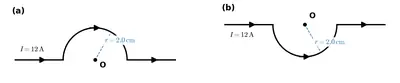
A straight wire carrying a current of 12 A is bent into a semi-circular arc of radius 2.0 cm as shown in Fig. 4.11(a). Consider the magnetic field $$\mathbf{B}$$ at the centre of the arc. (a) What is the magnetic field due to the straight segments? (b) In what way the contribution to $$\mathbf{B}$$ from the semicircle differs from that of a circular loop and in what way does it resemble? (c) Would your answer be different if the wire were bent into a semi-circular arc of the same radius but in the opposite way as shown in Fig. 4.11(b)?
Fig. 4.11
Fig. 4.11

Solution

(a) Field due to the straight segments. By the Biot–Savart law each current element contributes $$dB \propto I\,\mathbf{dl}\times\hat{\mathbf{r}}$$. For the two straight segments, every element lies along the straight line that passes through the centre of the arc, so $$\mathbf{dl}$$ and $$\hat{\mathbf{r}}$$ (the direction from the element to the centre) are either parallel or anti-parallel. Hence $$\mathbf{dl}\times\hat{\mathbf{r}} = 0$$ for every element.

Therefore the straight segments contribute nothing to the field at the centre: $$B_{\text{straight}} = 0$$.

(b) Field due to the semicircle. A full circular loop produces a field $$\mu_0 I/2R$$ at its centre. A semicircle is exactly half the loop, so it produces half this value:

$$B = \frac{1}{2}\cdot\frac{\mu_0 I}{2R} = \frac{\mu_0 I}{4R}$$

$$B = \frac{(4\pi\times10^{-7})(12)}{4\times(0.02)} = \frac{1.508\times10^{-5}}{0.08} \approx 1.9\times10^{-4} \, \mathrm{T}$$

It differs from a full loop in magnitude — it is exactly half as large. It resembles the full loop in direction: the field is normal to the plane of the arc, its sense given by the right-hand rule (here, directed into the page).

(c) Arc bent the opposite way. The magnitude of the field is unchanged, $$B \approx 1.9\times10^{-4} \, \mathrm{T}$$, since the geometry of the semicircle is identical. However, the sense in which the current circulates around the arc is reversed, so the direction of $$\mathbf{B}$$ is reversed — it would now point out of the page.

Answer

(a) Zero — the straight segments produce no field at the centre. (b) $$B = \dfrac{\mu_0 I}{4R} \approx 1.9\times10^{-4} \, \mathrm{T}$$ — half the magnitude of a full loop's field, but normal to the plane like a loop. (c) Same magnitude $$\approx 1.9\times10^{-4} \, \mathrm{T}$$, but the direction is reversed.

Example 4.6 Consider a tightly wound 100 turn coil of radius 10 cm, carrying a current of 1 A. What is the magnitude of the magnetic field at the centre of the coil?

Solution

The magnetic field at the centre of a tightly wound coil of $$N$$ turns, radius $$R$$, carrying a current $$I$$ is the field of a single loop multiplied by the number of turns:

$$B = \frac{\mu_0 N I}{2R}$$

Substituting $$N = 100$$, $$I = 1 \, \mathrm{A}$$, $$R = 10 \, \mathrm{cm} = 0.1 \, \mathrm{m}$$ and $$\mu_0 = 4\pi\times10^{-7} \, \mathrm{T\,m/A}$$:

$$B = \frac{(4\pi\times10^{-7})(100)(1)}{2\times0.1} = \frac{1.2566\times10^{-4}}{0.2}$$

$$B \approx 6.28\times10^{-4} \, \mathrm{T}$$

Answer

$$B \approx 6.28\times10^{-4} \, \mathrm{T}$$ (i.e. $$2\pi\times10^{-4} \, \mathrm{T}$$).

Example 4.7

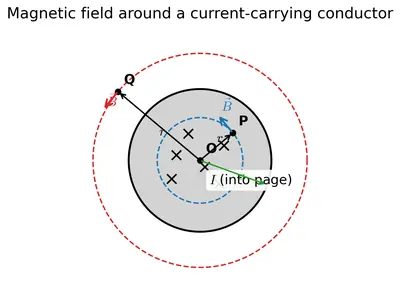
Figure 4.13 shows a long straight wire of a circular cross-section (radius $$a$$) carrying steady current $$I$$. The current $$I$$ is uniformly distributed across this cross-section. Calculate the magnetic field in the region $$r < a$$ and $$r > a$$.
Figure 4.13
Figure 4.13

Solution

Because the current is uniformly distributed and the wire has circular symmetry, the field $$\mathbf{B}$$ is tangential to circles drawn concentric with the wire's axis, and its magnitude is constant on each such circle. We therefore apply Ampère's circuital law on an Amperian loop that is a circle of radius $$r$$:

$$\oint\mathbf{B}\cdot\mathbf{dl} = \mu_0 I_{\text{enc}} \quad\Rightarrow\quad B\,(2\pi r) = \mu_0 I_{\text{enc}}$$

Region $$r > a$$ (outside the wire). The Amperian loop encloses the entire current $$I$$:

$$B\,(2\pi r) = \mu_0 I \quad\Rightarrow\quad B = \frac{\mu_0 I}{2\pi r}$$

The field falls off as $$1/r$$, exactly as for a thin straight wire.

Region $$r < a$$ (inside the wire). Since the current is uniform, the current enclosed by a circle of radius $$r$$ is the total current scaled by the ratio of areas:

$$I_{\text{enc}} = I\,\frac{\pi r^2}{\pi a^2} = I\,\frac{r^2}{a^2}$$

Ampère's law then gives

$$B\,(2\pi r) = \mu_0 I\,\frac{r^2}{a^2} \quad\Rightarrow\quad B = \frac{\mu_0 I r}{2\pi a^2}$$

Inside the wire the field grows linearly with $$r$$. At the surface $$r = a$$ both expressions give the same value, $$B = \dfrac{\mu_0 I}{2\pi a}$$, so the field is continuous there.

Answer

For $$r < a$$: $$B = \dfrac{\mu_0 I r}{2\pi a^2}$$ (rises linearly with $$r$$). For $$r > a$$: $$B = \dfrac{\mu_0 I}{2\pi r}$$ (falls off as $$1/r$$). The two expressions agree at the surface $$r = a$$.

Example 4.8 A solenoid of length 0.5 m has a radius of 1 cm and is made up of 500 turns. It carries a current of 5 A. What is the magnitude of the magnetic field inside the solenoid?

Solution

The number of turns per unit length of the solenoid is

$$n = \frac{N}{L} = \frac{500}{0.5} = 1000 \, \mathrm{turns/m}$$

The solenoid is long compared with its radius ($$L = 0.5 \, \mathrm{m}$$ versus $$r = 1 \, \mathrm{cm}$$), so we may treat it as an ideal solenoid, for which the field deep inside is uniform and given by

$$B = \mu_0 n I$$

Substituting $$n = 1000 \, \mathrm{m^{-1}}$$, $$I = 5 \, \mathrm{A}$$ and $$\mu_0 = 4\pi\times10^{-7} \, \mathrm{T\,m/A}$$:

$$B = (4\pi\times10^{-7})(1000)(5) = 4\pi\times10^{-7}\times5000$$

$$B \approx 6.28\times10^{-3} \, \mathrm{T}$$

Answer

$$B \approx 6.28\times10^{-3} \, \mathrm{T}$$ (i.e. $$2\pi\times10^{-3} \, \mathrm{T}$$).

Example 4.9 The horizontal component of the earth's magnetic field at a certain place is $$3.0 \times 10^{-5} \, \mathrm{T}$$ and the direction of the field is from the geographic south to the geographic north. A very long straight conductor is carrying a steady current of 1A. What is the force per unit length on it when it is placed on a horizontal table and the direction of the current is (a) east to west; (b) south to north?

Solution

The force per unit length on a straight conductor carrying current $$I$$ in a field $$B$$ is

$$f = \frac{F}{L} = I B\sin\theta$$

where $$\theta$$ is the angle between the current direction and $$\mathbf{B}$$. Here $$B = 3.0\times10^{-5} \, \mathrm{T}$$ points from geographic south to north, and $$I = 1 \, \mathrm{A}$$.

(a) Current from east to west. The current (east-to-west) is perpendicular to the field (south-to-north), so $$\theta = 90°$$:

$$f = I B \sin 90° = (1)(3.0\times10^{-5})(1) = 3.0\times10^{-5} \, \mathrm{N/m}$$

For the direction, $$\mathbf{F} = I\,\mathbf{L}\times\mathbf{B}$$: with the current pointing west and $$\mathbf{B}$$ pointing north, the cross product gives a force directed vertically downward.

(b) Current from south to north. Now the current is parallel to the field, so $$\theta = 0°$$:

$$f = I B \sin 0° = 0$$

There is no force on the conductor.

Answer

(a) $$f = 3.0\times10^{-5} \, \mathrm{N/m}$$, directed vertically downward. (b) $$f = 0$$ (the current is parallel to the field).

Example 4.10

A 100 turn closely wound circular coil of radius 10 cm carries a current of 3.2 A. (a) What is the field at the centre of the coil? (b) What is the magnetic moment of this coil?

The coil is placed in a vertical plane and is free to rotate about a horizontal axis which coincides with its diameter. A uniform magnetic field of 2T in the horizontal direction exists such that initially the axis of the coil is in the direction of the field. The coil rotates through an angle of $$90°$$ under the influence of the magnetic field. (c) What are the magnitudes of the torques on the coil in the initial and final position? (d) What is the angular speed acquired by the coil when it has rotated by $$90°$$? The moment of inertia of the coil is $$0.1 \, \mathrm{kg \, m^{2}}$$.

Solution

(a) Field at the centre of the coil.

$$B = \frac{\mu_0 N I}{2R} = \frac{(4\pi\times10^{-7})(100)(3.2)}{2\times0.10}$$

$$B = \frac{4.02\times10^{-4}}{0.20} \approx 2.0\times10^{-3} \, \mathrm{T}$$

(b) Magnetic moment of the coil. The moment is $$m = N I A$$, with $$A = \pi R^2$$:

$$m = N I \pi R^2 = (100)(3.2)\,\pi\,(0.10)^2 = 3.2\pi \approx 10 \, \mathrm{A\,m^2}$$

(c) Torques in the initial and final positions. The torque on the coil is $$\tau = mB\sin\theta$$, where $$\theta$$ is the angle between the magnetic moment $$\mathbf{m}$$ (along the coil's axis) and $$\mathbf{B}$$.

Initial position: the axis of the coil is along $$\mathbf{B}$$, so $$\theta = 0°$$ and

$$\tau_{\text{initial}} = mB\sin 0° = 0$$

Final position: the coil has turned through $$90°$$, so $$\theta = 90°$$ and

$$\tau_{\text{final}} = mB\sin 90° = (10)(2) = 20 \, \mathrm{N\,m}$$

(d) Angular speed after rotating $$90°$$. The work done by the magnetic torque as the coil turns from $$\theta = 0$$ to $$\theta = 90°$$ goes entirely into rotational kinetic energy:

$$W = \int_0^{\pi/2} \tau\,d\theta = \int_0^{\pi/2} mB\sin\theta\,d\theta = mB\big[-\cos\theta\big]_0^{\pi/2} = mB$$

Setting this equal to $$\tfrac{1}{2}I\omega^2$$:

$$mB = \frac{1}{2}I\omega^2 \quad\Rightarrow\quad \omega = \sqrt{\frac{2mB}{I}}$$

$$\omega = \sqrt{\frac{2\times20}{0.1}} = \sqrt{400} = 20 \, \mathrm{rad/s}$$

Answer

(a) $$B \approx 2.0\times10^{-3} \, \mathrm{T}$$. (b) $$m \approx 10 \, \mathrm{A\,m^2}$$. (c) $$\tau_{\text{initial}} = 0$$, $$\tau_{\text{final}} = 20 \, \mathrm{N\,m}$$. (d) $$\omega = 20 \, \mathrm{rad/s}$$.

Example 4.11

(a) A current-carrying circular loop lies on a smooth horizontal plane. Can a uniform magnetic field be set up in such a manner that the loop turns around itself (i.e., turns about the vertical axis).

Solution

No, a uniform magnetic field cannot make the loop turn about its own (vertical) axis.

The torque on a current loop of magnetic moment $$\mathbf{m}$$ in a field $$\mathbf{B}$$ is

$$\boldsymbol{\tau} = \mathbf{m}\times\mathbf{B}$$

By the property of the cross product, this torque is always perpendicular to $$\mathbf{m}$$.

For a loop lying flat on a horizontal plane, the magnetic moment $$\mathbf{m}$$ points vertically (up or down). Hence the torque $$\mathbf{m}\times\mathbf{B}$$ is always horizontal, whatever the direction of the uniform field $$\mathbf{B}$$. A purely horizontal torque can only tip or tilt the loop out of the horizontal plane; it can never have a vertical component.

Turning the loop "around itself" about the vertical axis would require a torque along the vertical. Since a uniform field can never supply such a torque on this loop, the loop cannot be made to spin about its vertical axis.

Answer

No. The torque $$\mathbf{m}\times\mathbf{B}$$ is always perpendicular to $$\mathbf{m}$$; since $$\mathbf{m}$$ is vertical, the torque is horizontal and can never rotate the loop about its vertical axis.

(b) A current-carrying circular loop is located in a uniform external magnetic field. If the loop is free to turn, what is its orientation of stable equilibrium? Show that in this orientation, the flux of the total field (external field + field produced by the loop) is maximum.

Solution

The potential energy of a current loop of moment $$\mathbf{m}$$ placed in an external field $$\mathbf{B}$$ is

$$U = -\mathbf{m}\cdot\mathbf{B} = -mB\cos\theta$$

where $$\theta$$ is the angle between $$\mathbf{m}$$ and $$\mathbf{B}$$. The energy is a minimum when $$\cos\theta = 1$$, i.e. $$\theta = 0$$.

So the orientation of stable equilibrium is the one in which the magnetic moment $$\mathbf{m}$$ of the loop is parallel to the external field $$\mathbf{B}$$ (equivalently, the plane of the loop is perpendicular to $$\mathbf{B}$$).

Flux is maximum in this orientation. The flux of the external field through the loop is

$$\Phi_{\text{ext}} = BA\cos\theta$$

which is greatest when $$\theta = 0$$, i.e. when $$\mathbf{m}$$ is along $$\mathbf{B}$$.

The loop also produces its own magnetic field. By the right-hand rule, this self-field threads the loop in the same direction as $$\mathbf{m}$$. When $$\mathbf{m}\parallel\mathbf{B}$$, the loop's self-field through the loop points the same way as the external field, so the two fluxes add constructively.

Therefore, in the stable-equilibrium orientation the external flux is maximum and the self-flux reinforces it — the flux of the total field (external + self) through the loop is a maximum.

Answer

Stable equilibrium occurs when the loop's magnetic moment $$\mathbf{m}$$ is parallel to $$\mathbf{B}$$ (the plane of the loop perpendicular to $$\mathbf{B}$$). In this orientation the external flux $$BA\cos\theta$$ is maximum and the loop's own field adds to it, so the total flux is maximum.

(c) A loop of irregular shape carrying current is located in an external magnetic field. If the wire is flexible, why does it change to a circular shape?

Solution

A flexible wire can change its shape, but its length (the perimeter of the loop) is fixed. Among all plane shapes of a given perimeter, the circle encloses the maximum area.

When the loop carries a current in an external field, the magnetic forces on its current elements act outward and tend to expand the loop. Expanding the loop increases the area $$A$$ and hence the flux $$\Phi = BA\cos\theta$$ threading it; equivalently, it lowers the magnetic potential energy of the configuration.

So the loop deforms in the direction that maximises the enclosed area for its fixed perimeter. The shape that achieves this maximum area is a circle. Hence an irregular flexible current loop changes into a circular shape.

Answer

Because, for a given (fixed) perimeter, a circle encloses the maximum area. The outward magnetic forces expand the loop to maximise the enclosed area and hence the flux, so a flexible loop deforms into a circle.

Example 4.12

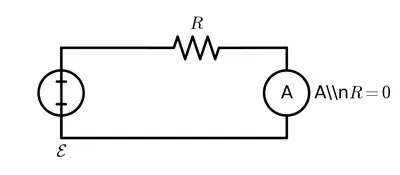
In the circuit (Fig. 4.23) the current is to be measured. What is the value of the current if the ammeter shown (a) is a galvanometer with a resistance $$R_G = 60.00 \, \Omega$$; (b) is a galvanometer described in (a) but converted to an ammeter by a shunt resistance $$r_s = 0.02 \, \Omega$$; (c) is an ideal ammeter with zero resistance?
Fig. 4.23
Fig. 4.23

Solution

The circuit (Fig. 4.23) consists of a cell of emf $$\varepsilon = 3 \, \mathrm{V}$$ in series with a resistance $$R = 3 \, \Omega$$ and the measuring instrument. The current is $$I = \dfrac{\varepsilon}{R_{\text{total}}}$$, where $$R_{\text{total}}$$ must include the resistance of the instrument itself.

(a) The instrument is the bare galvanometer ($$R_G = 60.00 \, \Omega$$). Its large resistance adds to the circuit:

$$R_{\text{total}} = R + R_G = 3 + 60 = 63 \, \Omega$$

$$I = \frac{\varepsilon}{R + R_G} = \frac{3}{63} \approx 0.048 \, \mathrm{A}$$

The instrument badly disturbs the circuit — the measured current is far below the true value.

(b) Galvanometer converted to an ammeter with a shunt $$r_s = 0.02 \, \Omega$$. The ammeter's effective resistance is the parallel combination of $$R_G$$ and $$r_s$$:

$$R_A = \frac{R_G\,r_s}{R_G + r_s} = \frac{60\times0.02}{60 + 0.02} = \frac{1.2}{60.02} \approx 0.02 \, \Omega$$

$$R_{\text{total}} = R + R_A = 3 + 0.02 = 3.02 \, \Omega$$

$$I = \frac{\varepsilon}{R + R_A} = \frac{3}{3.02} \approx 0.99 \, \mathrm{A}$$

A properly shunted ammeter has a very small resistance and reads almost the true current.

(c) Ideal ammeter ($$R_A = 0$$):

$$I = \frac{\varepsilon}{R} = \frac{3}{3} = 1.00 \, \mathrm{A}$$

This is the true current in the circuit. Comparing the three cases shows clearly why an ammeter must have as small a resistance as possible.

Answer

(a) $$I = \dfrac{3}{63} \approx 0.048 \, \mathrm{A}$$. (b) $$I = \dfrac{3}{3.02} \approx 0.99 \, \mathrm{A}$$. (c) $$I = \dfrac{3}{3} = 1.00 \, \mathrm{A}$$ (the true current).

Exercises

4.1 A circular coil of wire consisting of 100 turns, each of radius 8.0 cm carries a current of 0.40 A. What is the magnitude of the magnetic field $$\mathbf{B}$$ at the centre of the coil?

Solution

The magnetic field at the centre of a circular coil of $$N$$ turns, each of radius $$R$$, carrying a current $$I$$ is

$$B = \frac{\mu_0 N I}{2R}$$

Here $$N = 100$$, $$R = 8.0 \, \mathrm{cm} = 0.080 \, \mathrm{m}$$, $$I = 0.40 \, \mathrm{A}$$ and $$\mu_0 = 4\pi\times10^{-7} \, \mathrm{T\,m/A}$$.

$$B = \frac{(4\pi\times10^{-7})(100)(0.40)}{2\times0.080} = \frac{5.03\times10^{-5}}{0.16}$$

$$B \approx 3.1\times10^{-4} \, \mathrm{T}$$

The field is directed along the axis of the coil, its sense given by the right-hand rule.

Answer

$$B \approx 3.1\times10^{-4} \, \mathrm{T}$$, directed along the axis of the coil.

4.2 A long straight wire carries a current of 35 A. What is the magnitude of the field $$\mathbf{B}$$ at a point 20 cm from the wire?

Solution

The magnetic field at a perpendicular distance $$r$$ from a long straight wire carrying a current $$I$$ is

$$B = \frac{\mu_0 I}{2\pi r}$$

Substituting $$I = 35 \, \mathrm{A}$$, $$r = 20 \, \mathrm{cm} = 0.20 \, \mathrm{m}$$ and $$\dfrac{\mu_0}{2\pi} = 2\times10^{-7} \, \mathrm{T\,m/A}$$:

$$B = \frac{(2\times10^{-7})(35)}{0.20} = \frac{7\times10^{-6}}{0.20}$$

$$B = 3.5\times10^{-5} \, \mathrm{T}$$

Answer

$$B = 3.5\times10^{-5} \, \mathrm{T}$$.

4.3 A long straight wire in the horizontal plane carries a current of 50 A in north to south direction. Give the magnitude and direction of $$\mathbf{B}$$ at a point 2.5 m east of the wire.

Solution

The magnitude of the field at a perpendicular distance $$r$$ from a long straight wire is

$$B = \frac{\mu_0 I}{2\pi r}$$

With $$I = 50 \, \mathrm{A}$$, $$r = 2.5 \, \mathrm{m}$$ and $$\dfrac{\mu_0}{2\pi} = 2\times10^{-7} \, \mathrm{T\,m/A}$$:

$$B = \frac{(2\times10^{-7})(50)}{2.5} = \frac{10^{-5}}{2.5} = 4\times10^{-6} \, \mathrm{T}$$

Direction. The current flows from north to south, and the field point lies to the east of the wire. Apply the right-hand rule: point the thumb of the right hand along the current (towards the south); the curled fingers then give the sense of $$\mathbf{B}$$ around the wire. On the eastern side of the wire the fingers point upward, so the magnetic field at this point is directed vertically upward.

Answer

$$B = 4\times10^{-6} \, \mathrm{T}$$, directed vertically upward.

4.4 A horizontal overhead power line carries a current of 90 A in east to west direction. What is the magnitude and direction of the magnetic field due to the current 1.5 m below the line?

Solution

The magnitude of the field at a perpendicular distance $$r$$ from a long straight wire is

$$B = \frac{\mu_0 I}{2\pi r}$$

With $$I = 90 \, \mathrm{A}$$, $$r = 1.5 \, \mathrm{m}$$ and $$\dfrac{\mu_0}{2\pi} = 2\times10^{-7} \, \mathrm{T\,m/A}$$:

$$B = \frac{(2\times10^{-7})(90)}{1.5} = \frac{1.8\times10^{-5}}{1.5} = 1.2\times10^{-5} \, \mathrm{T}$$

Direction. The current flows from east to west, and the field point is directly below the line. Apply the right-hand rule: point the thumb along the current (towards the west); the curled fingers give the sense of $$\mathbf{B}$$. At a point below the wire the fingers point towards the south, so the magnetic field there is directed towards the south.

Answer

$$B = 1.2\times10^{-5} \, \mathrm{T}$$, directed towards the south.

4.5 What is the magnitude of magnetic force per unit length on a wire carrying a current of 8 A and making an angle of $$30°$$ with the direction of a uniform magnetic field of 0.15 T?

Solution

The magnetic force per unit length on a current-carrying wire is

$$f = \frac{F}{L} = I B \sin\theta$$

where $$\theta$$ is the angle between the wire (the current direction) and the field $$\mathbf{B}$$.

Substituting $$I = 8 \, \mathrm{A}$$, $$B = 0.15 \, \mathrm{T}$$ and $$\theta = 30°$$:

$$f = (8)(0.15)\sin 30° = (8)(0.15)(0.5)$$

$$f = 0.6 \, \mathrm{N/m}$$

Answer

$$f = 0.6 \, \mathrm{N/m}$$.

4.6 A 3.0 cm wire carrying a current of 10 A is placed inside a solenoid perpendicular to its axis. The magnetic field inside the solenoid is given to be 0.27 T. What is the magnetic force on the wire?

Solution

Inside a solenoid the magnetic field is uniform and directed along the axis. The wire is placed perpendicular to this axis, so the angle between the current direction and the field is $$\theta = 90°$$.

The magnetic force on a straight current-carrying wire is

$$F = B I L \sin\theta$$

Substituting $$B = 0.27 \, \mathrm{T}$$, $$I = 10 \, \mathrm{A}$$, $$L = 3.0 \, \mathrm{cm} = 0.03 \, \mathrm{m}$$ and $$\theta = 90°$$:

$$F = (0.27)(10)(0.03)\sin 90° = (0.27)(10)(0.03)(1)$$

$$F = 8.1\times10^{-2} \, \mathrm{N}$$

The force is perpendicular both to the wire and to the axis of the solenoid.

Answer

$$F = 8.1\times10^{-2} \, \mathrm{N}$$ ($$= 0.081 \, \mathrm{N}$$), perpendicular to both the wire and the solenoid axis.

4.7 Two long and parallel straight wires A and B carrying currents of 8.0 A and 5.0 A in the same direction are separated by a distance of 4.0 cm. Estimate the force on a 10 cm section of wire A.

Solution

Two long parallel wires carrying currents $$I_A$$ and $$I_B$$ and separated by a distance $$d$$ exert a force on each other. The force per unit length is

$$f = \frac{\mu_0 I_A I_B}{2\pi d}$$

Substituting $$I_A = 8.0 \, \mathrm{A}$$, $$I_B = 5.0 \, \mathrm{A}$$, $$d = 4.0 \, \mathrm{cm} = 0.04 \, \mathrm{m}$$ and $$\dfrac{\mu_0}{2\pi} = 2\times10^{-7} \, \mathrm{T\,m/A}$$:

$$f = \frac{(2\times10^{-7})(8.0)(5.0)}{0.04} = \frac{8.0\times10^{-6}}{0.04} = 2\times10^{-4} \, \mathrm{N/m}$$

The force on a section of length $$L = 10 \, \mathrm{cm} = 0.10 \, \mathrm{m}$$ of wire A is therefore

$$F = f\,L = (2\times10^{-4})(0.10) = 2\times10^{-5} \, \mathrm{N}$$

Since the two currents flow in the same direction, the force between the wires is attractive. (By Newton's third law, the force on an equal section of wire B is the same in magnitude.)

Answer

$$F = 2\times10^{-5} \, \mathrm{N}$$ on the 10 cm section, directed towards wire B (attractive, since the currents are in the same direction).

4.8 A closely wound solenoid 80 cm long has 5 layers of windings of 400 turns each. The diameter of the solenoid is 1.8 cm. If the current carried is 8.0 A, estimate the magnitude of $$\mathbf{B}$$ inside the solenoid near its centre.

Solution

The total number of turns is the number of layers multiplied by the turns per layer:

$$N = 5\times400 = 2000 \, \mathrm{turns}$$

The number of turns per unit length is

$$n = \frac{N}{L} = \frac{2000}{0.80} = 2500 \, \mathrm{turns/m}$$

For a long solenoid the field near the centre is uniform and given by

$$B = \mu_0 n I$$

Substituting $$n = 2500 \, \mathrm{m^{-1}}$$, $$I = 8.0 \, \mathrm{A}$$ and $$\mu_0 = 4\pi\times10^{-7} \, \mathrm{T\,m/A}$$:

$$B = (4\pi\times10^{-7})(2500)(8.0)$$

$$B \approx 2.5\times10^{-2} \, \mathrm{T}$$

(The diameter $$1.8 \, \mathrm{cm}$$ is small compared with the length $$80 \, \mathrm{cm}$$, which justifies using the ideal long-solenoid formula.)

Answer

$$B \approx 2.5\times10^{-2} \, \mathrm{T}$$ ($$= 8\pi\times10^{-3} \, \mathrm{T}$$).

4.9 A square coil of side 10 cm consists of 20 turns and carries a current of 12 A. The coil is suspended vertically and the normal to the plane of the coil makes an angle of $$30°$$ with the direction of a uniform horizontal magnetic field of magnitude 0.80 T. What is the magnitude of torque experienced by the coil?

Solution

The torque on a current-carrying coil of $$N$$ turns and area $$A$$ placed in a uniform field $$B$$ is

$$\tau = N I A B \sin\theta$$

where $$\theta$$ is the angle between the normal to the plane of the coil and $$\mathbf{B}$$.

The coil is a square of side $$10 \, \mathrm{cm} = 0.10 \, \mathrm{m}$$, so its area is

$$A = (0.10)^2 = 0.01 \, \mathrm{m^2}$$

Substituting $$N = 20$$, $$I = 12 \, \mathrm{A}$$, $$A = 0.01 \, \mathrm{m^2}$$, $$B = 0.80 \, \mathrm{T}$$ and $$\theta = 30°$$:

$$\tau = (20)(12)(0.01)(0.80)\sin 30°$$

$$\tau = (20)(12)(0.01)(0.80)(0.5) = 0.96 \, \mathrm{N\,m}$$

Answer

$$\tau = 0.96 \, \mathrm{N\,m}$$.

4.10

Two moving coil meters, $$\mathrm{M_1}$$ and $$\mathrm{M_2}$$ have the following particulars:

$$R_1 = 10 \, \Omega$$, $$N_1 = 30$$,
$$A_1 = 3.6 \times 10^{-3} \, \mathrm{m^2}$$, $$B_1 = 0.25 \, \mathrm{T}$$
$$R_2 = 14 \, \Omega$$, $$N_2 = 42$$,
$$A_2 = 1.8 \times 10^{-3} \, \mathrm{m^2}$$, $$B_2 = 0.50 \, \mathrm{T}$$

(The spring constants are identical for the two meters).

Determine the ratio of (a) current sensitivity and (b) voltage sensitivity of $$\mathrm{M_2}$$ and $$\mathrm{M_1}$$.

Solution

For a moving-coil galvanometer with $$N$$ turns, coil area $$A$$, field $$B$$, coil resistance $$R$$ and spring (torsion) constant $$k$$, the equilibrium deflection $$\phi$$ satisfies $$k\phi = NIAB$$. Hence:

Current sensitivity (deflection per unit current):

$$\frac{\phi}{I} = \frac{N B A}{k}$$

Voltage sensitivity (deflection per unit voltage, with $$V = IR$$):

$$\frac{\phi}{V} = \frac{\phi}{IR} = \frac{N B A}{k R}$$

(a) Ratio of current sensitivities ($$\mathrm{M_2}$$ to $$\mathrm{M_1}$$). Since the spring constant $$k$$ is the same for both meters, it cancels:

$$\frac{(\phi/I)_2}{(\phi/I)_1} = \frac{N_2 B_2 A_2}{N_1 B_1 A_1}$$

$$= \frac{(42)(0.50)(1.8\times10^{-3})}{(30)(0.25)(3.6\times10^{-3})} = \frac{0.0378}{0.0270} = 1.4$$

So the current sensitivity of $$\mathrm{M_2}$$ is $$1.4$$ times that of $$\mathrm{M_1}$$.

(b) Ratio of voltage sensitivities ($$\mathrm{M_2}$$ to $$\mathrm{M_1}$$):

$$\frac{(\phi/V)_2}{(\phi/V)_1} = \frac{N_2 B_2 A_2}{N_1 B_1 A_1}\times\frac{R_1}{R_2} = 1.4\times\frac{10}{14}$$

$$= 1.4\times0.714 = 1.0$$

So the voltage sensitivities of the two meters are equal.

Answer

(a) Ratio of current sensitivities $$\mathrm{M_2}:\mathrm{M_1} = 1.4$$. (b) Ratio of voltage sensitivities $$\mathrm{M_2}:\mathrm{M_1} = 1.0$$ (equal).

4.11 In a chamber, a uniform magnetic field of 6.5 G ($$1 \, \mathrm{G} = 10^{-4} \, \mathrm{T}$$) is maintained. An electron is shot into the field with a speed of $$4.8 \times 10^{6} \, \mathrm{m \, s^{-1}}$$ normal to the field. Explain why the path of the electron is a circle. Determine the radius of the circular orbit. ($$e = 1.5 \times 10^{-19} \, \mathrm{C}$$, $$m_e = 9.1 \times 10^{-31} \, \mathrm{kg}$$)

Solution

Why the path is a circle. The magnetic force on the moving electron is $$\mathbf{F} = -e\,\mathbf{v}\times\mathbf{B}$$. This force is always perpendicular to the velocity $$\mathbf{v}$$, so it does no work on the electron — the speed $$v$$ (and hence the kinetic energy) stays constant. A force of constant magnitude that always acts perpendicular to a constant-speed velocity is exactly a centripetal force: it continually changes the direction of $$\mathbf{v}$$ without changing its magnitude. Since the electron is shot in normal to $$\mathbf{B}$$, it stays in the plane perpendicular to $$\mathbf{B}$$ and moves in a circle at constant speed (uniform circular motion).

Radius of the orbit. The magnetic force supplies the centripetal force:

$$e v B = \frac{m_e v^2}{r} \quad\Rightarrow\quad r = \frac{m_e v}{e B}$$

Here $$B = 6.5 \, \mathrm{G} = 6.5\times10^{-4} \, \mathrm{T}$$ and $$v = 4.8\times10^{6} \, \mathrm{m\,s^{-1}}$$. Taking the electronic charge to be its standard value $$e = 1.6\times10^{-19} \, \mathrm{C}$$ and $$m_e = 9.1\times10^{-31} \, \mathrm{kg}$$:

$$r = \frac{(9.1\times10^{-31})(4.8\times10^{6})}{(1.6\times10^{-19})(6.5\times10^{-4})}$$

$$r = \frac{4.368\times10^{-24}}{1.04\times10^{-22}} \approx 4.2\times10^{-2} \, \mathrm{m}$$

So the radius of the circular orbit is about $$4.2 \, \mathrm{cm}$$. (The charge of the electron is $$1.6\times10^{-19} \, \mathrm{C}$$; the value $$1.5\times10^{-19} \, \mathrm{C}$$ quoted in the question is a misprint.)

Answer

The magnetic force is always perpendicular to $$\mathbf{v}$$, so it does no work and only turns the velocity — acting as a centripetal force, it makes the path a circle. Its radius is $$r = \dfrac{m_e v}{eB} \approx 4.2\times10^{-2} \, \mathrm{m}$$ ($$\approx 4.2 \, \mathrm{cm}$$).

4.12 In Exercise 4.11 obtain the frequency of revolution of the electron in its circular orbit. Does the answer depend on the speed of the electron? Explain.

Solution

For the uniform circular motion of the electron, the time taken for one revolution (the period) is

$$T = \frac{2\pi r}{v}$$

Using the radius found in Exercise 4.11, $$r = \dfrac{m_e v}{eB}$$, the period becomes

$$T = \frac{2\pi}{v}\cdot\frac{m_e v}{eB} = \frac{2\pi m_e}{eB}$$

The frequency of revolution is therefore

$$\nu = \frac{1}{T} = \frac{eB}{2\pi m_e}$$

Substituting $$e = 1.6\times10^{-19} \, \mathrm{C}$$, $$B = 6.5\times10^{-4} \, \mathrm{T}$$ and $$m_e = 9.1\times10^{-31} \, \mathrm{kg}$$:

$$\nu = \frac{(1.6\times10^{-19})(6.5\times10^{-4})}{2\pi(9.1\times10^{-31})} = \frac{1.04\times10^{-22}}{5.718\times10^{-30}}$$

$$\nu \approx 1.8\times10^{7} \, \mathrm{Hz} \;(\approx 18 \, \mathrm{MHz})$$

Does it depend on the speed? No. The final expression $$\nu = \dfrac{eB}{2\pi m_e}$$ contains only $$e$$, $$B$$ and $$m_e$$ — the speed $$v$$ has cancelled out. Physically, if the electron moves faster, its orbit radius grows in exact proportion ($$r\propto v$$), so the longer path is covered in the same time. Hence the frequency of revolution is independent of the electron's speed (and of the radius of the orbit). This speed-independent frequency is the cyclotron frequency.

Answer

$$\nu = \dfrac{eB}{2\pi m_e} \approx 1.8\times10^{7} \, \mathrm{Hz}$$ ($$\approx 18 \, \mathrm{MHz}$$). It does not depend on the speed of the electron, since $$v$$ cancels out ($$r\propto v$$, so the period stays the same).

4.13

(a) A circular coil of 30 turns and radius 8.0 cm carrying a current of 6.0 A is suspended vertically in a uniform horizontal magnetic field of magnitude 1.0 T. The field lines make an angle of $$60°$$ with the normal of the coil. Calculate the magnitude of the counter torque that must be applied to prevent the coil from turning.

Solution

The torque on a current-carrying coil in a uniform magnetic field is

$$\tau = N I A B \sin\theta$$

where $$\theta$$ is the angle between the field and the normal to the coil. To hold the coil still, the applied counter torque must equal this magnetic torque in magnitude.

The coil is circular with radius $$R = 8.0 \, \mathrm{cm} = 0.080 \, \mathrm{m}$$, so its area is

$$A = \pi R^2 = \pi(0.080)^2 = 2.01\times10^{-2} \, \mathrm{m^2}$$

Substituting $$N = 30$$, $$I = 6.0 \, \mathrm{A}$$, $$B = 1.0 \, \mathrm{T}$$ and $$\theta = 60°$$:

$$\tau = (30)(6.0)(2.01\times10^{-2})(1.0)\sin 60°$$

$$\tau = (30)(6.0)(2.01\times10^{-2})(1.0)(0.866)$$

$$\tau \approx 3.1 \, \mathrm{N\,m}$$

So a counter torque of about $$3.1 \, \mathrm{N\,m}$$ must be applied to prevent the coil from turning.

Answer

Counter torque $$\tau \approx 3.1 \, \mathrm{N\,m}$$.

(b) Would your answer change, if the circular coil in (a) were replaced by a planar coil of some irregular shape that encloses the same area? (All other particulars are also unaltered.)

Solution

No, the answer would not change.

The torque on a planar current loop in a uniform field is

$$\boldsymbol{\tau} = N I \,\mathbf{A}\times\mathbf{B}, \qquad \tau = N I A B\sin\theta$$

This expression depends only on the magnitude of the area $$A$$ enclosed by the loop (through the area vector $$\mathbf{A}$$) — it does not involve the shape of the boundary at all.

So any planar coil, however irregular its shape, that encloses the same area $$A$$, carries the same current, has the same number of turns and is held at the same angle in the same field, experiences exactly the same torque.

Hence replacing the circular coil by an irregular planar coil of the same area leaves the torque (and the required counter torque) unchanged at about $$3.1 \, \mathrm{N\,m}$$.

Answer

No. The torque $$\tau = NIAB\sin\theta$$ depends only on the area enclosed, not on the shape of the loop, so it remains $$\approx 3.1 \, \mathrm{N\,m}$$.
NCERT Solutions for Class 12
Maths
NCERT Solutions for Class 12 Maths
Chapter-wise step-by-step
solutions with explanations
explore solutions Maths bg
Physics
NCERT Solutions for Class 12 Physics
Chapter-wise step-by-step
solutions with explanations
explore solutions Physics bg
Chemistry
NCERT Solutions for Class 12 Chemistry
Chapter-wise step-by-step
solutions with explanations
explore solutions Chemistry bg

Frequently Asked Questions

50,000+ JEE Students Trusted Our Score Calculator

Predict your JEE Main percentile, rank & performance in seconds