Join WhatsApp Icon JEE WhatsApp Group
NCERT Solutions for Class 12 Physics

Chapter 2: Electrostatic Potential and Capacitance

Download Solutions PDF
Daily JEE Updates, Tips & Important Alerts
Join 30,000+ students and stay updated with JEE notifications and preparation insights.
Join Now!
Free PDF
Complete NCERT Solution PDF for Chapter 2: Electrostatic Potential and Capacitance

NCERT Solutions For Class 12 Physics Chapter 2 Electrostatic Potential and Capacitance helps students explore the concepts related to electric potential, potential difference, and storage of electrical energy. The page provides comprehensive NCERT Solutions that explain electric potential, capacitance, capacitors, dielectric materials, and combinations of capacitors. NCERT Solutions For Class 12 Physics make these topics easier with clear explanations, important formulas, and solved examples. The chapter helps students understand how electrical energy is stored and used in various devices. These solutions guide learners through textbook questions and numerical problems with proper methods. Students can access the chapter PDF for revision, practice, and board exam preparation. The detailed explanations help students develop a strong understanding of electrostatic concepts.
Download Solutions PDF

Examples

Example 2.1

  1. Calculate the potential at a point P due to a charge of $$4 \times 10^{-7} \, \mathrm{C}$$ located 9 cm away.
  2. Hence obtain the work done in bringing a charge of $$2 \times 10^{-9} \, \mathrm{C}$$ from infinity to the point P. Does the answer depend on the path along which the charge is brought?

Solution

Part (1): Potential at P

The potential at a point at distance $$r$$ from a point charge $$q$$ is $$V = \dfrac{1}{4\pi\varepsilon_0}\dfrac{q}{r}$$.

Here $$q = 4 \times 10^{-7}\,\mathrm{C}$$, $$r = 9\,\mathrm{cm} = 9 \times 10^{-2}\,\mathrm{m}$$, and $$\dfrac{1}{4\pi\varepsilon_0} = 9 \times 10^{9}\,\mathrm{N\,m^2\,C^{-2}}$$.

$$V = \dfrac{(9 \times 10^{9})(4 \times 10^{-7})}{9 \times 10^{-2}}$$

$$V = \dfrac{3600}{9 \times 10^{-2}} = 4 \times 10^{4}\,\mathrm{V}$$

Part (2): Work done

The work done in bringing a charge $$q_0$$ from infinity (where the potential is zero) to a point where the potential is $$V$$ is $$W = q_0 V$$.

With $$q_0 = 2 \times 10^{-9}\,\mathrm{C}$$:

$$W = (2 \times 10^{-9})(4 \times 10^{4}) = 8 \times 10^{-5}\,\mathrm{J}$$

No, the work done does not depend on the path. The electrostatic force is conservative, so the work done depends only on the initial and final positions of the charge, not on the route taken to move it.

Answer

Potential at P is $$V = 4 \times 10^{4}\,\mathrm{V}$$; the work done is $$W = 8 \times 10^{-5}\,\mathrm{J}$$. The work is independent of the path.

Example 2.2 Two charges $$3 \times 10^{-8} \, \mathrm{C}$$ and $$-2 \times 10^{-8} \, \mathrm{C}$$ are located 15 cm apart. At what point on the line joining the two charges is the electric potential zero? Take the potential at infinity to be zero.

Solution

Let the charges be $$q_1 = 3 \times 10^{-8}\,\mathrm{C}$$ at point A and $$q_2 = -2 \times 10^{-8}\,\mathrm{C}$$ at point B, with $$\mathrm{AB} = 15\,\mathrm{cm}$$.

The total potential at a point is the algebraic sum of the potentials due to each charge. We look for points on the line AB where this sum is zero.

Case 1: Point P between the charges.

Let P be at a distance $$x$$ (in cm) from A, so it is $$(15 - x)$$ cm from B.

$$V = \dfrac{1}{4\pi\varepsilon_0}\left[\dfrac{q_1}{x} + \dfrac{q_2}{15-x}\right] = 0$$

$$\dfrac{3 \times 10^{-8}}{x} + \dfrac{-2 \times 10^{-8}}{15-x} = 0$$

$$\dfrac{3}{x} = \dfrac{2}{15-x}$$

$$3(15 - x) = 2x \quad\Rightarrow\quad 45 - 3x = 2x \quad\Rightarrow\quad 5x = 45 \quad\Rightarrow\quad x = 9\,\mathrm{cm}$$

So the potential is zero at a point 9 cm from the charge $$q_1$$ (i.e. 6 cm from $$q_2$$).

Case 2: Point P outside, beyond B.

Let P be at a distance $$x$$ (in cm) from A, beyond B, so it is $$(x - 15)$$ cm from B.

$$\dfrac{3 \times 10^{-8}}{x} + \dfrac{-2 \times 10^{-8}}{x-15} = 0$$

$$\dfrac{3}{x} = \dfrac{2}{x-15}$$

$$3(x - 15) = 2x \quad\Rightarrow\quad 3x - 45 = 2x \quad\Rightarrow\quad x = 45\,\mathrm{cm}$$

(On the side beyond A the larger positive charge always dominates, so there is no zero of potential there.)

Hence the potential is zero at two points on the line: 9 cm from $$q_1$$ (between the charges), and 45 cm from $$q_1$$ (i.e. 30 cm beyond $$q_2$$).

Answer

The electric potential is zero at two points on the line joining the charges: one 9 cm from the $$3 \times 10^{-8}\,\mathrm{C}$$ charge (between the charges), and another 45 cm from it (30 cm beyond the $$-2 \times 10^{-8}\,\mathrm{C}$$ charge).

Example 2.3

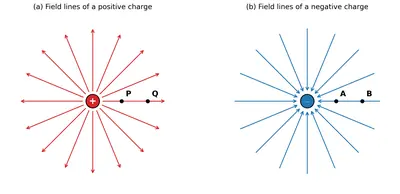
Figures 2.8 (a) and (b) show the field lines of a positive and negative point charge respectively.

  1. Give the signs of the potential difference $$V_P - V_Q$$; $$V_B - V_A$$.
  2. Give the sign of the potential energy difference of a small negative charge between the points Q and P; A and B.
  3. Give the sign of the work done by the field in moving a small positive charge from Q to P.
  4. Give the sign of the work done by the external agency in moving a small negative charge from B to A.
  5. Does the kinetic energy of a small negative charge increase or decrease in going from B to A?
Figures 2.8
Figures 2.8

Solution

In Fig. 2.8(a) the field lines belong to a positive point charge, with P nearer the charge than Q. In Fig. 2.8(b) they belong to a negative point charge, with A nearer the charge than B.

(1) Signs of the potential differences

For a point charge, $$V \propto \dfrac{q}{r}$$.

Near a positive charge, $$V$$ is positive and decreases with distance. Since P is closer than Q, $$V_P > V_Q$$, so $$V_P - V_Q$$ is positive.

Near a negative charge, $$V$$ is negative and its magnitude decreases with distance. B is farther, so $$V_B$$ is less negative than $$V_A$$; thus $$V_B > V_A$$, and $$V_B - V_A$$ is positive.

(2) Sign of the potential energy difference of a small negative charge

The potential energy of a charge $$q$$ at a point of potential $$V$$ is $$U = qV$$. For a negative charge, $$q = -|q|$$.

Between Q and P: $$U_Q - U_P = -|q|(V_Q - V_P)$$. Since $$V_Q - V_P < 0$$, this gives $$U_Q - U_P > 0$$ — positive.

Between A and B: $$U_A - U_B = -|q|(V_A - V_B)$$. Since $$V_A - V_B < 0$$, this gives $$U_A - U_B > 0$$ — positive.

(3) Sign of the work done by the field in moving a small positive charge from Q to P

The work done by the field is $$W_{field} = q(V_Q - V_P)$$. With $$q > 0$$ and $$V_Q - V_P < 0$$, $$W_{field}$$ is negative. (To carry a positive charge from low to high potential, work must be done against the field.)

(4) Sign of the work done by the external agency in moving a small negative charge from B to A

The work done by an external agency (moving the charge slowly) is $$W_{ext} = q(V_A - V_B)$$. With $$q = -|q| < 0$$ and $$V_A - V_B < 0$$, the product is positive.

(5) Kinetic energy of a small negative charge going from B to A

From part (2), the potential energy of the negative charge is greater at A than at B ($$U_A > U_B$$). By conservation of energy, $$KE + U = \text{constant}$$, so as $$U$$ increases the kinetic energy must decrease. (Physically, the negative test charge is repelled by the negative source charge, so it slows down as it approaches A.)

Answer

(1) $$V_P - V_Q > 0$$ and $$V_B - V_A > 0$$ (both positive). (2) Both PE differences, $$U_Q - U_P$$ and $$U_A - U_B$$, are positive. (3) Work done by the field is negative. (4) Work done by the external agency is positive. (5) The kinetic energy decreases from B to A.

Example 2.4

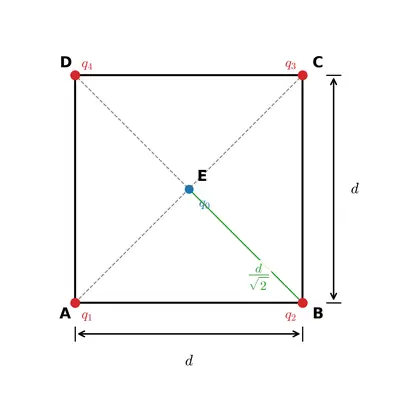
Four charges are arranged at the corners of a square ABCD of side $$d$$, as shown in Fig. 2.15.
  1. Find the work required to put together this arrangement.
  2. A charge $$q_0$$ is brought to the centre E of the square, the four charges being held fixed at its corners. How much extra work is needed to do this?
Fig. 2.15
Fig. 2.15

Solution

From Fig. 2.15 the corners carry charges $$+q$$ at A, $$-q$$ at B, $$+q$$ at C and $$-q$$ at D (like charges at opposite corners).

Part (1): Work to put together this arrangement

The work required equals the total electrostatic potential energy of the configuration, which is the sum of the potential energies of every distinct pair of charges:

$$U_{pair} = \dfrac{1}{4\pi\varepsilon_0}\dfrac{q_iq_j}{r_{ij}}$$

There are 6 pairs. The four sides AB, BC, CD, DA each have length $$d$$; the two diagonals AC and BD each have length $$d\sqrt{2}$$.

Sides — each side joins a $$+q$$ and a $$-q$$, so each contributes $$\dfrac{1}{4\pi\varepsilon_0}\dfrac{(+q)(-q)}{d} = -\dfrac{q^2}{4\pi\varepsilon_0 d}$$. The four sides together give $$-\dfrac{4q^2}{4\pi\varepsilon_0 d}$$.

Diagonals — AC joins $$+q$$ and $$+q$$; BD joins $$-q$$ and $$-q$$. Each contributes $$+\dfrac{1}{4\pi\varepsilon_0}\dfrac{q^2}{d\sqrt2}$$. The two diagonals together give $$+\dfrac{2q^2}{4\pi\varepsilon_0\,d\sqrt2}$$.

Adding all six pairs:

$$W = \dfrac{q^2}{4\pi\varepsilon_0 d}\left[-4 + \dfrac{2}{\sqrt2}\right] = \dfrac{q^2}{4\pi\varepsilon_0 d}\left[-4 + \sqrt2\right]$$

$$W = -\dfrac{q^2}{4\pi\varepsilon_0 d}\left(4 - \sqrt2\right)$$

The work is negative, which means the assembled configuration has lower energy than the fully separated charges; energy is in fact released in assembling it. (Putting the charges together in any other order gives the same total, since electrostatic energy is independent of the order of assembly.)

Part (2): Extra work to bring $$q_0$$ to the centre E

The extra work needed is $$W' = q_0 V_E$$, where $$V_E$$ is the potential at the centre E due to the four corner charges.

The centre of the square is equidistant from all four corners; that distance is half the diagonal, $$r = \dfrac{d\sqrt2}{2} = \dfrac{d}{\sqrt2}$$.

$$V_E = \dfrac{1}{4\pi\varepsilon_0}\left[\dfrac{+q}{r} + \dfrac{-q}{r} + \dfrac{+q}{r} + \dfrac{-q}{r}\right] = 0$$

Since the two $$+q$$ and two $$-q$$ charges are all the same distance from E, the potential due to A and C is exactly cancelled by that due to B and D. Therefore

$$W' = q_0 V_E = 0$$

No extra work is needed to bring the charge $$q_0$$ to the centre.

Answer

(1) Work required $$W = -\dfrac{q^2}{4\pi\varepsilon_0 d}(4 - \sqrt2)$$ (energy is released). (2) The potential at the centre is zero, so the extra work to bring $$q_0$$ there is zero.

Example 2.5

  1. Determine the electrostatic potential energy of a system consisting of two charges $$7 \, \mathrm{\mu C}$$ and $$-2 \, \mathrm{\mu C}$$ (and with no external field) placed at $$(-9 \, \mathrm{cm}, 0, 0)$$ and $$(9 \, \mathrm{cm}, 0, 0)$$ respectively.
  2. How much work is required to separate the two charges infinitely away from each other?
  3. Suppose that the same system of charges is now placed in an external electric field $$E = A(1/r^2)$$; $$A = 9 \times 10^5 \, \mathrm{NC^{-1} \, m^2}$$. What would the electrostatic energy of the configuration be?

Solution

Part (1): Potential energy of the two-charge system

The two charges are $$q_1 = 7\,\mathrm{\mu C} = 7 \times 10^{-6}\,\mathrm{C}$$ and $$q_2 = -2\,\mathrm{\mu C} = -2 \times 10^{-6}\,\mathrm{C}$$, placed at $$(-9\,\mathrm{cm},0,0)$$ and $$(9\,\mathrm{cm},0,0)$$. Their separation is $$r = 18\,\mathrm{cm} = 0.18\,\mathrm{m}$$.

$$U = \dfrac{1}{4\pi\varepsilon_0}\dfrac{q_1q_2}{r} = (9 \times 10^{9})\dfrac{(7 \times 10^{-6})(-2 \times 10^{-6})}{0.18}$$

$$U = (9 \times 10^{9})\dfrac{-14 \times 10^{-12}}{0.18} = -0.7\,\mathrm{J}$$

Part (2): Work to separate the charges infinitely

When the charges are infinitely far apart, the potential energy is zero. The work done by an external agency equals the change in potential energy:

$$W = U_{final} - U_{initial} = 0 - (-0.7\,\mathrm{J}) = 0.7\,\mathrm{J}$$

Part (3): Electrostatic energy in the external field

The external field is $$E = A/r^2$$ with $$A = 9 \times 10^{5}\,\mathrm{N\,C^{-1}\,m^2}$$. The corresponding external potential (that of a point-type source) is $$V(r) = A/r$$.

Each charge lies at a distance $$r = 9\,\mathrm{cm} = 0.09\,\mathrm{m}$$ from the origin, so the external potential at the location of each charge is

$$V = \dfrac{A}{r} = \dfrac{9 \times 10^{5}}{0.09} = 1 \times 10^{7}\,\mathrm{V}$$

The energy of the two charges in the external field is

$$U_{ext} = q_1V + q_2V = (7 \times 10^{-6})(10^{7}) + (-2 \times 10^{-6})(10^{7})$$

$$U_{ext} = 70 - 20 = 50\,\mathrm{J}$$

The total electrostatic energy is the sum of this and the mutual interaction energy of the pair (unchanged from Part 1):

$$U_{total} = U_{ext} + U_{mutual} = 50\,\mathrm{J} + (-0.7\,\mathrm{J}) = 49.3\,\mathrm{J}$$

Answer

(1) $$U = -0.7\,\mathrm{J}$$. (2) Work required to separate the charges $$= 0.7\,\mathrm{J}$$. (3) Total electrostatic energy $$= 49.3\,\mathrm{J}$$.

Example 2.6 A molecule of a substance has a permanent electric dipole moment of magnitude $$10^{-29} \, \mathrm{C \, m}$$. A mole of this substance is polarised (at low temperature) by applying a strong electrostatic field of magnitude $$10^6 \, \mathrm{V \, m^{-1}}$$. The direction of the field is suddenly changed by an angle of $$60^\circ$$. Estimate the heat released by the substance in aligning its dipoles along the new direction of the field. For simplicity, assume 100% polarisation of the sample.

Solution

Each molecule has a dipole moment $$p = 10^{-29}\,\mathrm{C\,m}$$. One mole contains Avogadro's number $$N = 6.023 \times 10^{23}$$ molecules. The field magnitude is $$E = 10^{6}\,\mathrm{V\,m^{-1}}$$.

The potential energy of a dipole making angle $$\theta$$ with the field is $$U(\theta) = -pE\cos\theta$$.

Initially, with 100% polarisation, every dipole is aligned with the field: $$\theta = 0$$, so the energy per dipole is $$U_i = -pE$$.

When the field direction is suddenly turned through $$60^\circ$$, each dipole momentarily makes an angle of $$60^\circ$$ with the new field, with energy $$U = -pE\cos 60^\circ$$. The dipoles then swing round to line up with the new direction ($$\theta = 0$$ again).

The heat released per dipole equals the drop in its potential energy as it realigns:

$$\Delta U = \big(-pE\cos 60^\circ\big) - \big(-pE\big) = pE\,(1 - \cos 60^\circ)$$

$$\Delta U = pE\left(1 - \tfrac{1}{2}\right) = \tfrac{1}{2}pE$$

For one mole (all $$N$$ dipoles), the total heat released is

$$Q = \tfrac{1}{2}\,NpE = \tfrac{1}{2}\,(6.023 \times 10^{23})(10^{-29})(10^{6})$$

$$Q = \tfrac{1}{2}\,(6.023 \times 10^{\,23-29+6}) = \tfrac{1}{2}\,(6.023) \approx 3\,\mathrm{J}$$

So the substance releases about 3 J of heat in re-aligning its dipoles along the new field direction.

Answer

The heat released is $$Q = \tfrac{1}{2}NpE \approx 3\,\mathrm{J}$$.

Example 2.7

  1. A comb run through one's dry hair attracts small bits of paper. Why?
    What happens if the hair is wet or if it is a rainy day? (Remember, a paper does not conduct electricity.)
  2. Ordinary rubber is an insulator. But special rubber tyres of aircraft are made slightly conducting. Why is this necessary?
  3. Vehicles carrying inflammable materials usually have metallic ropes touching the ground during motion. Why?
  4. A bird perches on a bare high power line, and nothing happens to the bird. A man standing on the ground touches the same line and gets a fatal shock. Why?

Solution

(1) Comb attracting bits of paper

Running a comb through dry hair charges the comb by friction. When the charged comb is brought near small bits of paper, it polarises them: the molecules of the (non-conducting) paper become induced dipoles, with the side facing the comb acquiring the opposite charge. Because the induced opposite charge is nearer to the comb than the induced like charge, the net force is one of attraction, and the bits of paper are picked up.

If the hair is wet, or on a rainy day, the moisture makes the hair (and the surrounding air) conducting. The charge produced on the comb leaks away through the moist hair, so the comb does not stay charged and cannot attract the paper.

(2) Slightly conducting aircraft tyres

As an aircraft moves, and especially during landing, friction with the air builds up a large amount of static charge on it. If this charge could not escape, the resulting high potential could produce a spark, which is dangerous near the fuel. Making the tyres slightly conducting provides a path for the accumulated charge to flow harmlessly to the ground, preventing such sparking.

(3) Metallic ropes on vehicles carrying inflammable material

The motion of the vehicle generates static charge by friction. If this charge were allowed to accumulate, a spark could occur and ignite the inflammable cargo. A metallic rope touching the ground continuously conducts the charge away to the earth, keeping the vehicle uncharged and preventing any spark.

(4) Bird on a power line versus a man touching it

A bird perched on a single bare wire touches the line at only one point; both its feet are at essentially the same potential, so there is no potential difference across its body and hence no current flows through it. A man standing on the ground who touches the line completes a conducting path between the high-potential line and the earth (at zero potential). The large potential difference drives a current through his body to the ground, giving a fatal shock.

Answer

(1) The charged comb polarises the non-conducting paper, inducing opposite charge nearer to it, hence attraction; moisture (wet hair or a rainy day) lets the comb's charge leak away, so there is no attraction. (2) & (3) Slightly conducting tyres and earthing ropes drain accumulated static charge to the ground, preventing dangerous sparks. (4) The bird is at a single potential (no current flows through it), while the man bridges the high-potential line and the earth, so a large current passes through him.

Example 2.8 A slab of material of dielectric constant $$K$$ has the same area as the plates of a parallel-plate capacitor but has a thickness $$(3/4)d$$, where $$d$$ is the separation of the plates. How is the capacitance changed when the slab is inserted between the plates?

Solution

Let the plate area be $$A$$ and the plate separation be $$d$$. Without the slab, the capacitance is

$$C_0 = \dfrac{\varepsilon_0 A}{d}$$

The slab has dielectric constant $$K$$ and thickness $$t = \tfrac{3}{4}d$$. The remaining gap is air, of thickness $$d - t = d - \tfrac{3}{4}d = \tfrac{1}{4}d$$.

The arrangement behaves as two capacitors in series: the air gap and the dielectric slab, since the same charge resides on the plates and the potential differences add.

Air-gap capacitor (thickness $$\tfrac{1}{4}d$$):

$$C_1 = \dfrac{\varepsilon_0 A}{d/4} = \dfrac{4\varepsilon_0 A}{d}$$

Dielectric-slab capacitor (thickness $$\tfrac{3}{4}d$$):

$$C_2 = \dfrac{K\varepsilon_0 A}{3d/4} = \dfrac{4K\varepsilon_0 A}{3d}$$

For a series combination,

$$\dfrac{1}{C} = \dfrac{1}{C_1} + \dfrac{1}{C_2} = \dfrac{d}{4\varepsilon_0 A} + \dfrac{3d}{4K\varepsilon_0 A}$$

$$\dfrac{1}{C} = \dfrac{d}{4\varepsilon_0 A}\left(1 + \dfrac{3}{K}\right) = \dfrac{d}{4\varepsilon_0 A}\cdot\dfrac{K + 3}{K}$$

$$C = \dfrac{4K}{K + 3}\cdot\dfrac{\varepsilon_0 A}{d} = \dfrac{4K}{K + 3}\,C_0$$

Since $$K > 1$$, the factor $$\dfrac{4K}{K+3}$$ is greater than 1, so inserting the slab increases the capacitance. (If $$K$$ is very large, $$C \to 4C_0$$, i.e. the capacitance approaches that of a plate separation of only $$d/4$$ — the air gap then sets the limit.)

Answer

The capacitance increases to $$C = \dfrac{4K}{K+3}\,C_0 = \dfrac{4K}{K+3}\cdot\dfrac{\varepsilon_0 A}{d}$$, which is larger than the original $$C_0$$ because $$K > 1$$.

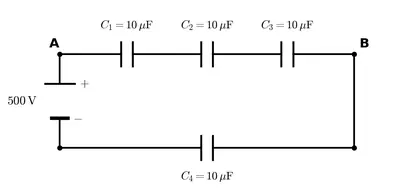
Example 2.9

A network of four $$10 \, \mathrm{\mu F}$$ capacitors is connected to a 500 V supply, as shown in Fig. 2.29. Determine
  1. the equivalent capacitance of the network and
  2. the charge on each capacitor.
(Note, the charge on a capacitor is the charge on the plate with higher potential, equal and opposite to the charge on the plate with lower potential.)
Fig. 2.29
Fig. 2.29

Solution

In the network of Fig. 2.29 the capacitors $$C_2$$, $$C_3$$ and $$C_4$$ are connected in series, and this series combination is in parallel with $$C_1$$ across the 500 V supply. Each capacitor has $$C = 10\,\mathrm{\mu F}$$.

Part (1): Equivalent capacitance of the network

For $$C_2$$, $$C_3$$, $$C_4$$ in series, the effective capacitance $$C'$$ is given by

$$\dfrac{1}{C'} = \dfrac{1}{C_2} + \dfrac{1}{C_3} + \dfrac{1}{C_4} = \dfrac{1}{10} + \dfrac{1}{10} + \dfrac{1}{10} = \dfrac{3}{10}$$

$$C' = \dfrac{10}{3}\,\mathrm{\mu F}$$

This series combination is in parallel with $$C_1$$, so the equivalent capacitance of the network is

$$C = C' + C_1 = \dfrac{10}{3} + 10 = \dfrac{40}{3} \approx 13.3\,\mathrm{\mu F}$$

Part (2): Charge on each capacitor

$$C_1$$ is connected directly across the 500 V supply, so the full 500 V appears across it:

$$Q_1 = C_1 V = (10 \times 10^{-6})(500) = 5 \times 10^{-3}\,\mathrm{C}$$

The series branch $$C_2C_3C_4$$ also has 500 V across it. In a series combination every capacitor carries the same charge, equal to that of the equivalent capacitor $$C'$$:

$$Q_2 = Q_3 = Q_4 = C'V = \left(\dfrac{10}{3} \times 10^{-6}\right)(500) \approx 1.7 \times 10^{-3}\,\mathrm{C}$$

The potential difference across each of $$C_2$$, $$C_3$$, $$C_4$$ is

$$V_2 = V_3 = V_4 = \dfrac{Q_2}{C} = \dfrac{1.7 \times 10^{-3}}{10 \times 10^{-6}} \approx 167\,\mathrm{V}$$

(As a check, $$167 \times 3 \approx 500\,\mathrm{V}$$, the voltage across the series branch.)

Answer

(1) Equivalent capacitance $$C = \dfrac{40}{3} \approx 13.3\,\mathrm{\mu F}$$. (2) Charge on $$C_1$$ is $$Q_1 = 5 \times 10^{-3}\,\mathrm{C}$$; the charge on each of $$C_2$$, $$C_3$$, $$C_4$$ is $$\approx 1.7 \times 10^{-3}\,\mathrm{C}$$ (with about 167 V across each).

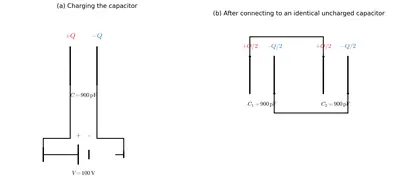
Example 2.10

  1. A 900 pF capacitor is charged by 100 V battery [Fig. 2.31(a)]. How much electrostatic energy is stored by the capacitor?
  2. The capacitor is disconnected from the battery and connected to another 900 pF capacitor [Fig. 2.31(b)]. What is the electrostatic energy stored by the system?
Fig. 2.31
Fig. 2.31

Solution

Part (1): Energy stored in the single capacitor

The capacitor has $$C = 900\,\mathrm{pF} = 900 \times 10^{-12}\,\mathrm{F}$$ and is charged to $$V = 100\,\mathrm{V}$$.

The energy stored is

$$U = \tfrac{1}{2}CV^2 = \tfrac{1}{2}(900 \times 10^{-12})(100)^2$$

$$U = \tfrac{1}{2}(900 \times 10^{-12})(10^{4}) = 4.5 \times 10^{-6}\,\mathrm{J}$$

Part (2): Energy after connecting to the second capacitor

The charge initially on the capacitor is

$$Q = CV = (900 \times 10^{-12})(100) = 9 \times 10^{-8}\,\mathrm{C}$$

When it is disconnected from the battery and connected to an identical uncharged 900 pF capacitor, the total charge $$Q$$ is conserved and is shared by the two capacitors, which are now in parallel (total capacitance $$2C = 1800\,\mathrm{pF}$$). They settle to a common potential

$$V' = \dfrac{Q}{2C} = \dfrac{9 \times 10^{-8}}{1800 \times 10^{-12}} = 50\,\mathrm{V}$$

The energy stored by the system is now

$$U' = \tfrac{1}{2}(2C)V'^2 = \tfrac{1}{2}(1800 \times 10^{-12})(50)^2$$

$$U' = \tfrac{1}{2}(1800 \times 10^{-12})(2500) = 2.25 \times 10^{-6}\,\mathrm{J}$$

The final energy ($$2.25\,\mathrm{\mu J}$$) is only half the initial energy ($$4.5\,\mathrm{\mu J}$$). The 'missing' energy, $$2.25 \times 10^{-6}\,\mathrm{J}$$, is dissipated as heat (and a little electromagnetic radiation) in the connecting wires while the charge redistributes.

Answer

(1) $$U = 4.5 \times 10^{-6}\,\mathrm{J}$$. (2) $$U' = 2.25 \times 10^{-6}\,\mathrm{J}$$ — half of the original energy; the remainder is lost as heat in the connecting wires.

Exercises

2.1 Two charges $$5 \times 10^{-8} \, \mathrm{C}$$ and $$-3 \times 10^{-8} \, \mathrm{C}$$ are located 16 cm apart. At what point(s) on the line joining the two charges is the electric potential zero? Take the potential at infinity to be zero.

Solution

Let $$q_1 = 5 \times 10^{-8}\,\mathrm{C}$$ be at point A and $$q_2 = -3 \times 10^{-8}\,\mathrm{C}$$ be at point B, with $$\mathrm{AB} = 16\,\mathrm{cm}$$.

The net potential at a point is the algebraic sum of the potentials of the two charges. We find where this sum vanishes.

Case 1: Point P between the charges.

Let P be at a distance $$x$$ (in cm) from A, hence $$(16 - x)$$ cm from B.

$$\dfrac{1}{4\pi\varepsilon_0}\left[\dfrac{q_1}{x} + \dfrac{q_2}{16-x}\right] = 0$$

$$\dfrac{5 \times 10^{-8}}{x} + \dfrac{-3 \times 10^{-8}}{16-x} = 0$$

$$\dfrac{5}{x} = \dfrac{3}{16-x}$$

$$5(16 - x) = 3x \quad\Rightarrow\quad 80 - 5x = 3x \quad\Rightarrow\quad 8x = 80 \quad\Rightarrow\quad x = 10\,\mathrm{cm}$$

So the potential is zero at a point 10 cm from $$q_1$$ (and 6 cm from $$q_2$$).

Case 2: Point P outside, beyond B.

Let P be at a distance $$x$$ (in cm) from A, beyond B, hence $$(x - 16)$$ cm from B.

$$\dfrac{5 \times 10^{-8}}{x} + \dfrac{-3 \times 10^{-8}}{x-16} = 0$$

$$\dfrac{5}{x} = \dfrac{3}{x-16}$$

$$5(x - 16) = 3x \quad\Rightarrow\quad 5x - 80 = 3x \quad\Rightarrow\quad 2x = 80 \quad\Rightarrow\quad x = 40\,\mathrm{cm}$$

(On the side beyond A the positive charge $$q_1$$ always dominates, so there is no zero of potential there.)

Hence the potential is zero at two points on the line: 10 cm from $$q_1$$ (between the charges) and 40 cm from $$q_1$$ (i.e. 24 cm beyond $$q_2$$).

Answer

The potential is zero at two points on the line joining the charges: one 10 cm from the $$5 \times 10^{-8}\,\mathrm{C}$$ charge (between the charges) and another 40 cm from it (outside the system, beyond the negative charge).

2.2 A regular hexagon of side 10 cm has a charge $$5 \, \mathrm{\mu C}$$ at each of its vertices. Calculate the potential at the centre of the hexagon.

Solution

In a regular hexagon, the distance from the centre O to each vertex is equal to the length of a side. So each charge is at a distance

$$r = 10\,\mathrm{cm} = 0.10\,\mathrm{m}$$

from the centre.

There are 6 identical charges, each $$q = 5\,\mathrm{\mu C} = 5 \times 10^{-6}\,\mathrm{C}$$. Electric potential is a scalar, so the potential at the centre is simply the sum of the six equal contributions:

$$V = 6 \times \dfrac{1}{4\pi\varepsilon_0}\dfrac{q}{r}$$

$$V = 6 \times (9 \times 10^{9}) \times \dfrac{5 \times 10^{-6}}{0.10}$$

$$V = 6 \times (9 \times 10^{9}) \times (5 \times 10^{-5})$$

$$V = 6 \times (4.5 \times 10^{5}) = 2.7 \times 10^{6}\,\mathrm{V}$$

Answer

The potential at the centre of the hexagon is $$V = 2.7 \times 10^{6}\,\mathrm{V}$$.

2.3 Two charges $$2 \, \mathrm{\mu C}$$ and $$-2 \, \mathrm{\mu C}$$ are placed at points A and B 6 cm apart.

(a) Identify an equipotential surface of the system.

Solution

The two charges are equal in magnitude and opposite in sign: $$+2\,\mathrm{\mu C}$$ at A and $$-2\,\mathrm{\mu C}$$ at B.

Consider the plane that is perpendicular to the line AB and passes through its mid-point. Every point on this plane is equidistant from A and B; call that common distance $$r$$.

The potential at such a point is

$$V = \dfrac{1}{4\pi\varepsilon_0}\left[\dfrac{+2\,\mathrm{\mu C}}{r} + \dfrac{-2\,\mathrm{\mu C}}{r}\right] = 0$$

Since the potential has the same value (zero) at every point of this plane, the plane perpendicular to AB through its mid-point is an equipotential surface of the system.

Answer

The equipotential surface is the plane perpendicular to the line AB and passing through its mid-point; the potential is zero everywhere on it.

(b) What is the direction of the electric field at every point on this surface?

Solution

The electric field is always perpendicular to an equipotential surface. Hence, at every point on this plane, the field is directed normal to the plane.

The direction of this normal field is from the positive charge towards the negative charge — that is, along AB, pointing from A ($$+2\,\mathrm{\mu C}$$) to B ($$-2\,\mathrm{\mu C}$$). (The components of the two charges' fields parallel to the plane cancel by symmetry, while the components along AB add up, so the resultant field is along AB.)

Answer

The electric field at every point of this surface is normal to the plane, directed from the positive charge A towards the negative charge B.

2.4 A spherical conductor of radius 12 cm has a charge of $$1.6 \times 10^{-7} \, \mathrm{C}$$ distributed uniformly on its surface. What is the electric field

(a) inside the sphere

Solution

For a charged conductor in electrostatic equilibrium, all the charge resides on the outer surface, and there is no charge anywhere in the interior.

Applying Gauss's law to a spherical surface drawn anywhere inside the conductor: it encloses zero net charge, so the flux through it is zero, and by symmetry the field on it is zero.

Therefore the electric field at every point inside the sphere is

$$E = 0$$

Answer

The electric field inside the sphere is zero.

(b) just outside the sphere

Solution

Just outside the conductor, the charged sphere behaves as if its entire charge were concentrated at the centre. With $$q = 1.6 \times 10^{-7}\,\mathrm{C}$$ and radius $$R = 12\,\mathrm{cm} = 0.12\,\mathrm{m}$$:

$$E = \dfrac{1}{4\pi\varepsilon_0}\dfrac{q}{R^2} = (9 \times 10^{9})\dfrac{1.6 \times 10^{-7}}{(0.12)^2}$$

$$E = (9 \times 10^{9})\dfrac{1.6 \times 10^{-7}}{1.44 \times 10^{-2}}$$

$$E = \dfrac{1440}{1.44 \times 10^{-2}} = 1 \times 10^{5}\,\mathrm{N\,C^{-1}}$$

The field is directed radially outward, since the charge is positive.

Answer

Just outside the sphere, $$E = 1 \times 10^{5}\,\mathrm{N\,C^{-1}}$$, directed radially outward.

(c) at a point 18 cm from the centre of the sphere?

Solution

At a point outside the sphere, at distance $$r = 18\,\mathrm{cm} = 0.18\,\mathrm{m}$$ from the centre, the field is again that of a point charge $$q$$ placed at the centre:

$$E = \dfrac{1}{4\pi\varepsilon_0}\dfrac{q}{r^2} = (9 \times 10^{9})\dfrac{1.6 \times 10^{-7}}{(0.18)^2}$$

$$E = (9 \times 10^{9})\dfrac{1.6 \times 10^{-7}}{3.24 \times 10^{-2}}$$

$$E = \dfrac{1440}{3.24 \times 10^{-2}} \approx 4.4 \times 10^{4}\,\mathrm{N\,C^{-1}}$$

The field is directed radially outward.

Answer

At 18 cm from the centre, $$E \approx 4.4 \times 10^{4}\,\mathrm{N\,C^{-1}}$$, directed radially outward.

2.5 A parallel plate capacitor with air between the plates has a capacitance of 8 pF $$(1 \, \mathrm{pF} = 10^{-12} \, \mathrm{F})$$. What will be the capacitance if the distance between the plates is reduced by half, and the space between them is filled with a substance of dielectric constant 6?

Solution

For a parallel-plate capacitor with air between the plates,

$$C_0 = \dfrac{\varepsilon_0 A}{d} = 8\,\mathrm{pF}$$

where $$A$$ is the plate area and $$d$$ the separation.

Now the separation is reduced to $$d' = \dfrac{d}{2}$$ and the gap is filled with a dielectric of constant $$K = 6$$. The new capacitance is

$$C' = \dfrac{K\varepsilon_0 A}{d'} = \dfrac{K\varepsilon_0 A}{d/2} = \dfrac{2K\varepsilon_0 A}{d}$$

$$C' = 2K\left(\dfrac{\varepsilon_0 A}{d}\right) = 2K\,C_0$$

Substituting $$K = 6$$ and $$C_0 = 8\,\mathrm{pF}$$:

$$C' = 2 \times 6 \times 8\,\mathrm{pF} = 96\,\mathrm{pF}$$

Answer

The new capacitance is $$C' = 2K\,C_0 = 96\,\mathrm{pF}$$.

2.6 Three capacitors each of capacitance 9 pF are connected in series.

(a) What is the total capacitance of the combination?

Solution

For capacitors connected in series, the reciprocals of the capacitances add:

$$\dfrac{1}{C_s} = \dfrac{1}{C_1} + \dfrac{1}{C_2} + \dfrac{1}{C_3}$$

Here $$C_1 = C_2 = C_3 = 9\,\mathrm{pF}$$, so

$$\dfrac{1}{C_s} = \dfrac{1}{9} + \dfrac{1}{9} + \dfrac{1}{9} = \dfrac{3}{9} = \dfrac{1}{3}\;\mathrm{pF^{-1}}$$

$$C_s = 3\,\mathrm{pF}$$

Answer

The total capacitance of the series combination is $$C_s = 3\,\mathrm{pF}$$.

(b) What is the potential difference across each capacitor if the combination is connected to a 120 V supply?

Solution

In a series combination the same charge $$Q$$ is stored on every capacitor. The total charge supplied is

$$Q = C_s V = (3 \times 10^{-12}\,\mathrm{F})(120\,\mathrm{V}) = 3.6 \times 10^{-10}\,\mathrm{C}$$

The potential difference across each 9 pF capacitor is

$$V_1 = \dfrac{Q}{C} = \dfrac{3.6 \times 10^{-10}}{9 \times 10^{-12}} = 40\,\mathrm{V}$$

So each capacitor has 40 V across it. (Equivalently, since the three capacitors are identical, the 120 V supply divides equally among them: $$120/3 = 40\,\mathrm{V}$$ each. Check: $$40 + 40 + 40 = 120\,\mathrm{V}$$.)

Answer

The potential difference across each capacitor is 40 V.

2.7 Three capacitors of capacitances 2 pF, 3 pF and 4 pF are connected in parallel.

(a) What is the total capacitance of the combination?

Solution

For capacitors connected in parallel, the capacitances simply add:

$$C_p = C_1 + C_2 + C_3 = 2\,\mathrm{pF} + 3\,\mathrm{pF} + 4\,\mathrm{pF}$$

$$C_p = 9\,\mathrm{pF}$$

Answer

The total capacitance of the parallel combination is $$C_p = 9\,\mathrm{pF}$$.

(b) Determine the charge on each capacitor if the combination is connected to a 100 V supply.

Solution

In a parallel combination every capacitor has the same potential difference across it, equal to the supply voltage $$V = 100\,\mathrm{V}$$. The charge on each is $$Q = CV$$.

For the 2 pF capacitor:

$$Q_1 = (2 \times 10^{-12})(100) = 2 \times 10^{-10}\,\mathrm{C}$$

For the 3 pF capacitor:

$$Q_2 = (3 \times 10^{-12})(100) = 3 \times 10^{-10}\,\mathrm{C}$$

For the 4 pF capacitor:

$$Q_3 = (4 \times 10^{-12})(100) = 4 \times 10^{-10}\,\mathrm{C}$$

Answer

Charges on the capacitors: $$Q_1 = 2 \times 10^{-10}\,\mathrm{C}$$ (2 pF), $$Q_2 = 3 \times 10^{-10}\,\mathrm{C}$$ (3 pF), $$Q_3 = 4 \times 10^{-10}\,\mathrm{C}$$ (4 pF).

2.8 In a parallel plate capacitor with air between the plates, each plate has an area of $$6 \times 10^{-3} \, \mathrm{m^2}$$ and the distance between the plates is 3 mm. Calculate the capacitance of the capacitor. If this capacitor is connected to a 100 V supply, what is the charge on each plate of the capacitor?

Solution

The capacitance of a parallel-plate capacitor with air between the plates is

$$C = \dfrac{\varepsilon_0 A}{d}$$

with $$\varepsilon_0 = 8.85 \times 10^{-12}\,\mathrm{F\,m^{-1}}$$, plate area $$A = 6 \times 10^{-3}\,\mathrm{m^2}$$ and separation $$d = 3\,\mathrm{mm} = 3 \times 10^{-3}\,\mathrm{m}$$.

$$C = \dfrac{(8.85 \times 10^{-12})(6 \times 10^{-3})}{3 \times 10^{-3}}$$

$$C = (8.85 \times 10^{-12}) \times 2 = 1.77 \times 10^{-11}\,\mathrm{F} \approx 18\,\mathrm{pF}$$

When this capacitor is connected to a $$V = 100\,\mathrm{V}$$ supply, the charge on each plate is

$$Q = CV = (1.77 \times 10^{-11})(100)$$

$$Q = 1.77 \times 10^{-9}\,\mathrm{C} \approx 1.8 \times 10^{-9}\,\mathrm{C}$$

Answer

The capacitance is $$C \approx 1.77 \times 10^{-11}\,\mathrm{F} \approx 18\,\mathrm{pF}$$, and the charge on each plate is $$Q \approx 1.8 \times 10^{-9}\,\mathrm{C}$$.

2.9 Explain what would happen if in the capacitor given in Exercise 2.8, a 3 mm thick mica sheet (of dielectric constant = 6) were inserted between the plates,

(a) while the voltage supply remained connected.

Solution

From Exercise 2.8, the air capacitor has $$C = 17.7\,\mathrm{pF}$$ and, on a 100 V supply, carries a charge $$Q = 1.77 \times 10^{-9}\,\mathrm{C}$$.

The 3 mm mica sheet (dielectric constant $$K = 6$$) completely fills the gap between the plates, so the capacitance becomes

$$C' = K\,C = 6 \times 17.7\,\mathrm{pF} = 106.2\,\mathrm{pF} \approx 106\,\mathrm{pF}$$

While the supply remains connected, the voltage across the capacitor is held fixed at $$V = 100\,\mathrm{V}$$. The charge therefore rises to

$$Q' = C'V = (106.2 \times 10^{-12})(100) \approx 1.06 \times 10^{-8}\,\mathrm{C}$$

So the capacitance increases 6-fold (to about 106 pF) and the charge increases 6-fold (the extra charge flows in from the battery), while the voltage stays unchanged at 100 V.

Answer

With the supply connected, the voltage stays at 100 V; the capacitance increases 6-fold to about 106 pF, and the charge increases 6-fold to $$Q' \approx 1.06 \times 10^{-8}\,\mathrm{C}$$.

(b) after the supply was disconnected.

Solution

Now the supply is removed before the mica sheet is inserted, so the charge on the plates is isolated and stays fixed at

$$Q = 1.77 \times 10^{-9}\,\mathrm{C} \approx 1.8 \times 10^{-9}\,\mathrm{C}$$

Inserting the mica ($$K = 6$$) again raises the capacitance to

$$C' = K\,C = 6 \times 17.7\,\mathrm{pF} \approx 106\,\mathrm{pF}$$

Since the charge $$Q$$ is now fixed, the voltage across the capacitor falls:

$$V' = \dfrac{Q}{C'} = \dfrac{Q}{K\,C} = \dfrac{V}{K} = \dfrac{100}{6} \approx 16.7\,\mathrm{V}$$

So the charge stays at about $$1.8 \times 10^{-9}\,\mathrm{C}$$, the capacitance increases 6-fold to about 106 pF, and the voltage drops to one-sixth of its original value, about 16.7 V.

Answer

With the supply disconnected, the charge stays fixed at $$\approx 1.8 \times 10^{-9}\,\mathrm{C}$$; the capacitance increases 6-fold to about 106 pF, and the voltage falls to $$V/K = 100/6 \approx 16.7\,\mathrm{V}$$.

2.10 A 12 pF capacitor is connected to a 50 V battery. How much electrostatic energy is stored in the capacitor?

Solution

The energy stored in a capacitor charged to a potential difference $$V$$ is

$$U = \tfrac{1}{2}CV^2$$

Here $$C = 12\,\mathrm{pF} = 12 \times 10^{-12}\,\mathrm{F}$$ and $$V = 50\,\mathrm{V}$$.

$$U = \tfrac{1}{2}(12 \times 10^{-12})(50)^2$$

$$U = \tfrac{1}{2}(12 \times 10^{-12})(2500)$$

$$U = \tfrac{1}{2}(3 \times 10^{-8}) = 1.5 \times 10^{-8}\,\mathrm{J}$$

Answer

The electrostatic energy stored in the capacitor is $$U = 1.5 \times 10^{-8}\,\mathrm{J}$$.

2.11 A 600 pF capacitor is charged by a 200 V supply. It is then disconnected from the supply and is connected to another uncharged 600 pF capacitor. How much electrostatic energy is lost in the process?

Solution

Initial state. The 600 pF capacitor is charged by a 200 V supply. Its charge and stored energy are

$$Q = CV = (600 \times 10^{-12})(200) = 1.2 \times 10^{-7}\,\mathrm{C}$$

$$U_i = \tfrac{1}{2}CV^2 = \tfrac{1}{2}(600 \times 10^{-12})(200)^2$$

$$U_i = \tfrac{1}{2}(600 \times 10^{-12})(4 \times 10^{4}) = 1.2 \times 10^{-5}\,\mathrm{J}$$

After connecting to the uncharged capacitor. The capacitor is disconnected from the supply and connected to an identical uncharged 600 pF capacitor. The total charge $$Q$$ is conserved and is shared between the two capacitors, which are now in parallel (total capacitance $$2C = 1200\,\mathrm{pF}$$). They reach a common potential

$$V' = \dfrac{Q}{2C} = \dfrac{1.2 \times 10^{-7}}{1200 \times 10^{-12}} = 100\,\mathrm{V}$$

The final stored energy is

$$U_f = \tfrac{1}{2}(2C)V'^2 = \tfrac{1}{2}(1200 \times 10^{-12})(100)^2$$

$$U_f = \tfrac{1}{2}(1200 \times 10^{-12})(10^{4}) = 0.6 \times 10^{-5}\,\mathrm{J}$$

Energy lost.

$$\Delta U = U_i - U_f = 1.2 \times 10^{-5} - 0.6 \times 10^{-5} = 6 \times 10^{-6}\,\mathrm{J}$$

This energy, $$6 \times 10^{-6}\,\mathrm{J}$$, is dissipated as heat (and a small amount of electromagnetic radiation) in the connecting wires as the charge redistributes between the two capacitors.

Answer

The electrostatic energy lost is $$\Delta U = U_i - U_f = 1.2 \times 10^{-5} - 0.6 \times 10^{-5} = 6 \times 10^{-6}\,\mathrm{J}$$, dissipated as heat in the connecting wires.
NCERT Solutions for Class 12
Maths
NCERT Solutions for Class 12 Maths
Chapter-wise step-by-step
solutions with explanations
explore solutions Maths bg
Physics
NCERT Solutions for Class 12 Physics
Chapter-wise step-by-step
solutions with explanations
explore solutions Physics bg
Chemistry
NCERT Solutions for Class 12 Chemistry
Chapter-wise step-by-step
solutions with explanations
explore solutions Chemistry bg

Frequently Asked Questions

50,000+ JEE Students Trusted Our Score Calculator

Predict your JEE Main percentile, rank & performance in seconds