Join WhatsApp Icon JEE WhatsApp Group
NCERT Solutions for Class 12 Physics

Chapter 1: Electric Charges and Fields

Download Solutions PDF
Daily JEE Updates, Tips & Important Alerts
Join 30,000+ students and stay updated with JEE notifications and preparation insights.
Join Now!
Free PDF
Complete NCERT Solution PDF for Chapter 1: Electric Charges and Fields

NCERT Solutions For Class 12 Physics Chapter 1 Electric Charges and Fields helps students understand the fundamental principles of electrostatics and the behaviour of electric charges. The page provides detailed NCERT Solutions that explain concepts such as electric charge, Coulomb’s law, electric field, electric flux, and Gauss’s law with proper examples. NCERT Solutions For Class 12 Physics simplify these concepts through step-by-step explanations and solved numerical problems. The chapter builds the foundation required for understanding advanced topics in electrostatics and electromagnetism. These solutions help students strengthen their conceptual knowledge and improve problem-solving accuracy. Students can access the chapter PDF for revision, practice, and exam preparation. The clear explanations make electric field concepts easier to understand and apply.

Download Solutions PDF

Examples 1.1-1.12

Example 1.1 If $$10^9$$ electrons move out of a body to another body every second, how much time is required to get a total charge of 1 C on the other body?

Solution

The magnitude of charge carried by one electron is $$e = 1.6 \times 10^{-19} \, \mathrm{C}$$.

In one second, $$n = 10^9$$ electrons move out, so the charge transferred per second is

$$q_{1\,\mathrm{s}} = n e = 10^9 \times 1.6 \times 10^{-19} \, \mathrm{C} = 1.6 \times 10^{-10} \, \mathrm{C}$$

To accumulate a total charge $$Q = 1 \, \mathrm{C}$$, the time required is

$$t = \frac{Q}{q_{1\,\mathrm{s}}} = \frac{1}{1.6 \times 10^{-10}} \, \mathrm{s} = 6.25 \times 10^9 \, \mathrm{s}$$

Converting to years (one year $$= 365 \times 24 \times 3600 \approx 3.15 \times 10^7 \, \mathrm{s}$$):

$$t = \frac{6.25 \times 10^9}{3.15 \times 10^7} \, \mathrm{years} \approx 198 \, \mathrm{years}$$

Thus, even at the rate of $$10^9$$ electrons per second, it takes about 200 years to collect a charge of just one coulomb. This shows that one coulomb is a very large unit of charge.

Answer

$$t = 6.25 \times 10^9 \, \mathrm{s} \approx 198 \, \mathrm{years}$$.

Example 1.2 How much positive and negative charge is there in a cup of water?

Solution

Take the mass of one cup of water as $$250 \, \mathrm{g}$$. The molar mass of water is $$18 \, \mathrm{g}$$, and one mole contains $$N_A = 6.02 \times 10^{23}$$ molecules.

Number of water molecules in the cup:

$$N = \frac{250}{18} \times 6.02 \times 10^{23} \approx 8.36 \times 10^{24}$$

Each water molecule $$\mathrm{H_2O}$$ has two hydrogen atoms (1 proton each) and one oxygen atom (8 protons), i.e. $$10$$ protons and $$10$$ electrons. So each molecule carries a positive charge $$10e$$ and an equal negative charge $$10e$$.

Total positive charge:

$$Q_+ = N \times 10 \times e = \frac{250}{18} \times 6.02 \times 10^{23} \times 10 \times 1.6 \times 10^{-19} \, \mathrm{C}$$

$$Q_+ \approx 1.34 \times 10^7 \, \mathrm{C}$$

Since each molecule is electrically neutral, the total negative charge has the same magnitude:

$$Q_- \approx -1.34 \times 10^7 \, \mathrm{C}$$

The enormous magnitude shows that ordinary matter contains a huge amount of charge of both signs, almost exactly balanced.

Answer

Positive charge $$\approx 1.34 \times 10^7 \, \mathrm{C}$$ and negative charge $$\approx -1.34 \times 10^7 \, \mathrm{C}$$ (equal in magnitude).

Example 1.3

Coulomb's law for electrostatic force between two point charges and Newton's law for gravitational force between two stationary point masses, both have inverse-square dependence on the distance between the charges and masses respectively. (a) Compare the strength of these forces by determining the ratio of their magnitudes (i) for an electron and a proton and (ii) for two protons. (b) Estimate the accelerations of electron and proton due to the electrical force of their mutual attraction when they are 1 Å (= $$10^{-10}$$ m) apart? ($$m_p = 1.67 \times 10^{-27}$$ kg, $$m_e = 9.11 \times 10^{-31}$$ kg)

Solution

(a) Ratio of electric force to gravitational force

Both forces obey an inverse-square law, so the distance $$r$$ cancels in the ratio.

(i) For an electron and a proton:

$$\left|\frac{F_e}{F_g}\right| = \frac{\dfrac{1}{4\pi\varepsilon_0}\dfrac{e^2}{r^2}}{\dfrac{G m_e m_p}{r^2}} = \frac{e^2}{4\pi\varepsilon_0\, G\, m_e m_p} = \frac{k e^2}{G\, m_e m_p}$$

Substituting $$k = 9 \times 10^9$$, $$e = 1.6 \times 10^{-19} \, \mathrm{C}$$, $$G = 6.67 \times 10^{-11}$$, $$m_e = 9.11 \times 10^{-31} \, \mathrm{kg}$$, $$m_p = 1.67 \times 10^{-27} \, \mathrm{kg}$$:

$$k e^2 = 9 \times 10^9 \times (1.6 \times 10^{-19})^2 = 2.3 \times 10^{-28}$$

$$G\, m_e m_p = 6.67 \times 10^{-11} \times 9.11 \times 10^{-31} \times 1.67 \times 10^{-27} \approx 1.0 \times 10^{-67}$$

$$\left|\frac{F_e}{F_g}\right| = \frac{2.3 \times 10^{-28}}{1.0 \times 10^{-67}} \approx 2.3 \times 10^{39}$$

(ii) For two protons: replace $$m_e$$ by $$m_p$$ in the denominator:

$$\left|\frac{F_e}{F_g}\right| = \frac{k e^2}{G\, m_p^2} = \frac{2.3 \times 10^{-28}}{6.67 \times 10^{-11} \times (1.67 \times 10^{-27})^2} \approx 1.3 \times 10^{36}$$

In both cases the electric force is enormously larger than the gravitational force.

(b) Accelerations at separation $$r = 10^{-10} \, \mathrm{m}$$

The magnitude of the electric (Coulomb) force is

$$F = \frac{k e^2}{r^2} = \frac{9 \times 10^9 \times (1.6 \times 10^{-19})^2}{(10^{-10})^2} = \frac{2.3 \times 10^{-28}}{10^{-20}} = 2.3 \times 10^{-8} \, \mathrm{N}$$

Acceleration of the electron:

$$a_e = \frac{F}{m_e} = \frac{2.3 \times 10^{-8}}{9.11 \times 10^{-31}} \approx 2.5 \times 10^{22} \, \mathrm{m\,s^{-2}}$$

Acceleration of the proton:

$$a_p = \frac{F}{m_p} = \frac{2.3 \times 10^{-8}}{1.67 \times 10^{-27}} \approx 1.4 \times 10^{19} \, \mathrm{m\,s^{-2}}$$

These accelerations are gigantic compared with $$g = 9.8 \, \mathrm{m\,s^{-2}}$$, confirming that gravity is utterly negligible for the motion of these particles under their mutual electric attraction.

Answer

(a) (i) $$F_e/F_g \approx 2.3 \times 10^{39}$$; (ii) $$F_e/F_g \approx 1.3 \times 10^{36}$$. (b) $$a_e \approx 2.5 \times 10^{22} \, \mathrm{m\,s^{-2}}$$ and $$a_p \approx 1.4 \times 10^{19} \, \mathrm{m\,s^{-2}}$$.

Example 1.4

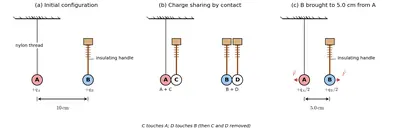
A charged metallic sphere A is suspended by a nylon thread. Another charged metallic sphere B held by an insulating handle is brought close to A such that the distance between their centres is 10 cm, as shown in Fig. 1.4(a). The resulting repulsion of A is noted (for example, by shining a beam of light and measuring the deflection of its shadow on a screen). Spheres A and B are touched by uncharged spheres C and D respectively, as shown in Fig. 1.4(b). C and D are then removed and B is brought closer to A to a distance of 5.0 cm between their centres, as shown in Fig. 1.4(c). What is the expected repulsion of A on the basis of Coulomb's law? Spheres A and C and spheres B and D have identical sizes. Ignore the sizes of A and B in comparison to the separation between their centres.
Fig. 1.4
Fig. 1.4

Solution

Let the original charge on sphere A be $$q$$ and on sphere B be $$q'$$. With centres a distance $$r$$ apart, the Coulomb force on each (treating them as point charges) is

$$F = \frac{1}{4\pi\varepsilon_0}\frac{q\,q'}{r^2}$$

When the uncharged identical sphere C touches A, the charge redistributes equally between the two identical conductors. By symmetry each then carries $$q/2$$. Similarly, after the identical uncharged sphere D touches B, sphere B is left with $$q'/2$$.

Now C and D are removed and the separation is halved to $$r' = r/2$$. The new force is

$$F' = \frac{1}{4\pi\varepsilon_0}\frac{(q/2)(q'/2)}{(r/2)^2} = \frac{1}{4\pi\varepsilon_0}\frac{q q'/4}{r^2/4} = \frac{1}{4\pi\varepsilon_0}\frac{q q'}{r^2} = F$$

The factor $$1/4$$ from halving each charge is exactly cancelled by the factor $$1/4$$ from halving the distance. Hence the expected repulsion of A is the same as before, $$F' = F$$.

Answer

The repulsion of A is unchanged: $$F' = F$$.

Example 1.5

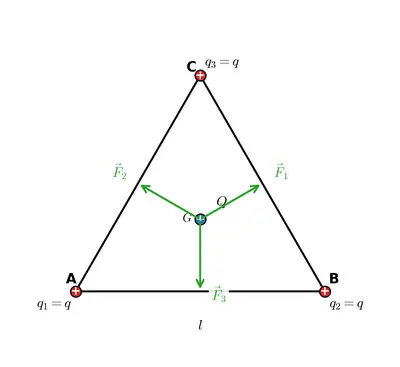
Consider three charges $$q_1$$, $$q_2$$, $$q_3$$ each equal to $$q$$ at the vertices of an equilateral triangle of side $$l$$. What is the force on a charge $$Q$$ (with the same sign as $$q$$) placed at the centroid of the triangle, as shown in Fig. 1.6?
Fig. 1.6
Fig. 1.6

Solution

Let the side of the equilateral triangle be $$l$$, with charges $$q$$ at each vertex A, B, C and charge $$Q$$ at the centroid O.

Drop a perpendicular AD from A to side BC. Then $$AD = AC\cos 30^\circ = \dfrac{\sqrt3}{2}\,l$$. The centroid divides the median in the ratio $$2:1$$, so the distance of O from each vertex is

$$AO = BO = CO = \frac{2}{3}AD = \frac{2}{3}\cdot\frac{\sqrt3}{2}l = \frac{l}{\sqrt3}$$

The magnitude of the force on $$Q$$ due to a charge $$q$$ at any vertex is

$$F_0 = \frac{1}{4\pi\varepsilon_0}\frac{Qq}{(l/\sqrt3)^2} = \frac{3}{4\pi\varepsilon_0}\frac{Qq}{l^2}$$

So the three forces have equal magnitude $$\dfrac{3}{4\pi\varepsilon_0}\dfrac{Qq}{l^2}$$, directed along AO, BO and CO respectively (repulsive, since $$Q$$ and $$q$$ have the same sign).

Consider the forces $$\mathbf F_2$$ (along BO) and $$\mathbf F_3$$ (along CO). They are equal in magnitude and inclined at $$120^\circ$$; by the parallelogram law their resultant has magnitude $$\dfrac{3}{4\pi\varepsilon_0}\dfrac{Qq}{l^2}$$ and is directed along OA, i.e. exactly opposite to $$\mathbf F_1$$ (which is along AO).

Therefore the total force is

$$\mathbf F = \frac{3}{4\pi\varepsilon_0}\frac{Qq}{l^2}\,(\hat{\mathbf r} - \hat{\mathbf r}) = 0$$

where $$\hat{\mathbf r}$$ is the unit vector along OA. By the symmetry of the configuration the three equal forces, spaced $$120^\circ$$ apart, must add to zero.

Answer

The net force on $$Q$$ is zero.

Example 1.6

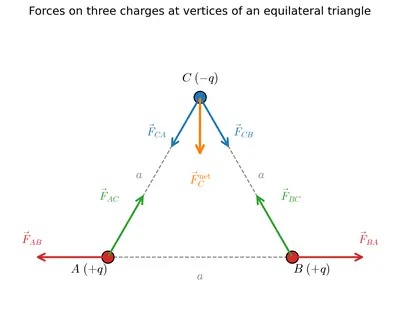
Consider the charges $$q$$, $$q$$, and $$-q$$ placed at the vertices of an equilateral triangle, as shown in Fig. 1.7. What is the force on each charge?
Fig. 1.7
Fig. 1.7

Solution

Let $$F = \dfrac{1}{4\pi\varepsilon_0}\dfrac{q^2}{l^2}$$ be the magnitude of the Coulomb force between any pair of the charges (every pair is separated by the side length $$l$$ and the charge magnitudes are all $$q$$).

Force on charge $$q$$ at A: It is repelled by $$q$$ at B (force of magnitude $$F$$ along BA) and attracted by $$-q$$ at C (force of magnitude $$F$$ along AC). These two forces of equal magnitude $$F$$ are inclined at $$60^\circ$$ to each other, so their resultant has magnitude

$$F_1 = \sqrt{F^2 + F^2 + 2F^2\cos 60^\circ} = \sqrt{3F^2} = \sqrt{3}\,F$$

directed parallel to BC.

Force on charge $$q$$ at B: By identical reasoning (repelled by A, attracted by C), its magnitude is

$$F_2 = \sqrt{3}\,F$$

directed parallel to AC.

Force on charge $$-q$$ at C: It is attracted by $$q$$ at A and by $$q$$ at B. The two forces of magnitude $$F$$ are again $$60^\circ$$ apart, so

$$F_3 = \sqrt{3}\,F$$

directed along the bisector of angle BCA (pointing into the triangle).

Thus each charge experiences a force of magnitude

$$\sqrt3\,F = \frac{\sqrt3\,q^2}{4\pi\varepsilon_0 l^2}$$

The vector sum of the three forces is $$\mathbf F_1 + \mathbf F_2 + \mathbf F_3 = 0$$, consistent with Newton's third law applied to the internal forces of the system.

Answer

Each charge experiences a force of magnitude $$\sqrt{3}\,F = \dfrac{\sqrt{3}\,q^2}{4\pi\varepsilon_0 l^2}$$; the three forces add up to zero.

Example 1.7

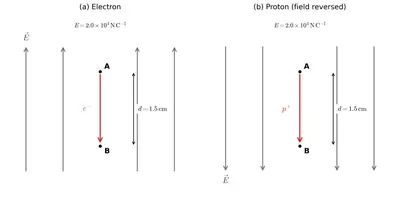
An electron falls through a distance of 1.5 cm in a uniform electric field of magnitude $$2.0 \times 10^4 \, \mathrm{N\,C^{-1}}$$ [Fig. 1.10(a)]. The direction of the field is reversed keeping its magnitude unchanged and a proton falls through the same distance [Fig. 1.10(b)]. Compute the time of fall in each case. Contrast the situation with that of 'free fall under gravity'.
Fig. 1.10
Fig. 1.10

Solution

Electron [Fig. 1.10(a)]: The field points upward, so the negatively charged electron feels a downward force of magnitude $$eE$$. Its acceleration is

$$a_e = \frac{eE}{m_e}$$

Starting from rest, the time to fall a distance $$h$$ follows from $$h = \tfrac12 a_e t_e^2$$:

$$t_e = \sqrt{\frac{2h}{a_e}} = \sqrt{\frac{2h\,m_e}{eE}}$$

With $$h = 1.5 \times 10^{-2} \, \mathrm{m}$$, $$E = 2.0 \times 10^4 \, \mathrm{N\,C^{-1}}$$, $$e = 1.6 \times 10^{-19} \, \mathrm{C}$$ and $$m_e = 9.11 \times 10^{-31} \, \mathrm{kg}$$:

$$t_e = \sqrt{\frac{2 \times 1.5 \times 10^{-2} \times 9.11 \times 10^{-31}}{1.6 \times 10^{-19} \times 2.0 \times 10^4}} \approx 2.9 \times 10^{-9} \, \mathrm{s}$$

Proton [Fig. 1.10(b)]: The field is reversed (now downward), so the positively charged proton also feels a downward force $$eE$$, with acceleration

$$a_p = \frac{eE}{m_p}$$

The time of fall is

$$t_p = \sqrt{\frac{2h\,m_p}{eE}} = \sqrt{\frac{2 \times 1.5 \times 10^{-2} \times 1.67 \times 10^{-27}}{1.6 \times 10^{-19} \times 2.0 \times 10^4}} \approx 1.3 \times 10^{-7} \, \mathrm{s}$$

Contrast with free fall: Here the time of fall depends on the mass, $$t \propto \sqrt{m}$$, so the heavier proton takes far longer ($$t_p/t_e = \sqrt{m_p/m_e} \approx 43$$) to fall the same distance. In free fall under gravity the acceleration is $$g$$, independent of mass, so all bodies take the same time. (Also $$a_p = eE/m_p \approx 1.9 \times 10^{12} \, \mathrm{m\,s^{-2}}$$ is enormous compared with $$g$$, which justifies ignoring gravity in this problem.)

Answer

$$t_e \approx 2.9 \times 10^{-9} \, \mathrm{s}$$ and $$t_p \approx 1.3 \times 10^{-7} \, \mathrm{s}$$. Unlike free fall under gravity, the time of fall here depends on the mass ($$t \propto \sqrt{m}$$).

Example 1.8

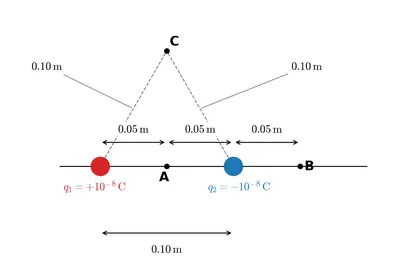
Two point charges $$q_1$$ and $$q_2$$, of magnitude $$+10^{-8}$$ C and $$-10^{-8}$$ C, respectively, are placed 0.1 m apart. Calculate the electric fields at points A, B and C shown in Fig. 1.11.
Fig. 1.11
Fig. 1.11

Solution

Take $$q_1 = +10^{-8} \, \mathrm{C}$$ on the left and $$q_2 = -10^{-8} \, \mathrm{C}$$ on the right, separated by $$0.1 \, \mathrm{m}$$. Use $$k = 9 \times 10^9 \, \mathrm{N\,m^2\,C^{-2}}$$.

At point A (the midpoint of the line, $$0.05 \, \mathrm{m}$$ from each charge):

The field $$\mathbf E_{1A}$$ of the positive charge $$q_1$$ points away from $$q_1$$ (towards the right); the field $$\mathbf E_{2A}$$ of the negative charge $$q_2$$ points towards $$q_2$$ (also towards the right). Each has magnitude

$$E_{1A} = E_{2A} = \frac{k|q|}{r^2} = \frac{9 \times 10^9 \times 10^{-8}}{(0.05)^2} = 3.6 \times 10^4 \, \mathrm{N\,C^{-1}}$$

As they point the same way, they add:

$$E_A = E_{1A} + E_{2A} = 7.2 \times 10^4 \, \mathrm{N\,C^{-1}}, \;\; \text{directed towards the right.}$$

At point B (on the line, $$0.05 \, \mathrm{m}$$ to the left of $$q_1$$, hence $$0.15 \, \mathrm{m}$$ from $$q_2$$):

$$E_{1B} = \frac{9 \times 10^9 \times 10^{-8}}{(0.05)^2} = 3.6 \times 10^4 \, \mathrm{N\,C^{-1}} \;\; (\text{towards the left, away from } q_1)$$

$$E_{2B} = \frac{9 \times 10^9 \times 10^{-8}}{(0.15)^2} = 4 \times 10^3 \, \mathrm{N\,C^{-1}} \;\; (\text{towards the right, towards } q_2)$$

These oppose each other, so

$$E_B = E_{1B} - E_{2B} = 3.6 \times 10^4 - 0.4 \times 10^4 = 3.2 \times 10^4 \, \mathrm{N\,C^{-1}}, \;\; \text{directed towards the left.}$$

At point C (the apex of an equilateral triangle, $$0.1 \, \mathrm{m}$$ from each charge):

$$E_{1C} = E_{2C} = \frac{9 \times 10^9 \times 10^{-8}}{(0.1)^2} = 9 \times 10^3 \, \mathrm{N\,C^{-1}}$$

$$\mathbf E_{1C}$$ points away from $$q_1$$ and $$\mathbf E_{2C}$$ points towards $$q_2$$; each makes an angle of $$60^\circ$$ with the line $$q_1q_2$$. The components perpendicular to that line cancel, while the components parallel to it (each equal to $$E\cos 60^\circ$$) add:

$$E_C = E_{1C}\cos 60^\circ + E_{2C}\cos 60^\circ = 2 \times 9 \times 10^3 \times \tfrac12 = 9 \times 10^3 \, \mathrm{N\,C^{-1}}$$

directed parallel to the line, towards the right.

Answer

$$E_A = 7.2 \times 10^4 \, \mathrm{N\,C^{-1}}$$ (towards the right); $$E_B = 3.2 \times 10^4 \, \mathrm{N\,C^{-1}}$$ (towards the left); $$E_C = 9 \times 10^3 \, \mathrm{N\,C^{-1}}$$ (parallel to the line, towards the right).

Example 1.9

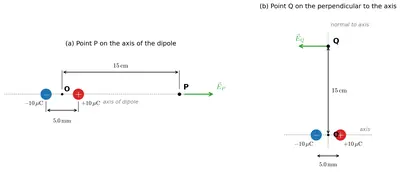
Two charges $$\pm 10 \, \mu\mathrm{C}$$ are placed 5.0 mm apart. Determine the electric field at (a) a point P on the axis of the dipole 15 cm away from its centre O on the side of the positive charge, as shown in Fig. 1.18(a), and (b) a point Q, 15 cm away from O on a line passing through O and normal to the axis of the dipole, as shown in Fig. 1.18(b).
Fig. 1.18
Fig. 1.18

Solution

The dipole has charges $$\pm 10 \, \mu\mathrm{C} = \pm 10^{-5} \, \mathrm{C}$$ separated by $$2a = 5.0 \, \mathrm{mm}$$, so $$a = 2.5 \times 10^{-3} \, \mathrm{m}$$. The dipole moment magnitude is $$p = q(2a) = 10^{-5} \times 5 \times 10^{-3} = 5 \times 10^{-8} \, \mathrm{C\,m}$$. Use $$k = 9 \times 10^9$$.

(a) Point P on the axis, $$r = 15 \, \mathrm{cm} = 0.15 \, \mathrm{m}$$ from O, on the side of $$+q$$.

P is at distance $$r - a = 0.1475 \, \mathrm{m}$$ from $$+q$$ and $$r + a = 0.1525 \, \mathrm{m}$$ from $$-q$$.

$$E_{+q} = \frac{kq}{(r-a)^2} = \frac{9 \times 10^9 \times 10^{-5}}{(0.1475)^2} \approx 4.13 \times 10^6 \, \mathrm{N\,C^{-1}} \;\; (\text{along OP})$$

$$E_{-q} = \frac{kq}{(r+a)^2} = \frac{9 \times 10^9 \times 10^{-5}}{(0.1525)^2} \approx 3.86 \times 10^6 \, \mathrm{N\,C^{-1}} \;\; (\text{towards O, opposite to OP})$$

The resultant points along OP (the direction of $$\mathbf p$$):

$$E_P = E_{+q} - E_{-q} \approx 4.13 \times 10^6 - 3.86 \times 10^6 = 2.7 \times 10^5 \, \mathrm{N\,C^{-1}}$$

Since $$r \gg a$$, this agrees with the axial dipole formula $$E = \dfrac{2kp}{r^3} = \dfrac{2 \times 9 \times 10^9 \times 5 \times 10^{-8}}{(0.15)^3} \approx 2.6 \times 10^5 \, \mathrm{N\,C^{-1}}$$.

(b) Point Q on the equatorial line, $$r = 0.15 \, \mathrm{m}$$ from O.

Q is at distance $$\sqrt{r^2 + a^2}$$ from each charge. The field magnitude due to each charge is

$$E_{+q} = E_{-q} = \frac{kq}{r^2 + a^2} = \frac{9 \times 10^9 \times 10^{-5}}{(0.15)^2 + (0.0025)^2} \approx 3.99 \times 10^6 \, \mathrm{N\,C^{-1}}$$

The components perpendicular to the dipole axis cancel; the components along the axis (each multiplied by $$\cos\theta = a/\sqrt{r^2+a^2}$$) add:

$$E_Q = 2E_{+q}\cos\theta = 2 \times 3.99 \times 10^6 \times \frac{0.0025}{0.15} \approx 1.33 \times 10^5 \, \mathrm{N\,C^{-1}}$$

directed antiparallel to $$\mathbf p$$. This matches the equatorial dipole formula $$E = \dfrac{kp}{r^3} = \dfrac{9 \times 10^9 \times 5 \times 10^{-8}}{(0.15)^3} \approx 1.33 \times 10^5 \, \mathrm{N\,C^{-1}}$$.

Answer

(a) $$E_P \approx 2.7 \times 10^5 \, \mathrm{N\,C^{-1}}$$, along the dipole moment; (b) $$E_Q \approx 1.33 \times 10^5 \, \mathrm{N\,C^{-1}}$$, antiparallel to the dipole moment.

Example 1.10

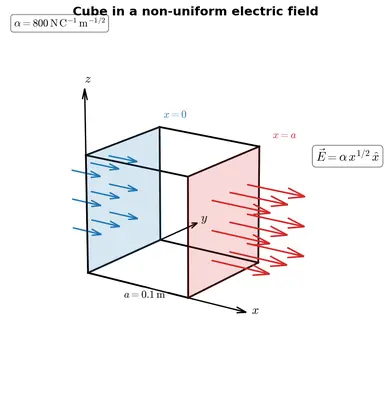
The electric field components in Fig. 1.24 are $$E_x = \alpha x^{1/2}$$, $$E_y = E_z = 0$$, in which $$\alpha = 800 \, \mathrm{N/C\,m^{1/2}}$$. Calculate (a) the flux through the cube, and (b) the charge within the cube. Assume that $$a = 0.1$$ m.
Fig. 1.24
Fig. 1.24

Solution

The field has only an $$x$$-component, $$E_x = \alpha x^{1/2}$$. For the four faces of the cube perpendicular to the $$y$$ and $$z$$ axes, $$\mathbf E$$ is parallel to the surface ($$\theta = 90^\circ$$), so the flux through them is zero. Only the two faces perpendicular to the $$x$$-axis contribute.

Place the left face at $$x = a$$ and the right face at $$x = 2a$$. The field magnitudes there are

$$E_L = \alpha a^{1/2}, \qquad E_R = \alpha (2a)^{1/2}$$

(a) Flux through the cube. The outward normal of the left face points along $$-x$$, so $$\theta = 180^\circ$$:

$$\phi_L = E_L a^2 \cos 180^\circ = -E_L a^2 = -\alpha a^{1/2}\,a^2$$

The outward normal of the right face points along $$+x$$, so $$\theta = 0^\circ$$:

$$\phi_R = E_R a^2 \cos 0^\circ = +E_R a^2 = \alpha (2a)^{1/2}\,a^2$$

The net flux is

$$\phi = \phi_R + \phi_L = \alpha a^2\left[(2a)^{1/2} - a^{1/2}\right] = \alpha a^{5/2}\left(\sqrt2 - 1\right)$$

$$\phi = 800 \times (0.1)^{5/2} \times (\sqrt2 - 1) = 800 \times 3.16 \times 10^{-3} \times 0.414 \approx 1.05 \, \mathrm{N\,m^2\,C^{-1}}$$

(b) Charge within the cube. By Gauss's law $$\phi = q/\varepsilon_0$$, so

$$q = \varepsilon_0\,\phi = 8.854 \times 10^{-12} \times 1.05 \approx 9.27 \times 10^{-12} \, \mathrm{C}$$

Answer

(a) $$\phi \approx 1.05 \, \mathrm{N\,m^2\,C^{-1}}$$; (b) $$q \approx 9.27 \times 10^{-12} \, \mathrm{C}$$.

Example 1.11

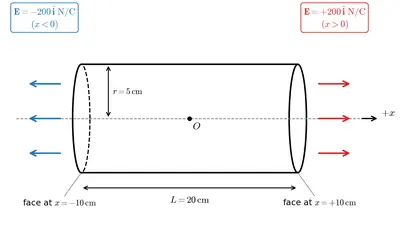
An electric field is uniform, and in the positive $$x$$ direction for positive $$x$$, and uniform with the same magnitude but in the negative $$x$$ direction for negative $$x$$. It is given that $$\mathbf{E} = 200 \, \hat{\mathbf{i}} \, \mathrm{N/C}$$ for $$x > 0$$ and $$\mathbf{E} = -200 \, \hat{\mathbf{i}} \, \mathrm{N/C}$$ for $$x < 0$$. A right circular cylinder of length 20 cm and radius 5 cm has its centre at the origin and its axis along the $$x$$-axis so that one face is at $$x = +10$$ cm and the other is at $$x = -10$$ cm (Fig. 1.25). (a) What is the net outward flux through each flat face? (b) What is the flux through the side of the cylinder? (c) What is the net outward flux through the cylinder? (d) What is the net charge inside the cylinder?
Fig. 1.25
Fig. 1.25

Solution

The cylinder has radius $$5 \, \mathrm{cm} = 0.05 \, \mathrm{m}$$, so each flat face has area

$$S = \pi r^2 = \pi (0.05)^2 \approx 7.85 \times 10^{-3} \, \mathrm{m^2}$$

(a) Flux through each flat face.

The right face is at $$x = +10 \, \mathrm{cm}$$, where $$\mathbf E = 200\,\hat{\mathbf i} \, \mathrm{N/C}$$. Its outward normal also points along $$+\hat{\mathbf i}$$, so $$\mathbf E$$ and $$\Delta\mathbf S$$ are parallel:

$$\phi_R = \mathbf E \cdot \Delta\mathbf S = 200 \times S = 200 \times 7.85 \times 10^{-3} \approx +1.57 \, \mathrm{N\,m^2\,C^{-1}}$$

The left face is at $$x = -10 \, \mathrm{cm}$$, where $$\mathbf E = -200\,\hat{\mathbf i} \, \mathrm{N/C}$$. Its outward normal points along $$-\hat{\mathbf i}$$, so $$\mathbf E$$ and $$\Delta\mathbf S$$ are again parallel:

$$\phi_L = \mathbf E \cdot \Delta\mathbf S = (-200)\times(-S) \approx +1.57 \, \mathrm{N\,m^2\,C^{-1}}$$

So the net outward flux through each flat face is $$+1.57 \, \mathrm{N\,m^2\,C^{-1}}$$.

(b) Flux through the curved side. Everywhere on the side, $$\mathbf E$$ (along $$\pm\hat{\mathbf i}$$) is perpendicular to the outward normal (which points radially outward). Hence $$\mathbf E \cdot \Delta\mathbf S = 0$$ and the flux through the side is zero.

(c) Net outward flux through the cylinder.

$$\phi = \phi_R + \phi_L + \phi_{\text{side}} = 1.57 + 1.57 + 0 = 3.14 \, \mathrm{N\,m^2\,C^{-1}}$$

(d) Net charge inside. By Gauss's law,

$$q = \varepsilon_0\,\phi = 8.854 \times 10^{-12} \times 3.14 \approx 2.78 \times 10^{-11} \, \mathrm{C}$$

Answer

(a) $$+1.57 \, \mathrm{N\,m^2\,C^{-1}}$$ through each flat face; (b) zero through the curved side; (c) net flux $$= 3.14 \, \mathrm{N\,m^2\,C^{-1}}$$; (d) $$q \approx 2.78 \times 10^{-11} \, \mathrm{C}$$.

Example 1.12 An early model for an atom considered it to have a positively charged point nucleus of charge $$Ze$$, surrounded by a uniform density of negative charge up to a radius $$R$$. The atom as a whole is neutral. For this model, what is the electric field at a distance $$r$$ from the nucleus?

Solution

The atom has a point nucleus of charge $$+Ze$$ at the centre, surrounded by a uniform negative charge spread through a sphere of radius $$R$$. Since the atom is neutral, the total negative charge must be $$-Ze$$.

Negative charge density. The negative charge $$-Ze$$ fills a sphere of volume $$\tfrac43\pi R^3$$, so

$$\rho = \frac{-Ze}{\tfrac43\pi R^3} = -\frac{3Ze}{4\pi R^3}$$

By spherical symmetry, $$\mathbf E$$ is radial and depends only on $$r$$. Choose a spherical Gaussian surface of radius $$r$$ centred on the nucleus.

(i) Inside the distribution, $$r < R$$. The enclosed charge is the nuclear charge plus the negative charge within radius $$r$$:

$$q_{\text{enc}} = Ze + \rho\left(\frac{4}{3}\pi r^3\right) = Ze - \frac{3Ze}{4\pi R^3}\cdot\frac{4\pi r^3}{3} = Ze\left(1 - \frac{r^3}{R^3}\right)$$

Gauss's law $$E\,(4\pi r^2) = q_{\text{enc}}/\varepsilon_0$$ gives

$$E(r) = \frac{Ze}{4\pi\varepsilon_0}\left(\frac{1}{r^2} - \frac{r}{R^3}\right), \qquad r < R$$

directed radially outward.

(ii) Outside the atom, $$r > R$$. The Gaussian surface now encloses the whole atom, whose total charge is zero. Hence

$$E\,(4\pi r^2) = \frac{0}{\varepsilon_0} \;\;\Rightarrow\;\; E(r) = 0, \qquad r > R$$

At $$r = R$$, both expressions give $$E = 0$$, so the field is continuous there.

Answer

For $$r < R$$: $$E(r) = \dfrac{Ze}{4\pi\varepsilon_0}\left(\dfrac{1}{r^2} - \dfrac{r}{R^3}\right)$$, directed radially outward. For $$r > R$$: $$E = 0$$.

Exercises

1.1 What is the force between two small charged spheres having charges of $$2 \times 10^{-7} \, \mathrm{C}$$ and $$3 \times 10^{-7} \, \mathrm{C}$$ placed 30 cm apart in air?

Solution

Both spheres are small, so they may be treated as point charges. By Coulomb's law,

$$F = \frac{1}{4\pi\varepsilon_0}\frac{q_1 q_2}{r^2} = k\,\frac{q_1 q_2}{r^2}$$

with $$k = 9 \times 10^9 \, \mathrm{N\,m^2\,C^{-2}}$$, $$q_1 = 2 \times 10^{-7} \, \mathrm{C}$$, $$q_2 = 3 \times 10^{-7} \, \mathrm{C}$$ and $$r = 30 \, \mathrm{cm} = 0.30 \, \mathrm{m}$$.

$$F = \frac{9 \times 10^9 \times (2 \times 10^{-7}) \times (3 \times 10^{-7})}{(0.30)^2}$$

$$F = \frac{9 \times 10^9 \times 6 \times 10^{-14}}{0.09} = \frac{5.4 \times 10^{-4}}{0.09} = 6 \times 10^{-3} \, \mathrm{N}$$

Both charges are positive, so the force is repulsive.

Answer

$$F = 6 \times 10^{-3} \, \mathrm{N}$$, repulsive.

1.2 The electrostatic force on a small sphere of charge $$0.4 \, \mu\mathrm{C}$$ due to another small sphere of charge $$-0.8 \, \mu\mathrm{C}$$ in air is 0.2 N. (a) What is the distance between the two spheres? (b) What is the force on the second sphere due to the first?

(a) What is the distance between the two spheres?

Solution

By Coulomb's law the magnitude of the force is

$$F = k\,\frac{q_1 q_2}{r^2} \;\;\Rightarrow\;\; r^2 = \frac{k\,q_1 q_2}{F}$$

Use the charge magnitudes $$q_1 = 0.4 \, \mu\mathrm{C} = 4 \times 10^{-7} \, \mathrm{C}$$, $$q_2 = 0.8 \, \mu\mathrm{C} = 8 \times 10^{-7} \, \mathrm{C}$$, $$F = 0.2 \, \mathrm{N}$$ and $$k = 9 \times 10^9$$:

$$r^2 = \frac{9 \times 10^9 \times (4 \times 10^{-7}) \times (8 \times 10^{-7})}{0.2} = \frac{9 \times 10^9 \times 3.2 \times 10^{-13}}{0.2}$$

$$r^2 = \frac{2.88 \times 10^{-3}}{0.2} = 1.44 \times 10^{-2} \, \mathrm{m^2}$$

$$r = \sqrt{1.44 \times 10^{-2}} = 0.12 \, \mathrm{m} = 12 \, \mathrm{cm}$$

Answer

$$r = 0.12 \, \mathrm{m} = 12 \, \mathrm{cm}$$.

(b) What is the force on the second sphere due to the first?

Solution

By Newton's third law, the two spheres exert equal and opposite forces on each other. The electrostatic force is an action-reaction pair, so the force on the second sphere due to the first has the same magnitude as the force on the first due to the second:

$$F_{21} = F_{12} = 0.2 \, \mathrm{N}$$

Since one charge is positive ($$+0.4 \, \mu\mathrm{C}$$) and the other negative ($$-0.8 \, \mu\mathrm{C}$$), the force is one of attraction.

Answer

$$0.2 \, \mathrm{N}$$, attractive (equal in magnitude and opposite in direction to the force on the first sphere).

1.3 Check that the ratio $$ke^2 / G\, m_e m_p$$ is dimensionless. Look up a Table of Physical Constants and determine the value of this ratio. What does the ratio signify?

Solution

Dimensional check. From Coulomb's law $$F = \dfrac{k e^2}{r^2}$$, we have $$k e^2 = F r^2$$, with dimensions

$$[k e^2] = [\text{force}][\text{length}]^2 = [\mathrm{M\,L\,T^{-2}}][\mathrm{L^2}] = [\mathrm{M\,L^3\,T^{-2}}]$$

From Newton's law of gravitation $$F = \dfrac{G m_e m_p}{r^2}$$, we have $$G m_e m_p = F r^2$$, with the same dimensions

$$[G m_e m_p] = [\text{force}][\text{length}]^2 = [\mathrm{M\,L^3\,T^{-2}}]$$

Therefore the ratio

$$\frac{k e^2}{G\, m_e m_p} = \frac{[\mathrm{M\,L^3\,T^{-2}}]}{[\mathrm{M\,L^3\,T^{-2}}]}$$

is dimensionless.

Numerical value. Using $$k = 9 \times 10^9 \, \mathrm{N\,m^2\,C^{-2}}$$, $$e = 1.6 \times 10^{-19} \, \mathrm{C}$$, $$G = 6.67 \times 10^{-11} \, \mathrm{N\,m^2\,kg^{-2}}$$, $$m_e = 9.11 \times 10^{-31} \, \mathrm{kg}$$ and $$m_p = 1.67 \times 10^{-27} \, \mathrm{kg}$$:

$$k e^2 = 9 \times 10^9 \times (1.6 \times 10^{-19})^2 = 2.3 \times 10^{-28}$$

$$G\, m_e m_p = 6.67 \times 10^{-11} \times 9.11 \times 10^{-31} \times 1.67 \times 10^{-27} \approx 1.0 \times 10^{-67}$$

$$\frac{k e^2}{G\, m_e m_p} = \frac{2.3 \times 10^{-28}}{1.0 \times 10^{-67}} \approx 2.3 \times 10^{39}$$

Significance. This ratio is the strength of the electrostatic force between an electron and a proton compared with the gravitational force between the same pair. Its huge value ($$\sim 10^{39}$$) shows that the electric force is overwhelmingly stronger than the gravitational force; gravity is utterly negligible at the atomic scale.

Answer

The ratio is dimensionless and equals about $$2.3 \times 10^{39}$$. It shows that the electrostatic force between an electron and a proton is roughly $$10^{39}$$ times stronger than the gravitational force between them.

1.4 (a) Explain the meaning of the statement 'electric charge of a body is quantised'.
(b) Why can one ignore quantisation of electric charge when dealing with macroscopic i.e., large scale charges?

(a) Explain the meaning of the statement 'electric charge of a body is quantised'.

Solution

To say that the electric charge of a body is quantised means that the total charge of any body is always an integral multiple of a basic (elementary) unit of charge $$e$$, the magnitude of the charge carried by an electron (or a proton):

$$q = n e, \qquad n = 0, \pm 1, \pm 2, \pm 3, \ldots$$

where $$e = 1.6 \times 10^{-19} \, \mathrm{C}$$. A body is charged only by transferring whole electrons, so its charge can change only in discrete steps of size $$e$$. Fractional charges such as $$0.5e$$ or $$2.7e$$ are never found on a free body; the charge is grainy, not continuously variable.

Answer

It means the charge on any body is always an integral multiple of the elementary charge $$e$$: $$q = ne$$, where $$n$$ is an integer and $$e = 1.6 \times 10^{-19} \, \mathrm{C}$$.

(b) Why can one ignore quantisation of electric charge when dealing with macroscopic i.e., large scale charges?

Solution

The elementary charge $$e = 1.6 \times 10^{-19} \, \mathrm{C}$$ is extremely small. A typical macroscopic charge, say $$1 \, \mu\mathrm{C} = 10^{-6} \, \mathrm{C}$$, corresponds to

$$n = \frac{q}{e} = \frac{10^{-6}}{1.6 \times 10^{-19}} \approx 6 \times 10^{12}$$

i.e. several thousand billion elementary charges. Adding or removing one electron changes $$n$$ by just $$1$$ out of about $$10^{13}$$ - a change far too tiny to detect. Because the step size $$e$$ is so minute compared with the total charge, the charge appears to vary continuously. Hence at the macroscopic scale the quantisation of charge can be ignored, just as a dotted line viewed from far away looks like a continuous line.

Answer

Because a macroscopic charge corresponds to an enormous number ($$\sim 10^{13}$$) of elementary charges, the step $$e$$ is negligibly small compared with the total, so the charge effectively behaves as a continuous quantity.

1.5 When a glass rod is rubbed with a silk cloth, charges appear on both. A similar phenomenon is observed with many other pairs of bodies. Explain how this observation is consistent with the law of conservation of charge.

Solution

When a glass rod is rubbed with silk, no new charge is created. Some electrons are merely transferred from the glass rod to the silk cloth. The glass rod, having lost electrons, acquires a positive charge $$+q$$; the silk, having gained exactly those electrons, acquires an equal negative charge $$-q$$.

Before rubbing, both bodies were neutral, so the total charge of the isolated glass-silk system was

$$q_{\text{before}} = 0 + 0 = 0$$

After rubbing, the total charge is

$$q_{\text{after}} = (+q) + (-q) = 0$$

The total charge is unchanged. The charges appearing on the two bodies are always equal in magnitude and opposite in sign, because one body gains precisely what the other loses. This is exactly the statement of the law of conservation of charge: charge can be transferred from one body to another, but it can neither be created nor destroyed. The same reasoning applies to every pair of bodies that are rubbed together.

Answer

Rubbing only transfers electrons from one body to the other; the two bodies acquire equal and opposite charges, so the total charge of the system stays zero - consistent with conservation of charge.

1.6 Four point charges $$q_A = 2 \, \mu\mathrm{C}$$, $$q_B = -5 \, \mu\mathrm{C}$$, $$q_C = 2 \, \mu\mathrm{C}$$, and $$q_D = -5 \, \mu\mathrm{C}$$ are located at the corners of a square ABCD of side 10 cm. What is the force on a charge of $$1 \, \mu\mathrm{C}$$ placed at the centre of the square?

Solution

Label the square ABCD with side $$10 \, \mathrm{cm}$$. The corner charges are $$q_A = 2 \, \mu\mathrm{C}$$, $$q_B = -5 \, \mu\mathrm{C}$$, $$q_C = 2 \, \mu\mathrm{C}$$, $$q_D = -5 \, \mu\mathrm{C}$$, and a charge $$q_O = 1 \, \mu\mathrm{C}$$ sits at the centre O.

The centre O is equidistant from all four corners; this distance is half the diagonal:

$$r = \frac{1}{2}\times(\text{diagonal}) = \frac{1}{2}\times\left(\sqrt2 \times 0.10\right) = \frac{0.10}{\sqrt2} \, \mathrm{m}$$

Charges A and C: A and C lie at opposite ends of one diagonal. They carry equal charges ($$2 \, \mu\mathrm{C}$$ each) at equal distances $$r$$ from O. The force on $$q_O$$ due to A and the force due to C therefore have equal magnitude

$$F_A = F_C = k\,\frac{q_O\,q_A}{r^2}$$

but act along the same diagonal in opposite directions (one towards A, the other towards C). Hence they cancel exactly.

Charges B and D: Likewise, B and D lie at opposite ends of the other diagonal and carry equal charges ($$-5 \, \mu\mathrm{C}$$ each) at equal distances $$r$$. The forces they exert on $$q_O$$ are equal in magnitude and opposite in direction, so they too cancel.

Adding the two cancelling pairs:

$$\mathbf F_{\text{net}} = (\mathbf F_A + \mathbf F_C) + (\mathbf F_B + \mathbf F_D) = 0 + 0 = 0$$

The net force on the $$1 \, \mu\mathrm{C}$$ charge at the centre is zero.

Answer

The net force on the $$1 \, \mu\mathrm{C}$$ charge at the centre is zero (the forces from each pair of equal diagonal charges cancel).

1.7 (a) An electrostatic field line is a continuous curve. That is, a field line cannot have sudden breaks. Why not?
(b) Explain why two field lines never cross each other at any point?

(a) An electrostatic field line is a continuous curve. That is, a field line cannot have sudden breaks. Why not?

Solution

An electric field line is drawn so that its tangent at every point gives the direction of the electric field $$\mathbf E$$ there. A sudden break in a field line would mean that at some point the field has no defined direction, or that a test charge released there would feel no force and then abruptly acquire one. This contradicts the fact that the electric field has a definite magnitude and direction at every point of the region (except exactly at a point charge).

Physically, a field line indicates the direction in which a small positive test charge would tend to move. Such motion is continuous - the test charge cannot jump from one place to another. Therefore the field line, being a continuous record of the field direction, must itself be a continuous, unbroken curve. (Field lines do begin and end, but only on charges: they start on positive charges and terminate on negative charges or at infinity.)

Answer

Because the electric field has a definite direction at every point, a test charge moves continuously along it; a break would imply an undefined field direction, which is impossible. Hence a field line is a continuous curve.

(b) Explain why two field lines never cross each other at any point?

Solution

The tangent to a field line at any point gives the direction of the electric field $$\mathbf E$$ at that point. If two field lines were to cross at some point, then at that single point we could draw two different tangents, implying two different directions for $$\mathbf E$$.

But the electric field at any given point has one unique magnitude and one unique direction - it is the net force per unit positive charge, a single well-defined vector. A point cannot have two field directions at the same time.

This contradiction shows the assumption is false: two electric field lines can never cross each other.

Answer

If two field lines crossed, the field at the crossing point would have two directions at once, which is impossible since $$\mathbf E$$ has a unique direction at every point.

1.8 Two point charges $$q_A = 3 \, \mu\mathrm{C}$$ and $$q_B = -3 \, \mu\mathrm{C}$$ are located 20 cm apart in vacuum.
(a) What is the electric field at the midpoint O of the line AB joining the two charges?
(b) If a negative test charge of magnitude $$1.5 \times 10^{-9} \, \mathrm{C}$$ is placed at this point, what is the force experienced by the test charge?

(a) What is the electric field at the midpoint O of the line AB joining the two charges?

Solution

The charges are $$q_A = +3 \, \mu\mathrm{C}$$ and $$q_B = -3 \, \mu\mathrm{C}$$, separated by $$20 \, \mathrm{cm}$$. The midpoint O is at $$r = 10 \, \mathrm{cm} = 0.10 \, \mathrm{m}$$ from each charge.

Field at O due to $$q_A$$ (positive): it points away from A, i.e. from A towards B. Its magnitude is

$$E_A = k\,\frac{q_A}{r^2} = \frac{9 \times 10^9 \times 3 \times 10^{-6}}{(0.10)^2} = \frac{2.7 \times 10^4}{0.01} = 2.7 \times 10^6 \, \mathrm{N\,C^{-1}}$$

Field at O due to $$q_B$$ (negative): it points towards B, i.e. also from A towards B. Its magnitude is

$$E_B = k\,\frac{|q_B|}{r^2} = \frac{9 \times 10^9 \times 3 \times 10^{-6}}{(0.10)^2} = 2.7 \times 10^6 \, \mathrm{N\,C^{-1}}$$

Both fields point in the same direction (from A to B), so they add:

$$E_O = E_A + E_B = 2.7 \times 10^6 + 2.7 \times 10^6 = 5.4 \times 10^6 \, \mathrm{N\,C^{-1}}$$

The resultant field at O is $$5.4 \times 10^6 \, \mathrm{N\,C^{-1}}$$, directed from A towards B.

Answer

$$E_O = 5.4 \times 10^6 \, \mathrm{N\,C^{-1}}$$, directed from A (the positive charge) towards B (the negative charge).

(b) If a negative test charge of magnitude $$1.5 \times 10^{-9} \, \mathrm{C}$$ is placed at this point, what is the force experienced by the test charge?

Solution

A test charge of magnitude $$q = 1.5 \times 10^{-9} \, \mathrm{C}$$ placed at O experiences a force of magnitude

$$F = qE_O = 1.5 \times 10^{-9} \times 5.4 \times 10^6$$

$$F = 8.1 \times 10^{-3} \, \mathrm{N}$$

The test charge is negative, so the force on it is directed opposite to the field $$\mathbf E_O$$. Since $$\mathbf E_O$$ points from A to B, the force on the negative test charge points from B towards A.

Answer

$$F = 8.1 \times 10^{-3} \, \mathrm{N}$$, directed from B towards A (opposite to $$\mathbf E_O$$, because the test charge is negative).

1.9 A system has two charges $$q_A = 2.5 \times 10^{-7} \, \mathrm{C}$$ and $$q_B = -2.5 \times 10^{-7} \, \mathrm{C}$$ located at points A: $$(0, 0, -15 \, \mathrm{cm})$$ and B: $$(0, 0, +15 \, \mathrm{cm})$$, respectively. What are the total charge and electric dipole moment of the system?

Solution

Total charge. Charge is a scalar and adds algebraically:

$$q_{\text{total}} = q_A + q_B = (2.5 \times 10^{-7}) + (-2.5 \times 10^{-7}) = 0$$

Electric dipole moment. The two charges are equal and opposite, so they form an electric dipole. Their separation is

$$2a = 15 \, \mathrm{cm} + 15 \, \mathrm{cm} = 30 \, \mathrm{cm} = 0.30 \, \mathrm{m}$$

The magnitude of the dipole moment is

$$p = q \times 2a = (2.5 \times 10^{-7}) \times 0.30 = 7.5 \times 10^{-8} \, \mathrm{C\,m}$$

By convention the dipole moment vector points from the negative charge to the positive charge. Here the negative charge $$q_B$$ is at $$z = +15 \, \mathrm{cm}$$ and the positive charge $$q_A$$ is at $$z = -15 \, \mathrm{cm}$$. So $$\mathbf p$$ points from B to A, i.e. along the negative $$z$$-direction.

Answer

Total charge $$= 0$$. Dipole moment $$p = 7.5 \times 10^{-8} \, \mathrm{C\,m}$$, directed from B to A, i.e. along the negative $$z$$-axis.

1.10 An electric dipole with dipole moment $$4 \times 10^{-9} \, \mathrm{C\,m}$$ is aligned at $$30^\circ$$ with the direction of a uniform electric field of magnitude $$5 \times 10^4 \, \mathrm{N\,C^{-1}}$$. Calculate the magnitude of the torque acting on the dipole.

Solution

The torque on a dipole of moment $$p$$ placed in a uniform field $$E$$ is $$\boldsymbol\tau = \mathbf p \times \mathbf E$$, whose magnitude is

$$\tau = pE\sin\theta$$

where $$\theta$$ is the angle between $$\mathbf p$$ and $$\mathbf E$$. Here $$p = 4 \times 10^{-9} \, \mathrm{C\,m}$$, $$E = 5 \times 10^4 \, \mathrm{N\,C^{-1}}$$ and $$\theta = 30^\circ$$:

$$\tau = (4 \times 10^{-9}) \times (5 \times 10^4) \times \sin 30^\circ$$

$$\tau = (4 \times 10^{-9}) \times (5 \times 10^4) \times 0.5$$

$$\tau = 10 \times 10^{-5} = 1 \times 10^{-4} \, \mathrm{N\,m}$$

Answer

$$\tau = 1 \times 10^{-4} \, \mathrm{N\,m}$$.

1.11 A polythene piece rubbed with wool is found to have a negative charge of $$3 \times 10^{-7} \, \mathrm{C}$$.
(a) Estimate the number of electrons transferred (from which to which?)
(b) Is there a transfer of mass from wool to polythene?

(a) Estimate the number of electrons transferred (from which to which?)

Solution

The polythene piece carries a negative charge of magnitude $$q = 3 \times 10^{-7} \, \mathrm{C}$$. Since charge is quantised, $$q = n e$$, the number of electrons transferred is

$$n = \frac{q}{e} = \frac{3 \times 10^{-7}}{1.6 \times 10^{-19}}$$

$$n \approx 1.875 \times 10^{12} \;\; (\text{about } 1.9 \times 10^{12}) \;\text{electrons}$$

The polythene became negatively charged, which means it gained electrons. Therefore the electrons were transferred from the wool to the polythene.

Answer

About $$n \approx 1.9 \times 10^{12}$$ electrons, transferred from the wool to the polythene.

(b) Is there a transfer of mass from wool to polythene?

Solution

Yes. Electrons have mass, so transferring electrons also transfers a (very small) amount of mass. Because the electrons move from the wool to the polythene, mass is transferred from the wool to the polythene, in the same direction as the electrons.

The mass transferred is

$$\Delta m = n\,m_e = (1.875 \times 10^{12}) \times (9.11 \times 10^{-31} \, \mathrm{kg})$$

$$\Delta m \approx 1.71 \times 10^{-18} \, \mathrm{kg}$$

This is an extremely tiny mass - far too small to be measured - but it is not exactly zero.

Answer

Yes. Mass is transferred from the wool to the polythene along with the electrons; $$\Delta m = n\,m_e \approx 1.71 \times 10^{-18} \, \mathrm{kg}$$, which is negligibly small.

1.12 (a) Two insulated charged copper spheres A and B have their centres separated by a distance of 50 cm. What is the mutual force of electrostatic repulsion if the charge on each is $$6.5 \times 10^{-7} \, \mathrm{C}$$? The radii of A and B are negligible compared to the distance of separation.
(b) What is the force of repulsion if each sphere is charged double the above amount, and the distance between them is halved?

(a) Two insulated charged copper spheres A and B have their centres separated by a distance of 50 cm. What is the mutual force of electrostatic repulsion if the charge on each is $$6.5 \times 10^{-7} \, \mathrm{C}$$? The radii of A and B are negligible compared to the distance of separation.

Solution

Since the radii are negligible compared with the separation, the spheres behave as point charges. By Coulomb's law,

$$F = k\,\frac{q^2}{r^2}$$

with $$q = 6.5 \times 10^{-7} \, \mathrm{C}$$, $$r = 50 \, \mathrm{cm} = 0.50 \, \mathrm{m}$$ and $$k = 9 \times 10^9 \, \mathrm{N\,m^2\,C^{-2}}$$:

$$F = \frac{9 \times 10^9 \times (6.5 \times 10^{-7})^2}{(0.50)^2}$$

$$F = \frac{9 \times 10^9 \times 4.225 \times 10^{-13}}{0.25} = \frac{3.8025 \times 10^{-3}}{0.25}$$

$$F \approx 1.5 \times 10^{-2} \, \mathrm{N}$$

The two charges are alike, so the force is one of repulsion.

Answer

$$F \approx 1.5 \times 10^{-2} \, \mathrm{N}$$ (repulsive).

(b) What is the force of repulsion if each sphere is charged double the above amount, and the distance between them is halved?

Solution

Each charge is doubled, $$q' = 2q$$, and the separation is halved, $$r' = r/2$$. The new force is

$$F' = k\,\frac{q'^2}{r'^2} = k\,\frac{(2q)^2}{(r/2)^2} = k\,\frac{4q^2}{r^2/4} = 16\left(k\,\frac{q^2}{r^2}\right) = 16\,F$$

So the force becomes $$16$$ times larger:

$$F' = 16 \times 1.5 \times 10^{-2} \, \mathrm{N} \approx 0.24 \, \mathrm{N}$$

The force is still repulsive.

Answer

$$F' = 16F \approx 0.24 \, \mathrm{N}$$ (repulsive).

1.13

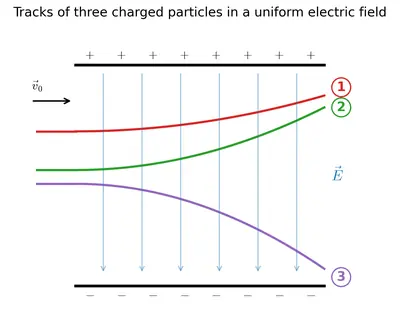
Figure 1.30 shows tracks of three charged particles in a uniform electrostatic field. Give the signs of the three charges. Which particle has the highest charge to mass ratio?
Figure 1.30
Figure 1.30

Solution

In Fig. 1.30 the upper plate is positive and the lower plate is negative, so the uniform electric field between the plates points downward (from the positive plate towards the negative plate).

Signs of the charges. The force on a charge is $$\mathbf F = q\mathbf E$$.

  • Particles 1 and 2 are deflected upward, towards the positive plate. Their force is opposite to $$\mathbf E$$, so they must carry negative charge.
  • Particle 3 is deflected downward, towards the negative plate. Its force is along $$\mathbf E$$, so it carries positive charge.

Highest charge-to-mass ratio. While crossing the field region (the same horizontal length, at roughly the same speed), a particle is displaced sideways by

$$y = \frac{1}{2}at^2 = \frac{1}{2}\left(\frac{qE}{m}\right)t^2$$

so the deflection is proportional to the charge-to-mass ratio $$q/m$$. Particle 3 shows the largest deflection, so it has the highest charge-to-mass ratio.

Answer

Particles 1 and 2 are negatively charged; particle 3 is positively charged. Particle 3 has the highest charge-to-mass ratio (it shows the greatest deflection).

1.14 Consider a uniform electric field $$\mathbf{E} = 3 \times 10^3 \, \hat{\mathbf{i}} \, \mathrm{N/C}$$. (a) What is the flux of this field through a square of 10 cm on a side whose plane is parallel to the $$yz$$ plane? (b) What is the flux through the same square if the normal to its plane makes a $$60^\circ$$ angle with the $$x$$-axis?

(a) What is the flux of this field through a square of 10 cm on a side whose plane is parallel to the $$yz$$ plane?

Solution

The field is $$\mathbf E = 3 \times 10^3\,\hat{\mathbf i} \, \mathrm{N/C}$$. The square has side $$10 \, \mathrm{cm} = 0.10 \, \mathrm{m}$$, so its area is

$$A = (0.10)^2 = 1 \times 10^{-2} \, \mathrm{m^2}$$

The plane of the square is parallel to the $$yz$$-plane, so the normal to the square is along the $$x$$-axis - the same direction as $$\mathbf E$$. Hence the angle between $$\mathbf E$$ and the area vector is $$\theta = 0^\circ$$, and the flux is

$$\phi = \mathbf E \cdot \mathbf A = E A\cos 0^\circ = (3 \times 10^3) \times (1 \times 10^{-2}) \times 1$$

$$\phi = 30 \, \mathrm{N\,m^2\,C^{-1}}$$

Answer

$$\phi = 30 \, \mathrm{N\,m^2\,C^{-1}}$$.

(b) What is the flux through the same square if the normal to its plane makes a $$60^\circ$$ angle with the $$x$$-axis?

Solution

The area and the field magnitude are unchanged: $$A = 1 \times 10^{-2} \, \mathrm{m^2}$$ and $$E = 3 \times 10^3 \, \mathrm{N/C}$$. Now the normal to the square makes an angle $$\theta = 60^\circ$$ with the $$x$$-axis (the direction of $$\mathbf E$$).

$$\phi = E A\cos\theta = (3 \times 10^3) \times (1 \times 10^{-2}) \times \cos 60^\circ$$

$$\phi = 30 \times 0.5 = 15 \, \mathrm{N\,m^2\,C^{-1}}$$

Answer

$$\phi = 15 \, \mathrm{N\,m^2\,C^{-1}}$$.

1.15 What is the net flux of the uniform electric field of Exercise 1.14 through a cube of side 20 cm oriented so that its faces are parallel to the coordinate planes?

Solution

The field $$\mathbf E = 3 \times 10^3\,\hat{\mathbf i} \, \mathrm{N/C}$$ is uniform. The cube is oriented with its faces parallel to the coordinate planes.

Consider the flux face by face:

  • The four faces parallel to the $$x$$-axis have their outward normals perpendicular to $$\mathbf E$$, so the flux through each of them is zero.
  • For the two faces perpendicular to the $$x$$-axis, the field lines enter through one face and leave through the opposite face. The flux entering one face is $$-EA$$ and the flux leaving the opposite face is $$+EA$$.

Adding all contributions:

$$\phi_{\text{net}} = (+EA) + (-EA) + 0 + 0 + 0 + 0 = 0$$

The net flux is zero. This also follows directly from Gauss's law: a uniform field means no charge is enclosed inside the cube, so $$\phi = q_{\text{enc}}/\varepsilon_0 = 0$$.

Answer

The net flux through the cube is zero (whatever flux enters one face leaves the opposite face; no charge is enclosed).

1.16 Careful measurement of the electric field at the surface of a black box indicates that the net outward flux through the surface of the box is $$8.0 \times 10^3 \, \mathrm{Nm^2/C}$$. (a) What is the net charge inside the box? (b) If the net outward flux through the surface of the box were zero, could you conclude that there were no charges inside the box? Why or Why not?

(a) What is the net charge inside the box?

Solution

By Gauss's law, the net outward flux through a closed surface is related to the net charge enclosed by

$$\phi = \frac{q_{\text{enc}}}{\varepsilon_0} \;\;\Rightarrow\;\; q_{\text{enc}} = \varepsilon_0\,\phi$$

With $$\phi = 8.0 \times 10^3 \, \mathrm{N\,m^2/C}$$ and $$\varepsilon_0 = 8.854 \times 10^{-12} \, \mathrm{C^2\,N^{-1}\,m^{-2}}$$:

$$q_{\text{enc}} = (8.854 \times 10^{-12}) \times (8.0 \times 10^3)$$

$$q_{\text{enc}} \approx 7.1 \times 10^{-8} \, \mathrm{C} \approx 0.07 \, \mu\mathrm{C}$$

Answer

$$q_{\text{enc}} \approx 7.1 \times 10^{-8} \, \mathrm{C} \approx 0.07 \, \mu\mathrm{C}$$.

(b) If the net outward flux through the surface of the box were zero, could you conclude that there were no charges inside the box? Why or Why not?

Solution

No, one cannot conclude that there are no charges inside the box.

Gauss's law states that the net flux equals the net (algebraic) charge enclosed divided by $$\varepsilon_0$$. A zero net flux only tells us that the net enclosed charge is zero:

$$\phi = 0 \;\;\Rightarrow\;\; q_{\text{enc, net}} = 0$$

But the box could still contain charges - for example equal amounts of positive and negative charge (such as $$+5 \, \mu\mathrm{C}$$ and $$-5 \, \mu\mathrm{C}$$) whose algebraic sum is zero. The outward flux produced by the positive charge would then be exactly cancelled by the inward flux of the negative charge.

Hence zero net flux guarantees only that the net charge inside is zero, not that the box is free of charges.

Answer

No. Zero net flux means only that the net charge enclosed is zero; the box could still contain equal amounts of positive and negative charge.

1.17

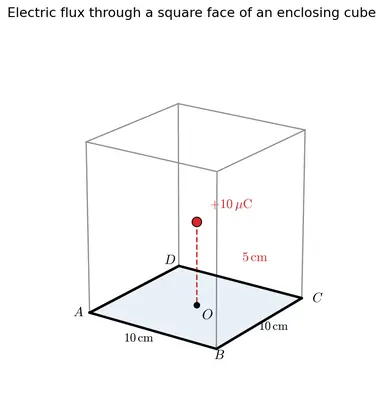
A point charge $$+10 \, \mu\mathrm{C}$$ is a distance 5 cm directly above the centre of a square of side 10 cm, as shown in Fig. 1.31. What is the magnitude of the electric flux through the square? (Hint: Think of the square as one face of a cube with edge 10 cm.)
Fig. 1.31
Fig. 1.31

Solution

Following the hint, imagine the square as one face of a cube of edge $$10 \, \mathrm{cm}$$. Since the charge $$+10 \, \mu\mathrm{C}$$ is $$5 \, \mathrm{cm}$$ directly above the centre of the square, it sits exactly at the centre of this cube.

By Gauss's law, the total flux through the whole closed cubical surface is

$$\phi_{\text{total}} = \frac{q}{\varepsilon_0}$$

By symmetry, a charge at the centre sends an equal flux through each of the $$6$$ identical faces. So the flux through one face (our square) is

$$\phi_{\text{square}} = \frac{1}{6}\cdot\frac{q}{\varepsilon_0}$$

Substituting $$q = 10 \times 10^{-6} \, \mathrm{C}$$ and $$\varepsilon_0 = 8.854 \times 10^{-12} \, \mathrm{C^2\,N^{-1}\,m^{-2}}$$:

$$\phi_{\text{square}} = \frac{10 \times 10^{-6}}{6 \times 8.854 \times 10^{-12}} = \frac{10 \times 10^{-6}}{5.31 \times 10^{-11}}$$

$$\phi_{\text{square}} \approx 1.88 \times 10^5 \, \mathrm{N\,m^2\,C^{-1}}$$

Answer

$$\phi \approx 1.88 \times 10^5 \, \mathrm{N\,m^2\,C^{-1}}$$.

1.18 A point charge of $$2.0 \, \mu\mathrm{C}$$ is at the centre of a cubic Gaussian surface 9.0 cm on edge. What is the net electric flux through the surface?

Solution

By Gauss's law, the net electric flux through any closed surface depends only on the total charge enclosed, not on the size or shape of the surface:

$$\phi = \frac{q}{\varepsilon_0}$$

The point charge $$q = 2.0 \, \mu\mathrm{C} = 2.0 \times 10^{-6} \, \mathrm{C}$$ is at the centre of the cube, so all of it is enclosed:

$$\phi = \frac{2.0 \times 10^{-6}}{8.854 \times 10^{-12}}$$

$$\phi \approx 2.26 \times 10^5 \, \mathrm{N\,m^2\,C^{-1}}$$

Note that the answer does not depend on the $$9.0 \, \mathrm{cm}$$ edge length - the flux would be the same for a cube of any size.

Answer

$$\phi \approx 2.26 \times 10^5 \, \mathrm{N\,m^2\,C^{-1}}$$ (independent of the size of the cube).

1.19 A point charge causes an electric flux of $$-1.0 \times 10^3 \, \mathrm{Nm^2/C}$$ to pass through a spherical Gaussian surface of 10.0 cm radius centred on the charge. (a) If the radius of the Gaussian surface were doubled, how much flux would pass through the surface? (b) What is the value of the point charge?

(a) If the radius of the Gaussian surface were doubled, how much flux would pass through the surface?

Solution

By Gauss's law the flux through a closed surface depends only on the charge enclosed:

$$\phi = \frac{q}{\varepsilon_0}$$

It does not depend on the size (radius) or shape of the Gaussian surface. When the radius of the spherical surface is doubled, the same point charge is still enclosed, so the flux is unchanged:

$$\phi' = \phi = -1.0 \times 10^3 \, \mathrm{N\,m^2/C}$$

(Although the surface area grows fourfold, the field falls off as $$1/r^2$$, so their product - the flux - stays the same.)

Answer

The flux is unchanged: $$\phi' = -1.0 \times 10^3 \, \mathrm{N\,m^2/C}$$.

(b) What is the value of the point charge?

Solution

From Gauss's law,

$$\phi = \frac{q}{\varepsilon_0} \;\;\Rightarrow\;\; q = \varepsilon_0\,\phi$$

With $$\phi = -1.0 \times 10^3 \, \mathrm{N\,m^2/C}$$ and $$\varepsilon_0 = 8.854 \times 10^{-12} \, \mathrm{C^2\,N^{-1}\,m^{-2}}$$:

$$q = (8.854 \times 10^{-12}) \times (-1.0 \times 10^3)$$

$$q \approx -8.85 \times 10^{-9} \, \mathrm{C} \approx -8.8 \, \mathrm{nC}$$

The negative sign (consistent with the negative, inward flux) shows that the point charge is negative.

Answer

$$q \approx -8.8 \times 10^{-9} \, \mathrm{C}$$ (a negative charge).

1.20 A conducting sphere of radius 10 cm has an unknown charge. If the electric field 20 cm from the centre of the sphere is $$1.5 \times 10^3 \, \mathrm{N/C}$$ and points radially inward, what is the net charge on the sphere?

Solution

For any point outside a charged conducting sphere, the sphere behaves as if its entire charge $$q$$ were concentrated at its centre. So at a distance $$r$$ from the centre,

$$E = \frac{1}{4\pi\varepsilon_0}\frac{q}{r^2} = k\,\frac{q}{r^2}$$

Here $$r = 20 \, \mathrm{cm} = 0.20 \, \mathrm{m}$$ (which lies outside the sphere of radius $$10 \, \mathrm{cm}$$) and $$E = 1.5 \times 10^3 \, \mathrm{N/C}$$. Solving for the charge magnitude:

$$q = \frac{E\,r^2}{k} = \frac{(1.5 \times 10^3) \times (0.20)^2}{9 \times 10^9}$$

$$q = \frac{(1.5 \times 10^3) \times 0.04}{9 \times 10^9} = \frac{60}{9 \times 10^9}$$

$$q \approx 6.67 \times 10^{-9} \, \mathrm{C}$$

The field points radially inward, which means the charge is negative. Therefore

$$q \approx -6.67 \times 10^{-9} \, \mathrm{C} = -6.67 \, \mathrm{nC}$$

Answer

$$q \approx -6.67 \times 10^{-9} \, \mathrm{C}$$ (negative, since the field points radially inward).

1.21 A uniformly charged conducting sphere of 2.4 m diameter has a surface charge density of $$80.0 \, \mu\mathrm{C/m^2}$$. (a) Find the charge on the sphere. (b) What is the total electric flux leaving the surface of the sphere?

(a) Find the charge on the sphere.

Solution

The sphere has diameter $$2.4 \, \mathrm{m}$$, so its radius is $$R = 1.2 \, \mathrm{m}$$. Its surface area is

$$A = 4\pi R^2 = 4\pi (1.2)^2 = 4\pi \times 1.44 \approx 18.10 \, \mathrm{m^2}$$

The charge equals the surface charge density times the area:

$$Q = \sigma A = (80.0 \times 10^{-6} \, \mathrm{C/m^2}) \times 18.10 \, \mathrm{m^2}$$

$$Q \approx 1.45 \times 10^{-3} \, \mathrm{C} = 1.45 \, \mathrm{mC}$$

Answer

$$Q \approx 1.45 \times 10^{-3} \, \mathrm{C}$$ (about $$1.45 \, \mathrm{mC}$$).

(b) What is the total electric flux leaving the surface of the sphere?

Solution

By Gauss's law, the total electric flux leaving a closed surface equals the enclosed charge divided by $$\varepsilon_0$$:

$$\phi = \frac{Q}{\varepsilon_0}$$

Using $$Q \approx 1.45 \times 10^{-3} \, \mathrm{C}$$ (from part (a)) and $$\varepsilon_0 = 8.854 \times 10^{-12} \, \mathrm{C^2\,N^{-1}\,m^{-2}}$$:

$$\phi = \frac{1.45 \times 10^{-3}}{8.854 \times 10^{-12}}$$

$$\phi \approx 1.6 \times 10^8 \, \mathrm{N\,m^2\,C^{-1}}$$

Answer

$$\phi \approx 1.6 \times 10^8 \, \mathrm{N\,m^2\,C^{-1}}$$.

1.22 An infinite line charge produces a field of $$9 \times 10^4 \, \mathrm{N/C}$$ at a distance of 2 cm. Calculate the linear charge density.

Solution

The electric field at a perpendicular distance $$r$$ from an infinitely long line charge of linear charge density $$\lambda$$ is

$$E = \frac{\lambda}{2\pi\varepsilon_0\,r}$$

Solving for $$\lambda$$:

$$\lambda = 2\pi\varepsilon_0\,r\,E$$

It is convenient to write $$\dfrac{1}{2\pi\varepsilon_0} = 2k$$ with $$k = 9 \times 10^9$$, so that $$E = \dfrac{2k\lambda}{r}$$ and

$$\lambda = \frac{E\,r}{2k} = \frac{(9 \times 10^4) \times (0.02)}{2 \times (9 \times 10^9)}$$

$$\lambda = \frac{1.8 \times 10^3}{1.8 \times 10^{10}} = 1 \times 10^{-7} \, \mathrm{C/m}$$

So the linear charge density is $$10^{-7} \, \mathrm{C/m} = 0.1 \, \mu\mathrm{C/m}$$.

Answer

$$\lambda = 1 \times 10^{-7} \, \mathrm{C/m} = 0.1 \, \mu\mathrm{C/m}$$.

1.23 Two large, thin metal plates are parallel and close to each other. On their inner faces, the plates have surface charge densities of opposite signs and of magnitude $$17.0 \times 10^{-22} \, \mathrm{C/m^2}$$. What is $$\mathbf{E}$$: (a) in the outer region of the first plate, (b) in the outer region of the second plate, and (c) between the plates?

(a) in the outer region of the first plate

Solution

This is the standard two-plate problem: one plate carries a surface charge density $$+\sigma$$ on its inner face and the other carries $$-\sigma$$, with $$\sigma = 17.0 \times 10^{-22} \, \mathrm{C/m^2}$$.

A single charged sheet of density $$\sigma$$ produces a field of magnitude $$\dfrac{\sigma}{2\varepsilon_0}$$ on each side of it. In the outer region of the first plate, the field of the $$+\sigma$$ sheet and the field of the $$-\sigma$$ sheet have equal magnitude but point in opposite directions, so they cancel:

$$E = \frac{\sigma}{2\varepsilon_0} - \frac{\sigma}{2\varepsilon_0} = 0$$

Hence the field in the outer region of the first plate is zero.

Answer

$$E = 0$$ in the outer region of the first plate.

(b) in the outer region of the second plate

Solution

The outer region of the second plate is the region on the far side of the plate carrying $$-\sigma$$. As in part (a), the fields due to the $$+\sigma$$ sheet and the $$-\sigma$$ sheet are equal in magnitude ($$\dfrac{\sigma}{2\varepsilon_0}$$ each) but point in opposite directions there, so they cancel:

$$E = \frac{\sigma}{2\varepsilon_0} - \frac{\sigma}{2\varepsilon_0} = 0$$

Hence the field in the outer region of the second plate is also zero.

Answer

$$E = 0$$ in the outer region of the second plate.

(c) between the plates

Solution

In the region between the plates, the field of the positive sheet (pointing away from it) and the field of the negative sheet (pointing towards it) are in the same direction, so they add:

$$E = \frac{\sigma}{2\varepsilon_0} + \frac{\sigma}{2\varepsilon_0} = \frac{\sigma}{\varepsilon_0}$$

Substituting $$\sigma = 17.0 \times 10^{-22} \, \mathrm{C/m^2}$$ and $$\varepsilon_0 = 8.854 \times 10^{-12} \, \mathrm{C^2\,N^{-1}\,m^{-2}}$$:

$$E = \frac{17.0 \times 10^{-22}}{8.854 \times 10^{-12}}$$

$$E \approx 1.92 \times 10^{-10} \, \mathrm{N/C}$$

The field is directed from the positively charged plate towards the negatively charged plate.

Answer

$$E = \dfrac{\sigma}{\varepsilon_0} \approx 1.92 \times 10^{-10} \, \mathrm{N/C}$$, directed from the positive plate to the negative plate.
NCERT Solutions for Class 12
Maths
NCERT Solutions for Class 12 Maths
Chapter-wise step-by-step
solutions with explanations
explore solutions Maths bg
Physics
NCERT Solutions for Class 12 Physics
Chapter-wise step-by-step
solutions with explanations
explore solutions Physics bg
Chemistry
NCERT Solutions for Class 12 Chemistry
Chapter-wise step-by-step
solutions with explanations
explore solutions Chemistry bg

Frequently Asked Questions

50,000+ JEE Students Trusted Our Score Calculator

Predict your JEE Main percentile, rank & performance in seconds