Step 1: Understand the function
The given function is $$y = |x + 3|$$. An absolute–value expression changes its sign when the quantity inside the bars becomes zero. Solve $$x + 3 = 0$$ to find the critical point:
$$x = -3$$.
Thus the definition in piece-wise form is
$$|x + 3| = \begin{cases}-(x + 3), & x \lt -3,\\ x + 3, & x \ge -3.\end{cases}$$
Step 2: Sketch the graph
- Plot the vertex at the point $$(-3,0)$$, because $$|x+3|=0$$ there.
- For $$x \ge -3$$ the formula is $$y = x + 3$$, a straight line of slope $$+1$$ passing through $$(-3,0)$$.
- For $$x \lt -3$$ the formula is $$y = -(x + 3) = -x - 3$$, a straight line of slope $$-1$$ passing through $$(-3,0)$$.
- Combine the two rays to obtain the familiar V-shape of an absolute-value graph.
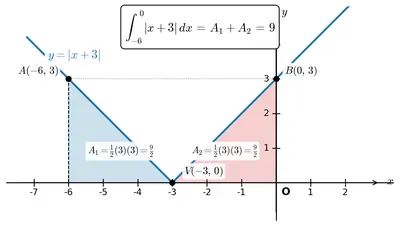
Diagram to draw: On a pair of perpendicular axes mark the vertex at $$(-3,0)$$. Draw one ray to the right of the vertex with slope $$+1$$ (the line $$y = x + 3$$) and another ray to the left of the vertex with slope $$-1$$ (the line $$y = -x - 3$$). Label the important points $$(-6,3)$$, $$(-3,0)$$ and $$(0,3)$$, and shade the region under the curve between $$x=-6$$ and $$x=0$$.
Step 3: Set up the integral
The sign change at $$x=-3$$ breaks the interval $$[-6,0]$$ into two sub-intervals:
$$\int_{-6}^{0}|x+3|\,dx = \int_{-6}^{-3}|x+3|\,dx + \int_{-3}^{0}|x+3|\,dx.$$
Using the piece-wise definition, rewrite each part with an ordinary algebraic expression.
First part ($$-6 \le x \lt -3$$): $$|x+3| = -(x+3) = -x-3$$.
$$\int_{-6}^{-3}(-x-3)\,dx.$$
Second part ($$-3 \le x \le 0$$): $$|x+3| = x+3$$.
$$\int_{-3}^{0}(x+3)\,dx.$$
Step 4: Evaluate each integral
1. Integrate the first part:
$$\int(-x-3)\,dx = -\frac{x^{2}}{2}-3x.$$
Evaluate from $$x=-6$$ to $$x=-3$$:
At $$x=-3$$: $$-\dfrac{(-3)^{2}}{2}-3(-3) = -\dfrac{9}{2}+9 = \dfrac{9}{2}.$$
At $$x=-6$$: $$-\dfrac{(-6)^{2}}{2}-3(-6) = -\dfrac{36}{2}+18 = -18+18 = 0.$$
Hence $$\int_{-6}^{-3}(-x-3)\,dx = \dfrac{9}{2}-0 = \dfrac{9}{2}.$$
2. Integrate the second part:
$$\int (x+3)\,dx = \frac{x^{2}}{2}+3x.$$
Evaluate from $$x=-3$$ to $$x=0$$:
At $$x=0$$: $$0+0=0.$$
At $$x=-3$$: $$\dfrac{(-3)^{2}}{2}+3(-3) = \dfrac{9}{2}-9 = -\dfrac{9}{2}.$$
Therefore $$\int_{-3}^{0}(x+3)\,dx = 0 - \left(-\dfrac{9}{2}\right) = \dfrac{9}{2}.$$
Step 5: Add the two results
$$\int_{-6}^{0}|x+3|\,dx = \dfrac{9}{2}+\dfrac{9}{2} = 9.$$
Geometric check – The region under each straight segment is a right-triangle of base $$3$$ and height $$3$$, area $$\tfrac{1}{2}\times 3\times 3 = \tfrac{9}{2}$$. Two such equal triangles give total area $$9$$, confirming the integral.
Conclusion: The required definite integral equals $$9$$.
 91- 6303239042