Join WhatsApp Icon JEE WhatsApp Group
NCERT Solutions for Class 12 Chemistry

Chapter 9: Amines

Download Solutions PDF
Daily JEE Updates, Tips & Important Alerts
Join 30,000+ students and stay updated with JEE notifications and preparation insights.
Join Now!
Free PDF
Complete NCERT Solution PDF for Chapter 9: Amines

NCERT Solutions For Class 12 Chemistry Chapter 9 Amines helps students understand nitrogen-containing organic compounds and their chemical behaviour. The page provides detailed NCERT Solutions that explain classification, nomenclature, preparation methods, physical properties, reactions, and important tests of amines. NCERT Solutions For Class 12 Chemistry simplify these concepts through reaction mechanisms, examples, and step-by-step explanations. The chapter helps students understand the role of amines in biological systems, medicines, and industrial applications. These solutions assist learners in practising organic Chemistry questions and improving their reaction-solving skills. Students can access the chapter PDF for revision and board exam preparation. The detailed explanations make amine chemistry easier to understand.
Download Solutions PDF

Intext Questions (9.1-9.2)

9.1 Classify the following amines as primary, secondary or tertiary:

(i) 1-Naphthylamine, i.e., naphthalene bearing an $$\mathrm{-NH_2}$$ group at position 1.

Solution

The class of an amine is decided by the number of carbon atoms bonded directly to the nitrogen atom: one carbon makes it primary, two secondary and three tertiary.

In 1-naphthylamine the nitrogen of the $$\mathrm{-NH_2}$$ group is joined to only one carbon atom (the C-1 carbon of the naphthalene ring) and still carries two hydrogen atoms. A nitrogen attached to a single carbon atom is the hallmark of a primary amine; since that carbon is part of an aromatic ring, it is an aromatic primary amine.

Answer

Primary amine.

(ii) 1-(N,N-Dimethylamino)naphthalene, i.e., naphthalene bearing an $$\mathrm{-N(CH_3)_2}$$ group at position 1.

Solution

In 1-(N,N-dimethylamino)naphthalene the nitrogen atom is bonded to three carbon atoms — the C-1 carbon of the naphthalene ring and the two carbon atoms of the two $$\mathrm{-CH_3}$$ groups, i.e. $$\mathrm{C_{10}H_7-N(CH_3)_2}$$.

A nitrogen carrying three carbon substituents and no hydrogen atom is a tertiary amine.

Answer

Tertiary amine.

(iii) $$\mathrm{(C_2H_5)_2CHNH_2}$$

Solution

The formula $$\mathrm{(C_2H_5)_2CHNH_2}$$ means $$\mathrm{(C_2H_5)_2CH-NH_2}$$: a central $$\mathrm{CH}$$ carbon carries two ethyl groups and the $$\mathrm{-NH_2}$$ group (the compound is pentan-3-amine).

The nitrogen atom is bonded to only one carbon atom (the central $$\mathrm{CH}$$ carbon) and carries two hydrogen atoms. Hence it is a primary amine.

Answer

Primary amine.

(iv) $$\mathrm{(C_2H_5)_2NH}$$

Solution

$$\mathrm{(C_2H_5)_2NH}$$ is diethylamine, $$\mathrm{C_2H_5-NH-C_2H_5}$$. The nitrogen atom is bonded to two carbon atoms (one from each ethyl group) and carries one hydrogen atom.

A nitrogen attached to exactly two carbon atoms is the hallmark of a secondary amine.

Answer

Secondary amine.

9.2

(i)

Write structures of different isomeric amines corresponding to the molecular formula, $$\mathrm{C_4H_{11}N}$$.
Structure
Structure

Solution

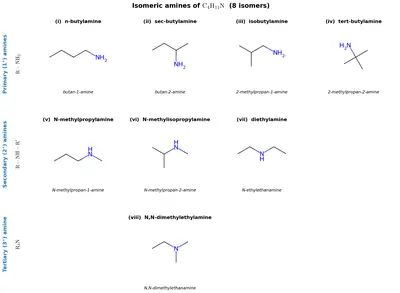
$$\mathrm{C_4H_{11}N}$$ corresponds to a saturated amine ($$\mathrm{C_nH_{2n+3}N}$$ with $$\mathrm{n=4}$$). The four carbon atoms can be distributed around the nitrogen to give primary, secondary and tertiary amines.

Primary amines $$\mathrm{(R-NH_2)}$$:

  1. $$\mathrm{CH_3CH_2CH_2CH_2NH_2}$$
  2. $$\mathrm{CH_3CH_2CH(NH_2)CH_3}$$
  3. $$\mathrm{(CH_3)_2CHCH_2NH_2}$$
  4. $$\mathrm{(CH_3)_3CNH_2}$$

Secondary amines $$\mathrm{(R-NH-R')}$$:

  1. $$\mathrm{CH_3CH_2CH_2-NH-CH_3}$$
  2. $$\mathrm{(CH_3)_2CH-NH-CH_3}$$
  3. $$\mathrm{CH_3CH_2-NH-CH_2CH_3}$$

Tertiary amine $$\mathrm{(R_3N)}$$:

  1. $$\mathrm{(CH_3)_2N-CH_2CH_3}$$

Thus there are eight isomeric amines having the formula $$\mathrm{C_4H_{11}N}$$.

Answer

Eight isomeric amines — 4 primary, 3 secondary and 1 tertiary.

(ii) Write IUPAC names of all the isomers.

Solution

IUPAC names of the eight isomers (the carbon chain is numbered so that the carbon bearing nitrogen gets the lowest locant; alkyl groups on nitrogen carry the prefix N-):

StructureIUPAC nameClass
$$\mathrm{CH_3CH_2CH_2CH_2NH_2}$$Butan-1-aminePrimary
$$\mathrm{CH_3CH_2CH(NH_2)CH_3}$$Butan-2-aminePrimary
$$\mathrm{(CH_3)_2CHCH_2NH_2}$$2-Methylpropan-1-aminePrimary
$$\mathrm{(CH_3)_3CNH_2}$$2-Methylpropan-2-aminePrimary
$$\mathrm{CH_3CH_2CH_2NHCH_3}$$N-Methylpropan-1-amineSecondary
$$\mathrm{(CH_3)_2CHNHCH_3}$$N-Methylpropan-2-amineSecondary
$$\mathrm{CH_3CH_2NHCH_2CH_3}$$N-EthylethanamineSecondary
$$\mathrm{(CH_3)_2NCH_2CH_3}$$N,N-DimethylethanamineTertiary

Answer

Butan-1-amine, butan-2-amine, 2-methylpropan-1-amine, 2-methylpropan-2-amine, N-methylpropan-1-amine, N-methylpropan-2-amine, N-ethylethanamine and N,N-dimethylethanamine.

(iii) What type of isomerism is exhibited by different pairs of amines?

Solution

The eight amines of formula $$\mathrm{C_4H_{11}N}$$ are related to one another by three kinds of structural isomerism:

Chain isomerism: isomers that differ in the carbon skeleton, e.g. butan-1-amine ($$\mathrm{CH_3CH_2CH_2CH_2NH_2}$$) and 2-methylpropan-1-amine ($$\mathrm{(CH_3)_2CHCH_2NH_2}$$).

Position isomerism: isomers that differ in the position of the $$\mathrm{-NH_2}$$ group on the same skeleton, e.g. butan-1-amine and butan-2-amine ($$\mathrm{CH_3CH_2CH(NH_2)CH_3}$$).

Metamerism: isomers that differ in the nature/distribution of the alkyl groups around the nitrogen atom, e.g. N-methylpropan-1-amine ($$\mathrm{CH_3CH_2CH_2NHCH_3}$$) and N-ethylethanamine ($$\mathrm{CH_3CH_2NHCH_2CH_3}$$). The primary, secondary and tertiary amines of this formula are likewise metamers of one another.

Answer

Chain isomerism, position isomerism and metamerism.

Example 9.1

Example 9.1 Write chemical equations for the following reactions:

(i) Reaction of ethanolic $$\mathrm{NH_3}$$ with $$\mathrm{C_2H_5Cl}$$.

Solution

Ethanolic ammonia reacts with ethyl chloride by nucleophilic substitution; the $$\mathrm{C-Cl}$$ bond is broken (ammonolysis). With an excess of ammonia, ethylamine is the chief product:

$$\mathrm{C_2H_5Cl + NH_3 \xrightarrow{\text{ethanol}} C_2H_5NH_2 + HCl}$$

The ethylamine formed is itself a nucleophile and can react with more $$\mathrm{C_2H_5Cl}$$, so the reaction does not stop here; successive substitutions give a mixture:

$$\mathrm{C_2H_5NH_2 + C_2H_5Cl \rightarrow (C_2H_5)_2NH + HCl}$$

$$\mathrm{(C_2H_5)_2NH + C_2H_5Cl \rightarrow (C_2H_5)_3N + HCl}$$

$$\mathrm{(C_2H_5)_3N + C_2H_5Cl \rightarrow (C_2H_5)_4\overset{+}{N}Cl^-}$$

Using a large excess of ammonia keeps ethylamine (the primary amine) as the major product.

Answer

$$\mathrm{C_2H_5Cl + NH_3 \rightarrow C_2H_5NH_2 + HCl}$$; ammonolysis gives ethylamine as the main product (along with secondary, tertiary amines and the quaternary ammonium salt).

(ii) Ammonolysis of benzyl chloride and reaction of amine so formed with two moles of $$\mathrm{CH_3Cl}$$.

Solution

Ammonolysis of benzyl chloride gives benzylamine:

$$\mathrm{C_6H_5CH_2Cl + NH_3 \rightarrow C_6H_5CH_2NH_2 + HCl}$$

Benzylamine, a primary amine, reacts with two moles of methyl chloride; each $$\mathrm{N-H}$$ hydrogen is replaced by a methyl group:

$$\mathrm{C_6H_5CH_2NH_2 + 2CH_3Cl \rightarrow C_6H_5CH_2N(CH_3)_2 + 2HCl}$$

The final product is N,N-dimethylbenzylamine.

Answer

Benzyl chloride $$\rightarrow$$ benzylamine ($$\mathrm{C_6H_5CH_2NH_2}$$); with 2 mol $$\mathrm{CH_3Cl}$$ it gives N,N-dimethylbenzylamine, $$\mathrm{C_6H_5CH_2N(CH_3)_2}$$.

Example 9.2

Example 9.2 Write chemical equations for the following conversions:

(i) $$\mathrm{CH_3{-}CH_2{-}Cl}$$ into $$\mathrm{CH_3{-}CH_2{-}CH_2{-}NH_2}$$

Solution

The product has one more carbon atom than the starting material, so the carbon chain must be lengthened by one. This is done through a nitrile.

Step 1 — formation of nitrile: chloroethane is treated with alcoholic $$\mathrm{KCN}$$; the cyanide ion substitutes chloride, adding one carbon:

$$\mathrm{CH_3CH_2Cl + KCN \rightarrow CH_3CH_2CN + KCl}$$

Step 2 — reduction: propanenitrile is reduced with $$\mathrm{Na/C_2H_5OH}$$ (or $$\mathrm{H_2/Ni}$$, or $$\mathrm{LiAlH_4}$$) to the primary amine:

$$\mathrm{CH_3CH_2CN + 4[H] \xrightarrow{Na/C_2H_5OH} CH_3CH_2CH_2NH_2}$$

Answer

$$\mathrm{CH_3CH_2Cl \xrightarrow{KCN} CH_3CH_2CN \xrightarrow{Na/C_2H_5OH} CH_3CH_2CH_2NH_2}$$

(ii) $$\mathrm{C_6H_5{-}CH_2{-}Cl}$$ into $$\mathrm{C_6H_5{-}CH_2{-}CH_2{-}NH_2}$$

Solution

The product has one carbon atom more than benzyl chloride, so a nitrile intermediate is used to lengthen the chain by one carbon.

Step 1 — formation of the nitrile: benzyl chloride reacts with alcoholic $$\mathrm{KCN}$$; the cyanide ion substitutes chloride to give phenylacetonitrile:

$$\mathrm{C_6H_5CH_2Cl + KCN \rightarrow C_6H_5CH_2CN + KCl}$$

Step 2 — reduction: phenylacetonitrile is reduced to the primary amine with lithium aluminium hydride, $$\mathrm{LiAlH_4}$$ (or by catalytic hydrogenation, $$\mathrm{H_2/Ni}$$). The reduction is followed by an acidic work-up to liberate the free amine:

$$\mathrm{C_6H_5CH_2CN \xrightarrow[(ii)\ H_3O^+]{(i)\ LiAlH_4} C_6H_5CH_2CH_2NH_2}$$

The product is 2-phenylethanamine.

Answer

$$\mathrm{C_6H_5CH_2Cl \xrightarrow{KCN} C_6H_5CH_2CN \xrightarrow[(ii)\ H_3O^+]{(i)\ LiAlH_4} C_6H_5CH_2CH_2NH_2}$$

Example 9.3

Example 9.3 Write structures and IUPAC names of

(i) the amide which gives propanamine by Hoffmann bromamide reaction.

Solution

In the Hofmann bromamide (degradation) reaction an amide $$\mathrm{R-CONH_2}$$ loses its carbonyl carbon and is converted to an amine $$\mathrm{R-NH_2}$$ having one carbon atom fewer:

$$\mathrm{R-CONH_2 + Br_2 + 4NaOH \rightarrow R-NH_2 + Na_2CO_3 + 2NaBr + 2H_2O}$$

The required amine is propanamine, $$\mathrm{CH_3CH_2CH_2NH_2}$$, in which $$\mathrm{R = CH_3CH_2CH_2-}$$ (propyl). Hence the amide must have one carbon atom more — it is $$\mathrm{CH_3CH_2CH_2CONH_2}$$.

Structure: $$\mathrm{CH_3CH_2CH_2CONH_2}$$; IUPAC name: butanamide.

Answer

Butanamide, $$\mathrm{CH_3CH_2CH_2CONH_2}$$.

(ii) the amine produced by the Hoffmann degradation of benzamide.

Solution

Benzamide is $$\mathrm{C_6H_5CONH_2}$$. In the Hofmann bromamide reaction the carbonyl carbon is lost and the group attached to it migrates to nitrogen, giving an amine with one carbon atom fewer:

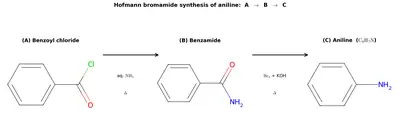
$$\mathrm{C_6H_5CONH_2 + Br_2 + 4NaOH \rightarrow C_6H_5NH_2 + Na_2CO_3 + 2NaBr + 2H_2O}$$

The amine formed is $$\mathrm{C_6H_5NH_2}$$.

Structure: $$\mathrm{C_6H_5NH_2}$$; IUPAC name: aniline (benzenamine).

Answer

Aniline (benzenamine), $$\mathrm{C_6H_5NH_2}$$.

Intext Question (9.3)

9.3 How will you convert

(i) Benzene into aniline

Solution

Step 1 — nitration: benzene is heated with a mixture of concentrated $$\mathrm{HNO_3}$$ and concentrated $$\mathrm{H_2SO_4}$$ to give nitrobenzene:

$$\mathrm{C_6H_6 + HNO_3 \xrightarrow{conc.\ H_2SO_4} C_6H_5NO_2 + H_2O}$$

Step 2 — reduction: nitrobenzene is reduced with $$\mathrm{Sn}$$ (or $$\mathrm{Fe}$$) and concentrated $$\mathrm{HCl}$$; treatment with alkali ($$\mathrm{NaOH}$$) then liberates the free amine, aniline:

$$\mathrm{C_6H_5NO_2 + 6[H] \xrightarrow{Sn/HCl} C_6H_5NH_2 + 2H_2O}$$

Answer

$$\mathrm{C_6H_6 \xrightarrow[conc.\ H_2SO_4]{conc.\ HNO_3} C_6H_5NO_2 \xrightarrow[then\ NaOH]{Sn/HCl} C_6H_5NH_2}$$

(ii) Benzene into N,N-dimethylaniline

Solution

Step 1 — preparation of aniline: benzene is first nitrated with a mixture of concentrated $$\mathrm{HNO_3}$$ and concentrated $$\mathrm{H_2SO_4}$$ to give nitrobenzene:

$$\mathrm{C_6H_6 + HNO_3 \xrightarrow{conc.\ H_2SO_4} C_6H_5NO_2 + H_2O}$$

Nitrobenzene is then reduced with tin and concentrated hydrochloric acid. Because the medium is strongly acidic, the amine is first obtained as its salt, anilinium chloride; the mixture is then made alkaline with $$\mathrm{NaOH}$$, which liberates the free amine, aniline:

$$\mathrm{C_6H_5NO_2 \xrightarrow{Sn,\ conc.\ HCl} C_6H_5\overset{+}{N}H_3Cl^- \xrightarrow{NaOH} C_6H_5NH_2}$$

Step 2 — N,N-dimethylation: aniline is alkylated with two equivalents of methyl iodide in the presence of a base (e.g. $$\mathrm{NaHCO_3}$$ or $$\mathrm{K_2CO_3}$$), which neutralises the $$\mathrm{HI}$$ formed and keeps the nitrogen lone pair available. Both $$\mathrm{N-H}$$ hydrogens are successively replaced by methyl groups:

$$\mathrm{C_6H_5NH_2 \xrightarrow[\ \ base\ \ ]{CH_3I} C_6H_5NHCH_3 \xrightarrow[\ \ base\ \ ]{CH_3I} C_6H_5N(CH_3)_2}$$

Caveat: direct alkylation of a primary amine with an alkyl halide is not selective — the secondary and tertiary amines formed are themselves more nucleophilic than aniline, so without controlled (stoichiometric, 2 equiv.) conditions and a mild base, the reaction over-alkylates to give a mixture that includes the quaternary salt $$\mathrm{C_6H_5N^+(CH_3)_3I^-}$$. The desired N,N-dimethylaniline is separated by fractional distillation.

Answer

$$\mathrm{C_6H_6 \xrightarrow[conc.\ H_2SO_4]{conc.\ HNO_3} C_6H_5NO_2 \xrightarrow[then\ NaOH]{Sn/conc.\ HCl} C_6H_5NH_2 \xrightarrow[base,\ controlled]{2\,CH_3I} C_6H_5N(CH_3)_2}$$

(iii) $$\mathrm{Cl{-}(CH_2)_4{-}Cl}$$ into hexan-1,6-diamine?

Solution

Hexane-1,6-diamine, $$\mathrm{H_2N-(CH_2)_6-NH_2}$$, has six carbon atoms, whereas $$\mathrm{Cl-(CH_2)_4-Cl}$$ has only four. Two carbon atoms must be added, one at each end, using cyanide.

Step 1: the dichloride reacts with two moles of $$\mathrm{KCN}$$; each chloride is replaced by a cyano group:

$$\mathrm{Cl-(CH_2)_4-Cl + 2KCN \rightarrow NC-(CH_2)_4-CN + 2KCl}$$

Step 2: the dinitrile is reduced (with $$\mathrm{H_2/Ni}$$ or $$\mathrm{Na/C_2H_5OH}$$); each $$\mathrm{-CN}$$ becomes $$\mathrm{-CH_2NH_2}$$:

$$\mathrm{NC-(CH_2)_4-CN + 8[H] \xrightarrow{Na/C_2H_5OH} H_2N-CH_2-(CH_2)_4-CH_2-NH_2}$$

The product is $$\mathrm{H_2N-(CH_2)_6-NH_2}$$, hexane-1,6-diamine.

Answer

$$\mathrm{Cl(CH_2)_4Cl \xrightarrow{2KCN} NC(CH_2)_4CN \xrightarrow{Na/C_2H_5OH} H_2N(CH_2)_6NH_2}$$

Example 9.4

Example 9.4 Arrange the following in decreasing order of their basic strength: $$\mathrm{C_6H_5NH_2}$$, $$\mathrm{C_2H_5NH_2}$$, $$\mathrm{(C_2H_5)_2NH}$$, $$\mathrm{NH_3}$$

Solution

Basic strength of an amine depends on the availability of the lone pair of electrons on nitrogen for donation to a proton.

  • In $$\mathrm{C_2H_5NH_2}$$ the electron-releasing ($$+I$$) ethyl group raises the electron density on nitrogen, so it is a stronger base than $$\mathrm{NH_3}$$.
  • $$\mathrm{(C_2H_5)_2NH}$$ has two electron-releasing ethyl groups; in aqueous solution (where the order is governed by inductive effect, solvation and steric factors) it is the strongest base of the set.
  • In aniline, $$\mathrm{C_6H_5NH_2}$$, the lone pair on nitrogen is delocalised into the benzene ring by resonance, making it least available; aniline is therefore the weakest base.

Hence the decreasing order of basic strength is:

$$\mathrm{(C_2H_5)_2NH > C_2H_5NH_2 > NH_3 > C_6H_5NH_2}$$

Answer

$$\mathrm{(C_2H_5)_2NH > C_2H_5NH_2 > NH_3 > C_6H_5NH_2}$$

Intext Questions (9.4-9.8)

9.4 Arrange the following in increasing order of their basic strength:

(i) $$\mathrm{C_2H_5NH_2}$$, $$\mathrm{C_6H_5NH_2}$$, $$\mathrm{NH_3}$$, $$\mathrm{C_6H_5CH_2NH_2}$$ and $$\mathrm{(C_2H_5)_2NH}$$

Solution

Aniline ($$\mathrm{C_6H_5NH_2}$$) is the weakest base: its lone pair is delocalised into the ring by resonance, so it is least available for protonation.

$$\mathrm{NH_3}$$ has no electron-releasing group, so it is the next weakest.

In benzylamine ($$\mathrm{C_6H_5CH_2NH_2}$$) the $$\mathrm{-NH_2}$$ is bonded to an $$\mathrm{sp^3}$$ carbon, so the lone pair is not delocalised into the ring; it is more basic than ammonia but less basic than ethylamine, because the phenyl group is slightly electron-withdrawing relative to an alkyl group.

In $$\mathrm{C_2H_5NH_2}$$ one electron-releasing ethyl group raises the electron density on nitrogen, and in $$\mathrm{(C_2H_5)_2NH}$$ two ethyl groups raise it further, making it the strongest base.

Increasing order of basic strength:

$$\mathrm{C_6H_5NH_2 < NH_3 < C_6H_5CH_2NH_2 < C_2H_5NH_2 < (C_2H_5)_2NH}$$

Answer

$$\mathrm{C_6H_5NH_2 < NH_3 < C_6H_5CH_2NH_2 < C_2H_5NH_2 < (C_2H_5)_2NH}$$

(ii) $$\mathrm{C_2H_5NH_2}$$, $$\mathrm{(C_2H_5)_2NH}$$, $$\mathrm{(C_2H_5)_3N}$$, $$\mathrm{C_6H_5NH_2}$$

Solution

Aniline is the weakest base, because the nitrogen lone pair is delocalised into the benzene ring.

Among the ethylamines, in aqueous solution the basic strength is governed by the combined effect of the ($$+I$$) inductive effect, solvation of the protonated cation by water, and steric crowding. The trisubstituted amine $$\mathrm{(C_2H_5)_3N}$$ has the largest $$+I$$ effect but its cation is poorly solvated and its nitrogen is sterically crowded; the disubstituted amine $$\mathrm{(C_2H_5)_2NH}$$ strikes the best balance and is the strongest base. The observed order is $$\mathrm{(C_2H_5)_2NH > (C_2H_5)_3N > C_2H_5NH_2}$$.

Increasing order of basic strength:

$$\mathrm{C_6H_5NH_2 < C_2H_5NH_2 < (C_2H_5)_3N < (C_2H_5)_2NH}$$

Answer

$$\mathrm{C_6H_5NH_2 < C_2H_5NH_2 < (C_2H_5)_3N < (C_2H_5)_2NH}$$

(iii) $$\mathrm{CH_3NH_2}$$, $$\mathrm{(CH_3)_2NH}$$, $$\mathrm{(CH_3)_3N}$$, $$\mathrm{C_6H_5NH_2}$$, $$\mathrm{C_6H_5CH_2NH_2}$$.

Solution

Aniline is the weakest base (lone pair delocalised into the ring). Benzylamine is more basic than aniline, because its $$\mathrm{-NH_2}$$ is on an $$\mathrm{sp^3}$$ carbon and its lone pair is not delocalised.

Among the methylamines, in aqueous solution the order is $$\mathrm{(CH_3)_2NH > CH_3NH_2 > (CH_3)_3N}$$ — the secondary amine is the strongest because it has the best balance of electron release, cation solvation and low steric hindrance, while the tertiary amine suffers from steric crowding and poor solvation of its cation.

All three methylamines are stronger bases than benzylamine. Hence the increasing order of basic strength is:

$$\mathrm{C_6H_5NH_2 < C_6H_5CH_2NH_2 < (CH_3)_3N < CH_3NH_2 < (CH_3)_2NH}$$

Answer

$$\mathrm{C_6H_5NH_2 < C_6H_5CH_2NH_2 < (CH_3)_3N < CH_3NH_2 < (CH_3)_2NH}$$

9.5 Complete the following acid-base reactions and name the products:

(i) $$\mathrm{CH_3CH_2CH_2NH_2 + HCl \rightarrow}$$

Solution

Propan-1-amine is a base; it reacts with hydrochloric acid to form a salt. The lone pair on nitrogen accepts a proton:

$$\mathrm{CH_3CH_2CH_2NH_2 + HCl \rightarrow CH_3CH_2CH_2\overset{+}{N}H_3\,Cl^-}$$

The product is propan-1-aminium chloride (propylammonium chloride).

Answer

$$\mathrm{CH_3CH_2CH_2NH_2 + HCl \rightarrow CH_3CH_2CH_2\overset{+}{N}H_3Cl^-}$$; product: propan-1-aminium chloride (propylammonium chloride).

(ii) $$\mathrm{(C_2H_5)_3N + HCl \rightarrow}$$

Solution

Triethylamine is a tertiary amine; its nitrogen still has a lone pair, so it acts as a base towards $$\mathrm{HCl}$$:

$$\mathrm{(C_2H_5)_3N + HCl \rightarrow (C_2H_5)_3\overset{+}{N}H\,Cl^-}$$

The product is triethylammonium chloride (N,N-diethylethanaminium chloride).

Answer

$$\mathrm{(C_2H_5)_3N + HCl \rightarrow (C_2H_5)_3\overset{+}{N}HCl^-}$$; product: triethylammonium chloride.

9.6 Write reactions of the final alkylation product of aniline with excess of methyl iodide in the presence of sodium carbonate solution.

Solution

Aniline reacts with an excess of methyl iodide; each step methylates the nitrogen, and the sodium carbonate solution neutralises the hydrogen iodide produced, keeping the amine free:

$$\mathrm{C_6H_5NH_2 \xrightarrow{CH_3I} C_6H_5NHCH_3 \xrightarrow{CH_3I} C_6H_5N(CH_3)_2 \xrightarrow{CH_3I} C_6H_5\overset{+}{N}(CH_3)_3\,I^-}$$

With excess $$\mathrm{CH_3I}$$ the reaction does not stop at the tertiary amine; the lone pair of N,N-dimethylaniline picks up a third methyl group to give the quaternary ammonium salt. The final alkylation product is N,N,N-trimethylanilinium iodide, $$\mathrm{C_6H_5\overset{+}{N}(CH_3)_3\,I^-}$$.

Overall, including neutralisation of the $$\mathrm{HI}$$ by $$\mathrm{Na_2CO_3}$$:

$$\mathrm{C_6H_5NH_2 + 3CH_3I \rightarrow C_6H_5\overset{+}{N}(CH_3)_3\,I^- + 2HI}$$

$$\mathrm{2HI + Na_2CO_3 \rightarrow 2NaI + H_2O + CO_2}$$

Answer

The final alkylation product is the quaternary ammonium salt N,N,N-trimethylanilinium iodide, $$\mathrm{C_6H_5\overset{+}{N}(CH_3)_3\,I^-}$$.

9.7 Write chemical reaction of aniline with benzoyl chloride and write the name of the product obtained.

Solution

Aniline has an $$\mathrm{N-H}$$ bond; in the presence of a base its hydrogen is replaced by the benzoyl group $$\mathrm{(C_6H_5CO-)}$$ when it reacts with benzoyl chloride. This is benzoylation (a Schotten-Baumann reaction):

$$\mathrm{C_6H_5NH_2 + C_6H_5COCl \xrightarrow{\text{base}} C_6H_5CONHC_6H_5 + HCl}$$

The product is N-phenylbenzamide, commonly called benzanilide.

Answer

$$\mathrm{C_6H_5NH_2 + C_6H_5COCl \rightarrow C_6H_5CONHC_6H_5 + HCl}$$; the product is N-phenylbenzamide (benzanilide).

9.8

Write structures of different isomers corresponding to the molecular formula, $$\mathrm{C_3H_9N}$$. Write IUPAC names of the isomers which will liberate nitrogen gas on treatment with nitrous acid.
Structure
Structure

Solution

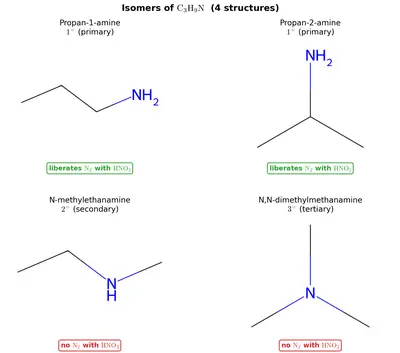
$$\mathrm{C_3H_9N}$$ is a saturated amine; the three carbon atoms can be arranged as primary, secondary or tertiary amines:

  • $$\mathrm{CH_3CH_2CH_2NH_2}$$ — propan-1-amine (primary)
  • $$\mathrm{(CH_3)_2CHNH_2}$$ — propan-2-amine (primary)
  • $$\mathrm{CH_3CH_2NHCH_3}$$ — N-methylethanamine (secondary)
  • $$\mathrm{(CH_3)_3N}$$ — N,N-dimethylmethanamine, i.e. trimethylamine (tertiary)

Only primary aliphatic amines react with nitrous acid to give a highly unstable diazonium salt that at once decomposes, evolving nitrogen gas:

$$\mathrm{R-NH_2 + HNO_2 \rightarrow R-OH + N_2\uparrow + H_2O}$$

Therefore the isomers that liberate $$\mathrm{N_2}$$ are the two primary amines: propan-1-amine and propan-2-amine.

Answer

Four isomers; the ones that liberate $$\mathrm{N_2}$$ with $$\mathrm{HNO_2}$$ are propan-1-amine and propan-2-amine.

Example 9.5

Example 9.5 How will you convert 4-nitrotoluene to 2-bromobenzoic acid?

Solution

The methyl group of toluene will finally become the $$\mathrm{-COOH}$$ group, and the bromine must end up ortho to it. The bromine is therefore introduced first, while the $$\mathrm{-NO_2}$$ group is still present.

Step 1 — bromination: in 4-nitrotoluene the $$\mathrm{-CH_3}$$ group directs ortho/para and the $$\mathrm{-NO_2}$$ group directs meta; both effects send the incoming bromine to the position ortho to $$\mathrm{-CH_3}$$, giving 2-bromo-4-nitrotoluene.

Step 2 — reduction: the $$\mathrm{-NO_2}$$ group is reduced to $$\mathrm{-NH_2}$$ with $$\mathrm{Sn/HCl}$$, giving 2-bromo-4-methylaniline.

Step 3 — diazotisation: the amine is treated with $$\mathrm{NaNO_2/HCl}$$ at 273-278 K to give the diazonium salt.

Step 4 — deamination: the diazonium group is replaced by hydrogen using hypophosphorous acid, $$\mathrm{H_3PO_2}$$ (with $$\mathrm{H_2O}$$), giving 2-bromotoluene (o-bromotoluene).

Step 5 — oxidation: the $$\mathrm{-CH_3}$$ group is oxidised with $$\mathrm{KMnO_4}$$ in alkaline medium (then acidified) to give 2-bromobenzoic acid.

$$\mathrm{4\text{-}nitrotoluene \xrightarrow{Br_2} 2\text{-}bromo\text{-}4\text{-}nitrotoluene \xrightarrow{Sn/HCl} 2\text{-}bromo\text{-}4\text{-}methylaniline \xrightarrow[273\text{-}278\,K]{NaNO_2/HCl} \text{diazonium salt}}$$

$$\mathrm{\xrightarrow{H_3PO_2,\ H_2O} 2\text{-}bromotoluene \xrightarrow[OH^-]{KMnO_4} 2\text{-}bromobenzoic\ acid}$$

Answer

Brominate (gives 2-bromo-4-nitrotoluene) $$\rightarrow$$ reduce $$\mathrm{-NO_2}$$ with $$\mathrm{Sn/HCl}$$ $$\rightarrow$$ diazotise ($$\mathrm{NaNO_2/HCl}$$, 273-278 K) $$\rightarrow$$ deaminate with $$\mathrm{H_3PO_2}$$ to 2-bromotoluene $$\rightarrow$$ oxidise with $$\mathrm{KMnO_4/OH^-}$$ to 2-bromobenzoic acid.

Intext Question (9.9)

9.9 Convert

(i) 3-Methylaniline into 3-nitrotoluene.

Solution

3-Methylaniline (m-toluidine) and 3-nitrotoluene have the $$\mathrm{-CH_3}$$ group in the same place; only the $$\mathrm{-NH_2}$$ group has to be changed into a $$\mathrm{-NO_2}$$ group. This cannot be done directly, so the diazonium route is used.

Step 1 — diazotisation: $$\mathrm{NaNO_2/HCl}$$ at 273-278 K converts $$\mathrm{-NH_2}$$ to the diazonium group:

$$\mathrm{3\text{-}CH_3C_6H_4NH_2 \xrightarrow[273\text{-}278\,K]{NaNO_2/HCl} 3\text{-}CH_3C_6H_4\overset{+}{N}_2Cl^-}$$

Step 2: the diazonium chloride is treated with fluoroboric acid $$\mathrm{(HBF_4)}$$ to precipitate the diazonium fluoroborate, which on warming with aqueous sodium nitrite in the presence of copper has its diazonium group replaced by $$\mathrm{-NO_2}$$:

$$\mathrm{3\text{-}CH_3C_6H_4\overset{+}{N}_2Cl^- \xrightarrow{HBF_4} 3\text{-}CH_3C_6H_4\overset{+}{N}_2BF_4^- \xrightarrow[Cu,\ \Delta]{NaNO_2} 3\text{-}nitrotoluene}$$

Answer

Diazotise 3-methylaniline, then treat with $$\mathrm{HBF_4}$$ followed by $$\mathrm{NaNO_2/Cu, \Delta}$$ to replace the diazonium group by $$\mathrm{-NO_2}$$, giving 3-nitrotoluene.

(ii) Aniline into 1,3,5-tribromobenzene.

Solution

Step 1 — bromination: aniline reacts with bromine water at room temperature to give 2,4,6-tribromoaniline (the $$\mathrm{-NH_2}$$ group is a powerful o-,p- activating group):

$$\mathrm{C_6H_5NH_2 + 3Br_2 \xrightarrow{H_2O} 2,4,6\text{-}tribromoaniline + 3HBr}$$

Step 2 — diazotisation: $$\mathrm{NaNO_2/HCl}$$ at 273-278 K converts the $$\mathrm{-NH_2}$$ group to a diazonium group, giving 2,4,6-tribromobenzenediazonium chloride.

Step 3 — deamination: the diazonium group is replaced by hydrogen using hypophosphorous acid $$\mathrm{(H_3PO_2)}$$; this removes the group that was originally $$\mathrm{-NH_2}$$, leaving the three bromine atoms at the 1,3,5-positions:

$$\mathrm{2,4,6\text{-}tribromobenzenediazonium\ chloride \xrightarrow{H_3PO_2,\ H_2O} 1,3,5\text{-}tribromobenzene + N_2 + H_3PO_3 + HCl}$$

Answer

Aniline $$\xrightarrow{Br_2/H_2O}$$ 2,4,6-tribromoaniline $$\xrightarrow{NaNO_2/HCl}$$ diazonium salt $$\xrightarrow{H_3PO_2}$$ 1,3,5-tribromobenzene.

Exercises

9.1 Write IUPAC names of the following compounds and classify them into primary, secondary and tertiary amines.

(i) $$\mathrm{(CH_3)_2CHNH_2}$$

Solution

$$\mathrm{(CH_3)_2CHNH_2}$$ — the $$\mathrm{-NH_2}$$ group is on the middle carbon of a three-carbon chain. IUPAC name: propan-2-amine.

The nitrogen is bonded to only one carbon atom, so it is a primary amine.

Answer

Propan-2-amine; primary amine.

(ii) $$\mathrm{CH_3(CH_2)_2NH_2}$$

Solution

$$\mathrm{CH_3(CH_2)_2NH_2}$$ is $$\mathrm{CH_3CH_2CH_2NH_2}$$, a three-carbon chain with $$\mathrm{-NH_2}$$ at C-1. IUPAC name: propan-1-amine.

The nitrogen is bonded to only one carbon atom, so it is a primary amine.

Answer

Propan-1-amine; primary amine.

(iii) $$\mathrm{CH_3NHCH(CH_3)_2}$$

Solution

$$\mathrm{CH_3NHCH(CH_3)_2}$$ — the nitrogen joins a methyl group and an isopropyl group. The larger group, isopropyl, gives the parent name (propan-2-amine) and the methyl on nitrogen is named as an N-substituent. IUPAC name: N-methylpropan-2-amine.

The nitrogen is bonded to two carbon atoms, so it is a secondary amine.

Answer

N-Methylpropan-2-amine; secondary amine.

(iv) $$\mathrm{(CH_3)_3CNH_2}$$

Solution

$$\mathrm{(CH_3)_3CNH_2}$$ — the $$\mathrm{-NH_2}$$ group is on a carbon that itself bears three methyl groups. The longest chain is propane and there is a methyl branch at C-2. IUPAC name: 2-methylpropan-2-amine.

The nitrogen is bonded to only one carbon atom, so it is a primary amine (a primary amine with a tertiary alkyl group).

Answer

2-Methylpropan-2-amine; primary amine.

(v) $$\mathrm{C_6H_5NHCH_3}$$

Solution

$$\mathrm{C_6H_5NHCH_3}$$ — the nitrogen carries a phenyl group and a methyl group. The compound is named as a derivative of aniline with a methyl group on nitrogen. IUPAC name: N-methylaniline (N-methylbenzenamine).

The nitrogen is bonded to two carbon atoms, so it is a secondary amine.

Answer

N-Methylaniline; secondary amine.

(vi) $$\mathrm{(CH_3CH_2)_2NCH_3}$$

Solution

$$\mathrm{(CH_3CH_2)_2NCH_3}$$ — the nitrogen carries two ethyl groups and one methyl group. One ethyl group is taken as the parent (ethanamine); the other ethyl and the methyl are N-substituents. IUPAC name: N-ethyl-N-methylethanamine.

The nitrogen is bonded to three carbon atoms, so it is a tertiary amine.

Answer

N-Ethyl-N-methylethanamine; tertiary amine.

(vii) $$\mathrm{\textit{m}\text{-}BrC_6H_4NH_2}$$

Solution

$$\mathrm{\textit{m}\text{-}BrC_6H_4NH_2}$$ is aniline carrying a bromine atom at the meta position (C-3 with respect to $$\mathrm{-NH_2}$$). IUPAC name: 3-bromoaniline (3-bromobenzenamine).

The nitrogen is bonded to one carbon atom and carries two hydrogens, so it is a primary amine.

Answer

3-Bromoaniline; primary amine.

9.2 Give one chemical test to distinguish between the following pairs of compounds.

(i) Methylamine and dimethylamine

Solution

Methylamine is a primary amine ($$\mathrm{CH_3NH_2}$$) and dimethylamine is a secondary amine ($$\mathrm{(CH_3)_2NH}$$).

Carbylamine test: only primary amines, on warming with chloroform and alcoholic $$\mathrm{KOH}$$, give a carbylamine (isocyanide) with an extremely offensive smell.

Methylamine gives the test:

$$\mathrm{CH_3NH_2 + CHCl_3 + 3KOH \xrightarrow{\Delta} CH_3NC + 3KCl + 3H_2O}$$

Dimethylamine, being secondary, gives no isocyanide and hence no offensive smell.

Answer

Carbylamine test: methylamine (primary) gives a foul-smelling isocyanide with $$\mathrm{CHCl_3}$$ + alc. $$\mathrm{KOH}$$; dimethylamine (secondary) does not.

(ii) Secondary and tertiary amines

Solution

Reaction with nitrous acid:

A secondary amine reacts with nitrous acid to give a yellow oily N-nitrosamine:

$$\mathrm{R_2NH + HNO_2 \rightarrow R_2N-NO + H_2O}$$ (yellow oil)

A tertiary amine has no $$\mathrm{N-H}$$ hydrogen; it does not give a nitrosamine, but simply forms a water-soluble salt with the acid.

Equivalently, with benzenesulphonyl chloride (Hinsberg's reagent) a secondary amine gives a sulphonamide that is insoluble in alkali, whereas a tertiary amine does not react at all.

Answer

With $$\mathrm{HNO_2}$$: a secondary amine gives a yellow oily nitrosamine; a tertiary amine does not (it only forms a salt). Equivalently, with Hinsberg's reagent a 2$${}^\circ$$ amine gives an alkali-insoluble solid while a 3$${}^\circ$$ amine does not react.

(iii) Ethylamine and aniline

Solution

Aniline is an aromatic amine and ethylamine is an aliphatic amine.

Azo-dye test: aniline, on treatment with $$\mathrm{NaNO_2}$$ and $$\mathrm{HCl}$$ at 273-278 K, forms a stable benzenediazonium chloride, which on coupling with an alkaline solution of 2-naphthol gives a brilliant orange-red azo dye.

Ethylamine, being aliphatic, forms a highly unstable diazonium salt that immediately decomposes with brisk effervescence of nitrogen gas, giving ethanol; no dye is formed:

$$\mathrm{C_2H_5NH_2 + HNO_2 \rightarrow C_2H_5OH + N_2\uparrow + H_2O}$$

Answer

Aniline gives an orange-red azo dye on diazotisation and coupling with 2-naphthol; ethylamine instead evolves $$\mathrm{N_2}$$ gas with $$\mathrm{HNO_2}$$ and gives no dye.

(iv) Aniline and benzylamine

Solution

In aniline the $$\mathrm{-NH_2}$$ group is attached directly to the benzene ring (aromatic amine), whereas in benzylamine it is attached to an $$\mathrm{sp^3}$$ $$\mathrm{-CH_2-}$$ carbon (it behaves as an aliphatic amine).

Azo-dye test: aniline forms a stable diazonium salt at 273-278 K which couples with 2-naphthol to give an orange-red azo dye. Benzylamine forms an unstable diazonium salt that at once decomposes, liberating $$\mathrm{N_2}$$ gas and giving benzyl alcohol; no dye is formed:

$$\mathrm{C_6H_5CH_2NH_2 + HNO_2 \rightarrow C_6H_5CH_2OH + N_2\uparrow + H_2O}$$

(Aniline also gives a white precipitate of 2,4,6-tribromoaniline with bromine water, which benzylamine does not.)

Answer

Azo-dye test: aniline gives an orange-red dye on diazotisation and coupling with 2-naphthol; benzylamine evolves $$\mathrm{N_2}$$ gas and forms no dye.

(v) Aniline and N-methylaniline.

Solution

Aniline is a primary aromatic amine; N-methylaniline is a secondary aromatic amine.

Carbylamine test: only primary amines respond. Aniline, warmed with chloroform and alcoholic $$\mathrm{KOH}$$, gives foul-smelling phenyl isocyanide:

$$\mathrm{C_6H_5NH_2 + CHCl_3 + 3KOH \xrightarrow{\Delta} C_6H_5NC + 3KCl + 3H_2O}$$

N-Methylaniline, being secondary, gives no isocyanide and no offensive smell.

Answer

Carbylamine test: aniline (primary) gives foul-smelling phenyl isocyanide with $$\mathrm{CHCl_3}$$ + alc. $$\mathrm{KOH}$$; N-methylaniline (secondary) does not.

9.3 Account for the following:

(i) $$\mathrm{p}K_b$$ of aniline is more than that of methylamine.

Solution

$$\mathrm{p}K_b$$ is a measure of basic weakness: the higher the $$\mathrm{p}K_b$$, the weaker the base.

In aniline the lone pair of electrons on nitrogen is delocalised into the benzene ring through resonance, so it is much less available for donation to a proton. Aniline is therefore a weak base, and so has a high $$\mathrm{p}K_b$$.

In methylamine the methyl group has a $$+I$$ (electron-releasing) effect that increases the electron density on nitrogen, making the lone pair more available. Methylamine is therefore a stronger base and has a lower $$\mathrm{p}K_b$$.

Hence the $$\mathrm{p}K_b$$ of aniline is greater than that of methylamine.

Answer

Aniline's lone pair is delocalised into the ring (less available), so it is a weaker base and has a higher $$\mathrm{p}K_b$$; methylamine's $$+I$$ methyl group makes it a stronger base, with a lower $$\mathrm{p}K_b$$.

(ii) Ethylamine is soluble in water whereas aniline is not.

Solution

Ethylamine ($$\mathrm{C_2H_5NH_2}$$) is a small molecule whose $$\mathrm{-NH_2}$$ group readily forms hydrogen bonds with water molecules; this intermolecular hydrogen bonding makes it freely miscible with water.

In aniline ($$\mathrm{C_6H_5NH_2}$$) the large hydrophobic (water-repelling) benzene ring forms the bulk of the molecule. It cannot form hydrogen bonds with water, and it outweighs the small $$\mathrm{-NH_2}$$ part. The tendency to hydrogen-bond with water is therefore greatly reduced, and aniline is only sparingly soluble in water.

Answer

Small ethylamine hydrogen-bonds extensively with water; in aniline the large hydrophobic benzene ring dominates and suppresses hydrogen bonding, so it is nearly insoluble.

(iii) Methylamine in water reacts with ferric chloride to precipitate hydrated ferric oxide.

Solution

Methylamine is a stronger base than ammonia; in water it ionises to give hydroxide ions:

$$\mathrm{CH_3NH_2 + H_2O \rightleftharpoons CH_3\overset{+}{N}H_3 + OH^-}$$

These hydroxide ions react with the ferric ions ($$\mathrm{Fe^{3+}}$$) of ferric chloride. The species precipitated first is ferric hydroxide, $$\mathrm{Fe(OH)_3}$$, a brown gelatinous solid:

$$\mathrm{FeCl_3 + 3OH^- \rightarrow Fe(OH)_3\downarrow + 3Cl^-}$$

Ferric hydroxide is essentially hydrated ferric oxide; on standing (partial loss of water) it is represented as $$\mathrm{Fe_2O_3\cdot xH_2O}$$:

$$\mathrm{2Fe(OH)_3 \rightleftharpoons Fe_2O_3\cdot 3H_2O}$$

Thus it is the $$\mathrm{OH^-}$$ ions furnished by the basic methylamine solution that bring down the precipitate of ferric hydroxide, i.e. hydrated ferric oxide.

Answer

Methylamine, being a base, furnishes $$\mathrm{OH^-}$$ ions in water; these react with $$\mathrm{Fe^{3+}}$$ to precipitate ferric hydroxide, $$\mathrm{Fe(OH)_3}$$, which is hydrated ferric oxide, $$\mathrm{Fe_2O_3\cdot xH_2O}$$.

(iv) Although amino group is o- and p- directing in aromatic electrophilic substitution reactions, aniline on nitration gives a substantial amount of m-nitroaniline.

Solution

The $$\mathrm{-NH_2}$$ group is indeed o-,p- directing. However, nitration is carried out in a strongly acidic medium (conc. $$\mathrm{HNO_3}$$ + conc. $$\mathrm{H_2SO_4}$$).

In this acidic medium a large fraction of the aniline is protonated to the anilinium ion, $$\mathrm{C_6H_5\overset{+}{N}H_3}$$. The $$\mathrm{-\overset{+}{N}H_3}$$ group is a meta-directing, deactivating group.

So the reaction mixture contains both un-protonated aniline (which gives o- and p-nitroaniline) and the anilinium ion (which gives m-nitroaniline). This is why a substantial amount (about 47%) of m-nitroaniline is obtained.

Answer

In the acidic nitrating medium aniline is largely protonated to the anilinium ion, whose $$\mathrm{-\overset{+}{N}H_3}$$ group is meta-directing; hence a substantial amount of m-nitroaniline is formed.

(v) Aniline does not undergo Friedel-Crafts reaction.

Solution

Friedel-Crafts reactions need a Lewis acid catalyst, anhydrous $$\mathrm{AlCl_3}$$.

Aniline is a base; its nitrogen lone pair reacts with the Lewis acid $$\mathrm{AlCl_3}$$ to form an acid-base adduct (salt):

$$\mathrm{C_6H_5NH_2 + AlCl_3 \rightarrow C_6H_5\overset{+}{N}H_2{-}\overset{-}{A}lCl_3}$$

Now the nitrogen carries a positive charge. The positively charged nitrogen strongly withdraws electrons from the ring, so the group acts as a strong deactivating group. The ring becomes too electron-poor to be attacked by the electrophile, so aniline does not undergo the Friedel-Crafts reaction.

Answer

Aniline's lone pair combines with the Lewis acid $$\mathrm{AlCl_3}$$; the nitrogen becomes positively charged and acts as a strong deactivating group, so the ring is too deactivated for Friedel-Crafts reaction.

(vi) Diazonium salts of aromatic amines are more stable than those of aliphatic amines.

Solution

In an aryldiazonium ion ($$\mathrm{Ar-\overset{+}{N}{\equiv}N}$$) the $$\mathrm{-\overset{+}{N}_2}$$ group is in conjugation with the benzene ring. The ion is a resonance hybrid in which the positive charge is dispersed over the ring as well; this lowers its energy and stabilises it (it is stable in solution at 273-278 K).

In an alkyldiazonium ion ($$\mathrm{R-\overset{+}{N}{\equiv}N}$$) there is no ring and hence no such delocalisation; the charge stays localised. These ions are very unstable and decompose at once, even at low temperature, evolving $$\mathrm{N_2}$$ (which is an excellent leaving group).

Hence aromatic diazonium salts are far more stable than aliphatic ones.

Answer

In arenediazonium ions the positive charge is delocalised into the benzene ring by resonance, which stabilises them; alkyldiazonium ions lack such delocalisation and decompose immediately, losing $$\mathrm{N_2}$$.

(vii) Gabriel phthalimide synthesis is preferred for synthesising primary amines.

Solution

The Gabriel phthalimide synthesis converts an alkyl halide into an amine through a substituted phthalimide, which on hydrolysis releases the amine.

In this method the nitrogen ends up bonded to only one alkyl group, so the product is exclusively a primary amine, not contaminated by secondary or tertiary amines.

This is its advantage over the ammonolysis of alkyl halides, where the primary amine formed reacts further with the halide to give a mixture of primary, secondary and tertiary amines and the quaternary salt. Hence Gabriel phthalimide synthesis is preferred for preparing pure primary amines.

Answer

Gabriel synthesis yields only pure primary amines, free from secondary and tertiary amines (unlike ammonolysis, which gives a mixture).

9.4 Arrange the following:

(i) In decreasing order of the $$\mathrm{p}K_b$$ values:
$$\mathrm{C_2H_5NH_2}$$, $$\mathrm{C_6H_5NHCH_3}$$, $$\mathrm{(C_2H_5)_2NH}$$ and $$\mathrm{C_6H_5NH_2}$$

Solution

$$\mathrm{p}K_b$$ decreases as basic strength increases, so the decreasing $$\mathrm{p}K_b$$ order is the same as the increasing basic-strength order.

The two aromatic amines are the weakest bases (lone pair delocalised into the ring); aniline ($$\mathrm{C_6H_5NH_2}$$) is weaker than N-methylaniline ($$\mathrm{C_6H_5NHCH_3}$$), since the $$+I$$ effect of the methyl group in the latter slightly increases the electron density on nitrogen. So aniline has the highest $$\mathrm{p}K_b$$.

The two aliphatic amines are stronger bases; the secondary amine $$\mathrm{(C_2H_5)_2NH}$$ (two $$+I$$ ethyl groups) is stronger than $$\mathrm{C_2H_5NH_2}$$, so it has the lowest $$\mathrm{p}K_b$$.

Decreasing order of $$\mathrm{p}K_b$$:

$$\mathrm{C_6H_5NH_2 > C_6H_5NHCH_3 > C_2H_5NH_2 > (C_2H_5)_2NH}$$

Answer

$$\mathrm{C_6H_5NH_2 > C_6H_5NHCH_3 > C_2H_5NH_2 > (C_2H_5)_2NH}$$

(ii) In increasing order of basic strength:
$$\mathrm{C_6H_5NH_2}$$, $$\mathrm{C_6H_5N(CH_3)_2}$$, $$\mathrm{(C_2H_5)_2NH}$$ and $$\mathrm{CH_3NH_2}$$

Solution

Aromatic amines are weaker bases than aliphatic amines, because the nitrogen lone pair is delocalised into the benzene ring.

Of the two aromatic amines, N,N-dimethylaniline $$\mathrm{C_6H_5N(CH_3)_2}$$ is more basic than aniline $$\mathrm{C_6H_5NH_2}$$, because the two methyl groups release electrons ($$+I$$) towards nitrogen.

Of the two aliphatic amines, the secondary amine $$\mathrm{(C_2H_5)_2NH}$$ (two $$+I$$ groups) is more basic than the primary amine $$\mathrm{CH_3NH_2}$$.

Increasing order of basic strength:

$$\mathrm{C_6H_5NH_2 < C_6H_5N(CH_3)_2 < CH_3NH_2 < (C_2H_5)_2NH}$$

Answer

$$\mathrm{C_6H_5NH_2 < C_6H_5N(CH_3)_2 < CH_3NH_2 < (C_2H_5)_2NH}$$

(iii)

In increasing order of basic strength:
  • (a) Aniline, p-nitroaniline and p-toluidine
  • (b) $$\mathrm{C_6H_5NH_2}$$, $$\mathrm{C_6H_5NHCH_3}$$, $$\mathrm{C_6H_5CH_2NH_2}$$.

Solution

(a) Aniline, p-nitroaniline and p-toluidine

The basic strength depends on the electron density available on the nitrogen atom.

  • In p-nitroaniline the strongly electron-withdrawing $$\mathrm{-NO_2}$$ group (both $$-I$$ and $$-R$$ effects) pulls electron density away from nitrogen, so it is the weakest base.
  • In p-toluidine the electron-releasing $$\mathrm{-CH_3}$$ group raises the electron density on nitrogen, so it is the strongest base.
  • Aniline, with no ring substituent, lies in between.

Increasing order of basic strength:

p-Nitroaniline < aniline < p-toluidine

(b) $$\mathrm{C_6H_5NH_2}$$, $$\mathrm{C_6H_5NHCH_3}$$, $$\mathrm{C_6H_5CH_2NH_2}$$

  • In aniline ($$\mathrm{C_6H_5NH_2}$$) the lone pair on nitrogen is delocalised into the benzene ring, so it is the weakest base.
  • In N-methylaniline ($$\mathrm{C_6H_5NHCH_3}$$) the $$+I$$ effect of the $$\mathrm{-CH_3}$$ group on nitrogen partly increases the electron density, so it is more basic than aniline.
  • In benzylamine ($$\mathrm{C_6H_5CH_2NH_2}$$) the $$\mathrm{-NH_2}$$ group is attached to an $$\mathrm{sp^3}$$ $$\mathrm{-CH_2-}$$ carbon, not directly to the ring, so its lone pair is not delocalised at all; it is the strongest base.

Increasing order of basic strength:

$$\mathrm{C_6H_5NH_2 < C_6H_5NHCH_3 < C_6H_5CH_2NH_2}$$

Answer

(a) p-Nitroaniline < aniline < p-toluidine;
(b) $$\mathrm{C_6H_5NH_2 < C_6H_5NHCH_3 < C_6H_5CH_2NH_2}$$

(iv) In decreasing order of basic strength in gas phase:
$$\mathrm{C_2H_5NH_2}$$, $$\mathrm{(C_2H_5)_2NH}$$, $$\mathrm{(C_2H_5)_3N}$$ and $$\mathrm{NH_3}$$

Solution

In the gas phase there is no solvent, so solvation effects are absent. Basic strength then depends only on the inductive ($$+I$$) electron-releasing effect of the alkyl groups: the more ethyl groups on nitrogen, the greater the electron density on nitrogen and the stronger the base.

Therefore, in the gas phase the order is decided purely by the number of alkyl groups:

$$\mathrm{(C_2H_5)_3N > (C_2H_5)_2NH > C_2H_5NH_2 > NH_3}$$

Answer

$$\mathrm{(C_2H_5)_3N > (C_2H_5)_2NH > C_2H_5NH_2 > NH_3}$$

(v) In increasing order of boiling point:
$$\mathrm{C_2H_5OH}$$, $$\mathrm{(CH_3)_2NH}$$, $$\mathrm{C_2H_5NH_2}$$

Solution

All three compounds have nearly the same molar mass, so the difference in boiling point is due to intermolecular hydrogen bonding.

$$\mathrm{(CH_3)_2NH}$$ is a secondary amine with only one $$\mathrm{N-H}$$ bond per molecule, so it forms the weakest hydrogen bonding — lowest boiling point.

$$\mathrm{C_2H_5NH_2}$$ is a primary amine with two $$\mathrm{N-H}$$ bonds per molecule, so it forms more hydrogen bonds — higher boiling point.

$$\mathrm{C_2H_5OH}$$ has an $$\mathrm{O-H}$$ bond; since oxygen is more electronegative than nitrogen, its hydrogen bonding is the strongest — highest boiling point.

Increasing order of boiling point:

$$\mathrm{(CH_3)_2NH < C_2H_5NH_2 < C_2H_5OH}$$

Answer

$$\mathrm{(CH_3)_2NH < C_2H_5NH_2 < C_2H_5OH}$$

(vi) In increasing order of solubility in water:
$$\mathrm{C_6H_5NH_2}$$, $$\mathrm{(C_2H_5)_2NH}$$, $$\mathrm{C_2H_5NH_2}$$.

Solution

Solubility in water depends on the extent of hydrogen bonding with water molecules, which is opposed by the size of the hydrophobic hydrocarbon part.

Aniline ($$\mathrm{C_6H_5NH_2}$$) has a large hydrophobic benzene ring, so it is the least soluble.

Between the two aliphatic amines, $$\mathrm{(C_2H_5)_2NH}$$ has only one $$\mathrm{N-H}$$ bond and a larger hydrocarbon part, while $$\mathrm{C_2H_5NH_2}$$ has two $$\mathrm{N-H}$$ bonds and a smaller hydrocarbon part; so ethylamine hydrogen-bonds with water more effectively and is the most soluble.

Increasing order of solubility in water:

$$\mathrm{C_6H_5NH_2 < (C_2H_5)_2NH < C_2H_5NH_2}$$

Answer

$$\mathrm{C_6H_5NH_2 < (C_2H_5)_2NH < C_2H_5NH_2}$$

9.5 How will you convert:

(i) Ethanoic acid into methanamine

Solution

Ethanoic acid has two carbon atoms; methanamine has one. The carbon count must be reduced by one, which is done by the Hofmann bromamide reaction.

Step 1: ethanoic acid is heated with ammonia to give ethanamide (acetamide):

$$\mathrm{CH_3COOH + NH_3 \xrightarrow{\Delta} CH_3CONH_2 + H_2O}$$

Step 2: ethanamide is treated with bromine and $$\mathrm{KOH}$$ (Hofmann bromamide reaction); the carbonyl carbon is lost:

$$\mathrm{CH_3CONH_2 + Br_2 + 4KOH \rightarrow CH_3NH_2 + K_2CO_3 + 2KBr + 2H_2O}$$

Answer

$$\mathrm{CH_3COOH \xrightarrow{NH_3,\ \Delta} CH_3CONH_2 \xrightarrow{Br_2/KOH} CH_3NH_2}$$

(ii) Hexanenitrile into 1-aminopentane

Solution

Hexanenitrile, $$\mathrm{CH_3(CH_2)_4CN}$$, has six carbon atoms; 1-aminopentane (pentan-1-amine), $$\mathrm{CH_3(CH_2)_4NH_2}$$, has five. One carbon must be lost — this is done by the Hofmann bromamide reaction carried out on the amide.

Step 1 — partial hydrolysis of the nitrile to the amide:

$$\mathrm{CH_3(CH_2)_4CN \xrightarrow[\text{partial hydrolysis}]{OH^-} CH_3(CH_2)_4CONH_2}$$

Step 2 — Hofmann bromamide reaction: the amide loses its carbonyl carbon to give the amine with one carbon fewer:

$$\mathrm{CH_3(CH_2)_4CONH_2 + Br_2 + 4KOH \rightarrow CH_3(CH_2)_4NH_2 + K_2CO_3 + 2KBr + 2H_2O}$$

The product $$\mathrm{CH_3(CH_2)_4NH_2}$$ is 1-aminopentane (pentan-1-amine).

Answer

$$\mathrm{CH_3(CH_2)_4CN \xrightarrow{OH^-,\ partial\ hydrolysis} CH_3(CH_2)_4CONH_2 \xrightarrow{Br_2/KOH} CH_3(CH_2)_4NH_2}$$ (1-aminopentane).

(iii) Methanol to ethanoic acid

Solution

Ethanoic acid has one carbon atom more than methanol, so the chain must be lengthened by one through a nitrile.

Step 1: methanol is converted to a methyl halide (e.g. with $$\mathrm{PCl_5}$$):

$$\mathrm{CH_3OH + PCl_5 \rightarrow CH_3Cl + POCl_3 + HCl}$$

Step 2: the methyl halide reacts with $$\mathrm{KCN}$$ to give ethanenitrile (one carbon added):

$$\mathrm{CH_3Cl + KCN \rightarrow CH_3CN + KCl}$$

Step 3: acidic hydrolysis of the nitrile gives ethanoic acid:

$$\mathrm{CH_3CN + 2H_2O \xrightarrow{H^+} CH_3COOH + NH_3}$$

Answer

$$\mathrm{CH_3OH \xrightarrow{PCl_5} CH_3Cl \xrightarrow{KCN} CH_3CN \xrightarrow{H_3O^+} CH_3COOH}$$

(iv) Ethanamine into methanamine

Solution

Methanamine has one carbon atom fewer than ethanamine, so a carbon must be removed. This is done by oxidising the carbon chain down to ethanoic acid and then carrying out a Hofmann bromamide reaction.

Step 1: ethanamine is treated with nitrous acid; being a primary aliphatic amine, it gives ethanol:

$$\mathrm{C_2H_5NH_2 + HNO_2 \rightarrow C_2H_5OH + N_2\uparrow + H_2O}$$

Step 2: ethanol is oxidised to ethanoic acid with alkaline $$\mathrm{KMnO_4}$$:

$$\mathrm{C_2H_5OH \xrightarrow[\text{alk. }KMnO_4]{[O]} CH_3COOH}$$

Step 3: ethanoic acid is heated with ammonia to give ethanamide:

$$\mathrm{CH_3COOH + NH_3 \xrightarrow{\Delta} CH_3CONH_2 + H_2O}$$

Step 4 — Hofmann bromamide reaction removes the carbonyl carbon:

$$\mathrm{CH_3CONH_2 + Br_2 + 4KOH \rightarrow CH_3NH_2 + K_2CO_3 + 2KBr + 2H_2O}$$

Answer

$$\mathrm{C_2H_5NH_2 \xrightarrow{HNO_2} C_2H_5OH \xrightarrow{[O]} CH_3COOH \xrightarrow{NH_3,\Delta} CH_3CONH_2 \xrightarrow{Br_2/KOH} CH_3NH_2}$$

(v) Ethanoic acid into propanoic acid

Solution

Propanoic acid has one carbon atom more than ethanoic acid, so one carbon is added via a nitrile.

Step 1: ethanoic acid is reduced to ethanol with $$\mathrm{LiAlH_4}$$:

$$\mathrm{CH_3COOH \xrightarrow{LiAlH_4} CH_3CH_2OH}$$

Step 2: ethanol is converted to bromoethane:

$$\mathrm{CH_3CH_2OH + HBr \rightarrow CH_3CH_2Br + H_2O}$$

Step 3: bromoethane reacts with $$\mathrm{KCN}$$ to give propanenitrile (one carbon added):

$$\mathrm{CH_3CH_2Br + KCN \rightarrow CH_3CH_2CN + KBr}$$

Step 4: propanenitrile is hydrolysed in acidic medium to propanoic acid; in the acidic medium the nitrogen is set free as the ammonium ion (not as free ammonia):

$$\mathrm{CH_3CH_2CN + 2H_2O + H^+ \rightarrow CH_3CH_2COOH + NH_4^+}$$

Answer

$$\mathrm{CH_3COOH \xrightarrow{LiAlH_4} C_2H_5OH \xrightarrow{HBr} C_2H_5Br \xrightarrow{KCN} C_2H_5CN \xrightarrow{H_3O^+} C_2H_5COOH}$$ (acidic hydrolysis of the nitrile also liberates $$\mathrm{NH_4^+}$$).

(vi) Methanamine into ethanamine

Solution

Ethanamine has one carbon atom more than methanamine, so a carbon is added via a nitrile.

Step 1: methanamine (a primary aliphatic amine) is treated with nitrous acid — generated in situ from sodium nitrite and dilute hydrochloric acid ($$\mathrm{NaNO_2 + HCl}$$) — to give methanol, with brisk evolution of nitrogen:

$$\mathrm{CH_3NH_2 + HNO_2 \xrightarrow{NaNO_2/HCl} CH_3OH + N_2\uparrow + H_2O}$$

Step 2: methanol is converted to a methyl halide:

$$\mathrm{CH_3OH + PCl_5 \rightarrow CH_3Cl + POCl_3 + HCl}$$

Step 3: the methyl halide reacts with $$\mathrm{KCN}$$ to give ethanenitrile (one carbon added):

$$\mathrm{CH_3Cl + KCN \rightarrow CH_3CN + KCl}$$

Step 4: the nitrile is reduced to ethanamine, either by catalytic hydrogenation ($$\mathrm{H_2/Pt}$$) or with lithium aluminium hydride, $$\mathrm{LiAlH_4}$$:

$$\mathrm{CH_3CN + 2H_2 \xrightarrow{Pt} CH_3CH_2NH_2}$$

Answer

$$\mathrm{CH_3NH_2 \xrightarrow{HNO_2} CH_3OH \xrightarrow{PCl_5} CH_3Cl \xrightarrow{KCN} CH_3CN \xrightarrow{H_2/Pt} C_2H_5NH_2}$$

(vii) Nitromethane into dimethylamine

Solution

Step 1: nitromethane is reduced (e.g. with $$\mathrm{Sn/HCl}$$ or $$\mathrm{H_2/Ni}$$) to methanamine:

$$\mathrm{CH_3NO_2 + 6[H] \xrightarrow{Sn/HCl} CH_3NH_2 + 2H_2O}$$

Step 2: methanamine is alkylated with one mole of methyl chloride; one $$\mathrm{N-H}$$ hydrogen is replaced by a methyl group, giving dimethylamine:

$$\mathrm{CH_3NH_2 + CH_3Cl \rightarrow (CH_3)_2NH + HCl}$$

Answer

$$\mathrm{CH_3NO_2 \xrightarrow{Sn/HCl} CH_3NH_2 \xrightarrow{CH_3Cl} (CH_3)_2NH}$$

(viii) Propanoic acid into ethanoic acid?

Solution

Ethanoic acid has one carbon atom fewer than propanoic acid, so a carbon must be removed.

Step 1: propanoic acid is heated with ammonia to give propanamide:

$$\mathrm{CH_3CH_2COOH + NH_3 \xrightarrow{\Delta} CH_3CH_2CONH_2 + H_2O}$$

Step 2 — Hofmann bromamide reaction removes the carbonyl carbon, giving ethanamine:

$$\mathrm{CH_3CH_2CONH_2 + Br_2 + 4KOH \rightarrow CH_3CH_2NH_2 + K_2CO_3 + 2KBr + 2H_2O}$$

Step 3: ethanamine is treated with nitrous acid to give ethanol:

$$\mathrm{CH_3CH_2NH_2 + HNO_2 \rightarrow CH_3CH_2OH + N_2\uparrow + H_2O}$$

Step 4: ethanol is oxidised to ethanoic acid with alkaline $$\mathrm{KMnO_4}$$:

$$\mathrm{CH_3CH_2OH \xrightarrow[\text{alk. }KMnO_4]{[O]} CH_3COOH}$$

Answer

$$\mathrm{C_2H_5COOH \xrightarrow{NH_3,\Delta} C_2H_5CONH_2 \xrightarrow{Br_2/KOH} C_2H_5NH_2 \xrightarrow{HNO_2} C_2H_5OH \xrightarrow{[O]} CH_3COOH}$$

9.6 Describe a method for the identification of primary, secondary and tertiary amines. Also write chemical equations of the reactions involved.

Solution

Primary, secondary and tertiary amines can be identified by their reaction with Hinsberg's reagent — benzenesulphonyl chloride, $$\mathrm{C_6H_5SO_2Cl}$$.

Primary amine: reacts to give an N-substituted benzenesulphonamide. This product still has one hydrogen on nitrogen; that hydrogen is acidic (because of the strongly electron-withdrawing $$\mathrm{-SO_2-}$$ group), so the product dissolves in $$\mathrm{KOH}$$:

$$\mathrm{C_6H_5SO_2Cl + H_2NR \rightarrow C_6H_5SO_2NHR + HCl}$$

$$\mathrm{C_6H_5SO_2NHR + KOH \rightarrow C_6H_5SO_2NKR + H_2O}$$ (soluble in alkali)

Secondary amine: reacts to give an N,N-disubstituted benzenesulphonamide. This product has no hydrogen on nitrogen, so it is not acidic and is insoluble in $$\mathrm{KOH}$$:

$$\mathrm{C_6H_5SO_2Cl + R_2NH \rightarrow C_6H_5SO_2NR_2 + HCl}$$ (insoluble in alkali)

Tertiary amine: has no $$\mathrm{N-H}$$ hydrogen at all, so it does not react with benzenesulphonyl chloride.

Conclusion: with Hinsberg's reagent — a primary amine gives a product soluble in $$\mathrm{KOH}$$; a secondary amine gives a product insoluble in $$\mathrm{KOH}$$; a tertiary amine does not react.

Answer

Hinsberg's test with $$\mathrm{C_6H_5SO_2Cl}$$: primary amine gives an alkali-soluble sulphonamide; secondary amine gives an alkali-insoluble sulphonamide; tertiary amine does not react.

9.7 Write short notes on the following:

(i) Carbylamine reaction

Solution

When a primary amine is heated with chloroform and alcoholic potassium hydroxide, it forms an isocyanide (carbylamine), which has an extremely unpleasant smell:

$$\mathrm{R-NH_2 + CHCl_3 + 3KOH \xrightarrow{\Delta} R-NC + 3KCl + 3H_2O}$$

For example, with aniline:

$$\mathrm{C_6H_5NH_2 + CHCl_3 + 3KOH \xrightarrow{\Delta} C_6H_5NC + 3KCl + 3H_2O}$$

Secondary and tertiary amines do not give this reaction. Hence the carbylamine reaction is used as a test for primary amines.

Answer

Heating a primary amine with $$\mathrm{CHCl_3}$$ and alcoholic $$\mathrm{KOH}$$ gives a foul-smelling isocyanide ($$\mathrm{R-NC}$$); it is a test for primary amines.

(ii) Diazotisation

Solution

The process of converting a primary aromatic amine into a diazonium salt by treating it with nitrous acid ($$\mathrm{NaNO_2 + HCl}$$) at a low temperature (273-278 K) is called diazotisation:

$$\mathrm{C_6H_5NH_2 + NaNO_2 + 2HCl \xrightarrow{273\text{-}278\,K} C_6H_5\overset{+}{N}_2Cl^- + NaCl + 2H_2O}$$

The nitrous acid is generated in situ from sodium nitrite and hydrochloric acid. The low temperature is necessary because the diazonium salt is unstable and decomposes on warming.

Answer

Conversion of a primary aromatic amine into a diazonium salt by treatment with $$\mathrm{NaNO_2/HCl}$$ at 273-278 K.

(iii) Hofmann's bromamide reaction

Solution

When an amide is treated with bromine in an aqueous or ethanolic solution of $$\mathrm{KOH}$$ (or $$\mathrm{NaOH}$$), a primary amine having one carbon atom fewer than the amide is obtained:

$$\mathrm{R-CONH_2 + Br_2 + 4KOH \rightarrow R-NH_2 + K_2CO_3 + 2KBr + 2H_2O}$$

The amine is formed by migration of the group $$\mathrm{R}$$ from the carbonyl carbon to the nitrogen atom; the carbonyl carbon is lost as carbonate. For example, ethanamide gives methanamine.

Answer

An amide treated with $$\mathrm{Br_2}$$ + $$\mathrm{KOH}$$ gives a primary amine with one carbon atom fewer ($$\mathrm{R\text{-}CONH_2 \rightarrow R\text{-}NH_2}$$).

(iv) Coupling reaction

Solution

The reaction in which a diazonium salt joins to an aromatic compound such as phenol or aniline through an $$\mathrm{-N=N-}$$ (azo) linkage, with retention of the diazo group, is called a coupling reaction. The products are coloured azo compounds (dyes).

Benzenediazonium chloride couples with phenol (in mildly alkaline medium) at the para position to give the orange dye p-hydroxyazobenzene:

$$\mathrm{C_6H_5\overset{+}{N}_2Cl^- + C_6H_5OH \xrightarrow{OH^-} \textit{p}\text{-}HOC_6H_4{-}N{=}N{-}C_6H_5 + HCl}$$

Similarly, coupling with aniline (in mildly acidic medium) gives the yellow dye p-aminoazobenzene. It is an example of electrophilic substitution.

Answer

Coupling of a diazonium salt with phenol or aniline through an $$\mathrm{-N=N-}$$ linkage to form coloured azo dyes.

(v) Ammonolysis

Solution

The process of cleaving the carbon-halogen bond of an alkyl (or benzyl) halide by an excess of ammonia to form an amine is called ammonolysis. Ammonia acts as a nucleophile:

$$\mathrm{R-X + NH_3 \rightarrow R-NH_2 + HX}$$

The primary amine so formed is itself a nucleophile and reacts further with the halide, so a mixture of primary, secondary and tertiary amines, and finally the quaternary ammonium salt, is obtained:

$$\mathrm{R-NH_2 \xrightarrow{RX} R_2NH \xrightarrow{RX} R_3N \xrightarrow{RX} R_4\overset{+}{N}X^-}$$

Using a large excess of ammonia favours the primary amine as the major product.

Answer

Cleavage of the C-X bond of an alkyl halide by ammonia to give an amine ($$\mathrm{R\text{-}X + NH_3 \rightarrow R\text{-}NH_2 + HX}$$); it gives a mixture of primary, secondary and tertiary amines.

(vi) Acetylation

Solution

The process of introducing an acetyl group ($$\mathrm{CH_3CO-}$$) into a molecule is called acetylation. Primary and secondary amines undergo acetylation when treated with acetyl chloride or acetic anhydride (usually in the presence of a base such as pyridine); a hydrogen of the $$\mathrm{N-H}$$ group is replaced by the acetyl group, giving a substituted amide:

$$\mathrm{C_6H_5NH_2 + (CH_3CO)_2O \rightarrow C_6H_5NHCOCH_3 + CH_3COOH}$$

(Aniline gives acetanilide.) Acetylation lowers the electron density on nitrogen, so it is used to protect the $$\mathrm{-NH_2}$$ group during reactions such as nitration and bromination of aromatic amines.

Answer

Replacement of an $$\mathrm{N-H}$$ hydrogen of an amine by an acetyl group ($$\mathrm{CH_3CO-}$$) using $$\mathrm{(CH_3CO)_2O}$$ or $$\mathrm{CH_3COCl}$$; e.g. aniline gives acetanilide.

(vii) Gabriel phthalimide synthesis.

Solution

Gabriel phthalimide synthesis is used to prepare pure primary amines.

Phthalimide is treated with ethanolic $$\mathrm{KOH}$$ to form potassium phthalimide. This is heated with an alkyl halide to give an N-alkylphthalimide, which on hydrolysis with dilute acid (or alkali) yields the primary amine:

$$\mathrm{Phthalimide \xrightarrow{KOH} potassium\ phthalimide \xrightarrow{R-X} N\text{-}alkylphthalimide \xrightarrow{H_3O^+} R-NH_2 + phthalic\ acid}$$

Since the nitrogen ends up bonded to only one alkyl group, the product is exclusively a primary amine, free from secondary and tertiary amines. (Aromatic primary amines cannot be made this way, because aryl halides do not undergo the necessary nucleophilic substitution with potassium phthalimide.)

Answer

Preparation of pure primary amines: potassium phthalimide + R-X gives N-alkylphthalimide, which on hydrolysis gives $$\mathrm{R-NH_2}$$.

9.8 Accomplish the following conversions:

(i) Nitrobenzene to benzoic acid

Solution

Step 1: nitrobenzene is reduced to aniline ($$\mathrm{Sn/HCl}$$, then $$\mathrm{NaOH}$$):

$$\mathrm{C_6H_5NO_2 \xrightarrow{Sn/HCl} C_6H_5NH_2}$$

Step 2: aniline is diazotised:

$$\mathrm{C_6H_5NH_2 \xrightarrow[273\text{-}278\,K]{NaNO_2/HCl} C_6H_5\overset{+}{N}_2Cl^-}$$

Step 3: the diazonium salt is treated with $$\mathrm{CuCN}$$ (Sandmeyer reaction) to give benzonitrile:

$$\mathrm{C_6H_5\overset{+}{N}_2Cl^- \xrightarrow{CuCN} C_6H_5CN + N_2}$$

Step 4: acidic hydrolysis of benzonitrile gives benzoic acid:

$$\mathrm{C_6H_5CN + 2H_2O \xrightarrow{H^+} C_6H_5COOH + NH_3}$$

Answer

$$\mathrm{C_6H_5NO_2 \xrightarrow{Sn/HCl} C_6H_5NH_2 \xrightarrow{NaNO_2/HCl} C_6H_5\overset{+}{N}_2Cl^- \xrightarrow{CuCN} C_6H_5CN \xrightarrow{H_3O^+} C_6H_5COOH}$$

(ii) Benzene to m-bromophenol

Solution

The two groups in m-bromophenol are meta to each other, so the first group introduced must be a meta-director.

Step 1 — nitration: benzene is nitrated to nitrobenzene:

$$\mathrm{C_6H_6 \xrightarrow[conc.\ H_2SO_4]{conc.\ HNO_3} C_6H_5NO_2}$$

Step 2 — bromination: $$\mathrm{-NO_2}$$ is a meta-director, so bromination gives m-bromonitrobenzene:

$$\mathrm{C_6H_5NO_2 + Br_2 \xrightarrow{Fe} \textit{m}\text{-}BrC_6H_4NO_2 + HBr}$$

Step 3 — reduction: the $$\mathrm{-NO_2}$$ group is reduced to $$\mathrm{-NH_2}$$:

$$\mathrm{\textit{m}\text{-}BrC_6H_4NO_2 \xrightarrow{Sn/HCl} \textit{m}\text{-}BrC_6H_4NH_2}$$

Step 4 — diazotisation and hydrolysis: m-bromoaniline is diazotised, and the diazonium salt is warmed with water to give m-bromophenol:

$$\mathrm{\textit{m}\text{-}BrC_6H_4NH_2 \xrightarrow[273\text{-}278\,K]{NaNO_2/HCl} \textit{m}\text{-}BrC_6H_4\overset{+}{N}_2Cl^- \xrightarrow[\Delta]{H_2O} \textit{m}\text{-}BrC_6H_4OH}$$

Answer

Benzene gives nitrobenzene, then m-bromonitrobenzene, then m-bromoaniline, then the diazonium salt, which on warming with water gives m-bromophenol.

(iii) Benzoic acid to aniline

Solution

Step 1: benzoic acid is heated with ammonia to give benzamide:

$$\mathrm{C_6H_5COOH + NH_3 \xrightarrow{\Delta} C_6H_5CONH_2 + H_2O}$$

Step 2 — Hofmann bromamide reaction: benzamide loses its carbonyl carbon to give aniline:

$$\mathrm{C_6H_5CONH_2 + Br_2 + 4NaOH \rightarrow C_6H_5NH_2 + Na_2CO_3 + 2NaBr + 2H_2O}$$

Answer

$$\mathrm{C_6H_5COOH \xrightarrow{NH_3,\Delta} C_6H_5CONH_2 \xrightarrow{Br_2/NaOH} C_6H_5NH_2}$$

(iv) Aniline to 2,4,6-tribromofluorobenzene

Solution

Step 1 — bromination: aniline reacts with bromine water to give 2,4,6-tribromoaniline:

$$\mathrm{C_6H_5NH_2 + 3Br_2 \xrightarrow{H_2O} 2,4,6\text{-}tribromoaniline + 3HBr}$$

Step 2 — diazotisation: 2,4,6-tribromoaniline is diazotised:

$$\mathrm{2,4,6\text{-}tribromoaniline \xrightarrow[273\text{-}278\,K]{NaNO_2/HCl} 2,4,6\text{-}tribromobenzenediazonium\ chloride}$$

Step 3 — replacement of the diazonium group by fluorine: the diazonium salt is treated with fluoroboric acid $$\mathrm{(HBF_4)}$$ to give the diazonium fluoroborate, which on heating decomposes to the aryl fluoride:

$$\mathrm{Ar\overset{+}{N}_2Cl^- \xrightarrow{HBF_4} Ar\overset{+}{N}_2BF_4^- \xrightarrow{\Delta} Ar{-}F + N_2 + BF_3}$$

The product is 2,4,6-tribromofluorobenzene.

Answer

Aniline gives 2,4,6-tribromoaniline (with $$\mathrm{Br_2/H_2O}$$), then the diazonium salt, then the fluoroborate with $$\mathrm{HBF_4}$$, which on heating gives 2,4,6-tribromofluorobenzene.

(v) Benzyl chloride to 2-phenylethanamine

Solution

Step 1: benzyl chloride reacts with $$\mathrm{KCN}$$ to give phenylacetonitrile (one carbon added):

$$\mathrm{C_6H_5CH_2Cl + KCN \rightarrow C_6H_5CH_2CN + KCl}$$

Step 2: the nitrile is reduced to the primary amine:

$$\mathrm{C_6H_5CH_2CN + 4[H] \xrightarrow{H_2/Ni} C_6H_5CH_2CH_2NH_2}$$

The product $$\mathrm{C_6H_5CH_2CH_2NH_2}$$ is 2-phenylethanamine.

Answer

$$\mathrm{C_6H_5CH_2Cl \xrightarrow{KCN} C_6H_5CH_2CN \xrightarrow{H_2/Ni} C_6H_5CH_2CH_2NH_2}$$

(vi) Chlorobenzene to p-chloroaniline

Solution

Step 1 — nitration: chlorine is an o-,p- directing group, so nitration of chlorobenzene gives mainly p-chloronitrobenzene (along with some ortho isomer):

$$\mathrm{C_6H_5Cl \xrightarrow[conc.\ H_2SO_4]{conc.\ HNO_3} \textit{p}\text{-}ClC_6H_4NO_2}$$

Step 2 — reduction: the $$\mathrm{-NO_2}$$ group is reduced to $$\mathrm{-NH_2}$$ with $$\mathrm{Sn/HCl}$$ (then $$\mathrm{NaOH}$$):

$$\mathrm{\textit{p}\text{-}ClC_6H_4NO_2 \xrightarrow{Sn/HCl} \textit{p}\text{-}ClC_6H_4NH_2}$$

The para isomer is separated to give p-chloroaniline.

Answer

Chlorobenzene gives p-chloronitrobenzene (with conc. $$\mathrm{HNO_3/H_2SO_4}$$), which on reduction with $$\mathrm{Sn/HCl}$$ gives p-chloroaniline.

(vii) Aniline to p-bromoaniline

Solution

Direct bromination of aniline gives 2,4,6-tribromoaniline, because $$\mathrm{-NH_2}$$ is a very powerful activating group. To obtain only the mono-substituted product, the $$\mathrm{-NH_2}$$ group is first protected by acetylation.

Step 1 — acetylation:

$$\mathrm{C_6H_5NH_2 + (CH_3CO)_2O \rightarrow C_6H_5NHCOCH_3 + CH_3COOH}$$ (acetanilide)

Step 2 — bromination: the $$\mathrm{-NHCOCH_3}$$ group is less strongly activating, so monobromination occurs, mainly at the para position:

$$\mathrm{C_6H_5NHCOCH_3 + Br_2 \xrightarrow{CH_3COOH} \textit{p}\text{-}BrC_6H_4NHCOCH_3 + HBr}$$

Step 3 — hydrolysis: the protecting acetyl group is removed by hydrolysis:

$$\mathrm{\textit{p}\text{-}BrC_6H_4NHCOCH_3 \xrightarrow{H_3O^+} \textit{p}\text{-}BrC_6H_4NH_2 + CH_3COOH}$$

The product is p-bromoaniline.

Answer

Aniline gives acetanilide (with $$\mathrm{(CH_3CO)_2O}$$), then p-bromoacetanilide (with $$\mathrm{Br_2}$$), which on hydrolysis gives p-bromoaniline.

(viii) Benzamide to toluene

Solution

Step 1 — Hofmann bromamide reaction: benzamide gives aniline:

$$\mathrm{C_6H_5CONH_2 + Br_2 + 4KOH \rightarrow C_6H_5NH_2 + K_2CO_3 + 2KBr + 2H_2O}$$

Step 2 — diazotisation:

$$\mathrm{C_6H_5NH_2 \xrightarrow[273\text{-}278\,K]{NaNO_2/HCl} C_6H_5\overset{+}{N}_2Cl^-}$$

Step 3 — deamination: the diazonium group is replaced by hydrogen with hypophosphorous acid, giving benzene:

$$\mathrm{C_6H_5\overset{+}{N}_2Cl^- + H_3PO_2 + H_2O \rightarrow C_6H_6 + N_2 + H_3PO_3 + HCl}$$

Step 4 — Friedel-Crafts methylation: benzene is methylated with methyl chloride and anhydrous $$\mathrm{AlCl_3}$$ to give toluene:

$$\mathrm{C_6H_6 + CH_3Cl \xrightarrow{anhyd.\ AlCl_3} C_6H_5CH_3 + HCl}$$

Answer

Benzamide gives aniline (Hofmann bromamide), then the diazonium salt, then benzene (deamination with $$\mathrm{H_3PO_2}$$), which on Friedel-Crafts methylation ($$\mathrm{CH_3Cl/AlCl_3}$$) gives toluene.

(ix) Aniline to benzyl alcohol.

Solution

Benzyl alcohol, $$\mathrm{C_6H_5CH_2OH}$$, has one carbon atom more than aniline, so a carbon must be added through the diazonium-nitrile route.

Step 1 — diazotisation: aniline is treated with $$\mathrm{NaNO_2/HCl}$$ at 273-278 K to give benzenediazonium chloride:

$$\mathrm{C_6H_5NH_2 \xrightarrow[273\text{-}278\,K]{NaNO_2/HCl} C_6H_5N_2^+Cl^-}$$

Step 2 — Sandmeyer reaction: the diazonium group is replaced by $$\mathrm{-CN}$$ using $$\mathrm{CuCN}$$:

$$\mathrm{C_6H_5N_2^+Cl^- \xrightarrow{CuCN} C_6H_5CN + N_2}$$

Step 3 — hydrolysis: benzonitrile is hydrolysed in acidic medium to benzoic acid; the nitrogen is liberated as the ammonium ion:

$$\mathrm{C_6H_5CN + 2H_2O + H^+ \rightarrow C_6H_5COOH + NH_4^+}$$

Step 4 — reduction: benzoic acid is reduced with $$\mathrm{LiAlH_4}$$ to benzyl alcohol:

$$\mathrm{C_6H_5COOH \xrightarrow{LiAlH_4} C_6H_5CH_2OH}$$

Answer

Aniline gives the diazonium salt $$\mathrm{C_6H_5N_2^+Cl^-}$$, then benzonitrile (with $$\mathrm{CuCN}$$), then benzoic acid (acidic hydrolysis, also giving $$\mathrm{NH_4^+}$$), which on reduction with $$\mathrm{LiAlH_4}$$ gives benzyl alcohol.

9.9 Give the structures of A, B and C in the following reactions:

(i) $$\mathrm{CH_3CH_2I \xrightarrow{NaCN} A \xrightarrow[\text{Partial hydrolysis}]{OH^-} B \xrightarrow{NaOH+Br_2} C}$$

Solution

A: $$\mathrm{CH_3CH_2I}$$ reacts with $$\mathrm{NaCN}$$; cyanide substitutes iodide to give propanenitrile.
$$\mathrm{A = CH_3CH_2CN}$$ (propanenitrile)

B: partial hydrolysis of the nitrile with $$\mathrm{OH^-}$$ stops at the amide stage.
$$\mathrm{B = CH_3CH_2CONH_2}$$ (propanamide)

C: the amide undergoes the Hofmann bromamide reaction with $$\mathrm{NaOH + Br_2}$$, losing one carbon to give the amine.
$$\mathrm{C = CH_3CH_2NH_2}$$ (ethanamine)

Answer

A = $$\mathrm{CH_3CH_2CN}$$ (propanenitrile); B = $$\mathrm{CH_3CH_2CONH_2}$$ (propanamide); C = $$\mathrm{CH_3CH_2NH_2}$$ (ethanamine).

(ii) $$\mathrm{C_6H_5N_2Cl \xrightarrow{CuCN} A \xrightarrow{H_2O/H^+} B \xrightarrow[\Delta]{NH_3} C}$$

Solution

A: Sandmeyer reaction — $$\mathrm{CuCN}$$ replaces the diazonium group by $$\mathrm{-CN}$$.
$$\mathrm{A = C_6H_5CN}$$ (benzonitrile)

B: acidic hydrolysis of the nitrile gives the carboxylic acid.
$$\mathrm{B = C_6H_5COOH}$$ (benzoic acid)

C: the acid heated with ammonia gives the amide.
$$\mathrm{C = C_6H_5CONH_2}$$ (benzamide)

Answer

A = $$\mathrm{C_6H_5CN}$$ (benzonitrile); B = $$\mathrm{C_6H_5COOH}$$ (benzoic acid); C = $$\mathrm{C_6H_5CONH_2}$$ (benzamide).

(iii) $$\mathrm{CH_3CH_2Br \xrightarrow{KCN} A \xrightarrow{LiAlH_4} B \xrightarrow[0^\circ C]{HNO_2} C}$$

Solution

A: $$\mathrm{KCN}$$ converts bromoethane to propanenitrile.
$$\mathrm{A = CH_3CH_2CN}$$ (propanenitrile)

B: $$\mathrm{LiAlH_4}$$ reduces the nitrile to a primary amine.
$$\mathrm{B = CH_3CH_2CH_2NH_2}$$ (propan-1-amine)

C: the primary aliphatic amine reacts with nitrous acid (formed at $$\mathrm{0^\circ C}$$) to give the alcohol, with evolution of $$\mathrm{N_2}$$.
$$\mathrm{C = CH_3CH_2CH_2OH}$$ (propan-1-ol)

Answer

A = $$\mathrm{CH_3CH_2CN}$$ (propanenitrile); B = $$\mathrm{CH_3CH_2CH_2NH_2}$$ (propan-1-amine); C = $$\mathrm{CH_3CH_2CH_2OH}$$ (propan-1-ol).

(iv) $$\mathrm{C_6H_5NO_2 \xrightarrow{Fe/HCl} A \xrightarrow[273\,K]{NaNO_2+HCl} B \xrightarrow[\Delta]{H_2O/H^+} C}$$

Solution

A: $$\mathrm{Fe/HCl}$$ reduces nitrobenzene to aniline.
$$\mathrm{A = C_6H_5NH_2}$$ (aniline)

B: diazotisation with $$\mathrm{NaNO_2/HCl}$$ at 273 K.
$$\mathrm{B = C_6H_5\overset{+}{N}_2Cl^-}$$ (benzenediazonium chloride)

C: on warming with water (acidic), the diazonium salt is hydrolysed to phenol.
$$\mathrm{C = C_6H_5OH}$$ (phenol)

Answer

A = $$\mathrm{C_6H_5NH_2}$$ (aniline); B = $$\mathrm{C_6H_5\overset{+}{N}_2Cl^-}$$ (benzenediazonium chloride); C = $$\mathrm{C_6H_5OH}$$ (phenol).

(v) $$\mathrm{CH_3COOH \xrightarrow[\Delta]{NH_3} A \xrightarrow{NaOBr} B \xrightarrow{NaNO_2/HCl} C}$$

Solution

A: ethanoic acid heated with ammonia gives ethanamide.
$$\mathrm{A = CH_3CONH_2}$$ (ethanamide)

B: $$\mathrm{NaOBr}$$ (sodium hypobromite, equivalent to $$\mathrm{Br_2 + NaOH}$$) brings about the Hofmann bromamide reaction, giving the amine with one carbon fewer.
$$\mathrm{B = CH_3NH_2}$$ (methanamine)

C: the primary aliphatic amine reacts with nitrous acid ($$\mathrm{NaNO_2/HCl}$$) to give the alcohol, evolving $$\mathrm{N_2}$$.
$$\mathrm{C = CH_3OH}$$ (methanol)

Answer

A = $$\mathrm{CH_3CONH_2}$$ (ethanamide); B = $$\mathrm{CH_3NH_2}$$ (methanamine); C = $$\mathrm{CH_3OH}$$ (methanol).

(vi) $$\mathrm{C_6H_5NO_2 \xrightarrow{Fe/HCl} A \xrightarrow[273\,K]{HNO_2} B \xrightarrow{C_6H_5OH} C}$$

Solution

A: $$\mathrm{Fe/HCl}$$ reduces nitrobenzene to aniline.
$$\mathrm{A = C_6H_5NH_2}$$ (aniline)

B: diazotisation with nitrous acid at 273 K.
$$\mathrm{B = C_6H_5\overset{+}{N}_2Cl^-}$$ (benzenediazonium chloride)

C: the diazonium salt couples with phenol at its para position (coupling reaction) to give an orange azo dye.
$$\mathrm{C = \textit{p}\text{-}HOC_6H_4{-}N{=}N{-}C_6H_5}$$ (p-hydroxyazobenzene)

Answer

A = aniline ($$\mathrm{C_6H_5NH_2}$$); B = benzenediazonium chloride ($$\mathrm{C_6H_5\overset{+}{N}_2Cl^-}$$); C = p-hydroxyazobenzene ($$\mathrm{\textit{p}\text{-}HOC_6H_4N{=}NC_6H_5}$$).

9.10

An aromatic compound 'A' on treatment with aqueous ammonia and heating forms compound 'B' which on heating with $$\mathrm{Br_2}$$ and KOH forms a compound 'C' of molecular formula $$\mathrm{C_6H_7N}$$. Write the structures and IUPAC names of compounds A, B and C.
Structure
Structure

Solution

Compound C has the molecular formula $$\mathrm{C_6H_7N}$$, which corresponds to aniline, $$\mathrm{C_6H_5NH_2}$$.

C is formed from B by heating with $$\mathrm{Br_2}$$ and $$\mathrm{KOH}$$ — this is the Hofmann bromamide reaction, which converts an amide to an amine with one carbon atom fewer. So B must be benzamide, $$\mathrm{C_6H_5CONH_2}$$:

$$\mathrm{C_6H_5CONH_2 + Br_2 + 4KOH \rightarrow C_6H_5NH_2 + K_2CO_3 + 2KBr + 2H_2O}$$

B (benzamide) is formed from A by heating with aqueous ammonia. An aromatic carboxylic acid heated with ammonia gives the amide (via the ammonium salt). So A is benzoic acid, $$\mathrm{C_6H_5COOH}$$:

$$\mathrm{C_6H_5COOH + NH_3 \xrightarrow{\Delta} C_6H_5CONH_2 + H_2O}$$

CompoundStructureIUPAC name
A$$\mathrm{C_6H_5COOH}$$Benzoic acid (benzenecarboxylic acid)
B$$\mathrm{C_6H_5CONH_2}$$Benzamide (benzenecarboxamide)
C$$\mathrm{C_6H_5NH_2}$$Aniline (benzenamine)

Answer

A = benzoic acid ($$\mathrm{C_6H_5COOH}$$); B = benzamide ($$\mathrm{C_6H_5CONH_2}$$); C = aniline ($$\mathrm{C_6H_5NH_2}$$).

9.11 Complete the following reactions:

(i) $$\mathrm{C_6H_5NH_2 + CHCl_3 + alc.KOH \rightarrow}$$

Solution

This is the carbylamine reaction; a primary amine with chloroform and alcoholic $$\mathrm{KOH}$$ gives a foul-smelling isocyanide:

$$\mathrm{C_6H_5NH_2 + CHCl_3 + 3KOH(alc.) \xrightarrow{\Delta} C_6H_5NC + 3KCl + 3H_2O}$$

The product is phenyl isocyanide (phenylcarbylamine).

Answer

$$\mathrm{C_6H_5NH_2 + CHCl_3 + 3KOH \rightarrow C_6H_5NC + 3KCl + 3H_2O}$$ — product is phenyl isocyanide.

(ii) $$\mathrm{C_6H_5N_2Cl + H_3PO_2 + H_2O \rightarrow}$$

Solution

Hypophosphorous acid reduces the diazonium salt, replacing the diazonium group by hydrogen (reductive deamination):

$$\mathrm{C_6H_5\overset{+}{N}_2Cl^- + H_3PO_2 + H_2O \rightarrow C_6H_6 + N_2 + H_3PO_3 + HCl}$$

The product is benzene.

Answer

$$\mathrm{C_6H_5\overset{+}{N}_2Cl^- + H_3PO_2 + H_2O \rightarrow C_6H_6 + N_2 + H_3PO_3 + HCl}$$

(iii) $$\mathrm{C_6H_5NH_2 + H_2SO_4\,(conc.) \rightarrow}$$

Solution

Aniline, being a base, reacts with concentrated sulphuric acid to form a salt, anilinium hydrogensulphate:

$$\mathrm{C_6H_5NH_2 + H_2SO_4 \rightarrow C_6H_5\overset{+}{N}H_3\,HSO_4^-}$$

On heating this salt at 453-473 K it rearranges to sulphanilic acid (p-aminobenzenesulphonic acid), which exists as a zwitter ion.

Answer

$$\mathrm{C_6H_5NH_2 + H_2SO_4 \rightarrow C_6H_5\overset{+}{N}H_3HSO_4^-}$$ (anilinium hydrogensulphate); on heating it gives sulphanilic acid.

(iv) $$\mathrm{C_6H_5N_2Cl + C_2H_5OH \rightarrow}$$

Solution

When benzenediazonium chloride is warmed with ethanol, the diazonium group is replaced by hydrogen (reductive deamination). Ethanol acts as the reducing agent and is itself oxidised to ethanal. The change can be split into two half-reactions:

Reduction half: the diazonium group is replaced by $$\mathrm{-H}$$, with loss of nitrogen —

$$\mathrm{C_6H_5N_2^+Cl^- + 2[H] \rightarrow C_6H_6 + N_2 + HCl}$$

Oxidation half: ethanol loses two hydrogen atoms to give ethanal —

$$\mathrm{C_2H_5OH \rightarrow CH_3CHO + 2[H]}$$

Adding the two half-reactions gives the overall equation:

$$\mathrm{C_6H_5N_2^+Cl^- + C_2H_5OH \rightarrow C_6H_6 + N_2 + CH_3CHO + HCl}$$

The product is benzene (with ethanal formed from the ethanol).

Answer

$$\mathrm{C_6H_5N_2^+Cl^- + C_2H_5OH \rightarrow C_6H_6 + N_2 + CH_3CHO + HCl}$$; the product is benzene (ethanol is oxidised to ethanal).

(v) $$\mathrm{C_6H_5NH_2 + Br_2\,(aq) \rightarrow}$$

Solution

Bromine water brings about electrophilic substitution at all three positions ortho and para to the powerfully activating $$\mathrm{-NH_2}$$ group, giving a white precipitate of 2,4,6-tribromoaniline:

$$\mathrm{C_6H_5NH_2 + 3Br_2(aq) \rightarrow 2,4,6\text{-}Br_3C_6H_2NH_2 + 3HBr}$$

Answer

$$\mathrm{C_6H_5NH_2 + 3Br_2 \rightarrow 2,4,6\text{-}tribromoaniline + 3HBr}$$ (white precipitate).

(vi) $$\mathrm{C_6H_5NH_2 + (CH_3CO)_2O \rightarrow}$$

Solution

Acetic anhydride acetylates aniline; a hydrogen of the $$\mathrm{-NH_2}$$ group is replaced by an acetyl group:

$$\mathrm{C_6H_5NH_2 + (CH_3CO)_2O \rightarrow C_6H_5NHCOCH_3 + CH_3COOH}$$

The product is N-phenylethanamide (acetanilide).

Answer

$$\mathrm{C_6H_5NH_2 + (CH_3CO)_2O \rightarrow C_6H_5NHCOCH_3 + CH_3COOH}$$ (acetanilide).

(vii) $$\mathrm{C_6H_5N_2Cl \xrightarrow[(ii)\,NaNO_2/Cu,\Delta]{(i)\,HBF_4}}$$

Solution

Treatment with fluoroboric acid precipitates the diazonium fluoroborate; this, on warming with aqueous sodium nitrite in the presence of copper, has its diazonium group replaced by a nitro group:

$$\mathrm{C_6H_5\overset{+}{N}_2Cl^- \xrightarrow{HBF_4} C_6H_5\overset{+}{N}_2BF_4^- \xrightarrow[Cu,\ \Delta]{NaNO_2} C_6H_5NO_2 + N_2 + NaBF_4}$$

The product is nitrobenzene.

Answer

Nitrobenzene, $$\mathrm{C_6H_5NO_2}$$ (the diazonium group is replaced by $$\mathrm{-NO_2}$$).

9.12 Why cannot aromatic primary amines be prepared by Gabriel phthalimide synthesis?

Solution

In the Gabriel phthalimide synthesis, potassium phthalimide must undergo a nucleophilic substitution reaction with the halide: the phthalimide nitrogen attacks the carbon bearing the halogen and displaces the halide ion.

To form an aromatic amine, an aryl halide would have to be used. But aryl halides do not undergo nucleophilic substitution: the carbon-halogen bond has partial double-bond character (the halogen lone pair is in resonance with the ring), and the halogen-bearing carbon is $$\mathrm{sp^2}$$ and electron-rich, so it is not attacked by nucleophiles under ordinary conditions.

Hence potassium phthalimide cannot react with an aryl halide, and so aromatic primary amines cannot be prepared by Gabriel phthalimide synthesis.

Answer

Gabriel synthesis requires nucleophilic substitution of the halide by potassium phthalimide; aryl halides do not undergo nucleophilic substitution (the C-X bond has partial double-bond character), so aromatic primary amines cannot be made this way.

9.13 Write the reactions of (i) aromatic and (ii) aliphatic primary amines with nitrous acid.

Solution

(i) Aromatic primary amines: at low temperature (273-278 K) an aromatic primary amine reacts with nitrous acid ($$\mathrm{NaNO_2 + HCl}$$) to give a diazonium salt, which is stable at that temperature (it is stabilised by resonance with the ring):

$$\mathrm{C_6H_5NH_2 + NaNO_2 + 2HCl \xrightarrow{273\text{-}278\,K} C_6H_5\overset{+}{N}_2Cl^- + NaCl + 2H_2O}$$

(ii) Aliphatic primary amines: these also form a diazonium salt, but the alkyldiazonium salt is highly unstable and decomposes at once, evolving nitrogen gas and giving an alcohol (the $$\mathrm{N_2}$$ is released quantitatively):

$$\mathrm{R-NH_2 + HNO_2 \rightarrow R-OH + N_2\uparrow + H_2O}$$

e.g. $$\mathrm{C_2H_5NH_2 + HNO_2 \rightarrow C_2H_5OH + N_2\uparrow + H_2O}$$.

Answer

An aromatic primary amine gives a stable diazonium salt at 273-278 K; an aliphatic primary amine gives an unstable diazonium salt that decomposes to an alcohol, with brisk evolution of $$\mathrm{N_2}$$.

9.14 Give plausible explanation for each of the following:

(i) Why are amines less acidic than alcohols of comparable molecular masses?

Solution

The acidity of a compound depends on how readily it loses a proton and how stable the resulting conjugate base (anion) is.

When an amine loses the proton of its $$\mathrm{N-H}$$ bond, the negative charge is left on nitrogen ($$\mathrm{R_2\overset{-}{N}}$$, an amide ion). When an alcohol loses the proton of its $$\mathrm{O-H}$$ bond, the negative charge is left on oxygen ($$\mathrm{R\overset{-}{O}}$$, an alkoxide ion).

Oxygen is more electronegative than nitrogen, so it accommodates the negative charge much better; the alkoxide ion is therefore more stable than the amide ion. Hence the alcohol releases its proton more easily.

So amines are less acidic than alcohols of comparable molecular mass.

Answer

On losing a proton an alcohol gives an alkoxide ($$\mathrm{RO^-}$$) and an amine gives $$\mathrm{R_2N^-}$$; oxygen is more electronegative than nitrogen, so $$\mathrm{RO^-}$$ is more stable — hence alcohols are more acidic, i.e. amines are less acidic.

(ii) Why do primary amines have higher boiling point than tertiary amines?

Solution

The boiling point depends largely on the extent of intermolecular hydrogen bonding.

A primary amine ($$\mathrm{R-NH_2}$$) has two $$\mathrm{N-H}$$ bonds per molecule, so its molecules associate strongly through intermolecular hydrogen bonding.

A tertiary amine ($$\mathrm{R_3N}$$) has no $$\mathrm{N-H}$$ bond at all, so its molecules cannot form intermolecular hydrogen bonds with one another.

More energy is needed to separate the strongly hydrogen-bonded molecules of a primary amine, so primary amines have higher boiling points than tertiary amines of comparable molecular mass.

Answer

Primary amines have two $$\mathrm{N-H}$$ bonds and form strong intermolecular hydrogen bonds; tertiary amines have no $$\mathrm{N-H}$$ bond and cannot hydrogen-bond, so they boil at lower temperatures.

(iii) Why are aliphatic amines stronger bases than aromatic amines?

Solution

The basic strength of an amine depends on the availability of the lone pair of electrons on nitrogen for donation to a proton.

In an aliphatic amine the alkyl groups attached to nitrogen release electrons ($$+I$$ effect), which increases the electron density on nitrogen; moreover the lone pair is localised on nitrogen and is fully available. Such amines are therefore good bases.

In an aromatic amine (e.g. aniline) the nitrogen is attached directly to the benzene ring, and its lone pair is delocalised into the ring through resonance. Aniline is a resonance hybrid of several structures, so the lone pair is largely tied up in the ring and is much less available for donation. The amine is therefore a weaker base.

Hence aliphatic amines are stronger bases than aromatic amines.

Answer

In aliphatic amines the $$+I$$ effect of alkyl groups makes the lone pair more available; in aromatic amines the lone pair is delocalised into the ring by resonance and is less available — so aliphatic amines are the stronger bases.
NCERT Solutions for Class 12
Maths
NCERT Solutions for Class 12 Maths
Chapter-wise step-by-step
solutions with explanations
explore solutions Maths bg
Physics
NCERT Solutions for Class 12 Physics
Chapter-wise step-by-step
solutions with explanations
explore solutions Physics bg
Chemistry
NCERT Solutions for Class 12 Chemistry
Chapter-wise step-by-step
solutions with explanations
explore solutions Chemistry bg

Frequently Asked Questions

50,000+ JEE Students Trusted Our Score Calculator

Predict your JEE Main percentile, rank & performance in seconds