Join WhatsApp Icon JEE WhatsApp Group
NCERT Solutions for Class 12 Chemistry

Chapter 7: Alcohols, Phenols and Ethers

Download Solutions PDF
Daily JEE Updates, Tips & Important Alerts
Join 30,000+ students and stay updated with JEE notifications and preparation insights.
Join Now!
Free PDF
Complete NCERT Solution PDF for Chapter 7: Alcohols, Phenols and Ethers

NCERT Solutions For Class 12 Chemistry Chapter 7 Alcohols, Phenols and Ethers helps students explore the structure, properties, and reactions of oxygen-containing organic compounds. The page provides detailed NCERT Solutions that explain concepts such as nomenclature, preparation methods, physical properties, acidity, chemical reactions, and applications of alcohols, phenols, and ethers. NCERT Solutions For Class 12 Chemistry simplify organic Chemistry concepts through reaction-based explanations and examples. The chapter helps students understand how functional groups influence the properties and behaviour of organic compounds. These solutions guide learners through textbook exercises and help strengthen their reaction-solving skills. Students can access the chapter PDF for revision, practice, and examination preparation. The clear explanations make functional group chemistry easier to understand.
Download Solutions PDF

Example 7.1

Example 7.1

Give IUPAC names of the following compounds:

(i) $$\mathrm{CH_3-CH(Cl)-CH(CH_3)-CH(CH_3)-CH_2OH}$$

(ii) $$\mathrm{CH_3-CH(CH_3)-O-CH_2CH_3}$$

(iii) 2,6-Dimethylphenol structure: benzene ring with $$\mathrm{-OH}$$ at position 1, $$\mathrm{-CH_3}$$ at positions 2 and 6.

(iv) Cyclohexane with $$\mathrm{-NO_2}$$ and $$\mathrm{-OC_2H_5}$$ on adjacent carbons.

Solution

(i) The principal functional group is $$\mathrm{-OH}$$, so the carbon bearing it gets the lowest locant. Numbering from the $$\mathrm{-CH_2OH}$$ end:

$$\mathrm{\underset{1}{CH_2OH}-\underset{2}{CH(CH_3)}-\underset{3}{CH(CH_3)}-\underset{4}{CH(Cl)}-\underset{5}{CH_3}}$$

Parent chain = 5 carbons (pentan-1-ol); substituents = $$\mathrm{Cl}$$ at C-4, $$\mathrm{CH_3}$$ at C-2 and C-3.

Name: 4-Chloro-2,3-dimethylpentan-1-ol.

(ii) $$\mathrm{CH_3-CH(CH_3)-O-CH_2CH_3}$$ is an ether. The smaller alkoxy group is named as a substituent on the larger chain. Here $$\mathrm{CH_3-CH(CH_3)-}$$ is propane (the larger group) and $$\mathrm{-OC_2H_5}$$ is the ethoxy substituent on C-2.

Name: 2-Ethoxypropane.

(iii) The $$\mathrm{-OH}$$ on the benzene ring is C-1; the two methyl groups are at C-2 and C-6.

Name: 2,6-Dimethylphenol.

(iv) For the cyclohexane ring, the ethoxy and nitro groups are on adjacent carbons. Citing substituents alphabetically, ethoxy gets C-1 and nitro gets C-2.

Name: 1-Ethoxy-2-nitrocyclohexane.

Answer

(i) 4-Chloro-2,3-dimethylpentan-1-ol
(ii) 2-Ethoxypropane
(iii) 2,6-Dimethylphenol
(iv) 1-Ethoxy-2-nitrocyclohexane

Intext Questions (after Section 7.1)

7.1

Classify the following as primary, secondary and tertiary alcohols:

(i) $$\mathrm{(CH_3)_3C-CH_2OH}$$ (2,2-dimethylpropan-1-ol)

Solution

An alcohol is classified by counting how many carbon atoms are directly bonded to the carbon that carries the $$\mathrm{-OH}$$ group: primary (1°) — one carbon, secondary (2°) — two carbons, tertiary (3°) — three carbons.

In $$\mathrm{(CH_3)_3C-CH_2OH}$$, the $$\mathrm{-OH}$$ is on the $$\mathrm{-CH_2-}$$ carbon. This carbon is bonded to only one other carbon atom (the central quaternary carbon).

Hence it is a primary (1°) alcohol.

Answer

Primary (1°) alcohol.

(ii) $$\mathrm{H_2C=CH-CH_2OH}$$ (prop-2-en-1-ol)

Solution

In $$\mathrm{H_2C=CH-CH_2OH}$$, the $$\mathrm{-OH}$$ is on the $$\mathrm{-CH_2-}$$ carbon, which is bonded to only one other carbon (the $$\mathrm{=CH-}$$ carbon).

Hence it is a primary (1°) alcohol. (It is also an allylic alcohol, since the $$\mathrm{-OH}$$ carbon is attached to a carbon of a $$\mathrm{C=C}$$ double bond.)

Answer

Primary (1°) alcohol (allylic).

(iii) $$\mathrm{CH_3-CH_2-CH_2-OH}$$ (propan-1-ol)

Solution

In $$\mathrm{CH_3-CH_2-CH_2-OH}$$, the $$\mathrm{-OH}$$ is on the terminal $$\mathrm{-CH_2-}$$ carbon, which is bonded to only one other carbon.

Hence it is a primary (1°) alcohol.

Answer

Primary (1°) alcohol.

(iv) Phenyl group attached to $$\mathrm{CH(OH)CH_3}$$, i.e., $$\mathrm{C_6H_5-CH(OH)-CH_3}$$ (1-phenylethanol)

Solution

In $$\mathrm{C_6H_5-CH(OH)-CH_3}$$, the $$\mathrm{-OH}$$ carbon is bonded to two other carbons — one of the phenyl ring and one of the methyl group.

Hence it is a secondary (2°) alcohol.

Answer

Secondary (2°) alcohol.

(v) Phenyl group attached to $$\mathrm{CH_2-CH(OH)-CH_3}$$, i.e., $$\mathrm{C_6H_5-CH_2-CH(OH)-CH_3}$$ (1-phenylpropan-2-ol)

Solution

In $$\mathrm{C_6H_5-CH_2-CH(OH)-CH_3}$$, the $$\mathrm{-OH}$$ carbon is bonded to two other carbons — the $$\mathrm{-CH_2-}$$ carbon and the $$\mathrm{-CH_3}$$ carbon.

Hence it is a secondary (2°) alcohol.

Answer

Secondary (2°) alcohol.

(vi) Phenyl group attached to $$\mathrm{CH=CH-C(CH_3)_2-OH}$$, i.e., $$\mathrm{C_6H_5-CH=CH-C(CH_3)_2-OH}$$

Solution

In $$\mathrm{C_6H_5-CH=CH-C(CH_3)_2-OH}$$, the $$\mathrm{-OH}$$ carbon is bonded to three other carbons — the two methyl carbons and the $$\mathrm{=CH-}$$ carbon.

Hence it is a tertiary (3°) alcohol. (It is also allylic, since the $$\mathrm{-OH}$$ carbon is attached to a $$\mathrm{C=C}$$ double bond.)

Answer

Tertiary (3°) alcohol (allylic).

7.2 Identify allylic alcohols in the above examples.

Solution

An allylic alcohol is one in which the $$\mathrm{-OH}$$ group is attached to an $$\mathrm{sp^3}$$-hybridised carbon that is itself joined to a carbon of a $$\mathrm{C=C}$$ double bond.

Examining the six compounds of Question 7.1:

  • (ii) $$\mathrm{H_2C=CH-CH_2OH}$$ — the $$\mathrm{-CH_2OH}$$ carbon is directly attached to the doubly-bonded $$\mathrm{=CH-}$$ carbon. Allylic.
  • (vi) $$\mathrm{C_6H_5-CH=CH-C(CH_3)_2-OH}$$ — the $$\mathrm{-OH}$$ bearing carbon is directly attached to the doubly-bonded $$\mathrm{=CH-}$$ carbon. Allylic.

In (i), (iii), (iv) and (v) the $$\mathrm{-OH}$$ carbon is not attached to any doubly-bonded carbon, so they are not allylic.

Answer

Compounds (ii) prop-2-en-1-ol and (vi) $$\mathrm{C_6H_5-CH=CH-C(CH_3)_2-OH}$$ are allylic alcohols.

7.3

Name the following compounds according to IUPAC system.

(i) $$\mathrm{CH_3-CH_2-CH(CH_2Cl)-CH(CH_2OH)-CH(CH_3)-CH_3}$$

Solution

The principal characteristic group $$\mathrm{-OH}$$ must lie on the parent chain, so the parent chain must include the carbon of the $$\mathrm{-CH_2OH}$$ group. That carbon is terminal, so it becomes C-1.

The longest chain that starts at $$\mathrm{-CH_2OH}$$ runs:

$$\mathrm{\underset{1}{HOCH_2}-\underset{2}{CH}-\underset{3}{CH}-\underset{4}{CH_2}-\underset{5}{CH_3}}$$

This is a 5-carbon chain $$\Rightarrow$$ pentan-1-ol.

Substituents on this chain:

  • C-2 carries a $$\mathrm{-CH(CH_3)_2}$$ group $$\Rightarrow$$ isopropyl (propan-2-yl).
  • C-3 carries a $$\mathrm{-CH_2Cl}$$ group $$\Rightarrow$$ chloromethyl.

Citing substituents alphabetically (chloromethyl before isopropyl):

Name: 3-(Chloromethyl)-2-isopropylpentan-1-ol [3-(chloromethyl)-2-(propan-2-yl)pentan-1-ol].

Answer

3-(Chloromethyl)-2-isopropylpentan-1-ol.

(ii) $$\mathrm{CH_3-CH-CH_2-CH-CH-CH_3}$$ with $$\mathrm{CH_3}$$ on the second carbon, $$\mathrm{OH}$$ on the fourth carbon, and $$\mathrm{CH_2OH}$$ on the fifth carbon. i.e., $$\mathrm{CH_3-CH(CH_3)-CH_2-CH(OH)-CH(CH_2OH)-CH_3}$$

Solution

The molecule has two $$\mathrm{-OH}$$ groups (a diol): one on the chain and one in the $$\mathrm{-CH_2OH}$$ branch. The parent chain must contain both hydroxyl-bearing carbons.

The longest chain that includes both $$\mathrm{-OH}$$ carbons is:

$$\mathrm{\underset{1}{HOCH_2}-\underset{2}{CH}-\underset{3}{CH(OH)}-\underset{4}{CH_2}-\underset{5}{CH}-\underset{6}{CH_3}}$$

This is a 6-carbon chain $$\Rightarrow$$ hexane-diol. Numbering from the $$\mathrm{-CH_2OH}$$ end gives the $$\mathrm{-OH}$$ groups locants $$\{1,3\}$$; from the other end they would be $$\{4,6\}$$. Since $$\{1,3\}$$ is lower, we number from the $$\mathrm{-CH_2OH}$$ end.

$$\mathrm{-OH}$$ groups at C-1 and C-3 $$\Rightarrow$$ hexane-1,3-diol. Methyl substituents at C-2 and C-5.

Name: 2,5-Dimethylhexane-1,3-diol.

Answer

2,5-Dimethylhexane-1,3-diol.

(iii) Cyclohexane ring with $$\mathrm{-OH}$$ and $$\mathrm{-Br}$$ on (1,3) positions.

Solution

The ring is named as cyclohexanol because $$\mathrm{-OH}$$ is the principal characteristic group; its carbon is C-1.

The $$\mathrm{-Br}$$ atom occupies the 1,3-position relative to $$\mathrm{-OH}$$, i.e. C-3.

Name: 3-Bromocyclohexan-1-ol (3-bromocyclohexanol).

Answer

3-Bromocyclohexan-1-ol.

(iv) $$\mathrm{H_2C=CH-CH(OH)-CH_2-CH_2-CH_3}$$

Solution

The compound is $$\mathrm{H_2C=CH-CH(OH)-CH_2-CH_2-CH_3}$$. The parent chain has 6 carbons and contains both the $$\mathrm{C=C}$$ double bond and the $$\mathrm{-OH}$$ group, so the parent is a hexenol.

The $$\mathrm{-OH}$$ group is the principal characteristic group. It must receive the lowest possible locant, and this requirement takes priority over the locant given to the double bond.

The $$\mathrm{-OH}$$ bearing carbon is the third carbon counting from the $$\mathrm{CH_2=}$$ end and the fourth counting from the $$\mathrm{CH_3}$$ end. Its locant can therefore only be 3 or 4 — it can never be 1, because that carbon is not at the end of the chain. The lower value, 3, is selected, so the chain is numbered from the $$\mathrm{CH_2=}$$ end:

$$\mathrm{\underset{1}{CH_2}=\underset{2}{CH}-\underset{3}{CH(OH)}-\underset{4}{CH_2}-\underset{5}{CH_2}-\underset{6}{CH_3}}$$

This gives $$\mathrm{-OH}$$ at C-3 and the double bond between C-1 and C-2. (Numbering from the other end would place $$\mathrm{-OH}$$ at the higher locant 4, which is not permitted.)

Name: Hex-1-en-3-ol.

Answer

Hex-1-en-3-ol.

(v) $$\mathrm{CH_3-C(CH_3)=C(Br)-CH_2OH}$$

Solution

The longest chain has 4 carbons. Numbering so that $$\mathrm{-OH}$$ gets the lowest locant (from the $$\mathrm{-CH_2OH}$$ end):

$$\mathrm{\underset{1}{HOCH_2}-\underset{2}{C(Br)}=\underset{3}{C(CH_3)}-\underset{4}{CH_3}}$$

$$\mathrm{-OH}$$ at C-1; double bond between C-2 and C-3; $$\mathrm{Br}$$ at C-2; $$\mathrm{CH_3}$$ at C-3.

Name: 2-Bromo-3-methylbut-2-en-1-ol.

Answer

2-Bromo-3-methylbut-2-en-1-ol.

Example 7.2

Example 7.2

Give the structures and IUPAC names of the products expected from the following reactions:

(a) Catalytic reduction of butanal.

Solution

Butanal is the aldehyde $$\mathrm{CH_3CH_2CH_2CHO}$$. Catalytic reduction adds $$\mathrm{H_2}$$ across the $$\mathrm{C=O}$$ bond in the presence of a metal catalyst, converting the aldehyde to a primary alcohol:

$$\mathrm{CH_3CH_2CH_2CHO \xrightarrow{H_2/\,Ni} CH_3CH_2CH_2CH_2OH}$$

The product is $$\mathrm{CH_3CH_2CH_2CH_2OH}$$.

Answer

$$\mathrm{CH_3CH_2CH_2CH_2OH}$$ — Butan-1-ol.

(b) Hydration of propene in the presence of dilute sulphuric acid.

Solution

Acid-catalysed hydration adds a molecule of water across the double bond. Addition follows Markovnikov's rule: the $$\mathrm{H}$$ adds to the double-bond carbon already bearing more hydrogens, and $$\mathrm{-OH}$$ to the other, because the more stable secondary carbocation is formed.

$$\mathrm{CH_3-CH=CH_2 \xrightarrow[\text{dil. }H_2SO_4]{H_2O} CH_3-CH(OH)-CH_3}$$

The product is propan-2-ol (a secondary alcohol).

Answer

$$\mathrm{CH_3-CH(OH)-CH_3}$$ — Propan-2-ol.

(c) Reaction of propanone with methylmagnesium bromide followed by hydrolysis.

Solution

Propanone is the ketone $$\mathrm{(CH_3)_2C=O}$$. The Grignard reagent $$\mathrm{CH_3MgBr}$$ adds its alkyl group to the carbonyl carbon, giving an alkoxide (magnesium salt). Subsequent hydrolysis gives the alcohol.

$$\mathrm{(CH_3)_2C=O + CH_3MgBr \rightarrow (CH_3)_3C-OMgBr}$$

$$\mathrm{(CH_3)_3C-OMgBr \xrightarrow{H_2O/H^+} (CH_3)_3C-OH + Mg(OH)Br}$$

A ketone with a Grignard reagent yields a tertiary alcohol. The product is $$\mathrm{(CH_3)_3C-OH}$$.

Answer

$$\mathrm{(CH_3)_3C-OH}$$ — 2-Methylpropan-2-ol (tert-butyl alcohol).

Intext Questions (after Section 7.4.2)

7.4

Show how are the following alcohols prepared by the reaction of a suitable Grignard reagent on methanal?

(i) $$\mathrm{CH_3-CH(CH_3)-CH_2OH}$$ (2-methylpropan-1-ol)

Solution

A Grignard reagent adds to methanal ($$\mathrm{HCHO}$$) and, on hydrolysis, gives a primary alcohol containing one carbon more than the Grignard alkyl group:

$$\mathrm{R-MgX + HCHO \rightarrow R-CH_2-OMgX \xrightarrow{H_2O/H^+} R-CH_2OH}$$

In the target $$\mathrm{(CH_3)_2CH-CH_2OH}$$, the $$\mathrm{-CH_2OH}$$ carbon comes from methanal, so $$\mathrm{R = (CH_3)_2CH-}$$ (isopropyl). The required Grignard reagent is isopropylmagnesium bromide.

$$\mathrm{(CH_3)_2CH-MgBr + HCHO \rightarrow (CH_3)_2CH-CH_2-OMgBr}$$

$$\mathrm{(CH_3)_2CH-CH_2-OMgBr \xrightarrow{H_2O/H^+} (CH_3)_2CH-CH_2OH}$$

Answer

$$\mathrm{(CH_3)_2CHMgBr + HCHO \rightarrow \xrightarrow{H_2O} (CH_3)_2CHCH_2OH}$$ (2-methylpropan-1-ol).

(ii) Cyclohexylmethanol, i.e., cyclohexane ring with $$\mathrm{-CH_2OH}$$ substituent.

Solution

In cyclohexylmethanol, $$\mathrm{C_6H_{11}-CH_2OH}$$, the $$\mathrm{-CH_2OH}$$ carbon is supplied by methanal. Hence $$\mathrm{R = C_6H_{11}-}$$ (cyclohexyl), and the required Grignard reagent is cyclohexylmagnesium bromide.

$$\mathrm{C_6H_{11}-MgBr + HCHO \rightarrow C_6H_{11}-CH_2-OMgBr}$$

$$\mathrm{C_6H_{11}-CH_2-OMgBr \xrightarrow{H_2O/H^+} C_6H_{11}-CH_2OH}$$

The product is cyclohexylmethanol.

Answer

$$\mathrm{C_6H_{11}MgBr + HCHO \rightarrow \xrightarrow{H_2O} C_6H_{11}CH_2OH}$$ (cyclohexylmethanol).

7.5

Write structures of the products of the following reactions:

(i) $$\mathrm{CH_3-CH=CH_2 \xrightarrow{H_2O/H^+} ?}$$

Solution

This is acid-catalysed hydration of propene. Water adds across the double bond following Markovnikov's rule — $$\mathrm{-OH}$$ goes to the more substituted carbon (via the more stable secondary carbocation).

$$\mathrm{CH_3-CH=CH_2 \xrightarrow{H_2O/H^+} CH_3-CH(OH)-CH_3}$$

The product is propan-2-ol.

Answer

$$\mathrm{CH_3-CH(OH)-CH_3}$$ — Propan-2-ol.

(ii) Cyclohexanone with $$\mathrm{-CH_2-C(=O)-OCH_3}$$ substituent on the carbon adjacent to the carbonyl, treated with $$\mathrm{NaBH_4}$$.

Solution

Sodium borohydride, $$\mathrm{NaBH_4}$$, is a mild reducing agent. It reduces aldehyde and ketone carbonyls to alcohols, but it does not reduce ester ($$\mathrm{-COOCH_3}$$) groups.

Therefore, only the ring ketone $$\mathrm{C=O}$$ is reduced to a secondary alcohol ($$\mathrm{>CH-OH}$$); the $$\mathrm{-CH_2COOCH_3}$$ ester group remains unchanged.

Product: the cyclohexanone ring becomes a cyclohexanol ring (i.e. the carbonyl carbon now bears $$\mathrm{H}$$ and $$\mathrm{OH}$$), still carrying the $$\mathrm{-CH_2-C(=O)-OCH_3}$$ group on the adjacent carbon — methyl 2-(2-hydroxycyclohexyl)acetate.

Answer

Only the ring ketone is reduced to a $$\mathrm{>CH-OH}$$ group; the ester $$\mathrm{-CH_2COOCH_3}$$ is unaffected. Product: 2-hydroxycyclohexyl ring bearing $$\mathrm{-CH_2COOCH_3}$$ (methyl 2-(2-hydroxycyclohexyl)acetate).

(iii) $$\mathrm{CH_3-CH_2-CH(CH_3)-CHO \xrightarrow{NaBH_4} ?}$$

Solution

$$\mathrm{NaBH_4}$$ reduces the aldehyde group $$\mathrm{-CHO}$$ to a primary alcohol group $$\mathrm{-CH_2OH}$$.

$$\mathrm{CH_3-CH_2-CH(CH_3)-CHO \xrightarrow{NaBH_4} CH_3-CH_2-CH(CH_3)-CH_2OH}$$

The product is 2-methylbutan-1-ol.

Answer

$$\mathrm{CH_3-CH_2-CH(CH_3)-CH_2OH}$$ — 2-Methylbutan-1-ol.

Example 7.3

Example 7.3

Arrange the following sets of compounds in order of their increasing boiling points:

(a) Pentan-1-ol, butan-1-ol, butan-2-ol, ethanol, propan-1-ol, methanol.

Solution

All six compounds are alcohols, so all show intermolecular hydrogen bonding. Two factors decide the boiling points:

  • Molecular mass: boiling point rises as the carbon chain lengthens (greater van der Waals forces and larger surface area).
  • Branching: for isomers, a more branched/compact molecule has a smaller surface area, so weaker van der Waals forces and a lower boiling point. Butan-2-ol is more branched than butan-1-ol, so it boils lower.

Ordering by carbon number, and placing butan-2-ol below butan-1-ol:

methanol (1C) < ethanol (2C) < propan-1-ol (3C) < butan-2-ol < butan-1-ol (4C) < pentan-1-ol (5C).

Answer

Methanol < Ethanol < Propan-1-ol < Butan-2-ol < Butan-1-ol < Pentan-1-ol.

(b) Pentan-1-ol, n-butane, pentanal, ethoxyethane.

Solution

Here the four compounds belong to different families, so the nature of intermolecular forces decides the order:

  • n-Butane ($$\mathrm{C_4H_{10}}$$): a non-polar hydrocarbon — only weak van der Waals forces. Lowest boiling point.
  • Ethoxyethane ($$\mathrm{C_2H_5OC_2H_5}$$): a polar ether — weak dipole-dipole forces but no intermolecular hydrogen bonding among ether molecules.
  • Pentanal ($$\mathrm{C_4H_9CHO}$$): a polar aldehyde with a strongly polar $$\mathrm{C=O}$$ group — appreciable dipole-dipole attraction, but still no hydrogen bonding.
  • Pentan-1-ol ($$\mathrm{C_5H_{11}OH}$$): an alcohol with strong intermolecular hydrogen bonding. Highest boiling point.

Increasing boiling point:

n-butane < ethoxyethane < pentanal < pentan-1-ol.

Answer

n-Butane < Ethoxyethane < Pentanal < Pentan-1-ol.

Example 7.4

Example 7.4 Arrange the following compounds in increasing order of their acid strength: Propan-1-ol, 2,4,6-trinitrophenol, 3-nitrophenol, 3,5-dinitrophenol, phenol, 4-methylphenol.

Solution

Acid strength of these compounds depends on the stability of the anion (conjugate base) formed after loss of $$\mathrm{H^+}$$:

  • Propan-1-ol is an alcohol. Its alkoxide ion is destabilised by the electron-releasing alkyl group, so it is the weakest acid.
  • Phenols are far more acidic than alcohols because the phenoxide ion is resonance-stabilised (negative charge delocalised into the ring).
  • An electron-withdrawing group ($$\mathrm{-NO_2}$$) further stabilises the phenoxide ion (by $$-I$$ and $$-R$$ effects), increasing acidity; more $$\mathrm{-NO_2}$$ groups $$\Rightarrow$$ stronger acid.
  • An electron-releasing group ($$\mathrm{-CH_3}$$ in 4-methylphenol) destabilises the phenoxide ion, decreasing acidity below that of phenol.

Hence: 4-methylphenol < phenol < 3-nitrophenol (one $$\mathrm{NO_2}$$) < 3,5-dinitrophenol (two $$\mathrm{NO_2}$$) < 2,4,6-trinitrophenol (three $$\mathrm{NO_2}$$, picric acid). All are placed above propan-1-ol.

Answer

Propan-1-ol < 4-Methylphenol < Phenol < 3-Nitrophenol < 3,5-Dinitrophenol < 2,4,6-Trinitrophenol.

Example 7.5

Example 7.5

Write the structures of the major products expected from the following reactions:

(a) Mononitration of 3-methylphenol

Solution

In 3-methylphenol the ring carries $$\mathrm{-OH}$$ at C-1 and $$\mathrm{-CH_3}$$ at C-3. Both groups are ortho/para-directing, and their directing effects reinforce each other.

Relative to $$\mathrm{-OH}$$ (C-1), the ortho/para positions are C-2, C-4, C-6. Relative to $$\mathrm{-CH_3}$$ (C-3), the ortho/para positions are C-2, C-4, C-6 as well. So $$\mathrm{-NO_2}$$ is directed to C-2, C-4 and C-6.

Position C-2 lies between the two substituents and is sterically crowded, so the major mononitration products carry $$\mathrm{-NO_2}$$ at C-4 (para to $$\mathrm{-OH}$$) and C-6 (ortho to $$\mathrm{-OH}$$).

Major products: 3-methyl-4-nitrophenol and 3-methyl-6-nitrophenol (a small amount of 3-methyl-2-nitrophenol also forms).

Answer

Mainly 3-methyl-4-nitrophenol and 3-methyl-6-nitrophenol (the $$\mathrm{-NO_2}$$ entering ortho/para to $$\mathrm{-OH}$$).

(b) Dinitration of 3-methylphenol

Solution

On dinitration, two $$\mathrm{-NO_2}$$ groups enter the positions activated by both $$\mathrm{-OH}$$ (C-1) and $$\mathrm{-CH_3}$$ (C-3) — i.e. positions that are ortho/para to $$\mathrm{-OH}$$.

The two $$\mathrm{-NO_2}$$ groups go to C-4 (para to $$\mathrm{-OH}$$) and C-6 (ortho to $$\mathrm{-OH}$$), both of which are also activated by $$\mathrm{-CH_3}$$.

Major product: 3-methyl-4,6-dinitrophenol.

Answer

3-Methyl-4,6-dinitrophenol ($$\mathrm{-NO_2}$$ at C-4 and C-6, ortho/para to $$\mathrm{-OH}$$).

(c) Mononitration of phenyl methanoate.

Solution

Phenyl methanoate is the ester $$\mathrm{H-COO-C_6H_5}$$ (phenyl formate). The acyloxy group $$\mathrm{-O-CO-H}$$ is attached to the ring.

The oxygen attached to the ring still carries lone pairs that it can donate by resonance, so $$\mathrm{-OCOH}$$ is an ortho/para-directing group (though, because the lone pair is partly drawn towards the carbonyl, it is much less strongly activating than $$\mathrm{-OH}$$).

Mononitration therefore gives the ortho and para nitro products, the para isomer being major:

Major product: 4-nitrophenyl methanoate (with some 2-nitrophenyl methanoate).

Answer

Mainly 4-nitrophenyl methanoate (para), with some 2-nitrophenyl methanoate (ortho).

Intext Questions (after Section 7.4.4)

7.6

Give structures of the products you would expect when each of the following alcohol reacts with (a) $$\mathrm{HCl-ZnCl_2}$$ (b) $$\mathrm{HBr}$$ and (c) $$\mathrm{SOCl_2}$$.

(i) Butan-1-ol

Solution

Butan-1-ol, $$\mathrm{CH_3CH_2CH_2CH_2OH}$$, is a primary alcohol. With each reagent the $$\mathrm{-OH}$$ group is replaced by a halogen.

(a) With $$\mathrm{HCl}$$ in the presence of anhydrous $$\mathrm{ZnCl_2}$$ (Lucas reagent):

$$\mathrm{CH_3CH_2CH_2CH_2OH \xrightarrow[\;]{HCl,\,ZnCl_2} CH_3CH_2CH_2CH_2Cl}$$ (1-chlorobutane)

(b) With $$\mathrm{HBr}$$:

$$\mathrm{CH_3CH_2CH_2CH_2OH + HBr \rightarrow CH_3CH_2CH_2CH_2Br + H_2O}$$ (1-bromobutane)

(c) With $$\mathrm{SOCl_2}$$ (thionyl chloride):

$$\mathrm{CH_3CH_2CH_2CH_2OH + SOCl_2 \rightarrow CH_3CH_2CH_2CH_2Cl + SO_2\uparrow + HCl\uparrow}$$ (1-chlorobutane)

Answer

(a) 1-Chlorobutane   (b) 1-Bromobutane   (c) 1-Chlorobutane.

(ii) 2-Methylbutan-2-ol

Solution

2-Methylbutan-2-ol, $$\mathrm{CH_3-C(OH)(CH_3)-CH_2CH_3}$$, is a tertiary alcohol; the $$\mathrm{-OH}$$ group is replaced by halogen in each case.

(a) With $$\mathrm{HCl/ZnCl_2}$$ (a tertiary alcohol reacts at once, even without $$\mathrm{ZnCl_2}$$):

$$\mathrm{CH_3-C(OH)(CH_3)-CH_2CH_3 \xrightarrow{HCl} CH_3-C(Cl)(CH_3)-CH_2CH_3}$$ (2-chloro-2-methylbutane)

(b) With $$\mathrm{HBr}$$:

$$\mathrm{CH_3-C(OH)(CH_3)-CH_2CH_3 + HBr \rightarrow CH_3-C(Br)(CH_3)-CH_2CH_3 + H_2O}$$ (2-bromo-2-methylbutane)

(c) With $$\mathrm{SOCl_2}$$:

$$\mathrm{CH_3-C(OH)(CH_3)-CH_2CH_3 + SOCl_2 \rightarrow CH_3-C(Cl)(CH_3)-CH_2CH_3 + SO_2 + HCl}$$ (2-chloro-2-methylbutane)

Answer

(a) 2-Chloro-2-methylbutane   (b) 2-Bromo-2-methylbutane   (c) 2-Chloro-2-methylbutane.

7.7

Predict the major product of acid catalysed dehydration of

(i) 1-methylcyclohexanol and

Solution

Acid-catalysed dehydration follows Saytzeff's rule: the major alkene is the more highly substituted (more stable) one, formed by loss of a $$\beta$$-hydrogen from the carbon with fewer hydrogens.

In 1-methylcyclohexanol, $$\mathrm{-OH}$$ is on the ring carbon that also bears the $$\mathrm{-CH_3}$$. Loss of water gives a tertiary carbocation on that ring carbon. A $$\beta$$-hydrogen can be removed either from a ring $$\mathrm{-CH_2-}$$ or from the $$\mathrm{-CH_3}$$ group.

  • Loss of a ring $$\beta$$-H gives 1-methylcyclohex-1-ene — a trisubstituted (more stable) double bond.
  • Loss of an H from $$\mathrm{-CH_3}$$ gives methylenecyclohexane — a less substituted double bond.

Hence the major product is 1-methylcyclohex-1-ene (1-methylcyclohexene).

Answer

1-Methylcyclohex-1-ene (the more substituted alkene, by Saytzeff's rule).

(ii) butan-1-ol

Solution

Butan-1-ol, $$\mathrm{CH_3CH_2CH_2CH_2OH}$$, on protonation and loss of water would give a primary carbocation, which is unstable. It rearranges by a 1,2-hydride shift to the more stable secondary carbocation $$\mathrm{CH_3CH_2\overset{+}{C}HCH_3}$$.

Loss of a $$\beta$$-hydrogen from this secondary carbocation, following Saytzeff's rule, gives the more substituted alkene:

$$\mathrm{CH_3CH_2CH_2CH_2OH \xrightarrow[\Delta]{conc.\,H_2SO_4} CH_3-CH=CH-CH_3}$$

Hence the major product is but-2-ene (a disubstituted alkene), rather than the less stable but-1-ene.

Answer

But-2-ene (the more substituted, more stable alkene).

7.8

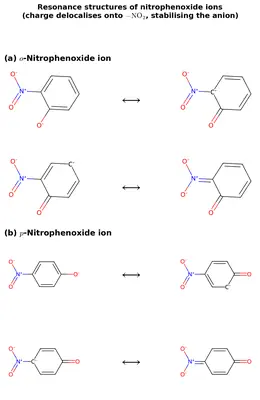
Ortho and para nitrophenols are more acidic than phenol. Draw the resonance structures of the corresponding phenoxide ions.
Figure
Figure

Solution

When a phenol loses $$\mathrm{H^+}$$, the phenoxide ion formed is stabilised by delocalisation of the negative charge. In a plain phenoxide ion the charge spreads only over the oxygen and the ortho/para carbons of the ring.

In the o- and p-nitrophenoxide ions, the $$\mathrm{-NO_2}$$ group provides an extra resonance path: the negative charge is delocalised right onto the electronegative oxygen atoms of the $$\mathrm{-NO_2}$$ group. This greater dispersal of charge makes these phenoxide ions much more stable, so o- and p-nitrophenols are more acidic than phenol.

p-Nitrophenoxide ion — the canonical (resonance) structures are:

  • Negative charge localised on the phenolic oxygen.
  • Negative charge on the ortho ring carbon (two equivalent ortho carbons).
  • Negative charge on the para ring carbon — this carbon bears the $$\mathrm{-NO_2}$$ group.
  • An additional structure in which the charge passes from the para carbon through the $$\mathrm{N=O}$$ of the nitro group onto an oxygen atom of the $$\mathrm{-NO_2}$$ group. This last structure is especially stabilising because the negative charge sits on an electronegative oxygen.

o-Nitrophenoxide ion — similarly, besides charge on the phenolic oxygen and the ortho/para ring carbons, there is a resonance structure in which the negative charge is delocalised from the ortho carbon (the one bearing $$\mathrm{-NO_2}$$) onto an oxygen of the $$\mathrm{-NO_2}$$ group.

Thus, in both ions the nitro group draws the negative charge onto its own oxygen atoms, an extra stabilisation absent in phenoxide ion itself.

Answer

In o- and p-nitrophenoxide ions the negative charge is delocalised not only over the oxygen and ring carbons but also onto the oxygen atoms of the $$\mathrm{-NO_2}$$ group. This extra delocalisation stabilises the anion, making the nitrophenols more acidic than phenol.

7.9

Write the equations involved in the following reactions:

(i) Reimer - Tiemann reaction

Solution

On treating phenol with chloroform in the presence of aqueous sodium hydroxide at 340 K, a $$\mathrm{-CHO}$$ group is introduced at the ortho position of the ring. The reactive electrophile is dichlorocarbene, $$\mathrm{:CCl_2}$$, generated from $$\mathrm{CHCl_3}$$ and $$\mathrm{NaOH}$$.

The intermediate is an o-substituted benzal chloride, which on alkaline hydrolysis gives the salt of salicylaldehyde; acidification then liberates salicylaldehyde.

$$\mathrm{C_6H_5OH + CHCl_3 + 3NaOH \xrightarrow{340\,K} \underset{\text{(sodium salt)}}{o\text{-}NaO\text{-}C_6H_4\text{-}CHO} + 3NaCl + 2H_2O}$$

$$\mathrm{o\text{-}NaO\text{-}C_6H_4\text{-}CHO \xrightarrow{H^+} \underset{\text{salicylaldehyde}}{o\text{-}HO\text{-}C_6H_4\text{-}CHO}}$$

The product is 2-hydroxybenzaldehyde (salicylaldehyde).

Answer

Phenol + $$\mathrm{CHCl_3}$$ + aq. NaOH (340 K), then $$\mathrm{H^+}$$, gives salicylaldehyde (2-hydroxybenzaldehyde).

(ii) Kolbe's reaction

Solution

Phenol is first converted to sodium phenoxide by reaction with $$\mathrm{NaOH}$$. The phenoxide ion is even more reactive than phenol towards electrophilic substitution, so it reacts with the weak electrophile carbon dioxide.

$$\mathrm{C_6H_5OH + NaOH \rightarrow C_6H_5ONa + H_2O}$$

Sodium phenoxide is treated with $$\mathrm{CO_2}$$ under pressure (about 4-7 atm) at 400 K, giving sodium salicylate; acidification yields salicylic acid.

$$\mathrm{C_6H_5ONa + CO_2 \xrightarrow{400\,K,\,pressure} \underset{\text{sodium salicylate}}{o\text{-}HO\text{-}C_6H_4\text{-}COONa}}$$

$$\mathrm{o\text{-}HO\text{-}C_6H_4\text{-}COONa \xrightarrow{H^+} \underset{\text{salicylic acid}}{o\text{-}HO\text{-}C_6H_4\text{-}COOH}}$$

The product is 2-hydroxybenzoic acid (salicylic acid).

Answer

Sodium phenoxide + $$\mathrm{CO_2}$$ (400 K, pressure), then $$\mathrm{H^+}$$, gives salicylic acid (2-hydroxybenzoic acid).

Example 7.6

Example 7.6

The following is not an appropriate reaction for the preparation of t-butyl ethyl ether.

$$\mathrm{C_2H_5ONa + (CH_3)_3C-Cl \rightarrow (CH_3)_3C-OC_2H_5}$$

(i) What would be the major product of this reaction?

Solution

Williamson synthesis proceeds by an $$\mathrm{S_N2}$$ attack of the alkoxide ion on the alkyl halide. Here the alkyl halide is tert-butyl chloride, $$\mathrm{(CH_3)_3C-Cl}$$ — a tertiary halide.

A tertiary halide is too hindered for $$\mathrm{S_N2}$$ substitution. Instead, the ethoxide ion ($$\mathrm{C_2H_5O^-}$$) acts as a strong base and abstracts a $$\beta$$-hydrogen, causing elimination (dehydrohalogenation).

$$\mathrm{(CH_3)_3C-Cl + C_2H_5O^-Na^+ \rightarrow (CH_3)_2C=CH_2 + C_2H_5OH + NaCl}$$

So the major product is the alkene 2-methylpropene (isobutylene), not the ether.

Answer

The major product is 2-methylpropene, $$\mathrm{(CH_3)_2C=CH_2}$$ (formed by elimination), along with ethanol and NaCl.

(ii) Write a suitable reaction for the preparation of t-butylethyl ether.

Solution

For Williamson synthesis to work well, the alkyl halide should be primary (best for $$\mathrm{S_N2}$$), while the alkoxide may be of any class.

So we must reverse the roles: take the tertiary group as the alkoxide and the ethyl group as the (primary) halide.

$$\mathrm{(CH_3)_3C-ONa + C_2H_5-Br \rightarrow (CH_3)_3C-O-C_2H_5 + NaBr}$$

Here sodium t-butoxide attacks the primary halide ethyl bromide by $$\mathrm{S_N2}$$, giving t-butyl ethyl ether smoothly.

Answer

$$\mathrm{(CH_3)_3C-ONa + C_2H_5Br \rightarrow (CH_3)_3C-OC_2H_5 + NaBr}$$ (use the primary halide ethyl bromide with sodium t-butoxide).

Example 7.7

Example 7.7

Give the major products that are formed by heating each of the following ethers with HI.

(i) $$\mathrm{CH_3-CH_2-CH(CH_3)-CH_2-O-CH_2-CH_3}$$

Solution

When an ether is heated with HI, the $$\mathrm{C-O}$$ bond is cleaved. With one mole of HI, the alkyl iodide formed corresponds to the smaller, less hindered alkyl group (formed by $$\mathrm{S_N2}$$ attack of $$\mathrm{I^-}$$ on the protonated ether), while the bulkier group is released as the alcohol.

Both groups here are primary, so $$\mathrm{I^-}$$ attacks the smaller one — the ethyl group:

$$\mathrm{CH_3CH_2CH(CH_3)CH_2-O-CH_2CH_3 + HI \rightarrow CH_3CH_2CH(CH_3)CH_2OH + CH_3CH_2I}$$

Products: 2-methylbutan-1-ol and iodoethane (ethyl iodide).

Answer

2-Methylbutan-1-ol, $$\mathrm{CH_3CH_2CH(CH_3)CH_2OH}$$, and ethyl iodide, $$\mathrm{C_2H_5I}$$.

(ii) $$\mathrm{CH_3-CH_2-CH_2-O-C(CH_3)_2-CH_2CH_3}$$

Solution

This ether has one primary group (n-propyl) and one tertiary group ($$\mathrm{-C(CH_3)_2CH_2CH_3}$$).

When one alkyl group is tertiary, cleavage occurs by an $$\mathrm{S_N1}$$ path: the protonated ether breaks to give the stable tertiary carbocation, which then combines with $$\mathrm{I^-}$$. The other (primary) group leaves as the alcohol.

$$\mathrm{CH_3CH_2CH_2-O-C(CH_3)_2CH_2CH_3 + HI \rightarrow CH_3CH_2CH_2OH + (CH_3)_2C(I)CH_2CH_3}$$

Products: propan-1-ol and 2-iodo-2-methylbutane.

Answer

Propan-1-ol, $$\mathrm{CH_3CH_2CH_2OH}$$, and 2-iodo-2-methylbutane, $$\mathrm{(CH_3)_2C(I)CH_2CH_3}$$ (the tertiary group forms the iodide).

(iii) $$\mathrm{C_6H_5-CH_2-O-C_6H_5}$$ (benzyl phenyl ether)

Solution

In an alkyl aryl ether, the $$\mathrm{O-C(aryl)}$$ bond is not cleaved by HI, because the aryl carbon is $$\mathrm{sp^2}$$ and cannot undergo nucleophilic substitution; a phenol is therefore one product.

Cleavage occurs at the $$\mathrm{O-CH_2(benzyl)}$$ bond. The benzyl group is released and combines with $$\mathrm{I^-}$$ to give benzyl iodide; the aryl part is set free as phenol.

$$\mathrm{C_6H_5-CH_2-O-C_6H_5 + HI \rightarrow C_6H_5-CH_2I + C_6H_5-OH}$$

Products: benzyl iodide and phenol.

Answer

Benzyl iodide, $$\mathrm{C_6H_5CH_2I}$$, and phenol, $$\mathrm{C_6H_5OH}$$.

Intext Questions (after Section 7.6.1)

7.10 Write the reactions of Williamson synthesis of 2-ethoxy-3-methylpentane starting from ethanol and 3-methylpentan-2-ol.

Solution

The target ether 2-ethoxy-3-methylpentane is $$\mathrm{CH_3-CH(OC_2H_5)-CH(CH_3)-CH_2-CH_3}$$. It is built from an ethyl group and a 3-methylpentan-2-yl group joined through oxygen.

In Williamson synthesis the alkyl halide must be primary (for clean $$\mathrm{S_N2}$$), while the alkoxide can be of any class. If we used the secondary halide (from 3-methylpentan-2-ol) it would mostly undergo elimination. Therefore:

  • The ethyl group is supplied as the primary halide — convert ethanol to ethyl bromide.
  • The 3-methylpentan-2-yl group is supplied as the sodium alkoxide.

Step 1 — make ethyl bromide from ethanol:

$$\mathrm{C_2H_5OH + HBr \rightarrow C_2H_5Br + H_2O}$$

Step 2 — make the sodium alkoxide of 3-methylpentan-2-ol:

$$\mathrm{CH_3-CH(OH)-CH(CH_3)-CH_2CH_3 + Na \rightarrow CH_3-CH(ONa)-CH(CH_3)-CH_2CH_3 + \tfrac{1}{2}H_2}$$

Step 3 — Williamson coupling ($$\mathrm{S_N2}$$):

$$\mathrm{CH_3-CH(ONa)-CH(CH_3)-CH_2CH_3 + C_2H_5Br \rightarrow CH_3-CH(OC_2H_5)-CH(CH_3)-CH_2CH_3 + NaBr}$$

This gives 2-ethoxy-3-methylpentane.

Answer

Convert ethanol to ethyl bromide; convert 3-methylpentan-2-ol to its sodium alkoxide; then $$\mathrm{CH_3CH(ONa)CH(CH_3)CH_2CH_3 + C_2H_5Br \rightarrow CH_3CH(OC_2H_5)CH(CH_3)CH_2CH_3 + NaBr}$$.

7.11

Which of the following is an appropriate set of reactants for the preparation of 1-methoxy-4-nitrobenzene and why?

(i) $$\mathrm{p\text{-}Br\text{-}C_6H_4\text{-}NO_2 + CH_3ONa}$$

Solution

In this set the halogen is attached to the benzene ring — it is an aryl halide (haloarene). The $$\mathrm{C-Br}$$ bond of a haloarene has partial double-bond character (due to resonance between the lone pairs of the halogen and the ring) and the carbon is $$\mathrm{sp^2}$$. Hence aryl halides do not undergo the easy $$\mathrm{S_N2}$$ substitution needed in Williamson synthesis.

Therefore this set, $$\mathrm{p\text{-}Br\text{-}C_6H_4\text{-}NO_2 + CH_3ONa}$$, is not appropriate — methoxide cannot readily displace the ring-bound bromine.

Answer

Not appropriate — the bromine is on the benzene ring (aryl halide), and aryl halides do not undergo the $$\mathrm{S_N2}$$ substitution required in Williamson synthesis.

(ii) $$\mathrm{p\text{-}NaO\text{-}C_6H_4\text{-}NO_2 + CH_3Br}$$

Solution

In this set the alkylating agent is $$\mathrm{CH_3Br}$$ — a primary alkyl halide, which readily undergoes $$\mathrm{S_N2}$$ substitution. The other reactant, sodium p-nitrophenoxide, supplies the aryloxide ion.

The phenoxide oxygen attacks the methyl carbon of $$\mathrm{CH_3Br}$$, displacing bromide:

$$\mathrm{p\text{-}NaO\text{-}C_6H_4\text{-}NO_2 + CH_3Br \rightarrow p\text{-}CH_3O\text{-}C_6H_4\text{-}NO_2 + NaBr}$$

This cleanly gives 1-methoxy-4-nitrobenzene. Hence set (ii) is the appropriate set of reactants.

Answer

Set (ii) is appropriate. $$\mathrm{CH_3Br}$$ is a primary alkyl halide that undergoes $$\mathrm{S_N2}$$ readily with sodium p-nitrophenoxide, giving 1-methoxy-4-nitrobenzene.

7.12

Predict the products of the following reactions:

(i) $$\mathrm{CH_3-CH_2-CH_2-O-CH_3 + HBr \rightarrow ?}$$

Solution

Methyl propyl ether is protonated by HBr; then bromide ion attacks by $$\mathrm{S_N2}$$ at the smaller, less hindered alkyl group — the methyl group. The propyl group is released as the alcohol.

$$\mathrm{CH_3CH_2CH_2-O-CH_3 + HBr \rightarrow CH_3CH_2CH_2OH + CH_3Br}$$

Products: propan-1-ol and bromomethane (methyl bromide).

Answer

Propan-1-ol, $$\mathrm{CH_3CH_2CH_2OH}$$, and bromomethane, $$\mathrm{CH_3Br}$$.

(ii) Phenyl ethyl ether ($$\mathrm{C_6H_5-OC_2H_5}$$) + HBr $$\rightarrow$$ ?

Solution

In an aryl alkyl ether the $$\mathrm{O-C(aryl)}$$ bond is not broken (the aryl carbon is $$\mathrm{sp^2}$$ and resists nucleophilic substitution), so a phenol is one product.

Cleavage occurs at the $$\mathrm{O-C_2H_5}$$ bond; bromide attacks the ethyl carbon:

$$\mathrm{C_6H_5-O-C_2H_5 + HBr \rightarrow C_6H_5-OH + C_2H_5Br}$$

Products: phenol and bromoethane (ethyl bromide).

Answer

Phenol, $$\mathrm{C_6H_5OH}$$, and bromoethane, $$\mathrm{C_2H_5Br}$$.

(iii) Phenyl ethyl ether ($$\mathrm{C_6H_5-OC_2H_5}$$) $$\xrightarrow{\text{Conc. }H_2SO_4,\text{ Conc. }HNO_3}$$ ?

Solution

A mixture of conc. $$\mathrm{HNO_3}$$ and conc. $$\mathrm{H_2SO_4}$$ nitrates the ring. The ethoxy group $$\mathrm{-OC_2H_5}$$ donates its lone pair into the ring, so it is activating and ortho/para-directing.

Nitration therefore occurs at the ortho and para positions, the para product being major:

$$\mathrm{C_6H_5-OC_2H_5 \xrightarrow[\text{conc. }H_2SO_4]{\text{conc. }HNO_3} o\text{- and } p\text{-}O_2N\text{-}C_6H_4\text{-}OC_2H_5}$$

Products: 2-nitrophenetole (1-ethoxy-2-nitrobenzene) and, mainly, 4-nitrophenetole (1-ethoxy-4-nitrobenzene).

Answer

1-Ethoxy-2-nitrobenzene (ortho) and 1-ethoxy-4-nitrobenzene (para, major).

(iv) $$\mathrm{(CH_3)_3C-OC_2H_5 \xrightarrow{HI} ?}$$

Solution

This ether has a tertiary group, $$\mathrm{(CH_3)_3C-}$$, and a primary ethyl group. After protonation of the ether oxygen, cleavage follows an $$\mathrm{S_N1}$$ path: the bond breaks to give the stable tertiary carbocation $$\mathrm{(CH_3)_3C^+}$$, which then combines with $$\mathrm{I^-}$$.

The ethyl group leaves with the oxygen as ethanol.

$$\mathrm{(CH_3)_3C-OC_2H_5 + HI \rightarrow (CH_3)_3C-I + C_2H_5OH}$$

Products: 2-iodo-2-methylpropane (tert-butyl iodide) and ethanol.

Answer

2-Iodo-2-methylpropane, $$\mathrm{(CH_3)_3C-I}$$, and ethanol, $$\mathrm{C_2H_5OH}$$.

Exercises

7.1

Write IUPAC names of the following compounds:

(i) $$\mathrm{CH_3-CH(CH_3)-CH(OH)-C(CH_3)_2-CH_3}$$

Solution

The longest chain has 5 carbons (pentane) and bears $$\mathrm{-OH}$$ on the middle carbon.

$$\mathrm{-OH}$$ is the principal group. From either end its locant is 3, so we choose the numbering that gives the methyl substituents the lower set of locants. Numbering so that the $$\mathrm{C(CH_3)_2}$$ carbon is C-2:

$$\mathrm{\underset{1}{CH_3}-\underset{2}{C(CH_3)_2}-\underset{3}{CH(OH)}-\underset{4}{CH(CH_3)}-\underset{5}{CH_3}}$$

This gives methyl locants $$\{2,2,4\}$$ (lower than $$\{2,4,4\}$$ from the other end). $$\mathrm{-OH}$$ at C-3.

Name: 2,2,4-Trimethylpentan-3-ol.

Answer

2,2,4-Trimethylpentan-3-ol.

(ii) $$\mathrm{H_3C-CH(OH)-CH_2-CH(OH)-CH(C_2H_5)-CH_2-CH_3}$$

Solution

The longest chain containing both $$\mathrm{-OH}$$ groups has 7 carbons (heptane); it is a diol with an ethyl substituent.

Numbering from the left end gives the $$\mathrm{-OH}$$ groups the locants $$\{2,4\}$$; from the right end they would be $$\{4,6\}$$. The lower set $$\{2,4\}$$ is chosen:

$$\mathrm{\underset{1}{CH_3}-\underset{2}{CH(OH)}-\underset{3}{CH_2}-\underset{4}{CH(OH)}-\underset{5}{CH(C_2H_5)}-\underset{6}{CH_2}-\underset{7}{CH_3}}$$

$$\mathrm{-OH}$$ at C-2 and C-4; ethyl substituent at C-5.

Name: 5-Ethylheptane-2,4-diol.

Answer

5-Ethylheptane-2,4-diol.

(iii) $$\mathrm{CH_3-CH(OH)-CH(OH)-CH_3}$$

Solution

The chain has 4 carbons (butane) with two $$\mathrm{-OH}$$ groups — a diol.

$$\mathrm{\underset{1}{CH_3}-\underset{2}{CH(OH)}-\underset{3}{CH(OH)}-\underset{4}{CH_3}}$$

$$\mathrm{-OH}$$ groups are at C-2 and C-3.

Name: Butane-2,3-diol.

Answer

Butane-2,3-diol.

(iv) $$\mathrm{HO-CH_2-CH(OH)-CH_2-OH}$$

Solution

The chain has 3 carbons (propane), and every carbon carries an $$\mathrm{-OH}$$ group — it is a triol.

$$\mathrm{\underset{1}{CH_2(OH)}-\underset{2}{CH(OH)}-\underset{3}{CH_2(OH)}}$$

$$\mathrm{-OH}$$ groups at C-1, C-2 and C-3.

Name: Propane-1,2,3-triol (common name: glycerol).

Answer

Propane-1,2,3-triol (glycerol).

(v) Benzene ring with $$\mathrm{-CH_3}$$ and $$\mathrm{-OH}$$ on adjacent (1,2) carbons (o-cresol structure).

Solution

The compound is a phenol, so the $$\mathrm{-OH}$$-bearing carbon is C-1. The methyl group is on the adjacent (ortho) carbon, C-2.

Name: 2-Methylphenol (common name: o-cresol).

Answer

2-Methylphenol (o-cresol).

(vi) Benzene ring with $$\mathrm{-CH_3}$$ and $$\mathrm{-OH}$$ on para (1,4) carbons (p-cresol structure).

Solution

The $$\mathrm{-OH}$$-bearing carbon is C-1. The methyl group is on the para carbon, C-4.

Name: 4-Methylphenol (common name: p-cresol).

Answer

4-Methylphenol (p-cresol).

(vii) Benzene ring with two $$\mathrm{-CH_3}$$ groups at positions 3 and 5, and $$\mathrm{-OH}$$ at position 1.

Solution

The $$\mathrm{-OH}$$-bearing carbon is C-1; the two methyl groups are at C-3 and C-5.

Name: 3,5-Dimethylphenol.

Answer

3,5-Dimethylphenol.

(viii) Benzene ring with two $$\mathrm{-CH_3}$$ groups at positions 2 and 6, and $$\mathrm{-OH}$$ at position 1.

Solution

The $$\mathrm{-OH}$$-bearing carbon is C-1; the two methyl groups occupy the two ortho positions, C-2 and C-6.

Name: 2,6-Dimethylphenol.

Answer

2,6-Dimethylphenol.

(ix) $$\mathrm{CH_3-O-CH_2-CH(CH_3)-CH_3}$$

Solution

This is an ether. The larger alkyl group, $$\mathrm{-CH_2-CH(CH_3)-CH_3}$$, is taken as the parent (propane chain with a methyl branch); the smaller group $$\mathrm{CH_3-O-}$$ is named as a methoxy substituent.

$$\mathrm{\underset{1}{CH_2}-\underset{2}{CH(CH_3)}-\underset{3}{CH_3}}$$, with $$\mathrm{-OCH_3}$$ on C-1 and $$\mathrm{-CH_3}$$ on C-2.

Name: 1-Methoxy-2-methylpropane.

Answer

1-Methoxy-2-methylpropane.

(x) $$\mathrm{C_6H_5-O-C_2H_5}$$

Solution

This is an aryl alkyl ether. The benzene ring is taken as the parent, and the $$\mathrm{-OC_2H_5}$$ group is named as an ethoxy substituent on it.

Name: Ethoxybenzene (common name: phenetole).

Answer

Ethoxybenzene (phenetole).

(xi) $$\mathrm{C_6H_5-O-C_7H_{15}}$$ (n-)

Solution

This ether joins a phenyl group and an n-heptyl group ($$\mathrm{C_7H_{15}}$$) through oxygen. The longer 7-carbon chain (heptane) is taken as the parent; the $$\mathrm{C_6H_5-O-}$$ group is named as a phenoxy substituent at C-1.

Name: 1-Phenoxyheptane.

Answer

1-Phenoxyheptane.

(xii) $$\mathrm{CH_3-CH_2-O-CH(CH_3)-CH_2-CH_3}$$

Solution

This ether joins an ethyl group and a butan-2-yl group, $$\mathrm{-CH(CH_3)-CH_2-CH_3}$$. The larger group is a 4-carbon chain (butane); the $$\mathrm{C_2H_5-O-}$$ group is the ethoxy substituent.

$$\mathrm{\underset{1}{CH_3}-\underset{2}{CH(OC_2H_5)}-\underset{3}{CH_2}-\underset{4}{CH_3}}$$ — the ethoxy group is on C-2.

Name: 2-Ethoxybutane.

Answer

2-Ethoxybutane.

7.2

Write structures of the compounds whose IUPAC names are as follows:

(i) 2-Methylbutan-2-ol

Solution

Parent: butane (4 carbons). $$\mathrm{-OH}$$ at C-2 and a methyl substituent also at C-2.

Structure: $$\mathrm{CH_3-C(CH_3)(OH)-CH_2-CH_3}$$

The $$\mathrm{-OH}$$ carbon is bonded to three other carbons, so it is a tertiary alcohol.

Answer

$$\mathrm{CH_3-C(CH_3)(OH)-CH_2-CH_3}$$

(ii) 1-Phenylpropan-2-ol

Solution

Parent: propane (3 carbons). A phenyl group is at C-1 and $$\mathrm{-OH}$$ at C-2.

Structure: $$\mathrm{C_6H_5-CH_2-CH(OH)-CH_3}$$

Answer

$$\mathrm{C_6H_5-CH_2-CH(OH)-CH_3}$$

(iii) 3,5-Dimethylhexane-1, 3, 5-triol

Solution

Parent: hexane (6 carbons). $$\mathrm{-OH}$$ groups at C-1, C-3, C-5; methyl groups at C-3 and C-5.

$$\mathrm{\underset{1}{CH_2(OH)}-\underset{2}{CH_2}-\underset{3}{C(CH_3)(OH)}-\underset{4}{CH_2}-\underset{5}{C(CH_3)(OH)}-\underset{6}{CH_3}}$$

Structure: $$\mathrm{HOCH_2-CH_2-C(CH_3)(OH)-CH_2-C(CH_3)(OH)-CH_3}$$

Answer

$$\mathrm{HOCH_2-CH_2-C(CH_3)(OH)-CH_2-C(CH_3)(OH)-CH_3}$$

(iv) 2,3 - Diethylphenol

Solution

Parent: phenol (benzene ring with $$\mathrm{-OH}$$ at C-1). Two ethyl ($$\mathrm{-C_2H_5}$$) groups are present at C-2 and C-3.

Structure: a benzene ring bearing $$\mathrm{-OH}$$ at position 1 and $$\mathrm{-C_2H_5}$$ groups at positions 2 and 3 (the two carbons adjacent to, and next-but-one from, the $$\mathrm{-OH}$$).

Answer

Benzene ring with $$\mathrm{-OH}$$ at C-1 and $$\mathrm{-C_2H_5}$$ groups at C-2 and C-3.

(v) 1 - Ethoxypropane

Solution

Parent: propane (3 carbons), bearing an ethoxy ($$\mathrm{-OC_2H_5}$$) group at C-1.

Structure: $$\mathrm{CH_3-CH_2-CH_2-O-C_2H_5}$$ (ethyl propyl ether).

Answer

$$\mathrm{CH_3CH_2CH_2-O-C_2H_5}$$

(vi) 2-Ethoxy-3-methylpentane

Solution

Parent: pentane (5 carbons). An ethoxy ($$\mathrm{-OC_2H_5}$$) group is at C-2 and a methyl group at C-3.

$$\mathrm{\underset{1}{CH_3}-\underset{2}{CH(OC_2H_5)}-\underset{3}{CH(CH_3)}-\underset{4}{CH_2}-\underset{5}{CH_3}}$$

Structure: $$\mathrm{CH_3-CH(OC_2H_5)-CH(CH_3)-CH_2-CH_3}$$

Answer

$$\mathrm{CH_3-CH(OC_2H_5)-CH(CH_3)-CH_2-CH_3}$$

(vii) Cyclohexylmethanol

Solution

The parent is methanol ($$\mathrm{CH_3OH}$$); one hydrogen of the methyl is replaced by a cyclohexyl group.

Structure: a cyclohexane ring carrying a $$\mathrm{-CH_2OH}$$ group, i.e. $$\mathrm{C_6H_{11}-CH_2OH}$$.

Answer

$$\mathrm{C_6H_{11}-CH_2OH}$$ (cyclohexane ring bearing a $$\mathrm{-CH_2OH}$$ group).

(viii) 3-Cyclohexylpentan-3-ol

Solution

Parent: pentane (5 carbons). $$\mathrm{-OH}$$ at C-3, and a cyclohexyl group also at C-3.

$$\mathrm{\underset{1}{CH_3}-\underset{2}{CH_2}-\underset{3}{C(OH)(C_6H_{11})}-\underset{4}{CH_2}-\underset{5}{CH_3}}$$

Structure: $$\mathrm{CH_3CH_2-C(OH)(C_6H_{11})-CH_2CH_3}$$ (C-3 bears $$\mathrm{-OH}$$ and a cyclohexyl ring).

Answer

$$\mathrm{CH_3CH_2-C(OH)(C_6H_{11})-CH_2CH_3}$$

(ix) Cyclopent-3-en-1-ol

Solution

The parent is a cyclopentane ring. $$\mathrm{-OH}$$ is at C-1 and a $$\mathrm{C=C}$$ double bond lies between C-3 and C-4.

Structure: a five-membered carbon ring; carbon 1 carries $$\mathrm{-OH}$$, and there is a double bond between carbons 3 and 4 (C-1 and the double bond are separated by one $$\mathrm{CH_2}$$ on each side).

Answer

A cyclopentene ring with $$\mathrm{-OH}$$ on C-1 and a $$\mathrm{C=C}$$ double bond between C-3 and C-4.

(x) 4-Chloro-3-ethylbutan-1-ol.

Solution

Parent: butane (4 carbons). $$\mathrm{-OH}$$ at C-1, an ethyl group at C-3, and a chlorine at C-4.

$$\mathrm{\underset{1}{CH_2(OH)}-\underset{2}{CH_2}-\underset{3}{CH(C_2H_5)}-\underset{4}{CH_2Cl}}$$

Structure: $$\mathrm{HOCH_2-CH_2-CH(C_2H_5)-CH_2Cl}$$

Answer

$$\mathrm{HOCH_2-CH_2-CH(C_2H_5)-CH_2Cl}$$

7.3

(i)

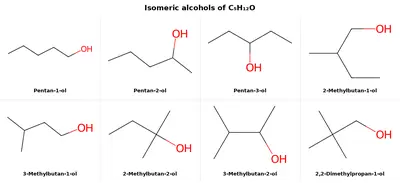
Draw the structures of all isomeric alcohols of molecular formula $$\mathrm{C_5H_{12}O}$$ and give their IUPAC names.
Structure
Structure

Solution

$$\mathrm{C_5H_{12}O}$$ is a saturated compound. Considering all possible carbon skeletons (straight, one branch, two branches) and all positions of the $$\mathrm{-OH}$$ group, there are eight isomeric alcohols:

No.StructureIUPAC name
1$$\mathrm{CH_3CH_2CH_2CH_2CH_2OH}$$Pentan-1-ol
2$$\mathrm{CH_3CH_2CH_2CH(OH)CH_3}$$Pentan-2-ol
3$$\mathrm{CH_3CH_2CH(OH)CH_2CH_3}$$Pentan-3-ol
4$$\mathrm{CH_3CH_2CH(CH_3)CH_2OH}$$2-Methylbutan-1-ol
5$$\mathrm{(CH_3)_2CHCH_2CH_2OH}$$3-Methylbutan-1-ol
6$$\mathrm{CH_3CH_2C(CH_3)(OH)CH_3}$$2-Methylbutan-2-ol
7$$\mathrm{(CH_3)_2CHCH(OH)CH_3}$$3-Methylbutan-2-ol
8$$\mathrm{(CH_3)_3C-CH_2OH}$$2,2-Dimethylpropan-1-ol

Answer

Eight isomeric alcohols: pentan-1-ol, pentan-2-ol, pentan-3-ol, 2-methylbutan-1-ol, 3-methylbutan-1-ol, 2-methylbutan-2-ol, 3-methylbutan-2-ol and 2,2-dimethylpropan-1-ol.

(ii) Classify the isomers of alcohols in question 11.3 (i) as primary, secondary and tertiary alcohols.

Solution

An alcohol is primary (1°), secondary (2°) or tertiary (3°) according to whether the carbon bearing $$\mathrm{-OH}$$ is attached to one, two or three other carbon atoms.

ClassAlcohols
Primary (1°)Pentan-1-ol, 2-Methylbutan-1-ol, 3-Methylbutan-1-ol, 2,2-Dimethylpropan-1-ol
Secondary (2°)Pentan-2-ol, Pentan-3-ol, 3-Methylbutan-2-ol
Tertiary (3°)2-Methylbutan-2-ol

Answer

Primary: pentan-1-ol, 2-methylbutan-1-ol, 3-methylbutan-1-ol, 2,2-dimethylpropan-1-ol. Secondary: pentan-2-ol, pentan-3-ol, 3-methylbutan-2-ol. Tertiary: 2-methylbutan-2-ol.

7.4 Explain why propanol has higher boiling point than that of the hydrocarbon, butane?

Solution

Propanol ($$\mathrm{C_3H_7OH}$$, molar mass 60 g/mol) and butane ($$\mathrm{C_4H_{10}}$$, molar mass 58 g/mol) have nearly the same molecular mass, so the difference in boiling point comes from the intermolecular forces.

Propanol contains a polar $$\mathrm{-OH}$$ group, so its molecules are held together by strong intermolecular hydrogen bonding. Butane is a non-polar hydrocarbon whose molecules are held only by weak van der Waals (London) forces.

Breaking the extensive hydrogen-bonded network of propanol requires much more energy than overcoming the weak forces between butane molecules. Hence propanol boils at a much higher temperature than butane.

Answer

Propanol molecules are associated through strong intermolecular hydrogen bonding (due to the $$\mathrm{-OH}$$ group), whereas butane has only weak van der Waals forces. More energy is needed to separate propanol molecules, so its boiling point is higher.

7.5 Alcohols are comparatively more soluble in water than hydrocarbons of comparable molecular masses. Explain this fact.

Solution

The solubility of a substance in water depends on its ability to interact with water molecules.

An alcohol contains a polar $$\mathrm{-OH}$$ group. This $$\mathrm{-OH}$$ group can form hydrogen bonds with water molecules (both as donor and acceptor). These alcohol-water hydrogen bonds are of nearly the same strength as the water-water hydrogen bonds they replace, so alcohols dissolve readily in water (smaller alcohols are completely miscible).

Hydrocarbons, on the other hand, are non-polar and have no group that can hydrogen-bond with water. Dissolving a hydrocarbon would require breaking water-water hydrogen bonds without forming any compensating bonds, which is energetically unfavourable. Hence hydrocarbons are practically insoluble in water.

Therefore, for comparable molecular masses, alcohols are far more soluble in water than hydrocarbons.

Answer

The $$\mathrm{-OH}$$ group of an alcohol forms hydrogen bonds with water molecules, allowing the alcohol to dissolve; non-polar hydrocarbons cannot hydrogen-bond with water, so they are insoluble.

7.6 What is meant by hydroboration-oxidation reaction? Illustrate it with an example.

Solution

Hydroboration-oxidation is a two-step method of converting an alkene into an alcohol.

Step 1 (Hydroboration): The alkene is treated with diborane, $$\mathrm{(BH_3)_2}$$ (i.e. $$\mathrm{B_2H_6}$$), which adds across the double bond. The boron atom (the electron-deficient, less electronegative atom) attaches to the less substituted (terminal) carbon. Diborane behaves as two $$\mathrm{BH_3}$$ units, and each $$\mathrm{BH_3}$$ unit adds to three alkene molecules to give a trialkylborane, so one molecule of diborane consumes six molecules of alkene:

$$\mathrm{6\,CH_3-CH=CH_2 + (BH_3)_2 \rightarrow 2\,(CH_3CH_2CH_2)_3B}$$

(Equivalently, per $$\mathrm{BH_3}$$ unit: $$\mathrm{3\,CH_3-CH=CH_2 + BH_3 \rightarrow (CH_3CH_2CH_2)_3B}$$.)

Step 2 (Oxidation): The trialkylborane is oxidised and hydrolysed with hydrogen peroxide in the presence of aqueous sodium hydroxide. Each $$\mathrm{C-B}$$ bond is replaced by a $$\mathrm{C-OH}$$ bond.

$$\mathrm{(CH_3CH_2CH_2)_3B \xrightarrow[\;OH^-\;]{H_2O_2} 3\,CH_3CH_2CH_2OH + H_3BO_3}$$

Since $$\mathrm{-OH}$$ ends up on the less substituted carbon, the overall result is anti-Markovnikov addition of water. Propene thus gives propan-1-ol (a primary alcohol), not propan-2-ol.

Answer

Hydroboration-oxidation: addition of $$\mathrm{(BH_3)_2}$$ to an alkene gives a trialkylborane, which on oxidation with $$\mathrm{H_2O_2/OH^-}$$ gives an alcohol with anti-Markovnikov orientation. Example: propene $$\rightarrow$$ propan-1-ol.

7.7

Give the structures and IUPAC names of monohydric phenols of molecular formula, $$\mathrm{C_7H_8O}$$.
Structure
Structure

Solution

A monohydric phenol of formula $$\mathrm{C_7H_8O}$$ is a benzene ring carrying one $$\mathrm{-OH}$$ group and one $$\mathrm{-CH_3}$$ group (the methylphenols, or cresols). The methyl group can be ortho, meta or para to the $$\mathrm{-OH}$$, giving three isomers:

StructureIUPAC nameCommon name
$$\mathrm{-OH}$$ at C-1, $$\mathrm{-CH_3}$$ at C-22-Methylphenolo-Cresol
$$\mathrm{-OH}$$ at C-1, $$\mathrm{-CH_3}$$ at C-33-Methylphenolm-Cresol
$$\mathrm{-OH}$$ at C-1, $$\mathrm{-CH_3}$$ at C-44-Methylphenolp-Cresol

(Benzyl alcohol $$\mathrm{C_6H_5CH_2OH}$$ and anisole $$\mathrm{C_6H_5OCH_3}$$ also have formula $$\mathrm{C_7H_8O}$$ but are not phenols, since their $$\mathrm{-OH/-O-}$$ is not bonded directly to the ring.)

Answer

Three monohydric phenols: 2-methylphenol (o-cresol), 3-methylphenol (m-cresol) and 4-methylphenol (p-cresol).

7.8 While separating a mixture of ortho and para nitrophenols by steam distillation, name the isomer which will be steam volatile. Give reason.

Solution

The ortho isomer (o-nitrophenol) is steam volatile.

Reason: In o-nitrophenol the $$\mathrm{-OH}$$ and $$\mathrm{-NO_2}$$ groups lie on adjacent (1,2) carbons, close enough for the hydrogen of the $$\mathrm{-OH}$$ group to form an intramolecular hydrogen bond with an oxygen atom of the $$\mathrm{-NO_2}$$ group within the same molecule. Because each molecule satisfies its hydrogen bonding internally, the molecules are not associated with one another, so o-nitrophenol has a relatively low boiling point and is readily volatile in steam.

In p-nitrophenol the $$\mathrm{-OH}$$ and $$\mathrm{-NO_2}$$ groups are far apart (1,4-positions), so intramolecular hydrogen bonding is geometrically impossible. Instead the molecules associate with one another through intermolecular hydrogen bonding, building an extended associated network. This raises the boiling point, so p-nitrophenol is much less volatile and is not carried over in steam.

Answer

o-Nitrophenol is steam volatile. In it the $$\mathrm{-OH}$$ and $$\mathrm{-NO_2}$$ groups (on adjacent carbons) form an intramolecular hydrogen bond, so the molecules stay unassociated and the boiling point is low. In p-nitrophenol the groups are too far apart for this, so the molecules associate through intermolecular hydrogen bonding, raising the boiling point and making it non-volatile in steam.

7.9 Give the equations of reactions for the preparation of phenol from cumene.

Solution

Cumene is isopropylbenzene, $$\mathrm{C_6H_5-CH(CH_3)_2}$$. It is the industrial starting material for phenol.

Step 1: Cumene is oxidised by air (atmospheric oxygen) to cumene hydroperoxide. Oxidation occurs at the tertiary benzylic $$\mathrm{C-H}$$ bond.

$$\mathrm{C_6H_5-CH(CH_3)_2 \xrightarrow{O_2} C_6H_5-C(CH_3)_2-O-O-H}$$

Step 2: Cumene hydroperoxide, on treatment with dilute acid, decomposes (by an acid-catalysed rearrangement) to give phenol and acetone (propanone).

$$\mathrm{C_6H_5-C(CH_3)_2-O-O-H \xrightarrow{H_3O^+} C_6H_5-OH + (CH_3)_2C=O}$$

Thus phenol is obtained, with acetone as a valuable by-product.

Answer

Cumene $$\xrightarrow{O_2}$$ cumene hydroperoxide $$\xrightarrow{H_3O^+}$$ phenol + acetone.

7.10 Write chemical reaction for the preparation of phenol from chlorobenzene.

Solution

This is the Dow process. Chlorobenzene is fused with sodium hydroxide at a high temperature (about 623 K) and high pressure (about 300 atm). The harsh conditions are needed because the $$\mathrm{C-Cl}$$ bond of an aryl halide is very unreactive.

$$\mathrm{C_6H_5Cl + 2NaOH \xrightarrow[300\ atm]{623\ K} C_6H_5ONa + NaCl + H_2O}$$

The sodium phenoxide formed is then treated with dilute acid to liberate phenol:

$$\mathrm{C_6H_5ONa + HCl \rightarrow C_6H_5OH + NaCl}$$

Answer

$$\mathrm{C_6H_5Cl + 2NaOH \xrightarrow[300\ atm]{623\ K} C_6H_5ONa + NaCl + H_2O}$$; then $$\mathrm{C_6H_5ONa + HCl \rightarrow C_6H_5OH + NaCl}$$.

7.11 Write the mechanism of hydration of ethene to yield ethanol.

Solution

Acid-catalysed hydration of ethene occurs in three steps.

Step 1 — Protonation of the alkene: The $$\pi$$ electrons of ethene pick up a proton from the acid ($$\mathrm{H_3O^+}$$), forming a carbocation.

$$\mathrm{CH_2=CH_2 + H^+ \rightarrow CH_3-\overset{+}{C}H_2}$$

Step 2 — Nucleophilic attack by water: A water molecule, using a lone pair on oxygen, attacks the electron-deficient carbocation to give a protonated alcohol (an oxonium ion).

$$\mathrm{CH_3-\overset{+}{C}H_2 + H_2O \rightarrow CH_3-CH_2-\overset{+}{O}H_2}$$

Step 3 — Deprotonation: The protonated alcohol loses a proton to a water molecule, giving ethanol and regenerating the $$\mathrm{H_3O^+}$$ catalyst.

$$\mathrm{CH_3-CH_2-\overset{+}{O}H_2 + H_2O \rightarrow CH_3-CH_2-OH + H_3O^+}$$

The acid is consumed in step 1 and regenerated in step 3, so it acts as a catalyst.

Answer

Three-step mechanism: (1) protonation of ethene to give the ethyl carbocation, (2) nucleophilic attack of water to give a protonated alcohol, (3) loss of a proton to give ethanol and regenerate $$\mathrm{H^+}$$.

7.12 You are given benzene, conc. $$\mathrm{H_2SO_4}$$ and NaOH. Write the equations for the preparation of phenol using these reagents.

Solution

Phenol is prepared from benzene through benzenesulphonic acid.

Step 1 — Sulphonation: Benzene is heated with concentrated sulphuric acid to give benzenesulphonic acid.

$$\mathrm{C_6H_6 + H_2SO_4 \xrightarrow{\Delta} C_6H_5\text{-}SO_3H + H_2O}$$

Step 2 — Neutralisation: Benzenesulphonic acid is neutralised with sodium hydroxide to give sodium benzenesulphonate.

$$\mathrm{C_6H_5\text{-}SO_3H + NaOH \rightarrow C_6H_5\text{-}SO_3Na + H_2O}$$

Step 3 — Alkali fusion: Sodium benzenesulphonate is fused with solid sodium hydroxide to give sodium phenoxide.

$$\mathrm{C_6H_5\text{-}SO_3Na + 2NaOH \xrightarrow{fuse} C_6H_5\text{-}ONa + Na_2SO_3 + H_2O}$$

Step 4 — Acidification: Sodium phenoxide is treated with dilute acid to liberate phenol.

$$\mathrm{C_6H_5\text{-}ONa + H^+ \rightarrow C_6H_5\text{-}OH}$$

Answer

Benzene $$\xrightarrow{conc.\,H_2SO_4}$$ benzenesulphonic acid $$\xrightarrow{NaOH}$$ sodium benzenesulphonate $$\xrightarrow{NaOH,\,fuse}$$ sodium phenoxide $$\xrightarrow{H^+}$$ phenol.

7.13

Show how will you synthesise:

(i) 1-phenylethanol from a suitable alkene.

Solution

1-Phenylethanol is $$\mathrm{C_6H_5-CH(OH)-CH_3}$$ — the $$\mathrm{-OH}$$ is on the carbon attached to the ring (a secondary, benzylic position).

The suitable alkene is styrene (phenylethene), $$\mathrm{C_6H_5-CH=CH_2}$$. On acid-catalysed hydration, water adds following Markovnikov's rule: protonation gives the more stable benzylic secondary carbocation $$\mathrm{C_6H_5-\overset{+}{C}H-CH_3}$$, so $$\mathrm{-OH}$$ ends up on the carbon next to the ring.

$$\mathrm{C_6H_5-CH=CH_2 \xrightarrow[H^+]{H_2O} C_6H_5-CH(OH)-CH_3}$$

Answer

Acid-catalysed hydration of styrene: $$\mathrm{C_6H_5-CH=CH_2 \xrightarrow{H_2O/H^+} C_6H_5-CH(OH)-CH_3}$$.

(ii) cyclohexylmethanol using an alkyl halide by an $$\mathrm{S_N2}$$ reaction.

Solution

Cyclohexylmethanol is $$\mathrm{C_6H_{11}-CH_2OH}$$. The corresponding alkyl halide is cyclohexylmethyl chloride (chloromethylcyclohexane), $$\mathrm{C_6H_{11}-CH_2Cl}$$ — a primary halide, ideal for $$\mathrm{S_N2}$$.

Heating it with aqueous sodium hydroxide, the hydroxide ion attacks the primary carbon by $$\mathrm{S_N2}$$, displacing chloride:

$$\mathrm{C_6H_{11}-CH_2Cl + NaOH\,(aq) \xrightarrow{S_N2} C_6H_{11}-CH_2OH + NaCl}$$

Answer

$$\mathrm{C_6H_{11}-CH_2Cl + NaOH\,(aq) \rightarrow C_6H_{11}-CH_2OH + NaCl}$$ (an $$\mathrm{S_N2}$$ reaction).

(iii) pentan-1-ol using a suitable alkyl halide?

Solution

Pentan-1-ol is $$\mathrm{CH_3CH_2CH_2CH_2CH_2OH}$$. The suitable alkyl halide is 1-bromopentane (or 1-chloropentane), $$\mathrm{CH_3CH_2CH_2CH_2CH_2Br}$$ — a primary halide.

On heating with aqueous sodium hydroxide, hydroxide ion substitutes the halogen:

$$\mathrm{CH_3CH_2CH_2CH_2CH_2Br + NaOH\,(aq) \rightarrow CH_3CH_2CH_2CH_2CH_2OH + NaBr}$$

Answer

$$\mathrm{CH_3CH_2CH_2CH_2CH_2Br + NaOH\,(aq) \rightarrow CH_3CH_2CH_2CH_2CH_2OH + NaBr}$$.

7.14 Give two reactions that show the acidic nature of phenol. Compare acidity of phenol with that of ethanol.

Solution

Two reactions showing the acidic nature of phenol:

(1) Phenol reacts with active metals such as sodium, liberating hydrogen gas:

$$\mathrm{2\,C_6H_5OH + 2Na \rightarrow 2\,C_6H_5ONa + H_2\uparrow}$$

(2) Phenol reacts with sodium hydroxide (a base) to form sodium phenoxide — phenol dissolves in aqueous NaOH:

$$\mathrm{C_6H_5OH + NaOH \rightarrow C_6H_5ONa + H_2O}$$

Comparison with ethanol: Phenol is a much stronger acid than ethanol.

  • On losing $$\mathrm{H^+}$$, phenol gives the phenoxide ion, in which the negative charge is delocalised over the benzene ring by resonance — this stabilises the anion.
  • Ethanol gives the ethoxide ion; here the electron-releasing ethyl group intensifies the negative charge on oxygen, destabilising the anion. No resonance stabilisation is possible.

Because the phenoxide ion is far more stable than the ethoxide ion, phenol ionises more readily. (Also, in phenol the $$\mathrm{-OH}$$ oxygen is attached to an $$\mathrm{sp^2}$$ carbon, which is more electronegative and makes the $$\mathrm{O-H}$$ bond more polar.) Indeed, ethanol does not even react with $$\mathrm{NaOH}$$, whereas phenol does.

Answer

Phenol reacts with Na (releasing $$\mathrm{H_2}$$) and with NaOH (forming sodium phenoxide), showing it is acidic. Phenol is much more acidic than ethanol because the phenoxide ion is resonance-stabilised, whereas the ethoxide ion is destabilised by the electron-releasing alkyl group; ethanol does not react with NaOH.

7.15 Explain why is ortho nitrophenol more acidic than ortho methoxyphenol?

Solution

The acidity of a substituted phenol depends on how the substituent affects the stability of the phenoxide ion formed after loss of $$\mathrm{H^+}$$.

In o-nitrophenol, the $$\mathrm{-NO_2}$$ group is strongly electron-withdrawing (it shows $$-I$$ and $$-R$$ effects). It pulls electron density away and disperses the negative charge of the phenoxide ion onto its own oxygen atoms. This stabilises the anion, so the $$\mathrm{O-H}$$ proton is released easily — the compound is more acidic.

In o-methoxyphenol, the $$\mathrm{-OCH_3}$$ group is electron-releasing (its $$+R$$ / $$+M$$ effect dominates). It pushes electron density into the ring, intensifying the negative charge on the phenoxide oxygen. This destabilises the anion, making proton release harder — the compound is less acidic (even less acidic than phenol).

Hence o-nitrophenol, with a charge-dispersing group, is more acidic than o-methoxyphenol, which has a charge-intensifying group.

Answer

$$\mathrm{-NO_2}$$ is electron-withdrawing — it stabilises the phenoxide ion of o-nitrophenol by dispersing the negative charge, increasing acidity. $$\mathrm{-OCH_3}$$ is electron-releasing — it destabilises the phenoxide ion of o-methoxyphenol by intensifying the charge, decreasing acidity. So o-nitrophenol is more acidic.

7.16 Explain how does the –OH group attached to a carbon of benzene ring activate it towards electrophilic substitution?

Solution

In phenol, the oxygen of the $$\mathrm{-OH}$$ group carries lone pairs of electrons. One of these lone pairs is in a p-orbital that can overlap with the $$\pi$$ system of the benzene ring.

As a result, the oxygen lone pair is delocalised into the ring (the $$+R$$ / +M, or electron-releasing resonance, effect). This can be shown by resonance structures in which a negative charge appears on the ortho and para ring carbons:

$$\mathrm{C_6H_5-\overset{..}{\underset{..}{O}}H \leftrightarrow \text{(structures with } (-)\text{ charge at ortho/para ring carbons and } (+)\text{ on O)}}$$

Because of this delocalisation, the electron density of the ring increases, particularly at the ortho and para positions. An electrophile attacks electron-rich centres; a ring richer in electrons reacts faster with electrophiles.

Hence the $$\mathrm{-OH}$$ group activates the benzene ring towards electrophilic substitution (and directs the electrophile to the ortho and para positions).

Answer

The lone pair on the oxygen of $$\mathrm{-OH}$$ is delocalised into the ring by resonance (+R effect), raising the electron density at the ortho and para positions. This electron-rich ring reacts more readily with electrophiles, so $$\mathrm{-OH}$$ activates the ring.

7.17

Give equations of the following reactions:

(i) Oxidation of propan-1-ol with alkaline $$\mathrm{KMnO_4}$$ solution.

Solution

Alkaline $$\mathrm{KMnO_4}$$ is a strong oxidising agent. It oxidises a primary alcohol all the way to a carboxylic acid (through the aldehyde stage).

$$\mathrm{CH_3CH_2CH_2OH \xrightarrow[\Delta]{alk.\,KMnO_4} CH_3CH_2COOH}$$

Propan-1-ol is oxidised to propanoic acid.

Answer

$$\mathrm{CH_3CH_2CH_2OH \xrightarrow{alk.\,KMnO_4} CH_3CH_2COOH}$$ (propanoic acid).

(ii) Bromine in $$\mathrm{CS_2}$$ with phenol.

Solution

When phenol is treated with bromine in a non-polar solvent such as carbon disulphide ($$\mathrm{CS_2}$$) at low temperature, the reaction is controlled and gives mainly the monobromo product, with the para isomer predominating.

$$\mathrm{C_6H_5OH + Br_2 \xrightarrow[273-278\,K]{CS_2} p\text{-}Br\text{-}C_6H_4\text{-}OH + HBr}$$

The major product is 4-bromophenol (a small amount of 2-bromophenol is also formed). The low temperature and non-polar solvent prevent polybromination.

Answer

$$\mathrm{C_6H_5OH + Br_2 \xrightarrow{CS_2} 4\text{-}bromophenol + HBr}$$ (mainly the para isomer; some ortho).

(iii) Dilute $$\mathrm{HNO_3}$$ with phenol.

Solution

With dilute nitric acid at low temperature, phenol undergoes mononitration. The $$\mathrm{-OH}$$ group is ortho/para-directing, so a mixture of o-nitrophenol and p-nitrophenol is obtained.

$$\mathrm{C_6H_5OH + HNO_3\,(dil.) \rightarrow o\text{-}O_2N\text{-}C_6H_4\text{-}OH + p\text{-}O_2N\text{-}C_6H_4\text{-}OH + H_2O}$$

The ortho and para nitrophenols formed are then separated by steam distillation (o-nitrophenol being steam volatile).

Answer

$$\mathrm{C_6H_5OH + dil.\,HNO_3 \rightarrow}$$ a mixture of 2-nitrophenol (ortho) and 4-nitrophenol (para).

(iv) Treating phenol wih chloroform in presence of aqueous NaOH.

Solution

This is the Reimer-Tiemann reaction. Phenol, on treatment with chloroform and aqueous sodium hydroxide at 340 K, gets a $$\mathrm{-CHO}$$ group introduced at the ortho position (the reactive intermediate is dichlorocarbene, $$\mathrm{:CCl_2}$$).

$$\mathrm{C_6H_5OH + CHCl_3 + 3NaOH \xrightarrow{340\,K} o\text{-}NaO\text{-}C_6H_4\text{-}CHO + 3NaCl + 2H_2O}$$

On acidification, salicylaldehyde (2-hydroxybenzaldehyde) is obtained:

$$\mathrm{o\text{-}NaO\text{-}C_6H_4\text{-}CHO \xrightarrow{H^+} o\text{-}HO\text{-}C_6H_4\text{-}CHO}$$

Answer

Reimer-Tiemann reaction: phenol + $$\mathrm{CHCl_3}$$ + aq. NaOH (340 K), then $$\mathrm{H^+}$$, gives salicylaldehyde (2-hydroxybenzaldehyde).

7.18

Explain the following with an example.

(i) Kolbe's reaction.

Solution

Kolbe's reaction: When phenol is treated with sodium hydroxide, sodium phenoxide is formed. The phenoxide ion is even more reactive towards electrophilic substitution than phenol itself, so it can react with a weak electrophile such as carbon dioxide.

$$\mathrm{C_6H_5OH + NaOH \rightarrow C_6H_5ONa + H_2O}$$

Sodium phenoxide is heated with $$\mathrm{CO_2}$$ at about 400 K under a pressure of 4-7 atm. The $$\mathrm{CO_2}$$ molecule acts as the electrophile and a $$\mathrm{-COOH}$$ group is introduced at the ortho position; acidification then liberates salicylic acid.

$$\mathrm{C_6H_5ONa \xrightarrow[\text{4-7 atm}]{CO_2,\ 400\,K} \underset{\text{sodium salicylate}}{o\text{-}HO\text{-}C_6H_4\text{-}COONa} \xrightarrow{H^+} \underset{\text{salicylic acid}}{o\text{-}HO\text{-}C_6H_4\text{-}COOH}}$$

Why ortho substitution predominates: the negatively charged oxygen of the phenoxide ion activates the ring at the ortho and para positions. The ortho product is favoured because the $$\mathrm{Na^+}$$ ion coordinates the phenoxide oxygen and holds the $$\mathrm{CO_2}$$ molecule close to the adjacent (ortho) carbon; in addition, the ortho product (sodium salicylate) is stabilised by intramolecular hydrogen bonding between the $$\mathrm{-OH}$$ and $$\mathrm{-COO^-}$$ groups.

The product, 2-hydroxybenzoic acid (salicylic acid), is used in making aspirin.

Answer

Kolbe's reaction: sodium phenoxide is heated with $$\mathrm{CO_2}$$ at about 400 K under 4-7 atm pressure. $$\mathrm{CO_2}$$ acts as a weak electrophile and substitutes mainly at the ortho position; acidification then gives salicylic acid (2-hydroxybenzoic acid).

(ii) Reimer-Tiemann reaction.

Solution

Reimer-Tiemann reaction: When phenol is treated with chloroform in the presence of aqueous sodium hydroxide at 340 K, a $$\mathrm{-CHO}$$ group is introduced at the ortho position of the ring.

$$\mathrm{NaOH}$$ reacts with $$\mathrm{CHCl_3}$$ to generate dichlorocarbene ($$\mathrm{:CCl_2}$$), the electrophile. It attacks the (highly reactive) phenoxide ring ortho to oxygen, and the resulting o-substituted benzal chloride is hydrolysed by alkali.

$$\mathrm{C_6H_5OH + CHCl_3 + 3NaOH \xrightarrow{340\,K} o\text{-}NaO\text{-}C_6H_4\text{-}CHO + 3NaCl + 2H_2O}$$

$$\mathrm{o\text{-}NaO\text{-}C_6H_4\text{-}CHO \xrightarrow{H^+} o\text{-}HO\text{-}C_6H_4\text{-}CHO}$$

The product is salicylaldehyde (2-hydroxybenzaldehyde).

Answer

Reimer-Tiemann reaction: phenol with $$\mathrm{CHCl_3}$$ and aq. NaOH at 340 K introduces a $$\mathrm{-CHO}$$ group at the ortho position, giving salicylaldehyde after acidification.

(iii) Williamson ether synthesis.

Solution

Williamson ether synthesis is an important laboratory method of preparing ethers (both symmetrical and unsymmetrical). An alkyl halide is allowed to react with a sodium alkoxide (or aryloxide).

The alkoxide ion is a strong nucleophile; it attacks the carbon of the alkyl halide in an $$\mathrm{S_N2}$$ reaction, displacing the halide ion and forming the ether.

$$\mathrm{R-O^-Na^+ + R'-X \rightarrow R-O-R' + NaX}$$

Example — preparation of ethoxyethane (diethyl ether):

$$\mathrm{C_2H_5ONa + C_2H_5Br \rightarrow C_2H_5-O-C_2H_5 + NaBr}$$

The method works best when the alkyl halide is primary; with secondary or tertiary halides, elimination competes.

Answer

Williamson synthesis: sodium alkoxide + alkyl halide $$\rightarrow$$ ether (by $$\mathrm{S_N2}$$). Example: $$\mathrm{C_2H_5ONa + C_2H_5Br \rightarrow C_2H_5OC_2H_5 + NaBr}$$.

(iv) Unsymmetrical ether.

Solution

An unsymmetrical (or mixed) ether is an ether in which the two groups attached to the oxygen atom are different from each other.

If both groups are the same, the ether is symmetrical (e.g. $$\mathrm{C_2H_5-O-C_2H_5}$$, ethoxyethane); if they differ, it is unsymmetrical.

Examples of unsymmetrical ethers:

  • $$\mathrm{CH_3-O-C_2H_5}$$ — methoxyethane (ethyl methyl ether)
  • $$\mathrm{C_6H_5-O-CH_3}$$ — methoxybenzene (anisole)

Answer

An unsymmetrical (mixed) ether has two different groups on the oxygen, e.g. $$\mathrm{CH_3-O-C_2H_5}$$ (methoxyethane) or $$\mathrm{C_6H_5-O-CH_3}$$ (anisole).

7.19 Write the mechanism of acid dehydration of ethanol to yield ethene.

Solution

Ethanol is dehydrated to ethene by heating with concentrated sulphuric acid at about 443 K. The mechanism has three steps.

Step 1 — Protonation: The lone pair on the oxygen of ethanol picks up a proton from the acid, forming a protonated alcohol (ethyl oxonium ion).

$$\mathrm{CH_3CH_2OH + H^+ \rightleftharpoons CH_3CH_2-\overset{+}{O}H_2}$$

Step 2 — Formation of carbocation (slow, rate-determining): The protonated alcohol loses a water molecule (a good leaving group), giving the ethyl carbocation.

$$\mathrm{CH_3CH_2-\overset{+}{O}H_2 \rightarrow CH_3-\overset{+}{C}H_2 + H_2O}$$

Step 3 — Loss of a proton: A base (e.g. $$\mathrm{HSO_4^-}$$ or water) removes a proton from the $$\beta$$-carbon of the carbocation; the electron pair forms the $$\pi$$ bond, giving ethene and regenerating $$\mathrm{H^+}$$.

$$\mathrm{CH_3-\overset{+}{C}H_2 \rightarrow CH_2=CH_2 + H^+}$$

The acid removed in step 1 is released in step 3, so it acts as a catalyst. The overall reaction is:

$$\mathrm{CH_3CH_2OH \xrightarrow[443\,K]{conc.\,H_2SO_4} CH_2=CH_2 + H_2O}$$

Answer

Three-step E1 mechanism: (1) protonation of ethanol, (2) loss of water to give the ethyl carbocation (slow step), (3) loss of a $$\beta$$-proton to give ethene and regenerate $$\mathrm{H^+}$$.

7.20

How are the following conversions carried out?

(i) Propene $$\rightarrow$$ Propan-2-ol.

Solution

Propene is converted to propan-2-ol by acid-catalysed hydration. Water adds across the double bond following Markovnikov's rule, so $$\mathrm{-OH}$$ goes to the more substituted (central) carbon.

$$\mathrm{CH_3-CH=CH_2 \xrightarrow[dil.\,H_2SO_4]{H_2O} CH_3-CH(OH)-CH_3}$$

Answer

Acid-catalysed hydration: $$\mathrm{CH_3CH=CH_2 \xrightarrow{H_2O/H^+} CH_3CH(OH)CH_3}$$.

(ii) Benzyl chloride $$\rightarrow$$ Benzyl alcohol.

Solution

Benzyl chloride, $$\mathrm{C_6H_5CH_2Cl}$$, is a primary (benzylic) halide. Heating it with aqueous sodium hydroxide (or aqueous $$\mathrm{KOH}$$) replaces the chlorine by $$\mathrm{-OH}$$ (nucleophilic substitution), giving benzyl alcohol.

$$\mathrm{C_6H_5CH_2Cl + NaOH\,(aq) \rightarrow C_6H_5CH_2OH + NaCl}$$

Answer

Hydrolysis with aqueous NaOH: $$\mathrm{C_6H_5CH_2Cl + NaOH\,(aq) \rightarrow C_6H_5CH_2OH + NaCl}$$.

(iii) Ethyl magnesium chloride $$\rightarrow$$ Propan-1-ol.

Solution

A Grignard reagent reacts with methanal ($$\mathrm{HCHO}$$) to give, after hydrolysis, a primary alcohol with one extra carbon.

Ethylmagnesium chloride adds to methanal, and the adduct is hydrolysed:

$$\mathrm{C_2H_5MgCl + HCHO \rightarrow C_2H_5-CH_2-OMgCl}$$

$$\mathrm{C_2H_5-CH_2-OMgCl \xrightarrow{H_2O/H^+} C_2H_5-CH_2-OH}$$

i.e. $$\mathrm{CH_3CH_2CH_2OH}$$ — propan-1-ol.

Answer

React with methanal, then hydrolyse: $$\mathrm{C_2H_5MgCl + HCHO \rightarrow \xrightarrow{H_2O} CH_3CH_2CH_2OH}$$ (propan-1-ol).

(iv) Methyl magnesium bromide $$\rightarrow$$ 2-Methylpropan-2-ol.

Solution

2-Methylpropan-2-ol is the tertiary alcohol $$\mathrm{(CH_3)_3C-OH}$$. A tertiary alcohol is obtained when a Grignard reagent reacts with a ketone.

Methylmagnesium bromide is allowed to react with propanone (acetone, $$\mathrm{(CH_3)_2C=O}$$); the adduct is then hydrolysed.

$$\mathrm{(CH_3)_2C=O + CH_3MgBr \rightarrow (CH_3)_3C-OMgBr}$$

$$\mathrm{(CH_3)_3C-OMgBr \xrightarrow{H_2O/H^+} (CH_3)_3C-OH}$$

Answer

React with propanone, then hydrolyse: $$\mathrm{(CH_3)_2C=O + CH_3MgBr \rightarrow \xrightarrow{H_2O} (CH_3)_3C-OH}$$ (2-methylpropan-2-ol).

7.21

Name the reagents used in the following reactions:

(i) Oxidation of a primary alcohol to carboxylic acid.

Solution

To oxidise a primary alcohol all the way to a carboxylic acid, a strong oxidising agent is needed.

Reagent: acidified potassium permanganate ($$\mathrm{KMnO_4/H^+}$$) — alkaline $$\mathrm{KMnO_4}$$ or acidified potassium dichromate ($$\mathrm{K_2Cr_2O_7/H^+}$$) may also be used.

$$\mathrm{RCH_2OH \xrightarrow{KMnO_4/H^+} RCOOH}$$

Answer

Acidified $$\mathrm{KMnO_4}$$ (or acidified $$\mathrm{K_2Cr_2O_7}$$).

(ii) Oxidation of a primary alcohol to aldehyde.

Solution

To stop the oxidation of a primary alcohol at the aldehyde stage (without further oxidation to the acid), a mild oxidising agent is required.

Reagent: pyridinium chlorochromate (PCC), used in dichloromethane.

$$\mathrm{RCH_2OH \xrightarrow[CH_2Cl_2]{PCC} RCHO}$$

Answer

Pyridinium chlorochromate (PCC) in dichloromethane.

(iii) Bromination of phenol to 2,4,6-tribromophenol.

Solution

To brominate all three activated positions of phenol at once, a polar medium is used so that the reaction is fast.

Reagent: bromine water (an aqueous solution of bromine, $$\mathrm{Br_2}$$ in water).

$$\mathrm{C_6H_5OH + 3Br_2\,(aq) \rightarrow 2,4,6\text{-tribromophenol} + 3HBr}$$

(In water, phenol is highly activated, so all the ortho and para positions are brominated, giving a white precipitate of 2,4,6-tribromophenol.)

Answer

Bromine water (aqueous bromine, $$\mathrm{Br_2}$$ in water).

(iv) Benzyl alcohol to benzoic acid.

Solution

Benzyl alcohol ($$\mathrm{C_6H_5CH_2OH}$$) is a primary alcohol; to oxidise it fully to benzoic acid ($$\mathrm{C_6H_5COOH}$$), a strong oxidising agent is used.

Reagent: acidified potassium permanganate ($$\mathrm{KMnO_4/H^+}$$) — acidified potassium dichromate ($$\mathrm{K_2Cr_2O_7/H^+}$$) also works.

$$\mathrm{C_6H_5CH_2OH \xrightarrow{KMnO_4/H^+} C_6H_5COOH}$$

Answer

Acidified $$\mathrm{KMnO_4}$$ (or acidified $$\mathrm{K_2Cr_2O_7}$$).

(v) Dehydration of propan-2-ol to propene.

Solution

Dehydration (removal of water) of an alcohol to an alkene requires a hot acid catalyst.

Reagent: concentrated sulphuric acid ($$\mathrm{conc.\ H_2SO_4}$$) on heating (about 440 K). Alternatively, 85% phosphoric acid.

$$\mathrm{CH_3CH(OH)CH_3 \xrightarrow[\Delta]{conc.\,H_2SO_4} CH_3CH=CH_2 + H_2O}$$

Answer

Concentrated $$\mathrm{H_2SO_4}$$ (heated), or 85% phosphoric acid.

(vi) Butan-2-one to butan-2-ol.

Solution

Converting a ketone (butan-2-one) to a secondary alcohol (butan-2-ol) requires reduction of the carbonyl group.

Reagent: sodium borohydride ($$\mathrm{NaBH_4}$$) — lithium aluminium hydride ($$\mathrm{LiAlH_4}$$), or $$\mathrm{H_2}$$ with a Ni/Pt/Pd catalyst, may also be used.

$$\mathrm{CH_3-CO-CH_2CH_3 \xrightarrow{NaBH_4} CH_3-CH(OH)-CH_2CH_3}$$

Answer

A reducing agent — $$\mathrm{NaBH_4}$$ (or $$\mathrm{LiAlH_4}$$, or $$\mathrm{H_2}$$/Ni).

7.22 Give reason for the higher boiling point of ethanol in comparison to methoxymethane.

Solution

Ethanol ($$\mathrm{C_2H_5OH}$$) and methoxymethane ($$\mathrm{CH_3-O-CH_3}$$, dimethyl ether) are isomers — both have the molecular formula $$\mathrm{C_2H_6O}$$ and the same molecular mass (46 g/mol). So the difference in boiling point arises only from the intermolecular forces.

Ethanol contains an $$\mathrm{O-H}$$ bond. Its molecules associate through strong intermolecular hydrogen bonding.

Methoxymethane has no $$\mathrm{O-H}$$ bond — its hydrogens are all bonded to carbon. Therefore its molecules cannot form hydrogen bonds with one another; they are held only by weak dipole-dipole and van der Waals forces.

Since breaking the hydrogen-bonded network of ethanol needs much more energy, ethanol has a markedly higher boiling point than methoxymethane.

Answer

Ethanol molecules are associated by strong intermolecular hydrogen bonding (it has an $$\mathrm{O-H}$$ bond); methoxymethane has no $$\mathrm{O-H}$$ bond and cannot hydrogen-bond, so it has weaker intermolecular forces and a lower boiling point.

7.23

Give IUPAC names of the following ethers:

(i) $$\mathrm{C_2H_5OCH_2-CH(CH_3)-CH_3}$$

Solution

This ether joins an ethyl group and an isobutyl group, $$\mathrm{-CH_2-CH(CH_3)-CH_3}$$. The larger group is taken as the parent: a propane chain ($$\mathrm{CH_2-CH(CH_3)-CH_3}$$) with a methyl branch. The $$\mathrm{C_2H_5-O-}$$ group is named as ethoxy.

$$\mathrm{\underset{1}{CH_2(OC_2H_5)}-\underset{2}{CH(CH_3)}-\underset{3}{CH_3}}$$ — ethoxy at C-1, methyl at C-2.

Name: 1-Ethoxy-2-methylpropane.

Answer

1-Ethoxy-2-methylpropane.

(ii) $$\mathrm{CH_3OCH_2CH_2Cl}$$

Solution

The larger group here is the 2-carbon chain $$\mathrm{-CH_2CH_2Cl}$$; it is taken as the parent (ethane). The $$\mathrm{CH_3-O-}$$ group is a methoxy substituent and $$\mathrm{Cl}$$ is a chloro substituent.

$$\mathrm{\underset{1}{CH_2Cl}-\underset{2}{CH_2(OCH_3)}}$$ — number to give the lower locant set; chloro at C-1, methoxy at C-2.

Name: 1-Chloro-2-methoxyethane.

Answer

1-Chloro-2-methoxyethane.

(iii) $$\mathrm{O_2N-C_6H_4-OCH_3}$$ ($$p$$-)

Solution

The benzene ring is the parent. It carries a methoxy ($$\mathrm{-OCH_3}$$) group and, para to it, a nitro ($$\mathrm{-NO_2}$$) group.

Citing substituents alphabetically, methoxy gets C-1 and nitro gets C-4.

Name: 1-Methoxy-4-nitrobenzene (common name: p-nitroanisole).

Answer

1-Methoxy-4-nitrobenzene (p-nitroanisole).

(iv) $$\mathrm{CH_3CH_2CH_2OCH_3}$$

Solution

This ether joins a propyl group and a methyl group. The larger group, propyl, is taken as the parent (propane); the $$\mathrm{CH_3-O-}$$ group is named as methoxy at C-1.

Name: 1-Methoxypropane.

Answer

1-Methoxypropane.

(v) Cyclohexane ring with two $$\mathrm{-CH_3}$$ groups and $$\mathrm{-OC_2H_5}$$ on the same carbon (1-ethoxy-2,2-dimethylcyclohexane type structure).

Solution

The parent is a cyclohexane ring. The carbon bearing the ethoxy ($$\mathrm{-OC_2H_5}$$) group is taken as C-1, and the two methyl groups are on the adjacent carbon, C-2.

Numbering this way gives the lowest locant set $$\{1,2,2\}$$.

Name: 1-Ethoxy-2,2-dimethylcyclohexane.

Answer

1-Ethoxy-2,2-dimethylcyclohexane.

(vi) Benzene ring with $$\mathrm{-OC_2H_5}$$ substituent (ethoxybenzene).

Solution

The benzene ring is the parent, carrying one ethoxy ($$\mathrm{-OC_2H_5}$$) group.

Name: Ethoxybenzene (common name: phenetole).

Answer

Ethoxybenzene (phenetole).

7.24

Write the names of reagents and equations for the preparation of the following ethers by Williamson's synthesis:

(i) 1-Propoxypropane

Solution

1-Propoxypropane is the symmetrical ether $$\mathrm{CH_3CH_2CH_2-O-CH_2CH_2CH_3}$$.

Reagents: sodium n-propoxide and 1-bromopropane (a primary halide).

$$\mathrm{CH_3CH_2CH_2ONa + CH_3CH_2CH_2Br \rightarrow CH_3CH_2CH_2-O-CH_2CH_2CH_3 + NaBr}$$

Answer

Sodium propoxide + 1-bromopropane: $$\mathrm{C_3H_7ONa + C_3H_7Br \rightarrow C_3H_7OC_3H_7 + NaBr}$$.

(ii) Ethoxybenzene

Solution

Ethoxybenzene is $$\mathrm{C_6H_5-O-C_2H_5}$$.

We must use sodium phenoxide with ethyl bromide — not sodium ethoxide with bromobenzene, because the aryl halide (bromobenzene) does not undergo the $$\mathrm{S_N2}$$ substitution needed here.

$$\mathrm{C_6H_5ONa + C_2H_5Br \rightarrow C_6H_5-O-C_2H_5 + NaBr}$$

Answer

Sodium phenoxide + ethyl bromide: $$\mathrm{C_6H_5ONa + C_2H_5Br \rightarrow C_6H_5OC_2H_5 + NaBr}$$.

(iii) 2-Methoxy-2-methylpropane

Solution

2-Methoxy-2-methylpropane is $$\mathrm{(CH_3)_3C-O-CH_3}$$ (tert-butyl methyl ether).

The tertiary group must be supplied as the alkoxide, and the methyl group as the (primary) halide. (Using a tertiary halide would give only elimination.)

$$\mathrm{(CH_3)_3C-ONa + CH_3Br \rightarrow (CH_3)_3C-O-CH_3 + NaBr}$$

Answer

Sodium t-butoxide + methyl bromide: $$\mathrm{(CH_3)_3C-ONa + CH_3Br \rightarrow (CH_3)_3C-OCH_3 + NaBr}$$.

(iv) 1-Methoxyethane

Solution

1-Methoxyethane is $$\mathrm{CH_3-O-C_2H_5}$$ (ethyl methyl ether). Both groups are primary, so either group may be the alkoxide and the other the halide.

Using sodium ethoxide and bromomethane:

$$\mathrm{C_2H_5ONa + CH_3Br \rightarrow C_2H_5-O-CH_3 + NaBr}$$

(Equally, sodium methoxide and bromoethane: $$\mathrm{CH_3ONa + C_2H_5Br \rightarrow CH_3-O-C_2H_5 + NaBr}$$.)

Answer

Sodium ethoxide + bromomethane: $$\mathrm{C_2H_5ONa + CH_3Br \rightarrow CH_3OC_2H_5 + NaBr}$$ (or sodium methoxide + bromoethane).

7.25 Illustrate with examples the limitations of Williamson synthesis for the preparation of certain types of ethers.

Solution

In Williamson synthesis the alkoxide ion attacks the alkyl halide by an $$\mathrm{S_N2}$$ mechanism. The alkoxide ion, however, is also a strong base. So:

  • With a primary alkyl halide, substitution ($$\mathrm{S_N2}$$, ether formation) dominates — the method works well.
  • With a secondary and especially a tertiary alkyl halide, the crowded carbon resists $$\mathrm{S_N2}$$ attack, and the alkoxide instead removes a $$\beta$$-hydrogen — elimination takes over and an alkene is the major product, not the ether.

Example: To prepare t-butyl ethyl ether, if sodium ethoxide is treated with t-butyl chloride (a tertiary halide):

$$\mathrm{C_2H_5ONa + (CH_3)_3C-Cl \rightarrow (CH_3)_2C=CH_2 + C_2H_5OH + NaCl}$$

The product is the alkene 2-methylpropene (by elimination), not the ether. The ether can be made only by reversing the roles — using sodium t-butoxide with the primary halide ethyl bromide.

Also, Williamson synthesis cannot use aryl halides (e.g. bromobenzene) as the substrate, since the $$\mathrm{C-X}$$ bond of a haloarene does not undergo $$\mathrm{S_N2}$$ substitution. To make an aryl alkyl ether the aryl group must be supplied as the aryloxide.

Answer

Williamson synthesis fails with secondary/tertiary alkyl halides (elimination gives alkenes instead of ethers) and with aryl halides (no $$\mathrm{S_N2}$$). e.g. $$\mathrm{C_2H_5ONa + (CH_3)_3CCl}$$ gives 2-methylpropene, not the ether.

7.26 How is 1-propoxypropane synthesised from propan-1-ol? Write mechanism of this reaction.

Solution

1-Propoxypropane (dipropyl ether) is prepared by the acid-catalysed (intermolecular) dehydration of propan-1-ol. Propan-1-ol is heated with concentrated sulphuric acid at about 413 K; two molecules of the alcohol combine with loss of one water molecule.

$$\mathrm{2\,CH_3CH_2CH_2OH \xrightarrow[413\,K]{conc.\,H_2SO_4} CH_3CH_2CH_2-O-CH_2CH_2CH_3 + H_2O}$$

Mechanism (an $$\mathrm{S_N2}$$-type substitution, since propyl is primary):

Step 1 — Protonation: One alcohol molecule is protonated by the acid, giving a propyl oxonium ion.

$$\mathrm{CH_3CH_2CH_2OH + H^+ \rightleftharpoons CH_3CH_2CH_2-\overset{+}{O}H_2}$$

Step 2 — Nucleophilic attack ($$\mathrm{S_N2}$$): A second (neutral) alcohol molecule, using a lone pair on its oxygen, attacks the carbon of the protonated alcohol and displaces a water molecule (a good leaving group). This gives a protonated ether.

$$\mathrm{CH_3CH_2CH_2OH + CH_3CH_2CH_2-\overset{+}{O}H_2 \rightarrow (CH_3CH_2CH_2)_2\overset{+}{O}H + H_2O}$$

Step 3 — Deprotonation: The protonated ether loses a proton, giving the neutral ether and regenerating the acid catalyst.

$$\mathrm{(CH_3CH_2CH_2)_2\overset{+}{O}H \rightarrow CH_3CH_2CH_2-O-CH_2CH_2CH_3 + H^+}$$

This method succeeds because propan-1-ol is a primary alcohol; at the moderate temperature (413 K) substitution (ether formation) is favoured over elimination.

Answer

By heating propan-1-ol with conc. $$\mathrm{H_2SO_4}$$ at 413 K (intermolecular dehydration). Mechanism: (1) protonation of one alcohol, (2) $$\mathrm{S_N2}$$ attack by a second alcohol displacing water to give a protonated ether, (3) loss of a proton to give 1-propoxypropane.

7.27 Preparation of ethers by acid dehydration of secondary or tertiary alcohols is not a suitable method. Give reason.

Solution

Acid dehydration of an alcohol can follow two competing paths: substitution (one alcohol molecule attacks another, giving an ether) or elimination (loss of water and a $$\beta$$-hydrogen, giving an alkene).

With secondary and tertiary alcohols, the protonated alcohol readily loses water to form a relatively stable secondary or tertiary carbocation. Such a carbocation prefers to lose a $$\beta$$-proton, forming a stable alkene (elimination), rather than be attacked by a bulky second alcohol molecule.

Moreover, secondary and tertiary carbons are sterically crowded, which further hinders the substitution (ether-forming) step.

Hence, with secondary or tertiary alcohols, the dehydration gives mainly the alkene, not the ether. The method is therefore unsuitable for them and works satisfactorily only for primary alcohols.

Answer

Secondary and tertiary alcohols, on acid dehydration, form stable carbocations that preferentially undergo elimination to give alkenes (and the crowded carbon resists substitution). So the alkene, not the ether, is the major product — making the method unsuitable.

7.28

Write the equation of the reaction of hydrogen iodide with:

(i) 1-propoxypropane

Solution

1-Propoxypropane is the symmetrical ether $$\mathrm{CH_3CH_2CH_2-O-CH_2CH_2CH_3}$$. With HI, the $$\mathrm{C-O}$$ bond is cleaved: one propyl group becomes the iodide and the other the alcohol.

$$\mathrm{CH_3CH_2CH_2-O-CH_2CH_2CH_3 + HI \rightarrow CH_3CH_2CH_2I + CH_3CH_2CH_2OH}$$

(With excess HI on heating, the propan-1-ol formed reacts further to give a second molecule of 1-iodopropane.)

Answer

$$\mathrm{C_3H_7-O-C_3H_7 + HI \rightarrow C_3H_7I + C_3H_7OH}$$ (1-iodopropane and propan-1-ol).

(ii) methoxybenzene and

Solution

Methoxybenzene (anisole) is $$\mathrm{C_6H_5-O-CH_3}$$, an aryl alkyl ether. The $$\mathrm{O-C(aryl)}$$ bond is not cleaved (the aryl carbon resists nucleophilic substitution), so a phenol is formed; iodide attacks the methyl carbon.

$$\mathrm{C_6H_5-O-CH_3 + HI \rightarrow C_6H_5-OH + CH_3I}$$

Products: phenol and iodomethane (methyl iodide).

Answer

$$\mathrm{C_6H_5-O-CH_3 + HI \rightarrow C_6H_5OH + CH_3I}$$ (phenol and methyl iodide).

(iii) benzyl ethyl ether.

Solution

Benzyl ethyl ether is $$\mathrm{C_6H_5CH_2-O-C_2H_5}$$. Both groups attached to oxygen are primary, but because one of them is a benzyl group, cleavage with HI follows the $$\mathrm{S_N1}$$ path (just as NCERT shows for tert-butyl methyl ether, where a stable carbocation is possible).

Step 1 — Protonation of the ether: HI protonates the lone pair on the ether oxygen, converting the poor leaving group ($$\mathrm{-OR}$$) into a good one (a neutral alcohol).

$$\mathrm{C_6H_5CH_2-O-C_2H_5 + HI \rightarrow C_6H_5CH_2-\overset{+}{O}(H)-C_2H_5 + I^-}$$

Step 2 — Heterolysis ($$\mathrm{S_N1}$$, slow step): The oxonium ion breaks at the benzyl $$\mathrm{C-O}$$ bond, expelling ethanol and giving the resonance-stabilised benzyl carbocation. Cleavage at the ethyl $$\mathrm{C-O}$$ bond would give an unstable primary ethyl cation, so this path is preferred.

$$\mathrm{C_6H_5CH_2-\overset{+}{O}(H)-C_2H_5 \xrightarrow{\text{slow}} C_6H_5\overset{+}{C}H_2 + C_2H_5OH}$$

Step 3 — Capture by iodide (fast): The iodide ion combines with the benzyl carbocation.

$$\mathrm{C_6H_5\overset{+}{C}H_2 + I^- \xrightarrow{\text{fast}} C_6H_5CH_2I}$$

Overall reaction:

$$\mathrm{C_6H_5CH_2-O-C_2H_5 + HI \rightarrow C_6H_5CH_2I + C_2H_5OH}$$

Products: benzyl iodide and ethanol. (The ethanol is not attacked further by $$\mathrm{I^-}$$ under these conditions; it can react with a second mole of HI only on prolonged heating with excess HI.)

Answer

$$\mathrm{C_6H_5CH_2-O-C_2H_5 + HI \rightarrow C_6H_5CH_2I + C_2H_5OH}$$ (benzyl iodide and ethanol).

7.29

Explain the fact that in aryl alkyl ethers

(i) the alkoxy group activates the benzene ring towards electrophilic substitution and

Solution

In an aryl alkyl ether (e.g. anisole, $$\mathrm{C_6H_5-OCH_3}$$), the oxygen of the alkoxy group carries lone pairs of electrons.

One of these lone pairs occupies a p-orbital that overlaps with the $$\pi$$ system of the benzene ring. Through this conjugation, oxygen donates electron density into the ring (the $$+R$$ / +M, electron-releasing resonance effect).

This can be shown by resonance structures in which the ring carries a negative charge at the ortho and para positions and oxygen carries a positive charge.

As a result, the electron density of the benzene ring increases. Since electrophiles attack electron-rich centres, the more electron-rich ring reacts faster with electrophiles. Hence the alkoxy group activates the ring towards electrophilic substitution.

Answer

The lone pair on the oxygen of the alkoxy group is delocalised into the ring by resonance (+R effect), increasing the ring's electron density. A more electron-rich ring reacts faster with electrophiles, so the alkoxy group activates the ring.

(ii) it directs the incoming substituents to ortho and para positions in benzene ring.

Solution

When the lone pair of the alkoxy oxygen is delocalised into the ring, the extra electron density does not spread evenly. The resonance structures show that the negative charge appears specifically on the carbon atoms that are ortho and para to the alkoxy group.

That is, the ortho and para positions become the most electron-rich centres of the ring, while the meta positions are not enriched.

An electrophile is attracted to the position of highest electron density. Therefore the incoming electrophile attacks mainly at the ortho and para positions, and the alkoxy group is described as an ortho/para-directing group.

Answer

Resonance delocalisation of the oxygen lone pair builds up the negative charge (electron density) specifically at the ortho and para carbons of the ring. Electrophiles attack these electron-rich positions, so the alkoxy group is ortho/para-directing.

7.30 Write the mechanism of the reaction of HI with methoxymethane.

Solution

Methoxymethane (dimethyl ether), $$\mathrm{CH_3-O-CH_3}$$, reacts with HI in two steps.

Step 1 — Protonation of the ether: HI is a strong acid; it protonates the lone pair on the ether oxygen, giving a dimethyl oxonium ion. This converts the poor leaving group ($$\mathrm{-OCH_3}$$) into a good one ($$\mathrm{CH_3OH}$$).

$$\mathrm{CH_3-O-CH_3 + HI \rightarrow CH_3-\overset{+}{O}(H)-CH_3 + I^-}$$

Step 2 — Nucleophilic attack by iodide ($$\mathrm{S_N2}$$): The iodide ion attacks a methyl carbon from the side opposite to oxygen, displacing a neutral methanol molecule.

$$\mathrm{I^- + CH_3-\overset{+}{O}(H)-CH_3 \rightarrow CH_3I + CH_3OH}$$

(Since the carbons are methyl — primary and unhindered — the reaction follows the $$\mathrm{S_N2}$$ path.) The products with one mole of HI are iodomethane and methanol:

$$\mathrm{CH_3-O-CH_3 + HI \rightarrow CH_3I + CH_3OH}$$

If HI is in excess and the mixture is heated, the methanol formed reacts further to give a second molecule of $$\mathrm{CH_3I}$$.

Answer

Two steps: (1) HI protonates the ether oxygen to give a dimethyl oxonium ion; (2) $$\mathrm{I^-}$$ attacks a methyl carbon by $$\mathrm{S_N2}$$, displacing methanol — giving $$\mathrm{CH_3I + CH_3OH}$$.

7.31

Write equations of the following reactions:

(i) Friedel-Crafts reaction – alkylation of anisole.

Solution

Anisole ($$\mathrm{C_6H_5OCH_3}$$) undergoes Friedel-Crafts alkylation with an alkyl halide in the presence of anhydrous aluminium chloride. The $$\mathrm{-OCH_3}$$ group is activating and ortho/para-directing, so the alkyl group enters mainly at the para position (with some ortho).

$$\mathrm{C_6H_5OCH_3 + CH_3Cl \xrightarrow{anhyd.\,AlCl_3} \underset{\text{(major, para)}}{4\text{-}CH_3\text{-}C_6H_4\text{-}OCH_3} + \underset{\text{(ortho)}}{2\text{-}CH_3\text{-}C_6H_4\text{-}OCH_3} + HCl}$$

Products: 2-methoxytoluene (o-) and 4-methoxytoluene (p-, major).

Answer

$$\mathrm{C_6H_5OCH_3 + CH_3Cl \xrightarrow{AlCl_3}}$$ 2-methoxytoluene and 4-methoxytoluene (para major) + HCl.

(ii) Nitration of anisole.

Solution

Anisole is nitrated by a mixture of concentrated nitric acid and concentrated sulphuric acid. The activating, ortho/para-directing $$\mathrm{-OCH_3}$$ group sends the $$\mathrm{-NO_2}$$ group to the ortho and para positions, the para isomer being major.

$$\mathrm{C_6H_5OCH_3 \xrightarrow[conc.\,H_2SO_4]{conc.\,HNO_3} \underset{\text{(ortho)}}{2\text{-}O_2N\text{-}C_6H_4\text{-}OCH_3} + \underset{\text{(para, major)}}{4\text{-}O_2N\text{-}C_6H_4\text{-}OCH_3} + H_2O}$$

Products: 2-nitroanisole and 4-nitroanisole (para major).

Answer

$$\mathrm{C_6H_5OCH_3 \xrightarrow{conc.\,HNO_3/H_2SO_4}}$$ 2-nitroanisole and 4-nitroanisole (para major).

(iii) Bromination of anisole in ethanoic acid medium.

Solution

Anisole reacts with bromine in ethanoic acid (acetic acid) medium. The reaction does not need a catalyst because $$\mathrm{-OCH_3}$$ strongly activates the ring. In this medium the para product is formed almost exclusively (the bulky para-selectivity arises since the ortho positions are sterically hindered).

$$\mathrm{C_6H_5OCH_3 + Br_2 \xrightarrow{CH_3COOH} \underset{\text{(major, para)}}{4\text{-}Br\text{-}C_6H_4\text{-}OCH_3} + HBr}$$

The major product is 4-bromoanisole (p-bromoanisole).

Answer

$$\mathrm{C_6H_5OCH_3 + Br_2 \xrightarrow{CH_3COOH} 4\text{-}bromoanisole + HBr}$$ (mainly the para product).

(iv) Friedel-Craft's acetylation of anisole.

Solution

In Friedel-Crafts acetylation, anisole reacts with acetyl chloride ($$\mathrm{CH_3COCl}$$) in the presence of anhydrous aluminium chloride; an acetyl group ($$\mathrm{-COCH_3}$$) is introduced into the ring.

Guided by the ortho/para-directing $$\mathrm{-OCH_3}$$ group, the acetyl group enters mainly at the para position.

$$\mathrm{C_6H_5OCH_3 + CH_3COCl \xrightarrow{anhyd.\,AlCl_3} \underset{\text{(major, para)}}{4\text{-}CH_3CO\text{-}C_6H_4\text{-}OCH_3} + \underset{\text{(ortho)}}{2\text{-}CH_3CO\text{-}C_6H_4\text{-}OCH_3} + HCl}$$

Products: 2-methoxyacetophenone (o-) and 4-methoxyacetophenone (p-, major).

Answer

$$\mathrm{C_6H_5OCH_3 + CH_3COCl \xrightarrow{AlCl_3}}$$ 2-methoxyacetophenone and 4-methoxyacetophenone (para major) + HCl.

7.32

Show how would you synthesise the following alcohols from appropriate alkenes?

(i) 1-Methylcyclohexan-1-ol (cyclohexane ring with $$\mathrm{-CH_3}$$ and $$\mathrm{-OH}$$ on the same carbon).

Solution

In 1-methylcyclohexan-1-ol the $$\mathrm{-OH}$$ is on the ring carbon that also carries the $$\mathrm{-CH_3}$$ group. The suitable alkene is 1-methylcyclohex-1-ene (a ring double bond, with the methyl on one of the doubly-bonded carbons).

On acid-catalysed hydration, water adds by Markovnikov's rule: protonation gives the more stable tertiary carbocation on the methyl-bearing carbon, so $$\mathrm{-OH}$$ goes to that carbon.

$$\mathrm{1\text{-methylcyclohex-1-ene} \xrightarrow[H^+]{H_2O} 1\text{-methylcyclohexan-1-ol}}$$

Answer

Acid-catalysed (Markovnikov) hydration of 1-methylcyclohex-1-ene gives 1-methylcyclohexan-1-ol.

(ii) An open-chain tertiary alcohol with structure $$\mathrm{CH_3CH_2-C(OH)(CH_2CH_3)-CH_2CH_2CH_3}$$ (3-ethylhexan-3-ol type).

Solution

The target is 3-ethylhexan-3-ol, $$\mathrm{CH_3CH_2-C(OH)(C_2H_5)-CH_2CH_2CH_3}$$ — a tertiary alcohol with $$\mathrm{-OH}$$ on C-3.

The suitable alkene is 3-ethylhex-2-ene, $$\mathrm{CH_3-CH=C(C_2H_5)-CH_2CH_2CH_3}$$. On acid-catalysed hydration, Markovnikov addition places $$\mathrm{H}$$ on C-2 and $$\mathrm{-OH}$$ on the more substituted C-3 (via the stable tertiary carbocation).

$$\mathrm{CH_3-CH=C(C_2H_5)-CH_2CH_2CH_3 \xrightarrow[H^+]{H_2O} CH_3CH_2-C(OH)(C_2H_5)-CH_2CH_2CH_3}$$

Answer

Markovnikov hydration of 3-ethylhex-2-ene ($$\mathrm{CH_3CH=C(C_2H_5)CH_2CH_2CH_3}$$) gives 3-ethylhexan-3-ol.

(iii) A secondary alcohol with $$\mathrm{-OH}$$ on an open-chain carbon (pentan-2-ol type, $$\mathrm{CH_3-CH(OH)-CH_2CH_2CH_3}$$).

Solution

The target is pentan-2-ol, $$\mathrm{CH_3-CH(OH)-CH_2CH_2CH_3}$$ — a secondary alcohol with $$\mathrm{-OH}$$ on C-2.

The suitable alkene is pent-1-ene, $$\mathrm{CH_2=CH-CH_2CH_2CH_3}$$. On acid-catalysed hydration, Markovnikov addition puts $$\mathrm{H}$$ on the terminal C-1 and $$\mathrm{-OH}$$ on the more substituted C-2 (via the secondary carbocation).

$$\mathrm{CH_2=CH-CH_2CH_2CH_3 \xrightarrow[H^+]{H_2O} CH_3-CH(OH)-CH_2CH_2CH_3}$$

(Pent-1-ene is preferred over pent-2-ene, which would give a mixture of pentan-2-ol and pentan-3-ol.)

Answer

Markovnikov hydration of pent-1-ene ($$\mathrm{CH_2=CHCH_2CH_2CH_3}$$) gives pentan-2-ol.

(iv) Cyclohexane ring with $$\mathrm{-OH}$$ and $$\mathrm{-C_2H_5}$$ on the same carbon (1-ethylcyclohexan-1-ol).

Solution

In 1-ethylcyclohexan-1-ol the $$\mathrm{-OH}$$ is on the ring carbon that also carries the $$\mathrm{-C_2H_5}$$ group. The suitable alkene is 1-ethylcyclohex-1-ene (a ring double bond, with the ethyl group on one of the doubly-bonded carbons).

On acid-catalysed hydration, Markovnikov addition places $$\mathrm{-OH}$$ on the more substituted carbon (the one bearing the ethyl group), via the stable tertiary carbocation.

$$\mathrm{1\text{-ethylcyclohex-1-ene} \xrightarrow[H^+]{H_2O} 1\text{-ethylcyclohexan-1-ol}}$$

Answer

Acid-catalysed (Markovnikov) hydration of 1-ethylcyclohex-1-ene gives 1-ethylcyclohexan-1-ol.

7.33

When 3-methylbutan-2-ol is treated with HBr, the following reaction takes place:

$$\mathrm{CH_3-CH(CH_3)-CH(OH)-CH_3 \xrightarrow{HBr} CH_3-C(Br)(CH_3)-CH_2-CH_3}$$

Give a mechanism for this reaction.

(Hint: The secondary carbocation formed in step II rearranges to a more stable tertiary carbocation by a hydride ion shift from 3rd carbon atom.)

Solution

3-Methylbutan-2-ol is $$\mathrm{CH_3-CH(CH_3)-CH(OH)-CH_3}$$. The $$\mathrm{-OH}$$ is on C-2 and the methyl branch is on C-3. The reaction with HBr proceeds by an $$\mathrm{S_N1}$$ pathway with a carbocation rearrangement.

Step I — Protonation of the $$\mathrm{-OH}$$ group: HBr is a strong acid; the lone pair of the hydroxyl oxygen takes up a proton, forming a protonated alcohol (oxonium ion). This turns $$\mathrm{-OH}$$ into the good leaving group $$\mathrm{-OH_2^+}$$.

$$\mathrm{CH_3-CH(CH_3)-CH(OH)-CH_3 + H^+ \rightarrow CH_3-CH(CH_3)-CH(\overset{+}{O}H_2)-CH_3}$$

Step II — Loss of water (formation of a secondary carbocation): The protonated alcohol loses a water molecule, giving a secondary carbocation at C-2.

$$\mathrm{CH_3-CH(CH_3)-CH(\overset{+}{O}H_2)-CH_3 \rightarrow CH_3-CH(CH_3)-\overset{+}{C}H-CH_3 + H_2O}$$

Step III — Rearrangement by a 1,2-hydride shift: A hydride ion ($$\mathrm{H^-}$$) migrates from C-3 (the adjacent, methyl-bearing carbon) to the positively charged C-2. This converts the secondary carbocation into a more stable tertiary carbocation, now centred on C-3.

$$\mathrm{CH_3-\underset{C\text{-}3}{CH(CH_3)}-\underset{C\text{-}2}{\overset{+}{C}H}-CH_3 \rightarrow CH_3-\underset{C\text{-}3}{\overset{+}{C}(CH_3)}-\underset{C\text{-}2}{CH_2}-CH_3}$$

Step IV — Attack by bromide ion: The nucleophile $$\mathrm{Br^-}$$ combines with the tertiary carbocation, giving the product 2-bromo-2-methylbutane.

$$\mathrm{CH_3-\overset{+}{C}(CH_3)-CH_2-CH_3 + Br^- \rightarrow CH_3-C(Br)(CH_3)-CH_2-CH_3}$$

Because the rearranged carbocation is tertiary (and more stable), the bromine ends up on C-3 of the original chain, giving 2-bromo-2-methylbutane rather than the unrearranged secondary bromide.

Answer

$$\mathrm{S_N1}$$ mechanism: (I) protonation of $$\mathrm{-OH}$$; (II) loss of water to give a secondary carbocation; (III) a 1,2-hydride shift from C-3 rearranges it to a more stable tertiary carbocation; (IV) $$\mathrm{Br^-}$$ attacks the tertiary carbocation, giving 2-bromo-2-methylbutane.

NCERT Solutions for Class 12
Maths
NCERT Solutions for Class 12 Maths
Chapter-wise step-by-step
solutions with explanations
explore solutions Maths bg
Physics
NCERT Solutions for Class 12 Physics
Chapter-wise step-by-step
solutions with explanations
explore solutions Physics bg
Chemistry
NCERT Solutions for Class 12 Chemistry
Chapter-wise step-by-step
solutions with explanations
explore solutions Chemistry bg

Frequently Asked Questions

50,000+ JEE Students Trusted Our Score Calculator

Predict your JEE Main percentile, rank & performance in seconds