Join WhatsApp Icon JEE WhatsApp Group
NCERT Solutions for Class 12 Chemistry

Chapter 6: Haloalkanes and Haloarenes

Download Solutions PDF
Daily JEE Updates, Tips & Important Alerts
Join 30,000+ students and stay updated with JEE notifications and preparation insights.
Join Now!
Free PDF
Complete NCERT Solution PDF for Chapter 6: Haloalkanes and Haloarenes

NCERT Solutions For Class 12 Chemistry Chapter 6 Haloalkanes and Haloarenes helps students understand organic compounds containing halogen atoms and their chemical behaviour. The page provides comprehensive NCERT Solutions that explain concepts such as classification, nomenclature, preparation methods, physical properties, chemical reactions, and mechanisms of halo compounds. NCERT Solutions For Class 12 Chemistry make organic reactions easier through detailed explanations and step-by-step reaction analysis. The chapter helps students understand important substitution reactions and the factors affecting them. These solutions support learners in practising textbook questions, revising reaction mechanisms, and preparing for board examinations. Students can access the chapter PDF for quick revision and practice. The detailed approach helps students develop strong fundamentals in organic Chemistry.
Download Solutions PDF

Examples

Example 6.1

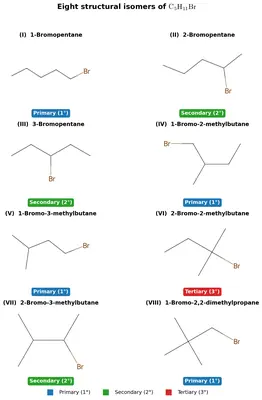
Draw the structures of all the eight structural isomers that have the molecular formula $$\mathrm{C_5H_{11}Br}$$. Name each isomer according to IUPAC system and classify them as primary, secondary or tertiary bromide.
Structure
Structure

Solution

$$\mathrm{C_5H_{11}Br}$$ is a saturated monobromide ($$\mathrm{C_nH_{2n+1}Br}$$): it is a $$\mathrm{C_5H_{12}}$$ alkane skeleton with one hydrogen replaced by $$\mathrm{Br}$$. There are three pentane skeletons — n-pentane, isopentane (2-methylbutane) and neopentane (2,2-dimethylpropane). Substituting $$\mathrm{Br}$$ at each chemically distinct position on these skeletons gives exactly eight structural isomers.

A bromide is primary (1°), secondary (2°) or tertiary (3°) according to whether the carbon bearing $$\mathrm{Br}$$ is attached to one, two or three other carbon atoms.

StructureIUPAC nameClass
$$\mathrm{CH_3CH_2CH_2CH_2CH_2Br}$$1-BromopentanePrimary (1°)
$$\mathrm{CH_3CH_2CH_2CHBrCH_3}$$2-BromopentaneSecondary (2°)
$$\mathrm{CH_3CH_2CHBrCH_2CH_3}$$3-BromopentaneSecondary (2°)
$$\mathrm{(CH_3)_2CHCH_2CH_2Br}$$1-Bromo-3-methylbutanePrimary (1°)
$$\mathrm{CH_3CH_2CH(CH_3)CH_2Br}$$1-Bromo-2-methylbutanePrimary (1°)
$$\mathrm{CH_3CH_2CBr(CH_3)CH_3}$$2-Bromo-2-methylbutaneTertiary (3°)
$$\mathrm{CH_3CHBrCH(CH_3)CH_3}$$2-Bromo-3-methylbutaneSecondary (2°)
$$\mathrm{(CH_3)_3CCH_2Br}$$1-Bromo-2,2-dimethylpropanePrimary (1°)

This accounts for all eight isomers: four primary, three secondary and one tertiary bromide.

Answer

Eight isomers — 1-bromopentane (1°), 2-bromopentane (2°), 3-bromopentane (2°), 1-bromo-3-methylbutane (1°), 1-bromo-2-methylbutane (1°), 2-bromo-2-methylbutane (3°), 2-bromo-3-methylbutane (2°), 1-bromo-2,2-dimethylpropane (1°): four 1°, three 2°, one 3°.

Example 6.2 Write IUPAC names of the following (structures with stereochemistry shown for each):

(i) An alkene of the form $$\mathrm{CH_3CH=CHCHBrCH_3}$$ (wedge-dash representation showing $$\mathrm{H_3C}$$, $$\mathrm{H}$$, $$\mathrm{Br}$$ and $$\mathrm{CH_3}$$ at the stereocentre).

Solution

The longest chain containing the $$\mathrm{C=C}$$ double bond has five carbons, so the parent hydrocarbon is pentene:

$$\mathrm{\overset{1}{C}H_3{-}\overset{2}{C}H={\overset{3}{C}}H{-}\overset{4}{C}HBr{-}\overset{5}{C}H_3}$$

The double bond is a suffix feature and must receive the lowest possible locant. Numbering from the left places the double bond at C-2 and $$\mathrm{Br}$$ at C-4; numbering from the right would place the double bond at C-3. So we number from the left, and the bromo group is cited as a prefix. The constitutional IUPAC name is 4-bromopent-2-ene.

Stereochemistry. Since the spatial arrangement is shown in the structure, the stereochemical descriptors are added:

  • Double bond, C-2=C-3: C-2 carries $$\mathrm{CH_3}$$ and $$\mathrm{H}$$, and C-3 carries $$\mathrm{H}$$ and the $$\mathrm{{-}CHBrCH_3}$$ group, so each doubly-bonded carbon bears two different groups and the alkene shows geometrical (E/Z) isomerism. The higher-priority groups — $$\mathrm{CH_3}$$ on C-2 and $$\mathrm{{-}CHBrCH_3}$$ on C-3 — lie on opposite sides of the double bond as drawn, so the configuration is E.
  • Chiral centre, C-4: C-4 is bonded to four different groups — $$\mathrm{Br}$$, $$\mathrm{H}$$, $$\mathrm{CH_3}$$ and $$\mathrm{{-}CH=CHCH_3}$$ — so it is a stereocentre and the molecule is chiral, existing as a pair of (R) and (S) enantiomers.

Including the descriptors, the full IUPAC name is (E)-4-bromopent-2-ene, with C-4 designated (R) or (S) according to its actual three-dimensional arrangement.

Answer

(E)-4-Bromopent-2-ene (constitutional name: 4-bromopent-2-ene). The C-2=C-3 double bond has the E configuration, and C-4 is a chiral centre — the molecule is chiral, designated (R) or (S).

(ii) An alkene of the form $$\mathrm{CH_2=C(CH_3)CHBrCH_3}$$ (wedge-dash representation showing $$\mathrm{H}$$, $$\mathrm{CH_3}$$, $$\mathrm{H}$$ and $$\mathrm{Br}$$ at the stereocentre).

Solution

The longest chain containing the double bond runs through four carbons, so the parent is butene:

$$\mathrm{\overset{1}{C}H_2={\overset{2}{C}}(CH_3){-}\overset{3}{C}HBr{-}\overset{4}{C}H_3}$$

Numbering from the terminal $$\mathrm{CH_2}$$ end gives the double bond the lowest locant (C-1); a methyl group sits on C-2 and a bromo group on C-3. The constitutional IUPAC name is 3-bromo-2-methylbut-1-ene.

Stereochemistry.

  • Double bond, C-1=C-2: C-1 is a terminal $$\mathrm{=CH_2}$$ carbon bearing two identical $$\mathrm{H}$$ atoms, so the double bond is not stereogenic — no E/Z isomerism is possible here.
  • Chiral centre, C-3: C-3 is bonded to four different groups — $$\mathrm{Br}$$, $$\mathrm{H}$$, $$\mathrm{CH_3}$$ and the $$\mathrm{{-}C(CH_3)=CH_2}$$ group — so it is a stereocentre and the molecule is chiral, existing as a pair of (R) and (S) enantiomers.

Hence the IUPAC name is 3-bromo-2-methylbut-1-ene, with C-3 designated (R) or (S) according to its actual three-dimensional arrangement.

Answer

3-Bromo-2-methylbut-1-ene. The C-1=C-2 double bond is terminal, so no E/Z isomerism is possible; C-3 is a chiral centre, so the compound is chiral and exists as (R)- and (S)-3-bromo-2-methylbut-1-ene.

(iii) An alkene of the form $$\mathrm{CH_3CH=C(CH_3)CHBrCH_3}$$ (wedge-dash representation showing $$\mathrm{H_3C}$$, $$\mathrm{CH_3}$$, $$\mathrm{H}$$ and $$\mathrm{Br}$$).

Solution

The longest chain containing the double bond has five carbons, so the parent is pentene:

$$\mathrm{\overset{1}{C}H_3{-}\overset{2}{C}H={\overset{3}{C}}(CH_3){-}\overset{4}{C}HBr{-}\overset{5}{C}H_3}$$

Numbering from the left places the double bond at C-2 (the lowest possible locant), a methyl substituent on C-3 and a bromo substituent on C-4. The constitutional IUPAC name is 4-bromo-3-methylpent-2-ene.

Stereochemistry.

  • Double bond, C-2=C-3: C-2 carries $$\mathrm{CH_3}$$ and $$\mathrm{H}$$; C-3 carries a $$\mathrm{CH_3}$$ group and the $$\mathrm{{-}CHBrCH_3}$$ group. Each doubly-bonded carbon bears two different groups, so the alkene shows geometrical (E/Z) isomerism. The higher-priority groups are $$\mathrm{CH_3}$$ on C-2 and, on C-3, $$\mathrm{{-}CHBrCH_3}$$ (its first carbon carries $$\mathrm{Br}$$, which outranks the plain $$\mathrm{CH_3}$$). These lie on opposite sides of the double bond as drawn, so the configuration is E.
  • Chiral centre, C-4: C-4 is bonded to four different groups — $$\mathrm{Br}$$, $$\mathrm{H}$$, $$\mathrm{CH_3}$$ and the $$\mathrm{{-}C(CH_3)=CHCH_3}$$ group — so it is a stereocentre and the molecule is chiral.

Including the descriptors, the full IUPAC name is (E)-4-bromo-3-methylpent-2-ene, with C-4 designated (R) or (S) according to its actual three-dimensional arrangement.

Answer

(E)-4-Bromo-3-methylpent-2-ene (constitutional name: 4-bromo-3-methylpent-2-ene). The C-2=C-3 double bond has the E configuration, and C-4 is a chiral centre — the molecule is chiral, designated (R) or (S).

(iv) An alkene of the form $$\mathrm{BrCH_2C(CH_3)=CHCH_3}$$ (wedge-dash representation showing $$\mathrm{H_3C}$$, $$\mathrm{CH_3}$$, $$\mathrm{H}$$, $$\mathrm{H}$$ and $$\mathrm{Br}$$).

Solution

The longest chain containing the double bond has four carbons, so the parent is butene:

$$\mathrm{\overset{1}{C}H_2Br{-}{\overset{2}{C}}(CH_3)=\overset{3}{C}H{-}\overset{4}{C}H_3}$$

Numbering from the $$\mathrm{CH_2Br}$$ end places the double bond at C-2 and gives the bromo group the lowest locant, C-1; a methyl group is on C-2. The constitutional IUPAC name is 1-bromo-2-methylbut-2-ene.

Stereochemistry.

  • Double bond, C-2=C-3: C-2 carries a $$\mathrm{{-}CH_2Br}$$ group and a $$\mathrm{CH_3}$$ group; C-3 carries $$\mathrm{CH_3}$$ and $$\mathrm{H}$$. Each doubly-bonded carbon bears two different groups, so the alkene shows geometrical (E/Z) isomerism. The higher-priority groups are $$\mathrm{{-}CH_2Br}$$ on C-2 (its carbon carries $$\mathrm{Br}$$, outranking $$\mathrm{CH_3}$$) and $$\mathrm{CH_3}$$ on C-3. These lie on opposite sides of the double bond as drawn, so the configuration is E.
  • Chiral centre: no carbon carries four different groups (C-1 is a $$\mathrm{CH_2Br}$$ group with two $$\mathrm{H}$$ atoms), so the molecule has no stereocentre and is achiral.

Including the descriptor, the full IUPAC name is (E)-1-bromo-2-methylbut-2-ene.

Answer

(E)-1-Bromo-2-methylbut-2-ene (constitutional name: 1-bromo-2-methylbut-2-ene). The C-2=C-3 double bond has the E configuration; the molecule has no chiral centre.

(v) An alkene of the form $$\mathrm{BrCH_2CH=CHCH_3}$$ (wedge-dash representation showing $$\mathrm{H_3C}$$, $$\mathrm{H}$$, $$\mathrm{H}$$ and $$\mathrm{Br}$$).

Solution

The chain has four carbons with a double bond, so the parent is butene:

$$\mathrm{\overset{1}{C}H_2Br{-}\overset{2}{C}H=\overset{3}{C}H{-}\overset{4}{C}H_3}$$

Numbering from the $$\mathrm{CH_2Br}$$ end gives the bromo group the lowest locant (C-1) and the double bond at C-2. The constitutional IUPAC name is 1-bromobut-2-ene.

Stereochemistry.

  • Double bond, C-2=C-3: C-2 carries a $$\mathrm{{-}CH_2Br}$$ group and $$\mathrm{H}$$; C-3 carries $$\mathrm{CH_3}$$ and $$\mathrm{H}$$. Each doubly-bonded carbon bears two different groups, so the alkene shows geometrical (E/Z) isomerism. The higher-priority groups are $$\mathrm{{-}CH_2Br}$$ on C-2 and $$\mathrm{CH_3}$$ on C-3; they lie on opposite sides of the double bond as drawn, so the configuration is E.
  • Chiral centre: no carbon carries four different groups, so the molecule has no stereocentre and is achiral.

Including the descriptor, the full IUPAC name is (E)-1-bromobut-2-ene.

Answer

(E)-1-Bromobut-2-ene (constitutional name: 1-bromobut-2-ene). The C-2=C-3 double bond has the E configuration; the molecule has no chiral centre.

(vi) An alkene of the form $$\mathrm{CH_2=C(CH_3)CH_2Br}$$ (wedge-dash representation showing $$\mathrm{H}$$, $$\mathrm{CH_3}$$, $$\mathrm{H}$$, $$\mathrm{Br}$$ and $$\mathrm{H}$$).

Solution

The longest chain containing the double bond has three carbons, so the parent is propene:

$$\mathrm{\overset{1}{C}H_2={\overset{2}{C}}(CH_3){-}\overset{3}{C}H_2Br}$$

Numbering from the $$\mathrm{CH_2}$$ end places the double bond at C-1. A methyl group sits on C-2 and a bromo group on C-3.

Hence the IUPAC name is 3-bromo-2-methylprop-1-ene (also written 3-bromo-2-methylpropene).

Answer

3-Bromo-2-methylprop-1-ene

Example 6.3 Identify all the possible monochloro structural isomers expected to be formed on free radical monochlorination of $$\mathrm{(CH_3)_2CHCH_2CH_3}$$.

Solution

The substrate is 2-methylbutane:

$$\mathrm{\overset{1}{C}H_3{-}\underset{\underset{\textstyle CH_3}{|}}{\overset{2}{C}H}{-}\overset{3}{C}H_2{-}\overset{4}{C}H_3}$$

In free-radical chlorination a chlorine atom can abstract a hydrogen from any C–H bond, so the number of distinct monochlorides equals the number of chemically different types of hydrogen atoms in the molecule.

2-Methylbutane has four sets of equivalent hydrogens:

  • the six $$\mathrm{H}$$ of the two equivalent $$\mathrm{CH_3}$$ groups attached to C-2 (the two end methyls of the isopropyl unit),
  • the single tertiary $$\mathrm{H}$$ on C-2,
  • the two $$\mathrm{H}$$ on the $$\mathrm{CH_2}$$ (C-3),
  • the three $$\mathrm{H}$$ on the terminal $$\mathrm{CH_3}$$ (C-4).

Replacing each type of hydrogen by $$\mathrm{Cl}$$ gives four monochloro structural isomers:

Position chlorinatedStructureIUPAC name
End $$\mathrm{CH_3}$$ on C-2$$\mathrm{ClCH_2CH(CH_3)CH_2CH_3}$$1-Chloro-2-methylbutane
Tertiary C-2$$\mathrm{(CH_3)_2CClCH_2CH_3}$$2-Chloro-2-methylbutane
$$\mathrm{CH_2}$$ (C-3)$$\mathrm{(CH_3)_2CHCHClCH_3}$$2-Chloro-3-methylbutane
Terminal $$\mathrm{CH_3}$$ (C-4)$$\mathrm{(CH_3)_2CHCH_2CH_2Cl}$$1-Chloro-3-methylbutane

Note how each IUPAC name is derived: in every product, the longest chain containing the C–Cl bond is chosen as parent, and numbering starts from the end nearer to chlorine so that it receives the lowest locant.

Answer

Four monochloro isomers are formed: 1-chloro-2-methylbutane $$\mathrm{[ClCH_2CH(CH_3)CH_2CH_3]}$$, 2-chloro-2-methylbutane $$\mathrm{[(CH_3)_2CClCH_2CH_3]}$$, 2-chloro-3-methylbutane $$\mathrm{[(CH_3)_2CHCHClCH_3]}$$ and 1-chloro-3-methylbutane $$\mathrm{[(CH_3)_2CHCH_2CH_2Cl]}$$.

Example 6.4 Write the products of the following reactions:

(i) $$\mathrm{C_6H_5CH=CH_2 + HBr \longrightarrow}$$

Solution

This is an electrophilic addition of $$\mathrm{HBr}$$ to an alkene, which follows Markovnikov's rule: $$\mathrm{H}$$ adds to the doubly-bonded carbon carrying more hydrogens and $$\mathrm{Br}$$ to the carbon carrying fewer.

Protonation can give two carbocations. Addition of $$\mathrm{H^+}$$ to the terminal $$\mathrm{=CH_2}$$ carbon gives the benzylic secondary cation $$\mathrm{C_6H_5\overset{+}{C}H{-}CH_3}$$, which is strongly stabilised by resonance with the ring. The alternative cation $$\mathrm{C_6H_5CH_2{-}\overset{+}{C}H_2}$$ is a primary, non-resonance-stabilised cation.

The more stable benzylic cation forms preferentially, and $$\mathrm{Br^-}$$ then attacks it:

$$\mathrm{C_6H_5CH=CH_2 + HBr \longrightarrow C_6H_5CHBrCH_3}$$

The product is (1-bromoethyl)benzene, $$\mathrm{C_6H_5CHBrCH_3}$$.

Answer

$$\mathrm{C_6H_5CHBrCH_3}$$ — (1-bromoethyl)benzene (Markovnikov addition).

(ii) $$\mathrm{CH_3{-}CH_2{-}CH=CH_2 + HCl \longrightarrow}$$

Solution

$$\mathrm{HCl}$$ adds to but-1-ene by electrophilic addition following Markovnikov's rule.

Protonation of the terminal $$\mathrm{=CH_2}$$ carbon gives the secondary carbocation $$\mathrm{CH_3CH_2\overset{+}{C}HCH_3}$$, which is more stable than the primary cation $$\mathrm{CH_3CH_2CH_2\overset{+}{C}H_2}$$ that would result from protonation at the internal carbon.

Thus $$\mathrm{H}$$ adds to the terminal carbon and $$\mathrm{Cl}$$ to the internal (more substituted) carbon:

$$\mathrm{CH_3CH_2CH=CH_2 + HCl \longrightarrow CH_3CH_2CHClCH_3}$$

The major product is 2-chlorobutane.

Answer

$$\mathrm{CH_3CH_2CHClCH_3}$$ — 2-chlorobutane (Markovnikov addition).

(iii) $$\mathrm{C_6H_5CH_2{-}CH=CH_2 + HBr \xrightarrow{Peroxide}}$$

Solution

In the presence of a peroxide, $$\mathrm{HBr}$$ adds to a terminal alkene by a free-radical chain mechanism. This gives anti-Markovnikov (peroxide / Kharasch) addition — the opposite orientation to ionic addition.

A bromine atom adds first; it attaches to the terminal $$\mathrm{=CH_2}$$ carbon so as to generate the more stable secondary carbon radical $$\mathrm{C_6H_5CH_2\overset{\bullet}{C}HCH_2Br}$$. This radical then abstracts $$\mathrm{H}$$ from $$\mathrm{HBr}$$.

Net result: $$\mathrm{Br}$$ ends up on the terminal carbon and $$\mathrm{H}$$ on the internal carbon:

$$\mathrm{C_6H_5CH_2CH=CH_2 + HBr \xrightarrow{peroxide} C_6H_5CH_2CH_2CH_2Br}$$

The product is 1-bromo-3-phenylpropane (only $$\mathrm{HBr}$$ shows the peroxide effect; $$\mathrm{HCl}$$ and $$\mathrm{HI}$$ do not).

Answer

$$\mathrm{C_6H_5CH_2CH_2CH_2Br}$$ — 1-bromo-3-phenylpropane (anti-Markovnikov / peroxide effect).

Example 6.5 Haloalkanes react with KCN to form alkyl cyanides as main product while AgCN forms isocyanides as the chief product. Explain.

Solution

The cyanide ion is an ambident nucleophile: it has two donor sites — the carbon atom and the nitrogen atom — represented by the resonance hybrid $$\mathrm{{}^-{:}C{\equiv}N{:} \longleftrightarrow {:}C{=}\overset{..}{N}{:}^-}$$. It can therefore link to the alkyl group either through carbon (giving an alkyl cyanide, $$\mathrm{R{-}C{\equiv}N}$$) or through nitrogen (giving an alkyl isocyanide, $$\mathrm{R{-}N{\equiv}C}$$).

With KCN: Potassium cyanide is predominantly ionic, so it furnishes free $$\mathrm{CN^-}$$ ions in solution. Although both C and N can donate the electron pair, attack occurs mainly through carbon, because the resulting $$\mathrm{C{-}C}$$ bond is stronger (more stable) than a $$\mathrm{C{-}N}$$ bond. Hence alkyl cyanides (nitriles) are the main product.

With AgCN: Silver cyanide is largely covalent. The lone pair on carbon is involved in bonding to silver and is not freely available; only the nitrogen lone pair is free to attack the carbon of the haloalkane. Hence the linkage forms through nitrogen and alkyl isocyanides ($$\mathrm{R{-}NC}$$) are the chief product.

Answer

$$\mathrm{CN^-}$$ is an ambident nucleophile. Ionic KCN gives free $$\mathrm{CN^-}$$ which attacks through carbon (stronger C–C bond) → alkyl cyanide. Covalent AgCN has the C lone pair tied up with Ag, so only the N lone pair is free → alkyl isocyanide.

Example 6.6 In the following pairs of halogen compounds, which would undergo $$\mathrm{S_N2}$$ reaction faster?

(i) (Cyclohexyl-$$\mathrm{CH_2Cl}$$) and (chlorocyclohexane, $$\mathrm{C_6H_{11}Cl}$$).

Solution

An $$\mathrm{S_N2}$$ reaction needs the nucleophile to approach the carbon bearing the halogen from the side opposite the leaving group. Bulky substituents around that carbon hinder this approach, so the rate falls in the order primary > secondary > tertiary.

In (chloromethyl)cyclohexane, $$\mathrm{C_6H_{11}CH_2Cl}$$, the $$\mathrm{Cl}$$ sits on a $$\mathrm{CH_2}$$ group — a primary carbon. In chlorocyclohexane the $$\mathrm{Cl}$$ is on a ring carbon attached to two other ring carbons — a secondary carbon, which is more crowded.

Hence the primary halide, (chloromethyl)cyclohexane, undergoes the $$\mathrm{S_N2}$$ reaction faster.

Answer

(Chloromethyl)cyclohexane ($$\mathrm{C_6H_{11}CH_2Cl}$$) reacts faster — it is a primary halide, whereas chlorocyclohexane is secondary.

(ii) A primary iodide $$\mathrm{R{-}I}$$ and a primary chloride $$\mathrm{R{-}Cl}$$ (both of the same alkyl chain, drawn as zigzag pentyl groups).

Solution

The two halides have the same alkyl group, so steric factors are identical; the difference is the leaving group.

A good leaving group is one that departs readily as a stable anion. Iodide ion is large, so the $$\mathrm{C{-}I}$$ bond is long and weak (low bond enthalpy) and the charge on $$\mathrm{I^-}$$ is well dispersed. The $$\mathrm{C{-}Cl}$$ bond is shorter and stronger. Hence $$\mathrm{I^-}$$ is a much better leaving group than $$\mathrm{Cl^-}$$.

Therefore the primary iodide $$\mathrm{R{-}I}$$ undergoes the $$\mathrm{S_N2}$$ reaction faster than the primary chloride $$\mathrm{R{-}Cl}$$.

Answer

The alkyl iodide $$\mathrm{R{-}I}$$ reacts faster — iodide is a larger, weaker-bonded, better leaving group than chloride.

Example 6.7 Predict the order of reactivity of the following compounds in $$\mathrm{S_N1}$$ and $$\mathrm{S_N2}$$ reactions:

(i) The four isomeric bromobutanes.

Solution

The four isomeric bromobutanes are:

  • $$\mathrm{CH_3CH_2CH_2CH_2Br}$$ — 1-bromobutane (primary, 1°)
  • $$\mathrm{(CH_3)_2CHCH_2Br}$$ — 1-bromo-2-methylpropane (primary, 1°)
  • $$\mathrm{CH_3CH_2CHBrCH_3}$$ — 2-bromobutane (secondary, 2°)
  • $$\mathrm{(CH_3)_3CBr}$$ — 2-bromo-2-methylpropane (tertiary, 3°)

$$\mathrm{S_N1}$$ reactivity. The slow, rate-determining step is ionisation of the C–Br bond to give a carbocation, so the reaction is faster the more stable that carbocation is. Carbocation stability falls in the order tertiary > secondary > primary. Both primary halides give primary cations; the one from $$\mathrm{(CH_3)_2CHCH_2Br}$$ is slightly better stabilised (more alkyl groups close to the cationic carbon) than the one from $$\mathrm{CH_3CH_2CH_2CH_2Br}$$. Hence the order of $$\mathrm{S_N1}$$ reactivity, fastest first, is:

$$\mathrm{(CH_3)_3CBr > CH_3CH_2CHBrCH_3 > (CH_3)_2CHCH_2Br > CH_3CH_2CH_2CH_2Br}$$

that is, 3° > 2° > 1°.

$$\mathrm{S_N2}$$ reactivity. The nucleophile attacks the carbon bearing $$\mathrm{Br}$$ from the side opposite the leaving group, so the rate falls as steric crowding around that carbon increases. The order is exactly the reverse, fastest first:

$$\mathrm{CH_3CH_2CH_2CH_2Br > (CH_3)_2CHCH_2Br > CH_3CH_2CHBrCH_3 > (CH_3)_3CBr}$$

that is, 1° > 2° > 3°.

Answer

$$\mathrm{S_N1}$$ (fastest first): $$\mathrm{(CH_3)_3CBr > CH_3CH_2CHBrCH_3 > (CH_3)_2CHCH_2Br > CH_3CH_2CH_2CH_2Br}$$ — i.e. 3° > 2° > 1°.
$$\mathrm{S_N2}$$ (fastest first): the reverse order — $$\mathrm{CH_3CH_2CH_2CH_2Br > (CH_3)_2CHCH_2Br > CH_3CH_2CHBrCH_3 > (CH_3)_3CBr}$$.

(ii) $$\mathrm{C_6H_5CH_2Br}$$, $$\mathrm{C_6H_5CH(C_6H_5)Br}$$, $$\mathrm{C_6H_5CH(CH_3)Br}$$, $$\mathrm{C_6H_5C(CH_3)(C_6H_5)Br}$$.

Solution

All four are benzylic bromides; the carbocations they form are stabilised by resonance with the phenyl ring(s).

$$\mathrm{S_N1}$$: The more phenyl groups attached to the cationic carbon, the greater the resonance stabilisation, hence the faster the $$\mathrm{S_N1}$$ reaction. The cation from $$\mathrm{C_6H_5C(CH_3)(C_6H_5)Br}$$ has two phenyl groups; that from $$\mathrm{C_6H_5CH(C_6H_5)Br}$$ also has two phenyls but one less alkyl; $$\mathrm{C_6H_5CH(CH_3)Br}$$ and $$\mathrm{C_6H_5CH_2Br}$$ have one phenyl. The order is

$$\mathrm{C_6H_5C(CH_3)(C_6H_5)Br > C_6H_5CH(C_6H_5)Br > C_6H_5CH(CH_3)Br > C_6H_5CH_2Br}$$

$$\mathrm{S_N2}$$: Reactivity is governed by steric crowding — more and bulkier groups slow the reaction. A phenyl group is bulkier than a methyl group. The order is the reverse:

$$\mathrm{C_6H_5C(CH_3)(C_6H_5)Br < C_6H_5CH(C_6H_5)Br < C_6H_5CH(CH_3)Br < C_6H_5CH_2Br}$$

Answer

$$\mathrm{S_N1}$$: $$\mathrm{C_6H_5C(CH_3)(C_6H_5)Br > C_6H_5CH(C_6H_5)Br > C_6H_5CH(CH_3)Br > C_6H_5CH_2Br}$$.
$$\mathrm{S_N2}$$: the reverse order.

Example 6.8 Identify chiral and achiral molecules in each of the following pair of compounds. (Wedge and Dash representations according to Class XI.)

(i) Pair: a carbon bearing $$\mathrm{H_3C}$$, $$\mathrm{H}$$, $$\mathrm{Br}$$, $$\mathrm{OH}$$ versus a carbon bearing $$\mathrm{H_3C}$$, $$\mathrm{H}$$, $$\mathrm{Br}$$, $$\mathrm{Br}$$.

Solution

A molecule is chiral (non-superimposable on its mirror image) if it contains a carbon attached to four different groups; if any two groups are identical, the molecule is achiral.

First molecule ($$\mathrm{CH_3CHBrOH}$$): the central carbon carries four different groups — $$\mathrm{CH_3}$$, $$\mathrm{H}$$, $$\mathrm{Br}$$ and $$\mathrm{OH}$$. It is an asymmetric carbon, so this molecule is chiral.

Second molecule ($$\mathrm{CH_3CHBr_2}$$): the central carbon carries two identical $$\mathrm{Br}$$ atoms ($$\mathrm{CH_3}$$, $$\mathrm{H}$$, $$\mathrm{Br}$$, $$\mathrm{Br}$$). With two like groups it is not an asymmetric carbon, so this molecule is achiral.

Answer

First molecule ($$\mathrm{CH_3CHBrOH}$$) is chiral (four different groups); second molecule ($$\mathrm{CH_3CHBr_2}$$) is achiral (two identical Br atoms).

(ii) Pair: a carbon bearing $$\mathrm{HO}$$, $$\mathrm{H}$$, $$\mathrm{H_3C}$$, $$\mathrm{CH_3}$$ versus a carbon bearing $$\mathrm{H_3C}$$, $$\mathrm{CH_3}$$, $$\mathrm{H}$$, $$\mathrm{OH}$$ (with a pentyl-like chain).

Solution

First molecule (propan-2-ol, $$\mathrm{(CH_3)_2CHOH}$$): the carbinol carbon is bonded to $$\mathrm{OH}$$, $$\mathrm{H}$$ and two identical $$\mathrm{CH_3}$$ groups. Since two of the four groups are the same, it is not an asymmetric carbon — the molecule is achiral (its mirror image is superimposable on itself).

Second molecule (butan-2-ol, $$\mathrm{CH_3CH(OH)CH_2CH_3}$$): the carbinol carbon (C-2) is bonded to four different groups — $$\mathrm{OH}$$, $$\mathrm{H}$$, $$\mathrm{CH_3}$$ and $$\mathrm{C_2H_5}$$. This is an asymmetric carbon, so the molecule is chiral.

Answer

The first alcohol (propan-2-ol) is achiral — its OH carbon bears two identical methyl groups; the second alcohol (butan-2-ol) is chiral — its OH carbon bears four different groups.

(iii) Pair: $$\mathrm{CH_3CHBrCH_2CH_3}$$ versus $$\mathrm{CH_3CH_2CH_2CH_2Br}$$.

Solution

2-Bromobutane ($$\mathrm{CH_3CHBrCH_2CH_3}$$): the C-2 carbon bearing $$\mathrm{Br}$$ is attached to four different groups — $$\mathrm{CH_3}$$, $$\mathrm{H}$$, $$\mathrm{Br}$$ and $$\mathrm{C_2H_5}$$. It is an asymmetric carbon, so the molecule is chiral.

1-Bromobutane ($$\mathrm{CH_3CH_2CH_2CH_2Br}$$): the C-1 carbon bearing $$\mathrm{Br}$$ is a $$\mathrm{CH_2}$$ group — it carries two identical $$\mathrm{H}$$ atoms. No carbon in the molecule has four different groups, so the molecule is achiral.

Answer

$$\mathrm{CH_3CHBrCH_2CH_3}$$ (2-bromobutane) is chiral; $$\mathrm{CH_3CH_2CH_2CH_2Br}$$ (1-bromobutane) is achiral.

Example 6.9 Although chlorine is an electron withdrawing group, yet it is ortho-, para- directing in electrophilic aromatic substitution reactions. Why?

Solution

Chlorine attached to a benzene ring acts in two opposing ways:

(a) Inductive effect (–I): Chlorine is highly electronegative, so it withdraws electron density from the ring through the $$\sigma$$ framework. This makes the ring electron-poor and deactivates it towards electrophilic attack (chlorobenzene reacts more slowly than benzene).

(b) Resonance / mesomeric effect (+R): A lone pair on chlorine can be donated into the ring by resonance:

$$\mathrm{\overset{..}{\underset{..}{Cl}}{-}C_6H_5 \longleftrightarrow \overset{+}{Cl}{=}C_6H_5^{\,-}}$$

In these resonance structures the negative charge (extra electron density) appears specifically at the ortho and para positions, never at the meta positions.

So although the –I effect deactivates the whole ring, the +R effect partially restores electron density at the ortho and para carbons. The meta positions get no such help. Hence the incoming electrophile prefers the ortho and para positions — chlorine is a deactivating but ortho-, para-directing group.

Answer

Cl deactivates the ring by its –I (electron-withdrawing) effect, but its +R (lone-pair resonance) effect releases electron density specifically at the ortho and para positions. So electrophiles attack mainly at ortho/para — Cl is deactivating yet o,p-directing.

Intext Questions

6.1 Write structures of the following compounds:

(i) 2-Chloro-3-methylpentane

Solution

The parent chain is pentane (5 carbons). Number the chain and place the substituents: a chloro group at C-2 and a methyl group at C-3.

$$\mathrm{\overset{1}{C}H_3{-}\overset{2}{C}HCl{-}\overset{3}{C}H(CH_3){-}\overset{4}{C}H_2{-}\overset{5}{C}H_3}$$

Hence the structure is $$\mathrm{CH_3CHClCH(CH_3)CH_2CH_3}$$.

Answer

$$\mathrm{CH_3CHClCH(CH_3)CH_2CH_3}$$

(ii) 1-Chloro-4-ethylcyclohexane

Solution

The parent ring is cyclohexane. A chloro group is at ring carbon C-1 and an ethyl group ($$\mathrm{{-}C_2H_5}$$) at C-4, i.e. the two substituents are on opposite (1,4) carbons of the ring.

Draw a hexagonal ring; attach $$\mathrm{Cl}$$ to one carbon and $$\mathrm{CH_2CH_3}$$ to the carbon directly across the ring.

Answer

A cyclohexane ring bearing $$\mathrm{Cl}$$ at C-1 and an ethyl group ($$\mathrm{{-}CH_2CH_3}$$) at C-4 (para-type 1,4-positions).

(iii) 4-tert. Butyl-3-iodoheptane

Solution

The parent chain is heptane (7 carbons). Place an iodo group at C-3 and a tert-butyl group $$\mathrm{{-}C(CH_3)_3}$$ at C-4.

$$\mathrm{\overset{1}{C}H_3{-}\overset{2}{C}H_2{-}\overset{3}{C}HI{-}\overset{4}{C}H[C(CH_3)_3]{-}\overset{5}{C}H_2{-}\overset{6}{C}H_2{-}\overset{7}{C}H_3}$$

Hence the structure is $$\mathrm{CH_3CH_2CHICH[C(CH_3)_3]CH_2CH_2CH_3}$$.

Answer

$$\mathrm{CH_3CH_2CHICH[C(CH_3)_3]CH_2CH_2CH_3}$$ — heptane chain with $$\mathrm{I}$$ at C-3 and $$\mathrm{{-}C(CH_3)_3}$$ at C-4.

(iv) 1,4-Dibromobut-2-ene

Solution

The parent is but-2-ene — a four-carbon chain with the double bond between C-2 and C-3. Bromo groups are placed at C-1 and C-4.

$$\mathrm{\overset{1}{B}rCH_2{-}\overset{2}{C}H=\overset{3}{C}H{-}\overset{4}{C}H_2Br}$$

Hence the structure is $$\mathrm{BrCH_2CH=CHCH_2Br}$$.

Answer

$$\mathrm{BrCH_2CH=CHCH_2Br}$$

(v) 1-Bromo-4-sec. butyl-2-methylbenzene.

Solution

The parent is benzene. Number the ring so the substituents get: bromo at C-1, methyl at C-2 and a sec-butyl group at C-4.

The sec-butyl group is $$\mathrm{{-}CH(CH_3)CH_2CH_3}$$.

Draw a benzene ring carrying $$\mathrm{Br}$$ at C-1, $$\mathrm{CH_3}$$ at C-2 (ortho to Br) and $$\mathrm{{-}CH(CH_3)CH_2CH_3}$$ at C-4 (para to Br).

Answer

A benzene ring with $$\mathrm{Br}$$ at C-1, $$\mathrm{CH_3}$$ at C-2 and $$\mathrm{{-}CH(CH_3)CH_2CH_3}$$ (sec-butyl) at C-4.

6.2 Why is sulphuric acid not used during the reaction of alcohols with KI?

Solution

To convert an alcohol into an alkyl iodide, $$\mathrm{KI}$$ must first be converted to hydroiodic acid, $$\mathrm{HI}$$, which then reacts with the alcohol. An acid is therefore needed in the mixture.

If concentrated sulphuric acid were used, two problems arise:

  • $$\mathrm{H_2SO_4}$$ is a strong oxidising agent. The $$\mathrm{HI}$$ liberated ($$\mathrm{2KI + H_2SO_4 \longrightarrow 2HI + K_2SO_4}$$) is a powerful reducing agent, so it is at once oxidised to iodine:
    $$\mathrm{2HI + H_2SO_4 \longrightarrow I_2 + SO_2 + 2H_2O}$$
    The $$\mathrm{HI}$$ is thus consumed and is not available to react with the alcohol.
  • Concentrated $$\mathrm{H_2SO_4}$$ also tends to dehydrate the alcohol to an alkene or to charred products.

For these reasons sulphuric acid is avoided. Instead, a non-oxidising acid such as phosphoric acid ($$\mathrm{H_3PO_4}$$) is used, which does not oxidise $$\mathrm{HI}$$ to $$\mathrm{I_2}$$.

Answer

Because concentrated $$\mathrm{H_2SO_4}$$ oxidises the $$\mathrm{HI}$$ produced from KI into $$\mathrm{I_2}$$ (and also dehydrates the alcohol), so the alkyl iodide cannot form. A non-oxidising acid like $$\mathrm{H_3PO_4}$$ is used instead.

6.3

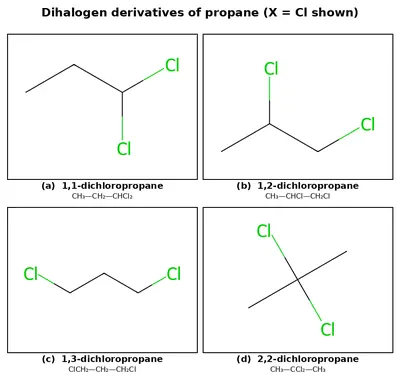
Write structures of different dihalogen derivatives of propane.
Structure
Structure

Solution

Propane is $$\mathrm{CH_3{-}CH_2{-}CH_3}$$. A dihalogen derivative has the general formula $$\mathrm{C_3H_6X_2}$$, obtained by replacing two hydrogen atoms by two halogen atoms $$\mathrm{X}$$. The distinct ways of placing the two halogens give four positional isomers:

StructureNameType
$$\mathrm{CH_3CH_2CHX_2}$$1,1-Dihalopropanegem-dihalide
$$\mathrm{CH_3CHXCH_2X}$$1,2-Dihalopropanevic-dihalide
$$\mathrm{XCH_2CH_2CH_2X}$$1,3-Dihalopropane
$$\mathrm{CH_3CX_2CH_3}$$2,2-Dihalopropanegem-dihalide

(Here $$\mathrm{X}$$ is the same halogen, e.g. $$\mathrm{Cl}$$, $$\mathrm{Br}$$ or $$\mathrm{I}$$.)

Answer

Four positional isomers: $$\mathrm{CH_3CH_2CHX_2}$$ (1,1-), $$\mathrm{CH_3CHXCH_2X}$$ (1,2-), $$\mathrm{XCH_2CH_2CH_2X}$$ (1,3-) and $$\mathrm{CH_3CX_2CH_3}$$ (2,2-dihalopropane).

6.4 Among the isomeric alkanes of molecular formula $$\mathrm{C_5H_{12}}$$, identify the one that on photochemical chlorination yields

(i) A single monochloride.

Solution

The three isomeric alkanes of formula $$\mathrm{C_5H_{12}}$$ are n-pentane, 2-methylbutane (isopentane) and 2,2-dimethylpropane (neopentane). The number of monochlorides equals the number of different types of hydrogen atoms.

A single monochloride is formed only if all the hydrogen atoms are equivalent. In 2,2-dimethylpropane (neopentane), $$\mathrm{C(CH_3)_4}$$, all 12 hydrogen atoms belong to four equivalent $$\mathrm{CH_3}$$ groups, so they are all of one type.

Chlorination therefore gives only $$\mathrm{ClCH_2C(CH_3)_3}$$ (1-chloro-2,2-dimethylpropane).

Answer

2,2-Dimethylpropane (neopentane) — all 12 hydrogens are equivalent, giving the single monochloride 1-chloro-2,2-dimethylpropane.

(ii) Three isomeric monochlorides.

Solution

n-Pentane, $$\mathrm{CH_3CH_2CH_2CH_2CH_3}$$, has three different types of hydrogen atoms:

  • the C-1 / C-5 $$\mathrm{CH_3}$$ hydrogens,
  • the C-2 / C-4 $$\mathrm{CH_2}$$ hydrogens,
  • the C-3 $$\mathrm{CH_2}$$ hydrogens.

Replacing each type by chlorine gives three isomeric monochlorides: 1-chloropentane, 2-chloropentane and 3-chloropentane.

Answer

n-Pentane — it has three types of hydrogen, giving 1-chloropentane, 2-chloropentane and 3-chloropentane.

(iii) Four isomeric monochlorides.

Solution

2-Methylbutane (isopentane), $$\mathrm{(CH_3)_2CHCH_2CH_3}$$, has four different types of hydrogen atoms:

  • the six $$\mathrm{H}$$ of the two $$\mathrm{CH_3}$$ groups on C-2,
  • the single $$\mathrm{H}$$ on the tertiary C-2,
  • the two $$\mathrm{H}$$ of the $$\mathrm{CH_2}$$ (C-3),
  • the three $$\mathrm{H}$$ of the terminal $$\mathrm{CH_3}$$ (C-4).

Replacing each type by chlorine gives four isomeric monochlorides: 1-chloro-2-methylbutane, 2-chloro-2-methylbutane, 2-chloro-3-methylbutane and 1-chloro-3-methylbutane.

Answer

2-Methylbutane (isopentane) — it has four types of hydrogen, giving four isomeric monochlorides.

6.5 Draw the structures of major monohalo products in each of the following reactions:

(i) Cyclohexanol $$\mathrm{+ SOCl_2 \longrightarrow}$$

Solution

Thionyl chloride replaces the $$\mathrm{{-}OH}$$ of an alcohol by $$\mathrm{{-}Cl}$$, the other products being gases $$\mathrm{SO_2}$$ and $$\mathrm{HCl}$$ which escape (Darzen's process):

$$\mathrm{C_6H_{11}{-}OH + SOCl_2 \longrightarrow C_6H_{11}{-}Cl + SO_2\uparrow + HCl\uparrow}$$

Hence the major monohalo product is chlorocyclohexane (cyclohexyl chloride).

Answer

Chlorocyclohexane (cyclohexyl chloride), $$\mathrm{C_6H_{11}Cl}$$, along with $$\mathrm{SO_2}$$ and $$\mathrm{HCl}$$.

(ii) $$\mathrm{p\text{-}O_2N{-}C_6H_4{-}CH_2CH_3 \xrightarrow{Br_2,\ heat\ or\ UV\ light}}$$

Solution

In the presence of heat or UV light (and absence of a halogen carrier), bromine reacts by a free-radical mechanism that substitutes a hydrogen on the side chain, not on the ring.

Substitution occurs at the benzylic carbon — the $$\mathrm{CH_2}$$ directly attached to the ring — because the benzylic radical formed there is stabilised by resonance with the ring.

$$\mathrm{p\text{-}O_2N{-}C_6H_4{-}CH_2CH_3 \xrightarrow{Br_2,\ \Delta/h\nu} p\text{-}O_2N{-}C_6H_4{-}CHBrCH_3 + HBr}$$

The major product is 1-(1-bromoethyl)-4-nitrobenzene, $$\mathrm{p\text{-}O_2N{-}C_6H_4{-}CHBrCH_3}$$.

Answer

$$\mathrm{p\text{-}O_2N{-}C_6H_4{-}CHBrCH_3}$$ — 1-(1-bromoethyl)-4-nitrobenzene (free-radical substitution at the benzylic carbon).

(iii) $$\mathrm{p\text{-}HO{-}C_6H_4{-}CH_2OH + HCl \xrightarrow{heat}}$$

Solution

The molecule has two $$\mathrm{{-}OH}$$ groups: a phenolic $$\mathrm{{-}OH}$$ attached directly to the ring, and a benzylic alcohol $$\mathrm{{-}CH_2OH}$$.

The phenolic $$\mathrm{C{-}OH}$$ bond has partial double-bond character (the lone pair on O is in resonance with the ring) and is very strong; it is not cleaved by $$\mathrm{HCl}$$. The benzylic $$\mathrm{{-}CH_2OH}$$, however, is on an $$sp^3$$ carbon and is readily replaced by $$\mathrm{Cl}$$.

$$\mathrm{p\text{-}HO{-}C_6H_4{-}CH_2OH + HCl \xrightarrow{\Delta} p\text{-}HO{-}C_6H_4{-}CH_2Cl + H_2O}$$

The major monohalo product is 4-(chloromethyl)phenol, $$\mathrm{p\text{-}HO{-}C_6H_4{-}CH_2Cl}$$.

Answer

$$\mathrm{p\text{-}HO{-}C_6H_4{-}CH_2Cl}$$ — 4-(chloromethyl)phenol; only the benzylic $$\mathrm{{-}CH_2OH}$$ is replaced, the phenolic $$\mathrm{{-}OH}$$ is unaffected.

(iv) 1-Methylcyclohexene $$\mathrm{+ HI \longrightarrow}$$

Solution

$$\mathrm{HI}$$ adds across the ring double bond by electrophilic addition, following Markovnikov's rule.

In 1-methylcyclohexene the double bond joins C-1 (which bears the methyl group) and C-2. Protonation at C-2 gives the more stable tertiary carbocation at C-1 (stabilised by the methyl group and the two ring carbons).

Iodide then attacks C-1, so $$\mathrm{H}$$ adds to C-2 and $$\mathrm{I}$$ to C-1:

The major product is 1-iodo-1-methylcyclohexane — a cyclohexane ring bearing both $$\mathrm{I}$$ and $$\mathrm{CH_3}$$ on the same (C-1) carbon.

Answer

1-Iodo-1-methylcyclohexane (Markovnikov addition — $$\mathrm{I}$$ goes to the more substituted ring carbon).

(v) $$\mathrm{CH_3CH_2Br + NaI \longrightarrow}$$

Solution

This is the Finkelstein reaction — a halogen-exchange carried out in dry acetone:

$$\mathrm{CH_3CH_2Br + NaI \xrightarrow{dry\ acetone} CH_3CH_2I + NaBr\downarrow}$$

$$\mathrm{NaI}$$ is soluble in acetone whereas $$\mathrm{NaBr}$$ is not; $$\mathrm{NaBr}$$ precipitates out, and by Le Chatelier's principle this drives the reaction forward.

The major monohalo product is iodoethane (ethyl iodide), $$\mathrm{CH_3CH_2I}$$.

Answer

Iodoethane (ethyl iodide), $$\mathrm{CH_3CH_2I}$$, with $$\mathrm{NaBr}$$ precipitating out (Finkelstein reaction).

(vi) Cyclohexene $$\mathrm{+ Br_2 \xrightarrow{heat / UV\ light}}$$

Solution

Bromine adds across a $$\mathrm{C=C}$$ double bond at low temperature in the dark. But under heat or UV light the reaction takes a free-radical course and gives allylic substitution instead of addition — a hydrogen on the carbon adjacent to the double bond (the allylic carbon) is replaced by bromine.

The allylic radical/product is favoured because it is resonance-stabilised. For cyclohexene the allylic carbon is C-3.

$$\mathrm{C_6H_{10} + Br_2 \xrightarrow{\Delta/h\nu} 3\text{-}bromocyclohexene + HBr}$$

The major monohalo product is 3-bromocyclohex-1-ene.

Answer

3-Bromocyclohex-1-ene (3-bromocyclohexene) — allylic substitution under heat/UV light, not addition.

6.6 Arrange each set of compounds in order of increasing boiling points.

(i) Bromomethane, Bromoform, Chloromethane, Dibromomethane.

Solution

For these halomethanes the boiling point rises with increasing molecular mass (and number of electrons), because the van der Waals forces of attraction get stronger.

CompoundFormulaApprox. molar mass (g/mol)
Chloromethane$$\mathrm{CH_3Cl}$$50.5
Bromomethane$$\mathrm{CH_3Br}$$95
Dibromomethane$$\mathrm{CH_2Br_2}$$174
Bromoform$$\mathrm{CHBr_3}$$253

So the boiling points increase in the order:

$$\text{Chloromethane} < \text{Bromomethane} < \text{Dibromomethane} < \text{Bromoform}$$

Answer

Chloromethane < Bromomethane < Dibromomethane < Bromoform.

(ii) 1-Chloropropane, Isopropyl chloride, 1-Chlorobutane.

Solution

1-Chlorobutane ($$\mathrm{C_4H_9Cl}$$) has the highest molecular mass, so its van der Waals forces are strongest — it has the highest boiling point.

1-Chloropropane and isopropyl chloride (2-chloropropane) are isomers with the same molecular mass. Isopropyl chloride is more branched (more spherical, smaller surface area), so its molecules touch over a smaller area, the van der Waals forces are weaker, and its boiling point is lower than that of the straight-chain 1-chloropropane.

Hence the boiling points increase in the order:

$$\text{Isopropyl chloride} < \text{1-Chloropropane} < \text{1-Chlorobutane}$$

Answer

Isopropyl chloride < 1-Chloropropane < 1-Chlorobutane.

6.7 Which alkyl halide from the following pairs would you expect to react more rapidly by an $$\mathrm{S_N2}$$ mechanism? Explain your answer.

(i) $$\mathrm{CH_3CH_2CH_2CH_2Br}$$ or $$\mathrm{CH_3CH_2CHBrCH_3}$$

Solution

In an $$\mathrm{S_N2}$$ reaction the nucleophile attacks the carbon bearing the halogen from the back side; crowding around that carbon slows the reaction. Reactivity therefore falls in the order $$1^\circ > 2^\circ > 3^\circ$$.

$$\mathrm{CH_3CH_2CH_2CH_2Br}$$ (1-bromobutane) is a primary halide; $$\mathrm{CH_3CH_2CHBrCH_3}$$ (2-bromobutane) is a secondary halide and so is more hindered.

Hence $$\mathrm{CH_3CH_2CH_2CH_2Br}$$ reacts faster by the $$\mathrm{S_N2}$$ mechanism.

Answer

$$\mathrm{CH_3CH_2CH_2CH_2Br}$$ (1-bromobutane) — it is a primary halide, less hindered than the secondary 2-bromobutane.

(ii) $$\mathrm{CH_3CH_2CHBrCH_3}$$ or $$\mathrm{(CH_3)_3CBr}$$

Solution

$$\mathrm{S_N2}$$ reactivity decreases with increasing steric crowding at the carbon bearing $$\mathrm{Br}$$: $$1^\circ > 2^\circ > 3^\circ$$.

$$\mathrm{CH_3CH_2CHBrCH_3}$$ (2-bromobutane) is a secondary halide; $$\mathrm{(CH_3)_3CBr}$$ (2-bromo-2-methylpropane) is a tertiary halide whose three bulky methyl groups strongly block back-side attack.

Hence the secondary halide $$\mathrm{CH_3CH_2CHBrCH_3}$$ reacts faster by the $$\mathrm{S_N2}$$ mechanism.

Answer

$$\mathrm{CH_3CH_2CHBrCH_3}$$ (2-bromobutane) — secondary halide, less hindered than the tertiary $$\mathrm{(CH_3)_3CBr}$$.

(iii) $$\mathrm{(CH_3)_2CHCH_2CH_2Br}$$ or $$\mathrm{CH_3CH_2CH(CH_3)CH_2Br}$$

Solution

Both compounds are primary bromides, so we compare the steric crowding near the reaction centre.

In $$\mathrm{(CH_3)_2CHCH_2CH_2Br}$$ (1-bromo-3-methylbutane) the methyl branching is on C-3 — the $$\gamma$$-carbon, two carbons away from the carbon bearing $$\mathrm{Br}$$.

In $$\mathrm{CH_3CH_2CH(CH_3)CH_2Br}$$ (1-bromo-2-methylbutane) the methyl branch is on C-2 — the $$\beta$$-carbon, adjacent to the carbon bearing $$\mathrm{Br}$$. Branching at the $$\beta$$-carbon hinders the back-side approach of the nucleophile much more strongly.

Hence $$\mathrm{(CH_3)_2CHCH_2CH_2Br}$$, with its branch further from the reaction centre, reacts faster by the $$\mathrm{S_N2}$$ mechanism.

Answer

$$\mathrm{(CH_3)_2CHCH_2CH_2Br}$$ (1-bromo-3-methylbutane) — its branching is on the $$\gamma$$-carbon (far from the reaction centre), causing less steric hindrance than the $$\beta$$-branching in 1-bromo-2-methylbutane.

6.8 In the following pairs of halogen compounds, which compound undergoes faster $$\mathrm{S_N1}$$ reaction?

(i) A tertiary chloride such as $$\mathrm{(CH_3)_3C{-}Cl}$$ and a secondary chloride on a longer alkyl chain.

Solution

An $$\mathrm{S_N1}$$ reaction goes through a carbocation intermediate formed in the slow, rate-determining step. The more stable that carbocation, the faster the $$\mathrm{S_N1}$$ reaction. Stability of carbocations follows $$3^\circ > 2^\circ > 1^\circ$$, because alkyl groups release electron density (+I effect) and provide hyperconjugation.

$$\mathrm{(CH_3)_3C{-}Cl}$$ on ionisation gives a tertiary carbocation $$\mathrm{(CH_3)_3C^+}$$, whereas the secondary chloride gives only a less stable secondary carbocation.

Hence the tertiary chloride $$\mathrm{(CH_3)_3C{-}Cl}$$ undergoes the $$\mathrm{S_N1}$$ reaction faster.

Answer

The tertiary chloride $$\mathrm{(CH_3)_3C{-}Cl}$$ — it forms a more stable tertiary carbocation than the secondary chloride.

(ii) A secondary chloride on a hexyl chain (e.g., 2-chlorohexane) and a primary chloride (1-chlorohexane).

Solution

$$\mathrm{S_N1}$$ rate depends on the stability of the carbocation formed in the slow step ($$3^\circ > 2^\circ > 1^\circ$$).

2-Chlorohexane is a secondary chloride; on ionisation it gives a secondary carbocation. 1-Chlorohexane is a primary chloride and would have to form a much less stable primary carbocation.

Hence the secondary chloride, 2-chlorohexane, undergoes the $$\mathrm{S_N1}$$ reaction faster.

Answer

2-Chlorohexane (the secondary chloride) — it forms a more stable secondary carbocation than the primary 1-chlorohexane.

6.9 Identify A, B, C, D, E, R and R1 in the following:

$$\mathrm{C_6H_{11}{-}Br + Mg \xrightarrow{dry\ ether} A \xrightarrow{H_2O} B}$$

$$\mathrm{R{-}Br + Mg \xrightarrow{dry\ ether} C \xrightarrow{D_2O} CH_3CHDCH_3}$$

$$\mathrm{(CH_3)_3C{-}C(CH_3)_3 \xleftarrow{Na/ether} R^1{-}X \xrightarrow{Mg} D \xrightarrow{H_2O} E}$$

Solution

First sequence: $$\mathrm{C_6H_{11}{-}Br}$$ is cyclohexyl bromide. With $$\mathrm{Mg}$$ in dry ether it forms a Grignard reagent.

$$\mathrm{C_6H_{11}Br + Mg \xrightarrow{dry\ ether} \underset{A}{C_6H_{11}MgBr}}$$

A Grignard reagent reacts with water (an active-hydrogen compound) to give the parent hydrocarbon:

$$\mathrm{C_6H_{11}MgBr + H_2O \longrightarrow \underset{B}{C_6H_{12}} + Mg(OH)Br}$$

So A = cyclohexylmagnesium bromide and B = cyclohexane.

Second sequence: The Grignard reagent C reacts with heavy water $$\mathrm{D_2O}$$, which replaces $$\mathrm{{-}MgBr}$$ by $$\mathrm{{-}D}$$. The product is $$\mathrm{CH_3CHDCH_3}$$ (propane with D on C-2), so the carbon that held $$\mathrm{MgBr}$$ is the middle carbon. Hence $$\mathrm{R = }$$ isopropyl, $$\mathrm{(CH_3)_2CH{-}}$$, and $$\mathrm{R{-}Br}$$ is 2-bromopropane.

$$\mathrm{(CH_3)_2CHBr + Mg \xrightarrow{dry\ ether} \underset{C}{(CH_3)_2CHMgBr} \xrightarrow{D_2O} CH_3CHDCH_3}$$

So R = isopropyl group, $$\mathrm{(CH_3)_2CH{-}}$$ and C = isopropylmagnesium bromide, $$\mathrm{(CH_3)_2CHMgBr}$$.

Third sequence: With $$\mathrm{Na}$$ in ether (Wurtz reaction) $$\mathrm{R^1{-}X}$$ couples to give $$\mathrm{(CH_3)_3C{-}C(CH_3)_3}$$ (2,2,3,3-tetramethylbutane). Coupling joins two identical $$\mathrm{R^1}$$ groups, so each $$\mathrm{R^1}$$ must be a tert-butyl group, $$\mathrm{(CH_3)_3C{-}}$$, and $$\mathrm{R^1{-}X}$$ is a tert-butyl halide.

$$\mathrm{(CH_3)_3C{-}X + Mg \xrightarrow{ether} \underset{D}{(CH_3)_3CMgX} \xrightarrow{H_2O} \underset{E}{(CH_3)_3CH}}$$

So R$${}^1$$ = tert-butyl group, $$\mathrm{(CH_3)_3C{-}}$$, D = tert-butylmagnesium halide, $$\mathrm{(CH_3)_3CMgX}$$ and E = 2-methylpropane (isobutane), $$\mathrm{(CH_3)_3CH}$$.

Answer

A = cyclohexylmagnesium bromide ($$\mathrm{C_6H_{11}MgBr}$$); B = cyclohexane ($$\mathrm{C_6H_{12}}$$); C = isopropylmagnesium bromide ($$\mathrm{(CH_3)_2CHMgBr}$$); D = tert-butylmagnesium halide ($$\mathrm{(CH_3)_3CMgX}$$); E = 2-methylpropane / isobutane ($$\mathrm{(CH_3)_3CH}$$); R = isopropyl group $$\mathrm{(CH_3)_2CH{-}}$$; R$${}^1$$ = tert-butyl group $$\mathrm{(CH_3)_3C{-}}$$.

Exercises

6.1 Name the following halides according to IUPAC system and classify them as alkyl, allyl, benzyl (primary, secondary, tertiary), vinyl or aryl halides:

(i) $$\mathrm{(CH_3)_2CHCH(Cl)CH_3}$$

Solution

Expanded structure: $$\mathrm{CH_3{-}CH(CH_3){-}CHCl{-}CH_3}$$. The longest chain has four carbons (butane). Numbering to give the lowest locants puts $$\mathrm{Cl}$$ at C-2 and a methyl group at C-3.

IUPAC name: 2-chloro-3-methylbutane.

The carbon bearing $$\mathrm{Cl}$$ is attached to two other carbon atoms, so it is a secondary (2°) alkyl halide.

Answer

2-Chloro-3-methylbutane — secondary (2°) alkyl halide.

(ii) $$\mathrm{CH_3CH_2CH(CH_3)CH(C_2H_5)Cl}$$

Solution

Expanded structure: $$\mathrm{CH_3{-}CH_2{-}CH(CH_3){-}CHCl{-}CH_2{-}CH_3}$$. The longest chain contains six carbons (hexane). Numbering to give the lowest locants places $$\mathrm{Cl}$$ at C-3 and a methyl group at C-4.

IUPAC name: 3-chloro-4-methylhexane.

The carbon bearing $$\mathrm{Cl}$$ is attached to two other carbon atoms, so it is a secondary (2°) alkyl halide.

Answer

3-Chloro-4-methylhexane — secondary (2°) alkyl halide.

(iii) $$\mathrm{CH_3CH_2C(CH_3)_2CH_2I}$$

Solution

Expanded structure: $$\mathrm{CH_3{-}CH_2{-}C(CH_3)_2{-}CH_2I}$$. The longest chain has four carbons (butane). Numbering from the $$\mathrm{CH_2I}$$ end gives $$\mathrm{I}$$ at C-1 and two methyl groups at C-2.

IUPAC name: 1-iodo-2,2-dimethylbutane.

The carbon bearing $$\mathrm{I}$$ is attached to only one other carbon atom, so it is a primary (1°) alkyl halide.

Answer

1-Iodo-2,2-dimethylbutane — primary (1°) alkyl halide.

(iv) $$\mathrm{(CH_3)_3CCH_2CH(Br)C_6H_5}$$

Solution

Expanded structure: $$\mathrm{(CH_3)_3C{-}CH_2{-}CHBr{-}C_6H_5}$$. Taking the longest carbon chain as butane and the phenyl ring as a substituent, the carbon bearing $$\mathrm{Br}$$ is C-1; it also carries the phenyl group, and there are two methyl groups on C-3.

IUPAC name: 1-bromo-3,3-dimethyl-1-phenylbutane.

The $$\mathrm{Br}$$ is on an $$sp^3$$ carbon directly attached to the benzene ring, so it is a benzylic halide; that carbon also carries one other alkyl carbon, making it a secondary benzylic halide.

Answer

1-Bromo-3,3-dimethyl-1-phenylbutane — secondary benzylic halide.

(v) $$\mathrm{CH_3CH(CH_3)CH(Br)CH_3}$$

Solution

Expanded structure: $$\mathrm{(CH_3)_2CH{-}CHBr{-}CH_3}$$. The longest chain has four carbons (butane). Numbering to give the lowest locants puts $$\mathrm{Br}$$ at C-2 and a methyl group at C-3.

IUPAC name: 2-bromo-3-methylbutane.

The carbon bearing $$\mathrm{Br}$$ is attached to two other carbon atoms, so it is a secondary (2°) alkyl halide.

Answer

2-Bromo-3-methylbutane — secondary (2°) alkyl halide.

(vi) $$\mathrm{CH_3C(C_2H_5)_2CH_2Br}$$

Solution

Expanded structure: $$\mathrm{CH_3{-}C(C_2H_5)_2{-}CH_2Br}$$. The longest chain (running through one of the ethyl groups) has four carbons (butane). Numbering from the $$\mathrm{CH_2Br}$$ end gives $$\mathrm{Br}$$ at C-1, with an ethyl group and a methyl group on C-2.

IUPAC name: 1-bromo-2-ethyl-2-methylbutane.

The carbon bearing $$\mathrm{Br}$$ is attached to only one other carbon atom, so it is a primary (1°) alkyl halide.

Answer

1-Bromo-2-ethyl-2-methylbutane — primary (1°) alkyl halide.

(vii) $$\mathrm{CH_3C(Cl)(C_2H_5)CH_2CH_3}$$

Solution

Expanded structure: $$\mathrm{CH_3{-}CCl(C_2H_5){-}CH_2{-}CH_3}$$. The central carbon carries two ethyl-type chains; the longest chain runs through both and has five carbons (pentane). $$\mathrm{Cl}$$ and a methyl group are both on the middle carbon, C-3.

IUPAC name: 3-chloro-3-methylpentane.

The carbon bearing $$\mathrm{Cl}$$ is attached to three other carbon atoms, so it is a tertiary (3°) alkyl halide.

Answer

3-Chloro-3-methylpentane — tertiary (3°) alkyl halide.

(viii) $$\mathrm{CH_3CH=C(Cl)CH_2CH(CH_3)_2}$$

Solution

Expanded structure: $$\mathrm{CH_3{-}CH=CCl{-}CH_2{-}CH(CH_3){-}CH_3}$$. The longest chain containing the double bond has six carbons (hexene). Numbering to give the double bond the lowest locant places it at C-2, with $$\mathrm{Cl}$$ at C-3 and a methyl group at C-5.

IUPAC name: 3-chloro-5-methylhex-2-ene.

The $$\mathrm{Cl}$$ is bonded directly to an $$sp^2$$ carbon of the $$\mathrm{C=C}$$ double bond, so it is a vinyl (vinylic) halide.

Answer

3-Chloro-5-methylhex-2-ene — vinyl (vinylic) halide.

(ix) $$\mathrm{CH_3CH=CHC(Br)(CH_3)_2}$$

Solution

Expanded structure: $$\mathrm{CH_3{-}CH=CH{-}CBr(CH_3){-}CH_3}$$. The longest chain containing the double bond has five carbons (pentene). Numbering to give the double bond the lowest locant places it at C-2, with $$\mathrm{Br}$$ and a methyl group on C-4.

IUPAC name: 4-bromo-4-methylpent-2-ene.

The $$\mathrm{Br}$$ is on an $$sp^3$$ carbon next to the $$\mathrm{C=C}$$ double bond, i.e. an allylic carbon, and that carbon is bonded to three other carbons. So it is an allylic halide (tertiary).

Answer

4-Bromo-4-methylpent-2-ene — allylic halide (tertiary).

(x) $$\mathrm{p\text{-}ClC_6H_4CH_2CH(CH_3)_2}$$

Solution

The compound is a benzene ring carrying a chloro group and, at the para position, an isobutyl group $$\mathrm{{-}CH_2CH(CH_3)_2}$$ (the IUPAC name of this side chain is 2-methylpropyl).

IUPAC name: 1-chloro-4-(2-methylpropyl)benzene (i.e. 1-chloro-4-isobutylbenzene).

The $$\mathrm{Cl}$$ is bonded directly to an $$sp^2$$ carbon of the aromatic ring, so it is an aryl halide.

Answer

1-Chloro-4-(2-methylpropyl)benzene — aryl halide.

(xi) $$\mathrm{m\text{-}ClCH_2C_6H_4CH_2C(CH_3)_3}$$

Solution

The compound is a benzene ring carrying two side chains at the meta (1,3) positions: a chloromethyl group $$\mathrm{{-}CH_2Cl}$$ and a neopentyl group $$\mathrm{{-}CH_2C(CH_3)_3}$$ (IUPAC: 2,2-dimethylpropyl).

IUPAC name: 1-(chloromethyl)-3-(2,2-dimethylpropyl)benzene.

The $$\mathrm{Cl}$$ is on an $$sp^3$$ carbon ($$\mathrm{CH_2}$$) attached to the aromatic ring, and that carbon carries no other alkyl carbon, so it is a primary benzylic halide.

Answer

1-(Chloromethyl)-3-(2,2-dimethylpropyl)benzene — primary benzylic halide.

(xii) $$\mathrm{o\text{-}Br\text{-}C_6H_4CH(CH_3)CH_2CH_3}$$

Solution

The compound is a benzene ring carrying a bromo group and, at the ortho position, a sec-butyl group $$\mathrm{{-}CH(CH_3)CH_2CH_3}$$ (IUPAC: butan-2-yl).

IUPAC name: 1-bromo-2-(butan-2-yl)benzene (i.e. 1-bromo-2-sec-butylbenzene).

The $$\mathrm{Br}$$ is bonded directly to an $$sp^2$$ carbon of the aromatic ring, so it is an aryl halide.

Answer

1-Bromo-2-(butan-2-yl)benzene — aryl halide.

6.2 Give the IUPAC names of the following compounds:

(i) $$\mathrm{CH_3CH(Cl)CH(Br)CH_3}$$

Solution

The chain has four carbons (butane). The halogens are on C-2 and C-3; both numbering directions give the locant set $$\{2,3\}$$. When there is a tie, the lower locant goes to the substituent first in alphabetical order — bromo before chloro.

Hence $$\mathrm{Br}$$ is at C-2 and $$\mathrm{Cl}$$ at C-3.

IUPAC name: 2-bromo-3-chlorobutane.

Answer

2-Bromo-3-chlorobutane

(ii) $$\mathrm{CHF_2CBrClF}$$

Solution

The parent chain has two carbons (ethane). One carbon carries $$\mathrm{Br}$$, $$\mathrm{Cl}$$ and $$\mathrm{F}$$; the other carries two $$\mathrm{F}$$ and one $$\mathrm{H}$$.

Numbering for the lowest set of locants makes the $$\mathrm{CBrClF}$$ carbon C-1: then $$\mathrm{Br}$$, $$\mathrm{Cl}$$ and one $$\mathrm{F}$$ are at C-1 and the two remaining $$\mathrm{F}$$ at C-2. Substituents are cited alphabetically — bromo, chloro, fluoro.

IUPAC name: 1-bromo-1-chloro-1,2,2-trifluoroethane.

Answer

1-Bromo-1-chloro-1,2,2-trifluoroethane

(iii) $$\mathrm{ClCH_2C{\equiv}CCH_2Br}$$

Solution

The chain has four carbons with a triple bond between C-2 and C-3 (but-2-yne). The halogens are on the terminal carbons; both directions give the locant set $$\{1,4\}$$ for the halogens.

The tie is broken alphabetically: bromo comes before chloro, so $$\mathrm{Br}$$ gets the lower locant, C-1.

IUPAC name: 1-bromo-4-chlorobut-2-yne.

Answer

1-Bromo-4-chlorobut-2-yne

(iv) $$\mathrm{(CCl_3)_3CCl}$$

Solution

The central carbon bears one $$\mathrm{Cl}$$ and three $$\mathrm{CCl_3}$$ groups. The longest chain runs through the central carbon and two of the $$\mathrm{CCl_3}$$ groups, giving a three-carbon parent (propane); the third $$\mathrm{CCl_3}$$ becomes a substituent — a trichloromethyl group.

Chlorine atoms: three on C-1, one on C-2, three on C-3 — seven in all (heptachloro). The trichloromethyl group is on C-2.

IUPAC name: 1,1,1,2,3,3,3-heptachloro-2-(trichloromethyl)propane.

Answer

1,1,1,2,3,3,3-Heptachloro-2-(trichloromethyl)propane

(v) $$\mathrm{CH_3C(p\text{-}ClC_6H_4)_2CH(Br)CH_3}$$

Solution

The parent carbon chain is butane: $$\mathrm{CH_3{-}C{-}CHBr{-}CH_3}$$. Two para-chlorophenyl (4-chlorophenyl) groups are on one inner carbon and $$\mathrm{Br}$$ on the other.

Numbering for the lowest set of locants: placing the two aryl groups at C-2 and $$\mathrm{Br}$$ at C-3 gives $$\{2,2,3\}$$, which is lower than the alternative $$\{2,3,3\}$$.

IUPAC name: 3-bromo-2,2-bis(4-chlorophenyl)butane.

Answer

3-Bromo-2,2-bis(4-chlorophenyl)butane

(vi) $$\mathrm{(CH_3)_3CCH=CClC_6H_4I\text{-}p}$$

Solution

The longest chain containing the double bond has four carbons (butene): $$\mathrm{CCl=CH{-}C(CH_3)_2{-}CH_3}$$. Numbering from the $$\mathrm{CCl}$$ end gives the double bond the lowest locant, C-1.

So C-1 carries $$\mathrm{Cl}$$ and a para-iodophenyl (4-iodophenyl) group; C-3 carries two methyl groups. Substituents are cited alphabetically — chloro, (4-iodophenyl), methyl.

IUPAC name: 1-chloro-1-(4-iodophenyl)-3,3-dimethylbut-1-ene.

Answer

1-Chloro-1-(4-iodophenyl)-3,3-dimethylbut-1-ene

6.3 Write the structures of the following organic halogen compounds.

(i) 2-Chloro-3-methylpentane

Solution

The parent chain is pentane (5 carbons). Place a chloro group at C-2 and a methyl group at C-3:

$$\mathrm{\overset{1}{C}H_3{-}\overset{2}{C}HCl{-}\overset{3}{C}H(CH_3){-}\overset{4}{C}H_2{-}\overset{5}{C}H_3}$$

Structure: $$\mathrm{CH_3CHClCH(CH_3)CH_2CH_3}$$.

Answer

$$\mathrm{CH_3CHClCH(CH_3)CH_2CH_3}$$

(ii) p-Bromochlorobenzene

Solution

The prefix p- (para) means the two substituents lie on opposite (1,4) carbons of the benzene ring. Here the ring carries one $$\mathrm{Br}$$ and one $$\mathrm{Cl}$$ para to each other.

Draw a benzene ring with $$\mathrm{Br}$$ on C-1 and $$\mathrm{Cl}$$ on C-4 — i.e. 1-bromo-4-chlorobenzene.

Answer

A benzene ring with $$\mathrm{Br}$$ and $$\mathrm{Cl}$$ at the para (1,4) positions (1-bromo-4-chlorobenzene).

(iii) 1-Chloro-4-ethylcyclohexane

Solution

The parent ring is cyclohexane (six-membered ring of $$\mathrm{CH_2}$$ groups). A chloro group sits on ring carbon C-1, and an ethyl group $$\mathrm{{-}CH_2CH_3}$$ sits on C-4 — the carbon directly across the ring (the 1,4 or para-type positions).

The structure can be written in skeletal form as:

$$\mathrm{\underset{\textstyle Cl}{\underset{|}{\overset{1}{C}H}}\langle\overset{2}{C}H_2{-}\overset{3}{C}H_2{-}\underset{\textstyle C_2H_5}{\underset{|}{\overset{4}{C}H}}{-}\overset{5}{C}H_2{-}\overset{6}{C}H_2\rangle}$$

where the angle brackets indicate that C-1 and C-6 are joined to close the six-membered ring. Equivalently, drawn as a hexagon: $$\mathrm{Cl}$$ on one vertex (C-1) and $$\mathrm{{-}CH_2CH_3}$$ on the vertex three bonds away (C-4):

$$\mathrm{Cl{-}\underset{1}{C}H{-}\underset{2}{C}H_2{-}\underset{3}{C}H_2{-}\underset{4}{C}H({-}CH_2CH_3){-}\underset{5}{C}H_2{-}\underset{6}{C}H_2{-}}\ \text{(ring: C-6 bonded back to C-1)}$$

Answer

1-Chloro-4-ethylcyclohexane — a six-membered cyclohexane ring carrying $$\mathrm{Cl}$$ on C-1 and an ethyl group $$\mathrm{{-}CH_2CH_3}$$ on the opposite (C-4) ring carbon.

(iv) 2-(2-Chlorophenyl)-1-iodooctane

Solution

The parent chain is octane (8 carbons). C-1 carries an iodo group, and C-2 carries a 2-chlorophenyl group — a benzene ring (attached through one of its carbons) bearing $$\mathrm{Cl}$$ at the adjacent ortho position.

Structure: $$\mathrm{ICH_2{-}CH(o\text{-}ClC_6H_4){-}CH_2CH_2CH_2CH_2CH_2CH_3}$$.

Answer

$$\mathrm{ICH_2CH(o\text{-}ClC_6H_4)CH_2CH_2CH_2CH_2CH_2CH_3}$$ — an octane chain with $$\mathrm{I}$$ on C-1 and a 2-chlorophenyl group on C-2.

(v) 2-Bromobutane

Solution

The parent chain is butane. Place a bromo group on C-2:

$$\mathrm{\overset{1}{C}H_3{-}\overset{2}{C}HBr{-}\overset{3}{C}H_2{-}\overset{4}{C}H_3}$$

Structure: $$\mathrm{CH_3CHBrCH_2CH_3}$$.

Answer

$$\mathrm{CH_3CHBrCH_2CH_3}$$

(vi) 4-tert-Butyl-3-iodoheptane

Solution

The parent chain is heptane (7 carbons). Place an iodo group at C-3 and a tert-butyl group $$\mathrm{{-}C(CH_3)_3}$$ at C-4:

$$\mathrm{CH_3CH_2CHICH[C(CH_3)_3]CH_2CH_2CH_3}$$.

Answer

$$\mathrm{CH_3CH_2CHICH[C(CH_3)_3]CH_2CH_2CH_3}$$ — heptane chain with $$\mathrm{I}$$ at C-3 and $$\mathrm{{-}C(CH_3)_3}$$ at C-4.

(vii) 1-Bromo-4-sec-butyl-2-methylbenzene

Solution

The parent is benzene. Number the ring so the substituents are bromo at C-1, methyl at C-2 and a sec-butyl group $$\mathrm{{-}CH(CH_3)CH_2CH_3}$$ at C-4.

Draw a benzene ring carrying $$\mathrm{Br}$$ at C-1, $$\mathrm{CH_3}$$ at C-2 (ortho to $$\mathrm{Br}$$) and $$\mathrm{{-}CH(CH_3)CH_2CH_3}$$ at C-4 (para to $$\mathrm{Br}$$).

Answer

A benzene ring with $$\mathrm{Br}$$ at C-1, $$\mathrm{CH_3}$$ at C-2 and a sec-butyl group ($$\mathrm{{-}CH(CH_3)CH_2CH_3}$$) at C-4.

(viii) 1,4-Dibromobut-2-ene

Solution

The parent is but-2-ene — a four-carbon chain with the double bond between C-2 and C-3. Place bromo groups at C-1 and C-4:

$$\mathrm{BrCH_2{-}CH=CH{-}CH_2Br}$$

Answer

$$\mathrm{BrCH_2CH=CHCH_2Br}$$

6.4 Which one of the following has the highest dipole moment?

(i) $$\mathrm{CH_2Cl_2}$$

Solution

The three chloromethanes given in this question — $$\mathrm{CH_2Cl_2}$$, $$\mathrm{CHCl_3}$$ and $$\mathrm{CCl_4}$$ — are all tetrahedral around carbon, so their net dipole moment is the vector sum of the individual $$\mathrm{C{-}H}$$ and $$\mathrm{C{-}Cl}$$ bond dipoles.

$$\mathrm{CH_2Cl_2}$$ has two $$\mathrm{C{-}Cl}$$ bonds (large bond moments, pointing toward $$\mathrm{Cl}$$) and two $$\mathrm{C{-}H}$$ bonds (small bond moments, with $$\mathrm{C}$$ the slightly negative end). The molecule has $$C_{2v}$$ symmetry: the resultant of the two $$\mathrm{C{-}Cl}$$ bond dipoles and the resultant of the two $$\mathrm{C{-}H}$$ bond dipoles both lie along the same $$C_2$$ axis and, because the negative pole is on the $$\mathrm{Cl}$$ side for both pairs, the two resultants point in the same direction and add together. The bond moments therefore do not cancel.

The measured dipole moment of $$\mathrm{CH_2Cl_2}$$ is about $$\mathbf{1.60\ D}$$ — the highest of the three molecules listed. (For comparison, $$\mathrm{CHCl_3}$$ has $$\mu \approx 1.04\ \mathrm{D}$$ and $$\mathrm{CCl_4}$$ has $$\mu = 0$$.)

Answer

$$\mathrm{CH_2Cl_2}$$ has the highest dipole moment of the three options ($$\mu \approx 1.60\ \mathrm{D}$$), because its tetrahedral $$C_{2v}$$ geometry leaves the resultants of the two $$\mathrm{C{-}Cl}$$ and two $$\mathrm{C{-}H}$$ bond moments aligned in the same direction.

(ii) $$\mathrm{CHCl_3}$$

Solution

$$\mathrm{CHCl_3}$$ (chloroform) is tetrahedral with three $$\mathrm{C{-}Cl}$$ bonds and one $$\mathrm{C{-}H}$$ bond ($$C_{3v}$$ symmetry). Pick the unique $$\mathrm{C{-}H}$$ direction as the molecular axis. The three $$\mathrm{C{-}Cl}$$ bond moments are symmetric about this axis; their components perpendicular to the axis cancel exactly, leaving only the components along the axis, which point away from $$\mathrm{H}$$ toward the $$\mathrm{Cl_3}$$ side. The small $$\mathrm{C{-}H}$$ bond moment points in the opposite direction along the same axis, partially opposing the $$\mathrm{C{-}Cl}$$ resultant.

Hence the net dipole moment of $$\mathrm{CHCl_3}$$ ($$\mu \approx 1.04\ \mathrm{D}$$) is smaller than that of $$\mathrm{CH_2Cl_2}$$ ($$\mu \approx 1.60\ \mathrm{D}$$), where the $$\mathrm{C{-}H}$$ and $$\mathrm{C{-}Cl}$$ resultants reinforce each other instead of opposing.

Therefore $$\mathrm{CHCl_3}$$ does not have the highest dipole moment among the three given molecules — $$\mathrm{CH_2Cl_2}$$ does.

Answer

$$\mathrm{CHCl_3}$$ has $$\mu \approx 1.04\ \mathrm{D}$$, which is less than that of $$\mathrm{CH_2Cl_2}$$. The highest dipole moment among the three given molecules belongs to $$\mathrm{CH_2Cl_2}$$.

(iii) $$\mathrm{CCl_4}$$

Solution

$$\mathrm{CCl_4}$$ is a perfectly symmetric tetrahedron ($$T_d$$ symmetry) with four identical $$\mathrm{C{-}Cl}$$ bonds. The four equal bond dipoles point from $$\mathrm{C}$$ toward the corners of the tetrahedron and, because of this high symmetry, their vector sum is exactly zero.

Hence the dipole moment of $$\mathrm{CCl_4}$$ is $$\mu = 0$$ — it is a non-polar molecule.

Comparing the three given molecules:

Molecule$$\mu$$ / D
$$\mathrm{CH_2Cl_2}$$≈ 1.60
$$\mathrm{CHCl_3}$$≈ 1.04
$$\mathrm{CCl_4}$$0

The overall order is $$\mathrm{CH_2Cl_2 > CHCl_3 > CCl_4}$$, so $$\mathrm{CH_2Cl_2}$$ has the highest dipole moment.

Answer

$$\mathrm{CCl_4}$$ has $$\mu = 0$$ (regular tetrahedral — the four $$\mathrm{C{-}Cl}$$ bond moments cancel by symmetry). Overall order: $$\mathrm{CH_2Cl_2 > CHCl_3 > CCl_4}$$, so $$\mathrm{CH_2Cl_2}$$ has the highest dipole moment.

6.5 A hydrocarbon $$\mathrm{C_5H_{10}}$$ does not react with chlorine in dark but gives a single monochloro compound $$\mathrm{C_5H_9Cl}$$ in bright sunlight. Identify the hydrocarbon.

Solution

The hydrocarbon $$\mathrm{C_5H_{10}}$$ has one degree of unsaturation — it is either an alkene or a cycloalkane.

It does not react with chlorine in the dark. Alkenes react readily with $$\mathrm{Cl_2}$$ even in the dark, by addition across the $$\mathrm{C=C}$$ double bond. Since this compound does not react, it has no double bond — it must be a cycloalkane.

In bright sunlight it gives a single monochloride $$\mathrm{C_5H_9Cl}$$. Sunlight promotes free-radical substitution. Only one monochloride is formed, so all the hydrogen atoms in the molecule must be equivalent.

The cycloalkane $$\mathrm{C_5H_{10}}$$ in which all ten hydrogen atoms are equivalent is cyclopentane.

Answer

Cyclopentane — being a cycloalkane it does not add $$\mathrm{Cl_2}$$ in the dark, and since all 10 of its hydrogens are equivalent it gives a single monochloride on photochemical chlorination.

6.6 Write the isomers of the compound having formula $$\mathrm{C_4H_9Br}$$.

Solution

$$\mathrm{C_4H_9Br}$$ corresponds to a $$\mathrm{C_4H_{10}}$$ alkane skeleton with one hydrogen replaced by $$\mathrm{Br}$$. There are two carbon skeletons (n-butane and isobutane); substituting $$\mathrm{Br}$$ at each chemically distinct position gives four structural isomers:

StructureIUPAC nameClass
$$\mathrm{CH_3CH_2CH_2CH_2Br}$$1-BromobutanePrimary (1°)
$$\mathrm{CH_3CH_2CHBrCH_3}$$2-BromobutaneSecondary (2°)
$$\mathrm{(CH_3)_2CHCH_2Br}$$1-Bromo-2-methylpropanePrimary (1°)
$$\mathrm{(CH_3)_3CBr}$$2-Bromo-2-methylpropaneTertiary (3°)

Answer

Four structural isomers: 1-bromobutane (1°), 2-bromobutane (2°), 1-bromo-2-methylpropane (1°) and 2-bromo-2-methylpropane (3°).

6.7 Write the equations for the preparation of 1-iodobutane from

(i) 1-butanol

Solution

Heat 1-butanol with sodium iodide (or potassium iodide) in the presence of phosphoric acid (a non-oxidising acid). $$\mathrm{NaI}$$ and $$\mathrm{H_3PO_4}$$ generate $$\mathrm{HI}$$ in situ, which then converts the alcohol into the alkyl iodide:

$$\mathrm{NaI + H_3PO_4 \longrightarrow HI + NaH_2PO_4}$$

$$\mathrm{CH_3CH_2CH_2CH_2OH + HI \xrightarrow{\Delta} CH_3CH_2CH_2CH_2I + H_2O}$$

Combined (net) equation:

$$\mathrm{CH_3CH_2CH_2CH_2OH + NaI + H_3PO_4 \xrightarrow{\Delta} CH_3CH_2CH_2CH_2I + NaH_2PO_4 + H_2O}$$

Sulphuric acid is deliberately avoided here because it would oxidise $$\mathrm{HI}$$ to $$\mathrm{I_2}$$; phosphoric acid does not.

Answer

$$\mathrm{CH_3CH_2CH_2CH_2OH + NaI \xrightarrow{95\%\ H_3PO_4,\ \Delta} CH_3CH_2CH_2CH_2I + NaH_2PO_4 + H_2O}$$ ($$\mathrm{HI}$$ generated in situ; $$\mathrm{H_2SO_4}$$ avoided because it would oxidise $$\mathrm{HI}$$).

(ii) 1-chlorobutane

Solution

This is the Finkelstein reaction — a halogen exchange carried out in dry acetone:

$$\mathrm{CH_3CH_2CH_2CH_2Cl + NaI \xrightarrow{dry\ acetone} CH_3CH_2CH_2CH_2I + NaCl\downarrow}$$

$$\mathrm{NaCl}$$ is insoluble in acetone and precipitates out; by Le Chatelier's principle this drives the equilibrium towards the iodide.

Answer

$$\mathrm{CH_3CH_2CH_2CH_2Cl + NaI \xrightarrow{dry\ acetone} CH_3CH_2CH_2CH_2I + NaCl}$$ (Finkelstein reaction).

(iii) but-1-ene.

Solution

Direct addition of $$\mathrm{HI}$$ to but-1-ene would, by Markovnikov's rule, give 2-iodobutane — not 1-iodobutane — and $$\mathrm{HI}$$ does not show the peroxide (anti-Markovnikov) effect. So a two-step route is used.

Step 1 — anti-Markovnikov addition of $$\mathrm{HBr}$$ in the presence of peroxide gives the terminal (primary) bromide:

$$\mathrm{CH_3CH_2CH=CH_2 + HBr \xrightarrow{peroxide} CH_3CH_2CH_2CH_2Br}$$

Step 2 — Finkelstein halogen exchange converts it to the iodide:

$$\mathrm{CH_3CH_2CH_2CH_2Br + NaI \xrightarrow{dry\ acetone} CH_3CH_2CH_2CH_2I + NaBr}$$

Answer

But-1-ene $$\xrightarrow{\mathrm{HBr,\ peroxide}}$$ 1-bromobutane $$\xrightarrow{\mathrm{NaI,\ acetone}}$$ 1-iodobutane.

6.8 What are ambident nucleophiles? Explain with an example.

Solution

Ambident nucleophiles are nucleophiles that possess two different donor sites in the same species, so they can attack a substrate from either end and become linked through either atom — giving two constitutionally different products from the same reaction.

Example — the cyanide ion, $$\mathrm{CN^-}$$. Its Lewis structure is $$\mathrm{{:}\overset{-}{C}{\equiv}N{:}}$$, with lone pairs (and nucleophilic character) on both carbon and nitrogen. The negative charge is formally on $$\mathrm{C}$$, but $$\mathrm{N}$$ also carries a lone pair that can donate to an electrophile. So in a reaction with an alkyl halide, $$\mathrm{R{-}X}$$, the new C–N bond can form through either end:

  • through carbon → alkyl cyanide (nitrile): $$\mathrm{R{-}C{\equiv}N}$$
  • through nitrogen → alkyl isocyanide: $$\mathrm{R{-}N{\equiv}C}$$

With ionic $$\mathrm{KCN}$$ the free $$\mathrm{CN^-}$$ attacks predominantly through the more nucleophilic carbon (stronger C–C bond), giving the cyanide. With covalent $$\mathrm{AgCN}$$, the carbon lone pair is tied up with silver and only the nitrogen lone pair is free, giving the isocyanide.

The nitrite ion, $$\mathrm{NO_2^-}$$, is another ambident nucleophile — it links through $$\mathrm{O}$$ (giving an alkyl nitrite, $$\mathrm{R{-}O{-}N{=}O}$$) or through $$\mathrm{N}$$ (giving a nitroalkane, $$\mathrm{R{-}NO_2}$$).

Answer

Ambident nucleophiles have two different donor atoms in the same species and so can link to a substrate through either one, giving two different products. Example: cyanide ion, $$\mathrm{{:}\overset{-}{C}{\equiv}N{:}}$$, has lone pairs on both C and N; it can attack through C (→ alkyl cyanide, $$\mathrm{R{-}C{\equiv}N}$$) or through N (→ alkyl isocyanide, $$\mathrm{R{-}N{\equiv}C}$$).

6.9 Which compound in each of the following pairs will react faster in $$\mathrm{S_N2}$$ reaction with $$\mathrm{^-OH}$$?

(i) $$\mathrm{CH_3Br}$$ or $$\mathrm{CH_3I}$$

Solution

$$\mathrm{CH_3Br}$$ and $$\mathrm{CH_3I}$$ have the same methyl group, so $$\mathrm{S_N2}$$ reactivity is decided entirely by the leaving group.

Iodide ion is larger than bromide, so the $$\mathrm{C{-}I}$$ bond is longer and weaker than the $$\mathrm{C{-}Br}$$ bond, and $$\mathrm{I^-}$$ is a more stable, better leaving group.

Hence $$\mathrm{CH_3I}$$ reacts faster with $$\mathrm{{}^-OH}$$ in an $$\mathrm{S_N2}$$ reaction.

Answer

$$\mathrm{CH_3I}$$ — iodide is a larger, weaker-bonded and therefore better leaving group than bromide.

(ii) $$\mathrm{(CH_3)_3CCl}$$ or $$\mathrm{CH_3Cl}$$

Solution

$$\mathrm{S_N2}$$ reactivity decreases sharply with steric crowding at the carbon bearing the halogen: $$\mathrm{CH_3X > 1^\circ > 2^\circ > 3^\circ}$$.

$$\mathrm{CH_3Cl}$$ is a methyl halide — its carbon carries only three small hydrogen atoms, so back-side attack by $$\mathrm{{}^-OH}$$ is easy. $$\mathrm{(CH_3)_3CCl}$$ is a tertiary halide whose three bulky methyl groups block the back-side approach.

Hence $$\mathrm{CH_3Cl}$$ reacts faster in the $$\mathrm{S_N2}$$ reaction.

Answer

$$\mathrm{CH_3Cl}$$ — a methyl halide is the least hindered, whereas $$\mathrm{(CH_3)_3CCl}$$ is sterically blocked towards $$\mathrm{S_N2}$$ attack.

6.10 Predict all the alkenes that would be formed by dehydrohalogenation of the following halides with sodium ethoxide in ethanol and identify the major alkene:

(i) 1-Bromo-1-methylcyclohexane

Solution

Sodium ethoxide removes $$\mathrm{HBr}$$ (dehydrohalogenation, an $$\mathrm{E2}$$ elimination). The $$\mathrm{Br}$$ is on C-1 of the ring, the carbon that also carries the methyl group. A $$\beta$$-hydrogen can be taken either from a ring carbon (C-2/C-6) or from the methyl group.

  • Removing a $$\beta$$-H from a ring carbon gives 1-methylcyclohexene — the double bond lies in the ring and is trisubstituted.
  • Removing a $$\beta$$-H from the methyl group gives methylenecyclohexane — an exocyclic $$\mathrm{=CH_2}$$, a disubstituted alkene.

By Saytzeff's rule the more substituted alkene predominates.

Major product: 1-methylcyclohexene; minor product: methylenecyclohexane.

Answer

Alkenes formed: 1-methylcyclohexene and methylenecyclohexane. Major alkene: 1-methylcyclohexene (more substituted, Saytzeff).

(ii) 2-Chloro-2-methylbutane

Solution

2-Chloro-2-methylbutane is $$\mathrm{(CH_3)_2CCl{-}CH_2CH_3}$$. The $$\mathrm{Cl}$$ is on C-2; $$\beta$$-hydrogens are available on the two methyl carbons and on the C-3 $$\mathrm{CH_2}$$.

  • Removing a $$\beta$$-H from C-3 gives 2-methylbut-2-ene, $$\mathrm{CH_3C(CH_3)=CHCH_3}$$ — a trisubstituted alkene.
  • Removing a $$\beta$$-H from a methyl group gives 2-methylbut-1-ene, $$\mathrm{CH_2=C(CH_3)CH_2CH_3}$$ — a disubstituted alkene.

By Saytzeff's rule the more substituted alkene is the major product.

Major product: 2-methylbut-2-ene; minor product: 2-methylbut-1-ene.

Answer

Alkenes formed: 2-methylbut-2-ene and 2-methylbut-1-ene. Major alkene: 2-methylbut-2-ene (more substituted, Saytzeff).

(iii) 2,2,3-Trimethyl-3-bromopentane.

Solution

2,2,3-Trimethyl-3-bromopentane is $$\mathrm{CH_3{-}C(CH_3)_2{-}CBr(CH_3){-}CH_2{-}CH_3}$$ (C-1 to C-5); the $$\mathrm{Br}$$ is on C-3.

Examine the $$\beta$$-carbons of C-3:

  • C-2 is quaternary — it carries no hydrogen, so elimination towards C-2 is impossible.
  • C-4 ($$\mathrm{CH_2}$$) has hydrogens; removing a $$\beta$$-H from C-4 gives 3,4,4-trimethylpent-2-ene — a trisubstituted alkene.
  • The methyl group on C-3 has hydrogens; removing one gives 2-ethyl-3,3-dimethylbut-1-ene — a disubstituted (terminal) alkene.

By Saytzeff's rule the more substituted alkene predominates.

Major product: 3,4,4-trimethylpent-2-ene; minor product: 2-ethyl-3,3-dimethylbut-1-ene.

Answer

Alkenes formed: 3,4,4-trimethylpent-2-ene and 2-ethyl-3,3-dimethylbut-1-ene. Major alkene: 3,4,4-trimethylpent-2-ene (more substituted, Saytzeff).

6.11 How will you bring about the following conversions?

(i) Ethanol to but-1-yne

Solution

Step 1: Dehydrate ethanol to ethene, then add bromine across the double bond:

$$\mathrm{CH_3CH_2OH \xrightarrow{conc.\ H_2SO_4,\ 443\ K} CH_2=CH_2 \xrightarrow{Br_2} BrCH_2CH_2Br}$$

Step 2: Double dehydrohalogenation gives ethyne, which is converted to sodium acetylide:

$$\mathrm{BrCH_2CH_2Br \xrightarrow{2KOH(alc.)} HC{\equiv}CH \xrightarrow{Na} HC{\equiv}C^-Na^+}$$

Step 3: Prepare bromoethane separately and alkylate the acetylide:

$$\mathrm{CH_3CH_2OH \xrightarrow{HBr} CH_3CH_2Br}$$

$$\mathrm{HC{\equiv}C^-Na^+ + CH_3CH_2Br \longrightarrow HC{\equiv}C{-}CH_2CH_3 + NaBr}$$

The product is but-1-yne.

Answer

Ethanol → ethene → 1,2-dibromoethane → ethyne → sodium acetylide; separately ethanol → bromoethane; then $$\mathrm{HC{\equiv}C^-Na^+ + C_2H_5Br \rightarrow}$$ but-1-yne.

(ii) Ethane to bromoethene

Solution

Step 1: Free-radical bromination of ethane gives bromoethane:

$$\mathrm{CH_3CH_3 + Br_2 \xrightarrow{UV\ light} CH_3CH_2Br + HBr}$$

Step 2: Dehydrohalogenation with alcoholic $$\mathrm{KOH}$$ gives ethene, which then adds bromine:

$$\mathrm{CH_3CH_2Br \xrightarrow{KOH(alc.)} CH_2=CH_2 \xrightarrow{Br_2} BrCH_2CH_2Br}$$

Step 3: One dehydrohalogenation with alcoholic $$\mathrm{KOH}$$ gives bromoethene:

$$\mathrm{BrCH_2CH_2Br \xrightarrow{KOH(alc.)} CH_2=CHBr + KBr + H_2O}$$

Answer

Ethane $$\xrightarrow{\mathrm{Br_2/UV}}$$ bromoethane $$\xrightarrow{\mathrm{alc.\ KOH}}$$ ethene $$\xrightarrow{\mathrm{Br_2}}$$ 1,2-dibromoethane $$\xrightarrow{\mathrm{alc.\ KOH}}$$ bromoethene.

(iii) Propene to 1-nitropropane

Solution

Step 1: Add $$\mathrm{HBr}$$ to propene in the presence of peroxide (anti-Markovnikov) to obtain the primary bromide:

$$\mathrm{CH_3CH=CH_2 + HBr \xrightarrow{peroxide} CH_3CH_2CH_2Br}$$

Step 2: Treat 1-bromopropane with silver nitrite; $$\mathrm{AgNO_2}$$ (largely covalent) gives the nitroalkane as the main product:

$$\mathrm{CH_3CH_2CH_2Br + AgNO_2 \longrightarrow CH_3CH_2CH_2NO_2 + AgBr}$$

The product is 1-nitropropane.

Answer

Propene $$\xrightarrow{\mathrm{HBr,\ peroxide}}$$ 1-bromopropane $$\xrightarrow{\mathrm{AgNO_2}}$$ 1-nitropropane.

(iv) Toluene to benzyl alcohol

Solution

Step 1: Free-radical (side-chain) chlorination of toluene in sunlight gives benzyl chloride:

$$\mathrm{C_6H_5CH_3 + Cl_2 \xrightarrow{UV\ light} C_6H_5CH_2Cl + HCl}$$

Step 2: Hydrolysis of benzyl chloride with aqueous $$\mathrm{NaOH}$$ (or boiling water) gives benzyl alcohol:

$$\mathrm{C_6H_5CH_2Cl + NaOH(aq.) \longrightarrow C_6H_5CH_2OH + NaCl}$$

Answer

Toluene $$\xrightarrow{\mathrm{Cl_2/UV}}$$ benzyl chloride $$\xrightarrow{\mathrm{aq.\ NaOH}}$$ benzyl alcohol.

(v) Propene to propyne

Solution

Step 1: Add bromine across the double bond to get the vicinal dibromide:

$$\mathrm{CH_3CH=CH_2 + Br_2 \longrightarrow CH_3CHBrCH_2Br}$$

Step 2: Double dehydrohalogenation. Alcoholic $$\mathrm{KOH}$$ removes one $$\mathrm{HBr}$$ to give a bromopropene; the second $$\mathrm{HBr}$$ is removed by the stronger base sodium amide:

$$\mathrm{CH_3CHBrCH_2Br \xrightarrow{KOH(alc.)} CH_3CBr=CH_2 \xrightarrow{NaNH_2} CH_3C{\equiv}CH}$$

The product is propyne.

Answer

Propene $$\xrightarrow{\mathrm{Br_2}}$$ 1,2-dibromopropane $$\xrightarrow{\mathrm{alc.\ KOH,\ then\ NaNH_2}}$$ propyne.

(vi) Ethanol to ethyl fluoride

Solution

Step 1: Convert ethanol to ethyl chloride:

$$\mathrm{CH_3CH_2OH + PCl_5 \longrightarrow CH_3CH_2Cl + POCl_3 + HCl}$$

Step 2: Heat the haloalkane with a metallic fluoride (Swarts reaction):

$$\mathrm{CH_3CH_2Cl + AgF \longrightarrow CH_3CH_2F + AgCl}$$

The product is ethyl fluoride (fluoroethane).

Answer

Ethanol $$\xrightarrow{\mathrm{PCl_5}}$$ ethyl chloride $$\xrightarrow{\mathrm{AgF\ (Swarts)}}$$ ethyl fluoride.

(vii) Bromomethane to propanone

Solution

Step 1: Convert bromomethane to methyl cyanide (acetonitrile) using $$\mathrm{KCN}$$:

$$\mathrm{CH_3Br + KCN \longrightarrow CH_3CN + KBr}$$

Step 2: React the nitrile with the Grignard reagent $$\mathrm{CH_3MgBr}$$ (itself made from bromomethane) and hydrolyse the resulting ketimine salt:

$$\mathrm{CH_3CN + CH_3MgBr \longrightarrow CH_3{-}C(=NMgBr){-}CH_3 \xrightarrow{H_2O/H^+} CH_3COCH_3}$$

The product is propanone (acetone).

Answer

Bromomethane $$\xrightarrow{\mathrm{KCN}}$$ $$\mathrm{CH_3CN}$$ $$\xrightarrow{\mathrm{CH_3MgBr,\ then\ H_2O/H^+}}$$ propanone.

(viii) But-1-ene to but-2-ene

Solution

Step 1: Markovnikov addition of $$\mathrm{HBr}$$ (no peroxide) places $$\mathrm{Br}$$ on the more substituted carbon:

$$\mathrm{CH_3CH_2CH=CH_2 + HBr \longrightarrow CH_3CH_2CHBrCH_3}$$

Step 2: Dehydrohalogenation of 2-bromobutane with alcoholic $$\mathrm{KOH}$$; by Saytzeff's rule the more substituted alkene, but-2-ene, is the major product:

$$\mathrm{CH_3CH_2CHBrCH_3 \xrightarrow{KOH(alc.)} CH_3CH=CHCH_3}$$

Answer

But-1-ene $$\xrightarrow{\mathrm{HBr}}$$ 2-bromobutane $$\xrightarrow{\mathrm{alc.\ KOH}}$$ but-2-ene (Saytzeff major).

(ix) 1-Chlorobutane to n-octane

Solution

This is the Wurtz reaction — two molecules of an alkyl halide couple when heated with sodium in dry ether:

$$\mathrm{2\,CH_3CH_2CH_2CH_2Cl + 2Na \xrightarrow{dry\ ether} CH_3(CH_2)_6CH_3 + 2NaCl}$$

The product is n-octane.

Answer

$$\mathrm{2\,CH_3CH_2CH_2CH_2Cl + 2Na \xrightarrow{dry\ ether} n\text{-}C_8H_{18} + 2NaCl}$$ (Wurtz reaction).

(x) Benzene to biphenyl.

Solution

Step 1: Chlorinate benzene in the presence of a Lewis-acid catalyst:

$$\mathrm{C_6H_6 + Cl_2 \xrightarrow{anhyd.\ AlCl_3} C_6H_5Cl + HCl}$$

Step 2: Heat chlorobenzene with sodium in dry ether (Fittig reaction); two aryl halide molecules couple:

$$\mathrm{2\,C_6H_5Cl + 2Na \xrightarrow{dry\ ether} C_6H_5{-}C_6H_5 + 2NaCl}$$

The product is biphenyl (diphenyl).

Answer

Benzene $$\xrightarrow{\mathrm{Cl_2/AlCl_3}}$$ chlorobenzene $$\xrightarrow{\mathrm{2Na,\ dry\ ether\ (Fittig)}}$$ biphenyl.

6.12 Explain why

(i) the dipole moment of chlorobenzene is lower than that of cyclohexyl chloride?

Solution

The dipole moment depends on the polarity and length of the $$\mathrm{C{-}Cl}$$ bond and on any opposing effects.

In cyclohexyl chloride the $$\mathrm{Cl}$$ is attached to an $$sp^3$$ carbon; the $$\mathrm{C{-}Cl}$$ bond is a simple polar single bond.

In chlorobenzene two effects lower the dipole moment: (a) the $$\mathrm{Cl}$$ is attached to an $$sp^2$$ carbon, which has more s-character, is more electronegative and holds the bonding electrons more tightly, giving a shorter and less polar $$\mathrm{C{-}Cl}$$ bond; (b) a lone pair on $$\mathrm{Cl}$$ is in conjugation (resonance) with the ring, so the $$\mathrm{C{-}Cl}$$ bond acquires partial double-bond character and chlorine partly donates electron density back towards the ring, opposing the $$\mathrm{C{\rightarrow}Cl}$$ polarity.

Because of these effects chlorobenzene has a lower dipole moment than cyclohexyl chloride.

Answer

In chlorobenzene the $$\mathrm{Cl}$$ is on an $$sp^2$$ carbon (shorter, less polar bond) and its lone pair is in resonance with the ring, partly opposing the bond polarity; in cyclohexyl chloride the $$\mathrm{Cl}$$ is on an $$sp^3$$ carbon with no such resonance — so its dipole moment is higher.

(ii) alkyl halides, though polar, are immiscible with water?

Solution

For a substance to dissolve in water, the new solute–water attractions must release roughly as much energy as is needed to break the existing attractions in the two pure liquids.

Water molecules are held together by strong hydrogen bonds. Alkyl halides cannot form hydrogen bonds with water; the only new forces possible (dipole–dipole and dispersion forces) are much weaker.

So the energy released when an alkyl halide mixes with water is far less than the energy needed to break the water–water hydrogen bonds. The process is energetically unfavourable, so alkyl halides remain immiscible with water even though they are polar.

Answer

Alkyl halides cannot form hydrogen bonds with water; the weak new attractions release too little energy to make up for breaking the strong water–water hydrogen bonds, so they do not dissolve.

(iii) Grignard reagents should be prepared under anhydrous conditions?

Solution

A Grignard reagent, $$\mathrm{R{-}MgX}$$, has a highly polar and very reactive carbon–magnesium bond in which the carbon is strongly nucleophilic (almost carbanion-like).

It reacts at once with any compound containing active hydrogen — and water has active hydrogen:

$$\mathrm{R{-}MgX + H_2O \longrightarrow R{-}H + Mg(OH)X}$$

If even traces of moisture are present, the Grignard reagent is destroyed (decomposed to an alkane) instead of being available for the intended reaction. Therefore Grignard reagents must be prepared and used under strictly anhydrous (moisture-free) conditions.

Answer

Grignard reagents react instantly with water (active hydrogen) to give alkanes, $$\mathrm{RMgX + H_2O \rightarrow RH + Mg(OH)X}$$; any moisture would destroy them, so anhydrous conditions are essential.

6.13 Give the uses of freon 12, DDT, carbon tetrachloride and iodoform.

Solution

Freon-12 ($$\mathrm{CCl_2F_2}$$, dichlorodifluoromethane): used as a refrigerant in refrigerators and air-conditioners, and as an aerosol-spray propellant.

DDT (p,p'-dichlorodiphenyltrichloroethane): used as a powerful insecticide, especially effective against malaria-carrying mosquitoes and against lice.

Carbon tetrachloride ($$\mathrm{CCl_4}$$): used as an industrial solvent for oils, fats and greases, in the manufacture of refrigerants and propellants, as a dry-cleaning agent and spot remover, and formerly in fire extinguishers (pyrene).

Iodoform ($$\mathrm{CHI_3}$$): formerly used as an antiseptic for dressing wounds — although its antiseptic action is actually due to the iodine it liberates, not to iodoform itself.

Answer

Freon-12 — refrigerant and aerosol propellant; DDT — insecticide; carbon tetrachloride — solvent, dry-cleaning agent, fire extinguisher and feedstock for refrigerants; iodoform — antiseptic (due to liberated iodine).

6.14 Write the structure of the major organic product in each of the following reactions:

(i) $$\mathrm{CH_3CH_2CH_2Cl + NaI \xrightarrow{acetone,\ heat}}$$

Solution

This is the Finkelstein halogen-exchange reaction in acetone — chloride is replaced by iodide:

$$\mathrm{CH_3CH_2CH_2Cl + NaI \xrightarrow{acetone,\ \Delta} CH_3CH_2CH_2I + NaCl\downarrow}$$

Major product: 1-iodopropane.

Answer

1-Iodopropane, $$\mathrm{CH_3CH_2CH_2I}$$ (with $$\mathrm{NaCl}$$ precipitating out).

(ii) $$\mathrm{(CH_3)_3CBr + KOH \xrightarrow{ethanol,\ heat}}$$

Solution

$$\mathrm{(CH_3)_3CBr}$$ is a tertiary halide, and $$\mathrm{KOH}$$ in ethanol with heat favours elimination (dehydrohalogenation):

$$\mathrm{(CH_3)_3CBr + KOH \xrightarrow{ethanol,\ \Delta} (CH_3)_2C=CH_2 + KBr + H_2O}$$

Major product: 2-methylprop-1-ene (isobutylene).

Answer

2-Methylprop-1-ene, $$\mathrm{(CH_3)_2C=CH_2}$$ (elimination).

(iii) $$\mathrm{CH_3CH(Br)CH_2CH_3 + NaOH \xrightarrow{water}}$$

Solution

$$\mathrm{NaOH}$$ in water favours nucleophilic substitution; $$\mathrm{{}^-OH}$$ replaces $$\mathrm{Br}$$:

$$\mathrm{CH_3CH(Br)CH_2CH_3 + NaOH \xrightarrow{water} CH_3CH(OH)CH_2CH_3 + NaBr}$$

Major product: butan-2-ol.

Answer

Butan-2-ol, $$\mathrm{CH_3CH(OH)CH_2CH_3}$$ (substitution).

(iv) $$\mathrm{CH_3CH_2Br + KCN \xrightarrow{aq.\ ethanol}}$$

Solution

With $$\mathrm{KCN}$$ (ionic, supplying free $$\mathrm{CN^-}$$) the attack takes place through carbon, giving a nitrile:

$$\mathrm{CH_3CH_2Br + KCN \xrightarrow{aq.\ ethanol} CH_3CH_2CN + KBr}$$

Major product: propanenitrile (ethyl cyanide), $$\mathrm{CH_3CH_2CN}$$.

Answer

Propanenitrile, $$\mathrm{CH_3CH_2C{\equiv}N}$$.

(v) $$\mathrm{C_6H_5ONa + C_2H_5Cl \longrightarrow}$$

Solution

This is a Williamson ether synthesis — the phenoxide ion displaces chloride from ethyl chloride:

$$\mathrm{C_6H_5ONa + C_2H_5Cl \longrightarrow C_6H_5OC_2H_5 + NaCl}$$

Major product: ethoxybenzene (phenetole), $$\mathrm{C_6H_5OC_2H_5}$$.

Answer

Ethoxybenzene (phenetole), $$\mathrm{C_6H_5{-}O{-}C_2H_5}$$.

(vi) $$\mathrm{CH_3CH_2CH_2OH + SOCl_2 \longrightarrow}$$

Solution

Thionyl chloride replaces the $$\mathrm{{-}OH}$$ group by $$\mathrm{{-}Cl}$$, the by-products escaping as gases:

$$\mathrm{CH_3CH_2CH_2OH + SOCl_2 \longrightarrow CH_3CH_2CH_2Cl + SO_2\uparrow + HCl\uparrow}$$

Major product: 1-chloropropane.

Answer

1-Chloropropane, $$\mathrm{CH_3CH_2CH_2Cl}$$ (with $$\mathrm{SO_2}$$ and $$\mathrm{HCl}$$).

(vii) $$\mathrm{CH_3CH_2CH=CH_2 + HBr \xrightarrow{peroxide}}$$

Solution

$$\mathrm{HBr}$$ in the presence of peroxide adds in the anti-Markovnikov sense — $$\mathrm{Br}$$ goes to the terminal carbon:

$$\mathrm{CH_3CH_2CH=CH_2 + HBr \xrightarrow{peroxide} CH_3CH_2CH_2CH_2Br}$$

Major product: 1-bromobutane.

Answer

1-Bromobutane, $$\mathrm{CH_3CH_2CH_2CH_2Br}$$ (anti-Markovnikov / peroxide effect).

(viii) $$\mathrm{CH_3CH=C(CH_3)_2 + HBr \longrightarrow}$$

Solution

$$\mathrm{HBr}$$ adds to $$\mathrm{CH_3CH=C(CH_3)_2}$$ (2-methylbut-2-ene) by Markovnikov's rule. Protonation gives the more stable tertiary carbocation on the $$\mathrm{C(CH_3)_2}$$ carbon, so $$\mathrm{Br}$$ ends up there:

$$\mathrm{CH_3CH=C(CH_3)_2 + HBr \longrightarrow CH_3CH_2{-}CBr(CH_3)_2}$$

Major product: 2-bromo-2-methylbutane.

Answer

2-Bromo-2-methylbutane, $$\mathrm{CH_3CH_2CBr(CH_3)_2}$$ (Markovnikov addition).

6.15 Write the mechanism of the following reaction:
$$\mathrm{nBuBr + KCN \xrightarrow{EtOH\text{-}H_2O} nBuCN}$$

Solution

n-Butyl bromide is a primary alkyl halide, so its reaction with $$\mathrm{KCN}$$ follows the $$\mathrm{S_N2}$$ (bimolecular nucleophilic substitution) mechanism.

The cyanide ion — attacking through carbon, since $$\mathrm{KCN}$$ is ionic — approaches the carbon bearing $$\mathrm{Br}$$ from the side opposite the leaving group. In a single step the new $$\mathrm{C{-}CN}$$ bond forms while the $$\mathrm{C{-}Br}$$ bond breaks, passing through a transition state in which the carbon is partially bonded to both groups:

$$\mathrm{NC^- + CH_3CH_2CH_2CH_2{-}Br \longrightarrow [NC{\cdots}C{\cdots}Br]^{\ddagger} \longrightarrow CH_3CH_2CH_2CH_2{-}CN + Br^-}$$

Because attack is from the back side, the configuration at carbon is inverted (like an umbrella turning inside out). No carbocation intermediate is formed. The rate depends on the concentrations of both the alkyl halide and the cyanide ion — second-order kinetics:

$$\mathrm{Rate = k[n\text{-}BuBr][CN^-]}$$

Answer

It proceeds by the $$\mathrm{S_N2}$$ mechanism: $$\mathrm{CN^-}$$ attacks the carbon from the side opposite $$\mathrm{Br}$$ in a single concerted step (one transition state, no intermediate), with inversion of configuration and second-order kinetics, $$\mathrm{Rate = k[n\text{-}BuBr][CN^-]}$$.

6.16 Arrange the compounds of each set in order of reactivity towards $$\mathrm{S_N2}$$ displacement:

(i) 2-Bromo-2-methylbutane, 1-Bromopentane, 2-Bromopentane

Solution

$$\mathrm{S_N2}$$ reactivity decreases as steric crowding at the carbon bearing $$\mathrm{Br}$$ increases: $$1^\circ > 2^\circ > 3^\circ$$.

1-Bromopentane is primary, 2-bromopentane is secondary and 2-bromo-2-methylbutane is tertiary.

Order of $$\mathrm{S_N2}$$ reactivity:

$$\text{1-Bromopentane} > \text{2-Bromopentane} > \text{2-Bromo-2-methylbutane}$$

Answer

1-Bromopentane > 2-bromopentane > 2-bromo-2-methylbutane.

(ii) 1-Bromo-3-methylbutane, 2-Bromo-2-methylbutane, 2-Bromo-3-methylbutane

Solution

$$\mathrm{S_N2}$$ reactivity follows $$1^\circ > 2^\circ > 3^\circ$$ (less steric crowding reacts faster).

1-Bromo-3-methylbutane is primary, 2-bromo-3-methylbutane is secondary and 2-bromo-2-methylbutane is tertiary.

Order of $$\mathrm{S_N2}$$ reactivity:

$$\text{1-Bromo-3-methylbutane} > \text{2-Bromo-3-methylbutane} > \text{2-Bromo-2-methylbutane}$$

Answer

1-Bromo-3-methylbutane > 2-bromo-3-methylbutane > 2-bromo-2-methylbutane.

(iii) 1-Bromobutane, 1-Bromo-2,2-dimethylpropane, 1-Bromo-2-methylbutane, 1-Bromo-3-methylbutane.

Solution

All four are primary bromides, so reactivity is decided by branching near the carbon bearing $$\mathrm{Br}$$ — branching at the $$\beta$$-carbon hinders the back-side attack the most.

  • 1-Bromobutane — the $$\beta$$-carbon is an unbranched $$\mathrm{CH_2}$$: least hindered.
  • 1-Bromo-3-methylbutane — branching is at the $$\gamma$$-carbon, well away from the reaction centre: little hindrance.
  • 1-Bromo-2-methylbutane — one methyl branch on the $$\beta$$-carbon: more hindered.
  • 1-Bromo-2,2-dimethylpropane (neopentyl bromide) — two methyl branches on the $$\beta$$-carbon: most hindered.

Order of $$\mathrm{S_N2}$$ reactivity:

$$\text{1-Bromobutane} > \text{1-Bromo-3-methylbutane} > \text{1-Bromo-2-methylbutane} > \text{1-Bromo-2,2-dimethylpropane}$$

Answer

1-Bromobutane > 1-bromo-3-methylbutane > 1-bromo-2-methylbutane > 1-bromo-2,2-dimethylpropane.

6.17 Out of $$\mathrm{C_6H_5CH_2Cl}$$ and $$\mathrm{C_6H_5CHClC_6H_5}$$, which is more easily hydrolysed by aqueous KOH.

Solution

Both compounds are benzylic chlorides, and hydrolysis of such halides by aqueous $$\mathrm{KOH}$$ proceeds largely by the $$\mathrm{S_N1}$$ mechanism — through a carbocation intermediate. The more stable the carbocation, the faster the hydrolysis.

$$\mathrm{C_6H_5CH_2Cl}$$ ionises to a benzyl cation $$\mathrm{C_6H_5\overset{+}{C}H_2}$$, stabilised by resonance with one aromatic ring.

$$\mathrm{C_6H_5CHClC_6H_5}$$ ionises to a diphenylmethyl (benzhydryl) cation $$\mathrm{(C_6H_5)_2\overset{+}{C}H}$$, stabilised by resonance with two aromatic rings — and is therefore far more stable.

Since the carbocation from $$\mathrm{C_6H_5CHClC_6H_5}$$ forms much more readily, $$\mathrm{C_6H_5CHClC_6H_5}$$ is hydrolysed more easily by aqueous $$\mathrm{KOH}$$.

Answer

$$\mathrm{C_6H_5CHClC_6H_5}$$ is hydrolysed more easily — it forms the more stable diphenylmethyl carbocation (resonance stabilisation by two rings), favouring the $$\mathrm{S_N1}$$ pathway.

6.18 p-Dichlorobenzene has higher m.p. than those of o- and m-isomers. Discuss.

Solution

The three dichlorobenzenes have the same molecular mass and very similar intermolecular (van der Waals) forces, so their boiling points are nearly the same.

The melting point, however, also depends on how well the molecules pack into the crystal lattice. The para isomer is the most symmetrical of the three; its symmetrical, more linear shape lets the molecules fit closely and regularly into the crystal lattice.

This tight, ordered packing produces stronger crystal-lattice forces, so more thermal energy is needed to break the lattice on melting. Hence p-dichlorobenzene has a higher melting point than the less symmetrical o- and m-isomers.

Answer

The para isomer is the most symmetrical, so its molecules pack more closely and tightly into the crystal lattice; breaking this lattice needs more energy, giving p-dichlorobenzene a higher melting point than the o- and m-isomers.

6.19 How the following conversions can be carried out?

(i) Propene to propan-1-ol

Solution

Step 1: Anti-Markovnikov addition of $$\mathrm{HBr}$$ in the presence of peroxide gives the primary bromide:

$$\mathrm{CH_3CH=CH_2 + HBr \xrightarrow{peroxide} CH_3CH_2CH_2Br}$$

Step 2: Hydrolysis with aqueous $$\mathrm{KOH}$$ (or $$\mathrm{NaOH}$$) gives propan-1-ol:

$$\mathrm{CH_3CH_2CH_2Br + KOH(aq.) \longrightarrow CH_3CH_2CH_2OH + KBr}$$

Answer

Propene $$\xrightarrow{\mathrm{HBr,\ peroxide}}$$ 1-bromopropane $$\xrightarrow{\mathrm{aq.\ KOH}}$$ propan-1-ol.

(ii) Ethanol to but-1-yne

Solution

The carbon skeleton must be extended from $$\mathrm{C_2}$$ to $$\mathrm{C_4}$$, so the route is to make ethyne (from ethanol) and bromoethane (also from ethanol) and couple them via the acetylide.

Step 1 — ethanol to ethyne. Dehydrate ethanol to ethene, brominate, then doubly dehydrohalogenate:

$$\mathrm{CH_3CH_2OH \xrightarrow{conc.\ H_2SO_4,\ 443\ K} CH_2=CH_2 \xrightarrow{Br_2} BrCH_2CH_2Br \xrightarrow{2\,KOH(alc.),\ \Delta} HC{\equiv}CH}$$

Step 2 — ethyne to its sodium acetylide. The terminal $$\equiv$$C–H of ethyne is weakly acidic ($$pK_a \approx 25$$), so a very strong base is needed. The standard reagent is sodamide ($$\mathrm{NaNH_2}$$) in liquid ammonia:

$$\mathrm{HC{\equiv}CH + NaNH_2 \xrightarrow{liq.\ NH_3} HC{\equiv}C^-Na^+ + NH_3}$$

Step 3 — bromoethane from ethanol (in parallel):

$$\mathrm{CH_3CH_2OH + HBr \longrightarrow CH_3CH_2Br + H_2O}$$

Step 4 — alkylation of sodium acetylide (an $$\mathrm{S_N2}$$ displacement; a primary halide such as bromoethane is essential):

$$\mathrm{HC{\equiv}C^-Na^+ + CH_3CH_2Br \xrightarrow{liq.\ NH_3} HC{\equiv}C{-}CH_2CH_3 + NaBr}$$

The product is but-1-yne.

Answer

Ethanol $$\xrightarrow{\mathrm{conc.\ H_2SO_4,\ 443\ K}}$$ ethene $$\xrightarrow{\mathrm{Br_2}}$$ 1,2-dibromoethane $$\xrightarrow{\mathrm{2\,KOH(alc.)}}$$ ethyne $$\xrightarrow{\mathrm{NaNH_2/liq.\ NH_3}}$$ sodium acetylide; separately ethanol $$\xrightarrow{\mathrm{HBr}}$$ bromoethane; then $$\mathrm{HC{\equiv}C^-Na^+ + CH_3CH_2Br \rightarrow HC{\equiv}C{-}CH_2CH_3}$$ (but-1-yne).

(iii) 1-Bromopropane to 2-bromopropane

Solution

Step 1: Dehydrohalogenate 1-bromopropane with alcoholic $$\mathrm{KOH}$$ to give propene:

$$\mathrm{CH_3CH_2CH_2Br \xrightarrow{KOH(alc.)} CH_3CH=CH_2}$$

Step 2: Add $$\mathrm{HBr}$$ in the absence of peroxide; by Markovnikov's rule $$\mathrm{Br}$$ goes to the middle carbon:

$$\mathrm{CH_3CH=CH_2 + HBr \longrightarrow CH_3CHBrCH_3}$$

The product is 2-bromopropane.

Answer

1-Bromopropane $$\xrightarrow{\mathrm{alc.\ KOH}}$$ propene $$\xrightarrow{\mathrm{HBr\ (Markovnikov)}}$$ 2-bromopropane.

(iv) Toluene to benzyl alcohol

Solution

Step 1: Free-radical (side-chain) chlorination of toluene in sunlight gives benzyl chloride:

$$\mathrm{C_6H_5CH_3 + Cl_2 \xrightarrow{UV\ light} C_6H_5CH_2Cl + HCl}$$

Step 2: Hydrolysis of benzyl chloride with aqueous $$\mathrm{NaOH}$$ (or boiling water) gives benzyl alcohol:

$$\mathrm{C_6H_5CH_2Cl + NaOH(aq.) \longrightarrow C_6H_5CH_2OH + NaCl}$$

Answer

Toluene $$\xrightarrow{\mathrm{Cl_2/UV}}$$ benzyl chloride $$\xrightarrow{\mathrm{aq.\ NaOH}}$$ benzyl alcohol.

(v) Benzene to 4-bromonitrobenzene

Solution

Step 1: Brominate benzene first (because bromine is an ortho/para-directing substituent):

$$\mathrm{C_6H_6 + Br_2 \xrightarrow{anhyd.\ FeBr_3} C_6H_5Br + HBr}$$

Step 2: Nitrate bromobenzene; the $$\mathrm{Br}$$ already present directs the incoming nitro group mainly to the para position:

$$\mathrm{C_6H_5Br + HNO_3 \xrightarrow{conc.\ H_2SO_4} p\text{-}O_2N{-}C_6H_4{-}Br + H_2O}$$

The major product is 4-bromonitrobenzene. (If benzene were nitrated first, the meta-directing nitro group would not give the para product.)

Answer

Benzene $$\xrightarrow{\mathrm{Br_2/FeBr_3}}$$ bromobenzene $$\xrightarrow{\mathrm{conc.\ HNO_3/H_2SO_4}}$$ 4-bromonitrobenzene (para, major).

(vi) Benzyl alcohol to 2-phenylethanoic acid

Solution

Step 1: Convert benzyl alcohol to benzyl chloride:

$$\mathrm{C_6H_5CH_2OH + SOCl_2 \longrightarrow C_6H_5CH_2Cl + SO_2 + HCl}$$

Step 2: Treat benzyl chloride with $$\mathrm{KCN}$$ to introduce one extra carbon as a nitrile:

$$\mathrm{C_6H_5CH_2Cl + KCN \longrightarrow C_6H_5CH_2CN + KCl}$$

Step 3: Acidic hydrolysis of the nitrile gives the carboxylic acid:

$$\mathrm{C_6H_5CH_2CN + 2H_2O \xrightarrow{H^+} C_6H_5CH_2COOH + NH_3}$$

The product is 2-phenylethanoic acid (phenylacetic acid).

Answer

Benzyl alcohol $$\xrightarrow{\mathrm{SOCl_2}}$$ benzyl chloride $$\xrightarrow{\mathrm{KCN}}$$ $$\mathrm{C_6H_5CH_2CN}$$ $$\xrightarrow{\mathrm{H_3O^+}}$$ 2-phenylethanoic acid.

(vii) Ethanol to propanenitrile

Solution

Step 1: Convert ethanol to bromoethane:

$$\mathrm{CH_3CH_2OH + HBr \longrightarrow CH_3CH_2Br + H_2O}$$

Step 2: Treat bromoethane with $$\mathrm{KCN}$$; the cyanide adds through carbon:

$$\mathrm{CH_3CH_2Br + KCN \longrightarrow CH_3CH_2CN + KBr}$$

The product is propanenitrile, $$\mathrm{CH_3CH_2CN}$$.

Answer

Ethanol $$\xrightarrow{\mathrm{HBr}}$$ bromoethane $$\xrightarrow{\mathrm{KCN}}$$ propanenitrile.

(viii) Aniline to chlorobenzene

Solution

Step 1: Diazotise aniline with nitrous acid (generated from $$\mathrm{NaNO_2}$$ and $$\mathrm{HCl}$$) at 273–278 K:

$$\mathrm{C_6H_5NH_2 + NaNO_2 + 2HCl \xrightarrow{273\text{-}278\ K} C_6H_5N_2^+Cl^- + NaCl + 2H_2O}$$

Step 2: Treat the benzenediazonium chloride with cuprous chloride (Sandmeyer reaction):

$$\mathrm{C_6H_5N_2^+Cl^- \xrightarrow{CuCl/HCl} C_6H_5Cl + N_2}$$

The product is chlorobenzene.

Answer

Aniline $$\xrightarrow{\mathrm{NaNO_2/HCl,\ 273\text{-}278\ K}}$$ benzenediazonium chloride $$\xrightarrow{\mathrm{CuCl\ (Sandmeyer)}}$$ chlorobenzene.

(ix) 2-Chlorobutane to 3,4-dimethylhexane

Solution

This is the Wurtz reaction — two molecules of 2-chlorobutane couple at their $$\mathrm{Cl}$$-bearing carbons when heated with sodium in dry ether:

$$\mathrm{2\,CH_3CHClCH_2CH_3 + 2Na \xrightarrow{dry\ ether} CH_3CH_2CH(CH_3)CH(CH_3)CH_2CH_3 + 2NaCl}$$

Joining two sec-butyl groups gives 3,4-dimethylhexane.

Answer

$$\mathrm{2\,CH_3CHClCH_2CH_3 + 2Na \xrightarrow{dry\ ether}}$$ 3,4-dimethylhexane $$+\ 2NaCl$$ (Wurtz reaction).

(x) 2-Methyl-1-propene to 2-chloro-2-methylpropane

Solution

Add $$\mathrm{HCl}$$ to 2-methylpropene by Markovnikov's rule. Protonation gives the stable tertiary carbocation $$\mathrm{(CH_3)_3C^+}$$, so $$\mathrm{Cl}$$ becomes attached to the central carbon:

$$\mathrm{(CH_3)_2C=CH_2 + HCl \longrightarrow (CH_3)_3CCl}$$

The product is 2-chloro-2-methylpropane (tert-butyl chloride).

Answer

$$\mathrm{(CH_3)_2C=CH_2 + HCl \longrightarrow (CH_3)_3CCl}$$ (Markovnikov addition).

(xi) Ethyl chloride to propanoic acid

Solution

Step 1: Treat ethyl chloride with $$\mathrm{KCN}$$ to introduce one extra carbon as a nitrile:

$$\mathrm{CH_3CH_2Cl + KCN \longrightarrow CH_3CH_2CN + KCl}$$

Step 2: Hydrolyse the nitrile with dilute acid:

$$\mathrm{CH_3CH_2CN + 2H_2O \xrightarrow{H^+} CH_3CH_2COOH + NH_3}$$

The product is propanoic acid.

Answer

Ethyl chloride $$\xrightarrow{\mathrm{KCN}}$$ propanenitrile $$\xrightarrow{\mathrm{H_3O^+}}$$ propanoic acid.

(xii) But-1-ene to n-butyliodide

Solution

Step 1: Anti-Markovnikov addition of $$\mathrm{HBr}$$ (peroxide) gives the terminal bromide:

$$\mathrm{CH_3CH_2CH=CH_2 + HBr \xrightarrow{peroxide} CH_3CH_2CH_2CH_2Br}$$

Step 2: Finkelstein halogen exchange with $$\mathrm{NaI}$$ in acetone:

$$\mathrm{CH_3CH_2CH_2CH_2Br + NaI \xrightarrow{acetone} CH_3CH_2CH_2CH_2I + NaBr}$$

The product is n-butyl iodide (1-iodobutane).

Answer

But-1-ene $$\xrightarrow{\mathrm{HBr,\ peroxide}}$$ 1-bromobutane $$\xrightarrow{\mathrm{NaI,\ acetone}}$$ n-butyl iodide.

(xiii) 2-Chloropropane to 1-propanol

Solution

Step 1: Dehydrohalogenate 2-chloropropane with alcoholic $$\mathrm{KOH}$$ to give propene:

$$\mathrm{(CH_3)_2CHCl \xrightarrow{KOH(alc.)} CH_3CH=CH_2}$$

Step 2: Anti-Markovnikov addition of $$\mathrm{HBr}$$ (peroxide):

$$\mathrm{CH_3CH=CH_2 + HBr \xrightarrow{peroxide} CH_3CH_2CH_2Br}$$

Step 3: Hydrolysis with aqueous $$\mathrm{KOH}$$:

$$\mathrm{CH_3CH_2CH_2Br + KOH(aq.) \longrightarrow CH_3CH_2CH_2OH + KBr}$$

Answer

2-Chloropropane $$\xrightarrow{\mathrm{alc.\ KOH}}$$ propene $$\xrightarrow{\mathrm{HBr,\ peroxide}}$$ 1-bromopropane $$\xrightarrow{\mathrm{aq.\ KOH}}$$ propan-1-ol.

(xiv) Isopropyl alcohol to iodoform

Solution

Isopropyl alcohol, $$\mathrm{(CH_3)_2CHOH}$$, contains the $$\mathrm{CH_3CH(OH){-}}$$ grouping, so it answers the iodoform test.

On warming with iodine and sodium hydroxide (i.e. $$\mathrm{NaOI}$$), it is first oxidised to acetone; the $$\mathrm{CH_3CO{-}}$$ group is then triiodinated and cleaved to give iodoform:

$$\mathrm{(CH_3)_2CHOH + 4I_2 + 6NaOH \longrightarrow CHI_3\downarrow + CH_3COONa + 5NaI + 5H_2O}$$

The yellow precipitate is iodoform, $$\mathrm{CHI_3}$$.

Answer

$$\mathrm{(CH_3)_2CHOH}$$ warmed with $$\mathrm{I_2}$$ and $$\mathrm{NaOH}$$ gives a yellow precipitate of iodoform, $$\mathrm{CHI_3}$$ (iodoform reaction).

(xv) Chlorobenzene to p-nitrophenol

Solution

Step 1: Nitrate chlorobenzene; $$\mathrm{Cl}$$ is ortho/para-directing, so the para product predominates:

$$\mathrm{C_6H_5Cl + HNO_3 \xrightarrow{conc.\ H_2SO_4} p\text{-}O_2N{-}C_6H_4{-}Cl + H_2O}$$

Step 2: Hydrolyse with aqueous $$\mathrm{NaOH}$$ on heating; the para-nitro group activates the ring towards nucleophilic substitution, so $$\mathrm{Cl}$$ is replaced by $$\mathrm{{-}OH}$$. Acidification then liberates the phenol:

$$\mathrm{p\text{-}O_2N{-}C_6H_4{-}Cl \xrightarrow{NaOH(aq.),\ \Delta} p\text{-}O_2N{-}C_6H_4{-}ONa \xrightarrow{H^+} p\text{-}O_2N{-}C_6H_4{-}OH}$$

The product is p-nitrophenol.

Answer

Chlorobenzene $$\xrightarrow{\mathrm{conc.\ HNO_3/H_2SO_4}}$$ p-nitrochlorobenzene $$\xrightarrow{\mathrm{aq.\ NaOH,\ \Delta,\ then\ H^+}}$$ p-nitrophenol.

(xvi) 2-Bromopropane to 1-bromopropane

Solution

Step 1: Dehydrohalogenate 2-bromopropane with alcoholic $$\mathrm{KOH}$$ to give propene:

$$\mathrm{(CH_3)_2CHBr \xrightarrow{KOH(alc.)} CH_3CH=CH_2}$$

Step 2: Add $$\mathrm{HBr}$$ in the presence of peroxide (anti-Markovnikov), so $$\mathrm{Br}$$ goes to the terminal carbon:

$$\mathrm{CH_3CH=CH_2 + HBr \xrightarrow{peroxide} CH_3CH_2CH_2Br}$$

The product is 1-bromopropane.

Answer

2-Bromopropane $$\xrightarrow{\mathrm{alc.\ KOH}}$$ propene $$\xrightarrow{\mathrm{HBr,\ peroxide}}$$ 1-bromopropane.

(xvii) Chloroethane to butane

Solution

This is the Wurtz reaction — two molecules of chloroethane couple with sodium in dry ether:

$$\mathrm{2\,CH_3CH_2Cl + 2Na \xrightarrow{dry\ ether} CH_3CH_2CH_2CH_3 + 2NaCl}$$

The product is butane.

Answer

$$\mathrm{2\,CH_3CH_2Cl + 2Na \xrightarrow{dry\ ether} CH_3CH_2CH_2CH_3 + 2NaCl}$$ (Wurtz reaction).

(xviii) Benzene to diphenyl

Solution

Step 1 — chlorination of benzene. Treat benzene with chlorine in the presence of a Lewis-acid catalyst (anhydrous $$\mathrm{FeCl_3}$$ or $$\mathrm{AlCl_3}$$). The Lewis acid polarises $$\mathrm{Cl_2}$$ to generate the electrophile $$\mathrm{Cl^+}$$, which substitutes a ring hydrogen:

$$\mathrm{C_6H_6 + Cl_2 \xrightarrow{anhyd.\ FeCl_3} C_6H_5Cl + HCl}$$

Step 2 — Fittig reaction. Heat chlorobenzene with sodium metal in dry ether; two molecules of the aryl halide couple, eliminating $$\mathrm{NaCl}$$ (this aryl–aryl coupling is called the Fittig reaction; the closely related coupling of an aryl halide with an alkyl halide using sodium is the Wurtz–Fittig reaction):

$$\mathrm{2\,C_6H_5Cl + 2Na \xrightarrow{dry\ ether} C_6H_5{-}C_6H_5 + 2NaCl}$$

The product is biphenyl (diphenyl), $$\mathrm{C_6H_5{-}C_6H_5}$$.

Answer

Benzene $$\xrightarrow{\mathrm{Cl_2,\ anhyd.\ FeCl_3}}$$ chlorobenzene $$\xrightarrow{\mathrm{2\,Na,\ dry\ ether}}$$ biphenyl (diphenyl) — the second step is the Fittig reaction (aryl–aryl coupling).

(xix) tert-Butyl bromide to isobutyl bromide

Solution

Step 1: Dehydrohalogenate tert-butyl bromide with alcoholic $$\mathrm{KOH}$$ to give 2-methylpropene:

$$\mathrm{(CH_3)_3CBr \xrightarrow{KOH(alc.)} (CH_3)_2C=CH_2}$$

Step 2: Add $$\mathrm{HBr}$$ in the presence of peroxide (anti-Markovnikov), so $$\mathrm{Br}$$ goes to the terminal $$\mathrm{CH_2}$$:

$$\mathrm{(CH_3)_2C=CH_2 + HBr \xrightarrow{peroxide} (CH_3)_2CHCH_2Br}$$

The product is isobutyl bromide (1-bromo-2-methylpropane).

Answer

tert-Butyl bromide $$\xrightarrow{\mathrm{alc.\ KOH}}$$ 2-methylpropene $$\xrightarrow{\mathrm{HBr,\ peroxide}}$$ isobutyl bromide.

(xx) Aniline to phenylisocyanide

Solution

Aniline, a primary amine, undergoes the carbylamine reaction when warmed with chloroform and alcoholic $$\mathrm{KOH}$$:

$$\mathrm{C_6H_5NH_2 + CHCl_3 + 3KOH(alc.) \xrightarrow{\Delta} C_6H_5NC + 3KCl + 3H_2O}$$

The product is phenyl isocyanide (phenyl carbylamine), $$\mathrm{C_6H_5NC}$$, recognised by its extremely offensive smell.

Answer

$$\mathrm{C_6H_5NH_2 + CHCl_3 + 3KOH(alc.) \xrightarrow{\Delta} C_6H_5NC + 3KCl + 3H_2O}$$ (carbylamine reaction).

6.20 The treatment of alkyl chlorides with aqueous KOH leads to the formation of alcohols but in the presence of alcoholic KOH, alkenes are major products. Explain.

Solution

When an alkyl chloride is treated with $$\mathrm{KOH}$$, two reactions compete — substitution (giving an alcohol) and elimination (giving an alkene). Which one dominates depends on the medium.

Aqueous $$\mathrm{KOH}$$: In water, $$\mathrm{KOH}$$ is almost completely ionised and supplies a high concentration of hydroxide ions. $$\mathrm{OH^-}$$ acts here mainly as a strong nucleophile; it attacks the carbon bearing the halogen and replaces it. This nucleophilic substitution gives the alcohol:

$$\mathrm{R{-}Cl + KOH(aq.) \longrightarrow R{-}OH + KCl}$$

Alcoholic $$\mathrm{KOH}$$: In alcohol, $$\mathrm{KOH}$$ reacts with the alcohol to produce alkoxide ions ($$\mathrm{RO^-}$$). Alkoxide ions (and $$\mathrm{OH^-}$$ in this medium) act mainly as strong bases; they abstract a $$\beta$$-hydrogen, and the loss of $$\mathrm{H}$$ and $$\mathrm{Cl}$$ from adjacent carbons gives an alkene by dehydrohalogenation:

$$\mathrm{R{-}CH_2{-}CH_2Cl + KOH(alc.) \longrightarrow R{-}CH=CH_2 + KCl + H_2O}$$

Answer

In water, $$\mathrm{KOH}$$ supplies $$\mathrm{OH^-}$$ which acts mainly as a nucleophile → substitution → alcohol. In alcohol, $$\mathrm{KOH}$$ gives alkoxide/$$\mathrm{OH^-}$$ which acts mainly as a strong base, abstracting a $$\beta$$-hydrogen → elimination → alkene.

6.21 Primary alkyl halide $$\mathrm{C_4H_9Br}$$ (a) reacted with alcoholic KOH to give compound (b). Compound (b) is reacted with HBr to give (c) which is an isomer of (a). When (a) is reacted with sodium metal it gives compound (d), $$\mathrm{C_8H_{18}}$$ which is different from the compound formed when n-butyl bromide is reacted with sodium. Give the structural formula of (a) and write the equations for all the reactions.

Solution

Compound (a) is a primary alkyl bromide of formula $$\mathrm{C_4H_9Br}$$. There are two primary $$\mathrm{C_4H_9Br}$$ isomers: n-butyl bromide and isobutyl bromide.

Identifying (a): On treatment with sodium, (a) gives (d), $$\mathrm{C_8H_{18}}$$, which is stated to be different from the Wurtz product of n-butyl bromide (n-octane). So (a) is not n-butyl bromide — it must be the other primary bromide, isobutyl bromide, $$\mathrm{(CH_3)_2CHCH_2Br}$$ (1-bromo-2-methylpropane).

Checking with the reactions:

(a) with alcoholic $$\mathrm{KOH}$$ → (b): dehydrohalogenation gives 2-methylpropene.

$$\mathrm{(CH_3)_2CHCH_2Br \xrightarrow{KOH(alc.)} \underset{(b)}{(CH_3)_2C=CH_2} + KBr + H_2O}$$

(b) with $$\mathrm{HBr}$$ → (c): Markovnikov addition gives tert-butyl bromide.

$$\mathrm{(CH_3)_2C=CH_2 + HBr \longrightarrow \underset{(c)}{(CH_3)_3CBr}}$$

(c), 2-bromo-2-methylpropane, is indeed an isomer of (a).

(a) with sodium → (d): Wurtz coupling of two isobutyl groups.

$$\mathrm{2\,(CH_3)_2CHCH_2Br + 2Na \xrightarrow{dry\ ether} \underset{(d)}{(CH_3)_2CHCH_2CH_2CH(CH_3)_2} + 2NaBr}$$

(d) is 2,5-dimethylhexane, $$\mathrm{C_8H_{18}}$$ — different from n-octane (the Wurtz product of n-butyl bromide), as required.

Hence (a) is isobutyl bromide, $$\mathrm{(CH_3)_2CHCH_2Br}$$.

Answer

(a) is isobutyl bromide, $$\mathrm{(CH_3)_2CHCH_2Br}$$ (1-bromo-2-methylpropane). Then (b) = 2-methylpropene, (c) = tert-butyl bromide $$\mathrm{(CH_3)_3CBr}$$, and (d) = 2,5-dimethylhexane.

6.22 What happens when

(i) n-butyl chloride is treated with alcoholic KOH,

Solution

n-Butyl chloride treated with alcoholic $$\mathrm{KOH}$$ undergoes dehydrohalogenation — elimination of $$\mathrm{HCl}$$:

$$\mathrm{CH_3CH_2CH_2CH_2Cl + KOH(alc.) \xrightarrow{\Delta} CH_3CH_2CH=CH_2 + KCl + H_2O}$$

The product is but-1-ene.

Answer

But-1-ene is formed by dehydrohalogenation: $$\mathrm{CH_3CH_2CH_2CH_2Cl \xrightarrow{alc.\ KOH} CH_3CH_2CH=CH_2}$$.

(ii) bromobenzene is treated with Mg in the presence of dry ether,

Solution

Bromobenzene reacts with magnesium in dry ether to form a Grignard reagent:

$$\mathrm{C_6H_5Br + Mg \xrightarrow{dry\ ether} C_6H_5MgBr}$$

The product is phenylmagnesium bromide.

Answer

Phenylmagnesium bromide, $$\mathrm{C_6H_5MgBr}$$ (a Grignard reagent), is formed.

(iii) chlorobenzene is subjected to hydrolysis,

Solution

The $$\mathrm{C{-}Cl}$$ bond in chlorobenzene has partial double-bond character (due to resonance) and the ring is electron-rich, so chlorobenzene is very unreactive towards nucleophiles. Its hydrolysis therefore needs drastic conditions — heating with aqueous $$\mathrm{NaOH}$$ at about 623 K under a pressure of about 300 atm (Dow process):

$$\mathrm{C_6H_5Cl + NaOH \xrightarrow{623\ K,\ 300\ atm} C_6H_5ONa \xrightarrow{H^+} C_6H_5OH}$$

Sodium phenoxide, on acidification, gives phenol.

Answer

Chlorobenzene resists ordinary hydrolysis; only under drastic conditions (NaOH, 623 K, 300 atm — the Dow process) does it give sodium phenoxide, which on acidification yields phenol.

(iv) ethyl chloride is treated with aqueous KOH,

Solution

Ethyl chloride treated with aqueous $$\mathrm{KOH}$$ undergoes nucleophilic substitution — $$\mathrm{{}^-OH}$$ replaces $$\mathrm{Cl}$$:

$$\mathrm{CH_3CH_2Cl + KOH(aq.) \longrightarrow CH_3CH_2OH + KCl}$$

The product is ethanol.

Answer

Ethanol is formed by nucleophilic substitution: $$\mathrm{CH_3CH_2Cl + KOH(aq.) \rightarrow CH_3CH_2OH + KCl}$$.

(v) methyl bromide is treated with sodium in the presence of dry ether,

Solution

Methyl bromide reacts with sodium in dry ether by the Wurtz reaction; two methyl groups couple:

$$\mathrm{2\,CH_3Br + 2Na \xrightarrow{dry\ ether} CH_3{-}CH_3 + 2NaBr}$$

The product is ethane.

Answer

Ethane is formed: $$\mathrm{2\,CH_3Br + 2Na \xrightarrow{dry\ ether} CH_3CH_3 + 2NaBr}$$ (Wurtz reaction).

(vi) methyl chloride is treated with KCN?

Solution

Methyl chloride reacts with $$\mathrm{KCN}$$. Since $$\mathrm{KCN}$$ is ionic it supplies free $$\mathrm{CN^-}$$ ions, which attack through carbon to give a nitrile:

$$\mathrm{CH_3Cl + KCN \longrightarrow CH_3CN + KCl}$$

The product is methyl cyanide (acetonitrile / ethanenitrile).

Answer

Methyl cyanide (acetonitrile), $$\mathrm{CH_3CN}$$, is formed: $$\mathrm{CH_3Cl + KCN \rightarrow CH_3CN + KCl}$$.
NCERT Solutions for Class 12
Maths
NCERT Solutions for Class 12 Maths
Chapter-wise step-by-step
solutions with explanations
explore solutions Maths bg
Physics
NCERT Solutions for Class 12 Physics
Chapter-wise step-by-step
solutions with explanations
explore solutions Physics bg
Chemistry
NCERT Solutions for Class 12 Chemistry
Chapter-wise step-by-step
solutions with explanations
explore solutions Chemistry bg

Frequently Asked Questions

50,000+ JEE Students Trusted Our Score Calculator

Predict your JEE Main percentile, rank & performance in seconds