Join WhatsApp Icon JEE WhatsApp Group
NCERT Solutions for Class 12 Chemistry

Chapter 3: Chemical Kinetics

Download Solutions PDF
Daily JEE Updates, Tips & Important Alerts
Join 30,000+ students and stay updated with JEE notifications and preparation insights.
Join Now!
Free PDF
Complete NCERT Solution PDF for Chapter 3: Chemical Kinetics

NCERT Solutions For Class 12 Chemistry Chapter 3 Chemical Kinetics helps students understand the speed of chemical reactions and the factors affecting reaction rates. The page provides detailed NCERT Solutions that explain concepts such as rate of reaction, rate law, order of reaction, molecularity, activation energy, and Arrhenius equation. NCERT Solutions For Class 12 Chemistry simplify these concepts through graphs, formulas, and step-by-step problem-solving methods. The chapter helps students analyse how different conditions influence the progress of chemical reactions. These solutions support learners in solving numerical questions, revising important theories, and preparing for examinations. Students can use the chapter PDF for quick revision and practice. The clear explanations make reaction rate concepts easier to understand and apply.

Download Solutions PDF

Examples 3.1-3.10

Example 3.1

From the concentrations of $$\mathrm{C_4H_9Cl}$$ (butyl chloride) at different times given below, calculate the average rate of the reaction:

$$\mathrm{C_4H_9Cl + H_2O \rightarrow C_4H_9OH + HCl}$$

during different intervals of time.

$$t/\mathrm{s}$$050100150200300400700800
$$[\mathrm{C_4H_9Cl}]/\mathrm{mol\,L^{-1}}$$0.1000.09050.08200.07410.06710.05490.04390.02100.017

Solution

For the reaction $$\mathrm{C_4H_9Cl + H_2O \rightarrow C_4H_9OH + HCl}$$ the stoichiometric coefficient of $$\mathrm{C_4H_9Cl}$$ is 1, so the average rate of reaction over a time interval is

$$\text{Average rate} = -\dfrac{\Delta[\mathrm{C_4H_9Cl}]}{\Delta t} = -\dfrac{[\mathrm{C_4H_9Cl}]_2-[\mathrm{C_4H_9Cl}]_1}{t_2-t_1}$$

The negative sign keeps the rate positive, since the reactant concentration decreases with time. Taking the interval 0 to 50 s as an example:

$$\text{Average rate} = -\dfrac{0.0905-0.100}{50-0} = \dfrac{0.0095}{50} = 1.90\times10^{-4}\,\mathrm{mol\,L^{-1}\,s^{-1}}$$

Repeating this for every interval (change in concentration divided by the corresponding time interval) gives:

Interval /s$$-\Delta[\mathrm{C_4H_9Cl}]$$ /$$\mathrm{mol\,L^{-1}}$$$$\Delta t$$ /sAverage rate /$$\mathrm{mol\,L^{-1}\,s^{-1}}$$
0–500.009550$$1.90\times10^{-4}$$
50–1000.008550$$1.70\times10^{-4}$$
100–1500.007950$$1.58\times10^{-4}$$
150–2000.007050$$1.40\times10^{-4}$$
200–3000.0122100$$1.22\times10^{-4}$$
300–4000.0110100$$1.10\times10^{-4}$$
400–7000.0229300$$0.763\times10^{-4}$$
700–8000.0040100$$0.40\times10^{-4}$$

The average rate decreases steadily as the reaction proceeds, because the concentration of $$\mathrm{C_4H_9Cl}$$ keeps falling.

Answer

The average rate falls from $$1.90\times10^{-4}\,\mathrm{mol\,L^{-1}\,s^{-1}}$$ in the first interval to $$0.40\times10^{-4}\,\mathrm{mol\,L^{-1}\,s^{-1}}$$ in the last interval, as listed in the table.

Example 3.2

The decomposition of $$\mathrm{N_2O_5}$$ in $$\mathrm{CCl_4}$$ at 318K has been studied by monitoring the concentration of $$\mathrm{N_2O_5}$$ in the solution. Initially the concentration of $$\mathrm{N_2O_5}$$ is $$2.33 \, \mathrm{mol\,L^{-1}}$$ and after 184 minutes, it is reduced to $$2.08 \, \mathrm{mol\,L^{-1}}$$. The reaction takes place according to the equation

$$\mathrm{2N_2O_5\,(g) \rightarrow 4NO_2\,(g) + O_2\,(g)}$$

Calculate the average rate of this reaction in terms of hours, minutes and seconds. What is the rate of production of $$\mathrm{NO_2}$$ during this period?

Solution

For $$\mathrm{2N_2O_5\,(g) \rightarrow 4NO_2\,(g) + O_2\,(g)}$$ the average rate in terms of $$\mathrm{N_2O_5}$$ is

$$\text{Average rate} = -\dfrac{1}{2}\dfrac{\Delta[\mathrm{N_2O_5}]}{\Delta t}$$

Here $$\Delta[\mathrm{N_2O_5}] = (2.08-2.33)\,\mathrm{mol\,L^{-1}} = -0.25\,\mathrm{mol\,L^{-1}}$$ and $$\Delta t = 184\,\text{min}$$.

In units of minutes:

$$\text{Average rate} = -\dfrac{1}{2}\times\dfrac{-0.25}{184} = 6.79\times10^{-4}\,\mathrm{mol\,L^{-1}\,min^{-1}}$$

Converting the time unit to hours ($$184\,\text{min} = \tfrac{184}{60}\,\text{h}$$) and to seconds ($$184\,\text{min} = 184\times60\,\text{s}$$):

$$\text{Average rate} = 6.79\times10^{-4}\times60 = 4.07\times10^{-2}\,\mathrm{mol\,L^{-1}\,h^{-1}}$$

$$\text{Average rate} = \dfrac{6.79\times10^{-4}}{60} = 1.13\times10^{-5}\,\mathrm{mol\,L^{-1}\,s^{-1}}$$

The rate of production of $$\mathrm{NO_2}$$ follows from $$\text{Rate} = +\dfrac{1}{4}\dfrac{\Delta[\mathrm{NO_2}]}{\Delta t}$$, so

$$\dfrac{\Delta[\mathrm{NO_2}]}{\Delta t} = 4\times\text{Average rate} = 4\times6.79\times10^{-4} = 2.72\times10^{-3}\,\mathrm{mol\,L^{-1}\,min^{-1}}$$

Answer

Average rate $$= 6.79\times10^{-4}\,\mathrm{mol\,L^{-1}\,min^{-1}} = 4.07\times10^{-2}\,\mathrm{mol\,L^{-1}\,h^{-1}} = 1.13\times10^{-5}\,\mathrm{mol\,L^{-1}\,s^{-1}}$$; rate of production of $$\mathrm{NO_2} = 2.72\times10^{-3}\,\mathrm{mol\,L^{-1}\,min^{-1}}$$.

Example 3.3 Calculate the overall order of a reaction which has the rate expression
(a) Rate = $$k\,[\mathrm{A}]^{1/2}\,[\mathrm{B}]^{3/2}$$
(b) Rate = $$k\,[\mathrm{A}]^{3/2}\,[\mathrm{B}]^{-1}$$

Solution

The overall order of a reaction is the sum of the powers (exponents) to which the concentration terms are raised in the rate law.

(a) Rate $$= k\,[\mathrm{A}]^{1/2}\,[\mathrm{B}]^{3/2}$$

$$\text{Order} = \dfrac{1}{2} + \dfrac{3}{2} = 2$$

The reaction is of second order.

(b) Rate $$= k\,[\mathrm{A}]^{3/2}\,[\mathrm{B}]^{-1}$$

$$\text{Order} = \dfrac{3}{2} + (-1) = \dfrac{1}{2}$$

The reaction is of order one-half.

Answer

(a) Order $$= 2$$; (b) Order $$= \tfrac{1}{2}$$.

Example 3.4 Identify the reaction order from each of the following rate constants.
(i) $$k = 2.3 \times 10^{-5}\,\mathrm{L\,mol^{-1}\,s^{-1}}$$
(ii) $$k = 3 \times 10^{-4}\,\mathrm{s^{-1}}$$

Solution

The units of the rate constant depend on the order of the reaction. For a reaction of order $$n$$ with concentration in $$\mathrm{mol\,L^{-1}}$$ and time in seconds, $$k$$ has units

$$k:\ \mathrm{(mol\,L^{-1})^{1-n}\,s^{-1}} = \mathrm{mol^{1-n}\,L^{n-1}\,s^{-1}}$$

We match the given units to identify $$n$$.

(i) $$k = 2.3\times10^{-5}\,\mathrm{L\,mol^{-1}\,s^{-1}}$$. Writing the units as $$\mathrm{mol^{-1}\,L\,s^{-1}}$$, comparison requires $$1-n = -1$$, i.e. $$n = 2$$. Hence it is a second order reaction.

(ii) $$k = 3\times10^{-4}\,\mathrm{s^{-1}}$$. Comparison requires $$1-n = 0$$, i.e. $$n = 1$$. Hence it is a first order reaction.

Answer

(i) Second order reaction; (ii) First order reaction.

Example 3.5

The initial concentration of $$\mathrm{N_2O_5}$$ in the following first order reaction

$$\mathrm{N_2O_5(g) \rightarrow 2\,NO_2(g) + \tfrac{1}{2}O_2(g)}$$

was $$1.24 \times 10^{-2}\,\mathrm{mol\,L^{-1}}$$ at 318 K. The concentration of $$\mathrm{N_2O_5}$$ after 60 minutes was $$0.20 \times 10^{-2}\,\mathrm{mol\,L^{-1}}$$. Calculate the rate constant of the reaction at 318 K.

Solution

For a first order reaction the integrated rate equation is

$$k = \dfrac{2.303}{t}\log\dfrac{[\mathrm{N_2O_5}]_0}{[\mathrm{N_2O_5}]}$$

Given $$[\mathrm{N_2O_5}]_0 = 1.24\times10^{-2}\,\mathrm{mol\,L^{-1}}$$, $$[\mathrm{N_2O_5}] = 0.20\times10^{-2}\,\mathrm{mol\,L^{-1}}$$ and $$t = 60\,\text{min}$$.

$$k = \dfrac{2.303}{60\,\text{min}}\log\dfrac{1.24\times10^{-2}}{0.20\times10^{-2}}$$

$$k = \dfrac{2.303}{60}\log(6.2) = \dfrac{2.303}{60}\times0.7924\,\mathrm{min^{-1}}$$

$$k = 0.0304\,\mathrm{min^{-1}}$$

Answer

$$k = 0.0304\,\mathrm{min^{-1}}$$

Example 3.6

The following data were obtained during the first order thermal decomposition of $$\mathrm{N_2O_5}\,(g)$$ at constant volume:

$$\mathrm{2N_2O_5\,(g) \rightarrow 2N_2O_4\,(g) + O_2\,(g)}$$

S.No.Time/sTotal Pressure/(atm)
1.00.5
2.1000.512

Calculate the rate constant.

Solution

For $$\mathrm{2N_2O_5\,(g) \rightarrow 2N_2O_4\,(g) + O_2\,(g)}$$, let the initial pressure of $$\mathrm{N_2O_5}$$ be $$p_i$$. Initially only $$\mathrm{N_2O_5}$$ is present, so $$p_i = 0.5\,\text{atm}$$ (the total pressure at $$t=0$$).

Suppose that after time $$t$$ the partial pressure of $$\mathrm{N_2O_5}$$ has fallen by $$2x$$. From the stoichiometry, $$\mathrm{N_2O_4}$$ formed $$= 2x$$ and $$\mathrm{O_2}$$ formed $$= x$$.

$$\mathrm{2N_2O_5}$$$$\mathrm{2N_2O_4}$$$$\mathrm{O_2}$$
At $$t=0$$$$p_i$$00
At time $$t$$$$p_i-2x$$$$2x$$$$x$$

Total pressure at time $$t$$:

$$p_t = (p_i-2x) + 2x + x = p_i + x \quad\Rightarrow\quad x = p_t - p_i$$

Hence the partial pressure of $$\mathrm{N_2O_5}$$ at time $$t$$ is

$$p_{\mathrm{N_2O_5}} = p_i - 2x = p_i - 2(p_t-p_i) = 3p_i - 2p_t$$

At $$t = 100\,\text{s}$$, $$p_t = 0.512\,\text{atm}$$:

$$p_{\mathrm{N_2O_5}} = 3(0.5) - 2(0.512) = 1.5 - 1.024 = 0.476\,\text{atm}$$

For a first order reaction, replacing concentrations by partial pressures:

$$k = \dfrac{2.303}{t}\log\dfrac{p_i}{p_{\mathrm{N_2O_5}}} = \dfrac{2.303}{100\,\mathrm{s}}\log\dfrac{0.5}{0.476}$$

$$k = 4.98\times10^{-4}\,\mathrm{s^{-1}}$$

Answer

$$k = 4.98\times10^{-4}\,\mathrm{s^{-1}}$$

Example 3.7 A first order reaction is found to have a rate constant, $$k = 5.5 \times 10^{-14}\,\mathrm{s^{-1}}$$. Find the half-life of the reaction.

Solution

For a first order reaction the half-life is independent of the initial concentration and is given by

$$t_{1/2} = \dfrac{0.693}{k}$$

Substituting $$k = 5.5\times10^{-14}\,\mathrm{s^{-1}}$$:

$$t_{1/2} = \dfrac{0.693}{5.5\times10^{-14}\,\mathrm{s^{-1}}} = 1.26\times10^{13}\,\mathrm{s}$$

Answer

$$t_{1/2} = 1.26\times10^{13}\,\mathrm{s}$$

Example 3.8 Show that in a first order reaction, time required for completion of 99.9% is 10 times of half-life ($$t_{1/2}$$) of the reaction.

Solution

For a first order reaction

$$k = \dfrac{2.303}{t}\log\dfrac{[\mathrm{R}]_0}{[\mathrm{R}]}$$

Time for 99.9% completion. When the reaction is 99.9% complete, $$[\mathrm{R}] = [\mathrm{R}]_0 - \dfrac{99.9}{100}[\mathrm{R}]_0 = \dfrac{0.1}{100}[\mathrm{R}]_0$$, so that $$\dfrac{[\mathrm{R}]_0}{[\mathrm{R}]} = 10^3$$.

$$t = \dfrac{2.303}{k}\log 10^3 = \dfrac{2.303}{k}\times3 = \dfrac{6.909}{k}$$

Half-life. When the reaction is 50% complete, $$\dfrac{[\mathrm{R}]_0}{[\mathrm{R}]} = 2$$:

$$t_{1/2} = \dfrac{2.303}{k}\log 2 = \dfrac{0.693}{k}$$

Taking the ratio of the two times:

$$\dfrac{t}{t_{1/2}} = \dfrac{6.909/k}{0.693/k} = \dfrac{6.909}{0.693} \approx 10$$

Hence the time required for 99.9% completion is 10 times the half-life of the reaction. Hence proved.

Answer

Proved: $$t_{99.9\%} = \dfrac{6.909}{k} = 10\times\dfrac{0.693}{k} = 10\,t_{1/2}$$.

Example 3.9 The rate constants of a reaction at 500K and 700K are $$0.02\,\mathrm{s^{-1}}$$ and $$0.07\,\mathrm{s^{-1}}$$ respectively. Calculate the values of $$E_a$$ and $$A$$.

Solution

The Arrhenius equation in two-temperature logarithmic form is

$$\log\dfrac{k_2}{k_1} = \dfrac{E_a}{2.303\,R}\left[\dfrac{T_2-T_1}{T_1 T_2}\right]$$

Given $$k_1 = 0.02\,\mathrm{s^{-1}}$$ at $$T_1 = 500\,\mathrm{K}$$ and $$k_2 = 0.07\,\mathrm{s^{-1}}$$ at $$T_2 = 700\,\mathrm{K}$$.

$$\log\dfrac{0.07}{0.02} = \dfrac{E_a}{2.303\times8.314}\left[\dfrac{700-500}{500\times700}\right]$$

$$\log(3.5) = \dfrac{E_a}{19.147}\times\dfrac{200}{350000}$$

$$0.544 = \dfrac{E_a}{19.147}\times5.714\times10^{-4}$$

$$E_a = \dfrac{0.544\times19.147}{5.714\times10^{-4}} = 1.823\times10^{4}\,\mathrm{J\,mol^{-1}} = 18.23\,\mathrm{kJ\,mol^{-1}}$$

To find $$A$$, use $$k = A\,e^{-E_a/RT}$$, i.e. $$\log A = \log k + \dfrac{E_a}{2.303\,RT}$$, taking the data at $$500\,\mathrm{K}$$:

$$\log A = \log(0.02) + \dfrac{1.823\times10^{4}}{2.303\times8.314\times500}$$

$$\log A = -1.699 + 1.904 = 0.205$$

$$A = \text{antilog}(0.205) = 1.61\,\mathrm{s^{-1}}$$

Answer

$$E_a = 18.23\,\mathrm{kJ\,mol^{-1}}$$ and $$A = 1.61\,\mathrm{s^{-1}}$$.

Example 3.10

The first order rate constant for the decomposition of ethyl iodide by the reaction

$$\mathrm{C_2H_5I(g) \rightarrow C_2H_4(g) + HI(g)}$$

at 600K is $$1.60 \times 10^{-5}\,\mathrm{s^{-1}}$$. Its energy of activation is $$209 \, \mathrm{kJ/mol}$$. Calculate the rate constant of the reaction at 700K.

Solution

Use the Arrhenius equation in two-temperature form:

$$\log\dfrac{k_2}{k_1} = \dfrac{E_a}{2.303\,R}\left[\dfrac{T_2-T_1}{T_1 T_2}\right]$$

Given $$k_1 = 1.60\times10^{-5}\,\mathrm{s^{-1}}$$ at $$T_1 = 600\,\mathrm{K}$$, $$E_a = 209\,\mathrm{kJ\,mol^{-1}} = 209000\,\mathrm{J\,mol^{-1}}$$, and $$T_2 = 700\,\mathrm{K}$$.

$$\log\dfrac{k_2}{k_1} = \dfrac{209000}{2.303\times8.314}\left[\dfrac{700-600}{600\times700}\right]$$

$$\log\dfrac{k_2}{k_1} = \dfrac{209000}{19.147}\times\dfrac{100}{420000} = 10916.6\times2.381\times10^{-4} = 2.599$$

$$\dfrac{k_2}{k_1} = \text{antilog}(2.599) = 397$$

$$k_2 = 397\times1.60\times10^{-5} = 6.36\times10^{-3}\,\mathrm{s^{-1}}$$

Answer

$$k_2 = 6.36\times10^{-3}\,\mathrm{s^{-1}}$$ at 700 K.

Intext Questions

3.1 For the reaction $$\mathrm{R \rightarrow P}$$, the concentration of a reactant changes from $$0.03\,\mathrm{M}$$ to $$0.02\,\mathrm{M}$$ in 25 minutes. Calculate the average rate of reaction using units of time both in minutes and seconds.

Solution

For $$\mathrm{R \rightarrow P}$$ the average rate is the decrease in reactant concentration per unit time:

$$\text{Average rate} = -\dfrac{\Delta[\mathrm{R}]}{\Delta t}$$

Here $$\Delta[\mathrm{R}] = (0.02-0.03)\,\mathrm{M} = -0.01\,\mathrm{M}$$ and $$\Delta t = 25\,\text{min}$$.

In minutes:

$$\text{Average rate} = -\dfrac{-0.01}{25} = 4\times10^{-4}\,\mathrm{M\,min^{-1}}$$

In seconds ($$25\,\text{min} = 25\times60 = 1500\,\text{s}$$):

$$\text{Average rate} = \dfrac{0.01}{1500} = 6.67\times10^{-6}\,\mathrm{M\,s^{-1}}$$

Answer

Average rate $$= 4\times10^{-4}\,\mathrm{M\,min^{-1}} = 6.67\times10^{-6}\,\mathrm{M\,s^{-1}}$$.

3.2 In a reaction, $$\mathrm{2A \rightarrow Products}$$, the concentration of A decreases from $$0.5\,\mathrm{mol\,L^{-1}}$$ to $$0.4\,\mathrm{mol\,L^{-1}}$$ in 10 minutes. Calculate the rate during this interval?

Solution

For $$\mathrm{2A \rightarrow Products}$$, the reactant A is consumed twice as fast as the reaction proceeds, so the rate of reaction is

$$\text{Rate} = -\dfrac{1}{2}\dfrac{\Delta[\mathrm{A}]}{\Delta t}$$

Here $$\Delta[\mathrm{A}] = (0.4-0.5)\,\mathrm{mol\,L^{-1}} = -0.1\,\mathrm{mol\,L^{-1}}$$ and $$\Delta t = 10\,\text{min}$$.

$$\text{Rate} = -\dfrac{1}{2}\times\dfrac{-0.1}{10} = \dfrac{0.1}{20} = 5\times10^{-3}\,\mathrm{mol\,L^{-1}\,min^{-1}}$$

Answer

Rate of reaction $$= 5\times10^{-3}\,\mathrm{mol\,L^{-1}\,min^{-1}}$$.

3.3 For a reaction, $$\mathrm{A + B \rightarrow Product}$$; the rate law is given by, $$r = k\,[\mathrm{A}]^{1/2}[\mathrm{B}]^{2}$$. What is the order of the reaction?

Solution

The order of a reaction is the sum of the powers of the concentration terms appearing in the experimentally observed rate law.

$$r = k\,[\mathrm{A}]^{1/2}[\mathrm{B}]^{2}$$

$$\text{Order} = \dfrac{1}{2} + 2 = \dfrac{5}{2} = 2.5$$

The reaction is of order $$2.5$$ (a fractional order, which indicates a complex multi-step reaction).

Answer

Order of the reaction $$= 2.5$$.

3.4 The conversion of molecules X to Y follows second order kinetics. If concentration of X is increased to three times how will it affect the rate of formation of Y?

Solution

Since the conversion $$\mathrm{X \rightarrow Y}$$ follows second order kinetics, the rate law is

$$\text{Rate} = k\,[\mathrm{X}]^2$$

Let the initial rate be $$r_1 = k\,[\mathrm{X}]^2$$. When the concentration of X is made three times, $$[\mathrm{X}] \rightarrow 3[\mathrm{X}]$$:

$$r_2 = k\,(3[\mathrm{X}])^2 = 9\,k\,[\mathrm{X}]^2 = 9\,r_1$$

Hence the rate of formation of Y becomes 9 times its original value.

Answer

The rate of formation of Y increases to 9 times its original value.

3.5 A first order reaction has a rate constant $$1.15 \times 10^{-3}\,\mathrm{s^{-1}}$$. How long will 5 g of this reactant take to reduce to 3 g?

Solution

For a first order reaction the integrated rate equation is

$$t = \dfrac{2.303}{k}\log\dfrac{[\mathrm{R}]_0}{[\mathrm{R}]}$$

Because the rate depends only on the ratio of amounts, the masses (5 g initially, 3 g finally) may be used directly in place of concentrations:

$$t = \dfrac{2.303}{1.15\times10^{-3}\,\mathrm{s^{-1}}}\log\dfrac{5}{3}$$

$$t = \dfrac{2.303}{1.15\times10^{-3}}\times\log(1.667) = \dfrac{2.303}{1.15\times10^{-3}}\times0.2218$$

$$t = 2002.6\times0.2218 = 444\,\mathrm{s}$$

Answer

$$t \approx 444\,\mathrm{s}$$

3.6 Time required to decompose $$\mathrm{SO_2Cl_2}$$ to half of its initial amount is 60 minutes. If the decomposition is a first order reaction, calculate the rate constant of the reaction.

Solution

For a first order reaction the half-life is related to the rate constant by

$$t_{1/2} = \dfrac{0.693}{k} \quad\Rightarrow\quad k = \dfrac{0.693}{t_{1/2}}$$

With $$t_{1/2} = 60\,\text{min}$$:

$$k = \dfrac{0.693}{60\,\text{min}} = 1.155\times10^{-2}\,\mathrm{min^{-1}}$$

Expressed in $$\mathrm{s^{-1}}$$ (using $$t_{1/2} = 60\times60 = 3600\,\text{s}$$):

$$k = \dfrac{0.693}{3600\,\text{s}} = 1.925\times10^{-4}\,\mathrm{s^{-1}}$$

Answer

$$k = 1.155\times10^{-2}\,\mathrm{min^{-1}} = 1.925\times10^{-4}\,\mathrm{s^{-1}}$$.

3.7 What will be the effect of temperature on rate constant?

Solution

The rate constant of a reaction increases with increase in temperature. For most reactions, the rate constant becomes nearly doubled for every 10° rise in temperature.

This temperature dependence is expressed quantitatively by the Arrhenius equation:

$$k = A\,e^{-E_a/RT}$$

where $$A$$ is the Arrhenius (pre-exponential) factor, $$E_a$$ the activation energy, $$R$$ the gas constant and $$T$$ the absolute temperature. As $$T$$ increases, the exponential factor $$e^{-E_a/RT}$$ increases, and so $$k$$ increases. Physically, at higher temperature a larger fraction of the molecules possess kinetic energy equal to or greater than the activation energy, so the number of effective (fruitful) collisions per unit time rises.

Answer

The rate constant increases with rise in temperature (roughly doubling for every 10° rise); quantitatively it is governed by the Arrhenius equation $$k = A\,e^{-E_a/RT}$$.

3.8 The rate of the chemical reaction doubles for an increase of 10K in absolute temperature from 298K. Calculate $$E_a$$.

Solution

Use the Arrhenius equation in two-temperature form:

$$\log\dfrac{k_2}{k_1} = \dfrac{E_a}{2.303\,R}\left[\dfrac{T_2-T_1}{T_1 T_2}\right]$$

The rate, and hence the rate constant, doubles, so $$\dfrac{k_2}{k_1} = 2$$, with $$T_1 = 298\,\mathrm{K}$$ and $$T_2 = 308\,\mathrm{K}$$.

$$\log 2 = \dfrac{E_a}{2.303\times8.314}\left[\dfrac{308-298}{298\times308}\right]$$

$$0.3010 = \dfrac{E_a}{19.147}\times\dfrac{10}{91784}$$

$$0.3010 = \dfrac{E_a}{19.147}\times1.0895\times10^{-4}$$

$$E_a = \dfrac{0.3010\times19.147}{1.0895\times10^{-4}} = 52897\,\mathrm{J\,mol^{-1}} \approx 52.9\,\mathrm{kJ\,mol^{-1}}$$

Answer

$$E_a \approx 52.9\,\mathrm{kJ\,mol^{-1}}$$ (i.e. $$52897\,\mathrm{J\,mol^{-1}}$$).

3.9

The activation energy for the reaction

$$\mathrm{2\,HI(g) \rightarrow H_2(g) + I_2(g)}$$

is $$209.5 \, \mathrm{kJ\,mol^{-1}}$$ at 581K. Calculate the fraction of molecules of reactants having energy equal to or greater than activation energy?

Solution

The fraction of molecules having energy equal to or greater than the activation energy is given by

$$f = e^{-E_a/RT}$$

Taking logarithms and converting to base 10:

$$\ln f = -\dfrac{E_a}{RT} \quad\Rightarrow\quad \log f = -\dfrac{E_a}{2.303\,RT}$$

With $$E_a = 209.5\,\mathrm{kJ\,mol^{-1}} = 209500\,\mathrm{J\,mol^{-1}}$$, $$R = 8.314\,\mathrm{J\,K^{-1}\,mol^{-1}}$$ and $$T = 581\,\mathrm{K}$$:

$$\log f = -\dfrac{209500}{2.303\times8.314\times581} = -\dfrac{209500}{11124.5} = -18.832$$

$$f = \text{antilog}(-18.832) = \text{antilog}(\overline{19}.168) = 1.471\times10^{-19}$$

Answer

Fraction of molecules with energy $$\geq E_a$$ is $$f = e^{-E_a/RT} = 1.471\times10^{-19}$$.

Exercises

3.1 From the rate expression for the following reactions, determine their order of reaction and the dimensions of the rate constants.

(i) $$\mathrm{3NO(g) \rightarrow N_2O(g)}$$    Rate = $$k\,[\mathrm{NO}]^2$$

Solution

The given rate law is $$\text{Rate}=k\,[\mathrm{NO}]^{2}$$.

1. Order of reaction
The sum of the exponents of the concentration terms is $$2$$, hence the reaction is second order.

2. Dimensions of k

For an overall order $$n$$ the unit of the rate constant is obtained from $$k = \dfrac{\text{Rate}}{(\text{concentration})^{n}}$$.

Rate has units $$\mathrm{mol\,L^{-1}\,s^{-1}}$$ and concentration has units $$\mathrm{mol\,L^{-1}}$$.

Here $$n = 2$$, therefore
$$k = \dfrac{\mathrm{mol\,L^{-1}\,s^{-1}}}{(\mathrm{mol\,L^{-1}})^{2}} \,=\, \mathrm{L\,mol^{-1}\,s^{-1}}$$.

Answer

Order = 2 (second order);   Units of k = $$\mathrm{L\,mol^{-1}\,s^{-1}}$$

(ii) $$\mathrm{H_2O_2\,(aq) + 3I^{-}\,(aq) + 2H^{+} \rightarrow 2H_2O\,(l) + I_3^{-}}$$    Rate = $$k\,[\mathrm{H_2O_2}][\mathrm{I^{-}}]$$

Solution

The rate law is $$\text{Rate}=k\,[\mathrm{H_2O_2}][\mathrm{I^{-}}]$$.

1. Order of reaction
The powers add up to $$1+1 = 2$$, so it is a second-order reaction.

2. Dimensions of k

Using $$n = 2$$, $$k = \dfrac{\mathrm{mol\,L^{-1}\,s^{-1}}}{(\mathrm{mol\,L^{-1}})^{2}} = \mathrm{L\,mol^{-1}\,s^{-1}}$$.

Answer

Order = 2;   Units of k = $$\mathrm{L\,mol^{-1}\,s^{-1}}$$

(iii) $$\mathrm{CH_3CHO\,(g) \rightarrow CH_4\,(g) + CO(g)}$$    Rate = $$k\,[\mathrm{CH_3CHO}]^{3/2}$$

Solution

The rate law is $$\text{Rate}=k\,[\mathrm{CH_3CHO}]^{3/2}$$.

1. Order of reaction
Exponent $$= \dfrac{3}{2}$$, hence the reaction is of order $$3/2$$ (one and a half order).

2. Dimensions of k

Overall order $$n = 3/2$$.
$$k = \dfrac{\mathrm{mol\,L^{-1}\,s^{-1}}}{(\mathrm{mol\,L^{-1}})^{3/2}} = \mathrm{L^{1/2}\,mol^{-1/2}\,s^{-1}}$$.

Answer

Order = $$\dfrac{3}{2}$$;   Units of k = $$\mathrm{L^{1/2}\,mol^{-1/2}\,s^{-1}}$$

(iv) $$\mathrm{C_2H_5Cl\,(g) \rightarrow C_2H_4\,(g) + HCl(g)}$$    Rate = $$k\,[\mathrm{C_2H_5Cl}]$$

Solution

The rate law is $$\text{Rate}=k\,[\mathrm{C_2H_5Cl}]$$.

1. Order of reaction
Power of the concentration term is $$1$$, hence it is a first-order reaction.

2. Dimensions of k

For $$n = 1$$,
$$k = \dfrac{\mathrm{mol\,L^{-1}\,s^{-1}}}{\mathrm{mol\,L^{-1}}}=\mathrm{s^{-1}}$$.

Answer

Order = 1;   Units of k = $$\mathrm{s^{-1}}$$

3.2

For the reaction:

$$\mathrm{2A + B \rightarrow A_2B}$$

the rate = $$k\,[\mathrm{A}][\mathrm{B}]^2$$ with $$k = 2.0 \times 10^{-6}\,\mathrm{mol^{-2}\,L^{2}\,s^{-1}}$$. Calculate the initial rate of the reaction when $$[\mathrm{A}] = 0.1\,\mathrm{mol\,L^{-1}}$$, $$[\mathrm{B}] = 0.2\,\mathrm{mol\,L^{-1}}$$. Calculate the rate of reaction after $$[\mathrm{A}]$$ is reduced to $$0.06\,\mathrm{mol\,L^{-1}}$$.

Solution

Given data

  • Rate law : $$\text{rate}=k\,[\mathrm{A}][\mathrm{B}]^{2}$$
  • Rate constant : $$k=2.0\times10^{-6}\,\mathrm{mol^{-2}\,L^{2}\,s^{-1}}$$
  • Initial concentrations : $$[\mathrm{A}]_{0}=0.10\,\mathrm{mol\,L^{-1}},\;[\mathrm{B}]_{0}=0.20\,\mathrm{mol\,L^{-1}}$$

(i) Initial rate

Insert the given values in the rate law:

$$\text{rate}_{0}=k\,[\mathrm{A}]_{0}[\mathrm{B}]_{0}^{2}$$

$$\;\;\;\;\;=\bigl(2.0\times10^{-6}\,\mathrm{mol^{-2}\,L^{2}\,s^{-1}}\bigr)\,(0.10\,\mathrm{mol\,L^{-1}})\,(0.20\,\mathrm{mol\,L^{-1}})^{2}$$

Square the concentration of $$\mathrm{B}$$:

$$ (0.20)^{2}=0.040 $$

Multiply step-wise:

$$ 0.10\times0.040 = 0.0040 $$

$$ 2.0\times10^{-6}\times0.0040 = 8.0\times10^{-9} $$

Units:

$$ \mathrm{mol^{-2}\,L^{2}\,s^{-1}}\times\mathrm{mol\,L^{-1}}\times\bigl(\mathrm{mol\,L^{-1}}\bigr)^{2}=\mathrm{mol\,L^{-1}\,s^{-1}} $$

Initial rate

$$ \text{rate}_{0}=8.0\times10^{-9}\,\mathrm{mol\,L^{-1}\,s^{-1}} $$

(ii) Rate when $$[\mathrm{A}]=0.060\,\mathrm{mol\,L^{-1}}$$

Because the reaction stoichiometry is $$2\mathrm{A}+\mathrm{B}\to\mathrm{A_{2}B}$$, consumption of $$0.040\,\mathrm{mol\,L^{-1}}$$ of $$\mathrm{A}$$ corresponds to

$$ \frac{0.040}{2}=0.020\,\mathrm{mol\,L^{-1}} $$ of $$\mathrm{B}$$ being used.

New concentration of $$\mathrm{B}$$:

$$ [\mathrm{B}]=0.20-0.020=0.18\,\mathrm{mol\,L^{-1}} $$

Substitute the new concentrations:

$$ \text{rate}=k\,[\mathrm{A}][\mathrm{B}]^{2} $$

$$ =\bigl(2.0\times10^{-6}\bigr)(0.060)(0.18)^{2} $$

Calculate $$ (0.18)^{2} $$:

$$ (0.18)^{2}=0.0324 $$

Multiply all factors:

$$ 0.060\times0.0324=0.001944 $$

$$ 2.0\times10^{-6}\times0.001944=3.888\times10^{-9} $$

Rounding to two significant figures (as in the data supplied):

$$ \text{rate}=3.9\times10^{-9}\,\mathrm{mol\,L^{-1}\,s^{-1}} $$

Answer

Initial rate = $$8.0\times10^{-9}\,\mathrm{mol\,L^{-1}\,s^{-1}}$$
Rate when $$[\mathrm{A}]=0.06\,\mathrm{M}$$ (and $$[\mathrm{B}]=0.18\,\mathrm{M}$$) = $$3.9\times10^{-9}\,\mathrm{mol\,L^{-1}\,s^{-1}}$$

3.3 The decomposition of $$\mathrm{NH_3}$$ on platinum surface is zero order reaction. What are the rates of production of $$\mathrm{N_2}$$ and $$\mathrm{H_2}$$ if $$k = 2.5 \times 10^{-4}\,\mathrm{mol^{-1}\,L\,s^{-1}}$$?

Solution

The catalytic decomposition of ammonia on a platinum surface proceeds as

$$2\,\mathrm{NH_3(g)} \;\longrightarrow\; \mathrm{N_2(g)} + 3\,\mathrm{H_2(g)}$$

Note on the units of $$k$$. The question is explicitly stated to be of zero order. For a zero-order reaction $$\text{Rate}=k[A]^{0}=k$$, so the units of $$k$$ must match those of the rate itself, namely $$\mathrm{mol\,L^{-1}\,s^{-1}}$$. The units quoted in the printed question ($$\mathrm{mol^{-1}\,L\,s^{-1}}$$) are a well-known typographical error in the NCERT textbook — they correspond to a second-order reaction, which contradicts the explicit statement. We therefore use the consistent zero-order units

$$k = 2.5\times10^{-4}\;\mathrm{mol\,L^{-1}\,s^{-1}}.$$

Because the reaction is zero order, the rate is independent of the concentration of $$\mathrm{NH_3}$$ and is given directly by the rate constant:

$$\text{Rate} = k = 2.5\times10^{-4}\;\mathrm{mol\,L^{-1}\,s^{-1}}$$

For the general reaction

$$a\,A \;\longrightarrow\; b\,B + c\,C$$

the rate is related to the individual rates of change of concentration by

$$\text{Rate} = -\frac{1}{a}\,\frac{\mathrm d[A]}{\mathrm dt} = \frac{1}{b}\,\frac{\mathrm d[B]}{\mathrm dt} = \frac{1}{c}\,\frac{\mathrm d[C]}{\mathrm dt}$$

For the present reaction ($$a = 2$$, $$b = 1$$, $$c = 3$$):

$$\text{Rate} = -\frac{1}{2}\,\frac{\mathrm d[\mathrm{NH_3}]}{\mathrm dt} = \frac{\mathrm d[\mathrm{N_2}]}{\mathrm dt} = \frac{1}{3}\,\frac{\mathrm d[\mathrm{H_2}]}{\mathrm dt}$$

Hence the individual rates of formation are

  • Rate of formation of $$\mathrm{N_2}$$:
    $$\frac{\mathrm d[\mathrm{N_2}]}{\mathrm dt} = \text{Rate} = k = 2.5\times10^{-4}\;\mathrm{mol\,L^{-1}\,s^{-1}}$$
  • Rate of formation of $$\mathrm{H_2}$$:
    $$\frac{\mathrm d[\mathrm{H_2}]}{\mathrm dt} = 3\,\text{Rate} = 3k = 7.5\times10^{-4}\;\mathrm{mol\,L^{-1}\,s^{-1}}$$

Thus $$\mathrm{H_2}$$ is produced three times as fast as $$\mathrm{N_2}$$, in agreement with the 3:1 stoichiometric ratio of the products.

Answer

Rate of formation of $$\mathrm{N_2}$$ = $$2.5\times10^{-4}\;\mathrm{mol\,L^{-1}\,s^{-1}}$$
Rate of formation of $$\mathrm{H_2}$$ = $$7.5\times10^{-4}\;\mathrm{mol\,L^{-1}\,s^{-1}}$$
(The units of $$k$$ stated in the question contain a printing error; for a zero-order reaction they must be $$\mathrm{mol\,L^{-1}\,s^{-1}}$$.)

3.4

The decomposition of dimethyl ether leads to the formation of $$\mathrm{CH_4}$$, $$\mathrm{H_2}$$ and $$\mathrm{CO}$$ and the reaction rate is given by

Rate = $$k\,[\mathrm{CH_3OCH_3}]^{3/2}$$

The rate of reaction is followed by increase in pressure in a closed vessel, so the rate can also be expressed in terms of the partial pressure of dimethyl ether, i.e.,

$$\mathrm{Rate} = k\,(p_{\mathrm{CH_3OCH_3}})^{3/2}$$

If the pressure is measured in bar and time in minutes, then what are the units of rate and rate constants?

Solution

Step 1 – Identify the physical quantities that appear in the rate law
Rate law written in terms of pressure:
$$\text{Rate}=k\,(p_{\mathrm{CH_3OCH_3}})^{3/2}$$
The pressure $$p_{\mathrm{CH_3OCH_3}}$$ is measured in bar and time in minutes.

Step 2 – Units of rate
When a reaction is monitored by the rise (or fall) of pressure in a closed vessel, the rate is the time–derivative of that pressure, i.e. $$\text{Rate}=\dfrac{\mathrm d p}{\mathrm d t}$$.
Hence
$$[\text{Rate}] = \text{bar}\,\text{min}^{-1}$$

Step 3 – Units of the rate constant k
From the rate law,
$$k=\dfrac{\text{Rate}}{(p_{\mathrm{CH_3OCH_3}})^{3/2}}$$
Insert the units found above:
$$[k]=\dfrac{\text{bar}\,\text{min}^{-1}}{(\text{bar})^{3/2}}=\text{bar}^{1-3/2}\,\text{min}^{-1}=\text{bar}^{-1/2}\,\text{min}^{-1}$$

Step 4 – Final statement
Units of rate : $$\text{bar}\,\text{min}^{-1}$$
Units of $$k$$ : $$\text{bar}^{-1/2}\,\text{min}^{-1}$$

Answer

Rate unit = bar min−1
k unit = bar−1⁄2 min−1

3.5 Mention the factors that affect the rate of a chemical reaction.

Solution

For any chemical transformation the rate at which the reactants are converted into products does not remain the same under all experimental conditions. From experimental observations and from the theoretical treatments given by collision theory and the Arrhenius equation, the following factors are known to govern the rate:

  1. Nature of the reactants. Ionic reactions in aqueous solution (e.g. $$\mathrm{AgNO_3 + NaCl \rightarrow AgCl + NaNO_3}$$) are usually very fast because no covalent bonds have to be broken, whereas reactions involving the breaking of covalent bonds (e.g. the hydrolysis of an ester) are slow. The intrinsic bonding and the molecular complexity of the reactants therefore decide the attainable speed.
  2. Concentration of the reactants (or partial pressure for gases). The rate law $$r = k\,[\mathrm{A}]^{m}[\mathrm{B}]^{n}$$ shows that an increase in the concentration of any reactant raises the number of effective collisions per unit time and hence the rate. For gaseous systems, $$PV = nRT$$ shows that concentration is proportional to partial pressure, so raising the pressure has the same accelerating effect.
  3. Temperature. The Arrhenius equation $$k = A\,e^{-E_a/RT}$$ shows that the rate constant $$k$$ rises exponentially with temperature, because at a higher temperature a larger fraction of molecules possess energy equal to or greater than $$E_a$$, giving more successful collisions. As a thumb rule, a 10 K rise nearly doubles the rate.
  4. Presence of a catalyst. A catalyst provides an alternative reaction pathway with a lower activation energy $$E_a' < E_a$$. As a result, a larger fraction of molecules can cross the energy barrier at the same temperature, so $$k$$ (and therefore the rate) increases. The catalyst itself is not consumed and does not appear in the overall stoichiometry. Catalysts can be homogeneous (same phase as the reactants) or heterogeneous (different phase).
  5. Surface area of the reacting phase. For heterogeneous reactions (solid + gas or solid + liquid) the reaction takes place at the interface, so the rate is proportional to the available surface area. Finely powdered zinc reacts with $$\mathrm{HCl}$$ much faster than the same mass of granular zinc because the powdered form exposes much more surface for collisions.
  6. Radiation (for photochemical reactions). In photochemical reactions the activation energy is supplied by photons. For example,

$$\mathrm{Cl_2(g) \xrightarrow{\;h\nu\;} 2\,Cl^{\bullet}(g)}$$

a chlorine molecule dissociates into two chlorine atoms (free radicals) upon absorbing a photon of suitable wavelength. Changing the intensity or wavelength of the incident light therefore alters the rate of such reactions; photosynthesis is another familiar example.

Other variables (solvent polarity, ionic strength, etc.) influence the rate only through their effect on one of the above fundamental factors.

Answer

The rate of a chemical reaction is affected by six main factors: (i) nature of the reactants, (ii) concentration or partial pressure of the reactants, (iii) temperature, (iv) presence of a catalyst, (v) surface area of the reacting phase (for heterogeneous reactions), and (vi) intensity/wavelength of incident radiation in photochemical reactions.

3.6 A reaction is second order with respect to a reactant. How is the rate of reaction affected if the concentration of the reactant is

(i) doubled

Solution

For a reaction that is second order with respect to the single reactant $$A$$, the rate law is

$$R = k[A]^2.$$

Let the initial concentration be $$[A]$$ and the initial rate be $$R$$.

When the concentration is doubled,

$$[A]' = 2[A].$$

Substituting into the rate expression,

$$R' = k([A]')^2 = k(2[A])^2 = k\,4[A]^2 = 4k[A]^2 = 4R.$$

Hence, the rate becomes four times the original value.

Answer

Rate increases to 4 times the original (quadruples).

(ii) reduced to half?

Solution

With the same rate law $$R = k[A]^2$$, let the original concentration be $$[A]$$ and rate be $$R$$.

If the concentration is reduced to half,

$$[A]' = \dfrac{[A]}{2}.$$

The new rate is

$$R' = k([A]')^2 = k\left(\frac{[A]}{2}\right)^2 = k\frac{[A]^2}{4} = \frac{1}{4}k[A]^2 = \frac{R}{4}.$$

Therefore, the rate falls to one-fourth of its original value.

Answer

Rate decreases to \(\tfrac{1}{4}\) of the original.

3.7 What is the effect of temperature on the rate constant of a reaction? How can this effect of temperature on rate constant be represented quantitatively?

Solution

Qualitative effect. When the temperature is raised, a larger fraction of the molecules acquires kinetic energy equal to or greater than the activation energy $$E_a$$. The frequency of effective collisions therefore increases and the rate constant $$k$$ rises. As a rule of thumb, for most chemical reactions $$k$$ becomes nearly two to three times its original value for every $$10\,\mathrm{K}$$ rise in temperature.

Quantitative representation – the Arrhenius equation. The temperature dependence of $$k$$ was expressed empirically by Svante Arrhenius as

$$k = A\,\exp\!\left(-\dfrac{E_a}{RT}\right)$$

where

  • $$k$$ = rate constant of the reaction,
  • $$A$$ = frequency (or pre-exponential) factor, characteristic of the reaction,
  • $$E_a$$ = activation energy,
  • $$R = 8.314\;\mathrm{J\,mol^{-1}\,K^{-1}}$$ (universal gas constant),
  • $$T$$ = absolute temperature in kelvin.

Taking natural logarithms gives the linear form

$$\ln k = \ln A - \dfrac{E_a}{R}\cdot\dfrac{1}{T}$$

or, using common logarithms,

$$\log k = \log A - \dfrac{E_a}{2.303\,R}\cdot\dfrac{1}{T}$$

A plot of $$\ln k$$ (or $$\log k$$) versus $$1/T$$ is therefore a straight line with slope $$-E_a/R$$ (or $$-E_a/(2.303\,R)$$) and intercept $$\ln A$$ (or $$\log A$$). From the slope the activation energy can be evaluated experimentally.

Alternatively, if the rate constants $$k_1$$ and $$k_2$$ are known at two different temperatures $$T_1$$ and $$T_2$$, $$E_a$$ can be obtained from

$$\log\dfrac{k_2}{k_1} = \dfrac{E_a}{2.303\,R}\,\dfrac{T_2-T_1}{T_1\,T_2}.$$

Answer

The rate constant increases sharply with temperature, becoming roughly two to three times its value for every $$10\,\mathrm{K}$$ rise. The dependence is given quantitatively by the Arrhenius equation $$k = A\,\exp(-E_a/RT)$$, with $$R = 8.314\;\mathrm{J\,mol^{-1}\,K^{-1}}$$. In linear form $$\ln k = \ln A - E_a/(RT)$$, so a plot of $$\ln k$$ versus $$1/T$$ is a straight line of slope $$-E_a/R$$.

3.8

In a pseudo first order reaction in water, the following results were obtained:

$$t/\mathrm{s}$$0306090
$$[\mathrm{A}]/\mathrm{mol\,L^{-1}}$$0.550.310.170.085

Calculate the average rate of reaction between the time interval 30 to 60 seconds.

Solution

The rate of a reaction is defined as

$$\text{rate}= -\frac{\Delta [\mathrm{A}]}{\Delta t}$$

where the negative sign compensates for the decrease in concentration of the reactant.

For the given time interval 30 s to 60 s:

  • Initial concentration (at 30 s): $$[\mathrm{A}]_1 = 0.31\,\mathrm{mol\,L^{-1}}$$
  • Final concentration (at 60 s): $$[\mathrm{A}]_2 = 0.17\,\mathrm{mol\,L^{-1}}$$
  • Time interval: $$\Delta t = 60\,\mathrm{s} - 30\,\mathrm{s} = 30\,\mathrm{s}$$

Change in concentration:

$$\Delta [\mathrm{A}] = [\mathrm{A}]_2 - [\mathrm{A}]_1 = 0.17 - 0.31 = -0.14\,\mathrm{mol\,L^{-1}}$$

Substituting in the rate expression:

$$\text{rate}= -\frac{-0.14\,\mathrm{mol\,L^{-1}}}{30\,\mathrm{s}} = \frac{0.14}{30}\,\mathrm{mol\,L^{-1}\,s^{-1}}$$

$$\text{rate}= 0.00467\,\mathrm{mol\,L^{-1}\,s^{-1}} \;\approx\; 4.7\times10^{-3}\,\mathrm{mol\,L^{-1}\,s^{-1}}$$

Answer

Average rate between 30 s and 60 s = $$4.7 \times 10^{-3}\,\mathrm{mol\,L^{-1}\,s^{-1}}$$.

3.9 A reaction is first order in A and second order in B.

(i) Write the differential rate equation.

Solution

For a reaction that is first order in A and second order in B we write, in general,

$$r = k[\mathrm{A}]^{1}[\mathrm{B}]^{2}$$

Expressed as a differential rate equation with respect to reactant A,

$$-\dfrac{d[\mathrm{A}]}{dt} = k[\mathrm{A}][\mathrm{B}]^{2}$$

Similarly, with respect to B (if its stoichiometric coefficient is b),

$$-\dfrac{1}{b}\,\dfrac{d[\mathrm{B}]}{dt} = k[\mathrm{A}][\mathrm{B}]^{2}$$

This is the required differential rate equation.

Answer

$$-\dfrac{d[\mathrm{A}]}{dt}=k[\mathrm{A}][\mathrm{B}]^{2}$$

(ii) How is the rate affected on increasing the concentration of B three times?

Solution

Let the initial rate be

$$r_1 = k\,[\mathrm{A}]\,[\mathrm{B}]^{2}.$$

If the concentration of B is increased three times, the new concentration is

$$[\mathrm{B}]' = 3\,[\mathrm{B}].$$

The new rate is therefore

$$r_2 = k\,[\mathrm{A}]\,(3\,[\mathrm{B}])^{2} = k\,[\mathrm{A}]\,(9\,[\mathrm{B}]^{2}) = 9\,k\,[\mathrm{A}]\,[\mathrm{B}]^{2} = 9\,r_1.$$

Hence the rate becomes nine times the original value.

Answer

The rate increases to $$9$$ times its original value.

(iii) How is the rate affected when the concentrations of both A and B are doubled?

Solution

Initial rate:

$$r_1 = k\,[\mathrm{A}]\,[\mathrm{B}]^{2}.$$

If the concentrations of both A and B are doubled, the new concentrations are

$$[\mathrm{A}]' = 2\,[\mathrm{A}],\quad [\mathrm{B}]' = 2\,[\mathrm{B}].$$

The new rate becomes

$$r_2 = k\,(2\,[\mathrm{A}])\,(2\,[\mathrm{B}])^{2} = k\,(2\,[\mathrm{A}])\,(4\,[\mathrm{B}]^{2}) = 8\,k\,[\mathrm{A}]\,[\mathrm{B}]^{2} = 8\,r_1.$$

Therefore the rate becomes eight times its original value.

Answer

The rate increases to $$8$$ times its original value.

3.10

In a reaction between A and B, the initial rate of reaction ($$r_0$$) was measured for different initial concentrations of A and B as given below:

$$\mathrm{A}/\mathrm{mol\,L^{-1}}$$0.200.200.40
$$\mathrm{B}/\mathrm{mol\,L^{-1}}$$0.300.100.05
$$r_0/\mathrm{mol\,L^{-1}\,s^{-1}}$$$$5.07 \times 10^{-5}$$$$5.07 \times 10^{-5}$$$$1.43 \times 10^{-4}$$

What is the order of the reaction with respect to A and B?

Solution

Let the rate law be $$r_0 = k[\mathrm{A}]^{m}[\mathrm{B}]^{n}$$, where $$m$$ and $$n$$ are the orders with respect to $$\mathrm{A}$$ and $$\mathrm{B}$$, and $$k$$ is the rate constant.

The experimental data are:

Exp.$$[\mathrm{A}] / \mathrm{mol\,L^{-1}}$$$$[\mathrm{B}] / \mathrm{mol\,L^{-1}}$$$$r_0 / \mathrm{mol\,L^{-1}\,s^{-1}}$$
10.200.30$$5.07\times10^{-5}$$
20.200.10$$5.07\times10^{-5}$$
30.400.05$$1.43\times10^{-4}$$

1. Order with respect to $$\mathrm{B}$$ (compare Exps. 1 and 2, $$[\mathrm{A}]$$ constant):

$$\frac{r_1}{r_2}=\left(\frac{[\mathrm{B}]_1}{[\mathrm{B}]_2}\right)^{n}$$

$$\frac{5.07\times10^{-5}}{5.07\times10^{-5}}=\left(\frac{0.30}{0.10}\right)^{n}\;\Rightarrow\;1=3^{n}\;\Rightarrow\;n=0$$

Hence the reaction is zero order in $$\mathrm{B}$$.

2. Order with respect to $$\mathrm{A}$$ (compare Exps. 2 and 3, using $$n=0$$):

With $$n=0$$ the rate law simplifies to $$r_0=k[\mathrm{A}]^{m}$$, so

$$\frac{r_3}{r_2}=\left(\frac{[\mathrm{A}]_3}{[\mathrm{A}]_2}\right)^{m}$$

$$\frac{1.43\times10^{-4}}{5.07\times10^{-5}}=\left(\frac{0.40}{0.20}\right)^{m}$$

$$2.82=2^{m}\;\Rightarrow\;m=\frac{\log(2.82)}{\log 2}=1.5$$

Thus the reaction is $$\tfrac{3}{2}$$ order in $$\mathrm{A}$$.

3. Overall order

Overall order $$=m+n=1.5+0=1.5$$.

Result: Order w.r.t. $$\mathrm{A}$$ is $$\tfrac{3}{2}$$; order w.r.t. $$\mathrm{B}$$ is 0.

Answer

Order in $$\mathrm{A}$$ = $$\tfrac{3}{2}$$ (1.5); Order in $$\mathrm{B}$$ = 0

3.11

The following results have been obtained during the kinetic studies of the reaction:

$$\mathrm{2A + B \rightarrow C + D}$$

Experiment$$[\mathrm{A}]/\mathrm{mol\,L^{-1}}$$$$[\mathrm{B}]/\mathrm{mol\,L^{-1}}$$Initial rate of formation of D/$$\mathrm{mol\,L^{-1}\,min^{-1}}$$
I0.10.1$$6.0 \times 10^{-3}$$
II0.30.2$$7.2 \times 10^{-2}$$
III0.30.4$$2.88 \times 10^{-1}$$
IV0.40.1$$2.40 \times 10^{-2}$$

Determine the rate law and the rate constant for the reaction.

Solution

Let the rate law be written in the general form

$$r = k [\mathrm{A}]^{m}[\mathrm{B}]^{n}$$

where $$m$$ and $$n$$ are the orders with respect to $$\mathrm{A}$$ and $$\mathrm{B}$$, respectively, and $$k$$ is the rate constant.

Step 1 – Determine the order with respect to $$\mathrm{B}$$

Choose two experiments in which $$[\mathrm{A}]$$ is the same (II and III):

IIIII
$$[\mathrm{A}]/\mathrm{mol\,L^{-1}}$$0.30.3
$$[\mathrm{B}]/\mathrm{mol\,L^{-1}}$$0.20.4
Rate $$/(\mathrm{mol\,L^{-1}\,min^{-1}})$$$$7.2\times10^{-2}$$$$2.88\times10^{-1}$$

Form the ratio

$$\frac{r_{\mathrm{III}}}{r_{\mathrm{II}}}=\frac{k(0.3)^{m}(0.4)^{n}}{k(0.3)^{m}(0.2)^{n}}=\left(\frac{0.4}{0.2}\right)^{n}=2^{n}$$

Numerically,

$$\frac{2.88\times10^{-1}}{7.2\times10^{-2}}=4.0=2^{n}\;\Rightarrow\;n=2$$

Step 2 – Determine the order with respect to $$\mathrm{A}$$

Choose two experiments in which $$[\mathrm{B}]$$ is the same (I and IV):

IIV
$$[\mathrm{A}]/\mathrm{mol\,L^{-1}}$$0.10.4
$$[\mathrm{B}]/\mathrm{mol\,L^{-1}}$$0.10.1
Rate $$/(\mathrm{mol\,L^{-1}\,min^{-1}})$$$$6.0\times10^{-3}$$$$2.40\times10^{-2}$$

Form the ratio

$$\frac{r_{\mathrm{IV}}}{r_{\mathrm{I}}}=\frac{k(0.4)^{m}(0.1)^{2}}{k(0.1)^{m}(0.1)^{2}}=\left(\frac{0.4}{0.1}\right)^{m}=4^{m}$$

Numerically,

$$\frac{2.40\times10^{-2}}{6.0\times10^{-3}}=4.0=4^{m}\;\Rightarrow\;m=1$$

Step 3 – Write the rate law

Therefore,

$$r = k[\mathrm{A}]^{1}[\mathrm{B}]^{2}$$

Step 4 – Evaluate the rate constant $$k$$

Use experiment I (any set gives the same result):

$$6.0\times10^{-3}=k(0.1)(0.1)^{2}=k(0.1)(0.01)=k(1.0\times10^{-3})$$

$$k=\frac{6.0\times10^{-3}}{1.0\times10^{-3}}=6.0$$

Verify with the other three experiments:

  • Experiment II: $$k=\frac{7.2\times10^{-2}}{0.3\times0.2^{2}}=\frac{7.2\times10^{-2}}{0.012}=6.0$$
  • Experiment III: $$k=\frac{2.88\times10^{-1}}{0.3\times0.4^{2}}=\frac{2.88\times10^{-1}}{0.048}=6.0$$
  • Experiment IV: $$k=\frac{2.40\times10^{-2}}{0.4\times0.1^{2}}=\frac{2.40\times10^{-2}}{0.004}=6.0$$

All give the same value, confirming consistency.

Step 5 – Units of $$k$$

The overall order is $$m+n=1+2=3$$. Hence,

$$[k]=\frac{\mathrm{mol\,L^{-1}\,min^{-1}}}{(\mathrm{mol\,L^{-1}})^{3}}=\mathrm{L^{2}\,mol^{-2}\,min^{-1}}$$

Final result

Rate law: $$r = 6.0\,\mathrm{L^{2}\,mol^{-2}\,min^{-1}}\,[\mathrm{A}][\mathrm{B}]^{2}$$

Answer

Rate law: $$r = 6.0\,\mathrm{L^{2}\,mol^{-2}\,min^{-1}}\,[\mathrm{A}][\mathrm{B}]^{2}$$

3.12

The reaction between A and B is first order with respect to A and zero order with respect to B. Fill in the blanks in the following table:

Experiment$$[\mathrm{A}]/\mathrm{mol\,L^{-1}}$$$$[\mathrm{B}]/\mathrm{mol\,L^{-1}}$$Initial rate/$$\mathrm{mol\,L^{-1}\,min^{-1}}$$
I0.10.1$$2.0 \times 10^{-2}$$
II0.2$$4.0 \times 10^{-2}$$
III0.40.4
IV0.2$$2.0 \times 10^{-2}$$

Solution

Rate law for the reaction
Because the reaction is first order with respect to $$\mathrm{A}$$ and zero order with respect to $$\mathrm{B}$$, the differential rate law is

$$\text{Rate}=k\,[\mathrm{A}]^{1}[\mathrm{B}]^{0}=k\,[\mathrm{A}].$$

Thus the initial rate depends only on $$[\mathrm{A}]$$; the concentration of $$\mathrm{B}$$ is irrelevant.

Determination of the rate constant k

Using Experiment I, where the concentrations and rate are completely known:

$$k=\dfrac{\text{Rate}}{[\mathrm{A}]}=\dfrac{2.0\times10^{-2}\;\mathrm{mol\,L^{-1}\,min^{-1}}}{0.1\;\mathrm{mol\,L^{-1}}}=0.20\;\mathrm{min^{-1}}.$$

Filling the blanks

  1. Experiment II — missing [A]
      $$[\mathrm{A}]_{\text{II}}=\dfrac{\text{Rate}_{\text{II}}}{k}=\dfrac{4.0\times10^{-2}}{0.20}=0.20\;\mathrm{mol\,L^{-1}}.$$
  2. Experiment III — missing rate
      $$\text{Rate}_{\text{III}}=k\,[\mathrm{A}]_{\text{III}}=0.20\times0.40=0.080\;\mathrm{mol\,L^{-1}\,min^{-1}}=8.0\times10^{-2}\;\mathrm{mol\,L^{-1}\,min^{-1}}.$$
  3. Experiment IV — missing [A]
      $$[\mathrm{A}]_{\text{IV}}=\dfrac{\text{Rate}_{\text{IV}}}{k}=\dfrac{2.0\times10^{-2}}{0.20}=0.10\;\mathrm{mol\,L^{-1}}.$$

Completed table

Experiment$$[\mathrm{A}]/\mathrm{mol\,L^{-1}}$$$$[\mathrm{B}]/\mathrm{mol\,L^{-1}}$$Initial rate $$/\mathrm{mol\,L^{-1}\,min^{-1}}$$
I0.10.1$$2.0\times10^{-2}$$
II0.20.2$$4.0\times10^{-2}$$
III0.40.4$$8.0\times10^{-2}$$
IV0.10.2$$2.0\times10^{-2}$$

The blanks have been filled consistently with a first-order dependence on $$\mathrm{A}$$ and zero-order dependence on $$\mathrm{B}$$.

Answer

II: $$[\mathrm{A}]=0.2\;\mathrm{mol\,L^{-1}}$$
III: initial rate = $$8.0\times10^{-2}\;\mathrm{mol\,L^{-1}\,min^{-1}}$$
IV: $$[\mathrm{A}]=0.1\;\mathrm{mol\,L^{-1}}$$

3.13 Calculate the half-life of a first order reaction from their rate constants given below:

(i) $$200\,\mathrm{s^{-1}}$$

Solution

For every first–order reaction the half-life is given by

$$t_{1/2}=\frac{\ln 2}{k}=\frac{0.693}{k}$$

Given $$k=200\,\mathrm{s^{-1}}$$,

$$t_{1/2}=\frac{0.693}{200}\;\mathrm{s}=3.465\times10^{-3}\;\mathrm{s}$$

Answer

$$t_{1/2}=3.47\times10^{-3}\;\mathrm{s}$$

(ii) $$2\,\mathrm{min^{-1}}$$

Solution

Using $$t_{1/2}=\dfrac{0.693}{k}$$ for first order:

With $$k=2\,\mathrm{min^{-1}}$$,

$$t_{1/2}=\frac{0.693}{2}\;\mathrm{min}=0.3465\;\mathrm{min}$$

Optional conversion: $$0.3465\;\mathrm{min}\times60=20.79\;\mathrm{s}$$

Answer

$$t_{1/2}=0.3465\;\mathrm{min}=20.8\;\mathrm{s}$$

(iii) $$4\,\mathrm{years^{-1}}$$

Solution

Again $$t_{1/2}=\dfrac{0.693}{k}$$.

For $$k=4\,\mathrm{year^{-1}}$$:

$$t_{1/2}=\frac{0.693}{4}\;\mathrm{year}=0.17325\;\mathrm{year}$$

Optional conversion to days:
$$0.17325\;\mathrm{year}\times365=63.3\;\mathrm{days}$$

Answer

$$t_{1/2}=0.173\;\mathrm{year}=63.3\;\mathrm{days}$$

3.14 The half-life for radioactive decay of $$\mathrm{^{14}C}$$ is 5730 years. An archaeological artifact containing wood had only 80% of the $$\mathrm{^{14}C}$$ found in a living tree. Estimate the age of the sample.

Solution

For radioactive decay the rate law is first order.

Let

  • $$N_0$$ = number of $$\mathrm{^{14}C}$$ nuclei present in the living wood,
  • $$N$$ = number remaining in the artefact.

Given $$\dfrac{N}{N_0}=0.80$$.

The first-order integrated rate law is

$$kt = \ln\!\left(\dfrac{N_0}{N}\right).$$

Step 1 — rate constant. Half-life $$t_{1/2}=5730\,\text{years}$$, and for a first-order process

$$k = \dfrac{0.693}{t_{1/2}} = \dfrac{0.693}{5730\,\text{year}} = 1.21\times10^{-4}\,\text{year}^{-1}.$$

Step 2 — substitute in the rate equation.

$$t = \dfrac{1}{k}\,\ln\!\left(\dfrac{N_0}{N}\right) = \dfrac{1}{1.21\times10^{-4}\,\text{year}^{-1}}\,\ln\!\left(\dfrac{1}{0.80}\right).$$

Evaluate the logarithm:

$$\ln\!\left(\dfrac{1}{0.80}\right)=\ln(1.25)=0.2231.$$

Therefore

$$t = \dfrac{0.2231}{1.21\times10^{-4}}\,\text{year} = 1.845\times10^{3}\,\text{year} \approx 1.85\times10^{3}\,\text{year}.$$

Step 3 — result. The wood in the archaeological sample is approximately $$1.85\times10^{3}$$ years old, i.e. about 1850 years.

Answer

Age of the wooden artefact $$\approx 1.85\times10^{3}\,\text{years}$$ (about 1850 years).

3.15

The experimental data for decomposition of $$\mathrm{N_2O_5}$$

$$\mathrm{[2N_2O_5 \rightarrow 4NO_2 + O_2]}$$

in gas phase at 318K are given below:

$$t/\mathrm{s}$$0400800120016002000240028003200
$$10^2 \times [\mathrm{N_2O_5}]/\mathrm{mol\,L^{-1}}$$1.631.361.140.930.780.640.530.430.35

(i) Plot $$[\mathrm{N_2O_5}]$$ against $$t$$.

Solution

The actual concentrations (in $$\mathrm{mol\,L^{-1}}$$) are obtained by dividing the tabulated numbers by $$100$$:

$$t/\mathrm{s}$$$$[\mathrm{N_2O_5}]/\mathrm{mol\,L^{-1}}$$
00.0163
4000.0136
8000.0114
12000.0093
16000.0078
20000.0064
24000.0053
28000.0043
32000.0035

Plot these concentrations on the $$y$$-axis against the corresponding time $$t$$ on the $$x$$-axis. The points lie on a smooth curve that decreases monotonically with time, reflecting the steady consumption of $$\mathrm{N_2O_5}$$.

Answer

A smooth curve of $$[\mathrm{N_2O_5}]$$ versus $$t$$ that falls continuously with time, drawn from the data table above.

(ii) Find the half-life period for the reaction.

Solution

The initial concentration is

$$a = 0.0163\;\text{mol L}^{-1}$$

Half of this is

$$a/2 = 0.00815\;\text{mol L}^{-1}$$

From the table this value lies between 1200 s (0.0093 M) and 1600 s (0.0078 M). Linear interpolation is used:

Change in concentration between 1200 s and 1600 s:
$$0.0093 - 0.0078 = 0.0015\;\text{M}$$

Difference from 0.0093 M to the half–value:
$$0.0093 - 0.00815 = 0.00115\;\text{M}$$

Fraction of the 400 s interval required:
$$\dfrac{0.00115}{0.0015}=0.767$$

Time after 1200 s corresponding to this fraction:
$$0.767\times400\,\text{s}=3.07\times10^{2}\,\text{s}$$

Total half–life period:
$$t_{1/2}\;(\text{exp}) \approx 1200\;\text{s}+307\;\text{s} \approx 1.5\times10^{3}\;\text{s}$$

Answer

Experimental half-life ≈ 1.5 × 10³ s.

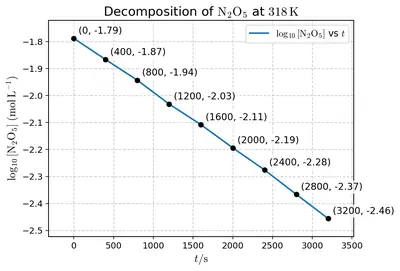
(iii)

Draw a graph between $$\log[\mathrm{N_2O_5}]$$ and $$t$$.
Figure
Figure

Solution

First compute $$\log_{10}[\mathrm{N_2O_5}]$$ for every entry:

$$t/\mathrm{s}$$$$[\mathrm{N_2O_5}]/\mathrm{mol\,L^{-1}}$$$$\log_{10}[\mathrm{N_2O_5}]$$
00.0163$$-1.788$$
4000.0136$$-1.866$$
8000.0114$$-1.943$$
12000.0093$$-2.032$$
16000.0078$$-2.108$$
20000.0064$$-2.194$$
24000.0053$$-2.276$$
28000.0043$$-2.367$$
32000.0035$$-2.456$$

Plot $$\log_{10}[\mathrm{N_2O_5}]$$ on the $$y$$-axis against $$t$$ on the $$x$$-axis. The nine points lie on a straight line whose slope is approximately

$$\text{slope}=\dfrac{(-2.456)-(-1.788)}{3200-0}=\dfrac{-0.668}{3200}=-2.09\times10^{-4}\,\mathrm{s^{-1}}.$$

A straight-line relationship between $$\log[\mathrm{N_2O_5}]$$ and $$t$$ confirms first-order kinetics, in agreement with the integrated rate law

$$\log[\mathrm{N_2O_5}]=\log[\mathrm{N_2O_5}]_{0}-\dfrac{k}{2.303}\,t,$$

so that the slope equals $$-k/2.303$$.

Answer

The plot of $$\log_{10}[\mathrm{N_2O_5}]$$ versus $$t$$ is a straight line of slope $$\approx -2.09\times10^{-4}\,\mathrm{s^{-1}}$$, confirming first-order kinetics.

(iv) What is the rate law?

Solution

From part (iii) the plot of $$\log_{10}[\mathrm{N_2O_5}]$$ versus $$t$$ is linear — the integrated rate law of a first-order reaction. As a check, evaluate

$$k = \dfrac{2.303}{t}\,\log\dfrac{[\mathrm{N_2O_5}]_0}{[\mathrm{N_2O_5}]}$$

using a few data points:

  • $$t=400\,\mathrm{s}$$: $$k = \dfrac{2.303}{400}\log\dfrac{0.0163}{0.0136} = 4.52\times10^{-4}\,\mathrm{s^{-1}}.$$
  • $$t=1600\,\mathrm{s}$$: $$k = \dfrac{2.303}{1600}\log\dfrac{0.0163}{0.0078} = 4.60\times10^{-4}\,\mathrm{s^{-1}}.$$
  • $$t=3200\,\mathrm{s}$$: $$k = \dfrac{2.303}{3200}\log\dfrac{0.0163}{0.0035} = 4.81\times10^{-4}\,\mathrm{s^{-1}}.$$

Values of $$k$$ obtained from widely separated times are nearly the same, which is the hallmark of a first-order reaction. Hence the rate law is

$$\text{Rate} = k\,[\mathrm{N_2O_5}].$$

Answer

Rate law: $$\text{Rate}=k\,[\mathrm{N_2O_5}]$$ (first order in $$\mathrm{N_2O_5}$$).

(v) Calculate the rate constant.

Solution

For a first-order reaction the integrated rate law is

$$k = \dfrac{2.303}{t}\,\log\dfrac{a}{a-x},$$

where $$a = [\mathrm{N_2O_5}]_0 = 0.0163\,\mathrm{mol\,L^{-1}}$$ is the initial concentration and $$a-x$$ is the concentration at time $$t$$.

Using the data at $$t=400\,\mathrm{s}$$ ($$[\mathrm{N_2O_5}]=0.0136\,\mathrm{mol\,L^{-1}}$$):

$$k = \dfrac{2.303}{400}\,\log\dfrac{0.0163}{0.0136} = \dfrac{2.303}{400}\times 0.0786 = 4.52\times10^{-4}\,\mathrm{s^{-1}}.$$

Repeating the calculation for every subsequent reading gives

$$t/\mathrm{s}$$$$[\mathrm{N_2O_5}]/\mathrm{mol\,L^{-1}}$$$$k/\mathrm{s^{-1}}$$
4000.0136$$4.52\times10^{-4}$$
8000.0114$$4.48\times10^{-4}$$
12000.0093$$4.67\times10^{-4}$$
16000.0078$$4.59\times10^{-4}$$
20000.0064$$4.67\times10^{-4}$$
24000.0053$$4.68\times10^{-4}$$
28000.0043$$4.76\times10^{-4}$$
32000.0035$$4.81\times10^{-4}$$

The eight values are nearly constant, again confirming first-order kinetics. Their average gives

$$k \approx 4.66\times10^{-4}\,\mathrm{s^{-1}} \approx 4.7\times10^{-4}\,\mathrm{s^{-1}}.$$

Answer

$$k \approx 4.7\times10^{-4}\,\mathrm{s^{-1}}.$$

(vi) Calculate the half-life period from $$k$$ and compare it with (ii).

Solution

For a first-order reaction the half-life is

$$t_{1/2}=\dfrac{0.693}{k}.$$

Using the average rate constant $$k\approx 4.7\times10^{-4}\,\mathrm{s^{-1}}$$ obtained in part (v):

$$t_{1/2}=\dfrac{0.693}{4.7\times10^{-4}\,\mathrm{s^{-1}}} \approx 1.47\times10^{3}\,\mathrm{s} \approx 1.5\times10^{3}\,\mathrm{s}.$$

This calculated value matches the experimental half-life $$\approx 1.5\times10^{3}\,\mathrm{s}$$ obtained from the graph in part (ii), confirming the consistency of the first-order analysis.

Answer

$$t_{1/2}\;(\text{from }k) \approx 1.5\times10^{3}\,\mathrm{s}$$, in agreement with the experimental value in part (ii).

3.16 The rate constant for a first order reaction is $$60\,\mathrm{s^{-1}}$$. How much time will it take to reduce the initial concentration of the reactant to its $$1/16^{\text{th}}$$ value?

Solution

The integrated rate law for a first-order reaction is

$$k = \frac{2.303}{t}\,\log\frac{[R]_0}{[R]}$$

Given data:

  • Rate constant, $$k = 60\,\mathrm{s^{-1}}$$
  • Final concentration, $$[R]=\dfrac{[R]_0}{16}$$

Hence the concentration ratio is

$$\frac{[R]_0}{[R]} = \frac{[R]_0}{[R]_0/16} = 16$$

Substituting these values,

$$t = \frac{2.303}{k}\,\log 16$$

Since $$\log 16 = 1.2041$$,

$$t = \frac{2.303}{60}\,(1.2041)$$

$$t = 0.0463\,\mathrm{s}$$

Therefore, the time required for the reactant concentration to fall to one-sixteenth of its original value is approximately $$4.6\times10^{-2}\,\mathrm{s}$$.

Answer

$$t \approx 4.6 \times 10^{-2}\,\mathrm{s}$$

3.17 During nuclear explosion, one of the products is $$\mathrm{^{90}Sr}$$ with half-life of 28.1 years. If $$1\,\mathrm{\mu g}$$ of $$\mathrm{^{90}Sr}$$ was absorbed in the bones of a newly born baby instead of calcium, how much of it will remain after 10 years and 60 years if it is not lost metabolically?

Solution

Given data

  • Half-life of $$\mathrm{^{90}Sr}$$ : $$t_{1/2}=28.1\,\text{years}$$
  • Initial mass incorporated in bones : $$m_0 = 1\,\mu\text{g}$$

For a first-order nuclear decay the amount left after time $$t$$ is

$$m = m_0\,e^{-\lambda t}$$   with   $$\lambda = \dfrac{0.693}{t_{1/2}}$$.

1. Decay constant

$$\lambda = \frac{0.693}{28.1\,\text{y}} = 2.47\times10^{-2}\,\text{y}^{-1}$$ (to three significant figures)

2. Mass left after 10 years

Time $$t = 10\,\text{y}$$

Exponent: $$\lambda t = (2.47\times10^{-2})(10) = 0.247$$

$$m_{10} = 1\,\mu\text{g}\times e^{-0.247} = 1\,\mu\text{g}\times 0.781 = 0.781\,\mu\text{g}$$

3. Mass left after 60 years

Time $$t = 60\,\text{y}$$

Exponent: $$\lambda t = (2.47\times10^{-2})(60) = 1.48$$

$$m_{60} = 1\,\mu\text{g}\times e^{-1.48} = 1\,\mu\text{g}\times 0.227 = 0.227\,\mu\text{g}$$

Result

Assuming no metabolic loss:

  • After 10 years: $$\boxed{\;0.78\,\mu\text{g}\;}$$ of $$\mathrm{^{90}Sr}$$ will remain.
  • After 60 years: $$\boxed{\;0.23\,\mu\text{g}\;}$$ of $$\mathrm{^{90}Sr}$$ will remain.

Answer

Amount remaining: after 10 years ≈ $$0.78\,\mu\text{g}$$; after 60 years ≈ $$0.23\,\mu\text{g}$$.

3.18 For a first order reaction, show that time required for 99% completion is twice the time required for the completion of 90% of reaction.

Solution

Integrated rate law for a first order reaction

The integrated form (using common logarithm) is

$$k t = 2.303\,\log \frac{a}{a-x}$$

where

  • $$a$$ = initial concentration (or amount)
  • $$x$$ = amount reacted after time $$t$$
  • $$a-x$$ = concentration left

1. Time for 90 % completion  ($$t_{90\%}$$)

90 % of the reactant has reacted, so 10 % remains:

$$a-x = 0.10\,a$$

Substitute in the rate law:

$$k\,t_{90\%} = 2.303\,\log\frac{a}{0.10\,a}$$

$$= 2.303\,\log 10$$

But $$\log 10 = 1$$, therefore

$$t_{90\%} = \frac{2.303}{k}$$

2. Time for 99 % completion  ($$t_{99\%}$$)

99 % of the reactant has reacted, so 1 % remains:

$$a-x = 0.01\,a$$

Substitute in the rate law:

$$k\,t_{99\%} = 2.303\,\log\frac{a}{0.01\,a}$$

$$= 2.303\,\log 100$$

Since $$\log 100 = 2$$,

$$t_{99\%} = \frac{2\,(2.303)}{k} = \frac{4.606}{k}$$

3. Ratio of the two times

$$\frac{t_{99\%}}{t_{90\%}} = \frac{4.606/k}{2.303/k} = 2$$

Hence

$$t_{99\%} = 2\,t_{90\%}$$

Therefore, for a first-order reaction, the time required for 99 % completion is exactly twice the time required for 90 % completion.

Answer

Proved: $$t_{99\%}=2\,t_{90\%}$$

3.19 A first order reaction takes 40 min for 30% decomposition. Calculate $$t_{1/2}$$.

Solution

For a first-order reaction the rate constant $$k$$ is obtained from

$$k = \frac{2.303}{t}\,\log\left(\frac{[R]_0}{[R]}\right)$$

Let the initial concentration be $$[R]_0 = a$$. After 40 min, 30 % has decomposed, so 70 % remains:

$$[R] = 0.70a$$

Substituting $$t = 40\,\text{min}$$,

$$k = \frac{2.303}{40}\,\log\left(\frac{a}{0.70a}\right) = \frac{2.303}{40}\,\log\left(\frac{1}{0.70}\right)$$

Numerically, $$\log(1/0.70) = 0.1549$$, hence

$$k = \frac{2.303\,(0.1549)}{40} = 8.92 \times 10^{-3}\;\text{min}^{-1}$$

The half-life of a first-order reaction is

$$t_{1/2} = \frac{0.693}{k}$$

Therefore,

$$t_{1/2} = \frac{0.693}{8.92 \times 10^{-3}} = 7.77 \times 10^{1}\;\text{min} \approx 78\;\text{min}$$

Thus, the half-life of the reaction is about 78 minutes.

Answer

$$t_{1/2} \approx 7.8 \times 10^{1}\,\text{min}\;(\text{about }78\,\text{min})$$

3.20

For the decomposition of azoisopropane to hexane and nitrogen at 543 K, the following data are obtained.

$$t\,(\mathrm{sec})$$$$P\,(\mathrm{mm\,of\,Hg})$$
035.0
36054.0
72063.0

Calculate the rate constant.

Solution

Step 1 – Write the reaction
$$\mathrm{(CH_3)_2CH\!{-}N\!=\!N\!{-}CH(CH_3)_2}\;\longrightarrow\;\mathrm{C_6H_{14}}+\mathrm{N_2}$$
One mole of reactant gives two moles of products, hence the total number of moles (and therefore the pressure) increases by one mole for each mole decomposed.

Step 2 – Relate the observed pressure to the extent of decomposition
Let the initial pressure of azo-isopropane be $$P_0$$.
At time $$t$$, let $$x$$ mm Hg of the reactant have decomposed.
Remaining reactant: $$(P_0-x)$$
Products formed: $$2x$$
Total pressure at time $$t$$:
$$P_t=(P_0-x)+2x=P_0+x$$
Therefore $$x=P_t-P_0$$ and the partial pressure of the undecomposed reactant is
$$P_A=P_0-x=2P_0-P_t$$.

Step 3 – First-order rate law in terms of pressure
For a first-order reaction
$$k=\frac{2.303}{t}\log\frac{[A]_0}{[A]}=\frac{2.303}{t}\log\frac{P_0}{P_A}=\frac{2.303}{t}\log\frac{P_0}{2P_0-P_t}$$

Step 4 – Calculate $$k$$ from each set of data

t (s)$$P_t$$ (mm Hg)$$P_A=2P_0-P_t$$ (mm Hg)Expression for $$k$$Value of $$k$$ (s-1)
36054.016.0$$\dfrac{2.303}{360}\log\dfrac{35.0}{16.0}$$$$2.17\times10^{-3}$$
72063.07.0$$\dfrac{2.303}{720}\log\dfrac{35.0}{7.0}$$$$2.24\times10^{-3}$$

Step 5 – Final rate constant
The two values are very close; their average is
$$k\approx2.2\times10^{-3}\;\mathrm{s^{-1}}$$ at 543 K.

Answer

$$k \approx 2.2\times10^{-3}\;\mathrm{s^{-1}}$$

3.21

The following data were obtained during the first order thermal decomposition of $$\mathrm{SO_2Cl_2}$$ at a constant volume.

$$\mathrm{SO_2Cl_2\,(g) \rightarrow SO_2\,(g) + Cl_2\,(g)}$$

ExperimentTime/$$\mathrm{s^{-1}}$$Total pressure/atm
100.5
21000.6

Calculate the rate of the reaction when total pressure is $$0.65\,\mathrm{atm}$$.

Solution

Step 1 : Express the change in pressure in terms of extent of decomposition
At t = 0 the vessel contains only $$\mathrm{SO_2Cl_2}$$ having pressure $$P_0 = 0.5\,\text{atm}$$.
After time t, let the pressure corresponding to the amount of $$\mathrm{SO_2Cl_2}$$ that has decomposed be x (in atm).

SpeciesInitial pressureChangePressure at time t
$$\mathrm{SO_2Cl_2}$$$$P_0$$$$-x$$$$P_0 - x$$
$$\mathrm{SO_2}$$0$$+x$$$$x$$
$$\mathrm{Cl_2}$$0$$+x$$$$x$$

Total pressure at time t:
$$P_t =(P_0 - x) + x + x = P_0 + x$$
Hence $$x = P_t - P_0$$ and $$P_{\mathrm{SO_2Cl_2}} = P_0 - x = 2P_0 - P_t$$.

Step 2 : Evaluate the first-order rate constant k
For a first-order reaction
$$k = \frac{2.303}{t}\,\log\!\left(\frac{[A]_0}{[A]_t}\right)$$
Replacing concentrations by the corresponding partial pressures,
$$k = \frac{2.303}{t}\,\log\!\left(\frac{P_0}{P_{\mathrm{SO_2Cl_2}}}\right)$$.

From the experimental entry (t = 100 s, $$P_t = 0.6\,\text{atm}$$):

  • $$x = 0.6 - 0.5 = 0.10\,\text{atm}$$
  • $$P_{\mathrm{SO_2Cl_2}} = 0.5 - 0.10 = 0.40\,\text{atm}$$
Therefore
$$k = \frac{2.303}{100}\,\log\!\left(\frac{0.50}{0.40}\right) = 0.02303\times0.09691\;\text{s}^{-1} = 2.23\times10^{-3}\;\text{s}^{-1}$$.

Step 3 : Find the rate when the total pressure is 0.65 atm
For $$P_t = 0.65\,\text{atm}$$:

  • $$x = 0.65 - 0.50 = 0.15\,\text{atm}$$
  • $$P_{\mathrm{SO_2Cl_2}} = 0.50 - 0.15 = 0.35\,\text{atm}$$
The instantaneous rate for a first-order reaction is
$$\text{Rate} = k\,P_{\mathrm{SO_2Cl_2}}$$
$$\therefore\;\text{Rate} = 2.23\times10^{-3}\;\text{s}^{-1}\;\times\;0.35\;\text{atm} = 7.8\times10^{-4}\;\text{atm s}^{-1}$$.

Thus the rate of decomposition when the total pressure is 0.65 atm is $$7.8\times10^{-4}\;\text{atm s}^{-1}$$.

Answer

Rate  =  $$7.8\times10^{-4}\;\text{atm s}^{-1}$$

3.22

The rate constant for the decomposition of $$\mathrm{N_2O_5}$$ at various temperatures is given below:

$$T/^{\circ}\mathrm{C}$$020406080
$$10^5 \times k/\mathrm{s^{-1}}$$0.07871.7025.71782140

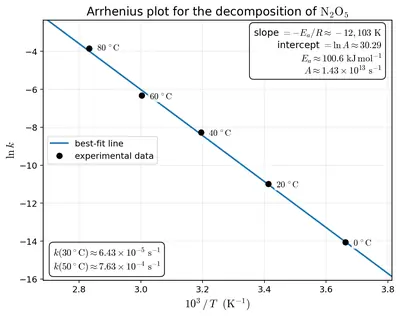
Draw a graph between $$\ln k$$ and $$1/T$$ and calculate the values of $$A$$ and $$E_a$$. Predict the rate constant at $$30^{\circ}$$ and $$50^{\circ}\mathrm{C}$$.

Figure
Figure

Solution

Step 1 — Convert the data into convenient form. Convert temperatures to kelvin and divide the tabulated values of $$10^{5}k$$ by $$10^{5}$$ to obtain $$k$$ in $$\mathrm{s^{-1}}$$, and then evaluate $$\ln k$$ and $$1/T$$:

$$T/^{\circ}\mathrm{C}$$$$T/\mathrm{K}$$$$k/\mathrm{s^{-1}}$$$$\ln k$$$$(1/T)/\mathrm{K^{-1}}$$
0273$$7.87\times10^{-7}$$$$-14.05$$$$3.663\times10^{-3}$$
20293$$1.70\times10^{-5}$$$$-10.98$$$$3.413\times10^{-3}$$
40313$$2.57\times10^{-4}$$$$-8.266$$$$3.195\times10^{-3}$$
60333$$1.78\times10^{-3}$$$$-6.331$$$$3.003\times10^{-3}$$
80353$$2.14\times10^{-2}$$$$-3.843$$$$2.833\times10^{-3}$$

Step 2 — Arrhenius plot. Plotting $$\ln k$$ (on the $$y$$-axis) against $$1/T$$ (on the $$x$$-axis) gives an essentially straight line that slopes downwards.

Step 3 — Slope and activation energy. Taking the two extreme points,

$$\text{slope} = \dfrac{\ln k_2-\ln k_1}{(1/T_2)-(1/T_1)} = \dfrac{-3.843-(-14.05)}{(2.833-3.663)\times10^{-3}} = \dfrac{10.21}{-0.830\times10^{-3}} = -1.23\times10^{4}\,\mathrm{K}.$$

The Arrhenius equation in linear form is $$\ln k = \ln A - \dfrac{E_a}{R}\,\dfrac{1}{T}$$, so $$\text{slope}=-E_a/R$$ and

$$E_a = -\text{slope}\times R = (1.23\times10^{4}\,\mathrm{K})(8.314\,\mathrm{J\,K^{-1}\,mol^{-1}}) \approx 1.02\times10^{5}\,\mathrm{J\,mol^{-1}} = 1.0\times10^{2}\,\mathrm{kJ\,mol^{-1}}.$$

Step 4 — Arrhenius factor $$A$$. Using the data at $$T = 313\,\mathrm{K}$$ (any point will do):

$$\ln A = \ln k + \dfrac{E_a}{RT} = -8.266 + \dfrac{1.02\times10^{5}}{8.314\times313} = -8.266 + 39.33 = 31.07.$$

Therefore $$A = e^{31.07} \approx 3.3\times10^{13}\,\mathrm{s^{-1}}.$$

Step 5 — Predicted rate constants. Substituting into $$\ln k = 31.07 - \dfrac{1.02\times10^{5}}{8.314\,T}$$:

  • At $$30^{\circ}\mathrm{C}$$ ($$T = 303\,\mathrm{K}$$): $$\ln k = 31.07 - 40.62 = -9.55$$, so $$k \approx 7.1\times10^{-5}\,\mathrm{s^{-1}}.$$
  • At $$50^{\circ}\mathrm{C}$$ ($$T = 323\,\mathrm{K}$$): $$\ln k = 31.07 - 38.10 = -7.03$$, so $$k \approx 8.9\times10^{-4}\,\mathrm{s^{-1}}.$$

Final results:

  • Activation energy $$E_a \approx 1.0\times10^{2}\,\mathrm{kJ\,mol^{-1}}$$
  • Arrhenius factor $$A \approx 3.3\times10^{13}\,\mathrm{s^{-1}}$$
  • $$k_{30^{\circ}\mathrm{C}} \approx 7.1\times10^{-5}\,\mathrm{s^{-1}}$$ and $$k_{50^{\circ}\mathrm{C}} \approx 8.9\times10^{-4}\,\mathrm{s^{-1}}$$

Answer

$$E_a \approx 1.0\times10^{2}\,\mathrm{kJ\,mol^{-1}},\quad A \approx 3.3\times10^{13}\,\mathrm{s^{-1}}$$
$$k_{30^{\circ}\mathrm{C}} \approx 7.1\times10^{-5}\,\mathrm{s^{-1}}, \quad k_{50^{\circ}\mathrm{C}} \approx 8.9\times10^{-4}\,\mathrm{s^{-1}}$$

3.23 The rate constant for the decomposition of hydrocarbons is $$2.418 \times 10^{-5}\,\mathrm{s^{-1}}$$ at 546 K. If the energy of activation is $$179.9 \, \mathrm{kJ/mol}$$, what will be the value of pre-exponential factor.

Solution

Step 1 : Write the Arrhenius equation
$$k = A \, e^{-E_a/(RT)}$$

Step 2 : Isolate the pre-exponential factor
$$A = k\,e^{E_a/(RT)}$$

Step 3 : Insert the given data

  • Rate constant : $$k = 2.418 \times 10^{-5}\,\mathrm{s^{-1}}$$
  • Temperature : $$T = 546\,\mathrm{K}$$
  • Activation energy : $$E_a = 179.9\,\mathrm{kJ\,mol^{-1}} = 179.9 \times 10^{3}\,\mathrm{J\,mol^{-1}}$$
  • Gas constant : $$R = 8.314\,\mathrm{J\,mol^{-1}\,K^{-1}}$$

Step 4 : Evaluate the exponent
$$RT = 8.314\,\mathrm{J\,mol^{-1}\,K^{-1}} \times 546\,\mathrm{K} = 4539.4\,\mathrm{J\,mol^{-1}}$$
$$\frac{E_a}{RT} = \frac{179.9 \times 10^{3}}{4539.4} = 39.64$$

Step 5 : Calculate the exponential term
$$e^{39.64} = 10^{\,\frac{39.64}{2.302585}} = 10^{17.22} \approx 1.66 \times 10^{17}$$

Step 6 : Determine the pre-exponential factor
$$A = 2.418 \times 10^{-5}\,\mathrm{s^{-1}} \times 1.66 \times 10^{17}$$
$$A \approx 4.0 \times 10^{12}\,\mathrm{s^{-1}}$$

The required pre-exponential (frequency) factor is therefore about $$4.0 \times 10^{12}\,\mathrm{s^{-1}}$$.

Answer

$$A \approx 4.0 \times 10^{12}\,\mathrm{s^{-1}}$$

3.24 Consider a certain reaction $$\mathrm{A \rightarrow Products}$$ with $$k = 2.0 \times 10^{-2}\,\mathrm{s^{-1}}$$. Calculate the concentration of A remaining after 100 s if the initial concentration of A is $$1.0\,\mathrm{mol\,L^{-1}}$$.

Solution

The rate constant shows units $$\mathrm{s^{-1}}$$, so the reaction is first order in $$\mathrm{A}$$.

For a first-order reaction, the integrated rate law is

$$\ln \frac{[\mathrm{A}]_0}{[\mathrm{A}]_t}=kt$$

where

  • $$[\mathrm{A}]_0=1.0\,\mathrm{mol\,L^{-1}}$$   (initial concentration)
  • $$k=2.0\times10^{-2}\,\mathrm{s^{-1}}$$   (rate constant)
  • $$t=100\,\mathrm{s}$$   (time elapsed)
  • $$[\mathrm{A}]_t$$   (concentration after time $$t$$)

Substitute the data:

$$\ln \frac{1.0}{[\mathrm{A}]_t}=(2.0\times10^{-2}\,\mathrm{s^{-1}})(100\,\mathrm{s})$$

$$\ln \frac{1.0}{[\mathrm{A}]_t}=2.0$$

Remove the natural logarithm by taking antilog (exponential) on both sides:

$$\frac{1.0}{[\mathrm{A}]_t}=e^{2.0}$$

$$[\mathrm{A}]_t=\frac{1.0}{e^{2.0}}$$

Numerical value:

$$e^{2.0}\approx7.39$$

$$[\mathrm{A}]_t=\frac{1.0}{7.39}\;\mathrm{mol\,L^{-1}}\approx0.135\,\mathrm{mol\,L^{-1}}$$

The concentration of $$\mathrm{A}$$ remaining after 100 s is therefore about $$0.14\,\mathrm{mol\,L^{-1}}$$ (to two significant figures).

Answer

After 100 s, $$[\mathrm{A}]\approx0.14\,\mathrm{mol\,L^{-1}}$$.

3.25 Sucrose decomposes in acid solution into glucose and fructose according to the first order rate law, with $$t_{1/2} = 3.00\,\mathrm{hours}$$. What fraction of sample of sucrose remains after 8 hours?

Solution

The decomposition of sucrose is first order, so the integrated rate law (in the base-10 form used in NCERT) is

$$k = \dfrac{2.303}{t}\log\dfrac{[\mathrm{R}]_0}{[\mathrm{R}]}$$

Step 1: Rate constant from the half-life. For a first order reaction the half-life is independent of the initial concentration:

$$k = \dfrac{0.693}{t_{1/2}} = \dfrac{0.693}{3.00\,\mathrm{h}} = 0.231\,\mathrm{h^{-1}}$$

Step 2: Apply the integrated rate equation at $$t = 8\,\mathrm{h}$$.

$$0.231\,\mathrm{h^{-1}} = \dfrac{2.303}{8\,\mathrm{h}}\log\dfrac{[\mathrm{R}]_0}{[\mathrm{R}]}$$

$$\log\dfrac{[\mathrm{R}]_0}{[\mathrm{R}]} = \dfrac{0.231\times 8}{2.303} = 0.8025$$

$$\dfrac{[\mathrm{R}]_0}{[\mathrm{R}]} = \text{antilog}(0.8025) = 6.346$$

Step 3: Fraction of sucrose remaining.

$$\dfrac{[\mathrm{R}]}{[\mathrm{R}]_0} = \dfrac{1}{6.346} = 0.158$$

Hence about $$0.158$$ (i.e. $$15.8\%$$) of the original sucrose remains after 8 hours.

Answer

Fraction of sucrose remaining after 8 hours $$= \dfrac{[\mathrm{R}]}{[\mathrm{R}]_0} \approx 0.158$$ (about $$15.8\%$$).

3.26

The decomposition of hydrocarbon follows the equation

$$k = (4.5 \times 10^{11}\,\mathrm{s^{-1}})\,e^{-28000\,\mathrm{K}/T}$$

Calculate $$E_a$$.

Solution

Step 1 : Start with the Arrhenius equation

The temperature–rate constant relation for any reaction is given by

$$k = A\,e^{-E_a/(R T)}$$

where

  • $$A$$ is the frequency (pre-exponential) factor,
  • $$E_a$$ is the activation energy,
  • $$R = 8.314\,\mathrm{J\,mol^{-1}\,K^{-1}}$$ is the gas constant,
  • $$T$$ is the absolute temperature.

Step 2 : Identify the exponential term in the given rate expression

The rate constant for the hydrocarbon decomposition is expressed as

$$k = (4.5 \times 10^{11}\,\mathrm{s^{-1}})\,e^{-28000\,\mathrm{K}/T}$$

Comparing the exponent with $$e^{-E_a/(R T)}$$ gives

$$\frac{-E_a}{R}\;=\;-28000\,\mathrm{K}$$

Step 3 : Solve for $$E_a$$

$$E_a = (28000\,\mathrm{K})(R)$$

Substitute $$R = 8.314\,\mathrm{J\,mol^{-1}\,K^{-1}}$$:

$$E_a = 28000\,\mathrm{K}\;\times\;8.314\,\mathrm{J\,mol^{-1}\,K^{-1}}$$

$$E_a = 232\,792\,\mathrm{J\,mol^{-1}}$$

Step 4 : Convert joules to kilojoules

$$E_a = \frac{232\,792\,\mathrm{J\,mol^{-1}}}{1000} = 232.792\,\mathrm{kJ\,mol^{-1}}$$

Rounded to three significant figures:

Activation energy

$$E_a \approx 2.33 \times 10^{2}\,\mathrm{kJ\,mol^{-1}}$$

Answer

$$E_a \approx 2.33 \times 10^{2}\,\mathrm{kJ\,mol^{-1}}$$

3.27

The rate constant for the first order decomposition of $$\mathrm{H_2O_2}$$ is given by the following equation:

$$\log k = 14.34 - 1.25 \times 10^4\,\mathrm{K}/T$$

Calculate $$E_a$$ for this reaction and at what temperature will its half-period be 256 minutes?

Solution

Step 1 : Identify the Arrhenius form
For a first-order reaction the Arrhenius equation in base 10 is
$$\log k = \log A - \dfrac{E_a}{2.303\,R}\,\dfrac1T$$ The given relation is
$$\log k = 14.34 - \dfrac{1.25\times10^{4}}{T}$$ Hence the slope equals $$-\dfrac{E_a}{2.303 R}= -1.25\times10^{4}.$$

Step 2 : Calculate the activation energy
$$E_a = 1.25\times10^{4}\times 2.303\times R$$ Using $$R = 8.314\;\mathrm{J\,mol^{-1}\,K^{-1}}$$,
$$E_a = 1.25\times10^{4}\times 2.303 \times 8.314\;\mathrm{J\,mol^{-1}}$$ $$E_a = 2.39\times10^{5}\;\mathrm{J\,mol^{-1}} \;\approx\; 2.39\times10^{2}\;\mathrm{kJ\,mol^{-1}}$$

Step 3 : Determine the rate constant that gives a half-life of 256 min
For a first-order reaction
$$t_{1/2}=\dfrac{0.693}{k}$$ Given $$t_{1/2}=256\;\text{min}=256\times60=1.536\times10^{4}\;\text{s}$$,
$$k = \dfrac{0.693}{1.536\times10^{4}}=4.51\times10^{-5}\;\text{s}^{-1}$$

Step 4 : Insert this k in the empirical equation to find T
$$\log k = \log(4.51\times10^{-5}) = \log4.51 - 5 = 0.654 - 5 = -4.346$$ Set equal to the given expression:
$$-4.346 = 14.34 - \dfrac{1.25\times10^{4}}{T}$$ $$\dfrac{1.25\times10^{4}}{T} = 14.34 + 4.346 = 18.686$$ $$T = \dfrac{1.25\times10^{4}}{18.686} = 6.69\times10^{2}\;\text{K} \approx 6.7\times10^{2}\;\text{K}$$

Result
$$E_a \approx 2.39\times10^{2}\;\mathrm{kJ\,mol^{-1}}$$
Half-life of 256 min is obtained at
$$T \approx 6.7\times10^{2}\;\text{K} \;\;(\approx 669\;\text{K}).$$

Answer

$$E_a \approx 2.39\times10^{2}\;\mathrm{kJ\,mol^{-1}}, \qquad T_{(t_{1/2}=256\,\text{min})}\approx 6.7\times10^{2}\;\text{K}$$

3.28 The decomposition of A into product has value of $$k$$ as $$4.5 \times 10^{3}\,\mathrm{s^{-1}}$$ at $$10^{\circ}\mathrm{C}$$ and energy of activation $$60 \, \mathrm{kJ\,mol^{-1}}$$. At what temperature would $$k$$ be $$1.5 \times 10^{4}\,\mathrm{s^{-1}}$$?

Solution

Given data

  • Rate constant at the first temperature: $$k_1 = 4.5 \times 10^{3}\,\mathrm{s^{-1}}$$
  • First temperature: $$T_1 = 10^{\circ}\mathrm{C} = 10 + 273 = 283\,\mathrm{K}$$
  • Rate constant at the second temperature: $$k_2 = 1.5 \times 10^{4}\,\mathrm{s^{-1}}$$
  • Activation energy: $$E_a = 60\,\mathrm{kJ\,mol^{-1}} = 60\,000\,\mathrm{J\,mol^{-1}}$$
  • Gas constant: $$R = 8.314\,\mathrm{J\,mol^{-1}K^{-1}}$$

Step 1 : Arrhenius relation for two temperatures

$$\ln\!\left(\frac{k_2}{k_1}\right) = \frac{E_a}{R}\left(\frac{1}{T_1} - \frac{1}{T_2}\right)$$

Step 2 : Insert numerical values

First evaluate the ratio of rate constants:

$$\frac{k_2}{k_1} = \frac{1.5 \times 10^{4}}{4.5 \times 10^{3}} = 3.3333$$

Hence

$$\ln(3.3333) = 1.20397$$

Substituting into the Arrhenius equation:

$$1.20397 = \frac{60\,000}{8.314}\left(\frac{1}{283} - \frac{1}{T_2}\right)$$

Step 3 : Solve for $$T_2$$

First compute the factor $$\dfrac{R}{E_a}$$ because we need its reciprocal:

$$\frac{R}{E_a} = \frac{8.314}{60\,000} = 1.3857 \times 10^{-4}\,\mathrm{K^{-1}}$$

Hence

$$\frac{1}{T_2} = \frac{1}{T_1} - \frac{R}{E_a}\,\ln\!\left(\frac{k_2}{k_1}\right)$$

$$\frac{1}{T_2} = \frac{1}{283} - (1.3857 \times 10^{-4})(1.20397)$$

$$\frac{1}{T_2} = 0.00353357 - 0.00016684 = 0.00336673\,\mathrm{K^{-1}}$$

Taking the reciprocal:

$$T_2 = \frac{1}{0.00336673} \approx 297\,\mathrm{K}$$

Step 4 : Convert to degree Celsius

$$T_2 (^{\circ}\mathrm{C}) = 297 - 273 = 24^{\circ}\mathrm{C}$$

Therefore, the rate constant $$k = 1.5 \times 10^{4}\,\mathrm{s^{-1}}$$ will be reached at about $$24^{\circ}\mathrm{C}$$ (\(\approx 297\,\mathrm{K}\)).

Answer

$$T \approx 297\,\mathrm{K}\; (= 24^{\circ}\mathrm{C})$$

3.29 The time required for 10% completion of a first order reaction at 298K is equal to that required for its 25% completion at 308K. If the value of $$A$$ is $$4 \times 10^{10}\,\mathrm{s^{-1}}$$. Calculate $$k$$ at 318K and $$E_a$$.

Solution

Step 1 : Integrated rate law for a first-order reaction
For a first-order reaction the relation between concentration and time is

$$t = \frac{2.303}{k}\;\log\!\frac{[A]_0}{[A]}$$

where $$k$$ is the rate constant at the temperature concerned.

Step 2 : Write the two given times

  • 10 % decomposition at $$298\,\mathrm K$$ : after the time required, $$[A] = 0.90[A]_0$$.

$$t_{10\%} = \frac{2.303}{k_{298}}\;\log \frac{[A]_0}{0.90[A]_0} = \frac{2.303}{k_{298}}\;\log 1.1111$$

  • 25 % decomposition at $$308\,\mathrm K$$ : after the time required, $$[A] = 0.75[A]_0$$.

$$t_{25\%} = \frac{2.303}{k_{308}}\;\log \frac{[A]_0}{0.75[A]_0} = \frac{2.303}{k_{308}}\;\log 1.3333$$

Step 3 : Equate the two times (given to be equal)

$$\frac{2.303}{k_{298}}\,\log 1.1111 = \frac{2.303}{k_{308}}\,\log 1.3333$$
$$\Rightarrow \;\frac{k_{308}}{k_{298}} = \frac{\log 1.3333}{\log 1.1111}$$

Numerical values (common logarithms):
$$\log 1.3333 = 0.124939,\quad \log 1.1111 = 0.045757$$

$$\therefore \;\frac{k_{308}}{k_{298}} = \frac{0.124939}{0.045757} = 2.730$$

Step 4 : Determine the activation energy $$E_a$$

The Arrhenius equation in ratio form is
$$\ln \frac{k_{308}}{k_{298}} = -\frac{E_a}{R}\left(\frac{1}{308} - \frac{1}{298}\right)$$

Because $$k_{308} > k_{298}$$, the right side must be positive; hence we may write
$$\ln 2.730 = \frac{E_a}{R}\left(\frac{1}{298} - \frac{1}{308}\right)$$

Compute the two factors:

$$\ln 2.730 = 1.004$$
$$\frac{1}{298} - \frac{1}{308} = \frac{308-298}{298\times308} = \frac{10}{91784}=1.089\times10^{-4}\,\mathrm{K^{-1}}$$

Insert the gas constant $$R = 8.314\,\mathrm{J\,mol^{-1}\,K^{-1}}$$:

$$E_a = \frac{1.004\times8.314}{1.089\times10^{-4}}\;\mathrm{J\,mol^{-1}} = 7.66\times10^{4}\,\mathrm J\,\mathrm{mol^{-1}}$$

$$E_a \approx 7.7\times10^{4}\,\mathrm{J\,mol^{-1}} = 76.6\,\mathrm{kJ\,mol^{-1}}$$

Step 5 : Calculate $$k$$ at $$318\,\mathrm K$$

Using the Arrhenius form with the pre-exponential factor $$A = 4.0\times10^{10}\,\mathrm{s^{-1}}$$:

$$k_{318}=A\,e^{-E_a/(R T)}$$
$$E_a/(RT)=\frac{7.66\times10^{4}}{8.314\times318}=28.96$$

$$e^{-28.96}=2.69\times10^{-13}$$

$$k_{318}=4.0\times10^{10}\times2.69\times10^{-13}=1.08\times10^{-2}\,\mathrm{s^{-1}}$$

Result

$$E_a\approx76.6\,\mathrm{kJ\,mol^{-1}},\qquad k_{318}\approx1.1\times10^{-2}\,\mathrm{s^{-1}}$$

Answer

$$E_a \approx 7.7\times10^{4}\,\text{J mol}^{-1}=76.6\,\text{kJ mol}^{-1}$$
$$k_{318\,\text{K}} \approx 1.1\times10^{-2}\;\text{s}^{-1}$$

3.30 The rate of a reaction quadruples when the temperature changes from 293 K to 313 K. Calculate the energy of activation of the reaction assuming that it does not change with temperature.

Solution

Given $$T_1 = 293\,\mathrm{K}$$, $$T_2 = 313\,\mathrm{K}$$, and the rate (hence the rate constant) becomes four times its original value, so $$\dfrac{k_2}{k_1} = 4$$.

The temperature dependence of the rate constant is given by the Arrhenius equation in two-temperature logarithmic form:

$$\log\dfrac{k_2}{k_1} = \dfrac{E_a}{2.303\,R}\left[\dfrac{T_2-T_1}{T_1 T_2}\right]$$

Step 1: Substitute the data.

$$\log 4 = \dfrac{E_a}{2.303\times 8.314}\left[\dfrac{313-293}{293\times 313}\right]$$

Step 2: Evaluate the numerical factors.

  • $$\log 4 = 0.6021$$
  • $$2.303 \times 8.314 = 19.147\,\mathrm{J\,K^{-1}\,mol^{-1}}$$
  • $$T_1 T_2 = 293 \times 313 = 91\,709\,\mathrm{K^2}$$
  • $$\dfrac{T_2-T_1}{T_1 T_2} = \dfrac{20}{91\,709} = 2.181\times10^{-4}\,\mathrm{K^{-1}}$$

Step 3: Solve for $$E_a$$.

$$0.6021 = \dfrac{E_a}{19.147}\times 2.181\times10^{-4}$$

$$E_a = \dfrac{0.6021 \times 19.147}{2.181\times10^{-4}}\,\mathrm{J\,mol^{-1}}$$

$$E_a = \dfrac{11.530}{2.181\times10^{-4}} = 5.286\times10^{4}\,\mathrm{J\,mol^{-1}}$$

Step 4: Convert to kilojoules.

$$E_a \approx 52.86\,\mathrm{kJ\,mol^{-1}}$$

Answer

Energy of activation $$E_a \approx 5.286\times10^{4}\,\mathrm{J\,mol^{-1}} \approx 52.86\,\mathrm{kJ\,mol^{-1}}$$.

NCERT Solutions for Class 12
Maths
NCERT Solutions for Class 12 Maths
Chapter-wise step-by-step
solutions with explanations
explore solutions Maths bg
Physics
NCERT Solutions for Class 12 Physics
Chapter-wise step-by-step
solutions with explanations
explore solutions Physics bg
Chemistry
NCERT Solutions for Class 12 Chemistry
Chapter-wise step-by-step
solutions with explanations
explore solutions Chemistry bg

Frequently Asked Questions

50,000+ JEE Students Trusted Our Score Calculator

Predict your JEE Main percentile, rank & performance in seconds