Join WhatsApp Icon JEE WhatsApp Group
NCERT Solutions for Class 12 Chemistry

Chapter 2: Electrochemistry

Download Solutions PDF
Daily JEE Updates, Tips & Important Alerts
Join 30,000+ students and stay updated with JEE notifications and preparation insights.
Join Now!
Free PDF
Complete NCERT Solution PDF for Chapter 2: Electrochemistry

NCERT Solutions For Class 12 Chemistry Chapter 2 Electrochemistry helps students understand the relationship between chemical reactions and electrical energy. The page provides comprehensive NCERT Solutions that explain concepts such as electrochemical cells, galvanic cells, electrolytic cells, electrode potential, Nernst equation, and Faraday’s laws of electrolysis. NCERT Solutions For Class 12 Chemistry make these concepts easier with detailed explanations, formulas, and solved numerical problems. The chapter helps students understand how electricity is generated through chemical reactions and how electrolysis works. These solutions guide learners in solving textbook questions and improving their numerical problem-solving skills. Students can access the chapter PDF for revision and exam preparation. The structured explanations help students develop a strong foundation in electrochemical concepts.
Download Solutions PDF

Examples 2.1-2.10

Example 2.1 Represent the cell in which the following reaction takes place $$\mathrm{Mg(s) + 2Ag^{+}(0.0001\,M) \rightarrow Mg^{2+}(0.130\,M) + 2Ag(s)}$$ Calculate its $$E_{(\mathrm{cell})}$$ if $$E^{\circ}_{(\mathrm{cell})} = 3.17\,\mathrm{V}$$.

Solution

In the given reaction magnesium is oxidised (loses electrons) and silver ions are reduced. So Mg is the anode and Ag is the cathode. Writing the anode on the left and the cathode on the right, the cell is represented as:

$$\mathrm{Mg\,|\,Mg^{2+}(0.130\,M)\,||\,Ag^{+}(0.0001\,M)\,|\,Ag}$$

The half-reactions are $$\mathrm{Mg \rightarrow Mg^{2+} + 2e^{-}}$$ and $$\mathrm{2Ag^{+} + 2e^{-} \rightarrow 2Ag}$$, so $$n = 2$$ electrons are transferred. Applying the Nernst equation:

$$E_{(\mathrm{cell})} = E^{\circ}_{(\mathrm{cell})} - \frac{0.059}{n}\log\frac{[\mathrm{Mg^{2+}}]}{[\mathrm{Ag^{+}}]^{2}}$$

Substituting the values:

$$E_{(\mathrm{cell})} = 3.17 - \frac{0.059}{2}\log\frac{0.130}{(0.0001)^{2}}$$

$$\frac{0.130}{(0.0001)^{2}} = \frac{0.130}{1\times10^{-8}} = 1.3\times10^{7}, \qquad \log(1.3\times10^{7}) = 7.11$$

$$E_{(\mathrm{cell})} = 3.17 - (0.0295)(7.11) = 3.17 - 0.21 = 2.96\,\mathrm{V}$$

Answer

Cell: $$\mathrm{Mg\,|\,Mg^{2+}(0.130\,M)\,||\,Ag^{+}(0.0001\,M)\,|\,Ag}$$; $$\;E_{(\mathrm{cell})} = 2.96\,\mathrm{V}$$

Example 2.2 Calculate the equilibrium constant of the reaction: $$\mathrm{Cu(s) + 2Ag^{+}(aq) \rightarrow Cu^{2+}(aq) + 2Ag(s)}$$ $$E^{\circ}_{(\mathrm{cell})} = 0.46\,\mathrm{V}$$

Solution

In this reaction copper is oxidised and silver ions are reduced; the number of electrons transferred is $$n = 2$$.

At equilibrium the cell potential becomes zero, and the Nernst equation reduces to a relation between $$E^{\circ}_{(\mathrm{cell})}$$ and the equilibrium constant $$K_C$$:

$$E^{\circ}_{(\mathrm{cell})} = \frac{0.059}{n}\log K_C$$

Rearranging for $$\log K_C$$:

$$\log K_C = \frac{n\,E^{\circ}_{(\mathrm{cell})}}{0.059} = \frac{2\times0.46}{0.059} = \frac{0.92}{0.059} = 15.6$$

Taking the antilog:

$$K_C = \mathrm{antilog}(15.6) = 3.92\times10^{15}$$

Answer

$$K_C = 3.92\times10^{15}$$

Example 2.3 The standard electrode potential for Daniell cell is $$1.1\,\mathrm{V}$$. Calculate the standard Gibbs energy for the reaction: $$\mathrm{Zn(s) + Cu^{2+}(aq) \rightarrow Zn^{2+}(aq) + Cu(s)}$$

Solution

The standard Gibbs energy of a cell reaction is related to the standard cell potential by:

$$\Delta_r G^{\circ} = -nF E^{\circ}_{(\mathrm{cell})}$$

For the Daniell cell reaction the half-reactions are $$\mathrm{Zn \rightarrow Zn^{2+} + 2e^{-}}$$ and $$\mathrm{Cu^{2+} + 2e^{-} \rightarrow Cu}$$, so $$n = 2$$. With $$F = 96487\,\mathrm{C\,mol^{-1}}$$ and $$E^{\circ}_{(\mathrm{cell})} = 1.1\,\mathrm{V}$$:

$$\Delta_r G^{\circ} = -2 \times 96487\,\mathrm{C\,mol^{-1}} \times 1.1\,\mathrm{V}$$

$$\Delta_r G^{\circ} = -212271\,\mathrm{J\,mol^{-1}} = -212.27\,\mathrm{kJ\,mol^{-1}}$$

The negative value confirms that the reaction is spontaneous.

Answer

$$\Delta_r G^{\circ} = -212.27\,\mathrm{kJ\,mol^{-1}}$$

Example 2.4 Resistance of a conductivity cell filled with $$0.1\,\mathrm{mol\,L^{-1}}$$ KCl solution is $$100\,\Omega$$. If the resistance of the same cell when filled with $$0.02\,\mathrm{mol\,L^{-1}}$$ KCl solution is $$520\,\Omega$$, calculate the conductivity and molar conductivity of $$0.02\,\mathrm{mol\,L^{-1}}$$ KCl solution. The conductivity of $$0.1\,\mathrm{mol\,L^{-1}}$$ KCl solution is $$1.29\,\mathrm{S/m}$$.

Solution

Step 1 — Cell constant. The cell constant $$G^{*}$$ is fixed for a given cell whatever solution it holds. From the $$0.1\,\mathrm{mol\,L^{-1}}$$ KCl data:

$$G^{*} = \kappa \times R = 1.29\,\mathrm{S\,m^{-1}} \times 100\,\Omega = 129\,\mathrm{m^{-1}}$$

Step 2 — Conductivity of the 0.02 M solution.

$$\kappa = \frac{G^{*}}{R} = \frac{129\,\mathrm{m^{-1}}}{520\,\Omega} = 0.248\,\mathrm{S\,m^{-1}}$$

Step 3 — Molar conductivity. Express the concentration in $$\mathrm{mol\,m^{-3}}$$:

$$c = 0.02\,\mathrm{mol\,L^{-1}} = 0.02 \times 1000\,\mathrm{mol\,m^{-3}} = 20\,\mathrm{mol\,m^{-3}}$$

$$\Lambda_m = \frac{\kappa}{c} = \frac{0.248\,\mathrm{S\,m^{-1}}}{20\,\mathrm{mol\,m^{-3}}} = 124\times10^{-4}\,\mathrm{S\,m^{2}\,mol^{-1}}$$

Equivalently, since $$1\,\mathrm{S\,m^{2}\,mol^{-1}} = 10^{4}\,\mathrm{S\,cm^{2}\,mol^{-1}}$$, this is $$\Lambda_m = 124\,\mathrm{S\,cm^{2}\,mol^{-1}}$$.

Answer

$$\kappa = 0.248\,\mathrm{S\,m^{-1}}$$; $$\;\Lambda_m = 124\times10^{-4}\,\mathrm{S\,m^{2}\,mol^{-1}} = 124\,\mathrm{S\,cm^{2}\,mol^{-1}}$$

Example 2.5 The electrical resistance of a column of $$0.05\,\mathrm{mol\,L^{-1}}$$ NaOH solution of diameter $$1\,\mathrm{cm}$$ and length $$50\,\mathrm{cm}$$ is $$5.55 \times 10^{3}\,\mathrm{ohm}$$. Calculate its resistivity, conductivity and molar conductivity.

Solution

Cross-sectional area of the column. The diameter is $$1\,\mathrm{cm}$$, so the radius is $$r = 0.5\,\mathrm{cm}$$:

$$A = \pi r^{2} = 3.14 \times (0.5)^{2} = 0.785\,\mathrm{cm^{2}}$$

Resistivity. From $$R = \rho\dfrac{l}{A}$$:

$$\rho = \frac{R\,A}{l} = \frac{5.55\times10^{3}\,\Omega \times 0.785\,\mathrm{cm^{2}}}{50\,\mathrm{cm}} = 87.135\,\Omega\,\mathrm{cm}$$

Conductivity. Conductivity is the reciprocal of resistivity:

$$\kappa = \frac{1}{\rho} = \frac{1}{87.135} = 0.01148\,\mathrm{S\,cm^{-1}}$$

Molar conductivity.

$$\Lambda_m = \frac{\kappa \times 1000}{c} = \frac{0.01148\,\mathrm{S\,cm^{-1}} \times 1000\,\mathrm{cm^{3}\,L^{-1}}}{0.05\,\mathrm{mol\,L^{-1}}}$$

$$\Lambda_m = 229.6\,\mathrm{S\,cm^{2}\,mol^{-1}}$$

Answer

$$\rho = 87.135\,\Omega\,\mathrm{cm}$$; $$\;\kappa = 0.01148\,\mathrm{S\,cm^{-1}}$$; $$\;\Lambda_m = 229.6\,\mathrm{S\,cm^{2}\,mol^{-1}}$$

Example 2.6

The molar conductivity of KCl solutions at different concentrations at $$298\,\mathrm{K}$$ are given below:

$$c/\mathrm{mol\,L^{-1}}$$$$\Lambda_m/\mathrm{S\,cm^{2}\,mol^{-1}}$$
0.000198148.61
0.000309148.29
0.000521147.81
0.000989147.09

Show that a plot between $$\Lambda_m$$ and $$c^{1/2}$$ is a straight line. Determine the values of $$\Lambda^{\circ}_m$$ and $$A$$ for KCl.

Solution

For a strong electrolyte the Debye–Hückel–Onsager equation predicts $$\Lambda_m = \Lambda^{\circ}_m - A\,c^{1/2}$$. Hence a plot of $$\Lambda_m$$ against $$c^{1/2}$$ should be a straight line of slope $$-A$$ and intercept $$\Lambda^{\circ}_m$$.

Taking the square root of each concentration:

$$c^{1/2}/(\mathrm{mol\,L^{-1}})^{1/2}$$$$\Lambda_m/\mathrm{S\,cm^{2}\,mol^{-1}}$$
0.01407148.61
0.01758148.29
0.02283147.81
0.03145147.09

Plotting $$\Lambda_m$$ (y-axis) against $$c^{1/2}$$ (x-axis), the four points lie on a straight line, which confirms the relation.

Slope. Using the first and last points:

$$\text{slope} = \frac{147.09 - 148.61}{0.03145 - 0.01407} = \frac{-1.52}{0.01738} = -87.46$$

So $$A = -\text{slope} = 87.46\,\mathrm{S\,cm^{2}\,mol^{-1}}\,(\mathrm{mol\,L^{-1}})^{-1/2}$$.

Intercept. Extrapolating the line to $$c^{1/2} = 0$$ (taking the first point):

$$\Lambda^{\circ}_m = \Lambda_m + A\,c^{1/2} = 148.61 + 87.46 \times 0.01407 \approx 150.0\,\mathrm{S\,cm^{2}\,mol^{-1}}$$

Answer

The plot of $$\Lambda_m$$ vs $$c^{1/2}$$ is a straight line; $$\Lambda^{\circ}_m = 150.0\,\mathrm{S\,cm^{2}\,mol^{-1}}$$ and $$A = 87.46\,\mathrm{S\,cm^{2}\,mol^{-1}}\,(\mathrm{mol\,L^{-1}})^{-1/2}$$

Example 2.7 Calculate $$\Lambda^{\circ}_m$$ for $$\mathrm{CaCl_2}$$ and $$\mathrm{MgSO_4}$$ from the data given in Table 3.4.

Solution

By Kohlrausch's law of independent migration of ions, the limiting molar conductivity of an electrolyte is the sum of the limiting molar conductivities of the ions it furnishes, each weighted by the number of such ions per formula unit. The required ionic values (Table 2.4) are $$\lambda^{\circ}(\mathrm{Ca^{2+}}) = 119.0$$, $$\lambda^{\circ}(\mathrm{Mg^{2+}}) = 106.0$$, $$\lambda^{\circ}(\mathrm{Cl^{-}}) = 76.3$$ and $$\lambda^{\circ}(\mathrm{SO_4^{2-}}) = 160.0\;\mathrm{S\,cm^{2}\,mol^{-1}}$$.

For $$\mathrm{CaCl_2}$$ (one $$\mathrm{Ca^{2+}}$$ and two $$\mathrm{Cl^{-}}$$):

$$\Lambda^{\circ}_m(\mathrm{CaCl_2}) = \lambda^{\circ}(\mathrm{Ca^{2+}}) + 2\,\lambda^{\circ}(\mathrm{Cl^{-}})$$

$$= 119.0 + 2(76.3) = 119.0 + 152.6 = 271.6\,\mathrm{S\,cm^{2}\,mol^{-1}}$$

For $$\mathrm{MgSO_4}$$ (one $$\mathrm{Mg^{2+}}$$ and one $$\mathrm{SO_4^{2-}}$$):

$$\Lambda^{\circ}_m(\mathrm{MgSO_4}) = \lambda^{\circ}(\mathrm{Mg^{2+}}) + \lambda^{\circ}(\mathrm{SO_4^{2-}})$$

$$= 106.0 + 160.0 = 266.0\,\mathrm{S\,cm^{2}\,mol^{-1}}$$

Answer

$$\Lambda^{\circ}_m(\mathrm{CaCl_2}) = 271.6\,\mathrm{S\,cm^{2}\,mol^{-1}}$$; $$\;\Lambda^{\circ}_m(\mathrm{MgSO_4}) = 266.0\,\mathrm{S\,cm^{2}\,mol^{-1}}$$

Example 2.8 $$\Lambda^{\circ}_m$$ for NaCl, HCl and NaAc are $$126.4$$, $$425.9$$ and $$91.0\,\mathrm{S\,cm^{2}\,mol^{-1}}$$ respectively. Calculate $$\Lambda^{\circ}$$ for HAc.

Solution

Acetic acid (HAc) is a weak electrolyte, so its $$\Lambda^{\circ}_m$$ cannot be found by extrapolation; instead it is obtained from strong electrolytes using Kohlrausch's law. We need

$$\Lambda^{\circ}_m(\mathrm{HAc}) = \lambda^{\circ}(\mathrm{H^{+}}) + \lambda^{\circ}(\mathrm{Ac^{-}})$$

This ionic combination can be assembled from the three given electrolytes:

$$\Lambda^{\circ}_m(\mathrm{HCl}) + \Lambda^{\circ}_m(\mathrm{NaAc}) - \Lambda^{\circ}_m(\mathrm{NaCl})$$

$$= [\lambda^{\circ}(\mathrm{H^{+}}) + \lambda^{\circ}(\mathrm{Cl^{-}})] + [\lambda^{\circ}(\mathrm{Na^{+}}) + \lambda^{\circ}(\mathrm{Ac^{-}})] - [\lambda^{\circ}(\mathrm{Na^{+}}) + \lambda^{\circ}(\mathrm{Cl^{-}})]$$

The $$\mathrm{Na^{+}}$$ and $$\mathrm{Cl^{-}}$$ terms cancel, leaving

$$= \lambda^{\circ}(\mathrm{H^{+}}) + \lambda^{\circ}(\mathrm{Ac^{-}}) = \Lambda^{\circ}_m(\mathrm{HAc})$$

Substituting the values:

$$\Lambda^{\circ}_m(\mathrm{HAc}) = 425.9 + 91.0 - 126.4 = 390.5\,\mathrm{S\,cm^{2}\,mol^{-1}}$$

Answer

$$\Lambda^{\circ}_m(\mathrm{HAc}) = 390.5\,\mathrm{S\,cm^{2}\,mol^{-1}}$$

Example 2.9 The conductivity of $$0.001028\,\mathrm{mol\,L^{-1}}$$ acetic acid is $$4.95 \times 10^{-5}\,\mathrm{S\,cm^{-1}}$$. Calculate its dissociation constant if $$\Lambda^{\circ}_m$$ for acetic acid is $$390.5\,\mathrm{S\,cm^{2}\,mol^{-1}}$$.

Solution

Molar conductivity at the given concentration.

$$\Lambda_m = \frac{\kappa \times 1000}{c} = \frac{4.95\times10^{-5}\,\mathrm{S\,cm^{-1}} \times 1000\,\mathrm{cm^{3}\,L^{-1}}}{0.001028\,\mathrm{mol\,L^{-1}}} = 48.15\,\mathrm{S\,cm^{2}\,mol^{-1}}$$

Degree of dissociation. The ratio of $$\Lambda_m$$ to $$\Lambda^{\circ}_m$$ gives $$\alpha$$:

$$\alpha = \frac{\Lambda_m}{\Lambda^{\circ}_m} = \frac{48.15}{390.5} = 0.1233$$

Dissociation constant. For the equilibrium $$\mathrm{HAc \rightleftharpoons H^{+} + Ac^{-}}$$,

$$K_a = \frac{c\,\alpha^{2}}{1-\alpha} = \frac{0.001028 \times (0.1233)^{2}}{1-0.1233}$$

$$K_a = \frac{0.001028 \times 0.01520}{0.8767} = 1.78\times10^{-5}$$

Answer

$$\alpha = 0.1233$$; $$\;K_a = 1.78\times10^{-5}$$

Example 2.10 A solution of $$\mathrm{CuSO_4}$$ is electrolysed for $$10\,\mathrm{minutes}$$ with a current of $$1.5\,\mathrm{amperes}$$. What is the mass of copper deposited at the cathode?

Solution

Quantity of charge passed. With $$t = 10\,\mathrm{min} = 600\,\mathrm{s}$$:

$$Q = I \times t = 1.5\,\mathrm{A} \times 600\,\mathrm{s} = 900\,\mathrm{C}$$

Cathode reaction.

$$\mathrm{Cu^{2+}(aq) + 2e^{-} \rightarrow Cu(s)}$$

This shows that $$2F = 2 \times 96487\,\mathrm{C}$$ of charge deposit $$1\,\mathrm{mol}$$ of copper, i.e. $$63.5\,\mathrm{g}$$.

Mass deposited by 900 C.

$$m = \frac{63.5\,\mathrm{g\,mol^{-1}} \times 900\,\mathrm{C}}{2 \times 96487\,\mathrm{C\,mol^{-1}}} = 0.2938\,\mathrm{g}$$

Answer

$$m_{\mathrm{Cu}} = 0.2938\,\mathrm{g}$$

Intext Questions

2.1 How would you determine the standard electrode potential of the system $$\mathrm{Mg^{2+}|Mg}$$?

Solution

The potential of a single half-cell cannot be measured on its own; it is found by coupling the half-cell with a reference electrode of known potential — the standard hydrogen electrode (SHE), whose potential is taken as zero at all temperatures.

Procedure. Set up a galvanic cell with the SHE as one electrode and a magnesium rod dipped in a $$1\,\mathrm{M}$$ $$\mathrm{Mg^{2+}}$$ solution as the other electrode, at $$298\,\mathrm{K}$$. The cell is represented as:

$$\mathrm{Mg\,|\,Mg^{2+}(1\,M)\,||\,H^{+}(1\,M)\,|\,H_2(g,\,1\,bar)\,|\,Pt}$$

Magnesium is oxidised more easily than hydrogen, so it acts as the anode (negative electrode) and the SHE as the cathode. Measure the emf of the cell with a high-resistance voltmeter (no current drawn).

$$E^{\circ}_{(\mathrm{cell})} = E^{\circ}_{\mathrm{cathode}} - E^{\circ}_{\mathrm{anode}} = E^{\circ}_{\mathrm{SHE}} - E^{\circ}_{(\mathrm{Mg^{2+}/Mg})}$$

Since $$E^{\circ}_{\mathrm{SHE}} = 0$$, $$\;E^{\circ}_{(\mathrm{Mg^{2+}/Mg})} = -E^{\circ}_{(\mathrm{cell})}$$. The measured emf is $$2.37\,\mathrm{V}$$, and because Mg is the anode the standard electrode potential of the $$\mathrm{Mg^{2+}|Mg}$$ system is $$-2.37\,\mathrm{V}$$.

Answer

Couple the $$\mathrm{Mg^{2+}|Mg}$$ half-cell ($$1\,\mathrm{M}$$ $$\mathrm{Mg^{2+}}$$, $$298\,\mathrm{K}$$) with the standard hydrogen electrode and measure the cell emf; Mg acts as anode, giving $$E^{\circ}_{(\mathrm{Mg^{2+}/Mg})} = -2.37\,\mathrm{V}$$.

2.2 Can you store copper sulphate solutions in a zinc pot?

Solution

No, copper sulphate solution cannot be stored in a zinc pot.

Zinc is more reactive than copper. The standard electrode potentials are $$E^{\circ}_{(\mathrm{Zn^{2+}/Zn})} = -0.76\,\mathrm{V}$$ and $$E^{\circ}_{(\mathrm{Cu^{2+}/Cu})} = +0.34\,\mathrm{V}$$. Because zinc has the more negative electrode potential, it is the stronger reducing agent and displaces copper from copper sulphate solution:

$$\mathrm{Zn(s) + CuSO_4(aq) \rightarrow ZnSO_4(aq) + Cu(s)}$$

For this displacement $$E^{\circ}_{(\mathrm{cell})} = 0.34 - (-0.76) = 1.10\,\mathrm{V} > 0$$, so the reaction is spontaneous. The zinc vessel would gradually dissolve and the copper sulphate would be consumed. Hence such a solution cannot be kept in a zinc container.

Answer

No — zinc is more reactive than copper and displaces it ($$\mathrm{Zn + CuSO_4 \rightarrow ZnSO_4 + Cu}$$, $$E^{\circ}_{(\mathrm{cell})} = +1.10\,\mathrm{V}$$), so the zinc pot would dissolve.

2.3 Consult the table of standard electrode potentials and suggest three substances that can oxidise ferrous ions under suitable conditions.

Solution

Oxidising $$\mathrm{Fe^{2+}}$$ to $$\mathrm{Fe^{3+}}$$ corresponds to the reverse of the couple

$$\mathrm{Fe^{3+} + e^{-} \rightarrow Fe^{2+}}, \qquad E^{\circ} = +0.77\,\mathrm{V}$$

Any species whose standard reduction potential is greater than $$+0.77\,\mathrm{V}$$ can act as the cathode against this couple, giving $$E^{\circ}_{(\mathrm{cell})} > 0$$, and can therefore oxidise ferrous ions. From Table 2.1, suitable oxidising agents include:

  • $$\mathrm{F_2}$$  ($$E^{\circ} = 2.87\,\mathrm{V}$$)
  • $$\mathrm{Cl_2}$$  ($$E^{\circ} = 1.36\,\mathrm{V}$$)
  • $$\mathrm{Br_2}$$  ($$E^{\circ} = 1.09\,\mathrm{V}$$)

(Acidified $$\mathrm{MnO_4^{-}}$$, $$E^{\circ} = 1.51\,\mathrm{V}$$, and $$\mathrm{Cr_2O_7^{2-}}$$, $$E^{\circ} = 1.33\,\mathrm{V}$$, would serve equally well.) Each has $$E^{\circ} > 0.77\,\mathrm{V}$$ and so oxidises $$\mathrm{Fe^{2+}}$$.

Answer

Any couple with $$E^{\circ} > 0.77\,\mathrm{V}$$ — e.g. $$\mathrm{F_2}$$, $$\mathrm{Cl_2}$$ and $$\mathrm{Br_2}$$ (also acidified $$\mathrm{MnO_4^{-}}$$ or $$\mathrm{Cr_2O_7^{2-}}$$).

2.4 Calculate the potential of hydrogen electrode in contact with a solution whose pH is $$10$$.

Solution

The hydrogen electrode half-reaction is

$$\mathrm{2H^{+}(aq) + 2e^{-} \rightarrow H_2(g)}, \qquad E^{\circ} = 0\,\mathrm{V}, \quad n = 2$$

By the Nernst equation, with hydrogen gas at $$1\,\mathrm{bar}$$ ($$p_{\mathrm{H_2}} = 1$$):

$$E = E^{\circ} - \frac{0.059}{2}\log\frac{p_{\mathrm{H_2}}}{[\mathrm{H^{+}}]^{2}} = 0 - \frac{0.059}{2}\log\frac{1}{[\mathrm{H^{+}}]^{2}}$$

$$E = \frac{0.059}{2}\log[\mathrm{H^{+}}]^{2} = \frac{0.059}{2}\times 2\log[\mathrm{H^{+}}] = 0.059\log[\mathrm{H^{+}}]$$

Since $$\mathrm{pH} = -\log[\mathrm{H^{+}}]$$, this gives

$$E = -0.059\,\mathrm{pH}$$

For $$\mathrm{pH} = 10$$:

$$E = -0.059 \times 10 = -0.59\,\mathrm{V}$$

Answer

$$E = -0.059 \times \mathrm{pH} = -0.59\,\mathrm{V}$$

2.5 Calculate the emf of the cell in which the following reaction takes place: $$\mathrm{Ni(s) + 2Ag^{+}(0.002\,M) \rightarrow Ni^{2+}(0.160\,M) + 2Ag(s)}$$ Given that $$E^{\circ}_{\mathrm{cell}} = 1.05\,\mathrm{V}$$

Solution

Nickel is oxidised and silver ions are reduced. The half-reactions $$\mathrm{Ni \rightarrow Ni^{2+} + 2e^{-}}$$ and $$\mathrm{2Ag^{+} + 2e^{-} \rightarrow 2Ag}$$ show that $$n = 2$$.

Applying the Nernst equation:

$$E_{(\mathrm{cell})} = E^{\circ}_{(\mathrm{cell})} - \frac{0.059}{n}\log\frac{[\mathrm{Ni^{2+}}]}{[\mathrm{Ag^{+}}]^{2}}$$

Substituting the data:

$$E_{(\mathrm{cell})} = 1.05 - \frac{0.059}{2}\log\frac{0.160}{(0.002)^{2}}$$

$$\frac{0.160}{(0.002)^{2}} = \frac{0.160}{4\times10^{-6}} = 4\times10^{4}, \qquad \log(4\times10^{4}) = 4.602$$

$$E_{(\mathrm{cell})} = 1.05 - (0.0295)(4.602) = 1.05 - 0.136 = 0.91\,\mathrm{V}$$

Answer

$$E_{(\mathrm{cell})} = 0.91\,\mathrm{V}$$

2.6 The cell in which the following reaction occurs: $$\mathrm{2Fe^{3+}(aq) + 2I^{-}(aq) \rightarrow 2Fe^{2+}(aq) + I_2(s)}$$ has $$E^{\circ}_{\mathrm{cell}} = 0.236\,\mathrm{V}$$ at $$298\,\mathrm{K}$$. Calculate the standard Gibbs energy and the equilibrium constant of the cell reaction.

Solution

In this reaction $$\mathrm{2I^{-} \rightarrow I_2 + 2e^{-}}$$ and $$\mathrm{2Fe^{3+} + 2e^{-} \rightarrow 2Fe^{2+}}$$, so $$n = 2$$ electrons are transferred.

Standard Gibbs energy.

$$\Delta_r G^{\circ} = -nF E^{\circ}_{(\mathrm{cell})} = -2 \times 96487\,\mathrm{C\,mol^{-1}} \times 0.236\,\mathrm{V}$$

$$\Delta_r G^{\circ} = -45542\,\mathrm{J\,mol^{-1}} \approx -45.54\,\mathrm{kJ\,mol^{-1}}$$

Equilibrium constant. Using $$\Delta_r G^{\circ} = -RT\ln K_C$$ with $$R = 8.314\,\mathrm{J\,K^{-1}\,mol^{-1}}$$ and $$T = 298\,\mathrm{K}$$:

$$\ln K_C = \frac{-\Delta_r G^{\circ}}{RT} = \frac{45542}{8.314 \times 298} = \frac{45542}{2477.6} = 18.38$$

$$K_C = e^{18.38} = 9.62\times10^{7}$$

Answer

$$\Delta_r G^{\circ} = -45.54\,\mathrm{kJ\,mol^{-1}}$$; $$\;K_C = 9.62\times10^{7}$$

2.7 Why does the conductivity of a solution decrease with dilution?

Solution

Conductivity ($$\kappa$$) is the conductance of a solution placed between two electrodes of unit cross-sectional area separated by unit distance — in effect, the conductance of unit volume of the solution.

On dilution, the number of ions present in that unit volume decreases, because the same ions are now spread through a much larger volume of solvent. Since the current through the solution is carried by these ions, a smaller number of ions per unit volume means a smaller conductivity.

(For a weak electrolyte the degree of dissociation does increase on dilution, producing more ions; but this increase is far outweighed by the fall in the number of ions per unit volume. Hence conductivity decreases on dilution for both strong and weak electrolytes.)

Answer

Conductivity is the conductance of unit volume of solution; on dilution the number of current-carrying ions per unit volume falls, so $$\kappa$$ decreases.

2.8 Suggest a way to determine the $$\Lambda^{\circ}_m$$ value of water.

Solution

Water is an extremely weak electrolyte; it ionises only slightly ($$\mathrm{H_2O \rightleftharpoons H^{+} + OH^{-}}$$). Its molar conductivity cannot be obtained by extrapolating a $$\Lambda_m$$ vs $$c^{1/2}$$ plot to zero concentration (the plot is far from linear for weak electrolytes). Instead $$\Lambda^{\circ}_m$$ of water is found by applying Kohlrausch's law of independent migration of ions, using strong electrolytes whose $$\Lambda^{\circ}_m$$ values are known.

Since water furnishes $$\mathrm{H^{+}}$$ and $$\mathrm{OH^{-}}$$ ions:

$$\Lambda^{\circ}_m(\mathrm{H_2O}) = \lambda^{\circ}(\mathrm{H^{+}}) + \lambda^{\circ}(\mathrm{OH^{-}})$$

This combination is constructed from the strong electrolytes HCl, NaOH and NaCl:

$$\Lambda^{\circ}_m(\mathrm{H_2O}) = \Lambda^{\circ}_m(\mathrm{HCl}) + \Lambda^{\circ}_m(\mathrm{NaOH}) - \Lambda^{\circ}_m(\mathrm{NaCl})$$

The $$\Lambda^{\circ}_m$$ values of HCl, NaOH and NaCl are obtained by extrapolation (they are strong electrolytes); substituting them gives $$\Lambda^{\circ}_m$$ of water.

Answer

Apply Kohlrausch's law: $$\Lambda^{\circ}_m(\mathrm{H_2O}) = \Lambda^{\circ}_m(\mathrm{HCl}) + \Lambda^{\circ}_m(\mathrm{NaOH}) - \Lambda^{\circ}_m(\mathrm{NaCl})$$.

2.9 The molar conductivity of $$0.025\,\mathrm{mol\,L^{-1}}$$ methanoic acid is $$46.1\,\mathrm{S\,cm^{2}\,mol^{-1}}$$. Calculate its degree of dissociation and dissociation constant. Given $$\lambda^{\circ}(\mathrm{H^{+}}) = 349.6\,\mathrm{S\,cm^{2}\,mol^{-1}}$$ and $$\lambda^{\circ}(\mathrm{HCOO^{-}}) = 54.6\,\mathrm{S\,cm^{2}\,mol^{-1}}$$.

Solution

Limiting molar conductivity of methanoic acid (HCOOH), by Kohlrausch's law:

$$\Lambda^{\circ}_m(\mathrm{HCOOH}) = \lambda^{\circ}(\mathrm{H^{+}}) + \lambda^{\circ}(\mathrm{HCOO^{-}}) = 349.6 + 54.6 = 404.2\,\mathrm{S\,cm^{2}\,mol^{-1}}$$

Degree of dissociation.

$$\alpha = \frac{\Lambda_m}{\Lambda^{\circ}_m} = \frac{46.1}{404.2} = 0.114$$

Dissociation constant. For $$\mathrm{HCOOH \rightleftharpoons H^{+} + HCOO^{-}}$$ with $$c = 0.025\,\mathrm{mol\,L^{-1}}$$:

$$K_a = \frac{c\,\alpha^{2}}{1-\alpha} = \frac{0.025 \times (0.114)^{2}}{1-0.114}$$

$$K_a = \frac{0.025 \times 0.013}{0.886} = 3.67\times10^{-4}\,\mathrm{mol\,L^{-1}}$$

Answer

$$\alpha = 0.114$$; $$\;K_a = 3.67\times10^{-4}\,\mathrm{mol\,L^{-1}}$$

2.10 If a current of $$0.5\,\mathrm{ampere}$$ flows through a metallic wire for $$2\,\mathrm{hours}$$, then how many electrons would flow through the wire?

Solution

Charge passed. With $$t = 2\,\mathrm{h} = 2 \times 3600\,\mathrm{s} = 7200\,\mathrm{s}$$:

$$Q = I \times t = 0.5\,\mathrm{A} \times 7200\,\mathrm{s} = 3600\,\mathrm{C}$$

Number of electrons. One mole of electrons carries a charge of $$1\,F = 96487\,\mathrm{C}$$ and contains $$N_A = 6.022\times10^{23}$$ electrons. So $$96487\,\mathrm{C}$$ corresponds to $$6.022\times10^{23}$$ electrons. Hence:

$$\text{Number of electrons} = \frac{6.022\times10^{23}}{96487} \times 3600$$

$$= 6.022\times10^{23} \times 0.0373 = 2.25\times10^{22}$$

Answer

$$2.25\times10^{22}$$ electrons

2.11 Suggest a list of metals that are extracted electrolytically.

Solution

Highly reactive metals have very negative standard electrode potentials, so no ordinary chemical reducing agent (carbon, CO, etc.) is able to reduce their cations. Such metals are obtained by passing electricity through their molten salts (or, for aluminium, the molten oxide) — a process called electrolytic reduction.

Metals extracted electrolytically include:

Sodium (Na), potassium (K), lithium (Li), calcium (Ca), magnesium (Mg) and aluminium (Al).

For example, Na and Mg are obtained by electrolysis of their fused chlorides, and Al by electrolysis of molten $$\mathrm{Al_2O_3}$$ dissolved in cryolite. (Copper and zinc are also refined electrolytically.)

Answer

Na, K, Li, Ca, Mg and Al — extracted by electrolysis of their fused salts (Al from molten $$\mathrm{Al_2O_3}$$).

2.12 Consider the reaction: $$\mathrm{Cr_2O_7^{2-} + 14H^{+} + 6e^{-} \rightarrow 2Cr^{3+} + 7H_2O}$$ What is the quantity of electricity in coulombs needed to reduce $$1\,\mathrm{mol}$$ of $$\mathrm{Cr_2O_7^{2-}}$$?

Solution

The given half-reaction

$$\mathrm{Cr_2O_7^{2-} + 14H^{+} + 6e^{-} \rightarrow 2Cr^{3+} + 7H_2O}$$

shows that the reduction of $$1\,\mathrm{mol}$$ of $$\mathrm{Cr_2O_7^{2-}}$$ requires $$6\,\mathrm{mol}$$ of electrons, i.e. $$6\,F$$ of charge.

$$Q = 6 \times F = 6 \times 96487\,\mathrm{C} = 578922\,\mathrm{C}$$

$$Q \approx 5.79\times10^{5}\,\mathrm{C}$$

Answer

$$Q = 6F = 578922\,\mathrm{C} \approx 5.79\times10^{5}\,\mathrm{C}$$

2.13 Write the chemistry of recharging the lead storage battery, highlighting all the materials that are involved during recharging.

Solution

A lead storage battery has a lead anode and a grid of lead packed with lead dioxide ($$\mathrm{PbO_2}$$) as cathode, immersed in about $$38\%$$ sulphuric acid. When the battery is in use (discharging) the overall cell reaction is:

$$\mathrm{Pb(s) + PbO_2(s) + 2H_2SO_4(aq) \rightarrow 2PbSO_4(s) + 2H_2O(l)}$$

Both electrodes become coated with insoluble lead sulphate, $$\mathrm{PbSO_4}$$, and sulphuric acid is consumed.

Recharging. An external source drives a direct current through the battery in the opposite direction, which reverses the cell reaction:

$$\mathrm{2PbSO_4(s) + 2H_2O(l) \rightarrow Pb(s) + PbO_2(s) + 2H_2SO_4(aq)}$$

Materials involved during recharging:

  • $$\mathrm{PbSO_4}$$ on the electrode that had acted as anode is reduced back to spongy lead, $$\mathrm{Pb}$$.
  • $$\mathrm{PbSO_4}$$ on the electrode that had acted as cathode is oxidised back to lead dioxide, $$\mathrm{PbO_2}$$.
  • Water is consumed and sulphuric acid ($$\mathrm{H_2SO_4}$$) is regenerated, so the density (strength) of the electrolyte rises again.

Answer

Recharging reverses the discharge reaction: $$\mathrm{2PbSO_4(s) + 2H_2O(l) \rightarrow Pb(s) + PbO_2(s) + 2H_2SO_4(aq)}$$ — $$\mathrm{PbSO_4}$$ is converted back to Pb and $$\mathrm{PbO_2}$$, water is used up and $$\mathrm{H_2SO_4}$$ is regenerated.

2.14 Suggest two materials other than hydrogen that can be used as fuels in fuel cells.

Solution

A fuel cell needs a fuel that can be supplied continuously to the anode and oxidised there, releasing energy that is converted directly into electrical energy. Besides hydrogen, suitable fuels include:

  • Methane ($$\mathrm{CH_4}$$)
  • Methanol ($$\mathrm{CH_3OH}$$)

(Other examples used in fuel cells are carbon monoxide, $$\mathrm{CO}$$, and hydrazine, $$\mathrm{N_2H_4}$$.) Each of these is oxidised by oxygen, and the energy of the combustion is harnessed as electricity.

Answer

Methane ($$\mathrm{CH_4}$$) and methanol ($$\mathrm{CH_3OH}$$).

2.15 Explain how rusting of iron is envisaged as setting up of an electrochemical cell.

Solution

When iron is exposed to moist air, a thin film of water carrying dissolved $$\mathrm{O_2}$$ and $$\mathrm{CO_2}$$ forms on its surface. This film acts as an electrolyte, and innumerable tiny galvanic cells are set up on the metal — exactly the components of an electrochemical cell.

Anode. At one spot the iron is oxidised (loses electrons):

$$\mathrm{2Fe(s) \rightarrow 2Fe^{2+}(aq) + 4e^{-}}, \qquad E^{\circ}_{(\mathrm{Fe^{2+}/Fe})} = -0.44\,\mathrm{V}$$

Cathode. The electrons released travel through the metal (the electronic conductor) to another spot, where oxygen is reduced in the presence of $$\mathrm{H^{+}}$$ (supplied by $$\mathrm{H_2CO_3}$$ from dissolved $$\mathrm{CO_2}$$):

$$\mathrm{O_2(g) + 4H^{+}(aq) + 4e^{-} \rightarrow 2H_2O(l)}, \qquad E^{\circ} = 1.23\,\mathrm{V}$$

Overall cell reaction:

$$\mathrm{2Fe(s) + O_2(g) + 4H^{+}(aq) \rightarrow 2Fe^{2+}(aq) + 2H_2O(l)}, \qquad E^{\circ}_{(\mathrm{cell})} = 1.67\,\mathrm{V}$$

Thus rusting behaves like a short-circuited galvanic cell: the metal is the electronic conductor between anode and cathode, and the water film is the ionic conductor (electrolyte). The $$\mathrm{Fe^{2+}}$$ ions formed are further oxidised by atmospheric oxygen to hydrated ferric oxide, $$\mathrm{Fe_2O_3\cdot xH_2O}$$, which is the brown rust.

Answer

Moist air sets up tiny galvanic cells on iron: iron is oxidised at anodic spots ($$\mathrm{Fe \rightarrow Fe^{2+} + 2e^{-}}$$) and $$\mathrm{O_2}$$ is reduced at cathodic spots ($$\mathrm{O_2 + 4H^{+} + 4e^{-} \rightarrow 2H_2O}$$), with the water film as electrolyte; $$\mathrm{Fe^{2+}}$$ is then oxidised to rust, $$\mathrm{Fe_2O_3\cdot xH_2O}$$.

Exercises

2.1 Arrange the following metals in the order in which they displace each other from the solution of their salts.
Al, Cu, Fe, Mg and Zn.

Solution

A metal displaces from solution any metal that lies below it in the activity (electrochemical) series — i.e. a metal with a more negative standard electrode potential displaces a metal with a less negative (higher) potential from a solution of its salt.

The standard electrode potentials of the given metals are:

Couple$$E^{\circ}/\mathrm{V}$$
$$\mathrm{Mg^{2+}/Mg}$$$$-2.37$$
$$\mathrm{Al^{3+}/Al}$$$$-1.66$$
$$\mathrm{Zn^{2+}/Zn}$$$$-0.76$$
$$\mathrm{Fe^{2+}/Fe}$$$$-0.44$$
$$\mathrm{Cu^{2+}/Cu}$$$$+0.34$$

Arranging the metals from the most negative potential (most reactive, best at displacing the others) to the least negative:

$$\mathrm{Mg > Al > Zn > Fe > Cu}$$

Each metal in this list can displace any metal that appears to its right from a solution of that metal's salt.

Answer

$$\mathrm{Mg > Al > Zn > Fe > Cu}$$ — each metal displaces those to its right from their salt solutions.

2.2 Given the standard electrode potentials,
$$\mathrm{K^{+}/K} = -2.93\,\mathrm{V}$$, $$\mathrm{Ag^{+}/Ag} = 0.80\,\mathrm{V}$$,
$$\mathrm{Hg^{2+}/Hg} = 0.79\,\mathrm{V}$$
$$\mathrm{Mg^{2+}/Mg} = -2.37\,\mathrm{V}$$, $$\mathrm{Cr^{3+}/Cr} = -0.74\,\mathrm{V}$$
Arrange these metals in their increasing order of reducing power.

Solution

The reducing power of a metal measures how readily it loses electrons (is oxidised). The more negative the standard electrode potential $$E^{\circ}_{(\mathrm{M^{n+}/M})}$$, the more easily the metal is oxidised, and hence the stronger its reducing power.

Listing the metals in order of their given potentials:

Couple$$E^{\circ}/\mathrm{V}$$
$$\mathrm{K^{+}/K}$$$$-2.93$$
$$\mathrm{Mg^{2+}/Mg}$$$$-2.37$$
$$\mathrm{Cr^{3+}/Cr}$$$$-0.74$$
$$\mathrm{Hg^{2+}/Hg}$$$$+0.79$$
$$\mathrm{Ag^{+}/Ag}$$$$+0.80$$

Reducing power increases as $$E^{\circ}$$ becomes more negative. Starting from the highest $$E^{\circ}$$ (weakest reducing agent) and ending at the lowest (strongest):

$$\mathrm{Ag < Hg < Cr < Mg < K}$$

Answer

Increasing order of reducing power: $$\mathrm{Ag < Hg < Cr < Mg < K}$$

2.3 Depict the galvanic cell in which the reaction $$\mathrm{Zn(s) + 2Ag^{+}(aq) \rightarrow Zn^{2+}(aq) + 2Ag(s)}$$ takes place. Further show:

(i) Which of the electrode is negatively charged?

Solution

The galvanic cell for the reaction $$\mathrm{Zn(s) + 2Ag^{+}(aq) \rightarrow Zn^{2+}(aq) + 2Ag(s)}$$ is represented as:

$$\mathrm{Zn(s)\,|\,Zn^{2+}(aq)\,||\,Ag^{+}(aq)\,|\,Ag(s)}$$

In this cell zinc is oxidised, so the zinc electrode is the anode. At the anode of a galvanic cell, oxidation ($$\mathrm{Zn \rightarrow Zn^{2+} + 2e^{-}}$$) leaves electrons behind on the metal, making the electrode negative with respect to the solution.

Hence the zinc electrode is negatively charged (the silver electrode, the cathode, is positively charged).

Answer

The zinc electrode (the anode) is negatively charged.

(ii) The carriers of the current in the cell.

Solution

For the cell Zn(s) | Zn²⁺(aq) ∥ Ag⁺(aq) | Ag(s), the carriers of current change as one moves around the circuit:

  • In the external wire joining the two electrodes, the current is carried by electrons. They flow from the zinc anode (where $$\mathrm{Zn \rightarrow Zn^{2+} + 2e^{-}}$$) through the external circuit to the silver cathode (where $$\mathrm{Ag^{+} + e^{-} \rightarrow Ag}$$).
  • Inside the cell, i.e. in the two electrolyte solutions and through the salt bridge, the current is carried by ions. Cations ($$\mathrm{Zn^{2+}}$$ produced in the left half-cell, plus the salt-bridge cation such as $$\mathrm{K^{+}}$$) migrate towards the cathode side; anions (such as the salt-bridge $$\mathrm{NO_{3}^{-}}$$ or $$\mathrm{Cl^{-}}$$, and the spectator anions of the electrolytes) migrate towards the anode side, maintaining charge neutrality in each half-cell.

The galvanic cell may be depicted as

$$\mathrm{Zn(s)\;|\;Zn^{2+}(aq)\;\|\;Ag^{+}(aq)\;|\;Ag(s)},$$

with the single vertical bar denoting a phase boundary between an electrode and its solution, and the double vertical bar denoting the salt bridge separating the two half-cells.

Answer

Current in the external metallic circuit is carried by electrons (from Zn anode to Ag cathode). Current within the cell — in the electrolyte solutions and across the salt bridge — is carried by ions (cations migrate to the cathode side, anions to the anode side). Cell representation: $$\mathrm{Zn(s)\;|\;Zn^{2+}(aq)\;\|\;Ag^{+}(aq)\;|\;Ag(s)}$$.

(iii) Individual reaction at each electrode.

Solution

For the cell Zn(s) | Zn²⁺(aq) ∥ Ag⁺(aq) | Ag(s), the individual half-reactions are:

  • At the anode (oxidation, Zn electrode): $$\mathrm{Zn(s) \rightarrow Zn^{2+}(aq) + 2e^{-}}$$.
  • At the cathode (reduction, Ag electrode): $$\mathrm{Ag^{+}(aq) + e^{-} \rightarrow Ag(s)}$$ (multiplied by 2 to balance electrons).

Overall cell reaction:

$$\mathrm{Zn(s) + 2 Ag^{+}(aq) \rightarrow Zn^{2+}(aq) + 2 Ag(s)}.$$

Cell notation (anode on the left, cathode on the right; a single vertical bar denotes a phase boundary and the double bar denotes the salt bridge):

$$\mathrm{Zn(s)\;|\;Zn^{2+}(aq)\;\|\;Ag^{+}(aq)\;|\;Ag(s)}.$$

Answer

Anode (oxidation): $$\mathrm{Zn \rightarrow Zn^{2+} + 2e^{-}}$$. Cathode (reduction): $$\mathrm{Ag^{+} + e^{-} \rightarrow Ag}$$. Cell representation: $$\mathrm{Zn(s)\;|\;Zn^{2+}(aq)\;\|\;Ag^{+}(aq)\;|\;Ag(s)}$$.

2.4

Calculate the standard cell potentials of galvanic cell in which the following reactions take place:

(i) $$\mathrm{2Cr(s) + 3Cd^{2+}(aq) \rightarrow 2Cr^{3+}(aq) + 3Cd}$$

(ii) $$\mathrm{Fe^{2+}(aq) + Ag^{+}(aq) \rightarrow Fe^{3+}(aq) + Ag(s)}$$

Calculate the $$\Delta_r G^{\circ}$$ and equilibrium constant of the reactions.

(i) $$\mathrm{2Cr(s) + 3Cd^{2+}(aq) \rightarrow 2Cr^{3+}(aq) + 3Cd}$$

Solution

Standard cell potential. Cadmium ions are reduced (cathode) and chromium is oxidised (anode). Using $$E^{\circ}_{(\mathrm{Cd^{2+}/Cd})} = -0.40\,\mathrm{V}$$ and $$E^{\circ}_{(\mathrm{Cr^{3+}/Cr})} = -0.74\,\mathrm{V}$$:

$$E^{\circ}_{(\mathrm{cell})} = E^{\circ}_{\mathrm{cathode}} - E^{\circ}_{\mathrm{anode}} = -0.40 - (-0.74) = 0.34\,\mathrm{V}$$

Number of electrons. $$\mathrm{2Cr \rightarrow 2Cr^{3+} + 6e^{-}}$$ and $$\mathrm{3Cd^{2+} + 6e^{-} \rightarrow 3Cd}$$, so $$n = 6$$.

Standard Gibbs energy.

$$\Delta_r G^{\circ} = -nF E^{\circ}_{(\mathrm{cell})} = -6 \times 96487 \times 0.34$$

$$\Delta_r G^{\circ} = -196833\,\mathrm{J\,mol^{-1}} \approx -196.8\,\mathrm{kJ\,mol^{-1}}$$

Equilibrium constant.

$$\log K_C = \frac{n\,E^{\circ}_{(\mathrm{cell})}}{0.059} = \frac{6 \times 0.34}{0.059} = 34.58$$

$$K_C = \mathrm{antilog}(34.58) = 3.77\times10^{34}$$

Answer

$$E^{\circ}_{(\mathrm{cell})} = 0.34\,\mathrm{V}$$; $$\;\Delta_r G^{\circ} \approx -196.8\,\mathrm{kJ\,mol^{-1}}$$; $$\;K_C \approx 3.77\times10^{34}$$

(ii) $$\mathrm{Fe^{2+}(aq) + Ag^{+}(aq) \rightarrow Fe^{3+}(aq) + Ag(s)}$$

Solution

Standard cell potential. Silver ions are reduced (cathode) and $$\mathrm{Fe^{2+}}$$ is oxidised to $$\mathrm{Fe^{3+}}$$ (anode). Using $$E^{\circ}_{(\mathrm{Ag^{+}/Ag})} = 0.80\,\mathrm{V}$$ and $$E^{\circ}_{(\mathrm{Fe^{3+}/Fe^{2+}})} = 0.77\,\mathrm{V}$$:

$$E^{\circ}_{(\mathrm{cell})} = E^{\circ}_{\mathrm{cathode}} - E^{\circ}_{\mathrm{anode}} = 0.80 - 0.77 = 0.03\,\mathrm{V}$$

Number of electrons. Both half-reactions involve one electron, so $$n = 1$$.

Standard Gibbs energy.

$$\Delta_r G^{\circ} = -nF E^{\circ}_{(\mathrm{cell})} = -1 \times 96487 \times 0.03$$

$$\Delta_r G^{\circ} = -2894.6\,\mathrm{J\,mol^{-1}} \approx -2.89\,\mathrm{kJ\,mol^{-1}}$$

Equilibrium constant.

$$\log K_C = \frac{n\,E^{\circ}_{(\mathrm{cell})}}{0.059} = \frac{1 \times 0.03}{0.059} = 0.508$$

$$K_C = \mathrm{antilog}(0.508) = 3.22$$

Answer

$$E^{\circ}_{(\mathrm{cell})} = 0.03\,\mathrm{V}$$; $$\;\Delta_r G^{\circ} \approx -2.89\,\mathrm{kJ\,mol^{-1}}$$; $$\;K_C \approx 3.22$$

2.5 Write the Nernst equation and emf of the following cells at $$298\,\mathrm{K}$$:

(i) $$\mathrm{Mg(s)\,|\,Mg^{2+}(0.001\,M)\,||\,Cu^{2+}(0.0001\,M)\,|\,Cu(s)}$$

Solution

Magnesium is the anode and copper the cathode. The cell reaction (with $$n = 2$$) is

$$\mathrm{Mg(s) + Cu^{2+}(aq) \rightarrow Mg^{2+}(aq) + Cu(s)}$$

Standard cell potential (using $$E^{\circ}_{(\mathrm{Cu^{2+}/Cu})} = 0.34\,\mathrm{V}$$ and $$E^{\circ}_{(\mathrm{Mg^{2+}/Mg})} = -2.37\,\mathrm{V}$$):

$$E^{\circ}_{(\mathrm{cell})} = E^{\circ}_{\mathrm{cathode}} - E^{\circ}_{\mathrm{anode}} = 0.34 - (-2.37) = 2.71\,\mathrm{V}$$

Nernst equation:

$$E_{(\mathrm{cell})} = E^{\circ}_{(\mathrm{cell})} - \frac{0.059}{2}\log\frac{[\mathrm{Mg^{2+}}]}{[\mathrm{Cu^{2+}}]}$$

$$E_{(\mathrm{cell})} = 2.71 - \frac{0.059}{2}\log\frac{0.001}{0.0001} = 2.71 - 0.0295\log(10)$$

$$E_{(\mathrm{cell})} = 2.71 - 0.0295 = 2.68\,\mathrm{V}$$

Answer

$$E_{(\mathrm{cell})} = E^{\circ}_{(\mathrm{cell})} - \dfrac{0.059}{2}\log\dfrac{[\mathrm{Mg^{2+}}]}{[\mathrm{Cu^{2+}}]} = 2.68\,\mathrm{V}$$

(ii) $$\mathrm{Fe(s)\,|\,Fe^{2+}(0.001\,M)\,||\,H^{+}(1\,M)\,|\,H_2(g)(1\,bar)\,|\,Pt(s)}$$

Solution

Iron is the anode and the hydrogen electrode is the cathode. The cell reaction (with $$n = 2$$) is

$$\mathrm{Fe(s) + 2H^{+}(aq) \rightarrow Fe^{2+}(aq) + H_2(g)}$$

Standard cell potential (using $$E^{\circ}_{(\mathrm{H^{+}/H_2})} = 0$$ and $$E^{\circ}_{(\mathrm{Fe^{2+}/Fe})} = -0.44\,\mathrm{V}$$):

$$E^{\circ}_{(\mathrm{cell})} = 0 - (-0.44) = 0.44\,\mathrm{V}$$

Nernst equation:

$$E_{(\mathrm{cell})} = E^{\circ}_{(\mathrm{cell})} - \frac{0.059}{2}\log\frac{[\mathrm{Fe^{2+}}]\,p_{\mathrm{H_2}}}{[\mathrm{H^{+}}]^{2}}$$

$$E_{(\mathrm{cell})} = 0.44 - \frac{0.059}{2}\log\frac{(0.001)(1)}{(1)^{2}} = 0.44 - 0.0295\log(10^{-3})$$

$$E_{(\mathrm{cell})} = 0.44 - 0.0295 \times (-3) = 0.44 + 0.0885 = 0.53\,\mathrm{V}$$

Answer

$$E_{(\mathrm{cell})} = E^{\circ}_{(\mathrm{cell})} - \dfrac{0.059}{2}\log\dfrac{[\mathrm{Fe^{2+}}]\,p_{\mathrm{H_2}}}{[\mathrm{H^{+}}]^{2}} = 0.53\,\mathrm{V}$$

(iii) $$\mathrm{Sn(s)\,|\,Sn^{2+}(0.050\,M)\,||\,H^{+}(0.020\,M)\,|\,H_2(g)\,(1\,bar)\,|\,Pt(s)}$$

Solution

Tin is the anode and the hydrogen electrode is the cathode. The cell reaction (with $$n = 2$$) is

$$\mathrm{Sn(s) + 2H^{+}(aq) \rightarrow Sn^{2+}(aq) + H_2(g)}$$

Standard cell potential (using $$E^{\circ}_{(\mathrm{H^{+}/H_2})} = 0$$ and $$E^{\circ}_{(\mathrm{Sn^{2+}/Sn})} = -0.14\,\mathrm{V}$$):

$$E^{\circ}_{(\mathrm{cell})} = 0 - (-0.14) = 0.14\,\mathrm{V}$$

Nernst equation:

$$E_{(\mathrm{cell})} = E^{\circ}_{(\mathrm{cell})} - \frac{0.059}{2}\log\frac{[\mathrm{Sn^{2+}}]\,p_{\mathrm{H_2}}}{[\mathrm{H^{+}}]^{2}}$$

$$E_{(\mathrm{cell})} = 0.14 - \frac{0.059}{2}\log\frac{(0.050)(1)}{(0.020)^{2}} = 0.14 - 0.0295\log(125)$$

$$E_{(\mathrm{cell})} = 0.14 - 0.0295 \times 2.097 = 0.14 - 0.062 = 0.078\,\mathrm{V}$$

Answer

$$E_{(\mathrm{cell})} = E^{\circ}_{(\mathrm{cell})} - \dfrac{0.059}{2}\log\dfrac{[\mathrm{Sn^{2+}}]\,p_{\mathrm{H_2}}}{[\mathrm{H^{+}}]^{2}} \approx 0.08\,\mathrm{V}$$

(iv) $$\mathrm{Pt(s)\,|\,Br^{-}(0.010\,M)\,|\,Br_2(l)\,||\,H^{+}(0.030\,M)\,|\,H_2(g)\,(1\,bar)\,|\,Pt(s)}$$

Solution

By convention the left electrode is the anode and the right electrode is the cathode. Here the bromine electrode (left) is the anode and the hydrogen electrode (right) is the cathode. The cell reaction (with $$n = 2$$) is

$$\mathrm{2Br^{-}(aq) + 2H^{+}(aq) \rightarrow Br_2(l) + H_2(g)}$$

Standard cell potential (using $$E^{\circ}_{(\mathrm{H^{+}/H_2})} = 0$$ and $$E^{\circ}_{(\mathrm{Br_2/Br^{-}})} = 1.09\,\mathrm{V}$$):

$$E^{\circ}_{(\mathrm{cell})} = E^{\circ}_{\mathrm{right}} - E^{\circ}_{\mathrm{left}} = 0 - 1.09 = -1.09\,\mathrm{V}$$

Nernst equation (pure liquid $$\mathrm{Br_2}$$ has unit activity):

$$E_{(\mathrm{cell})} = E^{\circ}_{(\mathrm{cell})} - \frac{0.059}{2}\log\frac{p_{\mathrm{H_2}}}{[\mathrm{H^{+}}]^{2}[\mathrm{Br^{-}}]^{2}}$$

$$E_{(\mathrm{cell})} = -1.09 - \frac{0.059}{2}\log\frac{1}{(0.030)^{2}(0.010)^{2}}$$

$$(0.030)^{2}(0.010)^{2} = 9\times10^{-8}, \qquad \log\frac{1}{9\times10^{-8}} = 7.05$$

$$E_{(\mathrm{cell})} = -1.09 - 0.0295 \times 7.05 = -1.09 - 0.208 = -1.30\,\mathrm{V}$$

The negative emf shows that the reaction as written is non-spontaneous; the cell actually works in the reverse direction.

Answer

$$E_{(\mathrm{cell})} = E^{\circ}_{(\mathrm{cell})} - \dfrac{0.059}{2}\log\dfrac{p_{\mathrm{H_2}}}{[\mathrm{H^{+}}]^{2}[\mathrm{Br^{-}}]^{2}} = -1.30\,\mathrm{V}$$ (reaction as written is non-spontaneous).

2.6 In the button cells widely used in watches and other devices the following reaction takes place: $$\mathrm{Zn(s) + Ag_2O(s) + H_2O(l) \rightarrow Zn^{2+}(aq) + 2Ag(s) + 2OH^{-}(aq)}$$ Determine $$\Delta_r G^{\circ}$$ and $$E^{\circ}$$ for the reaction.

Solution

In this button (silver oxide) cell zinc is oxidised and silver(I) oxide is reduced. The half-reactions are

Anode: $$\mathrm{Zn(s) \rightarrow Zn^{2+}(aq) + 2e^{-}}$$
Cathode: $$\mathrm{Ag_2O(s) + H_2O(l) + 2e^{-} \rightarrow 2Ag(s) + 2OH^{-}(aq)}$$

so $$n = 2$$ electrons are transferred.

Standard cell potential. Taking the standard electrode potential of the cathode couple as $$E^{\circ}_{(\mathrm{Ag_2O/Ag})} = +0.344\,\mathrm{V}$$ and of the anode couple as $$E^{\circ}_{(\mathrm{Zn^{2+}/Zn})} = -0.76\,\mathrm{V}$$:

$$E^{\circ} = E^{\circ}_{\mathrm{cathode}} - E^{\circ}_{\mathrm{anode}} = 0.344 - (-0.76) = 1.104\,\mathrm{V} \approx 1.1\,\mathrm{V}$$

Standard Gibbs energy.

$$\Delta_r G^{\circ} = -nF E^{\circ} = -2 \times 96487 \times 1.104$$

$$\Delta_r G^{\circ} = -213043\,\mathrm{J\,mol^{-1}} \approx -213\,\mathrm{kJ\,mol^{-1}}$$

The large positive $$E^{\circ}$$ and large negative $$\Delta_r G^{\circ}$$ explain why such cells deliver a steady, reliable voltage and are widely used in watches.

Answer

$$E^{\circ} \approx 1.10\,\mathrm{V}$$; $$\;\Delta_r G^{\circ} = -nFE^{\circ} \approx -213\,\mathrm{kJ\,mol^{-1}}$$

2.7 Define conductivity and molar conductivity for the solution of an electrolyte. Discuss their variation with concentration.

Solution

Conductivity ($$\kappa$$). The conductivity of an electrolytic solution is the conductance of a solution held between two electrodes of unit cross-sectional area separated by unit distance — equivalently, the conductance of unit volume of the solution. It is the reciprocal of resistivity, $$\kappa = 1/\rho$$, and is obtained from the measured resistance $$R$$ and the cell constant $$G^{*} = l/A$$ by

$$\kappa = \frac{G^{*}}{R}$$

Its SI unit is $$\mathrm{S\,m^{-1}}$$ (commonly $$\mathrm{S\,cm^{-1}}$$).

Molar conductivity ($$\Lambda_m$$). The molar conductivity is the conducting power of all the ions furnished by one mole of an electrolyte in solution. It is related to conductivity by

$$\Lambda_m = \frac{\kappa}{c}$$

where $$c$$ is the molar concentration. Its unit is $$\mathrm{S\,m^{2}\,mol^{-1}}$$ (or $$\mathrm{S\,cm^{2}\,mol^{-1}}$$).

Variation with concentration.

Conductivity always decreases when the solution is diluted (for both strong and weak electrolytes), because the number of ions per unit volume that carry the current decreases on dilution.

Molar conductivity increases on dilution, because the volume $$V$$ of solution containing one mole of electrolyte increases, and this increase more than offsets the fall in $$\kappa$$ (since $$\Lambda_m = \kappa V$$). The way it increases differs by type of electrolyte:

  • For a strong electrolyte, $$\Lambda_m$$ rises slowly and obeys $$\Lambda_m = \Lambda^{\circ}_m - A\,c^{1/2}$$; the plot of $$\Lambda_m$$ vs $$c^{1/2}$$ is a straight line whose intercept (at $$c \to 0$$) gives $$\Lambda^{\circ}_m$$.
  • For a weak electrolyte, $$\Lambda_m$$ is low at ordinary concentrations and rises steeply near infinite dilution (the degree of dissociation increases sharply). Here $$\Lambda^{\circ}_m$$ cannot be found by extrapolation; it is obtained using Kohlrausch's law of independent migration of ions.

Answer

Conductivity $$\kappa$$ = conductance of unit volume of solution ($$\kappa = G^{*}/R$$); molar conductivity $$\Lambda_m = \kappa/c$$ = conducting power of all ions from one mole of electrolyte. On dilution $$\kappa$$ decreases (fewer ions per unit volume) while $$\Lambda_m$$ increases — slowly for strong electrolytes (linear in $$c^{1/2}$$), steeply for weak ones.

2.8 The conductivity of $$0.20\,\mathrm{M}$$ solution of KCl at $$298\,\mathrm{K}$$ is $$0.0248\,\mathrm{S\,cm^{-1}}$$. Calculate its molar conductivity.

Solution

Molar conductivity is related to conductivity by

$$\Lambda_m = \frac{\kappa \times 1000}{c}$$

where $$\kappa$$ is in $$\mathrm{S\,cm^{-1}}$$, $$c$$ in $$\mathrm{mol\,L^{-1}}$$, and the factor $$1000\,\mathrm{cm^{3}\,L^{-1}}$$ accounts for the volume conversion.

$$\Lambda_m = \frac{0.0248\,\mathrm{S\,cm^{-1}} \times 1000\,\mathrm{cm^{3}\,L^{-1}}}{0.20\,\mathrm{mol\,L^{-1}}}$$

$$\Lambda_m = \frac{24.8}{0.20} = 124\,\mathrm{S\,cm^{2}\,mol^{-1}}$$

Answer

$$\Lambda_m = 124\,\mathrm{S\,cm^{2}\,mol^{-1}}$$

2.9 The resistance of a conductivity cell containing $$0.001\,\mathrm{M}$$ KCl solution at $$298\,\mathrm{K}$$ is $$1500\,\Omega$$. What is the cell constant if conductivity of $$0.001\,\mathrm{M}$$ KCl solution at $$298\,\mathrm{K}$$ is $$0.146 \times 10^{-3}\,\mathrm{S\,cm^{-1}}$$.

Solution

The conductivity, resistance and cell constant are related by $$\kappa = \dfrac{G^{*}}{R}$$, where $$G^{*} = l/A$$ is the cell constant. Rearranging:

$$\text{Cell constant }(G^{*}) = \kappa \times R$$

Substituting $$\kappa = 0.146\times10^{-3}\,\mathrm{S\,cm^{-1}}$$ and $$R = 1500\,\Omega$$:

$$G^{*} = 0.146\times10^{-3}\,\mathrm{S\,cm^{-1}} \times 1500\,\Omega$$

$$G^{*} = 0.219\,\mathrm{cm^{-1}}$$

Answer

Cell constant $$= \kappa R = 0.219\,\mathrm{cm^{-1}}$$

2.10

The conductivity of sodium chloride at $$298\,\mathrm{K}$$ has been determined at different concentrations and the results are given below:

Concentration/M0.0010.0100.0200.0500.100
$$10^{2} \times \kappa/\mathrm{S\,m^{-1}}$$1.23711.8523.1555.53106.74

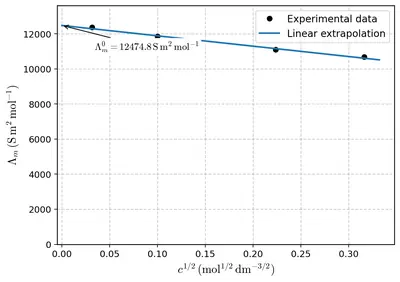
Calculate $$\Lambda_m$$ for all concentrations and draw a plot between $$\Lambda_m$$ and $$c^{1/2}$$. Find the value of $$\Lambda^{0}_m$$.

Figure
Figure

Solution

Molar conductivity is $$\Lambda_m = \dfrac{\kappa}{c}$$. Working in SI units, $$\kappa$$ is in $$\mathrm{S\,m^{-1}}$$ and $$c$$ in $$\mathrm{mol\,m^{-3}}$$ (note $$1\,\mathrm{M} = 1000\,\mathrm{mol\,m^{-3}}$$); the result in $$\mathrm{S\,m^{2}\,mol^{-1}}$$ is converted to $$\mathrm{S\,cm^{2}\,mol^{-1}}$$ on multiplying by $$10^{4}$$.

The table gives $$10^{2}\times\kappa$$, so the actual conductivity is the tabulated value divided by 100. For example, at $$c = 0.001\,\mathrm{M}$$:

$$\kappa = 1.237\times10^{-2}\,\mathrm{S\,m^{-1}}, \quad c = 1\,\mathrm{mol\,m^{-3}}$$

$$\Lambda_m = \frac{1.237\times10^{-2}}{1} = 1.237\times10^{-2}\,\mathrm{S\,m^{2}\,mol^{-1}} = 123.7\,\mathrm{S\,cm^{2}\,mol^{-1}}$$

Repeating for every concentration:

$$c/\mathrm{M}$$$$\kappa/\mathrm{S\,m^{-1}}$$$$c^{1/2}/\mathrm{M^{1/2}}$$$$\Lambda_m/\mathrm{S\,cm^{2}\,mol^{-1}}$$
0.0010.012370.0316123.7
0.0100.11850.1000118.5
0.0200.23150.1414115.8
0.0500.55530.2236111.1
0.1001.06740.3162106.7

When $$\Lambda_m$$ (y-axis) is plotted against $$c^{1/2}$$ (x-axis), the points fall close to a straight line, as expected for the strong electrolyte NaCl which obeys $$\Lambda_m = \Lambda^{0}_m - A\,c^{1/2}$$.

Extrapolating the straight line to $$c^{1/2} = 0$$ gives the intercept

$$\Lambda^{0}_m \approx 124\,\mathrm{S\,cm^{2}\,mol^{-1}}$$

(close to the accepted value $$126.4\,\mathrm{S\,cm^{2}\,mol^{-1}}$$ for sodium chloride).

Answer

$$\Lambda_m$$ = 123.7, 118.5, 115.8, 111.1, 106.7 $$\mathrm{S\,cm^{2}\,mol^{-1}}$$ at $$c$$ = 0.001, 0.010, 0.020, 0.050, 0.100 M respectively; extrapolating the $$\Lambda_m$$ vs $$c^{1/2}$$ line gives $$\Lambda^{0}_m \approx 124\,\mathrm{S\,cm^{2}\,mol^{-1}}$$.

2.11 Conductivity of $$0.00241\,\mathrm{M}$$ acetic acid is $$7.896 \times 10^{-5}\,\mathrm{S\,cm^{-1}}$$. Calculate its molar conductivity. If $$\Lambda^{0}_m$$ for acetic acid is $$390.5\,\mathrm{S\,cm^{2}\,mol^{-1}}$$, what is its dissociation constant?

Solution

Molar conductivity.

$$\Lambda_m = \frac{\kappa \times 1000}{c} = \frac{7.896\times10^{-5}\,\mathrm{S\,cm^{-1}} \times 1000\,\mathrm{cm^{3}\,L^{-1}}}{0.00241\,\mathrm{mol\,L^{-1}}}$$

$$\Lambda_m = \frac{0.07896}{0.00241} = 32.76\,\mathrm{S\,cm^{2}\,mol^{-1}}$$

Degree of dissociation.

$$\alpha = \frac{\Lambda_m}{\Lambda^{0}_m} = \frac{32.76}{390.5} = 0.0839$$

Dissociation constant. For $$\mathrm{CH_3COOH \rightleftharpoons H^{+} + CH_3COO^{-}}$$ with $$c = 0.00241\,\mathrm{mol\,L^{-1}}$$:

$$K_a = \frac{c\,\alpha^{2}}{1-\alpha} = \frac{0.00241 \times (0.0839)^{2}}{1-0.0839}$$

$$K_a = \frac{0.00241 \times 0.007039}{0.9161} = 1.85\times10^{-5}$$

Answer

$$\Lambda_m = 32.76\,\mathrm{S\,cm^{2}\,mol^{-1}}$$; $$\;\alpha = 0.084$$; $$\;K_a = 1.85\times10^{-5}$$

2.12 How much charge is required for the following reductions:

(i) $$1\,\mathrm{mol}$$ of $$\mathrm{Al^{3+}}$$ to Al?

Solution

The reduction half-reaction is

$$\mathrm{Al^{3+} + 3e^{-} \rightarrow Al}$$

so reducing $$1\,\mathrm{mol}$$ of $$\mathrm{Al^{3+}}$$ requires $$3\,\mathrm{mol}$$ of electrons, i.e. $$3\,F$$ of charge.

$$Q = 3 \times F = 3 \times 96487\,\mathrm{C} = 289461\,\mathrm{C} \approx 2.89\times10^{5}\,\mathrm{C}$$

Answer

$$Q = 3F = 289461\,\mathrm{C} \approx 2.89\times10^{5}\,\mathrm{C}$$

(ii) $$1\,\mathrm{mol}$$ of $$\mathrm{Cu^{2+}}$$ to Cu?

Solution

The reduction half-reaction is

$$\mathrm{Cu^{2+} + 2e^{-} \rightarrow Cu}$$

so reducing $$1\,\mathrm{mol}$$ of $$\mathrm{Cu^{2+}}$$ requires $$2\,\mathrm{mol}$$ of electrons, i.e. $$2\,F$$ of charge.

$$Q = 2 \times F = 2 \times 96487\,\mathrm{C} = 192974\,\mathrm{C} \approx 1.93\times10^{5}\,\mathrm{C}$$

Answer

$$Q = 2F = 192974\,\mathrm{C} \approx 1.93\times10^{5}\,\mathrm{C}$$

(iii) $$1\,\mathrm{mol}$$ of $$\mathrm{MnO_4^{-}}$$ to $$\mathrm{Mn^{2+}}$$?

Solution

In $$\mathrm{MnO_4^{-}}$$ manganese is in the $$+7$$ oxidation state; in $$\mathrm{Mn^{2+}}$$ it is $$+2$$. The reduction therefore involves a gain of $$5$$ electrons per manganese:

$$\mathrm{MnO_4^{-} + 8H^{+} + 5e^{-} \rightarrow Mn^{2+} + 4H_2O}$$

So reducing $$1\,\mathrm{mol}$$ of $$\mathrm{MnO_4^{-}}$$ requires $$5\,\mathrm{mol}$$ of electrons, i.e. $$5\,F$$ of charge.

$$Q = 5 \times F = 5 \times 96487\,\mathrm{C} = 482435\,\mathrm{C} \approx 4.82\times10^{5}\,\mathrm{C}$$

Answer

$$Q = 5F = 482435\,\mathrm{C} \approx 4.82\times10^{5}\,\mathrm{C}$$

2.13 How much electricity in terms of Faraday is required to produce

(i) $$20.0\,\mathrm{g}$$ of Ca from molten $$\mathrm{CaCl_2}$$?

Solution

The cathode reaction is $$\mathrm{Ca^{2+} + 2e^{-} \rightarrow Ca}$$, so depositing $$1\,\mathrm{mol}$$ of calcium ($$40\,\mathrm{g}$$) needs $$2\,F$$ of electricity.

Moles of calcium (molar mass of Ca $$= 40\,\mathrm{g\,mol^{-1}}$$):

$$n_{\mathrm{Ca}} = \frac{20.0\,\mathrm{g}}{40\,\mathrm{g\,mol^{-1}}} = 0.5\,\mathrm{mol}$$

Electricity required:

$$= n_{\mathrm{Ca}} \times 2\,F = 0.5 \times 2\,F = 1\,F$$

Answer

$$1\,F$$ (= 96487 C)

(ii) $$40.0\,\mathrm{g}$$ of Al from molten $$\mathrm{Al_2O_3}$$?

Solution

The cathode reaction is $$\mathrm{Al^{3+} + 3e^{-} \rightarrow Al}$$, so depositing $$1\,\mathrm{mol}$$ of aluminium ($$27\,\mathrm{g}$$) needs $$3\,F$$ of electricity.

Moles of aluminium (molar mass of Al $$= 27\,\mathrm{g\,mol^{-1}}$$):

$$n_{\mathrm{Al}} = \frac{40.0\,\mathrm{g}}{27\,\mathrm{g\,mol^{-1}}} = 1.48\,\mathrm{mol}$$

Electricity required:

$$= n_{\mathrm{Al}} \times 3\,F = 1.48 \times 3\,F = 4.44\,F$$

Answer

$$4.44\,F$$

2.14 How much electricity is required in coulomb for the oxidation of

(i) $$1\,\mathrm{mol}$$ of $$\mathrm{H_2O}$$ to $$\mathrm{O_2}$$?

Solution

The oxidation of water to oxygen is

$$\mathrm{2H_2O \rightarrow O_2 + 4H^{+} + 4e^{-}}$$

Here $$2\,\mathrm{mol}$$ of $$\mathrm{H_2O}$$ release $$4\,\mathrm{mol}$$ of electrons, so $$1\,\mathrm{mol}$$ of $$\mathrm{H_2O}$$ releases $$2\,\mathrm{mol}$$ of electrons.

$$Q = 2 \times F = 2 \times 96487\,\mathrm{C} = 192974\,\mathrm{C} \approx 1.93\times10^{5}\,\mathrm{C}$$

Answer

$$Q = 2F = 192974\,\mathrm{C} \approx 1.93\times10^{5}\,\mathrm{C}$$

(ii) $$1\,\mathrm{mol}$$ of FeO to $$\mathrm{Fe_2O_3}$$?

Solution

In FeO iron is in the $$+2$$ oxidation state; in $$\mathrm{Fe_2O_3}$$ it is $$+3$$. So each iron atom loses one electron:

$$\mathrm{Fe^{2+} \rightarrow Fe^{3+} + e^{-}}$$

(overall $$\mathrm{2FeO + \tfrac{1}{2}O_2 \rightarrow Fe_2O_3}$$). Therefore $$1\,\mathrm{mol}$$ of FeO loses $$1\,\mathrm{mol}$$ of electrons.

$$Q = 1 \times F = 96487\,\mathrm{C} \approx 9.65\times10^{4}\,\mathrm{C}$$

Answer

$$Q = 1F = 96487\,\mathrm{C} \approx 9.65\times10^{4}\,\mathrm{C}$$

2.15 A solution of $$\mathrm{Ni(NO_3)_2}$$ is electrolysed between platinum electrodes using a current of $$5\,\mathrm{amperes}$$ for $$20\,\mathrm{minutes}$$. What mass of Ni is deposited at the cathode?

Solution

Quantity of charge passed. With $$t = 20\,\mathrm{min} = 1200\,\mathrm{s}$$:

$$Q = I \times t = 5\,\mathrm{A} \times 1200\,\mathrm{s} = 6000\,\mathrm{C}$$

Cathode reaction.

$$\mathrm{Ni^{2+}(aq) + 2e^{-} \rightarrow Ni(s)}$$

So $$2F = 2 \times 96487\,\mathrm{C}$$ deposit $$1\,\mathrm{mol}$$ of nickel ($$58.7\,\mathrm{g}$$).

Mass of nickel deposited.

$$m = \frac{58.7\,\mathrm{g\,mol^{-1}} \times 6000\,\mathrm{C}}{2 \times 96487\,\mathrm{C\,mol^{-1}}} = \frac{352200}{192974} = 1.825\,\mathrm{g}$$

Answer

$$m_{\mathrm{Ni}} = 1.825\,\mathrm{g}$$

2.16 Three electrolytic cells A, B, C containing solutions of $$\mathrm{ZnSO_4}$$, $$\mathrm{AgNO_3}$$ and $$\mathrm{CuSO_4}$$, respectively are connected in series. A steady current of $$1.5\,\mathrm{amperes}$$ was passed through them until $$1.45\,\mathrm{g}$$ of silver deposited at the cathode of cell B. How long did the current flow? What mass of copper and zinc were deposited?

Solution

Because the three cells are connected in series, the same quantity of charge passes through each of them.

Charge from the silver data (cell B). The cathode reaction is $$\mathrm{Ag^{+} + e^{-} \rightarrow Ag}$$, so $$1\,F$$ deposits $$1\,\mathrm{mol}$$ of silver ($$108\,\mathrm{g}$$).

$$n_{\mathrm{Ag}} = \frac{1.45\,\mathrm{g}}{108\,\mathrm{g\,mol^{-1}}} = 0.01343\,\mathrm{mol}$$

$$Q = n_{\mathrm{Ag}} \times F = 0.01343 \times 96487 = 1295.5\,\mathrm{C}$$

Time of current flow.

$$t = \frac{Q}{I} = \frac{1295.5\,\mathrm{C}}{1.5\,\mathrm{A}} = 863.7\,\mathrm{s} \approx 14.4\,\mathrm{min}$$

Mass of copper (cell C). The reaction $$\mathrm{Cu^{2+} + 2e^{-} \rightarrow Cu}$$ means $$2F$$ deposit $$1\,\mathrm{mol}$$ Cu ($$63.5\,\mathrm{g}$$):

$$m_{\mathrm{Cu}} = \frac{63.5 \times 1295.5}{2 \times 96487} = 0.426\,\mathrm{g}$$

Mass of zinc (cell A). The reaction $$\mathrm{Zn^{2+} + 2e^{-} \rightarrow Zn}$$ means $$2F$$ deposit $$1\,\mathrm{mol}$$ Zn ($$65.4\,\mathrm{g}$$):

$$m_{\mathrm{Zn}} = \frac{65.4 \times 1295.5}{2 \times 96487} = 0.439\,\mathrm{g}$$

Answer

Current flowed for $$t \approx 863.7\,\mathrm{s}\;(\approx 14.4\,\mathrm{min})$$; $$\;m_{\mathrm{Cu}} \approx 0.426\,\mathrm{g}$$; $$\;m_{\mathrm{Zn}} \approx 0.439\,\mathrm{g}$$.

2.17 Using the standard electrode potentials given in Table 3.1, predict if the reaction between the following is feasible:

(i) $$\mathrm{Fe^{3+}(aq)}$$ and $$\mathrm{I^{-}(aq)}$$

Solution

A reaction is feasible (spontaneous) if the standard cell potential is positive, $$E^{\circ}_{(\mathrm{cell})} > 0$$, with the species being reduced acting as cathode and the species being oxidised as anode.

If $$\mathrm{Fe^{3+}}$$ oxidises $$\mathrm{I^{-}}$$:

$$\mathrm{2Fe^{3+}(aq) + 2I^{-}(aq) \rightarrow 2Fe^{2+}(aq) + I_2(s)}$$

Cathode: $$\mathrm{Fe^{3+}/Fe^{2+}}$$, $$E^{\circ} = 0.77\,\mathrm{V}$$; anode: $$\mathrm{I_2/I^{-}}$$, $$E^{\circ} = 0.54\,\mathrm{V}$$.

$$E^{\circ}_{(\mathrm{cell})} = 0.77 - 0.54 = +0.23\,\mathrm{V}$$

Since $$E^{\circ}_{(\mathrm{cell})} > 0$$, the reaction is feasible.

Answer

Feasible — $$E^{\circ}_{(\mathrm{cell})} = +0.23\,\mathrm{V} > 0$$.

(ii) $$\mathrm{Ag^{+}(aq)}$$ and $$\mathrm{Cu(s)}$$

Solution

If $$\mathrm{Ag^{+}}$$ oxidises copper metal:

$$\mathrm{2Ag^{+}(aq) + Cu(s) \rightarrow 2Ag(s) + Cu^{2+}(aq)}$$

Cathode: $$\mathrm{Ag^{+}/Ag}$$, $$E^{\circ} = 0.80\,\mathrm{V}$$; anode: $$\mathrm{Cu^{2+}/Cu}$$, $$E^{\circ} = 0.34\,\mathrm{V}$$.

$$E^{\circ}_{(\mathrm{cell})} = E^{\circ}_{\mathrm{cathode}} - E^{\circ}_{\mathrm{anode}} = 0.80 - 0.34 = +0.46\,\mathrm{V}$$

Since $$E^{\circ}_{(\mathrm{cell})} > 0$$, the reaction is feasible.

Answer

Feasible — $$E^{\circ}_{(\mathrm{cell})} = +0.46\,\mathrm{V} > 0$$.

(iii) $$\mathrm{Fe^{3+}(aq)}$$ and $$\mathrm{Br^{-}(aq)}$$

Solution

If $$\mathrm{Fe^{3+}}$$ were to oxidise $$\mathrm{Br^{-}}$$:

$$\mathrm{2Fe^{3+}(aq) + 2Br^{-}(aq) \rightarrow 2Fe^{2+}(aq) + Br_2(l)}$$

Cathode: $$\mathrm{Fe^{3+}/Fe^{2+}}$$, $$E^{\circ} = 0.77\,\mathrm{V}$$; anode: $$\mathrm{Br_2/Br^{-}}$$, $$E^{\circ} = 1.09\,\mathrm{V}$$.

$$E^{\circ}_{(\mathrm{cell})} = 0.77 - 1.09 = -0.32\,\mathrm{V}$$

Since $$E^{\circ}_{(\mathrm{cell})} < 0$$, the reaction is not feasible. ($$\mathrm{Fe^{3+}}$$ cannot oxidise $$\mathrm{Br^{-}}$$; rather $$\mathrm{Br_2}$$ oxidises $$\mathrm{Fe^{2+}}$$.)

Answer

Not feasible — $$E^{\circ}_{(\mathrm{cell})} = -0.32\,\mathrm{V} < 0$$.

(iv) $$\mathrm{Ag(s)}$$ and $$\mathrm{Fe^{3+}(aq)}$$

Solution

If $$\mathrm{Fe^{3+}}$$ were to oxidise silver metal:

$$\mathrm{Ag(s) + Fe^{3+}(aq) \rightarrow Ag^{+}(aq) + Fe^{2+}(aq)}$$

Cathode: $$\mathrm{Fe^{3+}/Fe^{2+}}$$, $$E^{\circ} = 0.77\,\mathrm{V}$$; anode: $$\mathrm{Ag^{+}/Ag}$$, $$E^{\circ} = 0.80\,\mathrm{V}$$.

$$E^{\circ}_{(\mathrm{cell})} = 0.77 - 0.80 = -0.03\,\mathrm{V}$$

Since $$E^{\circ}_{(\mathrm{cell})} < 0$$, the reaction is not feasible.

Answer

Not feasible — $$E^{\circ}_{(\mathrm{cell})} = -0.03\,\mathrm{V} < 0$$.

(v) $$\mathrm{Br_2(aq)}$$ and $$\mathrm{Fe^{2+}(aq)}$$.

Solution

If $$\mathrm{Br_2}$$ oxidises $$\mathrm{Fe^{2+}}$$:

$$\mathrm{Br_2(aq) + 2Fe^{2+}(aq) \rightarrow 2Br^{-}(aq) + 2Fe^{3+}(aq)}$$

Cathode: $$\mathrm{Br_2/Br^{-}}$$, $$E^{\circ} = 1.09\,\mathrm{V}$$; anode: $$\mathrm{Fe^{3+}/Fe^{2+}}$$, $$E^{\circ} = 0.77\,\mathrm{V}$$.

$$E^{\circ}_{(\mathrm{cell})} = 1.09 - 0.77 = +0.32\,\mathrm{V}$$

Since $$E^{\circ}_{(\mathrm{cell})} > 0$$, the reaction is feasible.

Answer

Feasible — $$E^{\circ}_{(\mathrm{cell})} = +0.32\,\mathrm{V} > 0$$.

2.18 Predict the products of electrolysis in each of the following:

(i) An aqueous solution of $$\mathrm{AgNO_3}$$ with silver electrodes.

Solution

In aqueous $$\mathrm{AgNO_3}$$ the species present are $$\mathrm{Ag^{+}}$$ and $$\mathrm{NO_3^{-}}$$ ions, together with $$\mathrm{H^{+}}$$ and $$\mathrm{OH^{-}}$$ from water.

At the cathode, $$\mathrm{Ag^{+}}$$ and $$\mathrm{H^{+}}$$ compete for reduction; $$\mathrm{Ag^{+}}$$ has the higher reduction potential, so silver is deposited:

$$\mathrm{Ag^{+}(aq) + e^{-} \rightarrow Ag(s)}$$

At the anode the silver electrode is reactive (attackable). Rather than oxidising water or $$\mathrm{NO_3^{-}}$$, the silver of the anode itself dissolves:

$$\mathrm{Ag(s) \rightarrow Ag^{+}(aq) + e^{-}}$$

Net effect: silver dissolves from the anode and an equal amount of silver is deposited on the cathode (the principle of electroplating/electro-refining).

Answer

Cathode: silver deposited ($$\mathrm{Ag^{+} + e^{-} \rightarrow Ag}$$); Anode: the silver electrode dissolves ($$\mathrm{Ag \rightarrow Ag^{+} + e^{-}}$$).

(ii) An aqueous solution of $$\mathrm{AgNO_3}$$ with platinum electrodes.

Solution

At the cathode, as in part (i), $$\mathrm{Ag^{+}}$$ is preferentially reduced over $$\mathrm{H^{+}}$$:

$$\mathrm{Ag^{+}(aq) + e^{-} \rightarrow Ag(s)}$$

At the anode, platinum is inert (unattackable), so the electrode itself does not dissolve. The possible oxidations are of water and of $$\mathrm{NO_3^{-}}$$. Water is oxidised much more easily ($$\mathrm{NO_3^{-}}$$ is not oxidised further), so oxygen gas is liberated:

$$\mathrm{2H_2O(l) \rightarrow O_2(g) + 4H^{+}(aq) + 4e^{-}}$$

Products: silver is deposited at the cathode and oxygen gas is evolved at the anode.

Answer

Cathode: silver deposited; Anode: oxygen gas evolved ($$\mathrm{2H_2O \rightarrow O_2 + 4H^{+} + 4e^{-}}$$).

(iii) A dilute solution of $$\mathrm{H_2SO_4}$$ with platinum electrodes.

Solution

Dilute $$\mathrm{H_2SO_4}$$ furnishes $$\mathrm{H^{+}}$$ and $$\mathrm{SO_4^{2-}}$$ ions, with water also present.

At the cathode, $$\mathrm{H^{+}}$$ ions are reduced to hydrogen gas:

$$\mathrm{2H^{+}(aq) + 2e^{-} \rightarrow H_2(g)}$$

At the anode (inert Pt), the two possible oxidations are of water ($$E^{\circ} = +1.23\,\mathrm{V}$$) and of $$\mathrm{SO_4^{2-}}$$ to peroxodisulphate $$\mathrm{S_2O_8^{2-}}$$ ($$E^{\circ} = +1.96\,\mathrm{V}$$). For dilute sulphuric acid the process with the lower potential is preferred, so water is oxidised to oxygen:

$$\mathrm{2H_2O(l) \rightarrow O_2(g) + 4H^{+}(aq) + 4e^{-}}$$

Net result: this is essentially the electrolysis of water — hydrogen at the cathode and oxygen at the anode.

Answer

Cathode: $$\mathrm{H_2}$$ gas; Anode: $$\mathrm{O_2}$$ gas — effectively the electrolysis of water.

(iv) An aqueous solution of $$\mathrm{CuCl_2}$$ with platinum electrodes.

Solution

Aqueous $$\mathrm{CuCl_2}$$ furnishes $$\mathrm{Cu^{2+}}$$ and $$\mathrm{Cl^{-}}$$ ions, with water also present.

At the cathode, $$\mathrm{Cu^{2+}}$$ has a higher reduction potential than $$\mathrm{H^{+}}$$, so copper is deposited:

$$\mathrm{Cu^{2+}(aq) + 2e^{-} \rightarrow Cu(s)}$$

At the anode (inert Pt), although the oxidation of water has a lower potential than that of $$\mathrm{Cl^{-}}$$, the oxygen-evolution reaction occurs only slowly and needs a large extra voltage (overpotential). Consequently $$\mathrm{Cl^{-}}$$ is discharged in preference to water, and chlorine gas is liberated:

$$\mathrm{2Cl^{-}(aq) \rightarrow Cl_2(g) + 2e^{-}}$$

Products: copper is deposited at the cathode and chlorine gas is evolved at the anode.

Answer

Cathode: copper deposited ($$\mathrm{Cu^{2+} + 2e^{-} \rightarrow Cu}$$); Anode: chlorine gas evolved ($$\mathrm{2Cl^{-} \rightarrow Cl_2 + 2e^{-}}$$).
NCERT Solutions for Class 12
Maths
NCERT Solutions for Class 12 Maths
Chapter-wise step-by-step
solutions with explanations
explore solutions Maths bg
Physics
NCERT Solutions for Class 12 Physics
Chapter-wise step-by-step
solutions with explanations
explore solutions Physics bg
Chemistry
NCERT Solutions for Class 12 Chemistry
Chapter-wise step-by-step
solutions with explanations
explore solutions Chemistry bg

Frequently Asked Questions

50,000+ JEE Students Trusted Our Score Calculator

Predict your JEE Main percentile, rank & performance in seconds